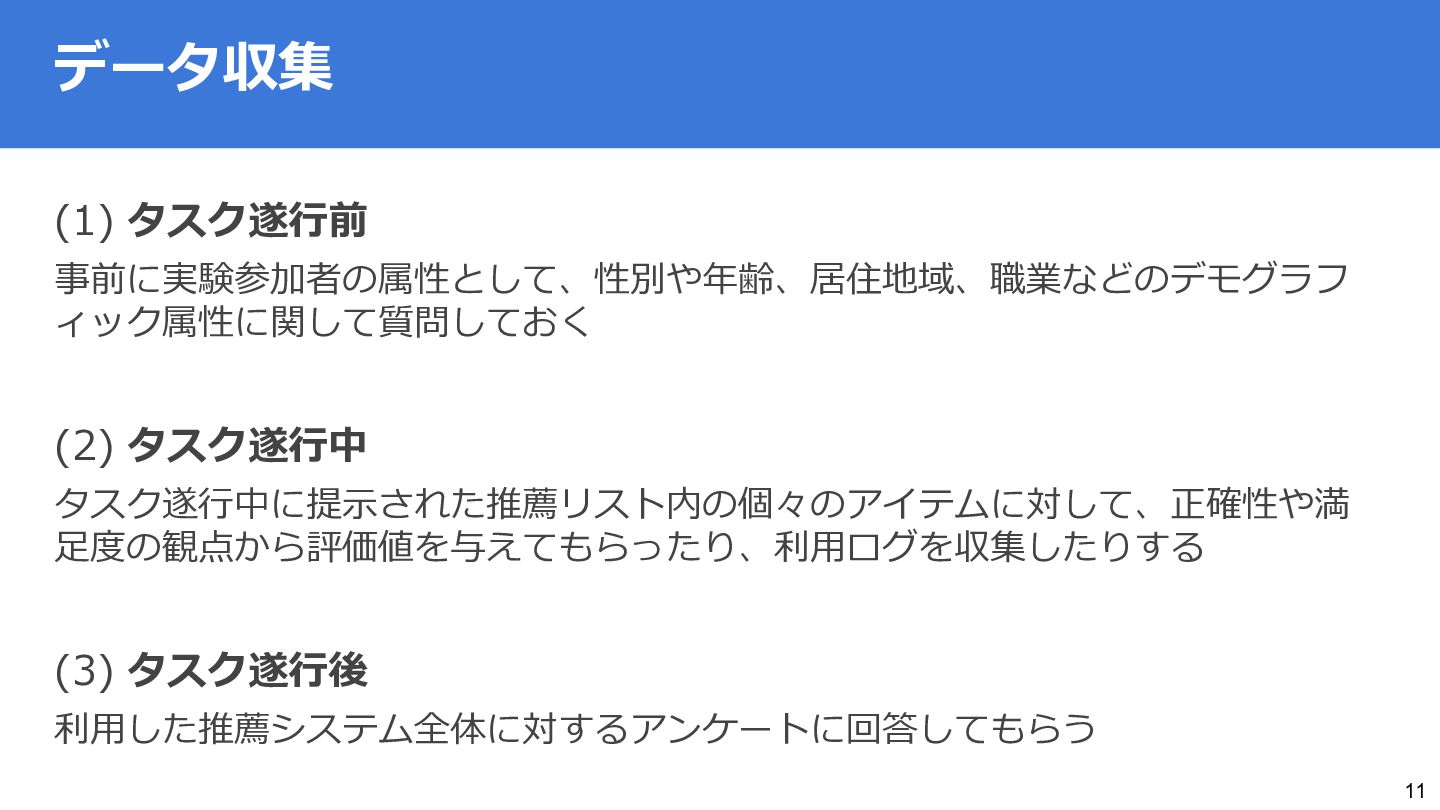
Male / Female 2 Please select your age group: -20 / 21-30 / 31-40 / 41-50 / 51-60 / 61- 3 Please fill in your nationality: 4 Which country do you reside in? 5 How long have you stayed in your residence country? 6 Please fill in your profession: 7 Please select your education level: Primary School / High School / College / Graduate School 8 How would you rate yourself as a computer user? No experience / Beginner / Average / Advanced 9 How frequently have you used the Internet? Never / Very infrequently (just a few times overall) / Infrequently (a few times a month) / Moderately (1-3 times a week) / Regularly (daily/almost daily) 10 Please list the recommender sites that you have used and frequency of usages. 11 Do you tend to trust a person/thing, even though you have little knowledge of it? Very probably not / Probably not / Probably / Very Probably / Definitely 12 Please fill in your email address if you want to be eligible for the prizes and receive information about the outcome of the survey. [Pu+2011] P. Pu et al.: A user-centric evaluation framework for recommender systems, RecSys2011, 157–164, 2011.
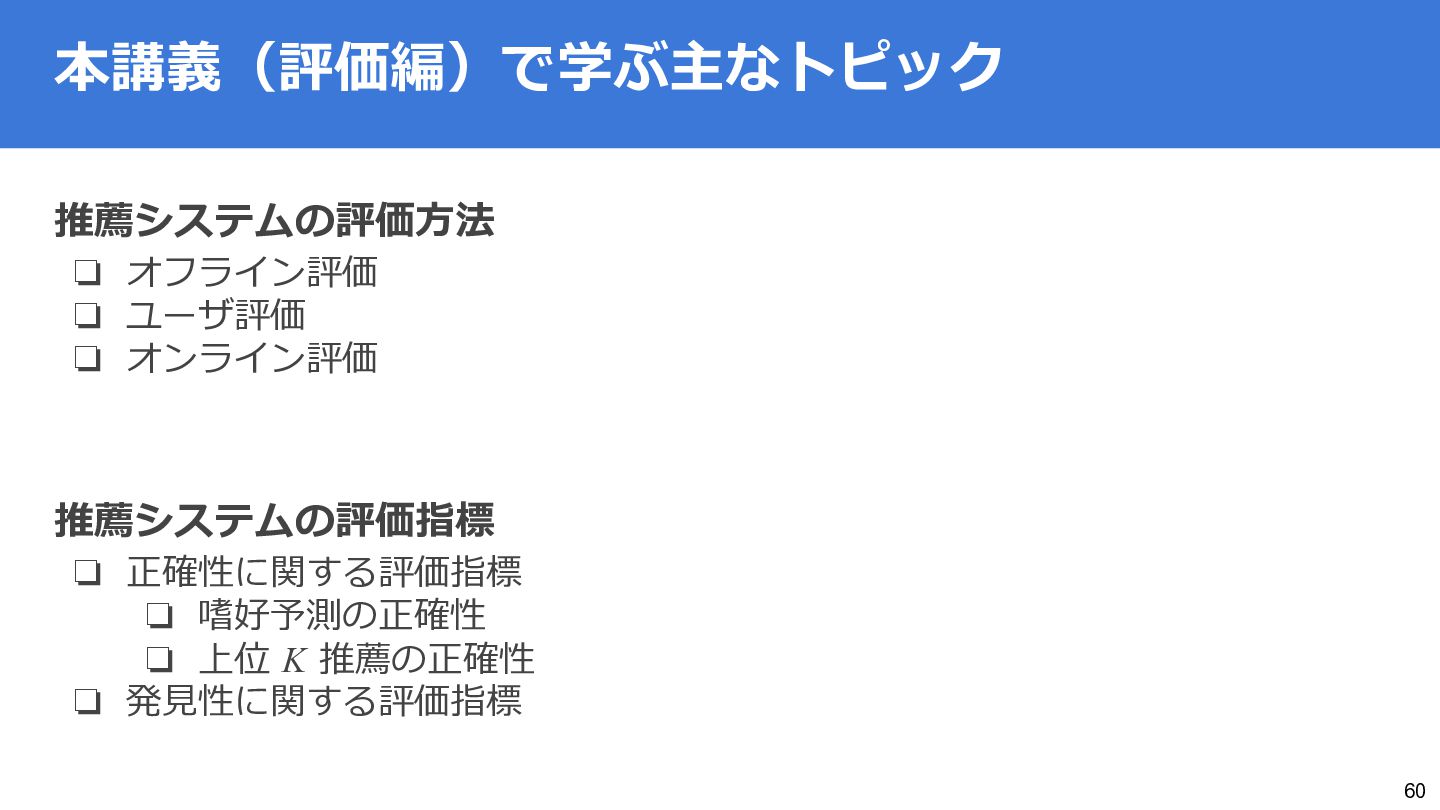
Charu C. Aggarwal: “Recommender Systems: The Textbook”, Springer, 2016. ❏ B.P. Knijnenburg et al.: Evaluating Recommender Systems with User Experiments, Recommender Systems Handbook, 2nd ed., Springer. 309–352, 2015. ❏ 土方嘉徳:推薦システムのオフライン評価手法,人工知能学会誌,29,6,658–689,2014. 推薦システムにおけるセレンディピティに関する最近の議論 ❏ Kotkov, D. et al.: The Dark Matter of Serendipity in Recommender Systems, 108–118, 2024. ❏ Kotkov, D. et al.: Rethinking Serendipity in Recommender Systems, 383–387, 2023. ❏ Smets, A. et al.: Serendipity in Recommender Systems Beyond the Algorithm: A Feature Repository and Experimental Design, 46–66, 2022. 61


 recsyslab
 sansantech
 puhitaku
 mkdev10
 mananyuki
 oracle4engineer
 bgpat
bgpat
 kairim0
 husengs7
 mewuto
 raspython3
 colopl
 furuton
 rocio
rocio
 sarafernandez
 ipullrank
 ks91
ks91
 danielanewman
 axbom
axbom
 akademiya2063
 szymonslowik
 lemiorhan
 katarinadahlin
 soysaucechin


![タスク遂行前の質問例 | ResQUE(短縮版) [Pu+2011] 12 1 Please choose your gender:](https://files.speakerdeck.com/presentations/192a5a7b403246fb97e157961687f055/slide_11.jpg)
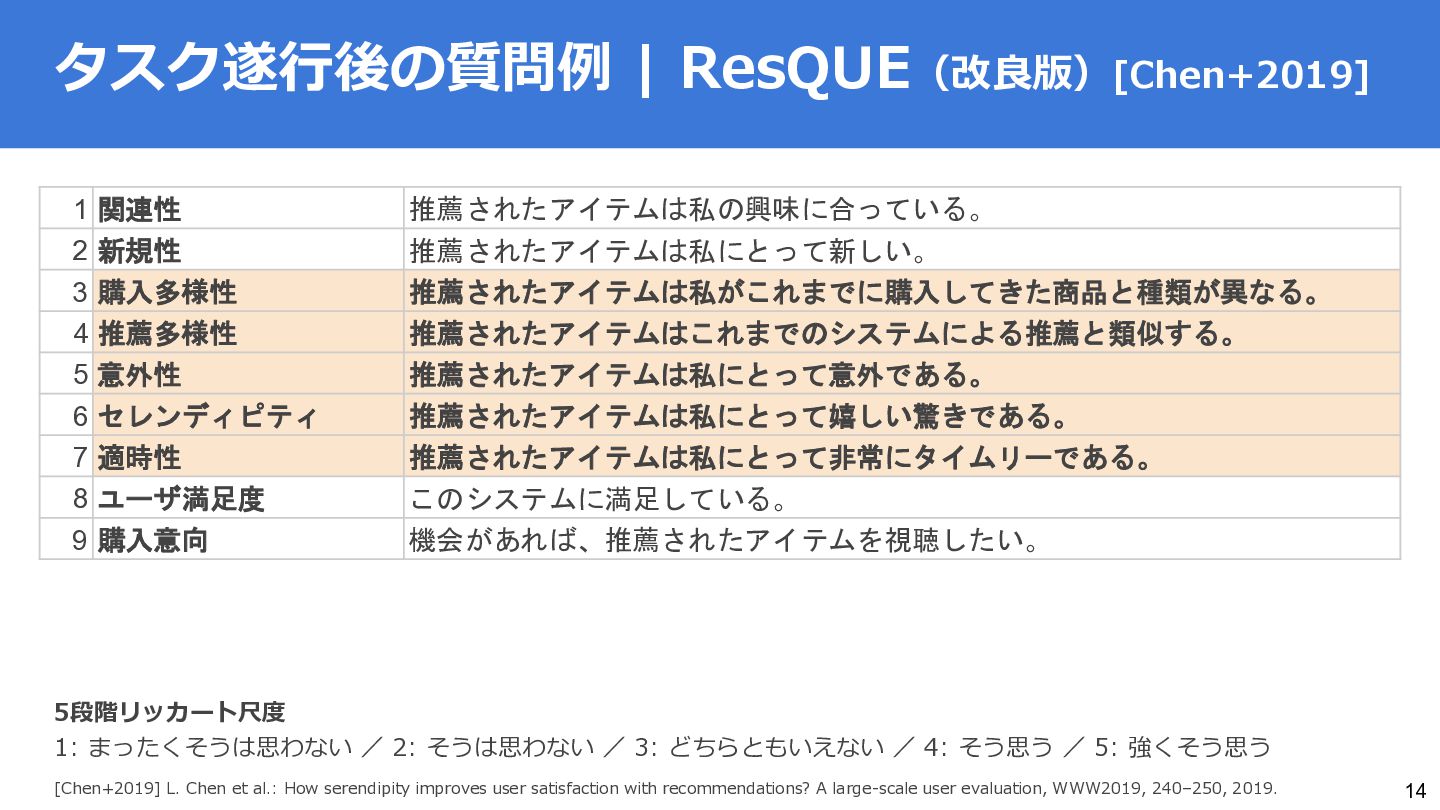
![タスク遂行後の質問例 | ResQUE(短縮版) [Pu+2011] 13 1: まったくそうは思わない / 2: そうは思わない](https://files.speakerdeck.com/presentations/192a5a7b403246fb97e157961687f055/slide_12.jpg)



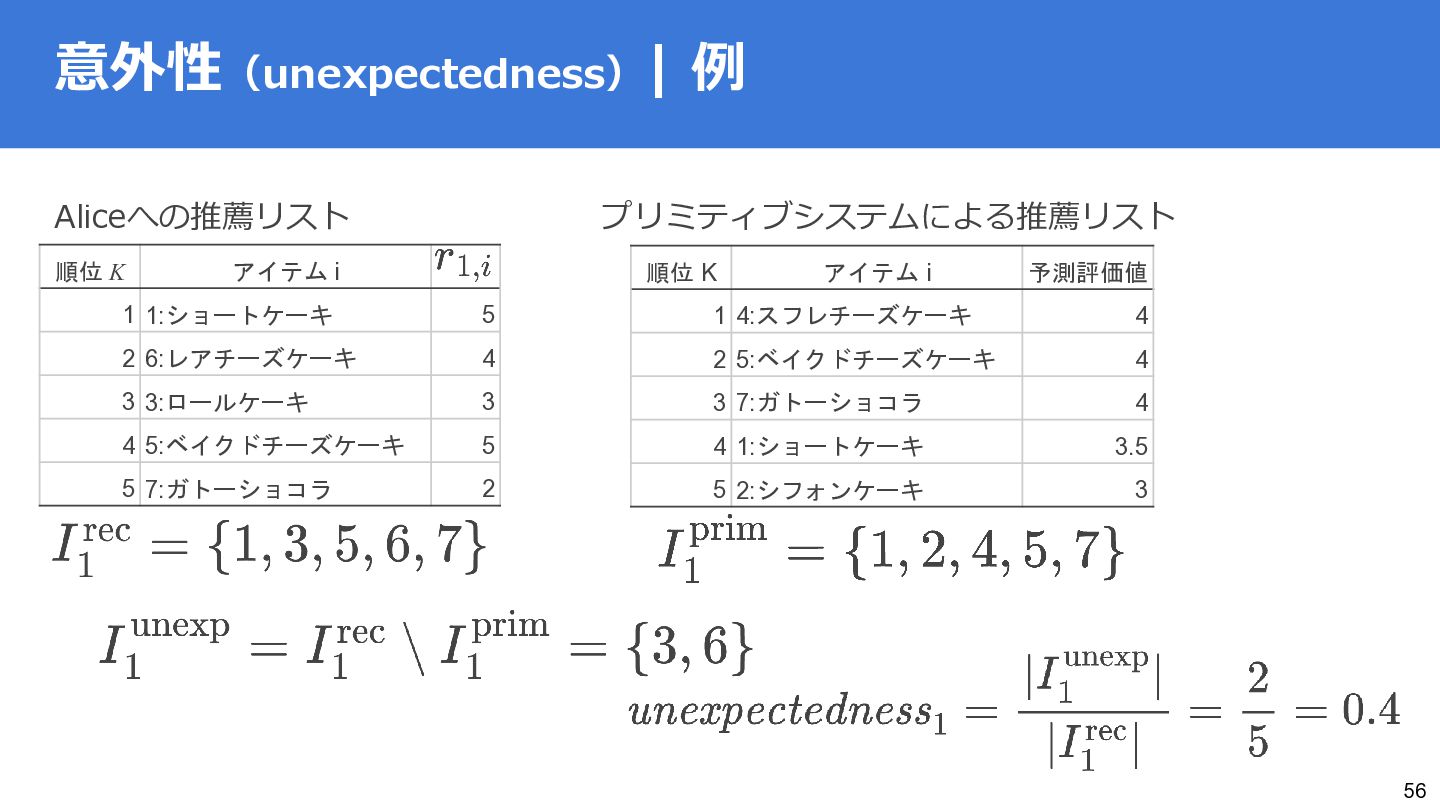
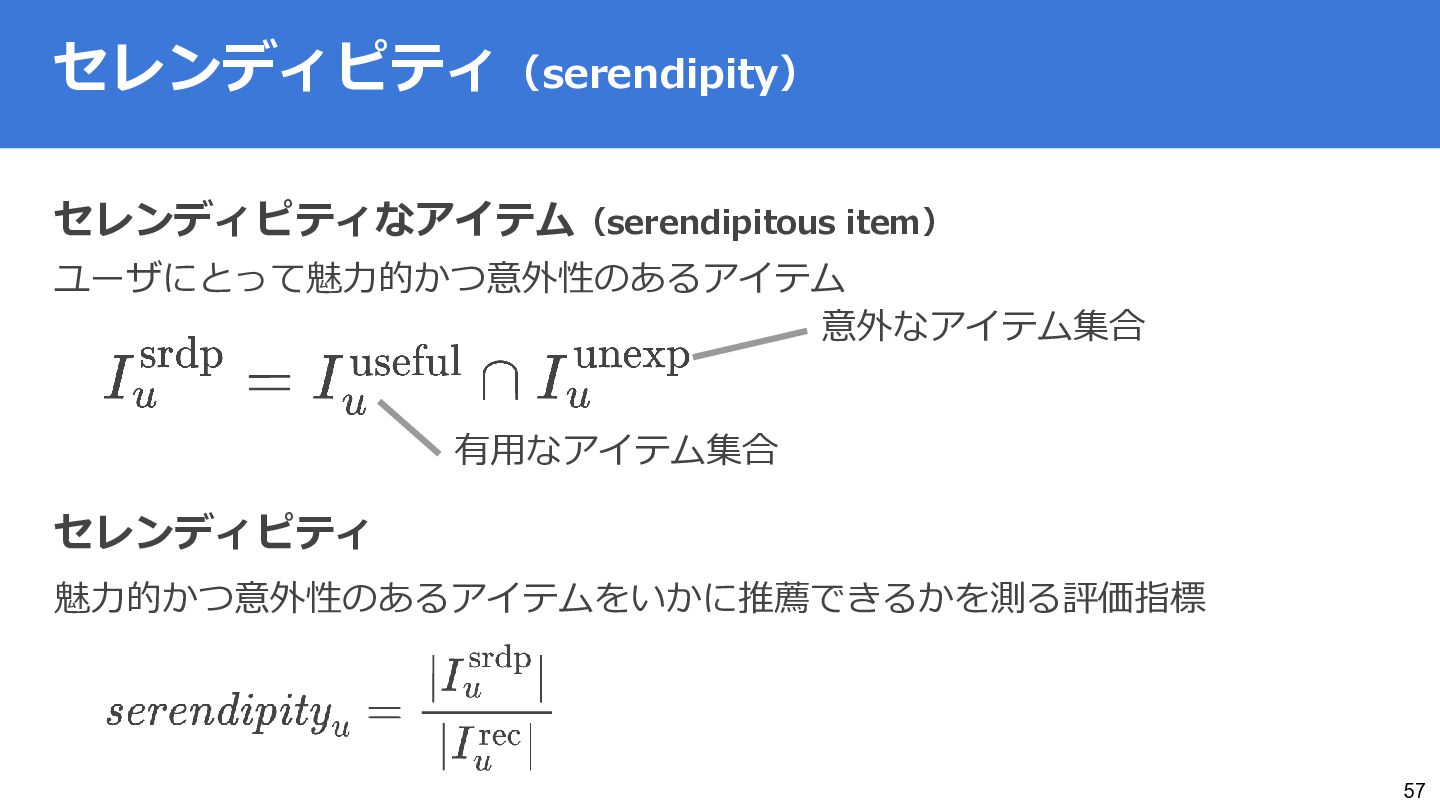
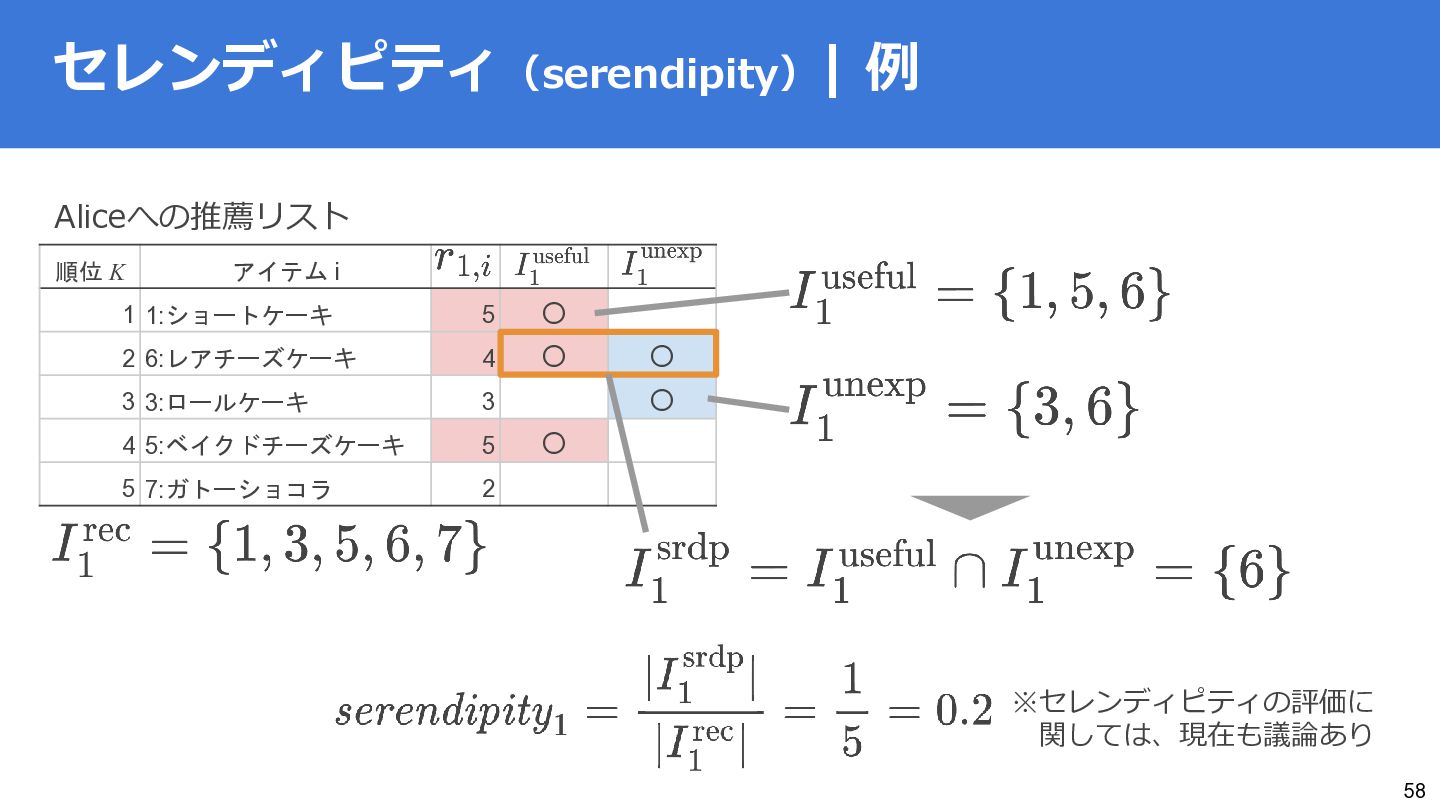
![意外性(unexpectedness)[Ge+2010] プリミティブシステム(人気度や平均評価値に基づく推薦システムなどの原始的な推薦シ ステム)により予測が困難なアイテム 対象とする推薦システムによるアイテム集合 意外なアイテム(unexpected item) プリミティブシステムによるアイテム集合 意外性 意外なアイテムをいかに推薦できるかを測る評価指標 55](https://files.speakerdeck.com/presentations/192a5a7b403246fb97e157961687f055/slide_54.jpg)