Upgrade to Pro — share decks privately, control downloads, hide ads and more …

Full-stack Development Best Practices and Toolsets

Sponsored · Ship Features Fearlessly Turn features on and off without deploys. Used by thousands of Ruby developers. →
Avatar for Reid Lai Reid Lai
September 28, 2017

Full-stack Development Best Practices and Toolsets

This help developer to understand their role in DevOps lifecycle.

Avatar for Reid Lai

Reid Lai

September 28, 2017

More Decks by Reid Lai

Other Decks in Technology

Transcript

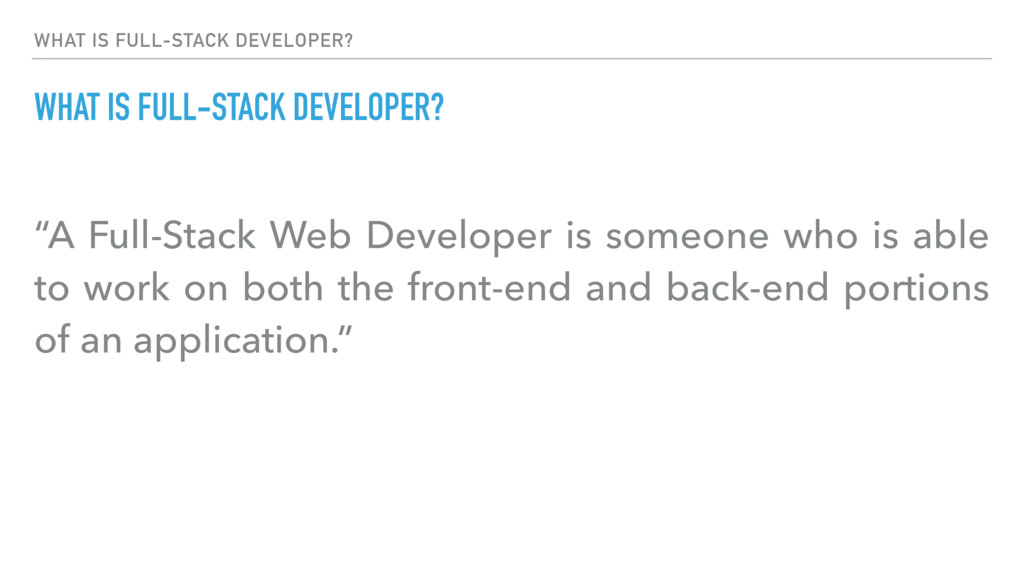
  1. WHAT IS FULL-STACK DEVELOPER? WHAT IS FULL-STACK DEVELOPER? “A Full-Stack

    Web Developer is someone who is able to work on both the front-end and back-end portions of an application.”
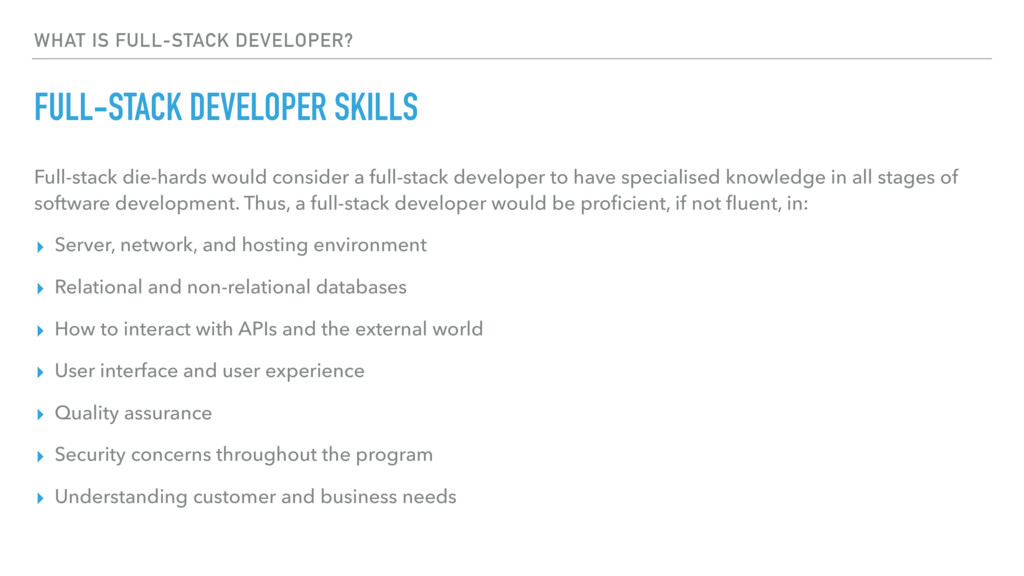
  2. WHAT IS FULL-STACK DEVELOPER? FULL-STACK DEVELOPER SKILLS Full-stack die-hards would

    consider a full-stack developer to have specialised knowledge in all stages of software development. Thus, a full-stack developer would be proficient, if not fluent, in: ▸ Server, network, and hosting environment ▸ Relational and non-relational databases ▸ How to interact with APIs and the external world ▸ User interface and user experience ▸ Quality assurance ▸ Security concerns throughout the program ▸ Understanding customer and business needs
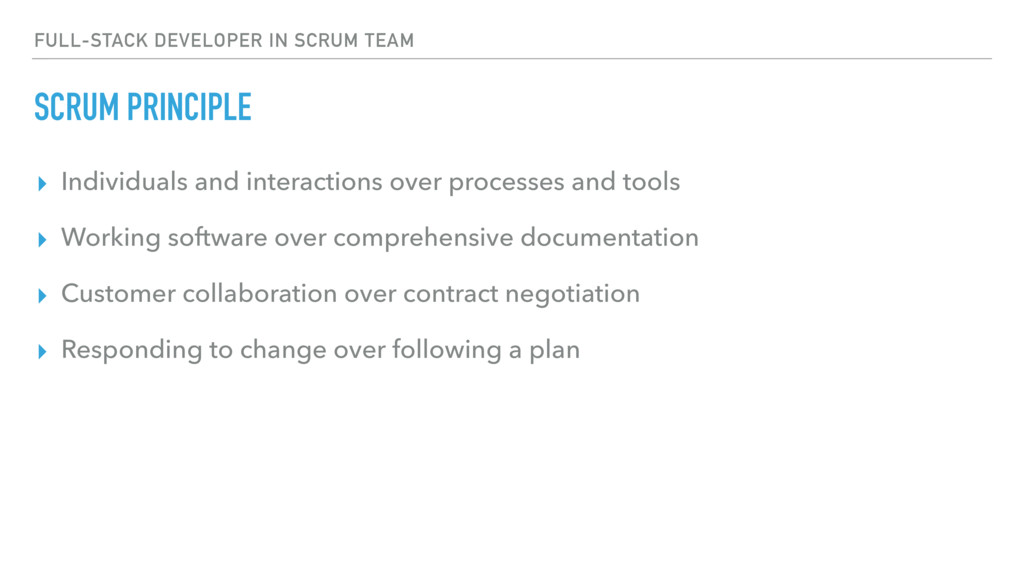
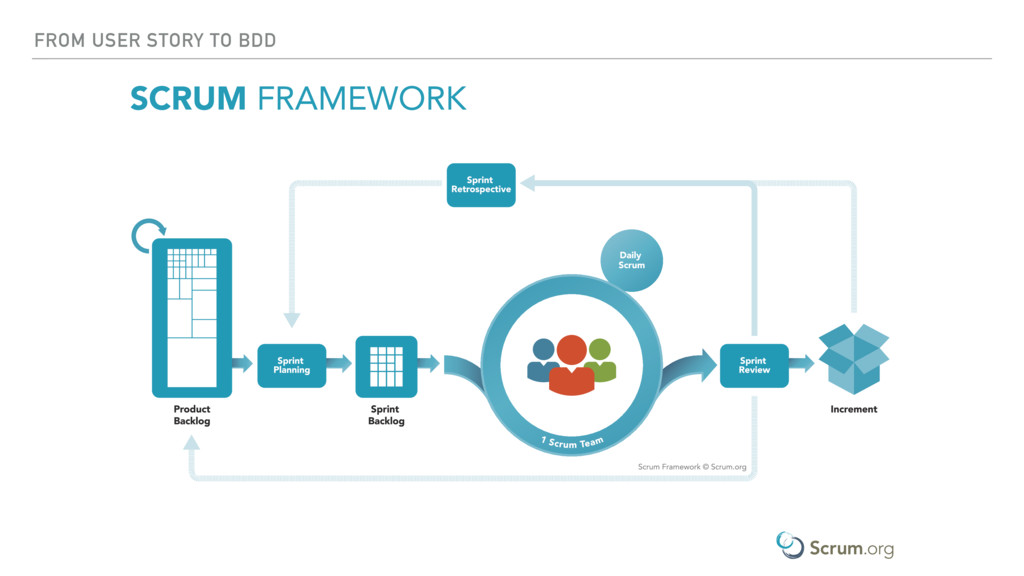
  3. FULL-STACK DEVELOPER IN SCRUM TEAM SCRUM PRINCIPLE ▸ Individuals and

    interactions over processes and tools ▸ Working software over comprehensive documentation ▸ Customer collaboration over contract negotiation ▸ Responding to change over following a plan
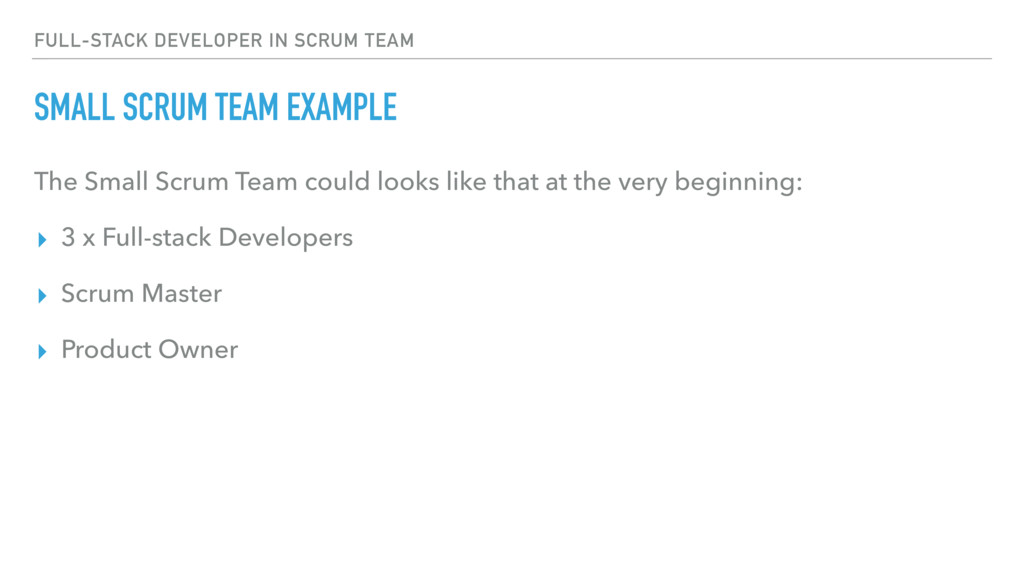
  4. FULL-STACK DEVELOPER IN SCRUM TEAM SMALL SCRUM TEAM EXAMPLE The

    Small Scrum Team could looks like that at the very beginning: ▸ 3 x Full-stack Developers ▸ Scrum Master ▸ Product Owner
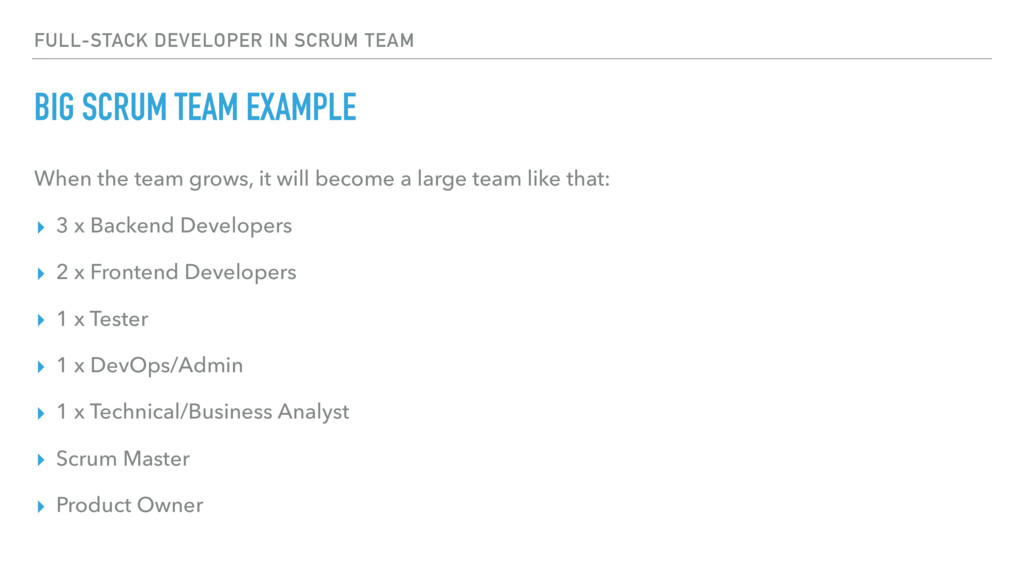
  5. FULL-STACK DEVELOPER IN SCRUM TEAM BIG SCRUM TEAM EXAMPLE When

    the team grows, it will become a large team like that: ▸ 3 x Backend Developers ▸ 2 x Frontend Developers ▸ 1 x Tester ▸ 1 x DevOps/Admin ▸ 1 x Technical/Business Analyst ▸ Scrum Master ▸ Product Owner
  6. FULL-STACK DEVELOPER IN SCRUM TEAM FULL-STACK DEVELOPER SHOULD BE CROSS-FUNCTIONAL

    ▸ In The Scrum Guide you may find that the Scrum Team should be Cross- Functional. ▸ Cross-functionality means that the team (as a team) has all the competences skills needed to build an increment of the product. ▸ At least two developers finished one feature (user story) together - XP or Pair Programming ▸ Full-stack developer can handle backend/frontend/DevOps development either in small or large team.
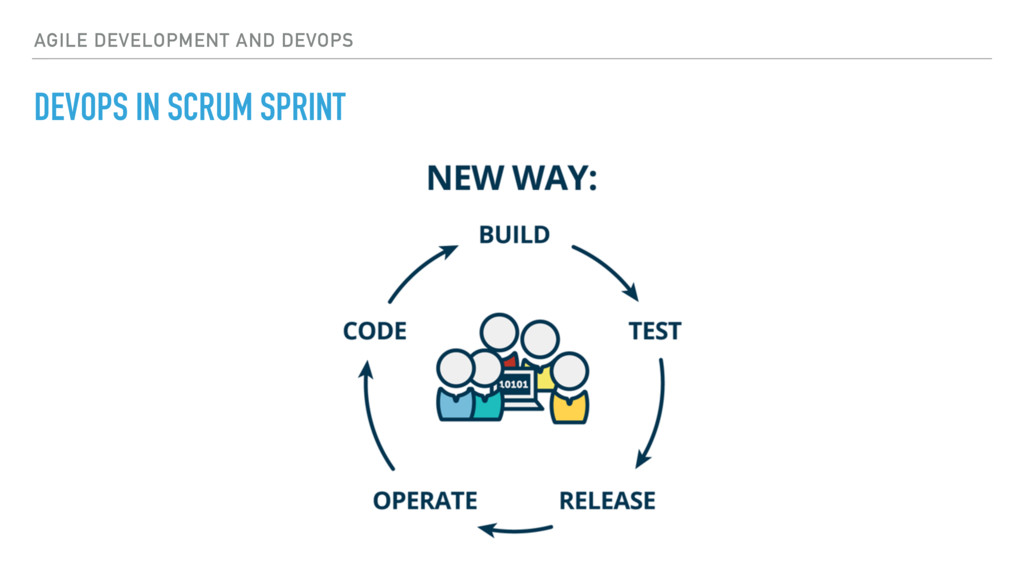
  7. AGILE DEVELOPMENT AND DEVOPS WHY DEVOPS RELATES TO AGILE? ▸

    DevOps is a new term emerging from the collision of two major related trends. ▸ The first was also called “agile infrastructure” or “agile operations”; it sprang from applying Agile and Lean approaches to operations work. ▸ The second is a much expanded understanding of the value of collaboration between development and operations staff throughout all stages of the development lifecycle when creating and operating a service, and how important operations has become in our increasingly service-oriented world.
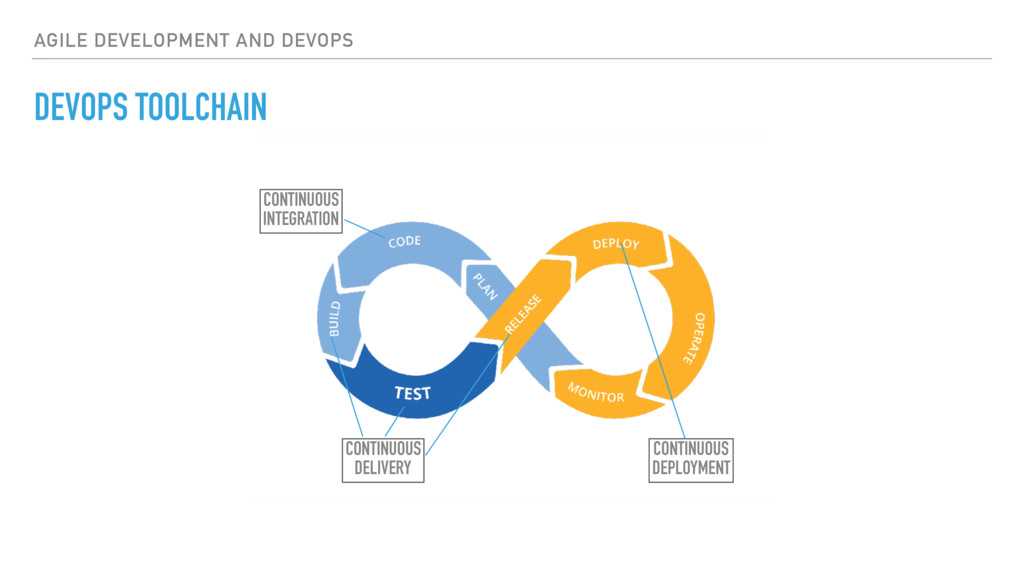
  8. AGILE DEVELOPMENT AND DEVOPS CONTINUOUS INTEGRATION (CI) ▸ Continuous Integration

    (CI) was intended to be used in combination with automated unit tests written through the practices of test-driven development. Initially this was conceived of as running all unit tests in the developer's local environment and verifying they all passed before committing to the mainline.
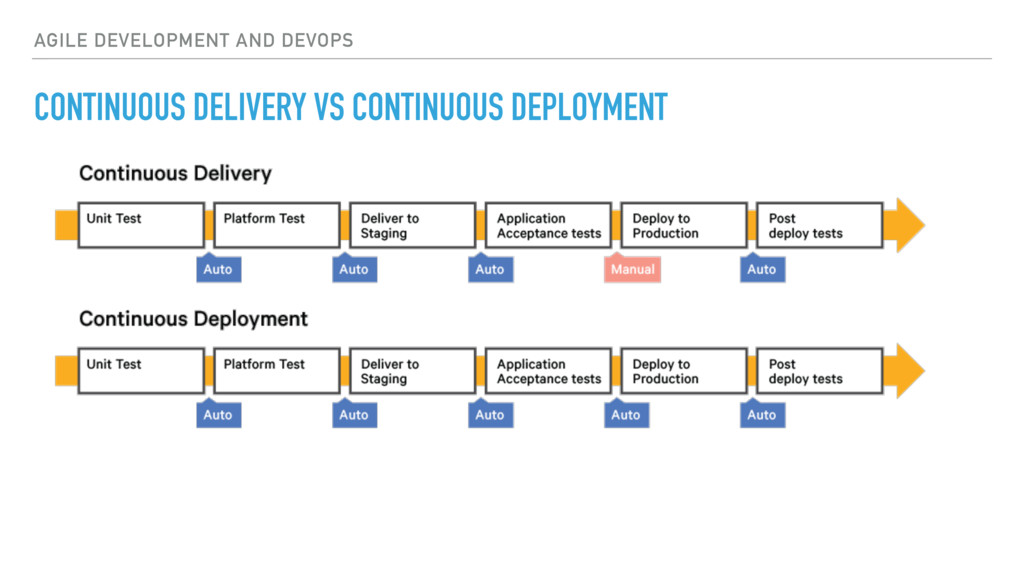
  9. AGILE DEVELOPMENT AND DEVOPS CONTINUOUS DELIVERY VS CONTINUOUS DEPLOYMENT (CONT’D)

    ▸ There are business cases in which IT must wait for a feature to go live, making continuous deployment impractical. ▸ While continuous deployment may not be right for every company, continuous delivery is an absolute requirement of DevOps practices.
  10. AGILE DEVELOPMENT AND DEVOPS CONTINUOUS DELIVERY (CD) ▸ Continuous delivery

    (CD) is a series of practices designed to ensure that code can be rapidly and safely deployed to production by delivering every change to a production-like environment and ensuring business applications and services function as expected through rigorous automated testing.
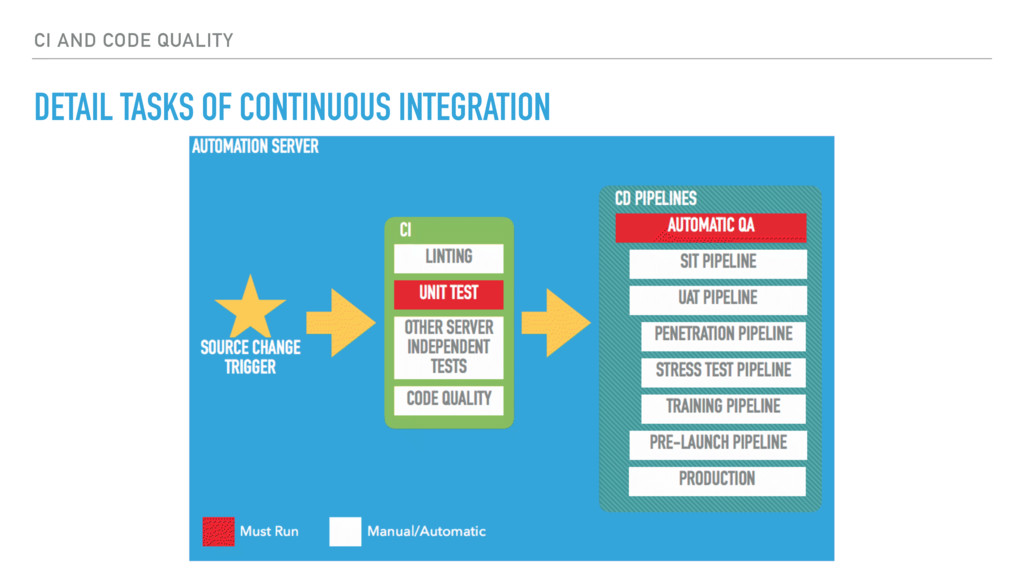
  11. AGILE DEVELOPMENT AND DEVOPS CD PIPELINE ▸ The pipeline breaks

    down the software delivery process into stages. Each stage is aimed at verifying the quality of new features from a different angle to validate the new functionality and prevent errors from affecting your users. The pipeline should provide feedback to the team and visibility into the flow of changes to everyone involved in delivering the new feature(s) ▸ SIT, UAT, Penetration Test, Stress Test, Pre-launch, and Production environment will be implemented as CD Pipeline. ▸ No standard for the number of pipelines and dependencies.
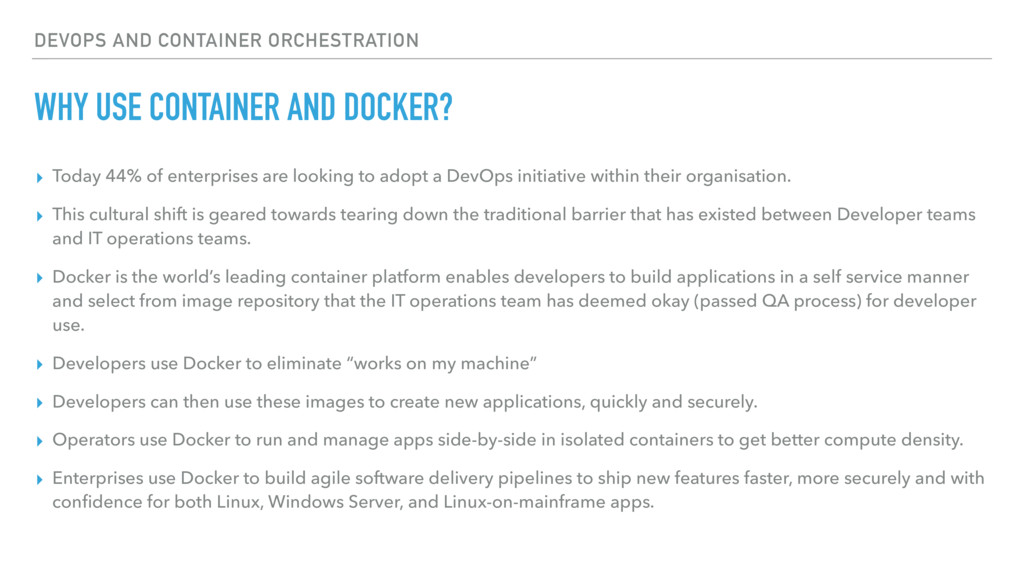
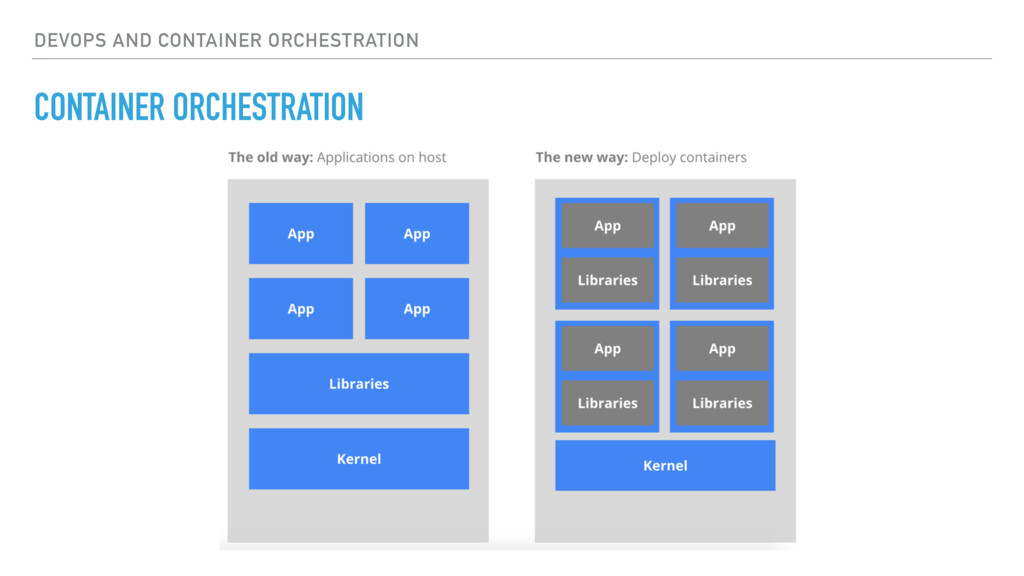
  12. DEVOPS AND CONTAINER ORCHESTRATION WHY USE CONTAINER AND DOCKER? ▸

    Today 44% of enterprises are looking to adopt a DevOps initiative within their organisation. ▸ This cultural shift is geared towards tearing down the traditional barrier that has existed between Developer teams and IT operations teams. ▸ Docker is the world’s leading container platform enables developers to build applications in a self service manner and select from image repository that the IT operations team has deemed okay (passed QA process) for developer use. ▸ Developers use Docker to eliminate “works on my machine” ▸ Developers can then use these images to create new applications, quickly and securely. ▸ Operators use Docker to run and manage apps side-by-side in isolated containers to get better compute density. ▸ Enterprises use Docker to build agile software delivery pipelines to ship new features faster, more securely and with confidence for both Linux, Windows Server, and Linux-on-mainframe apps.
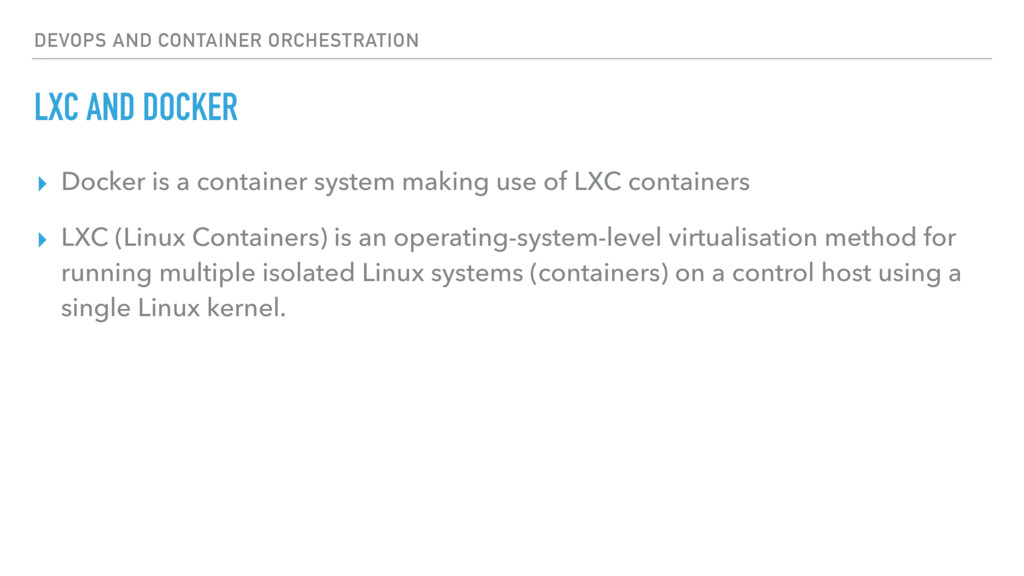
  13. DEVOPS AND CONTAINER ORCHESTRATION LXC AND DOCKER ▸ Docker is

    a container system making use of LXC containers ▸ LXC (Linux Containers) is an operating-system-level virtualisation method for running multiple isolated Linux systems (containers) on a control host using a single Linux kernel.
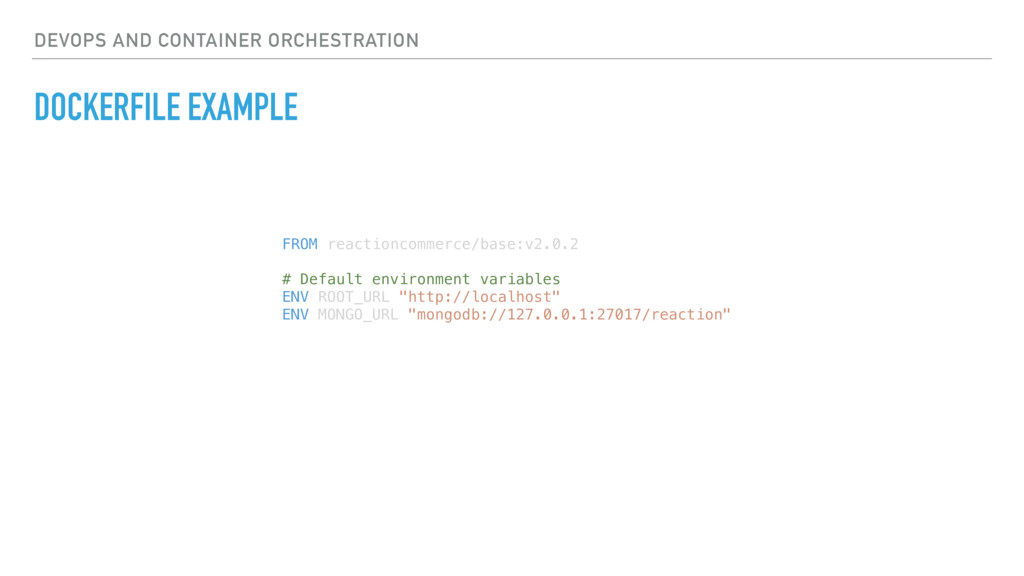
  14. DEVOPS AND CONTAINER ORCHESTRATION DOCKERFILE EXAMPLE FROM reactioncommerce/base:v2.0.2 # Default

    environment variables ENV ROOT_URL "http://localhost" ENV MONGO_URL "mongodb://127.0.0.1:27017/reaction"
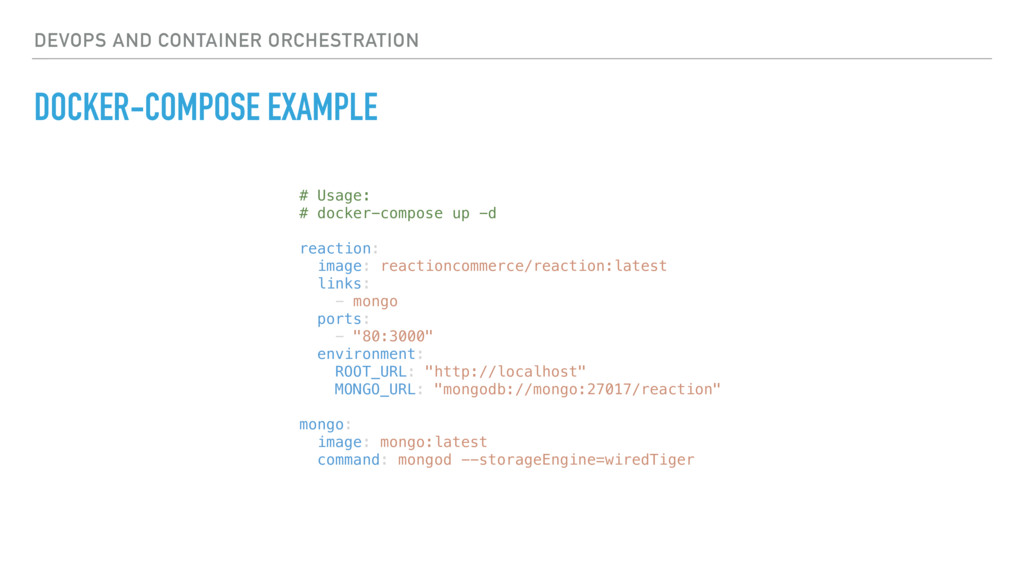
  15. DEVOPS AND CONTAINER ORCHESTRATION DOCKER-COMPOSE EXAMPLE # Usage: # docker-compose

    up -d reaction: image: reactioncommerce/reaction:latest links: - mongo ports: - "80:3000" environment: ROOT_URL: "http://localhost" MONGO_URL: "mongodb://mongo:27017/reaction" mongo: image: mongo:latest command: mongod --storageEngine=wiredTiger
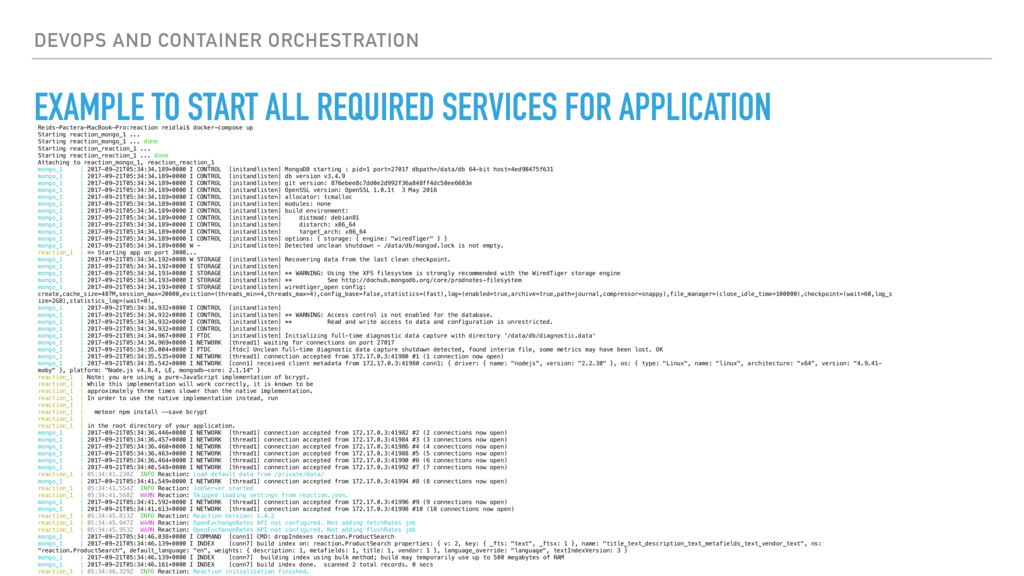
  16. DEVOPS AND CONTAINER ORCHESTRATION EXAMPLE TO START ALL REQUIRED SERVICES

    FOR APPLICATION Reids-Pactera-MacBook-Pro:reaction reidlai$ docker-compose up Starting reaction_mongo_1 ... Starting reaction_mongo_1 ... done Starting reaction_reaction_1 ... Starting reaction_reaction_1 ... done Attaching to reaction_mongo_1, reaction_reaction_1 mongo_1 | 2017-09-21T05:34:34.189+0000 I CONTROL [initandlisten] MongoDB starting : pid=1 port=27017 dbpath=/data/db 64-bit host=4ed98475f631 mongo_1 | 2017-09-21T05:34:34.189+0000 I CONTROL [initandlisten] db version v3.4.9 mongo_1 | 2017-09-21T05:34:34.189+0000 I CONTROL [initandlisten] git version: 876ebee8c7dd0e2d992f36a848ff4dc50ee6603e mongo_1 | 2017-09-21T05:34:34.189+0000 I CONTROL [initandlisten] OpenSSL version: OpenSSL 1.0.1t 3 May 2016 mongo_1 | 2017-09-21T05:34:34.189+0000 I CONTROL [initandlisten] allocator: tcmalloc mongo_1 | 2017-09-21T05:34:34.189+0000 I CONTROL [initandlisten] modules: none mongo_1 | 2017-09-21T05:34:34.189+0000 I CONTROL [initandlisten] build environment: mongo_1 | 2017-09-21T05:34:34.189+0000 I CONTROL [initandlisten] distmod: debian81 mongo_1 | 2017-09-21T05:34:34.189+0000 I CONTROL [initandlisten] distarch: x86_64 mongo_1 | 2017-09-21T05:34:34.189+0000 I CONTROL [initandlisten] target_arch: x86_64 mongo_1 | 2017-09-21T05:34:34.189+0000 I CONTROL [initandlisten] options: { storage: { engine: "wiredTiger" } } mongo_1 | 2017-09-21T05:34:34.189+0000 W - [initandlisten] Detected unclean shutdown - /data/db/mongod.lock is not empty. reaction_1 | => Starting app on port 3000... mongo_1 | 2017-09-21T05:34:34.192+0000 W STORAGE [initandlisten] Recovering data from the last clean checkpoint. mongo_1 | 2017-09-21T05:34:34.192+0000 I STORAGE [initandlisten] mongo_1 | 2017-09-21T05:34:34.193+0000 I STORAGE [initandlisten] ** WARNING: Using the XFS filesystem is strongly recommended with the WiredTiger storage engine mongo_1 | 2017-09-21T05:34:34.193+0000 I STORAGE [initandlisten] ** See http://dochub.mongodb.org/core/prodnotes-filesystem mongo_1 | 2017-09-21T05:34:34.193+0000 I STORAGE [initandlisten] wiredtiger_open config: create,cache_size=487M,session_max=20000,eviction=(threads_min=4,threads_max=4),config_base=false,statistics=(fast),log=(enabled=true,archive=true,path=journal,compressor=snappy),file_manager=(close_idle_time=100000),checkpoint=(wait=60,log_s ize=2GB),statistics_log=(wait=0), mongo_1 | 2017-09-21T05:34:34.932+0000 I CONTROL [initandlisten] mongo_1 | 2017-09-21T05:34:34.932+0000 I CONTROL [initandlisten] ** WARNING: Access control is not enabled for the database. mongo_1 | 2017-09-21T05:34:34.932+0000 I CONTROL [initandlisten] ** Read and write access to data and configuration is unrestricted. mongo_1 | 2017-09-21T05:34:34.932+0000 I CONTROL [initandlisten] mongo_1 | 2017-09-21T05:34:34.967+0000 I FTDC [initandlisten] Initializing full-time diagnostic data capture with directory '/data/db/diagnostic.data' mongo_1 | 2017-09-21T05:34:34.969+0000 I NETWORK [thread1] waiting for connections on port 27017 mongo_1 | 2017-09-21T05:34:35.004+0000 I FTDC [ftdc] Unclean full-time diagnostic data capture shutdown detected, found interim file, some metrics may have been lost. OK mongo_1 | 2017-09-21T05:34:35.535+0000 I NETWORK [thread1] connection accepted from 172.17.0.3:41980 #1 (1 connection now open) mongo_1 | 2017-09-21T05:34:35.542+0000 I NETWORK [conn1] received client metadata from 172.17.0.3:41980 conn1: { driver: { name: "nodejs", version: "2.2.30" }, os: { type: "Linux", name: "linux", architecture: "x64", version: "4.9.41- moby" }, platform: "Node.js v4.8.4, LE, mongodb-core: 2.1.14" } reaction_1 | Note: you are using a pure-JavaScript implementation of bcrypt. reaction_1 | While this implementation will work correctly, it is known to be reaction_1 | approximately three times slower than the native implementation. reaction_1 | In order to use the native implementation instead, run reaction_1 | reaction_1 | meteor npm install --save bcrypt reaction_1 | reaction_1 | in the root directory of your application. mongo_1 | 2017-09-21T05:34:36.446+0000 I NETWORK [thread1] connection accepted from 172.17.0.3:41982 #2 (2 connections now open) mongo_1 | 2017-09-21T05:34:36.457+0000 I NETWORK [thread1] connection accepted from 172.17.0.3:41984 #3 (3 connections now open) mongo_1 | 2017-09-21T05:34:36.460+0000 I NETWORK [thread1] connection accepted from 172.17.0.3:41986 #4 (4 connections now open) mongo_1 | 2017-09-21T05:34:36.463+0000 I NETWORK [thread1] connection accepted from 172.17.0.3:41988 #5 (5 connections now open) mongo_1 | 2017-09-21T05:34:36.464+0000 I NETWORK [thread1] connection accepted from 172.17.0.3:41990 #6 (6 connections now open) mongo_1 | 2017-09-21T05:34:40.548+0000 I NETWORK [thread1] connection accepted from 172.17.0.3:41992 #7 (7 connections now open) reaction_1 | 05:34:41.238Z INFO Reaction: Load default data from /private/data/ mongo_1 | 2017-09-21T05:34:41.549+0000 I NETWORK [thread1] connection accepted from 172.17.0.3:41994 #8 (8 connections now open) reaction_1 | 05:34:41.554Z INFO Reaction: JobServer started reaction_1 | 05:34:41.568Z WARN Reaction: Skipped loading settings from reaction.json. mongo_1 | 2017-09-21T05:34:41.592+0000 I NETWORK [thread1] connection accepted from 172.17.0.3:41996 #9 (9 connections now open) mongo_1 | 2017-09-21T05:34:41.613+0000 I NETWORK [thread1] connection accepted from 172.17.0.3:41998 #10 (10 connections now open) reaction_1 | 05:34:45.813Z INFO Reaction: Reaction Version: 1.4.2 reaction_1 | 05:34:45.947Z WARN Reaction: OpenExchangeRates API not configured. Not adding fetchRates job reaction_1 | 05:34:45.953Z WARN Reaction: OpenExchangeRates API not configured. Not adding flushRates job mongo_1 | 2017-09-21T05:34:46.038+0000 I COMMAND [conn1] CMD: dropIndexes reaction.ProductSearch mongo_1 | 2017-09-21T05:34:46.139+0000 I INDEX [conn7] build index on: reaction.ProductSearch properties: { v: 2, key: { _fts: "text", _ftsx: 1 }, name: "title_text_description_text_metafields_text_vendor_text", ns: "reaction.ProductSearch", default_language: "en", weights: { description: 1, metafields: 1, title: 1, vendor: 1 }, language_override: "language", textIndexVersion: 3 } mongo_1 | 2017-09-21T05:34:46.139+0000 I INDEX [conn7] building index using bulk method; build may temporarily use up to 500 megabytes of RAM mongo_1 | 2017-09-21T05:34:46.161+0000 I INDEX [conn7] build index done. scanned 2 total records. 0 secs reaction_1 | 05:34:46.329Z INFO Reaction: Reaction initialization finished.
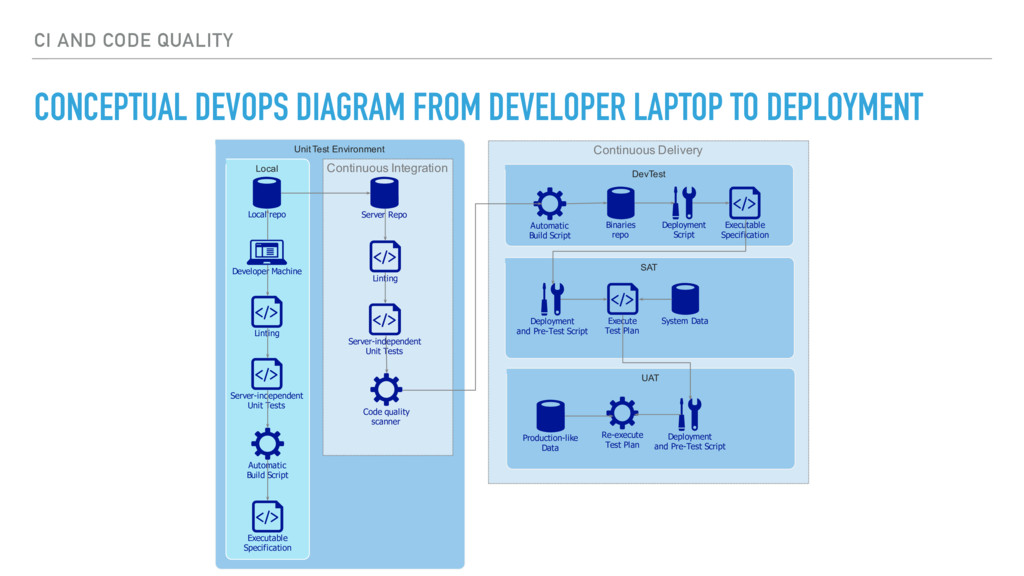
  17. CI AND CODE QUALITY CONCEPTUAL DEVOPS DIAGRAM FROM DEVELOPER LAPTOP

    TO DEPLOYMENT Unit Test Environment Continuous Delivery SAT UAT DevTest Continuous Integration Server Repo Server-independent Unit Tests Linting Code quality scanner Automatic Build Script Local Local repo Developer Machine Linting Server-independent Unit Tests Automatic Build Script Executable Specification Binaries repo Deployment Script Executable Specification Deployment and Pre-Test Script Execute Test Plan System Data Deployment and Pre-Test Script Re-execute Test Plan Production-like Data
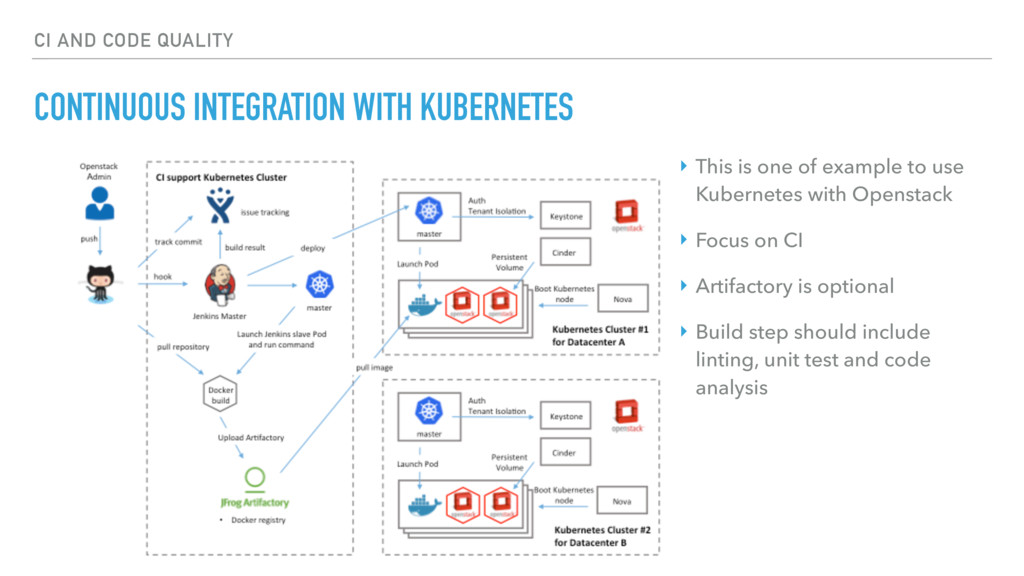
  18. CI AND CODE QUALITY CONTINUOUS INTEGRATION WITH KUBERNETES ‣ This

    is one of example to use Kubernetes with Openstack ‣ Focus on CI ‣ Artifactory is optional ‣ Build step should include linting, unit test and code analysis
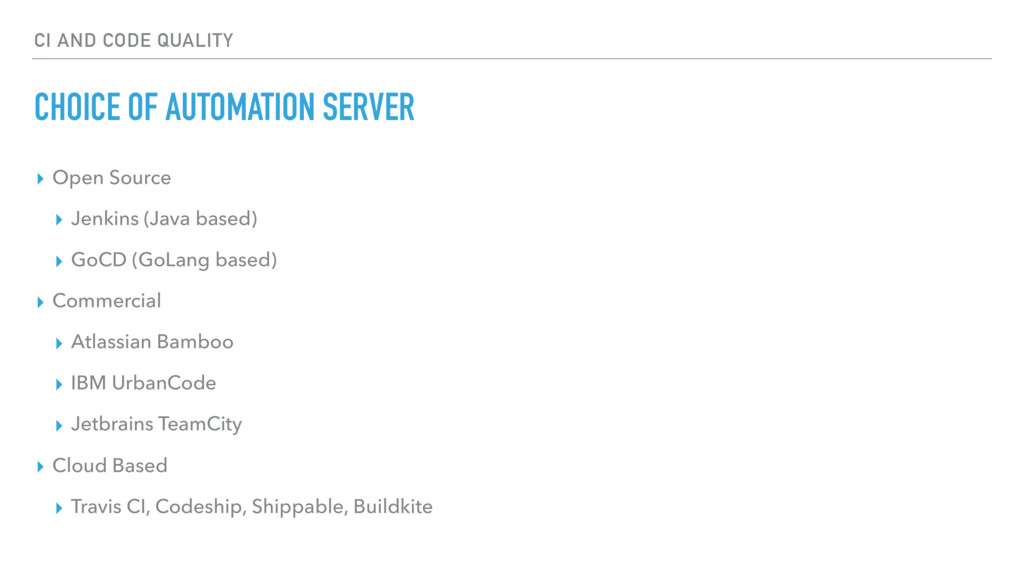
  19. CI AND CODE QUALITY CHOICE OF AUTOMATION SERVER ▸ Open

    Source ▸ Jenkins (Java based) ▸ GoCD (GoLang based) ▸ Commercial ▸ Atlassian Bamboo ▸ IBM UrbanCode ▸ Jetbrains TeamCity ▸ Cloud Based ▸ Travis CI, Codeship, Shippable, Buildkite
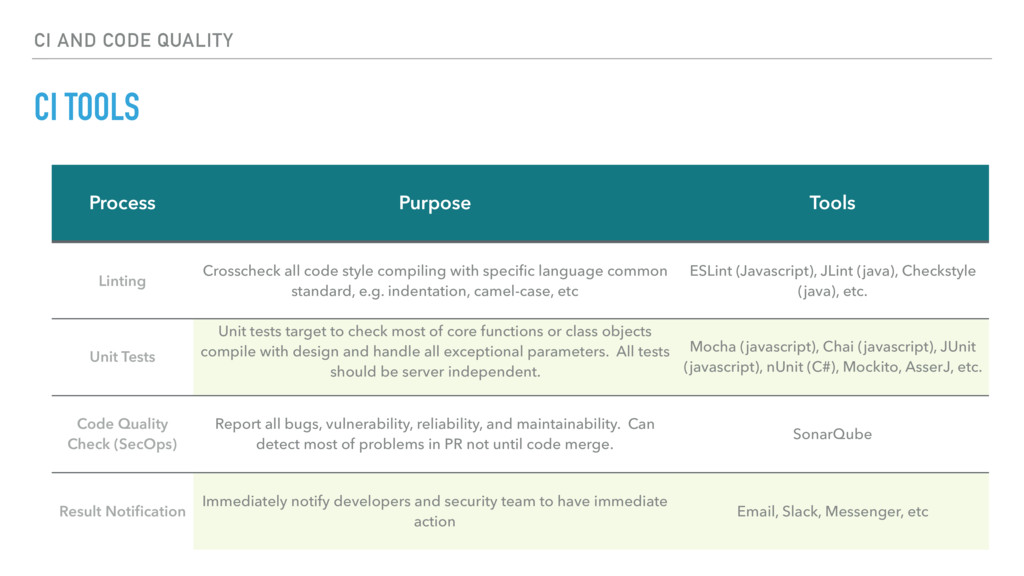
  20. CI AND CODE QUALITY CI TOOLS Process Purpose Tools Linting

    Crosscheck all code style compiling with specific language common standard, e.g. indentation, camel-case, etc ESLint (Javascript), JLint (java), Checkstyle (java), etc. Unit Tests Unit tests target to check most of core functions or class objects compile with design and handle all exceptional parameters. All tests should be server independent. Mocha (javascript), Chai (javascript), JUnit (javascript), nUnit (C#), Mockito, AsserJ, etc. Code Quality Check (SecOps) Report all bugs, vulnerability, reliability, and maintainability. Can detect most of problems in PR not until code merge. SonarQube Result Notification Immediately notify developers and security team to have immediate action Email, Slack, Messenger, etc
  21. CI AND CODE QUALITY CI TOOLS (CONT’D) ▸ Developer can

    gain trust from Ops and Sec team by using objective unit tests and code quality reporting mechanism. ▸ Can know most bugs and vulnerability immediately before build. ▸ All team members know test coverage percentage and see if additional effort is required. ▸ Docker image will be pushed if all CI tasks passed ▸ Coding vs Test Development Ratio = 6:4 in single sprint ▸ Test Coverage % of Mature Team = 80%
  22. FROM USER STORY TO BDD TDD/ATDD PROBLEM ▸ Test-Driven Development

    (TDD) was more of telling to make sure the code works fine but it did not say that if the code that is written was even required at first place ▸ Acceptance Test-Driven Development (ATDD) leans towards the developer-focused side of things like TDD does ▸ ATDD is a collaborative exercise that involves product owners, business analysts, testers, and developers. ATDD helps to ensure that all project members understand precisely what needs to be done and implemented - without describing how the deliverables works ▸ TDD and ATDD can only be applied for “build for unknown”
  23. FROM USER STORY TO BDD BDD VS TDD/ATDD ▸ BDD

    is largely facilitated through the use of a simple domain-specific language (DSL) using natural language constructs (e.g., English-like sentences) that can express the behavior and the expected outcomes. ▸ Behaviour-driven development specifies that tests of any unit of software should be specified in terms of the desired behaviour of the unit. ▸ Borrowing from agile software development the "desired behaviour" in this case consists of the requirements set by the business — that is, the desired behaviour that has business value for whatever entity commissioned the software unit under construction. ▸ Within BDD practice, this is referred to as BDD being an "outside-in" activity.
  24. FROM USER STORY TO BDD USER WRITES GHERKIN LANGUAGE ▸

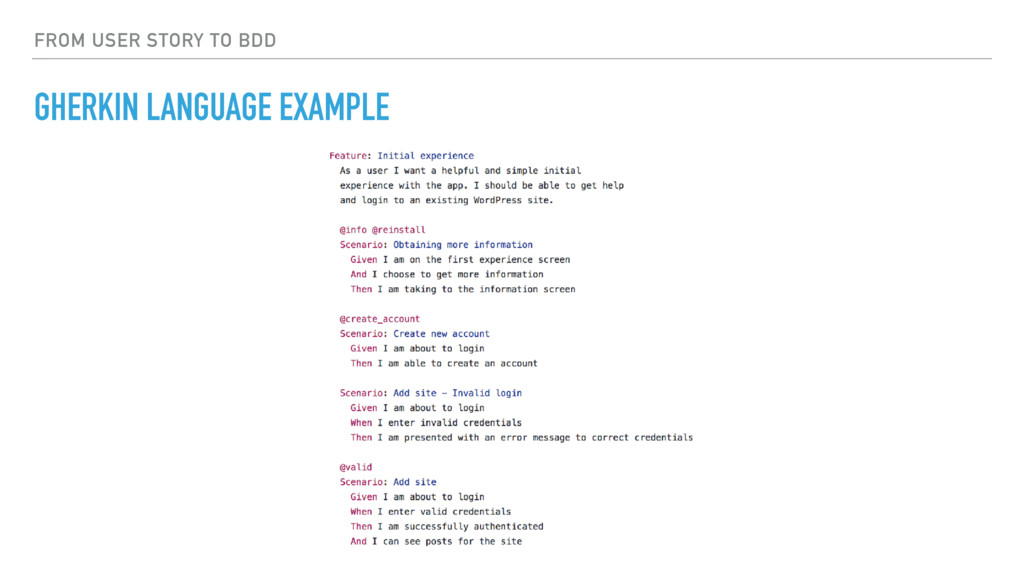
    Gherkin is the language that Cucumber understands. It is a Business Readable, Domain Specific Language that lets you describe software’s behaviour without detailing how that behaviour is implemented. ▸ Gherkin serves two purposes — documentation and automated tests. The third is a bonus feature telling you what code you should write. ▸ Gherkin’s grammar is defined in the Treetop grammar that is part of the Cucumber codebase. The grammar exists in different flavours for many spoken languages (60 at the time of writing), so that your team can use the keywords in your own language. ▸ Single Gherkin source file contains a description of a single feature (user story). ▸ Source files have .feature extension.
  25. FROM USER STORY TO BDD GIVEN-WHEN-THEN CONSTRUCT ▸ The Given-When-Then

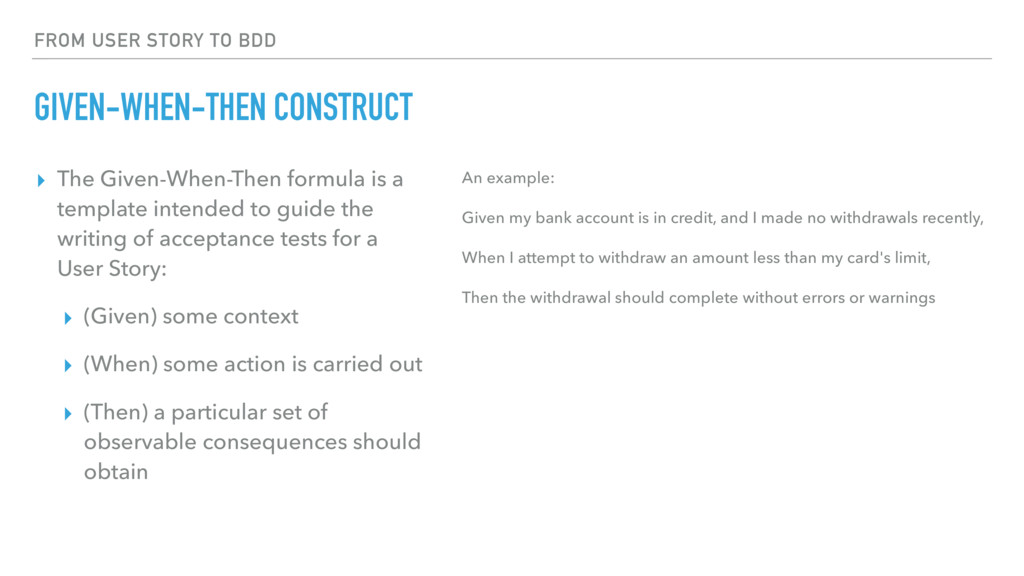
    formula is a template intended to guide the writing of acceptance tests for a User Story: ▸ (Given) some context ▸ (When) some action is carried out ▸ (Then) a particular set of observable consequences should obtain An example: Given my bank account is in credit, and I made no withdrawals recently, When I attempt to withdraw an amount less than my card's limit, Then the withdrawal should complete without errors or warnings
  26. FROM USER STORY TO BDD DEVELOPER IMPLEMENT CUCUMBER STEPS FOR

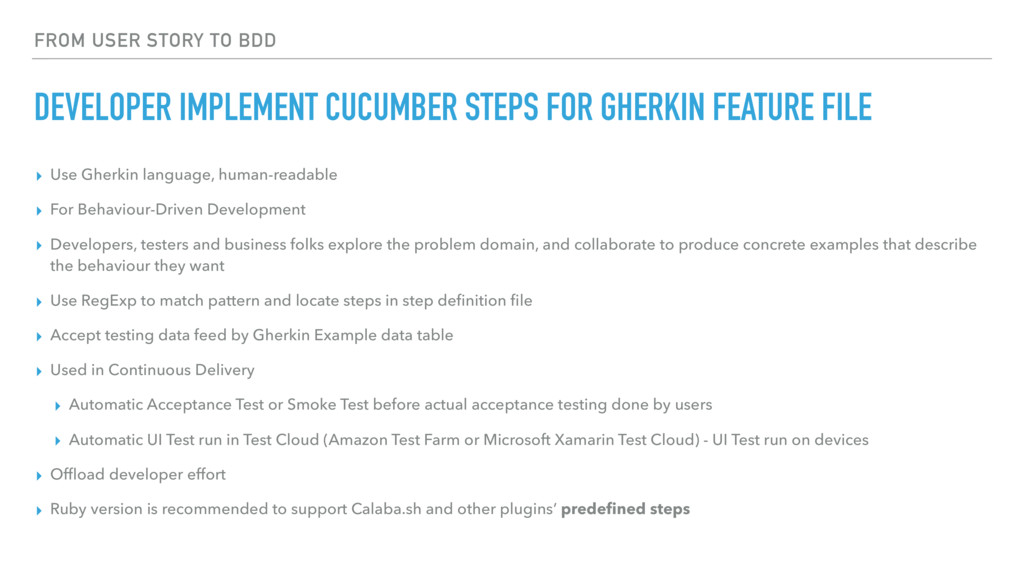
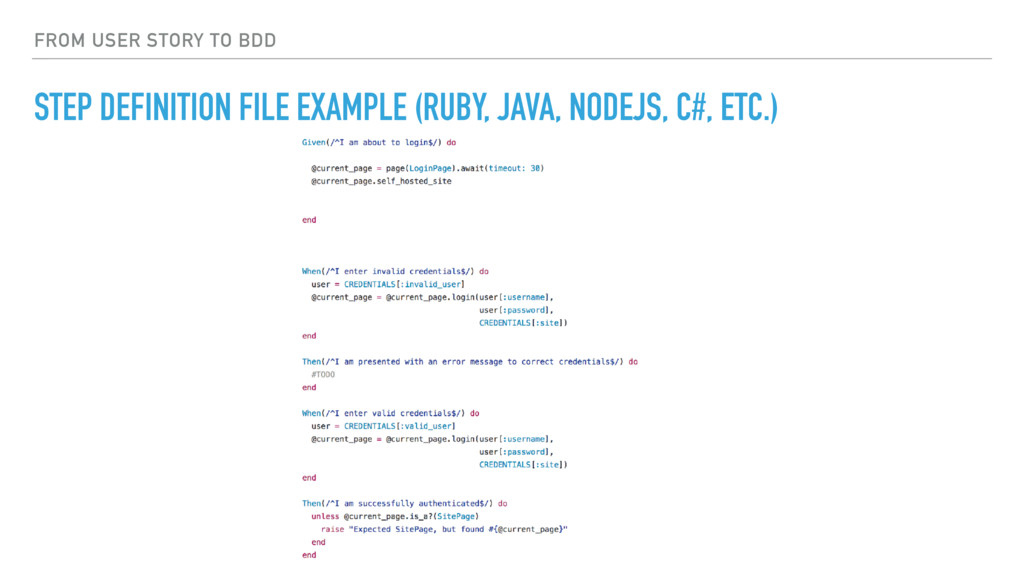
    GHERKIN FEATURE FILE ▸ Use Gherkin language, human-readable ▸ For Behaviour-Driven Development ▸ Developers, testers and business folks explore the problem domain, and collaborate to produce concrete examples that describe the behaviour they want ▸ Use RegExp to match pattern and locate steps in step definition file ▸ Accept testing data feed by Gherkin Example data table ▸ Used in Continuous Delivery ▸ Automatic Acceptance Test or Smoke Test before actual acceptance testing done by users ▸ Automatic UI Test run in Test Cloud (Amazon Test Farm or Microsoft Xamarin Test Cloud) - UI Test run on devices ▸ Offload developer effort ▸ Ruby version is recommended to support Calaba.sh and other plugins’ predefined steps
  27. FROM USER STORY TO BDD CUCUMBER-SELENIUM PREDEFINED STEPS ▸ Installation

    Step: gem install selenium-cucumber ▸ https://github.com/selenium-cucumber/selenium-cucumber-ruby/blob/ master/doc/canned_steps.md
  28. FROM USER STORY TO BDD CUCUMBER-API PREDEFINED STEPS ▸ Installation

    Step: gem install cucumber-api ▸ https://github.com/hidroh/cucumber-api
  29. FROM USER STORY TO BDD CALABASH-IOS PREDEFINED STEPS (FROM CALABA.SH)

    ▸ Please visit Calaba.sh website to follow Calaba.sh sandbox installation ▸ https://github.com/calabash/calabash-ios/wiki/02-Predefined-steps
  30. FROM USER STORY TO BDD CALABASH-ANDROID PREDEFINED STEPS (FROM CALABA.SH)

    ▸ Please visit Calaba.sh website to follow Calaba.sh sandbox installation ▸ https://github.com/calabash/calabash-android/blob/master/ruby-gem/lib/ calabash-android/canned_steps.md
  31. FROM USER STORY TO BDD RUN ACCEPTANCE TEST USING CUCUMBER/CALABA.SH

    ▸ Just run “cucumber” in your project repository except mobile ▸ Need to use calabash-sandbox to run mobile acceptance (smoke) test
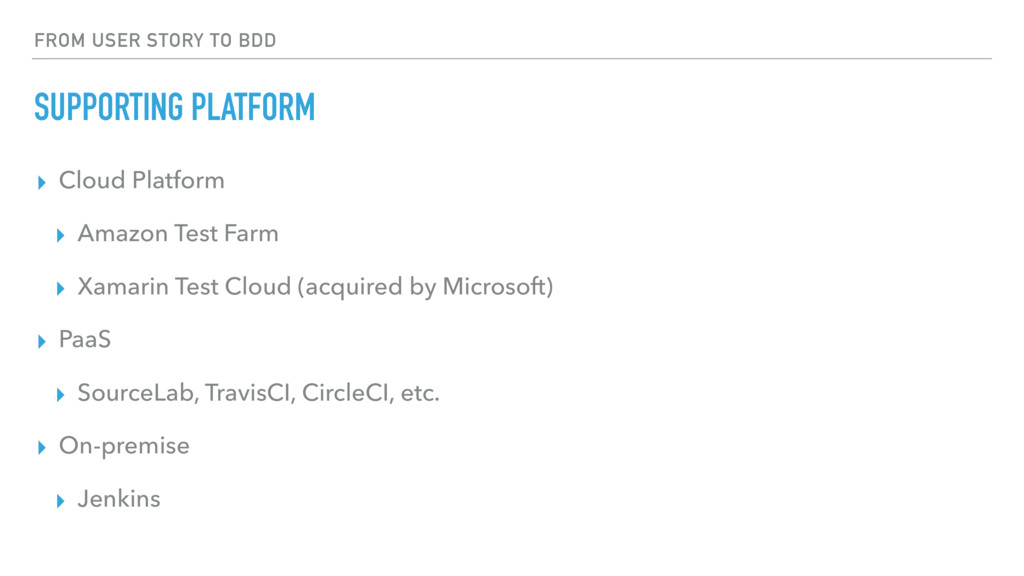
  32. FROM USER STORY TO BDD SUPPORTING PLATFORM ▸ Cloud Platform

    ▸ Amazon Test Farm ▸ Xamarin Test Cloud (acquired by Microsoft) ▸ PaaS ▸ SourceLab, TravisCI, CircleCI, etc. ▸ On-premise ▸ Jenkins
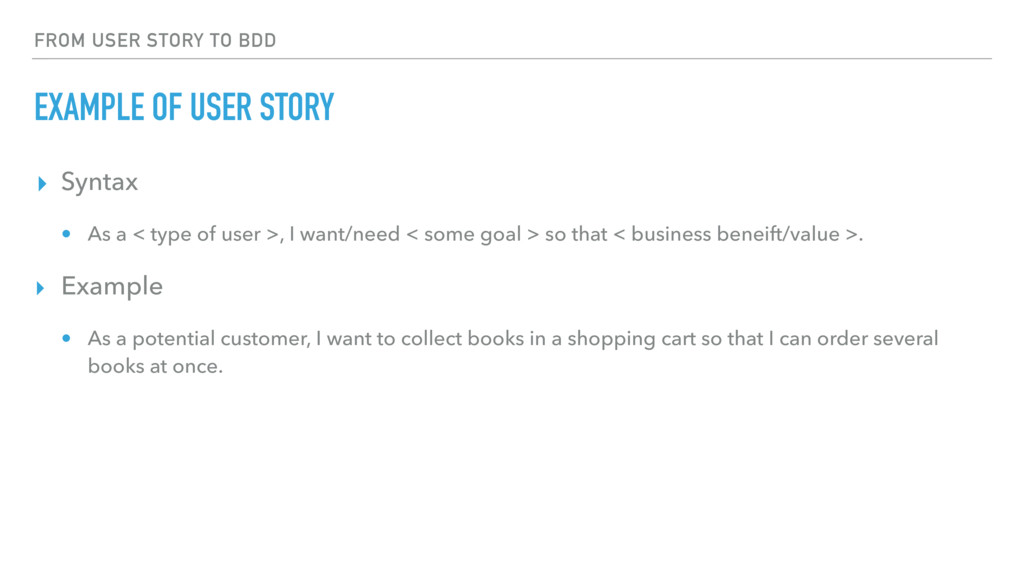
  33. FROM USER STORY TO BDD EXAMPLE OF USER STORY ▸

    Syntax • As a < type of user >, I want/need < some goal > so that < business beneift/value >. ‣ Example • As a potential customer, I want to collect books in a shopping cart so that I can order several books at once.
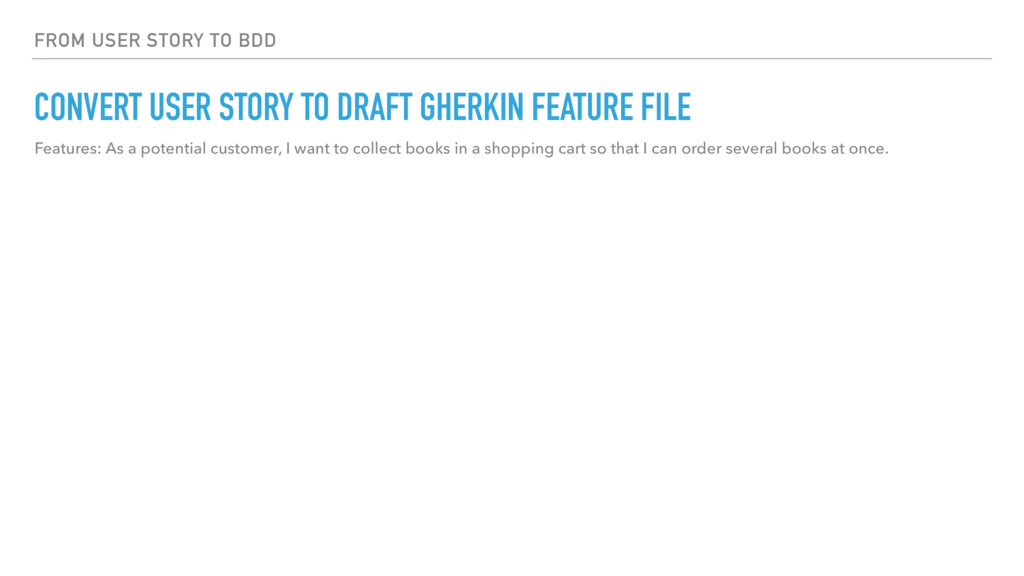
  34. FROM USER STORY TO BDD CONVERT USER STORY TO DRAFT

    GHERKIN FEATURE FILE Features: As a potential customer, I want to collect books in a shopping cart so that I can order several books at once.
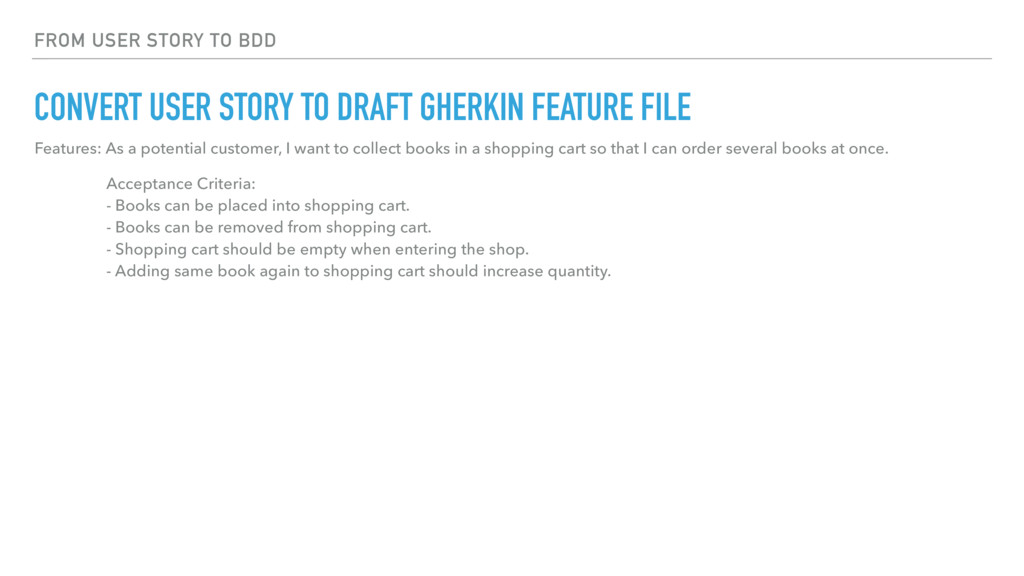
  35. FROM USER STORY TO BDD CONVERT USER STORY TO DRAFT

    GHERKIN FEATURE FILE Features: As a potential customer, I want to collect books in a shopping cart so that I can order several books at once. Acceptance Criteria:
 - Books can be placed into shopping cart.
 - Books can be removed from shopping cart.
 - Shopping cart should be empty when entering the shop.
 - Adding same book again to shopping cart should increase quantity.
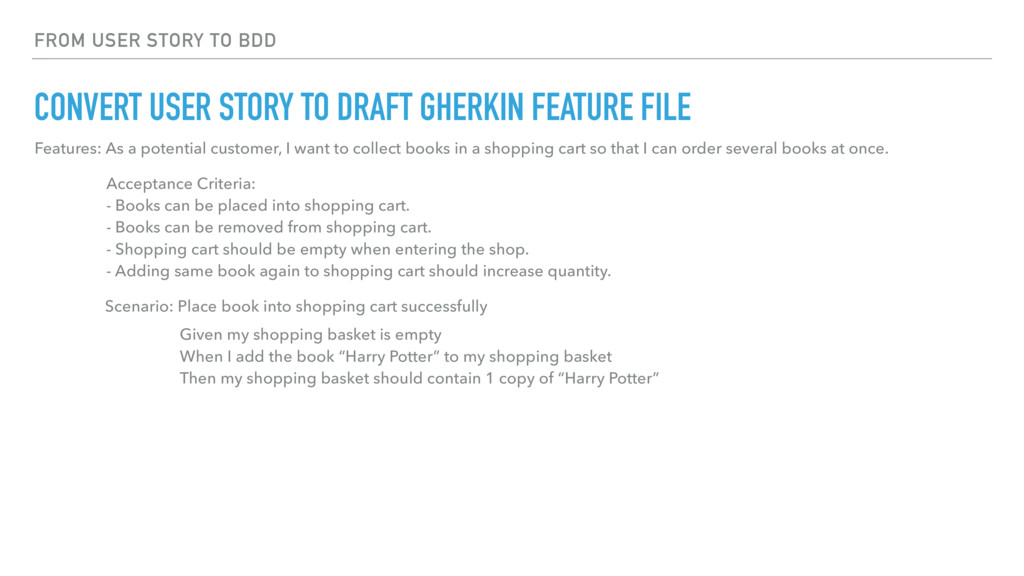
  36. FROM USER STORY TO BDD CONVERT USER STORY TO DRAFT

    GHERKIN FEATURE FILE Features: As a potential customer, I want to collect books in a shopping cart so that I can order several books at once. Acceptance Criteria:
 - Books can be placed into shopping cart.
 - Books can be removed from shopping cart.
 - Shopping cart should be empty when entering the shop.
 - Adding same book again to shopping cart should increase quantity. Scenario: Place book into shopping cart successfully Given my shopping basket is empty
 When I add the book “Harry Potter” to my shopping basket
 Then my shopping basket should contain 1 copy of “Harry Potter”
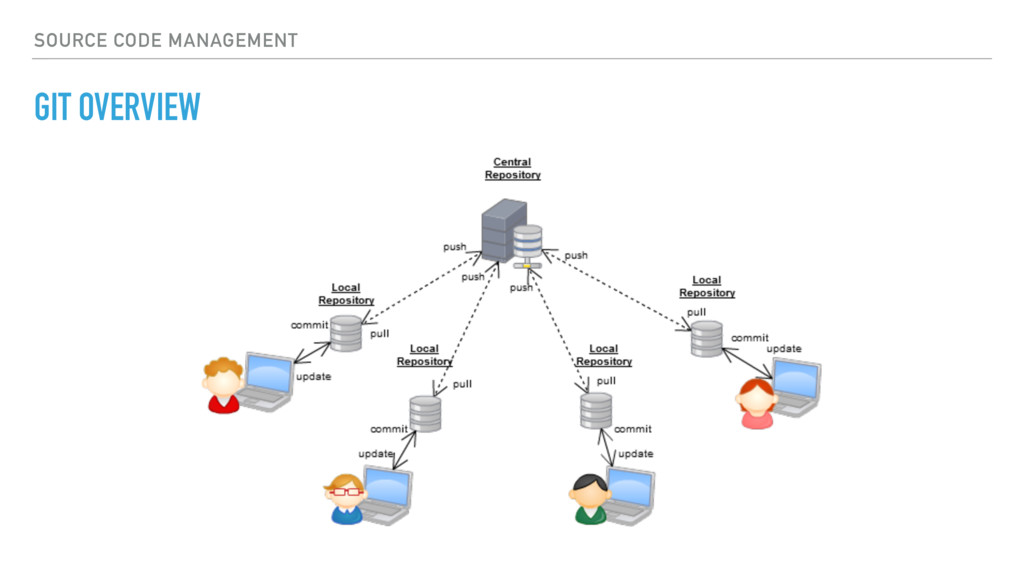
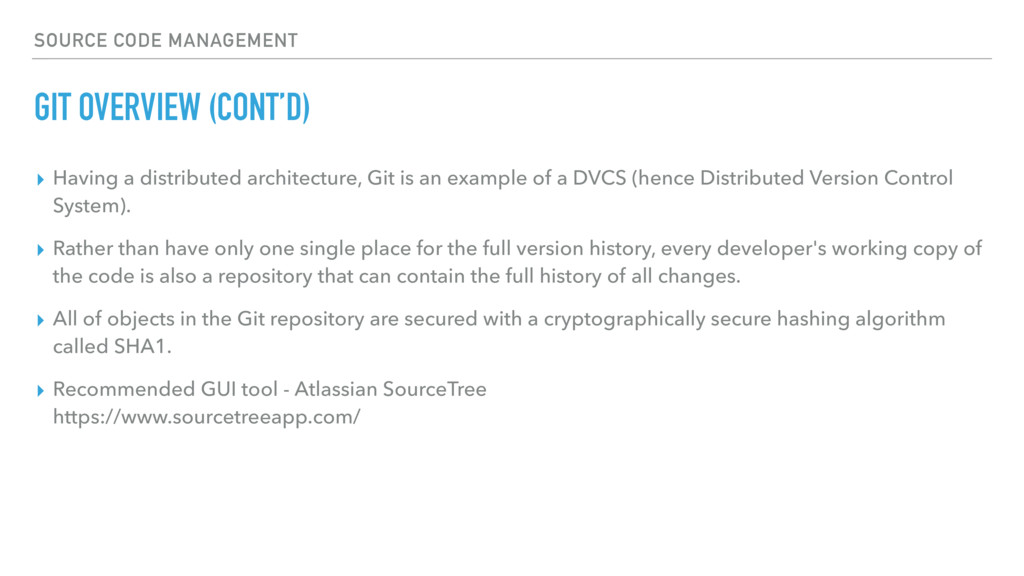
  37. SOURCE CODE MANAGEMENT GIT OVERVIEW (CONT’D) ▸ Having a distributed

    architecture, Git is an example of a DVCS (hence Distributed Version Control System). ▸ Rather than have only one single place for the full version history, every developer's working copy of the code is also a repository that can contain the full history of all changes. ▸ All of objects in the Git repository are secured with a cryptographically secure hashing algorithm called SHA1. ▸ Recommended GUI tool - Atlassian SourceTree
 https://www.sourcetreeapp.com/
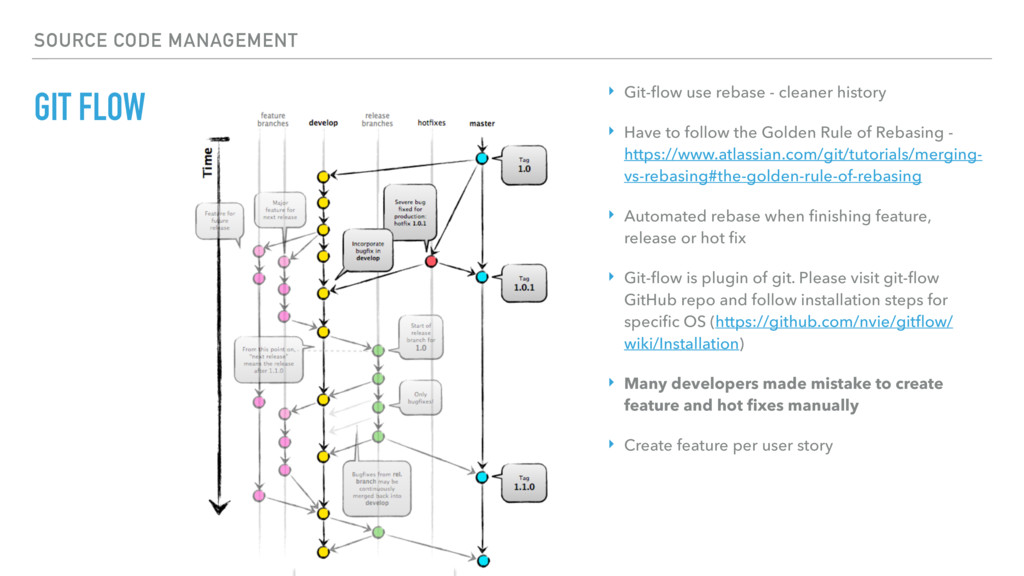
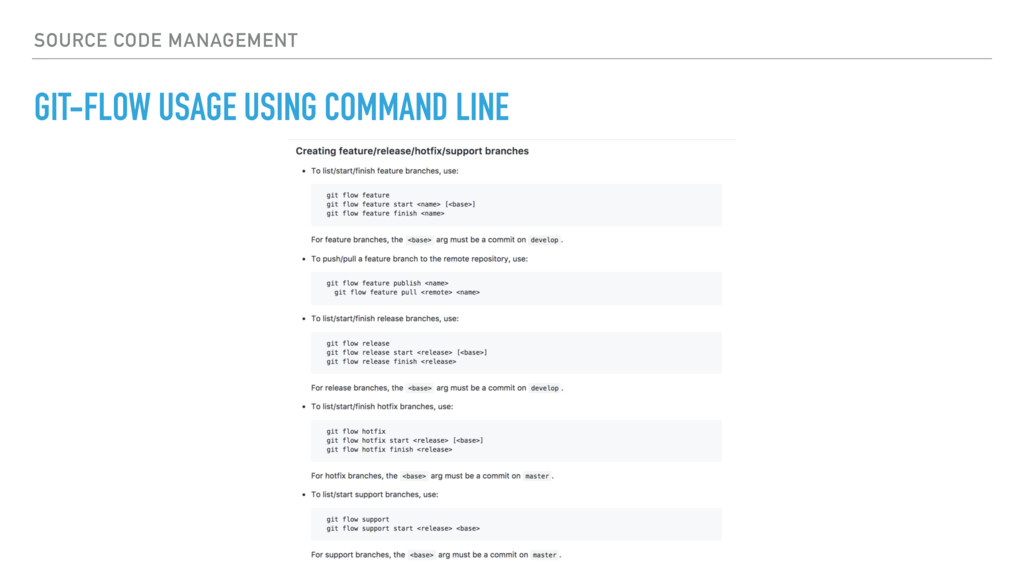
  38. SOURCE CODE MANAGEMENT GIT FLOW ‣ Git-flow use rebase -

    cleaner history ‣ Have to follow the Golden Rule of Rebasing - https://www.atlassian.com/git/tutorials/merging- vs-rebasing#the-golden-rule-of-rebasing ‣ Automated rebase when finishing feature, release or hot fix ‣ Git-flow is plugin of git. Please visit git-flow GitHub repo and follow installation steps for specific OS (https://github.com/nvie/gitflow/ wiki/Installation) ‣ Many developers made mistake to create feature and hot fixes manually ‣ Create feature per user story
  39. UNIT TEST HOW TO PREPARE UNIT TEST LOCALLY ▸ Unit

    test should be component or class based ▸ Server-independent (can use docker to simulate server locally if server is required)
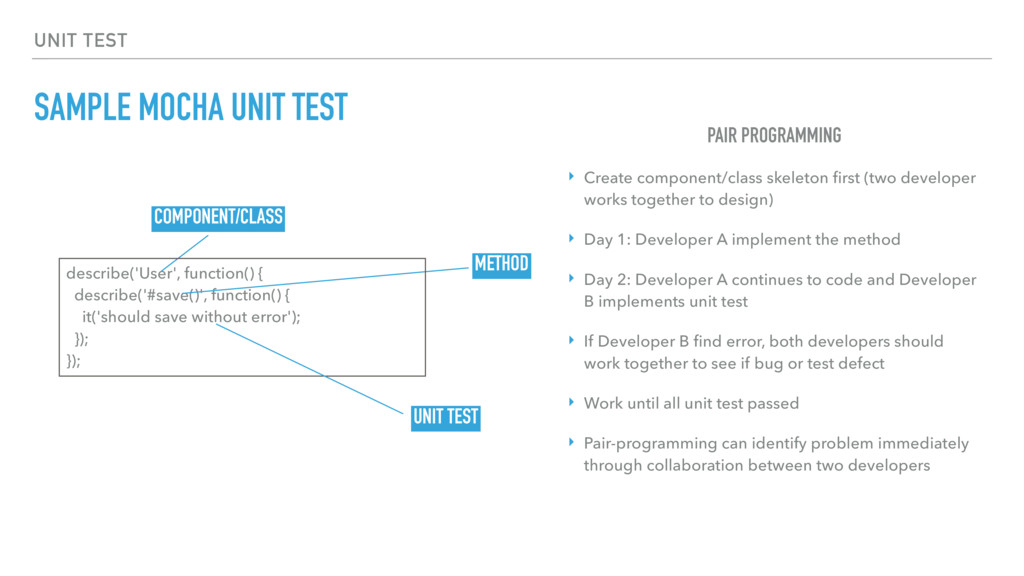
  40. UNIT TEST SAMPLE MOCHA UNIT TEST describe('User', function() {
 describe('#save()',

    function() {
 it('should save without error');
 });
 }); COMPONENT/CLASS METHOD UNIT TEST ‣ Create component/class skeleton first (two developer works together to design) ‣ Day 1: Developer A implement the method ‣ Day 2: Developer A continues to code and Developer B implements unit test ‣ If Developer B find error, both developers should work together to see if bug or test defect ‣ Work until all unit test passed ‣ Pair-programming can identify problem immediately through collaboration between two developers PAIR PROGRAMMING
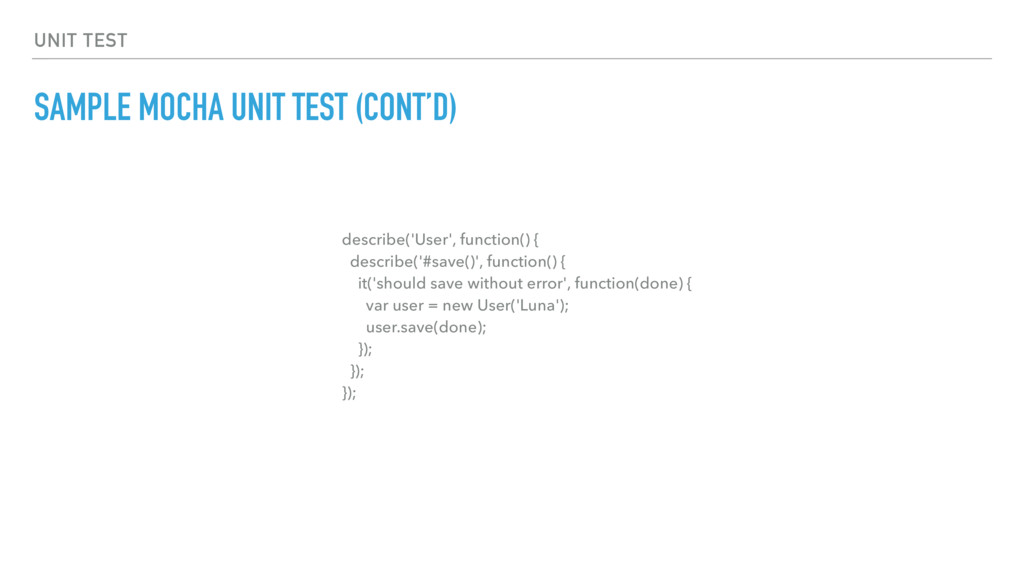
  41. UNIT TEST SAMPLE MOCHA UNIT TEST (CONT’D) describe('User', function() {


    describe('#save()', function() {
 it('should save without error', function(done) {
 var user = new User('Luna');
 user.save(done);
 });
 });
 });
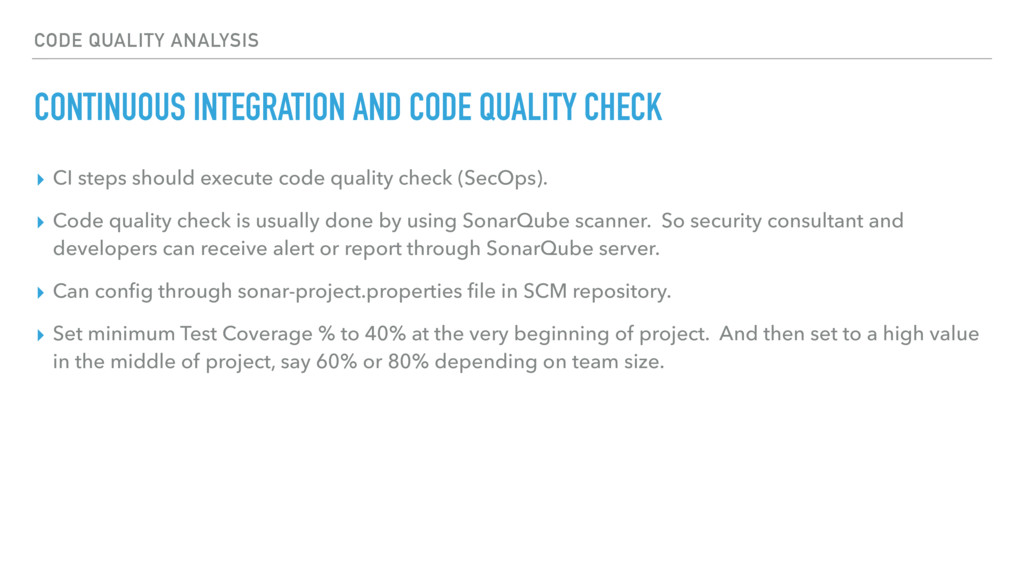
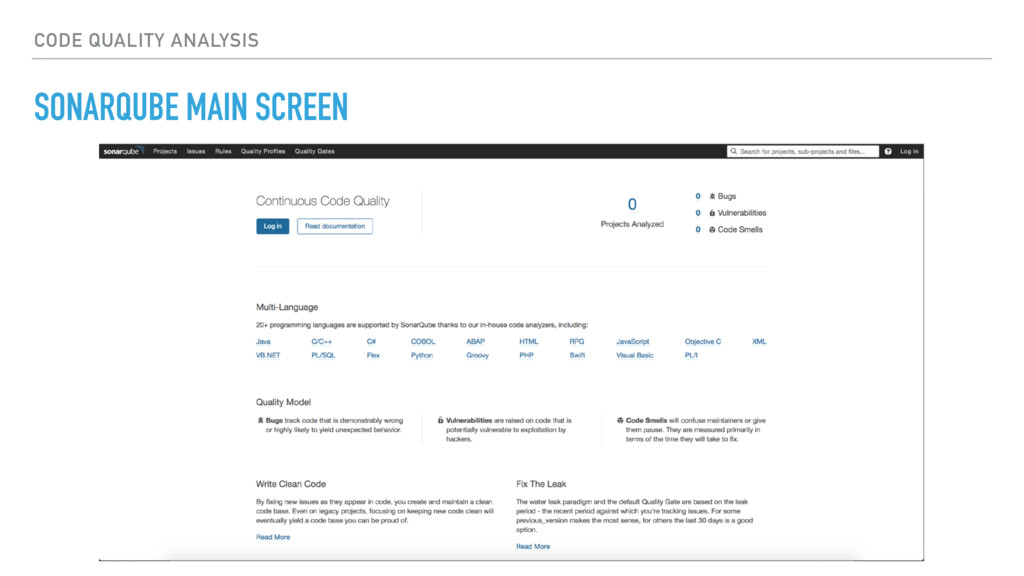
  42. CODE QUALITY ANALYSIS CONTINUOUS INTEGRATION AND CODE QUALITY CHECK ▸

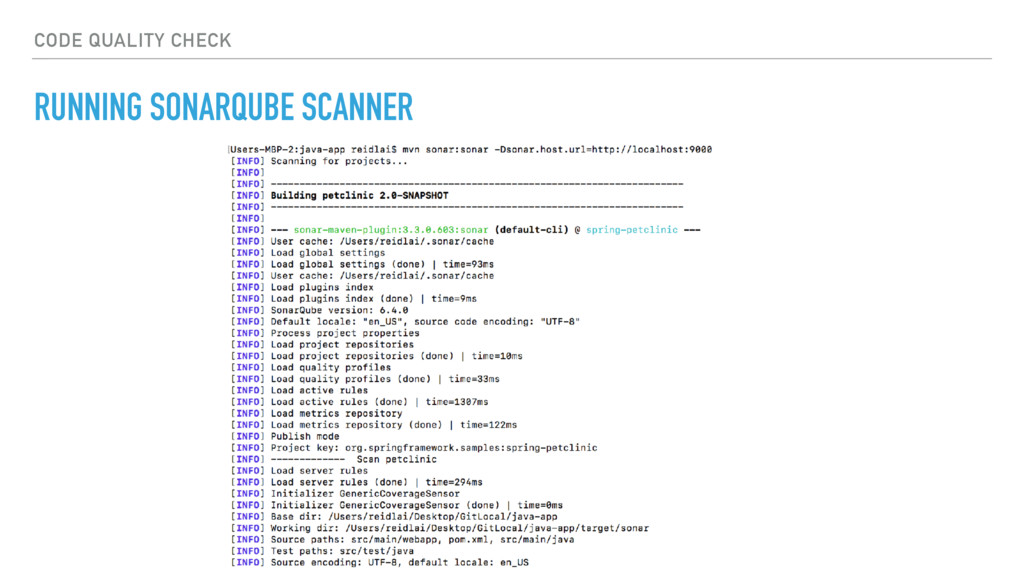
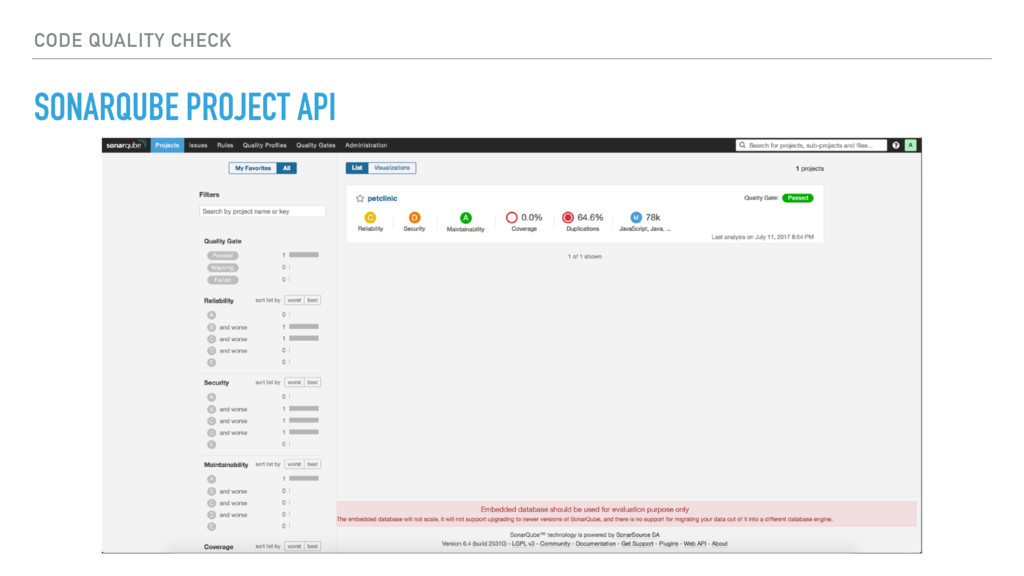
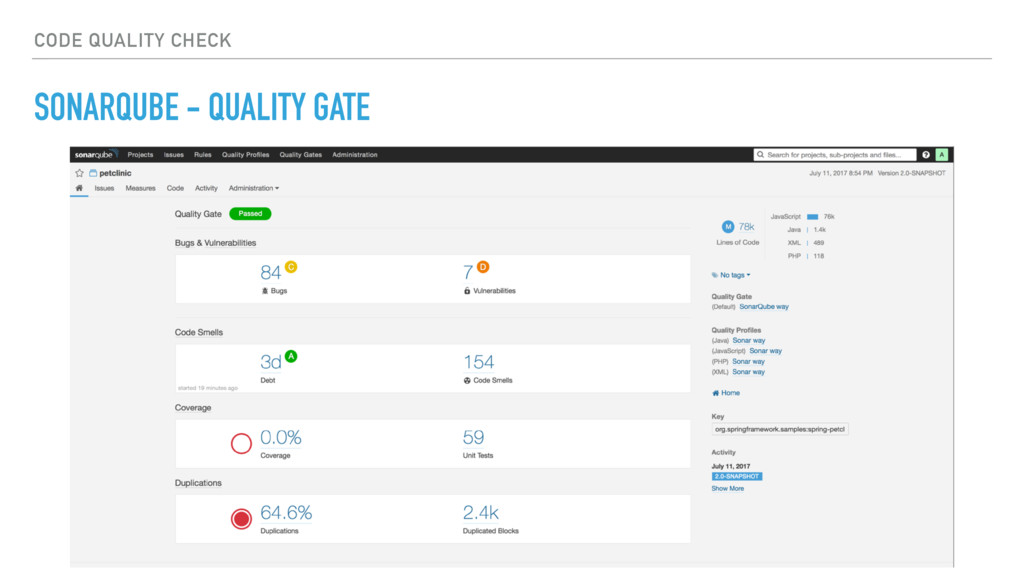
    CI steps should execute code quality check (SecOps). ▸ Code quality check is usually done by using SonarQube scanner. So security consultant and developers can receive alert or report through SonarQube server. ▸ Can config through sonar-project.properties file in SCM repository. ▸ Set minimum Test Coverage % to 40% at the very beginning of project. And then set to a high value in the middle of project, say 60% or 80% depending on team size.
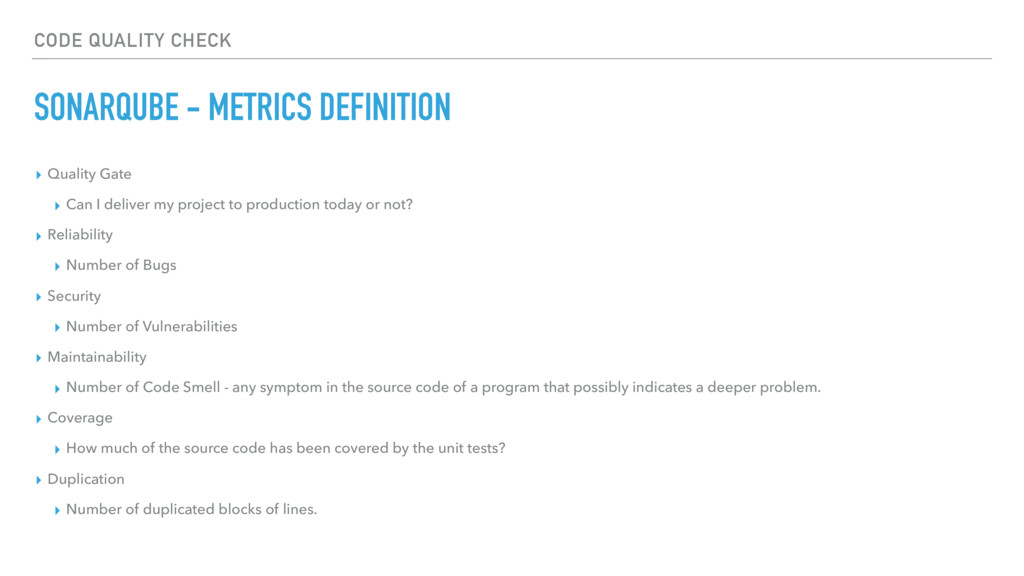
  43. CODE QUALITY CHECK SONARQUBE - METRICS DEFINITION ▸ Quality Gate

    ▸ Can I deliver my project to production today or not? ▸ Reliability ▸ Number of Bugs ▸ Security ▸ Number of Vulnerabilities ▸ Maintainability ▸ Number of Code Smell - any symptom in the source code of a program that possibly indicates a deeper problem. ▸ Coverage ▸ How much of the source code has been covered by the unit tests? ▸ Duplication ▸ Number of duplicated blocks of lines.