Share
Embed
Seamless mobile real-time communication with WebRTC
The WebRTC project allows developers to build strong voice and video communication solutions by facilitating the transmission of data between peers.
During this talk, we will discover the WebRTC project, its design, and how to implement a simple mobile app in a Kotlin Multiplatform project.
Renaud MATHIEU
June 07, 2024
Transcript
85 slides
-
Friday, June 7, 2024 droidcon San Francisco Seamless mobile real-time
communication with WebRTC Renaud Mathieu -
Renaud Mathieu • Freelance • Based in Paris, France 🥖🍷
• Member of the Paris Android User Group • Proud of being here today with you About me renaudmathieu.com -
Early Beginnings 2009 2011 Development & Standardization Browser Adoption 2012-2013
Industry Adoption 2014-2015 History Timeline -
Early Beginnings 2009 2011 Development & Standardization Browser Adoption 2012-2013
Industry Adoption 2014-2015 2018 WebRTC 1.0 History Timeline -
Early Beginnings 2009 2011 Development & Standardization Browser Adoption 2012-2013
Industry Adoption 2014-2015 2018 WebRTC 1.0 2020-Present Ubiquity History Timeline -
Client A Client C Client B 🕸 Mesh Number of
edges= N×(N−1) / 2 -
Server Client A Client C Client B 📦 📦 📦
🔗 Multipoint Conference Unit -
TURN (Traversal Using Relays around NAT) 👥 WebRTC STUN (Session
Traversal Utilities for NAT) ICE (Interactive Connectivity Establishment) -
Turn Server STUN Server NAT NAT Client A Client B
STUN Server Signaling Server Summary -
Additional informations • WebRTC transmits data using UDP • No
Standard regarding to the Signaling Server • 🔎 chrome://webrtc-internals -
import kotlinx.serialization.SerialName import kotlinx.serialization.Serializable @Serializable data class WsPacket( @SerialName("id") val
id: WsMessage, @SerialName("data") val data: String, ) -
import kotlinx.serialization.Serializable @Serializable enum class WsMessage { WsError, WsIceCandidates, WsIceServers,
WsInit, WsSDPAnswer, WsSDPOffer, } -
class Connection( val session: DefaultWebSocketSession ) { companion object {
val lastId = AtomicInteger(0) } val name = "client${lastId.getAndIncrement()}" } -
@OptIn(InternalAPI :: class) fun Application.configureSockets() { install(WebSockets) { pingPeriod =
Duration.ofSeconds(15) timeout = Duration.ofSeconds(15) maxFrameSize = Long.MAX_VALUE masking = false contentConverter = KotlinxWebsocketSerializationConverter(Json) } val connections = Collections.synchronizedSet<Connection?>(LinkedHashSet()) routing { webSocket("/connect") // Let’s GO } } } -
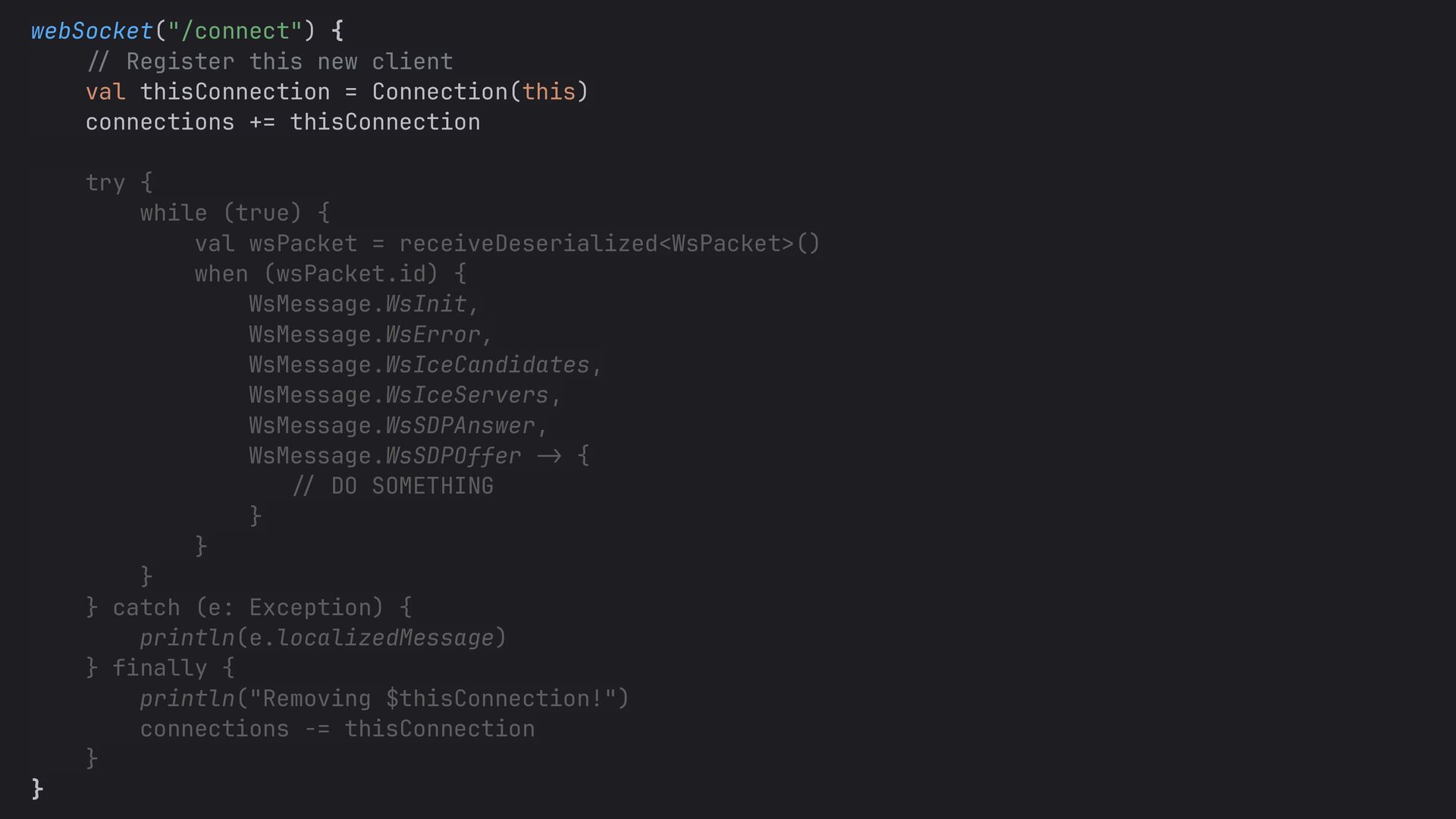
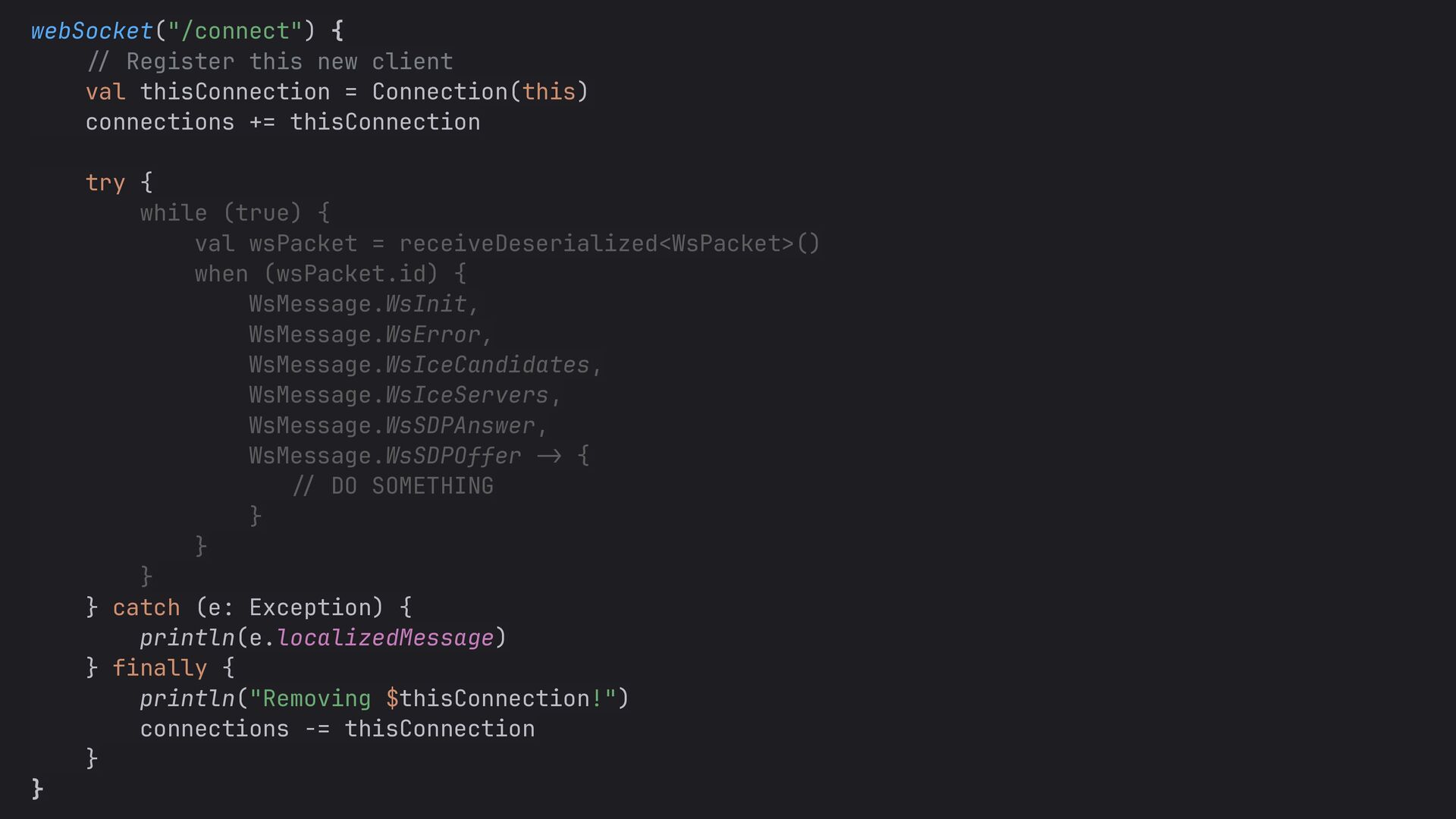
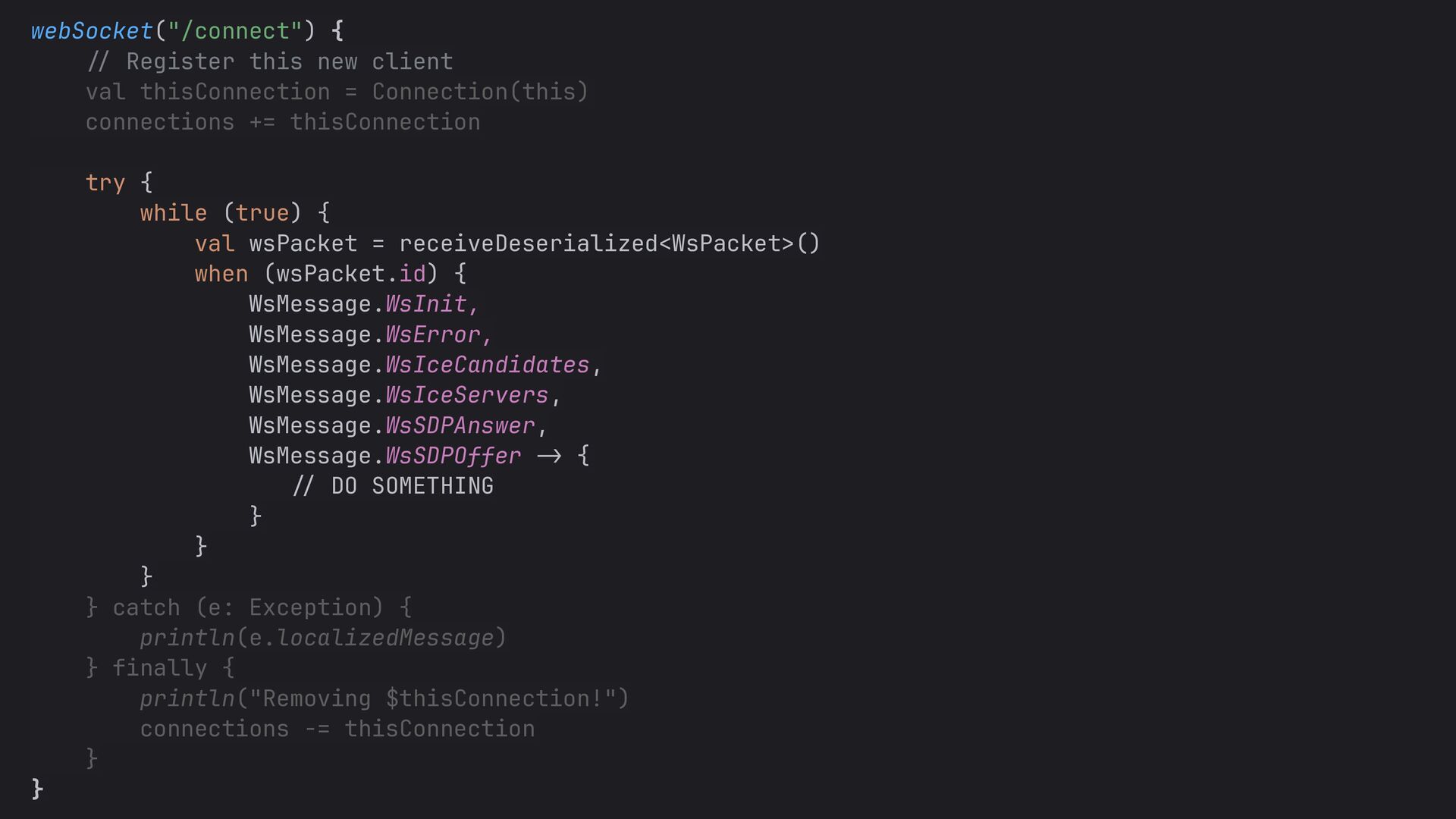
webSocket("/connect") { // Register this new client val thisConnection =
Connection(this) connections += thisConnection try { while (true) { val wsPacket = receiveDeserialized<WsPacket>() when (wsPacket.id) { WsMessage.WsInit, WsMessage.WsError, WsMessage.WsIceCandidates, WsMessage.WsIceServers, WsMessage.WsSDPAnswer, WsMessage.WsSDPOffer -> { // DO SOMETHING } } } } catch (e: Exception) { println(e.localizedMessage) } finally { println("Removing $thisConnection!") connections -= thisConnection } } -
WsMessage.WsIceCandidates, WsMessage.WsIceServers, WsMessage.WsSDPAnswer, WsMessage.WsSDPOffer -> { connections .filter { connection
-> connection.name != thisConnection.name } .forEach { it.session.send(wsPacket.data) } } -
<!DOCTYPE html> <html lang="en"> <head> <meta charset="UTF-8"> <title>WebRTC Simple Example
</ title> </ head> <body> <h1>WebRTC Connection </ h1> <video id="localVideo" autoplay playsinline> </ video> <video id="remoteVideo" autoplay playsinline> </ video> <button id="startCallButton">Start Call </ button> <script> const signalingServerUrl = "ws: // localhost:8080/connect"; const signalingSocket = new WebSocket(signalingServerUrl); let localPeerConnection; let remotePeerConnection; let localStream; signalingSocket.onmessage = async (message) => { const data = JSON.parse(message.data); if (data.offer) { await handleOffer(data.offer); } else if (data.answer) { -
class WebSocketDataSource { private var session: DefaultClientWebSocketSession? = null private
var pingJob: Job = SupervisorJob() private val client = HttpClient { install(Logging) { level = LogLevel.ALL } install(WebSockets) { contentConverter = KotlinxWebsocketSerializationConverter(Json) } } val webSocketDataSourceStream: Flow<WSPacket> = receiveMessages() .onStart { openWebSocketSession() sendMessage(WSPacket(id = WsMessage.WsInit, data = "")) } private suspend fun openWebSocketSession() { session = client.webSocketSession( method = HttpMethod.Get, host = Environment.HOST, path = Environment.PATH, port = 8080 ) { -
private suspend fun openWebSocketSession() { session = client.webSocketSession( method =
HttpMethod.Get, host = Environment.HOST, path = Environment.PATH, port = 8080 ) { url.protocol = URLProtocol.WS } } private suspend fun closeWebSocketSession() { session ?. close() } fun close() { client.close() session = null } suspend fun sendMessage(wsPacket: WSPacket) { logger.d { "Sending: $wsPacket" } try { session ?. ensureActive() if (session == null) { logger.e { "Unable to send message since session is null. $wsPacket" } } else { ?. -
suspend fun sendMessage(wsPacket: WSPacket) { logger.d { "Sending: $wsPacket" }
try { session ?. ensureActive() if (session == null) { logger.e { "Unable to send message since session is null. $wsPacket" } } else { session ?. sendSerialized(wsPacket) } } catch (e: Exception) { logger.e(throwable = e.cause, message = { e.message.orEmpty() }) } } private fun receiveMessages(): Flow<WSPacket> { return flow { emit(session !! ) } // This is needed because session is not initialized yet. .flatMapLatest { session -> session.incoming.consumeAsFlow() .map { session.converter !! .deserialize<WSPacket>(it) } .onEach { logger.d { "Receiving: $it" } } } .timeout(TIMEOUT_DURATION) .catch { logger.i { "Timeout exception was triggered" } } .onCompletion { throw CancellationException("WebSocket connection terminated") } } } -
class WebRTCDataSource( private val peerConnection: PeerConnection = PeerConnection(defaultRtcConfig), private var
dataChannel: DataChannel? = null ) { private var peerConnectionJob: Job = SupervisorJob() private val coroutineScope: CoroutineScope = CoroutineScope(Dispatchers.Default) var onIceCandidateStream: Flow<IceCandidate>? = null var peerConnectionState: StateFlow<PeerConnectionState>? = null init { dataChannel = peerConnection.createDataChannel( label = "input", id = 0, ordered = true, maxRetransmitTimeMs = -1, maxRetransmits = -1, protocol = "", negotiated = false ) onIceCandidateStream = peerConnection.onIceCandidate peerConnectionState = peerConnection.onConnectionStateChange -
onIceCandidateStream = peerConnection.onIceCandidate peerConnectionState = peerConnection.onConnectionStateChange .stateIn( scope = coroutineScope
+ peerConnectionJob, started = SharingStarted.WhileSubscribed(), initialValue = PeerConnectionState.New ) } val onMessageDataChannelStream = dataChannel ?. onMessage ?. shareIn( scope = coroutineScope + peerConnectionJob, started = SharingStarted.WhileSubscribed() ) fun sendCommand(key: NavKey, state: NavState) { logger.d { "sendCommand: ${key.name} ${state.name}" } val code = key.ordinal + state.ordinal.times(128) dataChannel ?. send(byteArrayOf(code.toByte())) } suspend fun createOffer(): SessionDescription = peerConnection.createOffer(defaultOfferAnswerOptions) .also { peerConnection.setLocalDescription(it) } -
suspend fun createOffer(): SessionDescription = peerConnection.createOffer(defaultOfferAnswerOptions) .also { peerConnection.setLocalDescription(it) }
suspend fun createAnswer(wsSDPAnswerData: WsSDPAnswerData) = SessionDescription( type = SessionDescriptionType.Answer, sdp = wsSDPAnswerData.sdp ).also { peerConnection.setRemoteDescription(it) } fun createRtcConfiguration(iceServers: List<WsIceServer>) = RtcConfiguration( iceServers = iceServers.map { iceServer -> IceServer( urls = iceServer.urls, password = iceServer.credential.orEmpty(), username = iceServer.username.orEmpty() ) } ) fun setConfiguration(configuration: RtcConfiguration) { peerConnection.setConfiguration(configuration) } fun addIceCandidates(iceCandidates: List<WsIceCandidateData>) { iceCandidates.forEach { wsIceCandidate -> peerConnection.addIceCandidate( IceCandidate( -
sdpMid = wsIceCandidate.sdpMid, sdpMLineIndex = wsIceCandidate.sdpMLineIndex, candidate = wsIceCandidate.candidate, )
) } } fun closeWebRTCSession() { logger.i { "closeWebRTCConnection" } peerConnectionJob.cancel() dataChannel = null peerConnection.close() } companion object { val defaultRtcConfig = RtcConfiguration( iceServers = listOf( IceServer( urls = listOf( "stun:stun1.l.google.com:19302", "stun:stun2.l.google.com:19302" ) ), ) ) -
class DefaultConnectionRepository( private val coroutineScope: CoroutineScope, private val webSocketDataSource: WebSocketDataSource,
private val webRTCDataSource: WebRTCDataSource, var connectionInfo: ConnectionInfo, ) : ConnectionRepository { override val controllerState: StateFlow<ControllerState> = combine( webRTCDataSource.peerConnectionState, webSocketDataSource.webSocketDataSourceStream, ) { peerConnectionState, packet -> when (packet.id) { WsMessage.WsError -> { val wsErrorCodeData: WsErrorCodeData = Json.decodeFromString(packet.data) PairingState.Failed(message = wsErrorCodeData.message) } else -> { when (peerConnectionState) { PeerConnectionState.New -> { -
when (packet.id) { WsMessage.WsIceServers -> { val wsIceServersData = Json.decodeFromString<WsIceServersData>(packet.data)
val iceServers = wsIceServersData.iceServers val rtcConfigurations = webRTCDataSource.createRtcConfiguration(iceServers) webRTCDataSource.setConfiguration(rtcConfigurations) sendWsIceCandidate() val sessionDescription = webRTCDataSource.createOffer() webSocketDataSource.sendMessage( WSPacket( id = WsMessage.WsSDPOffer, data = Json.encodeToString( WsSDPOfferData( type = sessionDescription.type.name.lowercase(), sdp = sessionDescription.sdp, controllerId = connectionInfo.controllerId, ) -
PairingState.Connecting } WsMessage.WsIceCandidates -> { val wsIceCandidateDataList = Json.decodeFromString<WsIceCandidatesData>(packet.data) webRTCDataSource.addIceCandidates(wsIceCandidateDataList.iceCandidates)
PairingState.Connecting } WsMessage.WsSDPAnswer -> { val wsSDPAnswerData = Json.decodeFromString<WsSDPAnswerData>(packet.data) webRTCDataSource.createAnswer(wsSDPAnswerData) PairingState.Connecting } else -> PairingState.Connecting } } PeerConnectionState.Connecting -> { when (packet.id) { WsMessage.WsSDPAnswer -> { -
PeerConnectionState.Connecting -> { when (packet.id) { WsMessage.WsSDPAnswer -> { val
wsSDPAnswerData = Json.decodeFromString<WsSDPAnswerData>(packet.data) webRTCDataSource.createAnswer(wsSDPAnswerData) PairingState.Connecting } WsMessage.WsIceCandidates -> { val wsIceCandidateDataList = Json.decodeFromString<WsIceCandidatesData>(packet.data) webRTCDataSource.addIceCandidates(wsIceCandidateDataList.iceCandidates) PairingState.Connecting } else -> PairingState.Connecting } } PeerConnectionState.Connected -> PairingState.Connected PeerConnectionState.Disconnected -> PairingState.Disconnected PeerConnectionState.Failed -> PairingState.Failed( message = "PeerConnectionState.Failed" -
PeerConnectionState.Connected -> PairingState.Connected PeerConnectionState.Disconnected -> PairingState.Disconnected PeerConnectionState.Failed -> PairingState.Failed( message
= "PeerConnectionState.Failed" ) PeerConnectionState.Closed -> PairingState.Closed } } } } .catch { emit(PairingState.Disconnected) } .onCompletion { webRTCDataSource.closeWebRTCSession() webSocketDataSource.close() } .stateIn( scope = coroutineScope, started = SharingStarted.WhileSubscribed(), initialValue = PairingState.New ) override suspend fun startSessions(connectionInfo: ConnectionInfo) { -
private fun sendWsIceCandidate() { coroutineScope.launch { webRTCDataSource.onIceCandidateStream ?. collect {
iceCandidate -> webSocketDataSource.sendMessage( WSPacket( id = WsMessage.WsIceCandidates, data = Json.encodeToString( WsIceCandidatesData( controllerId = connectionInfo.controllerId, iceCandidates = listOf( WsIceCandidateData( candidate = iceCandidate.candidate, sdpMLineIndex = iceCandidate.sdpMLineIndex, sdpMid = iceCandidate.sdpMid, ) ) ) ) ) ) } } } } -
@Composable expect fun Video( videoTrack: VideoStreamTrack, modifier: Modifier = Modifier,
audioTrack: AudioStreamTrack? = null ) https: // github.com/shepeliev/webrtc-kmp -
AndroidView( modifier = modifier, factory = { context -> SurfaceViewRenderer(context).apply
{ setScalingType( RendererCommon.ScalingType.SCALE_ASPECT_BALANCED, RendererCommon.ScalingType.SCALE_ASPECT_FIT ) renderer = this } }, ) https: // github.com/shepeliev/webrtc-kmp -
@OptIn(ExperimentalForeignApi :: class) @Composable actual fun Video( videoTrack: VideoStreamTrack, modifier:
Modifier, audioTrack: AudioStreamTrack?) { UIKitView( factory = { RTCMTLVideoView().apply { contentMode = UIViewContentMode.UIViewContentModeScaleAspectFit videoTrack.addRenderer(this) } }, modifier = modifier, ) } https: // github.com/shepeliev/webrtc-kmp -
👨✈ Selective Forwarding Unit Client A Client B Client C
Server PeerA → SFU → PeerB |→ PeerC PeerB → SFU → PeerA |→ PeerC PeerC → SFU → PeerA |→ PeerB -
👨✈ Selective Forwarding Unit Common technologies used with an SFU
• Simulcast • Temporal scalability • Insertable Streams • Protocol Converter -
What is next? Why WebRTC Companies Exist? • Scalability and
Performance • Security • Customization • Easy to setup -
What is next? Why WebRTC Companies Exist? • GetStream •
LiveKit • Dyte • Zoom SDK • Agora • Vonage • Twilio Video • Mux • Daily • AWS Chime • Whereby • MirrorFly