Safe Harbor Statement The following is intended to outline our general product direction. It is intended for information purposes only, and may not be incorporated into any contract. It is not a commitment to deliver any material, code, or functionality, and should not be relied upon in making purchasing decisions. The development, release, and timing of any features or functionality described for Oracle’s products remains at the sole discretion of Oracle. 3
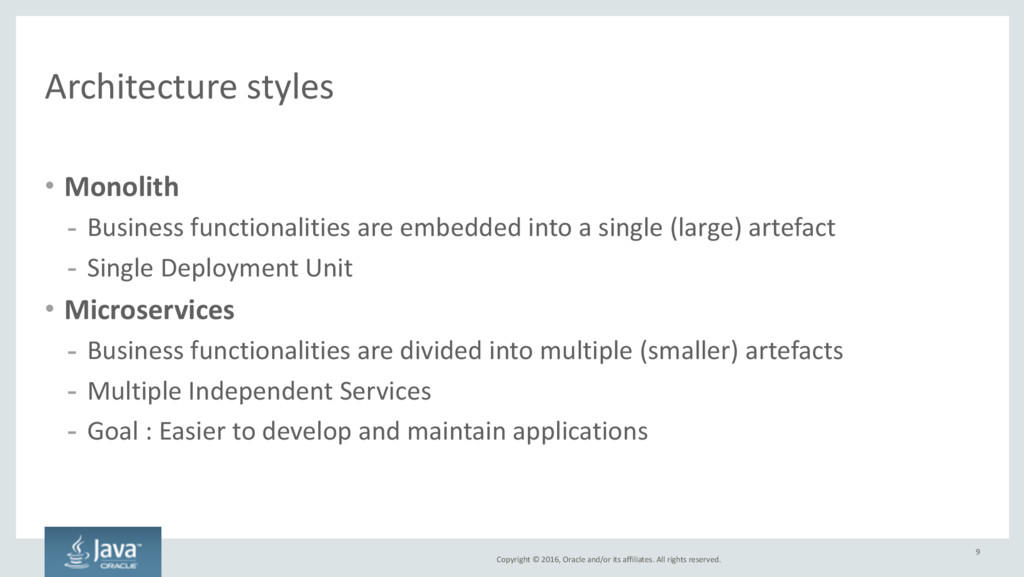
Architecture styles • Monolith - Business functionalities are embedded into a single (large) artefact - Single Deployment Unit • Microservices - Business functionalities are divided into multiple (smaller) artefacts - Multiple Independent Services - Goal : Easier to develop and maintain applications 9
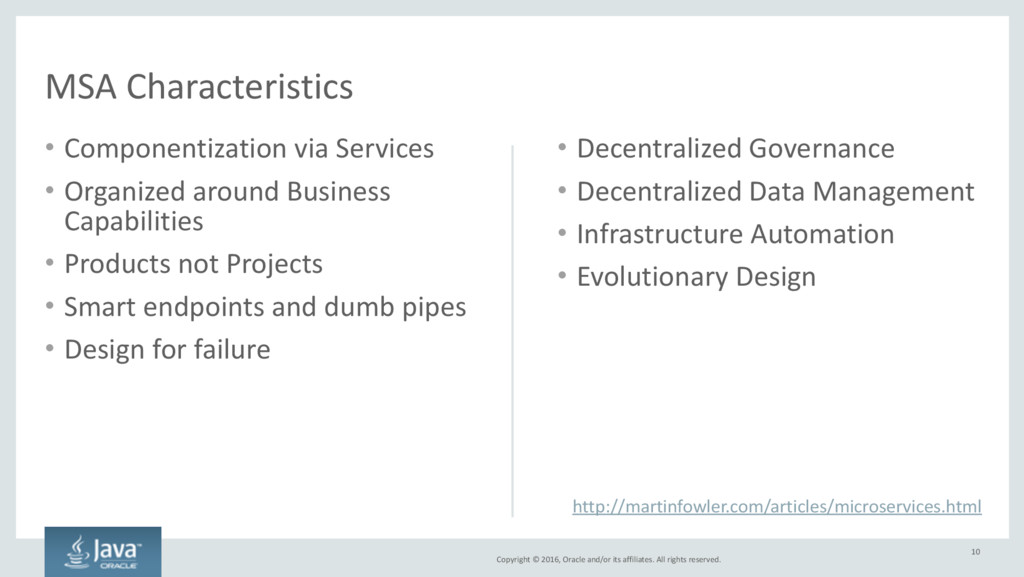
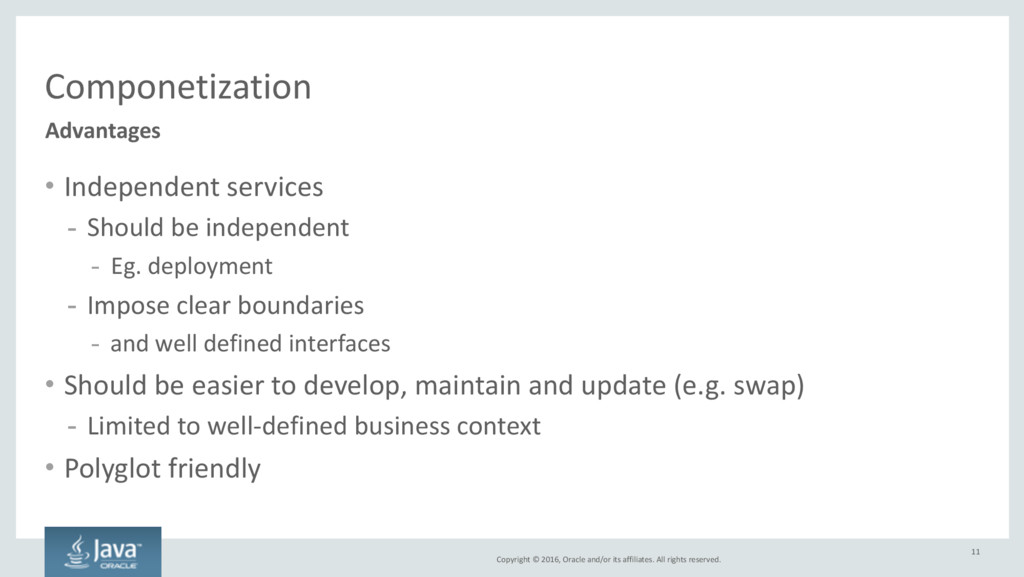
Componetization • Independent services - Should be independent - Eg. deployment - Impose clear boundaries - and well defined interfaces • Should be easier to develop, maintain and update (e.g. swap) - Limited to well-‐defined business context • Polyglot friendly 11 Advantages
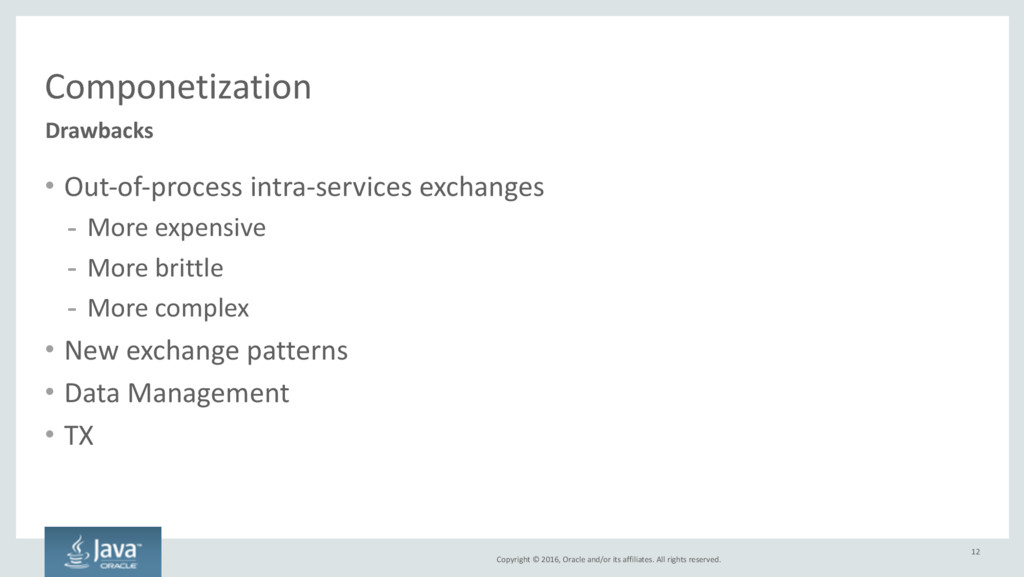
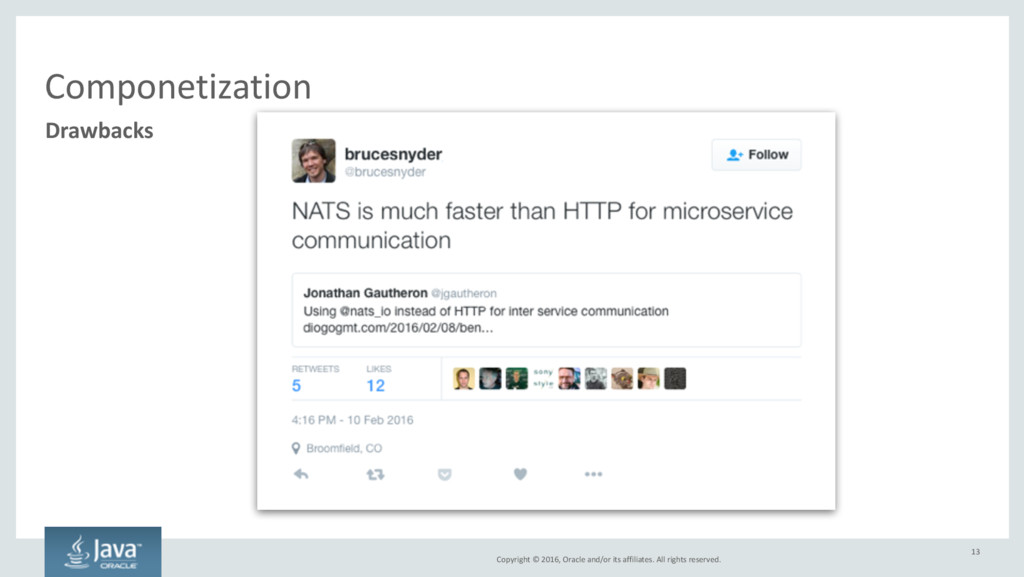
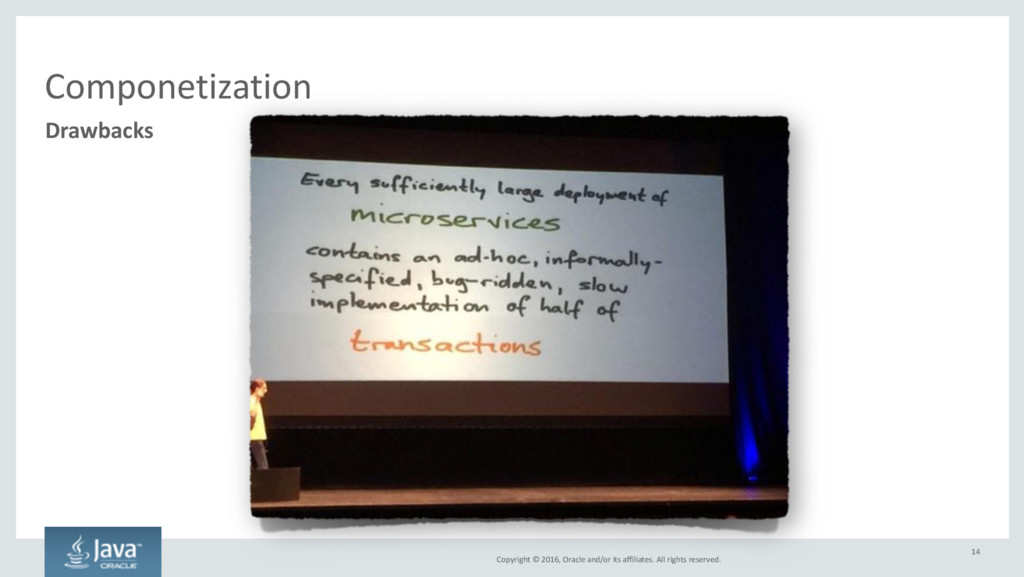
Componetization • Out-‐of-‐process intra-‐services exchanges - More expensive - More brittle - More complex • New exchange patterns • Data Management • TX 12 Drawbacks
Organized around Business Capabilities • How to split a complex problems? - Skills, Orgs, Geo, … • Cross-‐functional teams organised around business capability - UX, DB, PM, … 15 Divide & Conquer
Organized around Business Capabilities • Nothing prevent a Monlith to be modularized around business capabilities • Processes & Methodologies - Eg. Design Driven Development • Culture & Organisation 16 Divide & Conquer
Product not Project • A team should own a product over its full lifetime - Aka “You build it, you run it!” • An application is not just a set of functionality to release - How can the application assist its users to enhance the business capability? • Culture & Organisation 17 When are we really done?
Smart endpoints and dumb pipes • Leverage Web principles & protocols - Infrastructure friendly, caching, etc. • New communication patterns - Move from fine-‐grained to coarser-‐grained exchanges - Messaging • New tools - Circuit Breaker, Messaging Solution… 18
Design for Failure • Risk of failures are increased - Design accordingly and cope with failure! - Will induce additional complexity • Pro-‐active monitoring - Detect failures quickly - Automatically restore service 19 Many potential PoF
Decentralized Data Management • Conceptual model focused around the service context • No Data Management constraints • Polyglot persistence 21 Decentralized decisions
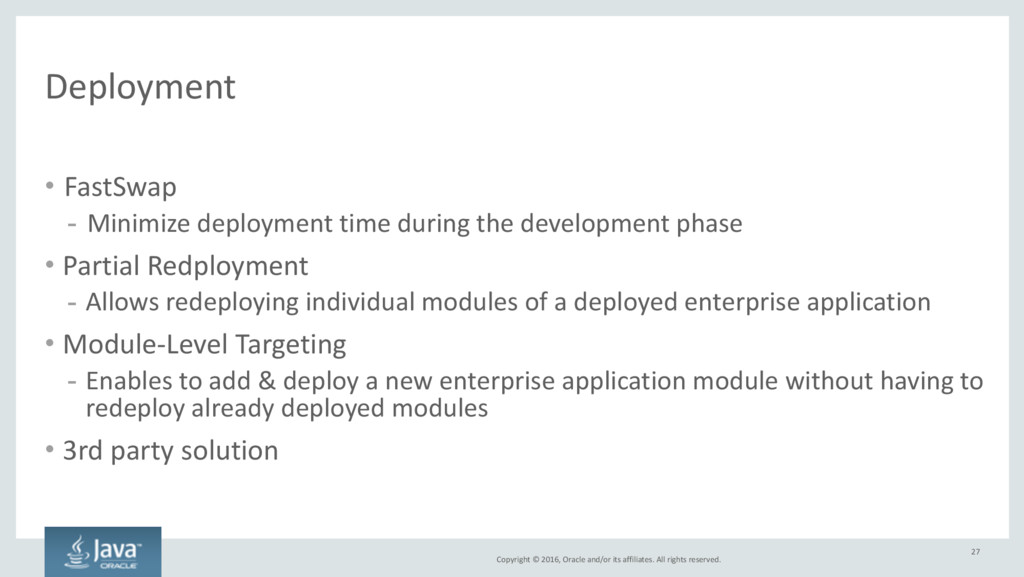
Deployment 27 • FastSwap - Minimize deployment time during the development phase • Partial Redployment - Allows redeploying individual modules of a deployed enterprise application • Module-‐Level Targeting - Enables to add & deploy a new enterprise application module without having to redeploy already deployed modules • 3rd party solution
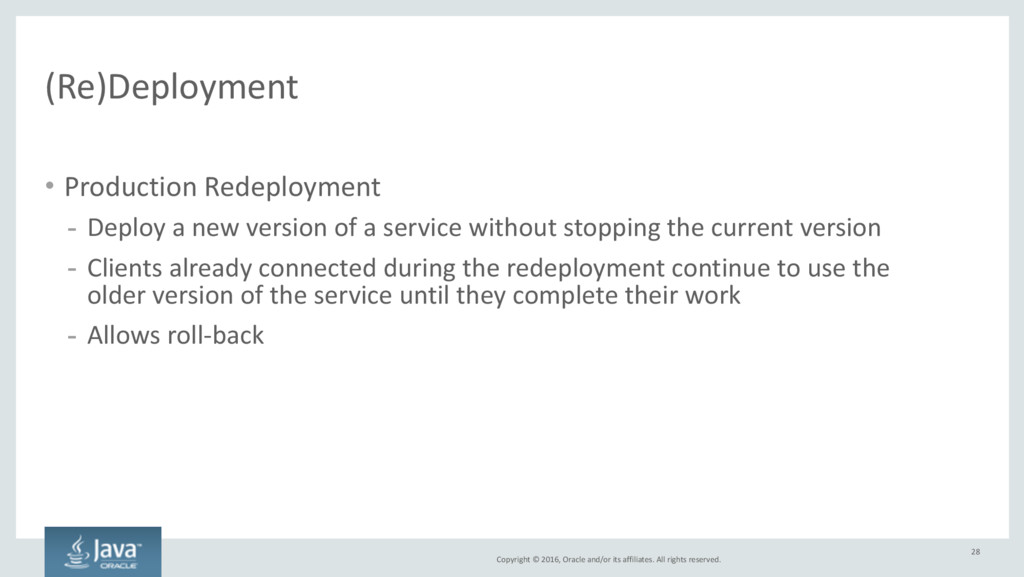
• Production Redeployment - Deploy a new version of a service without stopping the current version - Clients already connected during the redeployment continue to use the older version of the service until they complete their work - Allows roll-‐back 28 (Re)Deployment
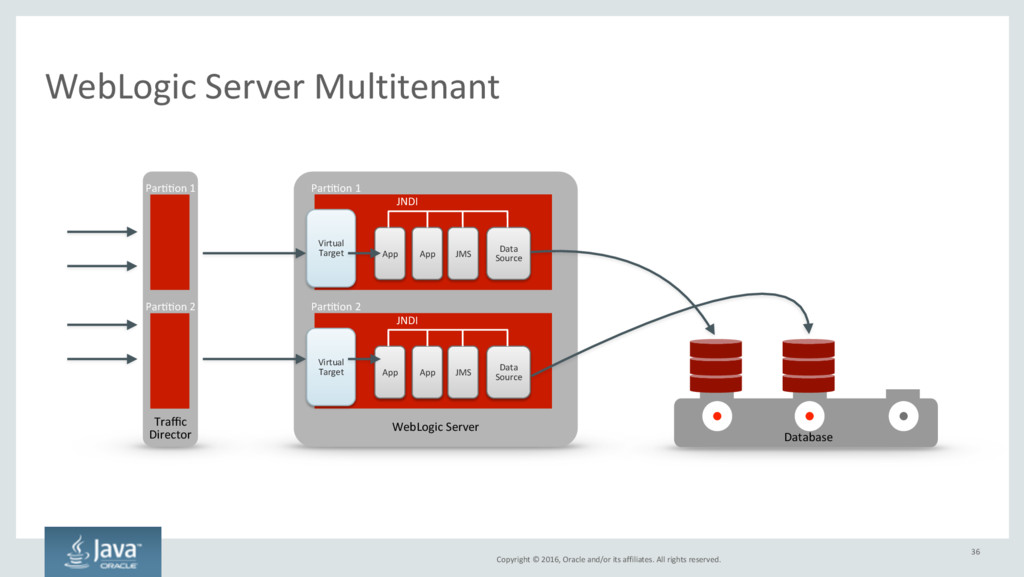
• Applications and resources deployed for each partition • No application changes required • WebLogic infrastructure shared among partitions • Provides resource isolation within a Domain Partition 35 Domain Partition WebLogic Server Multitenant
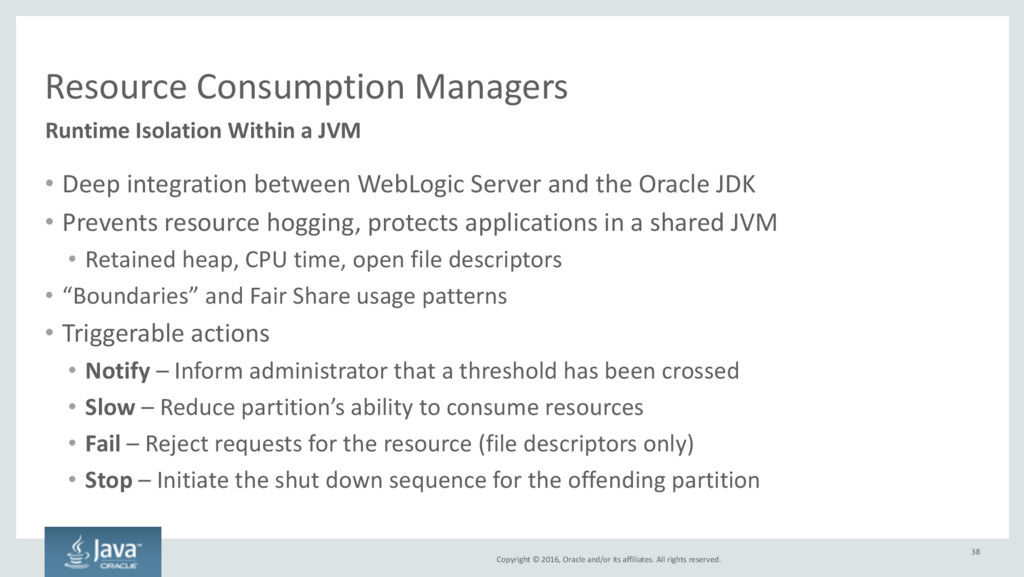
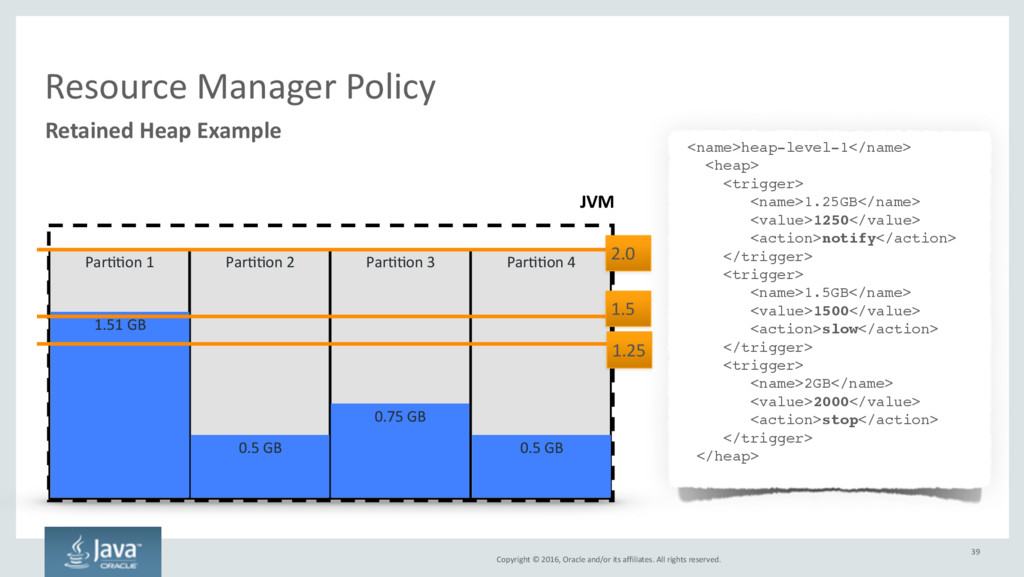
38 Runtime Isolation Within a JVM Resource Consumption Managers Dev • Deep integration between WebLogic Server and the Oracle JDK • Prevents resource hogging, protects applications in a shared JVM • Retained heap, CPU time, open file descriptors • “Boundaries” and Fair Share usage patterns • Triggerable actions • Notify – Inform administrator that a threshold has been crossed • Slow – Reduce partition’s ability to consume resources • Fail – Reject requests for the resource (file descriptors only) • Stop – Initiate the shut down sequence for the offending partition
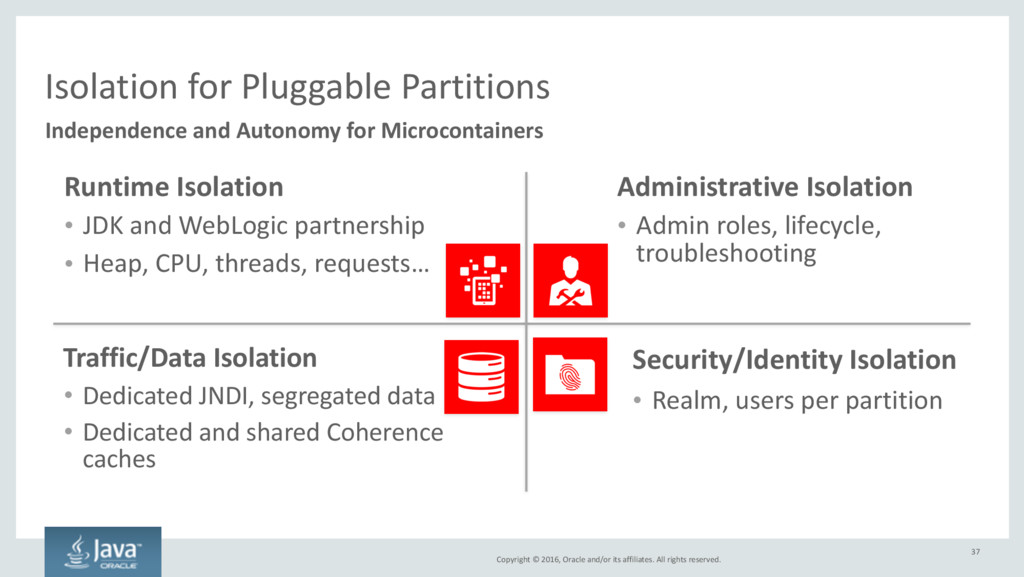
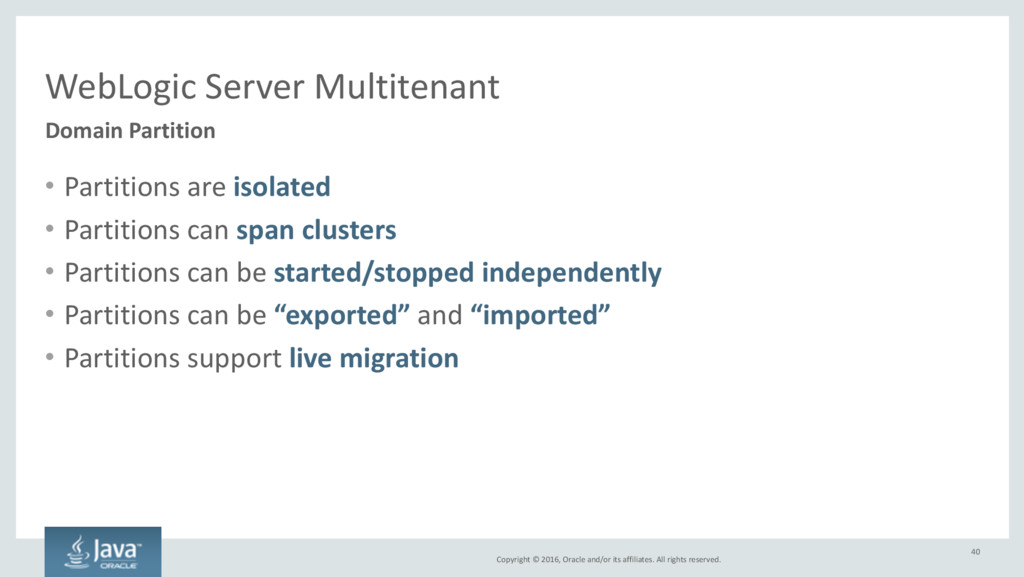
• Partitions are isolated • Partitions can span clusters • Partitions can be started/stopped independently • Partitions can be “exported” and “imported” • Partitions support live migration 40 Domain Partition WebLogic Server Multitenant
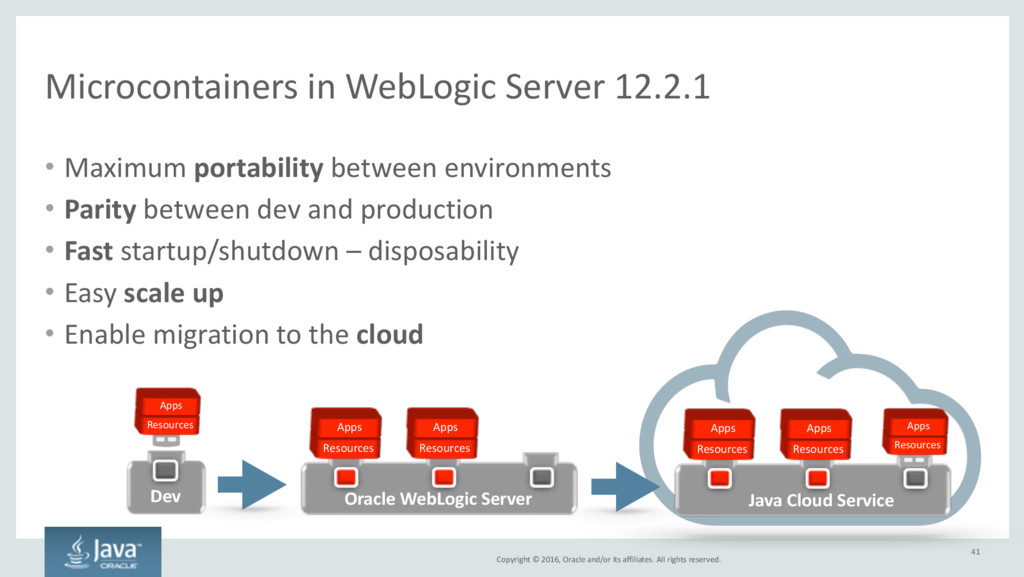
41 Microcontainers in WebLogic Server 12.2.1 • Maximum portability between environments • Parity between dev and production • Fast startup/shutdown – disposability • Easy scale up • Enable migration to the cloud Apps$ Resources$ Apps$ Resources$ Apps$ Resources$ Apps$ Resources$ Apps$ Resources$ Apps$ Resources$ Dev Oracle WebLogic Server Java Cloud Service
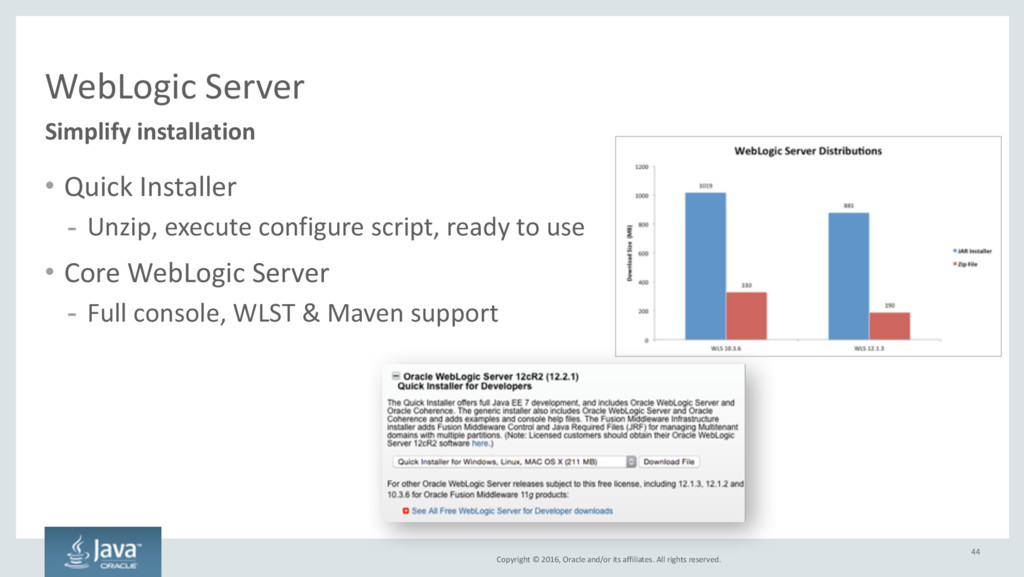
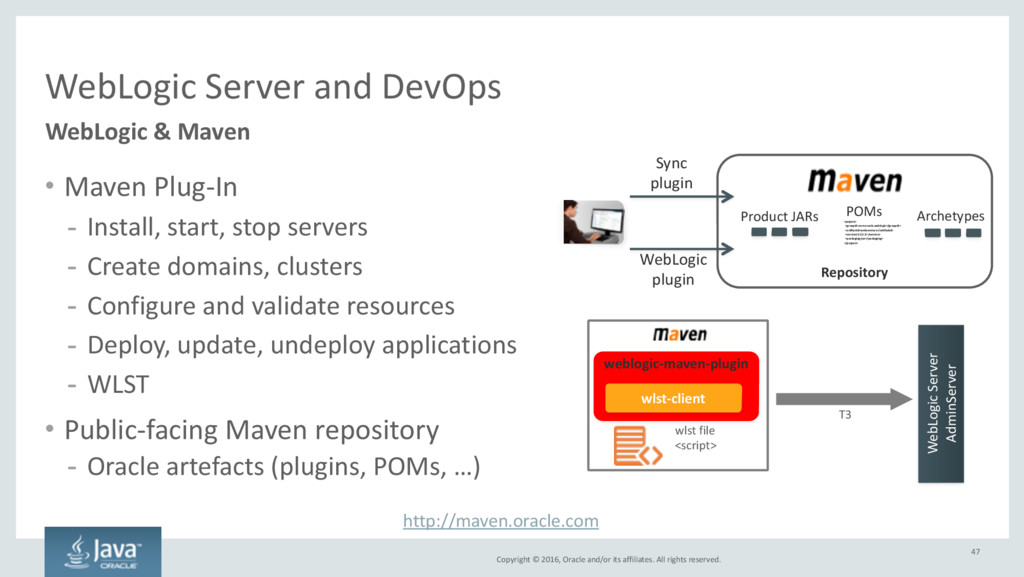
WebLogic Server • Quick Installer - Unzip, execute configure script, ready to use • Core WebLogic Server - Full console, WLST & Maven support 44 Simplify installation
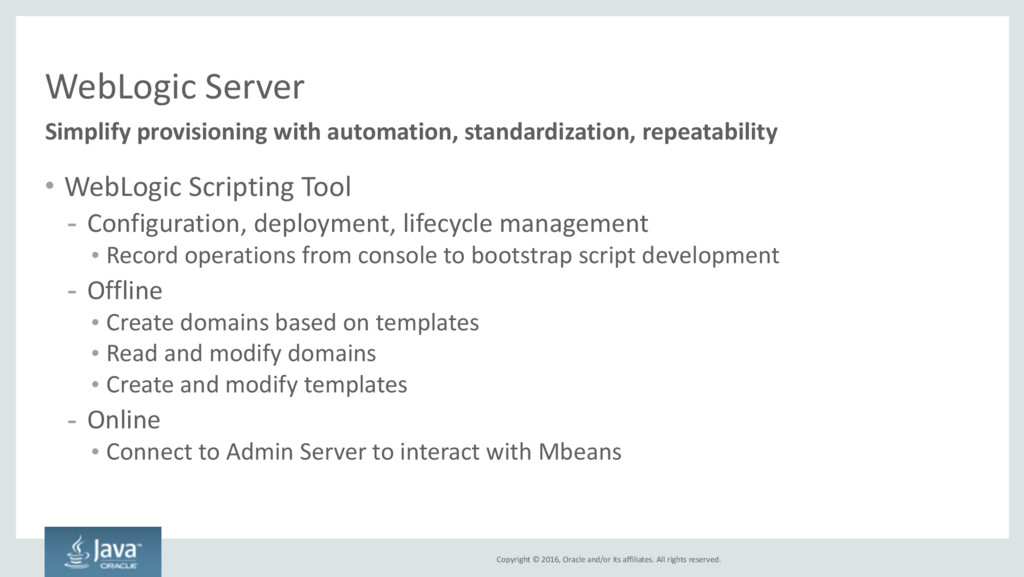
WebLogic Server • WebLogic Scripting Tool - Configuration, deployment, lifecycle management • Record operations from console to bootstrap script development - Offline • Create domains based on templates • Read and modify domains • Create and modify templates - Online • Connect to Admin Server to interact with Mbeans Simplify provisioning with automation, standardization, repeatability
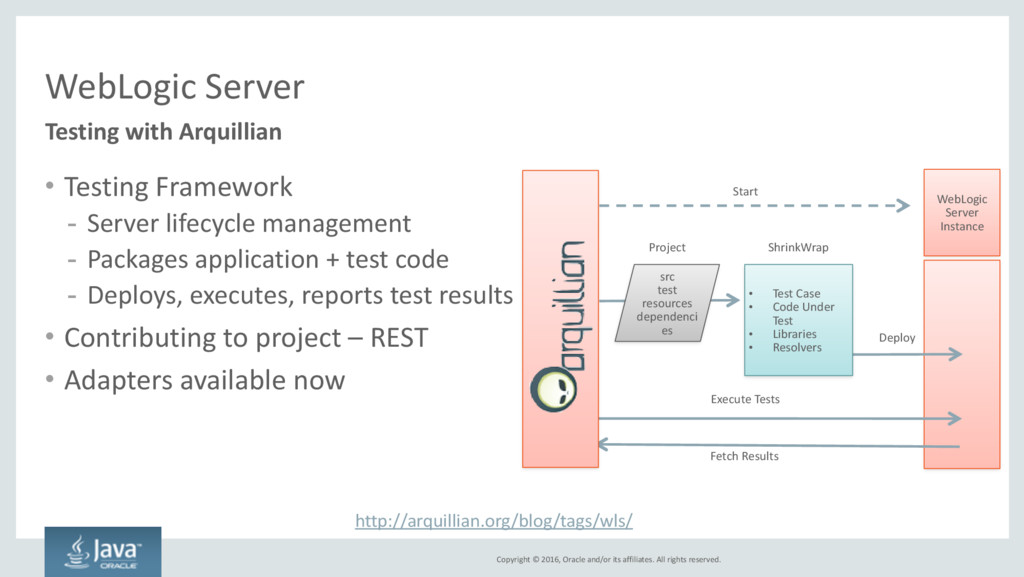
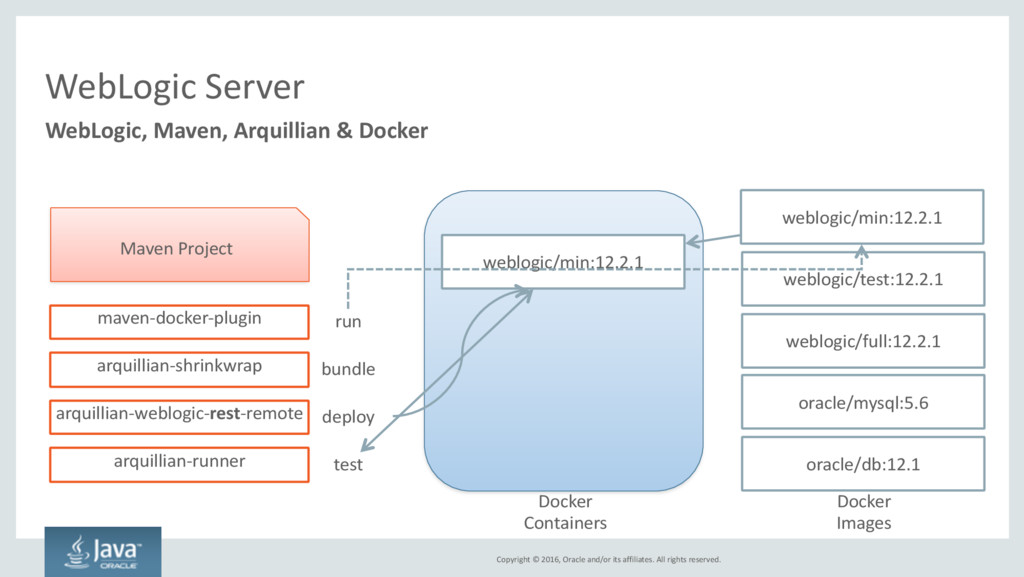
WebLogic Server • Testing Framework - Server lifecycle management - Packages application + test code - Deploys, executes, reports test results • Contributing to project – REST • Adapters available now Testing with Arquillian WebLogic Server Instance src test resources dependenci es • Test Case • Code Under Test • Libraries • Resolvers ShrinkWrap Start Project Execute Tests Fetch Results Deploy http://arquillian.org/blog/tags/wls/
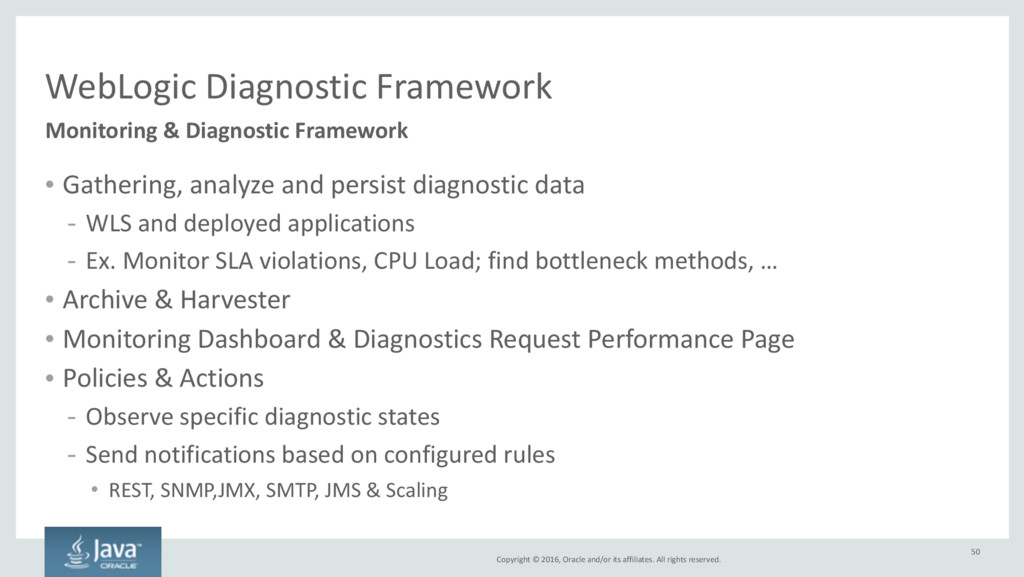
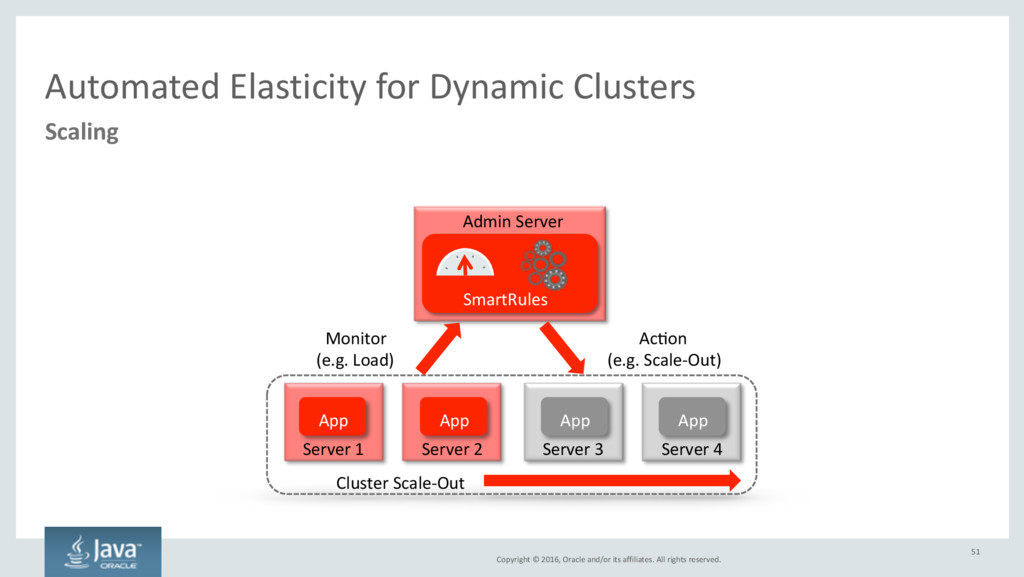
Automated Elasticity for Dynamic Clusters • Administration APIs for Dynamic Clusters - Start/stop a specified number of servers - Expand/shrink the size of the cluster • Simple/automated scale up/down or tune • Rules-‐based decisions based on capacity demand or schedule • Watches, Notifications become Policies, Actions - Policies: SmartRules, Calendar-‐based policies - Actions: scaleUp, scaleDown, REST, script 52 Scaling
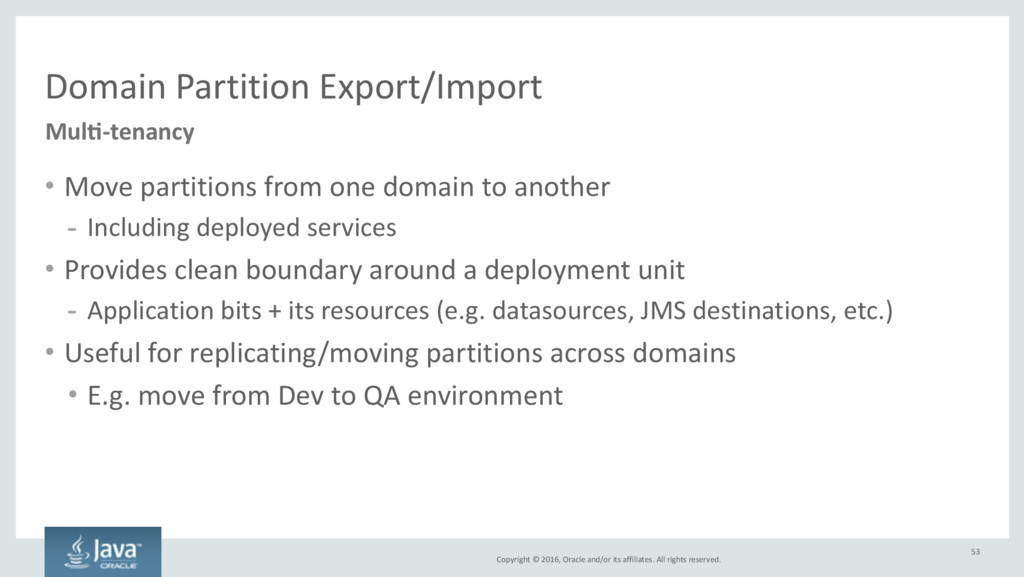
53 Domain Partition Export/Import Dev • Move partitions from one domain to another - Including deployed services • Provides clean boundary around a deployment unit - Application bits + its resources (e.g. datasources, JMS destinations, etc.) • Useful for replicating/moving partitions across domains • E.g. move from Dev to QA environment Mul\-‐tenancy
54 Zero Downtime Patching Dev • Automatically orchestrates the rollout of patches and updates, without incurring any downtime or session loss - OTD & OHS integration • Update roll-‐out -‐ Initiate, Revert or Resume (failed) update • Patch ‘OracleHome’ directory - WebLogic, JVM (and applications) - Production redeployment


 rigadevday
 marktimemedia
 aleyda
 akihiro_kokubo
 csswizardry
 tamaranovitovic
 danielanewman
 marcelosomers
 afnizarnur
 raygrieselhuber
 mojombo
 lara
lara
 katarinadahlin