HTTP Security: headers as a shield over your ap...

Share
Embed
HTTP Security: headers as a shield over your application
You are all aware of what are XSS vulnerabilities; do you know what's Clickjacking? You have probably heard of Root Certificate compromission; do you know the principle of a protocol downgrade attack? You're coming to SymfonyCon because you are HTTP application developers and I will present you awesome HTTP headers that will help you to mitigate these kind of attacks, just using W3C WebAppSec recommendations.

Romain Neutron
December 02, 2016
Transcript
75 slides
-
$ curl -I https://github.com HTTP/1.1 200 OK Server: GitHub.com
Date: Mon, 04 Apr 2016 20:10:13 GMT Content-Type: text/html; charset=utf-8 Status: 200 OK Cache-Control: no-cache Vary: X-PJAX X-UA-Compatible: IE=Edge,chrome=1 Set-Cookie: logged_in=no; domain=.github.com; path=/; expires=Fri, 04 Apr 2036 20:10:13 Set-Cookie: _gh_sess=eyJzZXNzaW9uX2lkIjoiYzE1ZjE3NjA4Yjg1MWM3MTk4MjY0ZjdiMzY5ZDJhNzciLC X-Request-Id: 048b988349db27c05f13900c2b8c8dd5 X-Runtime: 0.011717 Content-Security-Policy: default-src 'none'; base-uri 'self'; block-all-mixed-content; Strict-Transport-Security: max-age=31536000; includeSubdomains; preload Public-Key-Pins: max-age=1209600; pin-sha256="WoiWRyIOVNa9ihaBciRSC7XHjliYS9VwUGOIud4PB X-Content-Type-Options: nosniff X-Frame-Options: deny X-XSS-Protection: 1; mode=block Vary: Accept-Encoding X-Served-By: 7cc969f65c7ec8d9db2fa57dcc51d323 X-GitHub-Request-Id: 55A8461C:0E34:67919BE:5702CA25 Browsers HTTP Security -
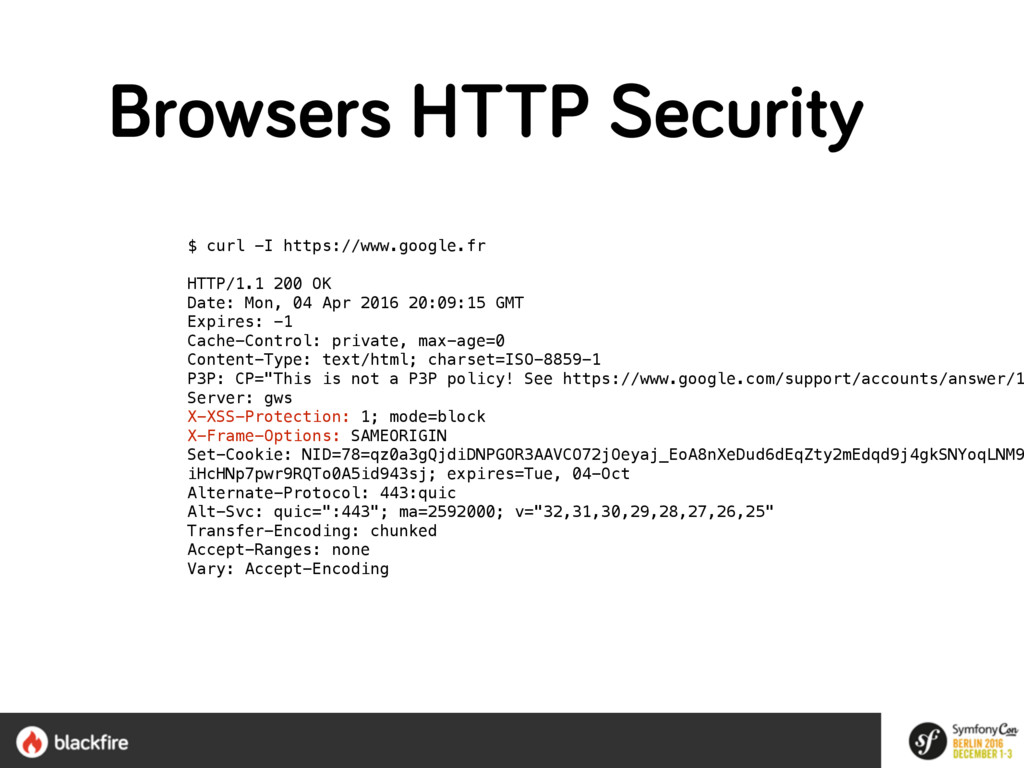
$ curl -I https://www.google.fr HTTP/1.1 200 OK Date: Mon, 04
Apr 2016 20:09:15 GMT Expires: -1 Cache-Control: private, max-age=0 Content-Type: text/html; charset=ISO-8859-1 P3P: CP="This is not a P3P policy! See https://www.google.com/support/accounts/answer/1 Server: gws X-XSS-Protection: 1; mode=block X-Frame-Options: SAMEORIGIN Set-Cookie: NID=78=qz0a3gQjdiDNPGOR3AAVCO72jOeyaj_EoA8nXeDud6dEqZty2mEdqd9j4gkSNYoqLNM9 iHcHNp7pwr9RQTo0A5id943sj; expires=Tue, 04-Oct Alternate-Protocol: 443:quic Alt-Svc: quic=":443"; ma=2592000; v="32,31,30,29,28,27,26,25" Transfer-Encoding: chunked Accept-Ranges: none Vary: Accept-Encoding Browsers HTTP Security -
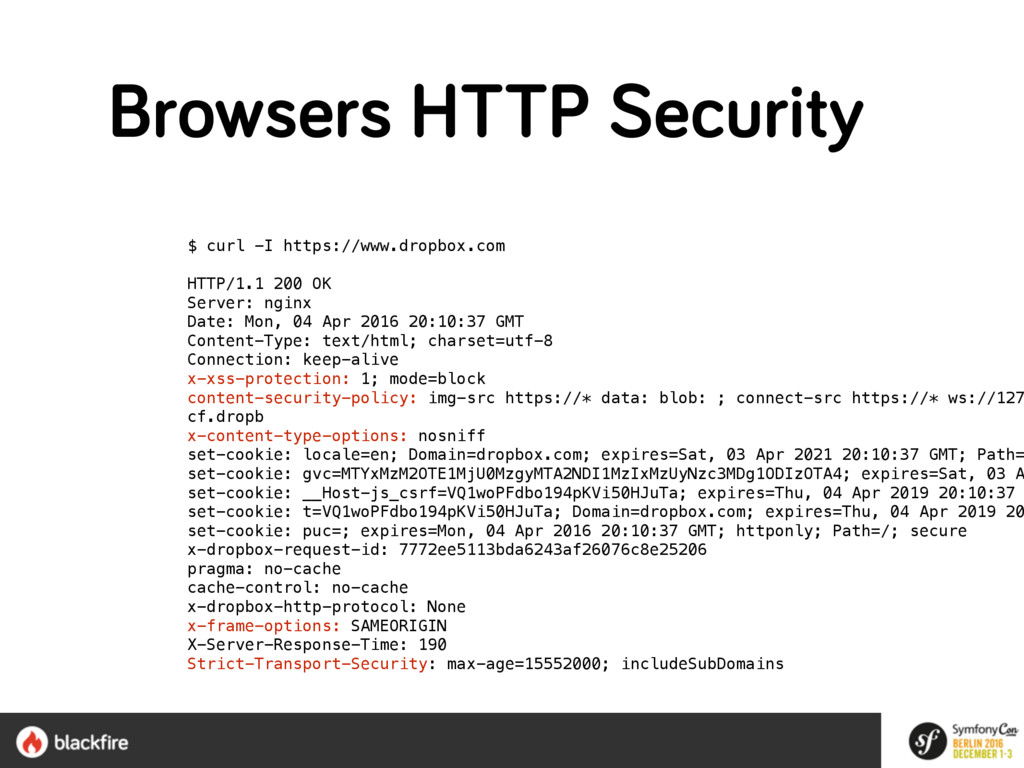
$ curl -I https://www.dropbox.com HTTP/1.1 200 OK Server: nginx Date:
Mon, 04 Apr 2016 20:10:37 GMT Content-Type: text/html; charset=utf-8 Connection: keep-alive x-xss-protection: 1; mode=block content-security-policy: img-src https://* data: blob: ; connect-src https://* ws://127 cf.dropb x-content-type-options: nosniff set-cookie: locale=en; Domain=dropbox.com; expires=Sat, 03 Apr 2021 20:10:37 GMT; Path= set-cookie: gvc=MTYxMzM2OTE1MjU0MzgyMTA2NDI1MzIxMzUyNzc3MDg1ODIzOTA4; expires=Sat, 03 A set-cookie: __Host-js_csrf=VQ1woPFdbo194pKVi50HJuTa; expires=Thu, 04 Apr 2019 20:10:37 set-cookie: t=VQ1woPFdbo194pKVi50HJuTa; Domain=dropbox.com; expires=Thu, 04 Apr 2019 20 set-cookie: puc=; expires=Mon, 04 Apr 2016 20:10:37 GMT; httponly; Path=/; secure x-dropbox-request-id: 7772ee5113bda6243af26076c8e25206 pragma: no-cache cache-control: no-cache x-dropbox-http-protocol: None x-frame-options: SAMEORIGIN X-Server-Response-Time: 190 Strict-Transport-Security: max-age=15552000; includeSubDomains Browsers HTTP Security -
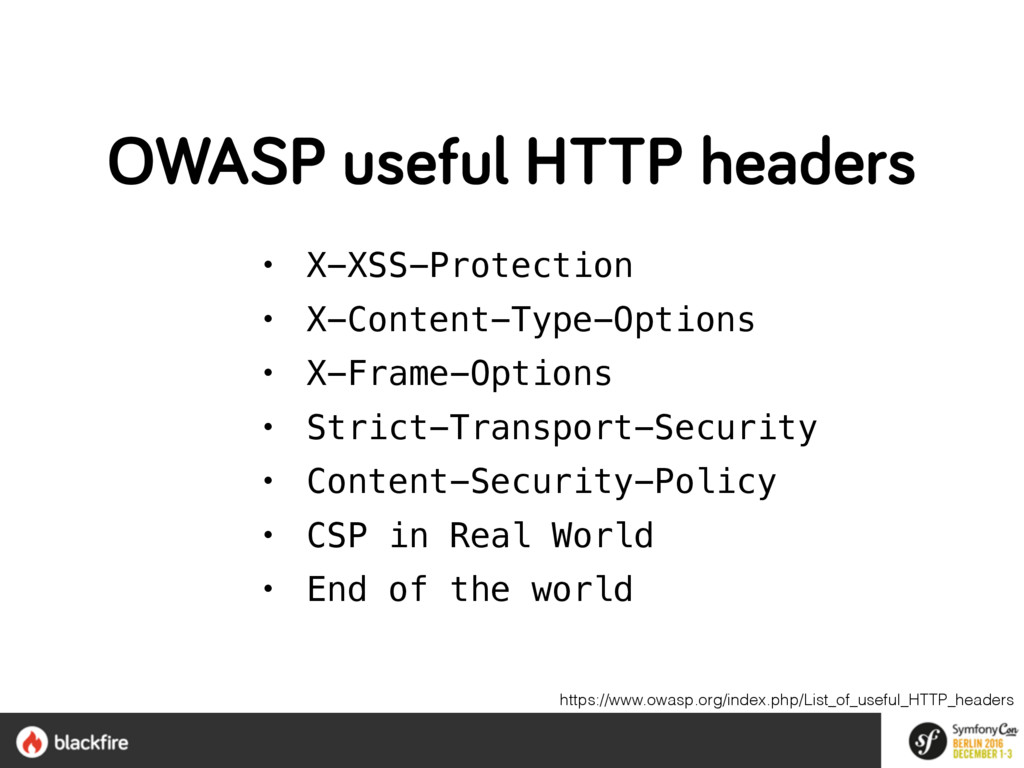
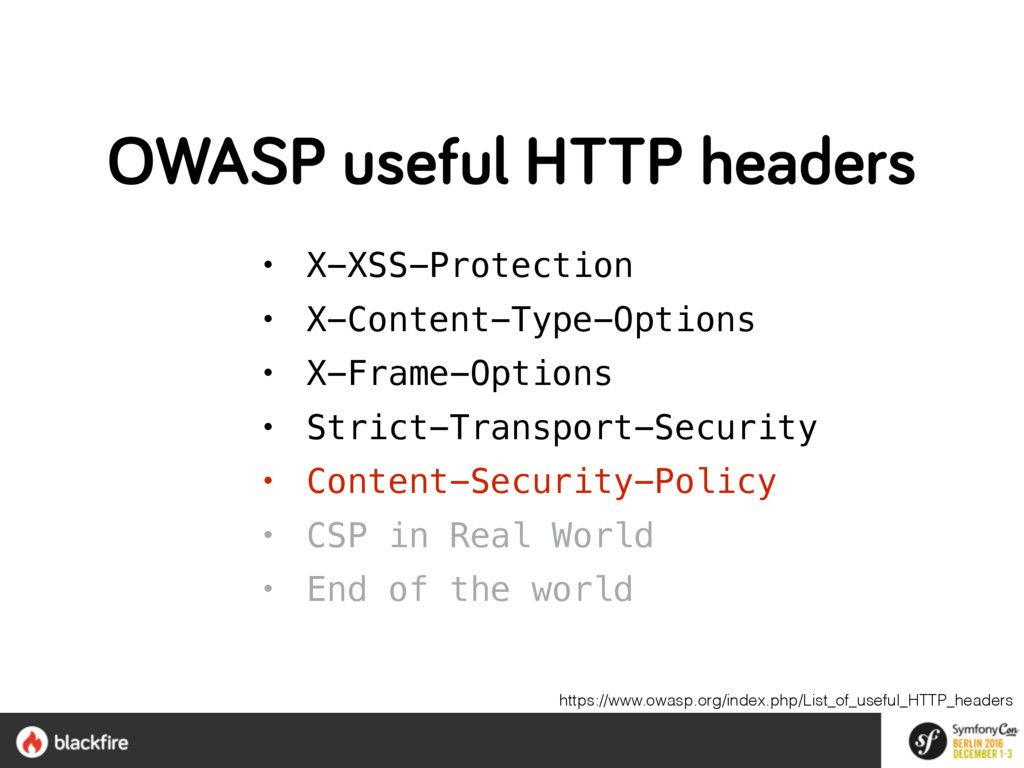
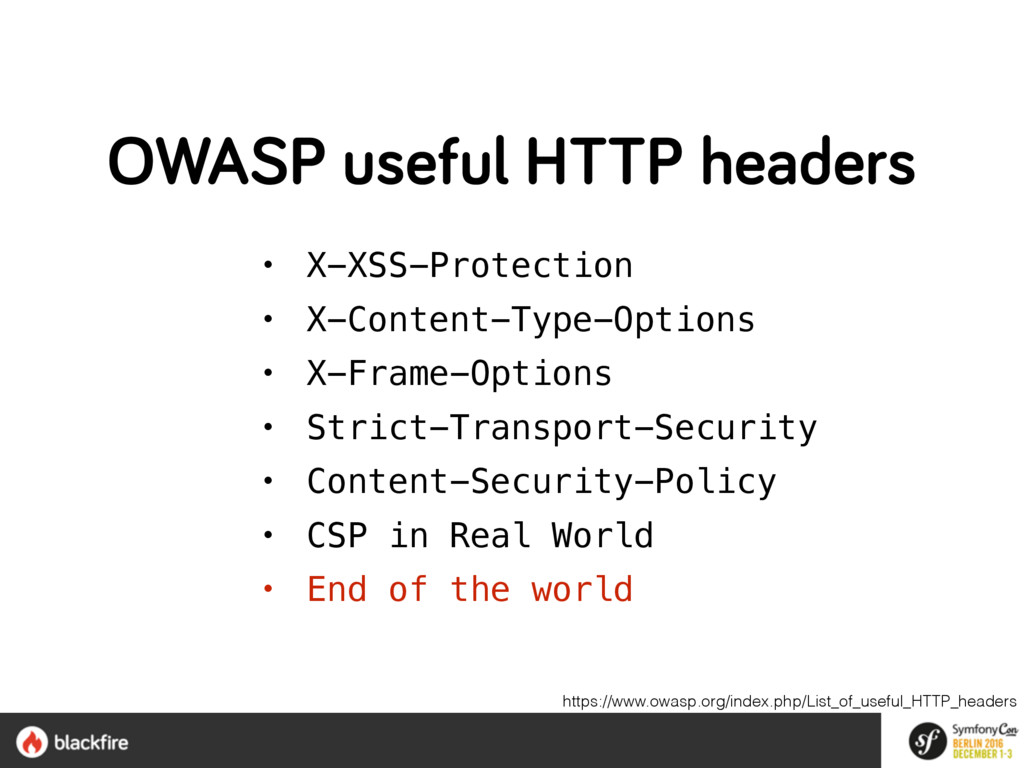
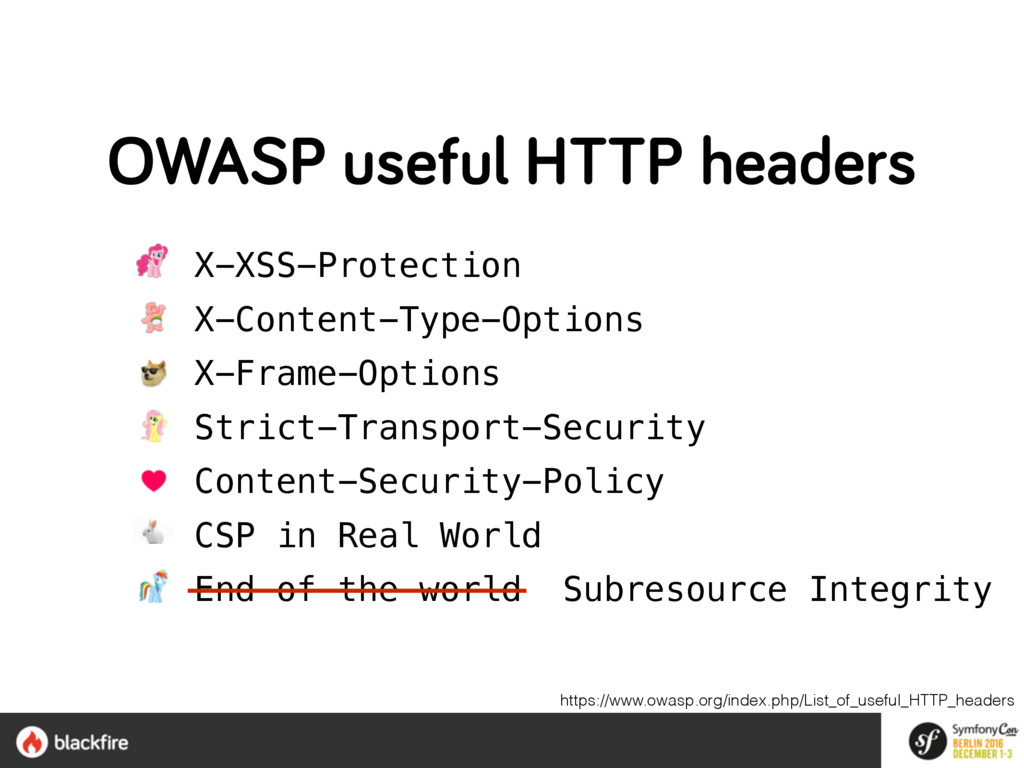
https://www.owasp.org/index.php/List_of_useful_HTTP_headers • X-XSS-Protection • X-Content-Type-Options • X-Frame-Options • Strict-Transport-Security •
Content-Security-Policy • CSP in Real World • End of the world OWASP useful HTTP headers -
https://www.owasp.org/index.php/List_of_useful_HTTP_headers • X-XSS-Protection • X-Content-Type-Options • X-Frame-Options • Strict-Transport-Security •
Content-Security-Policy • CSP in Real World • End of the world OWASP useful HTTP headers -
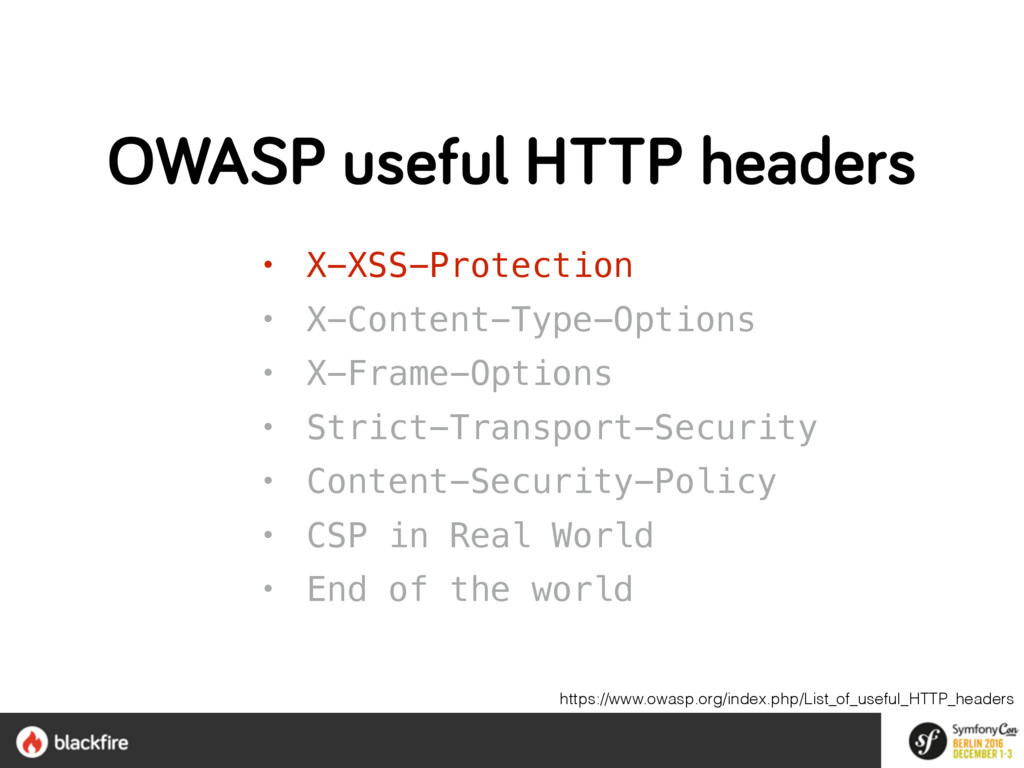
X-Xss-Protection • Prevents XSS reflected attacks • Supported by IE8+
and Chrome • Enabled / disabled • mode-block to completely turn off rendering X-XSS-Protection: 1; mode=block http://blogs.msdn.com/b/ieinternals/archive/2011/01/31/controlling-the-internet-explorer-xss-filter-with-the-x-xss-protection-http-header.aspx #BOUTIN -
https://www.owasp.org/index.php/List_of_useful_HTTP_headers • X-XSS-Protection • X-Content-Type-Options • X-Frame-Options • Strict-Transport-Security •
Content-Security-Policy • CSP in Real World • End of the world OWASP useful HTTP headers -
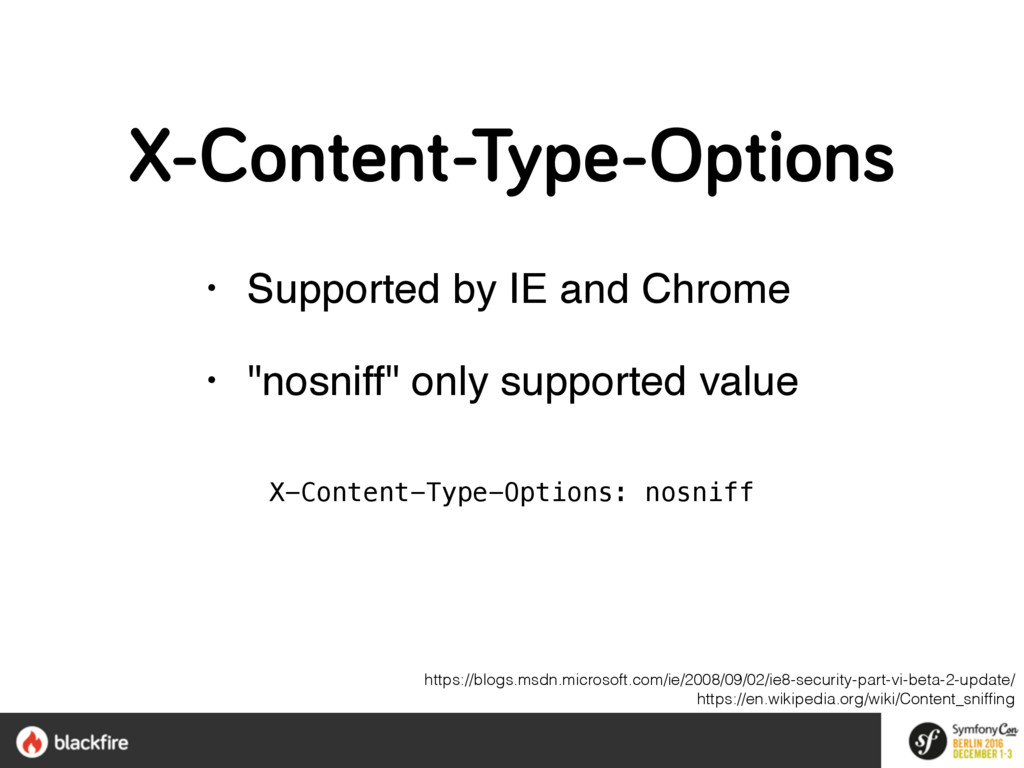
X-Content-Type-Options • Supported by IE and Chrome • "nosniff" only
supported value X-Content-Type-Options: nosniff https://blogs.msdn.microsoft.com/ie/2008/09/02/ie8-security-part-vi-beta-2-update/ https://en.wikipedia.org/wiki/Content_sniffing -
https://www.owasp.org/index.php/List_of_useful_HTTP_headers • X-XSS-Protection • X-Content-Type-Options • X-Frame-Options • Strict-Transport-Security •
Content-Security-Policy • CSP in Real World • End of the world OWASP useful HTTP headers -
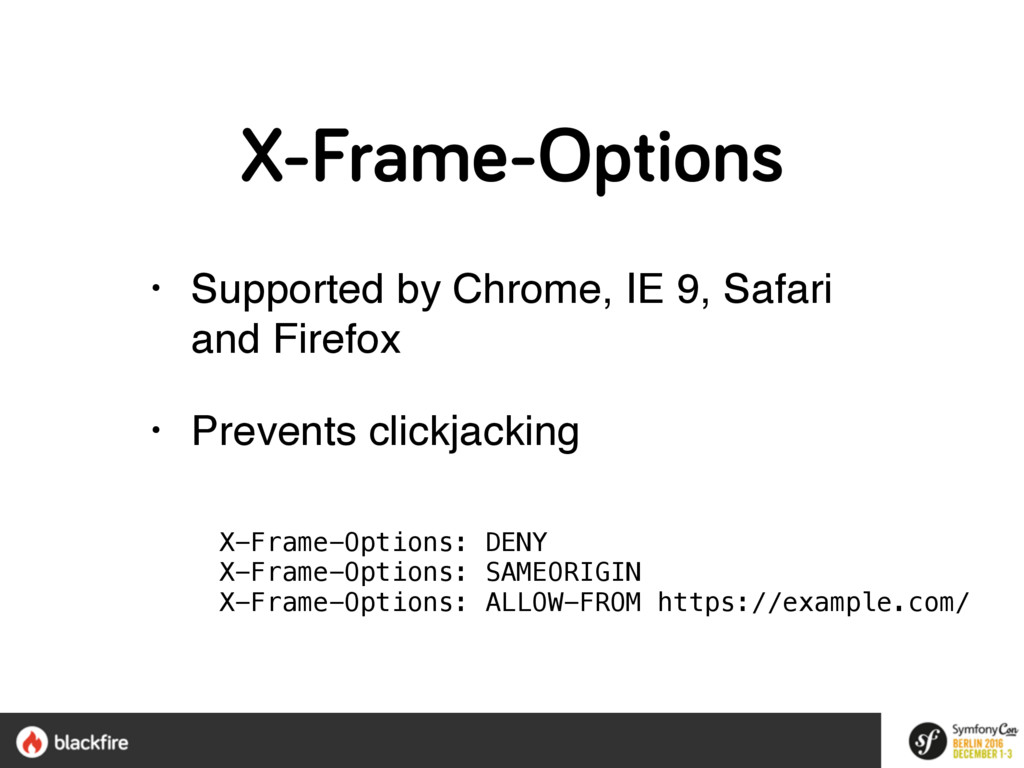
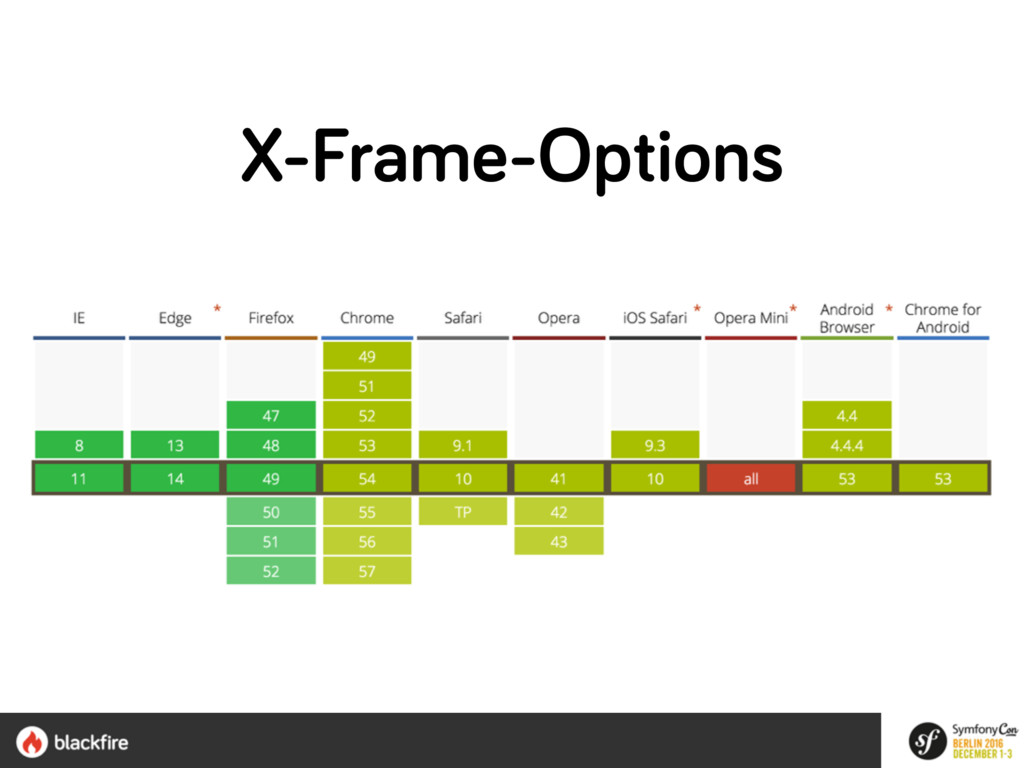
X-Frame-Options • Supported by Chrome, IE 9, Safari and Firefox
• Prevents clickjacking X-Frame-Options: DENY X-Frame-Options: SAMEORIGIN X-Frame-Options: ALLOW-FROM https://example.com/ -
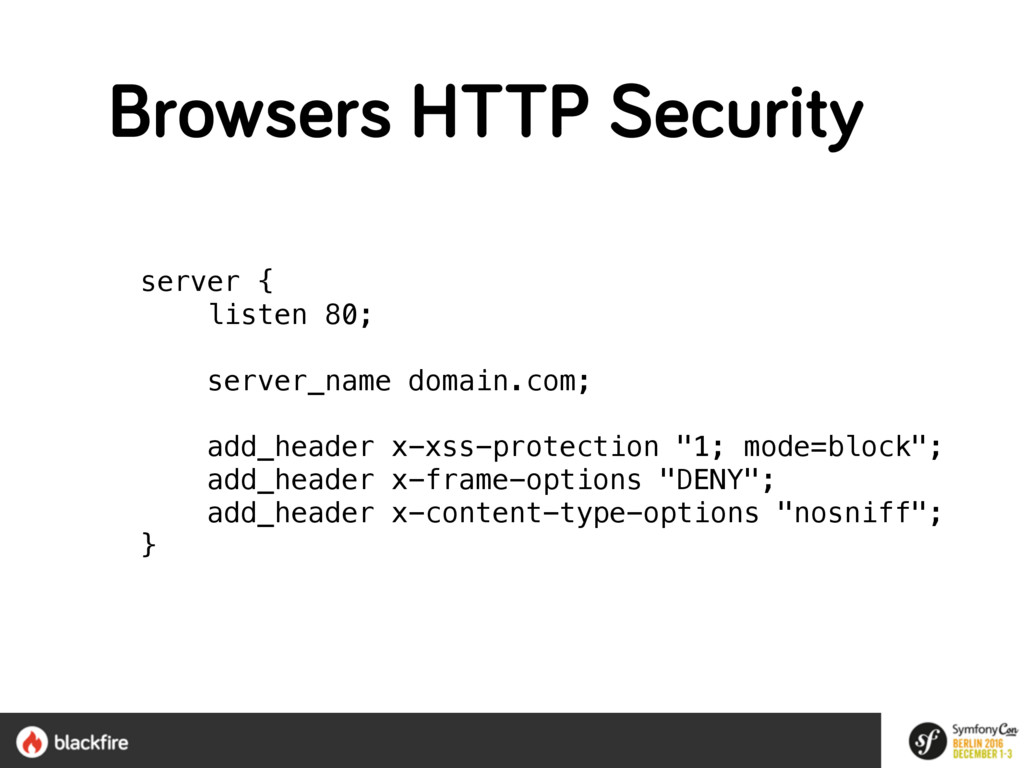
server { listen 80; server_name domain.com; add_header x-xss-protection "1;
mode=block"; add_header x-frame-options "DENY"; add_header x-content-type-options "nosniff"; } Browsers HTTP Security -
https://www.owasp.org/index.php/List_of_useful_HTTP_headers • X-XSS-Protection • X-Content-Type-Options • X-Frame-Options • Strict-Transport-Security •
Content-Security-Policy • CSP in Real World • End of the world OWASP useful HTTP headers -
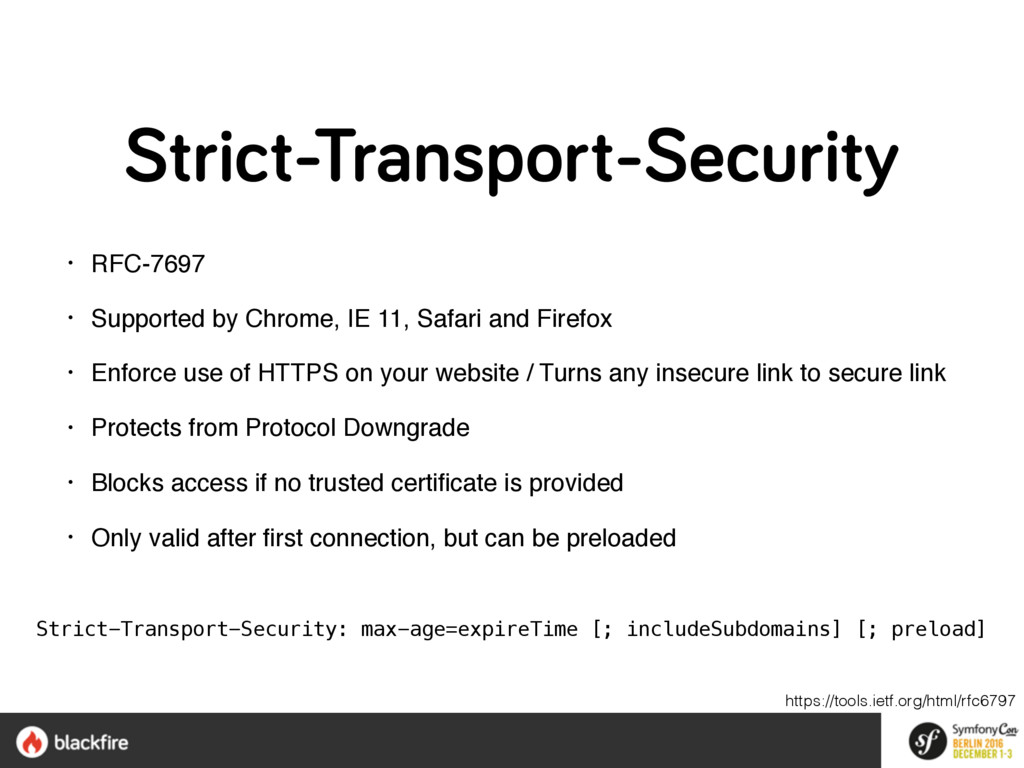
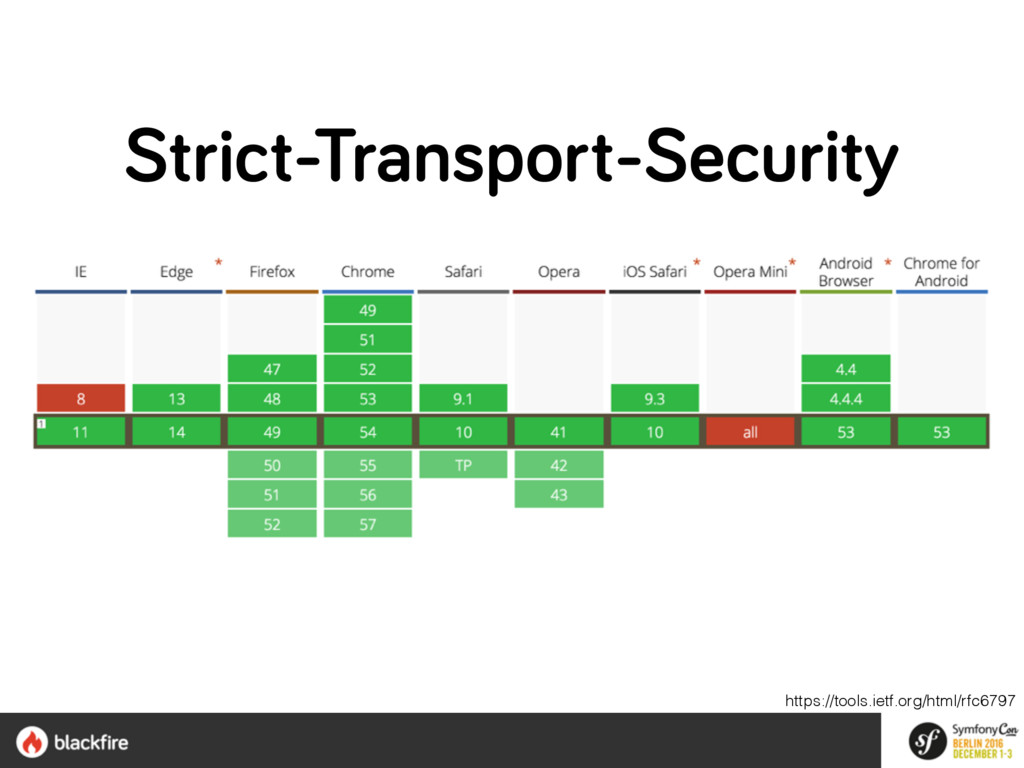
Strict-Transport-Security • RFC-7697 • Supported by Chrome, IE 11, Safari
and Firefox • Enforce use of HTTPS on your website / Turns any insecure link to secure link • Protects from Protocol Downgrade • Blocks access if no trusted certificate is provided • Only valid after first connection, but can be preloaded Strict-Transport-Security: max-age=expireTime [; includeSubdomains] [; preload] https://tools.ietf.org/html/rfc6797 -
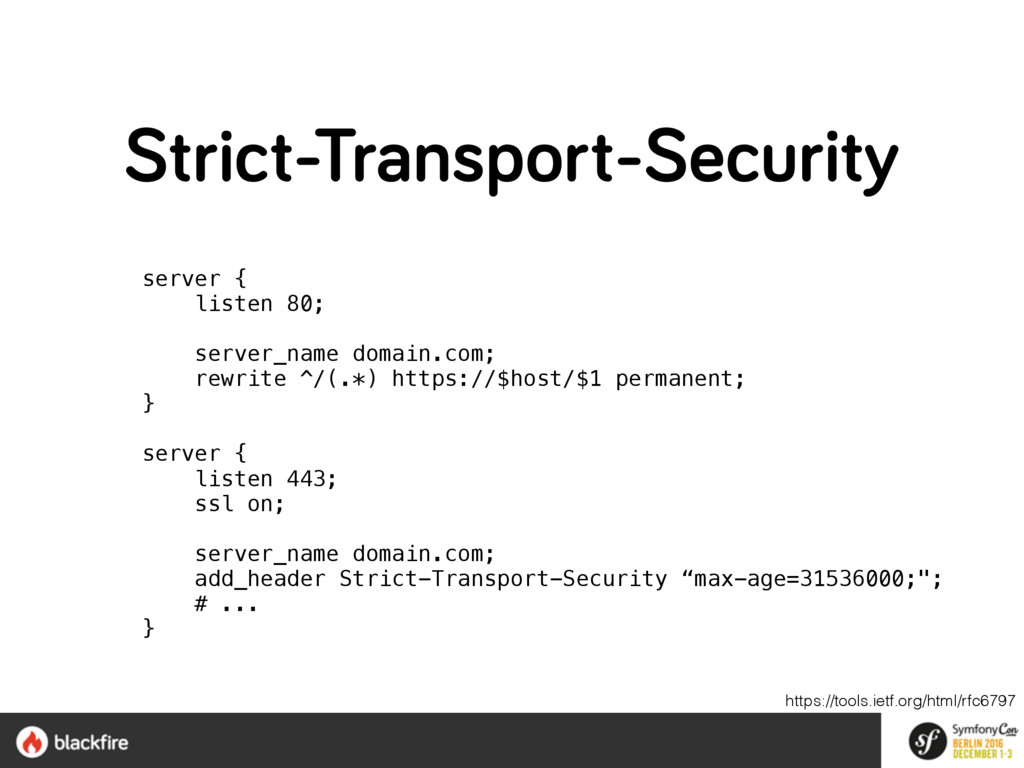
Strict-Transport-Security server { listen 80; server_name domain.com; rewrite ^/(.*)
https://$host/$1 permanent; } server { listen 443; ssl on; server_name domain.com; add_header Strict-Transport-Security “max-age=31536000;"; # ... } https://tools.ietf.org/html/rfc6797 -
https://www.owasp.org/index.php/List_of_useful_HTTP_headers • X-XSS-Protection • X-Content-Type-Options • X-Frame-Options • Strict-Transport-Security •
Content-Security-Policy • CSP in Real World • End of the world OWASP useful HTTP headers -
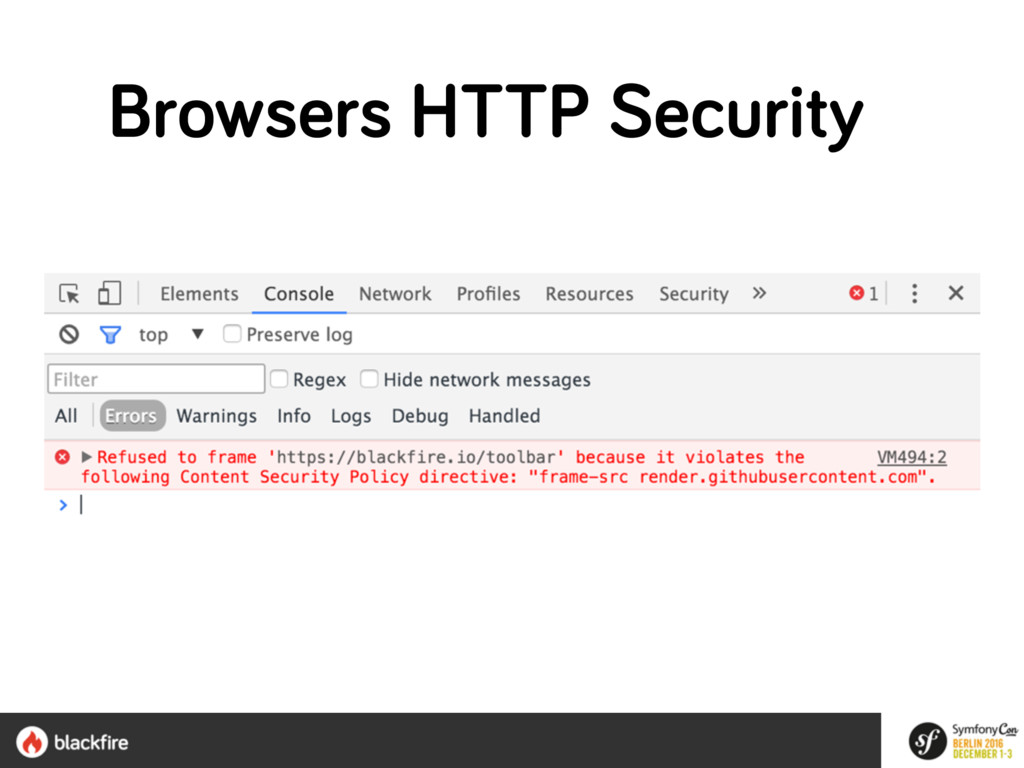
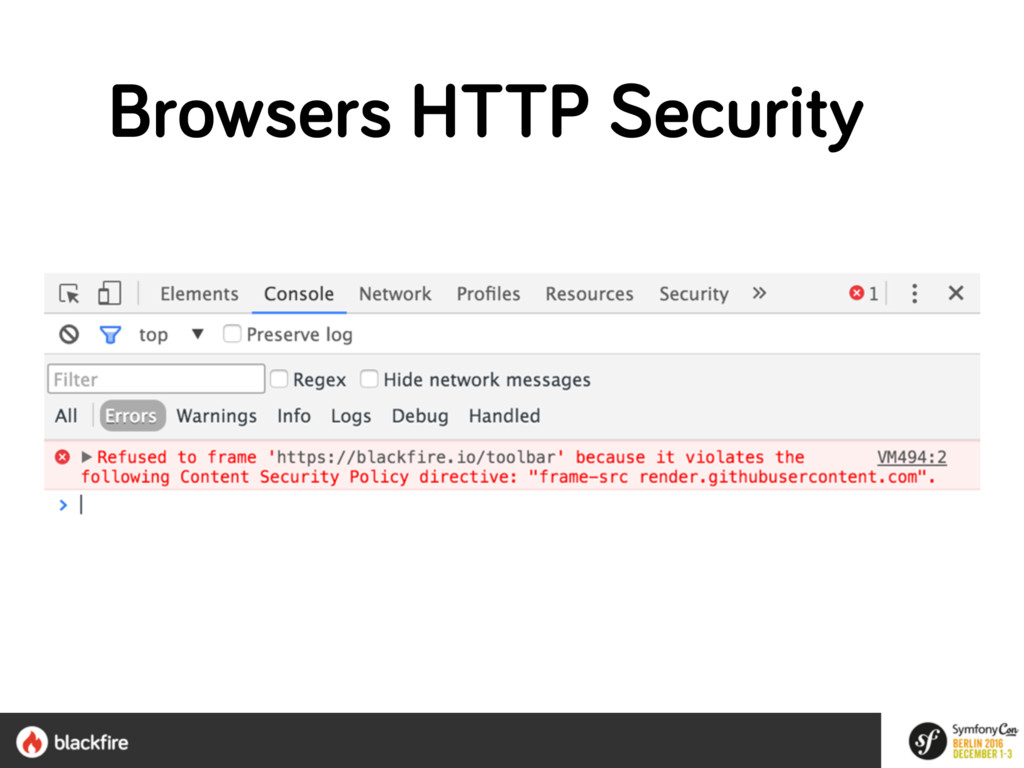
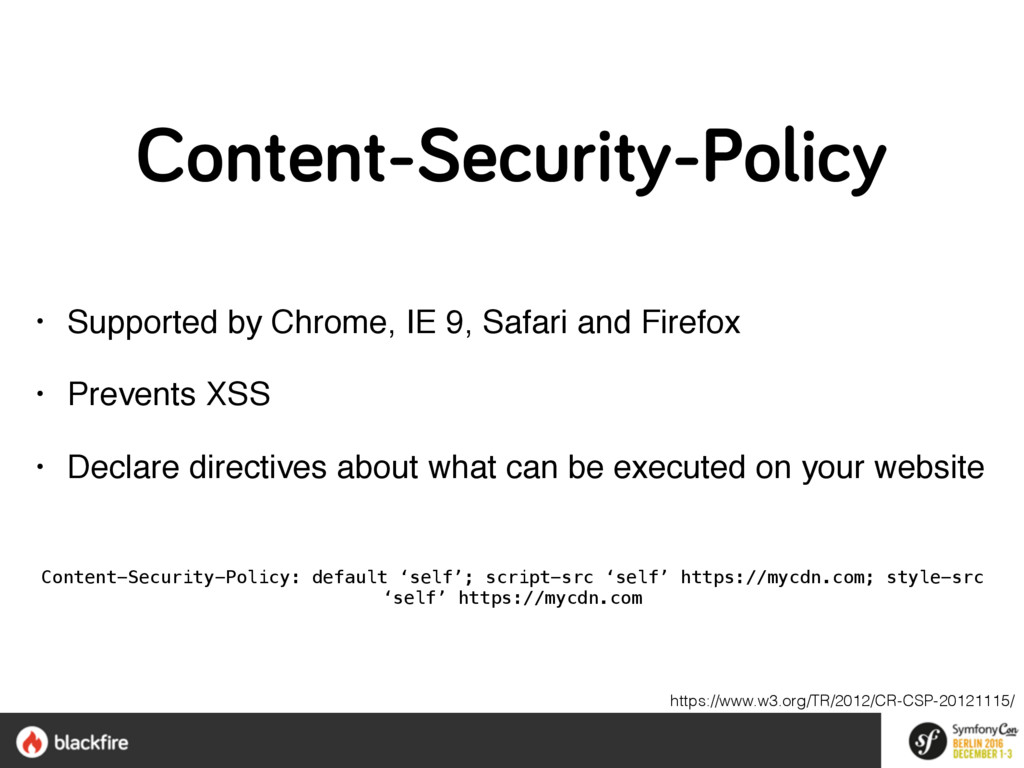
Content-Security-Policy • Supported by Chrome, IE 9, Safari and Firefox
• Prevents XSS • Declare directives about what can be executed on your website Content-Security-Policy: default ‘self’; script-src ‘self’ https://mycdn.com; style-src ‘self’ https://mycdn.com https://www.w3.org/TR/2012/CR-CSP-20121115/ -
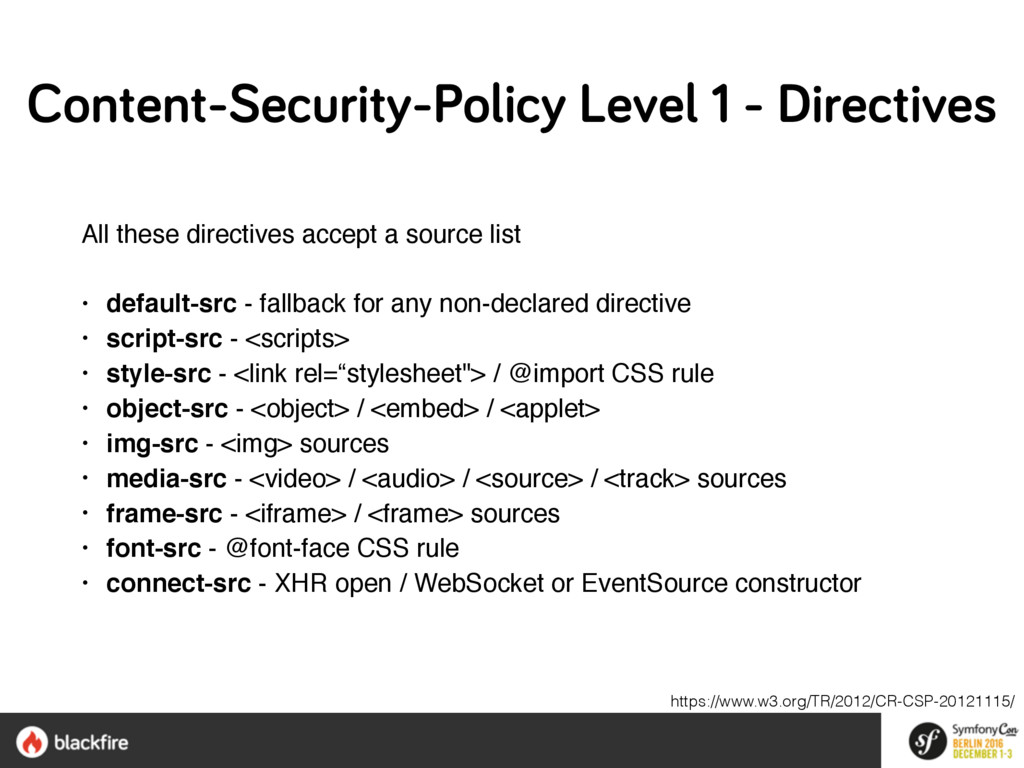
All these directives accept a source list • default-src -
fallback for any non-declared directive • script-src - <scripts> • style-src - <link rel=“stylesheet"> / @import CSS rule • object-src - <object> / <embed> / <applet> • img-src - <img> sources • media-src - <video> / <audio> / <source> / <track> sources • frame-src - <iframe> / <frame> sources • font-src - @font-face CSS rule • connect-src - XHR open / WebSocket or EventSource constructor https://www.w3.org/TR/2012/CR-CSP-20121115/ Content-Security-Policy Level 1 - Directives -
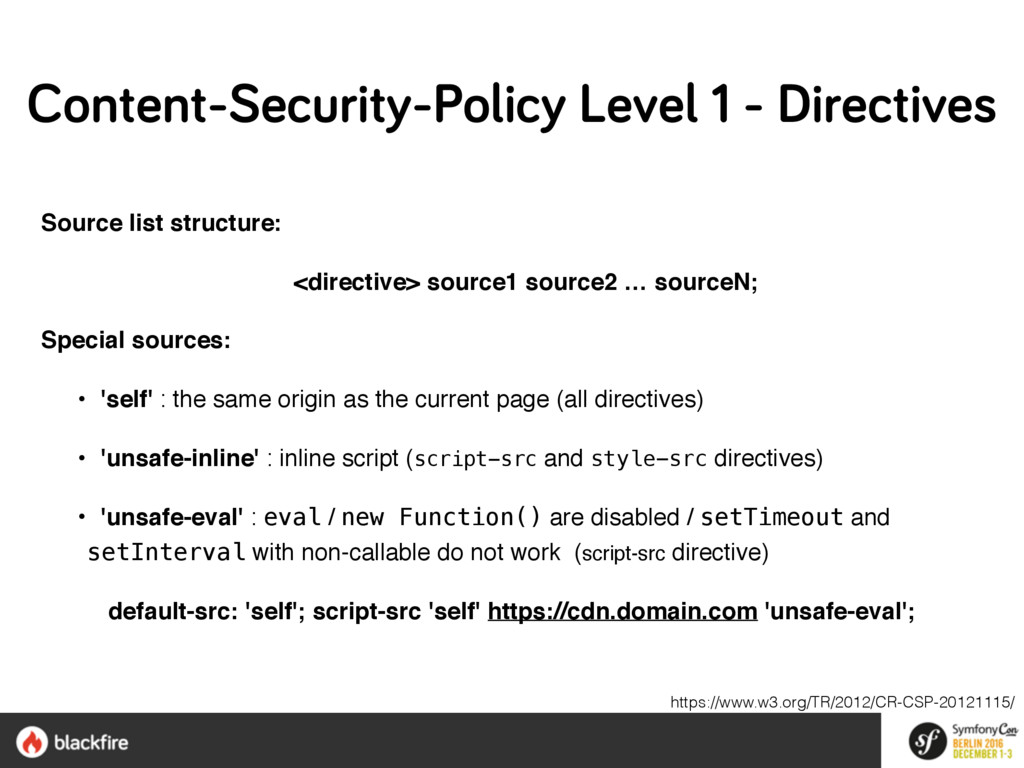
Source list structure: <directive> source1 source2 … sourceN; Special sources:
• 'self' : the same origin as the current page (all directives) • 'unsafe-inline' : inline script (script-src and style-src directives) • 'unsafe-eval' : eval / new Function() are disabled / setTimeout and setInterval with non-callable do not work (script-src directive) default-src: 'self'; script-src 'self' https://cdn.domain.com 'unsafe-eval'; https://www.w3.org/TR/2012/CR-CSP-20121115/ Content-Security-Policy Level 1 - Directives -
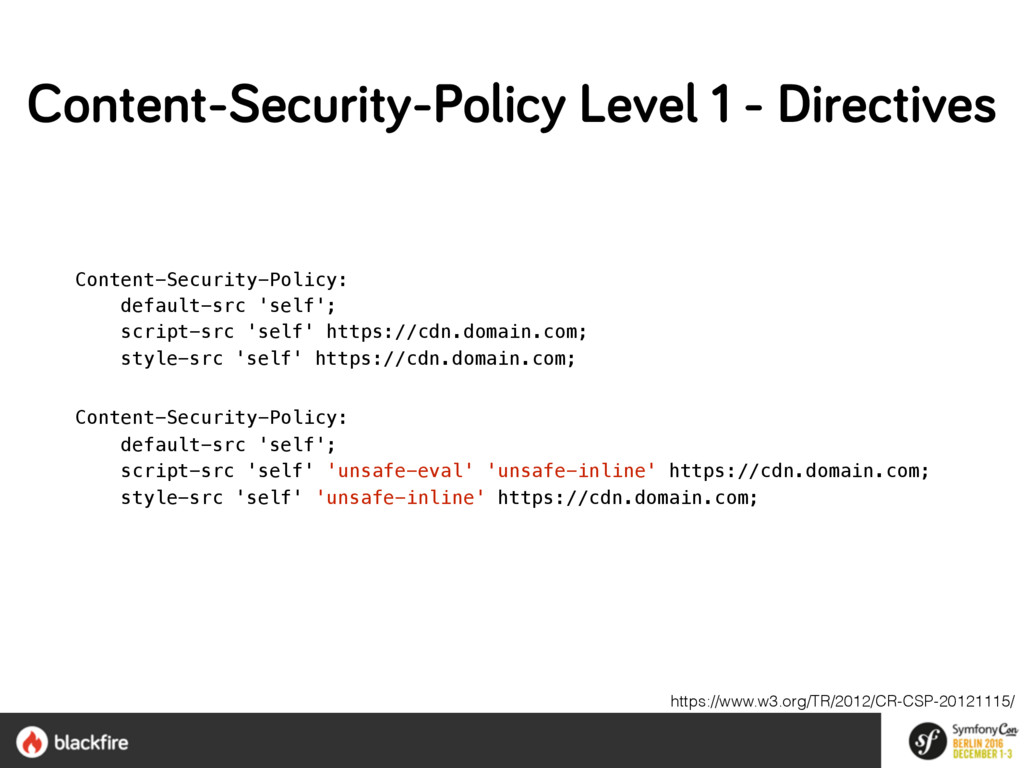
Content-Security-Policy: default-src 'self'; script-src 'self' https://cdn.domain.com; style-src
'self' https://cdn.domain.com; https://www.w3.org/TR/2012/CR-CSP-20121115/ Content-Security-Policy Level 1 - Directives -
'unsafe-eval' Warning: jQuery uses eval when inserting <script> DOM node:
# does not work document .getElementsByTagName('body')[0] .innerHTML = '<script>console.log("Hello roro")</script>' # works jQuery('body').html('<script>console.log("Hello roro")</script>') https://www.w3.org/TR/2012/CR-CSP-20121115/ Content-Security-Policy Level 1 - Directives -
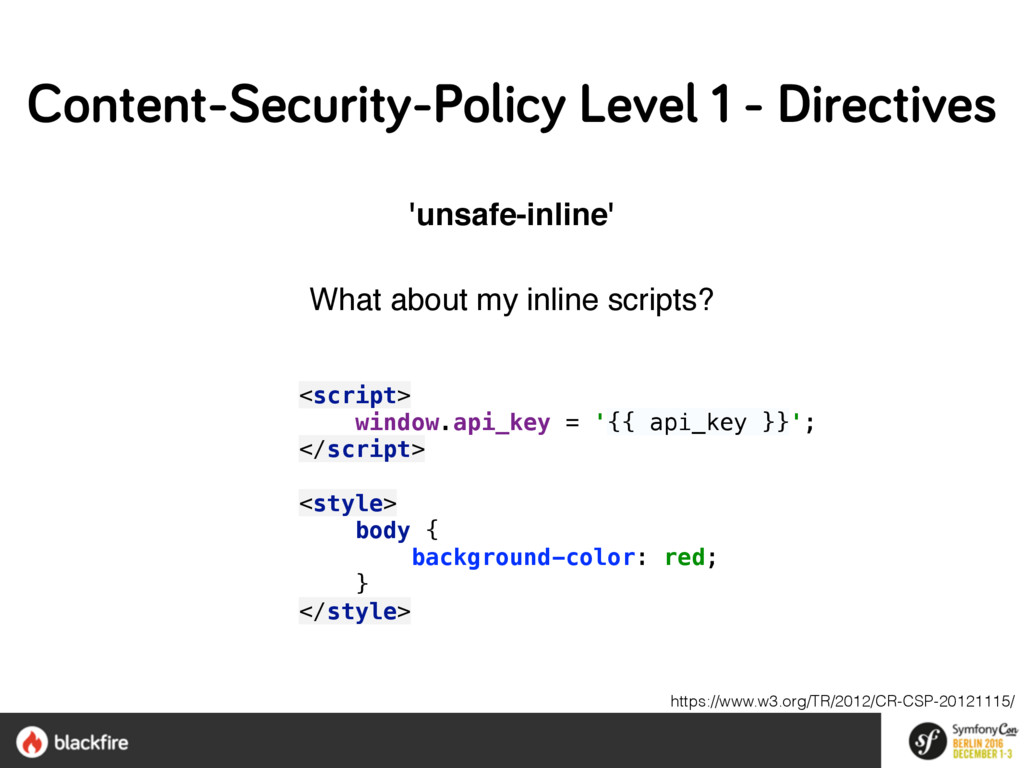
'unsafe-inline' What about my inline scripts? <script> window.api_key =
'{{ api_key }}'; </script> <style> body { background-color: red; } </style> https://www.w3.org/TR/2012/CR-CSP-20121115/ Content-Security-Policy Level 1 - Directives -
Content-Security-Policy: default-src 'self'; script-src 'self' https://cdn.domain.com; style-src
'self' https://cdn.domain.com; Content-Security-Policy: default-src 'self'; script-src 'self' 'unsafe-eval' 'unsafe-inline' https://cdn.domain.com; style-src 'self' 'unsafe-inline' https://cdn.domain.com; https://www.w3.org/TR/2012/CR-CSP-20121115/ Content-Security-Policy Level 1 - Directives -
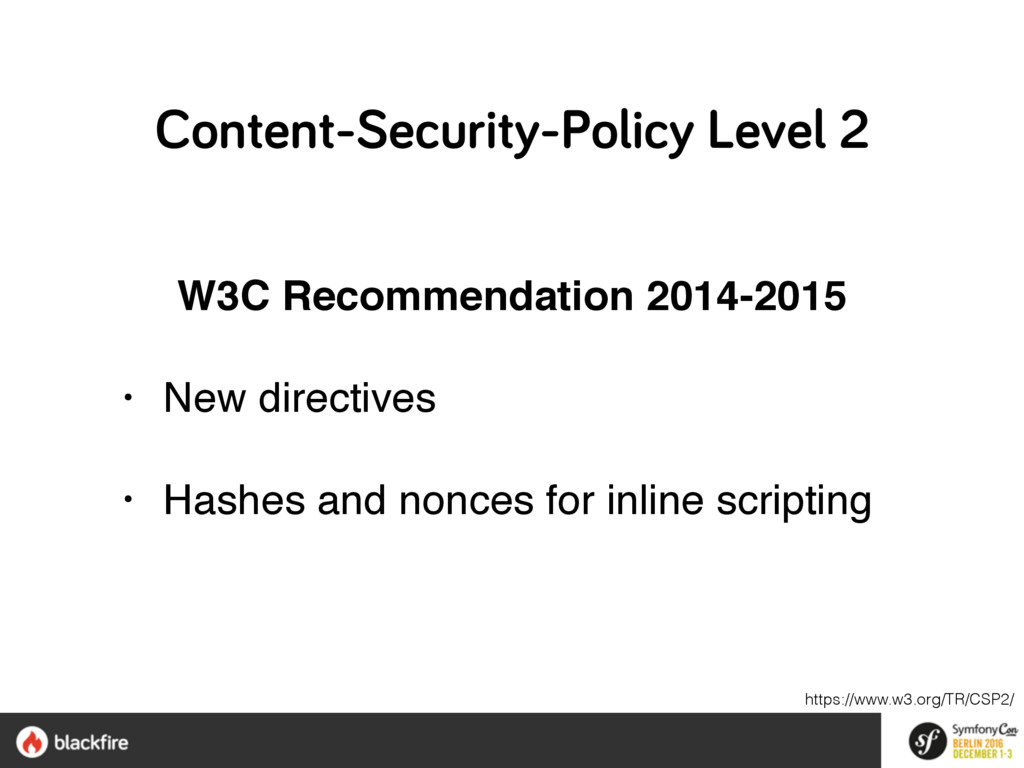
https://www.w3.org/TR/CSP2/ W3C Recommendation 2014-2015 • New directives • Hashes and
nonces for inline scripting Content-Security-Policy Level 2 -
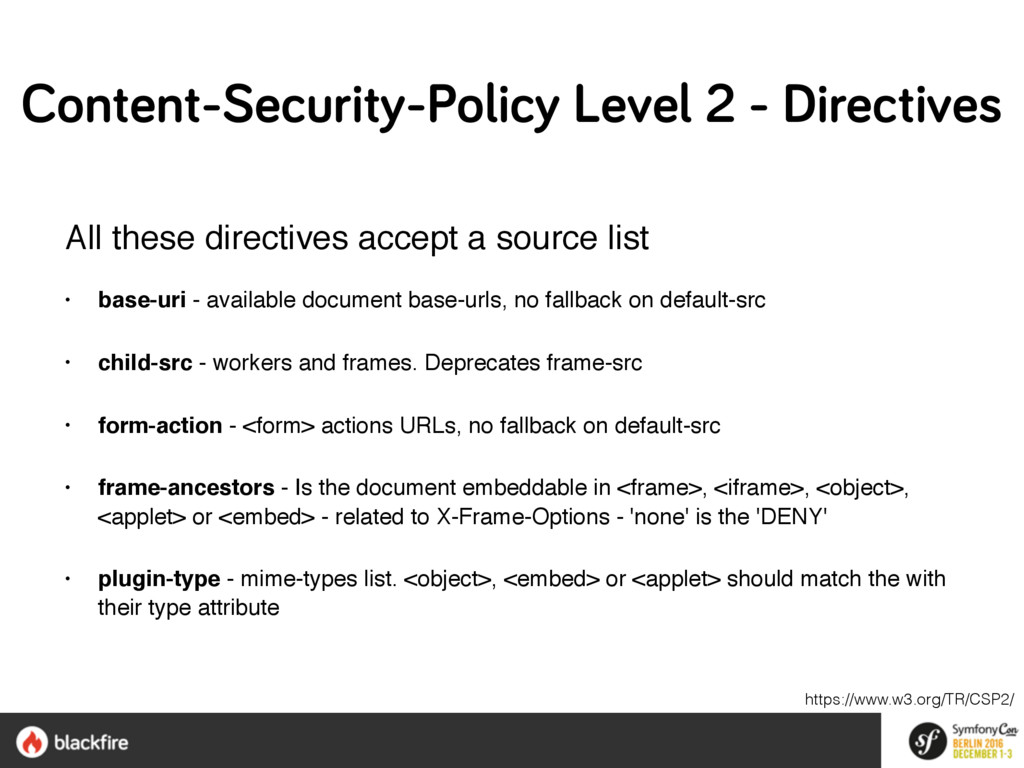
All these directives accept a source list •
base-uri - available document base-urls, no fallback on default-src • child-src - workers and frames. Deprecates frame-src • form-action - <form> actions URLs, no fallback on default-src • frame-ancestors - Is the document embeddable in <frame>, <iframe>, <object>, <applet> or <embed> - related to X-Frame-Options - 'none' is the 'DENY' • plugin-type - mime-types list. <object>, <embed> or <applet> should match the with their type attribute Content-Security-Policy Level 2 - Directives https://www.w3.org/TR/CSP2/ -
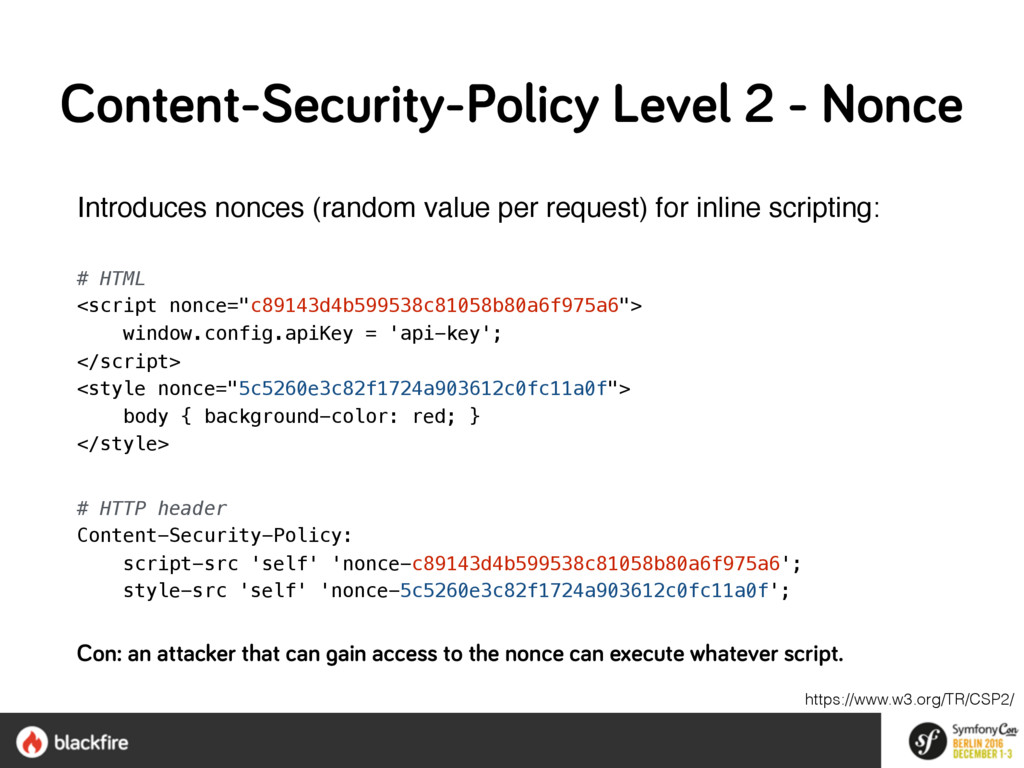
Introduces nonces (random value per request) for inline scripting: #
HTML <script nonce="c89143d4b599538c81058b80a6f975a6"> window.config.apiKey = 'api-key'; </script> <style nonce="5c5260e3c82f1724a903612c0fc11a0f"> body { background-color: red; } </style> # HTTP header Content-Security-Policy: script-src 'self' 'nonce-c89143d4b599538c81058b80a6f975a6'; style-src 'self' 'nonce-5c5260e3c82f1724a903612c0fc11a0f'; Con: an attacker that can gain access to the nonce can execute whatever script. Content-Security-Policy Level 2 - Nonce https://www.w3.org/TR/CSP2/ -
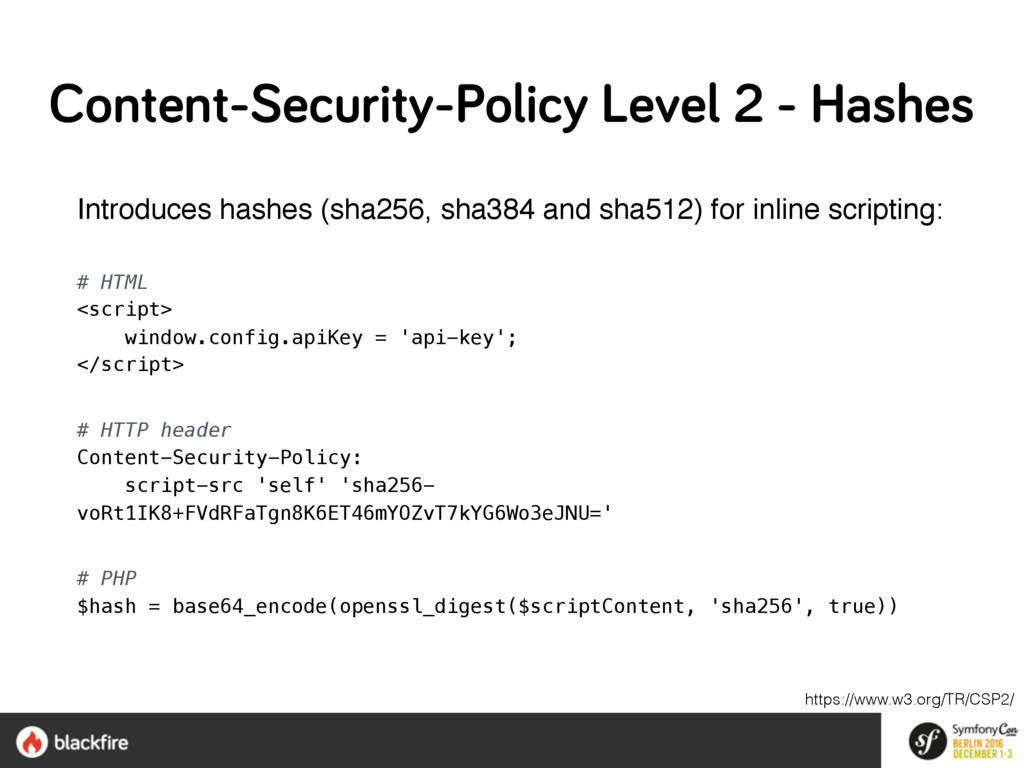
Introduces hashes (sha256, sha384 and sha512) for inline scripting: #
HTML <script> window.config.apiKey = 'api-key'; </script> # HTTP header Content-Security-Policy: script-src 'self' 'sha256- voRt1IK8+FVdRFaTgn8K6ET46mYOZvT7kYG6Wo3eJNU=' # PHP $hash = base64_encode(openssl_digest($scriptContent, 'sha256', true)) Content-Security-Policy Level 2 - Hashes https://www.w3.org/TR/CSP2/ -
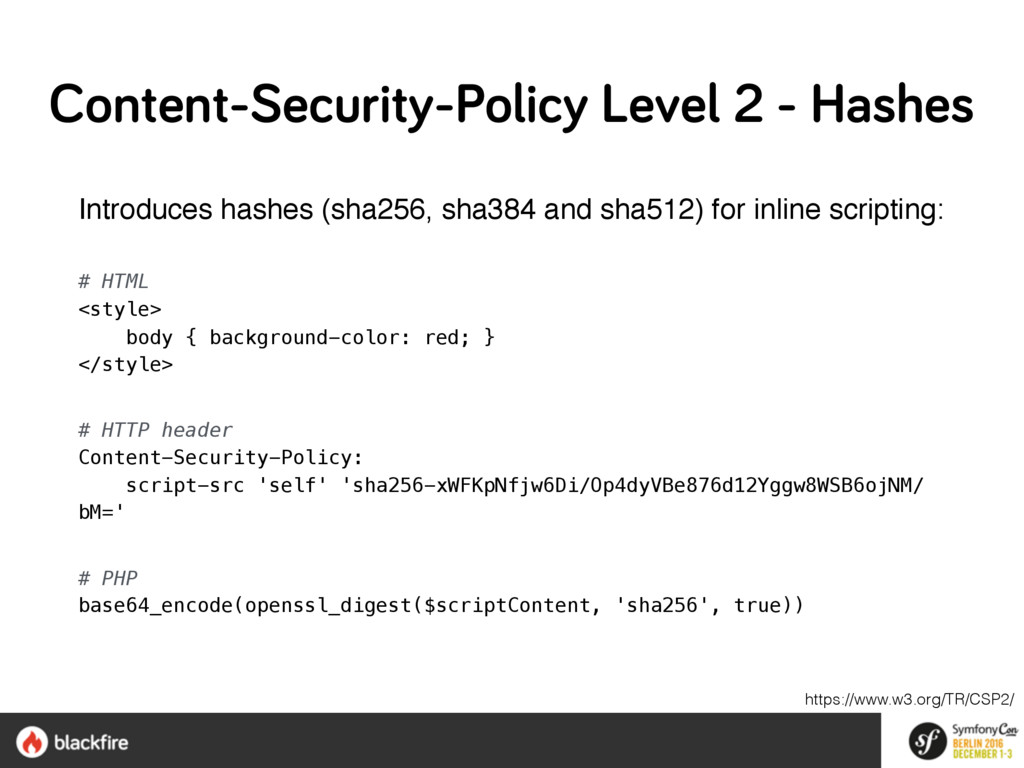
Introduces hashes (sha256, sha384 and sha512) for inline scripting: #
HTML <style> body { background-color: red; } </style> # HTTP header Content-Security-Policy: script-src 'self' 'sha256-xWFKpNfjw6Di/Op4dyVBe876d12Yggw8WSB6ojNM/ bM=' # PHP base64_encode(openssl_digest($scriptContent, 'sha256', true)) Content-Security-Policy Level 2 - Hashes https://www.w3.org/TR/CSP2/ -
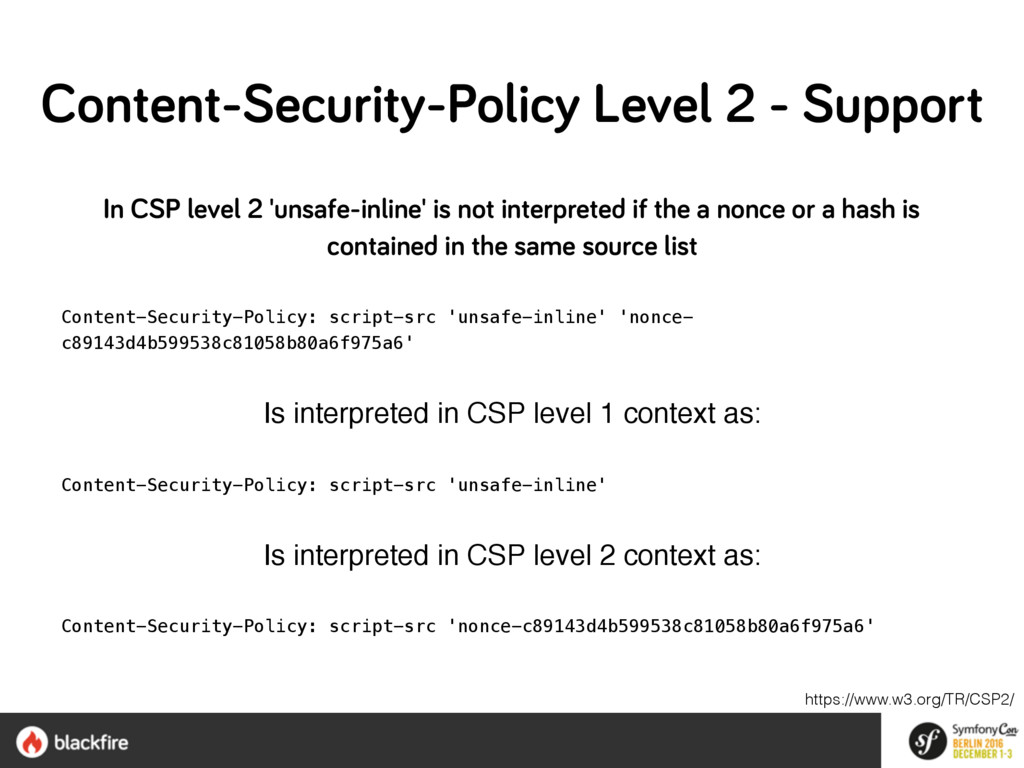
In CSP level 2 'unsafe-inline' is not interpreted if the
a nonce or a hash is contained in the same source list Content-Security-Policy: script-src 'unsafe-inline' 'nonce- c89143d4b599538c81058b80a6f975a6' Is interpreted in CSP level 1 context as: Content-Security-Policy: script-src 'unsafe-inline' Is interpreted in CSP level 2 context as: Content-Security-Policy: script-src 'nonce-c89143d4b599538c81058b80a6f975a6' Content-Security-Policy Level 2 - Support https://www.w3.org/TR/CSP2/ -
So you can use CSP level 2 with hashes and
nonces as long as you still include the 'unsafe-inline' directive Chrome, Safari, IE 11, Safari and Firefox https://www.w3.org/TR/CSP2/ Content-Security-Policy Level 2 -
• X-XSS-Protection • X-Content-Type-Options • X-Frame-Options • Strict-Transport-Security • Content-Security-Policy
• CSP in Real World • End of the world https://www.owasp.org/index.php/List_of_useful_HTTP_headers OWASP useful HTTP headers -
Content-Security-Policy might be difficult to implement in a legacy project
:( https://www.w3.org/TR/CSP2/ Content-Security-Policy - Project Setup -
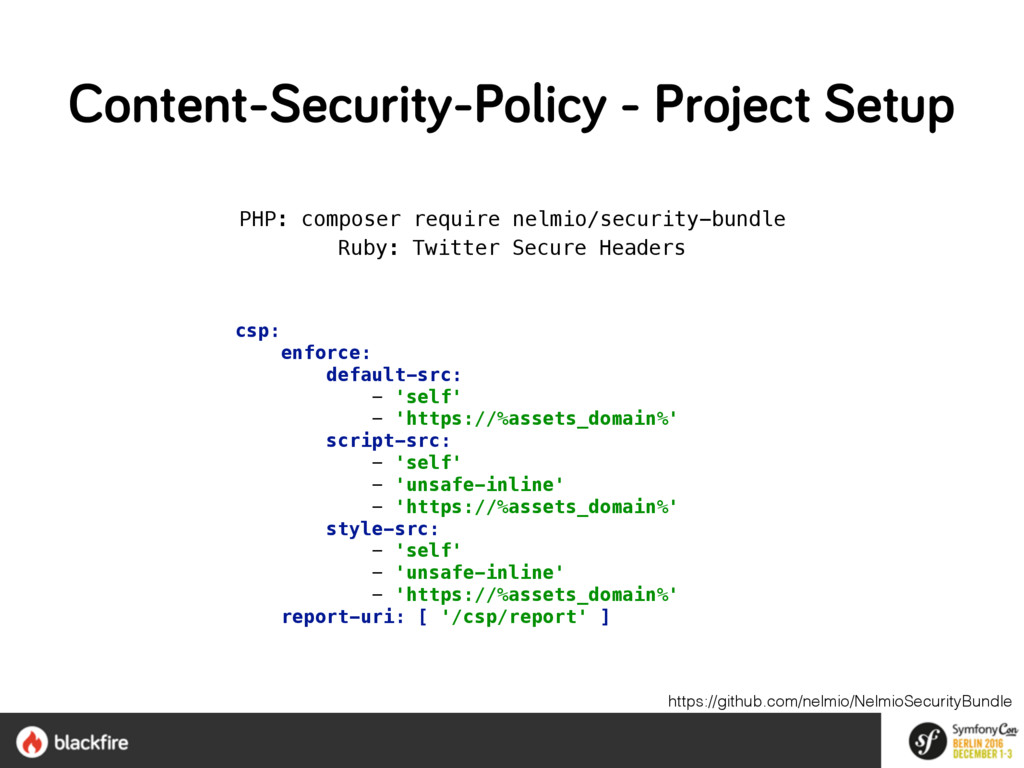
PHP: composer require nelmio/security-bundle Ruby: Twitter Secure Headers csp: enforce:
default-src: - 'self' - 'https://%assets_domain%' script-src: - 'self' - 'unsafe-inline' - 'https://%assets_domain%' style-src: - 'self' - 'unsafe-inline' - 'https://%assets_domain%' report-uri: [ '/csp/report' ] https://github.com/nelmio/NelmioSecurityBundle Content-Security-Policy - Project Setup -
PHP: composer require nelmio/security-bundle Ruby: Twitter Secure Headers {%
cspscript %} <script> window.api_key = '{{ api_key }}'; </script> {% endcspscript %} {% cspstyle %} <style> body { background-color: red; } </style> {% endcspstyle %} https://github.com/nelmio/NelmioSecurityBundle Content-Security-Policy - Project Setup -
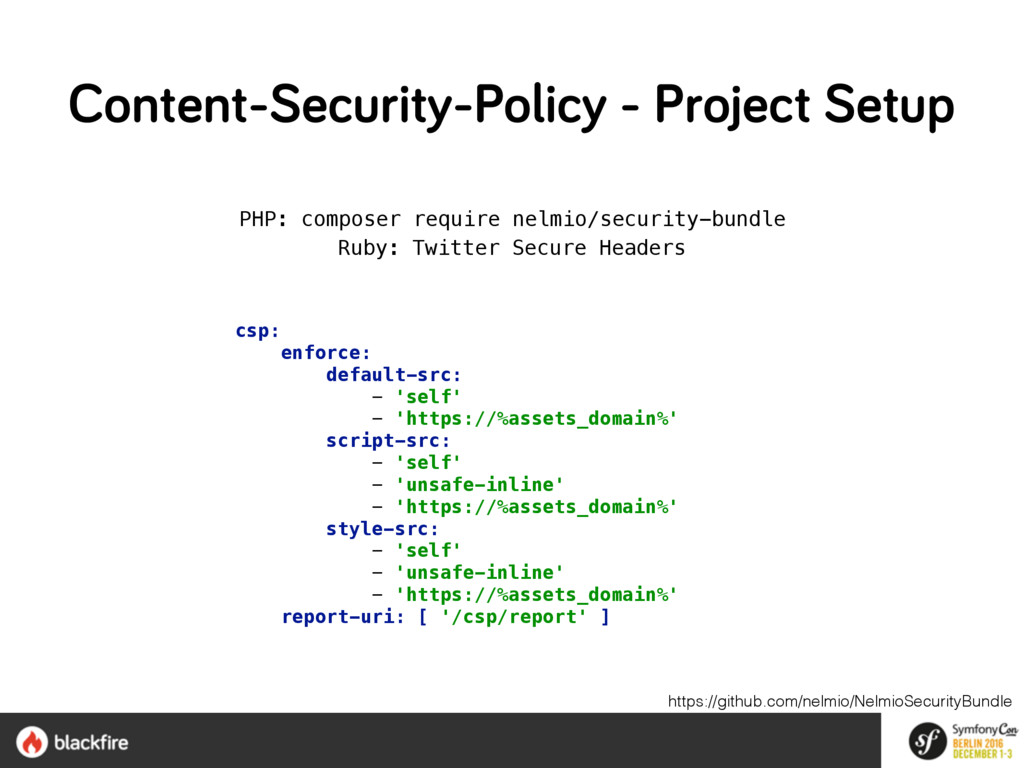
PHP: composer require nelmio/security-bundle Ruby: Twitter Secure Headers csp: enforce:
default-src: - 'self' - 'https://%assets_domain%' script-src: - 'self' - 'unsafe-inline' - 'https://%assets_domain%' style-src: - 'self' - 'unsafe-inline' - 'https://%assets_domain%' report-uri: [ '/csp/report' ] https://github.com/nelmio/NelmioSecurityBundle Content-Security-Policy - Project Setup -
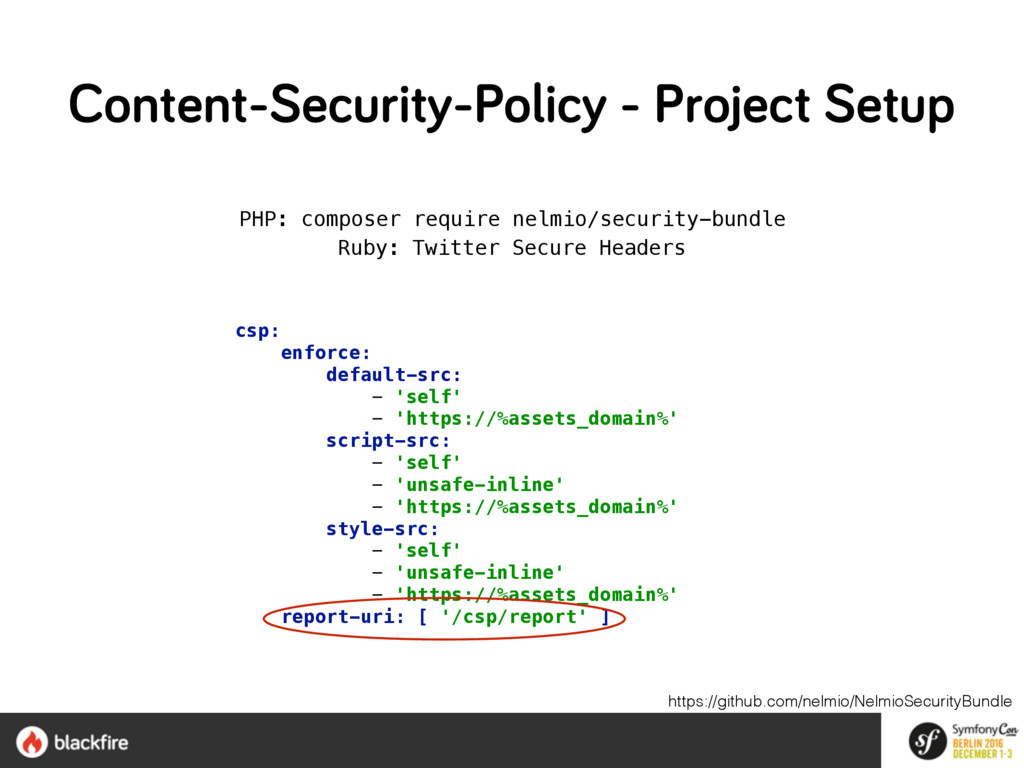
PHP: composer require nelmio/security-bundle Ruby: Twitter Secure Headers csp: enforce:
default-src: - 'self' - 'https://%assets_domain%' script-src: - 'self' - 'unsafe-inline' - 'https://%assets_domain%' style-src: - 'self' - 'unsafe-inline' - 'https://%assets_domain%' report-uri: [ '/csp/report' ] https://github.com/nelmio/NelmioSecurityBundle Content-Security-Policy - Project Setup -
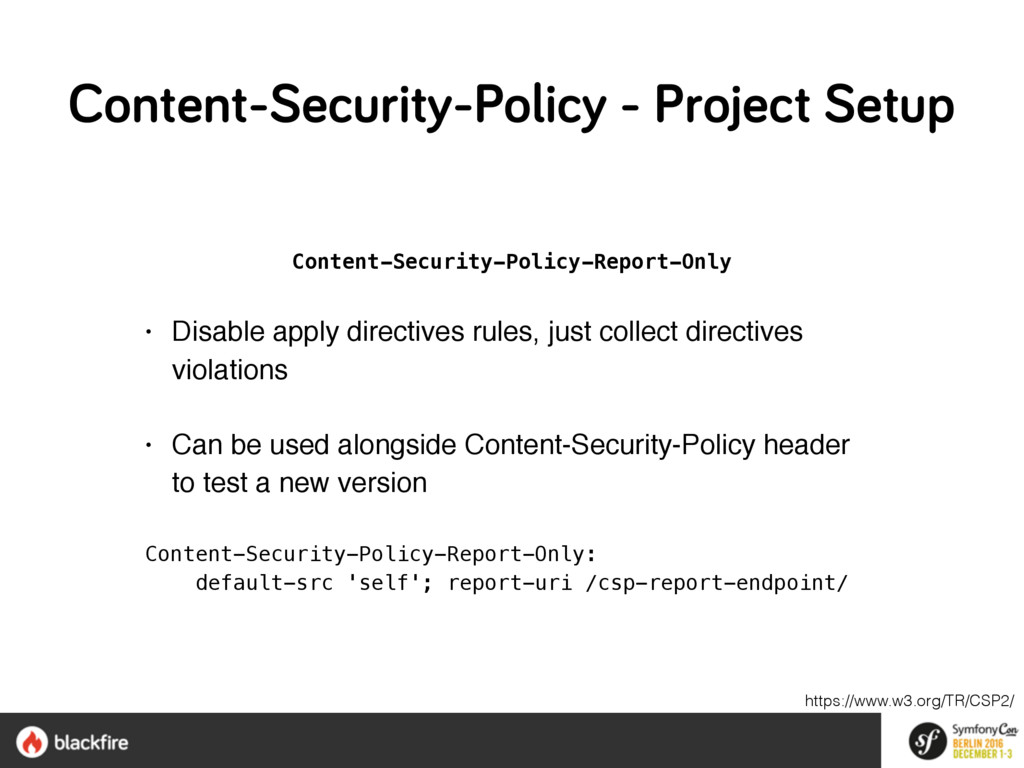
Content-Security-Policy-Report-Only • Disable apply directives rules, just collect directives violations
• Can be used alongside Content-Security-Policy header to test a new version Content-Security-Policy-Report-Only: default-src 'self'; report-uri /csp-report-endpoint/ https://www.w3.org/TR/CSP2/ Content-Security-Policy - Project Setup -
Content-Security-Policy report-uri • Reports Content Security Policy violations Content-Security-Policy:
default-src 'self'; report-uri /csp-report-endpoint/ https://www.w3.org/TR/CSP2/ Content-Security-Policy - Project Setup -
{ 'blocked-uri': 'https://m74.dnsqa2016.com', 'column-number': 290, 'document-uri': 'https://blackfire.io/', 'effective-directive': 'script-src', 'line-number':
45, 'original-policy': 'default-src \'self\' https://d2vqbs7xgyce6n.clou 'referrer': 'https://www.google.pl/', 'source-file': 'https://www.google-analytics.com', 'status-code': 0, 'violated-directive': 'script-src \'self\' \'unsafe-inline\' https:/ } https://www.w3.org/TR/CSP2/ Content-Security-Policy report-uri Content-Security-Policy - Project Setup -
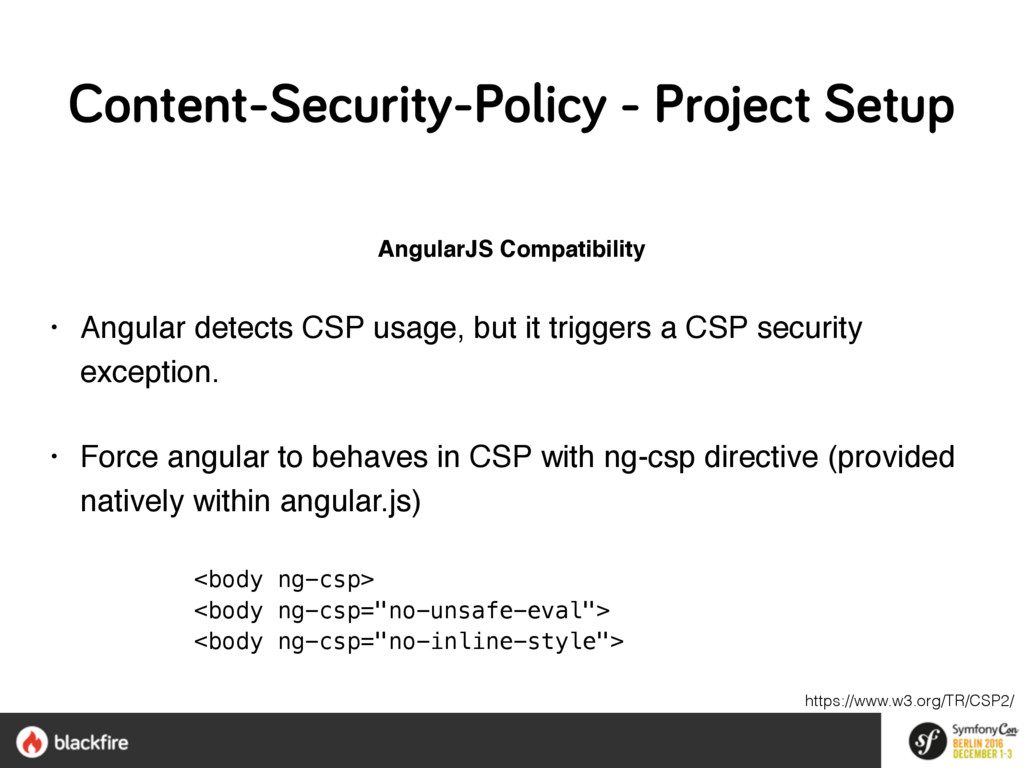
AngularJS Compatibility • Angular detects CSP usage, but it triggers
a CSP security exception. • Force angular to behaves in CSP with ng-csp directive (provided natively within angular.js) <body ng-csp> <body ng-csp="no-unsafe-eval"> <body ng-csp="no-inline-style"> https://www.w3.org/TR/CSP2/ Content-Security-Policy - Project Setup -
Is my website secured with Content-Security-Policy? • Browser extensions have
incredible access, you can not do anything about it Browsers HTTP Security -
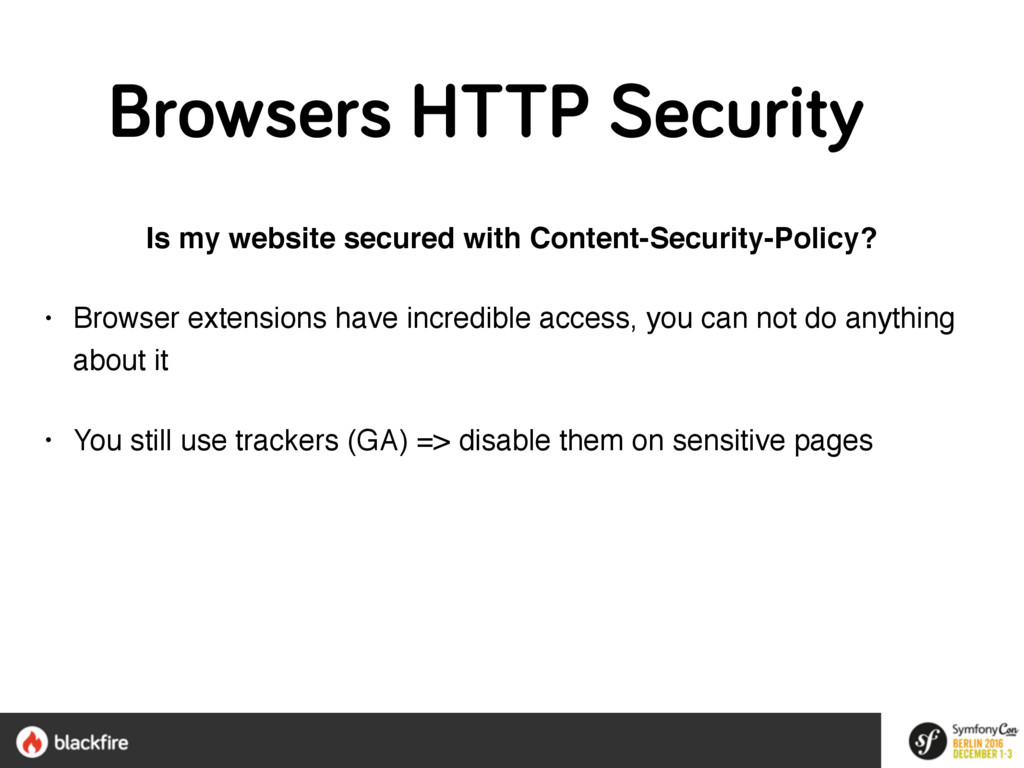
Is my website secured with Content-Security-Policy? • Browser extensions have
incredible access, you can not do anything about it • You still use trackers (GA) => disable them on sensitive pages Browsers HTTP Security -
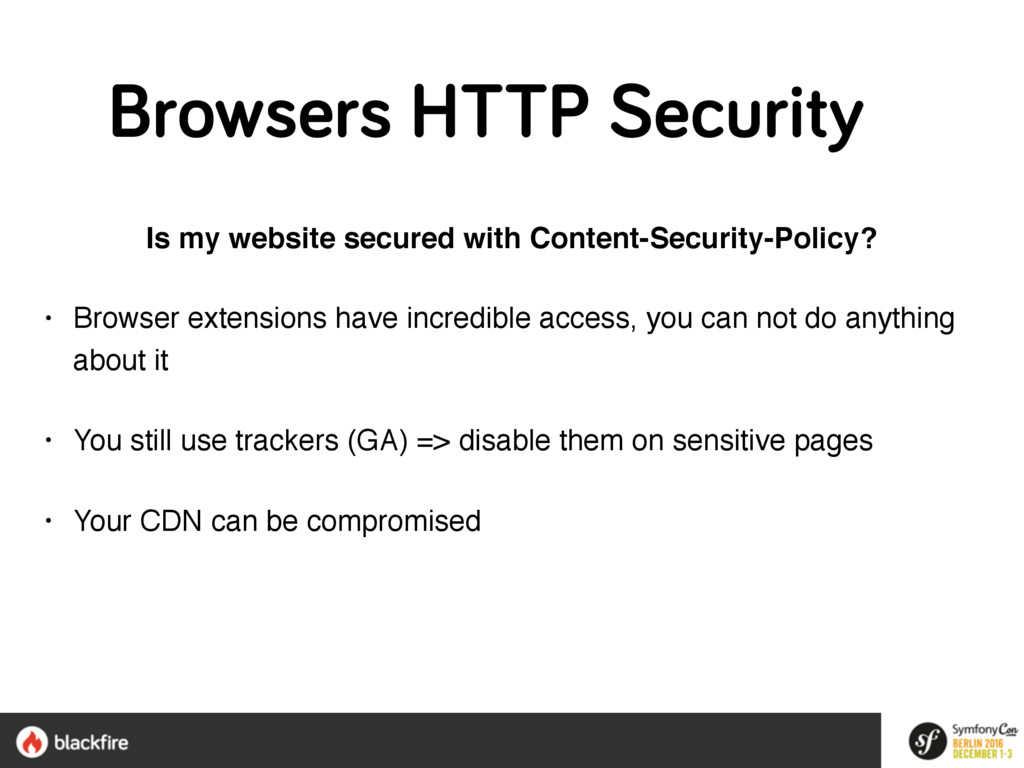
Is my website secured with Content-Security-Policy? • Browser extensions have
incredible access, you can not do anything about it • You still use trackers (GA) => disable them on sensitive pages • Your CDN can be compromised Browsers HTTP Security -
Is my website secured with Content-Security-Policy? • Browser extensions have
incredible access, you can not do anything about it • You still use trackers (GA) => disable them on sensitive pages • Your CDN can be compromised Browsers HTTP Security -
• X-XSS-Protection • X-Content-Type-Options • X-Frame-Options • Strict-Transport-Security • Content-Security-Policy
• CSP in Real World • End of the world https://www.owasp.org/index.php/List_of_useful_HTTP_headers OWASP useful HTTP headers -
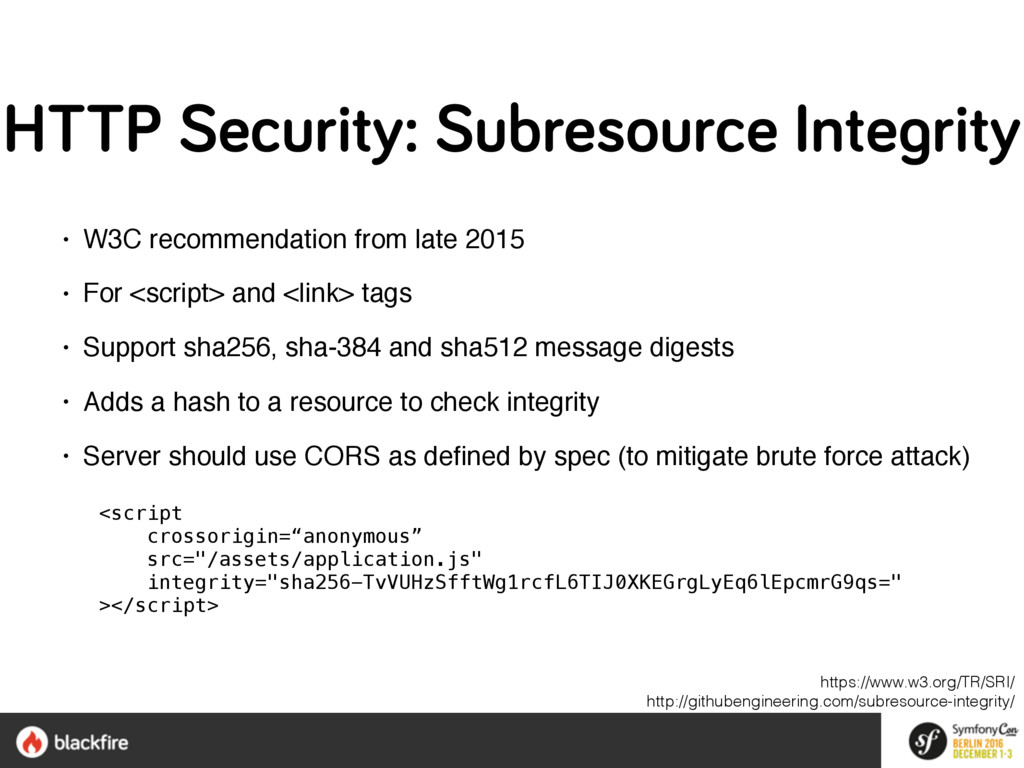
https://www.w3.org/TR/SRI/ http://githubengineering.com/subresource-integrity/ • W3C recommendation from late 2015 • For
<script> and <link> tags • Support sha256, sha-384 and sha512 message digests • Adds a hash to a resource to check integrity • Server should use CORS as defined by spec (to mitigate brute force attack) <script crossorigin=“anonymous” src="/assets/application.js" integrity="sha256-TvVUHzSfftWg1rcfL6TIJ0XKEGrgLyEq6lEpcmrG9qs=" ></script> HTTP Security: Subresource Integrity -
• X-XSS-Protection • X-Content-Type-Options • X-Frame-Options • Strict-Transport-Security • Content-Security-Policy
• CSP in Real World • End of the world Subresource Integrity https://www.owasp.org/index.php/List_of_useful_HTTP_headers OWASP useful HTTP headers -
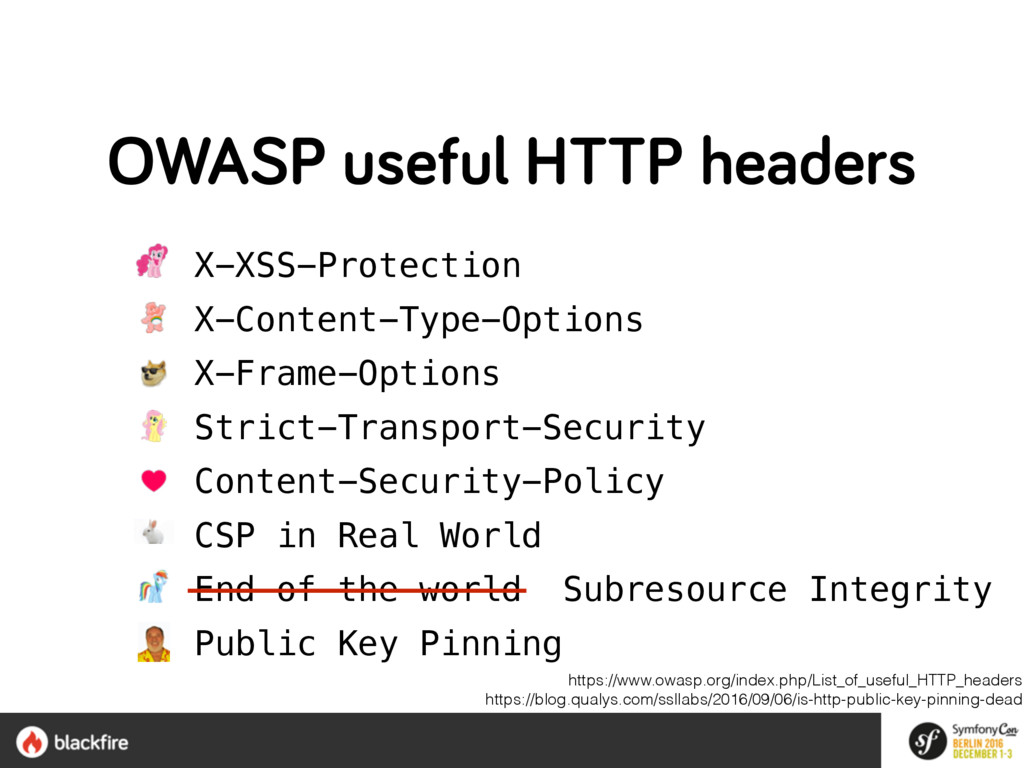
• X-XSS-Protection • X-Content-Type-Options • X-Frame-Options • Strict-Transport-Security • Content-Security-Policy
• CSP in Real World • End of the world Subresource Integrity • Public Key Pinning https://www.owasp.org/index.php/List_of_useful_HTTP_headers https://blog.qualys.com/ssllabs/2016/09/06/is-http-public-key-pinning-dead OWASP useful HTTP headers -
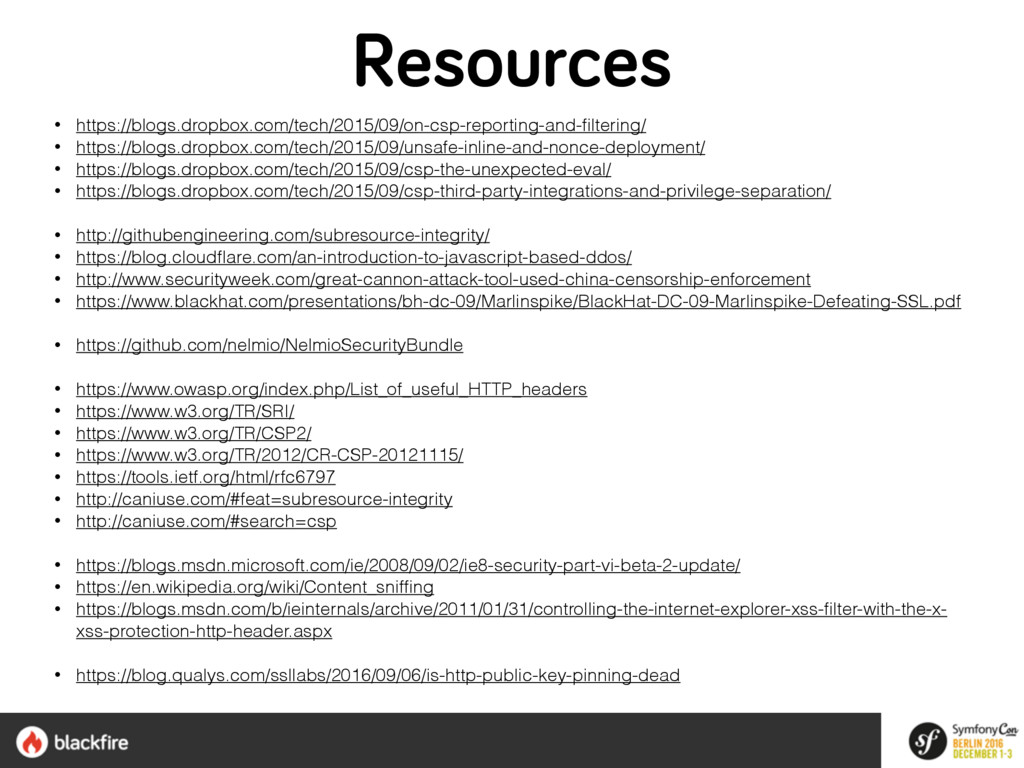
Resources • https://blogs.dropbox.com/tech/2015/09/on-csp-reporting-and-filtering/ • https://blogs.dropbox.com/tech/2015/09/unsafe-inline-and-nonce-deployment/ • https://blogs.dropbox.com/tech/2015/09/csp-the-unexpected-eval/ • https://blogs.dropbox.com/tech/2015/09/csp-third-party-integrations-and-privilege-separation/ •
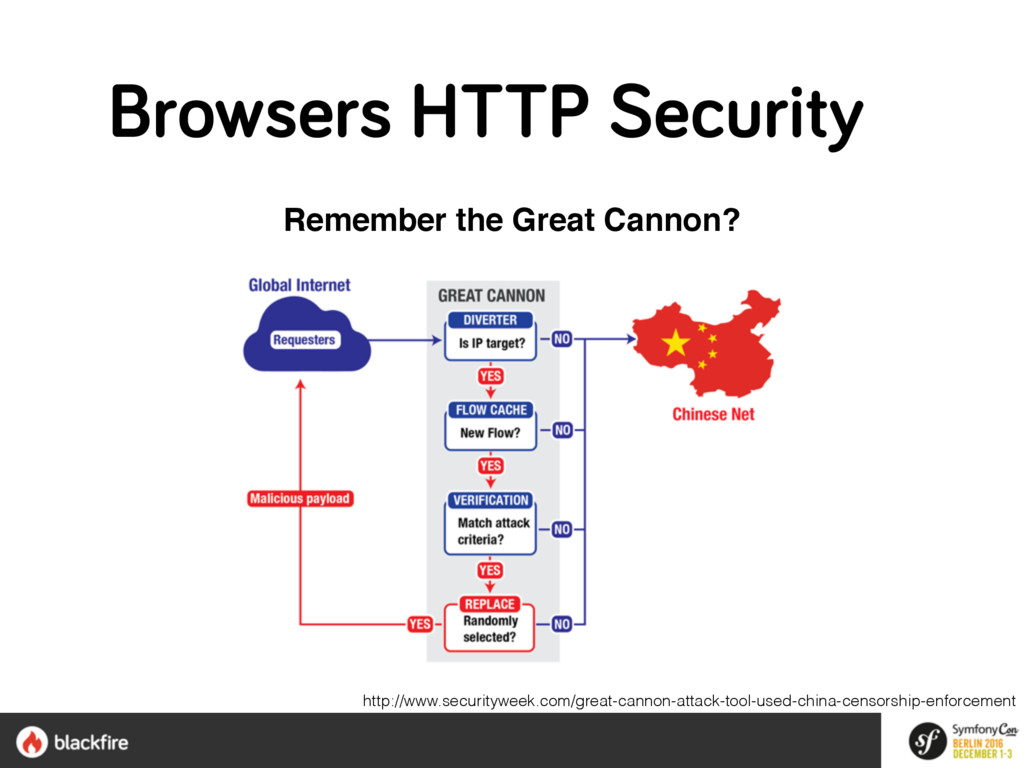
http://githubengineering.com/subresource-integrity/ • https://blog.cloudflare.com/an-introduction-to-javascript-based-ddos/ • http://www.securityweek.com/great-cannon-attack-tool-used-china-censorship-enforcement • https://www.blackhat.com/presentations/bh-dc-09/Marlinspike/BlackHat-DC-09-Marlinspike-Defeating-SSL.pdf • https://github.com/nelmio/NelmioSecurityBundle • https://www.owasp.org/index.php/List_of_useful_HTTP_headers • https://www.w3.org/TR/SRI/ • https://www.w3.org/TR/CSP2/ • https://www.w3.org/TR/2012/CR-CSP-20121115/ • https://tools.ietf.org/html/rfc6797 • http://caniuse.com/#feat=subresource-integrity • http://caniuse.com/#search=csp • https://blogs.msdn.microsoft.com/ie/2008/09/02/ie8-security-part-vi-beta-2-update/ • https://en.wikipedia.org/wiki/Content_sniffing • https://blogs.msdn.com/b/ieinternals/archive/2011/01/31/controlling-the-internet-explorer-xss-filter-with-the-x- xss-protection-http-header.aspx • https://blog.qualys.com/ssllabs/2016/09/06/is-http-public-key-pinning-dead
 romain
 ikura_hamu
 shiita0903
 ivargrimstad
 steliosf
 ostk0069
 usagi0920_pochi
 4geru
 kmkim
 takehaya
 kishida
 hasutosasaki
 marketingsoph
 addyosmani
 keathley
 jmmastey
 andyhume
 maltzj
 kastner
 marktimemedia
 elsirapls
 mraible
 schroneko