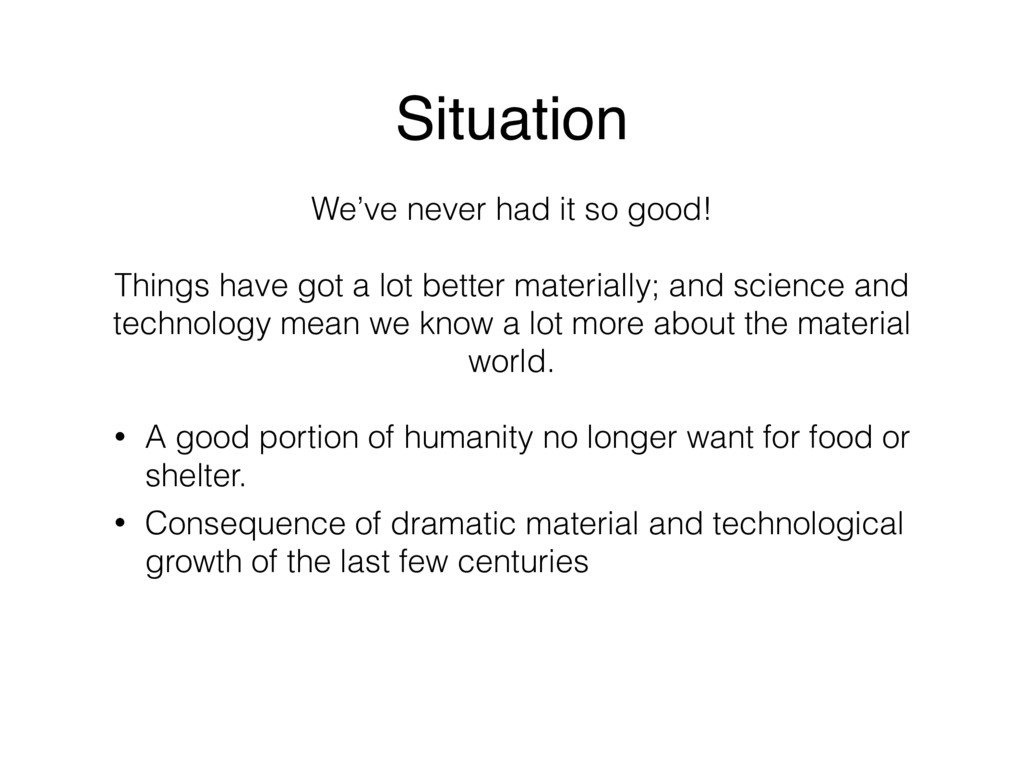
a lot better materially; and science and technology mean we know a lot more about the material world. • A good portion of humanity no longer want for food or shelter. • Consequence of dramatic material and technological growth of the last few centuries
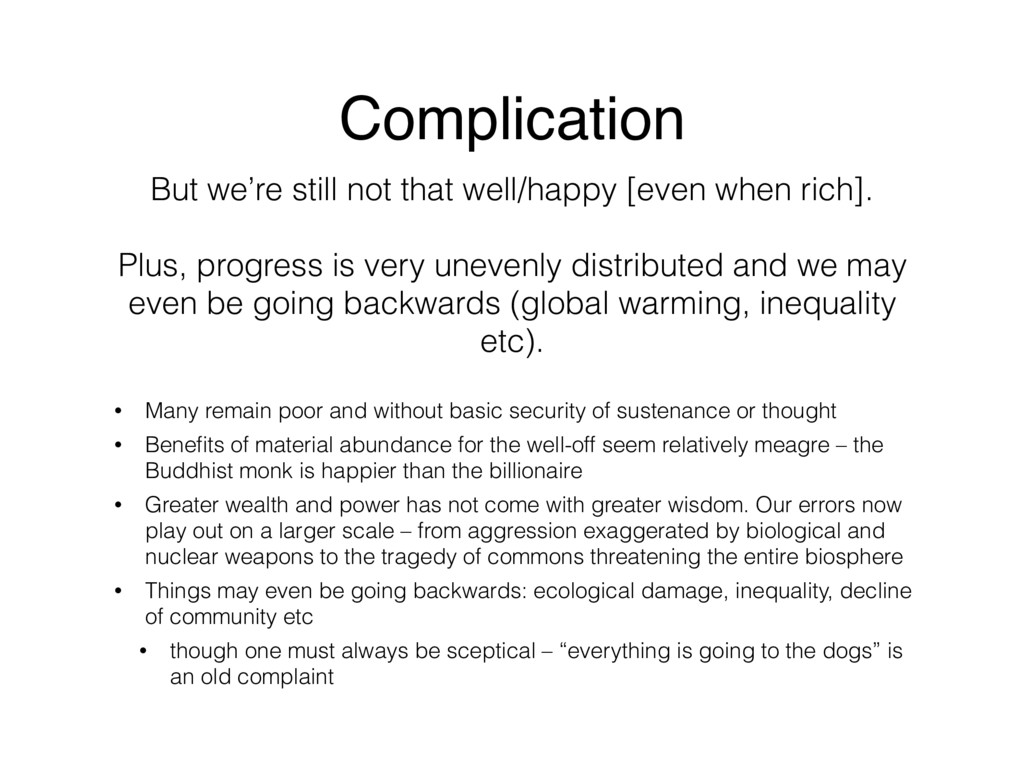
Plus, progress is very unevenly distributed and we may even be going backwards (global warming, inequality etc). • Many remain poor and without basic security of sustenance or thought • Benefits of material abundance for the well-off seem relatively meagre – the Buddhist monk is happier than the billionaire • Greater wealth and power has not come with greater wisdom. Our errors now play out on a larger scale – from aggression exaggerated by biological and nuclear weapons to the tragedy of commons threatening the entire biosphere • Things may even be going backwards: ecological damage, inequality, decline of community etc • though one must always be sceptical – “everything is going to the dogs” is an old complaint
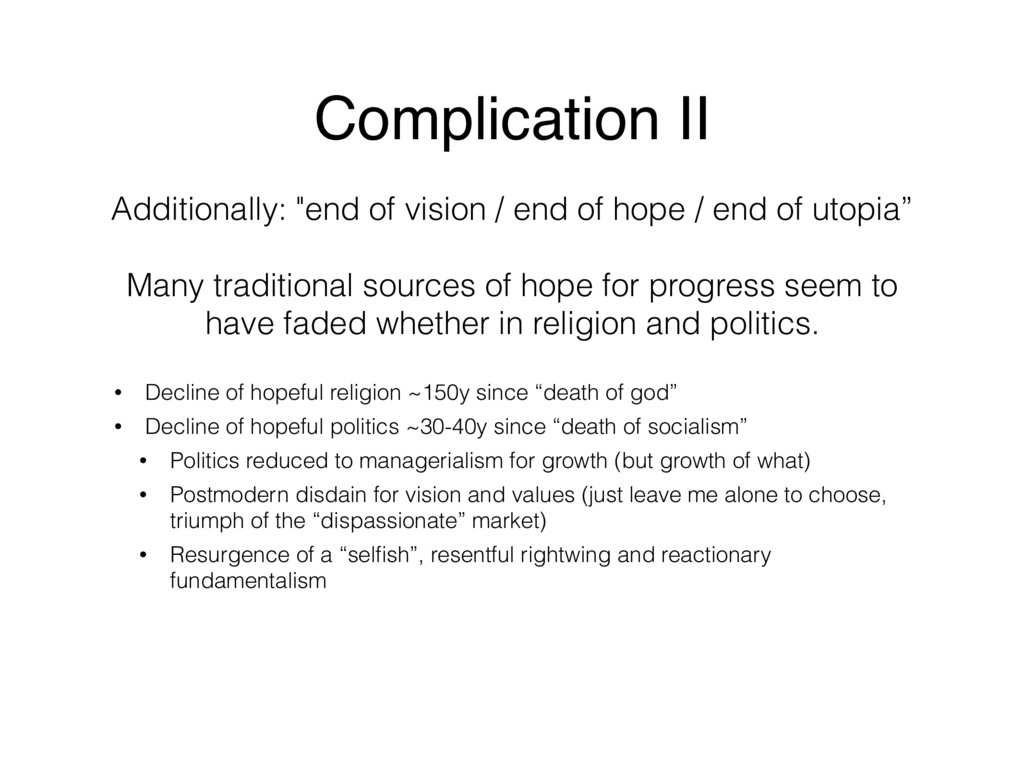
/ end of utopia” Many traditional sources of hope for progress seem to have faded whether in religion and politics. • Decline of hopeful religion ~150y since “death of god” • Decline of hopeful politics ~30-40y since “death of socialism” • Politics reduced to managerialism for growth (but growth of what) • Postmodern disdain for vision and values (just leave me alone to choose, triumph of the “dispassionate” market) • Resurgence of a “selfish”, resentful rightwing and reactionary fundamentalism
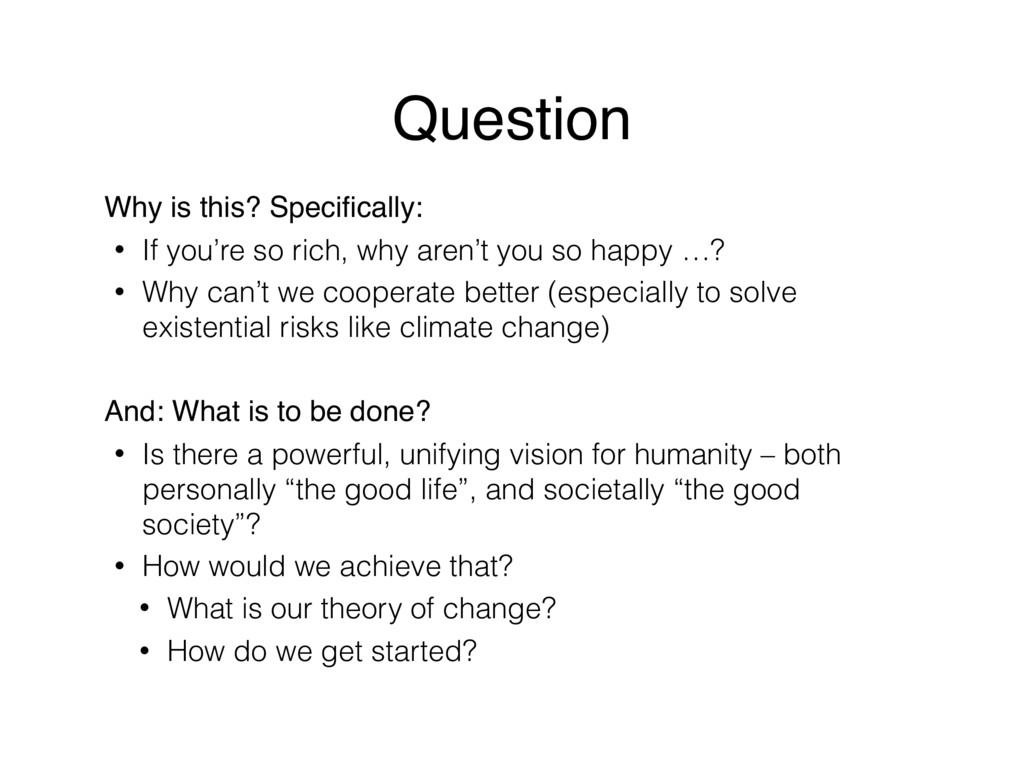
why aren’t you so happy …? • Why can’t we cooperate better (especially to solve existential risks like climate change) And: What is to be done? • Is there a powerful, unifying vision for humanity – both personally “the good life”, and societally “the good society”? • How would we achieve that? • What is our theory of change? • How do we get started?
Complication: But we're still not that well/happy. Plus, progress is unevenly distributed and we may even be going backwards • Complication II: death of god, death of socialism aka "end of utopia" — many traditional sources of hope for progress have faded whether in religion or politics • Question: Why is this? And what is to be done?
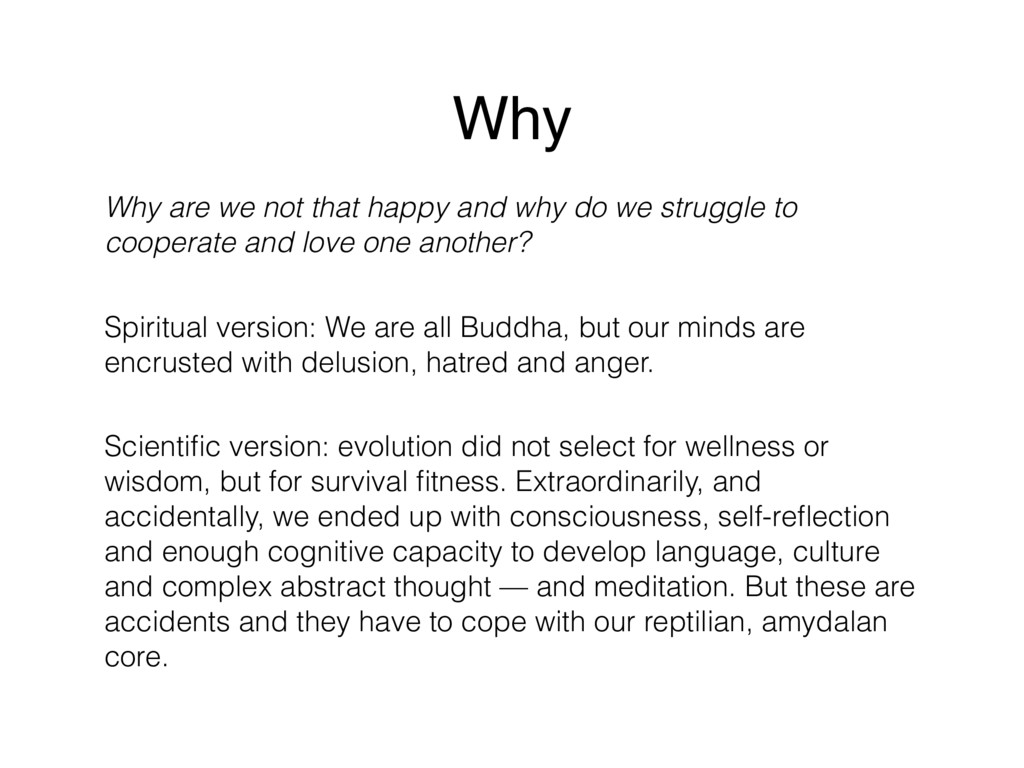
we struggle to cooperate and love one another? Spiritual version: We are all Buddha, but our minds are encrusted with delusion, hatred and anger. Scientific version: evolution did not select for wellness or wisdom, but for survival fitness. Extraordinarily, and accidentally, we ended up with consciousness, self-reflection and enough cognitive capacity to develop language, culture and complex abstract thought — and meditation. But these are accidents and they have to cope with our reptilian, amydalan core.
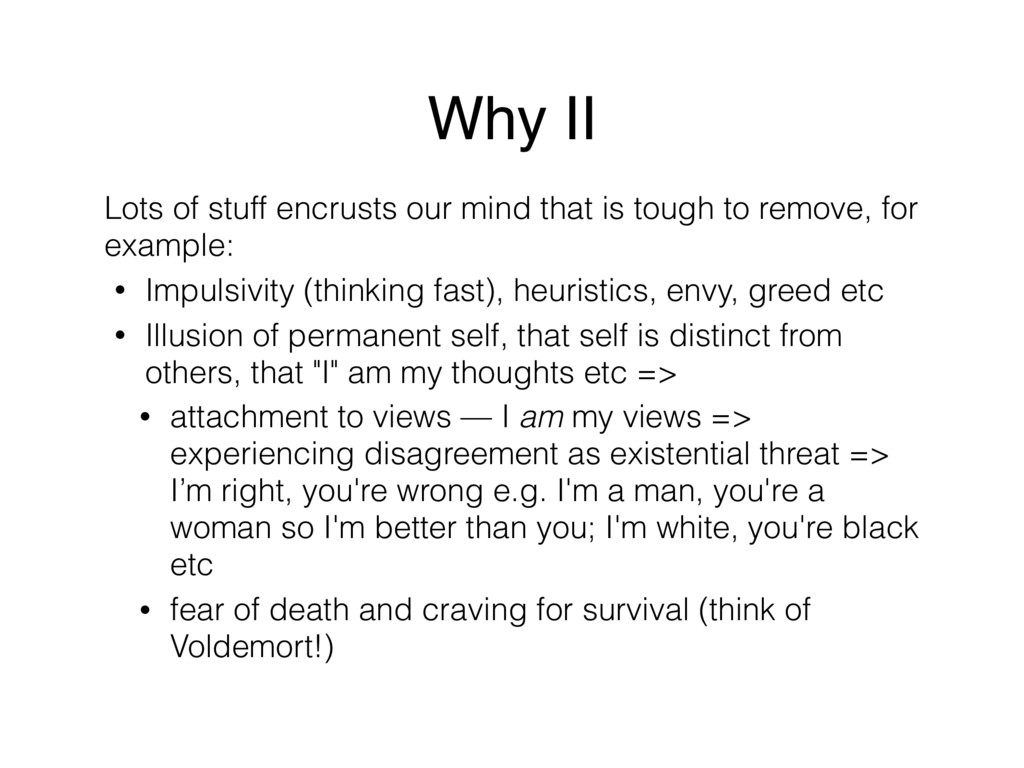
tough to remove, for example: • Impulsivity (thinking fast), heuristics, envy, greed etc • Illusion of permanent self, that self is distinct from others, that "I" am my thoughts etc => • attachment to views — I am my views => experiencing disagreement as existential threat => I’m right, you're wrong e.g. I'm a man, you're a woman so I'm better than you; I'm white, you're black etc • fear of death and craving for survival (think of Voldemort!)
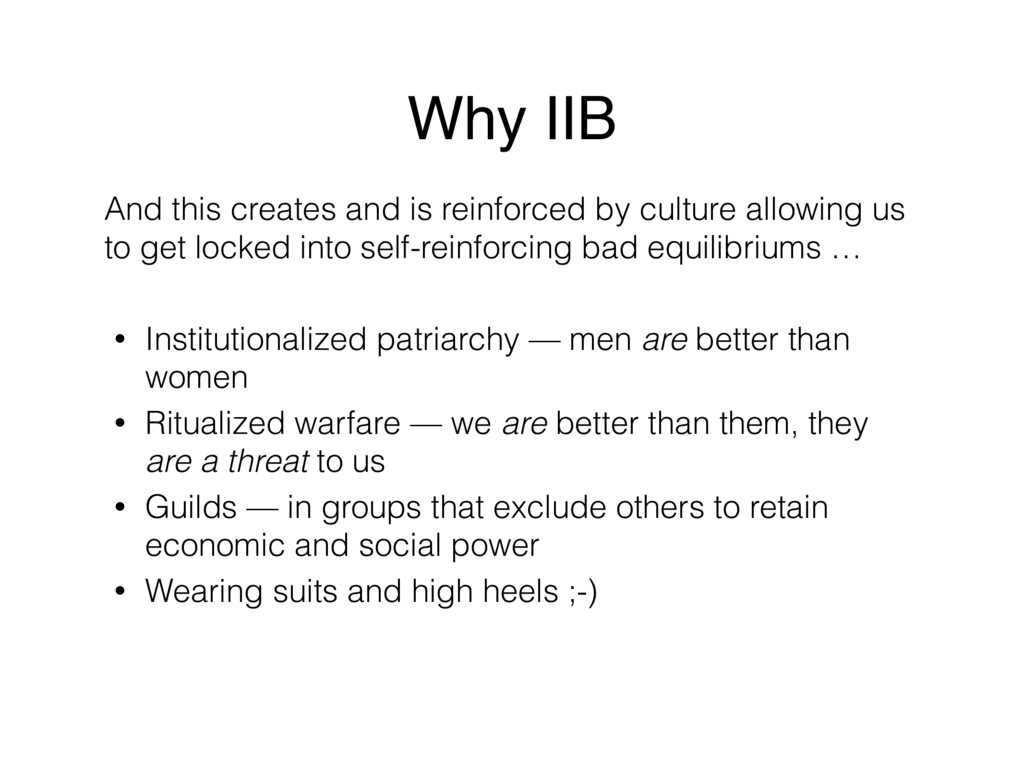
allowing us to get locked into self-reinforcing bad equilibriums … • Institutionalized patriarchy — men are better than women • Ritualized warfare — we are better than them, they are a threat to us • Guilds — in groups that exclude others to retain economic and social power • Wearing suits and high heels ;-)
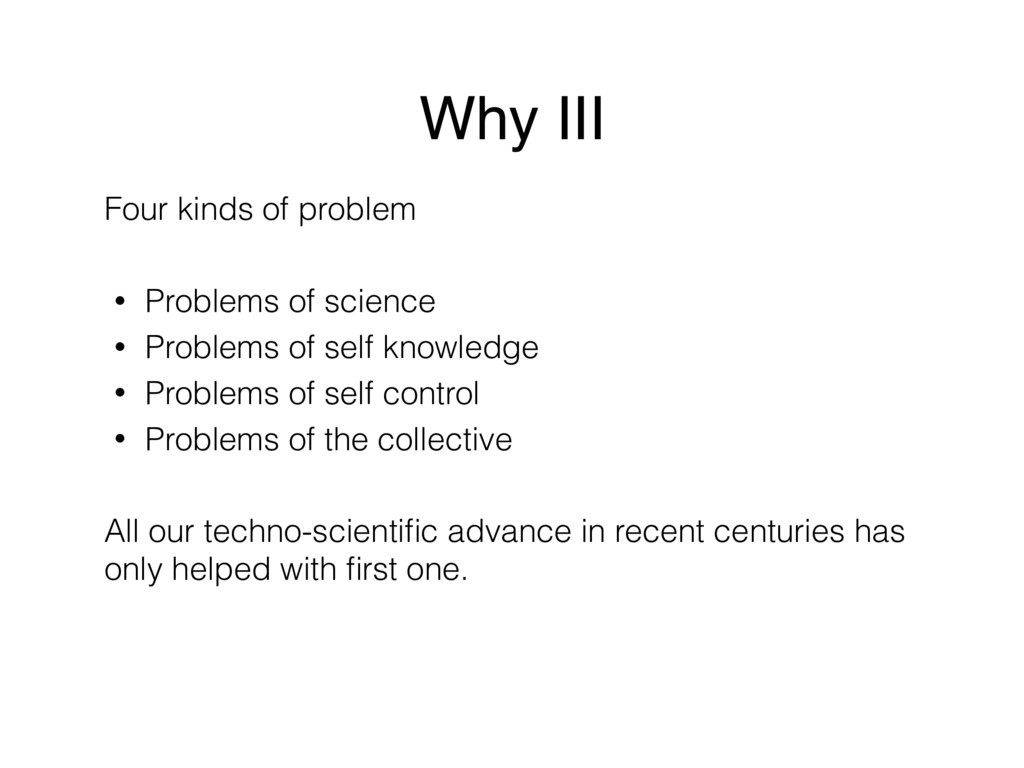
• Problems of self knowledge • Problems of self control • Problems of the collective All our techno-scientific advance in recent centuries has only helped with first one.
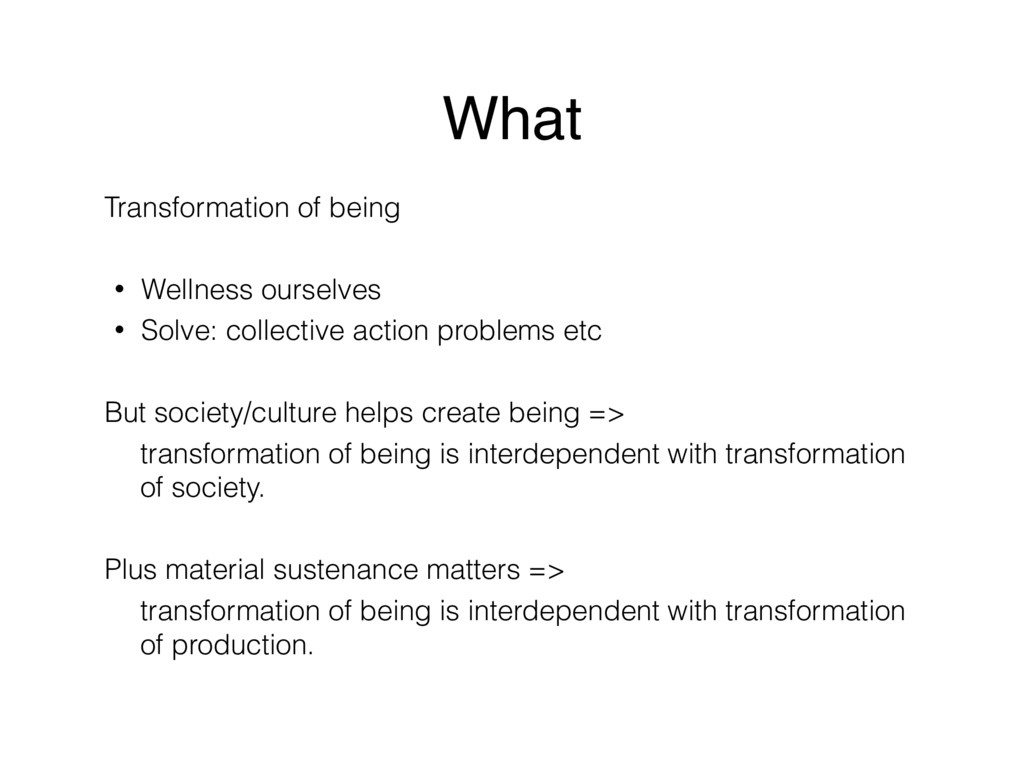
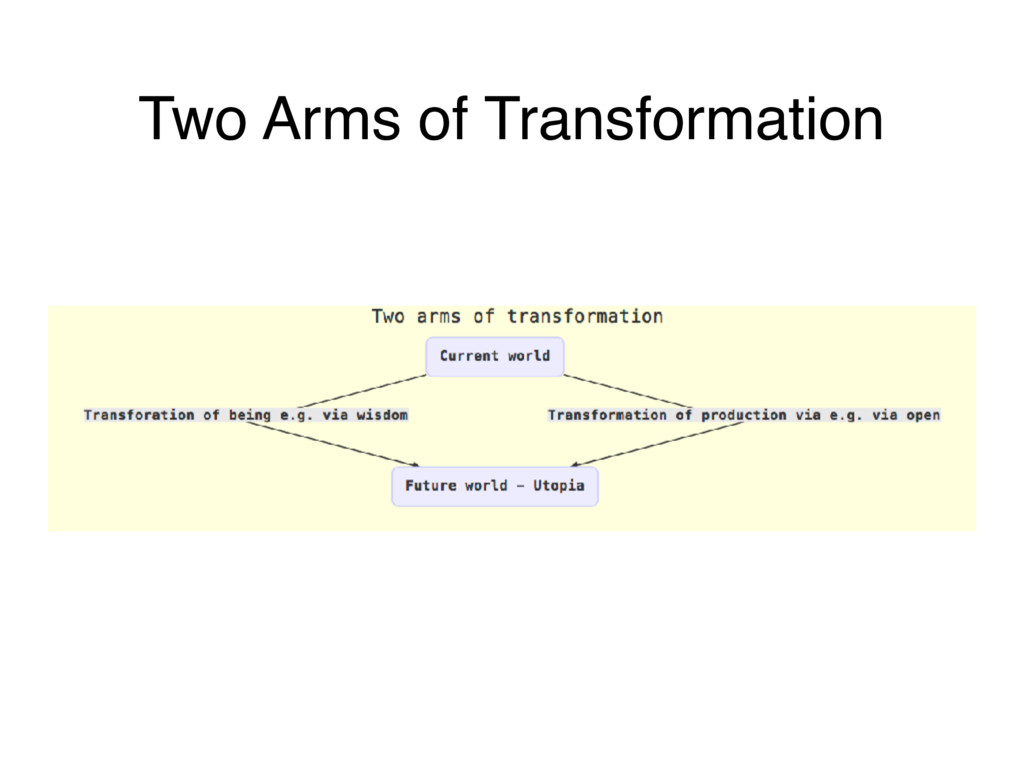
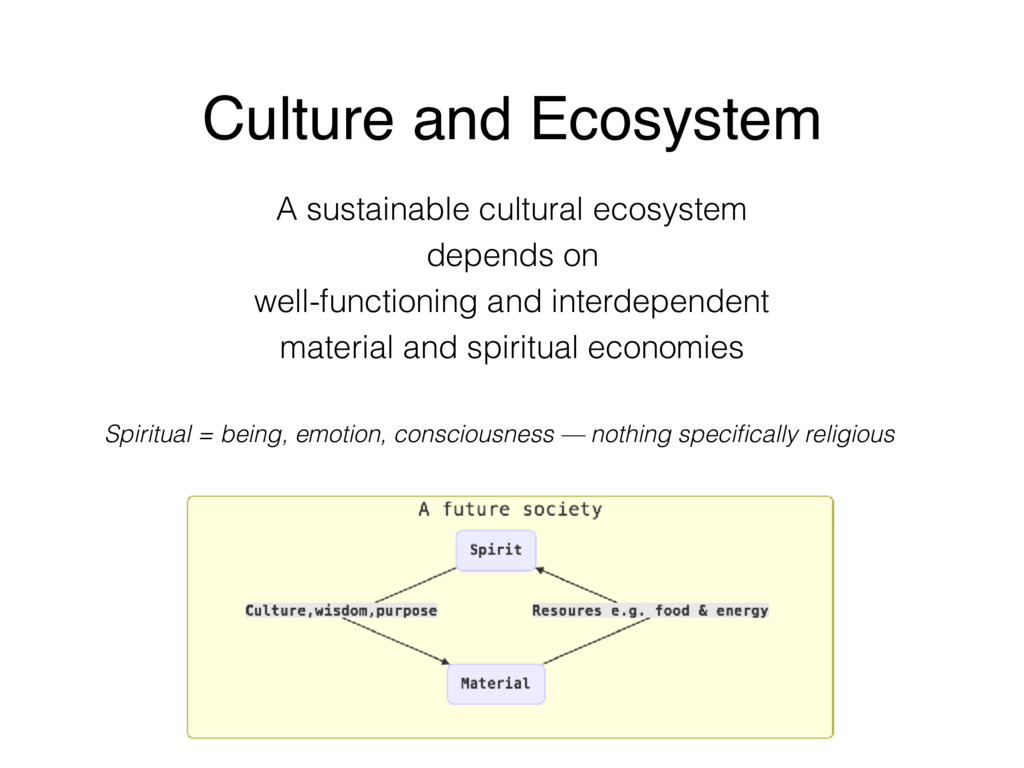
action problems etc But society/culture helps create being => transformation of being is interdependent with transformation of society. Plus material sustenance matters => transformation of being is interdependent with transformation of production.
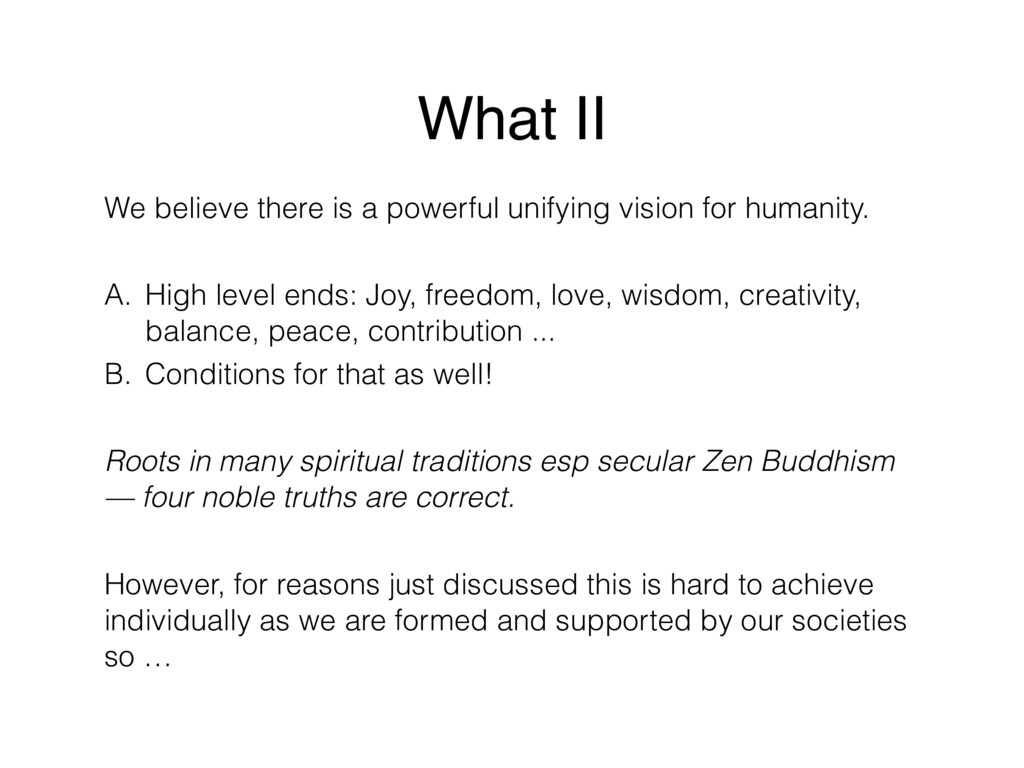
for humanity. A. High level ends: Joy, freedom, love, wisdom, creativity, balance, peace, contribution ... B. Conditions for that as well! Roots in many spiritual traditions esp secular Zen Buddhism — four noble truths are correct. However, for reasons just discussed this is hard to achieve individually as we are formed and supported by our societies so …
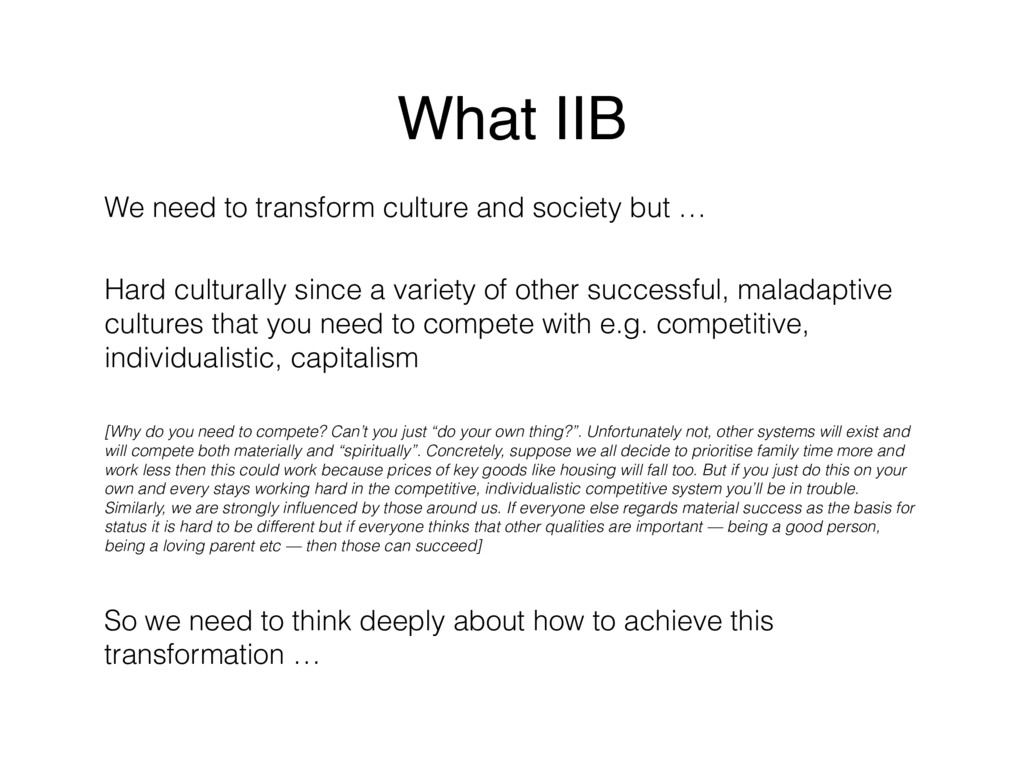
… Hard culturally since a variety of other successful, maladaptive cultures that you need to compete with e.g. competitive, individualistic, capitalism [Why do you need to compete? Can’t you just “do your own thing?”. Unfortunately not, other systems will exist and will compete both materially and “spiritually”. Concretely, suppose we all decide to prioritise family time more and work less then this could work because prices of key goods like housing will fall too. But if you just do this on your own and every stays working hard in the competitive, individualistic competitive system you’ll be in trouble. Similarly, we are strongly influenced by those around us. If everyone else regards material success as the basis for status it is hard to be different but if everyone thinks that other qualities are important — being a good person, being a loving parent etc — then those can succeed] So we need to think deeply about how to achieve this transformation …
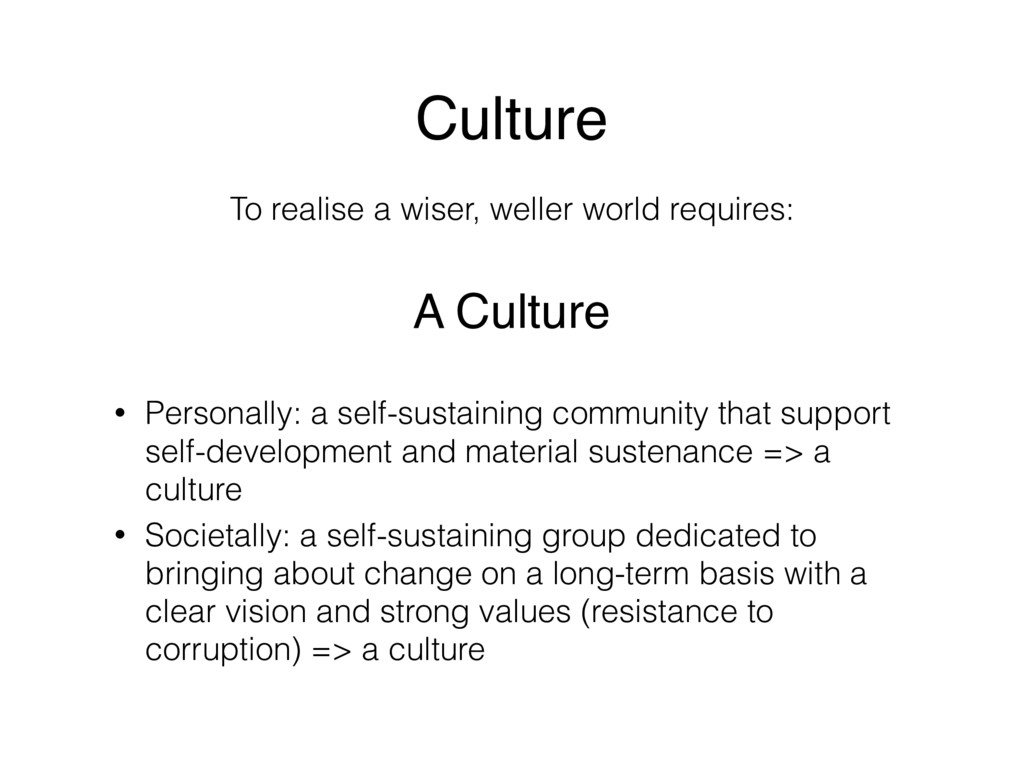
• Personally: a self-sustaining community that support self-development and material sustenance => a culture • Societally: a self-sustaining group dedicated to bringing about change on a long-term basis with a clear vision and strong values (resistance to corruption) => a culture
committed to creating that culture and that society. • Being: living well and wise lives ourselves, developing our being • Research: work out where we need to go (in detail) and how to get there • Business: making a living, generating resources for investment • Politics: (not necessarily electoral) structured effort to effect change in the collective Part of wisdom is to avoid sacrificing means to ends. Thus, all activities are themselves part of the practice.
of psychic revolution 1600-1800 = scientific revolution. Started to look at natural world with open-mindedness => ask questions, do experiments, build theories (that are always just an approximation) 600 BC psychic revolution with Buddha and pre-socratic philosopher: started to look at consciousness and reality in this way. Buddha: don’t take my word for anything, check it for yourself. Buddhist ontology has been developing via self- reflective meditation for 2000 years and now available to whole world and able to encounter modern neuroscience etc => similar opportunity for a psychic revolution similar to scientific revolution.
of digital technology => abundance is natural, sharing is natural Compare: bread vs bits Miracle of loaves and fishes vs 2bn views on youtube A ferrari for everyone is an impossibility, but everyone having shakespeare is not.
and no … — almost nothing here is new. But … most utopian visions in the past were either: • Religious — salvation beyond this world (and any material or spiritual transformation existed in that context) • Materialist — for example, marxist communism. Here the belief was that transformation of the “structures of production” would lead to human liberation. We differ in thinking that you need both spiritual and material transformation and in having a secular spirituality Comment: (e)utopian visions by their nature are about society not just the individual — they are not about individual salvation beyond this world but transformation here and now.


 rufuspollock
 baasie
 eitanlees
 aleyda
 reverentgeek
 pauljervisheath
 leimatthew05
 axbom
 smashingmag
 kastner
 mayunak
 rasmusluckow
 akosma