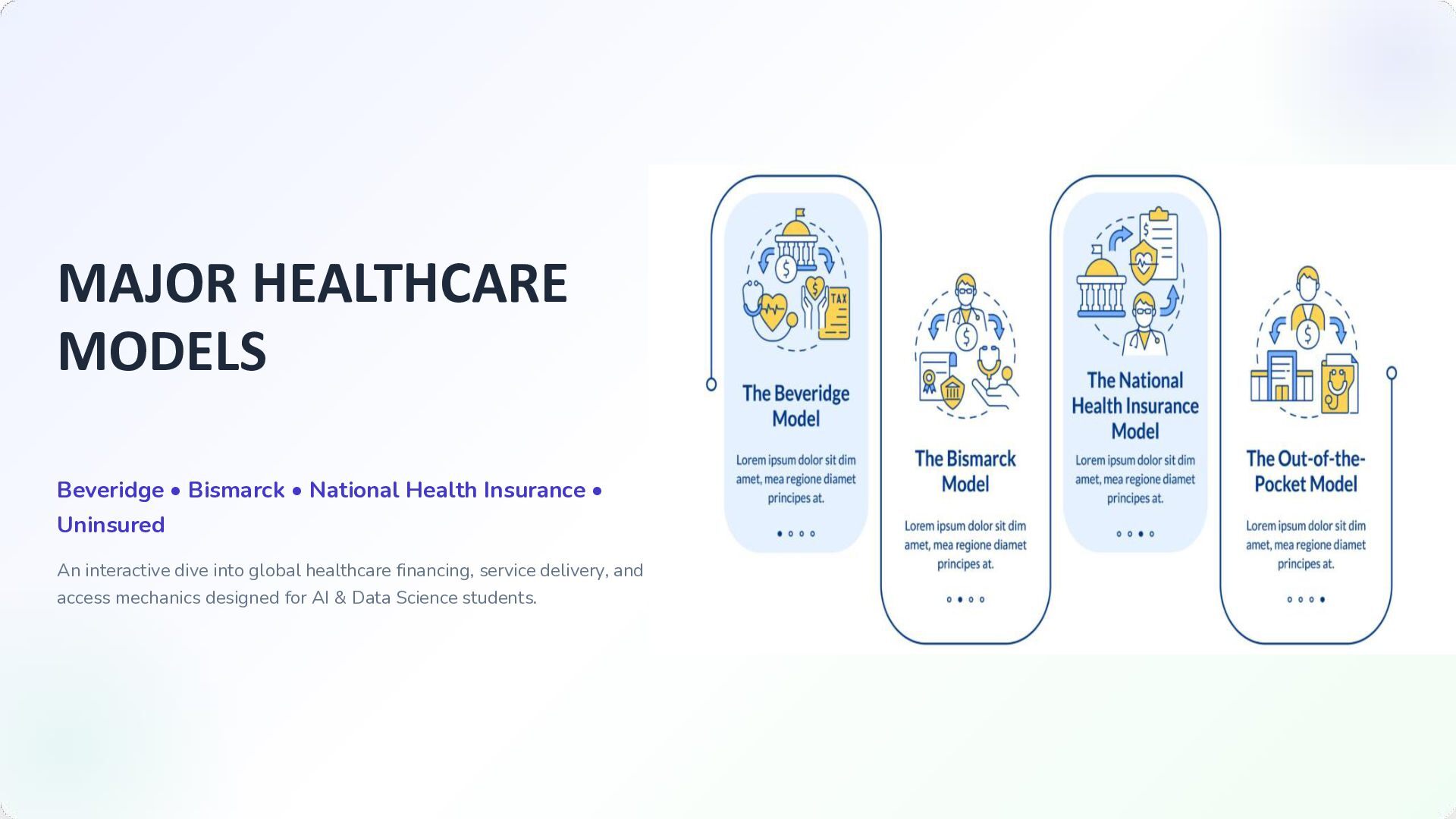
In this Presentation, we explore the four major healthcare models used around the world and understand how each model provides healthcare services, how it is funded, and who is responsible for delivering healthcare.
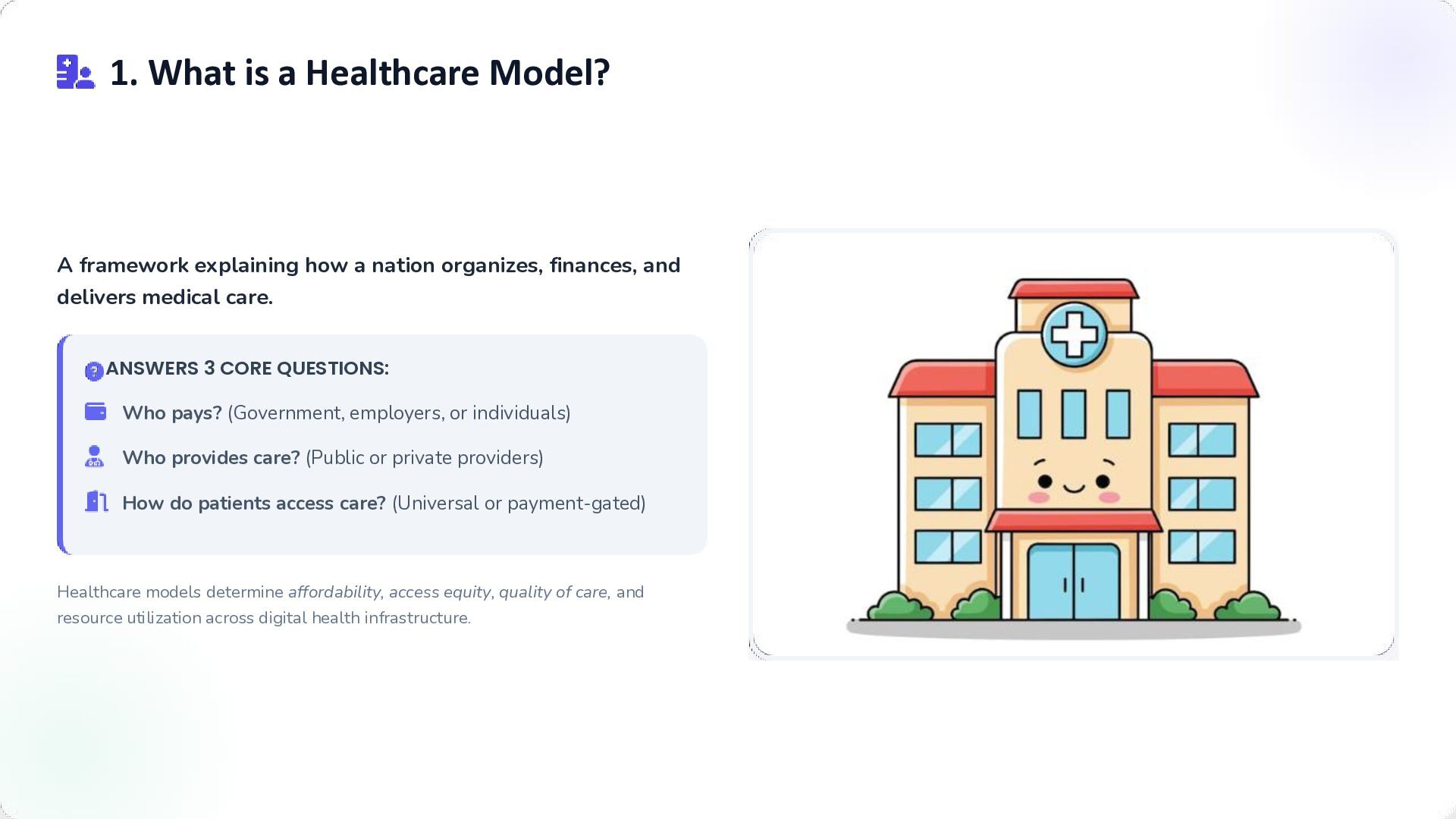
a nation organizes, finances, and delivers medical care. ANSWERS 3 CORE QUESTIONS: Who pays? (Government, employers, or individuals) Who provides care? (Public or private providers) How do patients access care? (Universal or payment-gated) Healthcare models determine affordability, access equity, quality of care, and resource utilization across digital health infrastructure.
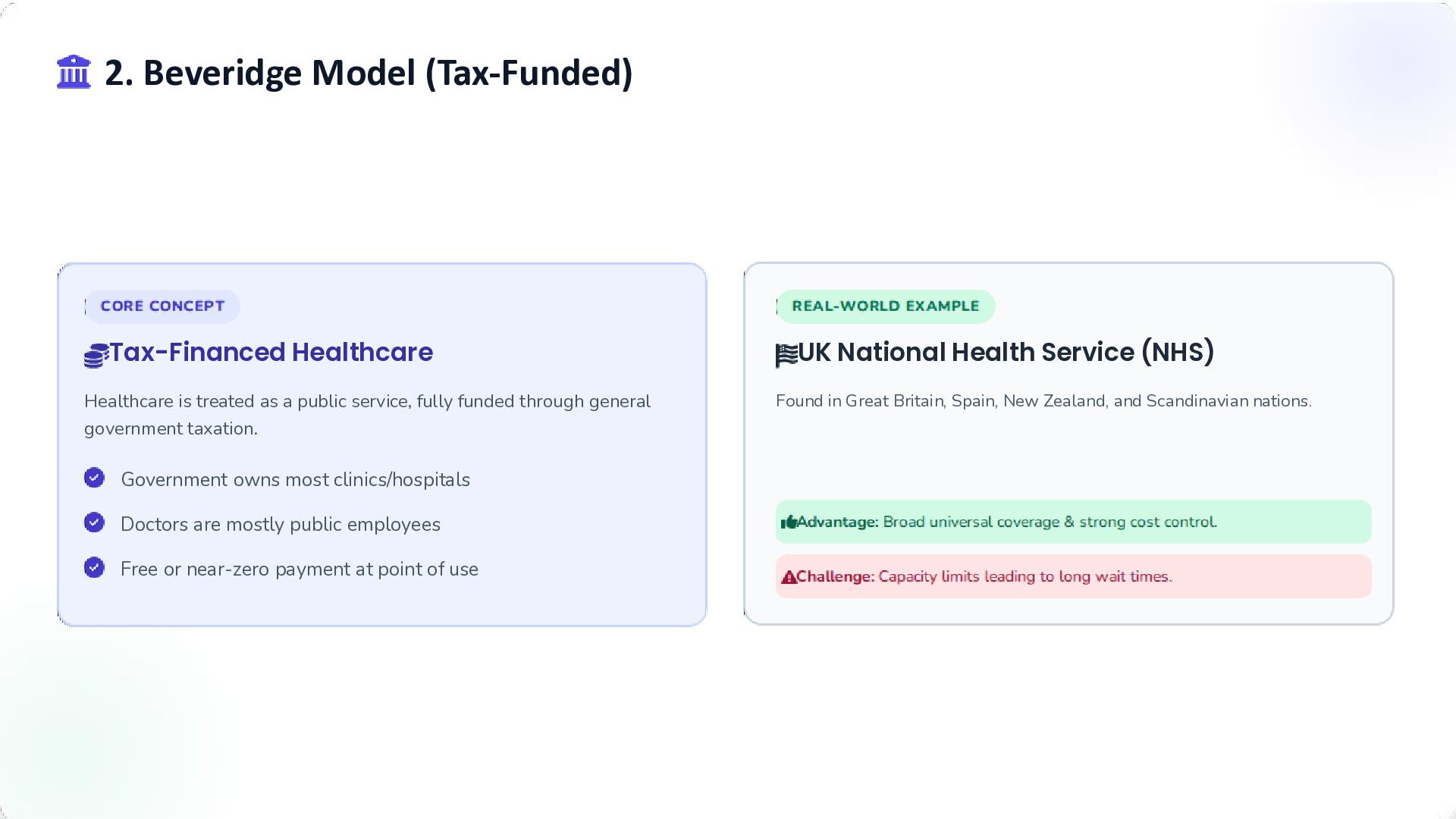
a public service, fully funded through general government taxation. Government owns most clinics/hospitals Doctors are mostly public employees Free or near-zero payment at point of use UK National Health Service (NHS) Found in Great Britain, Spain, New Zealand, and Scandinavian nations.
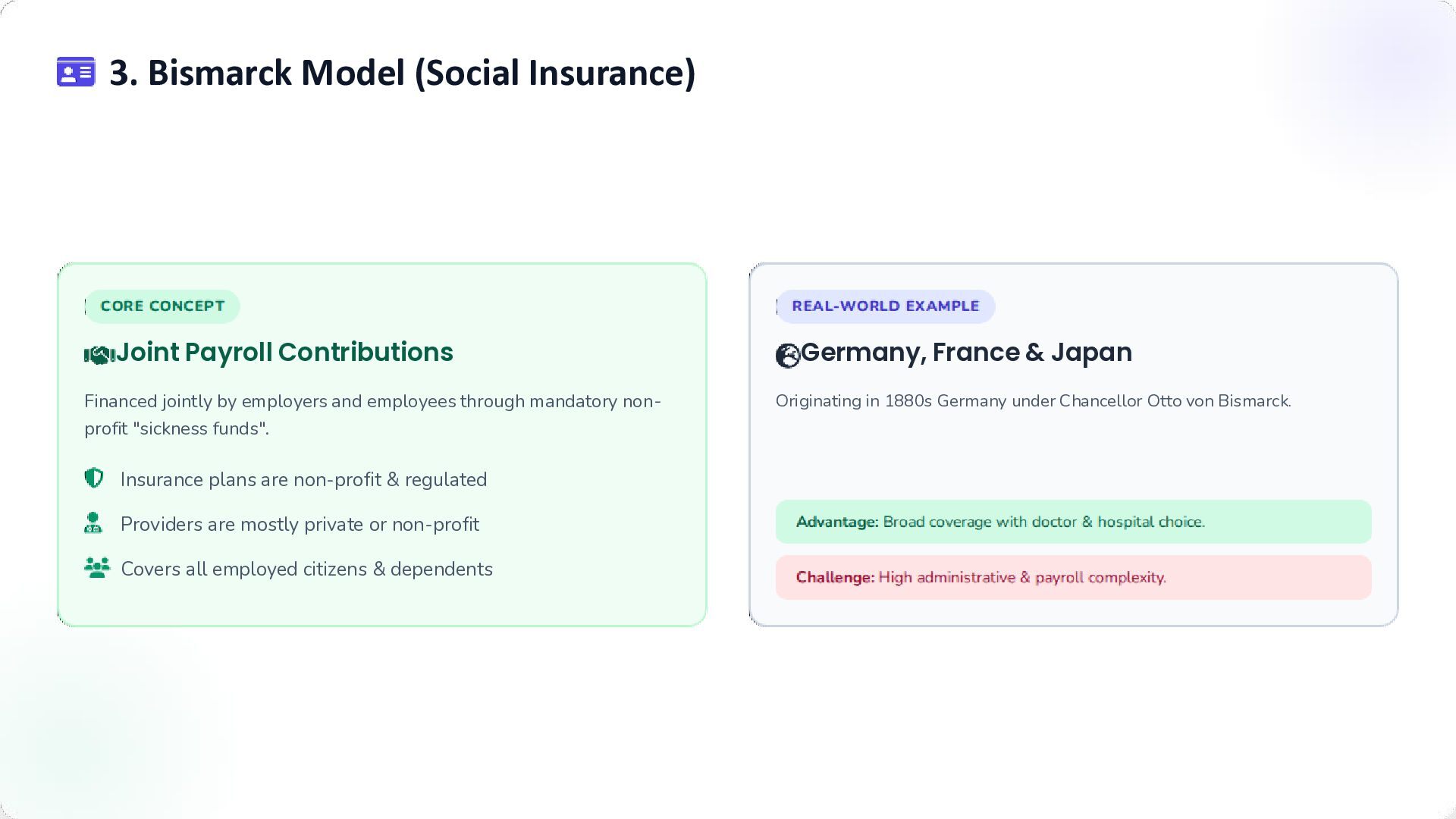
by employers and employees through mandatory nonprofit "sickness funds". Insurance plans are non-profit & regulated Providers are mostly private or non-profit Covers all employed citizens & dependents Germany, France & Japan Originating in 1880s Germany under Chancellor Otto von Bismarck.
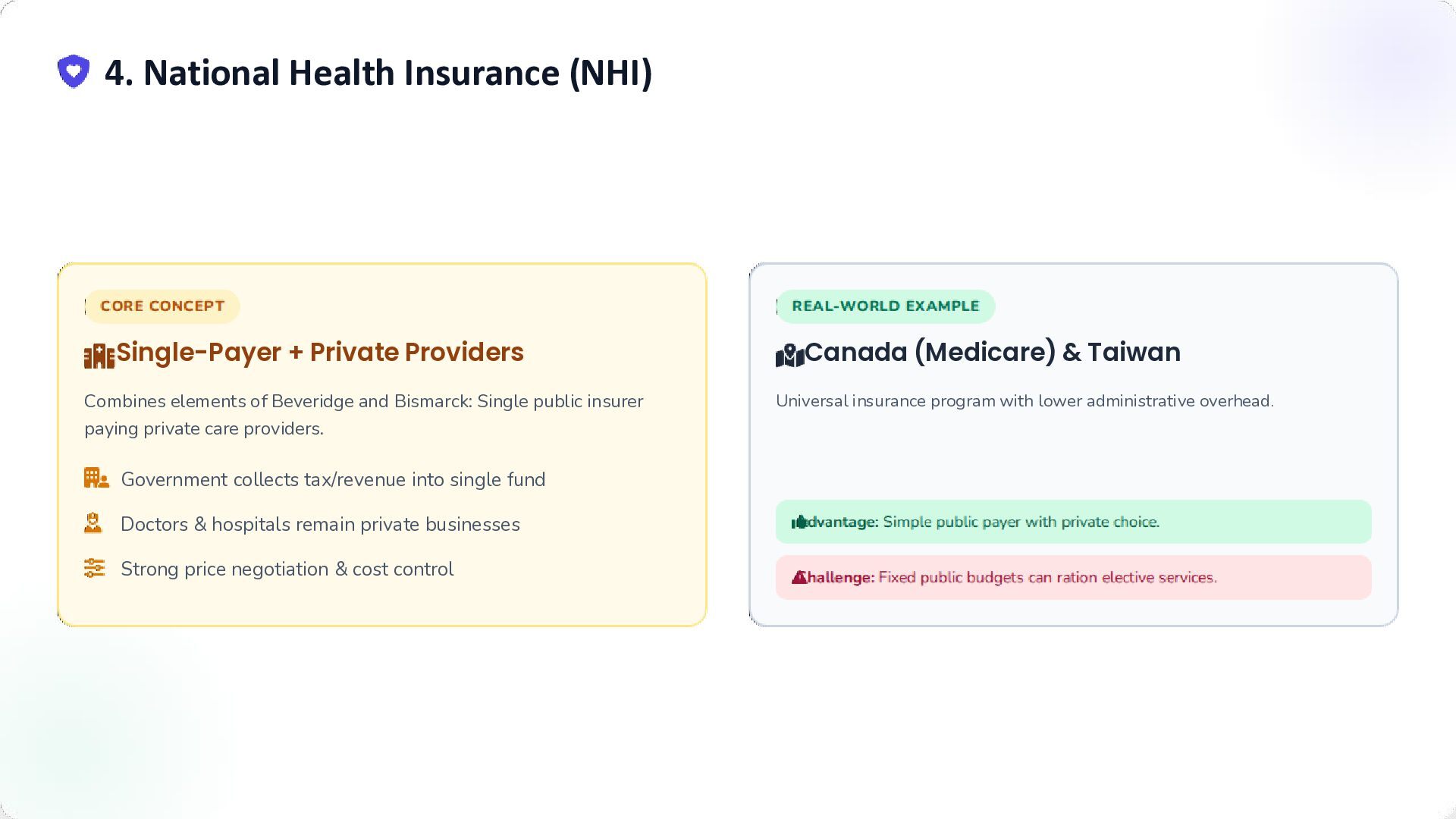
elements of Beveridge and Bismarck: Single public insurer paying private care providers. Government collects tax/revenue into single fund Doctors & hospitals remain private businesses Strong price negotiation & cost control Canada (Medicare) & Taiwan Universal insurance program with lower administrative overhead.
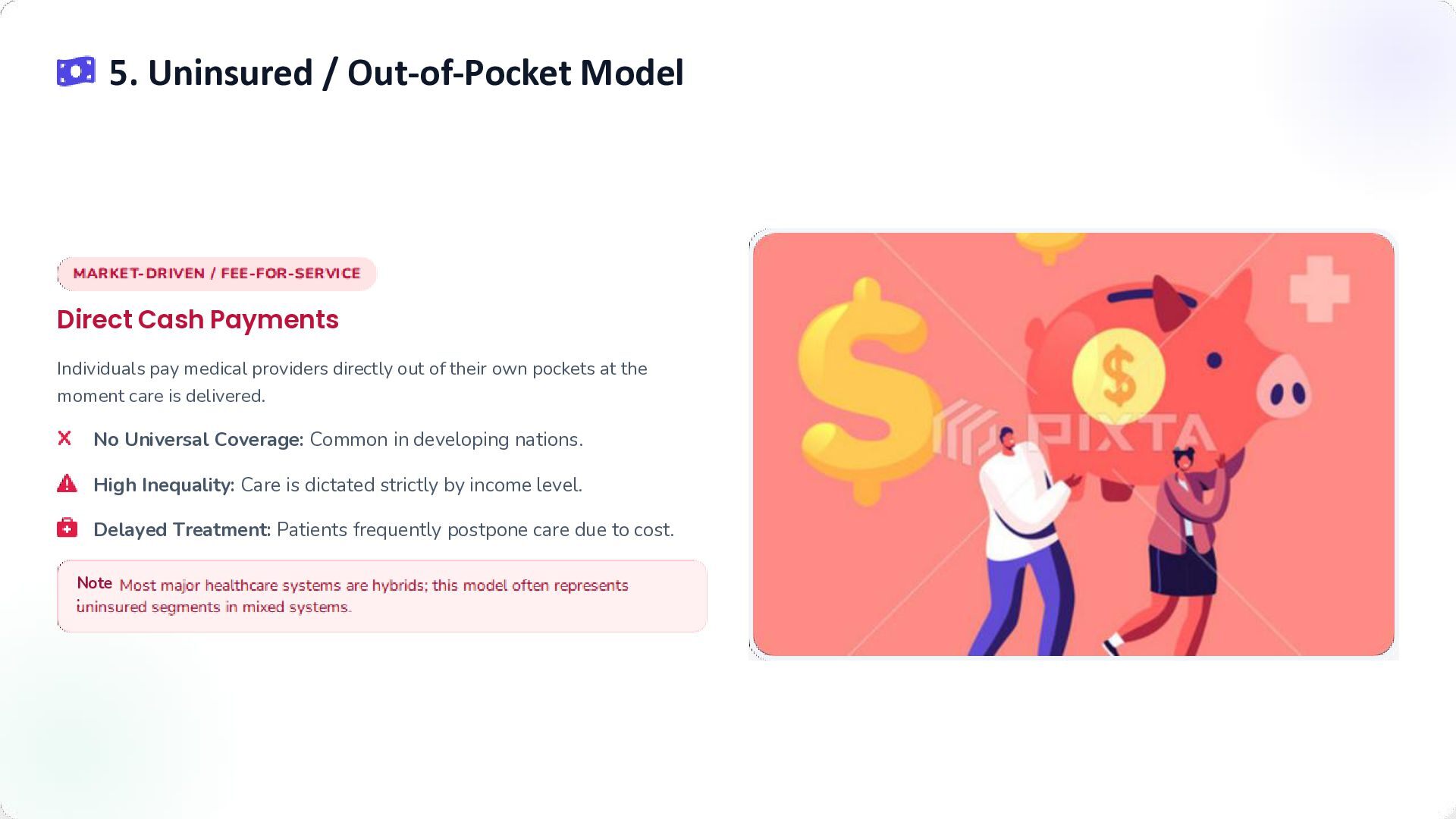
medical providers directly out of their own pockets at the moment care is delivered. No Universal Coverage: Common in developing nations. High Inequality: Care is dictated strictly by income level. Delayed Treatment: Patients frequently postpone care due to cost. Note :
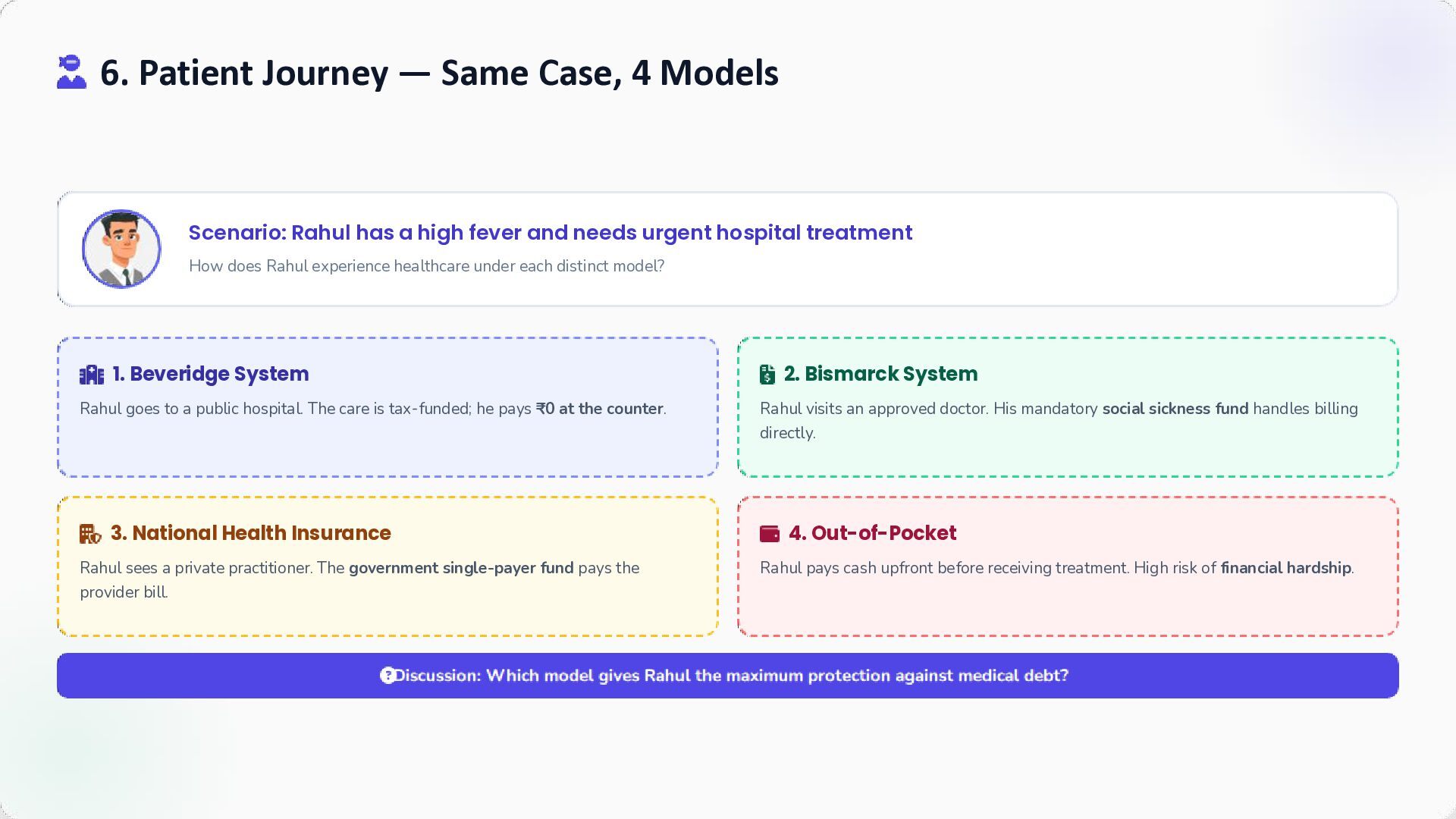
has a high fever and needs urgent hospital treatment How does Rahul experience healthcare under each distinct model? 1. Beveridge System Rahul goes to a public hospital. The care is tax-funded; he pays ₹0 at the counter. 2. Bismarck System Rahul visits an approved doctor. His mandatory social sickness fund handles billing directly. 3. National Health Insurance Rahul sees a private practitioner. The government single-payer fund pays the provider bill. 4. Out-of-Pocket Rahul pays cash upfront before receiving treatment. High risk of financial hardship.
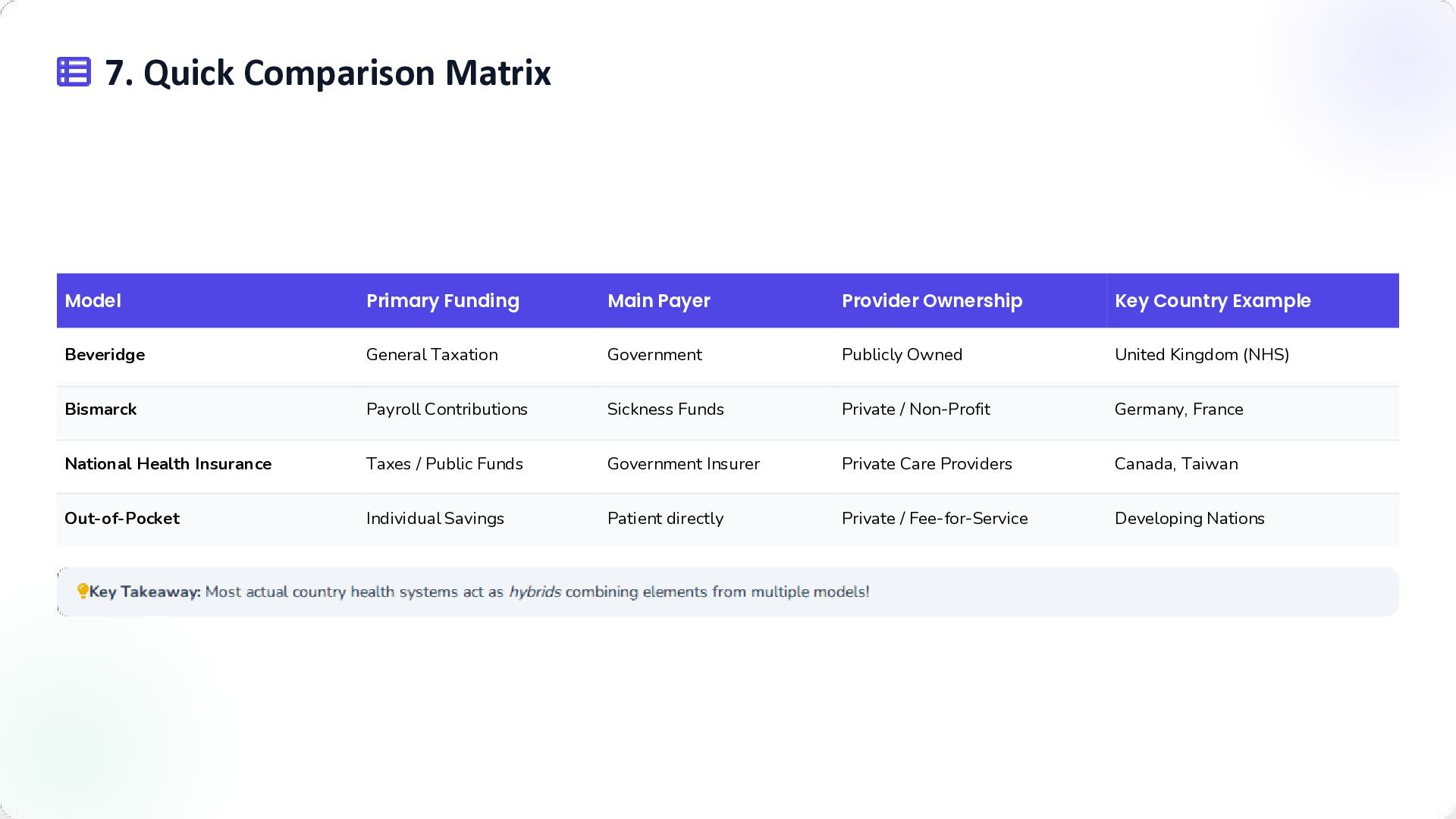
Ownership Key Country Example Beveridge General Taxation Government Publicly Owned United Kingdom (NHS) Bismarck Payroll Contributions Sickness Funds Private / Non-Profit Germany, France National Health Insurance Taxes / Public Funds Government Insurer Private Care Providers Canada, Taiwan Out-of-Pocket Individual Savings Patient directly Private / Fee-for-Service Developing Nations
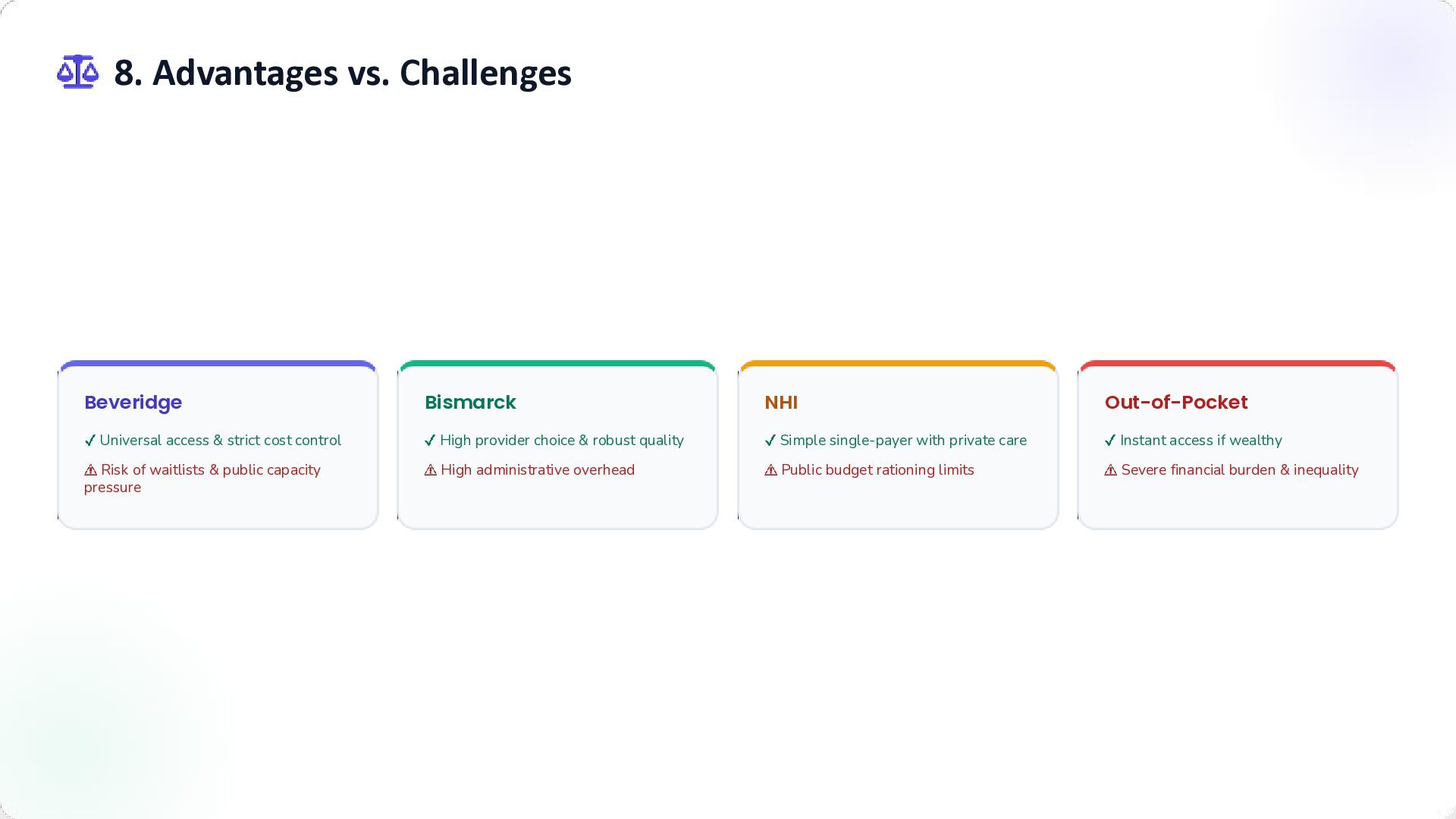
control Risk of waitlists & public capacity pressure Bismarck NHI Out-of-Pocket High provider choice & robust quality Simple single-payer with private care Instant access if wealthy High administrative overhead Public budget rationing limits Severe financial burden & inequality
Divide into 4 Groups representing each healthcare model: 1. Identify: Who pays for the surgery? 2. Identify: Who delivers the medical procedure? 3. Evaluate: What is the financial outcome for the patient? Final Brainstorm Question: If you were designing an optimal hybrid Healthcare System for India, which features would you combine?
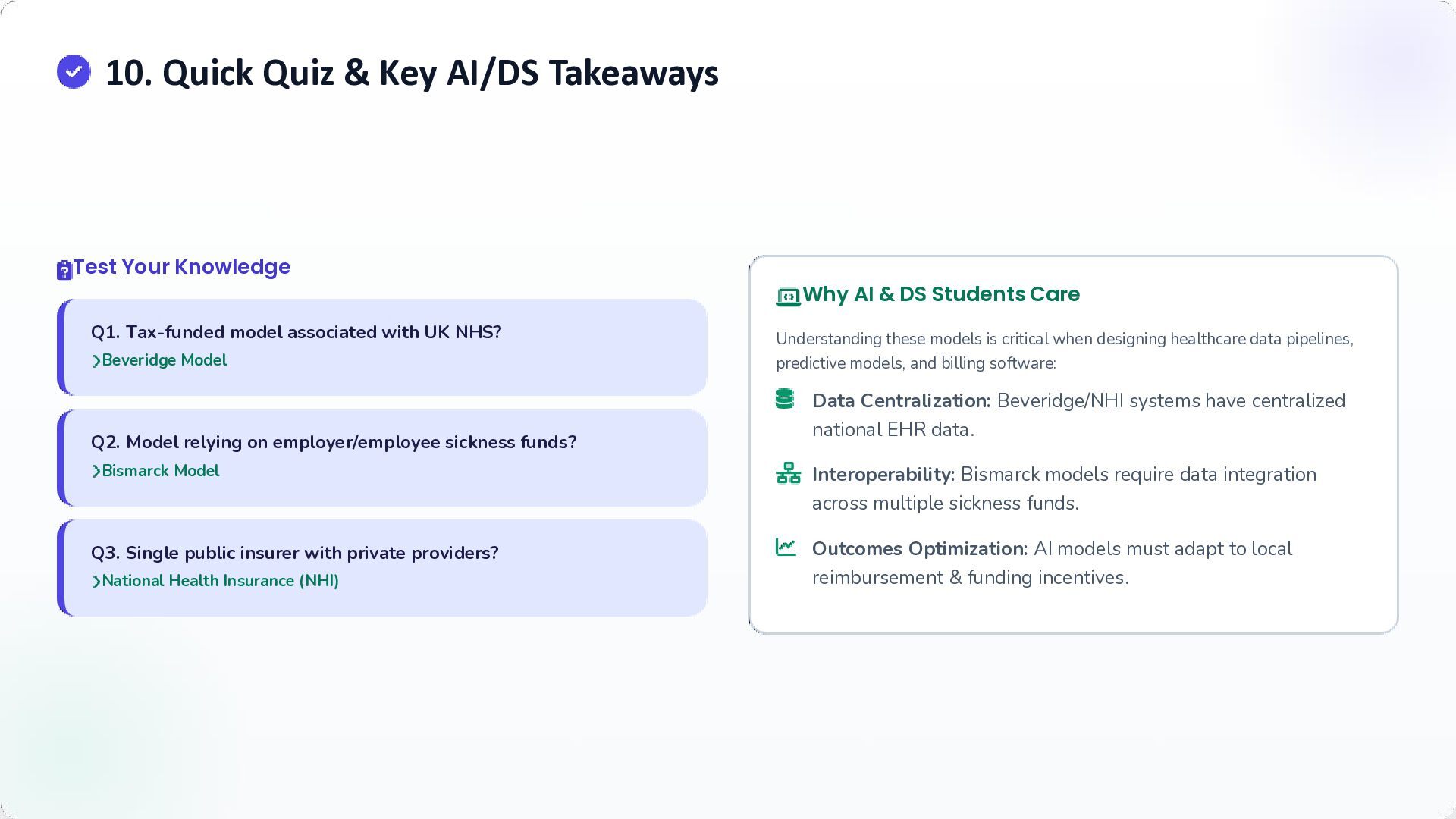
Q1. Tax-funded model associated with UK NHS? Beveridge Model Q2. Model relying on employer/employee sickness funds? Why AI & DS Students Care Understanding these models is critical when designing healthcare data pipelines, predictive models, and billing software: Data Centralization: Beveridge/NHI systems have centralized national EHR data. Bismarck Model Interoperability: Bismarck models require data integration across multiple sickness funds. Q3. Single public insurer with private providers? Outcomes Optimization: AI models must adapt to local reimbursement & funding incentives. National Health Insurance (NHI)


 3l4l5
 fmarot
 ishii_mit
 akiraasano
 hiola
 doratex
 yatabe
 bvr7352
 mariooc
 juanmartin2026
 naochim2026
 marktimemedia
 chriscoyier
 ryanjones
 jct
 reverentgeek
 greggifford
 nmsamuel
 mfonobong
 jacobian
 jnunemaker
 denniskardys