Upgrade to Pro — share decks privately, control downloads, hide ads and more …

Ubiquitous Computing - Privacy and Ethical issues

Ubiquitous Computing - Privacy and Ethical issues

With an exponential increase in computing devices, privacy becomes a major concern. With technology progressively moving towards the internet of things personal space and data are being collected on a scale never before seen in the history of mankind.

Avatar for Ryan Sukale

Ryan Sukale

April 15, 2014
Tweet

More Decks by Ryan Sukale

Other Decks in Technology

Transcript

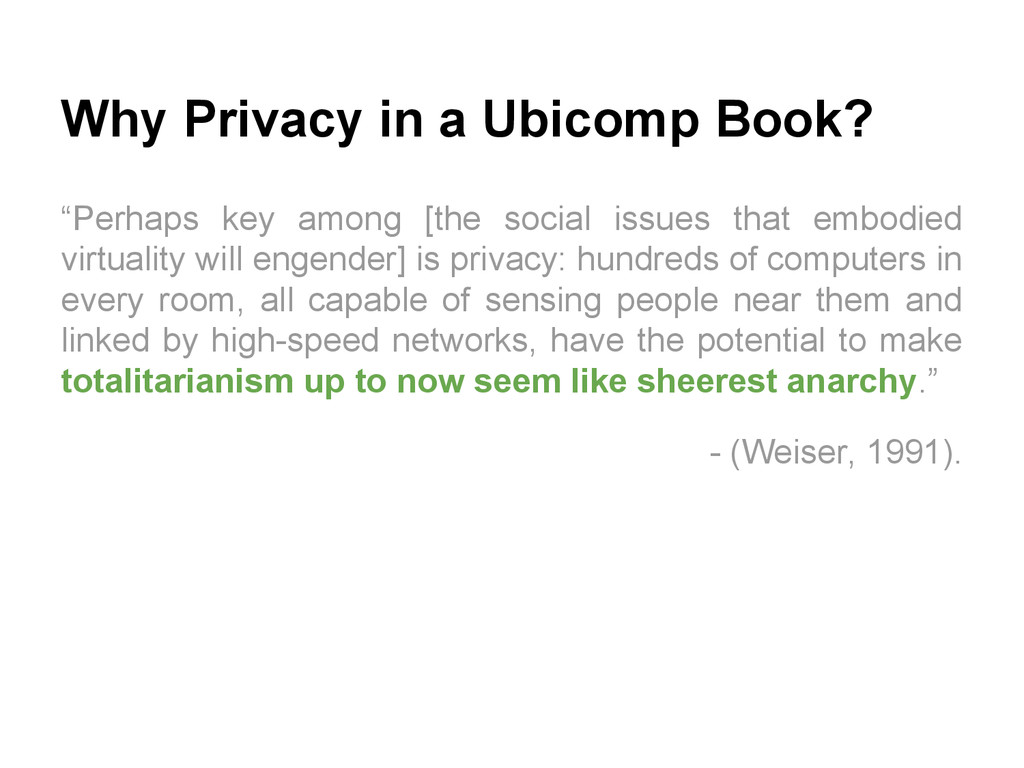
  1. Why Privacy in a Ubicomp Book? “Perhaps key among [the

    social issues that embodied virtuality will engender] is privacy: hundreds of computers in every room, all capable of sensing people near them and linked by high-speed networks, have the potential to make totalitarianism up to now seem like sheerest anarchy.” - (Weiser, 1991).
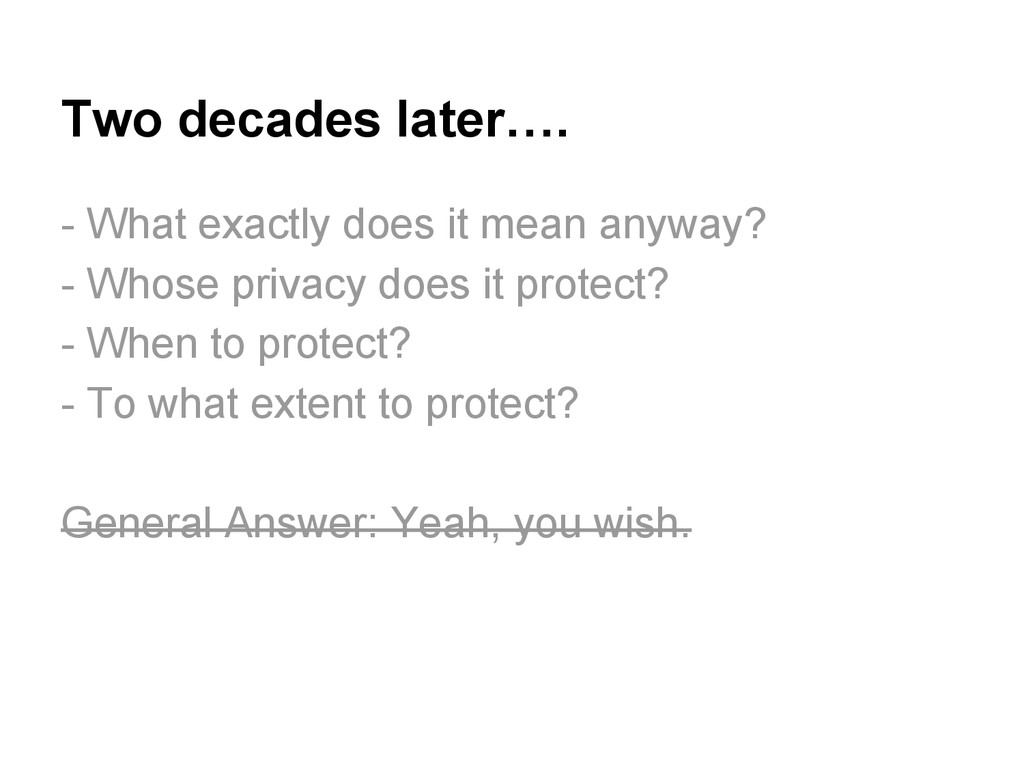
  2. Two decades later…. - What exactly does it mean anyway?

    - Whose privacy does it protect? - When to protect? - To what extent to protect? General Answer: Yeah, you wish.
  3. Privacy ! = Security Why? Security: confidentiality, integrity, and authenticity

    of information = essential ingredients for privacy. BUT You can have security without privacy ** think NSA **
  4. Why is it important in Ubicomp? - Data collection and

    processing are core components - Strong security does not solve privacy issues - We need to understand the nature of privacy, its social and legal realities
  5. Turning a page from history “My home is my castle”

    “The poorest man may in his cottage bid defiance to all the forces of the Crown” - William Pitt, Pariament(1763)
  6. What happened since then? - The Kodak Camera - Computers

    - Smart Labels - Memory Amplifiers - Smart Dust Preserving privacy through isolation is just not as much an option anymore as it was 100 years ago.
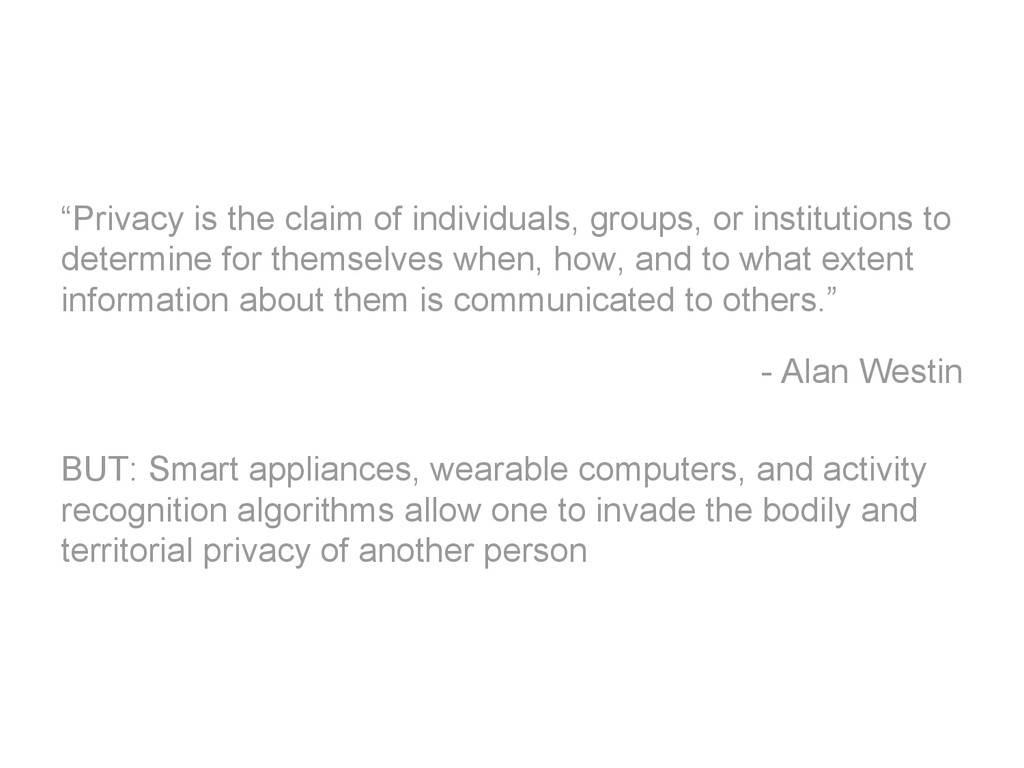
  7. “Privacy is the claim of individuals, groups, or institutions to

    determine for themselves when, how, and to what extent information about them is communicated to others.” - Alan Westin BUT: Smart appliances, wearable computers, and activity recognition algorithms allow one to invade the bodily and territorial privacy of another person
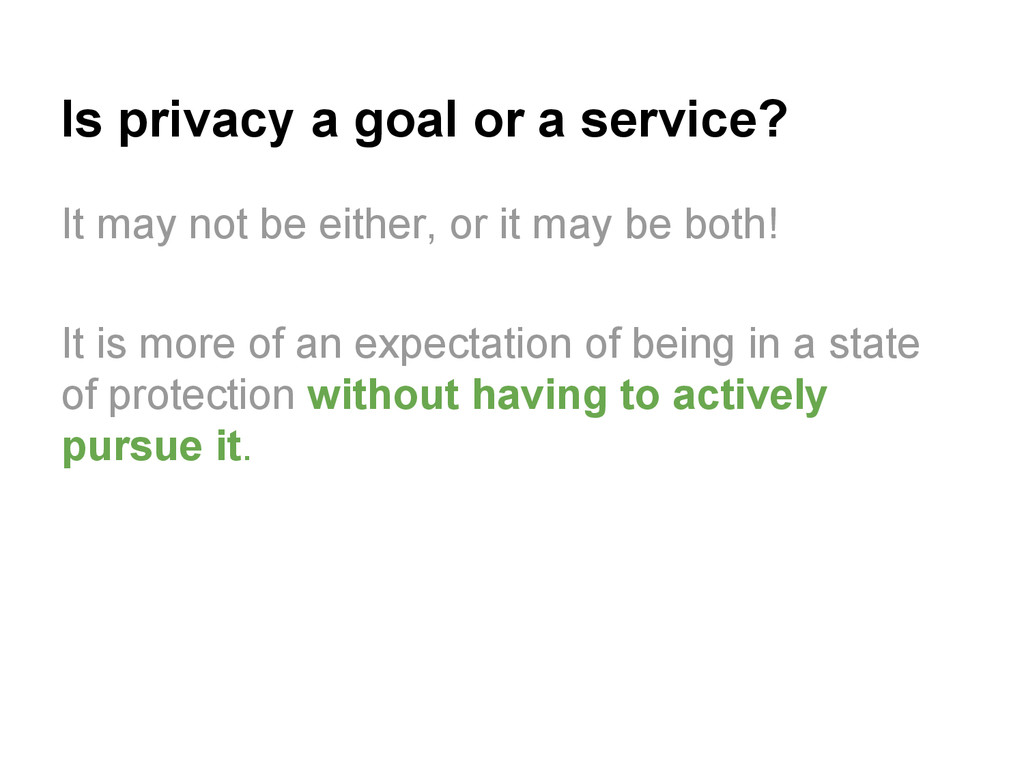
  8. Is privacy a goal or a service? It may not

    be either, or it may be both! It is more of an expectation of being in a state of protection without having to actively pursue it.
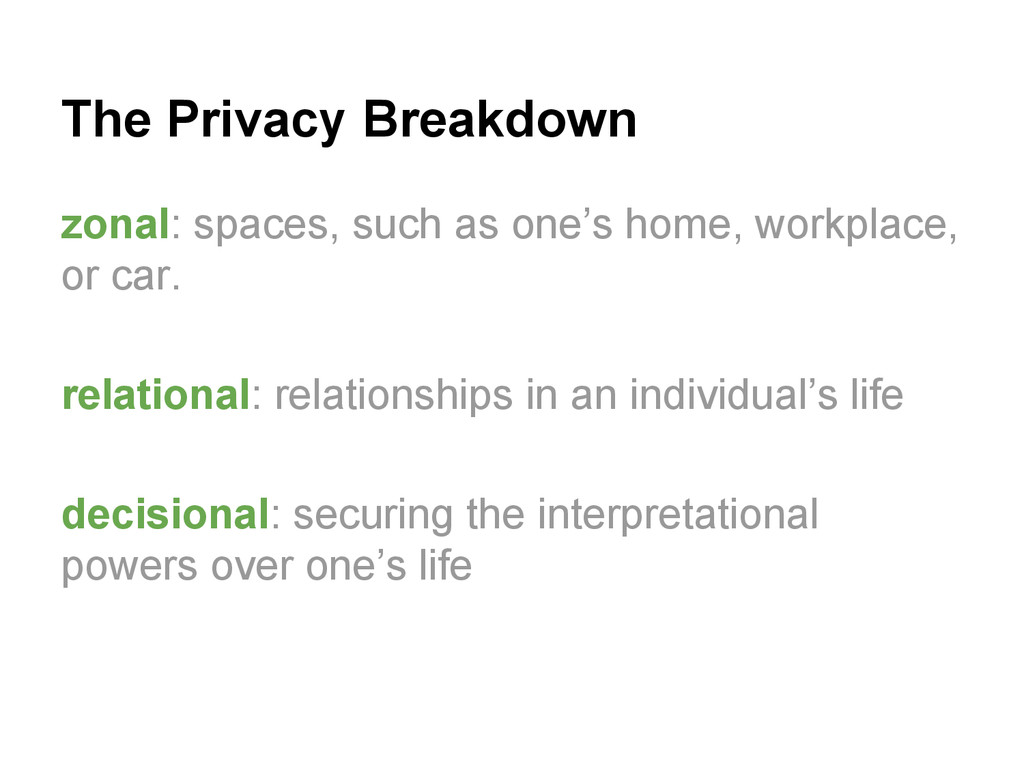
  9. The Privacy Breakdown zonal: spaces, such as one’s home, workplace,

    or car. relational: relationships in an individual’s life decisional: securing the interpretational powers over one’s life
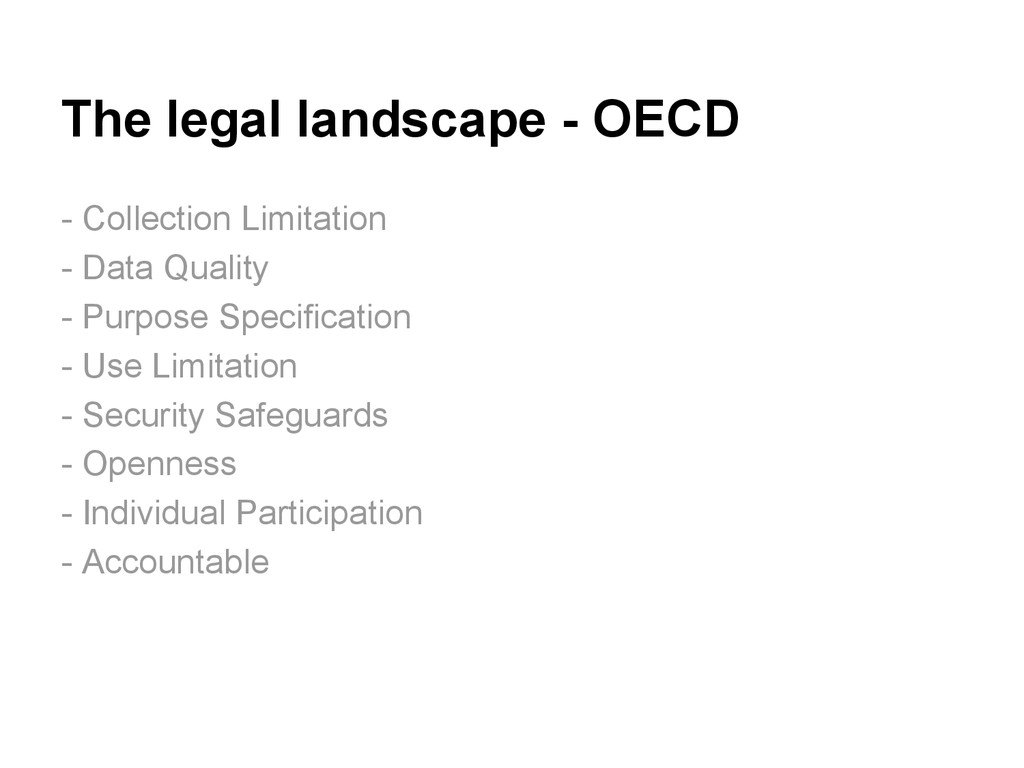
  10. The legal landscape - OECD - Collection Limitation - Data

    Quality - Purpose Specification - Use Limitation - Security Safeguards - Openness - Individual Participation - Accountable
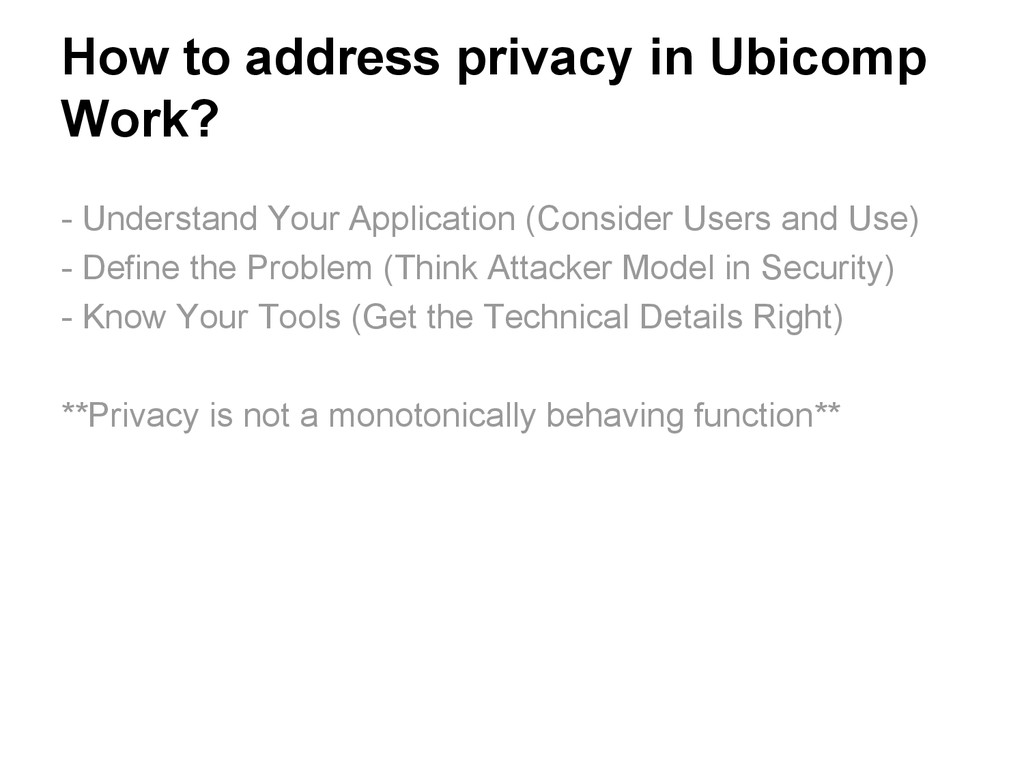
  11. How to address privacy in Ubicomp Work? - Understand Your

    Application (Consider Users and Use) - Define the Problem (Think Attacker Model in Security) - Know Your Tools (Get the Technical Details Right) **Privacy is not a monotonically behaving function**
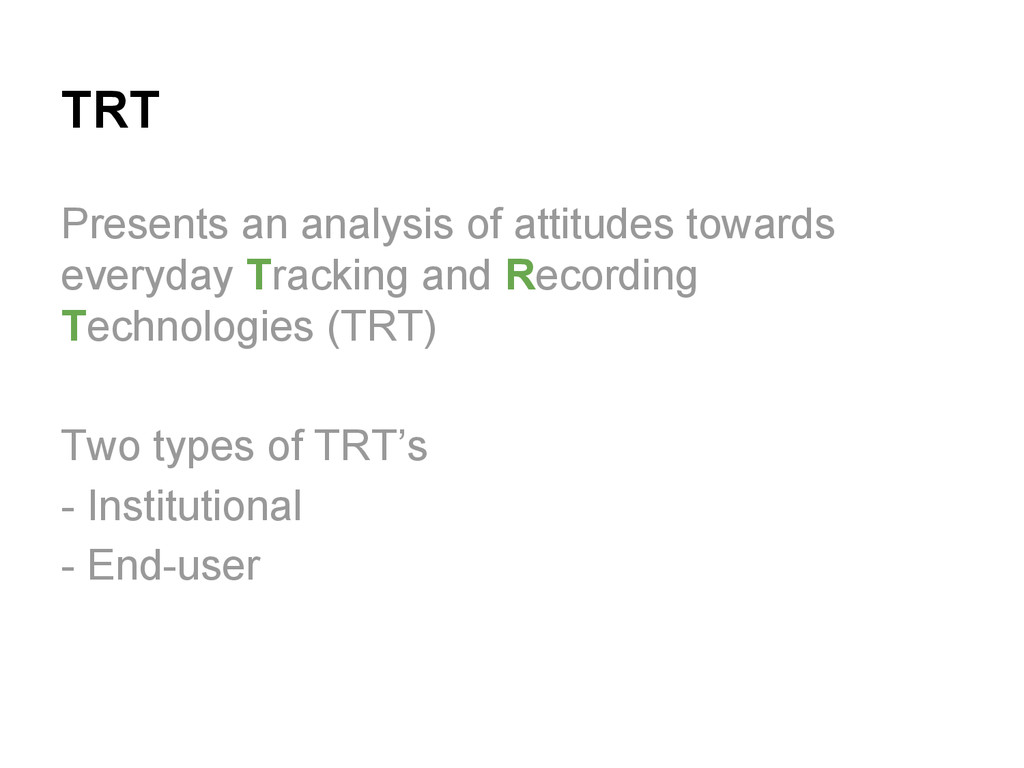
  12. TRT Presents an analysis of attitudes towards everyday Tracking and

    Recording Technologies (TRT) Two types of TRT’s - Institutional - End-user
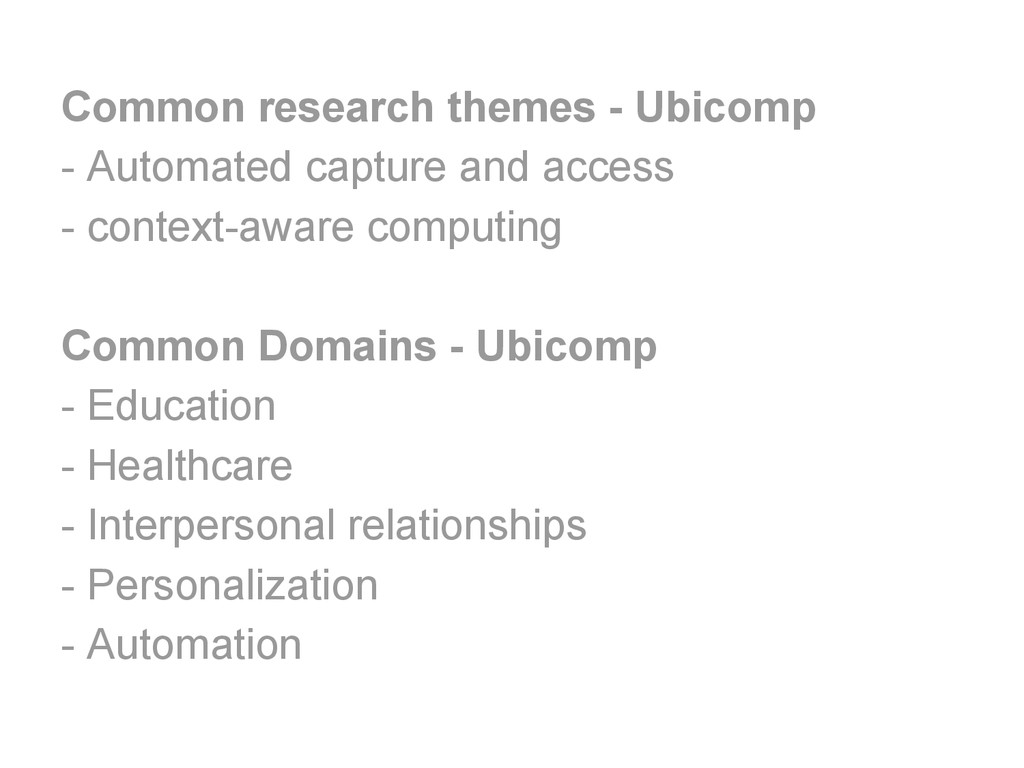
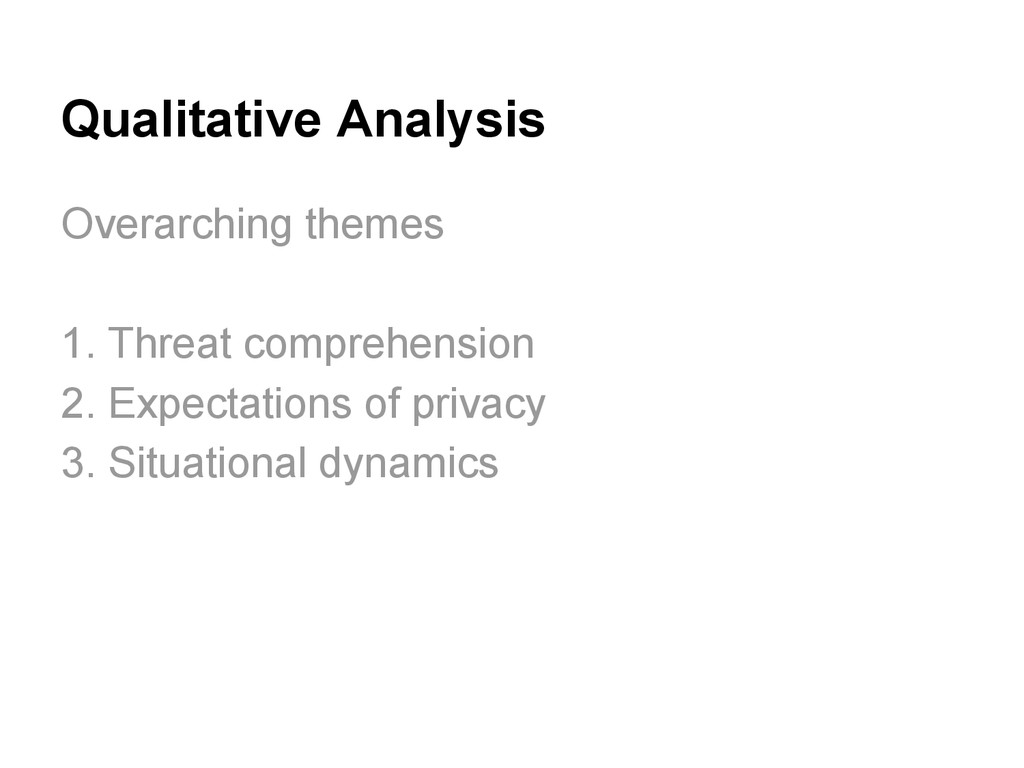
  13. Common research themes - Ubicomp - Automated capture and access

    - context-aware computing Common Domains - Ubicomp - Education - Healthcare - Interpersonal relationships - Personalization - Automation
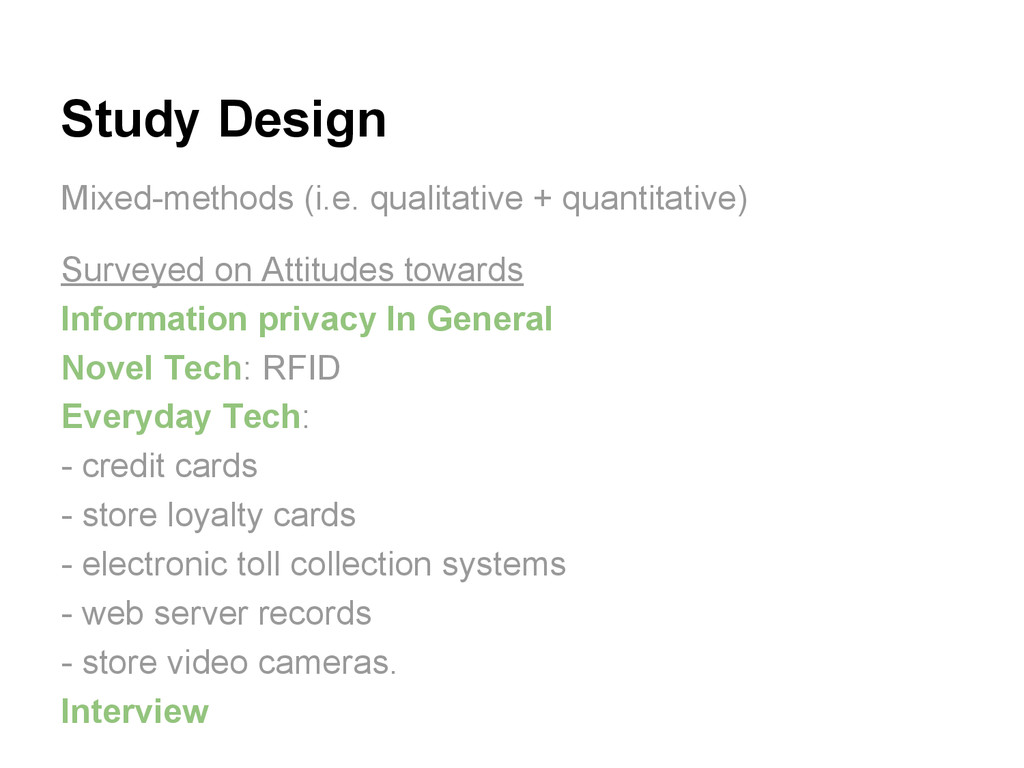
  14. Study Design Mixed-methods (i.e. qualitative + quantitative) Surveyed on Attitudes

    towards Information privacy In General Novel Tech: RFID Everyday Tech: - credit cards - store loyalty cards - electronic toll collection systems - web server records - store video cameras. Interview
  15. Study design (contd..) Recruitment More urban - Southern California More

    rural - Southern Louisiana Age group - 18–29, 30–50, and over 51.
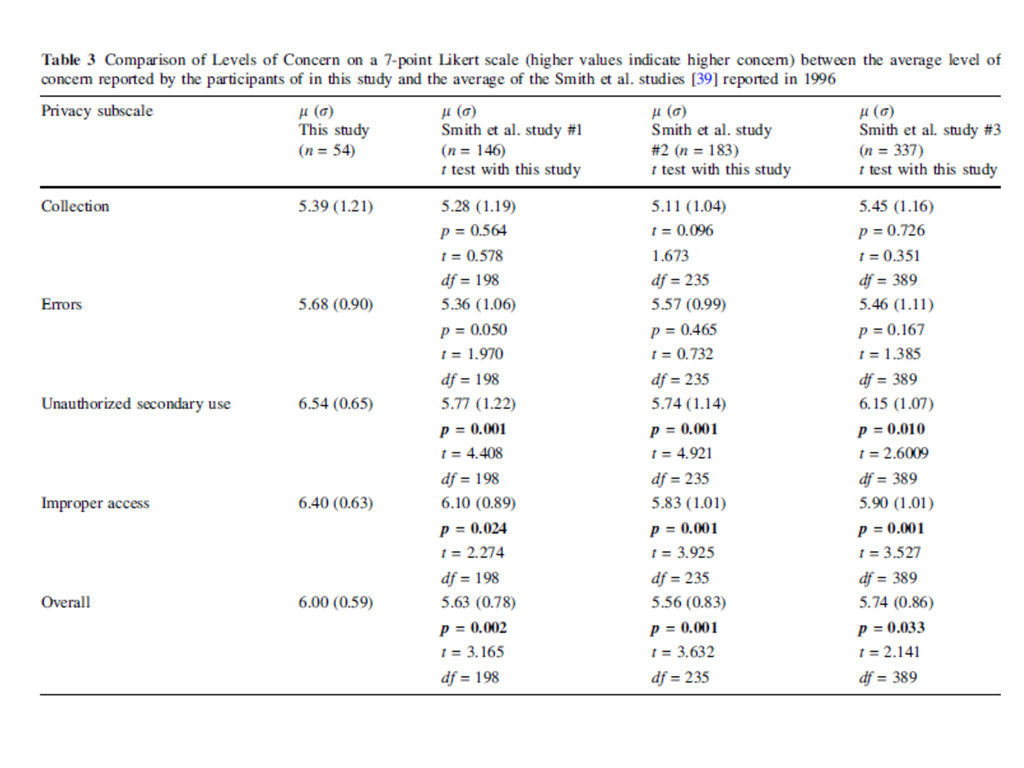
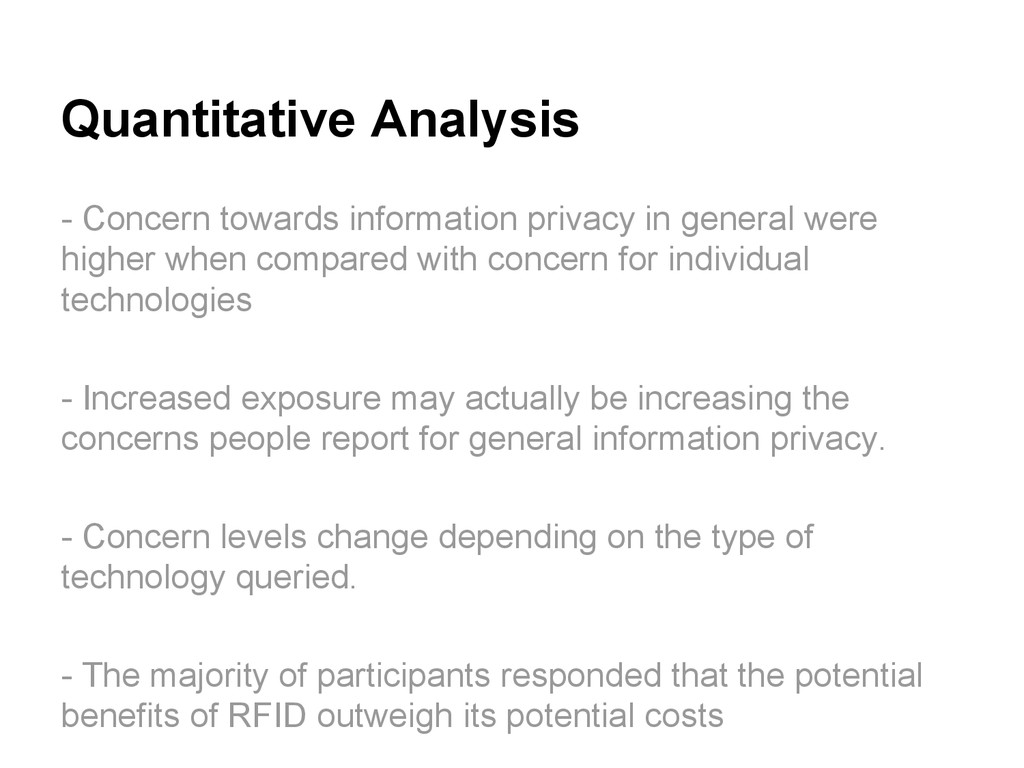
  16. Quantitative Analysis - Concern towards information privacy in general were

    higher when compared with concern for individual technologies - Increased exposure may actually be increasing the concerns people report for general information privacy. - Concern levels change depending on the type of technology queried. - The majority of participants responded that the potential benefits of RFID outweigh its potential costs
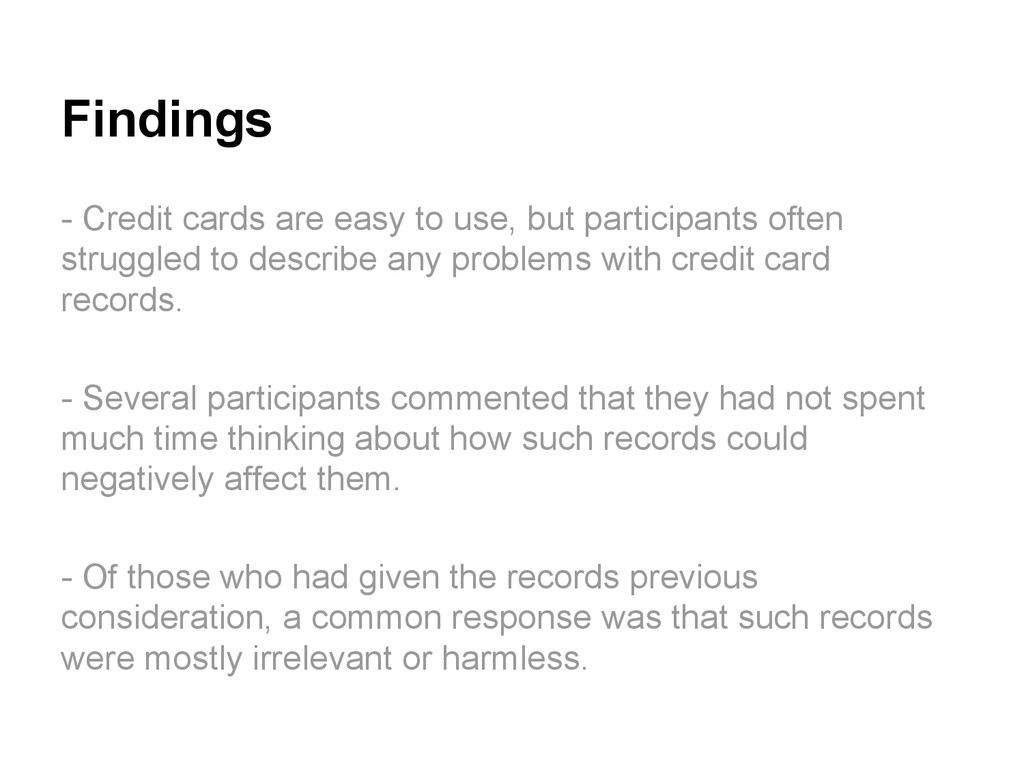
  17. Findings - Credit cards are easy to use, but participants

    often struggled to describe any problems with credit card records. - Several participants commented that they had not spent much time thinking about how such records could negatively affect them. - Of those who had given the records previous consideration, a common response was that such records were mostly irrelevant or harmless.
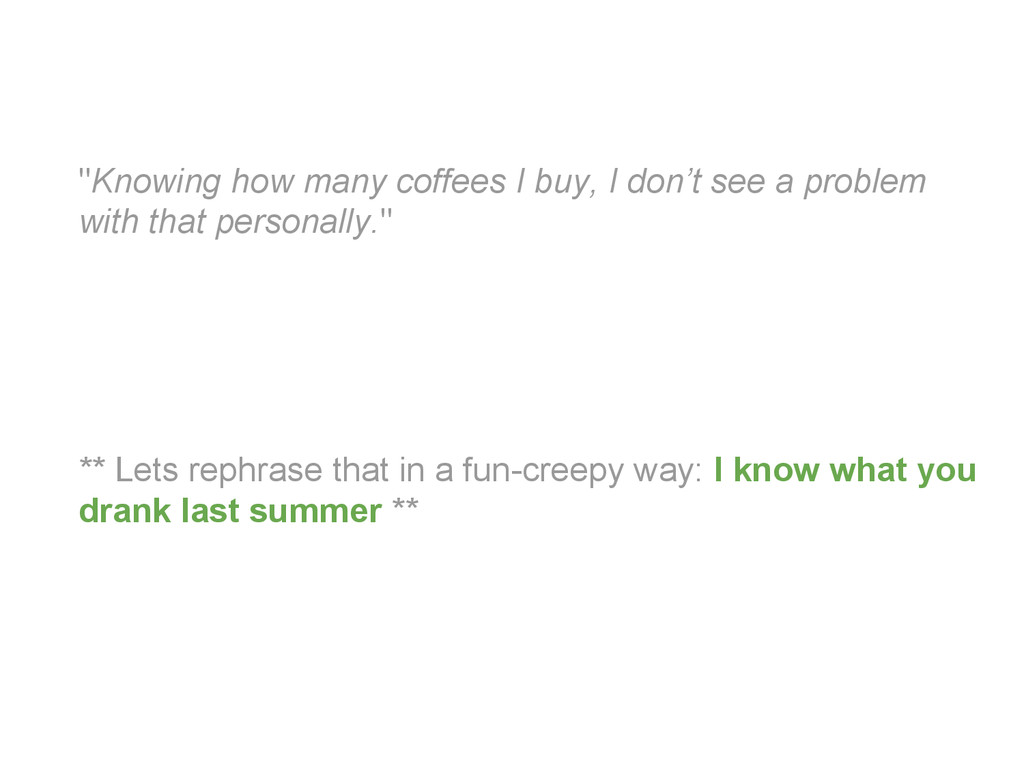
  18. ** Lets rephrase that in a fun-creepy way: I know

    what you drank last summer ** "Knowing how many coffees I buy, I don’t see a problem with that personally."
  19. Findings (contd..) - Participants did often present the impression that

    they should be concerned. - Participants with inaccurate models of the workings of the technology tended to assume a more dangerous position than is correct.
  20. “To trust or not to trust” - Recording was a

    small price one had to pay to get the services. - Participants reported trusting corporate information use. - Corporations were often seen as having the highest potential to abuse the information they were collecting ** Good CORP, Bad CORP **
  21. Discussion of the results - Many people may not understand

    the collection, processing, and dissemination of recorded consumer data - They may not carry a ‘‘reasonable expectation of privacy’’ - Some situations are likely to provoke more concern and action than others
  22. Conclusions - People do not comprehend the tracking and recording

    capabilities of novel technologies like RFID, and furthermore not of everyday technologies either. - In spite of using regular TRT’s for several years, they struggled to identify and verbalize risks and threats incurred from these technologies.
  23. Comparing end-user and institutional TRT’s - Ownership of data ‘‘If

    you give it to one, the rest of them can get it.’’ But dont organizations need it? http://goo.gl/pG8RqT - Choice Students audiotaping in class, store videotaping - Visibility and awareness “you’re not reminded every time that you do something that somebody’s going to be tracking it.”
  24. Comparison (contd..) - Trust ‘‘Because I’m not a fan of

    the government.’’ - Features of recorded data ‘‘There’s so many people buying so much stuff on credit cards. How would they target one person or just go look at one person?’ - Face Home face - Work face