Upgrade to Pro — share decks privately, control downloads, hide ads and more …

Beyond GitOps: Building Intelligent Drift Detec...

Beyond GitOps: Building Intelligent Drift Detection and Auto-Remediation in ArgoCD

Let's discover how to extend ArgoCD's capabilities by building a sophisticated drift detection and auto-remediation system. We'll demonstrate how to combine ArgoCD's Resource Hooks, Custom Health Checks, and the ApplicationSet controller to create an intelligent system that not only detects configuration drift but automatically resolves it based on defined policies. Through live coding, we'll build a custom controller that monitors for unauthorized changes, implements smart rollback decisions, and provides real-time notifications. Learn how to leverage ArgoCD's API to implement advanced reconciliation patterns, track drift metrics, and create audit trails of all remediation actions. Perfect for teams dealing with dynamic environments where maintaining configuration consistency is crucial.

This session advances the GitOps ecosystem by:

- Introducing new patterns for extending ArgoCD's core functionality
- Contributing an open-source drift detection framework
- Demonstrating advanced use cases for Resource Hooks
- Providing solutions for common enterprise compliance challenges
- Showing how to build sophisticated automation around ArgoCD
- Sharing reusable patterns for custom health checks
- Adding intelligence to standard GitOps workflows

Avatar for Shibi Chakravarthi

Shibi Chakravarthi

June 26, 2025

Other Decks in Technology

Transcript

  1. What is it about? Building a sophisticated drift detection and

    auto-remediation system that extends ArgoCD's capabilities through Resource Hooks, Custom Health Checks, and ApplicationSet controllers to create an intelligent system for configuration consistency.
  2. What is ArgoCD? ArgoCD is a declarative, GitOps continuous delivery

    tool for Kubernetes that follows the GitOps pattern of using Git repositories as the source of truth for defining the desired application state.
  3. Core ArgoCD Concepts: GitOps Pattern: Your Git repository contains the

    desired state of your applications Declarative: You declare what you want, ArgoCD figures out how to get there Continuous Sync: ArgoCD continuously monitors Git repos and Kubernetes clusters Self-Healing: Automatically corrects drift when cluster state differs from Git
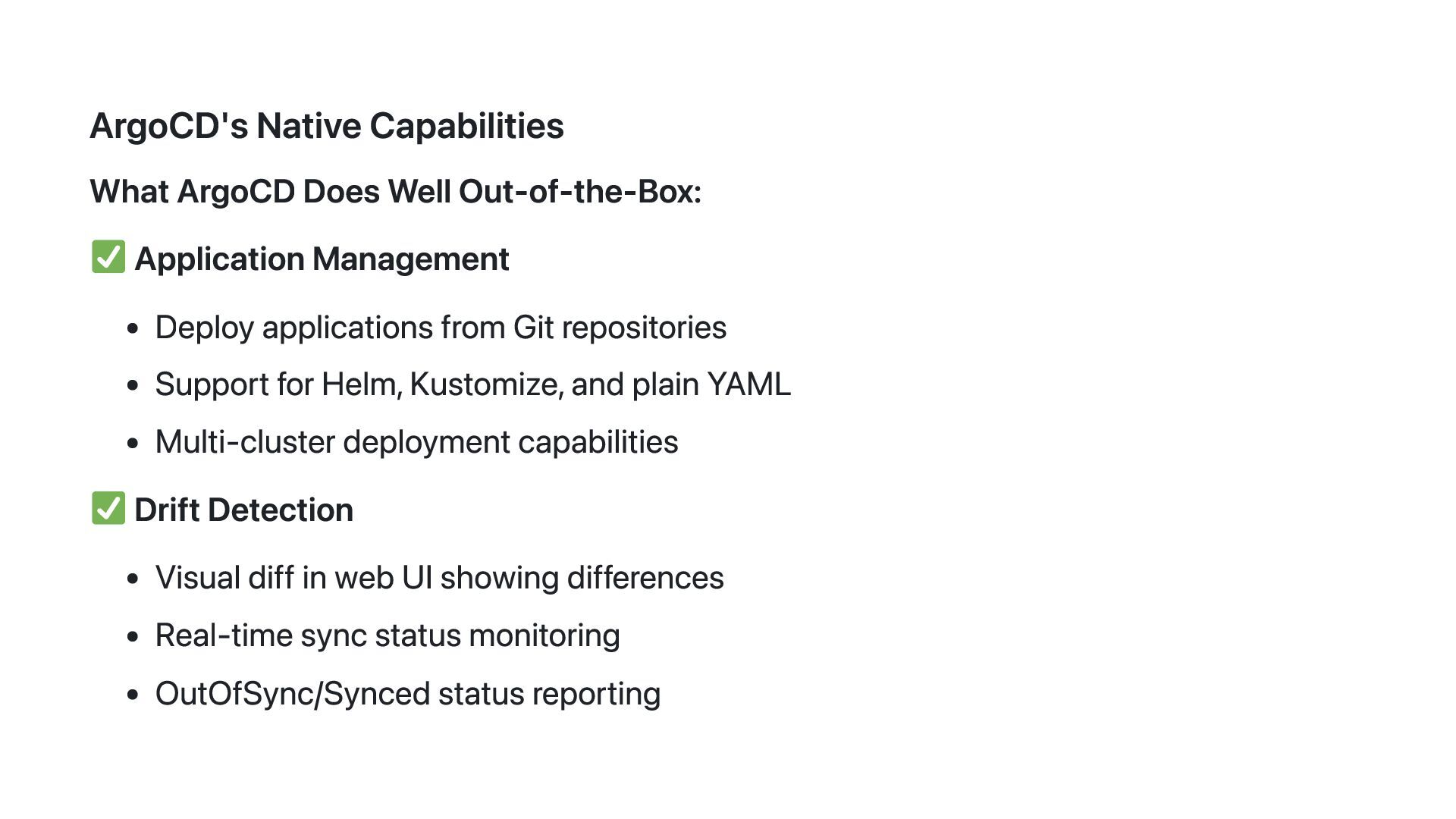
  4. ArgoCD's Native Capabilities What ArgoCD Does Well Out-of-the-Box: Application Management

    Deploy applications from Git repositories Support for Helm, Kustomize, and plain YAML Multi-cluster deployment capabilities Drift Detection Visual diff in web UI showing differences Real-time sync status monitoring OutOfSync/Synced status reporting
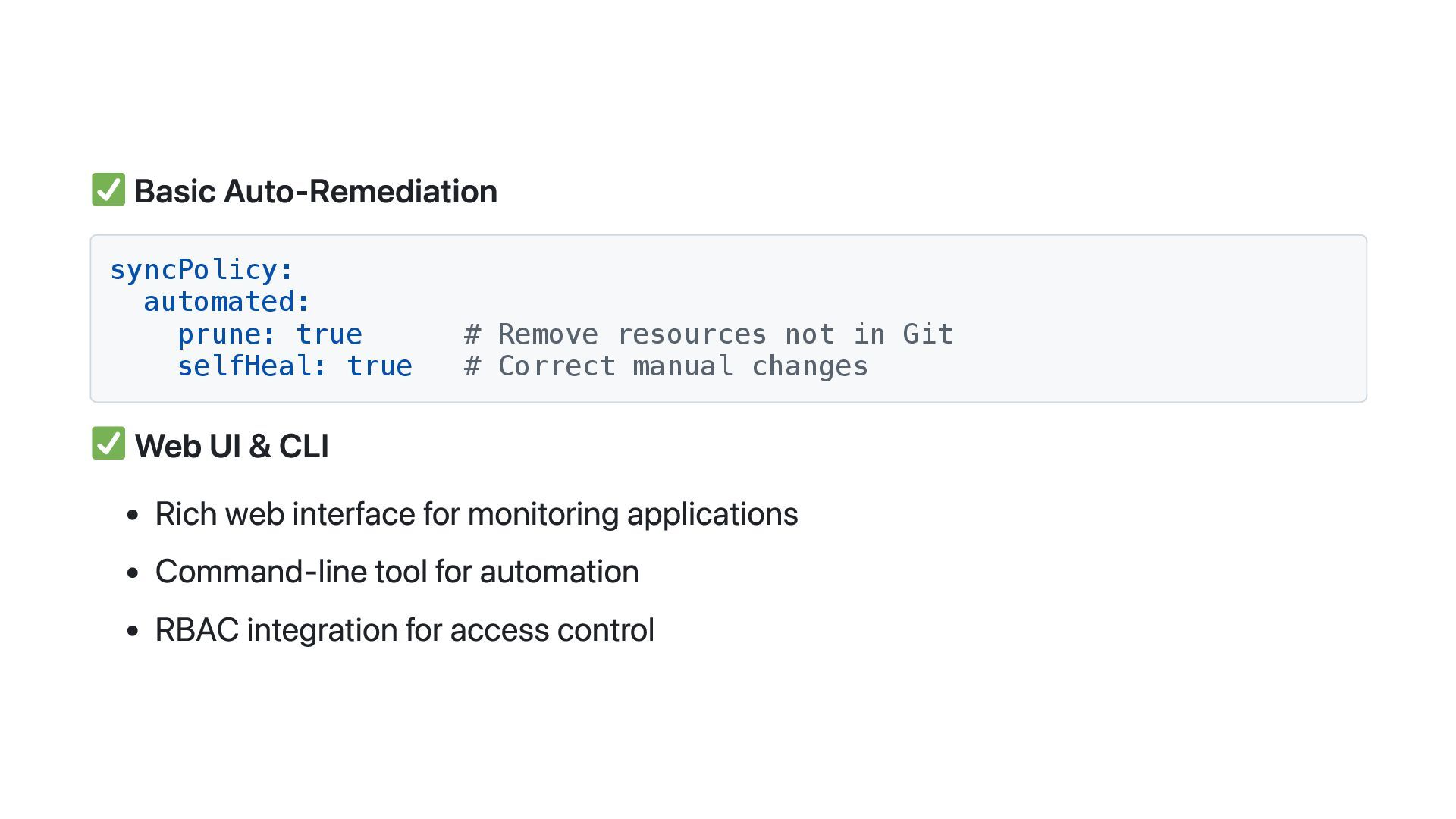
  5. Basic Auto-Remediation syncPolicy: automated: prune: true # Remove resources not

    in Git selfHeal: true # Correct manual changes Web UI & CLI Rich web interface for monitoring applications Command-line tool for automation RBAC integration for access control
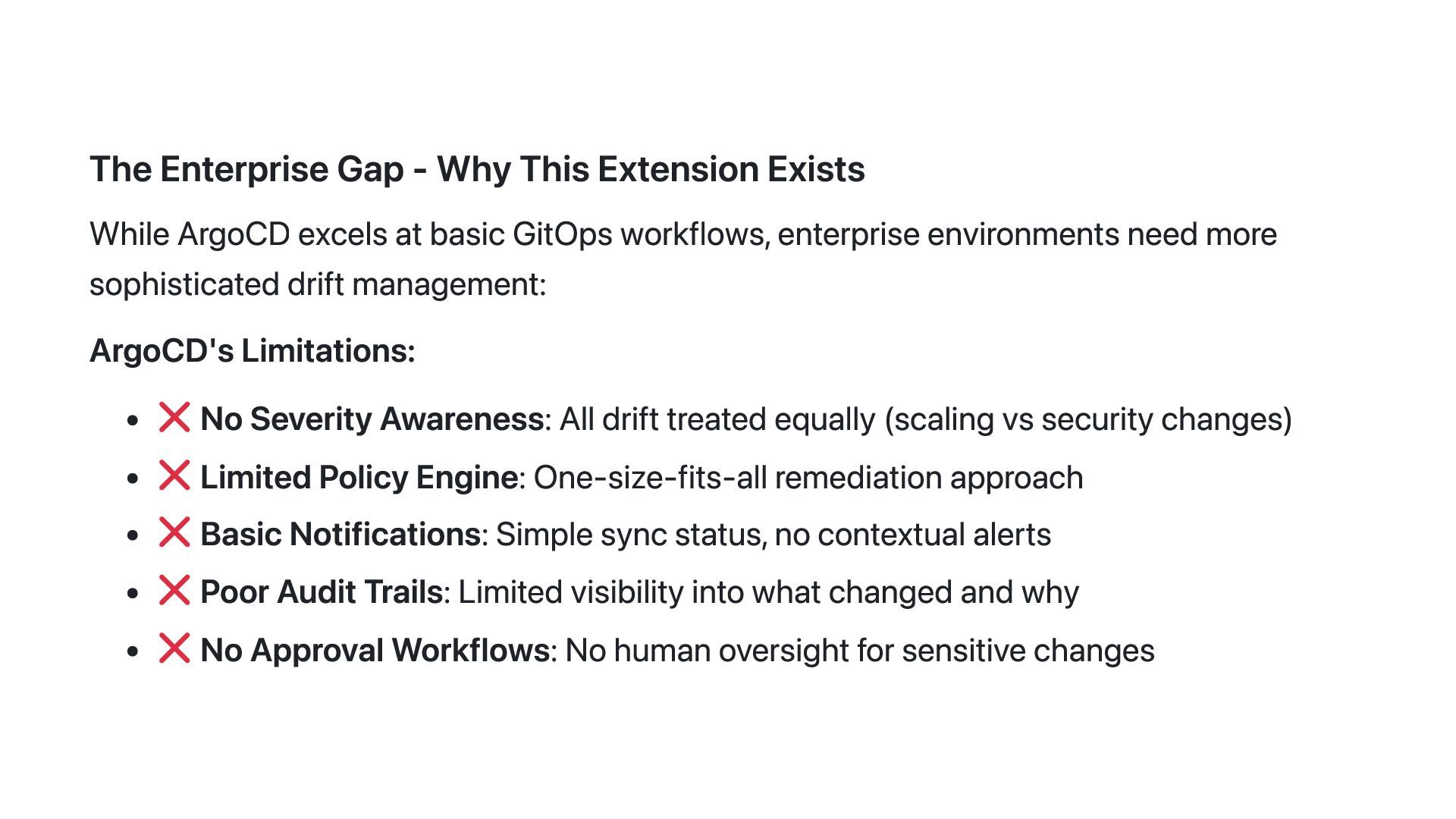
  6. The Enterprise Gap - Why This Extension Exists While ArgoCD

    excels at basic GitOps workflows, enterprise environments need more sophisticated drift management: ArgoCD's Limitations: No Severity Awareness: All drift treated equally (scaling vs security changes) Limited Policy Engine: One-size-fits-all remediation approach Basic Notifications: Simple sync status, no contextual alerts Poor Audit Trails: Limited visibility into what changed and why No Approval Workflows: No human oversight for sensitive changes
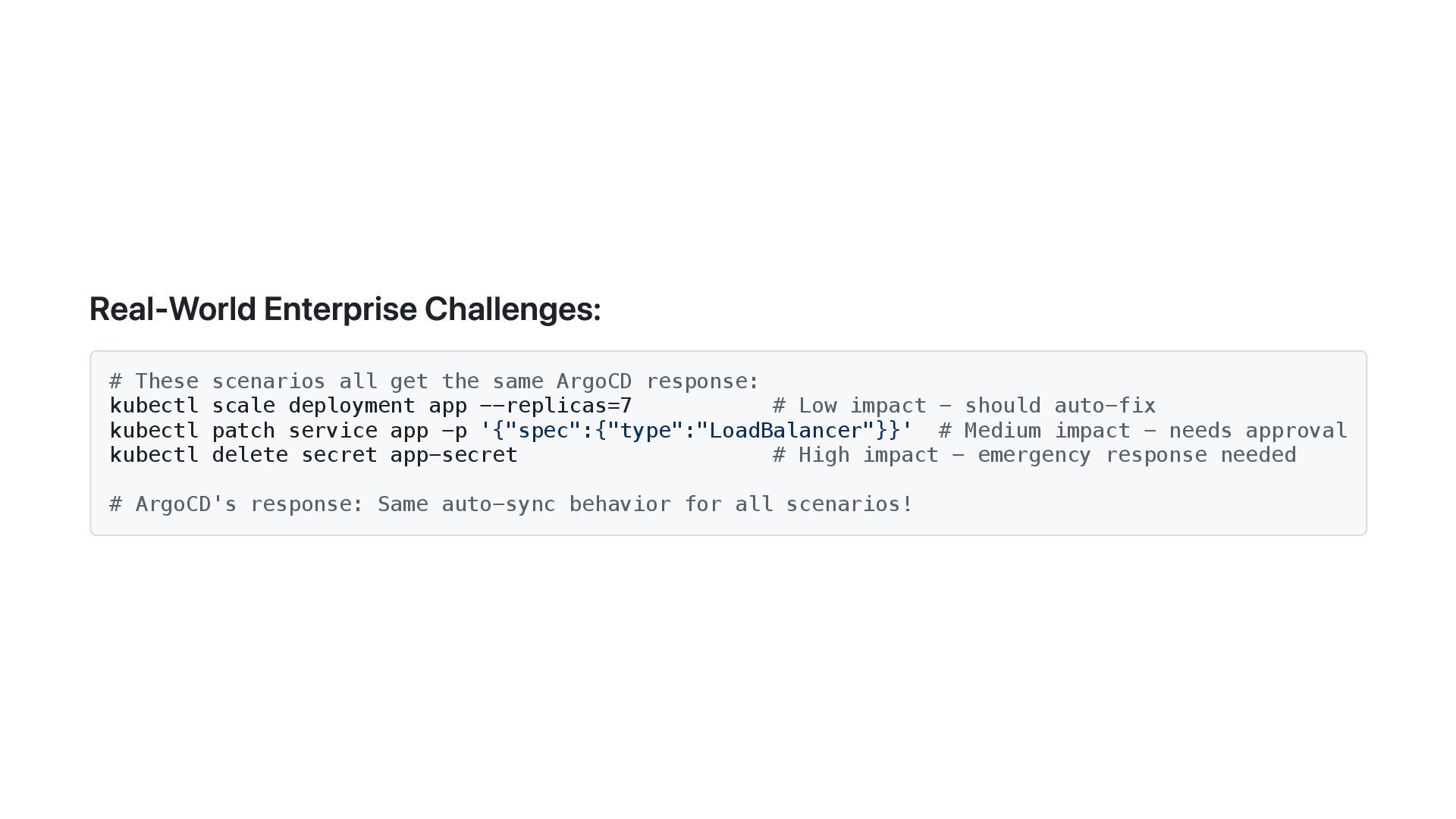
  7. Real-World Enterprise Challenges: # These scenarios all get the same

    ArgoCD response: kubectl scale deployment app --replicas=7 # Low impact - should auto-fix kubectl patch service app -p '{"spec":{"type":"LoadBalancer"}}' # Medium impact - needs approval kubectl delete secret app-secret # High impact - emergency response needed # ArgoCD's response: Same auto-sync behavior for all scenarios!
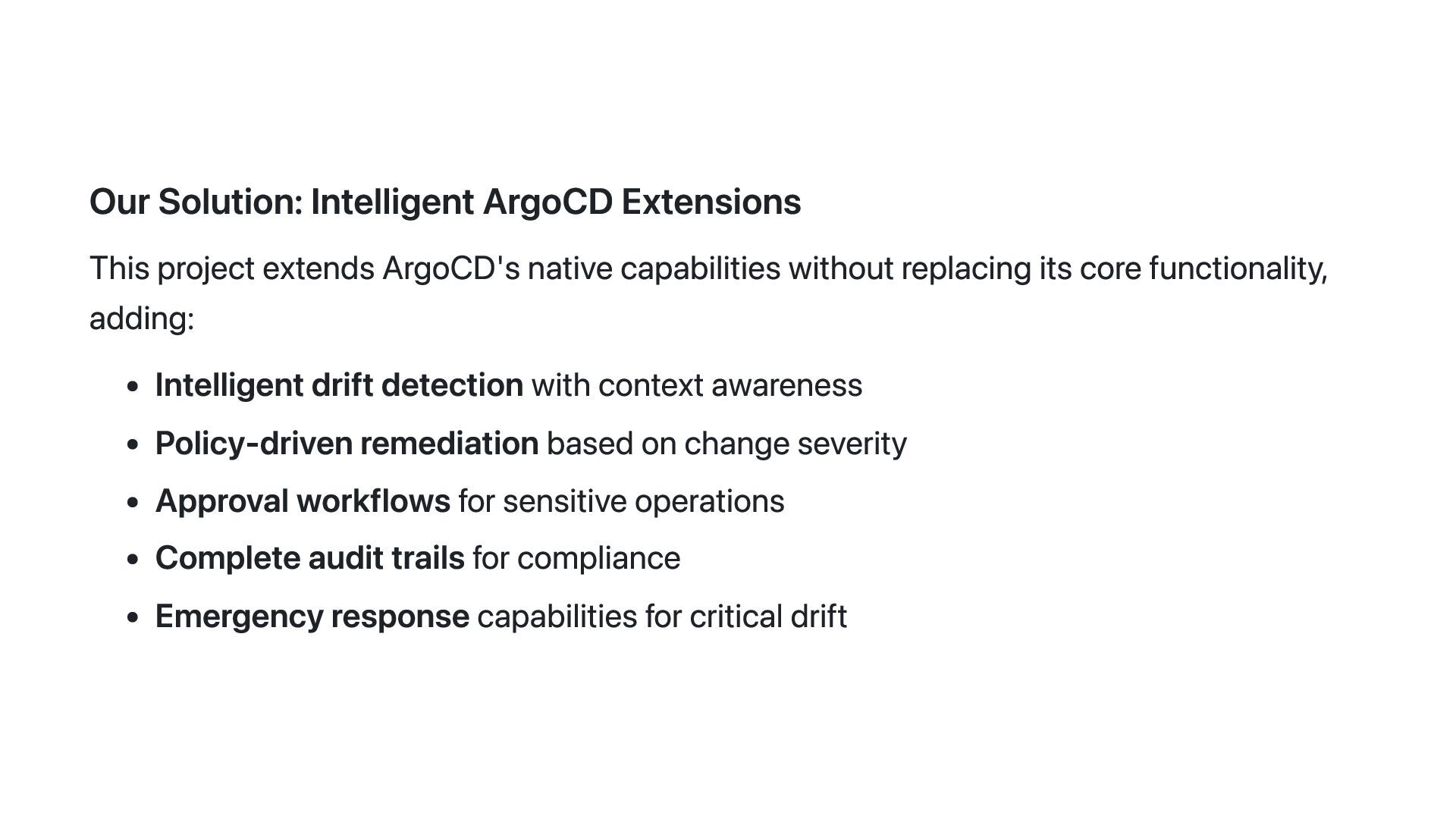
  8. Our Solution: Intelligent ArgoCD Extensions This project extends ArgoCD's native

    capabilities without replacing its core functionality, adding: Intelligent drift detection with context awareness Policy-driven remediation based on change severity Approval workflows for sensitive operations Complete audit trails for compliance Emergency response capabilities for critical drift
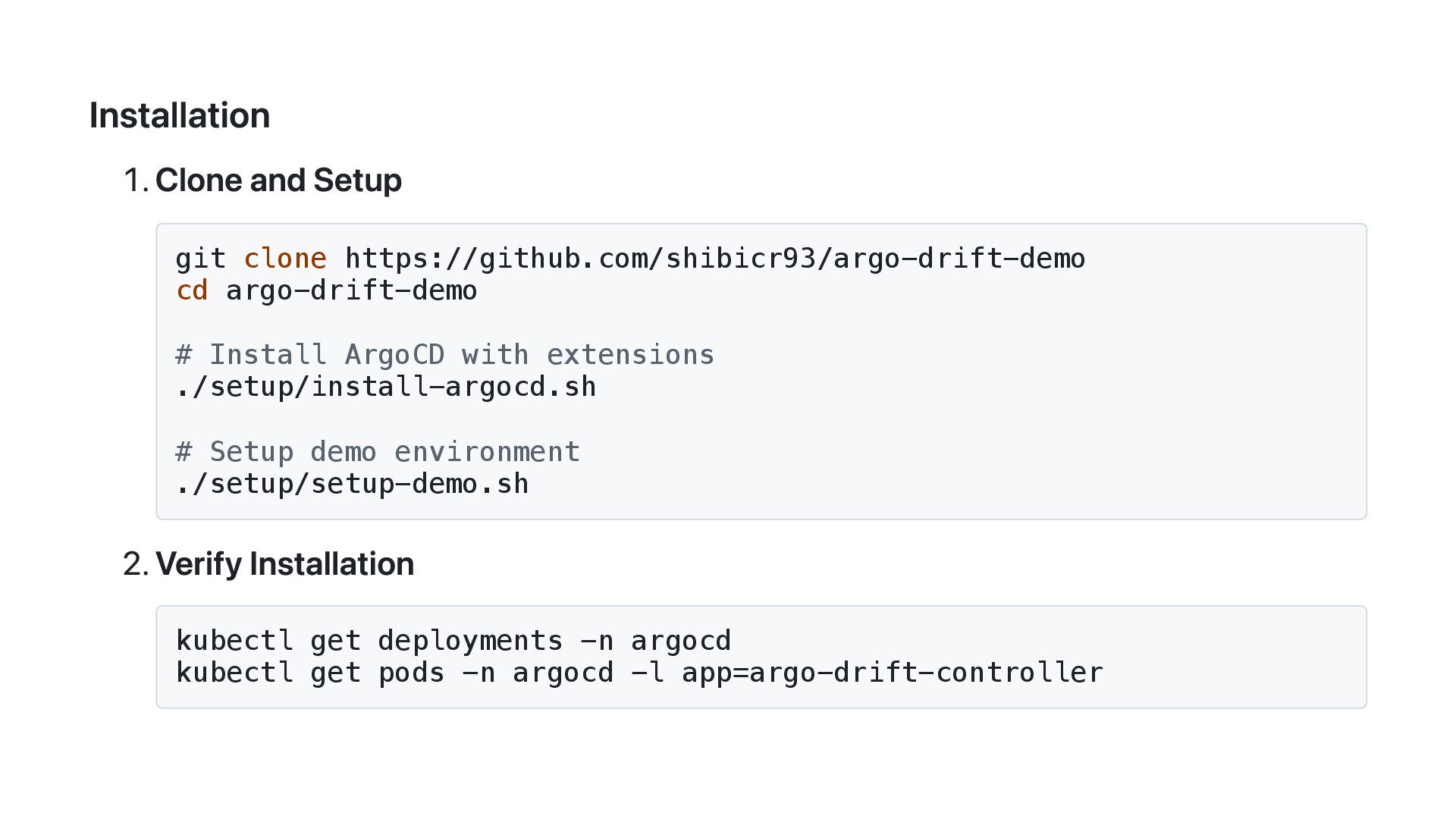
  9. Installation 1. Clone and Setup git clone https://github.com/shibicr93/argo-drift-demo cd argo-drift-demo

    # Install ArgoCD with extensions ./setup/install-argocd.sh # Setup demo environment ./setup/setup-demo.sh 2. Verify Installation kubectl get deployments -n argocd kubectl get pods -n argocd -l app=argo-drift-controller
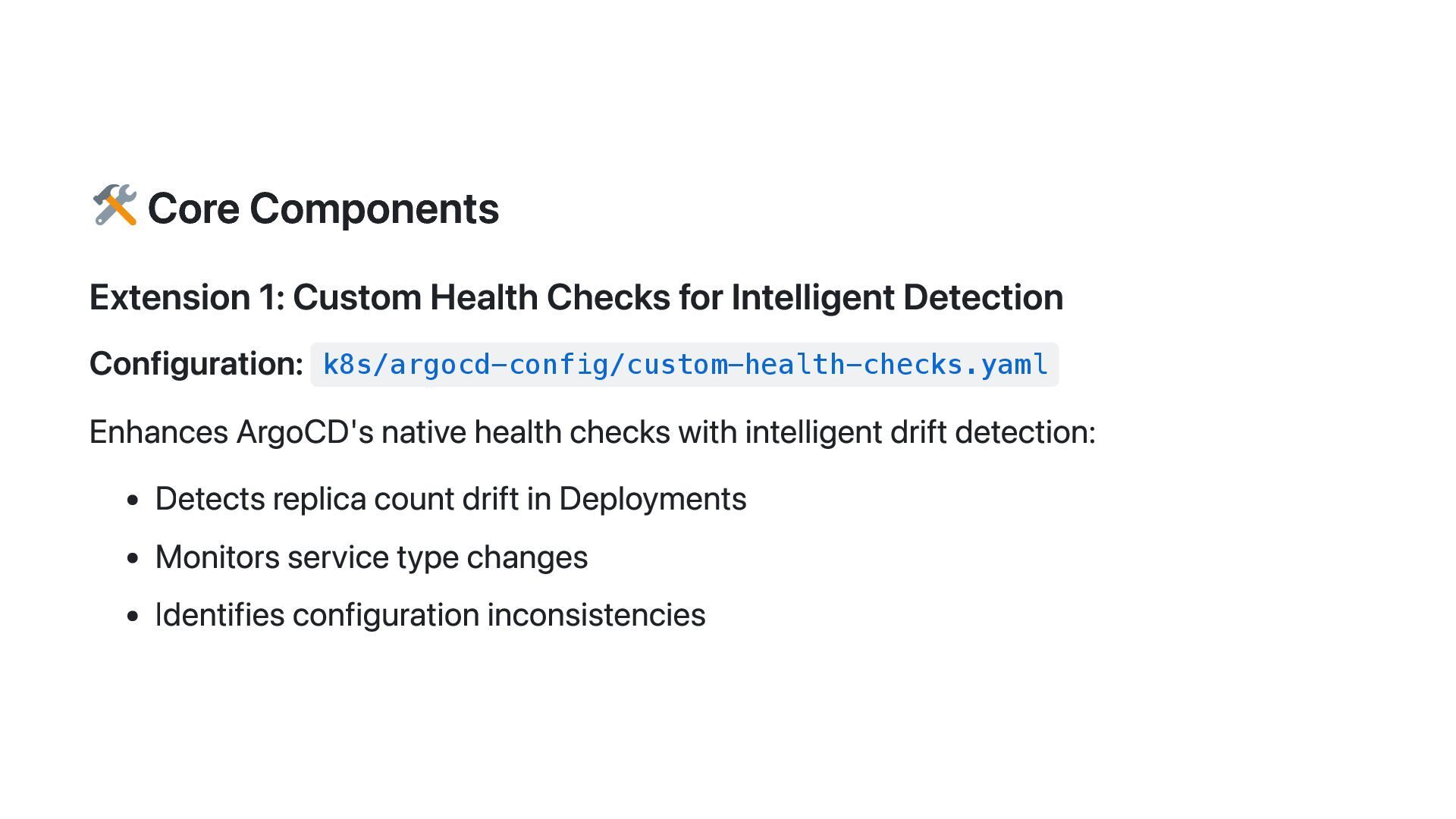
  10. Core Components Extension 1: Custom Health Checks for Intelligent Detection

    Configuration: k8s/argocd-config/custom-health-checks.yaml Enhances ArgoCD's native health checks with intelligent drift detection: Detects replica count drift in Deployments Monitors service type changes Identifies configuration inconsistencies
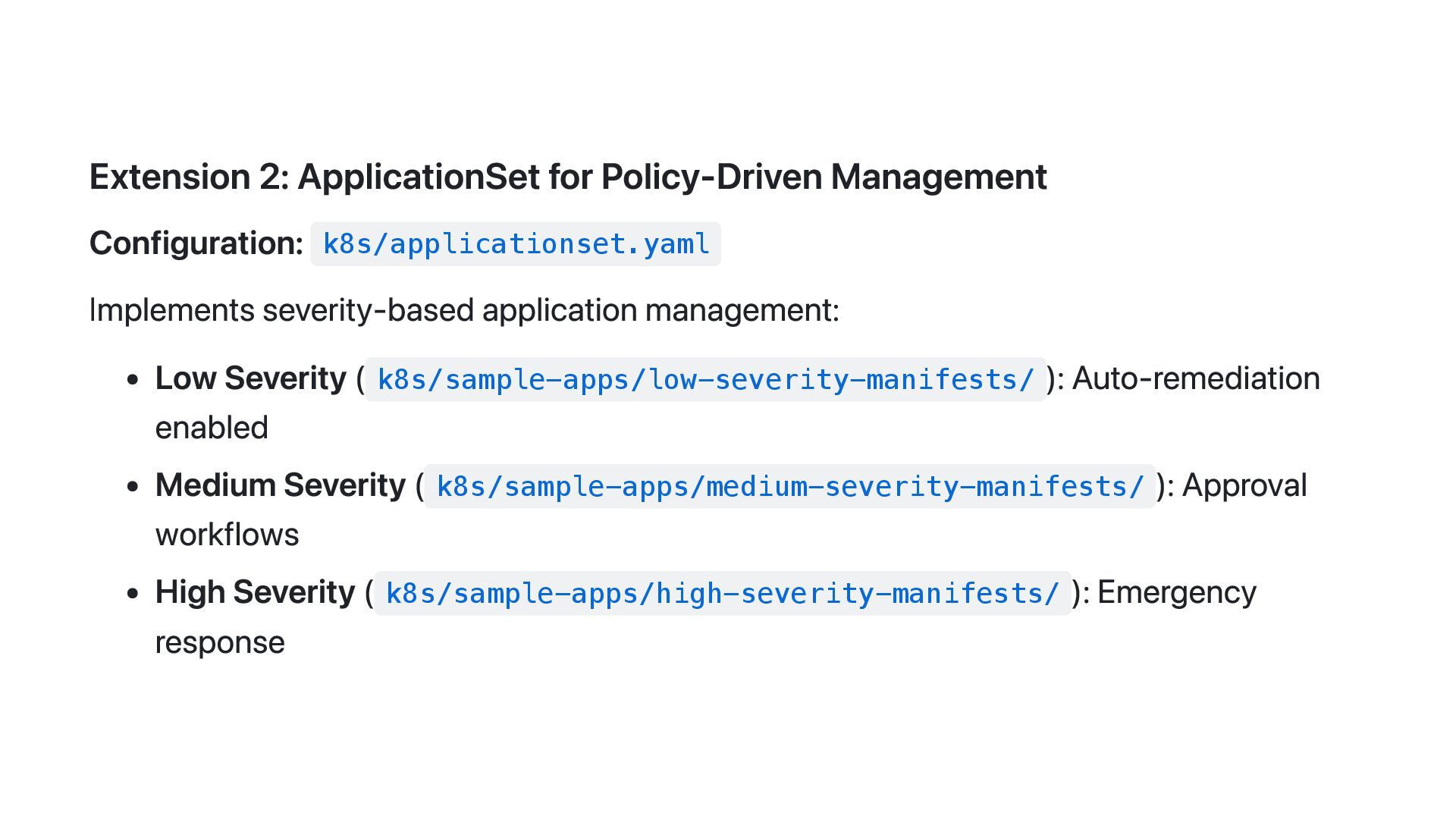
  11. Extension 2: ApplicationSet for Policy-Driven Management Configuration: k8s/applicationset.yaml Implements severity-based

    application management: Low Severity ( k8s/sample-apps/low-severity-manifests/ ): Auto-remediation enabled Medium Severity ( k8s/sample-apps/medium-severity-manifests/ ): Approval workflows High Severity ( k8s/sample-apps/high-severity-manifests/ ): Emergency response
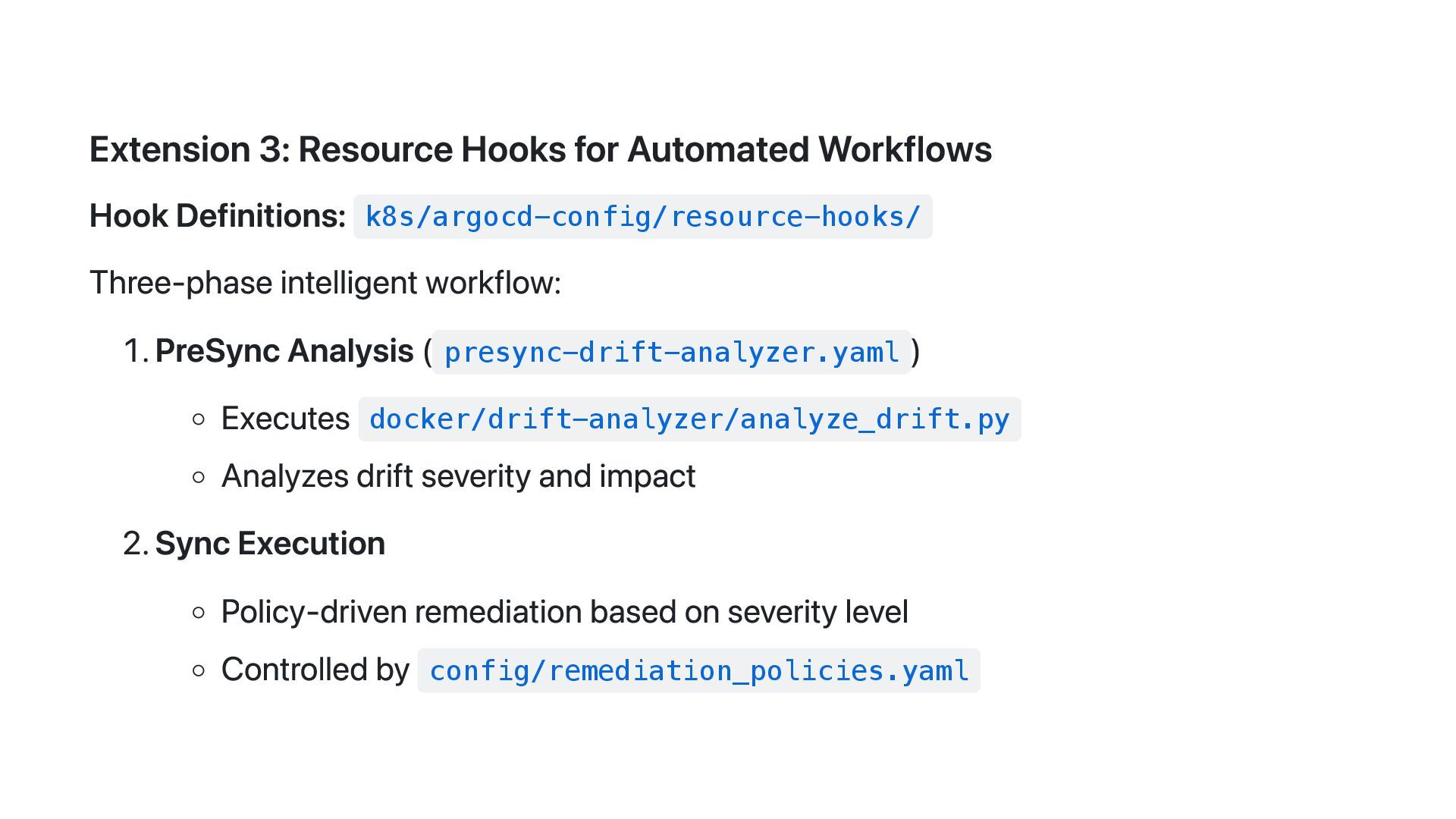
  12. Extension 3: Resource Hooks for Automated Workflows Hook Definitions: k8s/argocd-config/resource-hooks/

    Three-phase intelligent workflow: 1. PreSync Analysis ( presync-drift-analyzer.yaml ) Executes docker/drift-analyzer/analyze_drift.py Analyzes drift severity and impact 2. Sync Execution Policy-driven remediation based on severity level Controlled by config/remediation_policies.yaml
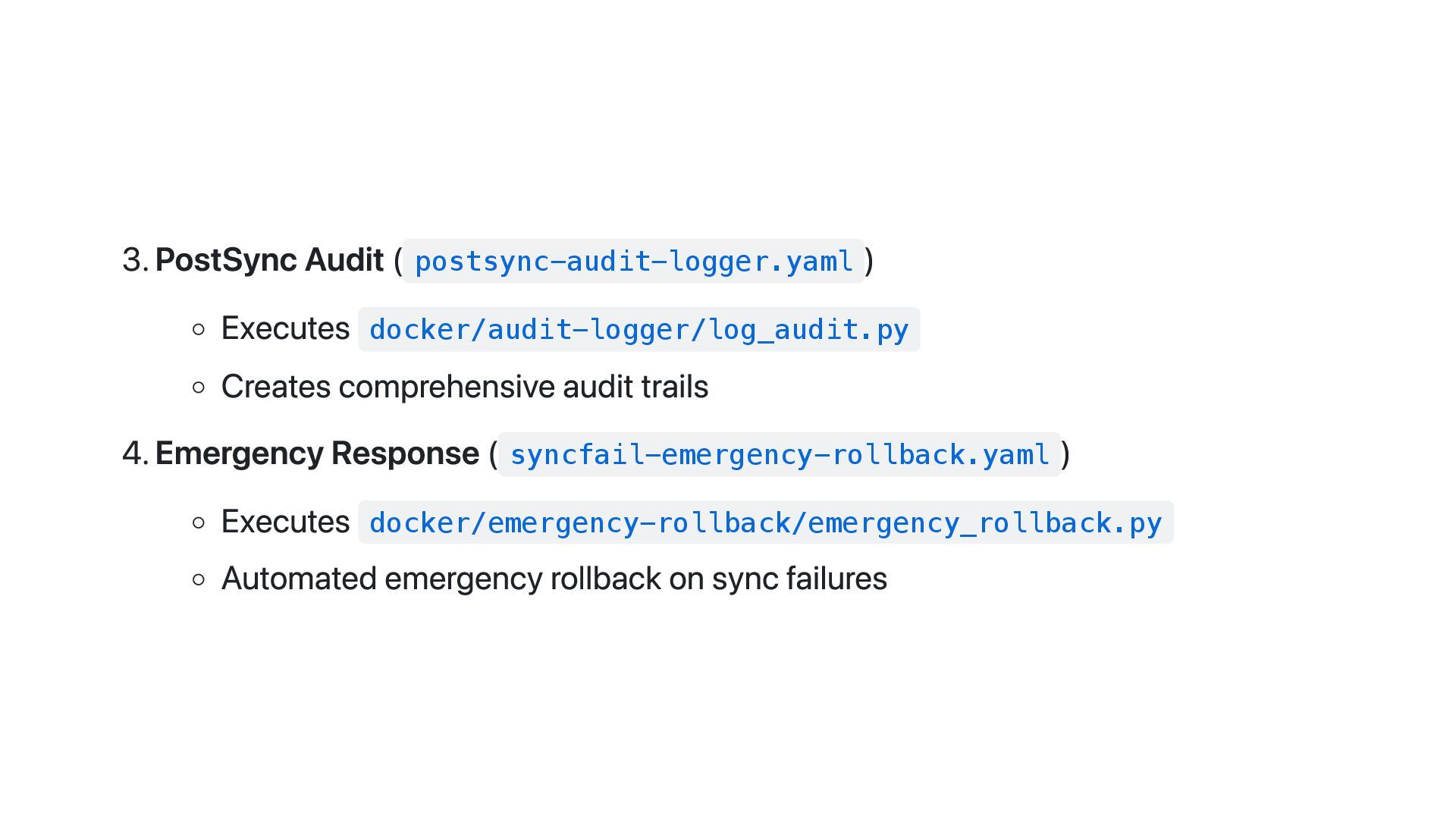
  13. 3. PostSync Audit ( postsync-audit-logger.yaml ) Executes docker/audit-logger/log_audit.py Creates comprehensive

    audit trails 4. Emergency Response ( syncfail-emergency-rollback.yaml ) Executes docker/emergency-rollback/emergency_rollback.py Automated emergency rollback on sync failures
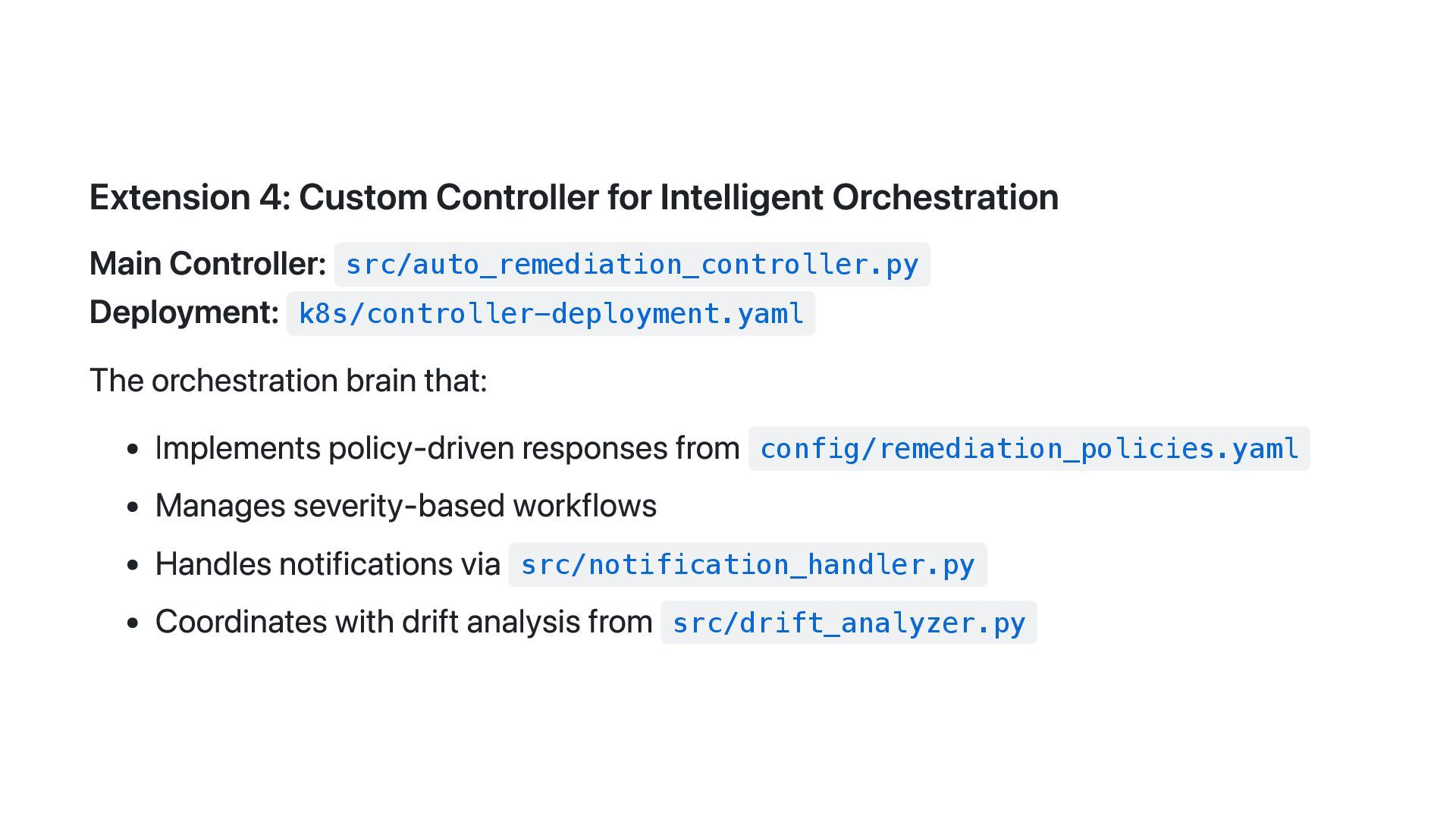
  14. Extension 4: Custom Controller for Intelligent Orchestration Main Controller: src/auto_remediation_controller.py

    Deployment: k8s/controller-deployment.yaml The orchestration brain that: Implements policy-driven responses from config/remediation_policies.yaml Manages severity-based workflows Handles notifications via src/notification_handler.py Coordinates with drift analysis from src/drift_analyzer.py
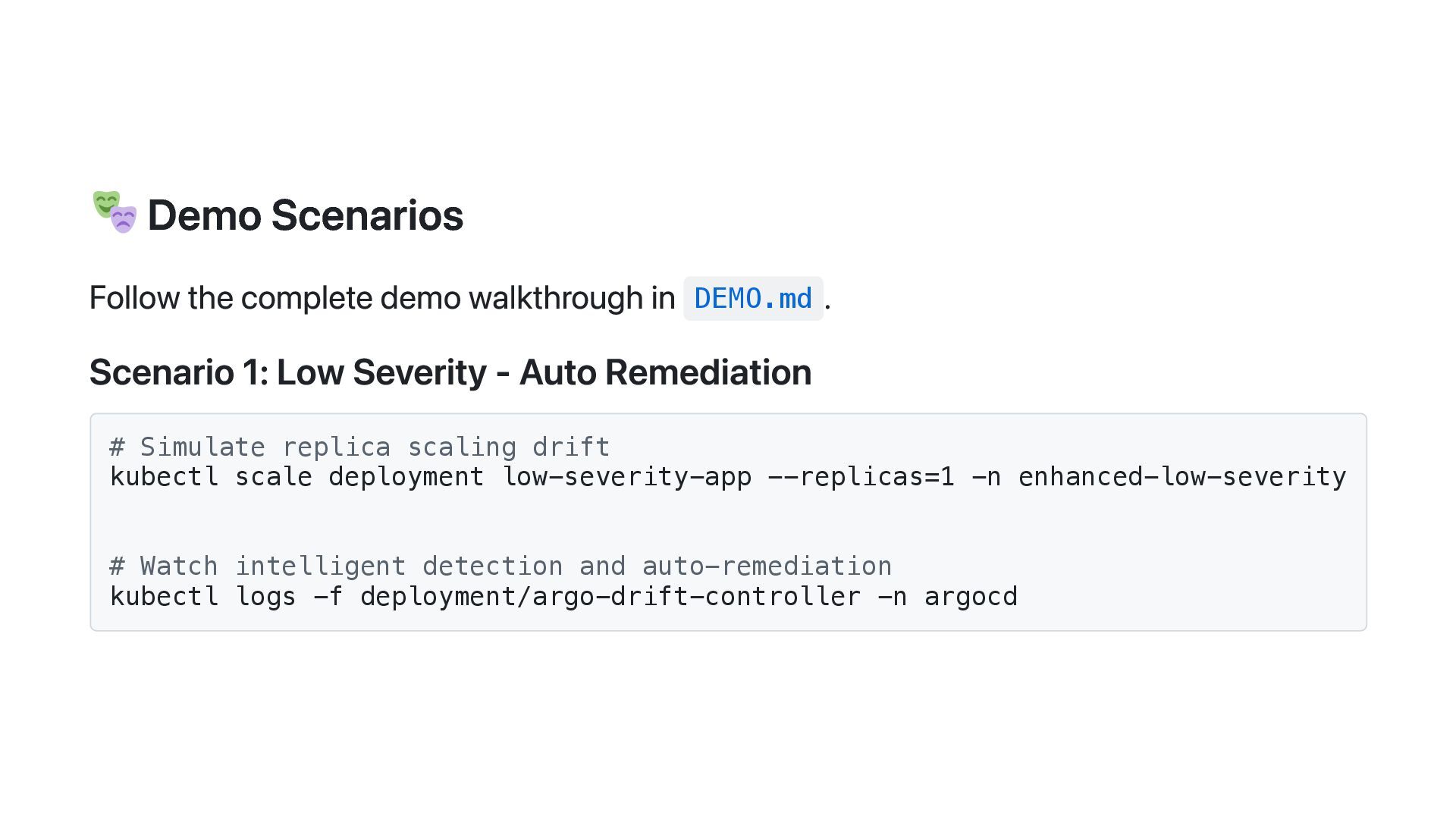
  15. Demo Scenarios Follow the complete demo walkthrough in DEMO.md .

    Scenario 1: Low Severity - Auto Remediation # Simulate replica scaling drift kubectl scale deployment low-severity-app --replicas=1 -n enhanced-low-severity # Watch intelligent detection and auto-remediation kubectl logs -f deployment/argo-drift-controller -n argocd
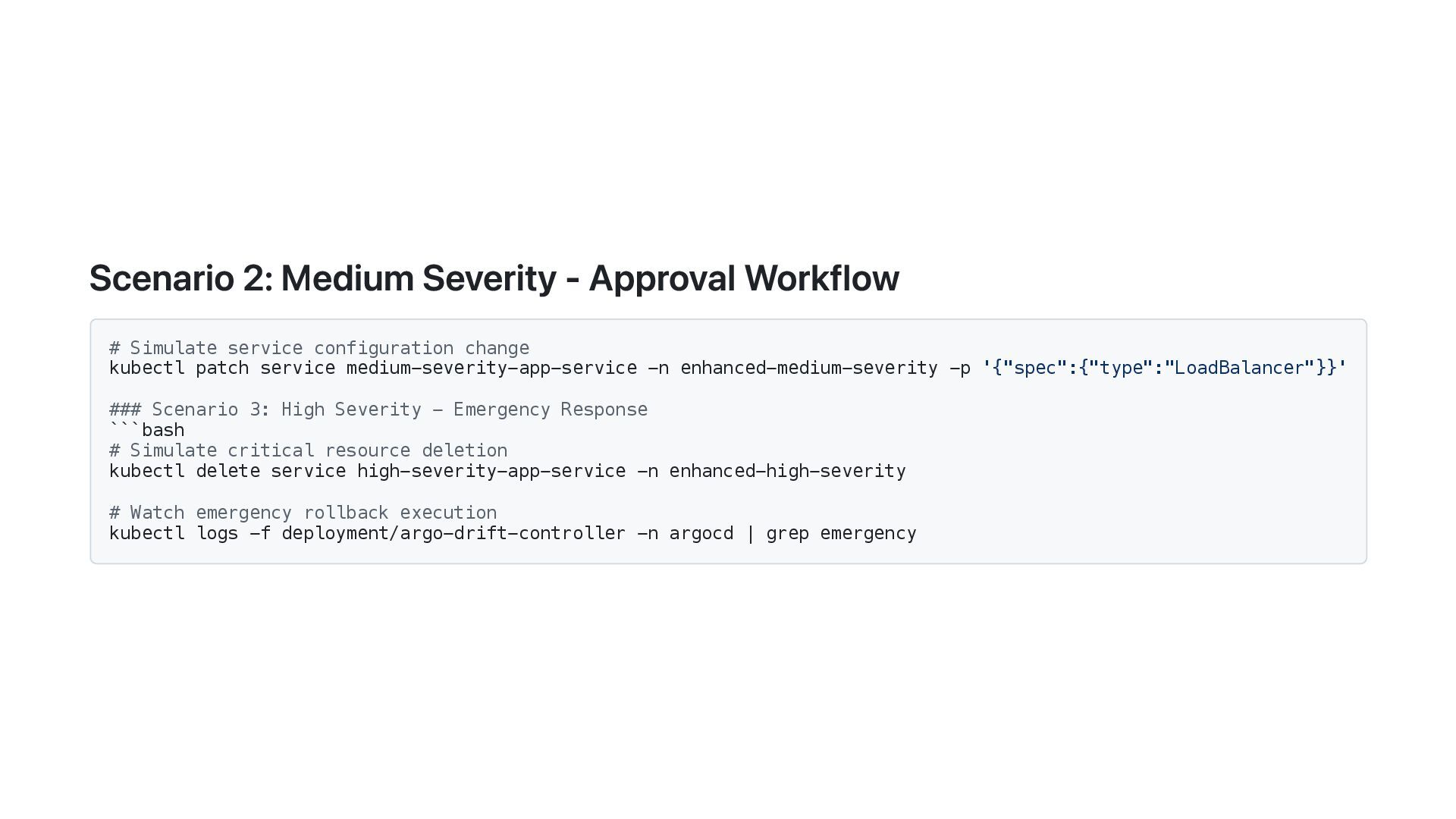
  16. Scenario 2: Medium Severity - Approval Workflow # Simulate service

    configuration change kubectl patch service medium-severity-app-service -n enhanced-medium-severity -p '{"spec":{"type":"LoadBalancer"}}' ### Scenario 3: High Severity - Emergency Response ```bash # Simulate critical resource deletion kubectl delete service high-severity-app-service -n enhanced-high-severity # Watch emergency rollback execution kubectl logs -f deployment/argo-drift-controller -n argocd | grep emergency
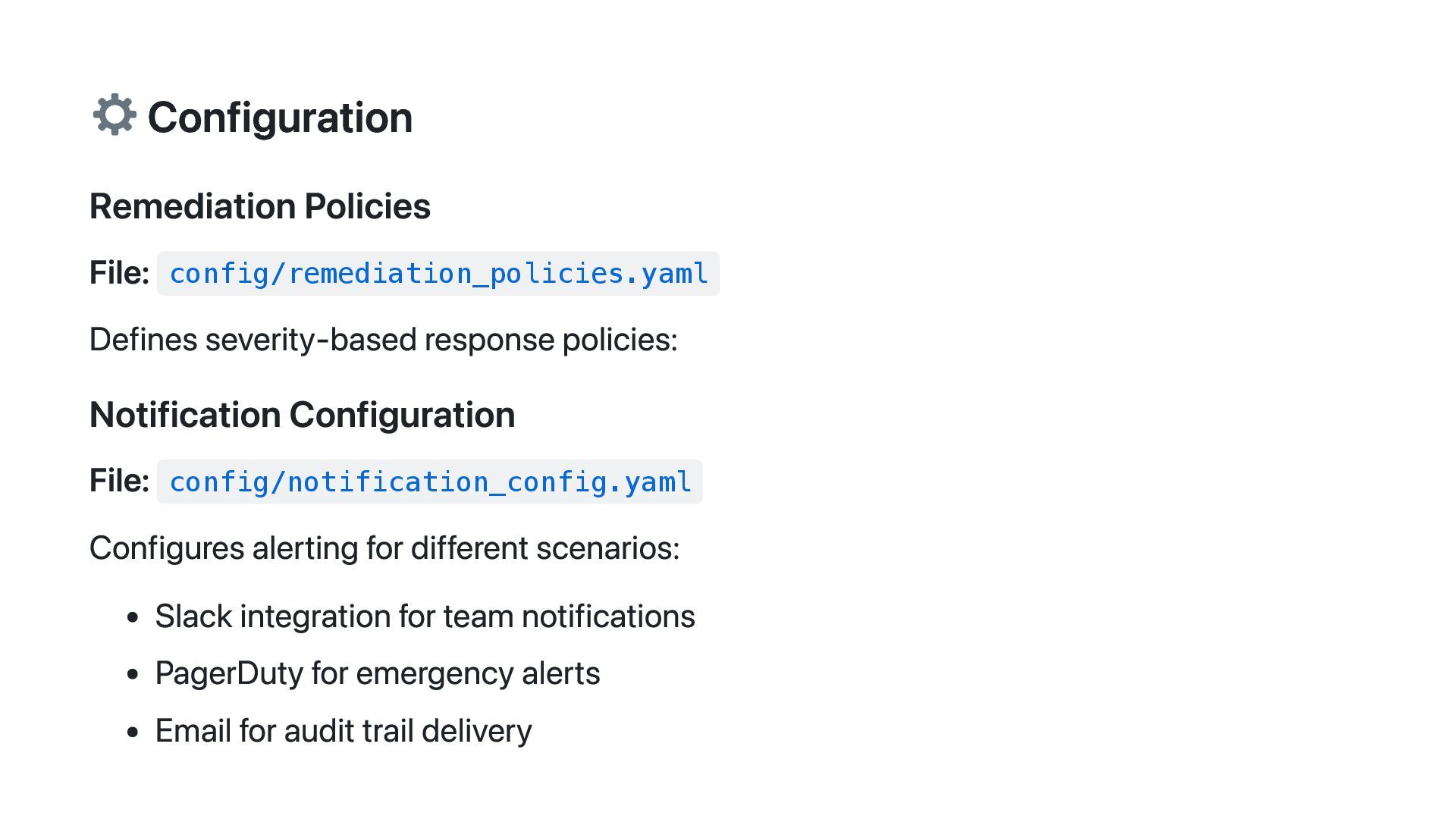
  17. Configuration Remediation Policies File: config/remediation_policies.yaml Defines severity-based response policies: Notification

    Configuration File: config/notification_config.yaml Configures alerting for different scenarios: Slack integration for team notifications PagerDuty for emergency alerts Email for audit trail delivery
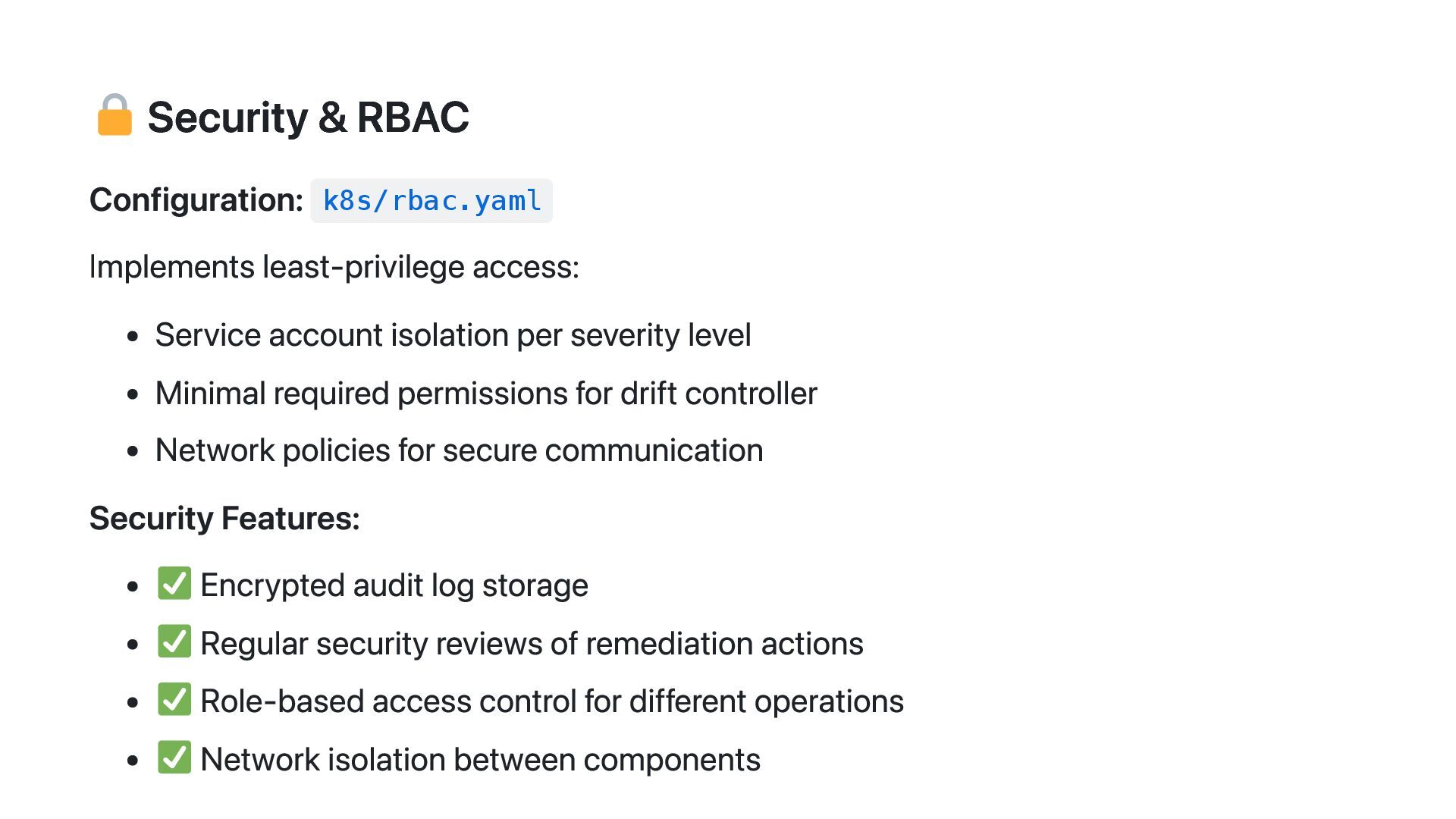
  18. Security & RBAC Configuration: k8s/rbac.yaml Implements least-privilege access: Service account

    isolation per severity level Minimal required permissions for drift controller Network policies for secure communication Security Features: Encrypted audit log storage Regular security reviews of remediation actions Role-based access control for different operations Network isolation between components
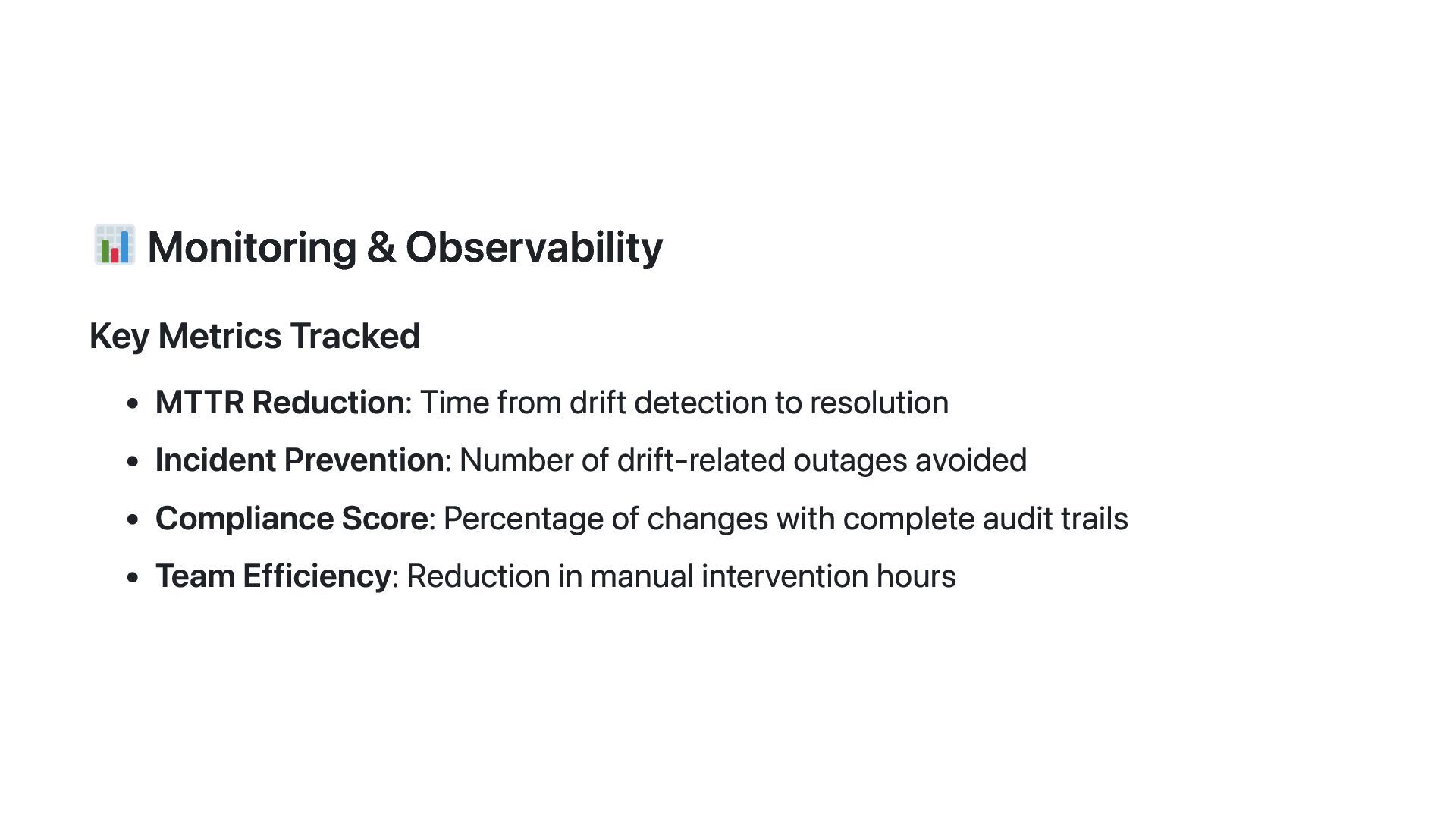
  19. Monitoring & Observability Key Metrics Tracked MTTR Reduction: Time from

    drift detection to resolution Incident Prevention: Number of drift-related outages avoided Compliance Score: Percentage of changes with complete audit trails Team Efficiency: Reduction in manual intervention hours
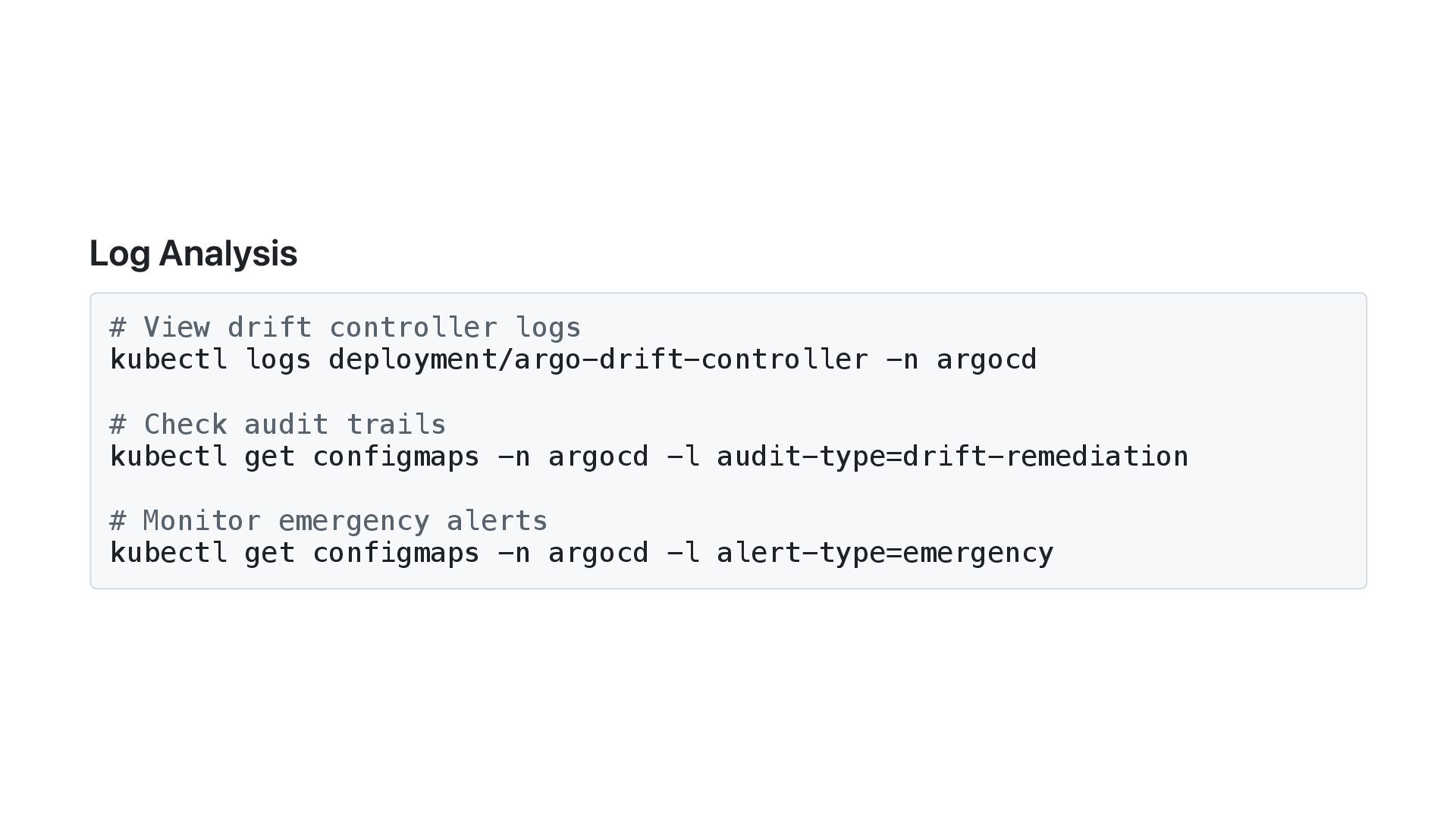
  20. Log Analysis # View drift controller logs kubectl logs deployment/argo-drift-controller

    -n argocd # Check audit trails kubectl get configmaps -n argocd -l audit-type=drift-remediation # Monitor emergency alerts kubectl get configmaps -n argocd -l alert-type=emergency
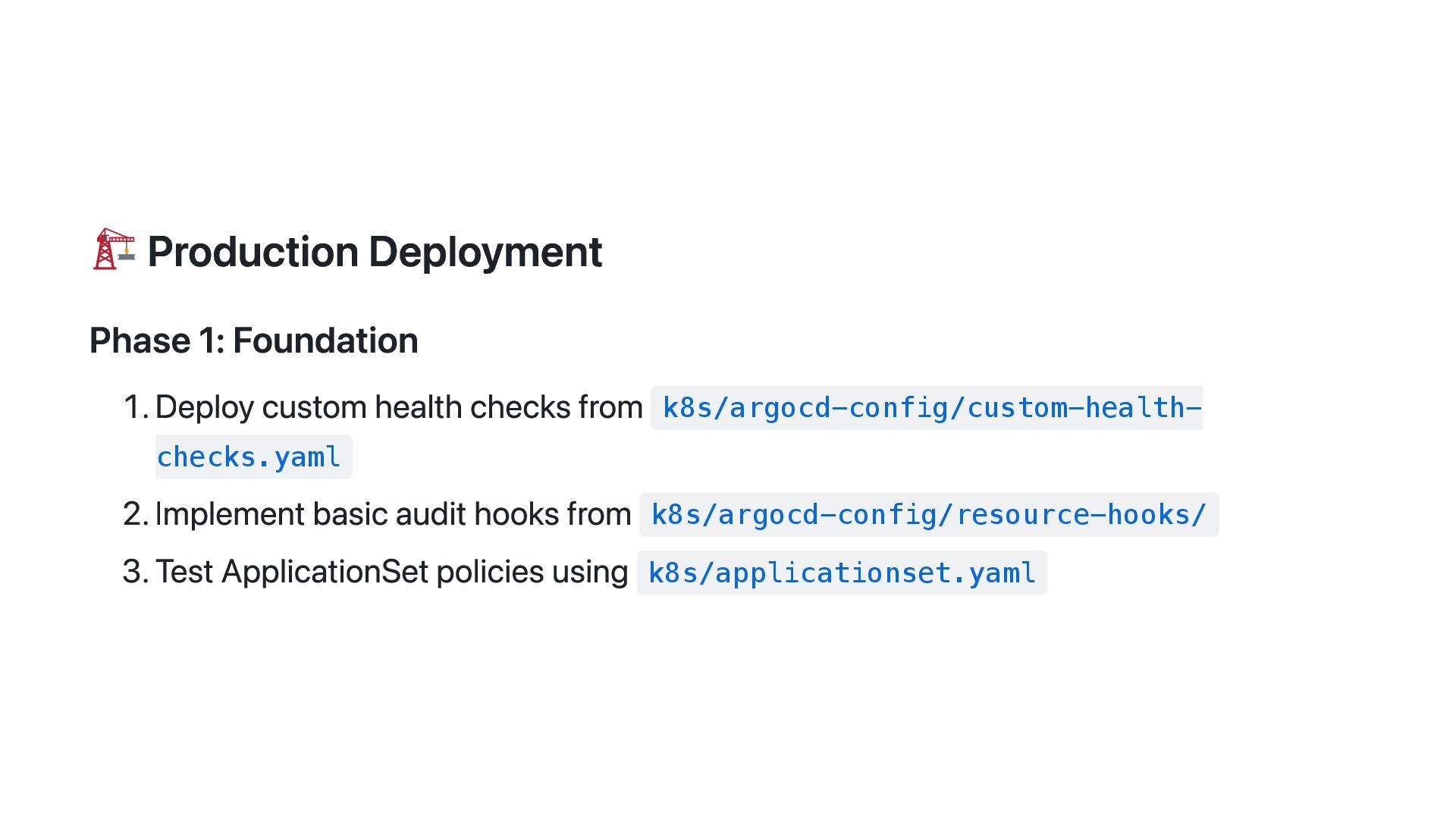
  21. Production Deployment Phase 1: Foundation 1. Deploy custom health checks

    from k8s/argocd-config/custom-health- checks.yaml 2. Implement basic audit hooks from k8s/argocd-config/resource-hooks/ 3. Test ApplicationSet policies using k8s/applicationset.yaml
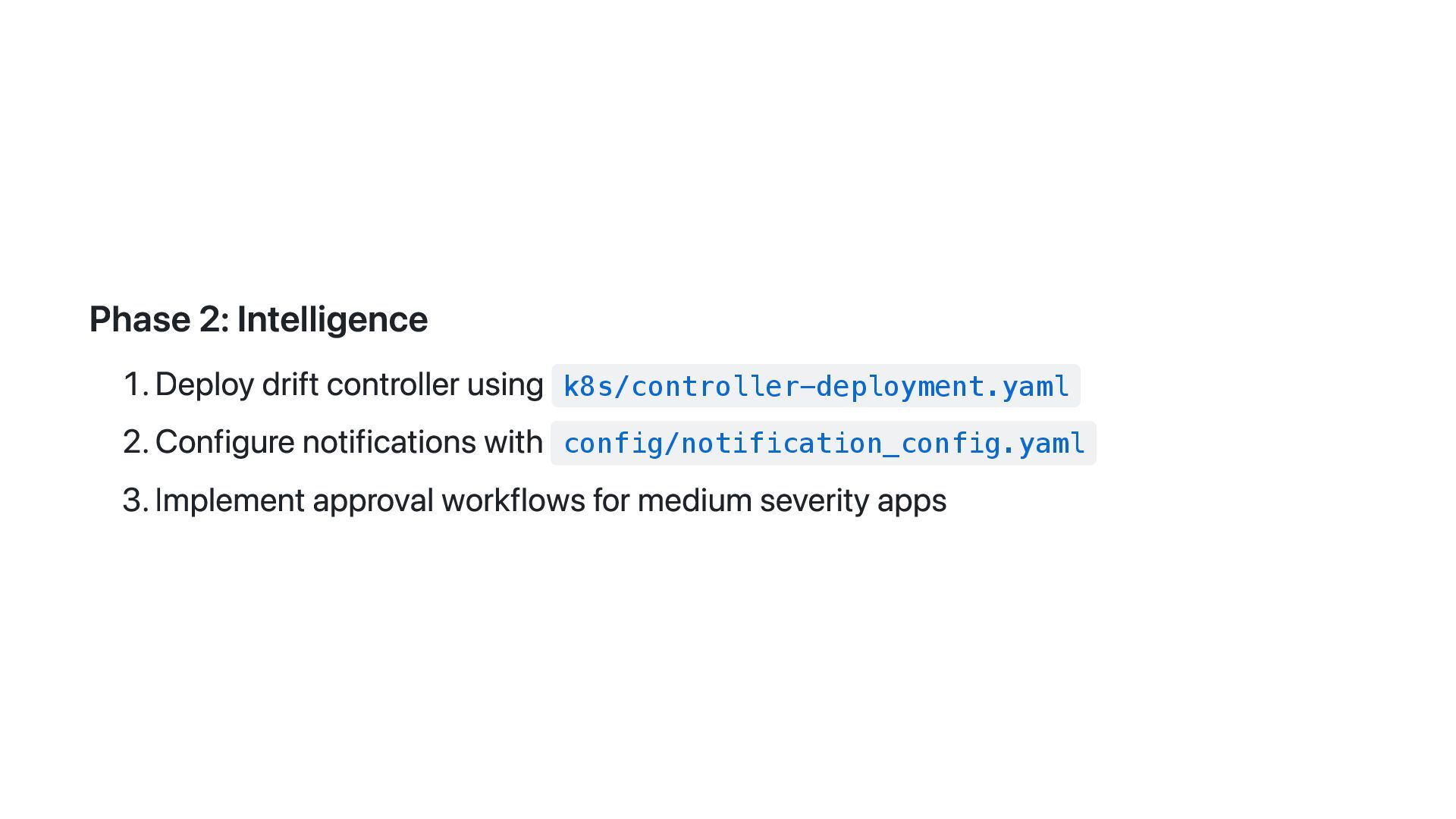
  22. Phase 2: Intelligence 1. Deploy drift controller using k8s/controller-deployment.yaml 2.

    Configure notifications with config/notification_config.yaml 3. Implement approval workflows for medium severity apps
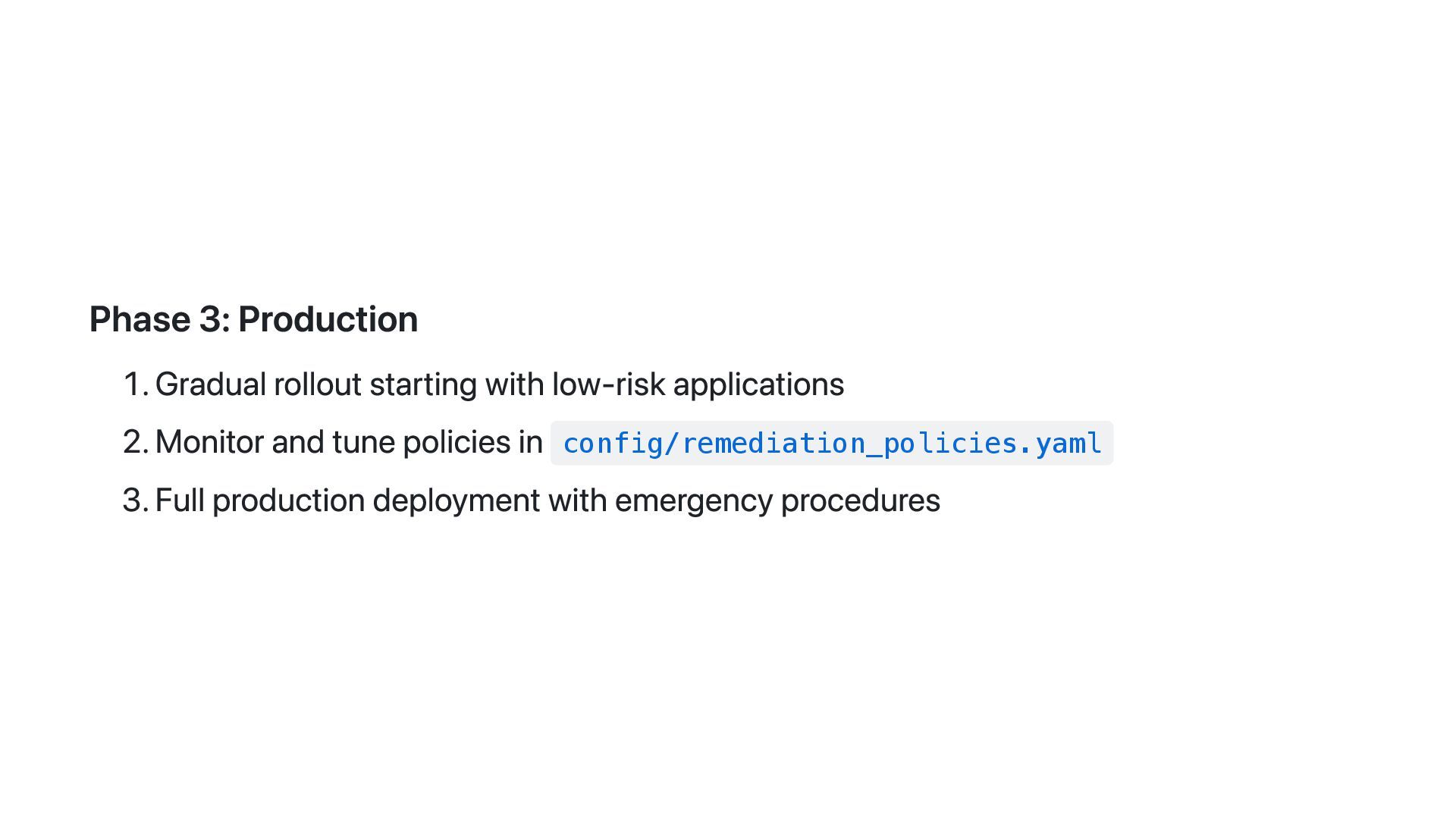
  23. Phase 3: Production 1. Gradual rollout starting with low-risk applications

    2. Monitor and tune policies in config/remediation_policies.yaml 3. Full production deployment with emergency procedures
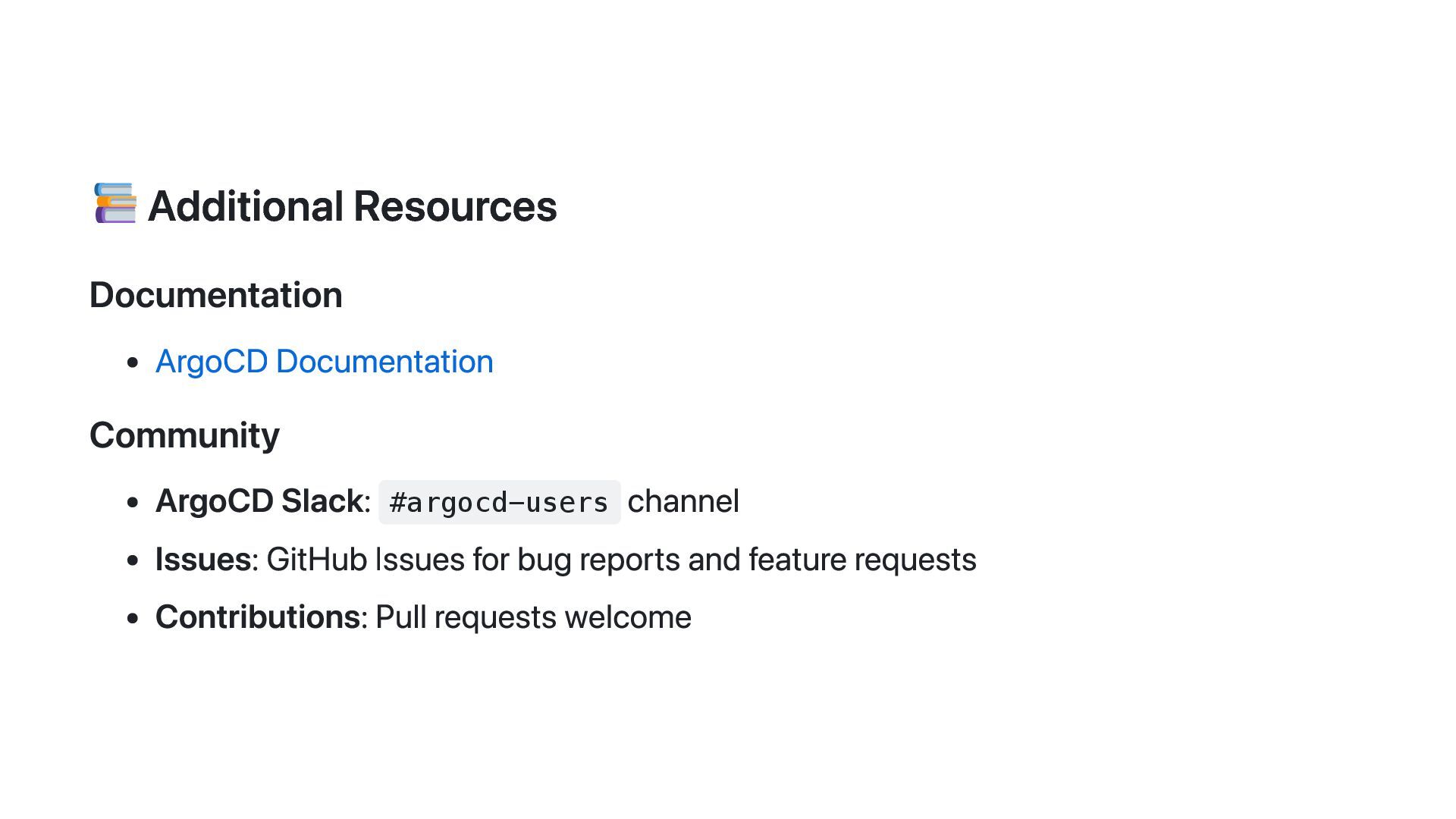
  24. Additional Resources Documentation ArgoCD Documentation Community ArgoCD Slack: #argocd-users channel

    Issues: GitHub Issues for bug reports and feature requests Contributions: Pull requests welcome