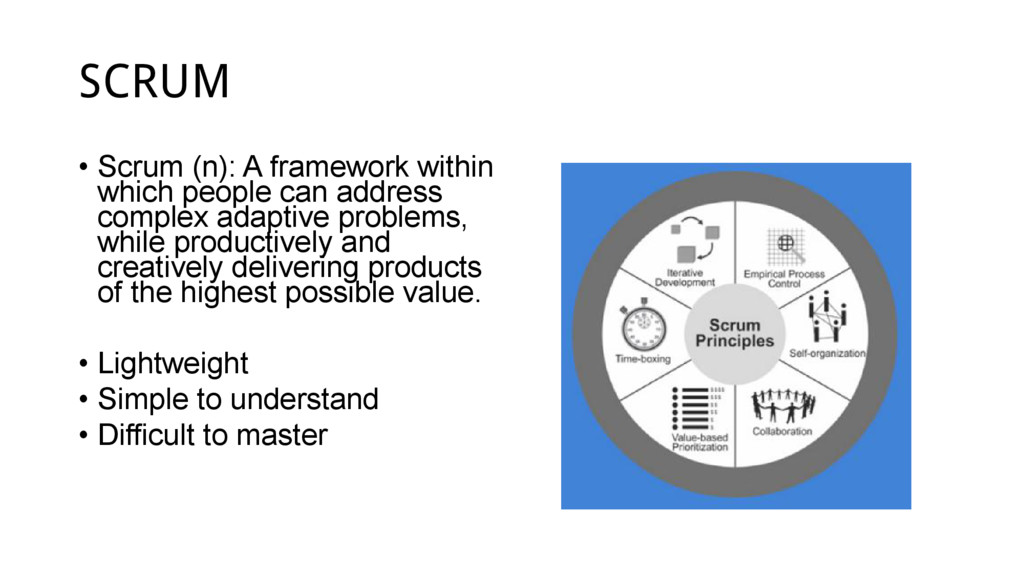
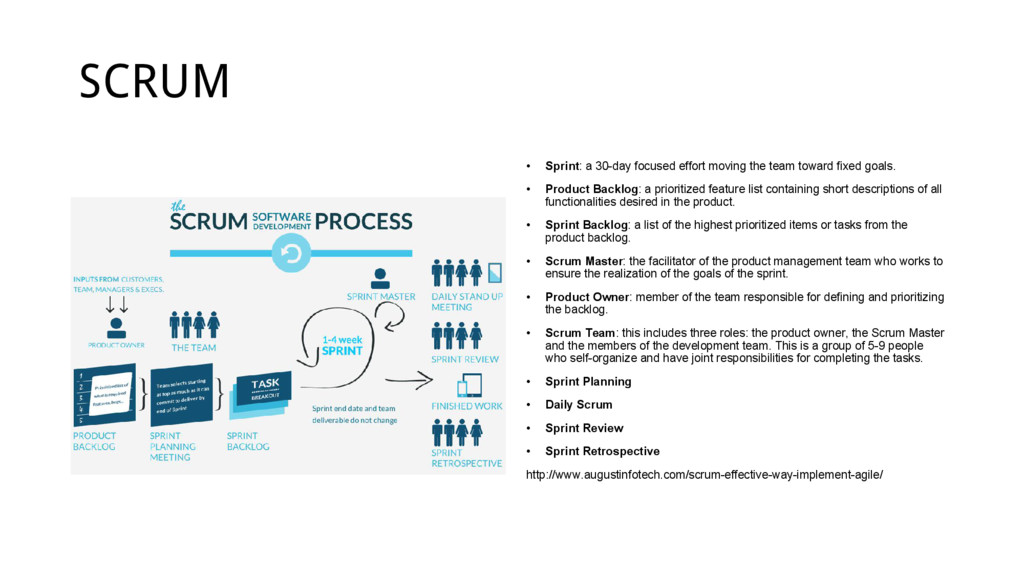
address complex adaptive problems, while productively and creatively delivering products of the highest possible value. • Lightweight • Simple to understand • Difficult to master
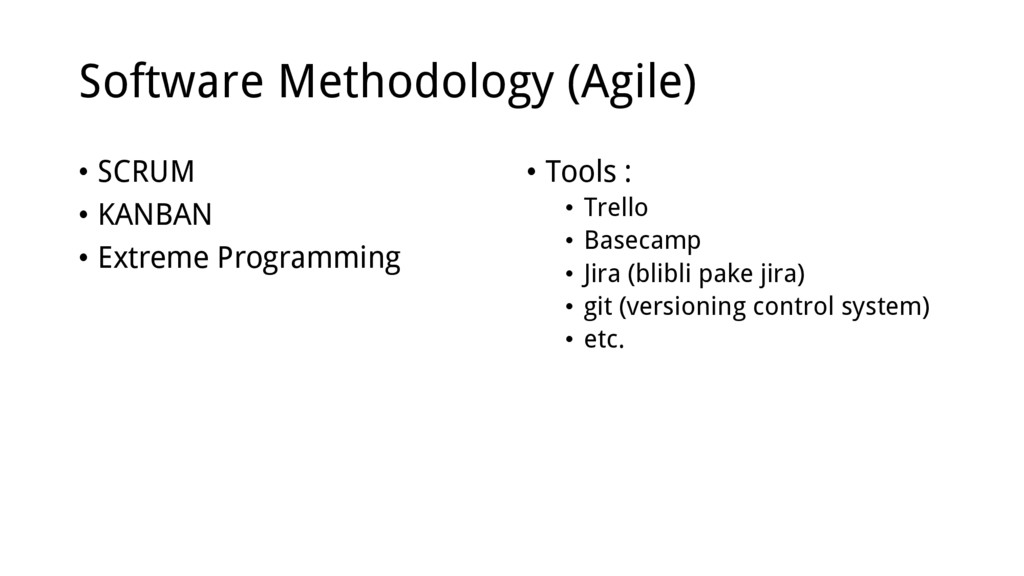
toward fixed goals. • Product Backlog: a prioritized feature list containing short descriptions of all functionalities desired in the product. • Sprint Backlog: a list of the highest prioritized items or tasks from the product backlog. • Scrum Master: the facilitator of the product management team who works to ensure the realization of the goals of the sprint. • Product Owner: member of the team responsible for defining and prioritizing the backlog. • Scrum Team: this includes three roles: the product owner, the Scrum Master and the members of the development team. This is a group of 5-9 people who self-organize and have joint responsibilities for completing the tasks. • Sprint Planning • Daily Scrum • Sprint Review • Sprint Retrospective http://www.augustinfotech.com/scrum-effective-way-implement-agile/
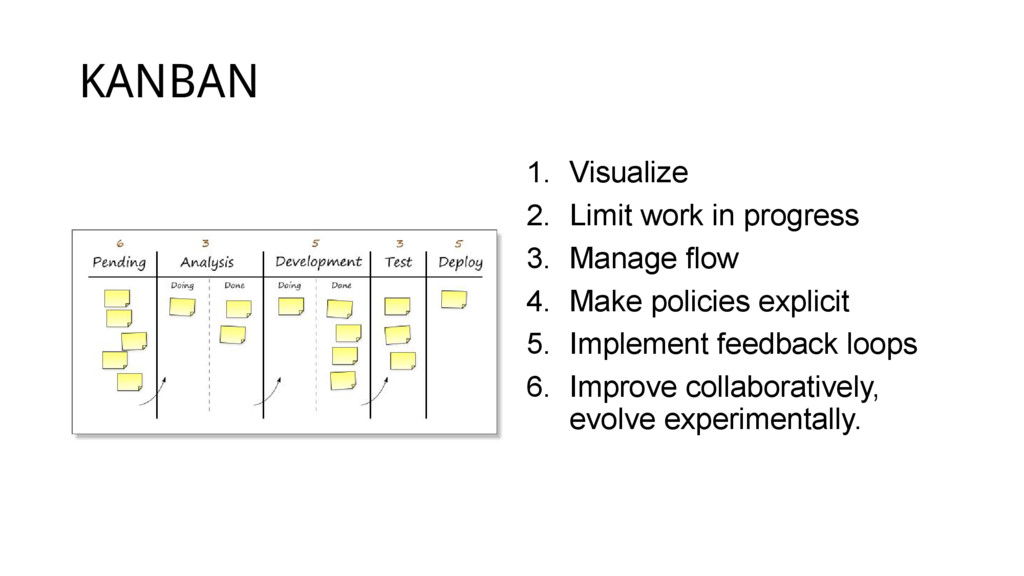
software development process in a highly efficient way. • Kanban underpins Toyota's "just-in-time" (JIT) production system. • Although producing software is a creative activity and therefore different to mass-producing cars, the underlying mechanism for managing the production line can still be applied. • A method for managing knowledge work which balances the demand for work to be done with the available capacity to start new work. • Intangible work items are visualized to present all participants with a view of the progress of individual items, and the process from task definition to customer delivery. • Team members "pull" work as they have capacity, rather than work being "pushed" into the process when requested.
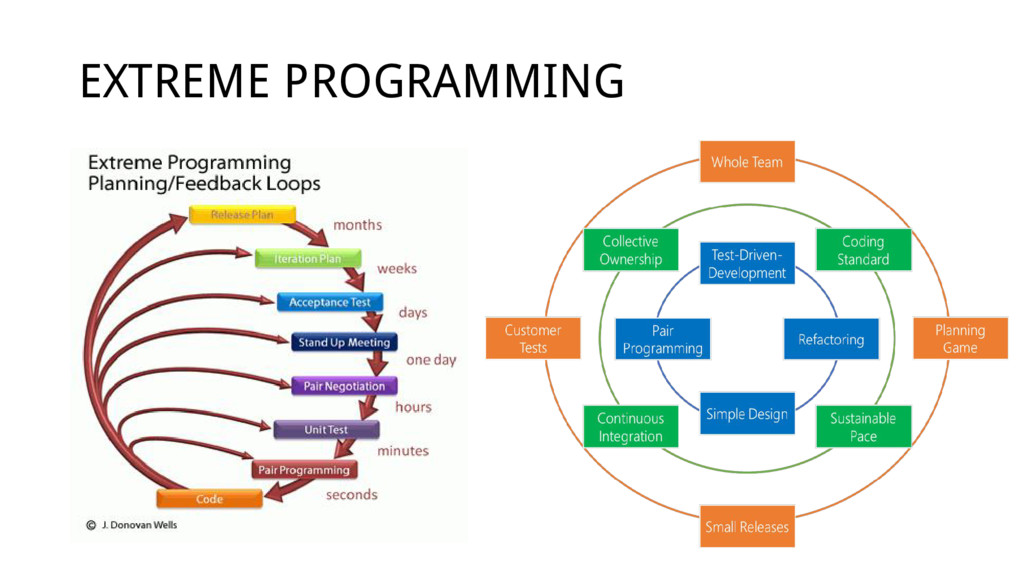
to improve software quality and responsiveness to changing customer requirements. • As a type of agile software development,[1][2][3] it advocates frequent "releases" in short development cycles, which is intended to improve productivity and introduce checkpoints at which new customer requirements can be adopted.
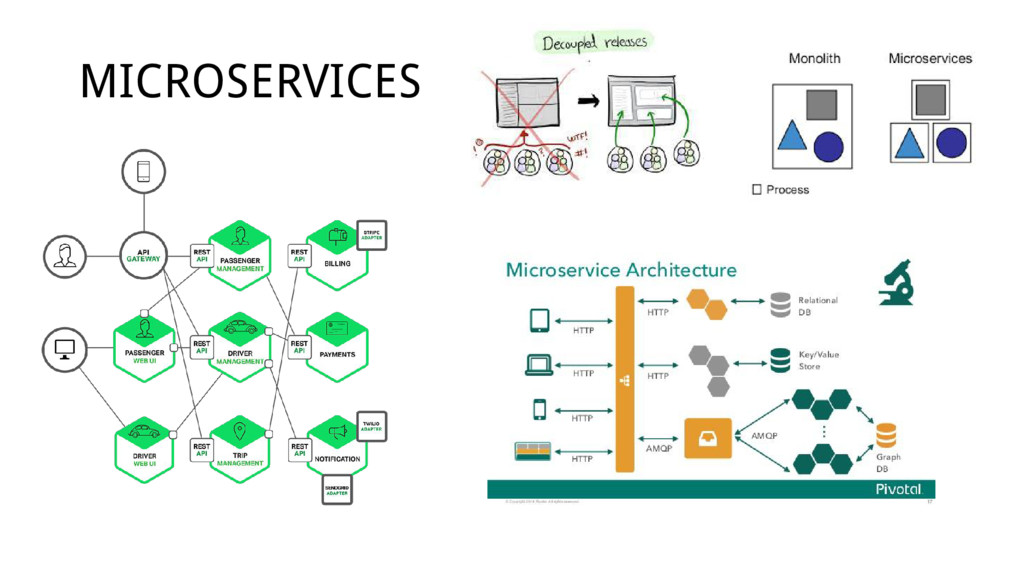
service- oriented architectures (SOA) used to build flexible, independently deployable software systems. Services in a microservice architecture (MSA)[1] are processes that communicate with each other over a network in order to fulfill a goal. These services use technology-agnostic protocols.[2][3][4] The microservices approach is a first realisation of SOA that followed the introduction of DevOps and is becoming more popular for building continuously deployed systems.[5][6]" -- wikipedia
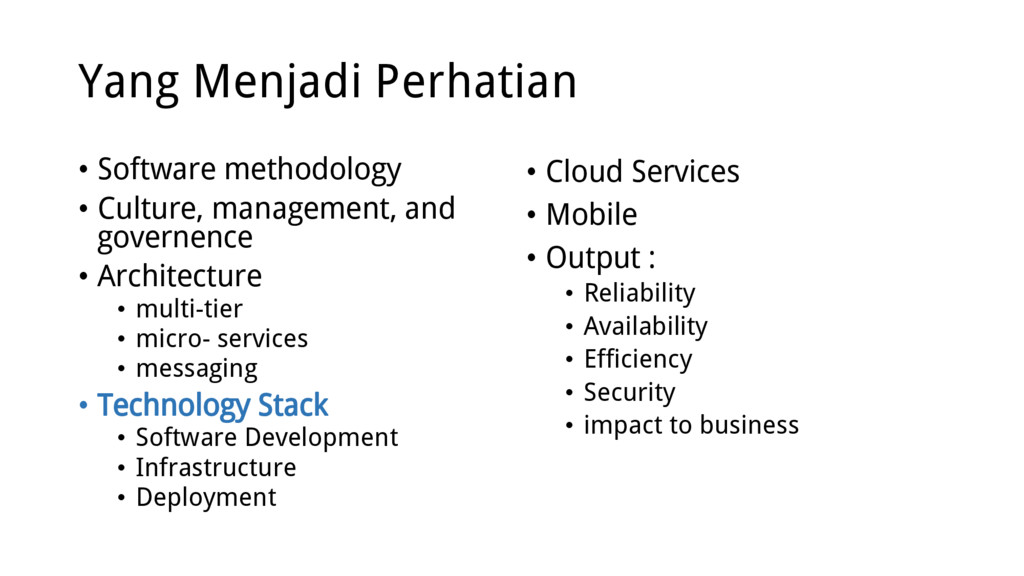
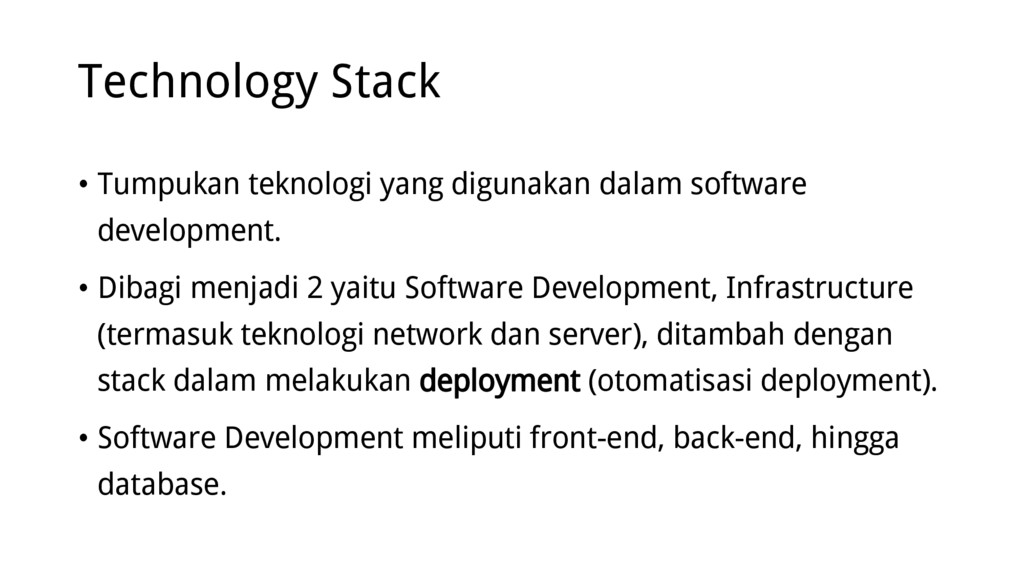
• Dibagi menjadi 2 yaitu Software Development, Infrastructure (termasuk teknologi network dan server), ditambah dengan stack dalam melakukan deployment (otomatisasi deployment). • Software Development meliputi front-end, back-end, hingga database.
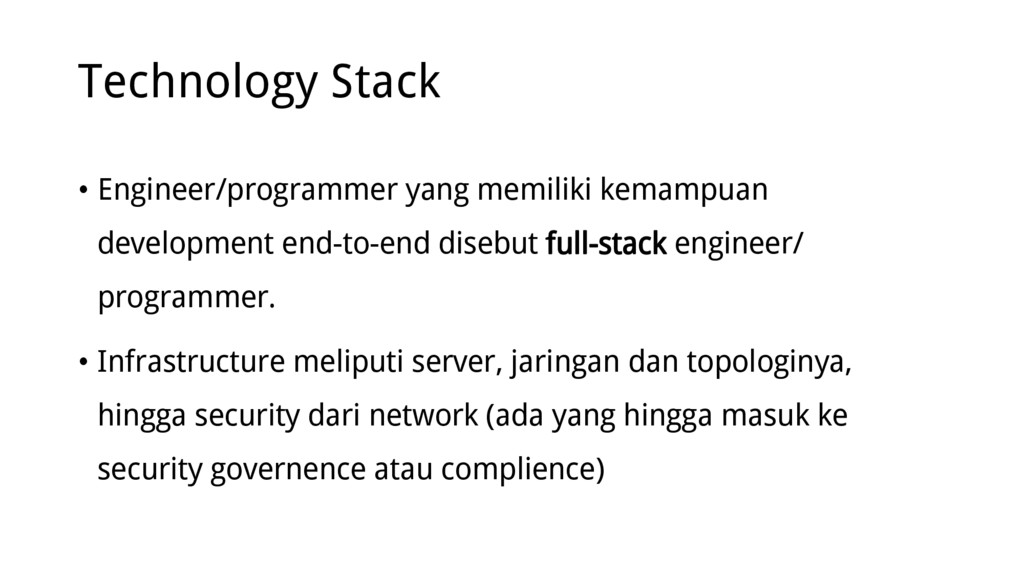
full-stack engineer/ programmer. • Infrastructure meliputi server, jaringan dan topologinya, hingga security dari network (ada yang hingga masuk ke security governence atau complience)
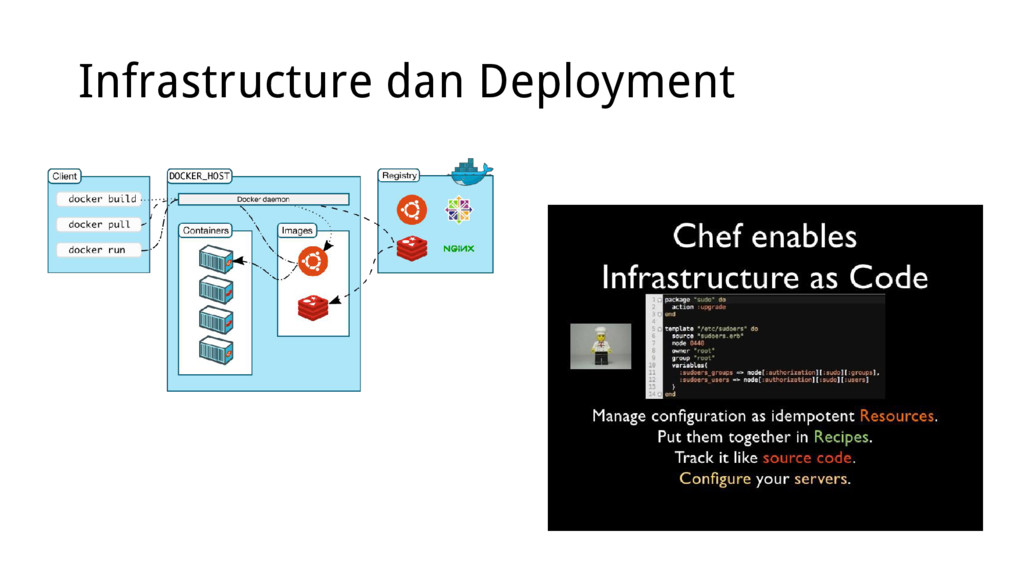
of a company and the name of a configuration management tool written in Ruby and Erlang. It uses a pure-Ruby, domain-specific language (DSL) for writing system configuration "recipes". Chef is used to streamline the task of configuring and maintaining a company's servers, and can integrate with cloud-based platforms such as Internap, Amazon EC2, Google Cloud Platform, OpenStack, SoftLayer, Microsoft Azure and Rackspace to automatically provision and configure new machines. https://www.chef.io/chef/
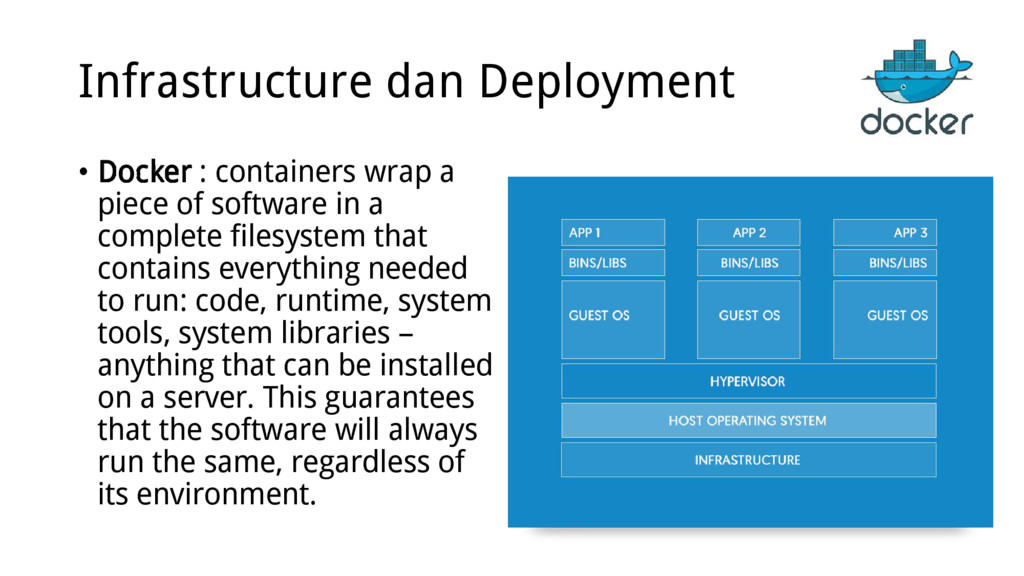
of software in a complete filesystem that contains everything needed to run: code, runtime, system tools, system libraries – anything that can be installed on a server. This guarantees that the software will always run the same, regardless of its environment.

 SiteGround - Reliable hosting with speed, security, and support you can count on.


 situkangsayur
 namiki64
 terurou
 keeg
keeg
 jtakeda
 tokuty
 pfn
pfn
 nealle
 occhi
occhi
 prog893
 syuchimu
 shuta13
 bgpat
bgpat
 samlambert
 ks91
ks91
 cassininazir
 soudai
 portentint
 62gerente
 aleyda
 erikaheidi
 szymonslowik
 takai
takai
 bermonpainter
 panda_program