Upgrade to Pro — share decks privately, control downloads, hide ads and more …

Population: The Foundation of Research

Avatar for Sreedevi Brahmadathan Sreedevi Brahmadathan
October 05, 2026
6

Population: The Foundation of Research

### Project Description

**“Population: The Foundation of Research”** is an educational project that explores the concept of population in statistics and its importance in research. The project introduces population as the complete group of individuals, objects, or units that a researcher intends to study and understand.

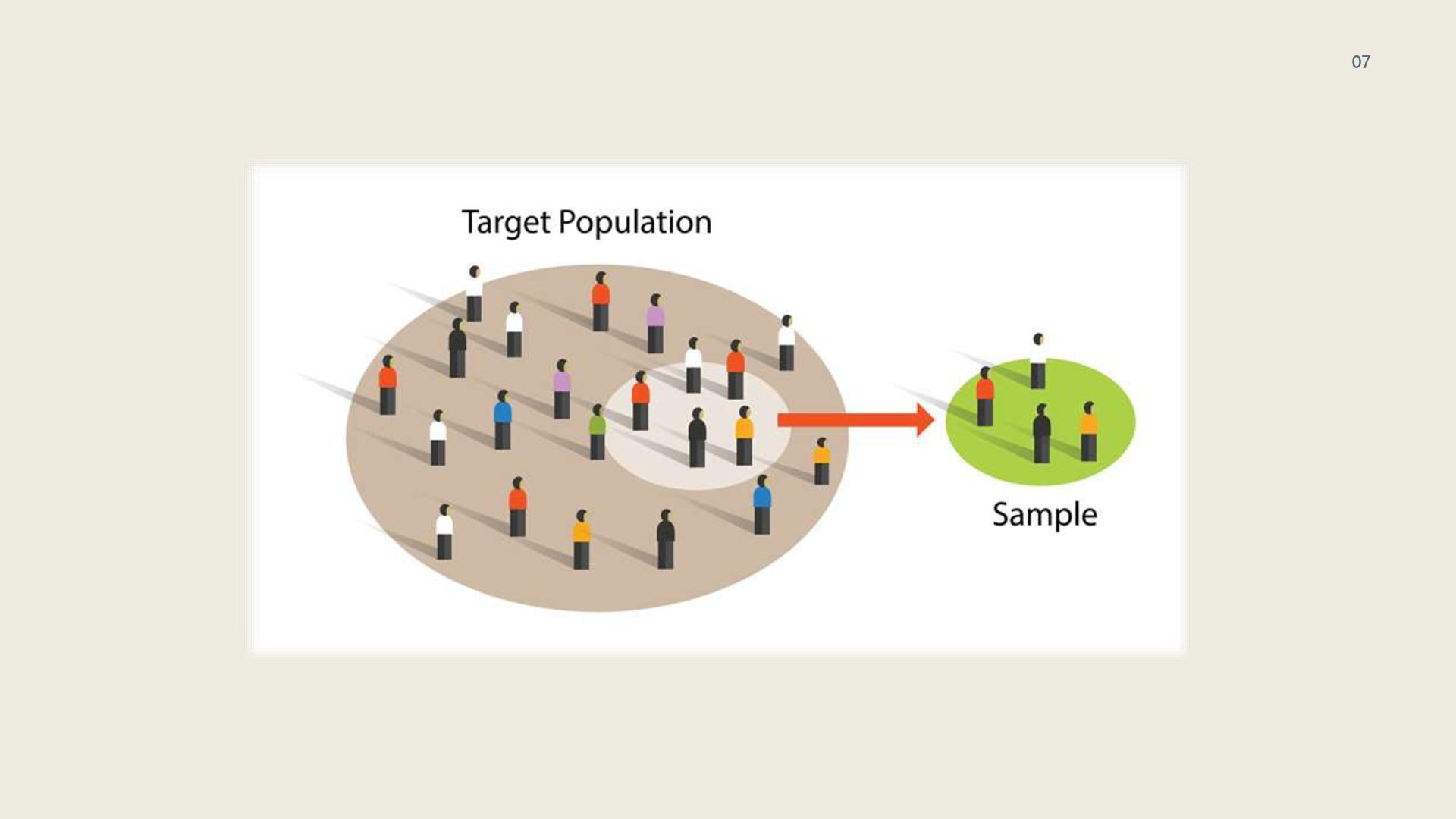
The presentation explains the different types of population, including **target population, accessible population, finite population, and infinite population**. It also highlights the relationship between **population and sample**, explaining how researchers select a sample from a population for data collection and analysis.

Through simple examples from educational research, the project demonstrates how a clearly defined population helps researchers establish the scope of a study, select an appropriate sample, and make meaningful generalizations from research findings. The project also includes visual representations, examples, and an interactive quiz to make the concept easier to understand and engage with.

Overall, this project aims to develop a clear understanding of population as a fundamental concept in **statistical analysis and educational research** and to demonstrate its role in conducting systematic and meaningful research.

Avatar for Sreedevi Brahmadathan

Sreedevi Brahmadathan

October 05, 2026

Transcript

  1. M.Ed. • RE S E AR CH & STATIS TICS

    POPULATION in Statis tics Concept • Types • Population & Sample • Parameters • Applications Presented by: _____M.B.S RE E DE VI_______________ Institution: NSS Training College, Ottapalam MED 04 – Research and Statistics
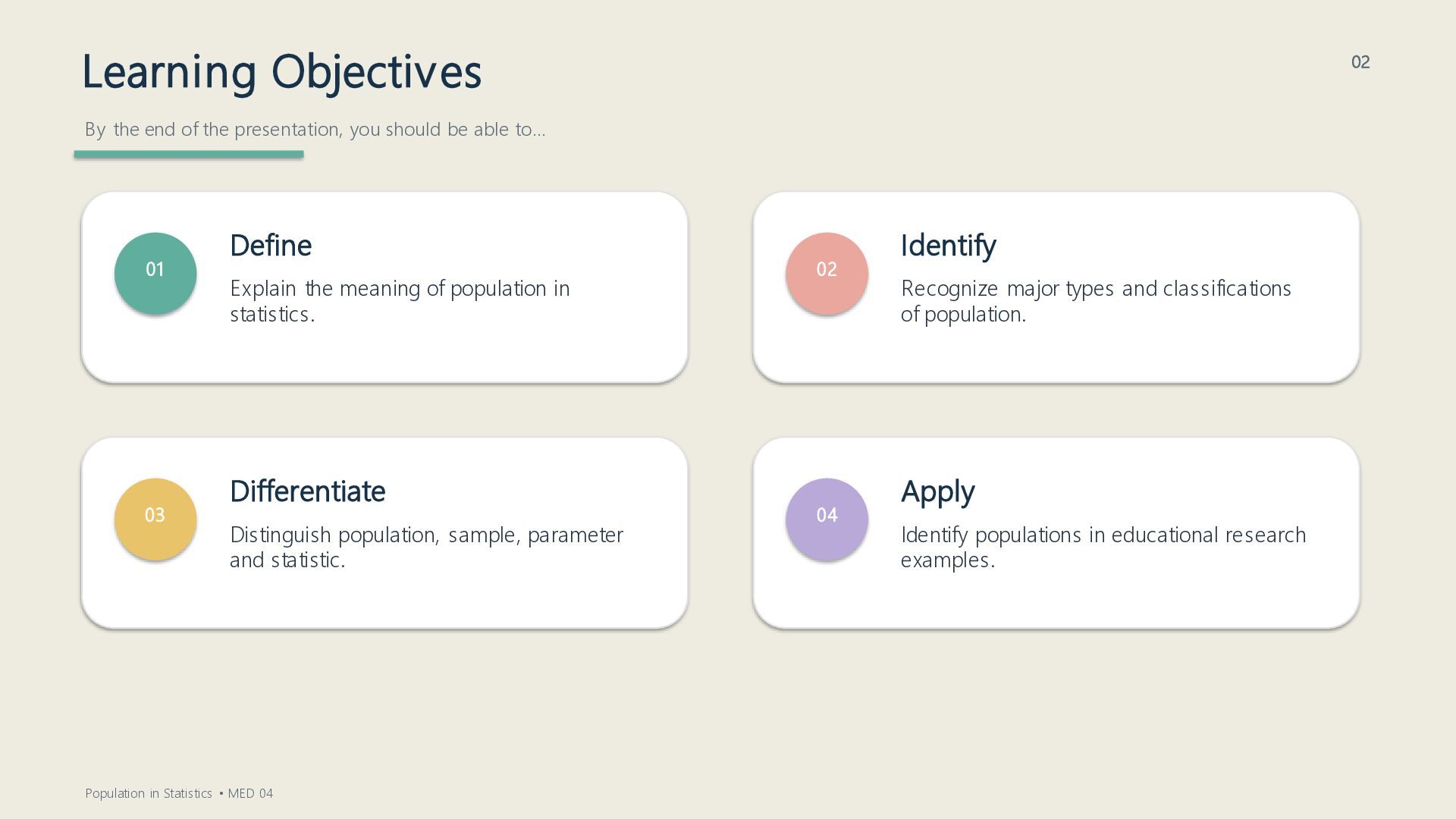
  2. Learning Objectives 02 By the end of the presentation, you

    should be able to… 01 03 Define Explain the meaning of population in statistics. Differentiate Distinguish population, sample, parameter and statistic. Population in Statistics • MED 04 02 04 Identify Recognize major types and classifications of population. Apply Identify populations in educational research examples.
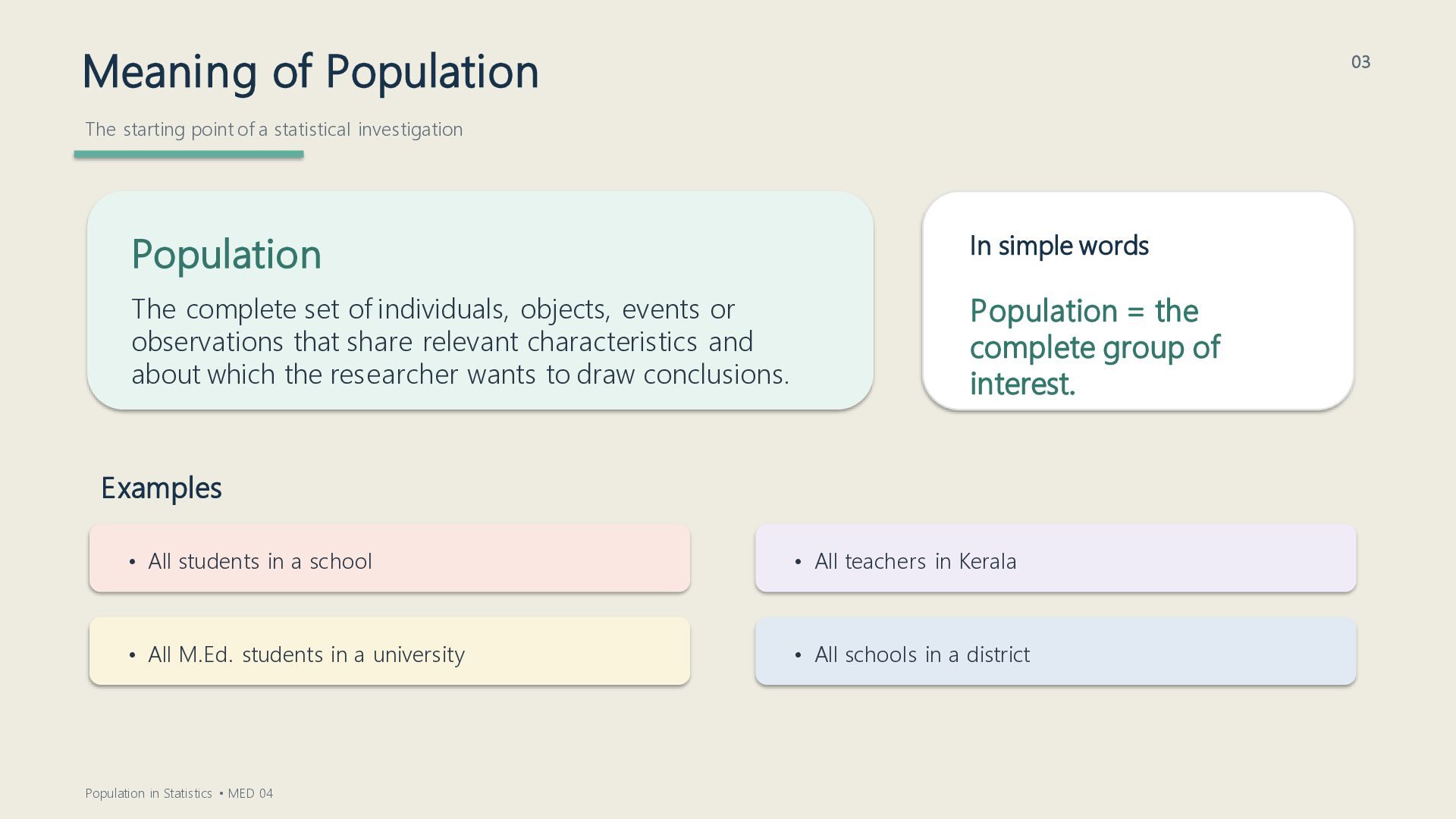
  3. Meaning of Population 03 The starting point of a statistical

    investigation Population In simple words The complete set of individuals, objects, events or observations that share relevant characteristics and about which the researcher wants to draw conclusions. Population = the complete group of interest. Examples • All students in a school • All teachers in Kerala • All M.Ed. students in a university • All schools in a district Population in Statistics • MED 04
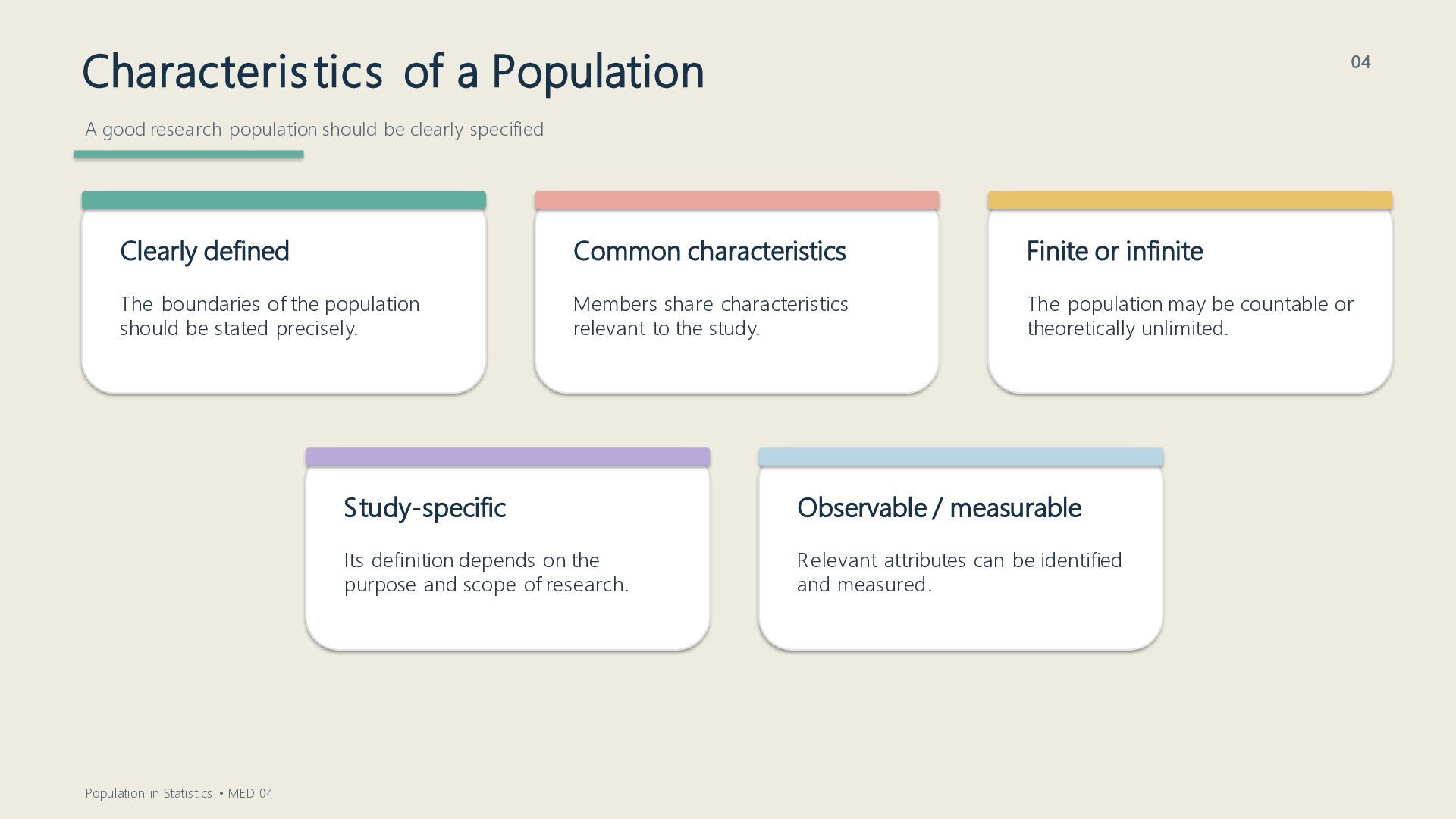
  4. Characteris tics of a Population 04 A good research population

    should be clearly specified Clearly defined Common characteristics Finite or infinite The boundaries of the population should be stated precisely. Members share characteristics relevant to the study. The population may be countable or theoretically unlimited. Population in Statistics • MED 04 Study-specific Observable / measurable Its definition depends on the purpose and scope of research. Relevant attributes can be identified and measured.
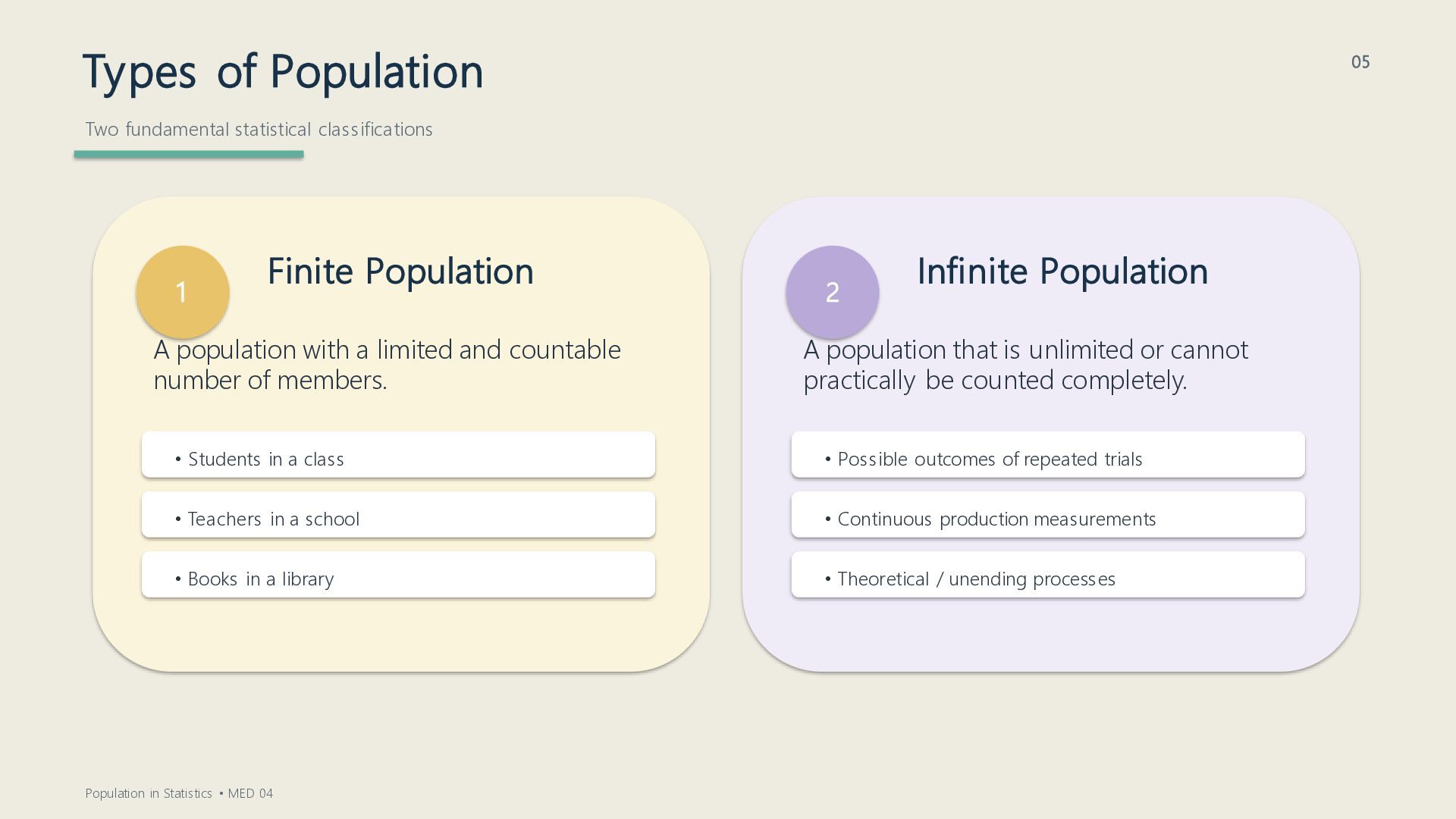
  5. Types of Population 05 Two fundamental statistical classifications 1 Finite

    Population A population with a limited and countable number of members. 2 Infinite Population A population that is unlimited or cannot practically be counted completely. • Students in a class • Possible outcomes of repeated trials • Teachers in a school • Continuous production measurements • Books in a library • Theoretical / unending processes Population in Statistics • MED 04
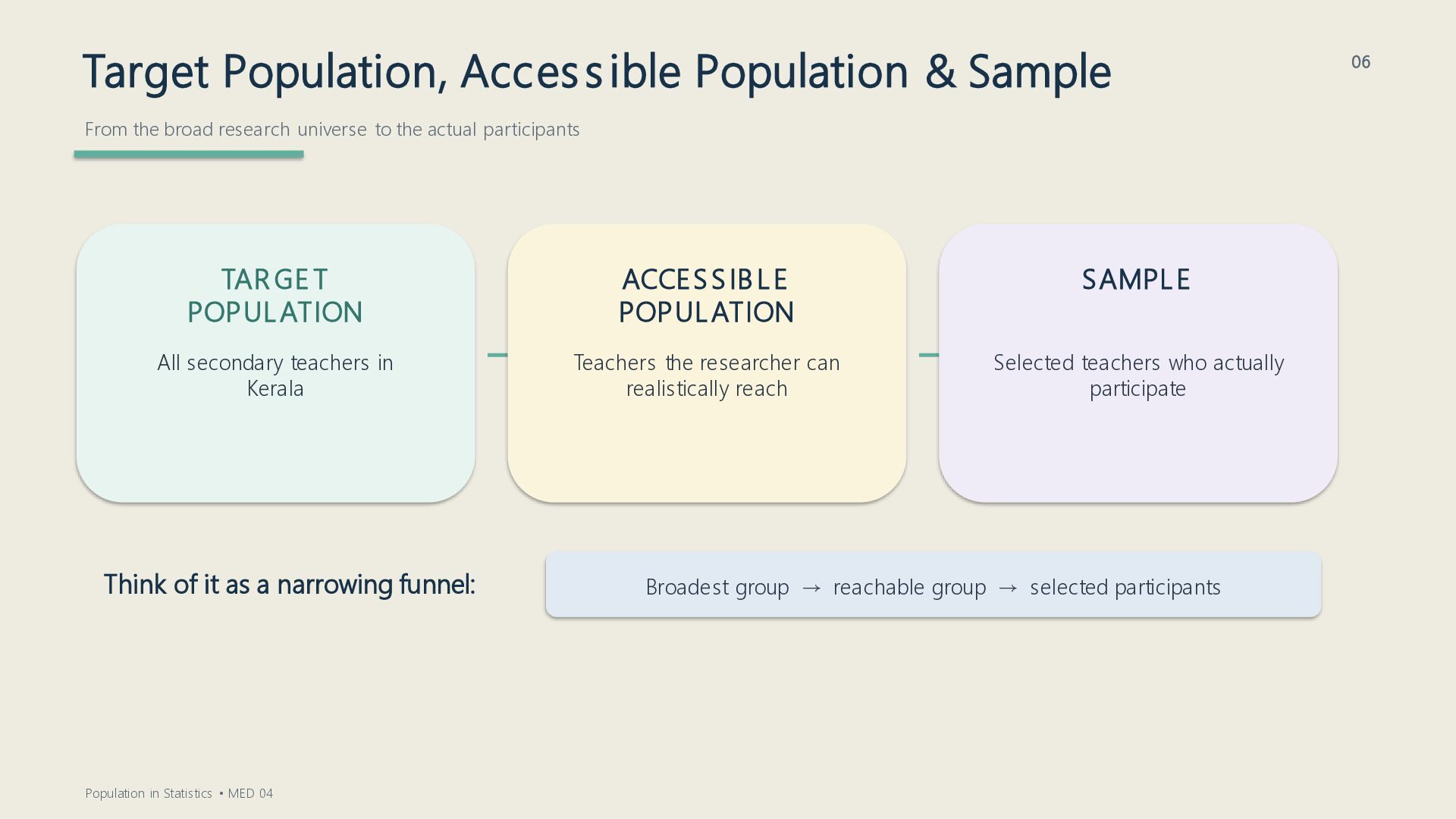
  6. Target Population, Acces s ible Population & Sample From the

    broad research universe to the actual participants TAR GE T POPUL ATION All secondary teachers in Kerala Think of it as a narrowing funnel: Population in Statistics • MED 04 → ACCE S S IB L E POPUL ATION Teachers the researcher can realistically reach SAMPL E → Selected teachers who actually participate Broadest group → reachable group → selected participants 06
  7. 07

  8. 08

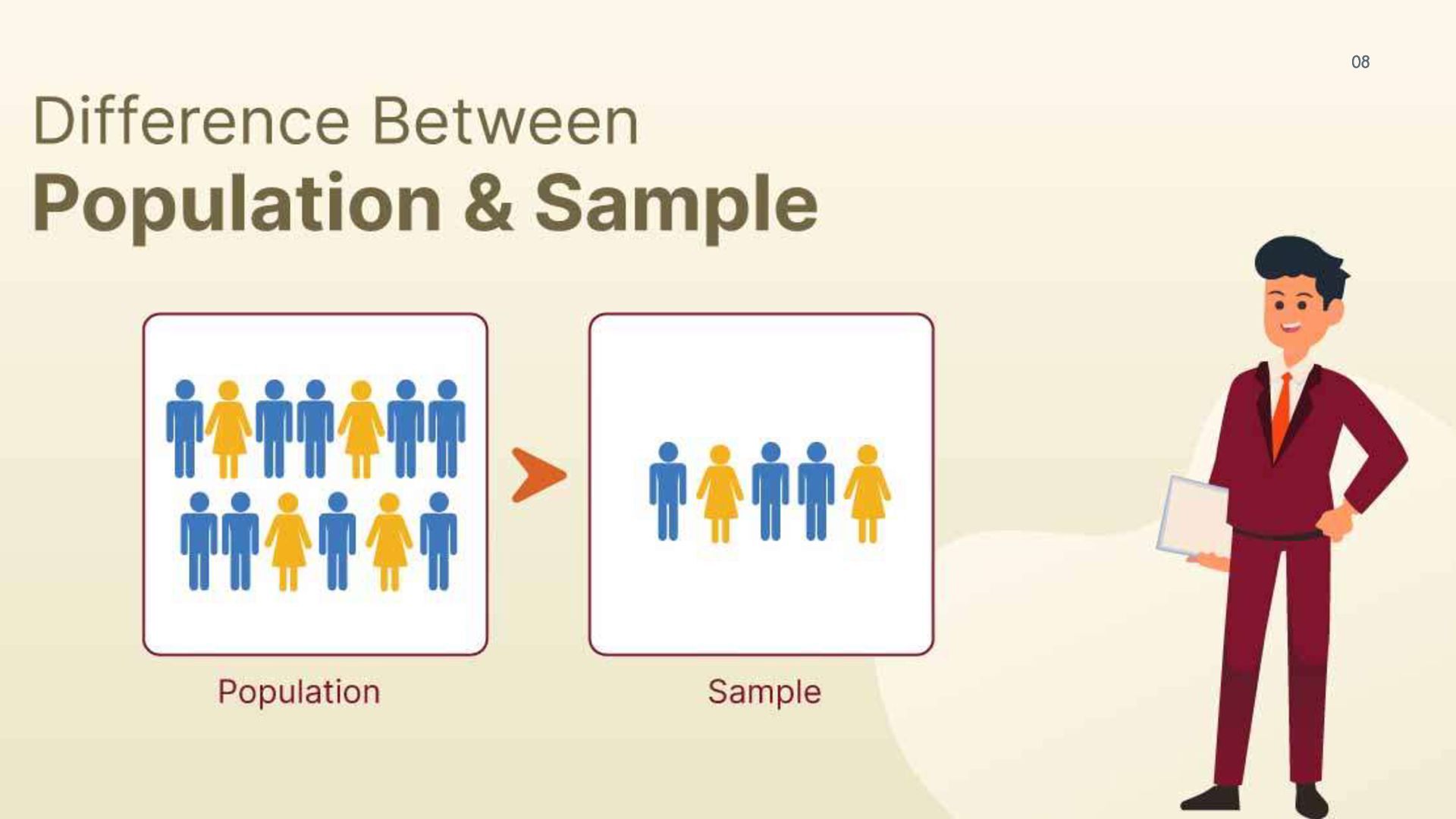
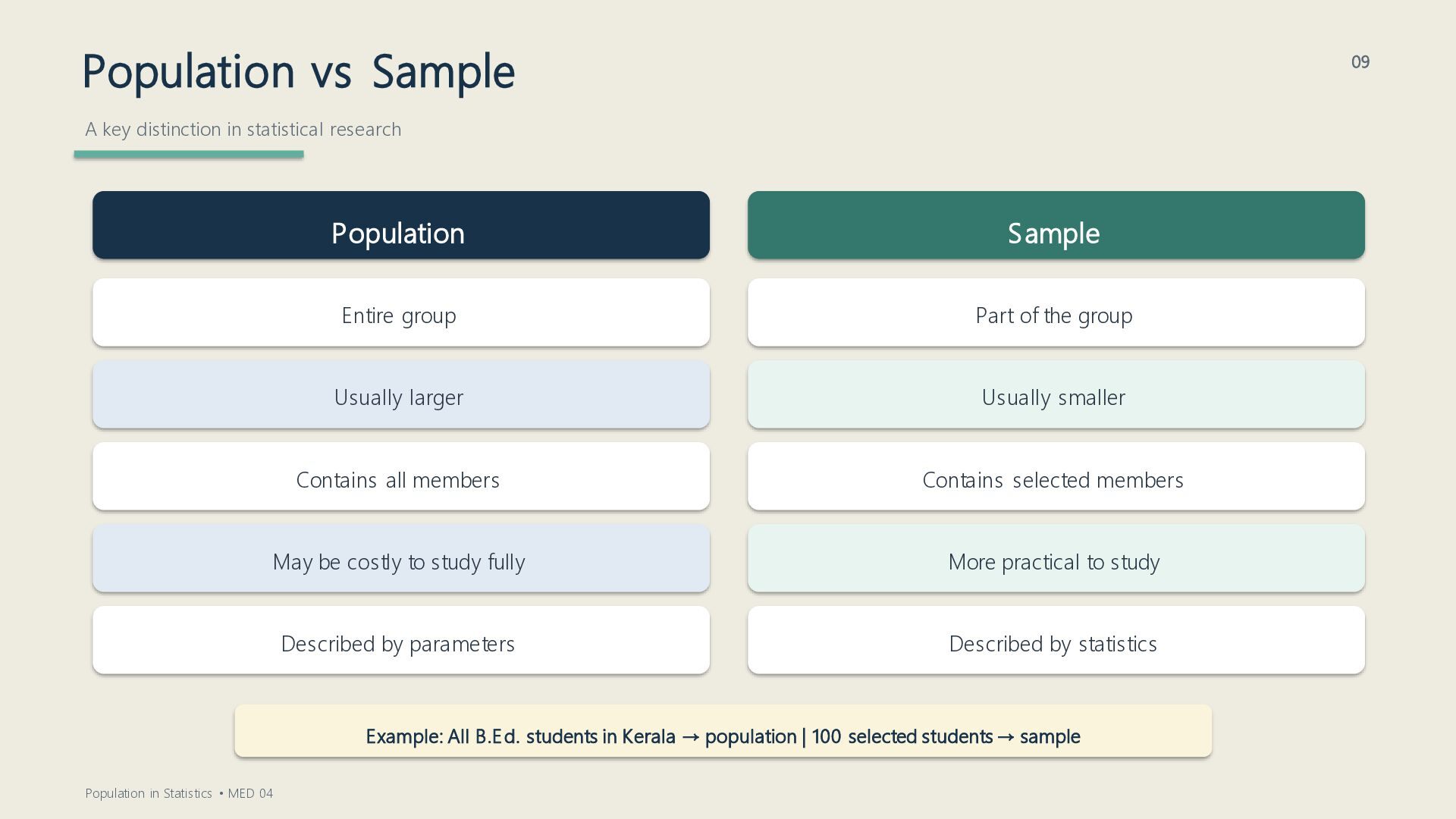
  9. Population vs Sample 09 A key distinction in statistical research

    Population Sample Entire group Part of the group Usually larger Usually smaller Contains all members Contains selected members May be costly to study fully More practical to study Described by parameters Described by statistics Example: All B.E d. students in Kerala → population | 100 selected students → sample Population in Statistics • MED 04
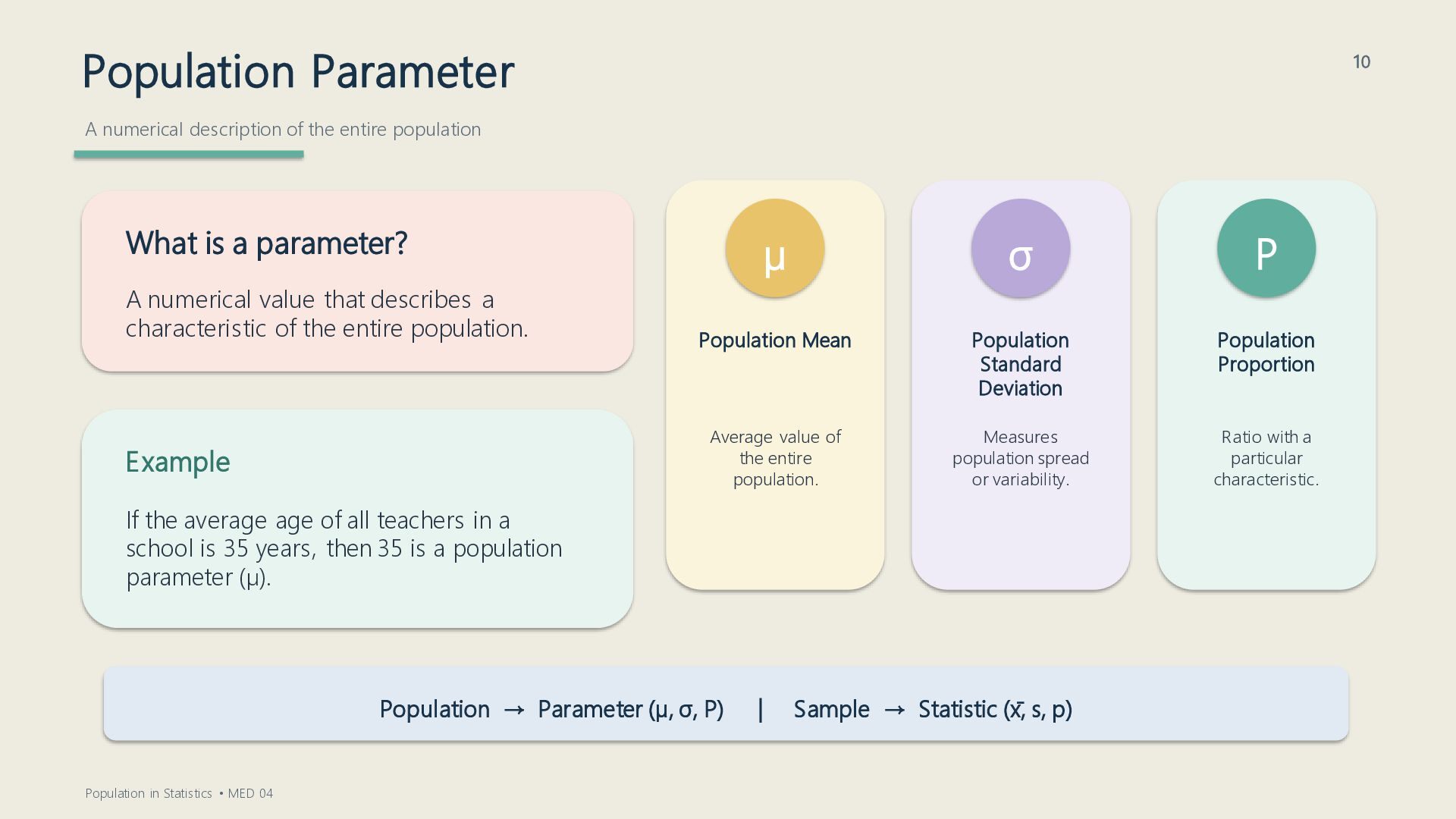
  10. Population Parameter 10 A numerical description of the entire population

    What is a parameter? A numerical value that describes a characteristic of the entire population. Example μ σ P Population Mean Population Standard Deviation Population Proportion Average value of the entire population. Measures population spread or variability. Ratio with a particular characteristic. If the average age of all teachers in a school is 35 years, then 35 is a population parameter (μ). Population → Parameter (μ, σ, P) Population in Statistics • MED 04 | Sample → Statistic (x̄, s, p)
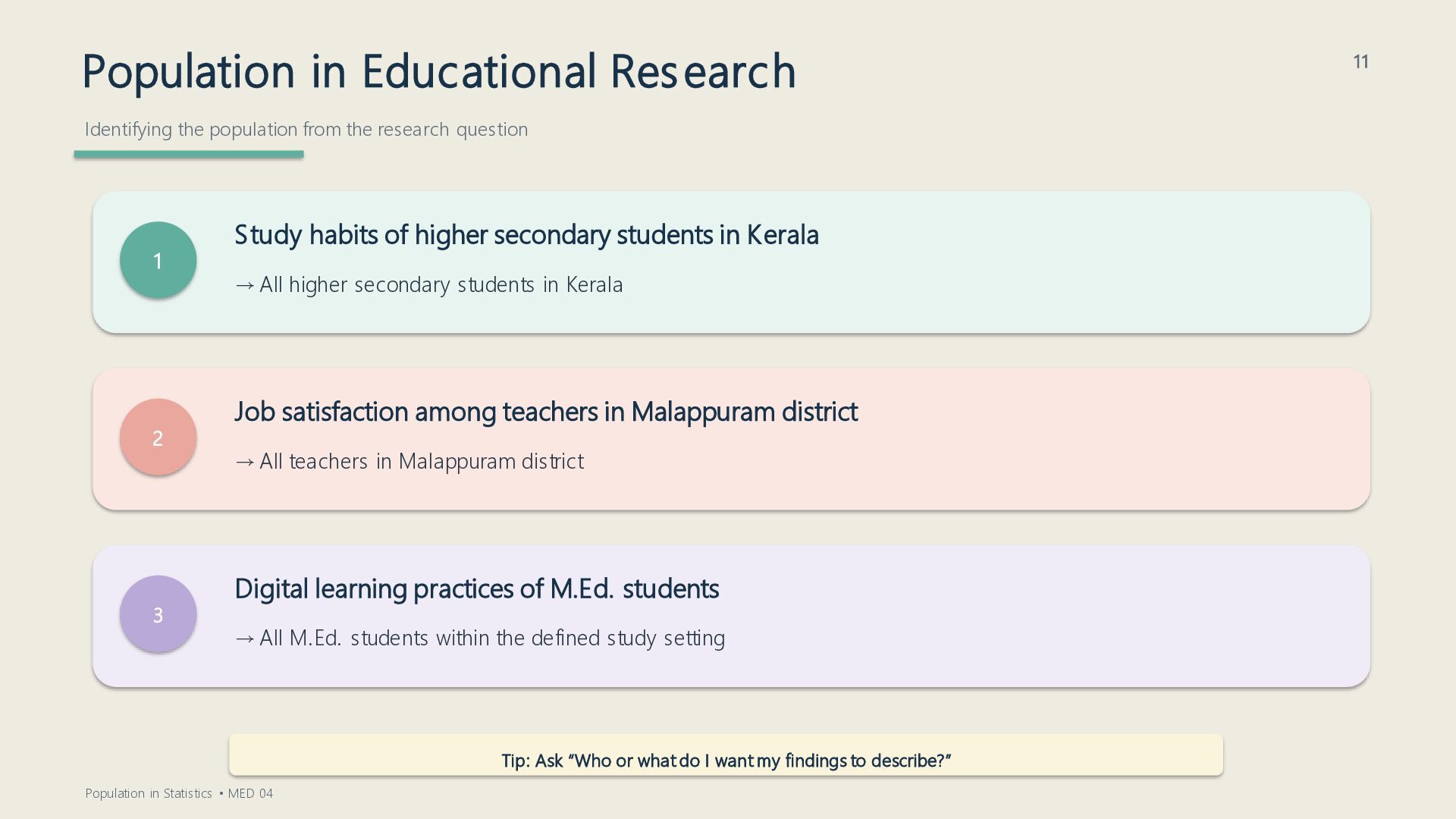
  11. Population in Educational Res earch Identifying the population from the

    research question 1 2 3 Study habits of higher secondary students in Kerala → All higher secondary students in Kerala Job satisfaction among teachers in Malappuram district → All teachers in Malappuram district Digital learning practices of M.Ed. students → All M.Ed. students within the defined study setting Tip: Ask “Who or what do I want my findings to describe?” Population in Statistics • MED 04 11
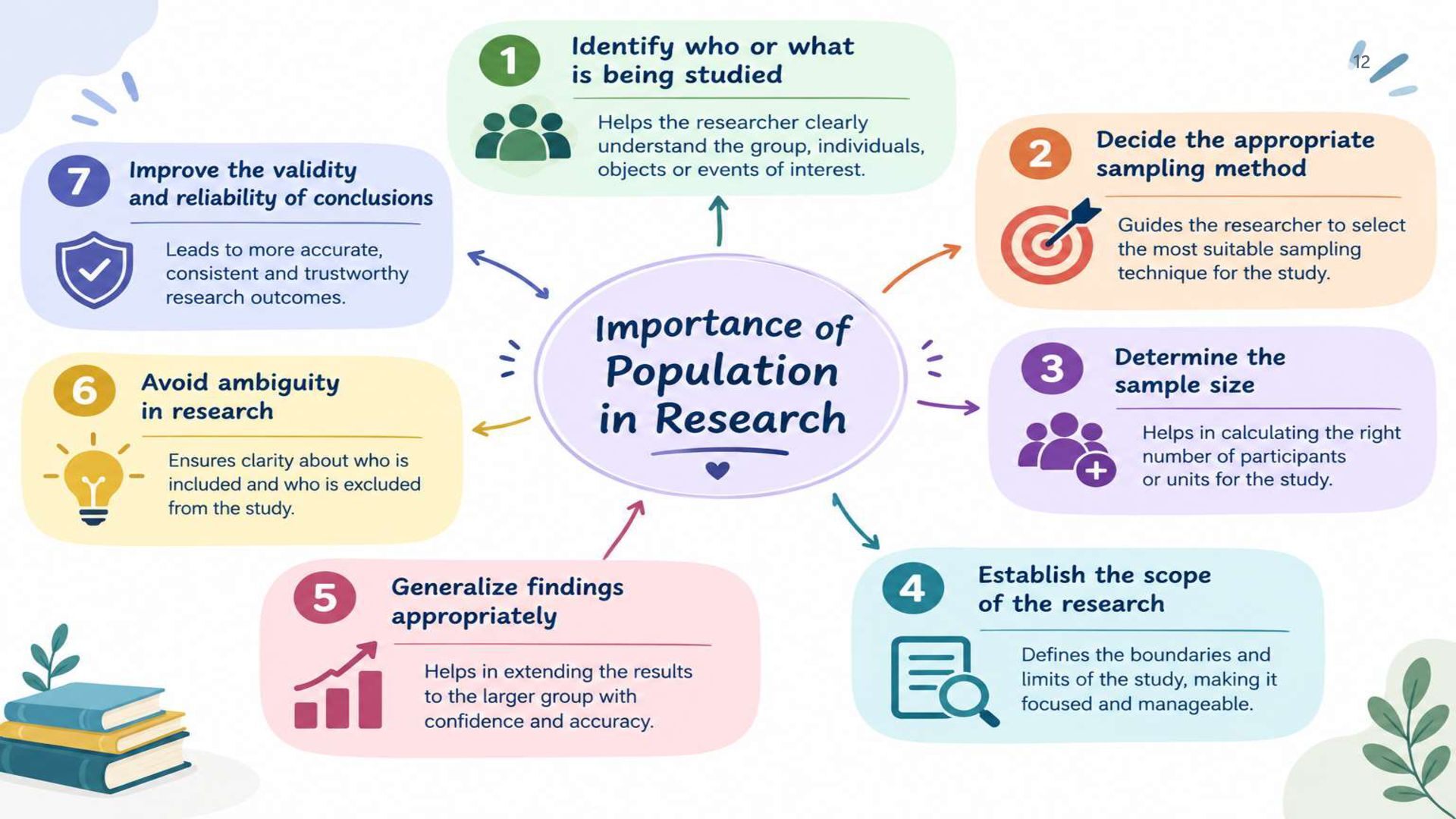
  12. 12

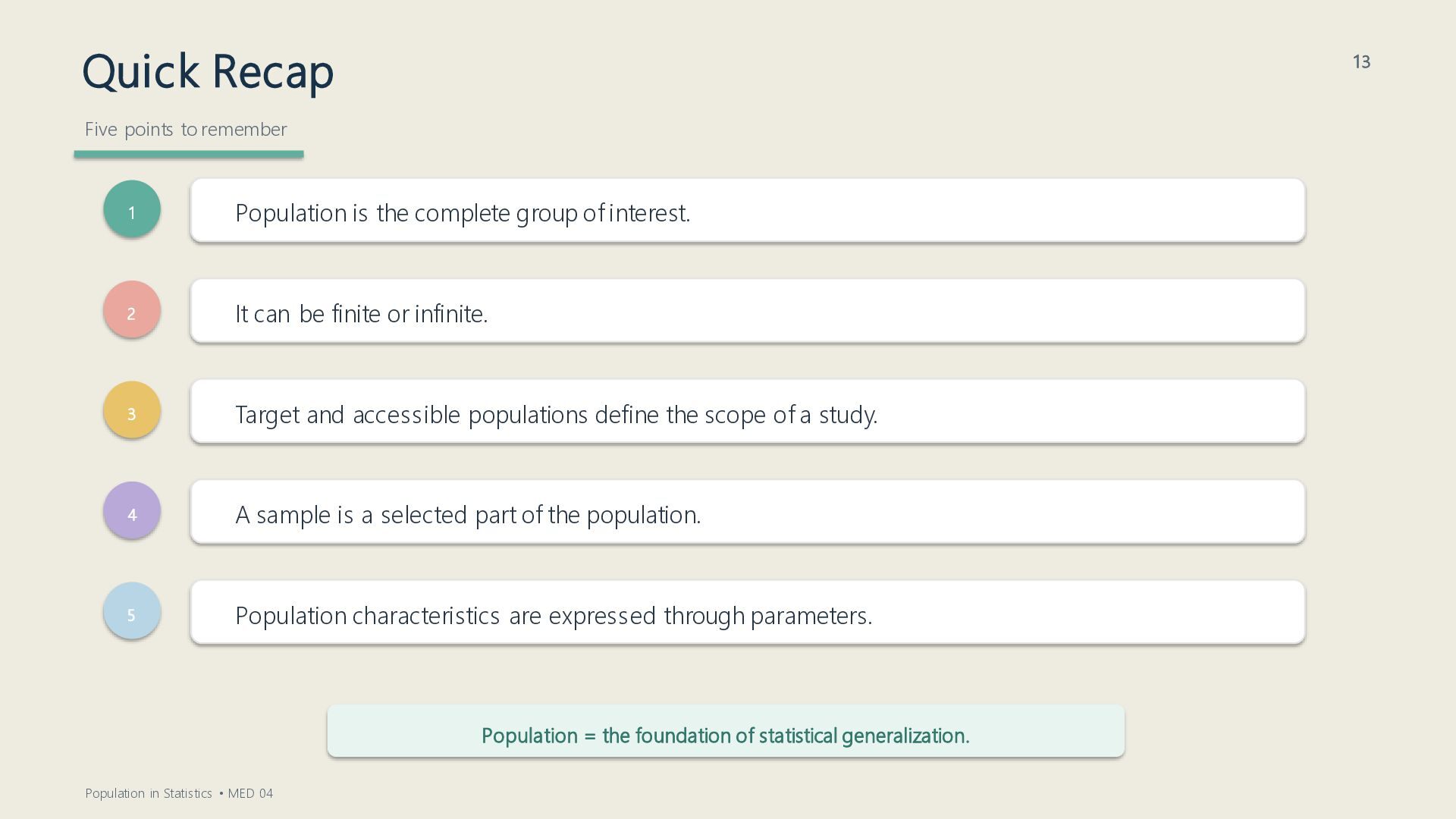
  13. Quick Recap 13 Five points to remember 1 Population is

    the complete group of interest. 2 It can be finite or infinite. 3 Target and accessible populations define the scope of a study. 4 A sample is a selected part of the population. 5 Population characteristics are expressed through parameters. Population = the foundation of statistical generalization. Population in Statistics • MED 04
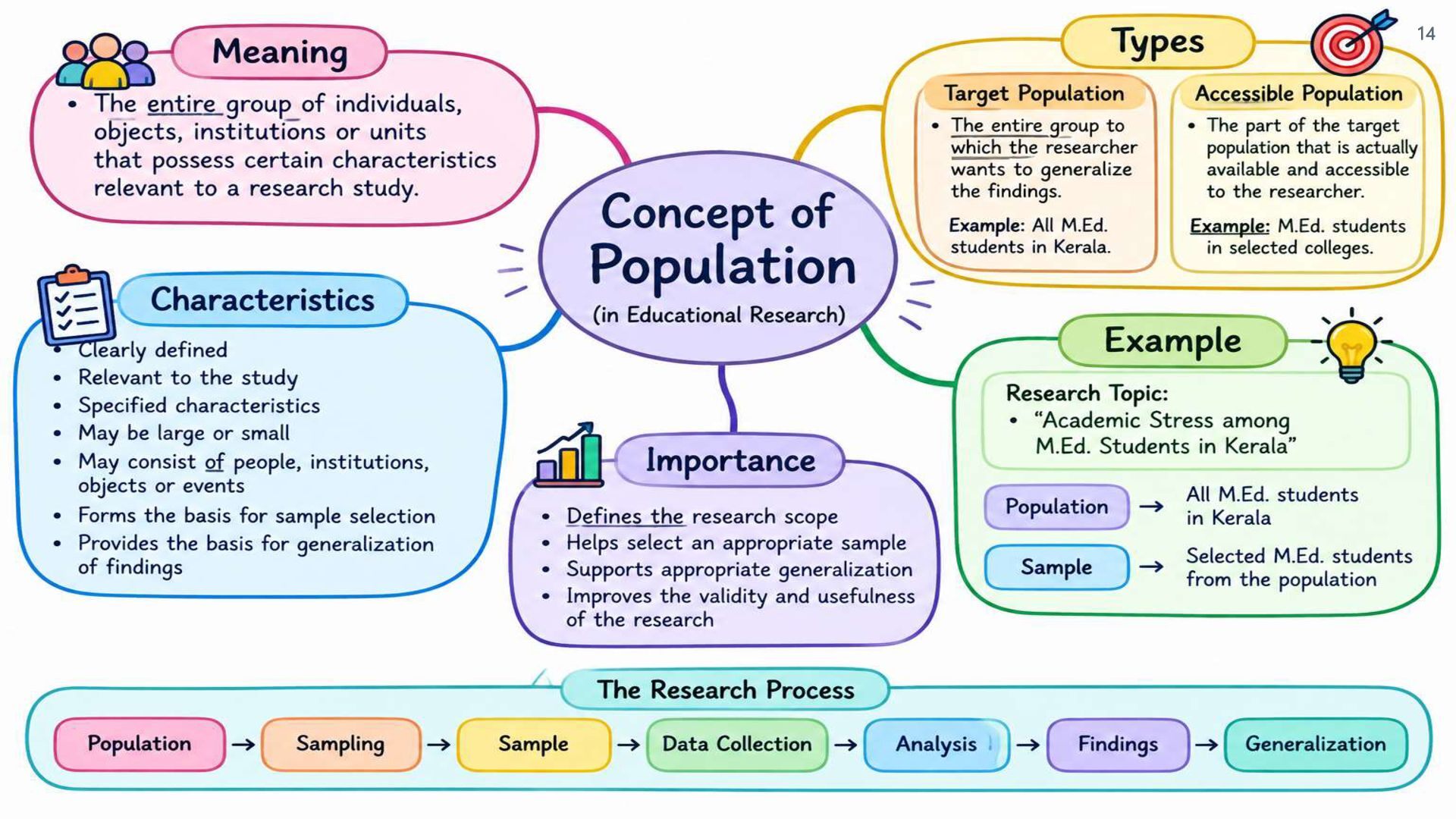
  14. 14

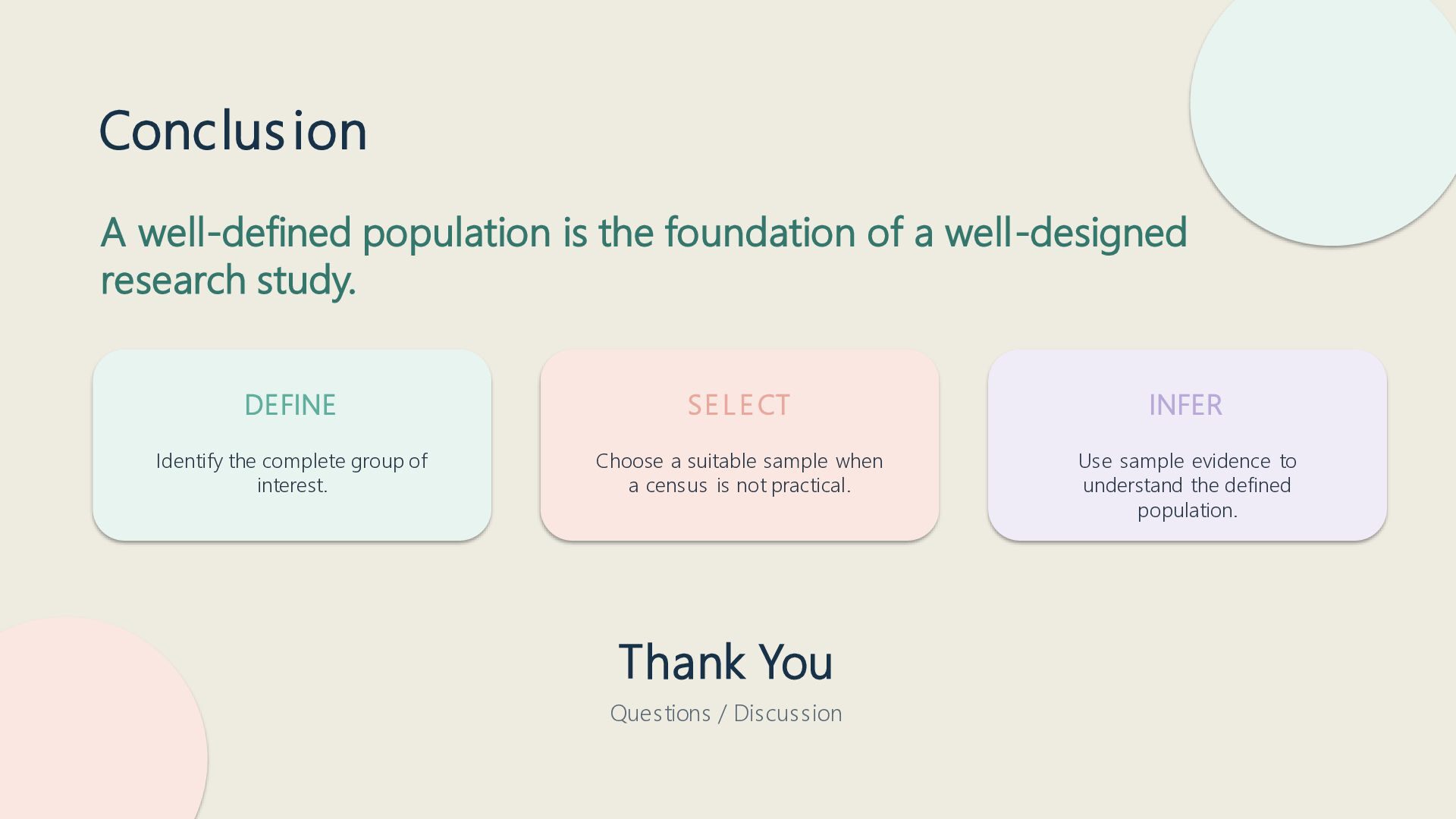
  15. Conclus ion A well-defined population is the foundation of a

    well-designed research study. DEFINE SE L E CT INFER Identify the complete group of interest. Choose a suitable sample when a census is not practical. Use sample evidence to understand the defined population. Thank You Questions / Discussion