Upgrade to Pro — share decks privately, control downloads, hide ads and more …

From Prediction to Understanding: Causal Discov...

Sponsored · Your Podcast. Everywhere. Effortlessly. Share. Educate. Inspire. Entertain. You do you. We'll handle the rest.

From Prediction to Understanding: Causal Discovery for Data Science and AI Applications

EcoSta2026

Avatar for Shohei SHIMIZU

Shohei SHIMIZU

August 08, 2026

More Decks by Shohei SHIMIZU

Other Decks in Science

Transcript

  1. EcoSta2026 From Prediction to Understanding: Causal Discovery for Data Science

    and AI Applications Shohei Shimizu Univ. Osaka, Shiga Univ & RIKEN
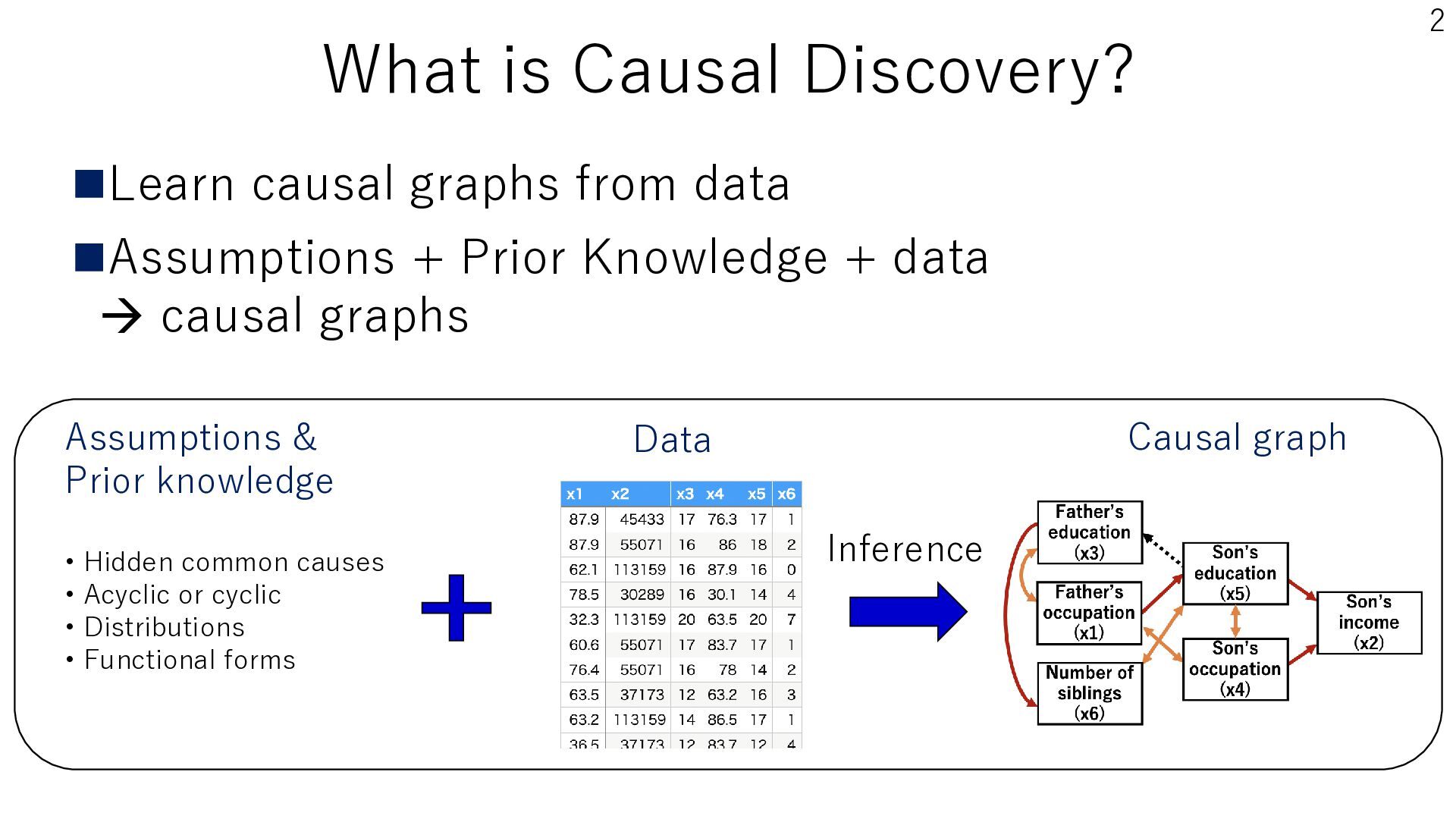
  2. What is Causal Discovery? ◼Learn causal graphs from data ◼Assumptions

    + Prior Knowledge + data → causal graphs Assumptions & Prior knowledge • Hidden common causes • Acyclic or cyclic • Distributions • Functional forms Causal graph Data Inference 2
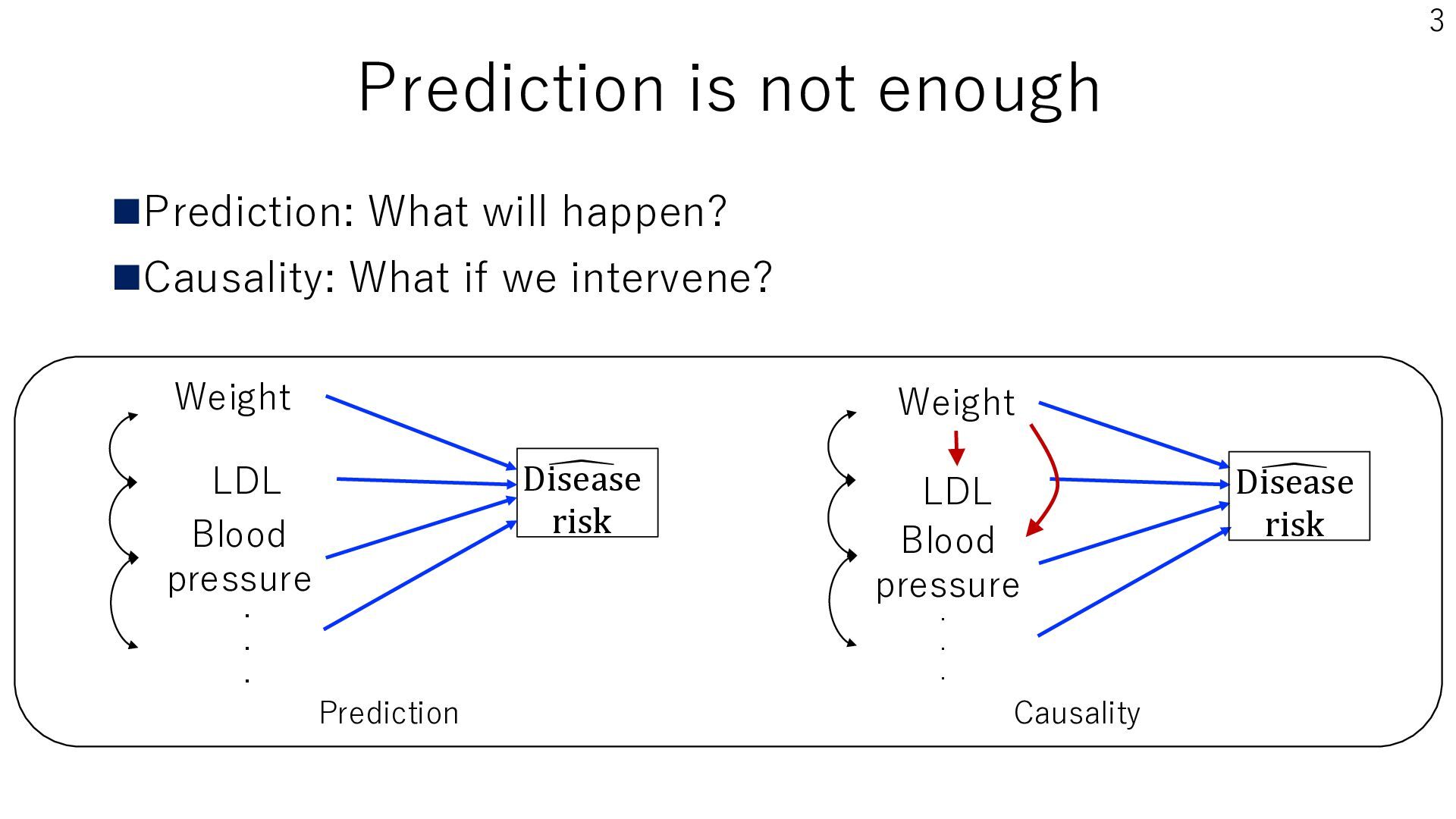
  3. 3 Prediction is not enough ◼Prediction: What will happen? ◼Causality:

    What if we intervene? Weight Weight ෣ Disease risk LDL Blood pressure . . . LDL Blood pressure . . . Prediction Causality ෣ Disease risk
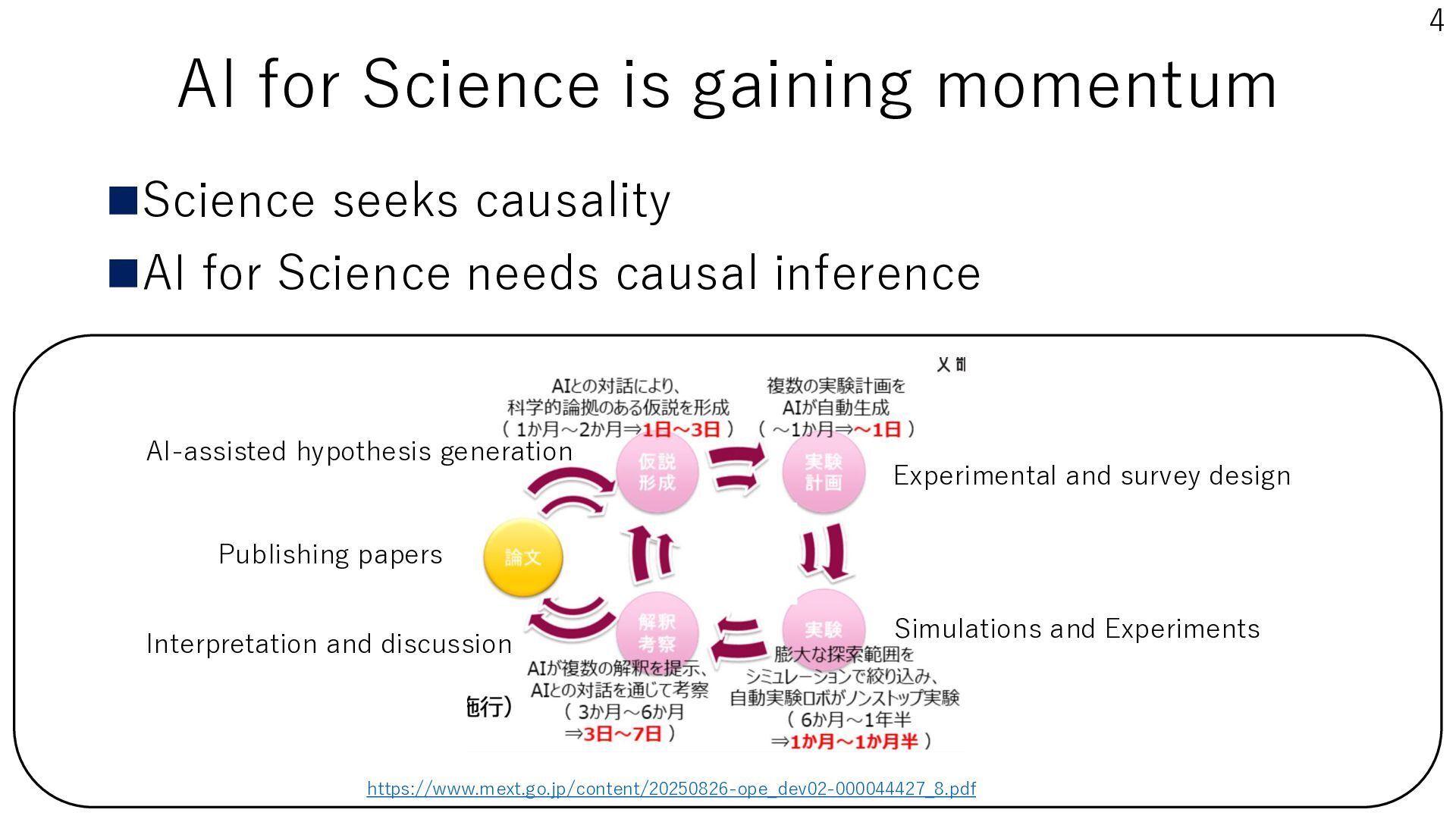
  4. 4 AI for Science is gaining momentum ◼Science seeks causality

    ◼AI for Science needs causal inference AI-assisted hypothesis generation Experimental and survey design Publishing papers Interpretation and discussion Simulations and Experiments https://www.mext.go.jp/content/20250826-ope_dev02-000044427_8.pdf
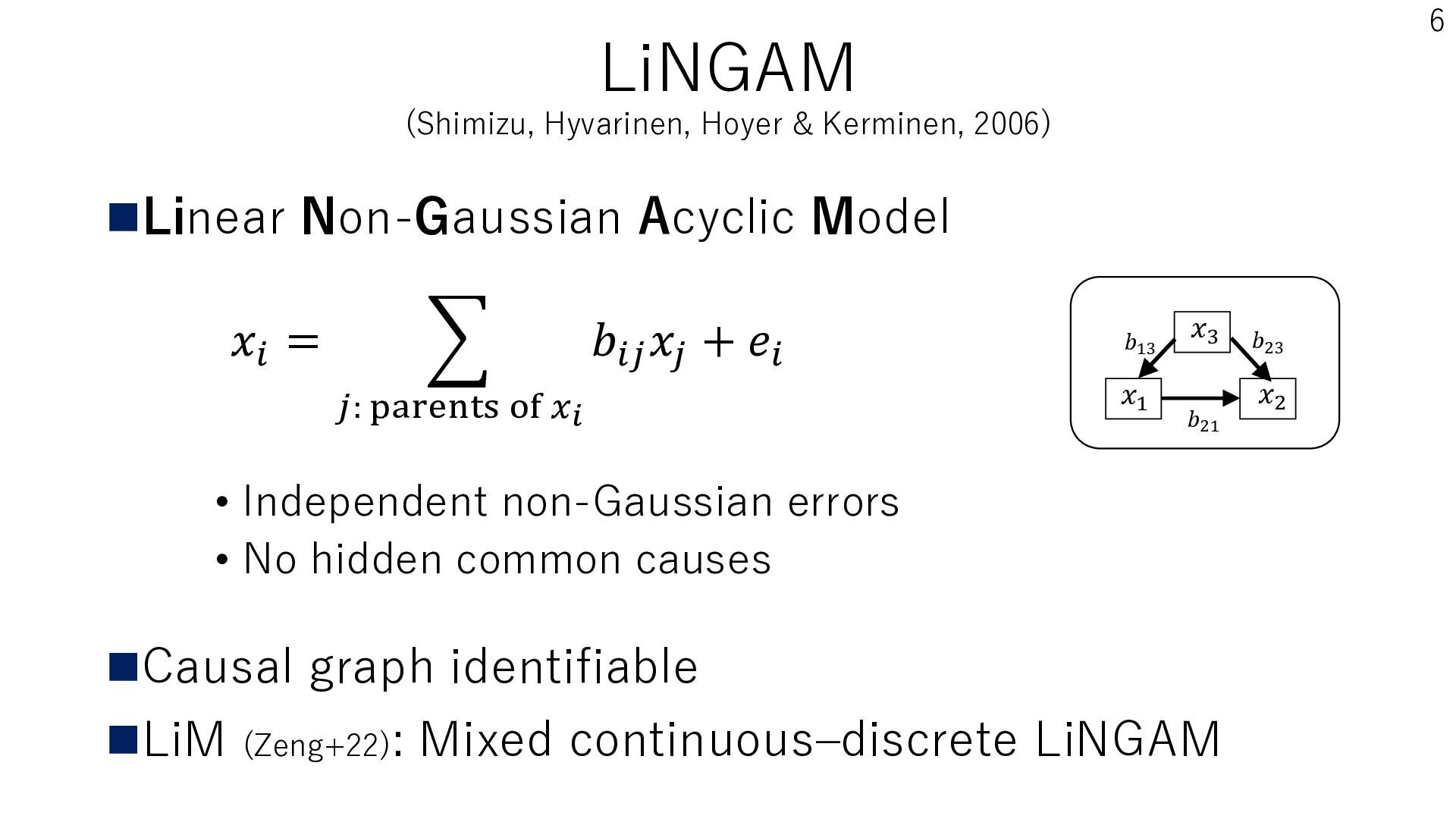
  5. 6 LiNGAM (Shimizu, Hyvarinen, Hoyer & Kerminen, 2006) ◼Linear Non-Gaussian

    Acyclic Model 𝑥𝑖 = ෍ 𝑏𝑖𝑗 𝑥𝑗 + 𝑒𝑖 𝑗: parents of 𝑥𝑖 𝑏13 𝑥1 𝑥3 𝑏21 • Independent non-Gaussian errors • No hidden common causes ◼Causal graph identifiable ◼LiM (Zeng+22): Mixed continuous–discrete LiNGAM 𝑏23 𝑥2
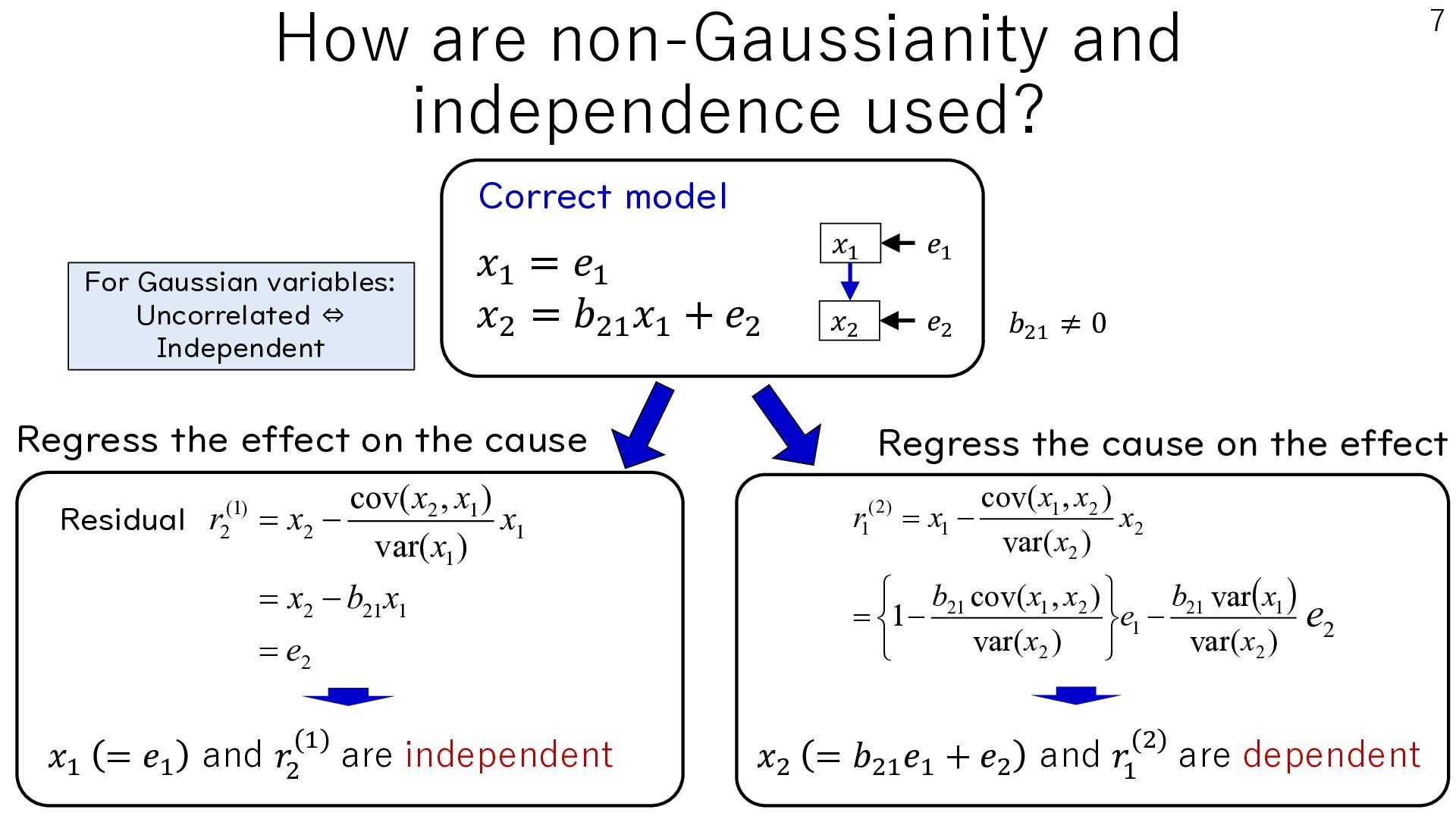
  6. How are non-Gaussianity and independence used? 7 Correct model For

    Gaussian variables: Uncorrelated ⇔ Independent 𝑥1 = 𝑒1 𝑥2 = 𝑏21 𝑥1 + 𝑒2 Regress the effect on the cause (1) 2 Residual r cov( x2 , x1 ) = x2 − x1 var( x1 ) = x2 − b21 x1 = e2 (1) 𝑥1 = 𝑒1 and 𝑟2 are independent 𝑥1 𝑒1 𝑥2 𝑒2 𝑏21 ≠ 0 Regress the cause on the effect r1( 2 ) = x1 − cov( x1 , x2 ) x2 var( x2 )  b21 cov( x1 , x2 )  b21 var( x1 ) = 1 − e2 e1 − var( x2 )  var( x2 )  (2) 𝑥2 = 𝑏21 𝑒1 + 𝑒2 and 𝑟1 are dependent
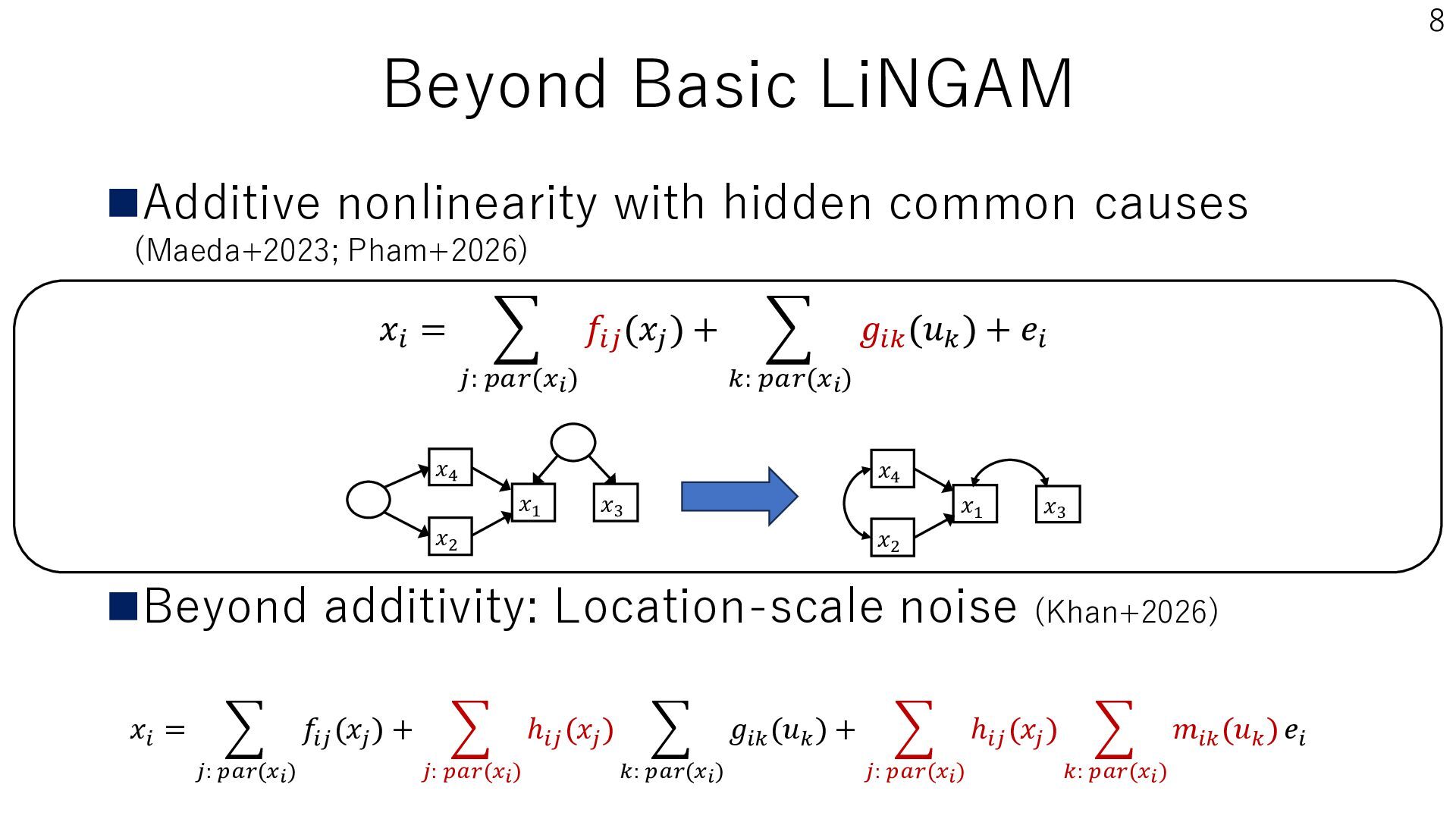
  7. 8 Beyond Basic LiNGAM ◼Additive nonlinearity with hidden common causes

    (Maeda+2023; Pham+2026) 𝑥𝑖 = ෍ 𝑓𝑖𝑗 (𝑥𝑗 ) + 𝑗: 𝑝𝑎𝑟(𝑥𝑖 ) ෍ 𝑔𝑖𝑘 (𝑢𝑘 ) + 𝑒𝑖 𝑘: 𝑝𝑎𝑟(𝑥𝑖 ) 𝑥4 𝑥4 𝑥1 𝑥3 𝑥1 𝑥2 𝑥3 𝑥2 ◼Beyond additivity: Location-scale noise (Khan+2026) 𝑥𝑖 = ෍ 𝑗: 𝑝𝑎𝑟(𝑥𝑖 ) 𝑓𝑖𝑗 (𝑥𝑗 ) + ෍ 𝑗: 𝑝𝑎𝑟(𝑥𝑖 ) ℎ𝑖𝑗 (𝑥𝑗 ) ෍ 𝑘: 𝑝𝑎𝑟(𝑥𝑖 ) 𝑔𝑖𝑘 (𝑢𝑘 ) + ෍ 𝑗: 𝑝𝑎𝑟(𝑥𝑖 ) ℎ𝑖𝑗 (𝑥𝑗 ) ෍ 𝑘: 𝑝𝑎𝑟(𝑥𝑖 ) 𝑚𝑖𝑘 (𝑢𝑘 ) 𝑒𝑖
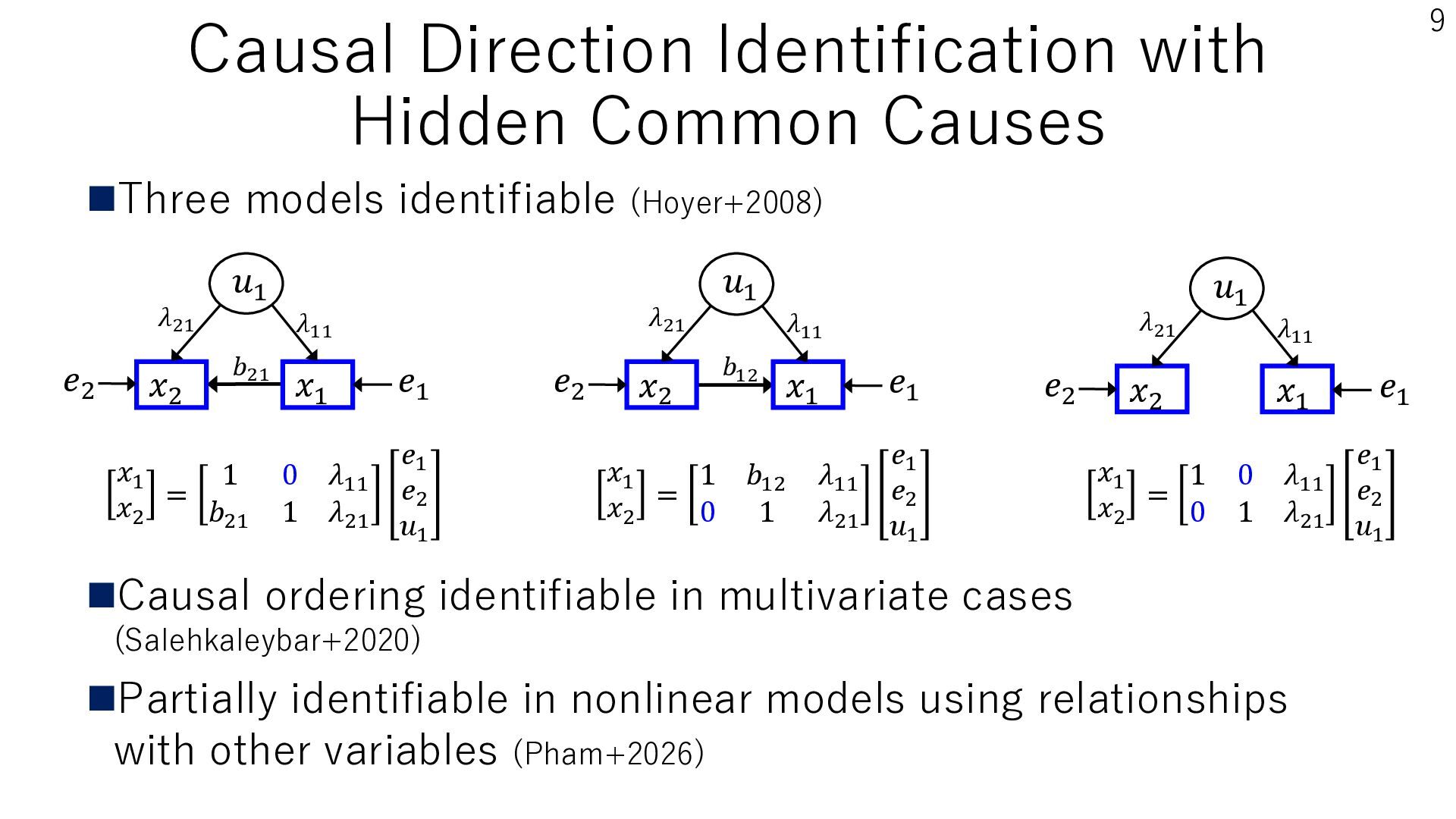
  8. 9 Causal Direction Identification with Hidden Common Causes ◼Three models

    identifiable (Hoyer+2008) 𝜆21 𝑒2 𝑥2 𝑢1 𝜆21 𝜆11 𝑏21 𝑥1 1 𝑥2 = 𝑏21 𝑥1 𝑒1 𝑒 0 𝜆11 𝑒1 2 1 𝜆21 𝑢 1 𝑒2 𝑥2 𝑢1 𝜆21 𝜆11 𝑏12 𝑥1 𝑥1 1 𝑏12 𝑥2 = 0 1 𝑒1 𝑒2 𝑒 𝜆11 𝑒1 2 𝜆21 𝑢 1 𝑥2 𝑢1 𝜆11 𝑥1 𝑒1 𝑒 𝑥1 1 0 𝜆11 𝑒1 𝑥2 = 0 1 𝜆21 2 𝑢1 ◼Causal ordering identifiable in multivariate cases (Salehkaleybar+2020) ◼Partially identifiable in nonlinear models using relationships with other variables (Pham+2026)
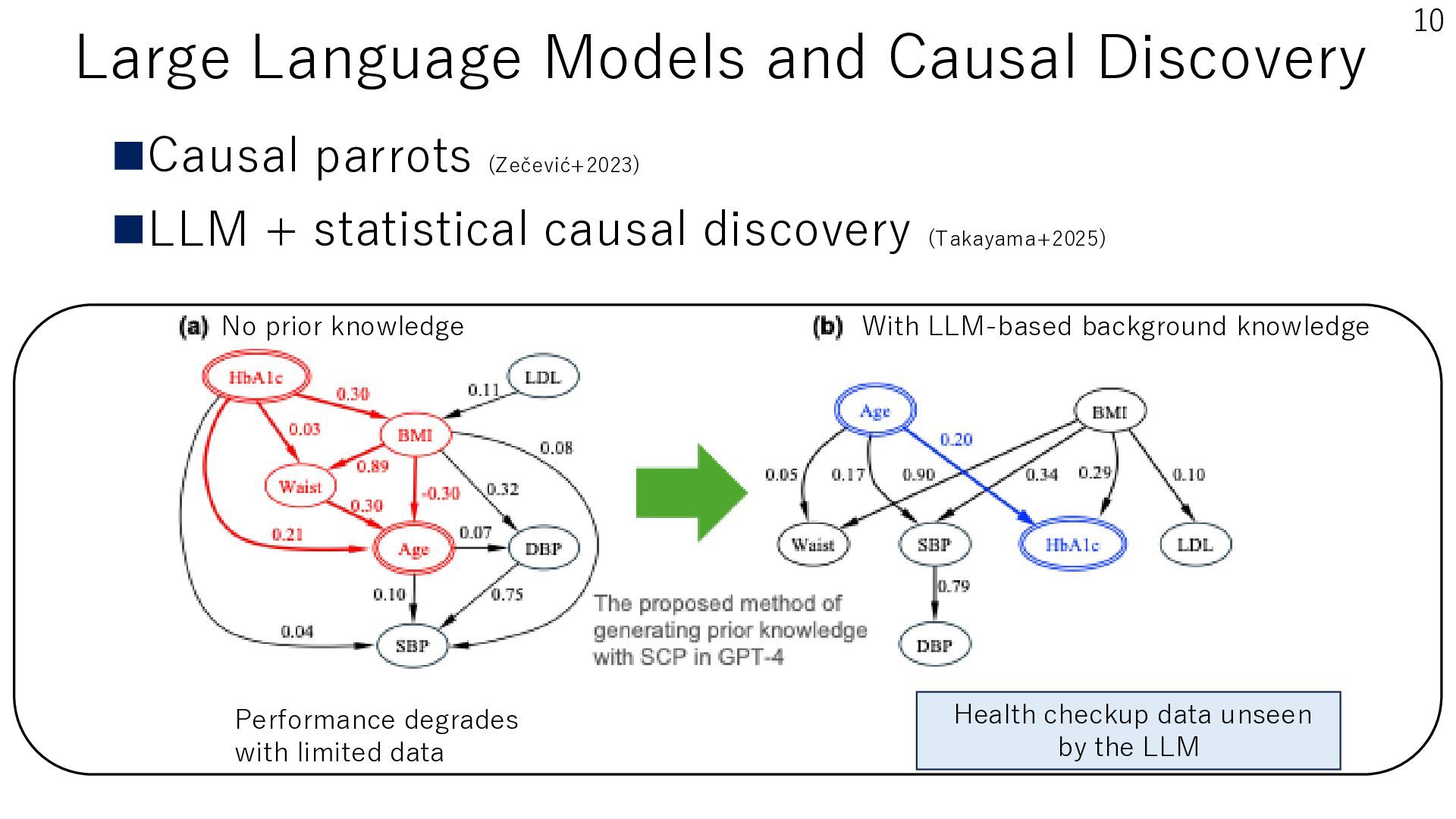
  9. Large Language Models and Causal Discovery ◼Causal parrots (Zečević+2023) ◼LLM

    + statistical causal discovery (Takayama+2025) No prior knowledge Performance degrades with limited data With LLM-based background knowledge Health checkup data unseen by the LLM 10
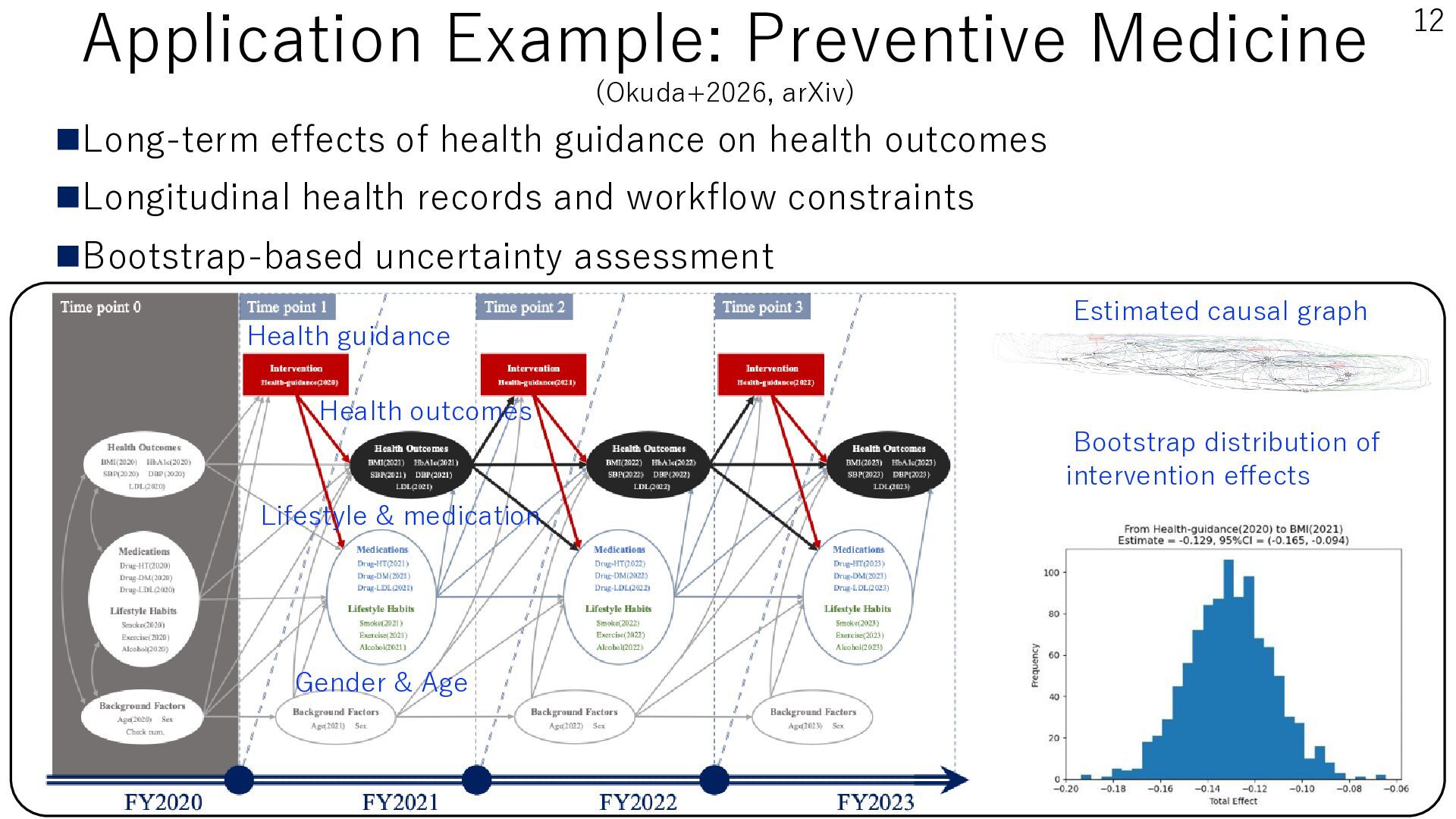
  10. Application Example: Preventive Medicine (Okuda+2026, arXiv) ◼Long-term effects of health

    guidance on health outcomes ◼Longitudinal health records and workflow constraints ◼Bootstrap-based uncertainty assessment Health guidance Estimated causal graph Health outcomes Bootstrap distribution of intervention effects Lifestyle & medication Gender & Age 12
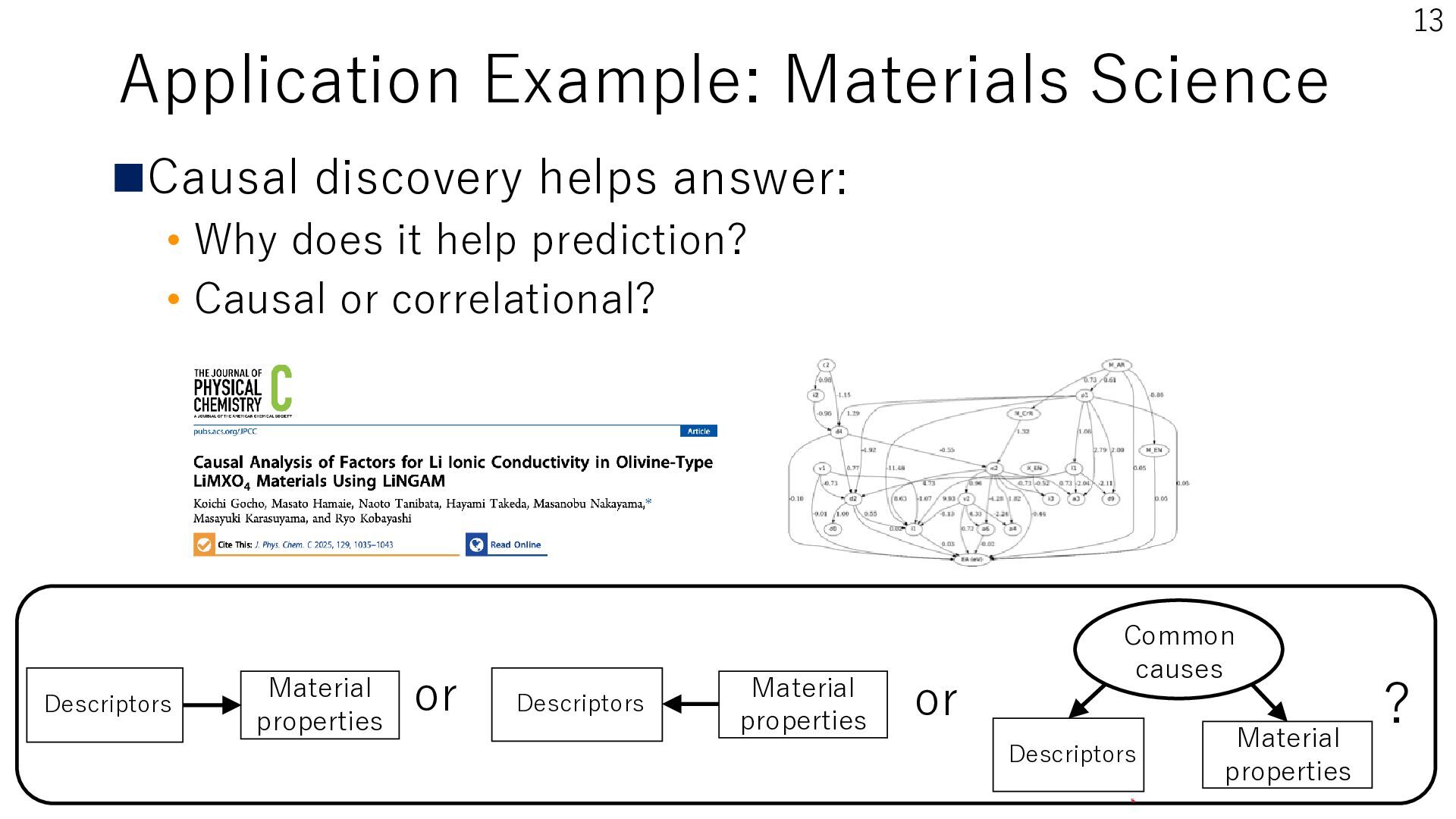
  11. 13 Application Example: Materials Science ◼Causal discovery helps answer: •

    Why does it help prediction? • Causal or correlational? Descriptors Material properties or Descriptors Material properties or Common causes Descriptors Material properties ?
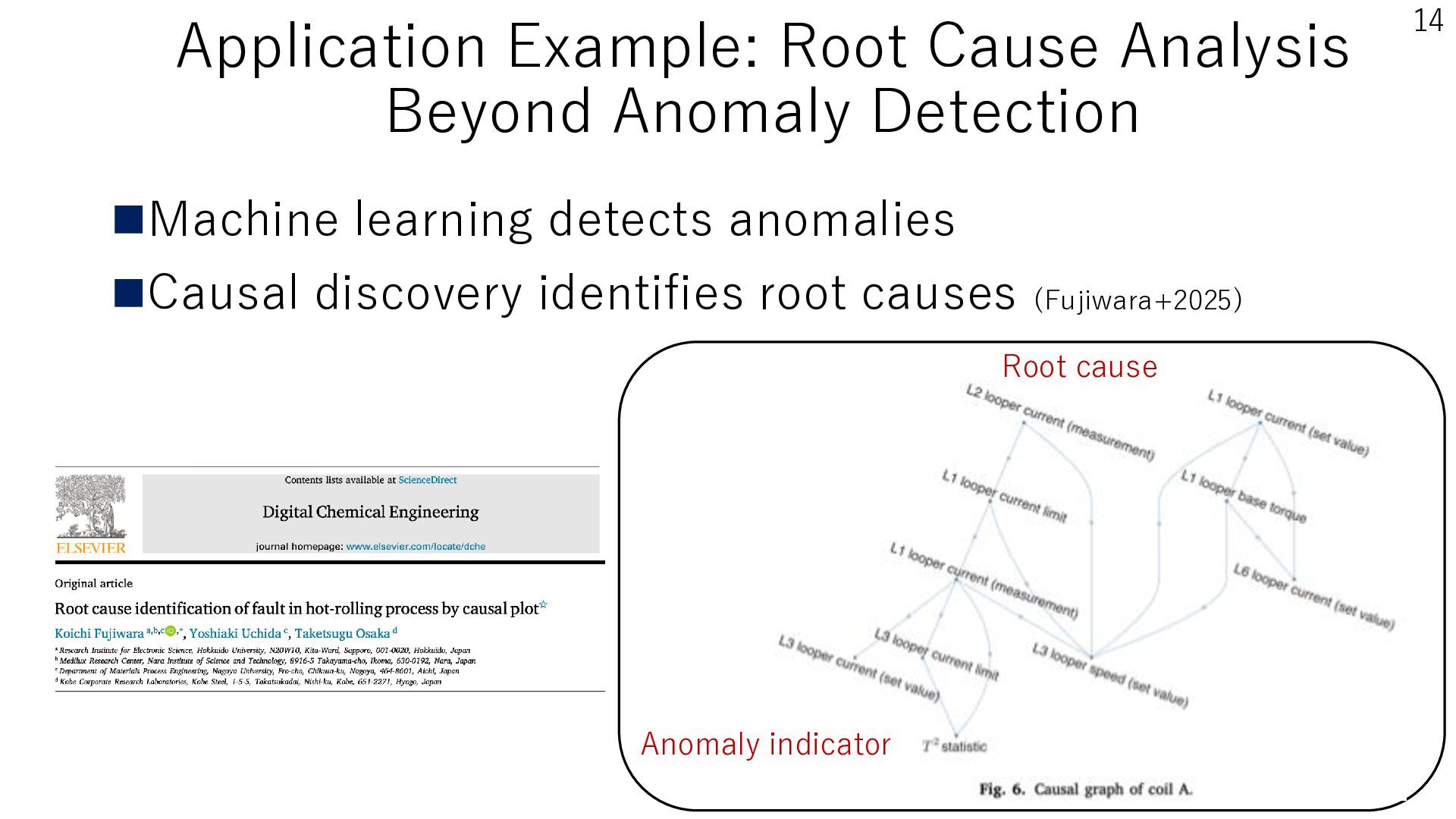
  12. Application Example: Root Cause Analysis Beyond Anomaly Detection ◼Machine learning

    detects anomalies ◼Causal discovery identifies root causes (Fujiwara+2025) Root cause Anomaly indicator 14
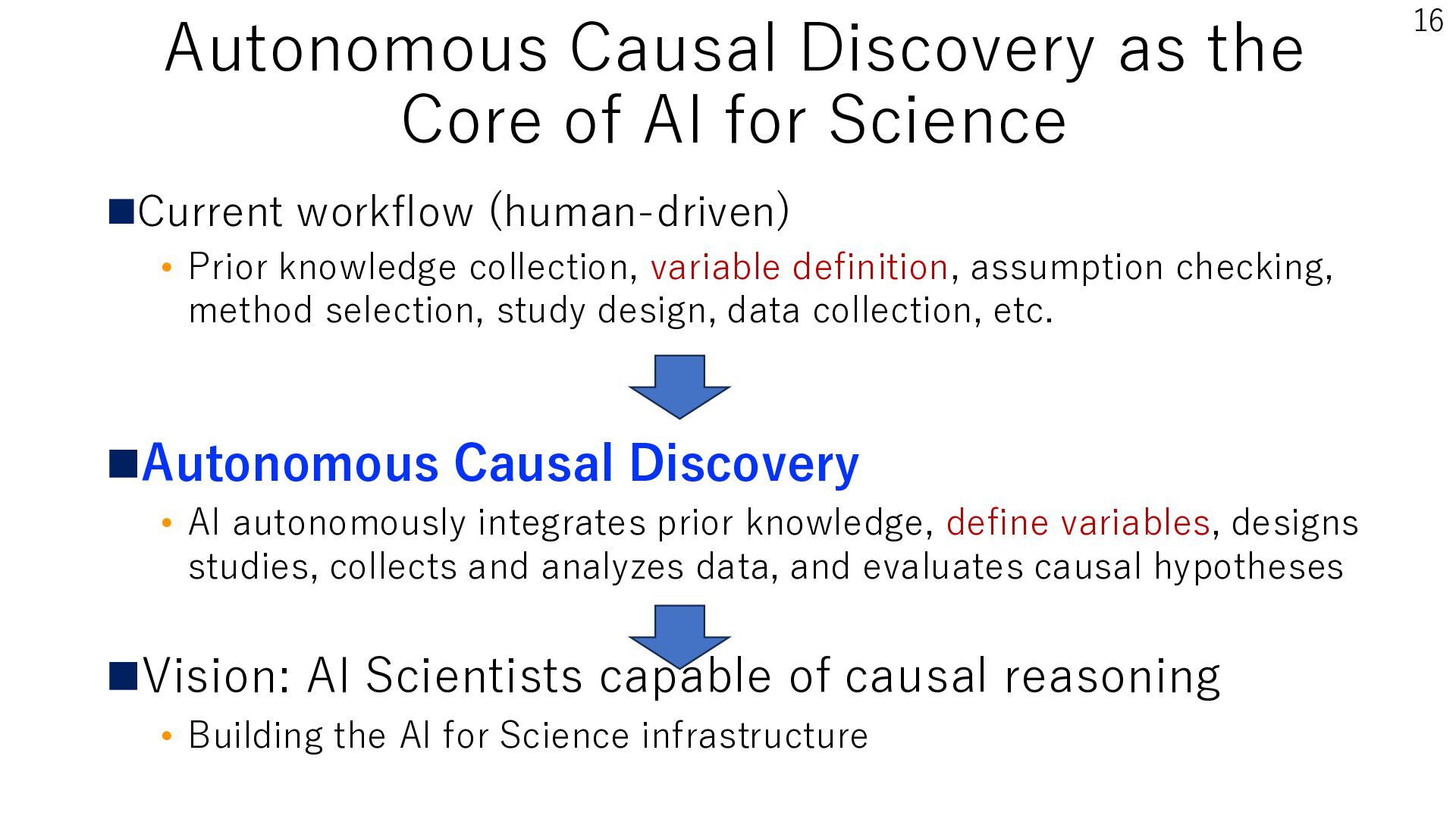
  13. Autonomous Causal Discovery as the Core of AI for Science

    ◼Current workflow (human-driven) • Prior knowledge collection, variable definition, assumption checking, method selection, study design, data collection, etc. ◼Autonomous Causal Discovery • AI autonomously integrates prior knowledge, define variables, designs studies, collects and analyzes data, and evaluates causal hypotheses ◼Vision: AI Scientists capable of causal reasoning • Building the AI for Science infrastructure 16
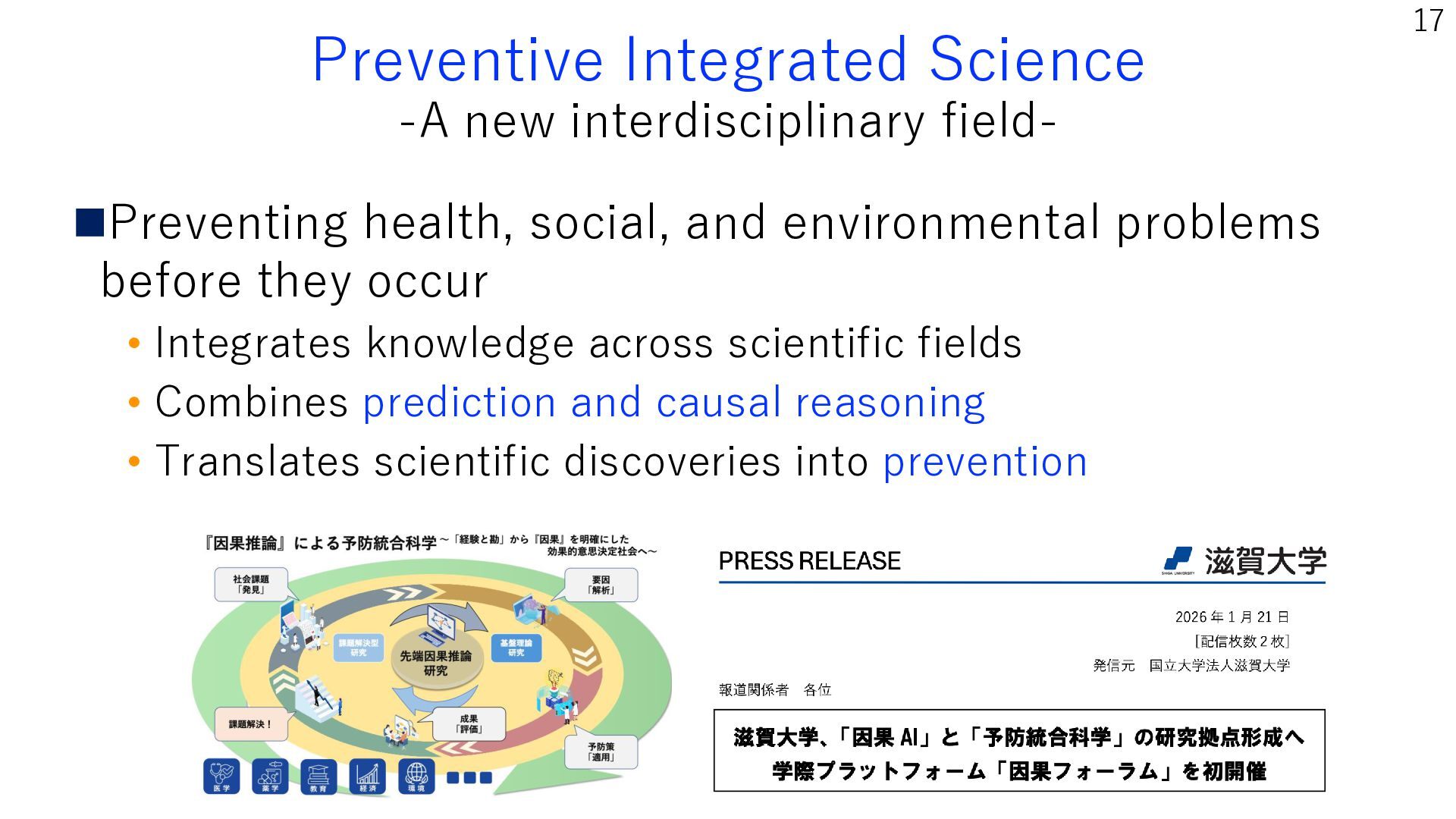
  14. Preventive Integrated Science -A new interdisciplinary field◼Preventing health, social, and

    environmental problems before they occur • Integrates knowledge across scientific fields • Combines prediction and causal reasoning • Translates scientific discoveries into prevention 17
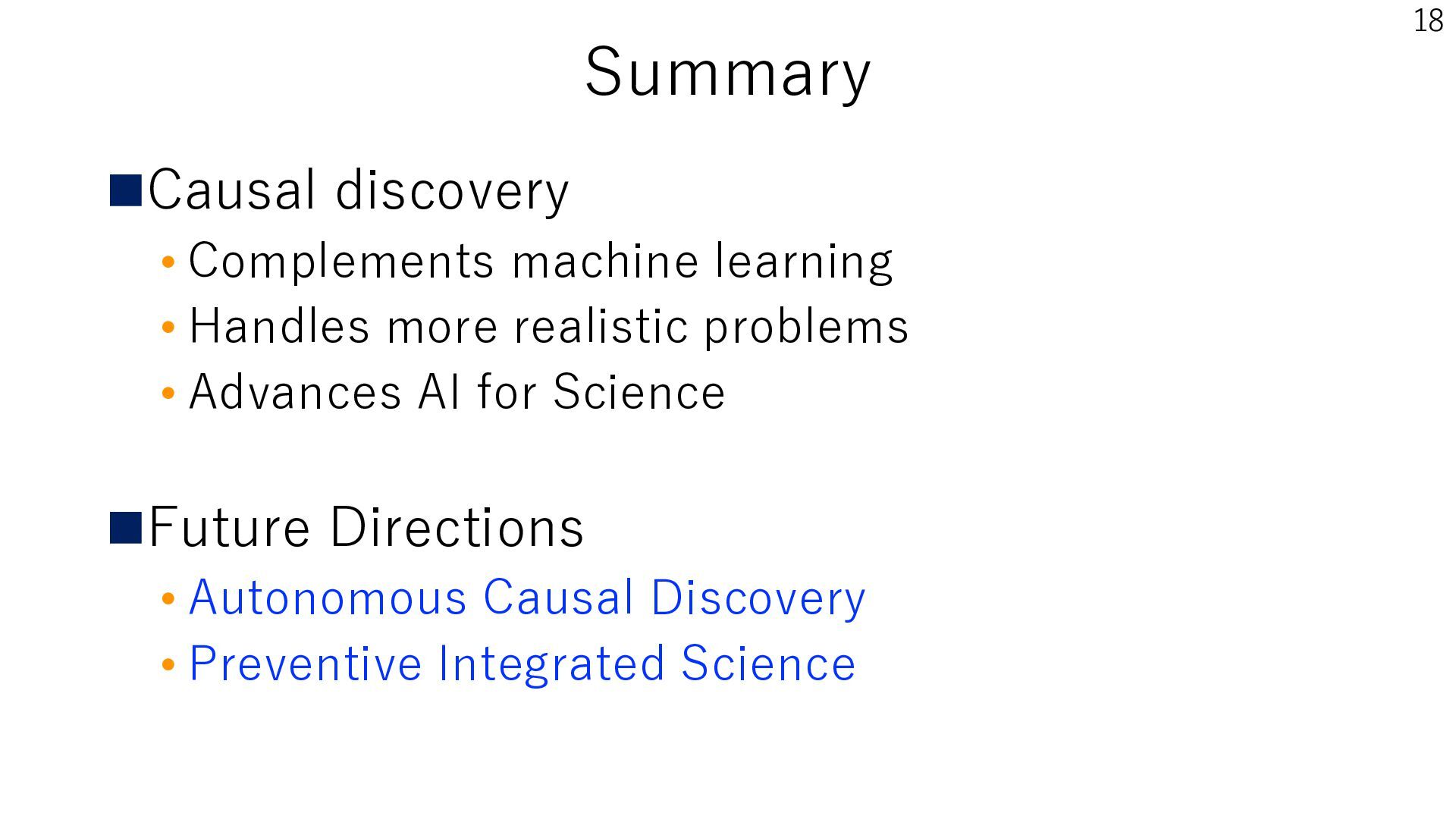
  15. 18 Summary ◼Causal discovery • Complements machine learning • Handles

    more realistic problems • Advances AI for Science ◼Future Directions • Autonomous Causal Discovery • Preventive Integrated Science