Upgrade to Pro — share decks privately, control downloads, hide ads and more …

20,000 Leagues Under the Ⓩ: A Zcash Deep-Dive

Avatar for str4d str4d
June 21, 2018

20,000 Leagues Under the Ⓩ: A Zcash Deep-Dive

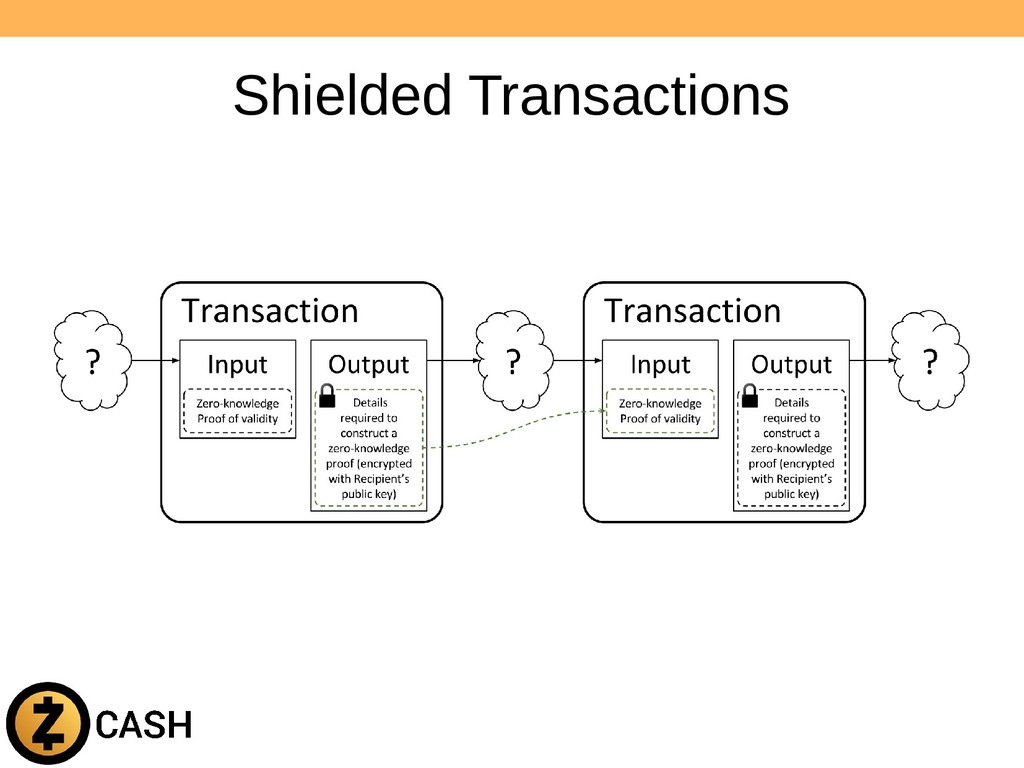
Zcash is an open-source cybercoin that offers privacy and selective transparency of transactions. Zcash uses advanced cryptographic techniques, namely zero-knowledge proofs, to guarantee the validity of transactions without revealing additional information about them. The upcoming Sapling network upgrade contains breakthrough cryptographic innovations that result in improvements to performance, security, and usability.

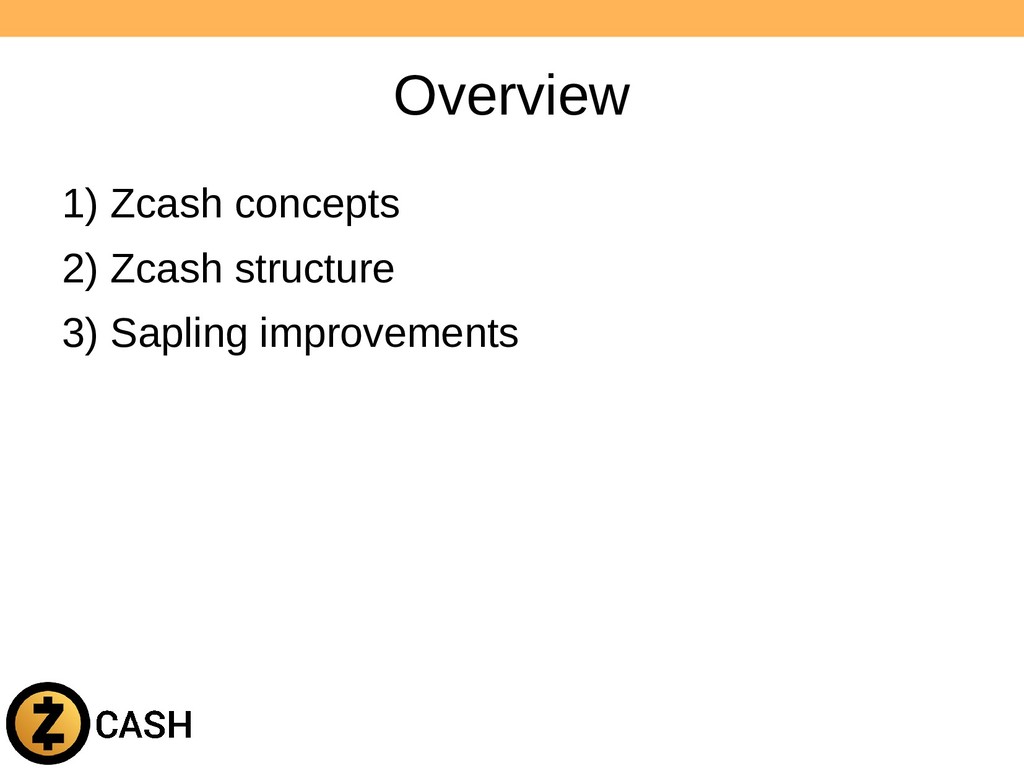
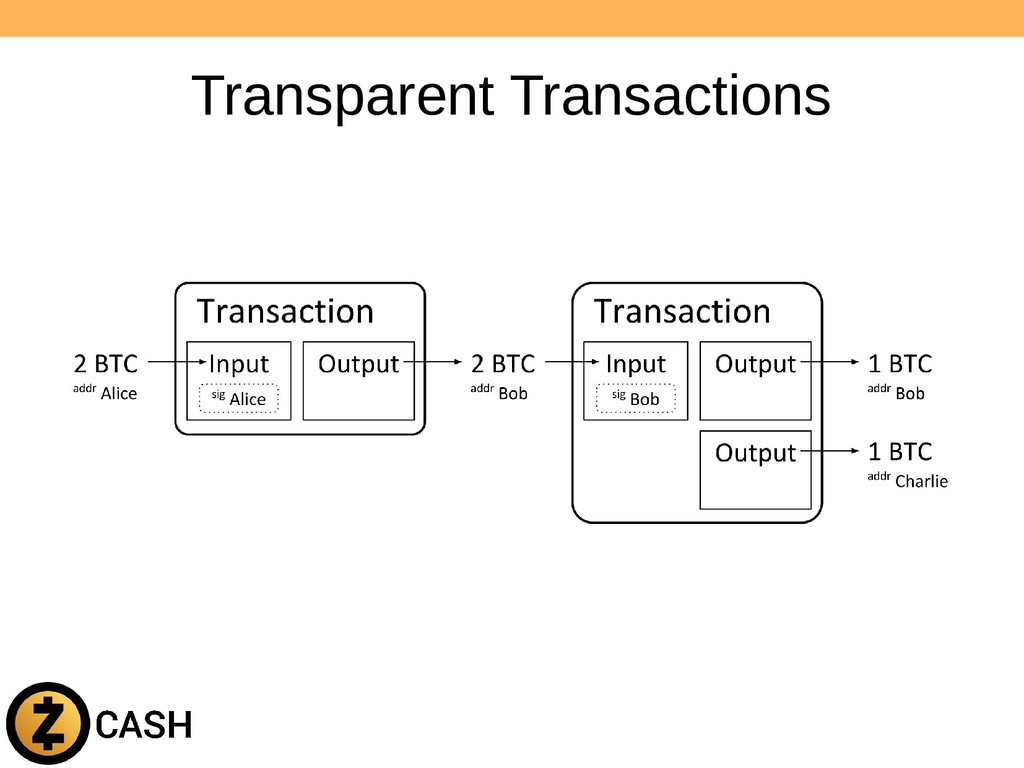
This talk starts with a brief overview of Zcash, outlining the modifications that were made to the Bitcoin design in order to support privacy-preserving "shielded" transactions. From there, we delve into the cryptographic design of shielded transactions themselves, and how zk-SNARKs are leveraged to create privacy in a public block chain. Finally, we examine the Sapling upgrade, stepping through the myriad of academic papers and engineering tricks to understand just how the upcoming performance, security, and usability improvements have been achieved.

Avatar for str4d

str4d

June 21, 2018

Other Decks in Research

Transcript

  1. 2) The Zcash Sub-Structure 1 2 3 4 5 6

    Voytek S [CC BY 3.0], via Wikimedia Commons
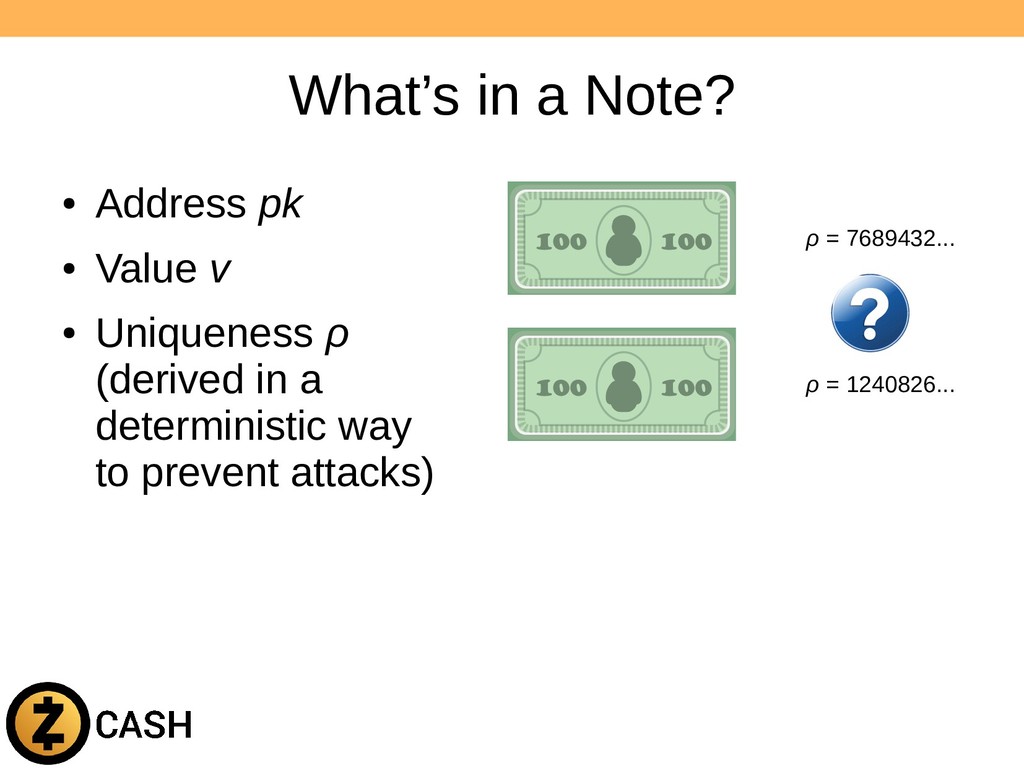
  2. What’s in a Note? • Address pk • Value v

    • Uniqueness ρ (derived in a deterministic way to prevent attacks) ρ = 7689432... ρ = 1240826...
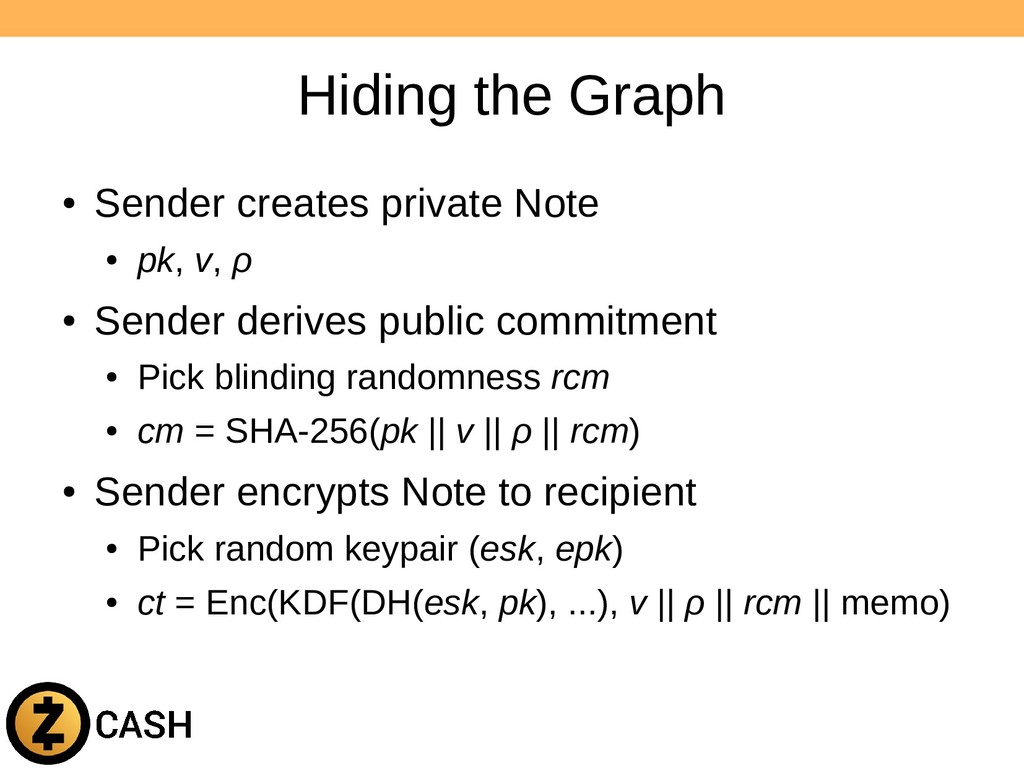
  3. Hiding the Graph • Sender creates private Note • pk,

    v, ρ • Sender derives public commitment • Pick blinding randomness rcm • cm = SHA-256(pk || v || ρ || rcm) • Sender encrypts Note to recipient • Pick random keypair (esk, epk) • ct = Enc(KDF(DH(esk, pk), ...), v || ρ || rcm || memo)
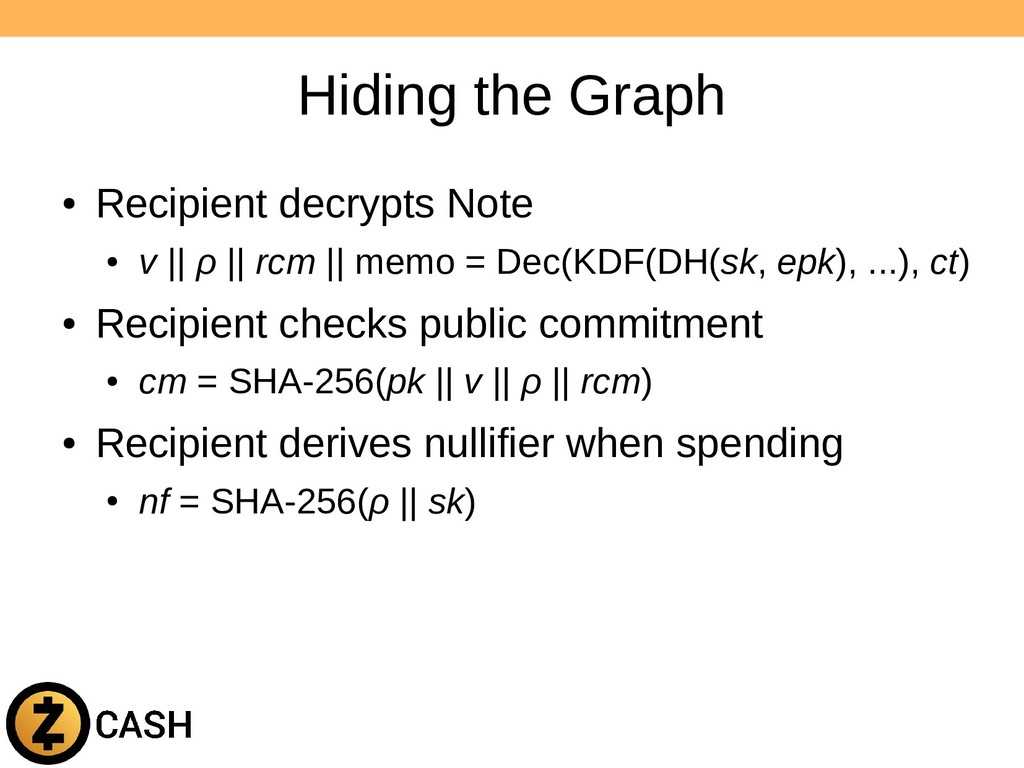
  4. Hiding the Graph • Recipient decrypts Note • v ||

    ρ || rcm || memo = Dec(KDF(DH(sk, epk), ...), ct) • Recipient checks public commitment • cm = SHA-256(pk || v || ρ || rcm) • Recipient derives nullifier when spending • nf = SHA-256(ρ || sk)
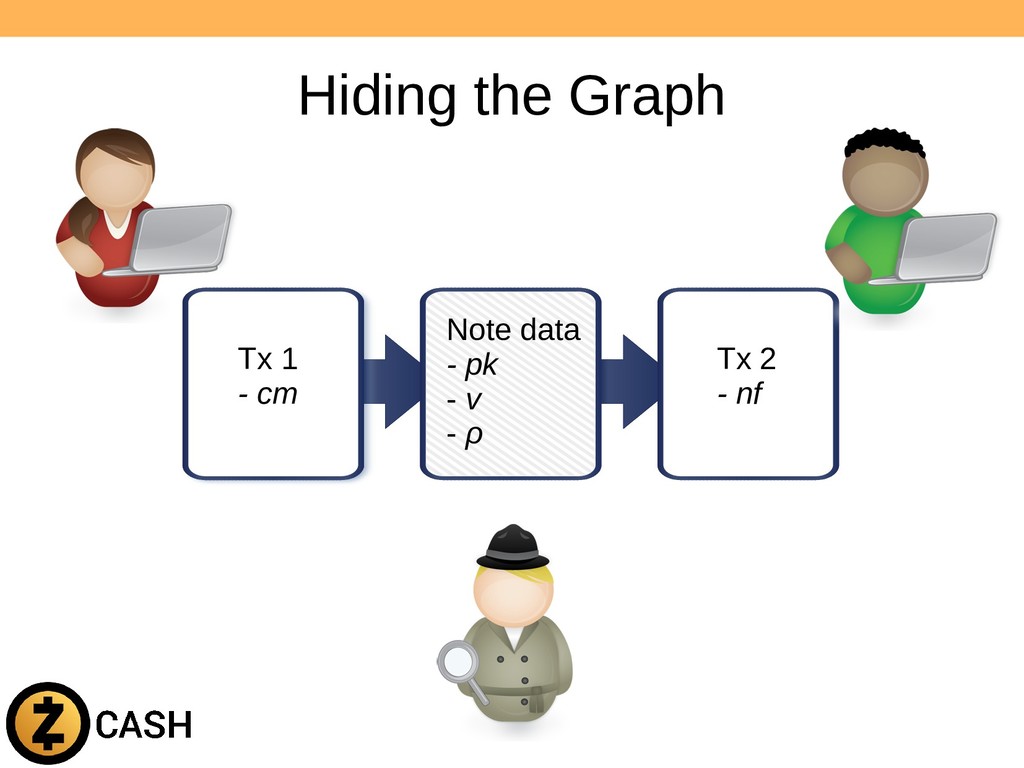
  5. Hiding the Graph Tx 1 - cm Tx 2 -

    nf Note data - pk - v - ρ
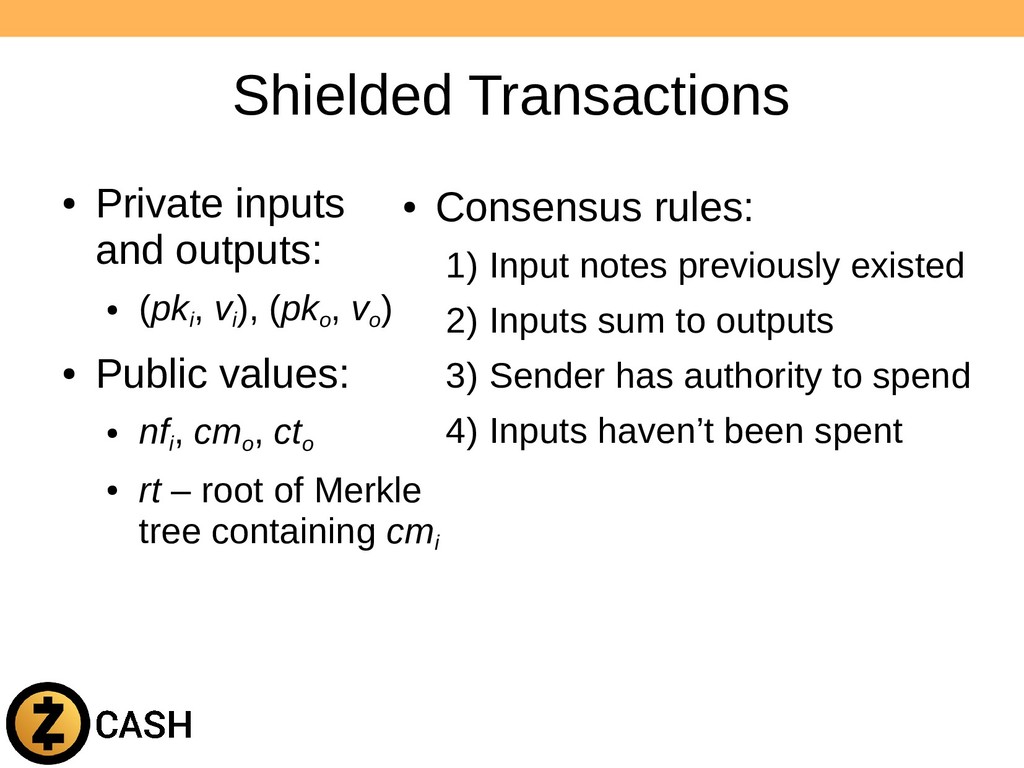
  6. Shielded Transactions • Private inputs and outputs: • (pk i

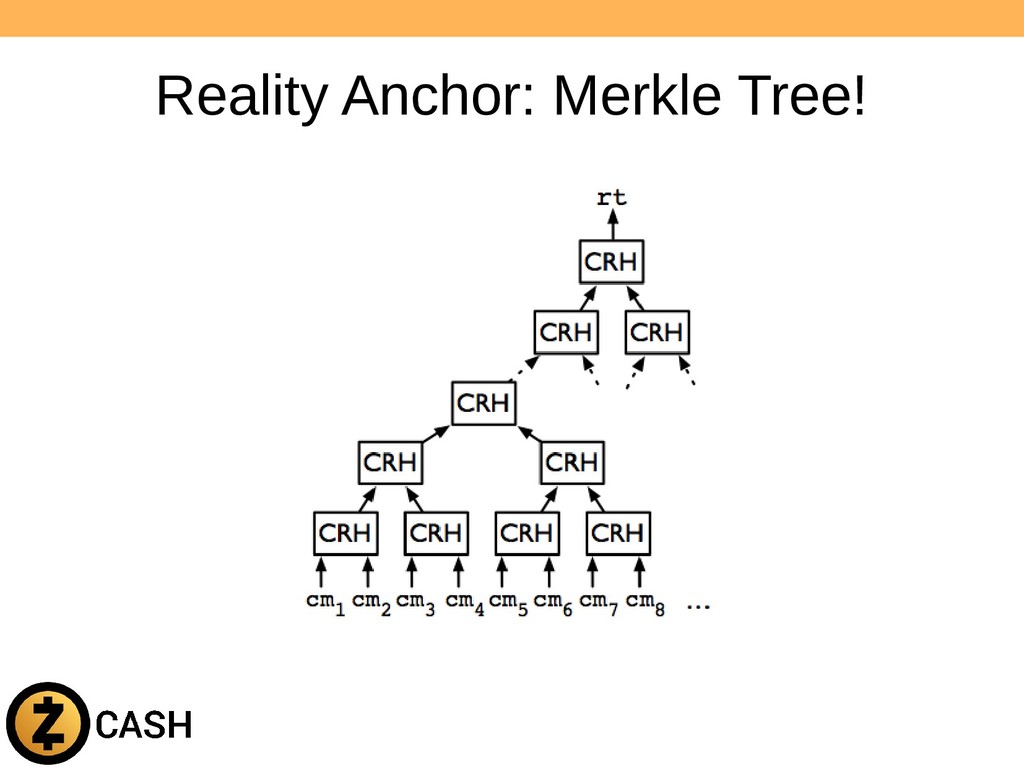
    , v i ), (pk o , v o ) • Public values: • nf i , cm o , ct o • rt – root of Merkle tree containing cm i • Consensus rules: 1) Input notes previously existed 2) Inputs sum to outputs 3) Sender has authority to spend 4) Inputs haven’t been spent
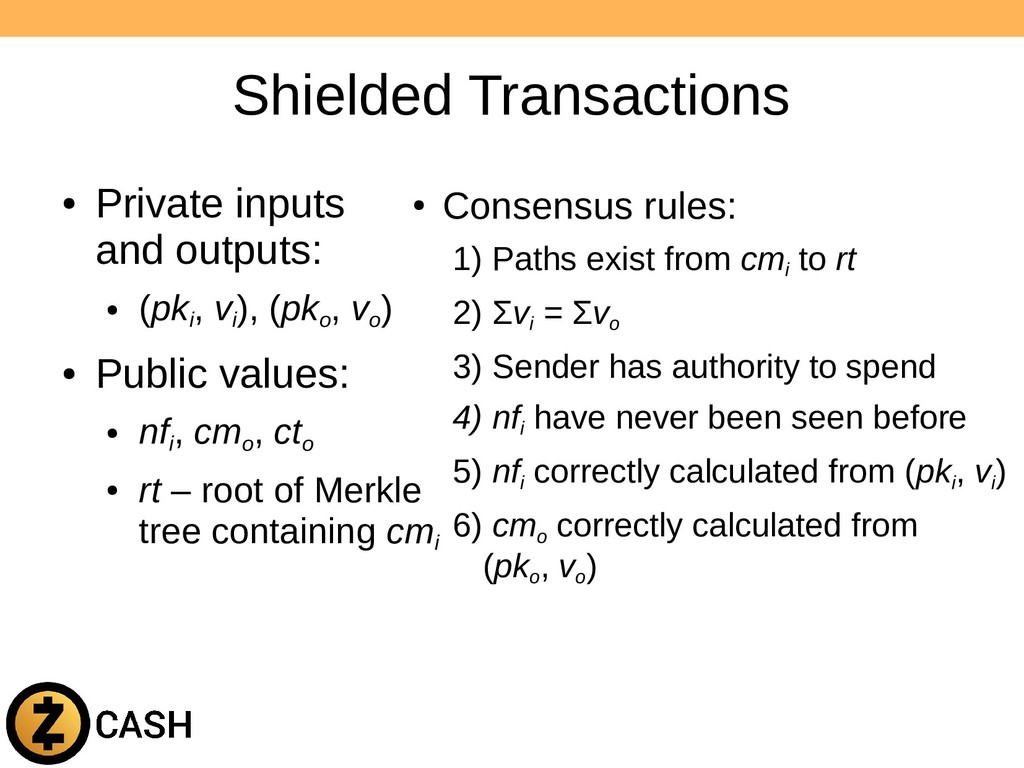
  7. Shielded Transactions • Private inputs and outputs: • (pk i

    , v i ), (pk o , v o ) • Public values: • nf i , cm o , ct o • rt – root of Merkle tree containing cm i • Consensus rules: 1) Paths exist from cm i to rt 2) Σv i = Σv o 3) Sender has authority to spend 4) nf i have never been seen before 5) nf i correctly calculated from (pk i , v i ) 6) cm o correctly calculated from (pk o , v o )
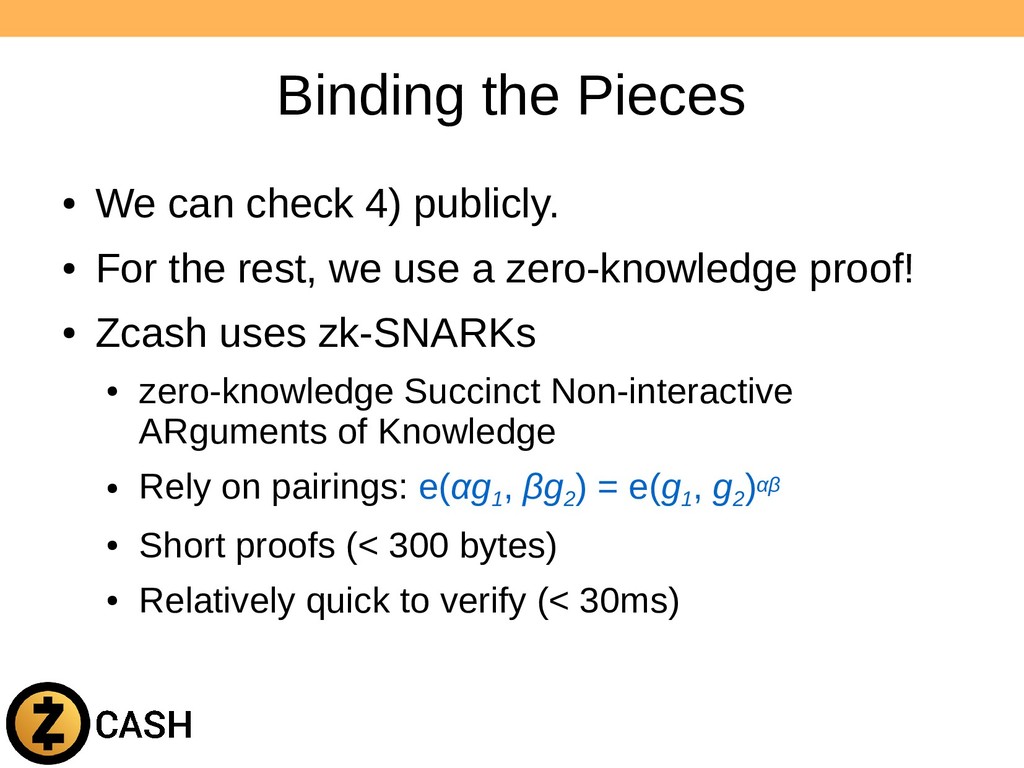
  8. Binding the Pieces • We can check 4) publicly. •

    For the rest, we use a zero-knowledge proof! • Zcash uses zk-SNARKs • zero-knowledge Succinct Non-interactive ARguments of Knowledge • Rely on pairings: e(αg 1 , βg 2 ) = e(g 1 , g 2 )αβ • Short proofs (< 300 bytes) • Relatively quick to verify (< 30ms)
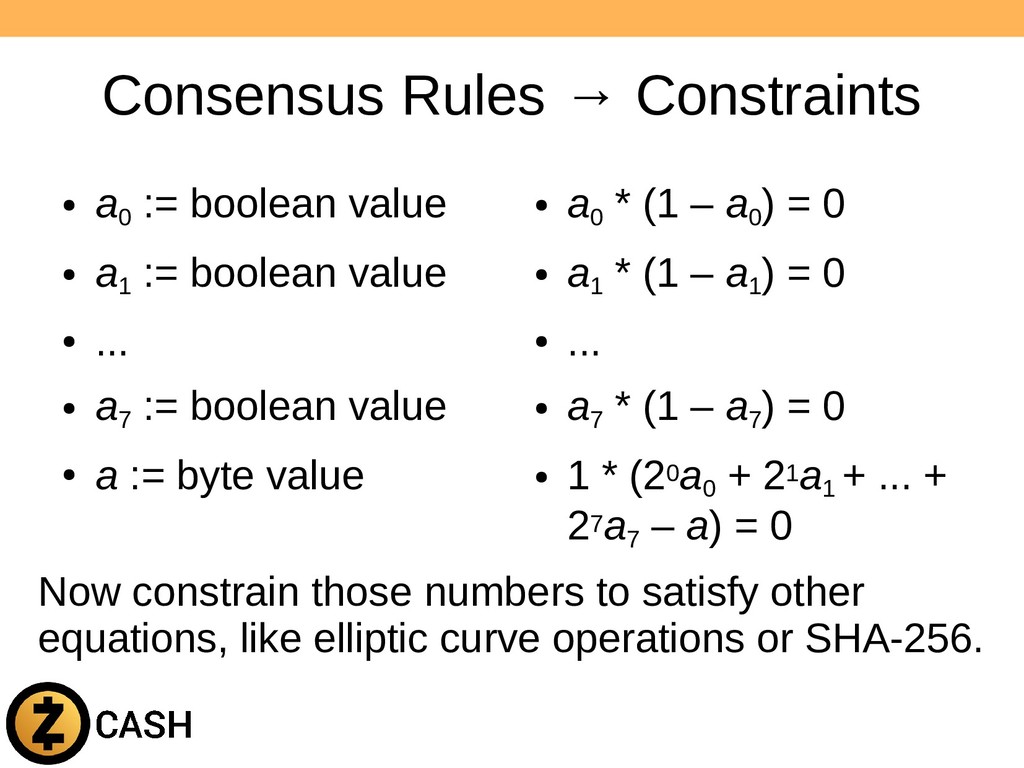
  9. Consensus Rules → Constraints • a 0 := boolean value

    • a 1 := boolean value • ... • a 7 := boolean value • a := byte value • a 0 * (1 – a 0 ) = 0 • a 1 * (1 – a 1 ) = 0 • ... • a 7 * (1 – a 7 ) = 0 • 1 * (20a 0 + 21a 1 + ... + 27a 7 – a) = 0 Now constrain those numbers to satisfy other equations, like elliptic curve operations or SHA-256.
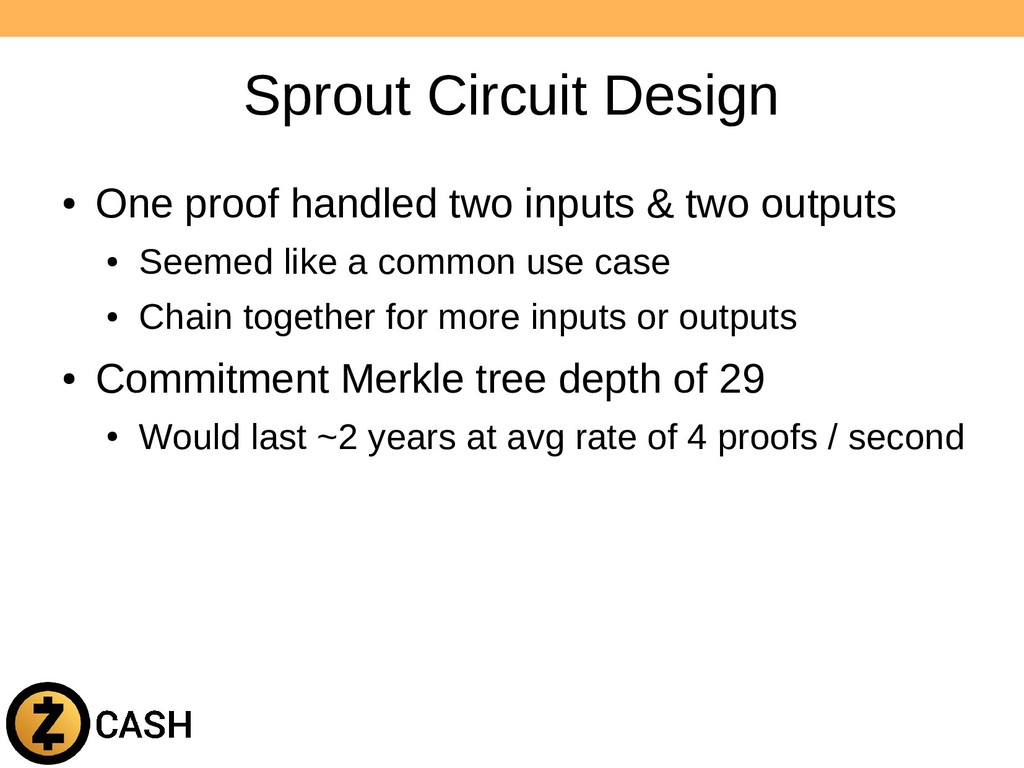
  10. Sprout Circuit Design • One proof handled two inputs &

    two outputs • Seemed like a common use case • Chain together for more inputs or outputs • Commitment Merkle tree depth of 29 • Would last ~2 years at avg rate of 4 proofs / second
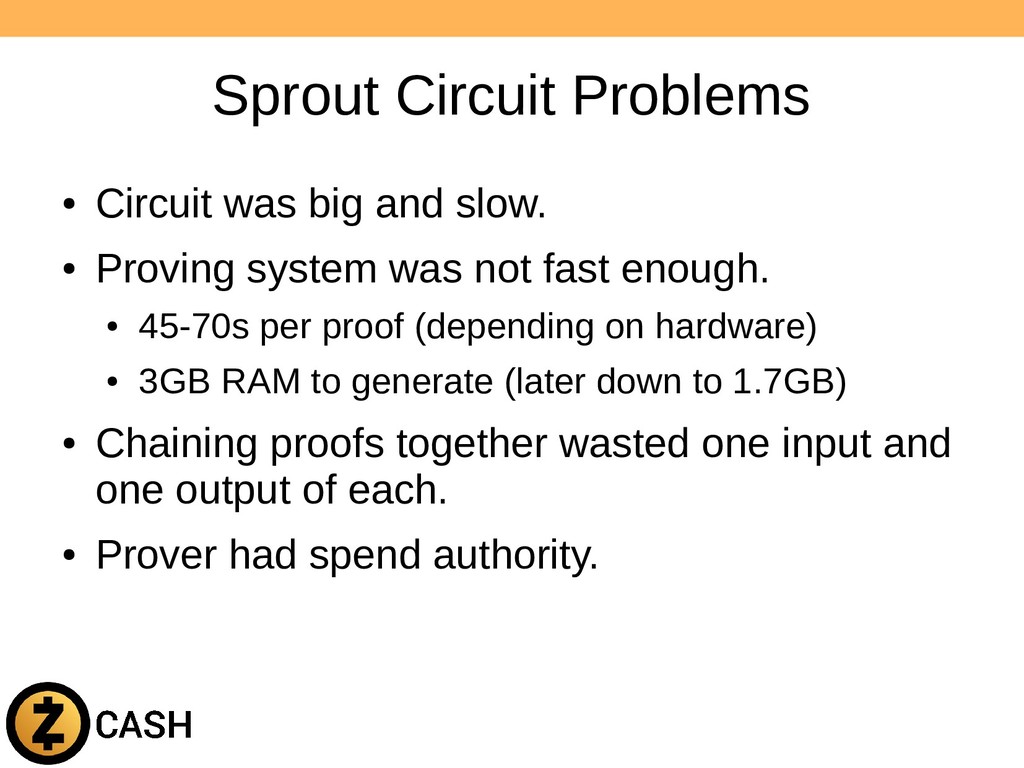
  11. Sprout Circuit Problems • Circuit was big and slow. •

    Proving system was not fast enough. • 45-70s per proof (depending on hardware) • 3GB RAM to generate (later down to 1.7GB) • Chaining proofs together wasted one input and one output of each. • Prover had spend authority.
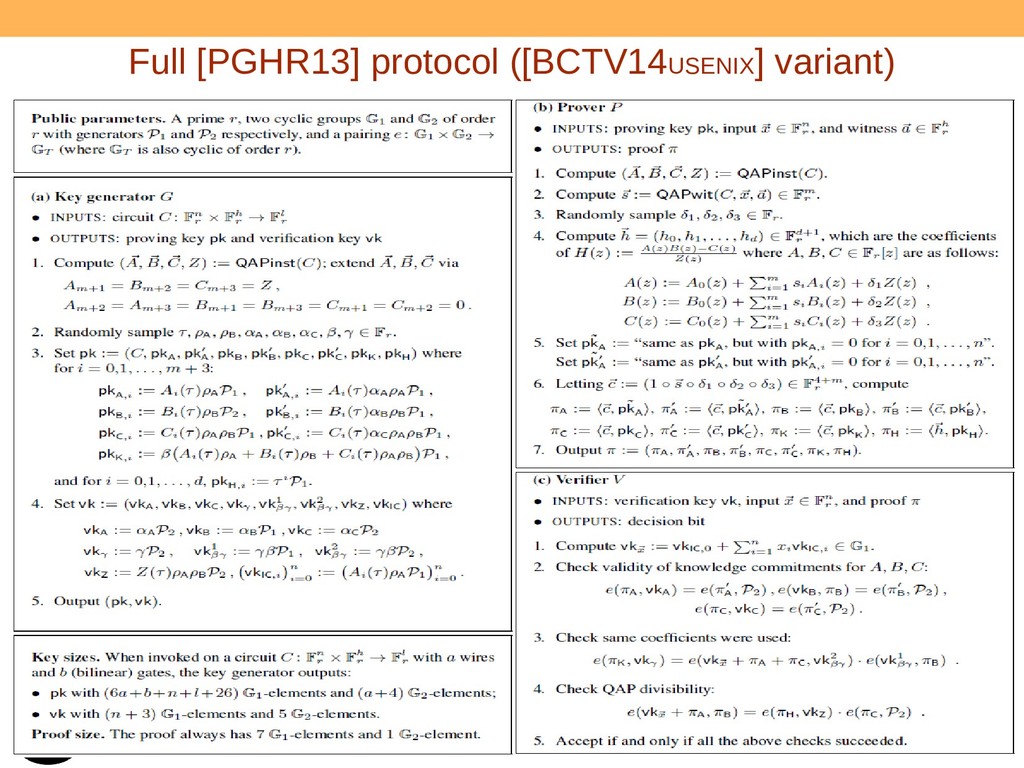
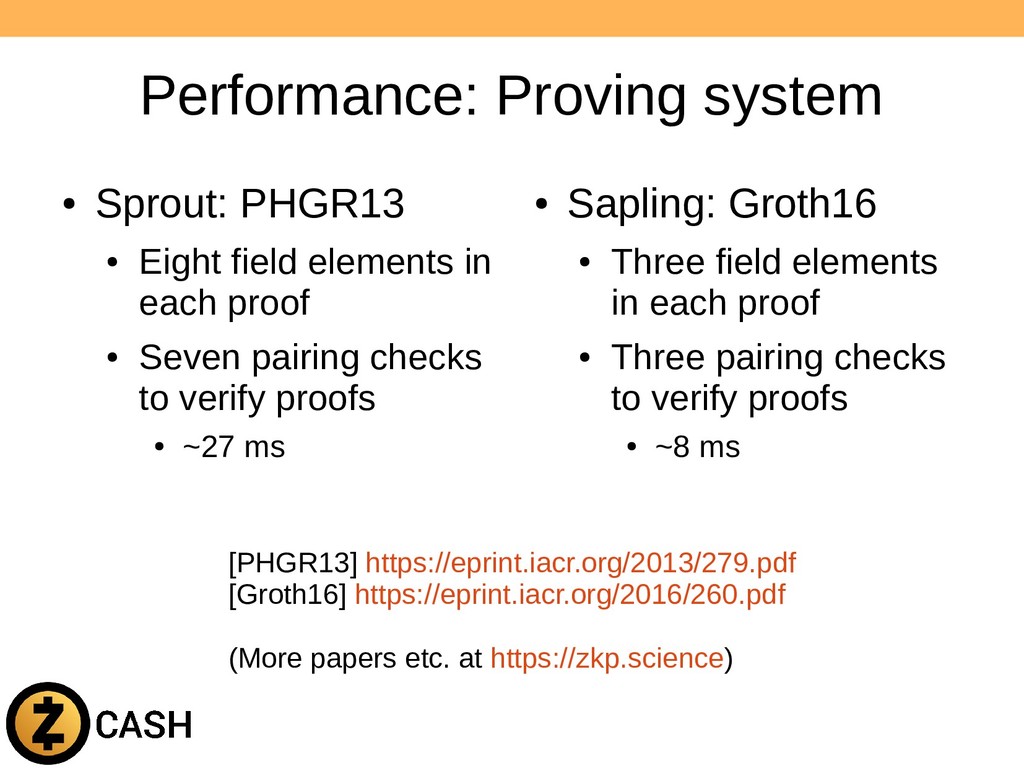
  12. Performance: Proving system • Sprout: PHGR13 • Eight field elements

    in each proof • Seven pairing checks to verify proofs • ~27 ms • Sapling: Groth16 • Three field elements in each proof • Three pairing checks to verify proofs • ~8 ms [PHGR13] https://eprint.iacr.org/2013/279.pdf [Groth16] https://eprint.iacr.org/2016/260.pdf (More papers etc. at https://zkp.science)
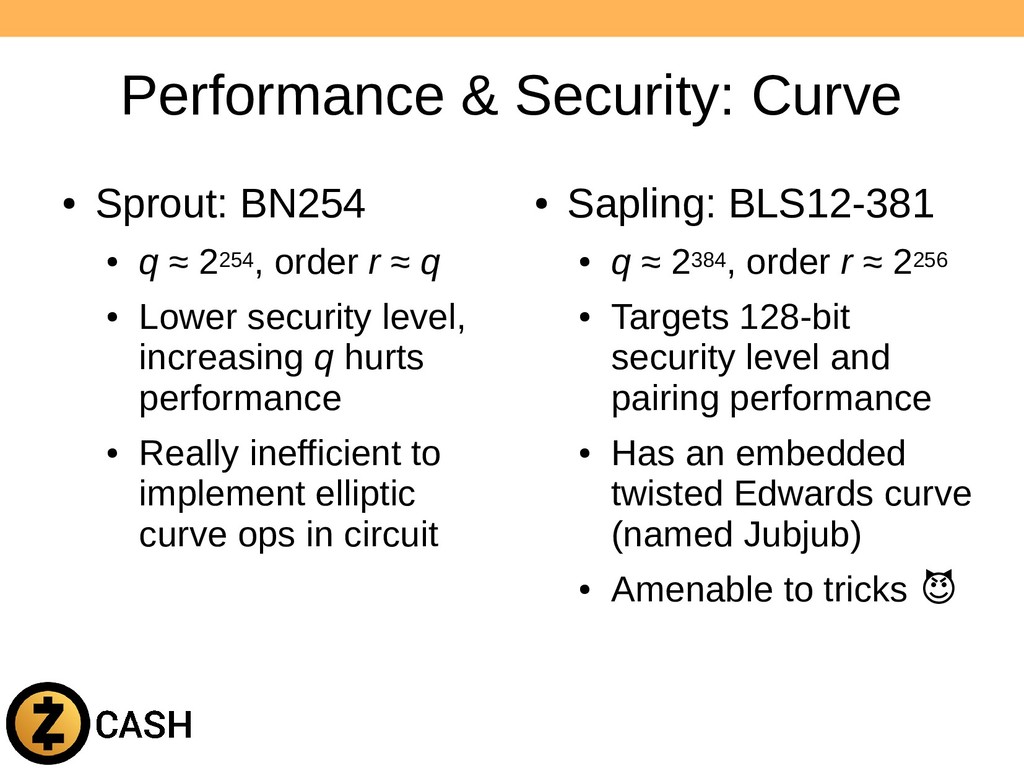
  13. Performance & Security: Curve • Sprout: BN254 • q ≈

    2254, order r ≈ q • Lower security level, increasing q hurts performance • Really inefficient to implement elliptic curve ops in circuit • Sapling: BLS12-381 • q ≈ 2384, order r ≈ 2256 • Targets 128-bit security level and pairing performance • Has an embedded twisted Edwards curve (named Jubjub) • Amenable to tricks
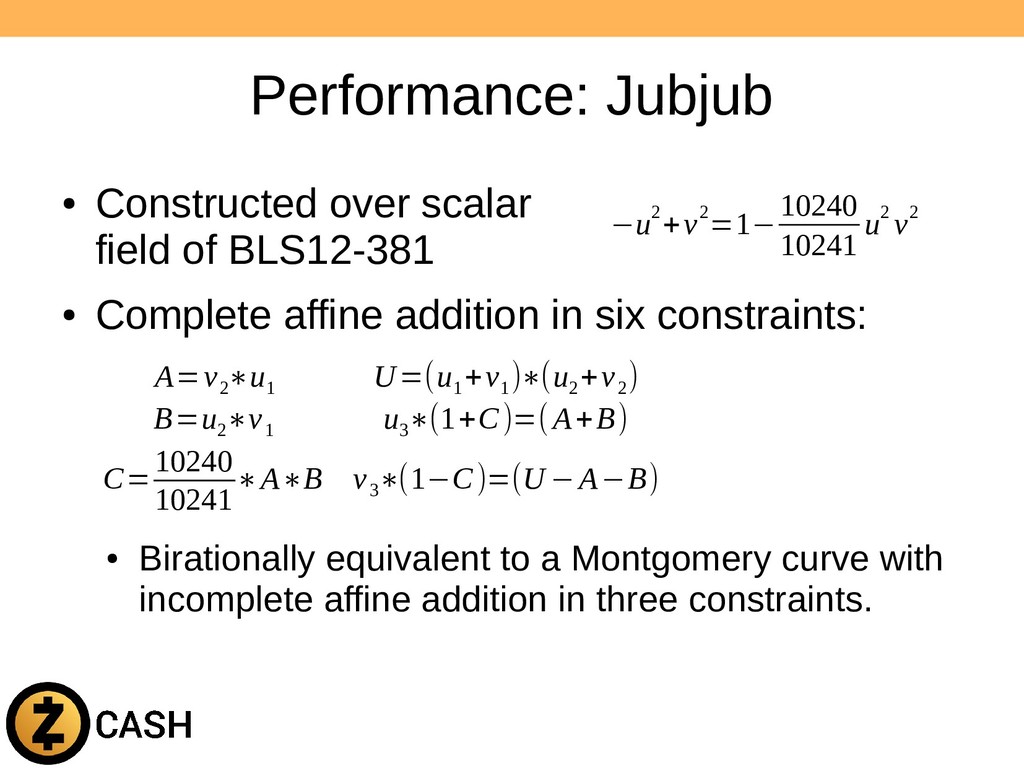
  14. Performance: Jubjub • Constructed over scalar field of BLS12-381 •

    Complete affine addition in six constraints: • Birationally equivalent to a Montgomery curve with incomplete affine addition in three constraints. −u2+v2=1− 10240 10241 u2 v2 A=v 2 ∗u 1 U=(u 1 +v 1 )∗(u 2 +v 2 ) B=u 2 ∗v 1 u 3 ∗(1+C)=(A+B) C= 10240 10241 ∗A∗B v 3 ∗(1−C)=(U −A−B)
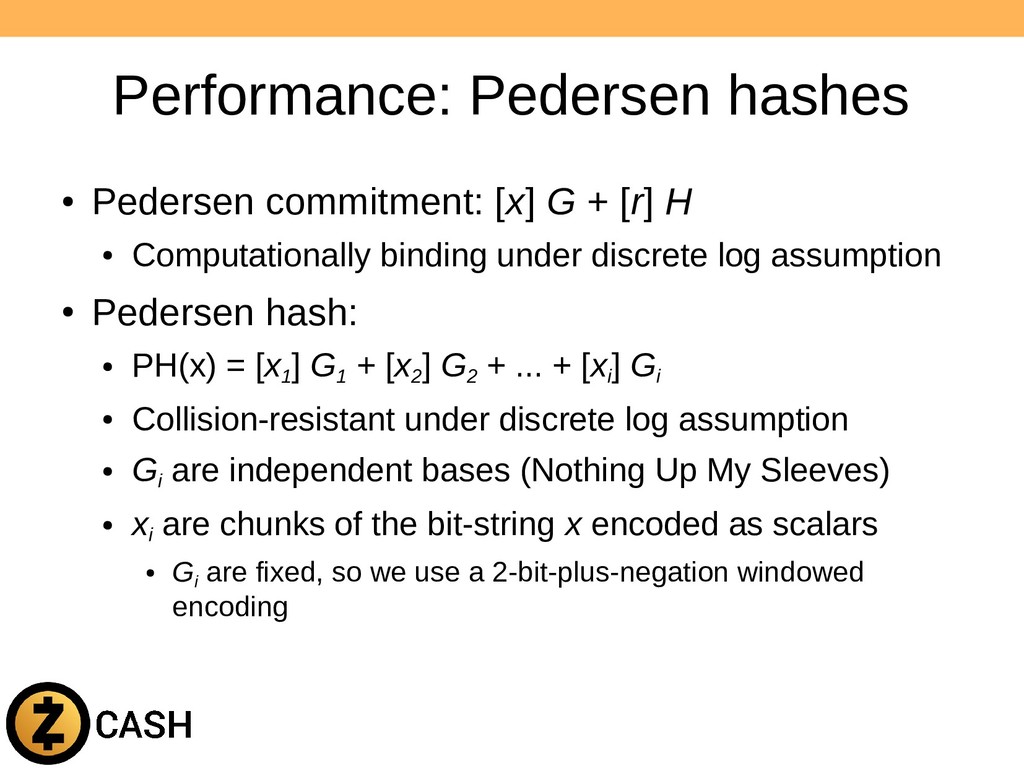
  15. Performance: Pedersen hashes • Pedersen commitment: [x] G + [r]

    H • Computationally binding under discrete log assumption • Pedersen hash: • PH(x) = [x 1 ] G 1 + [x 2 ] G 2 + ... + [x i ] G i • Collision-resistant under discrete log assumption • G i are independent bases (Nothing Up My Sleeves) • x i are chunks of the bit-string x encoded as scalars • G i are fixed, so we use a 2-bit-plus-negation windowed encoding
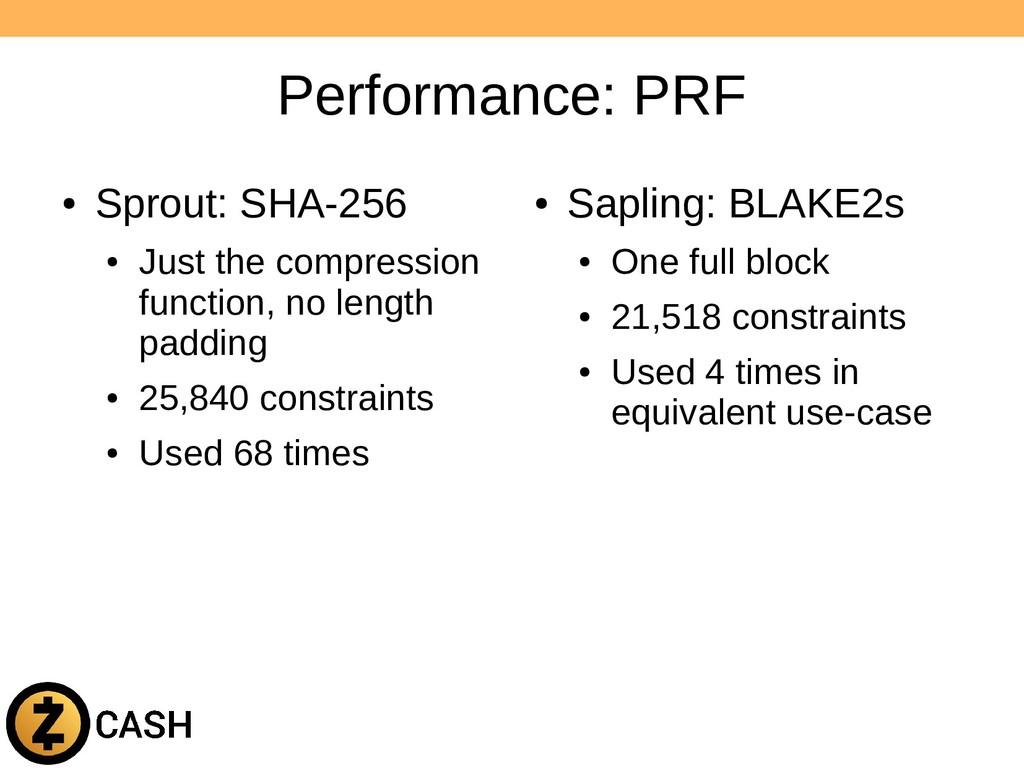
  16. Performance: PRF • Sprout: SHA-256 • Just the compression function,

    no length padding • 25,840 constraints • Used 68 times • Sapling: BLAKE2s • One full block • 21,518 constraints • Used 4 times in equivalent use-case
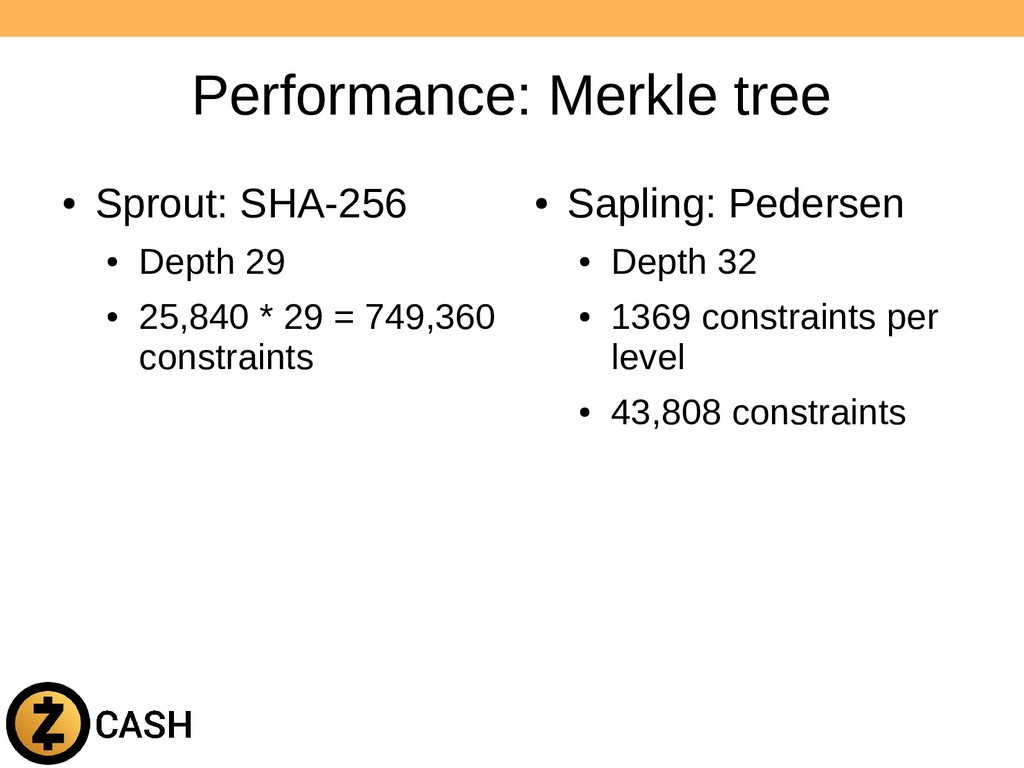
  17. Performance: Merkle tree • Sprout: SHA-256 • Depth 29 •

    25,840 * 29 = 749,360 constraints • Sapling: Pedersen • Depth 32 • 1369 constraints per level • 43,808 constraints
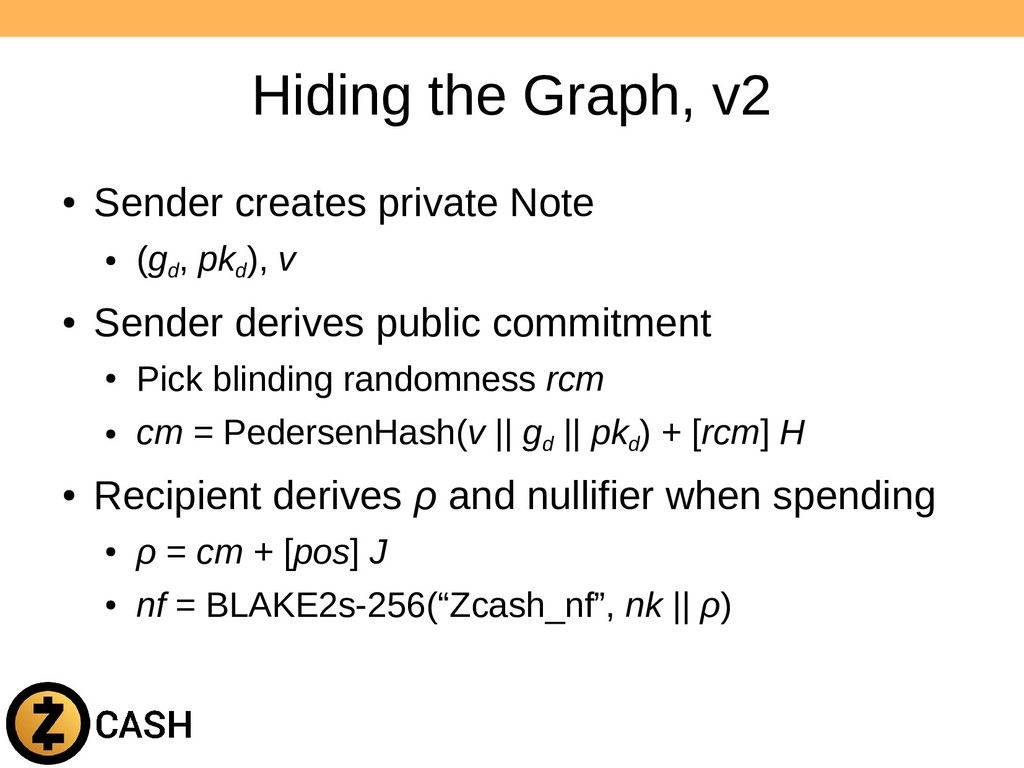
  18. Hiding the Graph, v2 • Sender creates private Note •

    (g d , pk d ), v • Sender derives public commitment • Pick blinding randomness rcm • cm = PedersenHash(v || g d || pk d ) + [rcm] H • Recipient derives ρ and nullifier when spending • ρ = cm + [pos] J • nf = BLAKE2s-256(“Zcash_nf”, nk || ρ)
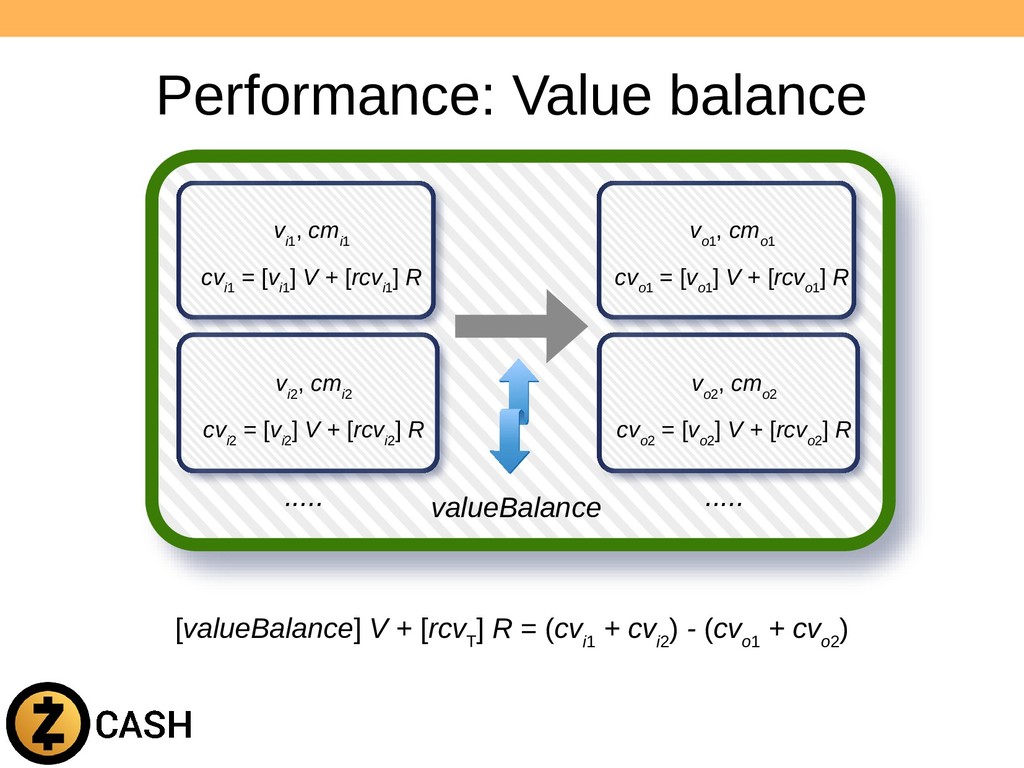
  19. Performance: Value balance v o1 , cm o1 cv o1

    = [v o1 ] V + [rcv o1 ] R v o2 , cm o2 cv o2 = [v o2 ] V + [rcv o2 ] R v i1 , cm i1 cv i1 = [v i1 ] V + [rcv i1 ] R v i2 , cm i2 cv i2 = [v i2 ] V + [rcv i2 ] R [valueBalance] V + [rcv T ] R = (cv i1 + cv i2 ) - (cv o1 + cv o2 ) valueBalance ..... .....
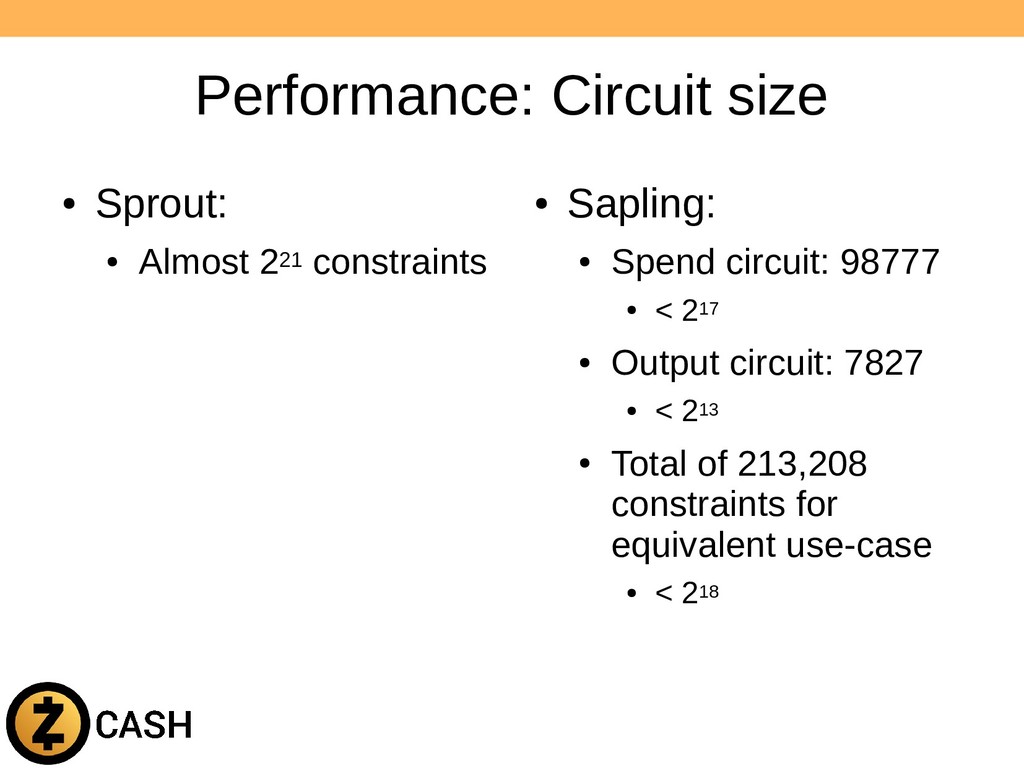
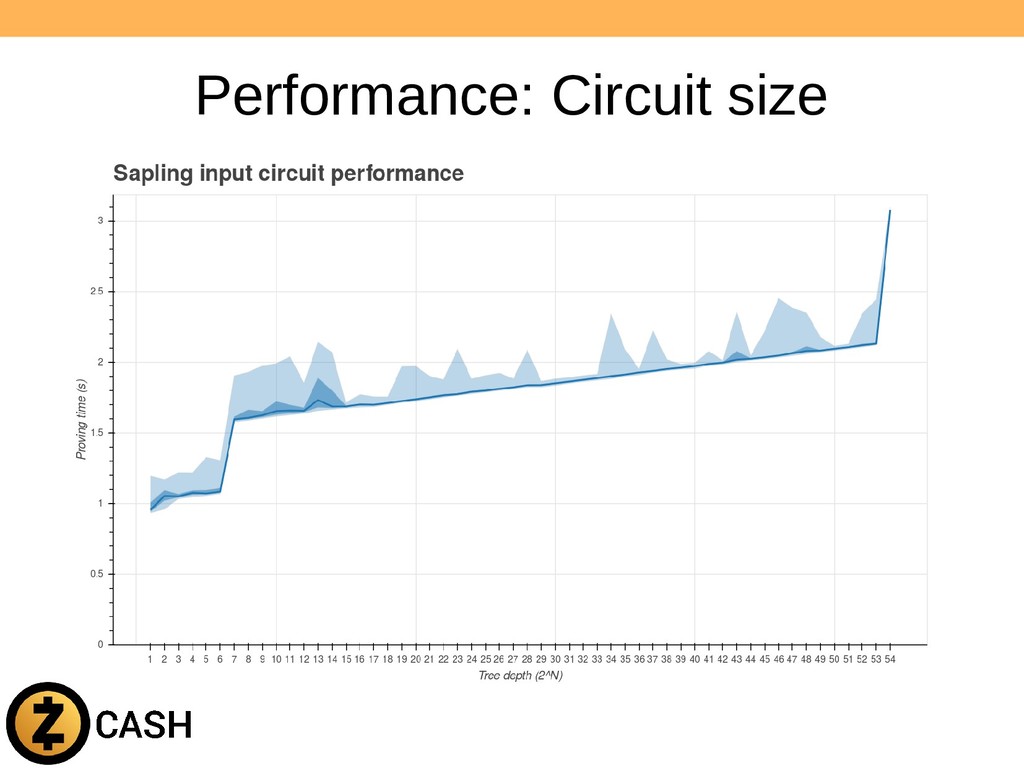
  20. Performance: Circuit size • Sprout: • Almost 221 constraints •

    Sapling: • Spend circuit: 98777 • < 217 • Output circuit: 7827 • < 213 • Total of 213,208 constraints for equivalent use-case • < 218
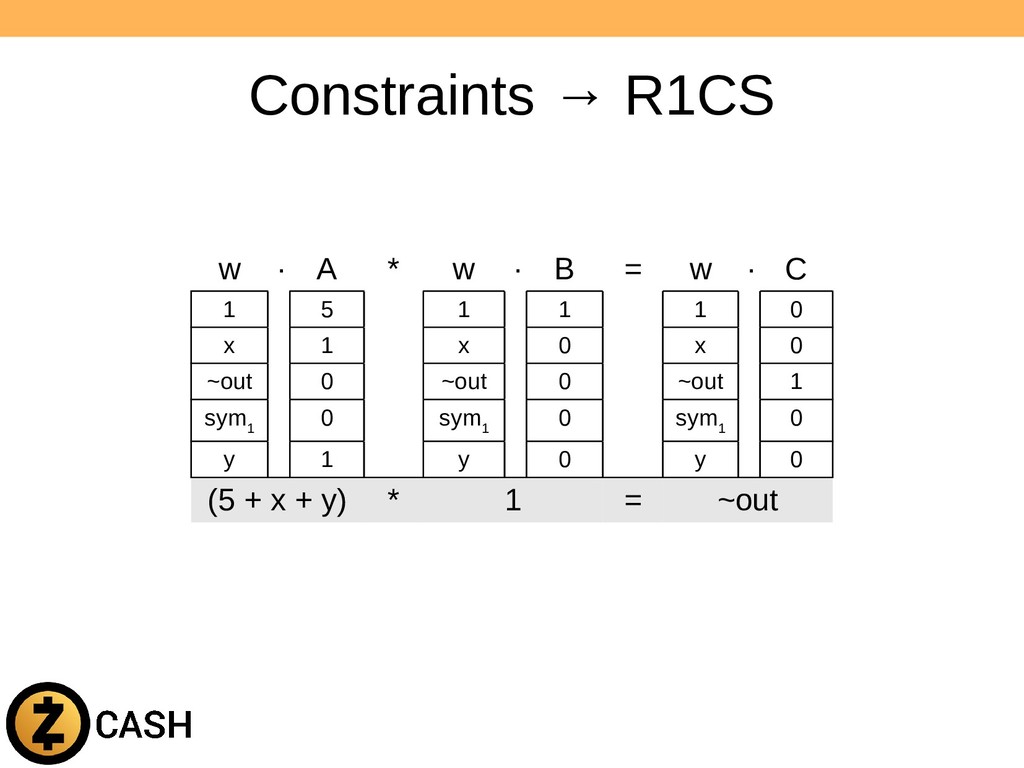
  21. Constraints → R1CS w ∙ A * w ∙ B

    = w ∙ C 1 5 1 1 1 0 x 1 x 0 x 0 ~out 0 ~out 0 ~out 1 sym 1 0 sym 1 0 sym 1 0 y 1 y 0 y 0 (5 + x + y) * 1 = ~out
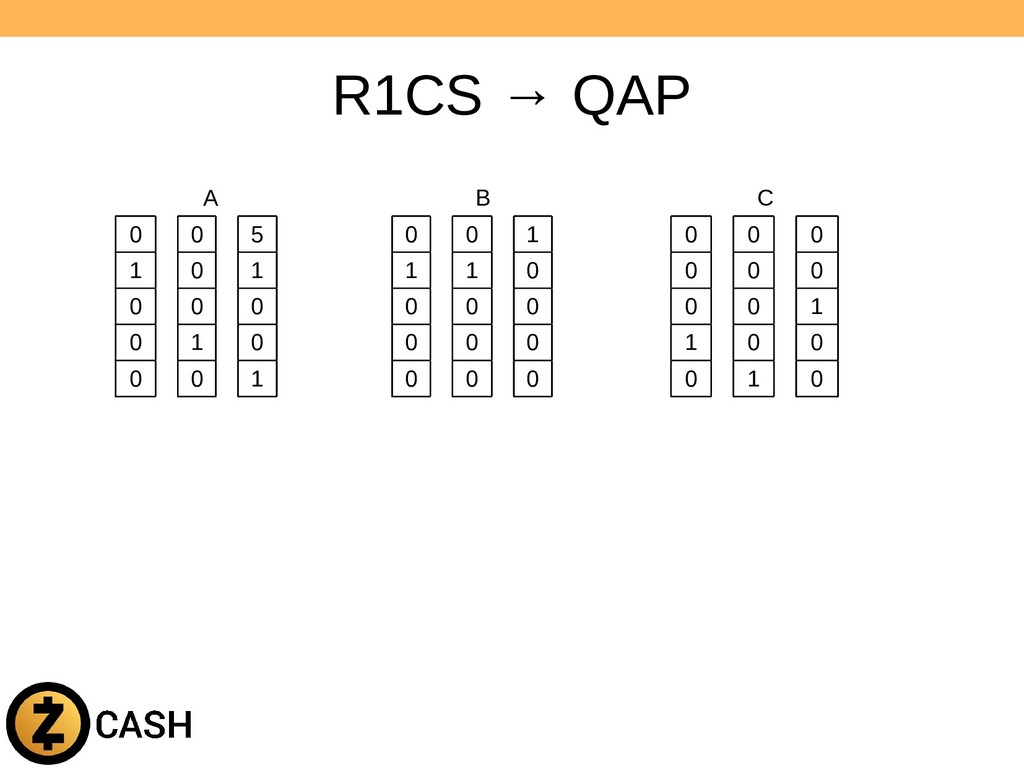
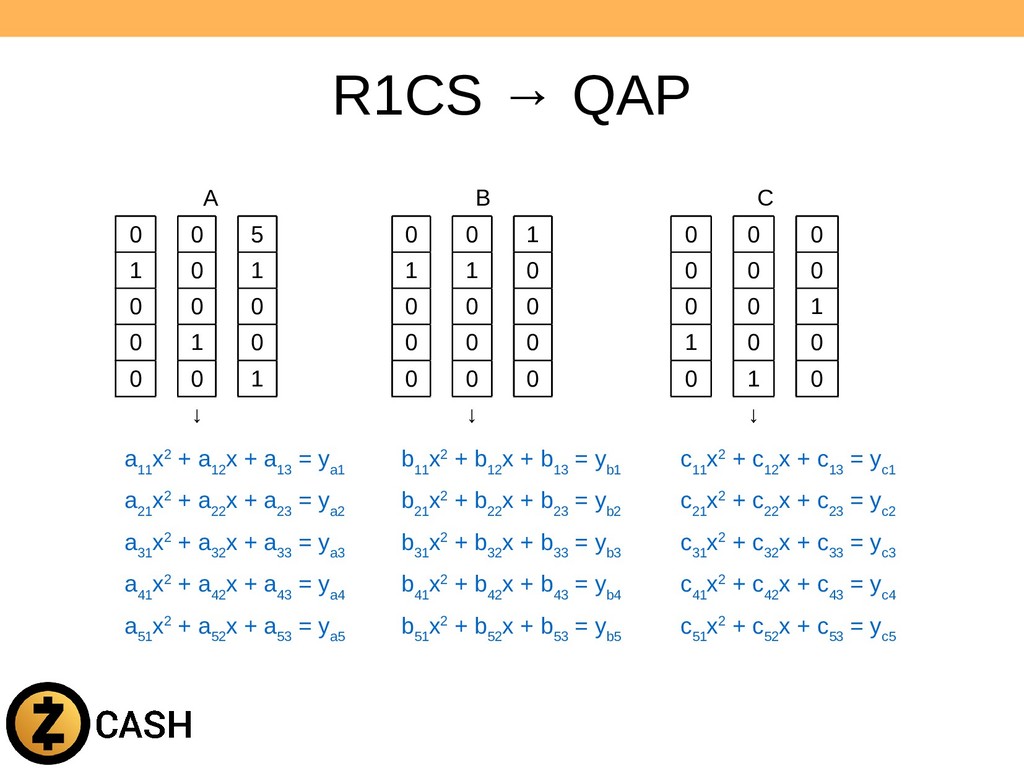
  22. R1CS → QAP A B C 0 0 5 0

    0 1 0 0 0 1 0 1 1 1 0 0 0 0 0 0 0 0 0 0 0 0 1 0 1 0 0 0 0 1 0 0 0 0 1 0 0 0 0 1 0
  23. R1CS → QAP A B C 0 0 5 0

    0 1 0 0 0 1 0 1 1 1 0 0 0 0 0 0 0 0 0 0 0 0 1 0 1 0 0 0 0 1 0 0 0 0 1 0 0 0 0 1 0 ↓ ↓ ↓ a 11 x2 + a 12 x + a 13 = y a1 b 11 x2 + b 12 x + b 13 = y b1 c 11 x2 + c 12 x + c 13 = y c1 a 21 x2 + a 22 x + a 23 = y a2 b 21 x2 + b 22 x + b 23 = y b2 c 21 x2 + c 22 x + c 23 = y c2 a 31 x2 + a 32 x + a 33 = y a3 b 31 x2 + b 32 x + b 33 = y b3 c 31 x2 + c 32 x + c 33 = y c3 a 41 x2 + a 42 x + a 43 = y a4 b 41 x2 + b 42 x + b 43 = y b4 c 41 x2 + c 42 x + c 43 = y c4 a 51 x2 + a 52 x + a 53 = y a5 b 51 x2 + b 52 x + b 53 = y b5 c 51 x2 + c 52 x + c 53 = y c5
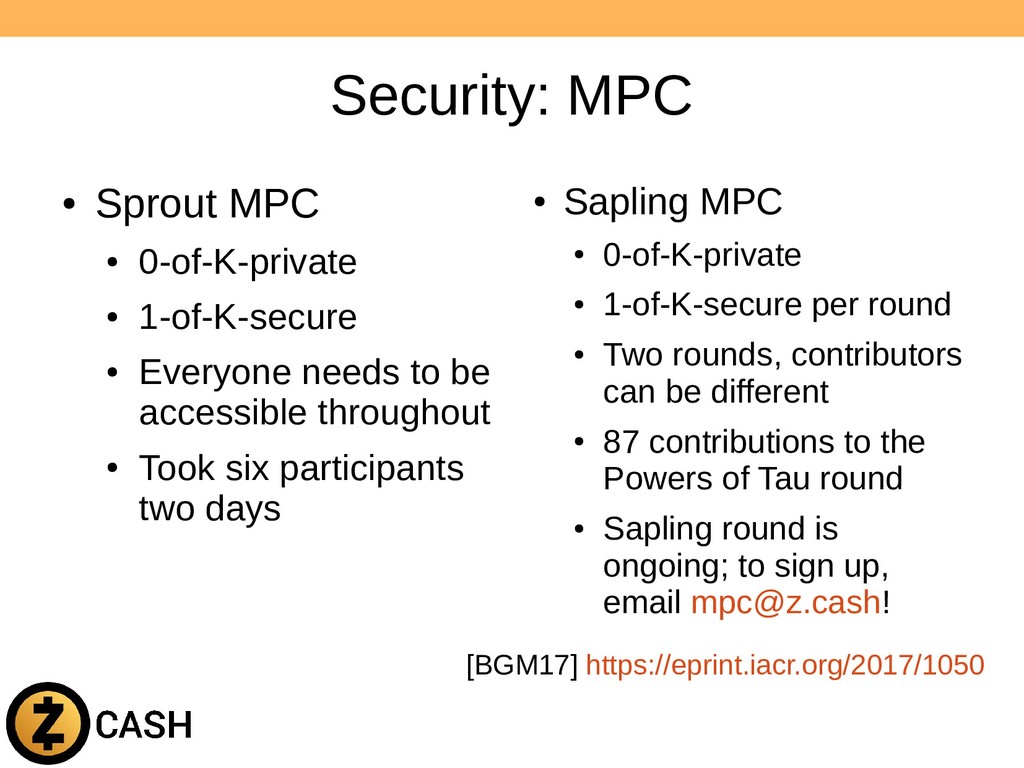
  24. Security: MPC • Sprout MPC • 0-of-K-private • 1-of-K-secure •

    Everyone needs to be accessible throughout • Took six participants two days • Sapling MPC • 0-of-K-private • 1-of-K-secure per round • Two rounds, contributors can be different • 87 contributions to the Powers of Tau round • Sapling round is ongoing; to sign up, email [email protected]! [BGM17] https://eprint.iacr.org/2017/1050
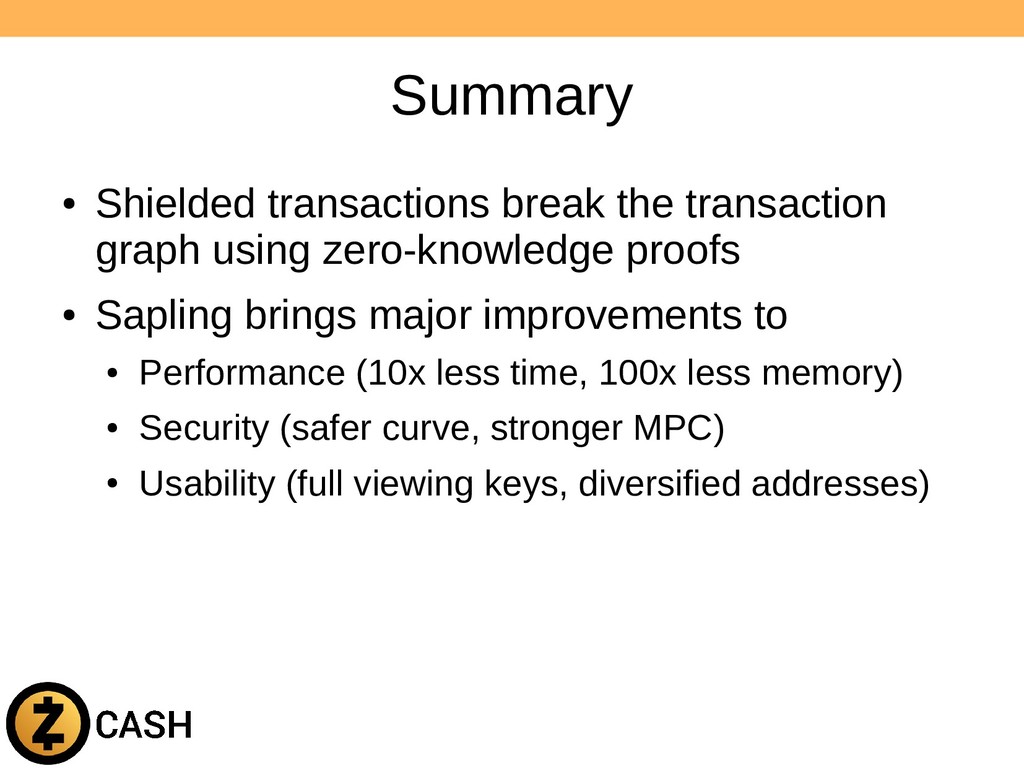
  25. Summary • Shielded transactions break the transaction graph using zero-knowledge

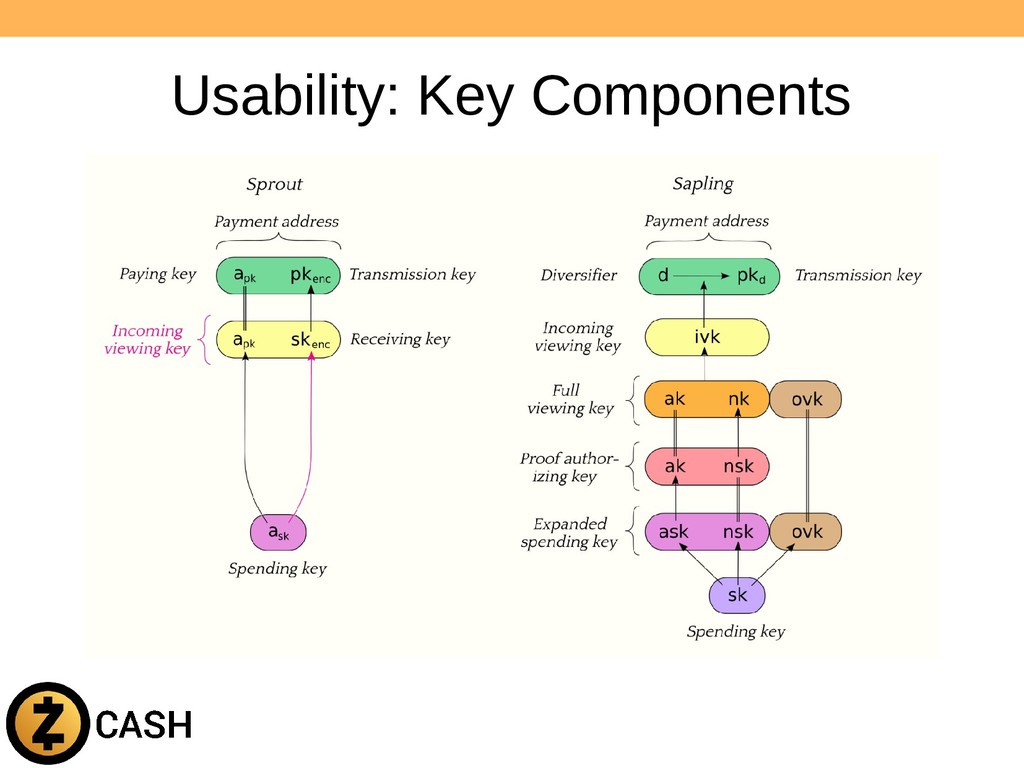
    proofs • Sapling brings major improvements to • Performance (10x less time, 100x less memory) • Security (safer curve, stronger MPC) • Usability (full viewing keys, diversified addresses)