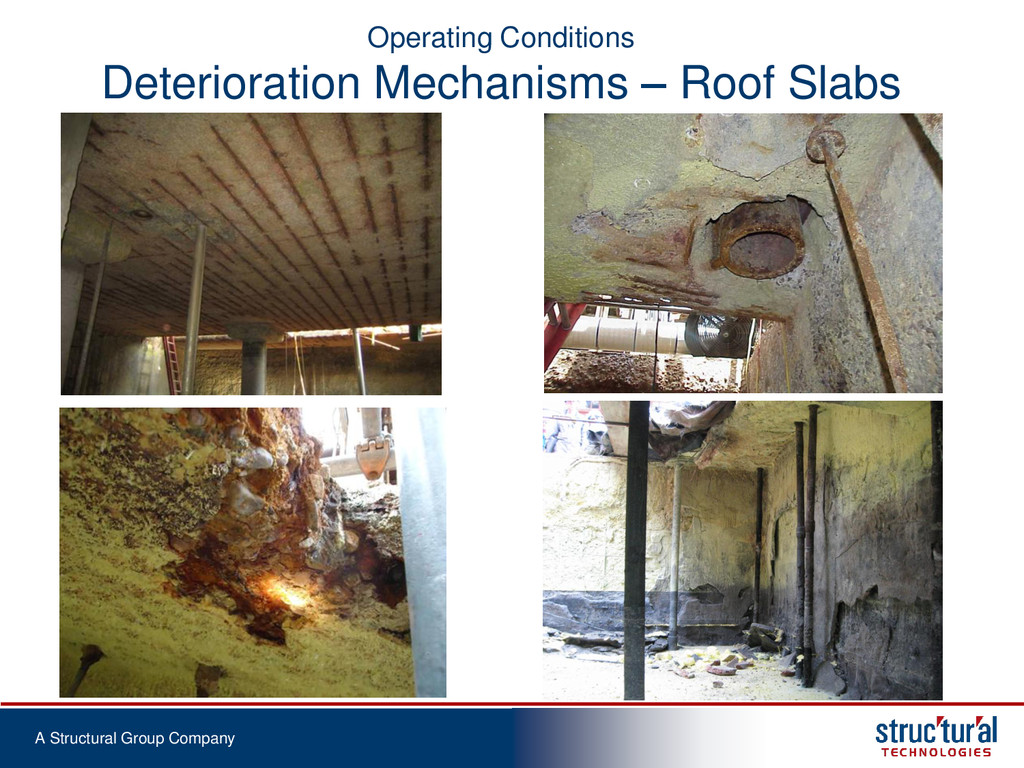
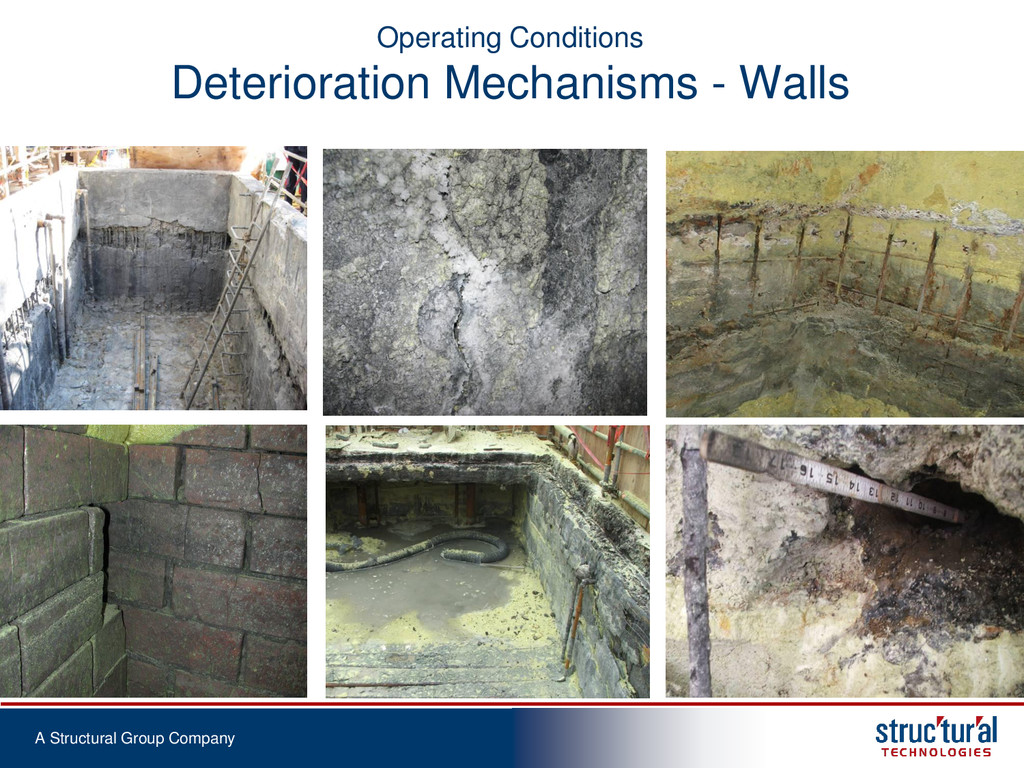
Civil Infrastructure The existing condition of an operating sub-surface reinforced concrete Sulfur Pit remained a “mystery” in the past…. Molten sulfur and “sealed” containment conditions were barriers to standard evaluation techniques…. A new approach had to be developed to assist Maintenance personnel in preparing realistic budgets for repair prior to scheduled outage events limiting “surprise” repair cost expenditures…. The On-Line/Off-Line Evaluation Approach was developed incorporating Non-Destructive & Semi-Destructive Testing Techniques to provide a clearer picture of existing reinforced concrete Sulfur Pit conditions….
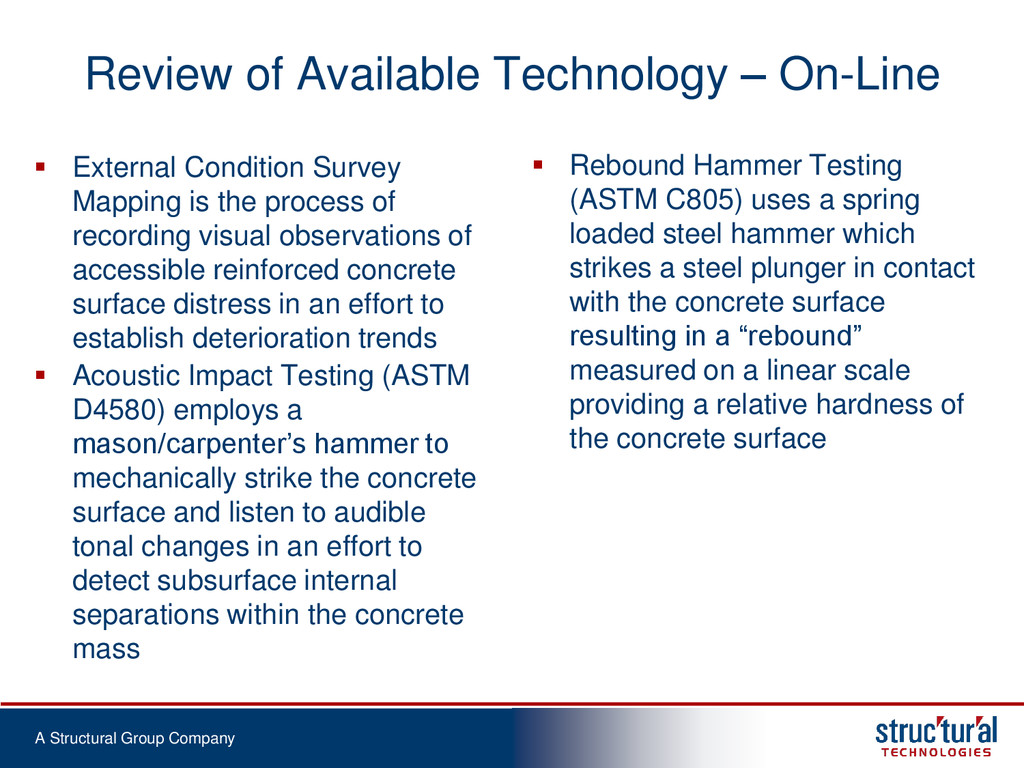
External Condition Survey Mapping is the process of recording visual observations of accessible reinforced concrete surface distress in an effort to establish deterioration trends Acoustic Impact Testing (ASTM D4580) employs a mason/carpenter’s hammer to mechanically strike the concrete surface and listen to audible tonal changes in an effort to detect subsurface internal separations within the concrete mass Rebound Hammer Testing (ASTM C805) uses a spring loaded steel hammer which strikes a steel plunger in contact with the concrete surface resulting in a “rebound” measured on a linear scale providing a relative hardness of the concrete surface
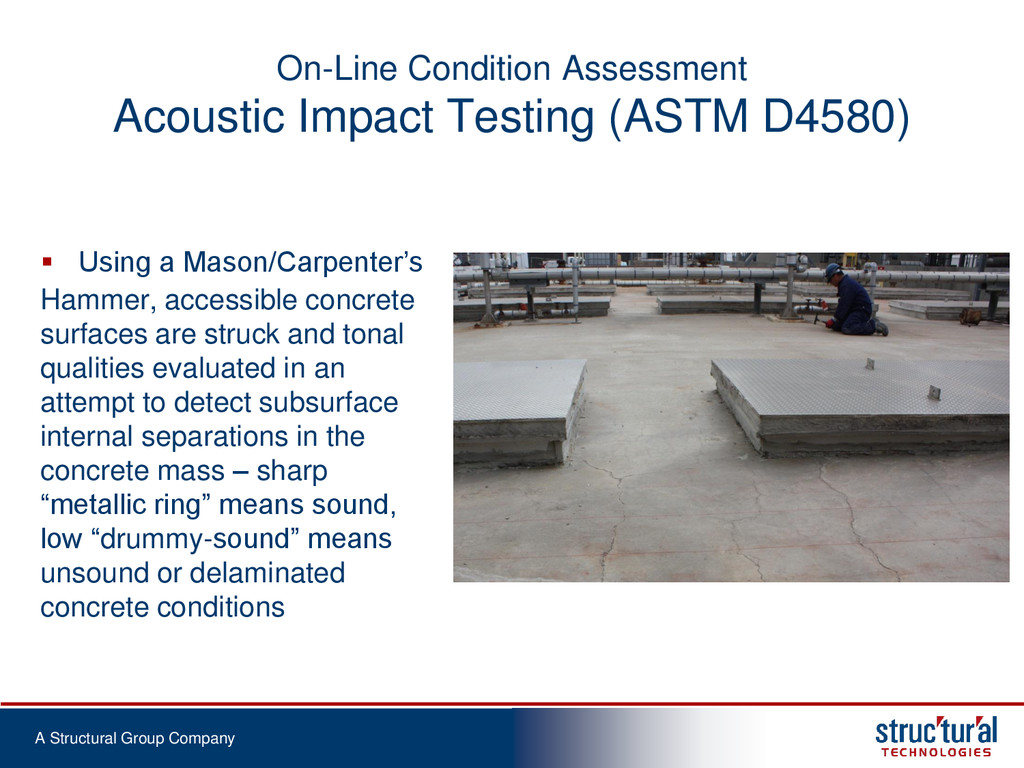
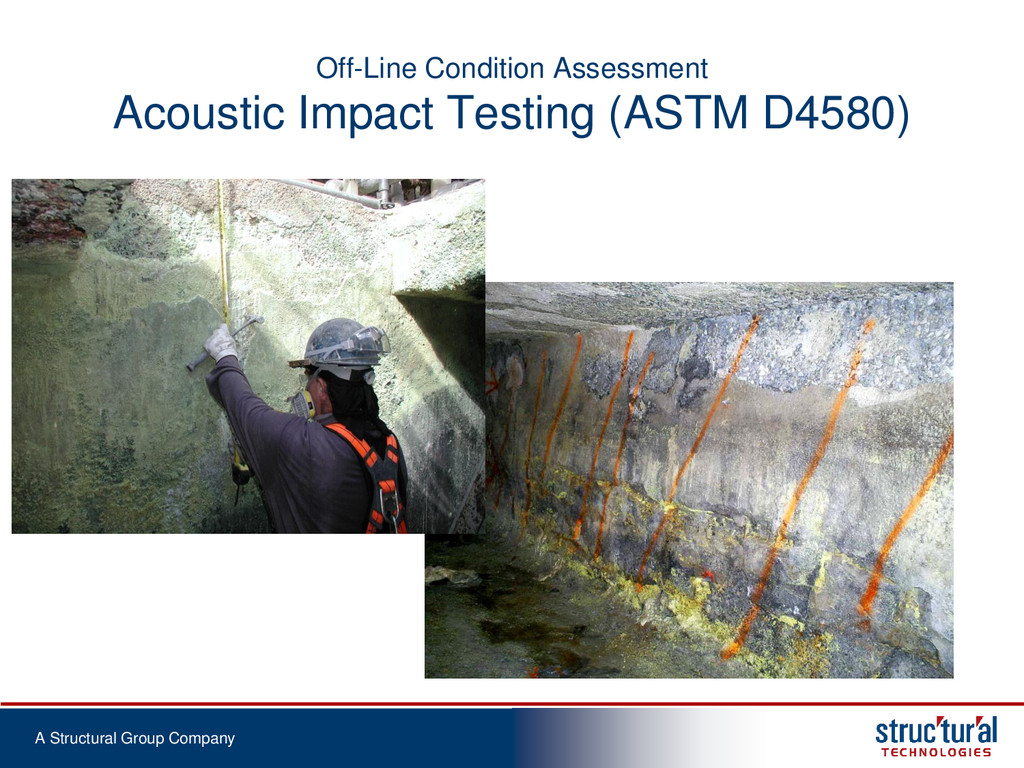
(ASTM D4580) Using a Mason/Carpenter’s Hammer, accessible concrete surfaces are struck and tonal qualities evaluated in an attempt to detect subsurface internal separations in the concrete mass – sharp “metallic ring” means sound, low “drummy-sound” means unsound or delaminated concrete conditions
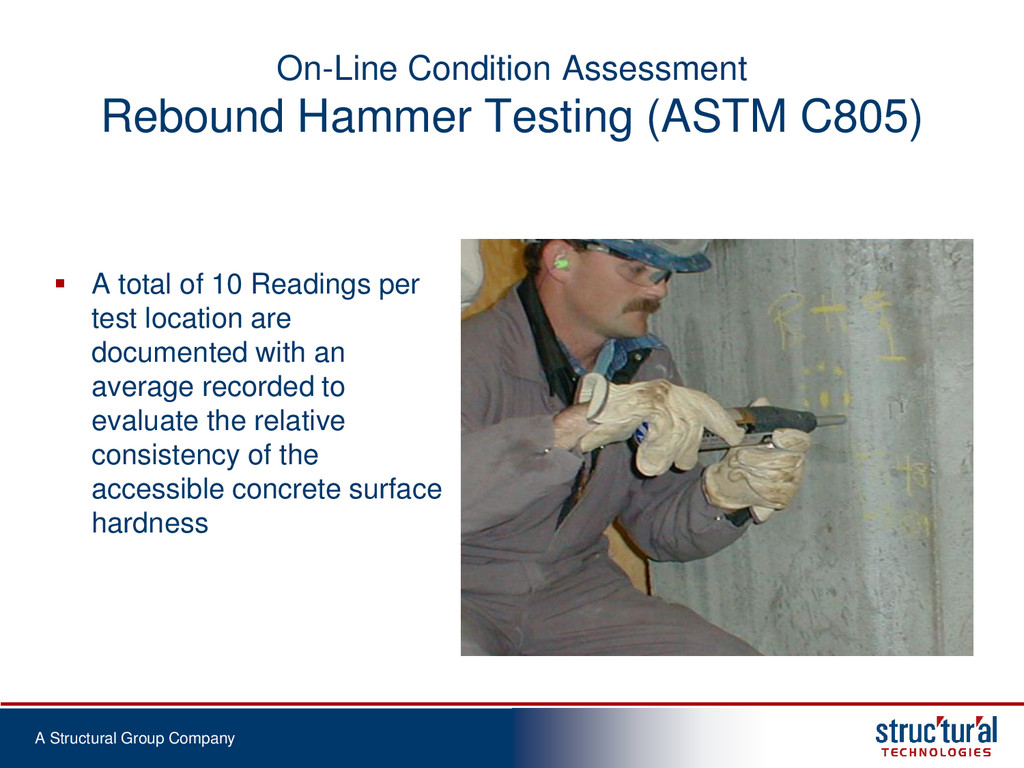
(ASTM C805) A total of 10 Readings per test location are documented with an average recorded to evaluate the relative consistency of the accessible concrete surface hardness
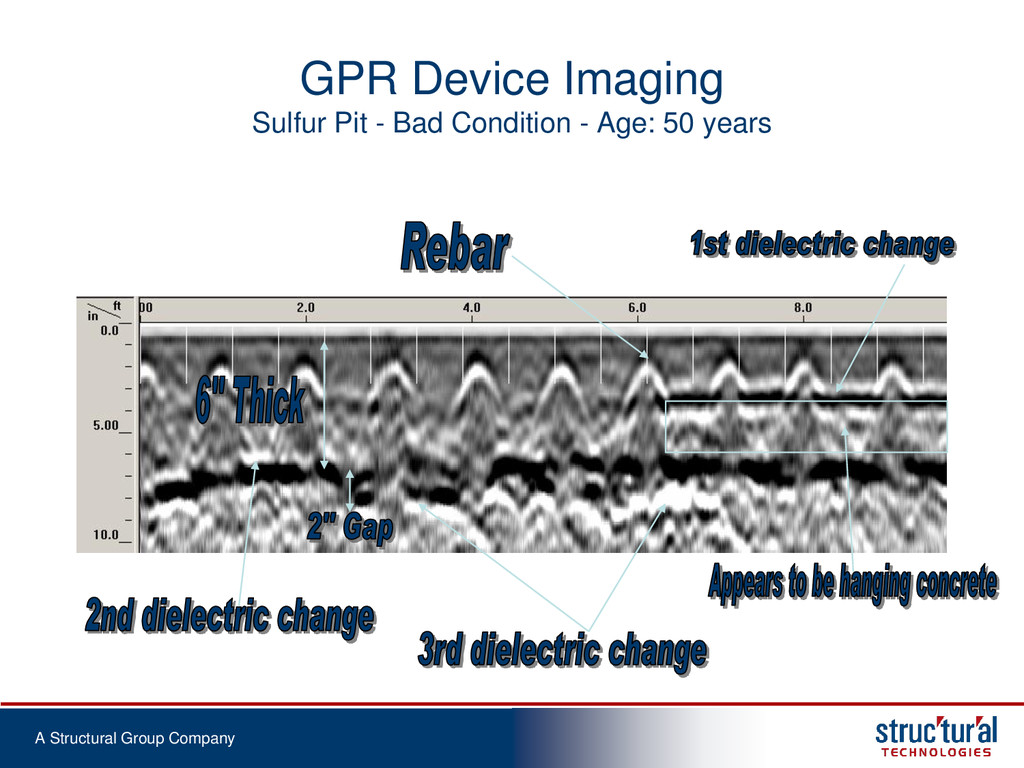
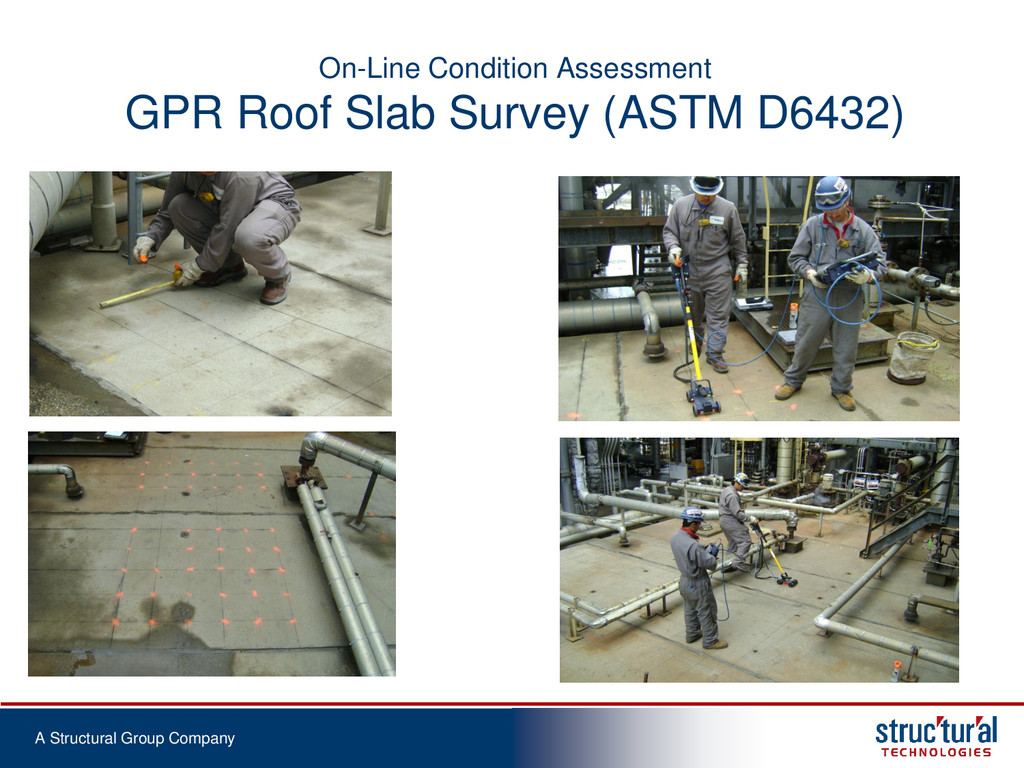
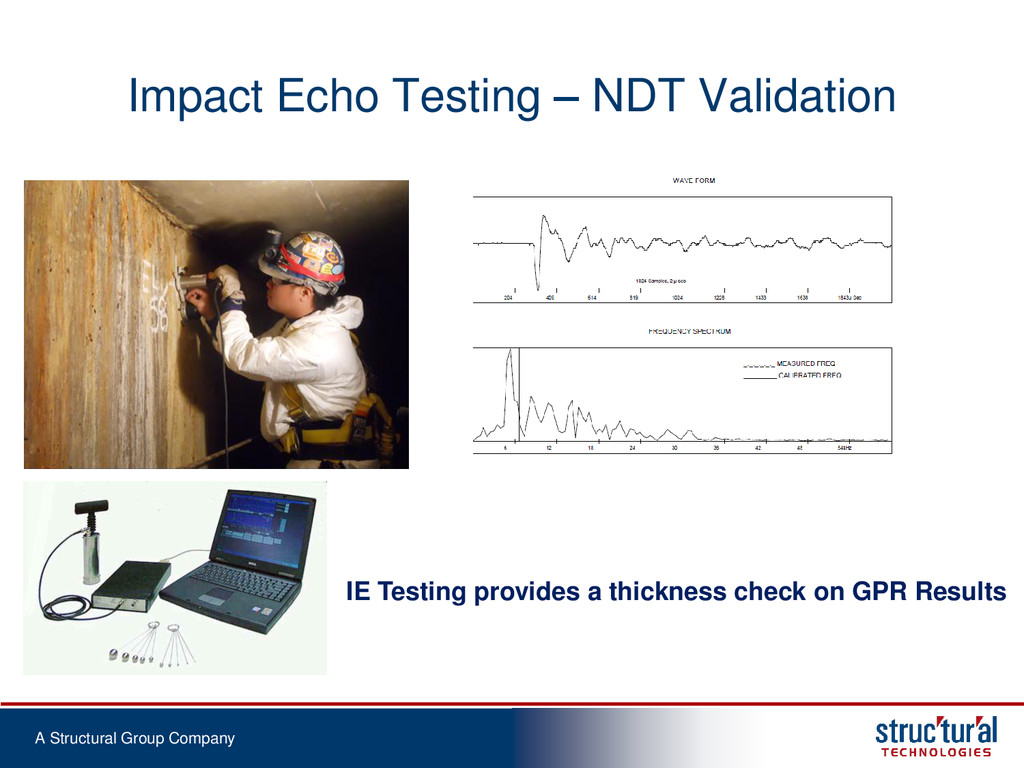
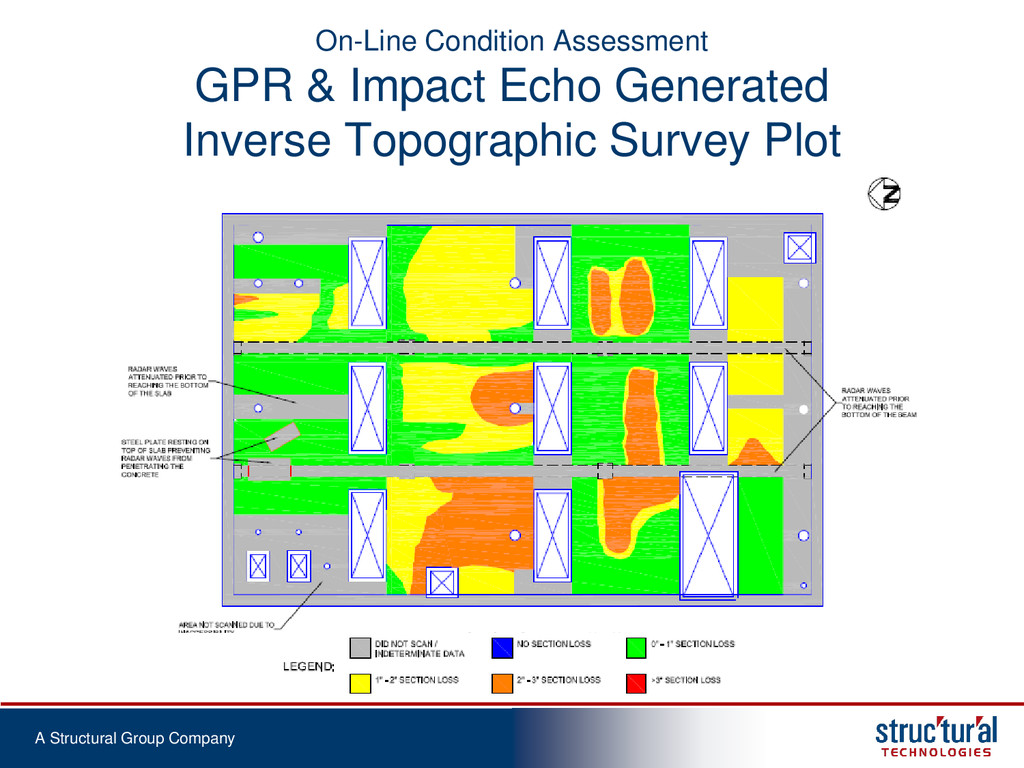
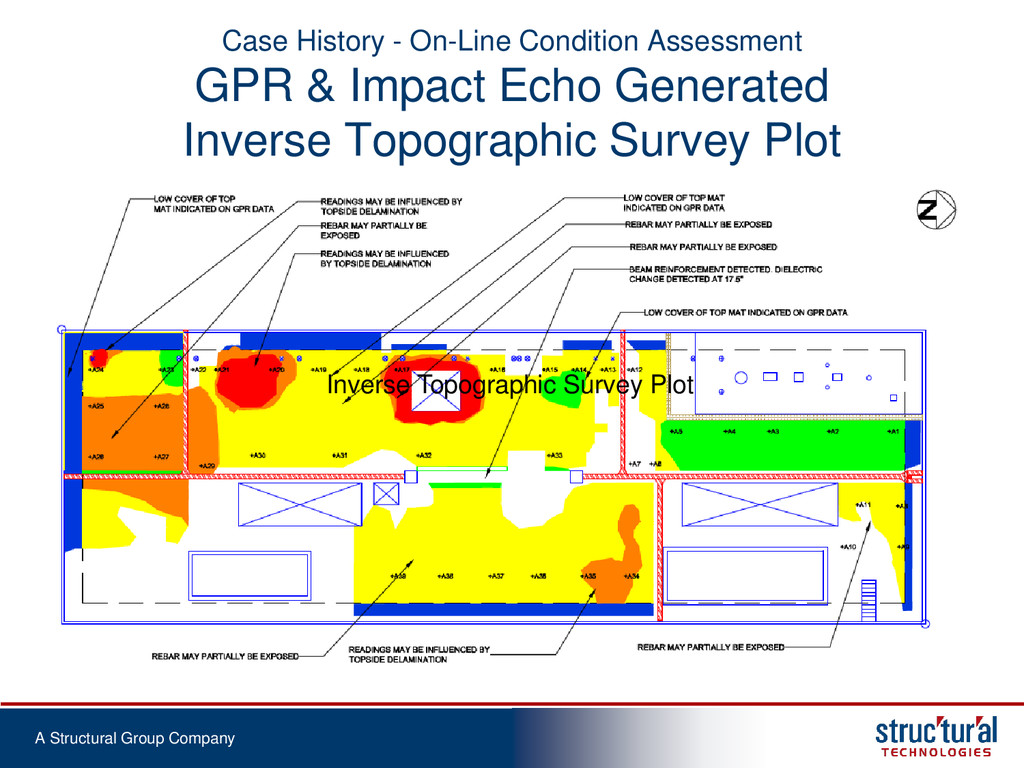
(cont.) Ground Penetrating Radar (ASTM D6432-11) GPR detects the reflected signals from subsurface structures of varying dielectric constants which is a materials ability to hold and pass a charge and is related to the speed of light GPR can be used in a variety of media, including concrete, rock, soil, ice, fresh water, pavements and structures - It can detect objects, changes in material, and voids & cracks Impact Echo (ASTM C1383-04) IE uses micro-siesmic technology where a “stress- wave” is generated by a small hammer and extends through a concrete member providing “echoes” of flaws, discontinuities and external boundaries (i.e., thickness) Provides an excellent “cross- check” and NDT validation to GPR results using a competing yet different technology
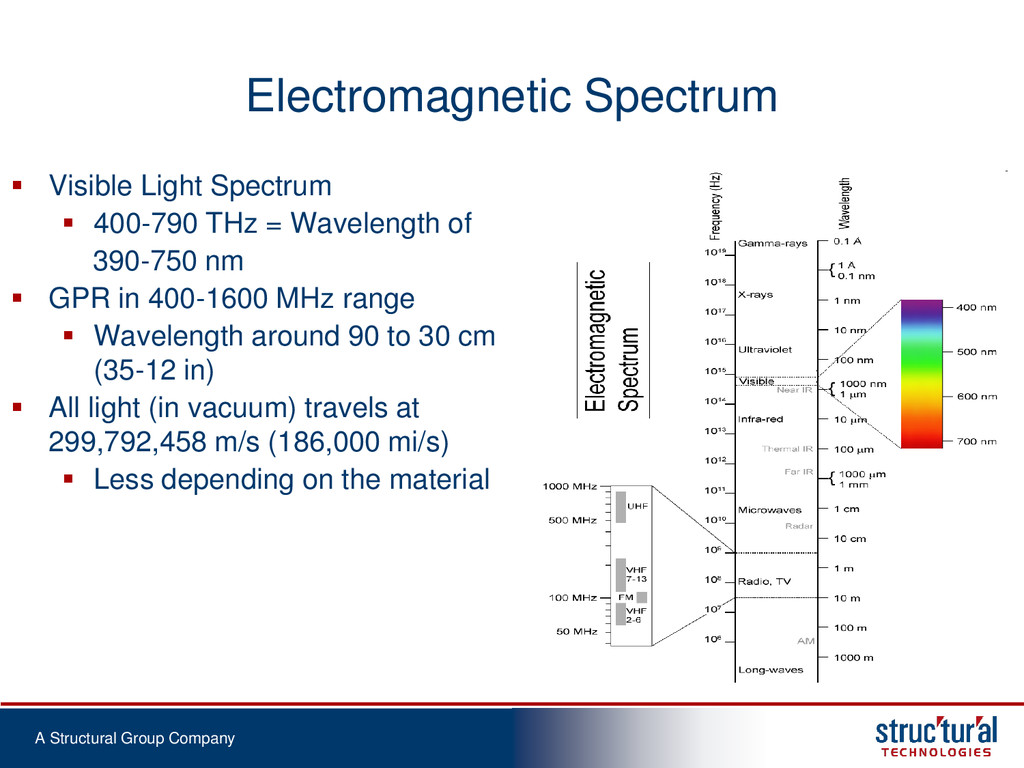
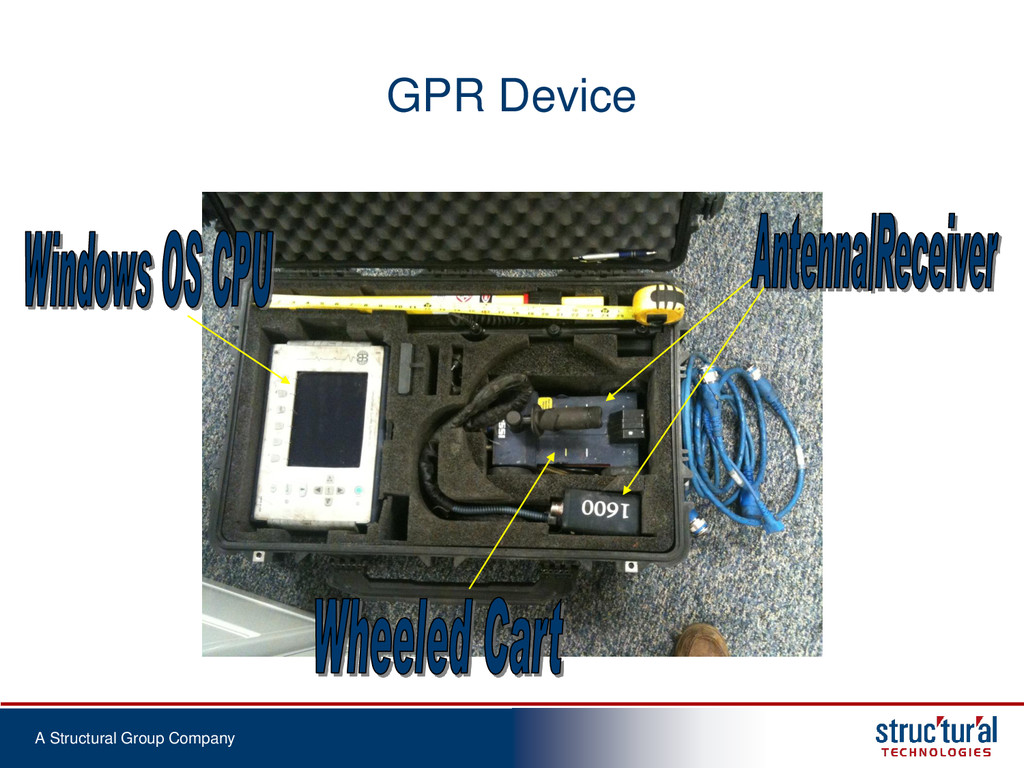
(GPR) is a geophysical method that uses radar pulses to image the subsurface. GPR uses electromagnetic radiation in the microwave band (UHF/VHF frequencies) of the radio spectrum.
400-790 THz = Wavelength of 390-750 nm GPR in 400-1600 MHz range Wavelength around 90 to 30 cm (35-12 in) All light (in vacuum) travels at 299,792,458 m/s (186,000 mi/s) Less depending on the material
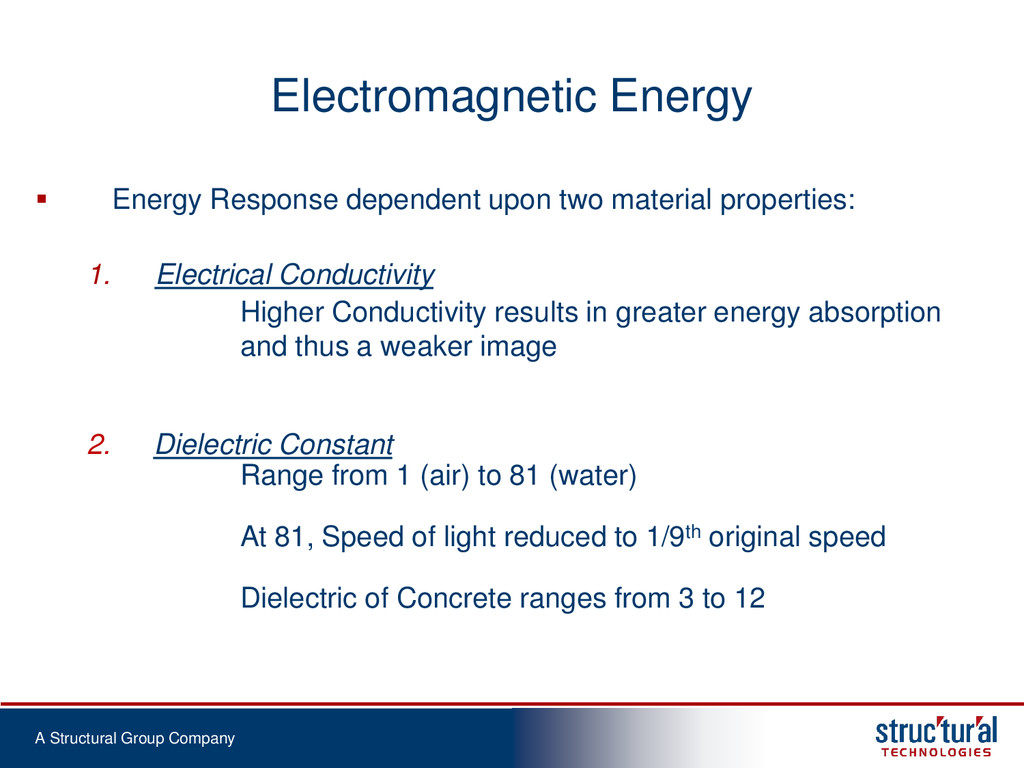
upon two material properties: 1. Electrical Conductivity Higher Conductivity results in greater energy absorption and thus a weaker image 2. Dielectric Constant Range from 1 (air) to 81 (water) At 81, Speed of light reduced to 1/9th original speed Dielectric of Concrete ranges from 3 to 12
Detects Differences in Dielectric/Speed of Light Primary Readings will occur with Material Changes – specifically at Interfaces: Concrete/Steel Concrete/Air
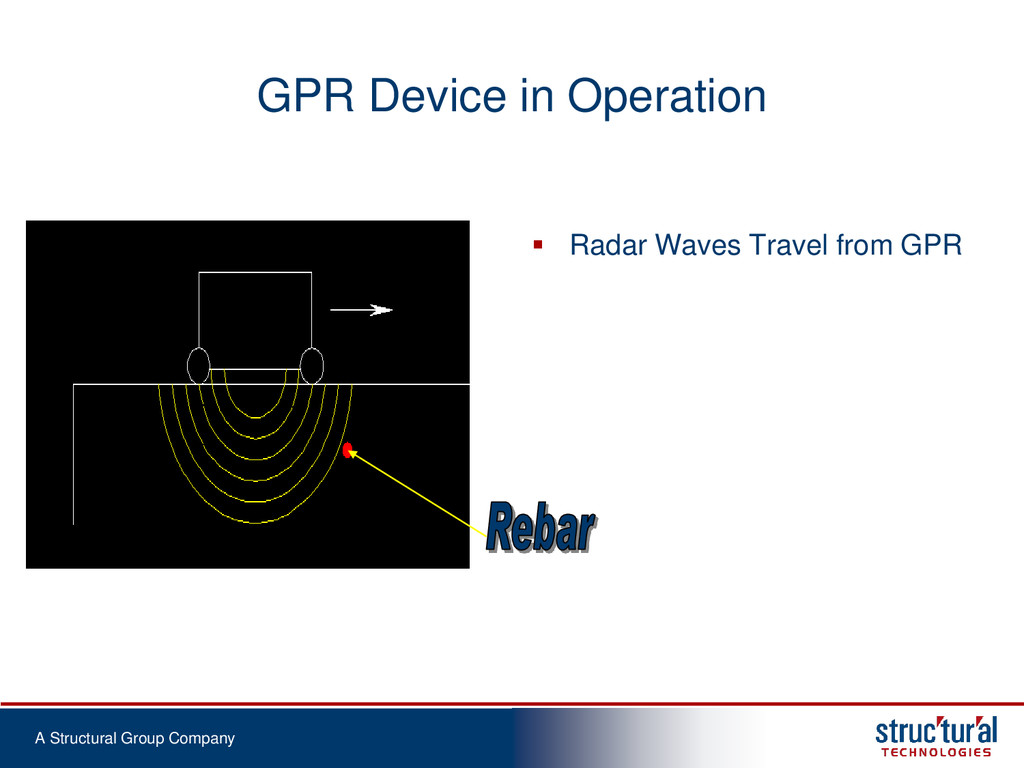
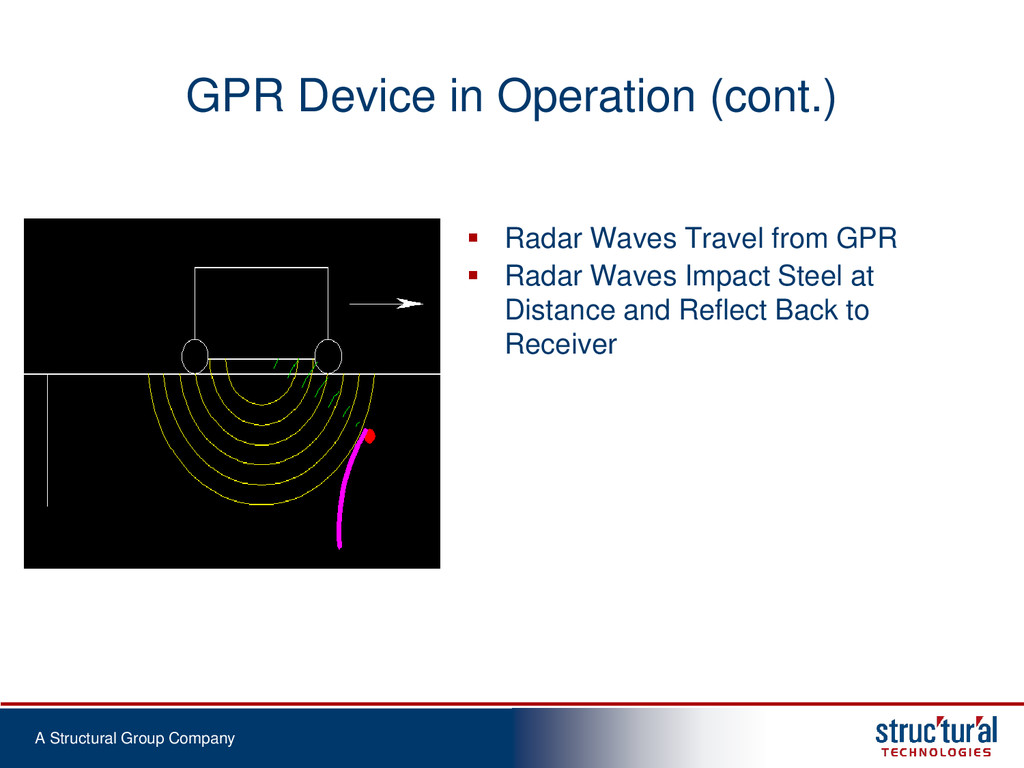
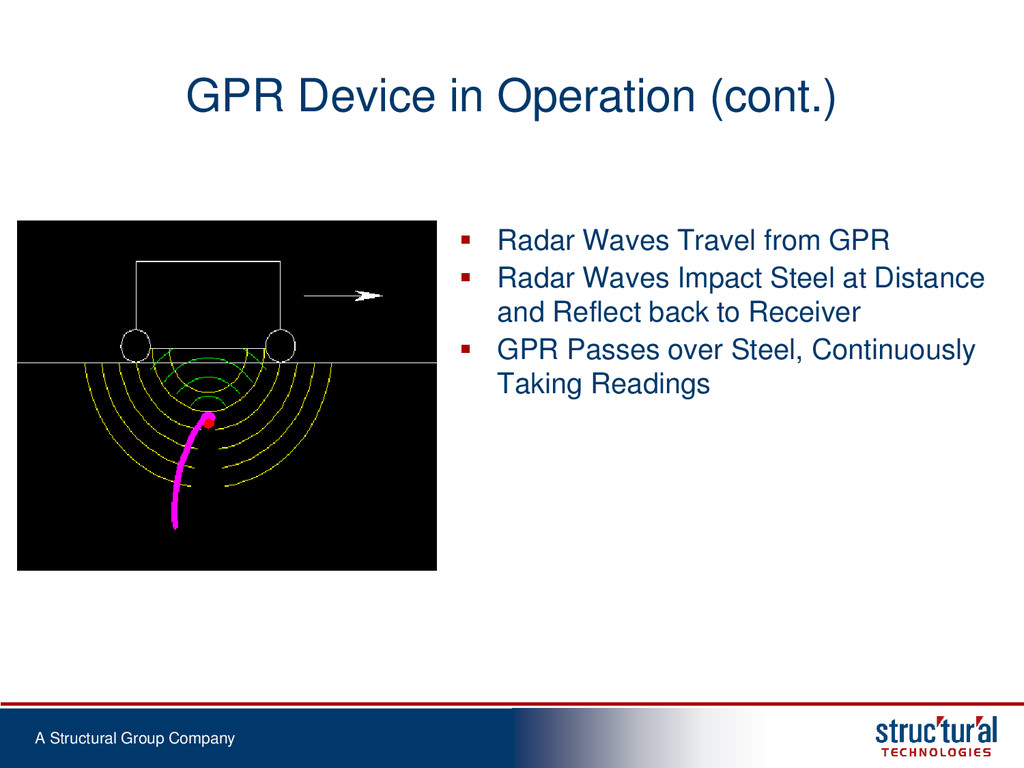
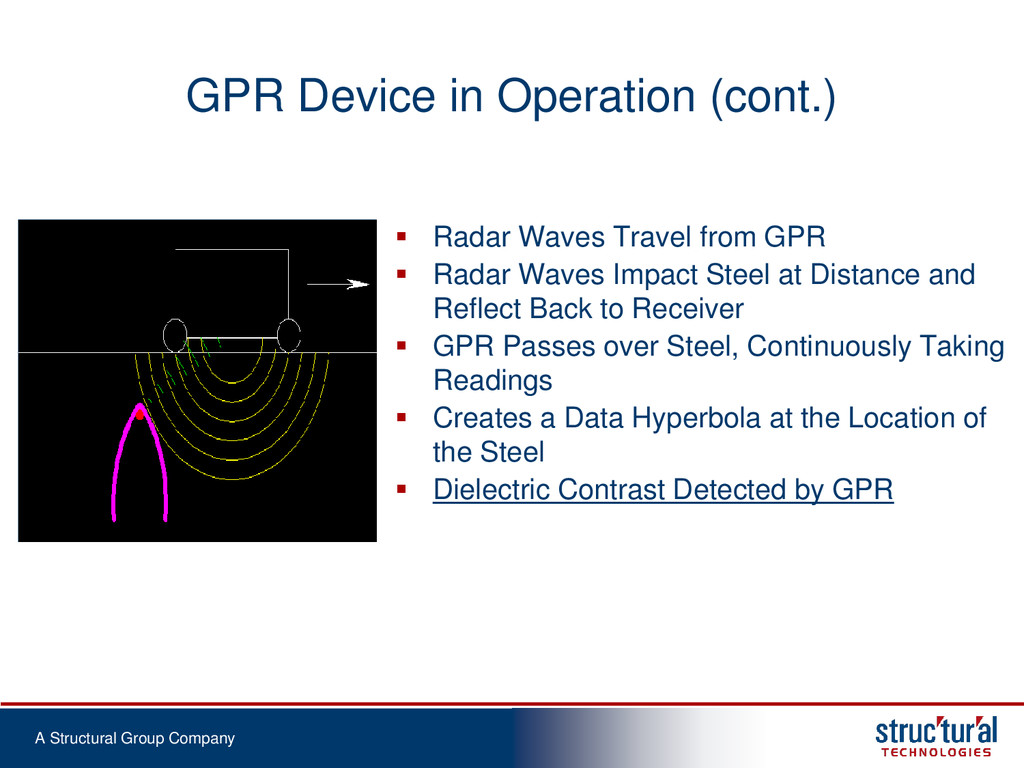
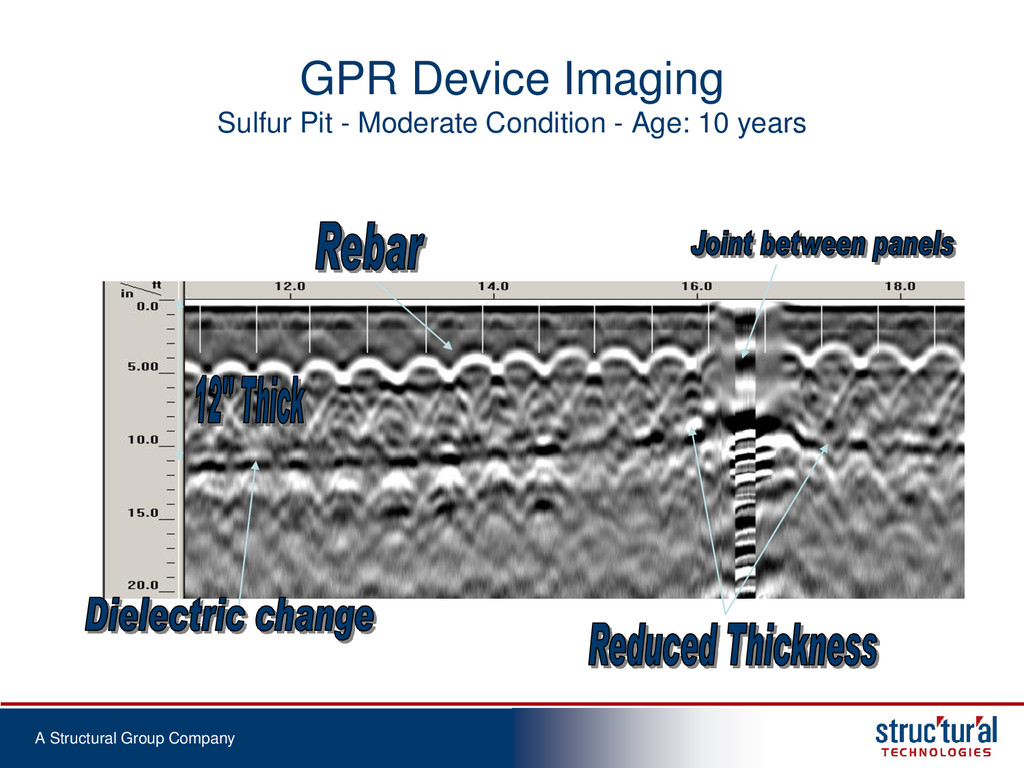
Radar Waves Travel from GPR Radar Waves Impact Steel at Distance and Reflect Back to Receiver GPR Passes over Steel, Continuously Taking Readings Creates a Data Hyperbola at the Location of the Steel Dielectric Contrast Detected by GPR
Verification is Always Recommended for NDT (Not Always Possible on Sulfur Pit Roofs while they are On-Line due to Fire Hazard) Correlation with Additional NDT like Impact Echo Testing aids in Validation of Test Results
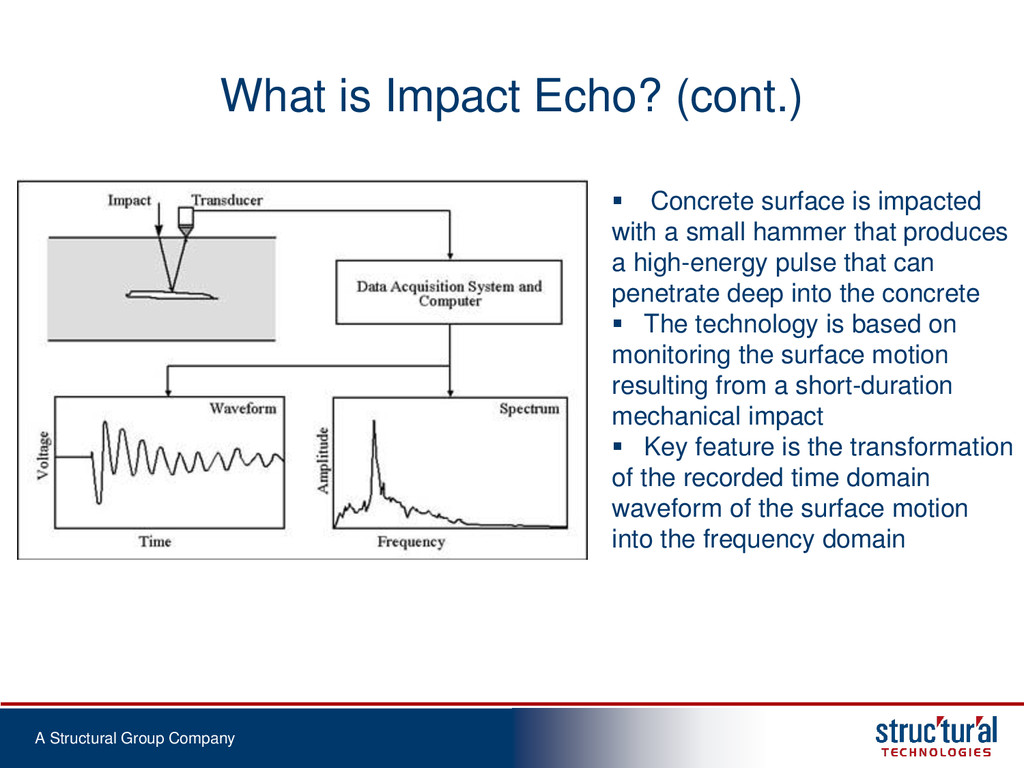
Echo (IE) is a technique that uses mechanical stress wave propagation through a solid to detect subsurface flaws and boundaries The method overcomes many of the barriers associated with flaw detection in concrete based on ultrasonic methods When a surface of a solid is impacted, the disturbance propagates through the solid in three different types of stress waves: a P-wave, a S-wave, and a R-wave Impact Echo processing techniques focus on the P-wave arrival from it’s reflection or “echo”
Concrete surface is impacted with a small hammer that produces a high-energy pulse that can penetrate deep into the concrete The technology is based on monitoring the surface motion resulting from a short-duration mechanical impact Key feature is the transformation of the recorded time domain waveform of the surface motion into the frequency domain
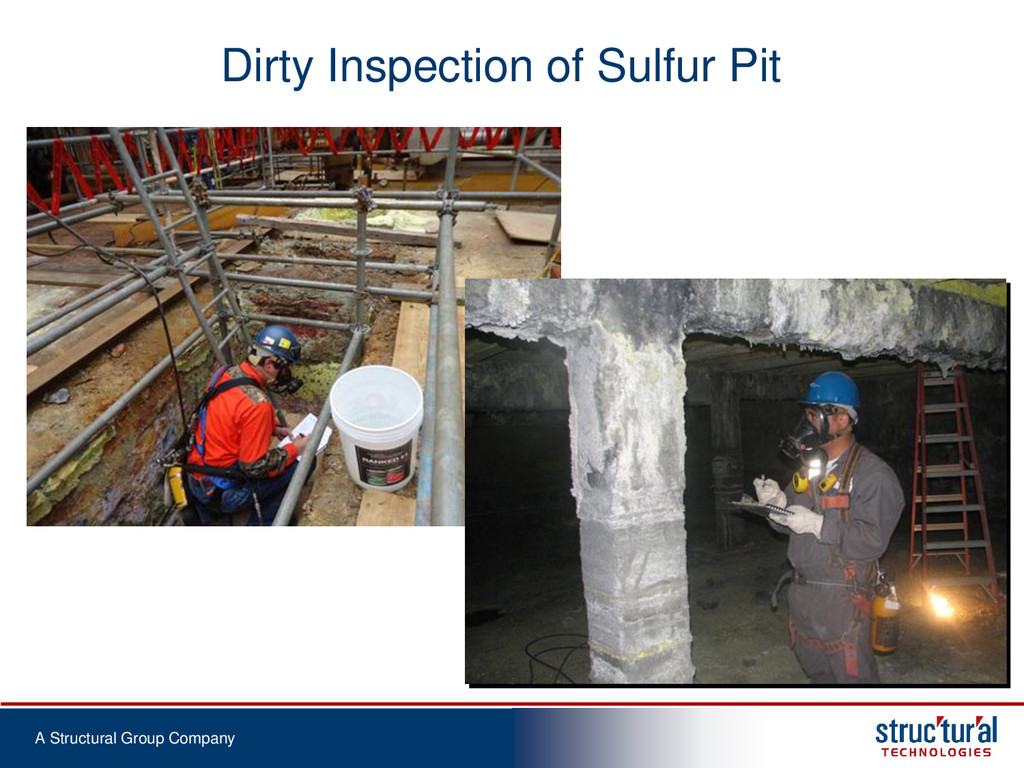
“Dirty Inspection” performed subsequent to draining the Sulfur Pit’s molten sulfur and interior surface cooling This inspection activity is visual only and performed under stringent safety protocols including fresh-air and retrieval safeguards Provides an opportunity to preliminarily assess the relative condition of the Sulfur Pit however the structural members are typically partially obstructed with sulfur cake and carsul Determinations as to temporary support and potential repair effort are qualified during this activity
(cont.) “Clean Inspection” performed subsequent to hyroblasting the Sulfur Pit’s interior concrete surfaces removing sulfur cake, carsul and in many instances the soft semi-gelatinous altered cement paste generated by Sulfate Chemical Attack of concrete This evaluation provides a competent concrete surface for visual and tactile inspection efforts Environmental conditions are usually better than during “Dirty Inspection” activities and safety protocols reflect these conditions - Often standard air- purifying respirators or with adequate ventilation & monitoring, respirator- free conditions can be maintained for Inspection Personnel In the absence of sulfur cake & carsul, tactile inspection efforts can be safely employed allowing “truth & verification” of NDT results collected while the Sulfur Pit was on-line
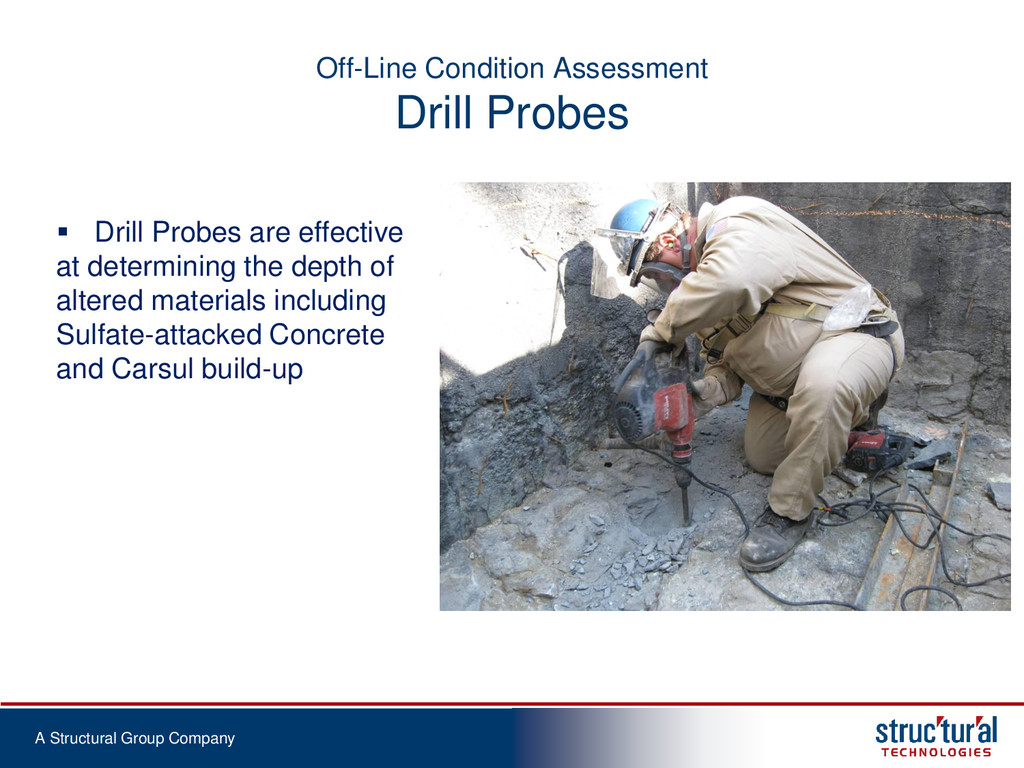
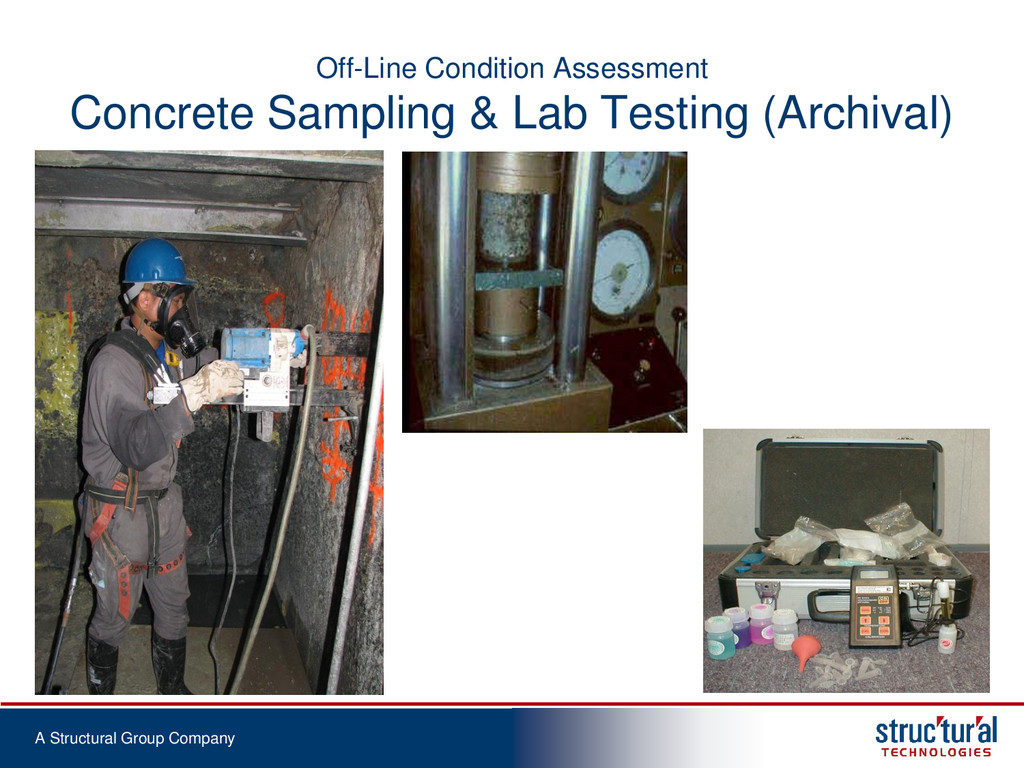
(cont.) Acoustic Impact Testing (ASTM D4580) of accessible interior concrete surfaces is performed to evaluated the soundness of the parent concrete and/or previously applied repair programs Drill Probes drilled to establish the depth of chemically altered concrete materials and/or prior repairs with relative “softness” of the drill media being the determining factor Should concrete material sampling be required, core & powder samples can be collected for archival purposes as laboratory testing results typically require processing timelines greater than those available during a short- duration outage
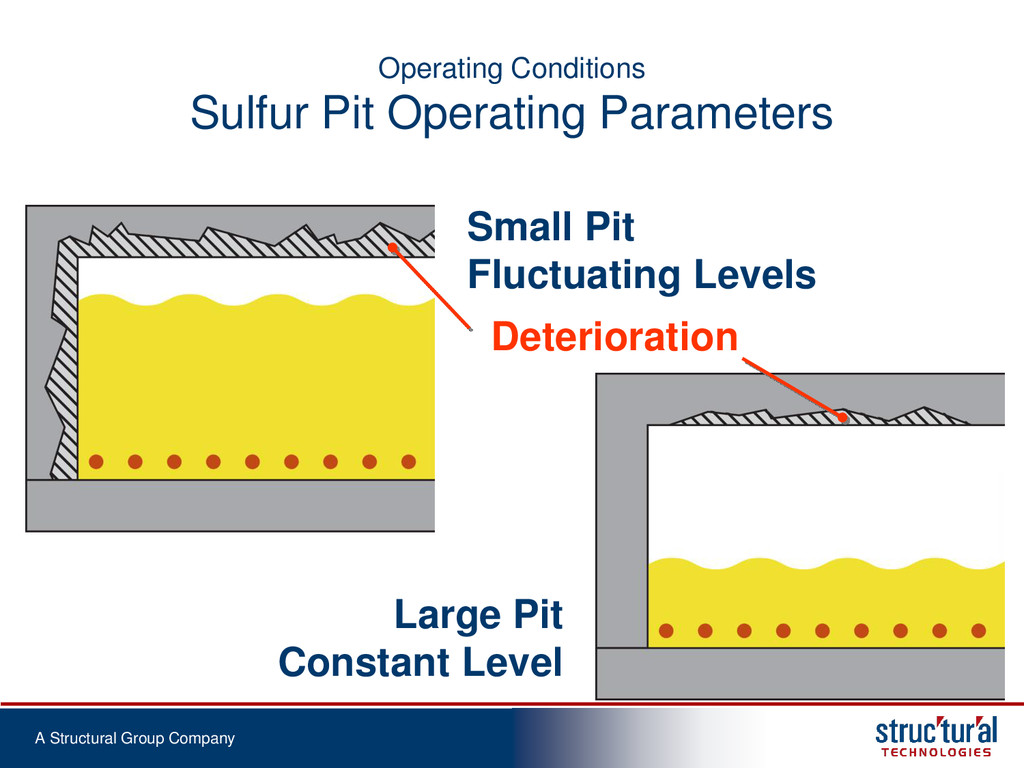
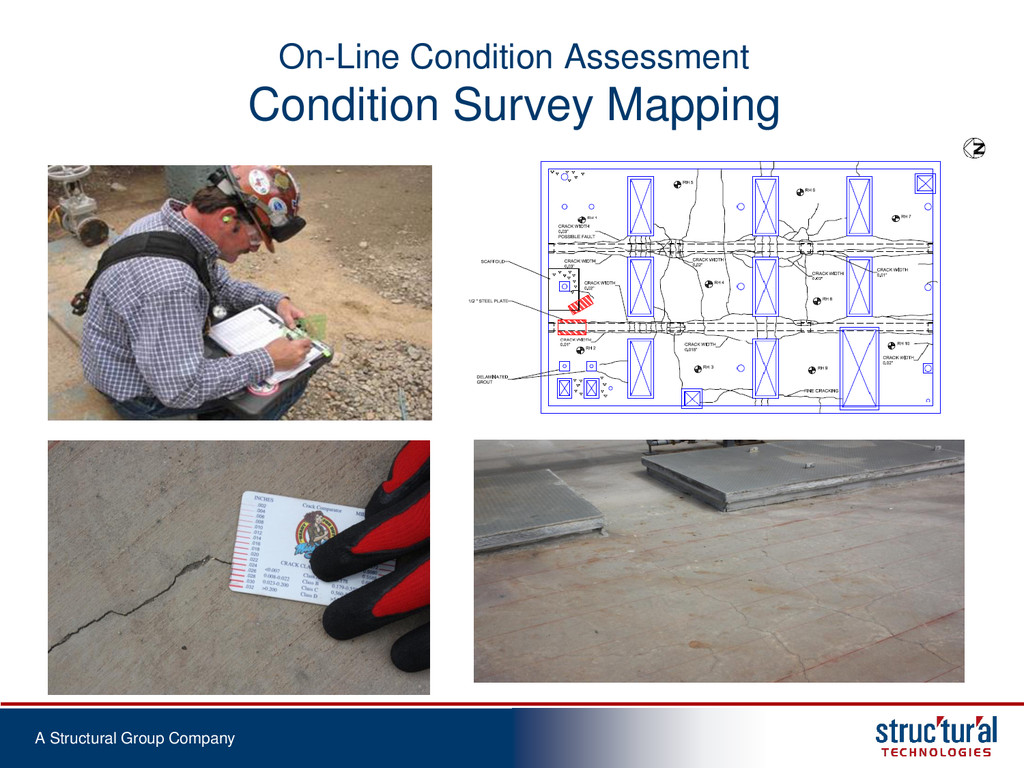
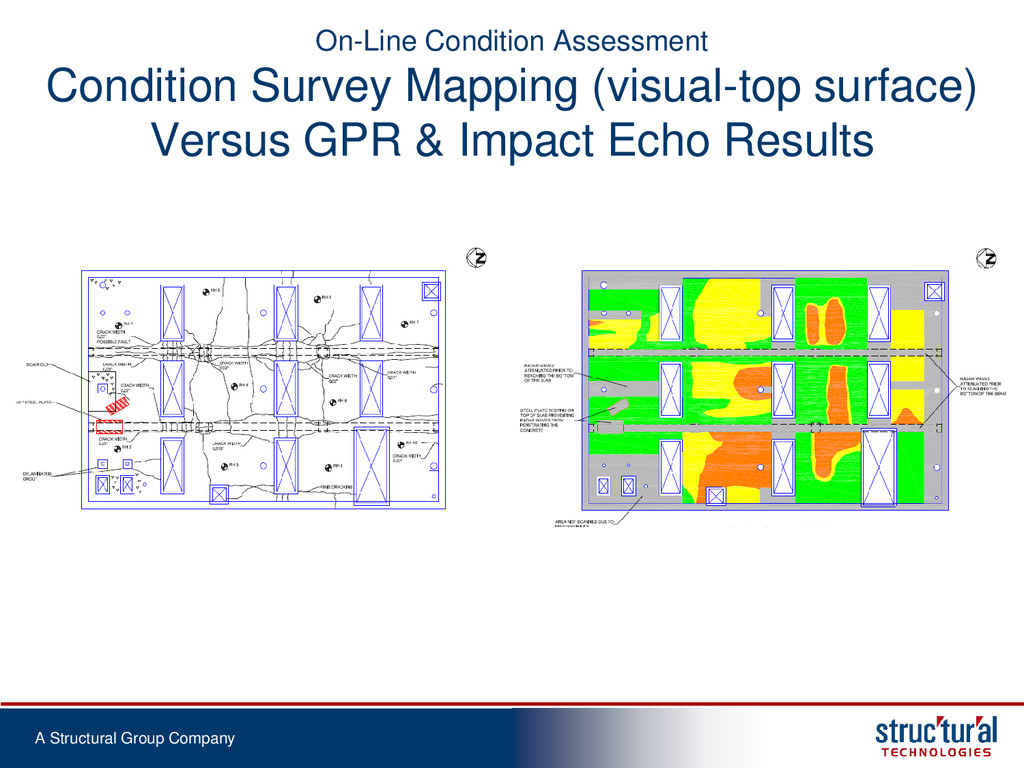
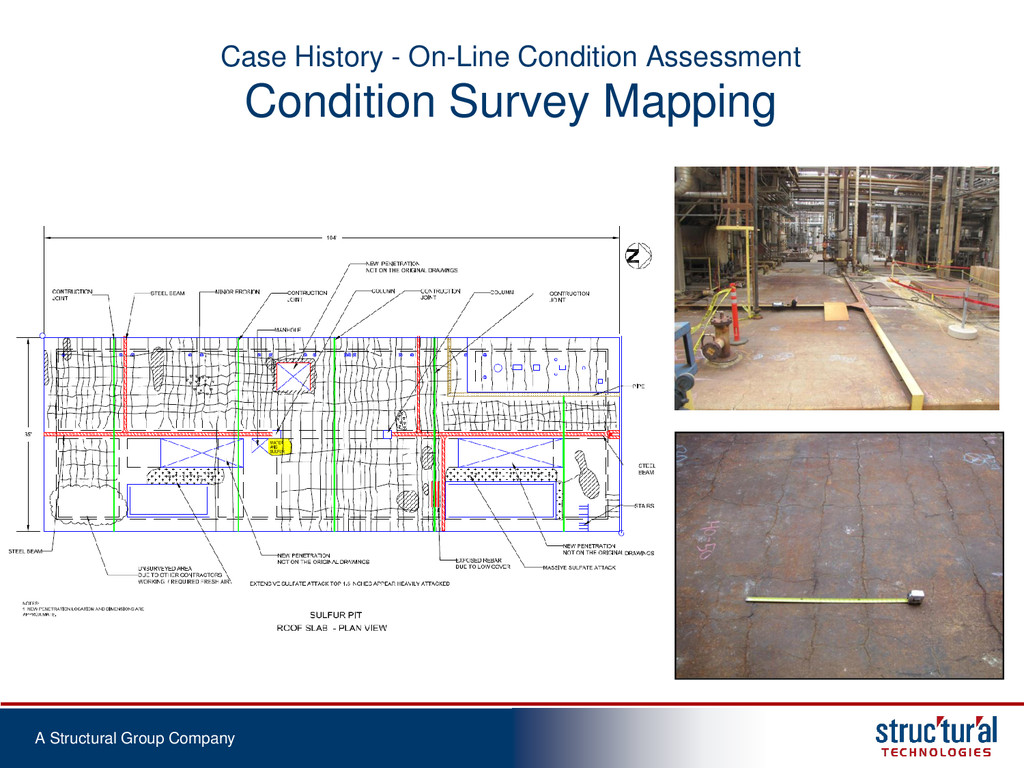
(cont.) Concerned with visually observed excessive cracking, significant Roof Slab deflections and detected fugitive emissions (H2 S), the Owner recognized that an extensive restoration program was necessary but didn’t have an idea of how much to budget Using the On-Line/Off-Line Evaluation Approach, the investigation began by performing a comprehensive Condition Survey Mapping of accessible external concrete surface features that clearly outlined current concrete distress
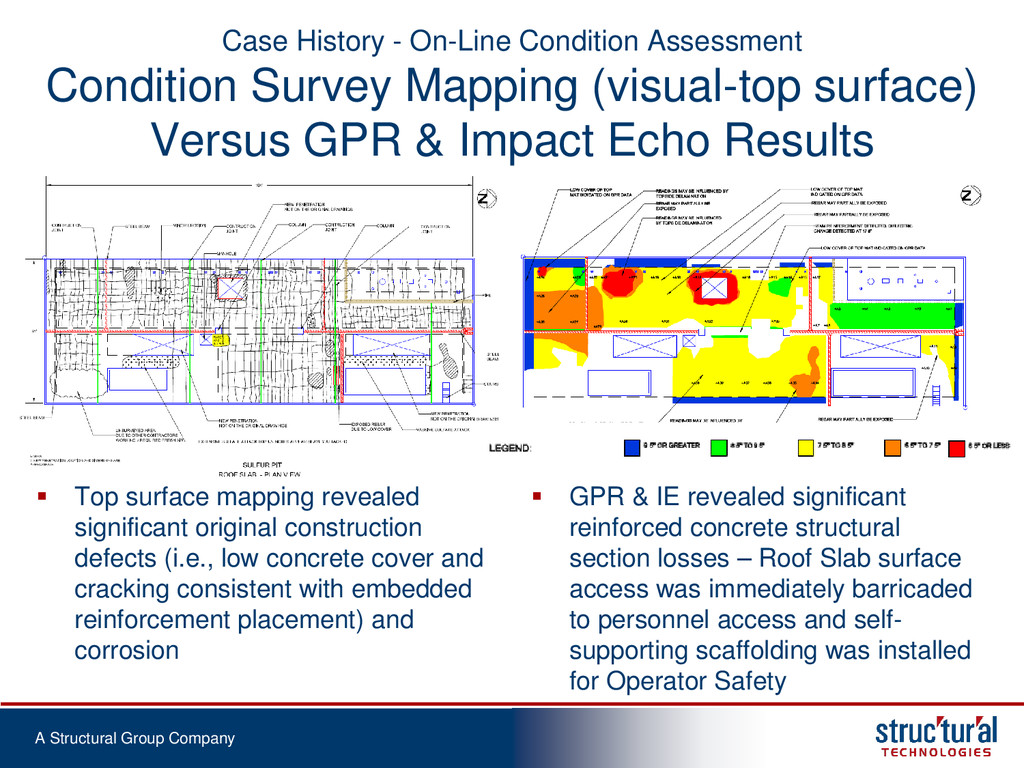
Evaluation Results As a result of the On-Line/Off-Line Evaluation Approach a Restoration Program had to be developed that accounted for the observed deterioration as well as the reported numerous failed repair programs employed at the Sulfur Pit The extensive deterioration detected in the Roof Slab provided an indicator that Wall regions were also probably in very poor condition and would need to be incorporated into the Restoration Program
Evaluation Results (cont.) Evaluating & interpreting collected data, a “Pit-within-a Pit” was designed and estimated allowing the Owner time to budget and get the required “buy-in” from Upper Level Management making project funding possible prior to the SRU Outage During the SRU Outage, both Dirty & Clean Inspections were performed to validate On-Line generated data with results verifying the repair assumption and allowing Fast-Track Repair Construction within a tight time-frame Repairs included the complete removal and replacement of the Sulfur Pit Roof Slab, installation of a new structural Wall Liner and new heating coil replacement/penetration seals to accommodate negative pressure requirements within the vapor zone
Thomas Kline – Director, Investigate Design Build Services STRUCTURAL TECHNOLOGIES Deer Park, Texas Vail Sulfur Symposium September 8th through 12th, 2014 Thank You Questions?


 structural
 kaityo256
 signer
 shirayanagiryuji
 pawan_pharm
 ichimichi
 uranoken
 yatabe
 terasawat
 moriyuya
 terazawa
 kenichiota0711
 kimpetersen
 akashhashmi
 stephaniewalter
 kneath
 hatefulcrawdad
 deanohume
 greggifford
 csswizardry
 baasie
 letsgokoyo
 tammyeverts
 eitanlees