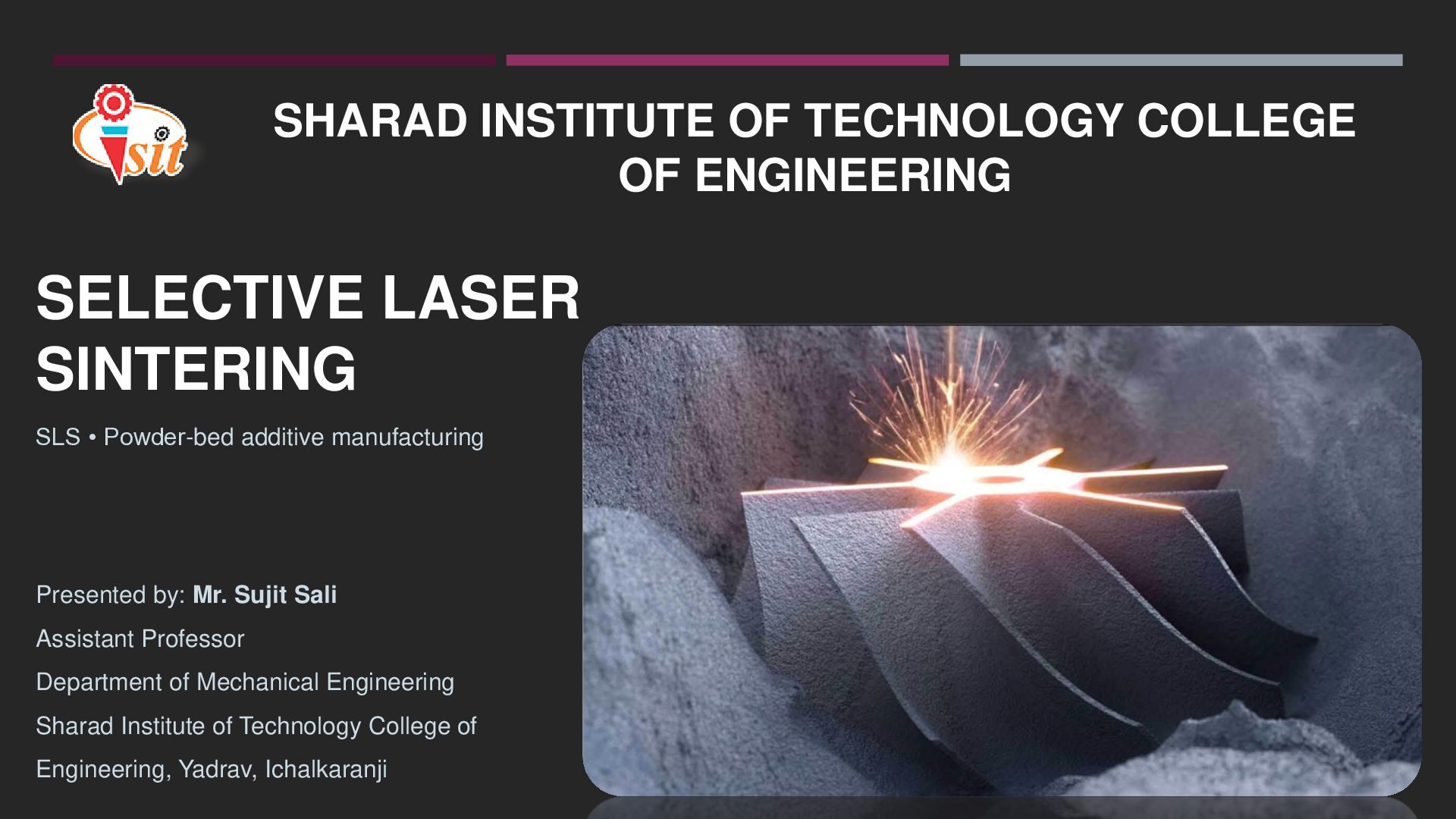
The particular slide involves information regarding to Selective Laser Sintering (SLS) 3D printing process. It contains basic principle, Working process, parts of machine.
SLS • Powder-bed additive manufacturing Presented by: Mr. Sujit Sali Assistant Professor Department of Mechanical Engineering Sharad Institute of Technology College of Engineering, Yadrav, Ichalkaranji
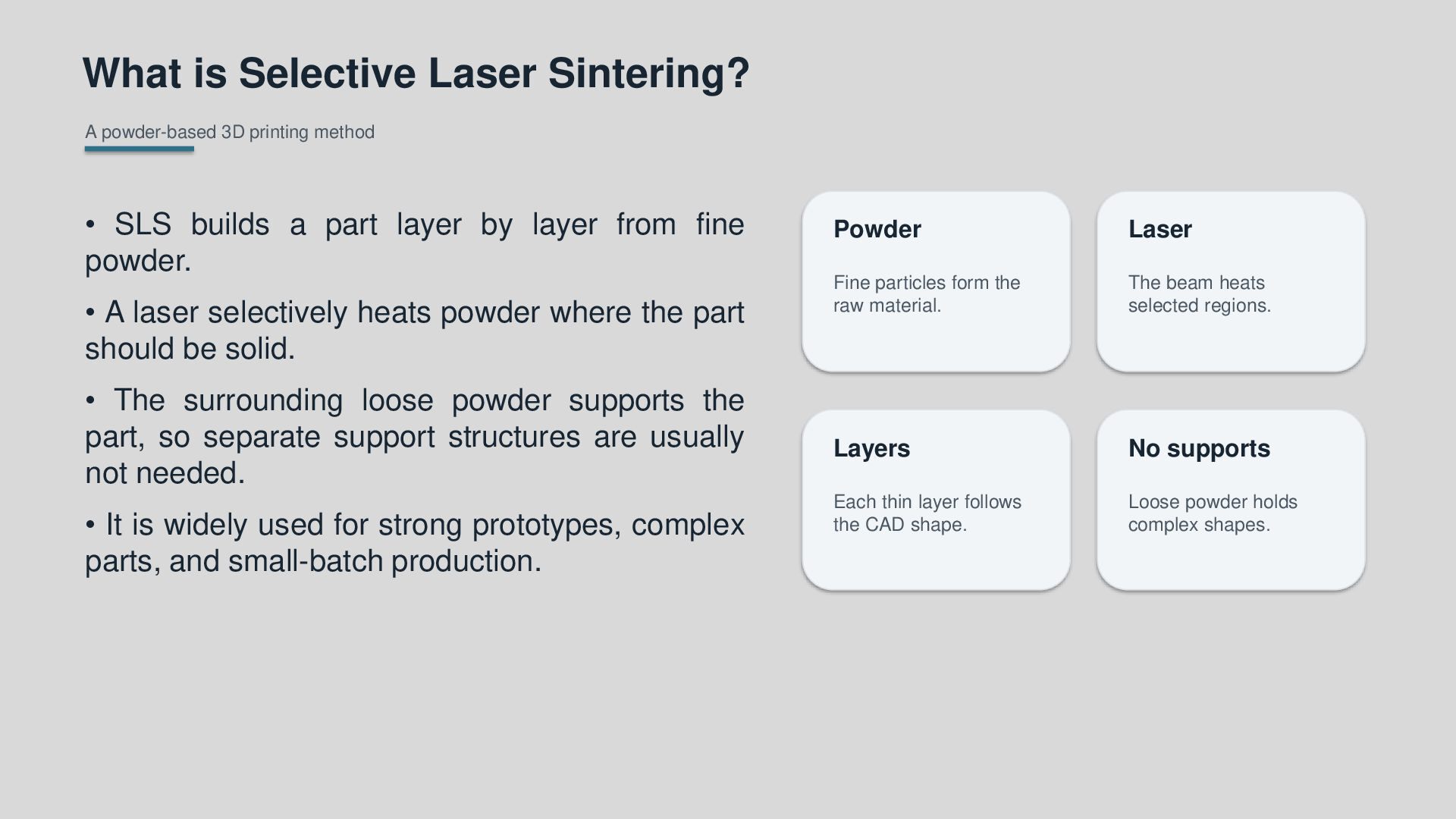
• SLS builds a part layer by layer from fine powder. • A laser selectively heats powder where the part should be solid. • The surrounding loose powder supports the part, so separate support structures are usually not needed. • It is widely used for strong prototypes, complex parts, and small-batch production. Powder Laser Fine particles form the raw material. The beam heats selected regions. Layers No supports Each thin layer follows the CAD shape. Loose powder holds complex shapes.
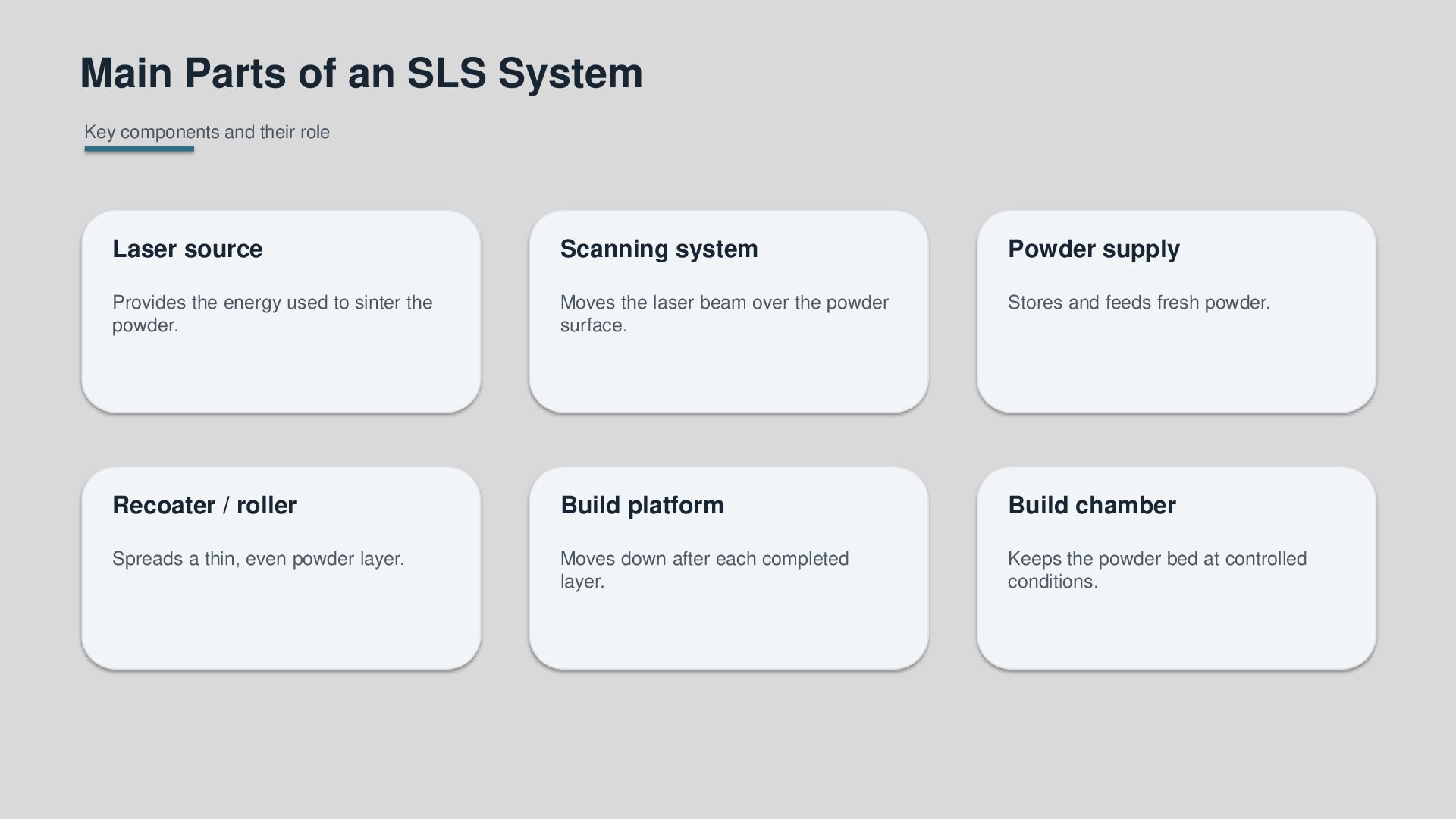
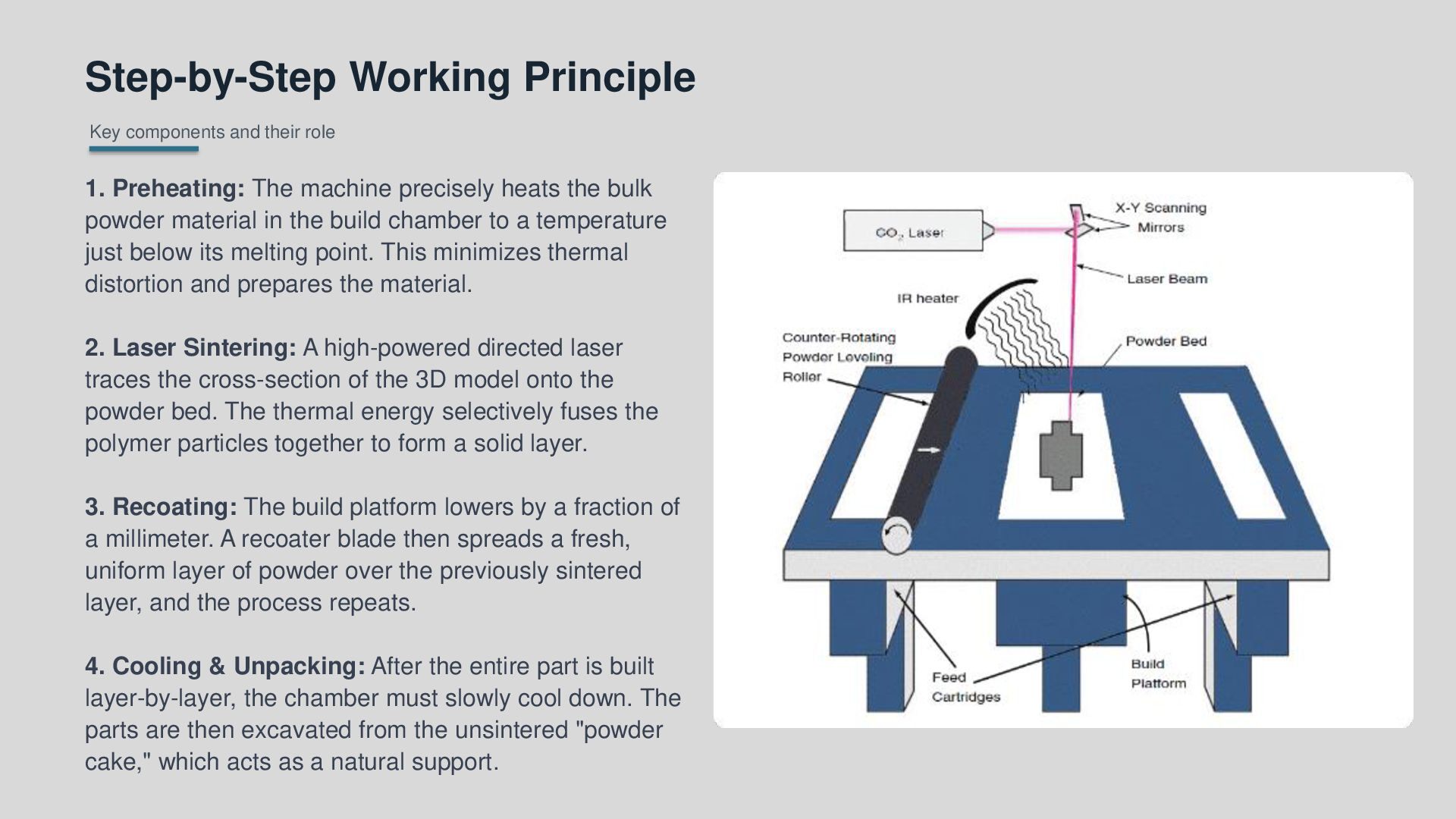
role Laser source Scanning system Powder supply Provides the energy used to sinter the powder. Moves the laser beam over the powder surface. Stores and feeds fresh powder. Recoater / roller Build platform Build chamber Spreads a thin, even powder layer. Moves down after each completed layer. Keeps the powder bed at controlled conditions.
The machine precisely heats the bulk powder material in the build chamber to a temperature just below its melting point. This minimizes thermal distortion and prepares the material. 2. Laser Sintering: A high-powered directed laser traces the cross-section of the 3D model onto the powder bed. The thermal energy selectively fuses the polymer particles together to form a solid layer. 3. Recoating: The build platform lowers by a fraction of a millimeter. A recoater blade then spreads a fresh, uniform layer of powder over the previously sintered layer, and the process repeats. 4. Cooling & Unpacking: After the entire part is built layer-by-layer, the chamber must slowly cool down. The parts are then excavated from the unsintered "powder cake," which acts as a natural support.


 sujit0722
 teamlab
 sh_fk2
 yu23ki14
 kakehashi
 onk
 techtekt
 yamanoku
 tokuty
 yazm
 jyouryuusui
 recruitengineers
 riyaamemiya
 tammielis
 malarkey
 khoart
 lynnandtonic
 shlominoach
 reverentgeek
 techseoconnect
 tmiket
 shpigford
 aleyda
 aemeredith
 cromwellryan