Share
Embed
Design and Implementation of a Local LLM Harness for Digital Forensics
FORENSIA
https://github.com/sumeshi/forensia
Do Local LLMs Dream of Forensic Investigators?
https://sumeshi.github.io/posts/works/do-localllms-dream-of-forensicinvestigator-en
Do Local LLMs Dream of Forensic Investigators? — Part II
https://sumeshi.github.io/posts/works/do-localllms-dream-of-forensicinvestigator-2-en

S.Nakano
November 25, 2026
Transcript
86 slides
-
Design and Implementation of a Local LLM Harness for Digital
Forensics S.Nakano (@sum3sh1) SA-FOR-002-EN 1 -
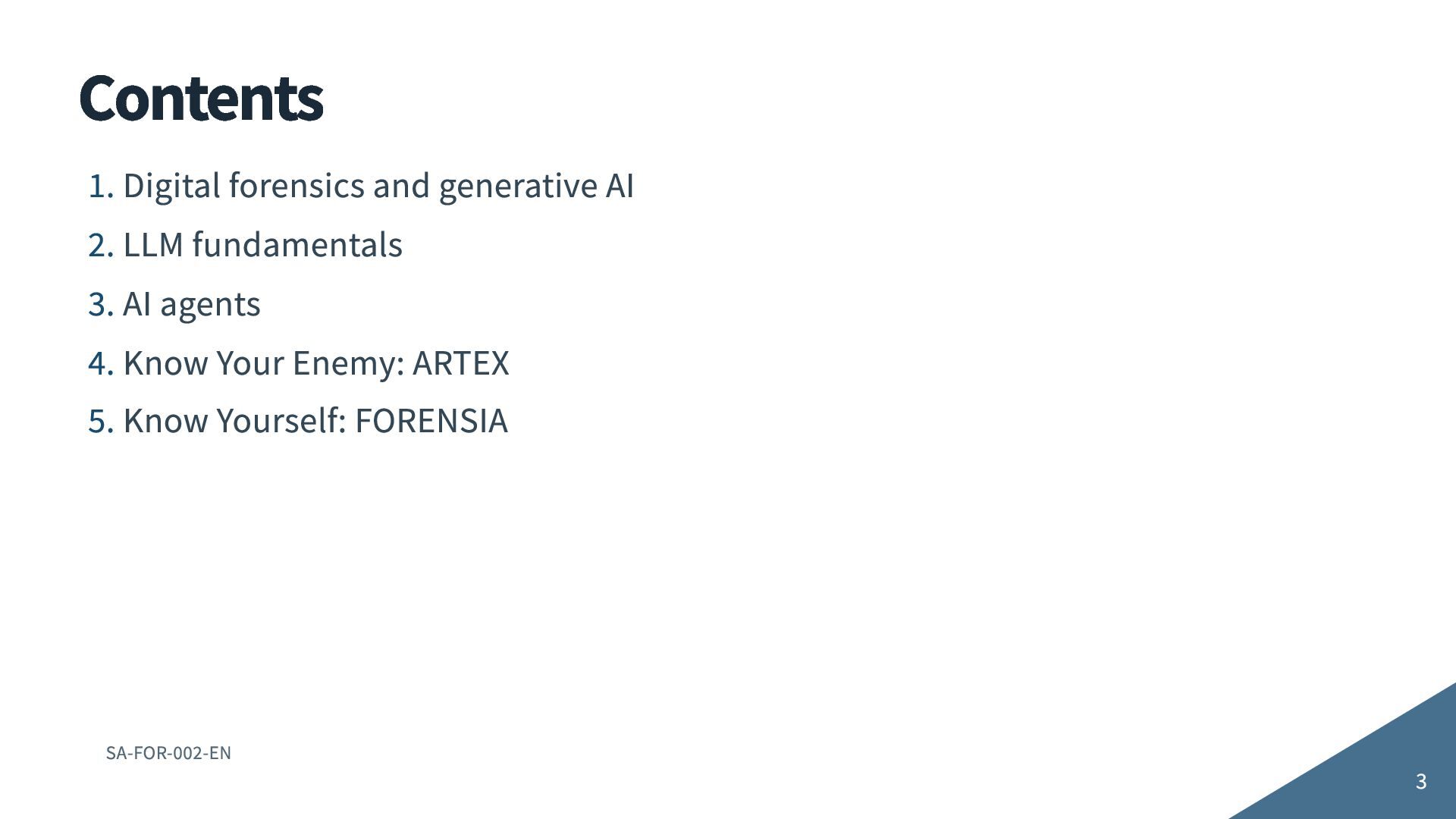
Contents 1. Digital forensics and generative AI 2. LLM fundamentals
3. AI agents 4. Know Your Enemy: ARTEX 5. Know Yourself: FORENSIA SA-FOR-002-EN 3 -
Scope This presentation looks at digital forensics in the context
of incident response at companies and other organizations. Some practices differ in litigation and criminal investigations. Company and product names are trademarks or registered trademarks of their respective owners. SA-FOR-002-EN 4 -
What is digital forensics? A set of scientific methods and
techniques for preserving, examining, and analyzing electronic records as evidence in incident response, legal disputes, or litigation. It also includes collecting and analyzing information about tampering with or damage to those records. Translated from “What Is Digital Forensics?” by the Institute of Digital Forensics. https://digitalforensic.jp/home/what-df/ “ “ Companies often use forensics after a cyberattack to determine its impact and plan a response. When they need answers quickly, investigators may use “fast forensics,” examining just enough data to establish what happened and why. SA-FOR-002-EN 6 -
Forensics in practice Preserve forensic artifacts, including logs, configuration data,
file system records, file contents, and memory, and protect the preserved data from subsequent overwriting. Analyze the preserved material in a way that maintains its evidentiary value and answers the question under investigation. Investigators form a hypothesis about an event, extract artifacts in a form they can examine, and test that hypothesis. They repeat the process to establish the facts. SA-FOR-002-EN 7 -
What we have automated so far Forensic work traditionally relied
on the knowledge and craft of individual specialists. As practitioners accumulated experience, parts of the job became easier to automate. Parse binary files and extract specific records. Format and aggregate the records for statistical analysis. Match records against known conditions to spot suspicious activity. SA-FOR-002-EN 8 -
Why automation is difficult Individual steps can be automated. Handing
over an entire investigation that requires judgment as circumstances change has been much harder. Investigators need both breadth and depth of expertise. What needs investigating varies so much that a common procedure is hard to define. The answers people need from an investigation also vary from case to case. SA-FOR-002-EN 9 -
What changed with generative AI? Systems that take questions and
give answers in natural language have made it much easier to delegate decisions as a situation unfolds. Early users gave one instruction at a time and read each response. Today a system can take a goal, plan from the situation at hand, and work with other systems to carry out the plan. Forensic systems are emerging that cover the process from artifact ingestion through report generation. SA-FOR-002-EN 10 -
Why automate forensic work? Because it’s hard. Really hard. Operating
systems and applications keep writing new records over old ones. Investigators have to piece together what survives and reach a conclusion. Some records are already gone. Even if we had them all, reconstructing everything that happened would take an enormous amount of time. And the adversary won’t wait. SA-FOR-002-EN 11 -
Lately it’s been even harder In recent months, attacks involving
AI systems have become common both in Japan and abroad. In a manual attack, the pauses between actions and the attacker's trial and error sometimes gave away their intentions. Even their choice of tools could hint at their background. AI seems to try everything at once. It feels like facing a thousand script kiddies. Even in chronological order, the actions can look disconnected and redundant. The logs are wall-to-wall pointless scans. No sense of artistry. SA-FOR-002-EN 12 -
An eye for an eye If attackers use AI, defenders
will struggle to keep up without it. Much of attack and defense comes down to making the other side bear the cost. If the two sides are still barely in balance (are they?), we can’t afford to put off a response. This presentation looks at how generative AI is changing the field and what defenders can do with that knowledge. SA-FOR-002-EN 13 -
What is an LLM? A large language model (LLM) is
trained on large amounts of data, including natural language. Many widely used text generators are autoregressive transformers. Given a sequence of tokens, such as words or parts of words, the model computes a probability distribution for the next token, selects one, and repeats. Sequential generation. Text grows one token at a time. Long outputs take time. Probabilistic output. The next token is selected from a distribution. The resulting text can disagree with the facts or even with the input. SA-FOR-002-EN 15 -
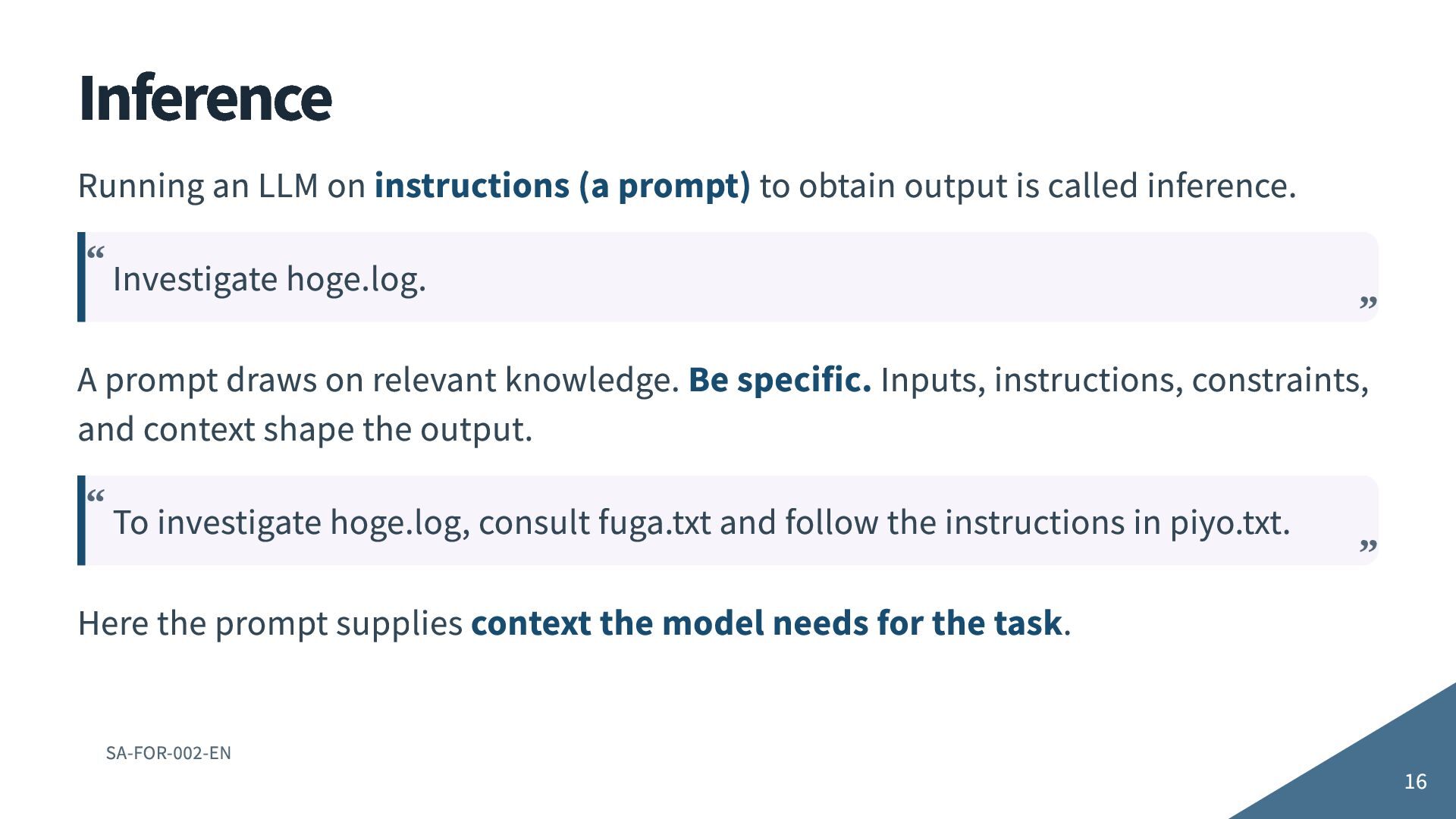
Inference “ Running an LLM on instructions (a prompt) to
obtain output is called inference. “ Investigate hoge.log. A prompt draws on relevant knowledge. Be specific. Inputs, instructions, constraints, and context shape the output. “ To investigate hoge.log, consult fuga.txt and follow the instructions in piyo.txt. “ Here the prompt supplies context the model needs for the task. SA-FOR-002-EN 16 -
Inference and reasoning Inference is the process of running a
model to obtain output. Reasoning is the ability or process of solving a problem in several steps. OpenAI o1, released in 2024, is an example of a model developed to improve this ability. “ Look for suspicious logons in hoge.log. To identify suspicious logons, I first need to check whether each logon succeeded or failed, its type, and its source. Next, I need to look for unusual times or users… “ Working through a problem by expressing intermediate reasoning steps is called chain of thought (CoT). SA-FOR-002-EN 17 -
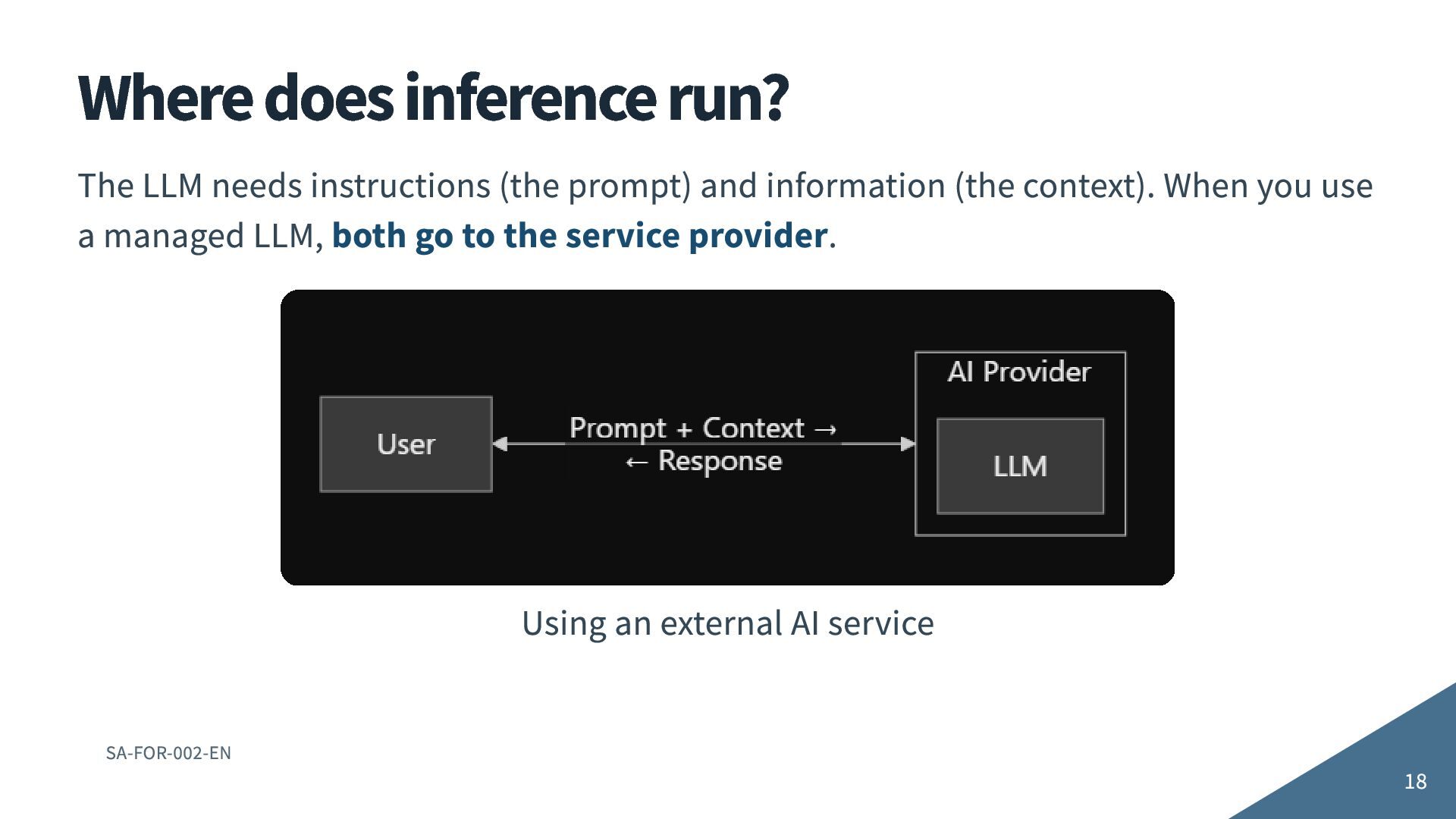
Where does inference run? The LLM needs instructions (the prompt)
and information (the context). When you use a managed LLM, both go to the service provider. Using an external AI service SA-FOR-002-EN 18 -
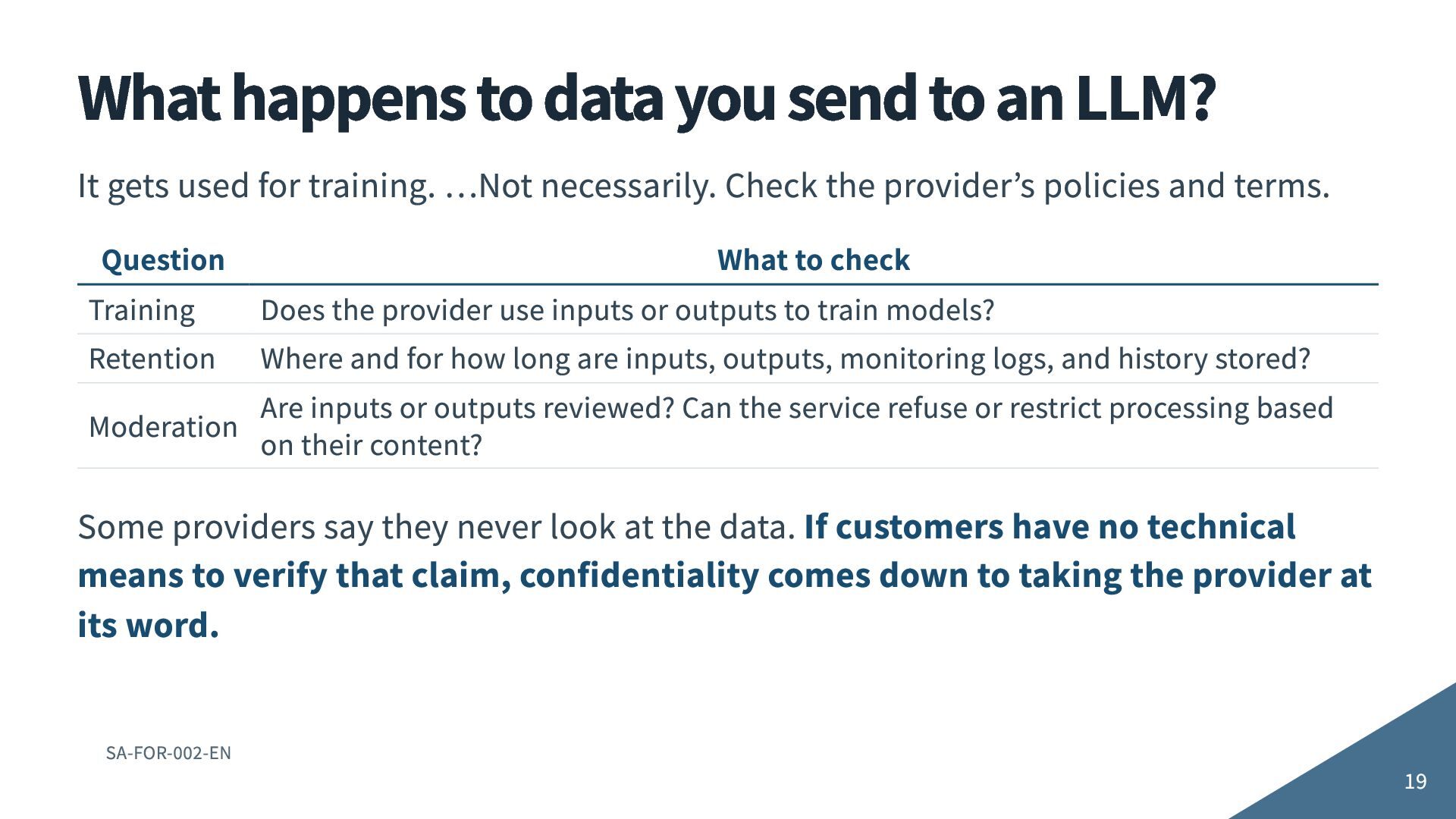
What happens to data you send to an LLM? It
gets used for training. …Not necessarily. Check the provider’s policies and terms. Question What to check Training Does the provider use inputs or outputs to train models? Retention Where and for how long are inputs, outputs, monitoring logs, and history stored? inputs or outputs reviewed? Can the service refuse or restrict processing based Moderation Are on their content? Some providers say they never look at the data. If customers have no technical means to verify that claim, confidentiality comes down to taking the provider at its word. SA-FOR-002-EN 19 -
Who controls the data? Generative AI is convenient, but forensic
evidence often contains sensitive material: personal identifiers, credentials, and internal information about an organization. One wrong move and the investigator can be the source of the next incident. When you gaze into an incident, the incident also gazes into you. SA-FOR-002-EN 20 -
Running an LLM locally How much investigation data are you
willing to send outside the organization? Is opting out of training enough? What if the provider uses a domestic data center? What if you rent a GPU? Can you still say you have full control of the data? Zero data retention (ZDR) is a promise about storage. The data still leaves your environment. Do you trust that promise? For my purposes, local still sounds ideal. SA-FOR-002-EN 21 -
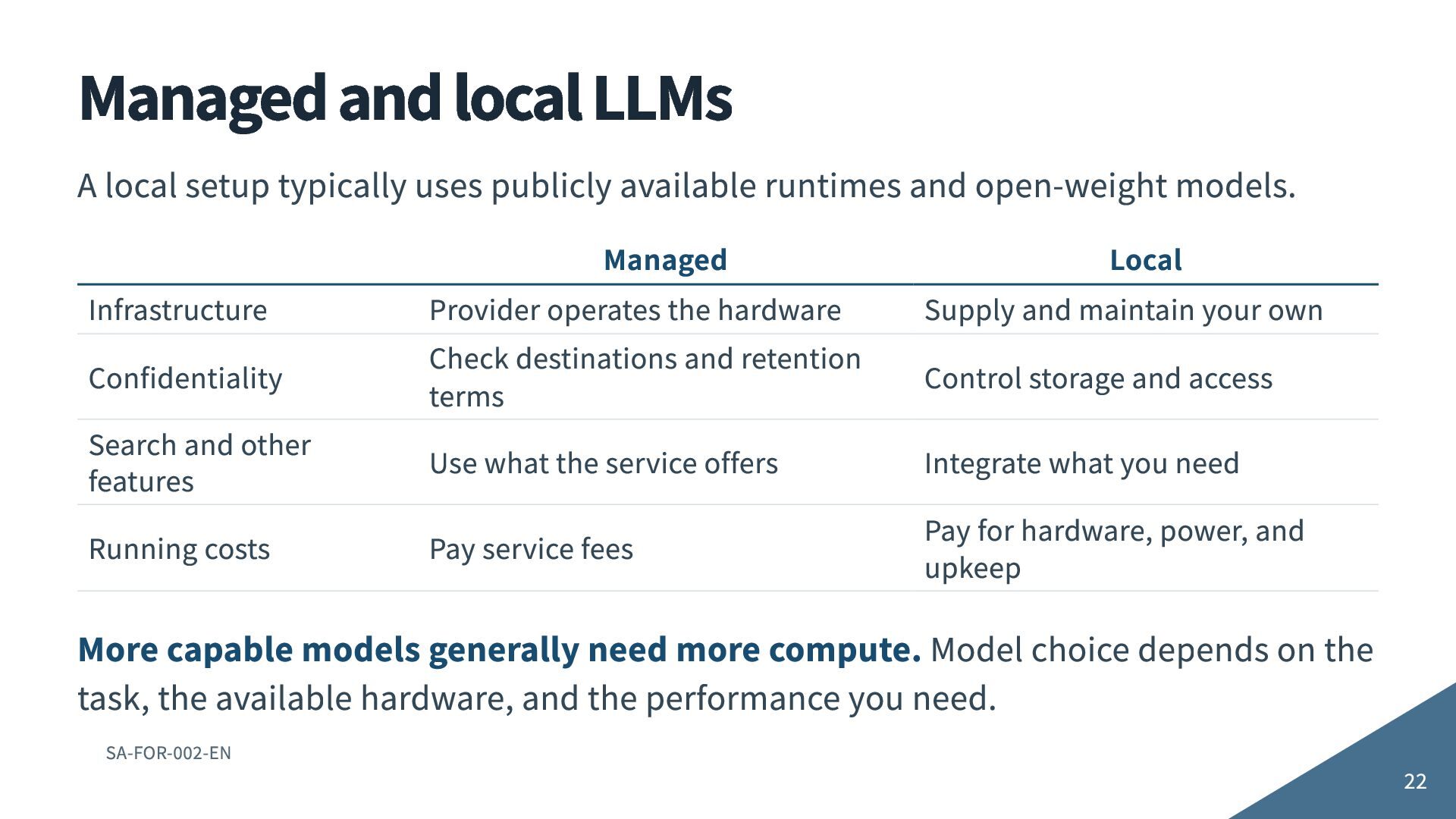
Managed and local LLMs A local setup typically uses publicly
available runtimes and open-weight models. Infrastructure Confidentiality Search and other features Running costs Managed Provider operates the hardware Check destinations and retention terms Use what the service offers Pay service fees Local Supply and maintain your own Control storage and access Integrate what you need Pay for hardware, power, and upkeep More capable models generally need more compute. Model choice depends on the task, the available hardware, and the performance you need. SA-FOR-002-EN 22 -
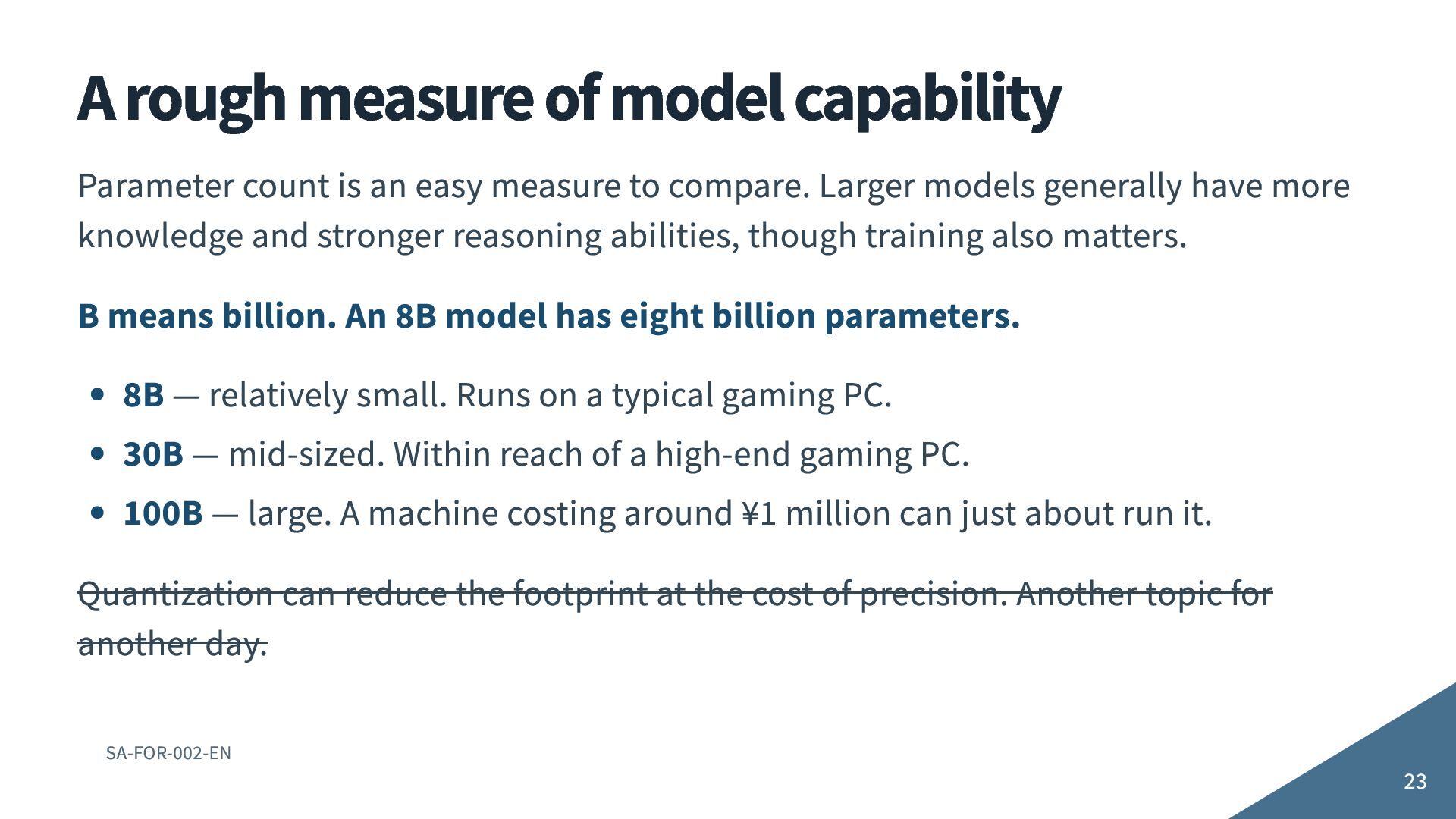
A rough measure of model capability Parameter count is an
easy measure to compare. Larger models generally have more knowledge and stronger reasoning abilities, though training also matters. B means billion. An 8B model has eight billion parameters. 8B — relatively small. Runs on a typical gaming PC. 30B — mid-sized. Within reach of a high-end gaming PC. 100B — large. A machine costing around ¥1 million can just about run it. Quantization can reduce the footprint at the cost of precision. Another topic for another day. SA-FOR-002-EN 23 -
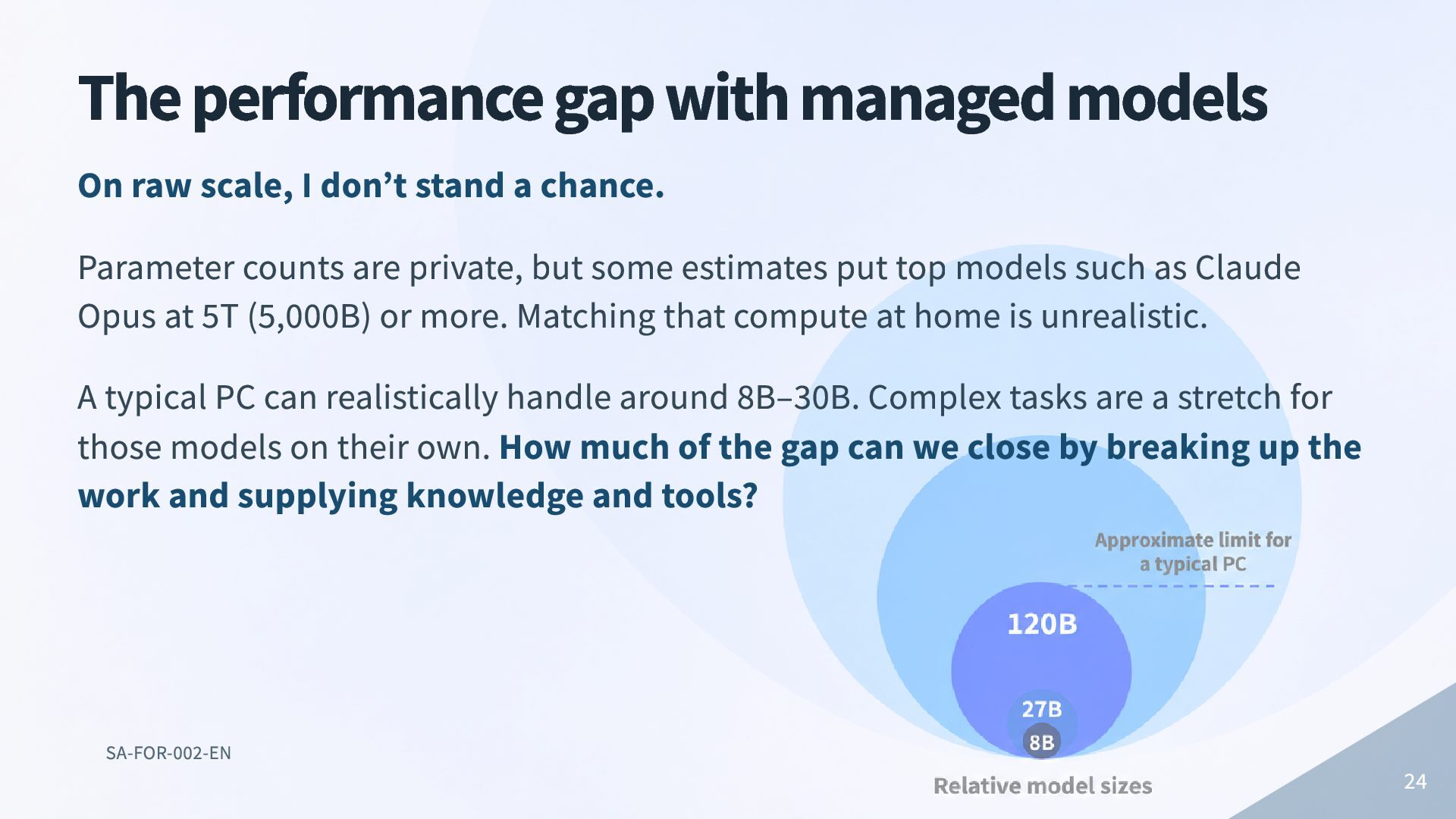
The performance gap with managed models On raw scale, I
don’t stand a chance. Parameter counts are private, but some estimates put top models such as Claude Opus at 5T (5,000B) or more. Matching that compute at home is unrealistic. A typical PC can realistically handle around 8B–30B. Complex tasks are a stretch for those models on their own. How much of the gap can we close by breaking up the work and supplying knowledge and tools? SA-FOR-002-EN 24 -
What matters on limited hardware? Which capabilities does a small
model actually need for an investigation? Knowledge — lower priority. Rules and external references can supply missing expertise. Problem solving — medium priority. The model needs to form a hypothesis from the available information and propose a way to test it. Instruction following — high priority. It needs to follow formats and constraints and call the appropriate tools. It doesn’t have to do everything. What matters is whether it can do the job with the information and instructions it receives. SA-FOR-002-EN 25 -
What is an AI agent? An AI agent assesses the
situation, makes a plan, and carries out tasks toward a goal by operating tools and external systems. Coding agents such as Codex and Claude Code are examples. An LLM’s output alone cannot operate another system. To do real work, the agent needs an interface to that system. SA-FOR-002-EN 27 -
Tool calling What if we asked an LLM for JSON
and connected the output to a web API? What if the LLM could express an action as a command for a Linux system? What if it could then see the result? This expands the actions the system can take and gives the model access to much more information than a person could supply by hand. Tool calling lets an LLM invoke external functions. ReAct repeatedly combines reasoning, acting, and observing the results. SA-FOR-002-EN 28 -
The harness An LLM can propose a tool call. Something
else has to execute it. The model can only process so much at once, so we cannot keep feeding it every result and every past conversation. The harness manages this work outside the model. Tools. Receive calls, execute them, and return results. Context and state. Track information and progress, and pass them to the LLM. Execution loop. Alternate inference and action, and decide when to continue or stop. Constraints and checks. Limit permissions and actions, then verify and record results. SA-FOR-002-EN 29 -
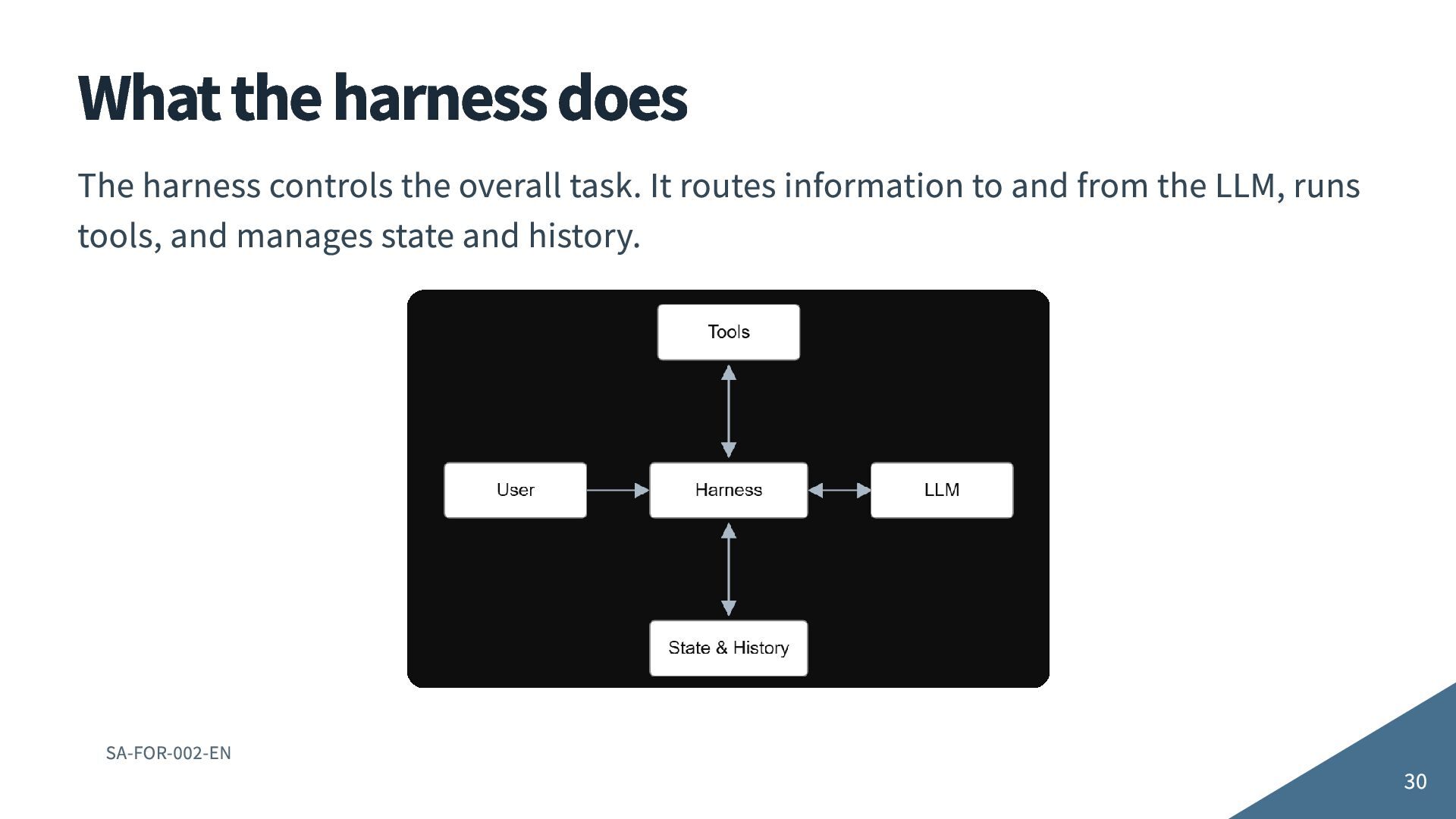
What the harness does The harness controls the overall task.
It routes information to and from the LLM, runs tools, and manages state and history. SA-FOR-002-EN 30 -
How the harness manages memory At each inference step, the
LLM sees the context supplied for that step. A long-running task cannot keep passing in every conversation and result. Store memory outside the model and select what to pass back. Work state. What do we know, and what is still unresolved? Execution history. What have we tried, and what happened? Context. What information does the next decision require? Saving a transcript is only part of the job. The harness also decides what to include in the next inference and what to leave out. SA-FOR-002-EN 31 -
How the harness manages tasks A single goal can require
several tasks. Investigating one suspicious logon might mean identifying a host, checking logon records, and correlating them with related activity. Decomposition. Break a large goal into individual tasks. Priorities and dependencies. Decide what needs to be checked first. Progress. Distinguish completed, active, deferred, and pending tasks. Checking each result against the overall goal and passing it to the next task helps a long investigation stay on course. SA-FOR-002-EN 32 -
How the harness controls the loop Running a tool and
returning its result is straightforward. Keeping the investigation on track over many iterations is harder. Continue when new information warrants another check. Retry with revised conditions after identifying why an attempt failed. Switch to another task when progress stalls. Stop when the goal is met, the budget runs out, or verification is impossible. More iterations can mean repeating the same work or drifting away from the original goal. SA-FOR-002-EN 33 -
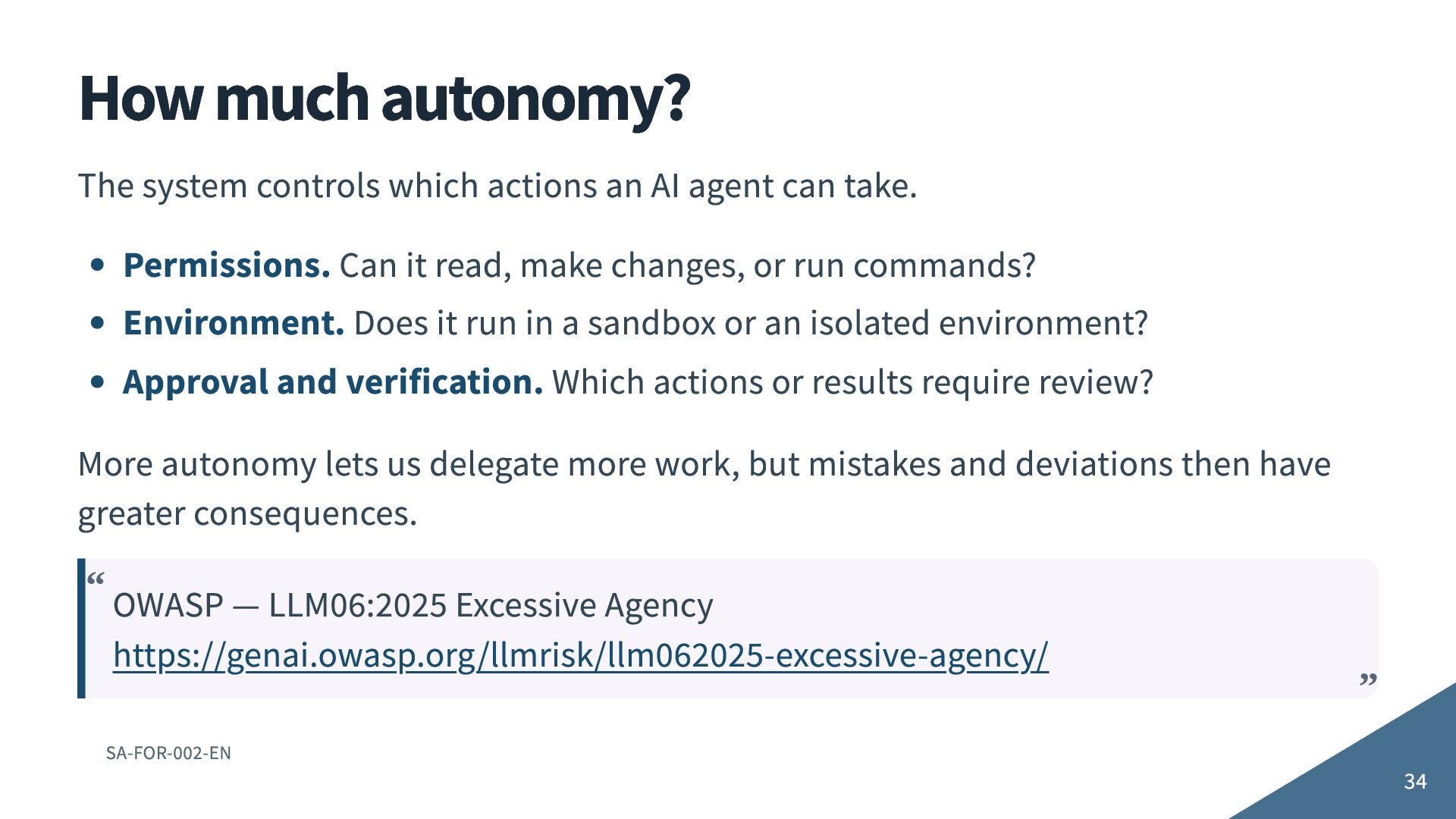
How much autonomy? SA-FOR-002-EN “ The system controls which actions
an AI agent can take. Permissions. Can it read, make changes, or run commands? Environment. Does it run in a sandbox or an isolated environment? Approval and verification. Which actions or results require review? More autonomy lets us delegate more work, but mistakes and deviations then have greater consequences. “ OWASP — LLM06:2025 Excessive Agency https://genai.owasp.org/llmrisk/llm062025-excessive-agency/ 34 -
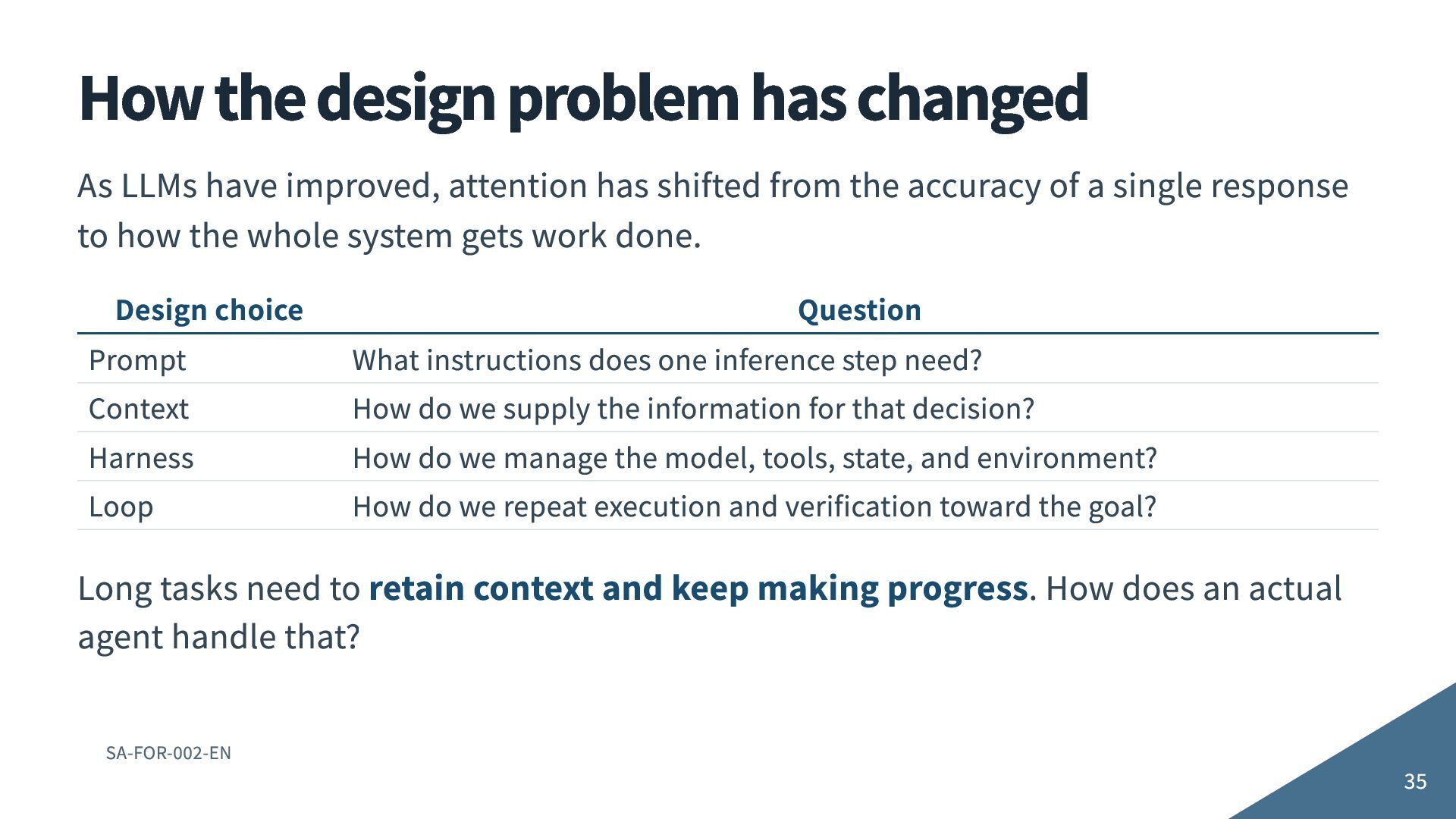
How the design problem has changed As LLMs have improved,
attention has shifted from the accuracy of a single response to how the whole system gets work done. Design choice Prompt Context Harness Loop Question What instructions does one inference step need? How do we supply the information for that decision? How do we manage the model, tools, state, and environment? How do we repeat execution and verification toward the goal? Long tasks need to retain context and keep making progress. How does an actual agent handle that? SA-FOR-002-EN 35 -
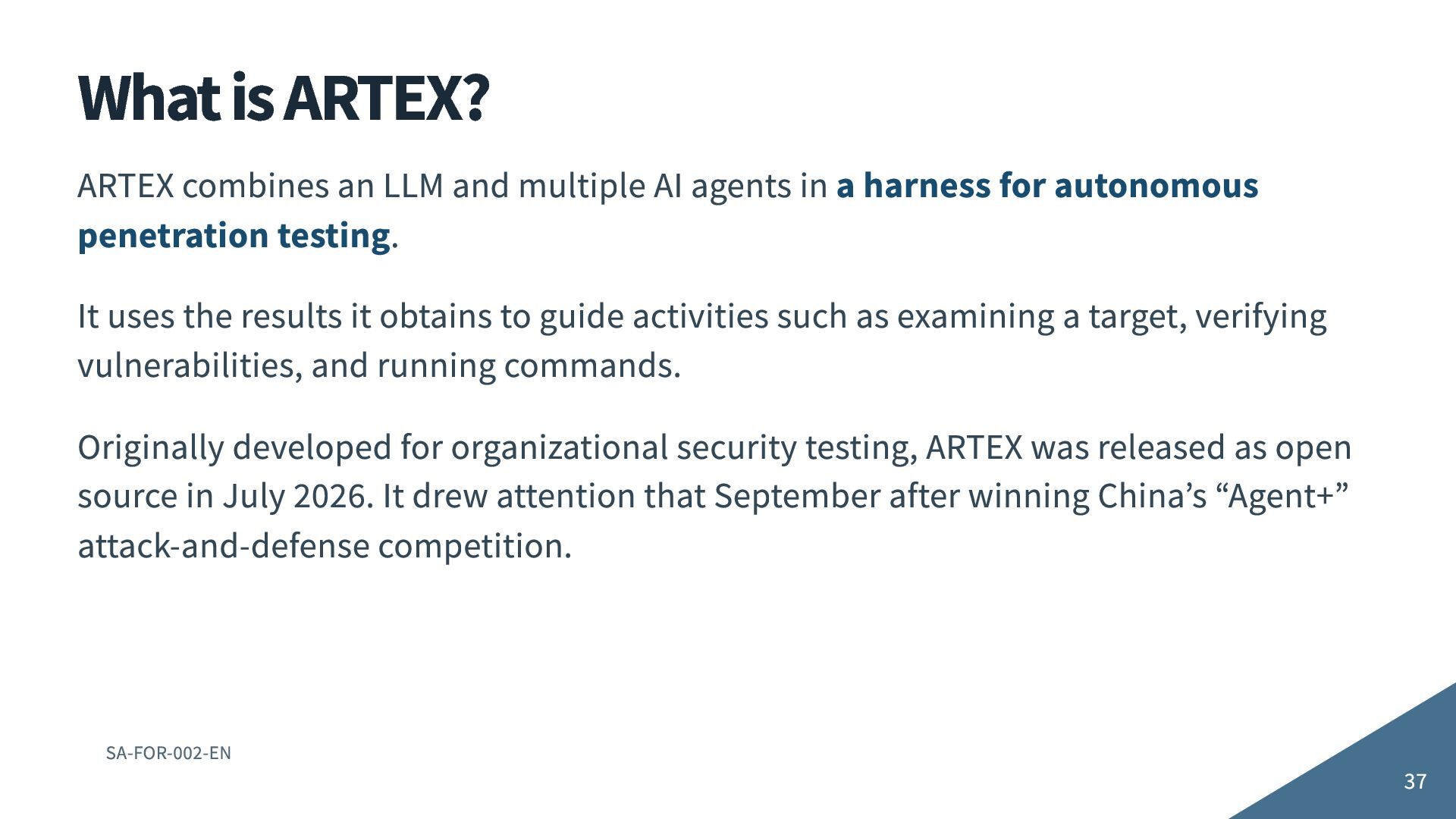
What is ARTEX? ARTEX combines an LLM and multiple AI
agents in a harness for autonomous penetration testing. It uses the results it obtains to guide activities such as examining a target, verifying vulnerabilities, and running commands. Originally developed for organizational security testing, ARTEX was released as open source in July 2026. It drew attention that September after winning China’s “Agent+” attack-and-defense competition. SA-FOR-002-EN 37 -
Misuse of ARTEX After its open-source release, attackers began using
ARTEX as well. Several organizations reported that intrusions from late August 2026 onward involved agent frameworks such as ARTEX. Although developed for security testing, ARTEX has frequently been misused because attackers also benefit from its automation. The author removed the original repository. Many forks are still in circulation. SA-FOR-002-EN 38 -
What can defenders use? ARTEX’s competition results and its use
in real attacks suggest that it can carry out complex work autonomously in practice. Giving an LLM tools is easy. Keeping it working reliably on a complex task for a long time is harder. What in the architecture makes that possible? Looking at that design can help us decide what to apply to defensive investigation and analysis. SA-FOR-002-EN 39 -
ARTEX architecture ARTEX coordinates tasks through shared state. Individual Workers
do not need to keep track of the entire investigation themselves. Design choice Separate planning and execution Structured memory Persistent tasks Replanning SA-FOR-002-EN Implementation The Planner chooses the work. Workers carry it out. The Asset Graph and Exploration Graph track targets and investigation progress. To-dos and dependencies carry over between runs. Workers share results so the Planner can reconsider the next task. 40 -
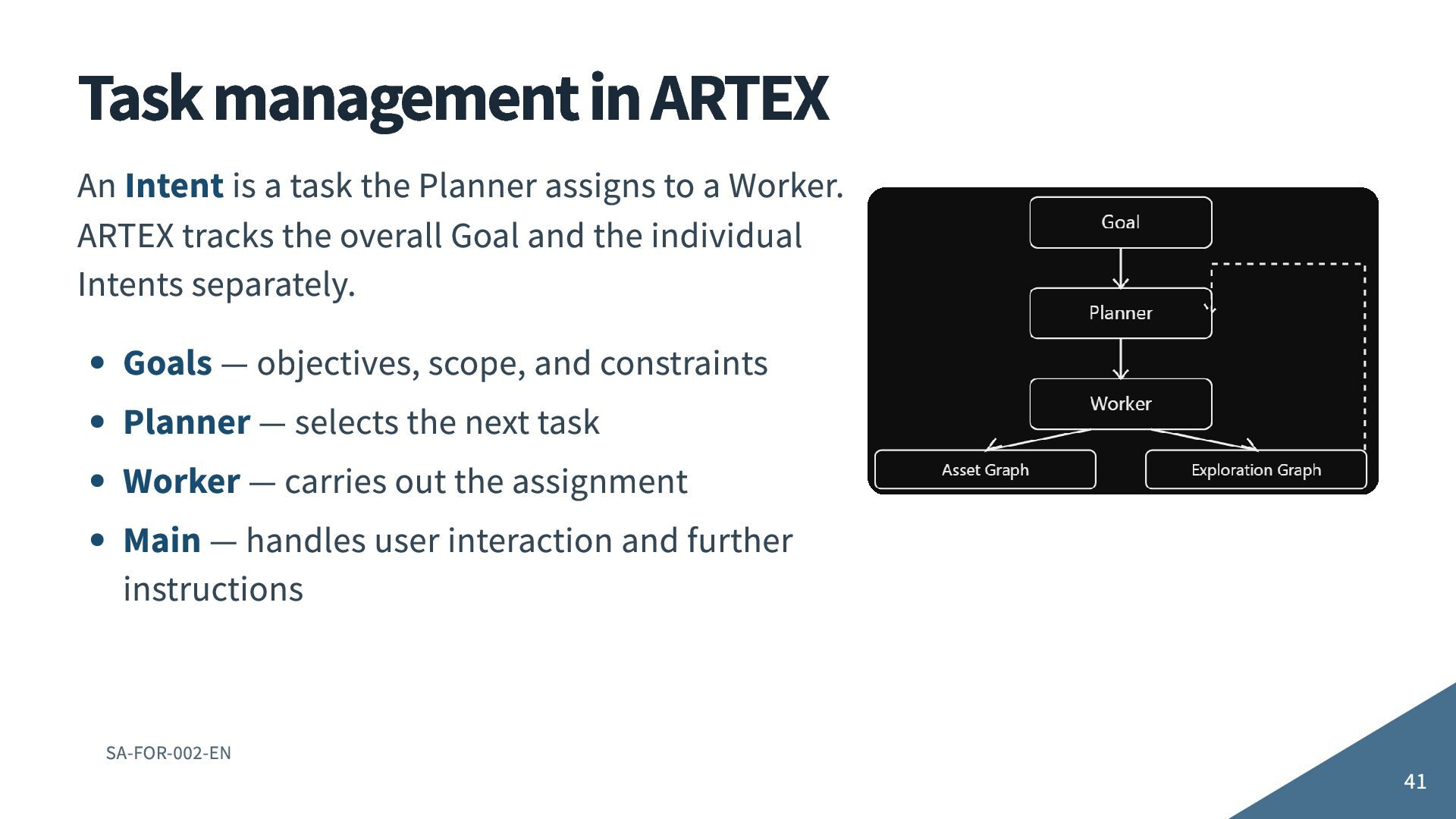
Task management in ARTEX An Intent is a task the
Planner assigns to a Worker. ARTEX tracks the overall Goal and the individual Intents separately. Goals — objectives, scope, and constraints Planner — selects the next task Worker — carries out the assignment Main — handles user interaction and further instructions SA-FOR-002-EN 41 -
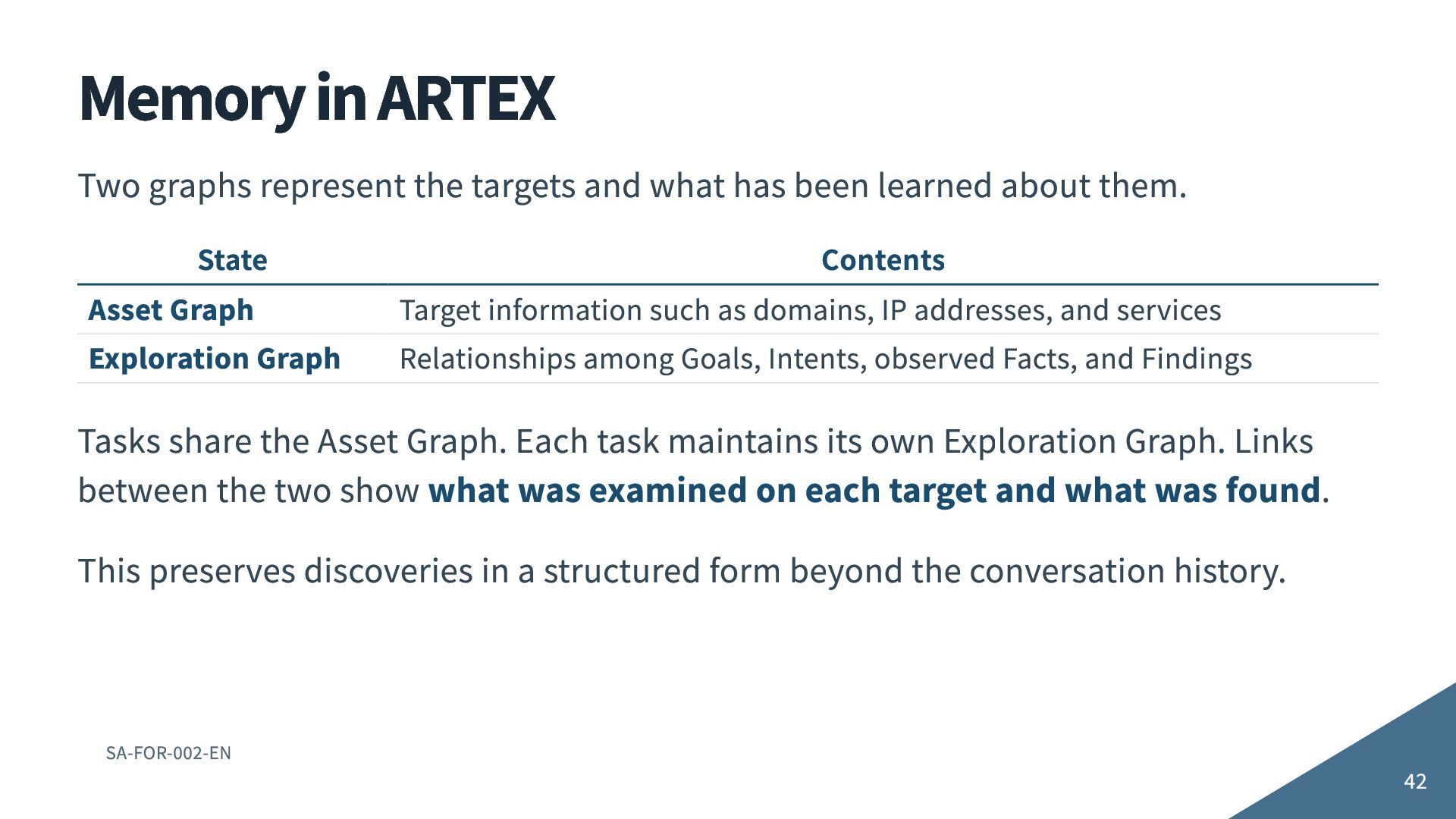
Memory in ARTEX Two graphs represent the targets and what
has been learned about them. State Asset Graph Exploration Graph Contents Target information such as domains, IP addresses, and services Relationships among Goals, Intents, observed Facts, and Findings Tasks share the Asset Graph. Each task maintains its own Exploration Graph. Links between the two show what was examined on each target and what was found. This preserves discoveries in a structured form beyond the conversation history. SA-FOR-002-EN 42 -
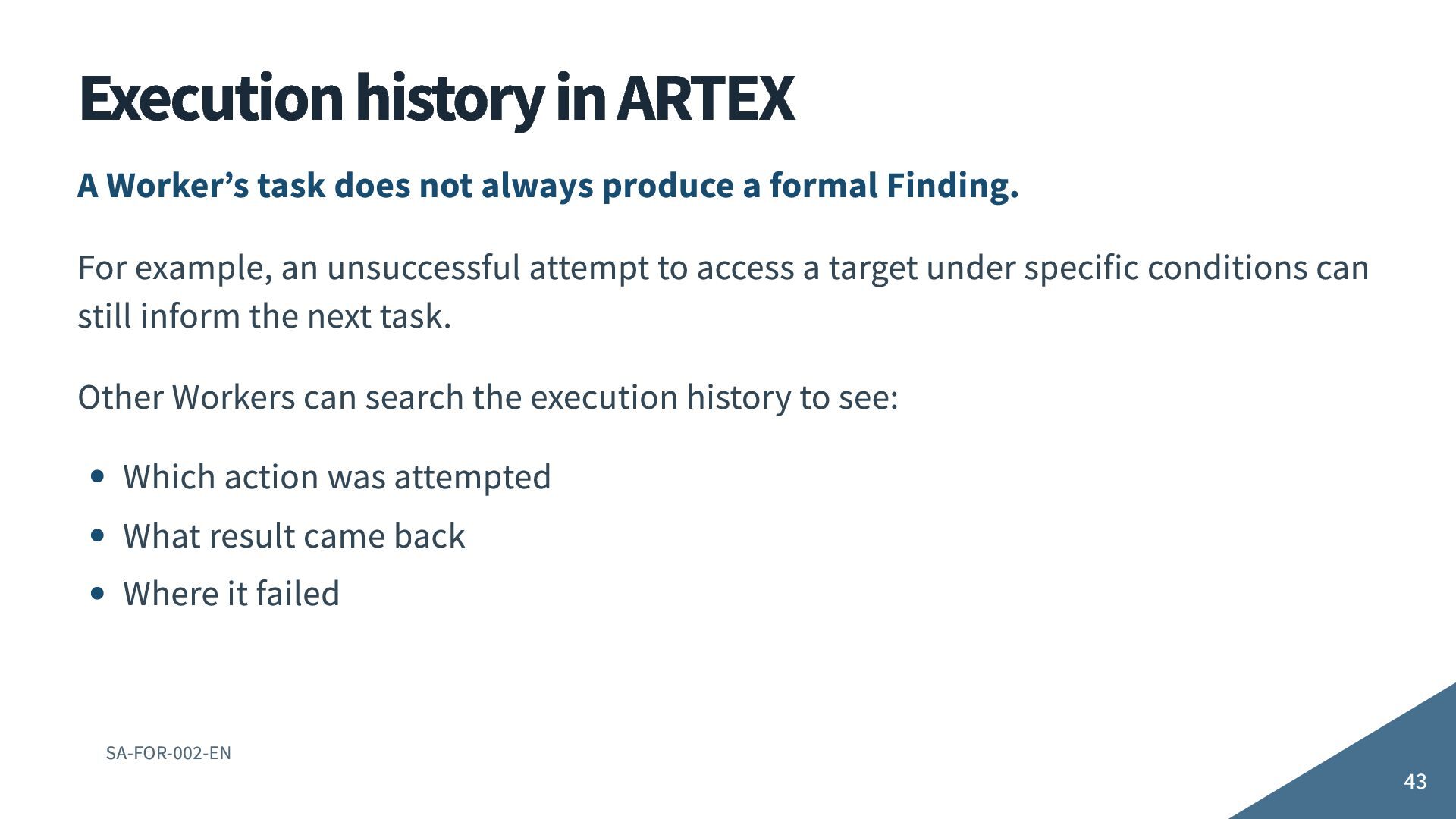
Execution history in ARTEX A Worker’s task does not always
produce a formal Finding. For example, an unsuccessful attempt to access a target under specific conditions can still inform the next task. Other Workers can search the execution history to see: Which action was attempted What result came back Where it failed SA-FOR-002-EN 43 -
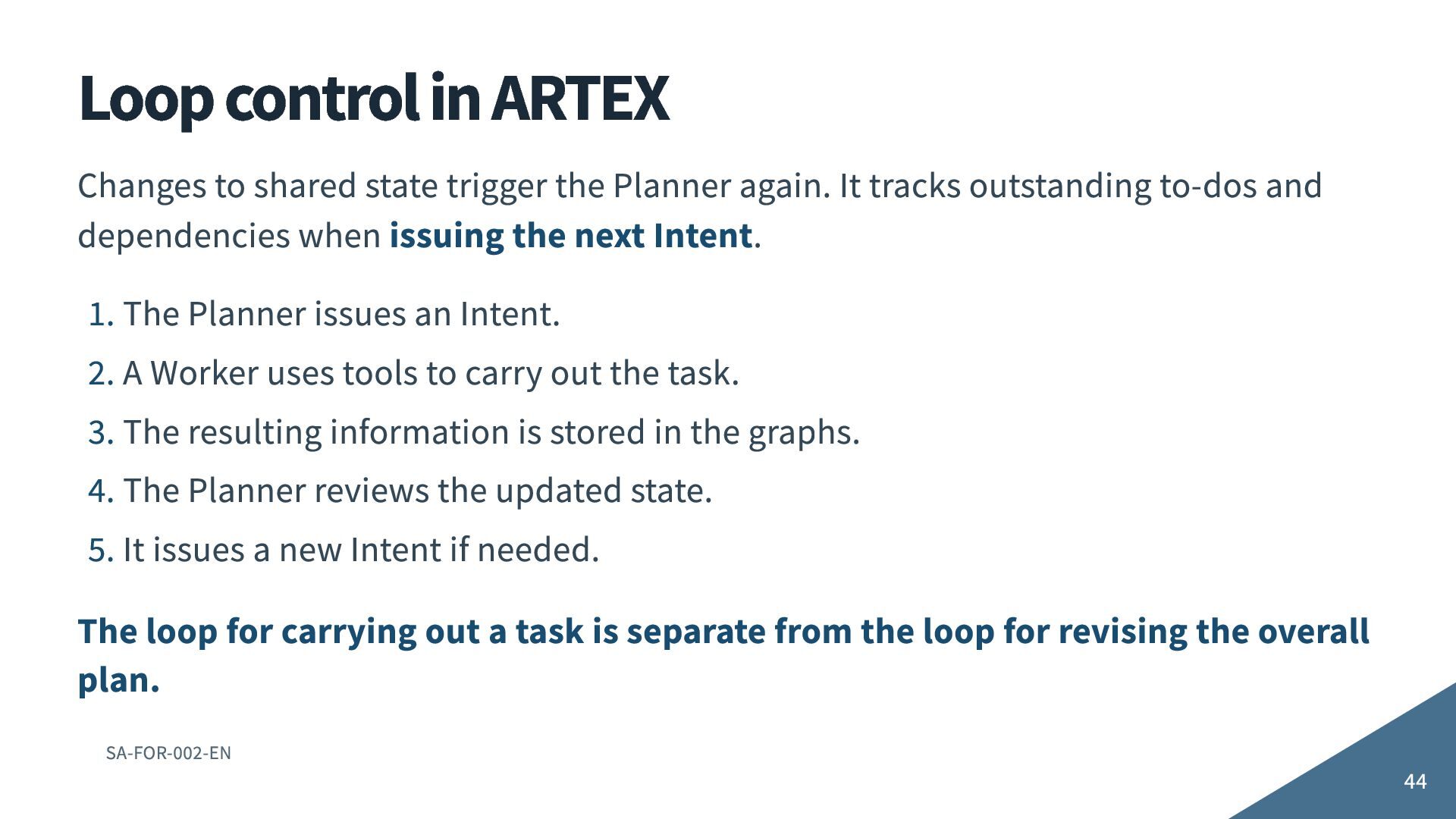
Loop control in ARTEX Changes to shared state trigger the
Planner again. It tracks outstanding to-dos and dependencies when issuing the next Intent. 1. The Planner issues an Intent. 2. A Worker uses tools to carry out the task. 3. The resulting information is stored in the graphs. 4. The Planner reviews the updated state. 5. It issues a new Intent if needed. The loop for carrying out a task is separate from the loop for revising the overall plan. SA-FOR-002-EN 44 -
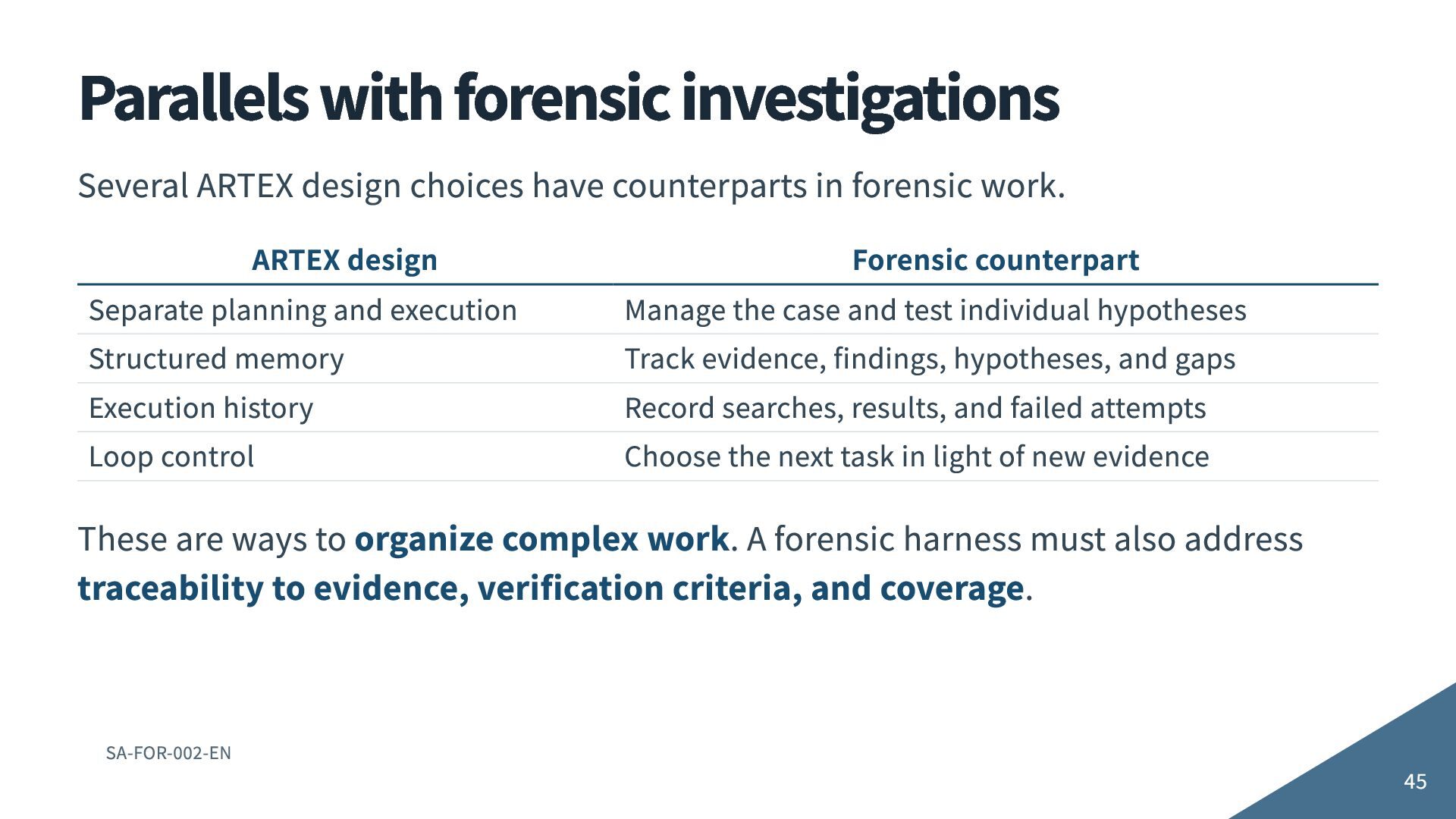
Parallels with forensic investigations Several ARTEX design choices have counterparts
in forensic work. ARTEX design Separate planning and execution Structured memory Execution history Loop control Forensic counterpart Manage the case and test individual hypotheses Track evidence, findings, hypotheses, and gaps Record searches, results, and failed attempts Choose the next task in light of new evidence These are ways to organize complex work. A forensic harness must also address traceability to evidence, verification criteria, and coverage. SA-FOR-002-EN 45 -
What is FORENSIA? I built FORENSIA as a harness to
keep a digital forensic investigation moving with a local LLM, even when compute is limited. It gives the model small pieces of work and alternates inference with verification. Even a less capable model can make progress without taking on a large task at once. https://github.com/sumeshi/forensia SA-FOR-002-EN 47 -
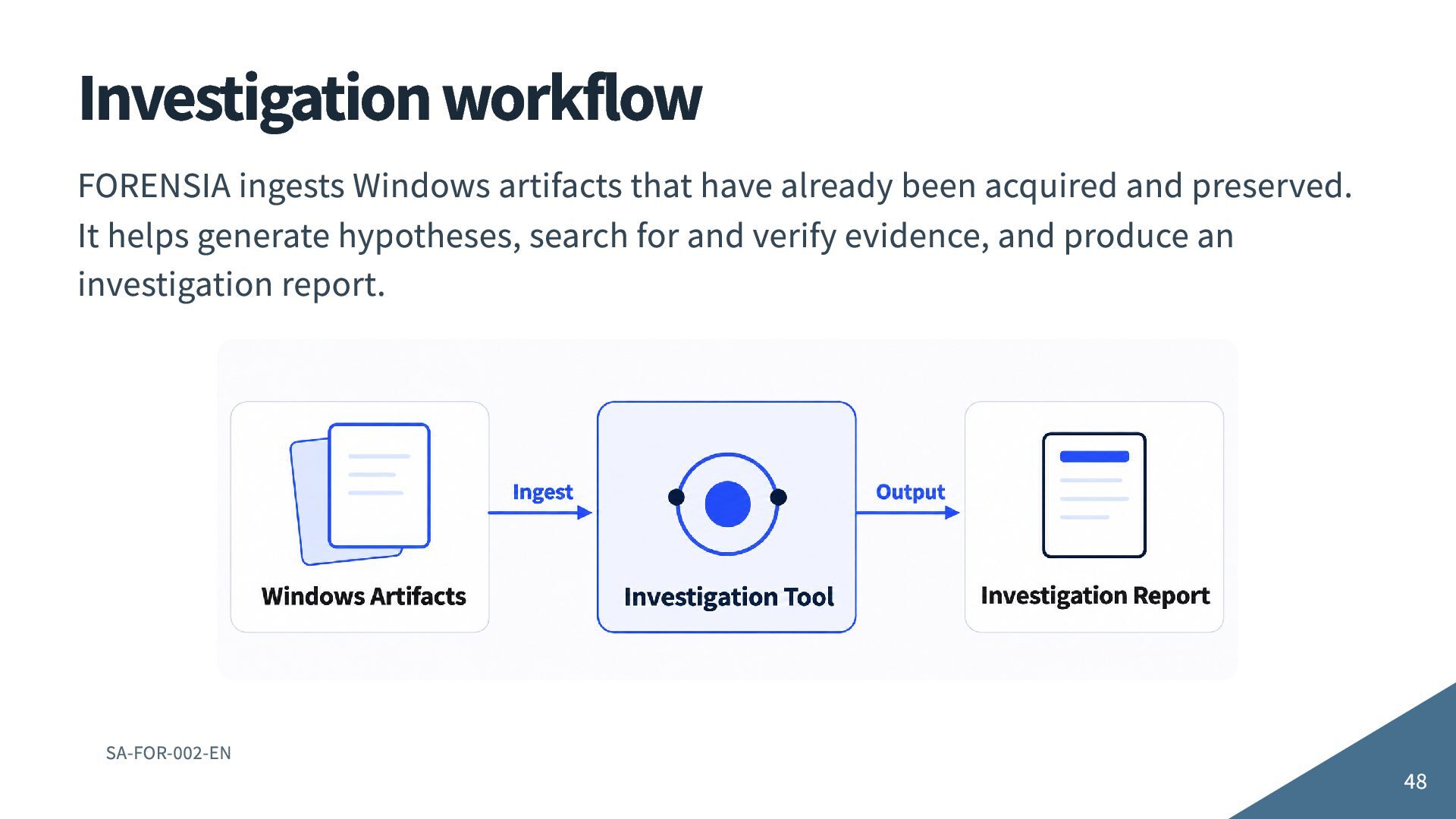
Investigation workflow FORENSIA ingests Windows artifacts that have already been
acquired and preserved. It helps generate hypotheses, search for and verify evidence, and produce an investigation report. SA-FOR-002-EN 48 -
Development approach An LLM is both part of the system
and a tool for building it faster. Generating code, prototyping, and iterating take less time, while models and frameworks themselves change rapidly. I wanted an architecture I could maintain as individual implementations changed. The analogy is the Pyramid of Pain: look past the elements that are easy to change and consider the more stable structure behind them. That led to three design principles. SA-FOR-002-EN 49 -
1. Go it alone An investigation should be able to
continue in an isolated environment, without external services. Forensic evidence often contains sensitive information. Evidence storage, search, case management, and LLM inference all need to run locally. SA-FOR-002-EN 50 -
2. Don’t expect too much of the LLM Give the
LLM tasks that are difficult to express as deterministic procedures: forming hypotheses, proposing verification steps, interpreting evidence, and summarizing findings. Where possible, the harness runs searches, restricts operations, evaluates verification criteria, and updates the investigation state mechanically. Assume that the model will make mistakes and forget. The harness supplies the information and the task it needs and manages the investigation as a whole. SA-FOR-002-EN 51 -
3. Spend time freely A single inference does not have
to produce the right answer. Human investigators can’t do that either. Start from an event, form a hypothesis, examine the evidence, and consider other possibilities. Make progress a step at a time. Repeating the same failure gains nothing. Record what was checked, what was learned, and where it failed. Use that history, the progress so far, and the prospects for verification to decide whether to continue. SA-FOR-002-EN 52 -
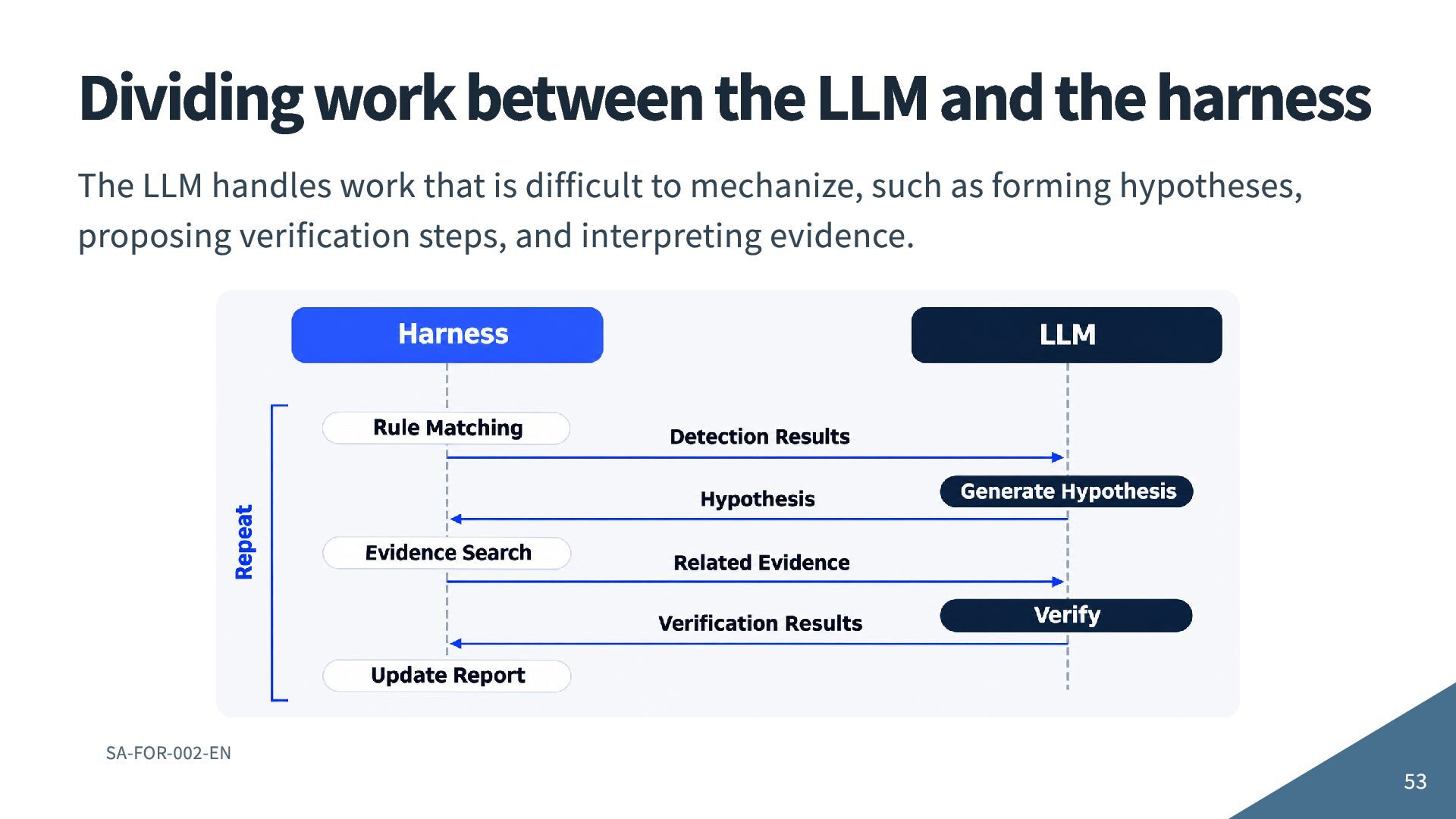
Dividing work between the LLM and the harness The LLM
handles work that is difficult to mechanize, such as forming hypotheses, proposing verification steps, and interpreting evidence. SA-FOR-002-EN 53 -
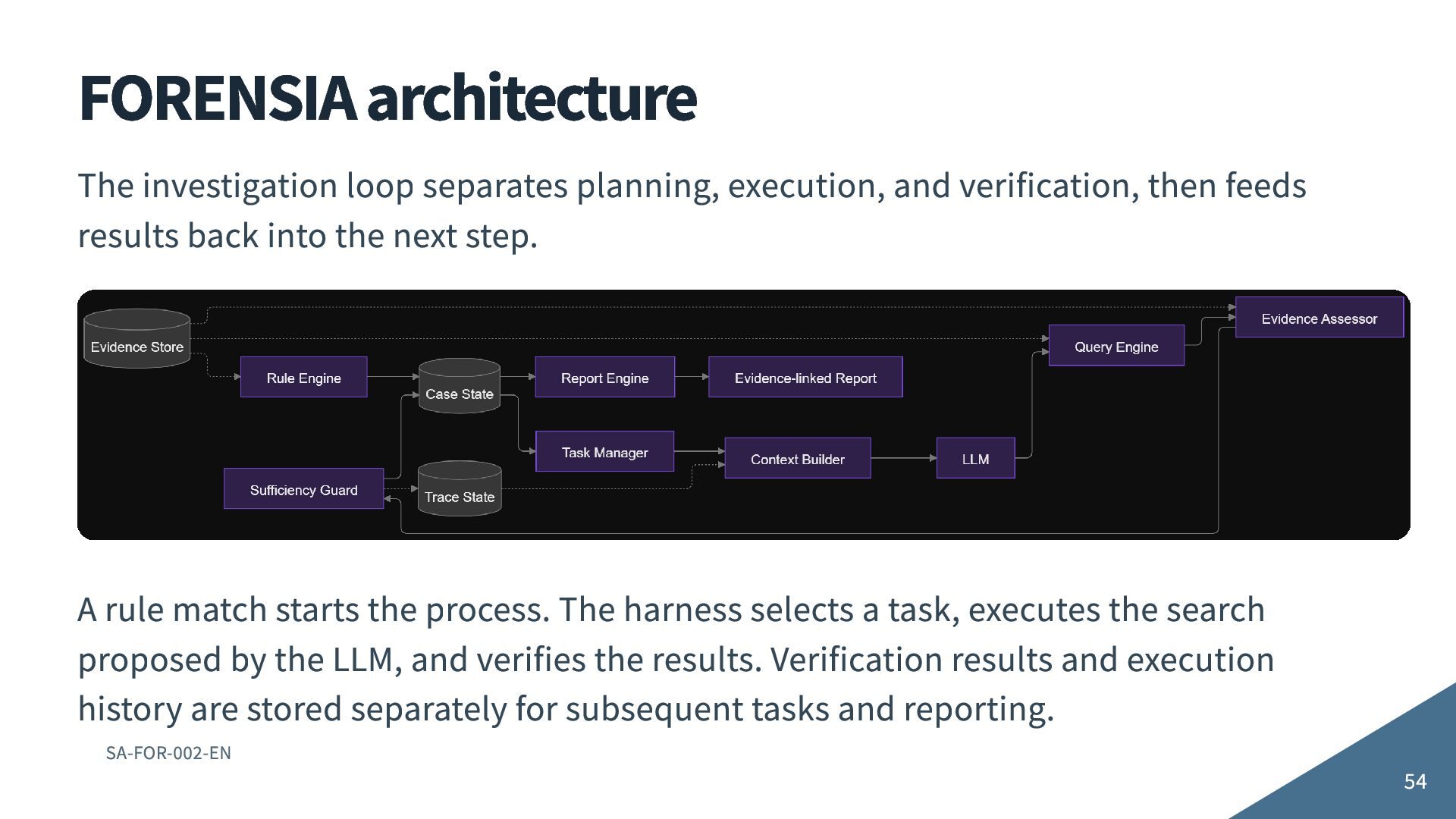
FORENSIA architecture The investigation loop separates planning, execution, and verification,
then feeds results back into the next step. A rule match starts the process. The harness selects a task, executes the search proposed by the LLM, and verifies the results. Verification results and execution history are stored separately for subsequent tasks and reporting. SA-FOR-002-EN 54 -
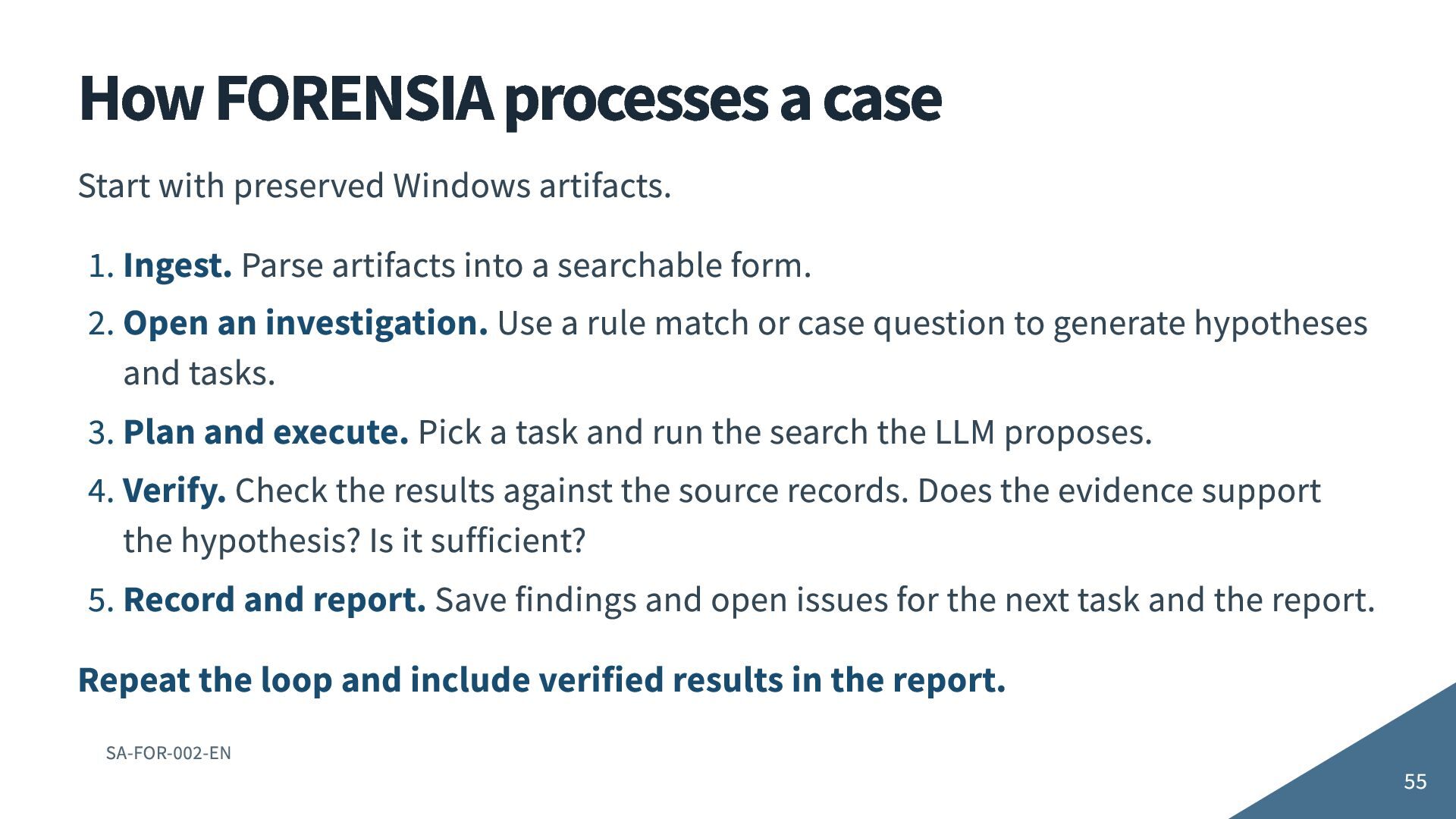
How FORENSIA processes a case Start with preserved Windows artifacts.
1. Ingest. Parse artifacts into a searchable form. 2. Open an investigation. Use a rule match or case question to generate hypotheses and tasks. 3. Plan and execute. Pick a task and run the search the LLM proposes. 4. Verify. Check the results against the source records. Does the evidence support the hypothesis? Is it sufficient? 5. Record and report. Save findings and open issues for the next task and the report. Repeat the loop and include verified results in the report. SA-FOR-002-EN 55 -
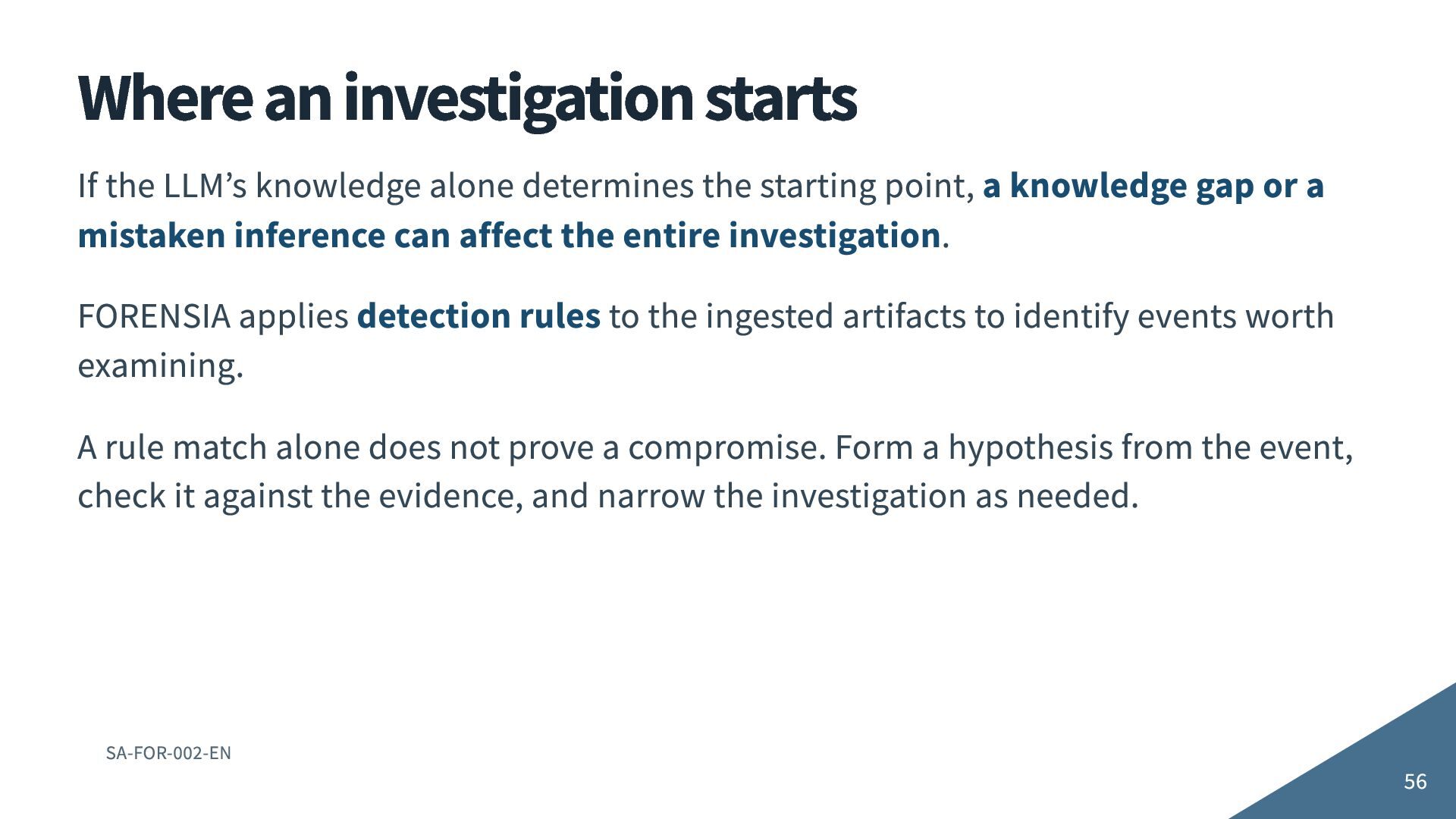
Where an investigation starts If the LLM’s knowledge alone determines
the starting point, a knowledge gap or a mistaken inference can affect the entire investigation. FORENSIA applies detection rules to the ingested artifacts to identify events worth examining. A rule match alone does not prove a compromise. Form a hypothesis from the event, check it against the evidence, and narrow the investigation as needed. SA-FOR-002-EN 56 -
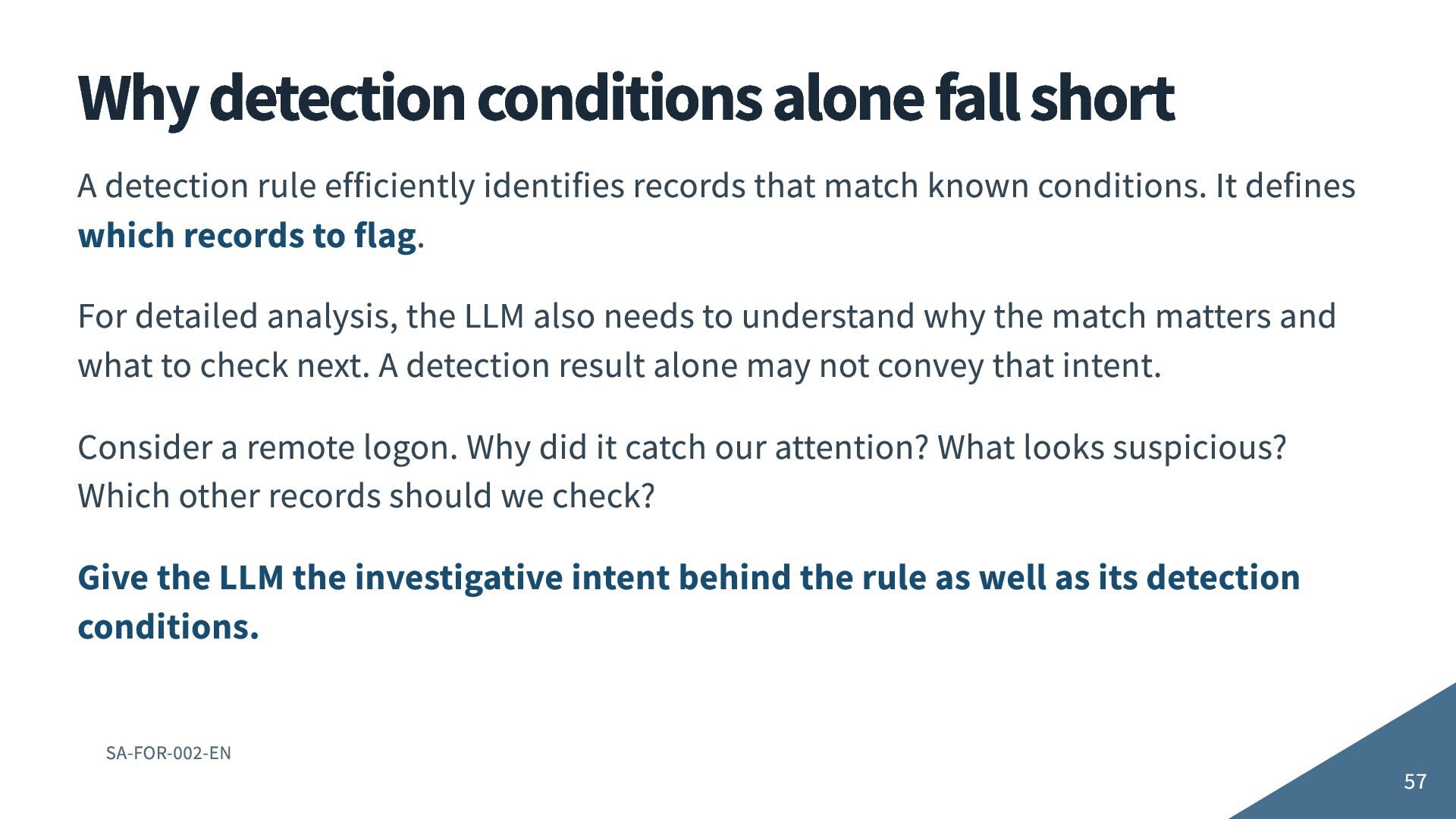
Why detection conditions alone fall short A detection rule efficiently
identifies records that match known conditions. It defines which records to flag. For detailed analysis, the LLM also needs to understand why the match matters and what to check next. A detection result alone may not convey that intent. Consider a remote logon. Why did it catch our attention? What looks suspicious? Which other records should we check? Give the LLM the investigative intent behind the rule as well as its detection conditions. SA-FOR-002-EN 57 -
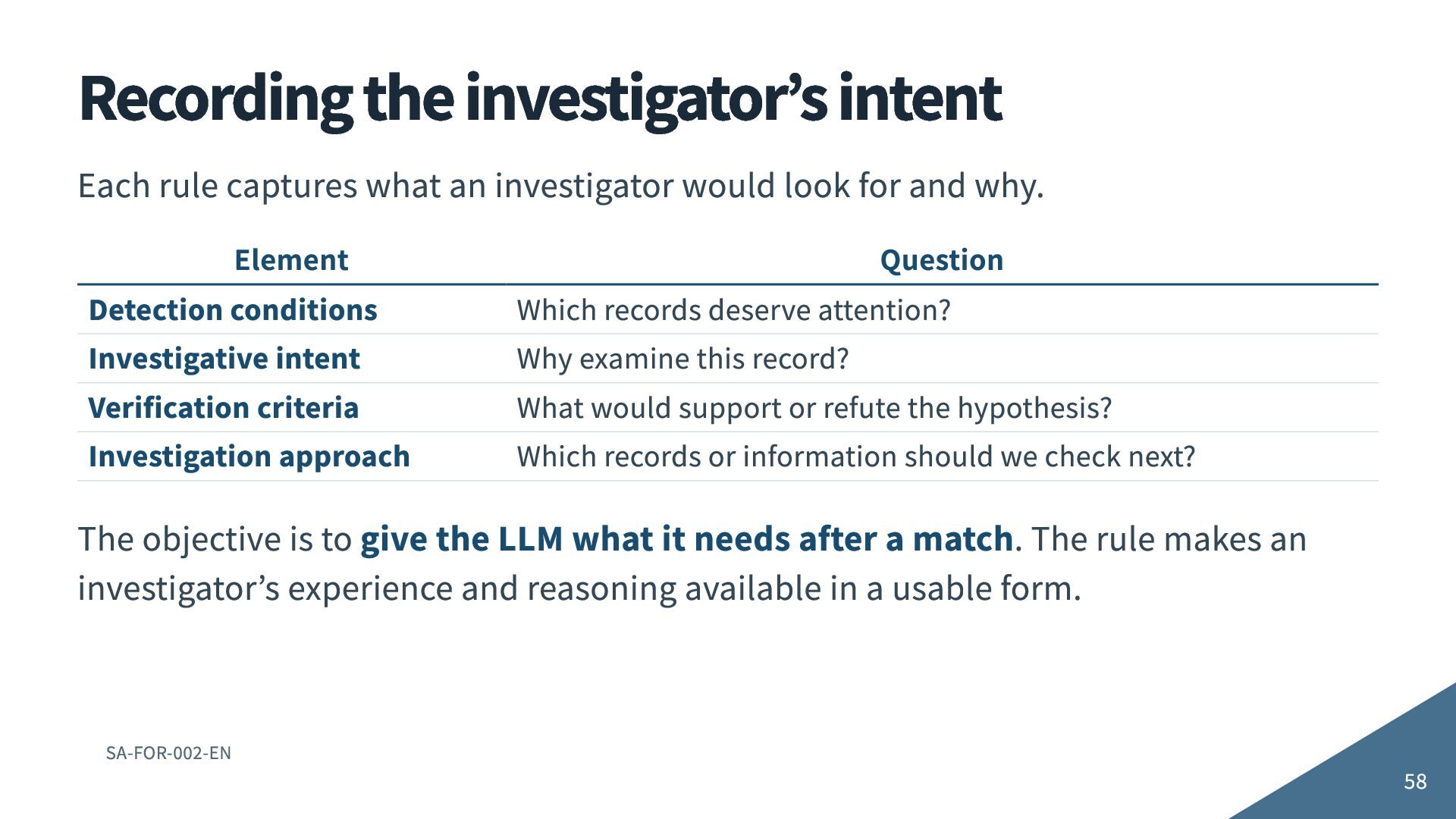
Recording the investigator’s intent Each rule captures what an investigator
would look for and why. Element Detection conditions Investigative intent Verification criteria Investigation approach Question Which records deserve attention? Why examine this record? What would support or refute the hypothesis? Which records or information should we check next? The objective is to give the LLM what it needs after a match. The rule makes an investigator’s experience and reasoning available in a usable form. SA-FOR-002-EN 58 -
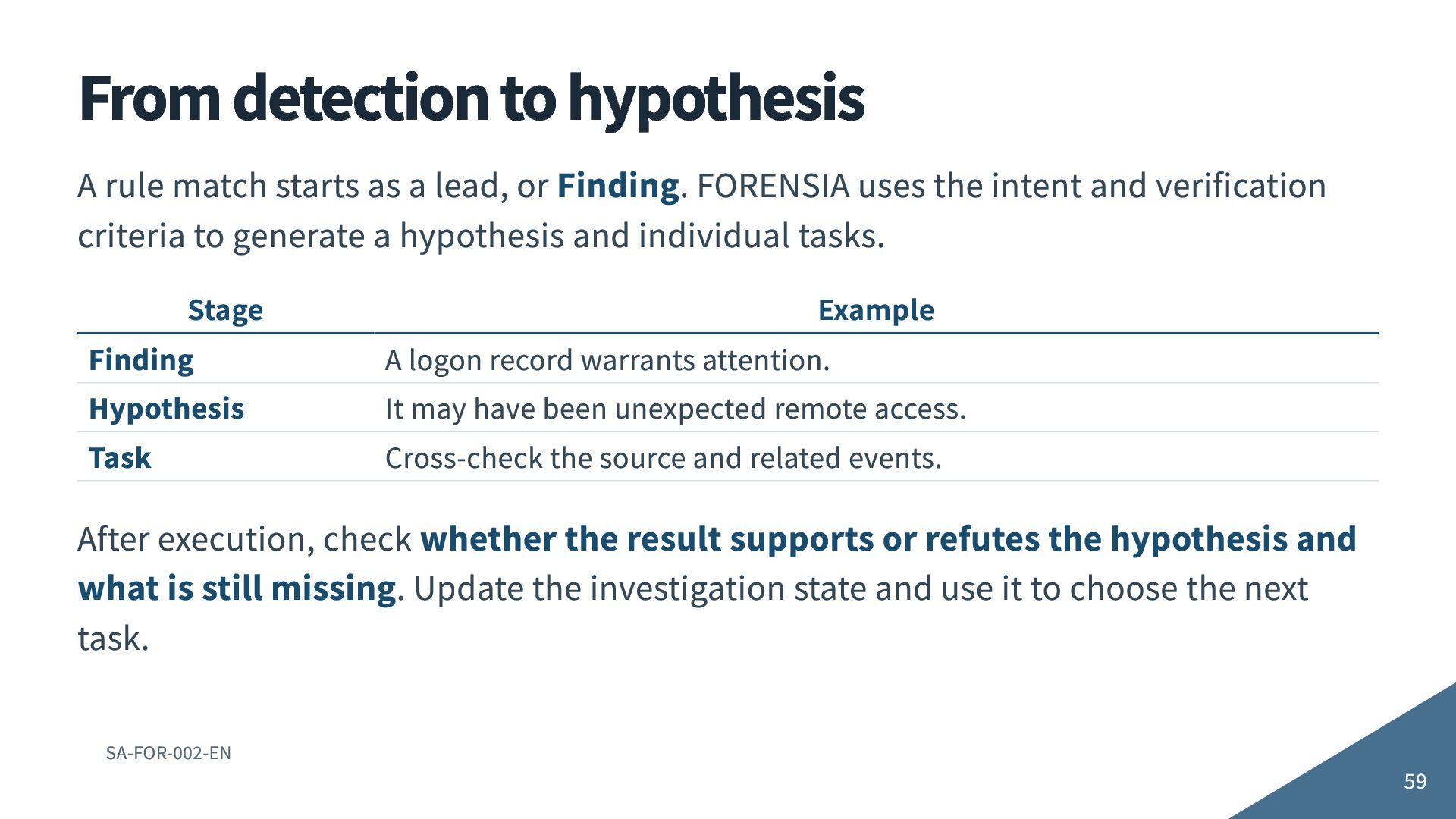
From detection to hypothesis A rule match starts as a
lead, or Finding. FORENSIA uses the intent and verification criteria to generate a hypothesis and individual tasks. Stage Finding Hypothesis Task Example A logon record warrants attention. It may have been unexpected remote access. Cross-check the source and related events. After execution, check whether the result supports or refutes the hypothesis and what is still missing. Update the investigation state and use it to choose the next task. SA-FOR-002-EN 59 -
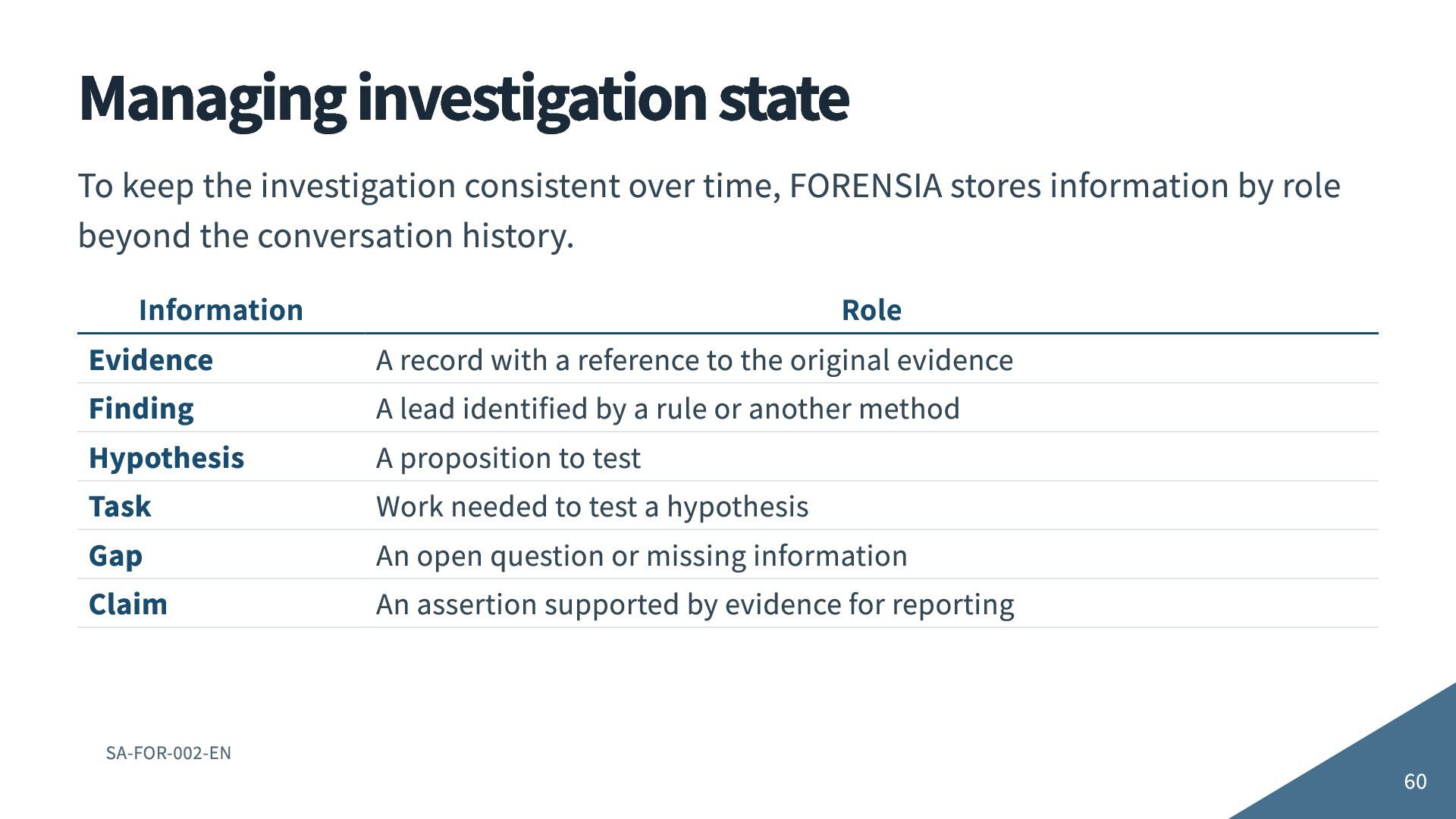
Managing investigation state To keep the investigation consistent over time,
FORENSIA stores information by role beyond the conversation history. Information Evidence Finding Hypothesis Task Gap Claim SA-FOR-002-EN Role A record with a reference to the original evidence A lead identified by a rule or another method A proposition to test Work needed to test a hypothesis An open question or missing information An assertion supported by evidence for reporting 60 -
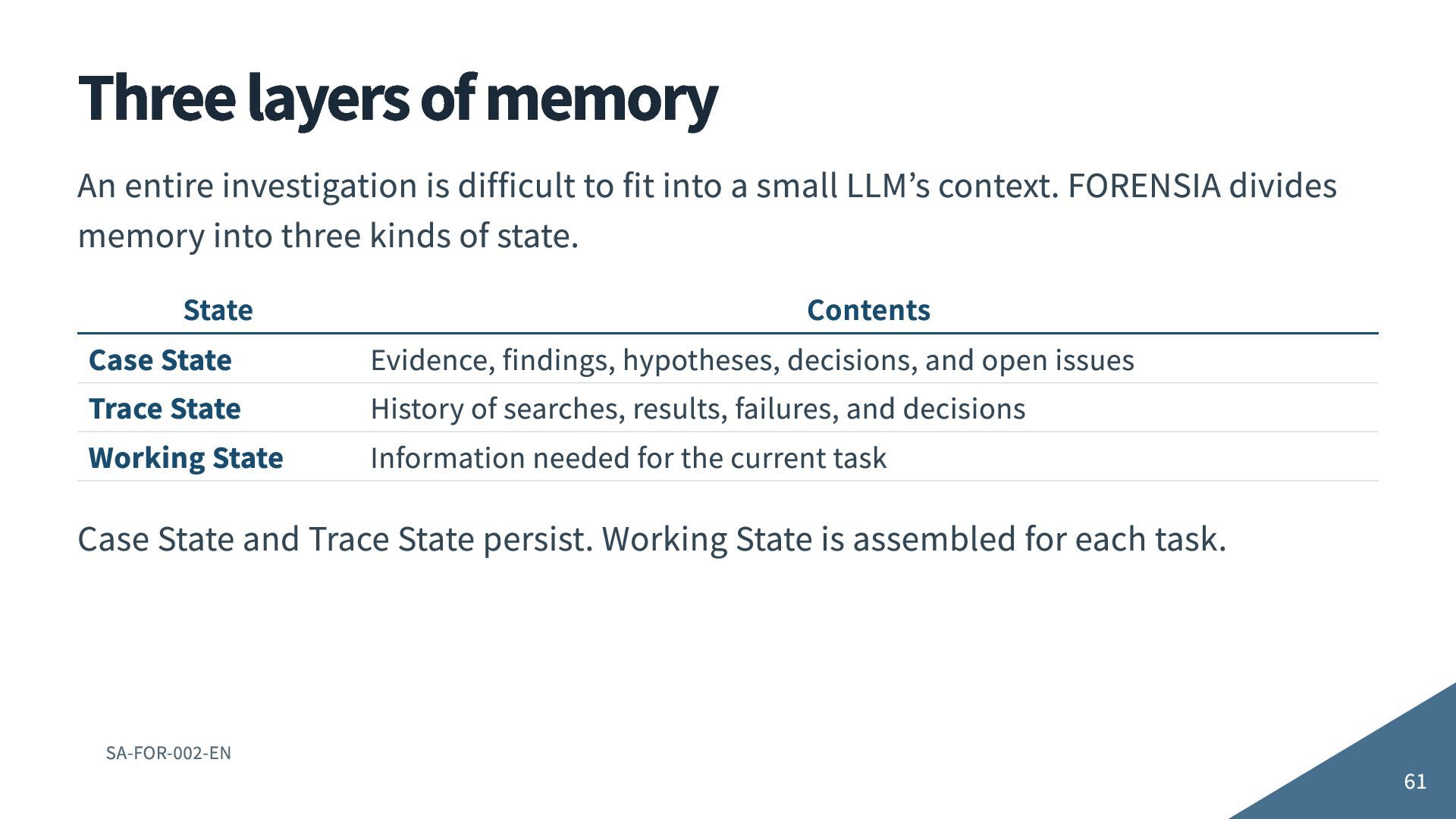
Three layers of memory An entire investigation is difficult to
fit into a small LLM’s context. FORENSIA divides memory into three kinds of state. State Case State Trace State Working State Contents Evidence, findings, hypotheses, decisions, and open issues History of searches, results, failures, and decisions Information needed for the current task Case State and Trace State persist. Working State is assembled for each task. SA-FOR-002-EN 61 -
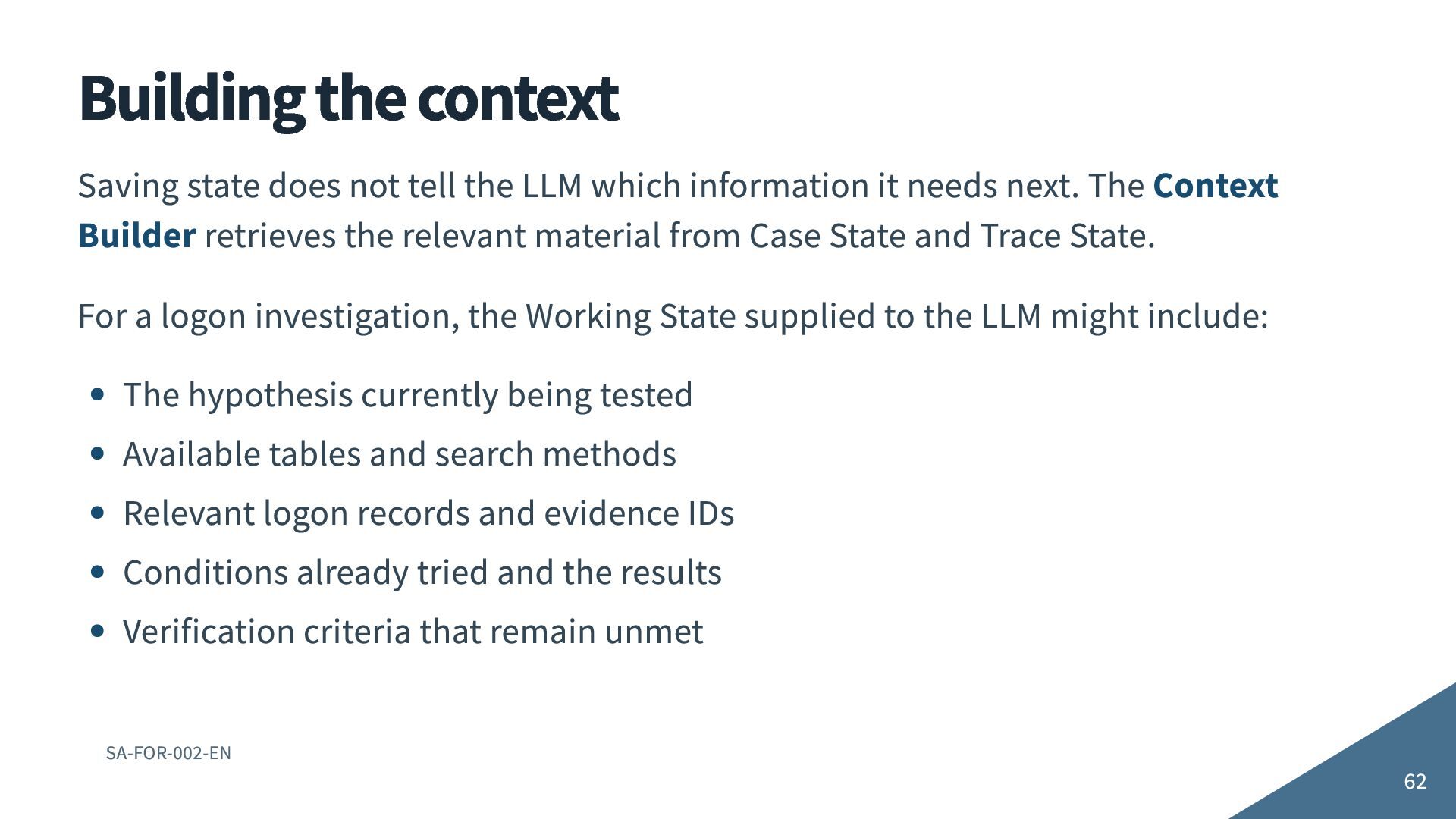
Building the context Saving state does not tell the LLM
which information it needs next. The Context Builder retrieves the relevant material from Case State and Trace State. For a logon investigation, the Working State supplied to the LLM might include: The hypothesis currently being tested Available tables and search methods Relevant logon records and evidence IDs Conditions already tried and the results Verification criteria that remain unmet SA-FOR-002-EN 62 -
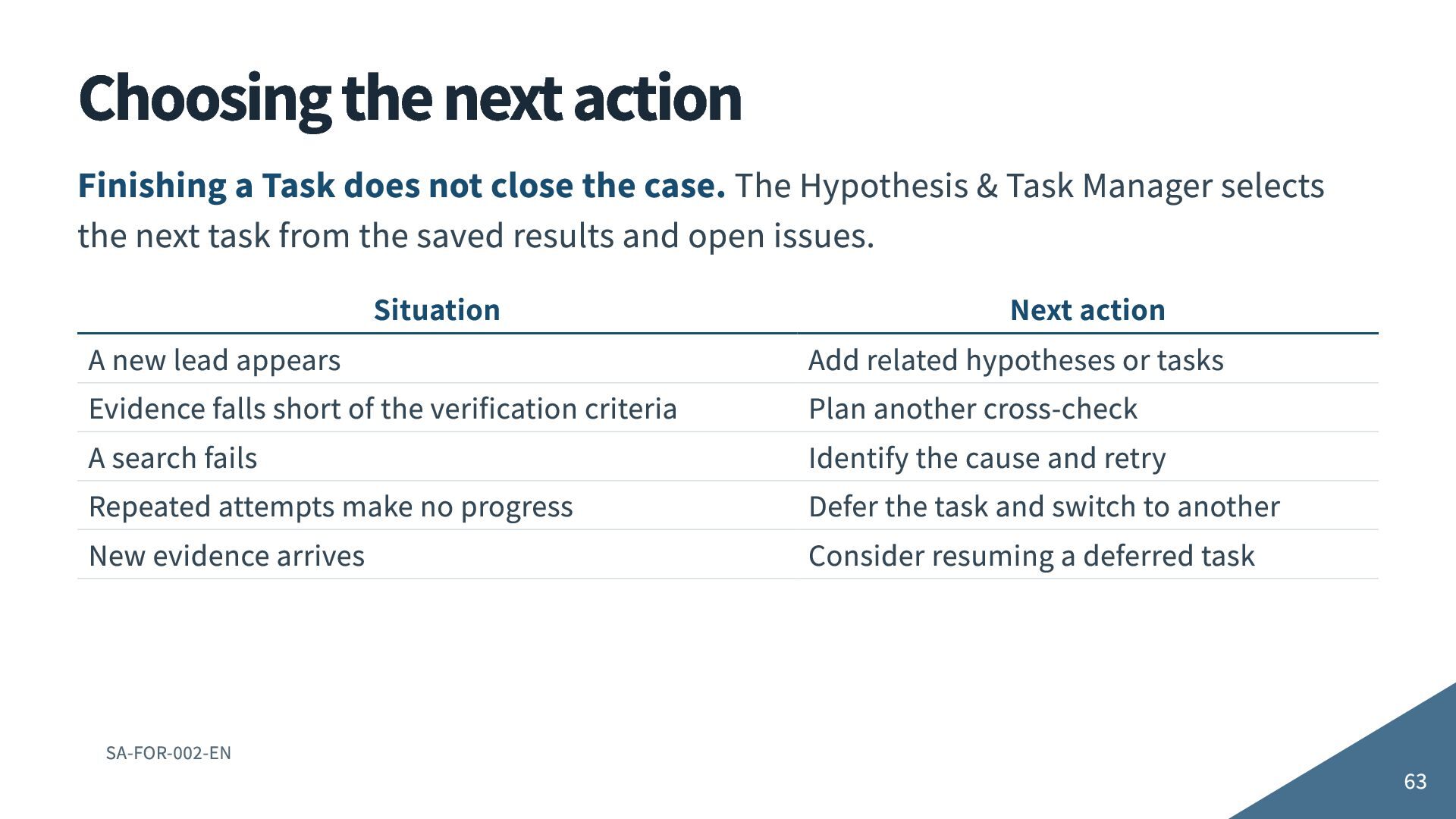
Choosing the next action Finishing a Task does not close
the case. The Hypothesis & Task Manager selects the next task from the saved results and open issues. Situation A new lead appears Evidence falls short of the verification criteria A search fails Repeated attempts make no progress New evidence arrives SA-FOR-002-EN Next action Add related hypotheses or tasks Plan another cross-check Identify the cause and retry Defer the task and switch to another Consider resuming a deferred task 63 -
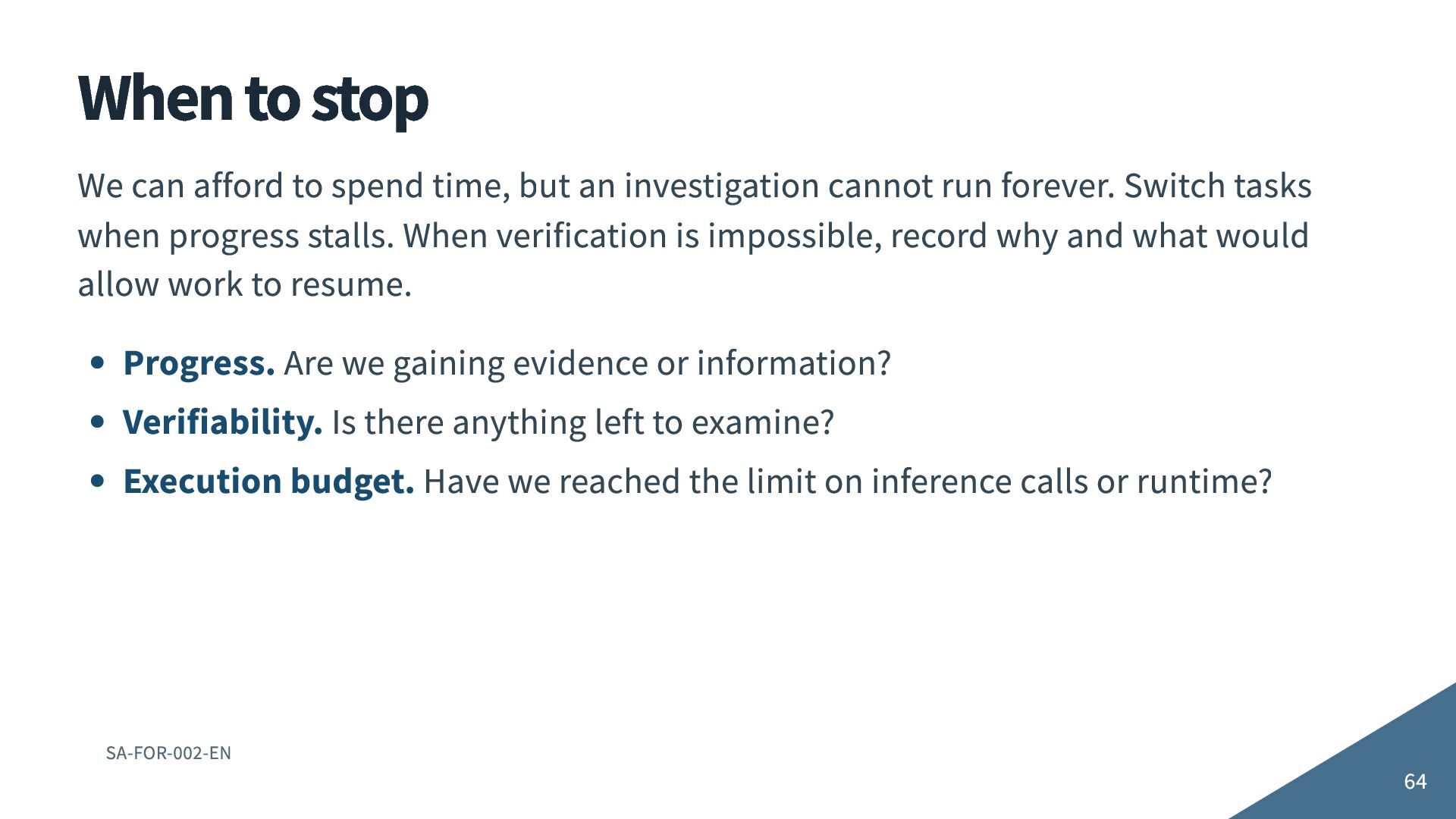
When to stop We can afford to spend time, but
an investigation cannot run forever. Switch tasks when progress stalls. When verification is impossible, record why and what would allow work to resume. Progress. Are we gaining evidence or information? Verifiability. Is there anything left to examine? Execution budget. Have we reached the limit on inference calls or runtime? SA-FOR-002-EN 64 -
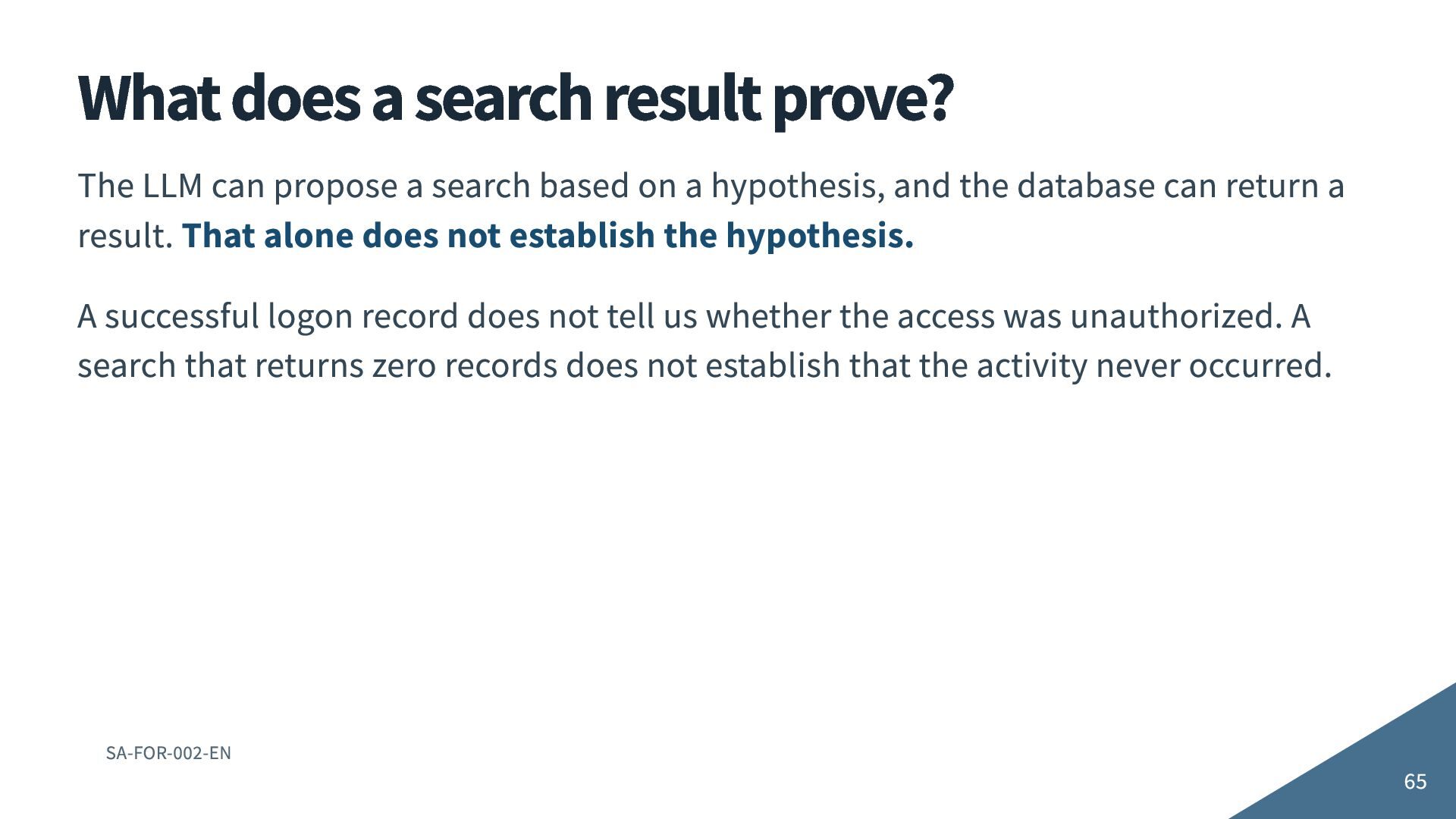
What does a search result prove? The LLM can propose
a search based on a hypothesis, and the database can return a result. That alone does not establish the hypothesis. A successful logon record does not tell us whether the access was unauthorized. A search that returns zero records does not establish that the activity never occurred. SA-FOR-002-EN 65 -
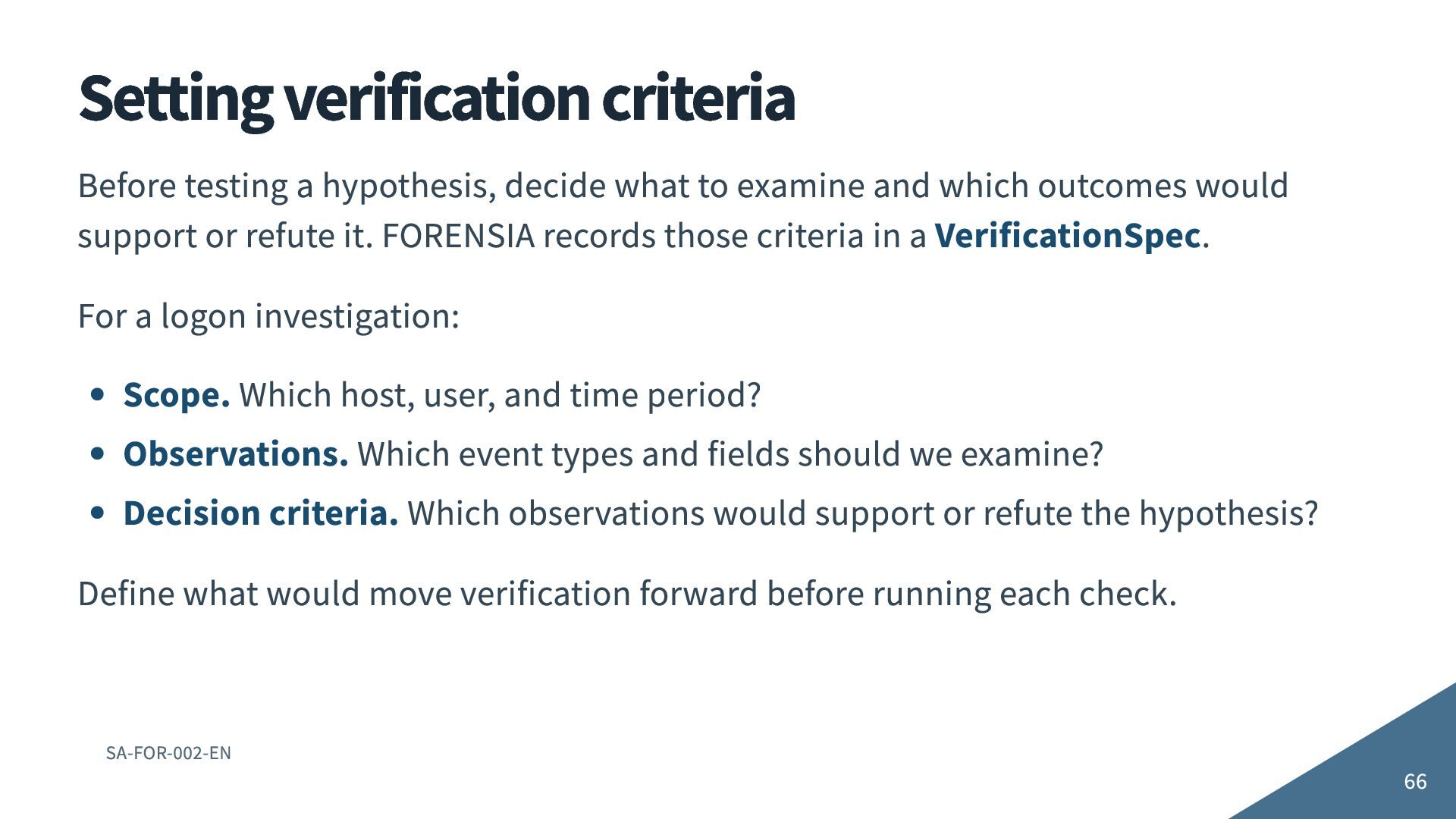
Setting verification criteria Before testing a hypothesis, decide what to
examine and which outcomes would support or refute it. FORENSIA records those criteria in a VerificationSpec. For a logon investigation: Scope. Which host, user, and time period? Observations. Which event types and fields should we examine? Decision criteria. Which observations would support or refute the hypothesis? Define what would move verification forward before running each check. SA-FOR-002-EN 66 -
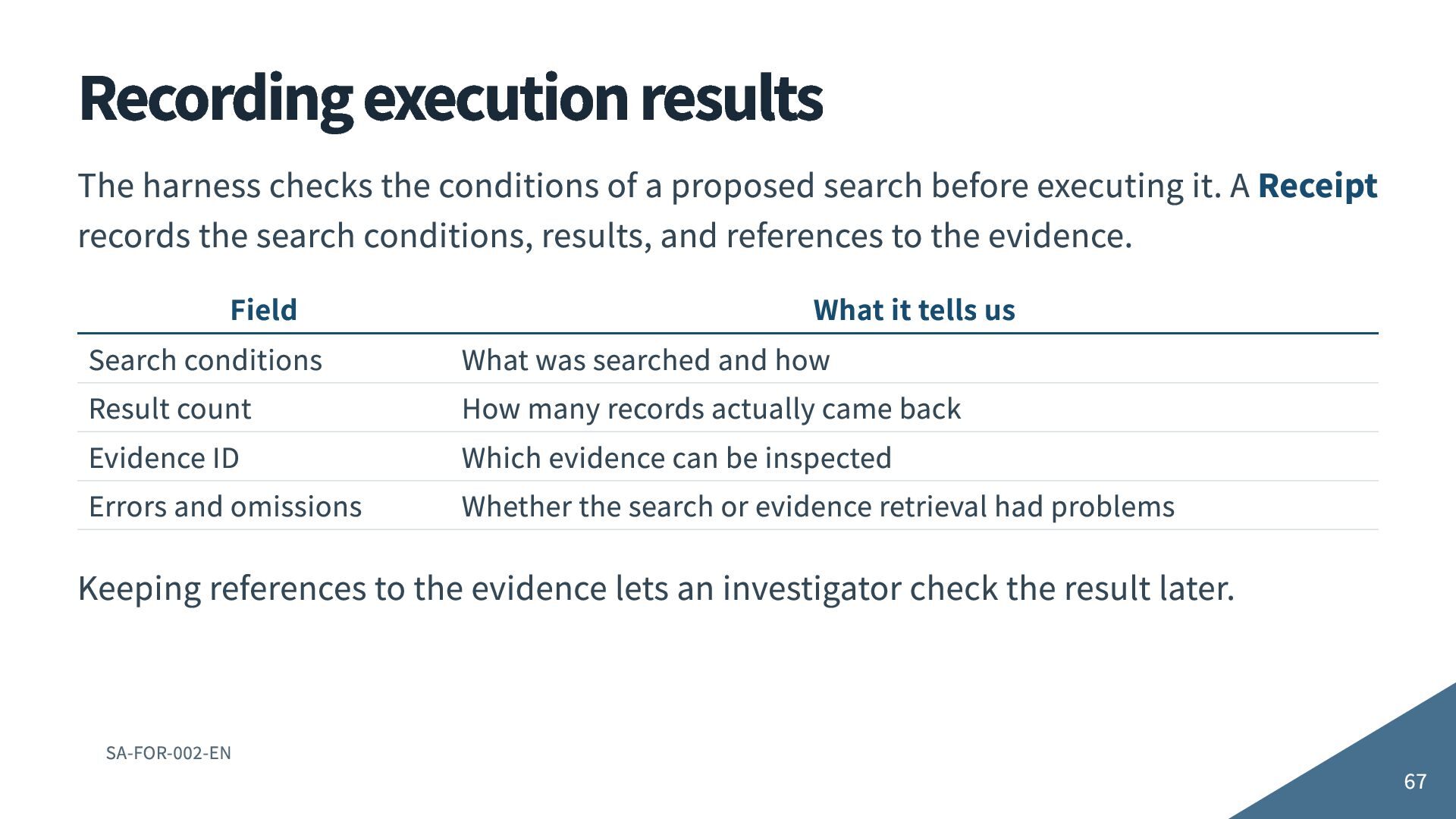
Recording execution results The harness checks the conditions of a
proposed search before executing it. A Receipt records the search conditions, results, and references to the evidence. Field Search conditions Result count Evidence ID Errors and omissions What it tells us What was searched and how How many records actually came back Which evidence can be inspected Whether the search or evidence retrieval had problems Keeping references to the evidence lets an investigator check the result later. SA-FOR-002-EN 67 -
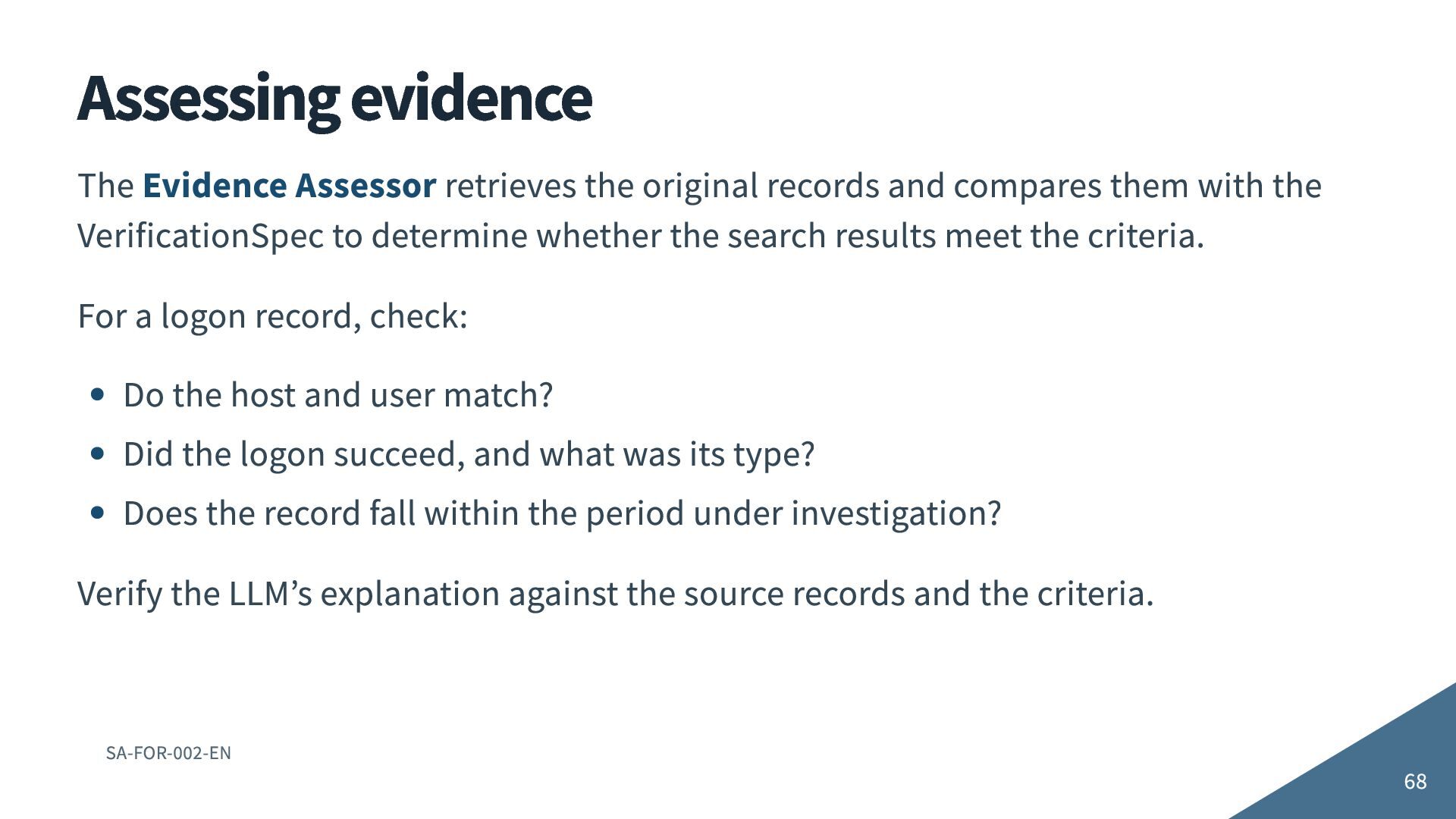
Assessing evidence The Evidence Assessor retrieves the original records and
compares them with the VerificationSpec to determine whether the search results meet the criteria. For a logon record, check: Do the host and user match? Did the logon succeed, and what was its type? Does the record fall within the period under investigation? Verify the LLM’s explanation against the source records and the criteria. SA-FOR-002-EN 68 -
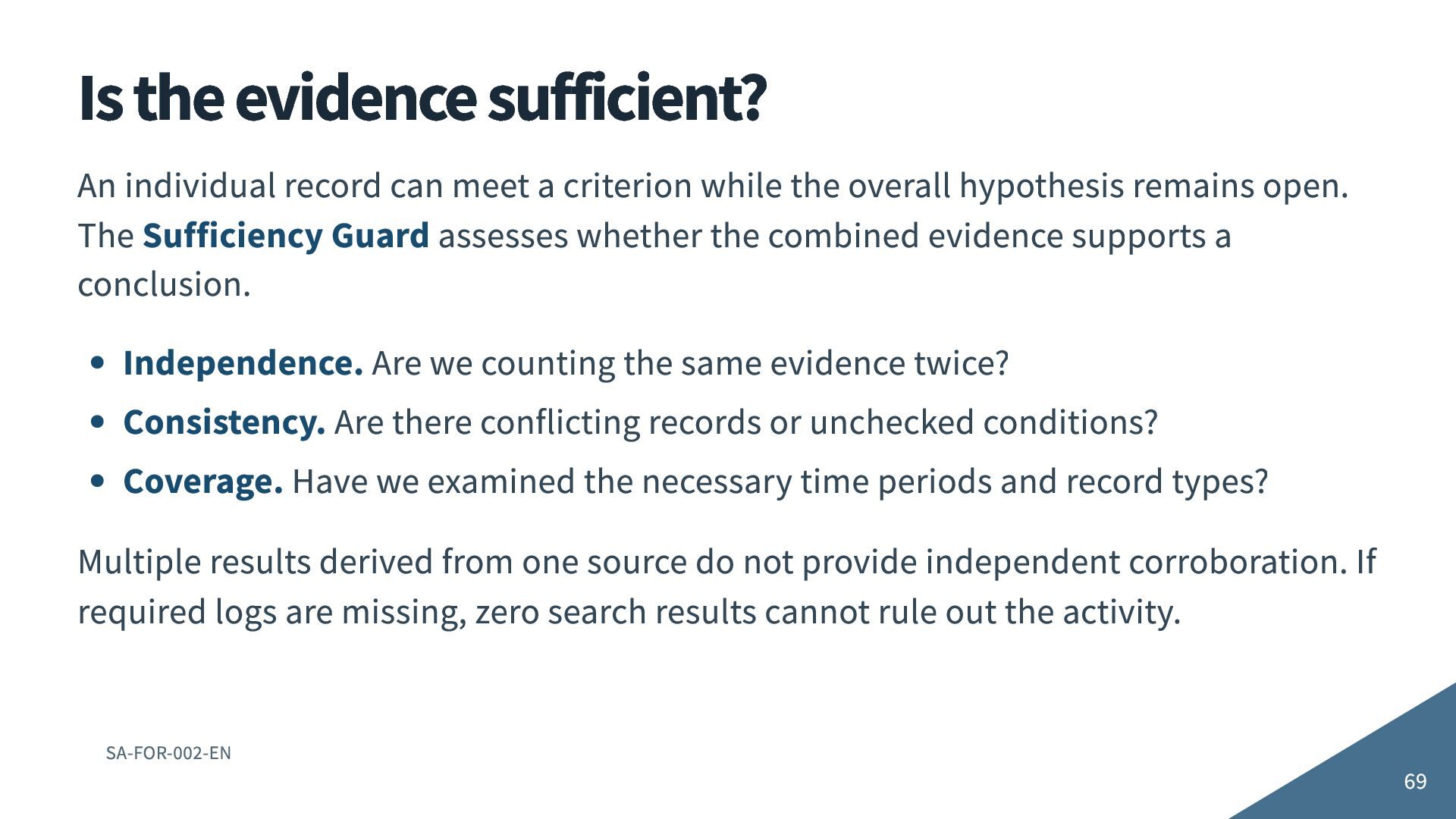
Is the evidence sufficient? An individual record can meet a
criterion while the overall hypothesis remains open. The Sufficiency Guard assesses whether the combined evidence supports a conclusion. Independence. Are we counting the same evidence twice? Consistency. Are there conflicting records or unchecked conditions? Coverage. Have we examined the necessary time periods and record types? Multiple results derived from one source do not provide independent corroboration. If required logs are missing, zero search results cannot rule out the activity. SA-FOR-002-EN 69 -
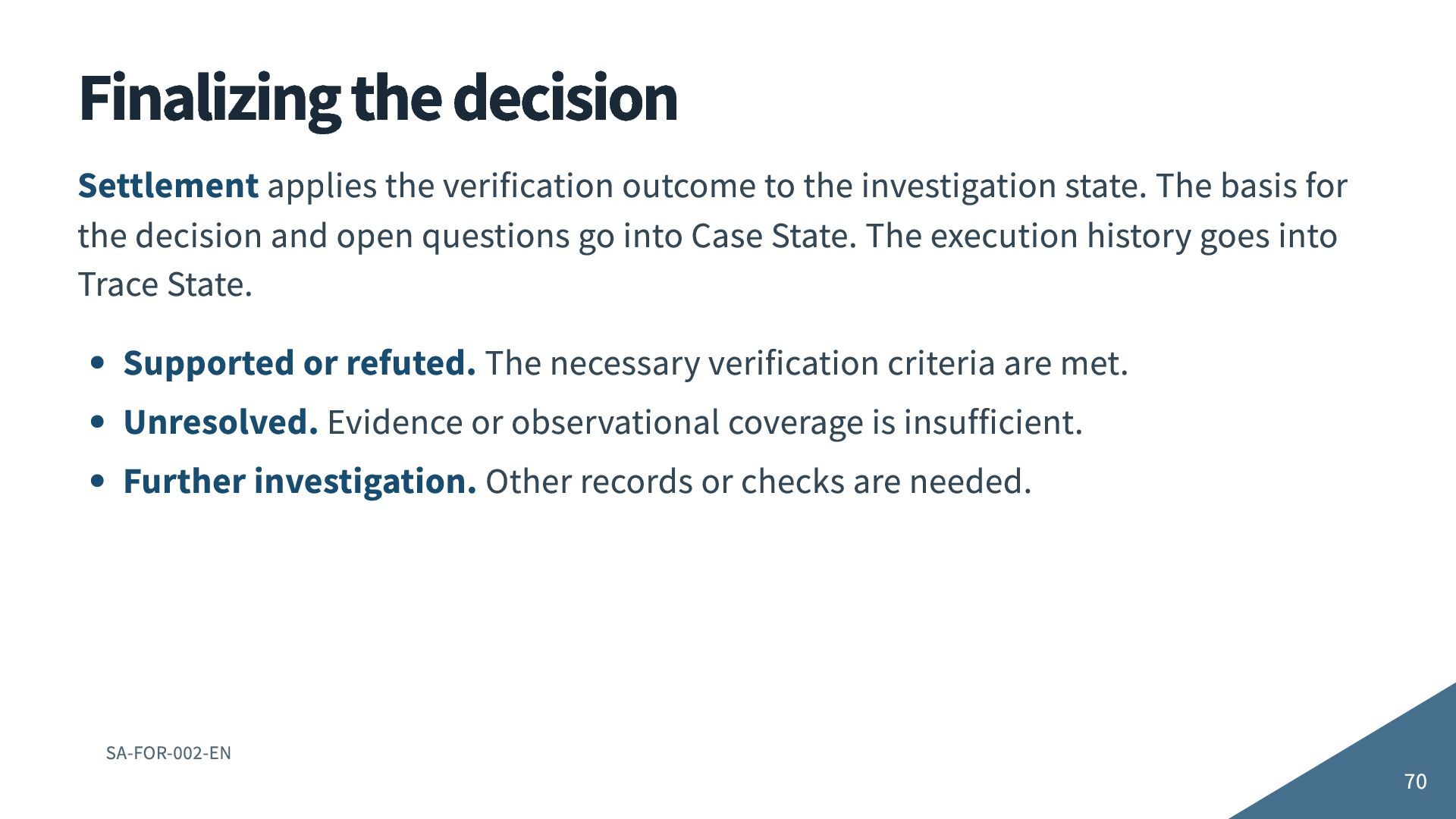
Finalizing the decision Settlement applies the verification outcome to the
investigation state. The basis for the decision and open questions go into Case State. The execution history goes into Trace State. Supported or refuted. The necessary verification criteria are met. Unresolved. Evidence or observational coverage is insufficient. Further investigation. Other records or checks are needed. SA-FOR-002-EN 70 -
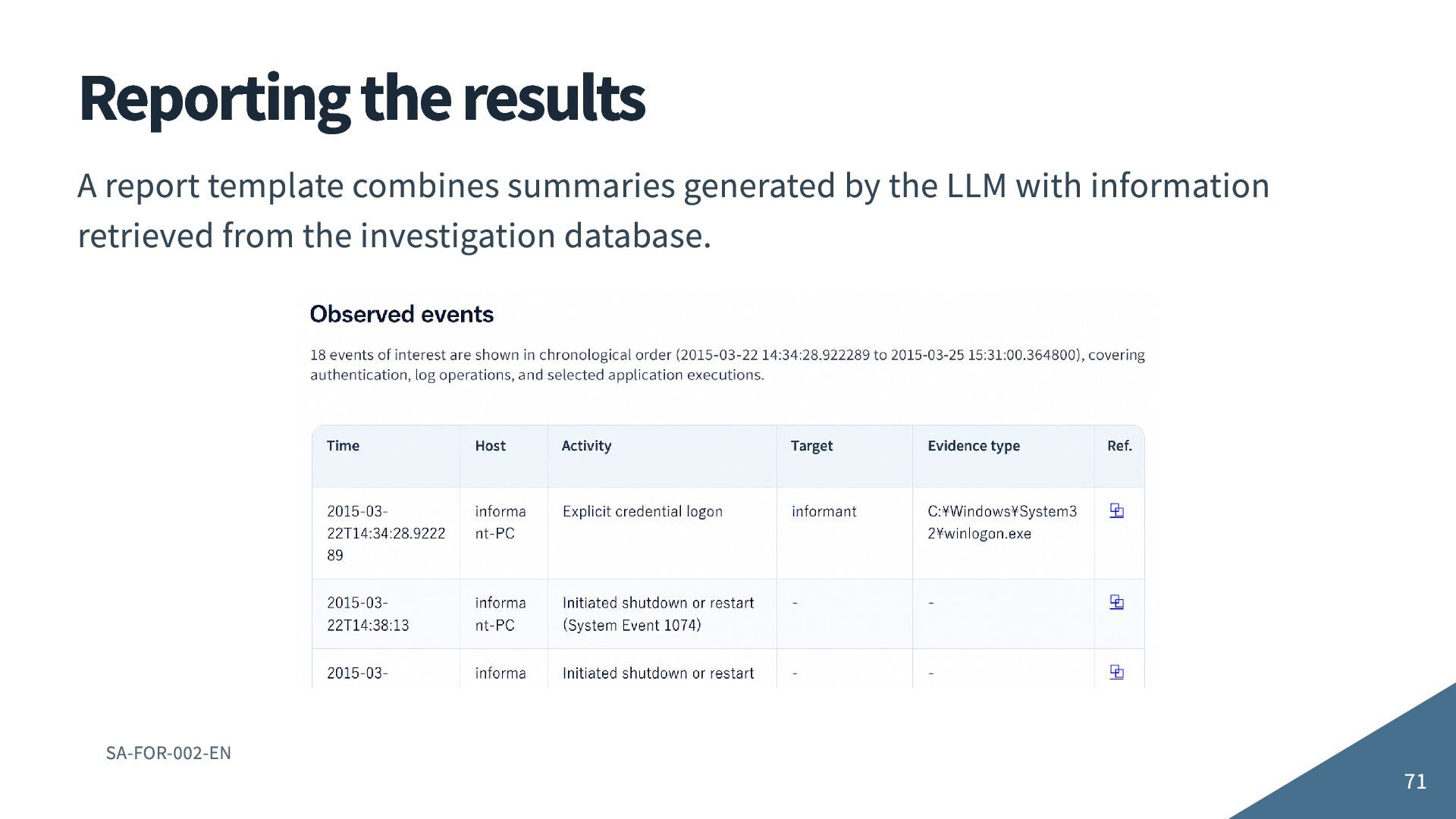
Reporting the results A report template combines summaries generated by
the LLM with information retrieved from the investigation database. SA-FOR-002-EN 71 -
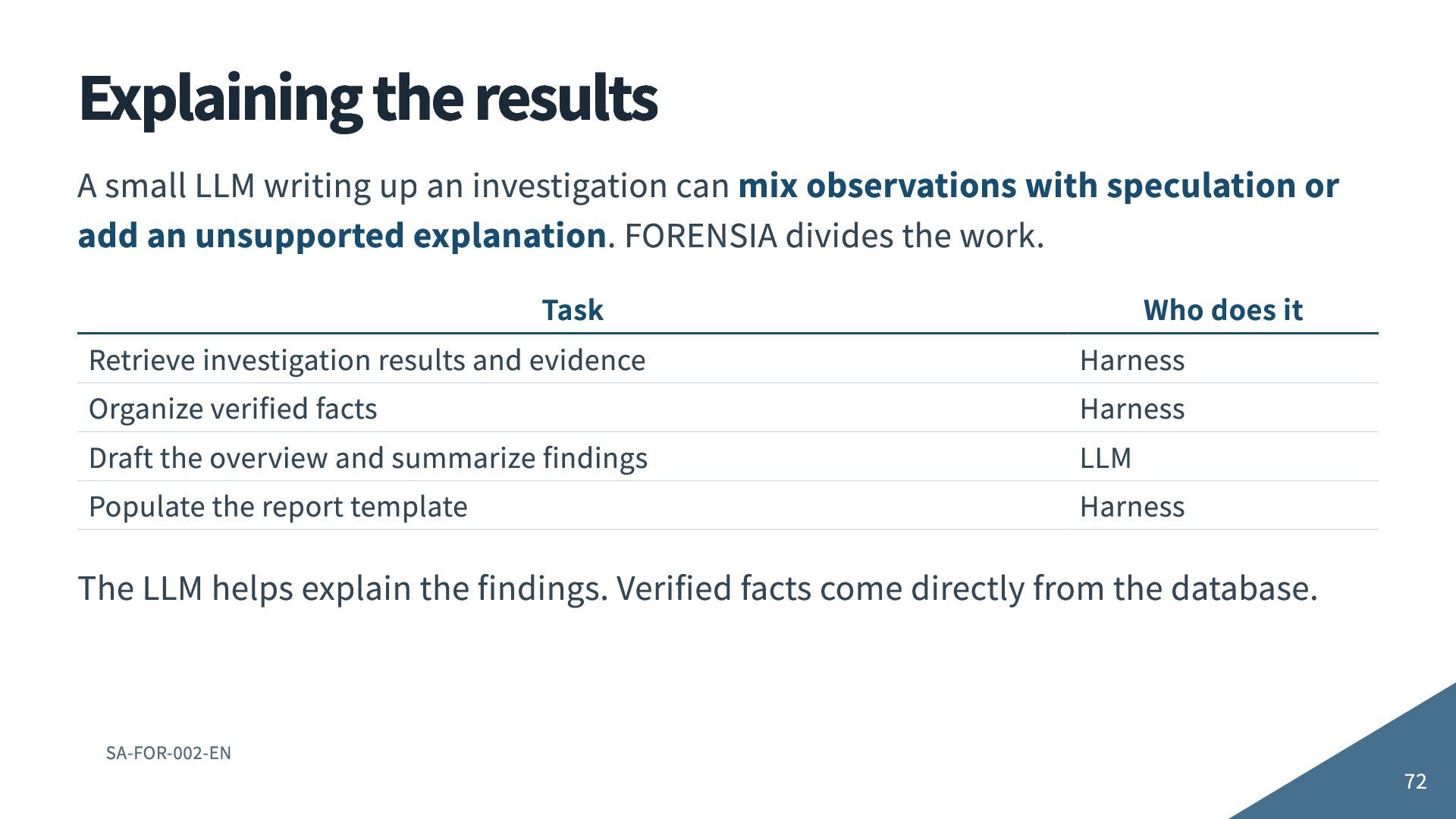
Explaining the results A small LLM writing up an investigation
can mix observations with speculation or add an unsupported explanation. FORENSIA divides the work. Task Retrieve investigation results and evidence Organize verified facts Draft the overview and summarize findings Populate the report template Who does it Harness Harness LLM Harness The LLM helps explain the findings. Verified facts come directly from the database. SA-FOR-002-EN 72 -
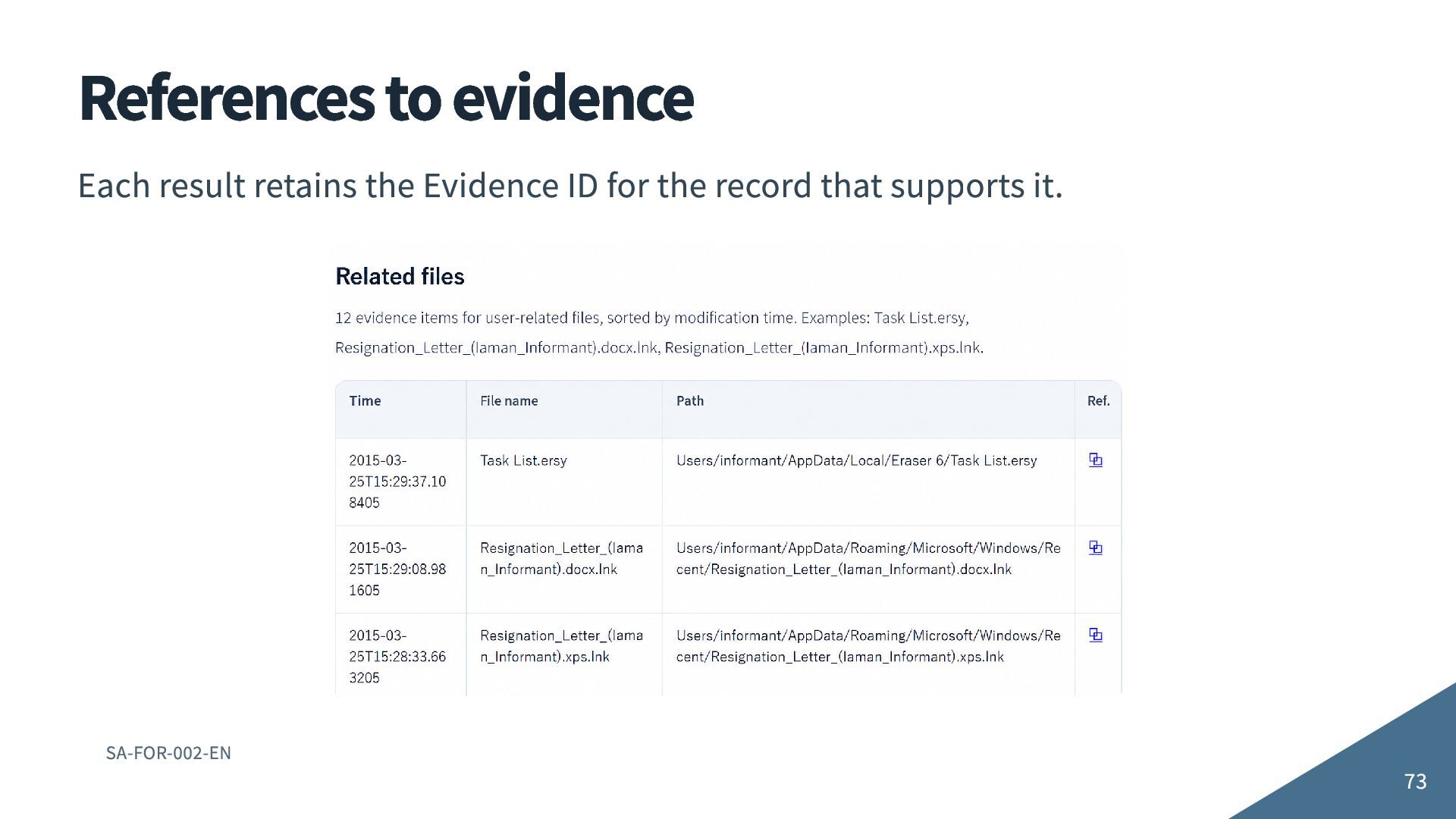
References to evidence Each result retains the Evidence ID for
the record that supports it. SA-FOR-002-EN 73 -
Returning open questions to the investigation Writing the report can
reveal that some information is missing. Return the gap to the investigation state as an open issue instead of filling in the text with a guess. FORENSIA can finish a run with questions still open. SA-FOR-002-EN 74 -
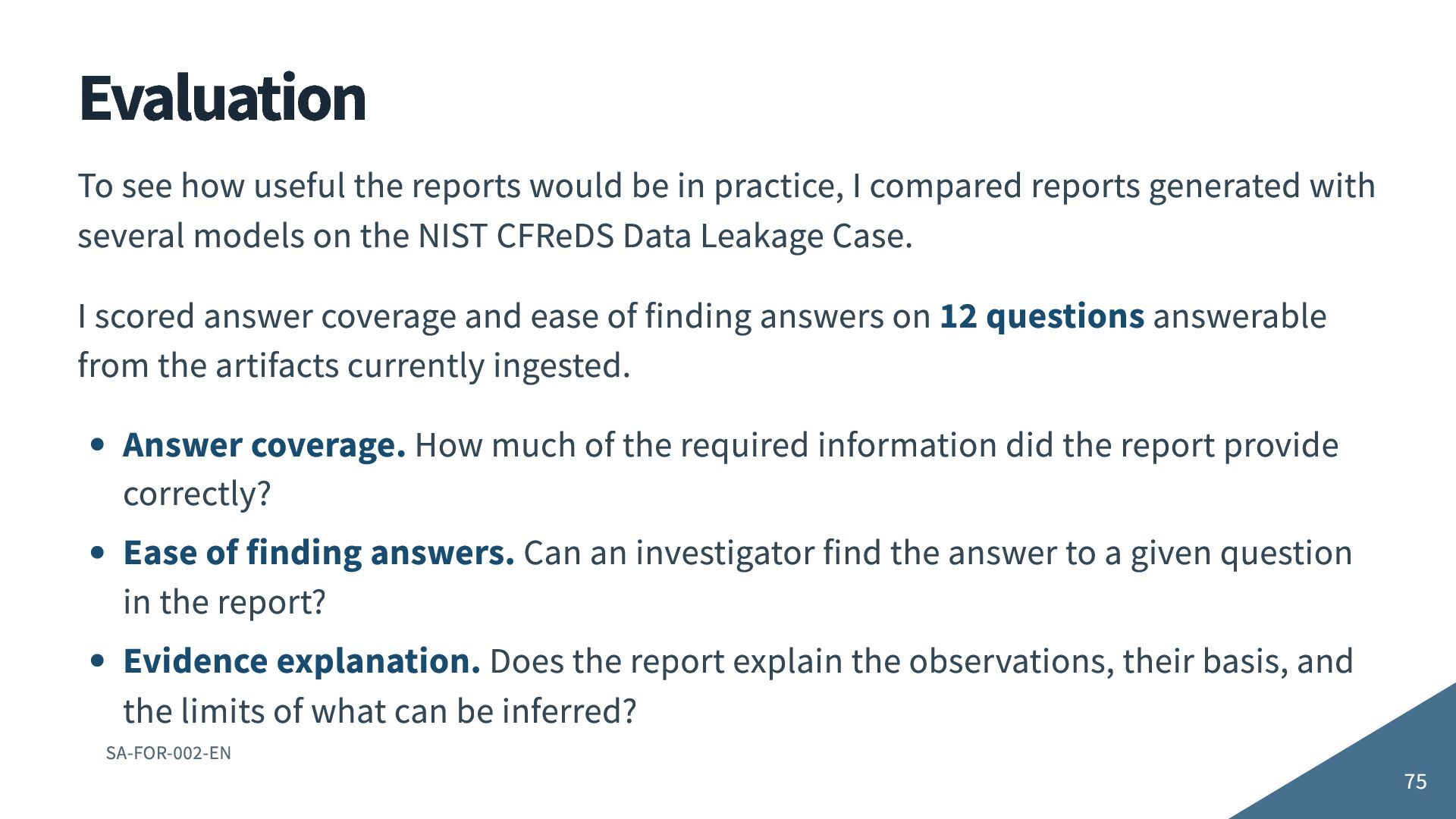
Evaluation To see how useful the reports would be in
practice, I compared reports generated with several models on the NIST CFReDS Data Leakage Case. I scored answer coverage and ease of finding answers on 12 questions answerable from the artifacts currently ingested. Answer coverage. How much of the required information did the report provide correctly? Ease of finding answers. Can an investigator find the answer to a given question in the report? Evidence explanation. Does the report explain the observations, their basis, and the limits of what can be inferred? SA-FOR-002-EN 75 -
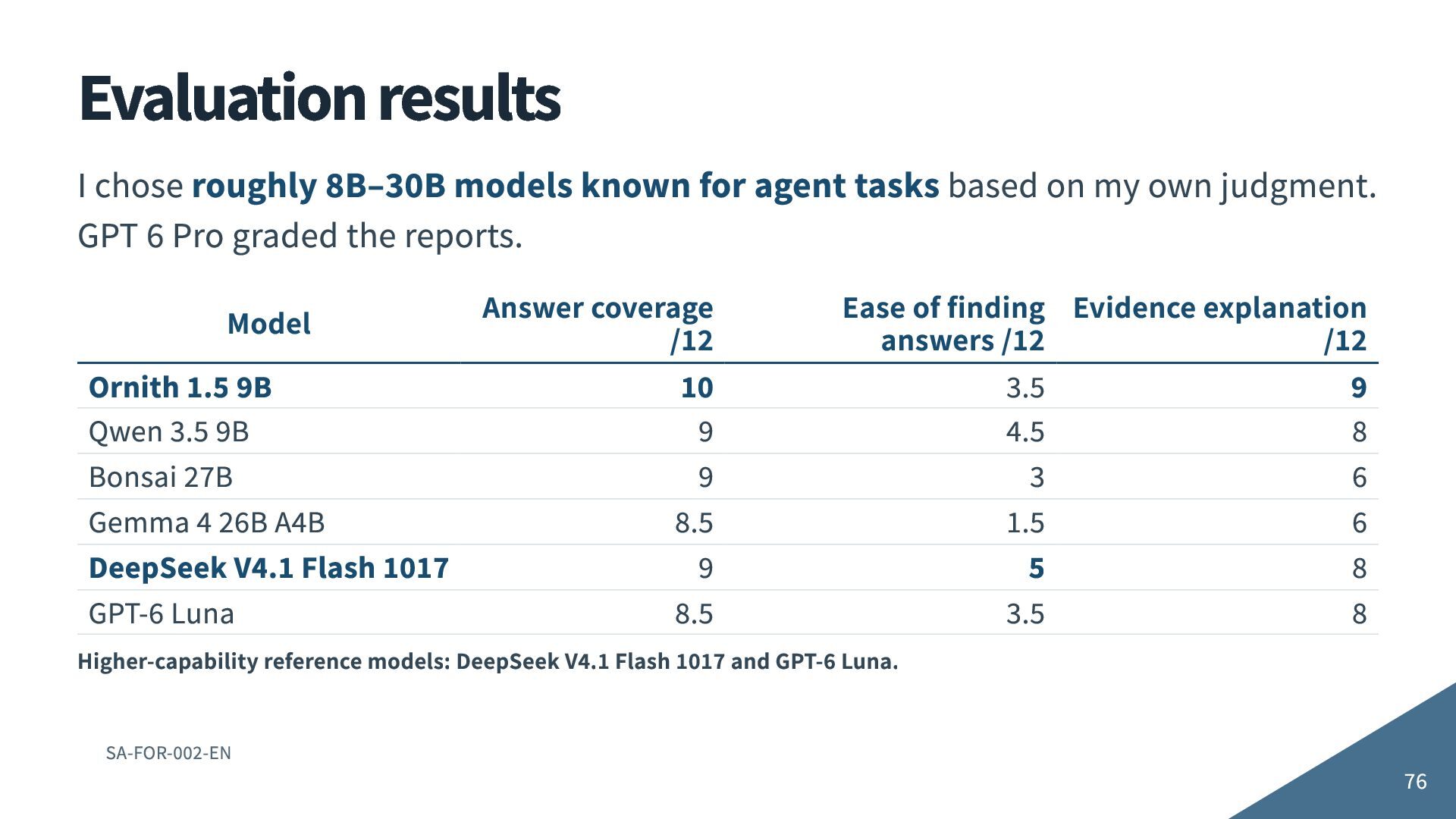
Evaluation results I chose roughly 8B–30B models known for agent
tasks based on my own judgment. GPT 6 Pro graded the reports. Answer coverage Model /12 Ornith 1.5 9B 10 Qwen 3.5 9B 9 Bonsai 27B 9 Gemma 4 26B A4B 8.5 DeepSeek V4.1 Flash 1017 9 GPT-6 Luna 8.5 Ease of finding Evidence explanation answers /12 /12 3.5 9 4.5 8 3 6 1.5 6 5 8 3.5 8 Higher-capability reference models: DeepSeek V4.1 Flash 1017 and GPT-6 Luna. SA-FOR-002-EN 76 -
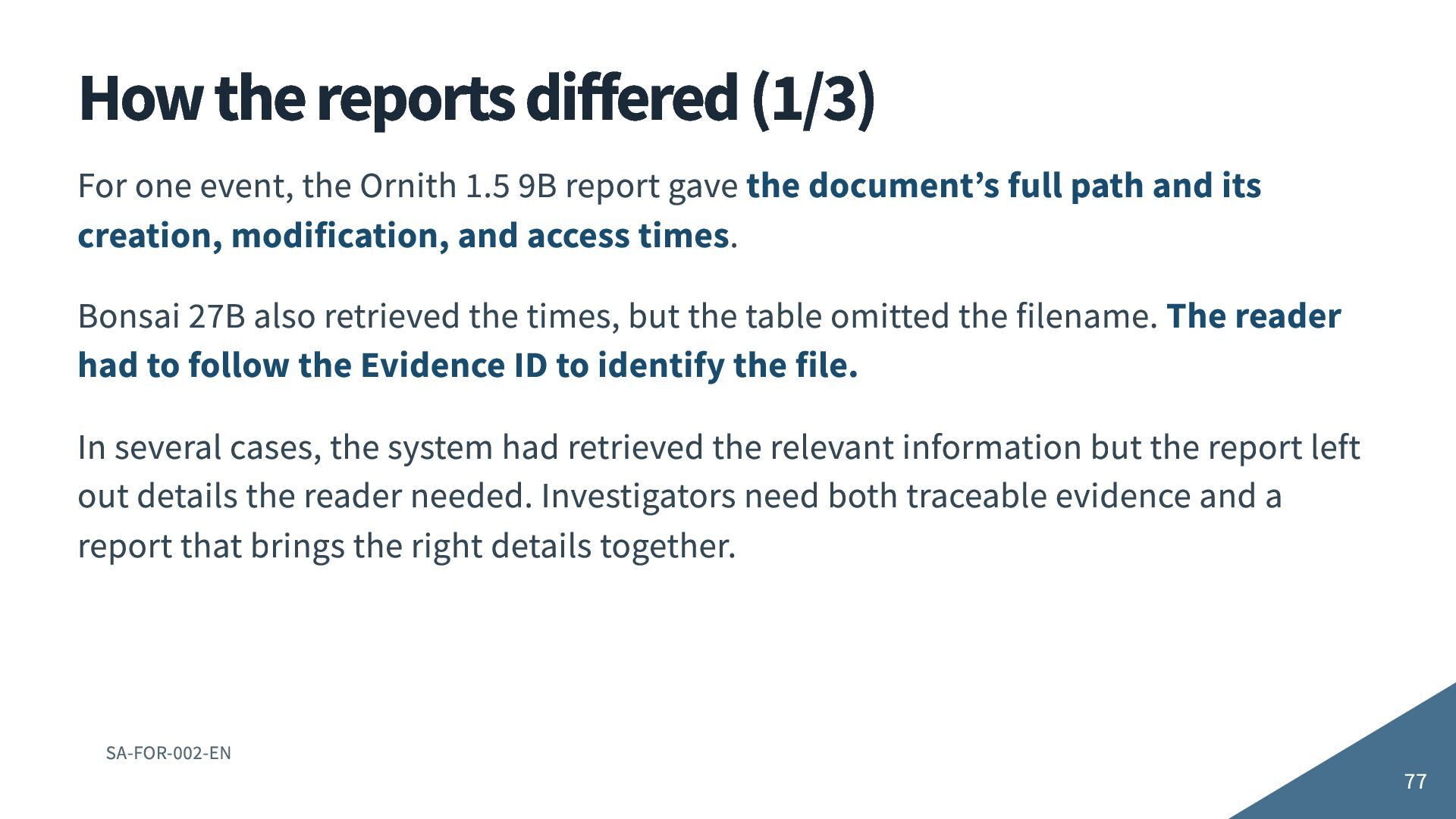
How the reports differed (1/3) For one event, the Ornith
1.5 9B report gave the document’s full path and its creation, modification, and access times. Bonsai 27B also retrieved the times, but the table omitted the filename. The reader had to follow the Evidence ID to identify the file. In several cases, the system had retrieved the relevant information but the report left out details the reader needed. Investigators need both traceable evidence and a report that brings the right details together. SA-FOR-002-EN 77 -
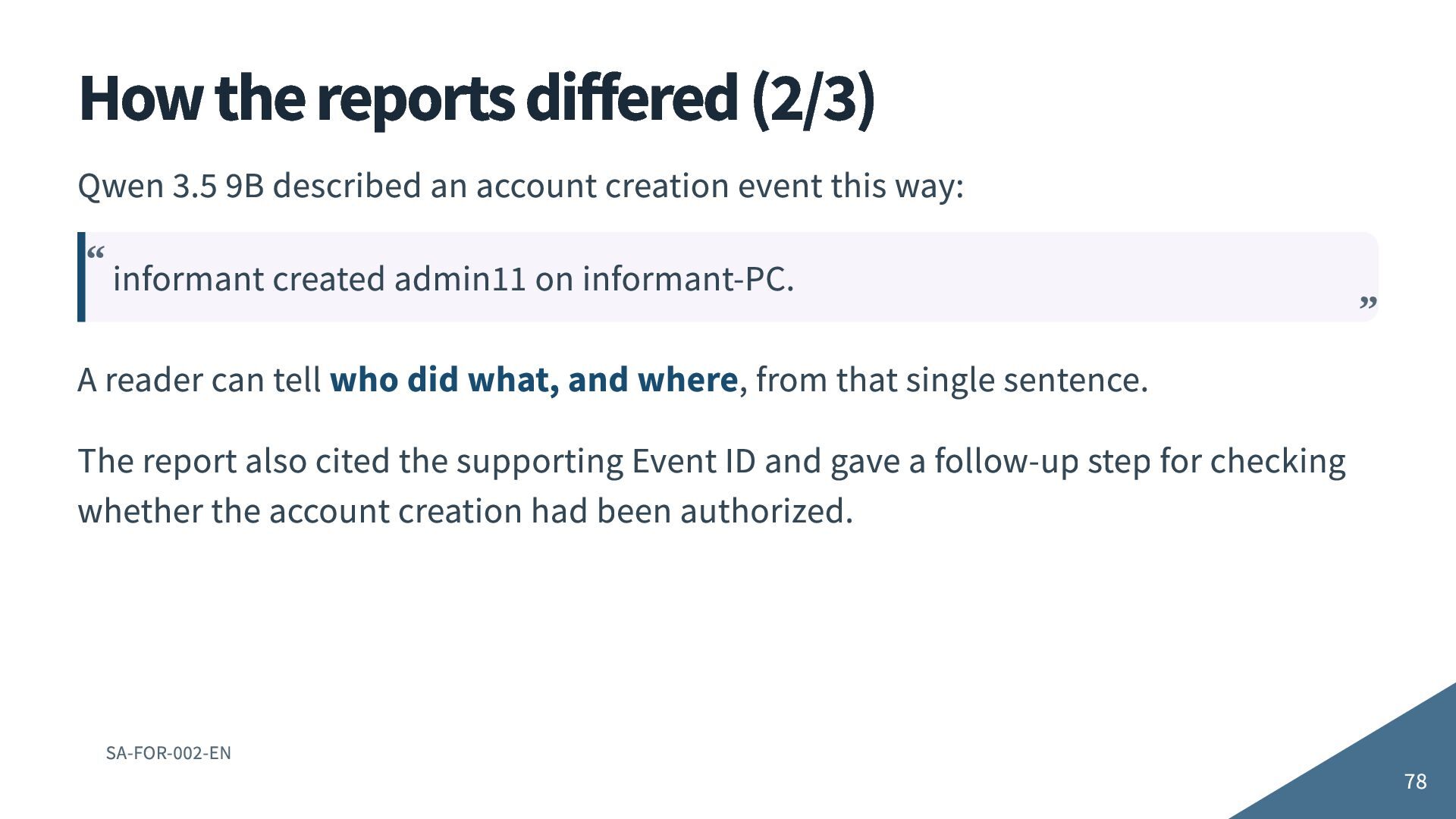
How the reports differed (2/3) “ Qwen 3.5 9B described
an account creation event this way: “ informant created admin11 on informant-PC. A reader can tell who did what, and where, from that single sentence. The report also cited the supporting Event ID and gave a follow-up step for checking whether the account creation had been authorized. SA-FOR-002-EN 78 -
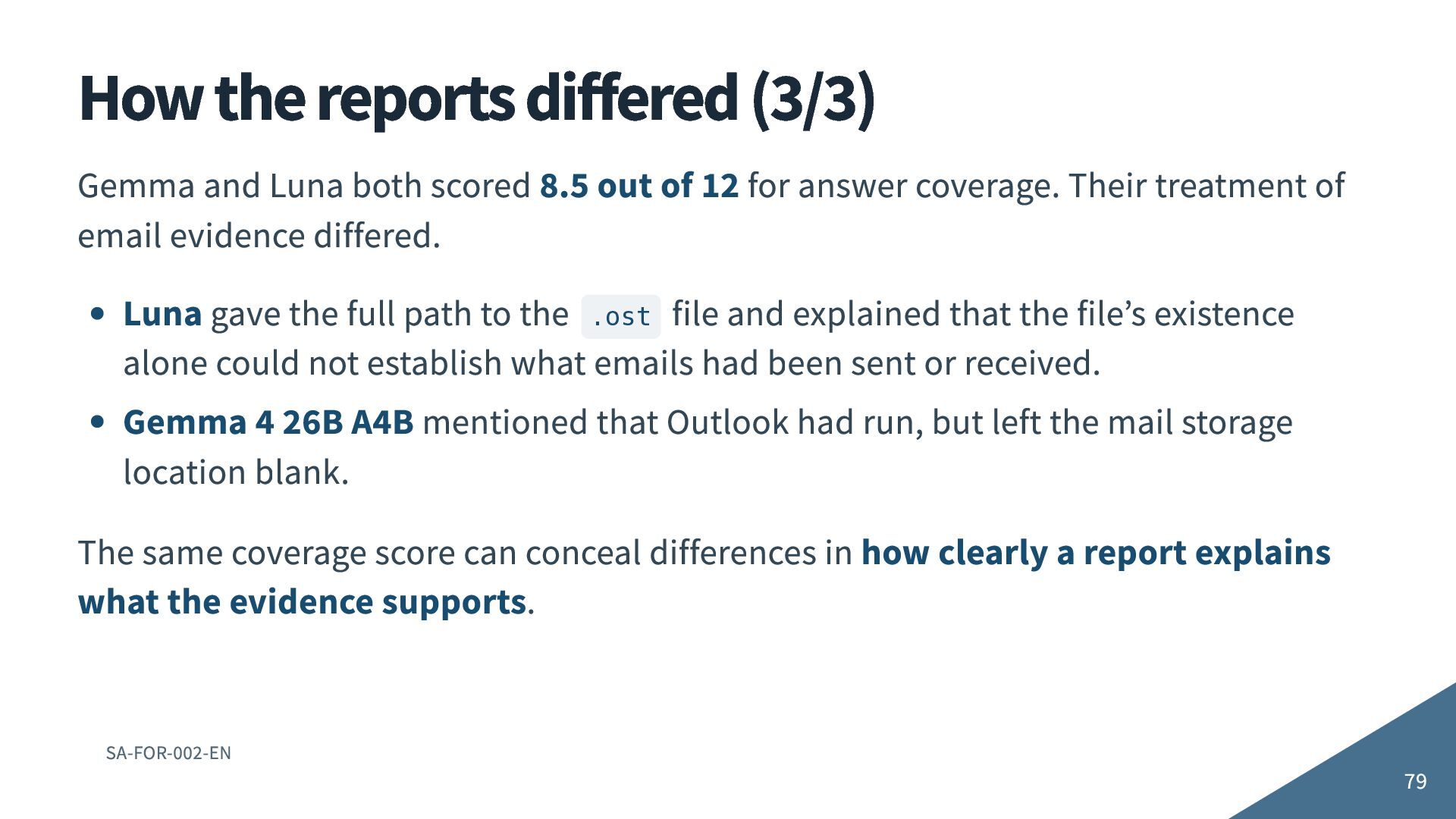
How the reports differed (3/3) Gemma and Luna both scored
8.5 out of 12 for answer coverage. Their treatment of email evidence differed. Luna gave the full path to the file and explained that the file’s existence alone could not establish what emails had been sent or received. Gemma 4 26B A4B mentioned that Outlook had run, but left the mail storage location blank. The same coverage score can conceal differences in how clearly a report explains what the evidence supports. .ost SA-FOR-002-EN 79 -
What the evaluation tells us Answer coverage alone missed differences
among the reports. In particular, a more capable model did not consistently produce a better report. This small benchmark used a subset of questions answerable from the available artifacts. These results alone cannot establish differences in the models’ underlying capabilities. Results can also vary between runs. What I want is a report an investigator can use to check the evidence and make the next decision. SA-FOR-002-EN 80 -
Choosing the starting point Encoding investigative intent and verification criteria
in rules helps a small model decide what to check next. The more an investigation relies on predefined knowledge, the more the rule author’s perspective shapes what gets investigated. For example, if all the rules look for known attack techniques, other events may receive too little attention. The challenge is to draw on investigators’ experience while leaving room for the model to consider possibilities they did not anticipate. SA-FOR-002-EN 81 -
The model is only part of the problem When the
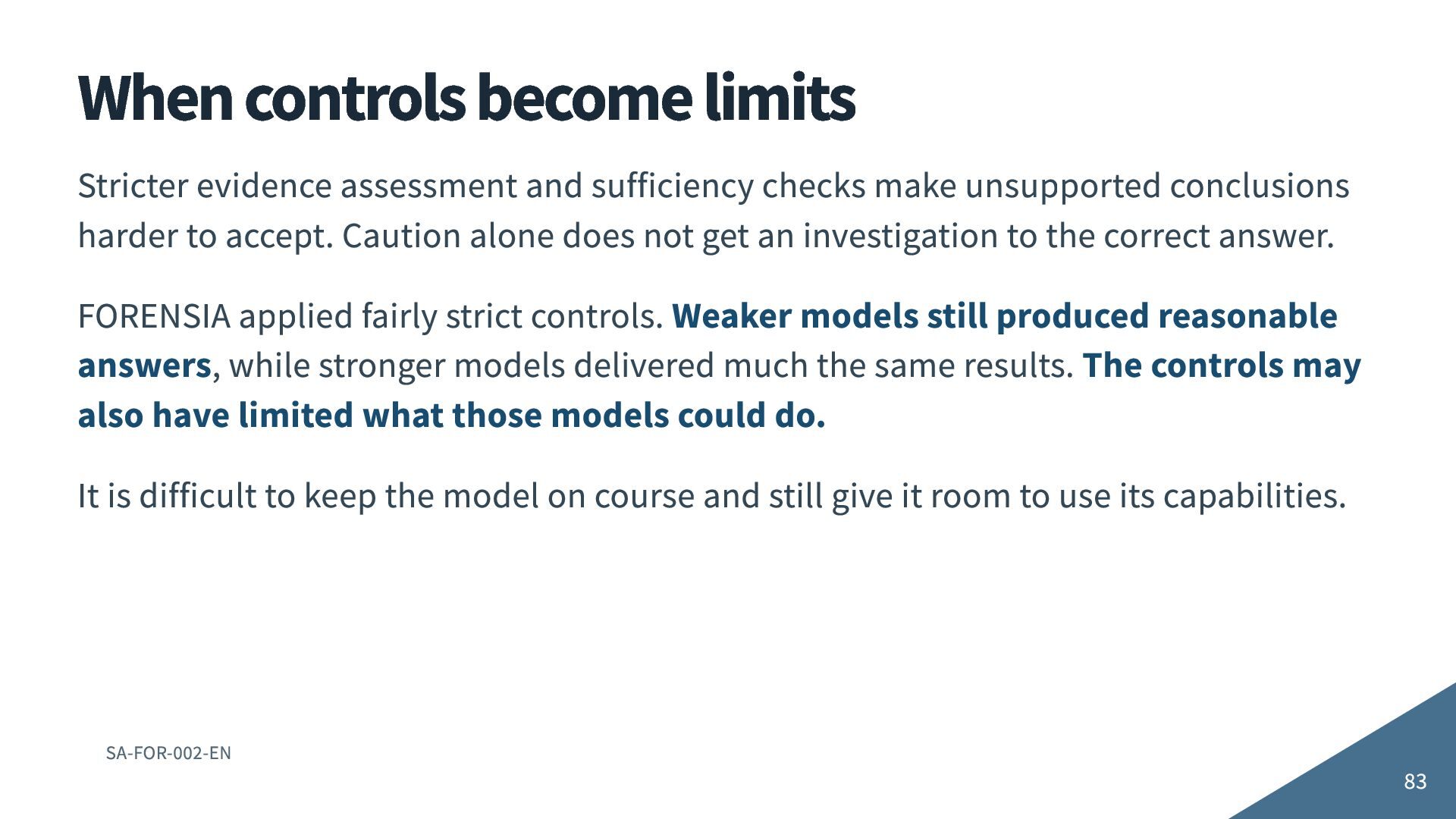
LLM failed to produce a suitable result, the cause was more often elsewhere in the system. The context was missing necessary information. The model lacked the right search method or data source. A retrieved record did not reach the next verification step correctly. The system repeated the same task and never reached another question. To diagnose these failures, record where information was lost or progress stalled. SA-FOR-002-EN 82 -
When controls become limits Stricter evidence assessment and sufficiency checks
make unsupported conclusions harder to accept. Caution alone does not get an investigation to the correct answer. FORENSIA applied fairly strict controls. Weaker models still produced reasonable answers, while stronger models delivered much the same results. The controls may also have limited what those models could do. It is difficult to keep the model on course and still give it room to use its capabilities. SA-FOR-002-EN 83 -
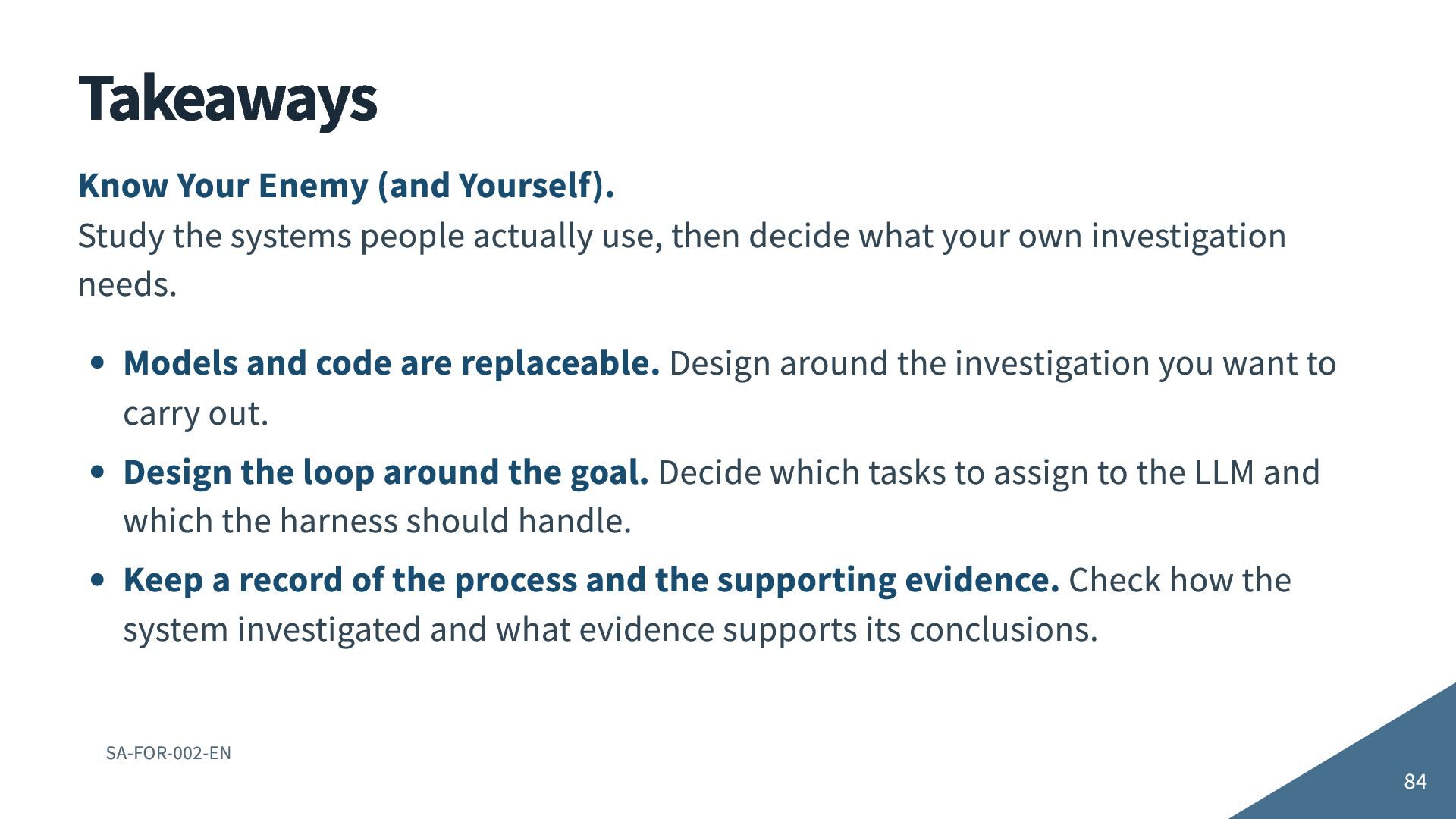
Takeaways Know Your Enemy (and Yourself). Study the systems people
actually use, then decide what your own investigation needs. Models and code are replaceable. Design around the investigation you want to carry out. Design the loop around the goal. Decide which tasks to assign to the LLM and which the harness should handle. Keep a record of the process and the supporting evidence. Check how the system investigated and what evidence supports its conclusions. SA-FOR-002-EN 84 -
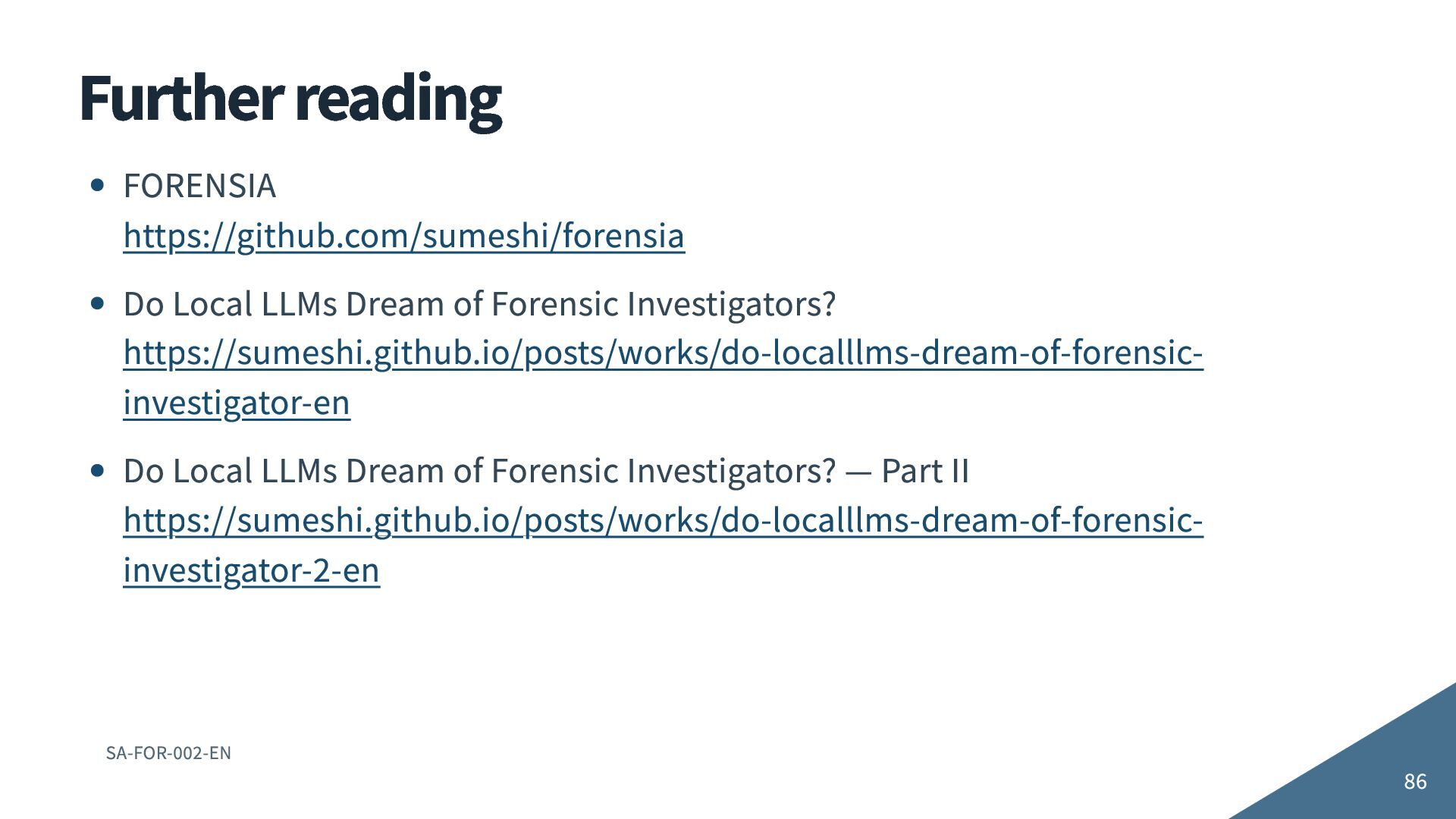
Further reading FORENSIA https://github.com/sumeshi/forensia Do Local LLMs Dream of Forensic
Investigators? https://sumeshi.github.io/posts/works/do-localllms-dream-of-forensicinvestigator-en Do Local LLMs Dream of Forensic Investigators? — Part II https://sumeshi.github.io/posts/works/do-localllms-dream-of-forensicinvestigator-2-en SA-FOR-002-EN 86
 sumeshi
 taka_aki
 inariku
 haru860
 yoshimura_datam
 shadowhat
 timakin
 kmiya84377
 oidfj
 rfdnxbro
 legalontechnologies
 lycorptech_jp
 marktimemedia
 palkan
 nikkihalliwell
 jnunemaker
 helenjbeal
 twada
 inesmontani
 reverentgeek
 yeseniaperezcruz
 mfonobong
 szymonslowik
 rocio