Upgrade to Pro — share decks privately, control downloads, hide ads and more …

IDI 2026 - Beyond the Basics: Mastering Postgre...

IDI 2026 - Beyond the Basics: Mastering PostgreSQL Index Performance

Indices are the backbone of efficient data retrieval in PostgreSQL, but their impact on performance is a double-edged sword.
While they accelerate read operations, they can introduce overhead to write operations and consume valuable storage.
This talk delves into the nuances of PostgreSQL index performance, providing practical insights and actionable strategies for optimizing your database.

Avatar for Federico Campoli

Federico Campoli

March 23, 2026
Tweet

More Decks by Federico Campoli

Other Decks in Technology

Transcript

  1. Beyond the Basics: Mastering PostgreSQL Index Performance Federico Campoli PostgreSQL

    DBA, because freaking miracle worker is not a job title Incontro Devops Italia 2026, Bologna, 20th March 2026 Federico Campoli (PostgreSQL DBA, because freaking miracle worker is not a job title) Beyond the Basics: Mastering PostgreSQL Index Performance 1 / 69
  2. Few words about the speaker Born in 1972 Passionate about

    IT since 1985 In love with PostgreSQL since 2006 PostgreSQL and FreeBSD tattoo on the right shoulder Amateur Jazz Guitarist Amateur Road and MTB Cyclist Freelance DBA at Kamedata Federico Campoli (PostgreSQL DBA, because freaking miracle worker is not a job title) Beyond the Basics: Mastering PostgreSQL Index Performance 2 / 69
  3. Getting in touch Linkedin: https://www.linkedin.com/in/federicocampoli/ Codeberg: https://codeberg.com/the4thdoctor Bluesky: https://bsky.app/profile/pgdba.org Mastodon:

    https://fosstodon.org/@4thdoctor scarf Blog: https://pgdba.org Federico Campoli (PostgreSQL DBA, because freaking miracle worker is not a job title) Beyond the Basics: Mastering PostgreSQL Index Performance 3 / 69
  4. Feedback please! Federico Campoli (PostgreSQL DBA, because freaking miracle worker

    is not a job title) Beyond the Basics: Mastering PostgreSQL Index Performance 4 / 69
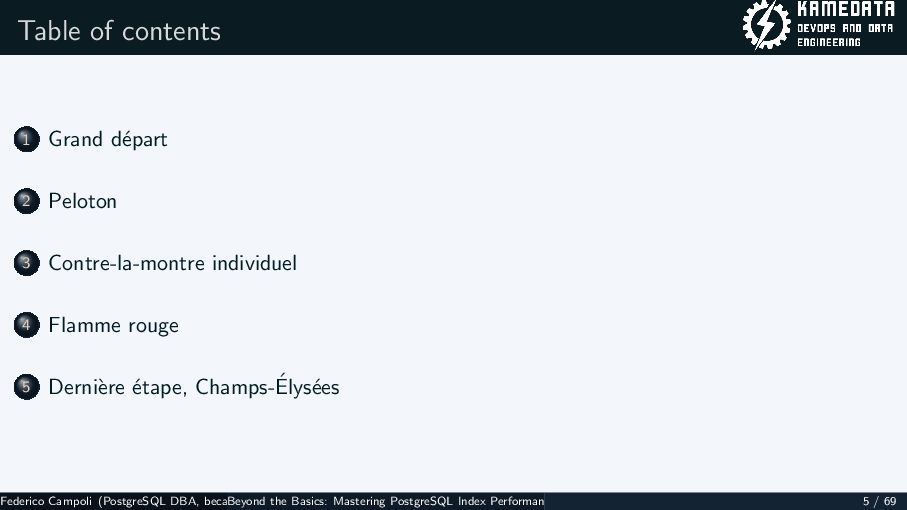
  5. Table of contents 1 Grand d´ epart 2 Peloton 3

    Contre-la-montre individuel 4 Flamme rouge 5 Derni` ere ´ etape, Champs-´ Elys´ ees Federico Campoli (PostgreSQL DBA, because freaking miracle worker is not a job title) Beyond the Basics: Mastering PostgreSQL Index Performance 5 / 69
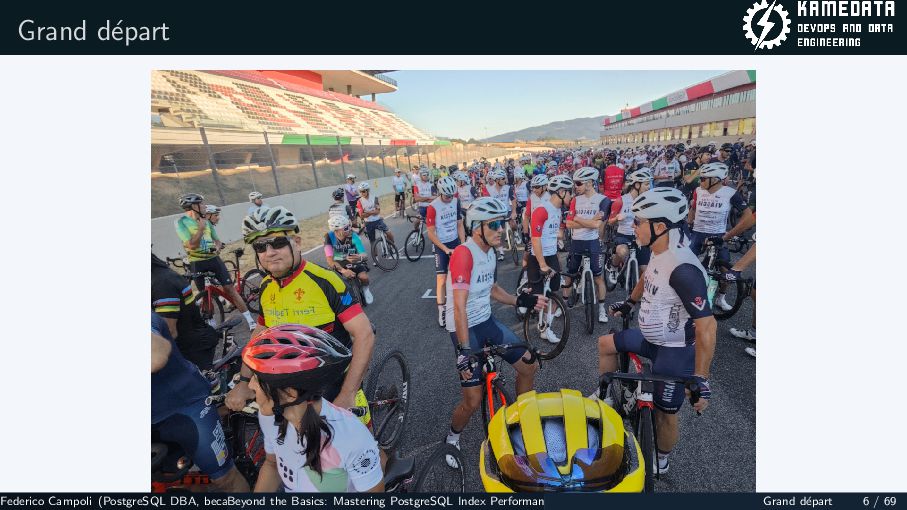
  6. Grand d´ epart Federico Campoli (PostgreSQL DBA, because freaking miracle

    worker is not a job title) Beyond the Basics: Mastering PostgreSQL Index Performance Grand d´ epart 6 / 69
  7. Les ´ equipes pr´ esent´ ees From Wikipedia: A database

    index is a data structure that improves the speed of data retrieval. Indexes are used to quickly locate data without having to search every row in a database table every time said table is accessed. Federico Campoli (PostgreSQL DBA, because freaking miracle worker is not a job title) Beyond the Basics: Mastering PostgreSQL Index Performance Grand d´ epart 7 / 69
  8. La forme Nowadays everything is cloud based It’s just an

    hallucination though The physical storage still fights for the users Federico Campoli (PostgreSQL DBA, because freaking miracle worker is not a job title) Beyond the Basics: Mastering PostgreSQL Index Performance Grand d´ epart 8 / 69
  9. La forme After a quick dive in the physical world...

    we’ll see how an index can improve the query performance ... or make things worse Federico Campoli (PostgreSQL DBA, because freaking miracle worker is not a job title) Beyond the Basics: Mastering PostgreSQL Index Performance Grand d´ epart 9 / 69
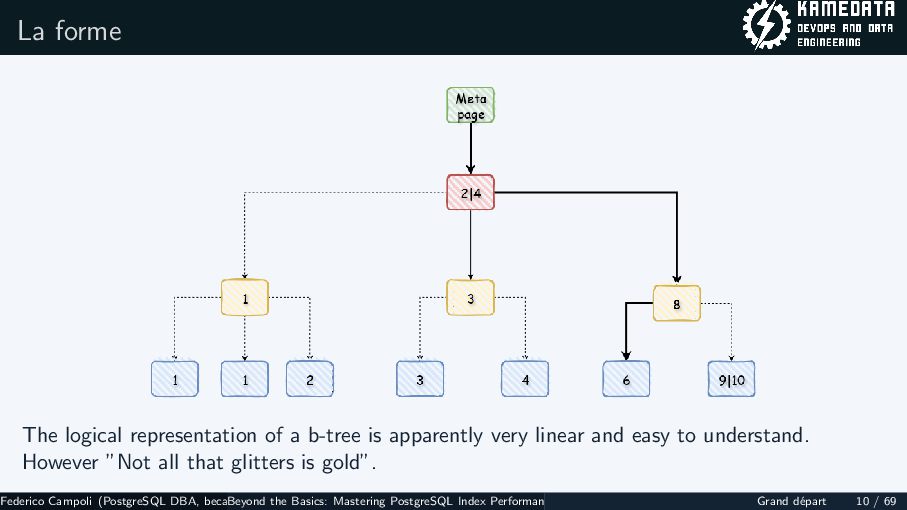
  10. La forme The logical representation of a b-tree is apparently

    very linear and easy to understand. However ”Not all that glitters is gold”. Federico Campoli (PostgreSQL DBA, because freaking miracle worker is not a job title) Beyond the Basics: Mastering PostgreSQL Index Performance Grand d´ epart 10 / 69
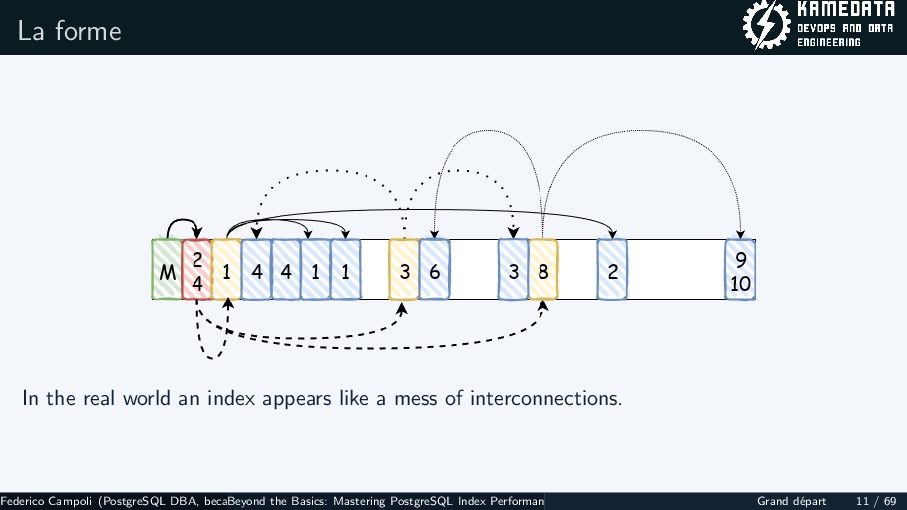
  11. La forme In the real world an index appears like

    a mess of interconnections. Federico Campoli (PostgreSQL DBA, because freaking miracle worker is not a job title) Beyond the Basics: Mastering PostgreSQL Index Performance Grand d´ epart 11 / 69
  12. Peloton Federico Campoli (PostgreSQL DBA, because freaking miracle worker is

    not a job title) Beyond the Basics: Mastering PostgreSQL Index Performance Peloton 12 / 69
  13. The database directories Within the data area the subdirectory $PGDATA/base

    containts folders with a numerical name. Each folder stores the data files belonging to the corresponding instance’s database. Federico Campoli (PostgreSQL DBA, because freaking miracle worker is not a job title) Beyond the Basics: Mastering PostgreSQL Index Performance Peloton 13 / 69
  14. The data files The data files have also a numerical

    name. When the relation is created then the file name is set to the value of the relation’s object identifier (OID). The relation’s filename is stored into the column relfilenode of the system table pg class and can change under particular conditions (VACUUM FULL, REINDEX). Federico Campoli (PostgreSQL DBA, because freaking miracle worker is not a job title) Beyond the Basics: Mastering PostgreSQL Index Performance Peloton 14 / 69
  15. The data files A data file’s max size is 1

    GB. If the data exceeds the first file then a new file with the same name and a numerical suffix is created. The first segment doesn’t have suffix though. Federico Campoli (PostgreSQL DBA, because freaking miracle worker is not a job title) Beyond the Basics: Mastering PostgreSQL Index Performance Peloton 15 / 69
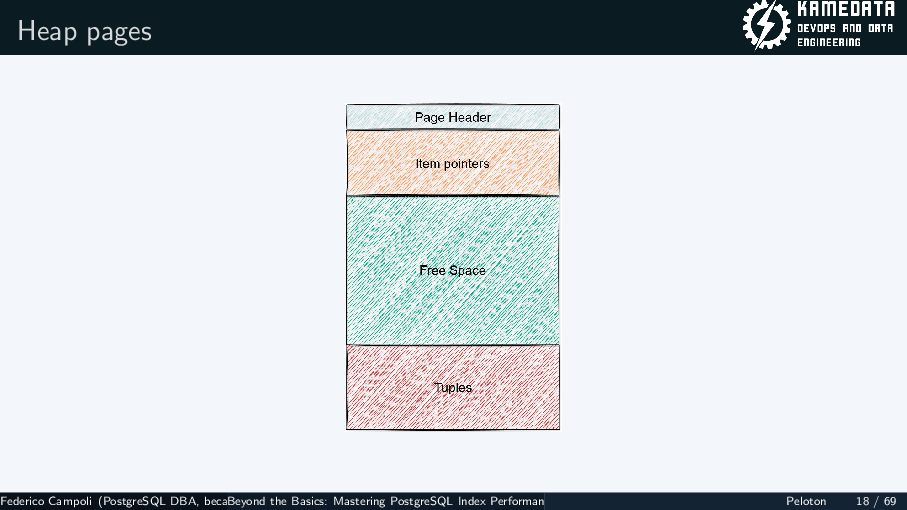
  16. The data pages Tables and indices are then organised in

    ”pages”. The page size is set at compile time. The defacto standard is 8kb. Federico Campoli (PostgreSQL DBA, because freaking miracle worker is not a job title) Beyond the Basics: Mastering PostgreSQL Index Performance Peloton 16 / 69
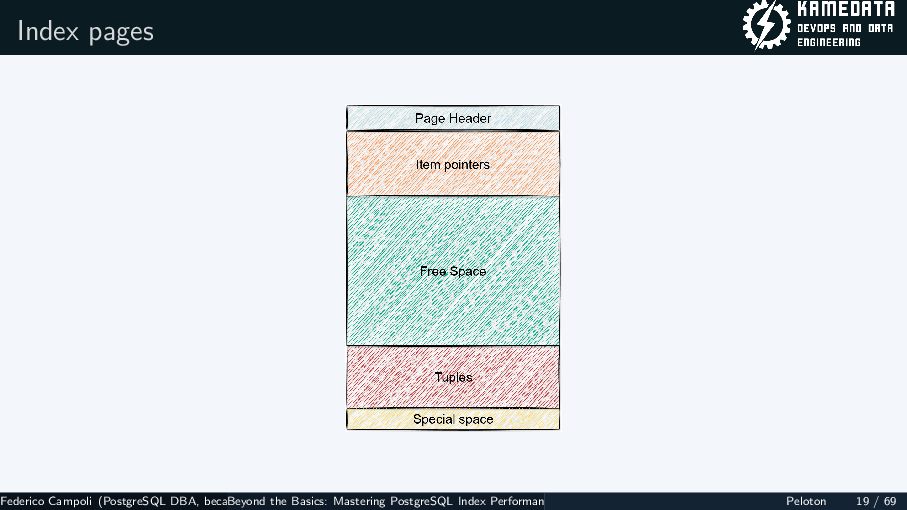
  17. The data pages The heap (table) pages and index pages

    have almost the same structure with one small but fundamental difference. Federico Campoli (PostgreSQL DBA, because freaking miracle worker is not a job title) Beyond the Basics: Mastering PostgreSQL Index Performance Peloton 17 / 69
  18. Heap pages Federico Campoli (PostgreSQL DBA, because freaking miracle worker

    is not a job title) Beyond the Basics: Mastering PostgreSQL Index Performance Peloton 18 / 69
  19. Index pages Federico Campoli (PostgreSQL DBA, because freaking miracle worker

    is not a job title) Beyond the Basics: Mastering PostgreSQL Index Performance Peloton 19 / 69
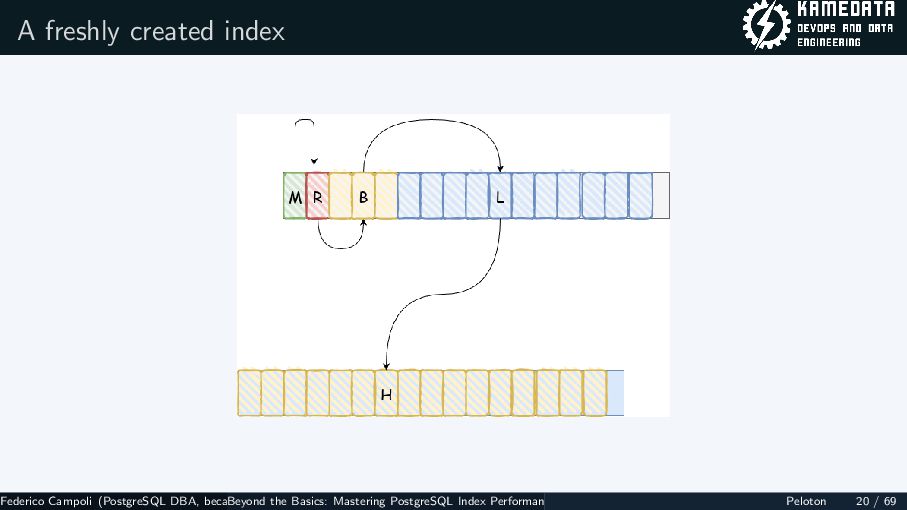
  20. A freshly created index Federico Campoli (PostgreSQL DBA, because freaking

    miracle worker is not a job title) Beyond the Basics: Mastering PostgreSQL Index Performance Peloton 20 / 69
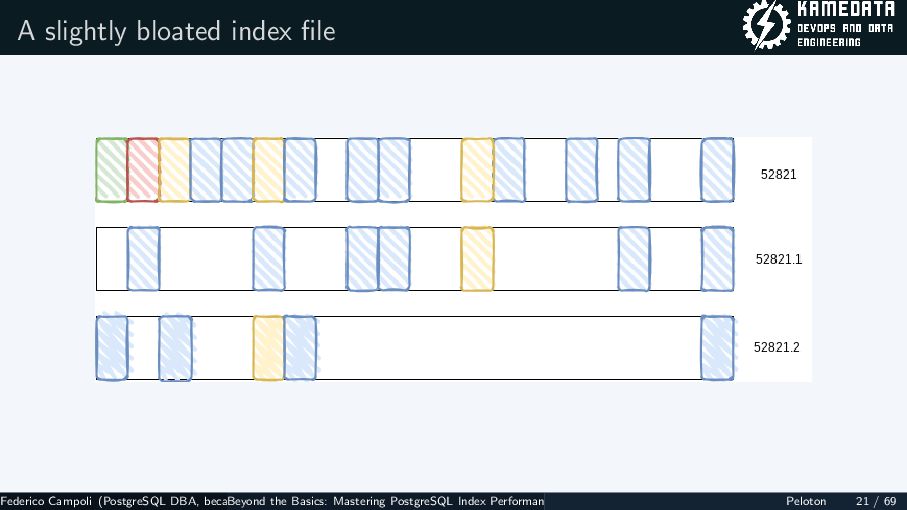
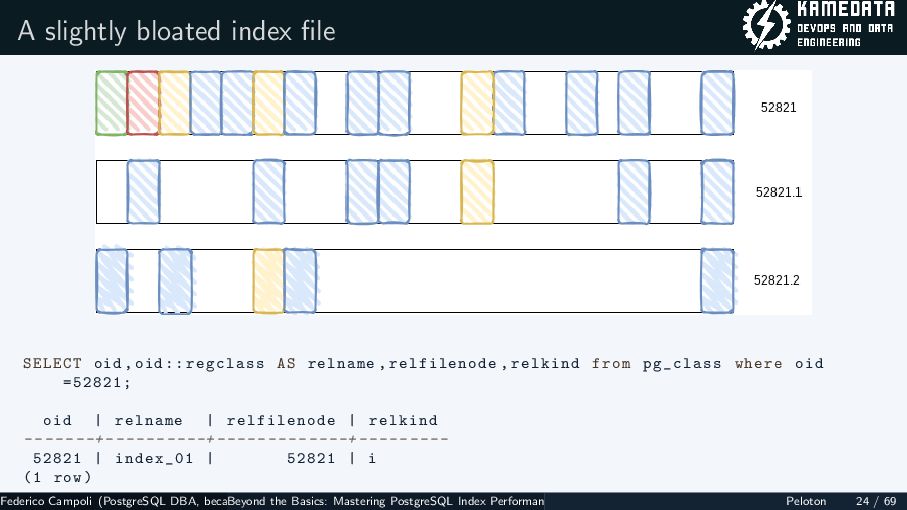
  21. A slightly bloated index file Federico Campoli (PostgreSQL DBA, because

    freaking miracle worker is not a job title) Beyond the Basics: Mastering PostgreSQL Index Performance Peloton 21 / 69
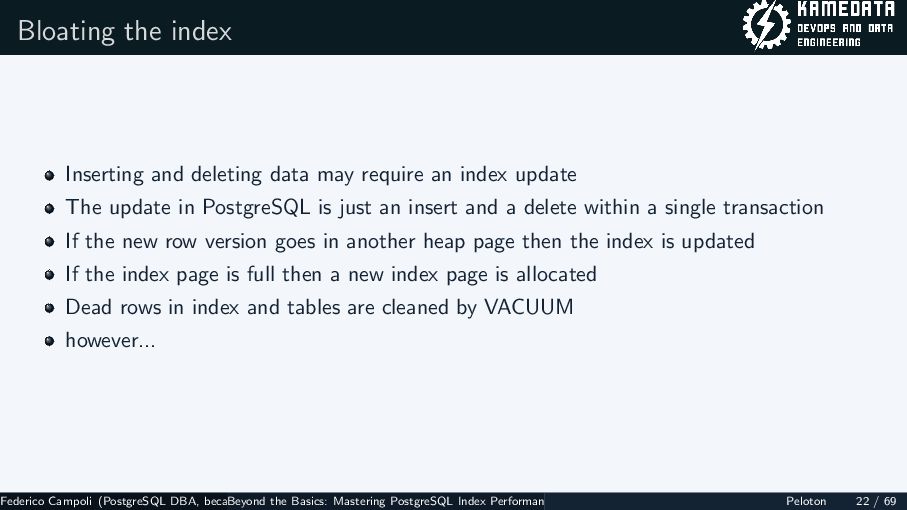
  22. Bloating the index Inserting and deleting data may require an

    index update The update in PostgreSQL is just an insert and a delete within a single transaction If the new row version goes in another heap page then the index is updated If the index page is full then a new index page is allocated Dead rows in index and tables are cleaned by VACUUM however... Federico Campoli (PostgreSQL DBA, because freaking miracle worker is not a job title) Beyond the Basics: Mastering PostgreSQL Index Performance Peloton 22 / 69
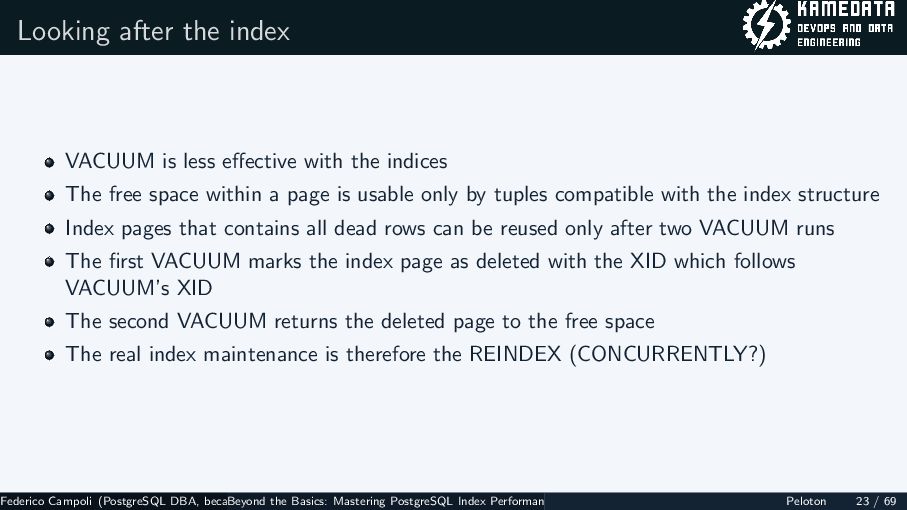
  23. Looking after the index VACUUM is less effective with the

    indices The free space within a page is usable only by tuples compatible with the index structure Index pages that contains all dead rows can be reused only after two VACUUM runs The first VACUUM marks the index page as deleted with the XID which follows VACUUM’s XID The second VACUUM returns the deleted page to the free space The real index maintenance is therefore the REINDEX (CONCURRENTLY?) Federico Campoli (PostgreSQL DBA, because freaking miracle worker is not a job title) Beyond the Basics: Mastering PostgreSQL Index Performance Peloton 23 / 69
  24. A slightly bloated index file SELECT oid ,oid :: regclass

    AS relname ,relfilenode ,relkind from pg_class where oid =52821; oid | relname | relfilenode | relkind -- -----+----------+-------------+--------- 52821 | index_01 | 52821 | i (1 row) Federico Campoli (PostgreSQL DBA, because freaking miracle worker is not a job title) Beyond the Basics: Mastering PostgreSQL Index Performance Peloton 24 / 69
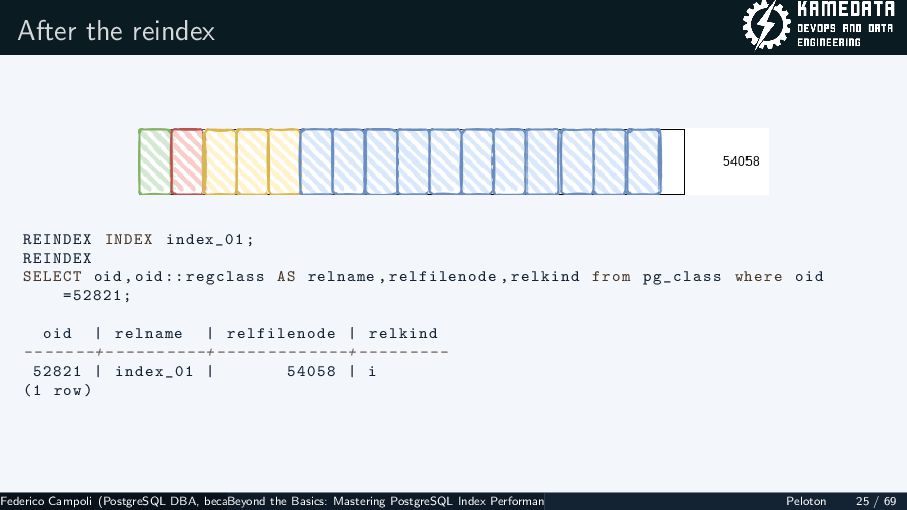
  25. After the reindex REINDEX INDEX index_01; REINDEX SELECT oid ,oid

    :: regclass AS relname ,relfilenode ,relkind from pg_class where oid =52821; oid | relname | relfilenode | relkind -- -----+----------+-------------+--------- 52821 | index_01 | 54058 | i (1 row) Federico Campoli (PostgreSQL DBA, because freaking miracle worker is not a job title) Beyond the Basics: Mastering PostgreSQL Index Performance Peloton 25 / 69
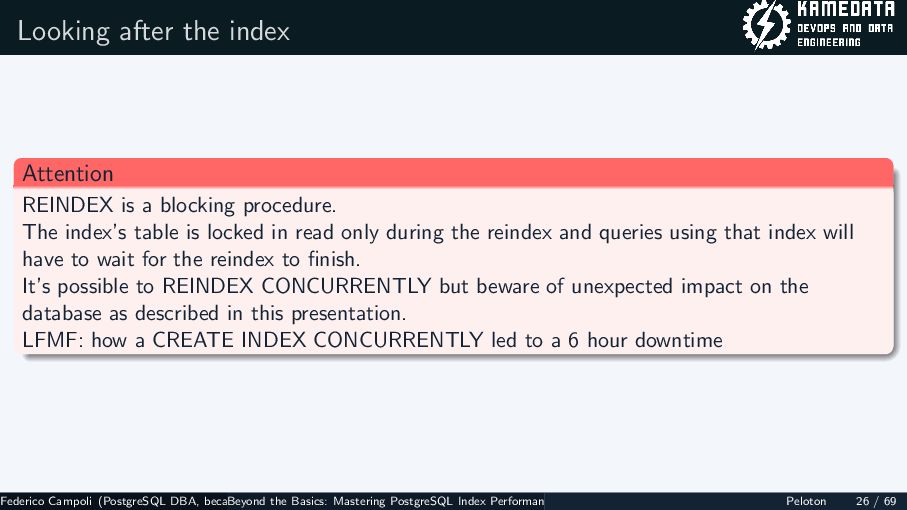
  26. Looking after the index Attention REINDEX is a blocking procedure.

    The index’s table is locked in read only during the reindex and queries using that index will have to wait for the reindex to finish. It’s possible to REINDEX CONCURRENTLY but beware of unexpected impact on the database as described in this presentation. LFMF: how a CREATE INDEX CONCURRENTLY led to a 6 hour downtime Federico Campoli (PostgreSQL DBA, because freaking miracle worker is not a job title) Beyond the Basics: Mastering PostgreSQL Index Performance Peloton 26 / 69
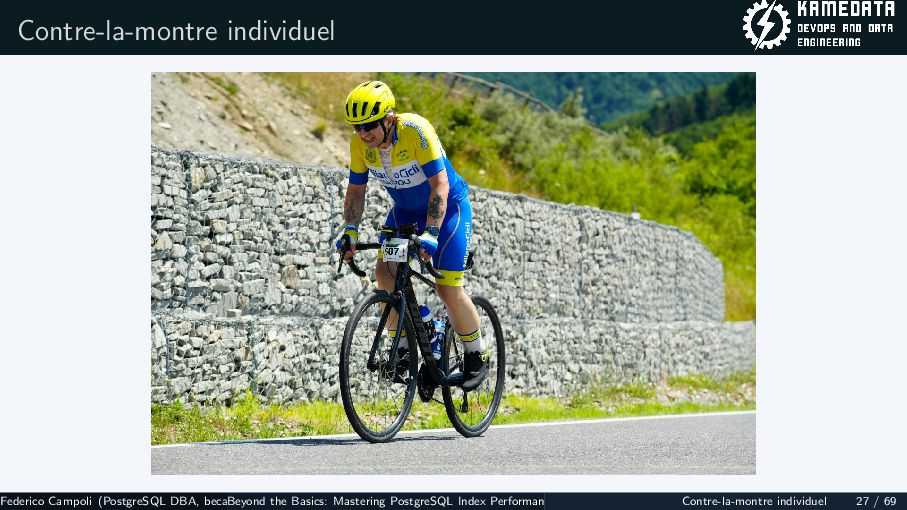
  27. Contre-la-montre individuel Federico Campoli (PostgreSQL DBA, because freaking miracle worker

    is not a job title) Beyond the Basics: Mastering PostgreSQL Index Performance Contre-la-montre individuel 27 / 69
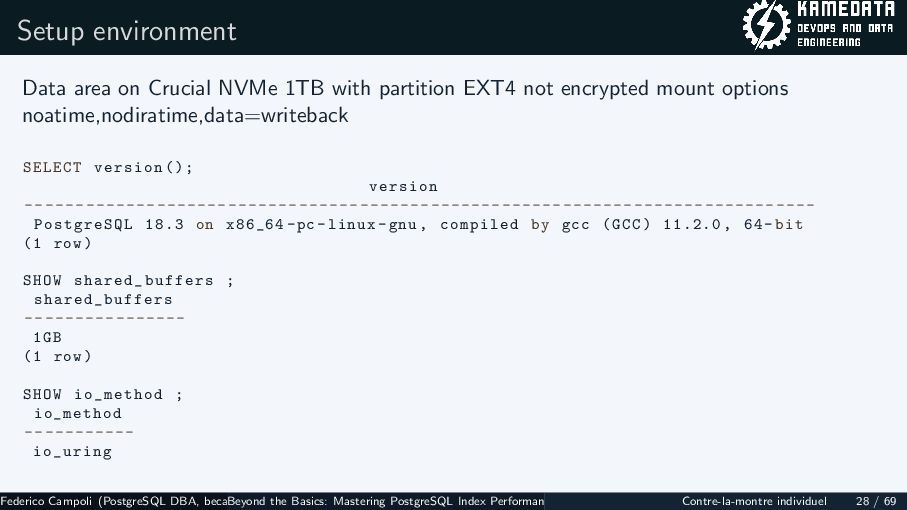
  28. Setup environment Data area on Crucial NVMe 1TB with partition

    EXT4 not encrypted mount options noatime,nodiratime,data=writeback SELECT version (); version -- ---------------------------------------------------------------------------- PostgreSQL 18.3 on x86_64 -pc -linux -gnu , compiled by gcc (GCC) 11.2.0 , 64-bit (1 row) SHOW shared_buffers ; shared_buffers -- -------------- 1GB (1 row) SHOW io_method ; io_method -- --------- io_uring Federico Campoli (PostgreSQL DBA, because freaking miracle worker is not a job title) Beyond the Basics: Mastering PostgreSQL Index Performance Contre-la-montre individuel 28 / 69
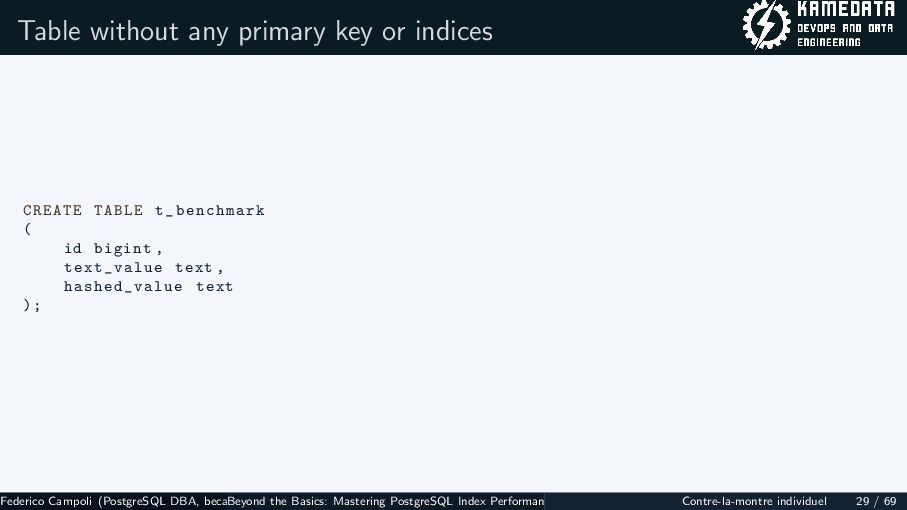
  29. Table without any primary key or indices CREATE TABLE t_benchmark

    ( id bigint , text_value text , hashed_value text ); Federico Campoli (PostgreSQL DBA, because freaking miracle worker is not a job title) Beyond the Basics: Mastering PostgreSQL Index Performance Contre-la-montre individuel 29 / 69
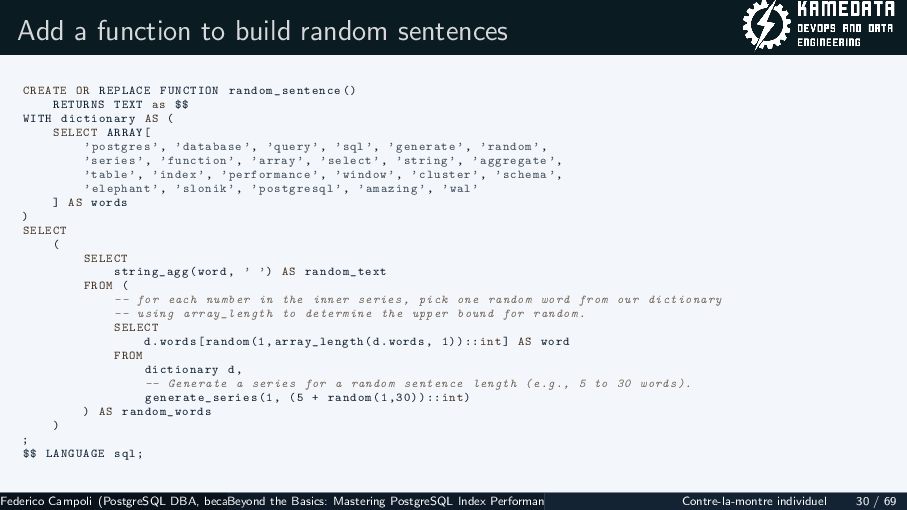
  30. Add a function to build random sentences CREATE OR REPLACE

    FUNCTION random_sentence () RETURNS TEXT as $$ WITH dictionary AS ( SELECT ARRAY[ ’postgres ’, ’database ’, ’query ’, ’sql ’, ’generate ’, ’random ’, ’series ’, ’function ’, ’array ’, ’select ’, ’string ’, ’aggregate ’, ’table ’, ’index ’, ’performance ’, ’window ’, ’cluster ’, ’schema ’, ’elephant ’, ’slonik ’, ’postgresql ’, ’amazing ’, ’wal’ ] AS words ) SELECT ( SELECT string_agg (word , ’ ’) AS random_text FROM ( -- for each number in the inner series , pick one random word from our dictionary -- using array_length to determine the upper bound for random . SELECT d.words[random (1, array_length (d.words , 1))::int] AS word FROM dictionary d, -- Generate a series for a random sentence length (e.g., 5 to 30 words). generate_series (1, (5 + random (1 ,30))::int) ) AS random_words ) ; $$ LANGUAGE sql; Federico Campoli (PostgreSQL DBA, because freaking miracle worker is not a job title) Beyond the Basics: Mastering PostgreSQL Index Performance Contre-la-montre individuel 30 / 69
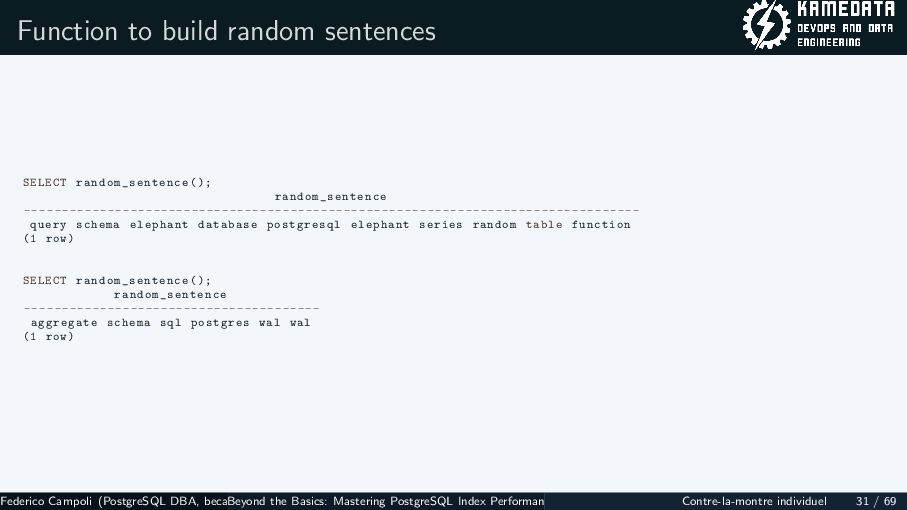
  31. Function to build random sentences SELECT random_sentence (); random_sentence --

    ------------------------------------------------------------------------------- query schema elephant database postgresql elephant series random table function (1 row) SELECT random_sentence (); random_sentence -- ------------------------------------- aggregate schema sql postgres wal wal (1 row) Federico Campoli (PostgreSQL DBA, because freaking miracle worker is not a job title) Beyond the Basics: Mastering PostgreSQL Index Performance Contre-la-montre individuel 31 / 69
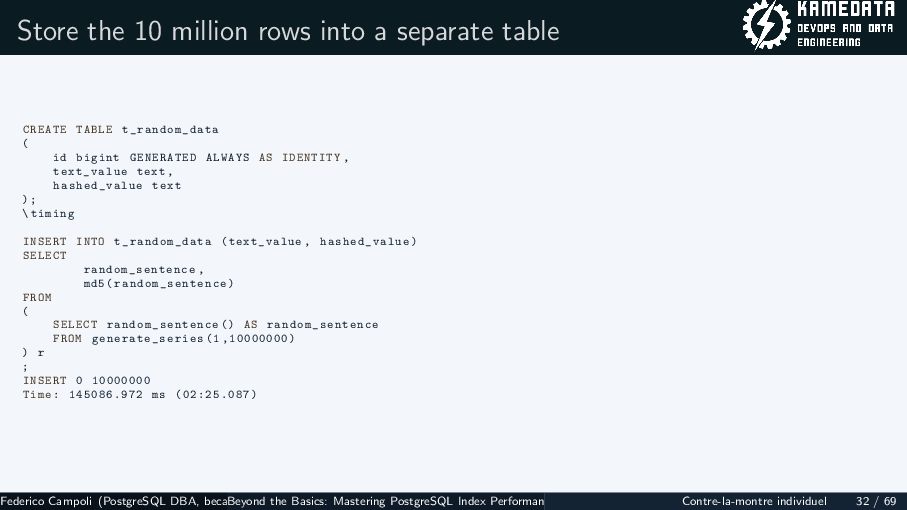
  32. Store the 10 million rows into a separate table CREATE

    TABLE t_random_data ( id bigint GENERATED ALWAYS AS IDENTITY , text_value text , hashed_value text ); \timing INSERT INTO t_random_data (text_value , hashed_value ) SELECT random_sentence , md5( random_sentence ) FROM ( SELECT random_sentence () AS random_sentence FROM generate_series (1 ,10000000) ) r ; INSERT 0 10000000 Time: 145086.972 ms (02:25.087) Federico Campoli (PostgreSQL DBA, because freaking miracle worker is not a job title) Beyond the Basics: Mastering PostgreSQL Index Performance Contre-la-montre individuel 32 / 69
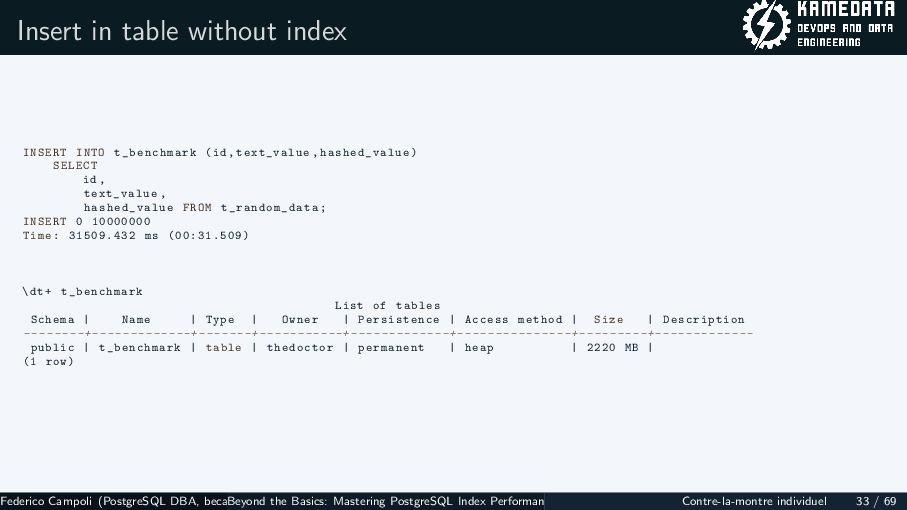
  33. Insert in table without index INSERT INTO t_benchmark (id ,text_value

    , hashed_value ) SELECT id , text_value , hashed_value FROM t_random_data ; INSERT 0 10000000 Time: 31509.432 ms (00:31.509) \dt+ t_benchmark List of tables Schema | Name | Type | Owner | Persistence | Access method | Size | Description -- ------+-------------+-------+-----------+-------------+---------------+---------+------------- public | t_benchmark | table | thedoctor | permanent | heap | 2220 MB | (1 row) Federico Campoli (PostgreSQL DBA, because freaking miracle worker is not a job title) Beyond the Basics: Mastering PostgreSQL Index Performance Contre-la-montre individuel 33 / 69
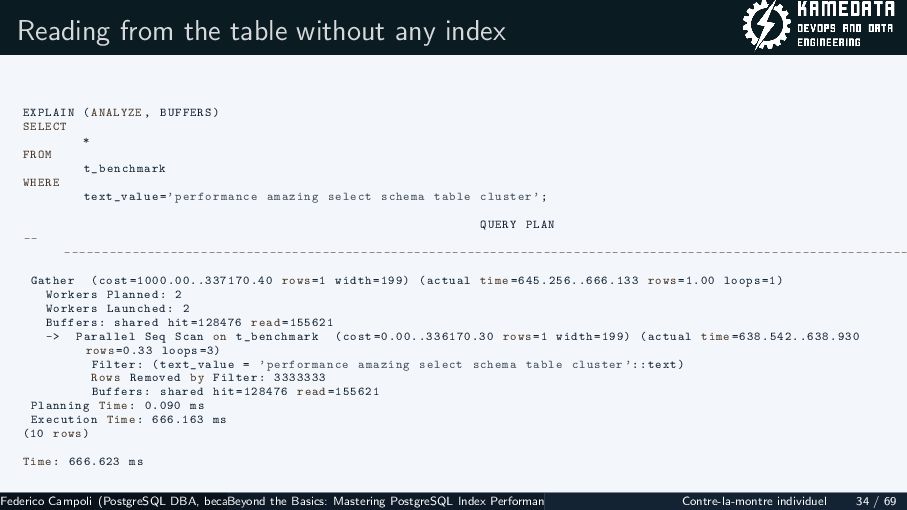
  34. Reading from the table without any index EXPLAIN (ANALYZE ,

    BUFFERS) SELECT * FROM t_benchmark WHERE text_value =’performance amazing select schema table cluster ’; QUERY PLAN -- --------------------------------------------------------------------------------------------------------------- Gather (cost =1000.00..337170.40 rows =1 width =199) (actual time =645.256..666.133 rows =1.00 loops =1) Workers Planned: 2 Workers Launched: 2 Buffers: shared hit =128476 read =155621 -> Parallel Seq Scan on t_benchmark (cost =0.00..336170.30 rows =1 width =199) (actual time =638.542..638.930 rows =0.33 loops =3) Filter: ( text_value = ’performance amazing select schema table cluster ’:: text) Rows Removed by Filter: 3333333 Buffers: shared hit =128476 read =155621 Planning Time: 0.090 ms Execution Time: 666.163 ms (10 rows) Time: 666.623 ms Federico Campoli (PostgreSQL DBA, because freaking miracle worker is not a job title) Beyond the Basics: Mastering PostgreSQL Index Performance Contre-la-montre individuel 34 / 69
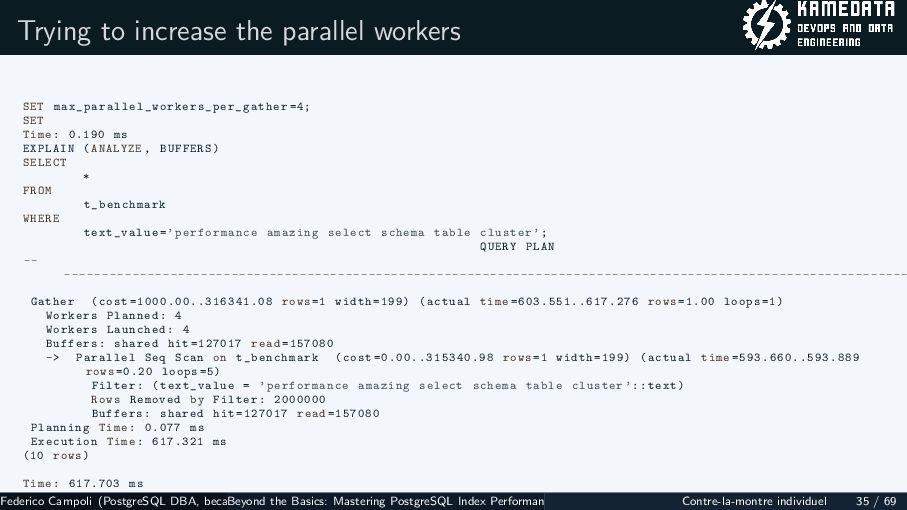
  35. Trying to increase the parallel workers SET max_parallel_workers_per_gather =4; SET

    Time: 0.190 ms EXPLAIN (ANALYZE , BUFFERS) SELECT * FROM t_benchmark WHERE text_value =’performance amazing select schema table cluster ’; QUERY PLAN -- --------------------------------------------------------------------------------------------------------------- Gather (cost =1000.00..316341.08 rows =1 width =199) (actual time =603.551..617.276 rows =1.00 loops =1) Workers Planned: 4 Workers Launched: 4 Buffers: shared hit =127017 read =157080 -> Parallel Seq Scan on t_benchmark (cost =0.00..315340.98 rows =1 width =199) (actual time =593.660..593.889 rows =0.20 loops =5) Filter: ( text_value = ’performance amazing select schema table cluster ’:: text) Rows Removed by Filter: 2000000 Buffers: shared hit =127017 read =157080 Planning Time: 0.077 ms Execution Time: 617.321 ms (10 rows) Time: 617.703 ms Federico Campoli (PostgreSQL DBA, because freaking miracle worker is not a job title) Beyond the Basics: Mastering PostgreSQL Index Performance Contre-la-montre individuel 35 / 69
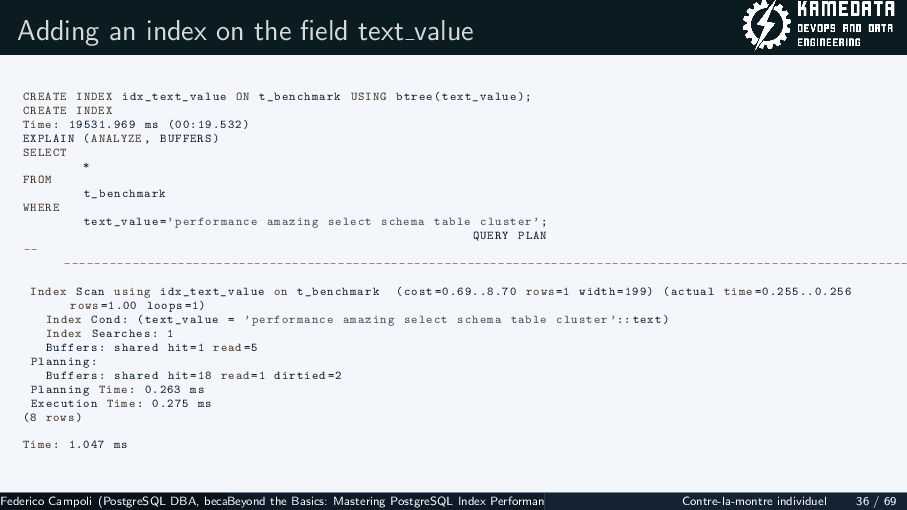
  36. Adding an index on the field text value CREATE INDEX

    idx_text_value ON t_benchmark USING btree(text_value); CREATE INDEX Time: 19531.969 ms (00:19.532) EXPLAIN (ANALYZE , BUFFERS) SELECT * FROM t_benchmark WHERE text_value =’performance amazing select schema table cluster ’; QUERY PLAN -- --------------------------------------------------------------------------------------------------------------- Index Scan using idx_text_value on t_benchmark (cost =0.69..8.70 rows =1 width =199) (actual time =0.255..0.256 rows =1.00 loops =1) Index Cond: (text_value = ’performance amazing select schema table cluster ’:: text) Index Searches: 1 Buffers: shared hit =1 read =5 Planning: Buffers: shared hit =18 read =1 dirtied =2 Planning Time: 0.263 ms Execution Time: 0.275 ms (8 rows) Time: 1.047 ms Federico Campoli (PostgreSQL DBA, because freaking miracle worker is not a job title) Beyond the Basics: Mastering PostgreSQL Index Performance Contre-la-montre individuel 36 / 69
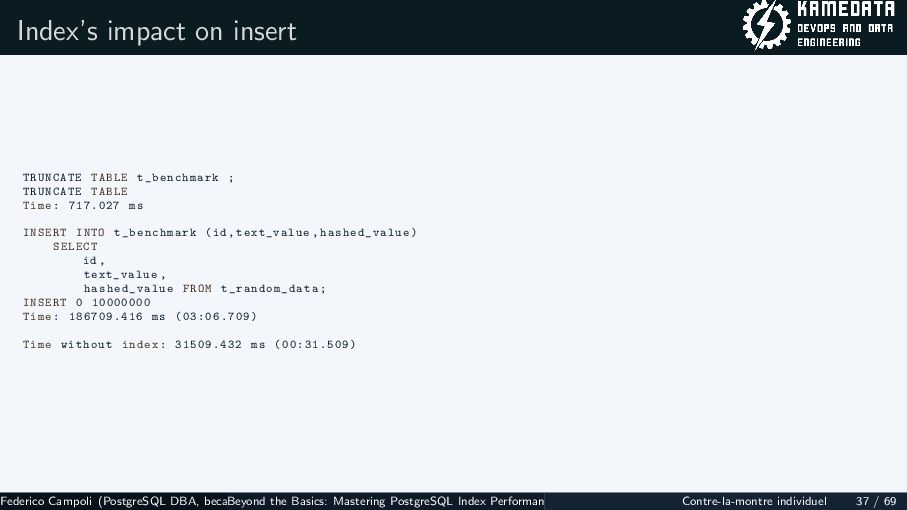
  37. Index’s impact on insert TRUNCATE TABLE t_benchmark ; TRUNCATE TABLE

    Time: 717.027 ms INSERT INTO t_benchmark (id ,text_value , hashed_value ) SELECT id , text_value , hashed_value FROM t_random_data ; INSERT 0 10000000 Time: 186709.416 ms (03:06.709) Time without index: 31509.432 ms (00:31.509) Federico Campoli (PostgreSQL DBA, because freaking miracle worker is not a job title) Beyond the Basics: Mastering PostgreSQL Index Performance Contre-la-montre individuel 37 / 69
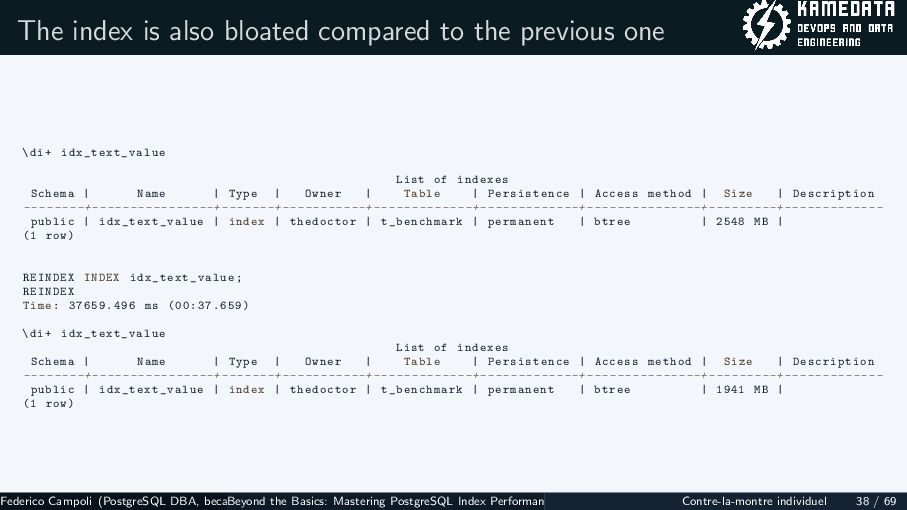
  38. The index is also bloated compared to the previous one

    \di+ idx_text_value List of indexes Schema | Name | Type | Owner | Table | Persistence | Access method | Size | Description -- ------+----------------+-------+-----------+-------------+-------------+---------------+---------+------------- public | idx_text_value | index | thedoctor | t_benchmark | permanent | btree | 2548 MB | (1 row) REINDEX INDEX idx_text_value ; REINDEX Time: 37659.496 ms (00:37.659) \di+ idx_text_value List of indexes Schema | Name | Type | Owner | Table | Persistence | Access method | Size | Description -- ------+----------------+-------+-----------+-------------+-------------+---------------+---------+------------- public | idx_text_value | index | thedoctor | t_benchmark | permanent | btree | 1941 MB | (1 row) Federico Campoli (PostgreSQL DBA, because freaking miracle worker is not a job title) Beyond the Basics: Mastering PostgreSQL Index Performance Contre-la-montre individuel 38 / 69
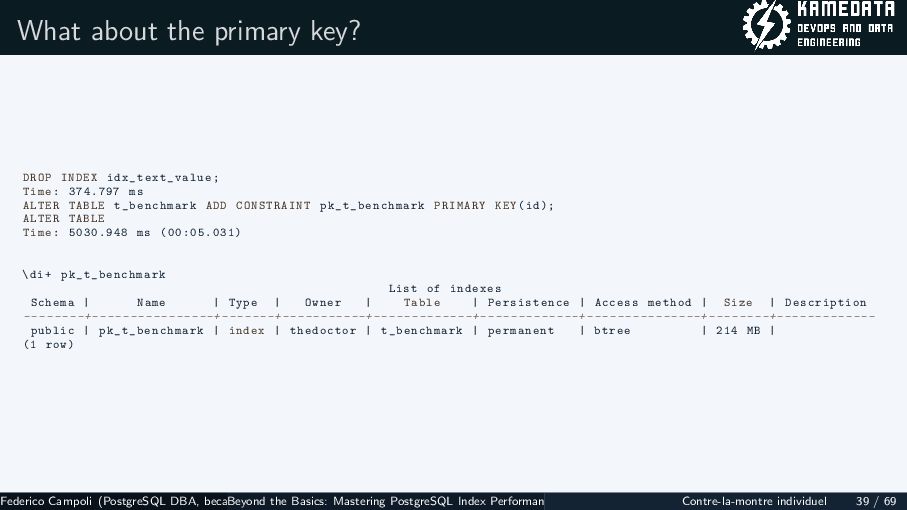
  39. What about the primary key? DROP INDEX idx_text_value ; Time:

    374.797 ms ALTER TABLE t_benchmark ADD CONSTRAINT pk_t_benchmark PRIMARY KEY(id); ALTER TABLE Time: 5030.948 ms (00:05.031) \di+ pk_t_benchmark List of indexes Schema | Name | Type | Owner | Table | Persistence | Access method | Size | Description -- ------+----------------+-------+-----------+-------------+-------------+---------------+--------+------------- public | pk_t_benchmark | index | thedoctor | t_benchmark | permanent | btree | 214 MB | (1 row) Federico Campoli (PostgreSQL DBA, because freaking miracle worker is not a job title) Beyond the Basics: Mastering PostgreSQL Index Performance Contre-la-montre individuel 39 / 69
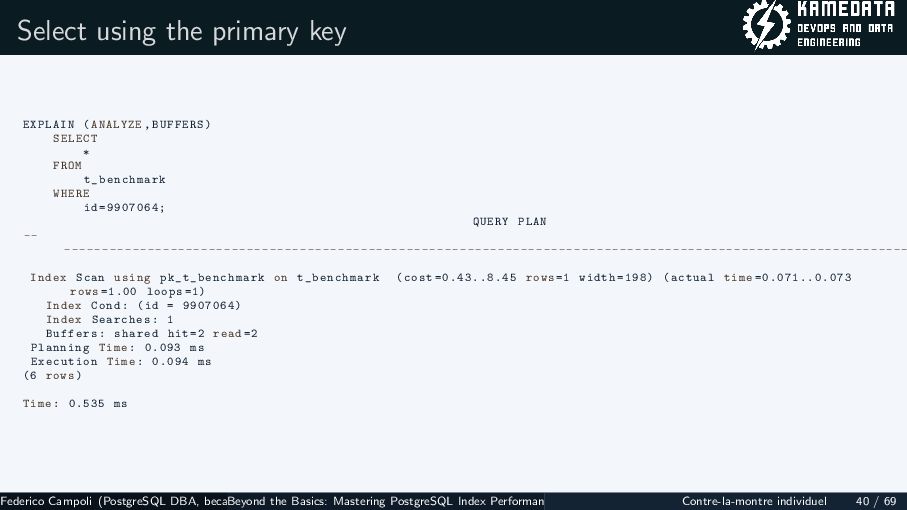
  40. Select using the primary key EXPLAIN (ANALYZE ,BUFFERS) SELECT *

    FROM t_benchmark WHERE id =9907064; QUERY PLAN -- --------------------------------------------------------------------------------------------------------------- Index Scan using pk_t_benchmark on t_benchmark (cost =0.43..8.45 rows =1 width =198) (actual time =0.071..0.073 rows =1.00 loops =1) Index Cond: (id = 9907064) Index Searches: 1 Buffers: shared hit =2 read =2 Planning Time: 0.093 ms Execution Time: 0.094 ms (6 rows) Time: 0.535 ms Federico Campoli (PostgreSQL DBA, because freaking miracle worker is not a job title) Beyond the Basics: Mastering PostgreSQL Index Performance Contre-la-montre individuel 40 / 69
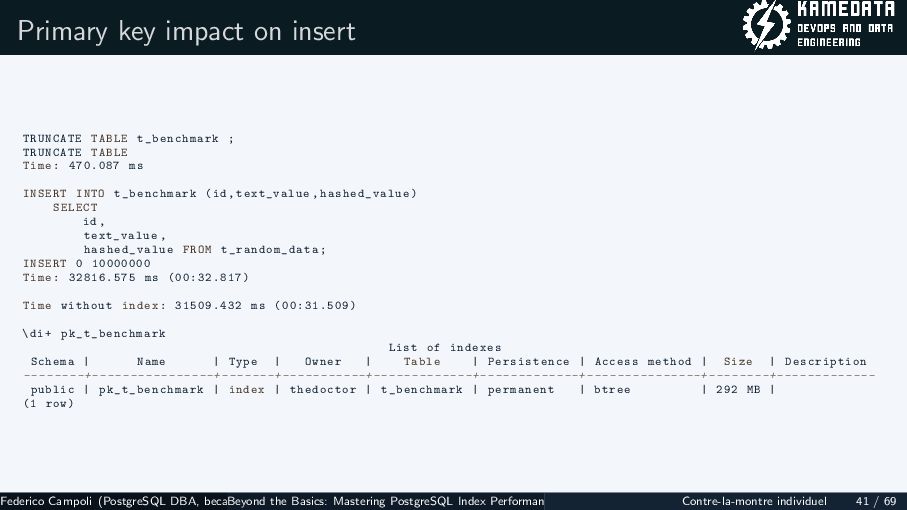
  41. Primary key impact on insert TRUNCATE TABLE t_benchmark ; TRUNCATE

    TABLE Time: 470.087 ms INSERT INTO t_benchmark (id ,text_value , hashed_value ) SELECT id , text_value , hashed_value FROM t_random_data ; INSERT 0 10000000 Time: 32816.575 ms (00:32.817) Time without index: 31509.432 ms (00:31.509) \di+ pk_t_benchmark List of indexes Schema | Name | Type | Owner | Table | Persistence | Access method | Size | Description -- ------+----------------+-------+-----------+-------------+-------------+---------------+--------+------------- public | pk_t_benchmark | index | thedoctor | t_benchmark | permanent | btree | 292 MB | (1 row) Federico Campoli (PostgreSQL DBA, because freaking miracle worker is not a job title) Beyond the Basics: Mastering PostgreSQL Index Performance Contre-la-montre individuel 41 / 69
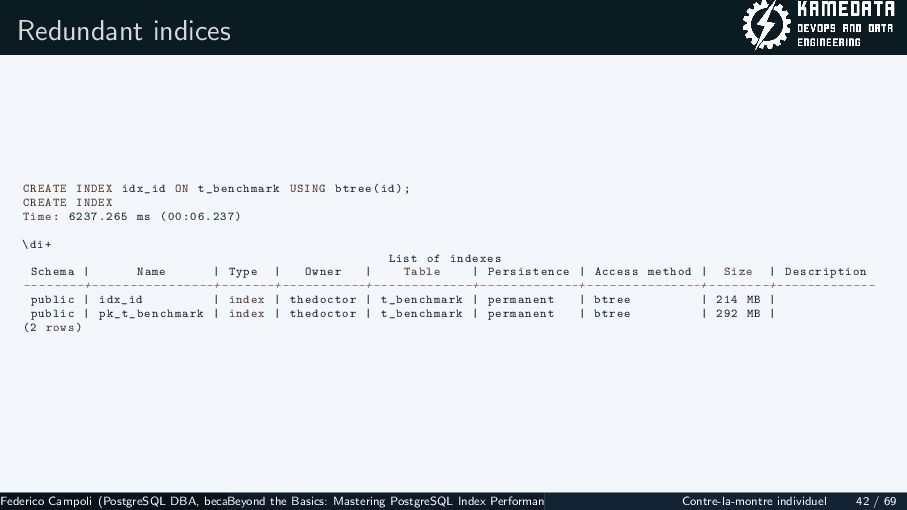
  42. Redundant indices CREATE INDEX idx_id ON t_benchmark USING btree(id); CREATE

    INDEX Time: 6237.265 ms (00:06.237) \di+ List of indexes Schema | Name | Type | Owner | Table | Persistence | Access method | Size | Description -- ------+----------------+-------+-----------+-------------+-------------+---------------+--------+------------- public | idx_id | index | thedoctor | t_benchmark | permanent | btree | 214 MB | public | pk_t_benchmark | index | thedoctor | t_benchmark | permanent | btree | 292 MB | (2 rows) Federico Campoli (PostgreSQL DBA, because freaking miracle worker is not a job title) Beyond the Basics: Mastering PostgreSQL Index Performance Contre-la-montre individuel 42 / 69
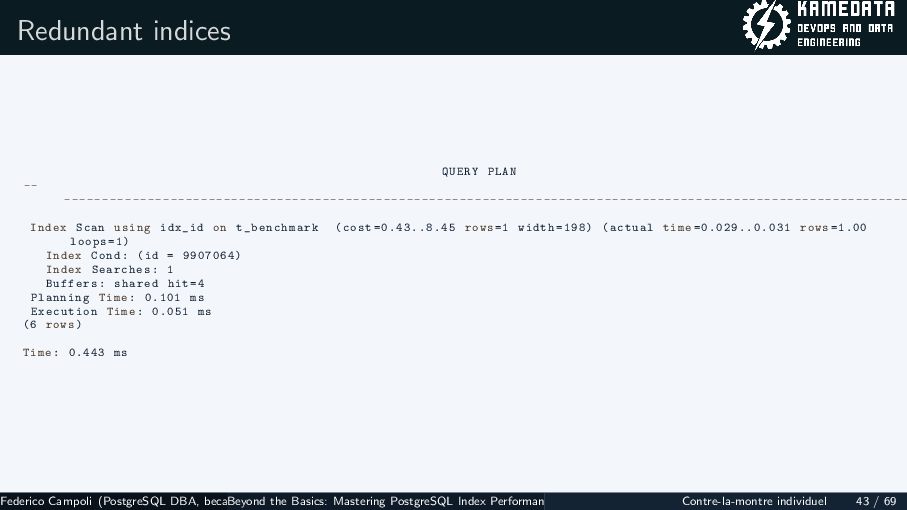
  43. Redundant indices QUERY PLAN -- --------------------------------------------------------------------------------------------------------------- Index Scan using idx_id

    on t_benchmark (cost =0.43..8.45 rows =1 width =198) (actual time =0.029..0.031 rows =1.00 loops =1) Index Cond: (id = 9907064) Index Searches: 1 Buffers: shared hit =4 Planning Time: 0.101 ms Execution Time: 0.051 ms (6 rows) Time: 0.443 ms Federico Campoli (PostgreSQL DBA, because freaking miracle worker is not a job title) Beyond the Basics: Mastering PostgreSQL Index Performance Contre-la-montre individuel 43 / 69
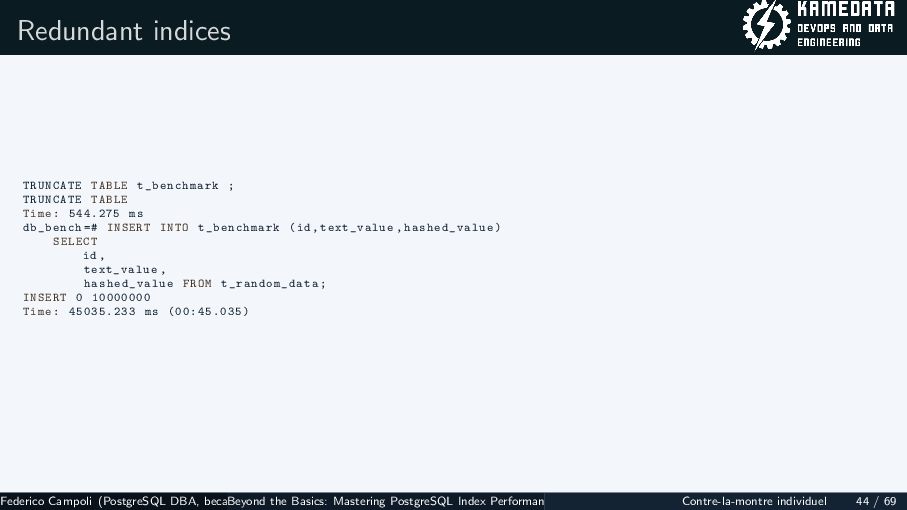
  44. Redundant indices TRUNCATE TABLE t_benchmark ; TRUNCATE TABLE Time: 544.275

    ms db_bench =# INSERT INTO t_benchmark (id ,text_value , hashed_value ) SELECT id , text_value , hashed_value FROM t_random_data ; INSERT 0 10000000 Time: 45035.233 ms (00:45.035) Federico Campoli (PostgreSQL DBA, because freaking miracle worker is not a job title) Beyond the Basics: Mastering PostgreSQL Index Performance Contre-la-montre individuel 44 / 69
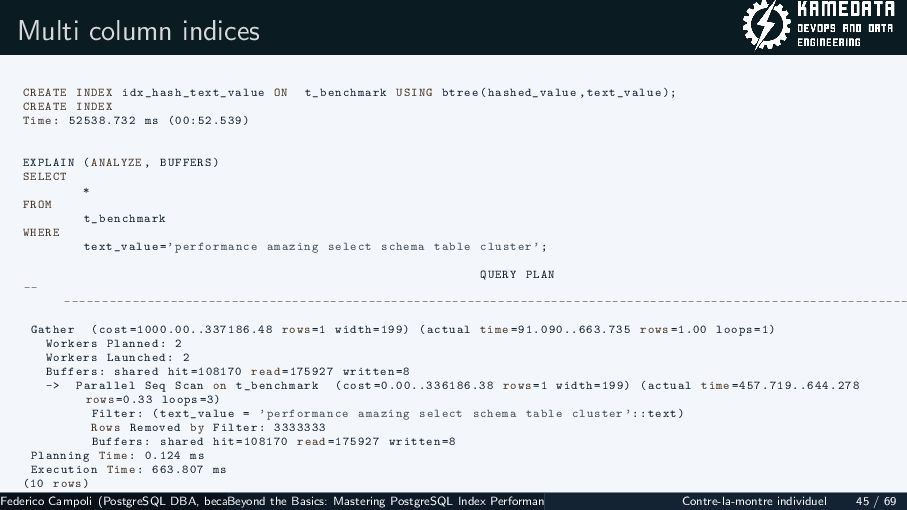
  45. Multi column indices CREATE INDEX idx_hash_text_value ON t_benchmark USING btree(hashed_value

    ,text_value); CREATE INDEX Time: 52538.732 ms (00:52.539) EXPLAIN (ANALYZE , BUFFERS) SELECT * FROM t_benchmark WHERE text_value =’performance amazing select schema table cluster ’; QUERY PLAN -- --------------------------------------------------------------------------------------------------------------- Gather (cost =1000.00..337186.48 rows =1 width =199) (actual time =91.090..663.735 rows =1.00 loops =1) Workers Planned: 2 Workers Launched: 2 Buffers: shared hit =108170 read =175927 written =8 -> Parallel Seq Scan on t_benchmark (cost =0.00..336186.38 rows =1 width =199) (actual time =457.719..644.278 rows =0.33 loops =3) Filter: ( text_value = ’performance amazing select schema table cluster ’:: text) Rows Removed by Filter: 3333333 Buffers: shared hit =108170 read =175927 written =8 Planning Time: 0.124 ms Execution Time: 663.807 ms (10 rows) Federico Campoli (PostgreSQL DBA, because freaking miracle worker is not a job title) Beyond the Basics: Mastering PostgreSQL Index Performance Contre-la-montre individuel 45 / 69
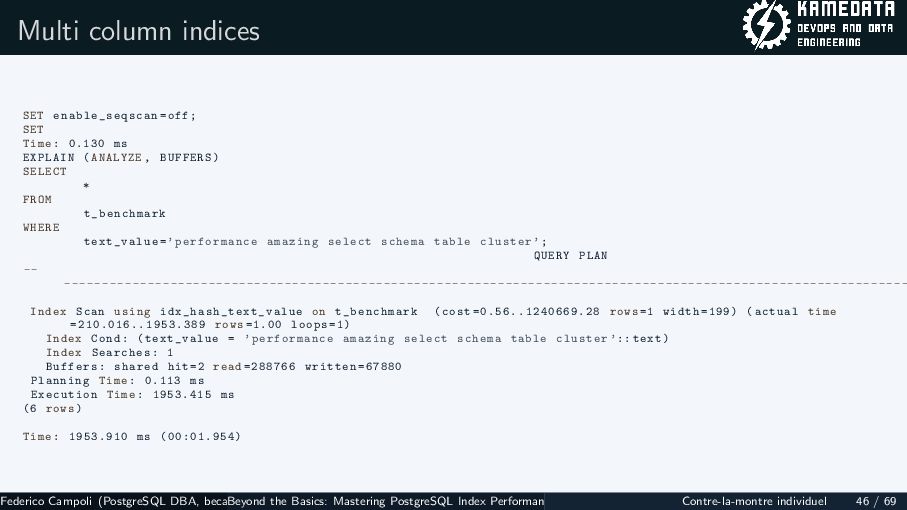
  46. Multi column indices SET enable_seqscan =off; SET Time: 0.130 ms

    EXPLAIN (ANALYZE , BUFFERS) SELECT * FROM t_benchmark WHERE text_value =’performance amazing select schema table cluster ’; QUERY PLAN -- --------------------------------------------------------------------------------------------------------------- Index Scan using idx_hash_text_value on t_benchmark (cost =0.56..1240669.28 rows =1 width =199) (actual time =210.016..1953.389 rows =1.00 loops =1) Index Cond: (text_value = ’performance amazing select schema table cluster ’:: text) Index Searches: 1 Buffers: shared hit =2 read =288766 written =67880 Planning Time: 0.113 ms Execution Time: 1953.415 ms (6 rows) Time: 1953.910 ms (00:01.954) Federico Campoli (PostgreSQL DBA, because freaking miracle worker is not a job title) Beyond the Basics: Mastering PostgreSQL Index Performance Contre-la-montre individuel 46 / 69
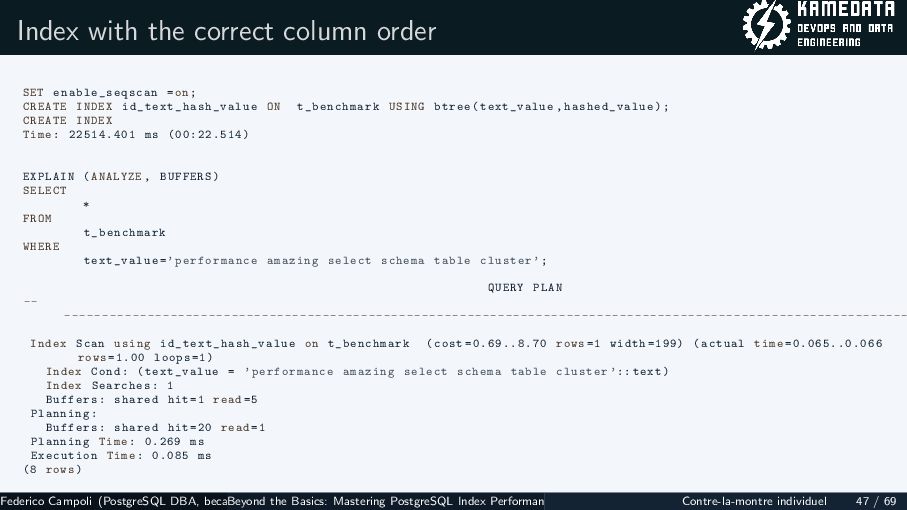
  47. Index with the correct column order SET enable_seqscan =on; CREATE

    INDEX id_text_hash_value ON t_benchmark USING btree(text_value , hashed_value ); CREATE INDEX Time: 22514.401 ms (00:22.514) EXPLAIN (ANALYZE , BUFFERS) SELECT * FROM t_benchmark WHERE text_value =’performance amazing select schema table cluster ’; QUERY PLAN -- --------------------------------------------------------------------------------------------------------------- Index Scan using id_text_hash_value on t_benchmark (cost =0.69..8.70 rows =1 width =199) (actual time =0.065..0.066 rows =1.00 loops =1) Index Cond: (text_value = ’performance amazing select schema table cluster ’:: text) Index Searches: 1 Buffers: shared hit =1 read =5 Planning: Buffers: shared hit =20 read =1 Planning Time: 0.269 ms Execution Time: 0.085 ms (8 rows) Time: 0.872 ms Federico Campoli (PostgreSQL DBA, because freaking miracle worker is not a job title) Beyond the Basics: Mastering PostgreSQL Index Performance Contre-la-montre individuel 47 / 69
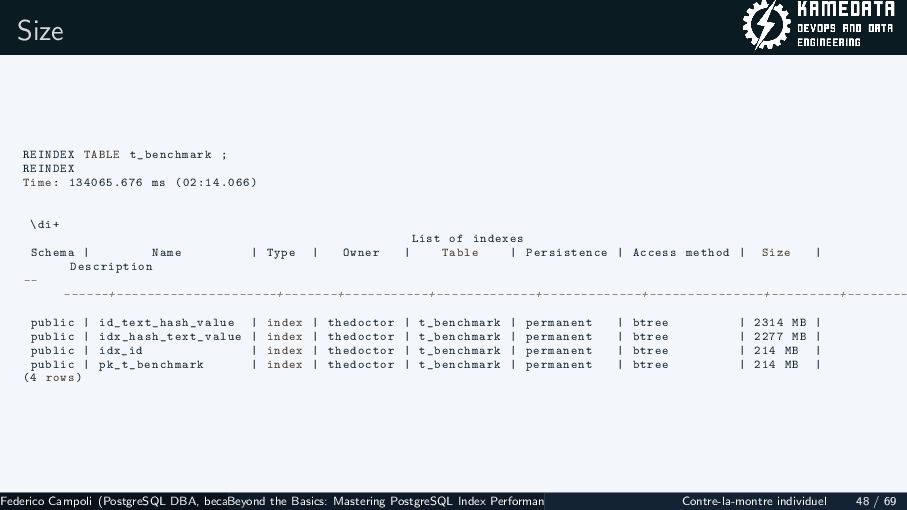
  48. Size REINDEX TABLE t_benchmark ; REINDEX Time: 134065.676 ms (02:14.066)

    \di+ List of indexes Schema | Name | Type | Owner | Table | Persistence | Access method | Size | Description -- ------+---------------------+-------+-----------+-------------+-------------+---------------+---------+-------- public | id_text_hash_value | index | thedoctor | t_benchmark | permanent | btree | 2314 MB | public | idx_hash_text_value | index | thedoctor | t_benchmark | permanent | btree | 2277 MB | public | idx_id | index | thedoctor | t_benchmark | permanent | btree | 214 MB | public | pk_t_benchmark | index | thedoctor | t_benchmark | permanent | btree | 214 MB | (4 rows) Federico Campoli (PostgreSQL DBA, because freaking miracle worker is not a job title) Beyond the Basics: Mastering PostgreSQL Index Performance Contre-la-montre individuel 48 / 69
  49. Flamme rouge Federico Campoli (PostgreSQL DBA, because freaking miracle worker

    is not a job title) Beyond the Basics: Mastering PostgreSQL Index Performance Flamme rouge 49 / 69
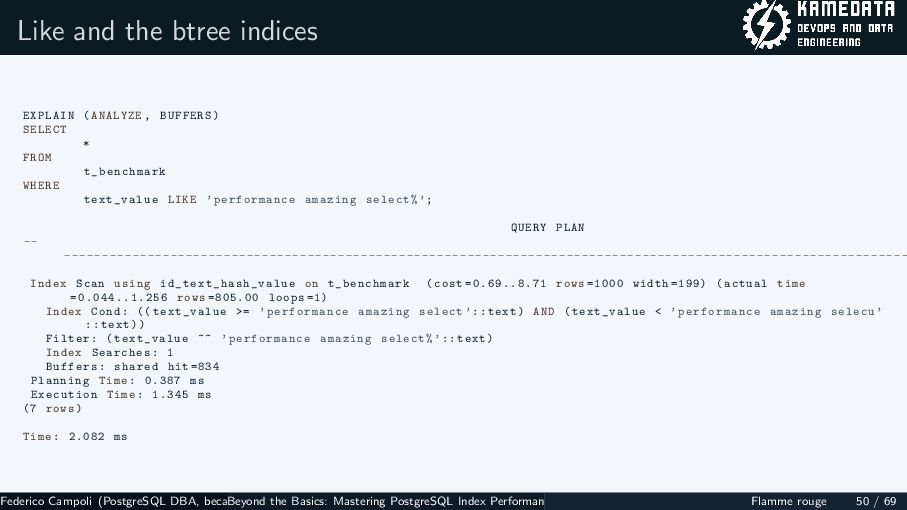
  50. Like and the btree indices EXPLAIN (ANALYZE , BUFFERS) SELECT

    * FROM t_benchmark WHERE text_value LIKE ’performance amazing select%’; QUERY PLAN -- --------------------------------------------------------------------------------------------------------------- Index Scan using id_text_hash_value on t_benchmark (cost =0.69..8.71 rows =1000 width =199) (actual time =0.044..1.256 rows =805.00 loops =1) Index Cond: (( text_value >= ’performance amazing select ’:: text) AND (text_value < ’performance amazing selecu ’ :: text)) Filter: (text_value ~~ ’performance amazing select%’:: text) Index Searches: 1 Buffers: shared hit =834 Planning Time: 0.387 ms Execution Time: 1.345 ms (7 rows) Time: 2.082 ms Federico Campoli (PostgreSQL DBA, because freaking miracle worker is not a job title) Beyond the Basics: Mastering PostgreSQL Index Performance Flamme rouge 50 / 69
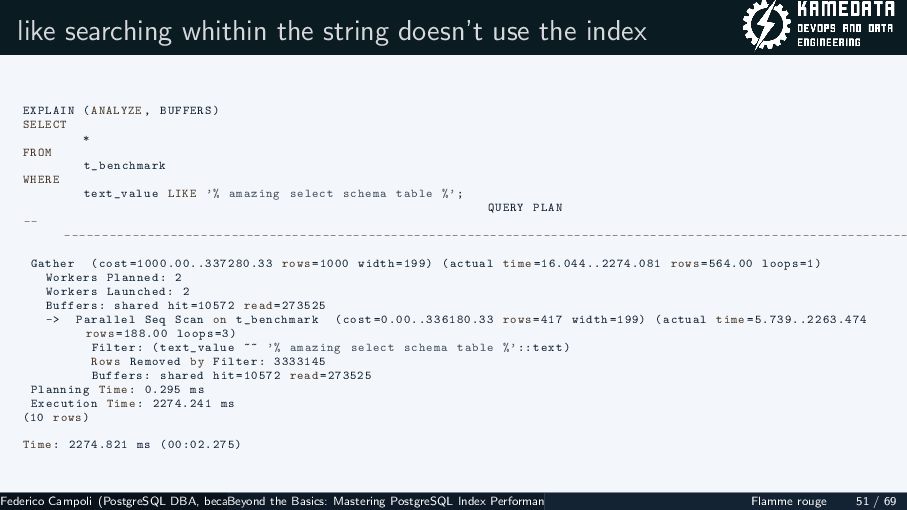
  51. like searching whithin the string doesn’t use the index EXPLAIN

    (ANALYZE , BUFFERS) SELECT * FROM t_benchmark WHERE text_value LIKE ’% amazing select schema table %’; QUERY PLAN -- --------------------------------------------------------------------------------------------------------------- Gather (cost =1000.00..337280.33 rows =1000 width =199) (actual time =16.044..2274.081 rows =564.00 loops =1) Workers Planned: 2 Workers Launched: 2 Buffers: shared hit =10572 read =273525 -> Parallel Seq Scan on t_benchmark (cost =0.00..336180.33 rows =417 width =199) (actual time =5.739..2263.474 rows =188.00 loops =3) Filter: ( text_value ~~ ’% amazing select schema table %’:: text) Rows Removed by Filter: 3333145 Buffers: shared hit =10572 read =273525 Planning Time: 0.295 ms Execution Time: 2274.241 ms (10 rows) Time: 2274.821 ms (00:02.275) Federico Campoli (PostgreSQL DBA, because freaking miracle worker is not a job title) Beyond the Basics: Mastering PostgreSQL Index Performance Flamme rouge 51 / 69
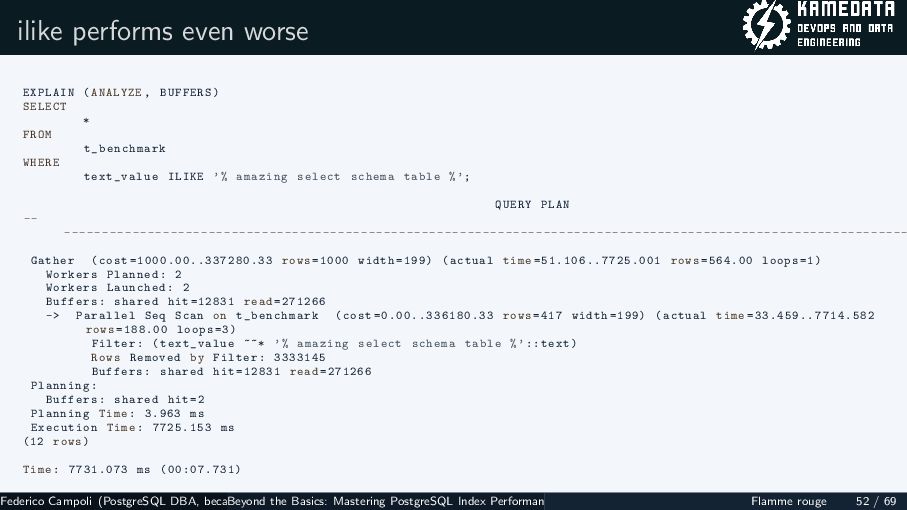
  52. ilike performs even worse EXPLAIN (ANALYZE , BUFFERS) SELECT *

    FROM t_benchmark WHERE text_value ILIKE ’% amazing select schema table %’; QUERY PLAN -- --------------------------------------------------------------------------------------------------------------- Gather (cost =1000.00..337280.33 rows =1000 width =199) (actual time =51.106..7725.001 rows =564.00 loops =1) Workers Planned: 2 Workers Launched: 2 Buffers: shared hit =12831 read =271266 -> Parallel Seq Scan on t_benchmark (cost =0.00..336180.33 rows =417 width =199) (actual time =33.459..7714.582 rows =188.00 loops =3) Filter: ( text_value ~~* ’% amazing select schema table %’:: text) Rows Removed by Filter: 3333145 Buffers: shared hit =12831 read =271266 Planning: Buffers: shared hit =2 Planning Time: 3.963 ms Execution Time: 7725.153 ms (12 rows) Time: 7731.073 ms (00:07.731) Federico Campoli (PostgreSQL DBA, because freaking miracle worker is not a job title) Beyond the Basics: Mastering PostgreSQL Index Performance Flamme rouge 52 / 69
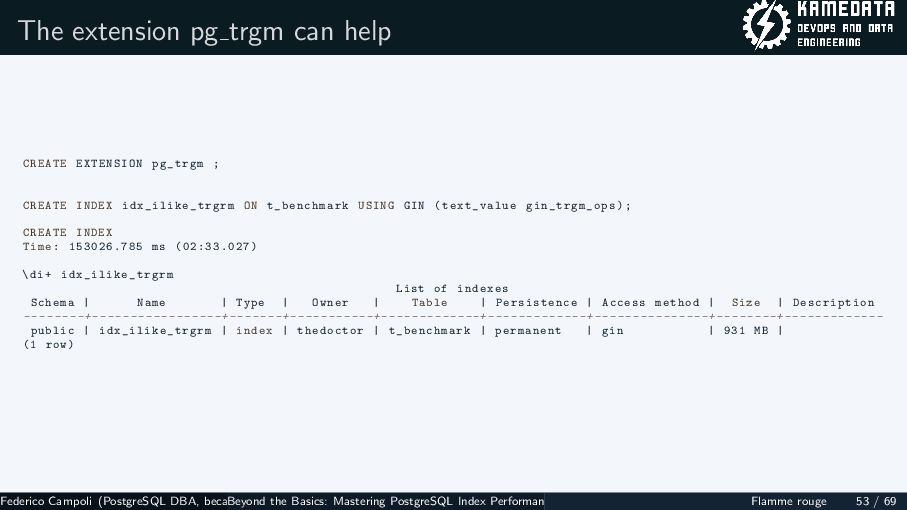
  53. The extension pg trgm can help CREATE EXTENSION pg_trgm ;

    CREATE INDEX idx_ilike_trgrm ON t_benchmark USING GIN (text_value gin_trgm_ops ); CREATE INDEX Time: 153026.785 ms (02:33.027) \di+ idx_ilike_trgrm List of indexes Schema | Name | Type | Owner | Table | Persistence | Access method | Size | Description -- ------+-----------------+-------+-----------+-------------+-------------+---------------+--------+------------- public | idx_ilike_trgrm | index | thedoctor | t_benchmark | permanent | gin | 931 MB | (1 row) Federico Campoli (PostgreSQL DBA, because freaking miracle worker is not a job title) Beyond the Basics: Mastering PostgreSQL Index Performance Flamme rouge 53 / 69
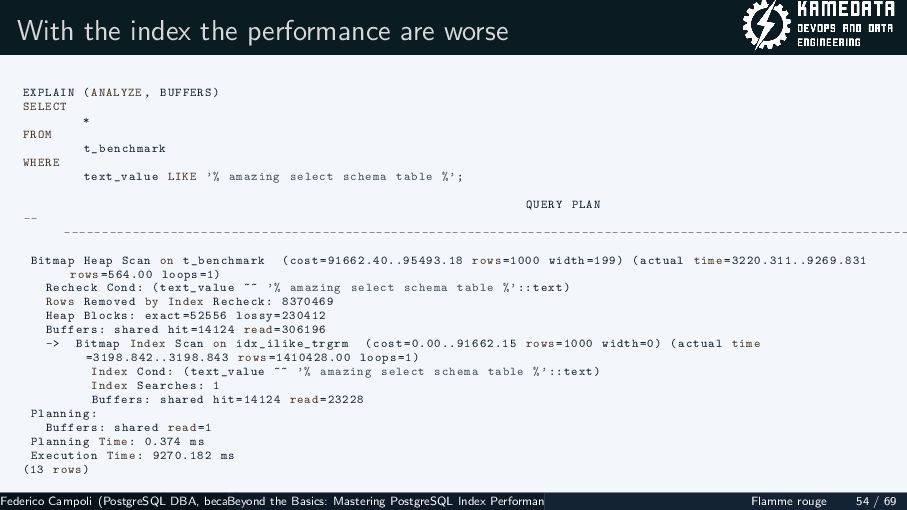
  54. With the index the performance are worse EXPLAIN (ANALYZE ,

    BUFFERS) SELECT * FROM t_benchmark WHERE text_value LIKE ’% amazing select schema table %’; QUERY PLAN -- --------------------------------------------------------------------------------------------------------------- Bitmap Heap Scan on t_benchmark (cost =91662.40..95493.18 rows =1000 width =199) (actual time =3220.311..9269.831 rows =564.00 loops =1) Recheck Cond: (text_value ~~ ’% amazing select schema table %’:: text) Rows Removed by Index Recheck: 8370469 Heap Blocks: exact =52556 lossy =230412 Buffers: shared hit =14124 read =306196 -> Bitmap Index Scan on idx_ilike_trgrm (cost =0.00..91662.15 rows =1000 width =0) (actual time =3198.842..3198.843 rows =1410428.00 loops =1) Index Cond: (text_value ~~ ’% amazing select schema table %’:: text) Index Searches: 1 Buffers: shared hit =14124 read =23228 Planning: Buffers: shared read =1 Planning Time: 0.374 ms Execution Time: 9270.182 ms (13 rows) Time: 9270.927 ms (00:09.271) Federico Campoli (PostgreSQL DBA, because freaking miracle worker is not a job title) Beyond the Basics: Mastering PostgreSQL Index Performance Flamme rouge 54 / 69
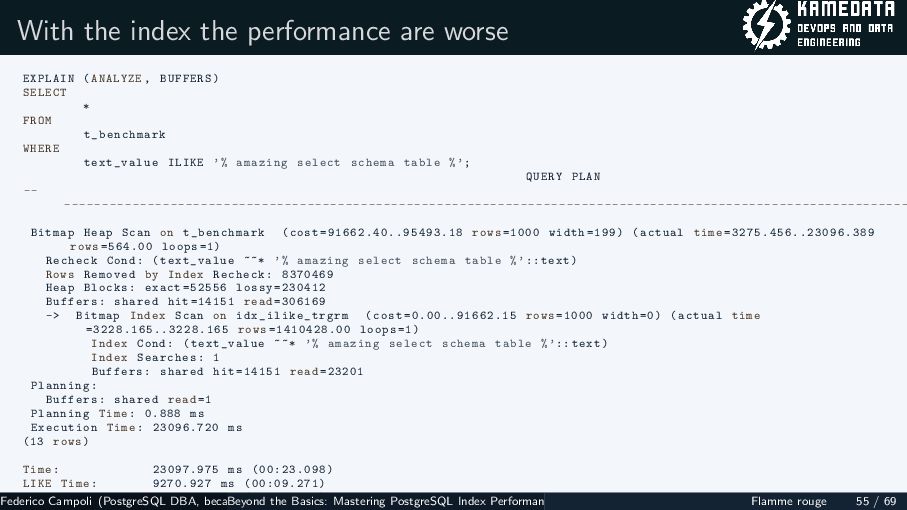
  55. With the index the performance are worse EXPLAIN (ANALYZE ,

    BUFFERS) SELECT * FROM t_benchmark WHERE text_value ILIKE ’% amazing select schema table %’; QUERY PLAN -- --------------------------------------------------------------------------------------------------------------- Bitmap Heap Scan on t_benchmark (cost =91662.40..95493.18 rows =1000 width =199) (actual time =3275.456..23096.389 rows =564.00 loops =1) Recheck Cond: (text_value ~~* ’% amazing select schema table %’:: text) Rows Removed by Index Recheck: 8370469 Heap Blocks: exact =52556 lossy =230412 Buffers: shared hit =14151 read =306169 -> Bitmap Index Scan on idx_ilike_trgrm (cost =0.00..91662.15 rows =1000 width =0) (actual time =3228.165..3228.165 rows =1410428.00 loops =1) Index Cond: (text_value ~~* ’% amazing select schema table %’:: text) Index Searches: 1 Buffers: shared hit =14151 read =23201 Planning: Buffers: shared read =1 Planning Time: 0.888 ms Execution Time: 23096.720 ms (13 rows) Time: 23097.975 ms (00:23.098) LIKE Time: 9270.927 ms (00:09.271) Seq scan time: 2274.821 ms (00:02.275) Federico Campoli (PostgreSQL DBA, because freaking miracle worker is not a job title) Beyond the Basics: Mastering PostgreSQL Index Performance Flamme rouge 55 / 69
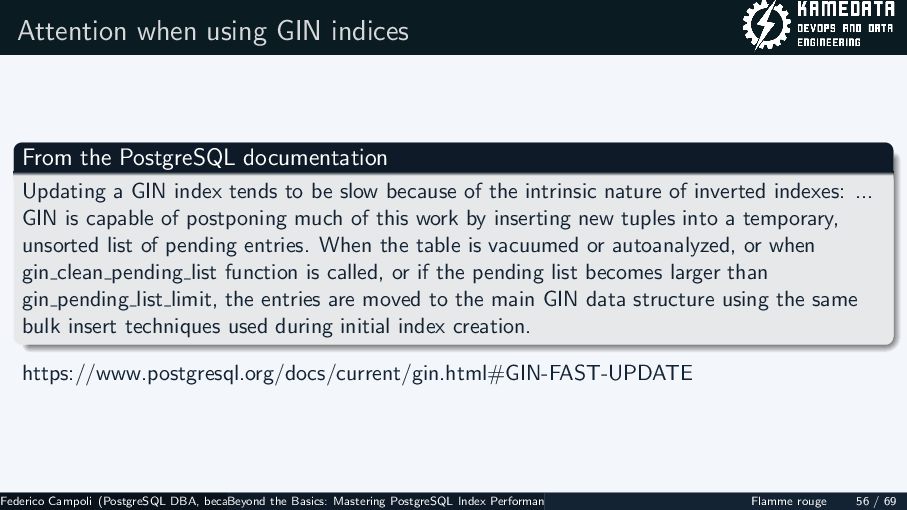
  56. Attention when using GIN indices From the PostgreSQL documentation Updating

    a GIN index tends to be slow because of the intrinsic nature of inverted indexes: ... GIN is capable of postponing much of this work by inserting new tuples into a temporary, unsorted list of pending entries. When the table is vacuumed or autoanalyzed, or when gin clean pending list function is called, or if the pending list becomes larger than gin pending list limit, the entries are moved to the main GIN data structure using the same bulk insert techniques used during initial index creation. https://www.postgresql.org/docs/current/gin.html#GIN-FAST-UPDATE Federico Campoli (PostgreSQL DBA, because freaking miracle worker is not a job title) Beyond the Basics: Mastering PostgreSQL Index Performance Flamme rouge 56 / 69
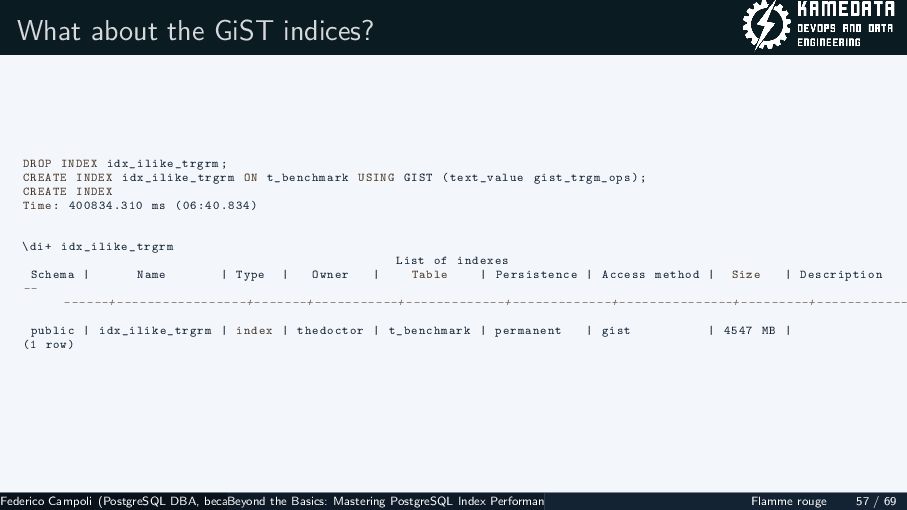
  57. What about the GiST indices? DROP INDEX idx_ilike_trgrm ; CREATE

    INDEX idx_ilike_trgrm ON t_benchmark USING GIST (text_value gist_trgm_ops ); CREATE INDEX Time: 400834.310 ms (06:40.834) \di+ idx_ilike_trgrm List of indexes Schema | Name | Type | Owner | Table | Persistence | Access method | Size | Description -- ------+-----------------+-------+-----------+-------------+-------------+---------------+---------+------------ public | idx_ilike_trgrm | index | thedoctor | t_benchmark | permanent | gist | 4547 MB | (1 row) Federico Campoli (PostgreSQL DBA, because freaking miracle worker is not a job title) Beyond the Basics: Mastering PostgreSQL Index Performance Flamme rouge 57 / 69
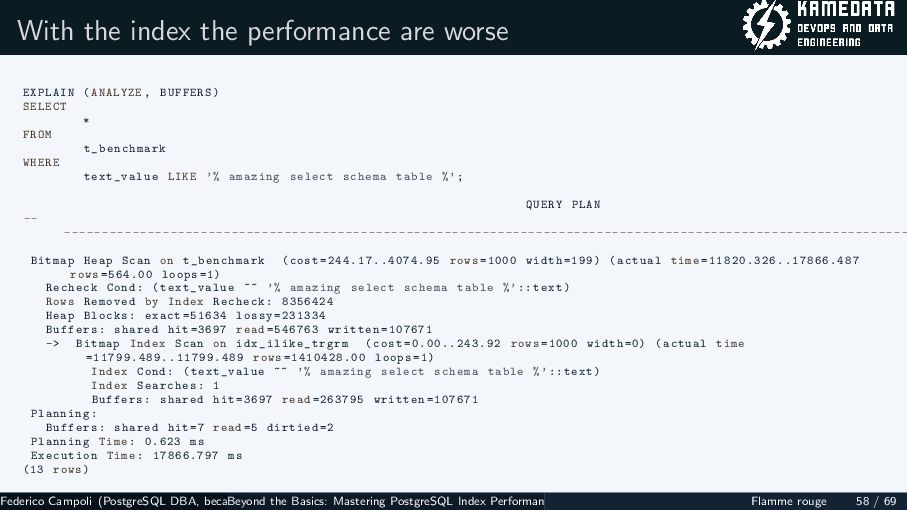
  58. With the index the performance are worse EXPLAIN (ANALYZE ,

    BUFFERS) SELECT * FROM t_benchmark WHERE text_value LIKE ’% amazing select schema table %’; QUERY PLAN -- --------------------------------------------------------------------------------------------------------------- Bitmap Heap Scan on t_benchmark (cost =244.17..4074.95 rows =1000 width =199) (actual time =11820.326..17866.487 rows =564.00 loops =1) Recheck Cond: (text_value ~~ ’% amazing select schema table %’:: text) Rows Removed by Index Recheck: 8356424 Heap Blocks: exact =51634 lossy =231334 Buffers: shared hit =3697 read =546763 written =107671 -> Bitmap Index Scan on idx_ilike_trgrm (cost =0.00..243.92 rows =1000 width =0) (actual time =11799.489..11799.489 rows =1410428.00 loops =1) Index Cond: (text_value ~~ ’% amazing select schema table %’:: text) Index Searches: 1 Buffers: shared hit =3697 read =263795 written =107671 Planning: Buffers: shared hit =7 read =5 dirtied =2 Planning Time: 0.623 ms Execution Time: 17866.797 ms (13 rows) Time: 17867.795 ms (00:17.868) Federico Campoli (PostgreSQL DBA, because freaking miracle worker is not a job title) Beyond the Basics: Mastering PostgreSQL Index Performance Flamme rouge 58 / 69
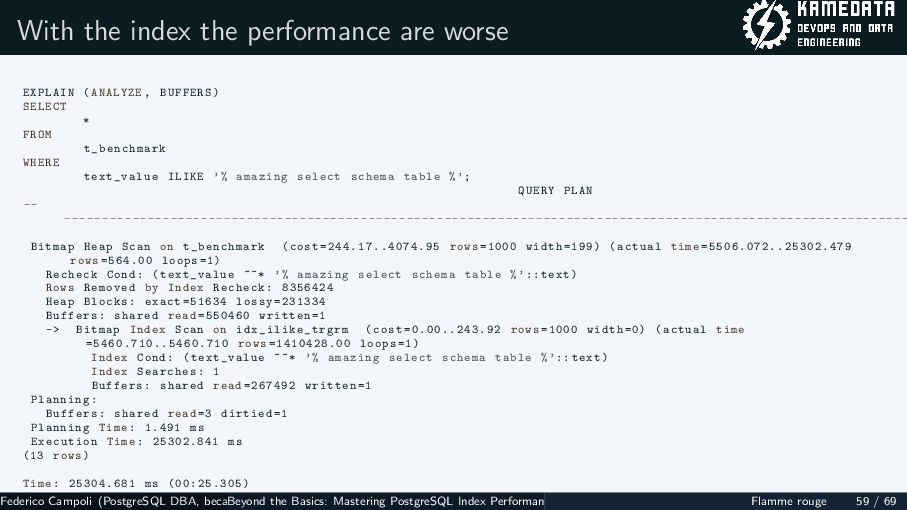
  59. With the index the performance are worse EXPLAIN (ANALYZE ,

    BUFFERS) SELECT * FROM t_benchmark WHERE text_value ILIKE ’% amazing select schema table %’; QUERY PLAN -- --------------------------------------------------------------------------------------------------------------- Bitmap Heap Scan on t_benchmark (cost =244.17..4074.95 rows =1000 width =199) (actual time =5506.072..25302.479 rows =564.00 loops =1) Recheck Cond: (text_value ~~* ’% amazing select schema table %’:: text) Rows Removed by Index Recheck: 8356424 Heap Blocks: exact =51634 lossy =231334 Buffers: shared read =550460 written =1 -> Bitmap Index Scan on idx_ilike_trgrm (cost =0.00..243.92 rows =1000 width =0) (actual time =5460.710..5460.710 rows =1410428.00 loops =1) Index Cond: (text_value ~~* ’% amazing select schema table %’:: text) Index Searches: 1 Buffers: shared read =267492 written =1 Planning: Buffers: shared read =3 dirtied =1 Planning Time: 1.491 ms Execution Time: 25302.841 ms (13 rows) Time: 25304.681 ms (00:25.305) Federico Campoli (PostgreSQL DBA, because freaking miracle worker is not a job title) Beyond the Basics: Mastering PostgreSQL Index Performance Flamme rouge 59 / 69
  60. Derni` ere ´ etape, Champs-´ Elys´ ees Federico Campoli (PostgreSQL

    DBA, because freaking miracle worker is not a job title) Beyond the Basics: Mastering PostgreSQL Index Performance Derni` ere ´ etape, Champs-´ Elys´ ees 60 / 69
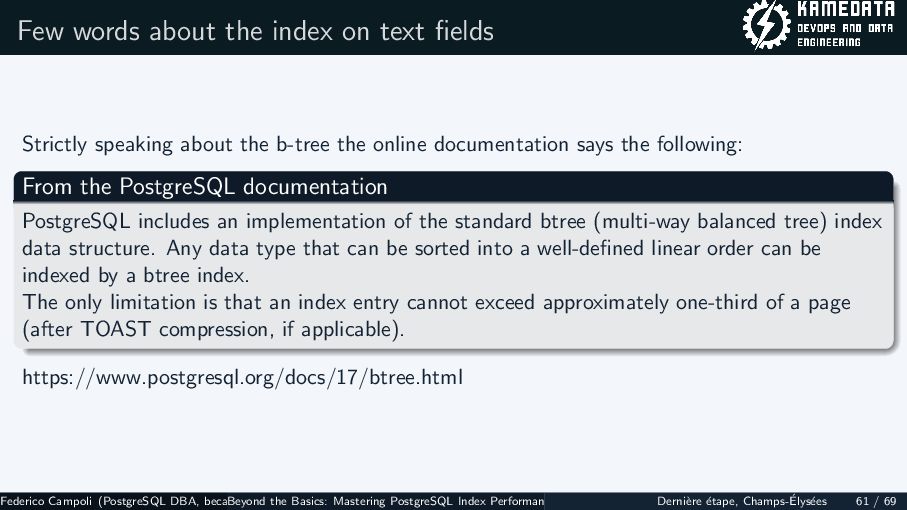
  61. Few words about the index on text fields Strictly speaking

    about the b-tree the online documentation says the following: From the PostgreSQL documentation PostgreSQL includes an implementation of the standard btree (multi-way balanced tree) index data structure. Any data type that can be sorted into a well-defined linear order can be indexed by a btree index. The only limitation is that an index entry cannot exceed approximately one-third of a page (after TOAST compression, if applicable). https://www.postgresql.org/docs/17/btree.html Federico Campoli (PostgreSQL DBA, because freaking miracle worker is not a job title) Beyond the Basics: Mastering PostgreSQL Index Performance Derni` ere ´ etape, Champs-´ Elys´ ees 61 / 69
  62. NO TOAST! Source image https://www.flickr.com/photos/francoisroche/2584062428 Federico Campoli (PostgreSQL DBA, because

    freaking miracle worker is not a job title) Beyond the Basics: Mastering PostgreSQL Index Performance Derni` ere ´ etape, Champs-´ Elys´ ees 62 / 69
  63. T.O.A.S.T. T.O.A.S.T. Stands for The Oversize Attribute Storage Tecnique. The

    manaement routines are automatically triggered for the table’s tuples when the row exceeds the TOAST TUPLE THRESHOLD (usually 2kb) and only for TOASTable data types (varlena). TOAST can store rows up to 1 GB using one of the following tecniques. Compression Out of line storage Compression and out of line storage Federico Campoli (PostgreSQL DBA, because freaking miracle worker is not a job title) Beyond the Basics: Mastering PostgreSQL Index Performance Derni` ere ´ etape, Champs-´ Elys´ ees 63 / 69
  64. Indices can’t be TOASTed As indices are not TOASTable, if

    the index entry after the eventual compression exceeds one third of the page then it will throw an error. Adding an index on a text field doesn’t mean that the index will always work. Federico Campoli (PostgreSQL DBA, because freaking miracle worker is not a job title) Beyond the Basics: Mastering PostgreSQL Index Performance Derni` ere ´ etape, Champs-´ Elys´ ees 64 / 69
  65. Wrap up PostgreSQL offers a constantly improving index infrastructure New

    ways are constantly opened for improving the performance... ...or crash it miserably! The rule of thumb is ”test your assumptions, always” And remember that... Federico Campoli (PostgreSQL DBA, because freaking miracle worker is not a job title) Beyond the Basics: Mastering PostgreSQL Index Performance Derni` ere ´ etape, Champs-´ Elys´ ees 65 / 69
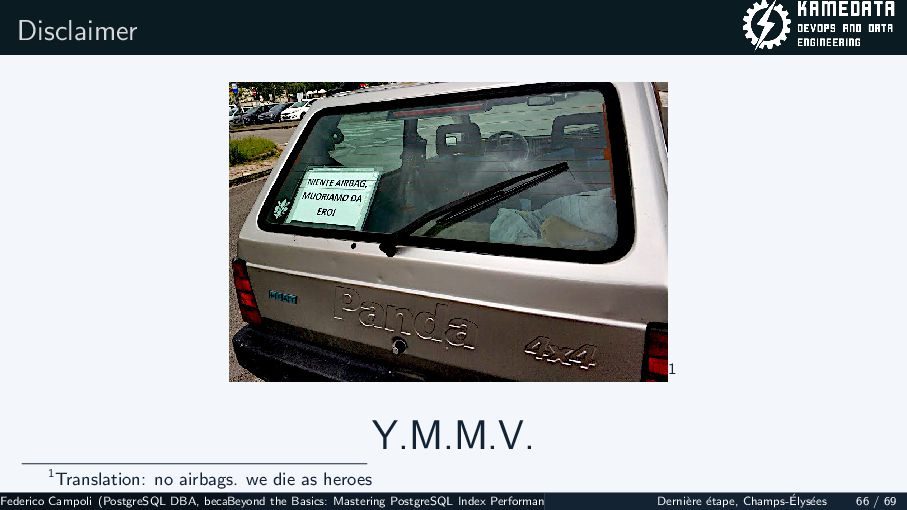
  66. Disclaimer 1 Y.M.M.V. 1Translation: no airbags. we die as heroes

    Federico Campoli (PostgreSQL DBA, because freaking miracle worker is not a job title) Beyond the Basics: Mastering PostgreSQL Index Performance Derni` ere ´ etape, Champs-´ Elys´ ees 66 / 69
  67. Feedback please! Federico Campoli (PostgreSQL DBA, because freaking miracle worker

    is not a job title) Beyond the Basics: Mastering PostgreSQL Index Performance Derni` ere ´ etape, Champs-´ Elys´ ees 67 / 69
  68. That’s all folks! Thank you for listening! Any questions? Copyright

    by dan232323 http://dan232323.deviantart.com/art/Pinkie-Pie-Thats-All-Folks-454693000 Federico Campoli (PostgreSQL DBA, because freaking miracle worker is not a job title) Beyond the Basics: Mastering PostgreSQL Index Performance Derni` ere ´ etape, Champs-´ Elys´ ees 68 / 69
  69. Beyond the Basics: Mastering PostgreSQL Index Performance Federico Campoli PostgreSQL

    DBA, because freaking miracle worker is not a job title Incontro Devops Italia 2026, Bologna, 20th March 2026 Federico Campoli (PostgreSQL DBA, because freaking miracle worker is not a job title) Beyond the Basics: Mastering PostgreSQL Index Performance Derni` ere ´ etape, Champs-´ Elys´ ees 69 / 69