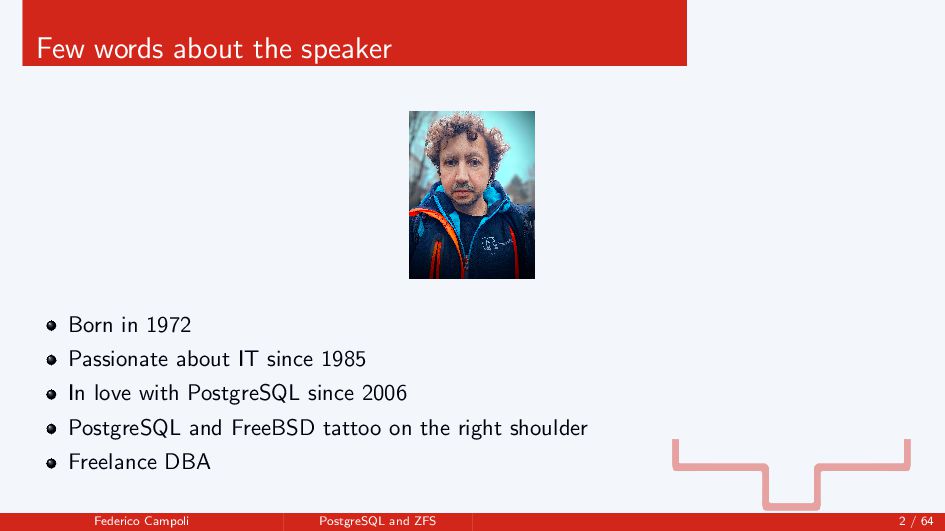
IT since 1985 In love with PostgreSQL since 2006 PostgreSQL and FreeBSD tattoo on the right shoulder Freelance DBA Federico Campoli PostgreSQL and ZFS 2 / 64
The tests are reenactments There are A LOT of topics not covered by this talk Always test before going in production Federico Campoli PostgreSQL and ZFS 4 / 64
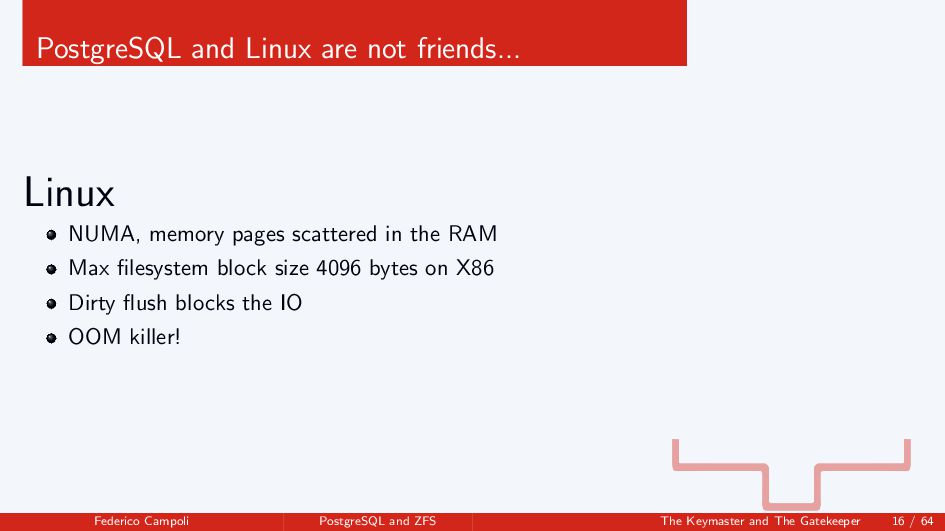
scattered in the RAM Max filesystem block size 4096 bytes on X86 Dirty flush blocks the IO OOM killer! Federico Campoli PostgreSQL and ZFS The Keymaster and The Gatekeeper 16 / 64
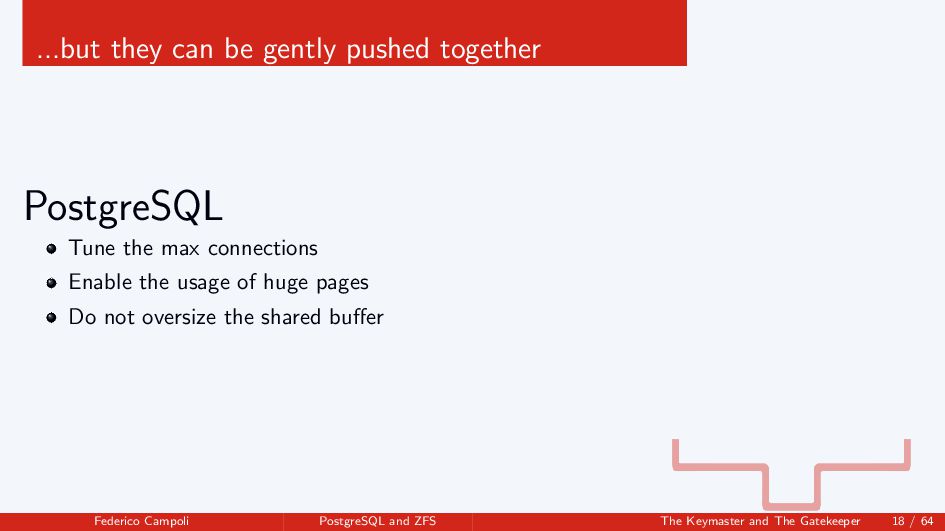
max connections Enable the usage of huge pages Do not oversize the shared buffer Federico Campoli PostgreSQL and ZFS The Keymaster and The Gatekeeper 18 / 64
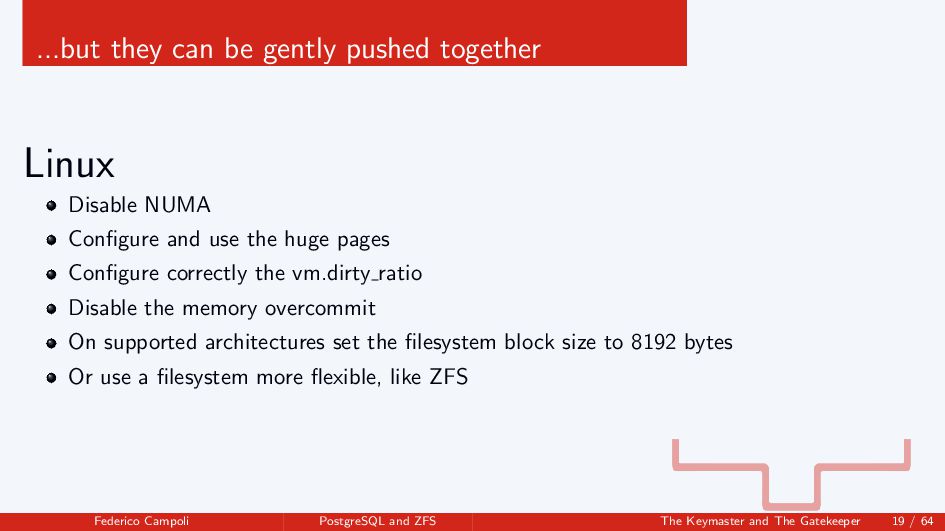
Configure and use the huge pages Configure correctly the vm.dirty ratio Disable the memory overcommit On supported architectures set the filesystem block size to 8192 bytes Or use a filesystem more flexible, like ZFS Federico Campoli PostgreSQL and ZFS The Keymaster and The Gatekeeper 19 / 64
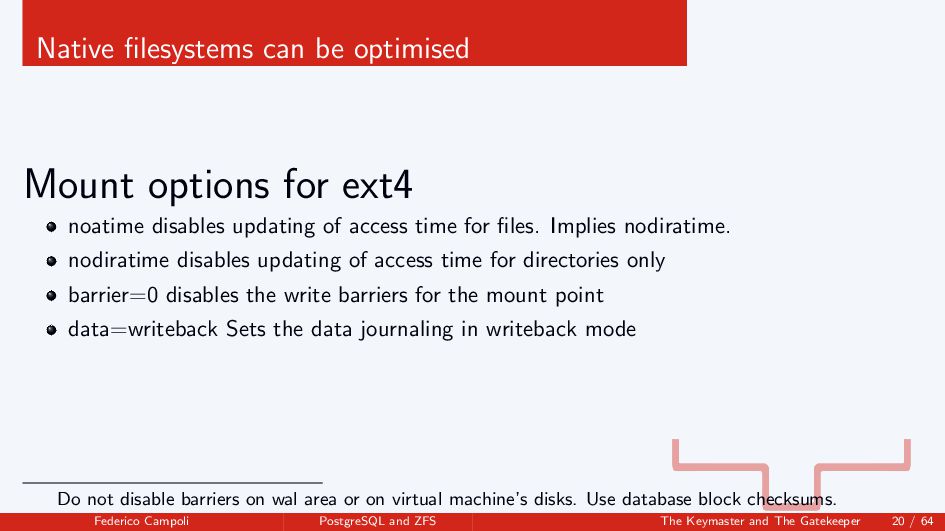
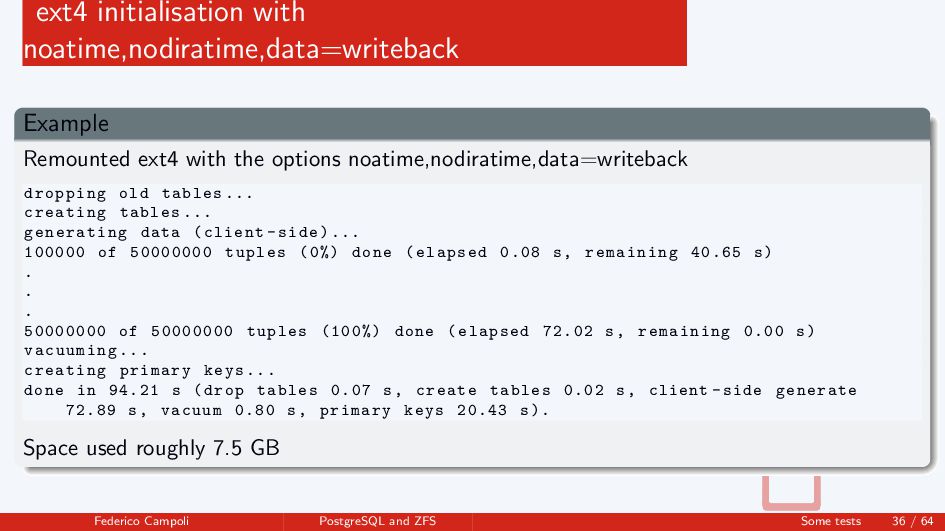
disables updating of access time for files. Implies nodiratime. nodiratime disables updating of access time for directories only barrier=0 disables the write barriers for the mount point data=writeback Sets the data journaling in writeback mode Do not disable barriers on wal area or on virtual machine’s disks. Use database block checksums. Federico Campoli PostgreSQL and ZFS The Keymaster and The Gatekeeper 20 / 64
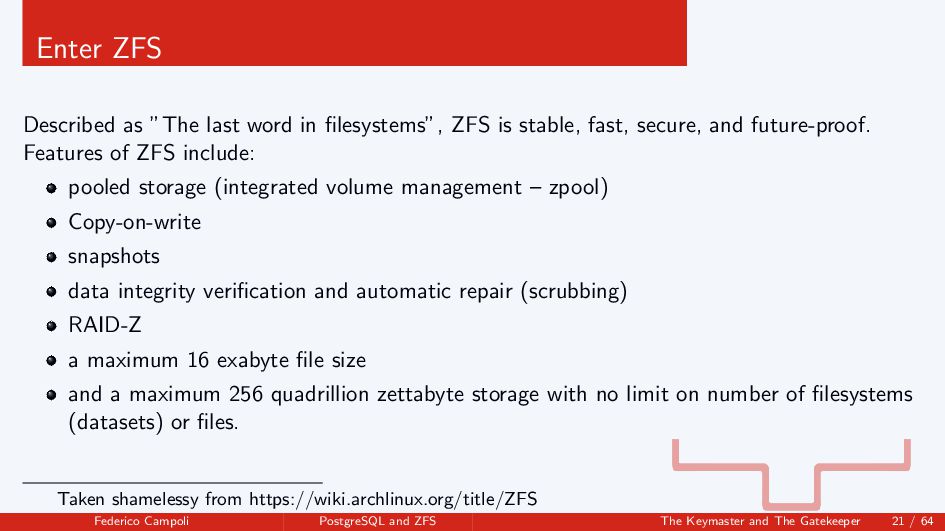
is stable, fast, secure, and future-proof. Features of ZFS include: pooled storage (integrated volume management – zpool) Copy-on-write snapshots data integrity verification and automatic repair (scrubbing) RAID-Z a maximum 16 exabyte file size and a maximum 256 quadrillion zettabyte storage with no limit on number of filesystems (datasets) or files. Taken shamelessy from https://wiki.archlinux.org/title/ZFS Federico Campoli PostgreSQL and ZFS The Keymaster and The Gatekeeper 21 / 64
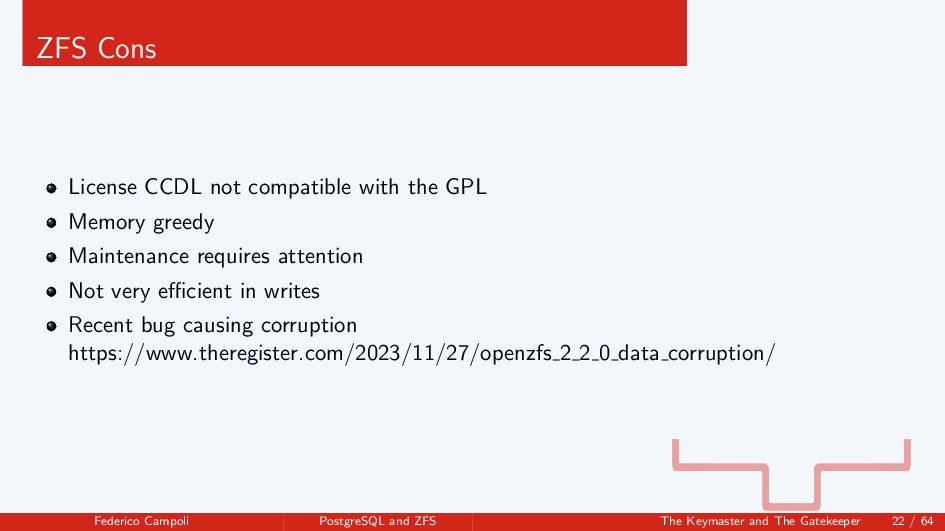
greedy Maintenance requires attention Not very efficient in writes Recent bug causing corruption https://www.theregister.com/2023/11/27/openzfs 2 2 0 data corruption/ Federico Campoli PostgreSQL and ZFS The Keymaster and The Gatekeeper 22 / 64
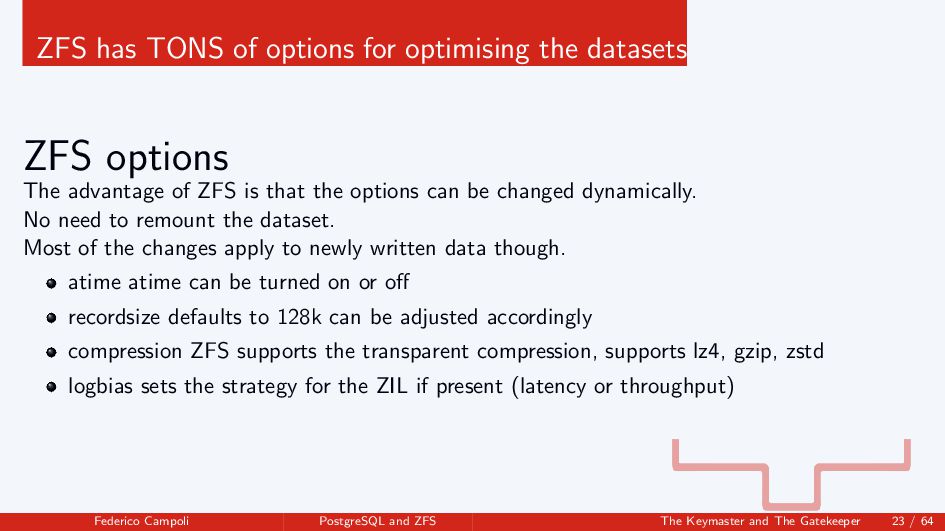
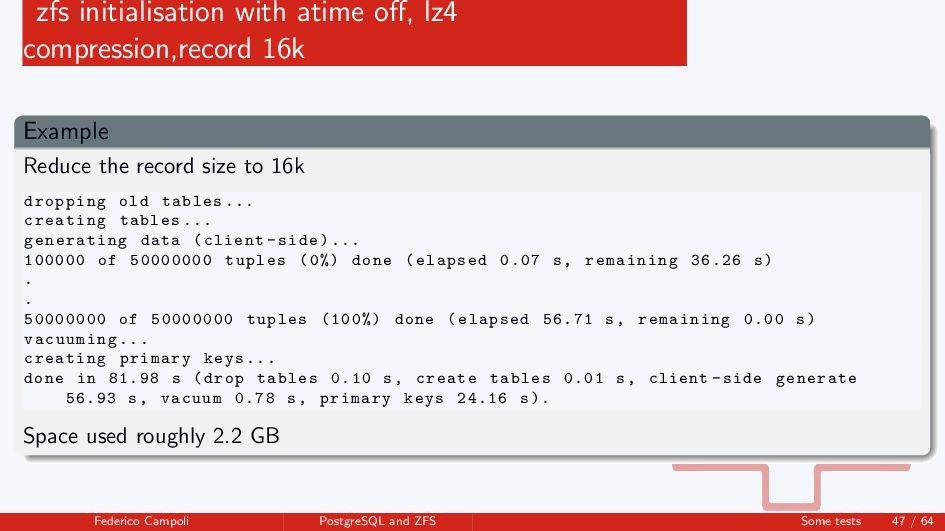
options The advantage of ZFS is that the options can be changed dynamically. No need to remount the dataset. Most of the changes apply to newly written data though. atime atime can be turned on or off recordsize defaults to 128k can be adjusted accordingly compression ZFS supports the transparent compression, supports lz4, gzip, zstd logbias sets the strategy for the ZIL if present (latency or throughput) Federico Campoli PostgreSQL and ZFS The Keymaster and The Gatekeeper 23 / 64
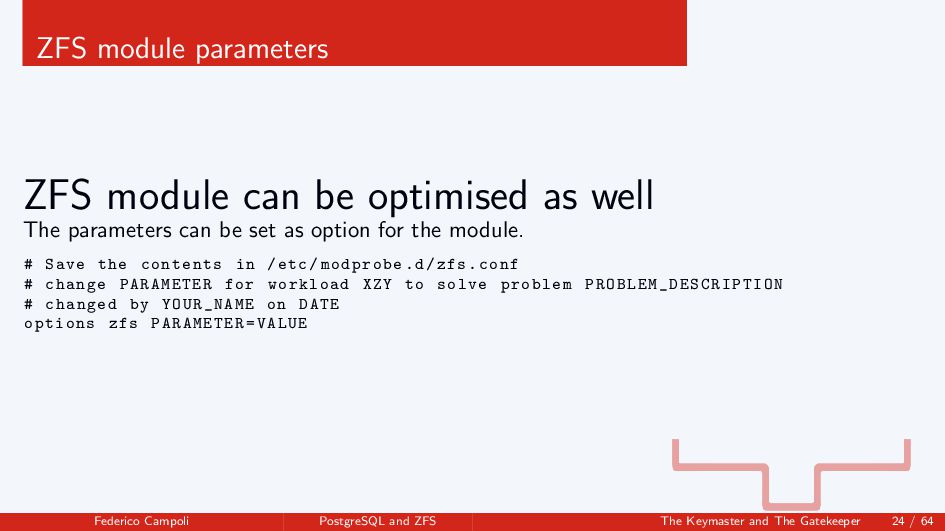
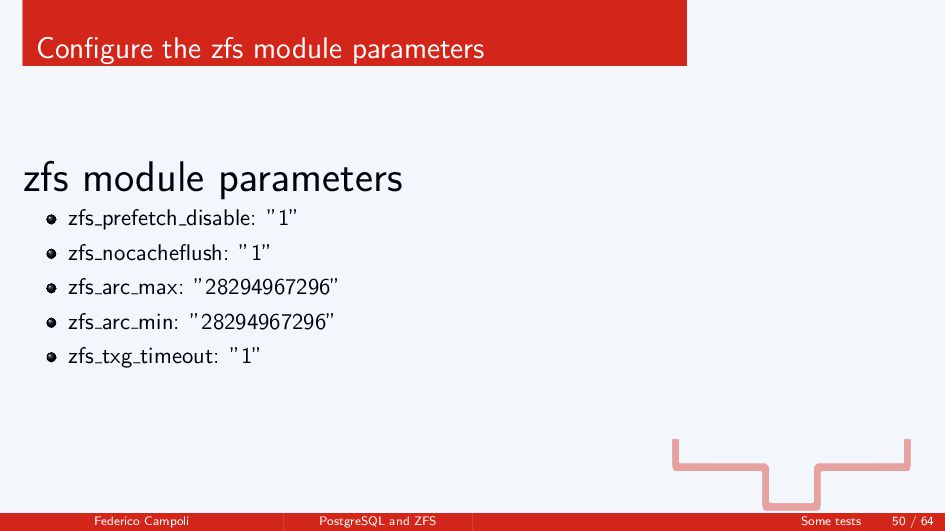
The parameters can be set as option for the module. # Save the contents in /etc/modprobe.d/zfs.conf # change PARAMETER for workload XZY to solve problem PROBLEM_DESCRIPTION # changed by YOUR_NAME on DATE options zfs PARAMETER=VALUE Federico Campoli PostgreSQL and ZFS The Keymaster and The Gatekeeper 24 / 64
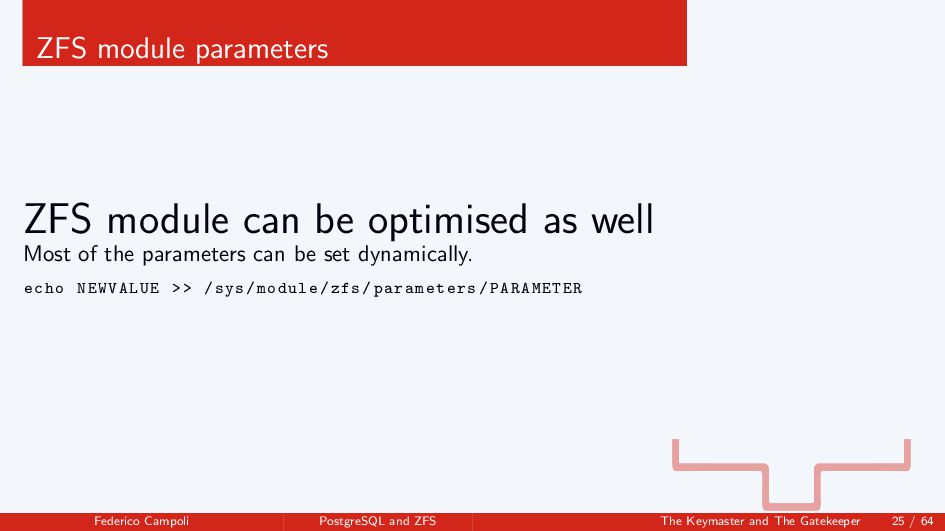
Most of the parameters can be set dynamically. echo NEWVALUE >> /sys/module/zfs/ parameters/PARAMETER Federico Campoli PostgreSQL and ZFS The Keymaster and The Gatekeeper 25 / 64
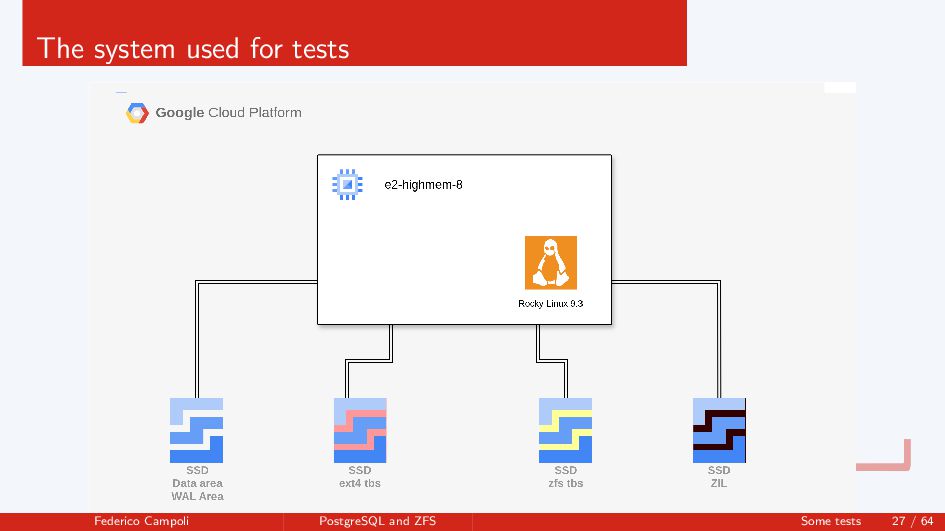
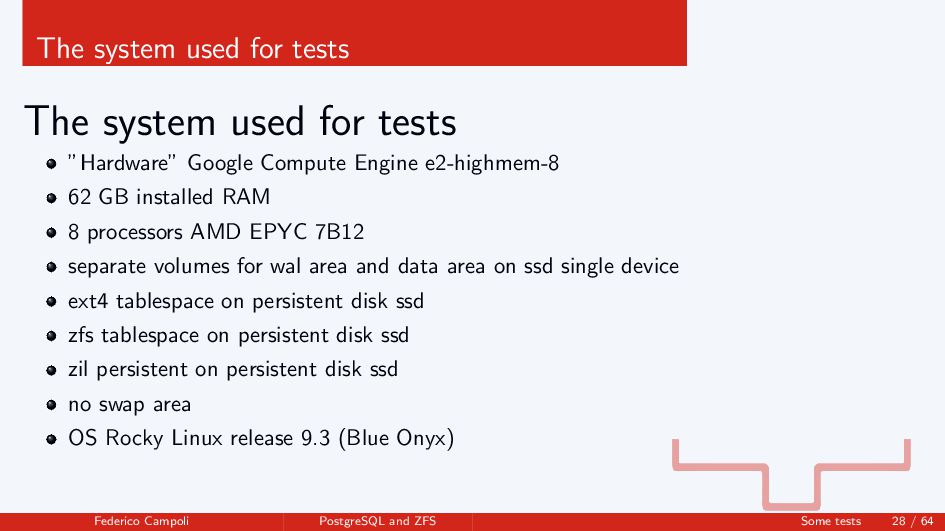
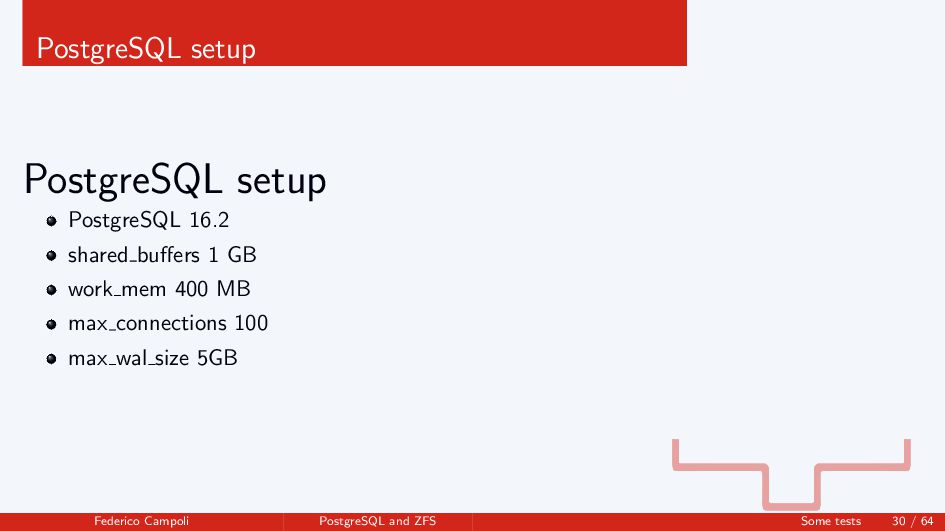
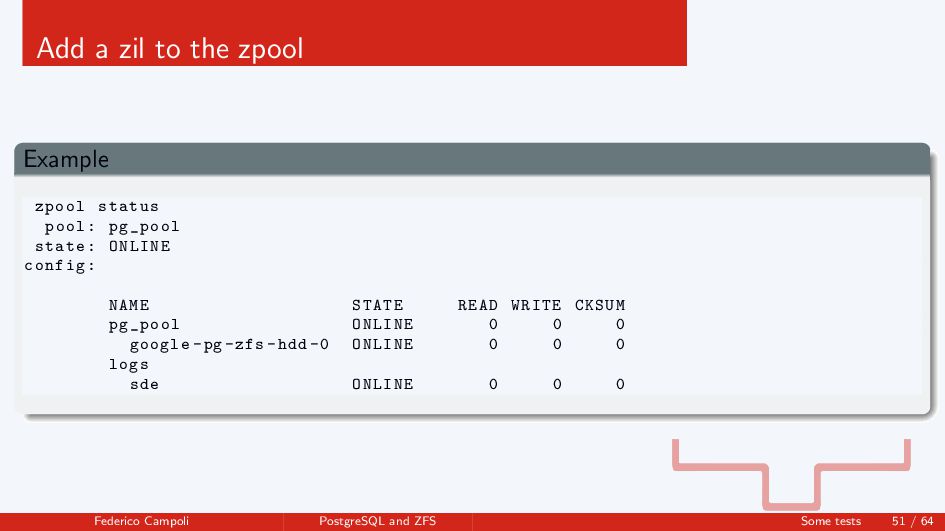
”Hardware” Google Compute Engine e2-highmem-8 62 GB installed RAM 8 processors AMD EPYC 7B12 separate volumes for wal area and data area on ssd single device ext4 tablespace on persistent disk ssd zfs tablespace on persistent disk ssd zil persistent on persistent disk ssd no swap area OS Rocky Linux release 9.3 (Blue Onyx) Federico Campoli PostgreSQL and ZFS Some tests 28 / 64
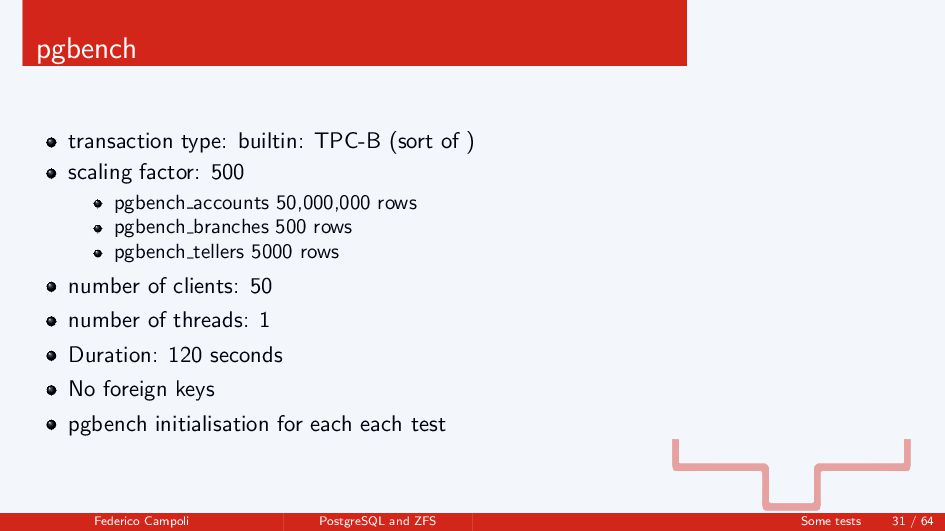
500 pgbench accounts 50,000,000 rows pgbench branches 500 rows pgbench tellers 5000 rows number of clients: 50 number of threads: 1 Duration: 120 seconds No foreign keys pgbench initialisation for each each test Federico Campoli PostgreSQL and ZFS Some tests 31 / 64
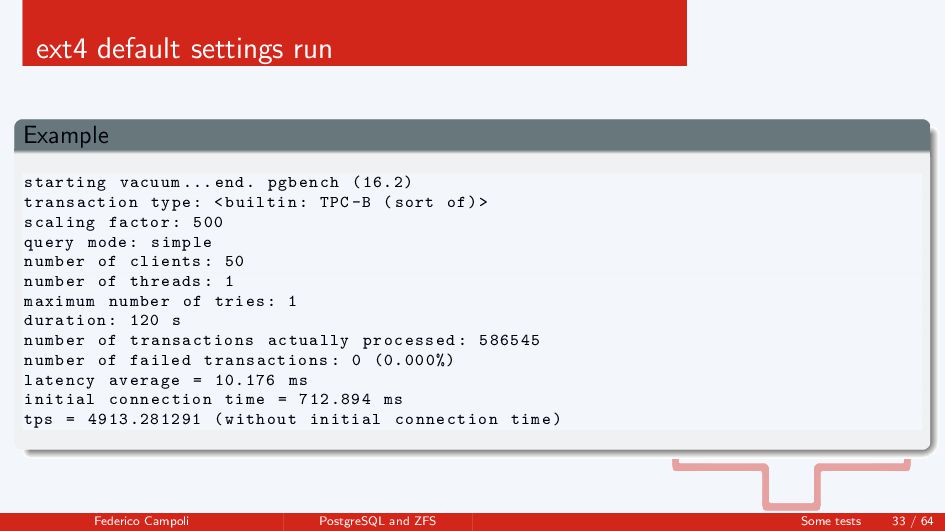
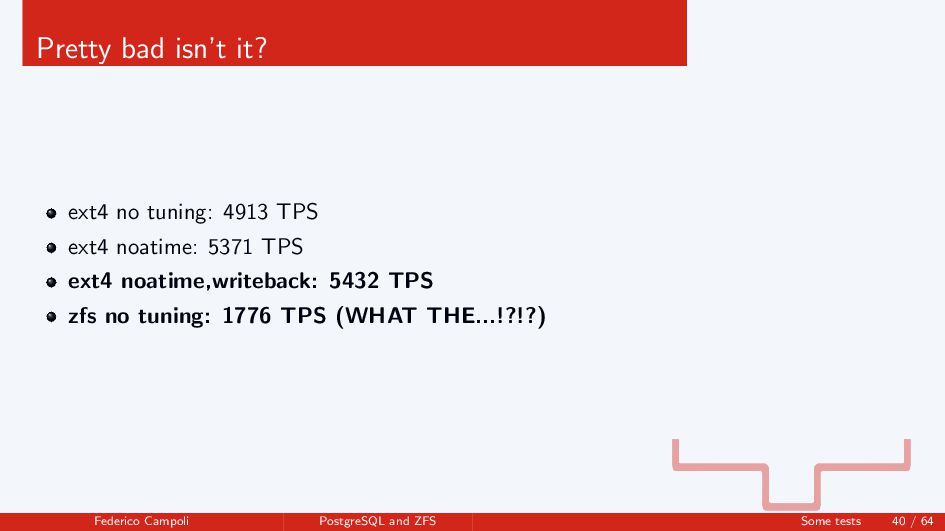
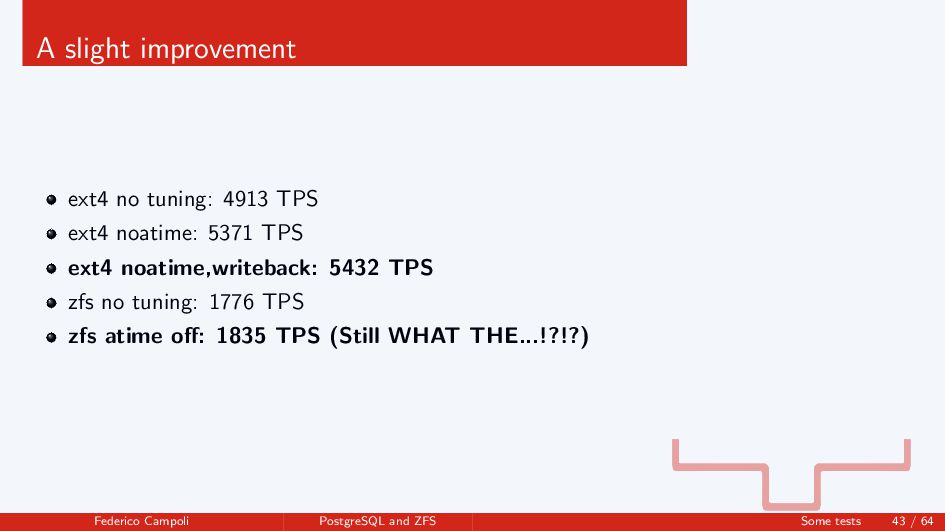
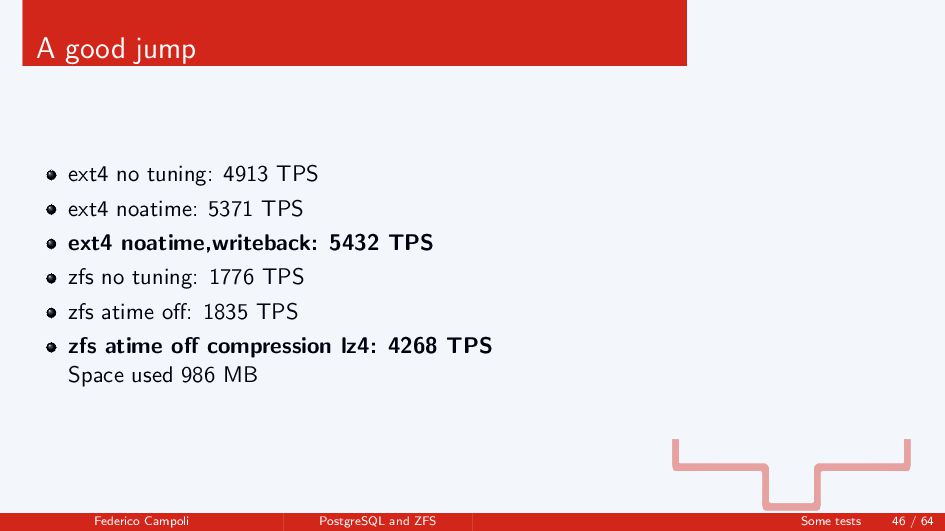
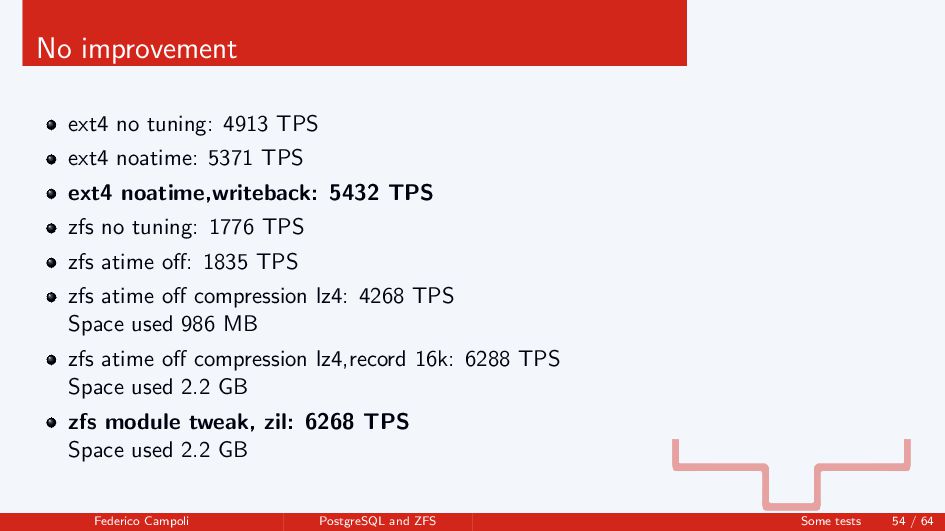
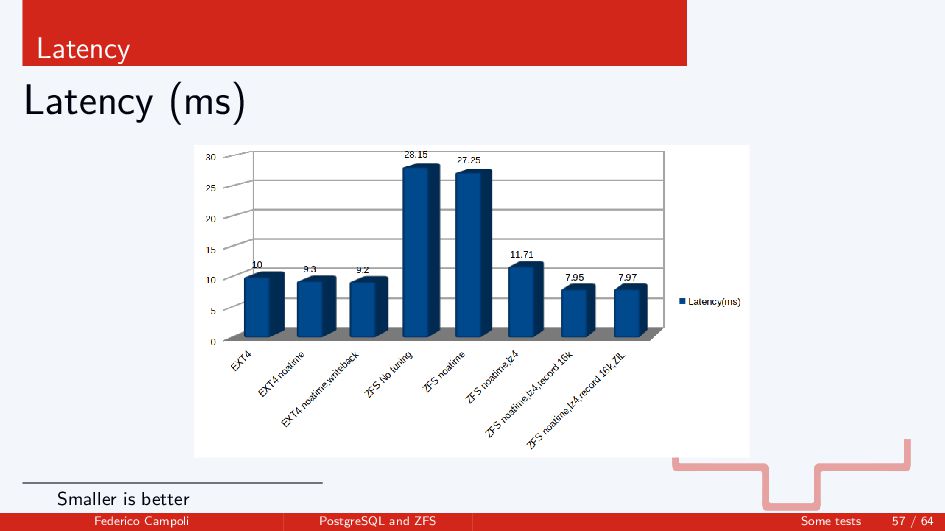
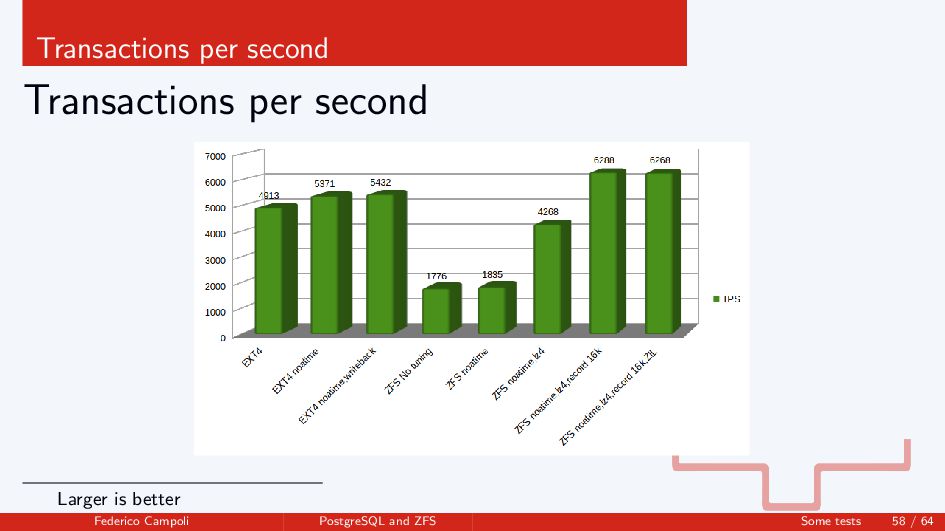
(16.2) transaction type: <builtin: TPC -B (sort of)> scaling factor: 500 query mode: simple number of clients: 50 number of threads: 1 maximum number of tries: 1 duration: 120 s number of transactions actually processed: 586545 number of failed transactions : 0 (0.000%) latency average = 10.176 ms initial connection time = 712.894 ms tps = 4913.281291 (without initial connection time) Federico Campoli PostgreSQL and ZFS Some tests 33 / 64
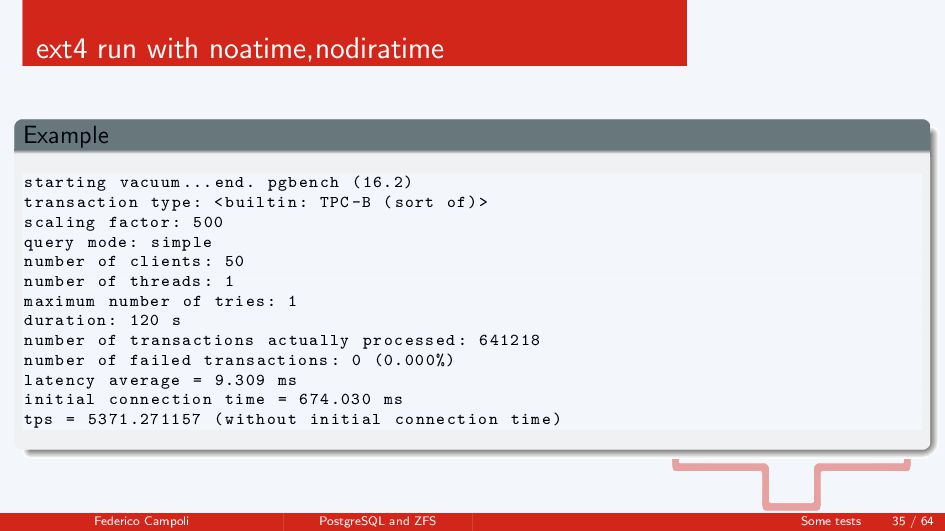
(16.2) transaction type: <builtin: TPC -B (sort of)> scaling factor: 500 query mode: simple number of clients: 50 number of threads: 1 maximum number of tries: 1 duration: 120 s number of transactions actually processed: 641218 number of failed transactions : 0 (0.000%) latency average = 9.309 ms initial connection time = 674.030 ms tps = 5371.271157 (without initial connection time) Federico Campoli PostgreSQL and ZFS Some tests 35 / 64
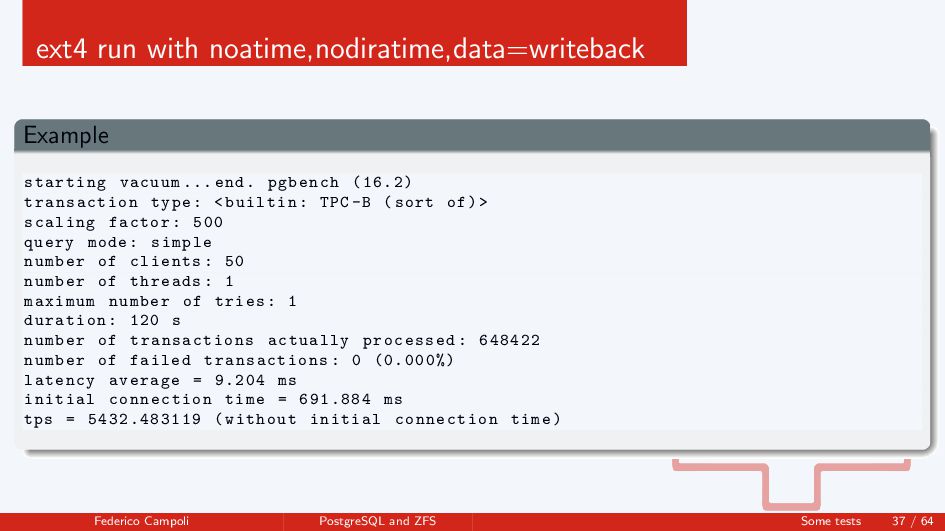
(16.2) transaction type: <builtin: TPC -B (sort of)> scaling factor: 500 query mode: simple number of clients: 50 number of threads: 1 maximum number of tries: 1 duration: 120 s number of transactions actually processed: 648422 number of failed transactions : 0 (0.000%) latency average = 9.204 ms initial connection time = 691.884 ms tps = 5432.483119 (without initial connection time) Federico Campoli PostgreSQL and ZFS Some tests 37 / 64
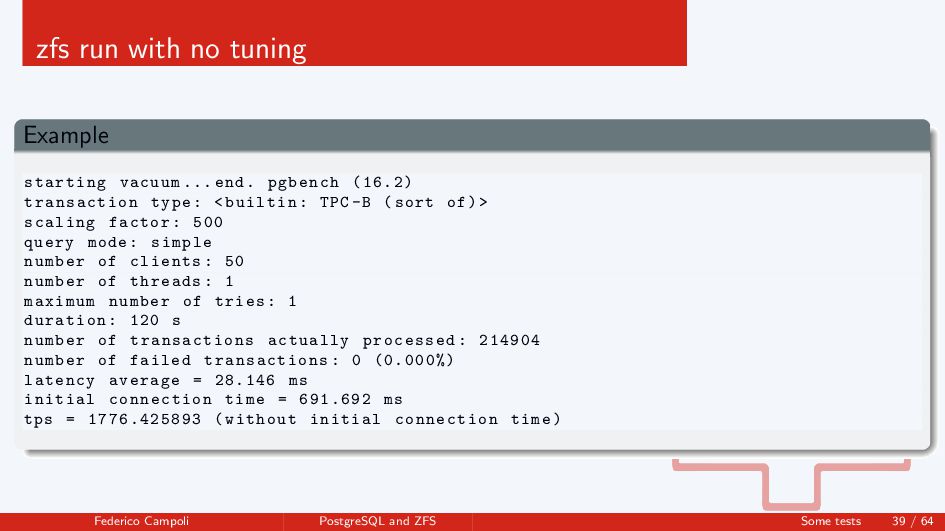
pgbench (16.2) transaction type: <builtin: TPC -B (sort of)> scaling factor: 500 query mode: simple number of clients: 50 number of threads: 1 maximum number of tries: 1 duration: 120 s number of transactions actually processed: 214904 number of failed transactions : 0 (0.000%) latency average = 28.146 ms initial connection time = 691.692 ms tps = 1776.425893 (without initial connection time) Federico Campoli PostgreSQL and ZFS Some tests 39 / 64
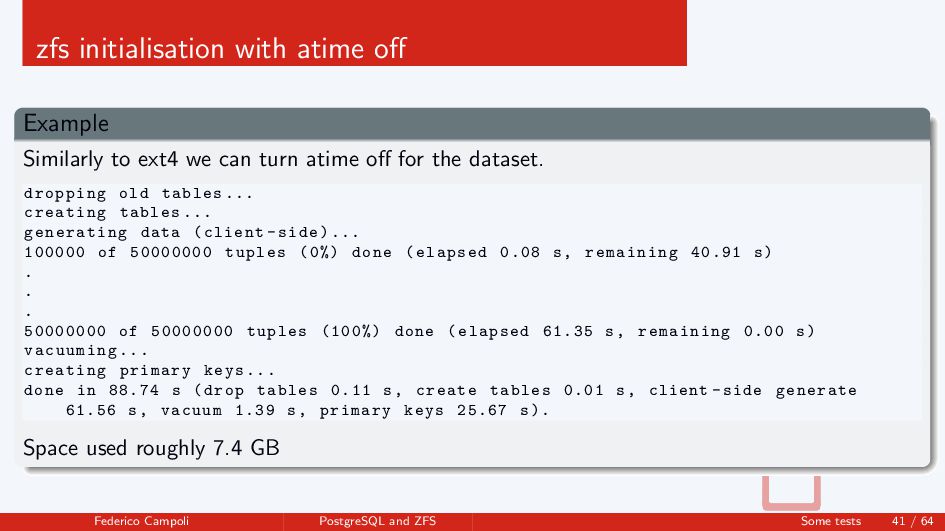
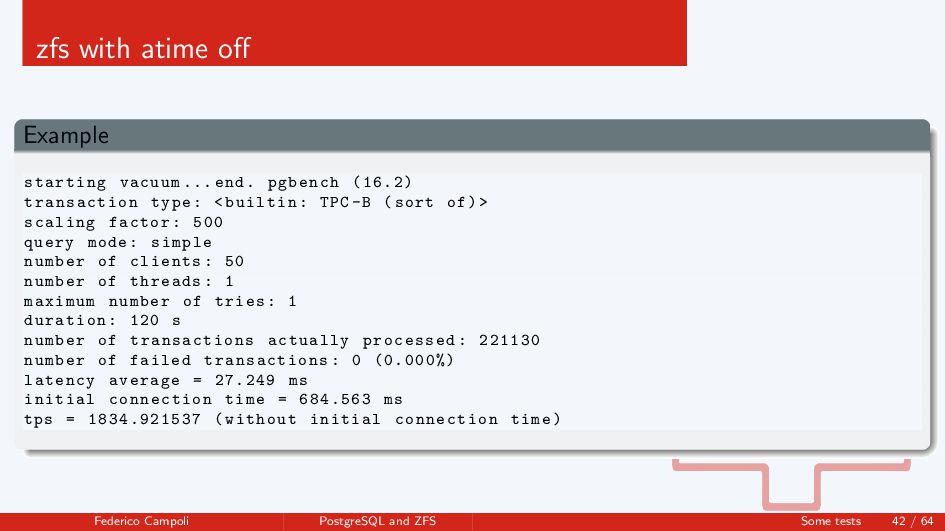
(16.2) transaction type: <builtin: TPC -B (sort of)> scaling factor: 500 query mode: simple number of clients: 50 number of threads: 1 maximum number of tries: 1 duration: 120 s number of transactions actually processed: 221130 number of failed transactions : 0 (0.000%) latency average = 27.249 ms initial connection time = 684.563 ms tps = 1834.921537 (without initial connection time) Federico Campoli PostgreSQL and ZFS Some tests 42 / 64
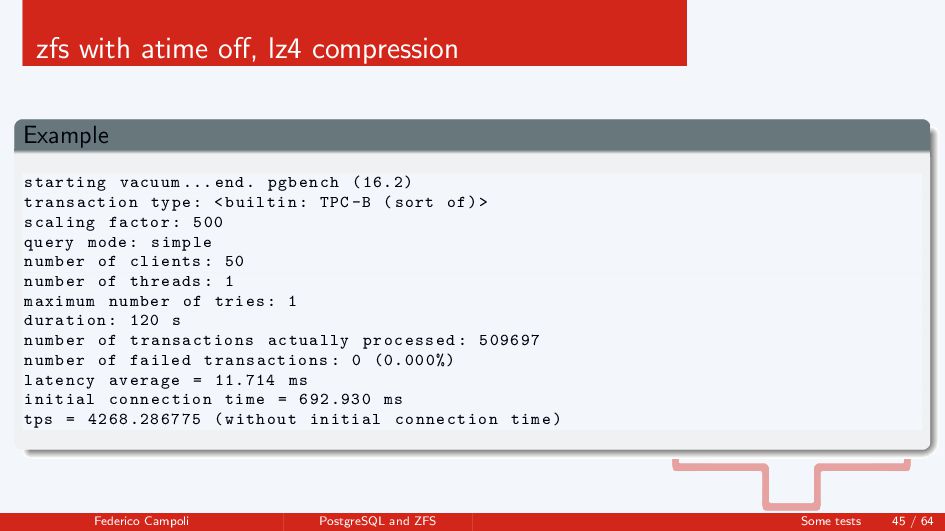
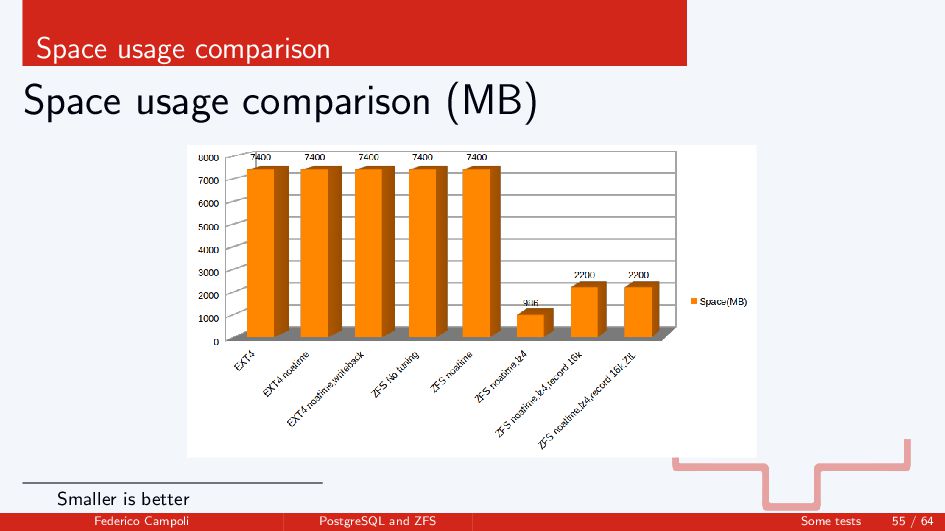
end. pgbench (16.2) transaction type: <builtin: TPC -B (sort of)> scaling factor: 500 query mode: simple number of clients: 50 number of threads: 1 maximum number of tries: 1 duration: 120 s number of transactions actually processed: 509697 number of failed transactions : 0 (0.000%) latency average = 11.714 ms initial connection time = 692.930 ms tps = 4268.286775 (without initial connection time) Federico Campoli PostgreSQL and ZFS Some tests 45 / 64
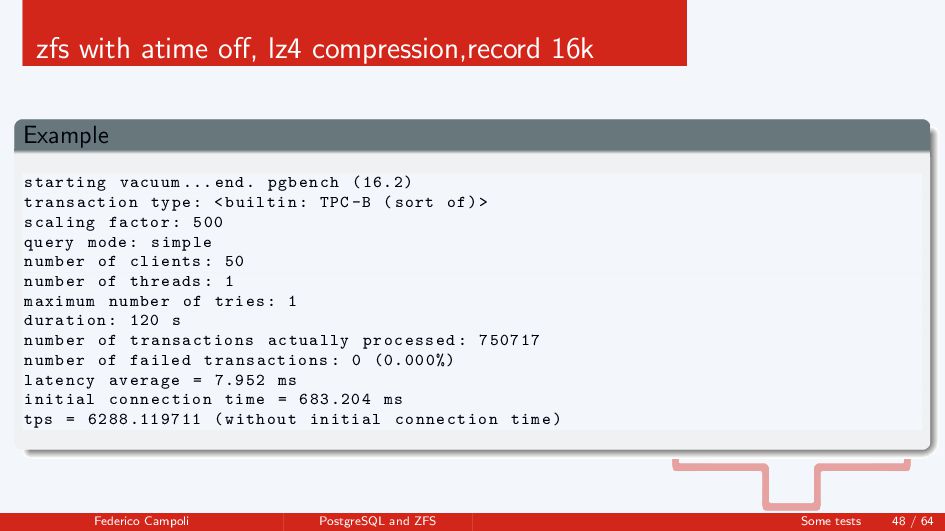
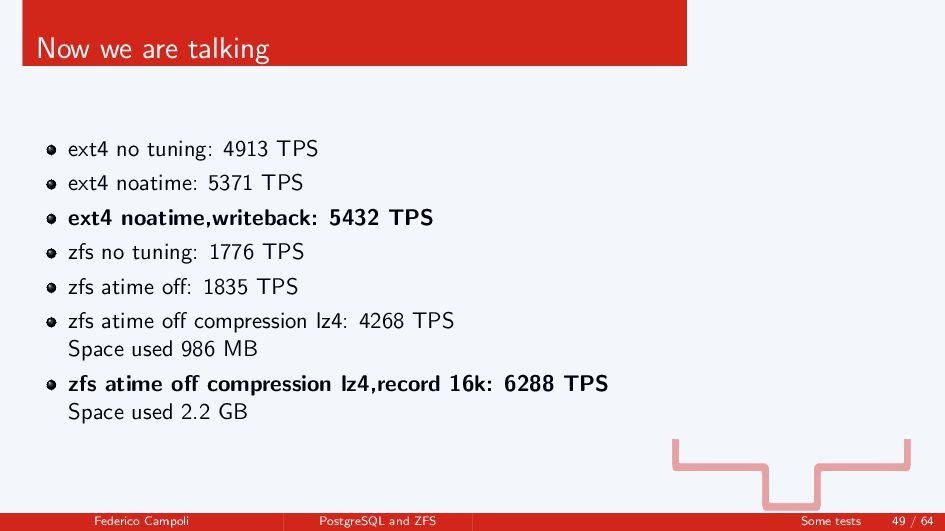
... end. pgbench (16.2) transaction type: <builtin: TPC -B (sort of)> scaling factor: 500 query mode: simple number of clients: 50 number of threads: 1 maximum number of tries: 1 duration: 120 s number of transactions actually processed: 750717 number of failed transactions : 0 (0.000%) latency average = 7.952 ms initial connection time = 683.204 ms tps = 6288.119711 (without initial connection time) Federico Campoli PostgreSQL and ZFS Some tests 48 / 64
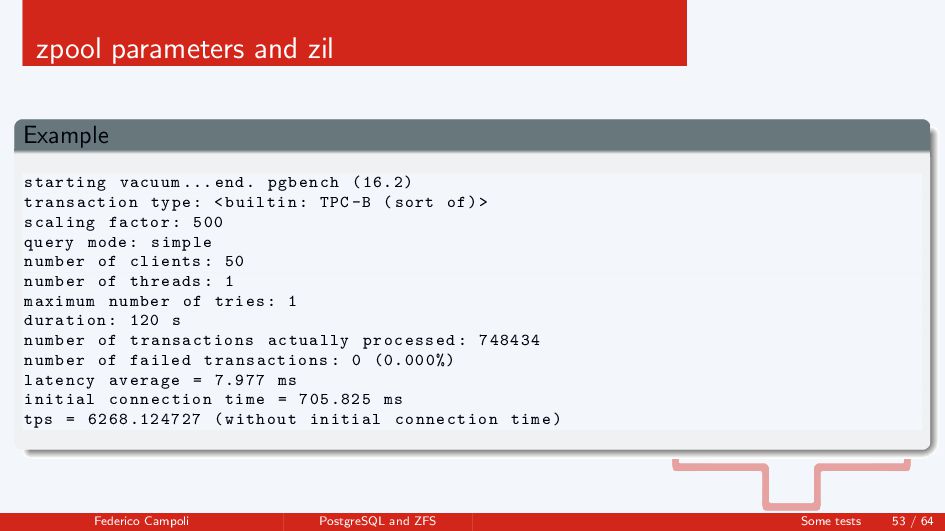
(16.2) transaction type: <builtin: TPC -B (sort of)> scaling factor: 500 query mode: simple number of clients: 50 number of threads: 1 maximum number of tries: 1 duration: 120 s number of transactions actually processed: 748434 number of failed transactions : 0 (0.000%) latency average = 7.977 ms initial connection time = 705.825 ms tps = 6268.124727 (without initial connection time) Federico Campoli PostgreSQL and ZFS Some tests 53 / 64
reputation Beware of any weird bug appearing... Yes, I mean this bug: https://www.theregister.com/2023/11/27/openzfs 2 2 0 data corruption/ Use the PostgreSQL block checksums Always use the right tool for the right job e.g. Don’t use ZFS if you have a 20 MB database Always RTFM! And finally, remember that... Federico Campoli PostgreSQL and ZFS Wrap up 59 / 64


 the4thdoctor
 hlum
hlum
 takanorip
 kairim0
 tokuty
 kizawa2020
 mot_techtalk
 kworkdev
 mkdev10
 naruoga
 camiha
 tomokusaba
 terurou
 pauljervisheath
 takai
takai
 tammyeverts
 greggifford
 eileencodes
 davidcarrasco
 ryanjones
 427marketing
 lfama
lfama
 maggiecrowley
 eitanlees