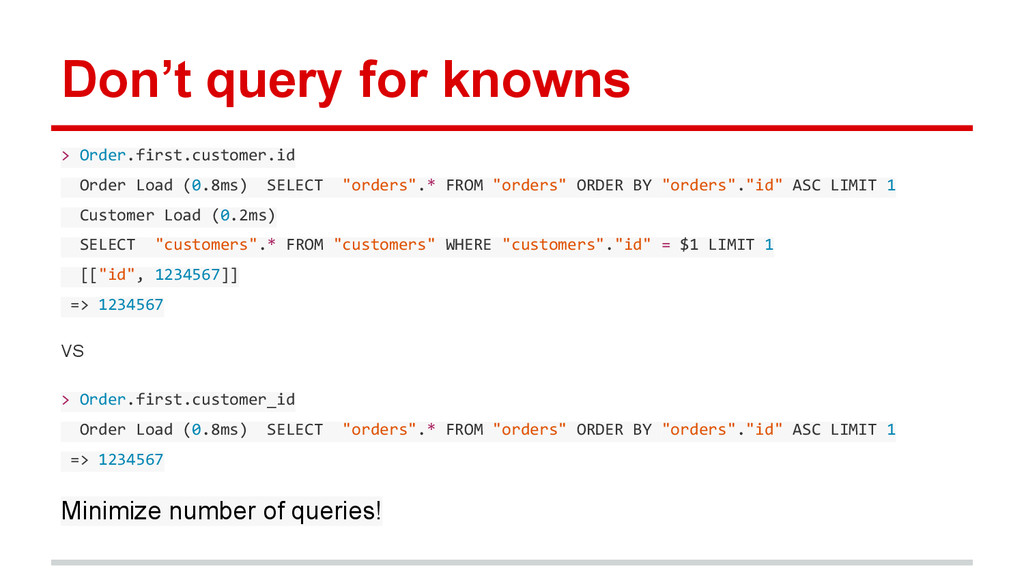
"orders".* FROM "orders" ORDER BY "orders"."id" ASC LIMIT 1 Customer Load (0.2ms) SELECT "customers".* FROM "customers" WHERE "customers"."id" = $1 LIMIT 1 [["id", 1234567]] => 1234567 VS > Order.first.customer_id Order Load (0.8ms) SELECT "orders".* FROM "orders" ORDER BY "orders"."id" ASC LIMIT 1 => 1234567 Minimize number of queries!
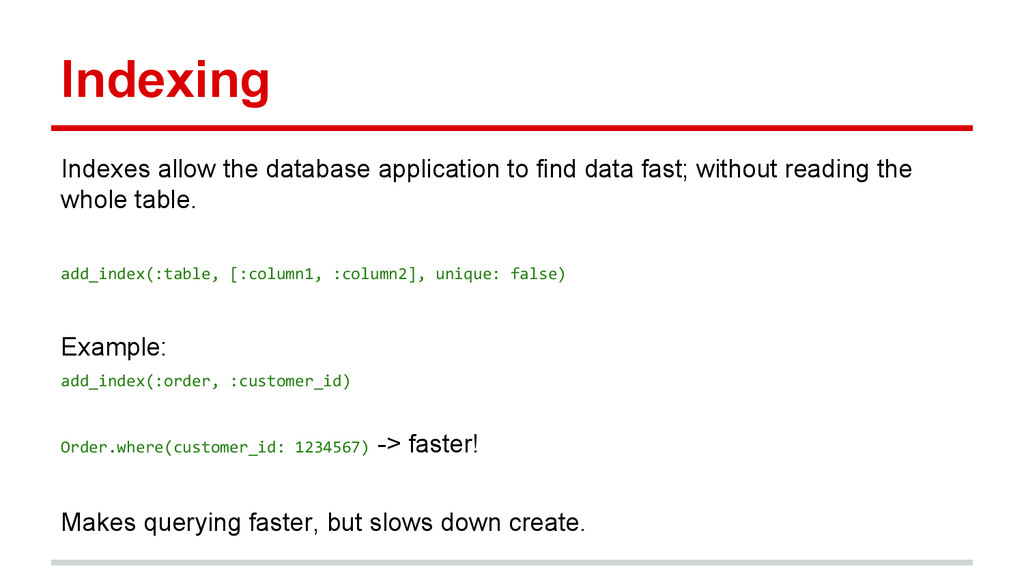
without reading the whole table. add_index(:table, [:column1, :column2], unique: false) Example: add_index(:order, :customer_id) Order.where(customer_id: 1234567) -> faster! Makes querying faster, but slows down create.
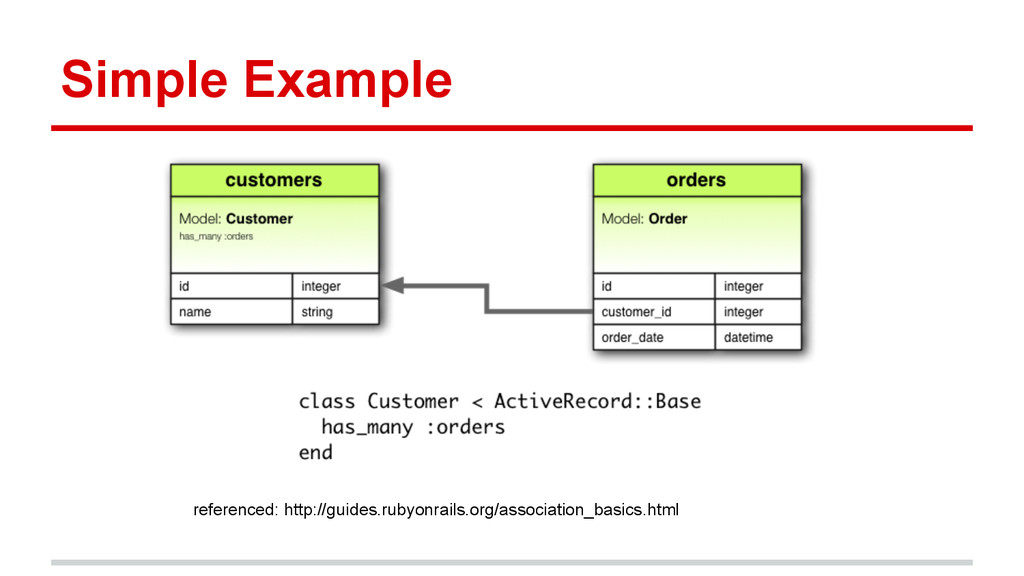
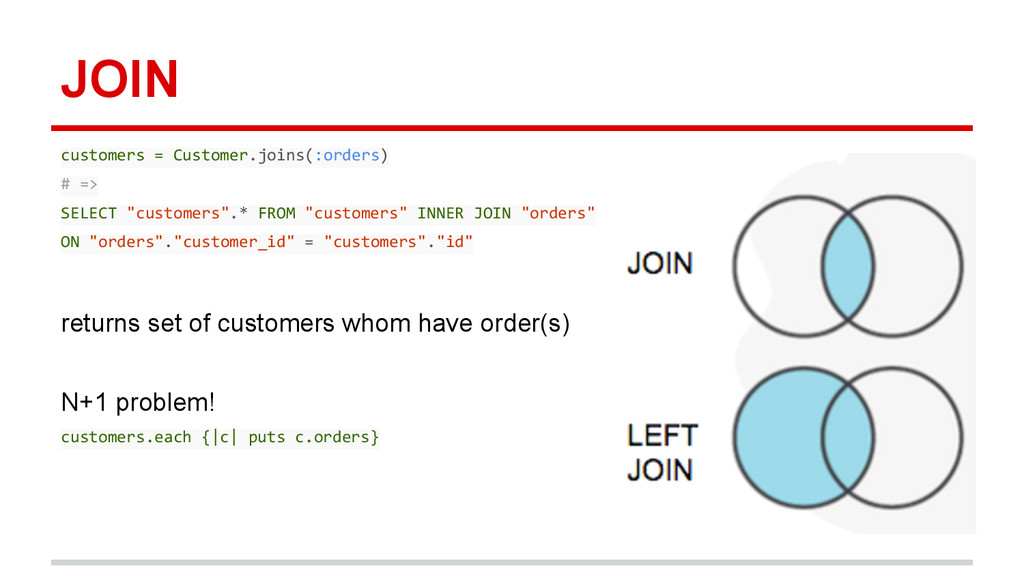
INNER JOIN "orders" ON "orders"."customer_id" = "customers"."id" returns set of customers whom have order(s) N+1 problem! customers.each {|c| puts c.orders}
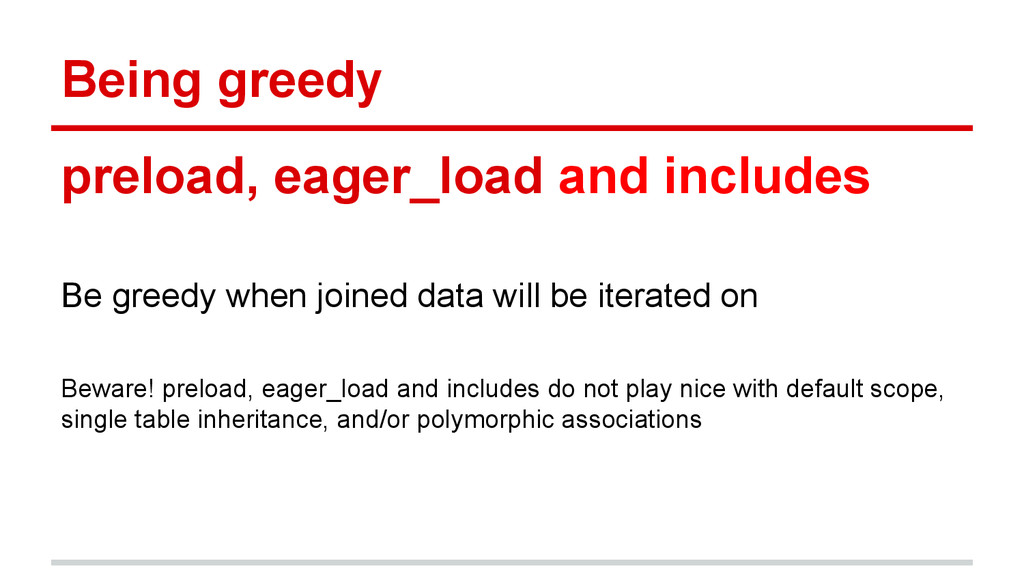
data will be iterated on Beware! preload, eager_load and includes do not play nice with default scope, single table inheritance, and/or polymorphic associations
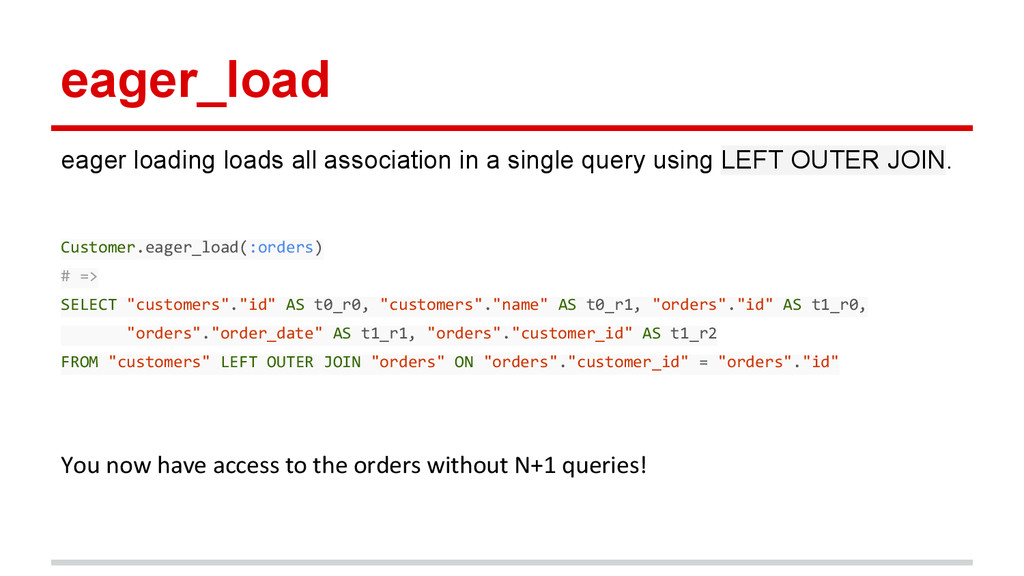
using LEFT OUTER JOIN. Customer.eager_load(:orders) # => SELECT "customers"."id" AS t0_r0, "customers"."name" AS t0_r1, "orders"."id" AS t1_r0, "orders"."order_date" AS t1_r1, "orders"."customer_id" AS t1_r2 FROM "customers" LEFT OUTER JOIN "orders" ON "orders"."customer_id" = "orders"."id" You now have access to the orders without N+1 queries!
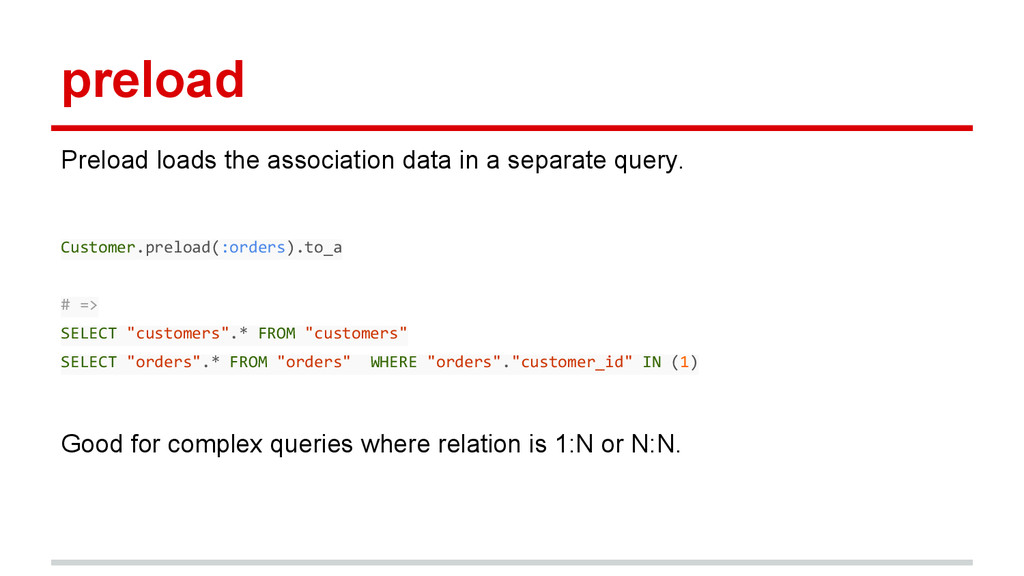
Customer.preload(:orders).to_a # => SELECT "customers".* FROM "customers" SELECT "orders".* FROM "orders" WHERE "orders"."customer_id" IN (1) Good for complex queries where relation is 1:N or N:N.
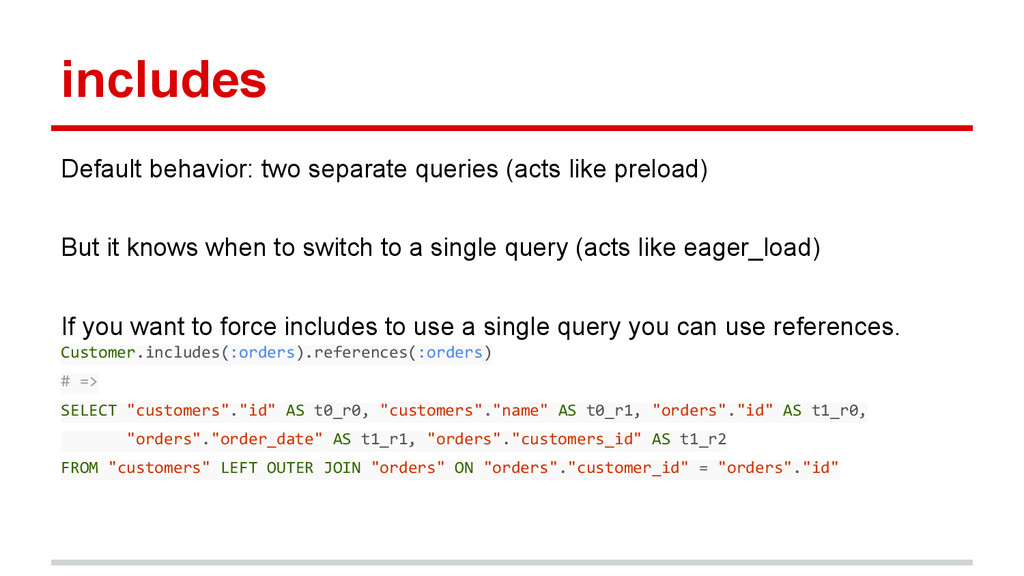
it knows when to switch to a single query (acts like eager_load) If you want to force includes to use a single query you can use references. Customer.includes(:orders).references(:orders) # => SELECT "customers"."id" AS t0_r0, "customers"."name" AS t0_r1, "orders"."id" AS t1_r0, "orders"."order_date" AS t1_r1, "orders"."customers_id" AS t1_r2 FROM "customers" LEFT OUTER JOIN "orders" ON "orders"."customer_id" = "orders"."id"
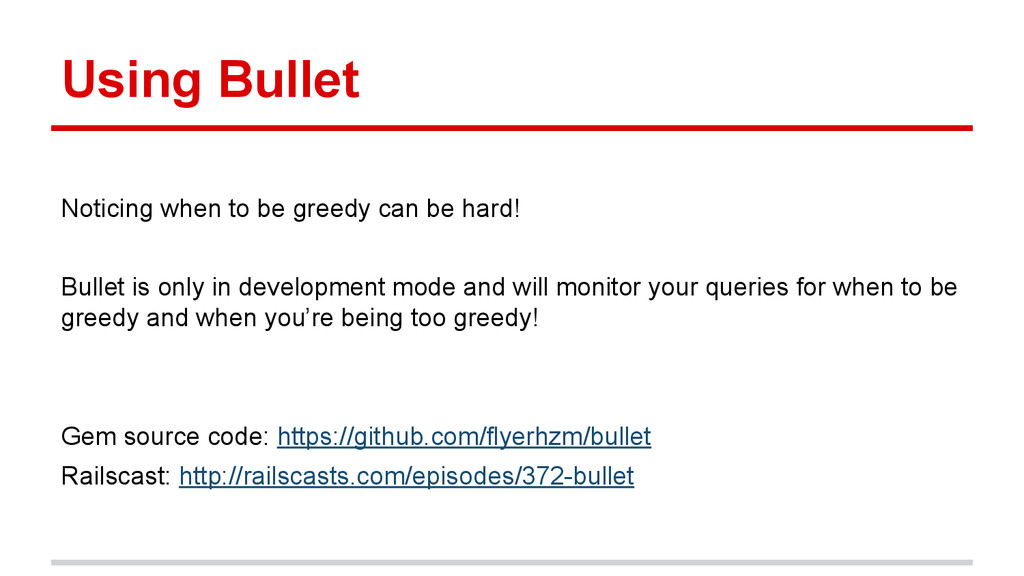
Bullet is only in development mode and will monitor your queries for when to be greedy and when you’re being too greedy! Gem source code: https://github.com/flyerhzm/bullet Railscast: http://railscasts.com/episodes/372-bullet


 persolserverworks
 maimyyym
 shuta13
 takuroabe
 kizawa2020
 ishikawa_satoru
 kaminashi
 mhrtech
 pfn
 techtekt
 codatum
 prog893
 nonsquared
 denniskardys
 aleyda
 signer
 katiecoart
 geshan
 dugsong
 marcoroth
 cassininazir
 kevinliebholz
 kimpetersen
 malarkey