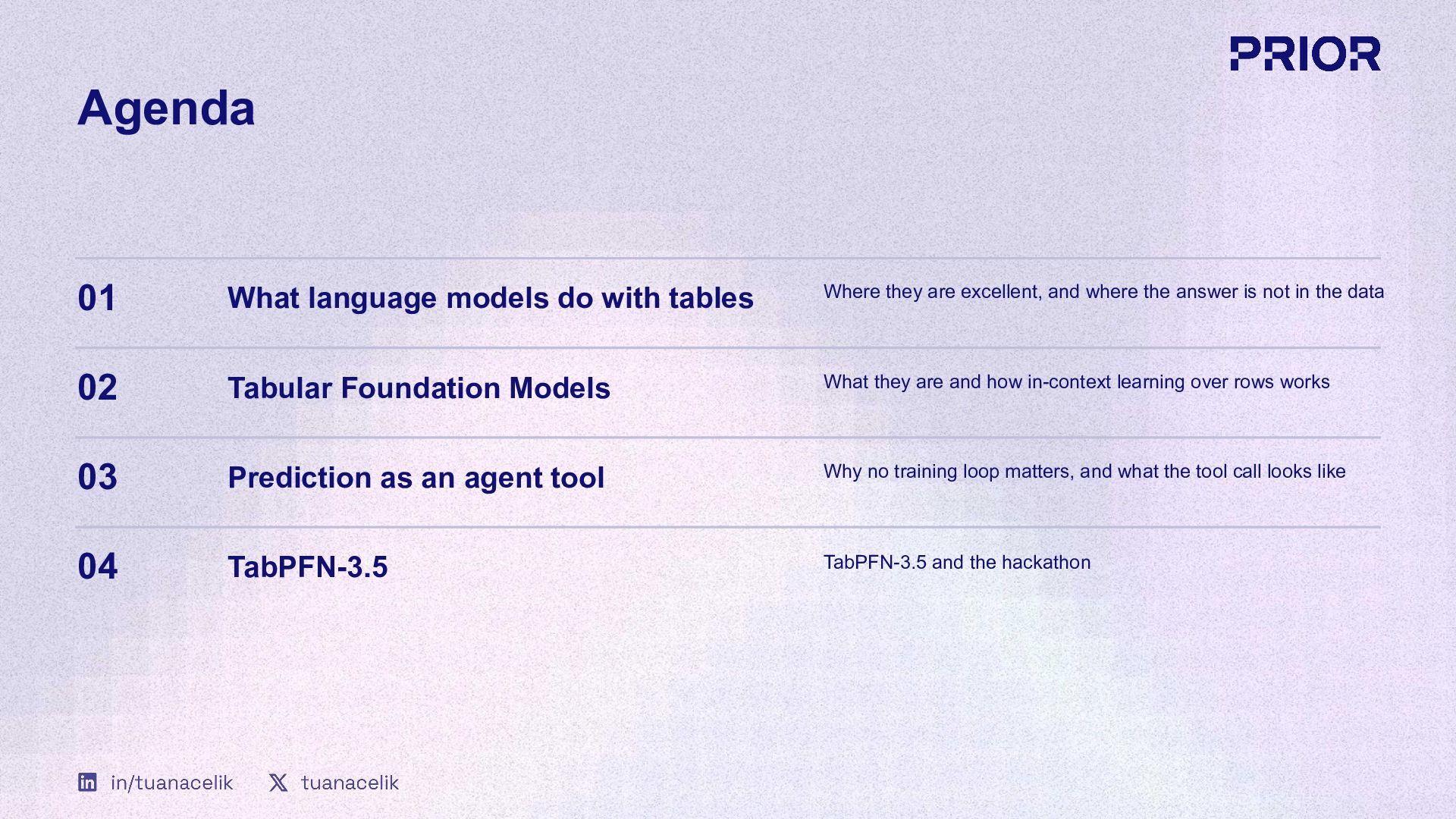
are excellent, and where the answer is not in the data 02 Tabular Foundation Models What they are and how in-context learning over rows works 03 Prediction as an agent tool Why no training loop matters, and what the tool call looks like 04 TabPFN-3.5 TabPFN-3.5 and the hackathon
are excellent, and where the answer is not in the data 02 Tabular Foundation Models What they are and how in-context learning over rows works 03 Prediction as an agent tool Why no training loop matters, and what the tool call looks like 04 TabPFN-3.5 TabPFN-3.5 and the hackathon
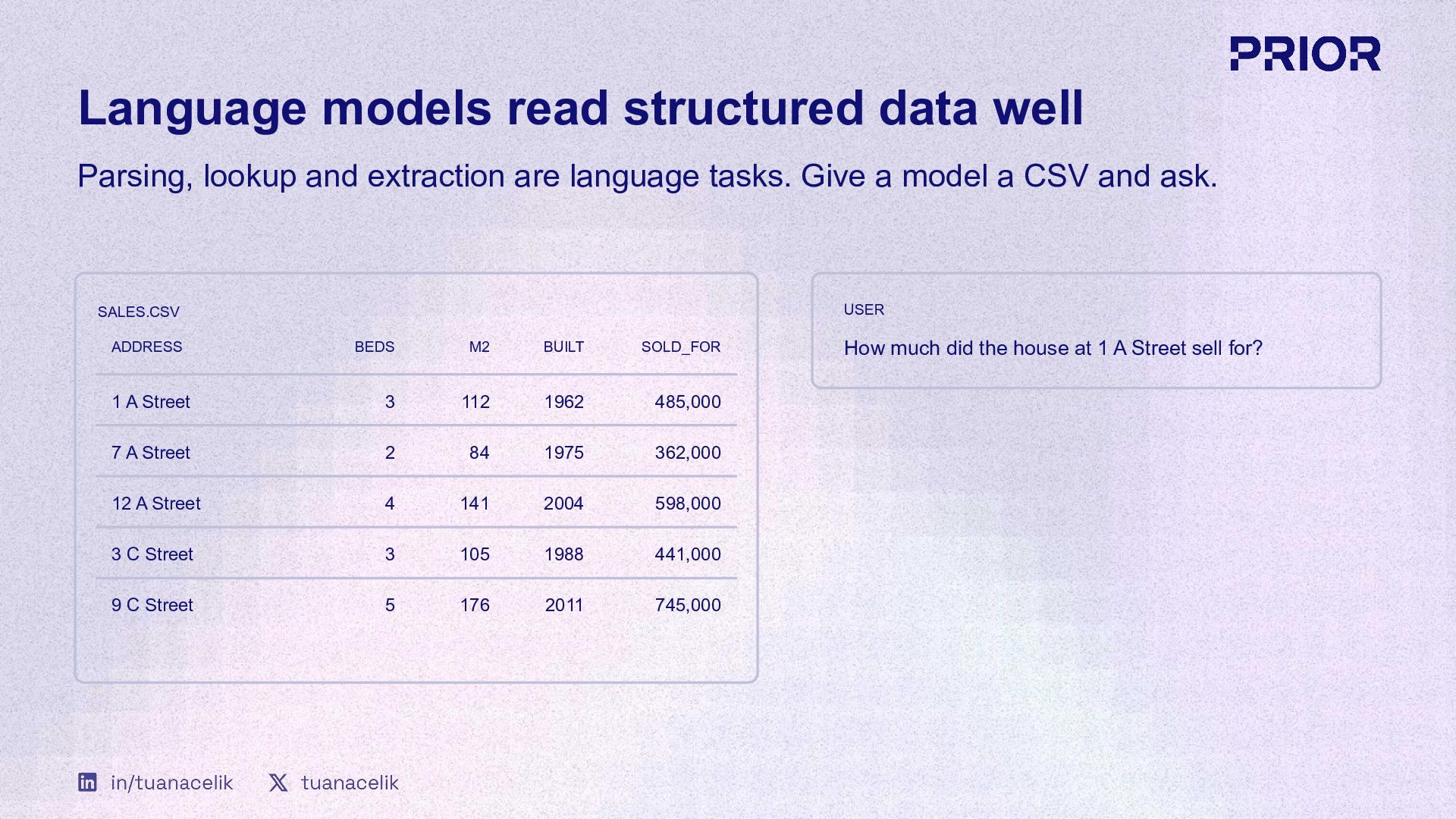
are language tasks. Give a model a CSV and ask. USER SALES.CSV ADDRESS BEDS M2 BUILT SOLD_FOR 1 A Street 3 112 1962 485,000 7 A Street 2 84 1975 362,000 12 A Street 4 141 2004 598,000 3 C Street 3 105 1988 441,000 9 C Street 5 176 2011 745,000 How much did the house at 1 A Street sell for?
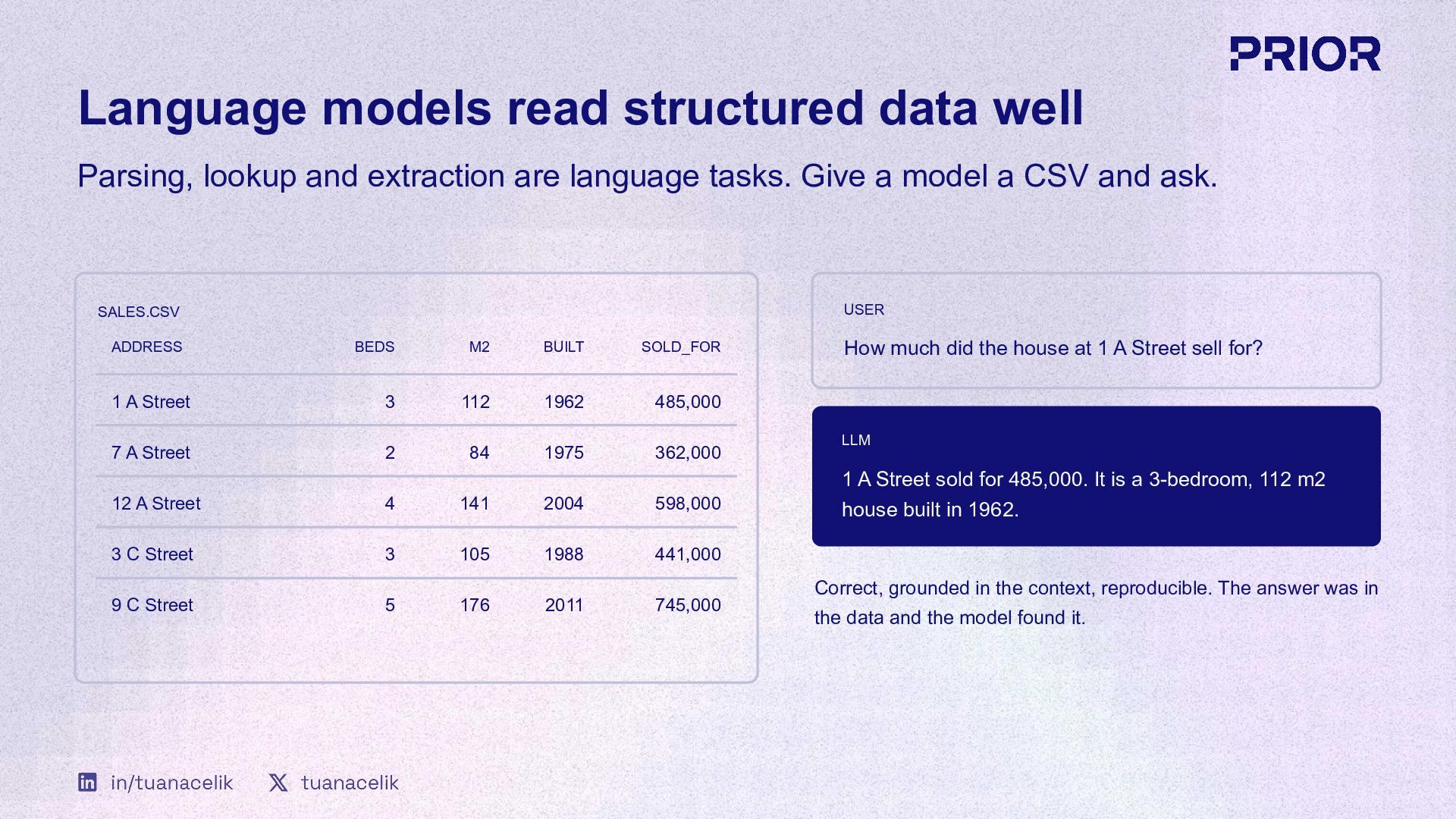
are language tasks. Give a model a CSV and ask. USER SALES.CSV ADDRESS BEDS M2 BUILT SOLD_FOR 1 A Street 3 112 1962 485,000 7 A Street 2 84 1975 362,000 12 A Street 4 141 2004 598,000 3 C Street 3 105 1988 441,000 9 C Street 5 176 2011 745,000 How much did the house at 1 A Street sell for? LLM 1 A Street sold for 485,000. It is a 3-bedroom, 112 m2 house built in 1962. Correct, grounded in the context, reproducible. The answer was in the data and the model found it.
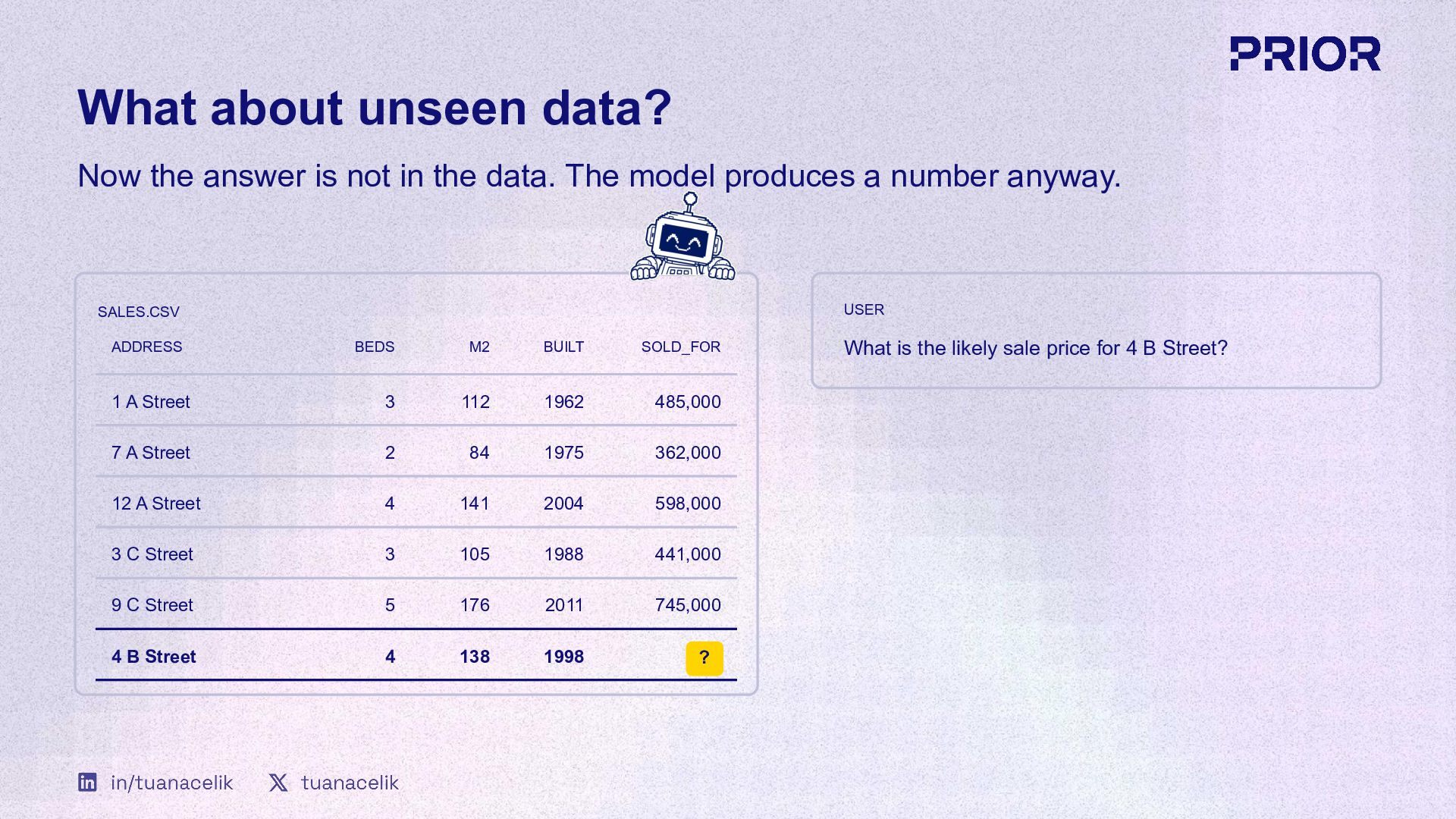
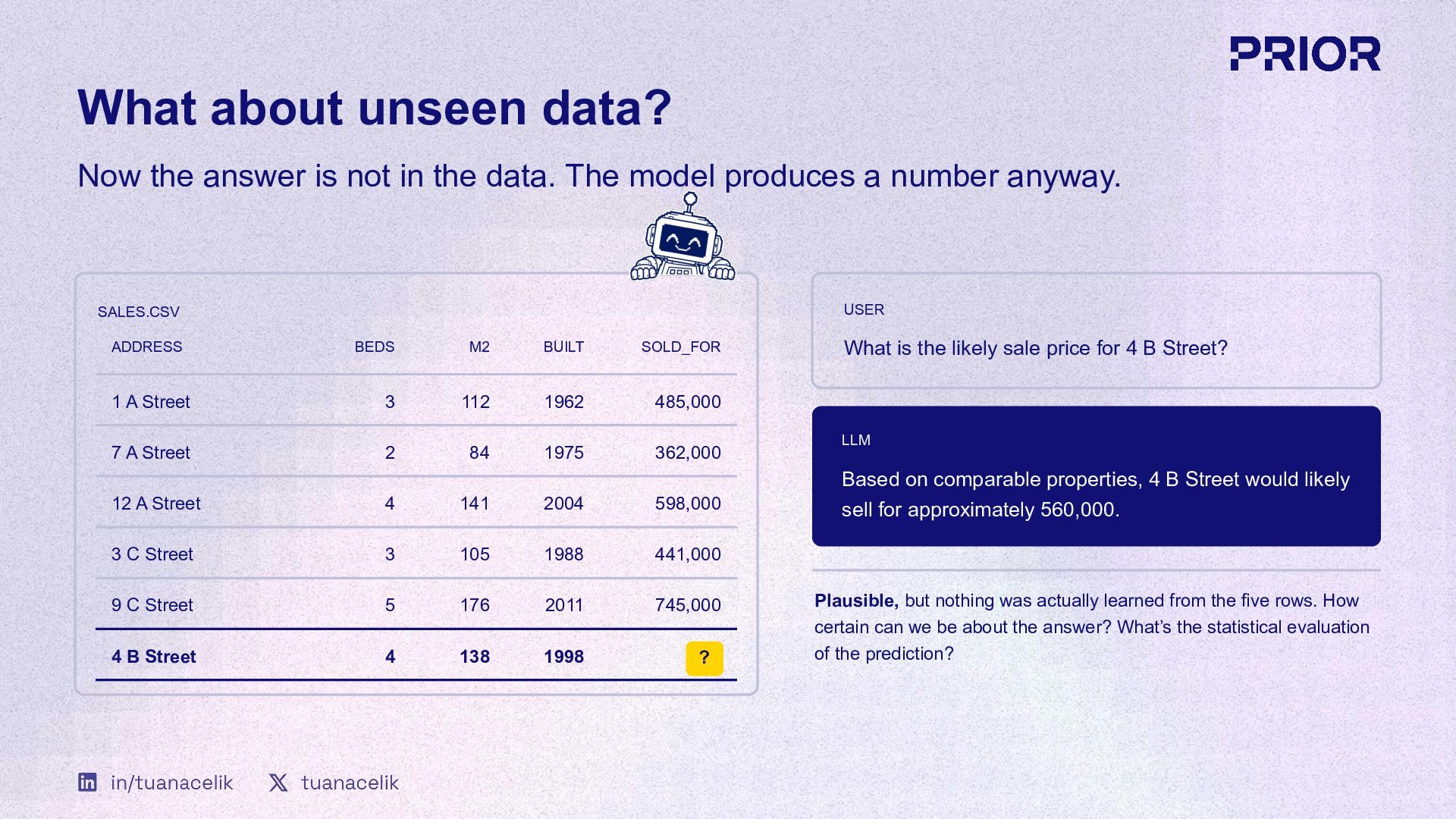
the data. The model produces a number anyway. USER SALES.CSV ADDRESS BEDS M2 BUILT SOLD_FOR 1 A Street 3 112 1962 485,000 7 A Street 2 84 1975 362,000 12 A Street 4 141 2004 598,000 3 C Street 3 105 1988 441,000 9 C Street 5 176 2011 745,000 4 B Street 4 138 1998 ? What is the likely sale price for 4 B Street?
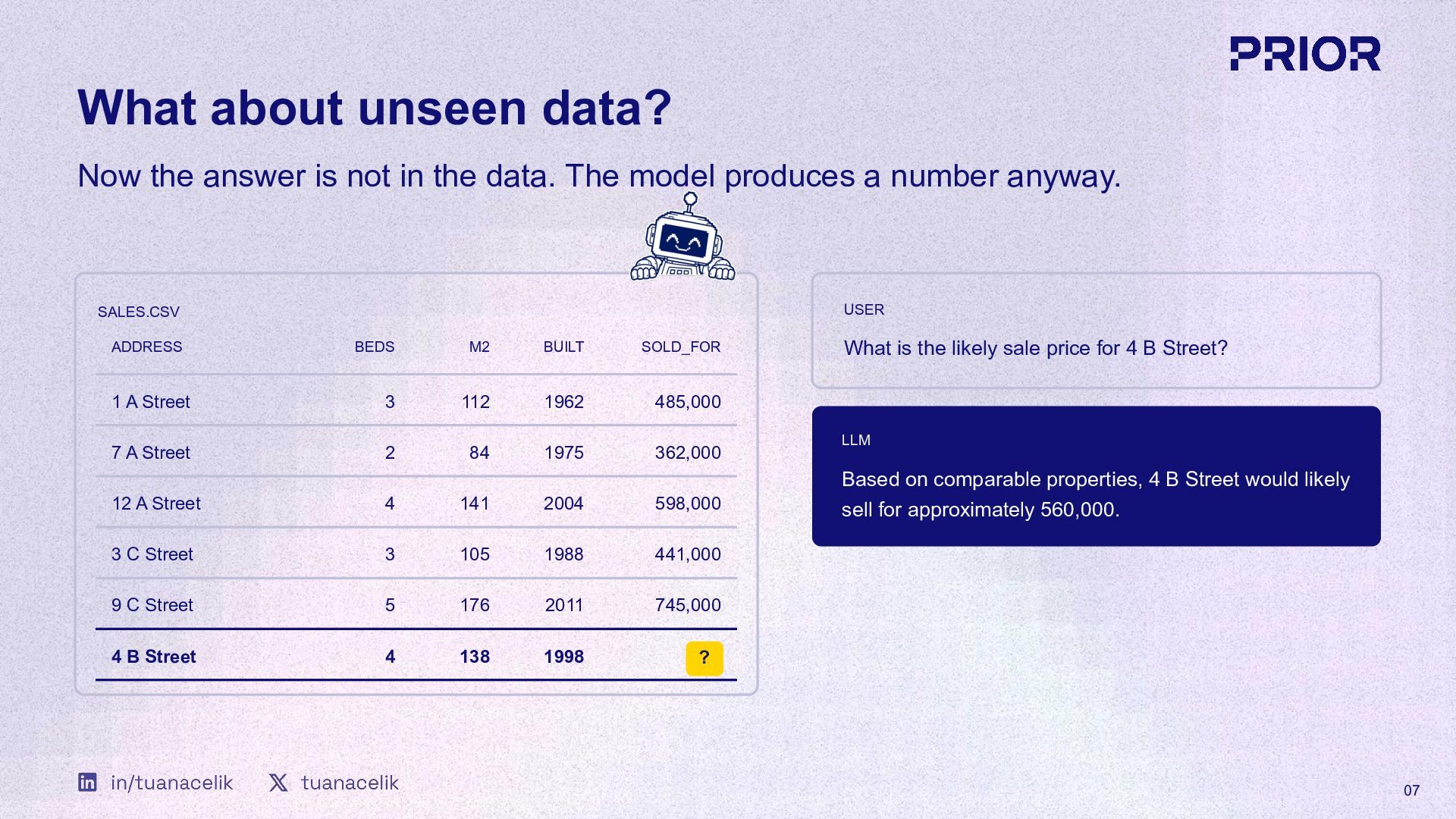
the data. The model produces a number anyway. USER SALES.CSV ADDRESS BEDS M2 BUILT SOLD_FOR 1 A Street 3 112 1962 485,000 7 A Street 2 84 1975 362,000 12 A Street 4 141 2004 598,000 3 C Street 3 105 1988 441,000 9 C Street 5 176 2011 745,000 4 B Street 4 138 1998 ? What is the likely sale price for 4 B Street? LLM Based on comparable properties, 4 B Street would likely sell for approximately 560,000. 07
the data. The model produces a number anyway. USER SALES.CSV ADDRESS BEDS M2 BUILT SOLD_FOR 1 A Street 3 112 1962 485,000 7 A Street 2 84 1975 362,000 12 A Street 4 141 2004 598,000 3 C Street 3 105 1988 441,000 9 C Street 5 176 2011 745,000 4 B Street 4 138 1998 ? What is the likely sale price for 4 B Street? LLM Based on comparable properties, 4 B Street would likely sell for approximately 560,000. Plausible, but nothing was actually learned from the five rows. How certain can we be about the answer? What’s the statistical evaluation of the prediction?
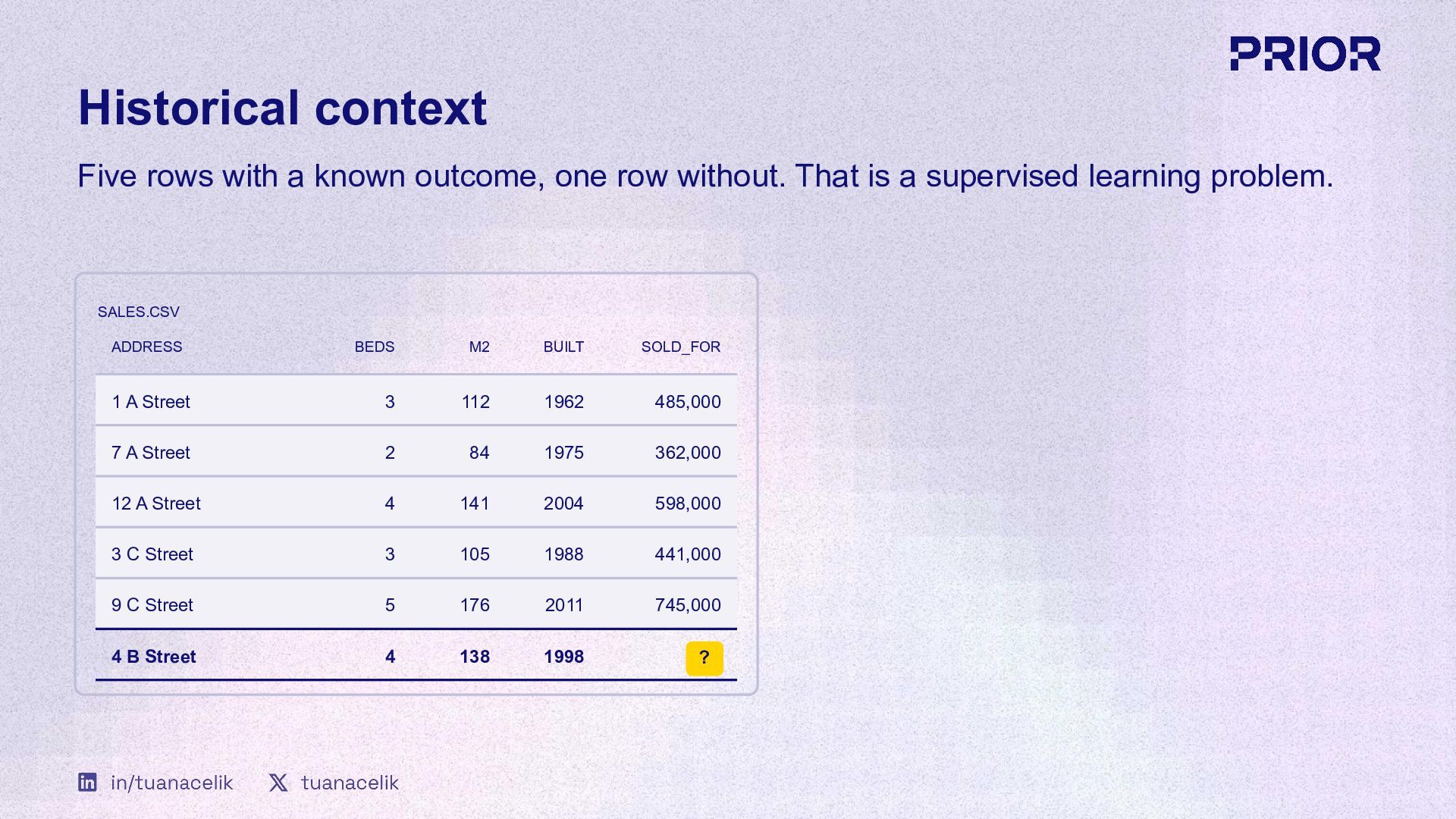
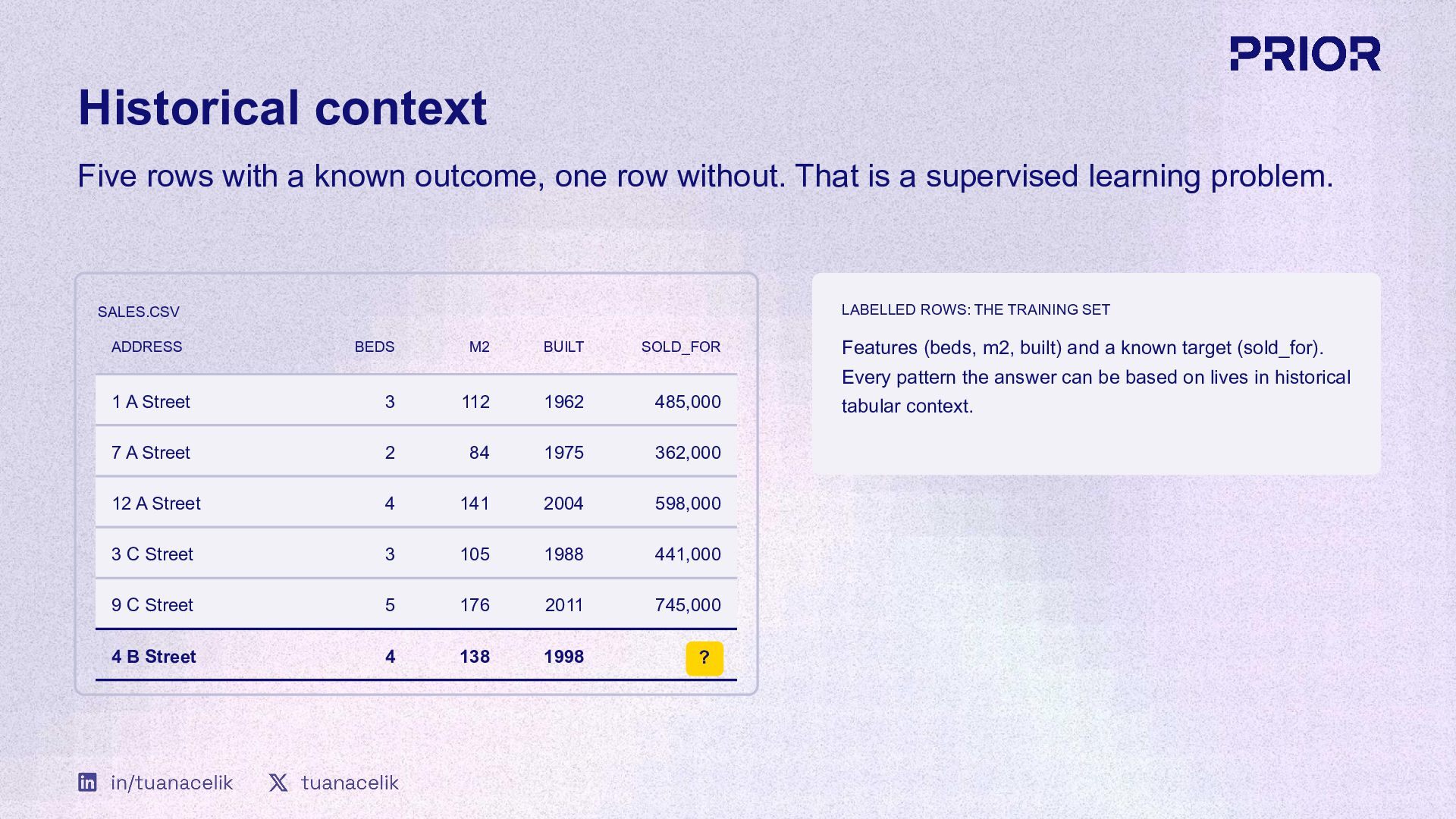
without. That is a supervised learning problem. SALES.CSV ADDRESS BEDS M2 BUILT SOLD_FOR 1 A Street 3 112 1962 485,000 7 A Street 2 84 1975 362,000 12 A Street 4 141 2004 598,000 3 C Street 3 105 1988 441,000 9 C Street 5 176 2011 745,000 4 B Street 4 138 1998 ?
without. That is a supervised learning problem. LABELLED ROWS: THE TRAINING SET SALES.CSV ADDRESS BEDS M2 BUILT SOLD_FOR Features (beds, m2, built) and a known target (sold_for). Every pattern the answer can be based on lives in historical 1 A Street 3 112 1962 485,000 7 A Street 2 84 1975 362,000 12 A Street 4 141 2004 598,000 3 C Street 3 105 1988 441,000 9 C Street 5 176 2011 745,000 4 B Street 4 138 1998 ? tabular context.
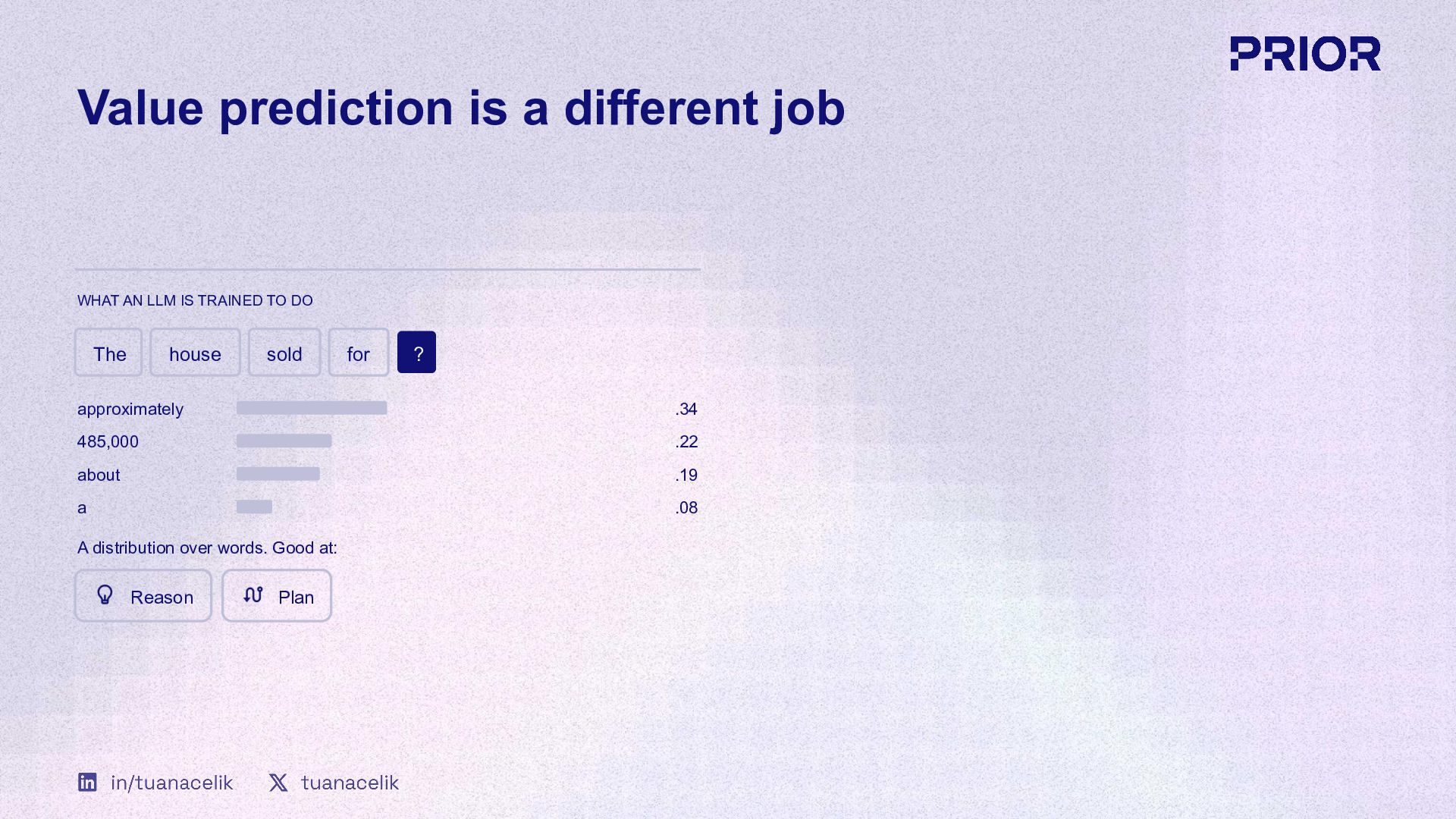
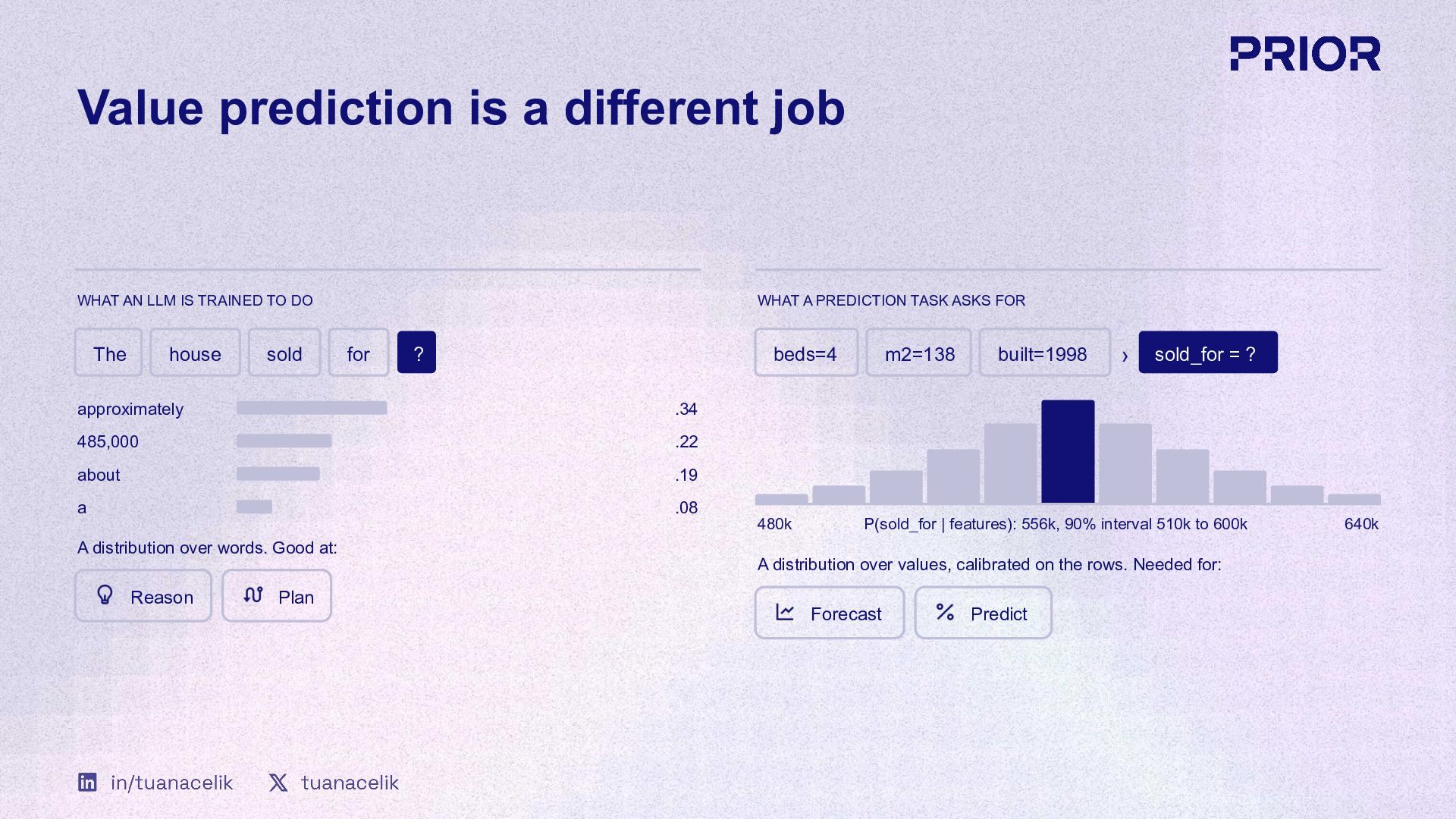
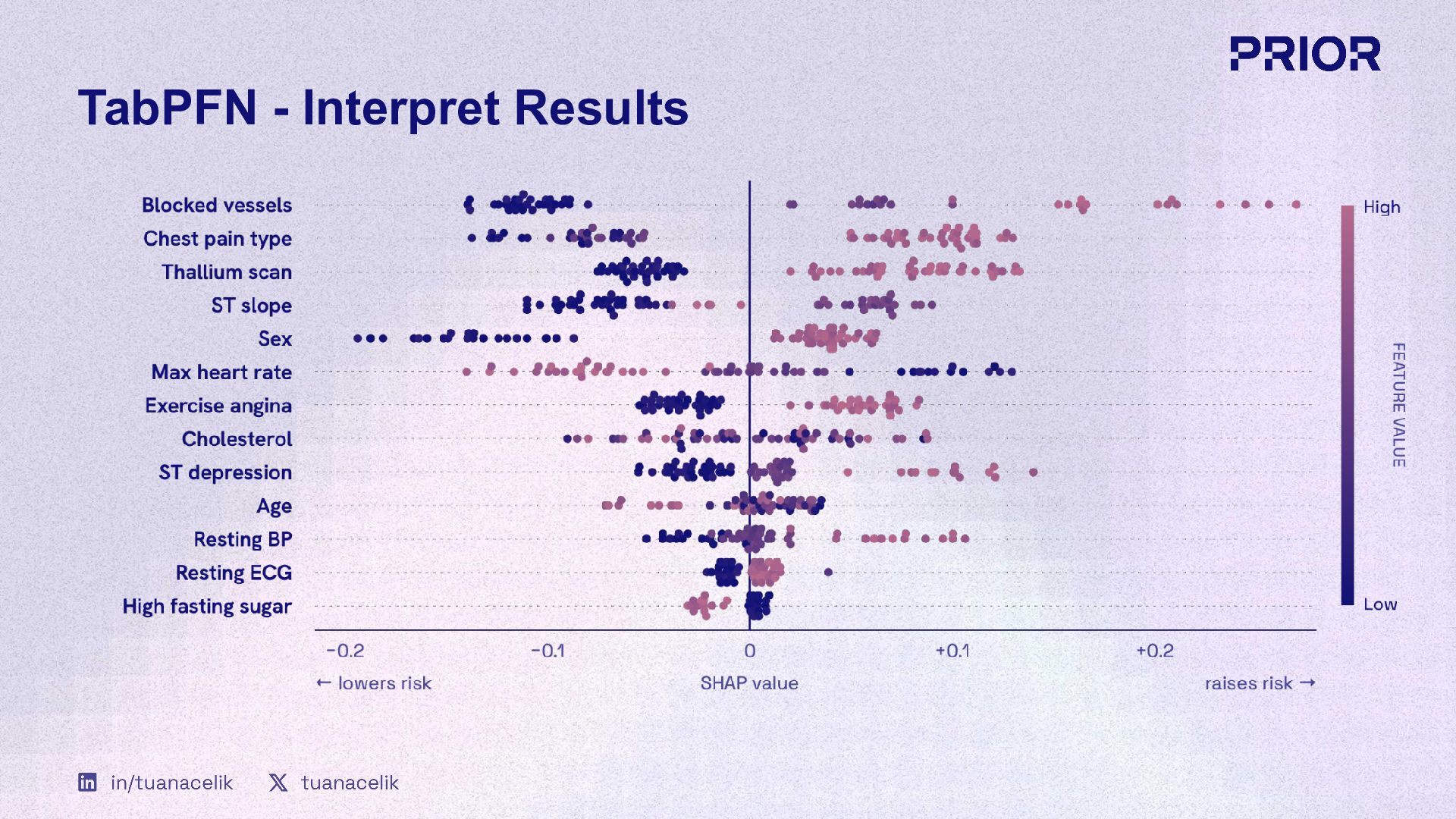
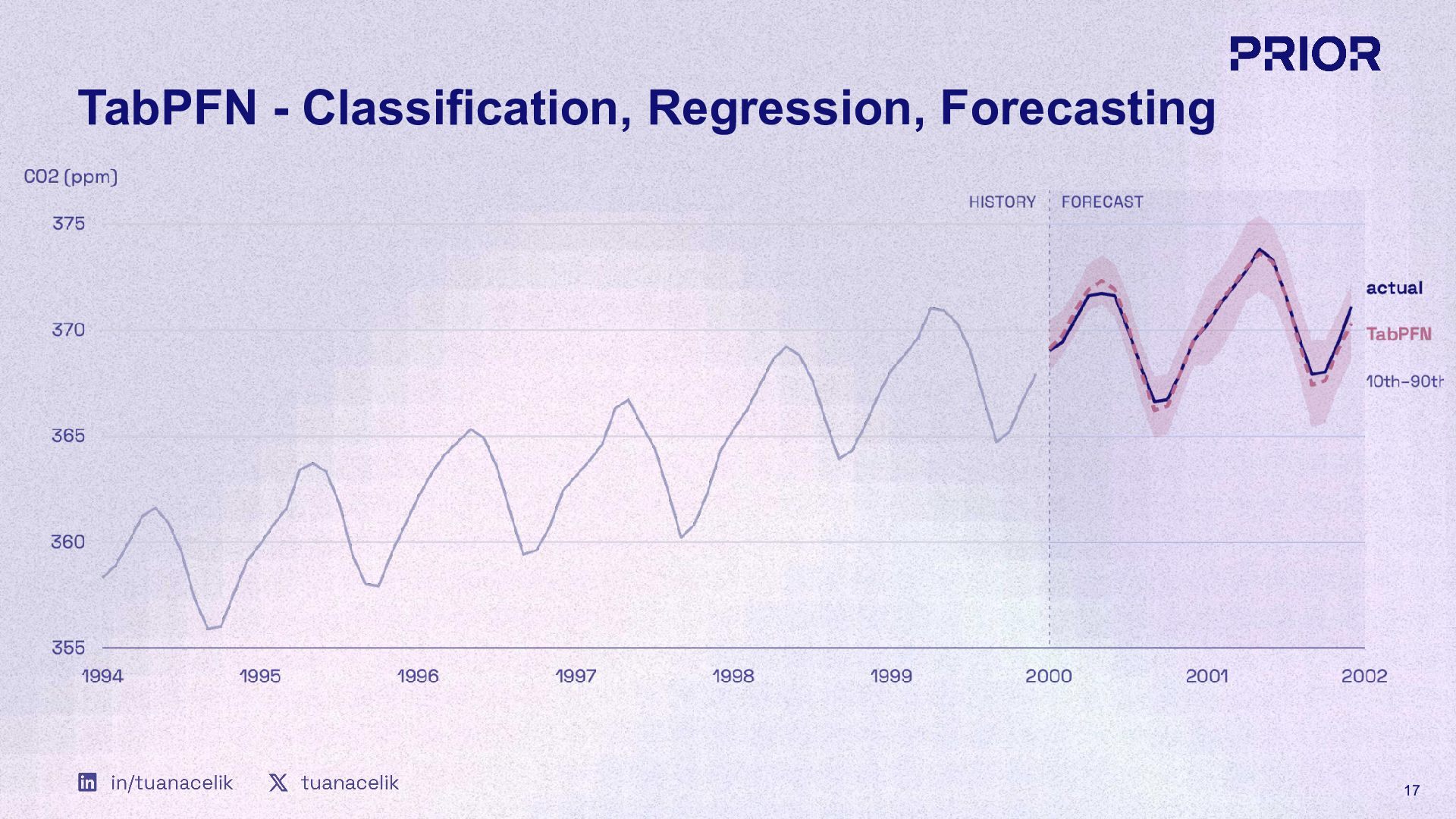
TRAINED TO DO The house sold WHAT A PREDICTION TASK ASKS FOR for ? beds=4 approximately .34 485,000 .22 about .19 a .08 480k m2=138 built=1998 › sold_for = ? P(sold_for | features): 556k, 90% interval 510k to 600k A distribution over words. Good at: A distribution over values, calibrated on the rows. Needed for: Reason Plan Forecast Predict 640k
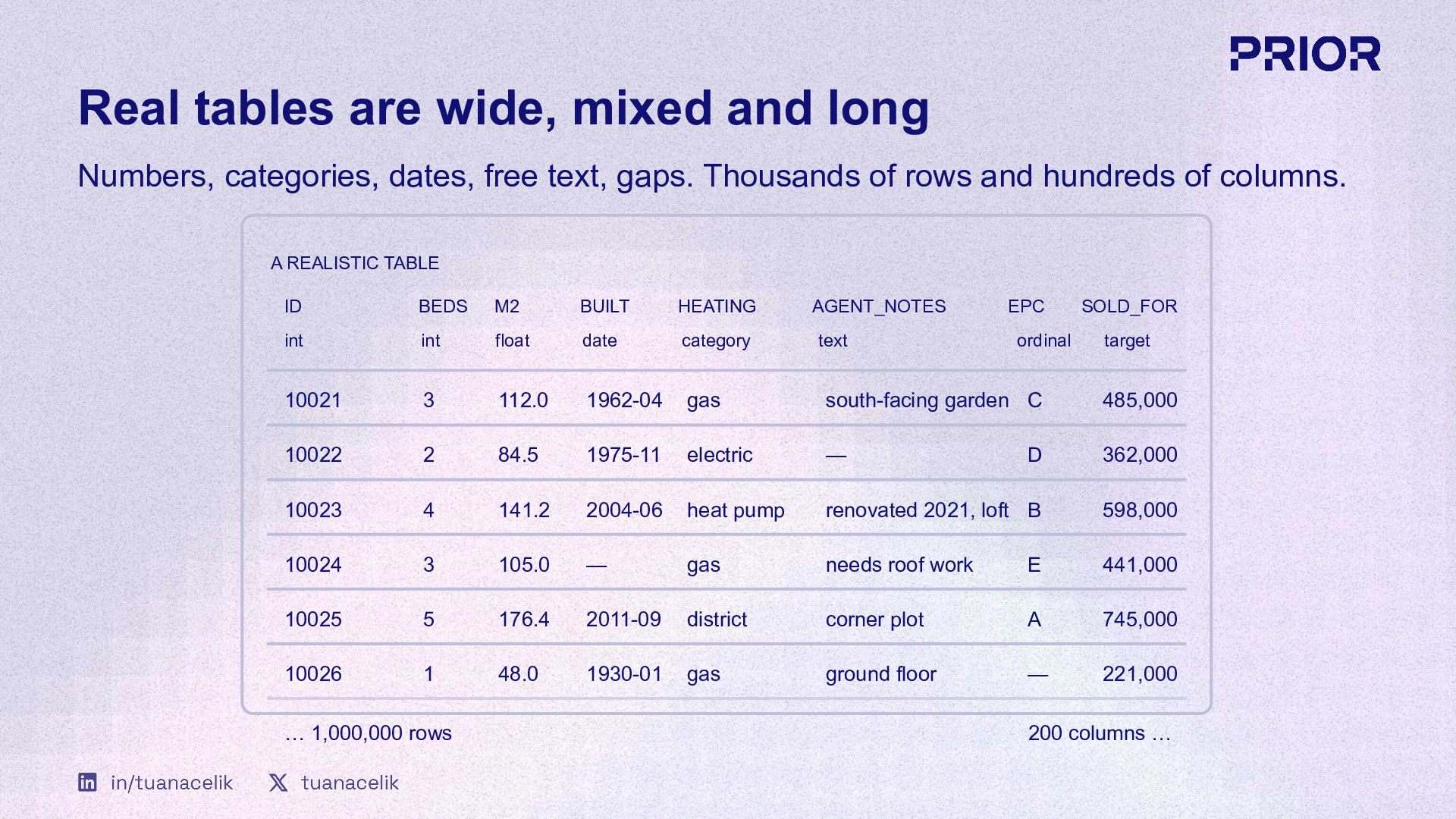
free text, gaps. Thousands of rows and hundreds of columns. A REALISTIC TABLE ID BEDS M2 BUILT HEATING AGENT_NOTES EPC int int float date category text ordinal 10021 3 112.0 1962-04 gas south-facing garden C 485,000 10022 2 84.5 1975-11 electric — D 362,000 10023 4 141.2 2004-06 heat pump renovated 2021, loft B 598,000 10024 3 105.0 — gas needs roof work E 441,000 10025 5 176.4 2011-09 district corner plot A 745,000 10026 1 48.0 1930-01 gas ground floor — 221,000 … 1,000,000 rows SOLD_FOR target 200 columns …
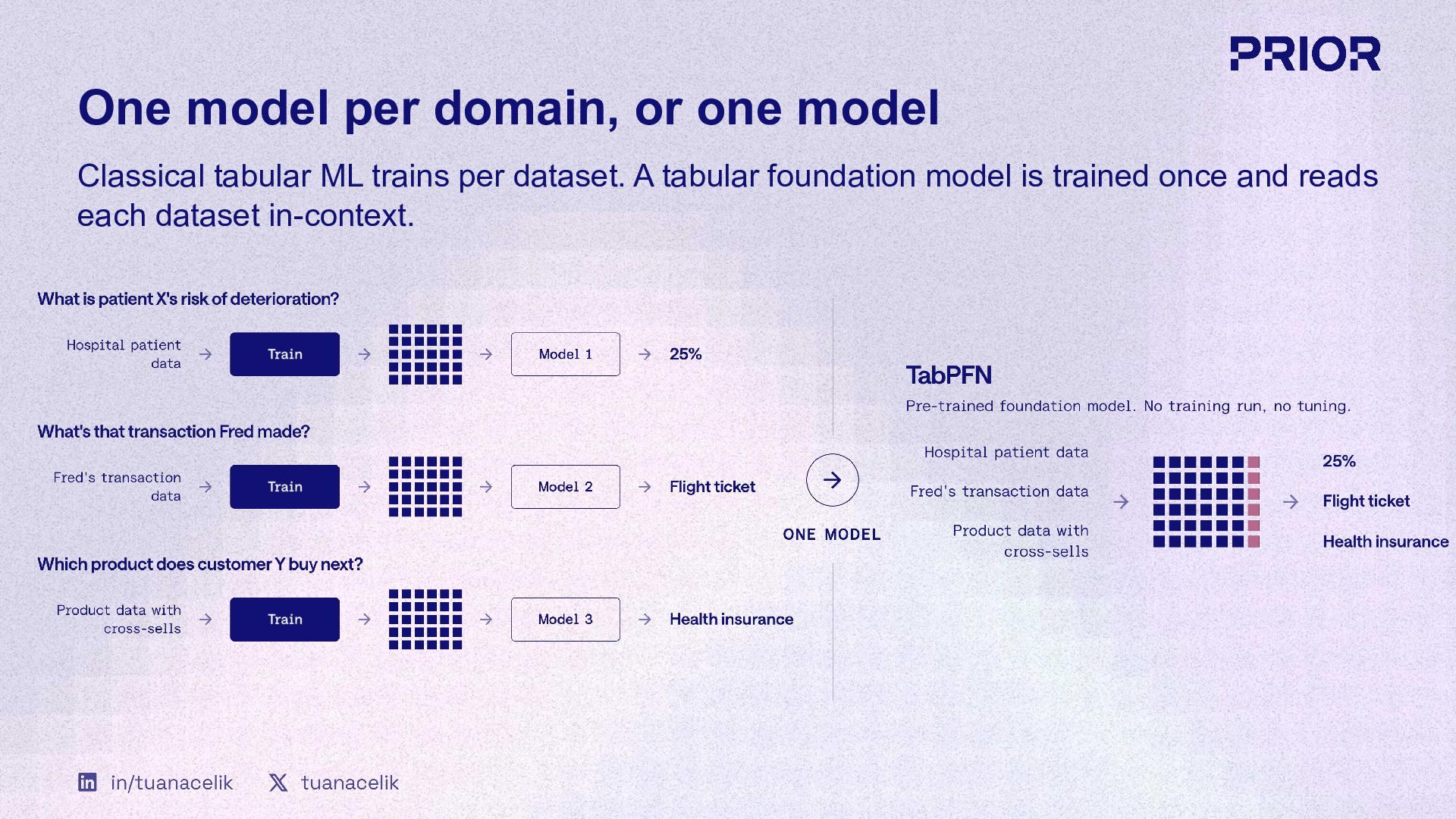
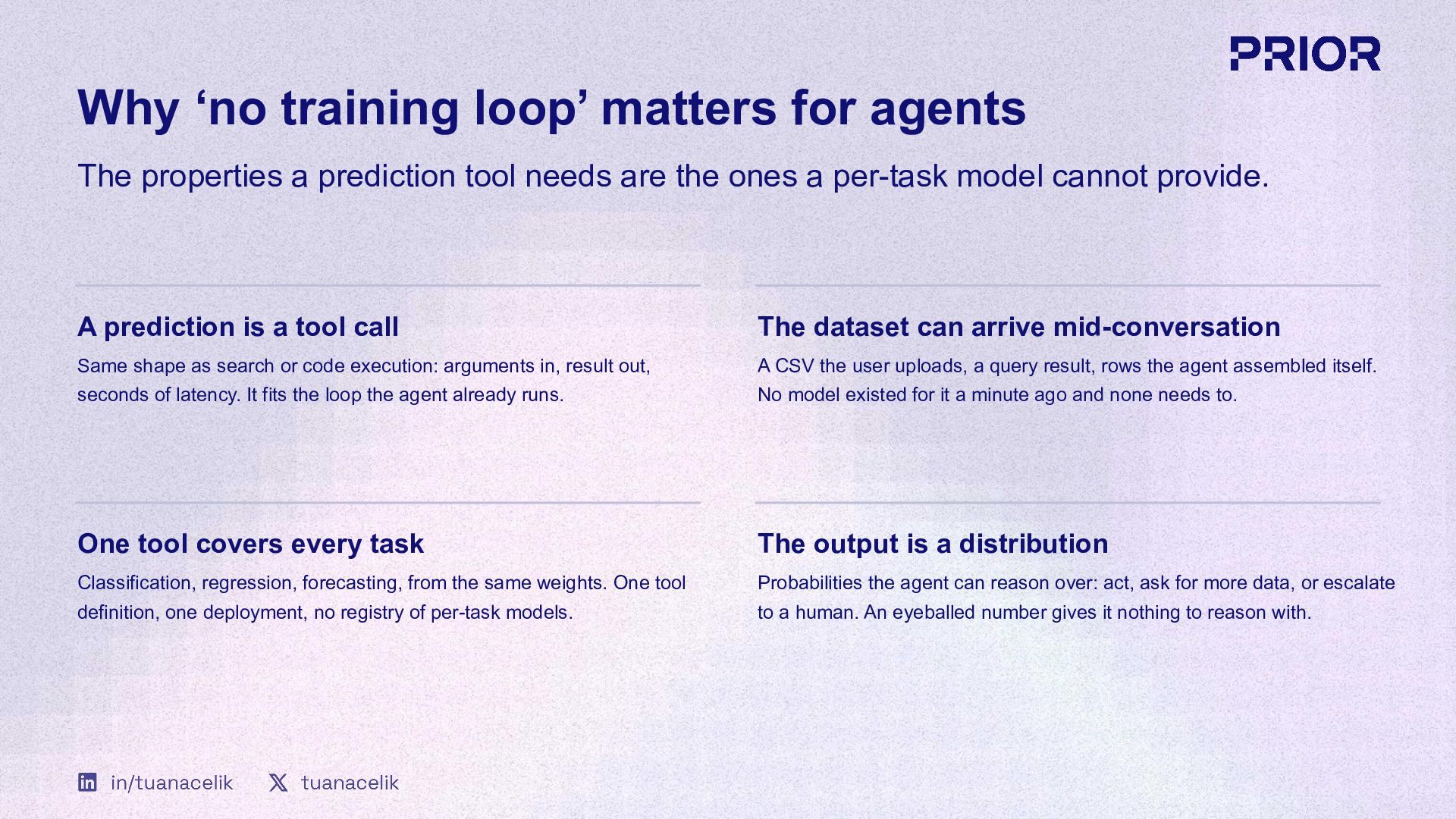
prediction tool needs are the ones a per-task model cannot provide. A prediction is a tool call The dataset can arrive mid-conversation Same shape as search or code execution: arguments in, result out, A CSV the user uploads, a query result, rows the agent assembled itself. seconds of latency. It fits the loop the agent already runs. No model existed for it a minute ago and none needs to. One tool covers every task The output is a distribution Classification, regression, forecasting, from the same weights. One tool Probabilities the agent can reason over: act, ask for more data, or escalate definition, one deployment, no registry of per-task models. to a human. An eyeballed number gives it nothing to reason with.
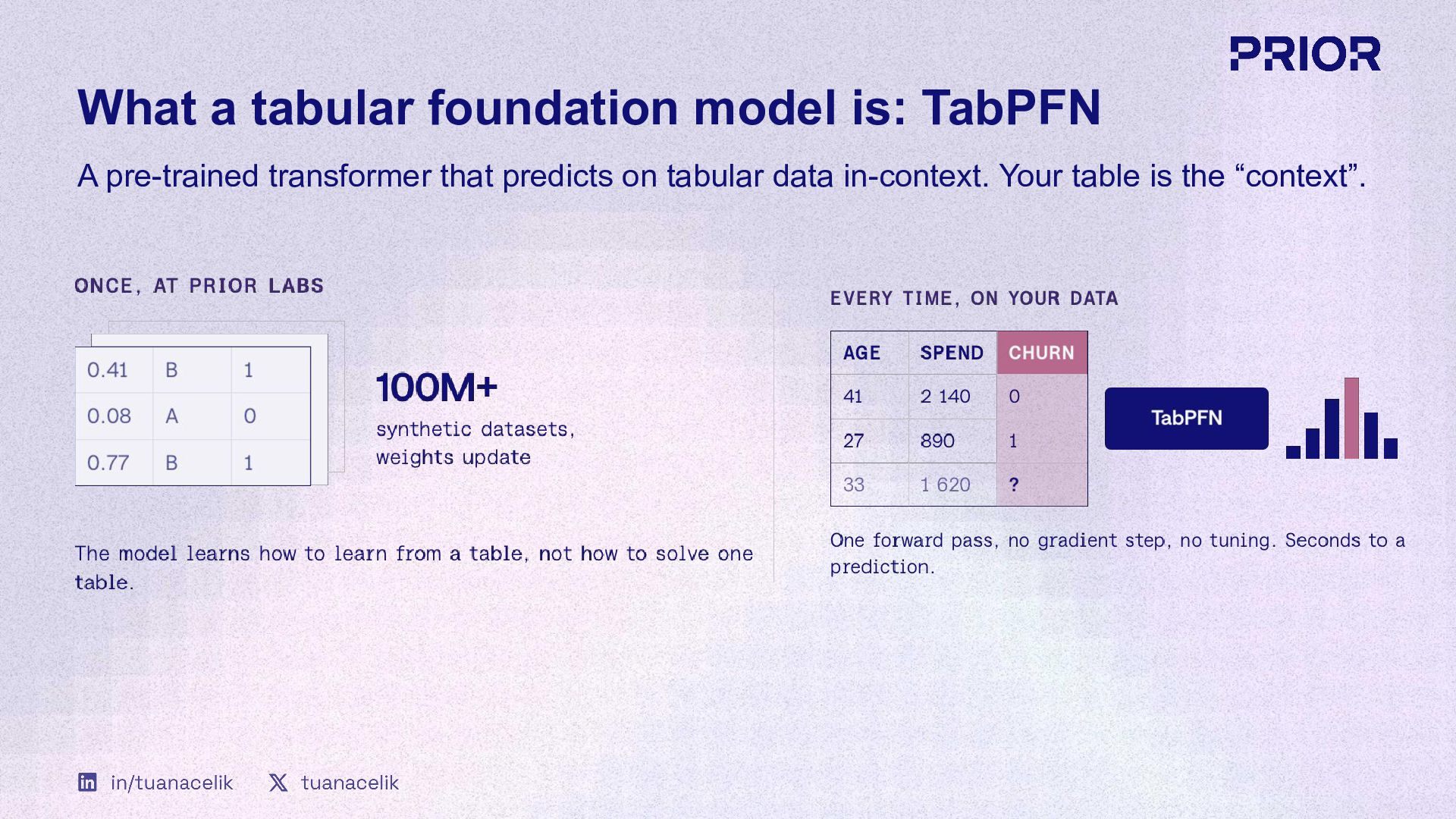
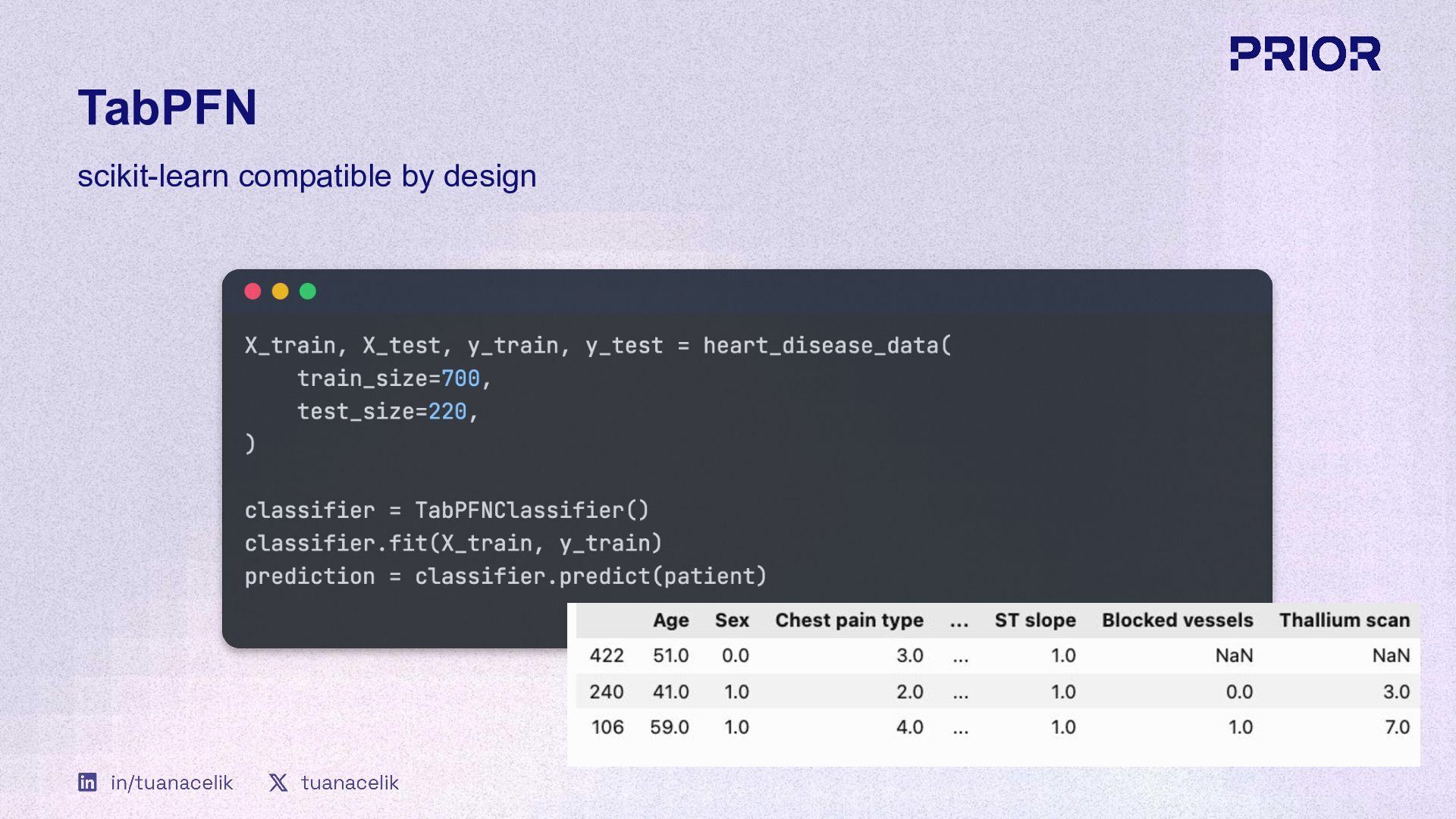
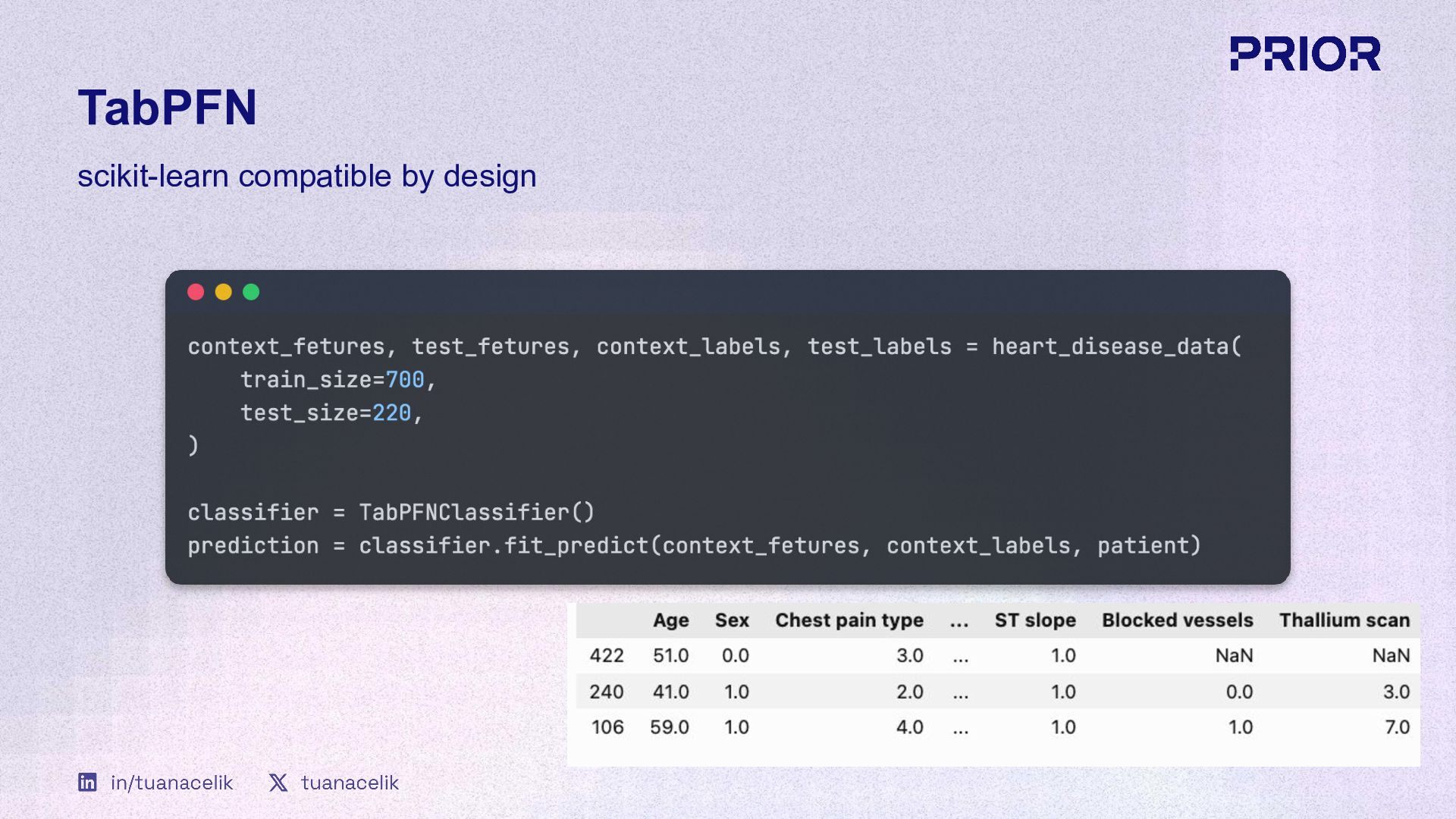
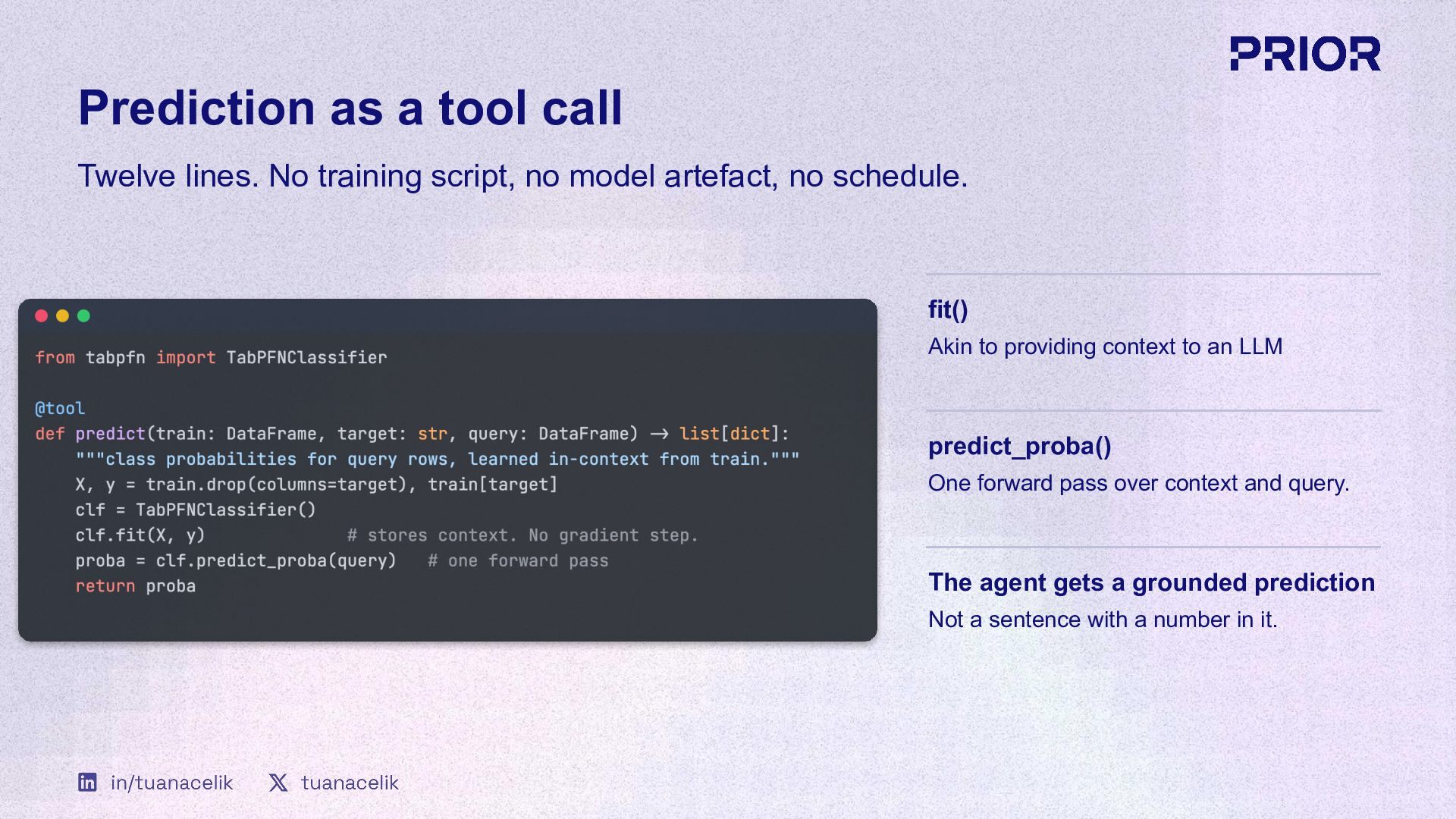
no model artefact, no schedule. fit() Akin to providing context to an LLM predict_proba() One forward pass over context and query. The agent gets a grounded prediction Not a sentence with a number in it.
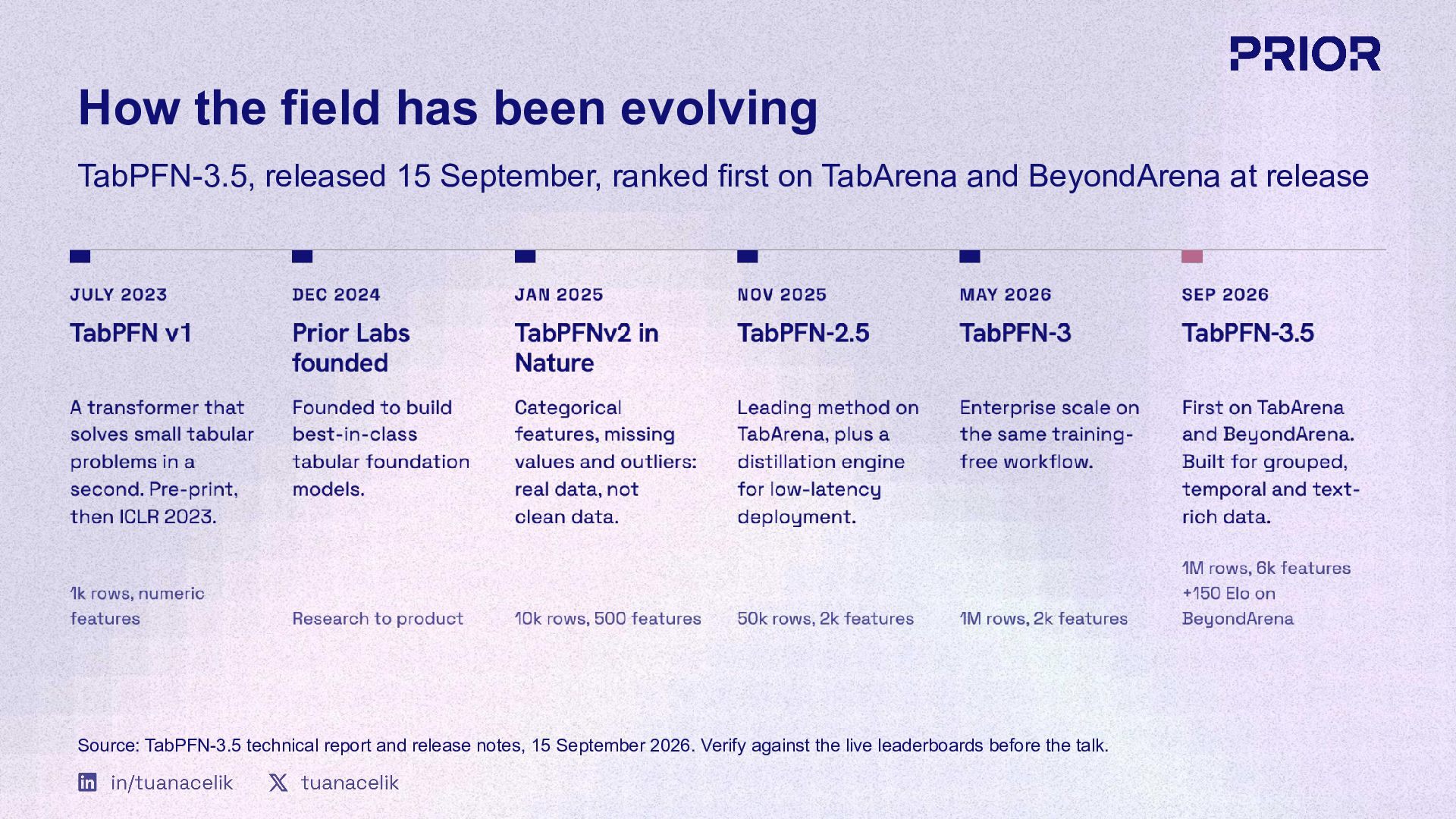
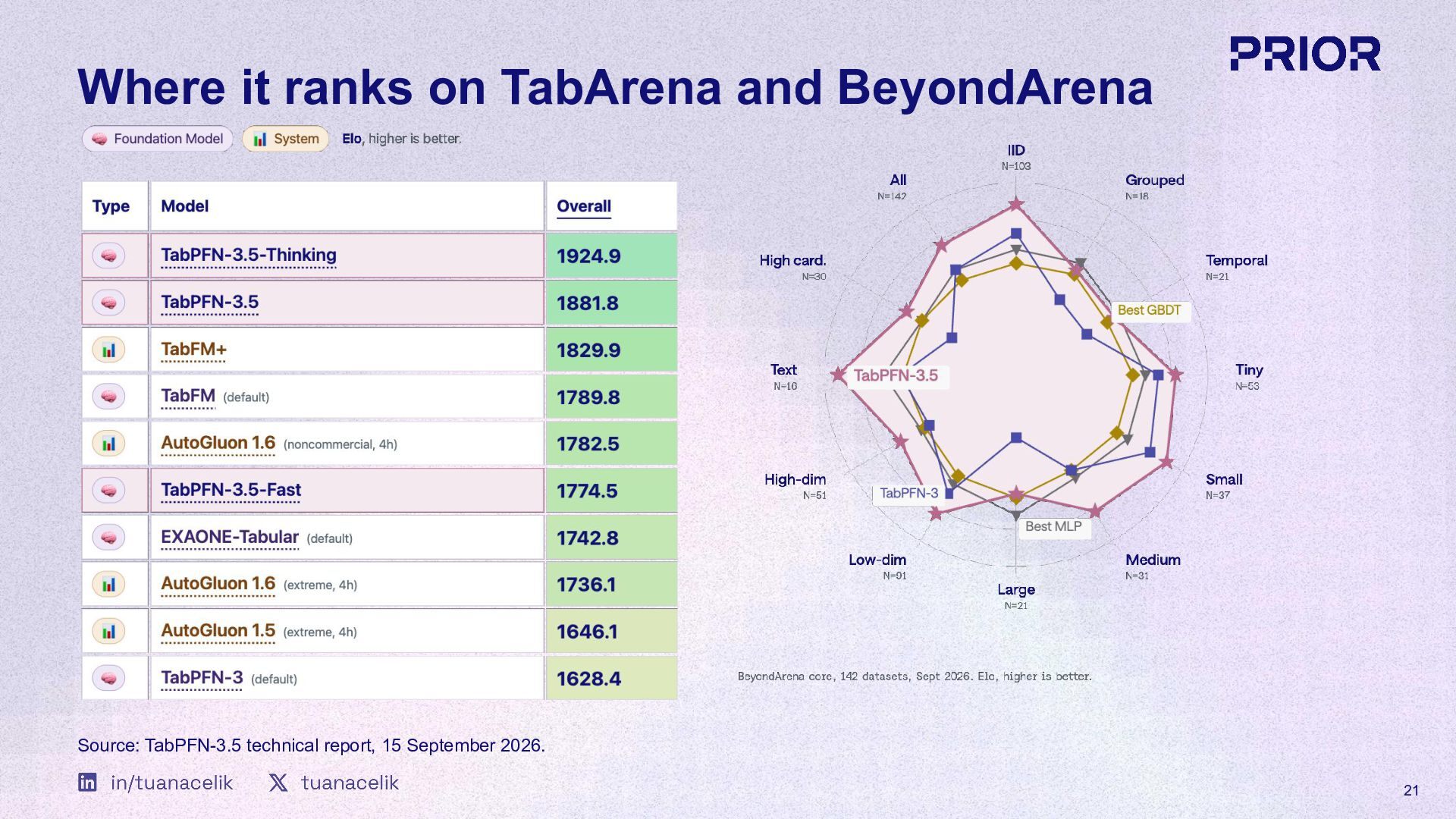
ranked first on TabArena and BeyondArena at release Source: TabPFN-3.5 technical report and release notes, 15 September 2026. Verify against the live leaderboards before the talk.
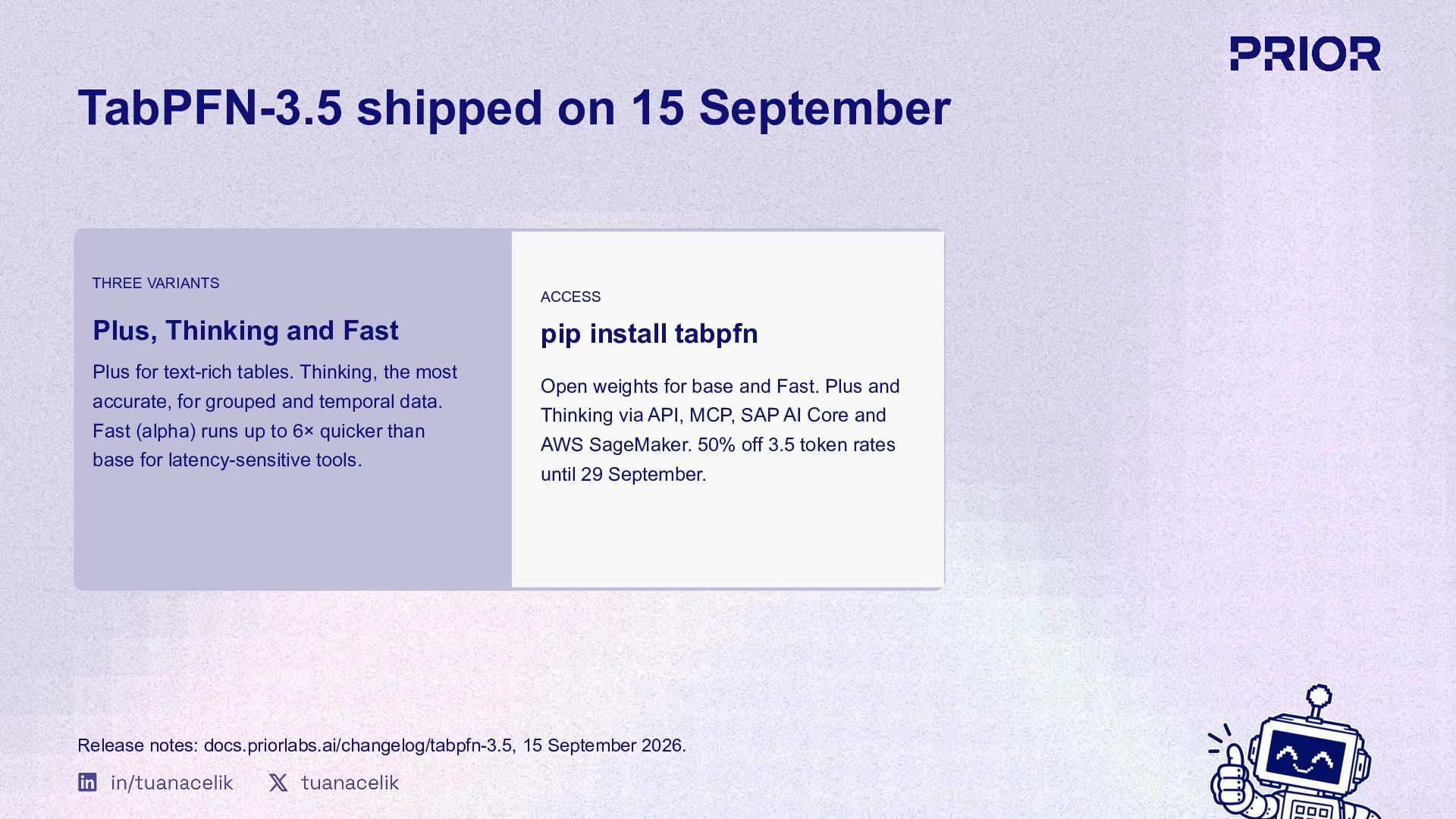
and Fast Plus for text-rich tables. Thinking, the most accurate, for grouped and temporal data. Fast (alpha) runs up to 6× quicker than base for latency-sensitive tools. pip install tabpfn Open weights for base and Fast. Plus and Thinking via API, MCP, SAP AI Core and AWS SageMaker. 50% off 3.5 token rates until 29 September. Release notes: docs.priorlabs.ai/changelog/tabpfn-3.5, 15 September 2026.
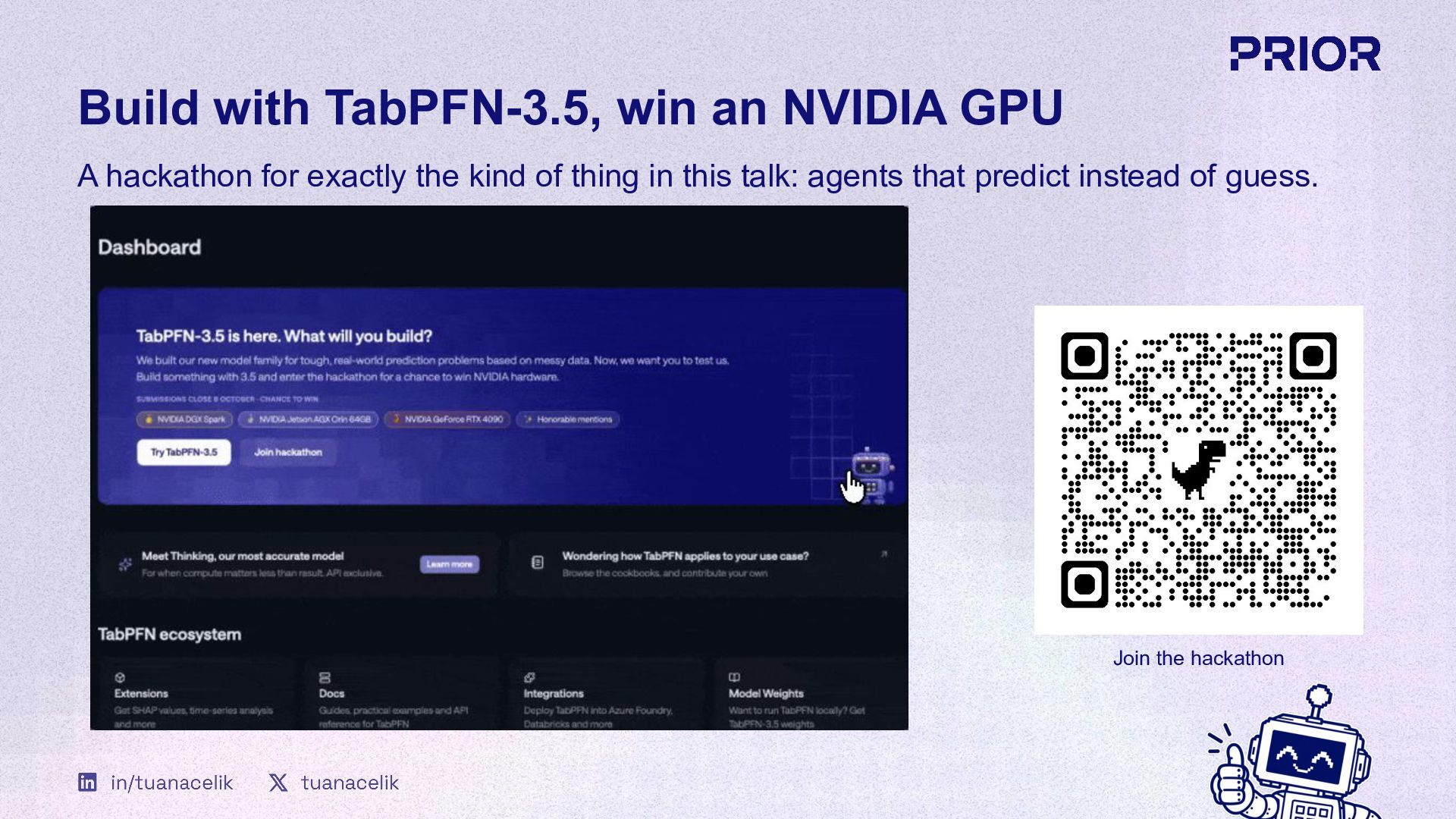
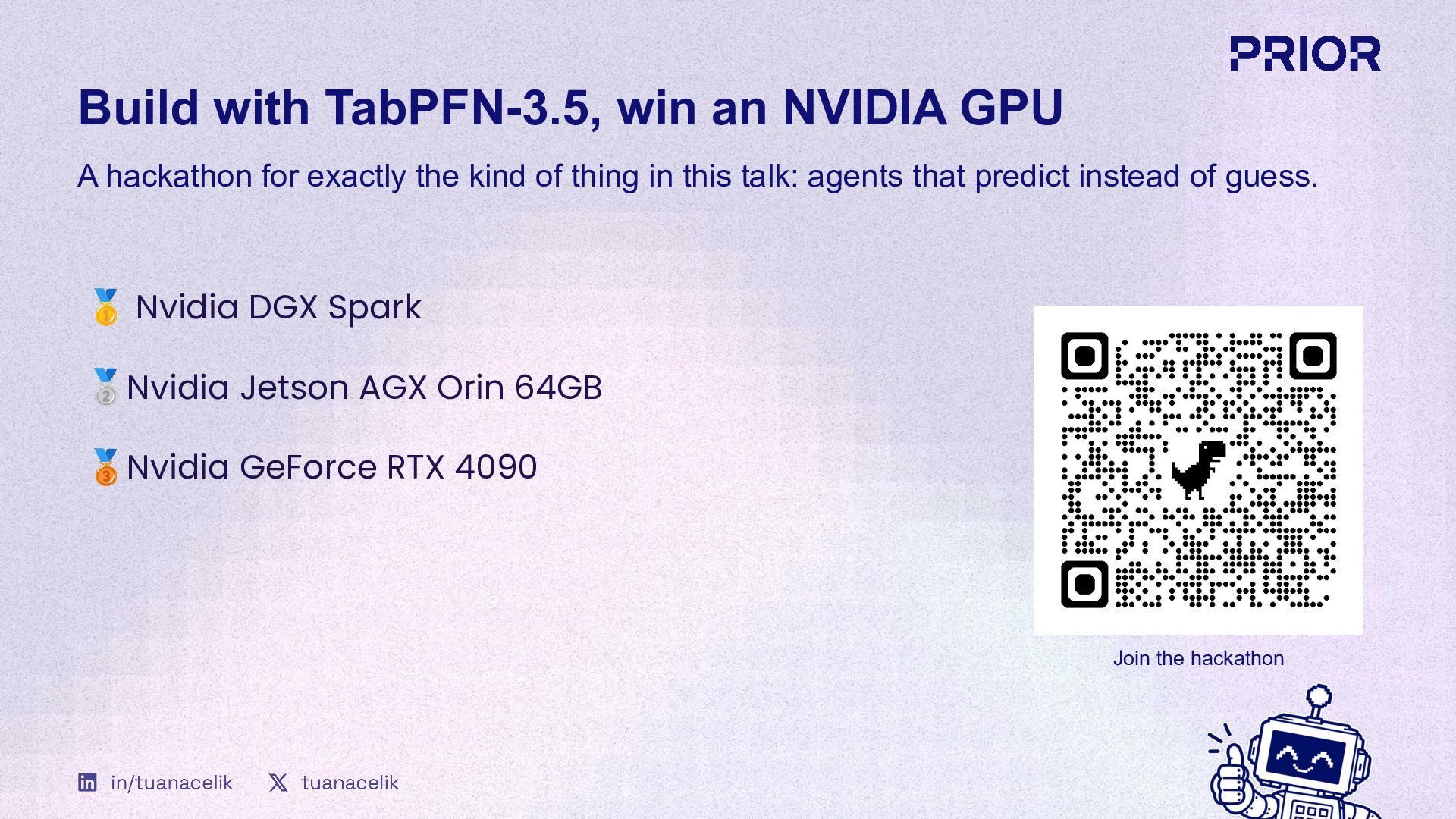
exactly the kind of thing in this talk: agents that predict instead of guess. 🥇 Nvidia DGX Spark 🥈Nvidia Jetson AGX Orin 64GB 🥉Nvidia GeForce RTX 4090 Join the hackathon


 tuanacelik
 recruitengineers
 aoto
aoto
 yamanoku
 ymrl
ymrl
 philipz
 kairim0
 shogo4131
 kakakakakku
 mewuto
 y0hgi
y0hgi
 soudai
 grimoh
 jonoalderson
 lara
lara
 portentint
 inesmontani
 techseoconnect
 stuffmc
 eitanlees
 akihiro_kokubo
 eileencodes
 gr2m
gr2m
 reverentgeek
 jnunemaker