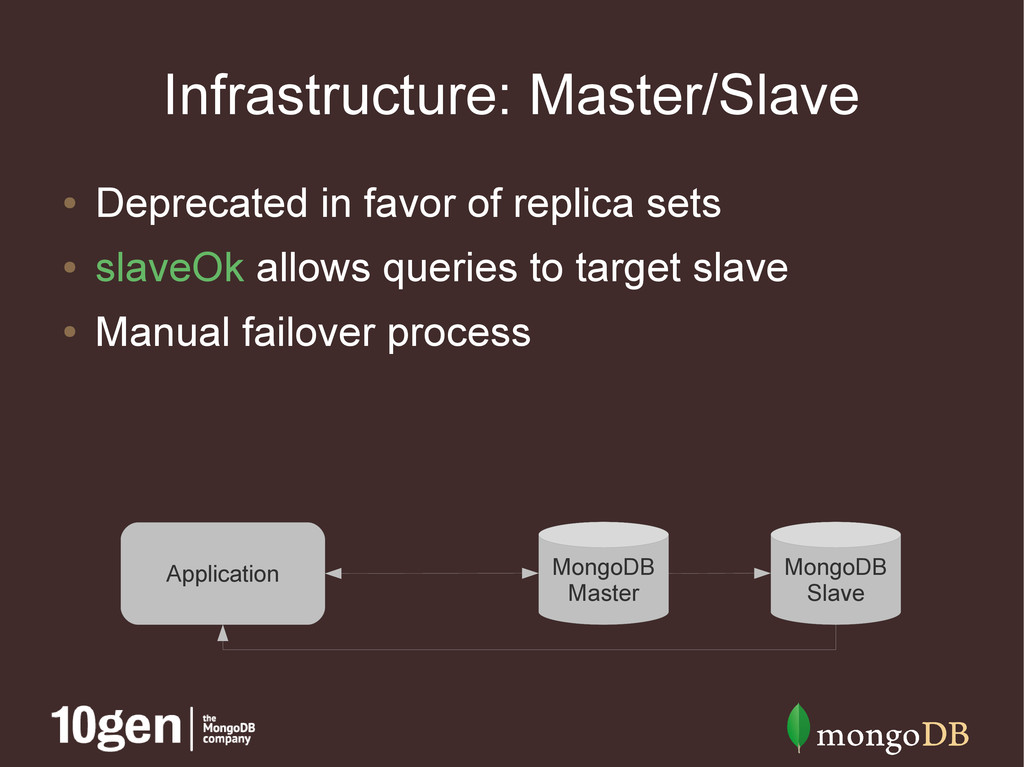
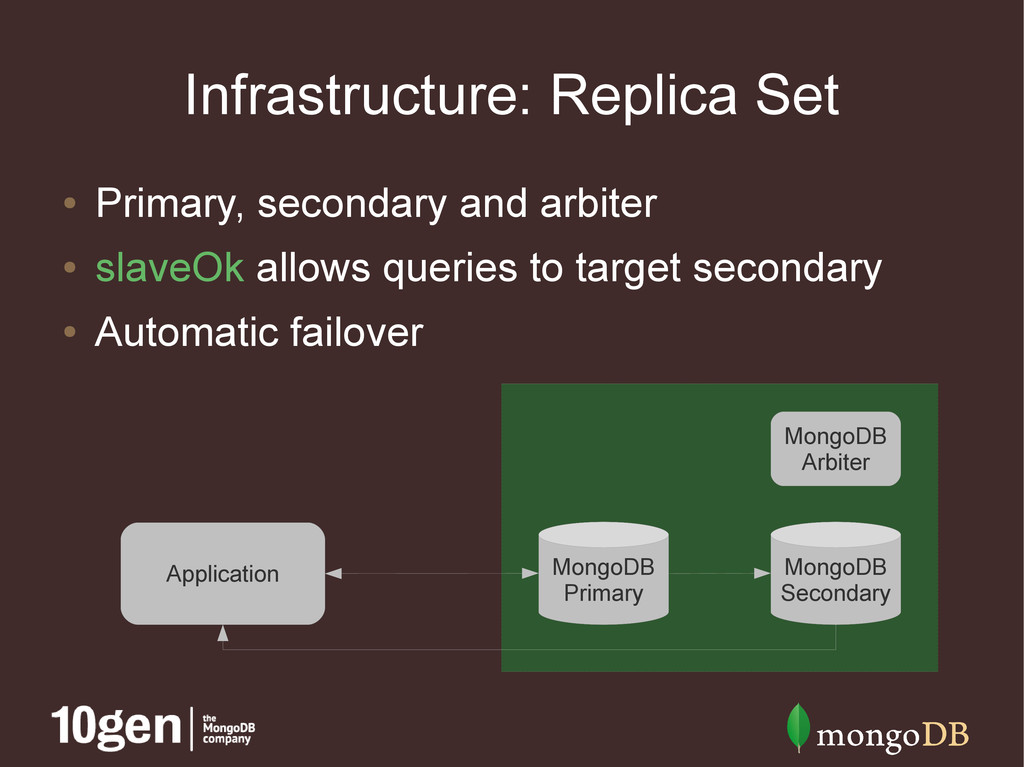
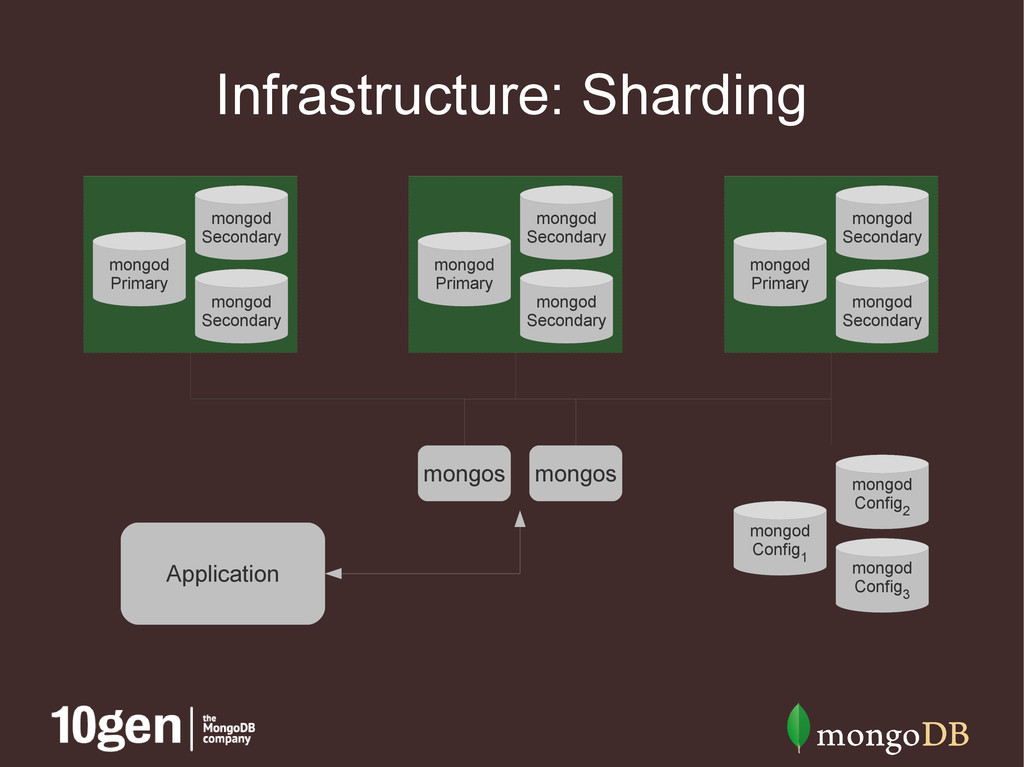
and merges results • Lightweight with no persistent state • Config servers • Launched with mongod --configsvr • Store cluster metadata (shard/chunk locations) • Proprietary replication model
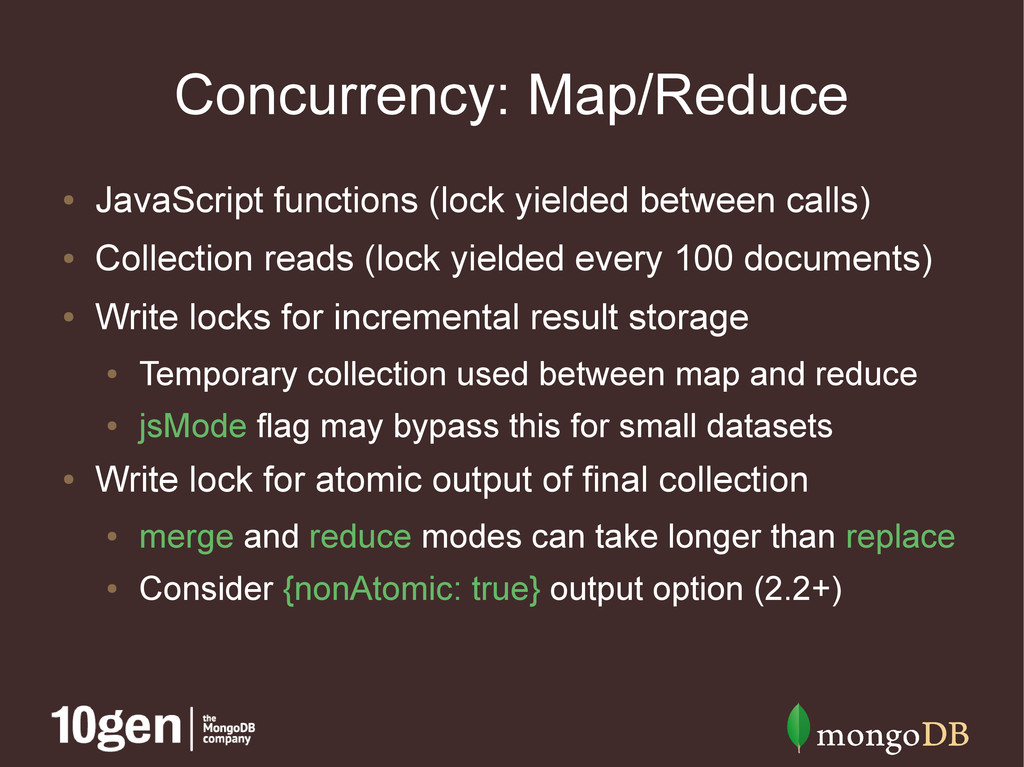
Collection reads (lock yielded every 100 documents) • Write locks for incremental result storage • Temporary collection used between map and reduce • jsMode flag may bypass this for small datasets • Write lock for atomic output of final collection • merge and reduce modes can take longer than replace • Consider {nonAtomic: true} output option (2.2+)
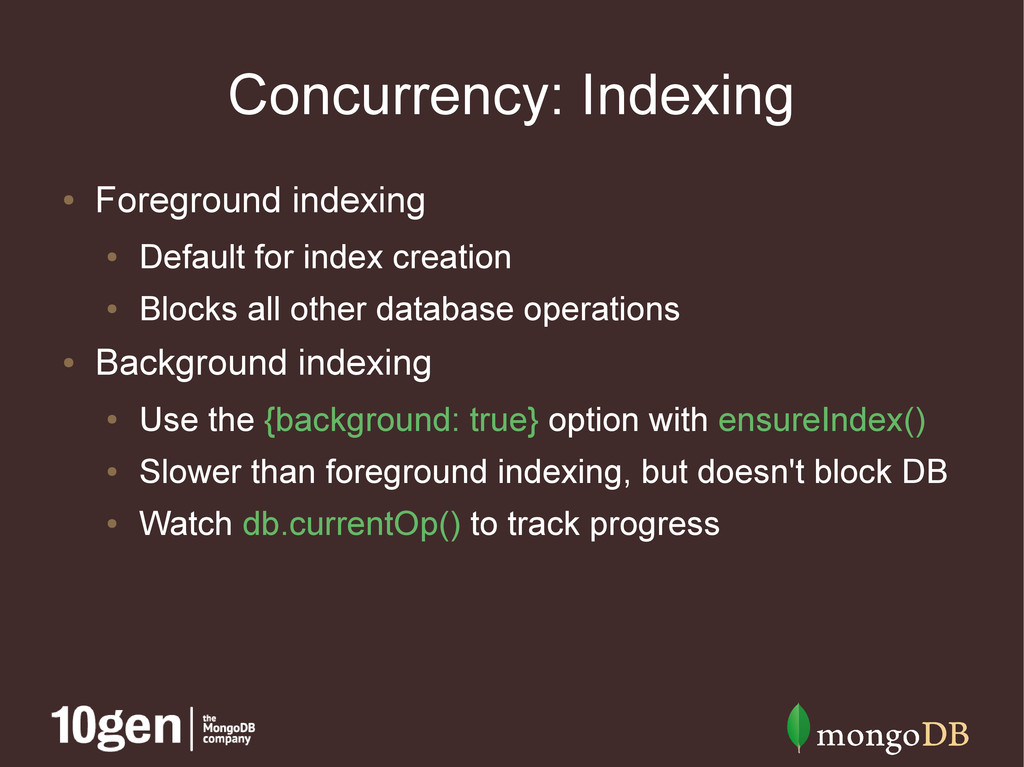
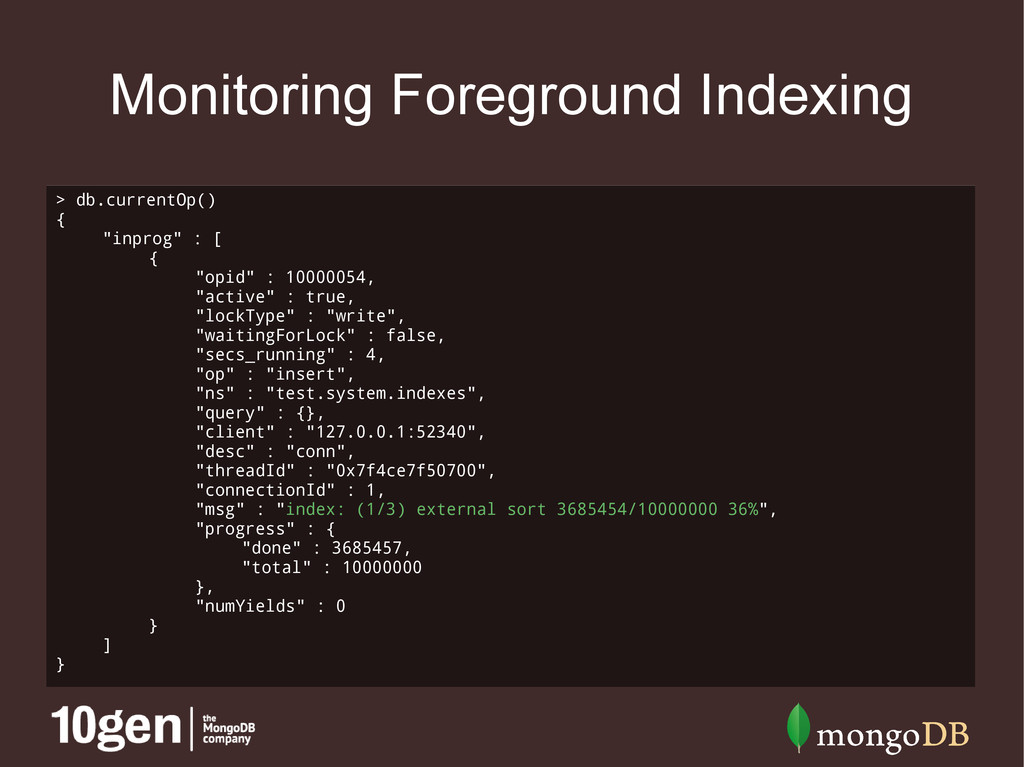
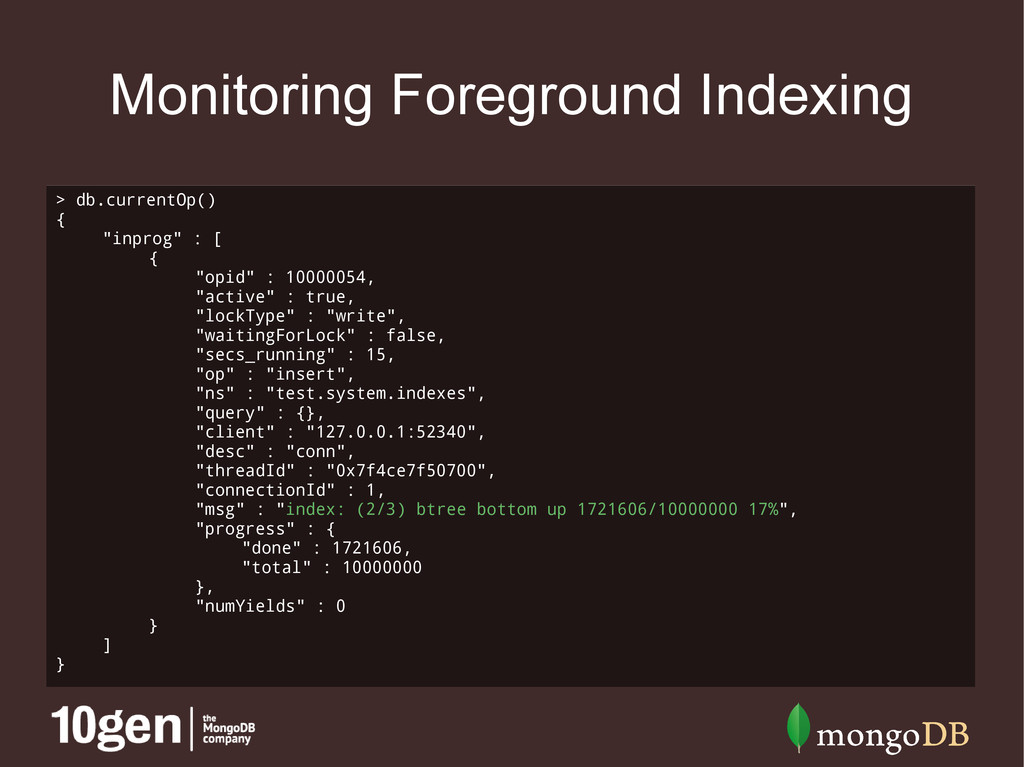
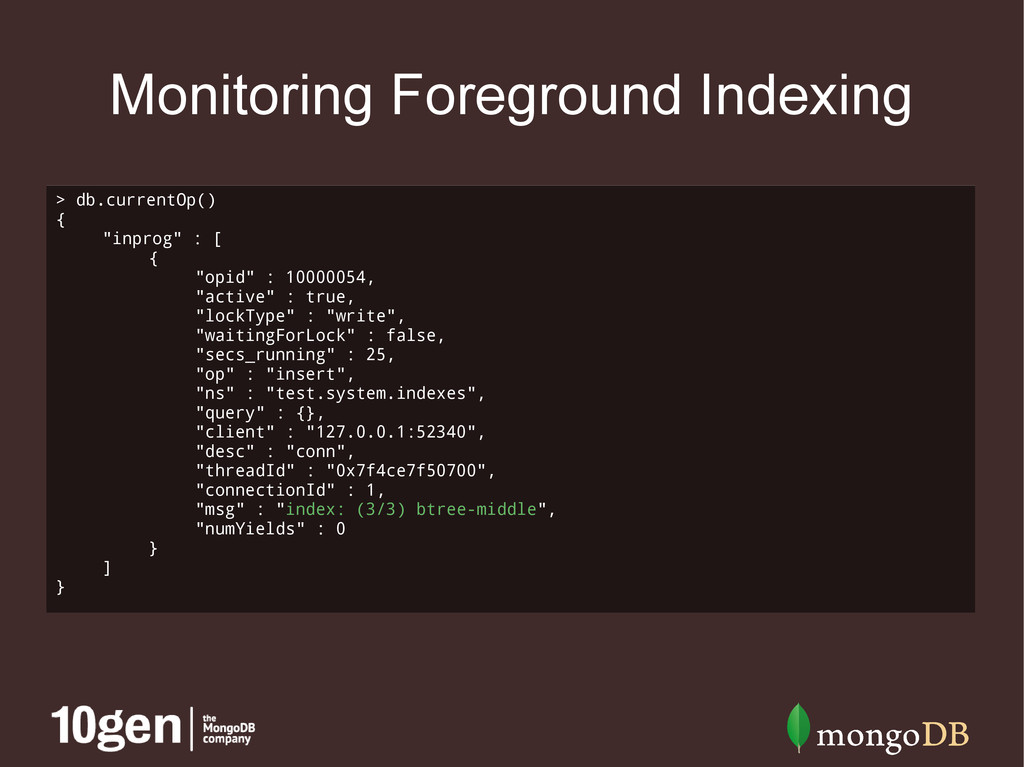
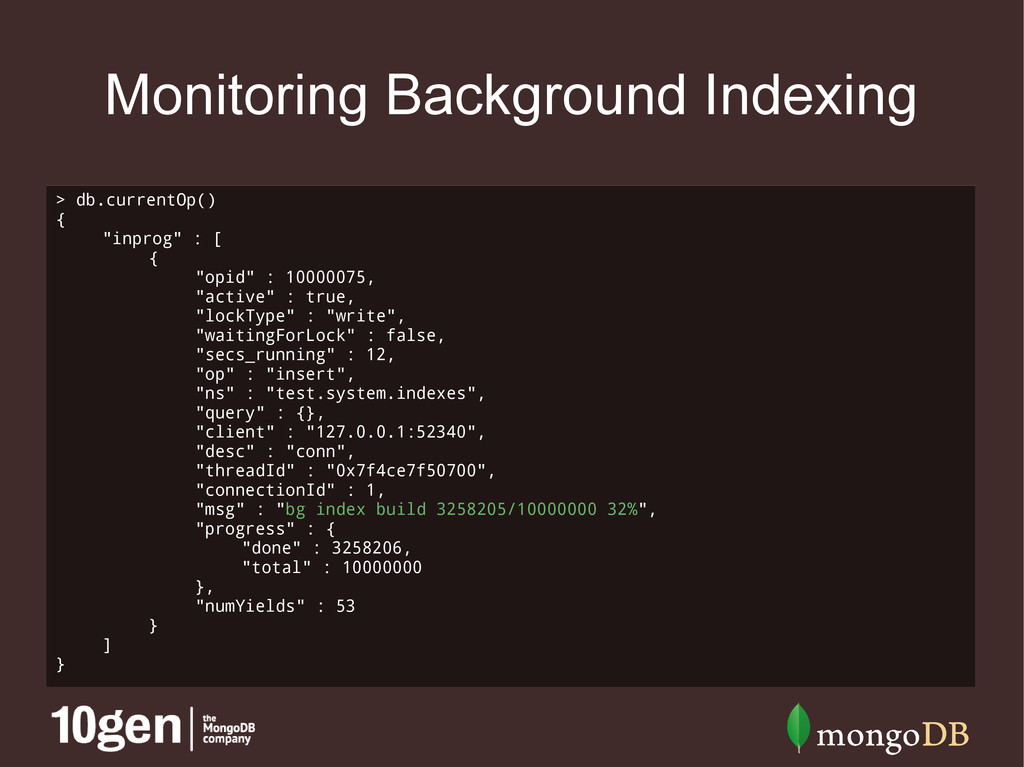
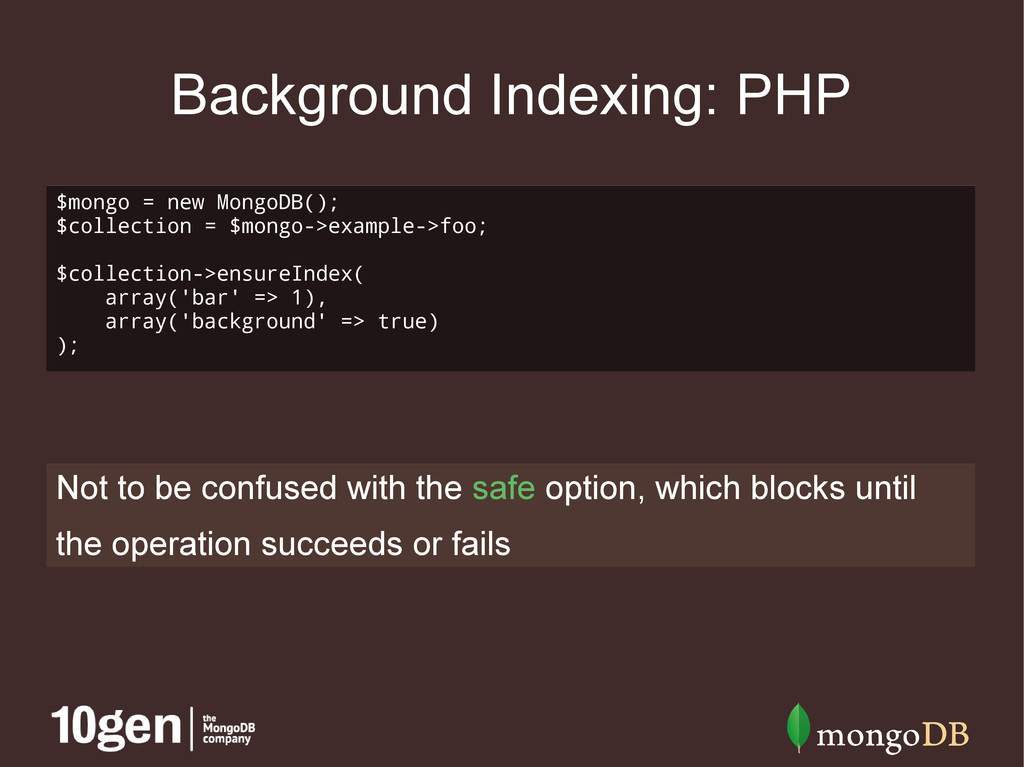
• Blocks all other database operations • Background indexing • Use the {background: true} option with ensureIndex() • Slower than foreground indexing, but doesn't block DB • Watch db.currentOp() to track progress
$collection->ensureIndex( array('bar' => 1), array('background' => true) ); Not to be confused with the safe option, which blocks until the operation succeeds or fails
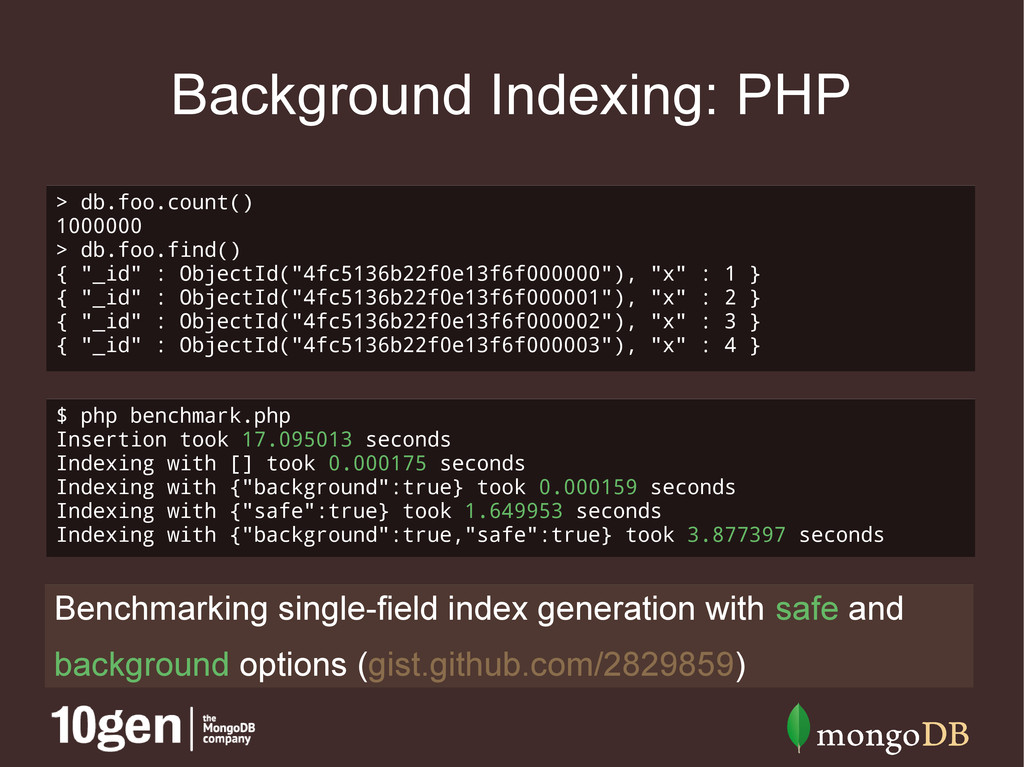
: ObjectId("4fc5136b22f0e13f6f000000"), "x" : 1 } { "_id" : ObjectId("4fc5136b22f0e13f6f000001"), "x" : 2 } { "_id" : ObjectId("4fc5136b22f0e13f6f000002"), "x" : 3 } { "_id" : ObjectId("4fc5136b22f0e13f6f000003"), "x" : 4 } $ php benchmark.php Insertion took 17.095013 seconds Indexing with [] took 0.000175 seconds Indexing with {"background":true} took 0.000159 seconds Indexing with {"safe":true} took 1.649953 seconds Indexing with {"background":true,"safe":true} took 3.877397 seconds Benchmarking single-field index generation with safe and background options (gist.github.com/2829859)
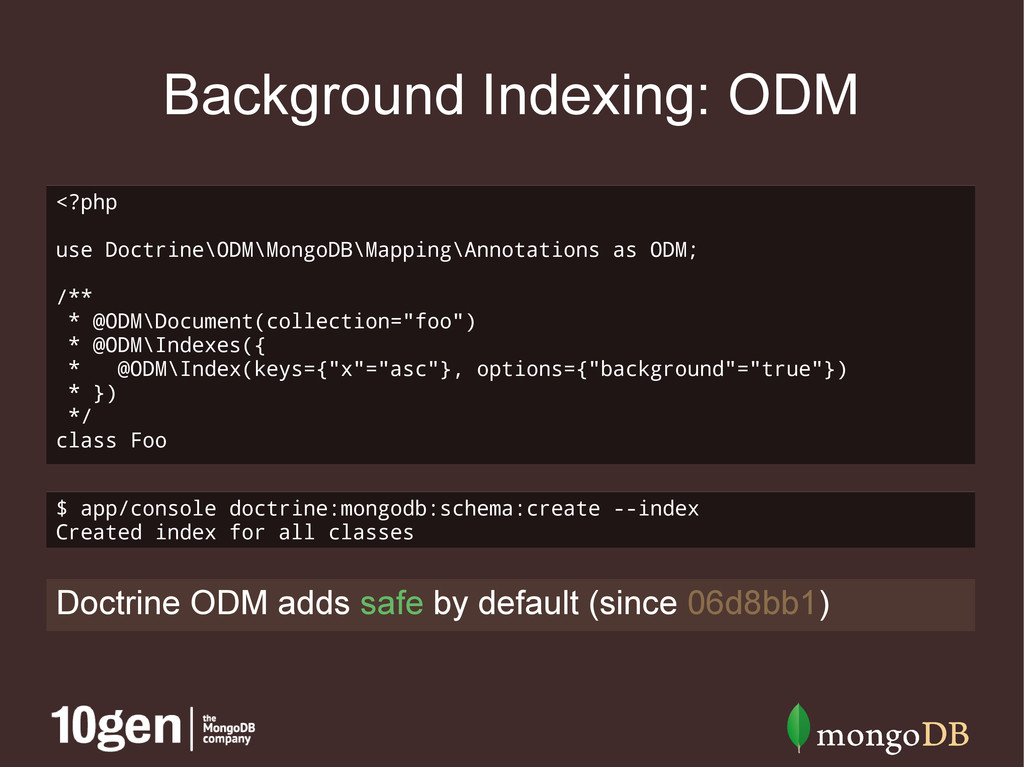
@ODM\Document(collection="foo") * @ODM\Indexes({ * @ODM\Index(keys={"x"="asc"}, options={"background"="true"}) * }) */ class Foo $ app/console doctrine:mongodb:schema:create --index Created index for all classes Doctrine ODM adds safe by default (since 06d8bb1)
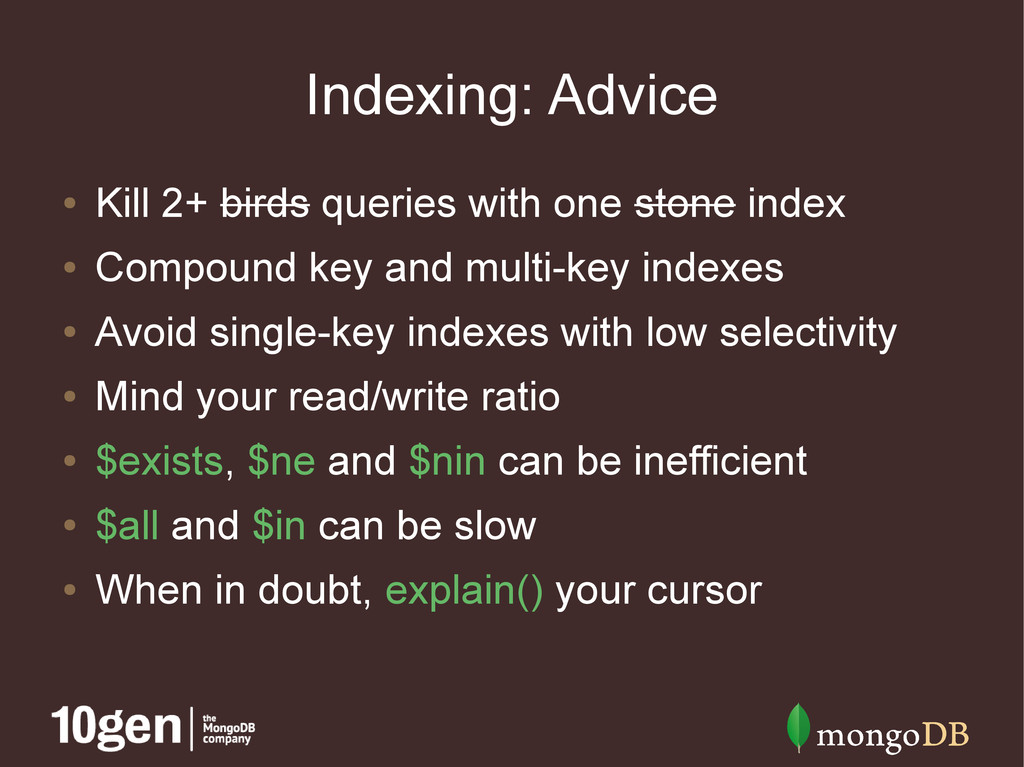
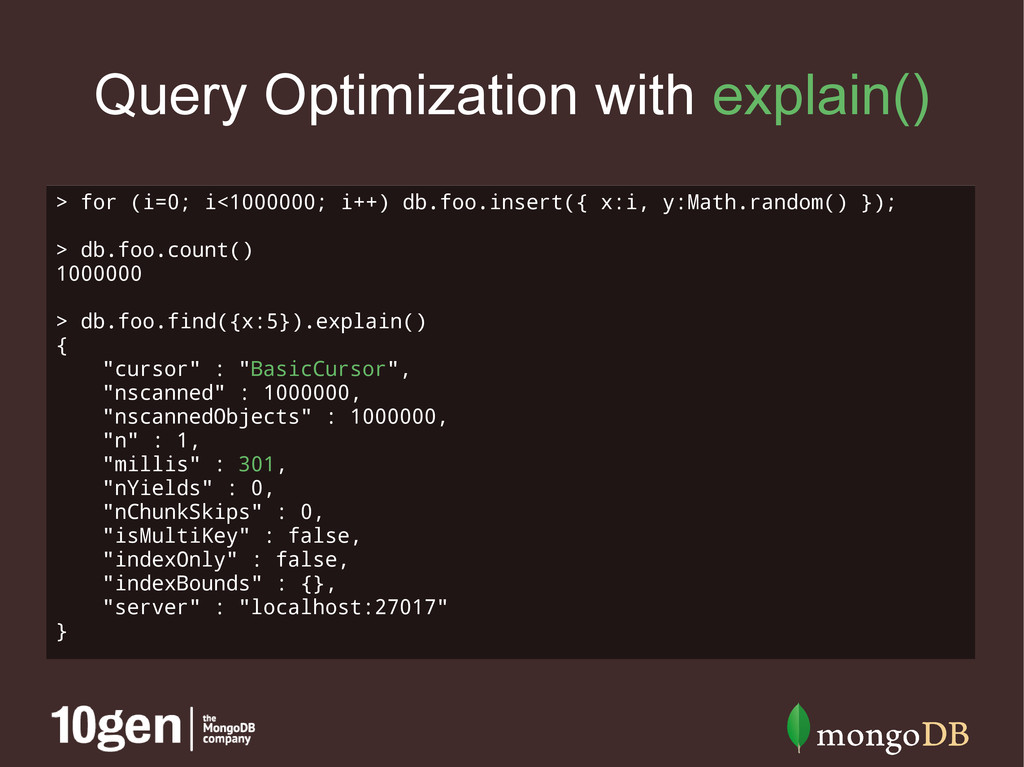
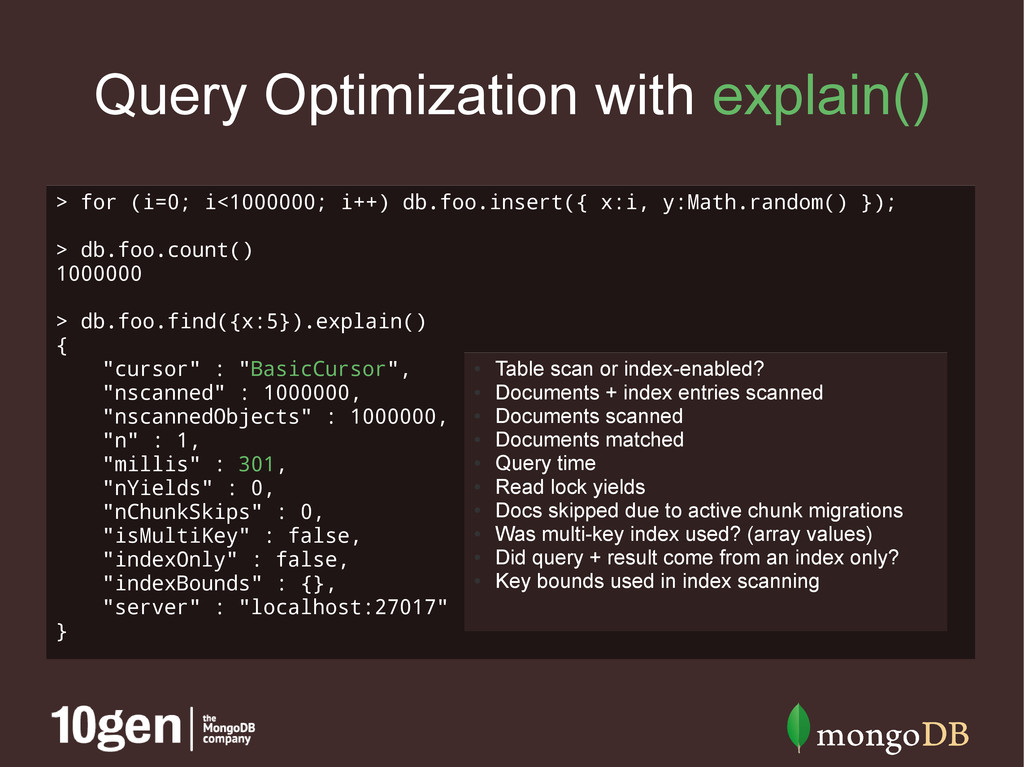
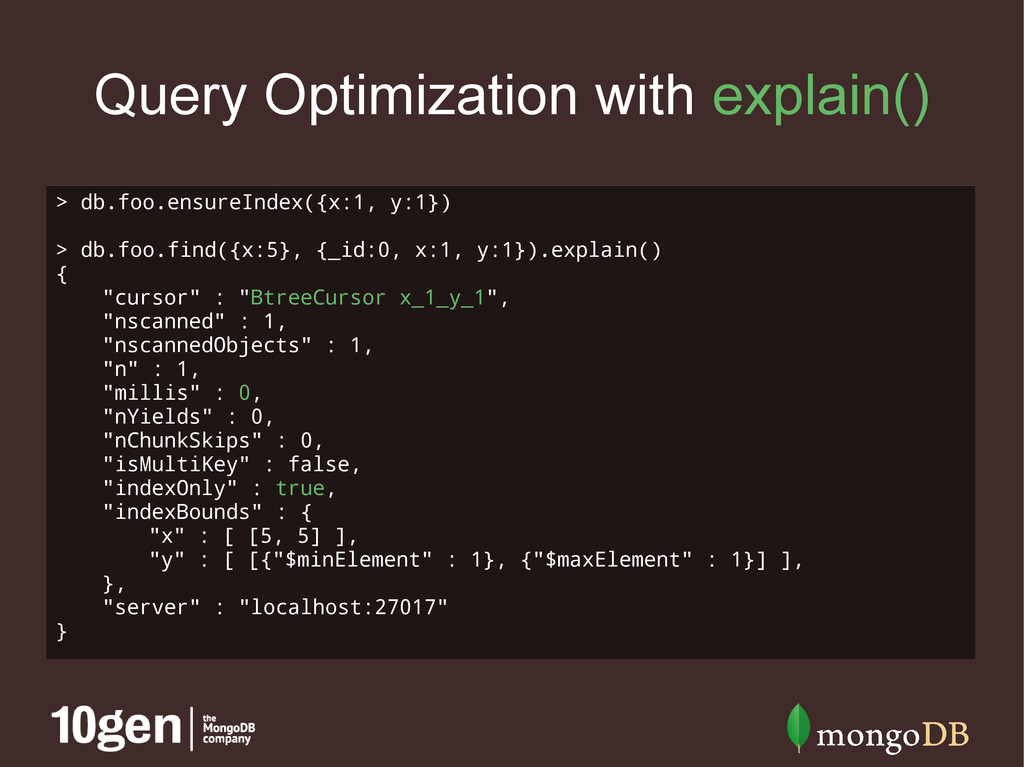
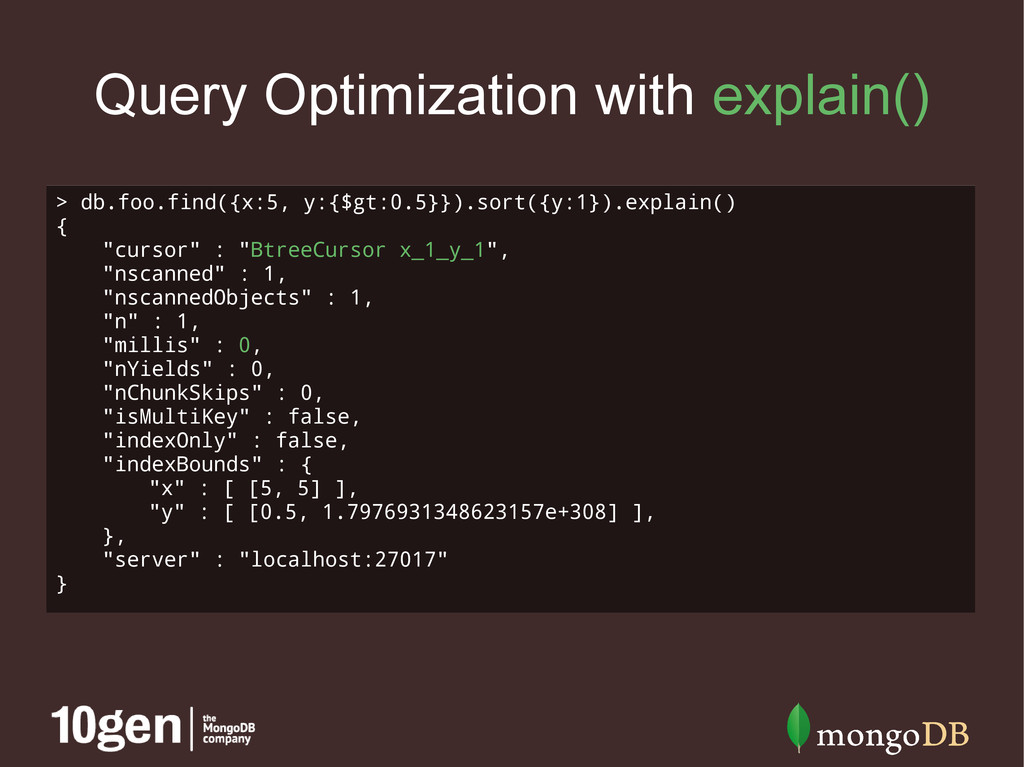
index • Compound key and multi-key indexes • Avoid single-key indexes with low selectivity • Mind your read/write ratio • $exists, $ne and $nin can be inefficient • $all and $in can be slow • When in doubt, explain() your cursor
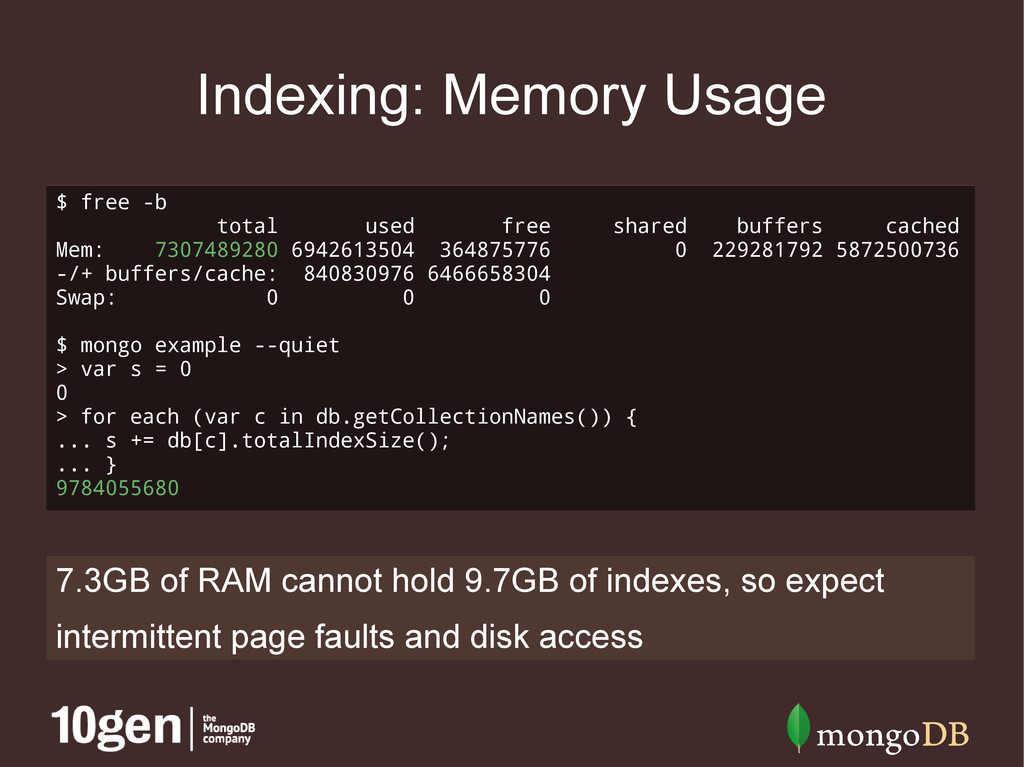
buffers cached Mem: 7307489280 6942613504 364875776 0 229281792 5872500736 -/+ buffers/cache: 840830976 6466658304 Swap: 0 0 0 $ mongo example --quiet > var s = 0 0 > for each (var c in db.getCollectionNames()) { ... s += db[c].totalIndexSize(); ... } 9784055680 7.3GB of RAM cannot hold 9.7GB of indexes, so expect intermittent page faults and disk access
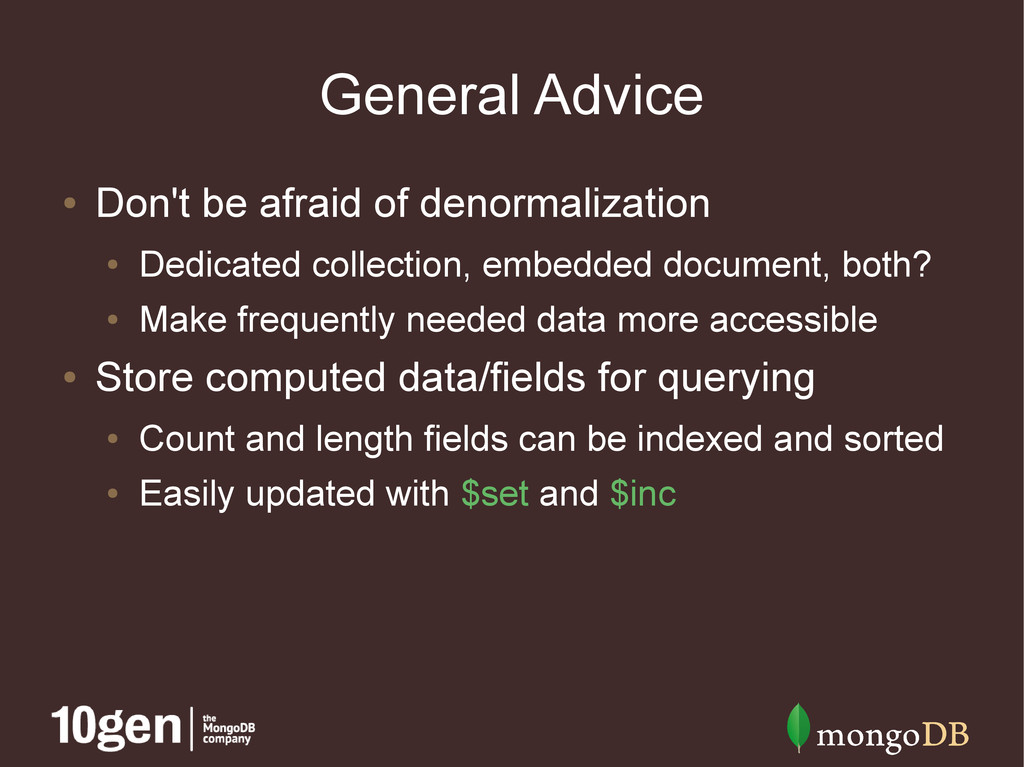
collection, embedded document, both? • Make frequently needed data more accessible • Store computed data/fields for querying • Count and length fields can be indexed and sorted • Easily updated with $set and $inc
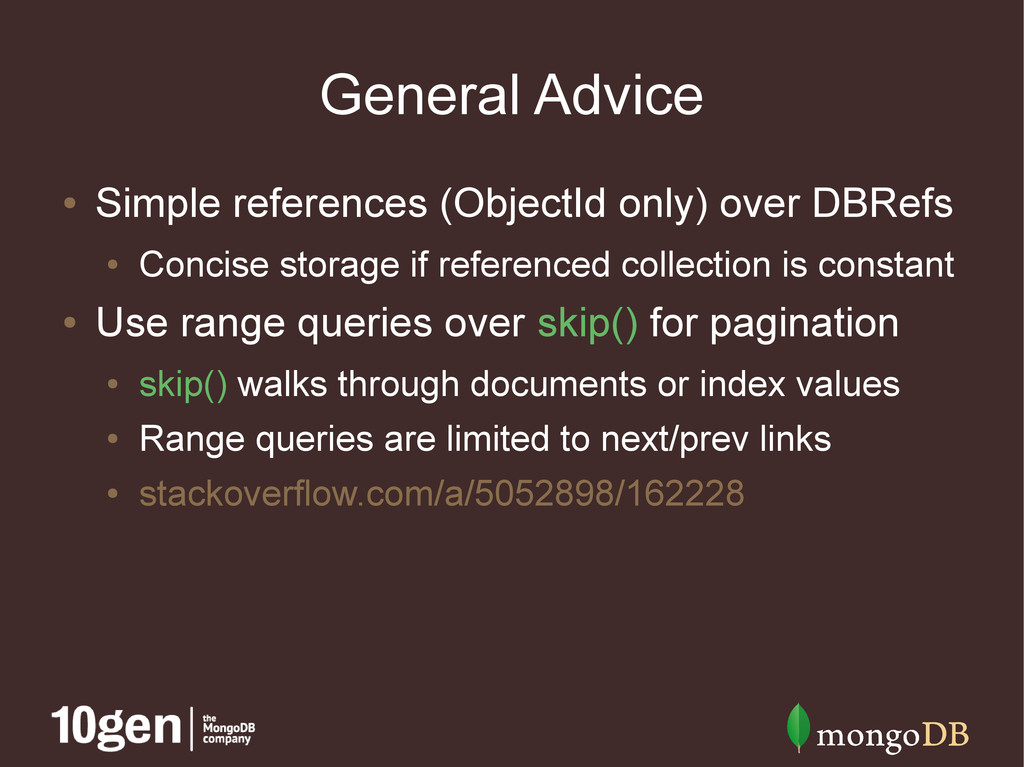
Concise storage if referenced collection is constant • Use range queries over skip() for pagination • skip() walks through documents or index values • Range queries are limited to next/prev links • stackoverflow.com/a/5052898/162228
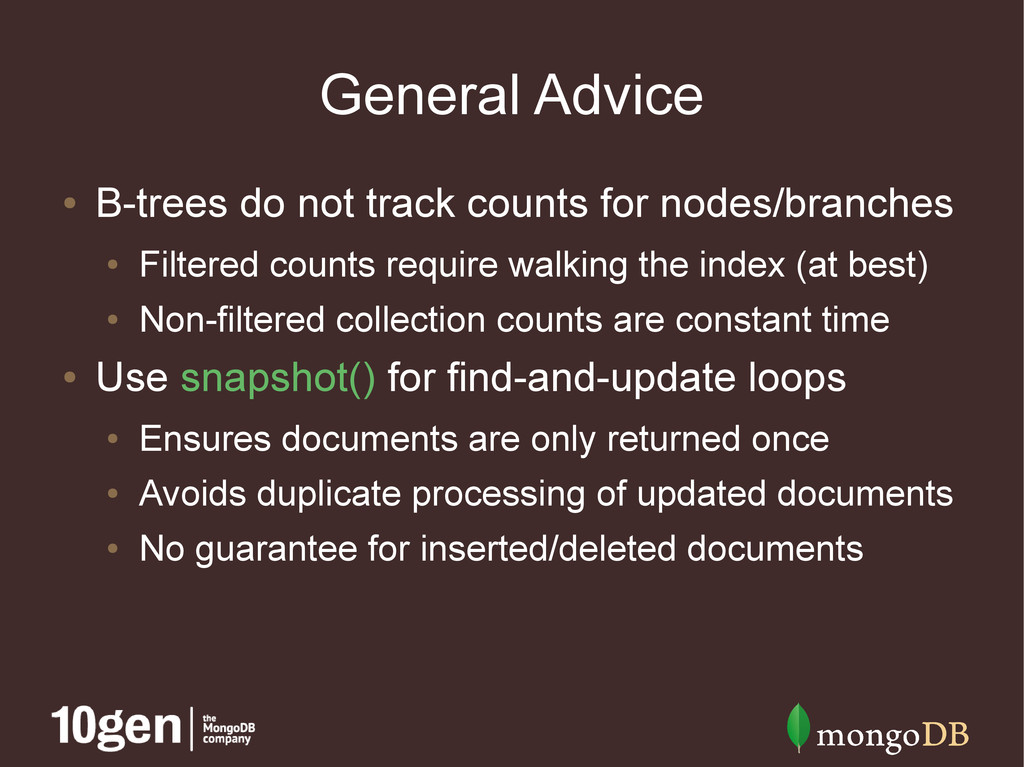
• Filtered counts require walking the index (at best) • Non-filtered collection counts are constant time • Use snapshot() for find-and-update loops • Ensures documents are only returned once • Avoids duplicate processing of updated documents • No guarantee for inserted/deleted documents
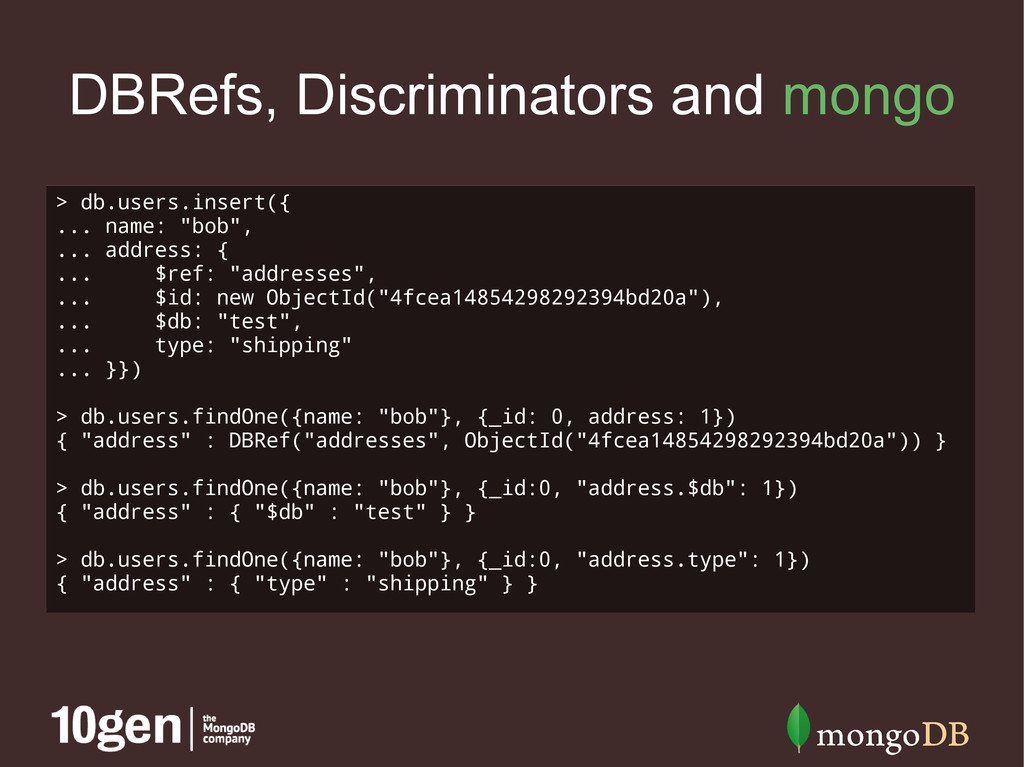
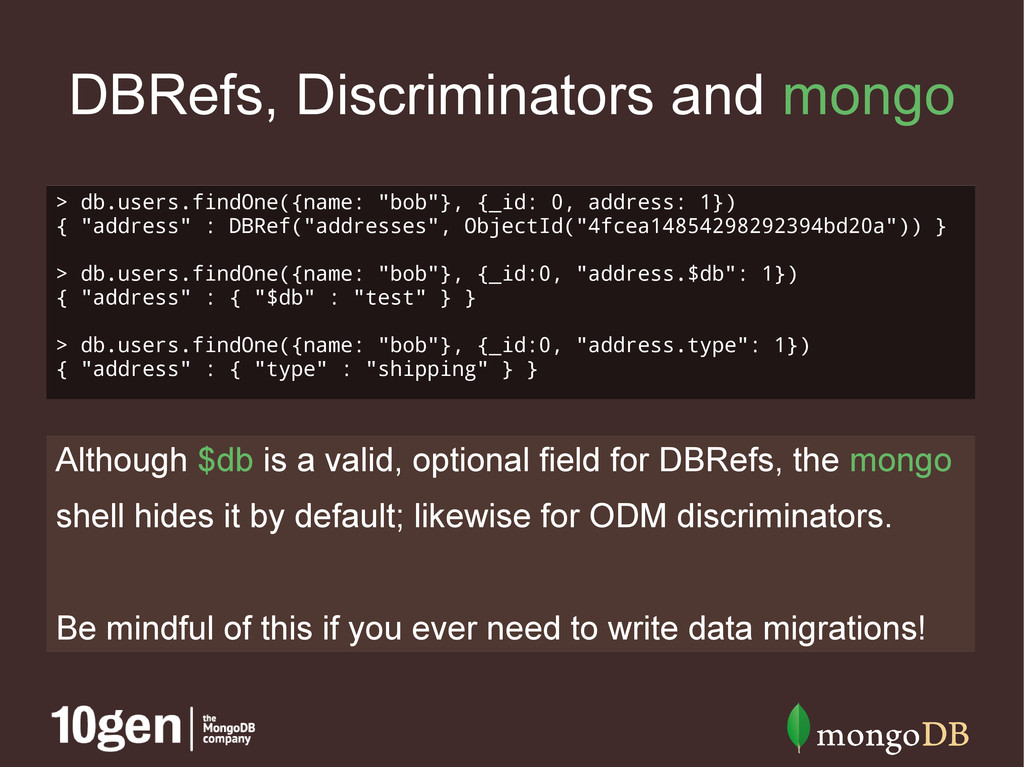
1}) { "address" : DBRef("addresses", ObjectId("4fcea14854298292394bd20a")) } > db.users.findOne({name: "bob"}, {_id:0, "address.$db": 1}) { "address" : { "$db" : "test" } } > db.users.findOne({name: "bob"}, {_id:0, "address.type": 1}) { "address" : { "type" : "shipping" } } Although $db is a valid, optional field for DBRefs, the mongo shell hides it by default; likewise for ODM discriminators. Be mindful of this if you ever need to write data migrations!
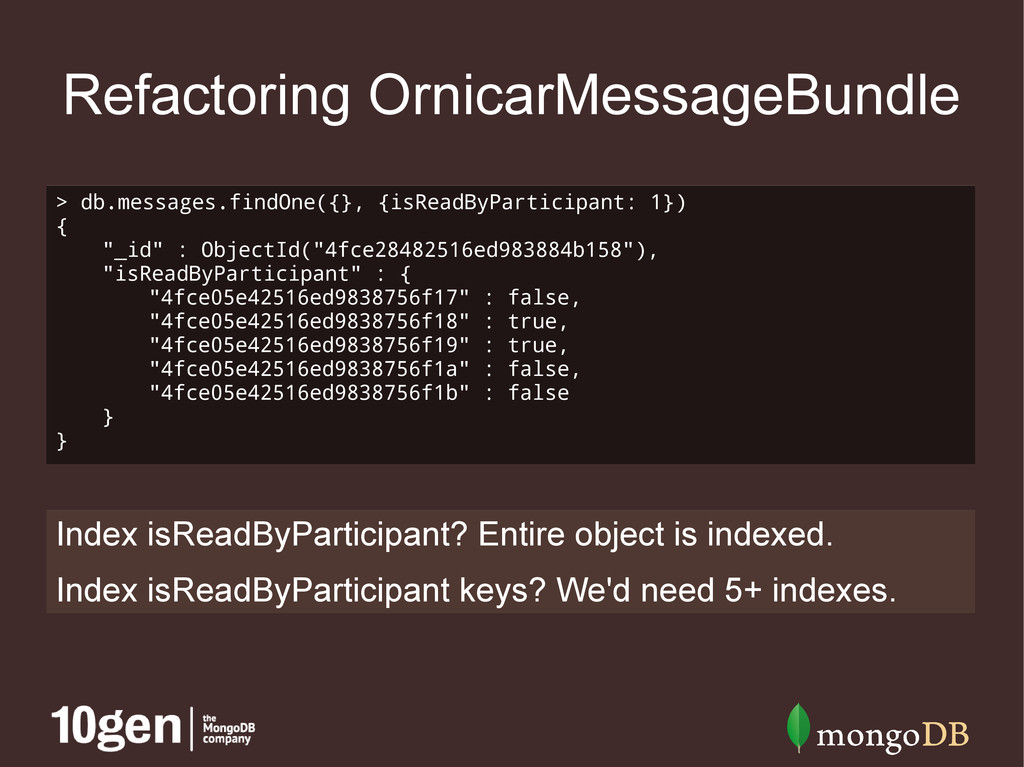
return $this->repository->createQueryBuilder() ->field($fieldName)->equals(false) ->getQuery() ->count(); } Counting the number of unread messages for a user entails scanning the entire collection from disk.
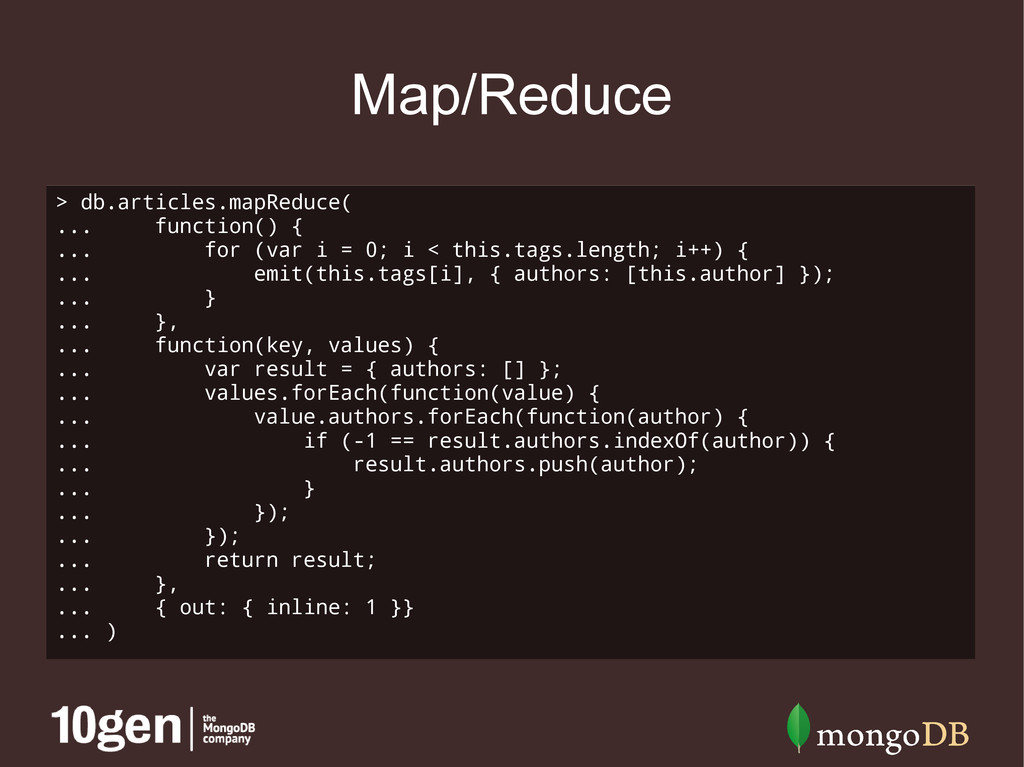
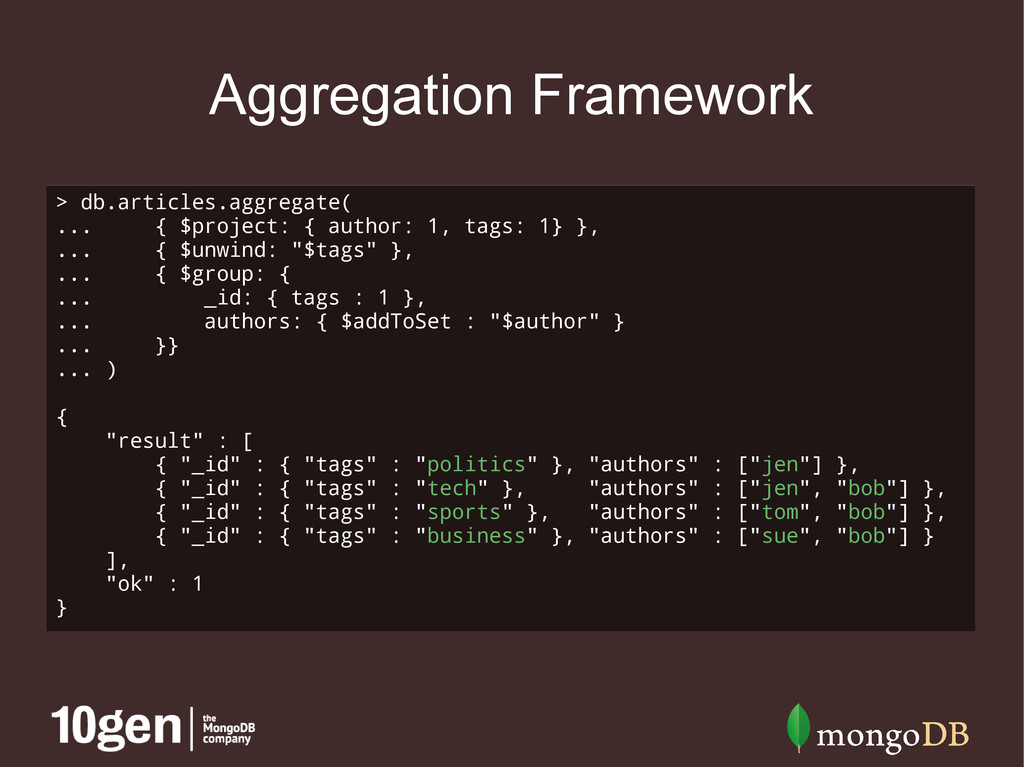
"jen", tags: ["politics", "tech"]}) > db.articles.save({author: "sue", tags: ["business"]}) > db.articles.save({author: "tom", tags: ["sports"]}) Generate a report with the set of authors that have written an article for each tag.
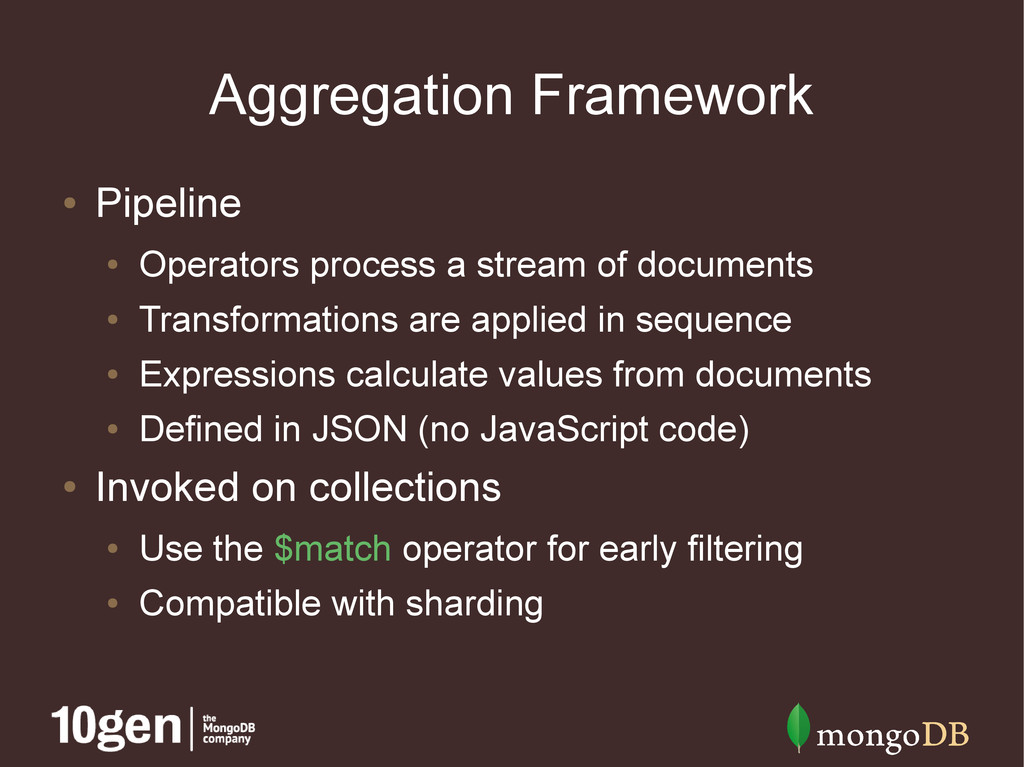
documents • Transformations are applied in sequence • Expressions calculate values from documents • Defined in JSON (no JavaScript code) • Invoked on collections • Use the $match operator for early filtering • Compatible with sharding
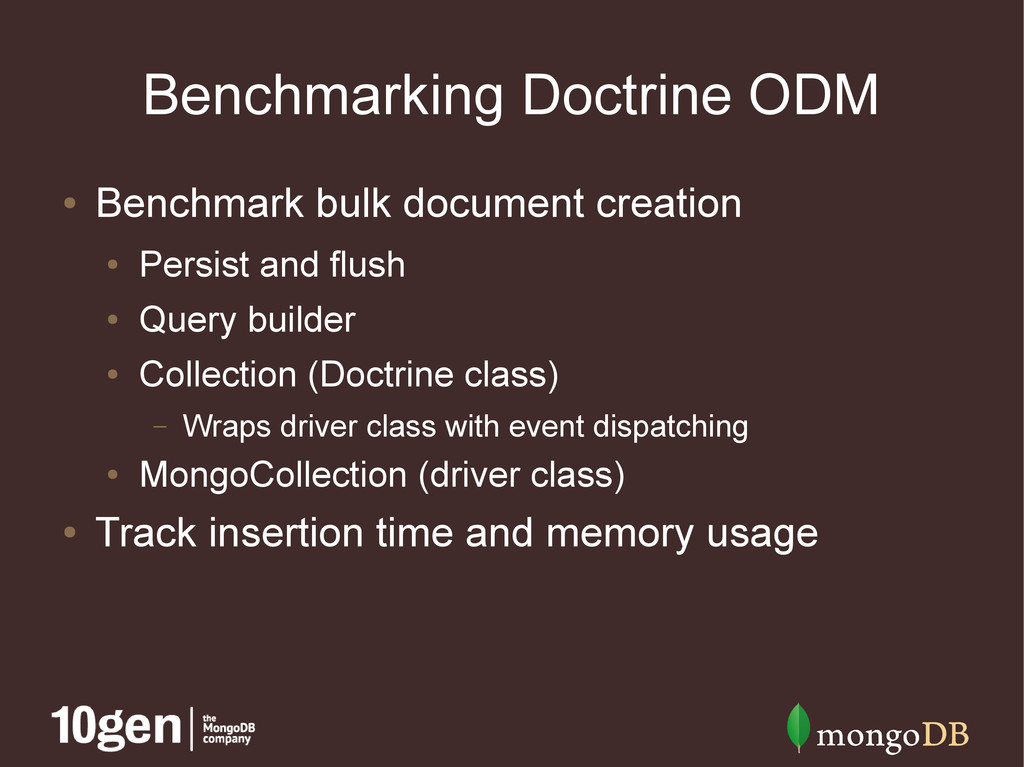
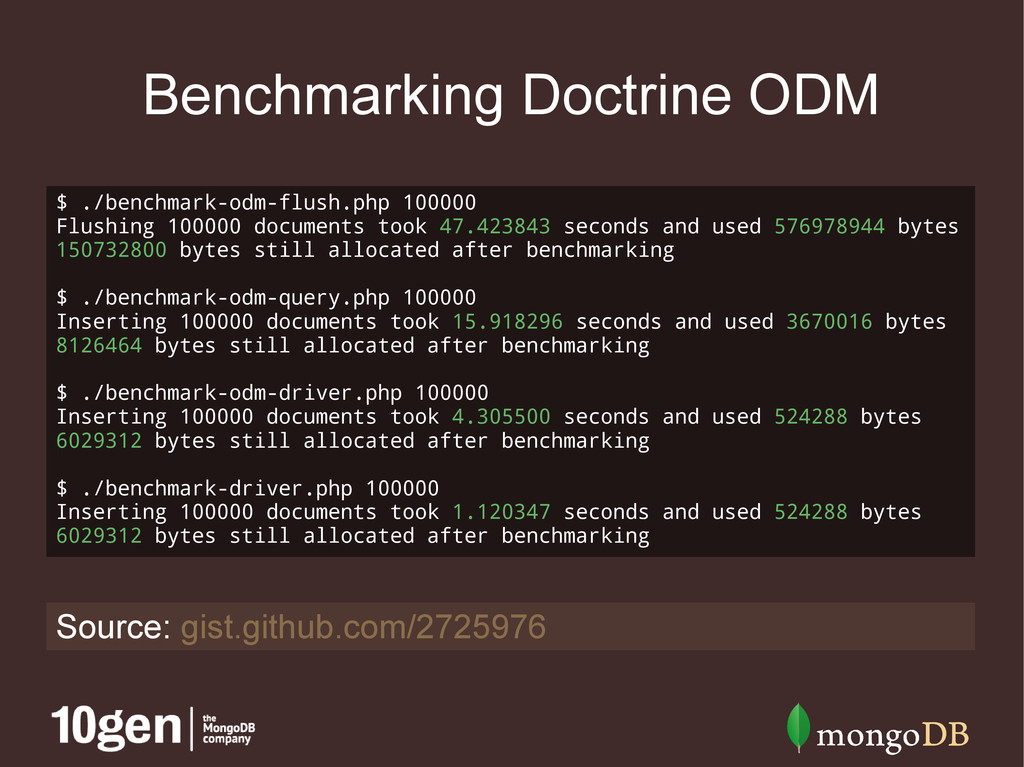
47.423843 seconds and used 576978944 bytes 150732800 bytes still allocated after benchmarking $ ./benchmark-odm-query.php 100000 Inserting 100000 documents took 15.918296 seconds and used 3670016 bytes 8126464 bytes still allocated after benchmarking $ ./benchmark-odm-driver.php 100000 Inserting 100000 documents took 4.305500 seconds and used 524288 bytes 6029312 bytes still allocated after benchmarking $ ./benchmark-driver.php 100000 Inserting 100000 documents took 1.120347 seconds and used 524288 bytes 6029312 bytes still allocated after benchmarking Source: gist.github.com/2725976
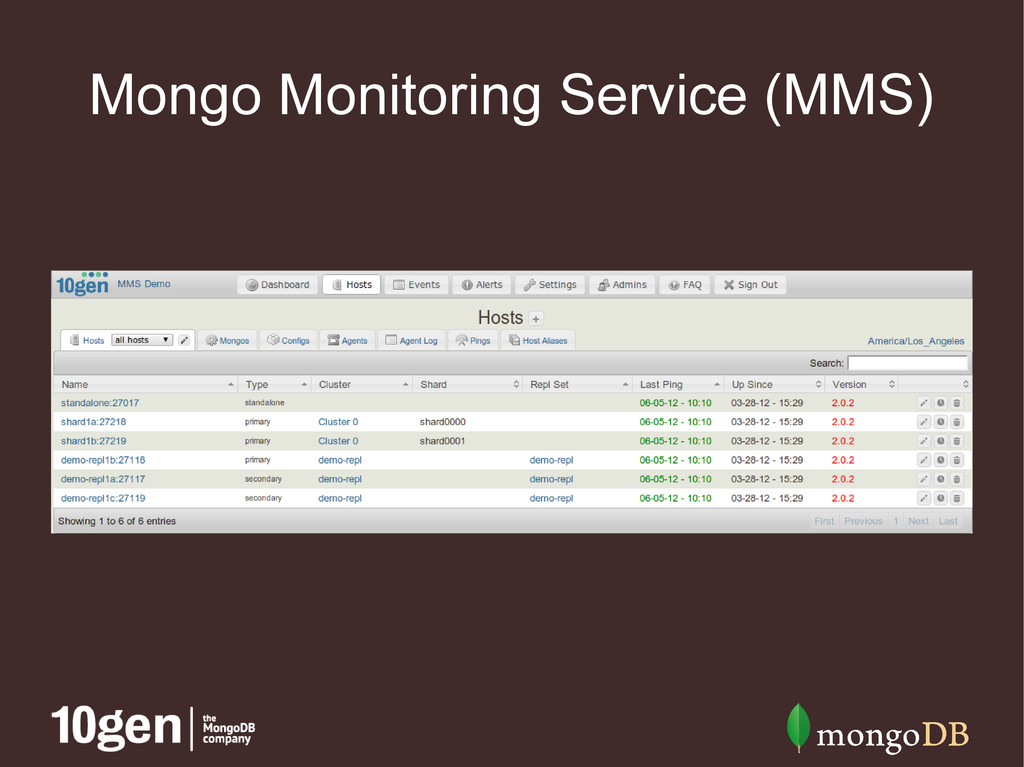
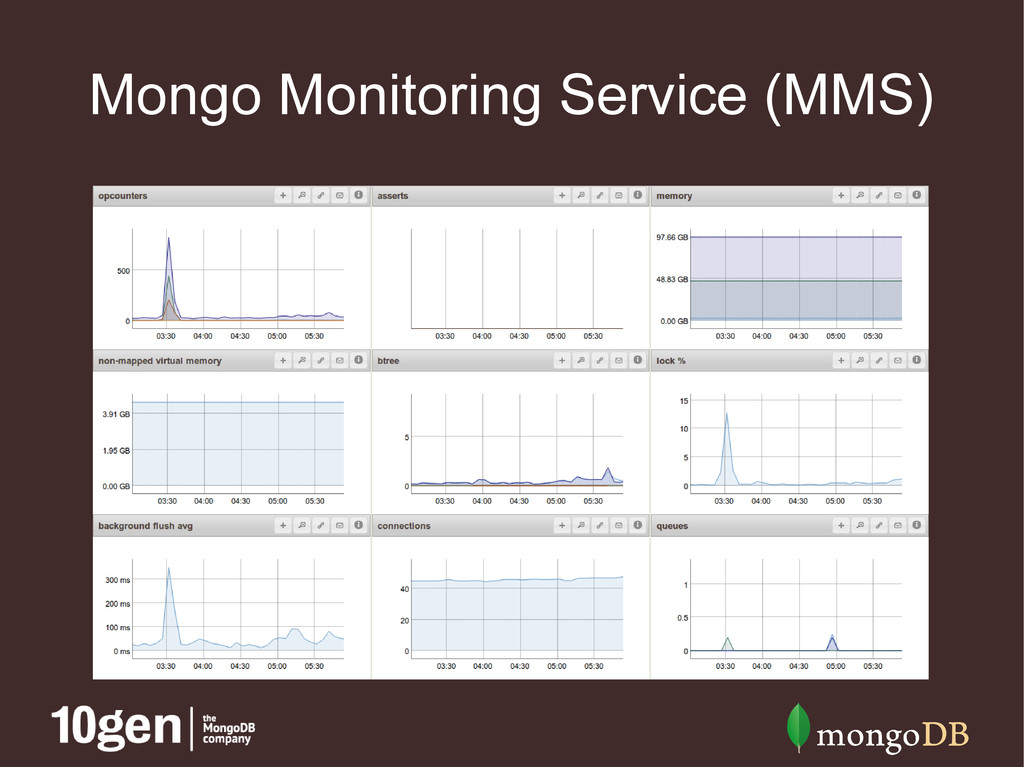
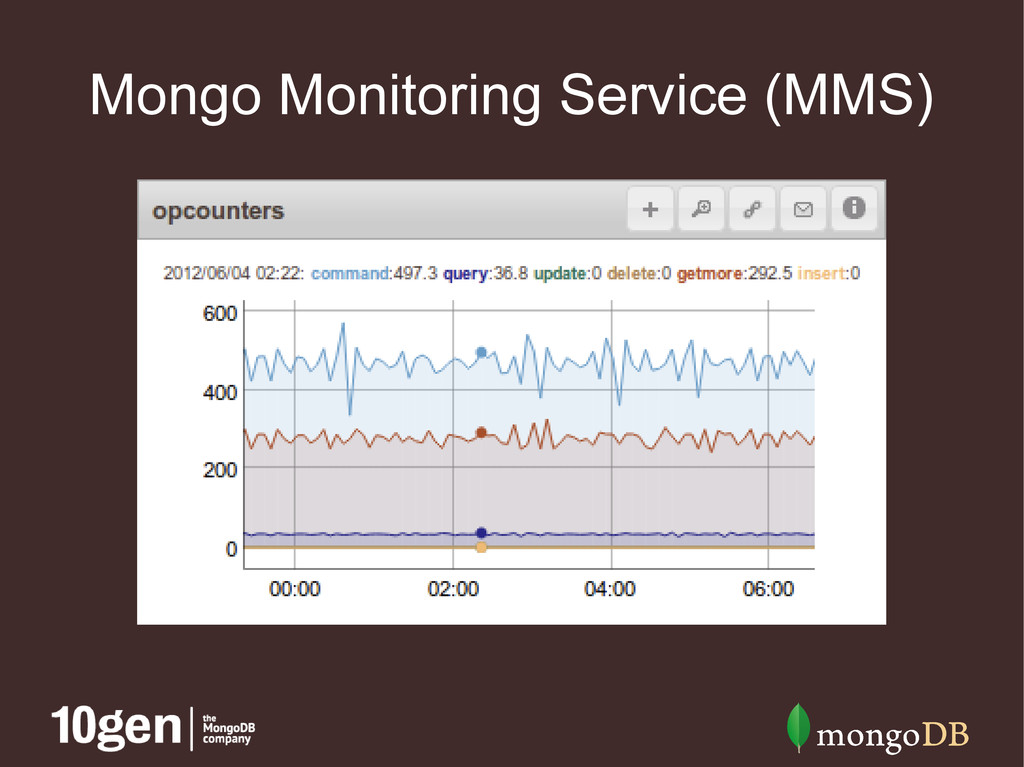
clusters • Speeds up diagnosis for support requests • MMS agent (lightweight Python script) • Reports all sorts of database stats • Additional hardware reporting with Munin • Free!


 jmikola
 oku053
 econanringo
 akit37
 akkeylab
 j341nono
 curekoshimizu
 y0hgi
y0hgi
 rkaga
rkaga
 eed3si9n
 kenjiyoneyama
 akihisaikeda
 taiseiue
 sabderemane
 livdayseo
 tammyeverts
 soysaucechin
 destraynor
 reverentgeek
 ryanjones
 akademiya2063
 portentint
 thoeni
 watany
 keathley







![Map/Reduce > db.articles.save({author: "bob", tags: ["business", "sports", "tech"]}) > db.articles.save({author:](https://files.speakerdeck.com/presentations/4fd1462f5d50290022006f47/slide_37.jpg)