of blocks require some solution for mathematically difficult problem. The solution itself is a proof-of-work (PoW) • After every block creation, network creates new coins. Start point is 50 coin for every blocks. It should be halved ever 210,000 blocks.
only valid transactions is accepted by chain. • Blocks are chained that, modifying a block will require modifying of all blocks in that chain. • Receiver can verify transaction by checking whether it takes place in a block.
names. • Every balance is associated with address and public- private keys. • Every user can have multiple addresses as suggested by bitcoin software itself.
the sequence of events witnessed, but proof that it came from the largest pool of CPU power • As long as a majority of CPU power is controlled by nodes that are not cooperating to attack the network, they'll generate the longest chain and outpace attackers
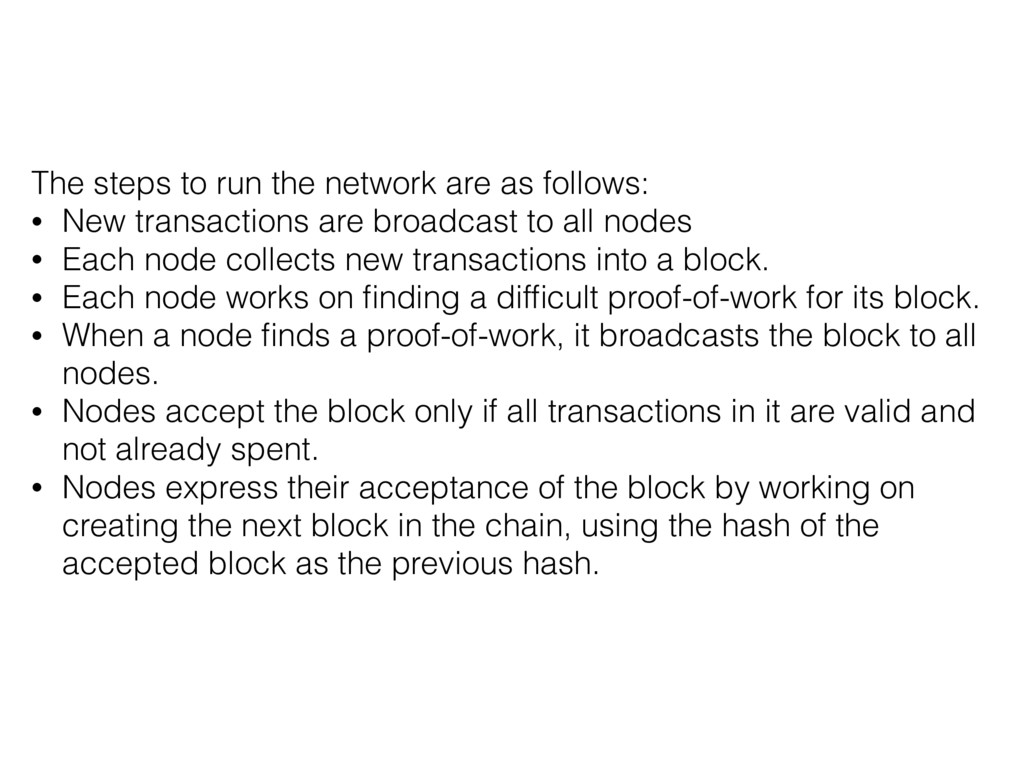
New transactions are broadcast to all nodes • Each node collects new transactions into a block. • Each node works on finding a difficult proof-of-work for its block. • When a node finds a proof-of-work, it broadcasts the block to all nodes. • Nodes accept the block only if all transactions in it are valid and not already spent. • Nodes express their acceptance of the block by working on creating the next block in the chain, using the hash of the accepted block as the previous hash.
all nodes. As long as they reach many nodes, they will get into a block before long. Block broadcasts are also tolerant of dropped messages. If a node does not receive a block, it will request it when it receives the next block and realizes it missed one. • The steady addition of a constant of amount of new coins is analogous to gold miners expending resources to add gold to circulation. In our case, it is CPU time and electricity that is expended.
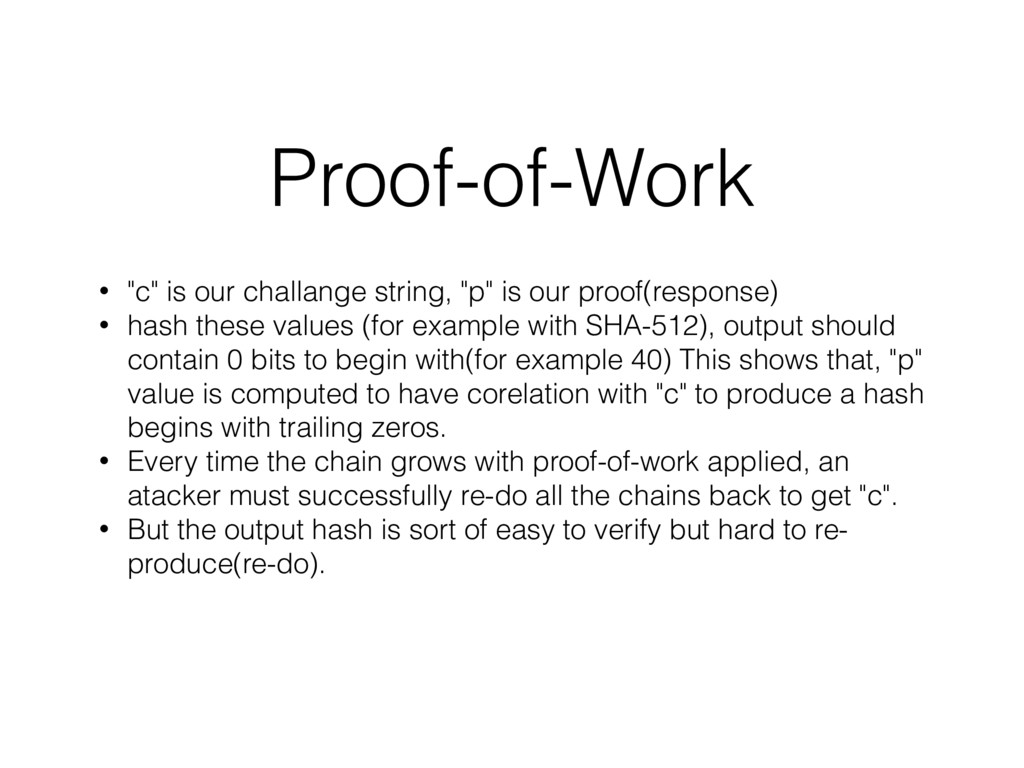
proof(response) • hash these values (for example with SHA-512), output should contain 0 bits to begin with(for example 40) This shows that, "p" value is computed to have corelation with "c" to produce a hash begins with trailing zeros. • Every time the chain grows with proof-of-work applied, an atacker must successfully re-do all the chains back to get "c". • But the output hash is sort of easy to verify but hard to re- produce(re-do).


 ueponx
 takuroabe
 pfn
 keeg
 usanchuu
 occhi
 yamanoku
 daidaidai
 takahashim
 kairim0
 bengo4com
 inesmontani
 soudai
 sarafernandez
 jmmastey
 portentint
 cassininazir
 baasie
 chriscoyier
 livdayseo
 andyhume
 addyosmani
 pauljervisheath