Share
Embed
The Knowledge Spine: A Machine-Executable Ontology for Governed Marketing Activation
Ontology as executable governance: consent, suppression, and frequency rules an agent can't talk its way past.
Ananth Packkildurai
September 16, 2026
Transcript
21 slides
-
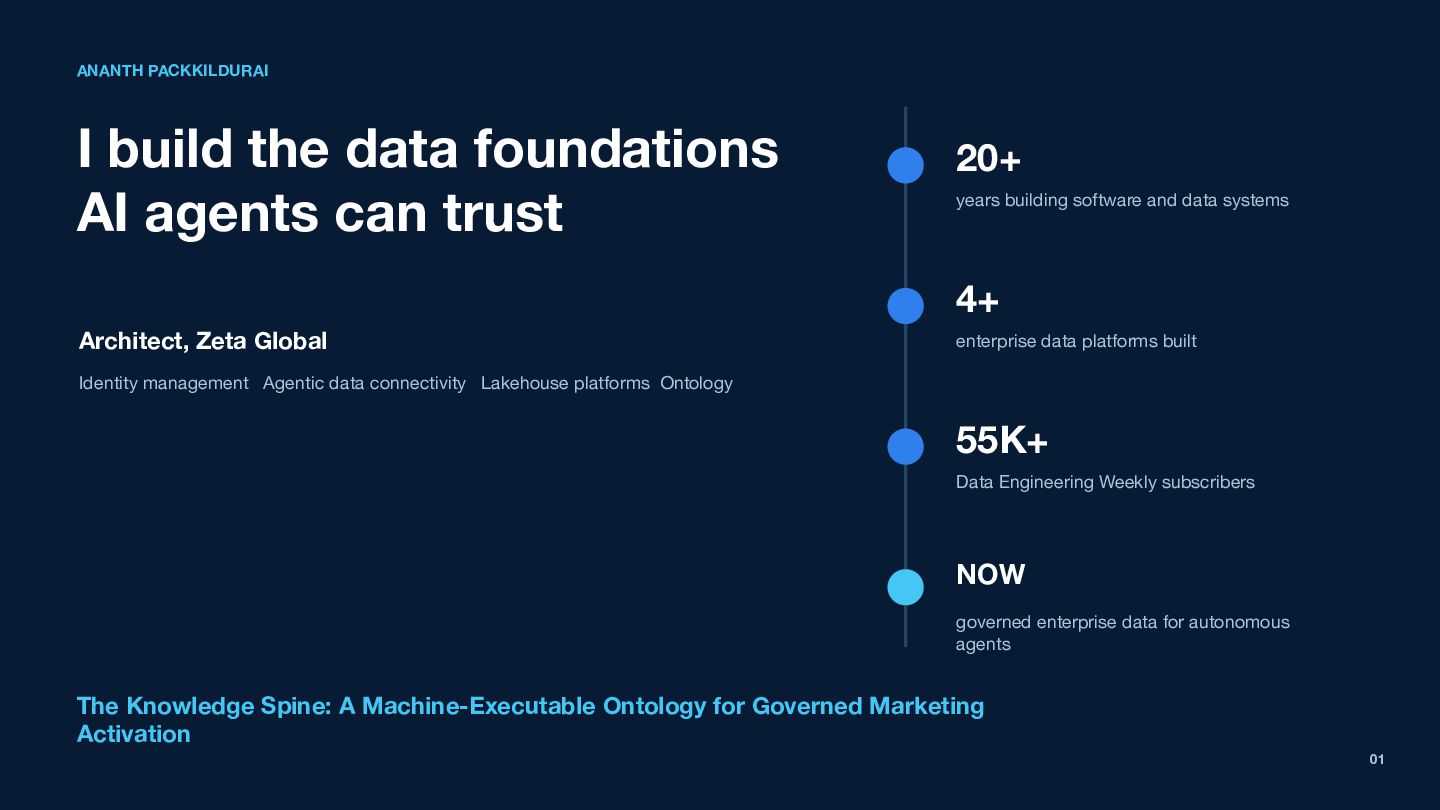
ANANTH PACKKILDURAI I build the data foundations AI agents can
trust 20+ years building software and data systems 4+ Architect, Zeta Global enterprise data platforms built Identity management Agentic data connectivity Lakehouse platforms Ontology 55K+ Data Engineering Weekly subscribers NOW governed enterprise data for autonomous agents The Knowledge Spine: A Machine-Executable Ontology for Governed Marketing Activation 01 -
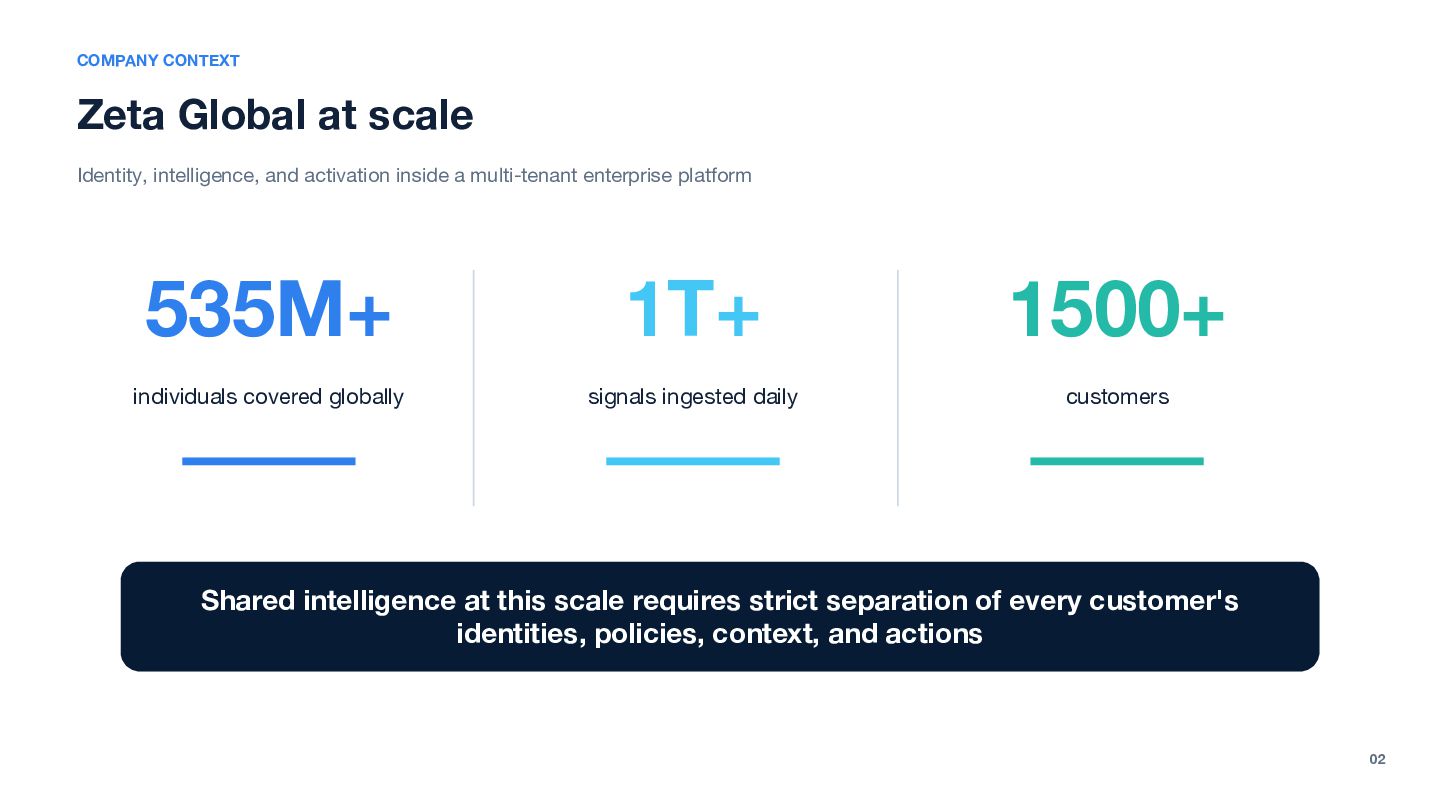
COMPANY CONTEXT Zeta Global at scale Identity, intelligence, and activation
inside a multi-tenant enterprise platform 535M+ 1T+ 1500+ individuals covered globally signals ingested daily customers Shared intelligence at this scale requires strict separation of every customer's identities, policies, context, and actions 02 -
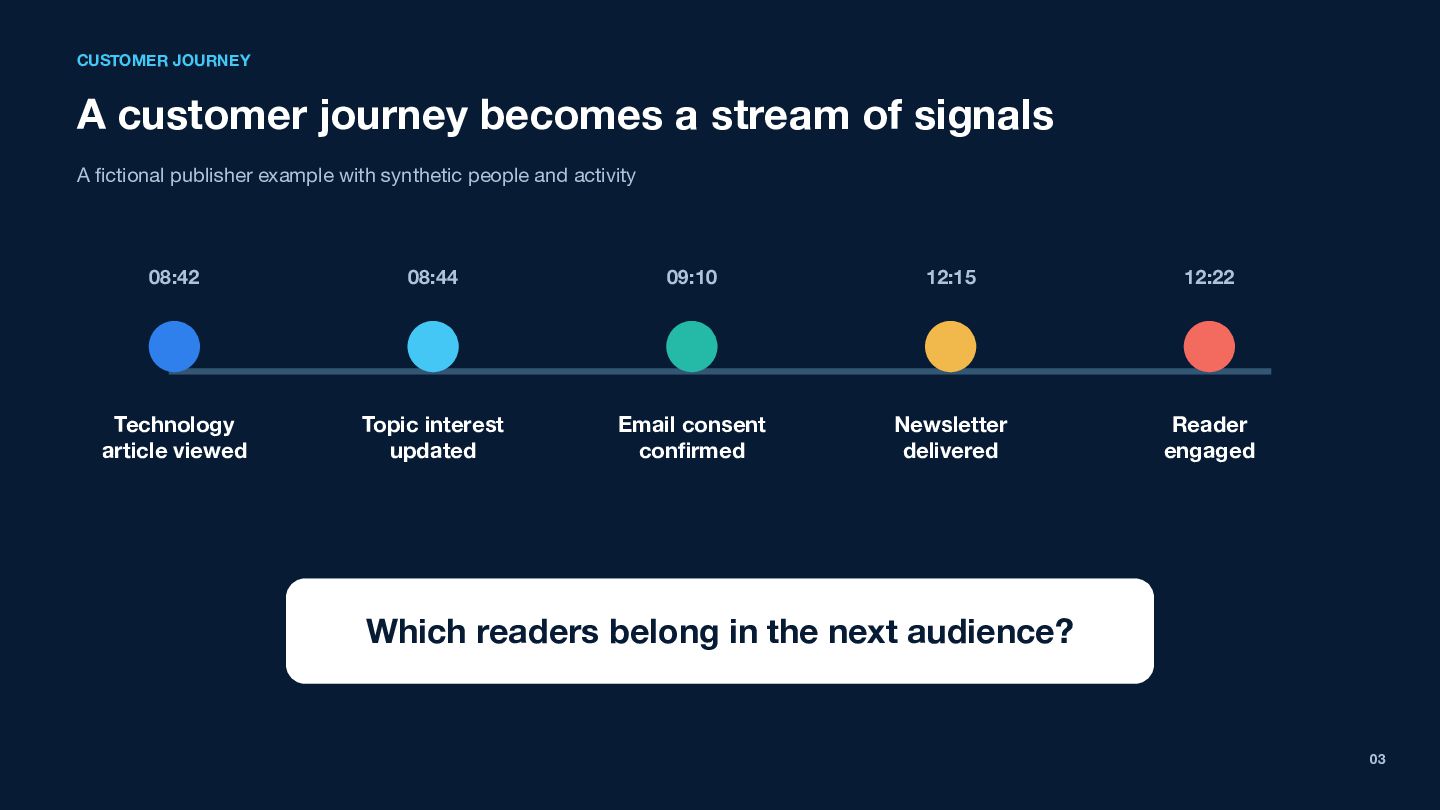
CUSTOMER JOURNEY A customer journey becomes a stream of signals
A fictional publisher example with synthetic people and activity 08:42 08:44 09:10 12:15 12:22 Technology article viewed Topic interest updated Email consent confirmed Newsletter delivered Reader engaged Which readers belong in the next audience? 03 -
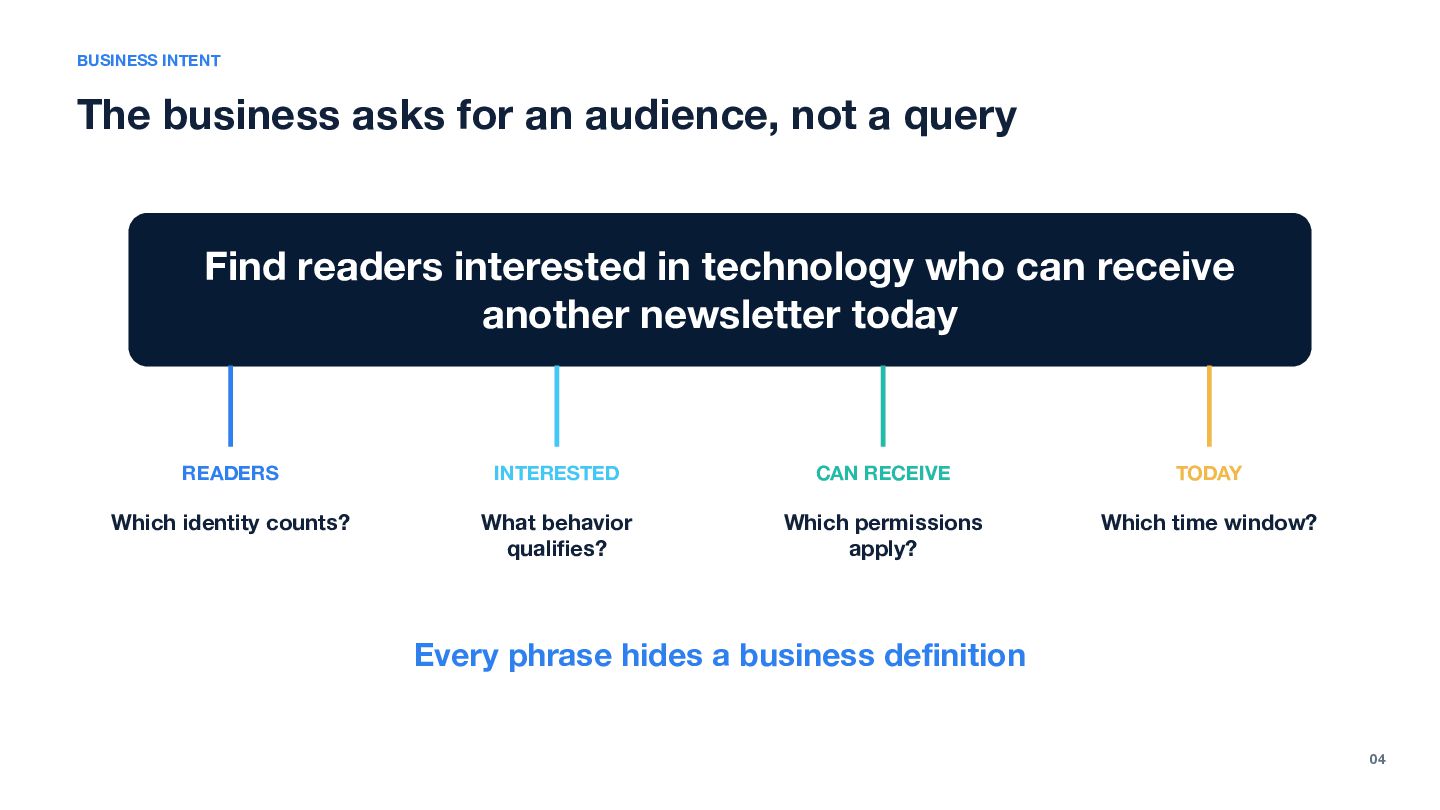
BUSINESS INTENT The business asks for an audience, not a
query Find readers interested in technology who can receive another newsletter today READERS INTERESTED CAN RECEIVE TODAY Which identity counts? What behavior qualifies? Which permissions apply? Which time window? Every phrase hides a business definition 04 -
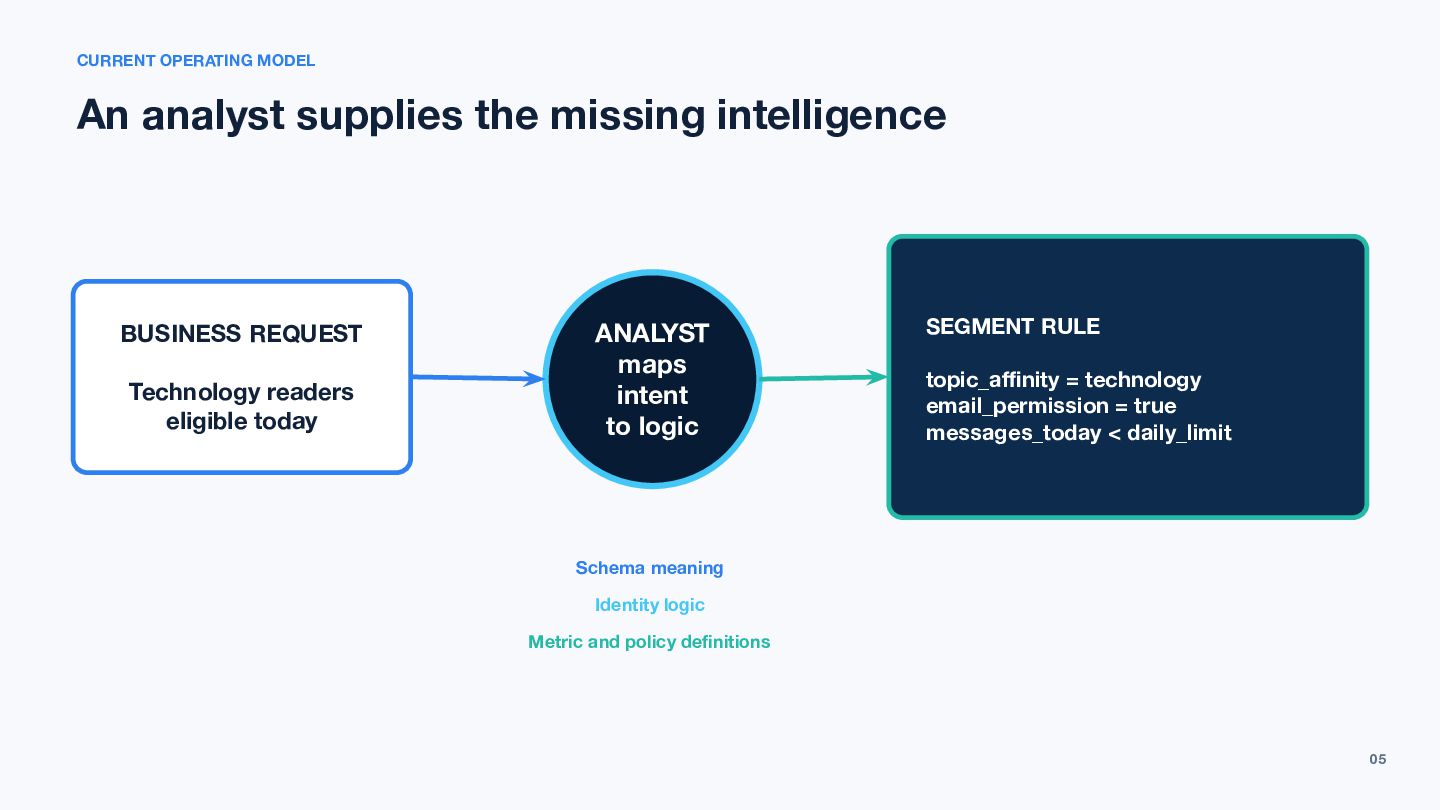
CURRENT OPERATING MODEL An analyst supplies the missing intelligence BUSINESS
REQUEST Technology readers eligible today ANALYST maps intent to logic SEGMENT RULE topic_affinity = technology email_permission = true messages_today < daily_limit Schema meaning Identity logic Metric and policy definitions 05 -
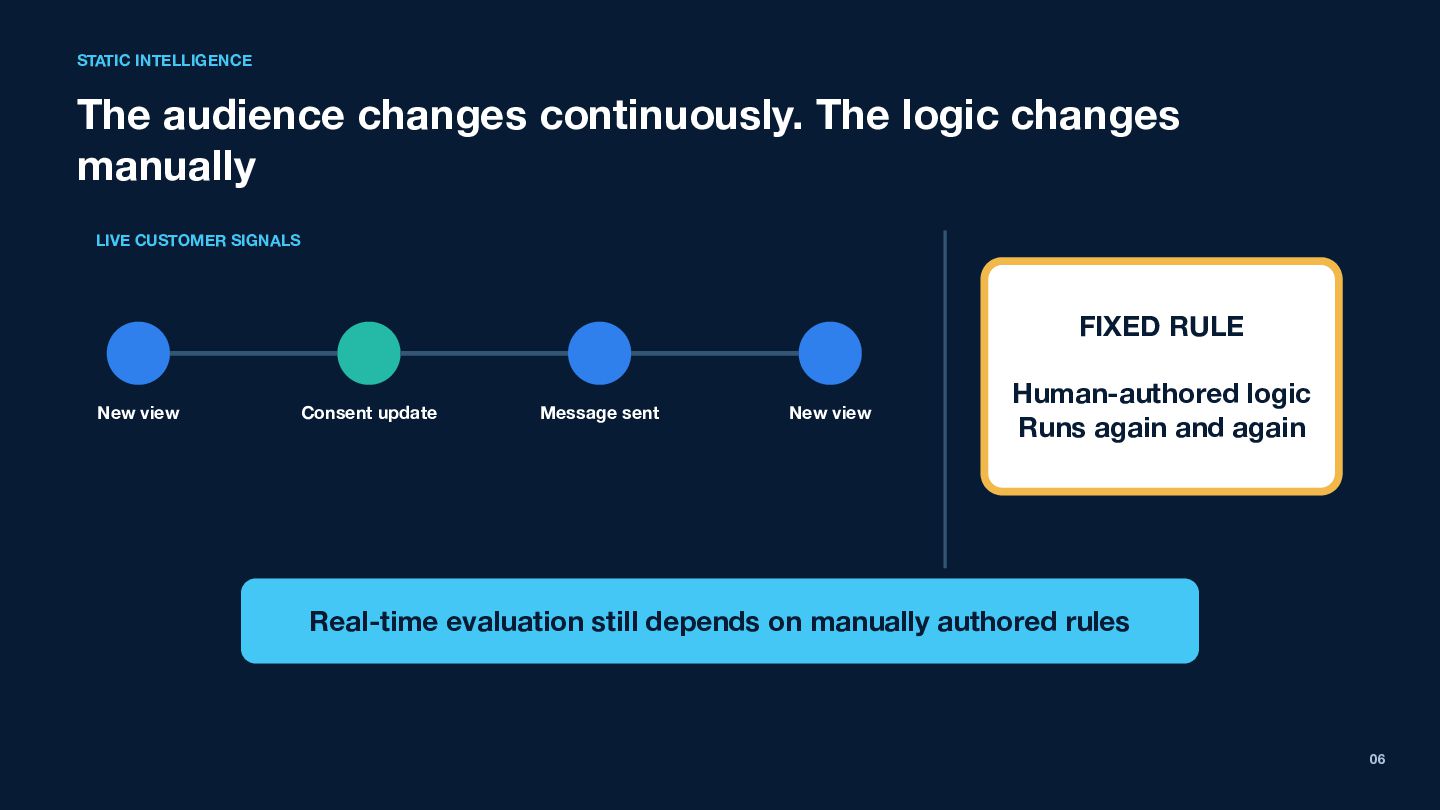
STATIC INTELLIGENCE The audience changes continuously. The logic changes manually
LIVE CUSTOMER SIGNALS FIXED RULE New view Consent update Message sent New view Human-authored logic Runs again and again Real-time evaluation still depends on manually authored rules 06 -
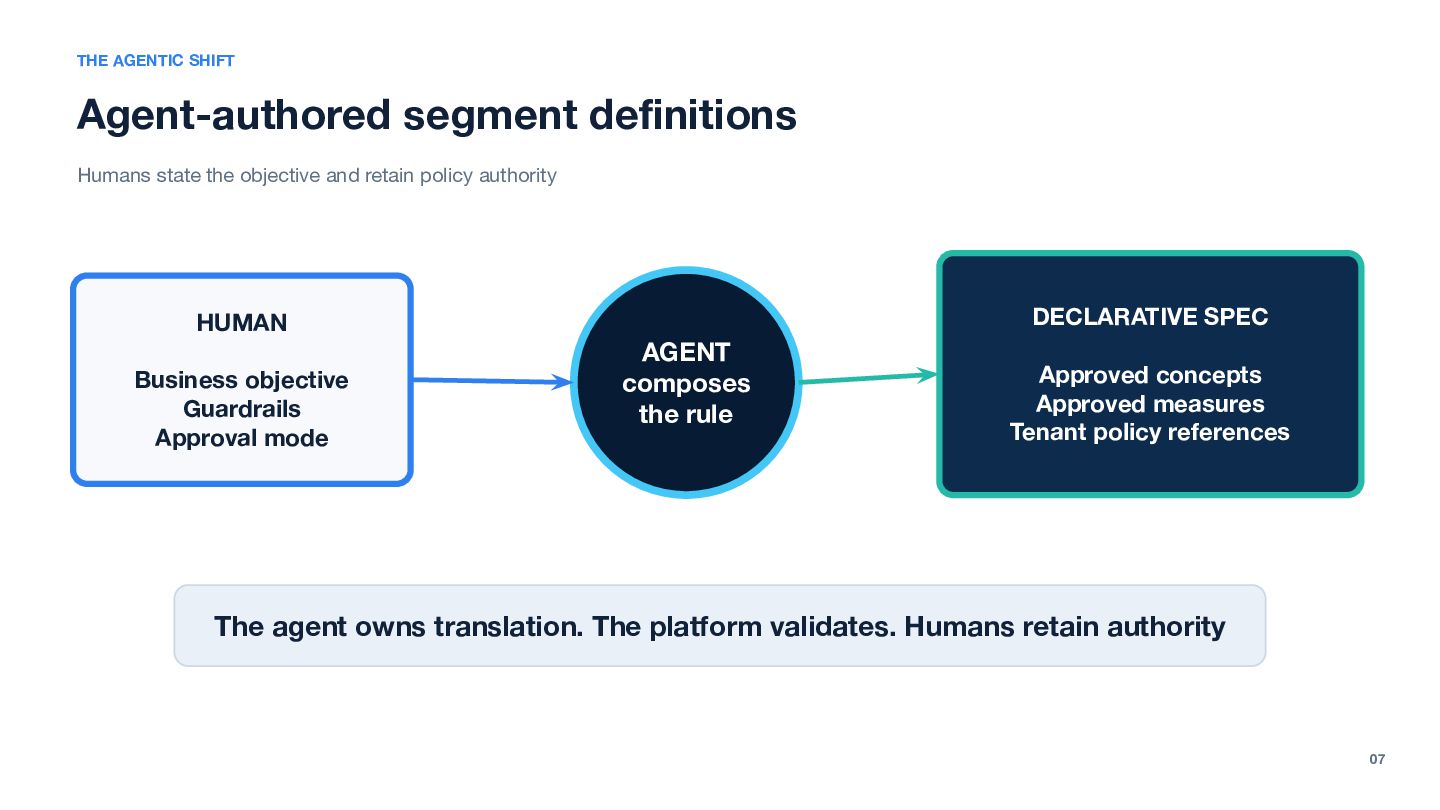
THE AGENTIC SHIFT Agent-authored segment definitions Humans state the objective
and retain policy authority DECLARATIVE SPEC HUMAN Business objective Guardrails Approval mode AGENT composes the rule Approved concepts Approved measures Tenant policy references The agent owns translation. The platform validates. Humans retain authority 07 -
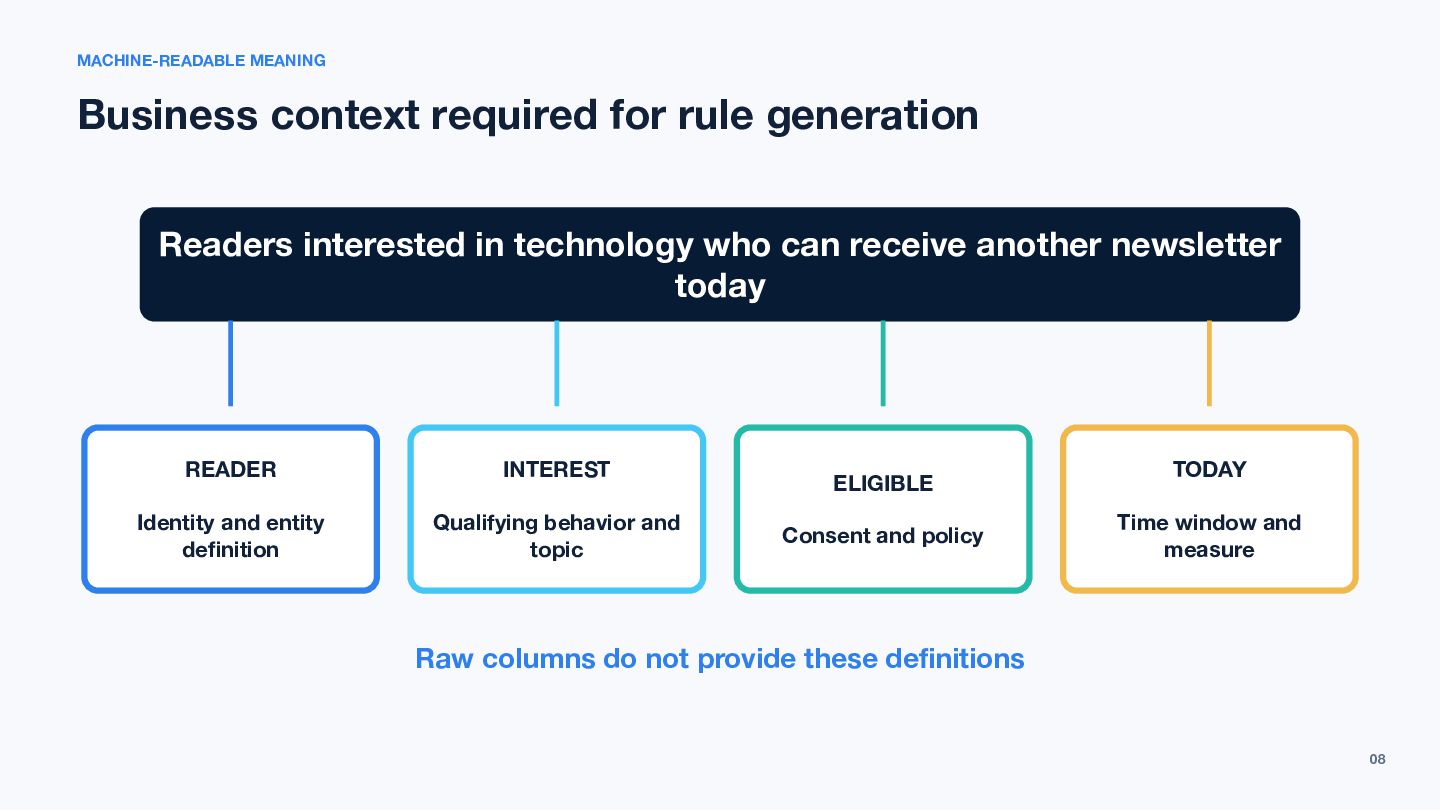
MACHINE-READABLE MEANING Business context required for rule generation Readers interested
in technology who can receive another newsletter today READER INTEREST Identity and entity definition Qualifying behavior and topic ELIGIBLE Consent and policy TODAY Time window and measure Raw columns do not provide these definitions 08 -
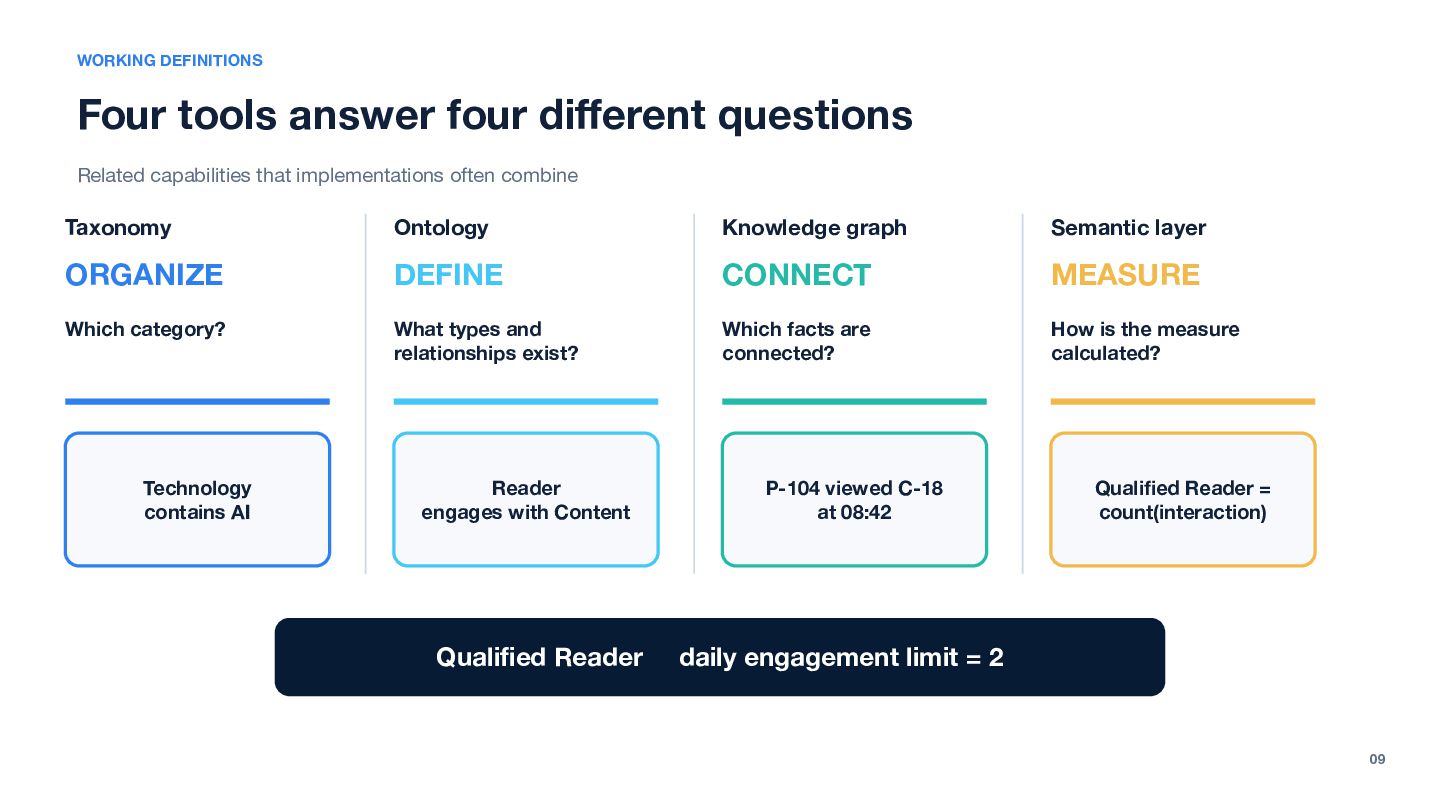
WORKING DEFINITIONS Four tools answer four different questions Related capabilities
that implementations often combine Taxonomy Ontology Knowledge graph Semantic layer ORGANIZE DEFINE CONNECT MEASURE Which category? What types and relationships exist? Which facts are connected? How is the measure calculated? Technology contains AI Reader engages with Content P-104 viewed C-18 at 08:42 Qualified Reader daily engagement limit = 2 Qualified Reader = count(interaction) 09 -
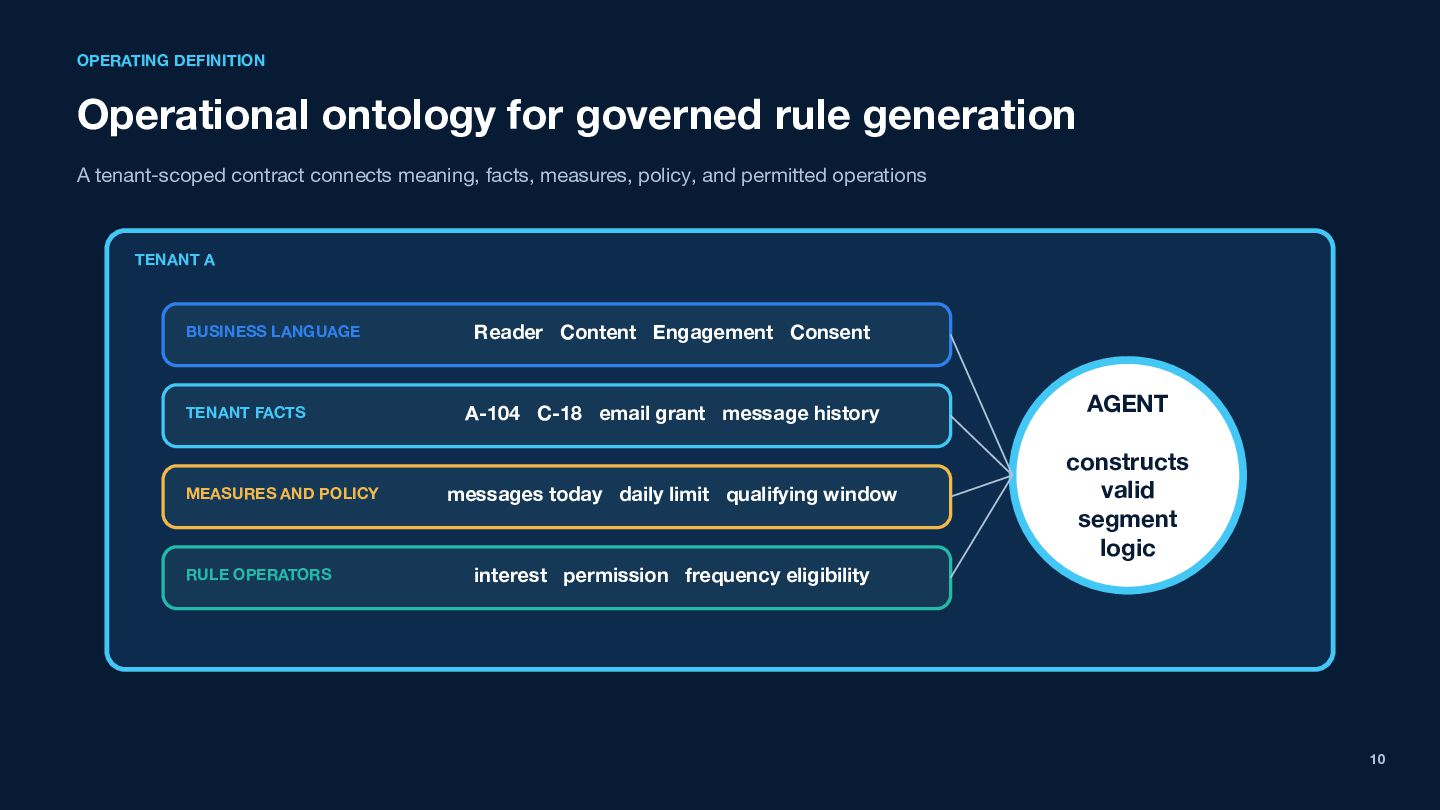
OPERATING DEFINITION Operational ontology for governed rule generation A tenant-scoped
contract connects meaning, facts, measures, policy, and permitted operations TENANT A BUSINESS LANGUAGE Reader Content Engagement Consent TENANT FACTS A-104 C-18 email grant message history MEASURES AND POLICY RULE OPERATORS messages today daily limit qualifying window AGENT constructs valid segment logic interest permission frequency eligibility 10 -
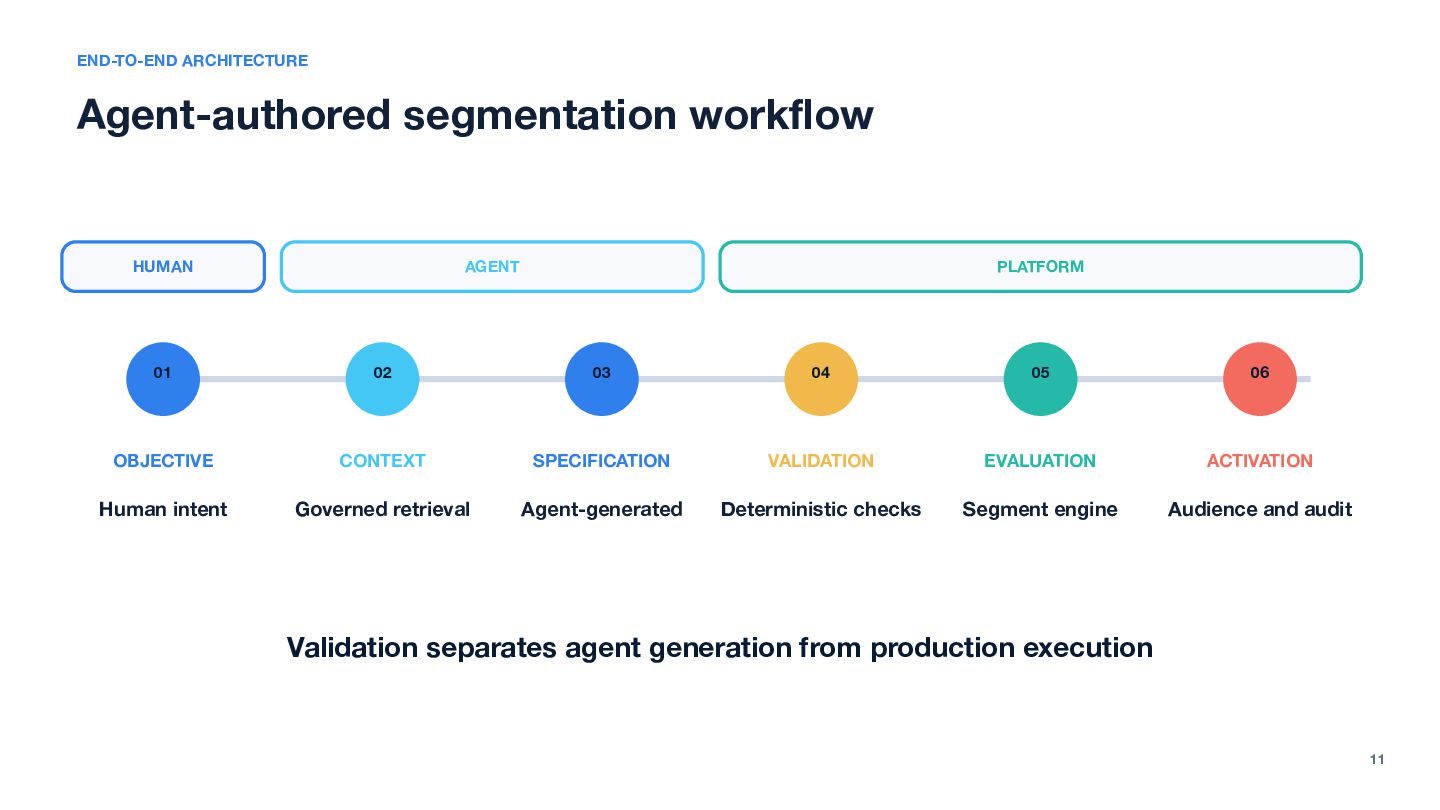
END-TO-END ARCHITECTURE Agent-authored segmentation workflow HUMAN AGENT PLATFORM 01 02
03 04 05 06 OBJECTIVE CONTEXT SPECIFICATION VALIDATION EVALUATION ACTIVATION Human intent Governed retrieval Agent-generated Deterministic checks Segment engine Audience and audit Validation separates agent generation from production execution 11 -
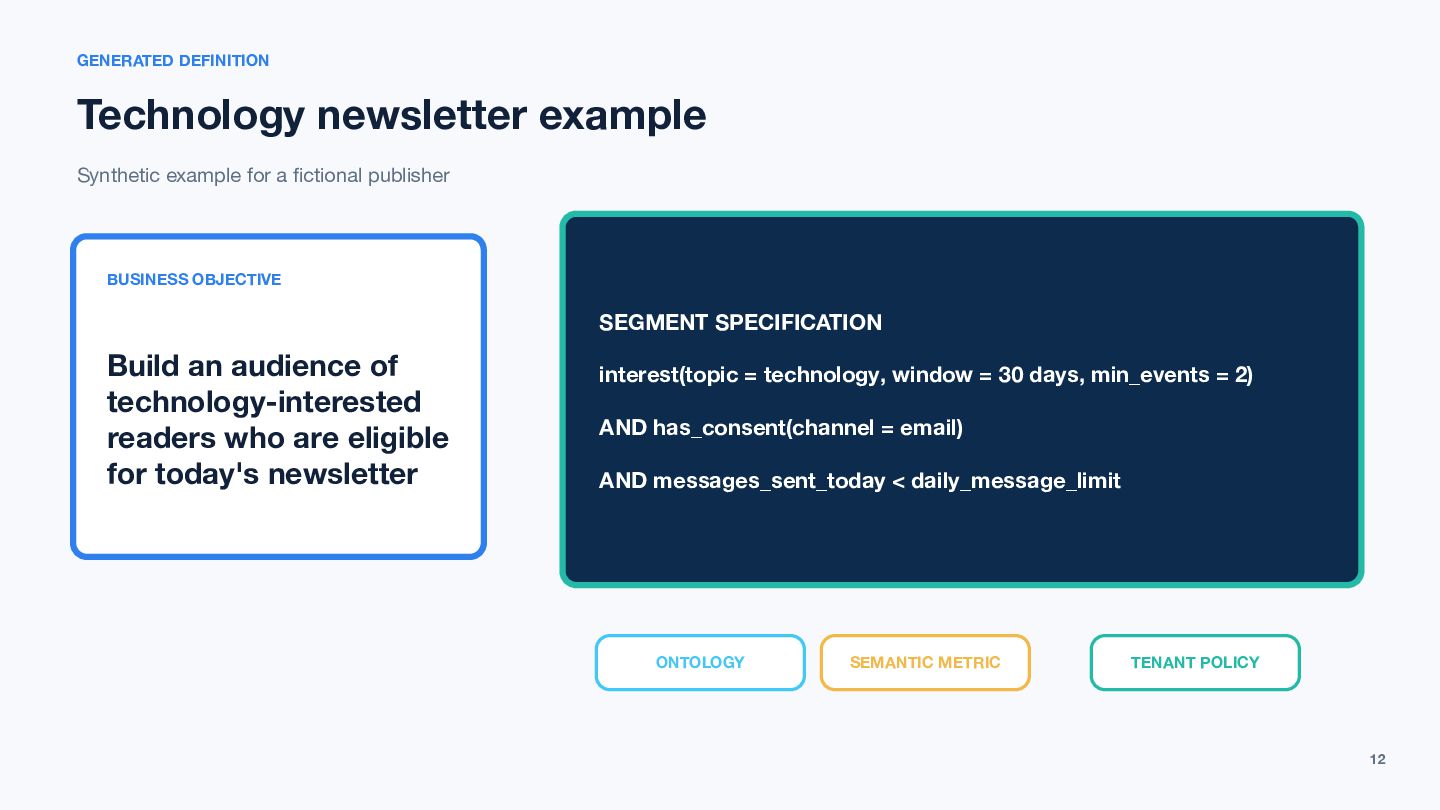
GENERATED DEFINITION Technology newsletter example Synthetic example for a fictional
publisher BUSINESS OBJECTIVE SEGMENT SPECIFICATION Build an audience of technology-interested readers who are eligible for today's newsletter interest(topic = technology, window = 30 days, min_events = 2) AND has_consent(channel = email) AND messages_sent_today < daily_message_limit ONTOLOGY SEMANTIC METRIC TENANT POLICY 12 -
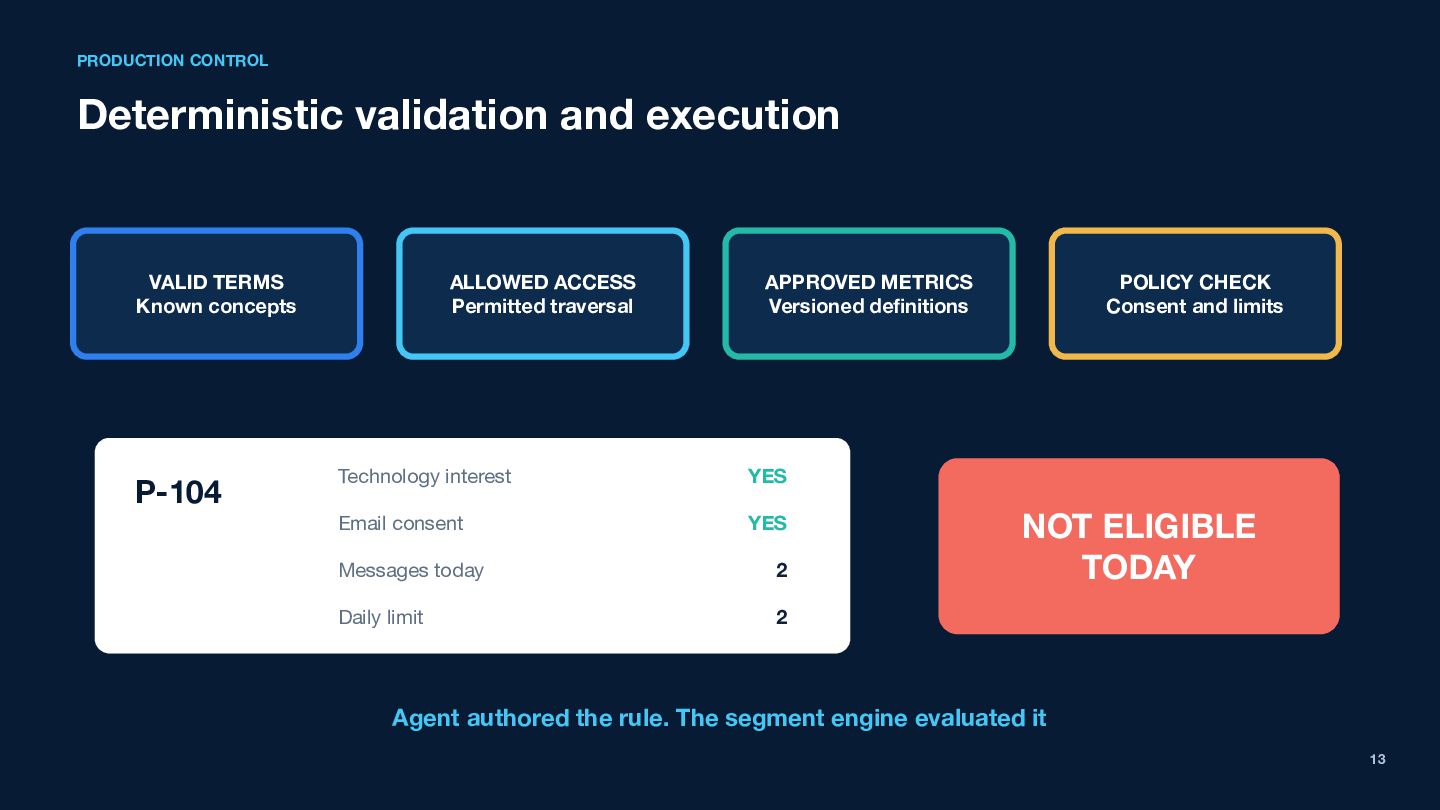
PRODUCTION CONTROL Deterministic validation and execution VALID TERMS Known concepts
P-104 ALLOWED ACCESS Permitted traversal APPROVED METRICS Versioned definitions Technology interest YES Email consent YES Messages today 2 Daily limit 2 POLICY CHECK Consent and limits NOT ELIGIBLE TODAY Agent authored the rule. The segment engine evaluated it 13 -
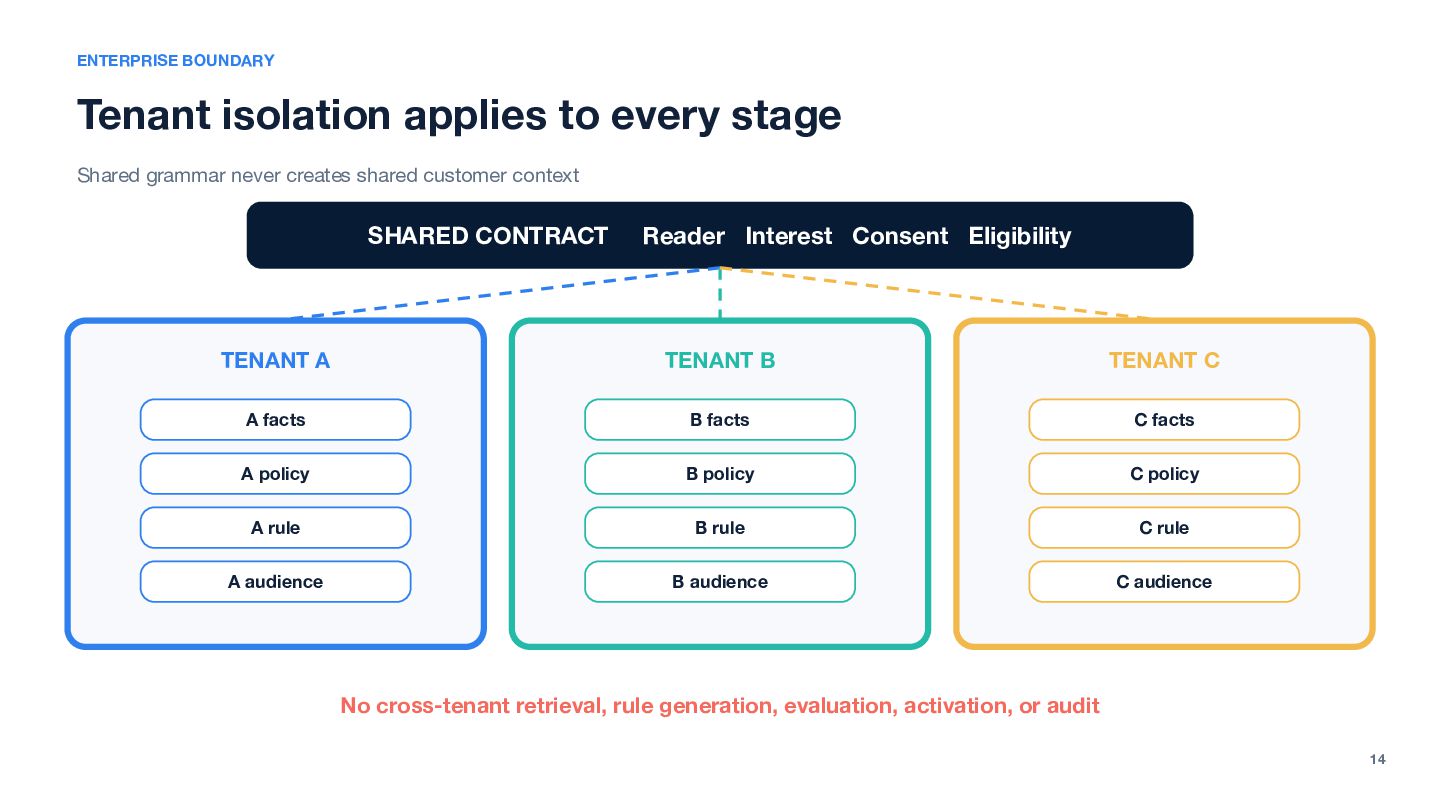
ENTERPRISE BOUNDARY Tenant isolation applies to every stage Shared grammar
never creates shared customer context SHARED CONTRACT Reader Interest Consent Eligibility TENANT A TENANT B TENANT C A facts B facts C facts A policy B policy C policy A rule B rule C rule A audience B audience C audience No cross-tenant retrieval, rule generation, evaluation, activation, or audit 14 -
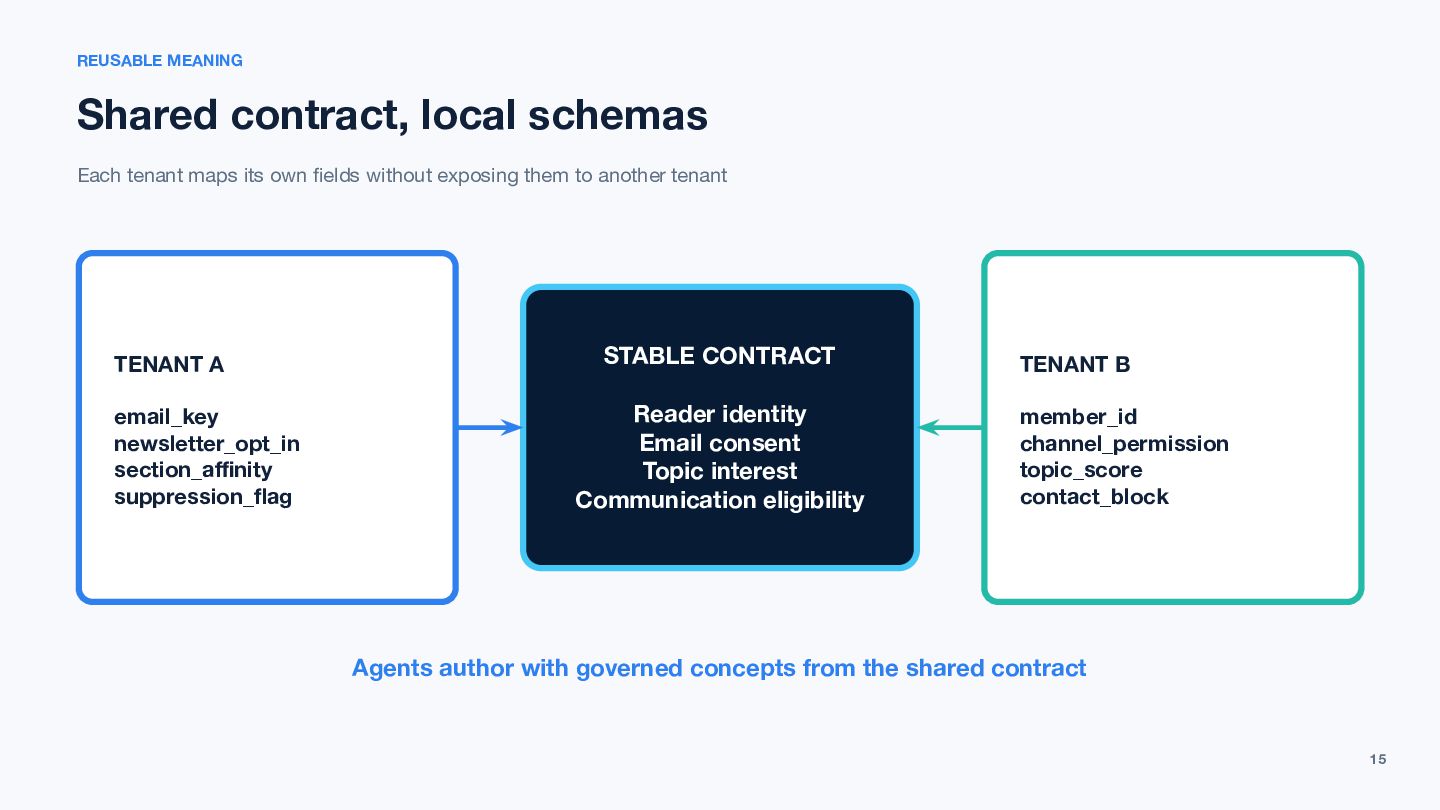
REUSABLE MEANING Shared contract, local schemas Each tenant maps its
own fields without exposing them to another tenant TENANT A email_key newsletter_opt_in section_affinity suppression_flag STABLE CONTRACT Reader identity Email consent Topic interest Communication eligibility TENANT B member_id channel_permission topic_score contact_block Agents author with governed concepts from the shared contract 15 -
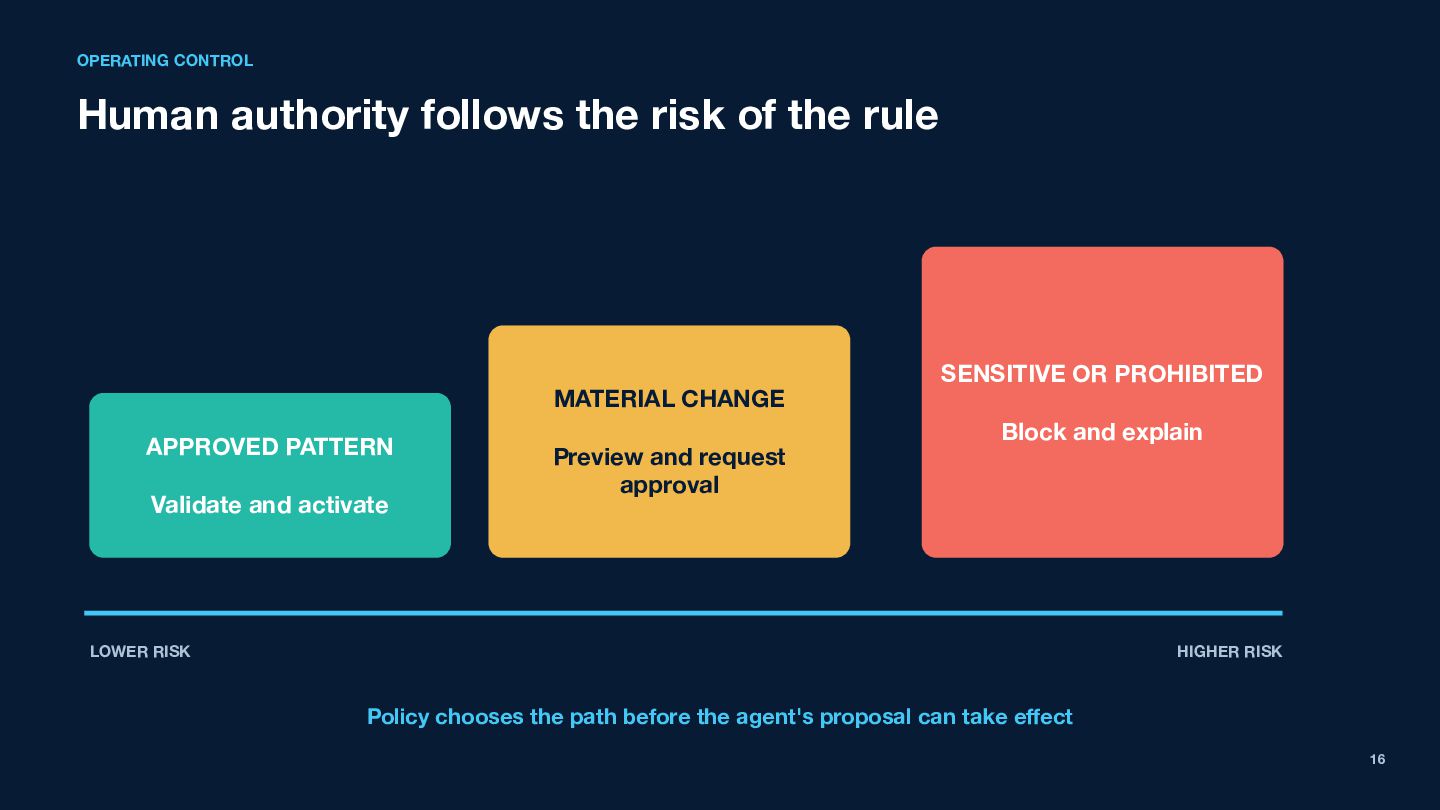
OPERATING CONTROL Human authority follows the risk of the rule
SENSITIVE OR PROHIBITED MATERIAL CHANGE APPROVED PATTERN Validate and activate Block and explain Preview and request approval LOWER RISK HIGHER RISK Policy chooses the path before the agent's proposal can take effect 16 -
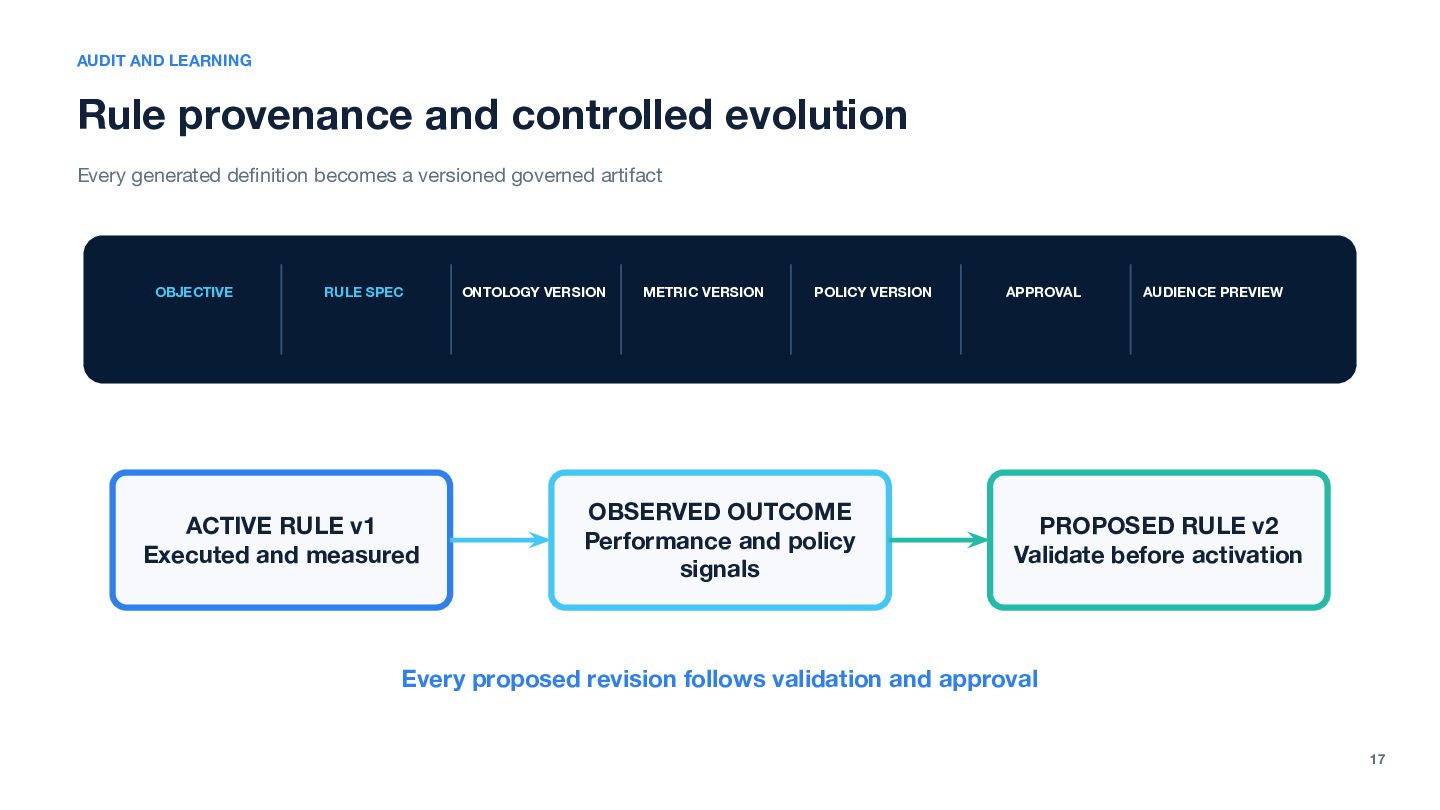
AUDIT AND LEARNING Rule provenance and controlled evolution Every generated
definition becomes a versioned governed artifact OBJECTIVE RULE SPEC ACTIVE RULE v1 Executed and measured ONTOLOGY VERSION METRIC VERSION POLICY VERSION OBSERVED OUTCOME Performance and policy signals APPROVAL AUDIENCE PREVIEW PROPOSED RULE v2 Validate before activation Every proposed revision follows validation and approval 17 -
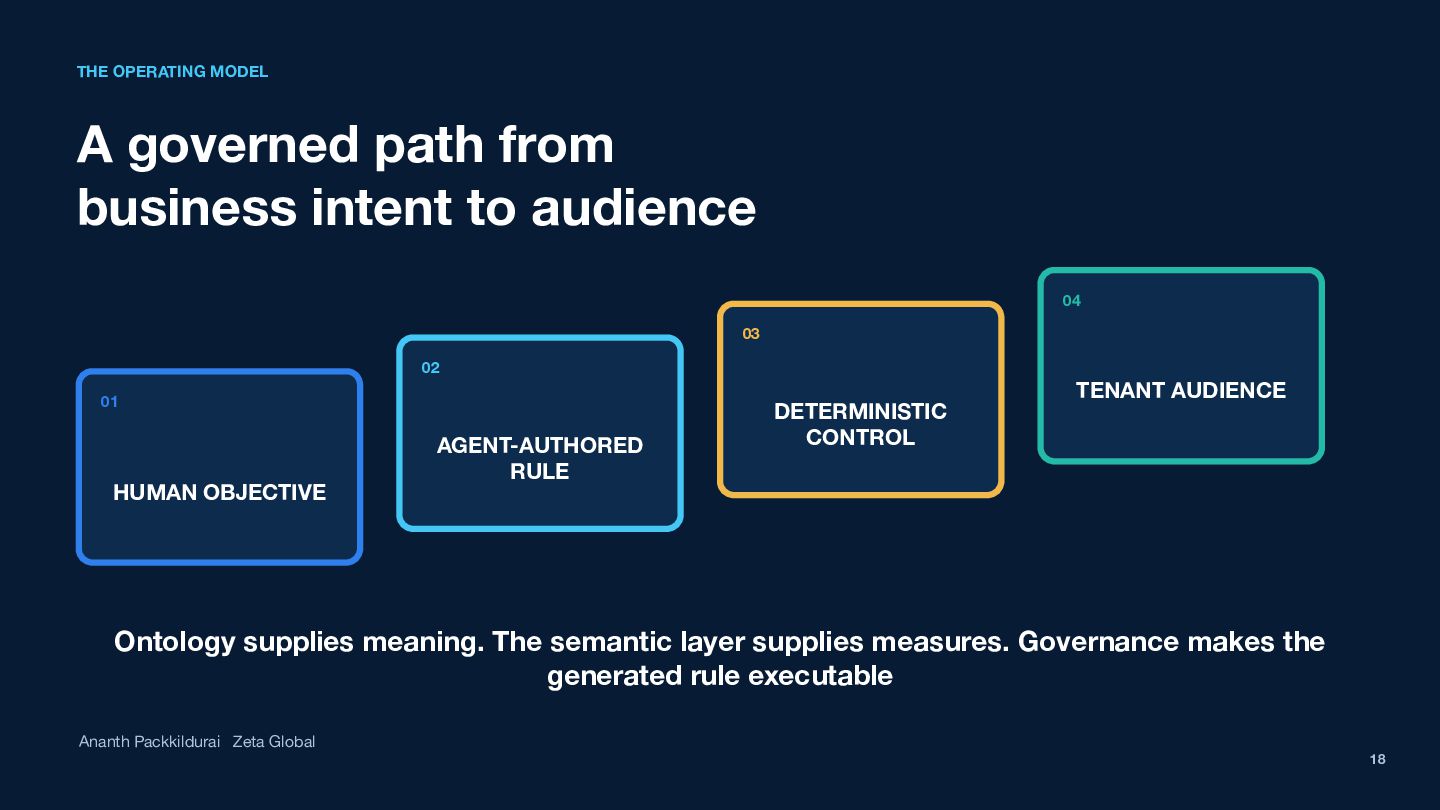
THE OPERATING MODEL A governed path from business intent to
audience 04 03 02 01 HUMAN OBJECTIVE AGENT-AUTHORED RULE DETERMINISTIC CONTROL TENANT AUDIENCE Ontology supplies meaning. The semantic layer supplies measures. Governance makes the generated rule executable Ananth Packkildurai Zeta Global 18 -
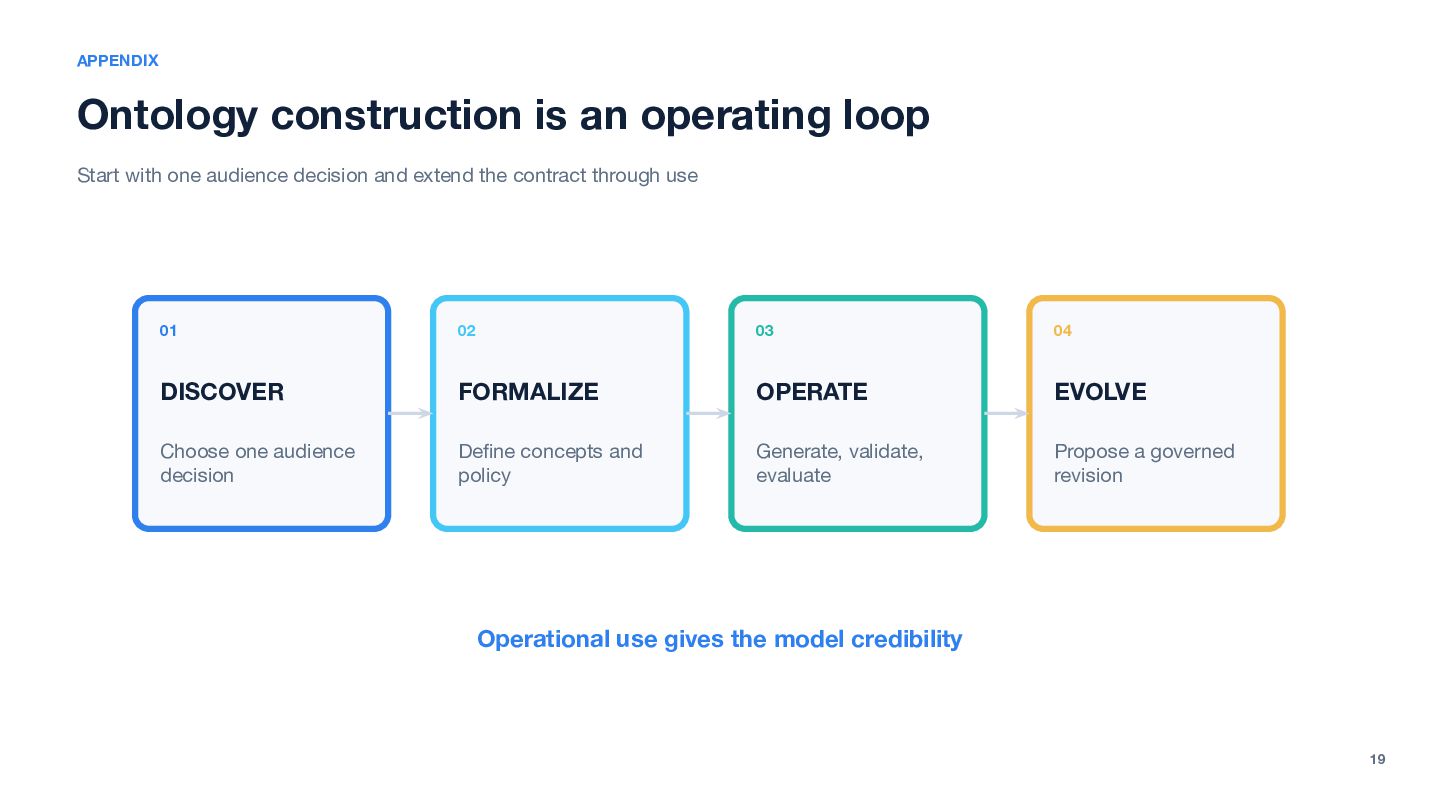
APPENDIX Ontology construction is an operating loop Start with one
audience decision and extend the contract through use 01 02 03 04 DISCOVER FORMALIZE OPERATE EVOLVE Choose one audience decision Define concepts and policy Generate, validate, evaluate Propose a governed revision Operational use gives the model credibility 19 -
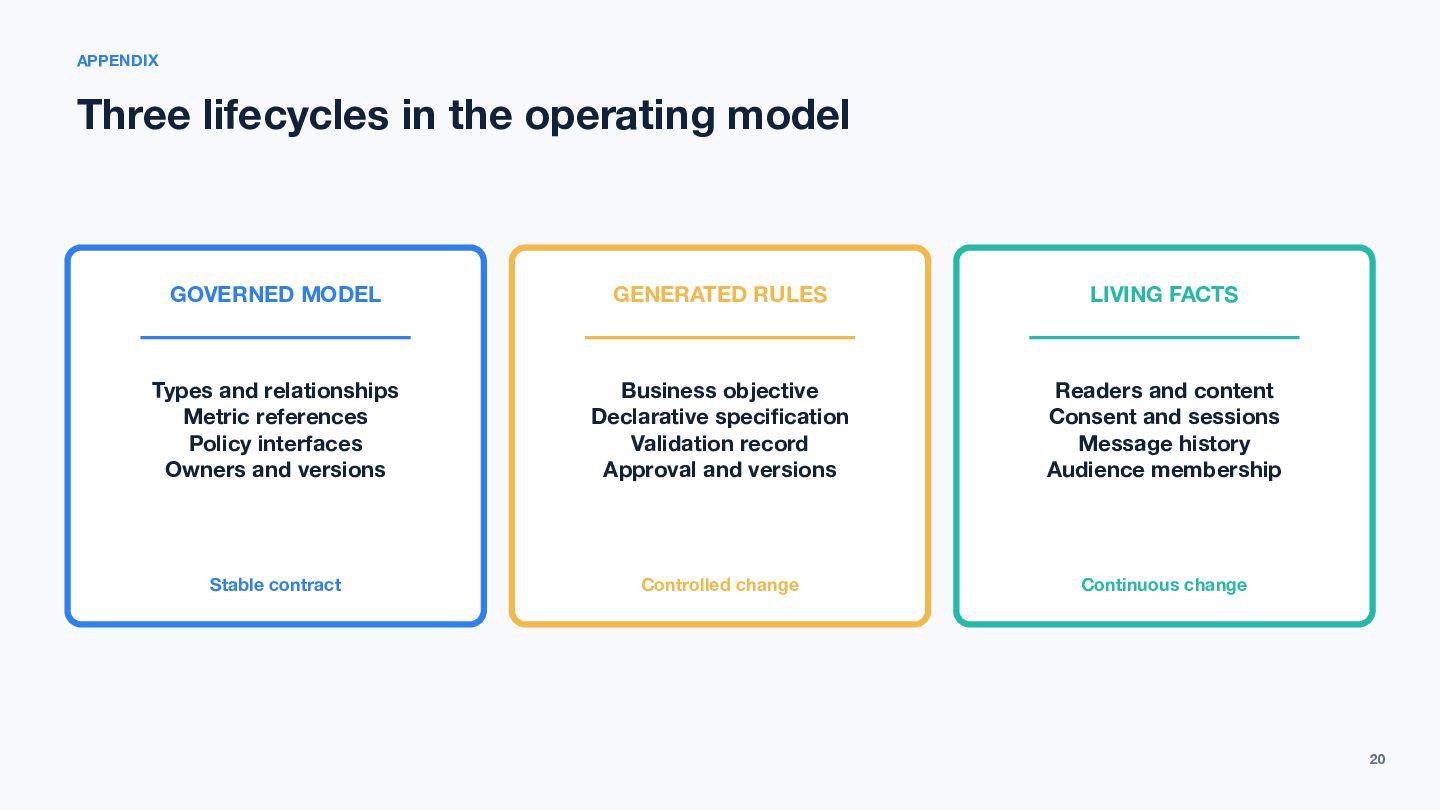
APPENDIX Three lifecycles in the operating model GOVERNED MODEL GENERATED
RULES LIVING FACTS Types and relationships Metric references Policy interfaces Owners and versions Business objective Declarative specification Validation record Approval and versions Readers and content Consent and sessions Message history Audience membership Stable contract Controlled change Continuous change 20