Share
Embed
Programação funcional para fazer Ruby melhor
Nessa palestra falei sobre algumas ideias de programação funcional para fazer ruby melhor. Apresentado no 21º encontro do GURU-SP, em Janeiro de 2012.
Vinicius Baggio Fuentes
January 30, 2012
Transcript
29 slides
-
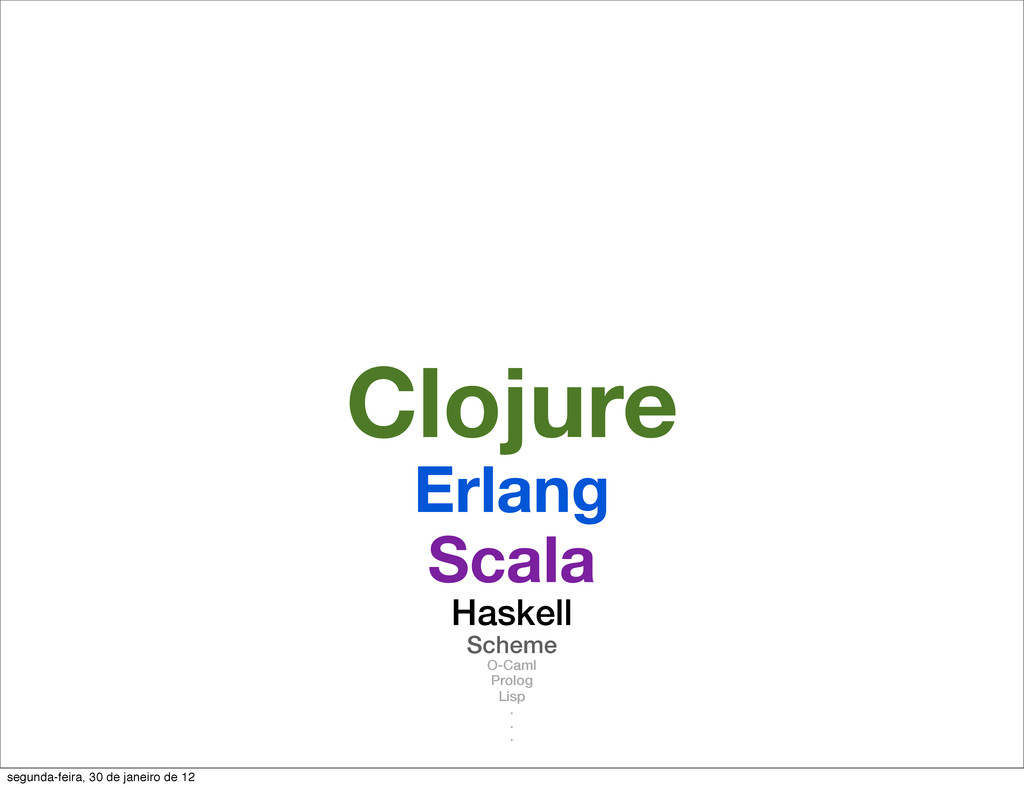
Clojure Erlang Scala Haskell Scheme O-Caml Prolog Lisp . .
. segunda-feira, 30 de janeiro de 12 -
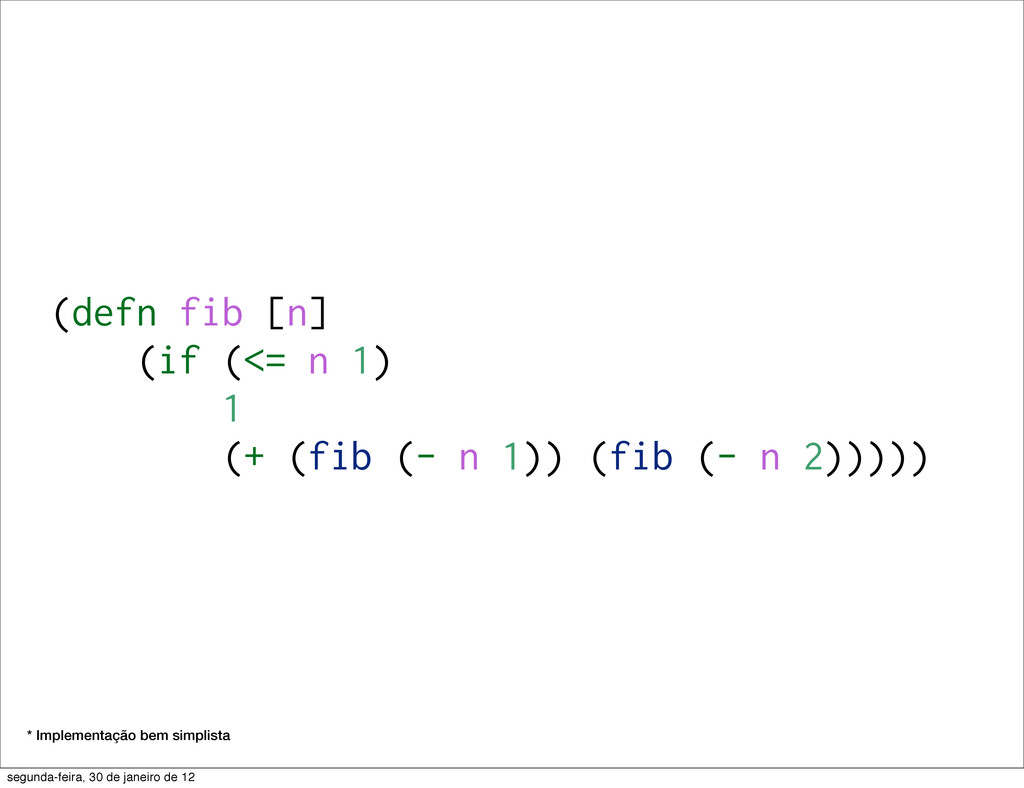
(defn fib [n] (if (<= n 1) 1 (+ (fib
(- n 1)) (fib (- n 2))))) * Implementação bem simplista segunda-feira, 30 de janeiro de 12 -
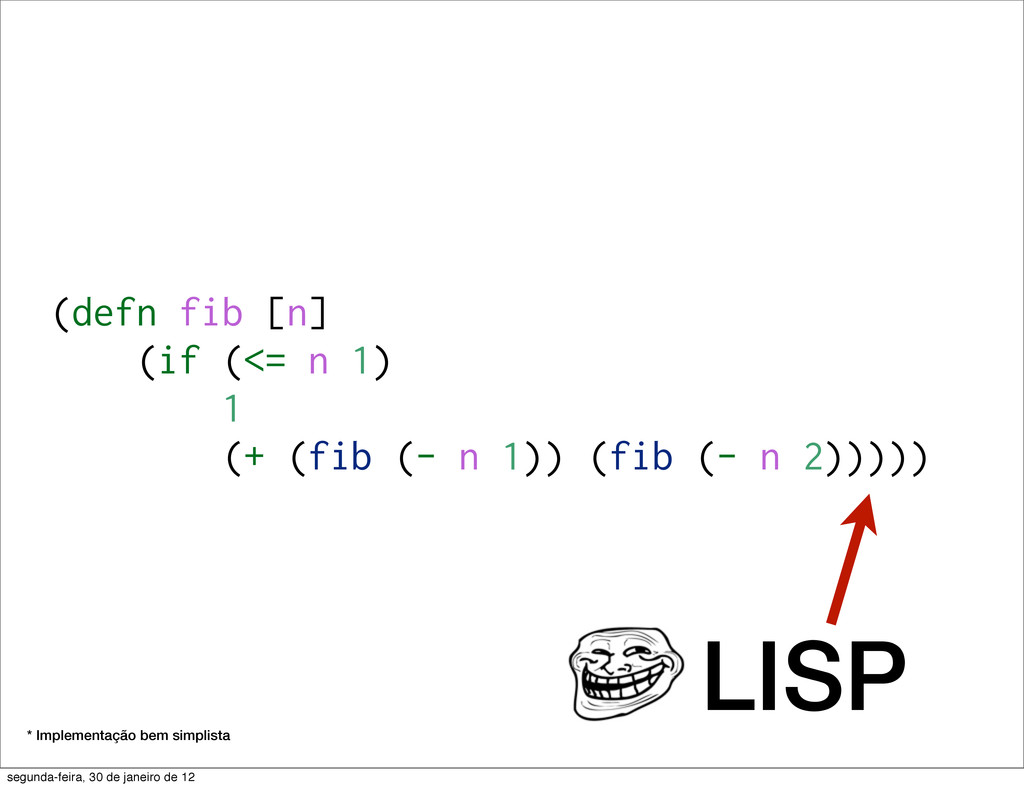
(defn fib [n] (if (<= n 1) 1 (+ (fib
(- n 1)) (fib (- n 2))))) * Implementação bem simplista LISP segunda-feira, 30 de janeiro de 12 -
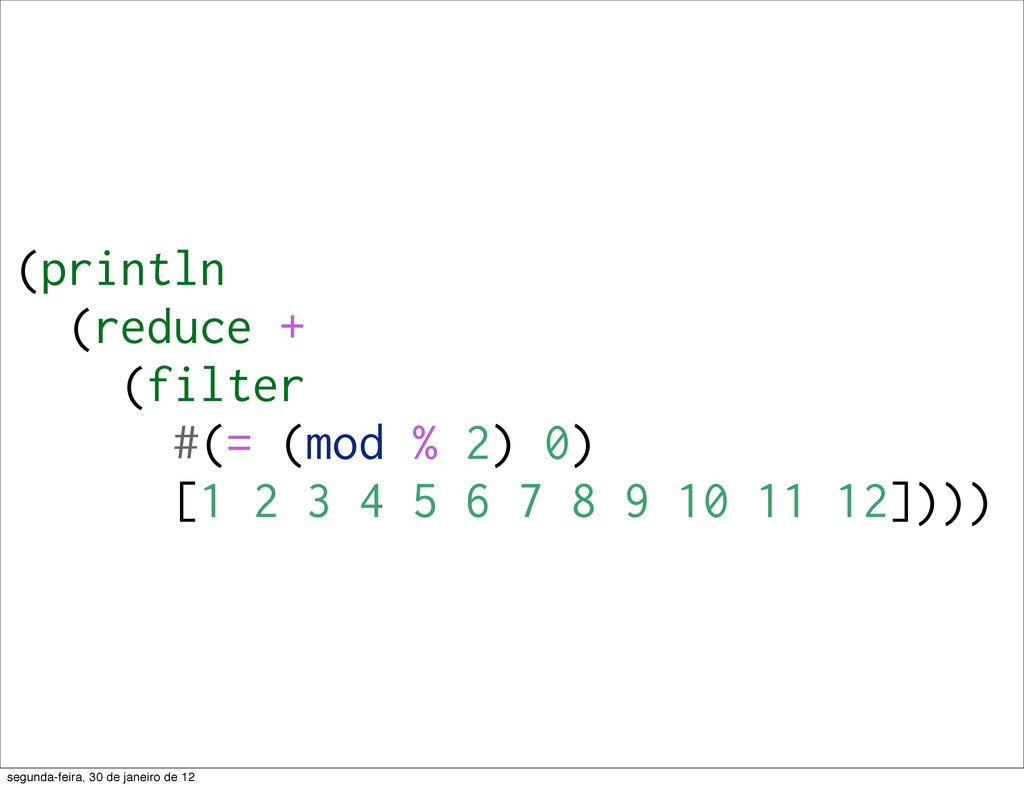
(println (reduce + (filter #(= (mod % 2) 0) [1
2 3 4 5 6 7 8 9 10 11 12]))) segunda-feira, 30 de janeiro de 12 -
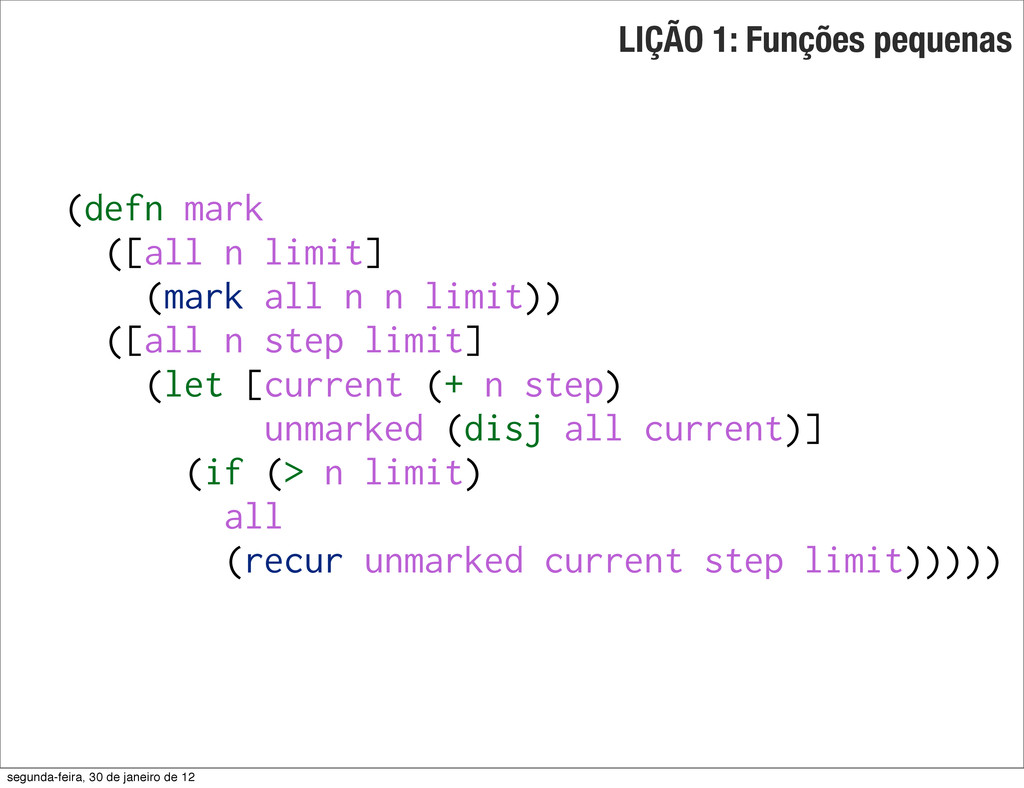
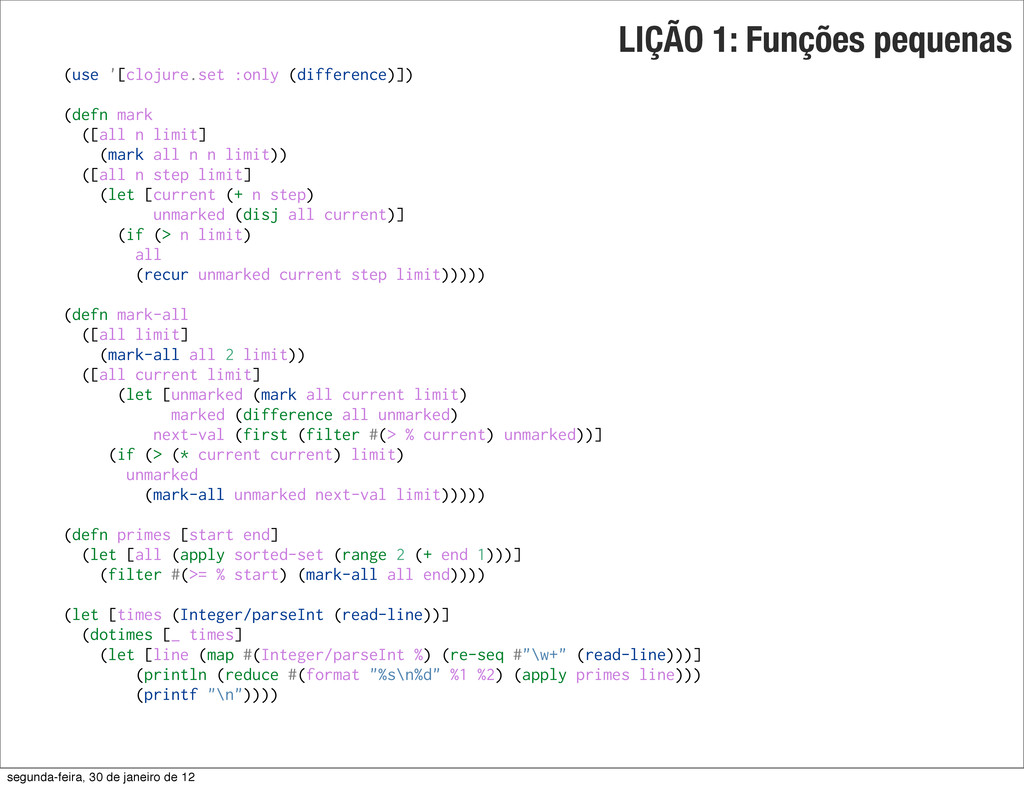
LIÇÃO 1: Funções pequenas (defn mark ([all n limit] (mark
all n n limit)) ([all n step limit] (let [current (+ n step) unmarked (disj all current)] (if (> n limit) all (recur unmarked current step limit))))) segunda-feira, 30 de janeiro de 12 -
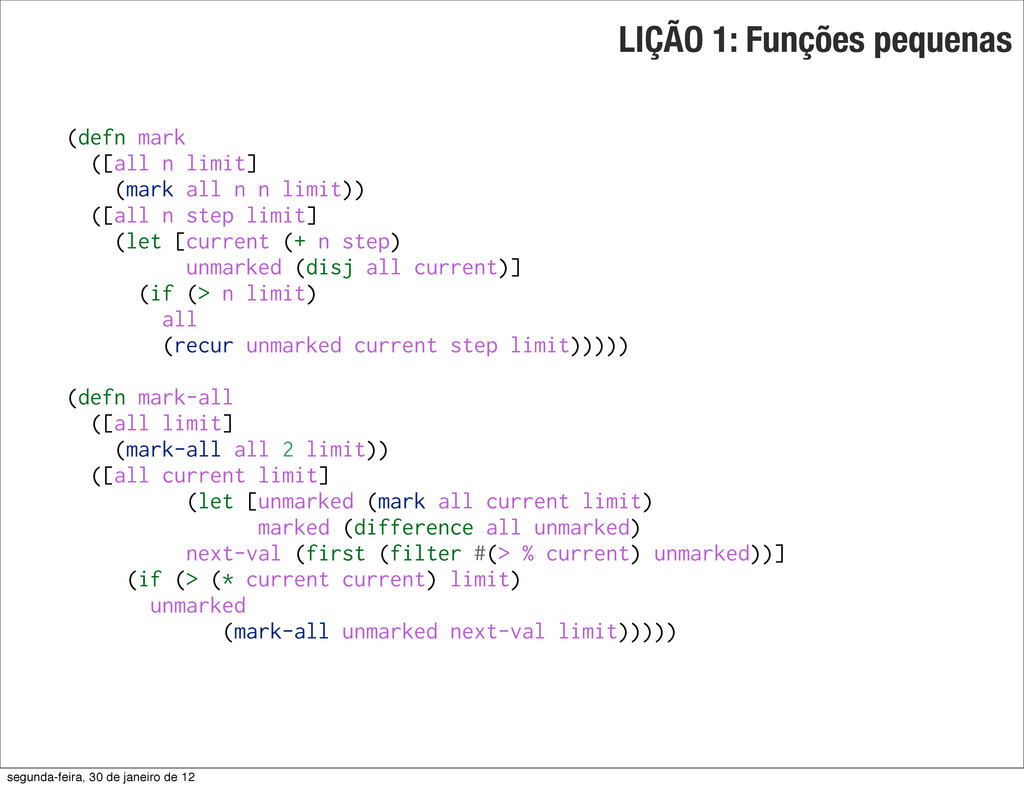
LIÇÃO 1: Funções pequenas (defn mark ([all n limit] (mark
all n n limit)) ([all n step limit] (let [current (+ n step) unmarked (disj all current)] (if (> n limit) all (recur unmarked current step limit))))) (defn mark-all ([all limit] (mark-all all 2 limit)) ([all current limit] (let [unmarked (mark all current limit) marked (difference all unmarked) next-val (first (filter #(> % current) unmarked))] (if (> (* current current) limit) unmarked (mark-all unmarked next-val limit))))) segunda-feira, 30 de janeiro de 12 -
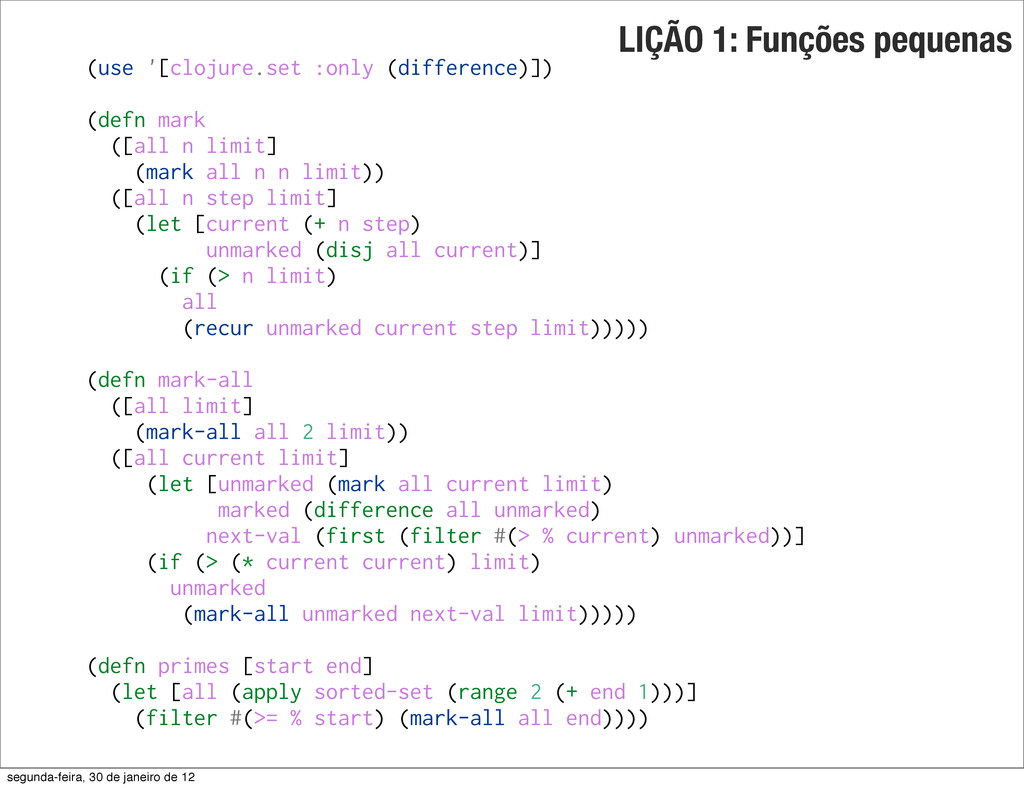
(use '[clojure.set :only (difference)]) (defn mark ([all n limit] (mark
all n n limit)) ([all n step limit] (let [current (+ n step) unmarked (disj all current)] (if (> n limit) all (recur unmarked current step limit))))) (defn mark-all ([all limit] (mark-all all 2 limit)) ([all current limit] (let [unmarked (mark all current limit) marked (difference all unmarked) next-val (first (filter #(> % current) unmarked))] (if (> (* current current) limit) unmarked (mark-all unmarked next-val limit))))) (defn primes [start end] (let [all (apply sorted-set (range 2 (+ end 1)))] (filter #(>= % start) (mark-all all end)))) LIÇÃO 1: Funções pequenas segunda-feira, 30 de janeiro de 12 -
(use '[clojure.set :only (difference)]) (defn mark ([all n limit] (mark
all n n limit)) ([all n step limit] (let [current (+ n step) unmarked (disj all current)] (if (> n limit) all (recur unmarked current step limit))))) (defn mark-all ([all limit] (mark-all all 2 limit)) ([all current limit] (let [unmarked (mark all current limit) marked (difference all unmarked) next-val (first (filter #(> % current) unmarked))] (if (> (* current current) limit) unmarked (mark-all unmarked next-val limit))))) (defn primes [start end] (let [all (apply sorted-set (range 2 (+ end 1)))] (filter #(>= % start) (mark-all all end)))) (let [times (Integer/parseInt (read-line))] (dotimes [_ times] (let [line (map #(Integer/parseInt %) (re-seq #"\w+" (read-line)))] (println (reduce #(format "%s\n%d" %1 %2) (apply primes line))) (printf "\n")))) LIÇÃO 1: Funções pequenas segunda-feira, 30 de janeiro de 12 -
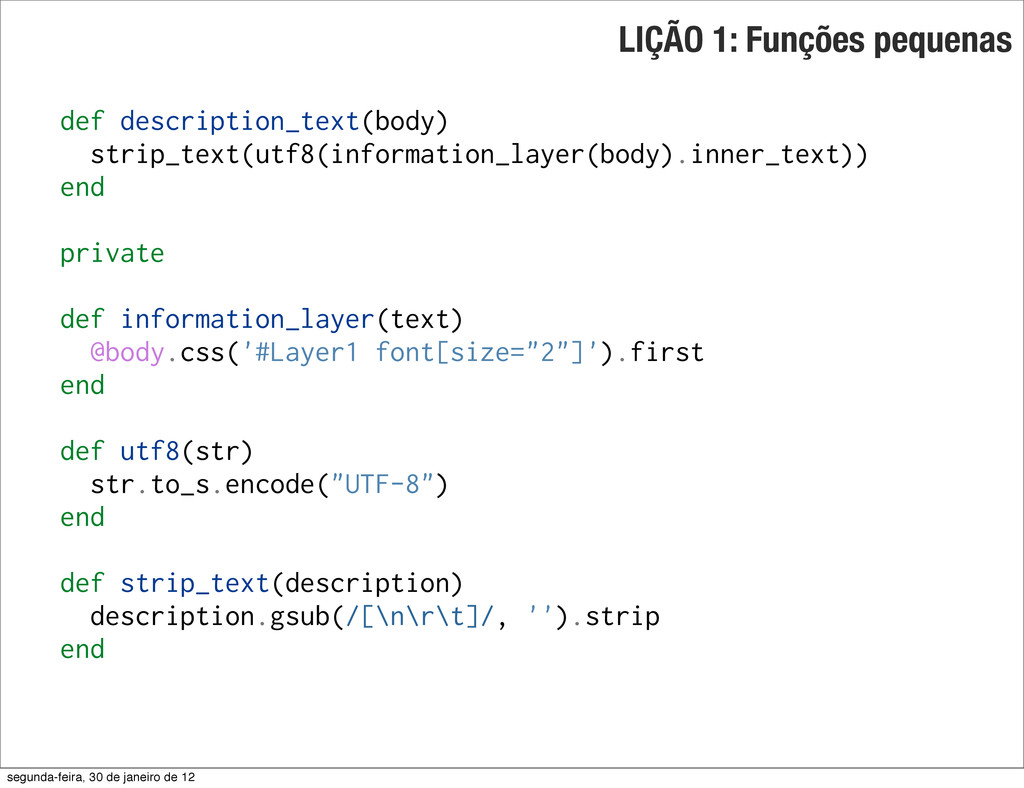
def description_text(body) strip_text(utf8(information_layer(body).inner_text)) end private def information_layer(text) @body.css('#Layer1 font[size="2"]').first end
def utf8(str) str.to_s.encode("UTF-8") end def strip_text(description) description.gsub(/[\n\r\t]/, '').strip end LIÇÃO 1: Funções pequenas segunda-feira, 30 de janeiro de 12 -
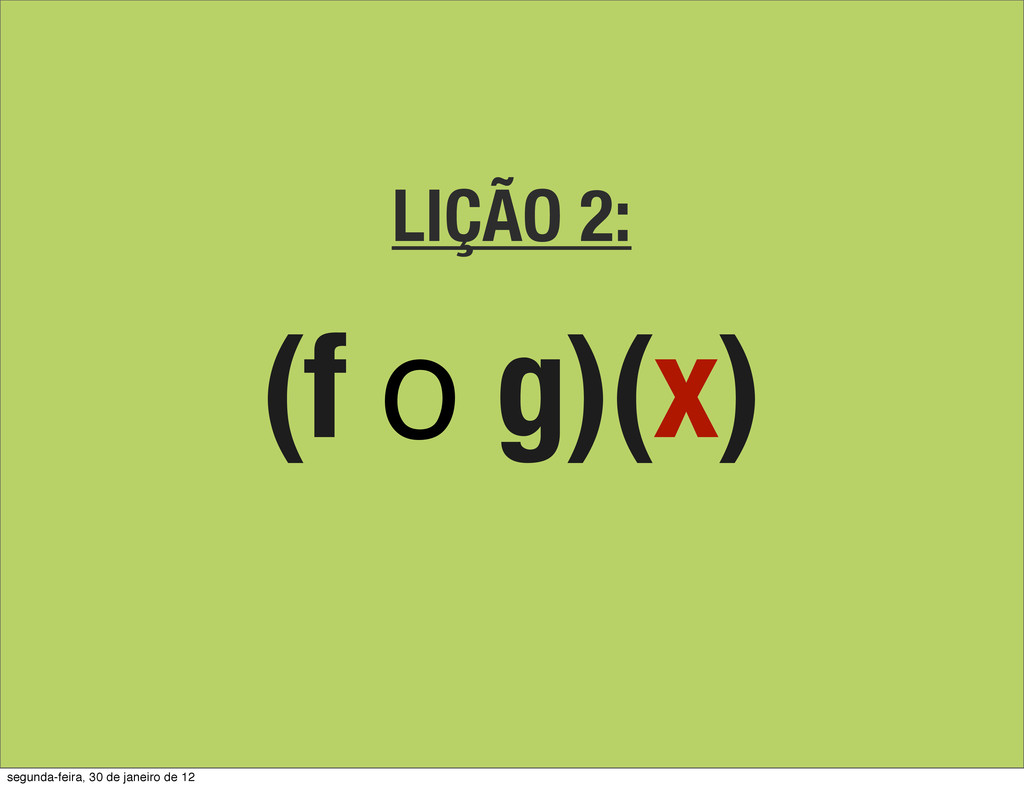
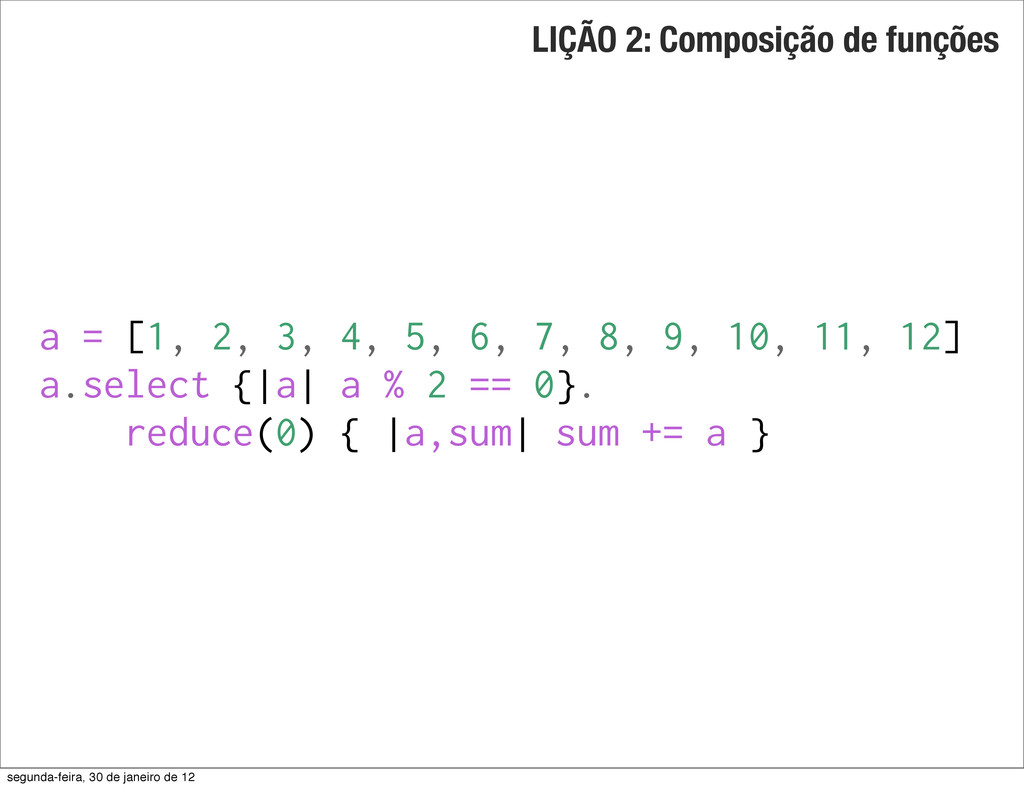
LIÇÃO 2: Composição de funções a = [1, 2, 3,
4, 5, 6, 7, 8, 9, 10, 11, 12] a.select {|a| a % 2 == 0}. reduce(0) { |a,sum| sum += a } segunda-feira, 30 de janeiro de 12 -
LIÇÃO 2: Composição de funções Enumerators em Ruby 1.9 segunda-feira,
30 de janeiro de 12 -
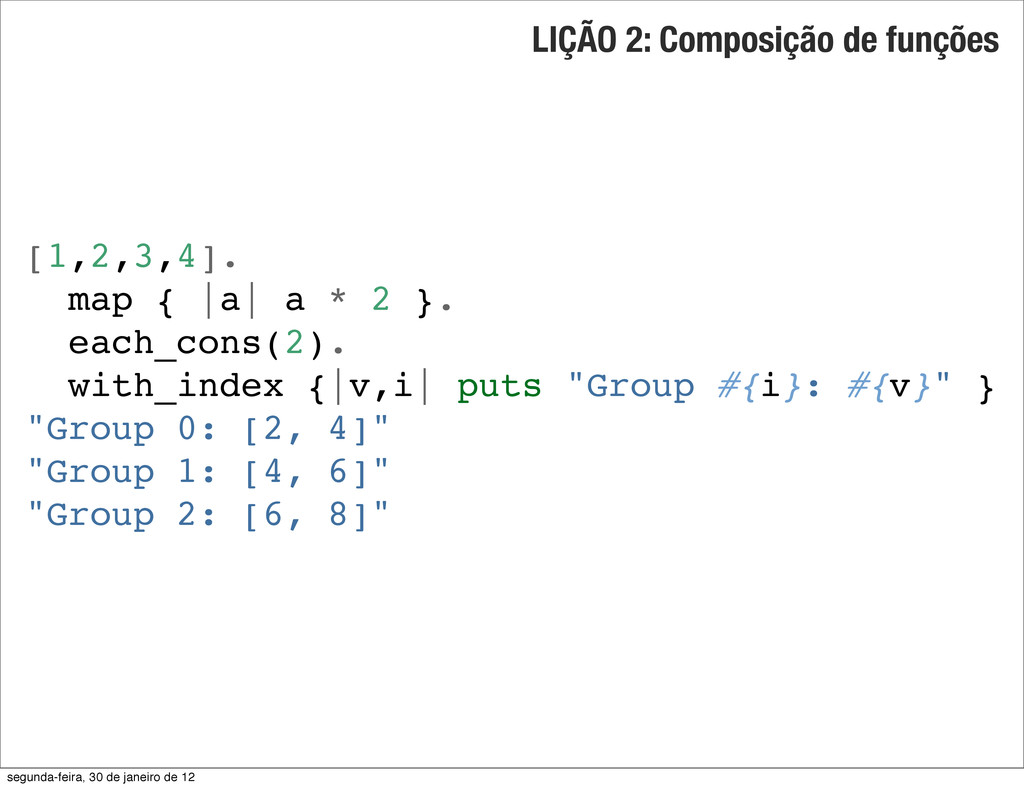
[1,2,3,4]. map { |a| a * 2 }. each_cons(2). with_index
{|v,i| puts "Group #{i}: #{v}" } "Group 0: [2, 4]" "Group 1: [4, 6]" "Group 2: [6, 8]" LIÇÃO 2: Composição de funções segunda-feira, 30 de janeiro de 12 -
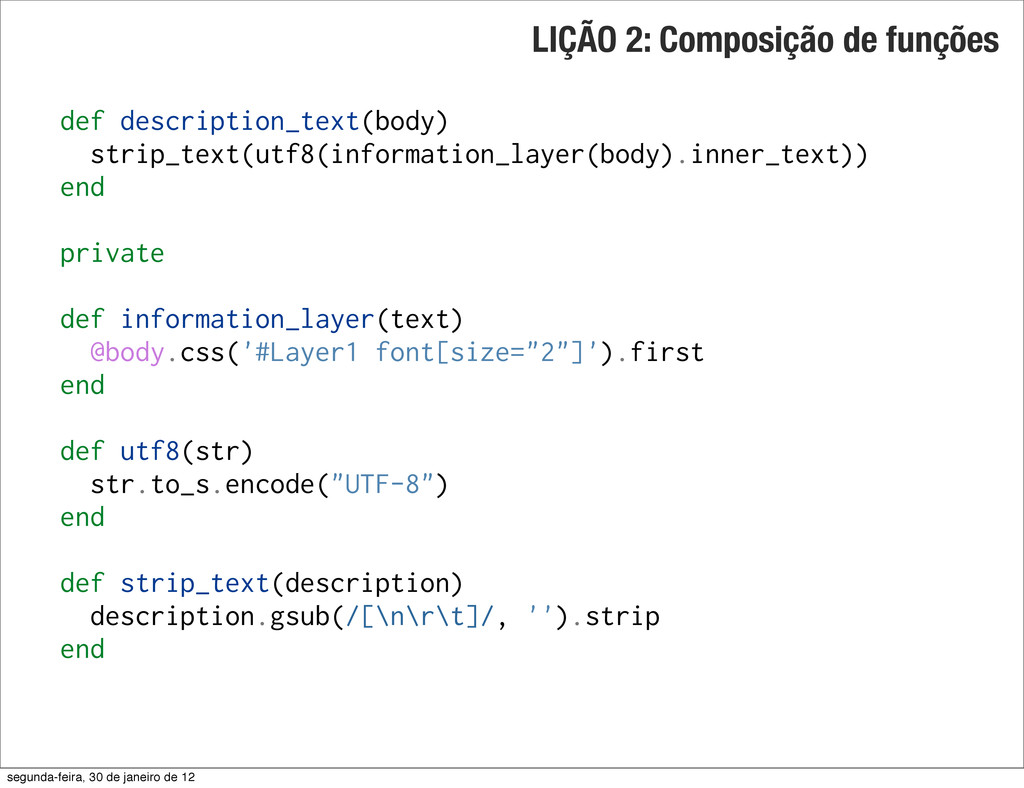
def description_text(body) strip_text(utf8(information_layer(body).inner_text)) end private def information_layer(text) @body.css('#Layer1 font[size="2"]').first end
def utf8(str) str.to_s.encode("UTF-8") end def strip_text(description) description.gsub(/[\n\r\t]/, '').strip end LIÇÃO 2: Composição de funções segunda-feira, 30 de janeiro de 12 -
LIÇÃO 2: Composição de funções <3 Ruby <3 segunda-feira, 30
de janeiro de 12 -
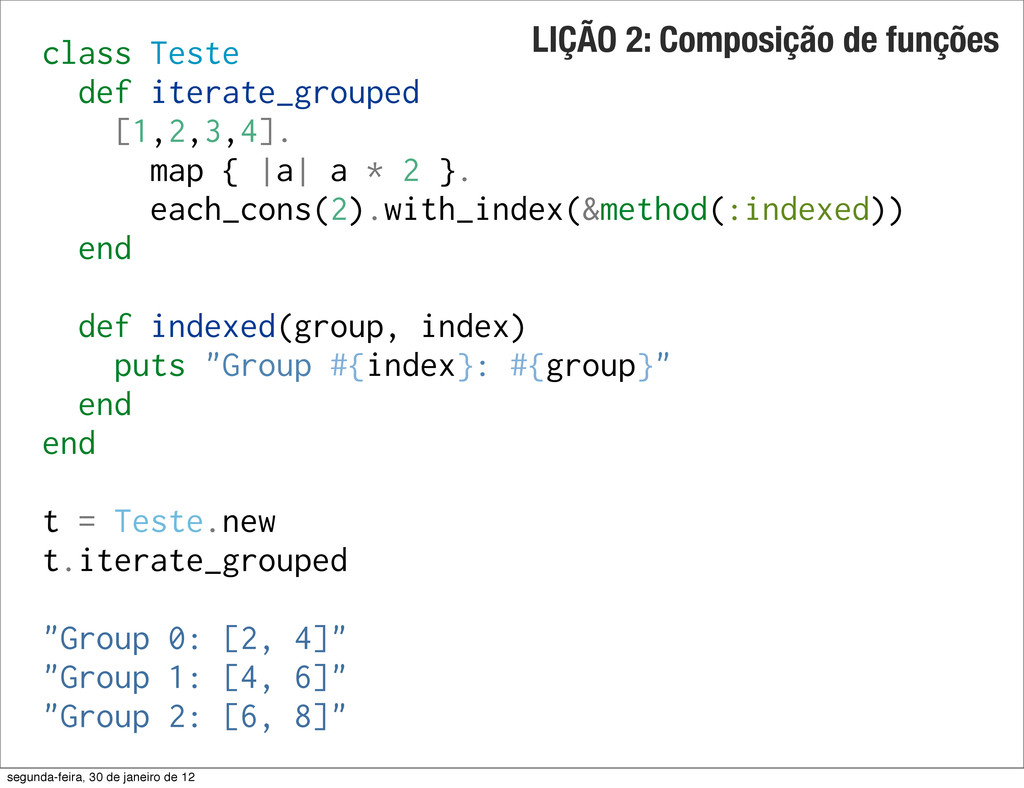
LIÇÃO 2: Composição de funções class Teste def iterate_grouped [1,2,3,4].
map { |a| a * 2 }. each_cons(2).with_index(&method(:indexed)) end def indexed(group, index) puts "Group #{index}: #{group}" end end t = Teste.new t.iterate_grouped "Group 0: [2, 4]" "Group 1: [4, 6]" "Group 2: [6, 8]" segunda-feira, 30 de janeiro de 12 -
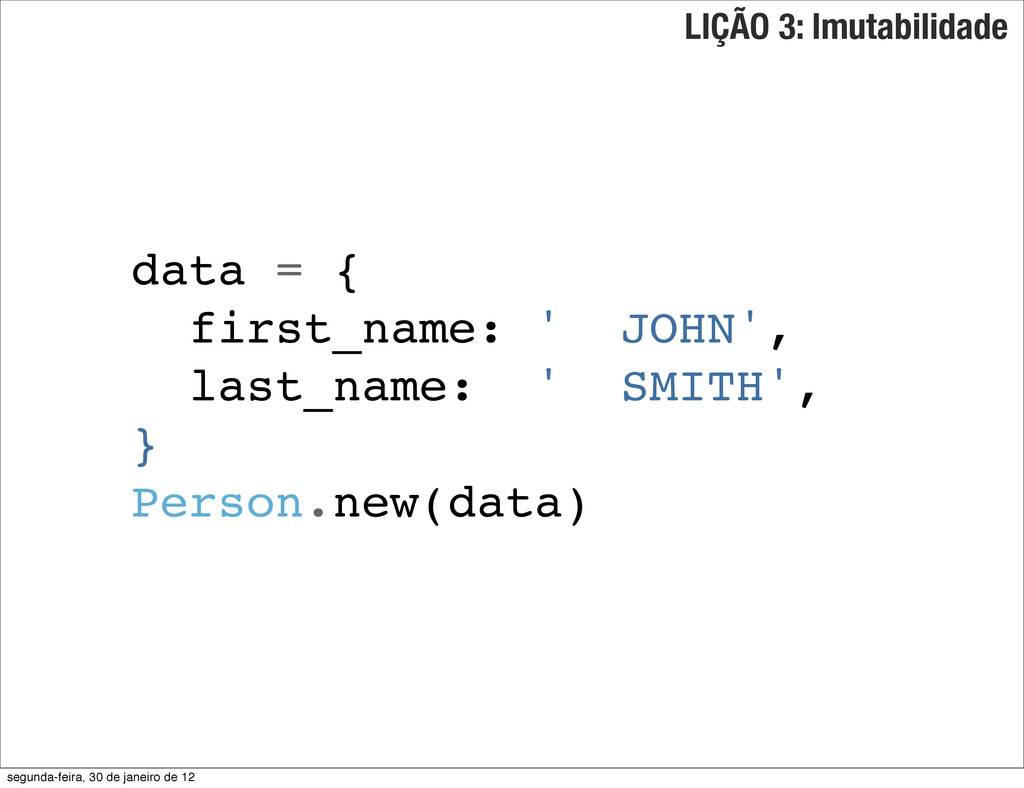
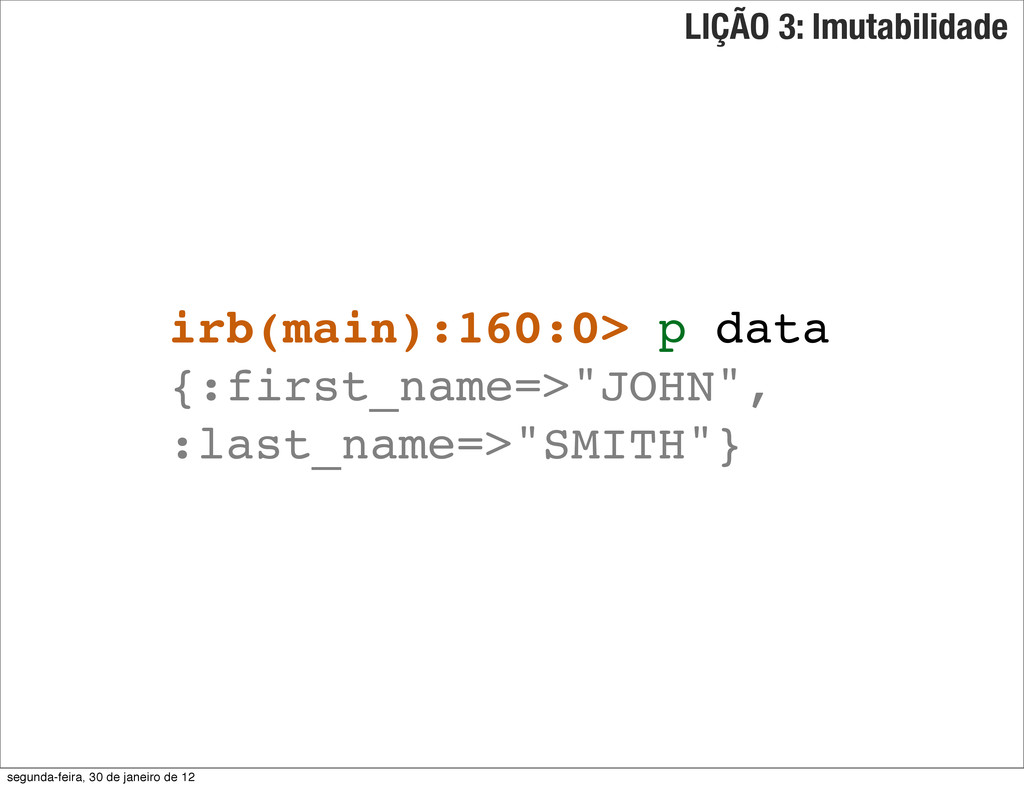
LIÇÃO 3: Imutabilidade data = { first_name: ' JOHN', last_name:
' SMITH', } Person.new(data) segunda-feira, 30 de janeiro de 12 -
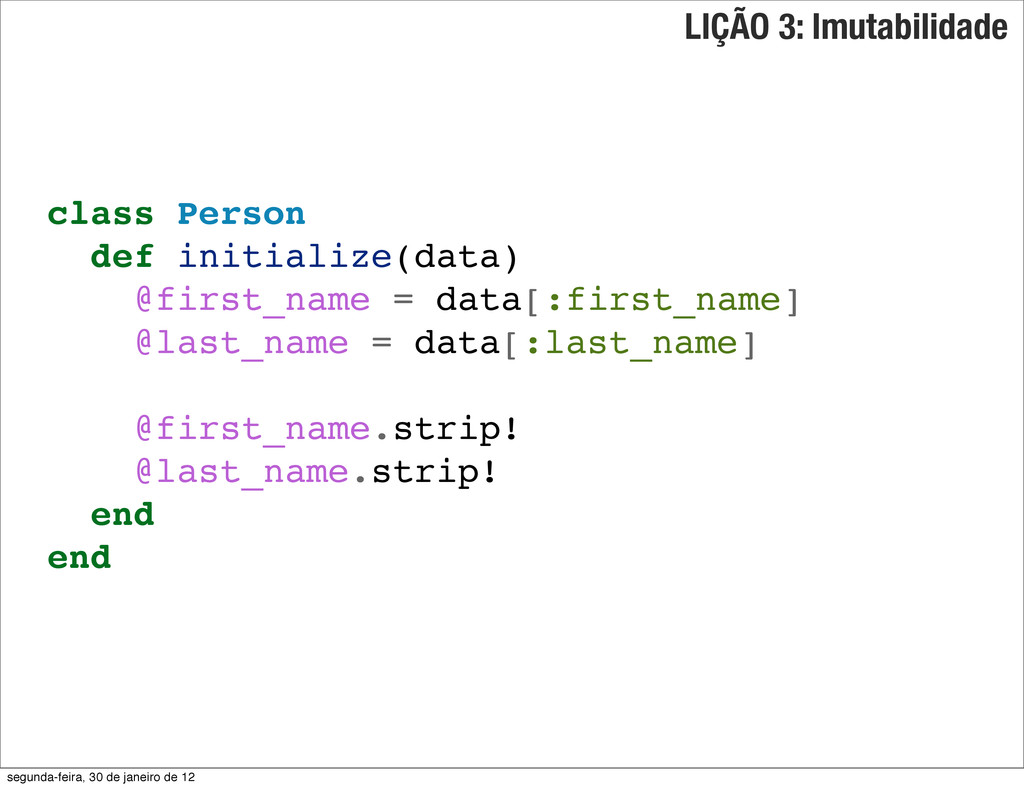
LIÇÃO 3: Imutabilidade class Person def initialize(data) @first_name = data[:first_name]
@last_name = data[:last_name] @first_name.strip! @last_name.strip! end end segunda-feira, 30 de janeiro de 12