Upgrade to Pro — share decks privately, control downloads, hide ads and more …

VoteAmerica 2024 Election Cycle Report

VoteAmerica 2024 Election Cycle Report

Avatar for voteamerica

voteamerica PRO

July 01, 2025

More Decks by voteamerica

Other Decks in Education

Transcript

  1. 2 LETTER FROM DEBRA OUR WORK TARGETING MESSAGING 2023 WISCONSIN

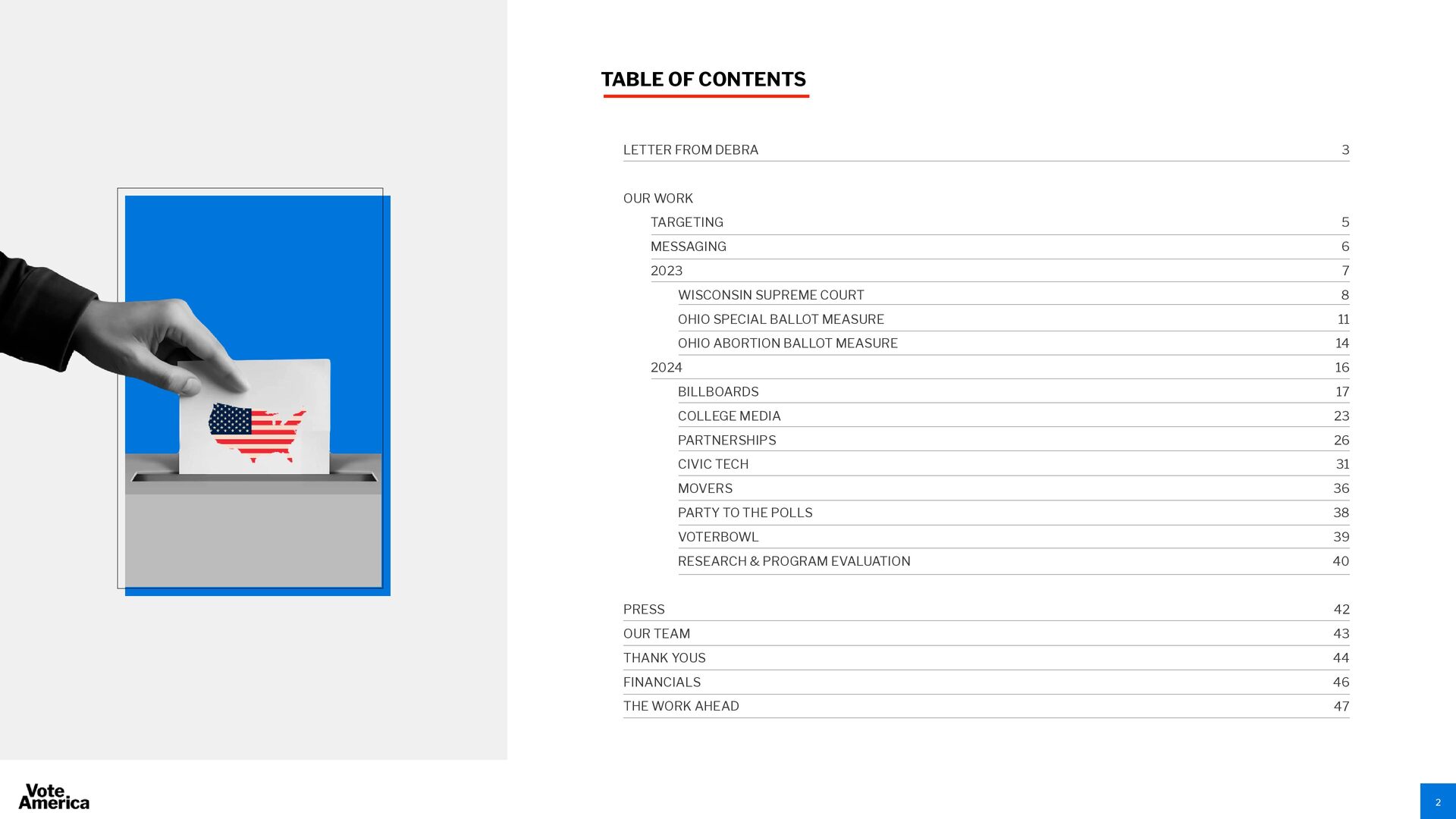
    SUPREME COURT OHIO SPECIAL BALLOT MEASURE OHIO ABORTION BALLOT MEASURE 2024 BILLBOARDS COLLEGE MEDIA PARTNERSHIPS CIVIC TECH MOVERS PARTY TO THE POLLS VOTERBOWL RESEARCH & PROGRAM EVALUATION PRESS OUR TEAM THANK YOUS FINANCIALS THE WORK AHEAD 3 5 6 7 8 11 14 16 17 23 26 31 36 38 39 40 42 43 44 46 47 TABLE OF CONTENTS
  2. 3 A Letter From VoteAmerica’s Founder The 2023 and 2024

    election cycles unfolded in an environment defined by disruption. Voting rules changed mid-cycle. Misinformation spread faster than facts. Courts, ballot measures, and administrative processes became frontline battlegrounds for everything from abortion access to fair representation. That environment asked an excessive amount from voters. Participating in democracy meant navigating a system that had become even harder and more fragmented. Across states and elections, we saw the same tension again and again. This report reflects how VoteAmerica responded to that reality in 2023 and 2024, by staying focused on one thing: reducing friction in the voting process when it mattered most. Over those two years, VoteAmerica’s civic infrastructure supported millions of voters navigating an increasingly complex system. From Wisconsin’s high-stakes Supreme Court election to Ohio’s fight over reproductive freedom to national elections shaped by widespread misinformation, our work centered on delivering accurate, actionable election information, clearly and at scale. That work sharpened a truth our research has shown for years: People don’t need to be convinced to vote. They need to be able to vote. That means knowing when to vote. Where to vote. What to bring. You will see this line repeated throughout our report, and across the programs, tools, and strategies that defined our work in 2023 and 2024. The past two years also forced a clearer reckoning with where the field invests its resources. While billions were spent on broadcast media with uneven results, proven, lower-cost strategies that deliver trusted information directly to voters, including college media and other local channels, remained underfunded.
  3. 4 Sincerely, Debra Cleaver LETTER FROM OUR FOUNDER We saw

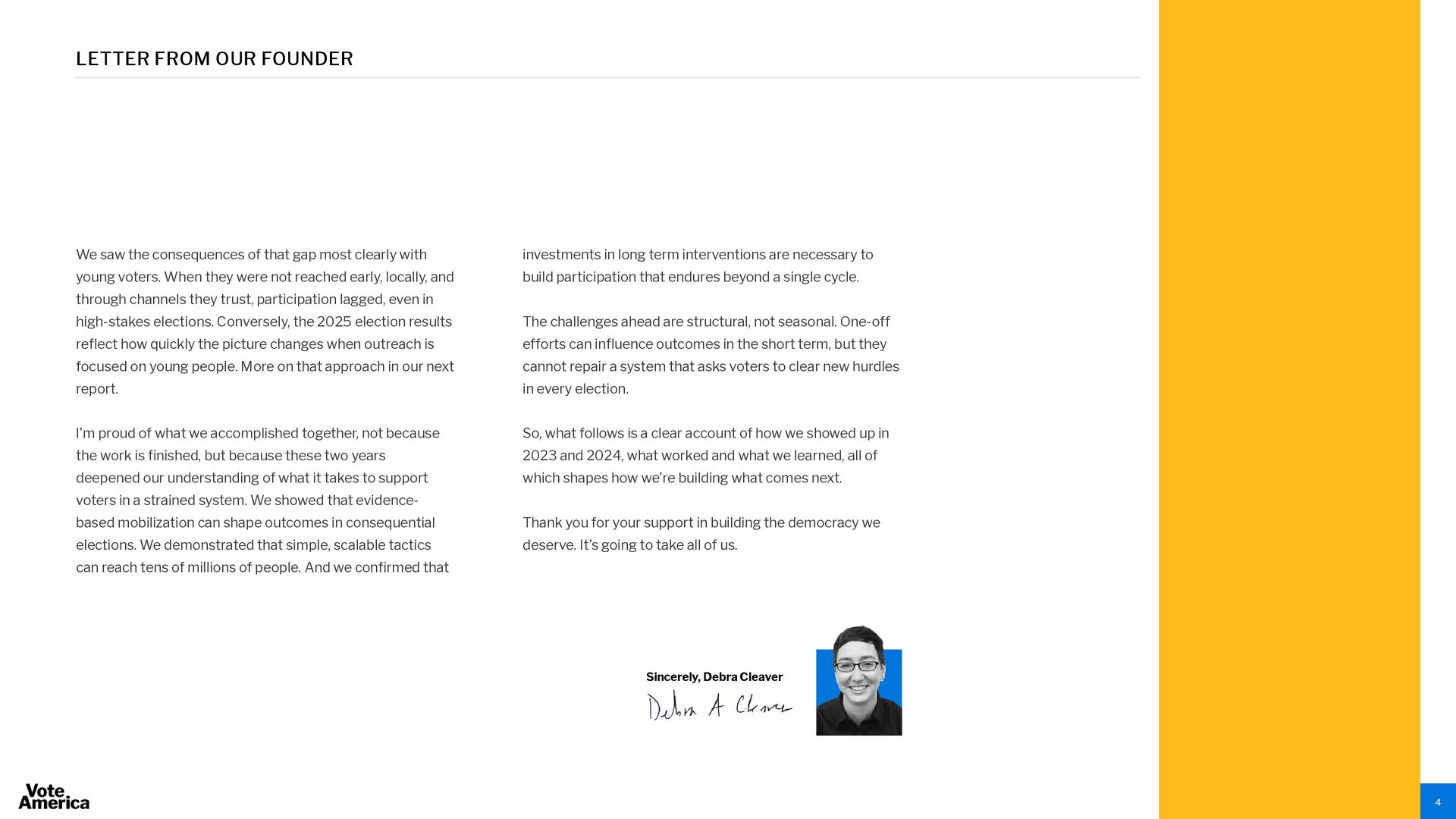
    the consequences of that gap most clearly with young voters. When they were not reached early, locally, and through channels they trust, participation lagged, even in high-stakes elections. Conversely, the 2025 election results reflect how quickly the picture changes when outreach is focused on young people. More on that approach in our next report. I’m proud of what we accomplished together, not because the work is finished, but because these two years deepened our understanding of what it takes to support voters in a strained system. We showed that evidence- based mobilization can shape outcomes in consequential elections. We demonstrated that simple, scalable tactics can reach tens of millions of people. And we confirmed that investments in long term interventions are necessary to build participation that endures beyond a single cycle. The challenges ahead are structural, not seasonal. One-off efforts can influence outcomes in the short term, but they cannot repair a system that asks voters to clear new hurdles in every election. So, what follows is a clear account of how we showed up in 2023 and 2024, what worked and what we learned, all of which shapes how we’re building what comes next. Thank you for your support in building the democracy we deserve. It’s going to take all of us.
  4. 5 Targeting OUR WORK Where can we reach the greatest

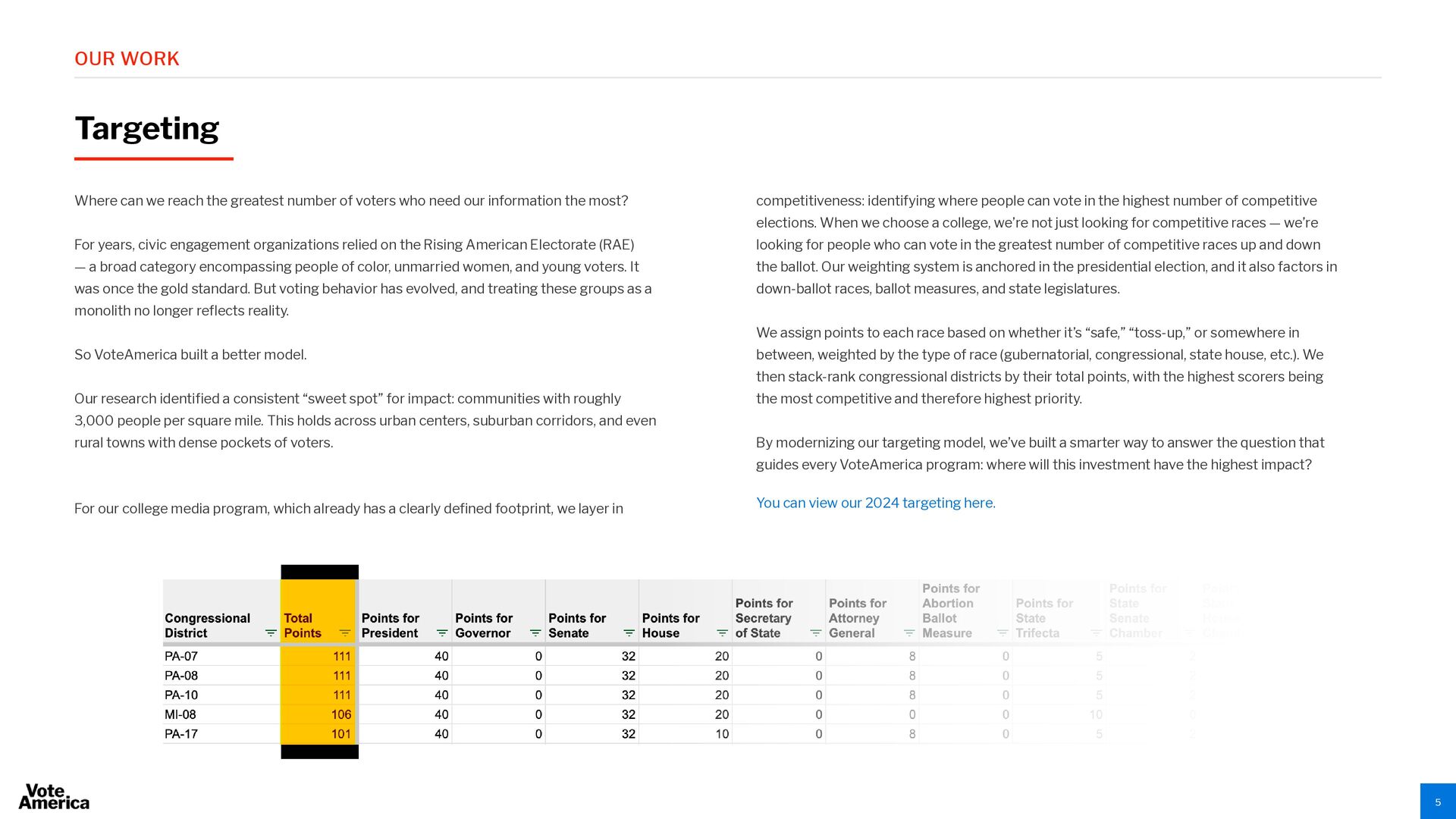
    number of voters who need our information the most? For years, civic engagement organizations relied on the Rising American Electorate (RAE) — a broad category encompassing people of color, unmarried women, and young voters. It was once the gold standard. But voting behavior has evolved, and treating these groups as a monolith no longer reflects reality. So VoteAmerica built a better model. Our research identified a consistent “sweet spot” for impact: communities with roughly 3,000 people per square mile. This holds across urban centers, suburban corridors, and even rural towns with dense pockets of voters. For our college media program, which already has a clearly defined footprint, we layer in competitiveness: identifying where people can vote in the highest number of competitive elections. When we choose a college, we’re not just looking for competitive races — we’re looking for people who can vote in the greatest number of competitive races up and down the ballot. Our weighting system is anchored in the presidential election, and it also factors in down-ballot races, ballot measures, and state legislatures. We assign points to each race based on whether it’s “safe,” “toss-up,” or somewhere in between, weighted by the type of race (gubernatorial, congressional, state house, etc.). We then stack-rank congressional districts by their total points, with the highest scorers being the most competitive and therefore highest priority. By modernizing our targeting model, we’ve built a smarter way to answer the question that guides every VoteAmerica program: where will this investment have the highest impact? You can view our 2024 targeting here.
  5. 6 Messaging OUR WORK In October 2016, 37% of Americans

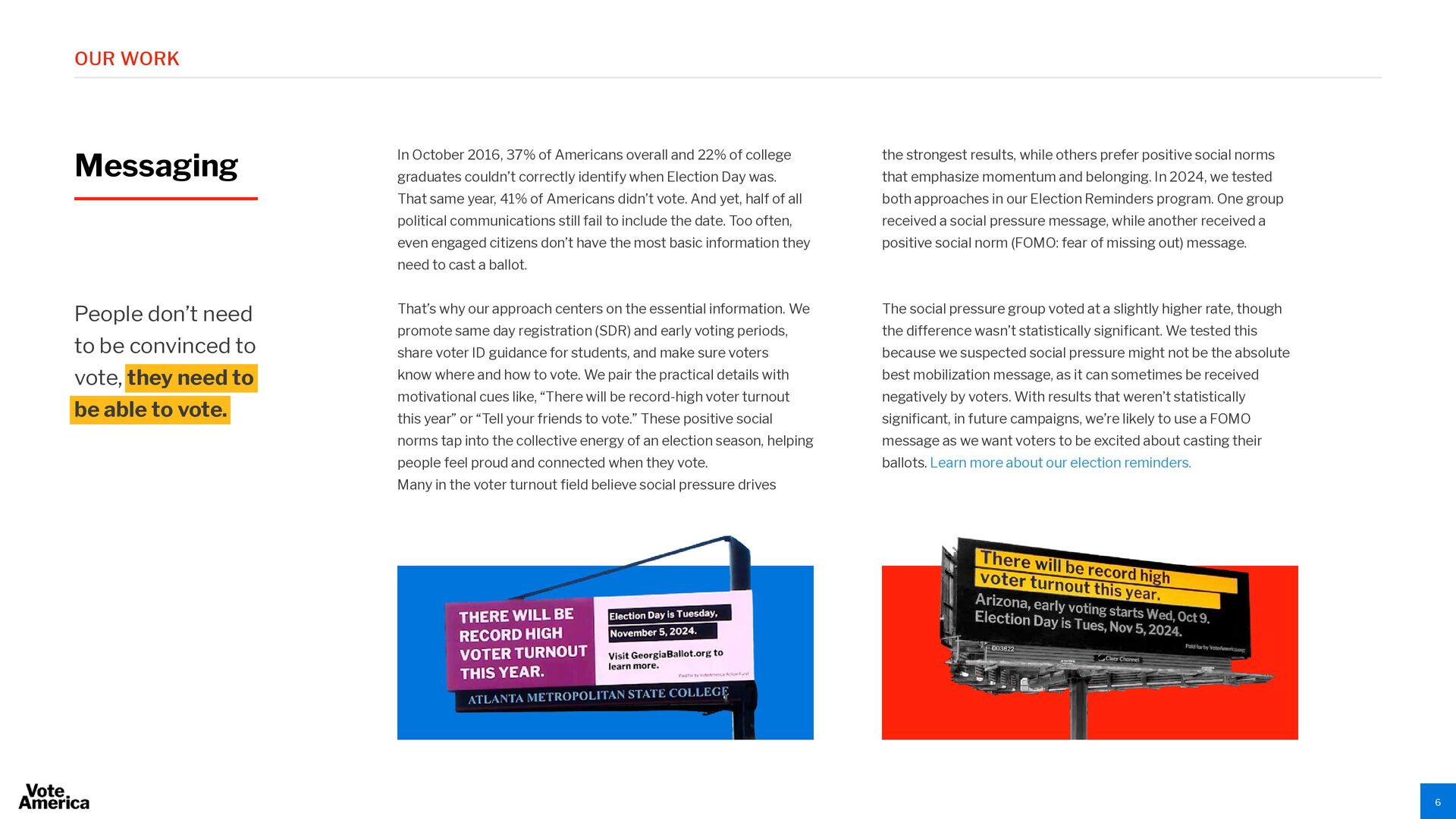
    overall and 22% of college graduates couldn’t correctly identify when Election Day was. That same year, 41% of Americans didn’t vote. And yet, half of all political communications still fail to include the date. Too often, even engaged citizens don’t have the most basic information they need to cast a ballot. That’s why our approach centers on the essential information. We promote same day registration (SDR) and early voting periods, share voter ID guidance for students, and make sure voters know where and how to vote. We pair the practical details with motivational cues like, “There will be record-high voter turnout this year” or “Tell your friends to vote.” These positive social norms tap into the collective energy of an election season, helping people feel proud and connected when they vote. Many in the voter turnout field believe social pressure drives the strongest results, while others prefer positive social norms that emphasize momentum and belonging. In 2024, we tested both approaches in our Election Reminders program. One group received a social pressure message, while another received a positive social norm (FOMO: fear of missing out) message. The social pressure group voted at a slightly higher rate, though the difference wasn’t statistically significant. We tested this because we suspected social pressure might not be the absolute best mobilization message, as it can sometimes be received negatively by voters. With results that weren’t statistically significant, in future campaigns, we’re likely to use a FOMO message as we want voters to be excited about casting their ballots. Learn more about our election reminders. People don’t need to be convinced to vote, they need to be able to vote.
  6. 7 Roe v. Wade was overturned on June 24, 2022,

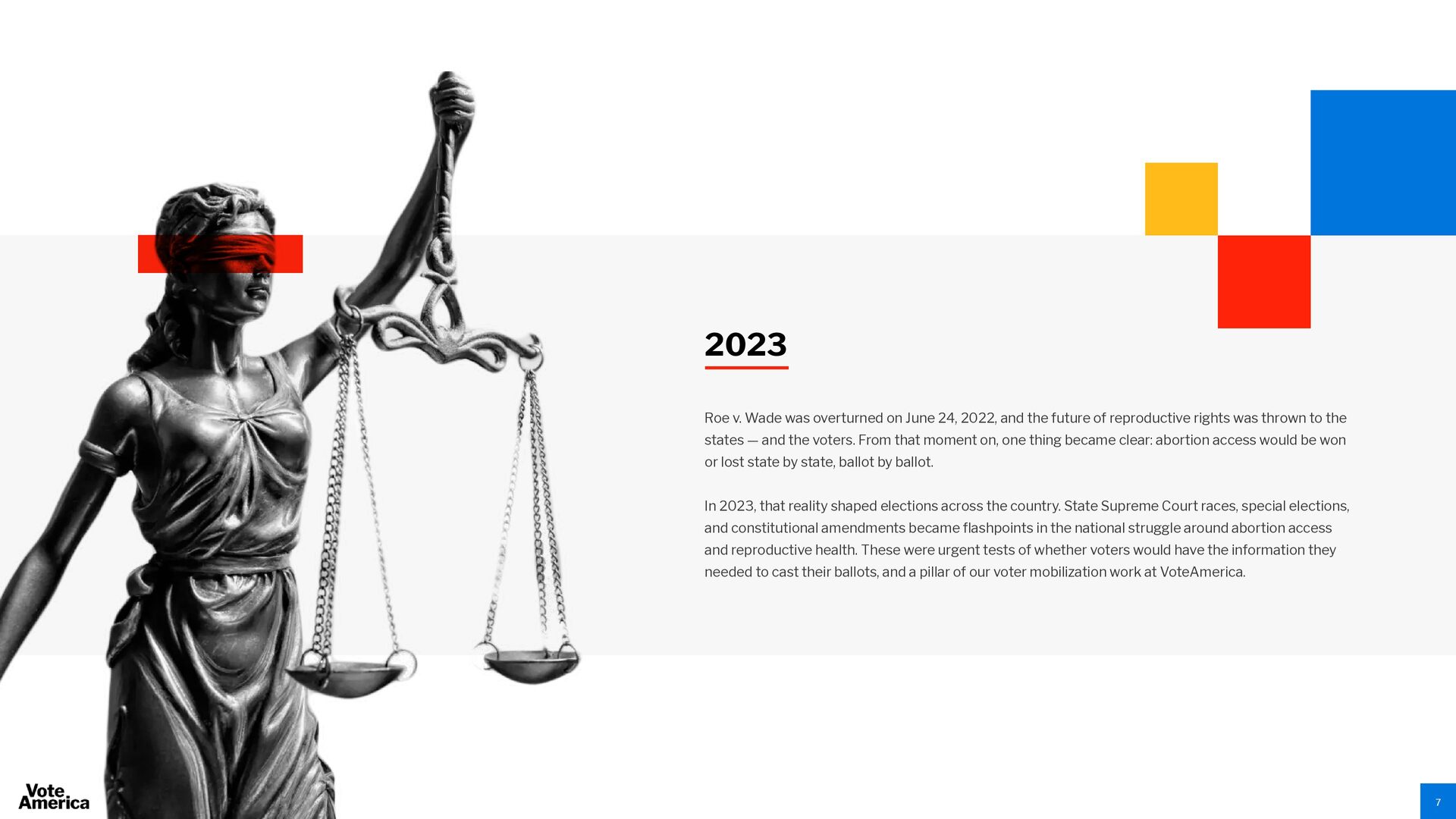
    and the future of reproductive rights was thrown to the states — and the voters. From that moment on, one thing became clear: abortion access would be won or lost state by state, ballot by ballot. In 2023, that reality shaped elections across the country. State Supreme Court races, special elections, and constitutional amendments became flashpoints in the national struggle around abortion access and reproductive health. These were urgent tests of whether voters would have the information they needed to cast their ballots, and a pillar of our voter mobilization work at VoteAmerica. 2023
  7. 8 The Wisconsin Supreme Court election in 2023 wasn’t a

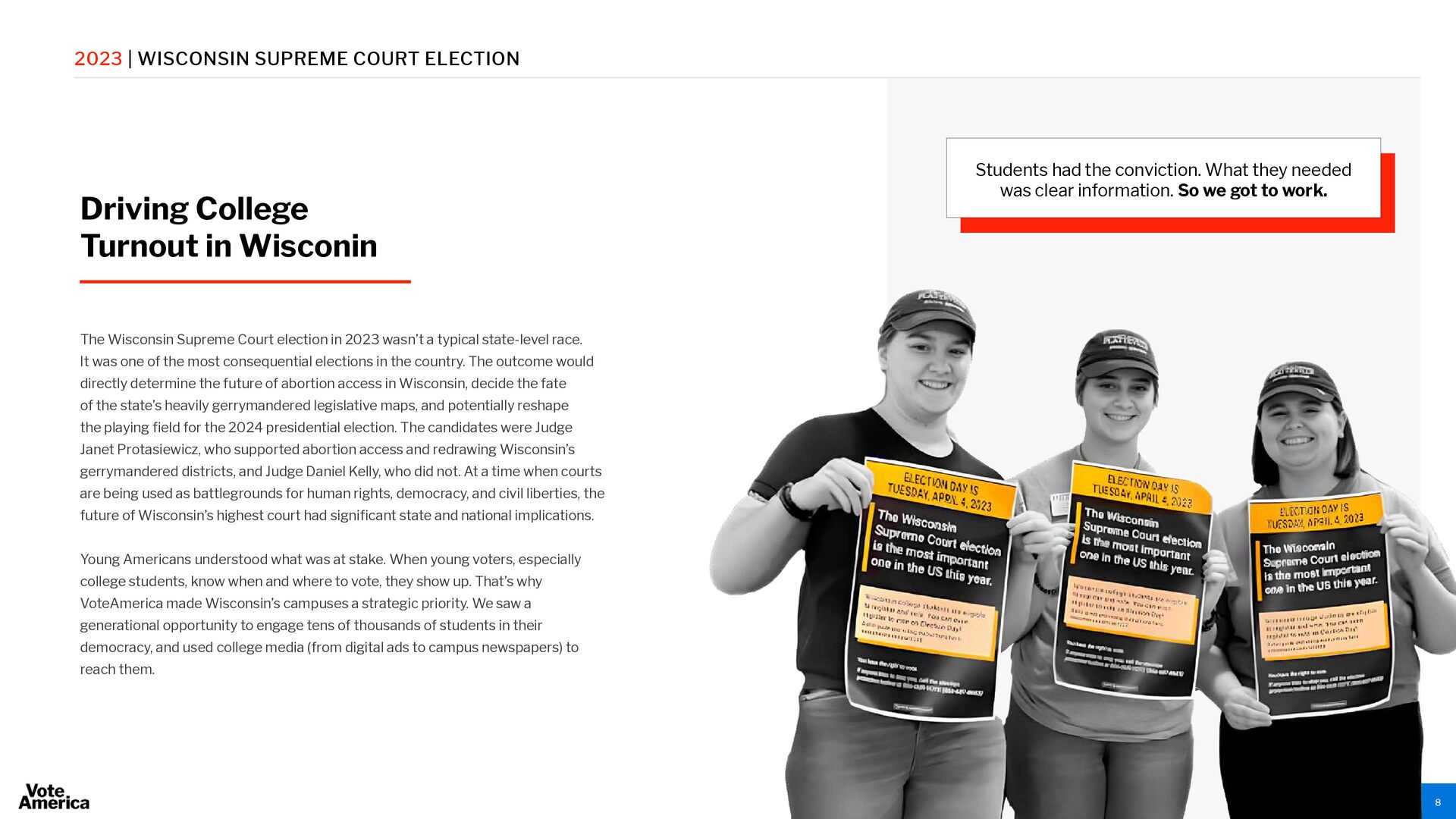
    typical state-level race. It was one of the most consequential elections in the country. The outcome would directly determine the future of abortion access in Wisconsin, decide the fate of the state’s heavily gerrymandered legislative maps, and potentially reshape the playing field for the 2024 presidential election. The candidates were Judge Janet Protasiewicz, who supported abortion access and redrawing Wisconsin’s gerrymandered districts, and Judge Daniel Kelly, who did not. At a time when courts are being used as battlegrounds for human rights, democracy, and civil liberties, the future of Wisconsin’s highest court had significant state and national implications. Young Americans understood what was at stake. When young voters, especially college students, know when and where to vote, they show up. That’s why VoteAmerica made Wisconsin’s campuses a strategic priority. We saw a generational opportunity to engage tens of thousands of students in their democracy, and used college media (from digital ads to campus newspapers) to reach them. Driving College Turnout in Wisconin 2023 | WISCONSIN SUPREME COURT ELECTION Students had the conviction. What they needed was clear information. So we got to work.
  8. 9 Leveraging VoteAmerica’s years of experience with college media, and

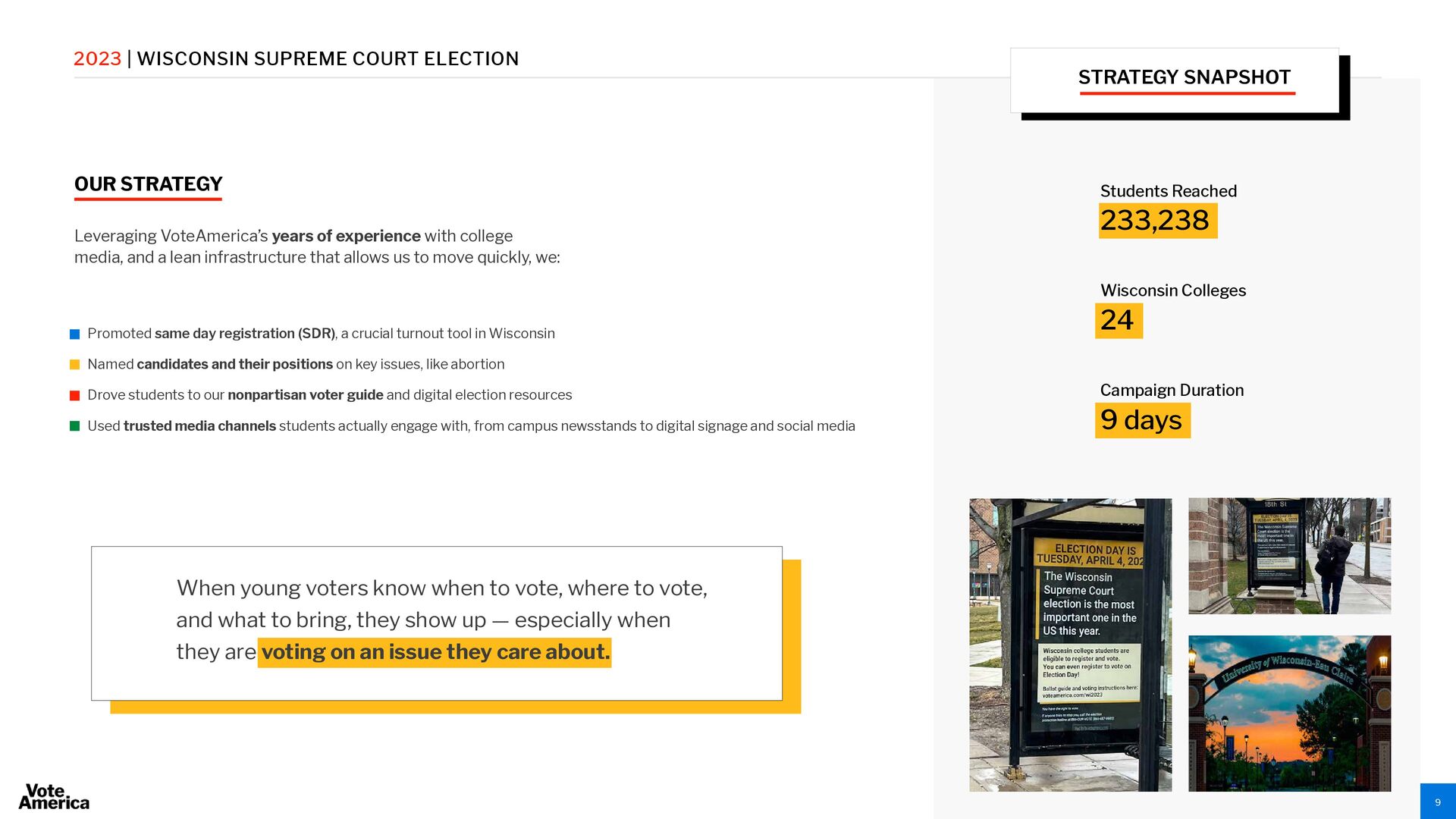
    a lean infrastructure that allows us to move quickly, we: • Promoted same day registration (SDR), a crucial turnout tool in Wisconsin • Named candidates and their positions on key issues, like abortion • Drove students to our nonpartisan voter guide and digital election resources • Used trusted media channels students actually engage with, from campus newsstands to digital signage and social media OUR STRATEGY 2023 | WISCONSIN SUPREME COURT ELECTION STRATEGY SNAPSHOT Students Reached 233,238 Wisconsin Colleges 24 Campaign Duration 9 days When young voters know when to vote, where to vote, and what to bring, they show up — especially when they are voting on an issue they care about.
  9. 10 THE OUTCOME Turnout for the election was significantly higher

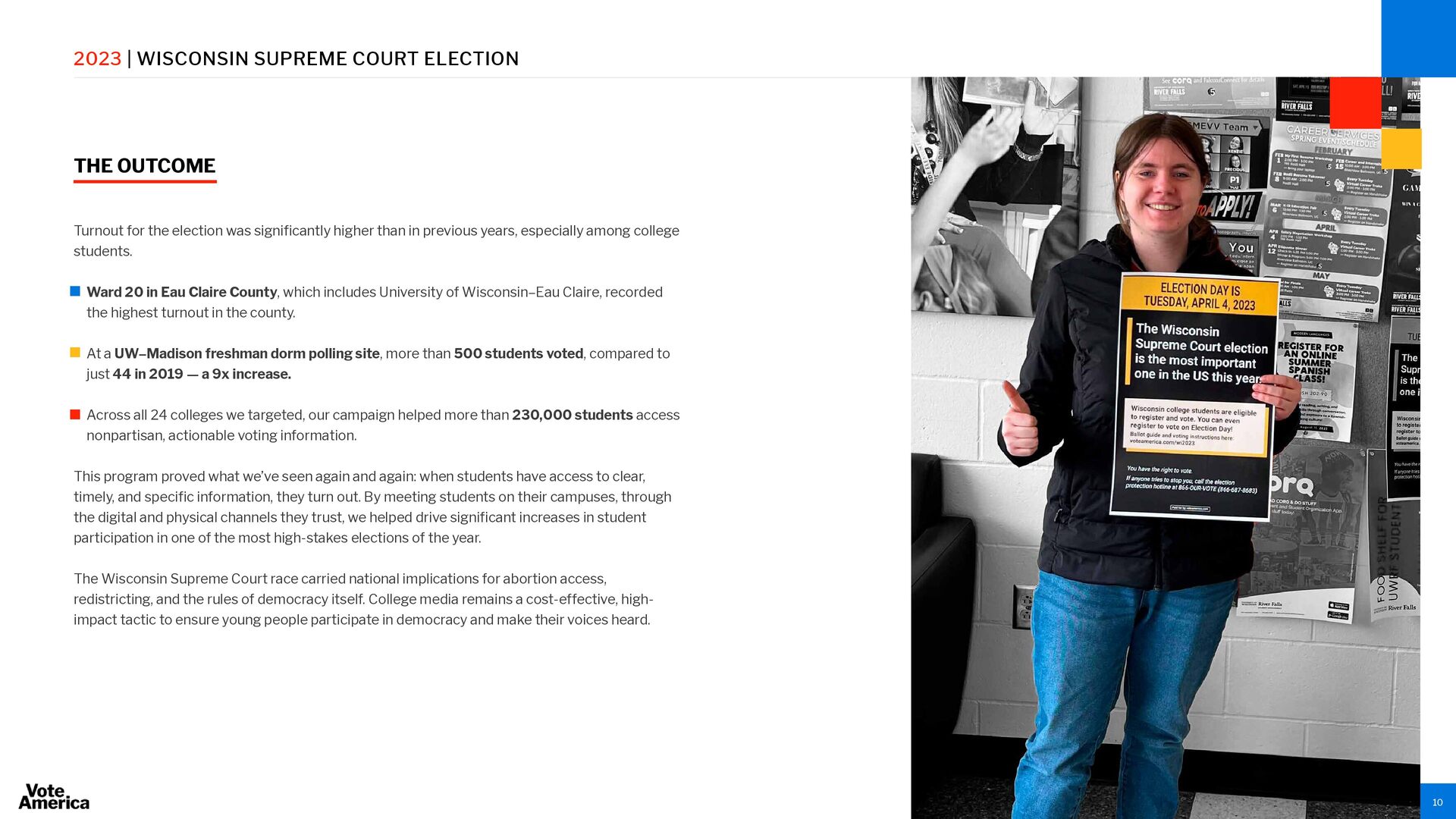
    than in previous years, especially among college students. • Ward 20 in Eau Claire County, which includes University of Wisconsin–Eau Claire, recorded the highest turnout in the county. • At a UW–Madison freshman dorm polling site, more than 500 students voted, compared to just 44 in 2019 — a 9x increase. • Across all 24 colleges we targeted, our campaign helped more than 230,000 students access nonpartisan, actionable voting information. This program proved what we’ve seen again and again: when students have access to clear, timely, and specific information, they turn out. By meeting students on their campuses, through the digital and physical channels they trust, we helped drive significant increases in student participation in one of the most high-stakes elections of the year. The Wisconsin Supreme Court race carried national implications for abortion access, redistricting, and the rules of democracy itself. College media remains a cost-effective, high- impact tactic to ensure young people participate in democracy and make their voices heard. 2023 | WISCONSIN SUPREME COURT ELECTION
  10. 11 In August 2023, Ohio voters faced a special election

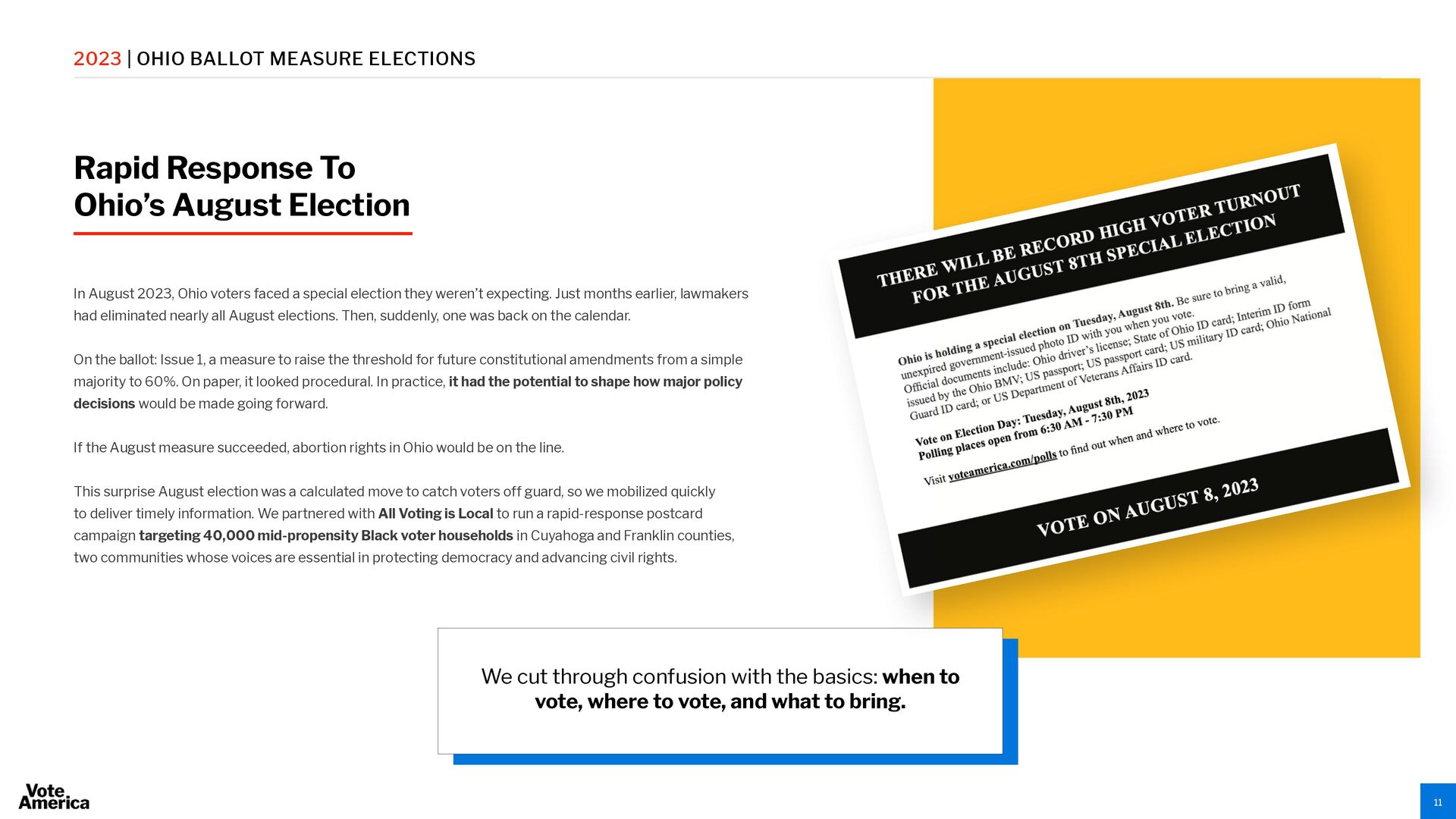
    they weren’t expecting. Just months earlier, lawmakers had eliminated nearly all August elections. Then, suddenly, one was back on the calendar. On the ballot: Issue 1, a measure to raise the threshold for future constitutional amendments from a simple majority to 60%. On paper, it looked procedural. In practice, it had the potential to shape how major policy decisions would be made going forward. If the August measure succeeded, abortion rights in Ohio would be on the line. This surprise August election was a calculated move to catch voters off guard, so we mobilized quickly to deliver timely information. We partnered with All Voting is Local to run a rapid-response postcard campaign targeting 40,000 mid-propensity Black voter households in Cuyahoga and Franklin counties, two communities whose voices are essential in protecting democracy and advancing civil rights. Rapid Response To Ohio’s August Election 2023 | OHIO BALLOT MEASURE ELECTIONS We cut through confusion with the basics: when to vote, where to vote, and what to bring.
  11. 12 THE OUTCOME Our postcards mirrored the look of official

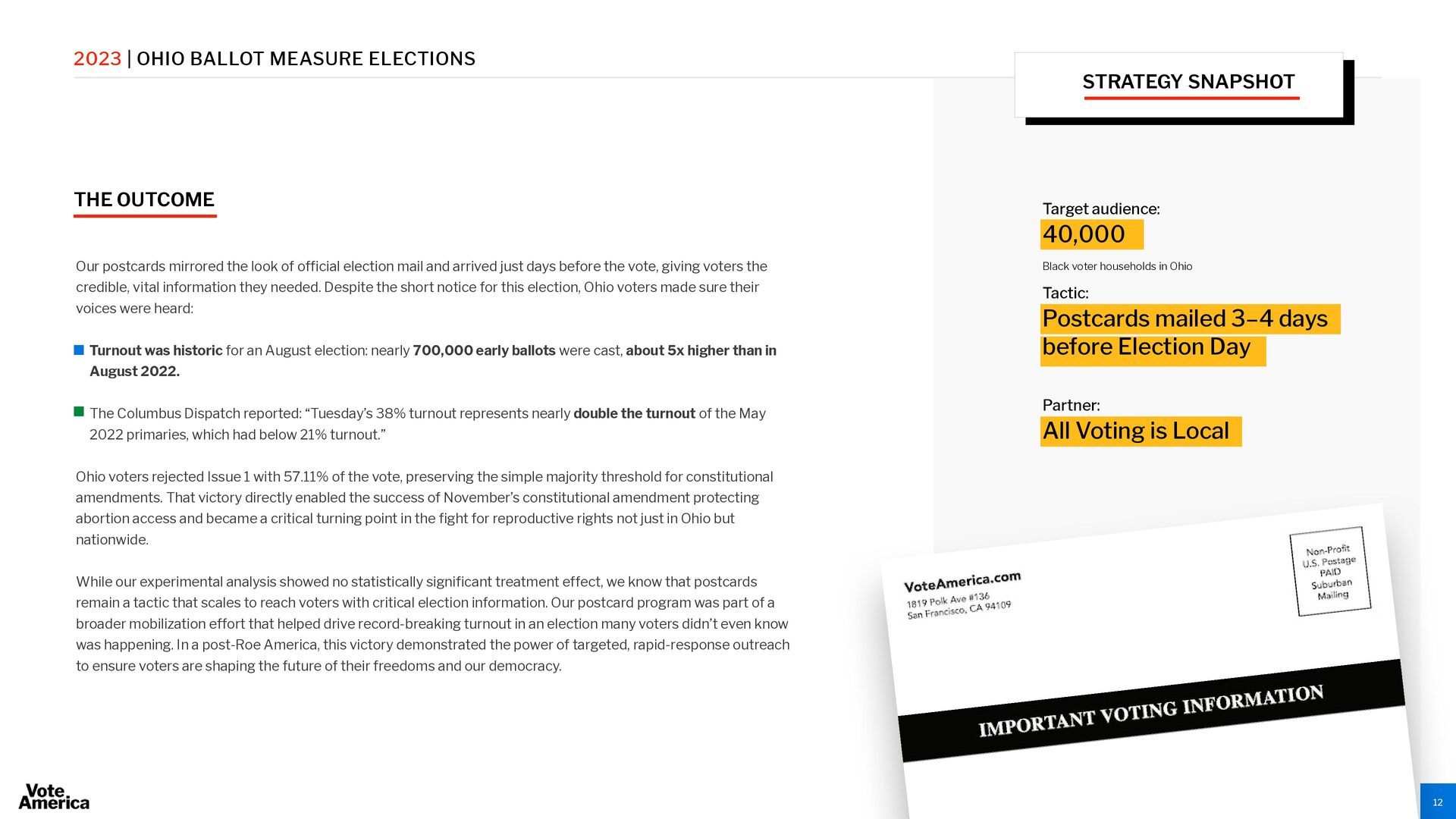
    election mail and arrived just days before the vote, giving voters the credible, vital information they needed. Despite the short notice for this election, Ohio voters made sure their voices were heard: • Turnout was historic for an August election: nearly 700,000 early ballots were cast, about 5x higher than in August 2022. • The Columbus Dispatch reported: “Tuesday’s 38% turnout represents nearly double the turnout of the May 2022 primaries, which had below 21% turnout.” Ohio voters rejected Issue 1 with 57.11% of the vote, preserving the simple majority threshold for constitutional amendments. That victory directly enabled the success of November’s constitutional amendment protecting abortion access and became a critical turning point in the fight for reproductive rights not just in Ohio but nationwide. While our experimental analysis showed no statistically significant treatment effect, we know that postcards remain a tactic that scales to reach voters with critical election information. Our postcard program was part of a broader mobilization effort that helped drive record-breaking turnout in an election many voters didn’t even know was happening. In a post-Roe America, this victory demonstrated the power of targeted, rapid-response outreach to ensure voters are shaping the future of their freedoms and our democracy. 2023 | OHIO BALLOT MEASURE ELECTIONS STRATEGY SNAPSHOT Target audience: 40,000 Tactic: Postcards mailed 3–4 days before Election Day Partner: All Voting is Local Black voter households in Ohio
  12. 13 After the last-minute special ballot measure election in August,

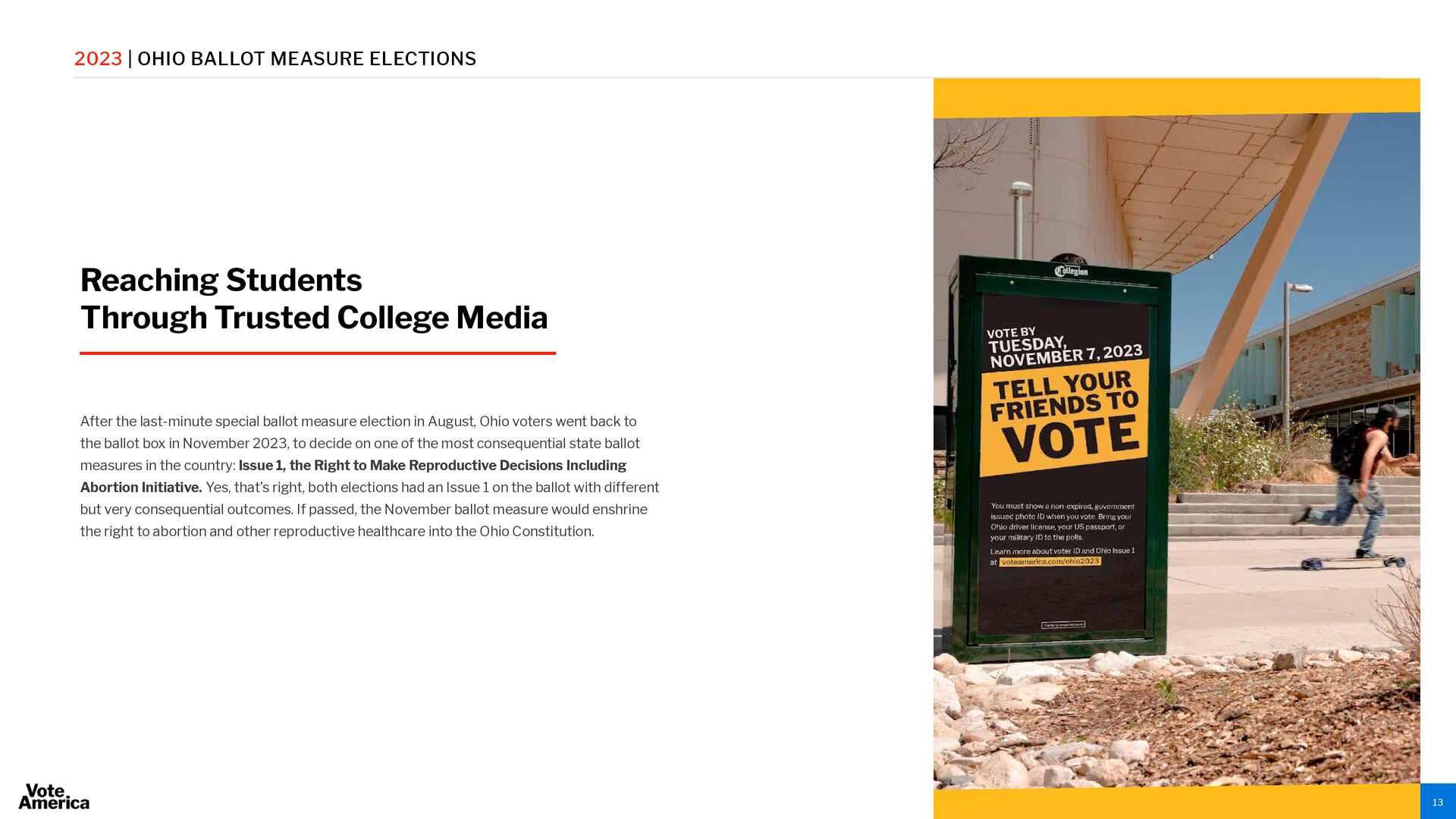
    Ohio voters went back to the ballot box in November 2023, to decide on one of the most consequential state ballot measures in the country: Issue 1, the Right to Make Reproductive Decisions Including Abortion Initiative. Yes, that’s right, both elections had an Issue 1 on the ballot with different but very consequential outcomes. If passed, the November ballot measure would enshrine the right to abortion and other reproductive healthcare into the Ohio Constitution. Reaching Students Through Trusted College Media 2023 | OHIO BALLOT MEASURE ELECTIONS
  13. 14 2023 | OHIO SPECIAL BALLOT MEASURE Partnering closely with

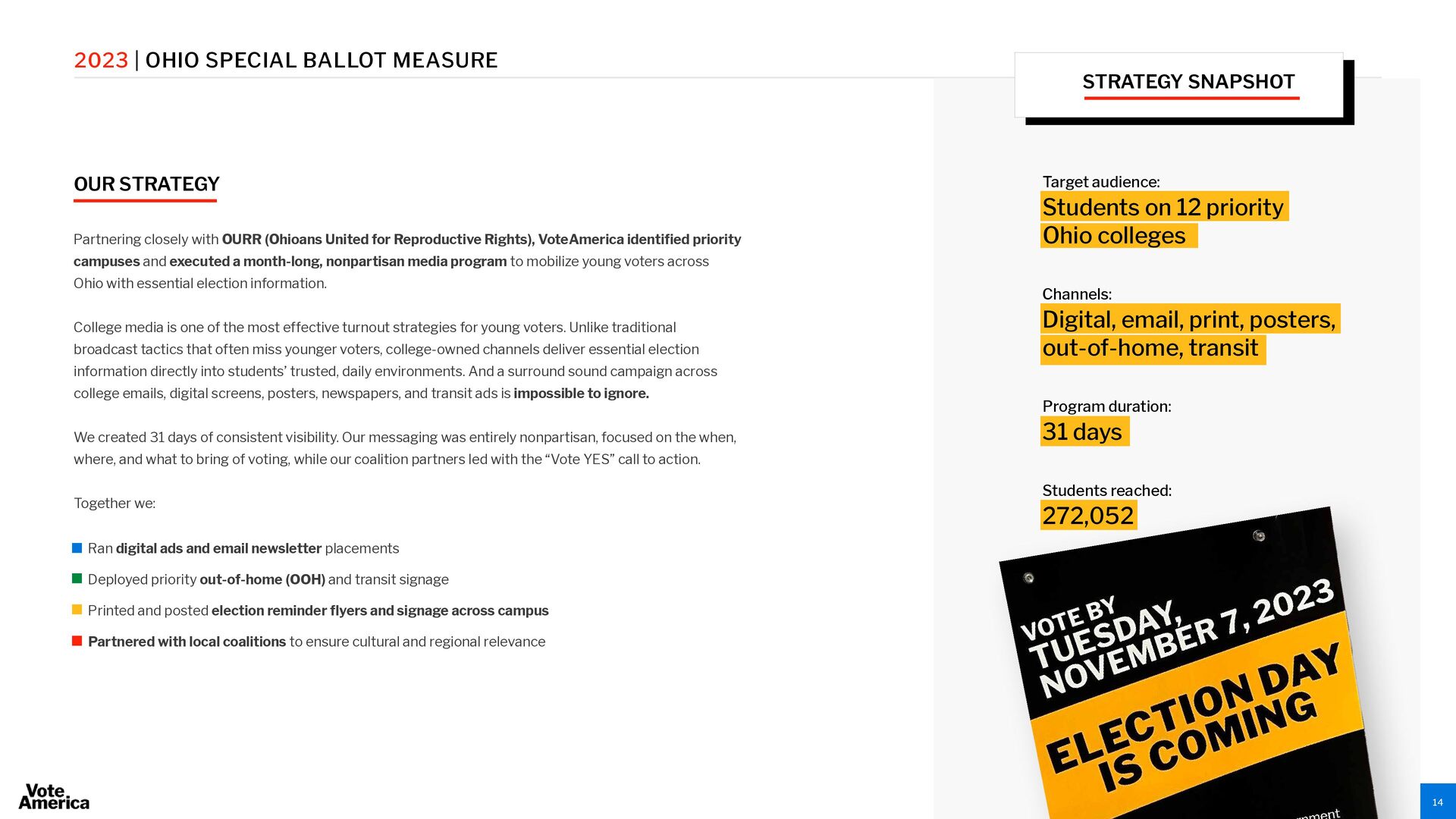
    OURR (Ohioans United for Reproductive Rights), VoteAmerica identified priority campuses and executed a month-long, nonpartisan media program to mobilize young voters across Ohio with essential election information. College media is one of the most effective turnout strategies for young voters. Unlike traditional broadcast tactics that often miss younger voters, college-owned channels deliver essential election information directly into students’ trusted, daily environments. And a surround sound campaign across college emails, digital screens, posters, newspapers, and transit ads is impossible to ignore. We created 31 days of consistent visibility. Our messaging was entirely nonpartisan, focused on the when, where, and what to bring of voting, while our coalition partners led with the “Vote YES” call to action. Together we: OUR STRATEGY • Ran digital ads and email newsletter placements • Deployed priority out-of-home (OOH) and transit signage • Printed and posted election reminder flyers and signage across campus • Partnered with local coalitions to ensure cultural and regional relevance STRATEGY SNAPSHOT Target audience: Students on 12 priority Ohio colleges Channels: Digital, email, print, posters, out-of-home, transit Program duration: 31 days Students reached: 272,052
  14. 15 Through 31 days of sustained, college-based outreach, we reached

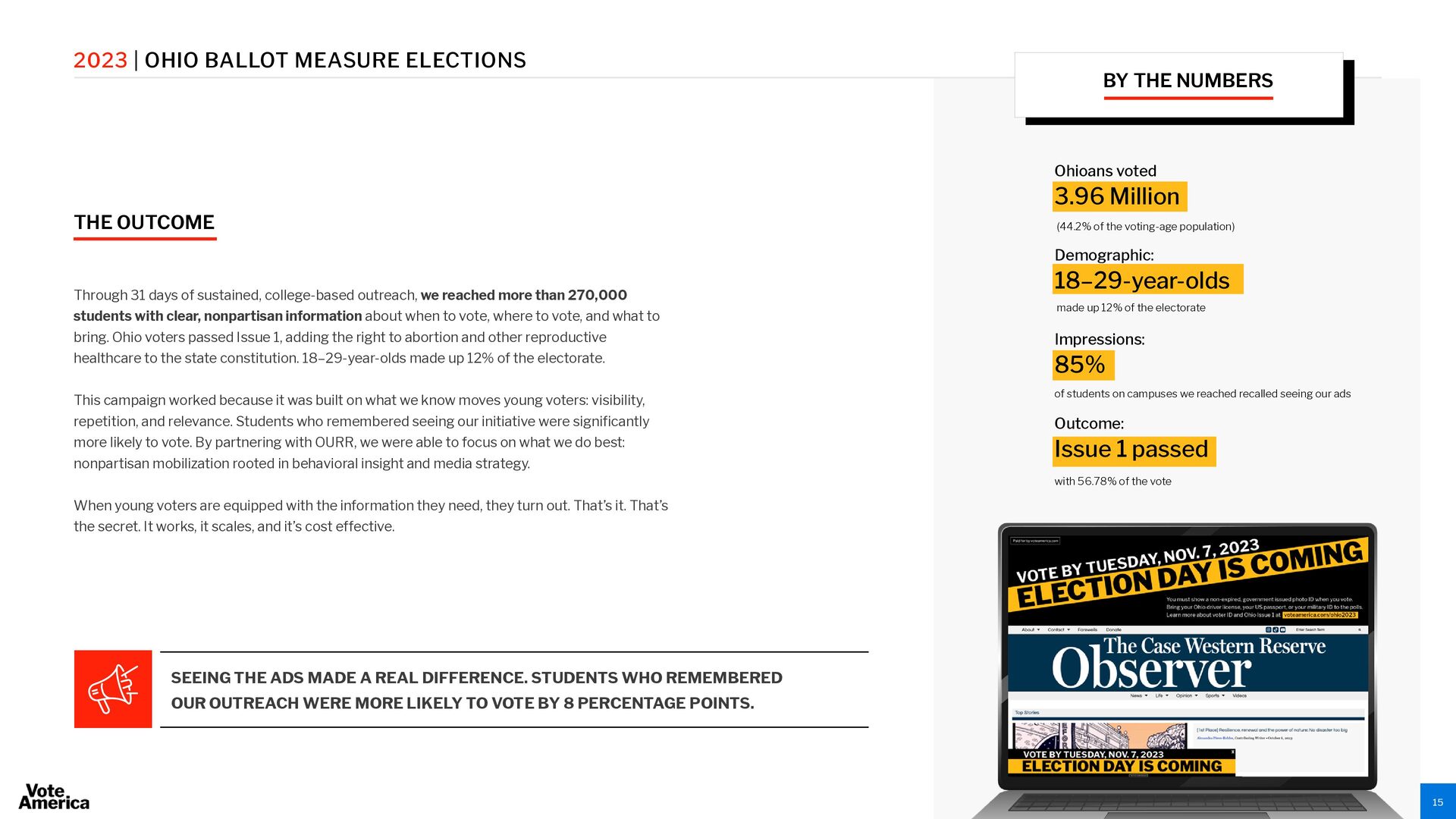
    more than 270,000 students with clear, nonpartisan information about when to vote, where to vote, and what to bring. Ohio voters passed Issue 1, adding the right to abortion and other reproductive healthcare to the state constitution. 18–29-year-olds made up 12% of the electorate. This campaign worked because it was built on what we know moves young voters: visibility, repetition, and relevance. Students who remembered seeing our initiative were significantly more likely to vote. By partnering with OURR, we were able to focus on what we do best: nonpartisan mobilization rooted in behavioral insight and media strategy. When young voters are equipped with the information they need, they turn out. That’s it. That’s the secret. It works, it scales, and it’s cost effective. 2023 | OHIO BALLOT MEASURE ELECTIONS SEEING THE ADS MADE A REAL DIFFERENCE. STUDENTS WHO REMEMBERED OUR OUTREACH WERE MORE LIKELY TO VOTE BY 8 PERCENTAGE POINTS. THE OUTCOME BY THE NUMBERS Ohioans voted 3.96 Million Demographic: 18–29-year-olds Impressions: 85% Outcome: Issue 1 passed (44.2% of the voting-age population) of students on campuses we reached recalled seeing our ads with 56.78% of the vote made up 12% of the electorate
  15. 16 In a 2016 national study, 37% of Americans —

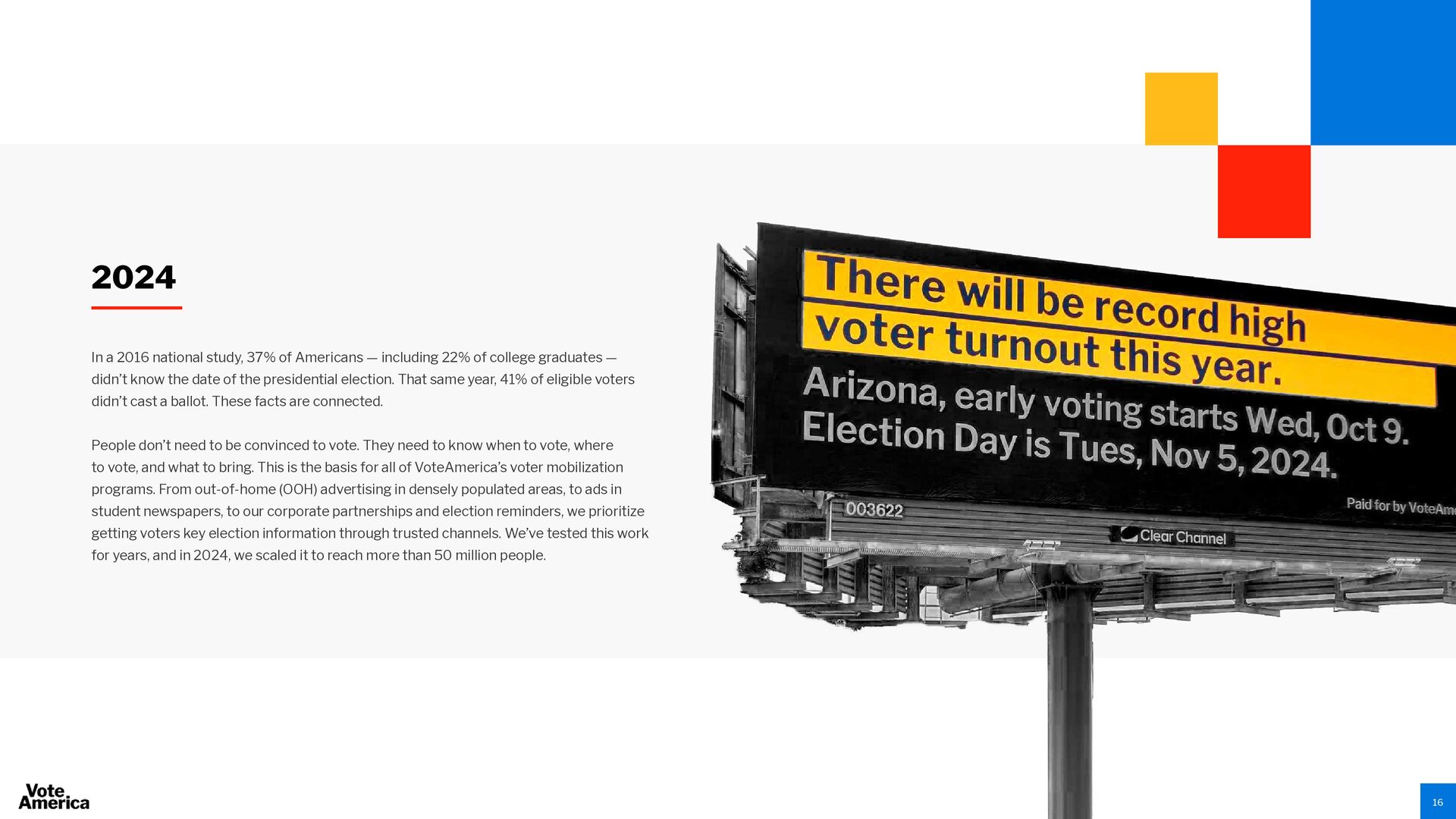
    including 22% of college graduates — didn’t know the date of the presidential election. That same year, 41% of eligible voters didn’t cast a ballot. These facts are connected. People don’t need to be convinced to vote. They need to know when to vote, where to vote, and what to bring. This is the basis for all of VoteAmerica’s voter mobilization programs. From out-of-home (OOH) advertising in densely populated areas, to ads in student newspapers, to our corporate partnerships and election reminders, we prioritize getting voters key election information through trusted channels. We’ve tested this work for years, and in 2024, we scaled it to reach more than 50 million people. 2024
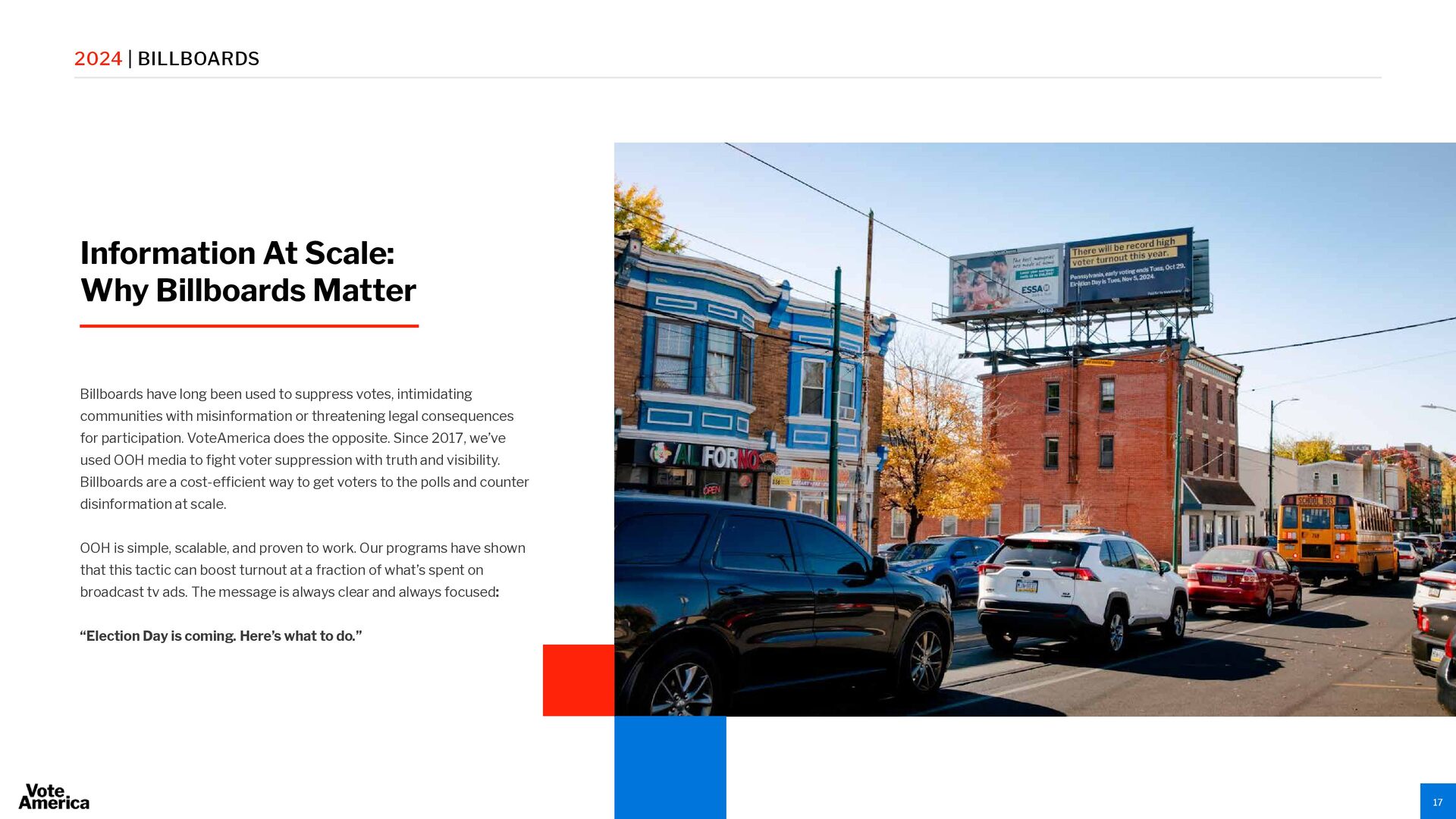
  16. 17 Billboards have long been used to suppress votes, intimidating

    communities with misinformation or threatening legal consequences for participation. VoteAmerica does the opposite. Since 2017, we’ve used OOH media to fight voter suppression with truth and visibility. Billboards are a cost-efficient way to get voters to the polls and counter disinformation at scale. OOH is simple, scalable, and proven to work. Our programs have shown that this tactic can boost turnout at a fraction of what’s spent on broadcast tv ads. The message is always clear and always focused: “Election Day is coming. Here’s what to do.” Information At Scale: Why Billboards Matter 2024 | BILLBOARDS
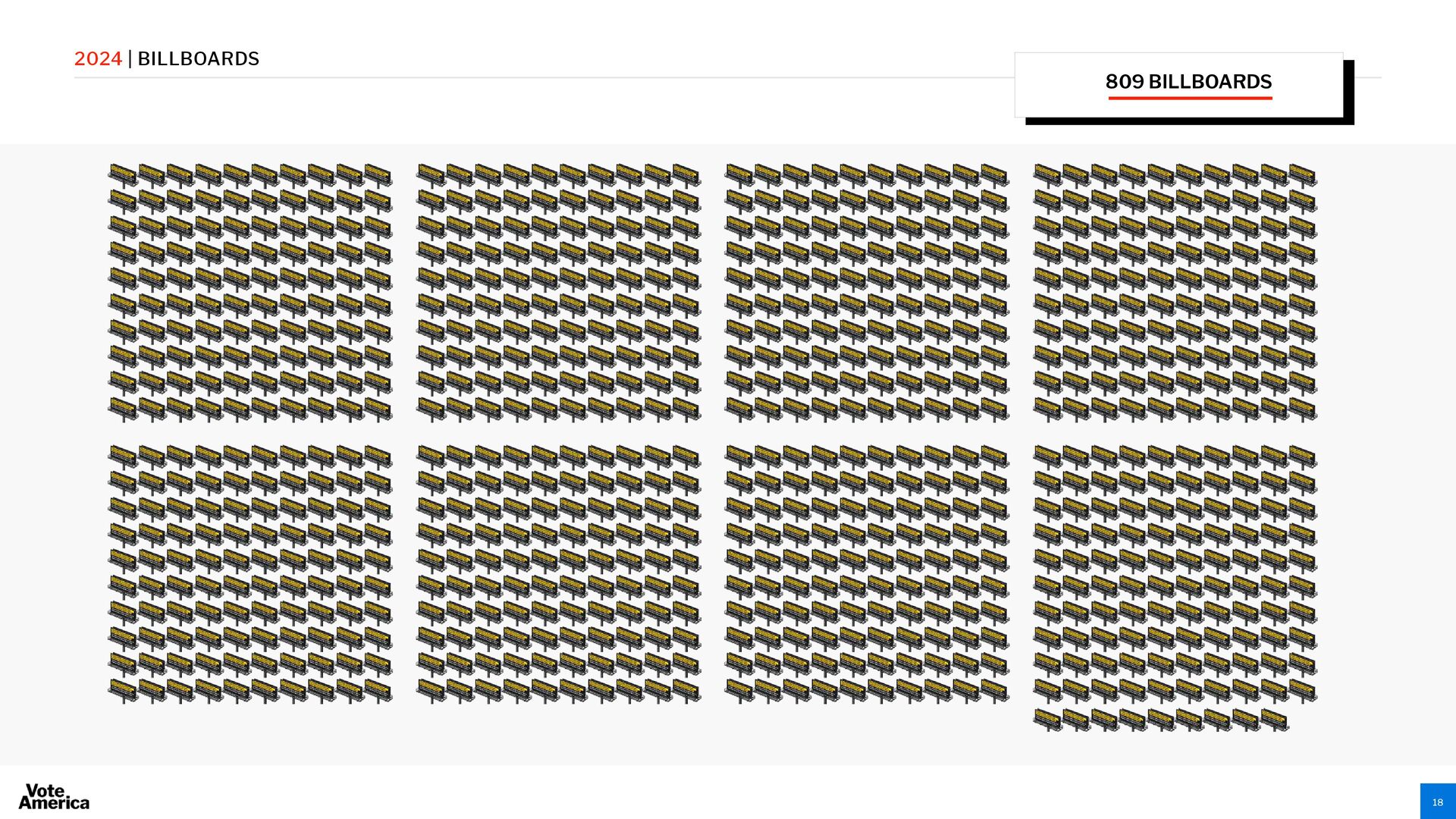
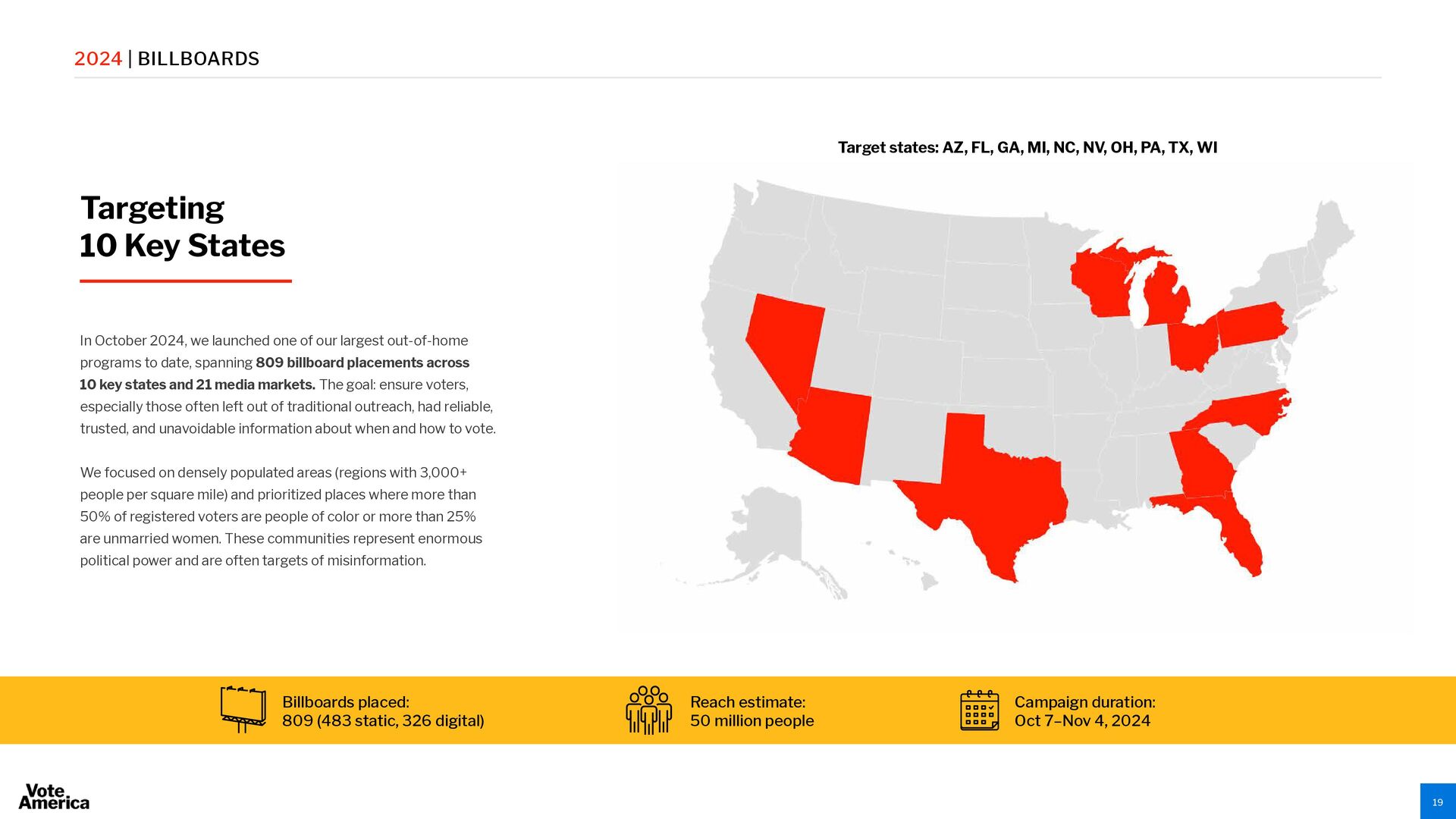
  17. 19 In October 2024, we launched one of our largest

    out-of-home programs to date, spanning 809 billboard placements across 10 key states and 21 media markets. The goal: ensure voters, especially those often left out of traditional outreach, had reliable, trusted, and unavoidable information about when and how to vote. We focused on densely populated areas (regions with 3,000+ people per square mile) and prioritized places where more than 50% of registered voters are people of color or more than 25% are unmarried women. These communities represent enormous political power and are often targets of misinformation. Targeting 10 Key States 2024 | BILLBOARDS Billboards placed: 809 (483 static, 326 digital) Reach estimate: 50 million people Campaign duration: Oct 7–Nov 4, 2024 Target states: AZ, FL, GA, MI, NC, NV, OH, PA, TX, WI
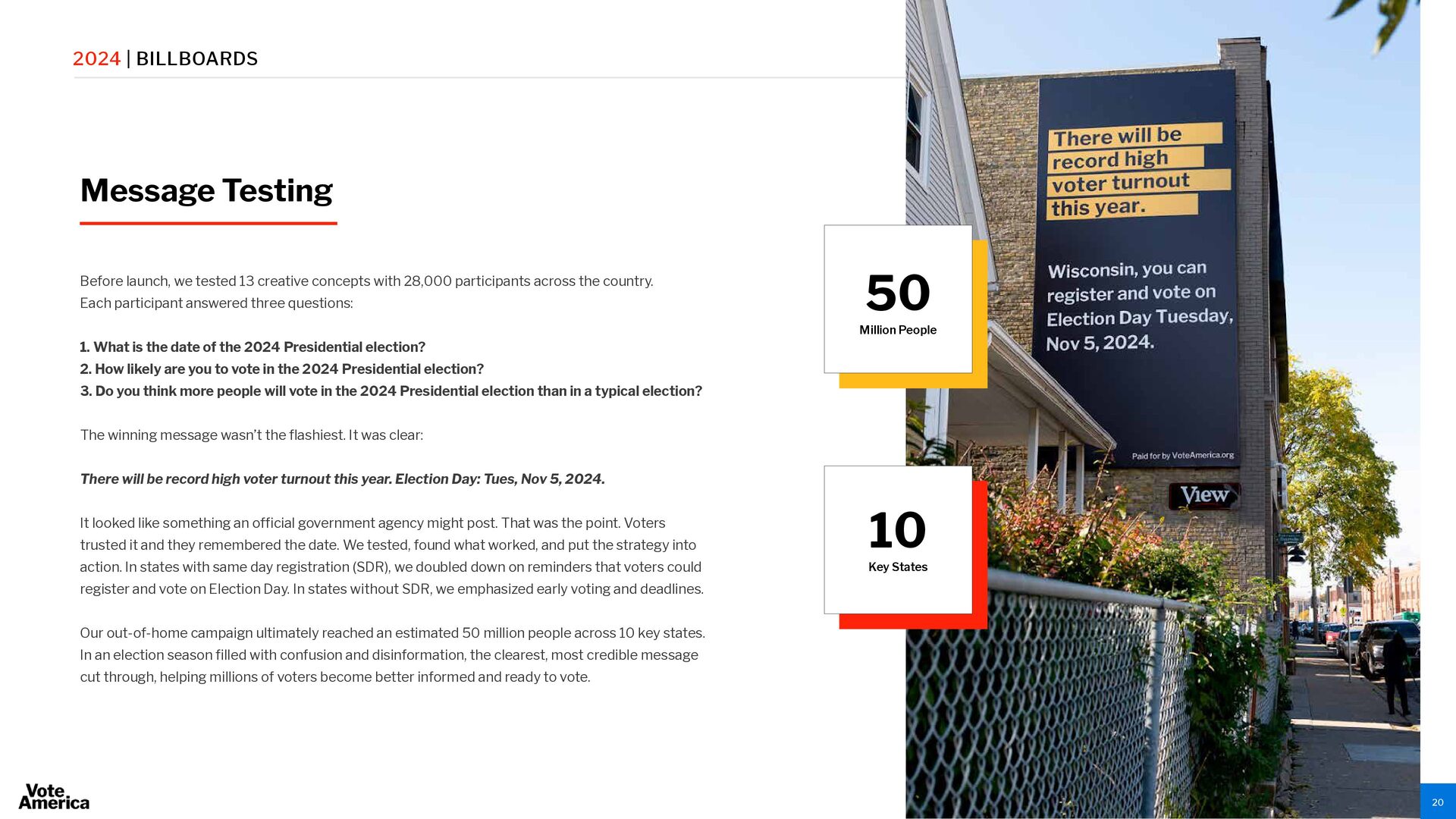
  18. 20 Before launch, we tested 13 creative concepts with 28,000

    participants across the country. Each participant answered three questions: 1. What is the date of the 2024 Presidential election? 2. How likely are you to vote in the 2024 Presidential election? 3. Do you think more people will vote in the 2024 Presidential election than in a typical election? The winning message wasn’t the flashiest. It was clear: There will be record high voter turnout this year. Election Day: Tues, Nov 5, 2024. It looked like something an official government agency might post. That was the point. Voters trusted it and they remembered the date. We tested, found what worked, and put the strategy into action. In states with same day registration (SDR), we doubled down on reminders that voters could register and vote on Election Day. In states without SDR, we emphasized early voting and deadlines. Our out-of-home campaign ultimately reached an estimated 50 million people across 10 key states. In an election season filled with confusion and disinformation, the clearest, most credible message cut through, helping millions of voters become better informed and ready to vote. Message Testing 2024 | BILLBOARDS 10 50 Million People Key States
  19. 21 Georgia was a high-priority state in 2024, and a

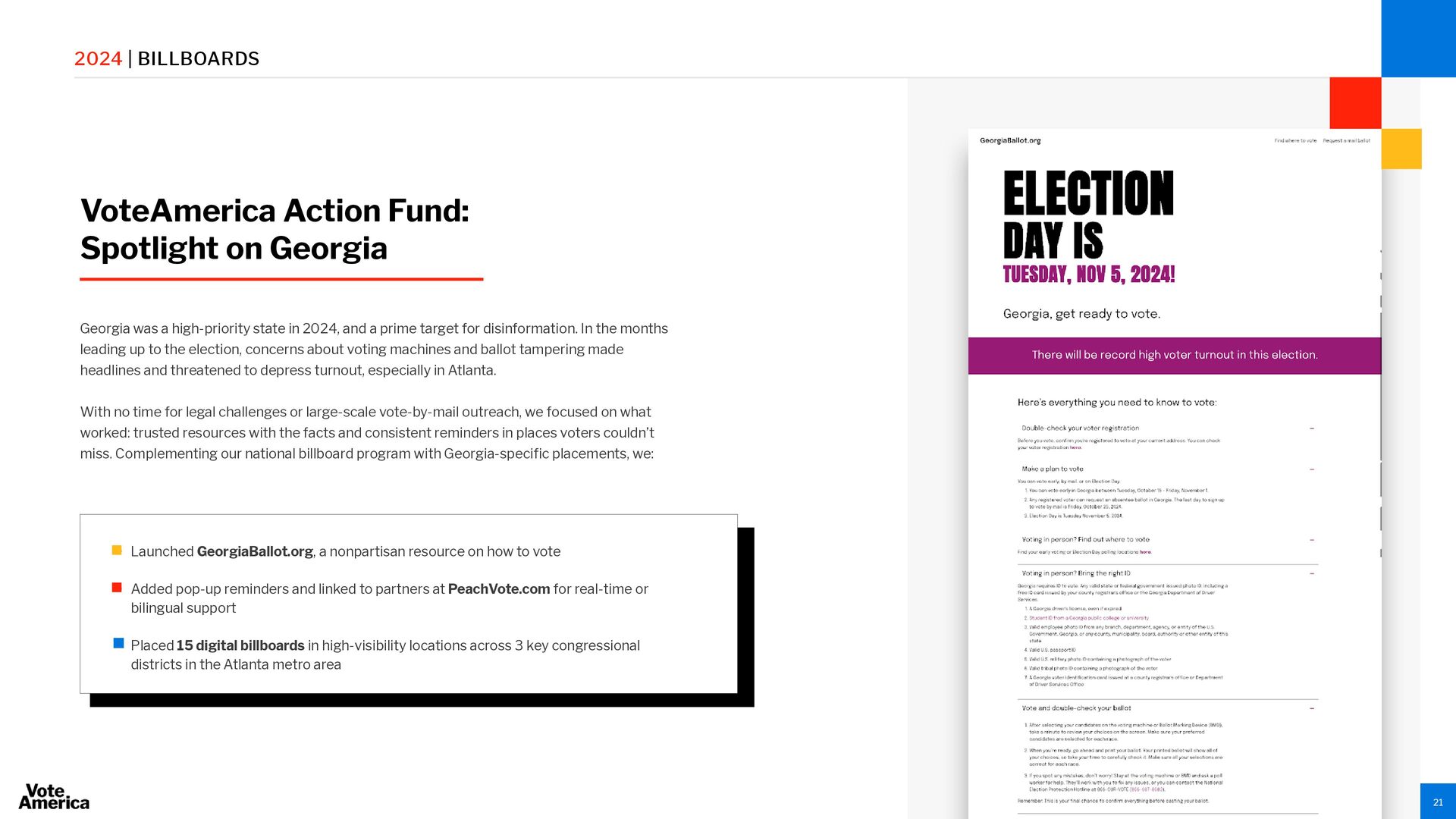
    prime target for disinformation. In the months leading up to the election, concerns about voting machines and ballot tampering made headlines and threatened to depress turnout, especially in Atlanta. With no time for legal challenges or large-scale vote-by-mail outreach, we focused on what worked: trusted resources with the facts and consistent reminders in places voters couldn’t miss. Complementing our national billboard program with Georgia-specific placements, we: VoteAmerica Action Fund: Spotlight on Georgia 2024 | BILLBOARDS • Launched GeorgiaBallot.org, a nonpartisan resource on how to vote • Added pop-up reminders and linked to partners at PeachVote.com for real-time or bilingual support • Placed 15 digital billboards in high-visibility locations across 3 key congressional districts in the Atlanta metro area
  20. 22 This campaign put our research into practice. People don’t

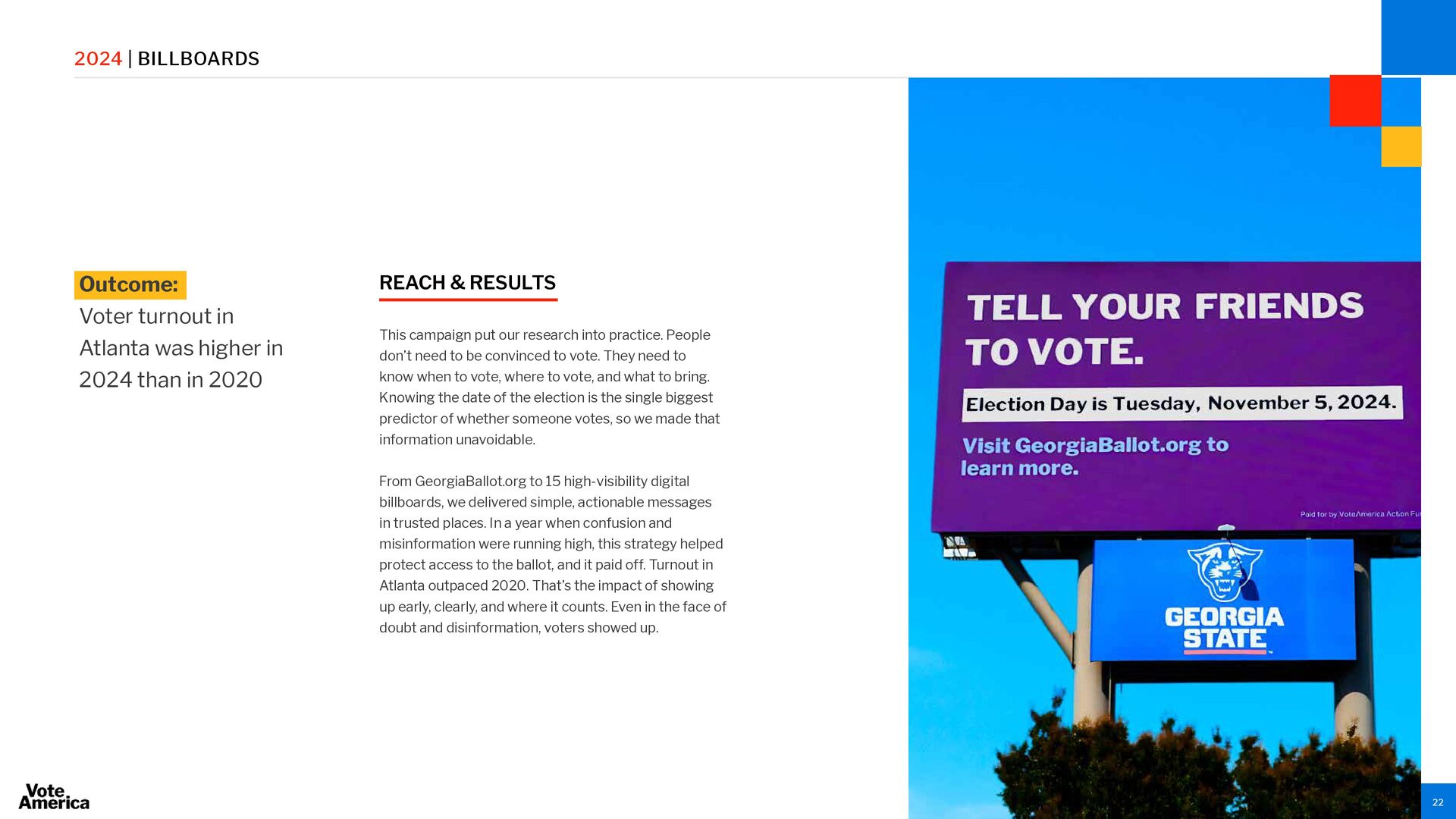
    need to be convinced to vote. They need to know when to vote, where to vote, and what to bring. Knowing the date of the election is the single biggest predictor of whether someone votes, so we made that information unavoidable. From GeorgiaBallot.org to 15 high-visibility digital billboards, we delivered simple, actionable messages in trusted places. In a year when confusion and misinformation were running high, this strategy helped protect access to the ballot, and it paid off. Turnout in Atlanta outpaced 2020. That’s the impact of showing up early, clearly, and where it counts. Even in the face of doubt and disinformation, voters showed up. 2024 | BILLBOARDS REACH & RESULTS Outcome: Voter turnout in Atlanta was higher in 2024 than in 2020
  21. 23 Young people care deeply about the issues on the

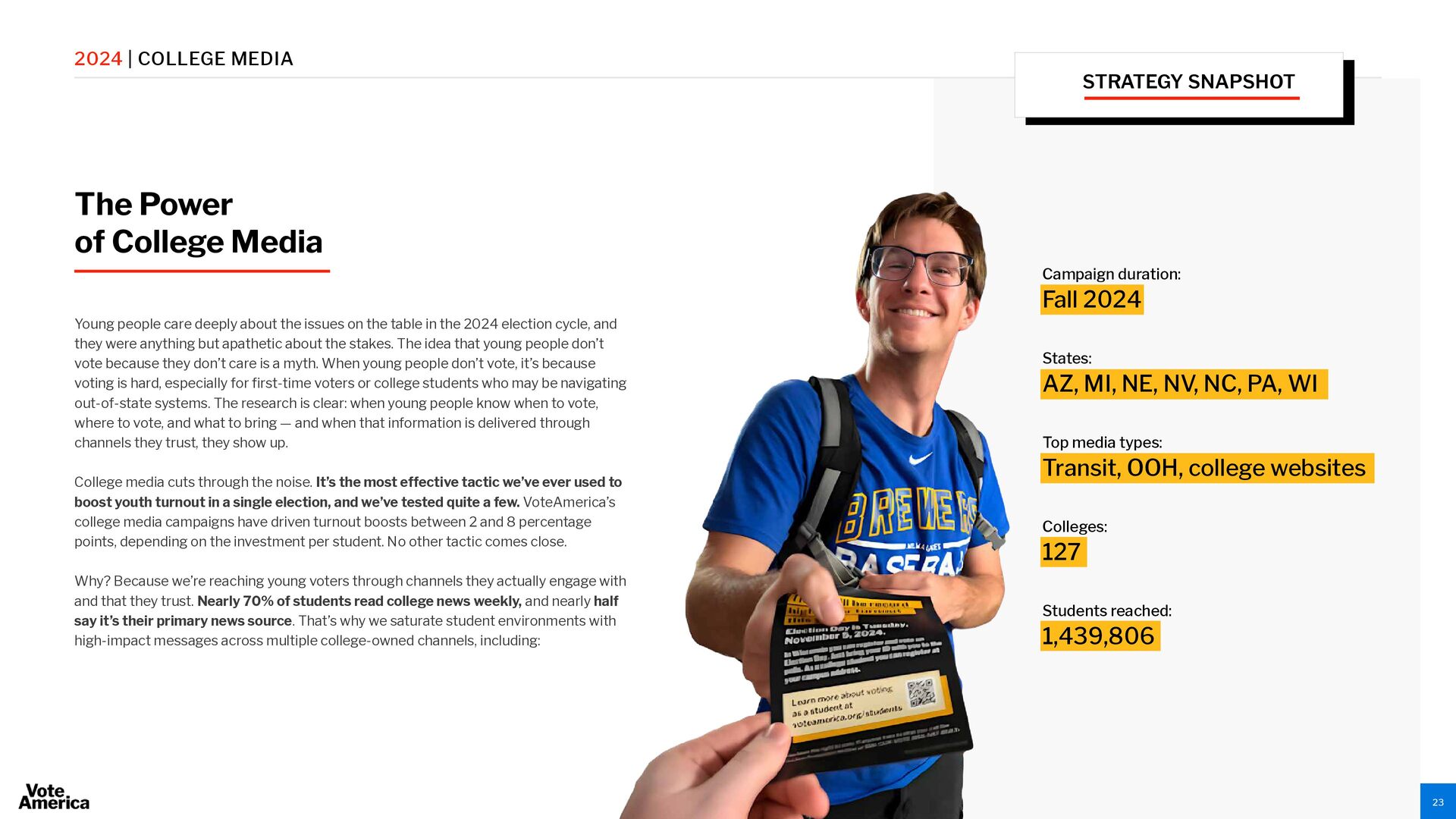
    table in the 2024 election cycle, and they were anything but apathetic about the stakes. The idea that young people don’t vote because they don’t care is a myth. When young people don’t vote, it’s because voting is hard, especially for first-time voters or college students who may be navigating out-of-state systems. The research is clear: when young people know when to vote, where to vote, and what to bring — and when that information is delivered through channels they trust, they show up. College media cuts through the noise. It’s the most effective tactic we’ve ever used to boost youth turnout in a single election, and we’ve tested quite a few. VoteAmerica’s college media campaigns have driven turnout boosts between 2 and 8 percentage points, depending on the investment per student. No other tactic comes close. Why? Because we’re reaching young voters through channels they actually engage with and that they trust. Nearly 70% of students read college news weekly, and nearly half say it’s their primary news source. That’s why we saturate student environments with high-impact messages across multiple college-owned channels, including: The Power of College Media 2024 | COLLEGE MEDIA Campaign duration: Fall 2024 States: AZ, MI, NE, NV, NC, PA, WI Top media types: Transit, OOH, college websites Colleges: 127 Students reached: 1,439,806 STRATEGY SNAPSHOT
  22. 24 While political groups spend more than $5 billion on

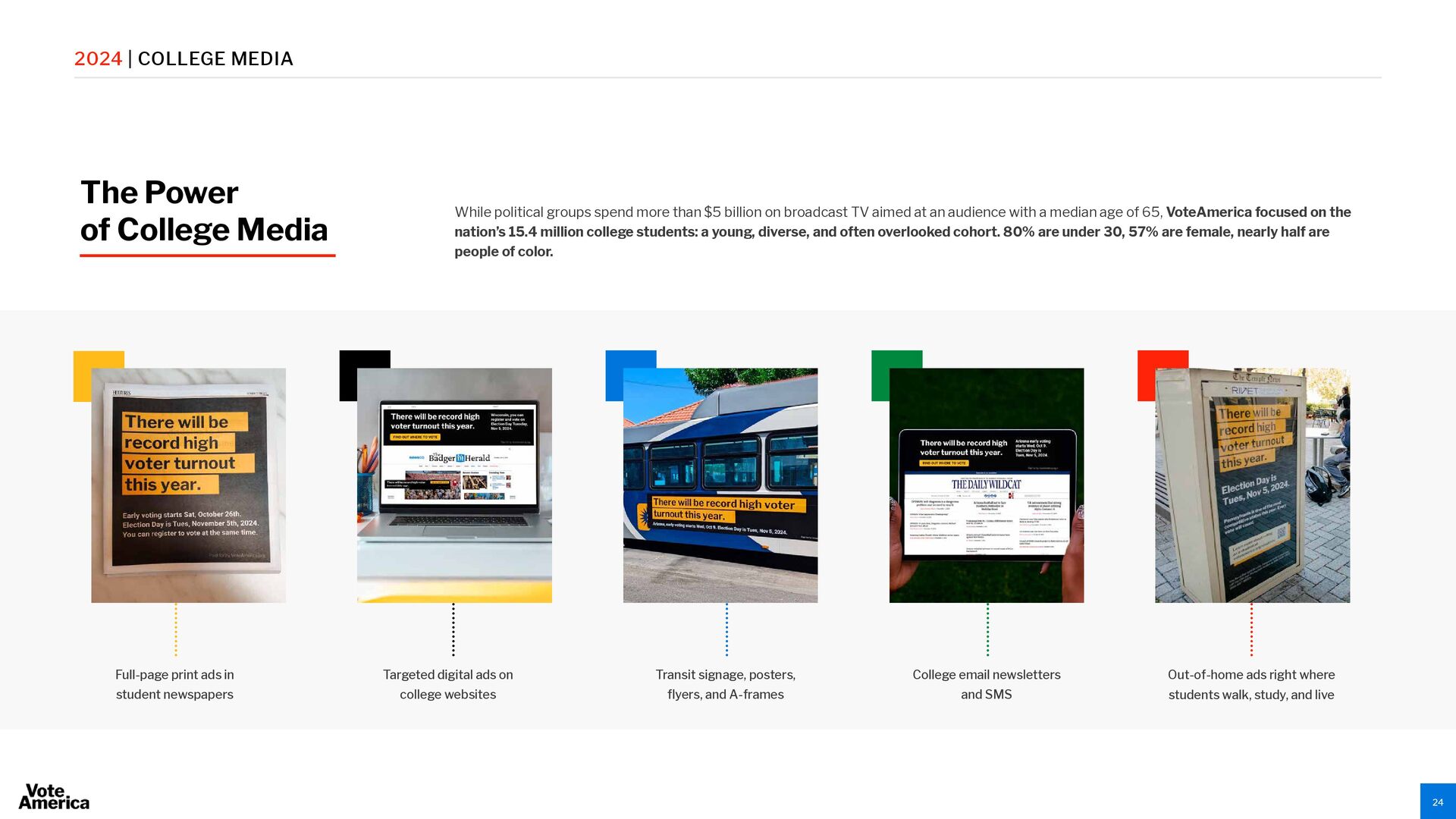
    broadcast TV aimed at an audience with a median age of 65, VoteAmerica focused on the nation’s 15.4 million college students: a young, diverse, and often overlooked cohort. 80% are under 30, 57% are female, nearly half are people of color. The Power of College Media 2024 | COLLEGE MEDIA Full-page print ads in student newspapers Targeted digital ads on college websites Transit signage, posters, flyers, and A-frames College email newsletters and SMS Out-of-home ads right where students walk, study, and live
  23. 25 Our 2024 college media campaign reached nearly 1.44 million

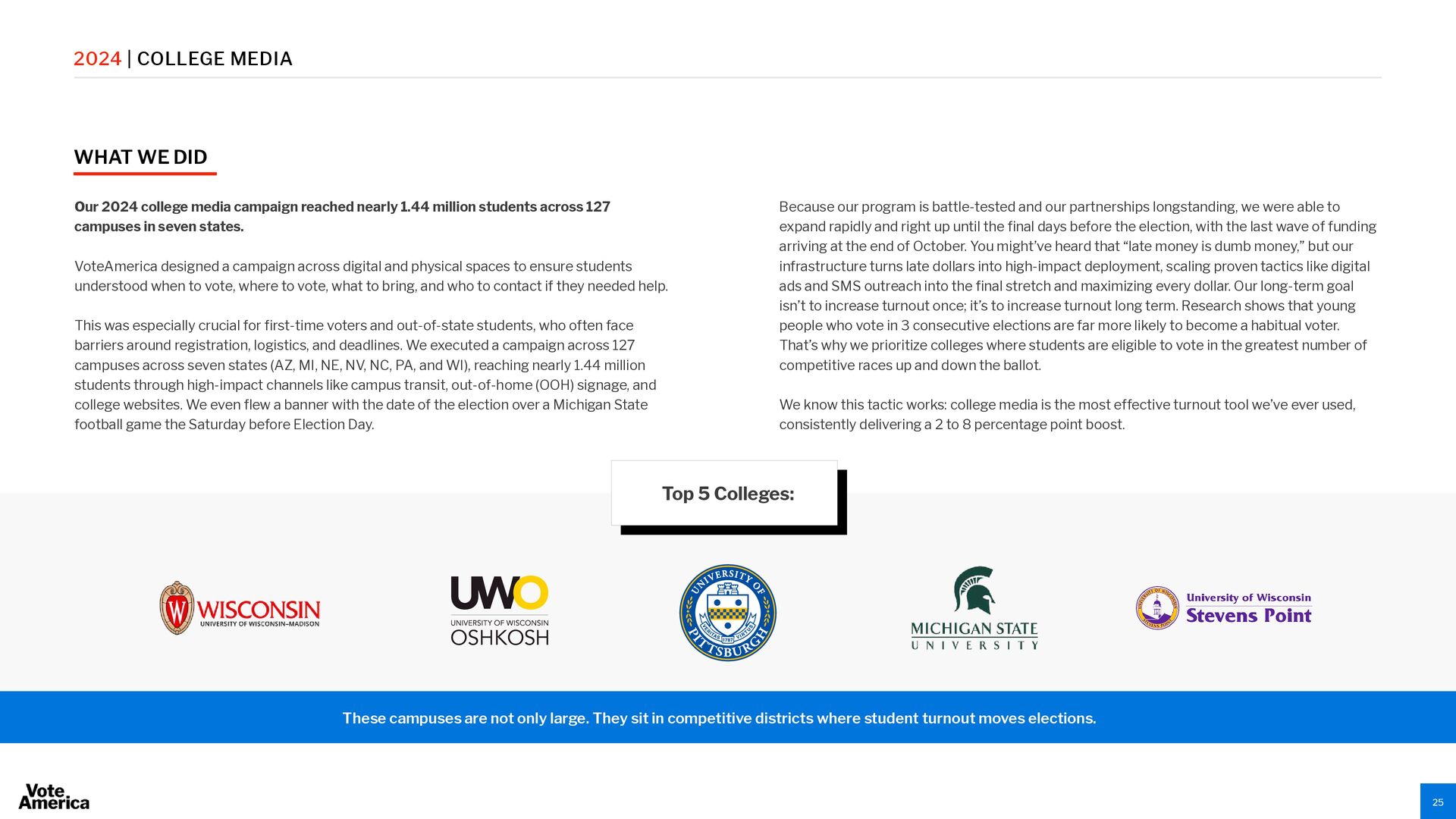
    students across 127 campuses in seven states. VoteAmerica designed a campaign across digital and physical spaces to ensure students understood when to vote, where to vote, what to bring, and who to contact if they needed help. This was especially crucial for first-time voters and out-of-state students, who often face barriers around registration, logistics, and deadlines. We executed a campaign across 127 campuses across seven states (AZ, MI, NE, NV, NC, PA, and WI), reaching nearly 1.44 million students through high-impact channels like campus transit, out-of-home (OOH) signage, and college websites. We even flew a banner with the date of the election over a Michigan State football game the Saturday before Election Day. Because our program is battle-tested and our partnerships longstanding, we were able to expand rapidly and right up until the final days before the election, with the last wave of funding arriving at the end of October. You might’ve heard that “late money is dumb money,” but our infrastructure turns late dollars into high-impact deployment, scaling proven tactics like digital ads and SMS outreach into the final stretch and maximizing every dollar. Our long-term goal isn’t to increase turnout once; it’s to increase turnout long term. Research shows that young people who vote in 3 consecutive elections are far more likely to become a habitual voter. That’s why we prioritize colleges where students are eligible to vote in the greatest number of competitive races up and down the ballot. We know this tactic works: college media is the most effective turnout tool we’ve ever used, consistently delivering a 2 to 8 percentage point boost. 2024 | COLLEGE MEDIA Top 5 Colleges: These campuses are not only large. They sit in competitive districts where student turnout moves elections. WHAT WE DID
  24. 26 In 2024, VoteAmerica joined forces with 24 brands, community

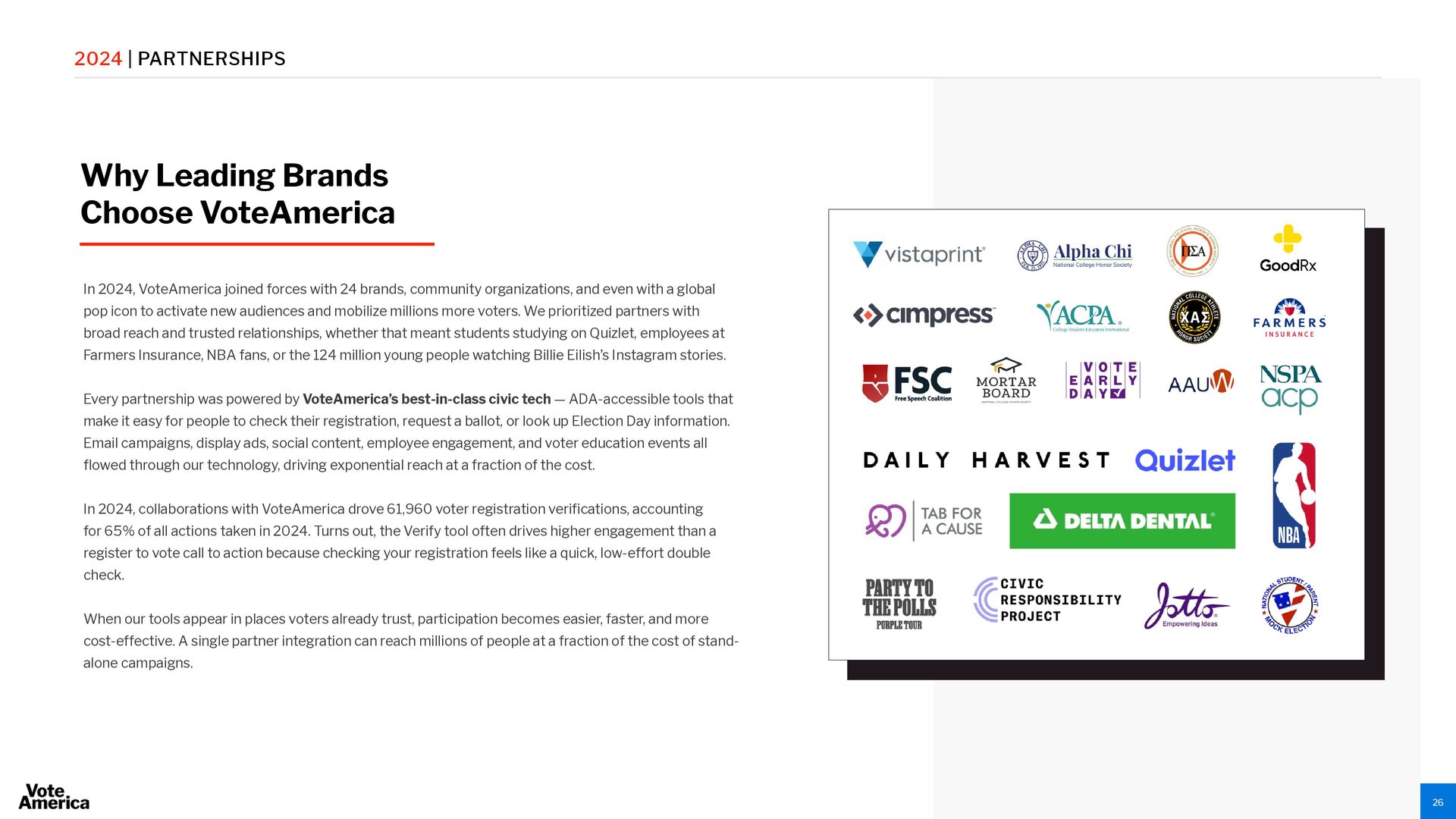
    organizations, and even with a global pop icon to activate new audiences and mobilize millions more voters. We prioritized partners with broad reach and trusted relationships, whether that meant students studying on Quizlet, employees at Farmers Insurance, NBA fans, or the 124 million young people watching Billie Eilish’s Instagram stories. Every partnership was powered by VoteAmerica’s best-in-class civic tech — ADA-accessible tools that make it easy for people to check their registration, request a ballot, or look up Election Day information. Email campaigns, display ads, social content, employee engagement, and voter education events all flowed through our technology, driving exponential reach at a fraction of the cost. In 2024, collaborations with VoteAmerica drove 61,960 voter registration verifications, accounting for 65% of all actions taken in 2024. Turns out, the Verify tool often drives higher engagement than a register to vote call to action because checking your registration feels like a quick, low-effort double check. When our tools appear in places voters already trust, participation becomes easier, faster, and more cost-effective. A single partner integration can reach millions of people at a fraction of the cost of stand- alone campaigns. Why Leading Brands Choose VoteAmerica 2024 | PARTNERSHIPS
  25. 27 Quizlet is one of the most widely used study

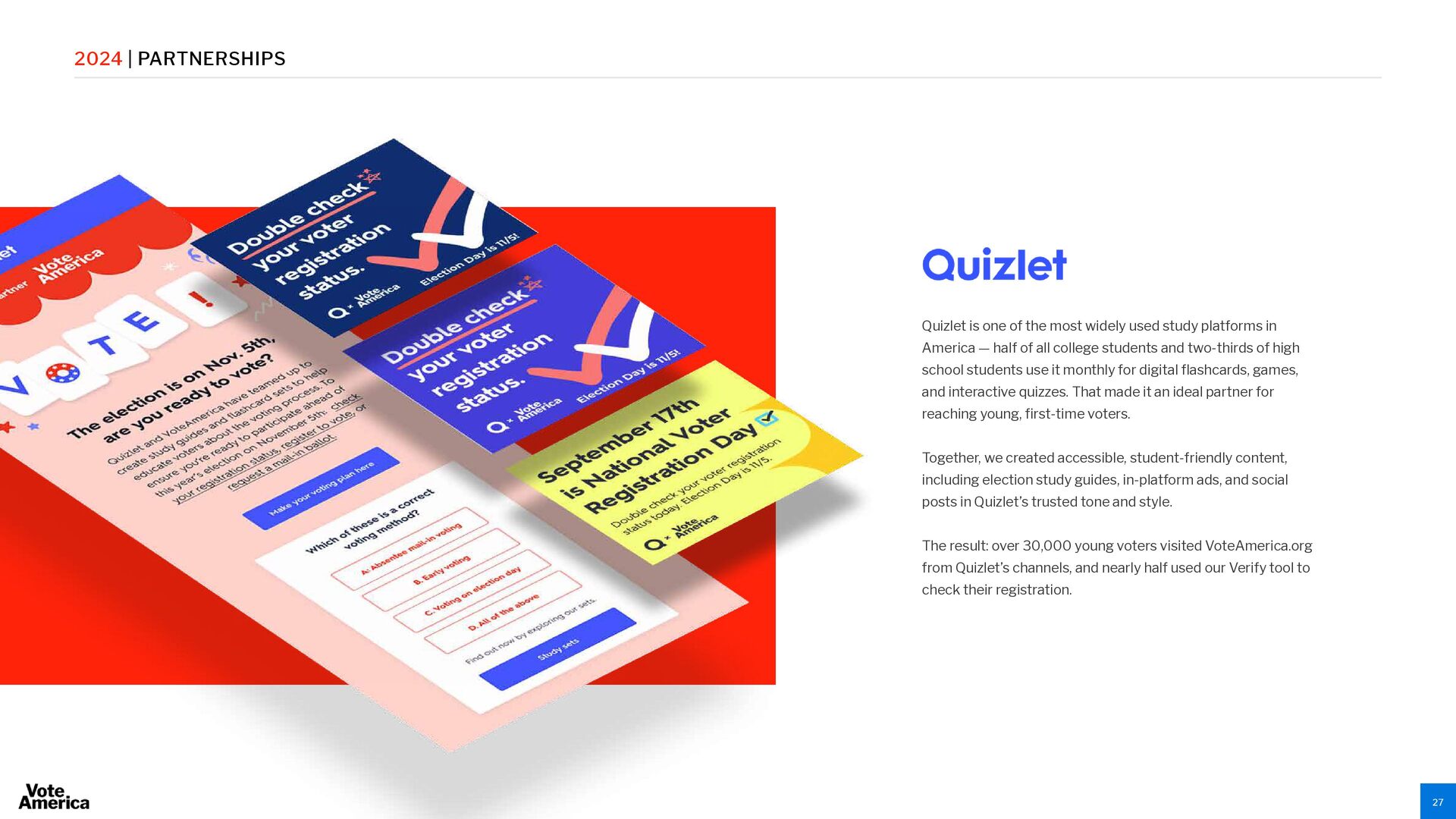
    platforms in America — half of all college students and two-thirds of high school students use it monthly for digital flashcards, games, and interactive quizzes. That made it an ideal partner for reaching young, first-time voters. Together, we created accessible, student-friendly content, including election study guides, in-platform ads, and social posts in Quizlet’s trusted tone and style. The result: over 30,000 young voters visited VoteAmerica.org from Quizlet’s channels, and nearly half used our Verify tool to check their registration. 2024 | PARTNERSHIPS
  26. 28 The NBA has a long-standing commitment to civic engagement.

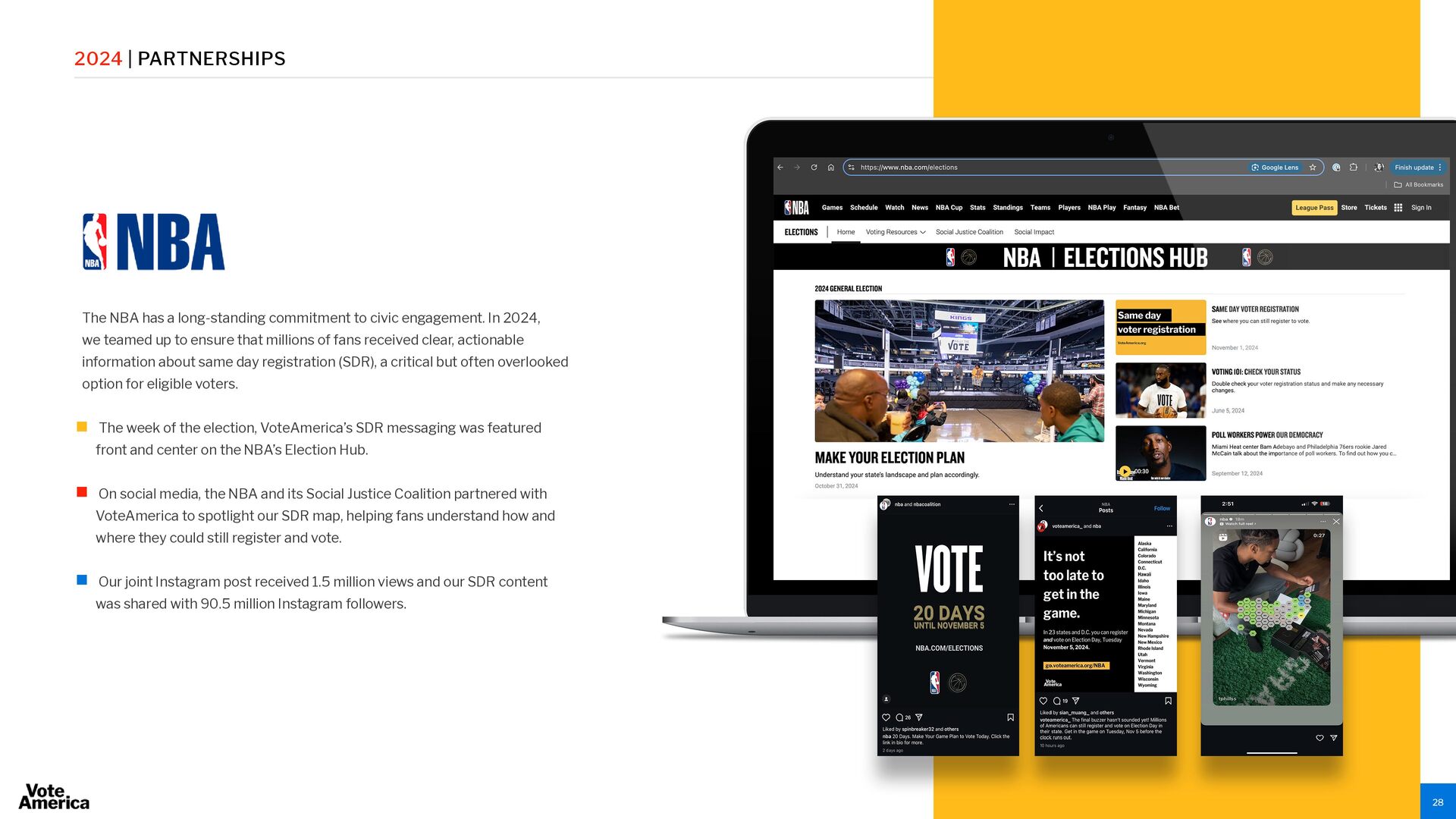
    In 2024, we teamed up to ensure that millions of fans received clear, actionable information about same day registration (SDR), a critical but often overlooked option for eligible voters. • The week of the election, VoteAmerica’s SDR messaging was featured front and center on the NBA’s Election Hub. • On social media, the NBA and its Social Justice Coalition partnered with VoteAmerica to spotlight our SDR map, helping fans understand how and where they could still register and vote. • Our joint Instagram post received 1.5 million views and our SDR content was shared with 90.5 million Instagram followers. 2024 | PARTNERSHIPS
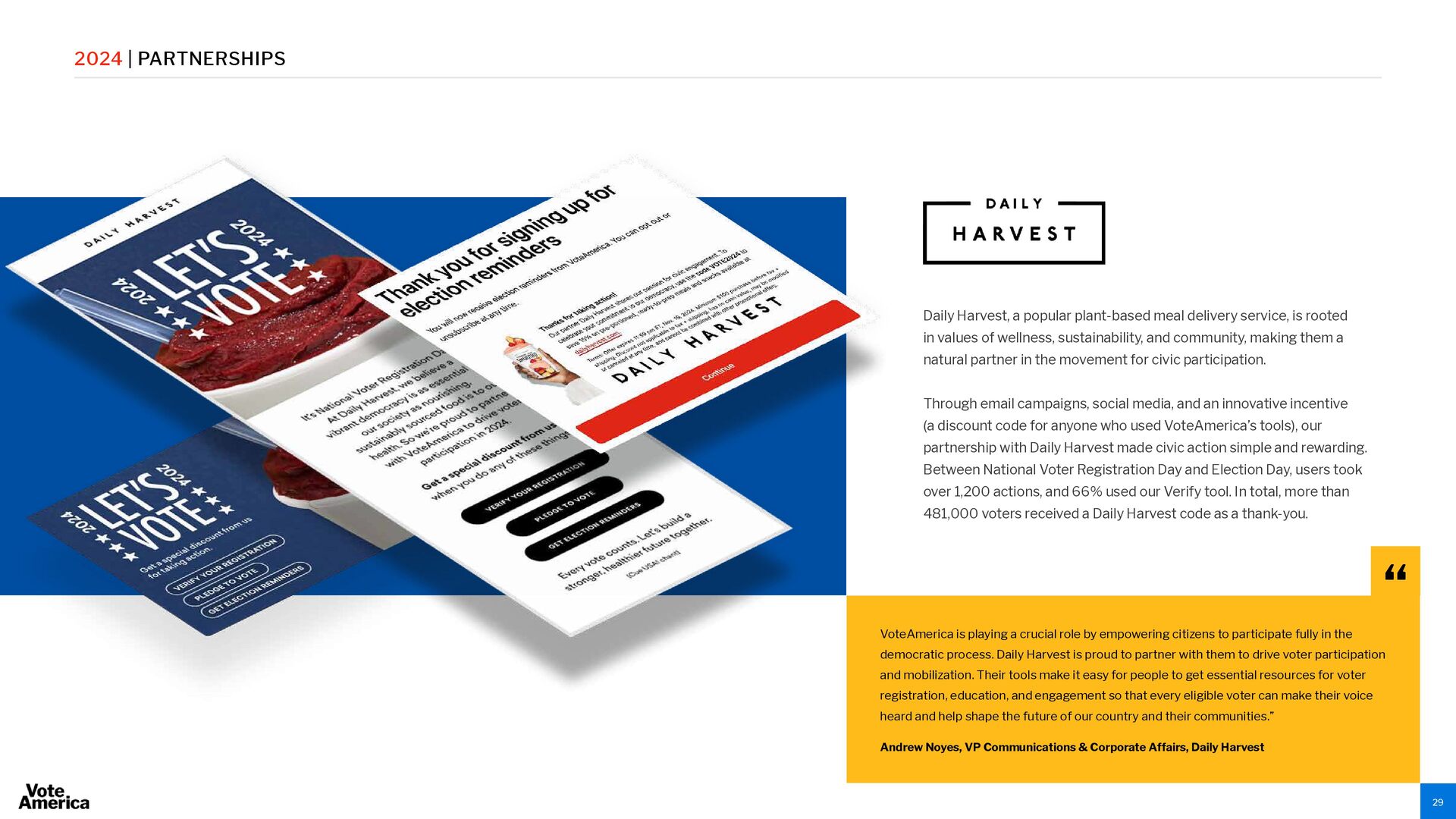
  27. 29 Daily Harvest, a popular plant-based meal delivery service, is

    rooted in values of wellness, sustainability, and community, making them a natural partner in the movement for civic participation. Through email campaigns, social media, and an innovative incentive (a discount code for anyone who used VoteAmerica’s tools), our partnership with Daily Harvest made civic action simple and rewarding. Between National Voter Registration Day and Election Day, users took over 1,200 actions, and 66% used our Verify tool. In total, more than 481,000 voters received a Daily Harvest code as a thank-you. VoteAmerica is playing a crucial role by empowering citizens to participate fully in the democratic process. Daily Harvest is proud to partner with them to drive voter participation and mobilization. Their tools make it easy for people to get essential resources for voter registration, education, and engagement so that every eligible voter can make their voice heard and help shape the future of our country and their communities.” Andrew Noyes, VP Communications & Corporate Affairs, Daily Harvest 2024 | PARTNERSHIPS “
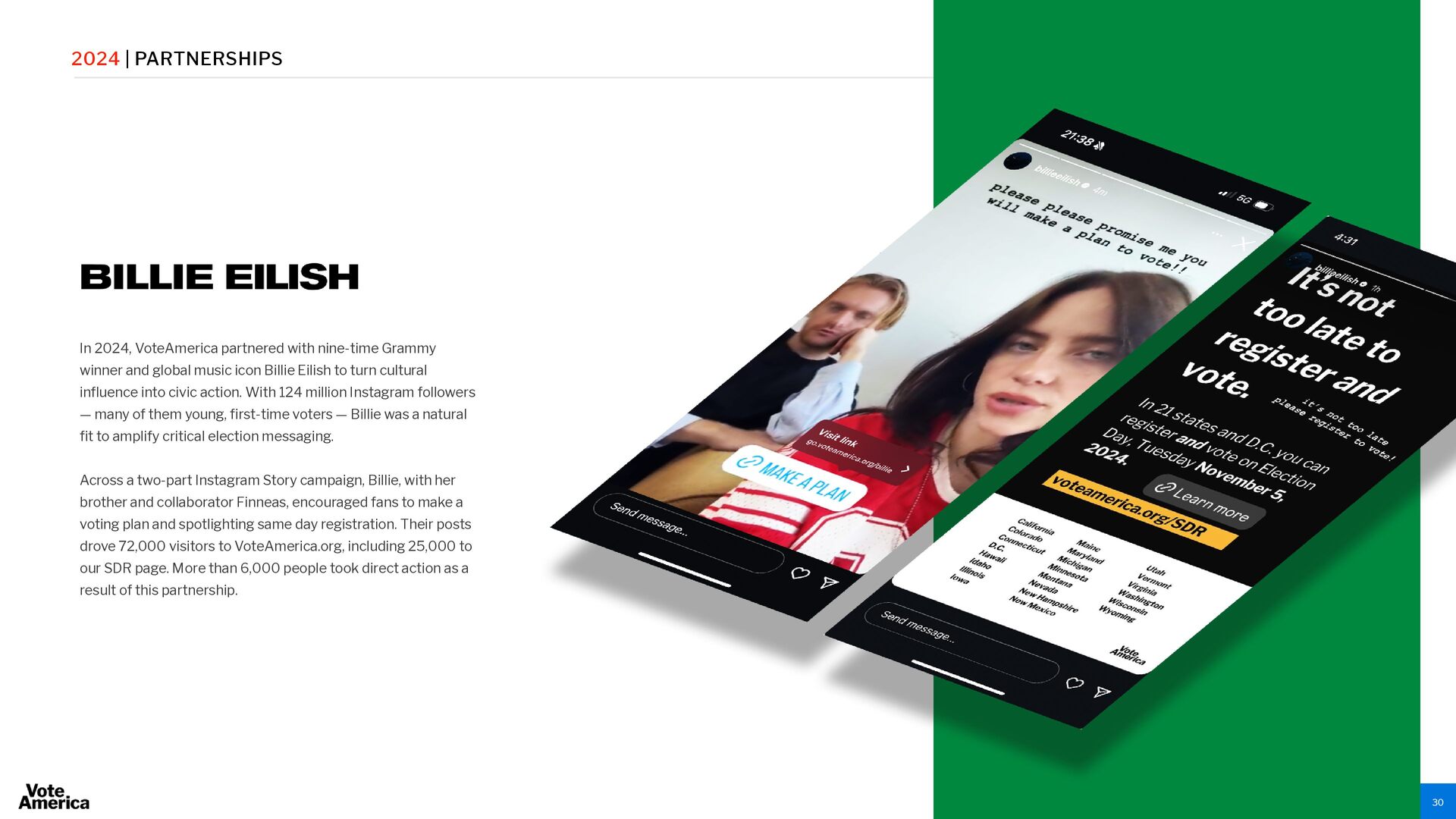
  28. 30 In 2024, VoteAmerica partnered with nine-time Grammy winner and

    global music icon Billie Eilish to turn cultural influence into civic action. With 124 million Instagram followers — many of them young, first-time voters — Billie was a natural fit to amplify critical election messaging. Across a two-part Instagram Story campaign, Billie, with her brother and collaborator Finneas, encouraged fans to make a voting plan and spotlighting same day registration. Their posts drove 72,000 visitors to VoteAmerica.org, including 25,000 to our SDR page. More than 6,000 people took direct action as a result of this partnership. 2024 | PARTNERSHIPS
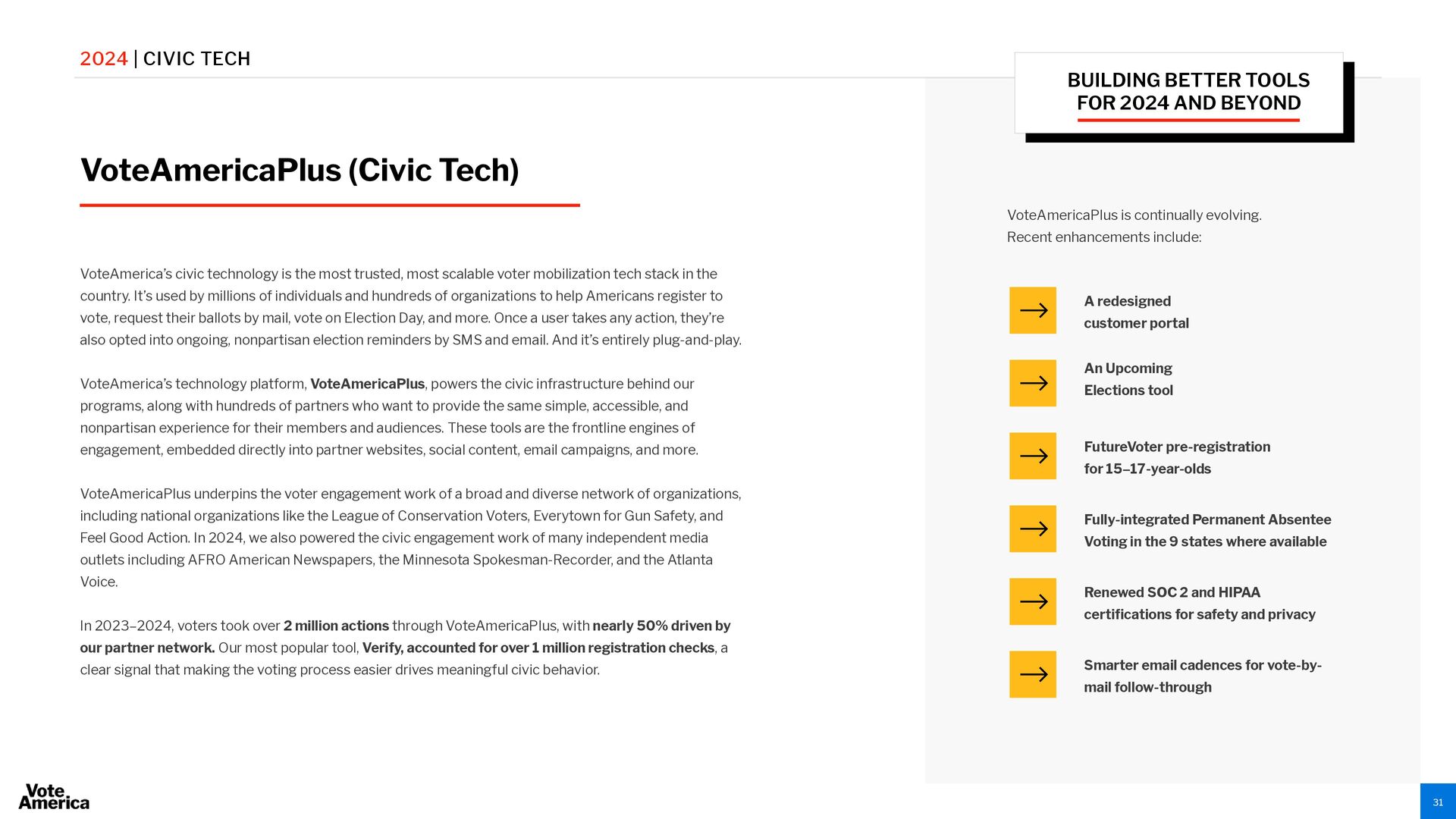
  29. 31 VoteAmericaPlus (Civic Tech) 2024 | CIVIC TECH VoteAmerica’s civic

    technology is the most trusted, most scalable voter mobilization tech stack in the country. It’s used by millions of individuals and hundreds of organizations to help Americans register to vote, request their ballots by mail, vote on Election Day, and more. Once a user takes any action, they’re also opted into ongoing, nonpartisan election reminders by SMS and email. And it’s entirely plug-and-play. VoteAmerica’s technology platform, VoteAmericaPlus, powers the civic infrastructure behind our programs, along with hundreds of partners who want to provide the same simple, accessible, and nonpartisan experience for their members and audiences. These tools are the frontline engines of engagement, embedded directly into partner websites, social content, email campaigns, and more. VoteAmericaPlus underpins the voter engagement work of a broad and diverse network of organizations, including national organizations like the League of Conservation Voters, Everytown for Gun Safety, and Feel Good Action. In 2024, we also powered the civic engagement work of many independent media outlets including AFRO American Newspapers, the Minnesota Spokesman-Recorder, and the Atlanta Voice. In 2023–2024, voters took over 2 million actions through VoteAmericaPlus, with nearly 50% driven by our partner network. Our most popular tool, Verify, accounted for over 1 million registration checks, a clear signal that making the voting process easier drives meaningful civic behavior. VoteAmericaPlus is continually evolving. Recent enhancements include: A redesigned customer portal An Upcoming Elections tool FutureVoter pre-registration for 15–17-year-olds Fully-integrated Permanent Absentee Voting in the 9 states where available BUILDING BETTER TOOLS FOR 2024 AND BEYOND Smarter email cadences for vote-by- mail follow-through Renewed SOC 2 and HIPAA certifications for safety and privacy
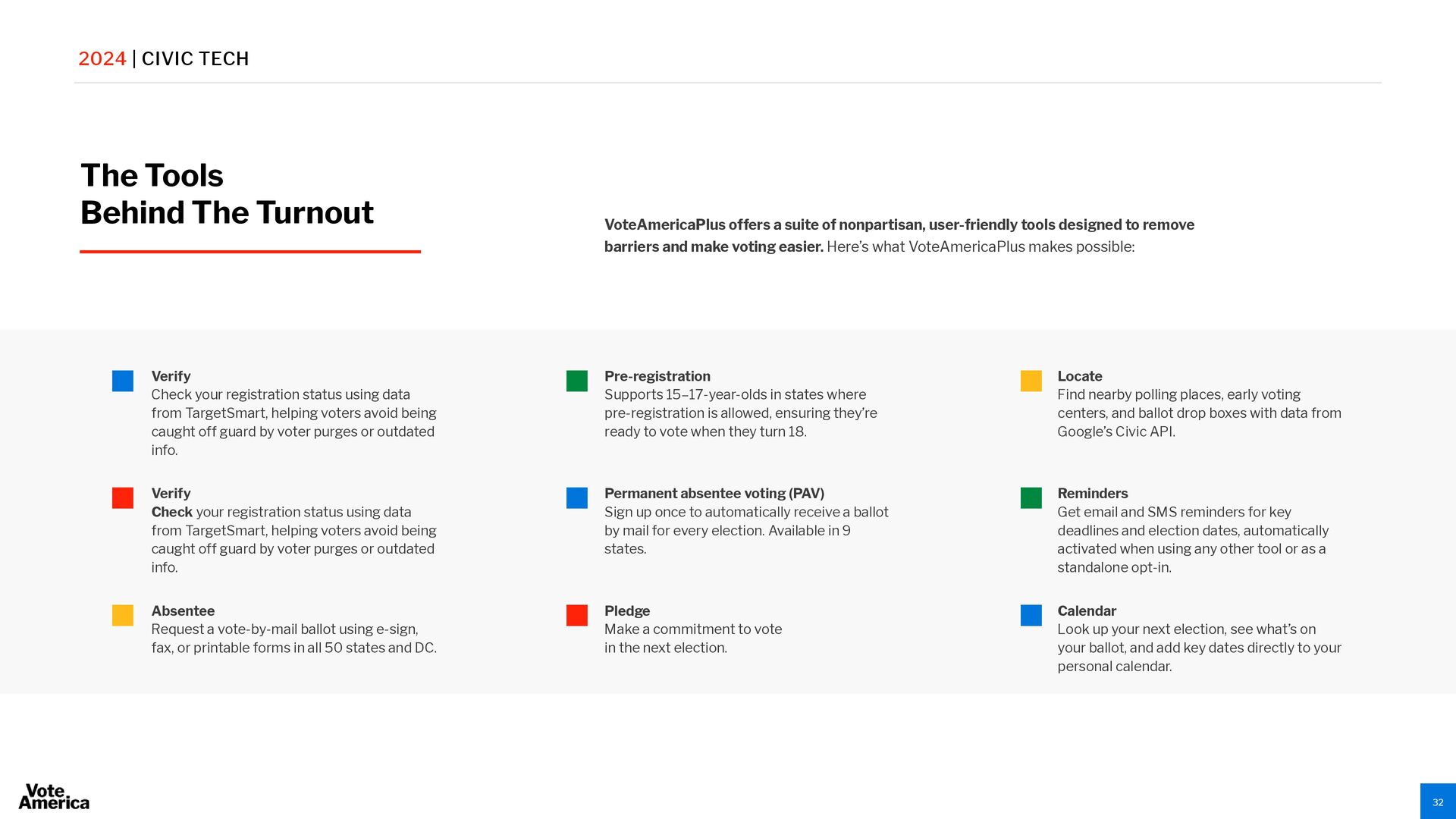
  30. 32 The Tools Behind The Turnout 2024 | CIVIC TECH

    VoteAmericaPlus offers a suite of nonpartisan, user-friendly tools designed to remove barriers and make voting easier. Here’s what VoteAmericaPlus makes possible: Verify Check your registration status using data from TargetSmart, helping voters avoid being caught off guard by voter purges or outdated info. Pre-registration Supports 15–17-year-olds in states where pre-registration is allowed, ensuring they’re ready to vote when they turn 18. Locate Find nearby polling places, early voting centers, and ballot drop boxes with data from Google’s Civic API. Verify Check your registration status using data from TargetSmart, helping voters avoid being caught off guard by voter purges or outdated info. Permanent absentee voting (PAV) Sign up once to automatically receive a ballot by mail for every election. Available in 9 states. Reminders Get email and SMS reminders for key deadlines and election dates, automatically activated when using any other tool or as a standalone opt-in. Absentee Request a vote-by-mail ballot using e-sign, fax, or printable forms in all 50 states and DC. Pledge Make a commitment to vote in the next election. Calendar Look up your next election, see what’s on your ballot, and add key dates directly to your personal calendar.
  31. 33 Spotlight: Permanent Absentee Voting (PAV) 2024 | CIVIC TECH

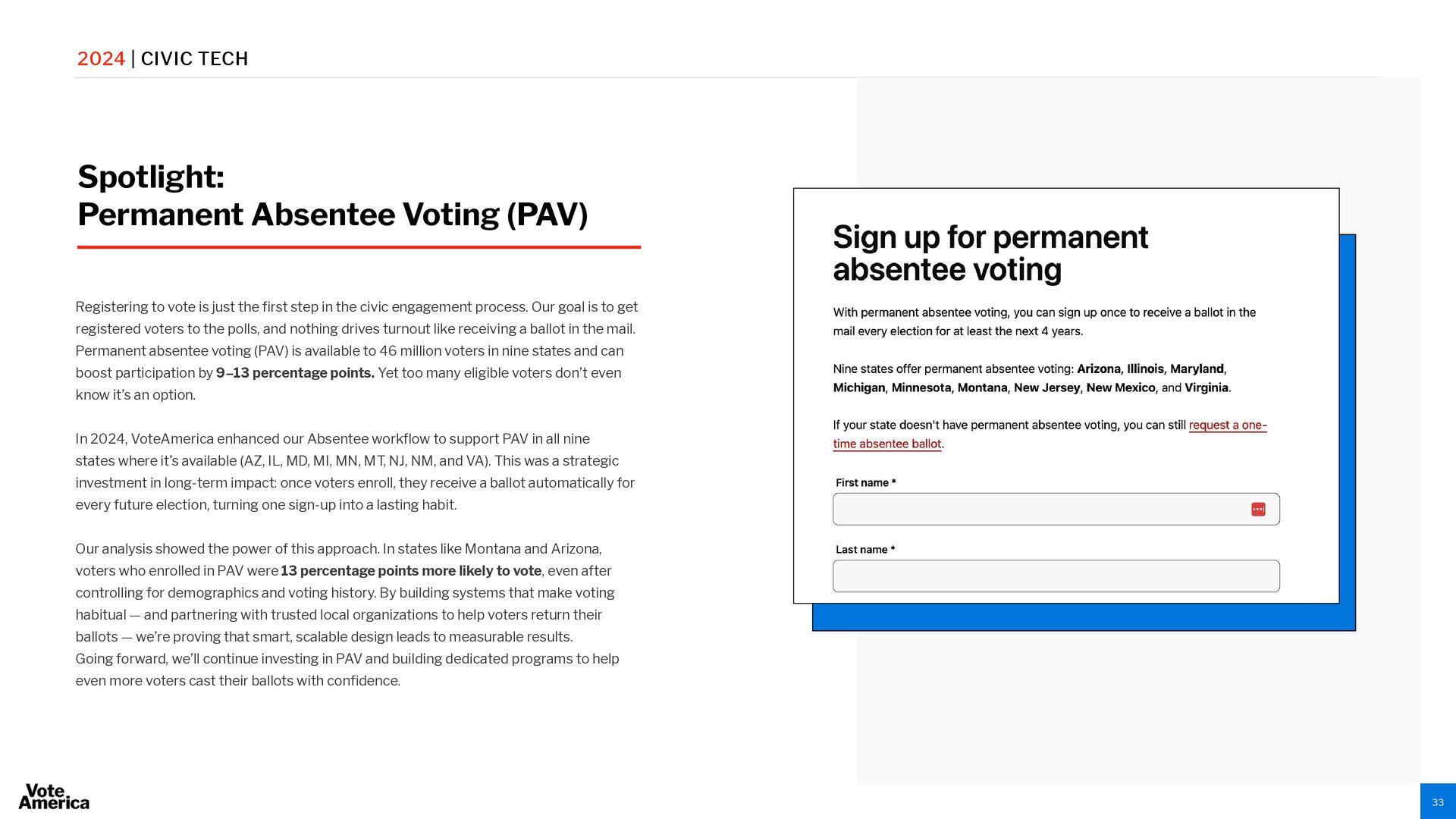
    Registering to vote is just the first step in the civic engagement process. Our goal is to get registered voters to the polls, and nothing drives turnout like receiving a ballot in the mail. Permanent absentee voting (PAV) is available to 46 million voters in nine states and can boost participation by 9–13 percentage points. Yet too many eligible voters don’t even know it’s an option. In 2024, VoteAmerica enhanced our Absentee workflow to support PAV in all nine states where it’s available (AZ, IL, MD, MI, MN, MT, NJ, NM, and VA). This was a strategic investment in long-term impact: once voters enroll, they receive a ballot automatically for every future election, turning one sign-up into a lasting habit. Our analysis showed the power of this approach. In states like Montana and Arizona, voters who enrolled in PAV were 13 percentage points more likely to vote, even after controlling for demographics and voting history. By building systems that make voting habitual — and partnering with trusted local organizations to help voters return their ballots — we’re proving that smart, scalable design leads to measurable results. Going forward, we’ll continue investing in PAV and building dedicated programs to help even more voters cast their ballots with confidence.
  32. 34 Spotlight: Pre-Registration 2024 | CIVIC TECH Launched through our

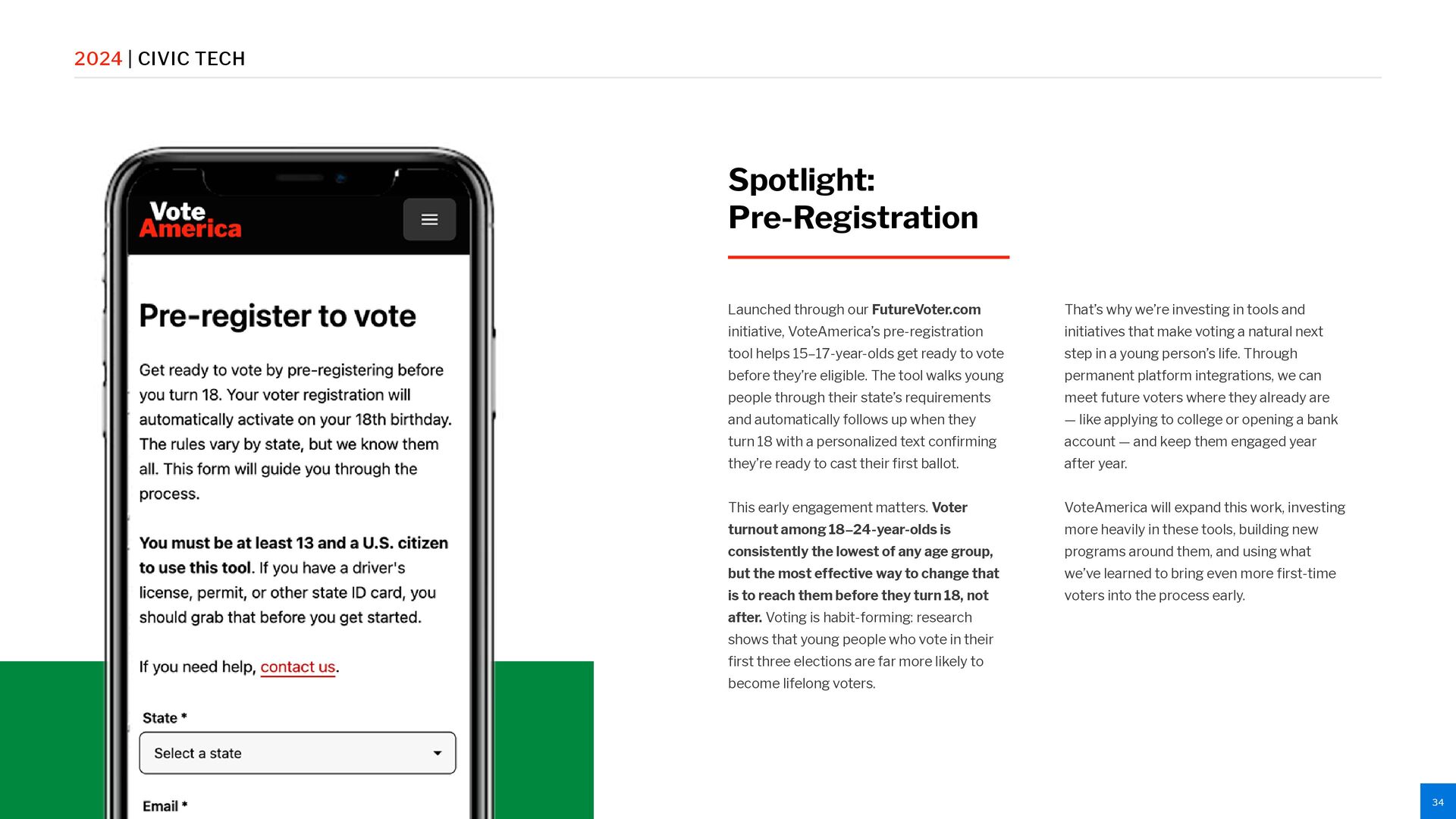
    FutureVoter.com initiative, VoteAmerica’s pre-registration tool helps 15–17-year-olds get ready to vote before they’re eligible. The tool walks young people through their state’s requirements and automatically follows up when they turn 18 with a personalized text confirming they’re ready to cast their first ballot. This early engagement matters. Voter turnout among 18–24-year-olds is consistently the lowest of any age group, but the most effective way to change that is to reach them before they turn 18, not after. Voting is habit-forming: research shows that young people who vote in their first three elections are far more likely to become lifelong voters. That’s why we’re investing in tools and initiatives that make voting a natural next step in a young person’s life. Through permanent platform integrations, we can meet future voters where they already are — like applying to college or opening a bank account — and keep them engaged year after year. VoteAmerica will expand this work, investing more heavily in these tools, building new programs around them, and using what we’ve learned to bring even more first-time voters into the process early.
  33. 35 Spotlight: Election Reminders 2024 | CIVIC TECH Built on

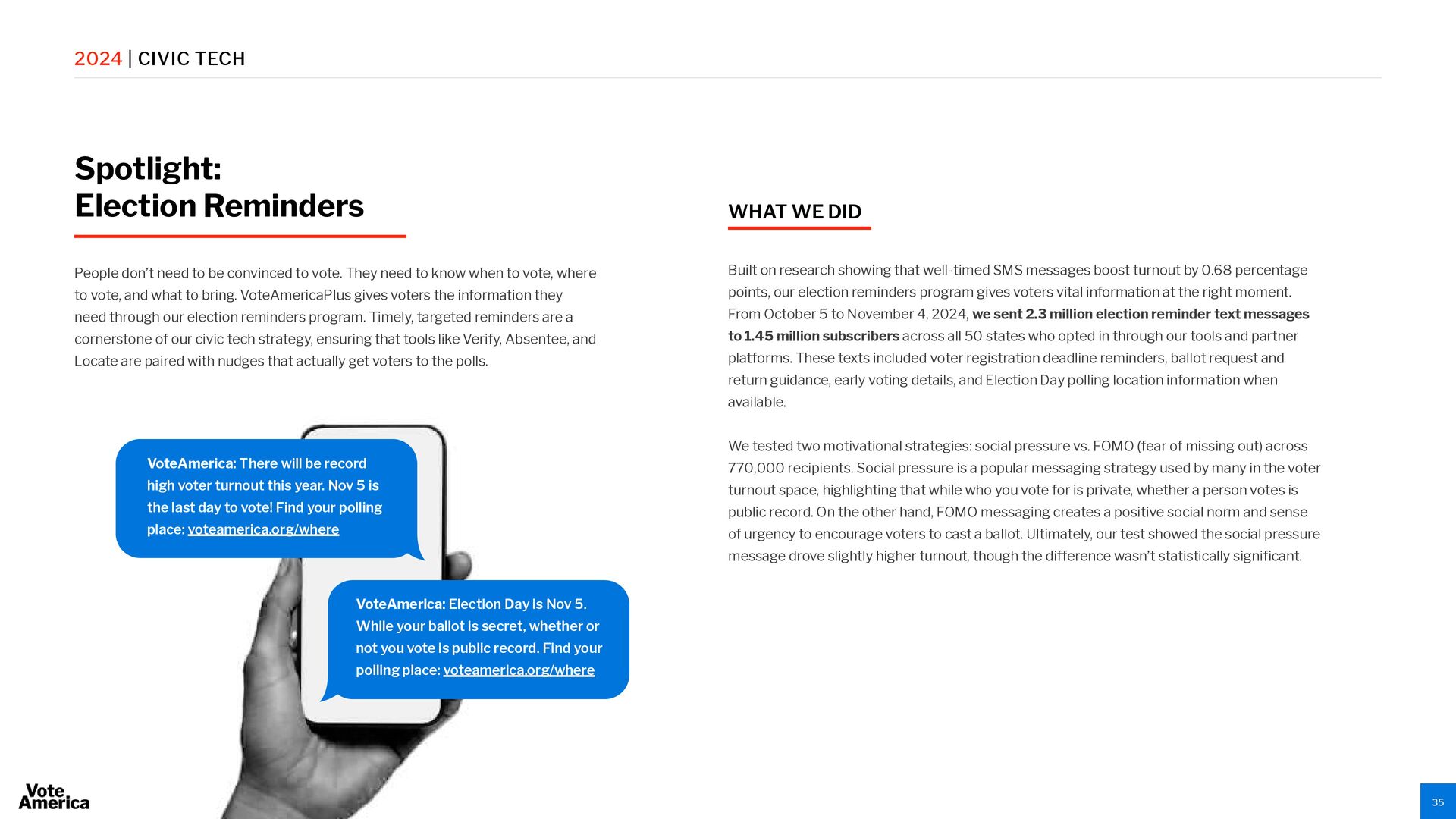
    research showing that well-timed SMS messages boost turnout by 0.68 percentage points, our election reminders program gives voters vital information at the right moment. From October 5 to November 4, 2024, we sent 2.3 million election reminder text messages to 1.45 million subscribers across all 50 states who opted in through our tools and partner platforms. These texts included voter registration deadline reminders, ballot request and return guidance, early voting details, and Election Day polling location information when available. We tested two motivational strategies: social pressure vs. FOMO (fear of missing out) across 770,000 recipients. Social pressure is a popular messaging strategy used by many in the voter turnout space, highlighting that while who you vote for is private, whether a person votes is public record. On the other hand, FOMO messaging creates a positive social norm and sense of urgency to encourage voters to cast a ballot. Ultimately, our test showed the social pressure message drove slightly higher turnout, though the difference wasn’t statistically significant. People don’t need to be convinced to vote. They need to know when to vote, where to vote, and what to bring. VoteAmericaPlus gives voters the information they need through our election reminders program. Timely, targeted reminders are a cornerstone of our civic tech strategy, ensuring that tools like Verify, Absentee, and Locate are paired with nudges that actually get voters to the polls. WHAT WE DID VoteAmerica: There will be record high voter turnout this year. Nov 5 is the last day to vote! Find your polling place: voteamerica.org/where VoteAmerica: Election Day is Nov 5. While your ballot is secret, whether or not you vote is public record. Find your polling place: voteamerica.org/where
  34. 36 Each year, nearly 40 million Americans move, and every

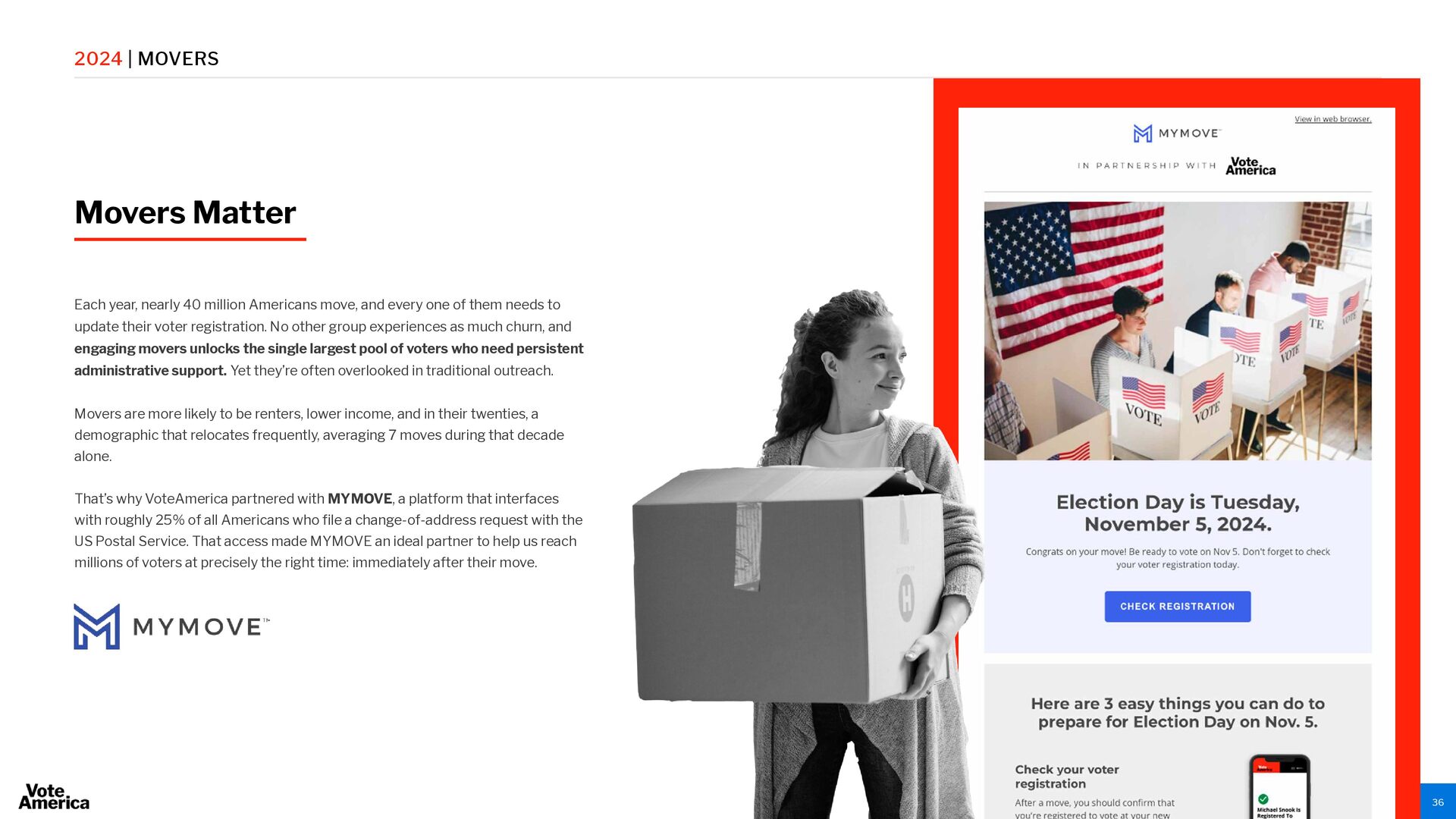
    one of them needs to update their voter registration. No other group experiences as much churn, and engaging movers unlocks the single largest pool of voters who need persistent administrative support. Yet they’re often overlooked in traditional outreach. Movers are more likely to be renters, lower income, and in their twenties, a demographic that relocates frequently, averaging 7 moves during that decade alone. That’s why VoteAmerica partnered with MYMOVE, a platform that interfaces with roughly 25% of all Americans who file a change-of-address request with the US Postal Service. That access made MYMOVE an ideal partner to help us reach millions of voters at precisely the right time: immediately after their move. Movers Matter 2024 | MOVERS
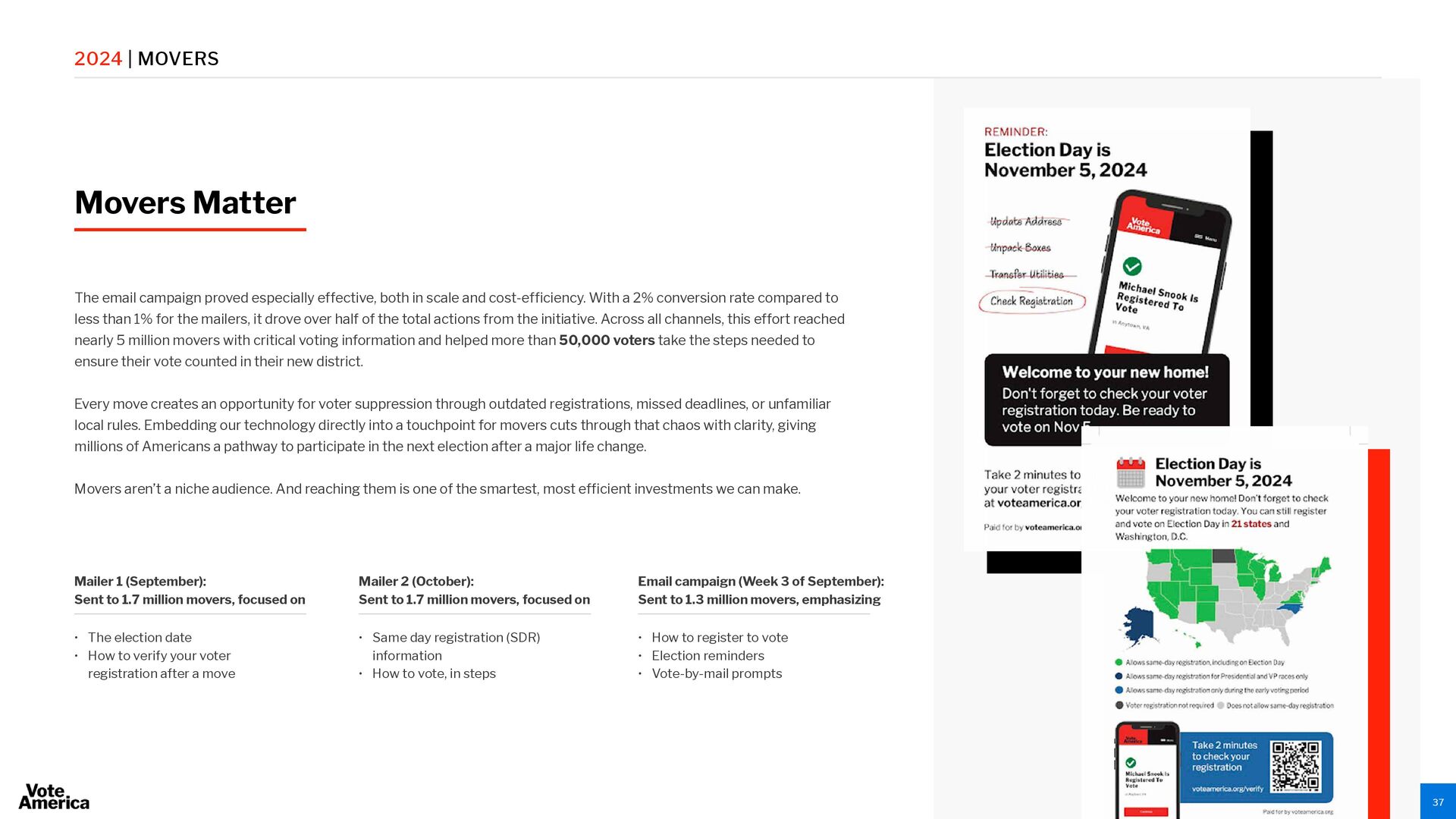
  35. 37 The email campaign proved especially effective, both in scale

    and cost-efficiency. With a 2% conversion rate compared to less than 1% for the mailers, it drove over half of the total actions from the initiative. Across all channels, this effort reached nearly 5 million movers with critical voting information and helped more than 50,000 voters take the steps needed to ensure their vote counted in their new district. Every move creates an opportunity for voter suppression through outdated registrations, missed deadlines, or unfamiliar local rules. Embedding our technology directly into a touchpoint for movers cuts through that chaos with clarity, giving millions of Americans a pathway to participate in the next election after a major life change. Movers aren’t a niche audience. And reaching them is one of the smartest, most efficient investments we can make. Mailer 1 (September): Sent to 1.7 million movers, focused on Mailer 2 (October): Sent to 1.7 million movers, focused on Email campaign (Week 3 of September): Sent to 1.3 million movers, emphasizing 2024 | MOVERS Movers Matter • The election date • How to verify your voter registration after a move • Same day registration (SDR) information • How to vote, in steps • How to register to vote • Election reminders • Vote-by-mail prompts
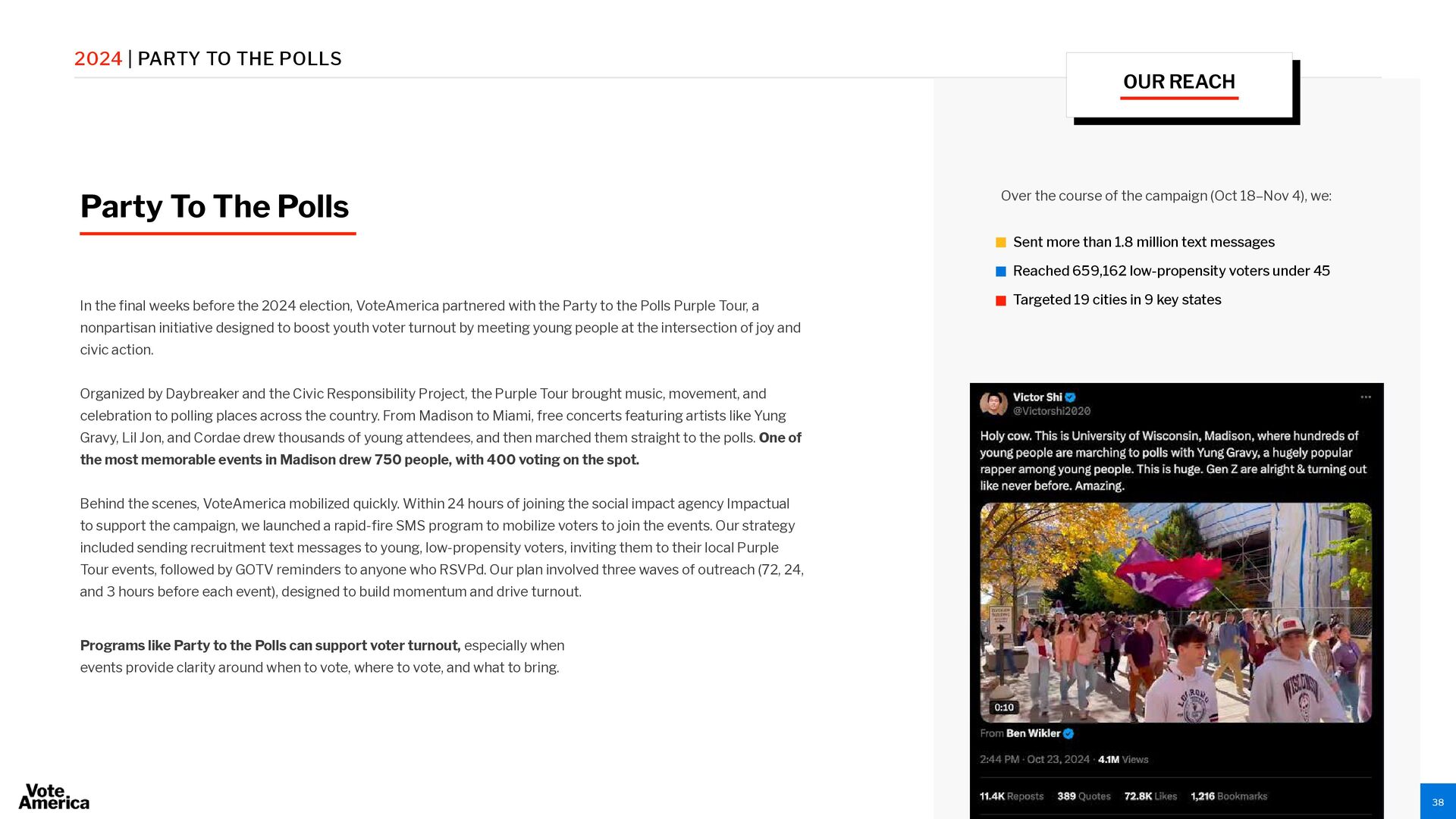
  36. 38 In the final weeks before the 2024 election, VoteAmerica

    partnered with the Party to the Polls Purple Tour, a nonpartisan initiative designed to boost youth voter turnout by meeting young people at the intersection of joy and civic action. Organized by Daybreaker and the Civic Responsibility Project, the Purple Tour brought music, movement, and celebration to polling places across the country. From Madison to Miami, free concerts featuring artists like Yung Gravy, Lil Jon, and Cordae drew thousands of young attendees, and then marched them straight to the polls. One of the most memorable events in Madison drew 750 people, with 400 voting on the spot. Behind the scenes, VoteAmerica mobilized quickly. Within 24 hours of joining the social impact agency Impactual to support the campaign, we launched a rapid-fire SMS program to mobilize voters to join the events. Our strategy included sending recruitment text messages to young, low-propensity voters, inviting them to their local Purple Tour events, followed by GOTV reminders to anyone who RSVPd. Our plan involved three waves of outreach (72, 24, and 3 hours before each event), designed to build momentum and drive turnout. Programs like Party to the Polls can support voter turnout, especially when events provide clarity around when to vote, where to vote, and what to bring. Party To The Polls 2024 | PARTY TO THE POLLS Over the course of the campaign (Oct 18–Nov 4), we: • Sent more than 1.8 million text messages • Reached 659,162 low-propensity voters under 45 • Targeted 19 cities in 9 key states OUR REACH
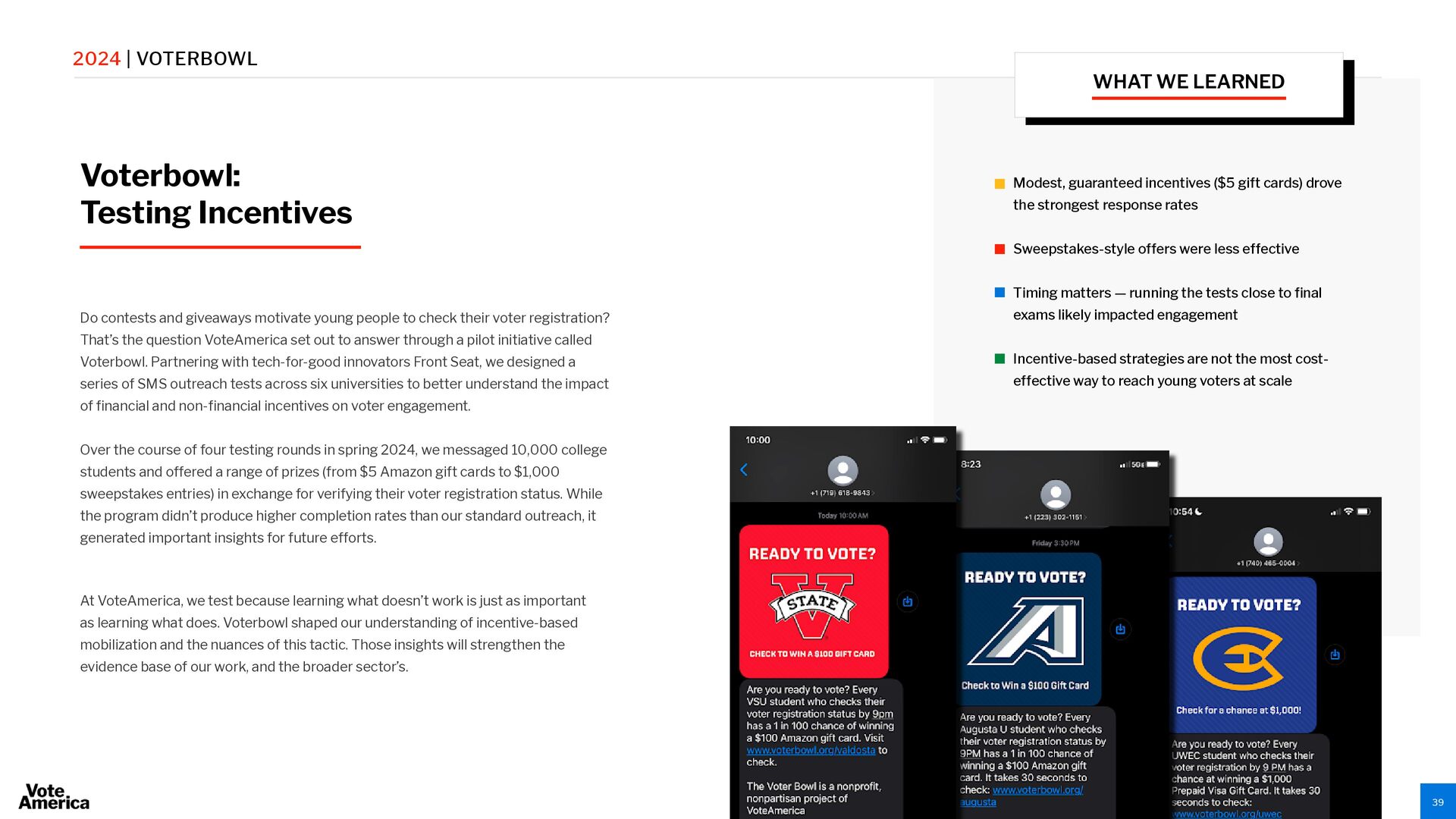
  37. 39 Do contests and giveaways motivate young people to check

    their voter registration? That’s the question VoteAmerica set out to answer through a pilot initiative called Voterbowl. Partnering with tech-for-good innovators Front Seat, we designed a series of SMS outreach tests across six universities to better understand the impact of financial and non-financial incentives on voter engagement. Over the course of four testing rounds in spring 2024, we messaged 10,000 college students and offered a range of prizes (from $5 Amazon gift cards to $1,000 sweepstakes entries) in exchange for verifying their voter registration status. While the program didn’t produce higher completion rates than our standard outreach, it generated important insights for future efforts. At VoteAmerica, we test because learning what doesn’t work is just as important as learning what does. Voterbowl shaped our understanding of incentive-based mobilization and the nuances of this tactic. Those insights will strengthen the evidence base of our work, and the broader sector’s. Voterbowl: Testing Incentives 2024 | VOTERBOWL • Modest, guaranteed incentives ($5 gift cards) drove the strongest response rates • Sweepstakes-style offers were less effective • Timing matters — running the tests close to final exams likely impacted engagement • Incentive-based strategies are not the most cost- effective way to reach young voters at scale WHAT WE LEARNED
  38. 40 VoteAmerica Research Center 2024 | RESEARCH & PROGRAM EVALUATION

    At VoteAmerica, we don’t do anything we can’t measure. Every tactic, from billboards to nationwide SMS, is tracked, analyzed, and evaluated for real-world impact. Over the years, we’ve produced hundreds of pages of evaluation write-ups, helping us refine our own work and elevate standards across the entire voter engagement field. In 2023 we took the commitment further and launched the VoteAmerica Research Center, an initiative designed to make evidence-based mobilization the norm rather than the exception. In 2023–2024, we also launched the VoteAmerica Democracy Fellowship, designed to make significant progress on long-term, comprehensive solutions to protect and strengthen American democracy. Fellows are academic scholars who study democracy in depth and work directly with our team to create actionable roadmaps we can execute in the field. Our first fellow, Professor Scott Minkoff of SUNY New Paltz, was a natural fit. We’ve partnered with Prof. Minkoff for years on program evaluations, and in 2023 he was able to dedicate an entire academic year to voter turnout research. His fellowship focused on two of the most impactful structural reforms in the country: universal vote by mail (UVBM) and permanent absentee Voting (PAV). Both reduce friction by bringing the polling place to the voter. In universal vote by mail (UVBM) states, all registered voters are sent a ballot in the mail without needing to proactively request one. In permanent absentee voting (PAV) states, voters can sign up once to receive ballots in the mail for all subsequent elections. Prof. Minkoff found that, in 2020, turnout in UVBM states was 0.6 percentage points higher than turnout in battleground states, where battleground states are defined as those where partisan groups spent at least $90 million on broadcast TV. Turnout in UVBM states was higher across all age cohorts. Notably, turnout among younger voters (18 to 24) in UVBM states was about 3.7 percentage points higher than in battleground states. When we talk about voter mobilization, we often mean external interventions that make someone more likely to vote. But some of the strongest turnout gains come from the government itself. Automatic mail voting — whether universal (UVBM) or permanent absentee (PAV) — brings the polls to the people and produces turnout lifts far beyond what standard outreach can achieve. While UVBM can’t be directly tested within states, and PAV effects are partly influenced by already-engaged voters opting in, the evidence is clear: receiving a ballot automatically is a powerful mobilization tool. The ballot itself becomes the intervention — and an enduring one. Expanding UVBM or PAV requires policy change, but in states that already offer PAV, the next challenge is adoption. Many eligible voters don’t even know these systems exist. That’s why our civic tech and outreach programs now integrate PAV enrollment wherever possible. Encouraging voters to opt in will require traditional outreach tactics, but once a voter signs up, they continue receiving ballots for every future election — often for years — without additional outreach.
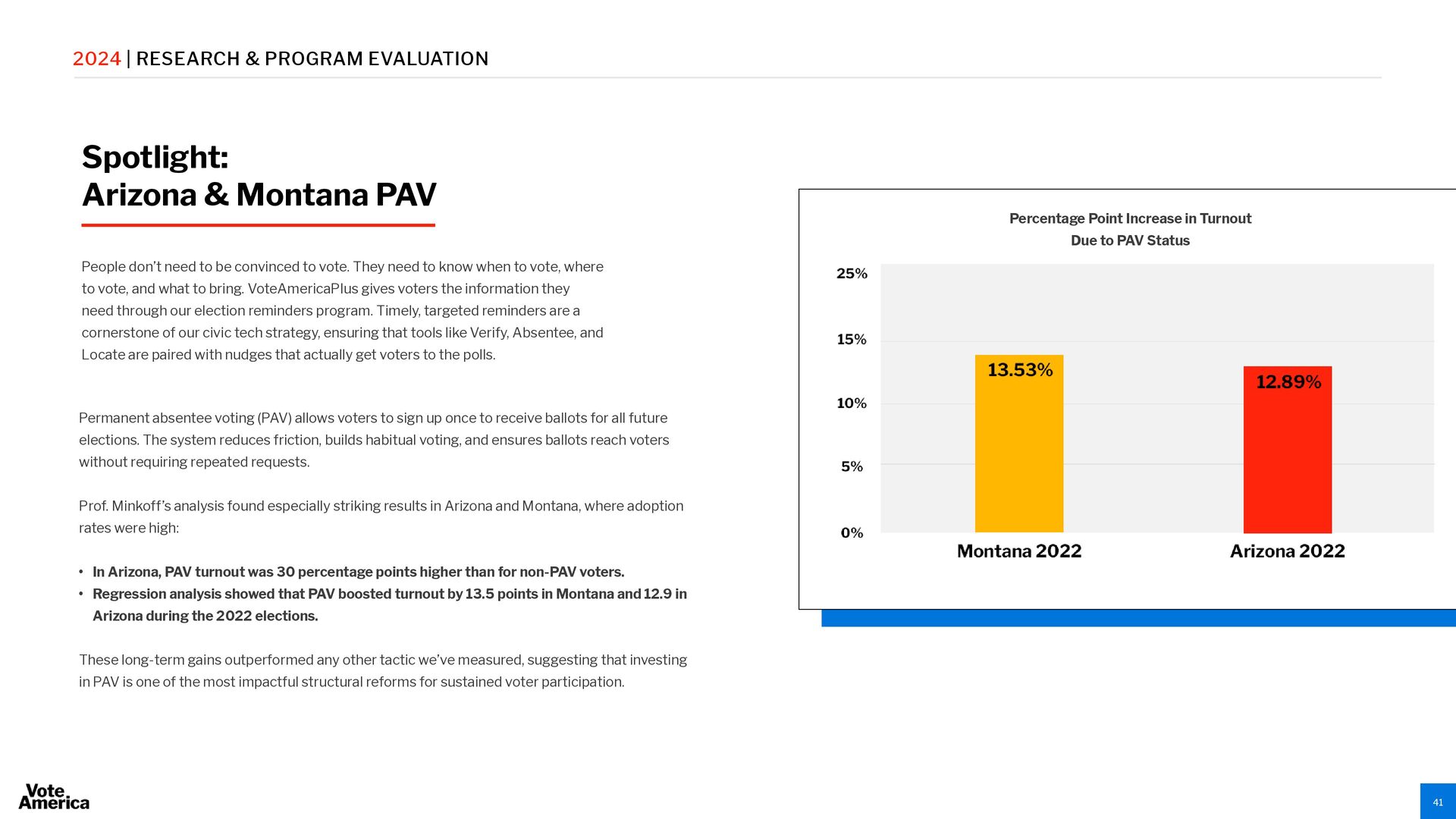
  39. 41 Spotlight: Arizona & Montana PAV 2024 | RESEARCH &

    PROGRAM EVALUATION Permanent absentee voting (PAV) allows voters to sign up once to receive ballots for all future elections. The system reduces friction, builds habitual voting, and ensures ballots reach voters without requiring repeated requests. Prof. Minkoff’s analysis found especially striking results in Arizona and Montana, where adoption rates were high: • In Arizona, PAV turnout was 30 percentage points higher than for non-PAV voters. • Regression analysis showed that PAV boosted turnout by 13.5 points in Montana and 12.9 in Arizona during the 2022 elections. These long-term gains outperformed any other tactic we’ve measured, suggesting that investing in PAV is one of the most impactful structural reforms for sustained voter participation. People don’t need to be convinced to vote. They need to know when to vote, where to vote, and what to bring. VoteAmericaPlus gives voters the information they need through our election reminders program. Timely, targeted reminders are a cornerstone of our civic tech strategy, ensuring that tools like Verify, Absentee, and Locate are paired with nudges that actually get voters to the polls. Percentage Point Increase in Turnout Due to PAV Status
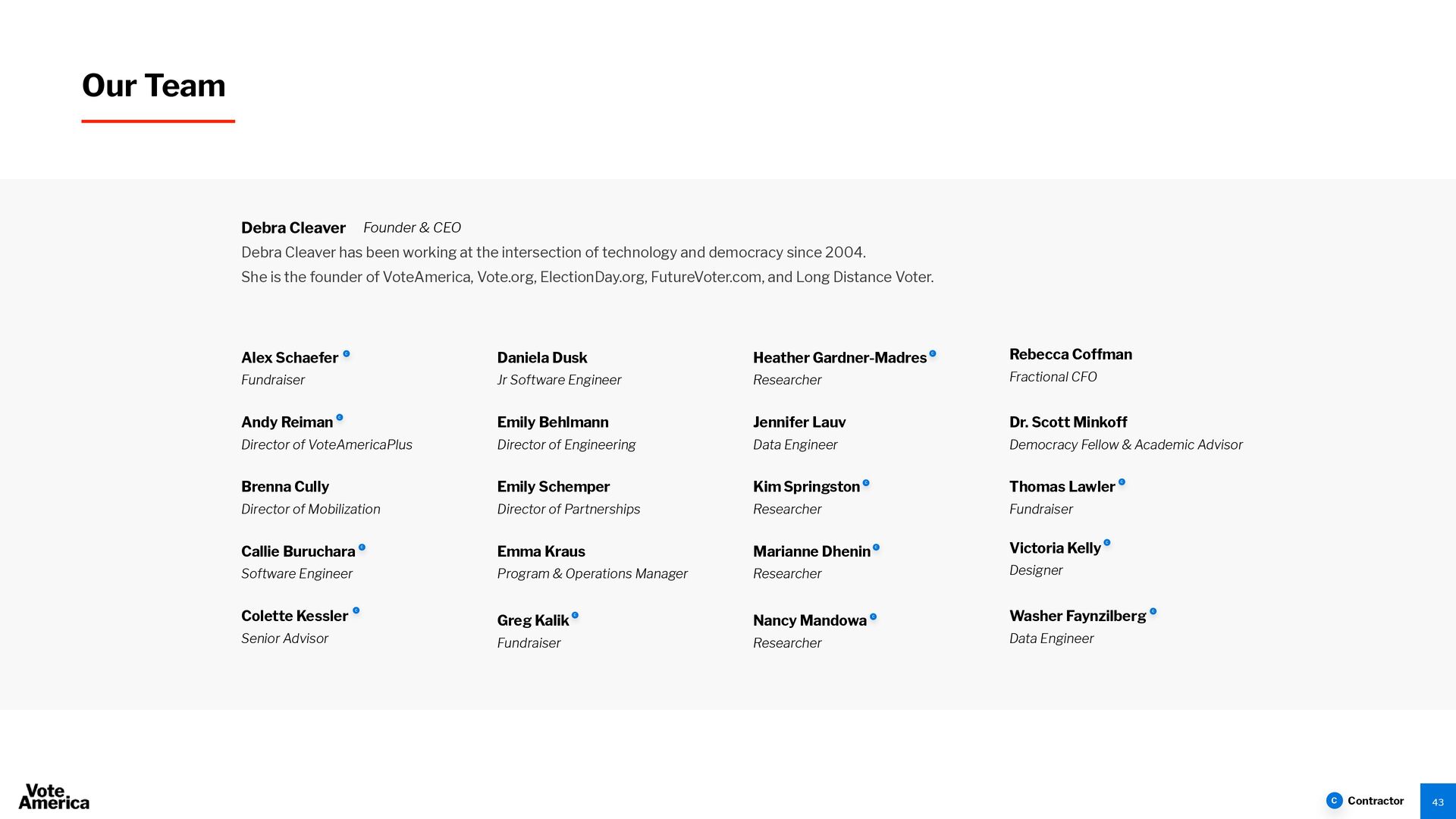
  40. 43 Debra Cleaver Founder & CEO Debra Cleaver has been

    working at the intersection of technology and democracy since 2004. She is the founder of VoteAmerica, Vote.org, ElectionDay.org, FutureVoter.com, and Long Distance Voter. Alex Schaefer Fundraiser Daniela Dusk Jr Software Engineer Andy Reiman Director of VoteAmericaPlus Emily Behlmann Director of Engineering Brenna Cully Director of Mobilization Emily Schemper Director of Partnerships Emma Kraus Program & Operations Manager Callie Buruchara Software Engineer Greg Kalik Fundraiser Colette Kessler Senior Advisor Heather Gardner-Madres Researcher Rebecca Coffman Fractional CFO Washer Faynzilberg Data Engineer Contractor Nancy Mandowa Researcher Victoria Kelly Designer Jennifer Lauv Data Engineer Dr. Scott Minkoff Democracy Fellow & Academic Advisor Kim Springston Researcher Thomas Lawler Fundraiser Marianne Dhenin Researcher C C C C C C C C C C C C C Our Team
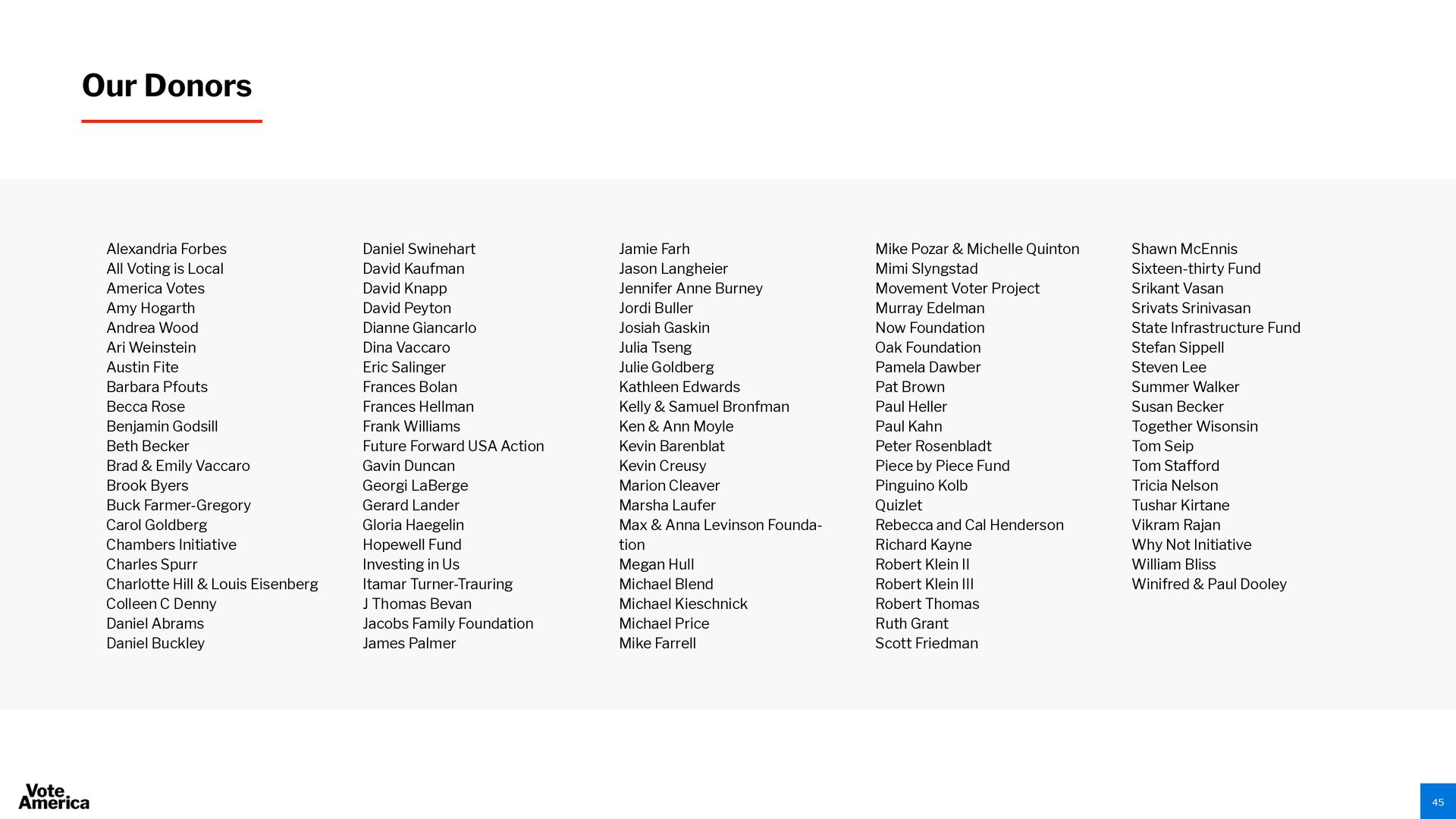
  41. 45 Alexandria Forbes All Voting is Local America Votes Amy

    Hogarth Andrea Wood Ari Weinstein Austin Fite Barbara Pfouts Becca Rose Benjamin Godsill Beth Becker Brad & Emily Vaccaro Brook Byers Buck Farmer-Gregory Carol Goldberg Chambers Initiative Charles Spurr Charlotte Hill & Louis Eisenberg Colleen C Denny Daniel Abrams Daniel Buckley Daniel Swinehart David Kaufman David Knapp David Peyton Dianne Giancarlo Dina Vaccaro Eric Salinger Frances Bolan Frances Hellman Frank Williams Future Forward USA Action Gavin Duncan Georgi LaBerge Gerard Lander Gloria Haegelin Hopewell Fund Investing in Us Itamar Turner-Trauring J Thomas Bevan Jacobs Family Foundation James Palmer Jamie Farh Jason Langheier Jennifer Anne Burney Jordi Buller Josiah Gaskin Julia Tseng Julie Goldberg Kathleen Edwards Kelly & Samuel Bronfman Ken & Ann Moyle Kevin Barenblat Kevin Creusy Marion Cleaver Marsha Laufer Max & Anna Levinson Founda- tion Megan Hull Michael Blend Michael Kieschnick Michael Price Mike Farrell Mike Pozar & Michelle Quinton Mimi Slyngstad Movement Voter Project Murray Edelman Now Foundation Oak Foundation Pamela Dawber Pat Brown Paul Heller Paul Kahn Peter Rosenbladt Piece by Piece Fund Pinguino Kolb Quizlet Rebecca and Cal Henderson Richard Kayne Robert Klein II Robert Klein III Robert Thomas Ruth Grant Scott Friedman Shawn McEnnis Sixteen-thirty Fund Srikant Vasan Srivats Srinivasan State Infrastructure Fund Stefan Sippell Steven Lee Summer Walker Susan Becker Together Wisonsin Tom Seip Tom Stafford Tricia Nelson Tushar Kirtane Vikram Rajan Why Not Initiative William Bliss Winifred & Paul Dooley Our Donors
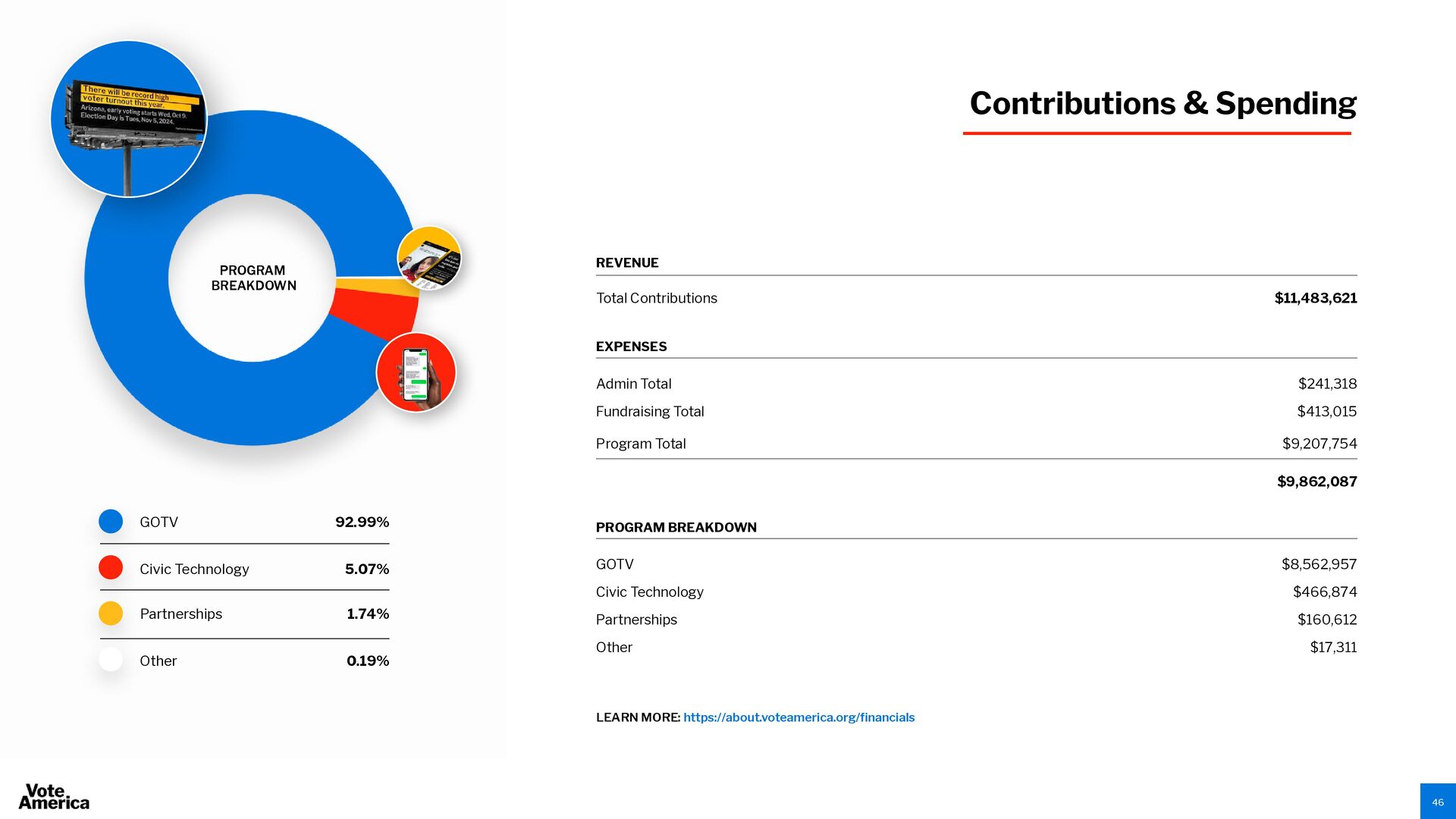
  42. 46 LEARN MORE: https://about.voteamerica.org/financials REVENUE EXPENSES PROGRAM BREAKDOWN Admin Total

    GOTV PROGRAM BREAKDOWN Total Contributions Fundraising Total Civic Technology Program Total Partnerships Other $241,318 $8,562,957 $11,483,621 $413,015 $466,874 $9,207,754 $160,612 $17,311 $9,862,087 GOTV Civic Technology Partnerships Other 92.99% 5.07% 1.74% 0.19% Contributions & Spending
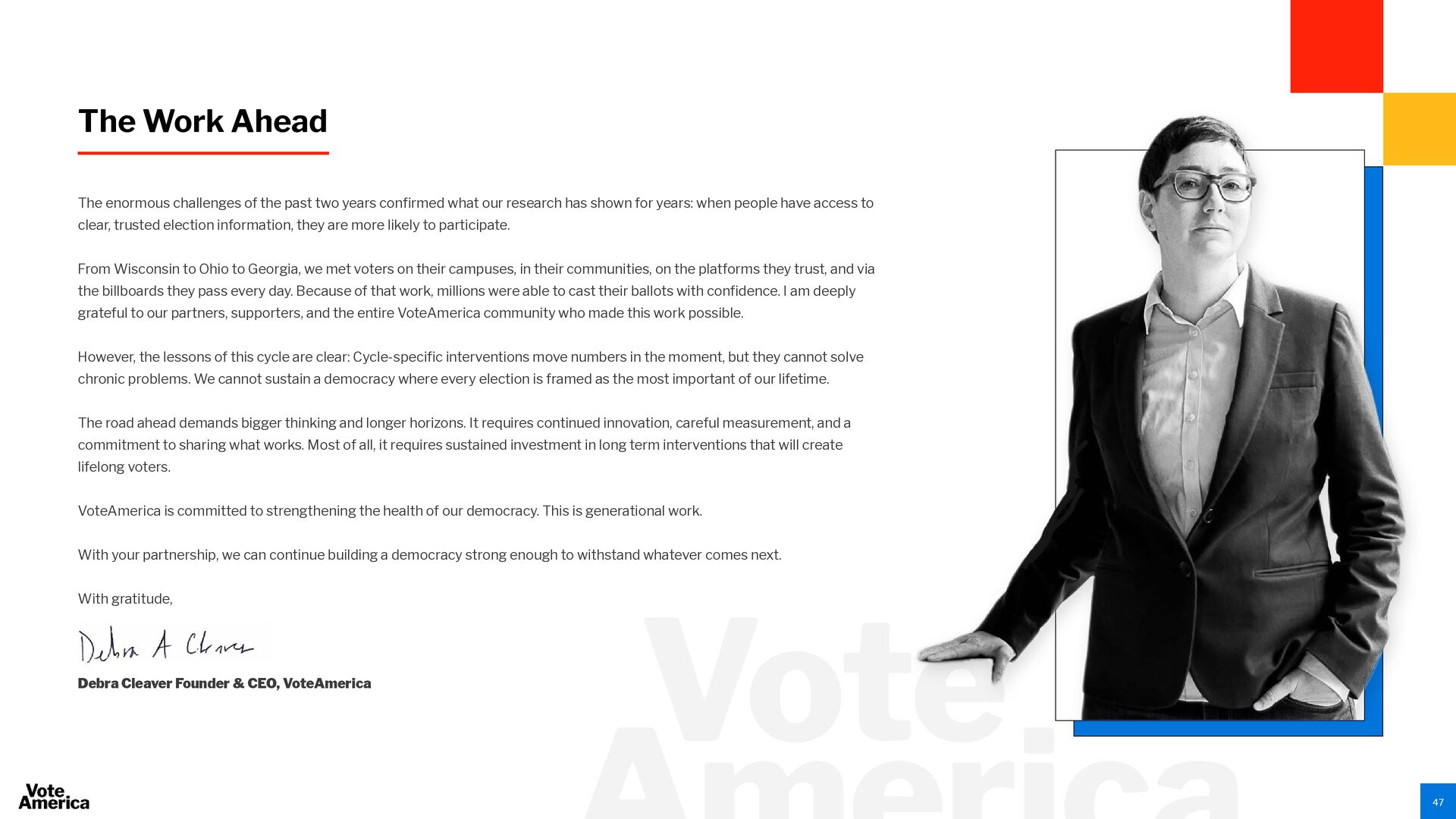
  43. 47 The enormous challenges of the past two years confirmed

    what our research has shown for years: when people have access to clear, trusted election information, they are more likely to participate. From Wisconsin to Ohio to Georgia, we met voters on their campuses, in their communities, on the platforms they trust, and via the billboards they pass every day. Because of that work, millions were able to cast their ballots with confidence. I am deeply grateful to our partners, supporters, and the entire VoteAmerica community who made this work possible. However, the lessons of this cycle are clear: Cycle-specific interventions move numbers in the moment, but they cannot solve chronic problems. We cannot sustain a democracy where every election is framed as the most important of our lifetime. The road ahead demands bigger thinking and longer horizons. It requires continued innovation, careful measurement, and a commitment to sharing what works. Most of all, it requires sustained investment in long term interventions that will create lifelong voters. VoteAmerica is committed to strengthening the health of our democracy. This is generational work. With your partnership, we can continue building a democracy strong enough to withstand whatever comes next. With gratitude, Debra Cleaver Founder & CEO VoteAmerica Debra Cleaver Founder & CEO, VoteAmerica The Work Ahead