Upgrade to Pro — share decks privately, control downloads, hide ads and more …

GopherCon 2017 - Writing Networking Clients in ...

GopherCon 2017 - Writing Networking Clients in Go: The Design & Implementation of the NATS Client

The NATS Go client is the canonical implementation of a client for the NATS Messaging System, and from the beginning it was designed for high performance. In this talk, we will cover its APIs and dissect how the client internal engine works to get the most out of Go to achieve maximum throughput.

Avatar for Waldemar Quevedo

Waldemar Quevedo

July 15, 2017

Other Decks in Programming

Transcript

  1. Writing Networking Clients in Go The Design and Implementation of

    the client from Waldemar Quevedo / GopherCon 2017 @wallyqs 1 . 1
  2. Waldemar Quevedo / So ware Developer at Development of the

    Apcera Platform NATS clients maintainer Using NATS based systems since 2012 Go favorite feature: Performance! About me @wallyqs Apcera 2 . 1
  3. About this talk Brief intro to the NATS project and

    its protocol Deep dive into how the NATS Go client is implemented 3 . 1
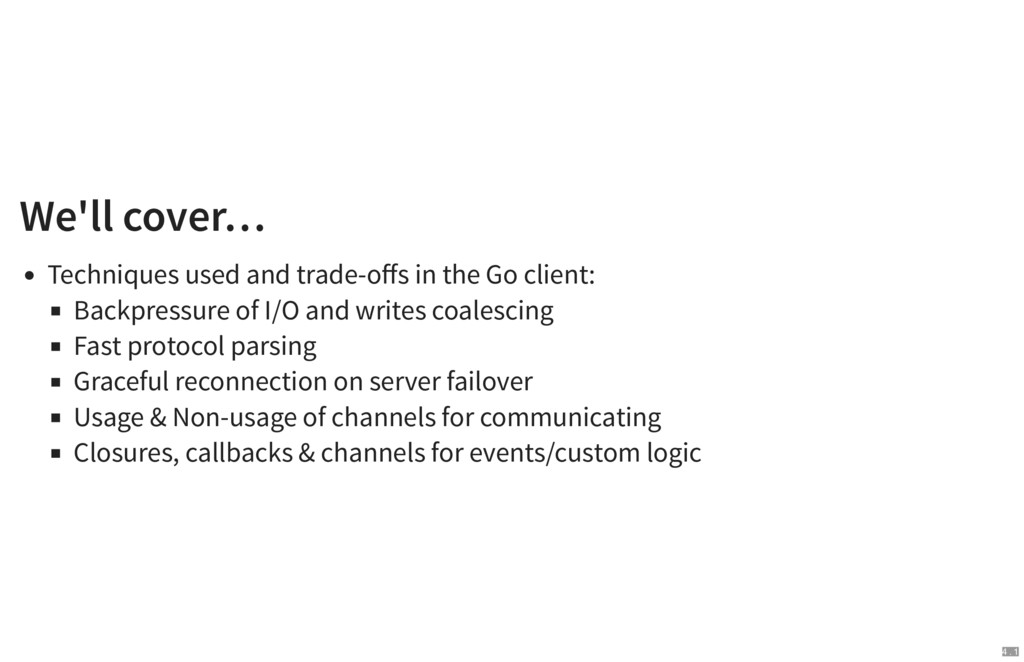
  4. We'll cover… Techniques used and trade-offs in the Go client:

    Backpressure of I/O and writes coalescing Fast protocol parsing Graceful reconnection on server failover Usage & Non-usage of channels for communicating Closures, callbacks & channels for events/custom logic 4 . 1
  5. Agenda Intro to the NATS Project The NATS Protocol NATS

    Client Deep Dive IO Engine Connecting & Graceful Reconnection Sync & Async Subscriptions Request/Response Performance 5 . 1
  6. Agenda Intro to the NATS Project The NATS Protocol NATS

    Client Deep Dive IO Engine Connecting & Graceful Reconnection Sync & Async Subscriptions Request/Response Performance 6 . 1
  7. Brief Intro to the NATS Project High Performance Messaging System

    Open Source, MIT License Created by Github: Website: Development sponsored by Derek Collison https://github.com/nats-io http://nats.io/ 7 . 1
  8. Used in production by thousands of users for… Building Microservices

    Control Planes Internal communication among components Service Discovery Low Latency Request Response RPC Fire and Forget PubSub 8 . 1
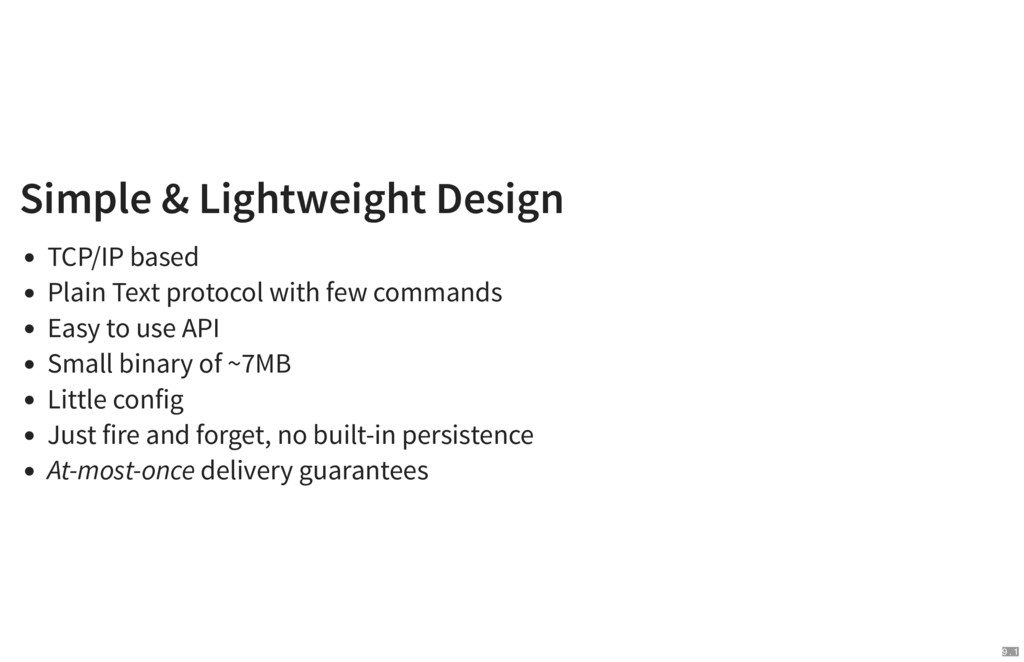
  9. Simple & Lightweight Design TCP/IP based Plain Text protocol with

    few commands Easy to use API Small binary of ~7MB Little config Just fire and forget, no built-in persistence At-most-once delivery guarantees 9 . 1
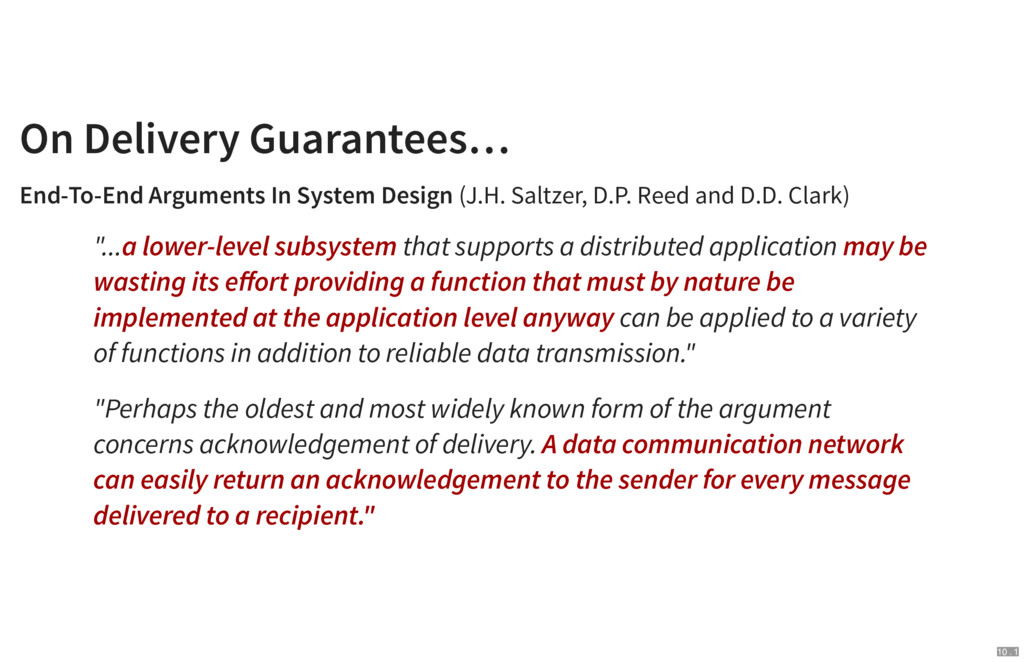
  10. On Delivery Guarantees… End-To-End Arguments In System Design (J.H. Saltzer,

    D.P. Reed and D.D. Clark) "...a lower-level subsystem that supports a distributed application may be wasting its effort providing a function that must by nature be implemented at the application level anyway can be applied to a variety of functions in addition to reliable data transmission." "Perhaps the oldest and most widely known form of the argument concerns acknowledgement of delivery. A data communication network can easily return an acknowledgement to the sender for every message delivered to a recipient." 10 . 1
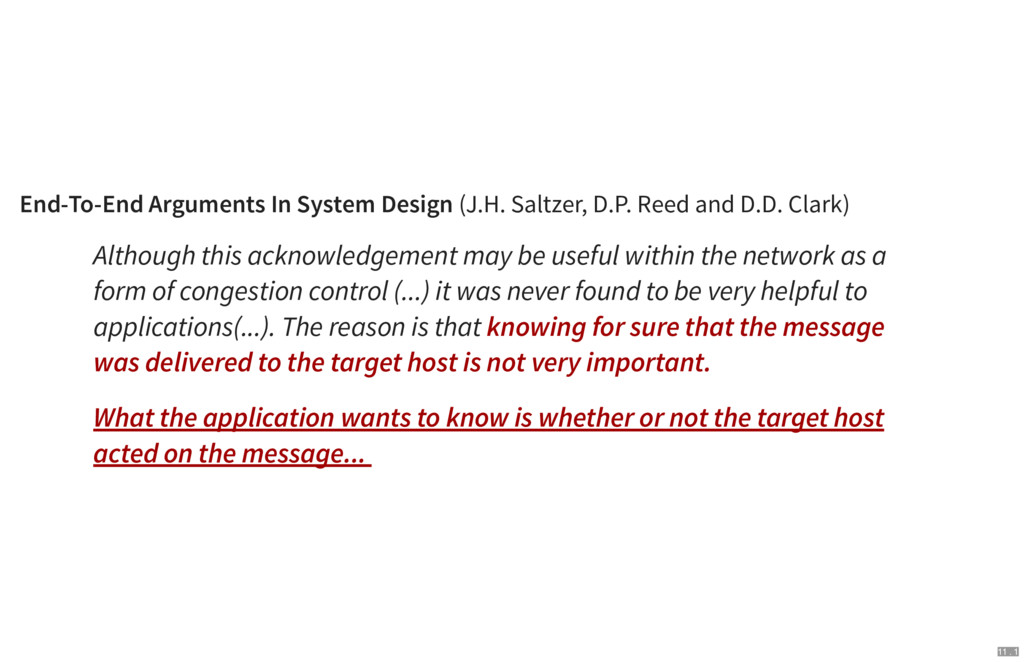
  11. End-To-End Arguments In System Design (J.H. Saltzer, D.P. Reed and

    D.D. Clark) Although this acknowledgement may be useful within the network as a form of congestion control (...) it was never found to be very helpful to applications(...). The reason is that knowing for sure that the message was delivered to the target host is not very important. What the application wants to know is whether or not the target host acted on the message... 11 . 1
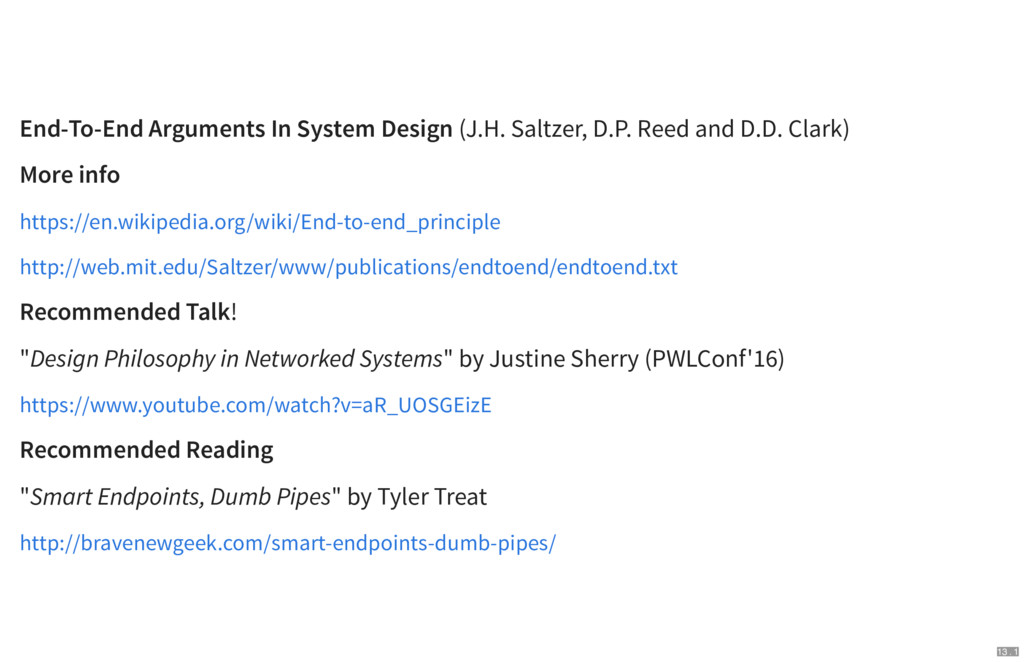
  12. End-To-End Arguments In System Design (J.H. Saltzer, D.P. Reed and

    D.D. Clark) More info Recommended Talk! ⭐⭐⭐⭐⭐ "Design Philosophy in Networked Systems" by Justine Sherry (PWLConf'16) Recommended Reading "Smart Endpoints, Dumb Pipes" by Tyler Treat https://en.wikipedia.org/wiki/End-to-end_principle http://web.mit.edu/Saltzer/www/publications/endtoend/endtoend.txt https://www.youtube.com/watch?v=aR_UOSGEizE http://bravenewgeek.com/smart-endpoints-dumb-pipes/ 13 . 1
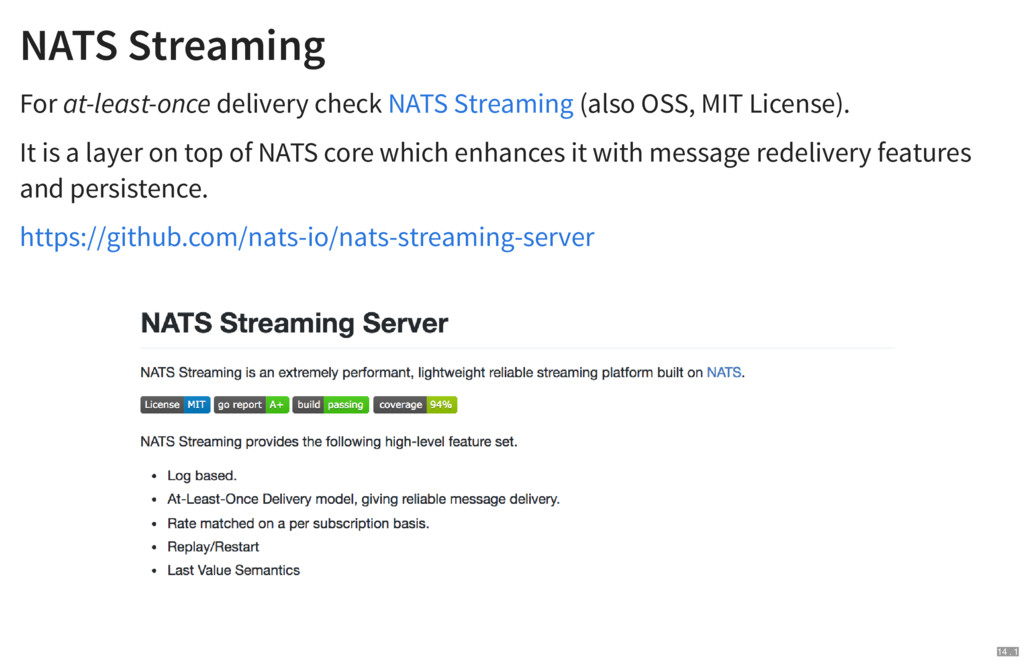
  13. NATS Streaming For at-least-once delivery check (also OSS, MIT License).

    It is a layer on top of NATS core which enhances it with message redelivery features and persistence. NATS Streaming https://github.com/nats-io/nats-streaming-server 14 . 1
  14. Agenda Intro to the NATS Project The NATS Protocol NATS

    Client Deep Dive IO Engine Connecting & Graceful Reconnection Sync & Async Subscriptions Request/Response Performance 15 . 1
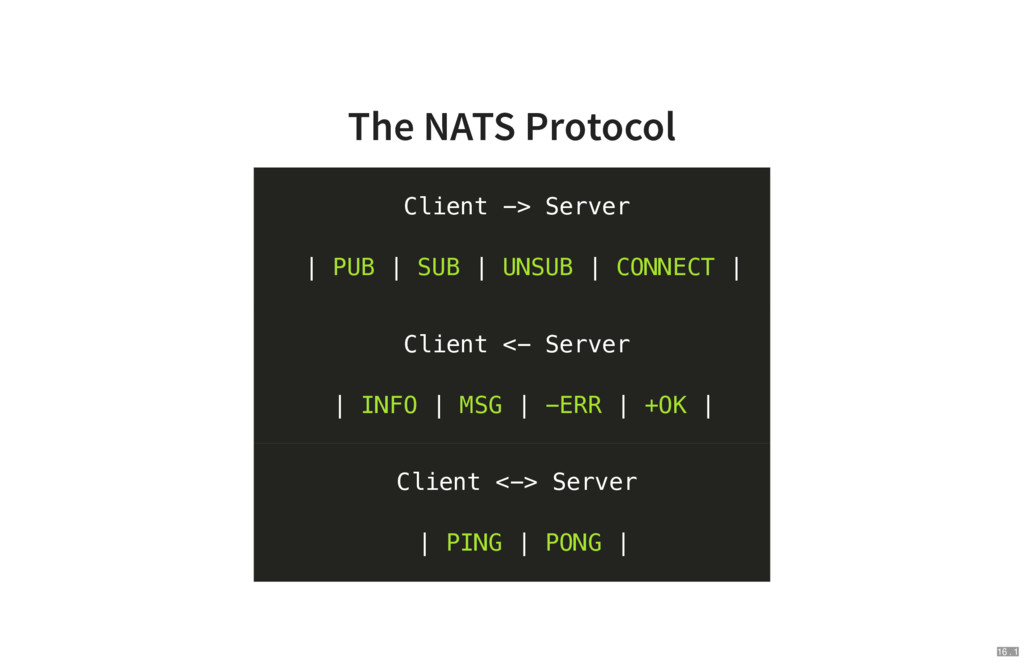
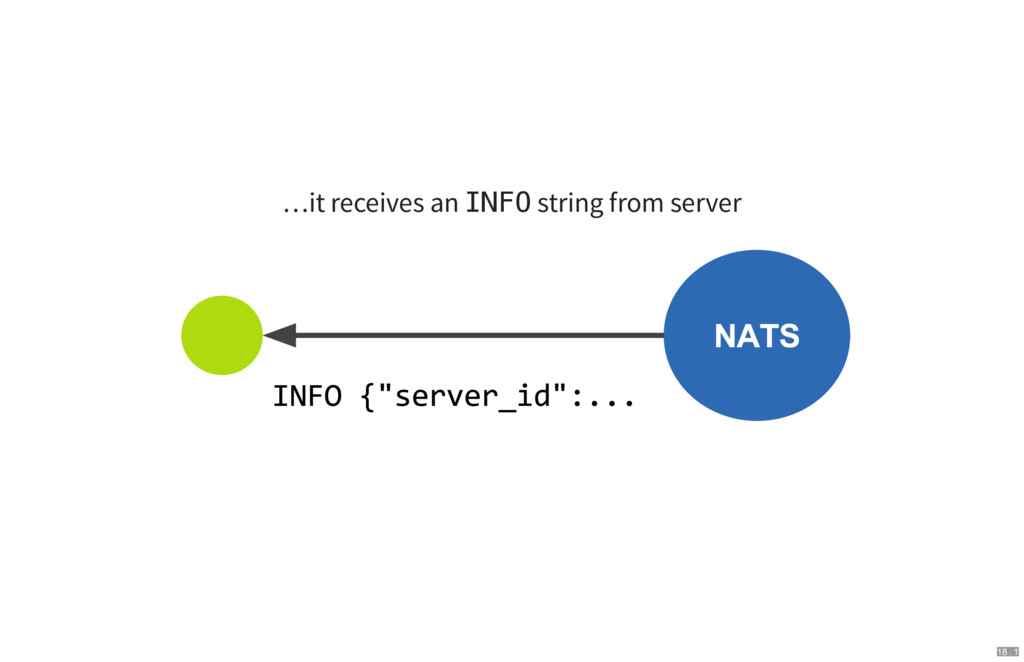
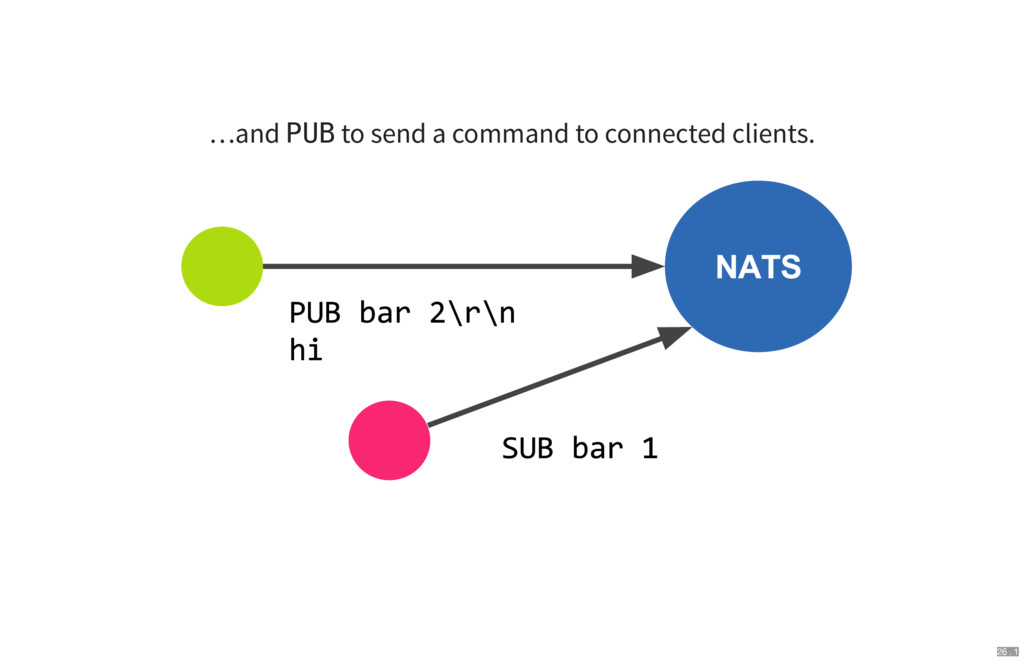
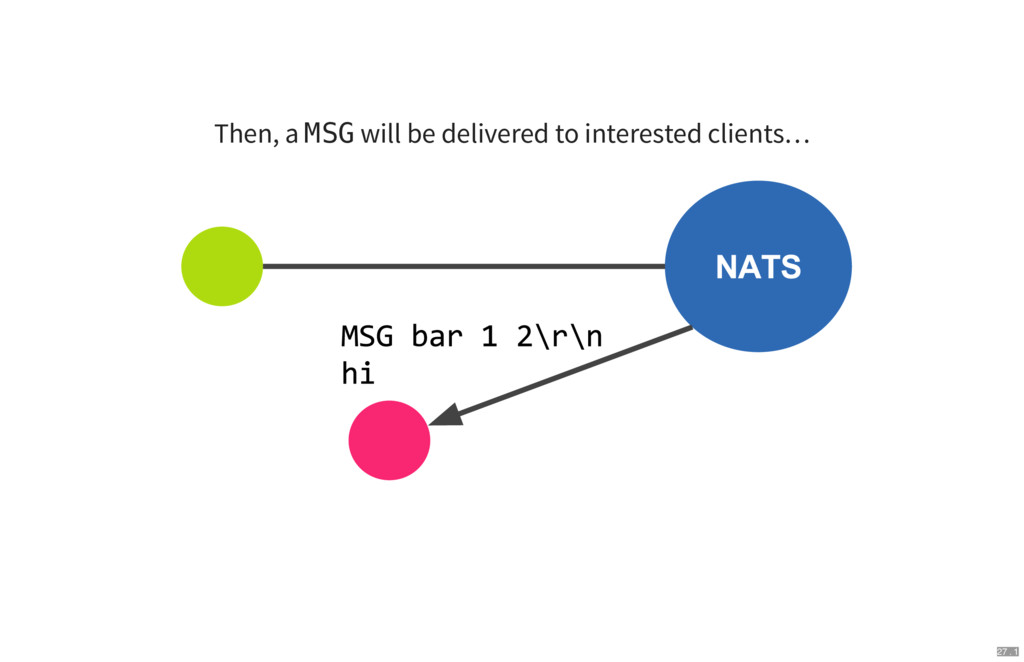
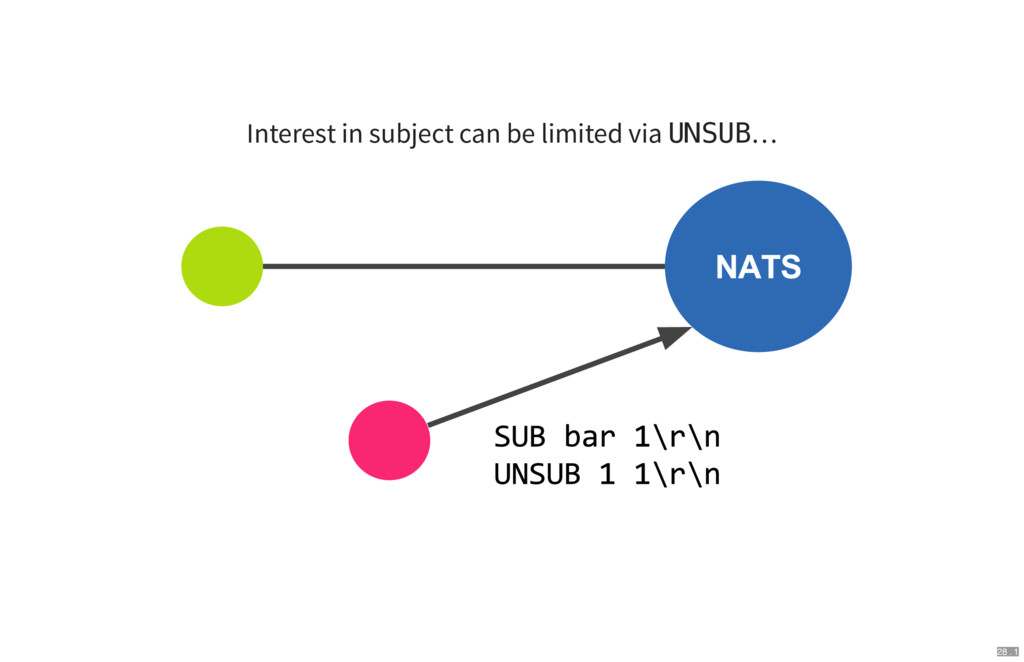
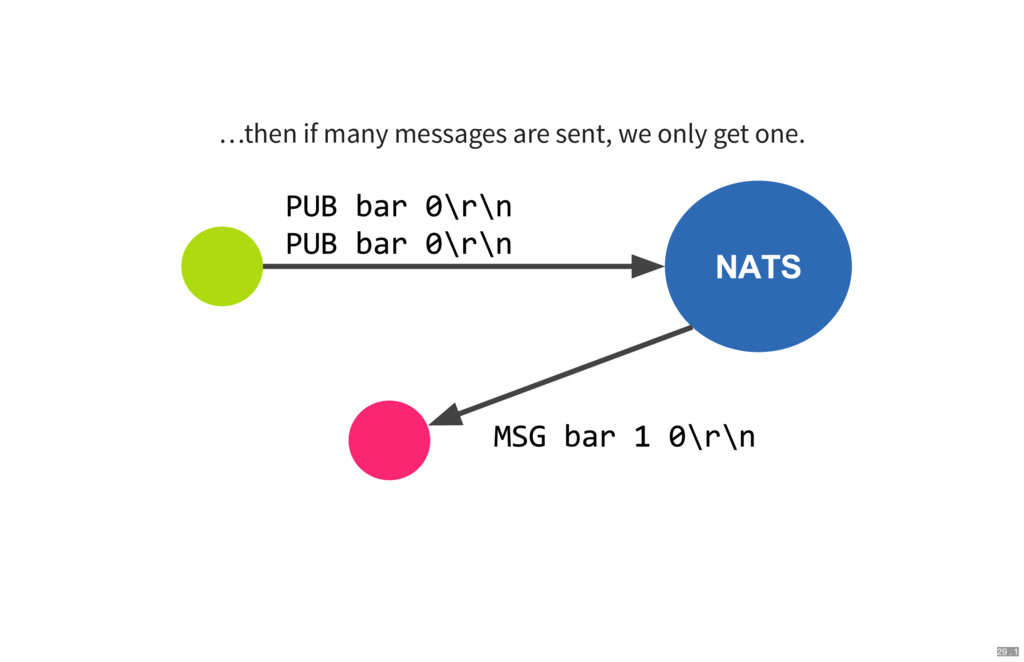
  15. The NATS Protocol Client -> Server | PUB | SUB

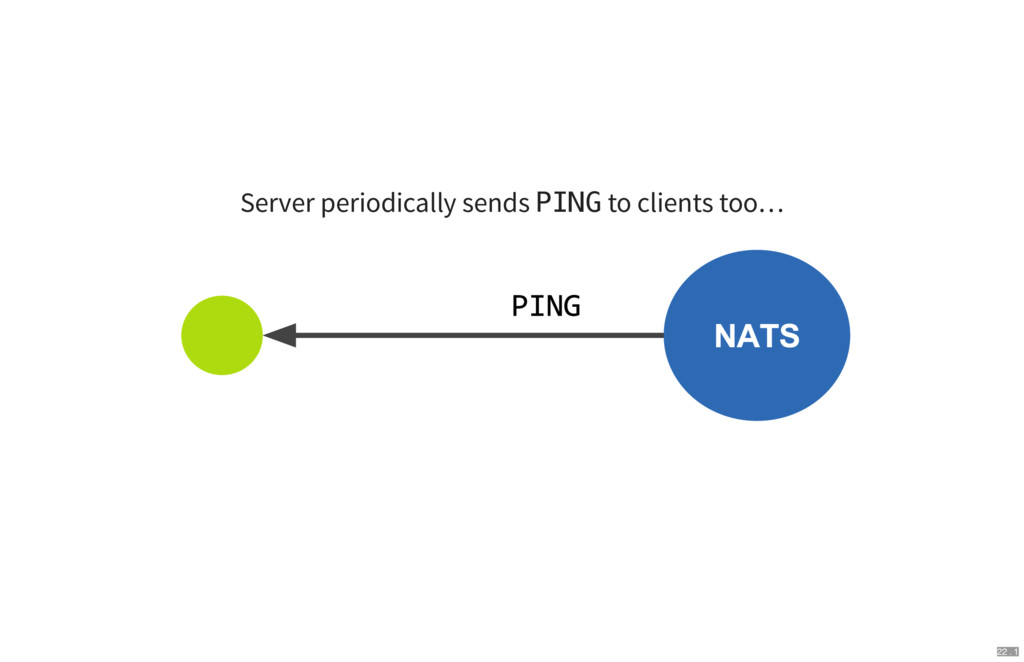
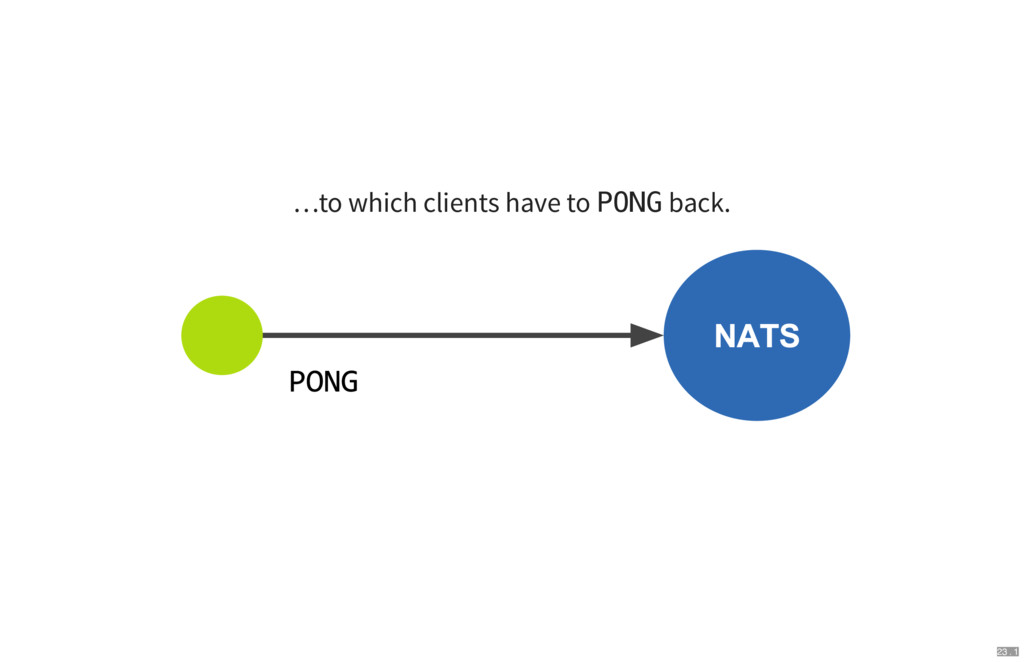
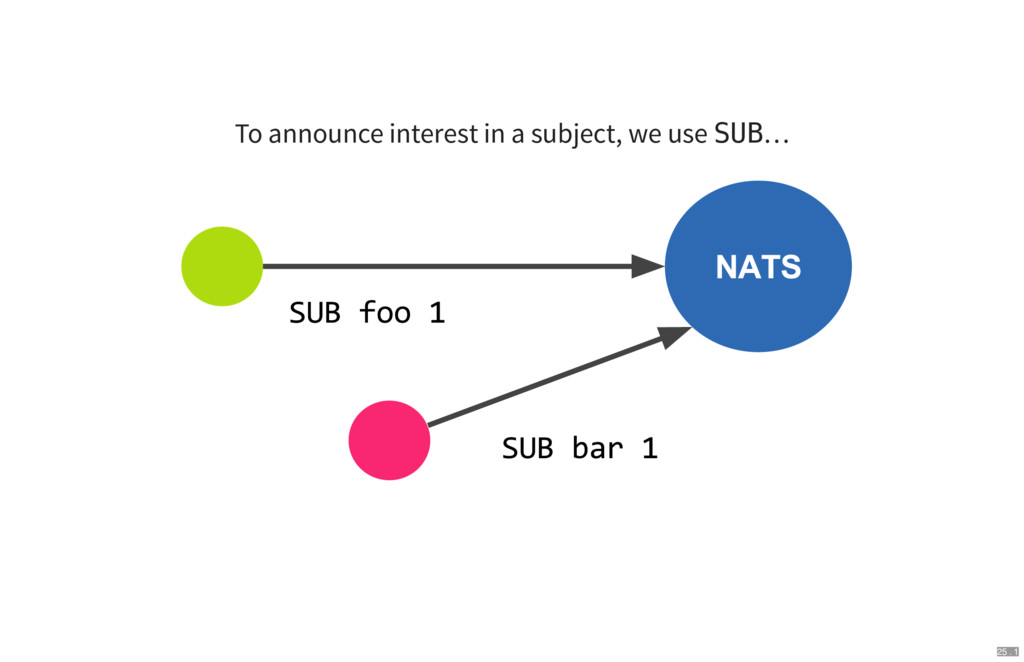
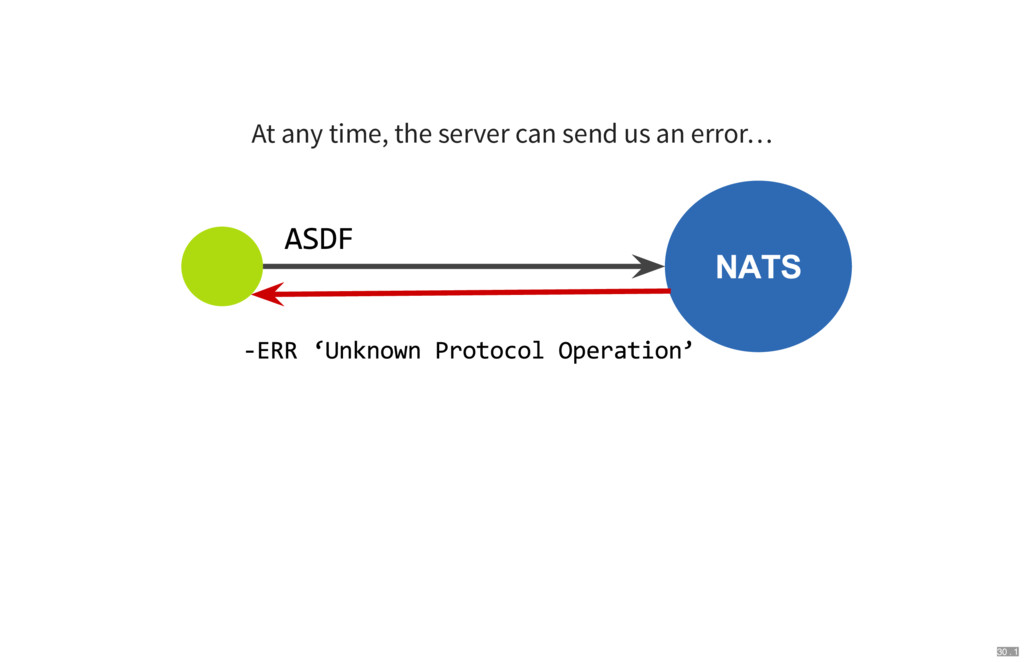
    | UNSUB | CONNECT | Client <- Server | INFO | MSG | -ERR | +OK | Client <-> Server | PING | PONG | 16 . 1
  16. Agenda Intro to the NATS Project The NATS Protocol NATS

    Client Deep Dive IO Engine Optimized Flushing Fast Protocol Parsing Engine Connecting & Graceful Reconnection Sync & Async Subscriptions Request / Response APIs Performance 33 . 1
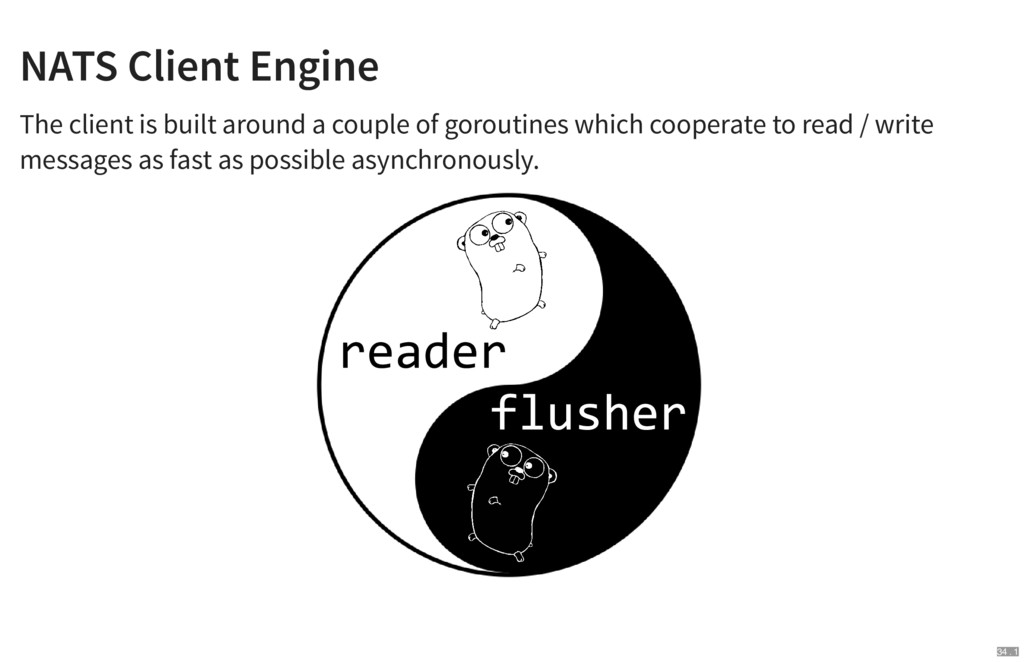
  17. NATS Client Engine The client is built around a couple

    of goroutines which cooperate to read / write messages as fast as possible asynchronously. 34 . 1
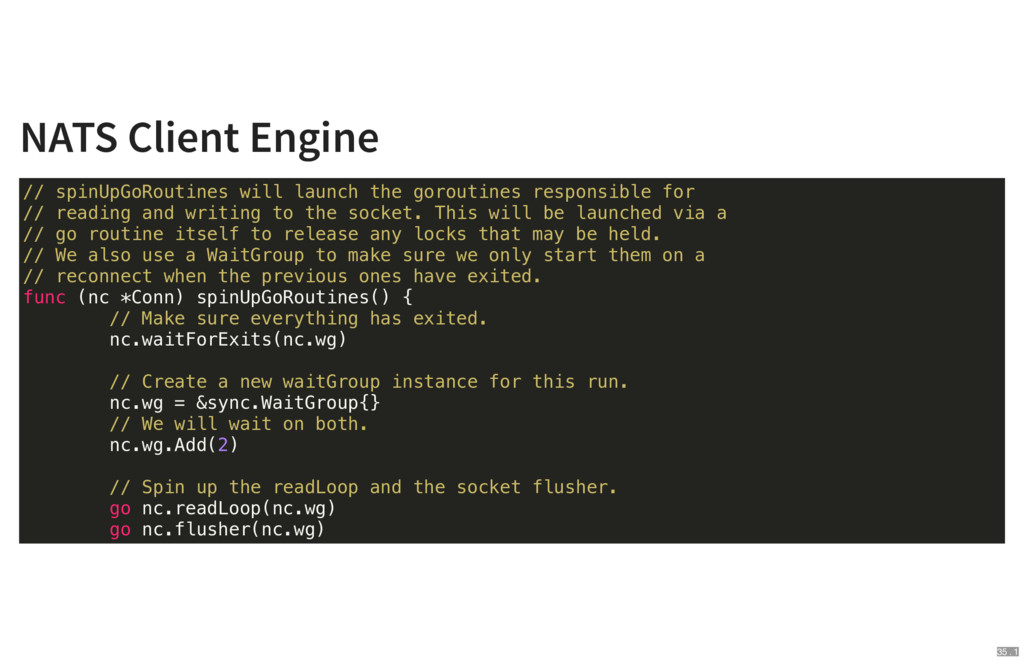
  18. NATS Client Engine // spinUpGoRoutines will launch the goroutines responsible

    for // reading and writing to the socket. This will be launched via a // go routine itself to release any locks that may be held. // We also use a WaitGroup to make sure we only start them on a // reconnect when the previous ones have exited. func (nc *Conn) spinUpGoRoutines() { // Make sure everything has exited. nc.waitForExits(nc.wg) // Create a new waitGroup instance for this run. nc.wg = &sync.WaitGroup{} // We will wait on both. nc.wg.Add(2) // Spin up the readLoop and the socket flusher. go nc.readLoop(nc.wg) go nc.flusher(nc.wg) 35 . 1
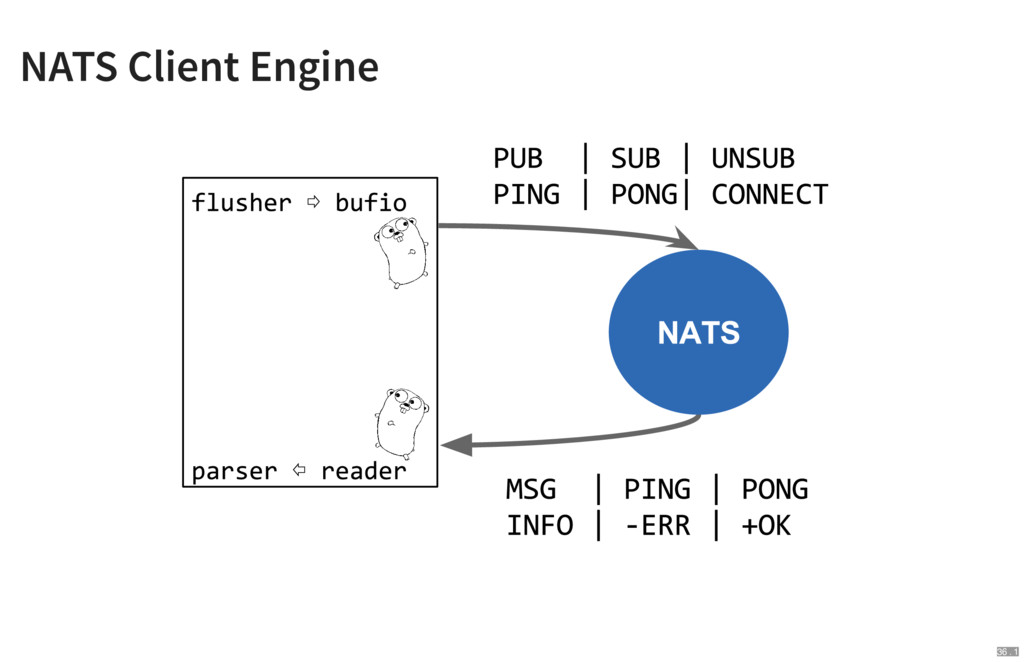
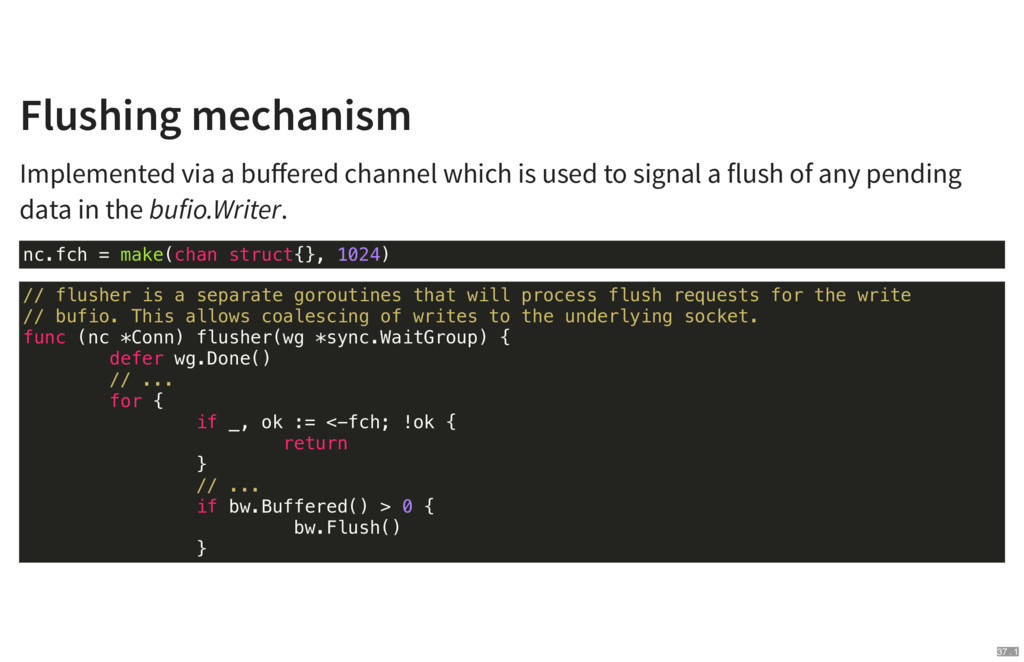
  19. Flushing mechanism Implemented via a buffered channel which is used

    to signal a flush of any pending data in the bufio.Writer. nc.fch = make(chan struct{}, 1024) // flusher is a separate goroutines that will process flush requests for the write // bufio. This allows coalescing of writes to the underlying socket. func (nc *Conn) flusher(wg *sync.WaitGroup) { defer wg.Done() // ... for { if _, ok := <-fch; !ok { return } // ... if bw.Buffered() > 0 { bw.Flush() } 37 . 1
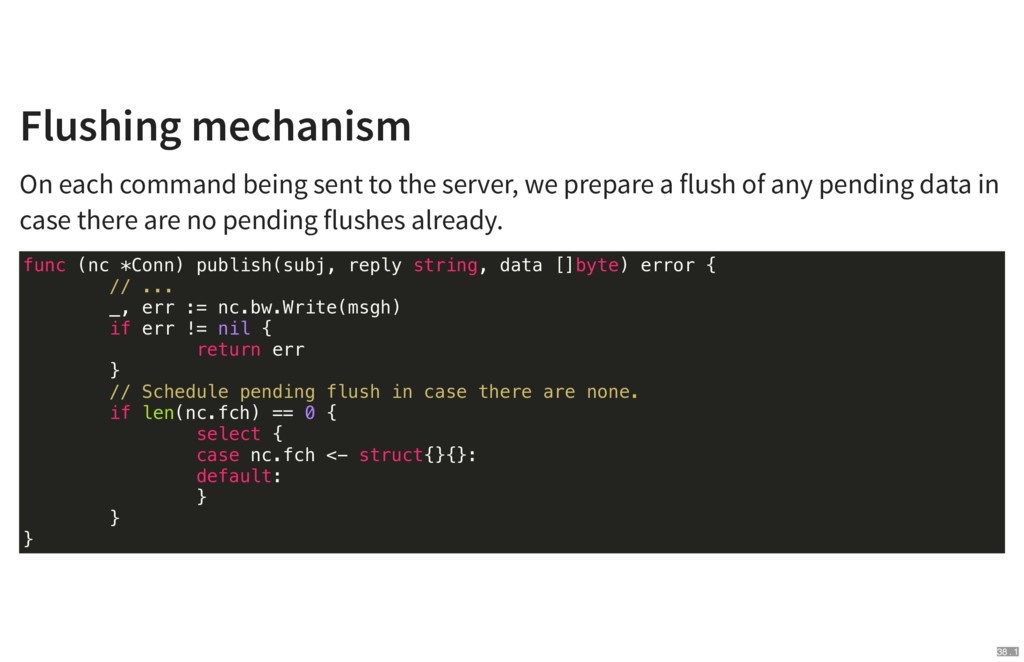
  20. Flushing mechanism On each command being sent to the server,

    we prepare a flush of any pending data in case there are no pending flushes already. func (nc *Conn) publish(subj, reply string, data []byte) error { // ... _, err := nc.bw.Write(msgh) if err != nil { return err } // Schedule pending flush in case there are none. if len(nc.fch) == 0 { select { case nc.fch <- struct{}{}: default: } } } 38 . 1
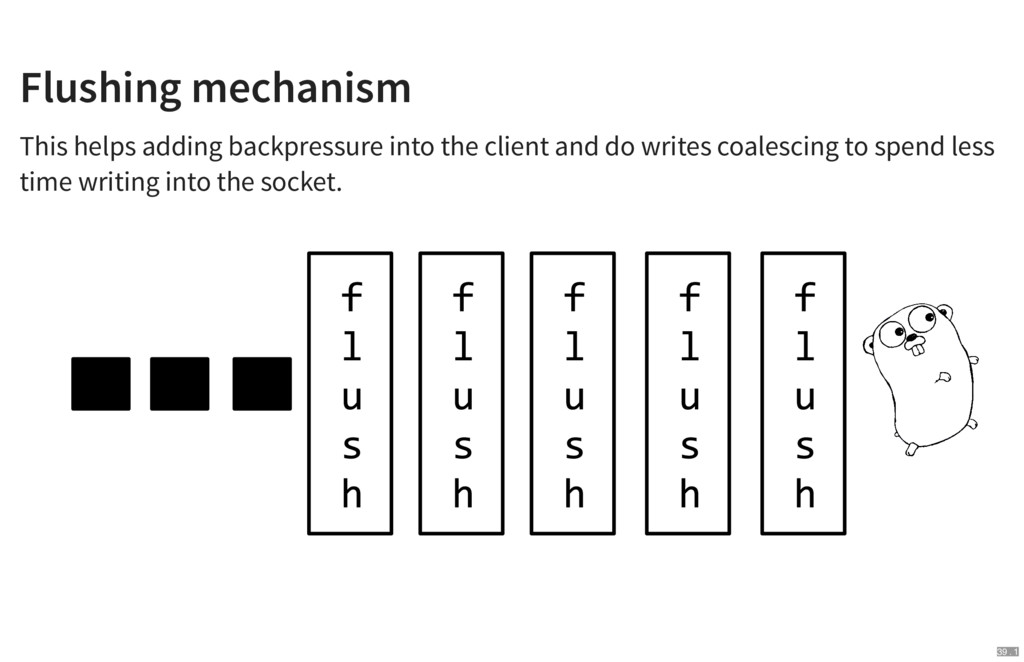
  21. Flushing mechanism This helps adding backpressure into the client and

    do writes coalescing to spend less time writing into the socket. 39 . 1
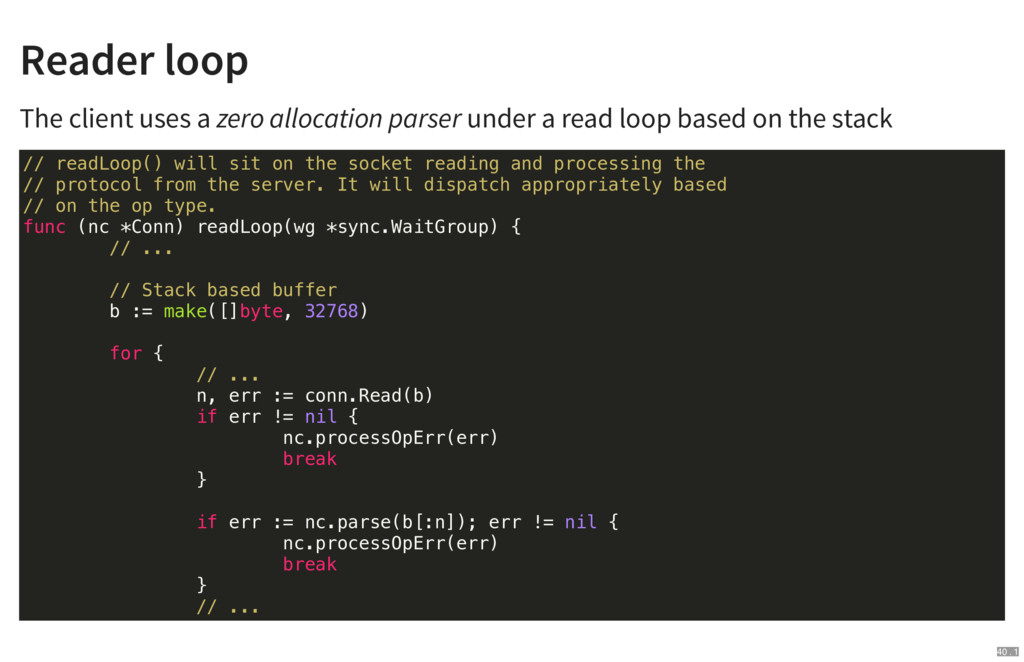
  22. Reader loop The client uses a zero allocation parser under

    a read loop based on the stack // readLoop() will sit on the socket reading and processing the // protocol from the server. It will dispatch appropriately based // on the op type. func (nc *Conn) readLoop(wg *sync.WaitGroup) { // ... // Stack based buffer b := make([]byte, 32768) for { // ... n, err := conn.Read(b) if err != nil { nc.processOpErr(err) break } if err := nc.parse(b[:n]); err != nil { nc.processOpErr(err) break } // ... 40 . 1
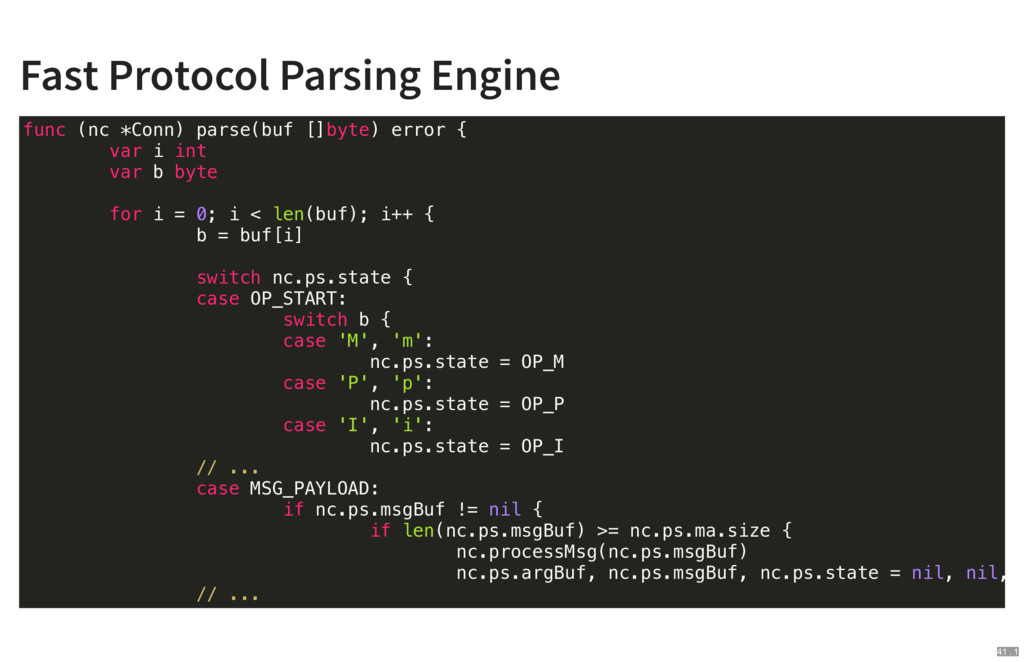
  23. Fast Protocol Parsing Engine func (nc *Conn) parse(buf []byte) error

    { var i int var b byte for i = 0; i < len(buf); i++ { b = buf[i] switch nc.ps.state { case OP_START: switch b { case 'M', 'm': nc.ps.state = OP_M case 'P', 'p': nc.ps.state = OP_P case 'I', 'i': nc.ps.state = OP_I // ... case MSG_PAYLOAD: if nc.ps.msgBuf != nil { if len(nc.ps.msgBuf) >= nc.ps.ma.size { nc.processMsg(nc.ps.msgBuf) nc.ps.argBuf, nc.ps.msgBuf, nc.ps.state = nil, nil, M // ... 41 . 1
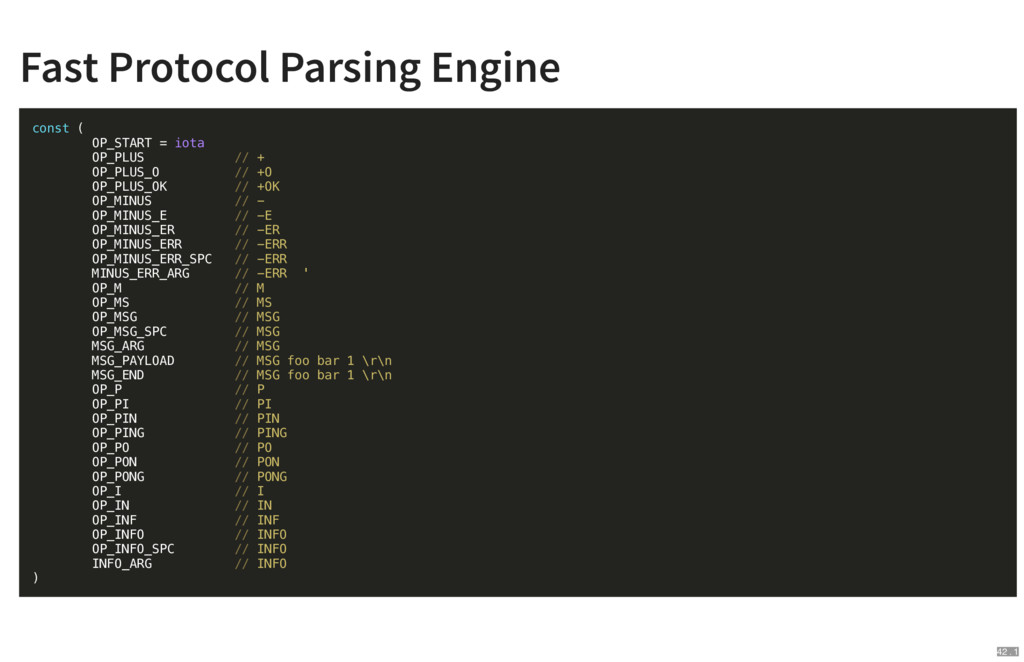
  24. Fast Protocol Parsing Engine const ( OP_START = iota OP_PLUS

    // + OP_PLUS_O // +O OP_PLUS_OK // +OK OP_MINUS // - OP_MINUS_E // -E OP_MINUS_ER // -ER OP_MINUS_ERR // -ERR OP_MINUS_ERR_SPC // -ERR MINUS_ERR_ARG // -ERR ' OP_M // M OP_MS // MS OP_MSG // MSG OP_MSG_SPC // MSG MSG_ARG // MSG MSG_PAYLOAD // MSG foo bar 1 \r\n MSG_END // MSG foo bar 1 \r\n OP_P // P OP_PI // PI OP_PIN // PIN OP_PING // PING OP_PO // PO OP_PON // PON OP_PONG // PONG OP_I // I OP_IN // IN OP_INF // INF OP_INFO // INFO OP_INFO_SPC // INFO INFO_ARG // INFO ) 42 . 1
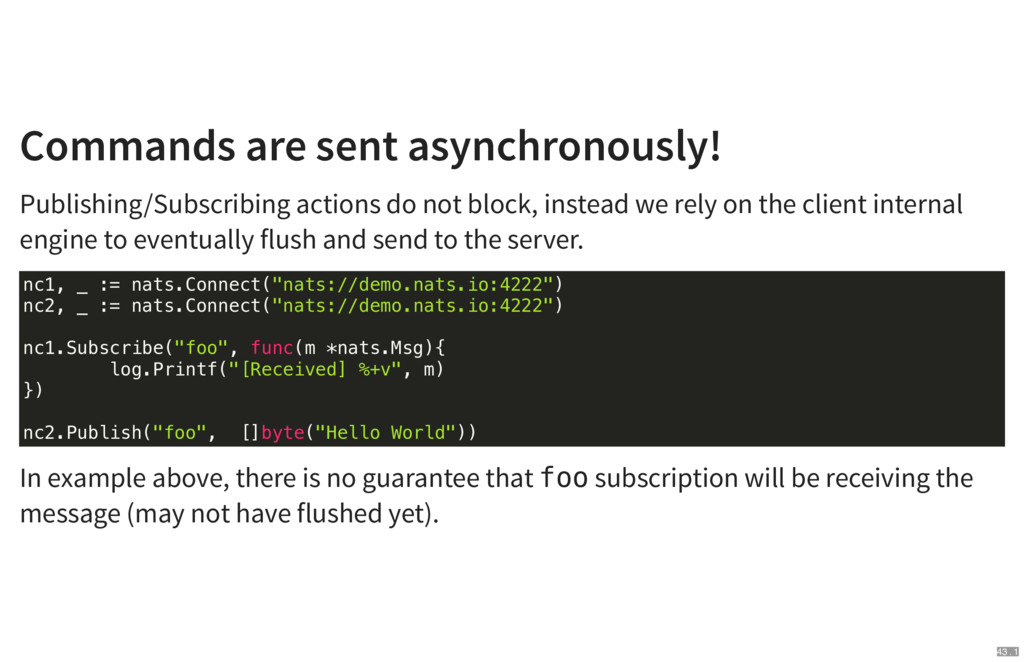
  25. Commands are sent asynchronously! Publishing/Subscribing actions do not block, instead

    we rely on the client internal engine to eventually flush and send to the server. In example above, there is no guarantee that foo subscription will be receiving the message (may not have flushed yet). nc1, _ := nats.Connect("nats://demo.nats.io:4222") nc2, _ := nats.Connect("nats://demo.nats.io:4222") nc1.Subscribe("foo", func(m *nats.Msg){ log.Printf("[Received] %+v", m) }) nc2.Publish("foo", []byte("Hello World")) 43 . 1
  26. FAQ If commands are sent asynchronously, how to ensure that

    a command sent has been processed by the server? 44 . 1
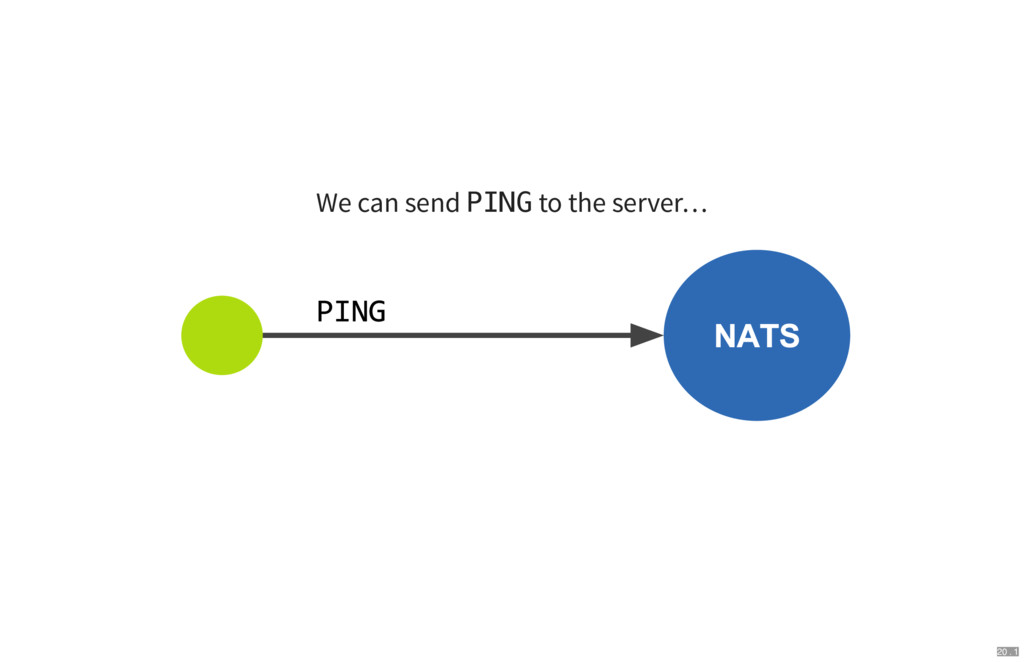
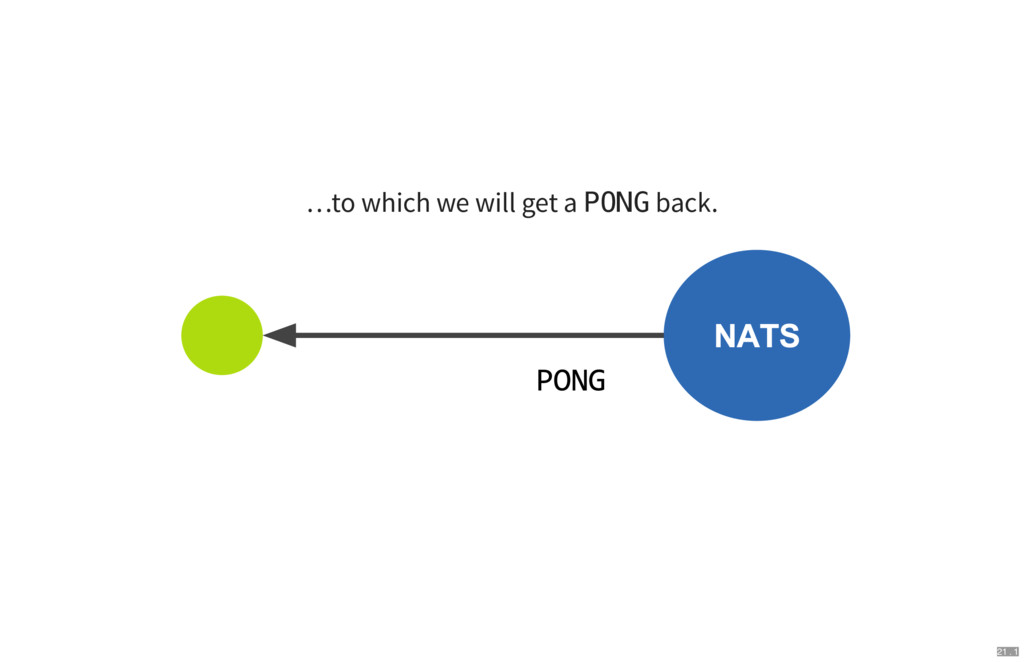
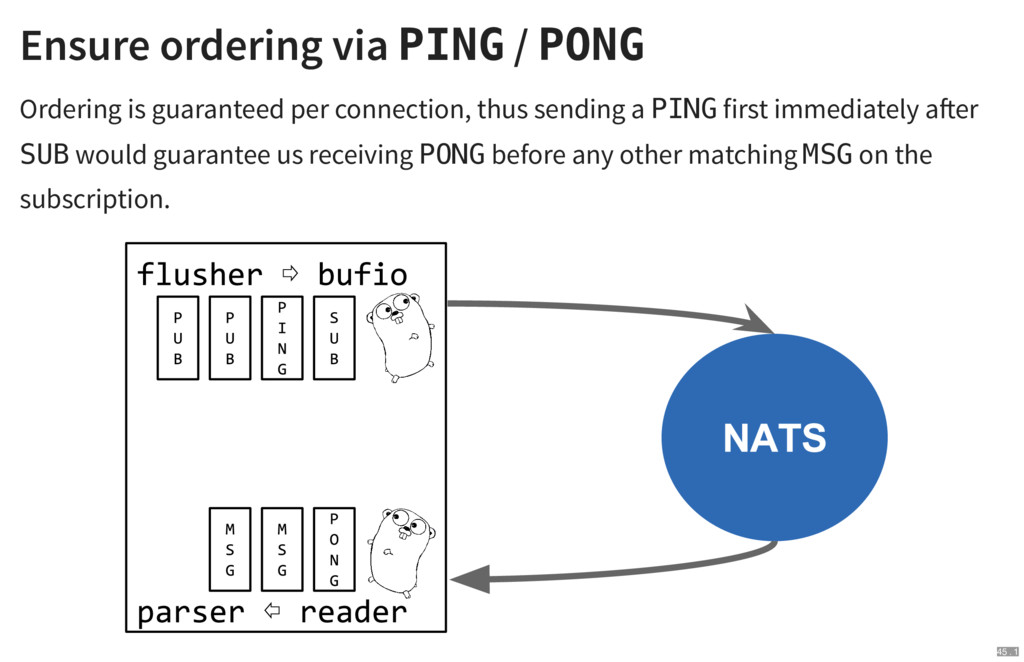
  27. Ensure ordering via PING / PONG Ordering is guaranteed per

    connection, thus sending a PING first immediately a er SUB would guarantee us receiving PONG before any other matching MSG on the subscription. 45 . 1
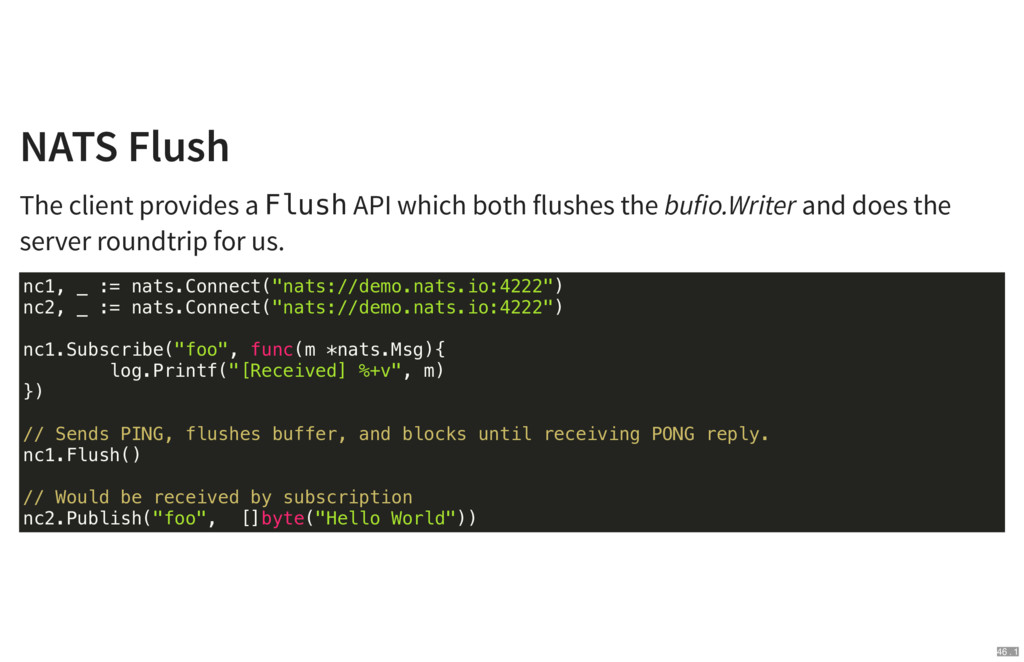
  28. NATS Flush The client provides a Flush API which both

    flushes the bufio.Writer and does the server roundtrip for us. nc1, _ := nats.Connect("nats://demo.nats.io:4222") nc2, _ := nats.Connect("nats://demo.nats.io:4222") nc1.Subscribe("foo", func(m *nats.Msg){ log.Printf("[Received] %+v", m) }) // Sends PING, flushes buffer, and blocks until receiving PONG reply. nc1.Flush() // Would be received by subscription nc2.Publish("foo", []byte("Hello World")) 46 . 1
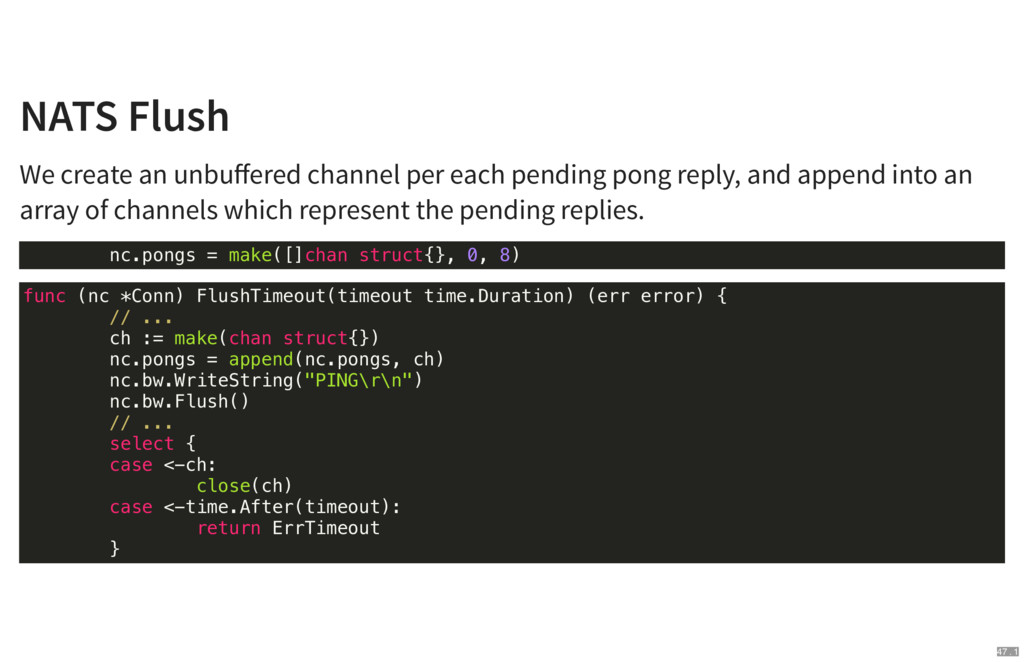
  29. NATS Flush We create an unbuffered channel per each pending

    pong reply, and append into an array of channels which represent the pending replies. nc.pongs = make([]chan struct{}, 0, 8) func (nc *Conn) FlushTimeout(timeout time.Duration) (err error) { // ... ch := make(chan struct{}) nc.pongs = append(nc.pongs, ch) nc.bw.WriteString("PING\r\n") nc.bw.Flush() // ... select { case <-ch: close(ch) case <-time.After(timeout): return ErrTimeout } 47 . 1
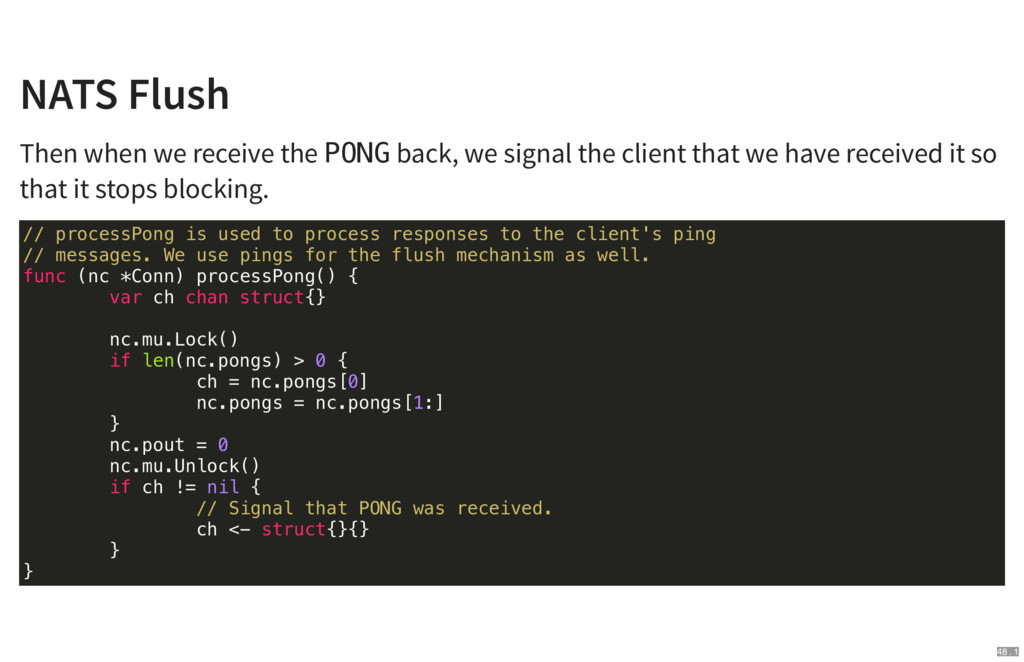
  30. NATS Flush Then when we receive the PONG back, we

    signal the client that we have received it so that it stops blocking. // processPong is used to process responses to the client's ping // messages. We use pings for the flush mechanism as well. func (nc *Conn) processPong() { var ch chan struct{} nc.mu.Lock() if len(nc.pongs) > 0 { ch = nc.pongs[0] nc.pongs = nc.pongs[1:] } nc.pout = 0 nc.mu.Unlock() if ch != nil { // Signal that PONG was received. ch <- struct{}{} } } 48 . 1
  31. Intro to the NATS Project The NATS Protocol NATS Client

    Deep Dive IO Engine Connecting & Graceful Reconnection Synchronous & Asynchronous Subscriptions Request/Response Performance 49 . 1
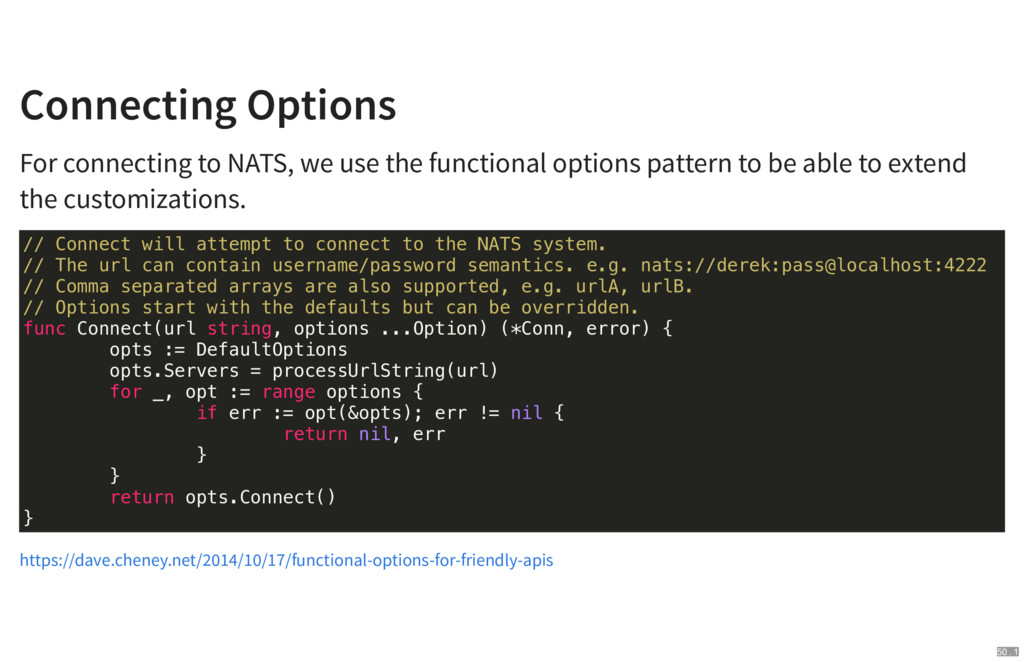
  32. Connecting Options For connecting to NATS, we use the functional

    options pattern to be able to extend the customizations. // Connect will attempt to connect to the NATS system. // The url can contain username/password semantics. e.g. nats://derek:pass@localhost:4222 // Comma separated arrays are also supported, e.g. urlA, urlB. // Options start with the defaults but can be overridden. func Connect(url string, options ...Option) (*Conn, error) { opts := DefaultOptions opts.Servers = processUrlString(url) for _, opt := range options { if err := opt(&opts); err != nil { return nil, err } } return opts.Connect() } https://dave.cheney.net/2014/10/17/functional-options-for-friendly-apis 50 . 1
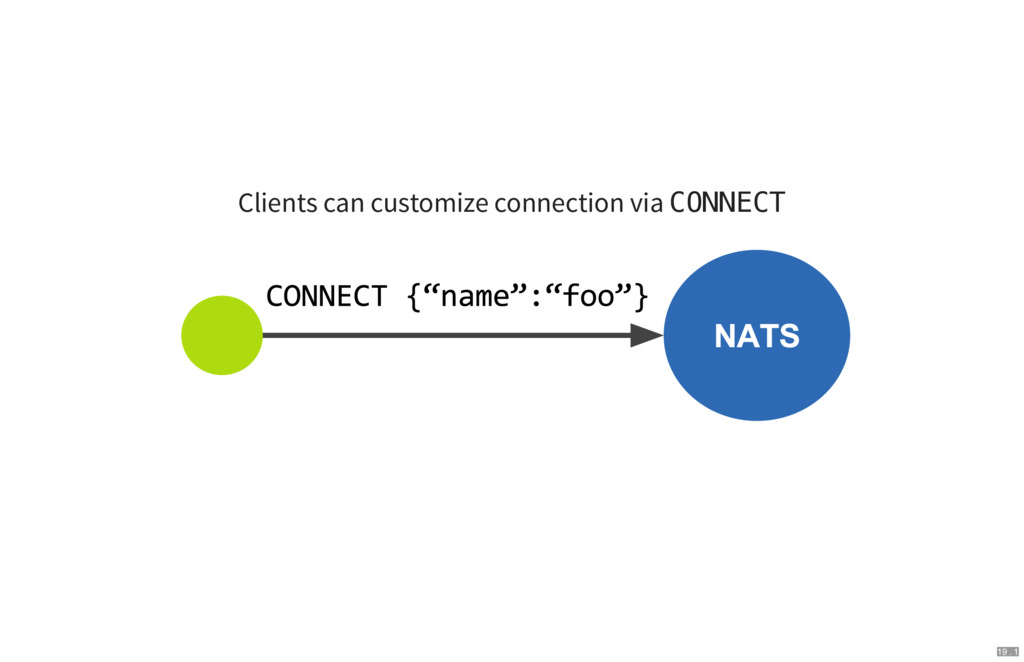
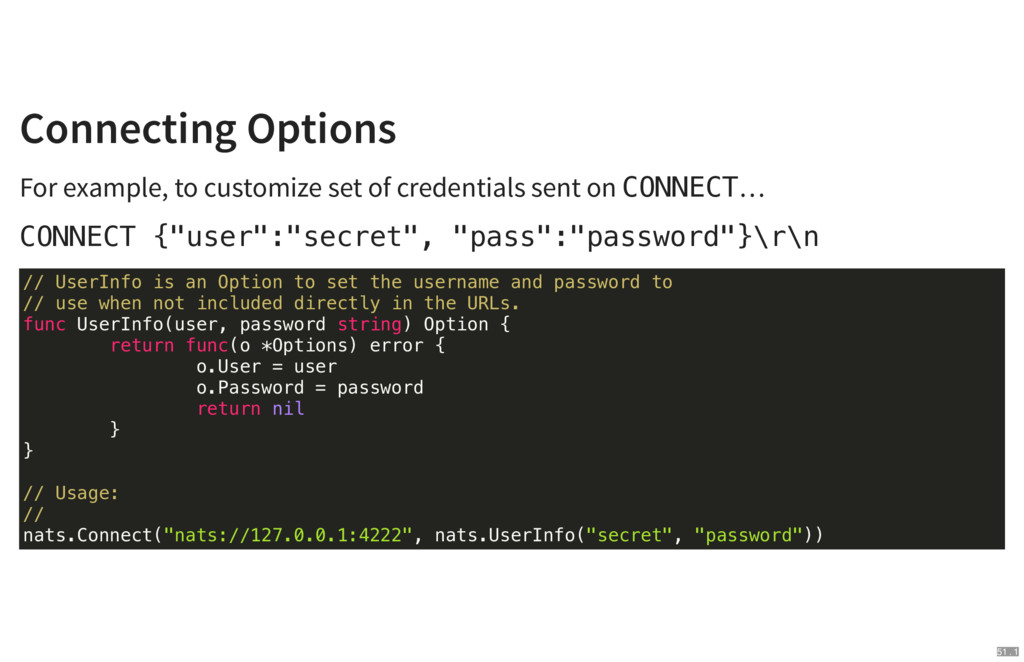
  33. Connecting Options For example, to customize set of credentials sent

    on CONNECT… CONNECT {"user":"secret", "pass":"password"}\r\n // UserInfo is an Option to set the username and password to // use when not included directly in the URLs. func UserInfo(user, password string) Option { return func(o *Options) error { o.User = user o.Password = password return nil } } // Usage: // nats.Connect("nats://127.0.0.1:4222", nats.UserInfo("secret", "password")) 51 . 1
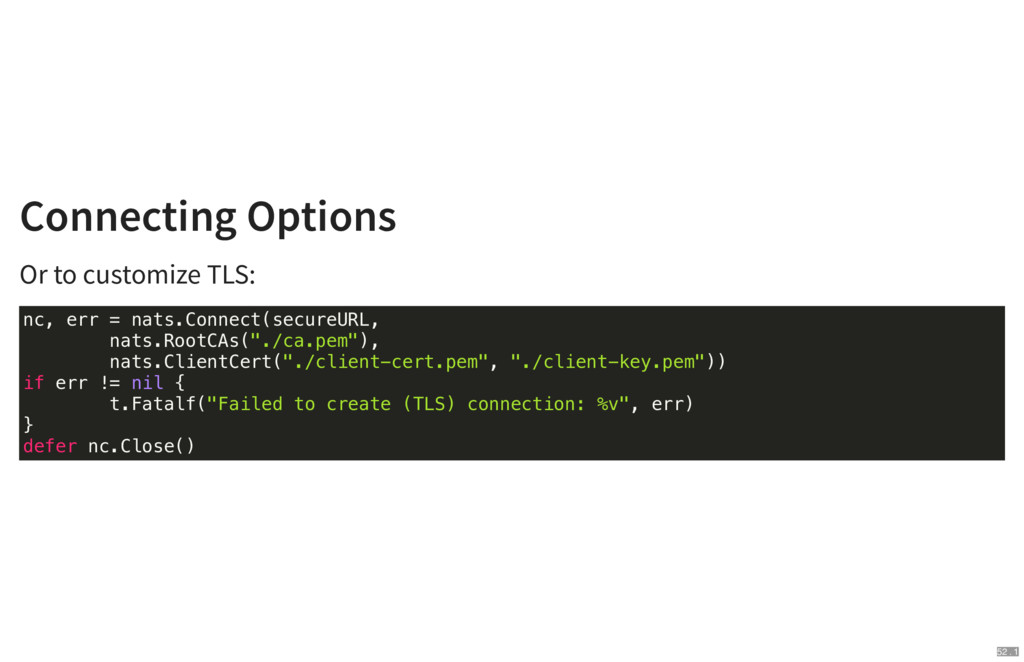
  34. Connecting Options Or to customize TLS: nc, err = nats.Connect(secureURL,

    nats.RootCAs("./ca.pem"), nats.ClientCert("./client-cert.pem", "./client-key.pem")) if err != nil { t.Fatalf("Failed to create (TLS) connection: %v", err) } defer nc.Close() 52 . 1
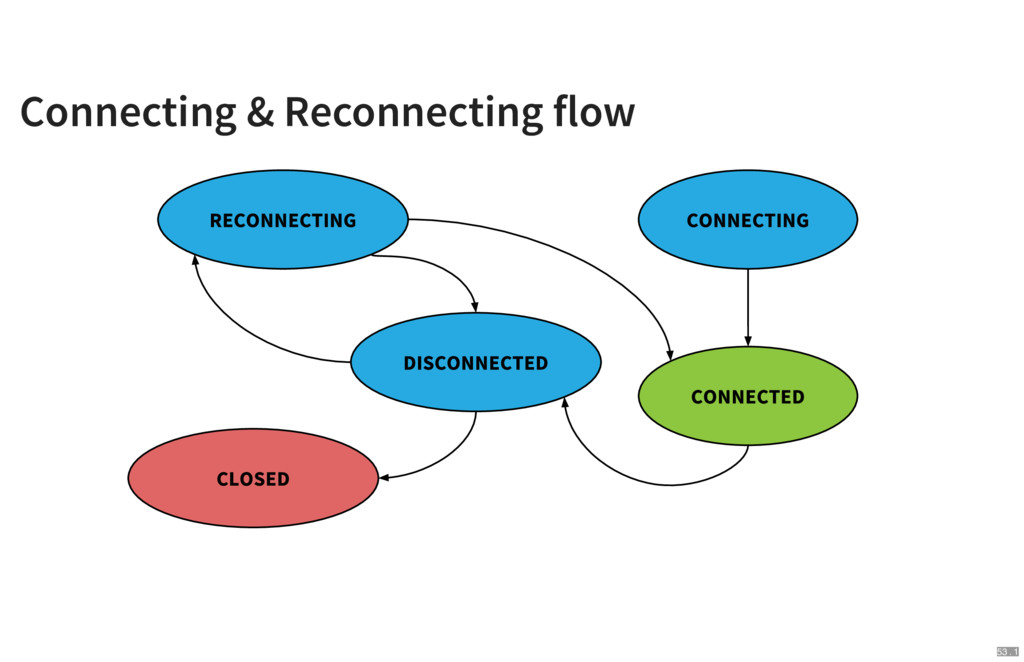
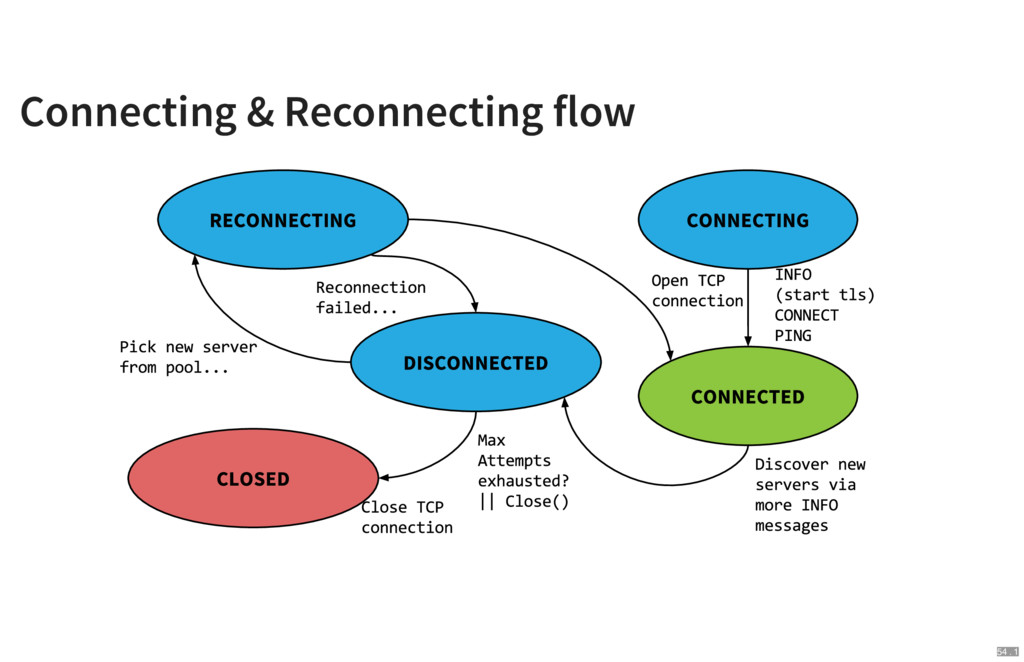
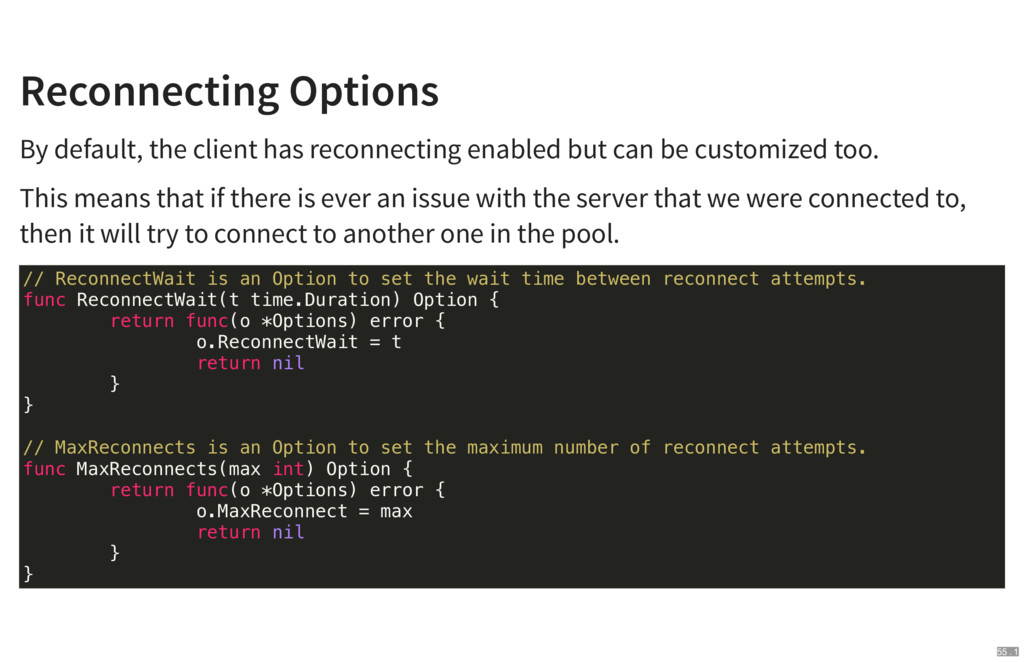
  35. Reconnecting Options By default, the client has reconnecting enabled but

    can be customized too. This means that if there is ever an issue with the server that we were connected to, then it will try to connect to another one in the pool. // ReconnectWait is an Option to set the wait time between reconnect attempts. func ReconnectWait(t time.Duration) Option { return func(o *Options) error { o.ReconnectWait = t return nil } } // MaxReconnects is an Option to set the maximum number of reconnect attempts. func MaxReconnects(max int) Option { return func(o *Options) error { o.MaxReconnect = max return nil } } 55 . 1
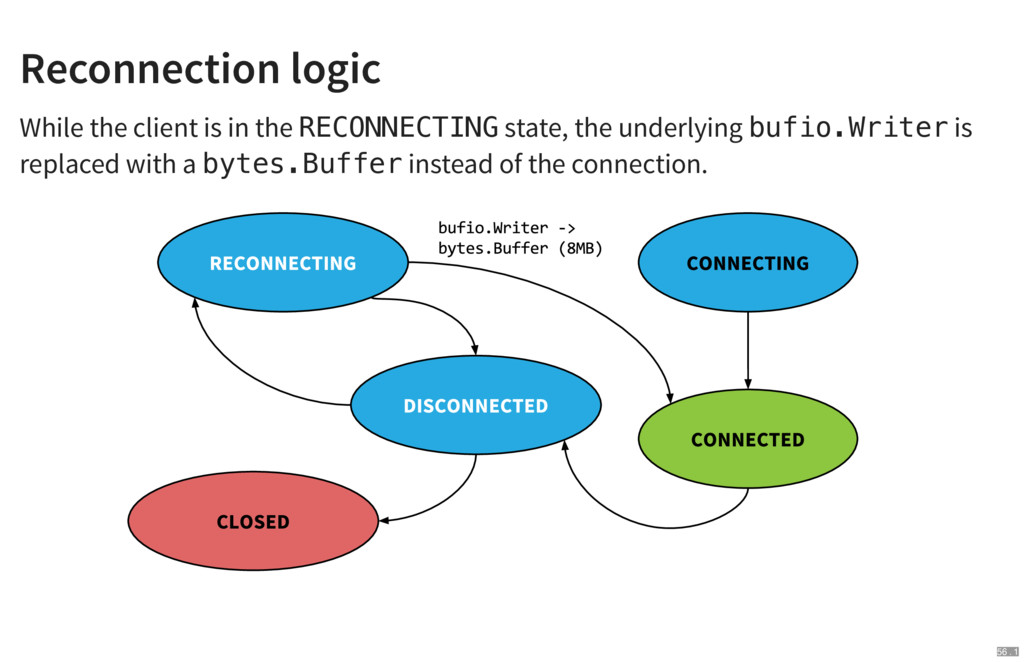
  36. Reconnection logic While the client is in the RECONNECTING state,

    the underlying bufio.Writer is replaced with a bytes.Buffer instead of the connection. 56 . 1
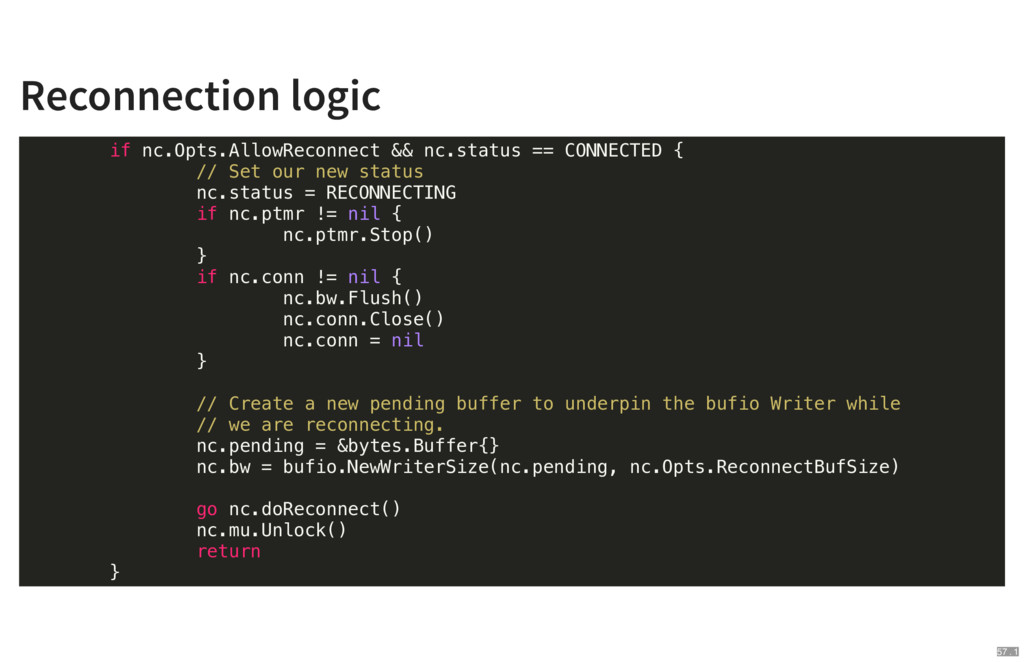
  37. Reconnection logic if nc.Opts.AllowReconnect && nc.status == CONNECTED { //

    Set our new status nc.status = RECONNECTING if nc.ptmr != nil { nc.ptmr.Stop() } if nc.conn != nil { nc.bw.Flush() nc.conn.Close() nc.conn = nil } // Create a new pending buffer to underpin the bufio Writer while // we are reconnecting. nc.pending = &bytes.Buffer{} nc.bw = bufio.NewWriterSize(nc.pending, nc.Opts.ReconnectBufSize) go nc.doReconnect() nc.mu.Unlock() return } 57 . 1
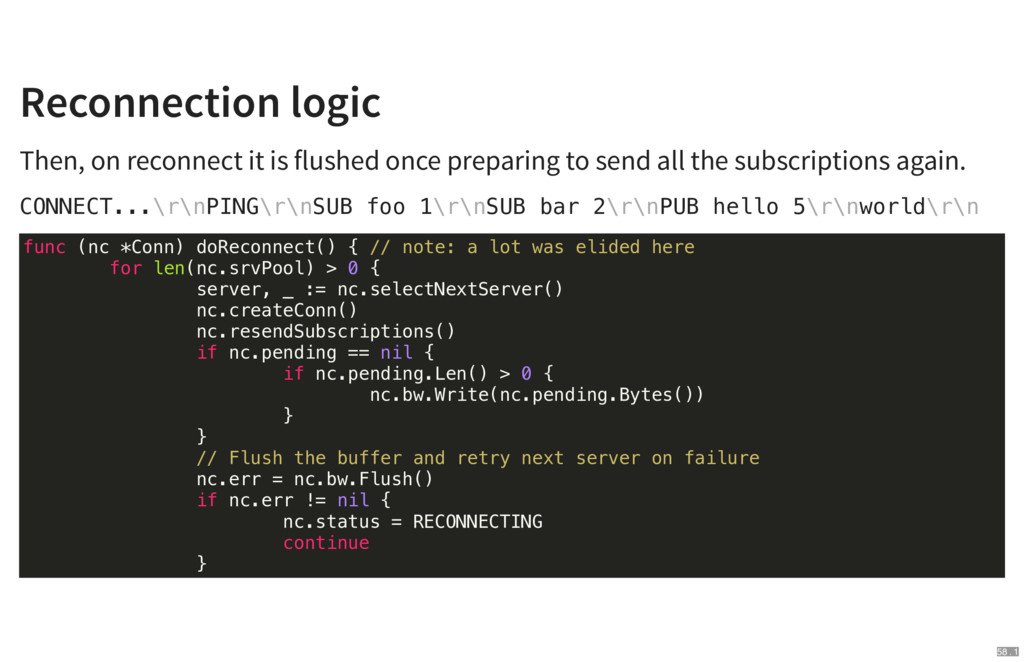
  38. Reconnection logic Then, on reconnect it is flushed once preparing

    to send all the subscriptions again. CONNECT...\r\nPING\r\nSUB foo 1\r\nSUB bar 2\r\nPUB hello 5\r\nworld\r\n func (nc *Conn) doReconnect() { // note: a lot was elided here for len(nc.srvPool) > 0 { server, _ := nc.selectNextServer() nc.createConn() nc.resendSubscriptions() if nc.pending == nil { if nc.pending.Len() > 0 { nc.bw.Write(nc.pending.Bytes()) } } // Flush the buffer and retry next server on failure nc.err = nc.bw.Flush() if nc.err != nil { nc.status = RECONNECTING continue } 58 . 1
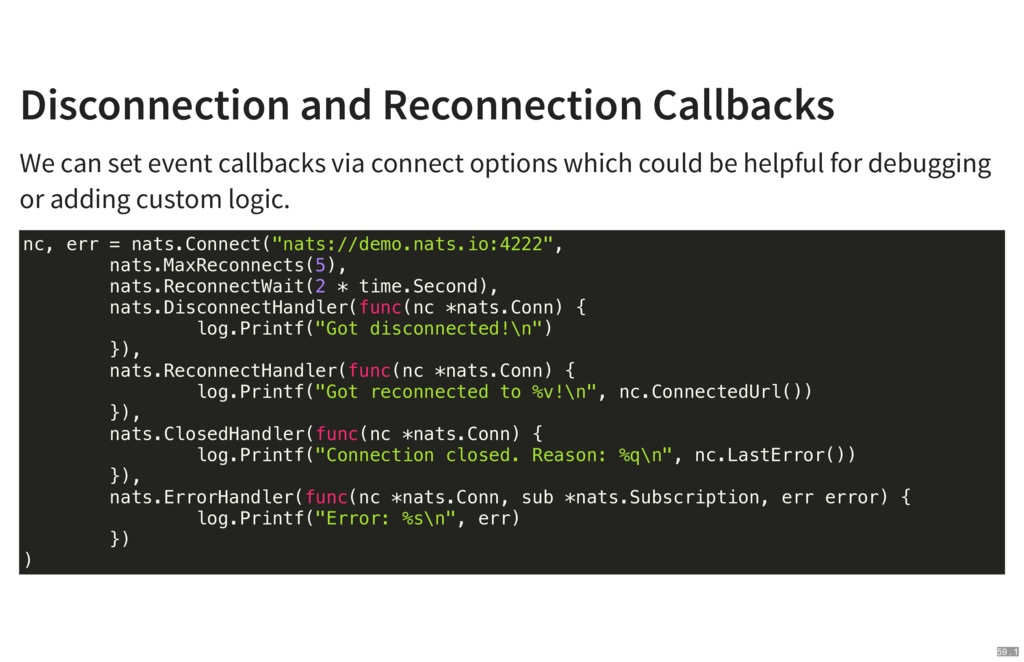
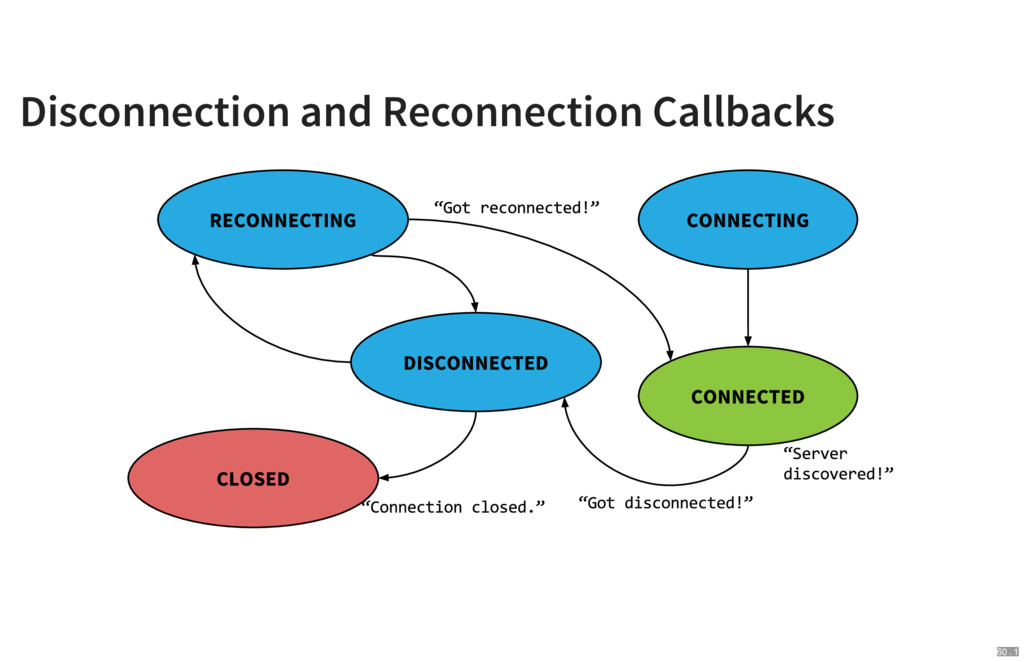
  39. Disconnection and Reconnection Callbacks We can set event callbacks via

    connect options which could be helpful for debugging or adding custom logic. nc, err = nats.Connect("nats://demo.nats.io:4222", nats.MaxReconnects(5), nats.ReconnectWait(2 * time.Second), nats.DisconnectHandler(func(nc *nats.Conn) { log.Printf("Got disconnected!\n") }), nats.ReconnectHandler(func(nc *nats.Conn) { log.Printf("Got reconnected to %v!\n", nc.ConnectedUrl()) }), nats.ClosedHandler(func(nc *nats.Conn) { log.Printf("Connection closed. Reason: %q\n", nc.LastError()) }), nats.ErrorHandler(func(nc *nats.Conn, sub *nats.Subscription, err error) { log.Printf("Error: %s\n", err) }) ) 59 . 1
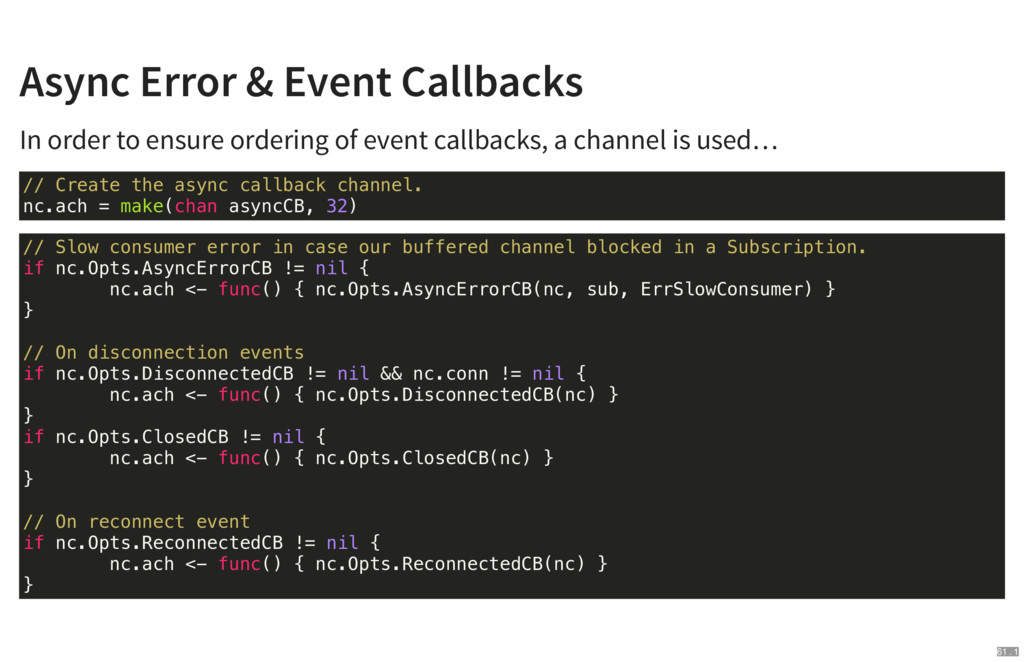
  40. Async Error & Event Callbacks In order to ensure ordering

    of event callbacks, a channel is used… // Create the async callback channel. nc.ach = make(chan asyncCB, 32) // Slow consumer error in case our buffered channel blocked in a Subscription. if nc.Opts.AsyncErrorCB != nil { nc.ach <- func() { nc.Opts.AsyncErrorCB(nc, sub, ErrSlowConsumer) } } // On disconnection events if nc.Opts.DisconnectedCB != nil && nc.conn != nil { nc.ach <- func() { nc.Opts.DisconnectedCB(nc) } } if nc.Opts.ClosedCB != nil { nc.ach <- func() { nc.Opts.ClosedCB(nc) } } // On reconnect event if nc.Opts.ReconnectedCB != nil { nc.ach <- func() { nc.Opts.ReconnectedCB(nc) } } 61 . 1
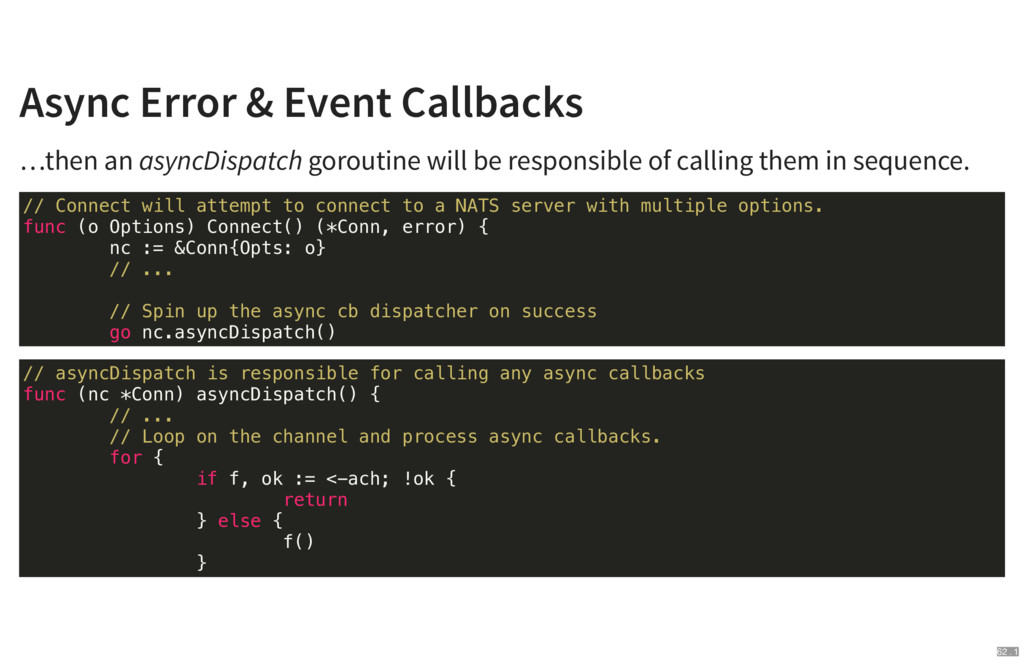
  41. Async Error & Event Callbacks …then an asyncDispatch goroutine will

    be responsible of calling them in sequence. // Connect will attempt to connect to a NATS server with multiple options. func (o Options) Connect() (*Conn, error) { nc := &Conn{Opts: o} // ... // Spin up the async cb dispatcher on success go nc.asyncDispatch() // asyncDispatch is responsible for calling any async callbacks func (nc *Conn) asyncDispatch() { // ... // Loop on the channel and process async callbacks. for { if f, ok := <-ach; !ok { return } else { f() } 62 . 1
  42. Intro to the NATS Project The NATS Protocol NATS Client

    Deep Dive IO Engine Connecting & Graceful Reconnection Sync & Async Subscriptions Channels and Callback based APIs Request / Response APIs Performance 63 . 1
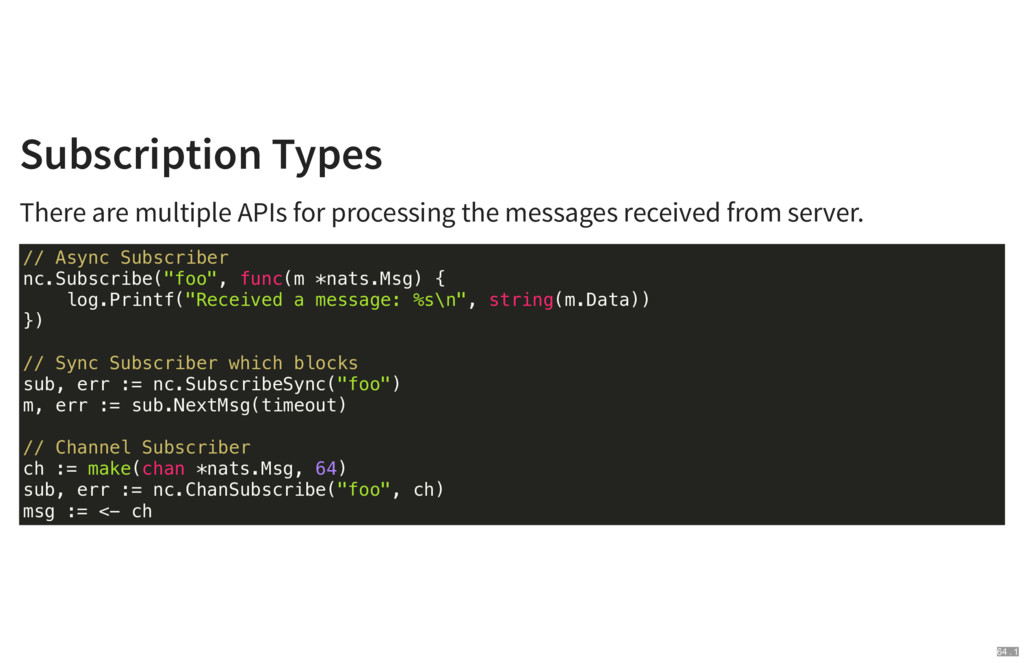
  43. Subscription Types There are multiple APIs for processing the messages

    received from server. // Async Subscriber nc.Subscribe("foo", func(m *nats.Msg) { log.Printf("Received a message: %s\n", string(m.Data)) }) // Sync Subscriber which blocks sub, err := nc.SubscribeSync("foo") m, err := sub.NextMsg(timeout) // Channel Subscriber ch := make(chan *nats.Msg, 64) sub, err := nc.ChanSubscribe("foo", ch) msg := <- ch 64 . 1
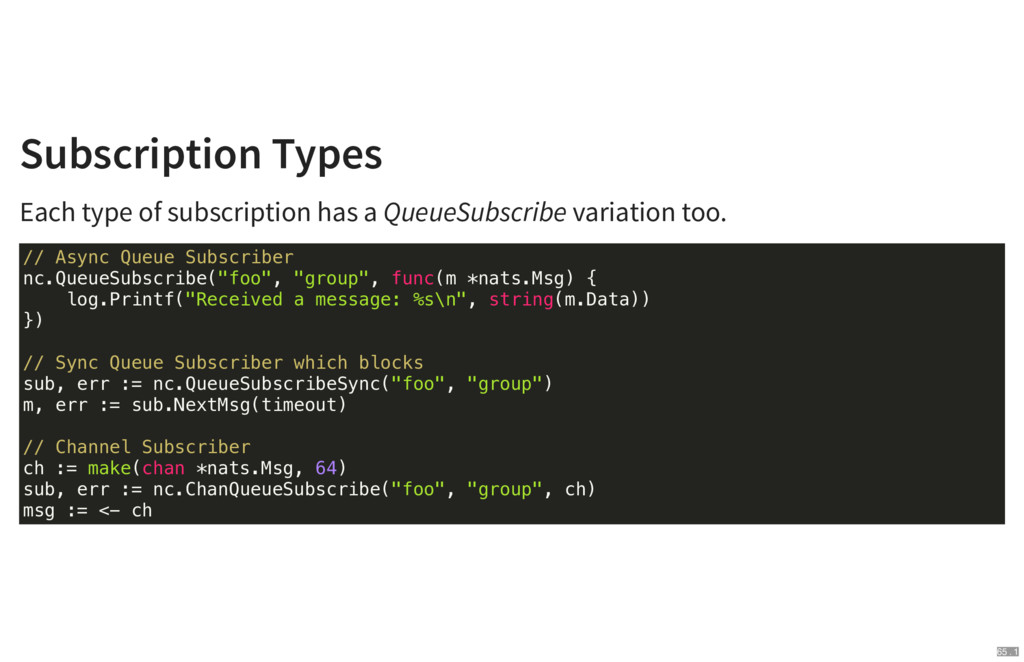
  44. Subscription Types Each type of subscription has a QueueSubscribe variation

    too. // Async Queue Subscriber nc.QueueSubscribe("foo", "group", func(m *nats.Msg) { log.Printf("Received a message: %s\n", string(m.Data)) }) // Sync Queue Subscriber which blocks sub, err := nc.QueueSubscribeSync("foo", "group") m, err := sub.NextMsg(timeout) // Channel Subscriber ch := make(chan *nats.Msg, 64) sub, err := nc.ChanQueueSubscribe("foo", "group", ch) msg := <- ch 65 . 1
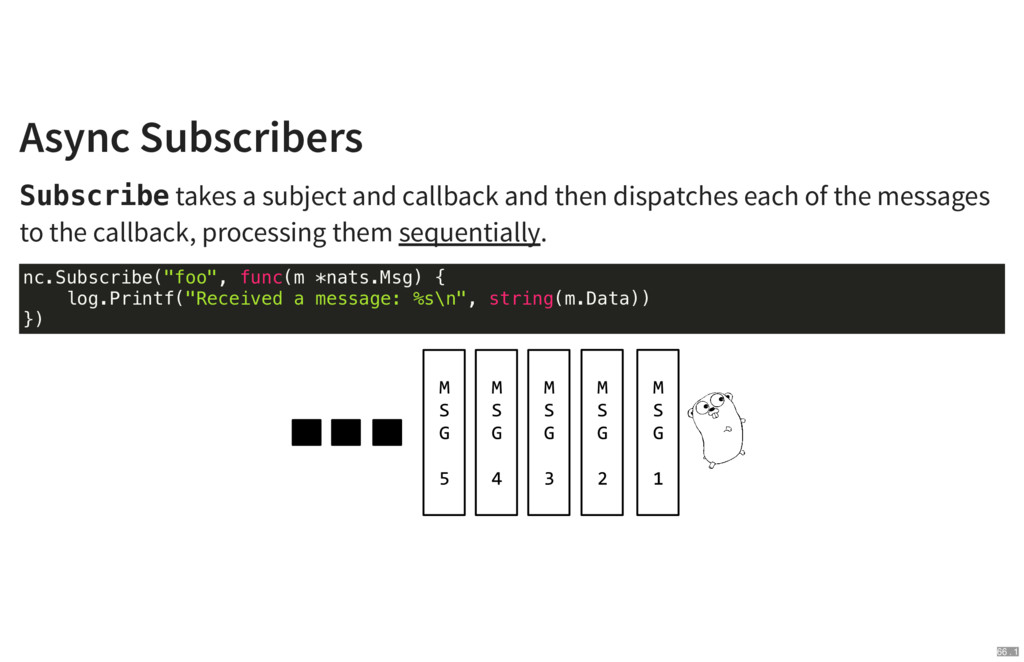
  45. Async Subscribers Subscribe takes a subject and callback and then

    dispatches each of the messages to the callback, processing them sequentially. nc.Subscribe("foo", func(m *nats.Msg) { log.Printf("Received a message: %s\n", string(m.Data)) }) 66 . 1
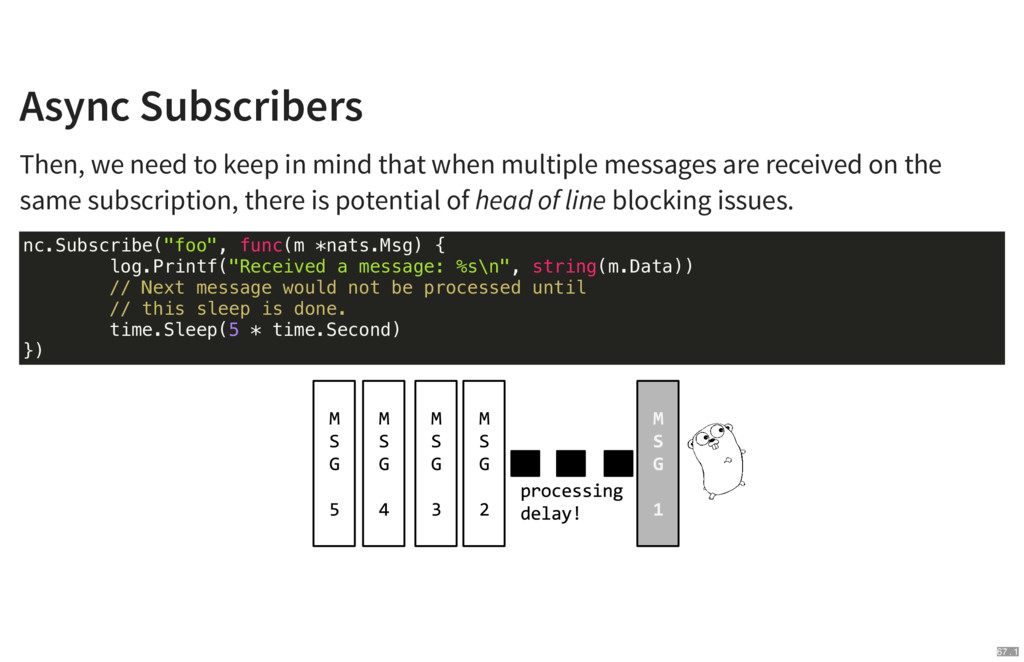
  46. Async Subscribers Then, we need to keep in mind that

    when multiple messages are received on the same subscription, there is potential of head of line blocking issues. nc.Subscribe("foo", func(m *nats.Msg) { log.Printf("Received a message: %s\n", string(m.Data)) // Next message would not be processed until // this sleep is done. time.Sleep(5 * time.Second) }) 67 . 1
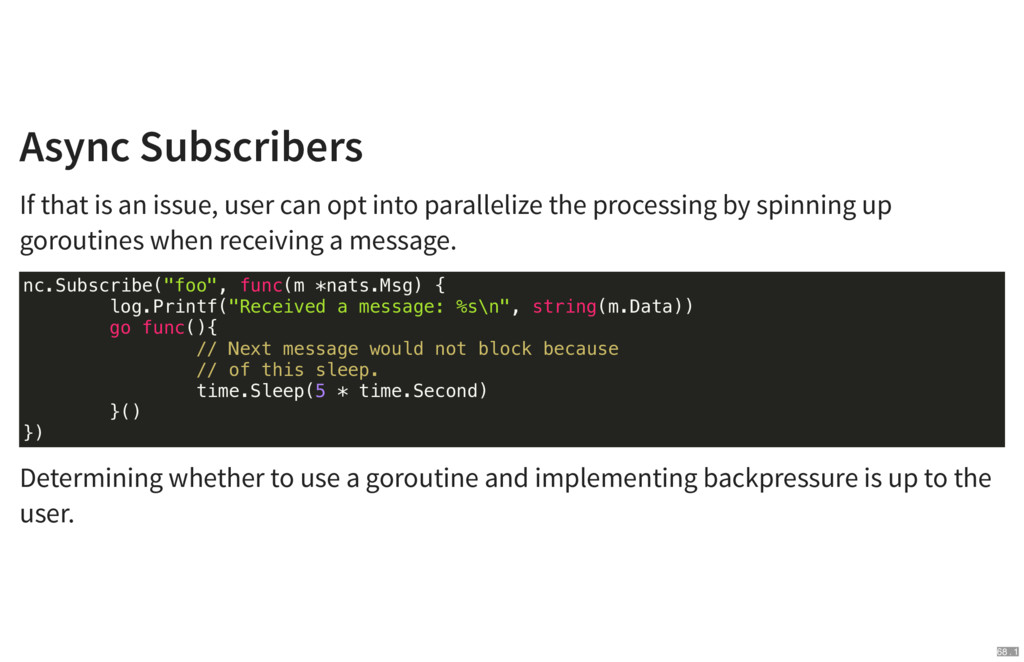
  47. Async Subscribers If that is an issue, user can opt

    into parallelize the processing by spinning up goroutines when receiving a message. Determining whether to use a goroutine and implementing backpressure is up to the user. nc.Subscribe("foo", func(m *nats.Msg) { log.Printf("Received a message: %s\n", string(m.Data)) go func(){ // Next message would not block because // of this sleep. time.Sleep(5 * time.Second) }() }) 68 . 1
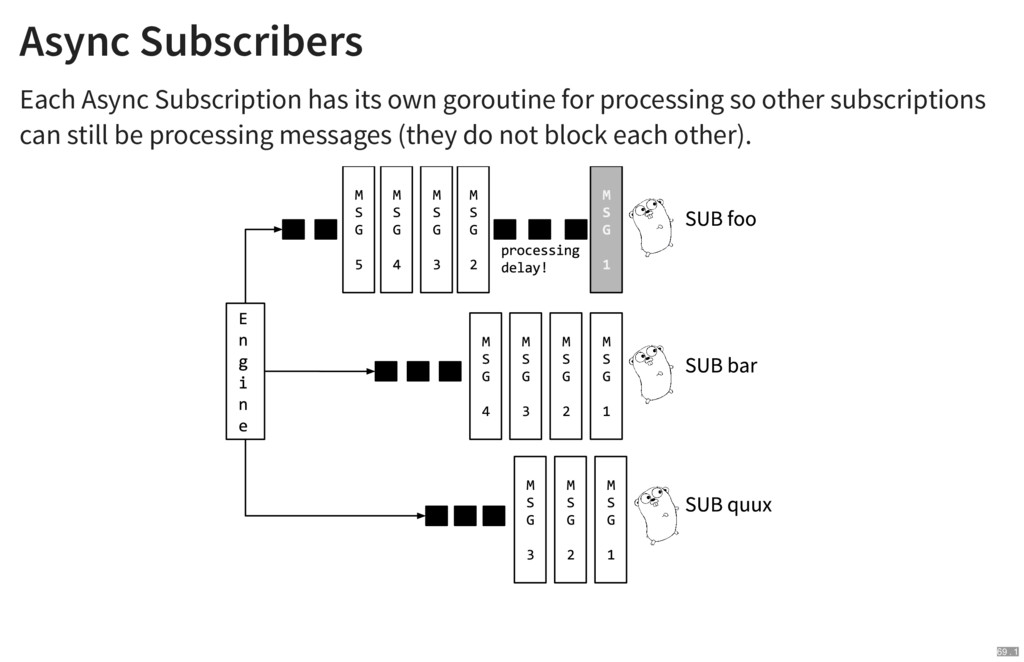
  48. Async Subscribers Each Async Subscription has its own goroutine for

    processing so other subscriptions can still be processing messages (they do not block each other). 69 . 1

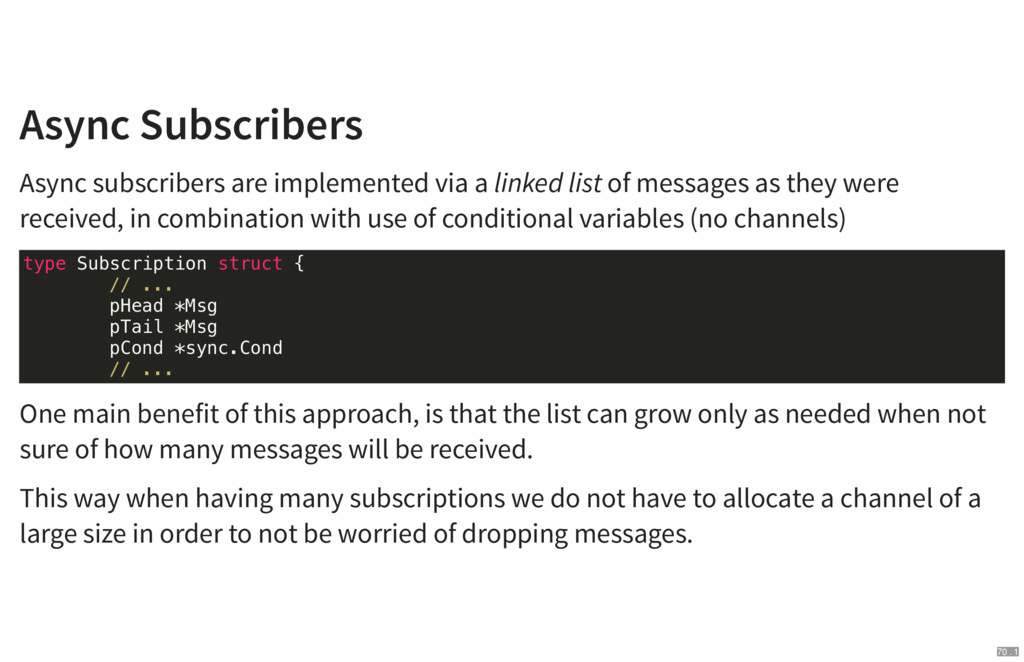
  49. Async Subscribers Async subscribers are implemented via a linked list
    of messages as they were received, in combination with use of conditional variables (no channels) One main benefit of this approach, is that the list can grow only as needed when not sure of how many messages will be received. This way when having many subscriptions we do not have to allocate a channel of a large size in order to not be worried of dropping messages. type Subscription struct { // ... pHead *Msg pTail *Msg pCond *sync.Cond // ... 70 . 1
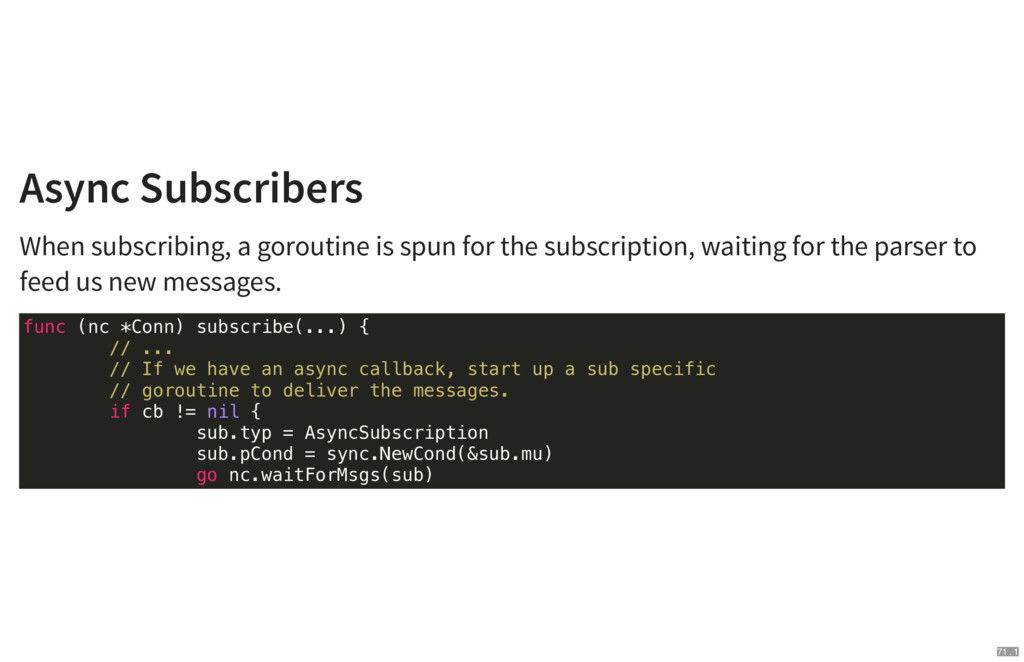
  50. Async Subscribers When subscribing, a goroutine is spun for the

    subscription, waiting for the parser to feed us new messages. func (nc *Conn) subscribe(...) { // ... // If we have an async callback, start up a sub specific // goroutine to deliver the messages. if cb != nil { sub.typ = AsyncSubscription sub.pCond = sync.NewCond(&sub.mu) go nc.waitForMsgs(sub) 71 . 1
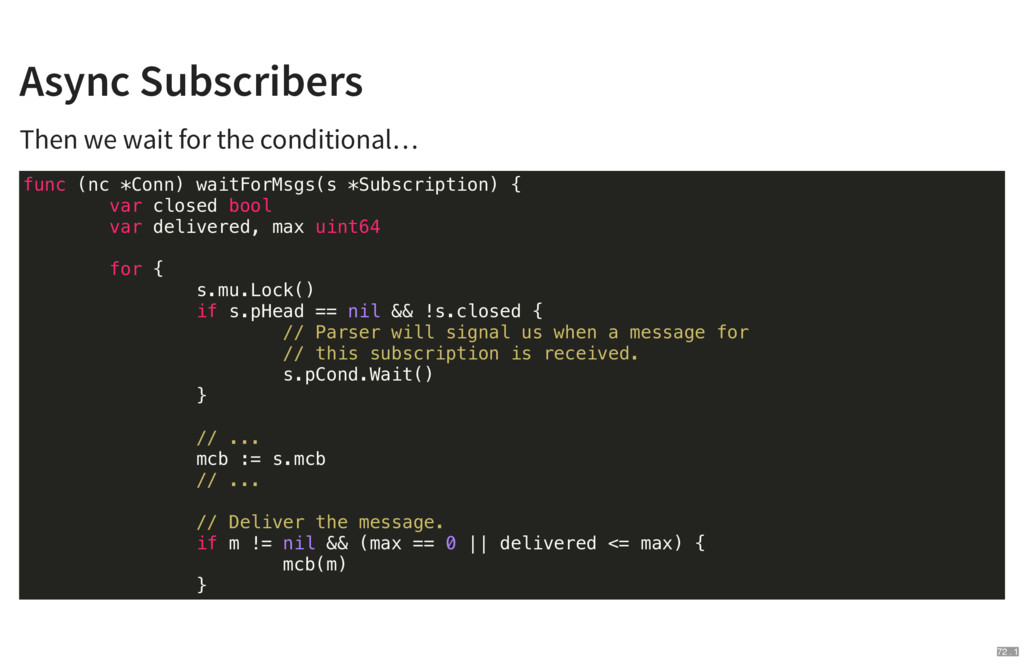
  51. Async Subscribers Then we wait for the conditional… func (nc

    *Conn) waitForMsgs(s *Subscription) { var closed bool var delivered, max uint64 for { s.mu.Lock() if s.pHead == nil && !s.closed { // Parser will signal us when a message for // this subscription is received. s.pCond.Wait() } // ... mcb := s.mcb // ... // Deliver the message. if m != nil && (max == 0 || delivered <= max) { mcb(m) } 72 . 1
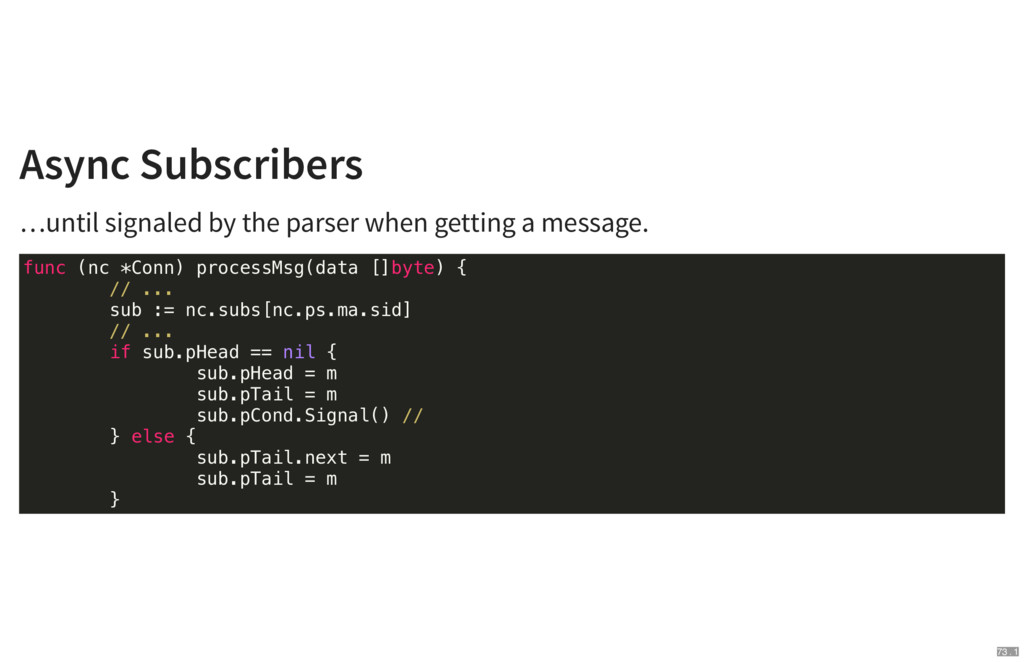
  52. Async Subscribers …until signaled by the parser when getting a

    message. func (nc *Conn) processMsg(data []byte) { // ... sub := nc.subs[nc.ps.ma.sid] // ... if sub.pHead == nil { sub.pHead = m sub.pTail = m sub.pCond.Signal() // } else { sub.pTail.next = m sub.pTail = m } 73 . 1
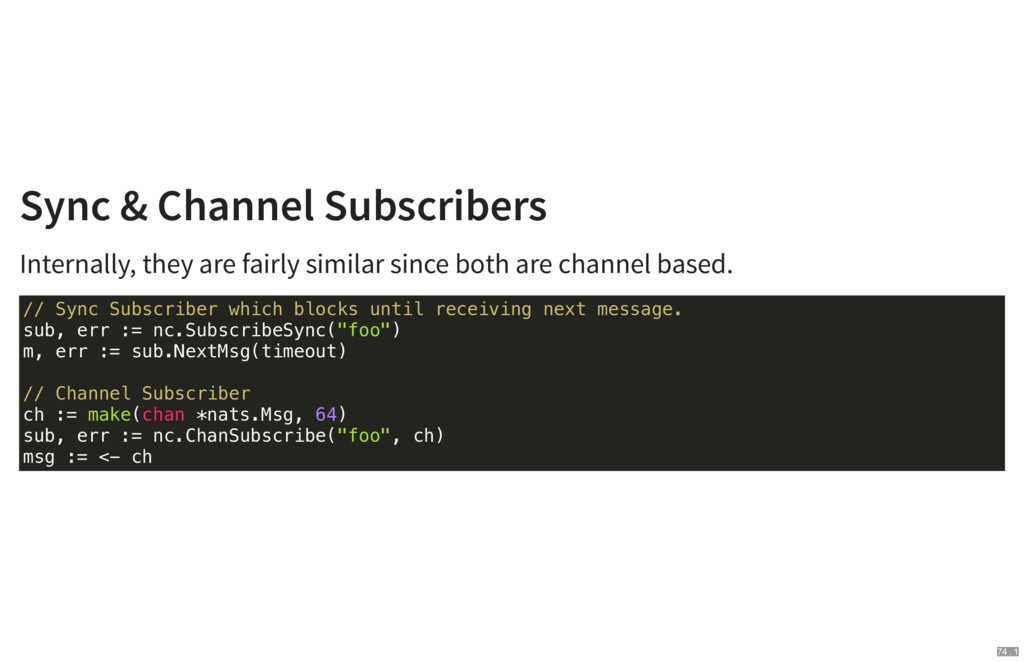
  53. Sync & Channel Subscribers Internally, they are fairly similar since

    both are channel based. // Sync Subscriber which blocks until receiving next message. sub, err := nc.SubscribeSync("foo") m, err := sub.NextMsg(timeout) // Channel Subscriber ch := make(chan *nats.Msg, 64) sub, err := nc.ChanSubscribe("foo", ch) msg := <- ch 74 . 1
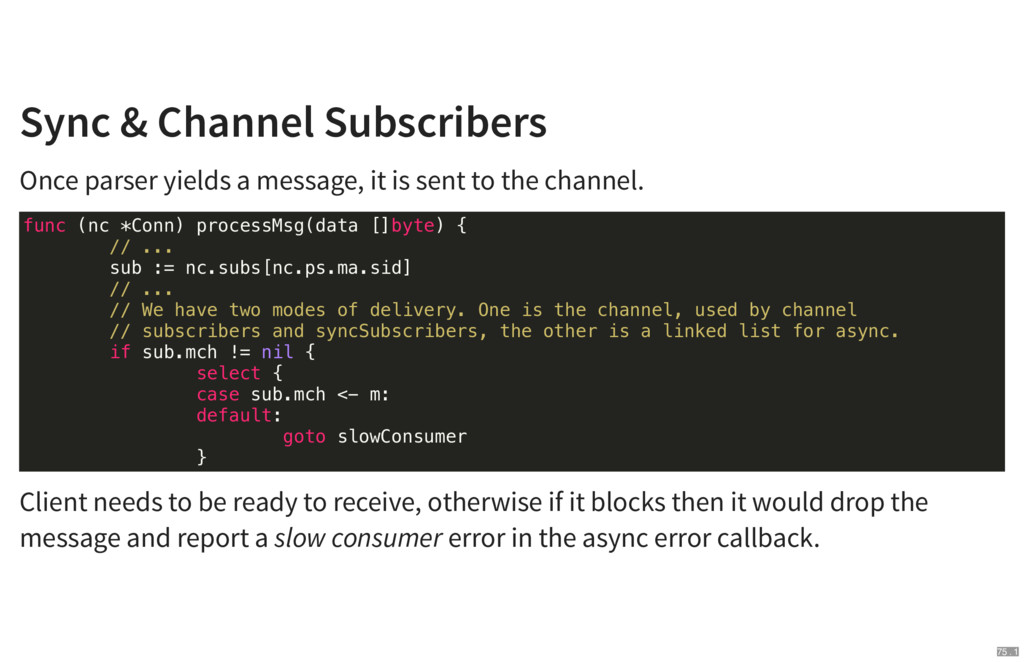
  54. Sync & Channel Subscribers Once parser yields a message, it

    is sent to the channel. Client needs to be ready to receive, otherwise if it blocks then it would drop the message and report a slow consumer error in the async error callback. func (nc *Conn) processMsg(data []byte) { // ... sub := nc.subs[nc.ps.ma.sid] // ... // We have two modes of delivery. One is the channel, used by channel // subscribers and syncSubscribers, the other is a linked list for async. if sub.mch != nil { select { case sub.mch <- m: default: goto slowConsumer } 75 . 1
  55. Intro to the NATS Project The NATS Protocol NATS Client

    Deep Dive IO Engine Connecting & Graceful Reconnection Sync & Async Subscriptions Request/Response Unique inboxes generation Context support for cancellation Performance 76 . 1
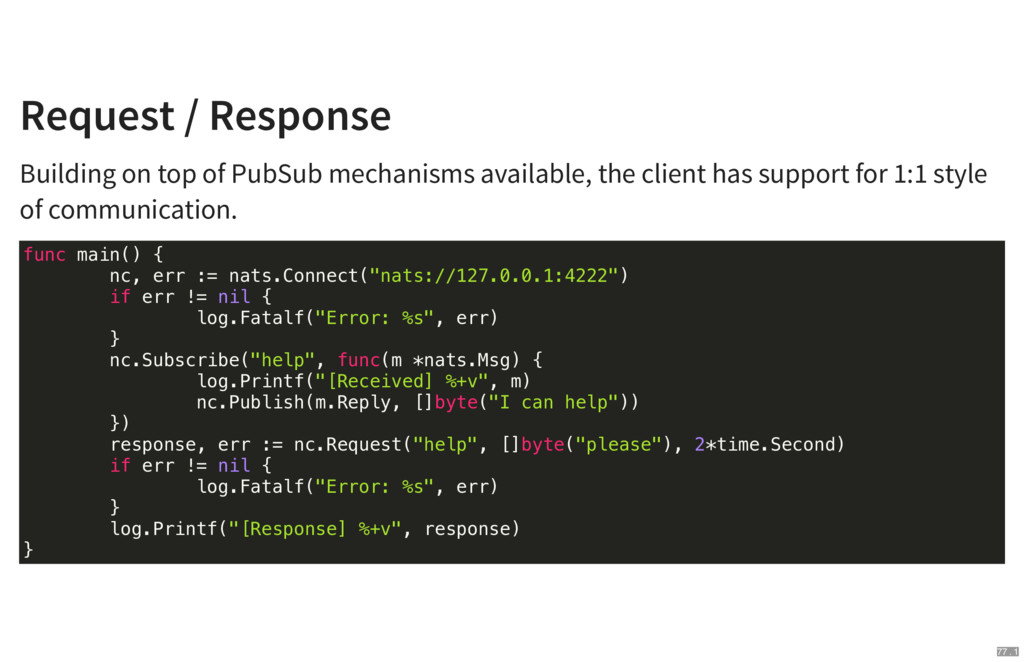
  56. Request / Response Building on top of PubSub mechanisms available,

    the client has support for 1:1 style of communication. func main() { nc, err := nats.Connect("nats://127.0.0.1:4222") if err != nil { log.Fatalf("Error: %s", err) } nc.Subscribe("help", func(m *nats.Msg) { log.Printf("[Received] %+v", m) nc.Publish(m.Reply, []byte("I can help")) }) response, err := nc.Request("help", []byte("please"), 2*time.Second) if err != nil { log.Fatalf("Error: %s", err) } log.Printf("[Response] %+v", response) } 77 . 1
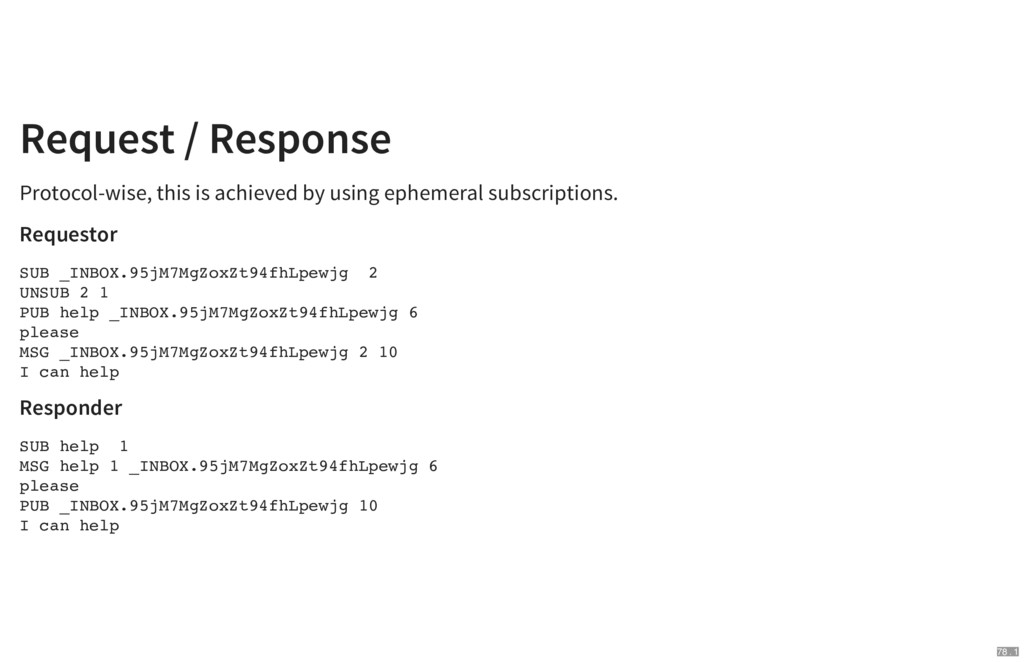
  57. Request / Response Protocol-wise, this is achieved by using ephemeral

    subscriptions. Requestor Responder SUB _INBOX.95jM7MgZoxZt94fhLpewjg 2 UNSUB 2 1 PUB help _INBOX.95jM7MgZoxZt94fhLpewjg 6 please MSG _INBOX.95jM7MgZoxZt94fhLpewjg 2 10 I can help SUB help 1 MSG help 1 _INBOX.95jM7MgZoxZt94fhLpewjg 6 please PUB _INBOX.95jM7MgZoxZt94fhLpewjg 10 I can help 78 . 1
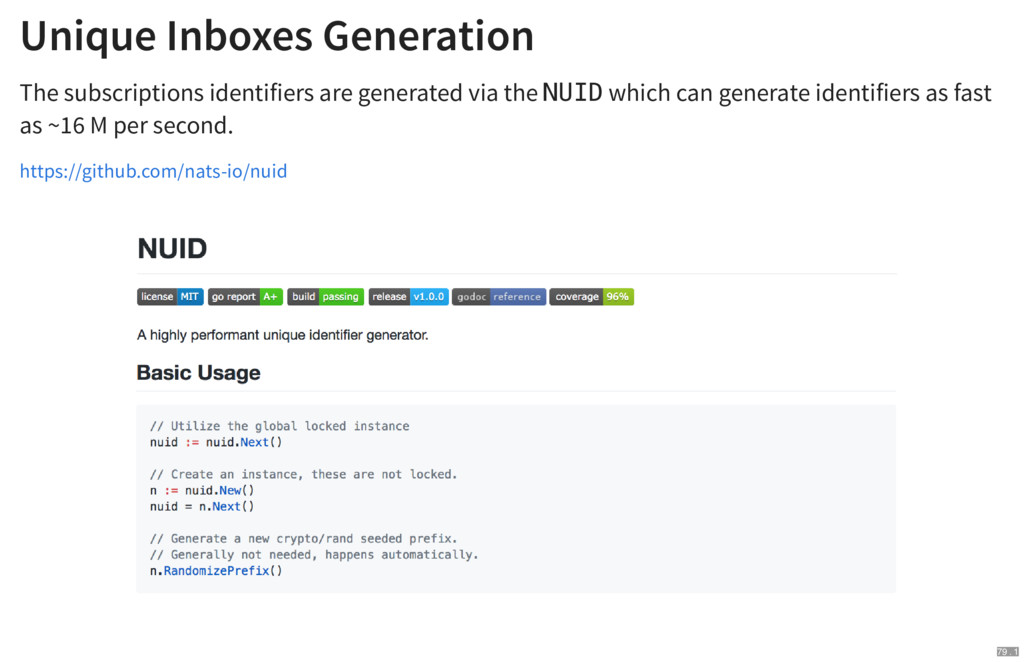
  58. Unique Inboxes Generation The subscriptions identifiers are generated via the

    NUID which can generate identifiers as fast as ~16 M per second. https://github.com/nats-io/nuid 79 . 1
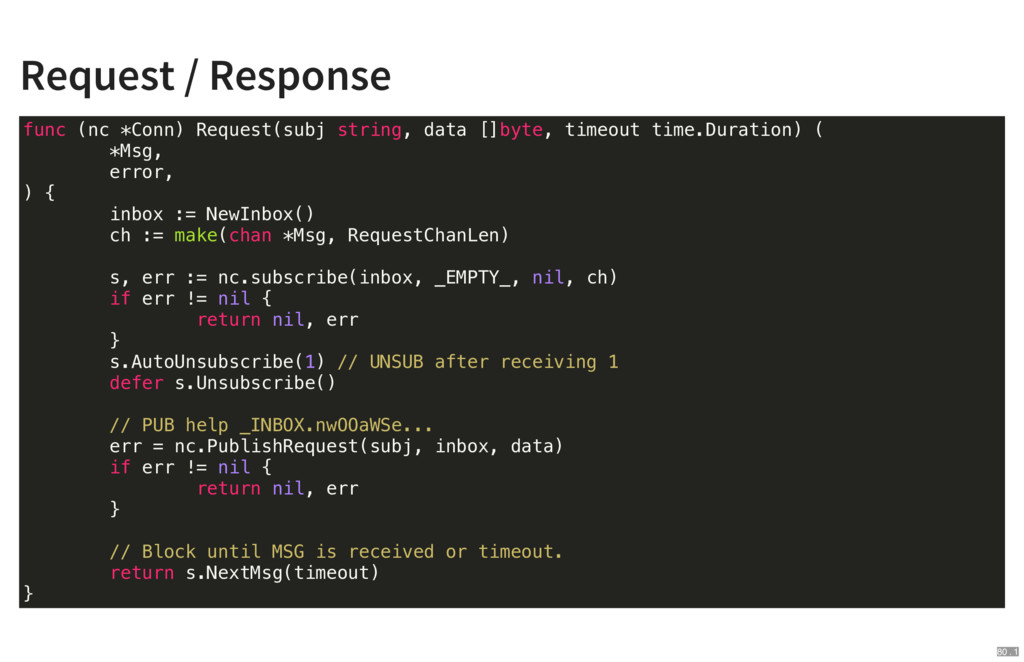
  59. Request / Response func (nc *Conn) Request(subj string, data []byte,

    timeout time.Duration) ( *Msg, error, ) { inbox := NewInbox() ch := make(chan *Msg, RequestChanLen) s, err := nc.subscribe(inbox, _EMPTY_, nil, ch) if err != nil { return nil, err } s.AutoUnsubscribe(1) // UNSUB after receiving 1 defer s.Unsubscribe() // PUB help _INBOX.nwOOaWSe... err = nc.PublishRequest(subj, inbox, data) if err != nil { return nil, err } // Block until MSG is received or timeout. return s.NextMsg(timeout) } 80 . 1
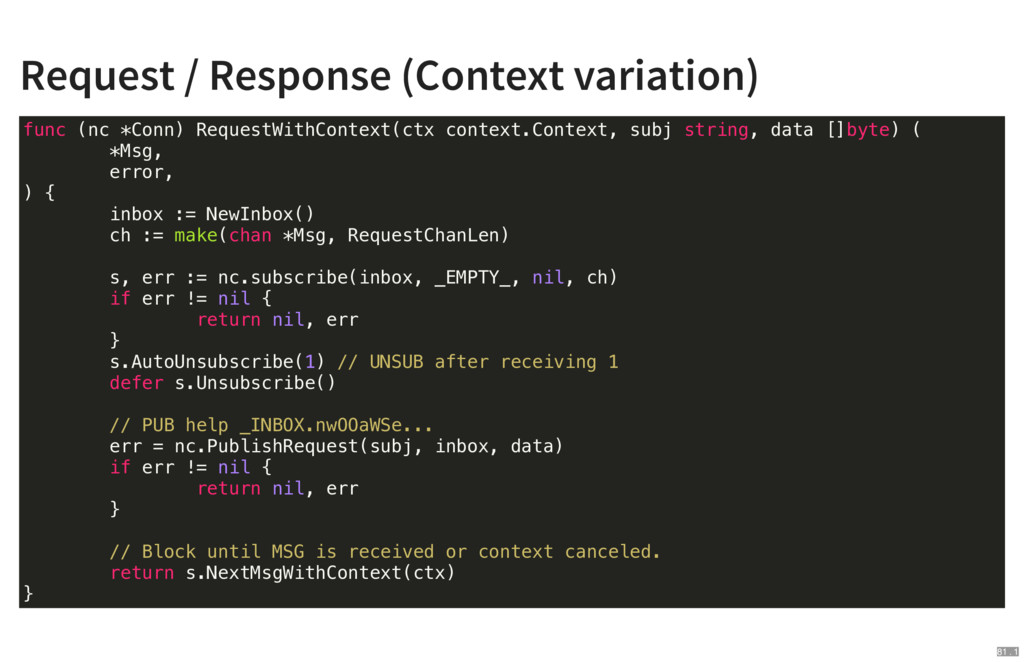
  60. Request / Response (Context variation) func (nc *Conn) RequestWithContext(ctx context.Context,

    subj string, data []byte) ( *Msg, error, ) { inbox := NewInbox() ch := make(chan *Msg, RequestChanLen) s, err := nc.subscribe(inbox, _EMPTY_, nil, ch) if err != nil { return nil, err } s.AutoUnsubscribe(1) // UNSUB after receiving 1 defer s.Unsubscribe() // PUB help _INBOX.nwOOaWSe... err = nc.PublishRequest(subj, inbox, data) if err != nil { return nil, err } // Block until MSG is received or context canceled. return s.NextMsgWithContext(ctx) } 81 . 1
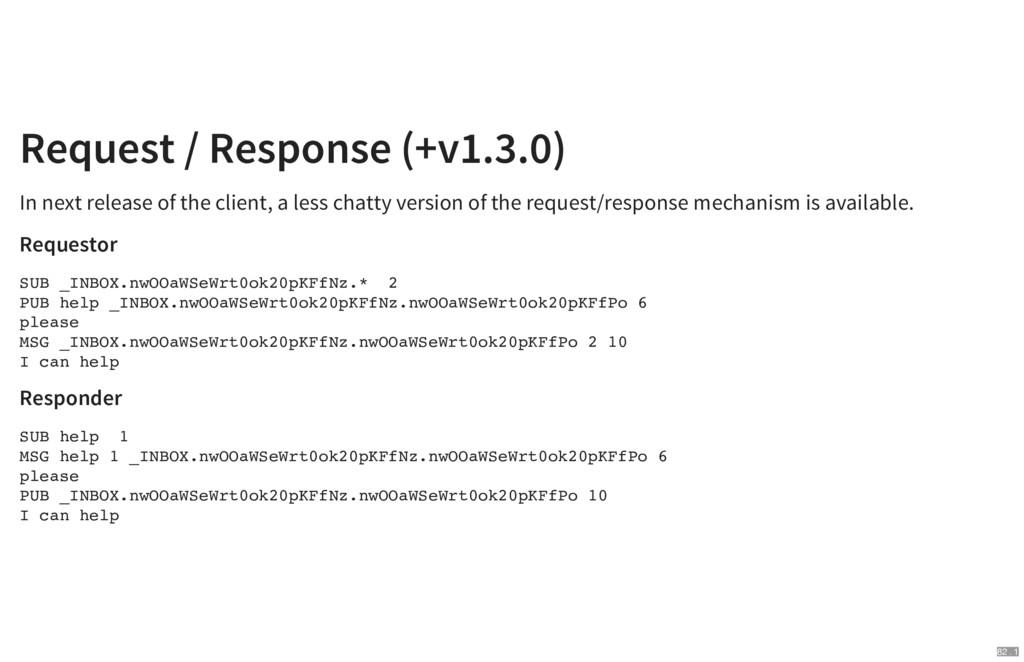
  61. Request / Response (+v1.3.0) In next release of the client,

    a less chatty version of the request/response mechanism is available. Requestor Responder SUB _INBOX.nwOOaWSeWrt0ok20pKFfNz.* 2 PUB help _INBOX.nwOOaWSeWrt0ok20pKFfNz.nwOOaWSeWrt0ok20pKFfPo 6 please MSG _INBOX.nwOOaWSeWrt0ok20pKFfNz.nwOOaWSeWrt0ok20pKFfPo 2 10 I can help SUB help 1 MSG help 1 _INBOX.nwOOaWSeWrt0ok20pKFfNz.nwOOaWSeWrt0ok20pKFfPo 6 please PUB _INBOX.nwOOaWSeWrt0ok20pKFfNz.nwOOaWSeWrt0ok20pKFfPo 10 I can help 82 . 1
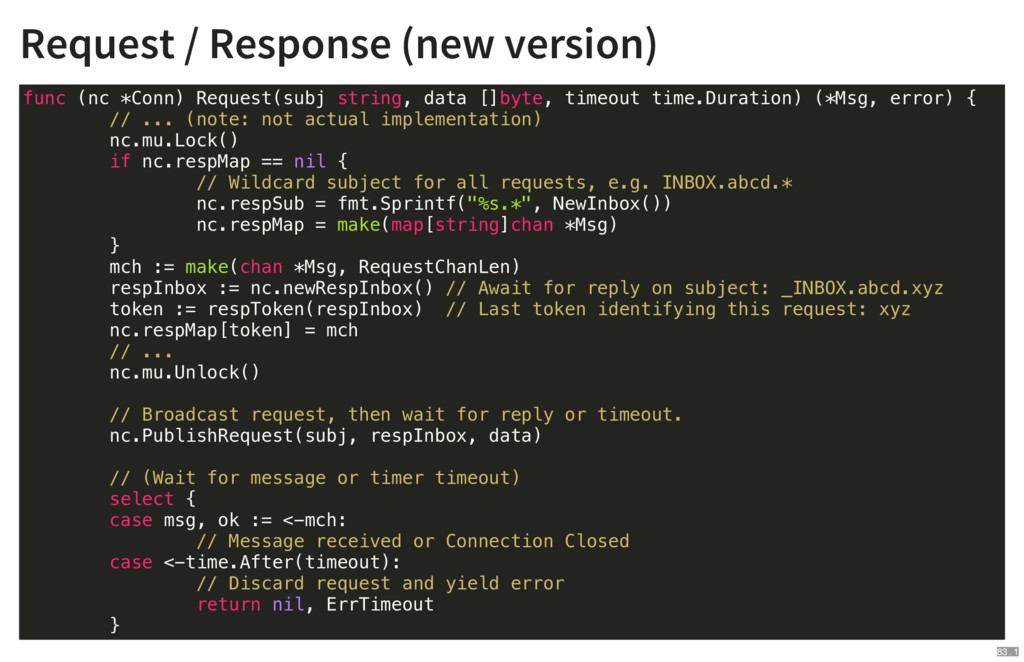
  62. Request / Response (new version) func (nc *Conn) Request(subj string,

    data []byte, timeout time.Duration) (*Msg, error) { // ... (note: not actual implementation) nc.mu.Lock() if nc.respMap == nil { // Wildcard subject for all requests, e.g. INBOX.abcd.* nc.respSub = fmt.Sprintf("%s.*", NewInbox()) nc.respMap = make(map[string]chan *Msg) } mch := make(chan *Msg, RequestChanLen) respInbox := nc.newRespInbox() // Await for reply on subject: _INBOX.abcd.xyz token := respToken(respInbox) // Last token identifying this request: xyz nc.respMap[token] = mch // ... nc.mu.Unlock() // Broadcast request, then wait for reply or timeout. nc.PublishRequest(subj, respInbox, data) // (Wait for message or timer timeout) select { case msg, ok := <-mch: // Message received or Connection Closed case <-time.After(timeout): // Discard request and yield error return nil, ErrTimeout } 83 . 1
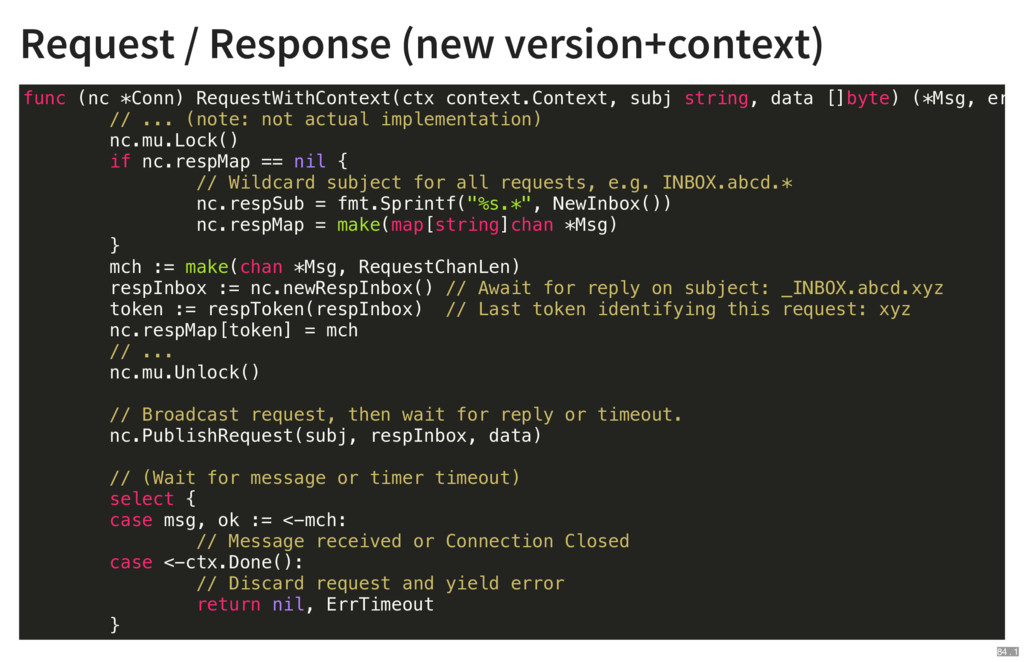
  63. Request / Response (new version+context) func (nc *Conn) RequestWithContext(ctx context.Context,

    subj string, data []byte) (*Msg, erro // ... (note: not actual implementation) nc.mu.Lock() if nc.respMap == nil { // Wildcard subject for all requests, e.g. INBOX.abcd.* nc.respSub = fmt.Sprintf("%s.*", NewInbox()) nc.respMap = make(map[string]chan *Msg) } mch := make(chan *Msg, RequestChanLen) respInbox := nc.newRespInbox() // Await for reply on subject: _INBOX.abcd.xyz token := respToken(respInbox) // Last token identifying this request: xyz nc.respMap[token] = mch // ... nc.mu.Unlock() // Broadcast request, then wait for reply or timeout. nc.PublishRequest(subj, respInbox, data) // (Wait for message or timer timeout) select { case msg, ok := <-mch: // Message received or Connection Closed case <-ctx.Done(): // Discard request and yield error return nil, ErrTimeout } 84 . 1
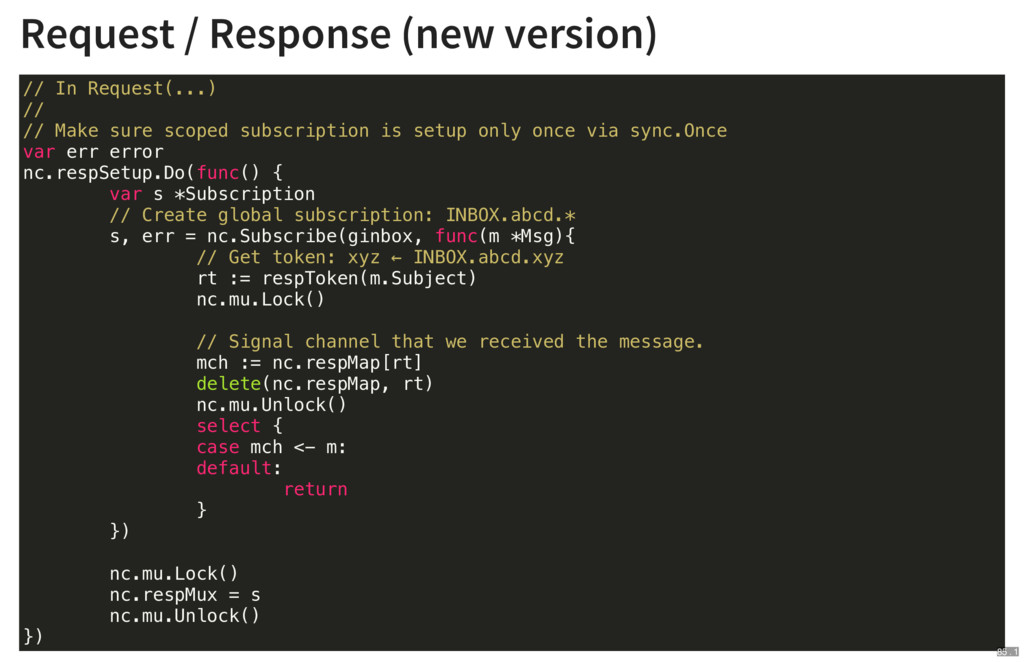
  64. Request / Response (new version) // In Request(...) // //

    Make sure scoped subscription is setup only once via sync.Once var err error nc.respSetup.Do(func() { var s *Subscription // Create global subscription: INBOX.abcd.* s, err = nc.Subscribe(ginbox, func(m *Msg){ // Get token: xyz ← INBOX.abcd.xyz rt := respToken(m.Subject) nc.mu.Lock() // Signal channel that we received the message. mch := nc.respMap[rt] delete(nc.respMap, rt) nc.mu.Unlock() select { case mch <- m: default: return } }) nc.mu.Lock() nc.respMux = s nc.mu.Unlock() }) 85 . 1
  65. Intro to the NATS Project The NATS Protocol NATS Client

    Deep Dive IO Engine Connecting & Graceful Reconnection Synchronous & Asynchronous Subscriptions Request / Response APIs Performance 86 . 1
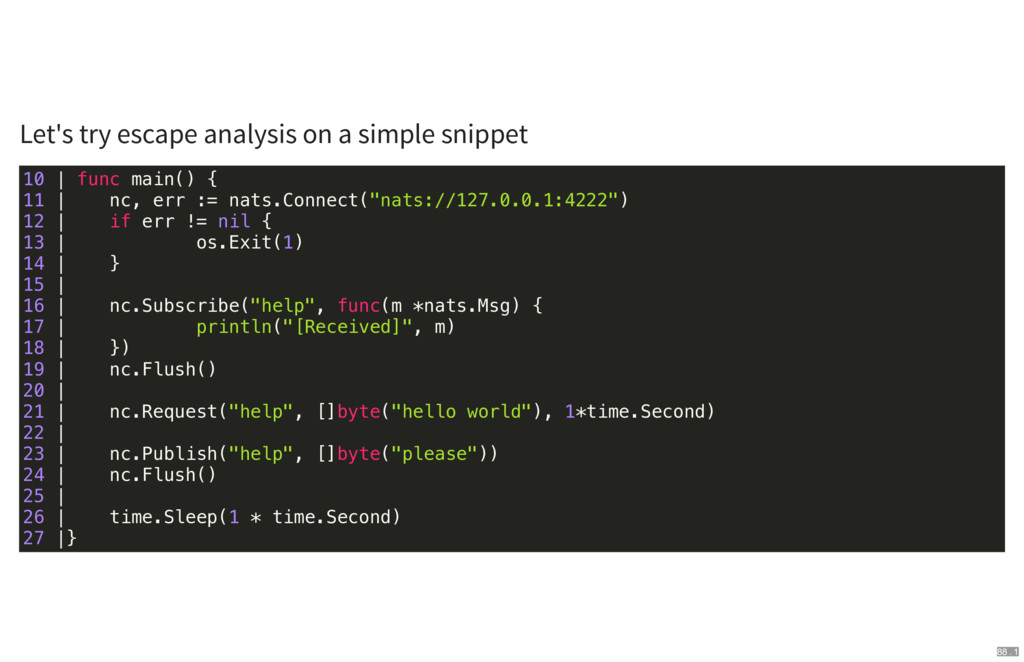
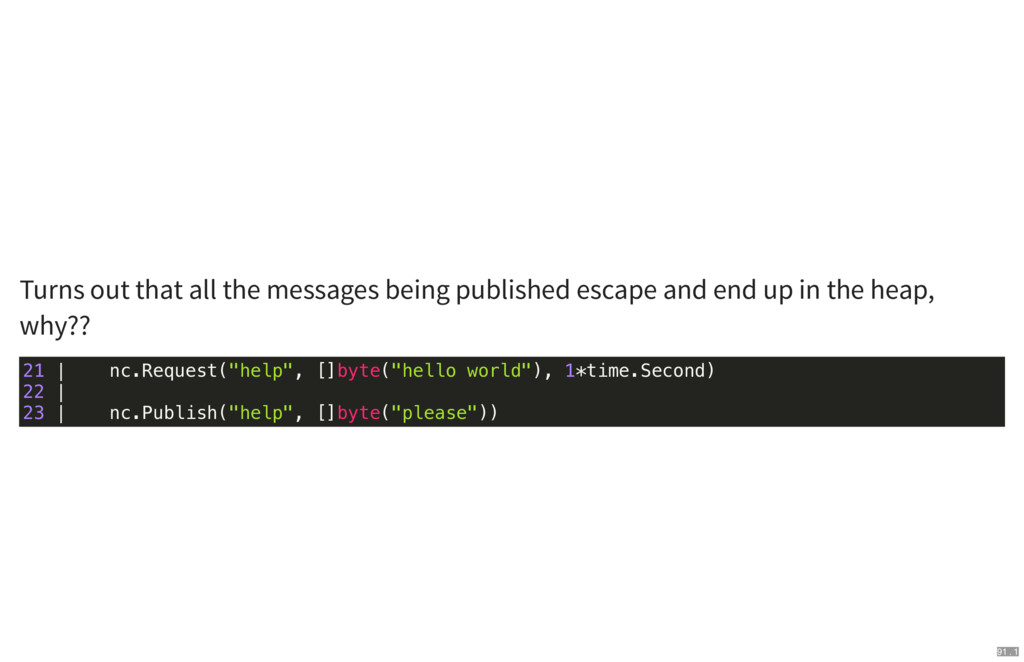
  66. Let's try escape analysis on a simple snippet 10 |

    func main() { 11 | nc, err := nats.Connect("nats://127.0.0.1:4222") 12 | if err != nil { 13 | os.Exit(1) 14 | } 15 | 16 | nc.Subscribe("help", func(m *nats.Msg) { 17 | println("[Received]", m) 18 | }) 19 | nc.Flush() 20 | 21 | nc.Request("help", []byte("hello world"), 1*time.Second) 22 | 23 | nc.Publish("help", []byte("please")) 24 | nc.Flush() 25 | 26 | time.Sleep(1 * time.Second) 27 |} 88 . 1
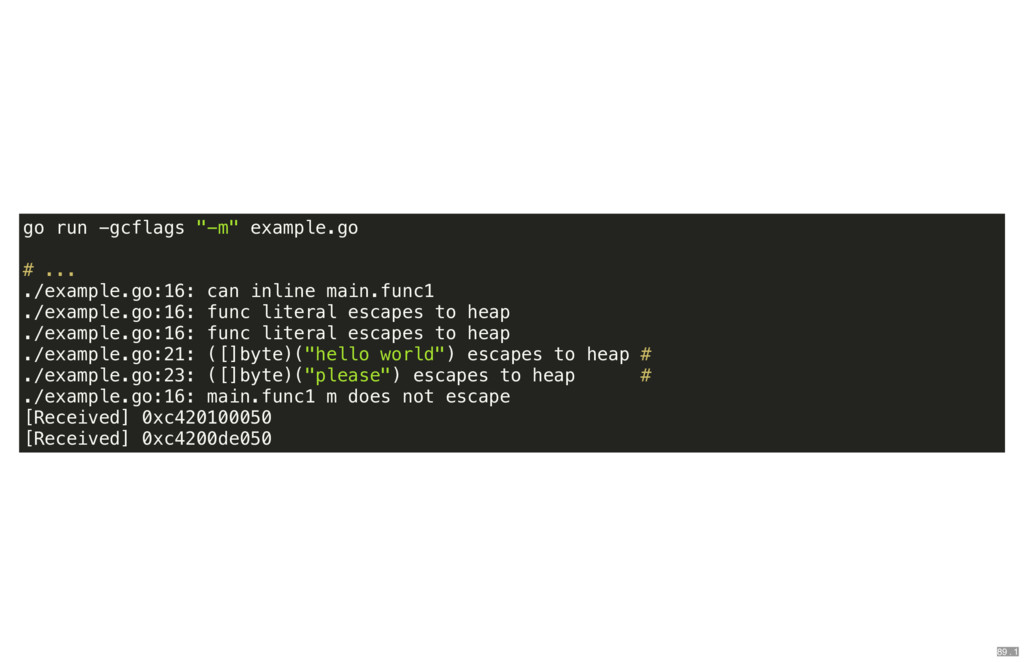
  67. go run -gcflags "-m" example.go # ... ./example.go:16: can inline

    main.func1 ./example.go:16: func literal escapes to heap ./example.go:16: func literal escapes to heap ./example.go:21: ([]byte)("hello world") escapes to heap # ❗ ./example.go:23: ([]byte)("please") escapes to heap # ❗ ./example.go:16: main.func1 m does not escape [Received] 0xc420100050 [Received] 0xc4200de050 89 . 1
  68. Turns out that all the messages being published escape and

    end up in the heap, why?? 21 | nc.Request("help", []byte("hello world"), 1*time.Second) 22 | 23 | nc.Publish("help", []byte("please")) 91 . 1
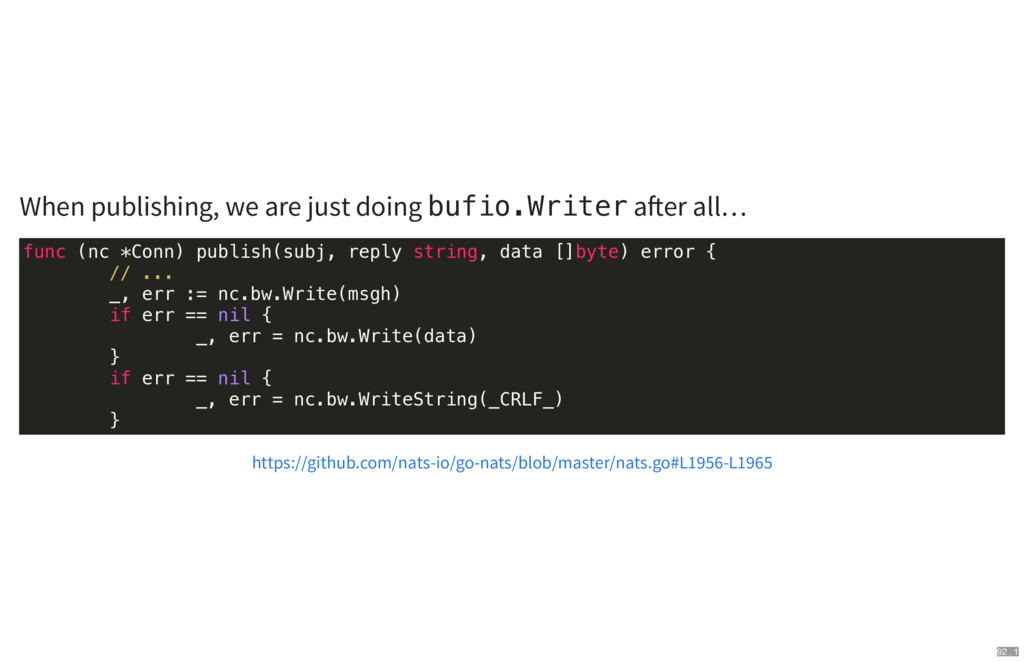
  69. When publishing, we are just doing bufio.Writer a er all…

    func (nc *Conn) publish(subj, reply string, data []byte) error { // ... _, err := nc.bw.Write(msgh) if err == nil { _, err = nc.bw.Write(data) } if err == nil { _, err = nc.bw.WriteString(_CRLF_) } https://github.com/nats-io/go-nats/blob/master/nats.go#L1956-L1965 92 . 1
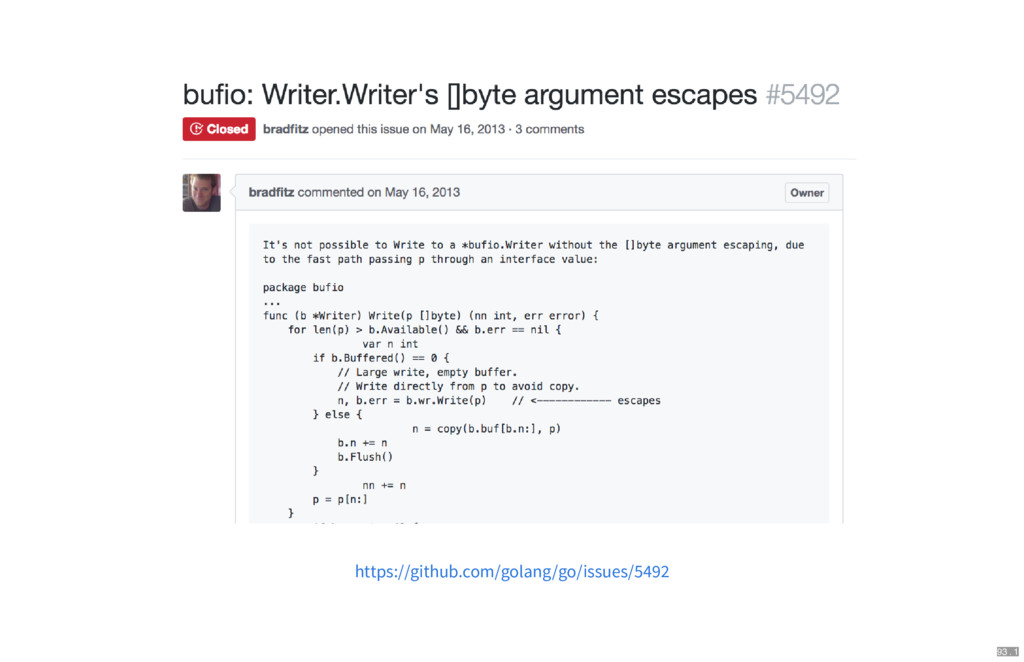
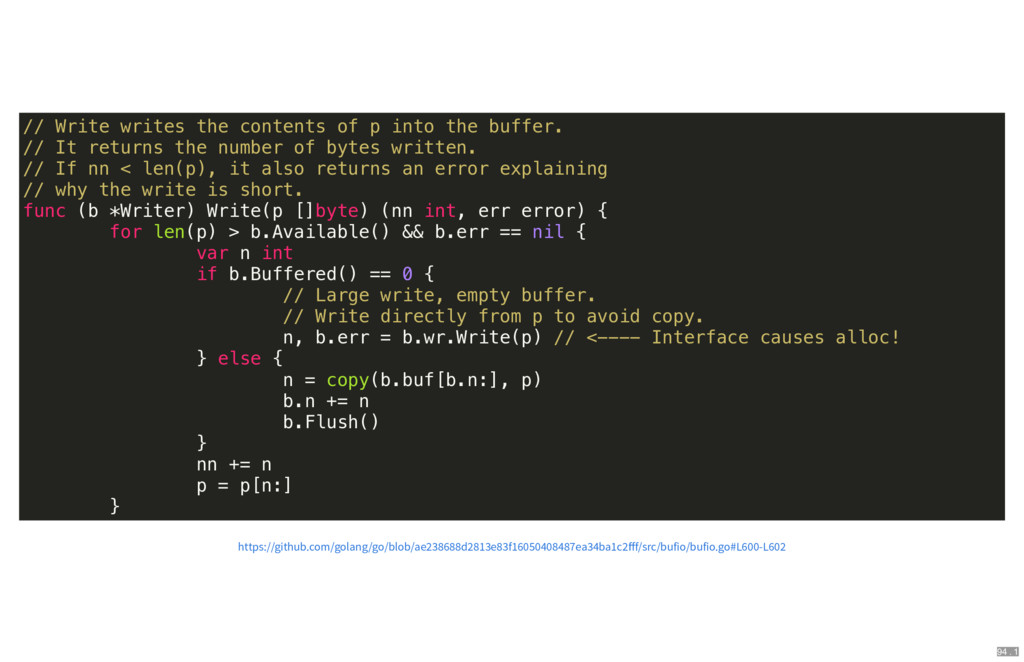
  70. // Write writes the contents of p into the buffer.

    // It returns the number of bytes written. // If nn < len(p), it also returns an error explaining // why the write is short. func (b *Writer) Write(p []byte) (nn int, err error) { for len(p) > b.Available() && b.err == nil { var n int if b.Buffered() == 0 { // Large write, empty buffer. // Write directly from p to avoid copy. n, b.err = b.wr.Write(p) // <---- Interface causes alloc! } else { n = copy(b.buf[b.n:], p) b.n += n b.Flush() } nn += n p = p[n:] } https://github.com/golang/go/blob/ae238688d2813e83f16050408487ea34ba1c2fff/src/bufio/bufio.go#L600-L602 94 . 1
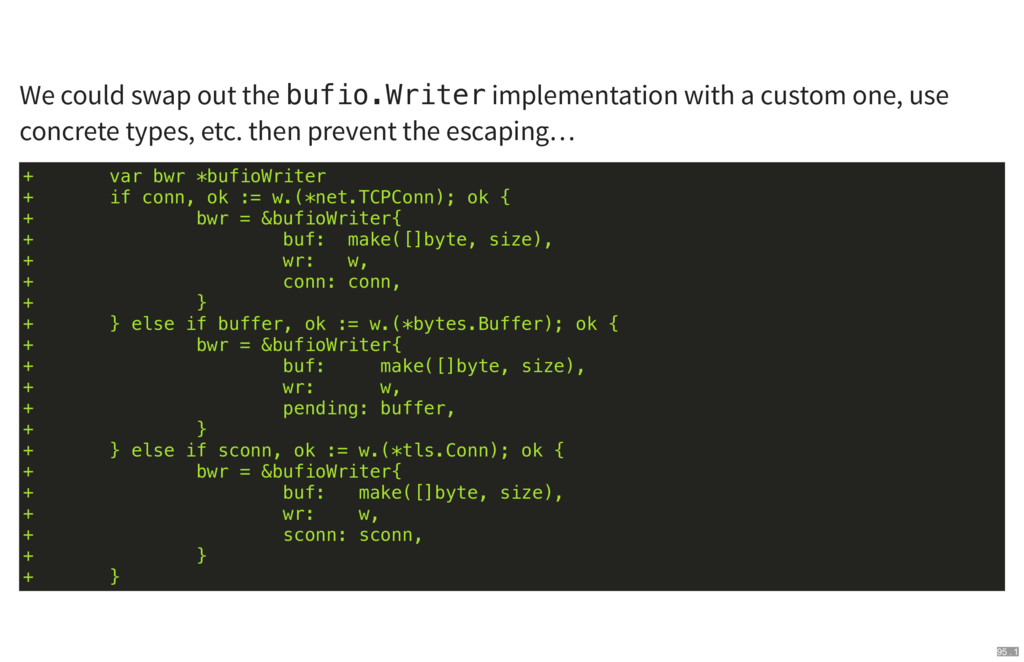
  71. We could swap out the bufio.Writer implementation with a custom

    one, use concrete types, etc. then prevent the escaping… + var bwr *bufioWriter + if conn, ok := w.(*net.TCPConn); ok { + bwr = &bufioWriter{ + buf: make([]byte, size), + wr: w, + conn: conn, + } + } else if buffer, ok := w.(*bytes.Buffer); ok { + bwr = &bufioWriter{ + buf: make([]byte, size), + wr: w, + pending: buffer, + } + } else if sconn, ok := w.(*tls.Conn); ok { + bwr = &bufioWriter{ + buf: make([]byte, size), + wr: w, + sconn: sconn, + } + } 95 . 1
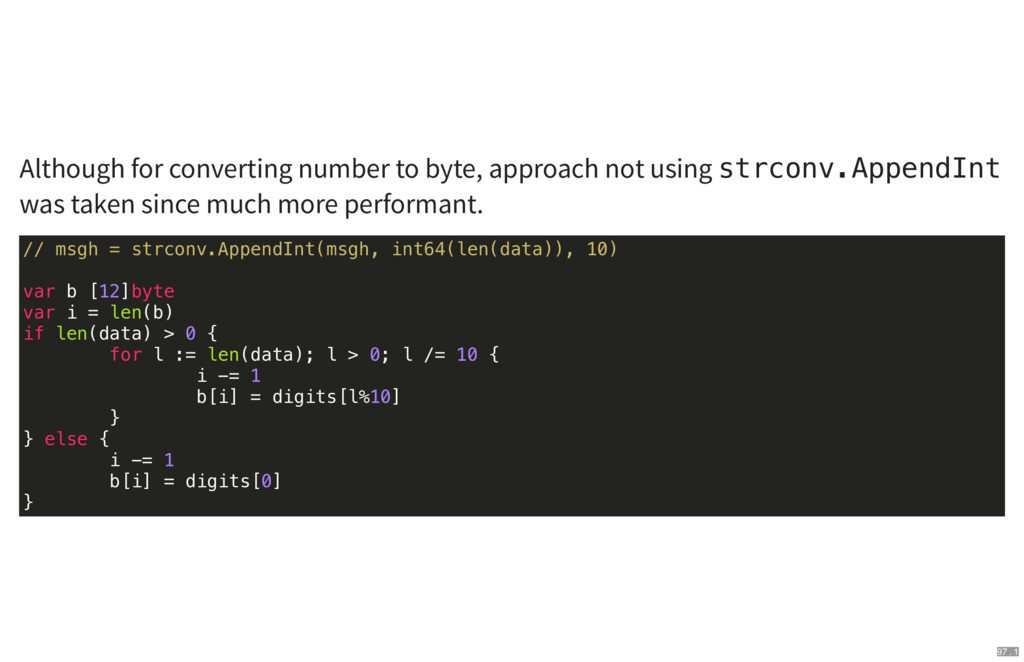
  72. Although for converting number to byte, approach not using strconv.AppendInt

    was taken since much more performant. // msgh = strconv.AppendInt(msgh, int64(len(data)), 10) var b [12]byte var i = len(b) if len(data) > 0 { for l := len(data); l > 0; l /= 10 { i -= 1 b[i] = digits[l%10] } } else { i -= 1 b[i] = digits[0] } 97 . 1
  73. ✅ Techniques used and trade-offs in the Go client: Backpressure

    of I/O and writes coalescing Fast protocol parsing Graceful reconnection on server failover Usage & Non-usage of channels for communicating Closures, callbacks & channels for events/custom logic 99 . 1
  74. Conclusions NATS approach to simplicity fits really well with what

    Go provides and has helped the project greatly. Go is a very flexible systems programming language, allowing us to choose our own trade offs. There is great tooling in Go which makes it possible to analyze when to take them. 100 . 1