Upgrade to Pro — share decks privately, control downloads, hide ads and more …

The Cloud Needs an OS

The Cloud Needs an OS

If you need an OS for you laptop, your phone, and your tablet, why don't you need one in the cloud? Our current conception of how people use the cloud has significant limitations that could be mitigated with the introduction of a cloud-based operating system that people can look at as their "virtual computer" that's always on, always working.

Avatar for Phil Windley

Phil Windley

July 09, 2014

Other Decks in Technology

Transcript

  1. The Cloud Needs an Operating System Phillip J. Windley, Ph.D.

    Chief Technology Officer Kynetx @windley Friday, November 16, 12
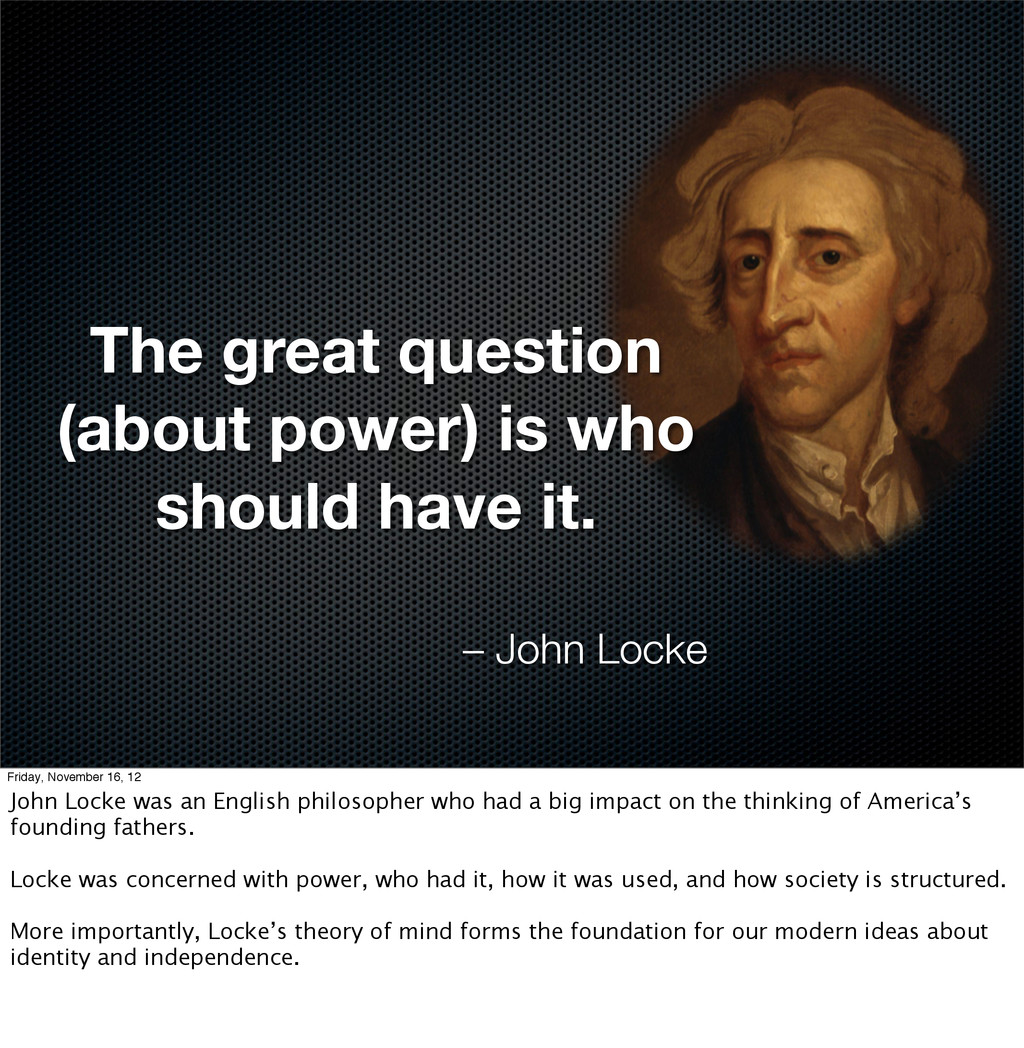
  2. The great question (about power) is who should have it.

    – John Locke Friday, November 16, 12 John Locke was an English philosopher who had a big impact on the thinking of America’s founding fathers. Locke was concerned with power, who had it, how it was used, and how society is structured. More importantly, Locke’s theory of mind forms the foundation for our modern ideas about identity and independence.
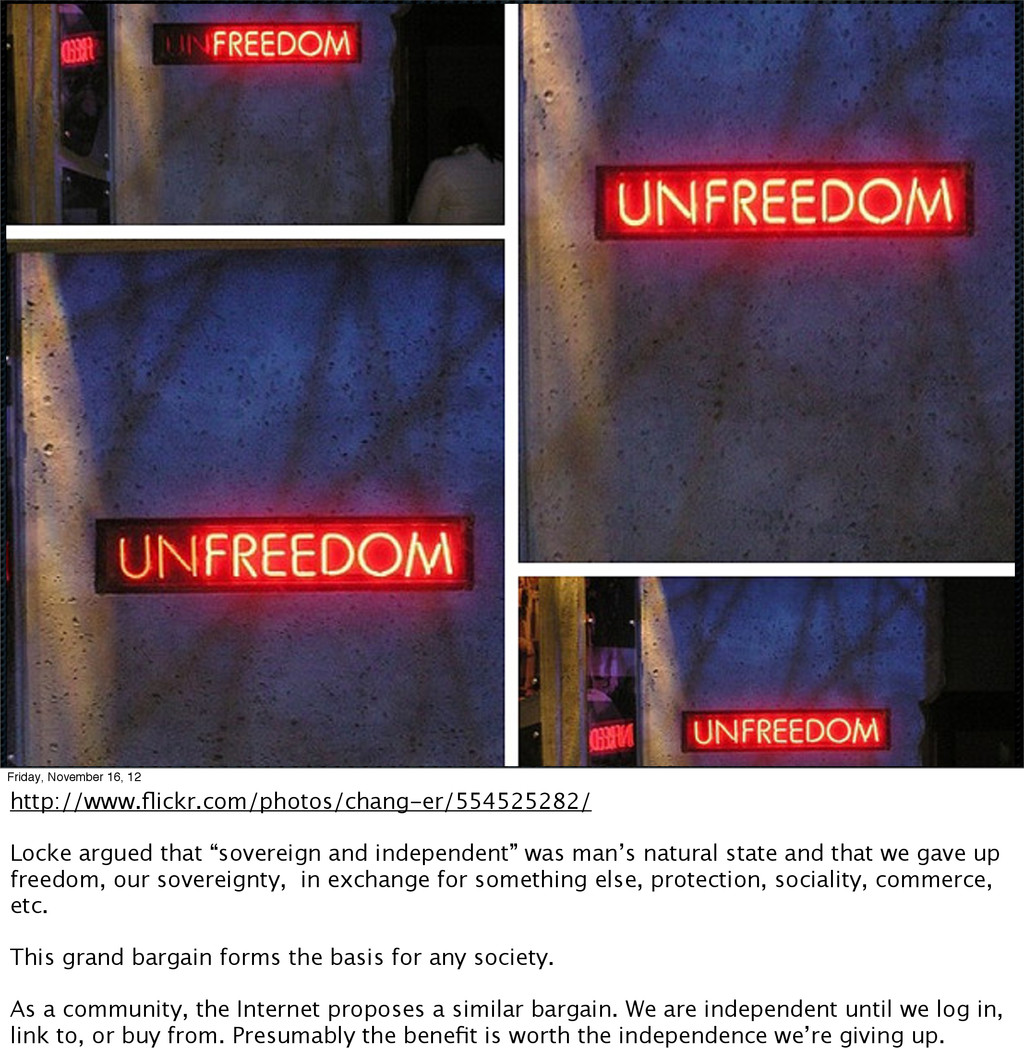
  3. Friday, November 16, 12 http://www.flickr.com/photos/chang-er/554525282/ Locke argued that “sovereign and

    independent” was man’s natural state and that we gave up freedom, our sovereignty, in exchange for something else, protection, sociality, commerce, etc. This grand bargain forms the basis for any society. As a community, the Internet proposes a similar bargain. We are independent until we log in, link to, or buy from. Presumably the benefit is worth the independence we’re giving up.
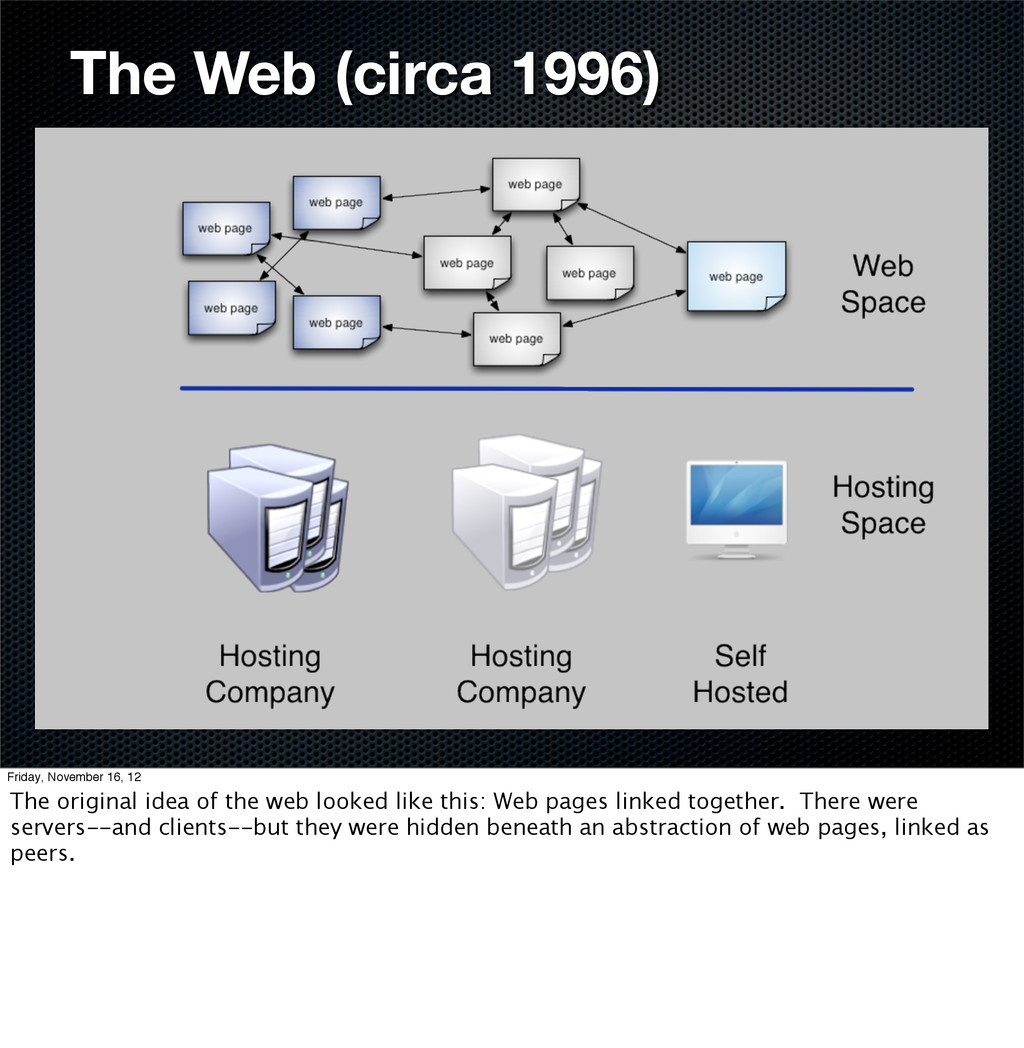
  4. The Web (circa 1996) Friday, November 16, 12 The original

    idea of the web looked like this: Web pages linked together. There were servers--and clients--but they were hidden beneath an abstraction of web pages, linked as peers.
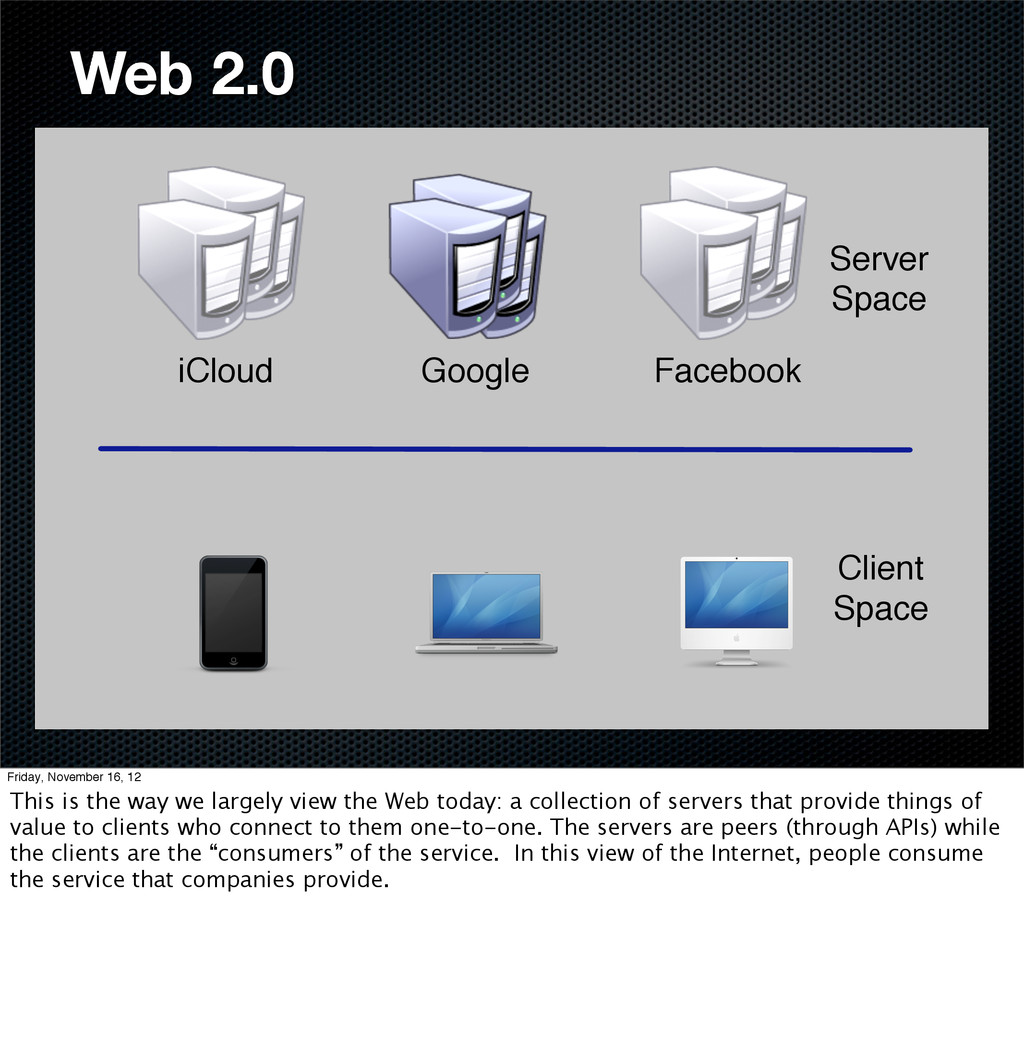
  5. Client Space Server Space Google Facebook iCloud Web 2.0 Friday,

    November 16, 12 This is the way we largely view the Web today: a collection of servers that provide things of value to clients who connect to them one-to-one. The servers are peers (through APIs) while the clients are the “consumers” of the service. In this view of the Internet, people consume the service that companies provide.
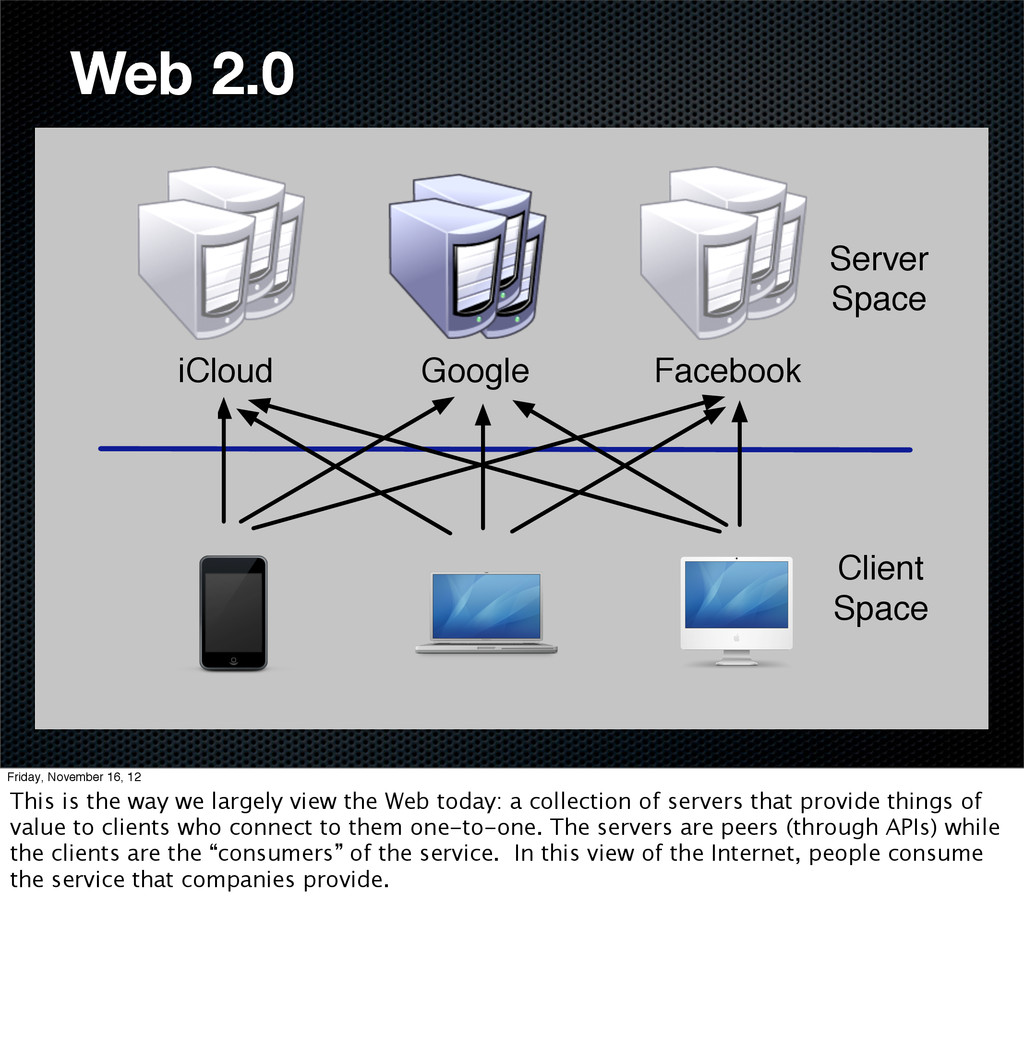
  6. Client Space Server Space Google Facebook iCloud Web 2.0 Friday,

    November 16, 12 This is the way we largely view the Web today: a collection of servers that provide things of value to clients who connect to them one-to-one. The servers are peers (through APIs) while the clients are the “consumers” of the service. In this view of the Internet, people consume the service that companies provide.
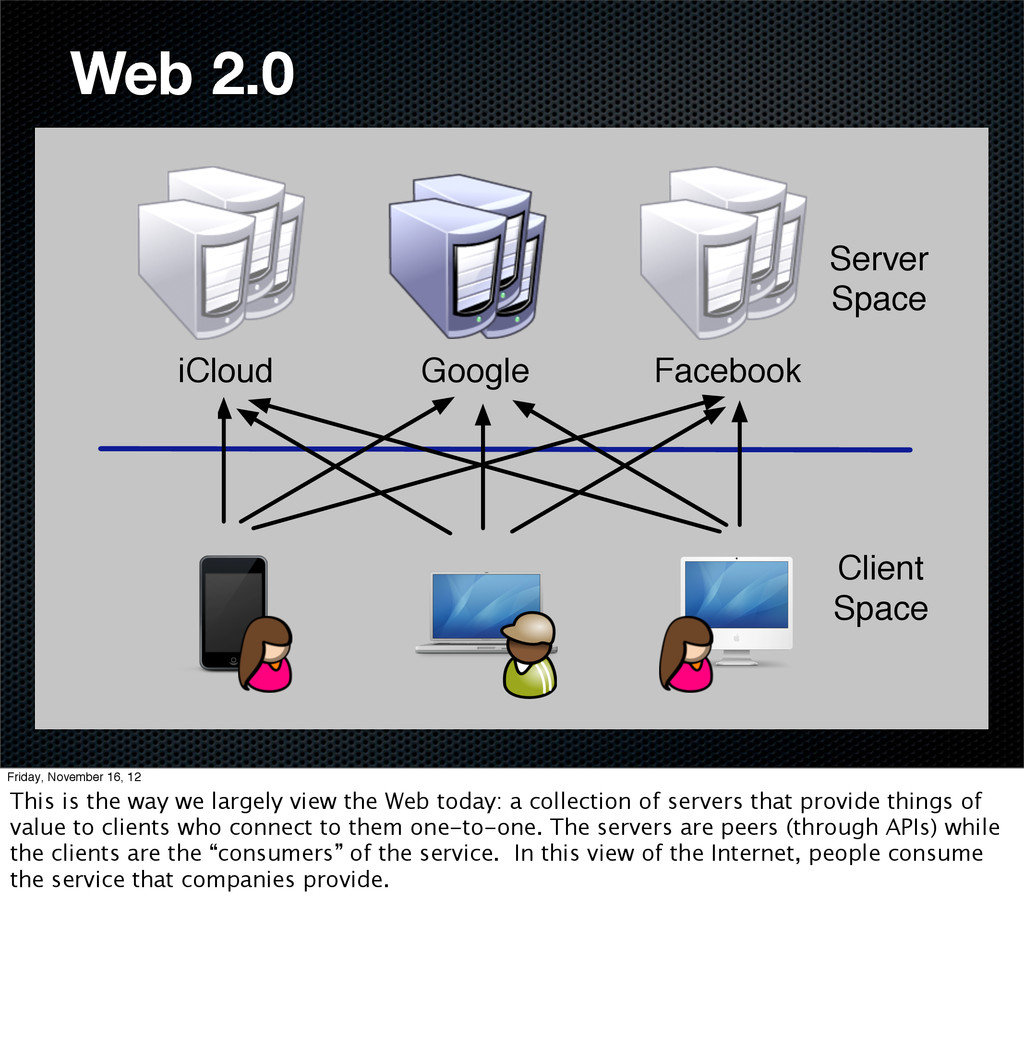
  7. Client Space Server Space Google Facebook iCloud Web 2.0 Friday,

    November 16, 12 This is the way we largely view the Web today: a collection of servers that provide things of value to clients who connect to them one-to-one. The servers are peers (through APIs) while the clients are the “consumers” of the service. In this view of the Internet, people consume the service that companies provide.
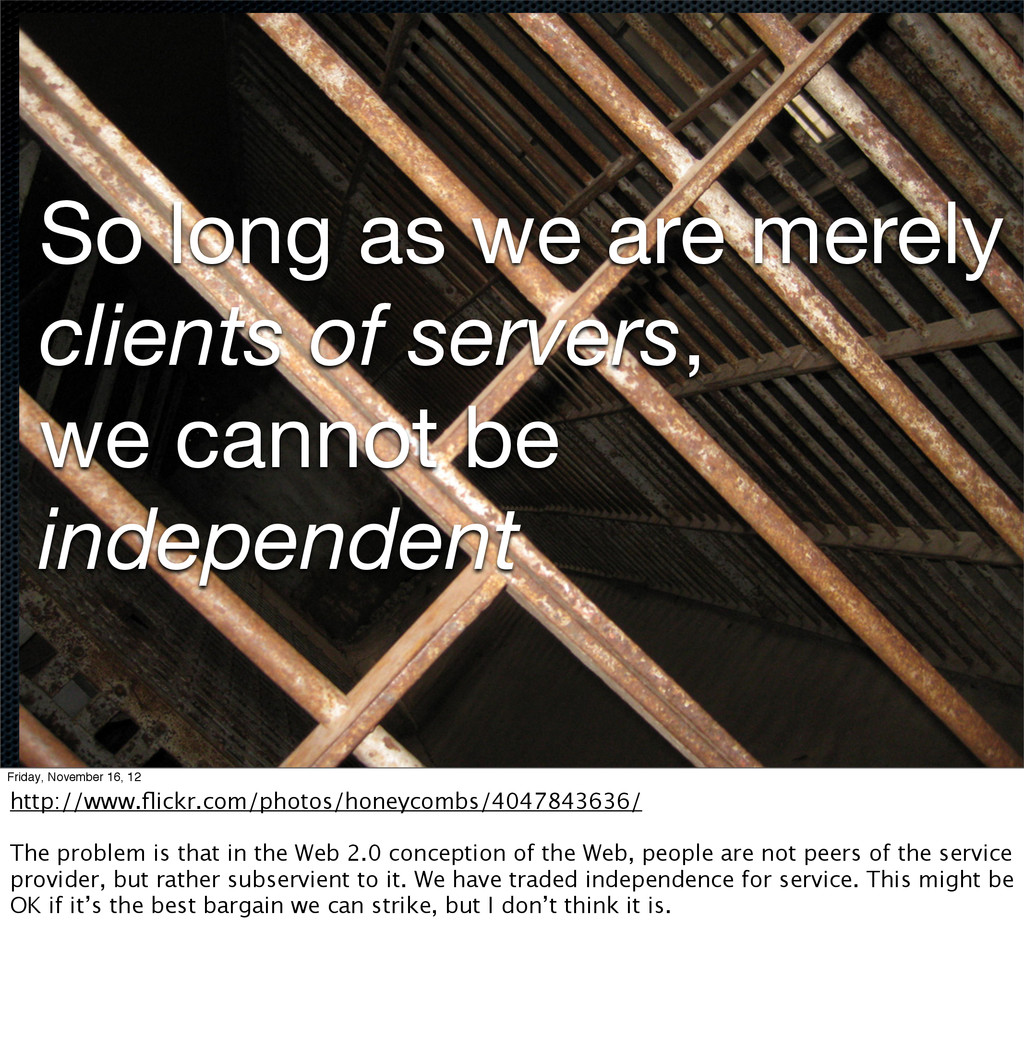
  8. So long as we are merely clients of servers, we

    cannot be independent Friday, November 16, 12 http://www.flickr.com/photos/honeycombs/4047843636/ The problem is that in the Web 2.0 conception of the Web, people are not peers of the service provider, but rather subservient to it. We have traded independence for service. This might be OK if it’s the best bargain we can strike, but I don’t think it is.
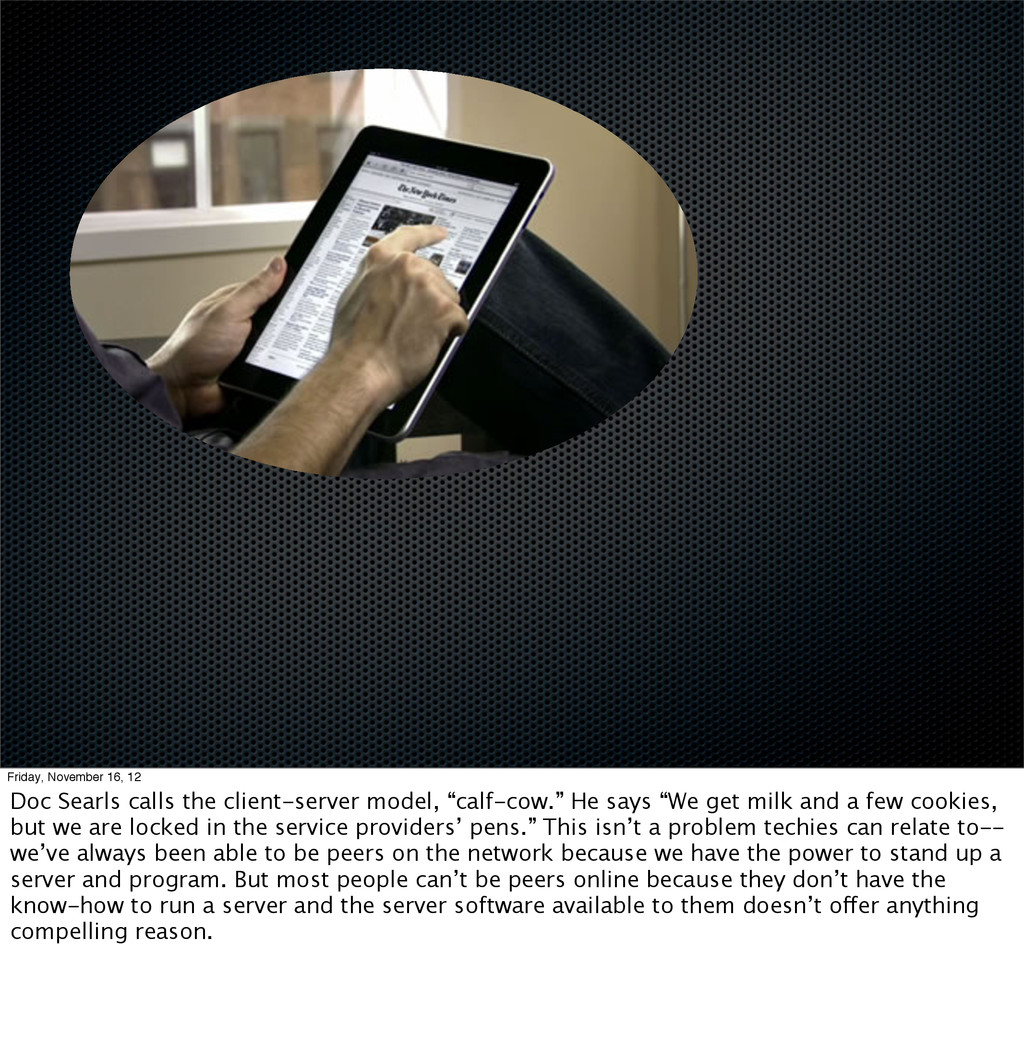
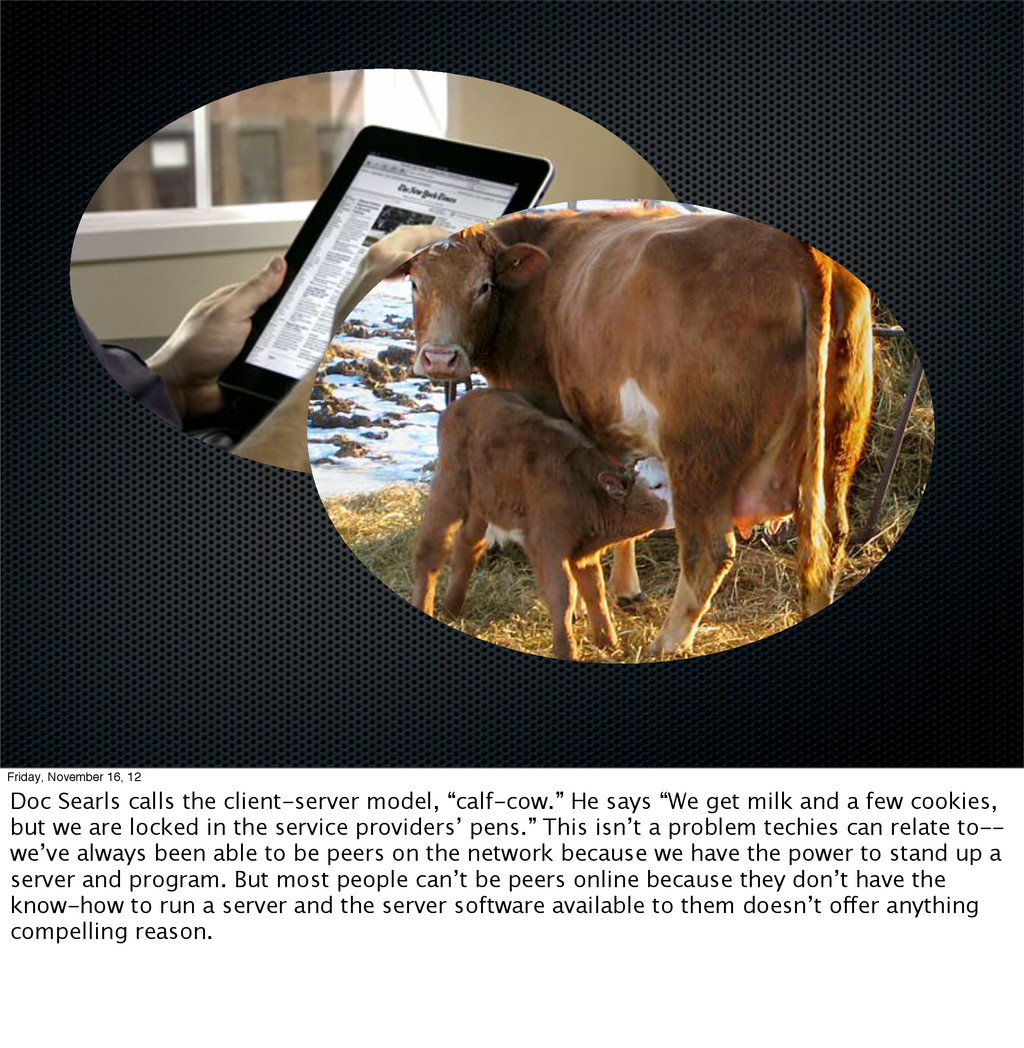
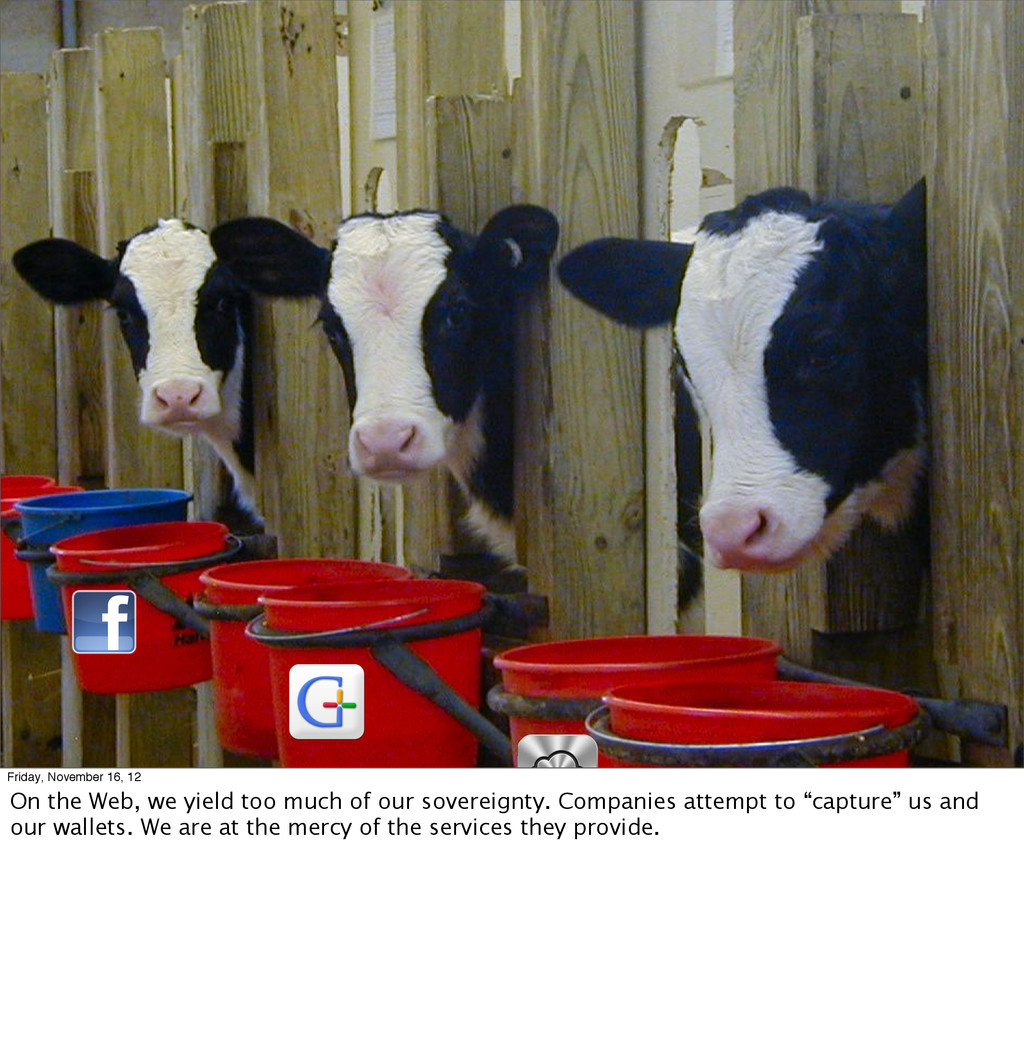
  9. Friday, November 16, 12 Doc Searls calls the client-server model,

    “calf-cow.” He says “We get milk and a few cookies, but we are locked in the service providers’ pens.” This isn’t a problem techies can relate to-- we’ve always been able to be peers on the network because we have the power to stand up a server and program. But most people can’t be peers online because they don’t have the know-how to run a server and the server software available to them doesn’t offer anything compelling reason.
  10. Friday, November 16, 12 Doc Searls calls the client-server model,

    “calf-cow.” He says “We get milk and a few cookies, but we are locked in the service providers’ pens.” This isn’t a problem techies can relate to-- we’ve always been able to be peers on the network because we have the power to stand up a server and program. But most people can’t be peers online because they don’t have the know-how to run a server and the server software available to them doesn’t offer anything compelling reason.
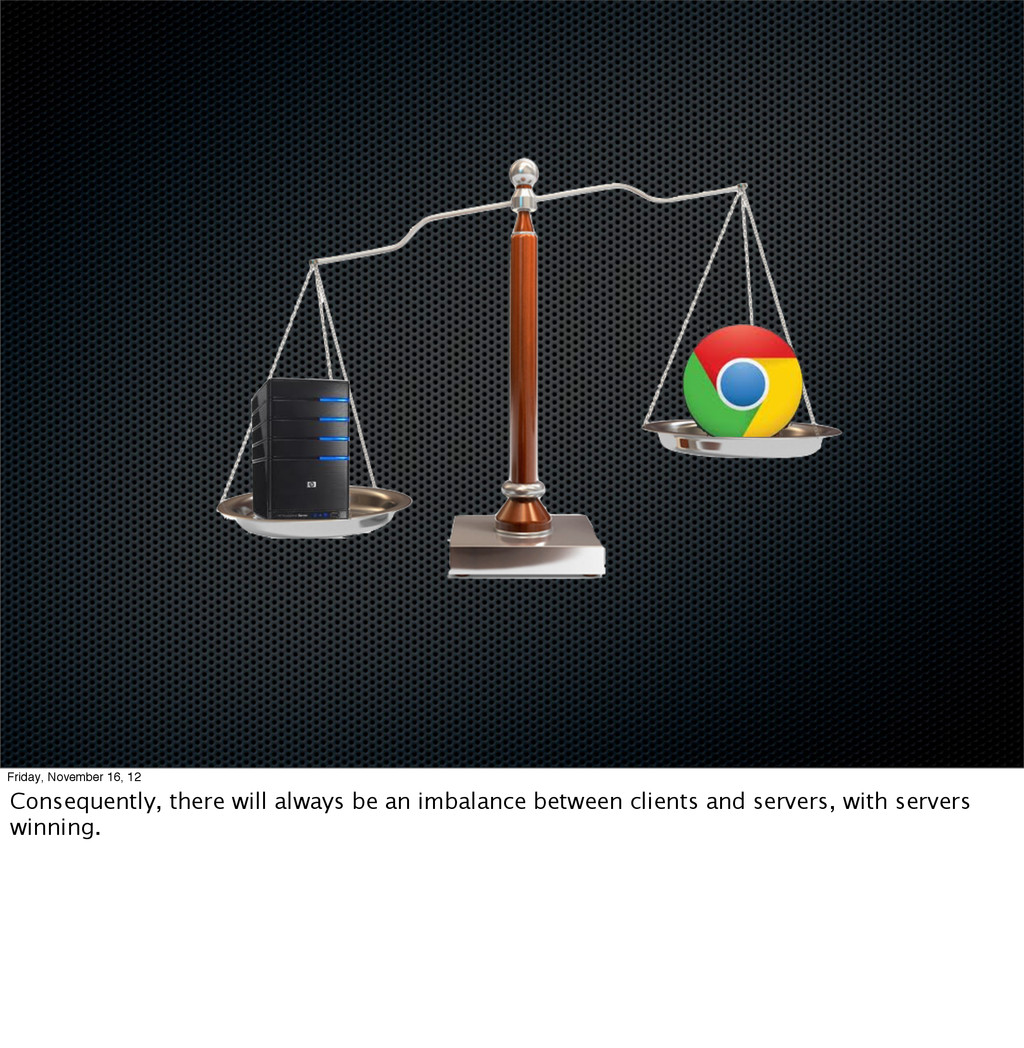
  11. Friday, November 16, 12 Consequently, there will always be an

    imbalance between clients and servers, with servers winning.
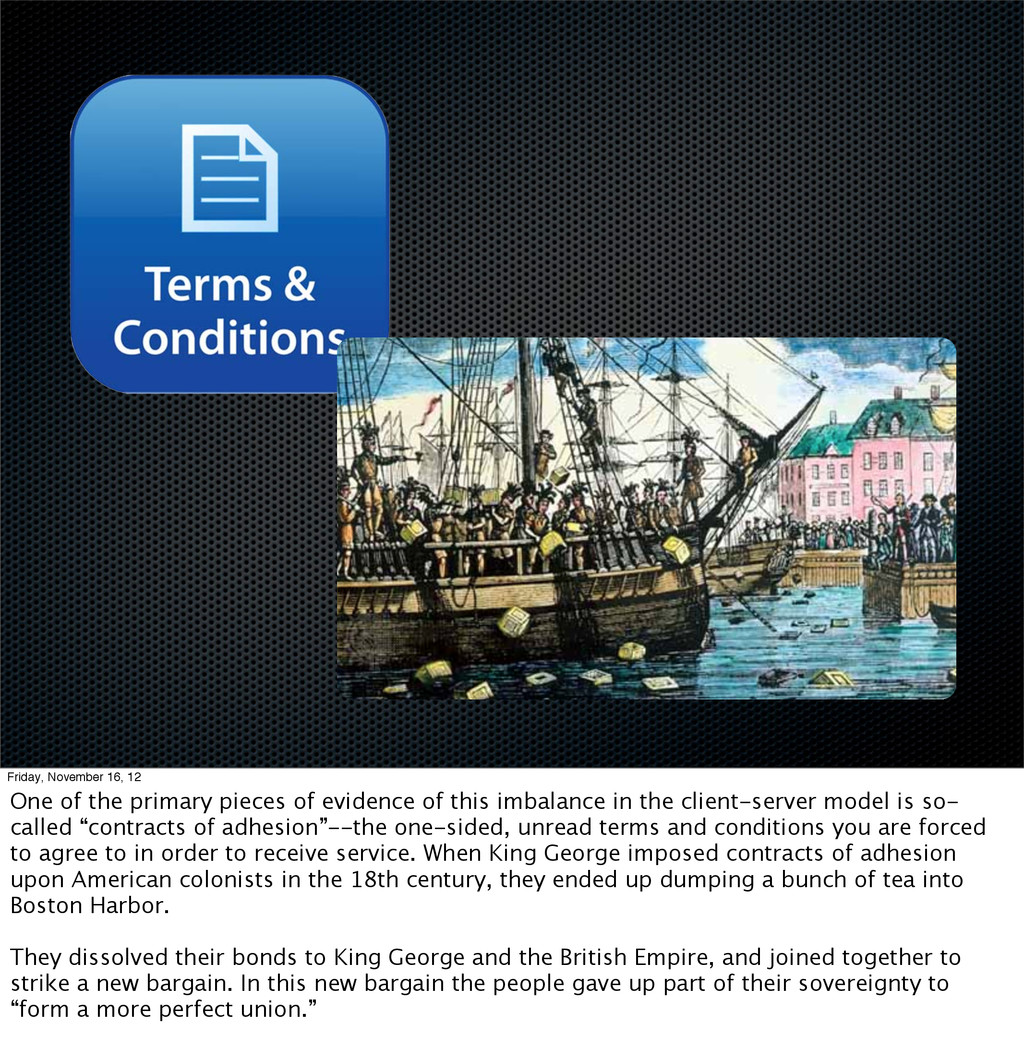
  12. Friday, November 16, 12 One of the primary pieces of

    evidence of this imbalance in the client-server model is so- called “contracts of adhesion”--the one-sided, unread terms and conditions you are forced to agree to in order to receive service. When King George imposed contracts of adhesion upon American colonists in the 18th century, they ended up dumping a bunch of tea into Boston Harbor. They dissolved their bonds to King George and the British Empire, and joined together to strike a new bargain. In this new bargain the people gave up part of their sovereignty to “form a more perfect union.”
  13. Friday, November 16, 12 One of the primary pieces of

    evidence of this imbalance in the client-server model is so- called “contracts of adhesion”--the one-sided, unread terms and conditions you are forced to agree to in order to receive service. When King George imposed contracts of adhesion upon American colonists in the 18th century, they ended up dumping a bunch of tea into Boston Harbor. They dissolved their bonds to King George and the British Empire, and joined together to strike a new bargain. In this new bargain the people gave up part of their sovereignty to “form a more perfect union.”
  14. picture of calfs in pens with logos on it. Friday,

    November 16, 12 On the Web, we yield too much of our sovereignty. Companies attempt to “capture” us and our wallets. We are at the mercy of the services they provide.
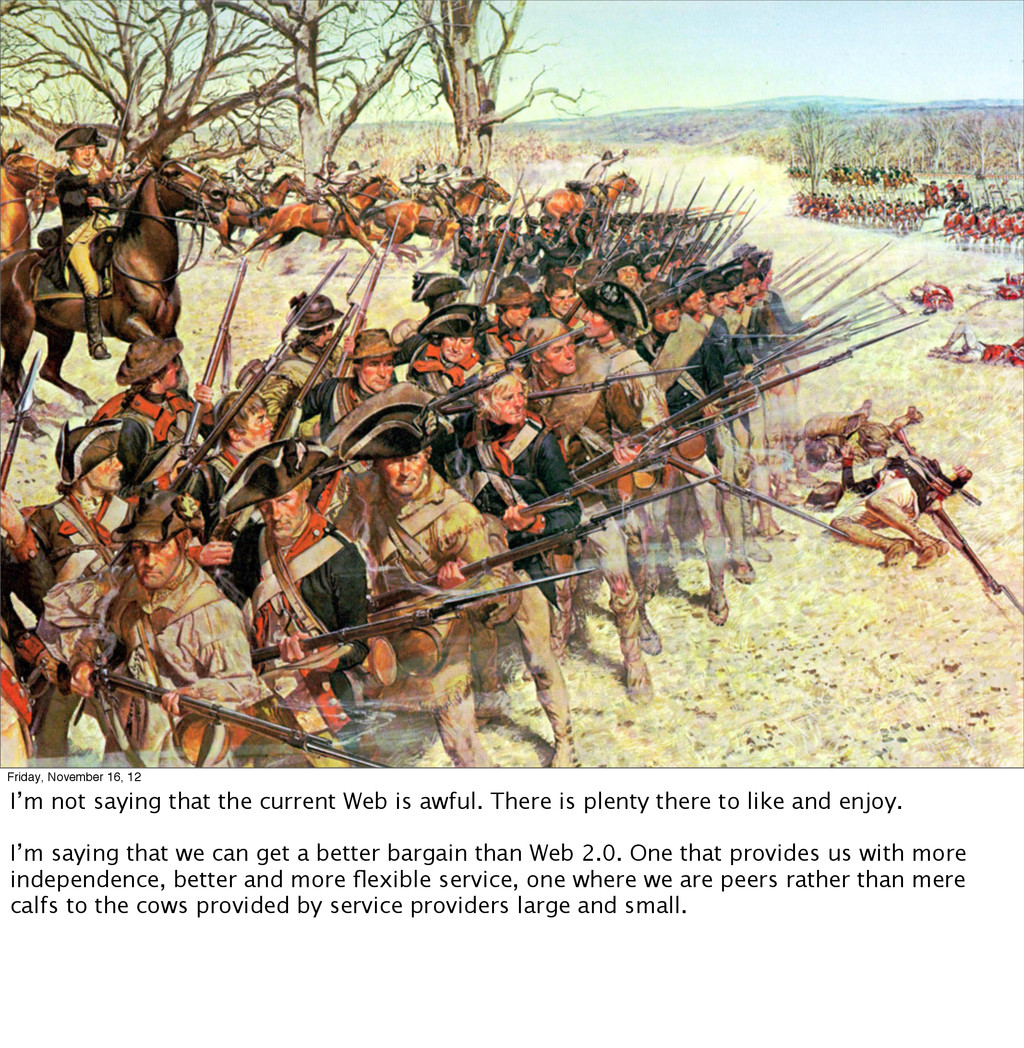
  15. Picture of revolutionary war Friday, November 16, 12 I’m not

    saying that the current Web is awful. There is plenty there to like and enjoy. I’m saying that we can get a better bargain than Web 2.0. One that provides us with more independence, better and more flexible service, one where we are peers rather than mere calfs to the cows provided by service providers large and small.
  16. picture of cloud Friday, November 16, 12 But, to be

    peers, we must have our own “servers” in the cloud. Not Web servers, but personal servers--personal clouds. These personal clouds must be easy to run and configure and provide flexible applications to meet the diverse needs of everyone.
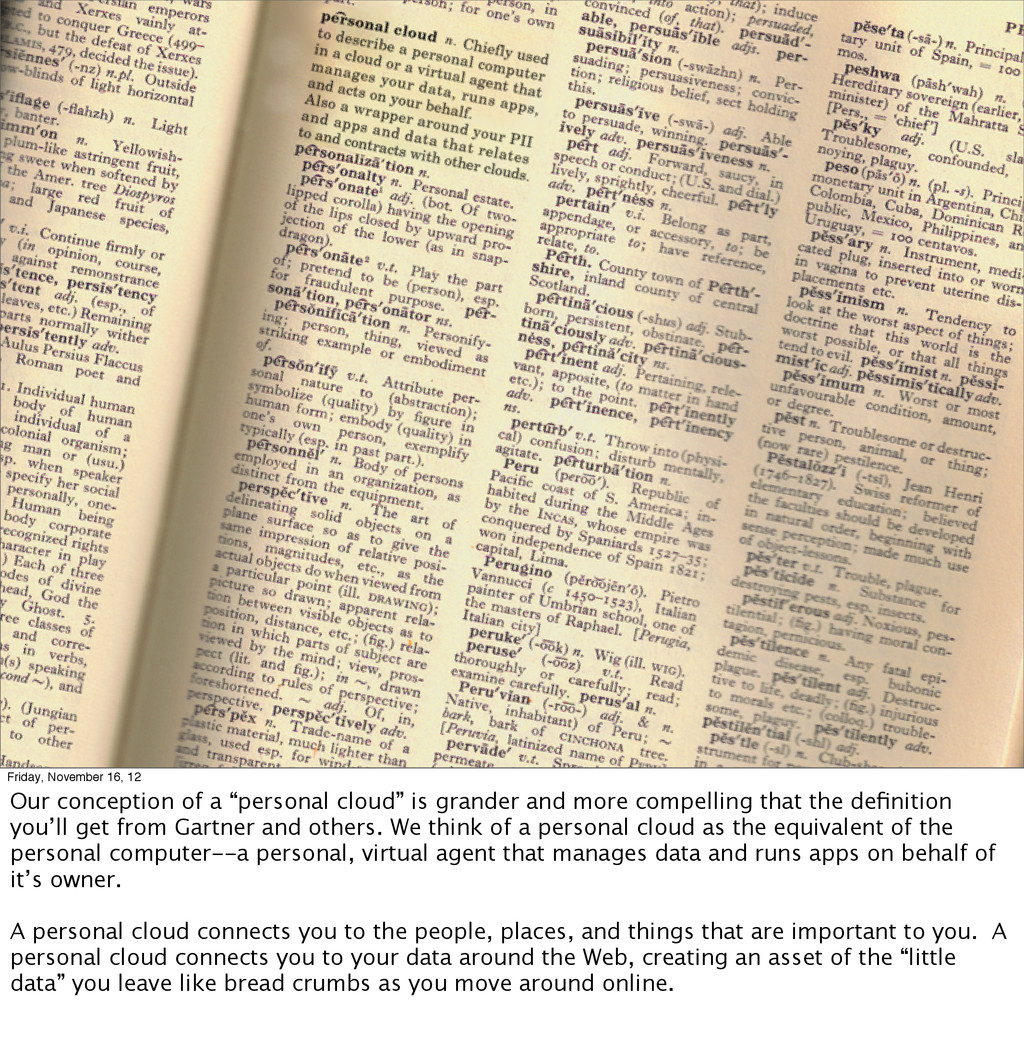
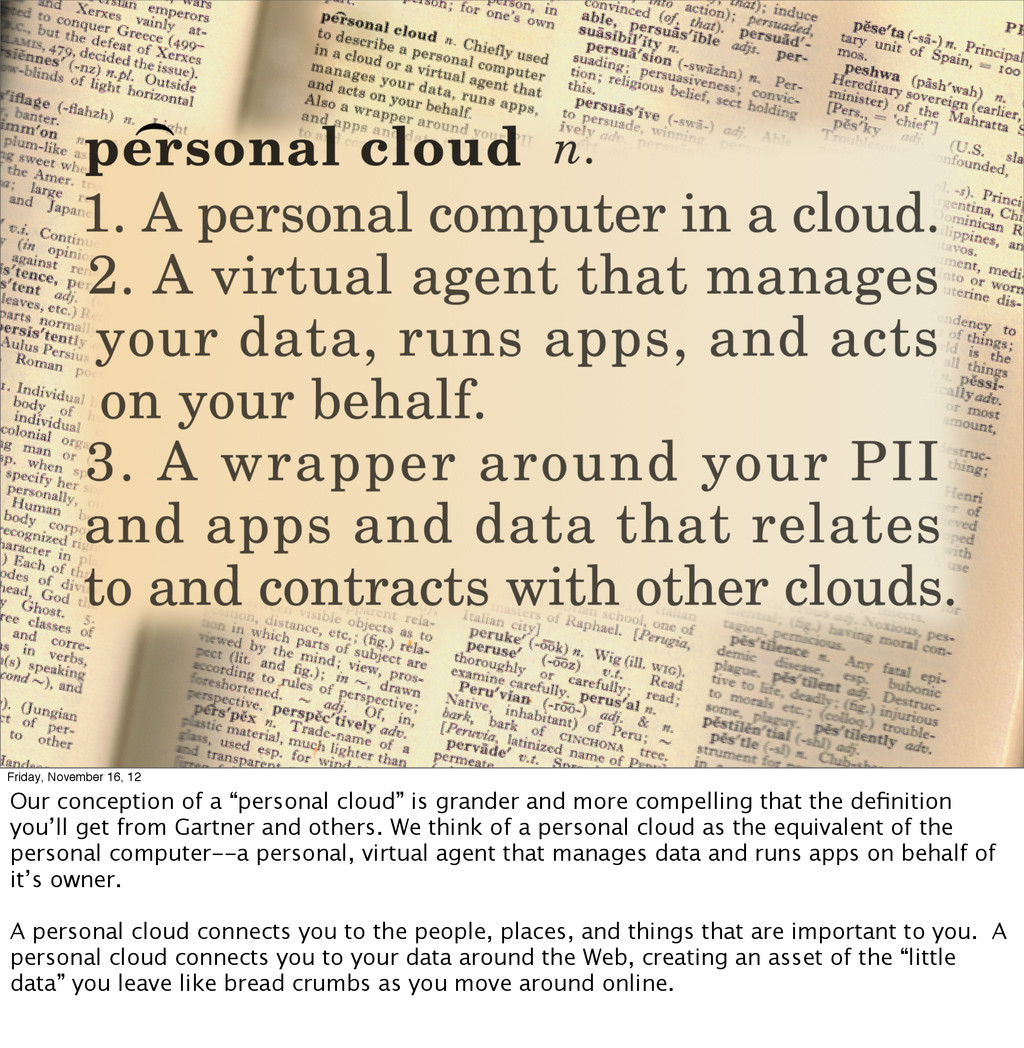
  17. Friday, November 16, 12 Our conception of a “personal cloud”

    is grander and more compelling that the definition you’ll get from Gartner and others. We think of a personal cloud as the equivalent of the personal computer--a personal, virtual agent that manages data and runs apps on behalf of it’s owner. A personal cloud connects you to the people, places, and things that are important to you. A personal cloud connects you to your data around the Web, creating an asset of the “little data” you leave like bread crumbs as you move around online.
  18. Friday, November 16, 12 Our conception of a “personal cloud”

    is grander and more compelling that the definition you’ll get from Gartner and others. We think of a personal cloud as the equivalent of the personal computer--a personal, virtual agent that manages data and runs apps on behalf of it’s owner. A personal cloud connects you to the people, places, and things that are important to you. A personal cloud connects you to your data around the Web, creating an asset of the “little data” you leave like bread crumbs as you move around online.
  19. Friday, November 16, 12 I’d like to show you a

    short video that introduces some of the concepts we’ve developed around personal clouds.
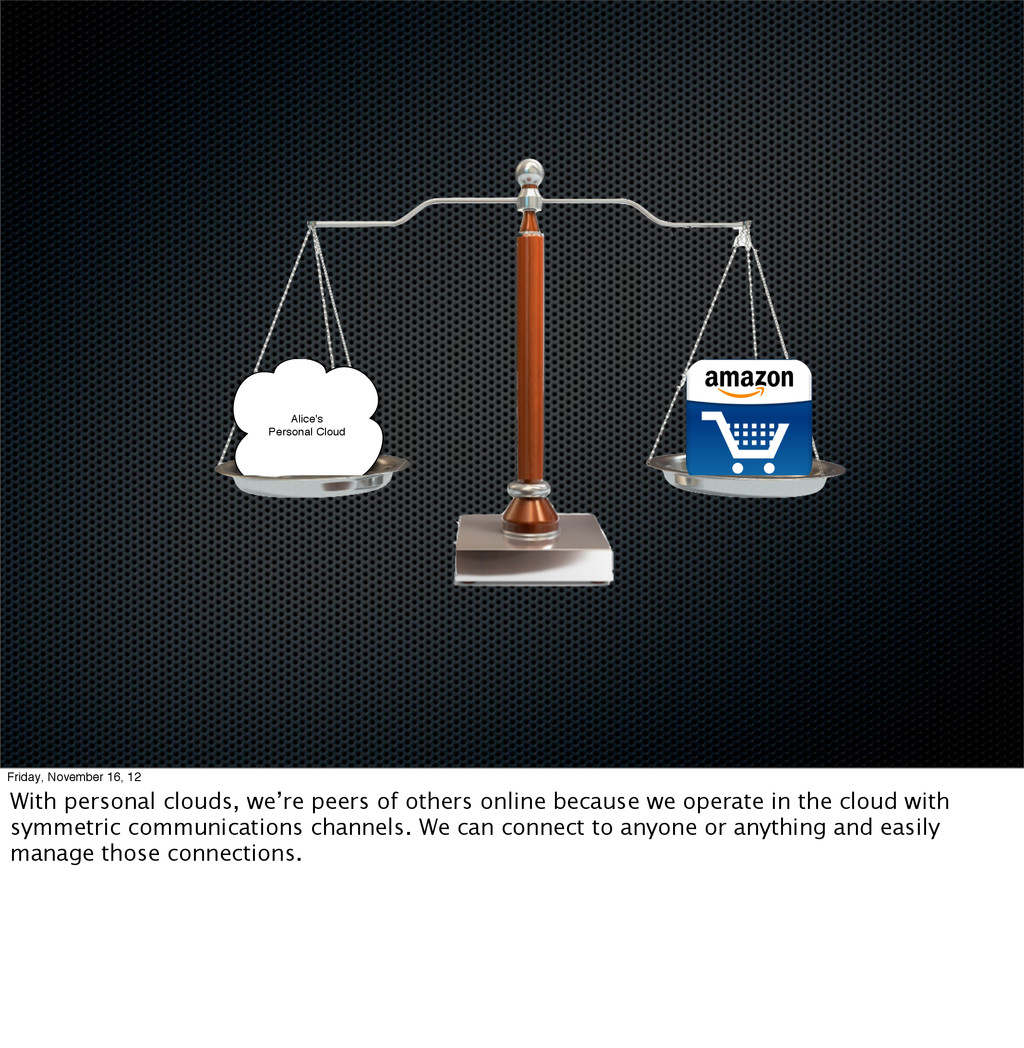
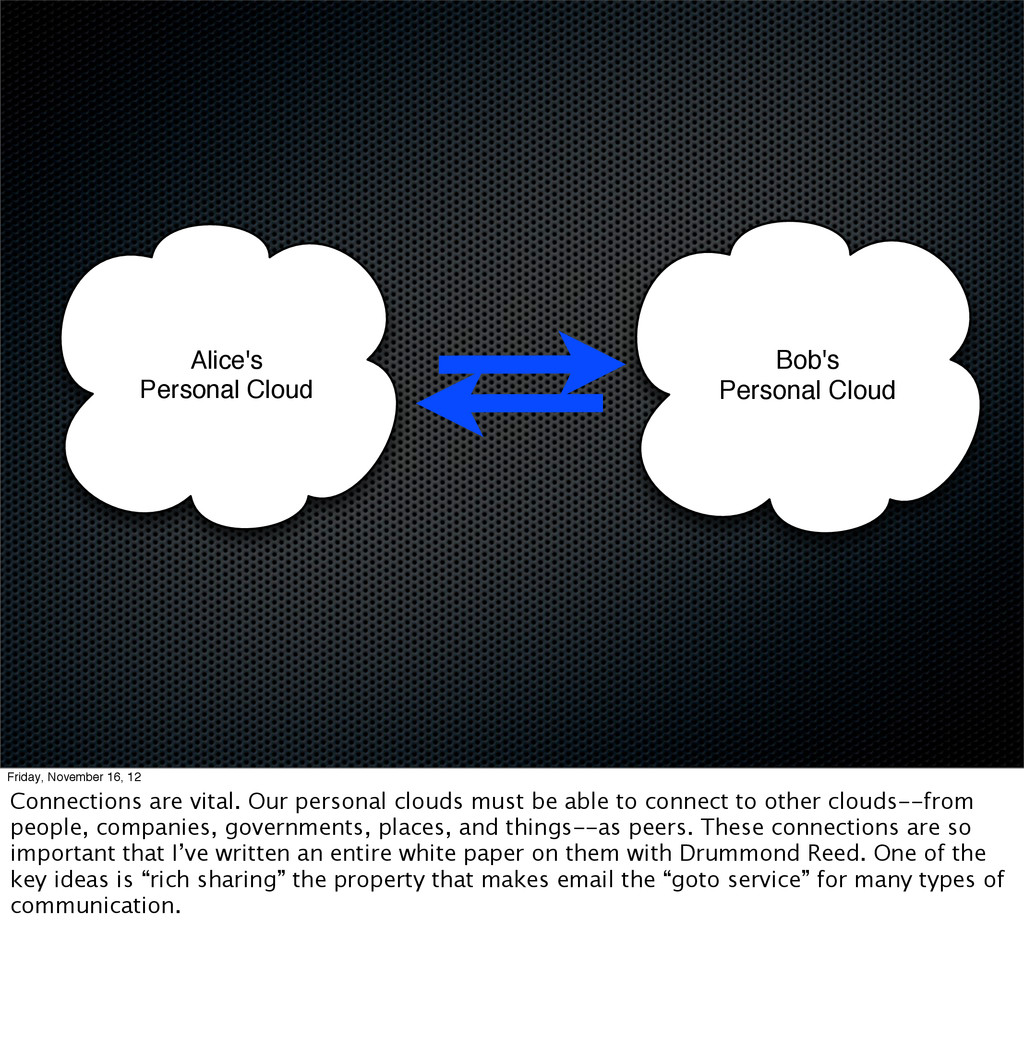
  20. Alice's Personal Cloud Friday, November 16, 12 With personal clouds,

    we’re peers of others online because we operate in the cloud with symmetric communications channels. We can connect to anyone or anything and easily manage those connections.
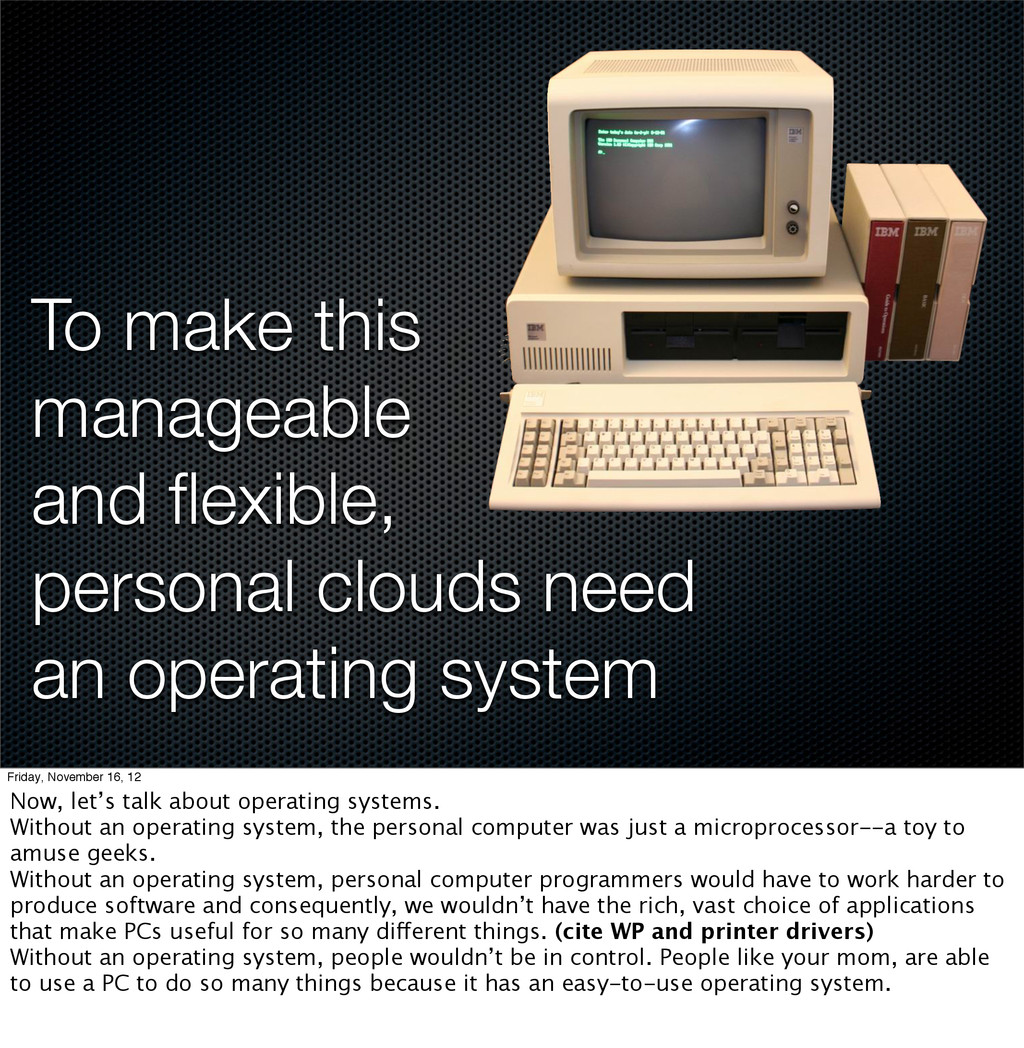
  21. To make this manageable and flexible, personal clouds need an

    operating system Friday, November 16, 12 Now, let’s talk about operating systems. Without an operating system, the personal computer was just a microprocessor--a toy to amuse geeks. Without an operating system, personal computer programmers would have to work harder to produce software and consequently, we wouldn’t have the rich, vast choice of applications that make PCs useful for so many different things. (cite WP and printer drivers) Without an operating system, people wouldn’t be in control. People like your mom, are able to use a PC to do so many things because it has an easy-to-use operating system.
  22. Operating Systems Collection of services: Friday, November 16, 12 An

    operating system provides important services. (explain) Not the same set of services because a personal cloud isn’t aimed at the same set of problems as a personal computer.
  23. Operating Systems Identity management Collection of services: Friday, November 16,

    12 An operating system provides important services. (explain) Not the same set of services because a personal cloud isn’t aimed at the same set of problems as a personal computer.
  24. Operating Systems Identity management Data management Collection of services: Friday,

    November 16, 12 An operating system provides important services. (explain) Not the same set of services because a personal cloud isn’t aimed at the same set of problems as a personal computer.
  25. Operating Systems Identity management Data management Programming model Collection of

    services: Friday, November 16, 12 An operating system provides important services. (explain) Not the same set of services because a personal cloud isn’t aimed at the same set of problems as a personal computer.
  26. Operating Systems Identity management Data management Programming model Connections Collection

    of services: Friday, November 16, 12 An operating system provides important services. (explain) Not the same set of services because a personal cloud isn’t aimed at the same set of problems as a personal computer.
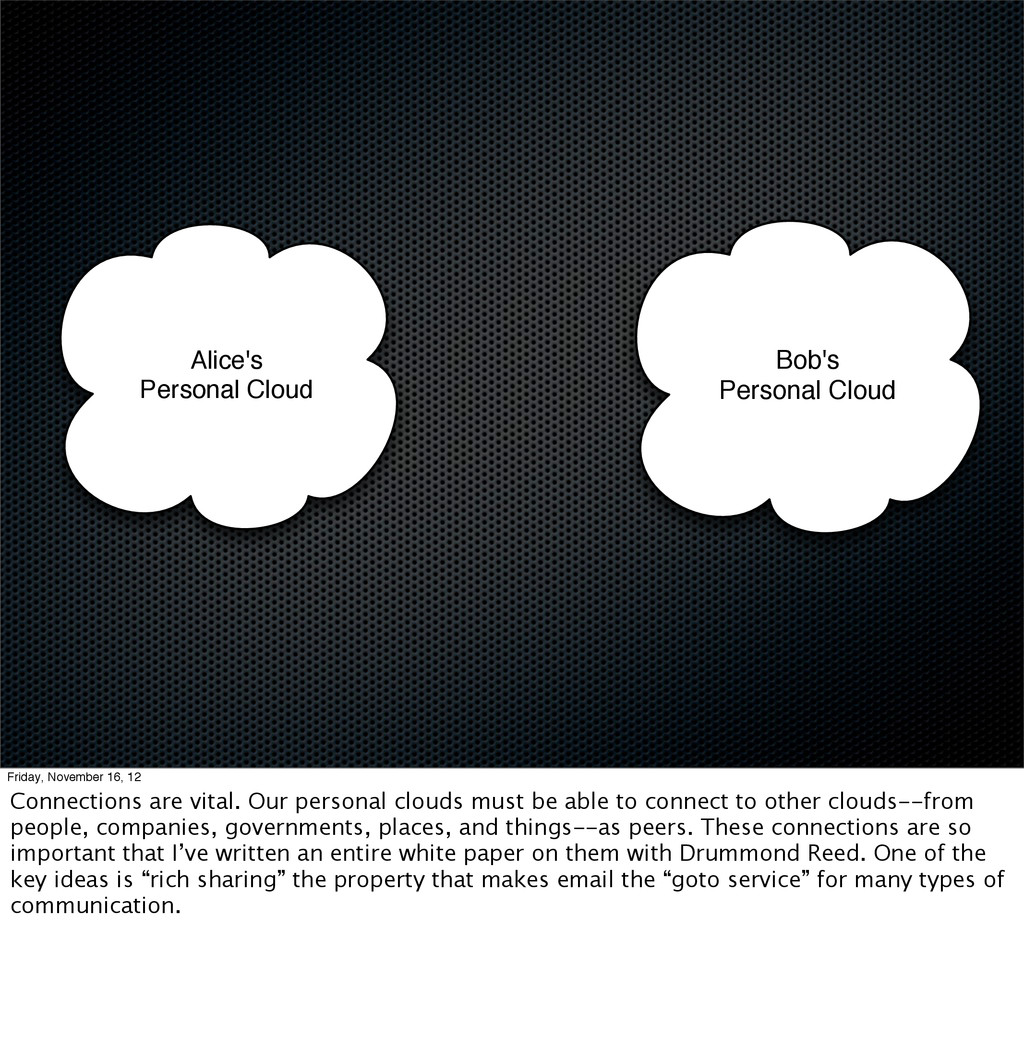
  27. Alice's Personal Cloud Bob's Personal Cloud Friday, November 16, 12

    Connections are vital. Our personal clouds must be able to connect to other clouds--from people, companies, governments, places, and things--as peers. These connections are so important that I’ve written an entire white paper on them with Drummond Reed. One of the key ideas is “rich sharing” the property that makes email the “goto service” for many types of communication.
  28. Alice's Personal Cloud Bob's Personal Cloud Friday, November 16, 12

    Connections are vital. Our personal clouds must be able to connect to other clouds--from people, companies, governments, places, and things--as peers. These connections are so important that I’ve written an entire white paper on them with Drummond Reed. One of the key ideas is “rich sharing” the property that makes email the “goto service” for many types of communication.
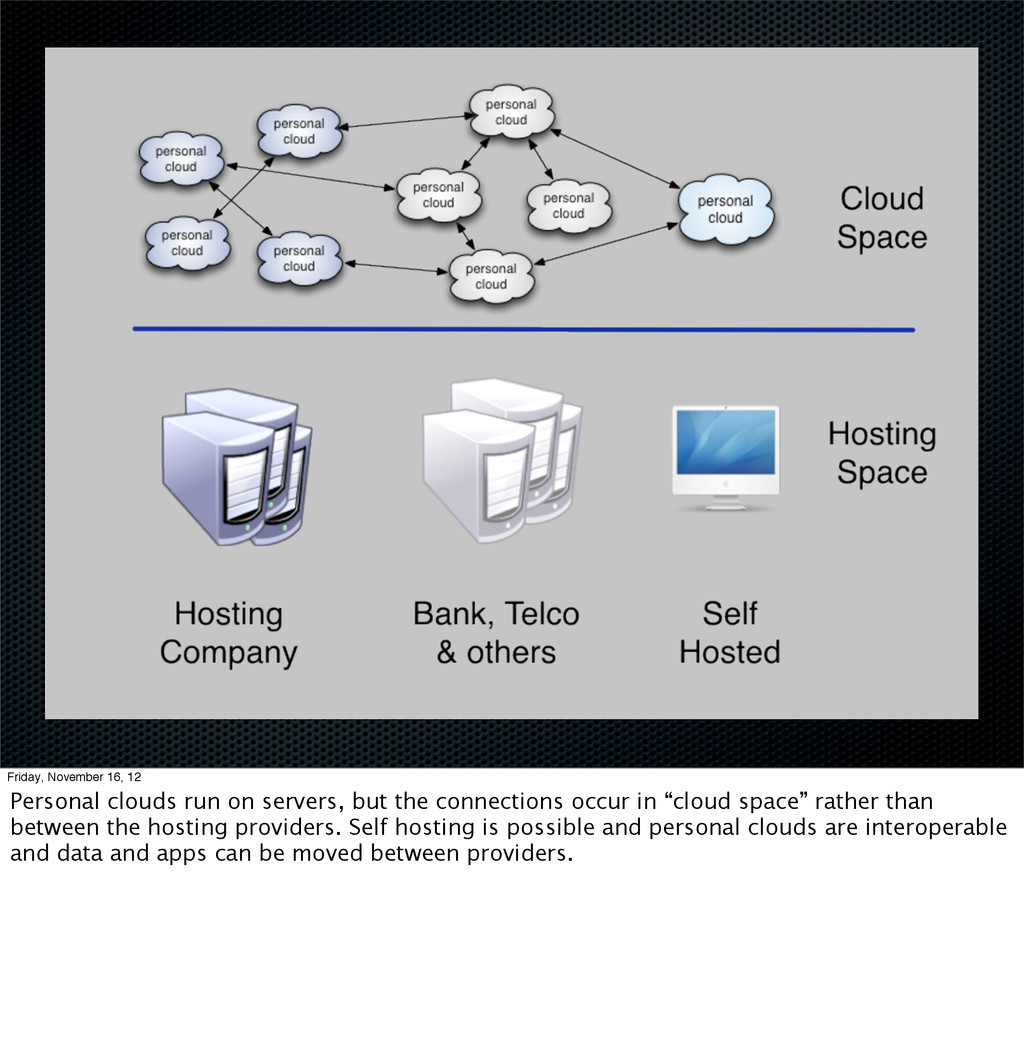
  29. Friday, November 16, 12 Personal clouds run on servers, but

    the connections occur in “cloud space” rather than between the hosting providers. Self hosting is possible and personal clouds are interoperable and data and apps can be moved between providers.
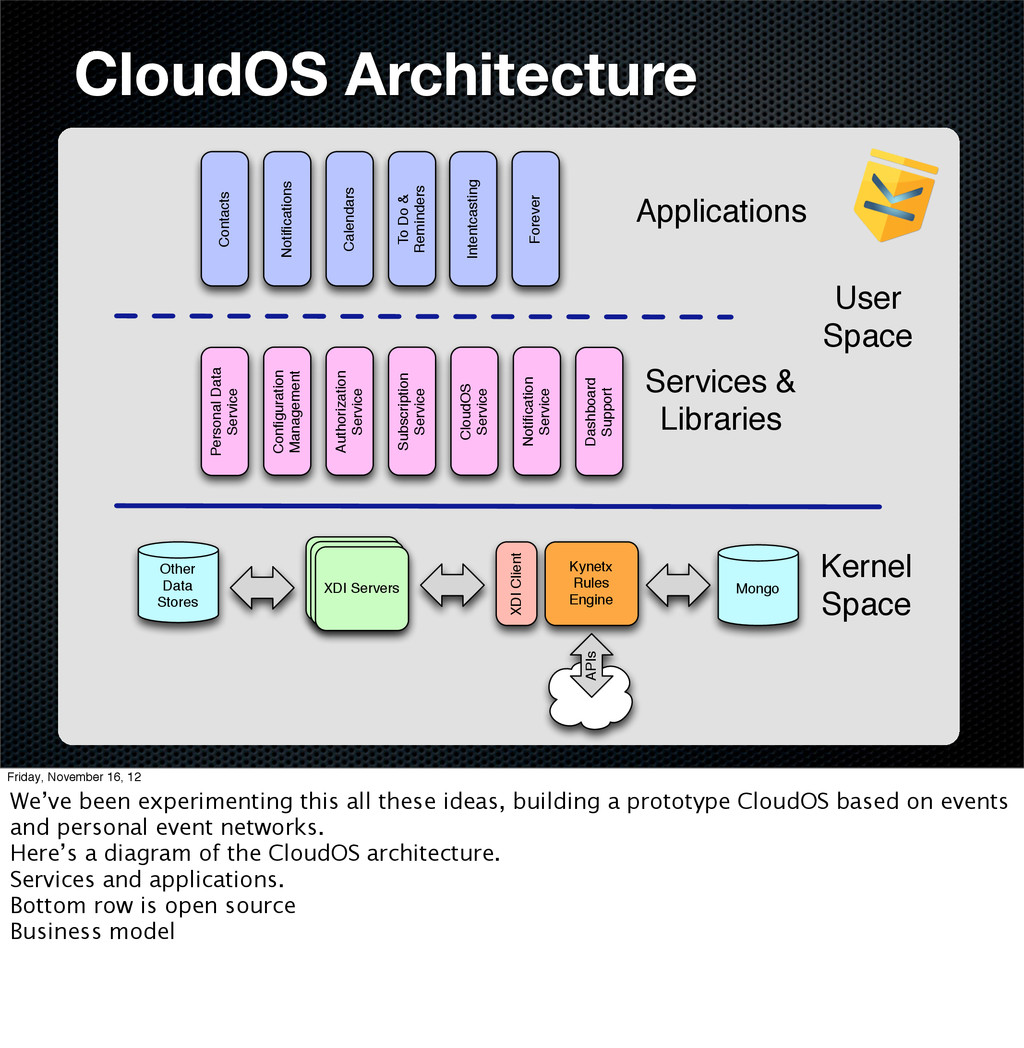
  30. CloudOS Architecture Kynetx Rules Engine Mongo XDI Client XDI Servers

    XDI Servers XDI Servers Kernel Space Configuration Management Authorization Service Subscription Service CloudOS Service Services & Libraries User Space Notification Service Contacts Notifications To Do & Reminders Calendars Applications Personal Data Service Dashboard Support Other Data Stores APIs Intentcasting Forever Friday, November 16, 12 We’ve been experimenting this all these ideas, building a prototype CloudOS based on events and personal event networks. Here’s a diagram of the CloudOS architecture. Services and applications. Bottom row is open source Business model
  31. ] Friday, November 16, 12 The CloudOS dashboard is where

    people interact with and control their personal cloud. The current dashboard is simple with a space for interacting with applications and a place for widgets. The top menubar allows owners to interact with their applications, find new applications, manage their personal inventory of things (each of which has it’s own cloud) and connect with people. I’m happy to give demos either here or in a Webex. Contact me.
  32. Friday, November 16, 12 I’d like to show you a

    video that will give you a feel for how people might interact with a personal cloud dashboard. This short video shows an intentcasting scenario we developed with Swift to show how personal clouds and a concept that Swift calls the Digital Asset Grid can enable new forms of commerce. All of the apps in the video are real and run on top of the personal cloud.
  33. Because it allows you to act as a peer, a

    CloudOS... Friday, November 16, 12
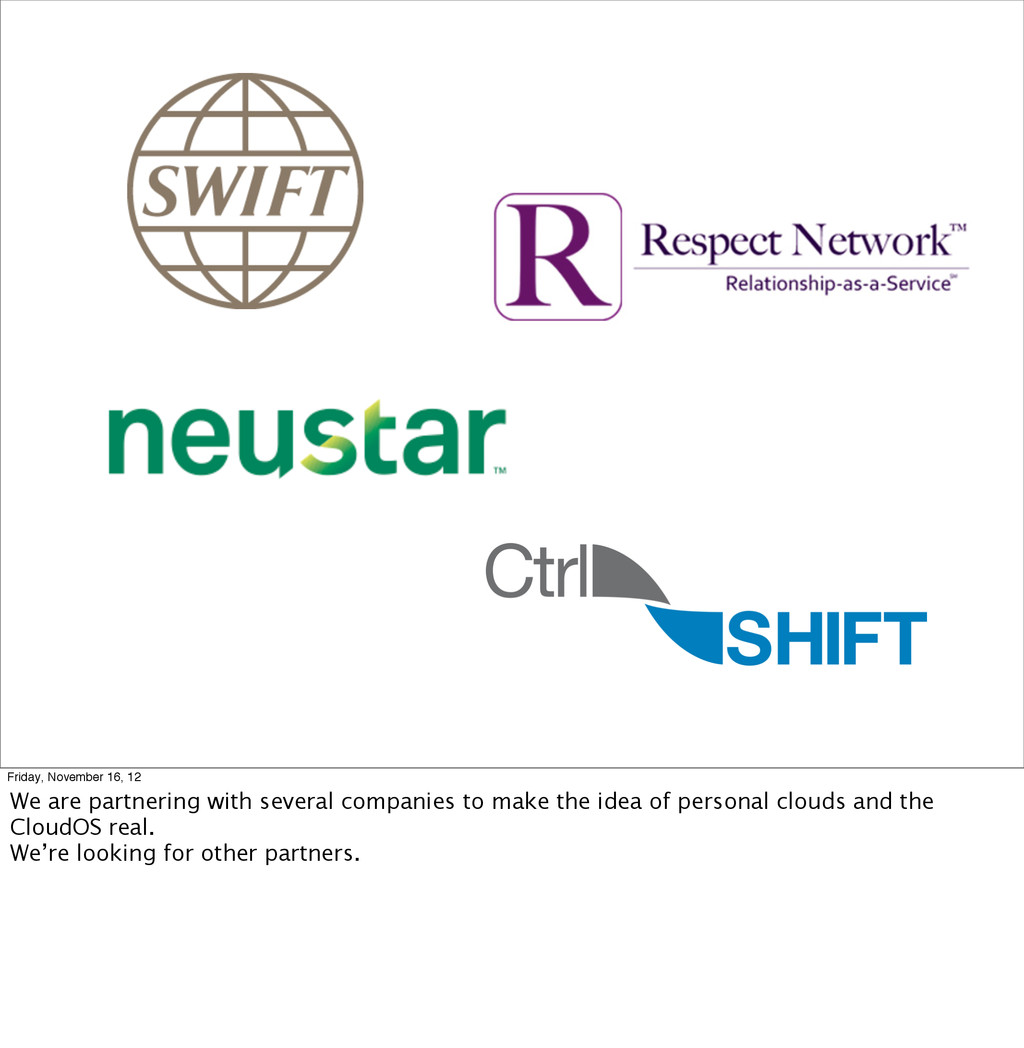
  34. Friday, November 16, 12 We are partnering with several companies

    to make the idea of personal clouds and the CloudOS real. We’re looking for other partners.
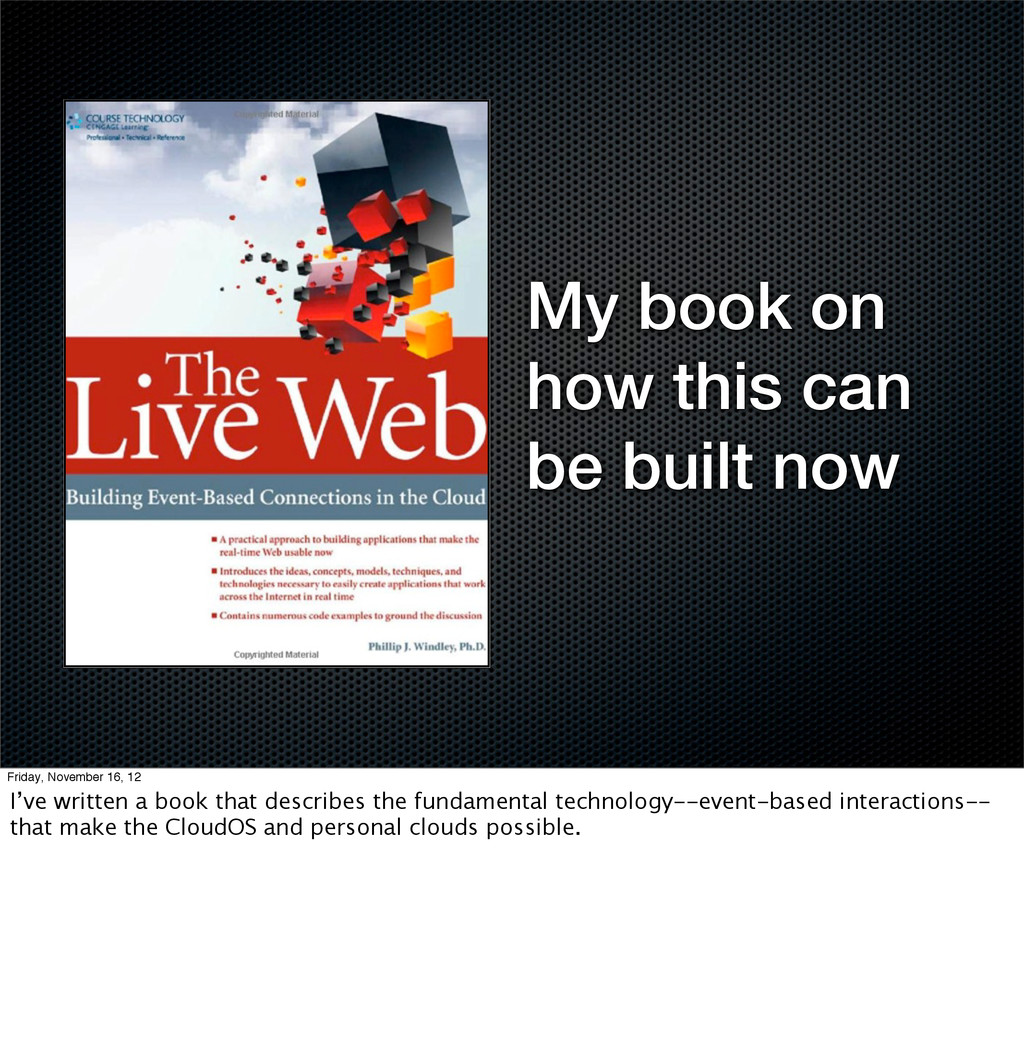
  35. My book on how this can be built now Friday,

    November 16, 12 I’ve written a book that describes the fundamental technology--event-based interactions-- that make the CloudOS and personal clouds possible.
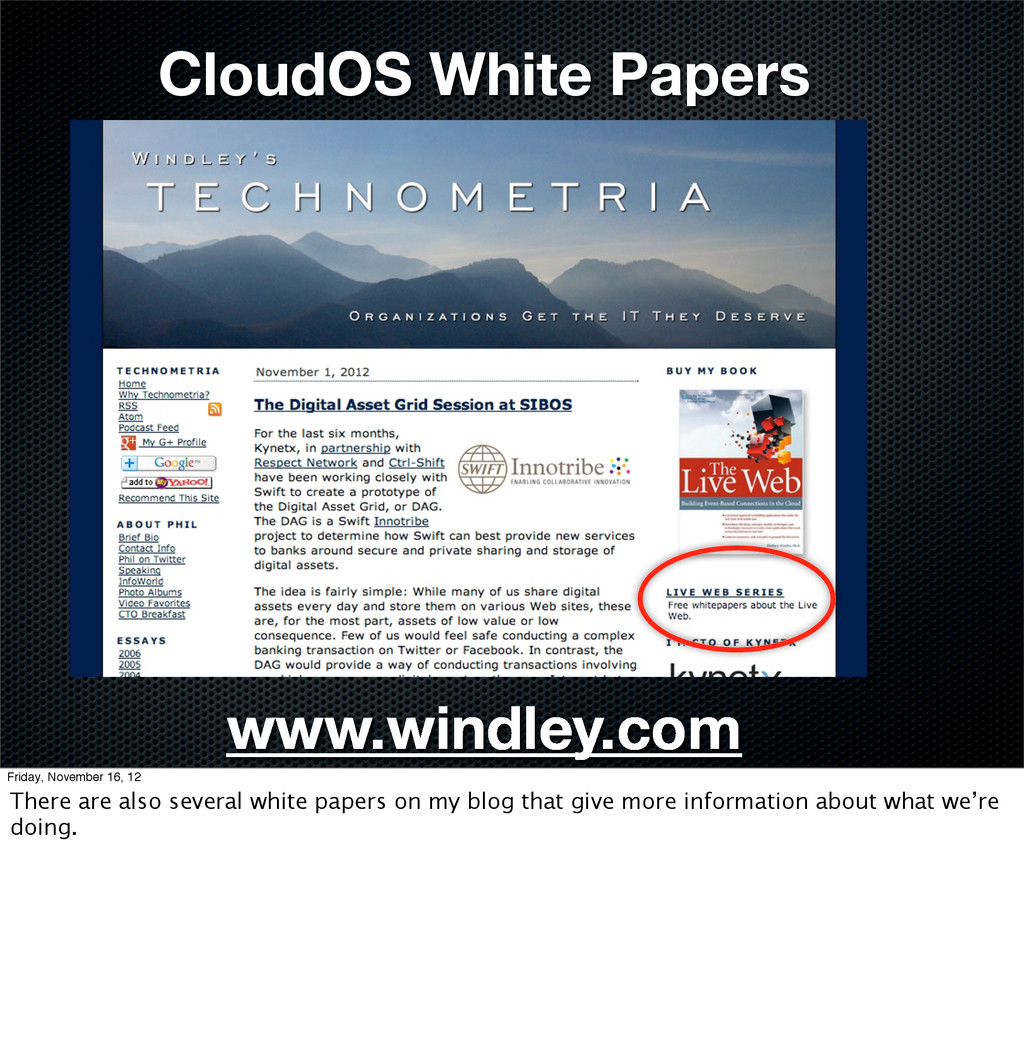
  36. CloudOS White Papers www.windley.com Friday, November 16, 12 There are

    also several white papers on my blog that give more information about what we’re doing.
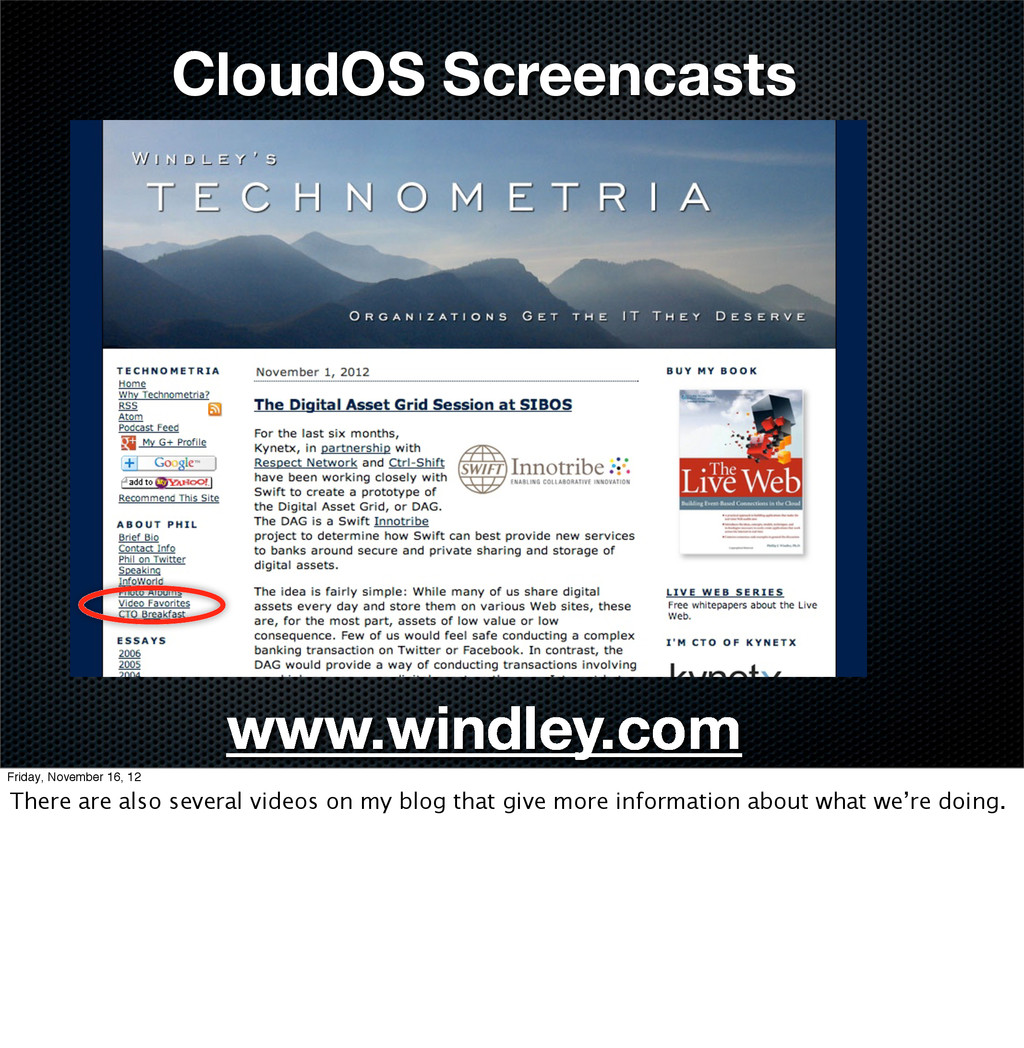
  37. CloudOS Screencasts www.windley.com Friday, November 16, 12 There are also

    several videos on my blog that give more information about what we’re doing.
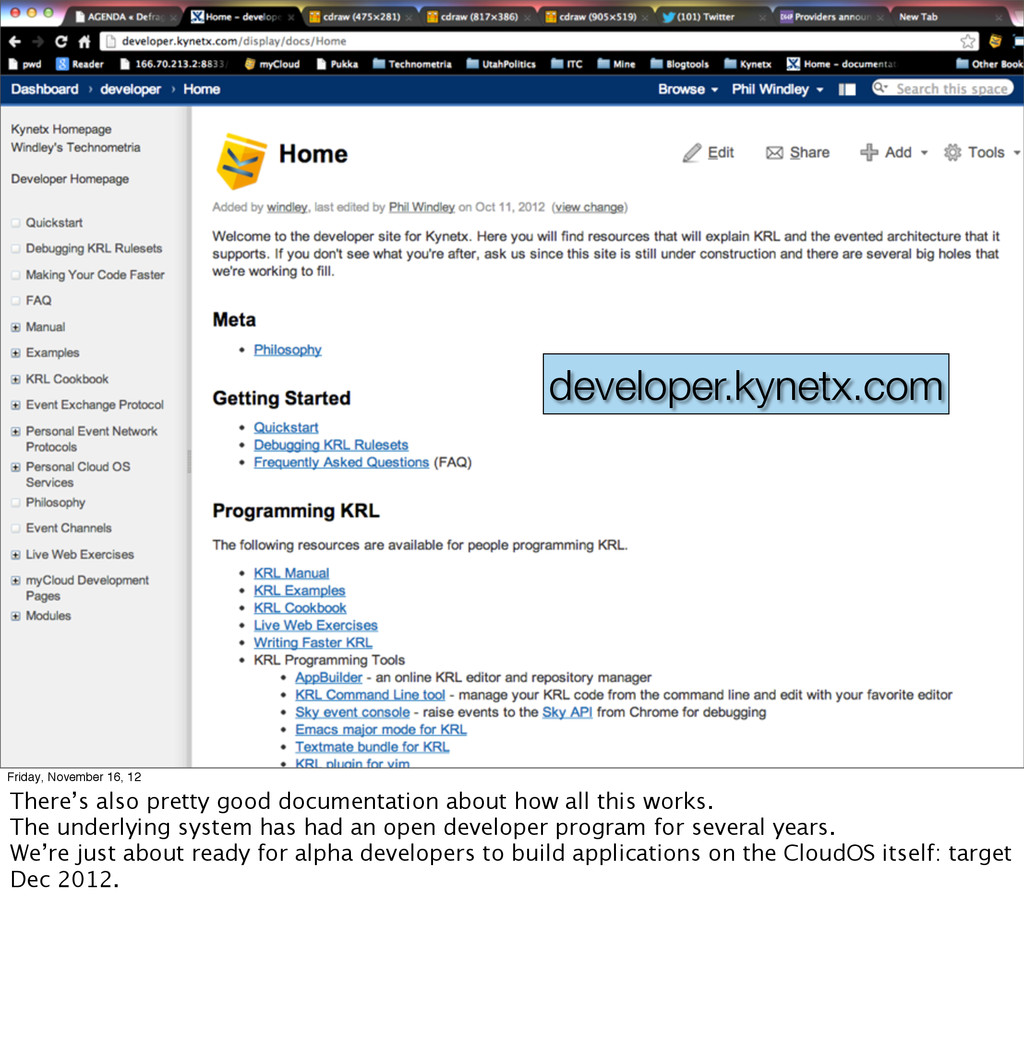
  38. docs developer.kynetx.com Friday, November 16, 12 There’s also pretty good

    documentation about how all this works. The underlying system has had an open developer program for several years. We’re just about ready for alpha developers to build applications on the CloudOS itself: target Dec 2012.
  39. Contact info: Phil Windley [email protected] www.windley.com @windley Personal Clouds Need

    an Operating System Friday, November 16, 12 Contact me if you’d like to be invited to the alpha developer program for the CloudOS or if you’d like a demonstration of personal clouds.