Upgrade to Pro — share decks privately, control downloads, hide ads and more …

OpenAgenet / OAN: Open Governance Infrastructur...

OpenAgenet / OAN: Open Governance Infrastructure for Trusted Agent Interconnection

OpenAgenet (OAN) is open infrastructure for trusted agent interconnection. It provides a governance-aware trust layer for registering, publishing, discovering, and verifying agent-facing resources such as Agent Services, Skills, MCP Servers, and Tool APIs.

This slide deck introduces the motivation, architecture, trust model, did:oan identity method, service-node roles, trusted discovery flow, and ecosystem positioning of OAN. It explains how OAN connects governance, identity, publication, distribution, and discovery into a coherent infrastructure layer for the emerging Agent Internet.

The deck is intended for researchers, infrastructure builders, protocol designers, developers, and potential ecosystem collaborators who want to understand how OAN can support trustworthy, scalable, and interoperable multi-agent

Avatar for @wolfbrother

@wolfbrother

July 05, 2026

More Decks by @wolfbrother

Other Decks in Technology

Transcript

  1. OpenAgenet/OAN Open Governance Infrastructure for Trusted Agent Interconnection Identity, Governance,

    Registration, Distribution, and Trusted Discovery OAN slogan: OAN helps the Agent Internet move from jungle rules to rule-based trust. Jinliang Xu China Academy of Information and Communications Technology (CAICT)
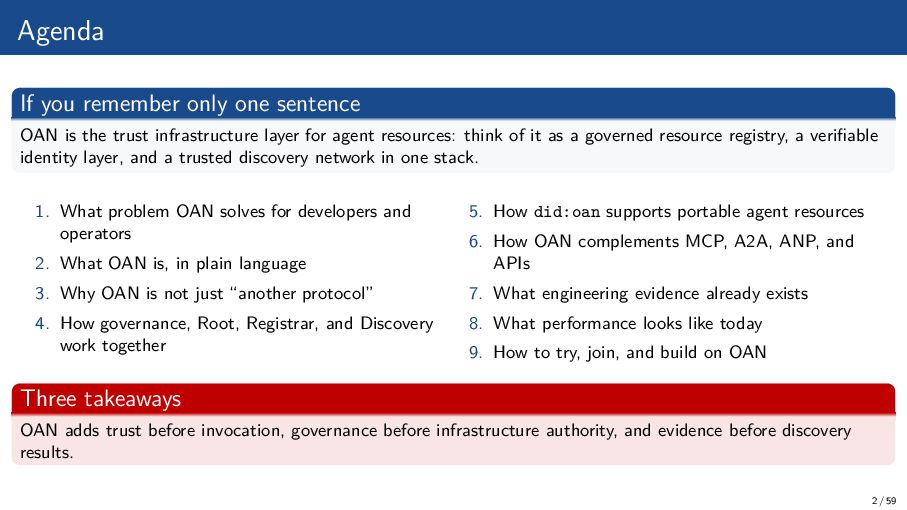
  2. Agenda If you remember only one sentence OAN is the

    trust infrastructure layer for agent resources: think of it as a governed resource registry, a verifiable identity layer, and a trusted discovery network in one stack. 1. What problem OAN solves for developers and operators 2. What OAN is, in plain language 3. Why OAN is not just “another protocol” 4. How governance, Root, Registrar, and Discovery work together 5. How did:oan supports portable agent resources 6. How OAN complements MCP, A2A, ANP, and APIs 7. What engineering evidence already exists 8. What performance looks like today 9. How to try, join, and build on OAN Three takeaways OAN adds trust before invocation, governance before infrastructure authority, and evidence before discovery results. 2 / 59
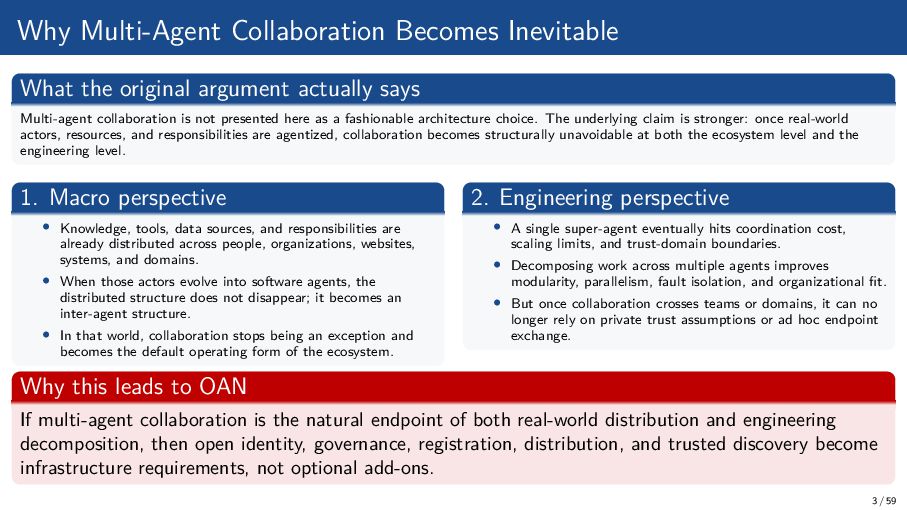
  3. Why Multi-Agent Collaboration Becomes Inevitable What the original argument actually

    says Multi-agent collaboration is not presented here as a fashionable architecture choice. The underlying claim is stronger: once real-world actors, resources, and responsibilities are agentized, collaboration becomes structurally unavoidable at both the ecosystem level and the engineering level. 1. Macro perspective • Knowledge, tools, data sources, and responsibilities are already distributed across people, organizations, websites, systems, and domains. • When those actors evolve into software agents, the distributed structure does not disappear; it becomes an inter-agent structure. • In that world, collaboration stops being an exception and becomes the default operating form of the ecosystem. 2. Engineering perspective • A single super-agent eventually hits coordination cost, scaling limits, and trust-domain boundaries. • Decomposing work across multiple agents improves modularity, parallelism, fault isolation, and organizational fit. • But once collaboration crosses teams or domains, it can no longer rely on private trust assumptions or ad hoc endpoint exchange. Why this leads to OAN If multi-agent collaboration is the natural endpoint of both real-world distribution and engineering decomposition, then open identity, governance, registration, distribution, and trusted discovery become infrastructure requirements, not optional add-ons. 3 / 59
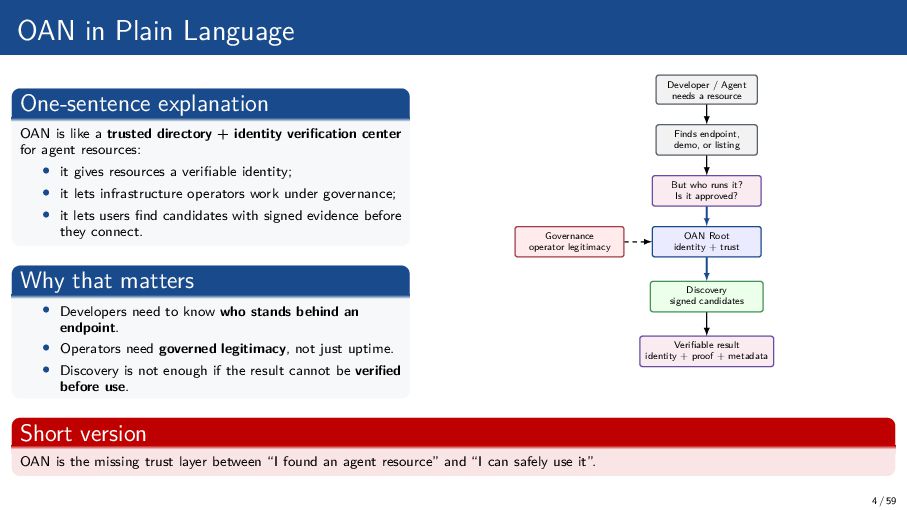
  4. OAN in Plain Language One-sentence explanation OAN is like a

    trusted directory + identity verification center for agent resources: • it gives resources a verifiable identity; • it lets infrastructure operators work under governance; • it lets users find candidates with signed evidence before they connect. Why that matters • Developers need to know who stands behind an endpoint. • Operators need governed legitimacy, not just uptime. • Discovery is not enough if the result cannot be verified before use. Developer / Agent needs a resource Finds endpoint, demo, or listing But who runs it? Is it approved? OAN Root identity + trust Governance operator legitimacy Discovery signed candidates Verifiable result identity + proof + metadata Short version OAN is the missing trust layer between “I found an agent resource” and “I can safely use it”. 4 / 59
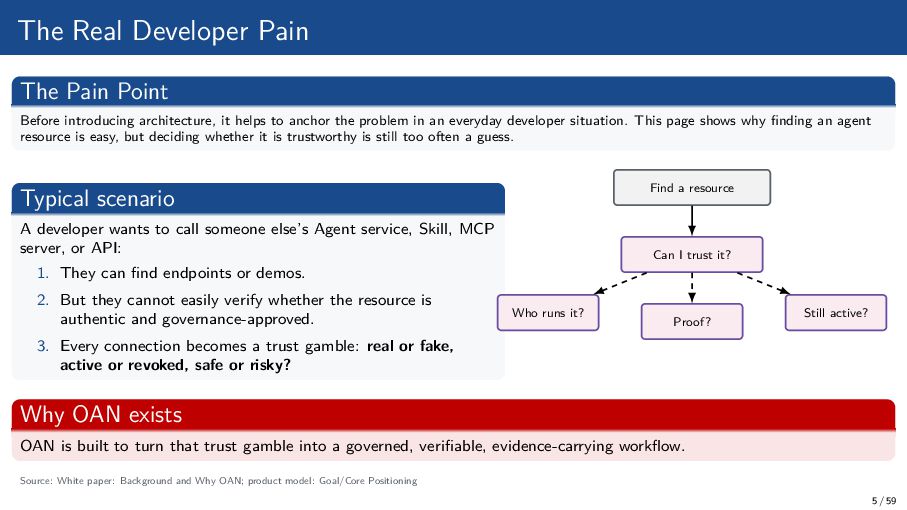
  5. The Real Developer Pain The Pain Point Before introducing architecture,

    it helps to anchor the problem in an everyday developer situation. This page shows why finding an agent resource is easy, but deciding whether it is trustworthy is still too often a guess. Typical scenario A developer wants to call someone else’s Agent service, Skill, MCP server, or API: 1. They can find endpoints or demos. 2. But they cannot easily verify whether the resource is authentic and governance-approved. 3. Every connection becomes a trust gamble: real or fake, active or revoked, safe or risky? Find a resource Can I trust it? Who runs it? Proof? Still active? Why OAN exists OAN is built to turn that trust gamble into a governed, verifiable, evidence-carrying workflow. Source: White paper: Background and Why OAN; product model: Goal/Core Positioning 5 / 59
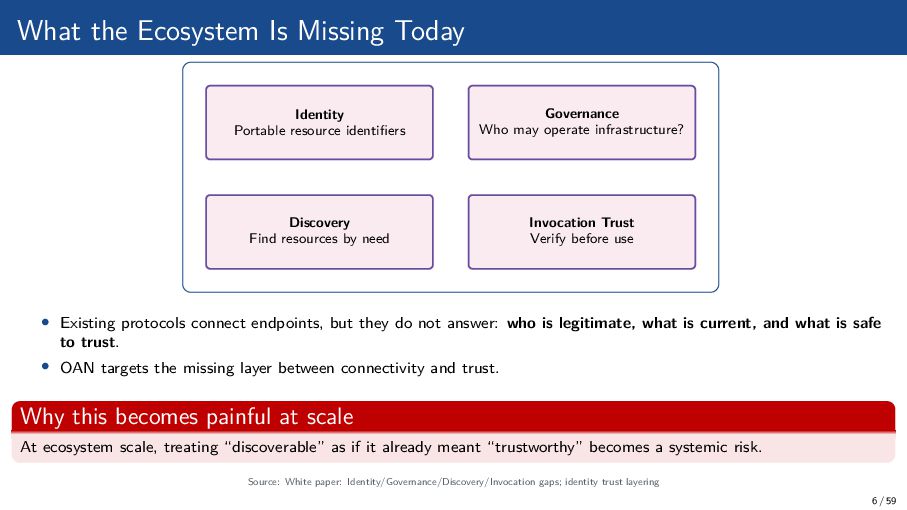
  6. What the Ecosystem Is Missing Today Identity Portable resource identifiers

    Governance Who may operate infrastructure? Discovery Find resources by need Invocation Trust Verify before use • Existing protocols connect endpoints, but they do not answer: who is legitimate, what is current, and what is safe to trust. • OAN targets the missing layer between connectivity and trust. Why this becomes painful at scale At ecosystem scale, treating “discoverable” as if it already meant “trustworthy” becomes a systemic risk. Source: White paper: Identity/Governance/Discovery/Invocation gaps; identity trust layering 6 / 59
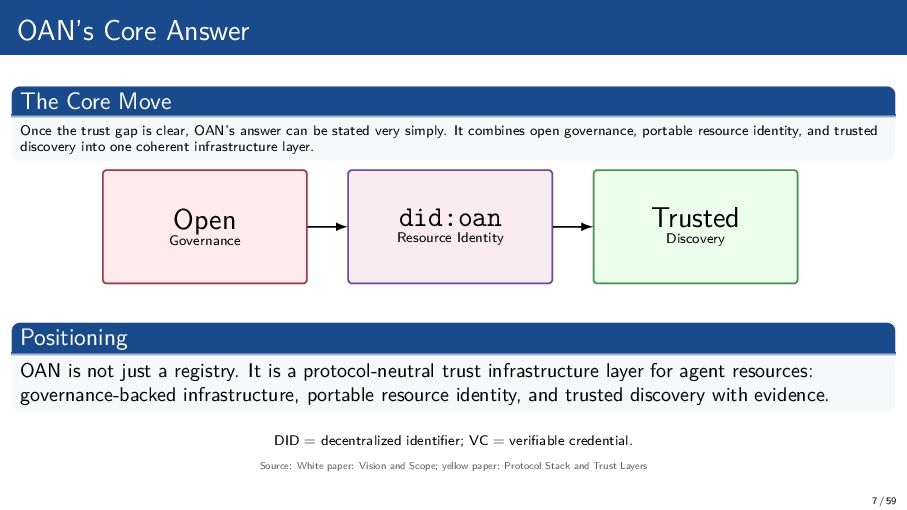
  7. OAN’s Core Answer The Core Move Once the trust gap

    is clear, OAN’s answer can be stated very simply. It combines open governance, portable resource identity, and trusted discovery into one coherent infrastructure layer. Open Governance did:oan Resource Identity Trusted Discovery Positioning OAN is not just a registry. It is a protocol-neutral trust infrastructure layer for agent resources: governance-backed infrastructure, portable resource identity, and trusted discovery with evidence. DID = decentralized identifier; VC = verifiable credential. Source: White paper: Vision and Scope; yellow paper: Protocol Stack and Trust Layers 7 / 59
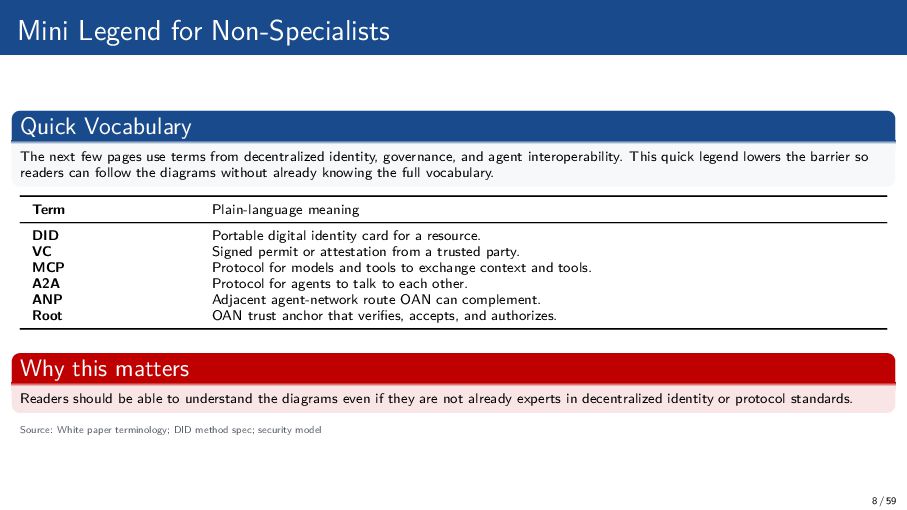
  8. Mini Legend for Non-Specialists Quick Vocabulary The next few pages

    use terms from decentralized identity, governance, and agent interoperability. This quick legend lowers the barrier so readers can follow the diagrams without already knowing the full vocabulary. Term Plain-language meaning DID Portable digital identity card for a resource. VC Signed permit or attestation from a trusted party. MCP Protocol for models and tools to exchange context and tools. A2A Protocol for agents to talk to each other. ANP Adjacent agent-network route OAN can complement. Root OAN trust anchor that verifies, accepts, and authorizes. Why this matters Readers should be able to understand the diagrams even if they are not already experts in decentralized identity or protocol standards. Source: White paper terminology; DID method spec; security model 8 / 59
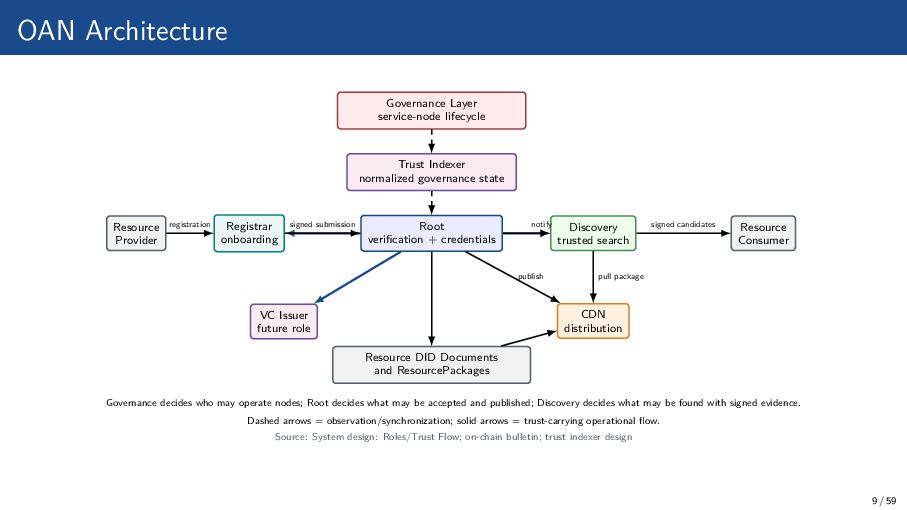
  9. OAN Architecture Governance Layer service-node lifecycle Trust Indexer normalized governance

    state Root verification + credentials Registrar onboarding Discovery trusted search CDN distribution VC Issuer future role Resource Provider Resource Consumer Resource DID Documents and ResourcePackages registration signed submission notify publish pull package signed candidates Governance decides who may operate nodes; Root decides what may be accepted and published; Discovery decides what may be found with signed evidence. Dashed arrows = observation/synchronization; solid arrows = trust-carrying operational flow. Source: System design: Roles/Trust Flow; on-chain bulletin; trust indexer design 9 / 59
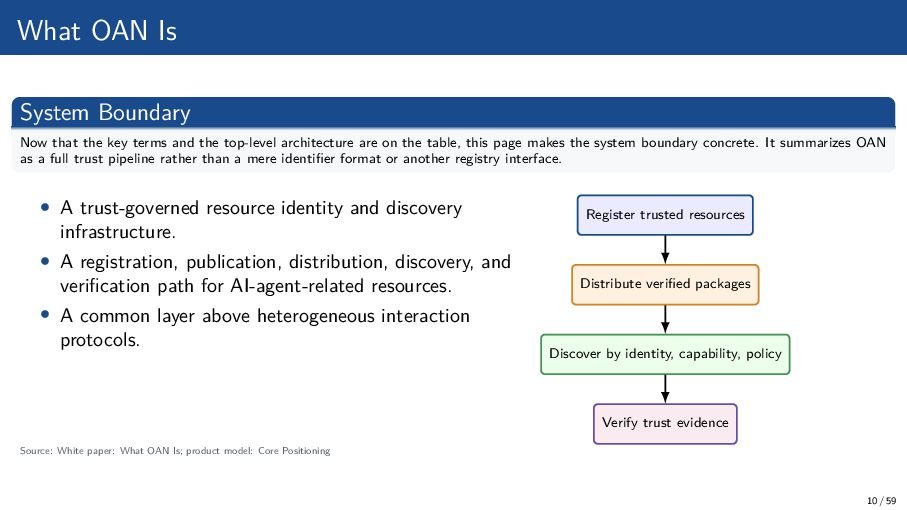
  10. What OAN Is System Boundary Now that the key terms

    and the top-level architecture are on the table, this page makes the system boundary concrete. It summarizes OAN as a full trust pipeline rather than a mere identifier format or another registry interface. • A trust-governed resource identity and discovery infrastructure. • A registration, publication, distribution, discovery, and verification path for AI-agent-related resources. • A common layer above heterogeneous interaction protocols. Register trusted resources Distribute verified packages Discover by identity, capability, policy Verify trust evidence Source: White paper: What OAN Is; product model: Core Positioning 10 / 59
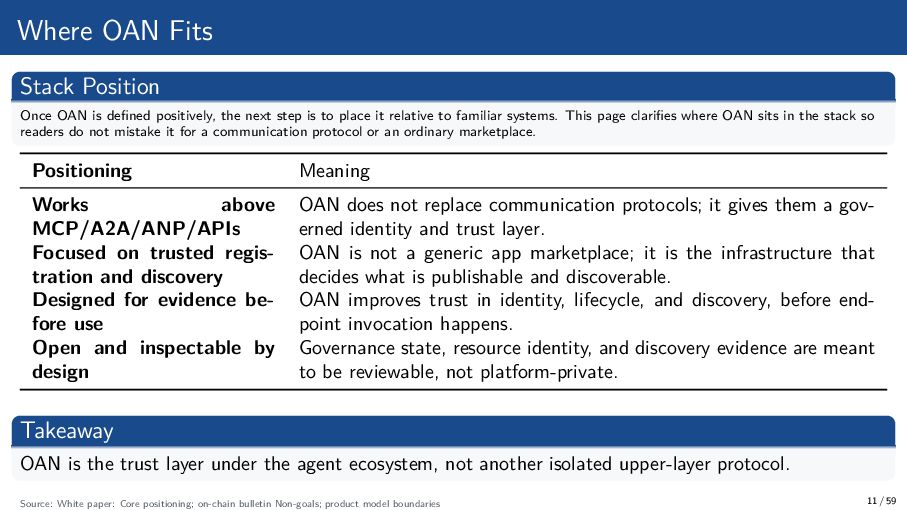
  11. Where OAN Fits Stack Position Once OAN is defined positively,

    the next step is to place it relative to familiar systems. This page clarifies where OAN sits in the stack so readers do not mistake it for a communication protocol or an ordinary marketplace. Positioning Meaning Works above MCP/A2A/ANP/APIs OAN does not replace communication protocols; it gives them a gov- erned identity and trust layer. Focused on trusted regis- tration and discovery OAN is not a generic app marketplace; it is the infrastructure that decides what is publishable and discoverable. Designed for evidence be- fore use OAN improves trust in identity, lifecycle, and discovery, before end- point invocation happens. Open and inspectable by design Governance state, resource identity, and discovery evidence are meant to be reviewable, not platform-private. Takeaway OAN is the trust layer under the agent ecosystem, not another isolated upper-layer protocol. Source: White paper: Core positioning; on-chain bulletin Non-goals; product model boundaries 11 / 59
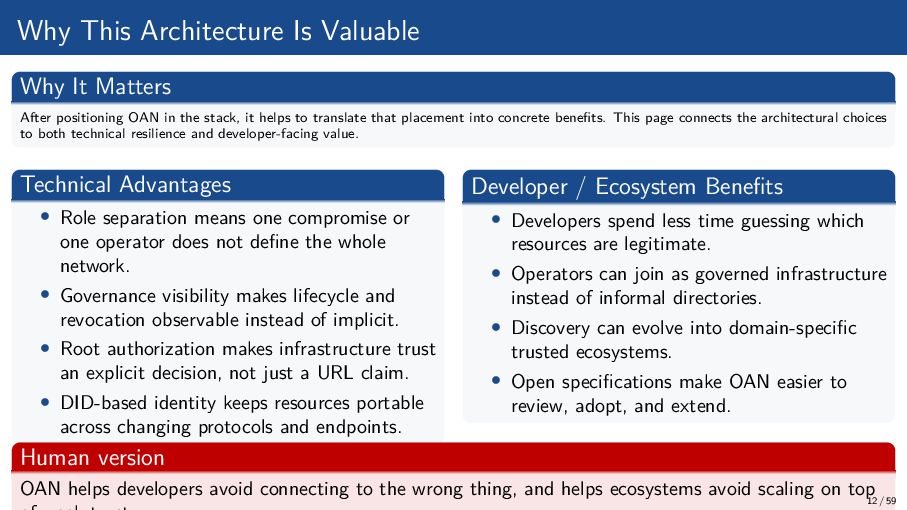
  12. Why This Architecture Is Valuable Why It Matters After positioning

    OAN in the stack, it helps to translate that placement into concrete benefits. This page connects the architectural choices to both technical resilience and developer-facing value. Technical Advantages • Role separation means one compromise or one operator does not define the whole network. • Governance visibility makes lifecycle and revocation observable instead of implicit. • Root authorization makes infrastructure trust an explicit decision, not just a URL claim. • DID-based identity keeps resources portable across changing protocols and endpoints. Developer / Ecosystem Benefits • Developers spend less time guessing which resources are legitimate. • Operators can join as governed infrastructure instead of informal directories. • Discovery can evolve into domain-specific trusted ecosystems. • Open specifications make OAN easier to review, adopt, and extend. Human version OAN helps developers avoid connecting to the wrong thing, and helps ecosystems avoid scaling on top 12 / 59
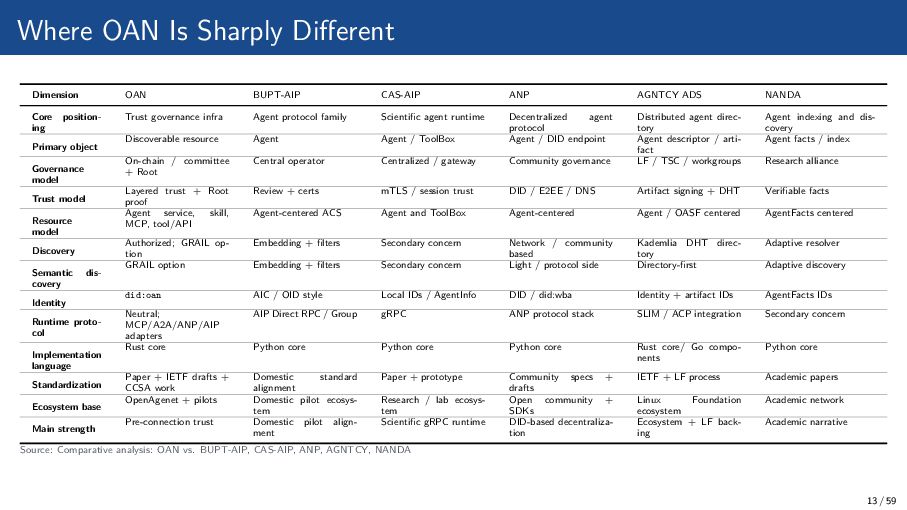
  13. Where OAN Is Sharply Different Dimension OAN BUPT-AIP CAS-AIP ANP

    AGNTCY ADS NANDA Core position- ing Trust governance infra Agent protocol family Scientific agent runtime Decentralized agent protocol Distributed agent direc- tory Agent indexing and dis- covery Primary object Discoverable resource Agent Agent / ToolBox Agent / DID endpoint Agent descriptor / arti- fact Agent facts / index Governance model On-chain / committee + Root Central operator Centralized / gateway Community governance LF / TSC / workgroups Research alliance Trust model Layered trust + Root proof Review + certs mTLS / session trust DID / E2EE / DNS Artifact signing + DHT Verifiable facts Resource model Agent service, skill, MCP, tool/API Agent-centered ACS Agent and ToolBox Agent-centered Agent / OASF centered AgentFacts centered Discovery Authorized; GRAIL op- tion Embedding + filters Secondary concern Network / community based Kademlia DHT direc- tory Adaptive resolver Semantic dis- covery GRAIL option Embedding + filters Secondary concern Light / protocol side Directory-first Adaptive discovery Identity did:oan AIC / OID style Local IDs / AgentInfo DID / did:wba Identity + artifact IDs AgentFacts IDs Runtime proto- col Neutral; MCP/A2A/ANP/AIP adapters AIP Direct RPC / Group gRPC ANP protocol stack SLIM / ACP integration Secondary concern Implementation language Rust core Python core Python core Python core Rust core/ Go compo- nents Python core Standardization Paper + IETF drafts + CCSA work Domestic standard alignment Paper + prototype Community specs + drafts IETF + LF process Academic papers Ecosystem base OpenAgenet + pilots Domestic pilot ecosys- tem Research / lab ecosys- tem Open community + SDKs Linux Foundation ecosystem Academic network Main strength Pre-connection trust Domestic pilot align- ment Scientific gRPC runtime DID-based decentraliza- tion Ecosystem + LF back- ing Academic narrative Source: Comparative analysis: OAN vs. BUPT-AIP, CAS-AIP, ANP, AGNTCY, NANDA 13 / 59
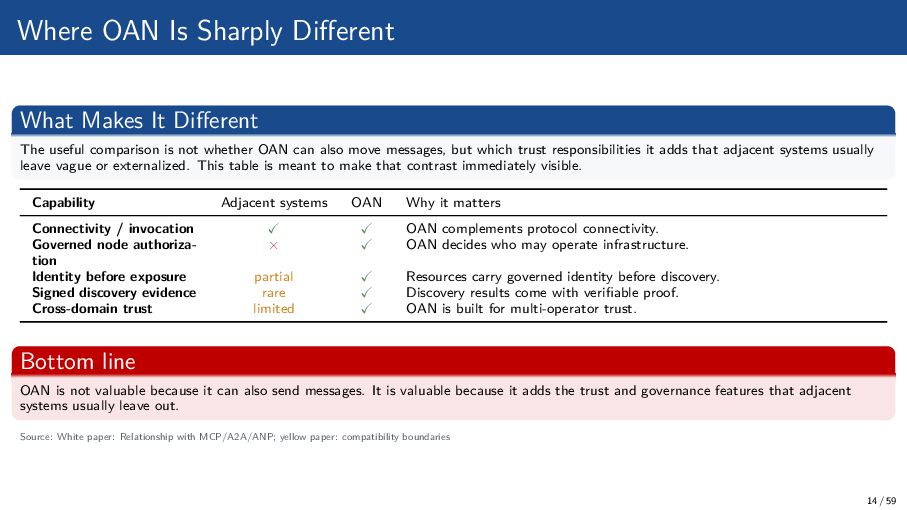
  14. Where OAN Is Sharply Different What Makes It Different The

    useful comparison is not whether OAN can also move messages, but which trust responsibilities it adds that adjacent systems usually leave vague or externalized. This table is meant to make that contrast immediately visible. Capability Adjacent systems OAN Why it matters Connectivity / invocation ✓ ✓ OAN complements protocol connectivity. Governed node authoriza- tion × ✓ OAN decides who may operate infrastructure. Identity before exposure partial ✓ Resources carry governed identity before discovery. Signed discovery evidence rare ✓ Discovery results come with verifiable proof. Cross-domain trust limited ✓ OAN is built for multi-operator trust. Bottom line OAN is not valuable because it can also send messages. It is valuable because it adds the trust and governance features that adjacent systems usually leave out. Source: White paper: Relationship with MCP/A2A/ANP; yellow paper: compatibility boundaries 14 / 59
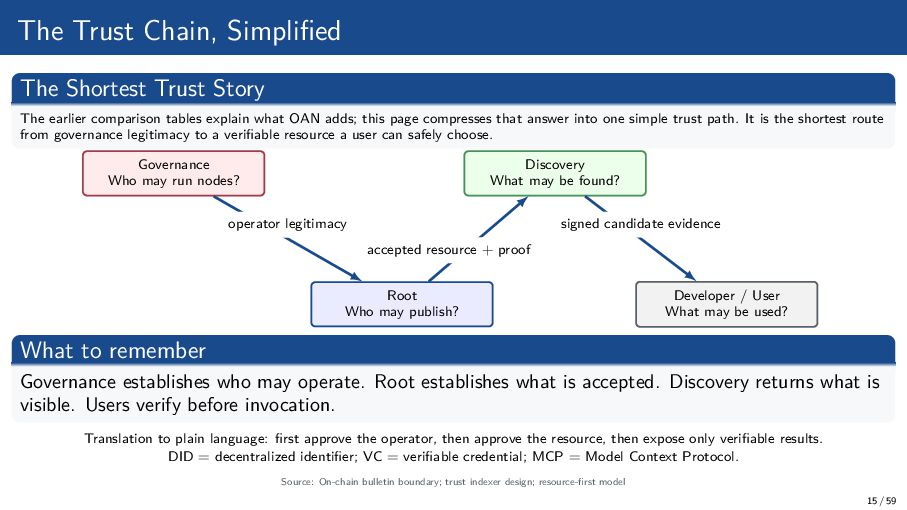
  15. The Trust Chain, Simplified The Shortest Trust Story The earlier

    comparison tables explain what OAN adds; this page compresses that answer into one simple trust path. It is the shortest route from governance legitimacy to a verifiable resource a user can safely choose. Governance Who may run nodes? Discovery What may be found? Root Who may publish? Developer / User What may be used? operator legitimacy accepted resource + proof signed candidate evidence What to remember Governance establishes who may operate. Root establishes what is accepted. Discovery returns what is visible. Users verify before invocation. Translation to plain language: first approve the operator, then approve the resource, then expose only verifiable results. DID = decentralized identifier; VC = verifiable credential; MCP = Model Context Protocol. Source: On-chain bulletin boundary; trust indexer design; resource-first model 15 / 59
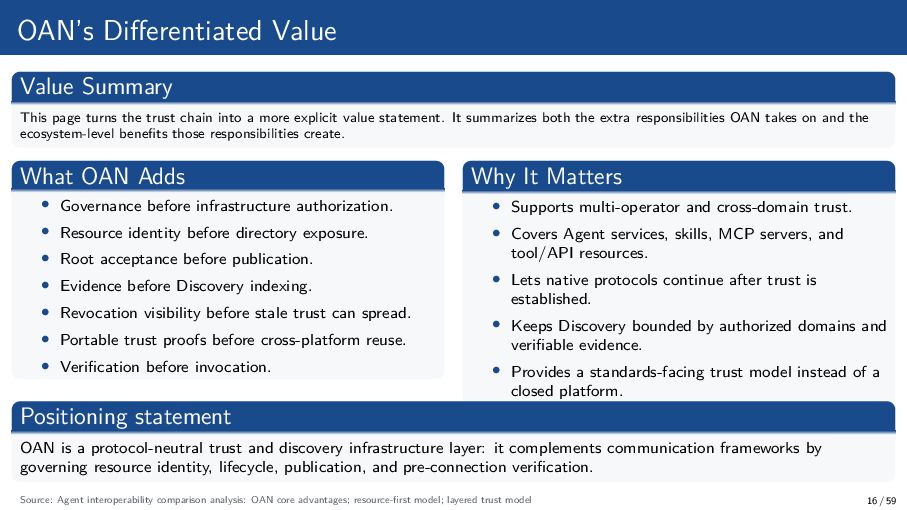
  16. OAN’s Differentiated Value Value Summary This page turns the trust

    chain into a more explicit value statement. It summarizes both the extra responsibilities OAN takes on and the ecosystem-level benefits those responsibilities create. What OAN Adds • Governance before infrastructure authorization. • Resource identity before directory exposure. • Root acceptance before publication. • Evidence before Discovery indexing. • Revocation visibility before stale trust can spread. • Portable trust proofs before cross-platform reuse. • Verification before invocation. Why It Matters • Supports multi-operator and cross-domain trust. • Covers Agent services, skills, MCP servers, and tool/API resources. • Lets native protocols continue after trust is established. • Keeps Discovery bounded by authorized domains and verifiable evidence. • Provides a standards-facing trust model instead of a closed platform. Positioning statement OAN is a protocol-neutral trust and discovery infrastructure layer: it complements communication frameworks by governing resource identity, lifecycle, publication, and pre-connection verification. Source: Agent interoperability comparison analysis: OAN core advantages; resource-first model; layered trust model 16 / 59
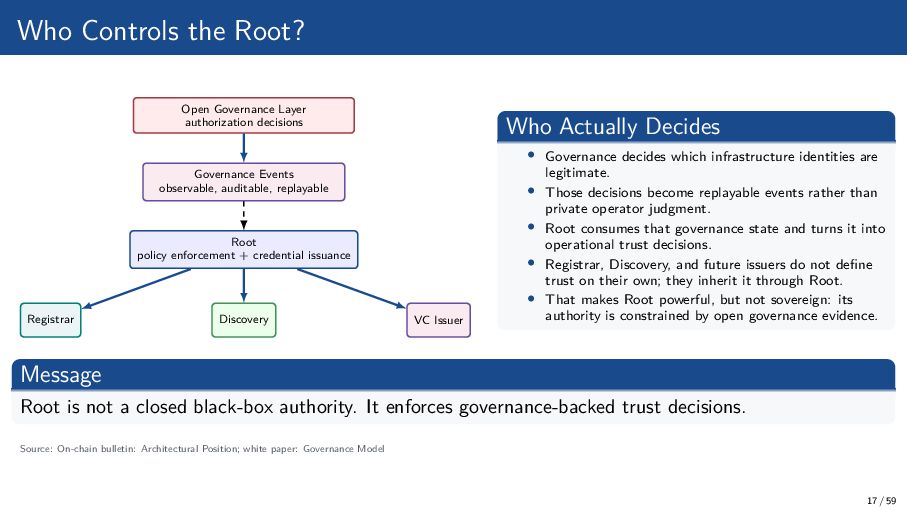
  17. Who Controls the Root? Open Governance Layer authorization decisions Governance

    Events observable, auditable, replayable Root policy enforcement + credential issuance Registrar Discovery VC Issuer Who Actually Decides • Governance decides which infrastructure identities are legitimate. • Those decisions become replayable events rather than private operator judgment. • Root consumes that governance state and turns it into operational trust decisions. • Registrar, Discovery, and future issuers do not define trust on their own; they inherit it through Root. • That makes Root powerful, but not sovereign: its authority is constrained by open governance evidence. Message Root is not a closed black-box authority. It enforces governance-backed trust decisions. Source: On-chain bulletin: Architectural Position; white paper: Governance Model 17 / 59
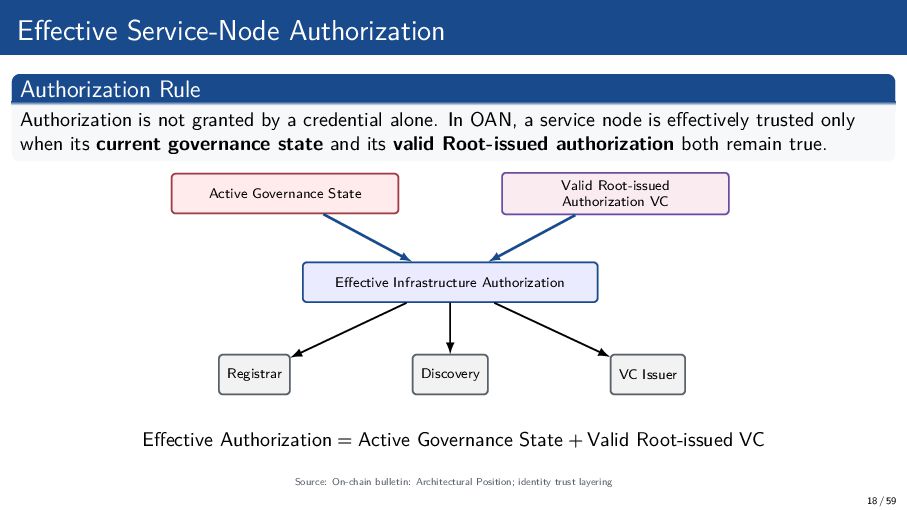
  18. Effective Service-Node Authorization Authorization Rule Authorization is not granted by

    a credential alone. In OAN, a service node is effectively trusted only when its current governance state and its valid Root-issued authorization both remain true. Active Governance State Valid Root-issued Authorization VC Effective Infrastructure Authorization Registrar Discovery VC Issuer Effective Authorization = Active Governance State + Valid Root-issued VC Source: On-chain bulletin: Architectural Position; identity trust layering 18 / 59
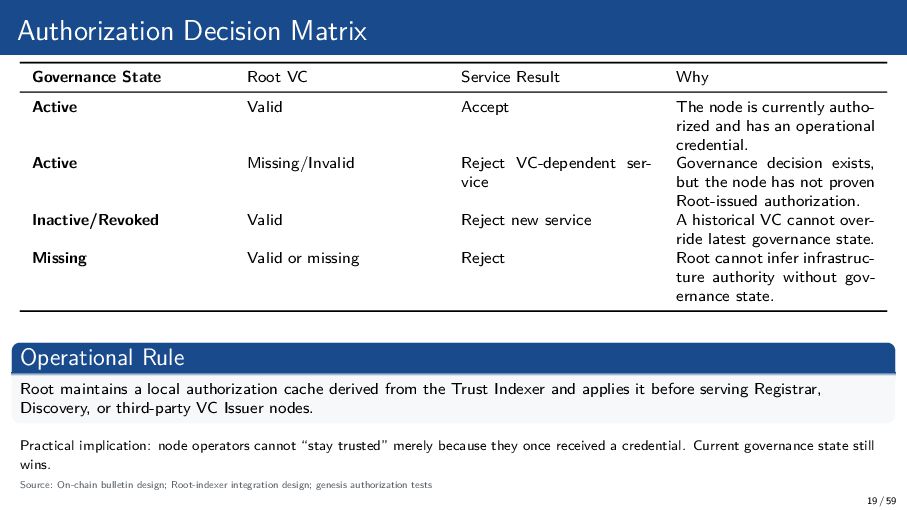
  19. Authorization Decision Matrix Governance State Root VC Service Result Why

    Active Valid Accept The node is currently autho- rized and has an operational credential. Active Missing/Invalid Reject VC-dependent ser- vice Governance decision exists, but the node has not proven Root-issued authorization. Inactive/Revoked Valid Reject new service A historical VC cannot over- ride latest governance state. Missing Valid or missing Reject Root cannot infer infrastruc- ture authority without gov- ernance state. Operational Rule Root maintains a local authorization cache derived from the Trust Indexer and applies it before serving Registrar, Discovery, or third-party VC Issuer nodes. Practical implication: node operators cannot “stay trusted” merely because they once received a credential. Current governance state still wins. Source: On-chain bulletin design; Root-indexer integration design; genesis authorization tests 19 / 59
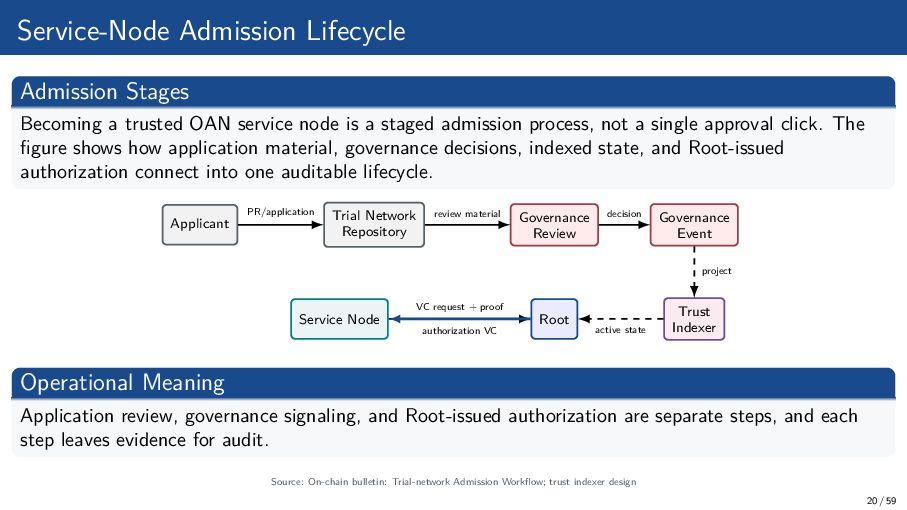
  20. Service-Node Admission Lifecycle Admission Stages Becoming a trusted OAN service

    node is a staged admission process, not a single approval click. The figure shows how application material, governance decisions, indexed state, and Root-issued authorization connect into one auditable lifecycle. Applicant Trial Network Repository Governance Review Governance Event Trust Indexer Root Service Node PR/application review material decision project active state VC request + proof authorization VC Operational Meaning Application review, governance signaling, and Root-issued authorization are separate steps, and each step leaves evidence for audit. Source: On-chain bulletin: Trial-network Admission Workflow; trust indexer design 20 / 59
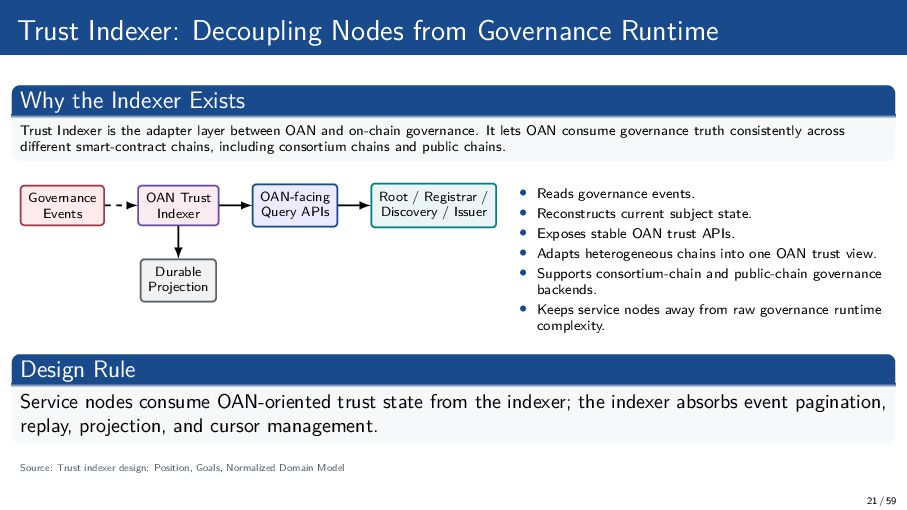
  21. Trust Indexer: Decoupling Nodes from Governance Runtime Why the Indexer

    Exists Trust Indexer is the adapter layer between OAN and on-chain governance. It lets OAN consume governance truth consistently across different smart-contract chains, including consortium chains and public chains. Governance Events OAN Trust Indexer Durable Projection OAN-facing Query APIs Root / Registrar / Discovery / Issuer • Reads governance events. • Reconstructs current subject state. • Exposes stable OAN trust APIs. • Adapts heterogeneous chains into one OAN trust view. • Supports consortium-chain and public-chain governance backends. • Keeps service nodes away from raw governance runtime complexity. Design Rule Service nodes consume OAN-oriented trust state from the indexer; the indexer absorbs event pagination, replay, projection, and cursor management. Source: Trust indexer design: Position, Goals, Normalized Domain Model 21 / 59
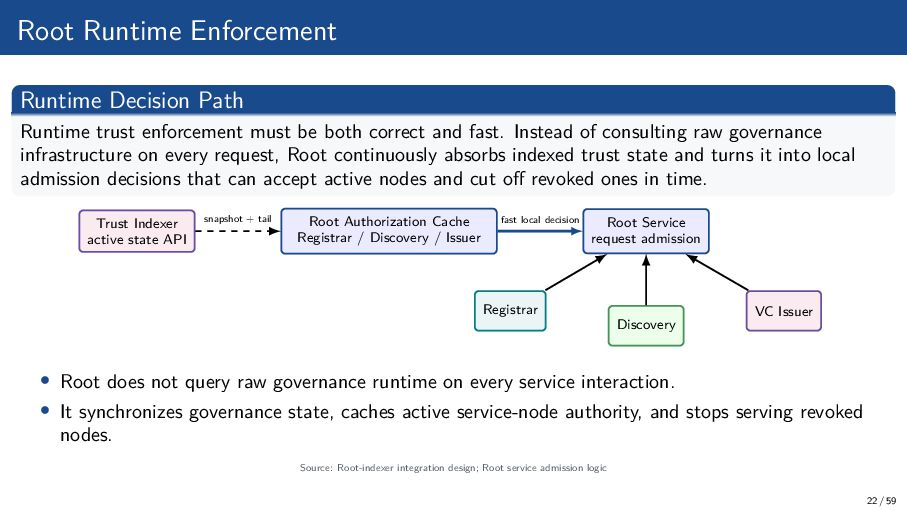
  22. Root Runtime Enforcement Runtime Decision Path Runtime trust enforcement must

    be both correct and fast. Instead of consulting raw governance infrastructure on every request, Root continuously absorbs indexed trust state and turns it into local admission decisions that can accept active nodes and cut off revoked ones in time. Trust Indexer active state API Root Authorization Cache Registrar / Discovery / Issuer Root Service request admission Registrar Discovery VC Issuer snapshot + tail fast local decision • Root does not query raw governance runtime on every service interaction. • It synchronizes governance state, caches active service-node authority, and stops serving revoked nodes. Source: Root-indexer integration design; Root service admission logic 22 / 59
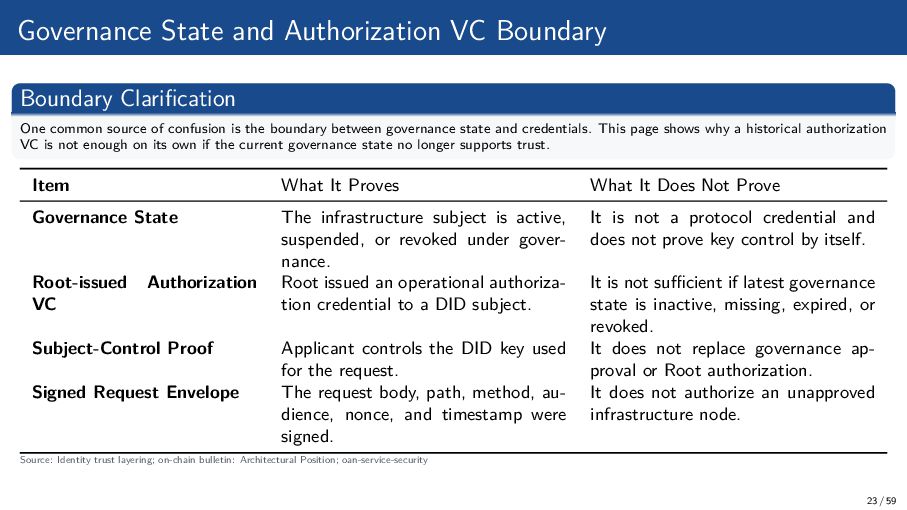
  23. Governance State and Authorization VC Boundary Boundary Clarification One common

    source of confusion is the boundary between governance state and credentials. This page shows why a historical authorization VC is not enough on its own if the current governance state no longer supports trust. Item What It Proves What It Does Not Prove Governance State The infrastructure subject is active, suspended, or revoked under gover- nance. It is not a protocol credential and does not prove key control by itself. Root-issued Authorization VC Root issued an operational authoriza- tion credential to a DID subject. It is not sufficient if latest governance state is inactive, missing, expired, or revoked. Subject-Control Proof Applicant controls the DID key used for the request. It does not replace governance ap- proval or Root authorization. Signed Request Envelope The request body, path, method, au- dience, nonce, and timestamp were signed. It does not authorize an unapproved infrastructure node. Source: Identity trust layering; on-chain bulletin: Architectural Position; oan-service-security 23 / 59
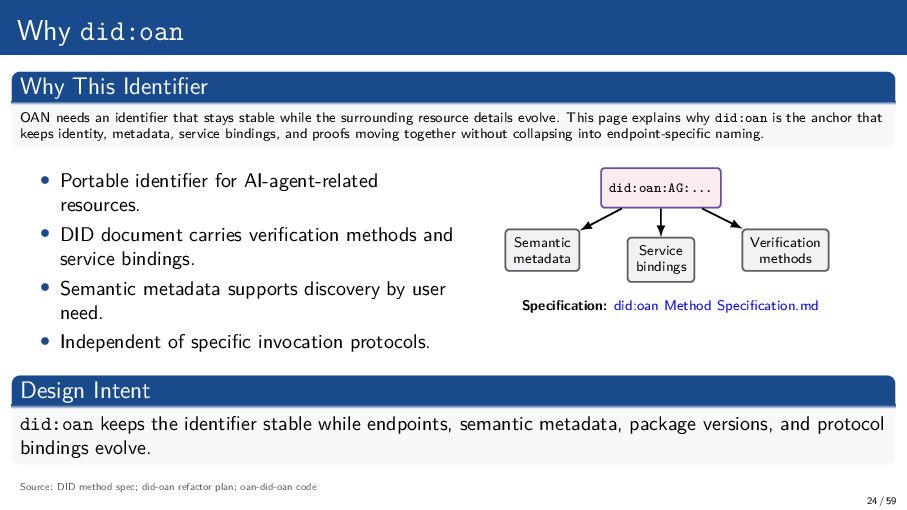
  24. Why did:oan Why This Identifier OAN needs an identifier that

    stays stable while the surrounding resource details evolve. This page explains why did:oan is the anchor that keeps identity, metadata, service bindings, and proofs moving together without collapsing into endpoint-specific naming. • Portable identifier for AI-agent-related resources. • DID document carries verification methods and service bindings. • Semantic metadata supports discovery by user need. • Independent of specific invocation protocols. did:oan:AG:... Semantic metadata Service bindings Verification methods Specification: did:oan Method Specification.md Design Intent did:oan keeps the identifier stable while endpoints, semantic metadata, package versions, and protocol bindings evolve. Source: DID method spec; did-oan refactor plan; oan-did-oan code 24 / 59
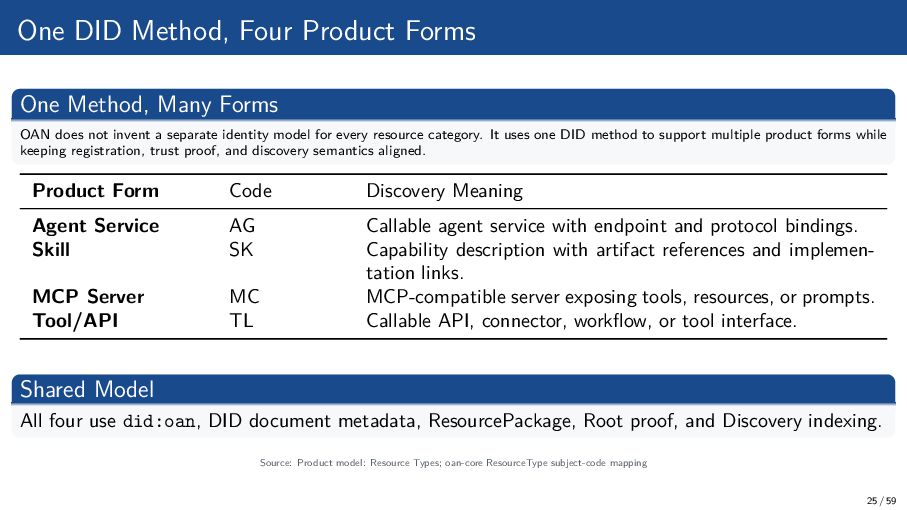
  25. One DID Method, Four Product Forms One Method, Many Forms

    OAN does not invent a separate identity model for every resource category. It uses one DID method to support multiple product forms while keeping registration, trust proof, and discovery semantics aligned. Product Form Code Discovery Meaning Agent Service AG Callable agent service with endpoint and protocol bindings. Skill SK Capability description with artifact references and implemen- tation links. MCP Server MC MCP-compatible server exposing tools, resources, or prompts. Tool/API TL Callable API, connector, workflow, or tool interface. Shared Model All four use did:oan, DID document metadata, ResourcePackage, Root proof, and Discovery indexing. Source: Product model: Resource Types; oan-core ResourceType subject-code mapping 25 / 59
  26. Resource Forms: What Is Registered and Found What Changes by

    Type Once the common DID method is established, the next question is what different resource forms actually look like in registration and discovery. This page compares those forms without breaking the shared trust model. Form Registered DID Document Carries Discovery Returns Consumer Next Step Agent Service Endpoint, protocol bindings, se- mantic profile, keys, VC hints. Candidate service DID documents and signed evidence. Verify evidence, then call via supported protocol. Skill Semantic description, artifact URI/hash, examples, compatibility metadata. Candidate Skill DID documents and artifact references. Fetch artifact from referenced lo- cation and verify hash. MCP Server MCP endpoint, capabilities sum- mary, resource/tool/prompt meta- data. Candidate MCP server DID docu- ments. Verify, then connect using MCP. Tool/API Endpoint or OpenAPI reference, authentication hints, operation se- mantics. Candidate API/tool DID docu- ments. Verify, then invoke according to API contract. Unification Point The resource type changes the expected metadata, but registration, Root verification, package proof, and Discovery evidence remain shared. Source: Product model: four product forms; DID method spec: oanMetadata and services 26 / 59
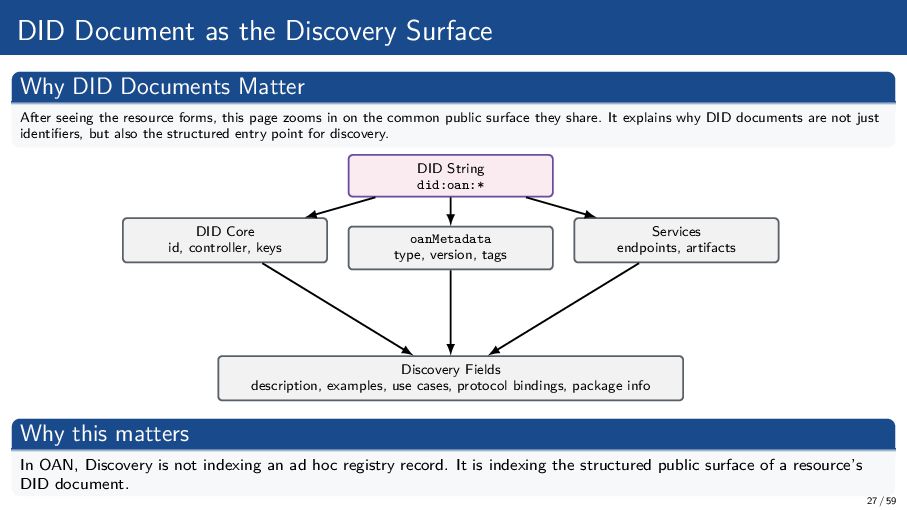
  27. DID Document as the Discovery Surface Why DID Documents Matter

    After seeing the resource forms, this page zooms in on the common public surface they share. It explains why DID documents are not just identifiers, but also the structured entry point for discovery. DID String did:oan:* DID Core id, controller, keys oanMetadata type, version, tags Services endpoints, artifacts Discovery Fields description, examples, use cases, protocol bindings, package info Why this matters In OAN, Discovery is not indexing an ad hoc registry record. It is indexing the structured public surface of a resource’s DID document. 27 / 59
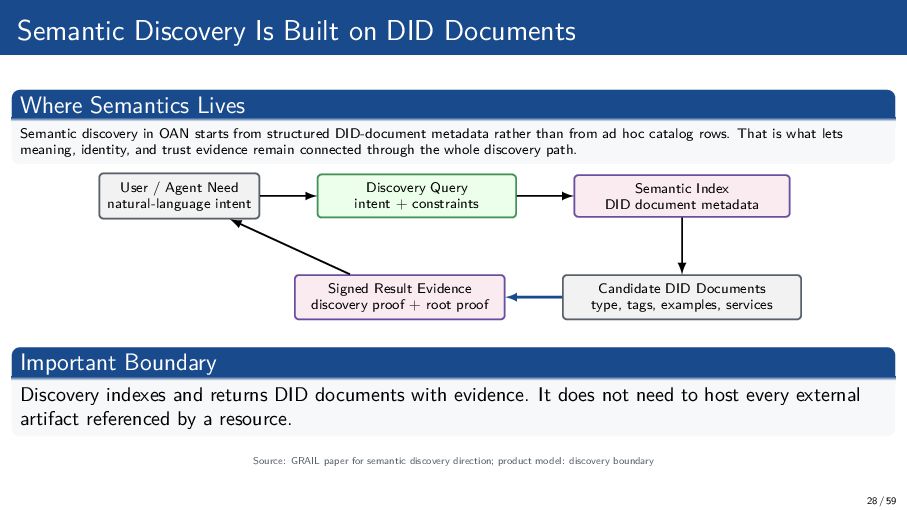
  28. Semantic Discovery Is Built on DID Documents Where Semantics Lives

    Semantic discovery in OAN starts from structured DID-document metadata rather than from ad hoc catalog rows. That is what lets meaning, identity, and trust evidence remain connected through the whole discovery path. User / Agent Need natural-language intent Discovery Query intent + constraints Semantic Index DID document metadata Candidate DID Documents type, tags, examples, services Signed Result Evidence discovery proof + root proof Important Boundary Discovery indexes and returns DID documents with evidence. It does not need to host every external artifact referenced by a resource. Source: GRAIL paper for semantic discovery direction; product model: discovery boundary 28 / 59
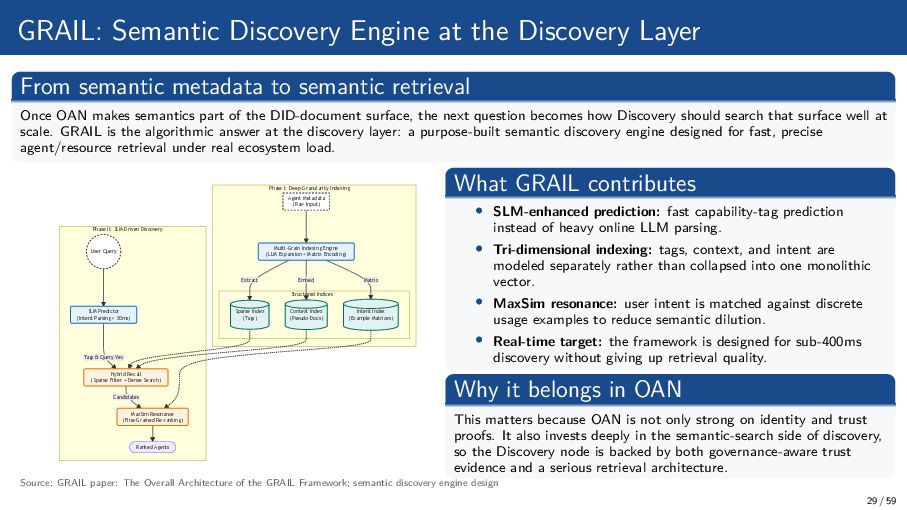
  29. GRAIL: Semantic Discovery Engine at the Discovery Layer From semantic

    metadata to semantic retrieval Once OAN makes semantics part of the DID-document surface, the next question becomes how Discovery should search that surface well at scale. GRAIL is the algorithmic answer at the discovery layer: a purpose-built semantic discovery engine designed for fast, precise agent/resource retrieval under real ecosystem load. Phase II: SLM-Driven Discovery Phase I: Deep-Granularity Indexing Structured Indices Extract Embed Matrix Tags & Query Vec Candidates User Query SLM Predictor (Intent Parsing < 30ms) Hybrid Recall (Sparse Filter + Dense Search) MaxSim Resonance (Fine-Grained Re-ranking) Ranked Agents Agent Metadata (Raw Input) Multi-Grain Indexing Engine (LLM Expansion + Matrix Encoding) Sparse Index (Tags) Context Index (Pseudo-Docs) Intent Index (Example Matrices) What GRAIL contributes • SLM-enhanced prediction: fast capability-tag prediction instead of heavy online LLM parsing. • Tri-dimensional indexing: tags, context, and intent are modeled separately rather than collapsed into one monolithic vector. • MaxSim resonance: user intent is matched against discrete usage examples to reduce semantic dilution. • Real-time target: the framework is designed for sub-400ms discovery without giving up retrieval quality. Why it belongs in OAN This matters because OAN is not only strong on identity and trust proofs. It also invests deeply in the semantic-search side of discovery, so the Discovery node is backed by both governance-aware trust evidence and a serious retrieval architecture. Source: GRAIL paper: The Overall Architecture of the GRAIL Framework; semantic discovery engine design 29 / 59
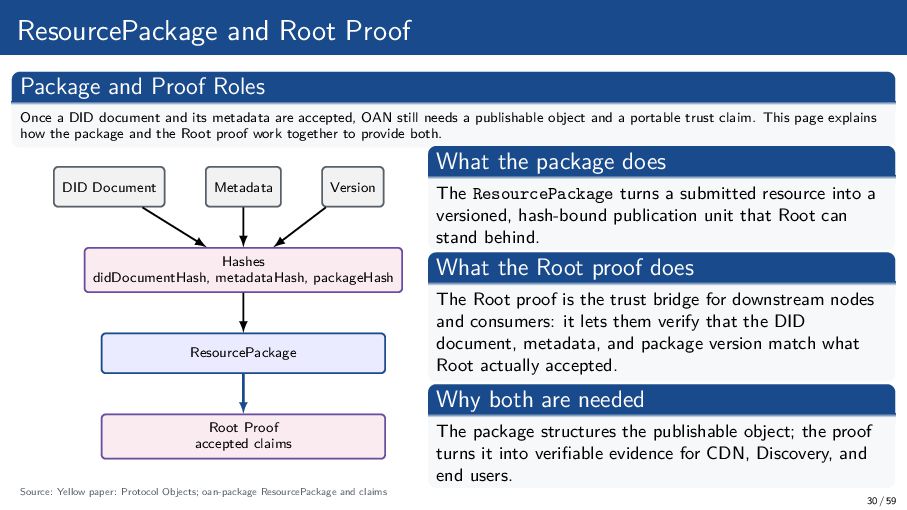
  30. ResourcePackage and Root Proof Package and Proof Roles Once a

    DID document and its metadata are accepted, OAN still needs a publishable object and a portable trust claim. This page explains how the package and the Root proof work together to provide both. DID Document Metadata Version Hashes didDocumentHash, metadataHash, packageHash ResourcePackage Root Proof accepted claims What the package does The ResourcePackage turns a submitted resource into a versioned, hash-bound publication unit that Root can stand behind. What the Root proof does The Root proof is the trust bridge for downstream nodes and consumers: it lets them verify that the DID document, metadata, and package version match what Root actually accepted. Why both are needed The package structures the publishable object; the proof turns it into verifiable evidence for CDN, Discovery, and end users. Source: Yellow paper: Protocol Objects; oan-package ResourcePackage and claims 30 / 59
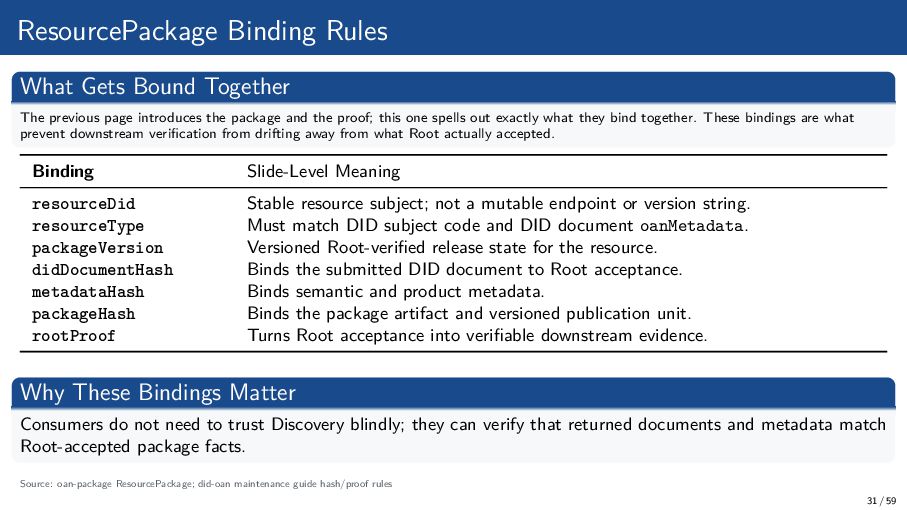
  31. ResourcePackage Binding Rules What Gets Bound Together The previous page

    introduces the package and the proof; this one spells out exactly what they bind together. These bindings are what prevent downstream verification from drifting away from what Root actually accepted. Binding Slide-Level Meaning resourceDid Stable resource subject; not a mutable endpoint or version string. resourceType Must match DID subject code and DID document oanMetadata. packageVersion Versioned Root-verified release state for the resource. didDocumentHash Binds the submitted DID document to Root acceptance. metadataHash Binds semantic and product metadata. packageHash Binds the package artifact and versioned publication unit. rootProof Turns Root acceptance into verifiable downstream evidence. Why These Bindings Matter Consumers do not need to trust Discovery blindly; they can verify that returned documents and metadata match Root-accepted package facts. Source: oan-package ResourcePackage; did-oan maintenance guide hash/proof rules 31 / 59
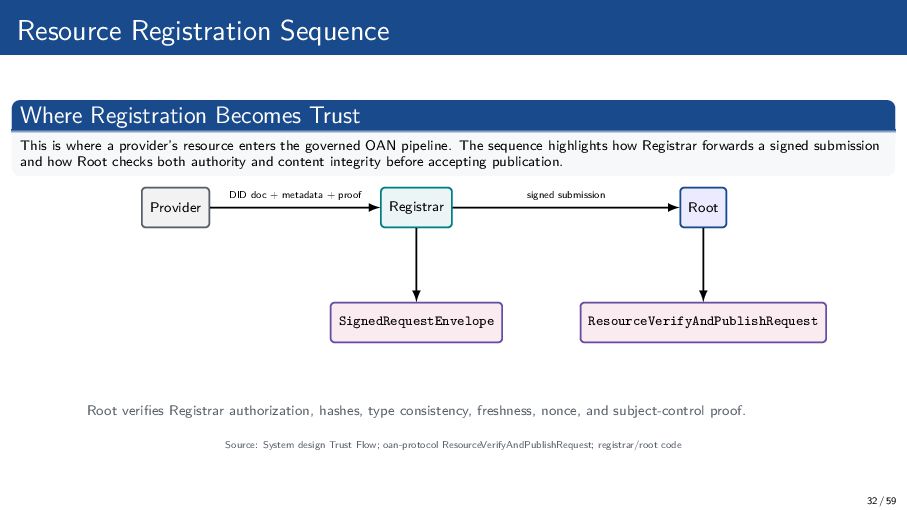
  32. Resource Registration Sequence Where Registration Becomes Trust This is where

    a provider’s resource enters the governed OAN pipeline. The sequence highlights how Registrar forwards a signed submission and how Root checks both authority and content integrity before accepting publication. Provider Registrar Root SignedRequestEnvelope ResourceVerifyAndPublishRequest DID doc + metadata + proof signed submission Root verifies Registrar authorization, hashes, type consistency, freshness, nonce, and subject-control proof. Source: System design Trust Flow; oan-protocol ResourceVerifyAndPublishRequest; registrar/root code 32 / 59
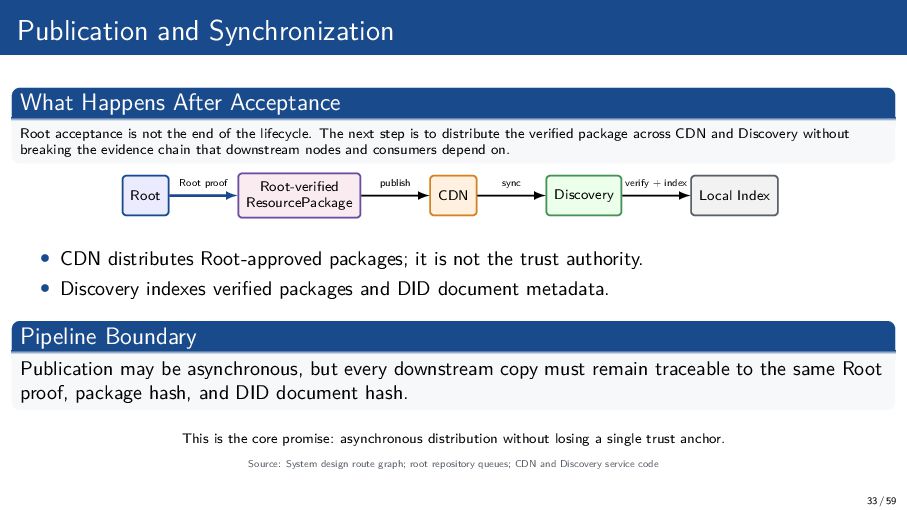
  33. Publication and Synchronization What Happens After Acceptance Root acceptance is

    not the end of the lifecycle. The next step is to distribute the verified package across CDN and Discovery without breaking the evidence chain that downstream nodes and consumers depend on. Root Root-verified ResourcePackage CDN Discovery Local Index Root proof publish sync verify + index • CDN distributes Root-approved packages; it is not the trust authority. • Discovery indexes verified packages and DID document metadata. Pipeline Boundary Publication may be asynchronous, but every downstream copy must remain traceable to the same Root proof, package hash, and DID document hash. This is the core promise: asynchronous distribution without losing a single trust anchor. Source: System design route graph; root repository queues; CDN and Discovery service code 33 / 59
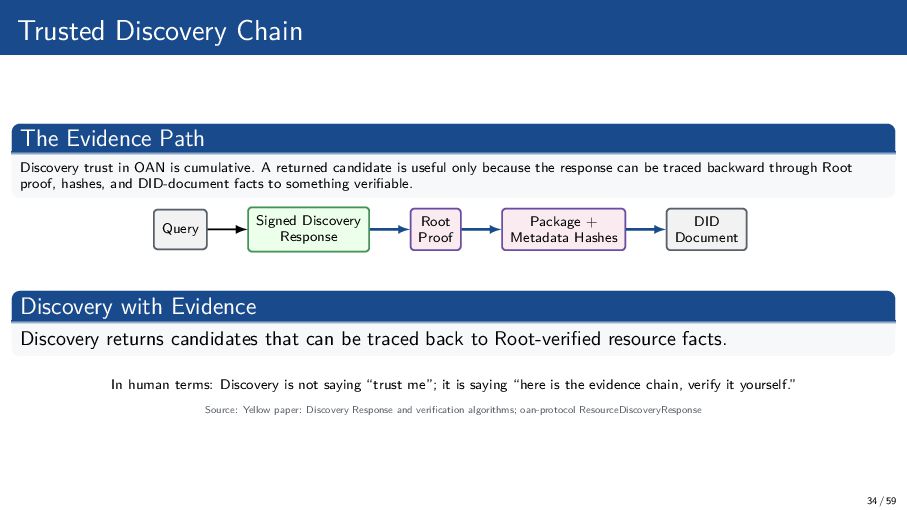
  34. Trusted Discovery Chain The Evidence Path Discovery trust in OAN

    is cumulative. A returned candidate is useful only because the response can be traced backward through Root proof, hashes, and DID-document facts to something verifiable. Query Signed Discovery Response Root Proof Package + Metadata Hashes DID Document Discovery with Evidence Discovery returns candidates that can be traced back to Root-verified resource facts. In human terms: Discovery is not saying “trust me”; it is saying “here is the evidence chain, verify it yourself.” Source: Yellow paper: Discovery Response and verification algorithms; oan-protocol ResourceDiscoveryResponse 34 / 59
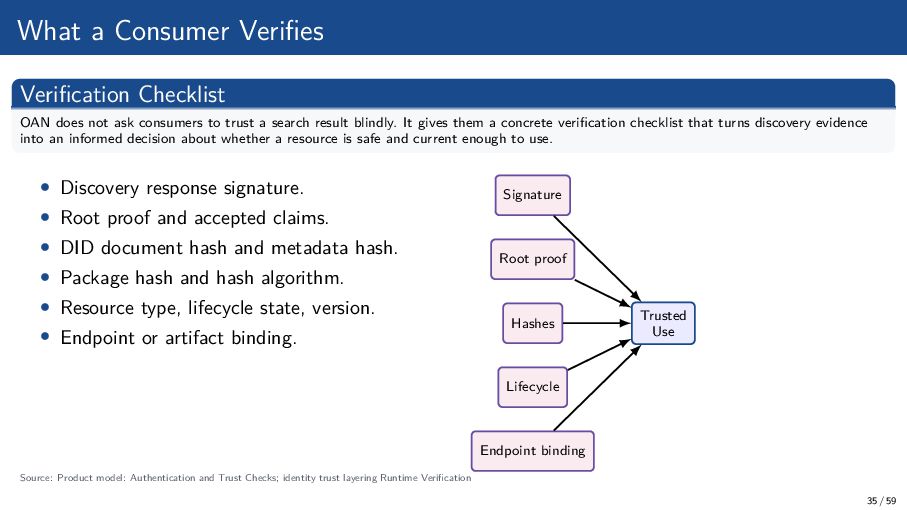
  35. What a Consumer Verifies Verification Checklist OAN does not ask

    consumers to trust a search result blindly. It gives them a concrete verification checklist that turns discovery evidence into an informed decision about whether a resource is safe and current enough to use. • Discovery response signature. • Root proof and accepted claims. • DID document hash and metadata hash. • Package hash and hash algorithm. • Resource type, lifecycle state, version. • Endpoint or artifact binding. Signature Root proof Hashes Lifecycle Endpoint binding Trusted Use Source: Product model: Authentication and Trust Checks; identity trust layering Runtime Verification 35 / 59
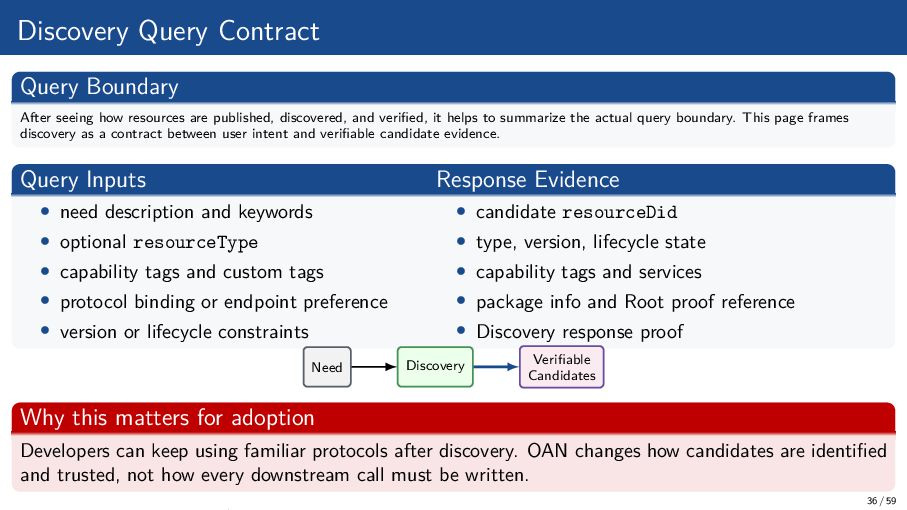
  36. Discovery Query Contract Query Boundary After seeing how resources are

    published, discovered, and verified, it helps to summarize the actual query boundary. This page frames discovery as a contract between user intent and verifiable candidate evidence. Query Inputs • need description and keywords • optional resourceType • capability tags and custom tags • protocol binding or endpoint preference • version or lifecycle constraints Response Evidence • candidate resourceDid • type, version, lifecycle state • capability tags and services • package info and Root proof reference • Discovery response proof Need Discovery Verifiable Candidates Why this matters for adoption Developers can keep using familiar protocols after discovery. OAN changes how candidates are identified and trusted, not how every downstream call must be written. 36 / 59
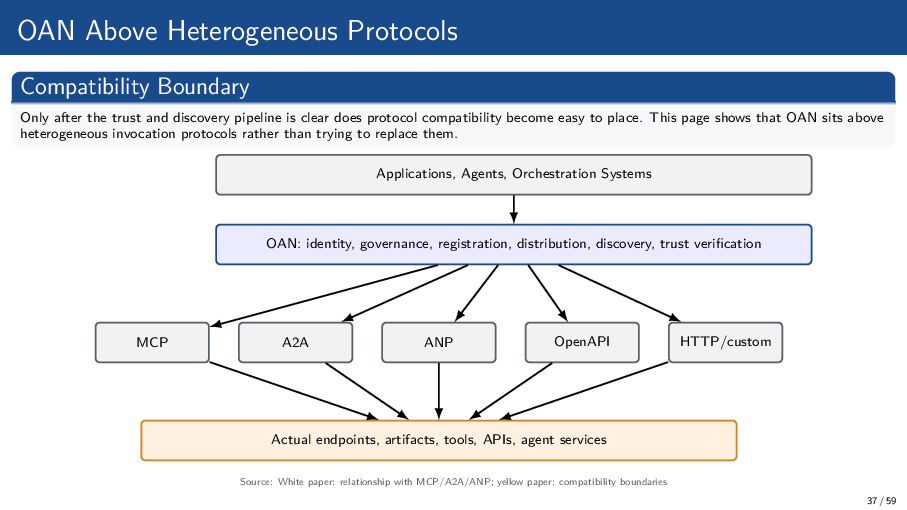
  37. OAN Above Heterogeneous Protocols Compatibility Boundary Only after the trust

    and discovery pipeline is clear does protocol compatibility become easy to place. This page shows that OAN sits above heterogeneous invocation protocols rather than trying to replace them. Applications, Agents, Orchestration Systems OAN: identity, governance, registration, distribution, discovery, trust verification MCP A2A ANP OpenAPI HTTP/custom Actual endpoints, artifacts, tools, APIs, agent services Source: White paper: relationship with MCP/A2A/ANP; yellow paper: compatibility boundaries 37 / 59
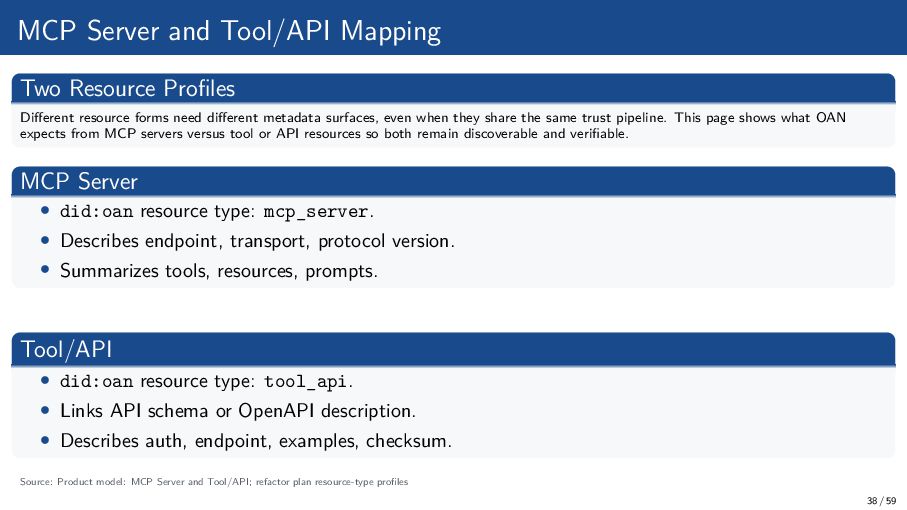
  38. MCP Server and Tool/API Mapping Two Resource Profiles Different resource

    forms need different metadata surfaces, even when they share the same trust pipeline. This page shows what OAN expects from MCP servers versus tool or API resources so both remain discoverable and verifiable. MCP Server • did:oan resource type: mcp_server. • Describes endpoint, transport, protocol version. • Summarizes tools, resources, prompts. Tool/API • did:oan resource type: tool_api. • Links API schema or OpenAPI description. • Describes auth, endpoint, examples, checksum. Source: Product model: MCP Server and Tool/API; refactor plan resource-type profiles 38 / 59
  39. Concrete Example: Registering an MCP Server A Concrete Walkthrough The

    abstract mapping becomes easier to internalize through one concrete case. This example walks through how a familiar MCP server moves through the OAN trust pipeline from registration to verified use. 1. Prepare a DID document that describes the MCP server endpoint, capabilities, verification methods, and metadata. 2. Submit it through a Registrar with signed request evidence. 3. Root verifies the submission and accepts it into the governed publication path. 4. Discovery later returns the MCP server as a signed candidate with evidence. 5. A developer verifies the evidence first, then connects using MCP. What OAN changes Without OAN, the developer only sees an MCP endpoint. With OAN, the developer sees a governed identity, Root acceptance, and signed discovery evidence before connecting. What the developer gains Less time spent guessing whether the MCP server is real, current, and safe to integrate; more time spent building on a candidate that already carries verifiable trust context. Human version: OAN helps you check whether the MCP server is a legitimate service or just a random endpoint on the Internet. Source: Product model: MCP Server flow; Root publication path; discovery evidence path 39 / 59
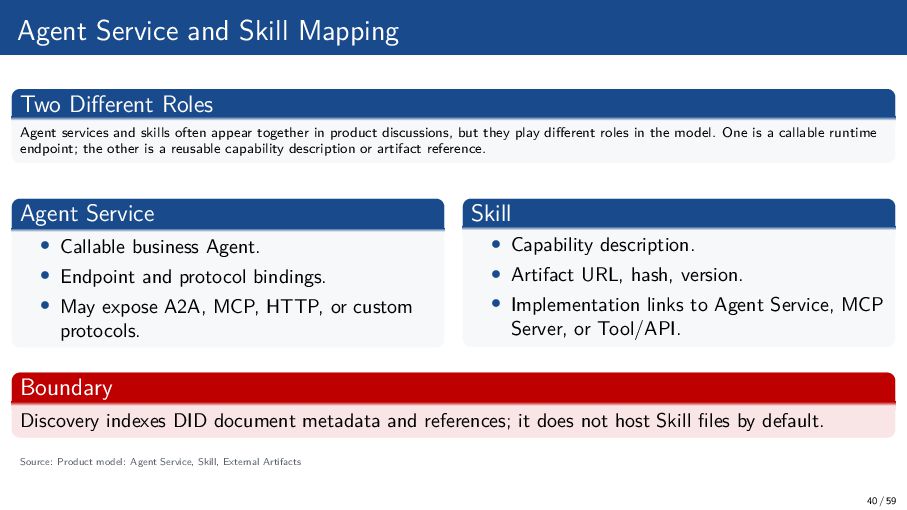
  40. Agent Service and Skill Mapping Two Different Roles Agent services

    and skills often appear together in product discussions, but they play different roles in the model. One is a callable runtime endpoint; the other is a reusable capability description or artifact reference. Agent Service • Callable business Agent. • Endpoint and protocol bindings. • May expose A2A, MCP, HTTP, or custom protocols. Skill • Capability description. • Artifact URL, hash, version. • Implementation links to Agent Service, MCP Server, or Tool/API. Boundary Discovery indexes DID document metadata and references; it does not host Skill files by default. Source: Product model: Agent Service, Skill, External Artifacts 40 / 59
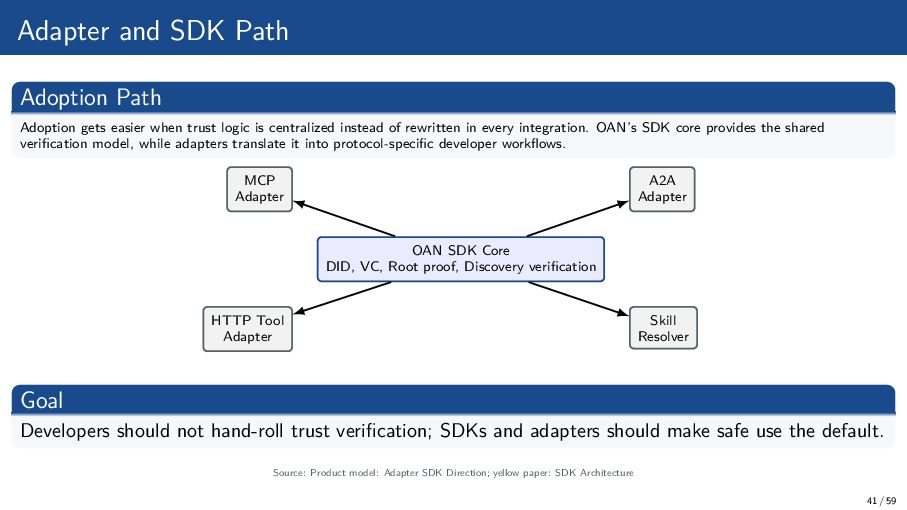
  41. Adapter and SDK Path Adoption Path Adoption gets easier when

    trust logic is centralized instead of rewritten in every integration. OAN’s SDK core provides the shared verification model, while adapters translate it into protocol-specific developer workflows. OAN SDK Core DID, VC, Root proof, Discovery verification MCP Adapter A2A Adapter HTTP Tool Adapter Skill Resolver Goal Developers should not hand-roll trust verification; SDKs and adapters should make safe use the default. Source: Product model: Adapter SDK Direction; yellow paper: SDK Architecture 41 / 59
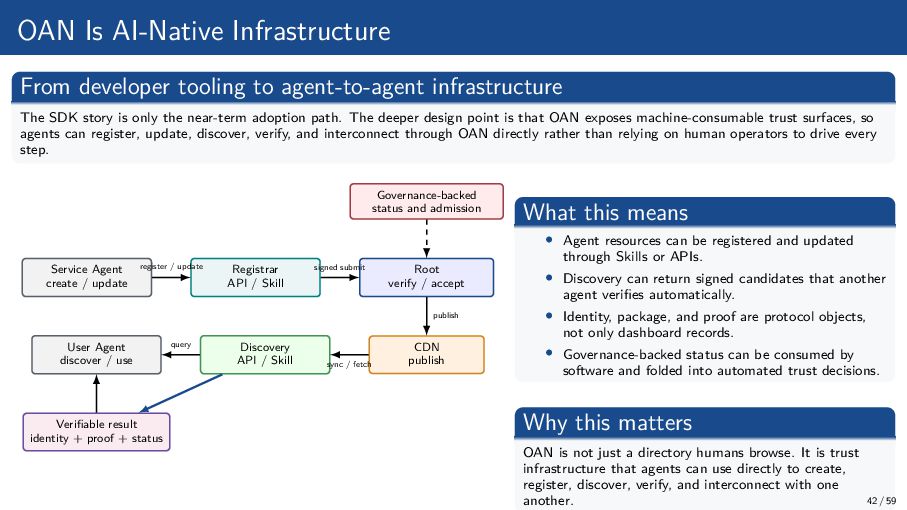
  42. OAN Is AI-Native Infrastructure From developer tooling to agent-to-agent infrastructure

    The SDK story is only the near-term adoption path. The deeper design point is that OAN exposes machine-consumable trust surfaces, so agents can register, update, discover, verify, and interconnect through OAN directly rather than relying on human operators to drive every step. Service Agent create / update Registrar API / Skill Root verify / accept Governance-backed status and admission CDN publish Discovery API / Skill User Agent discover / use Verifiable result identity + proof + status register / update signed submit publish sync / fetch query What this means • Agent resources can be registered and updated through Skills or APIs. • Discovery can return signed candidates that another agent verifies automatically. • Identity, package, and proof are protocol objects, not only dashboard records. • Governance-backed status can be consumed by software and folded into automated trust decisions. Why this matters OAN is not just a directory humans browse. It is trust infrastructure that agents can use directly to create, register, discover, verify, and interconnect with one another. 42 / 59
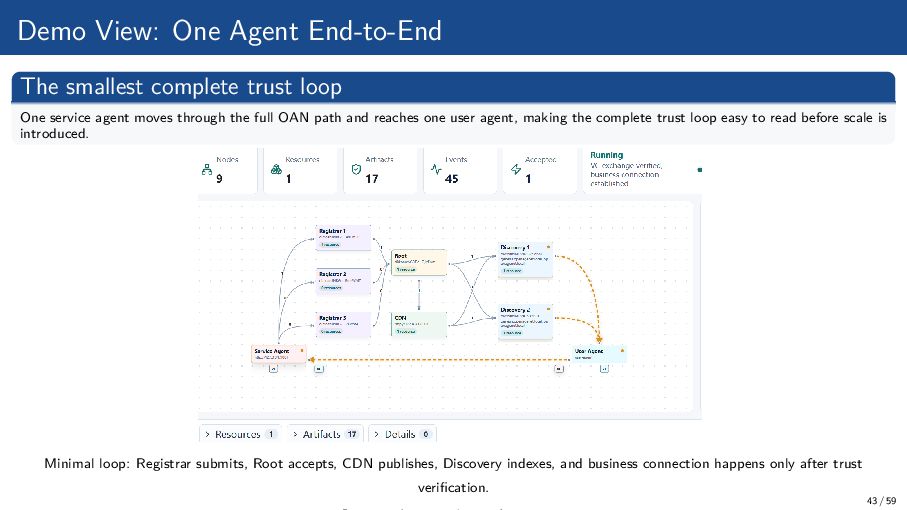
  43. Demo View: One Agent End-to-End The smallest complete trust loop

    One service agent moves through the full OAN path and reaches one user agent, making the complete trust loop easy to read before scale is introduced. Minimal loop: Registrar submits, Root accepts, CDN publishes, Discovery indexes, and business connection happens only after trust verification. 43 / 59
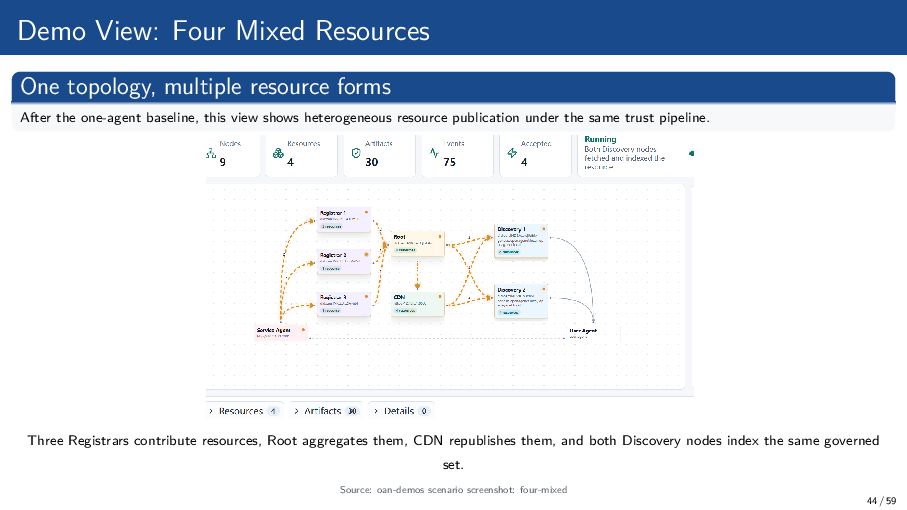
  44. Demo View: Four Mixed Resources One topology, multiple resource forms

    After the one-agent baseline, this view shows heterogeneous resource publication under the same trust pipeline. Three Registrars contribute resources, Root aggregates them, CDN republishes them, and both Discovery nodes index the same governed set. Source: oan-demos scenario screenshot: four-mixed 44 / 59
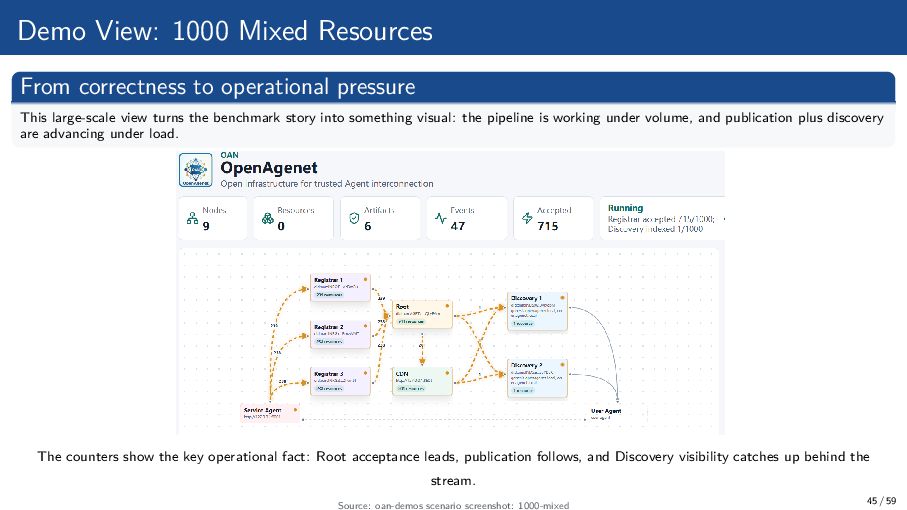
  45. Demo View: 1000 Mixed Resources From correctness to operational pressure

    This large-scale view turns the benchmark story into something visual: the pipeline is working under volume, and publication plus discovery are advancing under load. The counters show the key operational fact: Root acceptance leads, publication follows, and Discovery visibility catches up behind the stream. Source: oan-demos scenario screenshot: 1000-mixed 45 / 59
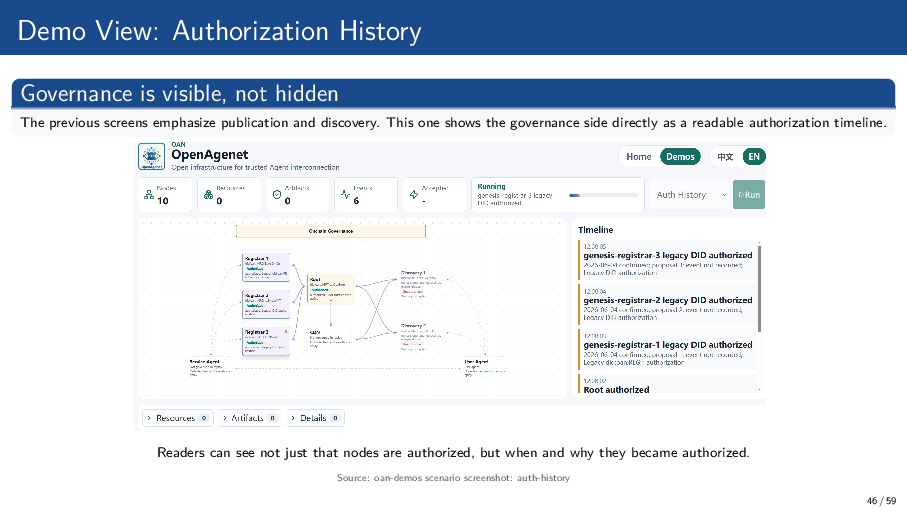
  46. Demo View: Authorization History Governance is visible, not hidden The

    previous screens emphasize publication and discovery. This one shows the governance side directly as a readable authorization timeline. Readers can see not just that nodes are authorized, but when and why they became authorized. Source: oan-demos scenario screenshot: auth-history 46 / 59
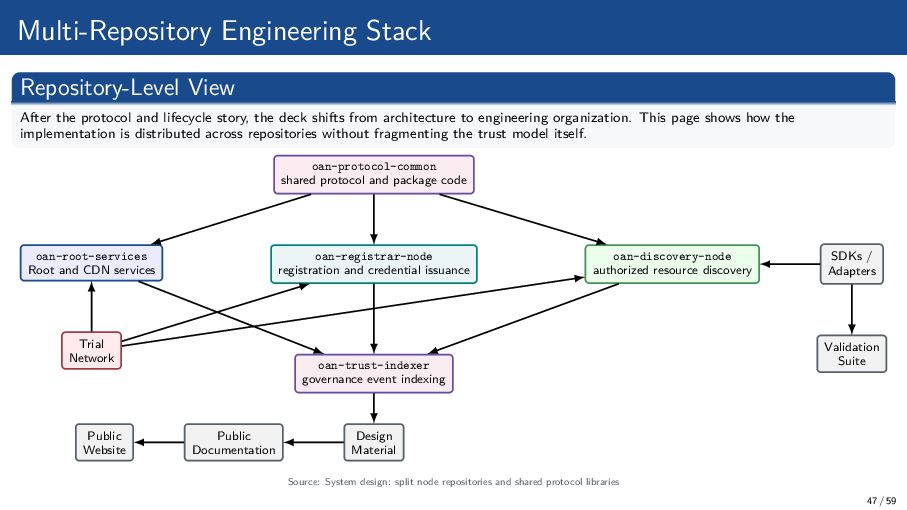
  47. Multi-Repository Engineering Stack Repository-Level View After the protocol and lifecycle

    story, the deck shifts from architecture to engineering organization. This page shows how the implementation is distributed across repositories without fragmenting the trust model itself. oan-protocol-common shared protocol and package code oan-root-services Root and CDN services oan-registrar-node registration and credential issuance oan-discovery-node authorized resource discovery oan-trust-indexer governance event indexing Design Material Public Documentation SDKs / Adapters Trial Network Public Website Validation Suite Source: System design: split node repositories and shared protocol libraries 47 / 59
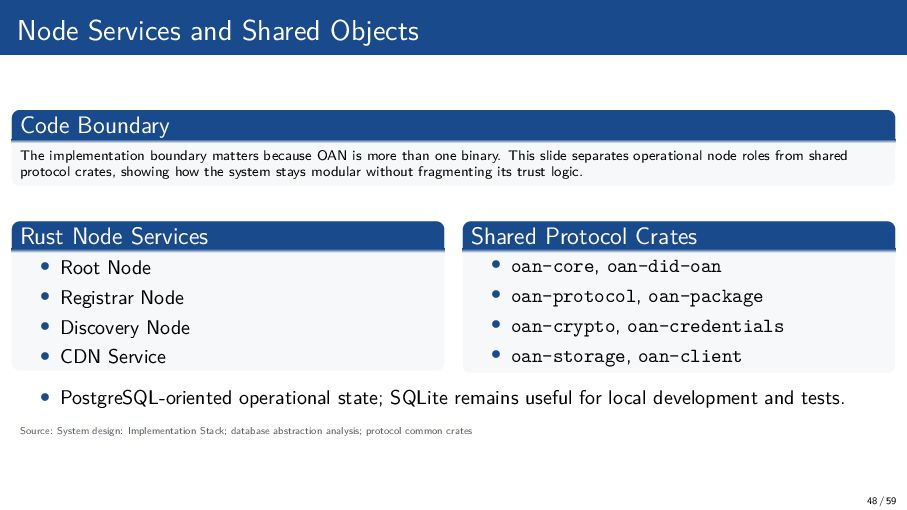
  48. Node Services and Shared Objects Code Boundary The implementation boundary

    matters because OAN is more than one binary. This slide separates operational node roles from shared protocol crates, showing how the system stays modular without fragmenting its trust logic. Rust Node Services • Root Node • Registrar Node • Discovery Node • CDN Service Shared Protocol Crates • oan-core, oan-did-oan • oan-protocol, oan-package • oan-crypto, oan-credentials • oan-storage, oan-client • PostgreSQL-oriented operational state; SQLite remains useful for local development and tests. Source: System design: Implementation Stack; database abstraction analysis; protocol common crates 48 / 59
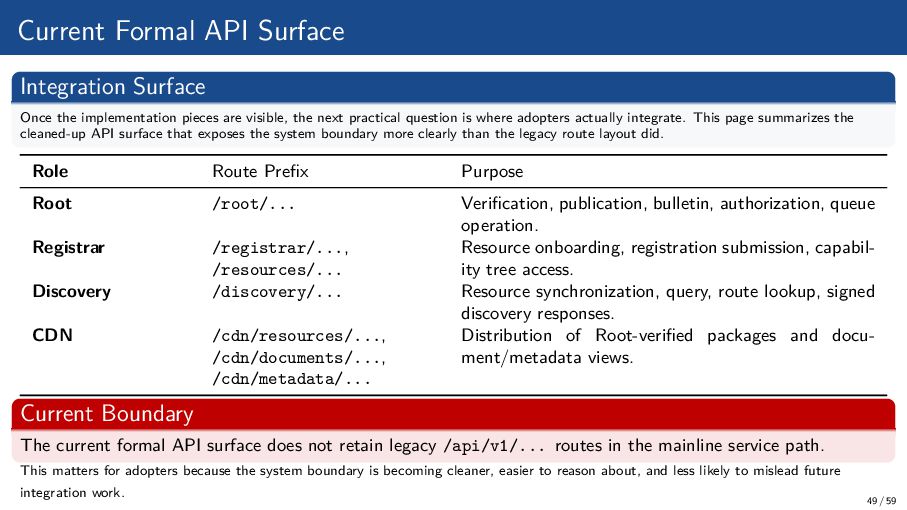
  49. Current Formal API Surface Integration Surface Once the implementation pieces

    are visible, the next practical question is where adopters actually integrate. This page summarizes the cleaned-up API surface that exposes the system boundary more clearly than the legacy route layout did. Role Route Prefix Purpose Root /root/... Verification, publication, bulletin, authorization, queue operation. Registrar /registrar/..., /resources/... Resource onboarding, registration submission, capabil- ity tree access. Discovery /discovery/... Resource synchronization, query, route lookup, signed discovery responses. CDN /cdn/resources/..., /cdn/documents/..., /cdn/metadata/... Distribution of Root-verified packages and docu- ment/metadata views. Current Boundary The current formal API surface does not retain legacy /api/v1/... routes in the mainline service path. This matters for adopters because the system boundary is becoming cleaner, easier to reason about, and less likely to mislead future integration work. 49 / 59
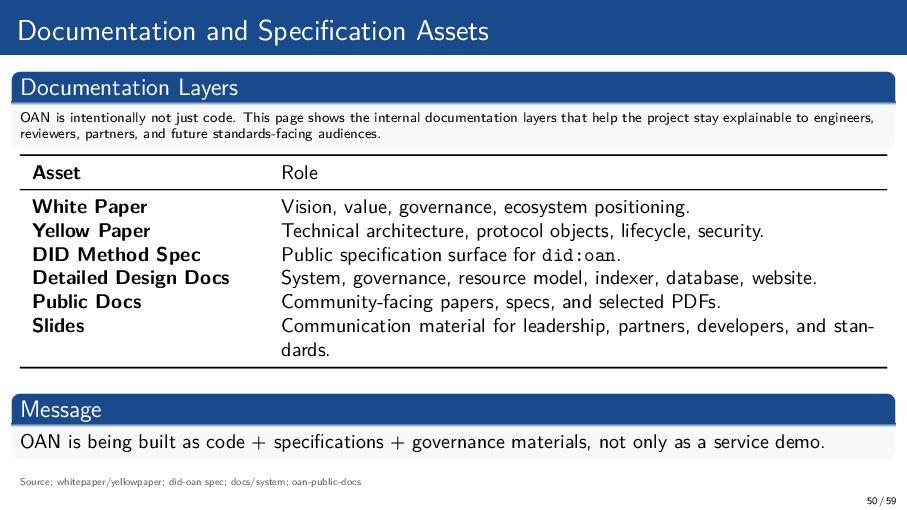
  50. Documentation and Specification Assets Documentation Layers OAN is intentionally not

    just code. This page shows the internal documentation layers that help the project stay explainable to engineers, reviewers, partners, and future standards-facing audiences. Asset Role White Paper Vision, value, governance, ecosystem positioning. Yellow Paper Technical architecture, protocol objects, lifecycle, security. DID Method Spec Public specification surface for did:oan. Detailed Design Docs System, governance, resource model, indexer, database, website. Public Docs Community-facing papers, specs, and selected PDFs. Slides Communication material for leadership, partners, developers, and stan- dards. Message OAN is being built as code + specifications + governance materials, not only as a service demo. Source: whitepaper/yellowpaper; did-oan spec; docs/system; oan-public-docs 50 / 59
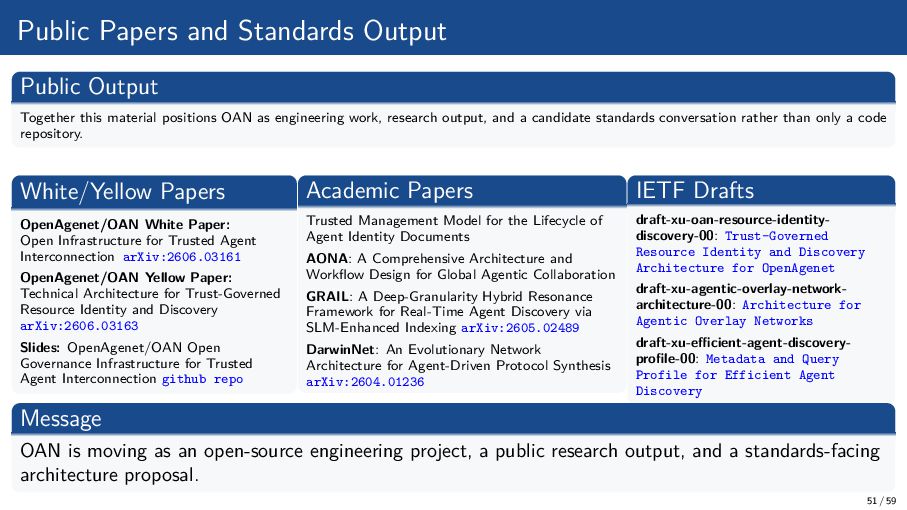
  51. Public Papers and Standards Output Public Output Together this material

    positions OAN as engineering work, research output, and a candidate standards conversation rather than only a code repository. White/Yellow Papers OpenAgenet/OAN White Paper: Open Infrastructure for Trusted Agent Interconnection arXiv:2606.03161 OpenAgenet/OAN Yellow Paper: Technical Architecture for Trust-Governed Resource Identity and Discovery arXiv:2606.03163 Slides: OpenAgenet/OAN Open Governance Infrastructure for Trusted Agent Interconnection github repo Academic Papers Trusted Management Model for the Lifecycle of Agent Identity Documents AONA: A Comprehensive Architecture and Workflow Design for Global Agentic Collaboration GRAIL: A Deep-Granularity Hybrid Resonance Framework for Real-Time Agent Discovery via SLM-Enhanced Indexing arXiv:2605.02489 DarwinNet: An Evolutionary Network Architecture for Agent-Driven Protocol Synthesis arXiv:2604.01236 IETF Drafts draft-xu-oan-resource-identity- discovery-00: Trust-Governed Resource Identity and Discovery Architecture for OpenAgenet draft-xu-agentic-overlay-network- architecture-00: Architecture for Agentic Overlay Networks draft-xu-efficient-agent-discovery- profile-00: Metadata and Query Profile for Efficient Agent Discovery Message OAN is moving as an open-source engineering project, a public research output, and a standards-facing architecture proposal. 51 / 59
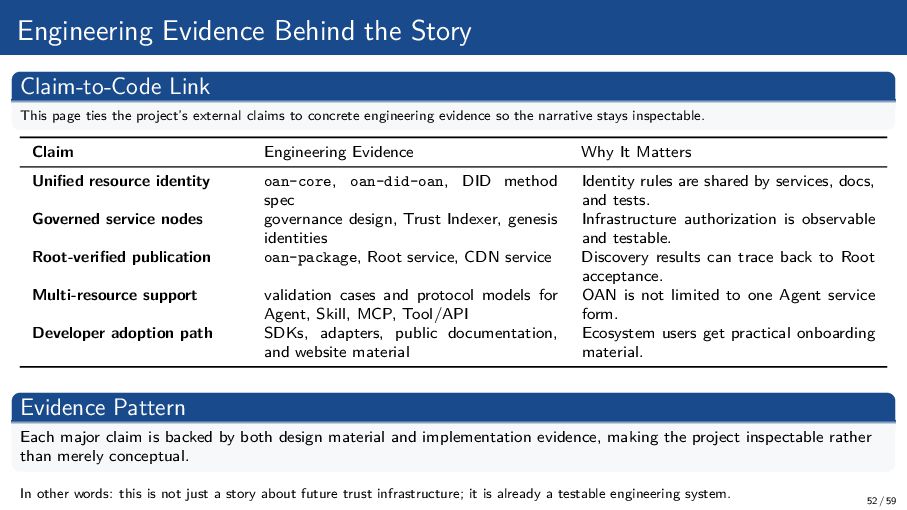
  52. Engineering Evidence Behind the Story Claim-to-Code Link This page ties

    the project’s external claims to concrete engineering evidence so the narrative stays inspectable. Claim Engineering Evidence Why It Matters Unified resource identity oan-core, oan-did-oan, DID method spec Identity rules are shared by services, docs, and tests. Governed service nodes governance design, Trust Indexer, genesis identities Infrastructure authorization is observable and testable. Root-verified publication oan-package, Root service, CDN service Discovery results can trace back to Root acceptance. Multi-resource support validation cases and protocol models for Agent, Skill, MCP, Tool/API OAN is not limited to one Agent service form. Developer adoption path SDKs, adapters, public documentation, and website material Ecosystem users get practical onboarding material. Evidence Pattern Each major claim is backed by both design material and implementation evidence, making the project inspectable rather than merely conceptual. In other words: this is not just a story about future trust infrastructure; it is already a testable engineering system. 52 / 59
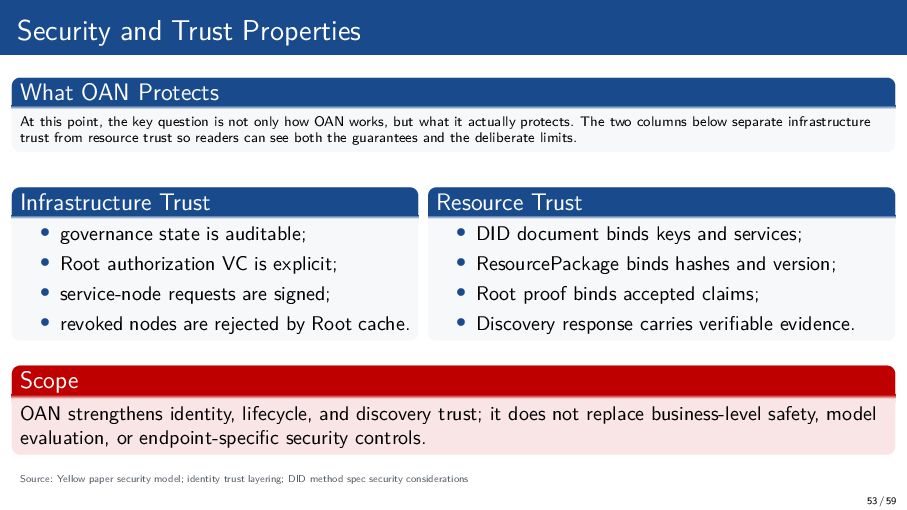
  53. Security and Trust Properties What OAN Protects At this point,

    the key question is not only how OAN works, but what it actually protects. The two columns below separate infrastructure trust from resource trust so readers can see both the guarantees and the deliberate limits. Infrastructure Trust • governance state is auditable; • Root authorization VC is explicit; • service-node requests are signed; • revoked nodes are rejected by Root cache. Resource Trust • DID document binds keys and services; • ResourcePackage binds hashes and version; • Root proof binds accepted claims; • Discovery response carries verifiable evidence. Scope OAN strengthens identity, lifecycle, and discovery trust; it does not replace business-level safety, model evaluation, or endpoint-specific security controls. Source: Yellow paper security model; identity trust layering; DID method spec security considerations 53 / 59
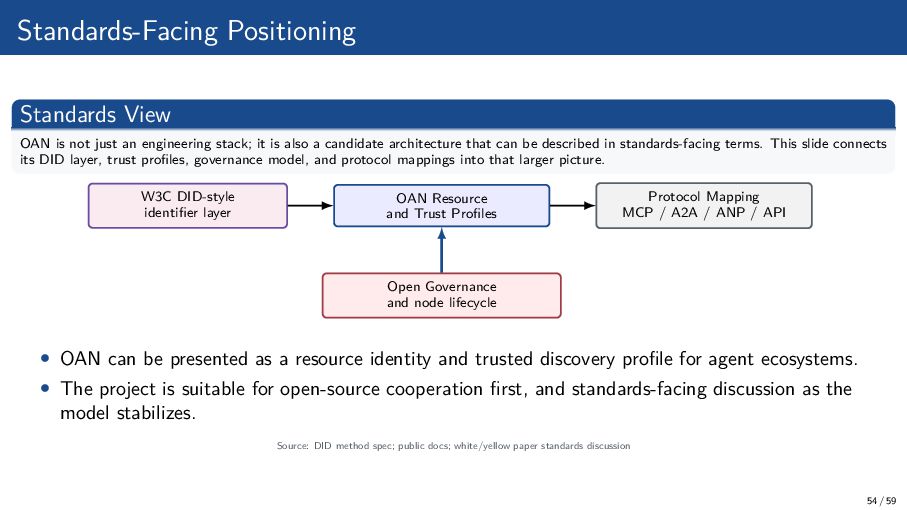
  54. Standards-Facing Positioning Standards View OAN is not just an engineering

    stack; it is also a candidate architecture that can be described in standards-facing terms. This slide connects its DID layer, trust profiles, governance model, and protocol mappings into that larger picture. W3C DID-style identifier layer OAN Resource and Trust Profiles Protocol Mapping MCP / A2A / ANP / API Open Governance and node lifecycle • OAN can be presented as a resource identity and trusted discovery profile for agent ecosystems. • The project is suitable for open-source cooperation first, and standards-facing discussion as the model stabilizes. Source: DID method spec; public docs; white/yellow paper standards discussion 54 / 59
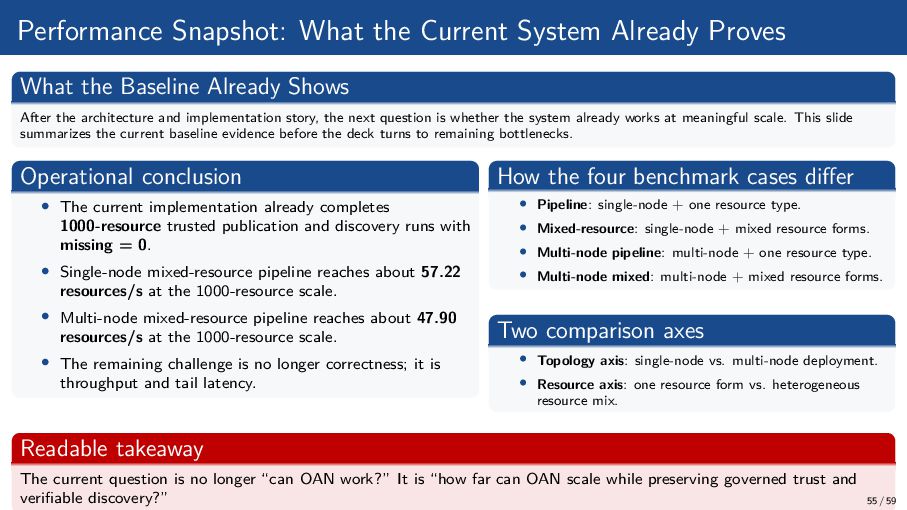
  55. Performance Snapshot: What the Current System Already Proves What the

    Baseline Already Shows After the architecture and implementation story, the next question is whether the system already works at meaningful scale. This slide summarizes the current baseline evidence before the deck turns to remaining bottlenecks. Operational conclusion • The current implementation already completes 1000-resource trusted publication and discovery runs with missing = 0. • Single-node mixed-resource pipeline reaches about 57.22 resources/s at the 1000-resource scale. • Multi-node mixed-resource pipeline reaches about 47.90 resources/s at the 1000-resource scale. • The remaining challenge is no longer correctness; it is throughput and tail latency. How the four benchmark cases differ • Pipeline: single-node + one resource type. • Mixed-resource: single-node + mixed resource forms. • Multi-node pipeline: multi-node + one resource type. • Multi-node mixed: multi-node + mixed resource forms. Two comparison axes • Topology axis: single-node vs. multi-node deployment. • Resource axis: one resource form vs. heterogeneous resource mix. Readable takeaway The current question is no longer “can OAN work?” It is “how far can OAN scale while preserving governed trust and verifiable discovery?” 55 / 59
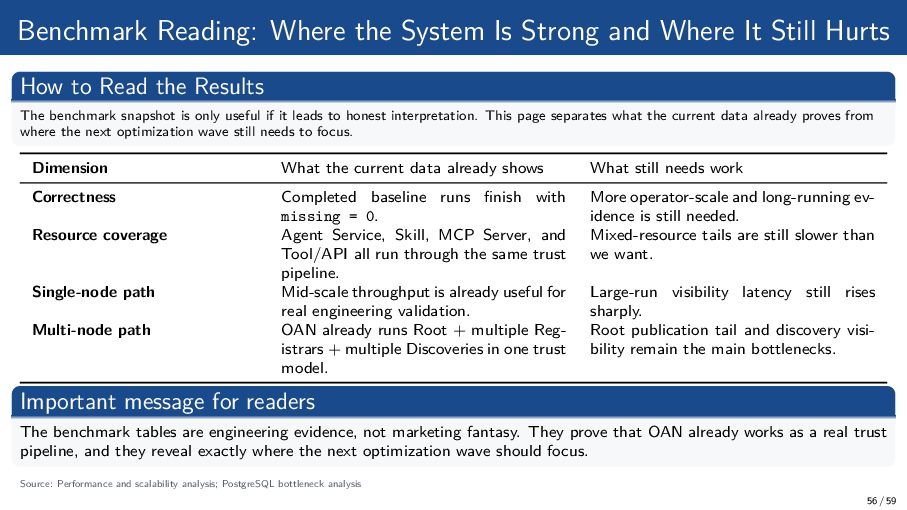
  56. Benchmark Reading: Where the System Is Strong and Where It

    Still Hurts How to Read the Results The benchmark snapshot is only useful if it leads to honest interpretation. This page separates what the current data already proves from where the next optimization wave still needs to focus. Dimension What the current data already shows What still needs work Correctness Completed baseline runs finish with missing = 0. More operator-scale and long-running ev- idence is still needed. Resource coverage Agent Service, Skill, MCP Server, and Tool/API all run through the same trust pipeline. Mixed-resource tails are still slower than we want. Single-node path Mid-scale throughput is already useful for real engineering validation. Large-run visibility latency still rises sharply. Multi-node path OAN already runs Root + multiple Reg- istrars + multiple Discoveries in one trust model. Root publication tail and discovery visi- bility remain the main bottlenecks. Important message for readers The benchmark tables are engineering evidence, not marketing fantasy. They prove that OAN already works as a real trust pipeline, and they reveal exactly where the next optimization wave should focus. Source: Performance and scalability analysis; PostgreSQL bottleneck analysis 56 / 59
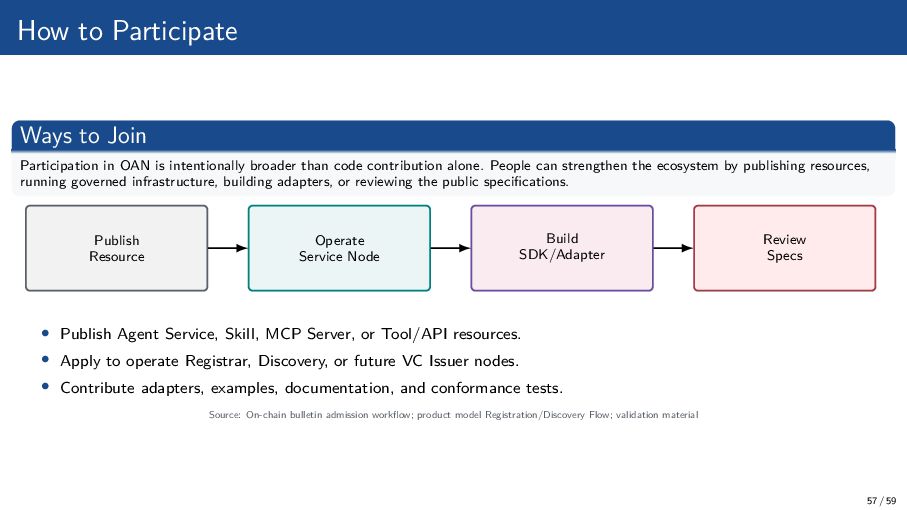
  57. How to Participate Ways to Join Participation in OAN is

    intentionally broader than code contribution alone. People can strengthen the ecosystem by publishing resources, running governed infrastructure, building adapters, or reviewing the public specifications. Publish Resource Operate Service Node Build SDK/Adapter Review Specs • Publish Agent Service, Skill, MCP Server, or Tool/API resources. • Apply to operate Registrar, Discovery, or future VC Issuer nodes. • Contribute adapters, examples, documentation, and conformance tests. Source: On-chain bulletin admission workflow; product model Registration/Discovery Flow; validation material 57 / 59
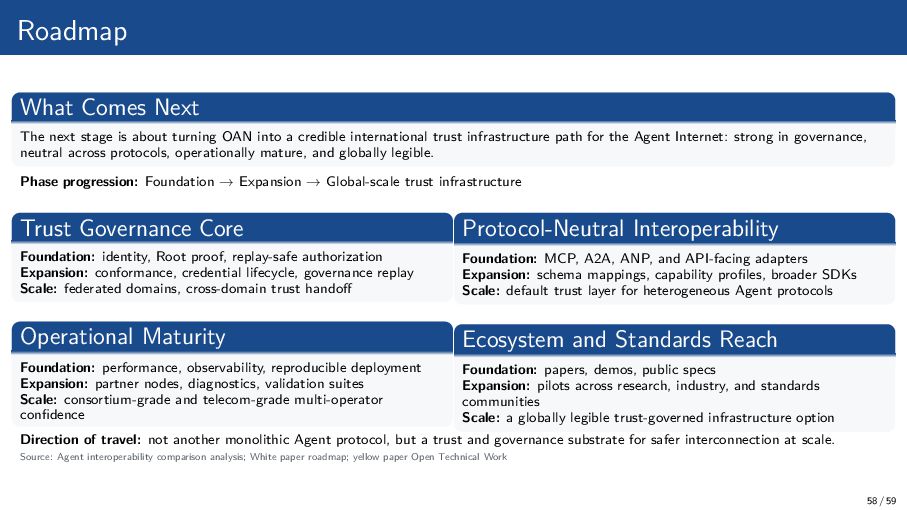
  58. Roadmap What Comes Next The next stage is about turning

    OAN into a credible international trust infrastructure path for the Agent Internet: strong in governance, neutral across protocols, operationally mature, and globally legible. Phase progression: Foundation → Expansion → Global-scale trust infrastructure Trust Governance Core Foundation: identity, Root proof, replay-safe authorization Expansion: conformance, credential lifecycle, governance replay Scale: federated domains, cross-domain trust handoff Operational Maturity Foundation: performance, observability, reproducible deployment Expansion: partner nodes, diagnostics, validation suites Scale: consortium-grade and telecom-grade multi-operator confidence Protocol-Neutral Interoperability Foundation: MCP, A2A, ANP, and API-facing adapters Expansion: schema mappings, capability profiles, broader SDKs Scale: default trust layer for heterogeneous Agent protocols Ecosystem and Standards Reach Foundation: papers, demos, public specs Expansion: pilots across research, industry, and standards communities Scale: a globally legible trust-governed infrastructure option Direction of travel: not another monolithic Agent protocol, but a trust and governance substrate for safer interconnection at scale. Source: Agent interoperability comparison analysis; White paper roadmap; yellow paper Open Technical Work 58 / 59
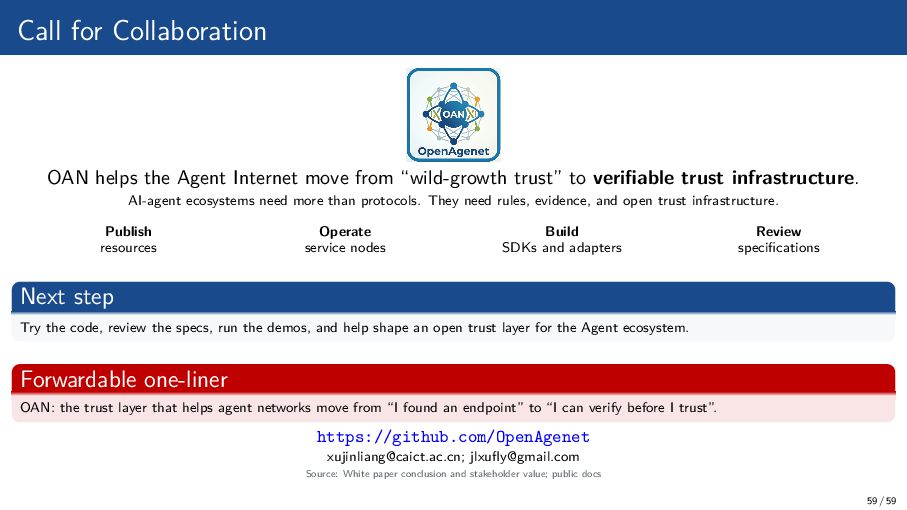
  59. Call for Collaboration OAN helps the Agent Internet move from

    “wild-growth trust” to verifiable trust infrastructure. AI-agent ecosystems need more than protocols. They need rules, evidence, and open trust infrastructure. Publish resources Operate service nodes Build SDKs and adapters Review specifications Next step Try the code, review the specs, run the demos, and help shape an open trust layer for the Agent ecosystem. Forwardable one-liner OAN: the trust layer that helps agent networks move from “I found an endpoint” to “I can verify before I trust”. https://github.com/OpenAgenet [email protected]; [email protected] Source: White paper conclusion and stakeholder value; public docs 59 / 59