Upgrade to Pro — share decks privately, control downloads, hide ads and more …

MMAO: A Metabolic Multi-Agent Optimization Fram...

Sponsored · Your Podcast. Everywhere. Effortlessly. Share. Educate. Inspire. Entertain. You do you. We'll handle the rest. →

MMAO: A Metabolic Multi-Agent Optimization Framework

This slide deck introduces MMAO (Metabolic Multi-Agent Optimizer), a controller-first metaheuristic framework for adaptive optimization. Instead of stacking disconnected schedules and parameter-control rules, MMAO organizes search through an endogenous closed-loop resource economy built on private energy, a communal pool, and lifecycle regulation.

The deck explains why this framework was proposed, how its internal control logic works, and how the same controller perspective can be instantiated across continuous, discrete, dynamic, and classification-oriented optimization settings. It also highlights representative evidence, public software entry points, and the current MMAO paper line.

The goal of this deck is not to claim universal superiority, but to present MMAO as a reusable and interpretable optimization framework that may be worth attention from researchers working in metaheuristics, evolutionary computation, swarm intelligence, and related optimization applications.

Avatar for @wolfbrother

@wolfbrother

July 05, 2026

More Decks by @wolfbrother

Other Decks in Research

Transcript

  1. MMAO: A Metabolic Multi-Agent Optimization Framework Why the framework exists,

    how it works, and why it may matter Jinliang Xu Shared in a personal research capacity July 5, 2026 1 / 17
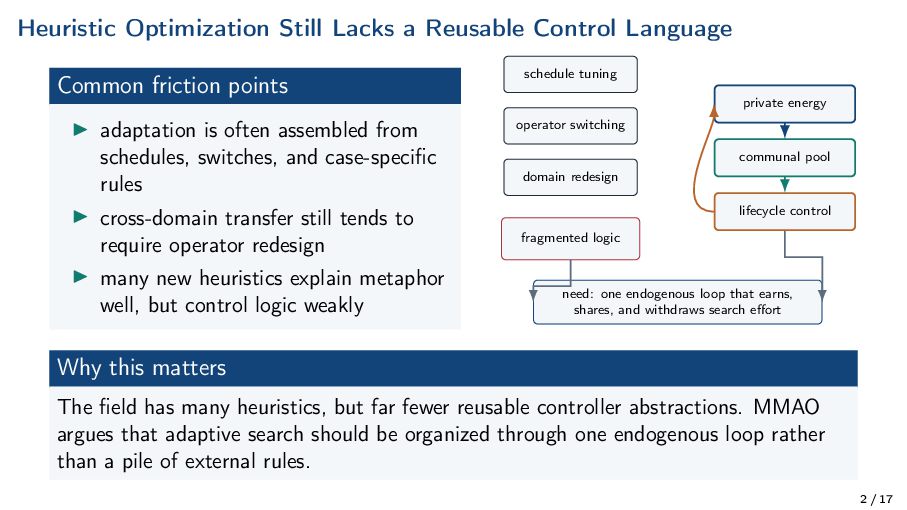
  2. Heuristic Optimization Still Lacks a Reusable Control Language Common friction

    points ▶ adaptation is often assembled from schedules, switches, and case-specific rules ▶ cross-domain transfer still tends to require operator redesign ▶ many new heuristics explain metaphor well, but control logic weakly schedule tuning operator switching domain redesign fragmented logic private energy communal pool lifecycle control need: one endogenous loop that earns, shares, and withdraws search effort Why this matters The field has many heuristics, but far fewer reusable controller abstractions. MMAO argues that adaptive search should be organized through one endogenous loop rather than a pile of external rules. 2 / 17
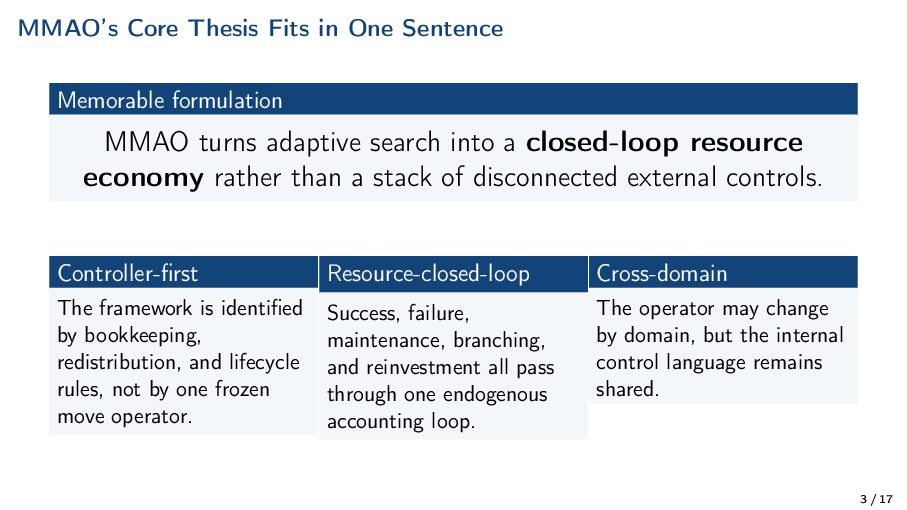
  3. MMAO’s Core Thesis Fits in One Sentence Memorable formulation MMAO

    turns adaptive search into a closed-loop resource economy rather than a stack of disconnected external controls. Controller-first The framework is identified by bookkeeping, redistribution, and lifecycle rules, not by one frozen move operator. Resource-closed-loop Success, failure, maintenance, branching, and reinvestment all pass through one endogenous accounting loop. Cross-domain The operator may change by domain, but the internal control language remains shared. 3 / 17
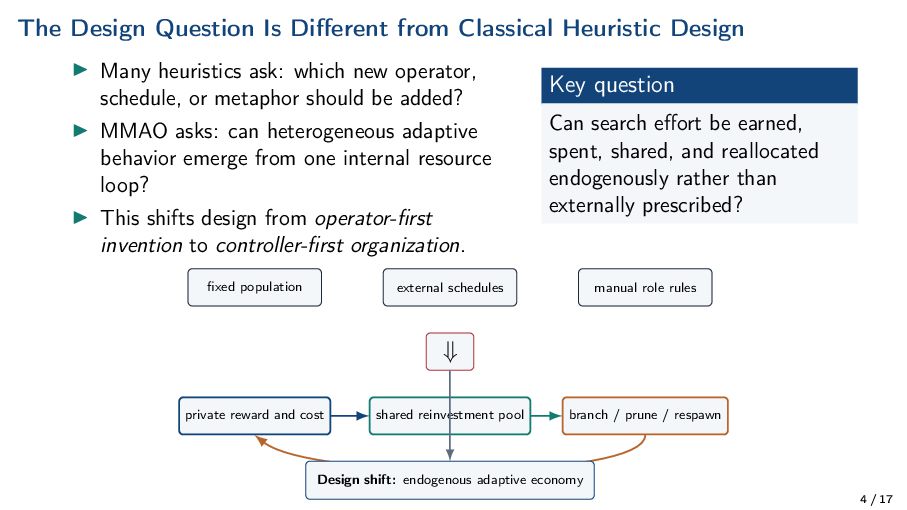
  4. The Design Question Is Different from Classical Heuristic Design ▶

    Many heuristics ask: which new operator, schedule, or metaphor should be added? ▶ MMAO asks: can heterogeneous adaptive behavior emerge from one internal resource loop? ▶ This shifts design from operator-first invention to controller-first organization. Key question Can search effort be earned, spent, shared, and reallocated endogenously rather than externally prescribed? fixed population external schedules manual role rules ⇓ private reward and cost shared reinvestment pool branch / prune / respawn Design shift: endogenous adaptive economy 4 / 17
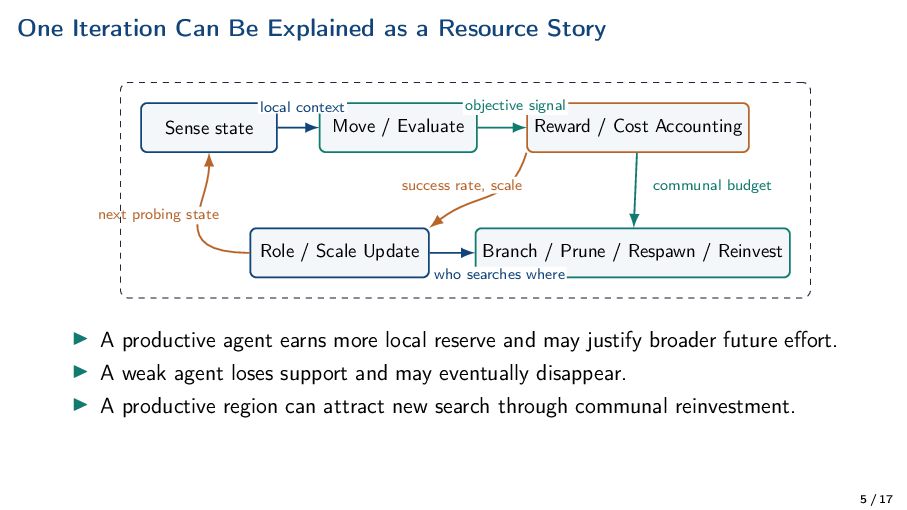
  5. One Iteration Can Be Explained as a Resource Story Sense

    state Move / Evaluate Reward / Cost Accounting Role / Scale Update Branch / Prune / Respawn / Reinvest local context objective signal success rate, scale communal budget who searches where next probing state ▶ A productive agent earns more local reserve and may justify broader future effort. ▶ A weak agent loses support and may eventually disappear. ▶ A productive region can attract new search through communal reinvestment. 5 / 17
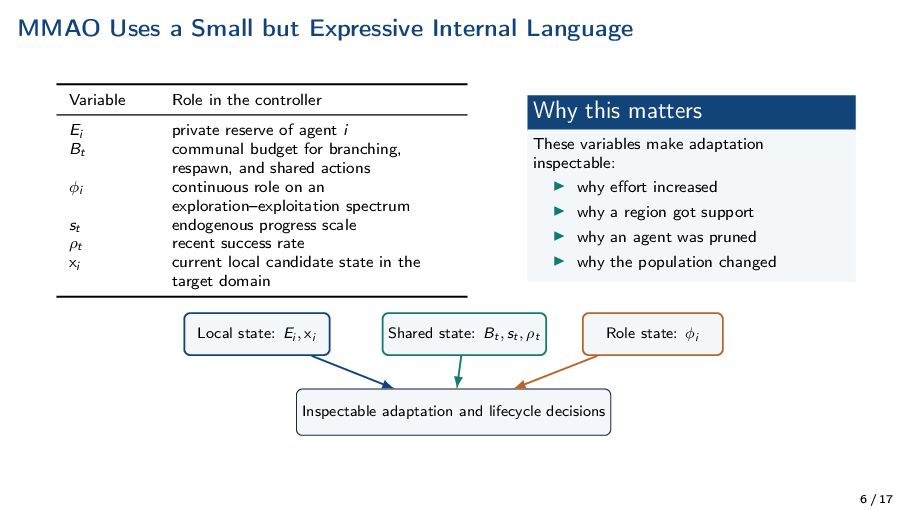
  6. MMAO Uses a Small but Expressive Internal Language Variable Role

    in the controller Ei private reserve of agent i Bt communal budget for branching, respawn, and shared actions ϕi continuous role on an exploration–exploitation spectrum st endogenous progress scale ρt recent success rate xi current local candidate state in the target domain Why this matters These variables make adaptation inspectable: ▶ why effort increased ▶ why a region got support ▶ why an agent was pruned ▶ why the population changed Local state: Ei , xi Shared state: Bt , st , ρt Role state: ϕi Inspectable adaptation and lifecycle decisions 6 / 17
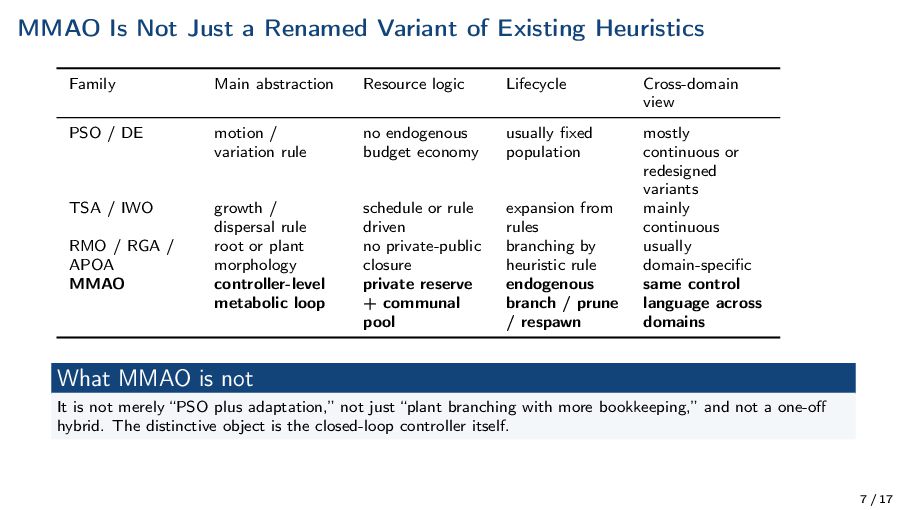
  7. MMAO Is Not Just a Renamed Variant of Existing Heuristics

    Family Main abstraction Resource logic Lifecycle Cross-domain view PSO / DE motion / variation rule no endogenous budget economy usually fixed population mostly continuous or redesigned variants TSA / IWO growth / dispersal rule schedule or rule driven expansion from rules mainly continuous RMO / RGA / APOA root or plant morphology no private-public closure branching by heuristic rule usually domain-specific MMAO controller-level metabolic loop private reserve + communal pool endogenous branch / prune / respawn same control language across domains What MMAO is not It is not merely “PSO plus adaptation,” not just “plant branching with more bookkeeping,” and not a one-off hybrid. The distinctive object is the closed-loop controller itself. 7 / 17
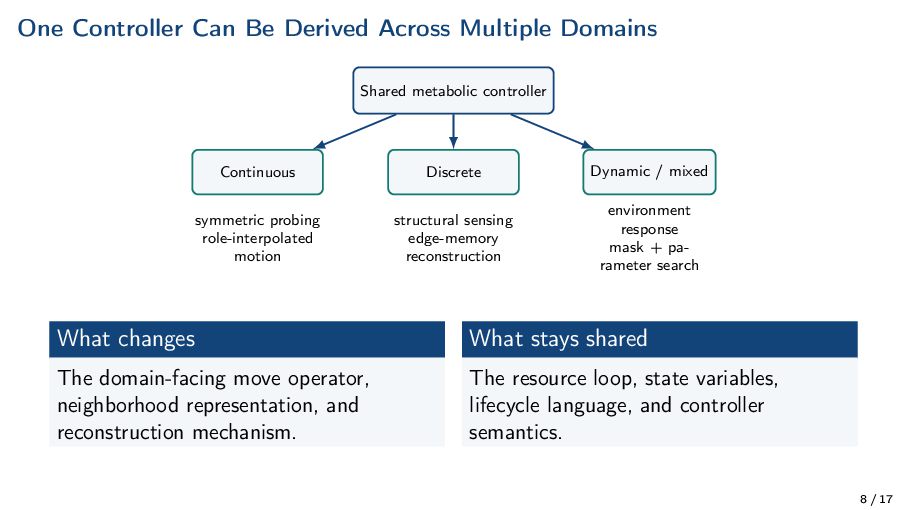
  8. One Controller Can Be Derived Across Multiple Domains Shared metabolic

    controller Continuous Discrete Dynamic / mixed symmetric probing role-interpolated motion structural sensing edge-memory reconstruction environment response mask + pa- rameter search What changes The domain-facing move operator, neighborhood representation, and reconstruction mechanism. What stays shared The resource loop, state variables, lifecycle language, and controller semantics. 8 / 17
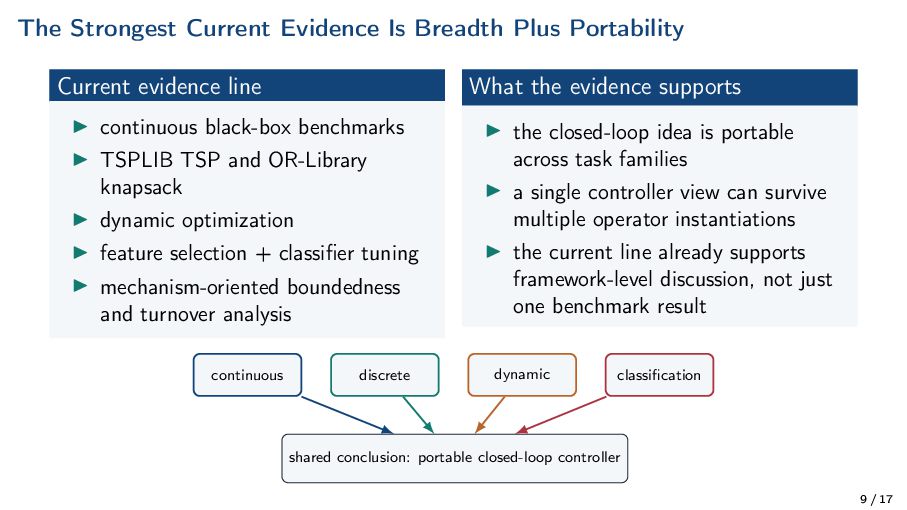
  9. The Strongest Current Evidence Is Breadth Plus Portability Current evidence

    line ▶ continuous black-box benchmarks ▶ TSPLIB TSP and OR-Library knapsack ▶ dynamic optimization ▶ feature selection + classifier tuning ▶ mechanism-oriented boundedness and turnover analysis What the evidence supports ▶ the closed-loop idea is portable across task families ▶ a single controller view can survive multiple operator instantiations ▶ the current line already supports framework-level discussion, not just one benchmark result continuous discrete dynamic classification shared conclusion: portable closed-loop controller 9 / 17
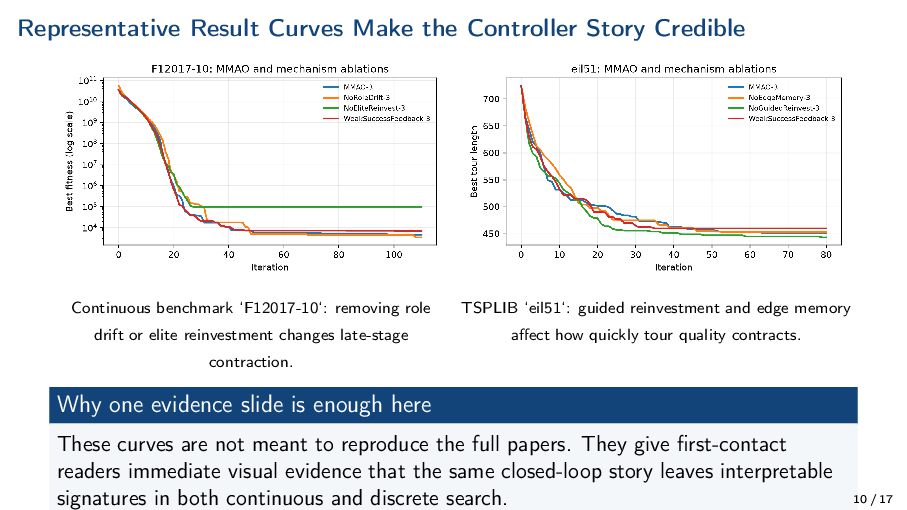
  10. Representative Result Curves Make the Controller Story Credible Continuous benchmark

    ‘F12017-10‘: removing role drift or elite reinvestment changes late-stage contraction. TSPLIB ‘eil51‘: guided reinvestment and edge memory affect how quickly tour quality contracts. Why one evidence slide is enough here These curves are not meant to reproduce the full papers. They give first-contact readers immediate visual evidence that the same closed-loop story leaves interpretable signatures in both continuous and discrete search. 10 / 17
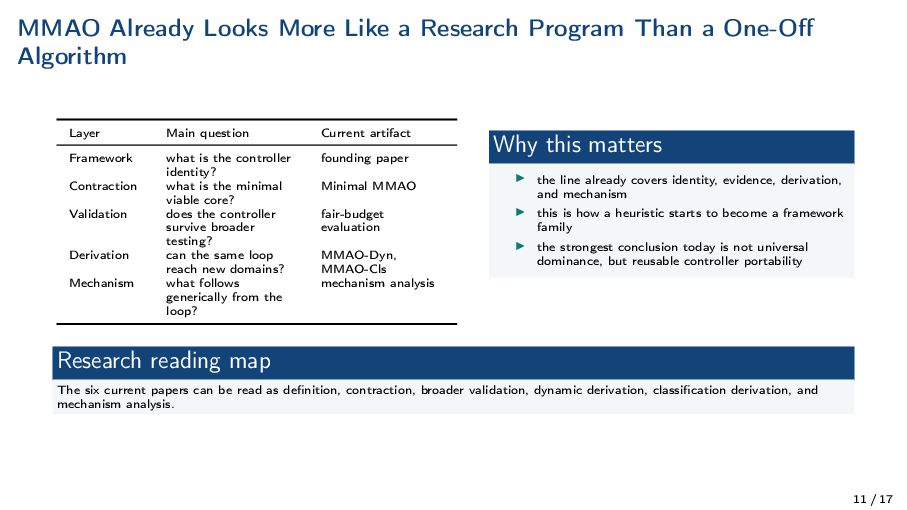
  11. MMAO Already Looks More Like a Research Program Than a

    One-Off Algorithm Layer Main question Current artifact Framework what is the controller identity? founding paper Contraction what is the minimal viable core? Minimal MMAO Validation does the controller survive broader testing? fair-budget evaluation Derivation can the same loop reach new domains? MMAO-Dyn, MMAO-Cls Mechanism what follows generically from the loop? mechanism analysis Why this matters ▶ the line already covers identity, evidence, derivation, and mechanism ▶ this is how a heuristic starts to become a framework family ▶ the strongest conclusion today is not universal dominance, but reusable controller portability Research reading map The six current papers can be read as definition, contraction, broader validation, dynamic derivation, classification derivation, and mechanism analysis. 11 / 17
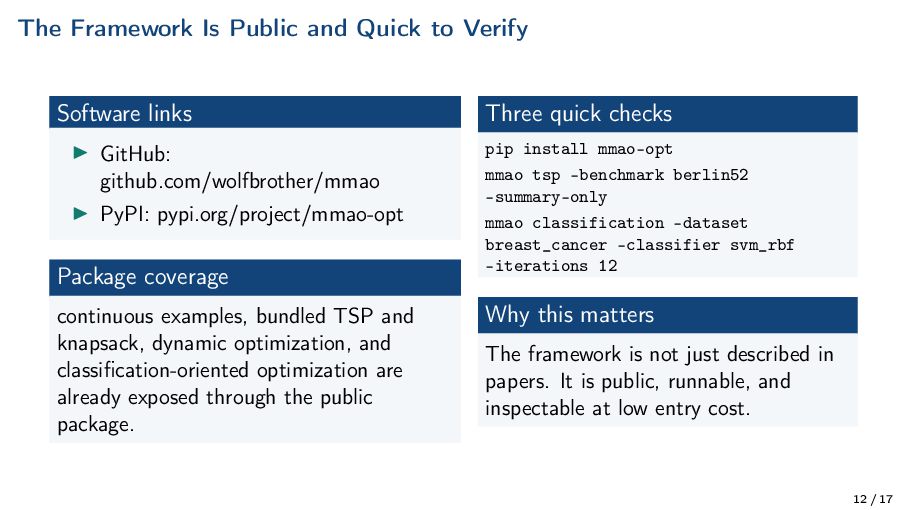
  12. The Framework Is Public and Quick to Verify Software links

    ▶ GitHub: github.com/wolfbrother/mmao ▶ PyPI: pypi.org/project/mmao-opt Package coverage continuous examples, bundled TSP and knapsack, dynamic optimization, and classification-oriented optimization are already exposed through the public package. Three quick checks pip install mmao-opt mmao tsp –benchmark berlin52 –summary-only mmao classification –dataset breast_cancer –classifier svm_rbf –iterations 12 Why this matters The framework is not just described in papers. It is public, runnable, and inspectable at low entry cost. 12 / 17
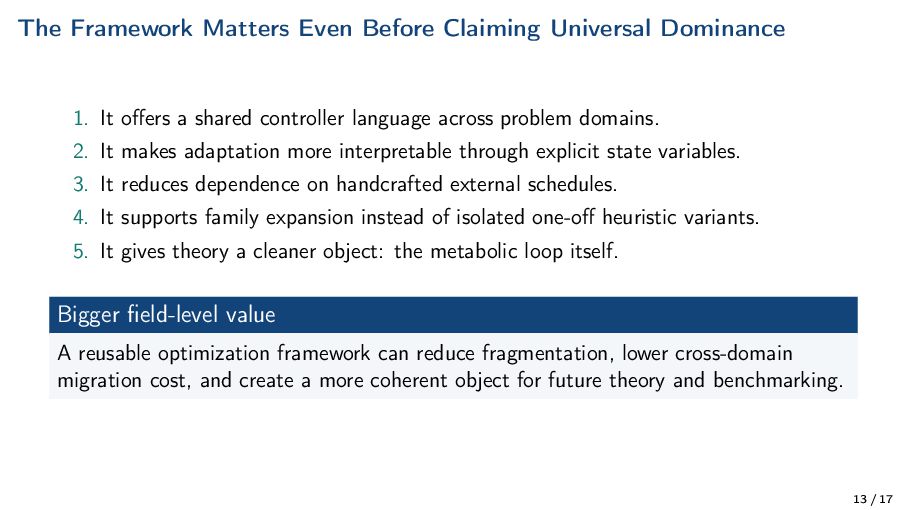
  13. The Framework Matters Even Before Claiming Universal Dominance 1. It

    offers a shared controller language across problem domains. 2. It makes adaptation more interpretable through explicit state variables. 3. It reduces dependence on handcrafted external schedules. 4. It supports family expansion instead of isolated one-off heuristic variants. 5. It gives theory a cleaner object: the metabolic loop itself. Bigger field-level value A reusable optimization framework can reduce fragmentation, lower cross-domain migration cost, and create a more coherent object for future theory and benchmarking. 13 / 17
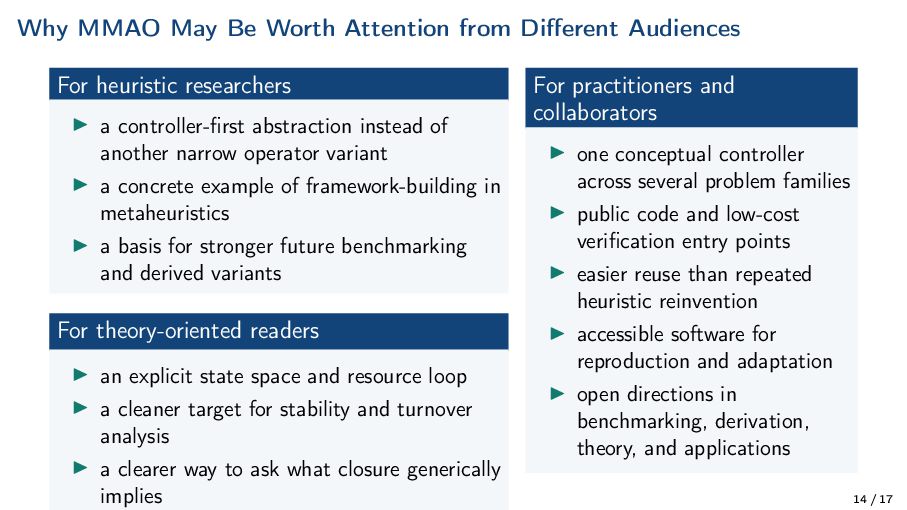
  14. Why MMAO May Be Worth Attention from Different Audiences For

    heuristic researchers ▶ a controller-first abstraction instead of another narrow operator variant ▶ a concrete example of framework-building in metaheuristics ▶ a basis for stronger future benchmarking and derived variants For theory-oriented readers ▶ an explicit state space and resource loop ▶ a cleaner target for stability and turnover analysis ▶ a clearer way to ask what closure generically implies For practitioners and collaborators ▶ one conceptual controller across several problem families ▶ public code and low-cost verification entry points ▶ easier reuse than repeated heuristic reinvention ▶ accessible software for reproduction and adaptation ▶ open directions in benchmarking, derivation, theory, and applications 14 / 17
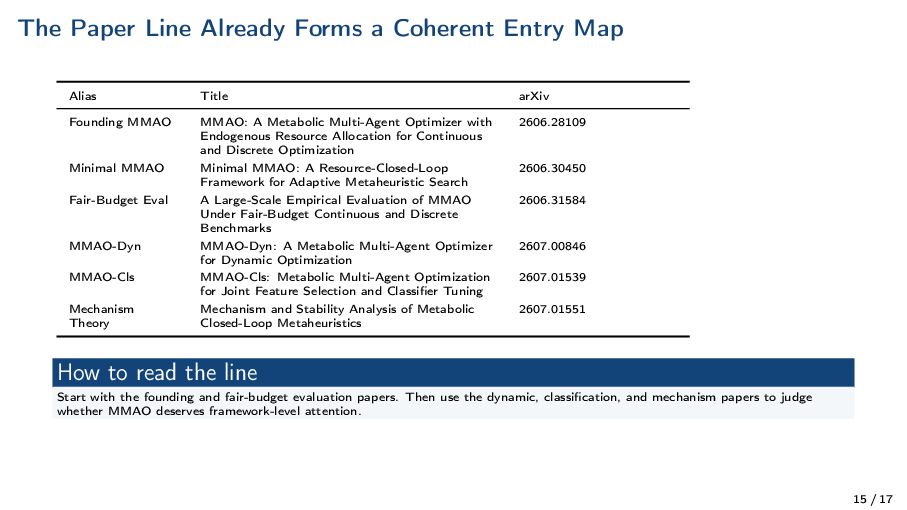
  15. The Paper Line Already Forms a Coherent Entry Map Alias

    Title arXiv Founding MMAO MMAO: A Metabolic Multi-Agent Optimizer with Endogenous Resource Allocation for Continuous and Discrete Optimization 2606.28109 Minimal MMAO Minimal MMAO: A Resource-Closed-Loop Framework for Adaptive Metaheuristic Search 2606.30450 Fair-Budget Eval A Large-Scale Empirical Evaluation of MMAO Under Fair-Budget Continuous and Discrete Benchmarks 2606.31584 MMAO-Dyn MMAO-Dyn: A Metabolic Multi-Agent Optimizer for Dynamic Optimization 2607.00846 MMAO-Cls MMAO-Cls: Metabolic Multi-Agent Optimization for Joint Feature Selection and Classifier Tuning 2607.01539 Mechanism Theory Mechanism and Stability Analysis of Metabolic Closed-Loop Metaheuristics 2607.01551 How to read the line Start with the founding and fair-budget evaluation papers. Then use the dynamic, classification, and mechanism papers to judge whether MMAO deserves framework-level attention. 15 / 17
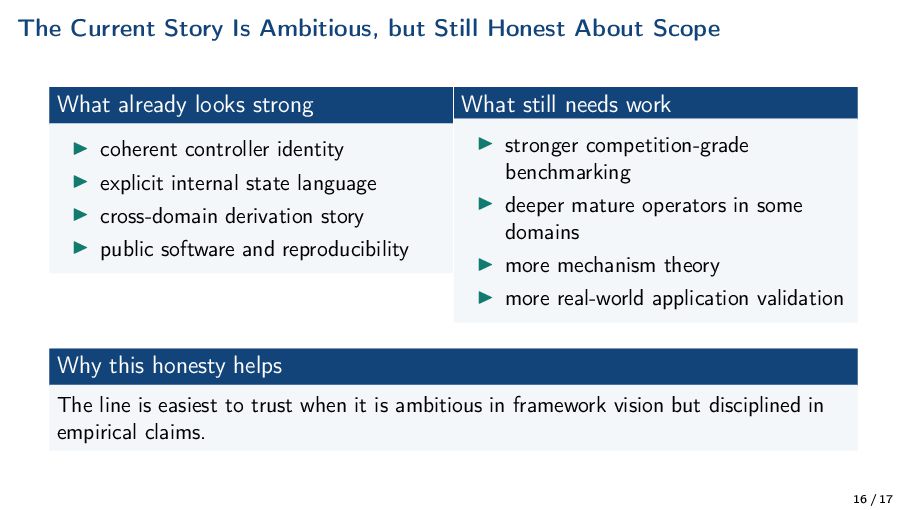
  16. The Current Story Is Ambitious, but Still Honest About Scope

    What already looks strong ▶ coherent controller identity ▶ explicit internal state language ▶ cross-domain derivation story ▶ public software and reproducibility What still needs work ▶ stronger competition-grade benchmarking ▶ deeper mature operators in some domains ▶ more mechanism theory ▶ more real-world application validation Why this honesty helps The line is easiest to trust when it is ambitious in framework vision but disciplined in empirical claims. 16 / 17
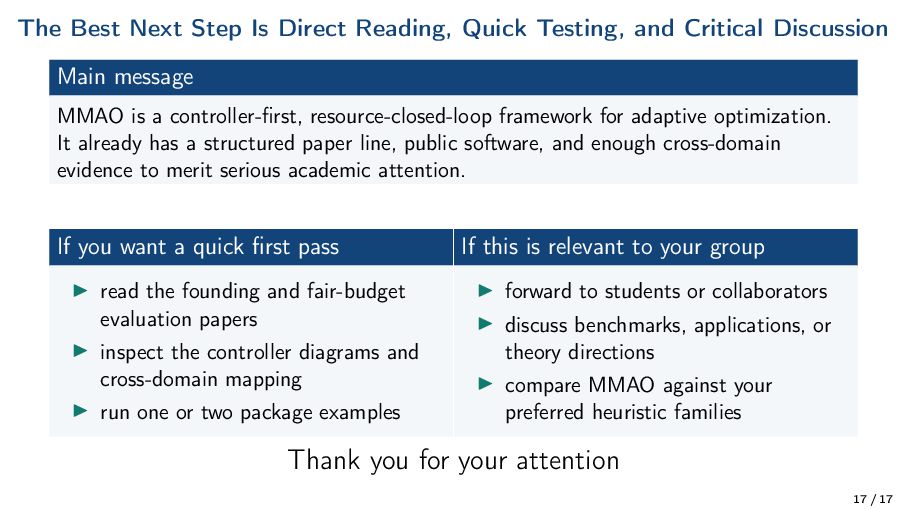
  17. The Best Next Step Is Direct Reading, Quick Testing, and

    Critical Discussion Main message MMAO is a controller-first, resource-closed-loop framework for adaptive optimization. It already has a structured paper line, public software, and enough cross-domain evidence to merit serious academic attention. If you want a quick first pass ▶ read the founding and fair-budget evaluation papers ▶ inspect the controller diagrams and cross-domain mapping ▶ run one or two package examples If this is relevant to your group ▶ forward to students or collaborators ▶ discuss benchmarks, applications, or theory directions ▶ compare MMAO against your preferred heuristic families Thank you for your attention 17 / 17