Upgrade to Pro — share decks privately, control downloads, hide ads and more …

Introduction to Machine Learning by Chirag Jain

Introduction to Machine Learning by Chirag Jain

Avatar for Yogesh Singh

Yogesh Singh

May 11, 2018
Tweet

More Decks by Yogesh Singh

Other Decks in Technology

Transcript

  1. About Haptik Chatbot platform for publishers, advertisers and enterprises AI

    powered conversational interface to drive customer engagement Reach of 30 Million Users, processing 5 Million Chats per month One of the world’s largest chatbot platforms Started in 2013, global pioneers of chatbots
  2. How this talk is divided Part 1: AI Introduction and

    applications ➔ Introduction ➔ New and Old news about AI Part 2: ML Introduction and workflow ➔ Introduction Part 3: High Level Learning framework ➔ Code (and some Math) walkthrough of linear classifier
  3. What is AI ? Demonstration of human like intelligence by

    machines. A machine performing any task that needs human level intelligence can be said to be “Artificially Intelligent”
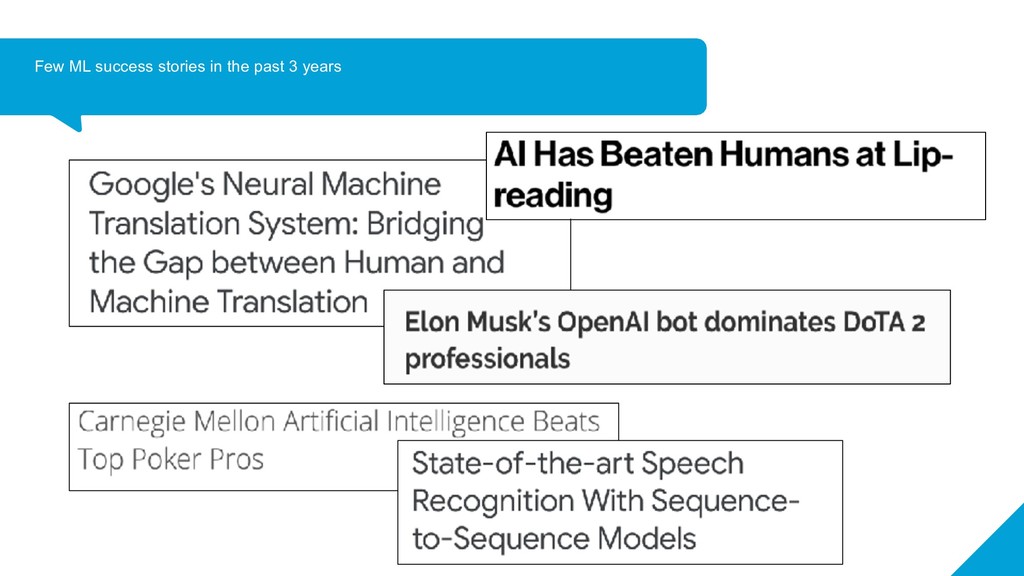
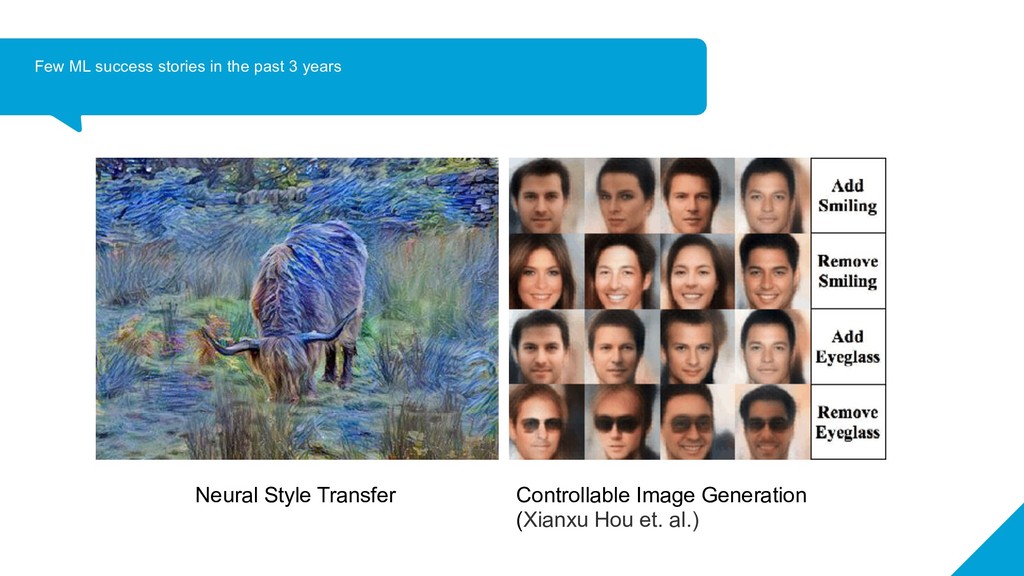
  4. Few ML success stories in the past 3 years Neural

    Style Transfer Controllable Image Generation (Xianxu Hou et. al.)
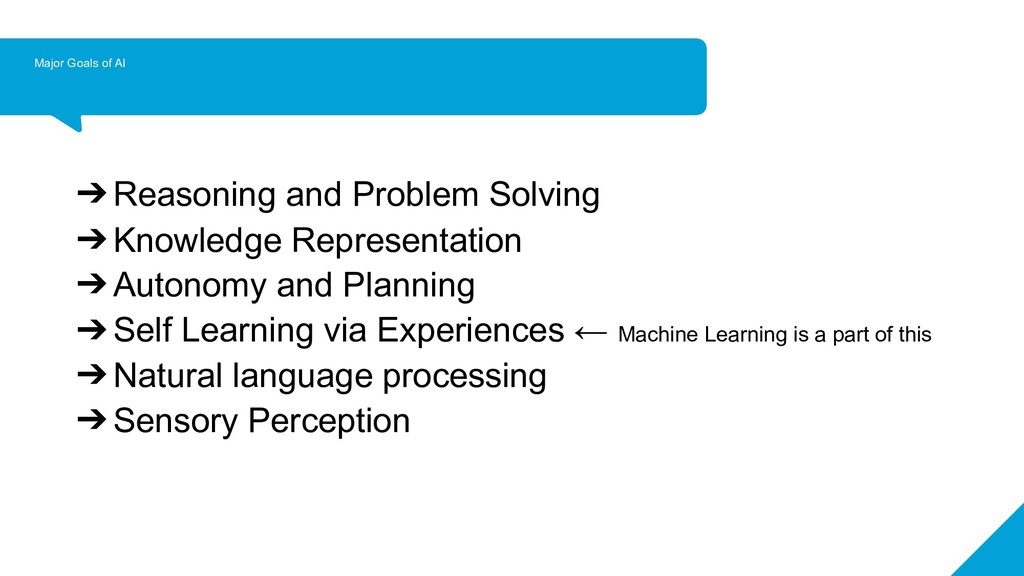
  5. Major Goals of AI ➔ Reasoning and Problem Solving ➔

    Knowledge Representation ➔ Autonomy and Planning ➔ Self Learning via Experiences ← Machine Learning is a part of this ➔ Natural language processing ➔ Sensory Perception
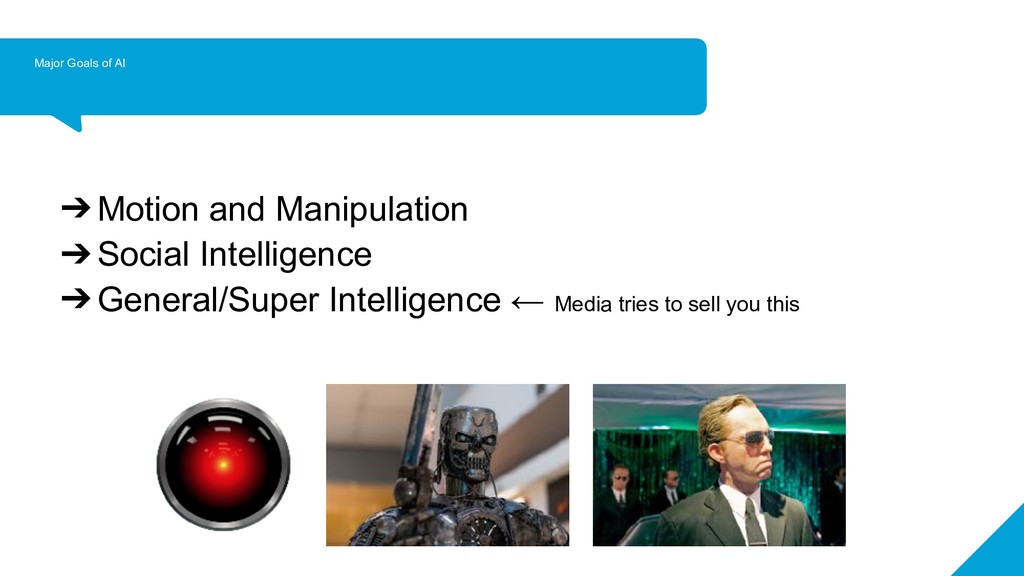
  6. Major Goals of AI ➔ Motion and Manipulation ➔ Social

    Intelligence ➔ General/Super Intelligence ← Media tries to sell you this
  7. Sciences involved in AI research ➔ Computer Science ➔ Mathematics

    ➔ Psychology ➔ Linguistics ➔ Philosophy ➔ Many Others
  8. Philosophy around AI ➔ Is general/super intelligence possible ? ➔

    Do they have to be similar to human systems to be intelligent as us ? ➔ Can intelligent machines be dangerous ? ➔ Should we prefer more accurate systems over transparent systems ?
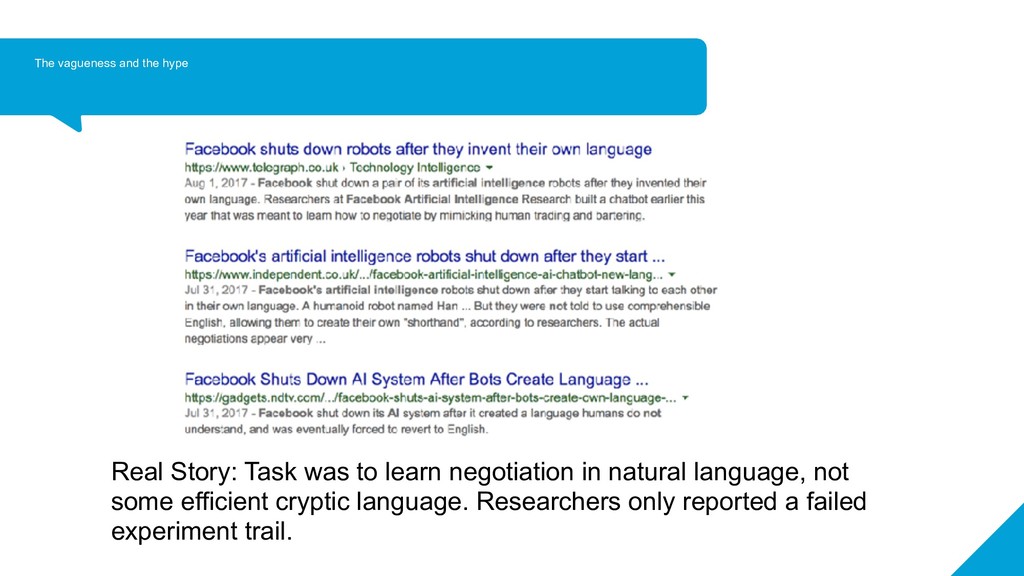
  9. The vagueness and the hype Real Story: Task was to

    learn negotiation in natural language, not some efficient cryptic language. Researchers only reported a failed experiment trail.
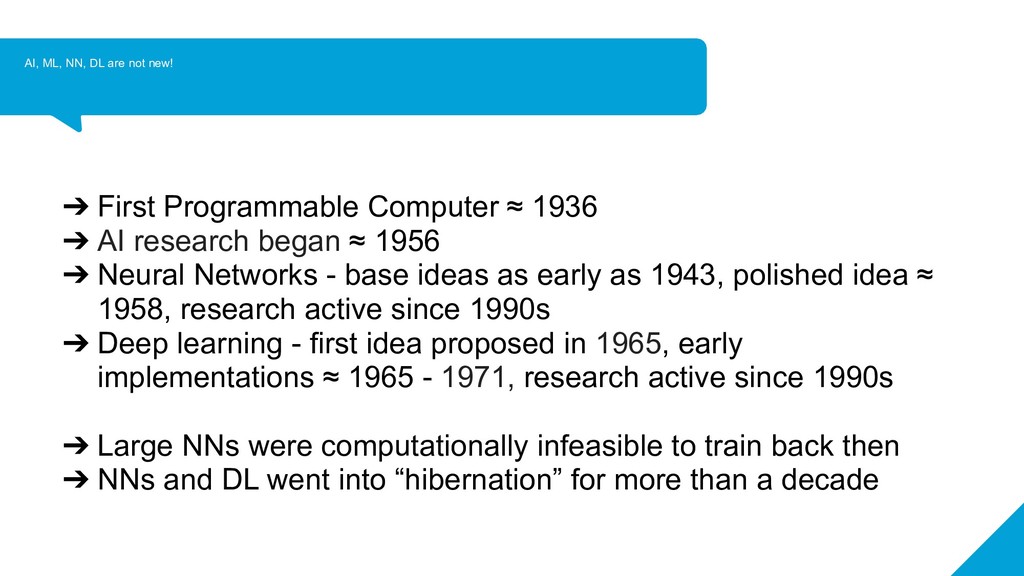
  10. AI, ML, NN, DL are not new! ➔ First Programmable

    Computer ≈ 1936 ➔ AI research began ≈ 1956 ➔ Neural Networks - base ideas as early as 1943, polished idea ≈ 1958, research active since 1990s ➔ Deep learning - first idea proposed in 1965, early implementations ≈ 1965 - 1971, research active since 1990s ➔ Large NNs were computationally infeasible to train back then ➔ NNs and DL went into “hibernation” for more than a decade
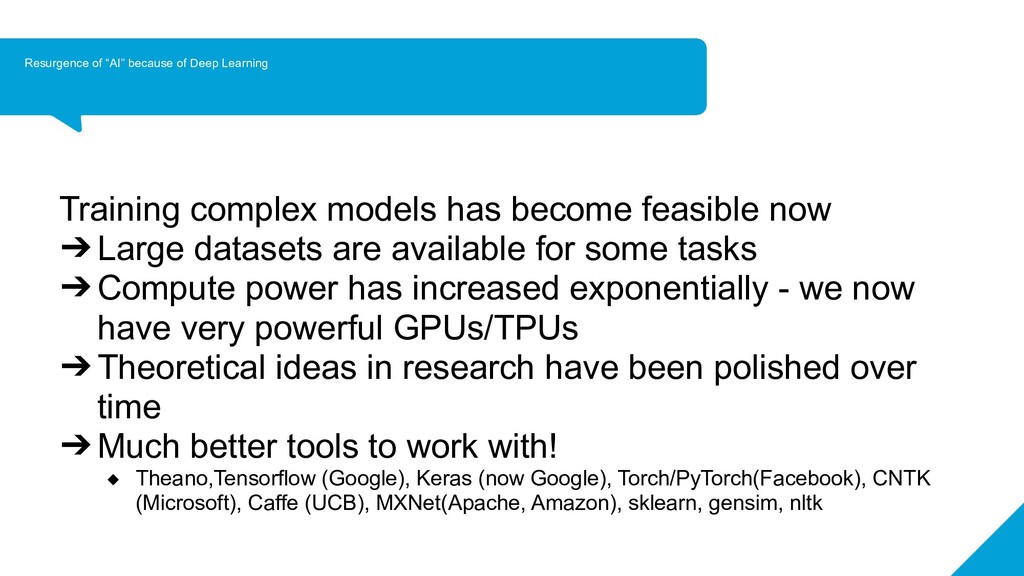
  11. Resurgence of “AI” because of Deep Learning Training complex models

    has become feasible now ➔ Large datasets are available for some tasks ➔ Compute power has increased exponentially - we now have very powerful GPUs/TPUs ➔ Theoretical ideas in research have been polished over time ➔ Much better tools to work with! ◆ Theano,Tensorflow (Google), Keras (now Google), Torch/PyTorch(Facebook), CNTK (Microsoft), Caffe (UCB), MXNet(Apache, Amazon), sklearn, gensim, nltk
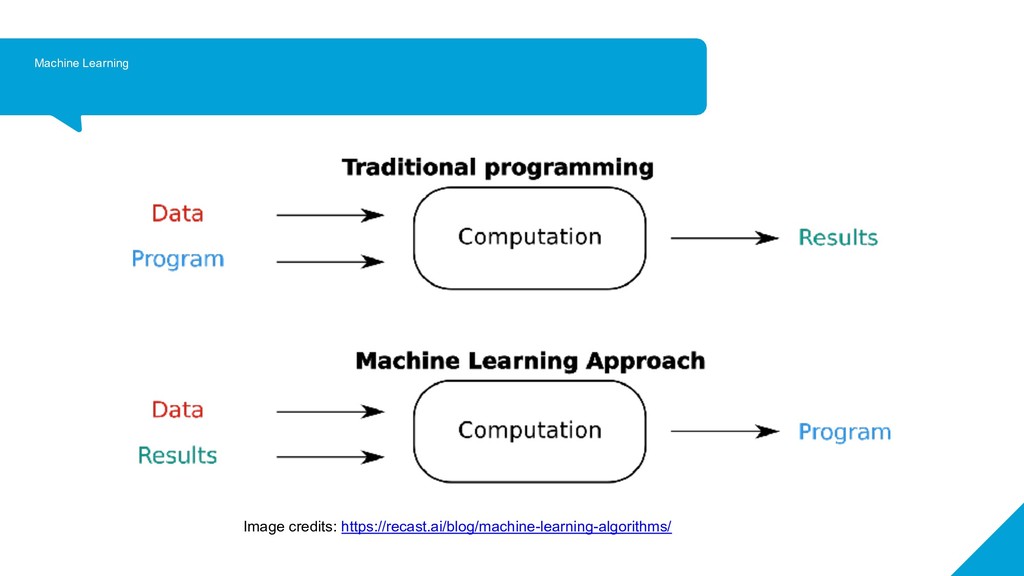
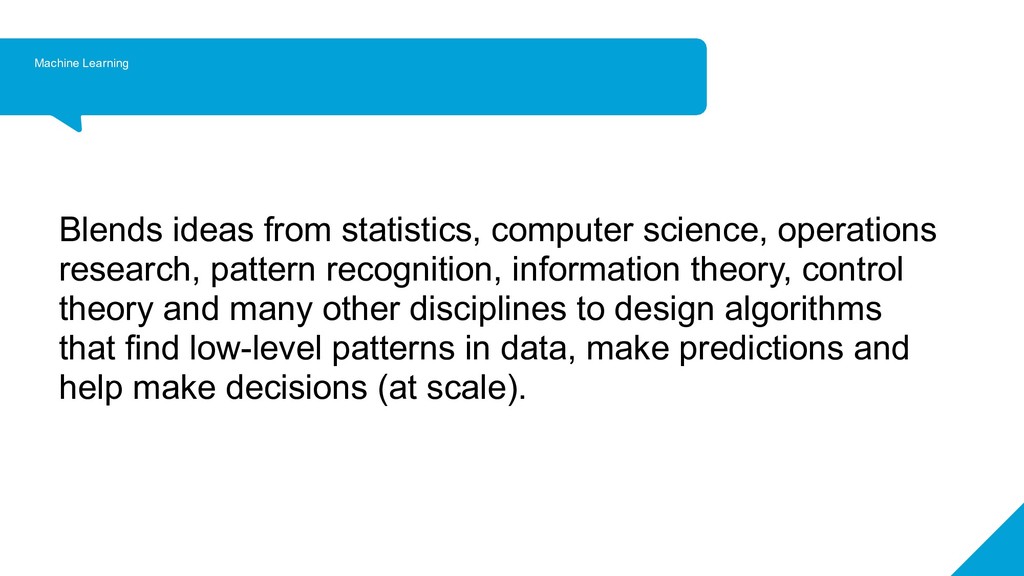
  12. Machine Learning Blends ideas from statistics, computer science, operations research,

    pattern recognition, information theory, control theory and many other disciplines to design algorithms that find low-level patterns in data, make predictions and help make decisions (at scale).
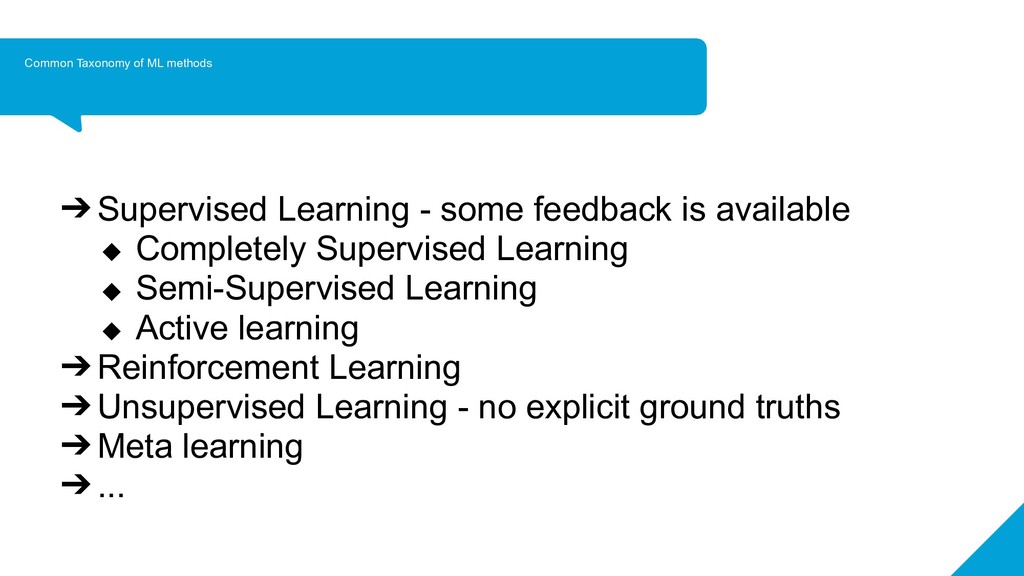
  13. Common Taxonomy of ML methods ➔ Supervised Learning - some

    feedback is available ◆ Completely Supervised Learning ◆ Semi-Supervised Learning ◆ Active learning ➔ Reinforcement Learning ➔ Unsupervised Learning - no explicit ground truths ➔ Meta learning ➔ ...
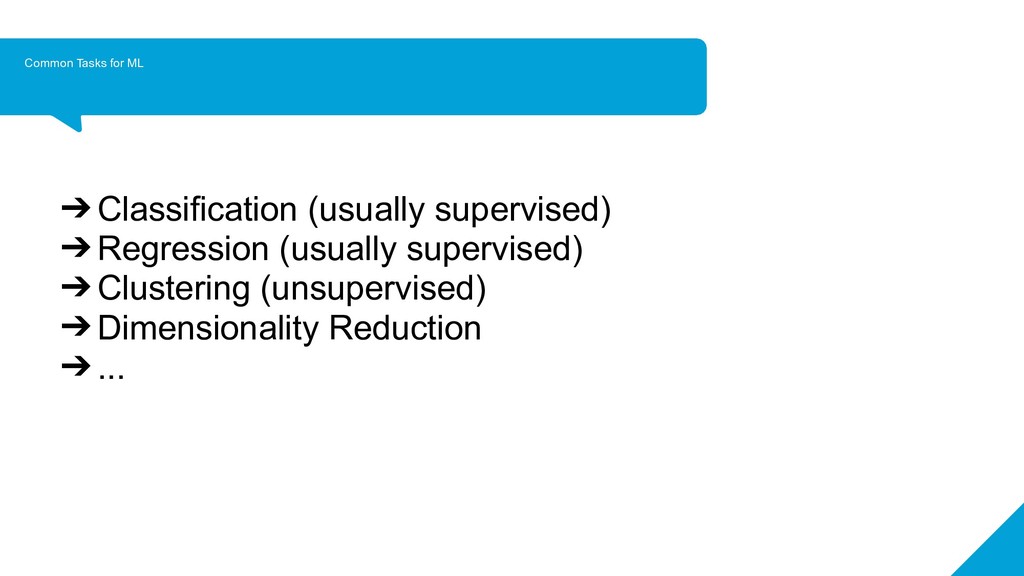
  14. Common Tasks for ML ➔ Classification (usually supervised) ➔ Regression

    (usually supervised) ➔ Clustering (unsupervised) ➔ Dimensionality Reduction ➔ ...
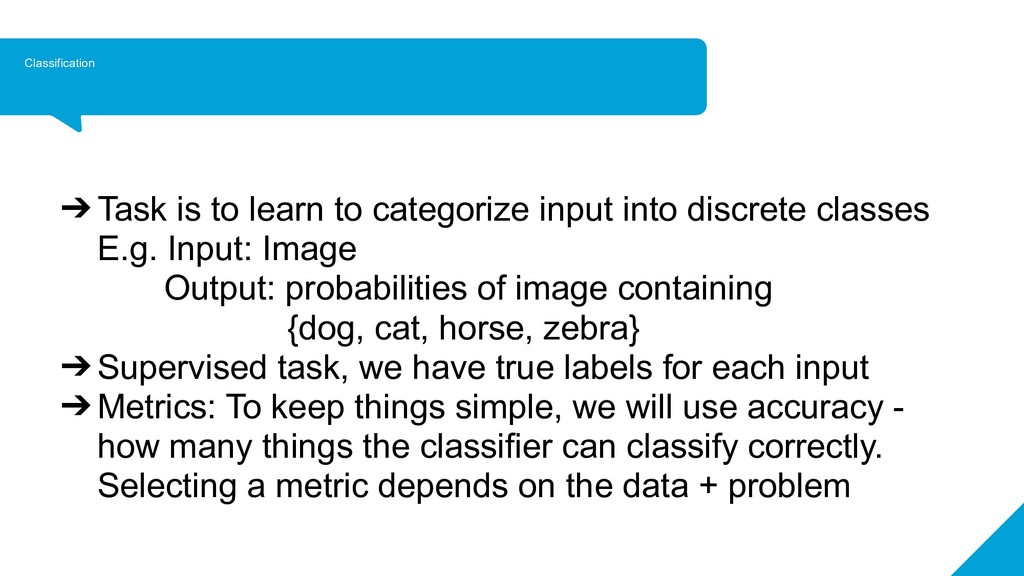
  15. Classification ➔ Task is to learn to categorize input into

    discrete classes E.g. Input: Image Output: probabilities of image containing {dog, cat, horse, zebra} ➔ Supervised task, we have true labels for each input ➔ Metrics: To keep things simple, we will use accuracy - how many things the classifier can classify correctly. Selecting a metric depends on the data + problem
  16. Logistic Regression - A simple linear classifier Notebook to follow

    along https://gist.github.com/chiragjn/ 24b548785d99a393fca9dccfe1439d4a
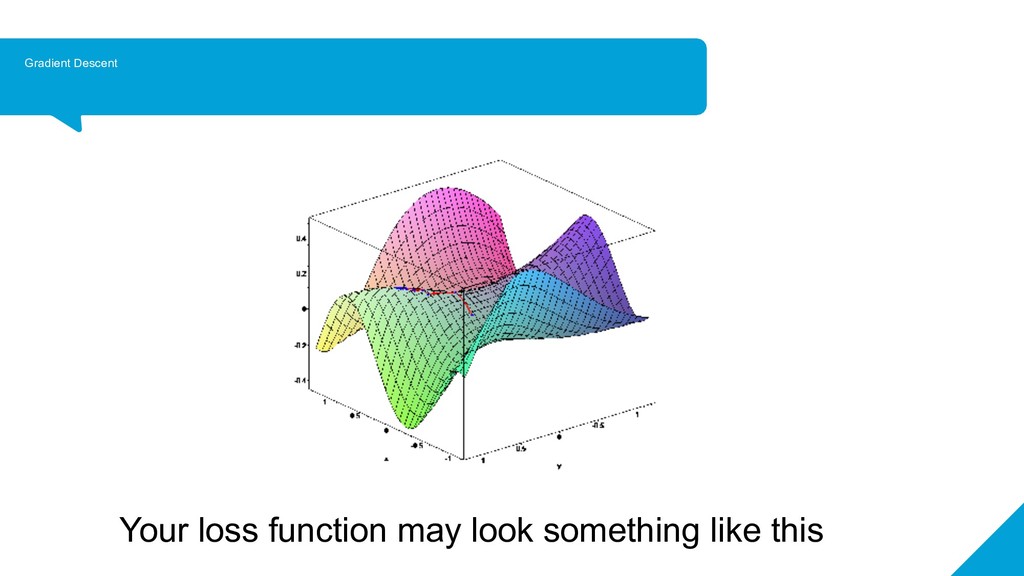
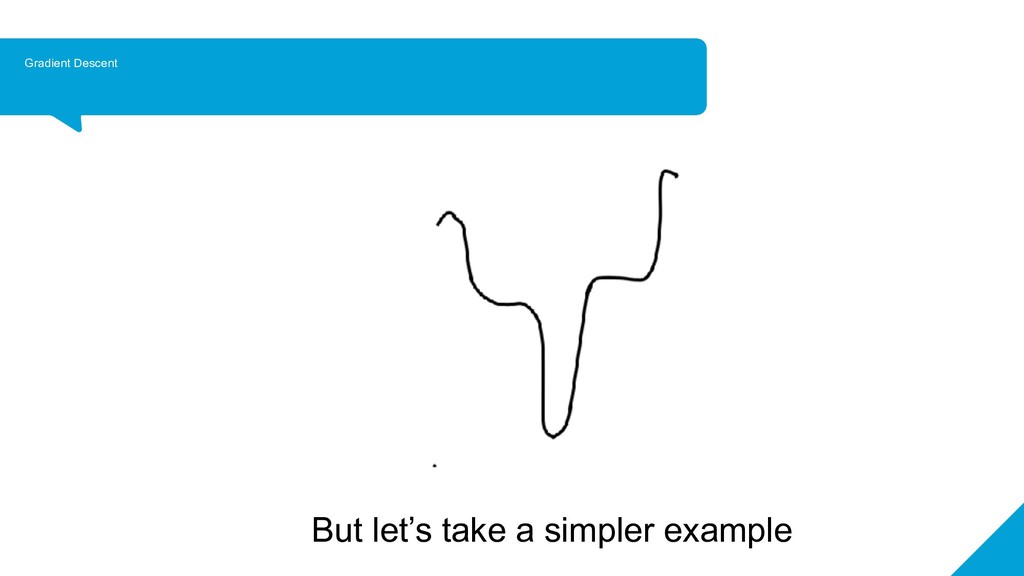
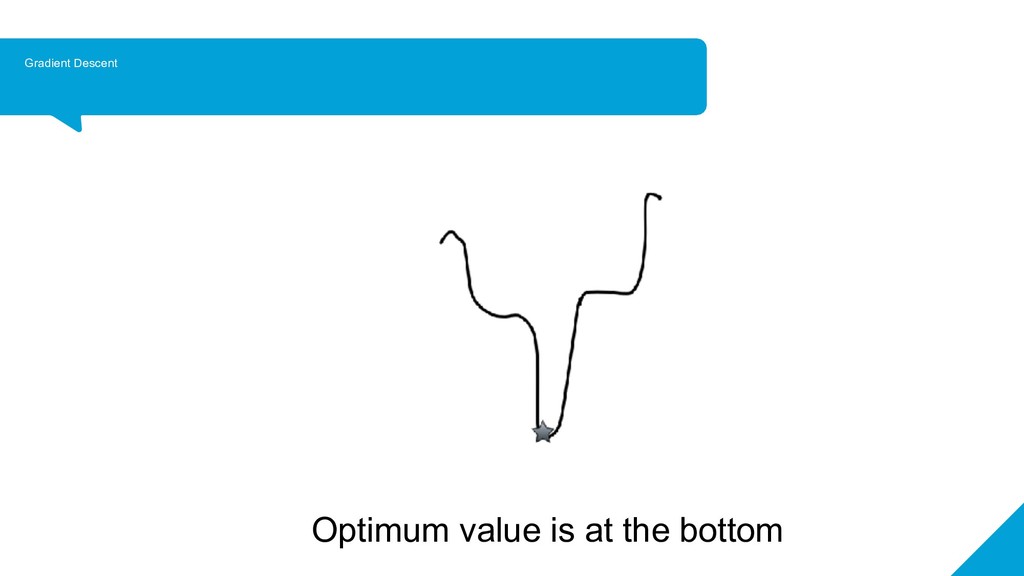
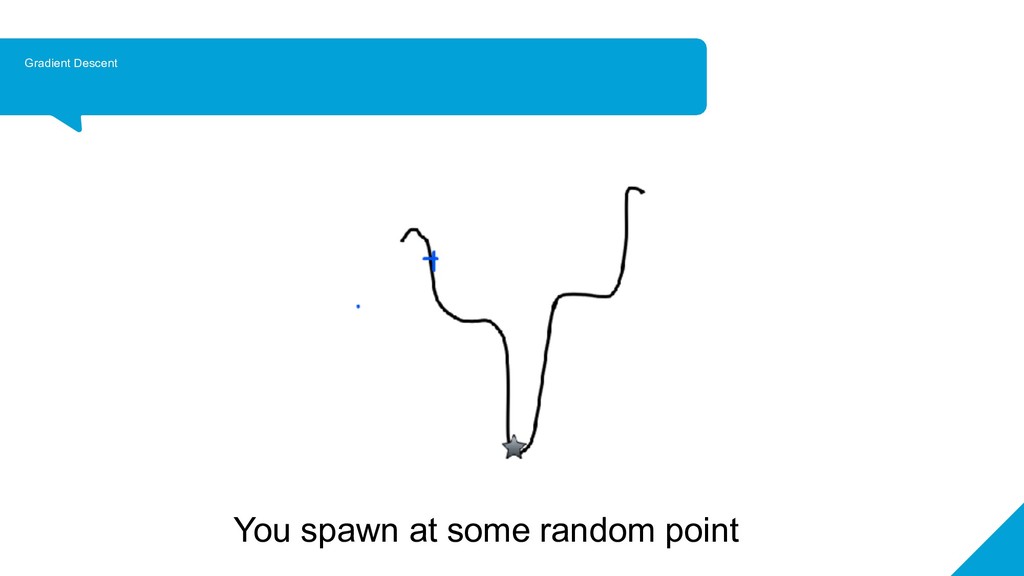
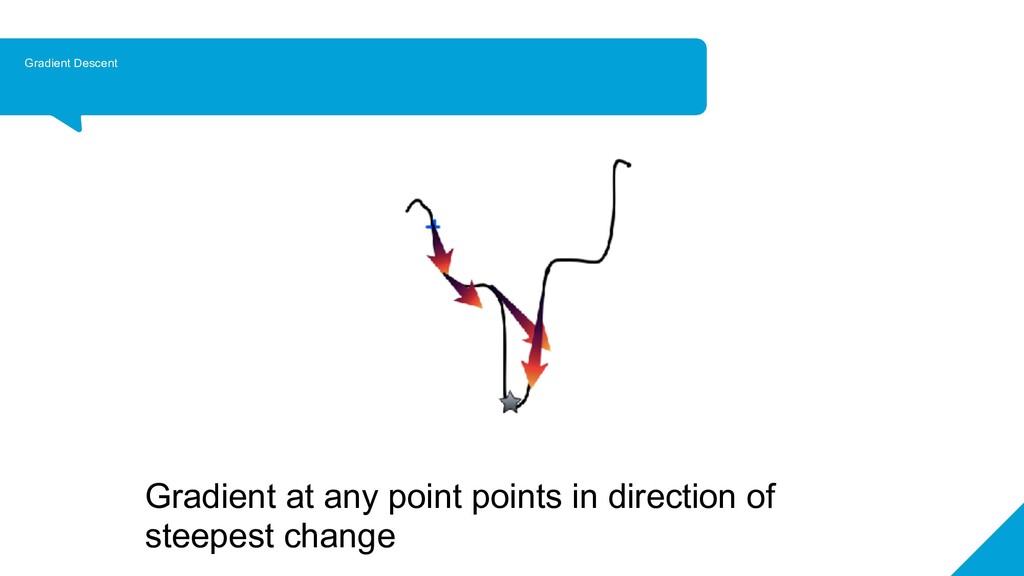
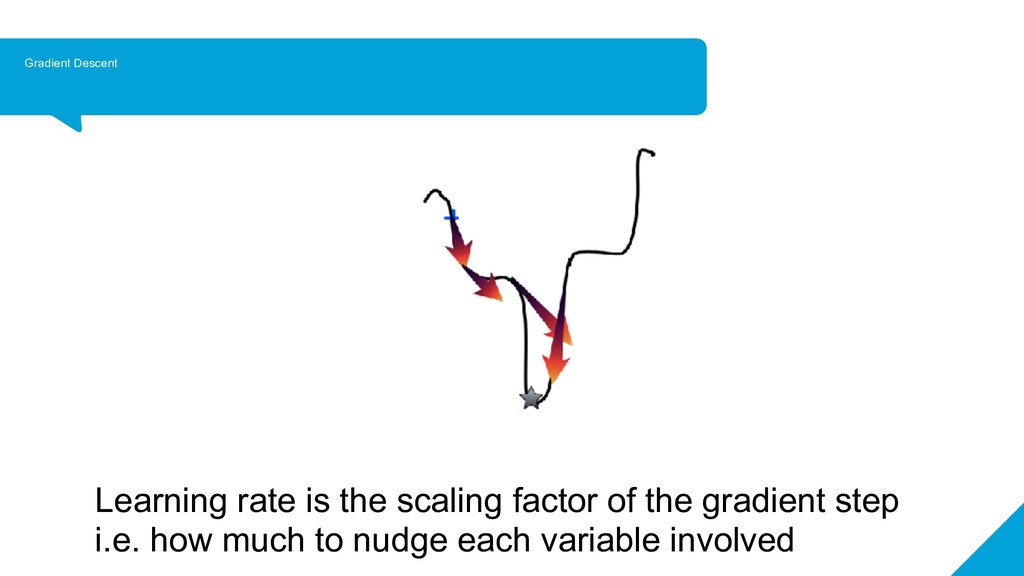
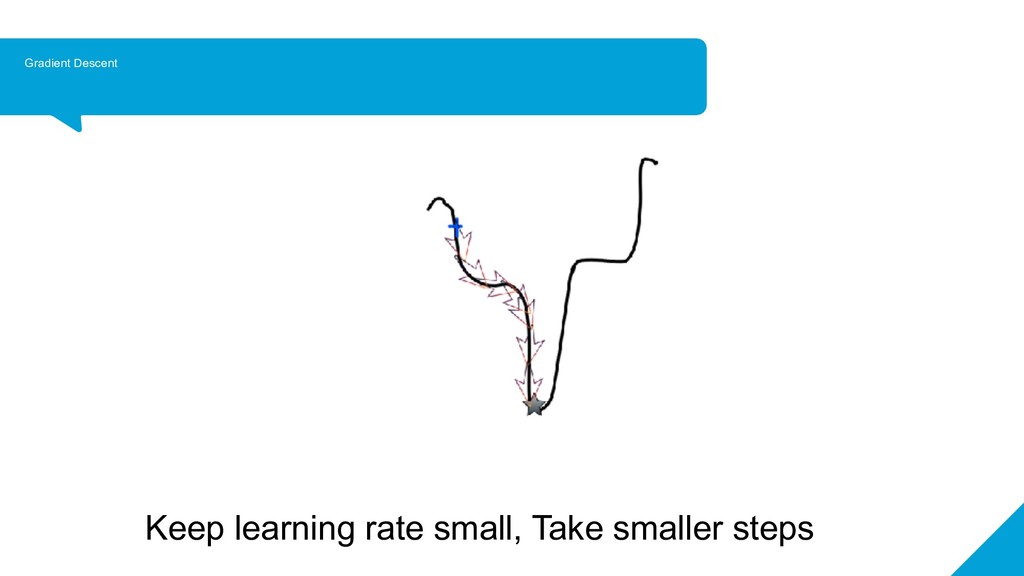
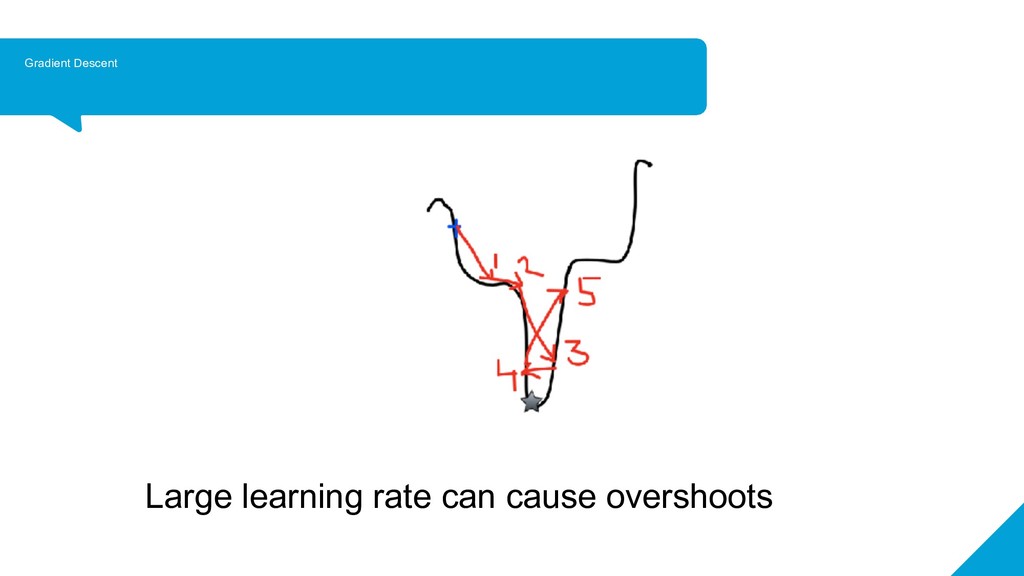
  17. Gradient Descent Learning rate is the scaling factor of the

    gradient step i.e. how much to nudge each variable involved
  18. Other things that we don’t have time for ➔ Non-Linear

    classifiers ➔ Learning Methods that don’t use Gradient Descent ➔ Other Metrics: Precision, Recall, F1 ➔ Overfitting and underfitting ➔ And many more tricks of the trade