Share
Embed
Security Testing 4G (LTE) Networks - 44CON 2012
Martyn Ruks & Nils present Security Testing 4G (LTE) Networks at 44CON 2012 in London, September 2012.
44CON
September 06, 2012
Transcript
61 slides
-
Security Testing 4G (LTE) Networks 44con 6th September 2012 Martyn
Ruks & Nils 1 11/09/2012 -
Today’s Talk • Intro to 4G (LTE) Networks • Technical
Details • Attacks and Testing • Defences • Conclusions 11/09/2012 2 -
A Brief History Lesson • 1G – 1980s Analogue technology
(AMPS, TACS) • 2G – 1990s Move to digital (GSM,GPRS,EDGE) • 3G – 2000s Improved data services (UMTS, HSPA) • 4G – 2010s High bandwidth data (LTE Advanced) 11/09/2012 4 Mobile Networks -
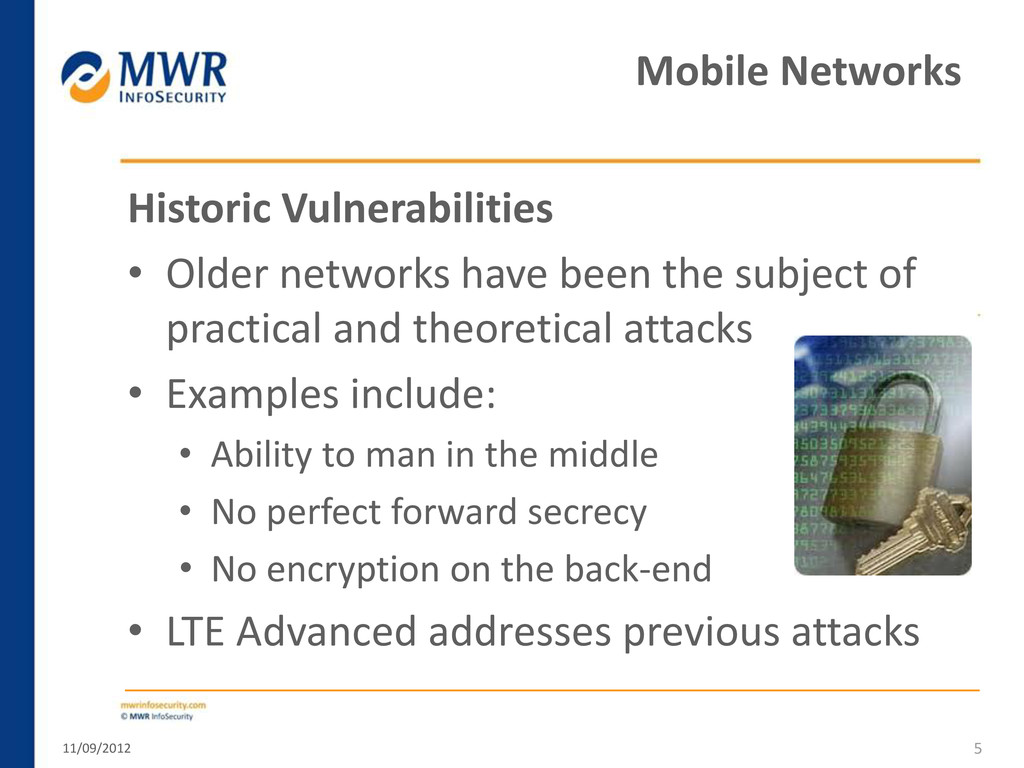
Historic Vulnerabilities • Older networks have been the subject of
practical and theoretical attacks • Examples include: • Ability to man in the middle • No perfect forward secrecy • No encryption on the back-end • LTE Advanced addresses previous attacks 11/09/2012 5 Mobile Networks -
Current Status of 4G • Lots of 4G networks running
or planned (eg Scandinavia, US) • UK Trials have run in Cornwall, London etc • Spectrum auction is important • EE services launches soon! 11/09/2012 6 Mobile Networks -
Why is 4G Important? • Digital Britain strategy • Fixed
line broadband expensive in remote locations • Provides high speed mobile data services • High level of scalability on the back- end 11/09/2012 7 Mobile Networks -
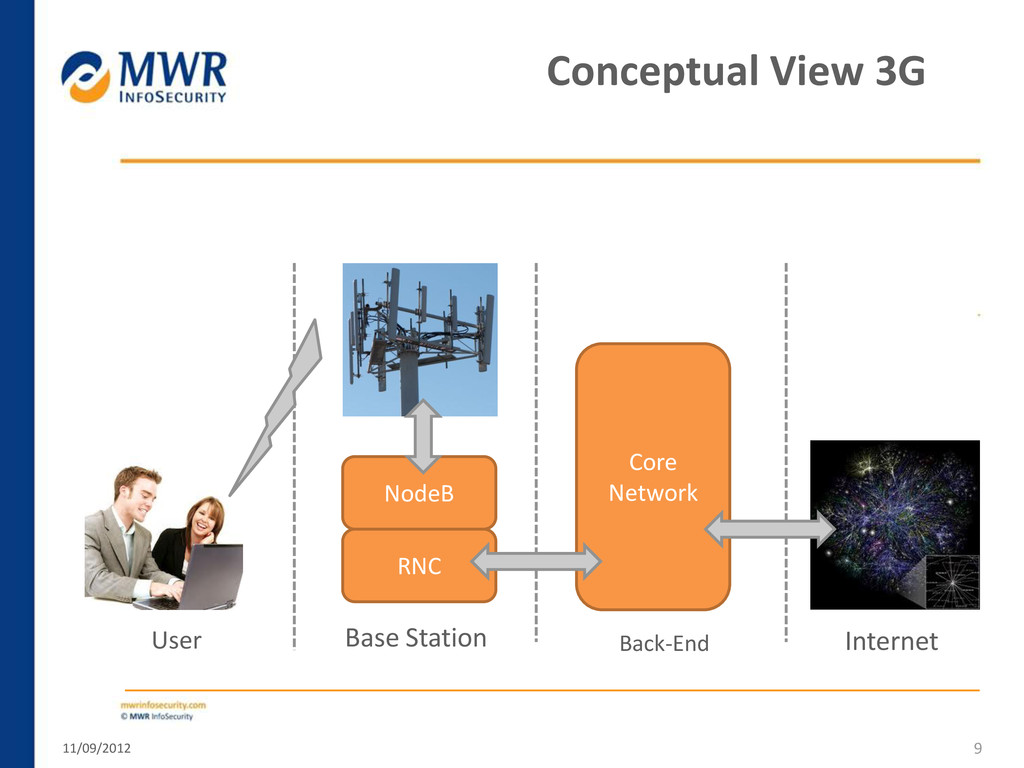
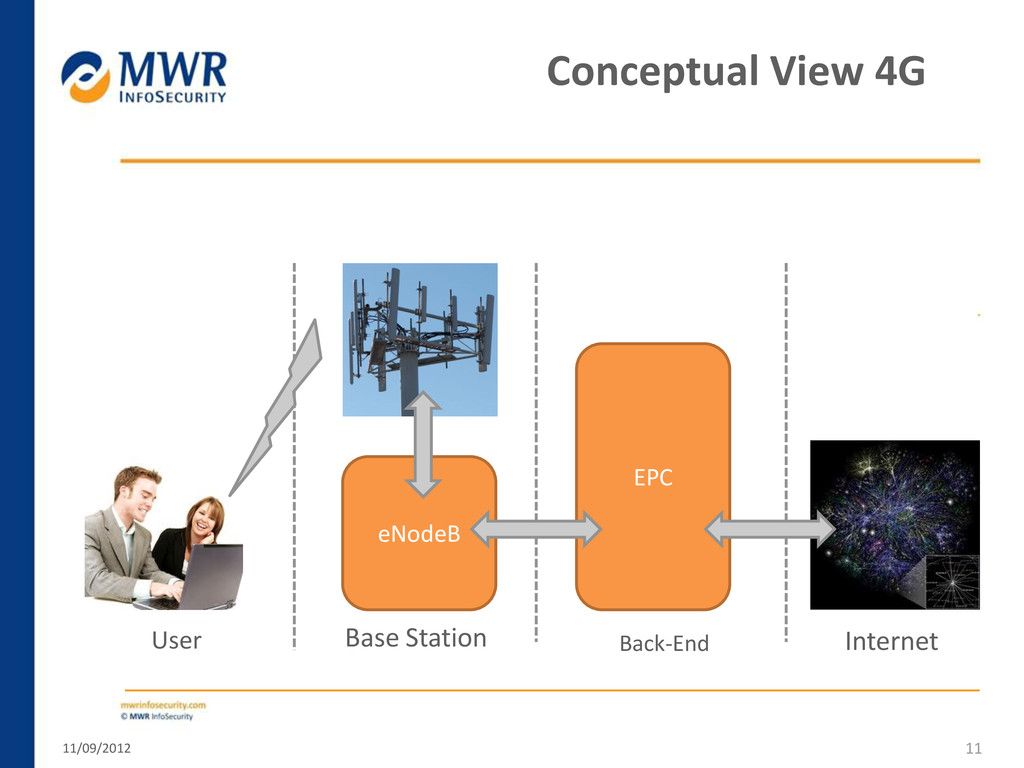
11/09/2012 9 NodeB Core Network Internet Base Station User Back-End
Conceptual View 3G RNC -
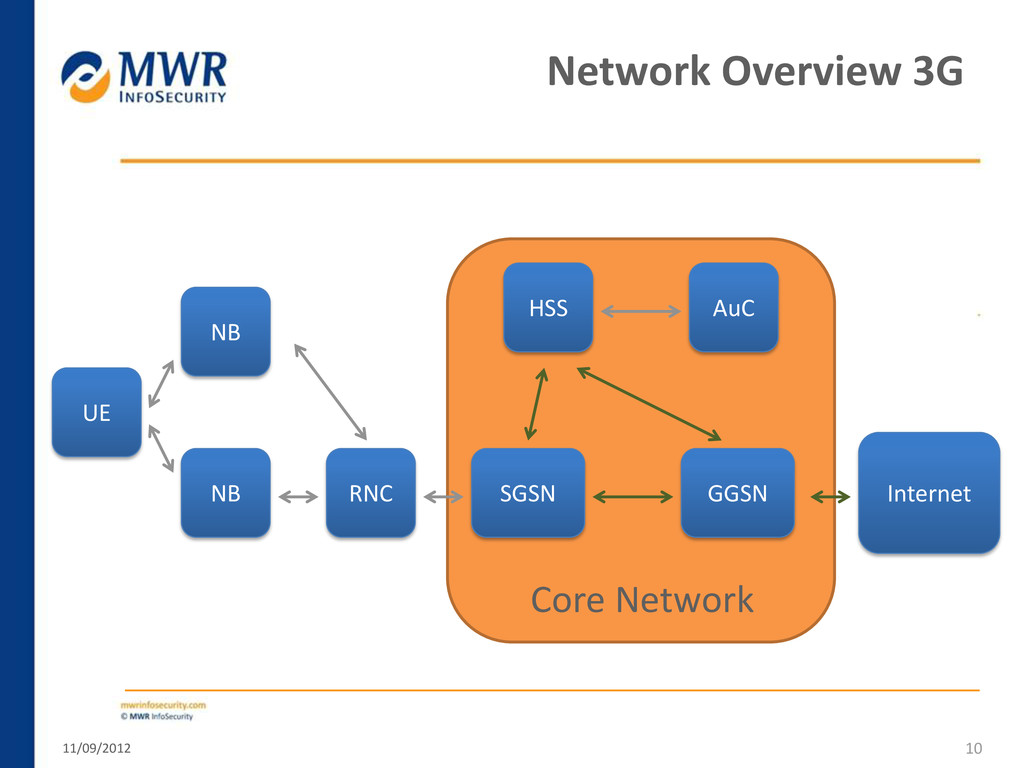
11/09/2012 10 Network Overview 3G UE NB NB SGSN GGSN
Internet HSS AuC Core Network RNC -
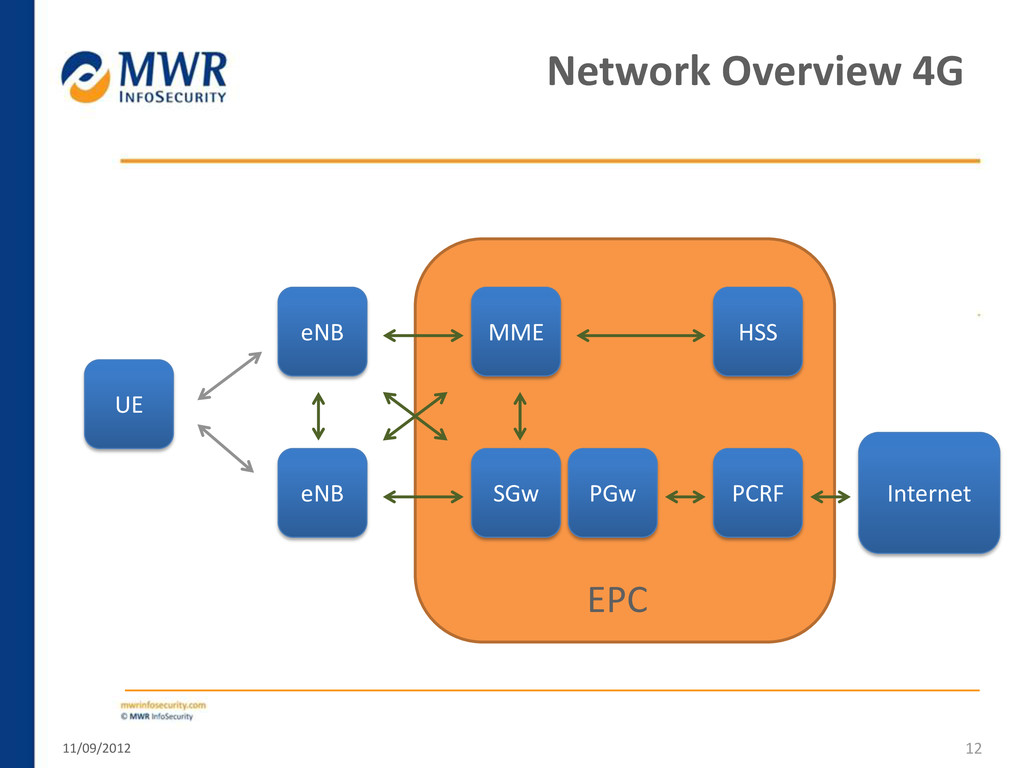
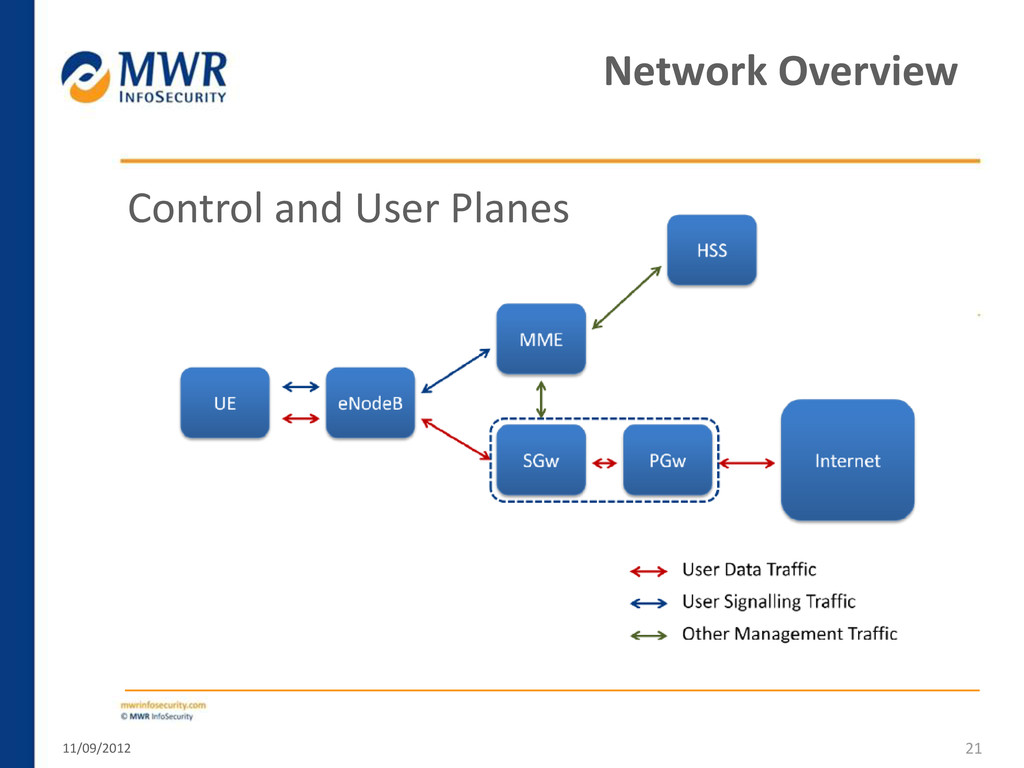
11/09/2012 12 Network Overview 4G UE eNB eNB MME SGw
PGw PCRF Internet HSS EPC -
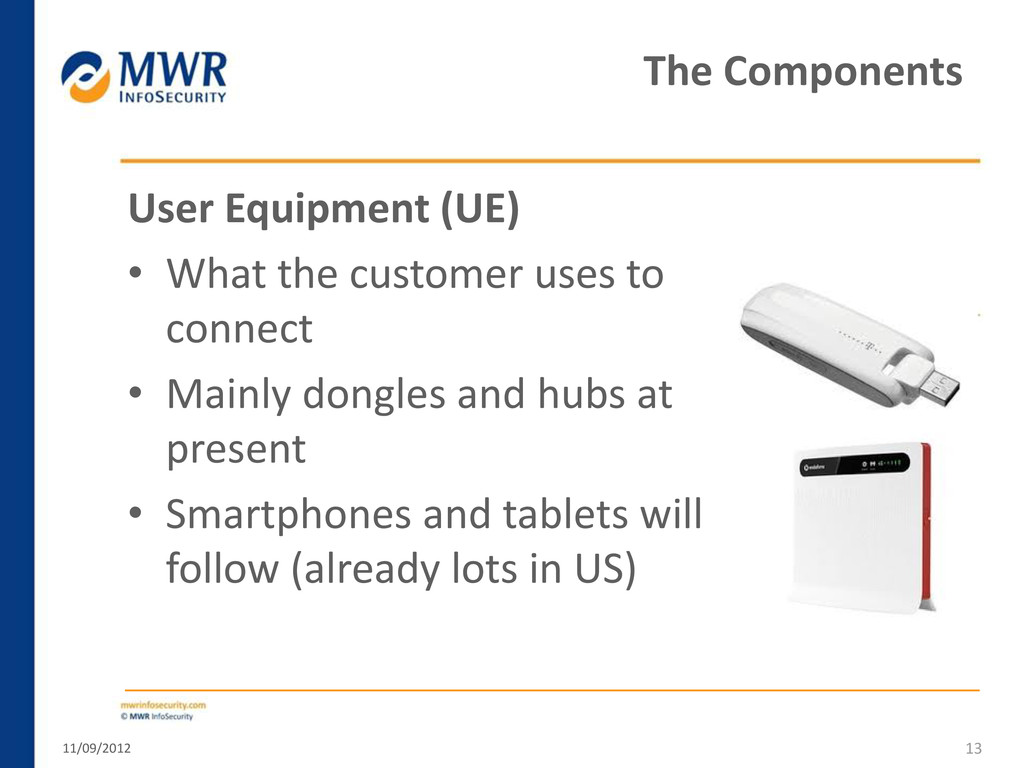
User Equipment (UE) • What the customer uses to connect
• Mainly dongles and hubs at present • Smartphones and tablets will follow (already lots in US) 11/09/2012 13 The Components -
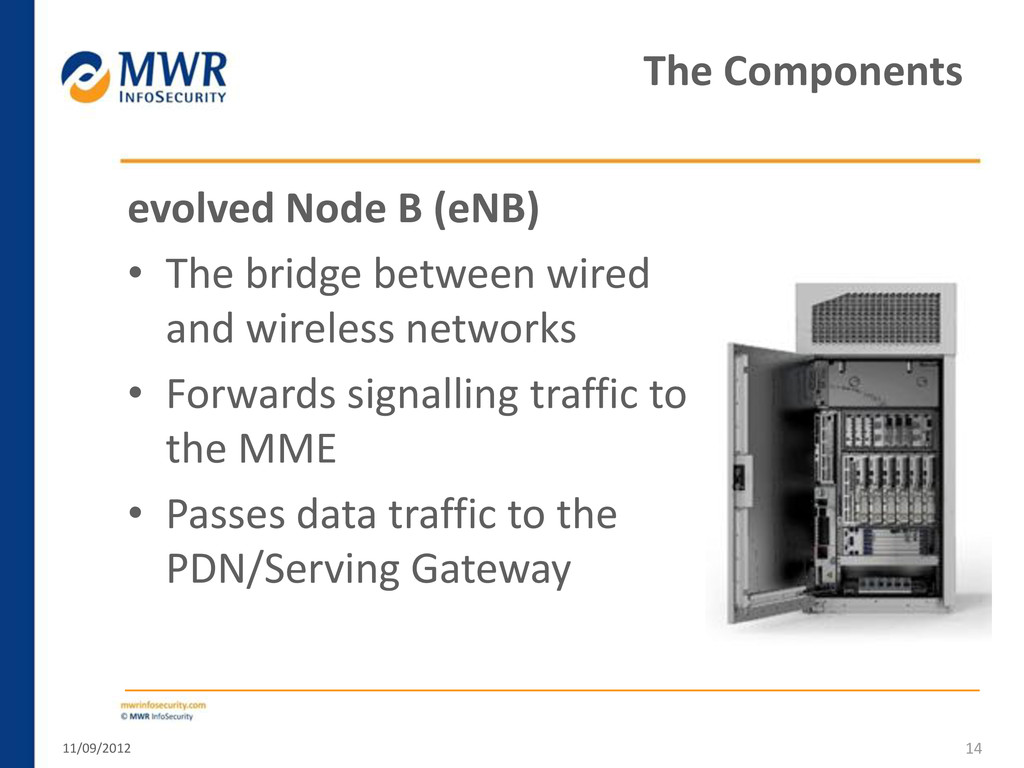
evolved Node B (eNB) • The bridge between wired and
wireless networks • Forwards signalling traffic to the MME • Passes data traffic to the PDN/Serving Gateway 11/09/2012 14 The Components -
Evolved Packet Core (EPC) • The back-end core network •
Manages access to data services • Uses IP for all communications • Divided into several components 11/09/2012 15 The Components -
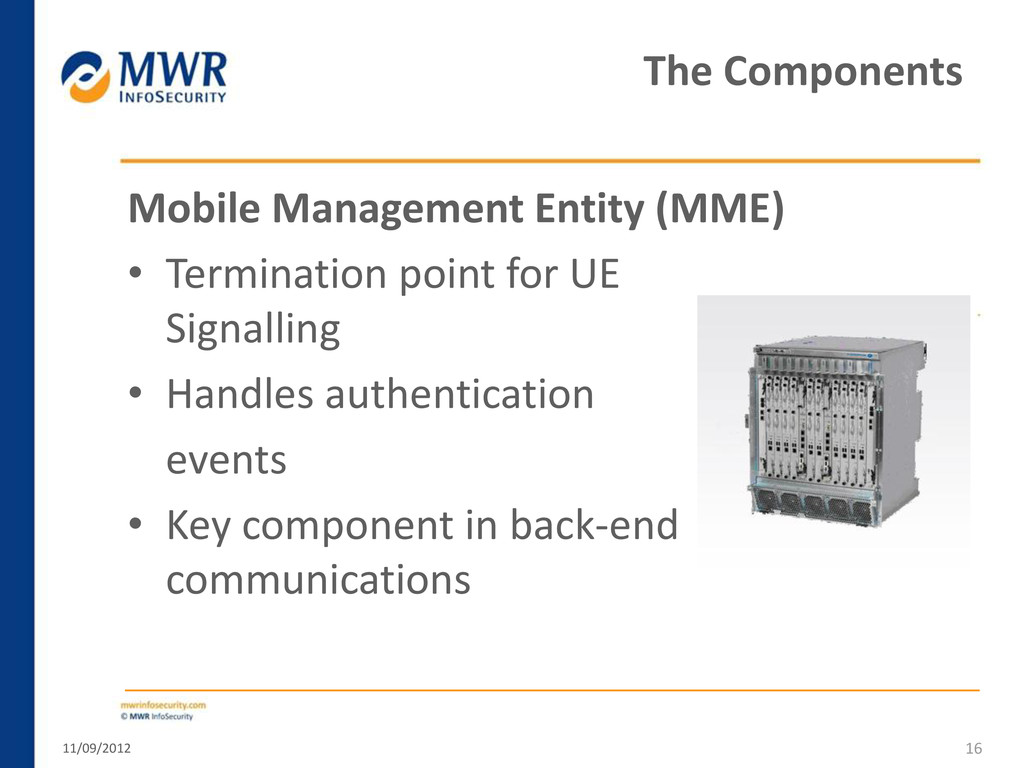
Mobile Management Entity (MME) • Termination point for UE Signalling
• Handles authentication events • Key component in back-end communications 11/09/2012 16 The Components -
Home Subscriber Service (HSS) • Contains a user’s subscription data
(profile) • Typically includes the Authentication Centre (AuC) • Where key material is stored 11/09/2012 17 The Components -
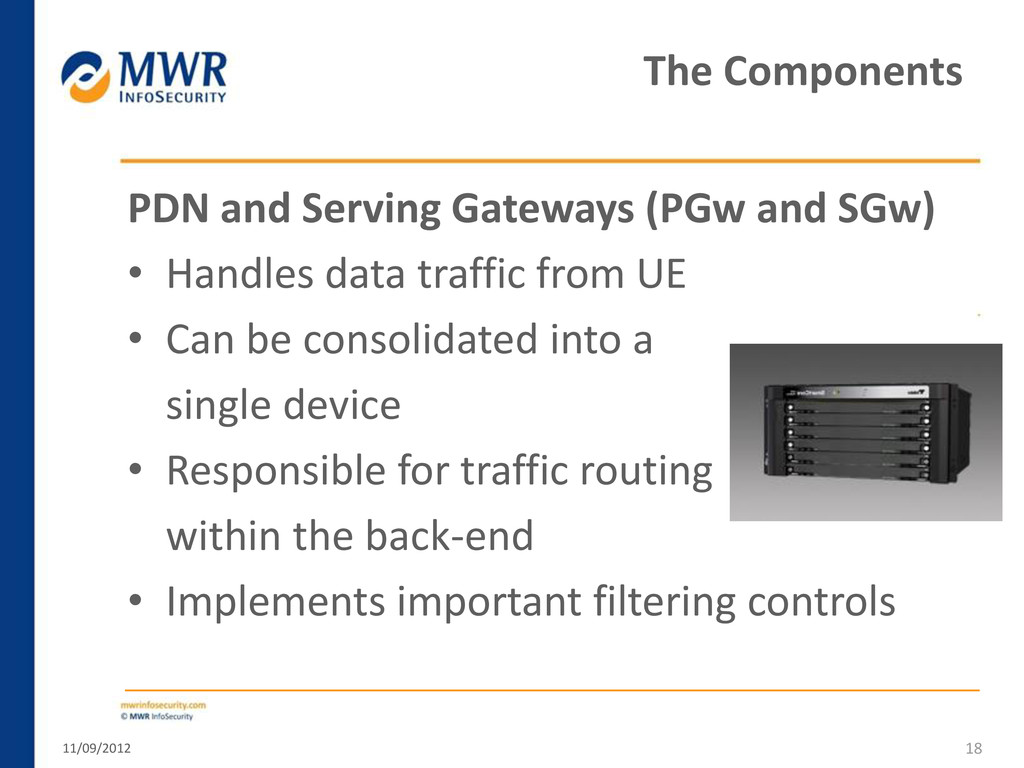
PDN and Serving Gateways (PGw and SGw) • Handles data
traffic from UE • Can be consolidated into a single device • Responsible for traffic routing within the back-end • Implements important filtering controls 11/09/2012 18 The Components -
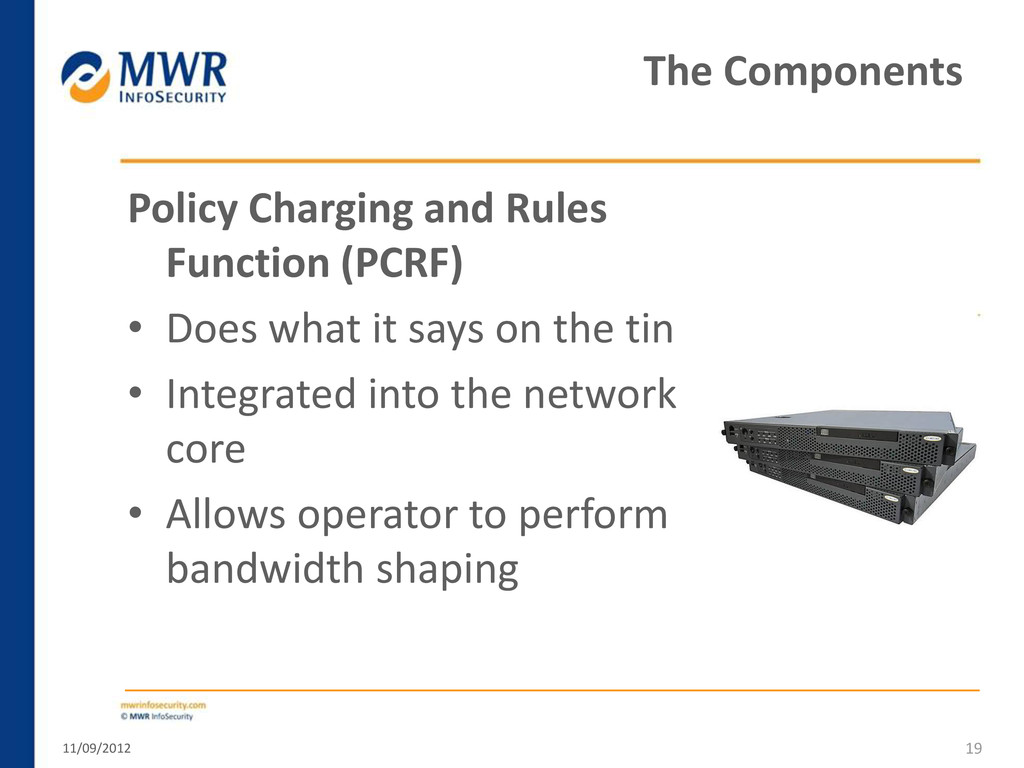
Policy Charging and Rules Function (PCRF) • Does what it
says on the tin • Integrated into the network core • Allows operator to perform bandwidth shaping 11/09/2012 19 The Components -
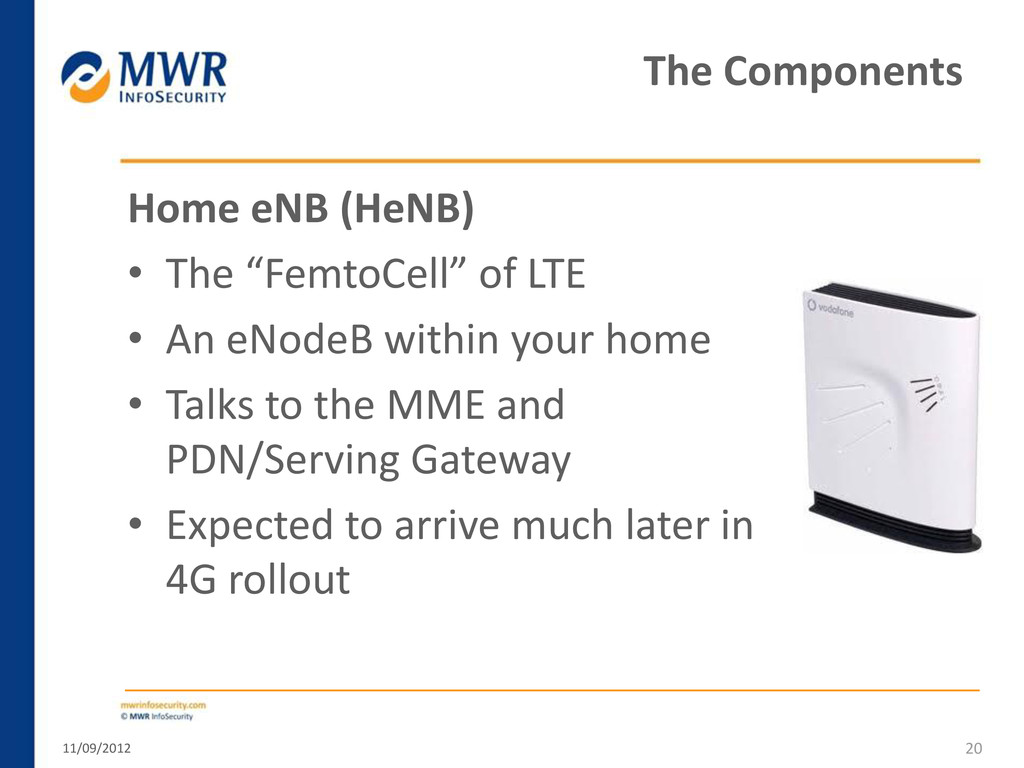
Home eNB (HeNB) • The “FemtoCell” of LTE • An
eNodeB within your home • Talks to the MME and PDN/Serving Gateway • Expected to arrive much later in 4G rollout 11/09/2012 20 The Components -
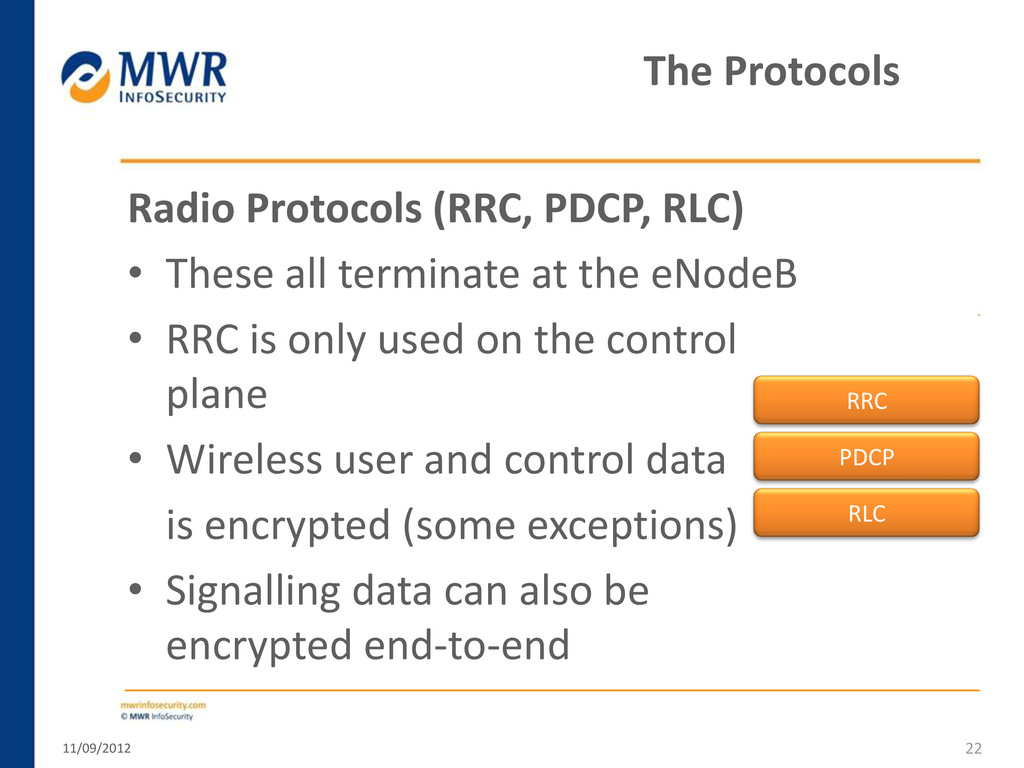
Radio Protocols (RRC, PDCP, RLC) • These all terminate at
the eNodeB • RRC is only used on the control plane • Wireless user and control data is encrypted (some exceptions) • Signalling data can also be encrypted end-to-end 11/09/2012 22 RRC PDCP RLC The Protocols -
Internet Protocol (IP) • Used by all back-end comms •
All user data uses it • Supports both IPv4 and IPv6 • Important to get routing and filtering correct • Common UDP and TCP services in use 11/09/2012 23 The Protocols IP -
The Protocols - SCTP • Another protocol on top of
IP • Robust session handling • Bi-directional sessions • Sequence numbers very important 11/09/2012 24 The Protocols IP SCTP -
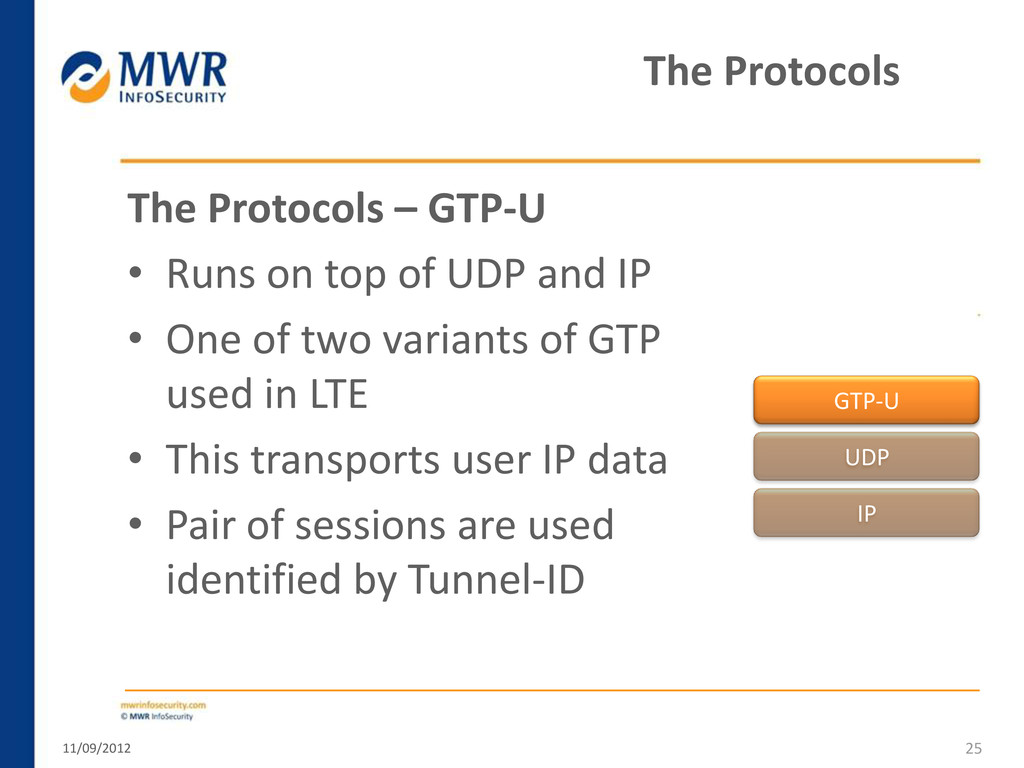
The Protocols – GTP-U • Runs on top of UDP
and IP • One of two variants of GTP used in LTE • This transports user IP data • Pair of sessions are used identified by Tunnel-ID 11/09/2012 25 The Protocols IP GTP-U UDP -
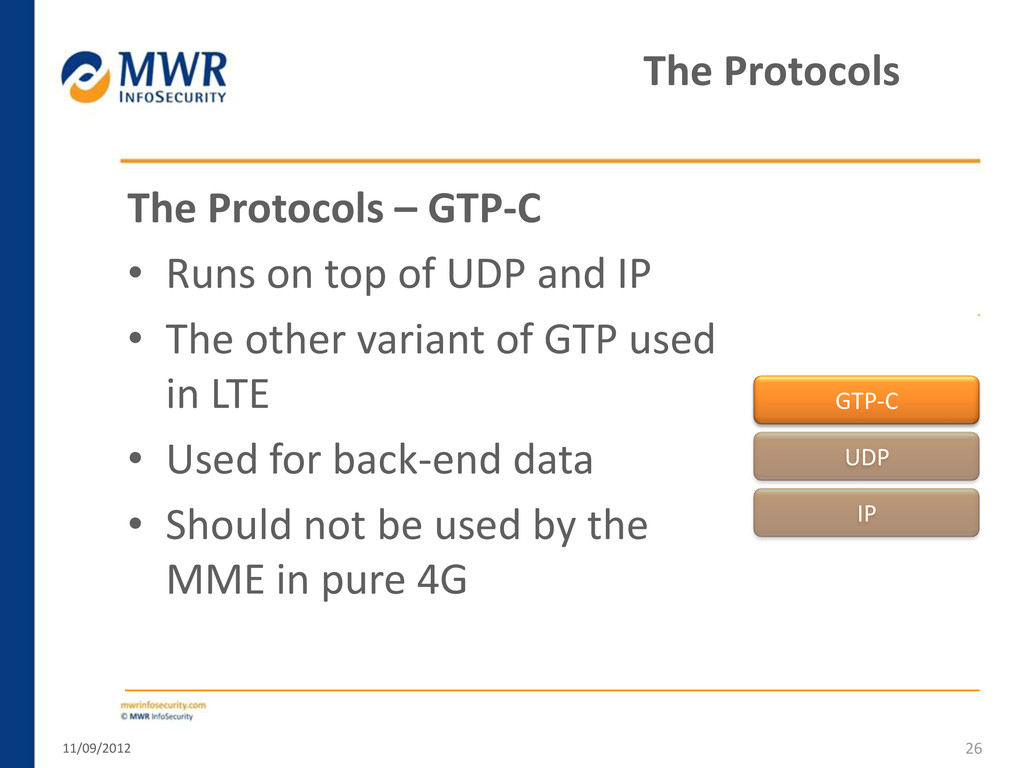
The Protocols – GTP-C • Runs on top of UDP
and IP • The other variant of GTP used in LTE • Used for back-end data • Should not be used by the MME in pure 4G 11/09/2012 26 The Protocols IP GTP-C UDP -
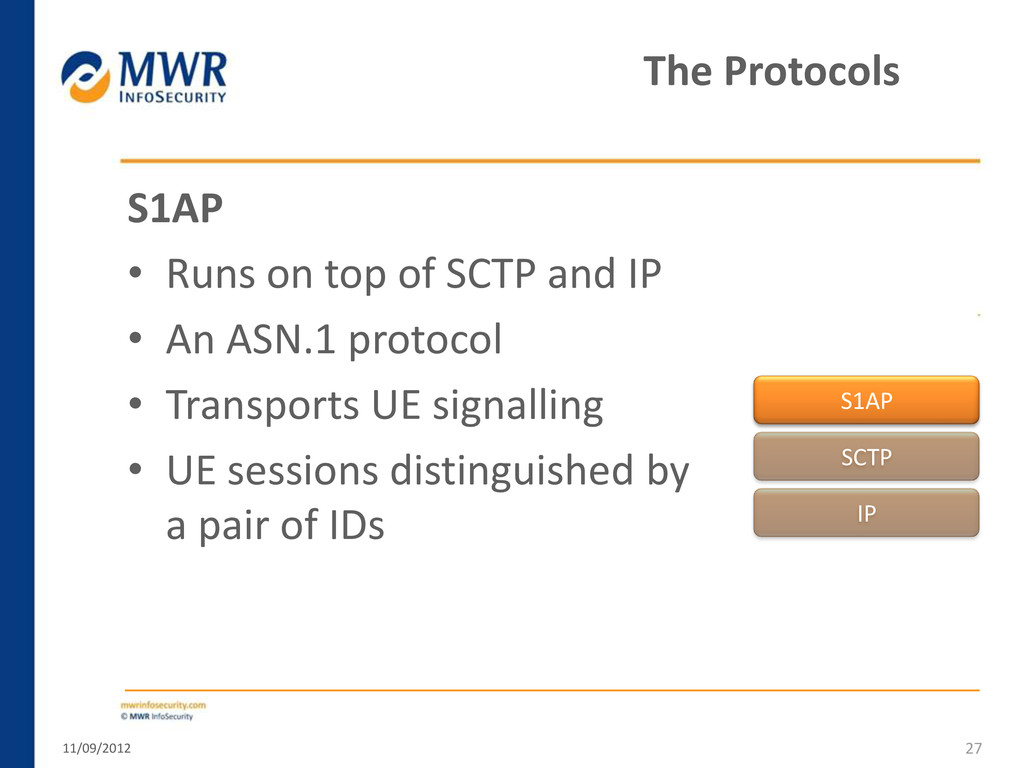
S1AP • Runs on top of SCTP and IP •
An ASN.1 protocol • Transports UE signalling • UE sessions distinguished by a pair of IDs 11/09/2012 27 The Protocols IP S1AP SCTP -
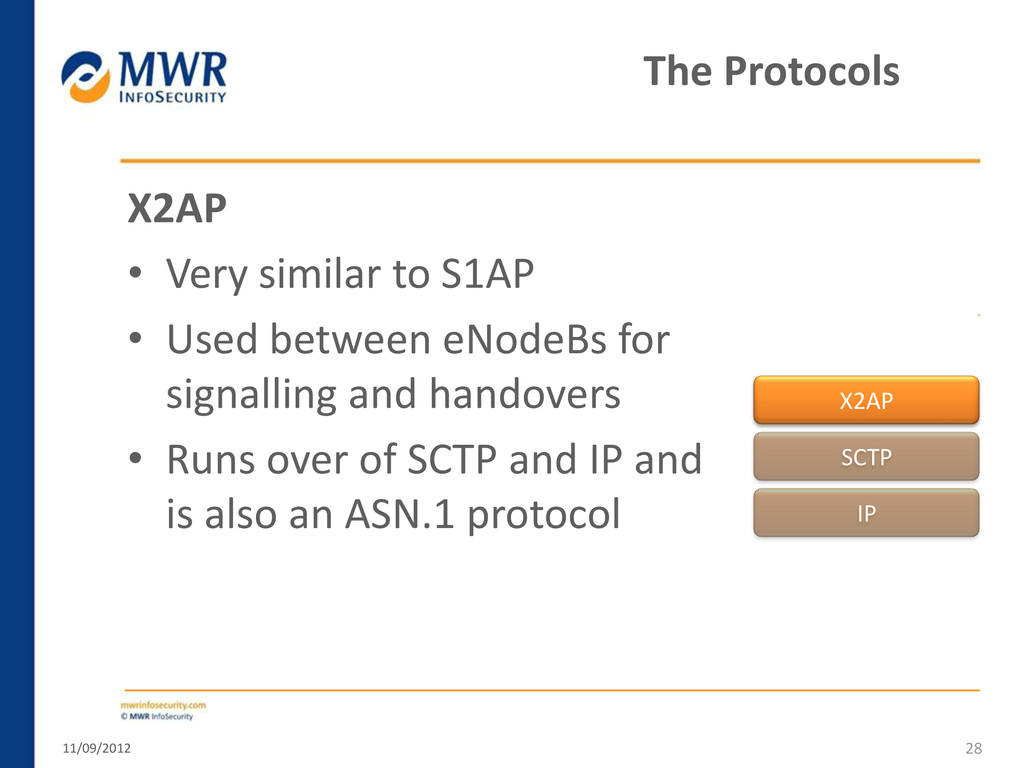
X2AP • Very similar to S1AP • Used between eNodeBs
for signalling and handovers • Runs over of SCTP and IP and is also an ASN.1 protocol 11/09/2012 28 The Protocols IP X2AP SCTP -
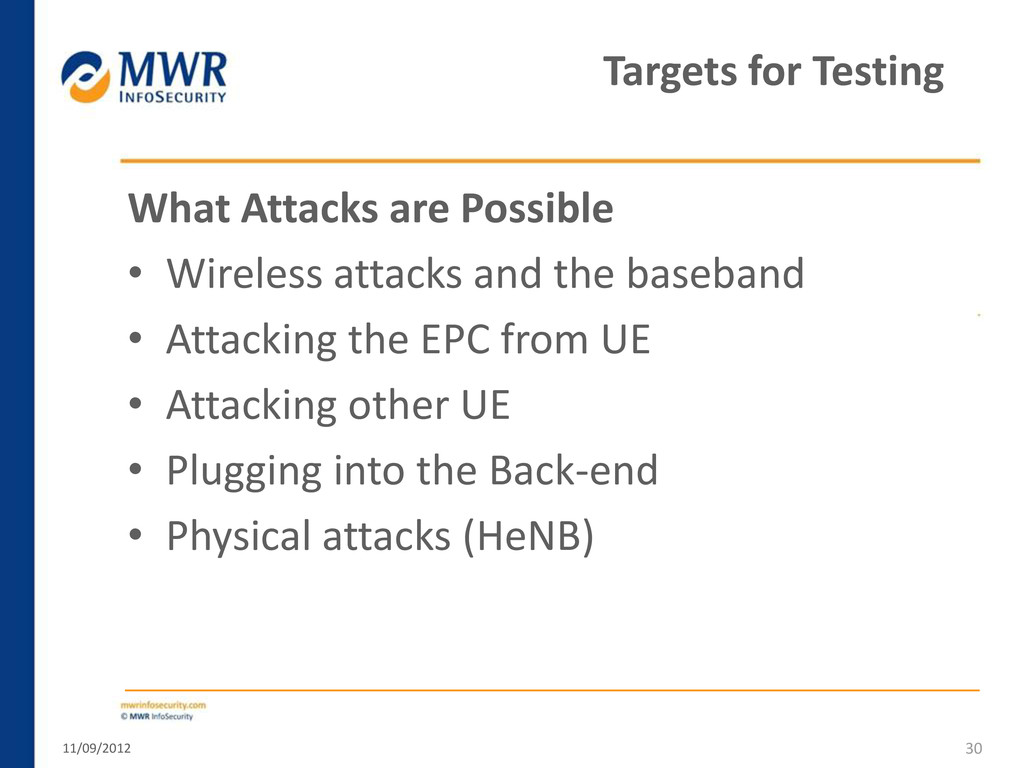
What Attacks are Possible • Wireless attacks and the baseband
• Attacking the EPC from UE • Attacking other UE • Plugging into the Back-end • Physical attacks (HeNB) 11/09/2012 30 Targets for Testing -
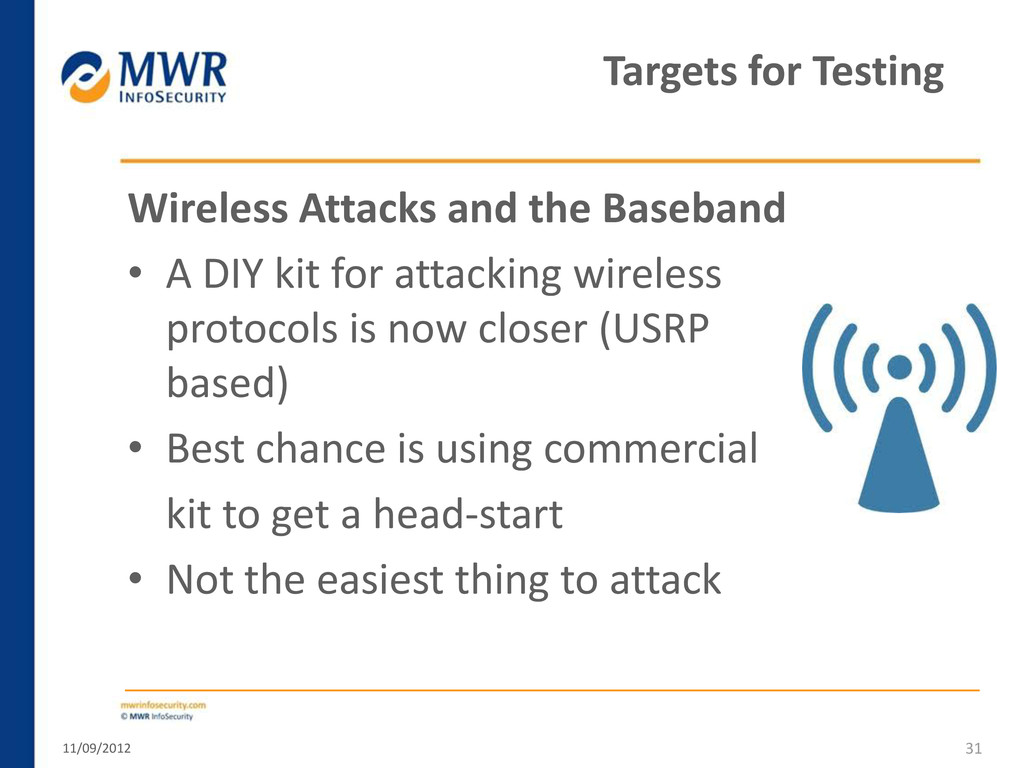
Wireless Attacks and the Baseband • A DIY kit for
attacking wireless protocols is now closer (USRP based) • Best chance is using commercial kit to get a head-start • Not the easiest thing to attack 11/09/2012 31 Targets for Testing -
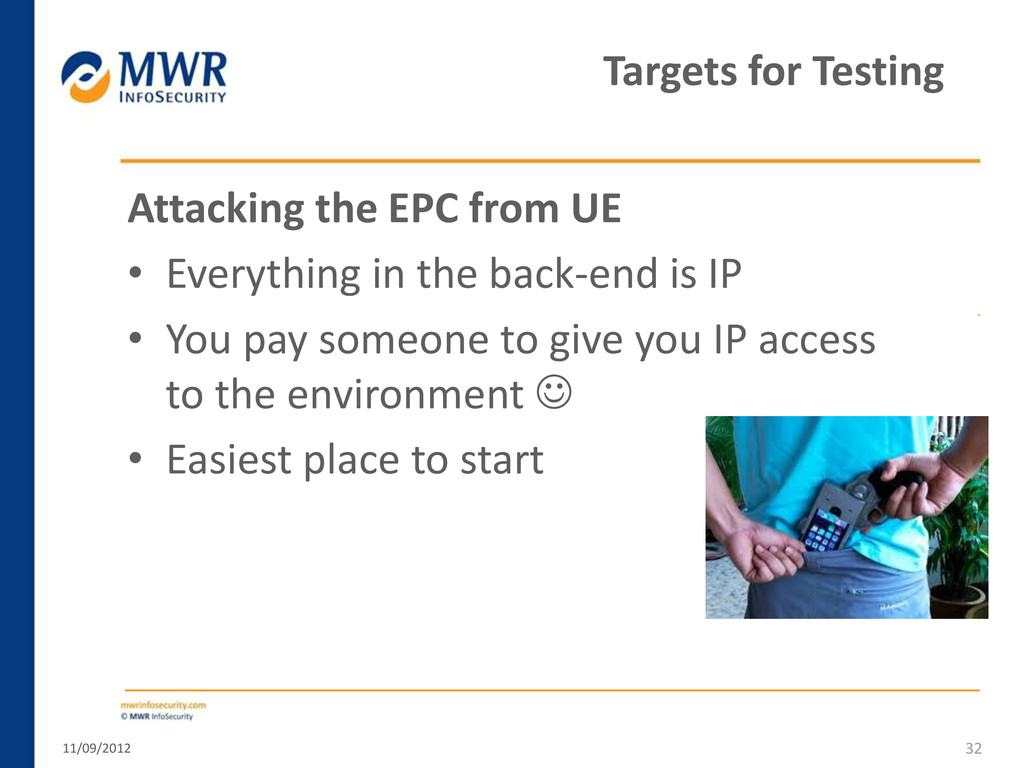
Attacking the EPC from UE • Everything in the back-end
is IP • You pay someone to give you IP access to the environment • Easiest place to start 11/09/2012 32 Targets for Testing -
Attacking other UE • Other wirelessly connected devices are close
• May be less protection if seen as a local network • The gateway may enforce segregation between UE 11/09/2012 33 Targets for Testing -
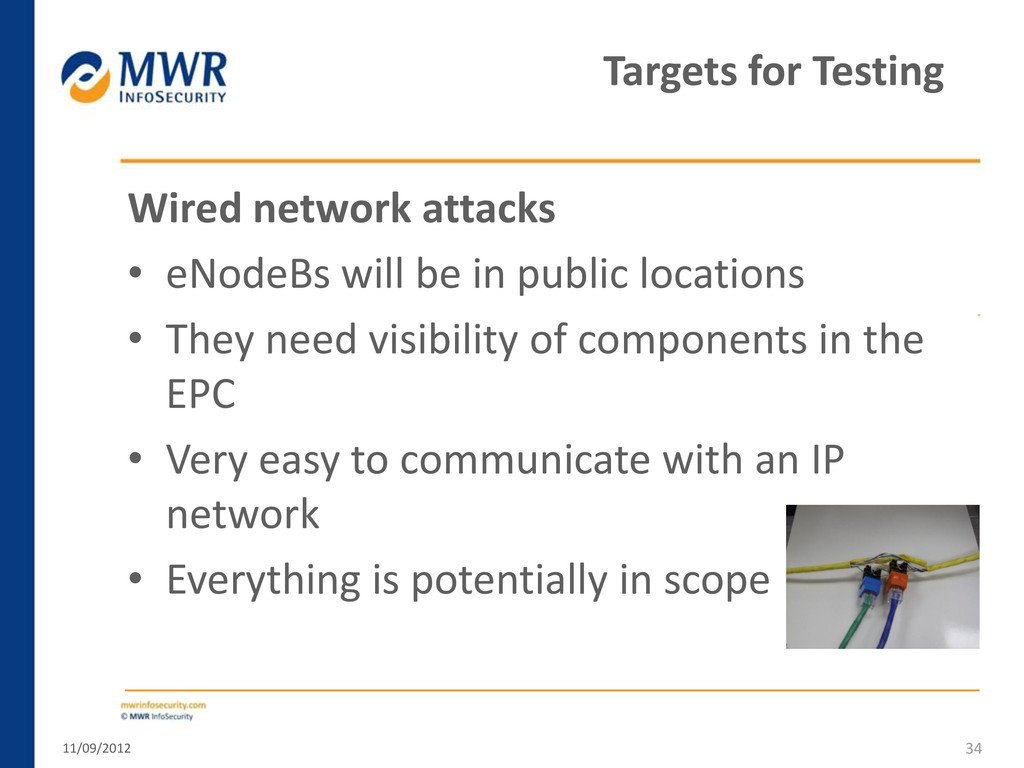
Wired network attacks • eNodeBs will be in public locations
• They need visibility of components in the EPC • Very easy to communicate with an IP network • Everything is potentially in scope 11/09/2012 34 Targets for Testing -
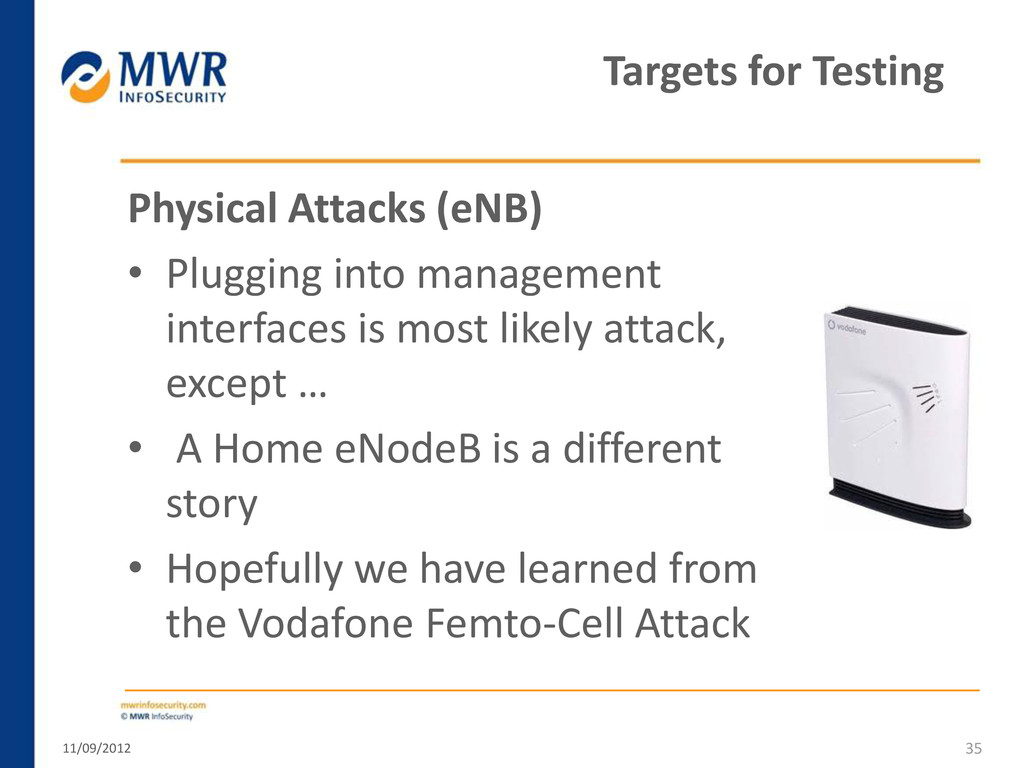
Physical Attacks (eNB) • Plugging into management interfaces is most
likely attack, except … • A Home eNodeB is a different story • Hopefully we have learned from the Vodafone Femto-Cell Attack 11/09/2012 35 Targets for Testing -
As a Wirelessly Connected User • Visibility of the back-end
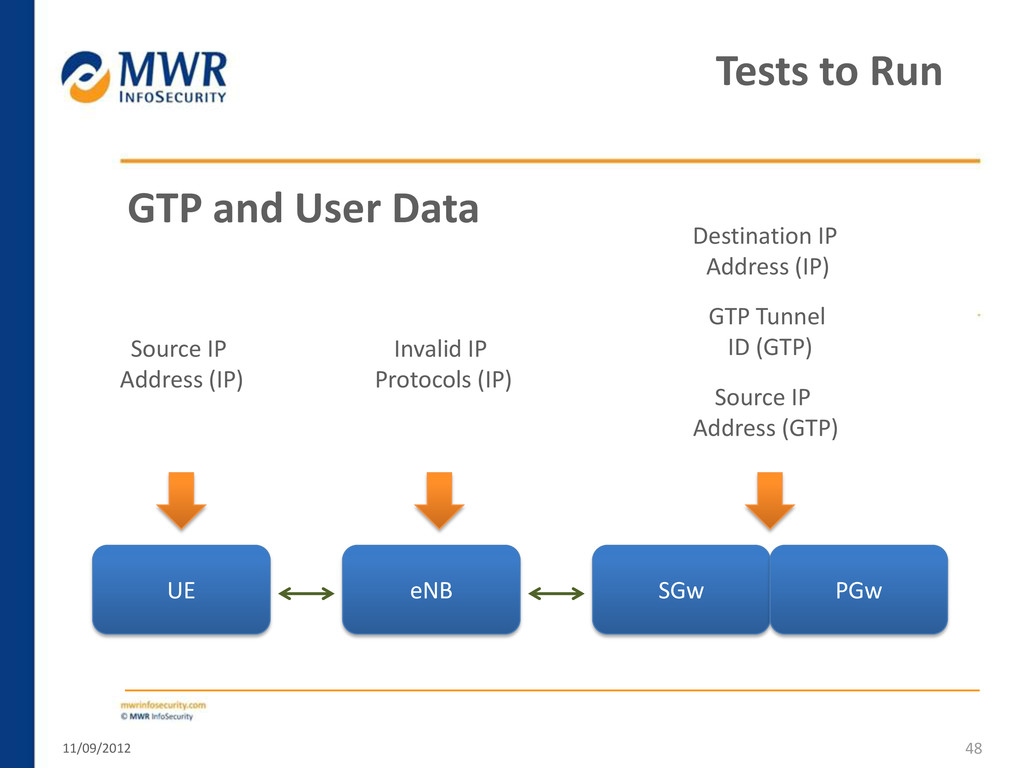
from UE • Visibility of other UEs • Testing controls enforced by Gateway • Spoofed source addresses • GTP Encapsulation (Control and User) 11/09/2012 37 Tests to Run -
From the Back-End • Ability to attack MME (signalling) •
Robustness of stacks (eg SCTP) • Fuzzing • Sequence number generation • Testing management interfaces • Web consoles • SSH • Proprietary protocols 11/09/2012 38 Tests to Run -
Challenges • Spoofing UE authentication is difficult • Messing with
radio layers is hard • ASN.1 protocols are a pain • Injecting into SCTP is tough • Easy to break back-end communications 11/09/2012 39 Tests to Run -
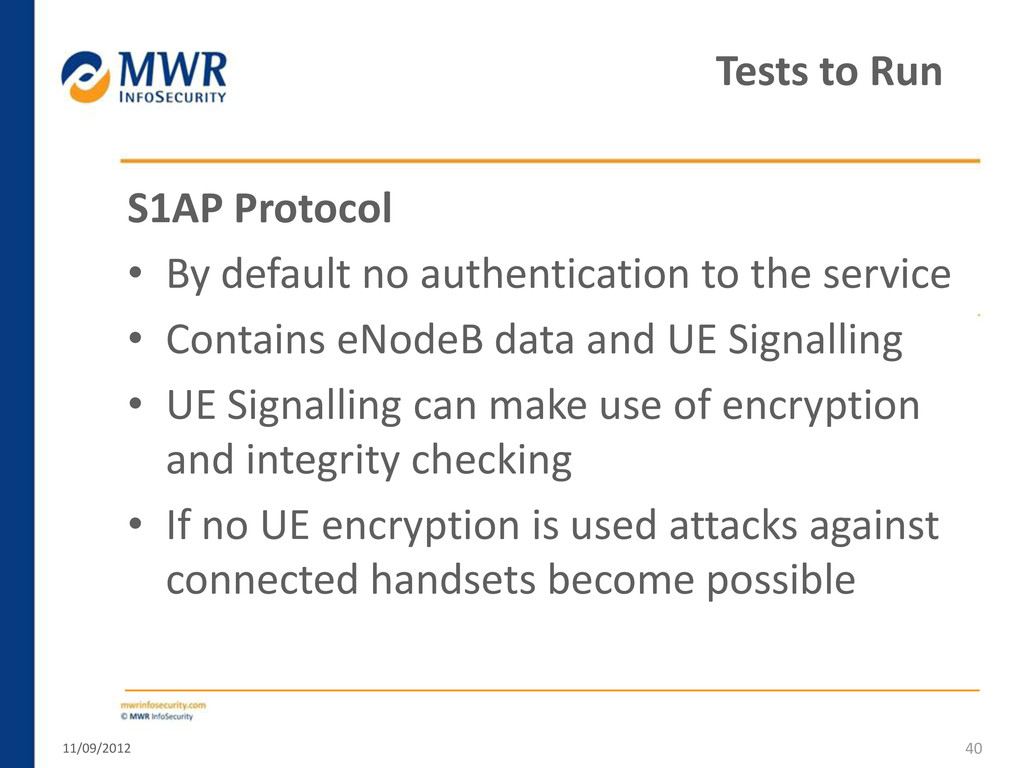
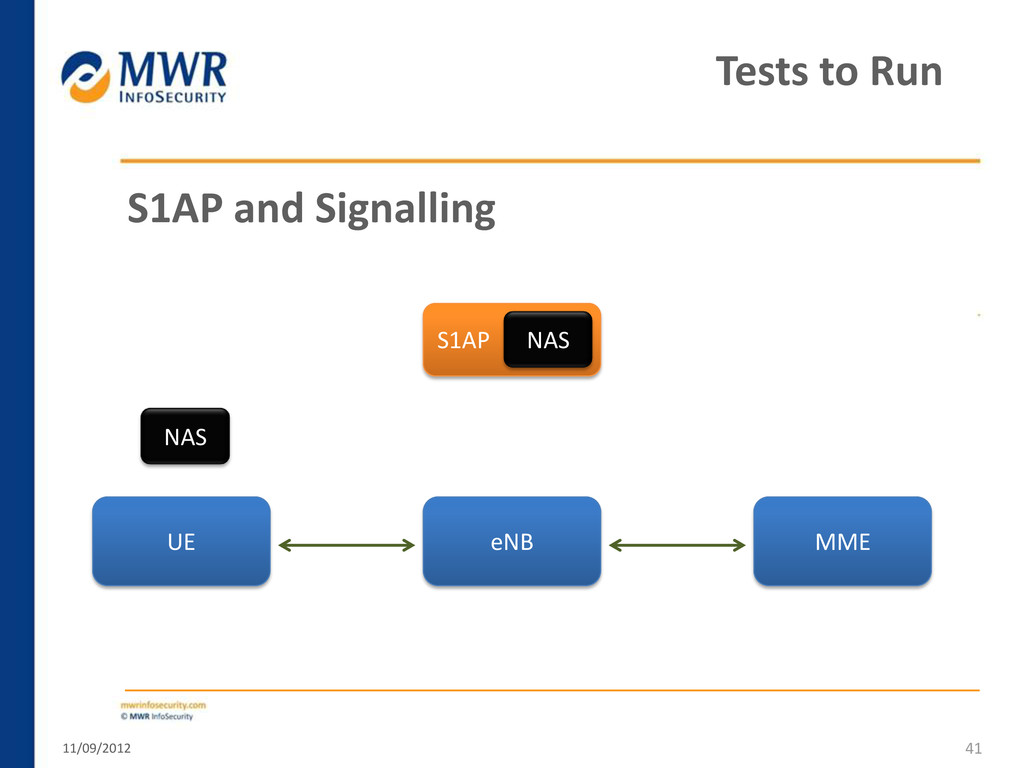
S1AP Protocol • By default no authentication to the service
• Contains eNodeB data and UE Signalling • UE Signalling can make use of encryption and integrity checking • If no UE encryption is used attacks against connected handsets become possible 11/09/2012 40 Tests to Run -
11/09/2012 41 Tests to Run eNB UE MME S1AP NAS
NAS S1AP and Signalling -
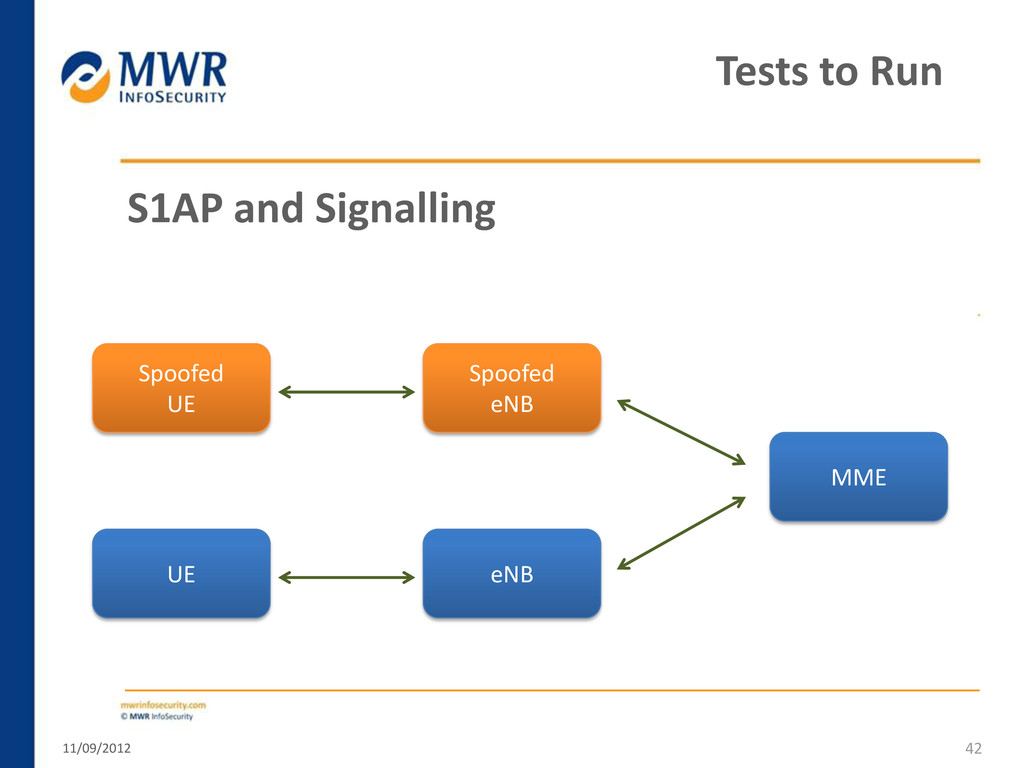
11/09/2012 42 Tests to Run eNB UE MME S1AP and
Signalling Spoofed UE Spoofed eNB -
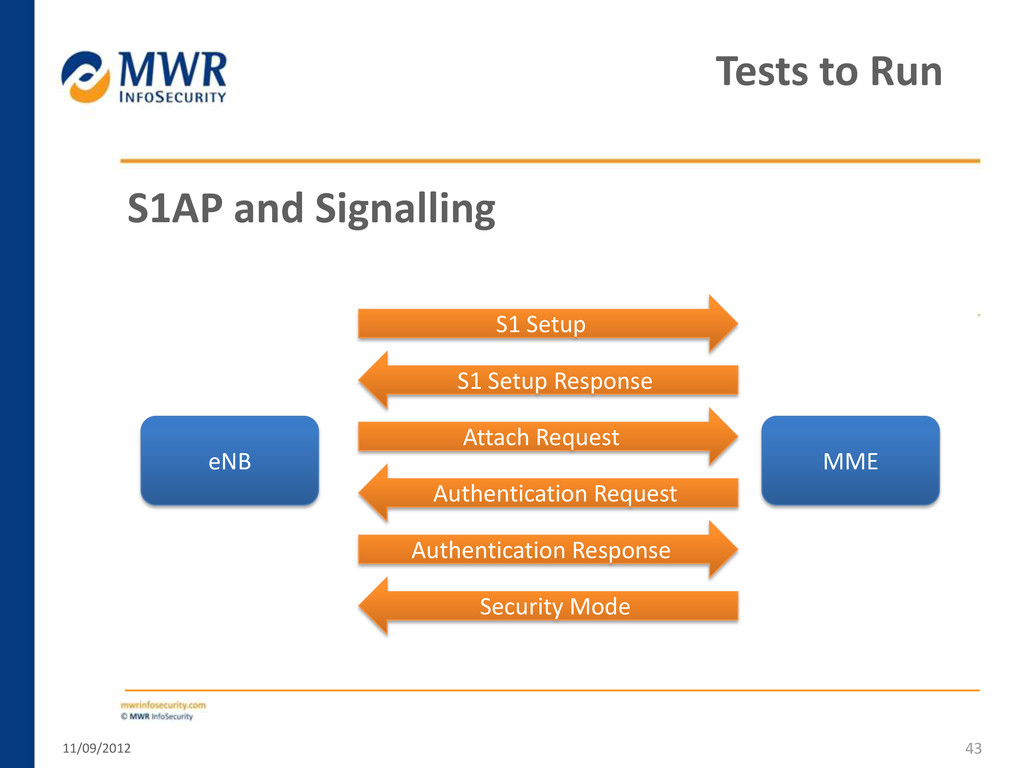
11/09/2012 43 Tests to Run eNB MME S1AP and Signalling
S1 Setup S1 Setup Response Attach Request Authentication Request Authentication Response Security Mode -
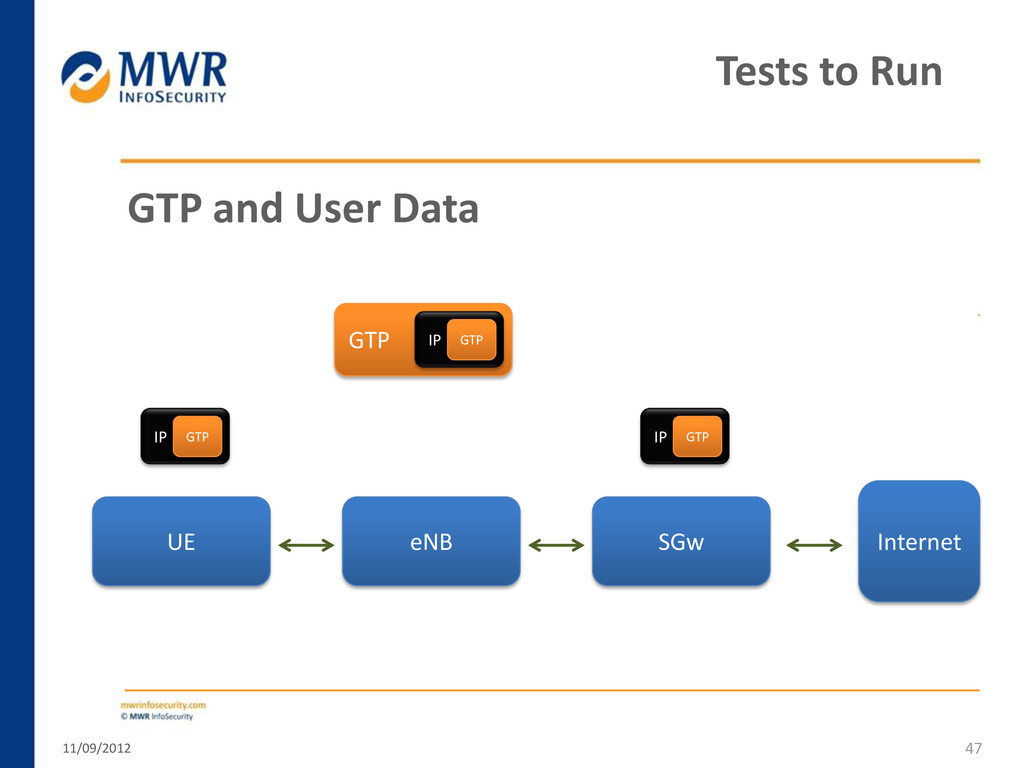
GTP Protocol • Gateway can handle multiple encapsulations • It
uses UDP so easy to have fun with • The gateway needs to enforce a number of controls that stop attacks 11/09/2012 44 Tests to Run -
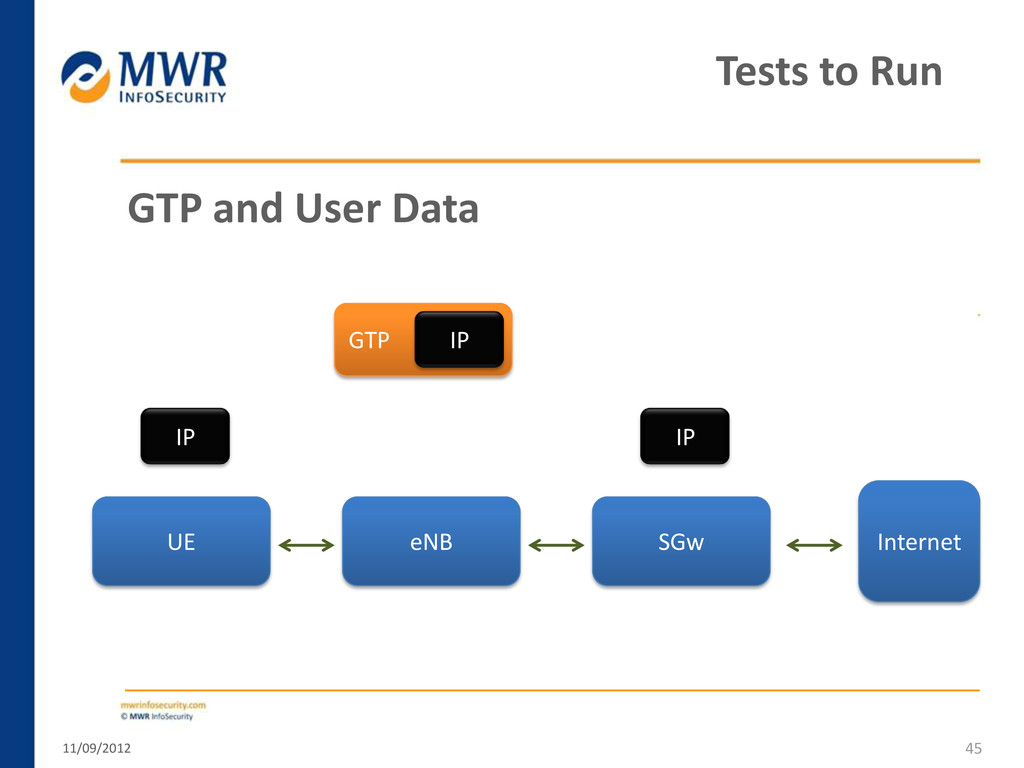
GTP and User Data 11/09/2012 45 Tests to Run eNB
UE SGw GTP IP IP Internet IP -
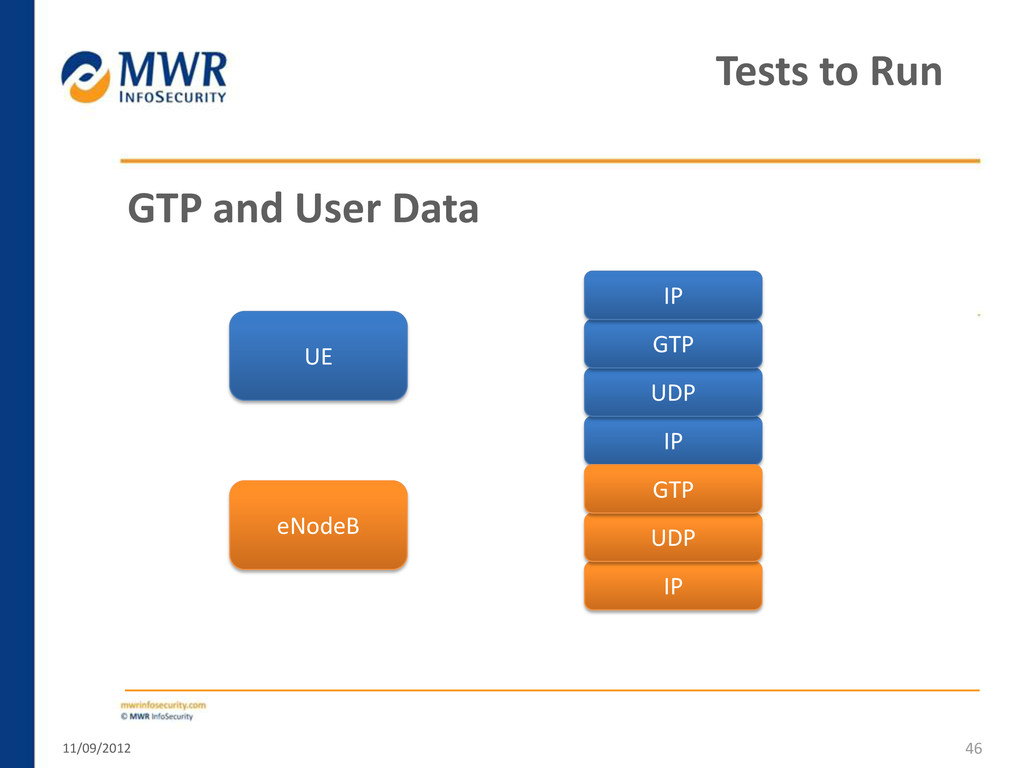
GTP and User Data 11/09/2012 46 Tests to Run UE
IP UDP GTP IP IP UDP GTP eNodeB -
GTP and User Data 11/09/2012 47 Tests to Run eNB
UE SGw Internet IP GTP GTP IP GTP IP GTP -
GTP and User Data 11/09/2012 48 Tests to Run eNB
UE SGw Source IP Address (IP) Invalid IP Protocols (IP) GTP Tunnel ID (GTP) Source IP Address (GTP) Destination IP Address (IP) PGw -
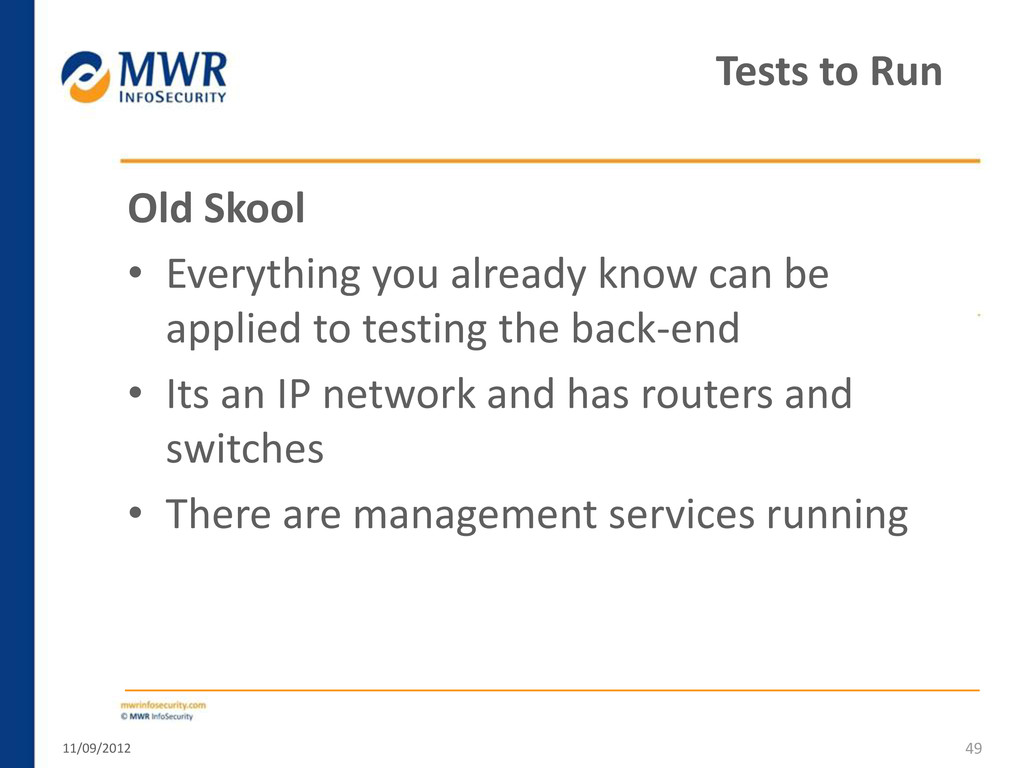
Old Skool • Everything you already know can be applied
to testing the back-end • Its an IP network and has routers and switches • There are management services running 11/09/2012 49 Tests to Run -
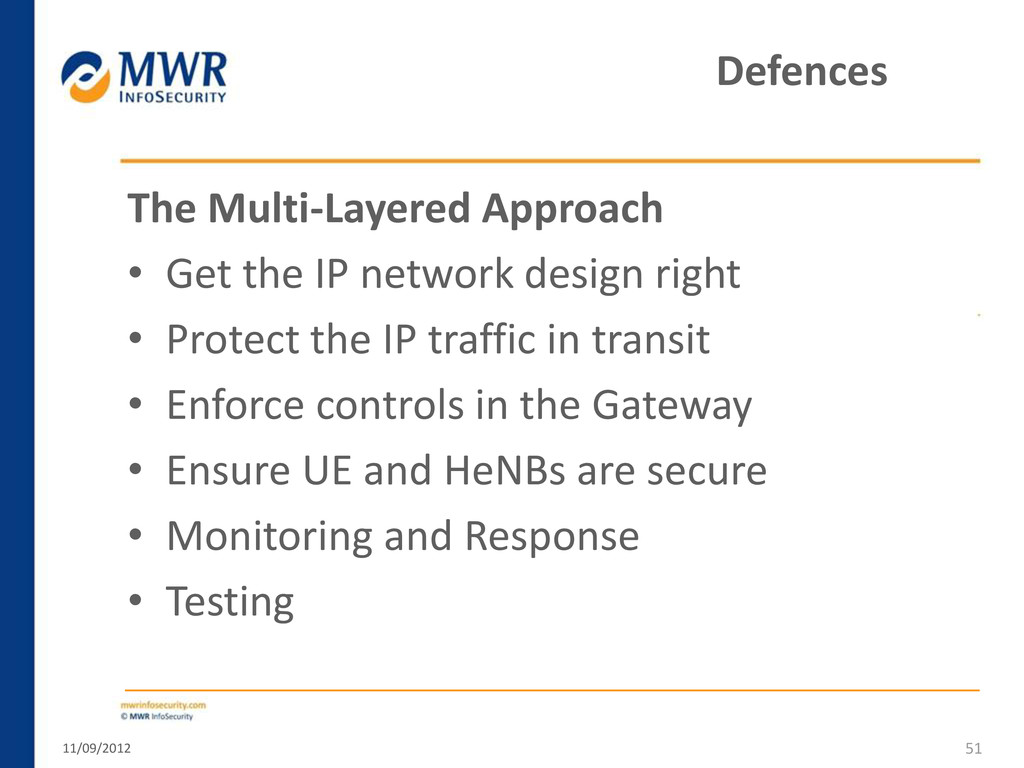
The Multi-Layered Approach • Get the IP network design right
• Protect the IP traffic in transit • Enforce controls in the Gateway • Ensure UE and HeNBs are secure • Monitoring and Response • Testing 11/09/2012 51 Defences -
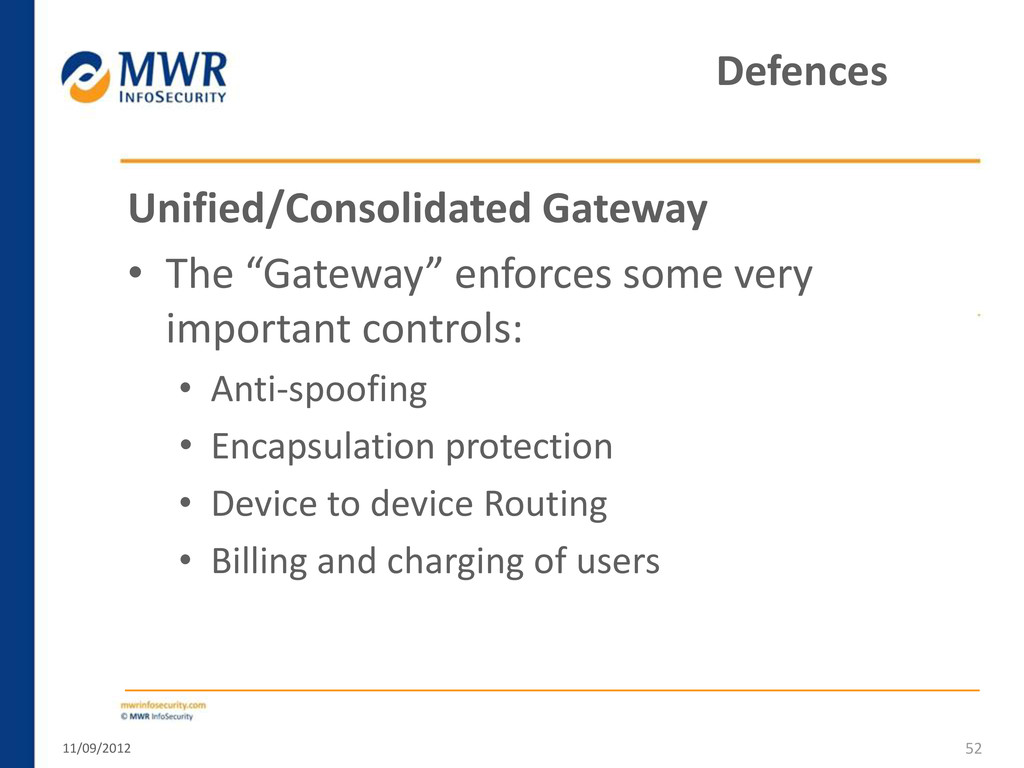
Unified/Consolidated Gateway • The “Gateway” enforces some very important controls:
• Anti-spoofing • Encapsulation protection • Device to device Routing • Billing and charging of users 11/09/2012 52 Defences -
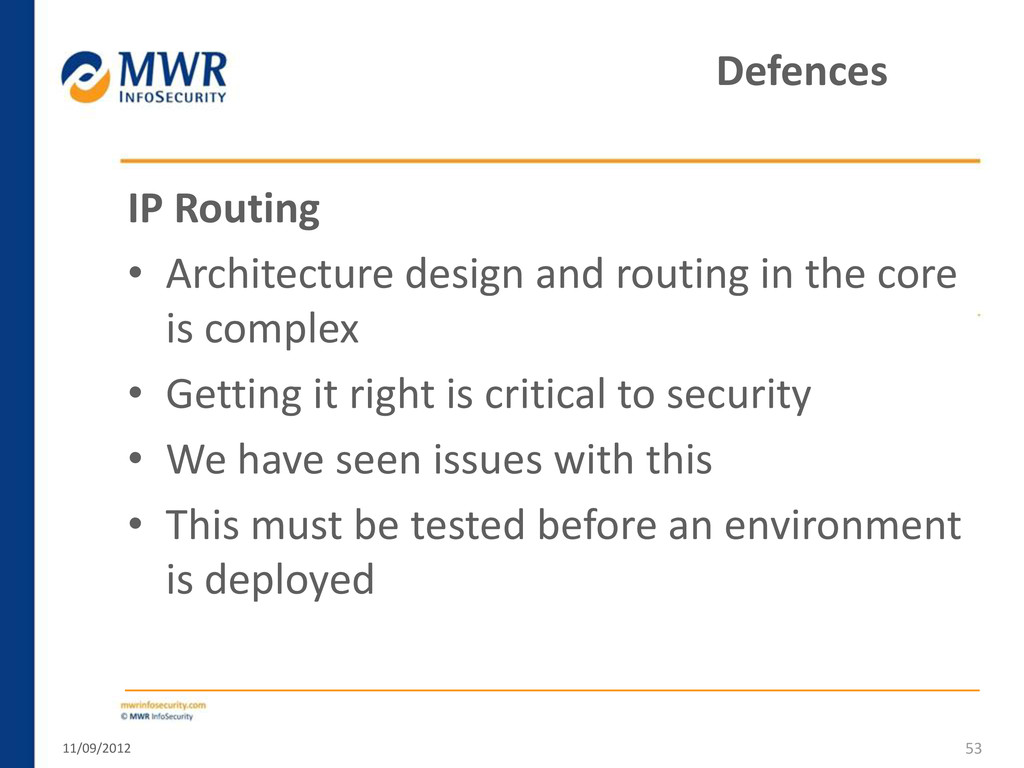
IP Routing • Architecture design and routing in the core
is complex • Getting it right is critical to security • We have seen issues with this • This must be tested before an environment is deployed 11/09/2012 53 Defences -
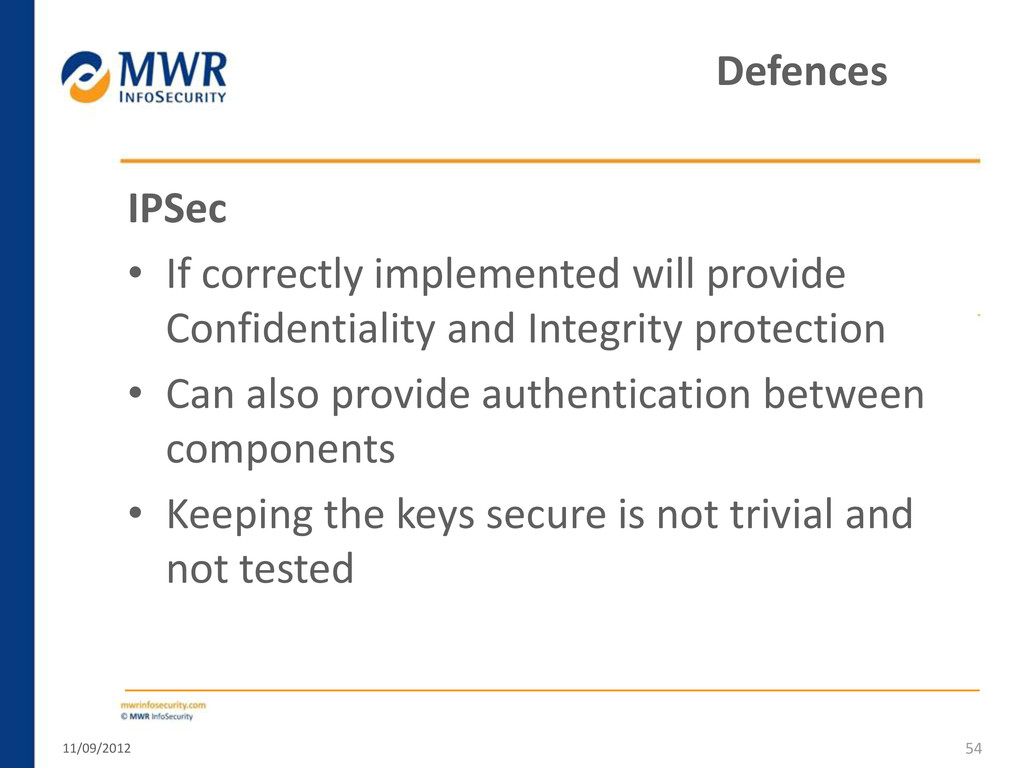
IPSec • If correctly implemented will provide Confidentiality and Integrity
protection • Can also provide authentication between components • Keeping the keys secure is not trivial and not tested 11/09/2012 54 Defences -
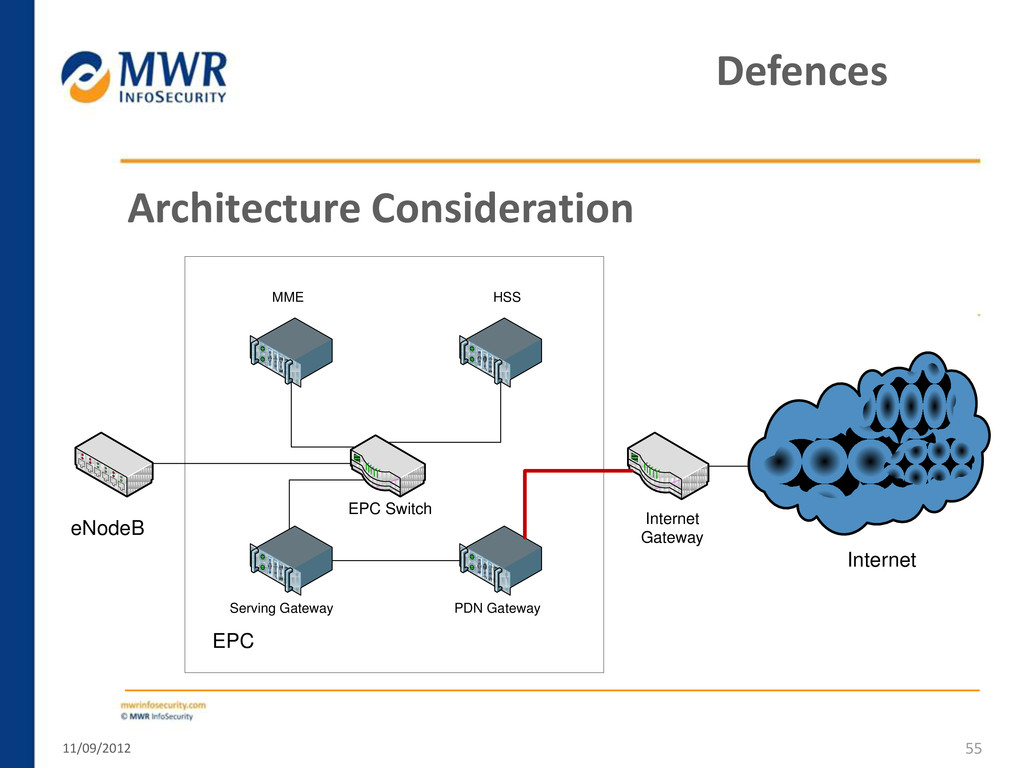
Architecture Consideration 11/09/2012 55 EPC Internet eNodeB MME HSS Serving
Gateway PDN Gateway Internet Gateway EPC Switch Defences -
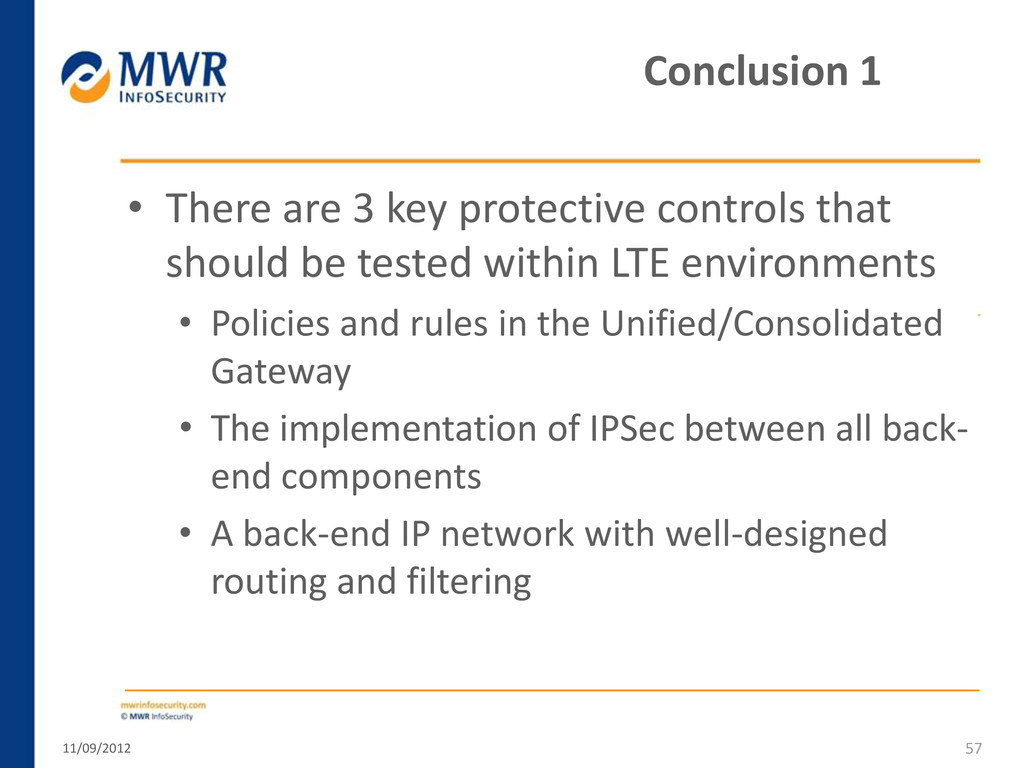
• There are 3 key protective controls that should be
tested within LTE environments • Policies and rules in the Unified/Consolidated Gateway • The implementation of IPSec between all back- end components • A back-end IP network with well-designed routing and filtering 11/09/2012 57 Conclusion 1 -
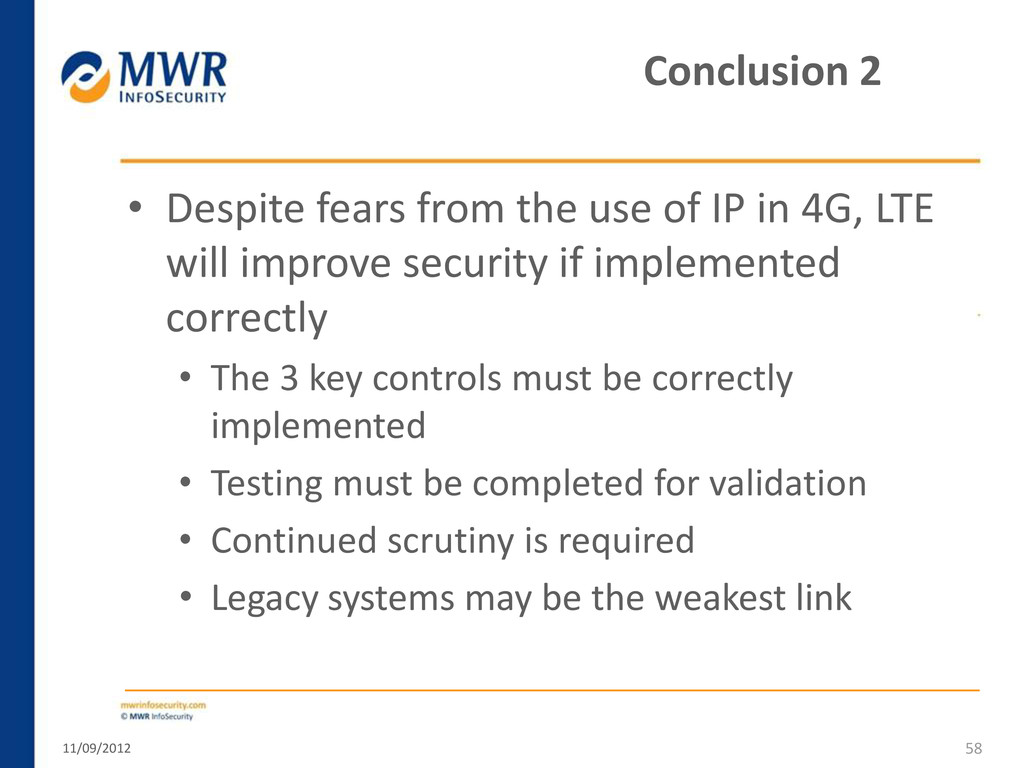
• Despite fears from the use of IP in 4G,
LTE will improve security if implemented correctly • The 3 key controls must be correctly implemented • Testing must be completed for validation • Continued scrutiny is required • Legacy systems may be the weakest link 11/09/2012 58 Conclusion 2 -
• Protecting key material used for IPSec is not trivial
• The security model for IPSec needs careful consideration • Operational security processes are also important • Home eNodeB security is a challenge 11/09/2012 59 Conclusion 3 -
• More air interface testing is needed • Will need
co-operation from vendors/operators • “Open” testing tools will need significant development effort • Still lower hanging fruit if support for legacy wireless standards remain 11/09/2012 60 Conclusion 4