Upgrade to Pro — share decks privately, control downloads, hide ads and more …

Hello Java 8

Sponsored · SiteGround - Reliable hosting with speed, security, and support you can count on. →

Hello Java 8

Original slides of Java 8 Talk

Avatar for Adam Davis

Adam Davis

March 27, 2014

Other Decks in Programming

Transcript

  1. Features of Java 8 • Lambda expressions • Method references

    • Default methods • New Streams API • New DateTime API • Nashorn
  2. Why Lambda? λ • Lambda calculus <-> Turing Machines •

    Alonzo Church – Alan Turing • JVM Closures: Groovy, Clojure, Scala, JRuby • Functional programming • Multi-core processors • Concurrency • Lazy evaluation
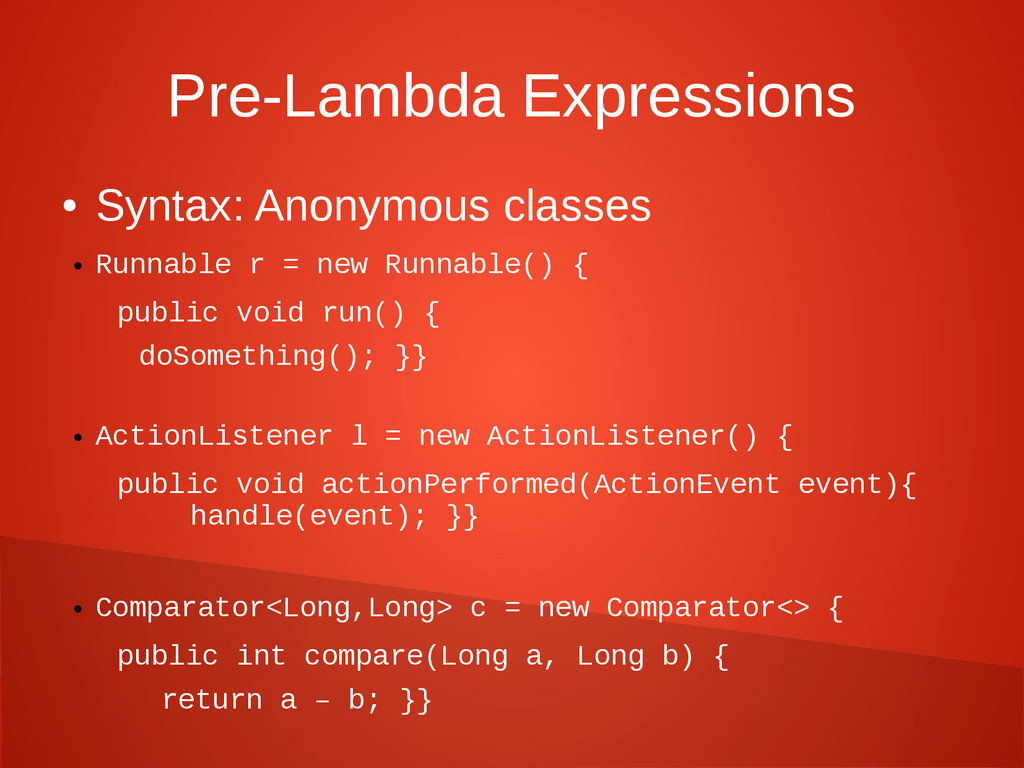
  3. Pre-Lambda Expressions • Syntax: Anonymous classes • Runnable r =

    new Runnable() { public void run() { doSomething(); }} • ActionListener l = new ActionListener() { public void actionPerformed(ActionEvent event){ handle(event); }} • Comparator<Long,Long> c = new Comparator<> { public int compare(Long a, Long b) { return a – b; }}
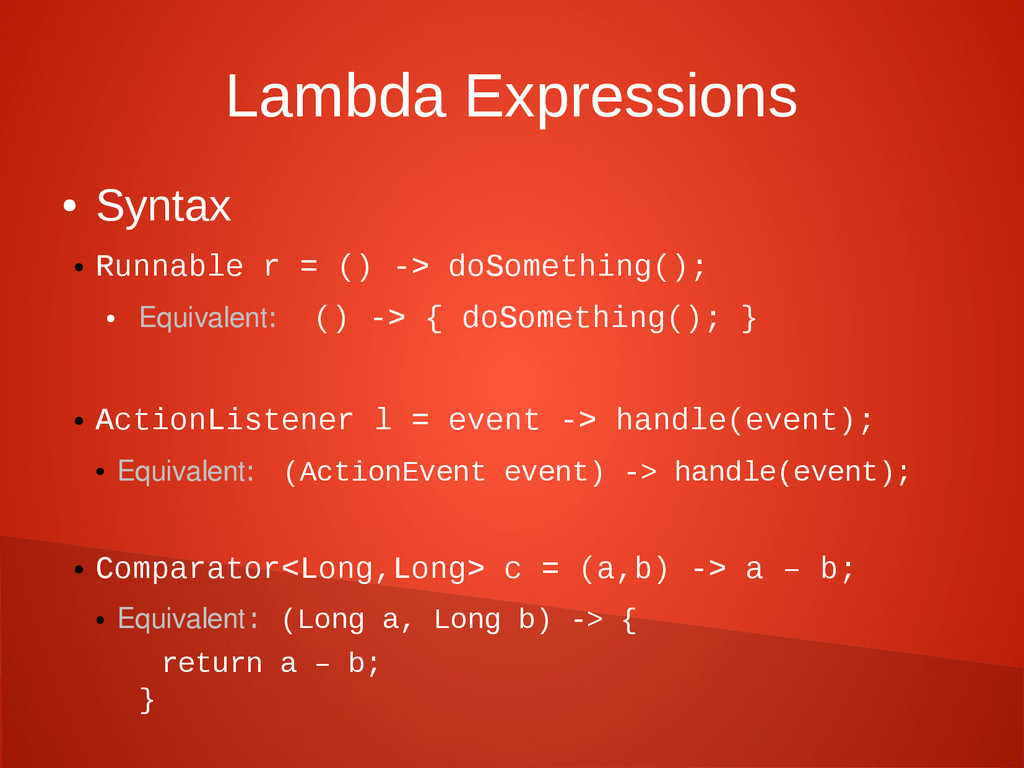
  4. Lambda Expressions • Syntax • Runnable r = () ->

    doSomething(); • Equivalent: () -> { doSomething(); } • ActionListener l = event -> handle(event); • Equivalent: (ActionEvent event) -> handle(event); • Comparator<Long,Long> c = (a,b) -> a – b; • Equivalent: (Long a, Long b) -> { return a – b; }
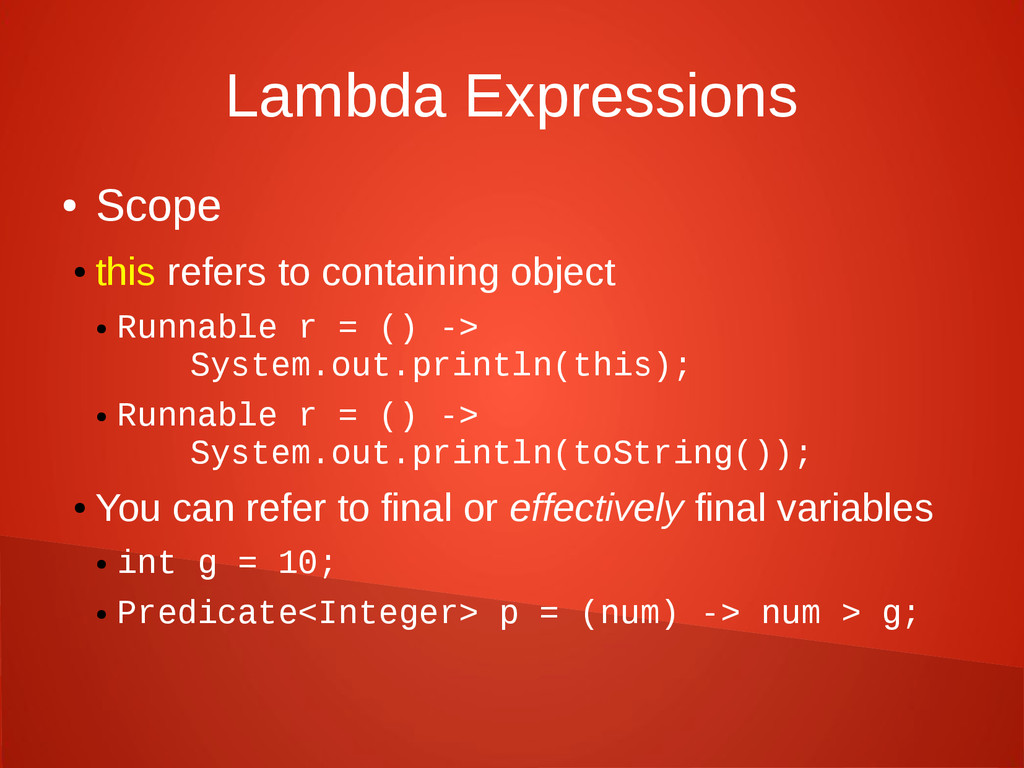
  5. Lambda Expressions • Scope • this refers to containing object

    • Runnable r = () -> System.out.println(this); • Runnable r = () -> System.out.println(toString()); • You can refer to final or effectively final variables • int g = 10; • Predicate<Integer> p = (num) -> num > g;
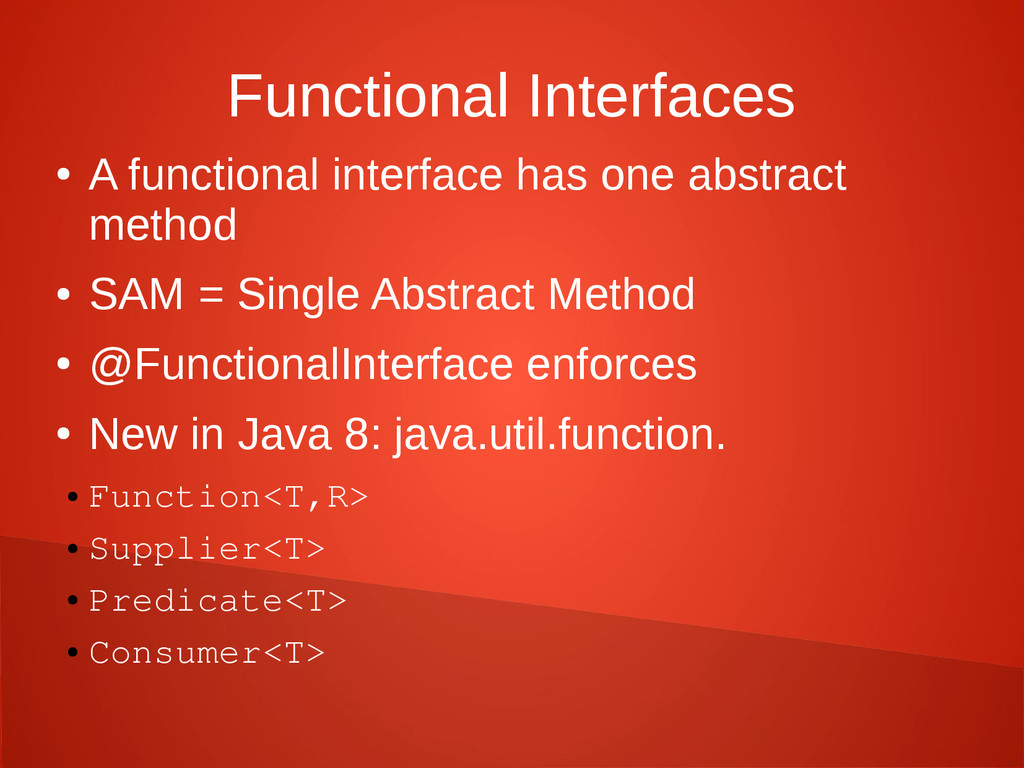
  6. Functional Interfaces • A functional interface has one abstract method

    • SAM = Single Abstract Method • @FunctionalInterface enforces • New in Java 8: java.util.function. • Function<T,R> • Supplier<T> • Predicate<T> • Consumer<T>
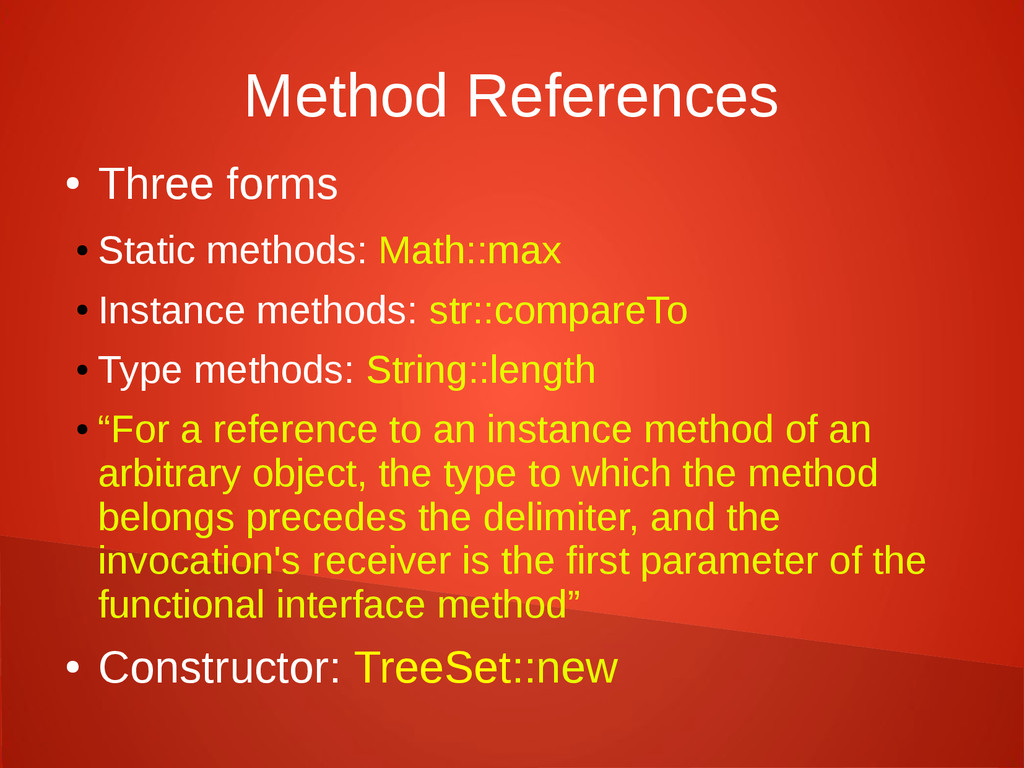
  7. Method References • Three forms • Static methods: Math::max •

    Instance methods: str::compareTo • Type methods: String::length • “For a reference to an instance method of an arbitrary object, the type to which the method belongs precedes the delimiter, and the invocation's receiver is the first parameter of the functional interface method” • Constructor: TreeSet::new
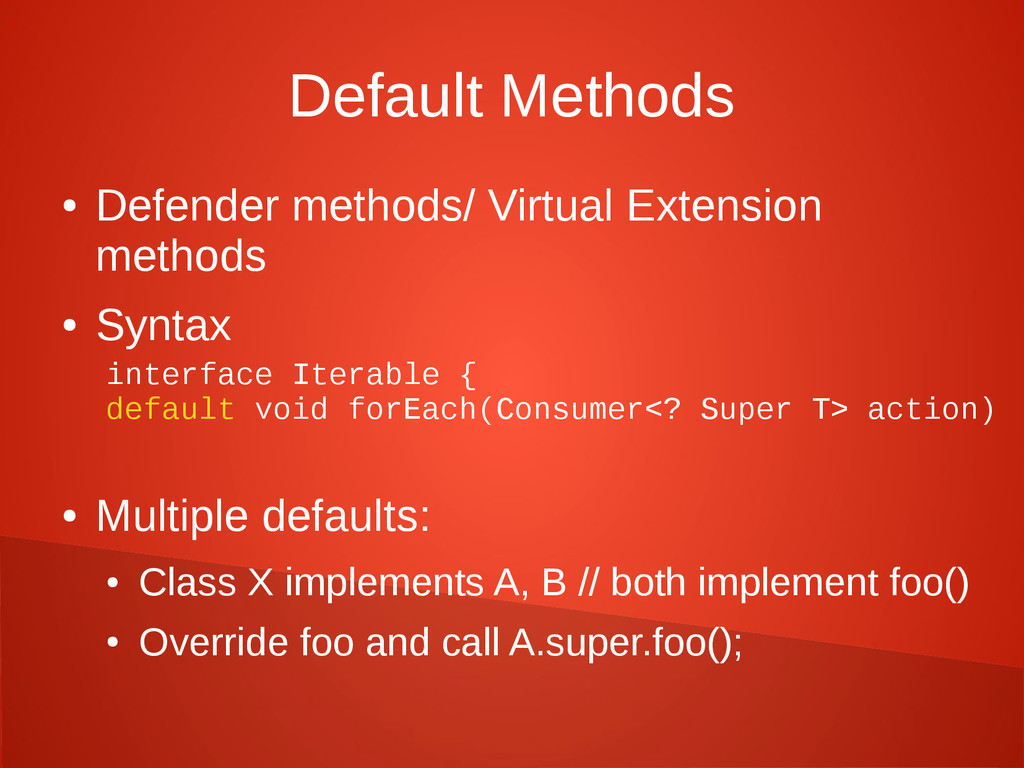
  8. Default Methods • Defender methods/ Virtual Extension methods • Syntax

    • Multiple defaults: • Class X implements A, B // both implement foo() • Override foo and call A.super.foo(); interface Iterable { default void forEach(Consumer<? Super T> action)
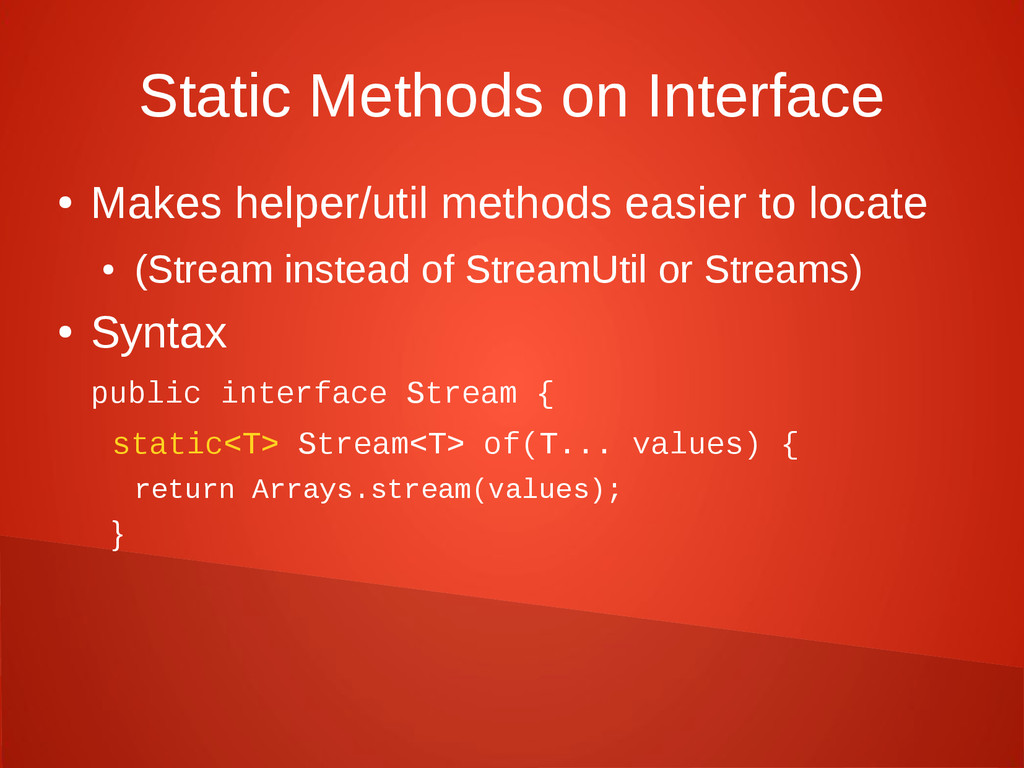
  9. Static Methods on Interface • Makes helper/util methods easier to

    locate • (Stream instead of StreamUtil or Streams) • Syntax public interface Stream { static<T> Stream<T> of(T... values) { return Arrays.stream(values); }
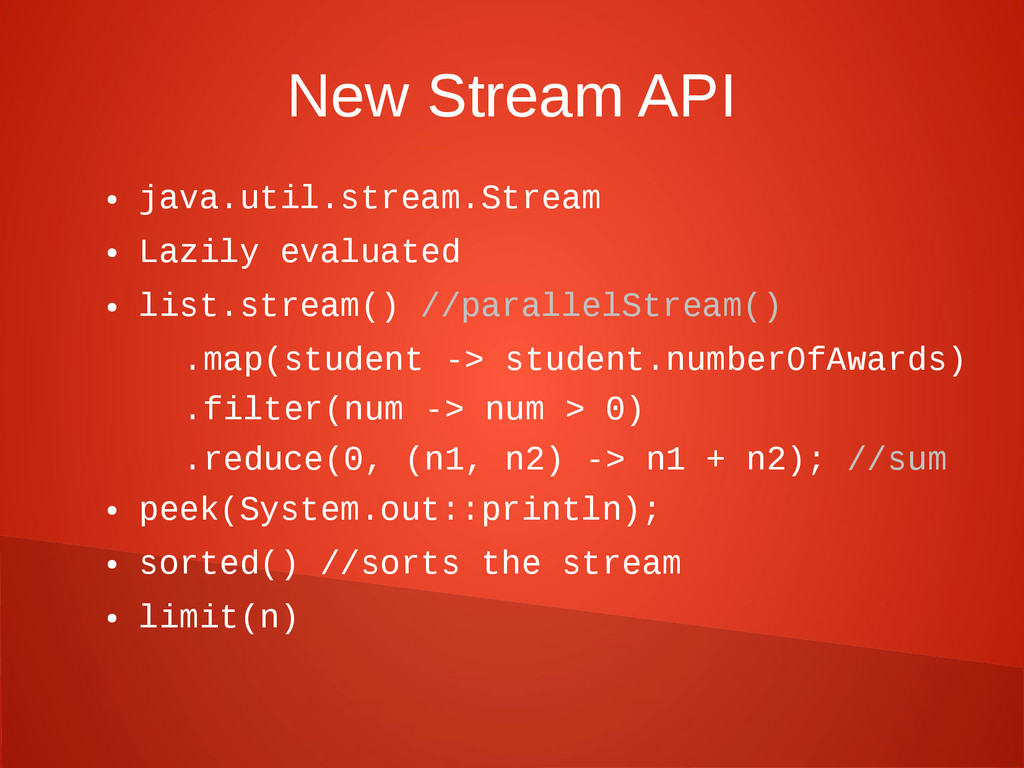
  10. New Stream API • java.util.stream.Stream • Lazily evaluated • list.stream()

    //parallelStream() .map(student -> student.numberOfAwards) .filter(num -> num > 0) .reduce(0, (n1, n2) -> n1 + n2); //sum • peek(System.out::println); • sorted() //sorts the stream • limit(n)
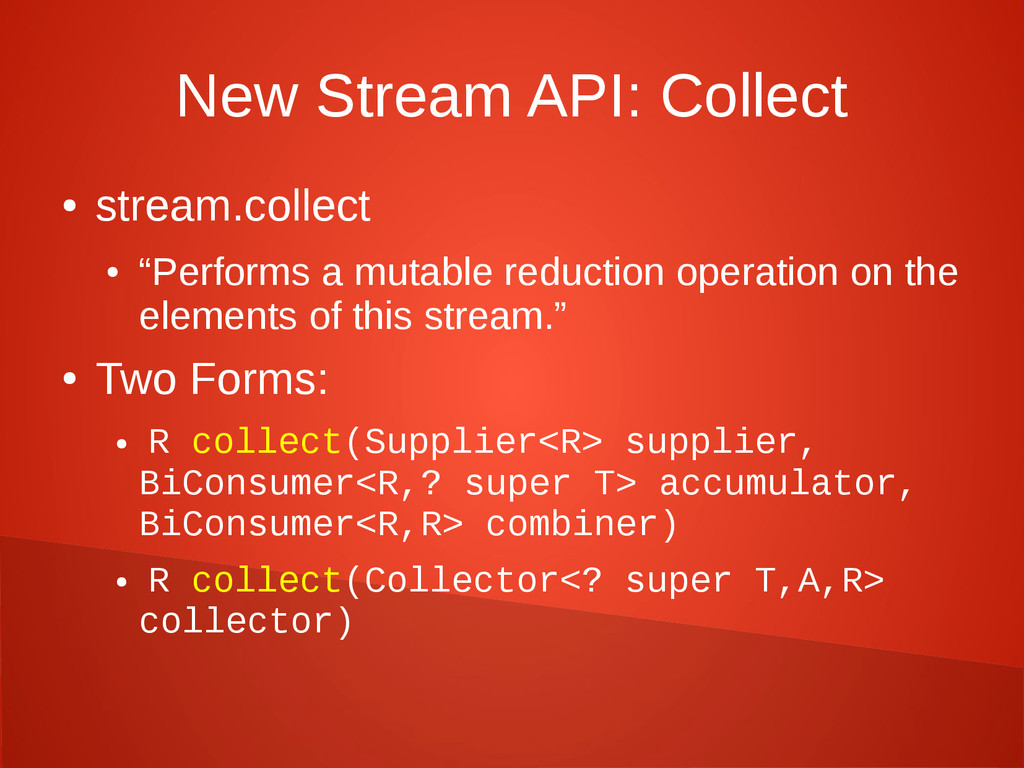
  11. New Stream API: Collect • stream.collect • “Performs a mutable

    reduction operation on the elements of this stream.” • Two Forms: • R collect(Supplier<R> supplier, BiConsumer<R,? super T> accumulator, BiConsumer<R,R> combiner) • R collect(Collector<? super T,A,R> collector)
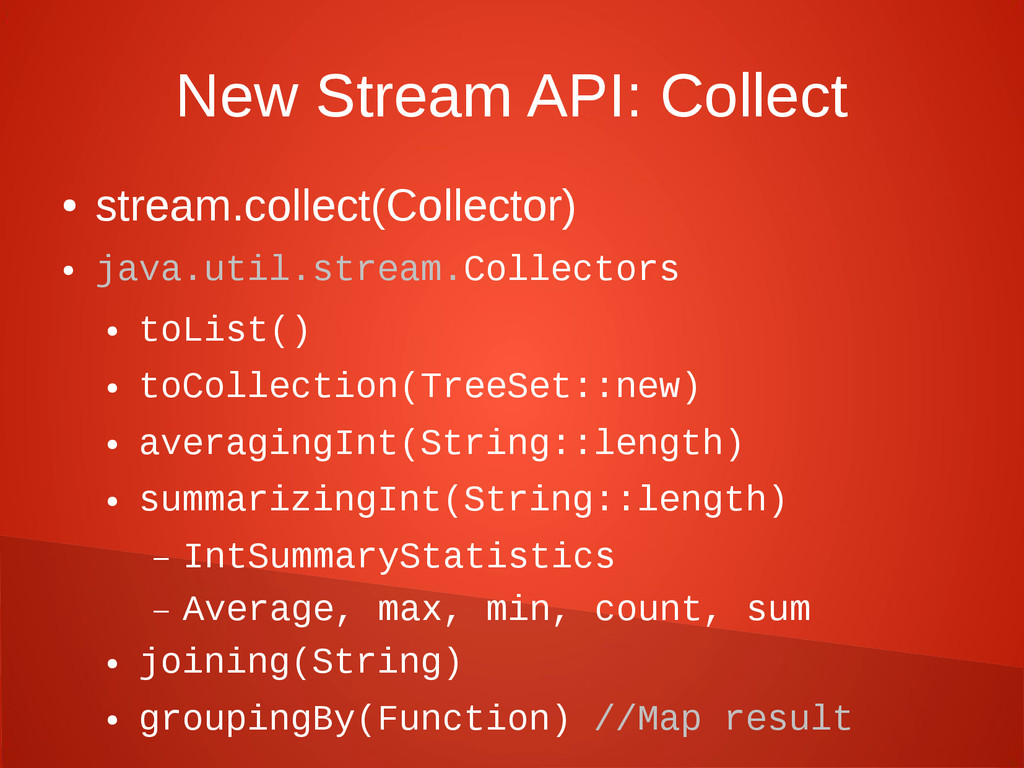
  12. New Stream API: Collect • stream.collect(Collector) • java.util.stream.Collectors • toList()

    • toCollection(TreeSet::new) • averagingInt(String::length) • summarizingInt(String::length) – IntSummaryStatistics – Average, max, min, count, sum • joining(String) • groupingBy(Function) //Map result
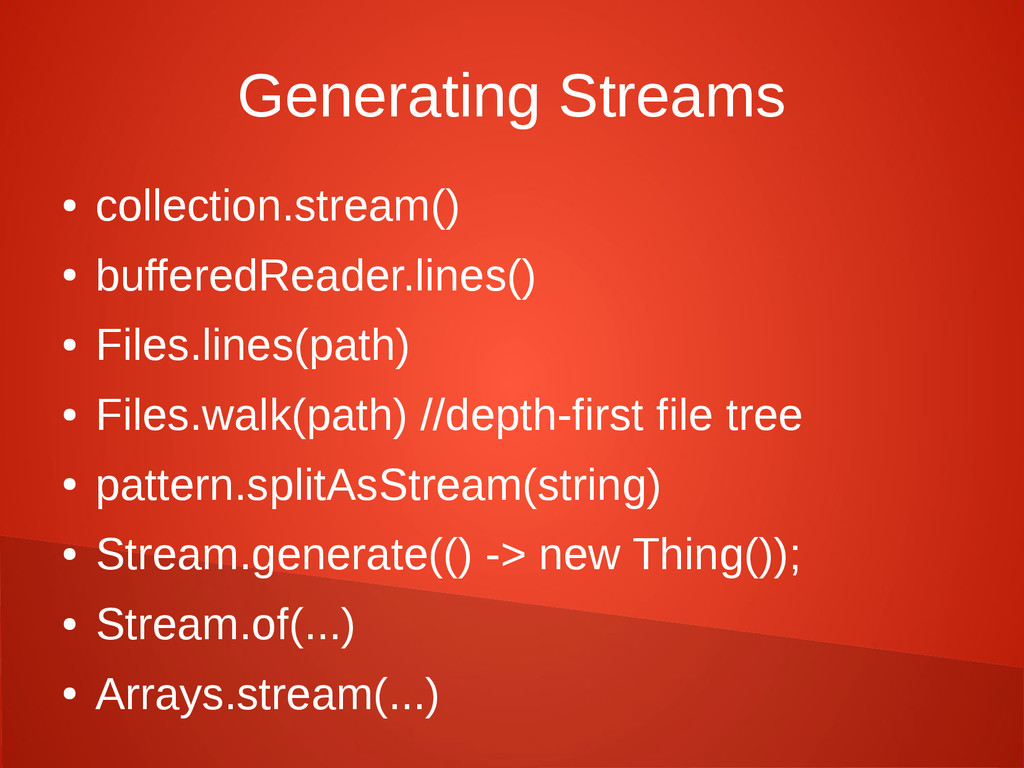
  13. Generating Streams • collection.stream() • bufferedReader.lines() • Files.lines(path) • Files.walk(path)

    //depth-first file tree • pattern.splitAsStream(string) • Stream.generate(() -> new Thing()); • Stream.of(...) • Arrays.stream(...)
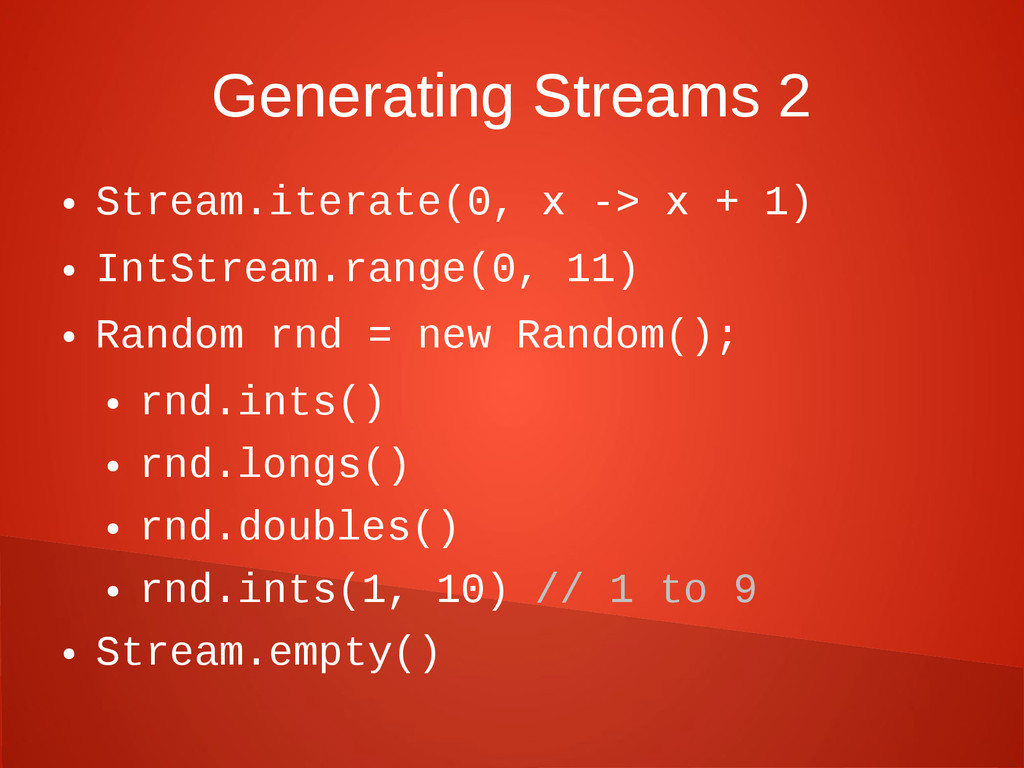
  14. Generating Streams 2 • Stream.iterate(0, x -> x + 1)

    • IntStream.range(0, 11) • Random rnd = new Random(); • rnd.ints() • rnd.longs() • rnd.doubles() • rnd.ints(1, 10) // 1 to 9 • Stream.empty()
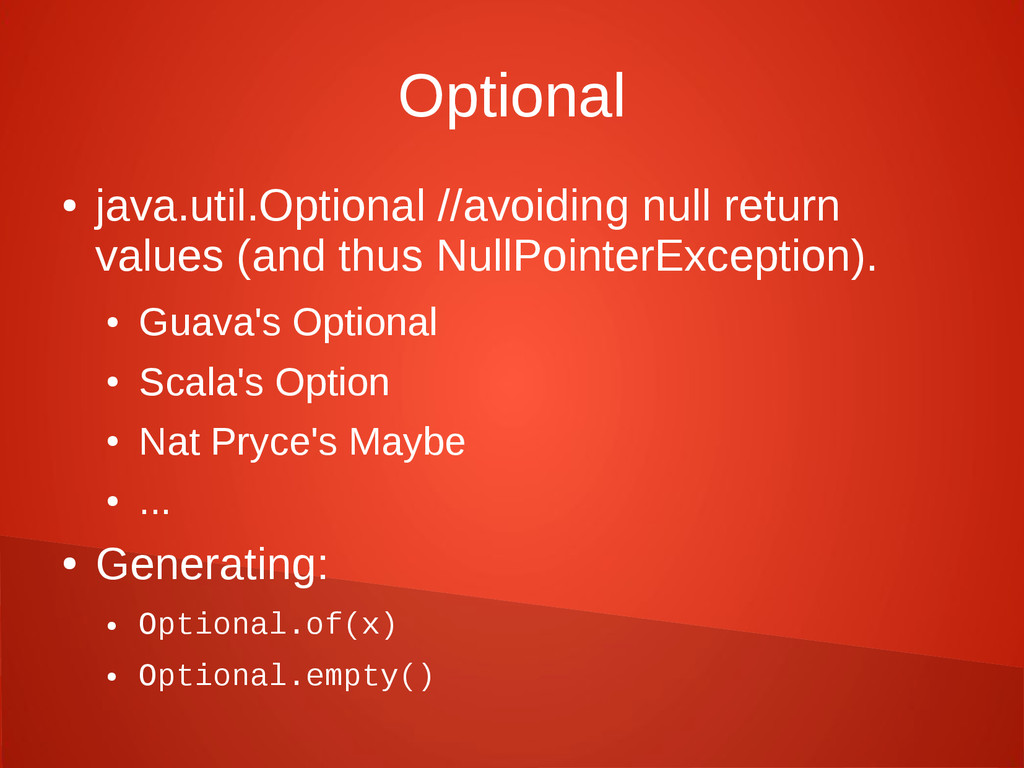
  15. Optional • java.util.Optional //avoiding null return values (and thus NullPointerException).

    • Guava's Optional • Scala's Option • Nat Pryce's Maybe • ... • Generating: • Optional.of(x) • Optional.empty()
  16. Optional • Methods: • isPresent() • get() • orElse(T) •

    orElseGet(Supplier<T>) • orElseThrow(Supplier<X extends Throwable>) • ifPresent(Consumer) • map(Function)
  17. Nashorn Javascript Engine • Nashorn replaces Rhino as the default

    Javascript engine for the Oracle JVM. • ECMAScript-262 Edition 5.1 • Faster, less memory, invokedynamic • Object, Function, Number, String, Date, Array, RegExp, etc. • Command line tool (jjs). • $ jjs script.js • Integrates with Java; Java<->Javascript
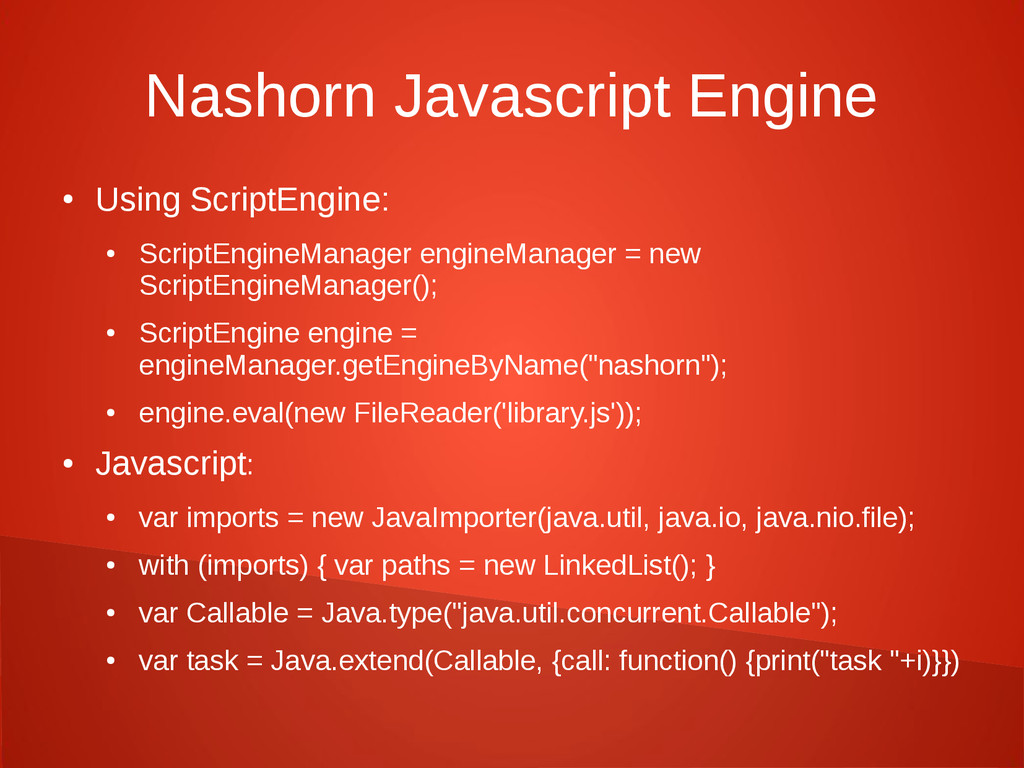
  18. Nashorn Javascript Engine • Using ScriptEngine: • ScriptEngineManager engineManager =

    new ScriptEngineManager(); • ScriptEngine engine = engineManager.getEngineByName("nashorn"); • engine.eval(new FileReader('library.js')); • Javascript: • var imports = new JavaImporter(java.util, java.io, java.nio.file); • with (imports) { var paths = new LinkedList(); } • var Callable = Java.type("java.util.concurrent.Callable"); • var task = Java.extend(Callable, {call: function() {print("task "+i)}})
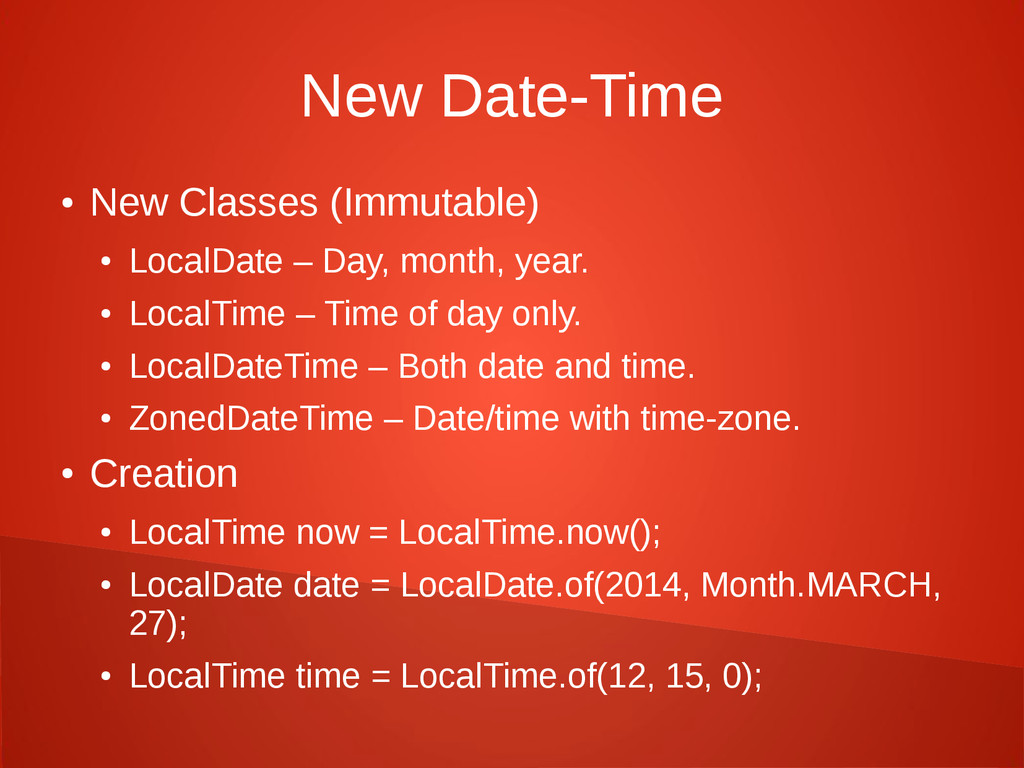
  19. New Date-Time • New Classes (Immutable) • LocalDate – Day,

    month, year. • LocalTime – Time of day only. • LocalDateTime – Both date and time. • ZonedDateTime – Date/time with time-zone. • Creation • LocalTime now = LocalTime.now(); • LocalDate date = LocalDate.of(2014, Month.MARCH, 27); • LocalTime time = LocalTime.of(12, 15, 0);
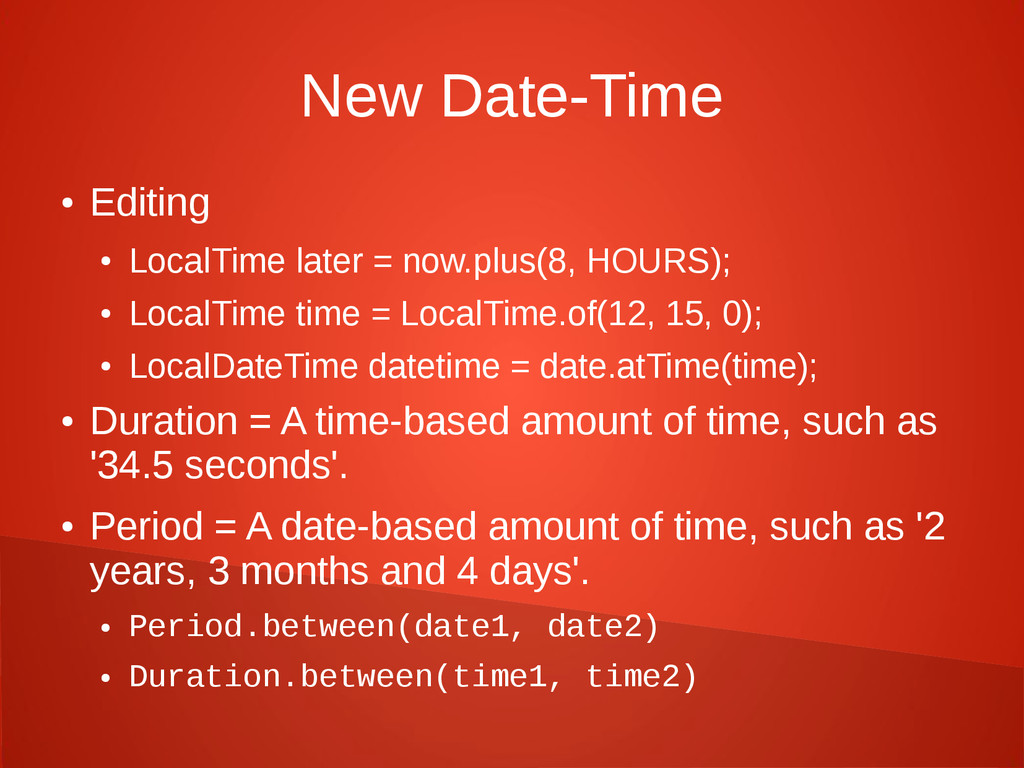
  20. New Date-Time • Editing • LocalTime later = now.plus(8, HOURS);

    • LocalTime time = LocalTime.of(12, 15, 0); • LocalDateTime datetime = date.atTime(time); • Duration = A time-based amount of time, such as '34.5 seconds'. • Period = A date-based amount of time, such as '2 years, 3 months and 4 days'. • Period.between(date1, date2) • Duration.between(time1, time2)
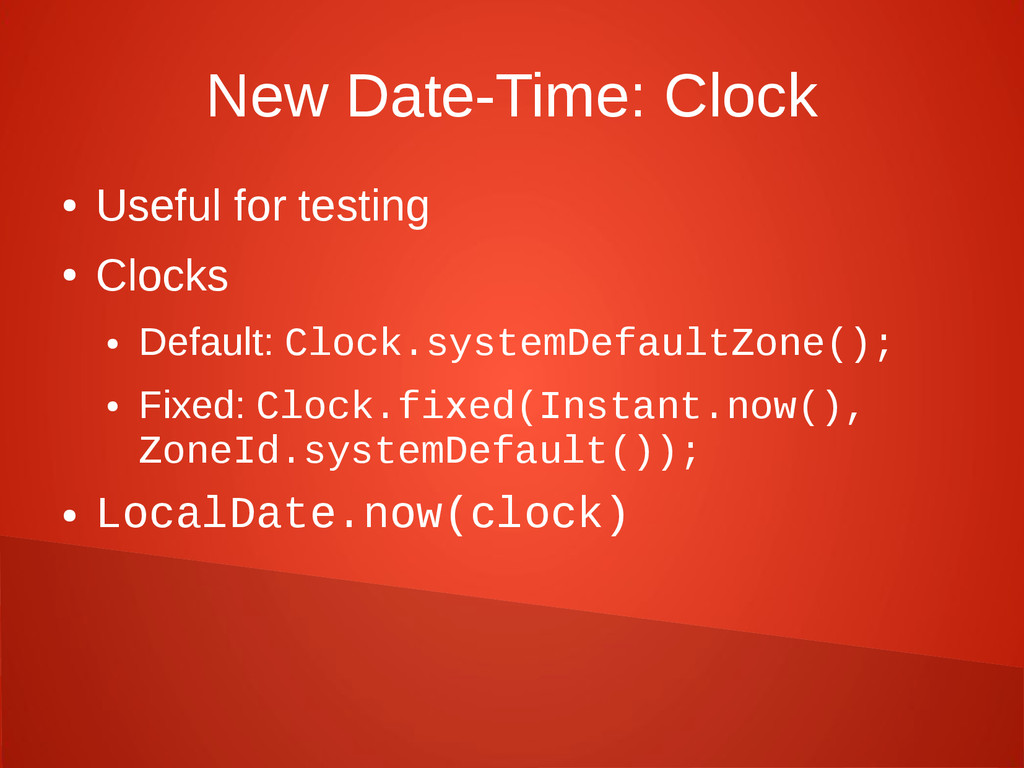
  21. New Date-Time: Clock • Useful for testing • Clocks •

    Default: Clock.systemDefaultZone(); • Fixed: Clock.fixed(Instant.now(), ZoneId.systemDefault()); • LocalDate.now(clock)
  22. Bye-bye PermGen • No more Permanent generation • Most allocations

    for the class metadata are now allocated out of native memory. – “The proposed implementation will allocate class meta-data in native memory and move interned Strings and class statics to the Java heap” -http://openjdk.java.net/jeps/122 • java.lang.OutOfMemoryError: Metadata space • Convergence of Oracle JRockit & HotSpot
  23. Miscellaneous • java.util.Base64 • Cryptography upgrades (lots) • JDBC 4.2

    • Repeatable Annotations • Annotations on types • ….? • http://openjdk.java.net/jeps/0