Pharmacognosy_Chapter_-3.pdf , Quality Control ...

Arun Kumar
November 16, 2026

Pharmacognosy_Chapter_-3.pdf , Quality Control of crude drugs

CHAPTER -3
Quality control of crude drugs:
Different methods of adulteration of crude drugs
Evaluation of crude drugs

Arun Kumar

November 16, 2026

Annual Pro sale · Save $30

Have presentations of your own?

Share with private links, password protection, and more control over your work.

Transcript

45 slides
  1. CHAPTER -3 Quality control of crude drugs:  Different methods

    of adulteration of crude drugs  Evaluation of crude drugs
  2. Quality Control of Crude Drugs  Quality control of crude

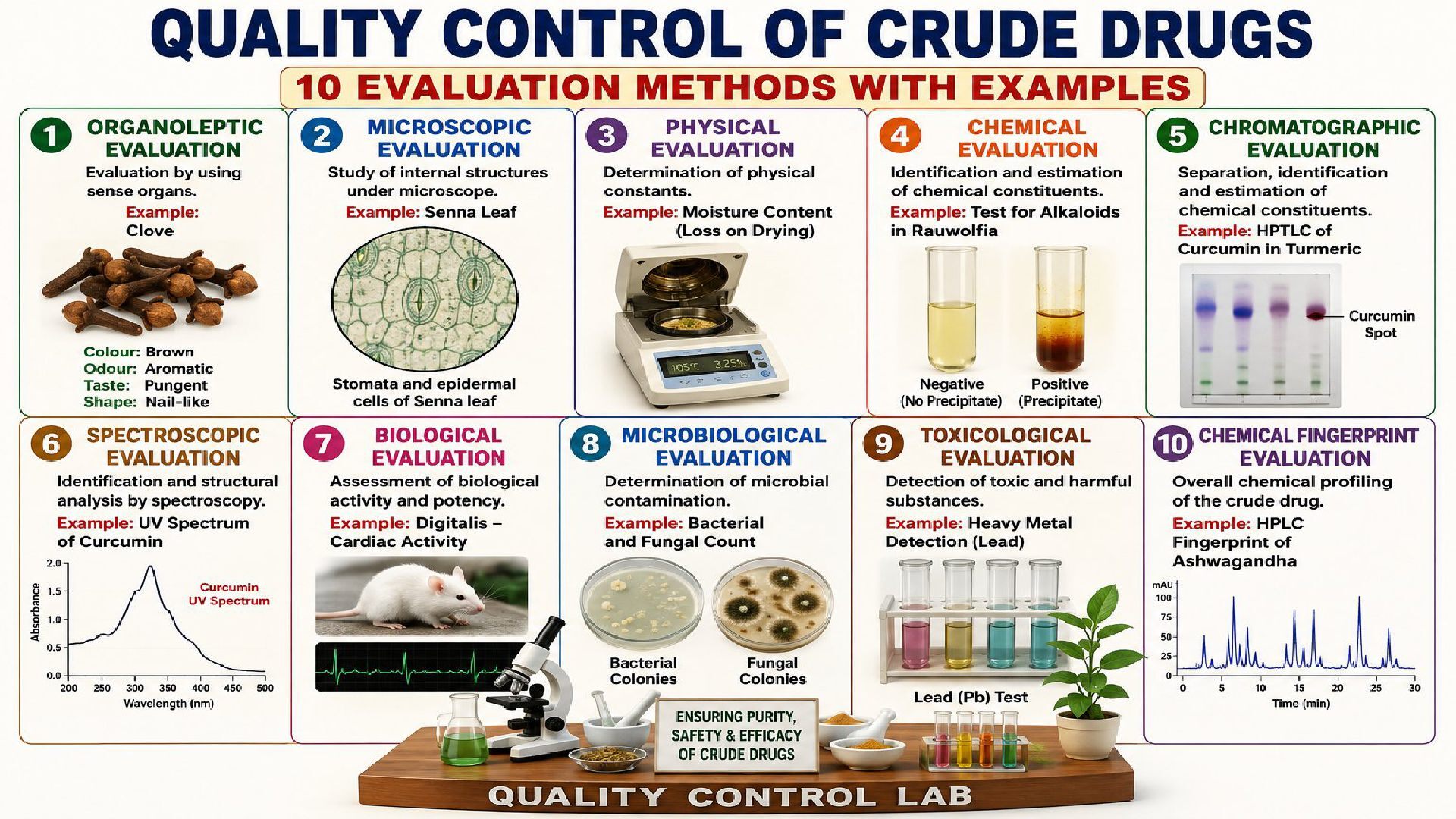
    drugs is the process of ensuring the identity, purity, safety, potency, and consistency of crude drugs before they are used in the preparation of herbal medicines.  It helps detect adulteration, contamination, and deterioration.  Suppose we buy Clove from the market. We need to check:  Is it really clove?  Is it mixed with another plant?  Does it contain too much moisture?  Is it contaminated with sand or dirt?  Does it contain the required amount of volatile oil?  For this purpose, different quality-control methods are used.
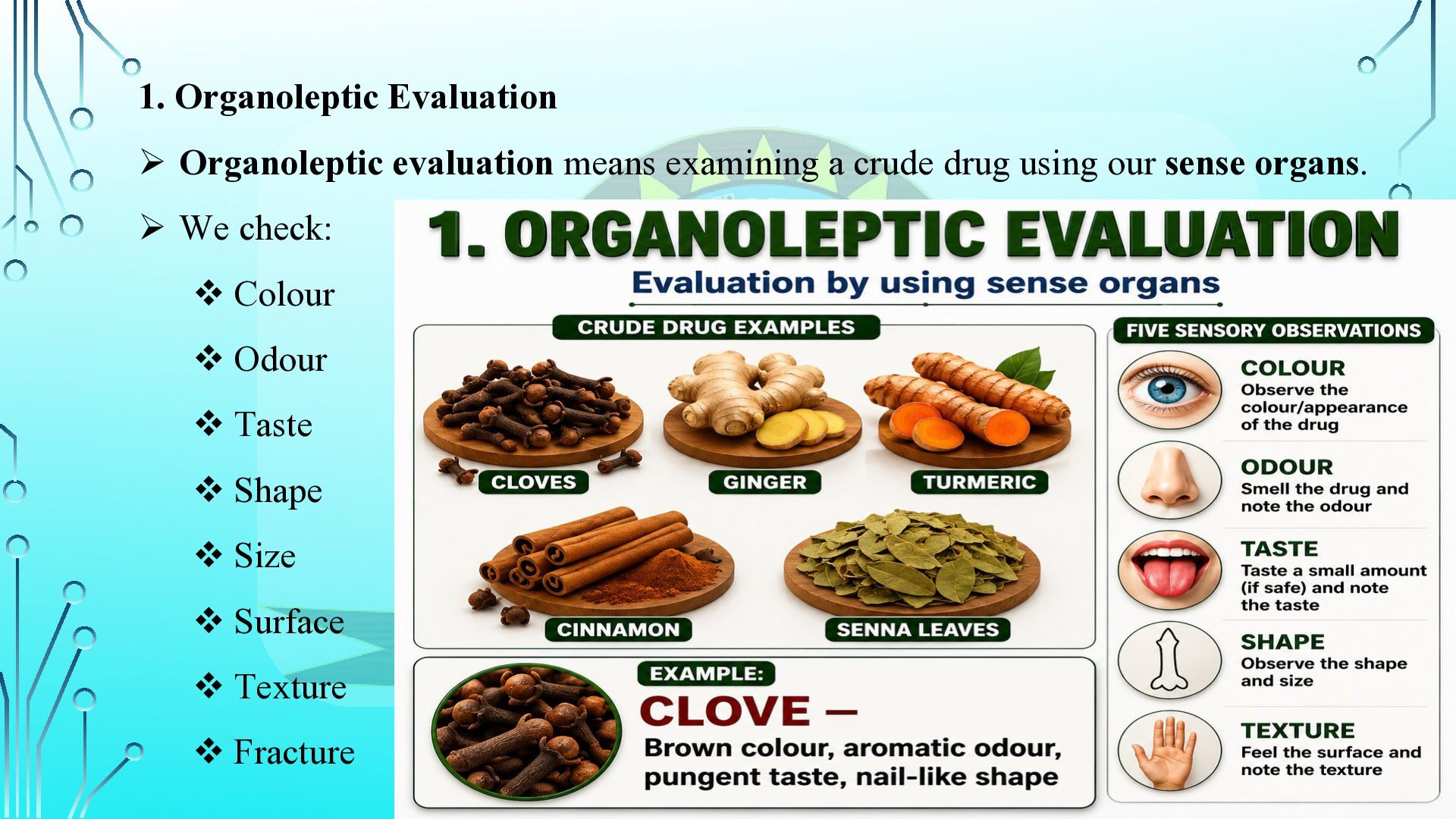
  3. 1. Organoleptic Evaluation  Organoleptic evaluation means examining a crude
    drug using our sense organs.  We check:  Colour  Odour  Taste  Shape  Size  Surface  Texture  Fracture
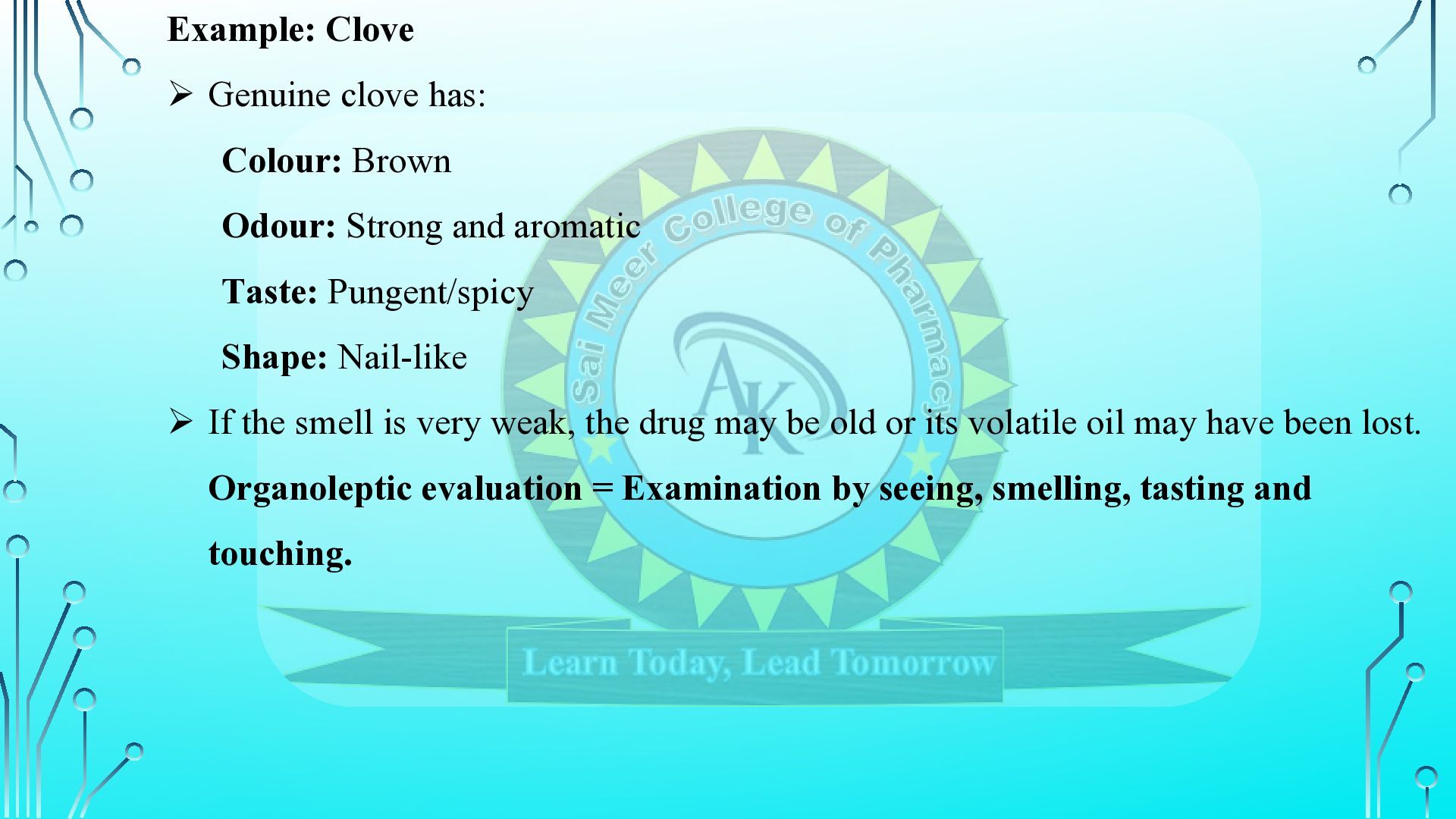
  4. Example: Clove  Genuine clove has: Colour: Brown Odour: Strong

    and aromatic Taste: Pungent/spicy Shape: Nail-like  If the smell is very weak, the drug may be old or its volatile oil may have been lost. Organoleptic evaluation = Examination by seeing, smelling, tasting and touching.
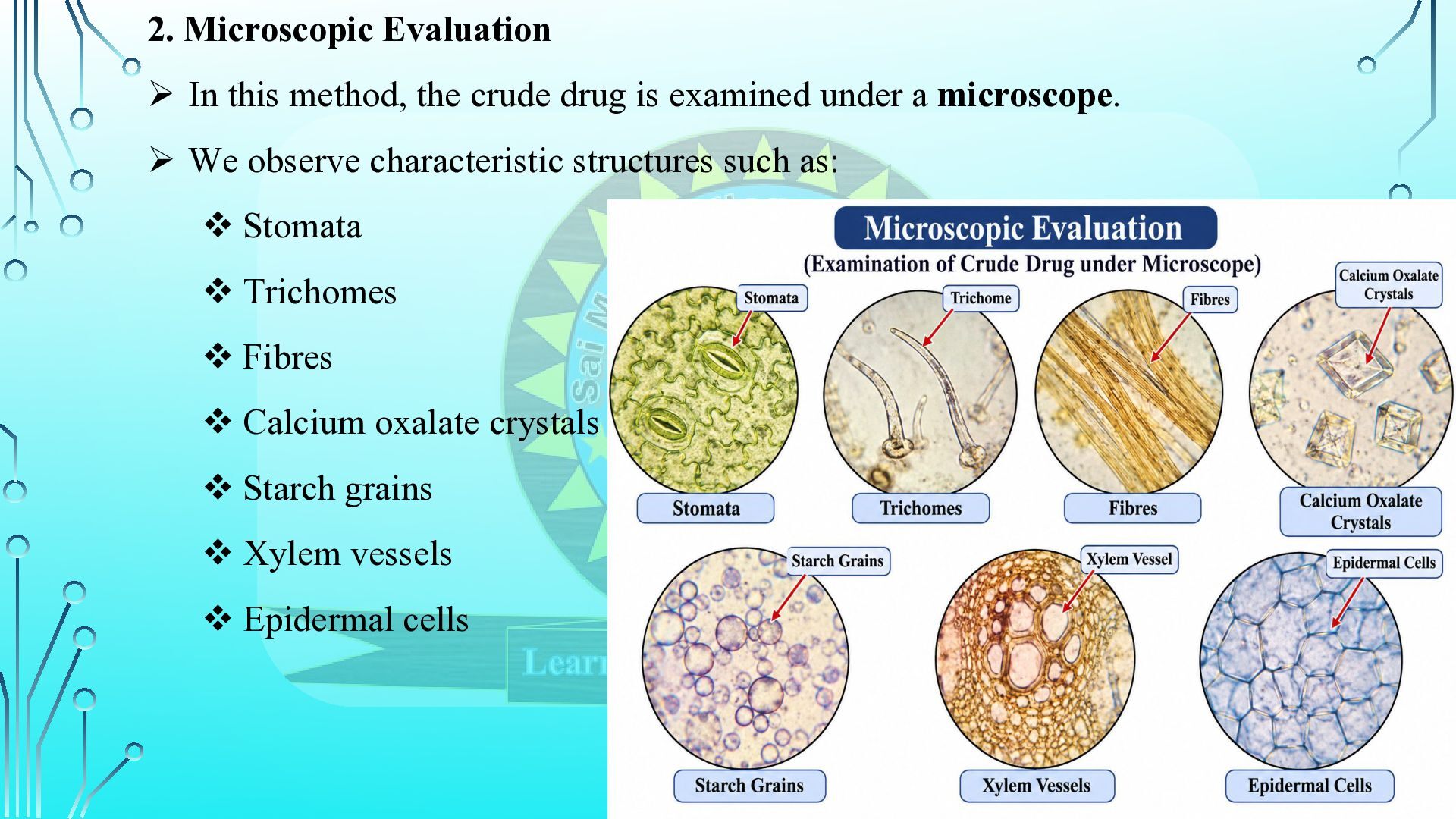
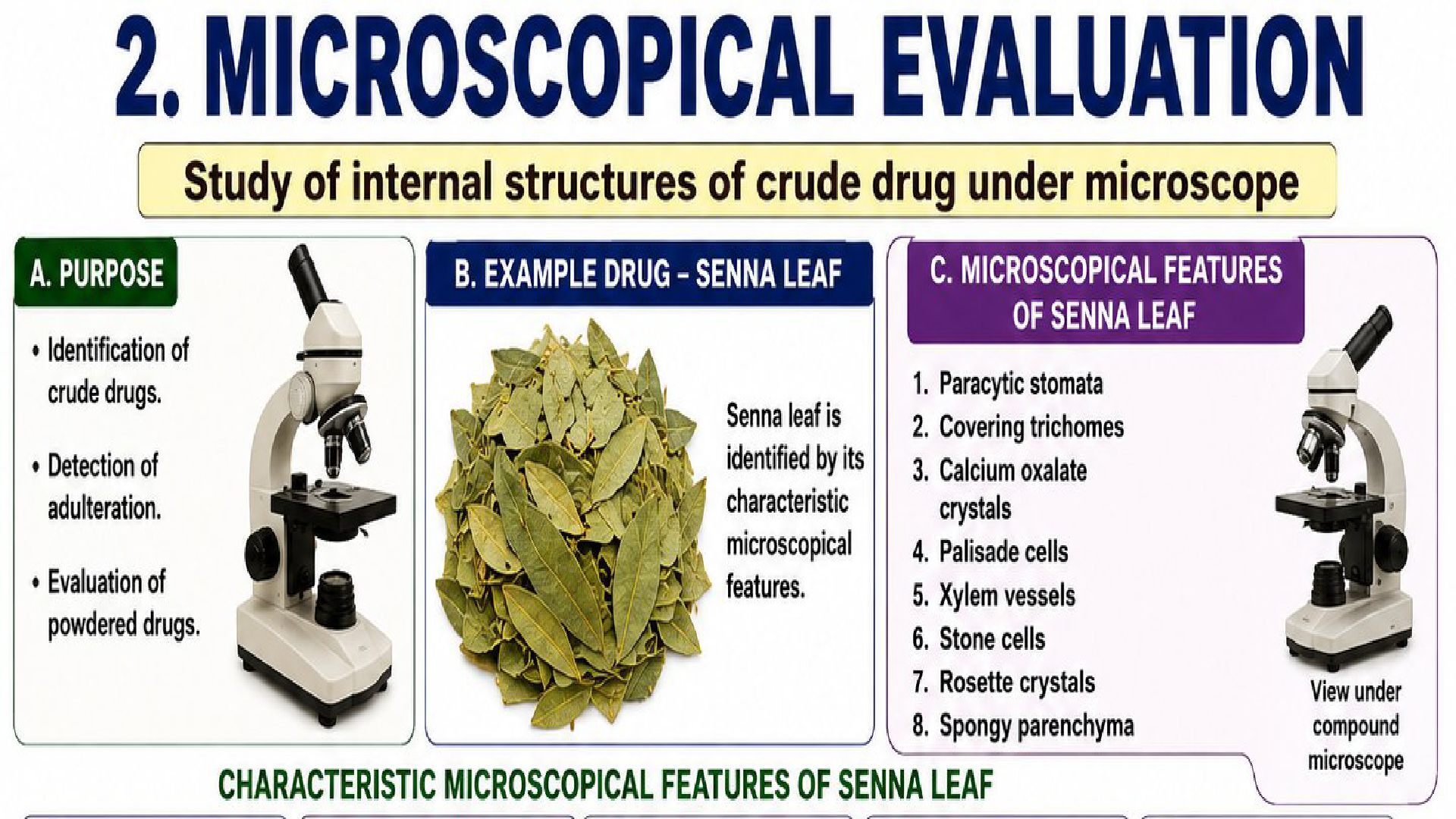
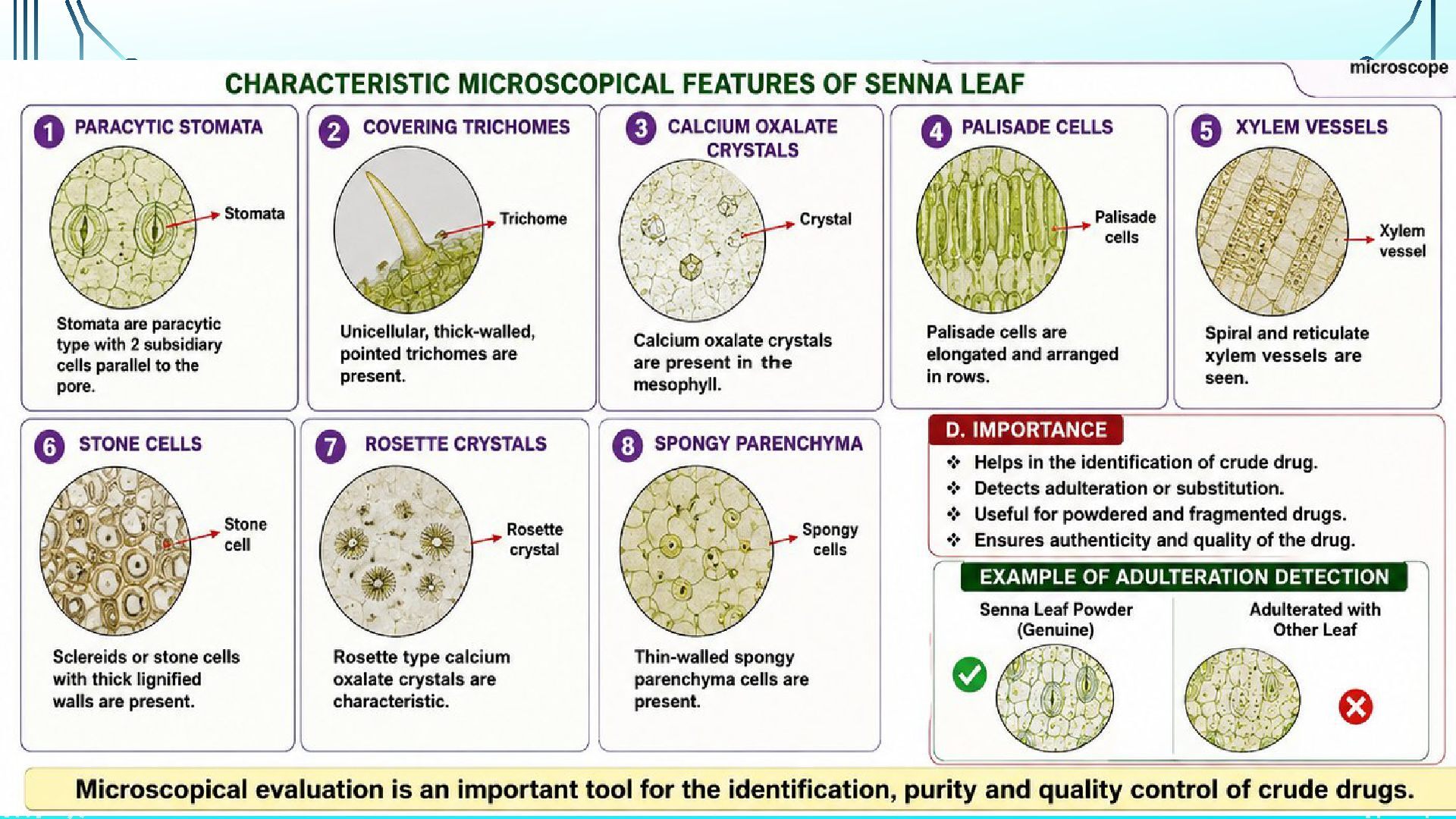
  5. 2. Microscopic Evaluation  In this method, the crude drug

    is examined under a microscope.  We observe characteristic structures such as:  Stomata  Trichomes  Fibres  Calcium oxalate crystals  Starch grains  Xylem vessels  Epidermal cells
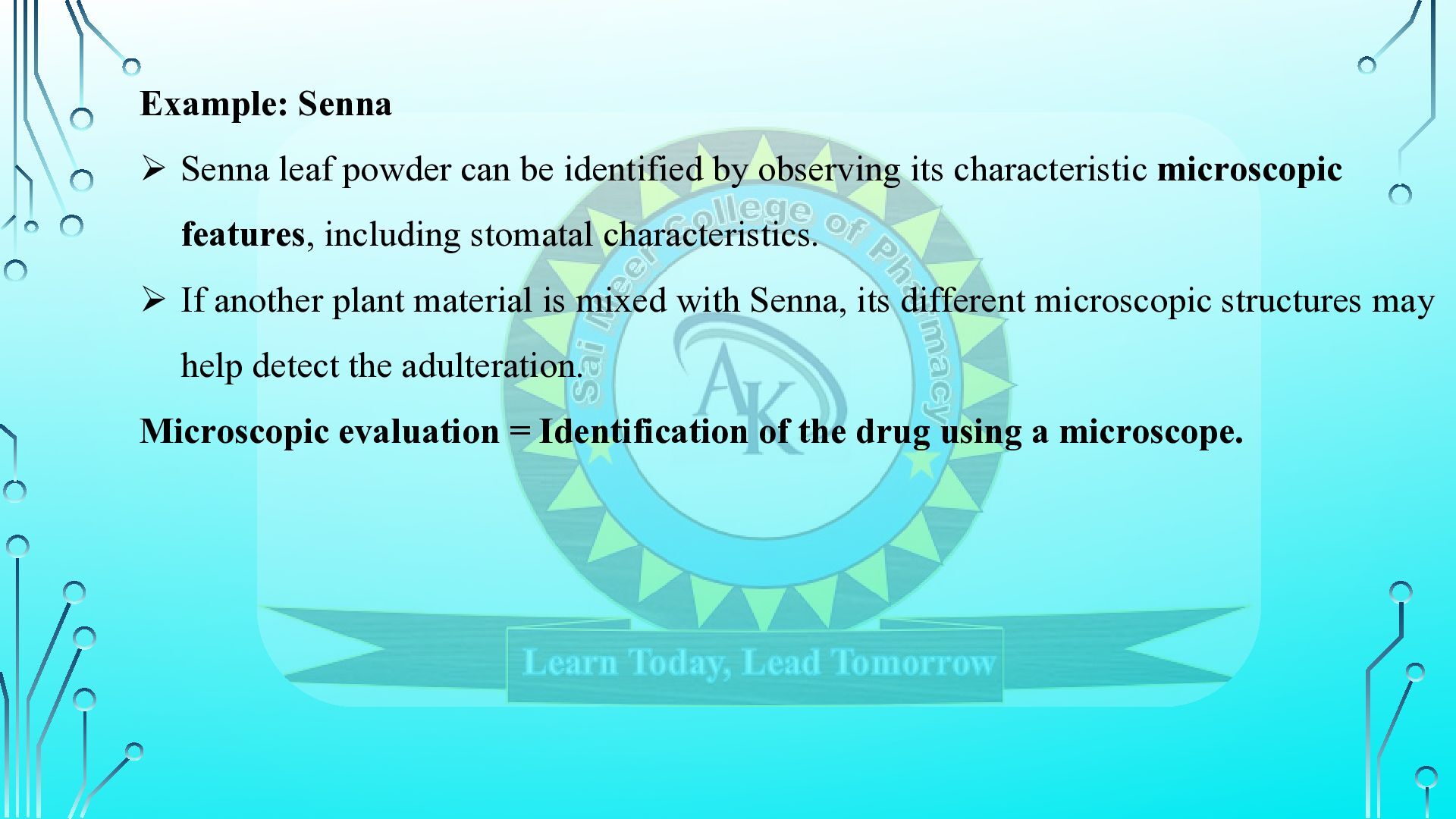
  6. Example: Senna  Senna leaf powder can be identified by

    observing its characteristic microscopic features, including stomatal characteristics.  If another plant material is mixed with Senna, its different microscopic structures may help detect the adulteration. Microscopic evaluation = Identification of the drug using a microscope.
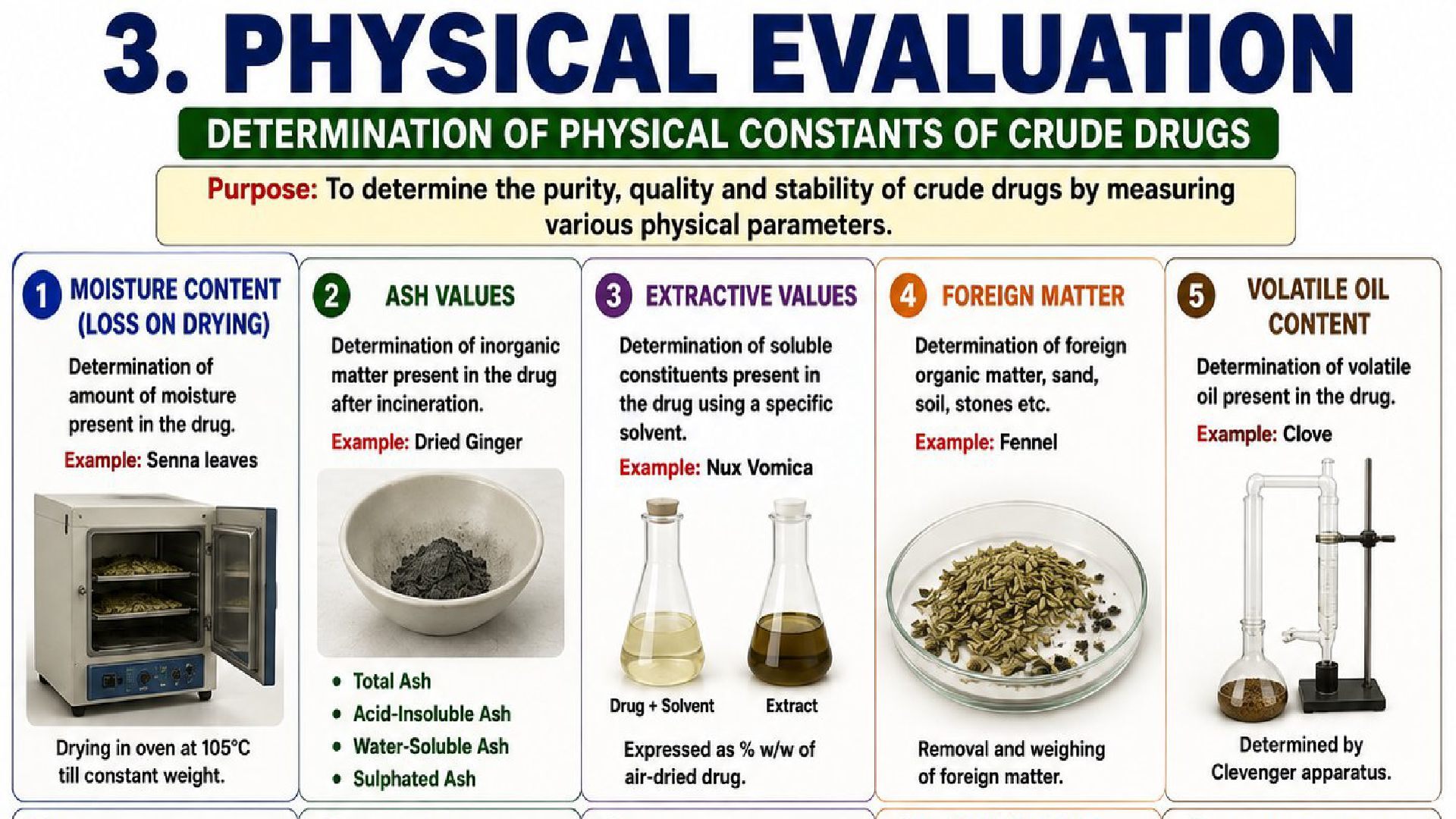
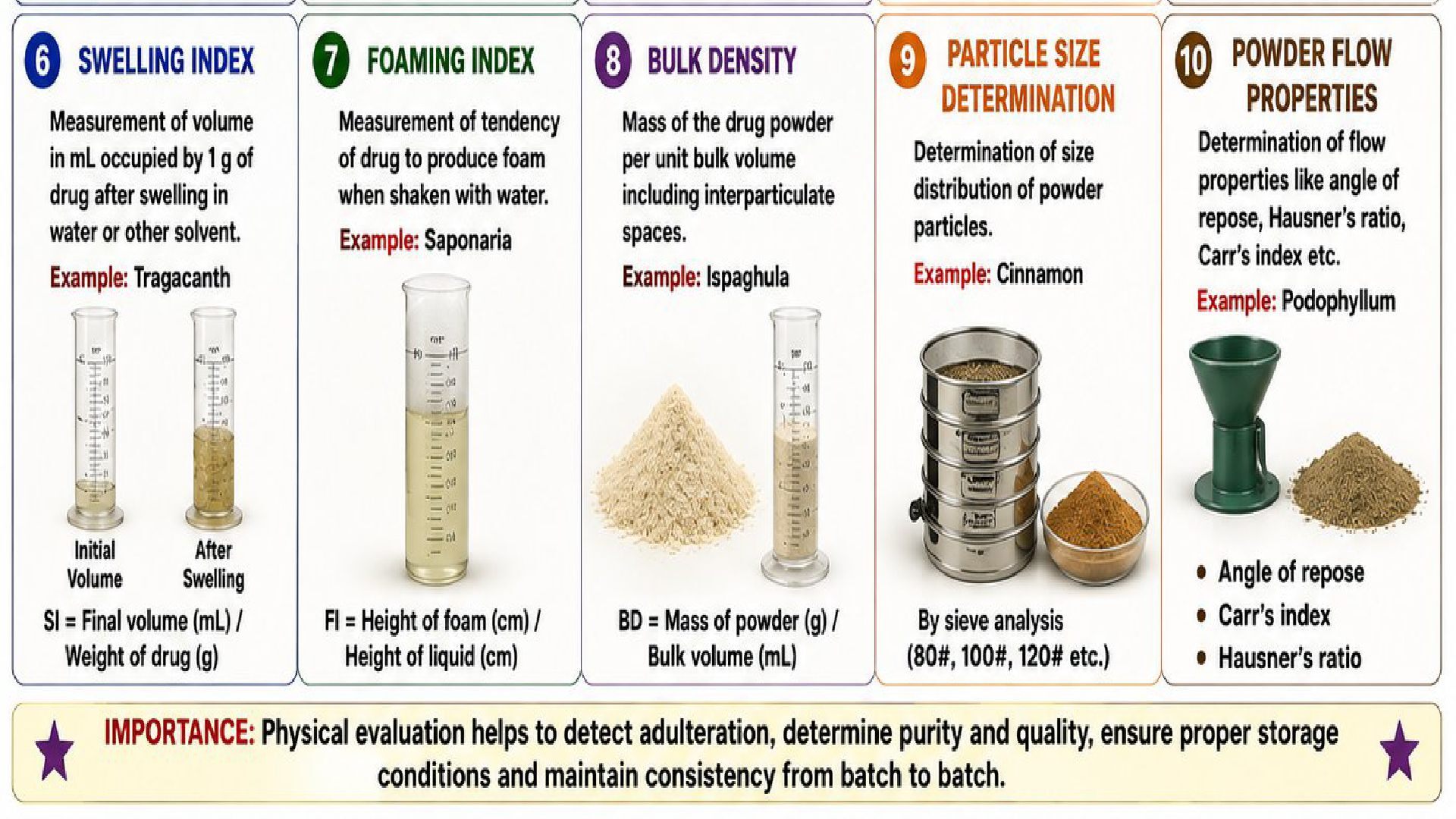
  7. 3. Physical Evaluation  Physical evaluation means checking the physical

    properties of the crude drug.  Important tests include:  Moisture content  Ash values  Extractive values  Swelling index  Foaming index  Volatile oil content  Foreign matter
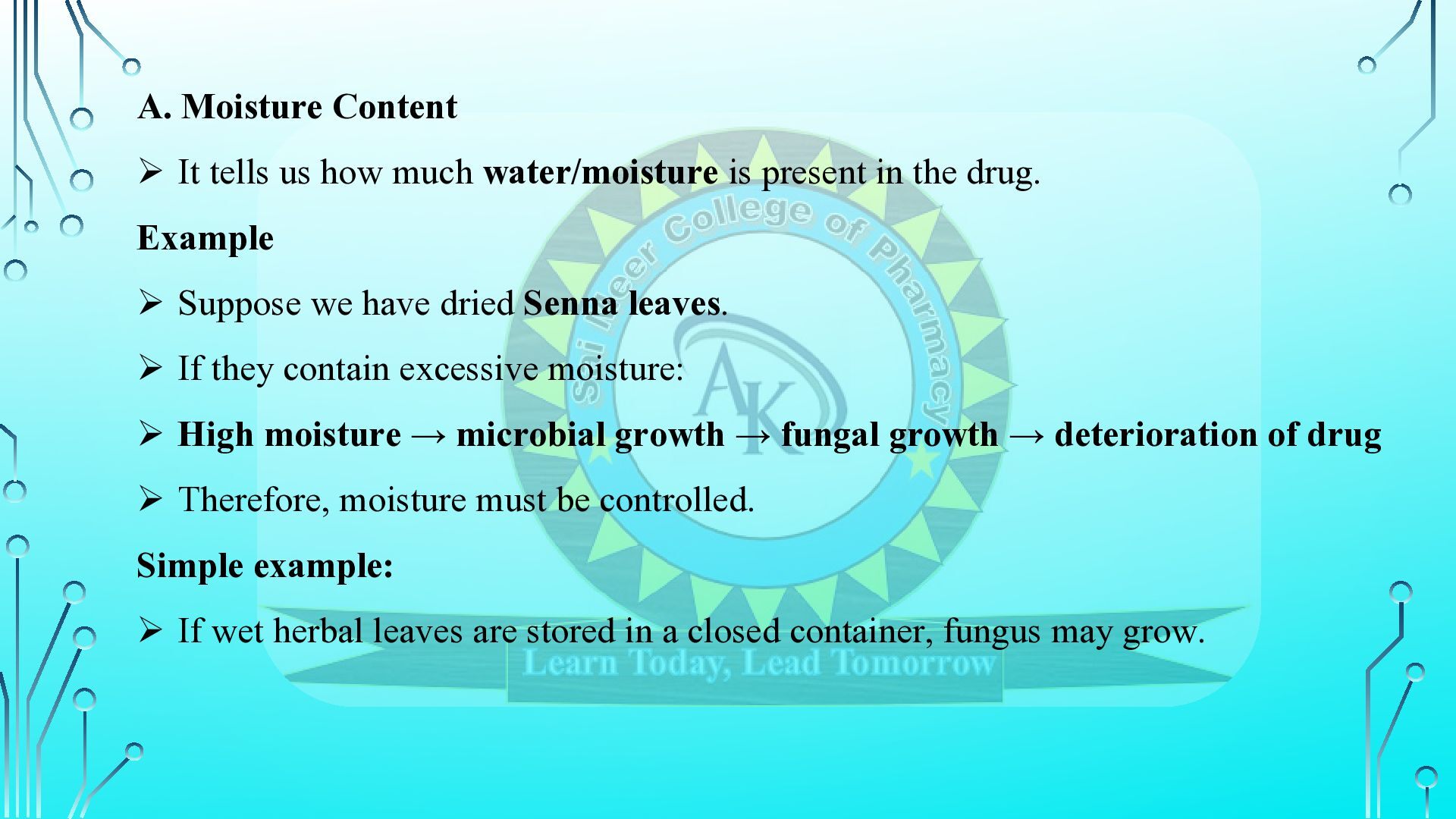
  8. A. Moisture Content  It tells us how much water/moisture

    is present in the drug. Example  Suppose we have dried Senna leaves.  If they contain excessive moisture:  High moisture → microbial growth → fungal growth → deterioration of drug  Therefore, moisture must be controlled. Simple example:  If wet herbal leaves are stored in a closed container, fungus may grow.
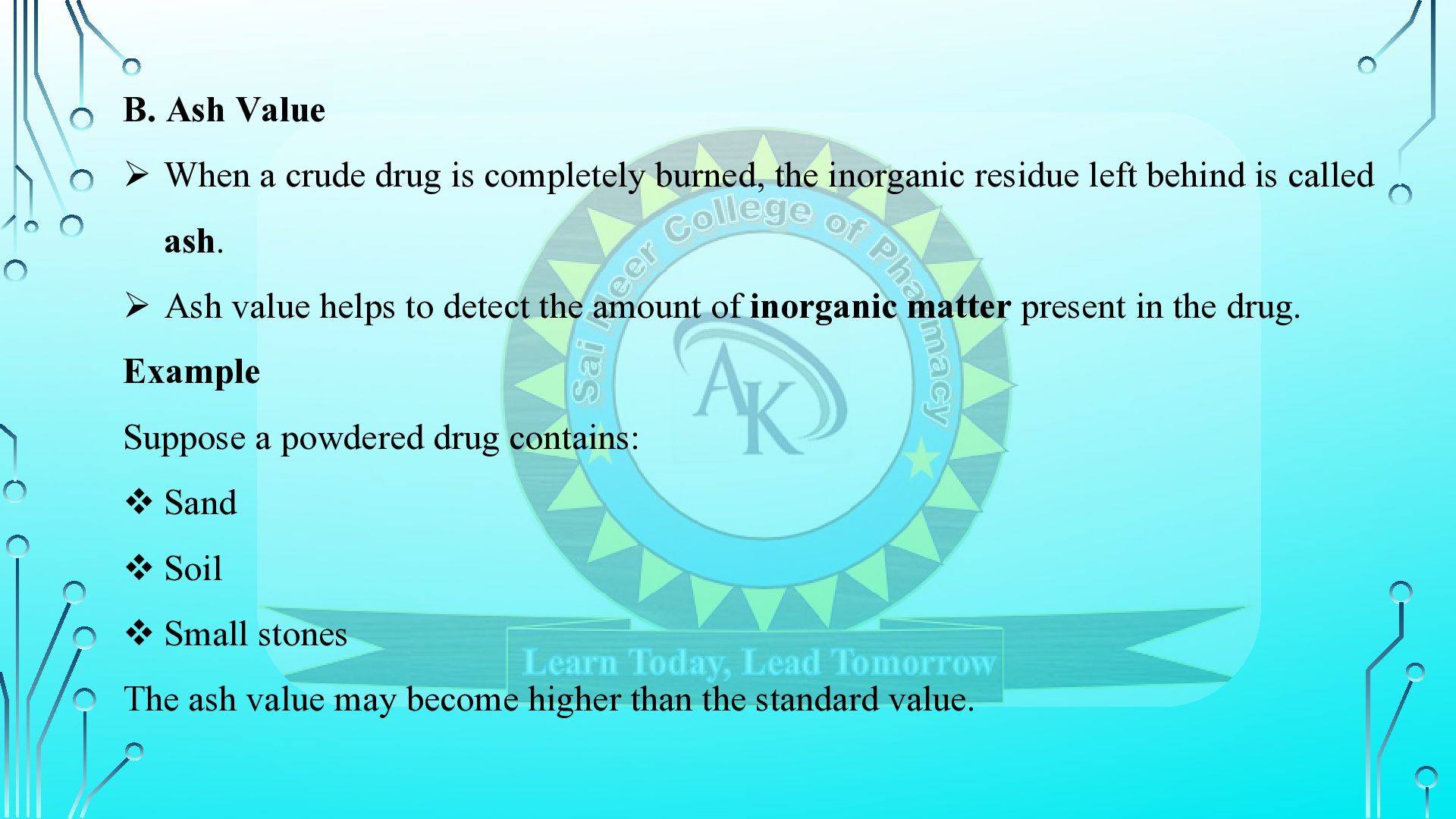
  9. B. Ash Value  When a crude drug is completely

    burned, the inorganic residue left behind is called ash.  Ash value helps to detect the amount of inorganic matter present in the drug. Example Suppose a powdered drug contains:  Sand  Soil  Small stones The ash value may become higher than the standard value.
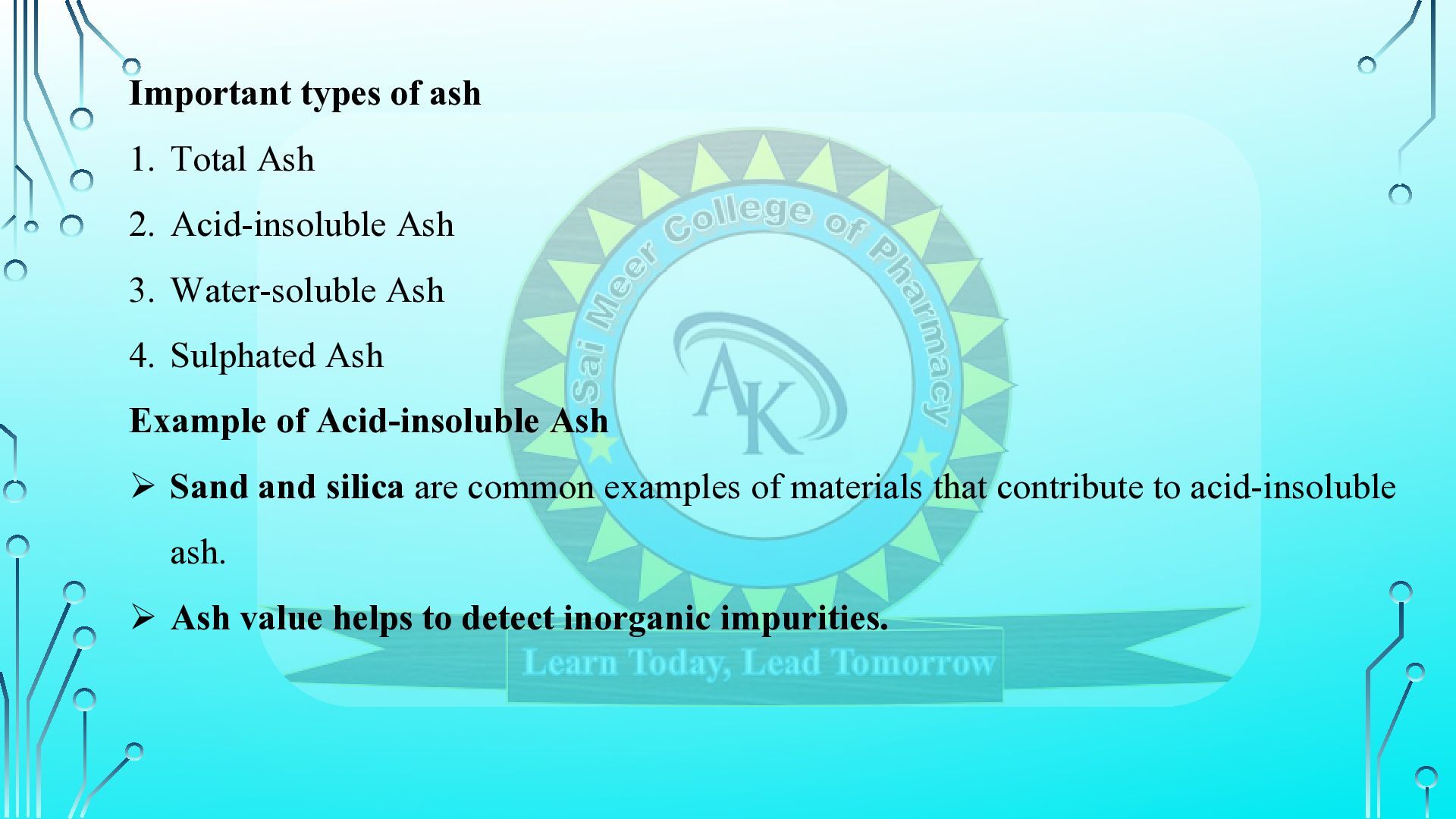
  10. Important types of ash 1. Total Ash 2. Acid-insoluble Ash

    3. Water-soluble Ash 4. Sulphated Ash Example of Acid-insoluble Ash  Sand and silica are common examples of materials that contribute to acid-insoluble ash.  Ash value helps to detect inorganic impurities.
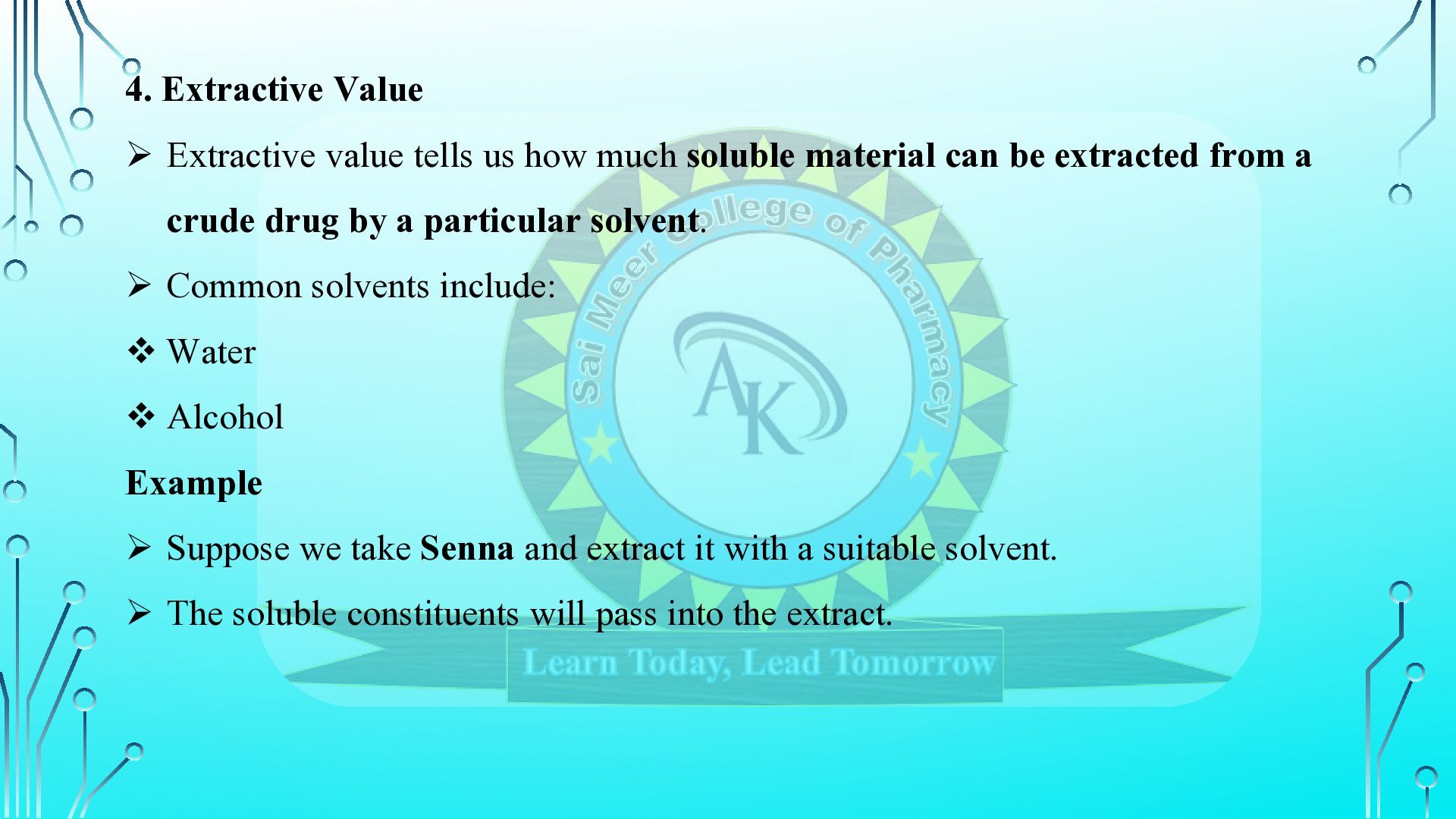
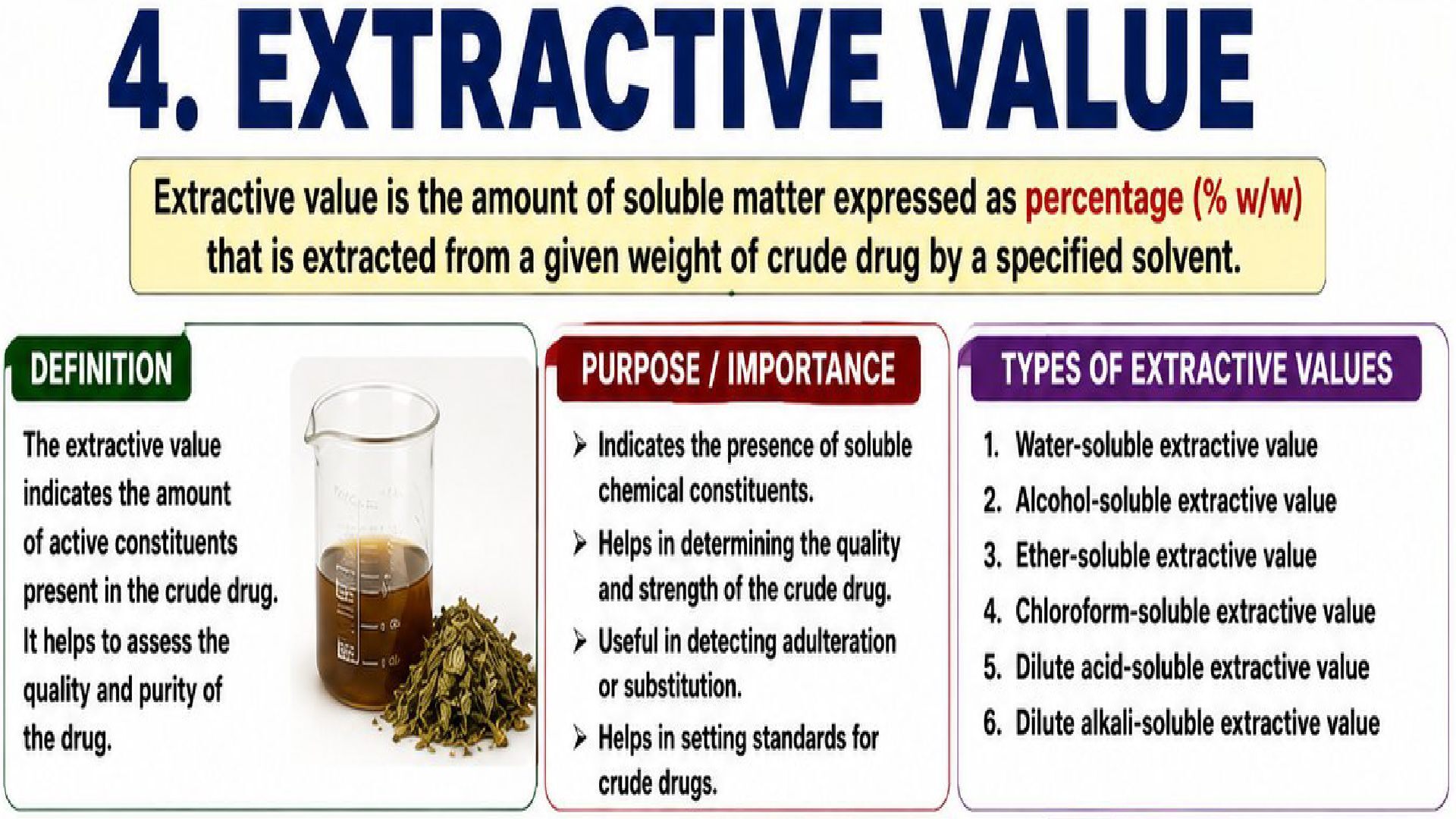
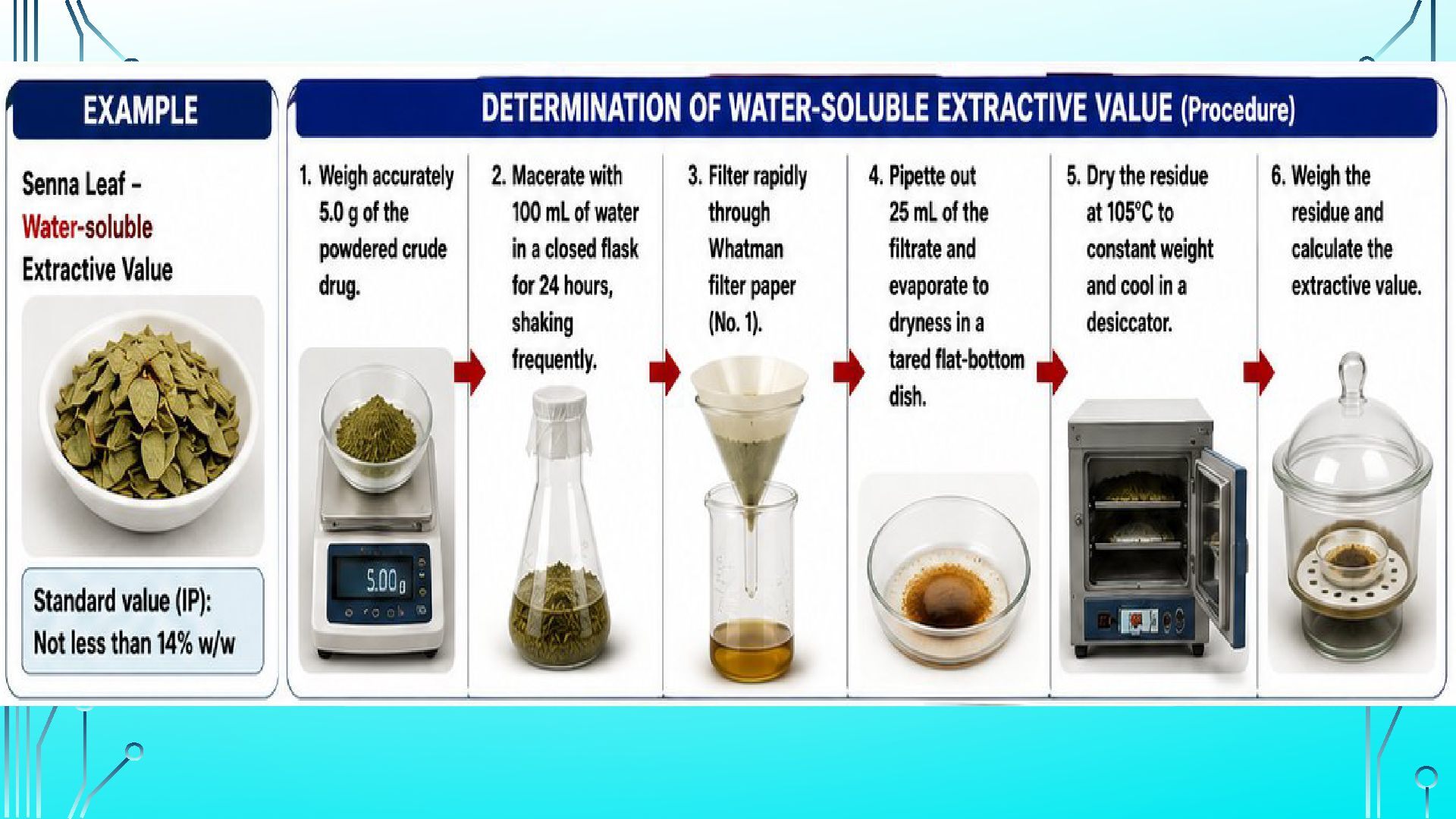
  11. 4. Extractive Value  Extractive value tells us how much

    soluble material can be extracted from a crude drug by a particular solvent.  Common solvents include:  Water  Alcohol Example  Suppose we take Senna and extract it with a suitable solvent.  The soluble constituents will pass into the extract.
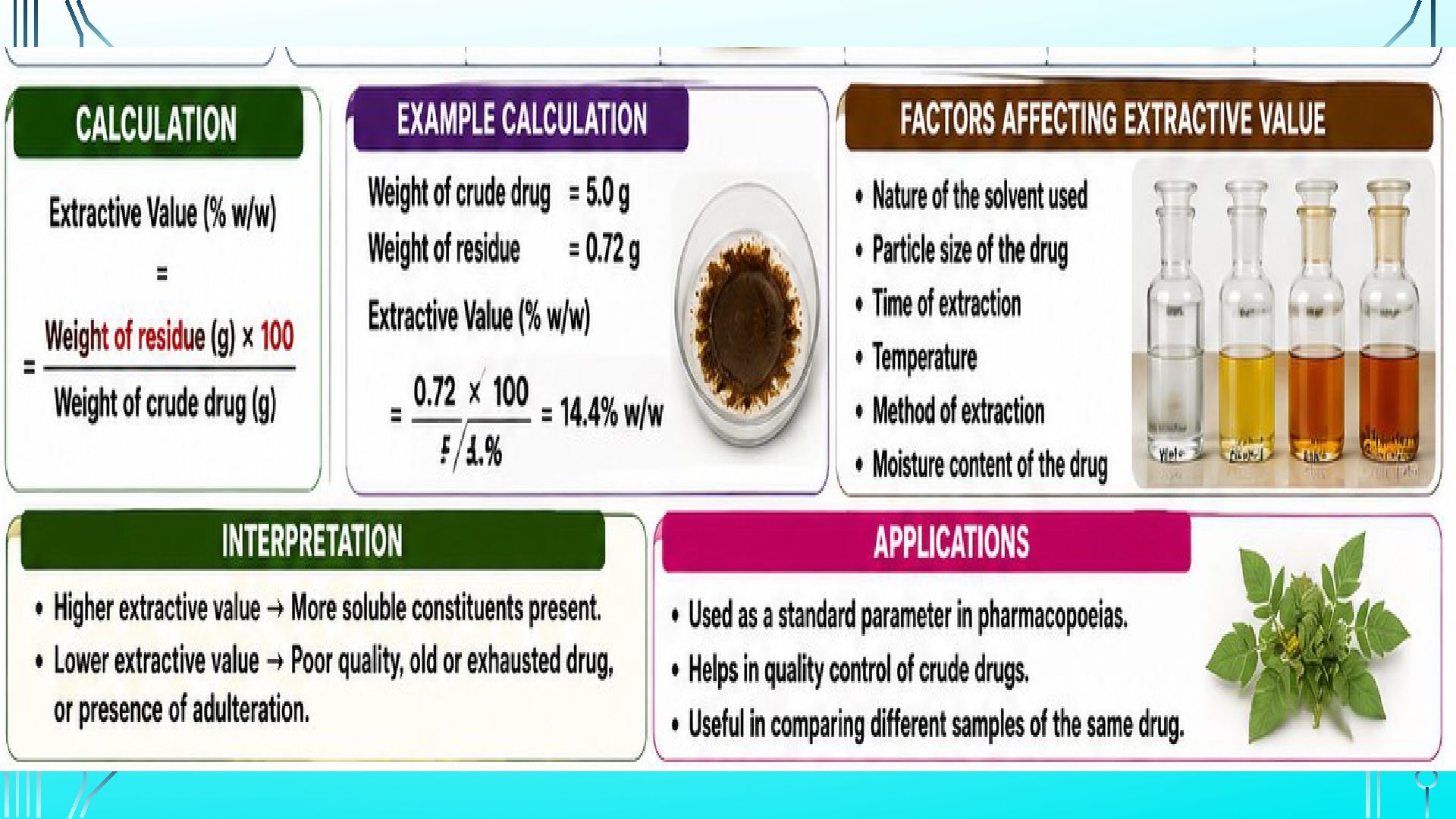
  12.  If the extractive value is much lower than the

    standard value, it may indicate:  Poor-quality drug  Adulteration  Loss of active constituents  Improper storage  Extractive value = Amount of soluble constituents obtained from the drug using a particular solvent.
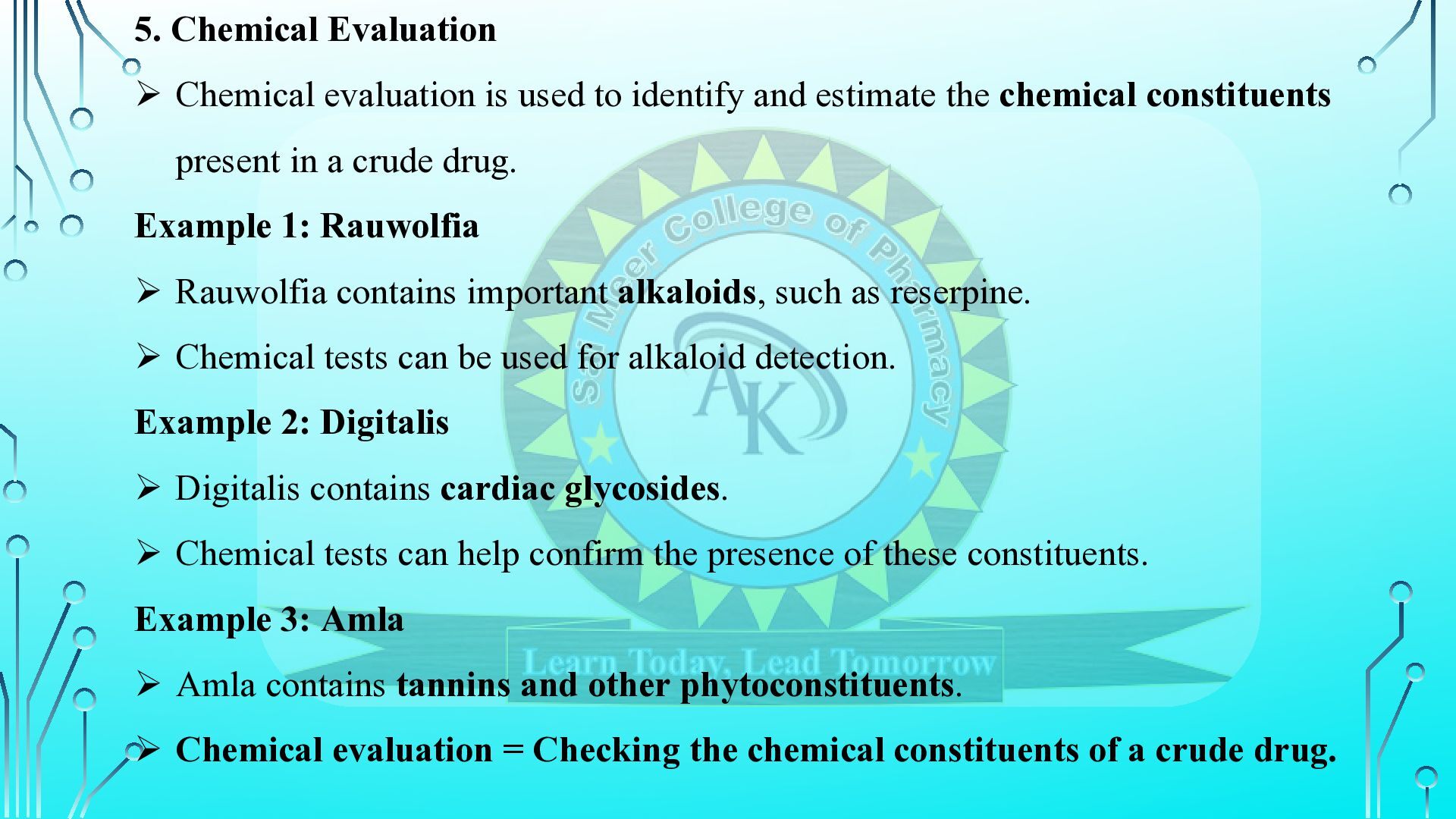
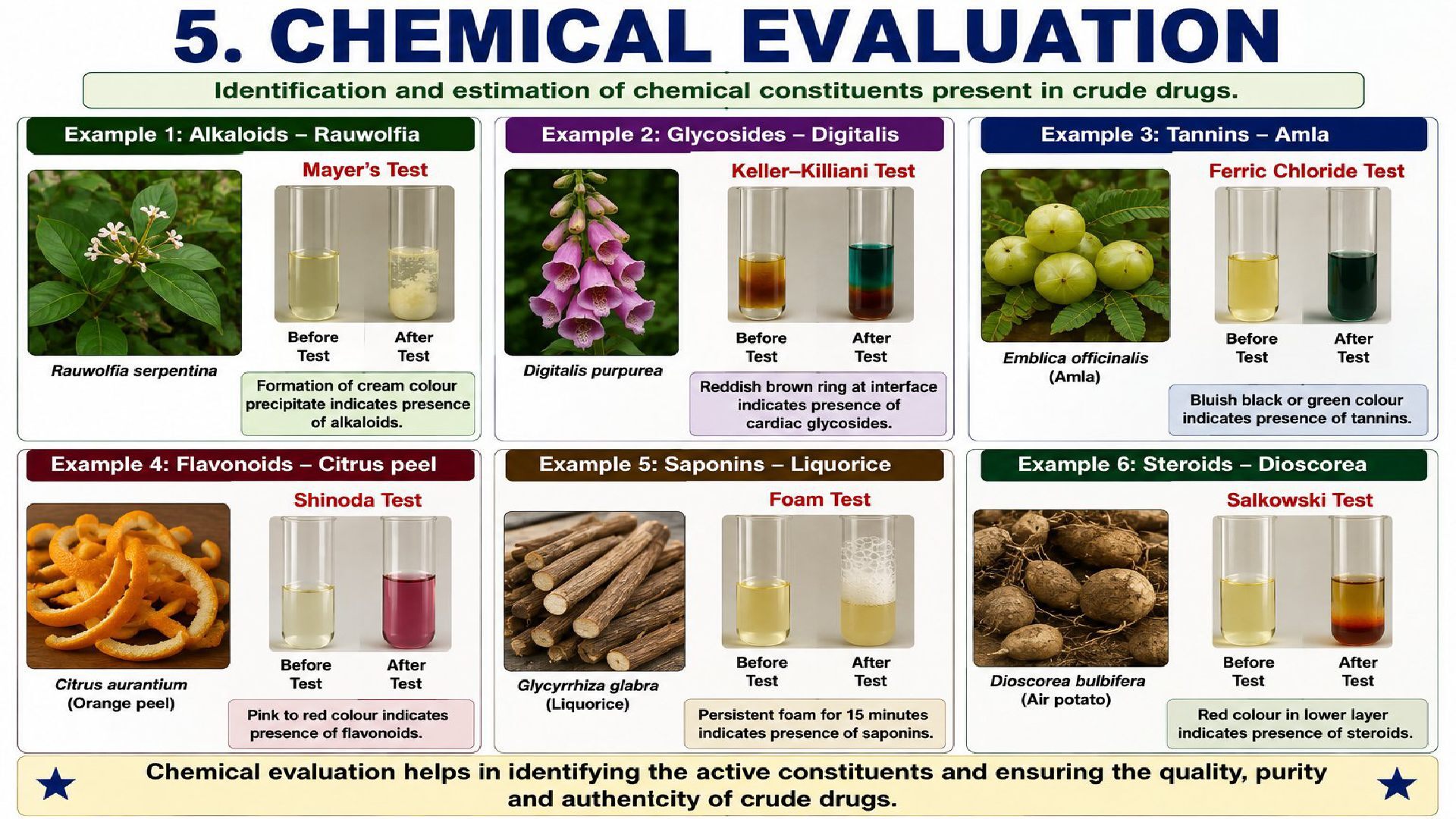
  13. 5. Chemical Evaluation  Chemical evaluation is used to identify

    and estimate the chemical constituents present in a crude drug. Example 1: Rauwolfia  Rauwolfia contains important alkaloids, such as reserpine.  Chemical tests can be used for alkaloid detection. Example 2: Digitalis  Digitalis contains cardiac glycosides.  Chemical tests can help confirm the presence of these constituents. Example 3: Amla  Amla contains tannins and other phytoconstituents.  Chemical evaluation = Checking the chemical constituents of a crude drug.
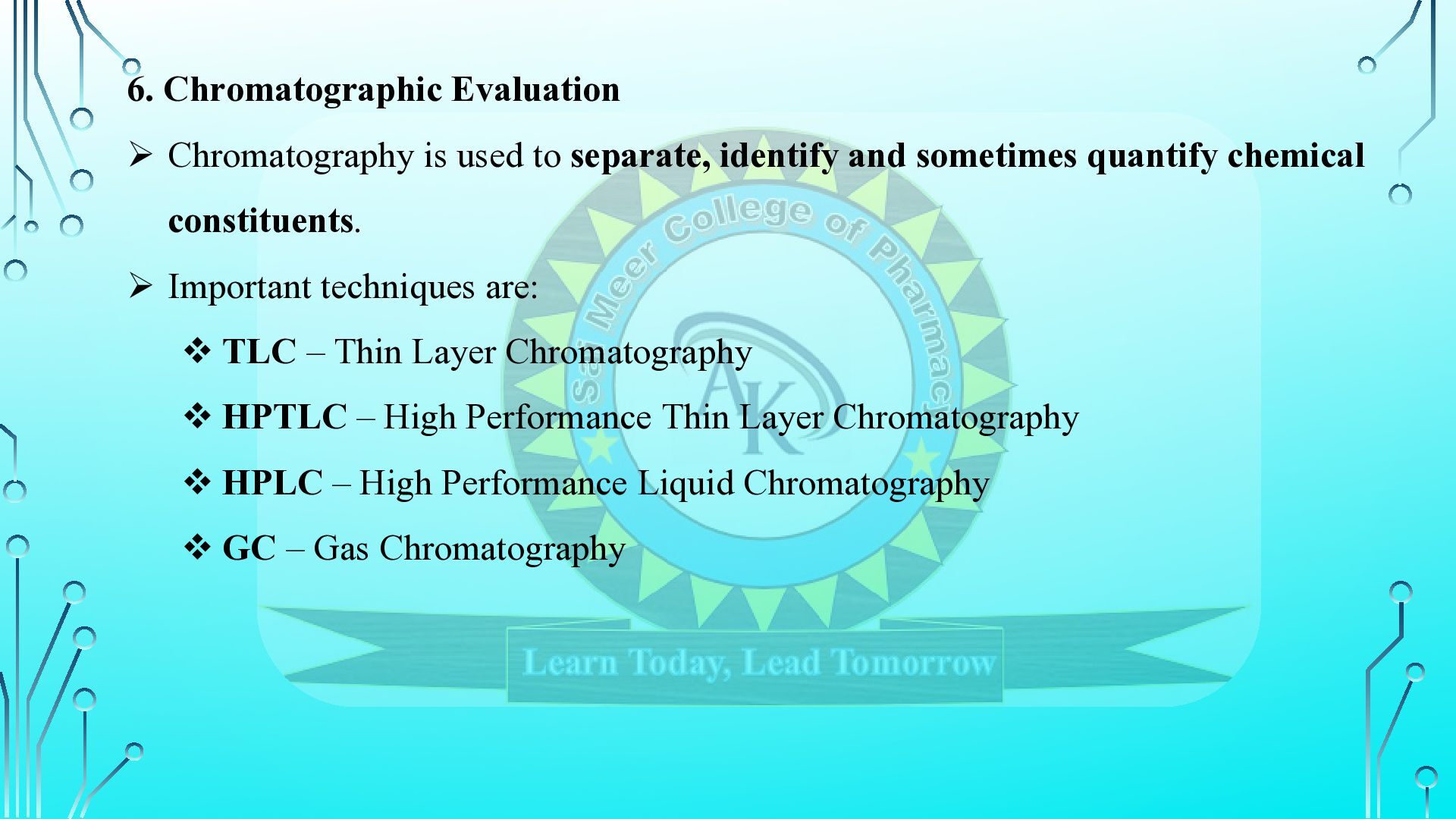
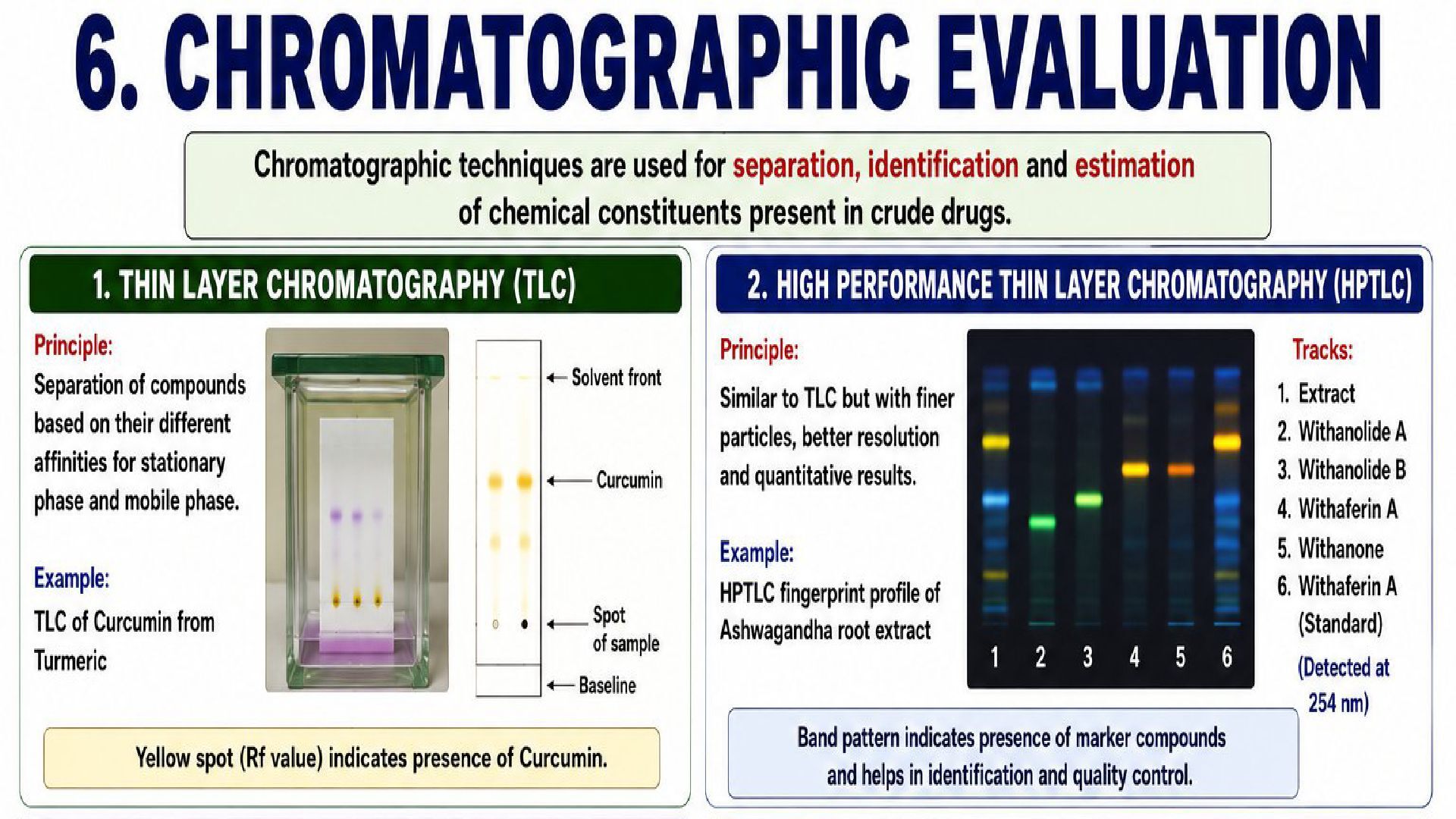
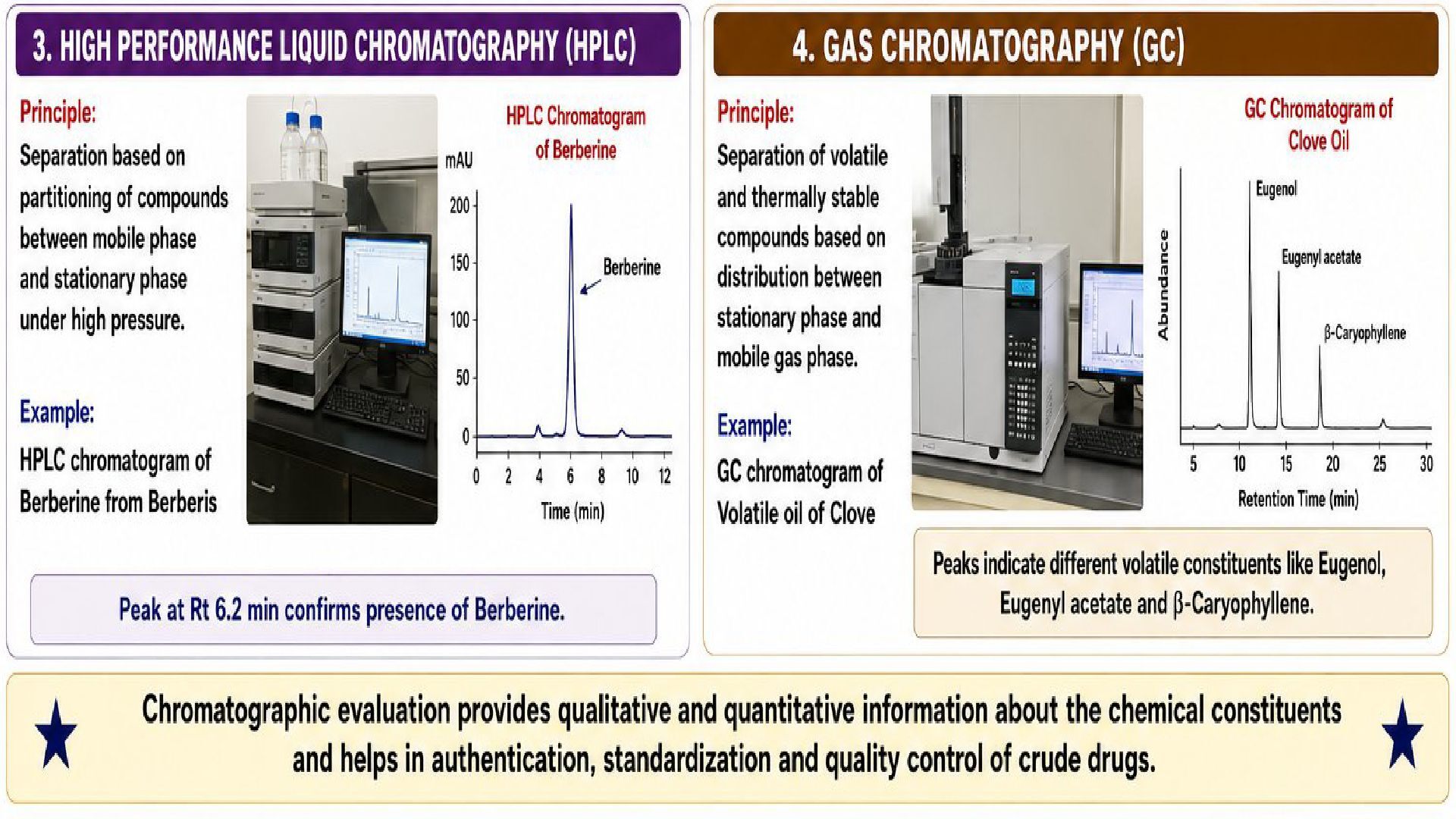
  14. 6. Chromatographic Evaluation  Chromatography is used to separate, identify

    and sometimes quantify chemical constituents.  Important techniques are:  TLC – Thin Layer Chromatography  HPTLC – High Performance Thin Layer Chromatography  HPLC – High Performance Liquid Chromatography  GC – Gas Chromatography
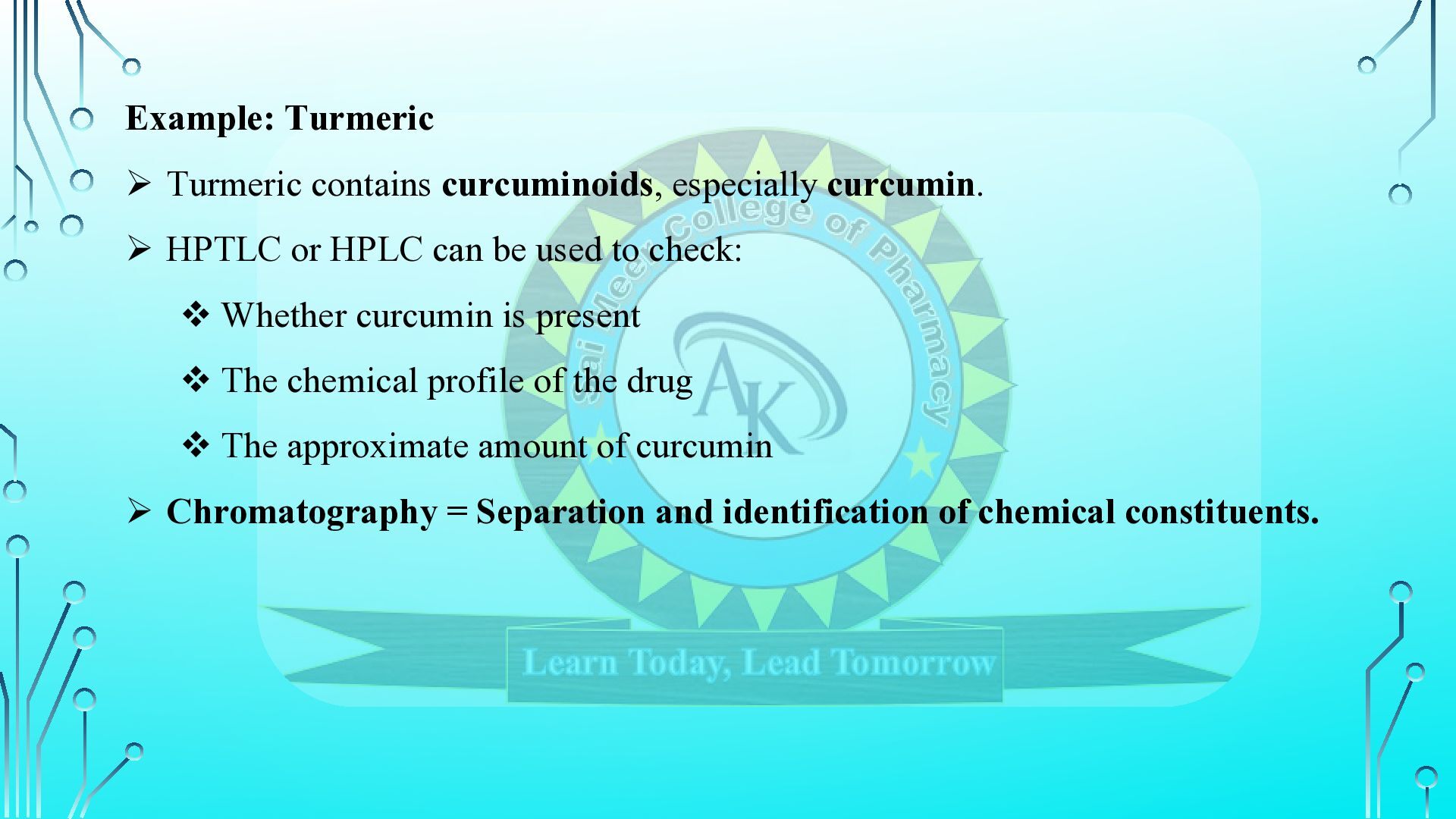
  15. Example: Turmeric  Turmeric contains curcuminoids, especially curcumin.  HPTLC

    or HPLC can be used to check:  Whether curcumin is present  The chemical profile of the drug  The approximate amount of curcumin  Chromatography = Separation and identification of chemical constituents.
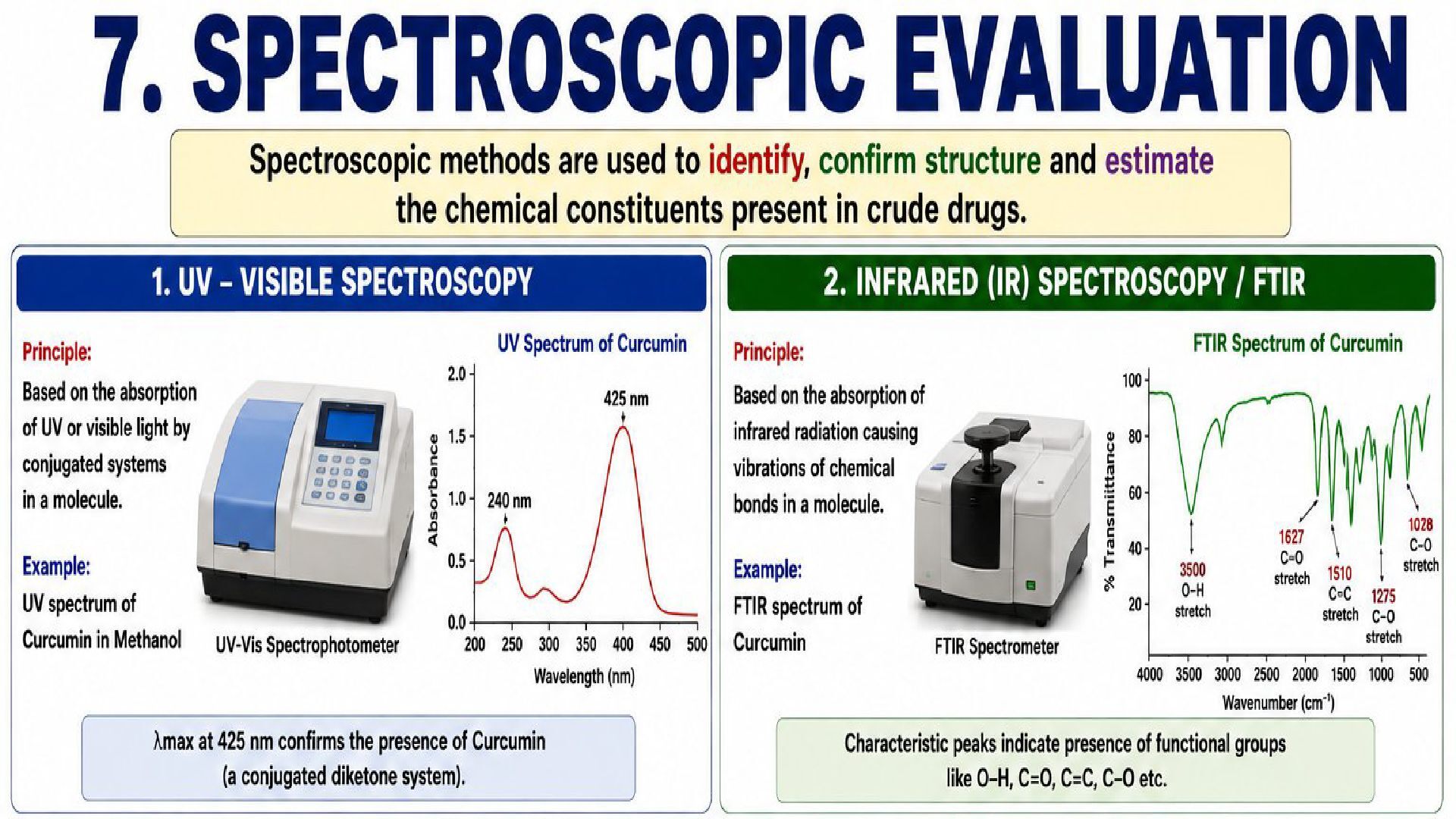
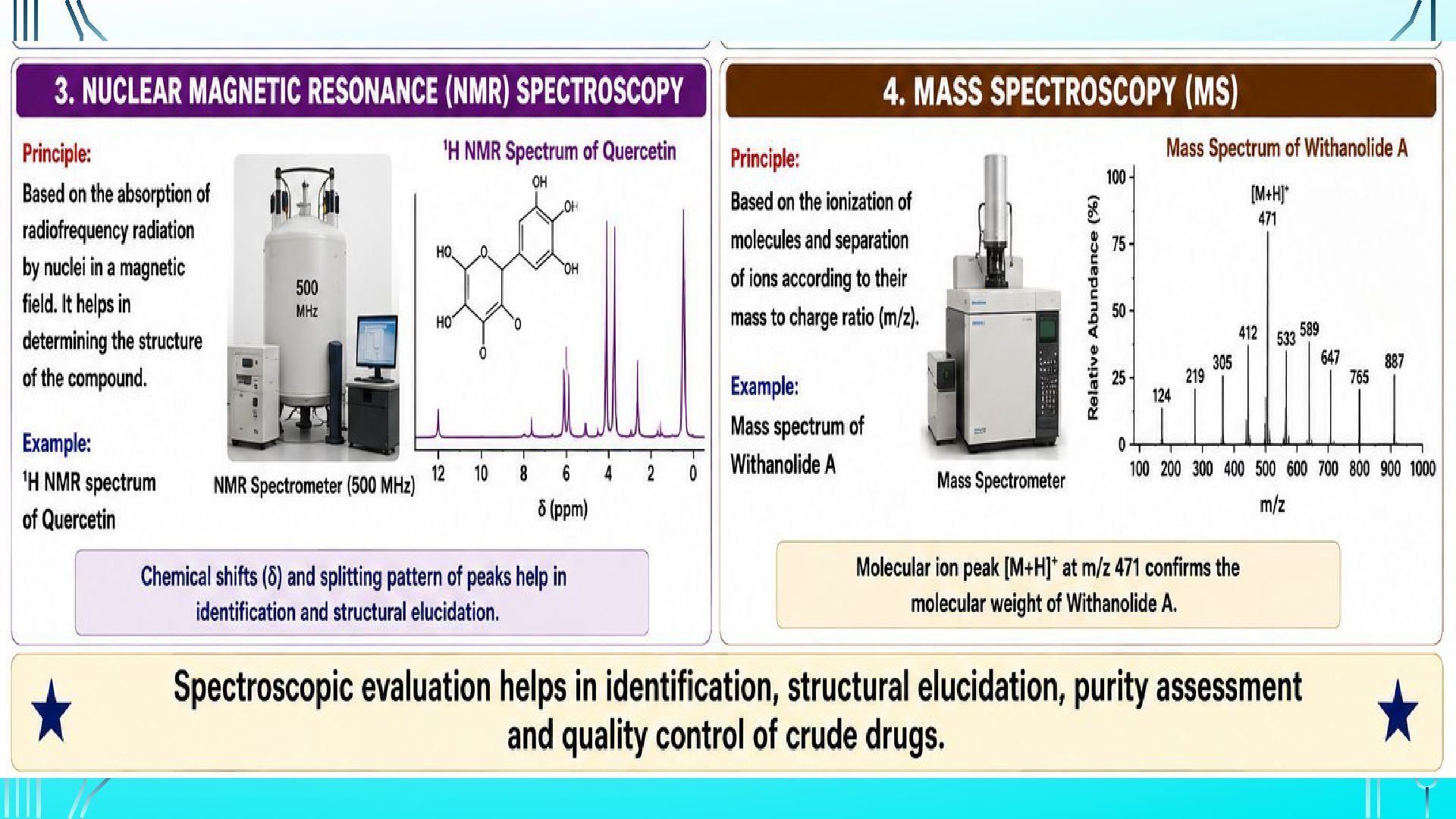
  16. 7. Spectroscopic Evaluation  Spectroscopic methods are used to identify

    and analyze chemical constituents.  Important methods include:  UV-Visible spectroscopy  IR/FTIR spectroscopy  NMR spectroscopy  Mass spectrometry Example: Curcumin  Curcumin can be analyzed by UV-Visible spectroscopy.  FTIR can help identify its characteristic functional groups.  Spectroscopy = Studying a drug or its constituents by measuring their interaction with radiation.
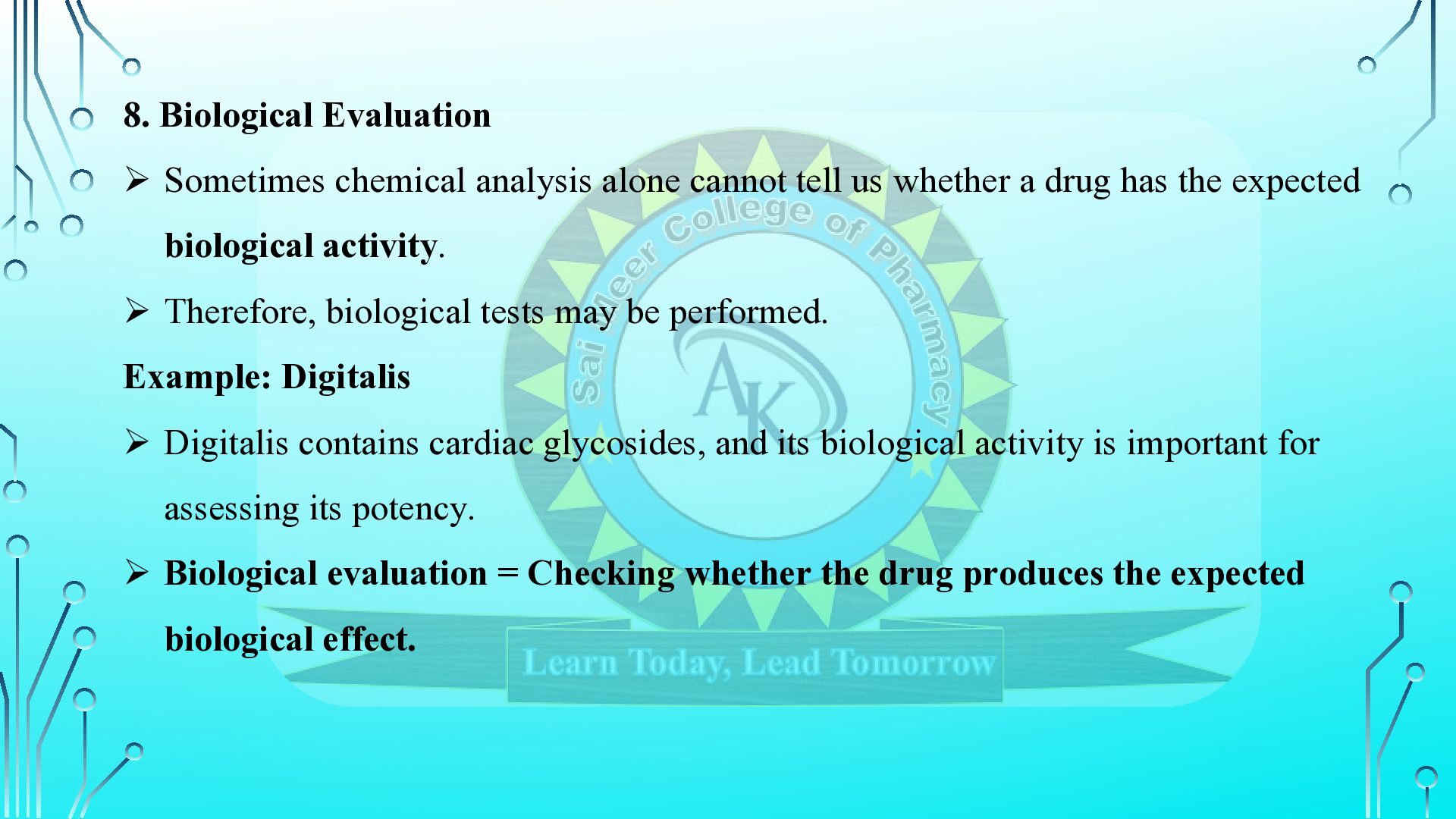
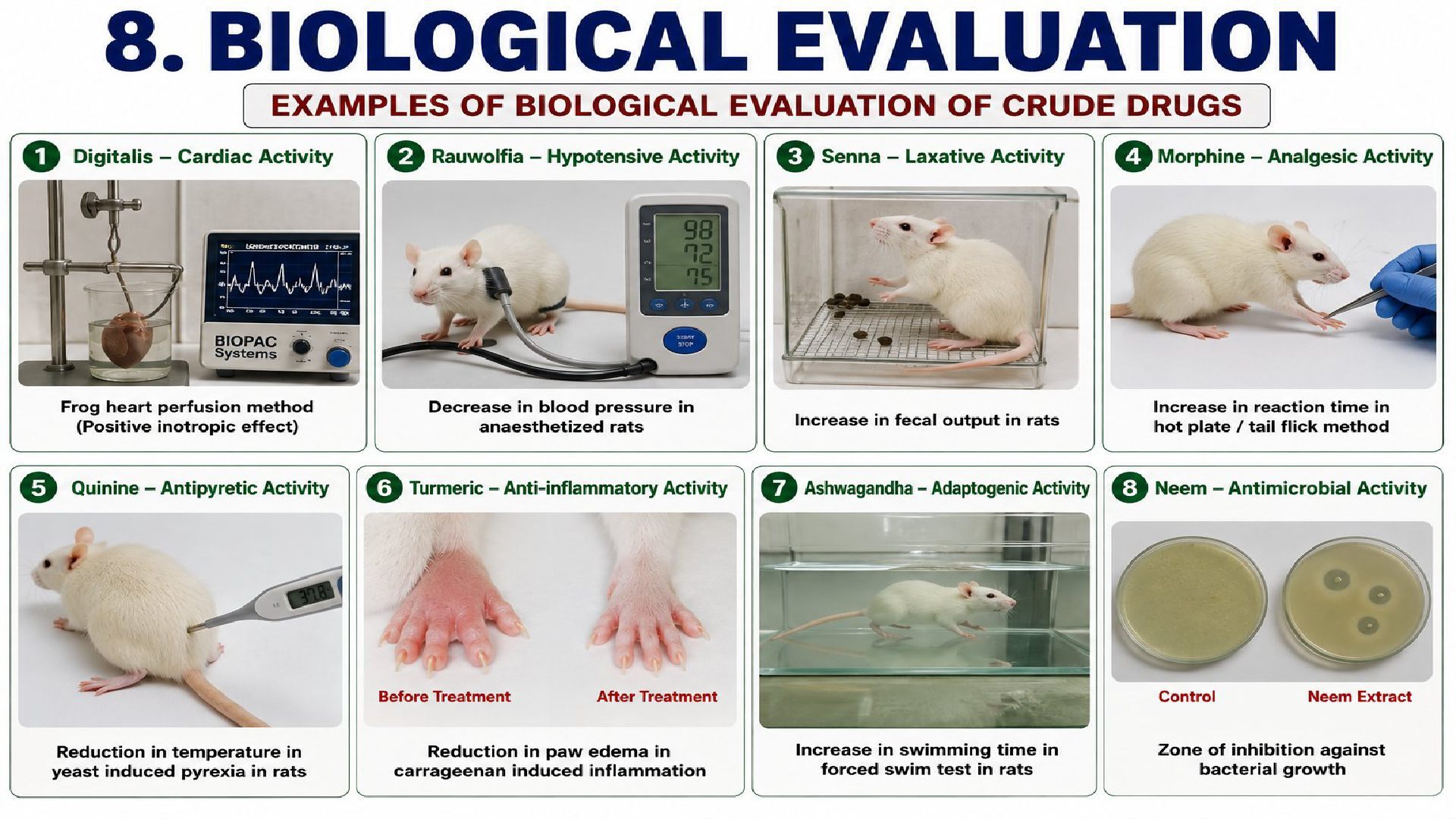
  17. 8. Biological Evaluation  Sometimes chemical analysis alone cannot tell

    us whether a drug has the expected biological activity.  Therefore, biological tests may be performed. Example: Digitalis  Digitalis contains cardiac glycosides, and its biological activity is important for assessing its potency.  Biological evaluation = Checking whether the drug produces the expected biological effect.
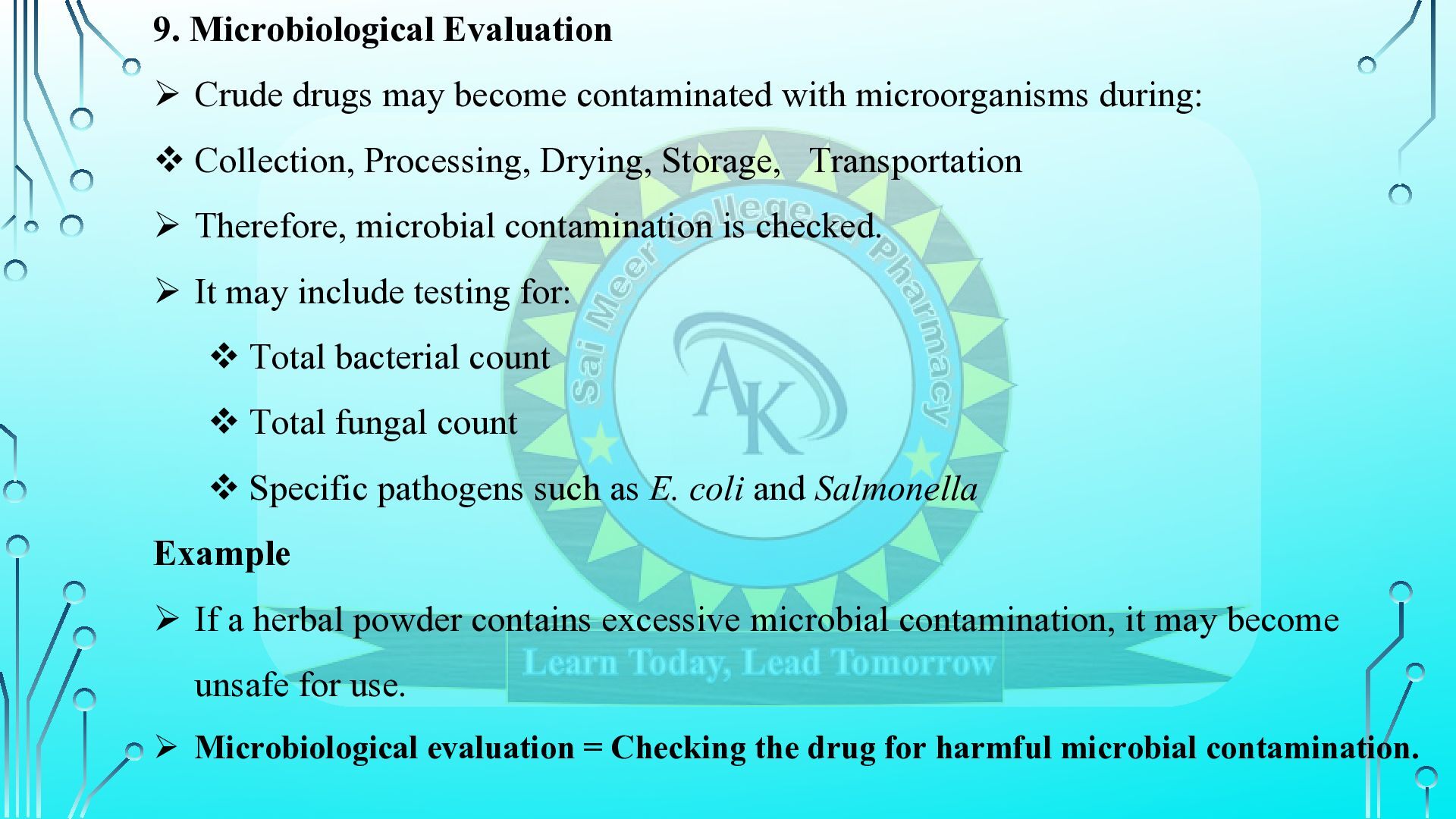
  18. 9. Microbiological Evaluation  Crude drugs may become contaminated with

    microorganisms during:  Collection, Processing, Drying, Storage, Transportation  Therefore, microbial contamination is checked.  It may include testing for:  Total bacterial count  Total fungal count  Specific pathogens such as E. coli and Salmonella Example  If a herbal powder contains excessive microbial contamination, it may become unsafe for use.  Microbiological evaluation = Checking the drug for harmful microbial contamination.
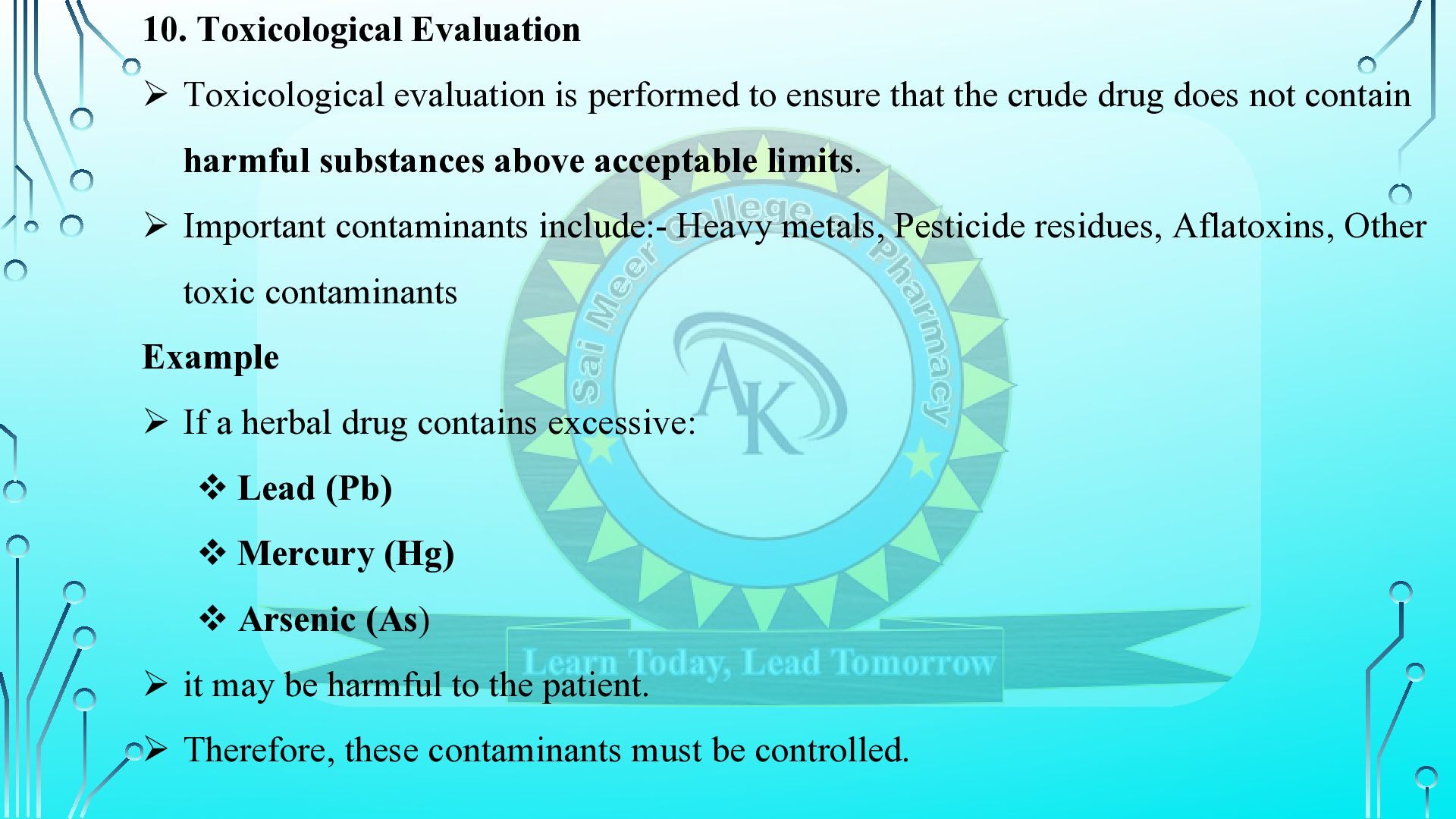
  19. 10. Toxicological Evaluation  Toxicological evaluation is performed to ensure

    that the crude drug does not contain harmful substances above acceptable limits.  Important contaminants include:- Heavy metals, Pesticide residues, Aflatoxins, Other toxic contaminants Example  If a herbal drug contains excessive:  Lead (Pb)  Mercury (Hg)  Arsenic (As)  it may be harmful to the patient.  Therefore, these contaminants must be controlled.
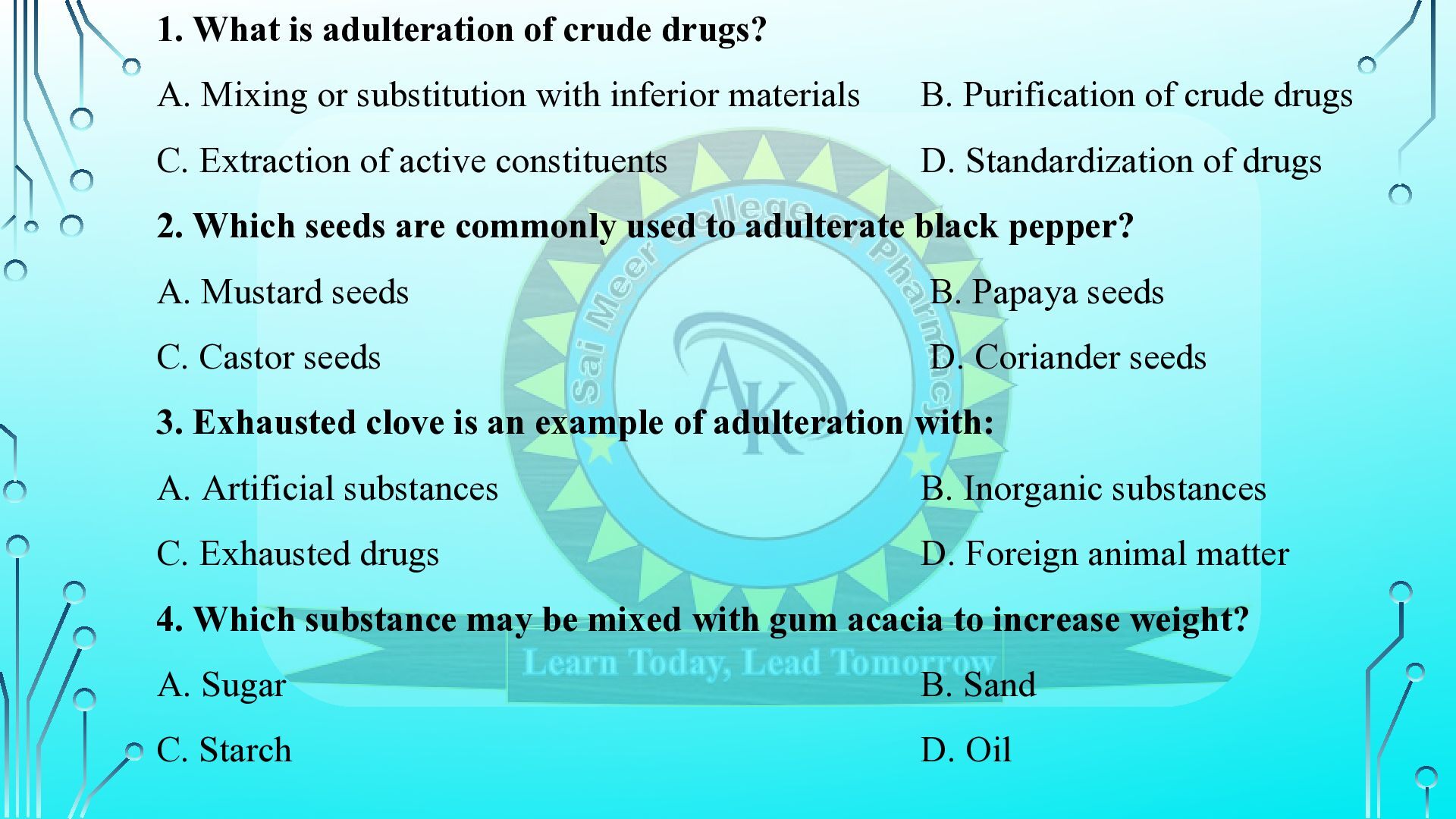
  20. 1. What is adulteration of crude drugs? A. Mixing or

    substitution with inferior materials C. Extraction of active constituents B. Purification of crude drugs D. Standardization of drugs 2. Which seeds are commonly used to adulterate black pepper? A. Mustard seeds C. Castor seeds B. Papaya seeds D. Coriander seeds 3. Exhausted clove is an example of adulteration with: A. Artificial substances C. Exhausted drugs B. Inorganic substances D. Foreign animal matter 4. Which substance may be mixed with gum acacia to increase weight? A. Sugar C. Starch B. Sand D. Oil
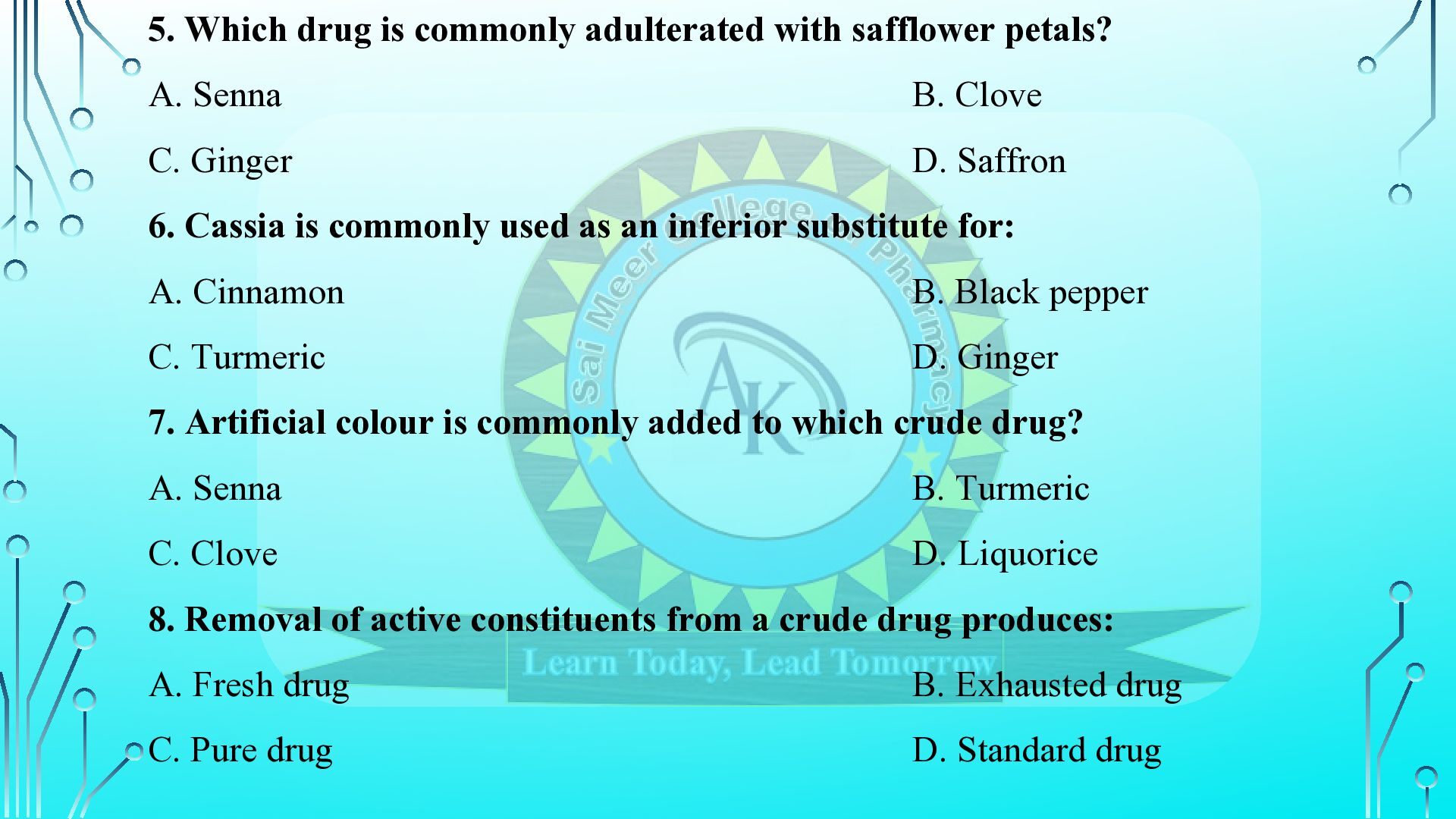
  21. 5. Which drug is commonly adulterated with safflower petals? A.

    Senna C. Ginger B. Clove D. Saffron 6. Cassia is commonly used as an inferior substitute for: A. Cinnamon C. Turmeric B. Black pepper D. Ginger 7. Artificial colour is commonly added to which crude drug? A. Senna C. Clove B. Turmeric D. Liquorice 8. Removal of active constituents from a crude drug produces: A. Fresh drug C. Pure drug B. Exhausted drug D. Standard drug
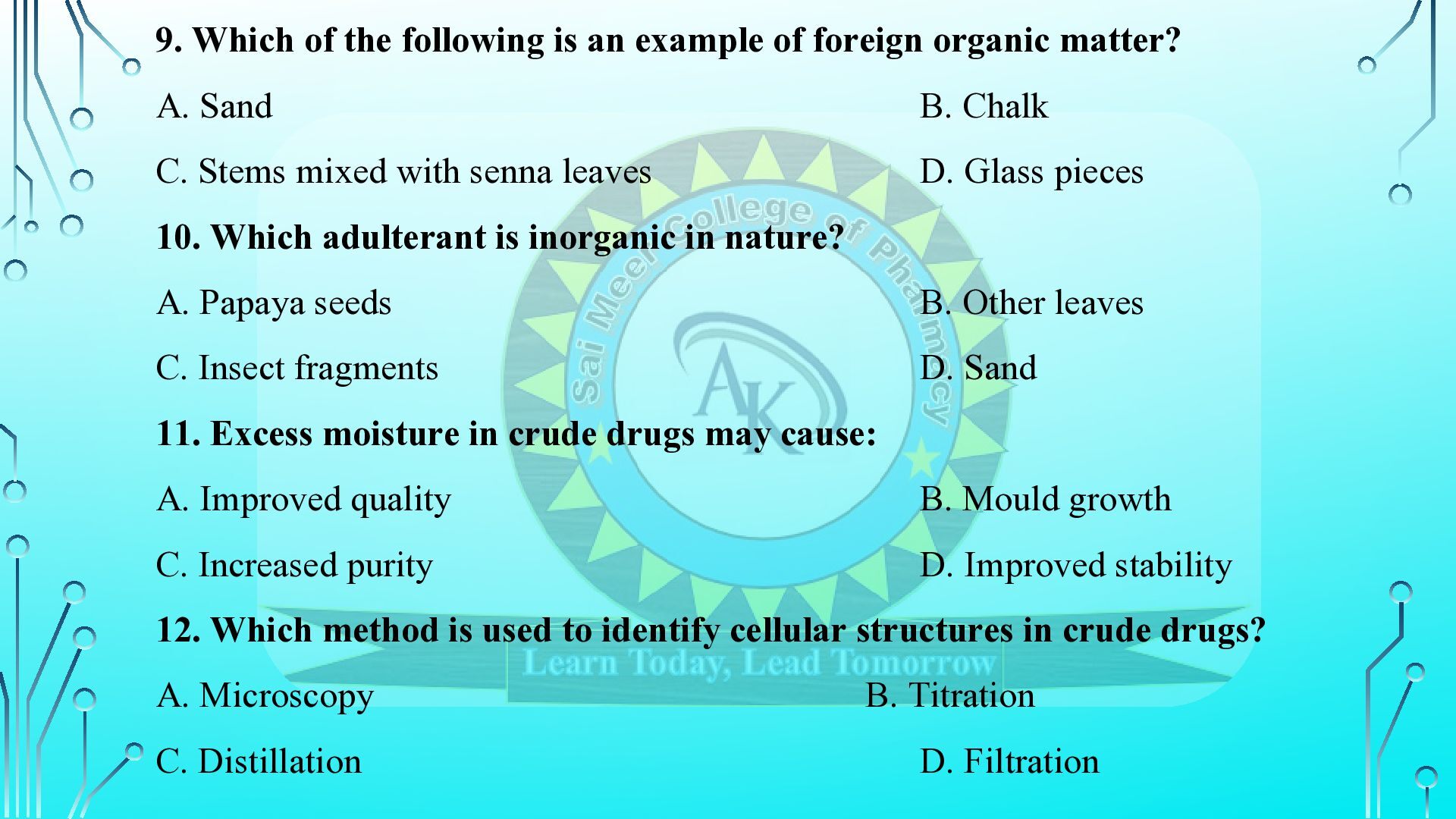
  22. 9. Which of the following is an example of foreign

    organic matter? A. Sand B. Chalk C. Stems mixed with senna leaves D. Glass pieces A. Papaya seeds B. Other leaves 10. Which adulterant is inorganic in nature? C. Insect fragments 11. Excess moisture in crude drugs may cause: A. Improved quality C. Increased purity D. Sand B. Mould growth D. Improved stability 12. Which method is used to identify cellular structures in crude drugs? A. Microscopy C. Distillation B. Titration D. Filtration
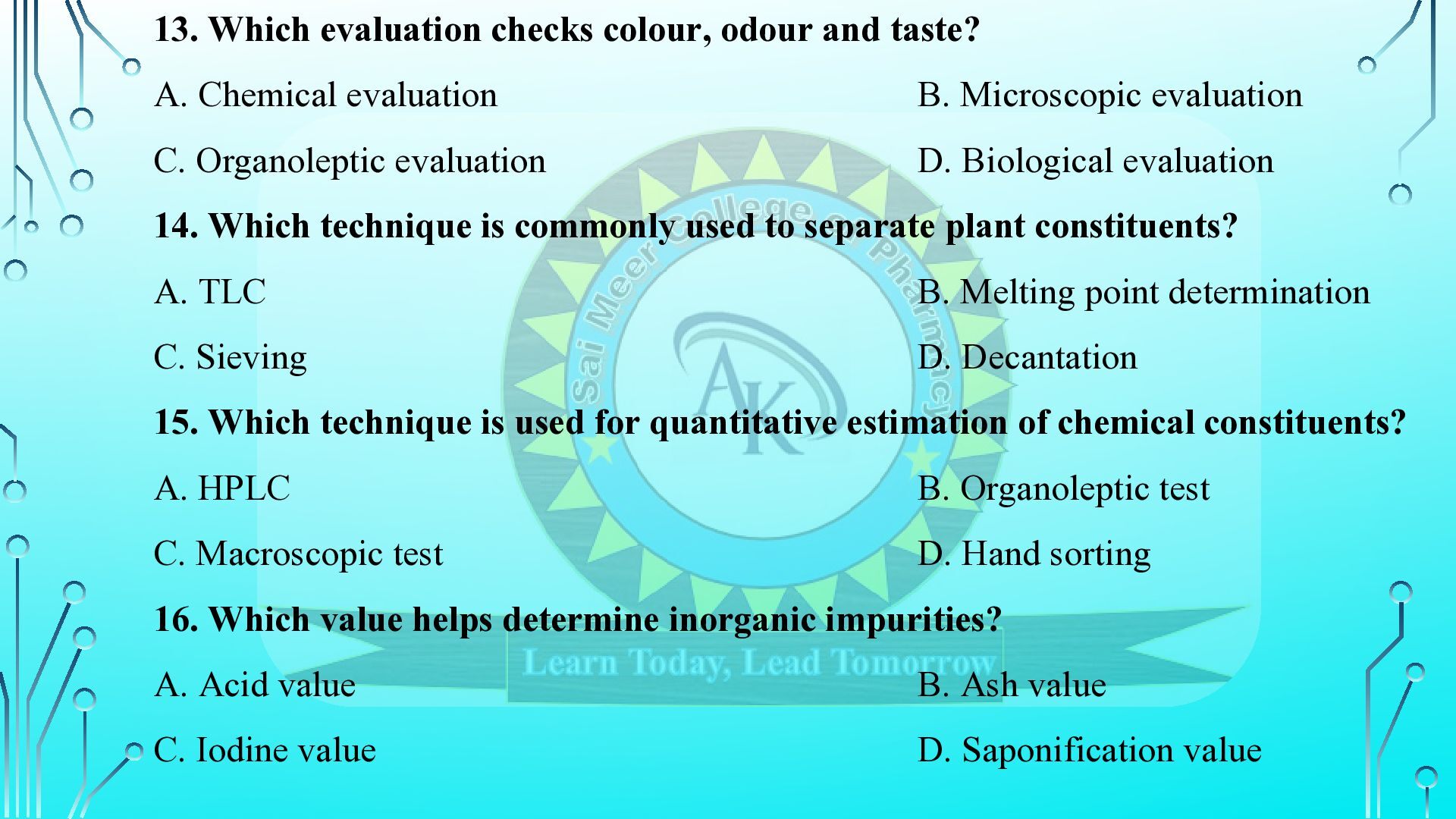
  23. 13. Which evaluation checks colour, odour and taste? A. Chemical

    evaluation C. Organoleptic evaluation B. Microscopic evaluation D. Biological evaluation 14. Which technique is commonly used to separate plant constituents? A. TLC C. Sieving B. Melting point determination D. Decantation 15. Which technique is used for quantitative estimation of chemical constituents? A. HPLC C. Macroscopic test B. Organoleptic test D. Hand sorting 16. Which value helps determine inorganic impurities? A. Acid value C. Iodine value B. Ash value D. Saponification value
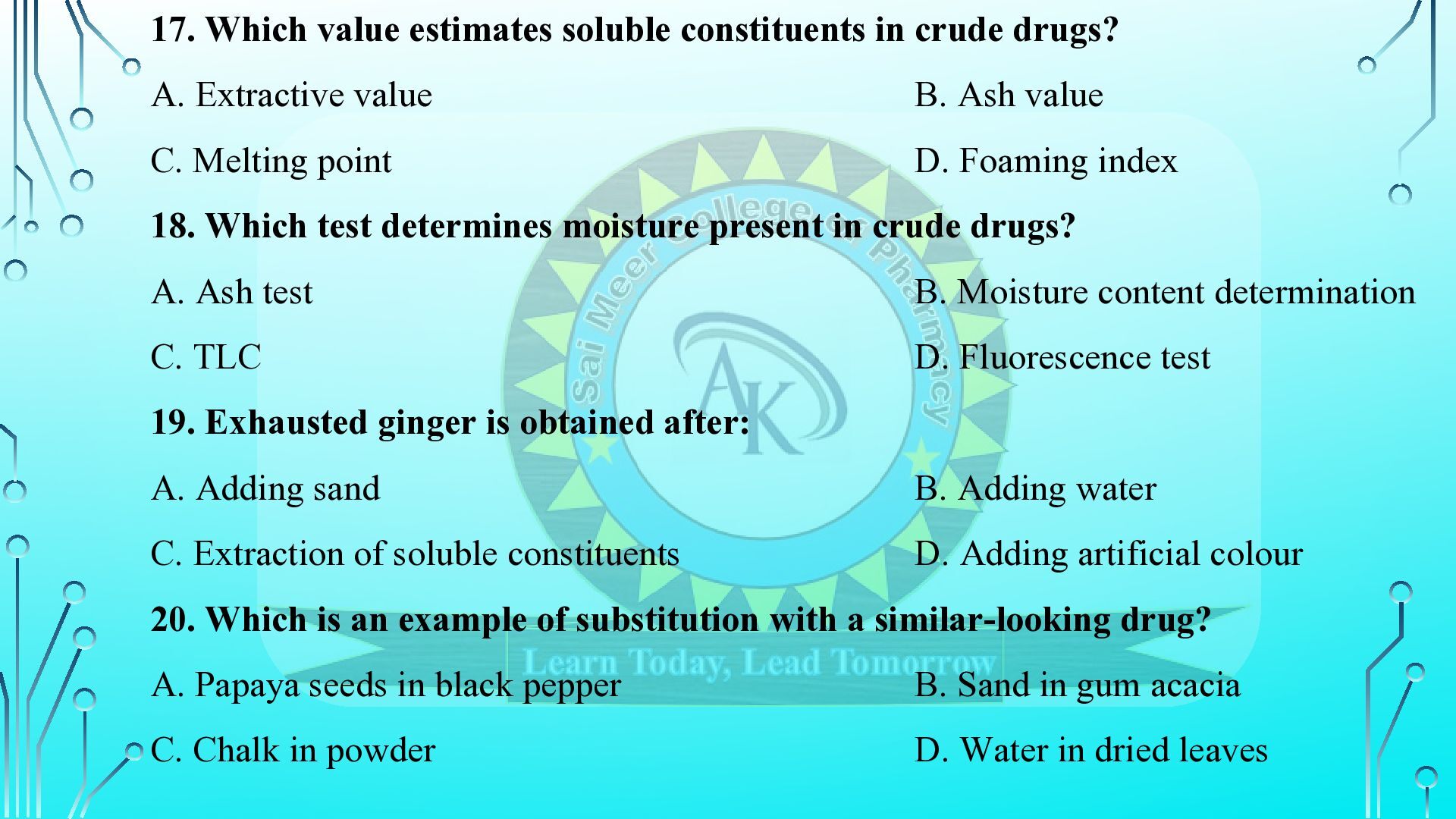
  24. 17. Which value estimates soluble constituents in crude drugs? A.

    Extractive value C. Melting point B. Ash value D. Foaming index 18. Which test determines moisture present in crude drugs? A. Ash test C. TLC 19. Exhausted ginger is obtained after: A. Adding sand C. Extraction of soluble constituents B. Moisture content determination D. Fluorescence test B. Adding water D. Adding artificial colour 20. Which is an example of substitution with a similar-looking drug? A. Papaya seeds in black pepper C. Chalk in powder B. Sand in gum acacia D. Water in dried leaves
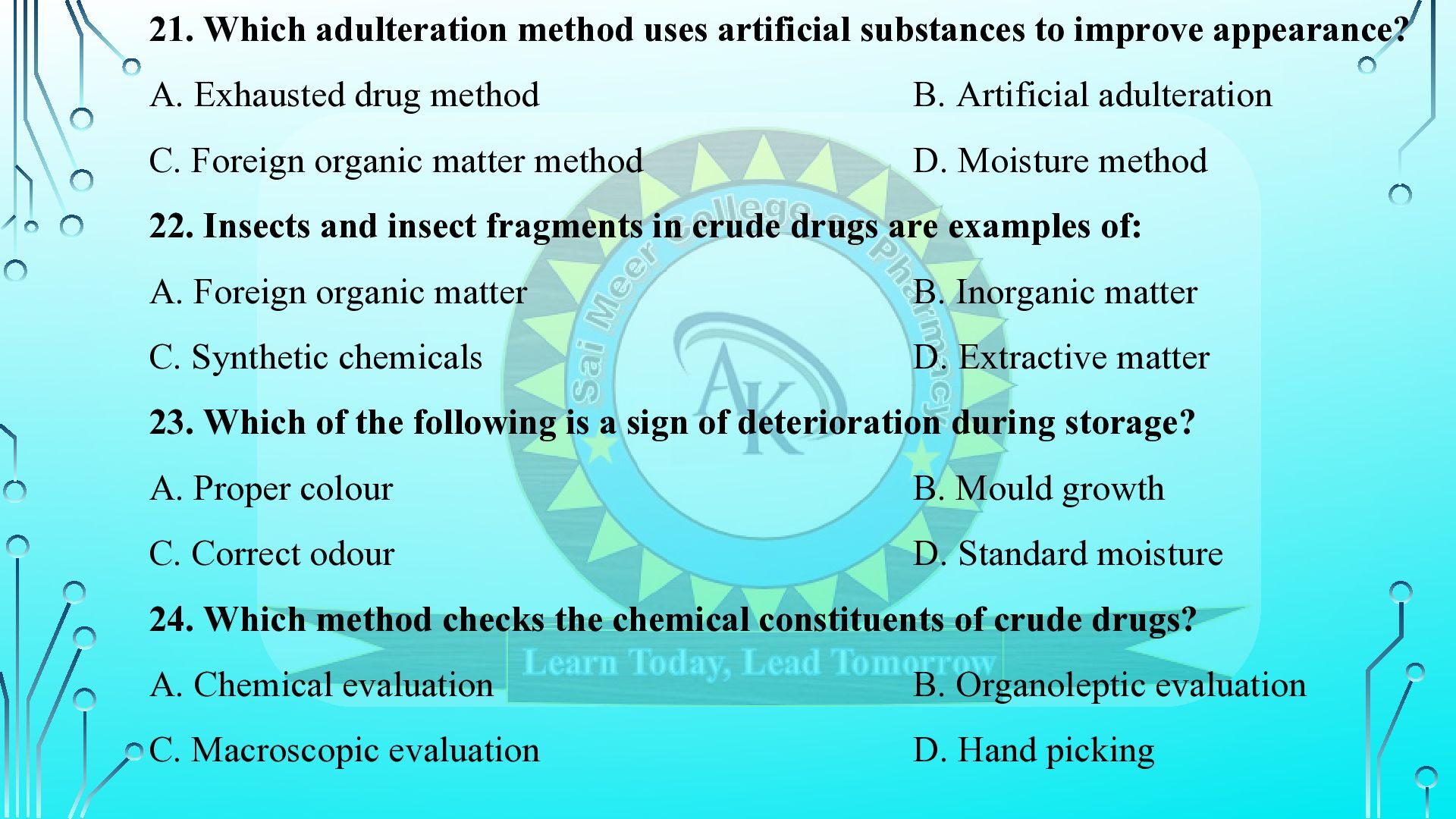
  25. 21. Which adulteration method uses artificial substances to improve appearance?

    A. Exhausted drug method C. Foreign organic matter method B. Artificial adulteration D. Moisture method 22. Insects and insect fragments in crude drugs are examples of: A. Foreign organic matter C. Synthetic chemicals B. Inorganic matter D. Extractive matter 23. Which of the following is a sign of deterioration during storage? A. Proper colour C. Correct odour B. Mould growth D. Standard moisture 24. Which method checks the chemical constituents of crude drugs? A. Chemical evaluation C. Macroscopic evaluation B. Organoleptic evaluation D. Hand picking
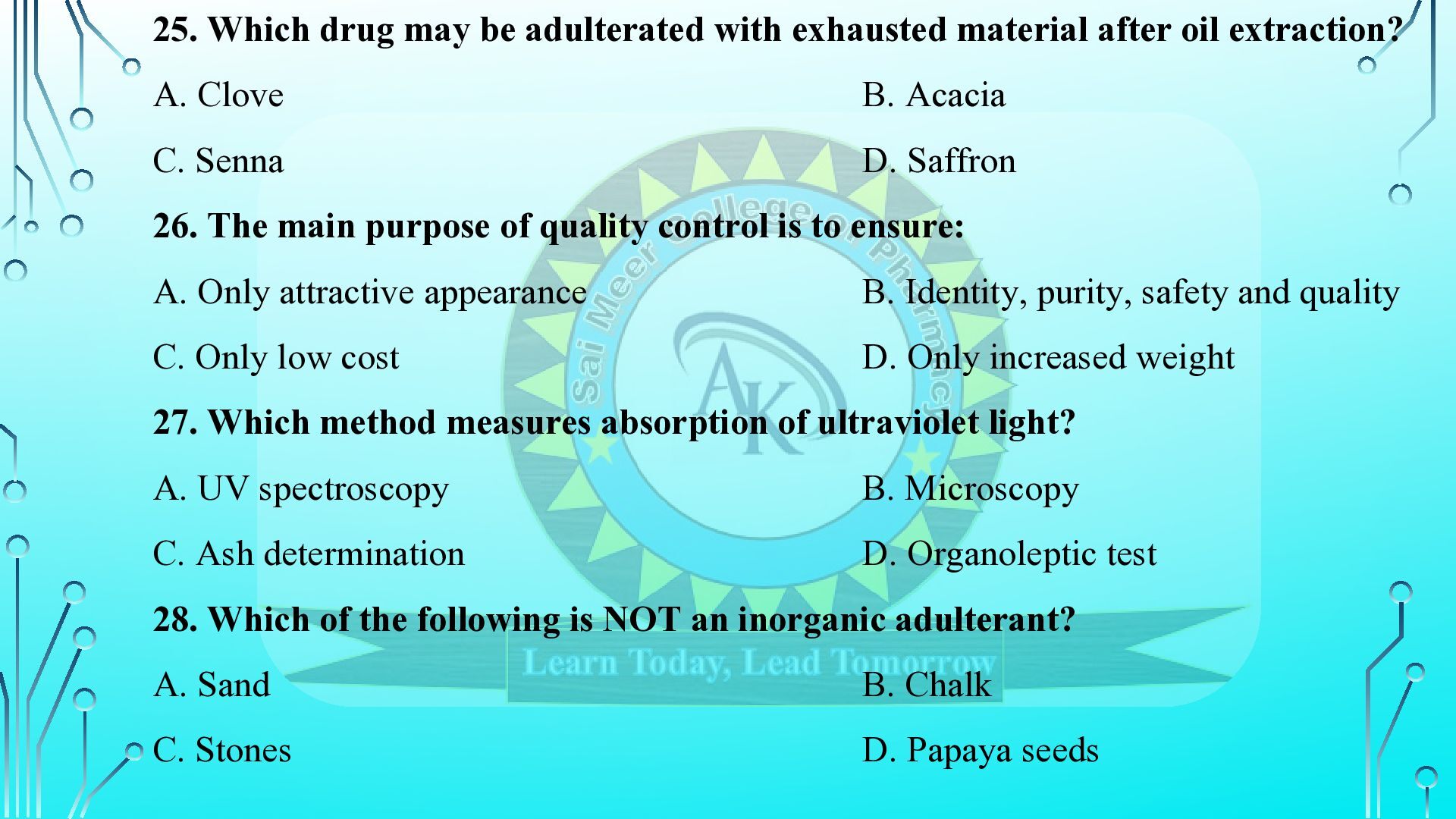
  26. 25. Which drug may be adulterated with exhausted material after

    oil extraction? A. Clove C. Senna B. Acacia D. Saffron 26. The main purpose of quality control is to ensure: A. Only attractive appearance C. Only low cost B. Identity, purity, safety and quality D. Only increased weight 27. Which method measures absorption of ultraviolet light? A. UV spectroscopy C. Ash determination B. Microscopy D. Organoleptic test 28. Which of the following is NOT an inorganic adulterant? A. Sand C. Stones B. Chalk D. Papaya seeds
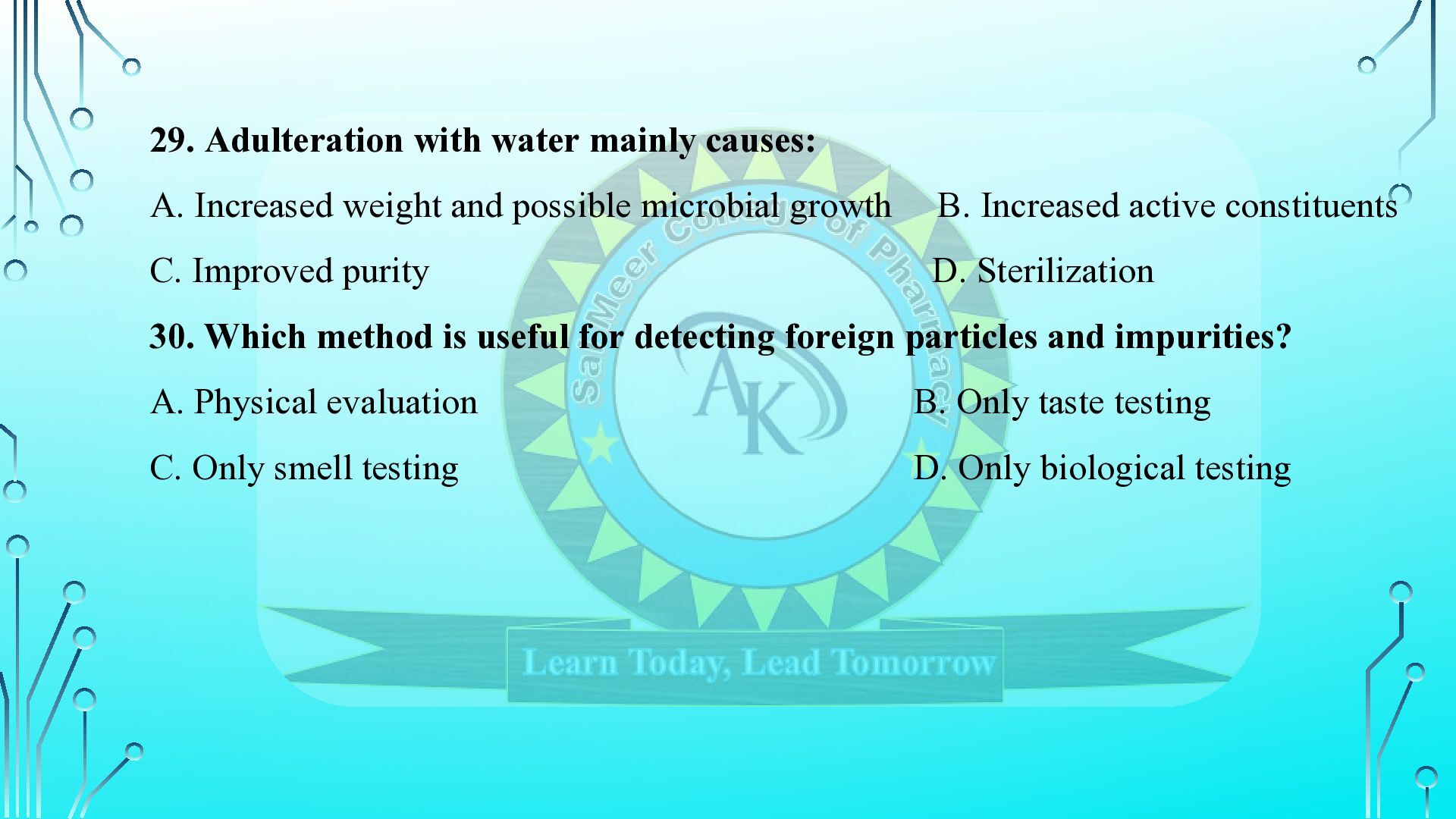
  27. 29. Adulteration with water mainly causes: A. Increased weight and

    possible microbial growth B. Increased active constituents C. Improved purity D. Sterilization A. Physical evaluation B. Only taste testing 30. Which method is useful for detecting foreign particles and impurities? C. Only smell testing D. Only biological testing
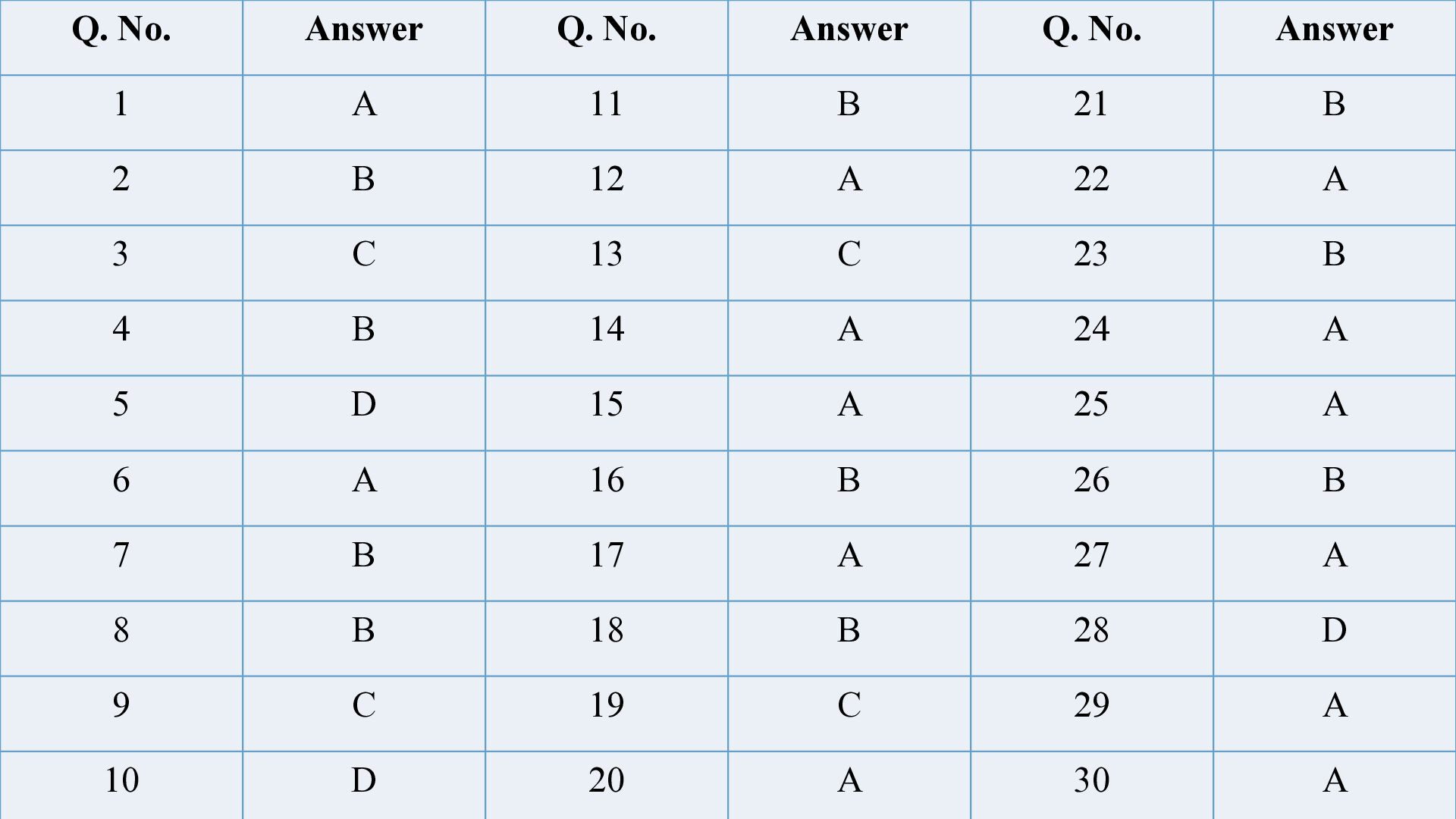
  28. Q. No. Answer Q. No. Answer Q. No. Answer 1

    A 11 B 21 B 2 B 12 A 22 A 3 C 13 C 23 B 4 B 14 A 24 A 5 D 15 A 25 A 6 A 16 B 26 B 7 B 17 A 27 A 8 B 18 B 28 D 9 C 19 C 29 A 10 D 20 A 30 A

More Decks by Arun Kumar

Other Decks in Education