Pharmacognosy_Chapter_-2.pdf, Classification of...

Arun Kumar
November 16, 2026

Pharmacognosy_Chapter_-2.pdf, Classification of drugs , D. Pharm-I Year.

CHAPTER -2
Classification of drugs:
Alphabetical
Taxonomical
Morphological
Pharmacological
Chemical
Chemo-taxonomical

Arun Kumar

November 16, 2026

Annual Pro sale · Save $30

Have presentations of your own?

Share with private links, password protection, and more control over your work.

Transcript

48 slides
  1. CHAPTER -2 Classification of drugs:  Alphabetical  Taxonomical 

    Morphological  Pharmacological  Chemical  Chemo-taxonomical
  2. Classification of Crude Drugs Introduction  Crude drugs are natural

    substances obtained from plants, animals, minerals, or microorganisms and used as medicines either in their natural form or after simple processing.  Crude drugs can be classified in different ways depending upon their name, botanical relationship, morphology, chemical constituents, pharmacological action, or chemical-taxonomical relationship.
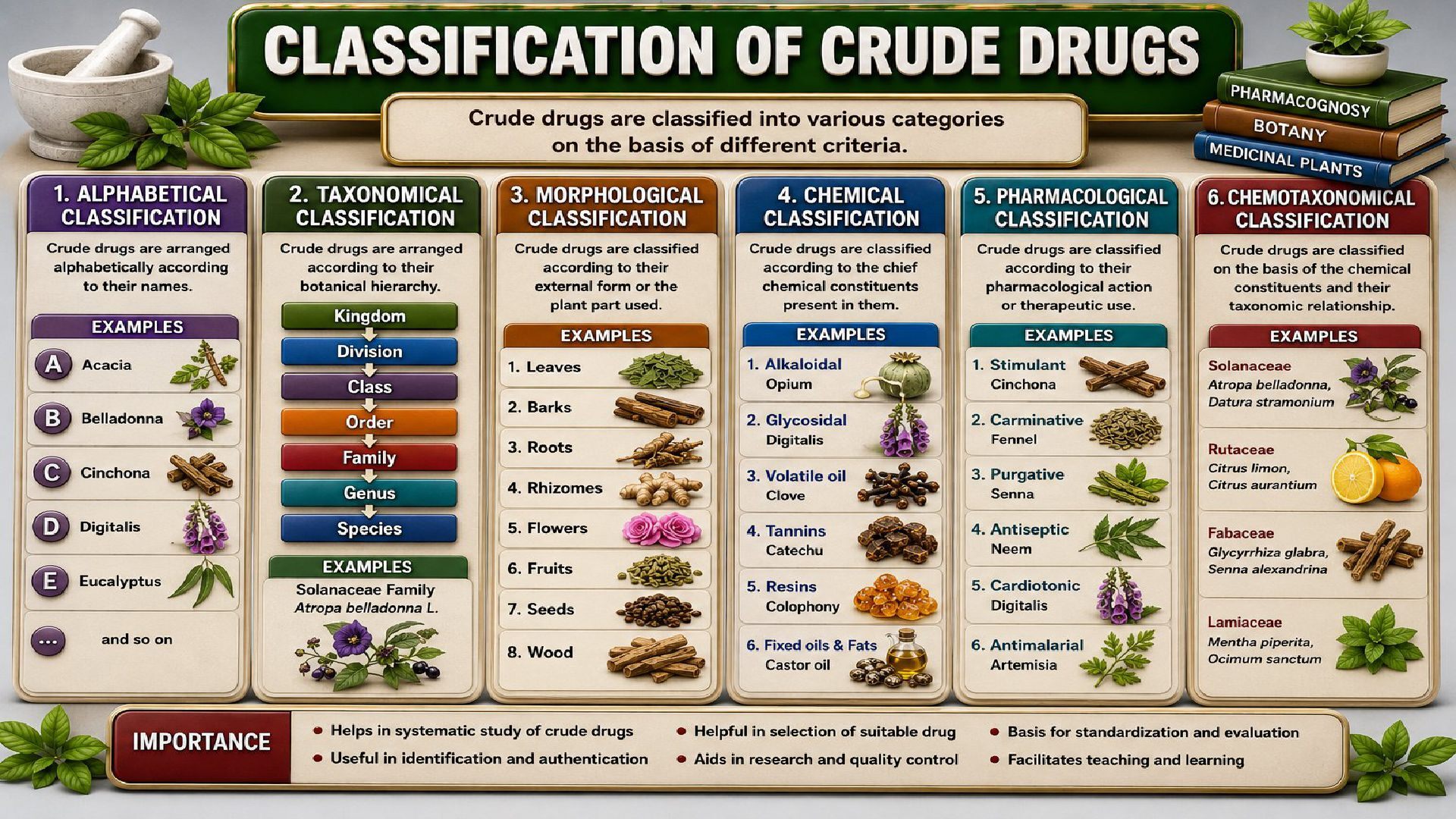
  3. The major methods of classification are: 1. Alphabetical classification 2.

    Taxonomical classification 3. Morphological classification 4. Chemical classification 5. Pharmacological classification 6. Chemotaxonomical classification
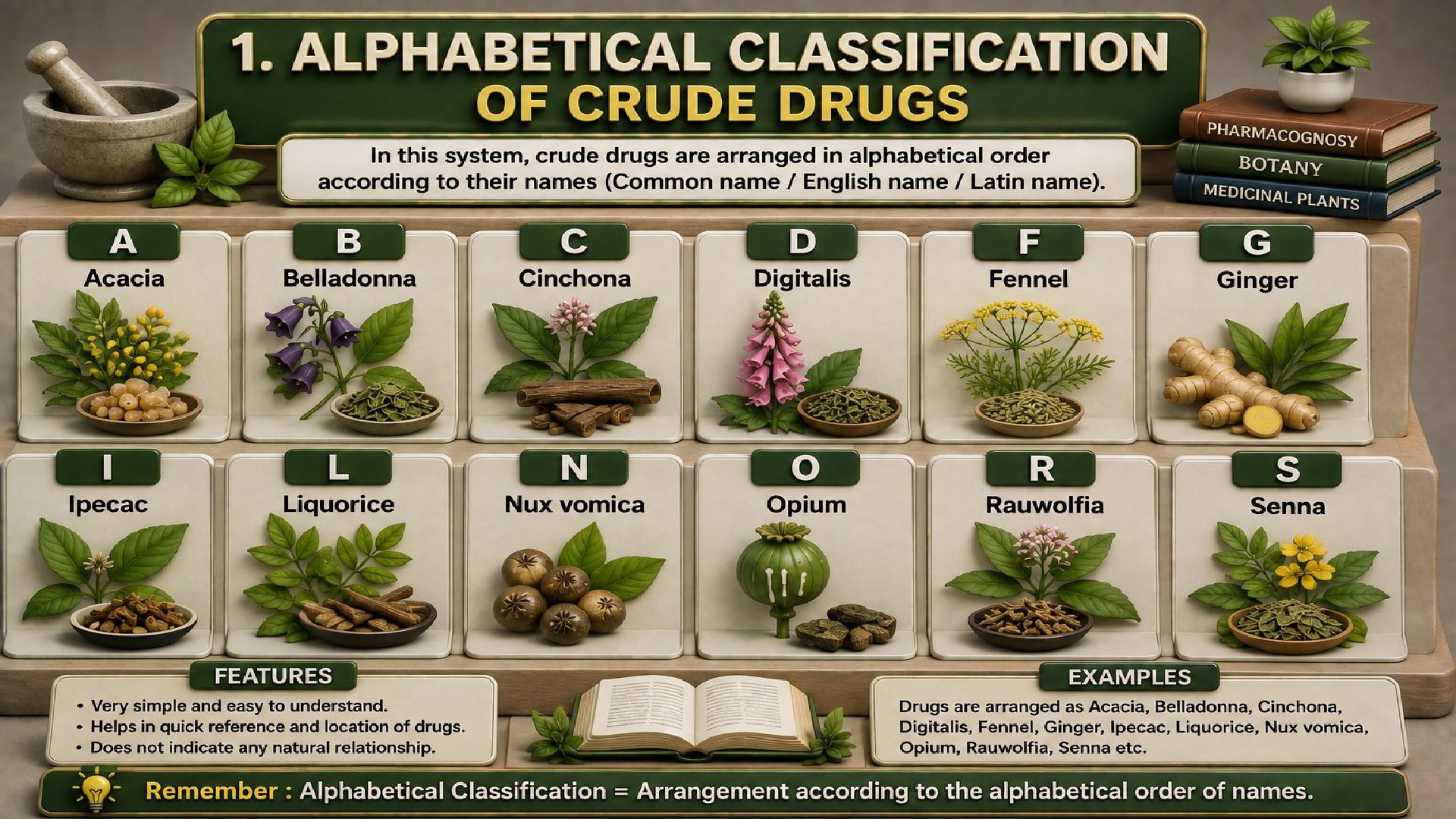
  4. 1. Alphabetical Classification In alphabetical classification, crude drugs are arranged

    according to the alphabetical order of their names. The drugs may be arranged according to their:  English name  Latin name  Official name  Common name
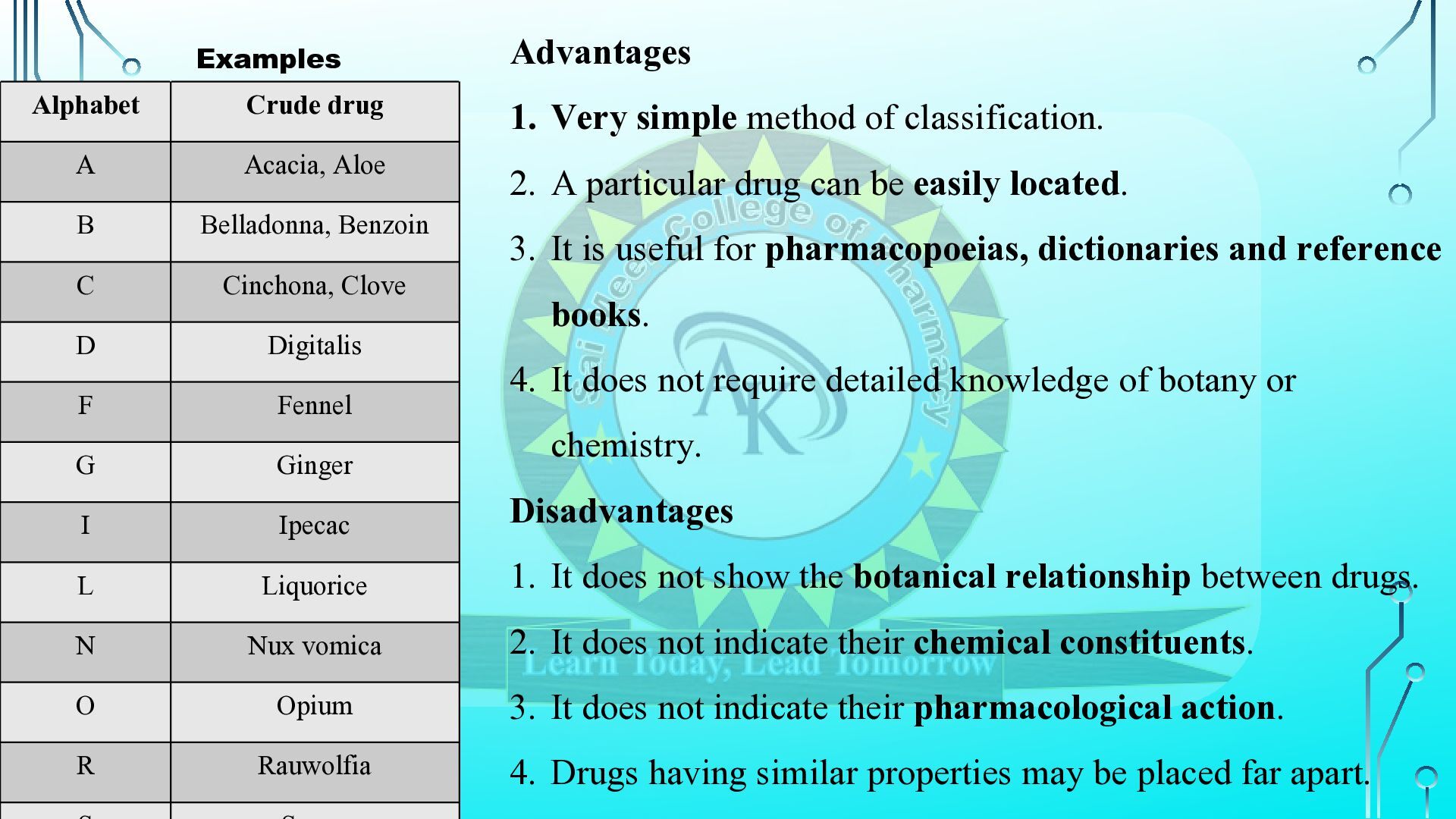
  5. Alphabet Examples Crude drug A Acacia, Aloe B Belladonna, Benzoin

    C Cinchona, Clove D Digitalis F Fennel G Ginger I Ipecac L Liquorice N Nux vomica O Opium R Rauwolfia Advantages 1. Very simple method of classification. 2. A particular drug can be easily located. 3. It is useful for pharmacopoeias, dictionaries and reference books. 4. It does not require detailed knowledge of botany or chemistry. Disadvantages 1. It does not show the botanical relationship between drugs. 2. It does not indicate their chemical constituents. 3. It does not indicate their pharmacological action. 4. Drugs having similar properties may be placed far apart.
  6. Example Acacia and Senna may have different alphabetical positions even

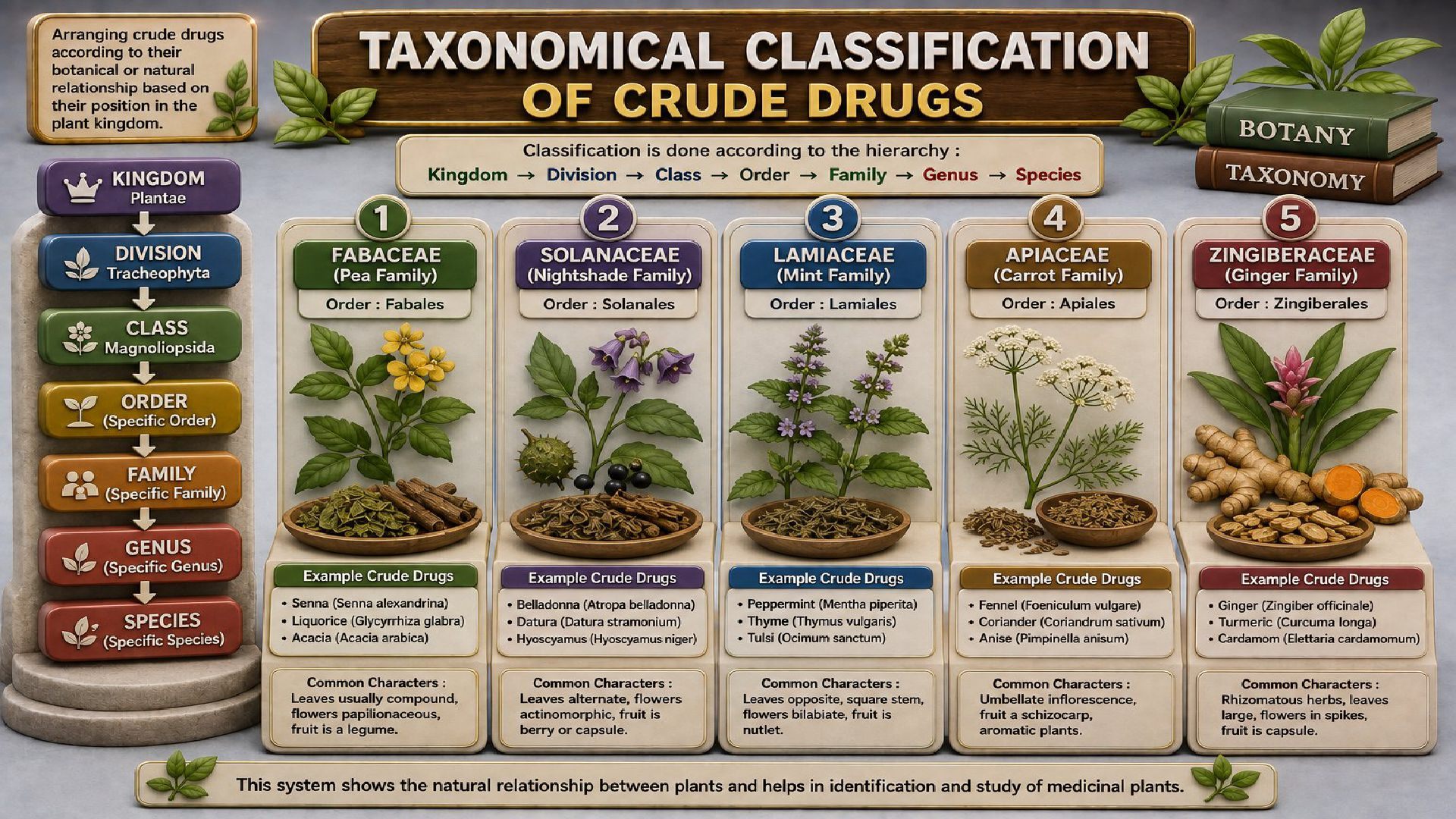
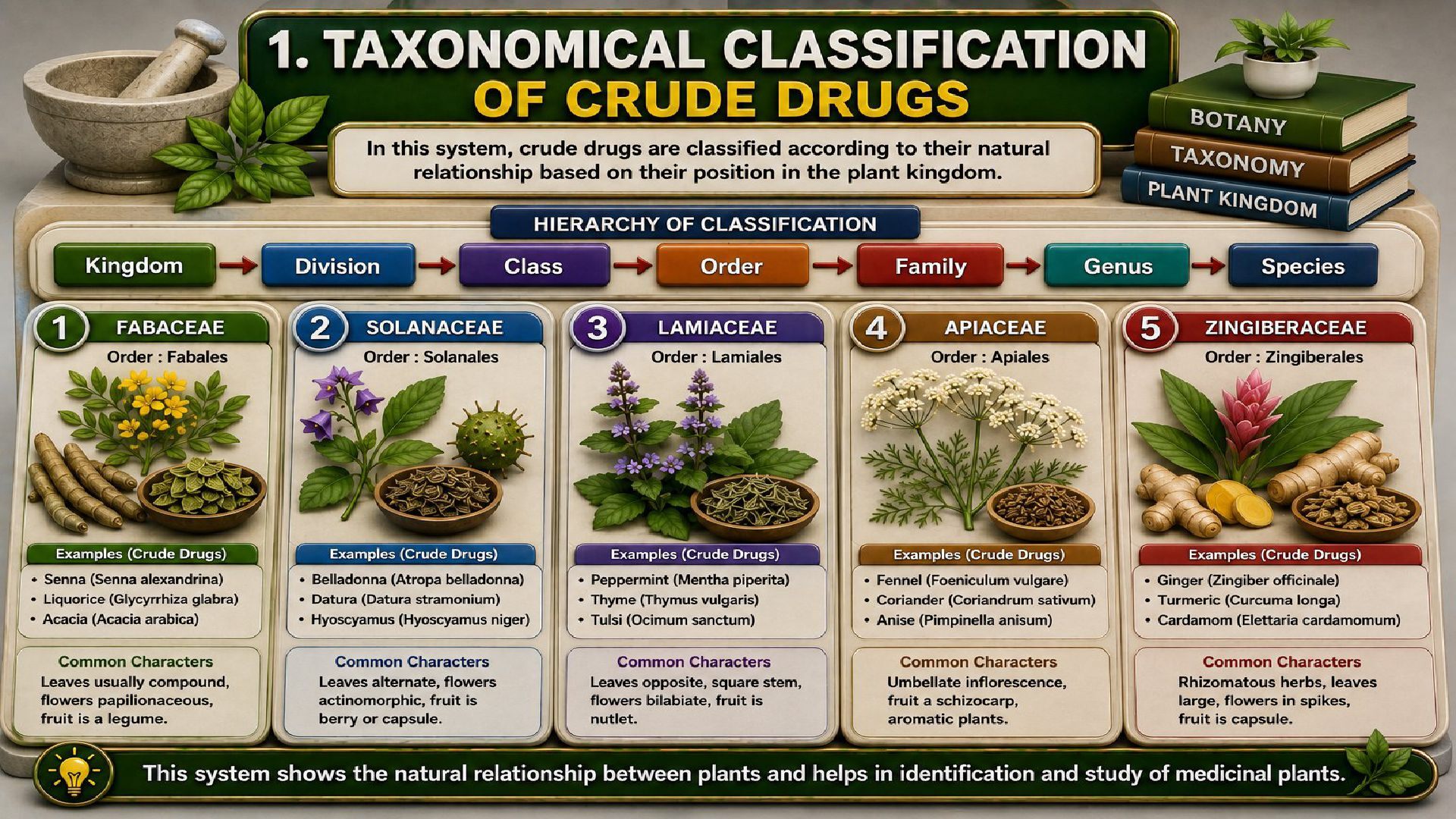
    though both are obtained from plants and have medicinal importance. Easy memory Alphabetical classification = Drug name → A, B, C, D... 2. Taxonomical Classification Definition In taxonomical classification, crude drugs are classified according to their botanical or biological relationships. The drugs are arranged according to their position in the plant kingdom, such as: Kingdom → Division → Class → Order → Family → Genus → Species The most commonly used levels for medicinal plants are family, genus and species.
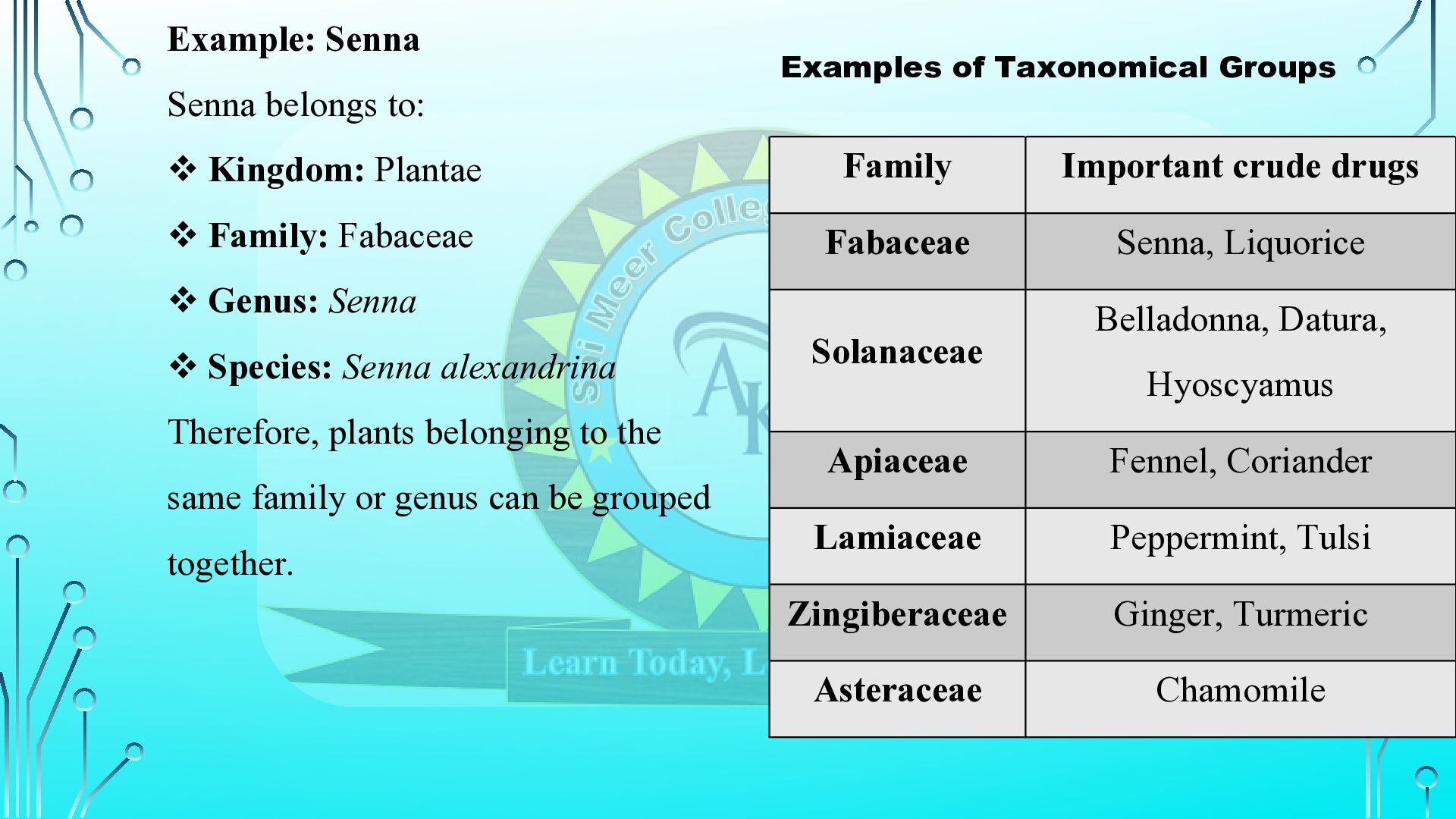
  7. Example: Senna Senna belongs to:  Kingdom: Plantae  Family:

    Fabaceae  Genus: Senna  Species: Senna alexandrina Therefore, plants belonging to the same family or genus can be grouped together. Examples of Taxonomical Groups Family Important crude drugs Fabaceae Senna, Liquorice Solanaceae Belladonna, Datura, Hyoscyamus Apiaceae Fennel, Coriander Lamiaceae Peppermint, Tulsi Zingiberaceae Ginger, Turmeric Asteraceae Chamomile
  8. Advantages 1. Shows the natural relationship between plants. 2. Useful

    for botanical identification. 3. Helps to study medicinal plants systematically. 4. Closely related plants can be studied together. 5. Useful in the discovery of new medicinal plants. Disadvantages 1. It requires knowledge of botany and taxonomy. 2. It does not directly provide information about the chemical constituents. 3. Plants belonging to the same family may have different chemical constituents and medicinal actions. 4. Taxonomic classification may change when botanical names or relationships are revised.
  9. 3. Morphological Classification In morphological classification, crude drugs are classified

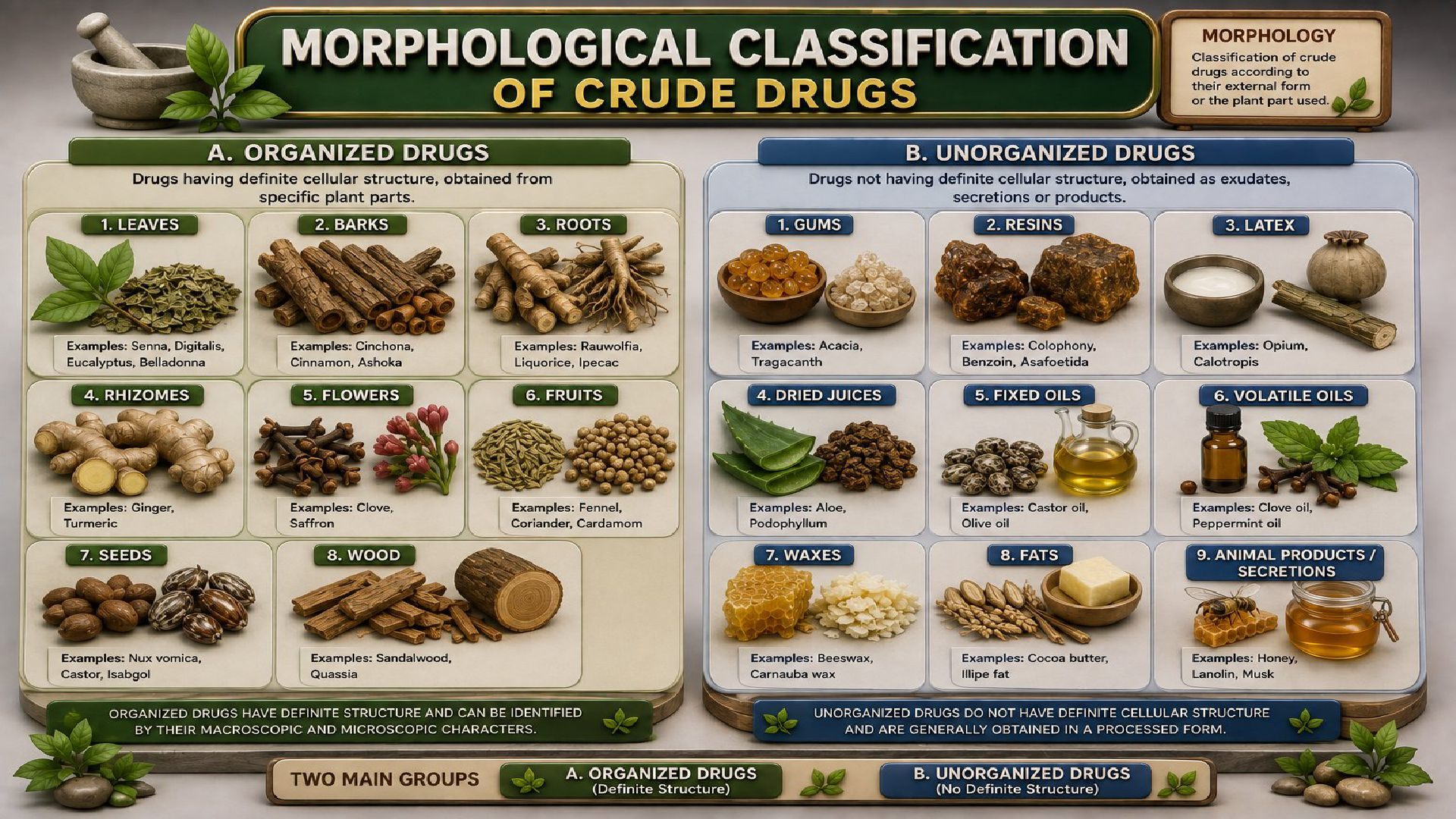
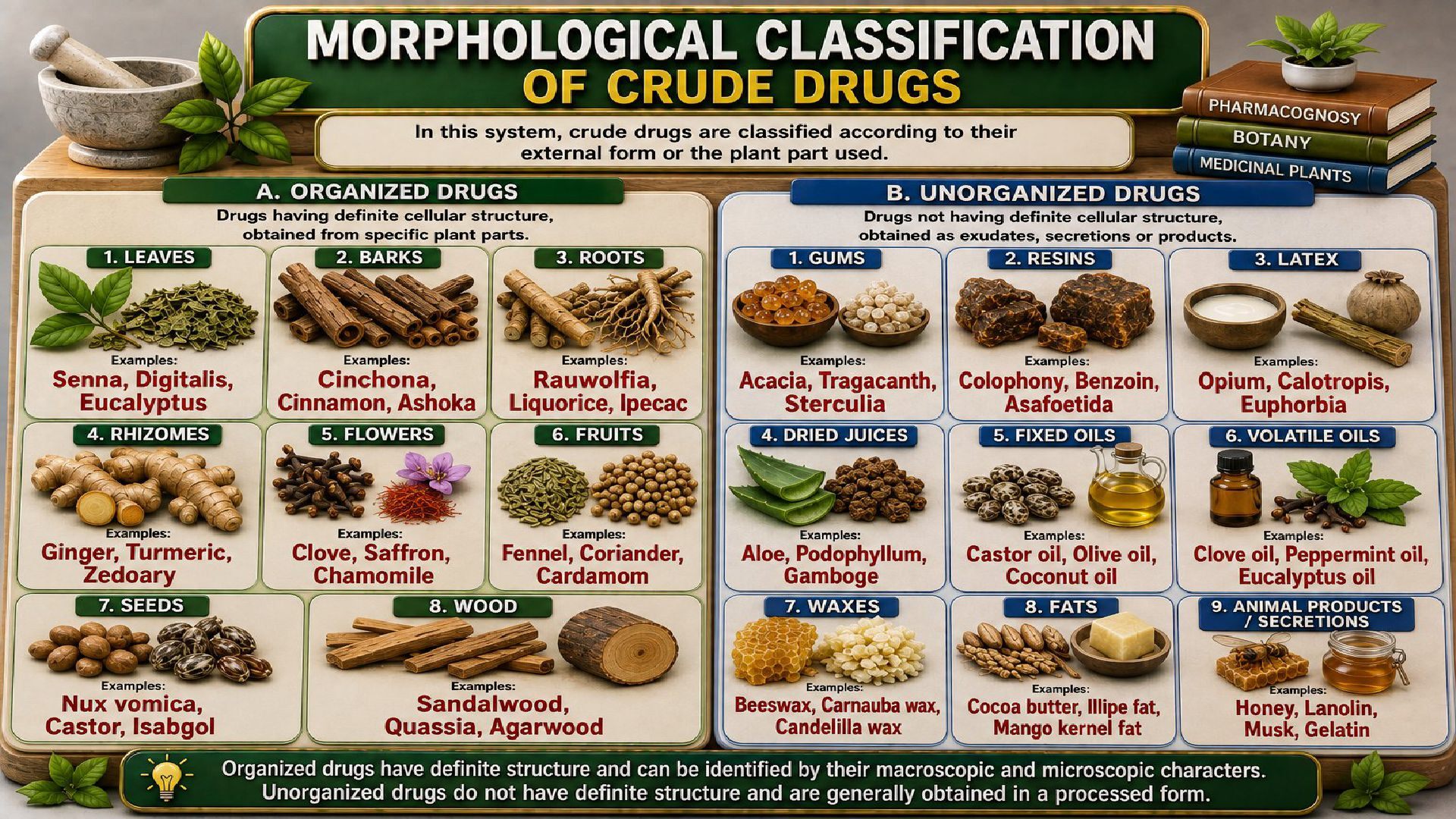
    according to their external appearance, form, and plant part used. This is a very important classification in pharmacognosy. Crude drugs are mainly divided into: A. Organized drugs B. Unorganized drugs A. Organized Drugs Organized drugs are crude drugs that have a definite cellular structure and are obtained from a particular plant part. They can be identified by their morphological and microscopic characters.
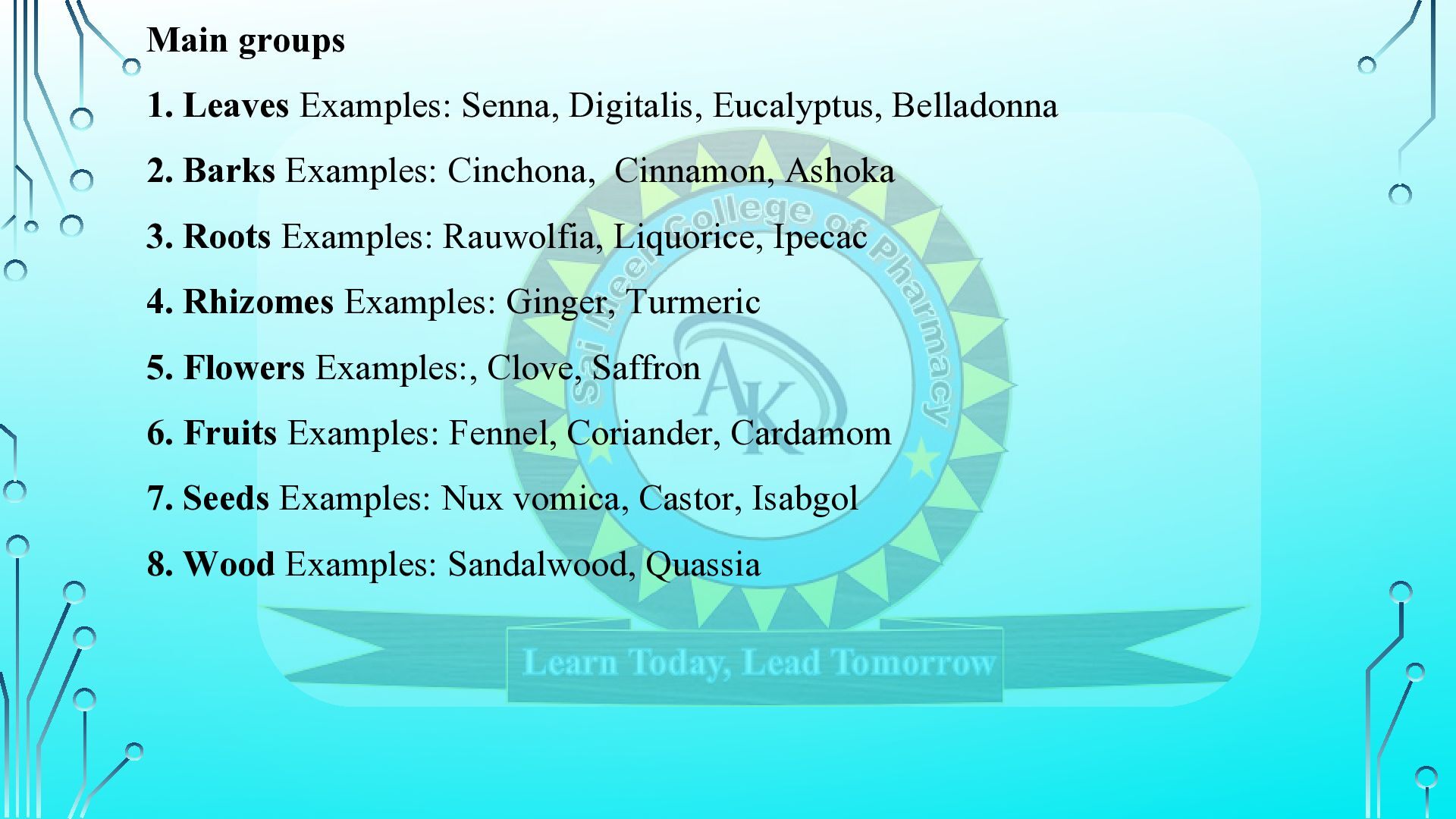
  10. Main groups 1. Leaves Examples: Senna, Digitalis, Eucalyptus, Belladonna 2.

    Barks Examples: Cinchona, Cinnamon, Ashoka 3. Roots Examples: Rauwolfia, Liquorice, Ipecac 4. Rhizomes Examples: Ginger, Turmeric 5. Flowers Examples:, Clove, Saffron 6. Fruits Examples: Fennel, Coriander, Cardamom 7. Seeds Examples: Nux vomica, Castor, Isabgol 8. Wood Examples: Sandalwood, Quassia
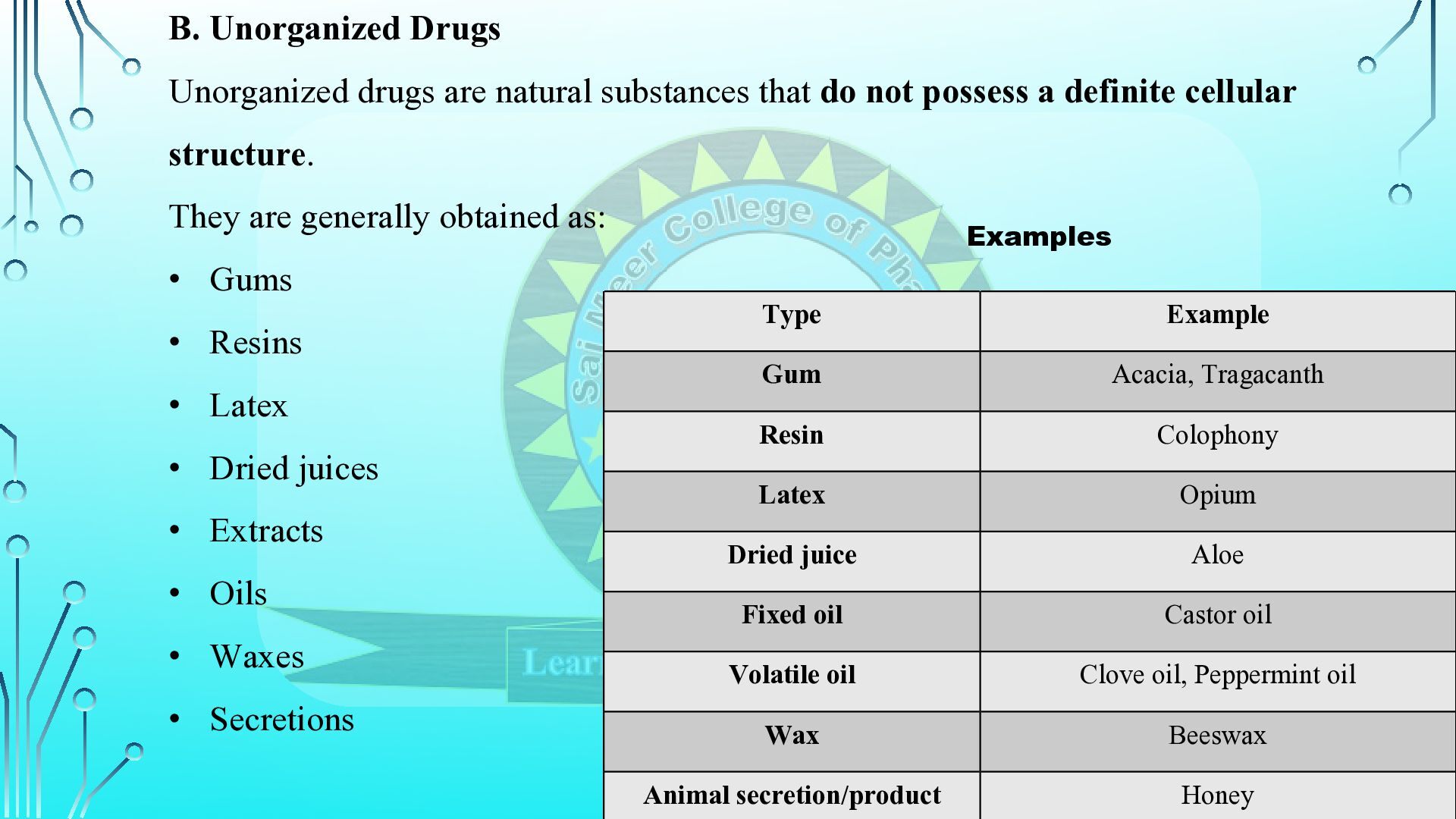
  11. B. Unorganized Drugs Unorganized drugs are natural substances that do

    not possess a definite cellular structure. They are generally obtained as: • Gums • Resins • Latex • Dried juices • Extracts • Oils • Waxes • Secretions Examples Type Example Gum Acacia, Tragacanth Resin Colophony Latex Opium Dried juice Aloe Fixed oil Castor oil Volatile oil Clove oil, Peppermint oil Wax Beeswax Animal secretion/product Honey
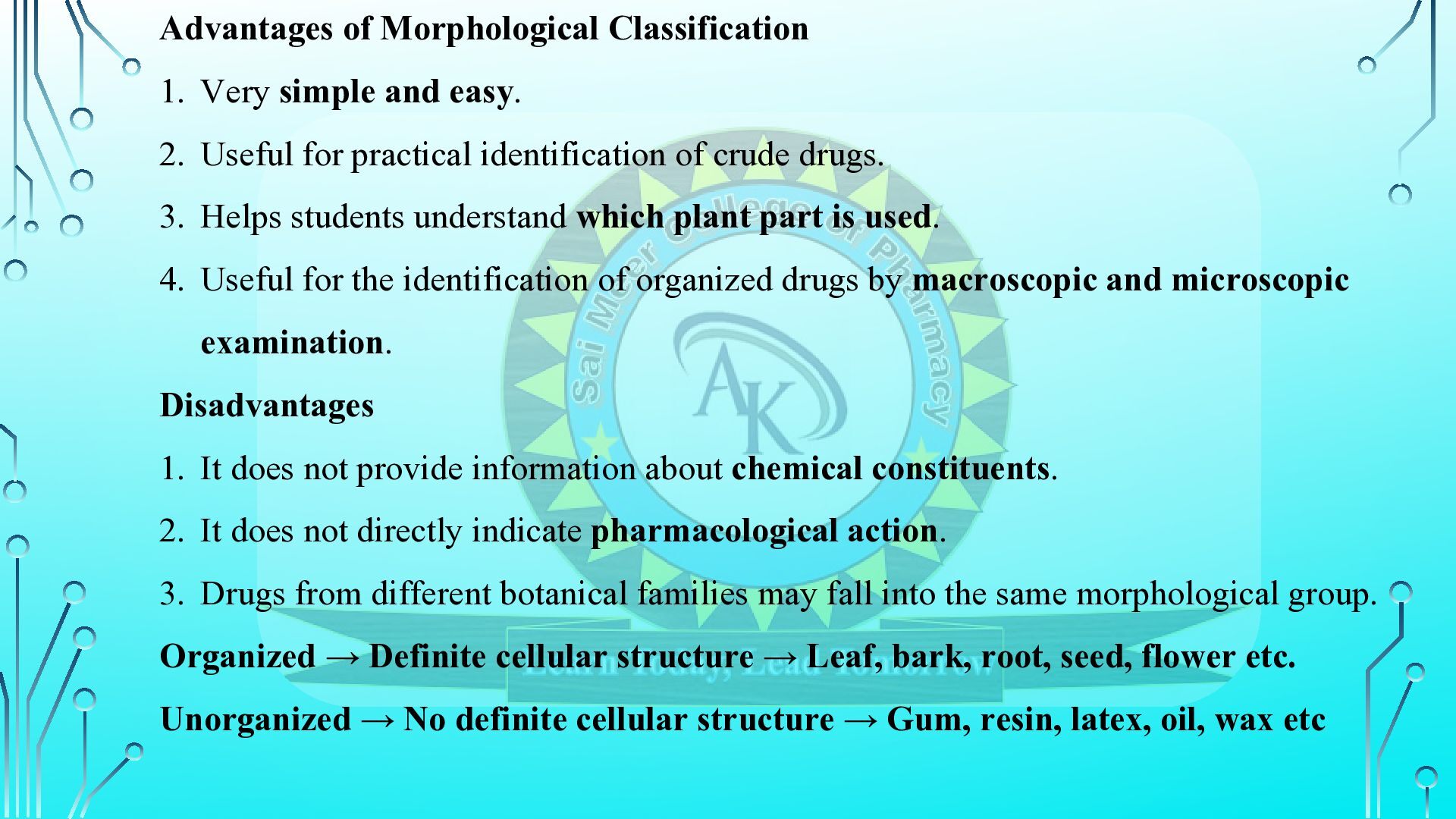
  12. Advantages of Morphological Classification 1. Very simple and easy. 2.

    Useful for practical identification of crude drugs. 3. Helps students understand which plant part is used. 4. Useful for the identification of organized drugs by macroscopic and microscopic examination. Disadvantages 1. It does not provide information about chemical constituents. 2. It does not directly indicate pharmacological action. 3. Drugs from different botanical families may fall into the same morphological group. Organized → Definite cellular structure → Leaf, bark, root, seed, flower etc. Unorganized → No definite cellular structure → Gum, resin, latex, oil, wax etc
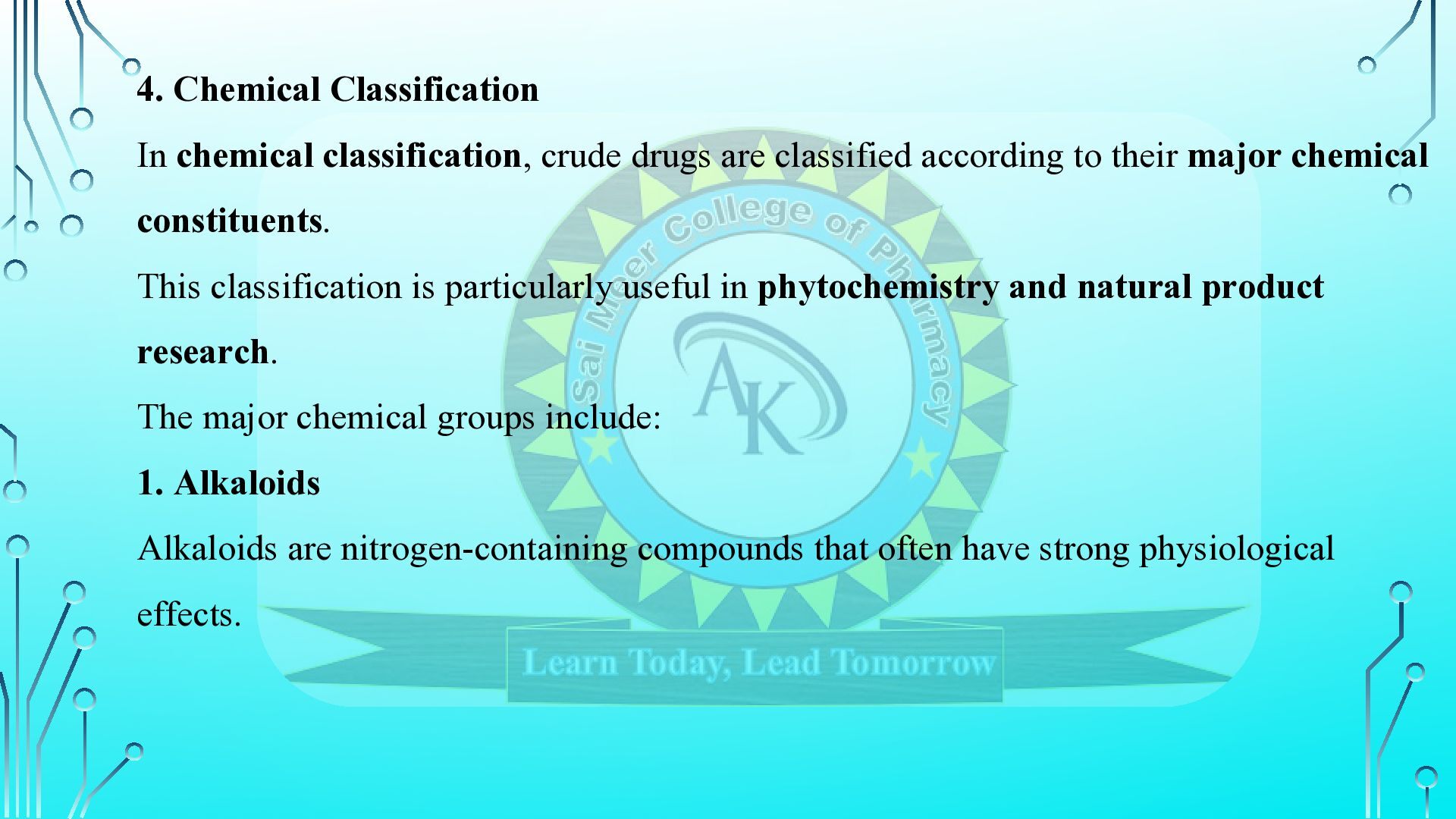
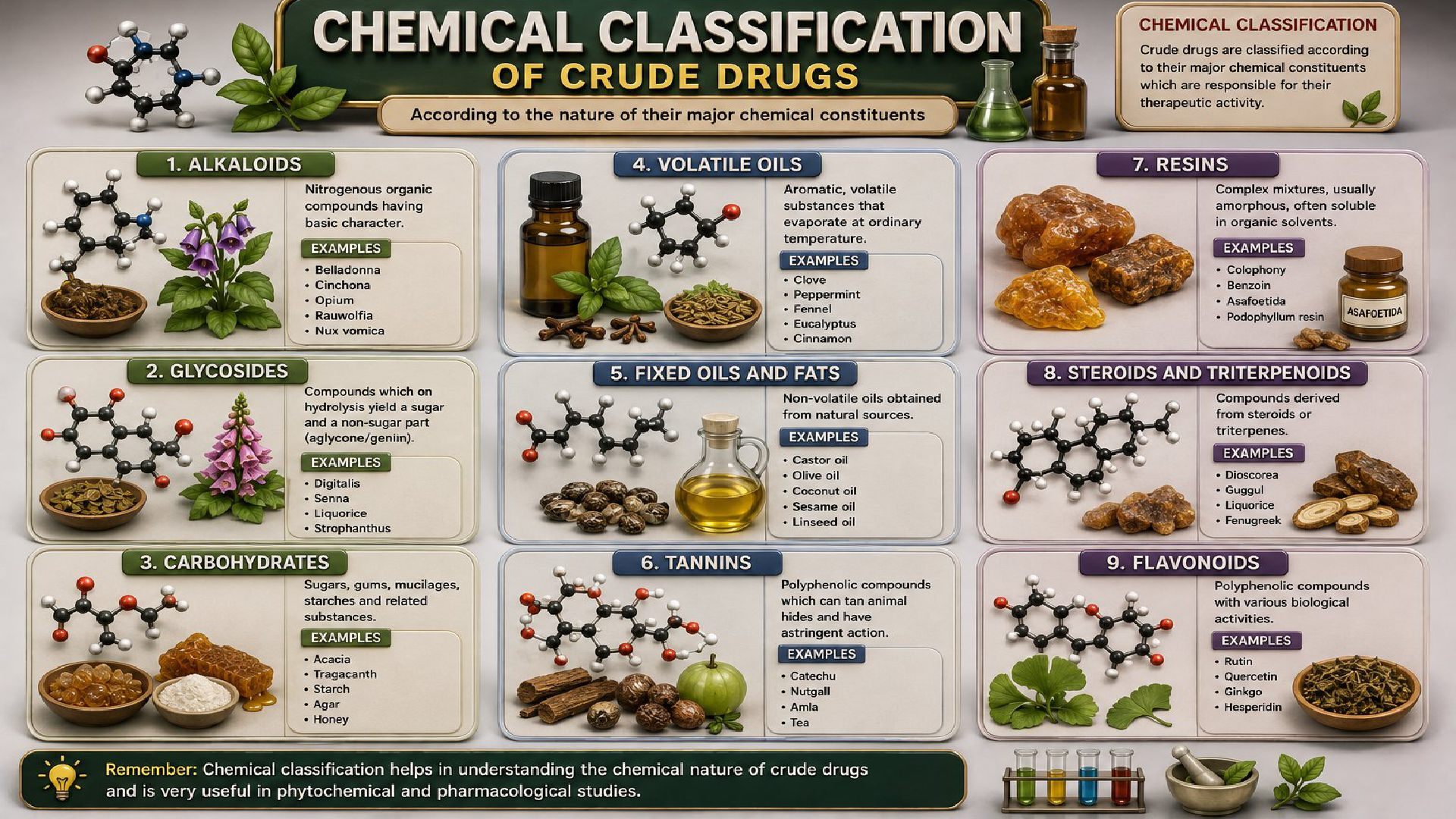
  13. 4. Chemical Classification In chemical classification, crude drugs are classified

    according to their major chemical constituents. This classification is particularly useful in phytochemistry and natural product research. The major chemical groups include: 1. Alkaloids Alkaloids are nitrogen-containing compounds that often have strong physiological effects.
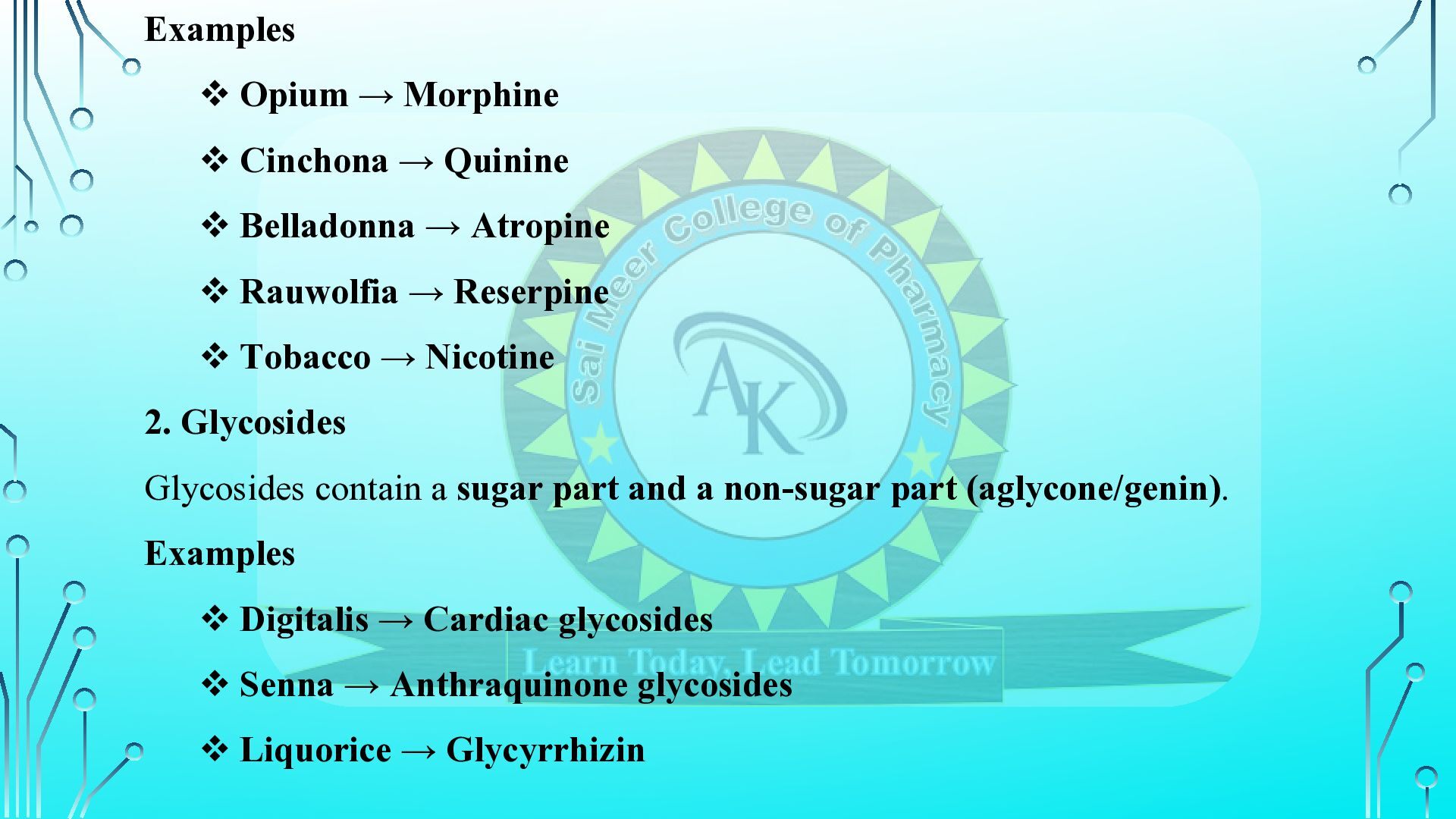
  14. Examples  Opium → Morphine  Cinchona → Quinine 

    Belladonna → Atropine  Rauwolfia → Reserpine  Tobacco → Nicotine 2. Glycosides Glycosides contain a sugar part and a non-sugar part (aglycone/genin). Examples  Digitalis → Cardiac glycosides  Senna → Anthraquinone glycosides  Liquorice → Glycyrrhizin
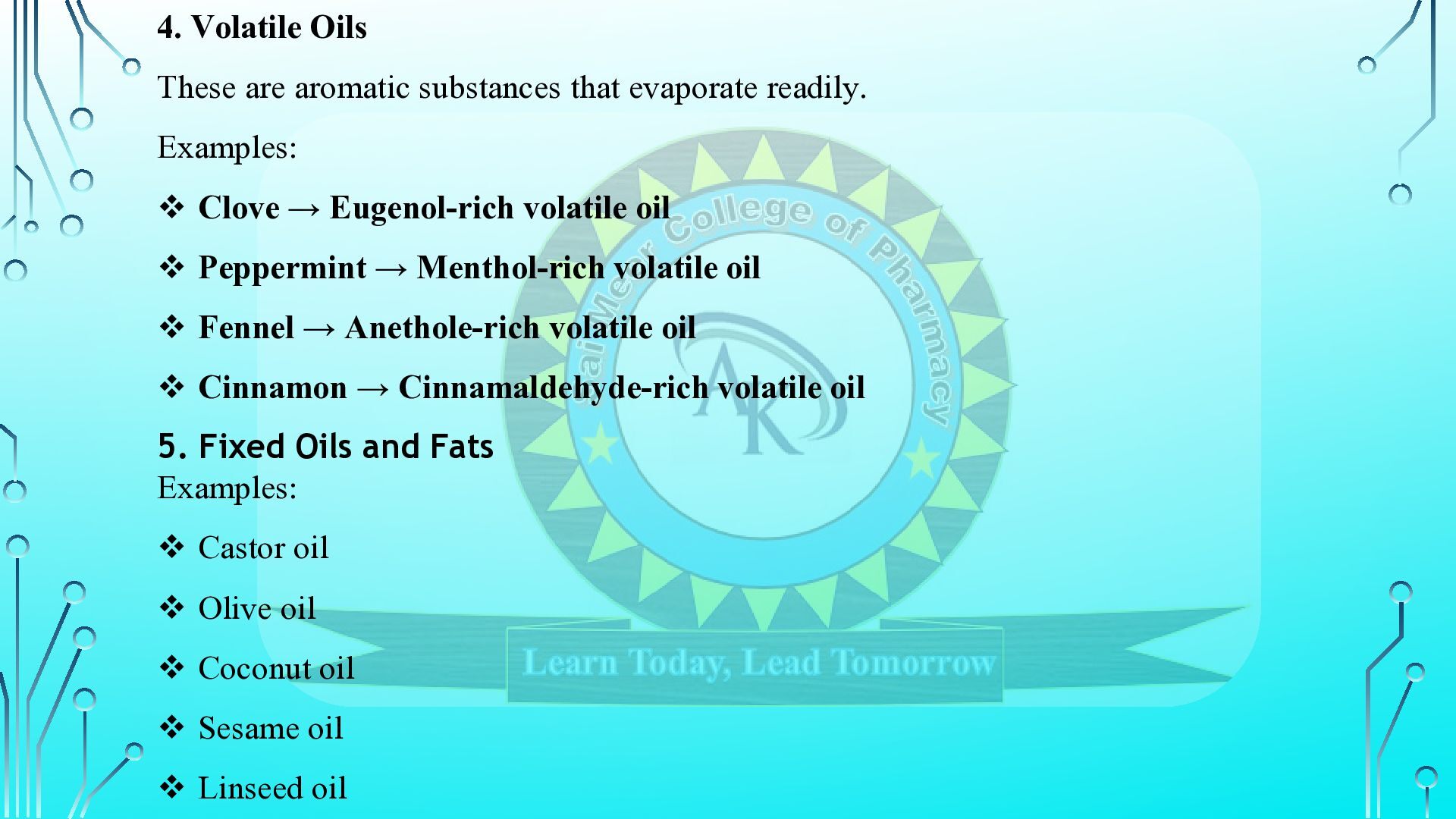
  15. 4. Volatile Oils These are aromatic substances that evaporate readily.

    Examples:  Clove → Eugenol-rich volatile oil  Peppermint → Menthol-rich volatile oil  Fennel → Anethole-rich volatile oil  Cinnamon → Cinnamaldehyde-rich volatile oil 5. Fixed Oils and Fats Examples:  Castor oil  Olive oil  Coconut oil  Sesame oil  Linseed oil
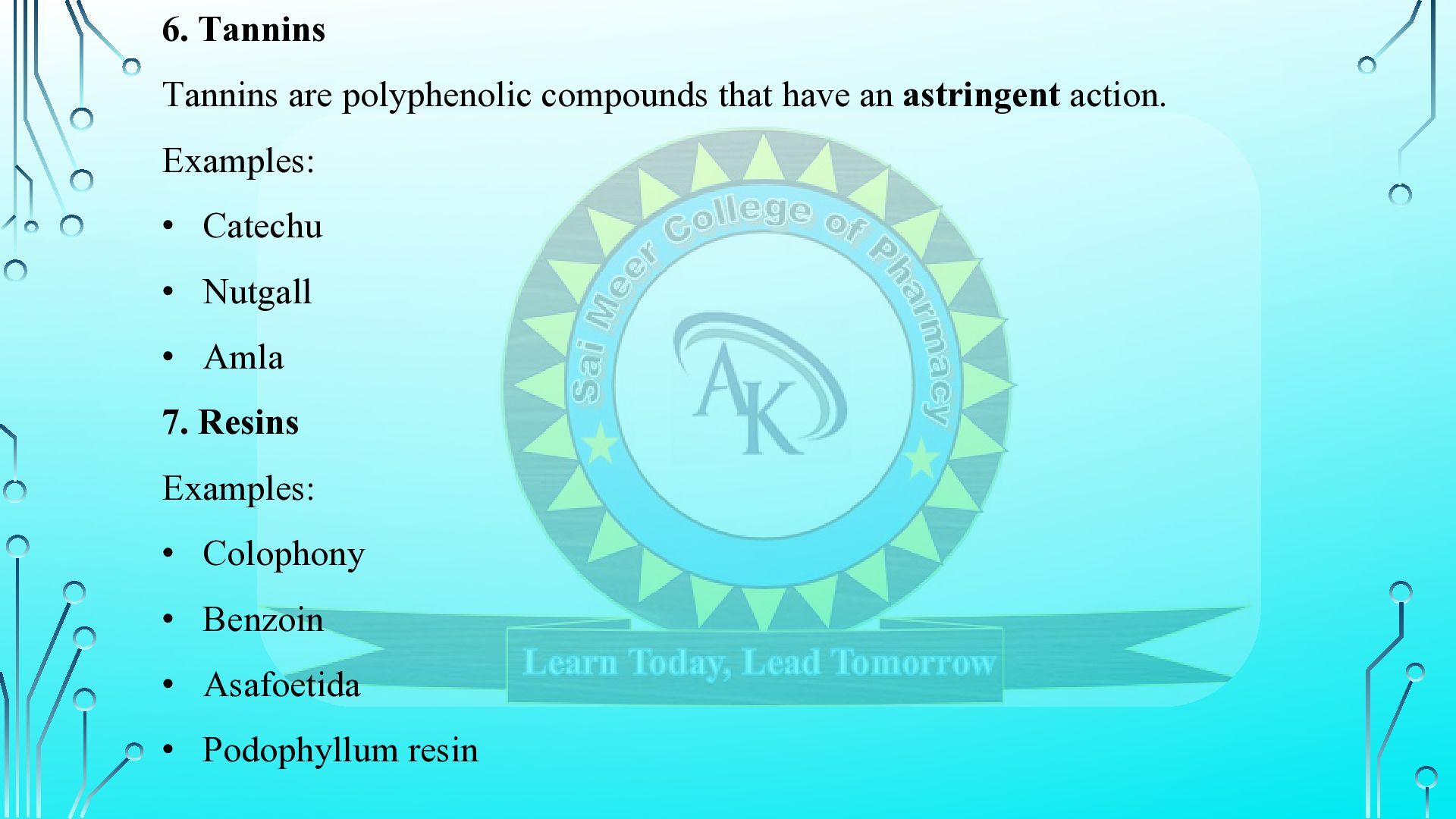
  16. 6. Tannins Tannins are polyphenolic compounds that have an astringent

    action. Examples: • Catechu • Nutgall • Amla 7. Resins Examples: • Colophony • Benzoin • Asafoetida • Podophyllum resin
  17. 8. Steroids and Triterpenoids Examples:  Dioscorea  Guggul 

    Liquorice 9. Flavonoids Examples:  Rutin  Quercetin  Ginkgo flavonoids
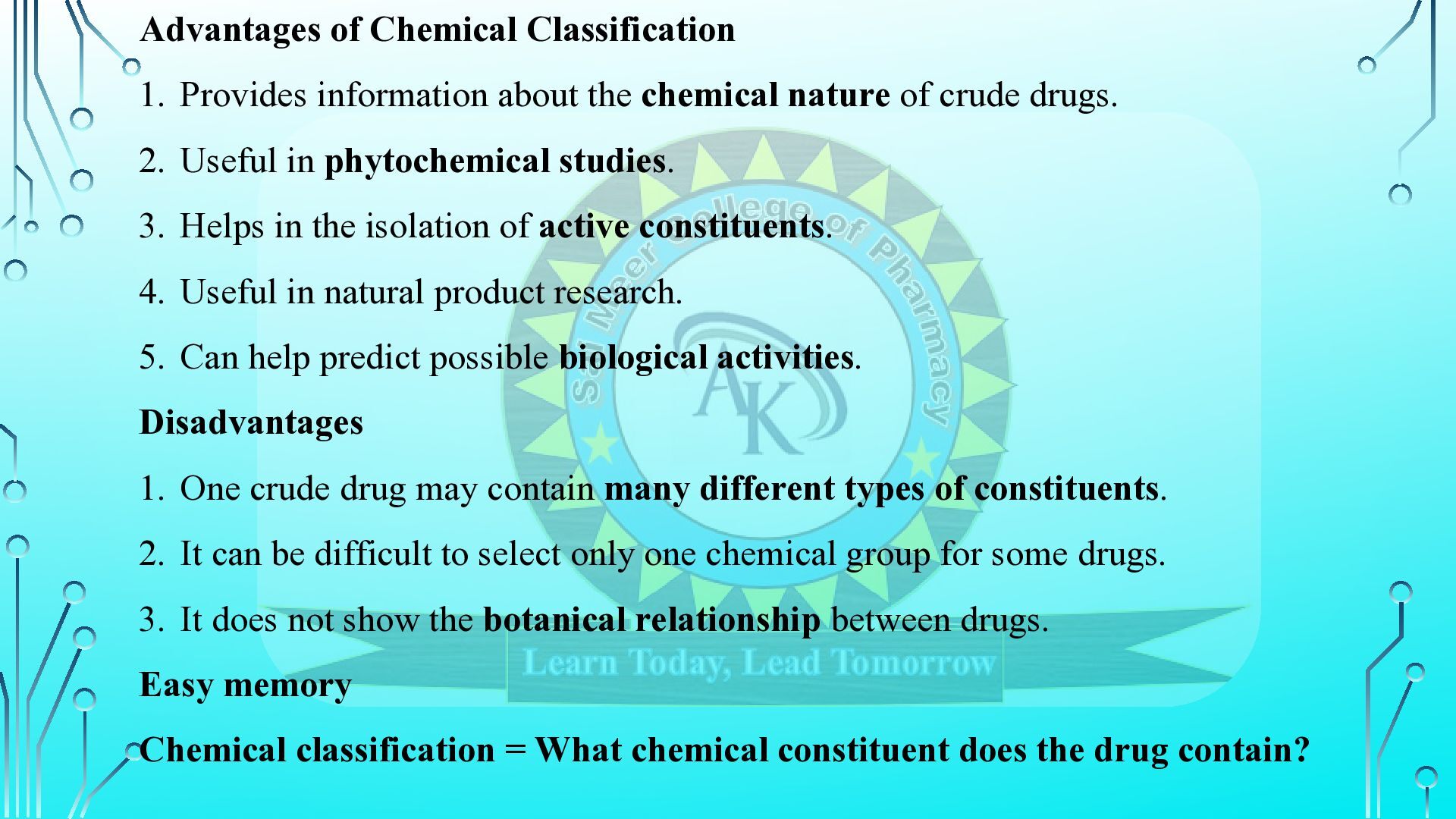
  18. Advantages of Chemical Classification 1. Provides information about the chemical

    nature of crude drugs. 2. Useful in phytochemical studies. 3. Helps in the isolation of active constituents. 4. Useful in natural product research. 5. Can help predict possible biological activities. Disadvantages 1. One crude drug may contain many different types of constituents. 2. It can be difficult to select only one chemical group for some drugs. 3. It does not show the botanical relationship between drugs. Easy memory Chemical classification = What chemical constituent does the drug contain?
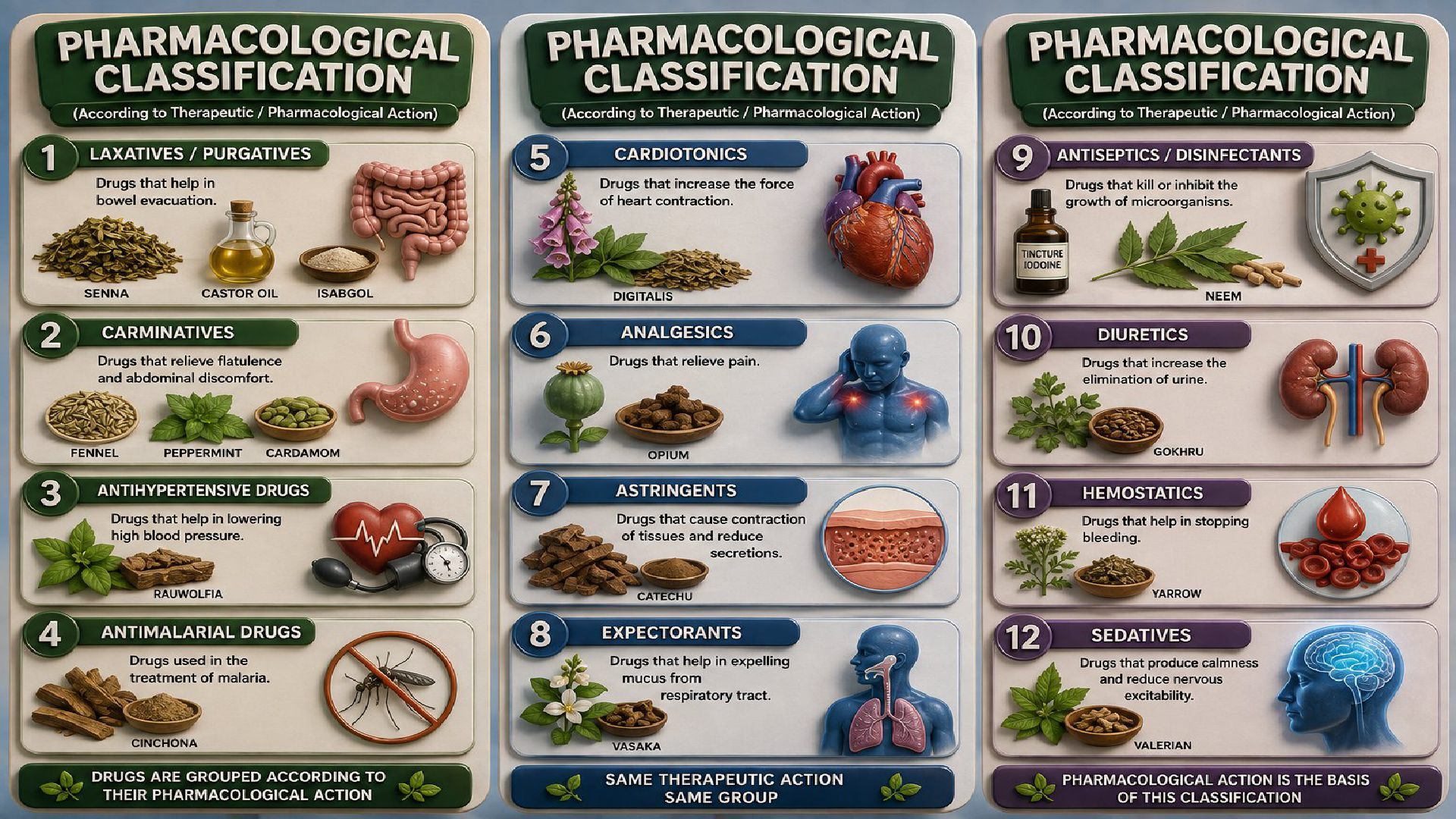
  19. 5. Pharmacological Classification In pharmacological classification, crude drugs are grouped

    according to their pharmacological action or therapeutic use. In simple words: Drugs producing a similar type of effect are placed in the same group. Important Groups 1. Laxatives / Purgatives These drugs help in bowel movement. Examples:  Senna  Castor oil  Isabgol
  20. 2. Carminatives These drugs help in relieving gas and intestinal

    discomfort. Examples:  Fennel  Peppermint  Cardamom  Ginger 3. Antihypertensive drugs These help in reducing high blood pressure. Example:  Rauwolfia
  21. 5. Cardiotonics These drugs affect cardiac function and have historically

    been used in heart conditions. Example:  Digitalis 6. Analgesics:- These drugs help relieve pain. Example:  Opium 7. Astringents These cause contraction of tissues and are used for their astringent effects. Examples:  Catechu  Nutgall
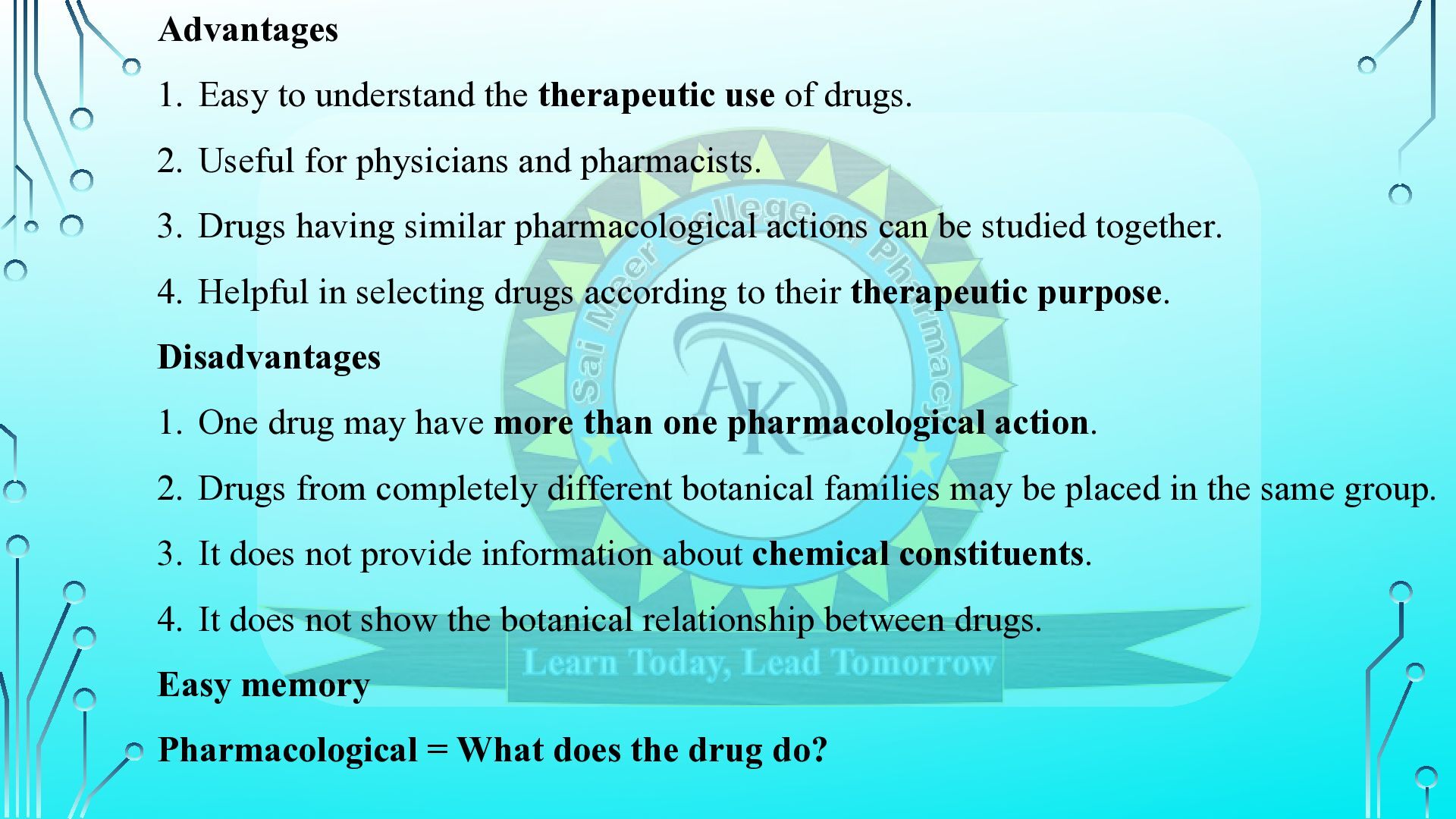
  22. Advantages 1. Easy to understand the therapeutic use of drugs.

    2. Useful for physicians and pharmacists. 3. Drugs having similar pharmacological actions can be studied together. 4. Helpful in selecting drugs according to their therapeutic purpose. Disadvantages 1. One drug may have more than one pharmacological action. 2. Drugs from completely different botanical families may be placed in the same group. 3. It does not provide information about chemical constituents. 4. It does not show the botanical relationship between drugs. Easy memory Pharmacological = What does the drug do?
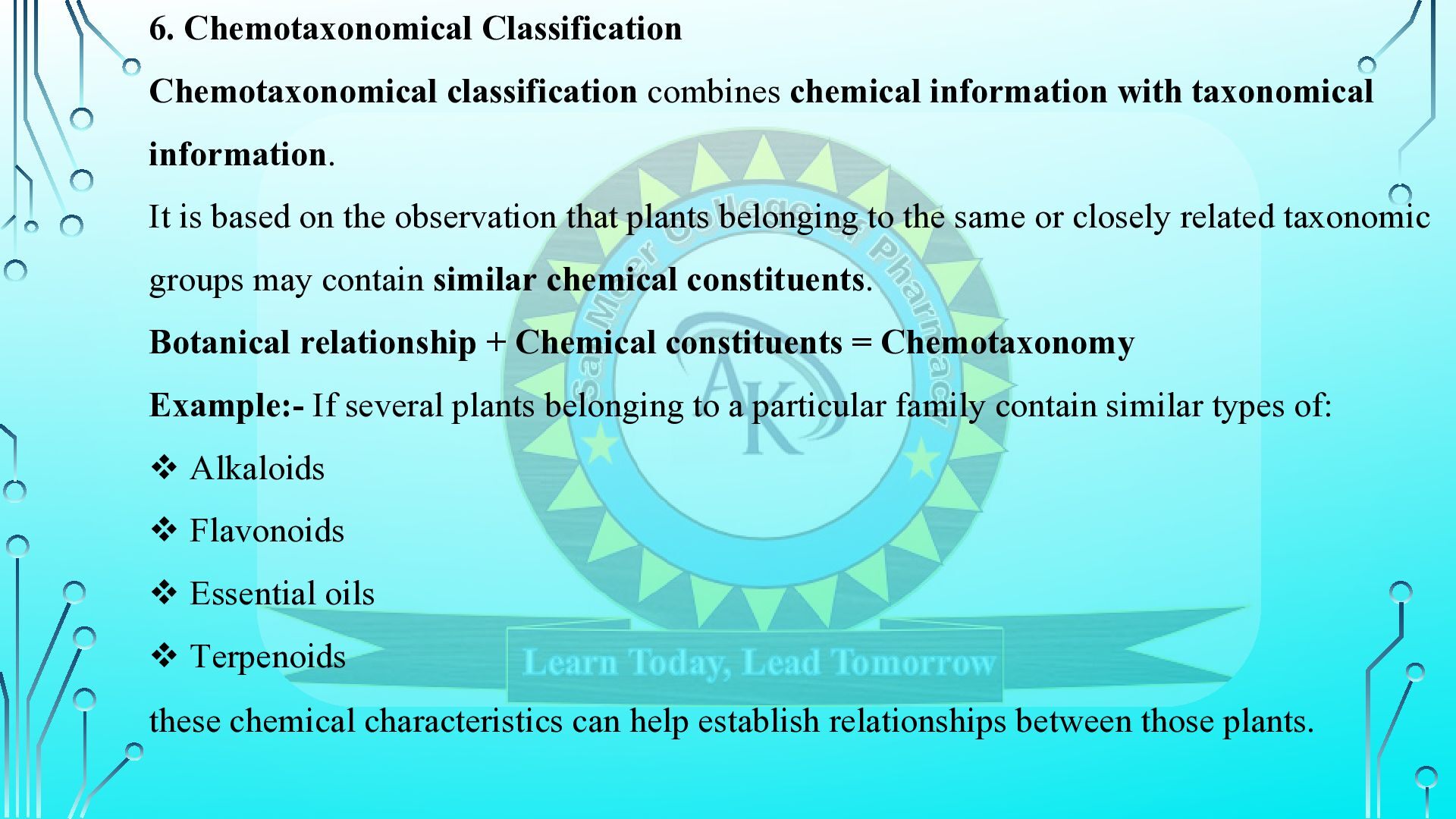
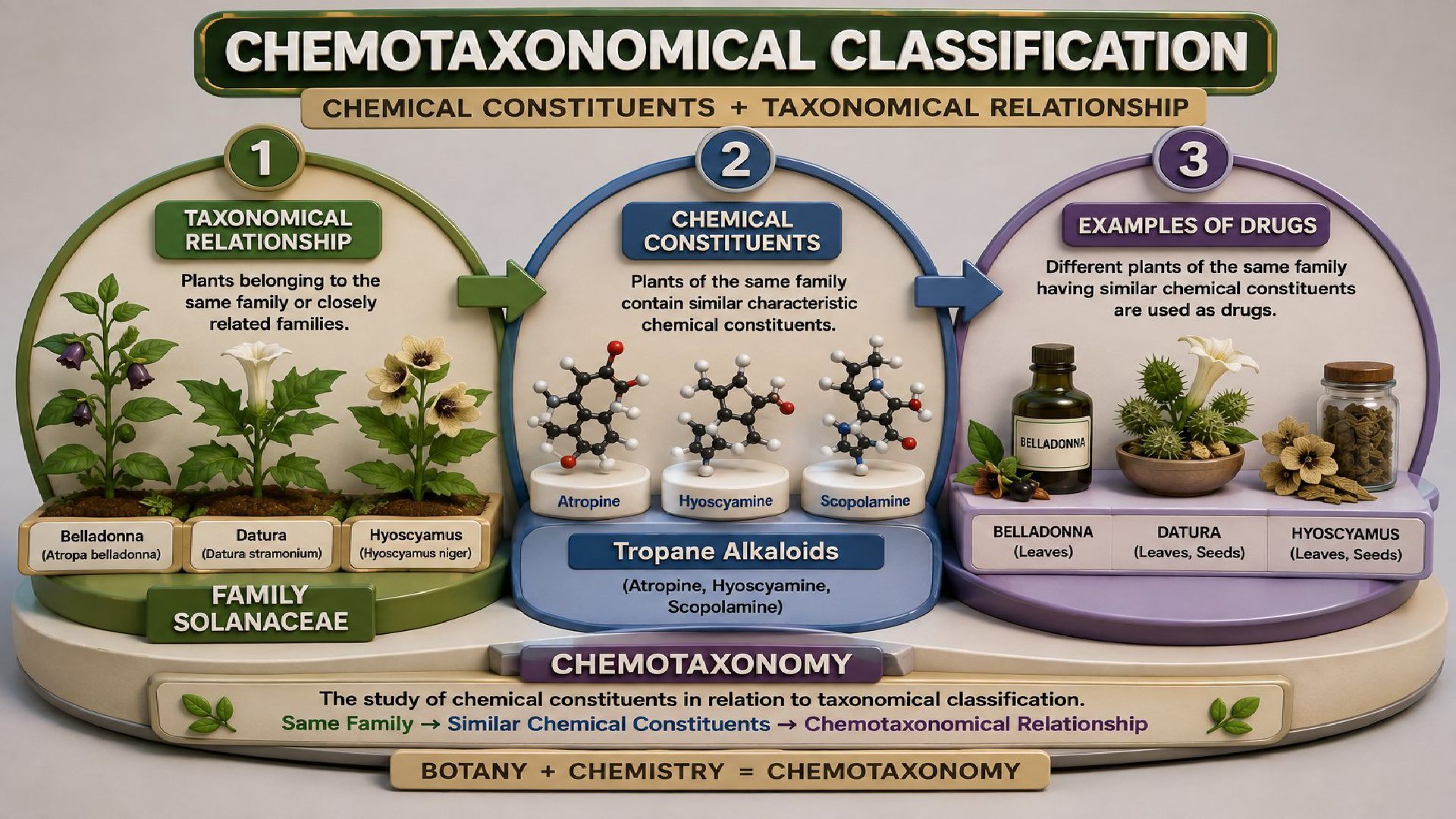
  23. 6. Chemotaxonomical Classification Chemotaxonomical classification combines chemical information with taxonomical

    information. It is based on the observation that plants belonging to the same or closely related taxonomic groups may contain similar chemical constituents. Botanical relationship + Chemical constituents = Chemotaxonomy Example:- If several plants belonging to a particular family contain similar types of:  Alkaloids  Flavonoids  Essential oils  Terpenoids these chemical characteristics can help establish relationships between those plants.
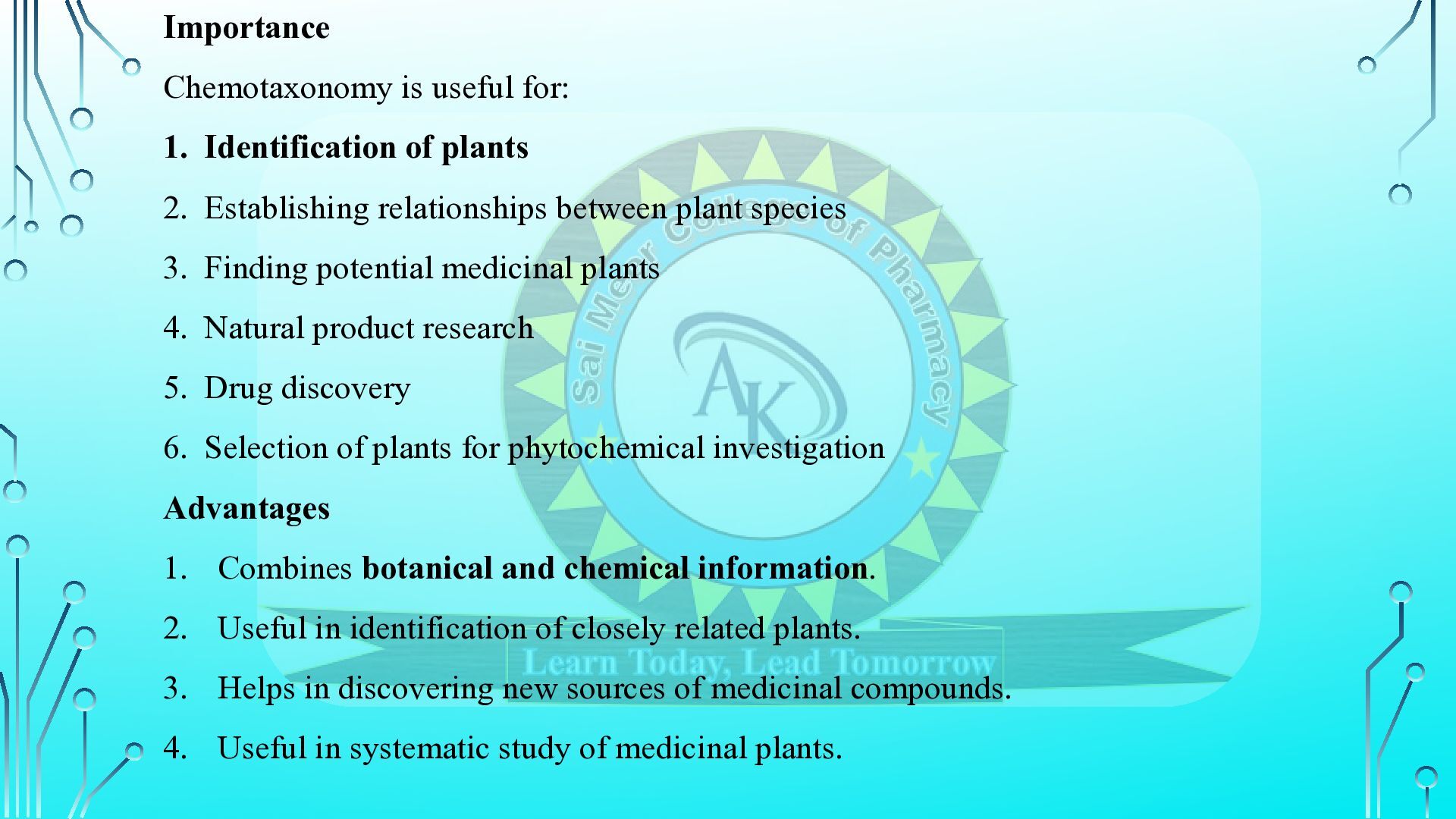
  24. Importance Chemotaxonomy is useful for: 1. Identification of plants 2.

    Establishing relationships between plant species 3. Finding potential medicinal plants 4. Natural product research 5. Drug discovery 6. Selection of plants for phytochemical investigation Advantages 1. Combines botanical and chemical information. 2. Useful in identification of closely related plants. 3. Helps in discovering new sources of medicinal compounds. 4. Useful in systematic study of medicinal plants.
  25. Disadvantages  Requires knowledge of botany and chemistry.  Chemical

    constituents can vary depending on:  Climate  Soil  Age of plant  Geographical location  Season  Closely related plants do not always have exactly the same chemical constituents. Easy memory Chemotaxonomy = Chemical constituents + Taxonomy
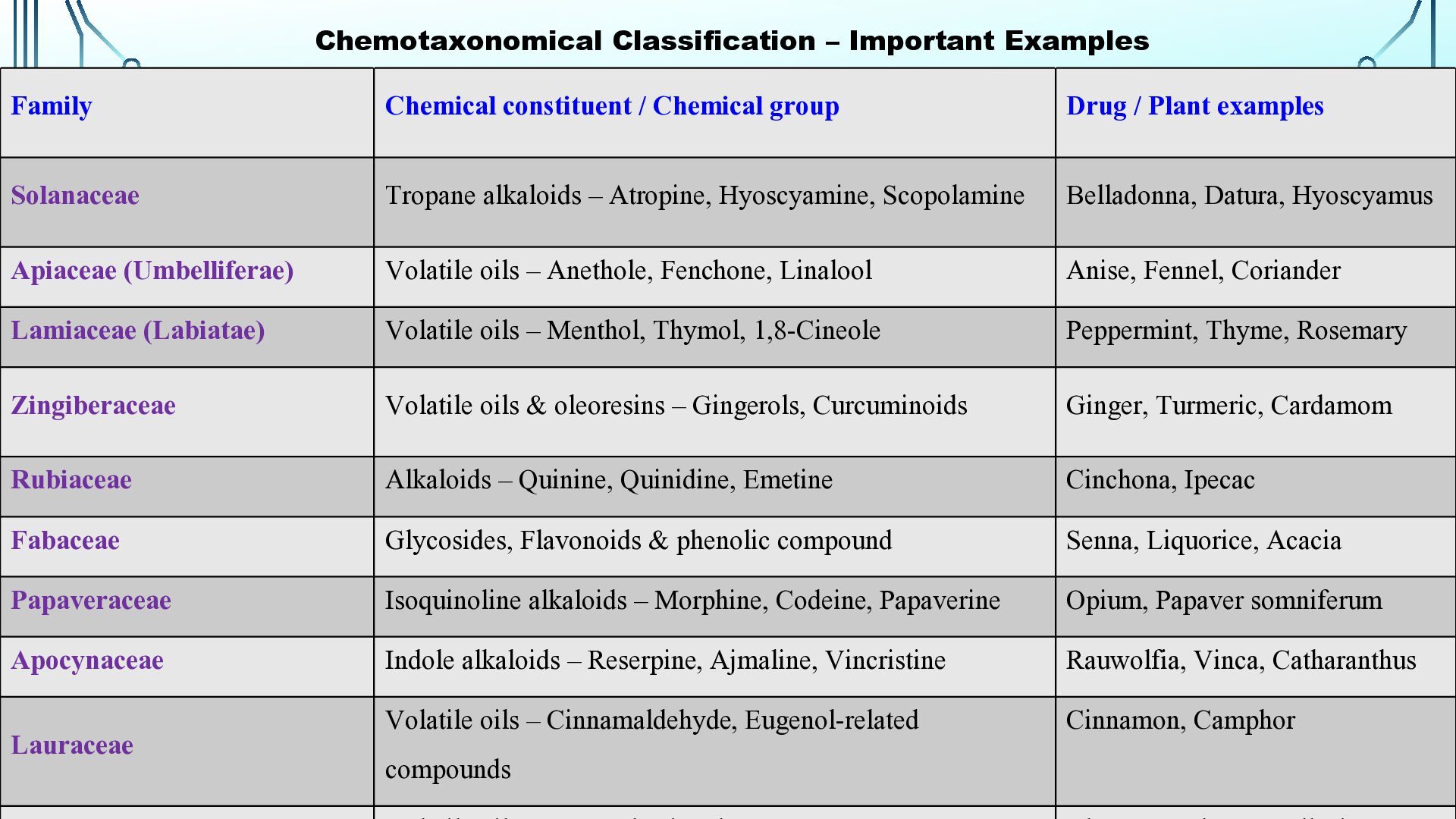
  26. Chemotaxonomical Classification – Important Examples Family Chemical constituent / Chemical

    group Drug / Plant examples Solanaceae Tropane alkaloids – Atropine, Hyoscyamine, Scopolamine Belladonna, Datura, Hyoscyamus Apiaceae (Umbelliferae) Volatile oils – Anethole, Fenchone, Linalool Anise, Fennel, Coriander Lamiaceae (Labiatae) Volatile oils – Menthol, Thymol, 1,8-Cineole Peppermint, Thyme, Rosemary Zingiberaceae Volatile oils & oleoresins – Gingerols, Curcuminoids Ginger, Turmeric, Cardamom Rubiaceae Alkaloids – Quinine, Quinidine, Emetine Cinchona, Ipecac Fabaceae Glycosides, Flavonoids & phenolic compound Senna, Liquorice, Acacia Papaveraceae Isoquinoline alkaloids – Morphine, Codeine, Papaverine Opium, Papaver somniferum Apocynaceae Indole alkaloids – Reserpine, Ajmaline, Vincristine Rauwolfia, Vinca, Catharanthus Volatile oils – Cinnamaldehyde, Eugenol-related Cinnamon, Camphor Lauraceae compounds
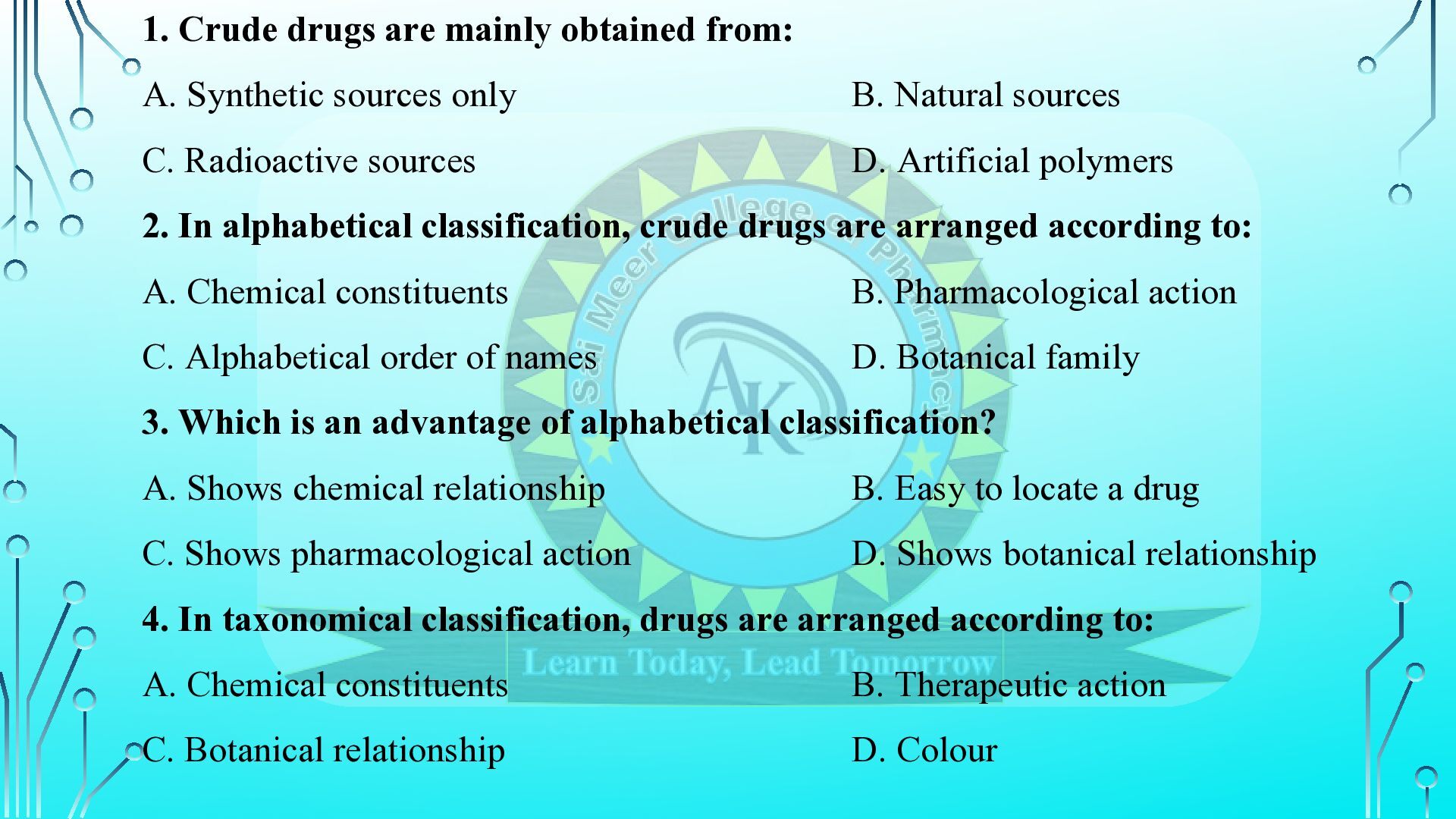
  27. 1. Crude drugs are mainly obtained from: A. Synthetic sources

    only C. Radioactive sources B. Natural sources D. Artificial polymers 2. In alphabetical classification, crude drugs are arranged according to: A. Chemical constituents C. Alphabetical order of names B. Pharmacological action D. Botanical family 3. Which is an advantage of alphabetical classification? A. Shows chemical relationship C. Shows pharmacological action B. Easy to locate a drug D. Shows botanical relationship 4. In taxonomical classification, drugs are arranged according to: A. Chemical constituents C. Botanical relationship B. Therapeutic action D. Colour
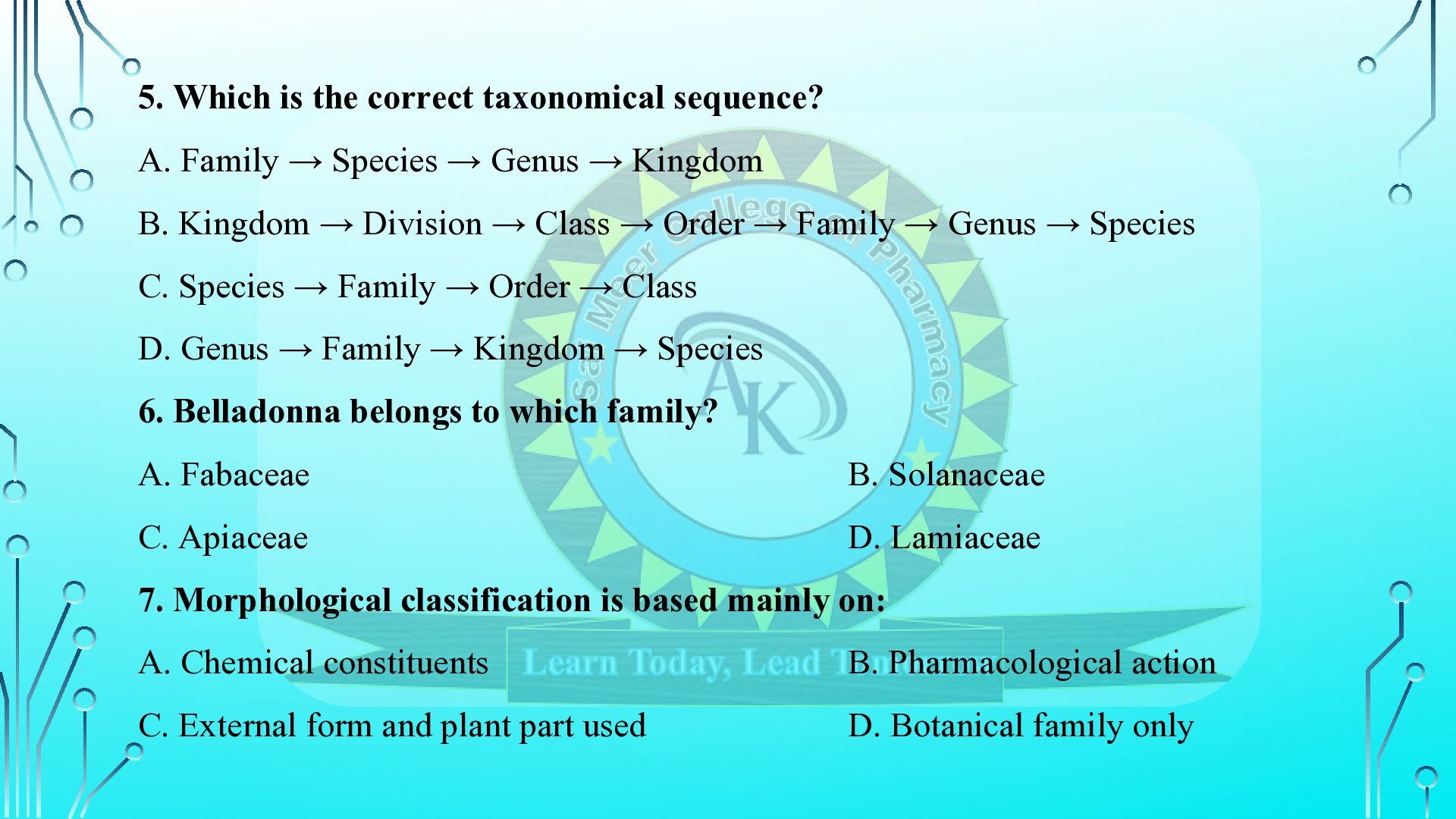
  28. 5. Which is the correct taxonomical sequence? A. Family →

    Species → Genus → Kingdom B. Kingdom → Division → Class → Order → Family → Genus → Species C. Species → Family → Order → Class D. Genus → Family → Kingdom → Species 6. Belladonna belongs to which family? A. Fabaceae C. Apiaceae B. Solanaceae D. Lamiaceae 7. Morphological classification is based mainly on: A. Chemical constituents C. External form and plant part used B. Pharmacological action D. Botanical family only
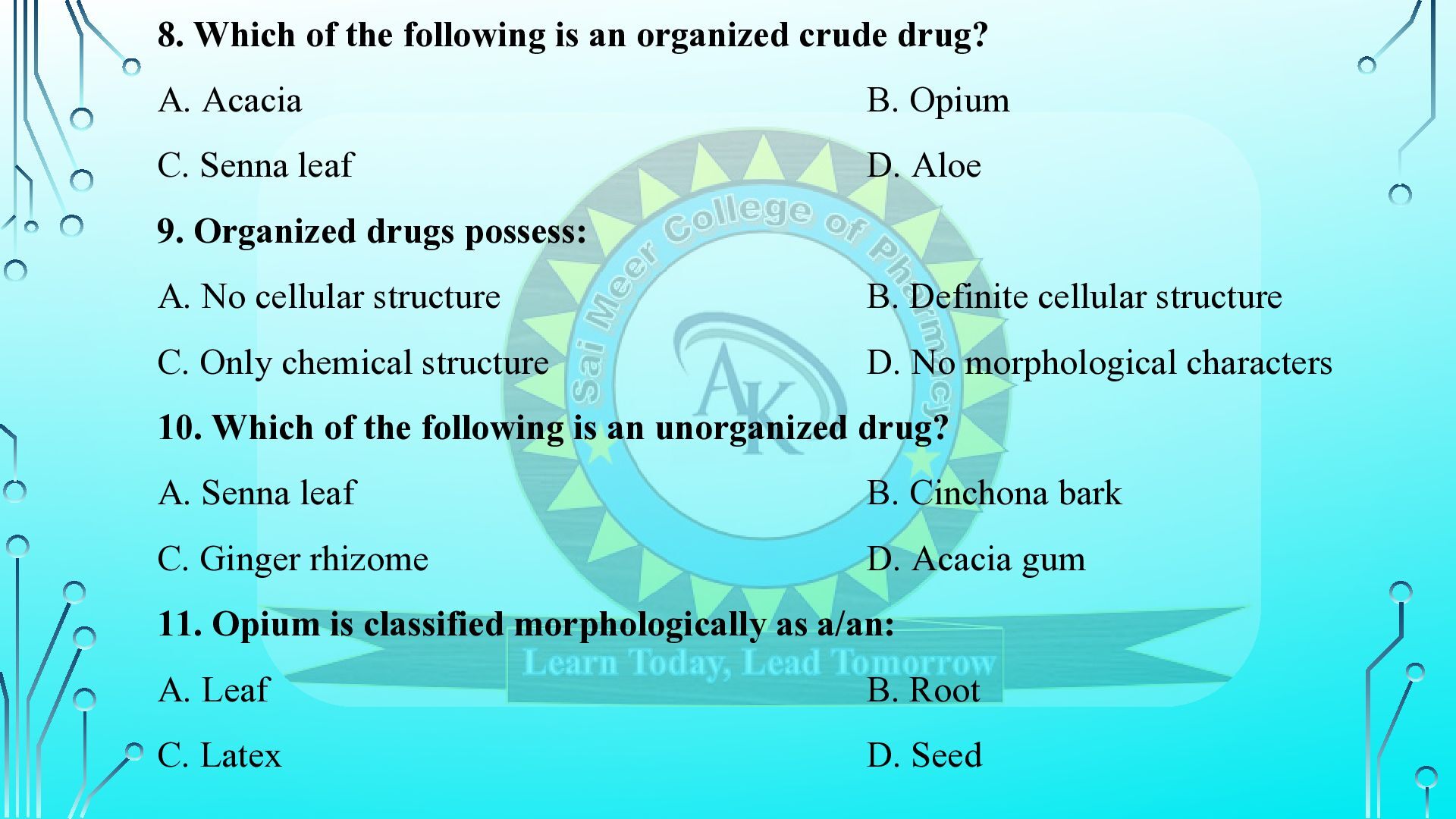
  29. 8. Which of the following is an organized crude drug?

    A. Acacia C. Senna leaf 9. Organized drugs possess: A. No cellular structure C. Only chemical structure B. Opium D. Aloe B. Definite cellular structure D. No morphological characters 10. Which of the following is an unorganized drug? A. Senna leaf C. Ginger rhizome B. Cinchona bark D. Acacia gum 11. Opium is classified morphologically as a/an: A. Leaf C. Latex B. Root D. Seed
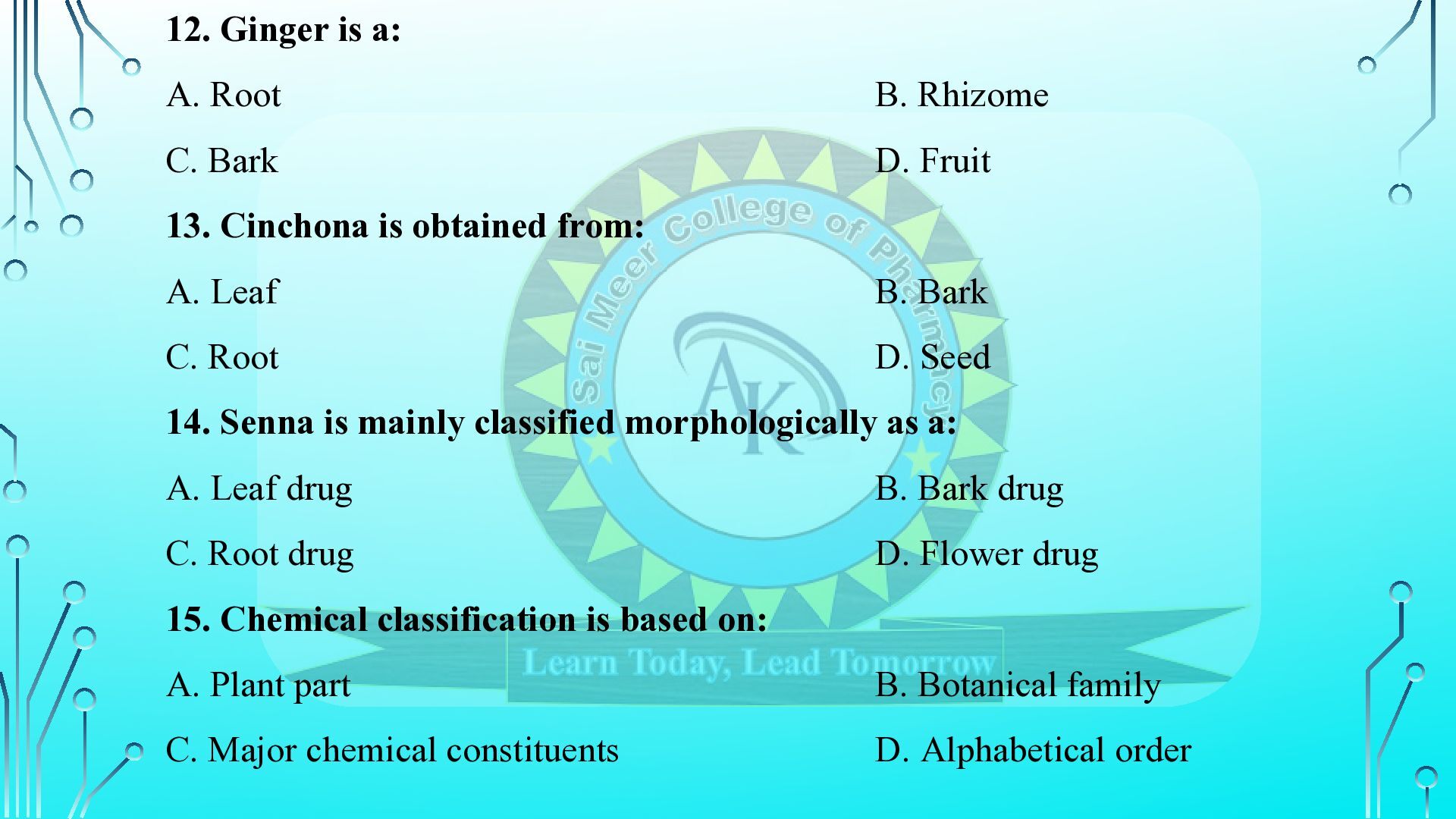
  30. 12. Ginger is a: A. Root C. Bark 13. Cinchona

    is obtained from: A. Leaf C. Root B. Rhizome D. Fruit B. Bark D. Seed 14. Senna is mainly classified morphologically as a: A. Leaf drug C. Root drug 15. Chemical classification is based on: A. Plant part C. Major chemical constituents B. Bark drug D. Flower drug B. Botanical family D. Alphabetical order
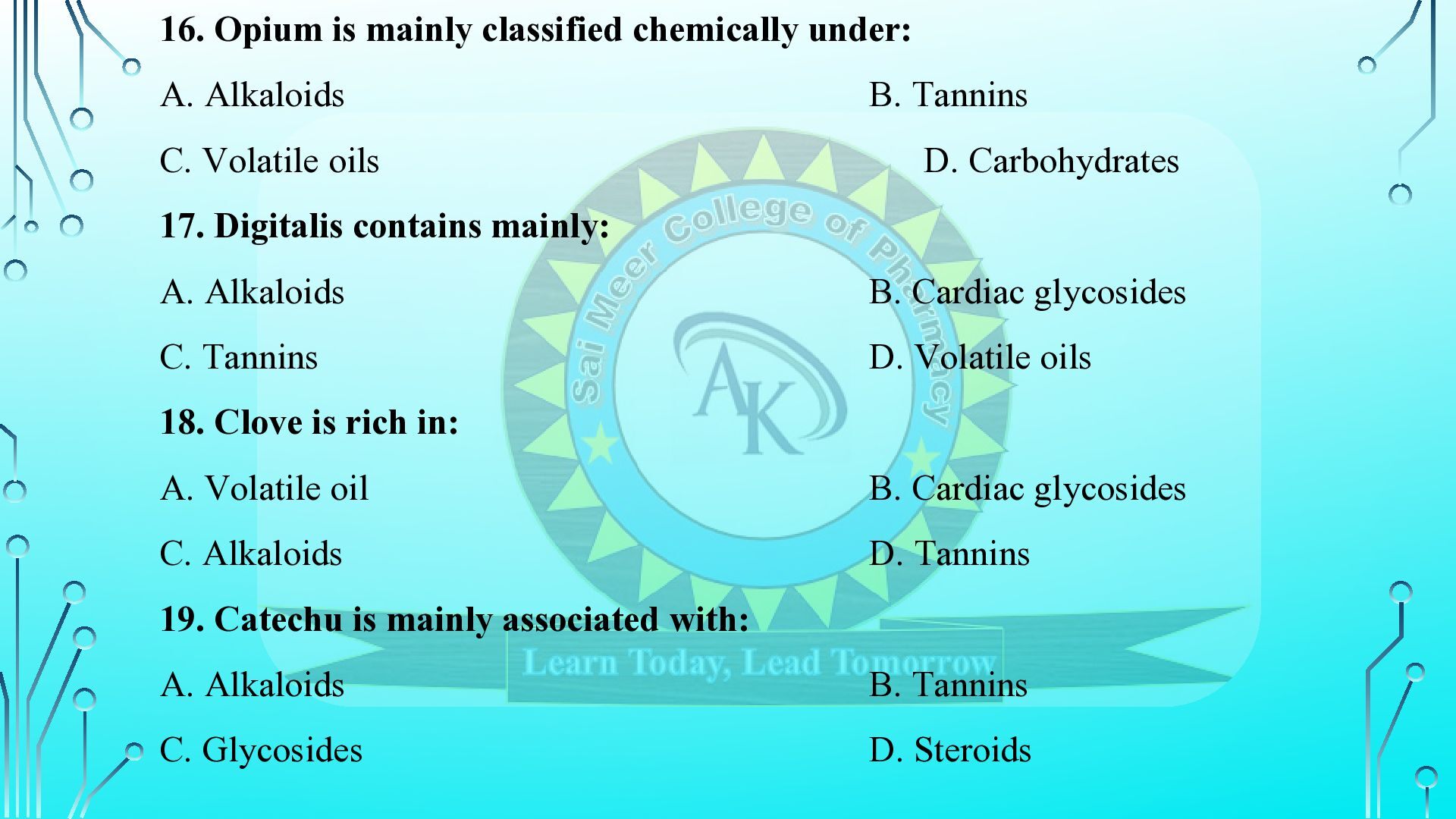
  31. 16. Opium is mainly classified chemically under: A. Alkaloids C.

    Volatile oils 17. Digitalis contains mainly: A. Alkaloids C. Tannins 18. Clove is rich in: A. Volatile oil C. Alkaloids 19. Catechu is mainly associated with: A. Alkaloids C. Glycosides B. Tannins D. Carbohydrates B. Cardiac glycosides D. Volatile oils B. Cardiac glycosides D. Tannins B. Tannins D. Steroids
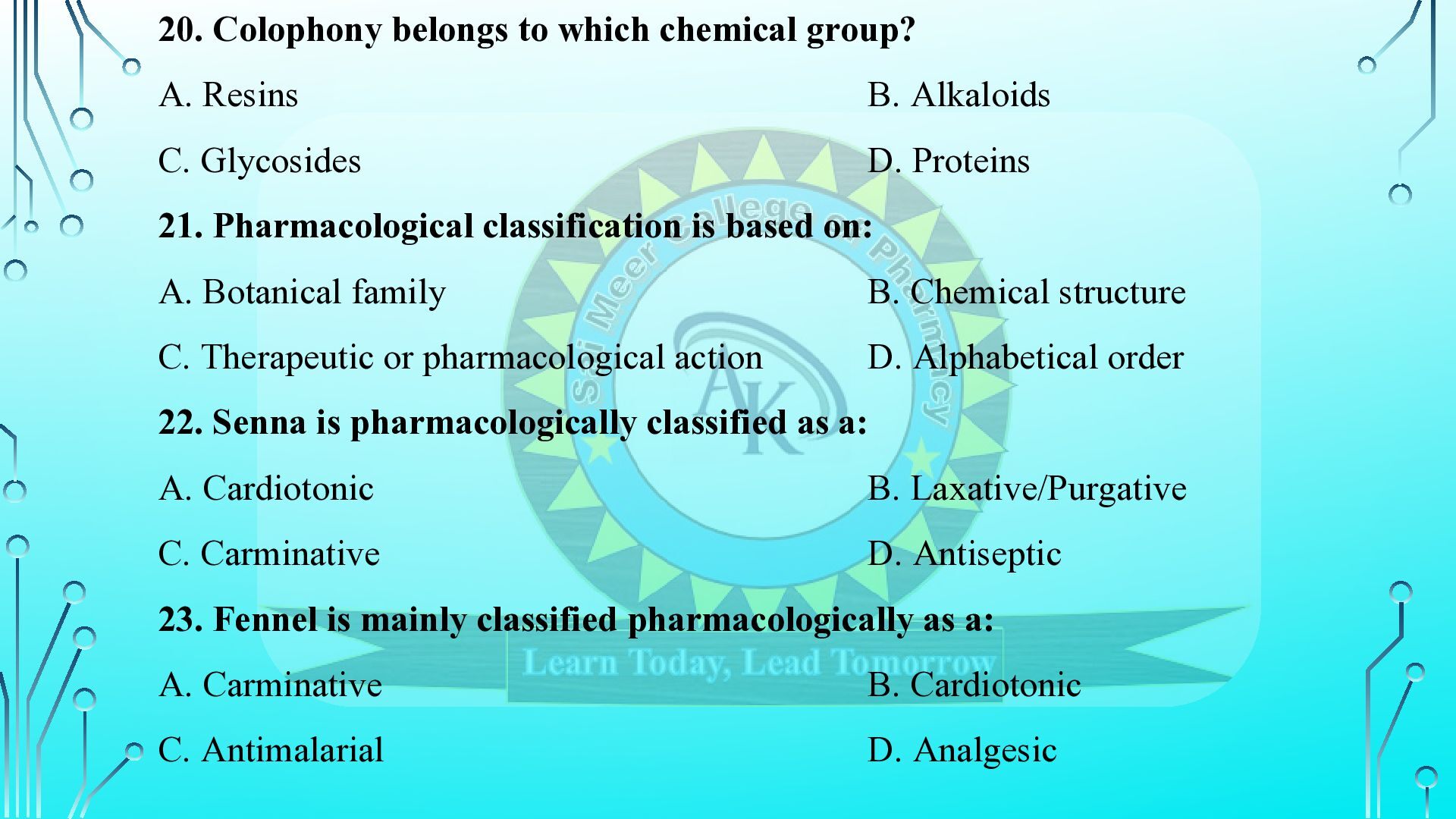
  32. 20. Colophony belongs to which chemical group? A. Resins C.

    Glycosides B. Alkaloids D. Proteins 21. Pharmacological classification is based on: A. Botanical family C. Therapeutic or pharmacological action B. Chemical structure D. Alphabetical order 22. Senna is pharmacologically classified as a: A. Cardiotonic C. Carminative B. Laxative/Purgative D. Antiseptic 23. Fennel is mainly classified pharmacologically as a: A. Carminative C. Antimalarial B. Cardiotonic D. Analgesic
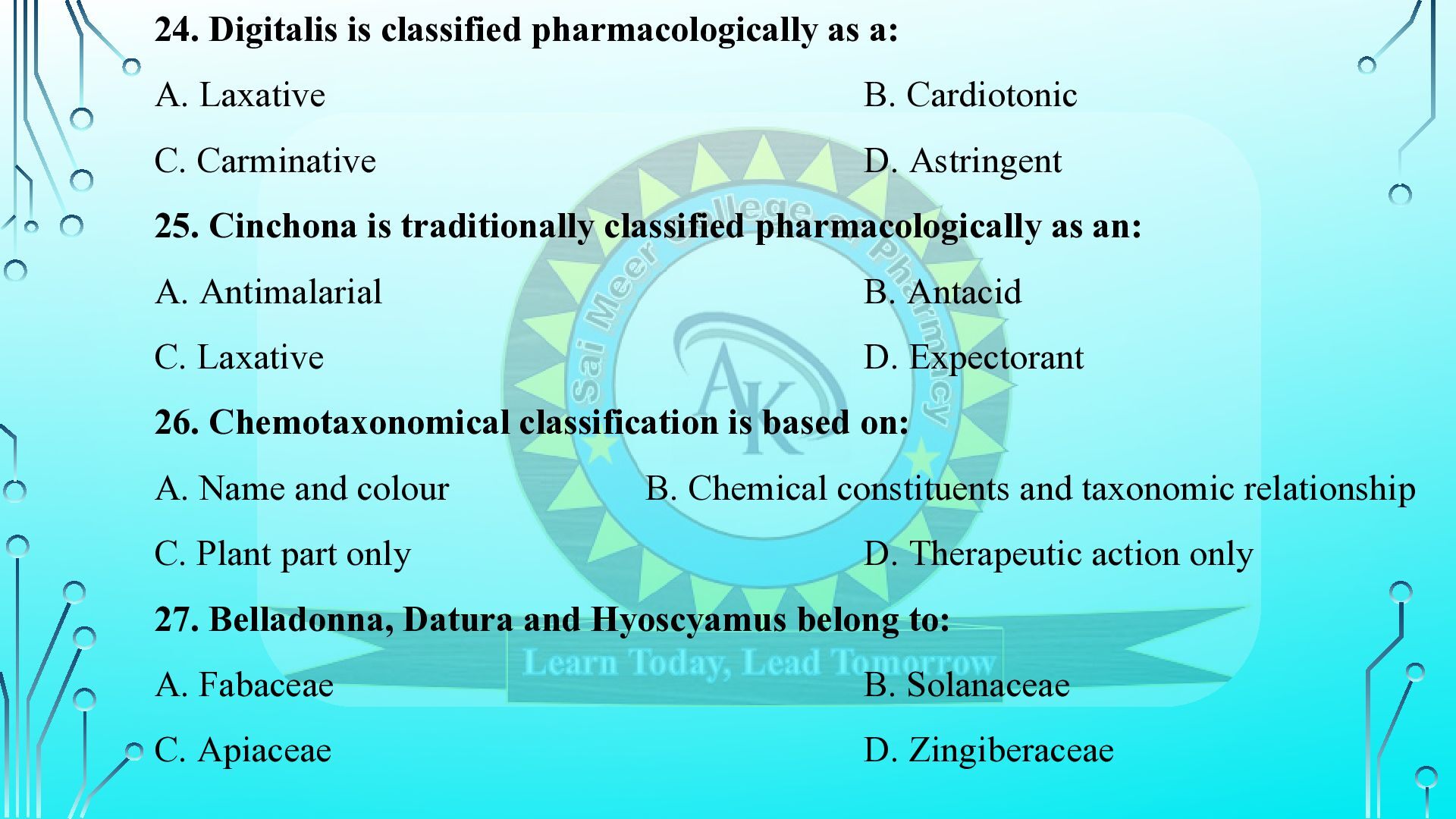
  33. 24. Digitalis is classified pharmacologically as a: A. Laxative C.

    Carminative B. Cardiotonic D. Astringent 25. Cinchona is traditionally classified pharmacologically as an: A. Antimalarial C. Laxative B. Antacid D. Expectorant 26. Chemotaxonomical classification is based on: A. Name and colour C. Plant part only B. Chemical constituents and taxonomic relationship D. Therapeutic action only 27. Belladonna, Datura and Hyoscyamus belong to: A. Fabaceae C. Apiaceae B. Solanaceae D. Zingiberaceae
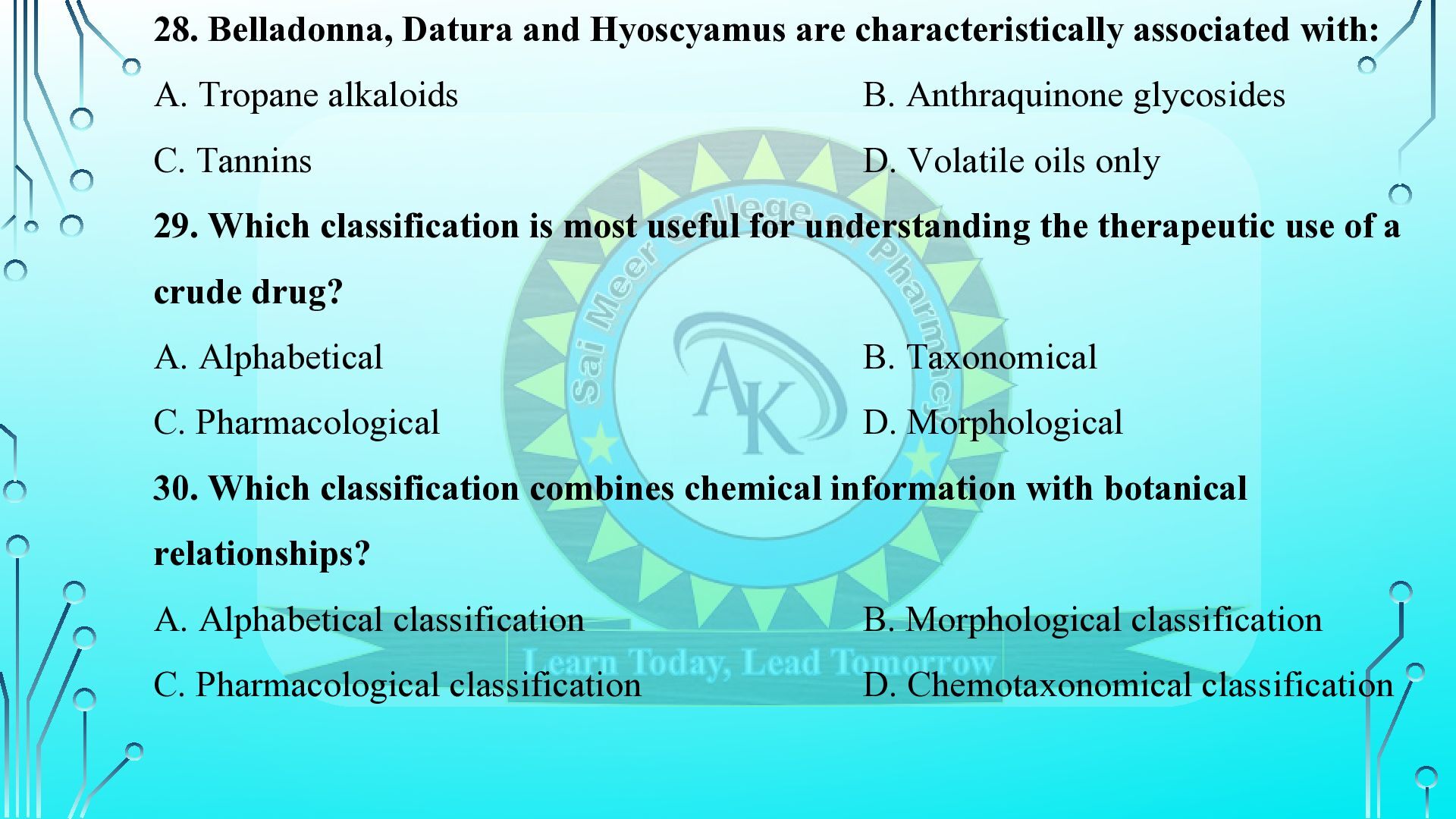
  34. 28. Belladonna, Datura and Hyoscyamus are characteristically associated with: A.

    Tropane alkaloids C. Tannins B. Anthraquinone glycosides D. Volatile oils only 29. Which classification is most useful for understanding the therapeutic use of a crude drug? A. Alphabetical C. Pharmacological B. Taxonomical D. Morphological 30. Which classification combines chemical information with botanical relationships? A. Alphabetical classification C. Pharmacological classification B. Morphological classification D. Chemotaxonomical classification
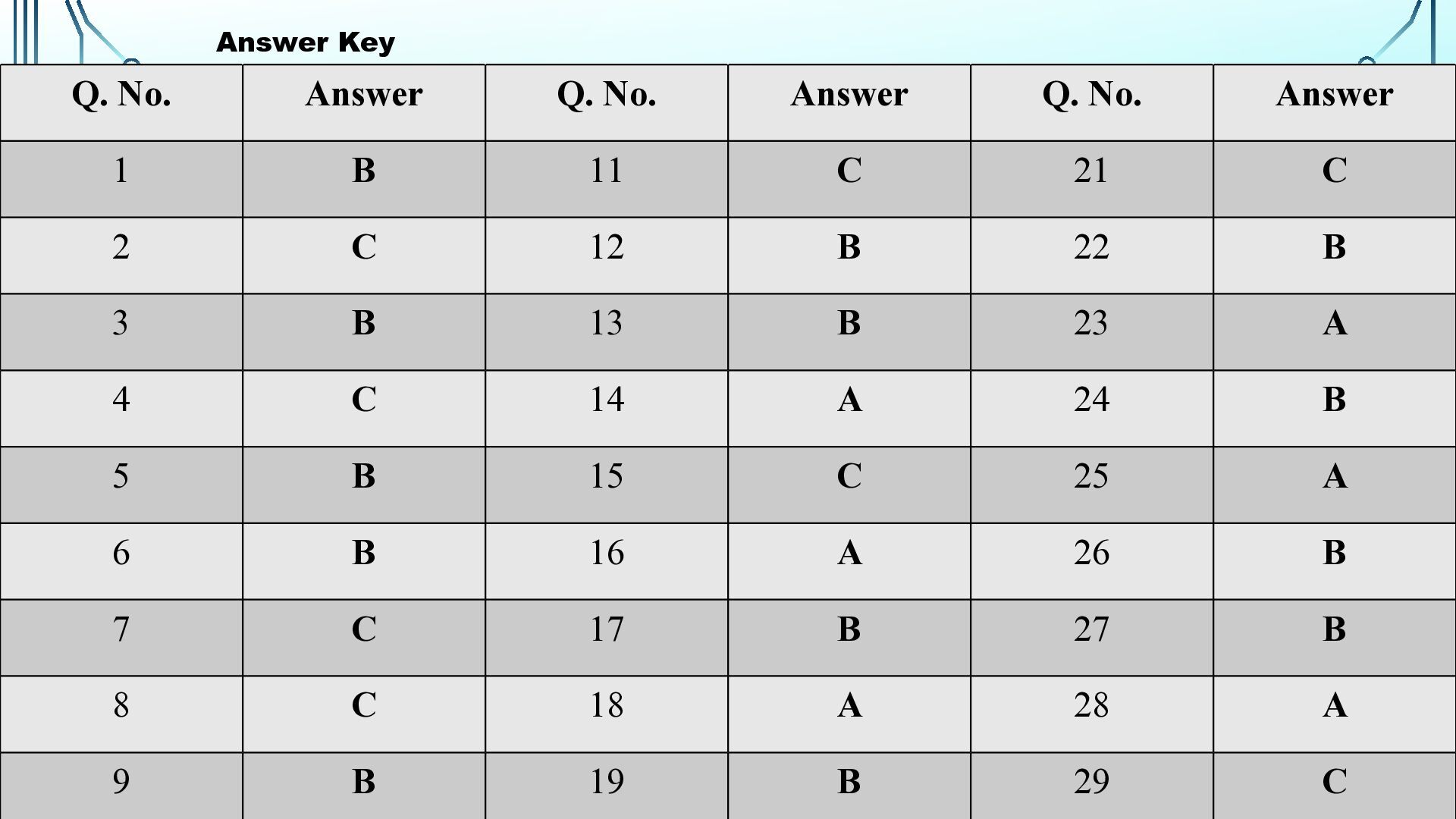
  35. Q. No. Answer Key Answer Q. No. Answer Q. No.

    Answer 1 B 11 C 21 C 2 C 12 B 22 B 3 B 13 B 23 A 4 C 14 A 24 B 5 B 15 C 25 A 6 B 16 A 26 B 7 C 17 B 27 B 8 C 18 A 28 A 9 B 19 B 29 C

More Decks by Arun Kumar

Other Decks in Education