This will help class 8 student in learning about
CONQUEST OF BENGAL
BATTLE OF PLASSEY
BATTLE OF BUXAR
DUAL GOVERNMENT IN BENGAL
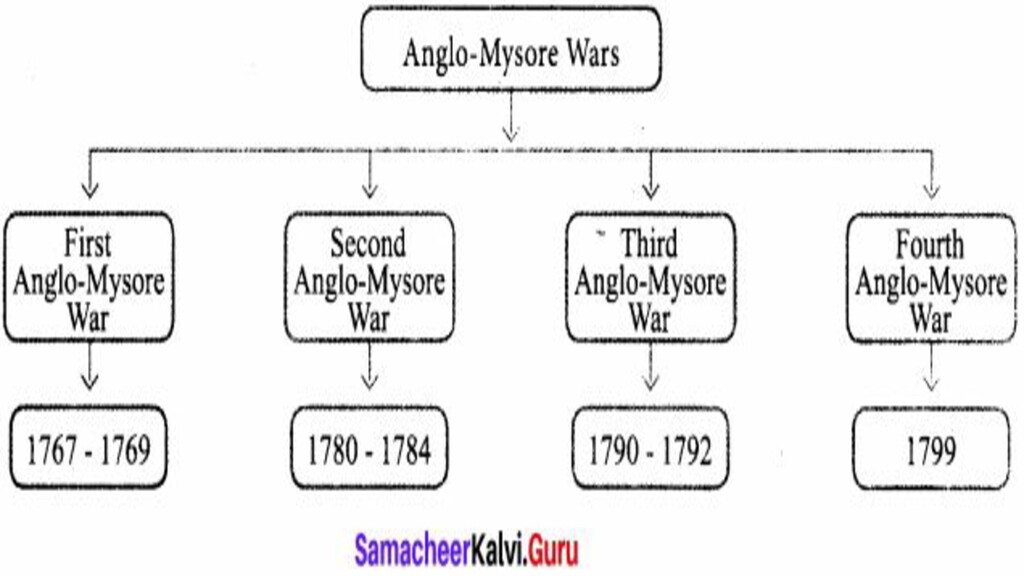
ANGLO-MYSORE WAR
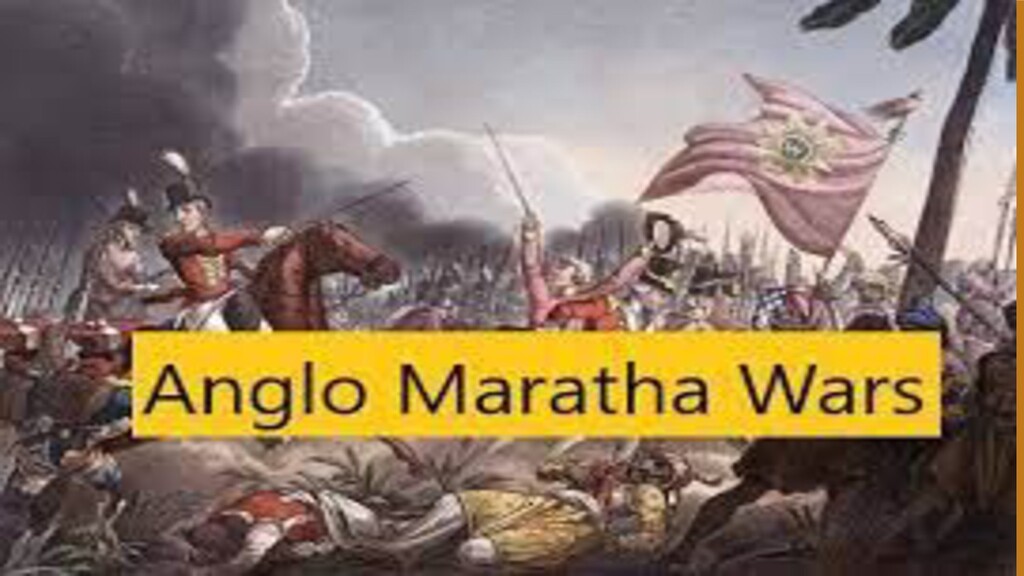
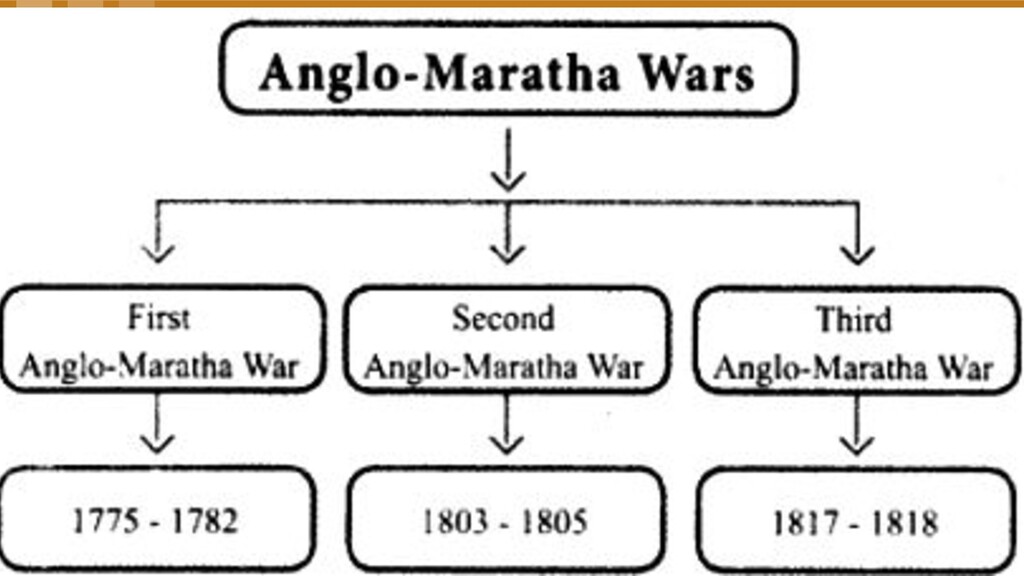
ANGLO-MARATHA WAR
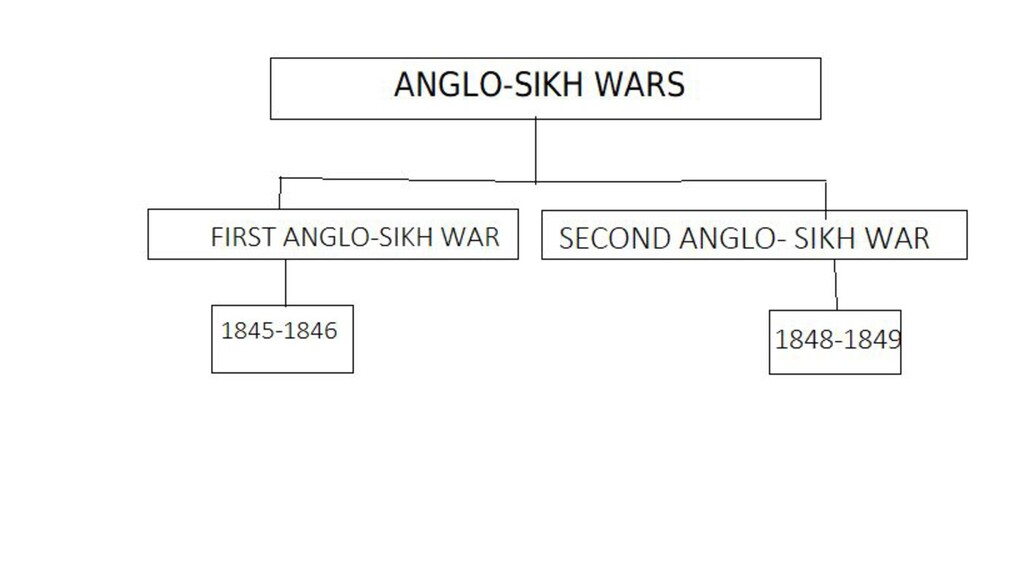
ANGLO-SIKH WAR
bengal. • Alwardi khan , the NAWAB of BENGAL , was an able administrator. He had followed a policy of keeping the European merchants under control but after his death , his grandson , Siraj-ud-Daulah became the NAWAB . • British started extending the fortification of Calcutta . meanwhile , Siraj-ud-Daulah’s troop took over Kolkata . Robert Clive set out from Madras With an army of 900 Europeans and 1200 sepoys armed and trained in in the European style of warfare and recaptured Kolkata .
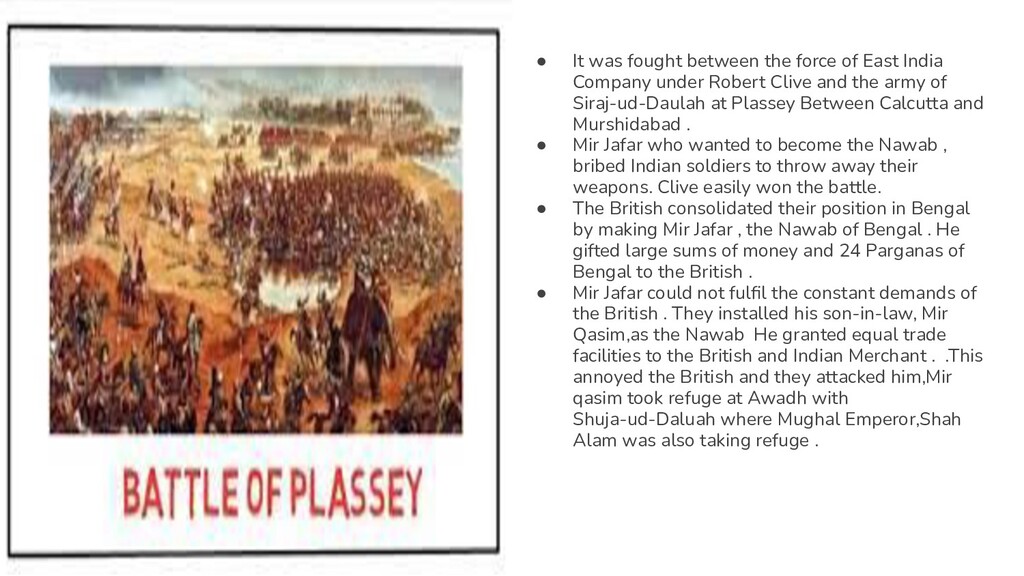
Company under Robert Clive and the army of Siraj-ud-Daulah at Plassey Between Calcutta and Murshidabad . • Mir Jafar who wanted to become the Nawab , bribed Indian soldiers to throw away their weapons. Clive easily won the battle. • The British consolidated their position in Bengal by making Mir Jafar , the Nawab of Bengal . He gifted large sums of money and 24 Parganas of Bengal to the British . • Mir Jafar could not fulfil the constant demands of the British . They installed his son-in-law, Mir Qasim,as the Nawab He granted equal trade facilities to the British and Indian Merchant . .This annoyed the British and they attacked him,Mir qasim took refuge at Awadh with Shuja-ud-Daluah where Mughal Emperor,Shah Alam was also taking refuge .
India Company rule . 2. It exposed the weakness of Indian ruler . 3. It was great economic loss along with large sum of money British also got 24 Paqrganas . 4. The British became King makers . 5. Power of British army was recognised .
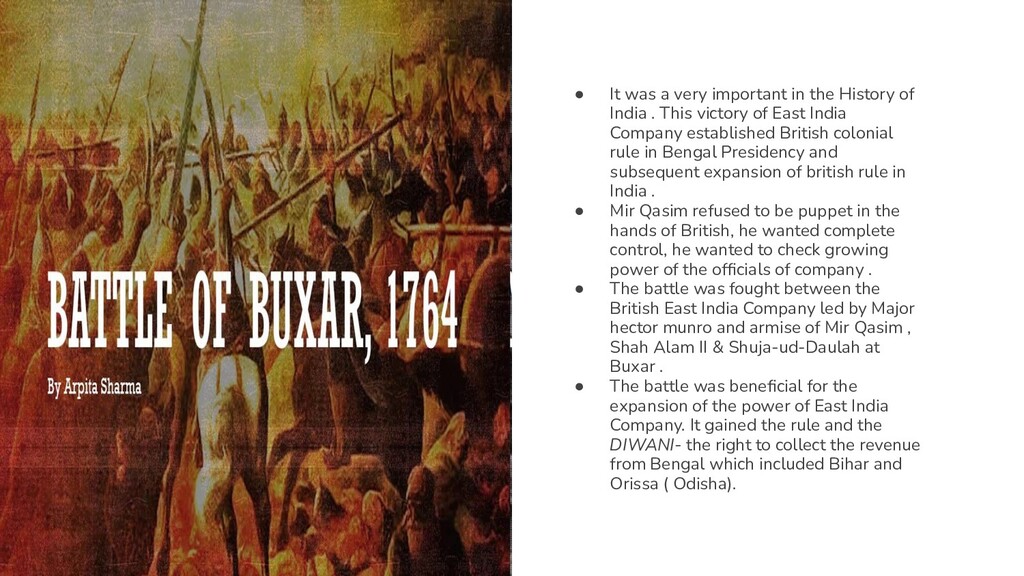
India . This victory of East India Company established British colonial rule in Bengal Presidency and subsequent expansion of british rule in India . • Mir Qasim refused to be puppet in the hands of British, he wanted complete control, he wanted to check growing power of the officials of company . • The battle was fought between the British East India Company led by Major hector munro and armise of Mir Qasim , Shah Alam II & Shuja-ud-Daulah at Buxar . • The battle was beneficial for the expansion of the power of East India Company. It gained the rule and the DIWANI- the right to collect the revenue from Bengal which included Bihar and Orissa ( Odisha).
of Mir Qasim,Shah Alam II (Mugal Emperor ) and Shuja-ud-Daulah(Nawab of Awadh) got defeated. 2. It not only exposed the weakness of Indian ruler it also exposed prestige.of India . 3. It was a great loss , Diwani of Bengal , total area got in hand of British . 4. British demanded war expenses . 5. Nawab of Awad’s province Allahabad Kohar was given to British. 6. Mugal emperor were bide under Delhi & they became pensioner . .
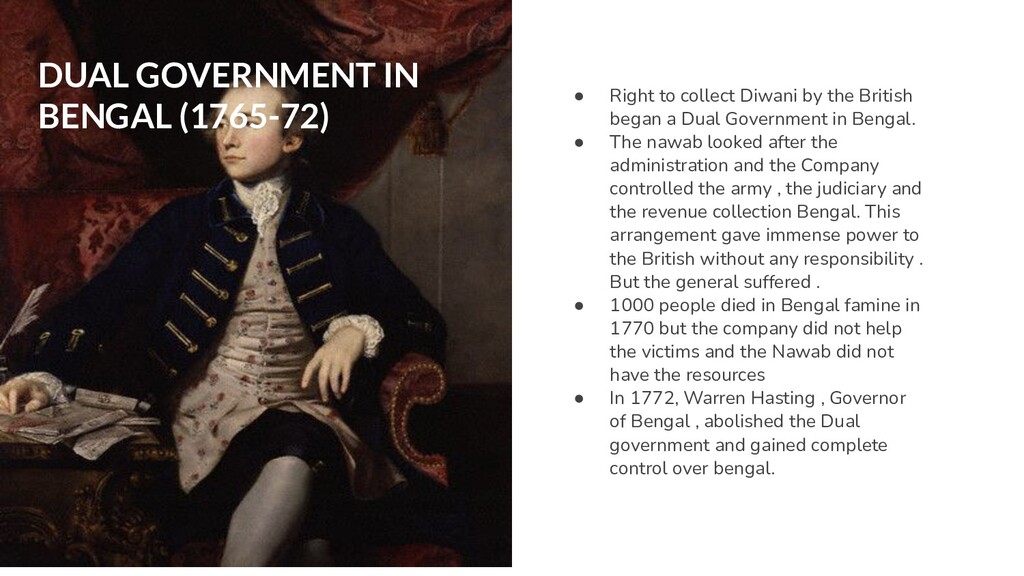
Dual Government in Bengal. • The nawab looked after the administration and the Company controlled the army , the judiciary and the revenue collection Bengal. This arrangement gave immense power to the British without any responsibility . But the general suffered . • 1000 people died in Bengal famine in 1770 but the company did not help the victims and the Nawab did not have the resources • In 1772, Warren Hasting , Governor of Bengal , abolished the Dual government and gained complete control over bengal. DUAL GOVERNMENT IN BENGAL (1765-72)
advantage out of this system of administration introduced by Robert Clive. By the time Diarchy was discontinued, much damage was done to Bengal and her people. The evil effects of the Diarchy may be summed up in the following words: 1. the scheme of Double Government as’ devised by Clive proved ineffective from the very beginning. 2. the system brought immense suffering to the cultivators of Bengal. They were subjected to coercion by the revenue officials of the government controlled by the Company. 3. the servants of the Company monopolized trade and commerce of Bengal. Also they forced the weavers to sell the cotton-goods at a price even lower than the cost of production. 4. the East India Company considered the Double Government to be a legal permit to milk the country out. 5. the abuses of the Dual Government manifested itself in the worst form in the Great Famine of 1770 in Bengal.
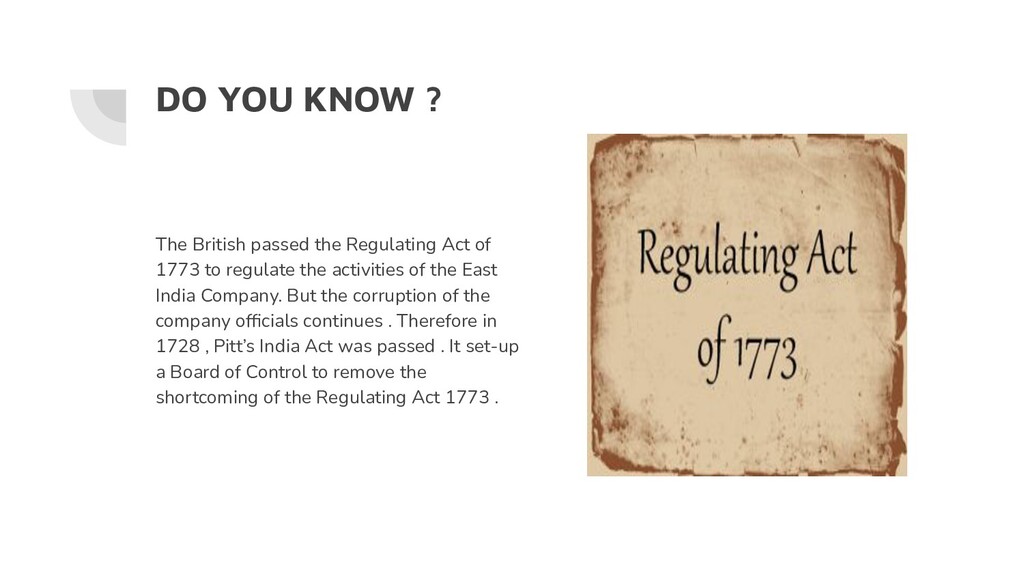
of 1773 to regulate the activities of the East India Company. But the corruption of the company officials continues . Therefore in 1728 , Pitt’s India Act was passed . It set-up a Board of Control to remove the shortcoming of the Regulating Act 1773 .
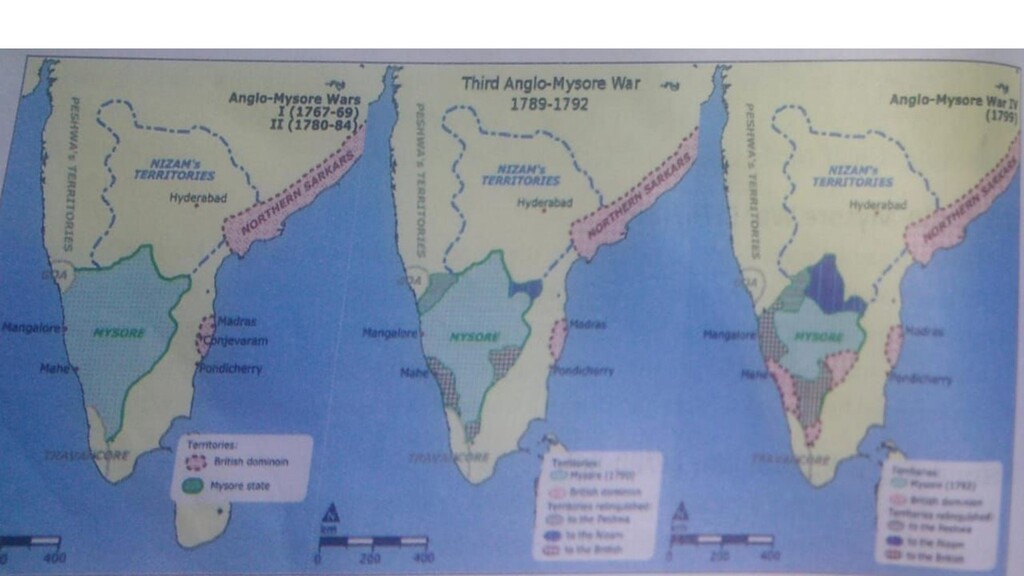
in 1760 , Hyder Ali became the ruler of Mysore . • He extend his territories over Bednore , Sundre, Sera , Canara and Guti and also subjugated some parts of the south India . At this time , Warren Hasting faced stiff resist from Marathas in the north and Hyper Ali in Mysore •
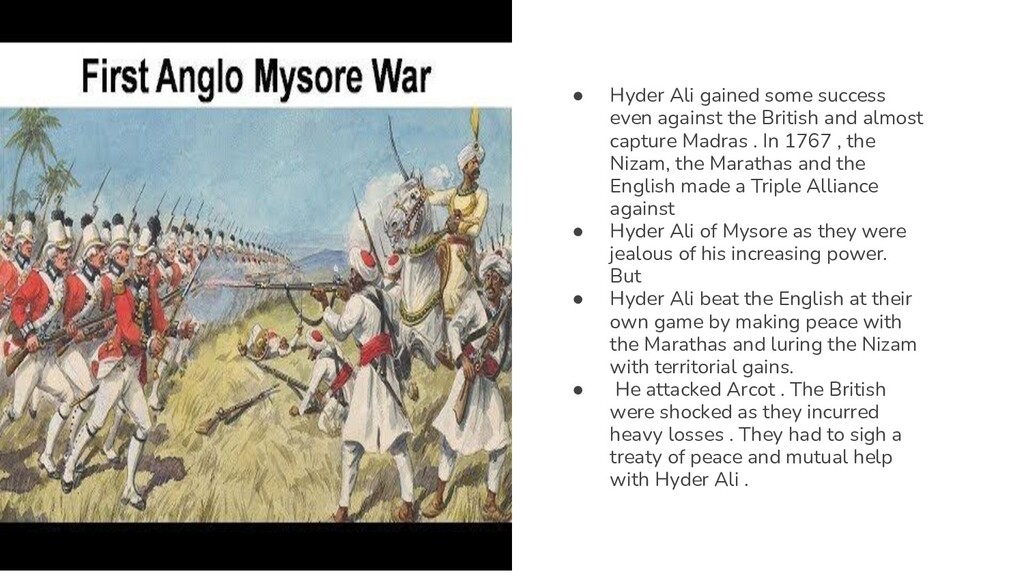
and almost capture Madras . In 1767 , the Nizam, the Marathas and the English made a Triple Alliance against • Hyder Ali of Mysore as they were jealous of his increasing power. But • Hyder Ali beat the English at their own game by making peace with the Marathas and luring the Nizam with territorial gains. • He attacked Arcot . The British were shocked as they incurred heavy losses . They had to sigh a treaty of peace and mutual help with Hyder Ali .
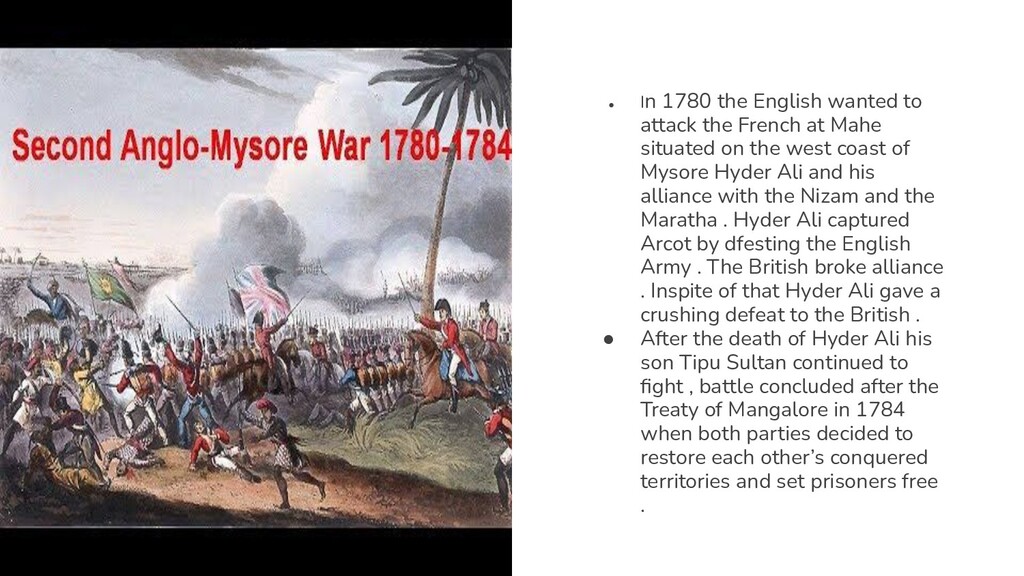
at Mahe situated on the west coast of Mysore Hyder Ali and his alliance with the Nizam and the Maratha . Hyder Ali captured Arcot by dfesting the English Army . The British broke alliance . Inspite of that Hyder Ali gave a crushing defeat to the British . • After the death of Hyder Ali his son Tipu Sultan continued to fight , battle concluded after the Treaty of Mangalore in 1784 when both parties decided to restore each other’s conquered territories and set prisoners free .
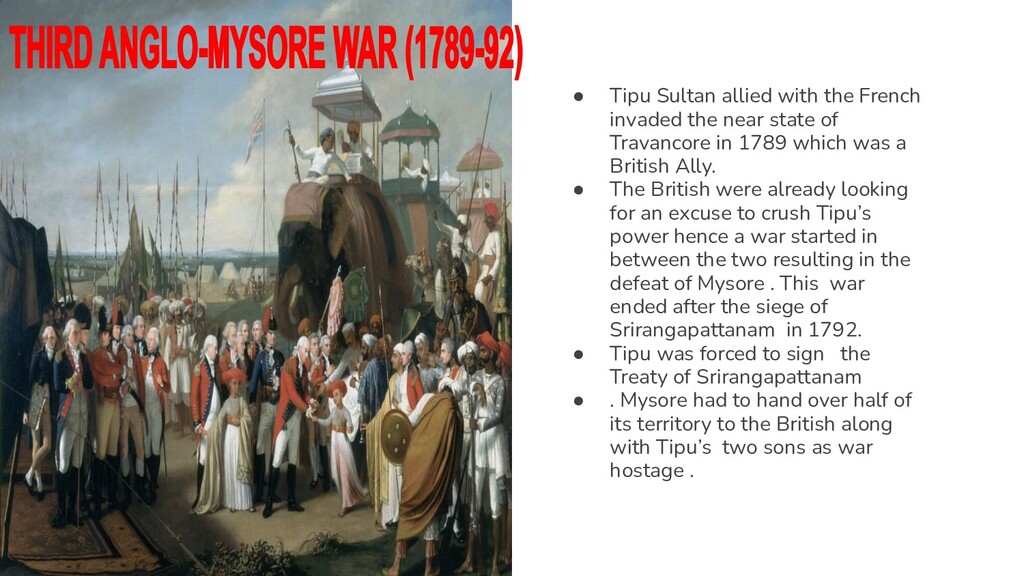
state of Travancore in 1789 which was a British Ally. • The British were already looking for an excuse to crush Tipu’s power hence a war started in between the two resulting in the defeat of Mysore . This war ended after the siege of Srirangapattanam in 1792. • Tipu was forced to sign the Treaty of Srirangapattanam • . Mysore had to hand over half of its territory to the British along with Tipu’s two sons as war hostage .
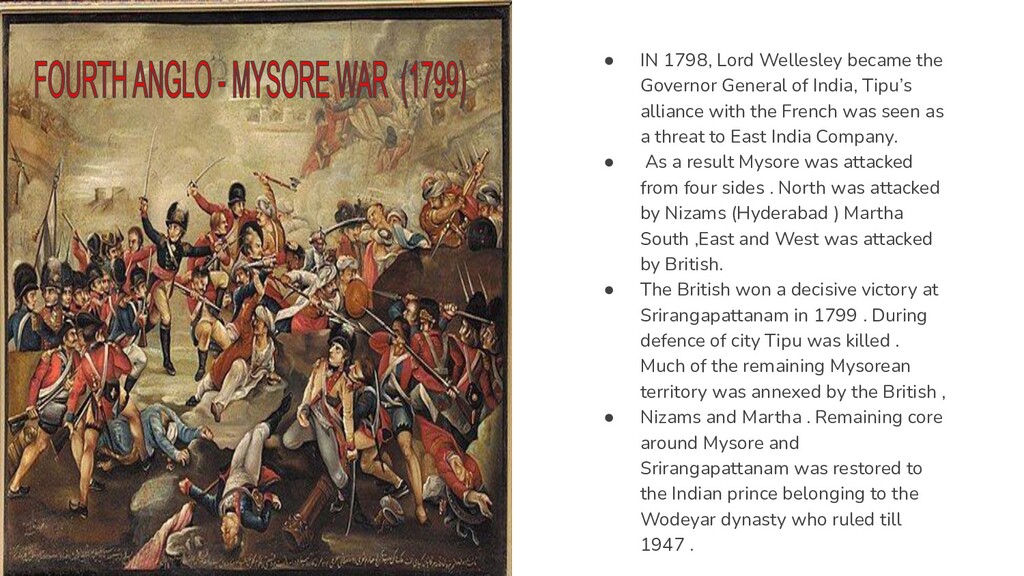
India, Tipu’s alliance with the French was seen as a threat to East India Company. • As a result Mysore was attacked from four sides . North was attacked by Nizams (Hyderabad ) Martha South ,East and West was attacked by British. • The British won a decisive victory at Srirangapattanam in 1799 . During defence of city Tipu was killed . Much of the remaining Mysorean territory was annexed by the British , • Nizams and Martha . Remaining core around Mysore and Srirangapattanam was restored to the Indian prince belonging to the Wodeyar dynasty who ruled till 1947 .
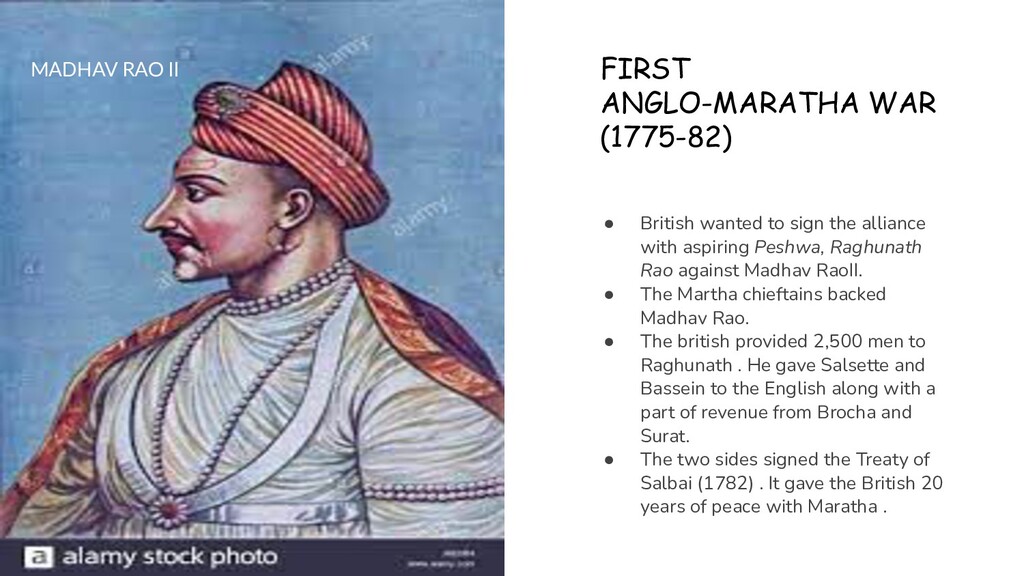
Raghunath Rao against Madhav RaoII. • The Martha chieftains backed Madhav Rao. • The british provided 2,500 men to Raghunath . He gave Salsette and Bassein to the English along with a part of revenue from Brocha and Surat. • The two sides signed the Treaty of Salbai (1782) . It gave the British 20 years of peace with Maratha . MADHAV RAO II FIRST ANGLO-MARATHA WAR (1775-82)
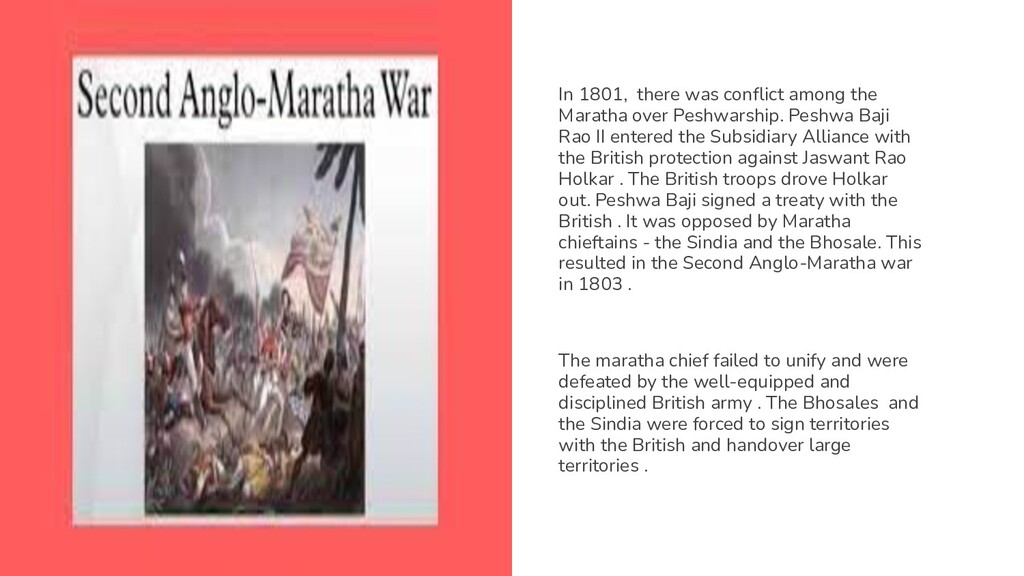
among the Maratha over Peshwarship. Peshwa Baji Rao II entered the Subsidiary Alliance with the British protection against Jaswant Rao Holkar . The British troops drove Holkar out. Peshwa Baji signed a treaty with the British . It was opposed by Maratha chieftains - the Sindia and the Bhosale. This resulted in the Second Anglo-Maratha war in 1803 . The maratha chief failed to unify and were defeated by the well-equipped and disciplined British army . The Bhosales and the Sindia were forced to sign territories with the British and handover large territories .
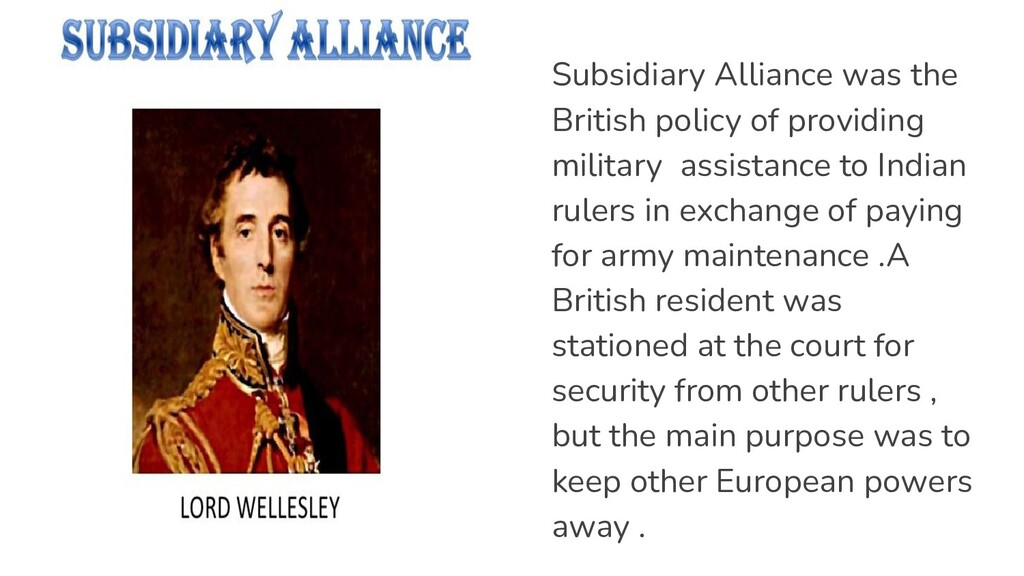
to Indian rulers in exchange of paying for army maintenance .A British resident was stationed at the court for security from other rulers , but the main purpose was to keep other European powers away .
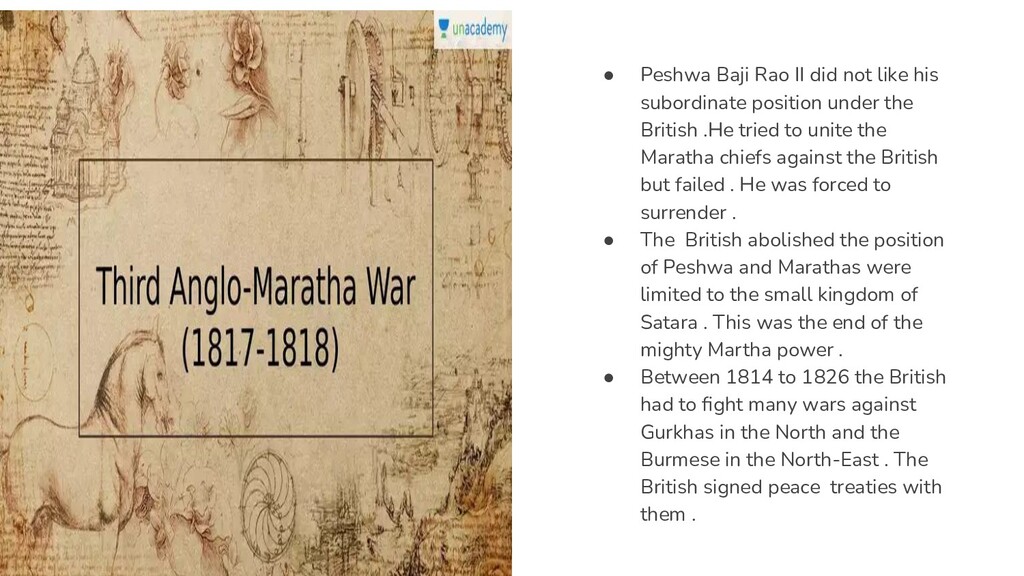
position under the British .He tried to unite the Maratha chiefs against the British but failed . He was forced to surrender . • The British abolished the position of Peshwa and Marathas were limited to the small kingdom of Satara . This was the end of the mighty Martha power . • Between 1814 to 1826 the British had to fight many wars against Gurkhas in the North and the Burmese in the North-East . The British signed peace treaties with them .
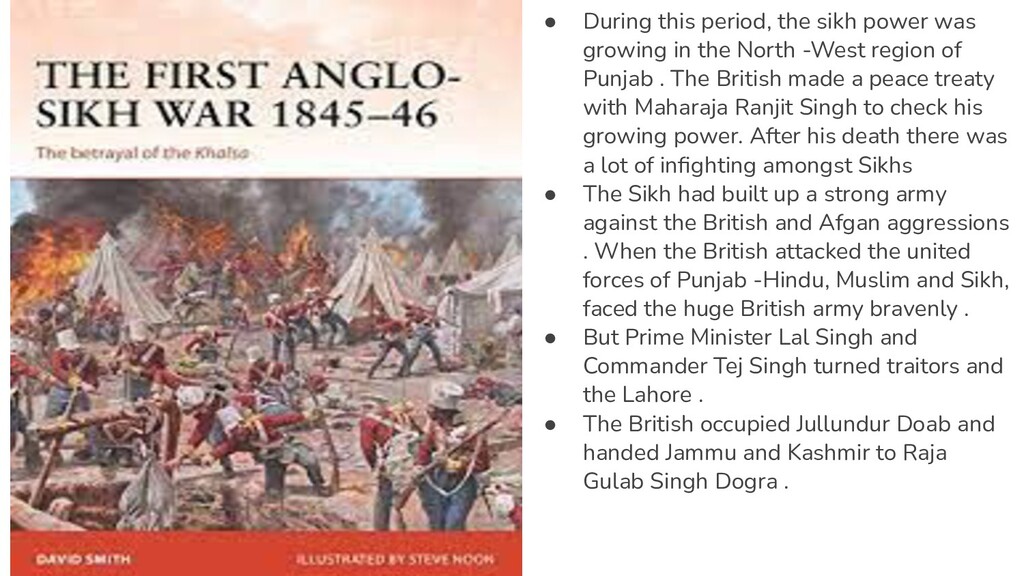
the North -West region of Punjab . The British made a peace treaty with Maharaja Ranjit Singh to check his growing power. After his death there was a lot of infighting amongst Sikhs • The Sikh had built up a strong army against the British and Afgan aggressions . When the British attacked the united forces of Punjab -Hindu, Muslim and Sikh, faced the huge British army bravenly . • But Prime Minister Lal Singh and Commander Tej Singh turned traitors and the Lahore . • The British occupied Jullundur Doab and handed Jammu and Kashmir to Raja Gulab Singh Dogra .
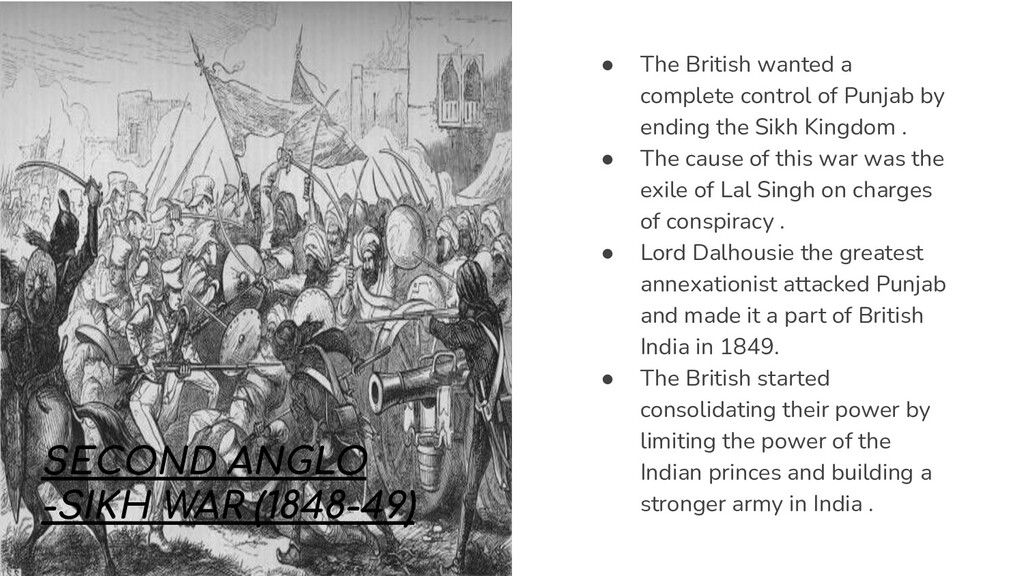
ending the Sikh Kingdom . • The cause of this war was the exile of Lal Singh on charges of conspiracy . • Lord Dalhousie the greatest annexationist attacked Punjab and made it a part of British India in 1849. • The British started consolidating their power by limiting the power of the Indian princes and building a stronger army in India . SECOND ANGLO -SIKH WAR (1848-49)


 hiola
 3l4l5
 pawan_pharm
 ainischool
 akiraasano
 camel_404
 signer
 fmarot
 drpoonamkc
 yoshimura_datam
 jnunemaker
 destraynor
 soudai
 axbom
 andyhume
 mkilby
 katiecoart
 aleyda
 tammielis
 skipperchong
 akihiro_kokubo
 quramy