Partial) and Fourier Analysis Probability and Statistics Numerical Analysis Operations Research and Optimization Astronomy Trigonometry and so on…
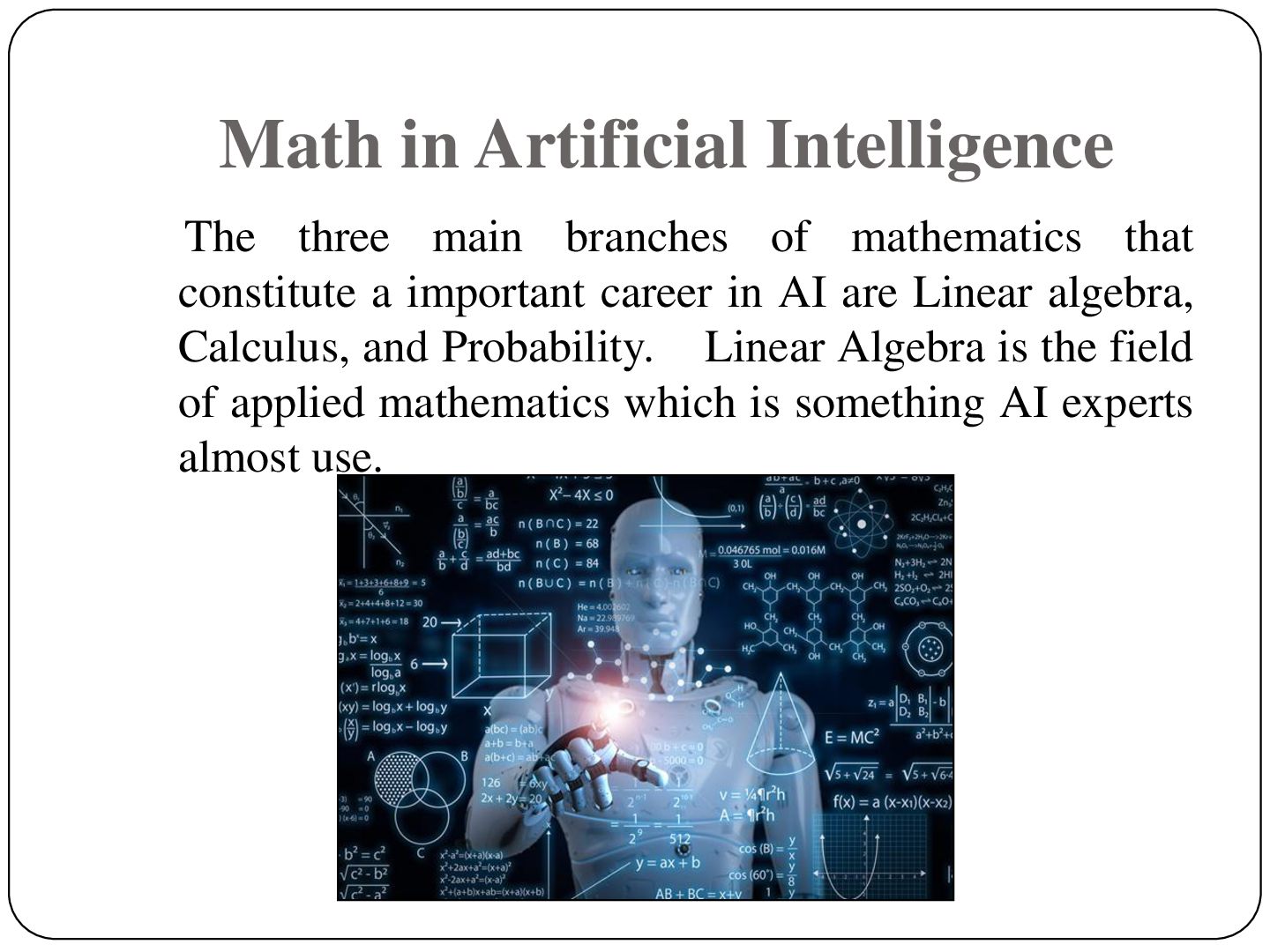
that constitute a important career in AI are Linear algebra, Calculus, and Probability. Linear Algebra is the field of applied mathematics which is something AI experts almost use.
general categories: Search Problems, and Representation Problems. Following them are interconnected models and tools like Rules, frames, Logics, and Nets. All of them are Mathematical topics. The primary purpose of Artificial intelligence is to create an acceptable model for human understanding. These models can be prepared with the ideas and strategies from various branches of Mathematics.
way it is used is when we look at objects in the sky with a telescope. The camera that is attached to the telescope basically records a series of numbers - those numbers might correspond to how much light different objects in the sky are emitting, what type of light, etc.
how fast an object in space is moving The Mesopotamian and Babylonian civilization used math in prediction of eclipses and position of heavenly bodies.They also calculate latitude and longitude
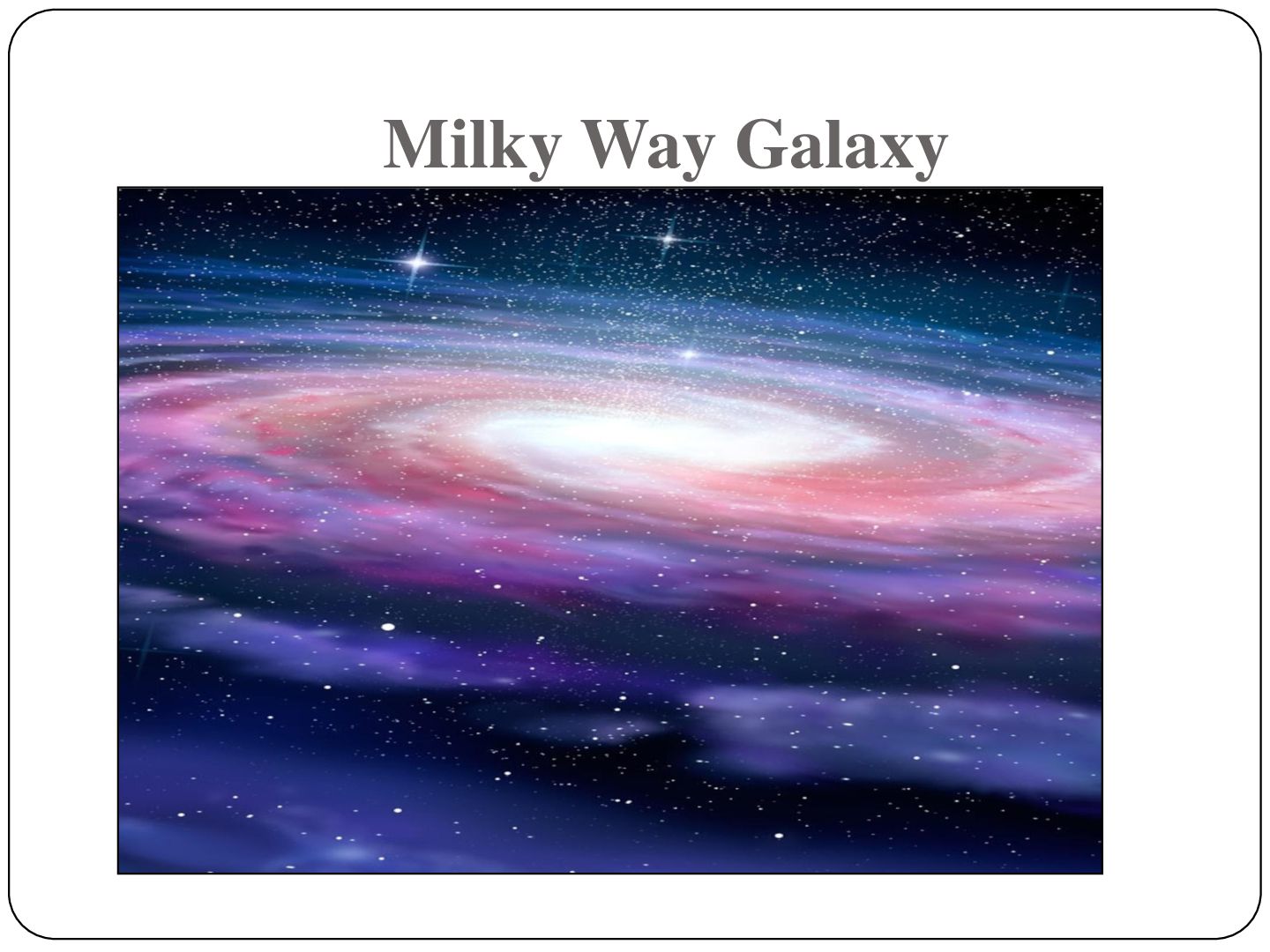
(107,000 km/h). Earth moves very fast. It spins (rotates) at a speed of about 1,000 miles (1600 kilometers) per hour and orbits around the Sun at a speed of about 67,000 miles (107,000 kilometers) per hour. We do not feel any of this motion because these speeds are constant. The sun and the solar system appear to be moving at 200 Km per second, or at an average speed of 448,000 mph (720,000 km/h). Even at this rapid speed, the solar system would take about 230 million years to travel all the way around the Milky Way. The Milky Way, too, moves in space relative to other galaxies. In about 4 billion years, the Milky Way will collide with its nearest neighbor, the Andromeda Galaxy. The two are rushing toward each other at about 70 miles per second (112 km per second). Everything in the universe is, therefore, in motion.
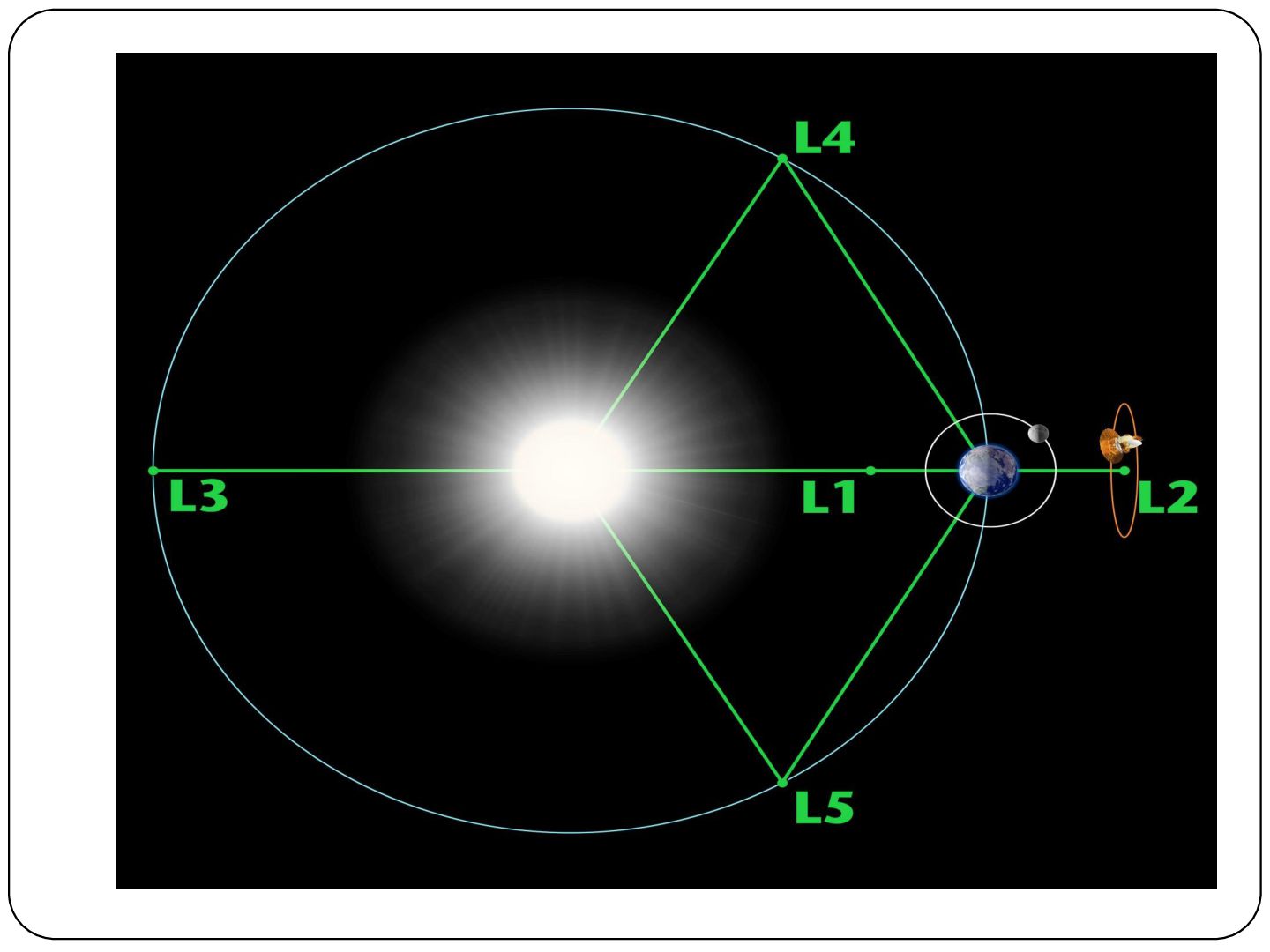
gravitational forces of a two-body system like the Sun and Earth produce enhanced regions of attraction and repulsion. These can be used by spacecraft as "parking spots" in space to remain in a fixed position with minimal fuel consumption.
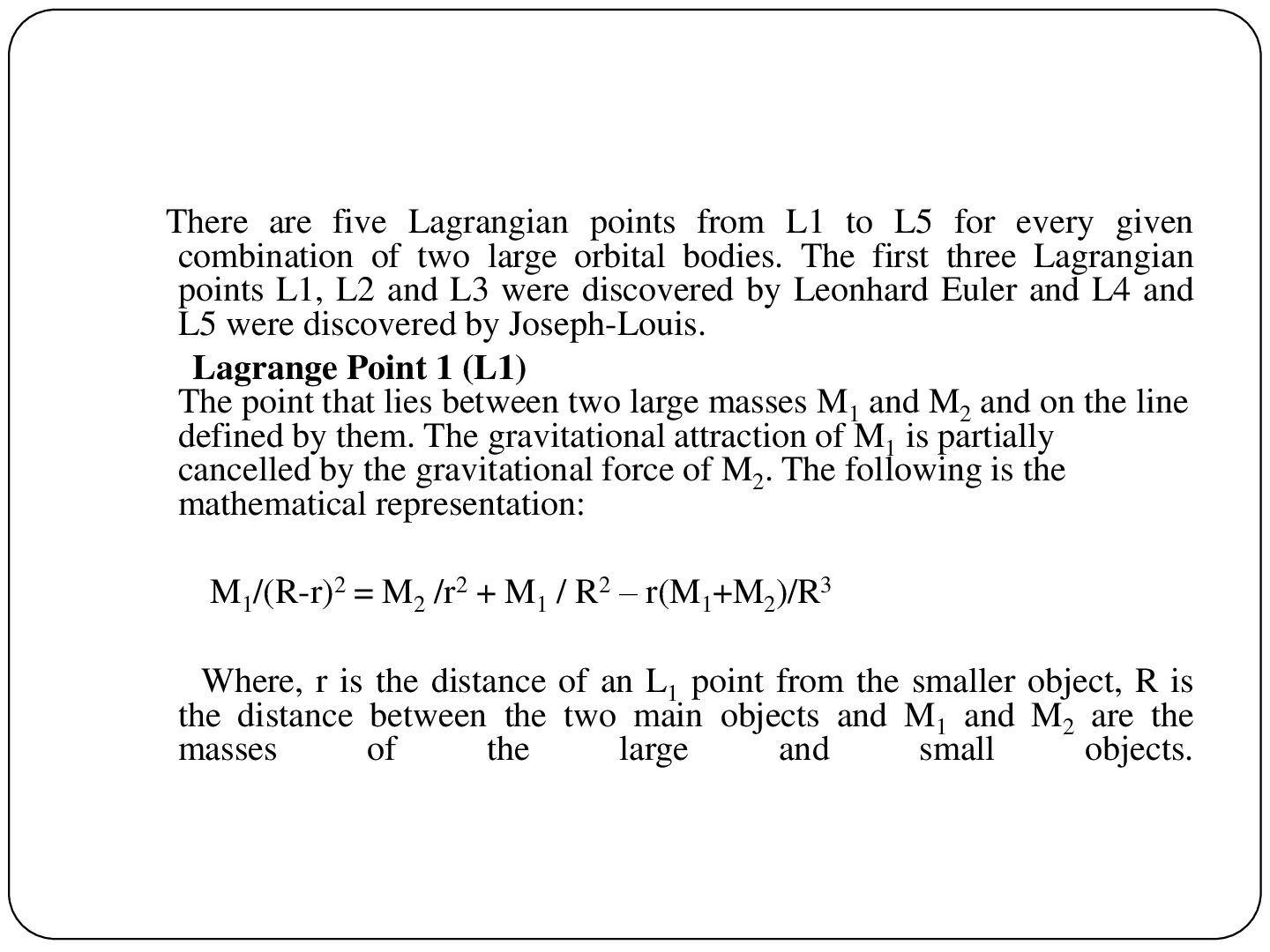
every given combination of two large orbital bodies. The first three Lagrangian points L1, L2 and L3 were discovered by Leonhard Euler and L4 and L5 were discovered by Joseph-Louis. Lagrange Point 1 (L1) The point that lies between two large masses M1 and M2 and on the line defined by them. The gravitational attraction of M1 is partially cancelled by the gravitational force of M2 . The following is the mathematical representation: M1 /(R-r)2 = M2 /r2 + M1 / R2 – r(M1 +M2 )/R3 Where, r is the distance of an L1 point from the smaller object, R is the distance between the two main objects and M1 and M2 are the masses of the large and small objects.
speed they are moving in the spacecraft, if they already know the distance from a particular location they can use trigonometry to calculate the unknown distance to another location point.


 akasan
 institutdelelevage
 estie
 trycycle
 kiyoshi
 voginip
 syuchimu
 neutron63zf
 mickey_0226
 analokmaus
 leimatthew05
 ianozsvald
 thekraken
 tenderlove
 caitiem20
 baasie
 rkendrick25
 yeseniaperezcruz
 seathinner
 portentint
 joshbly
 marketingsoph