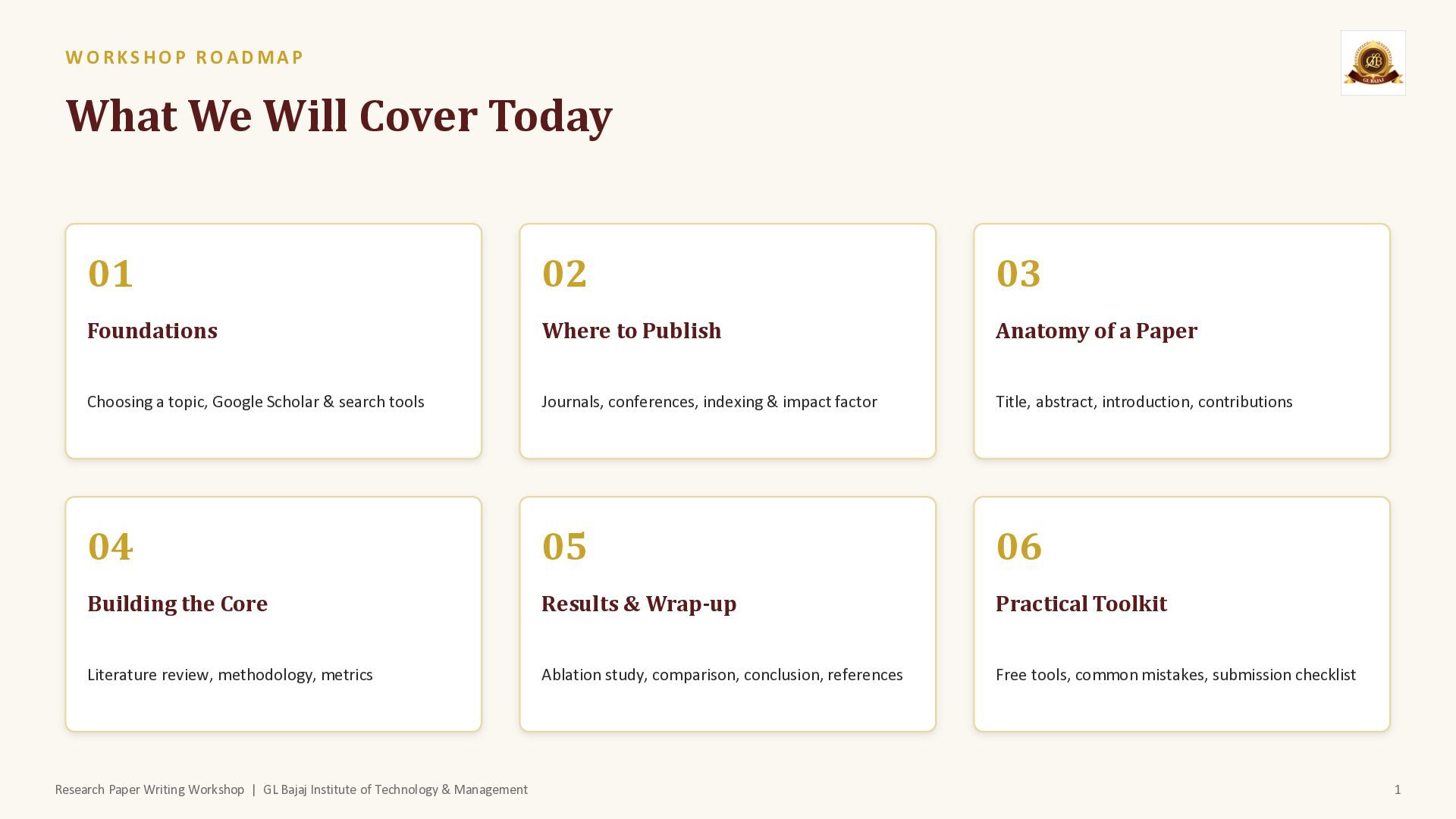
Foundations Where to Publish Anatomy of a Paper Choosing a topic, Google Scholar & search tools Journals, conferences, indexing & impact factor Title, abstract, introduction, contributions 04 05 06 Building the Core Results & Wrap-up Practical Toolkit Literature review, methodology, metrics Ablation study, comparison, conclusion, references Free tools, common mistakes, submission checklist Research Paper Writing Workshop | GL Bajaj Institute of Technology & Management 1
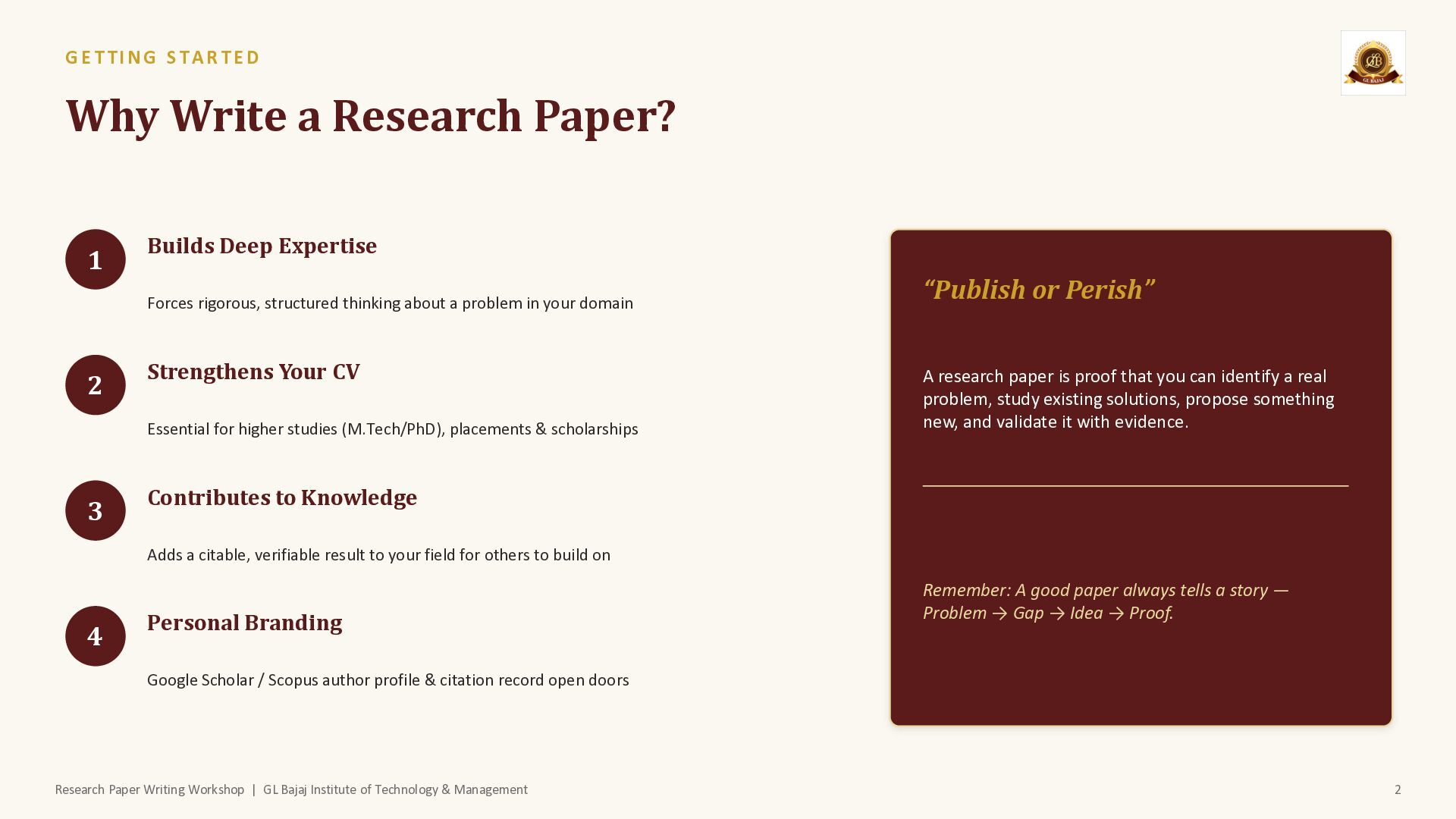
Expertise Forces rigorous, structured thinking about a problem in your domain 2 Strengthens Your CV Essential for higher studies (M.Tech/PhD), placements & scholarships 3 “Publish or Perish” A research paper is proof that you can identify a real problem, study existing solutions, propose something new, and validate it with evidence. Contributes to Knowledge Adds a citable, verifiable result to your field for others to build on 4 Personal Branding Remember: A good paper always tells a story — Problem → Gap → Idea → Proof. Google Scholar / Scopus author profile & citation record open doors Research Paper Writing Workshop | GL Bajaj Institute of Technology & Management 2
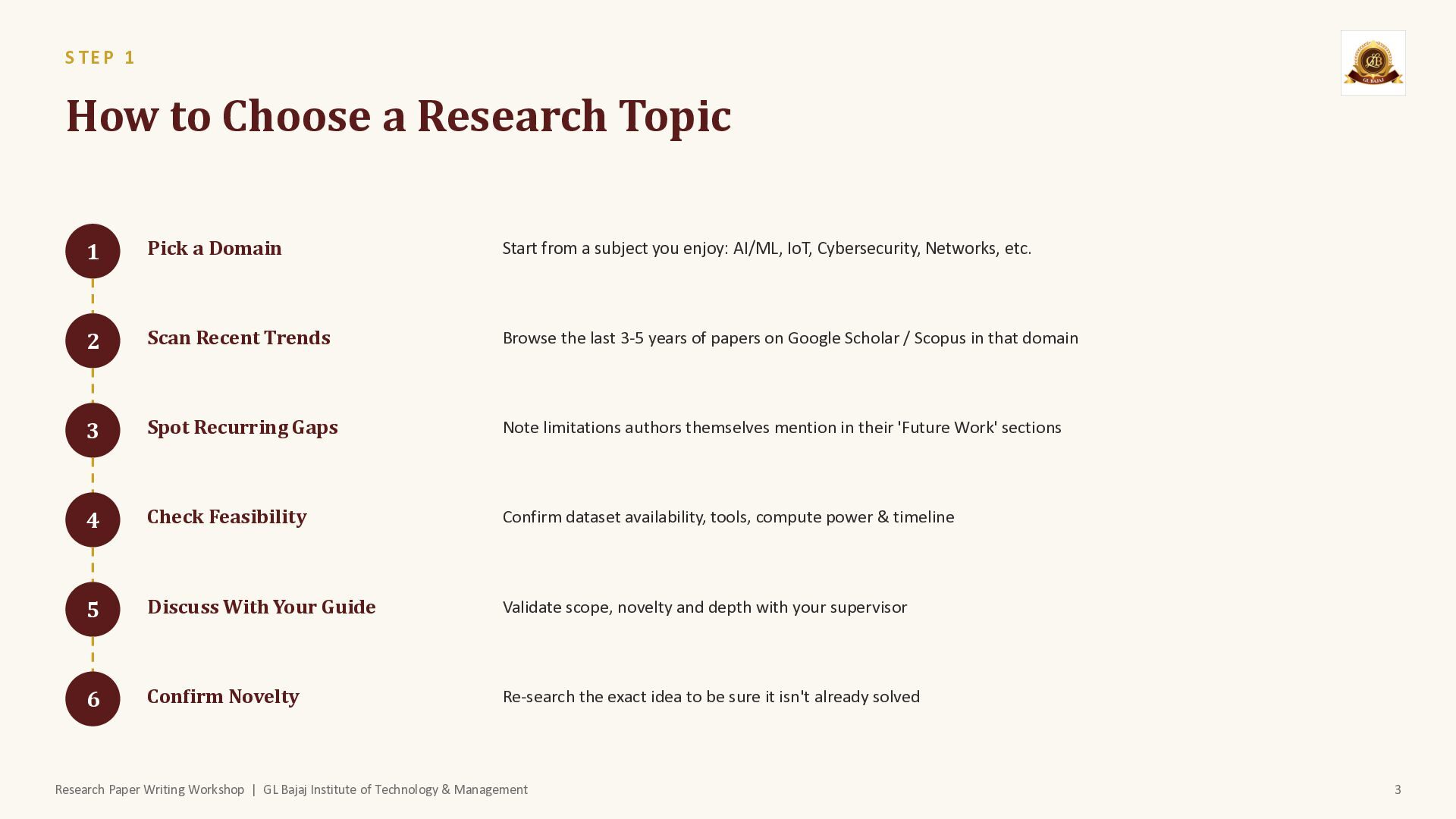
a Domain Start from a subject you enjoy: AI/ML, IoT, Cybersecurity, Networks, etc. 2 Scan Recent Trends Browse the last 3-5 years of papers on Google Scholar / Scopus in that domain 3 Spot Recurring Gaps Note limitations authors themselves mention in their 'Future Work' sections 4 Check Feasibility Confirm dataset availability, tools, compute power & timeline 5 Discuss With Your Guide Validate scope, novelty and depth with your supervisor 6 Confirm Novelty Re-search the exact idea to be sure it isn't already solved Research Paper Writing Workshop | GL Bajaj Institute of Technology & Management 3
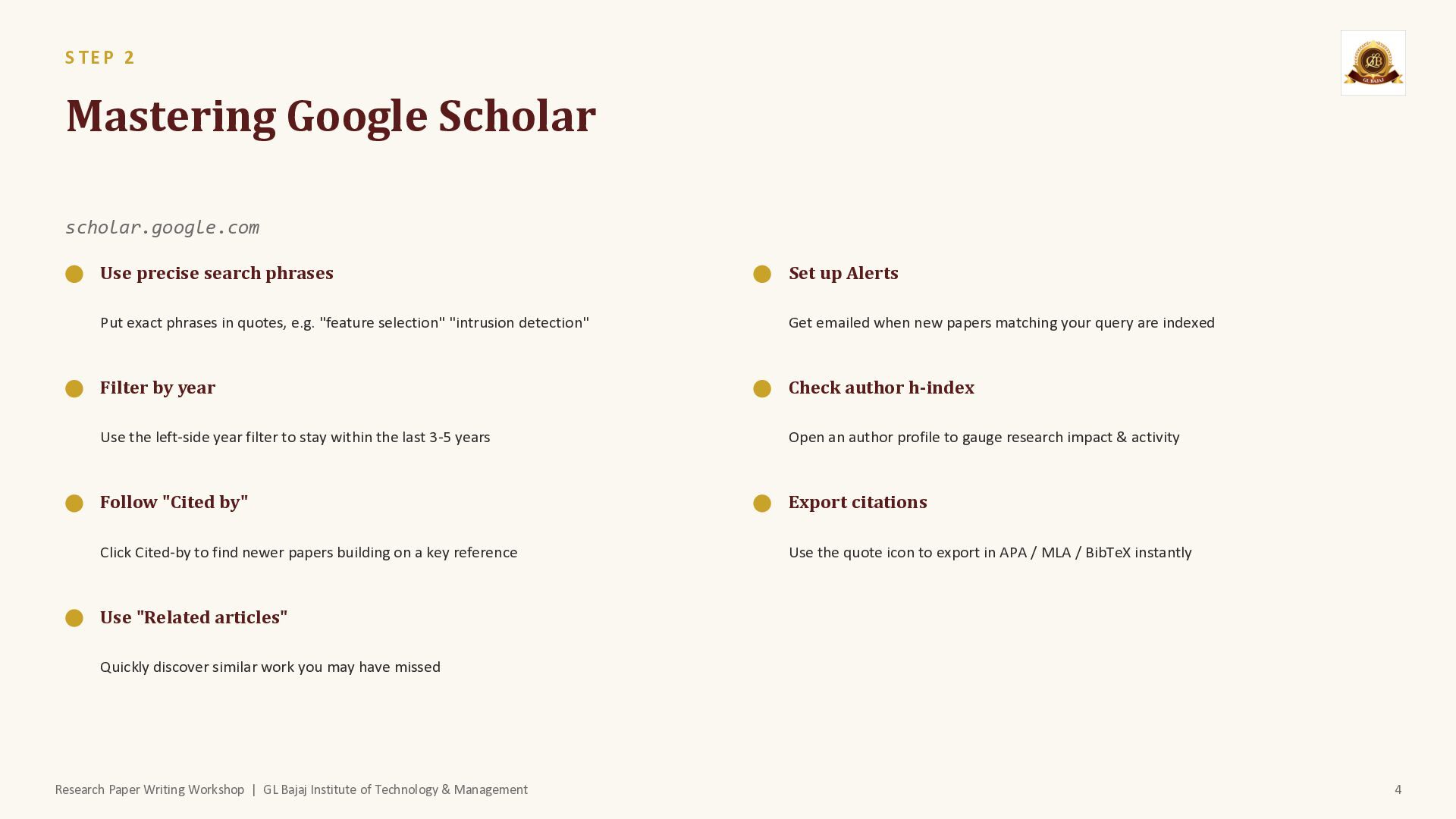
Set up Alerts Put exact phrases in quotes, e.g. "feature selection" "intrusion detection" Get emailed when new papers matching your query are indexed Filter by year Check author h-index Use the left-side year filter to stay within the last 3-5 years Open an author profile to gauge research impact & activity Follow "Cited by" Export citations Click Cited-by to find newer papers building on a key reference Use the quote icon to export in APA / MLA / BibTeX instantly Use "Related articles" Quickly discover similar work you may have missed Research Paper Writing Workshop | GL Bajaj Institute of Technology & Management 4
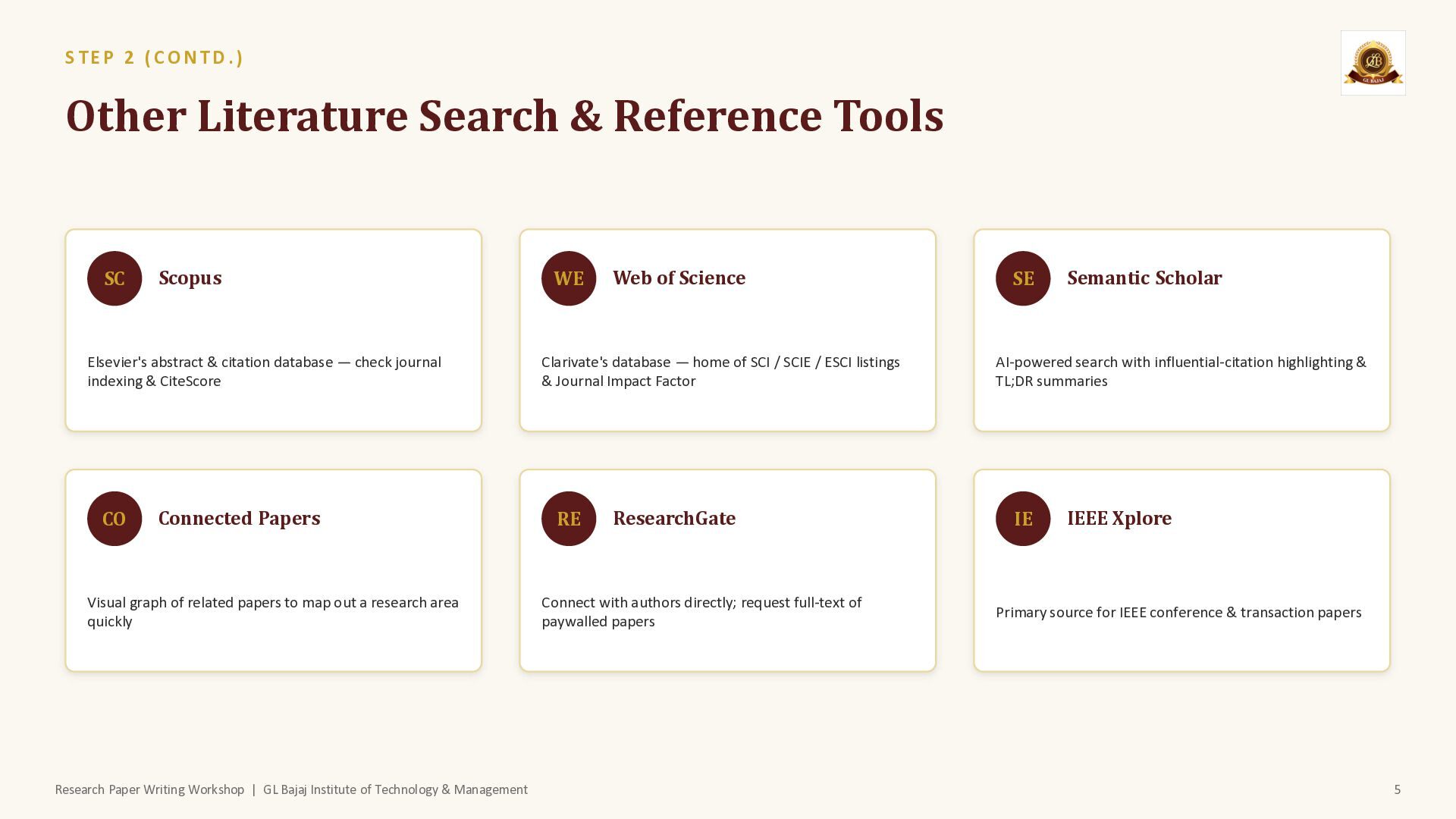
Scopus Elsevier's abstract & citation database — check journal indexing & CiteScore CO Connected Papers Visual graph of related papers to map out a research area quickly Research Paper Writing Workshop | GL Bajaj Institute of Technology & Management WE Web of Science Clarivate's database — home of SCI / SCIE / ESCI listings & Journal Impact Factor RE ResearchGate Connect with authors directly; request full-text of paywalled papers SE Semantic Scholar AI-powered search with influential-citation highlighting & TL;DR summaries IE IEEE Xplore Primary source for IEEE conference & transaction papers 5
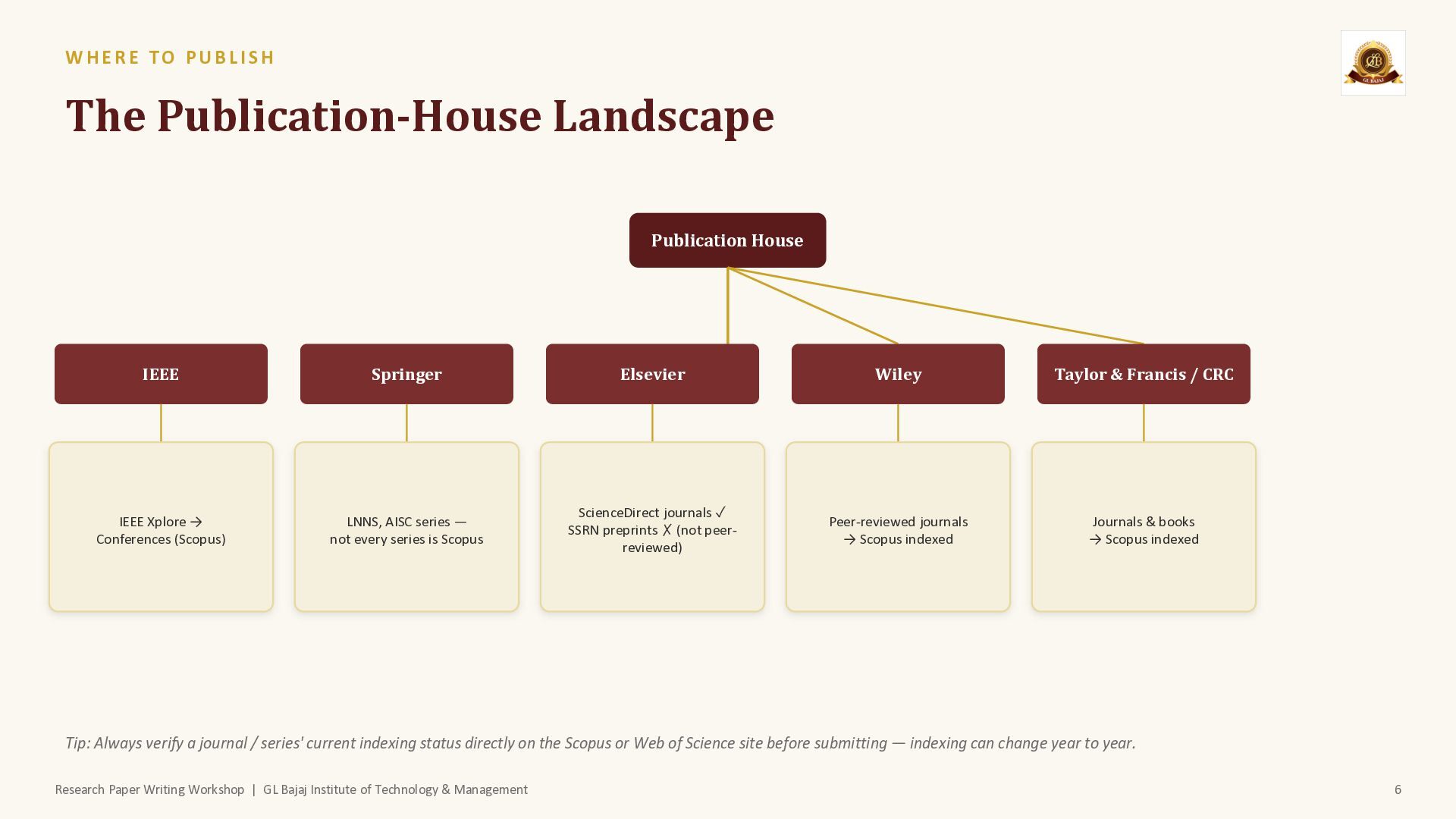
Elsevier Wiley Taylor & Francis / CRC IEEE Xplore → Conferences (Scopus) LNNS, AISC series — not every series is Scopus ScienceDirect journals ✓ SSRN preprints ✗ (not peerreviewed) Peer-reviewed journals → Scopus indexed Journals & books → Scopus indexed Tip: Always verify a journal / series' current indexing status directly on the Scopus or Web of Science site before submitting — indexing can change year to year. Research Paper Writing Workshop | GL Bajaj Institute of Technology & Management 6
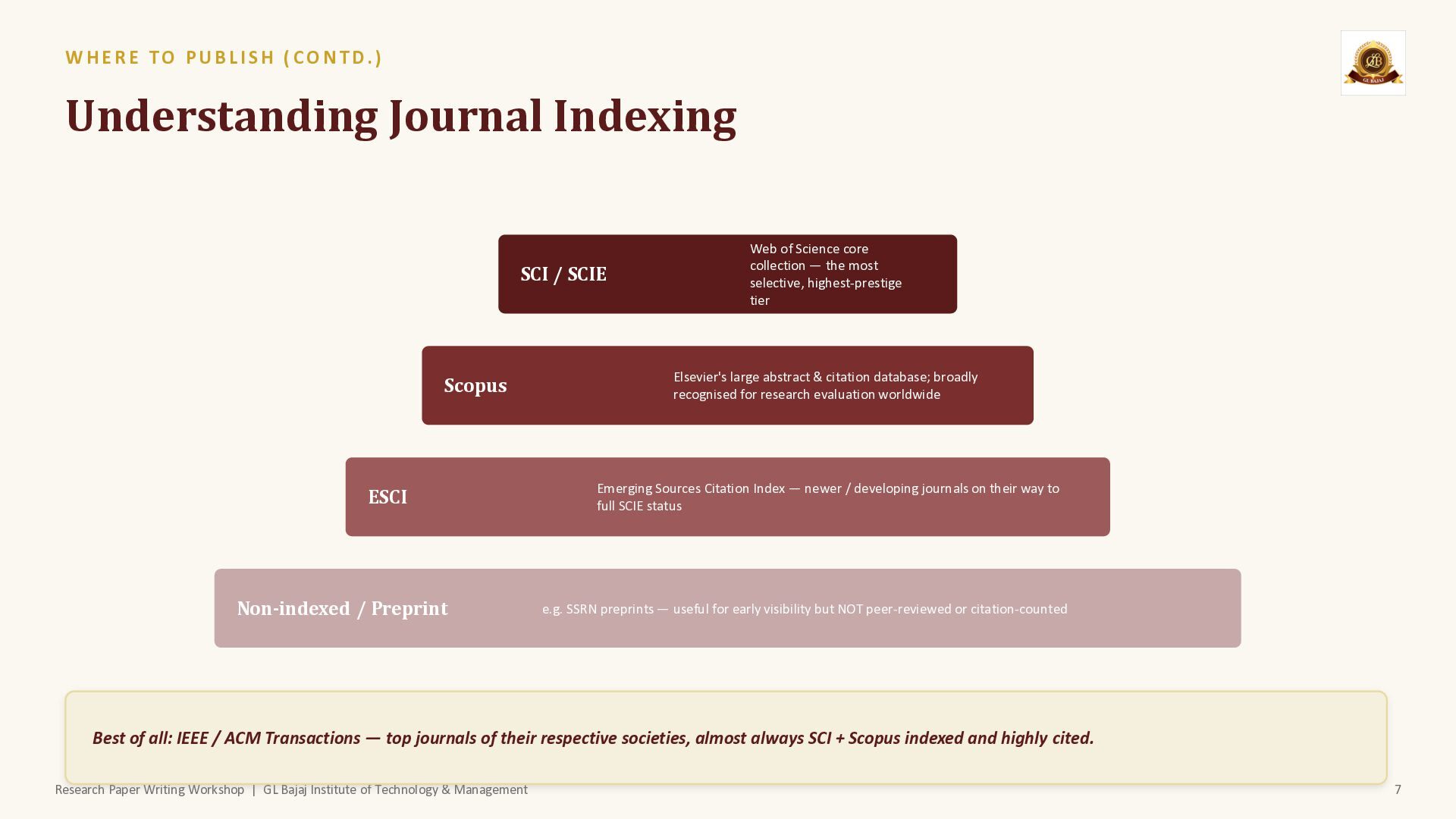
Scopus ESCI Non-indexed / Preprint Web of Science core collection — the most selective, highest-prestige tier Elsevier's large abstract & citation database; broadly recognised for research evaluation worldwide Emerging Sources Citation Index — newer / developing journals on their way to full SCIE status e.g. SSRN preprints — useful for early visibility but NOT peer-reviewed or citation-counted Best of all: IEEE / ACM Transactions — top journals of their respective societies, almost always SCI + Scopus indexed and highly cited. Research Paper Writing Workshop | GL Bajaj Institute of Technology & Management 7
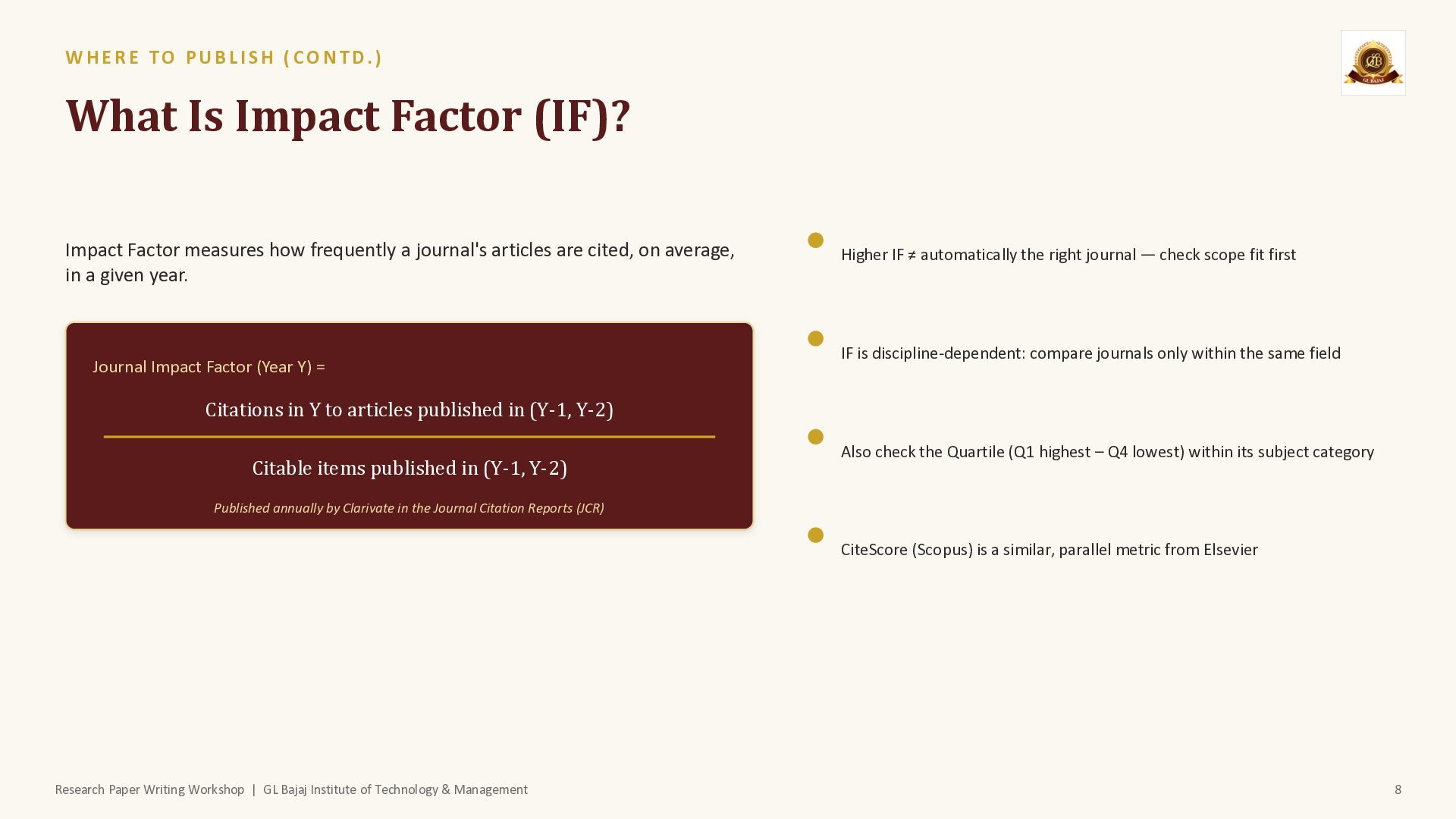
Factor measures how frequently a journal's articles are cited, on average, in a given year. Journal Impact Factor (Year Y) = Higher IF ≠ automatically the right journal — check scope fit first IF is discipline-dependent: compare journals only within the same field Citations in Y to articles published in (Y-1, Y-2) Citable items published in (Y-1, Y-2) Also check the Quartile (Q1 highest – Q4 lowest) within its subject category Published annually by Clarivate in the Journal Citation Reports (JCR) CiteScore (Scopus) is a similar, parallel metric from Elsevier Research Paper Writing Workshop | GL Bajaj Institute of Technology & Management 8
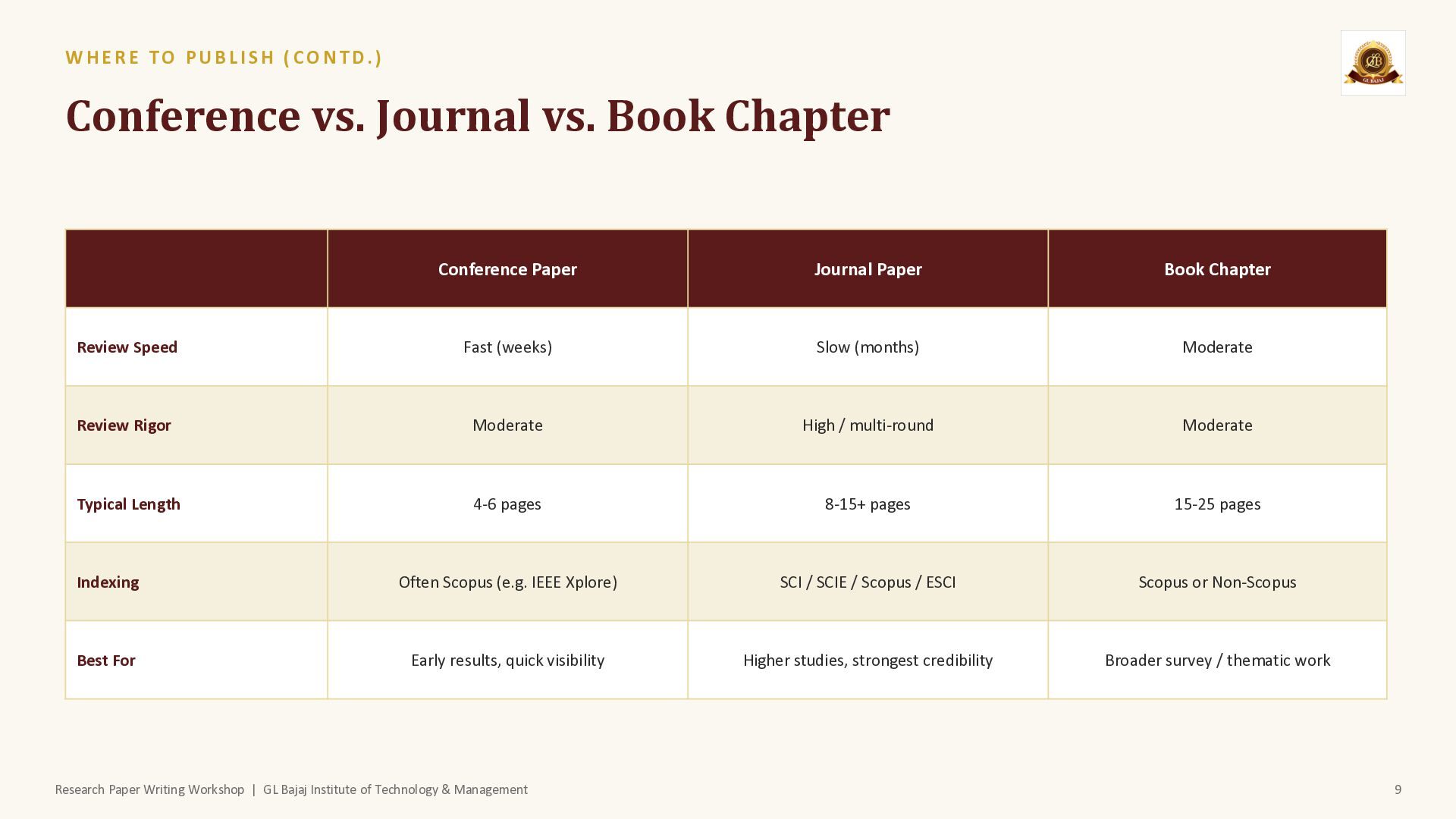
Conference Paper Journal Paper Book Chapter Review Speed Fast (weeks) Slow (months) Moderate Review Rigor Moderate High / multi-round Moderate Typical Length 4-6 pages 8-15+ pages 15-25 pages Indexing Often Scopus (e.g. IEEE Xplore) SCI / SCIE / Scopus / ESCI Scopus or Non-Scopus Best For Early results, quick visibility Higher studies, strongest credibility Broader survey / thematic work Research Paper Writing Workshop | GL Bajaj Institute of Technology & Management 9
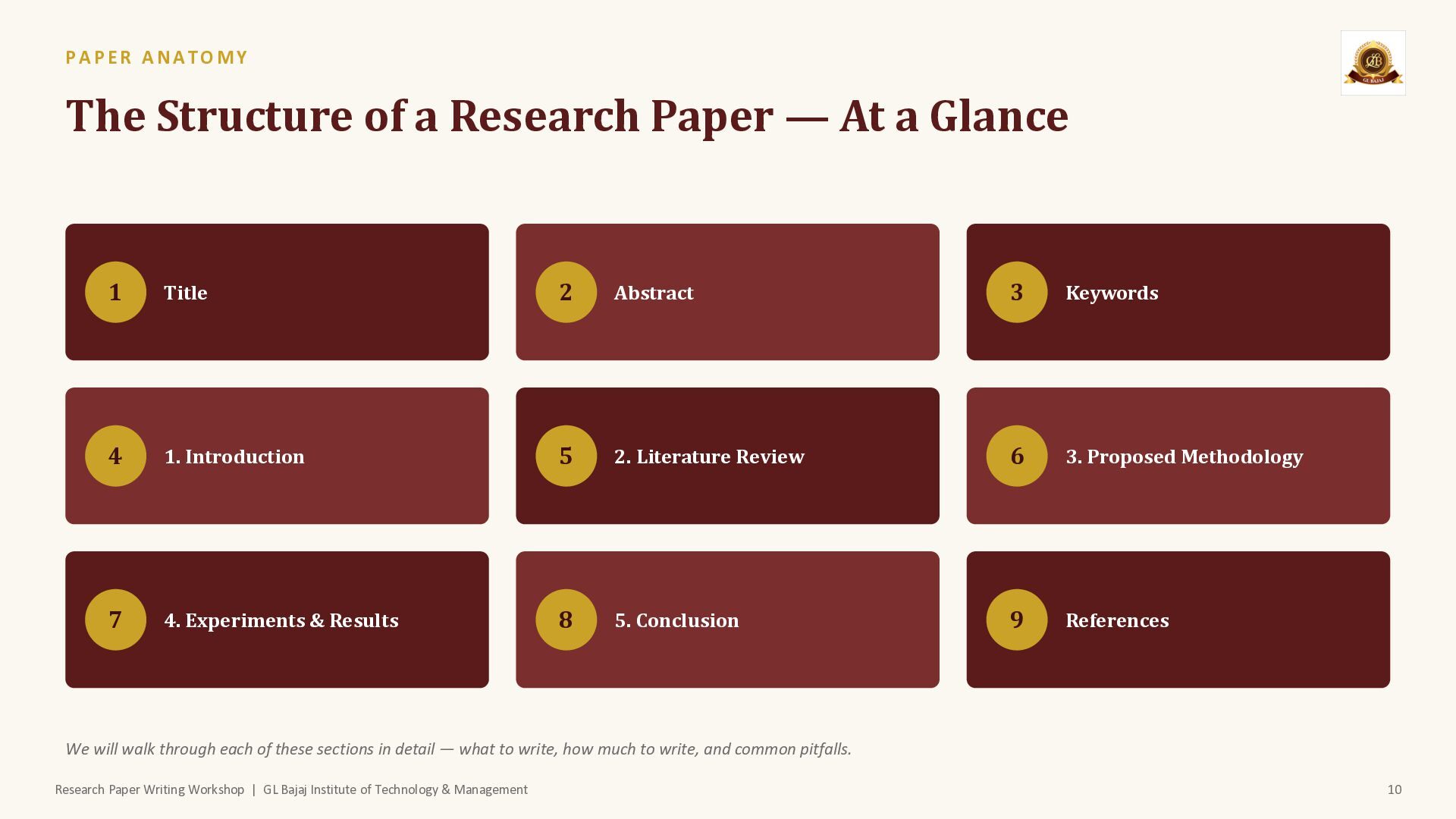
a Glance 1 Title 2 Abstract 3 Keywords 4 1. Introduction 5 2. Literature Review 6 3. Proposed Methodology 7 4. Experiments & Results 8 5. Conclusion 9 References We will walk through each of these sections in detail — what to write, how much to write, and common pitfalls. Research Paper Writing Workshop | GL Bajaj Institute of Technology & Management 10
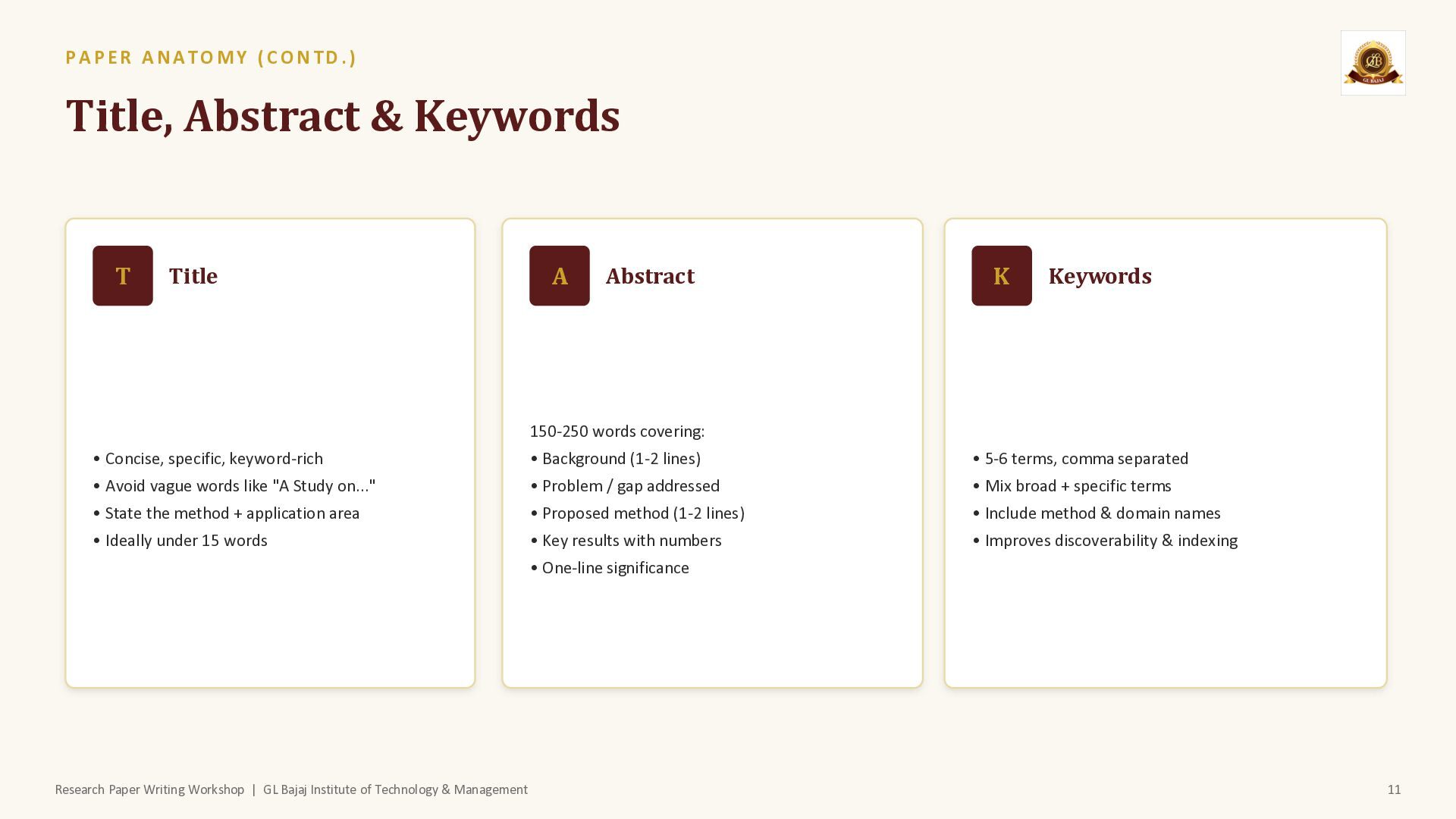
Abstract K Keywords 150-250 words covering: • Concise, specific, keyword-rich • Background (1-2 lines) • 5-6 terms, comma separated • Avoid vague words like "A Study on..." • Problem / gap addressed • Mix broad + specific terms • State the method + application area • Proposed method (1-2 lines) • Include method & domain names • Ideally under 15 words • Key results with numbers • Improves discoverability & indexing • One-line significance Research Paper Writing Workshop | GL Bajaj Institute of Technology & Management 11
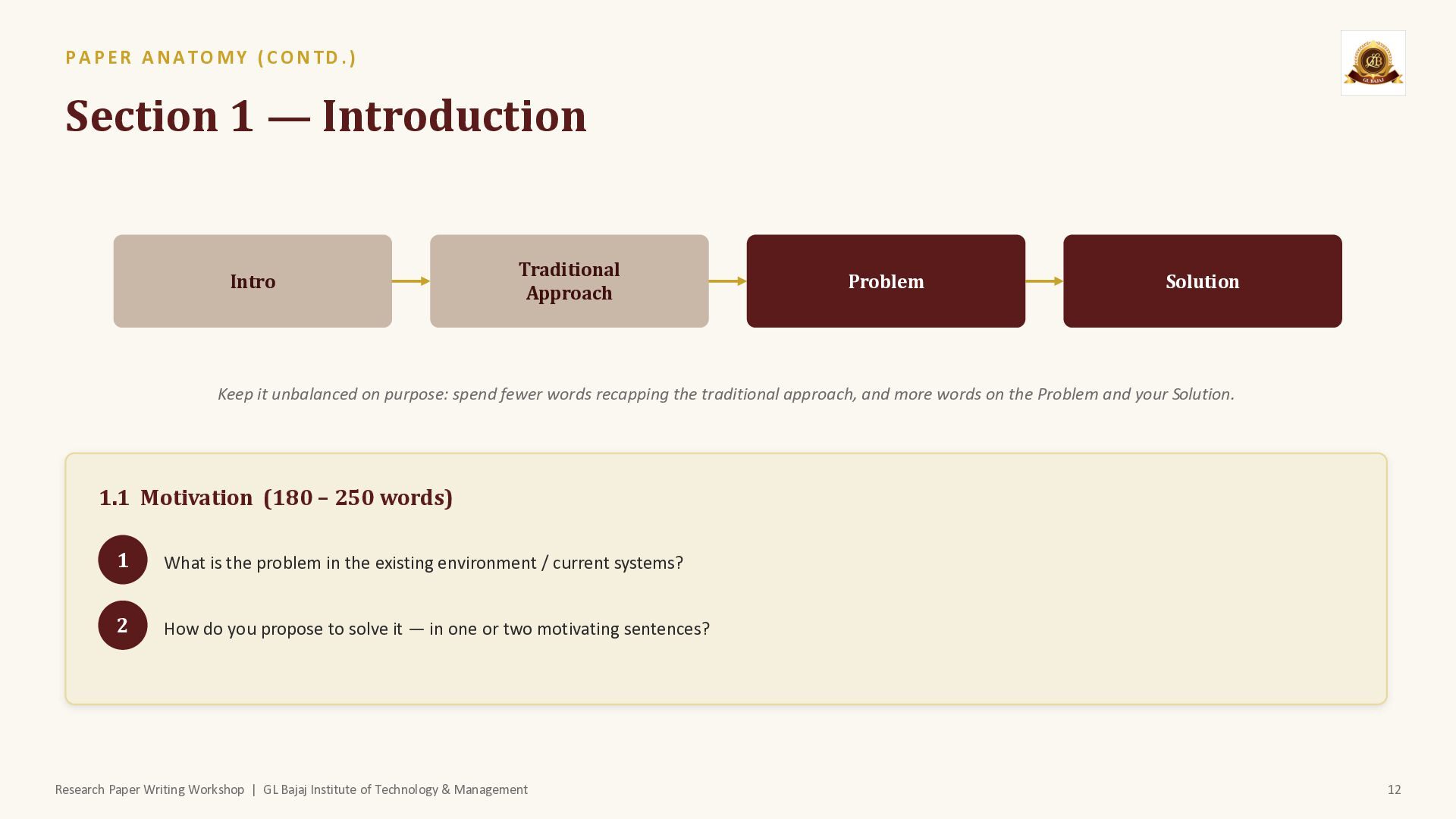
Problem Solution Keep it unbalanced on purpose: spend fewer words recapping the traditional approach, and more words on the Problem and your Solution. 1.1 Motivation (180 – 250 words) 1 What is the problem in the existing environment / current systems? 2 How do you propose to solve it — in one or two motivating sentences? Research Paper Writing Workshop | GL Bajaj Institute of Technology & Management 12
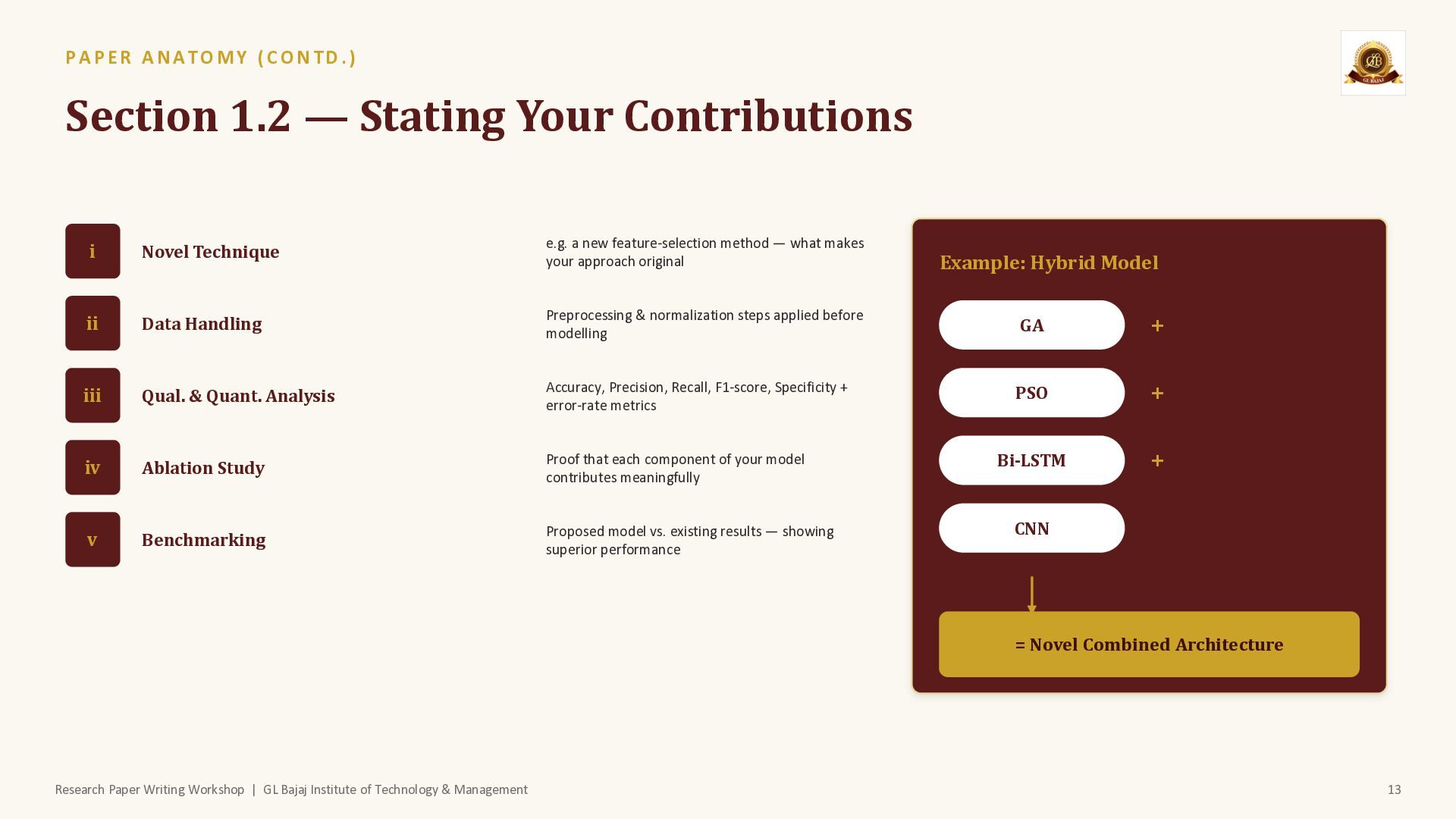
Novel Technique e.g. a new feature-selection method — what makes your approach original ii Data Handling Preprocessing & normalization steps applied before modelling GA + iii Qual. & Quant. Analysis Accuracy, Precision, Recall, F1-score, Specificity + error-rate metrics PSO + iv Ablation Study Proof that each component of your model contributes meaningfully Bi-LSTM + v Benchmarking Proposed model vs. existing results — showing superior performance Example: Hybrid Model CNN = Novel Combined Architecture Research Paper Writing Workshop | GL Bajaj Institute of Technology & Management 13
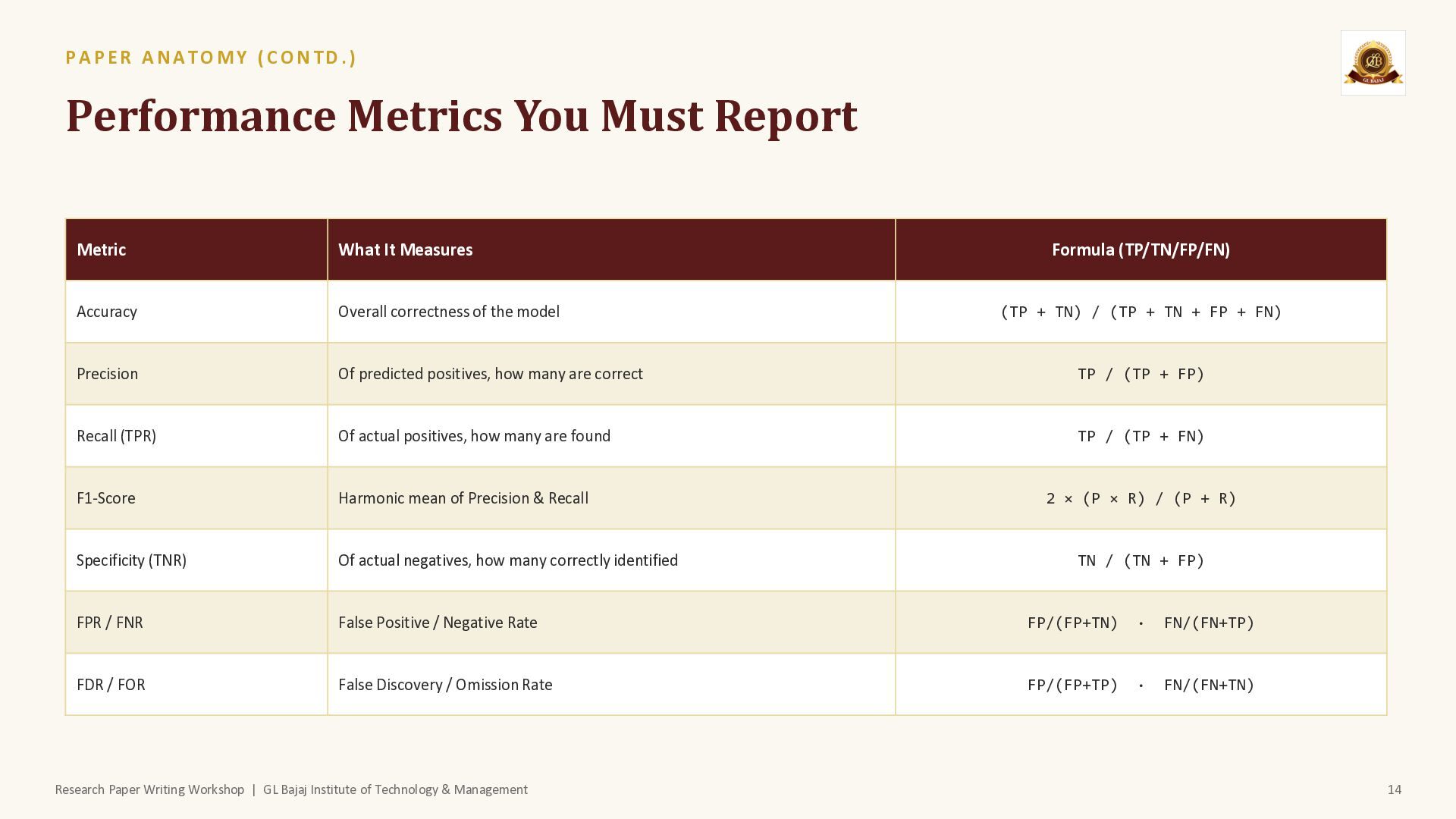
It Measures Accuracy Overall correctness of the model Precision Of predicted positives, how many are correct TP / (TP + FP) Recall (TPR) Of actual positives, how many are found TP / (TP + FN) F1-Score Harmonic mean of Precision & Recall 2 × (P × R) / (P + R) Specificity (TNR) Of actual negatives, how many correctly identified FPR / FNR False Positive / Negative Rate FP/(FP+TN) · FN/(FN+TP) FDR / FOR False Discovery / Omission Rate FP/(FP+TP) · FN/(FN+TN) Research Paper Writing Workshop | GL Bajaj Institute of Technology & Management Formula (TP/TN/FP/FN) (TP + TN) / (TP + TN + FP + FN) TN / (TN + FP) 14
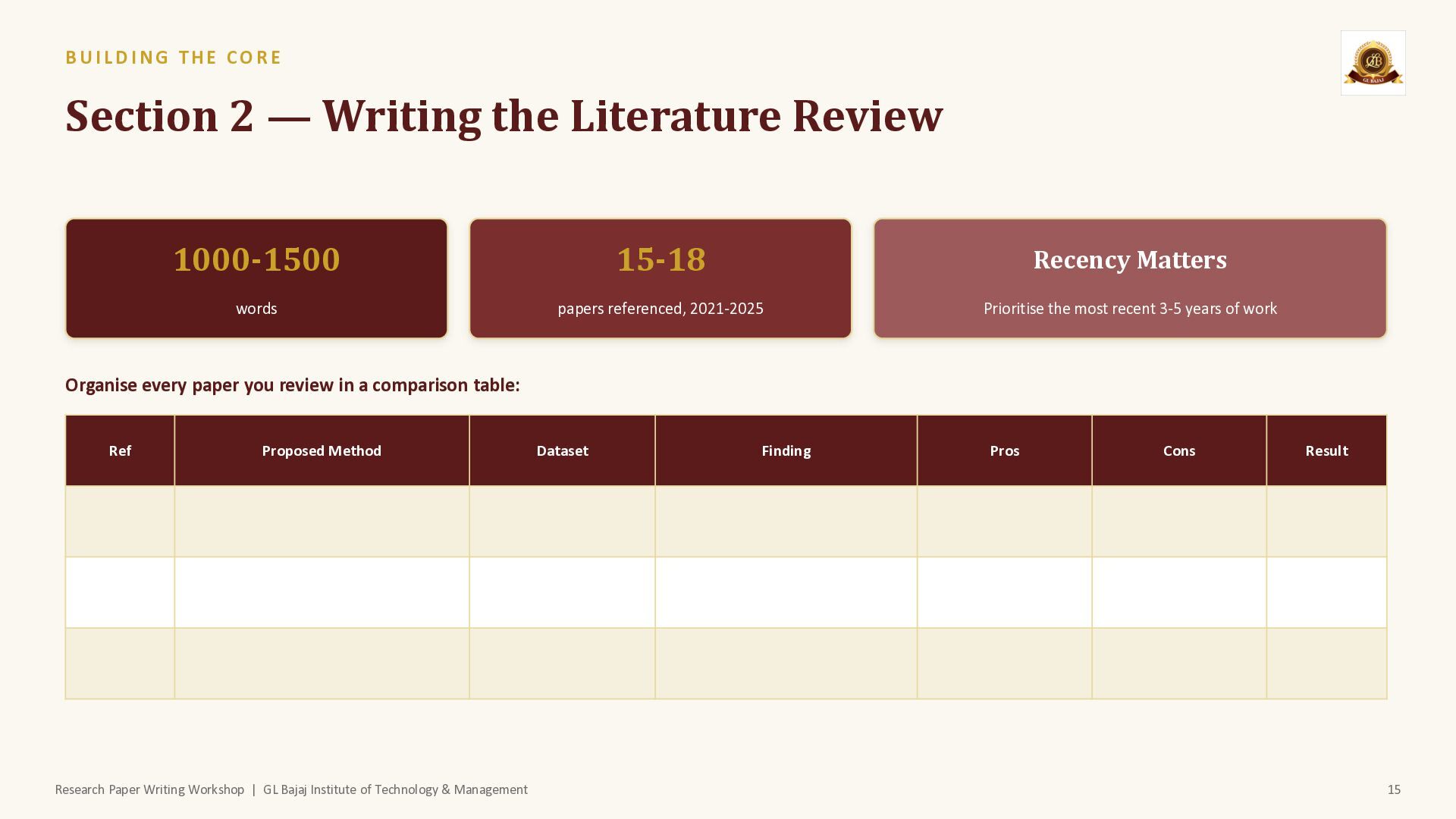
1000-1500 15-18 Recency Matters words papers referenced, 2021-2025 Prioritise the most recent 3-5 years of work Organise every paper you review in a comparison table: Ref Proposed Method Research Paper Writing Workshop | GL Bajaj Institute of Technology & Management Dataset Finding Pros Cons Result 15
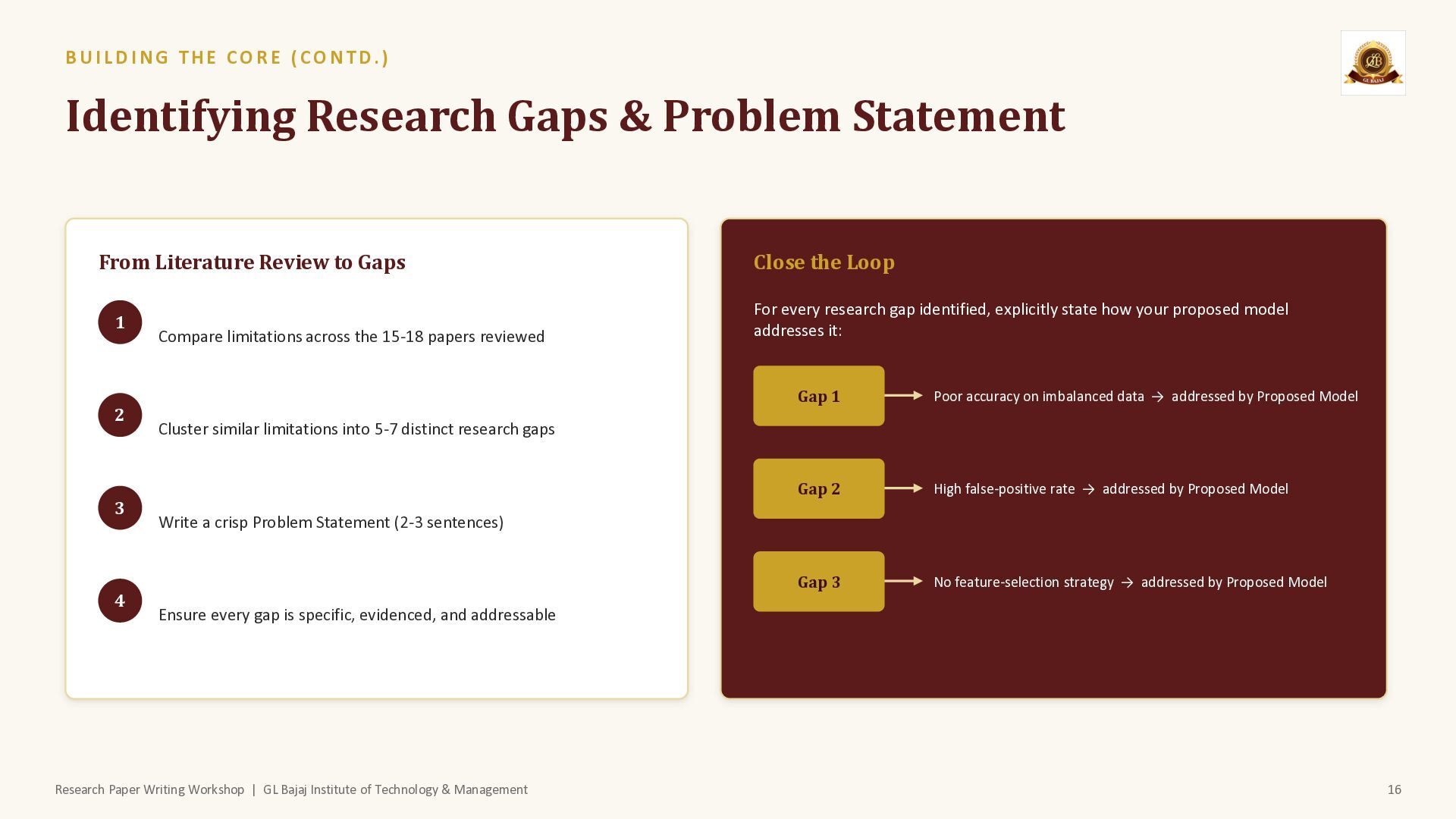
From Literature Review to Gaps 1 2 3 4 Compare limitations across the 15-18 papers reviewed Close the Loop For every research gap identified, explicitly state how your proposed model addresses it: Gap 1 Poor accuracy on imbalanced data → addressed by Proposed Model Gap 2 High false-positive rate → addressed by Proposed Model Gap 3 No feature-selection strategy → addressed by Proposed Model Cluster similar limitations into 5-7 distinct research gaps Write a crisp Problem Statement (2-3 sentences) Ensure every gap is specific, evidenced, and addressable Research Paper Writing Workshop | GL Bajaj Institute of Technology & Management 16
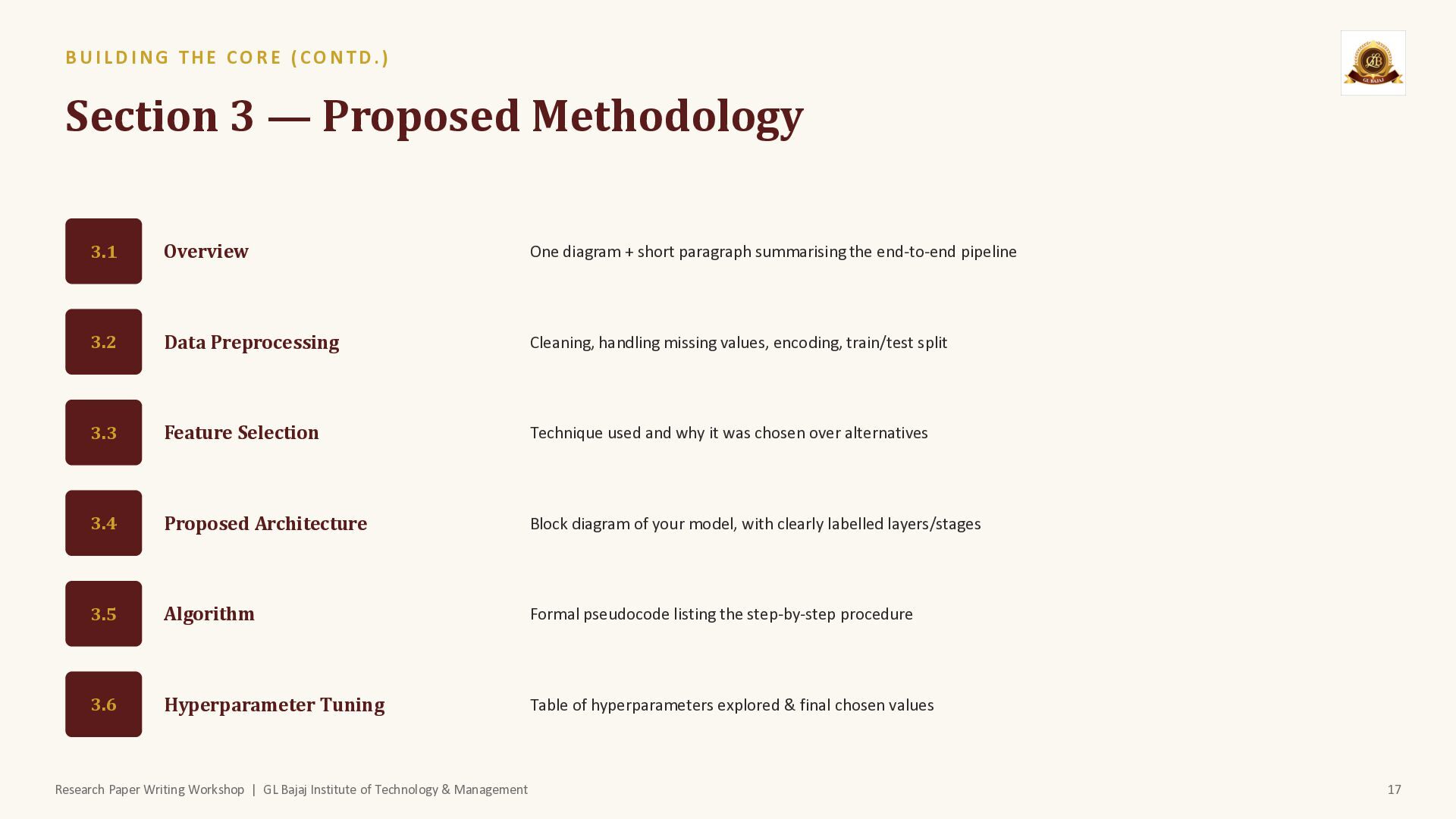
Overview One diagram + short paragraph summarising the end-to-end pipeline 3.2 Data Preprocessing Cleaning, handling missing values, encoding, train/test split 3.3 Feature Selection Technique used and why it was chosen over alternatives 3.4 Proposed Architecture Block diagram of your model, with clearly labelled layers/stages 3.5 Algorithm Formal pseudocode listing the step-by-step procedure 3.6 Hyperparameter Tuning Table of hyperparameters explored & final chosen values Research Paper Writing Workshop | GL Bajaj Institute of Technology & Management 17
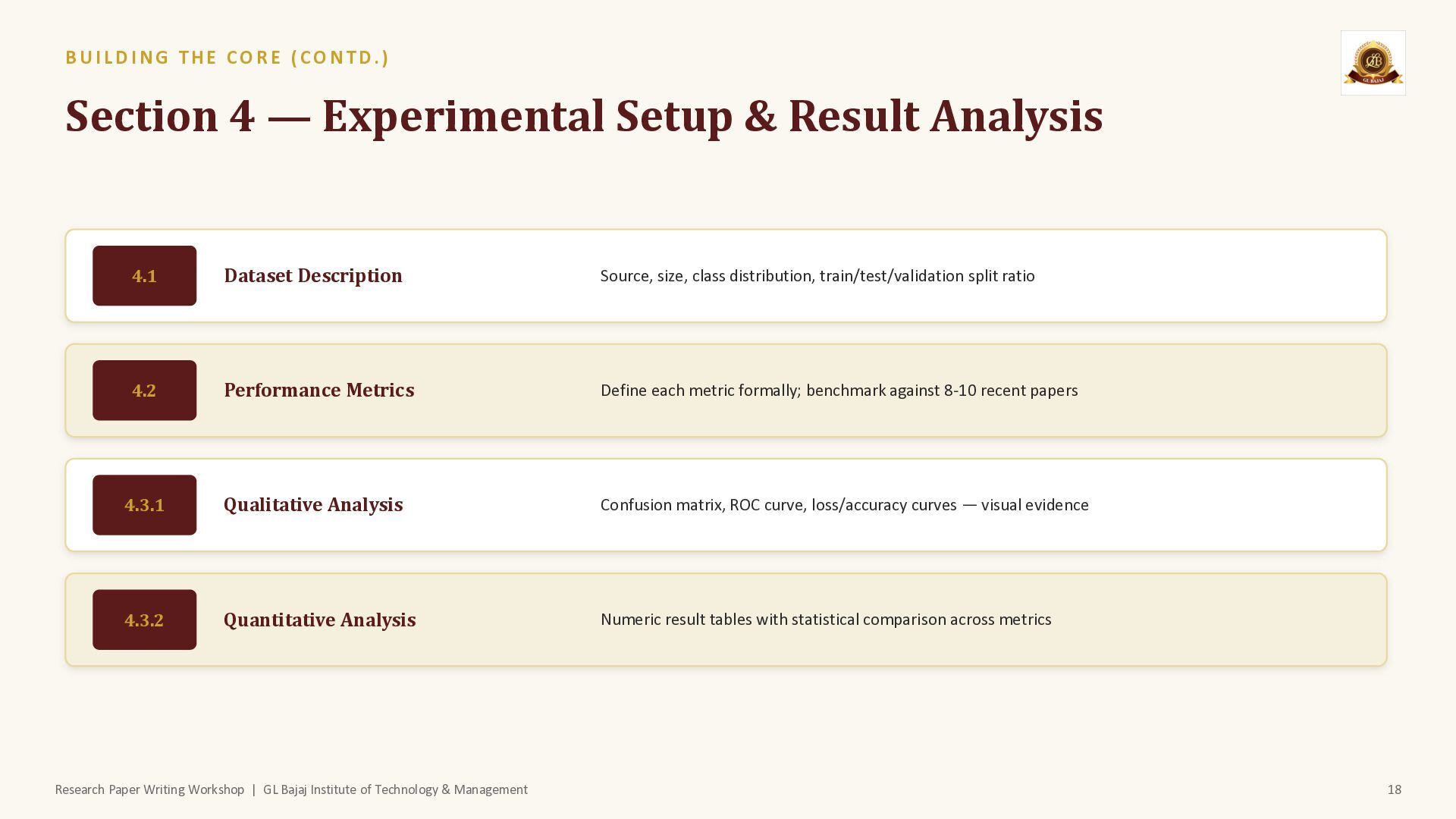
Result Analysis 4.1 Dataset Description Source, size, class distribution, train/test/validation split ratio 4.2 Performance Metrics Define each metric formally; benchmark against 8-10 recent papers 4.3.1 Qualitative Analysis Confusion matrix, ROC curve, loss/accuracy curves — visual evidence 4.3.2 Quantitative Analysis Numeric result tables with statistical comparison across metrics Research Paper Writing Workshop | GL Bajaj Institute of Technology & Management 18
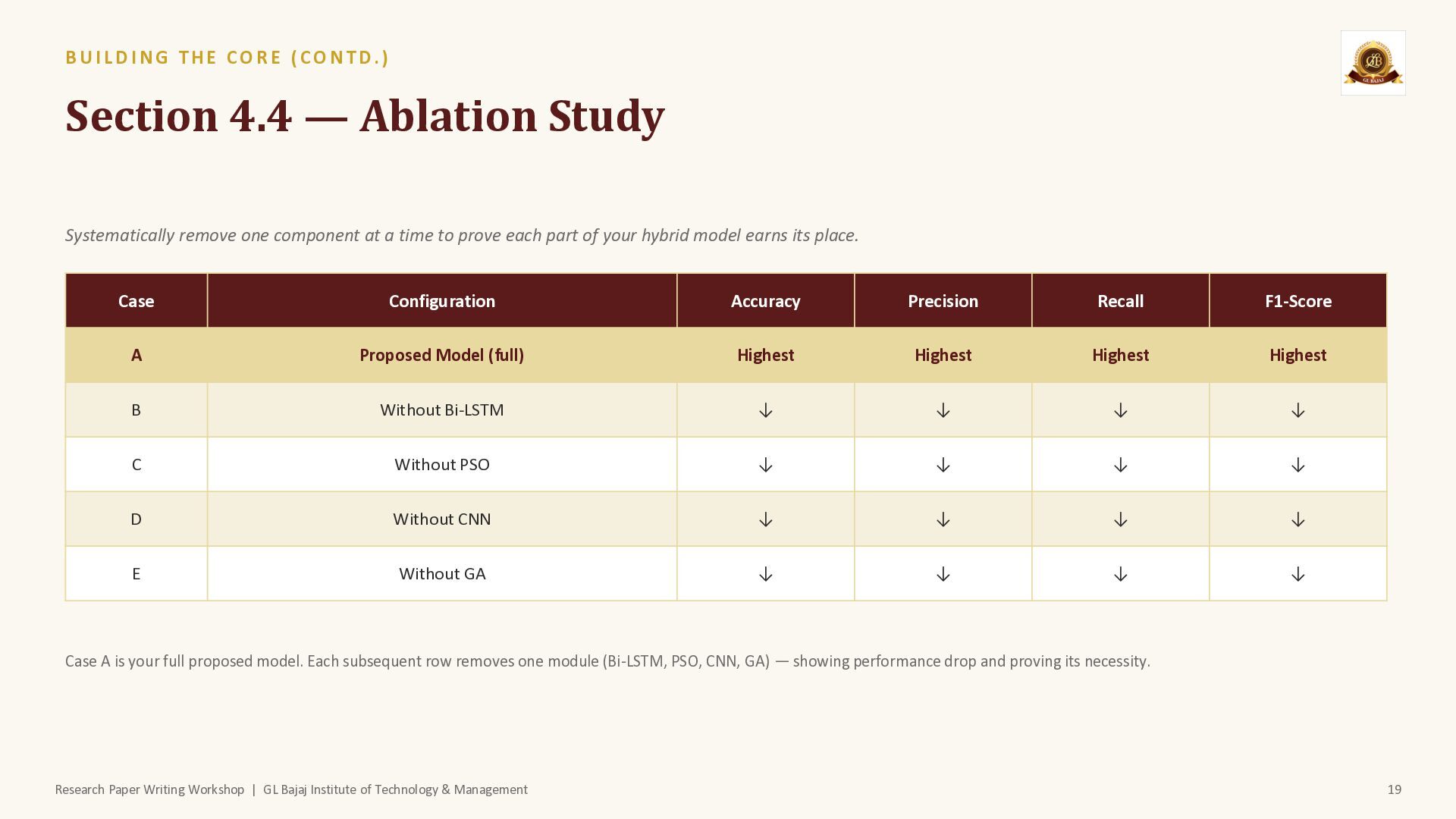
remove one component at a time to prove each part of your hybrid model earns its place. Case Configuration Accuracy Precision Recall F1-Score A Proposed Model (full) Highest Highest Highest Highest B Without Bi-LSTM ↓ ↓ ↓ ↓ C Without PSO ↓ ↓ ↓ ↓ D Without CNN ↓ ↓ ↓ ↓ E Without GA ↓ ↓ ↓ ↓ Case A is your full proposed model. Each subsequent row removes one module (Bi-LSTM, PSO, CNN, GA) — showing performance drop and proving its necessity. Research Paper Writing Workshop | GL Bajaj Institute of Technology & Management 19
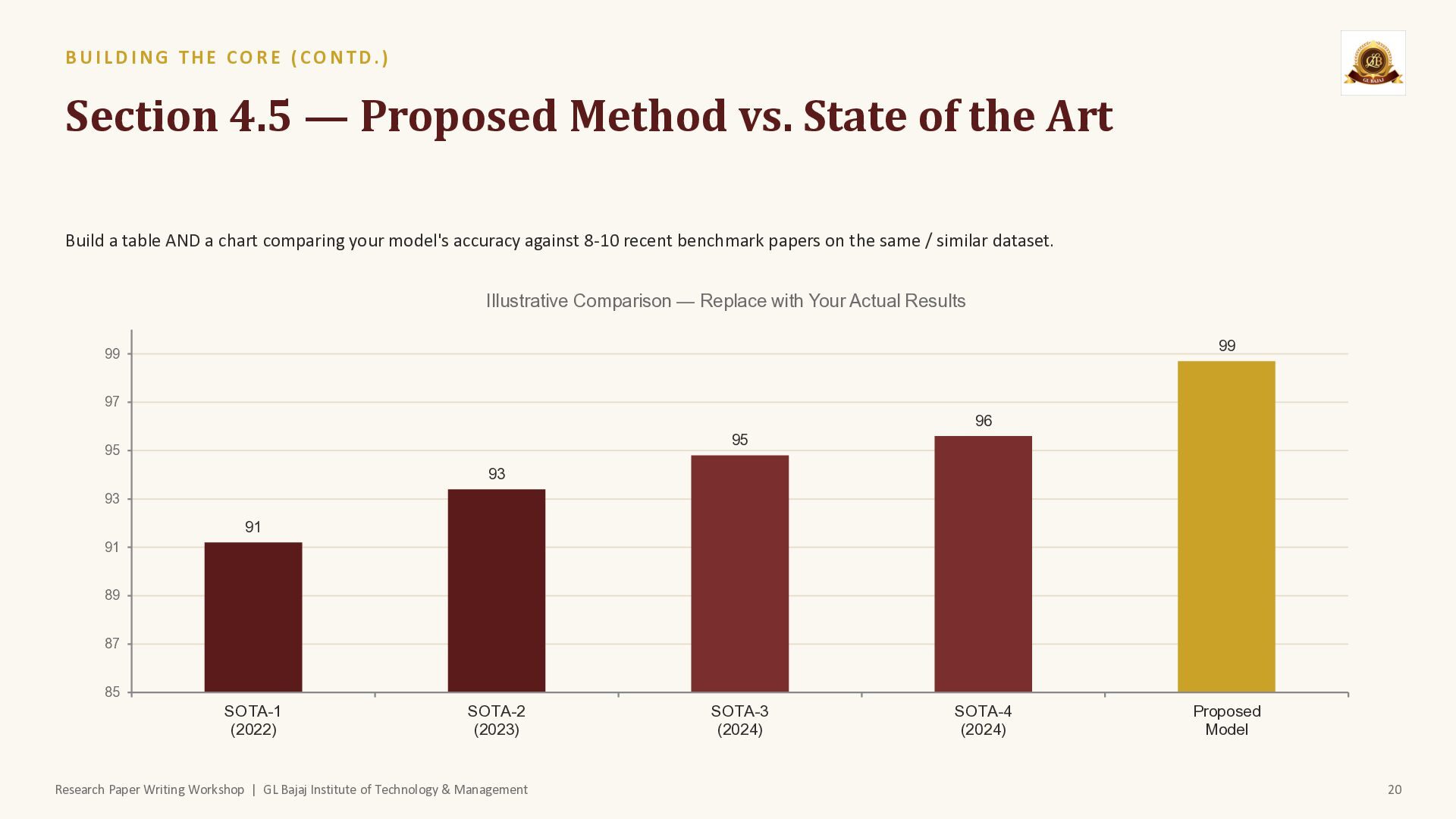
State of the Art Build a table AND a chart comparing your model's accuracy against 8-10 recent benchmark papers on the same / similar dataset. Illustrative Comparison — Replace with Your Actual Results 99 99 97 96 95 95 93 93 91 91 89 87 85 SOTA-1 (2022) SOTA-2 (2023) Research Paper Writing Workshop | GL Bajaj Institute of Technology & Management SOTA-3 (2024) SOTA-4 (2024) Proposed Model 20
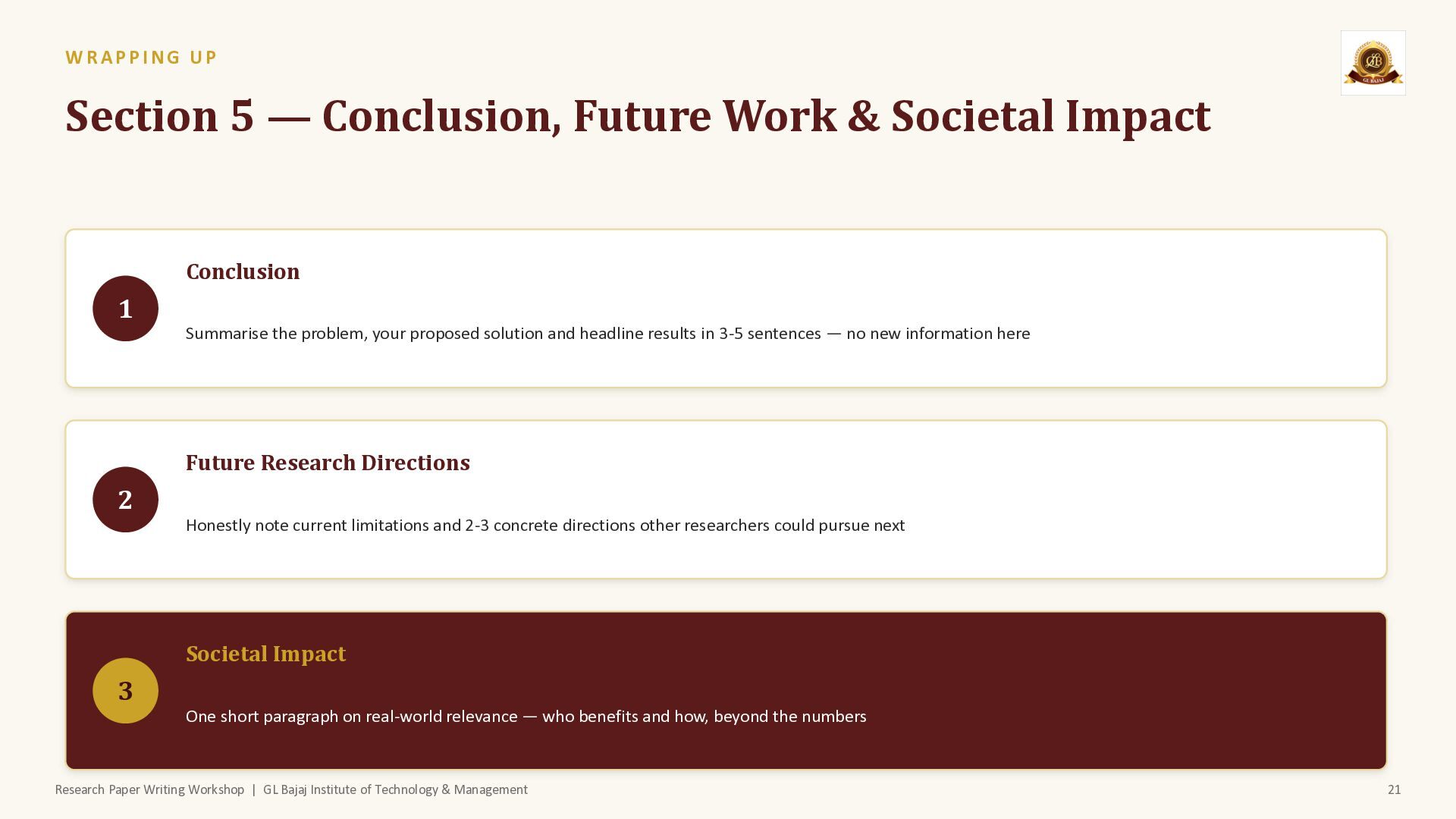
Impact Conclusion 1 Summarise the problem, your proposed solution and headline results in 3-5 sentences — no new information here Future Research Directions 2 Honestly note current limitations and 2-3 concrete directions other researchers could pursue next Societal Impact 3 One short paragraph on real-world relevance — who benefits and how, beyond the numbers Research Paper Writing Workshop | GL Bajaj Institute of Technology & Management 21
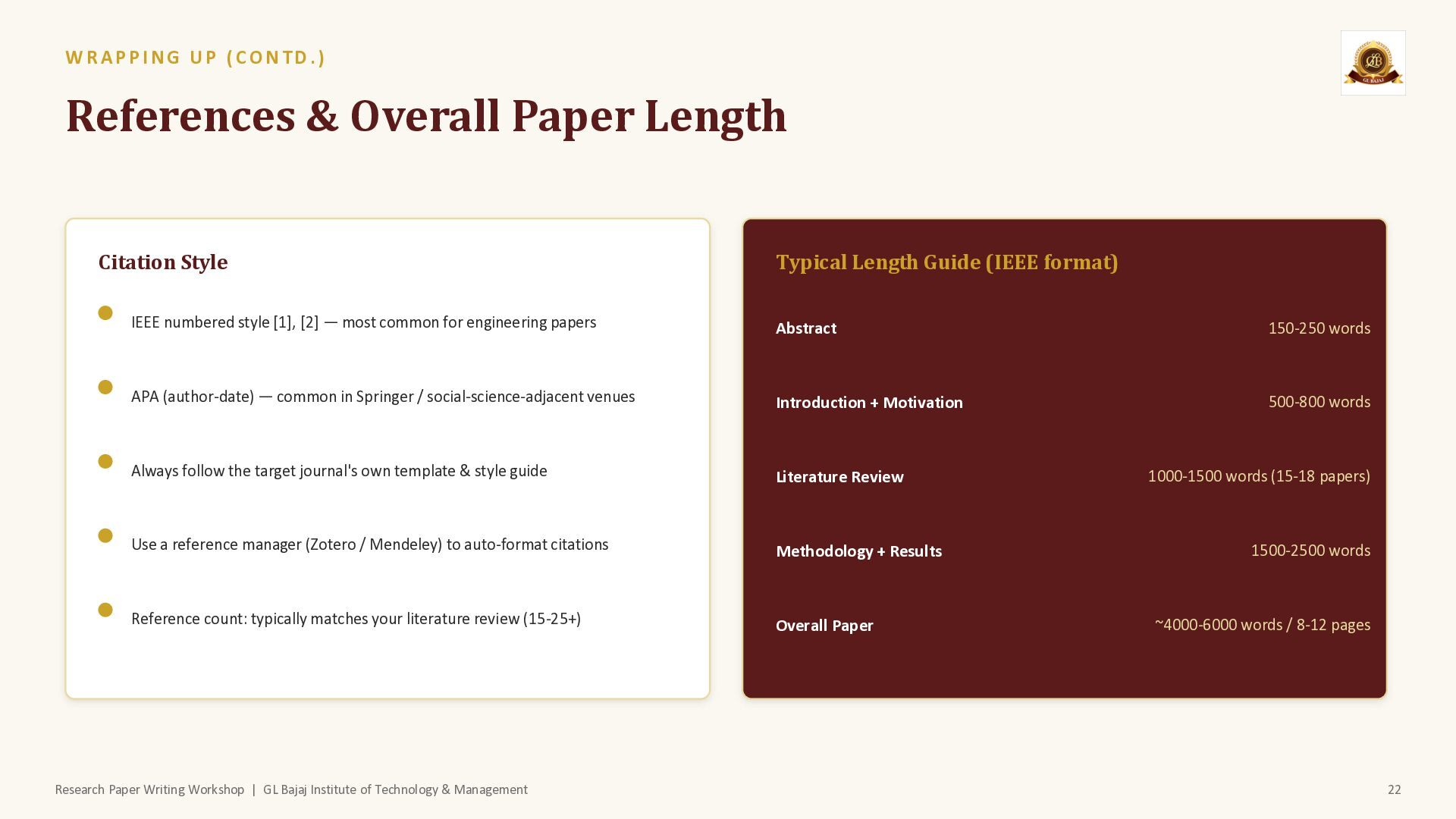
Typical Length Guide (IEEE format) IEEE numbered style [1], [2] — most common for engineering papers Abstract 150-250 words APA (author-date) — common in Springer / social-science-adjacent venues Introduction + Motivation 500-800 words Always follow the target journal's own template & style guide Literature Review Use a reference manager (Zotero / Mendeley) to auto-format citations Methodology + Results Reference count: typically matches your literature review (15-25+) Overall Paper Research Paper Writing Workshop | GL Bajaj Institute of Technology & Management 1000-1500 words (15-18 papers) 1500-2500 words ~4000-6000 words / 8-12 pages 22
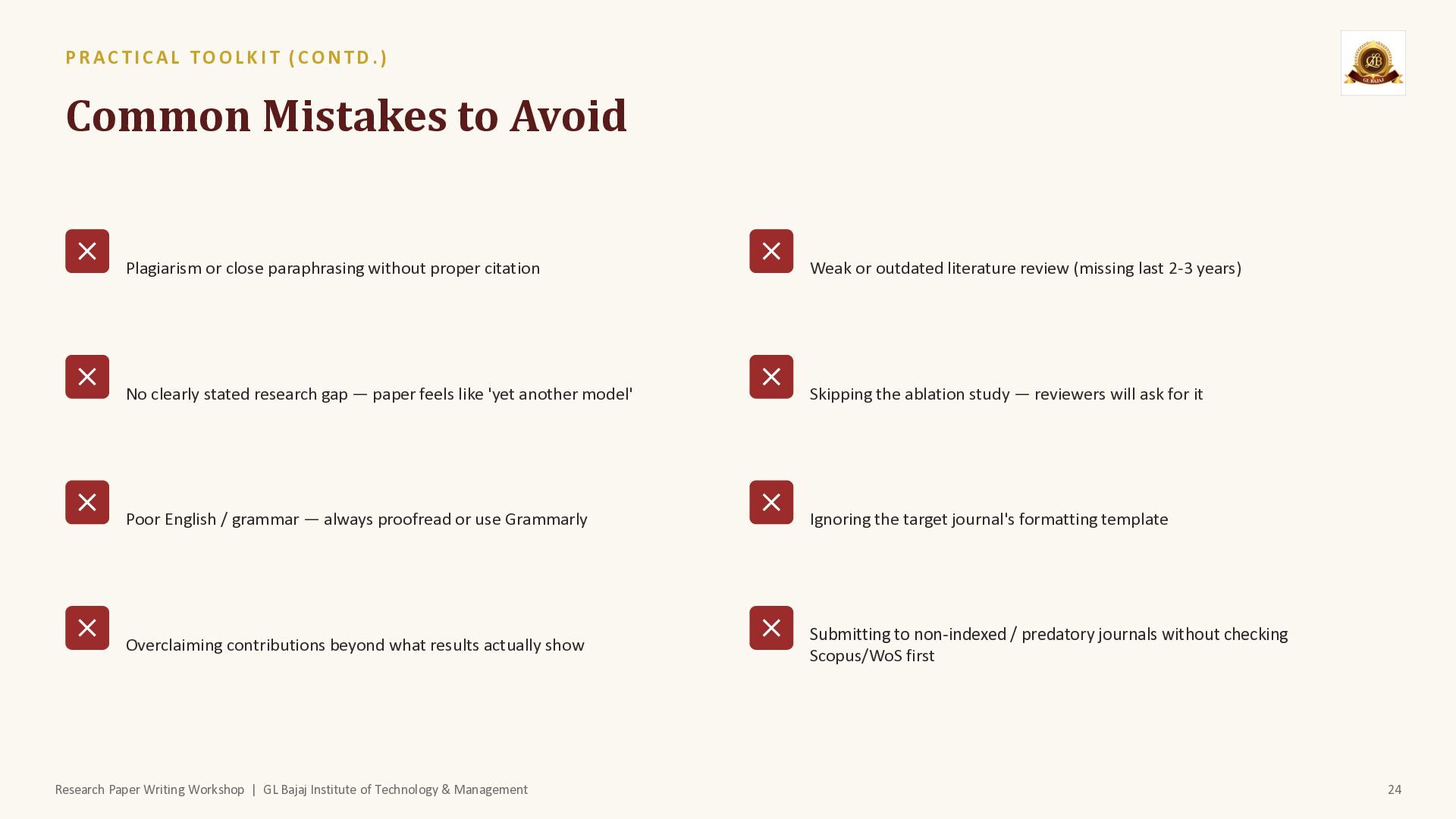
✕ Plagiarism or close paraphrasing without proper citation No clearly stated research gap — paper feels like 'yet another model' Poor English / grammar — always proofread or use Grammarly Overclaiming contributions beyond what results actually show Research Paper Writing Workshop | GL Bajaj Institute of Technology & Management ✕ ✕ ✕ ✕ Weak or outdated literature review (missing last 2-3 years) Skipping the ablation study — reviewers will ask for it Ignoring the target journal's formatting template Submitting to non-indexed / predatory journals without checking Scopus/WoS first 24


 apex9090
 kentaitakura
 yumaichikawa
 sishi2026
 kzmssk
 institutdelelevage
 hellosct1
 satai
 enochan
 sazimai
 gpeyre
 ayatokanada
 eileencodes
 jlugia
 baasie
 codingconduct
 cassininazir
 sergeychernyshev
 uxyall
 sstephenson
 holman
 varn
 rkendrick25
 marktimemedia