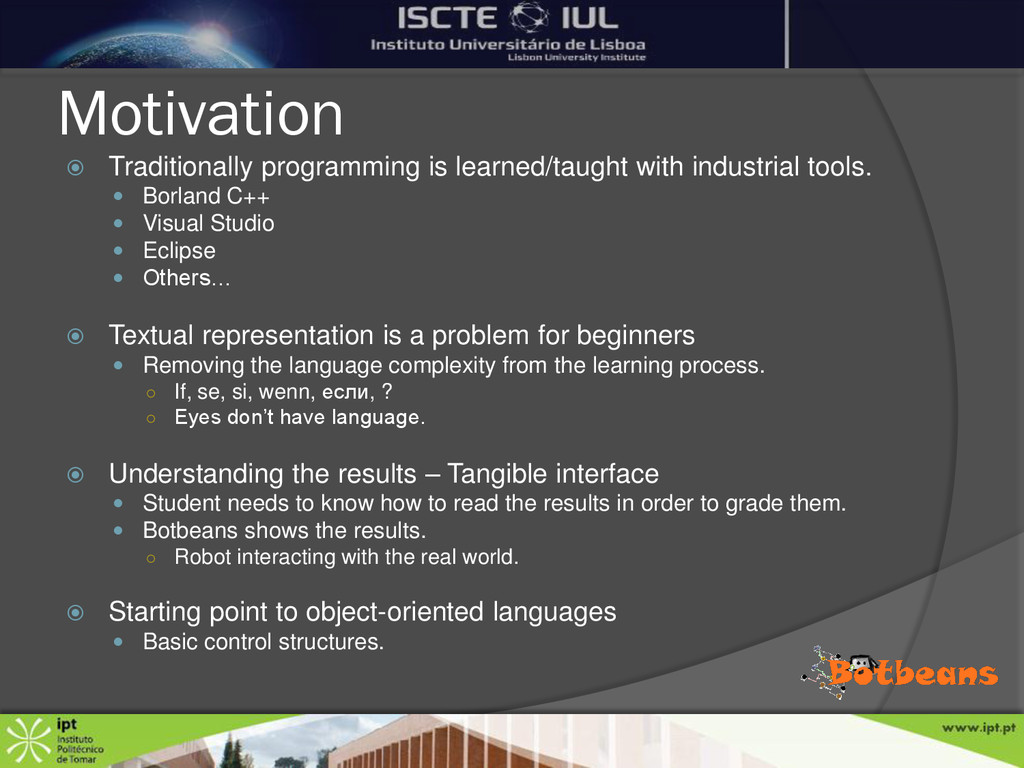
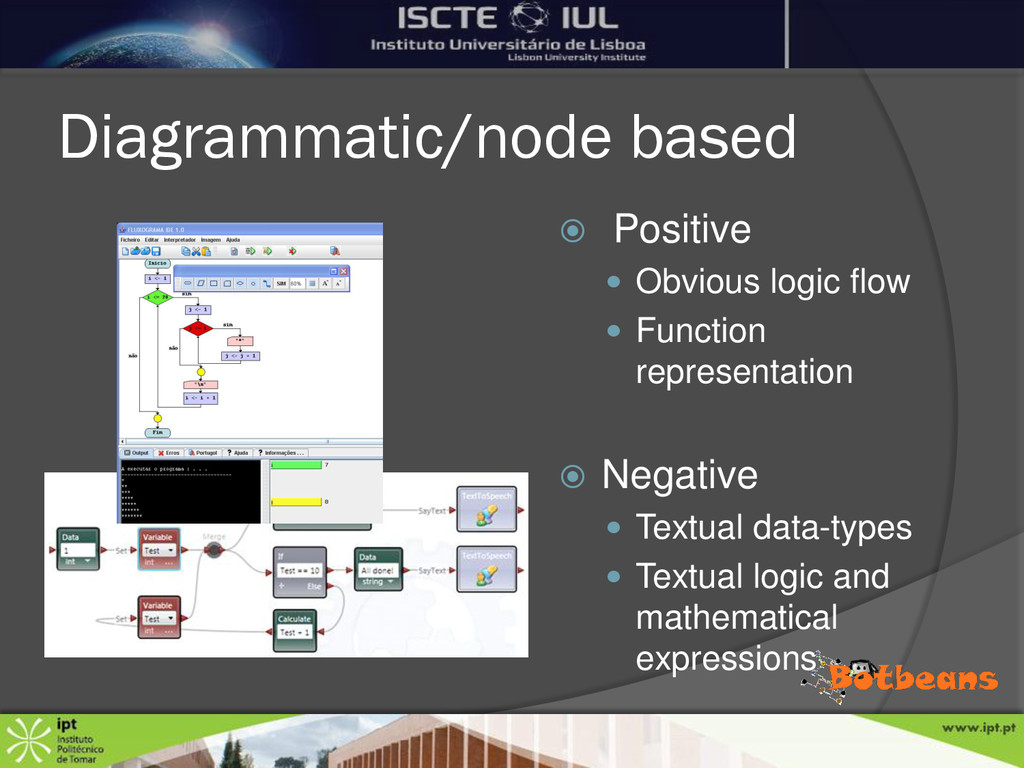
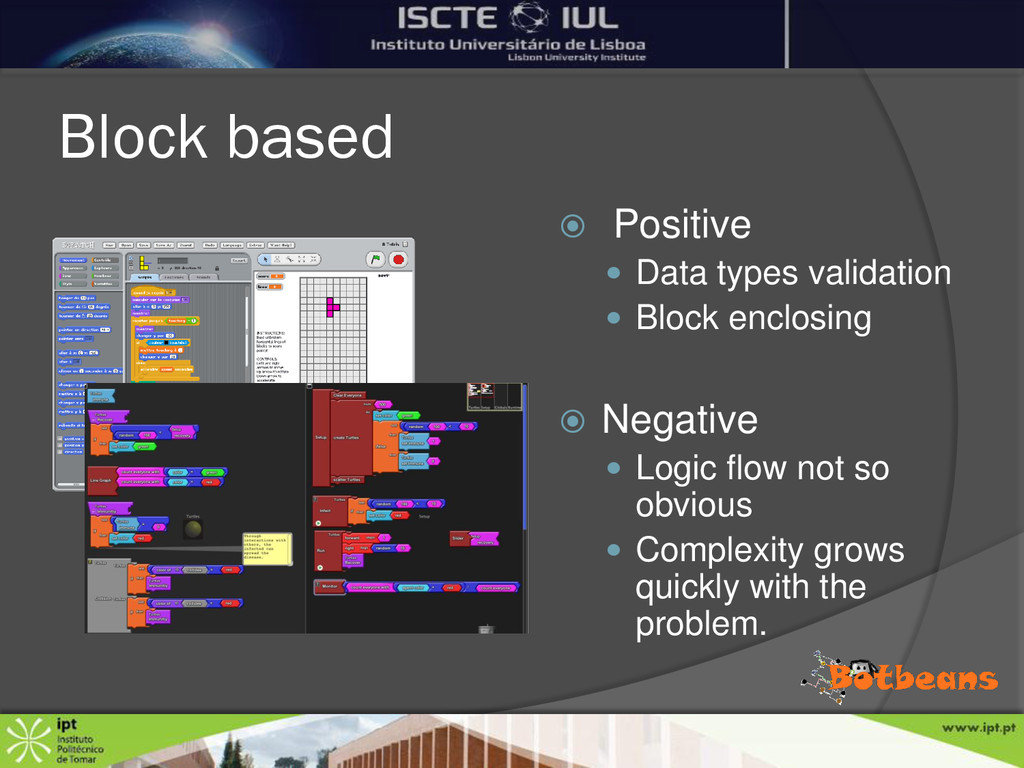
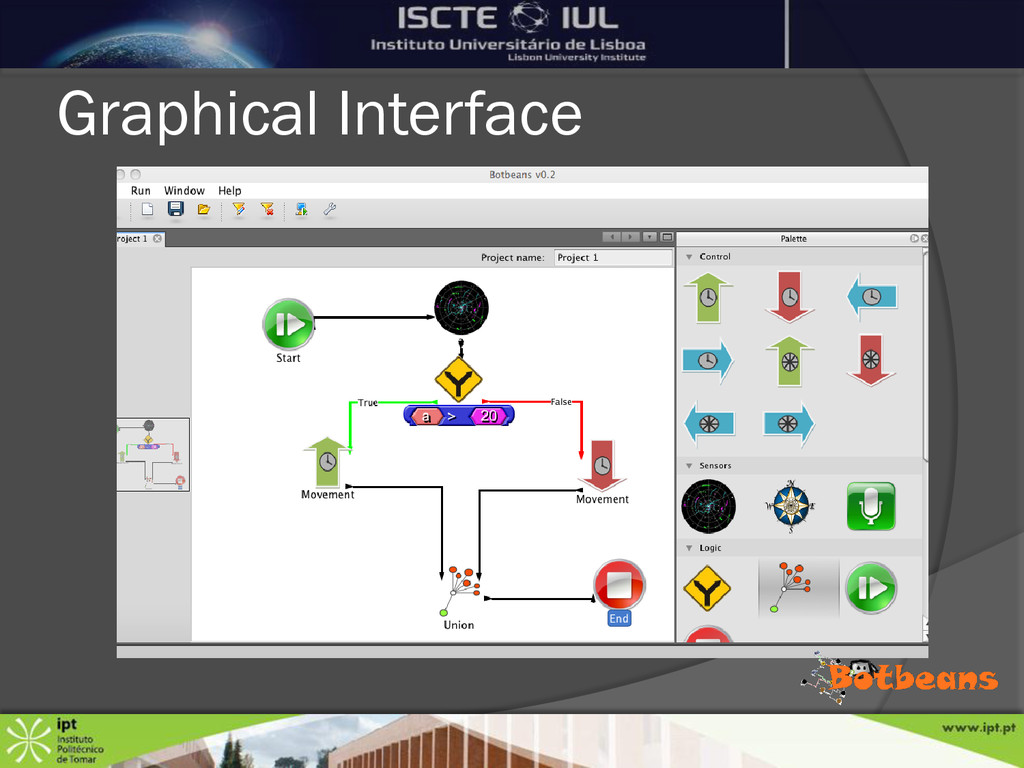
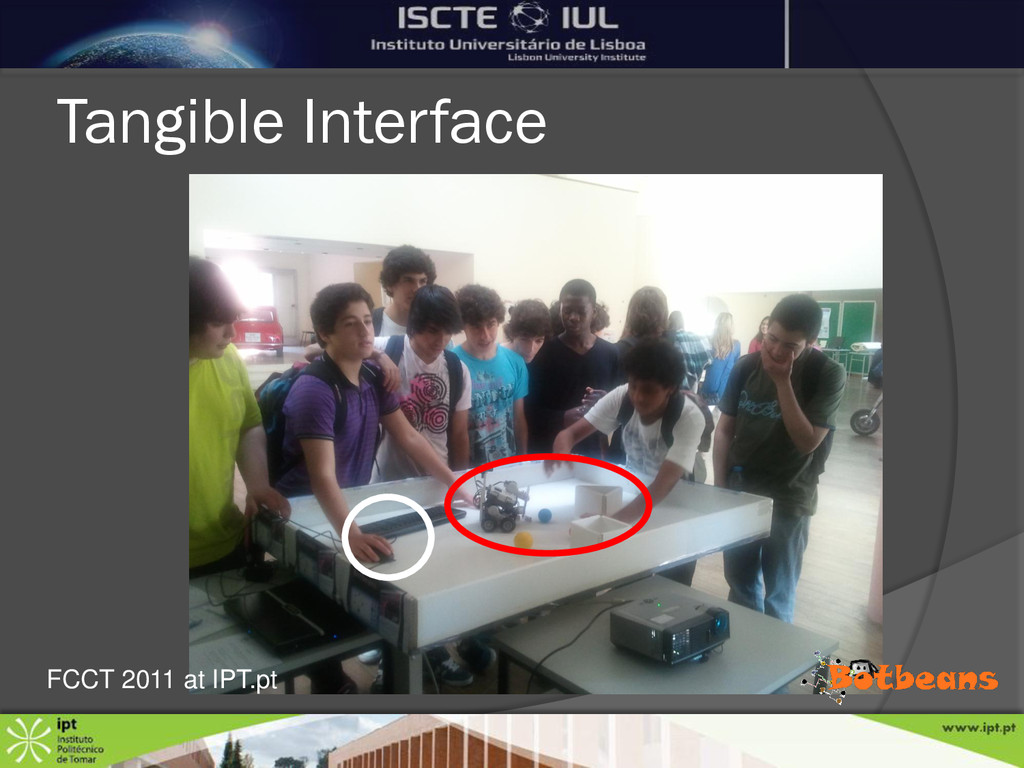
Borland C++ Visual Studio Eclipse Others… Textual representation is a problem for beginners Removing the language complexity from the learning process. ◦ If, se, si, wenn, если, ? ◦ Eyes don’t have language. Understanding the results – Tangible interface Student needs to know how to read the results in order to grade them. Botbeans shows the results. ◦ Robot interacting with the real world. Starting point to object-oriented languages Basic control structures.
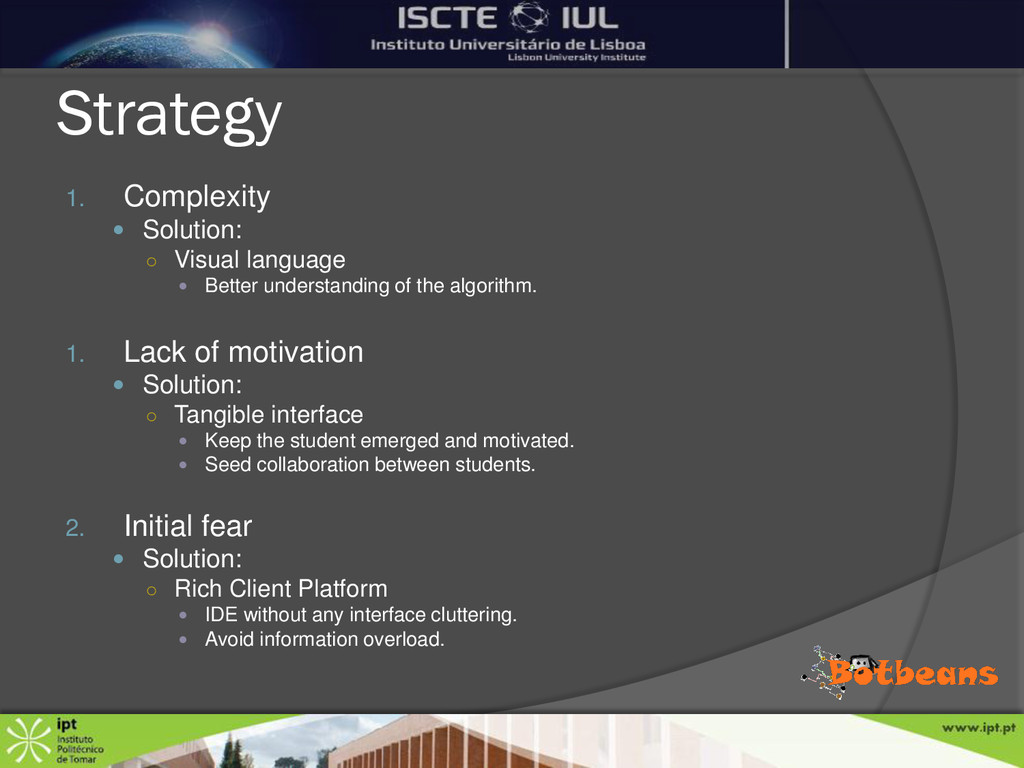
understanding of the algorithm. 1. Lack of motivation Solution: ◦ Tangible interface Keep the student emerged and motivated. Seed collaboration between students. 2. Initial fear Solution: ◦ Rich Client Platform IDE without any interface cluttering. Avoid information overload.
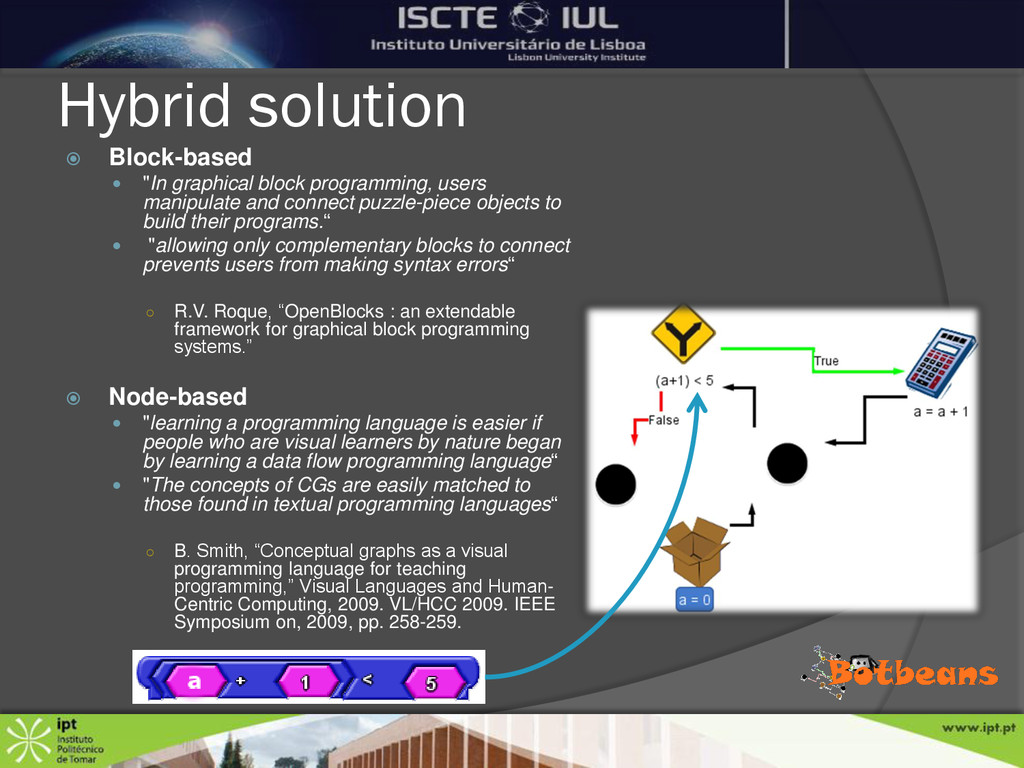
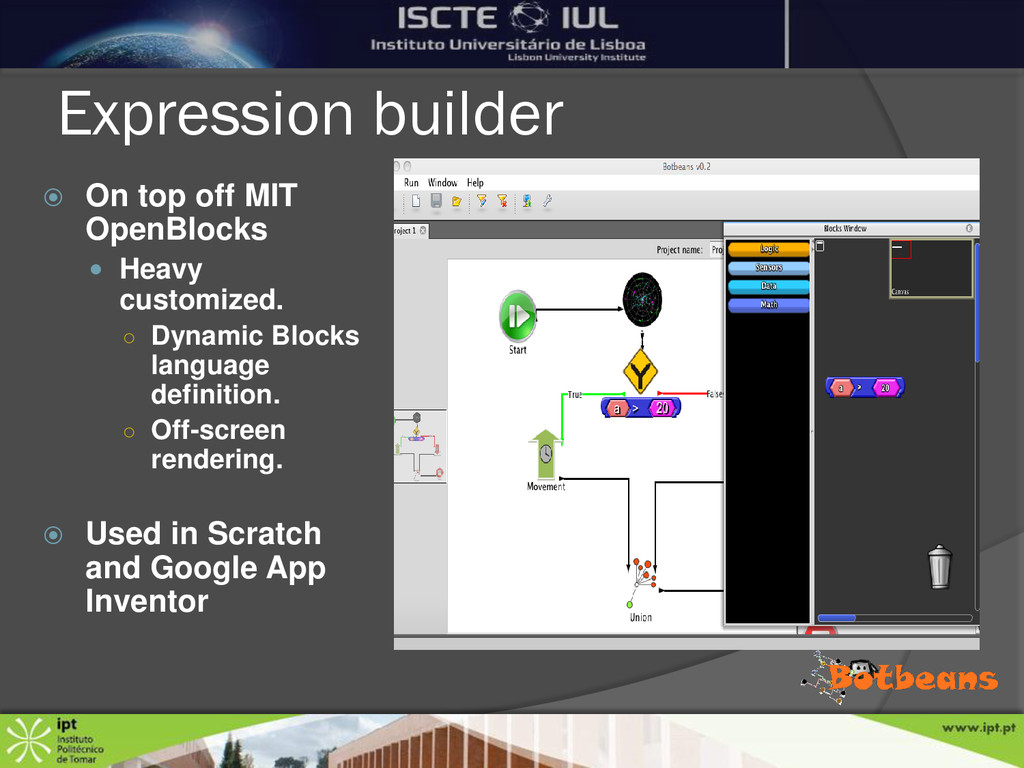
manipulate and connect puzzle-piece objects to build their programs.“ "allowing only complementary blocks to connect prevents users from making syntax errors“ ◦ R.V. Roque, “OpenBlocks : an extendable framework for graphical block programming systems.” Node-based "learning a programming language is easier if people who are visual learners by nature began by learning a data flow programming language“ "The concepts of CGs are easily matched to those found in textual programming languages“ ◦ B. Smith, “Conceptual graphs as a visual programming language for teaching programming,” Visual Languages and Human- Centric Computing, 2009. VL/HCC 2009. IEEE Symposium on, 2009, pp. 258-259.
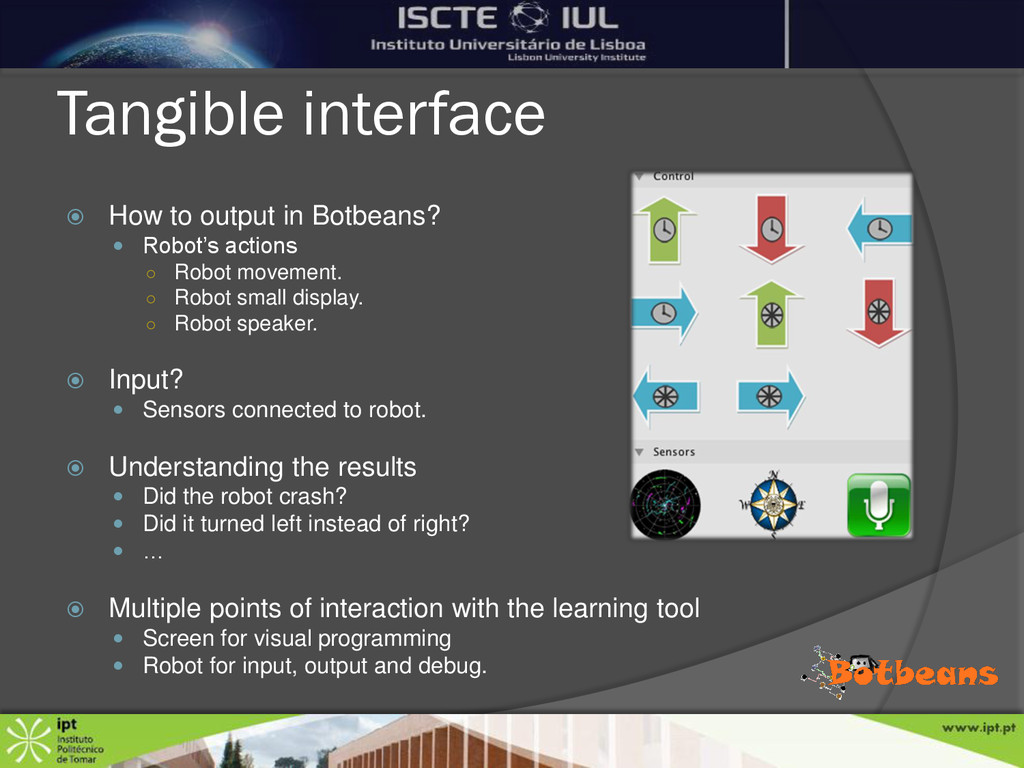
actions ◦ Robot movement. ◦ Robot small display. ◦ Robot speaker. Input? Sensors connected to robot. Understanding the results Did the robot crash? Did it turned left instead of right? … Multiple points of interaction with the learning tool Screen for visual programming Robot for input, output and debug.
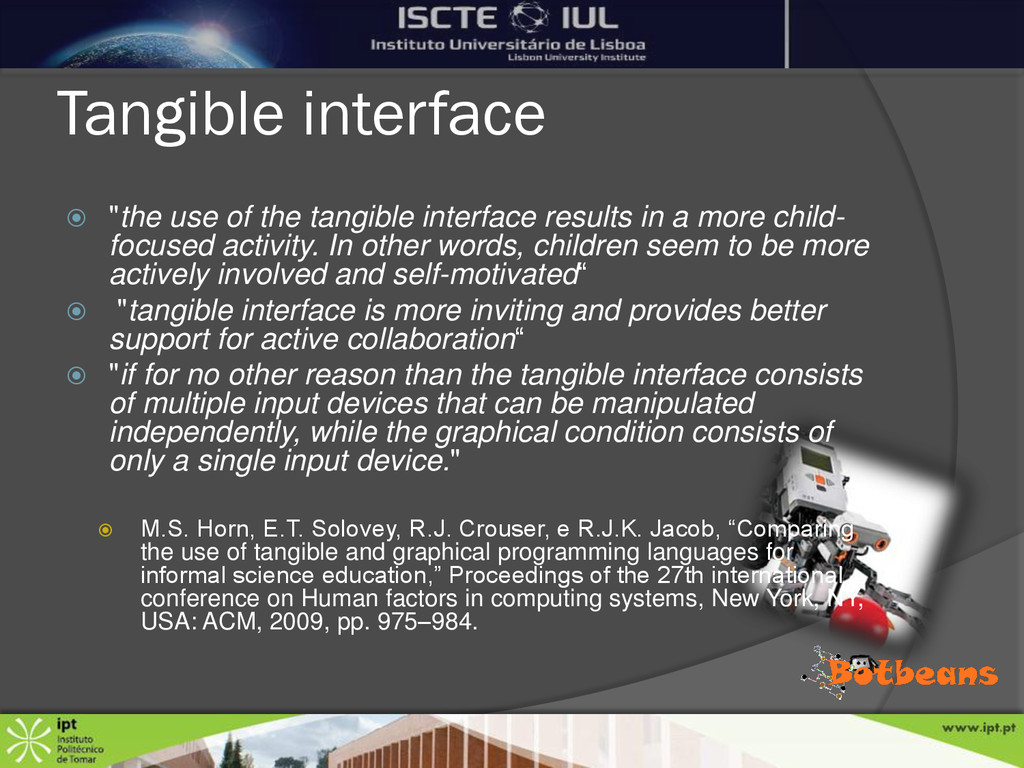
in a more child- focused activity. In other words, children seem to be more actively involved and self-motivated“ "tangible interface is more inviting and provides better support for active collaboration“ "if for no other reason than the tangible interface consists of multiple input devices that can be manipulated independently, while the graphical condition consists of only a single input device." M.S. Horn, E.T. Solovey, R.J. Crouser, e R.J.K. Jacob, “Comparing the use of tangible and graphical programming languages for informal science education,” Proceedings of the 27th international conference on Human factors in computing systems, New York, NY, USA: ACM, 2009, pp. 975–984.
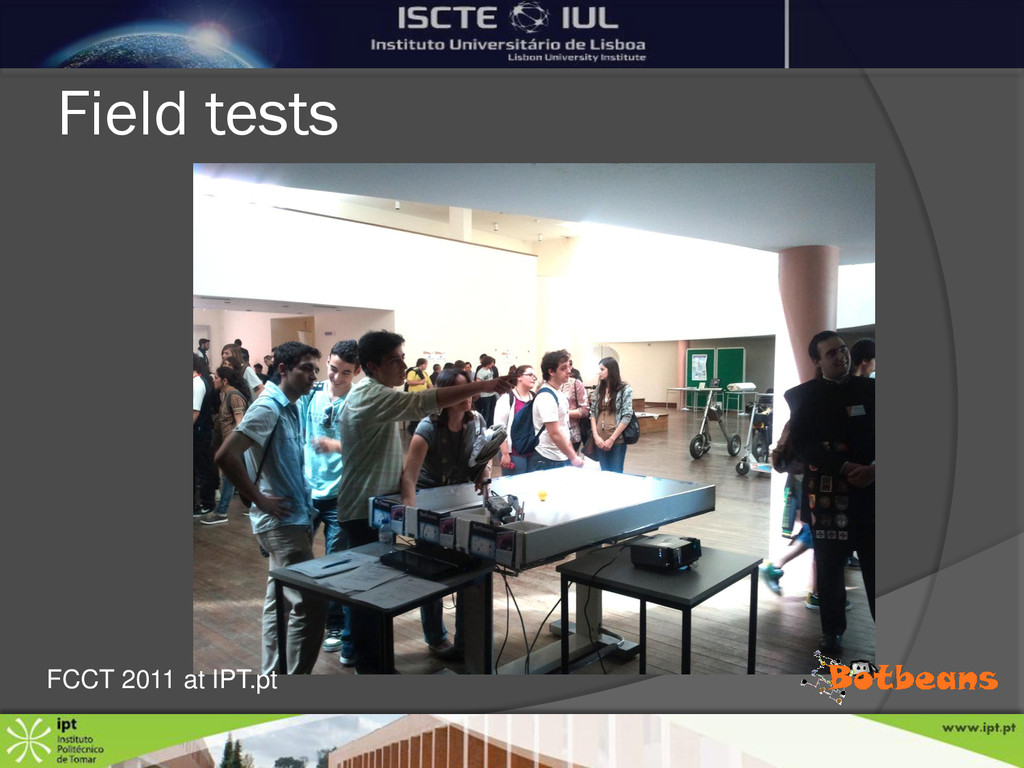
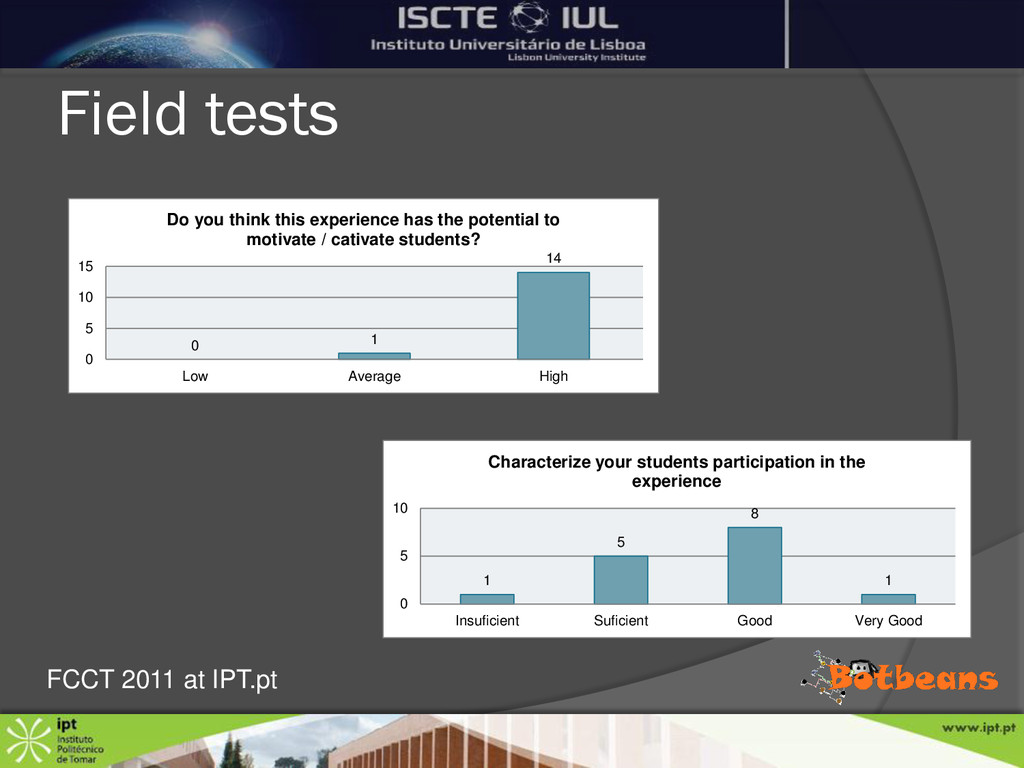
Average High Do you think this experience has the potential to motivate / cativate students? 1 5 8 1 0 5 10 Insuficient Suficient Good Very Good Characterize your students participation in the experience FCCT 2011 at IPT.pt
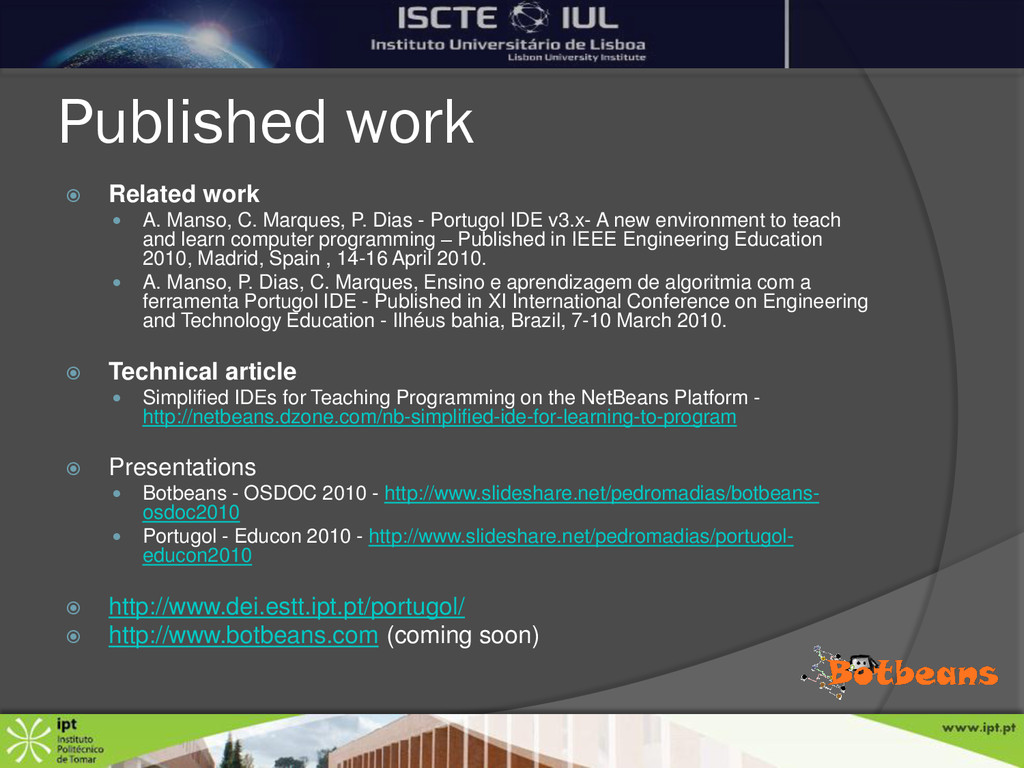
P. Dias - Portugol IDE v3.x- A new environment to teach and learn computer programming – Published in IEEE Engineering Education 2010, Madrid, Spain , 14-16 April 2010. A. Manso, P. Dias, C. Marques, Ensino e aprendizagem de algoritmia com a ferramenta Portugol IDE - Published in XI International Conference on Engineering and Technology Education - Ilhéus bahia, Brazil, 7-10 March 2010. Technical article Simplified IDEs for Teaching Programming on the NetBeans Platform - http://netbeans.dzone.com/nb-simplified-ide-for-learning-to-program Presentations Botbeans - OSDOC 2010 - http://www.slideshare.net/pedromadias/botbeans- osdoc2010 Portugol - Educon 2010 - http://www.slideshare.net/pedromadias/portugol- educon2010 http://www.dei.estt.ipt.pt/portugol/ http://www.botbeans.com (coming soon)


 apocas
 findyinc
 morizo_1984
 irinanazarova
 satoshi256kbyte
 uyuki234
 texmeijin
 steliosf
 akihisaikeda
 kenjiyoneyama
 palkan
 tomokon
 florets1
 davidcarrasco
 kristinabergwall1
 sergeychernyshev
 marcoroth
 ks91
ks91
 chriscoyier
 baasie
 kimpetersen
 bkeepers
 aarron
 tammyeverts
 reverentgeek
![Pedro M. Dias [email protected] Educational Graphical and Tangible Programming Platform](https://files.speakerdeck.com/presentations/363cc7f0a618013103e7524b11d75e78/slide_0.jpg)