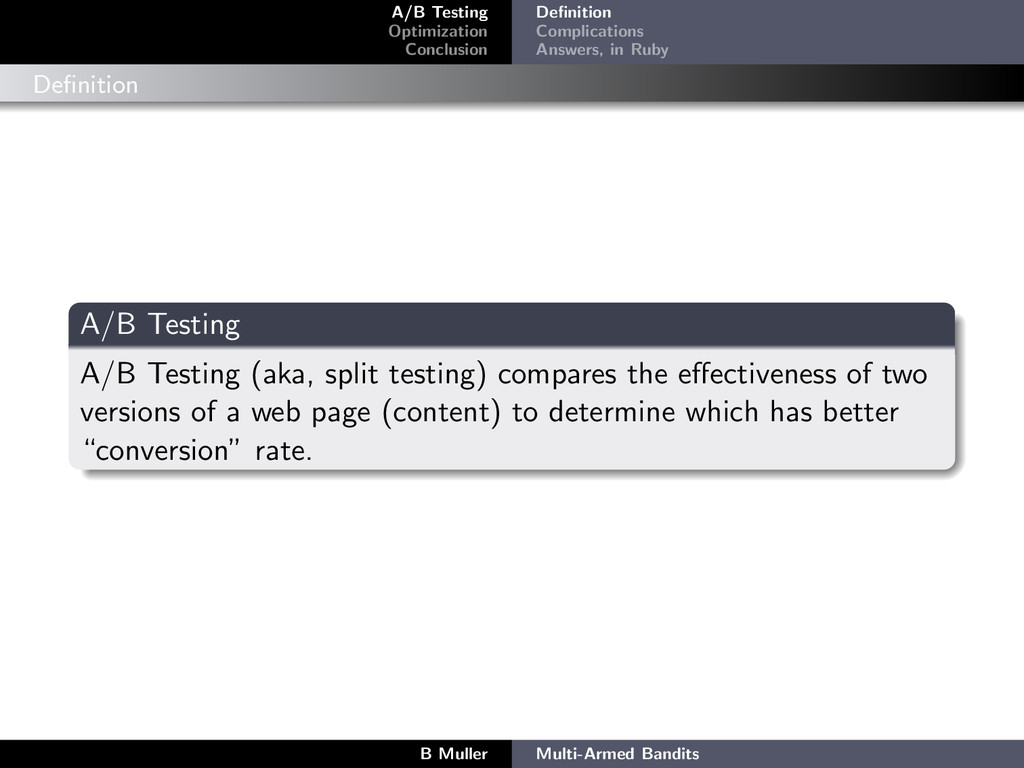
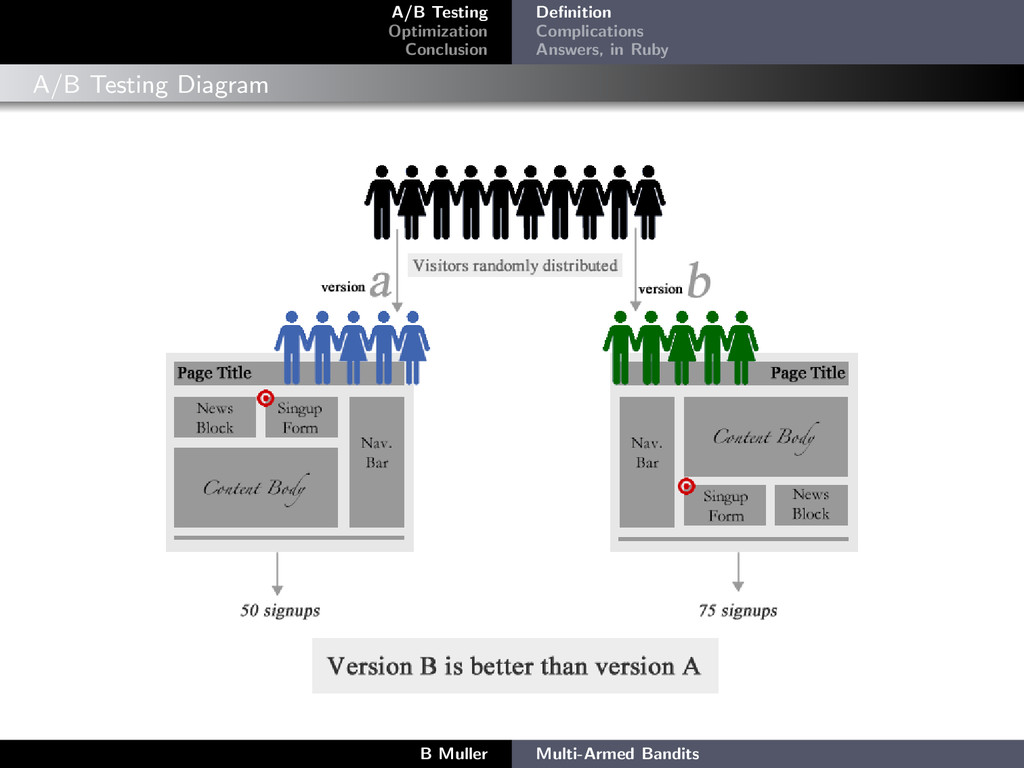
A/B Testing A/B Testing (aka, split testing) compares the effectiveness of two versions of a web page (content) to determine which has better “conversion” rate. B Muller Multi-Armed Bandits
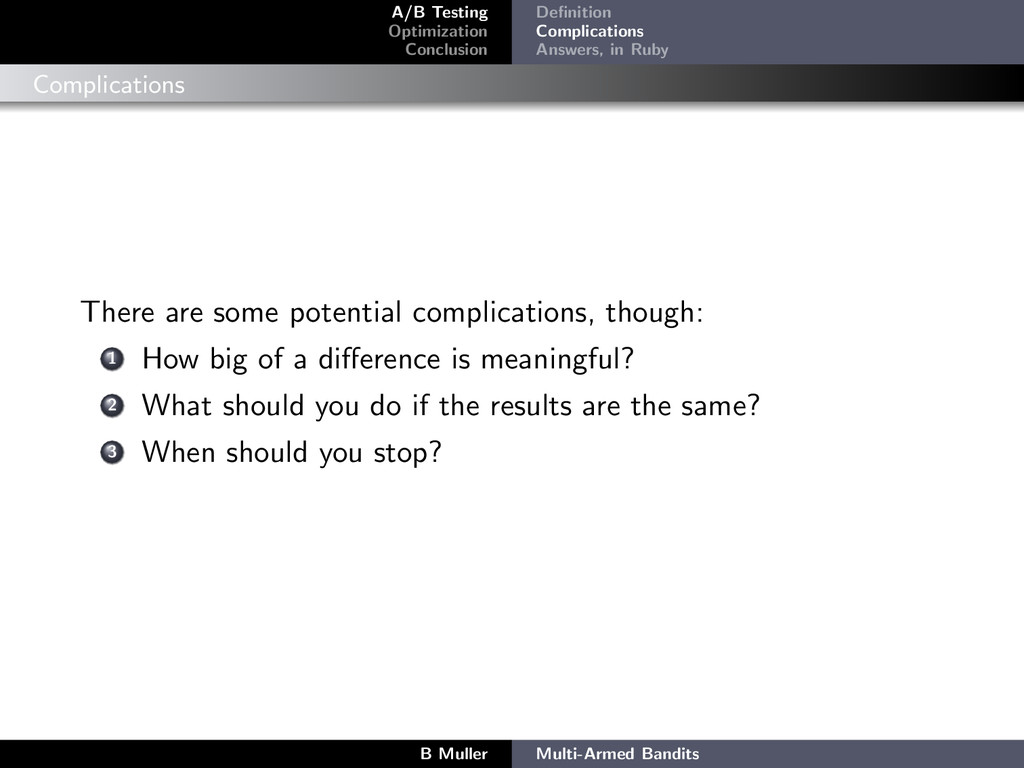
There are some potential complications, though: 1 How big of a difference is meaningful? 2 What should you do if the results are the same? 3 When should you stop? B Muller Multi-Armed Bandits
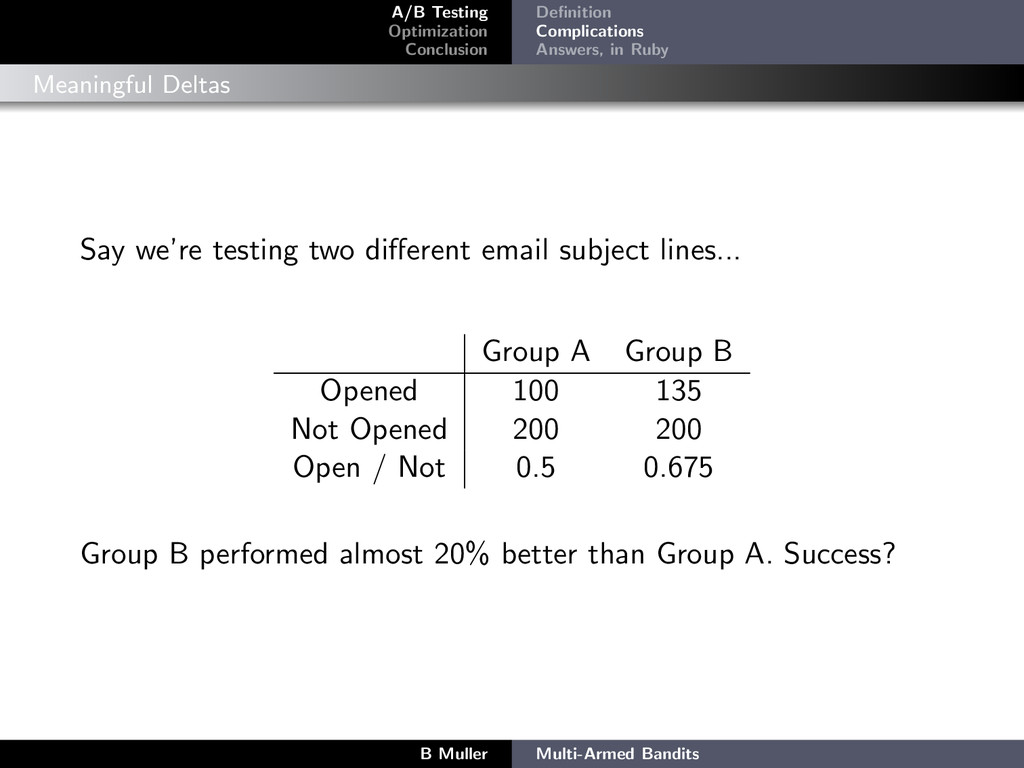
Deltas Say we’re testing two different email subject lines... Group A Group B Opened 100 135 Not Opened 200 200 Open / Not 0.5 0.675 Group B performed almost 20% better than Group A. Success? B Muller Multi-Armed Bandits
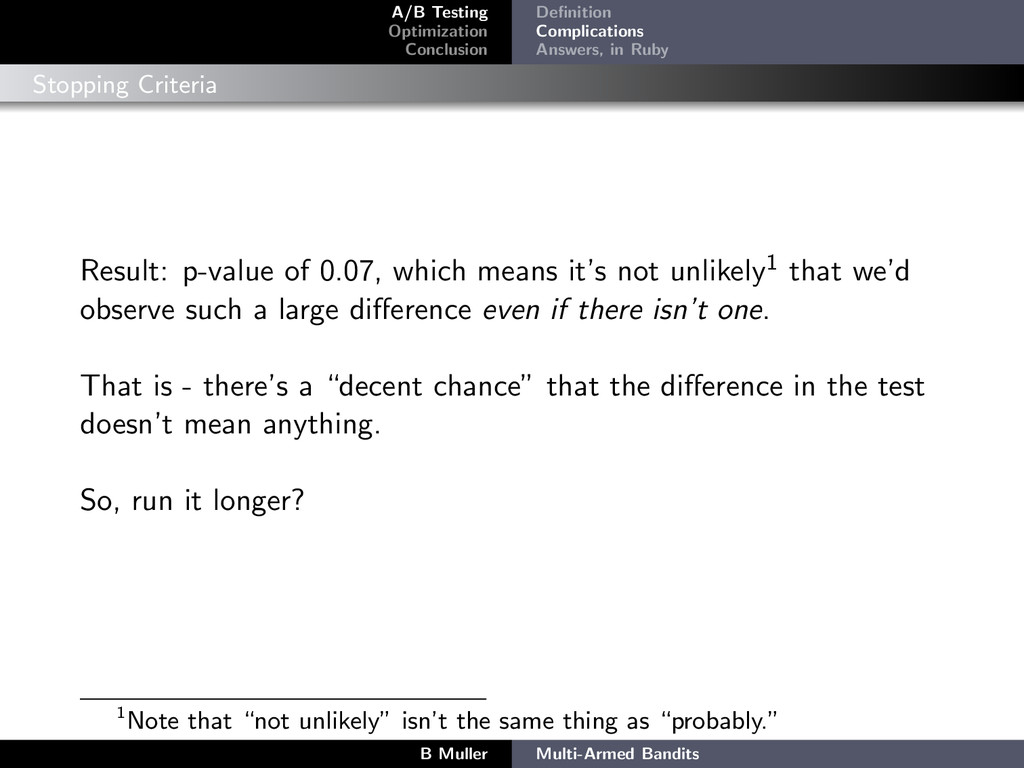
Criteria Result: p-value of 0.07, which means it’s not unlikely1 that we’d observe such a large difference even if there isn’t one. That is - there’s a “decent chance” that the difference in the test doesn’t mean anything. So, run it longer? 1Note that “not unlikely” isn’t the same thing as “probably.” B Muller Multi-Armed Bandits
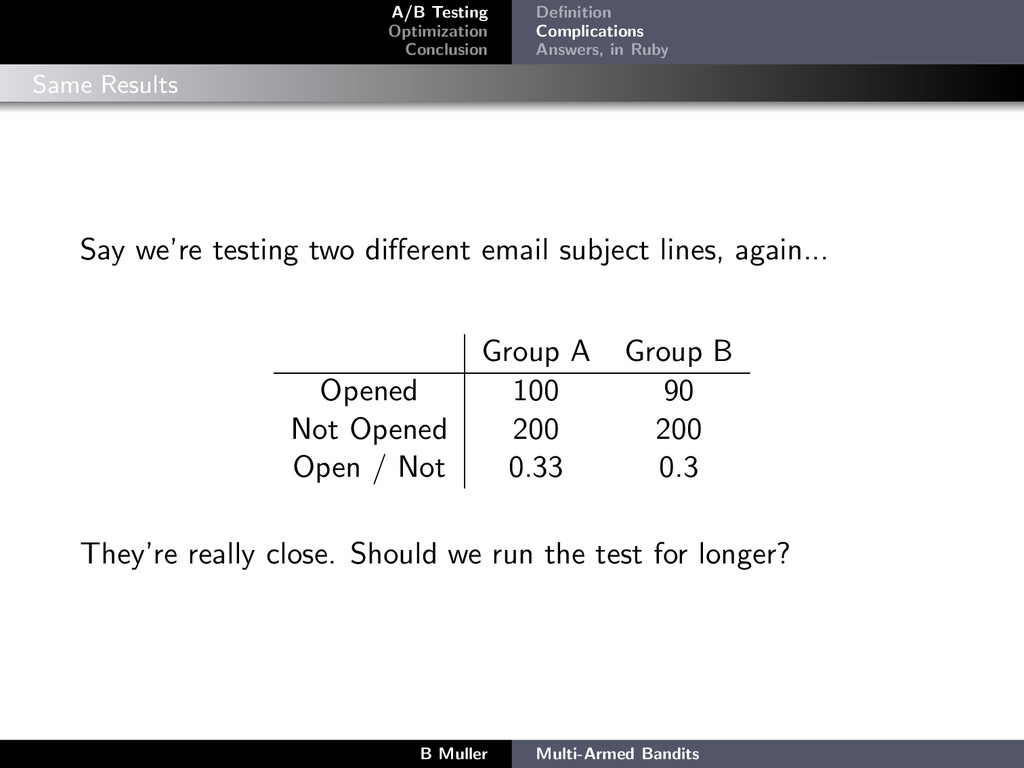
Results Say we’re testing two different email subject lines, again... Group A Group B Opened 100 90 Not Opened 200 200 Open / Not 0.33 0.3 They’re really close. Should we run the test for longer? B Muller Multi-Armed Bandits
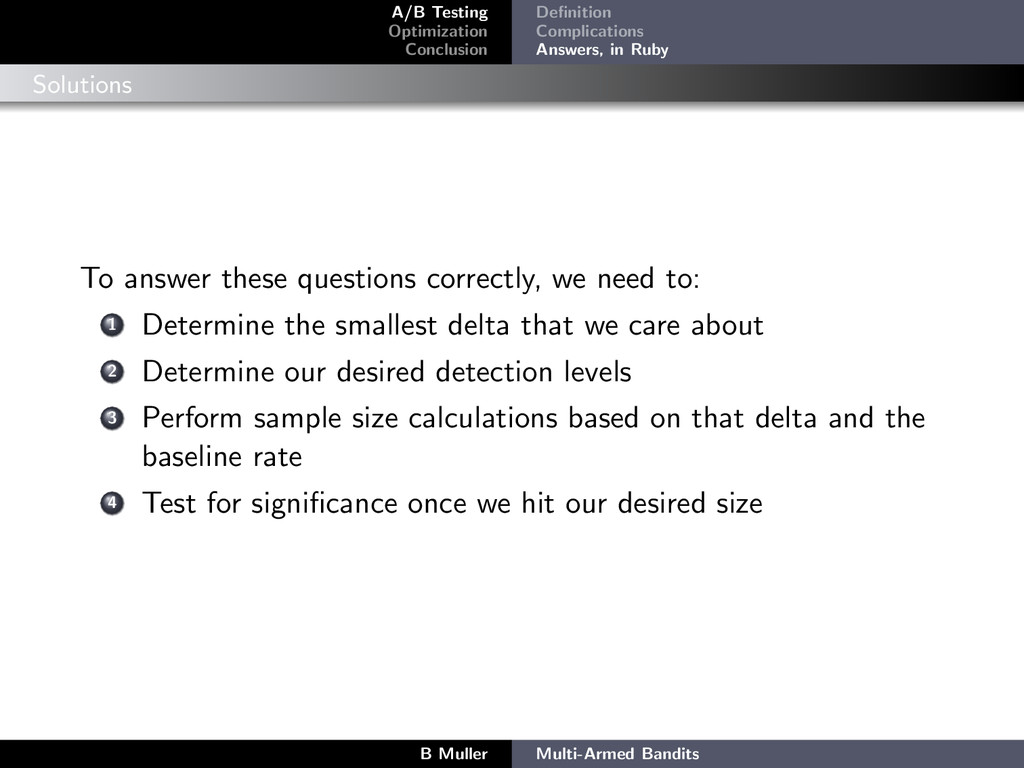
To answer these questions correctly, we need to: 1 Determine the smallest delta that we care about 2 Determine our desired detection levels 3 Perform sample size calculations based on that delta and the baseline rate 4 Test for significance once we hit our desired size B Muller Multi-Armed Bandits
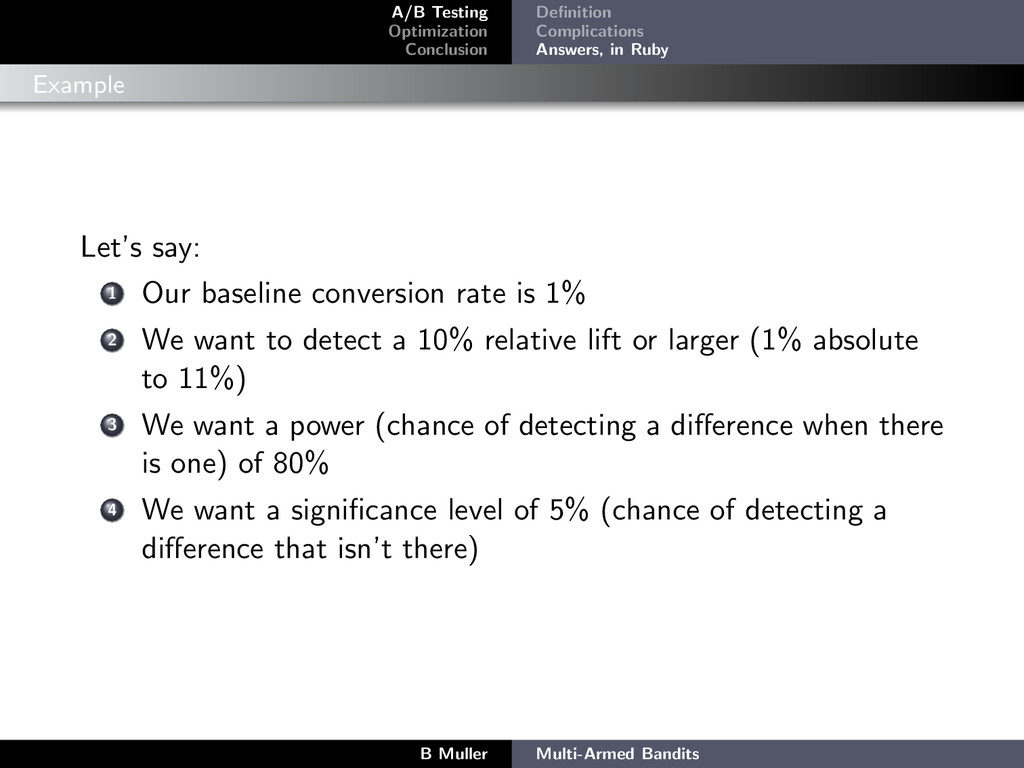
Let’s say: 1 Our baseline conversion rate is 1% 2 We want to detect a 10% relative lift or larger (1% absolute to 11%) 3 We want a power (chance of detecting a difference when there is one) of 80% 4 We want a significance level of 5% (chance of detecting a difference that isn’t there) B Muller Multi-Armed Bandits
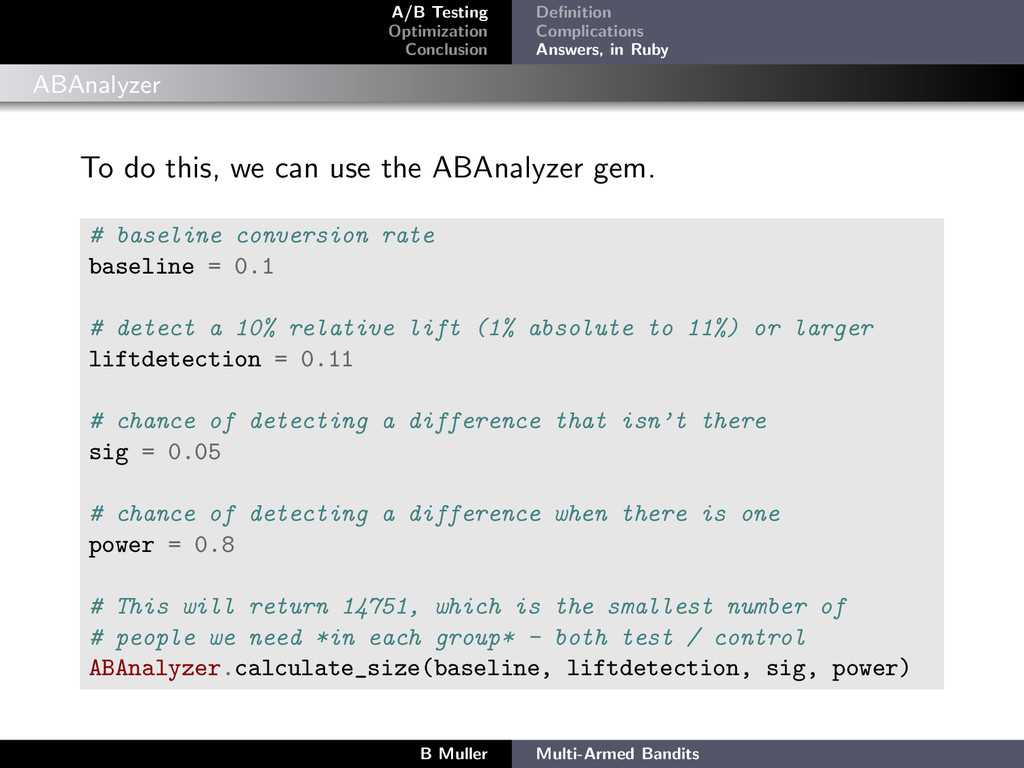
To do this, we can use the ABAnalyzer gem. # baseline conversion rate baseline = 0.1 # detect a 10% relative lift (1% absolute to 11%) or larger liftdetection = 0.11 # chance of detecting a difference that isn’t there sig = 0.05 # chance of detecting a difference when there is one power = 0.8 # This will return 14751, which is the smallest number of # people we need *in each group* - both test / control ABAnalyzer.calculate_size(baseline, liftdetection, sig, power) B Muller Multi-Armed Bandits
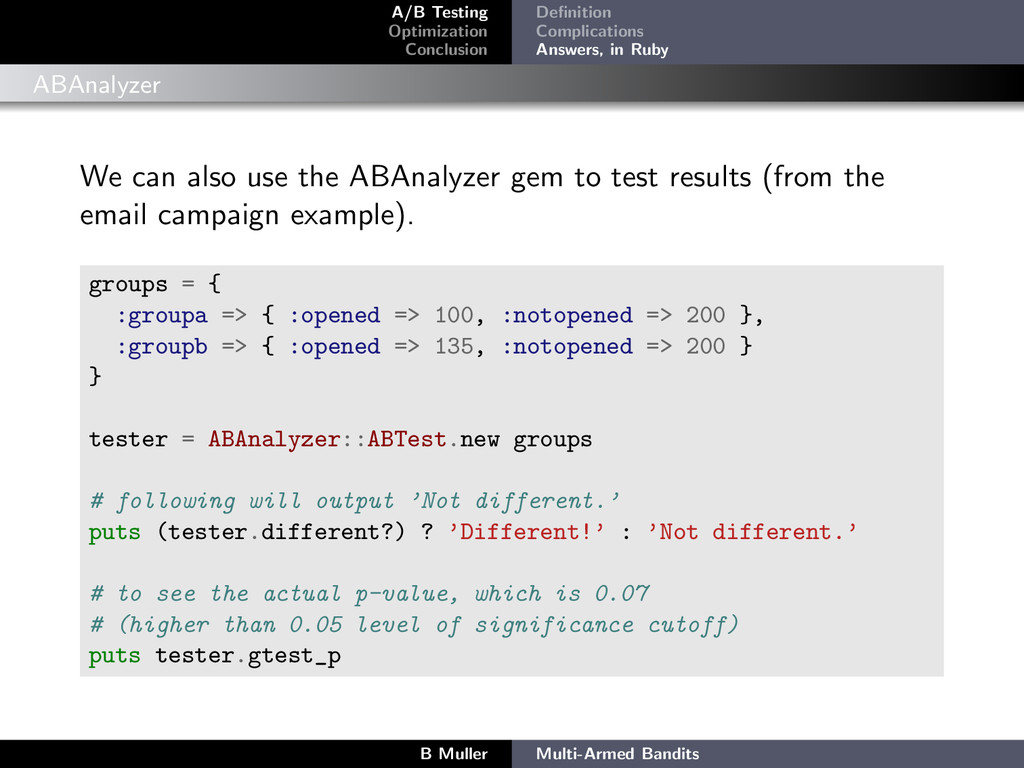
We can also use the ABAnalyzer gem to test results (from the email campaign example). groups = { :groupa => { :opened => 100, :notopened => 200 }, :groupb => { :opened => 135, :notopened => 200 } } tester = ABAnalyzer::ABTest.new groups # following will output ’Not different.’ puts (tester.different?) ? ’Different!’ : ’Not different.’ # to see the actual p-value, which is 0.07 # (higher than 0.05 level of significance cutoff) puts tester.gtest_p B Muller Multi-Armed Bandits
Reassess Goal Reassess Goal What if we could just maximize clicks at each step? Instead of evenly dividing audience, what if we just tried to divide the audience between the options to maximize clicks for each page load? B Muller Multi-Armed Bandits
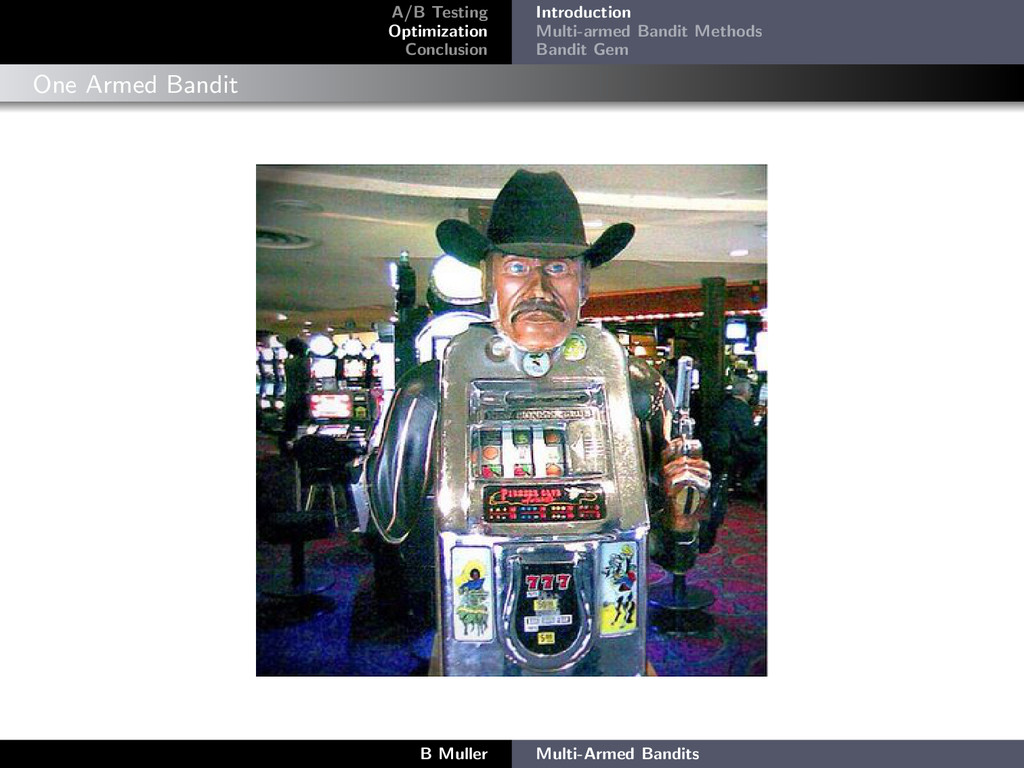
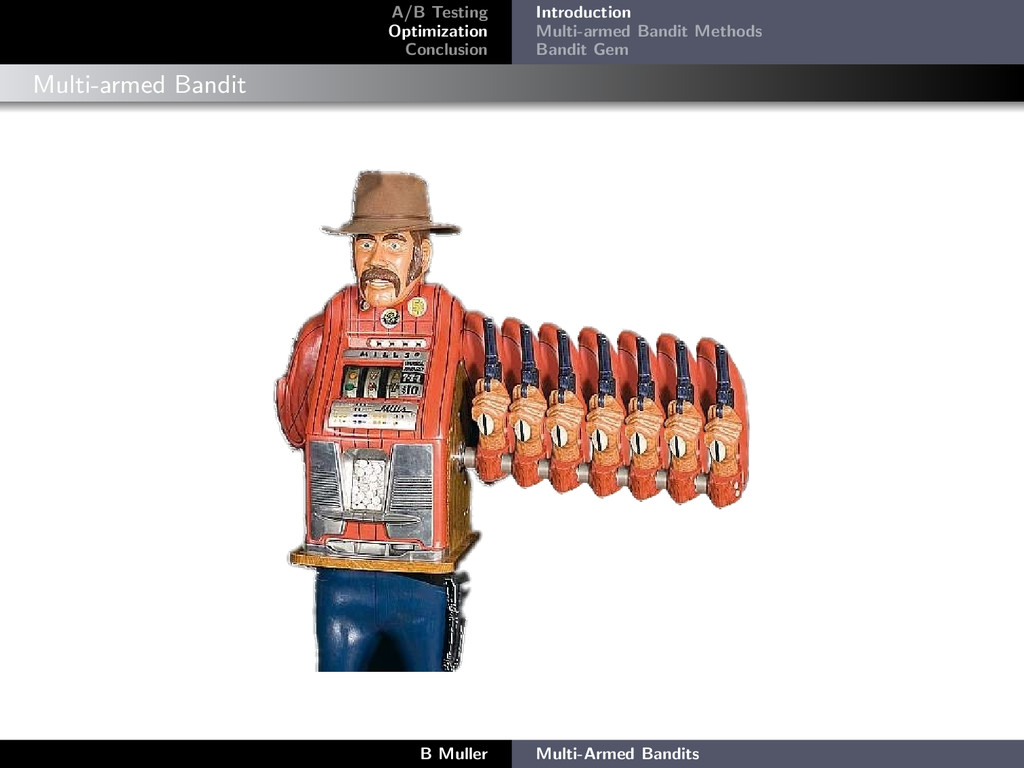
Multi-armed Bandit Definition The multi-armed bandit problem describes a tradeoff at each stage. The player must choose between: 1 Exploration: Pulling an arm that hasn’t been pulled before (or recently) 2 Exploitation: Pulling the arm that has performed the best so far The goal is to maximizing the total reward over all at each step. B Muller Multi-Armed Bandits
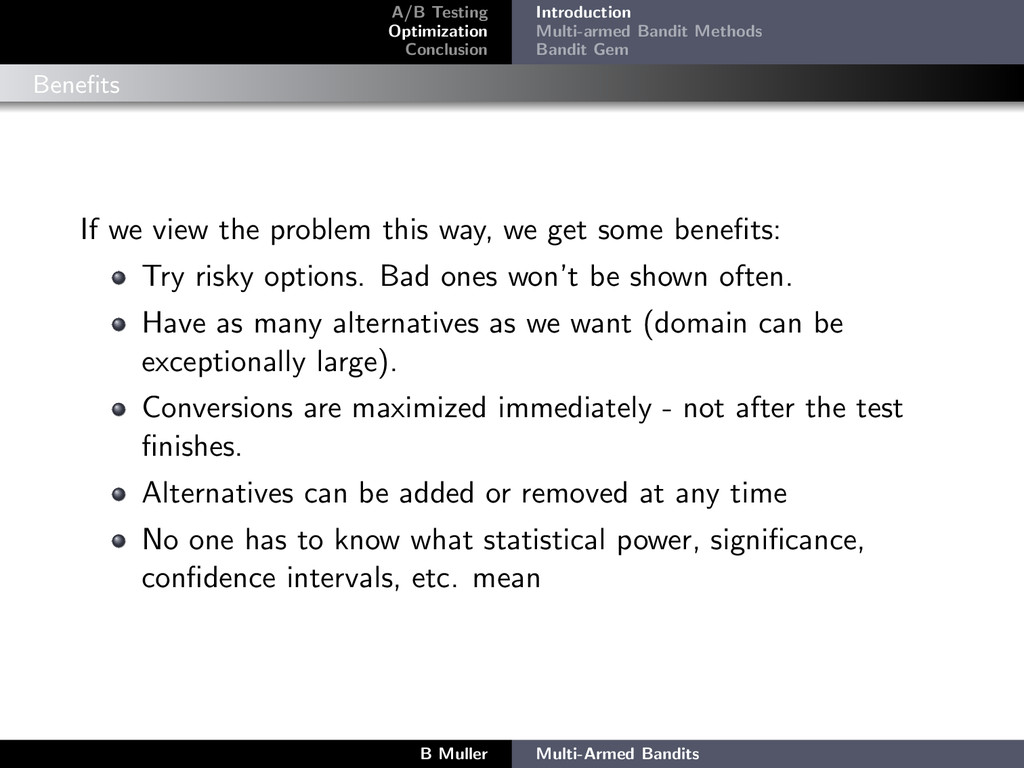
Benefits If we view the problem this way, we get some benefits: Try risky options. Bad ones won’t be shown often. Have as many alternatives as we want (domain can be exceptionally large). Conversions are maximized immediately - not after the test finishes. Alternatives can be added or removed at any time No one has to know what statistical power, significance, confidence intervals, etc. mean B Muller Multi-Armed Bandits
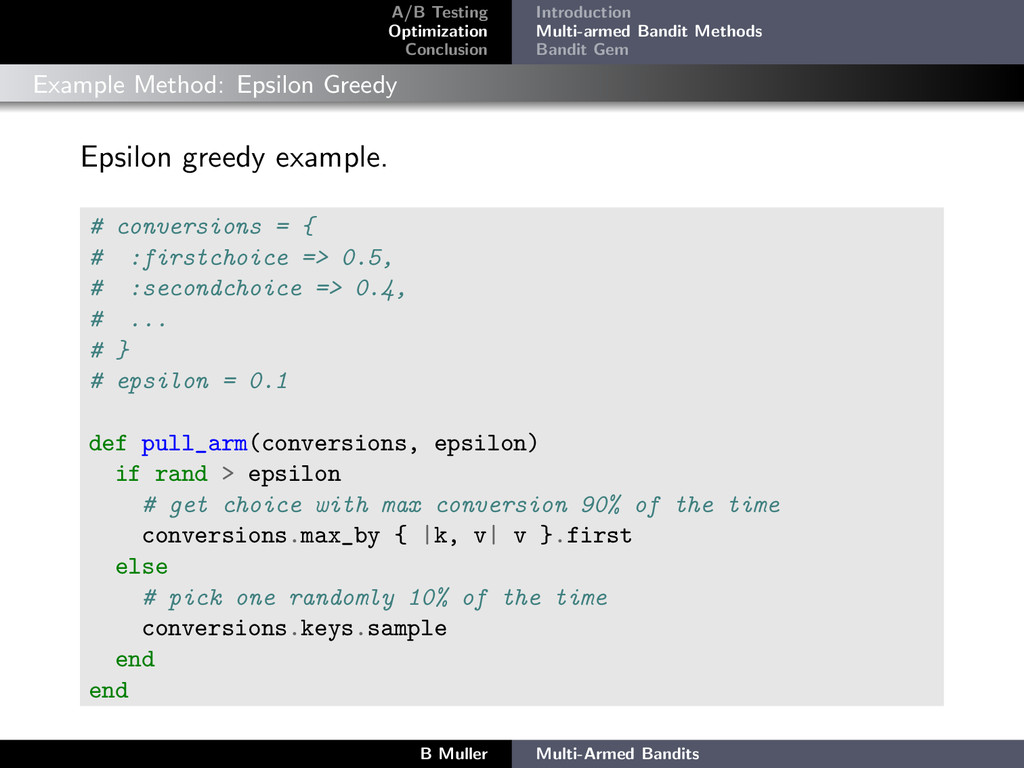
Example Method: Epsilon Greedy Epsilon greedy example. # conversions = { # :firstchoice => 0.5, # :secondchoice => 0.4, # ... # } # epsilon = 0.1 def pull_arm(conversions, epsilon) if rand > epsilon # get choice with max conversion 90% of the time conversions.max_by { |k, v| v }.first else # pick one randomly 10% of the time conversions.keys.sample end end B Muller Multi-Armed Bandits
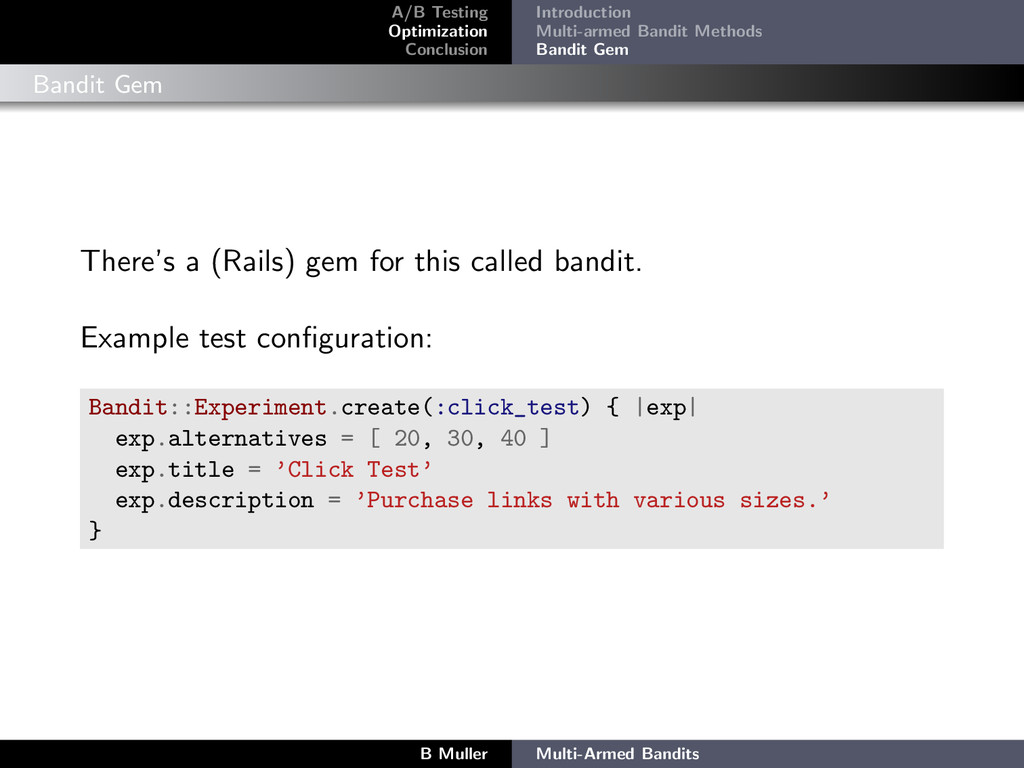
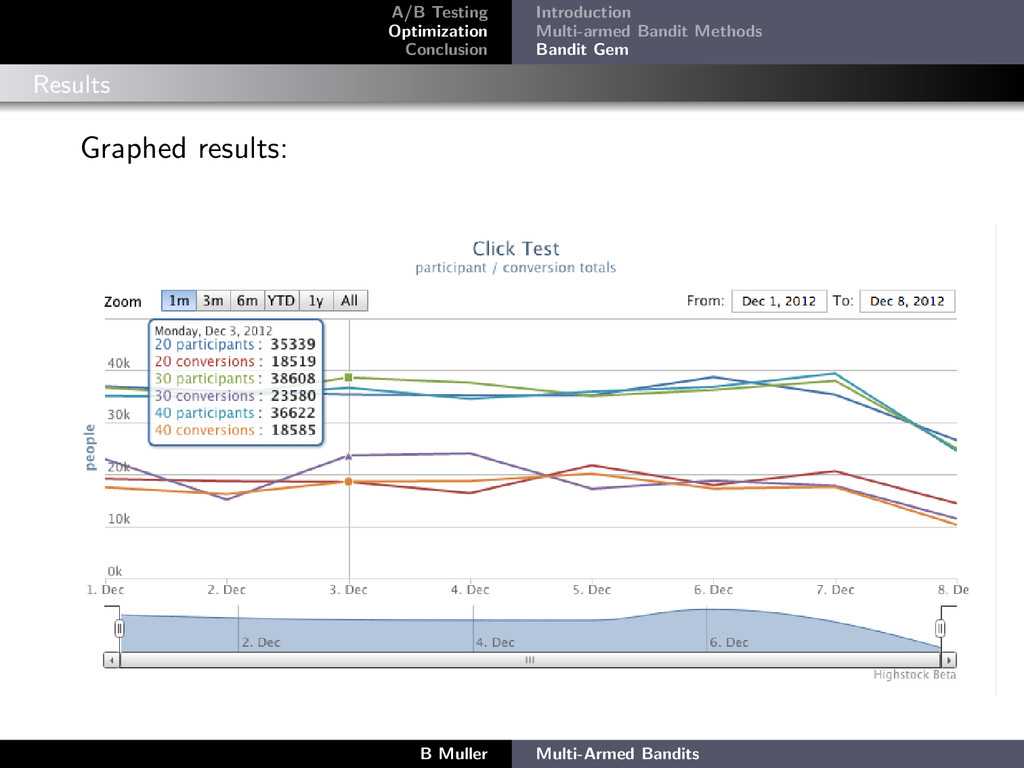
Bandit Gem There’s a (Rails) gem for this called bandit. Example test configuration: Bandit::Experiment.create(:click_test) { |exp| exp.alternatives = [ 20, 30, 40 ] exp.title = ’Click Test’ exp.description = ’Purchase links with various sizes.’ } B Muller Multi-Armed Bandits
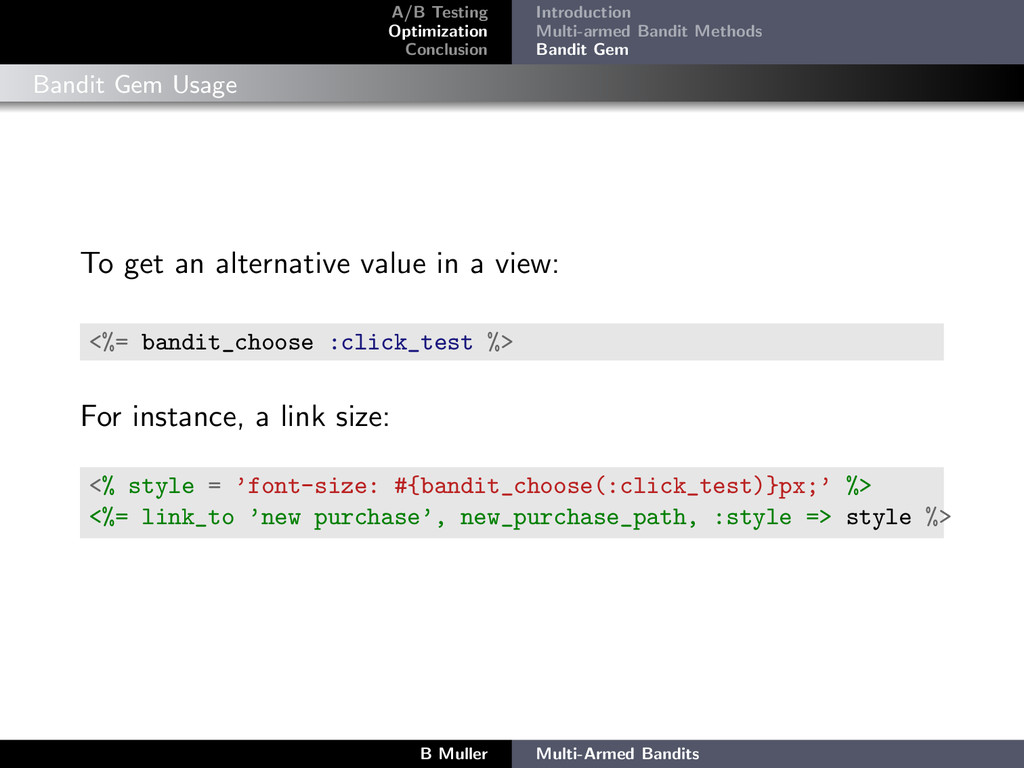
Bandit Gem Usage To get an alternative value in a view: <%= bandit_choose :click_test %> For instance, a link size: <% style = ’font-size: #{bandit_choose(:click_test)}px;’ %> <%= link_to ’new purchase’, new_purchase_path, :style => style %> B Muller Multi-Armed Bandits
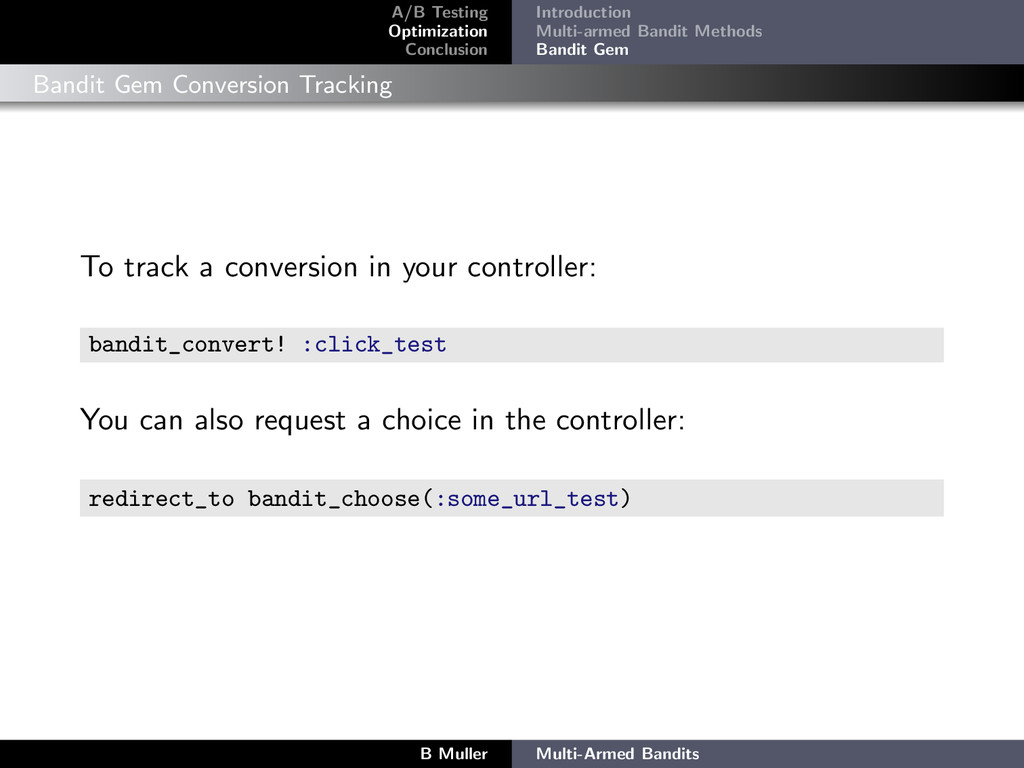
Bandit Gem Conversion Tracking To track a conversion in your controller: bandit_convert! :click_test You can also request a choice in the controller: redirect_to bandit_choose(:some_url_test) B Muller Multi-Armed Bandits
Testing Usage A/B Testing is good when: you know that the best option is permanent you know that the best option is global there are limited alternatives B Muller Multi-Armed Bandits
Multi-armed Usage Multi-armed bandit optimization is good when: conversion rates may change over time you may have “risky” alternatives there are many alternatives (could be an infinite number) you may be adding/removing alternatives regularly B Muller Multi-Armed Bandits


 prog893
 ivry_presentationmaterials
 teamlab
 ykanoh
 kentarofujii
 rfdnxbro
 carta_engineering
 jozono
 oikon48
 yuuuuuuu168
 jyouryuusui
 ymotongpoo
 axbom
axbom
 geshan
 garrettdimon
 palkan
 tammyeverts
 danielanewman
 zakiyama
 holman
 smashingmag
 kastner
 inesmontani
 marktimemedia