establish the base propositions of an inductive proof.[...] At present, this is mainly theory [but] seems to show a possibility of practical results, though proving correctness is a laborious and expensive process.” Perlis: “ Much of program complexity is spurious and a number of test cases properly studied will exhaust the testing problem. The problem is to isolate the right test cases, not to prove the algorithm, for that follows after the choice of the proper test cases.” Dijkstra: “Testing shows the presence, not the absence of bugs”
easy to come up with good communication tool straightforward to implement straightforward to overlook important ones usually only cover a very small portion of your domain often, programmers just get "expected" from the REPL v a r a c t u a l = f u n c t i o n _ u n d e r _ t e s t ( i n p u t ) ; e x p e c t ( a c t u a l ) . t o . e q u a l ( e x p e c t e d ) ; i f ( f u n c t i o n _ u n d e r _ t e s t ( i n p u t ) ! = = e x p e c t e d ) t h r o w n e w E r r o r ( " p r i m i t i v e u n i t t e s t i n g f r a m e w o r k " ) ;
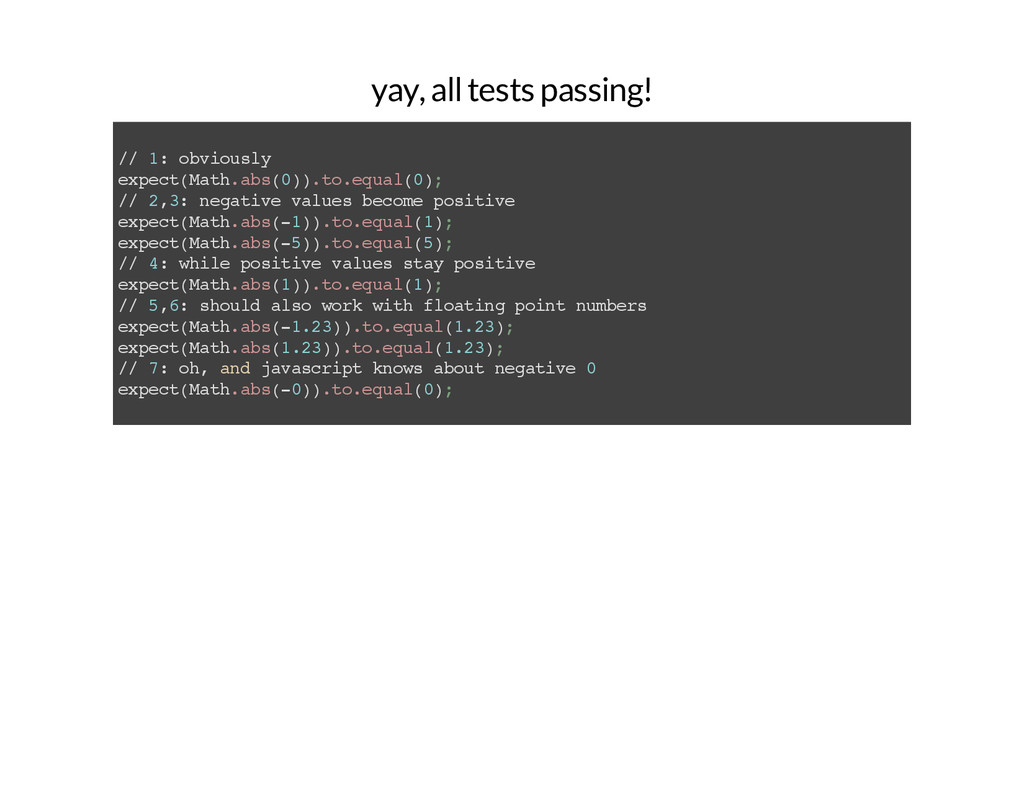
v i o u s l y e x p e c t ( M a t h . a b s ( 0 ) ) . t o . e q u a l ( 0 ) ; / / 2 , 3 : n e g a t i v e v a l u e s b e c o m e p o s i t i v e e x p e c t ( M a t h . a b s ( - 1 ) ) . t o . e q u a l ( 1 ) ; e x p e c t ( M a t h . a b s ( - 5 ) ) . t o . e q u a l ( 5 ) ; / / 4 : w h i l e p o s i t i v e v a l u e s s t a y p o s i t i v e e x p e c t ( M a t h . a b s ( 1 ) ) . t o . e q u a l ( 1 ) ; / / 5 , 6 : s h o u l d a l s o w o r k w i t h f l o a t i n g p o i n t n u m b e r s e x p e c t ( M a t h . a b s ( - 1 . 2 3 ) ) . t o . e q u a l ( 1 . 2 3 ) ; e x p e c t ( M a t h . a b s ( 1 . 2 3 ) ) . t o . e q u a l ( 1 . 2 3 ) ; / / 7 : o h , a n d j a v a s c r i p t k n o w s a b o u t n e g a t i v e 0 e x p e c t ( M a t h . a b s ( - 0 ) ) . t o . e q u a l ( 0 ) ;
. a b s = f u n c t i o n ( x ) { i f ( x = = = 0 ) r e t u r n 0 ; i f ( x = = = - 1 | | x = = = 1 ) r e t u r n 1 ; i f ( ( x > 1 & & x < 2 ) | | ( x > - 2 & & x < - 1 ) ) r e t u r n 1 . 2 3 ; r e t u r n 5 ; } ... but even with TDD done right, missing test cases happen.
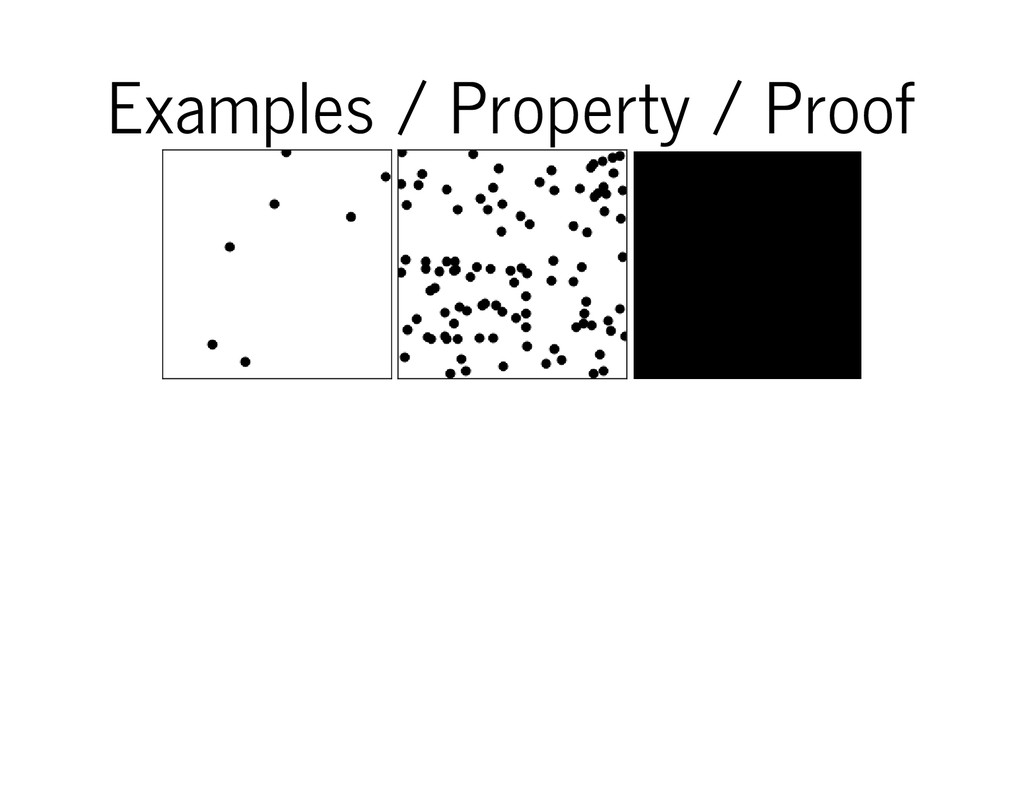
JavaScript objects a form of randomized testing specify a property that holds for all / specified inputs instead of finding a proof, test random inputs similar to contracts introduced in a paper (and Haskell implementation, quickcheck) in 2000 code samples use JavaScript and jsverify, implementations available for most langauges
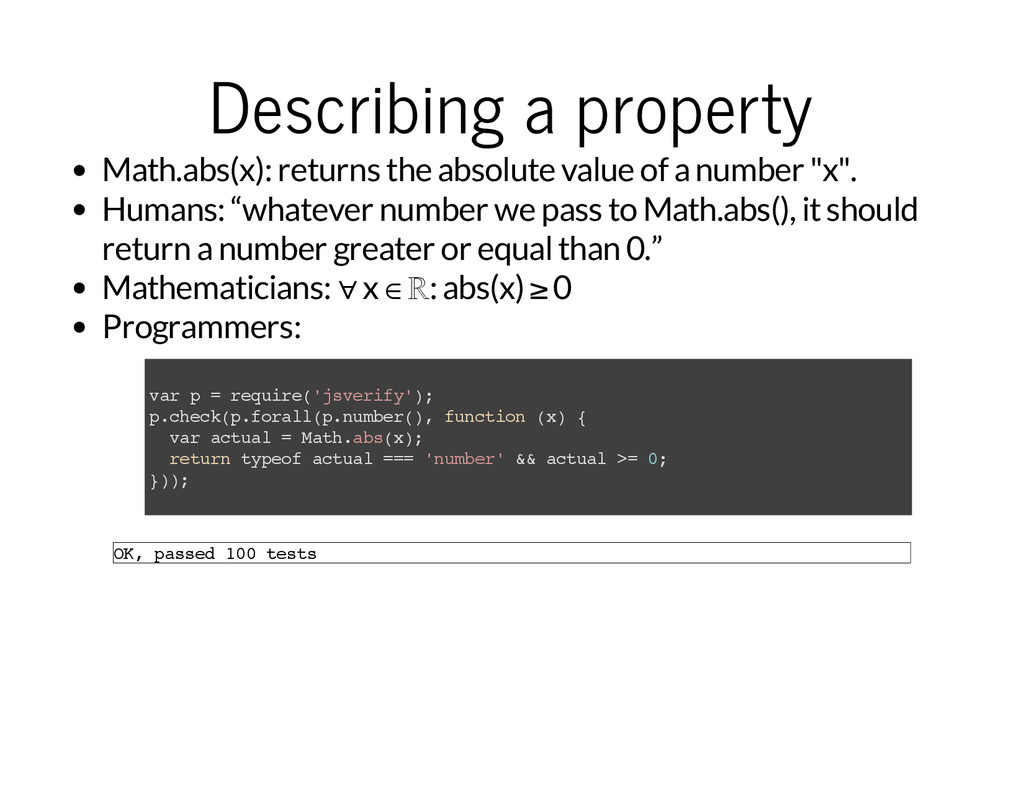
number "x". Humans: “whatever number we pass to Math.abs(), it should return a number greater or equal than 0.” Mathematicians: ∀ x ∈ ℝ: abs(x) ≥ 0 Programmers: v a r p = r e q u i r e ( ' j s v e r i f y ' ) ; p . c h e c k ( p . f o r a l l ( p . n u m b e r ( ) , f u n c t i o n ( x ) { v a r a c t u a l = M a t h . a b s ( x ) ; r e t u r n t y p e o f a c t u a l = = = ' n u m b e r ' & & a c t u a l > = 0 ; } ) ) ; O K , p a s s e d 1 0 0 t e s t s
h e c k ( p . f o r a l l ( p . n u m b e r ( ) , f u n c t i o n ( x ) { r e t u r n M a t h . a b s ( x ) > = x ; } ) ) ; E r r o r : F a i l e d a f t e r 3 t e s t s a n d 0 s h r i n k s . r n g S t a t e : 8 c 0 a 4 3 e f 8 5 c 7 6 1 d b 9 2 ; C o u n t e r e x a m p l e : 1 . 5 6 4 4 7 3 2 9 0 9 2 7 7 0 8 1 ;
o w S u m = f u n c t i o n ( n ) { v a r s u m = 0 , i ; f o r ( i = 1 ; i < = n ; i + + ) { s u m + = i ; } r e t u r n s u m ; } , g a u s s S u m = f u n c t i o n ( n ) { r e t u r n ( n / 2 ) * ( n + 1 ) ; } , p o s i t i v e N u m b e r = p . s u c h t h a t ( p . i n t e g e r ( ) , f u n c t i o n ( i ) { r e t u r n i > 0 ; } ) ; p . a s s e r t ( p . f o r a l l ( p o s i t i v e N u m b e r , f u n c t i o n ( i ) { r e t u r n s l o w S u m ( i ) = = = g a u s s S u m ( i ) ; } ) ) ;
u m b e r = f u n c t i o n ( ) { r e t u r n { a r b i t r a r y : f u n c t i o n ( r ) { v a r n = p . i n t e g e r ( ) . a r b i t r a r y ( r ) ; r e t u r n 2 * n + 1 ; } , s h r i n k : s h r i n k . n o o p , s h o w : s h o w . d e f } ; } ; d e s c r i b e ( ' o d d ' , f u n c t i o n ( ) { / / v a r o d d = f u n c t i o n ( n ) { r e t u r n n % 2 = = = 1 ; } ; v a r o d d = f u n c t i o n ( n ) { r e t u r n M a t h . a b s ( n ) % 2 = = = 1 ; } ; i t ( ' r e t u r n s t r u e f o r a l l o d d n u m b e r s ' , f u n c t i o n ( ) { p . a s s e r t ( p . f o r a l l ( o d d N u m b e r ( ) , o d d ) ) ; } ) ;
r i s _ i d e m p o t e n t = f u n c t i o n ( g e n e r a t o r , f n ) { r e t u r n p . f o r a l l ( g e n e r a t o r , f u n c t i o n ( x ) { r e t u r n _ . i s E q u a l ( f n ( f n ( s ) ) , f n ( s ) ) ; } ) ; } ; p . a s s e r t ( i s _ i d e m p o t e n t ( p . a r r a y ( ) , _ . c o m p a c t ) ) ; p . a s s e r t ( i s _ i d e m p o t e n t ( p . a r r a y ( ) , _ . u n i q ) ) ;
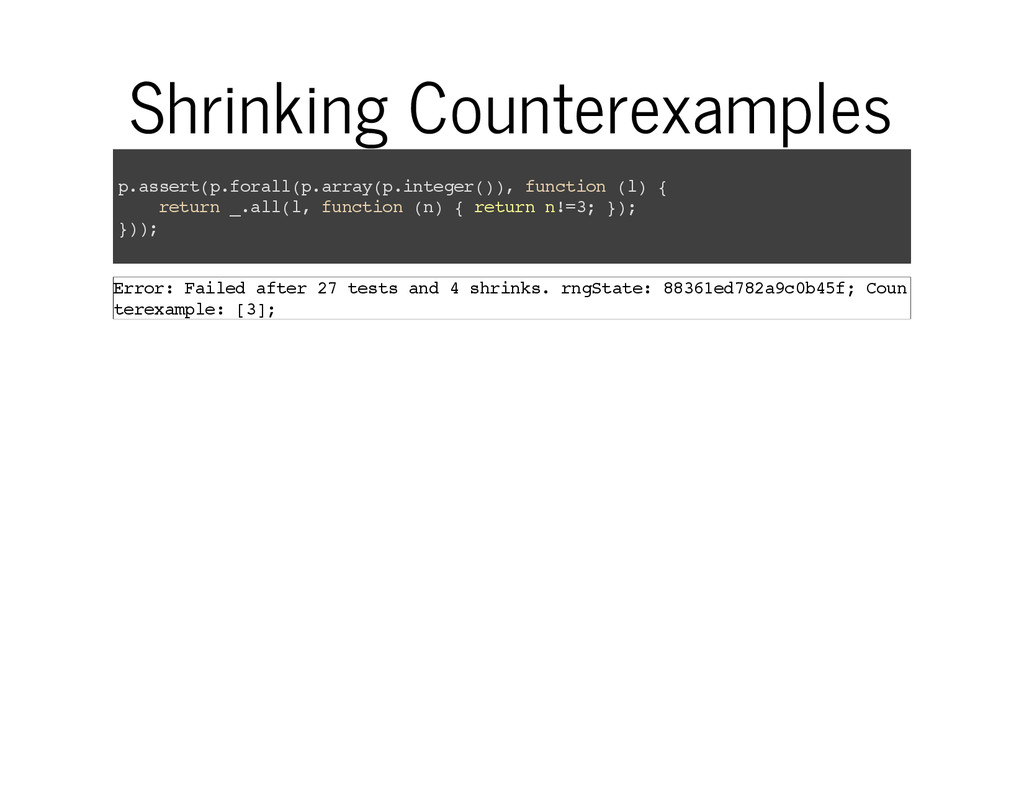
( p . f o r a l l ( p . a r r a y ( p . i n t e g e r ( ) ) , f u n c t i o n ( l ) { r e t u r n _ . a l l ( l , f u n c t i o n ( n ) { r e t u r n n ! = 3 ; } ) ; } ) ) ; E r r o r : F a i l e d a f t e r 2 7 t e s t s a n d 4 s h r i n k s . r n g S t a t e : 8 8 3 6 1 e d 7 8 2 a 9 c 0 b 4 5 f ; C o u n t e r e x a m p l e : [ 3 ] ;
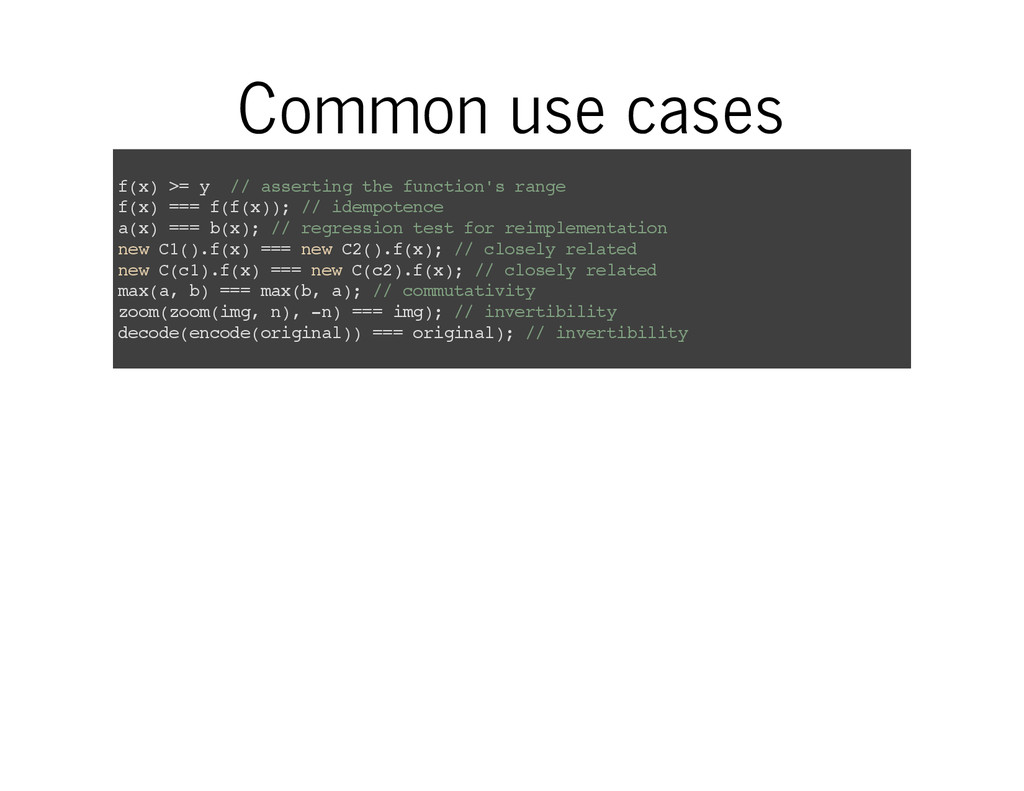
/ / a s s e r t i n g t h e f u n c t i o n ' s r a n g e f ( x ) = = = f ( f ( x ) ) ; / / i d e m p o t e n c e a ( x ) = = = b ( x ) ; / / r e g r e s s i o n t e s t f o r r e i m p l e m e n t a t i o n n e w C 1 ( ) . f ( x ) = = = n e w C 2 ( ) . f ( x ) ; / / c l o s e l y r e l a t e d n e w C ( c 1 ) . f ( x ) = = = n e w C ( c 2 ) . f ( x ) ; / / c l o s e l y r e l a t e d m a x ( a , b ) = = = m a x ( b , a ) ; / / c o m m u t a t i v i t y z o o m ( z o o m ( i m g , n ) , - n ) = = = i m g ) ; / / i n v e r t i b i l i t y d e c o d e ( e n c o d e ( o r i g i n a l ) ) = = = o r i g i n a l ) ; / / i n v e r t i b i l i t y
check properties involving function valued variables, then we must be able to generate arbitrary functions. Rather surprisingly, we are able to do so.” p . a s s e r t ( p . f o r a l l ( p . a r r a y ( ) , p . f n ( ) , p . v a l u e ( ) , f u n c t i o n ( a , f , c ) { r e t u r n _ . m a p ( a , f , c ) . l e n g t h = = = a . l e n g t h ; } ) ) ;
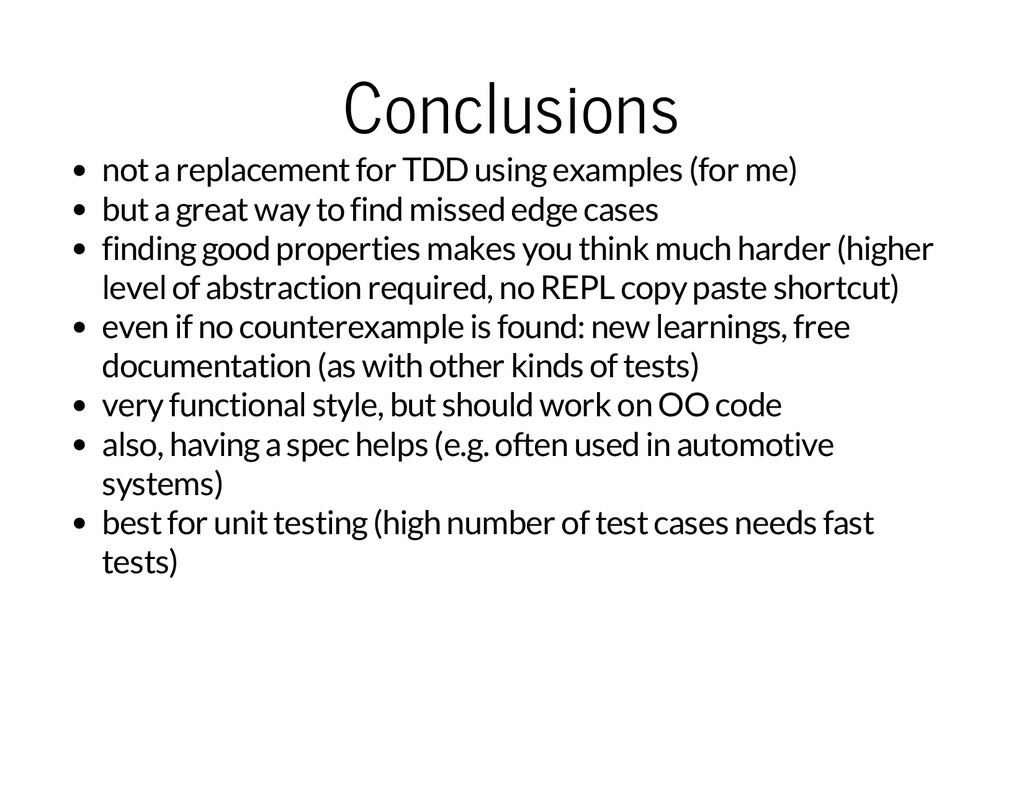
but a great way to find missed edge cases finding good properties makes you think much harder (higher level of abstraction required, no REPL copy paste shortcut) even if no counterexample is found: new learnings, free documentation (as with other kinds of tests) very functional style, but should work on OO code also, having a spec helps (e.g. often used in automotive systems) best for unit testing (high number of test cases needs fast tests)
testing of Haskell programs” - K Claessen, J Hughes Implementation used in this talk: github.com/phadej/jsverify Feedback welcome! @c089 / [email protected]


 c089
c089
 x5gtrn
 tanakaseiya
 kitagawaz
 masakiokuda
 sansantech
 kentapapa
 yoshiakiyamasaki
 taka_aki
 tkuchiki
 kawametho
 ishiirikie
 mayunak
 jacobtomlinson
 moore
moore
 hannesfritz
 garrettdimon
 codingconduct
 marktimemedia
 emna__ayadi
 soysaucechin
 mongodb
 helmedeiros
 eileencodes
![XP Days Germany 2014 Christoph Neuroth [ ] @c089 testing](https://files.speakerdeck.com/presentations/48e51340381c01322c8976e1a203b64c/slide_0.jpg)
![[horribly predictable quote] “Testing shows the presence, not the absence](https://files.speakerdeck.com/presentations/48e51340381c01322c8976e1a203b64c/slide_1.jpg)