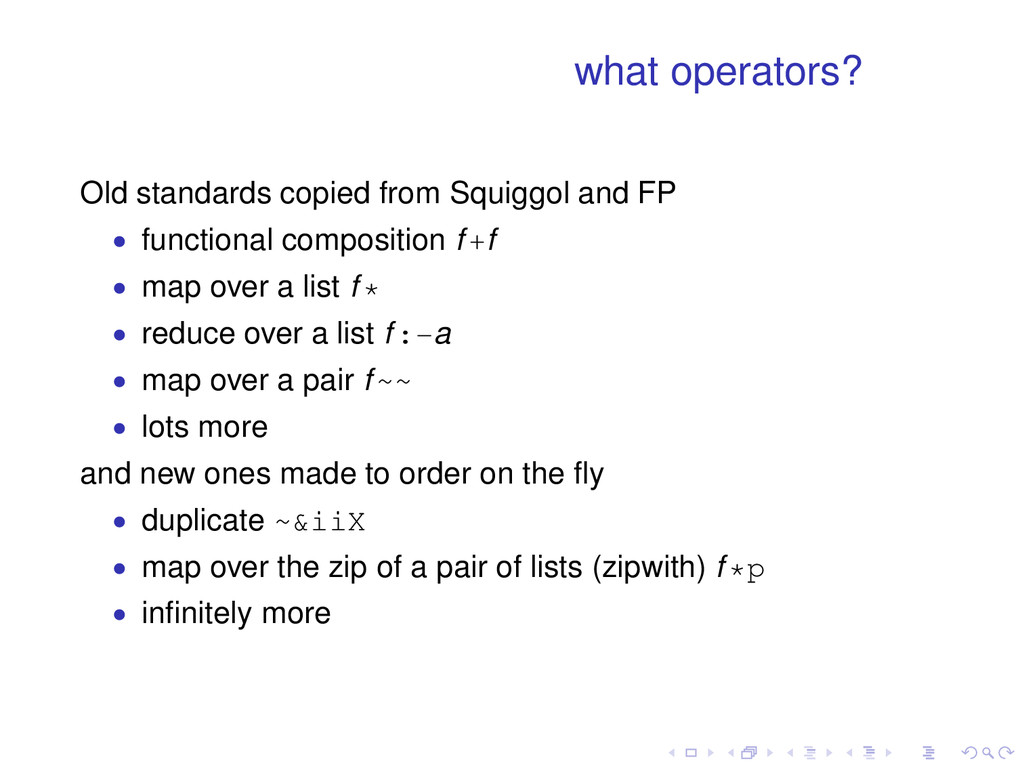
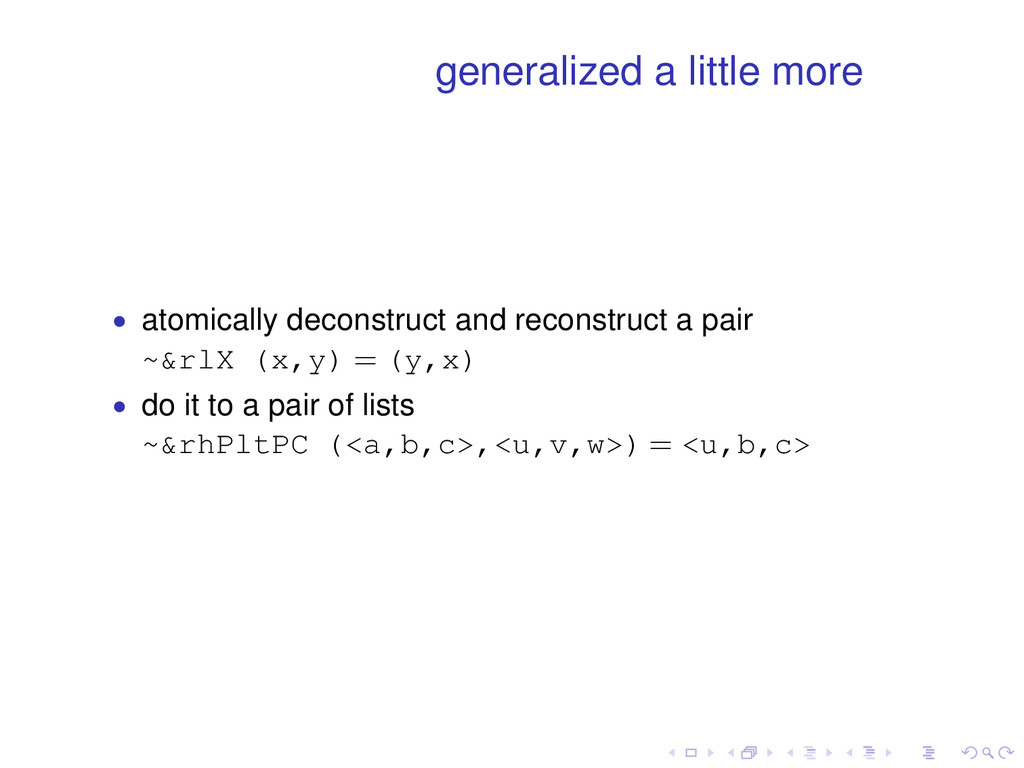
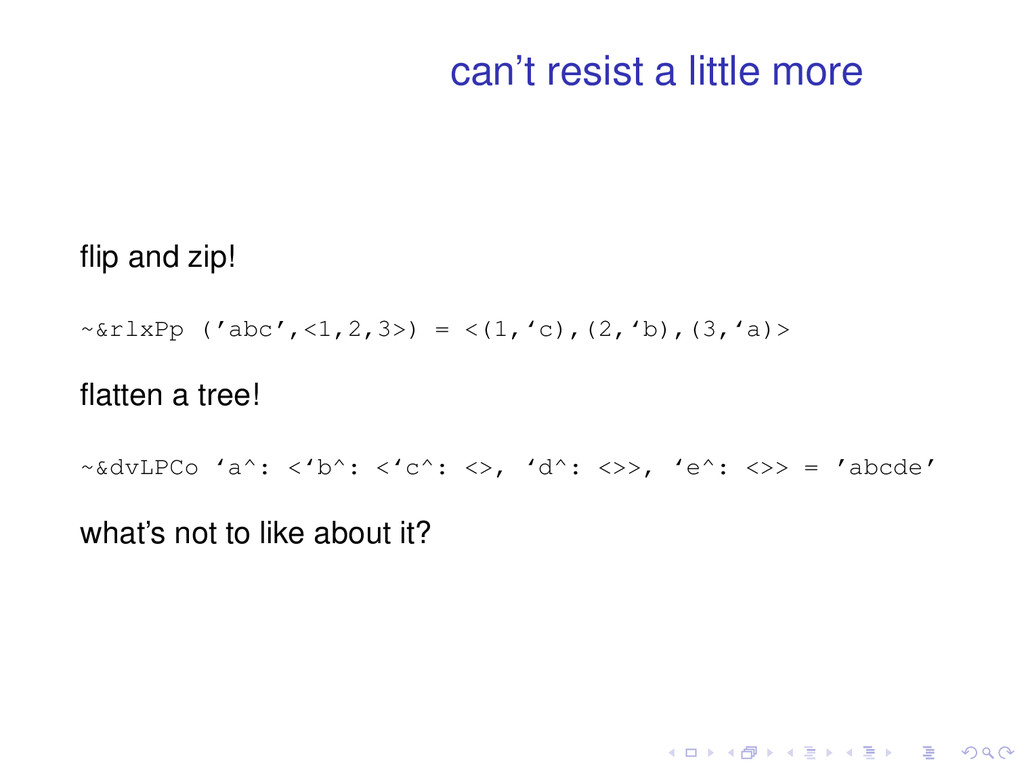
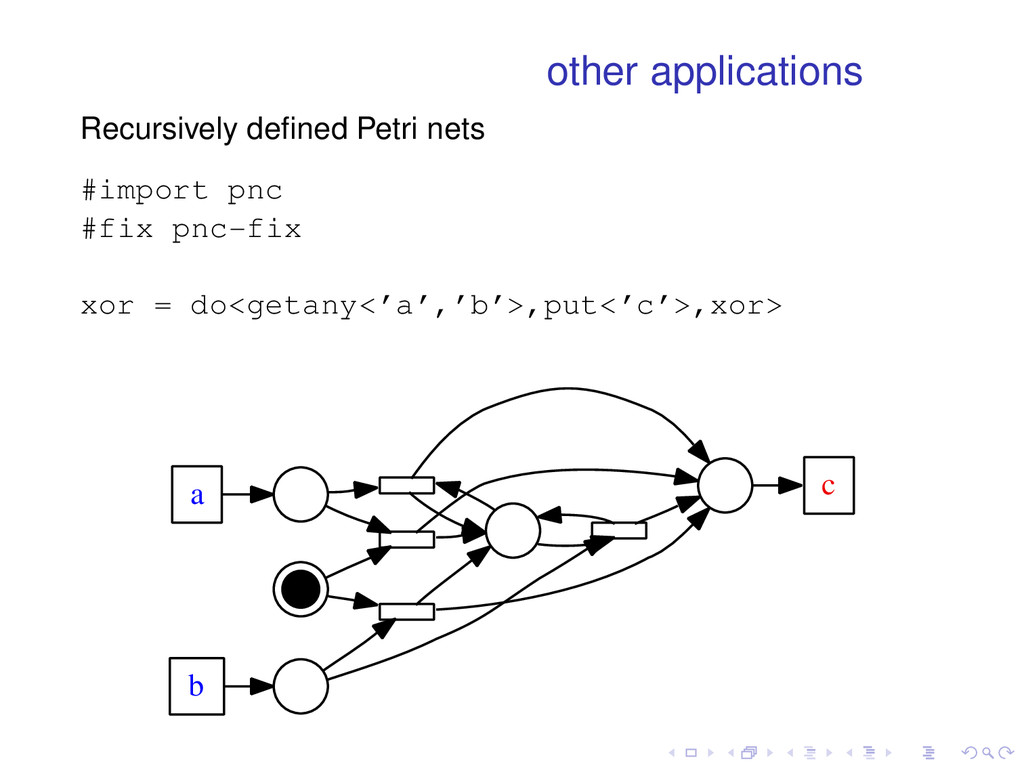
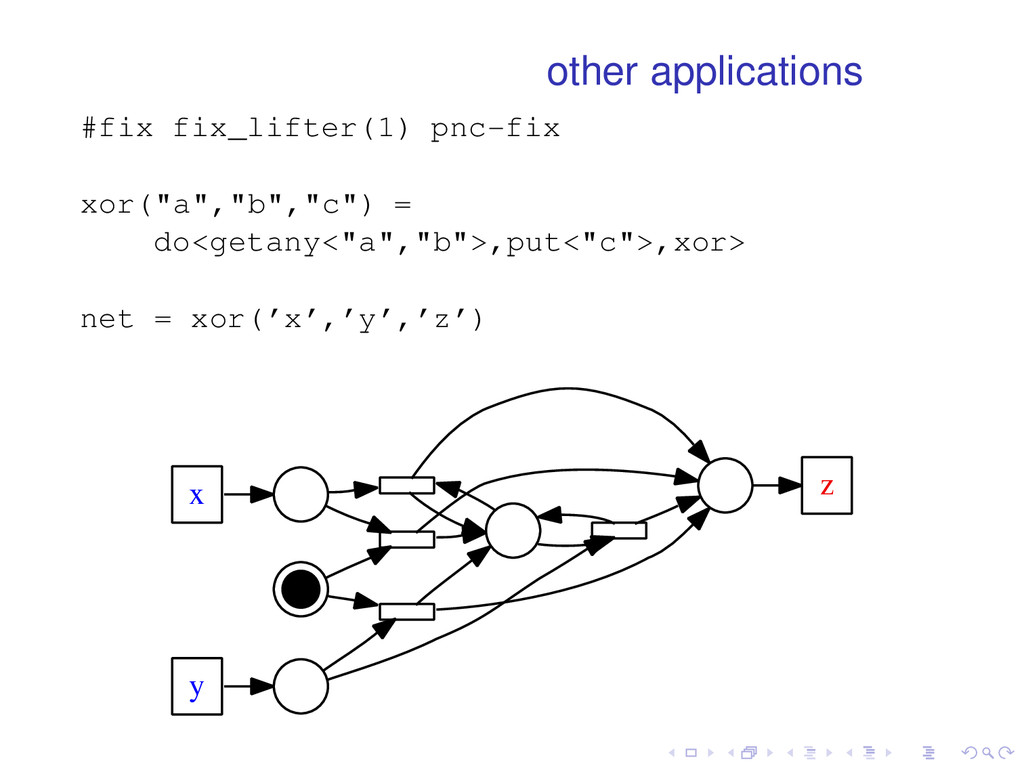
functional composition f+f • map over a list f* • reduce over a list f:-a • map over a pair f~~ • lots more and new ones made to order on the fly • duplicate ~&iiX • map over the zip of a pair of lists (zipwith) f*p • infinitely more
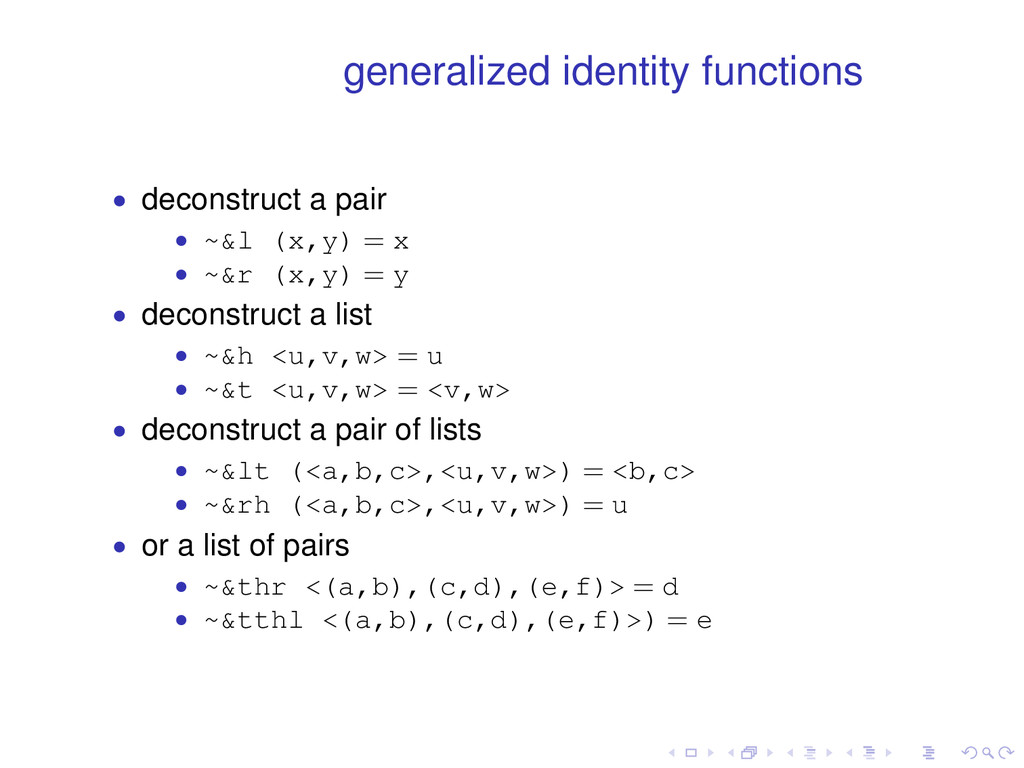
= x • ~&r (x,y) = y • deconstruct a list • ~&h <u,v,w> = u • ~&t <u,v,w> = <v,w> • deconstruct a pair of lists • ~< (<a,b,c>,<u,v,w>) = <b,c> • ~&rh (<a,b,c>,<u,v,w>) = u • or a list of pairs • ~&thr <(a,b),(c,d),(e,f)> = d • ~&tthl <(a,b),(c,d),(e,f)>) = e
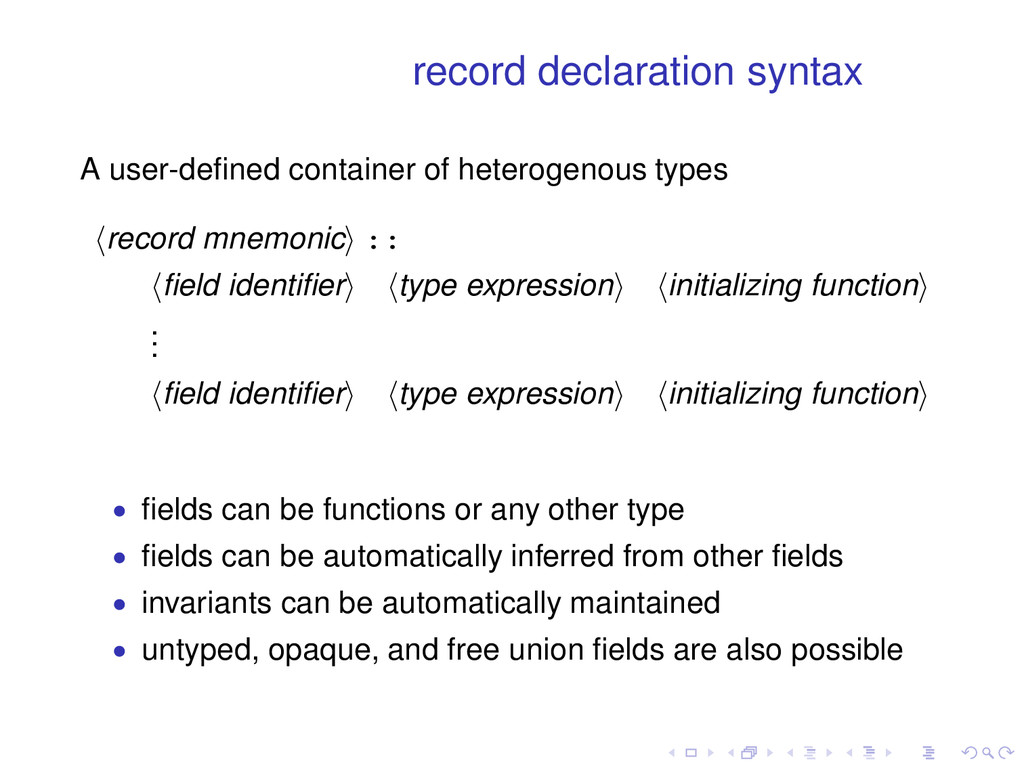
mnemonic :: field identifier type expression initializing function . . . field identifier type expression initializing function • fields can be functions or any other type • fields can be automatically inferred from other fields • invariants can be automatically maintained • untyped, opaque, and free union fields are also possible
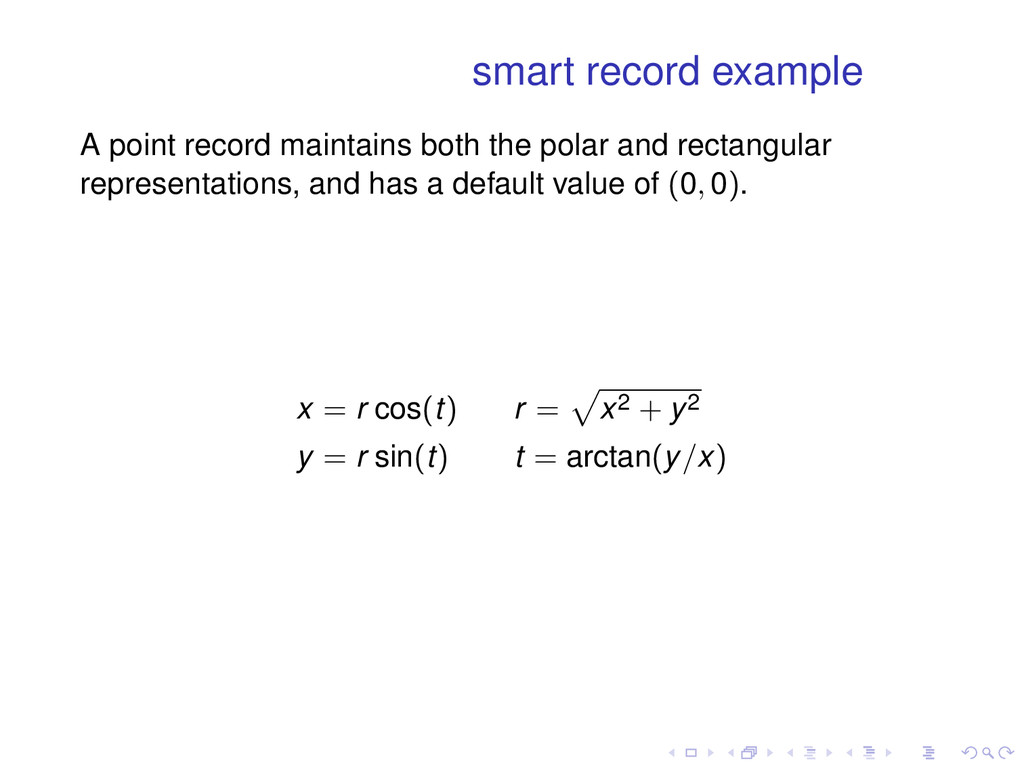
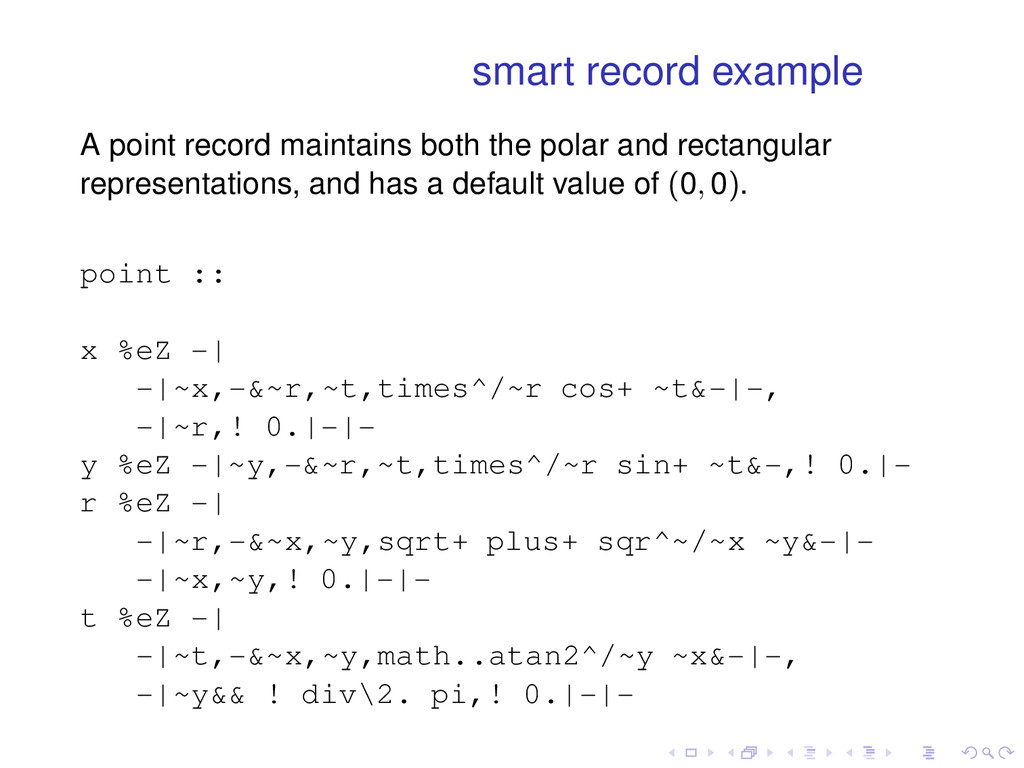
and rectangular representations, and has a default value of (0, 0). point :: x %eZ -| -|~x,-&~r,~t,times^/~r cos+ ~t&-|-, -|~r,! 0.|-|- y %eZ -|~y,-&~r,~t,times^/~r sin+ ~t&-,! 0.|- r %eZ -| -|~r,-&~x,~y,sqrt+ plus+ sqr^~/~x ~y&-|- -|~x,~y,! 0.|-|- t %eZ -| -|~t,-&~x,~y,math..atan2^/~y ~x&-|-, -|~y&& ! div\2. pi,! 0.|-|-
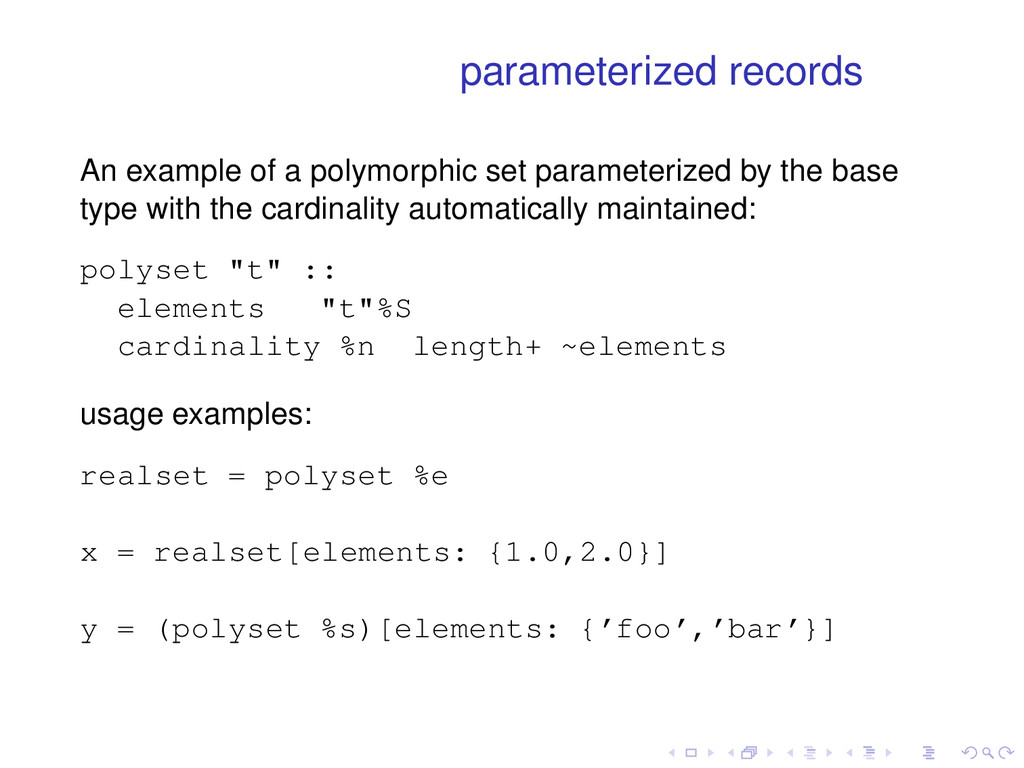
the base type with the cardinality automatically maintained: polyset "t" :: elements "t"%S cardinality %n length+ ~elements usage examples: realset = polyset %e x = realset[elements: {1.0,2.0}] y = (polyset %s)[elements: {’foo’,’bar’}]
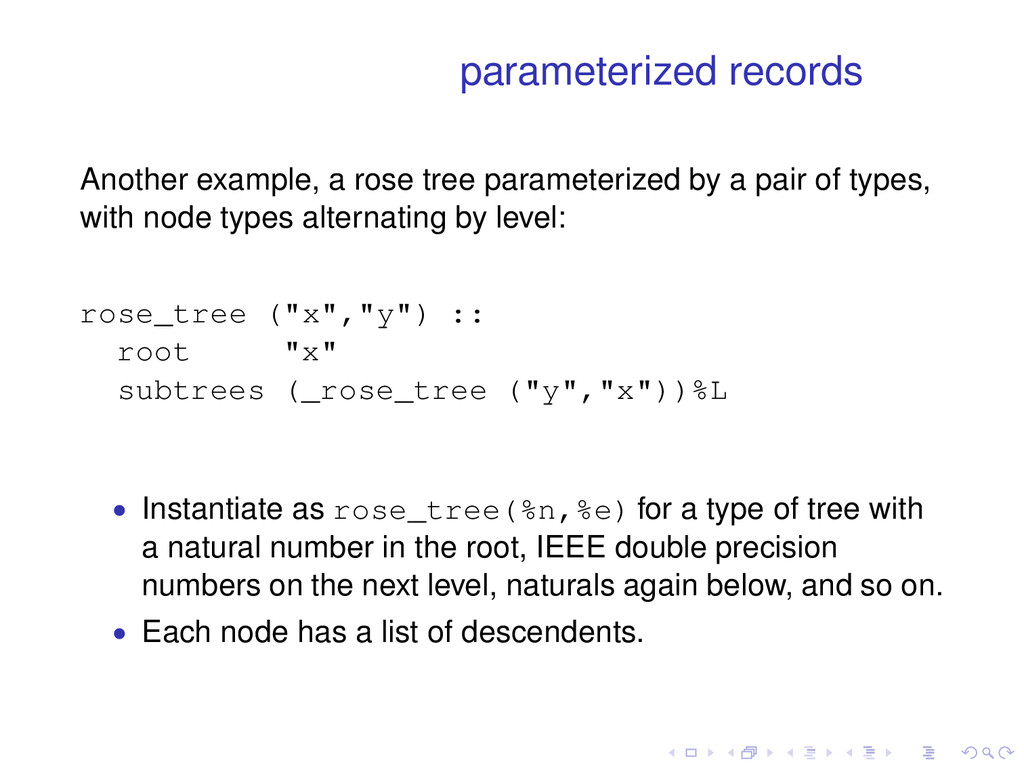
pair of types, with node types alternating by level: rose_tree ("x","y") :: root "x" subtrees (_rose_tree ("y","x"))%L • Instantiate as rose_tree(%n,%e) for a type of tree with a natural number in the root, IEEE double precision numbers on the next level, naturals again below, and so on. • Each node has a list of descendents.
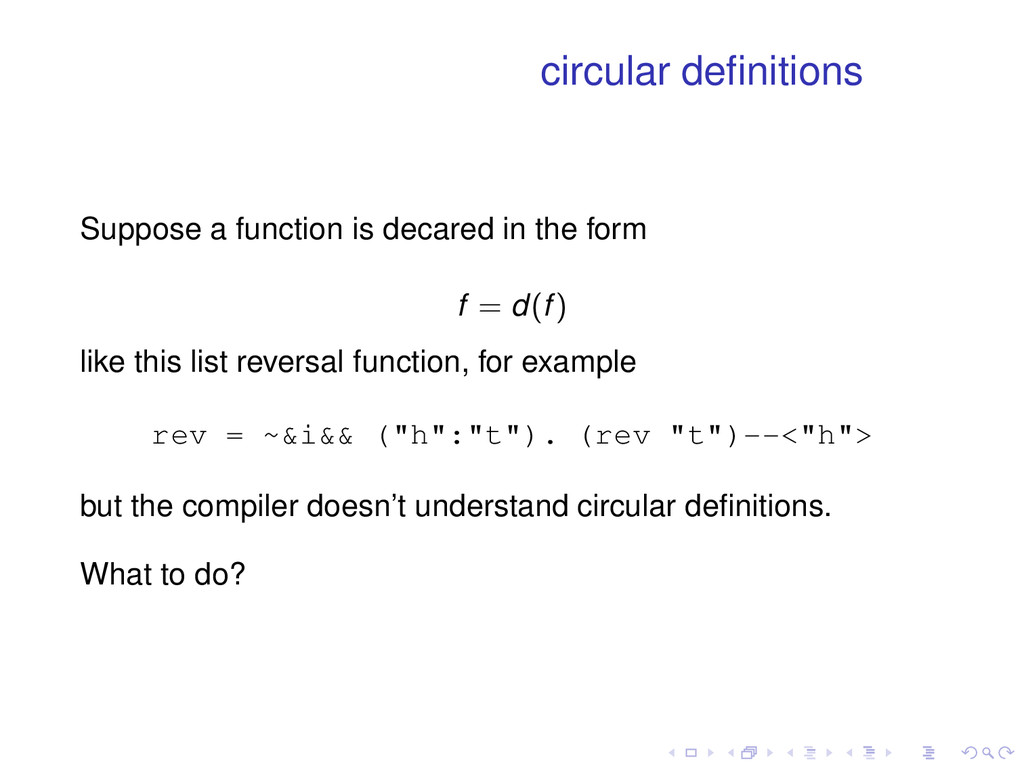
f = d(f) like this list reversal function, for example rev = ~&i&& ("h":"t"). (rev "t")--<"h"> but the compiler doesn’t understand circular definitions. What to do?
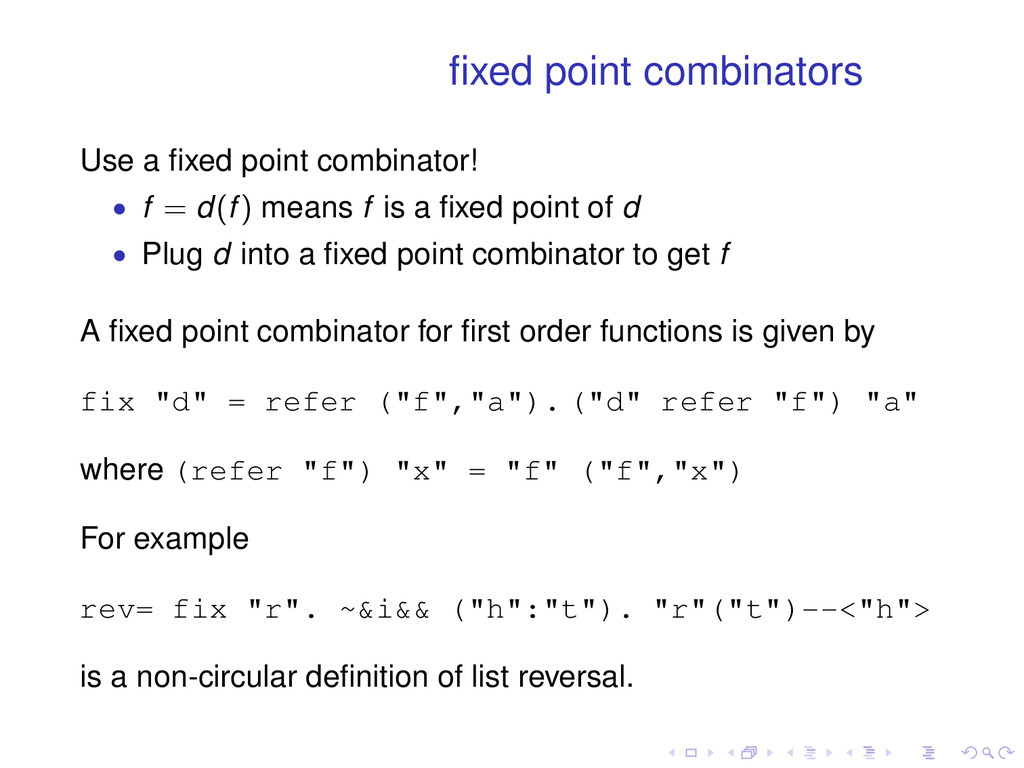
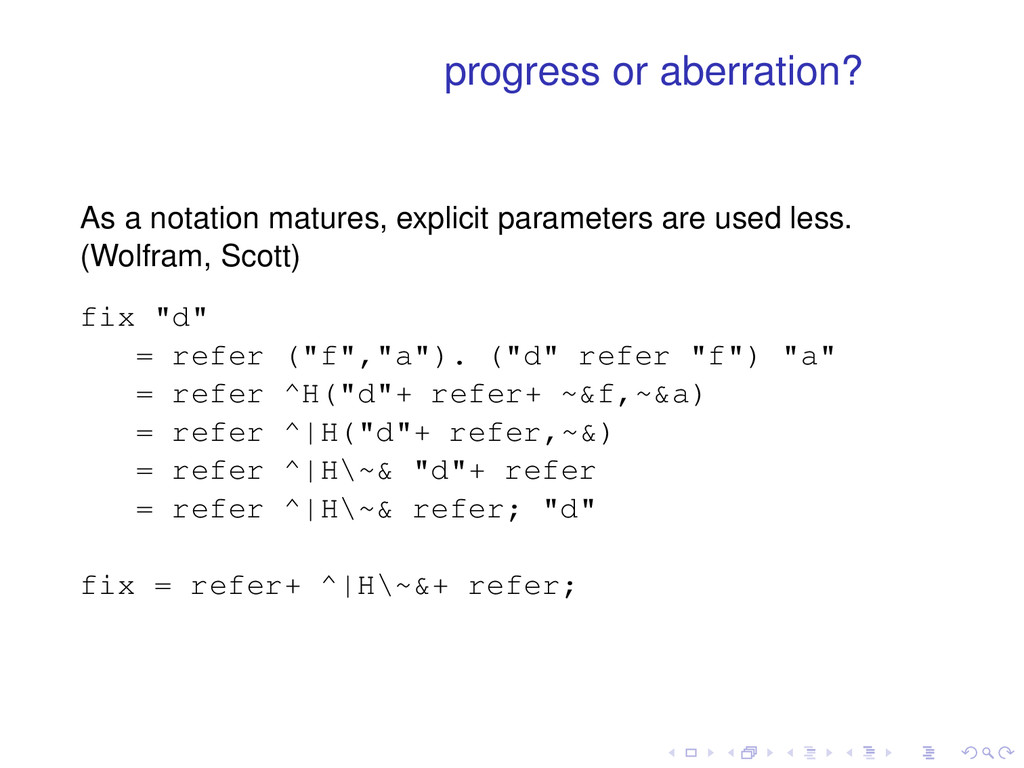
= d(f) means f is a fixed point of d • Plug d into a fixed point combinator to get f A fixed point combinator for first order functions is given by fix "d" = refer ("f","a"). ("d" refer "f") "a" where (refer "f") "x" = "f" ("f","x") For example rev= fix "r". ~&i&& ("h":"t"). "r"("t")--<"h"> is a non-circular definition of list reversal.
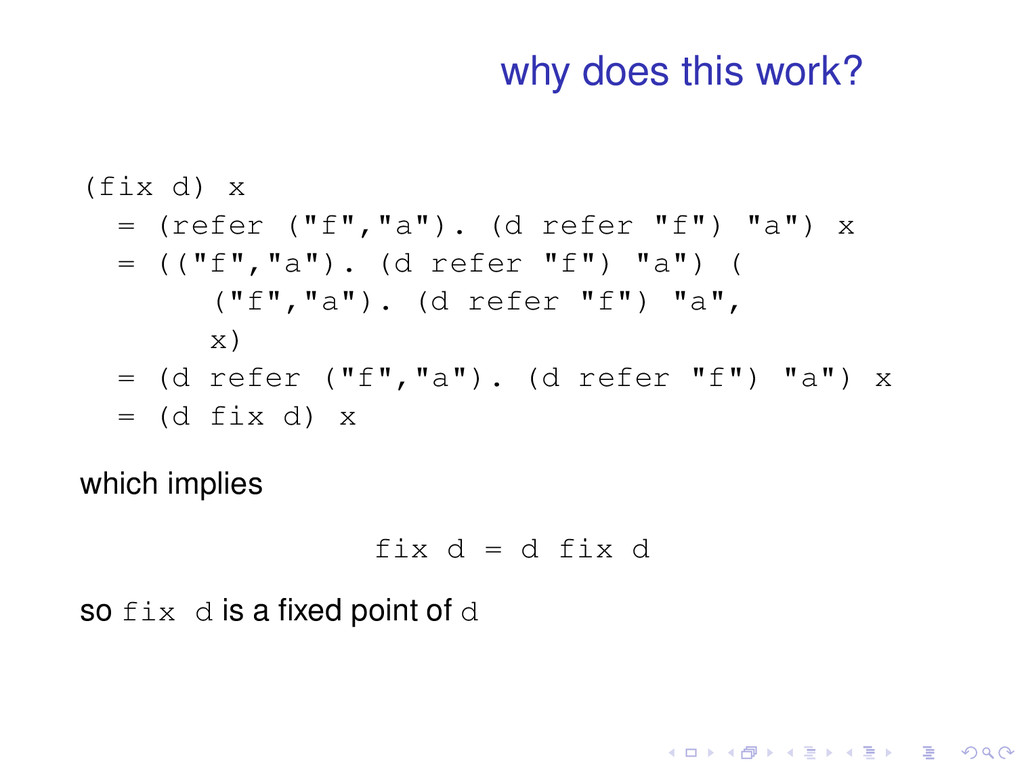
(d refer "f") "a") x = (("f","a"). (d refer "f") "a") ( ("f","a"). (d refer "f") "a", x) = (d refer ("f","a"). (d refer "f") "a") x = (d fix d) x which implies fix d = d fix d so fix d is a fixed point of d
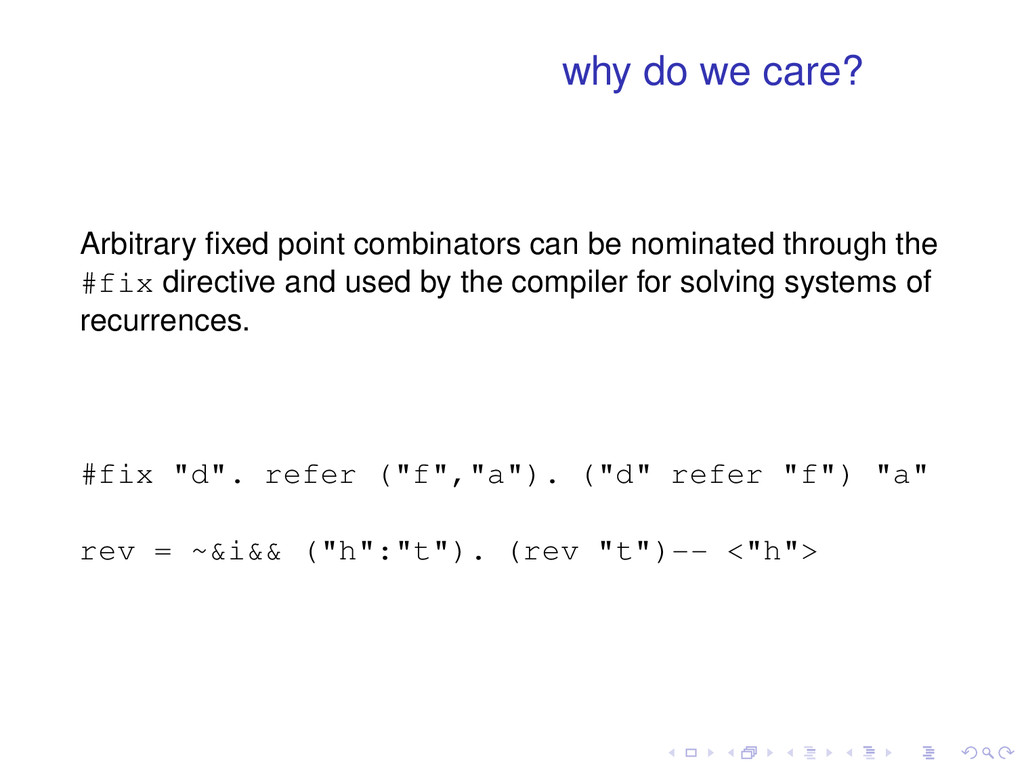
nominated through the #fix directive and used by the compiler for solving systems of recurrences. #fix "d". refer ("f","a"). ("d" refer "f") "a" rev = ~&i&& ("h":"t"). (rev "t")-- <"h">
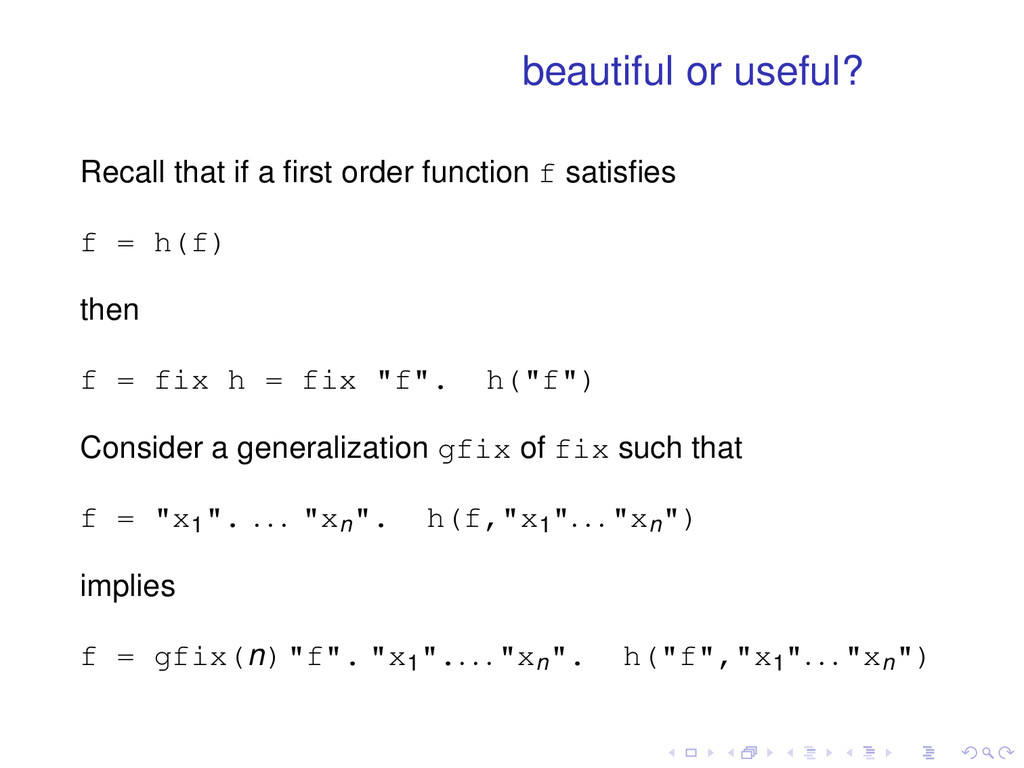
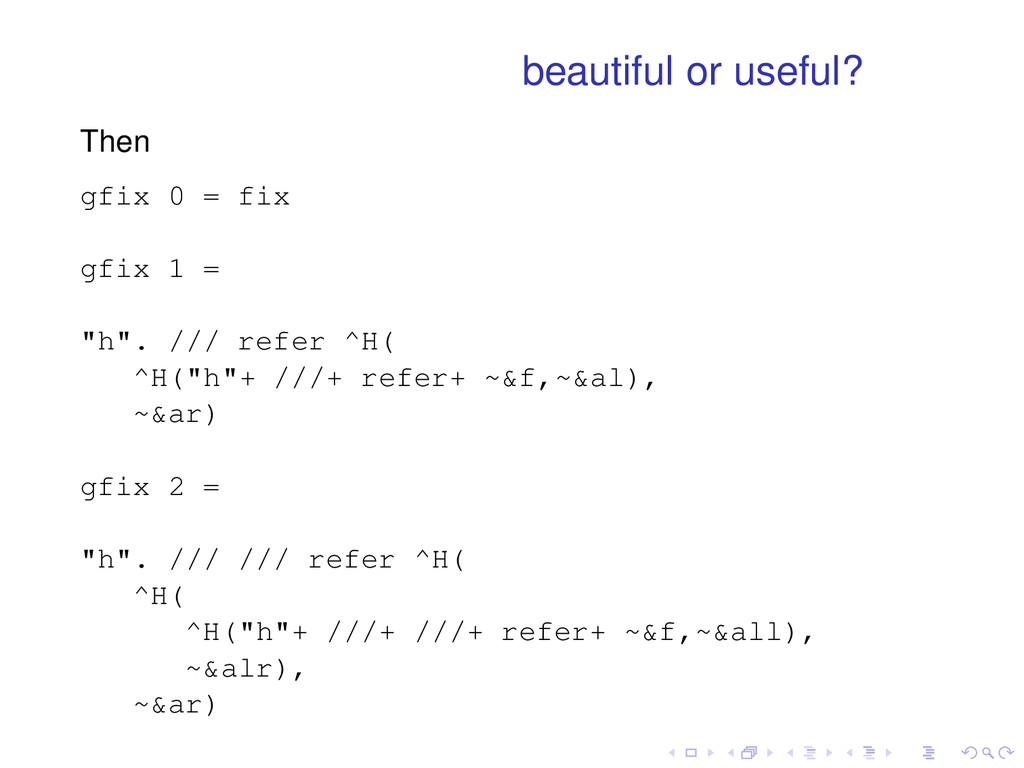
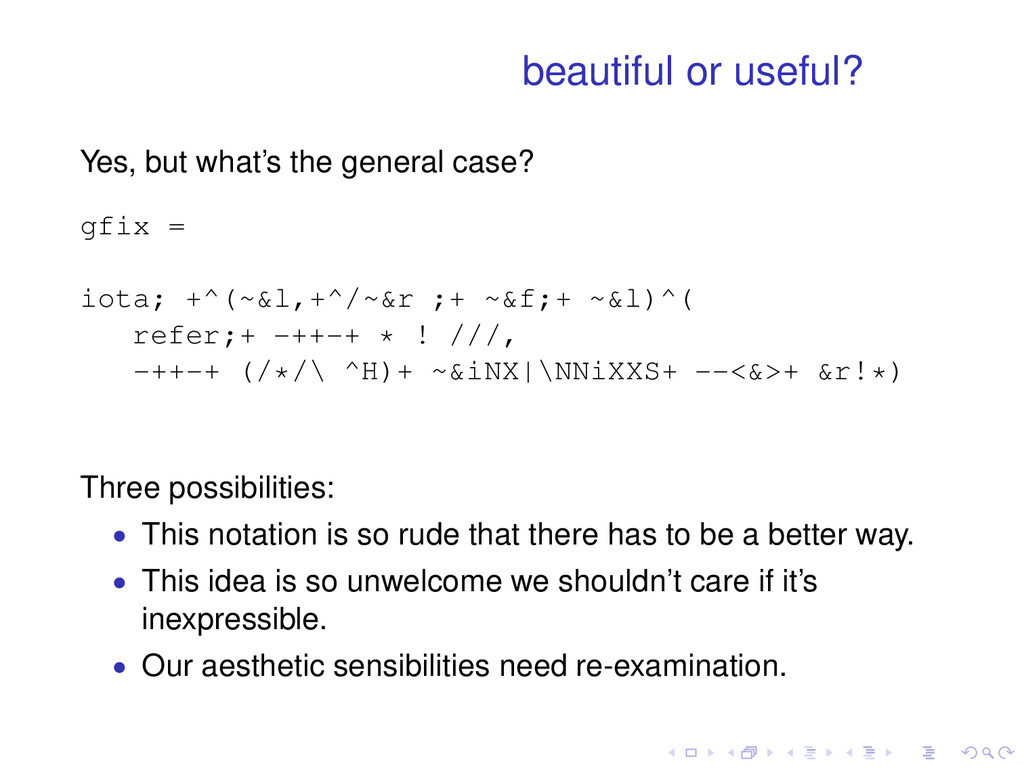
f satisfies f = h(f) then f = fix h = fix "f". h("f") Consider a generalization gfix of fix such that f = "x1". . . . "xn". h(f,"x1". . . "xn") implies f = gfix(n)"f". "x1".. . . "xn". h("f","x1". . . "xn")
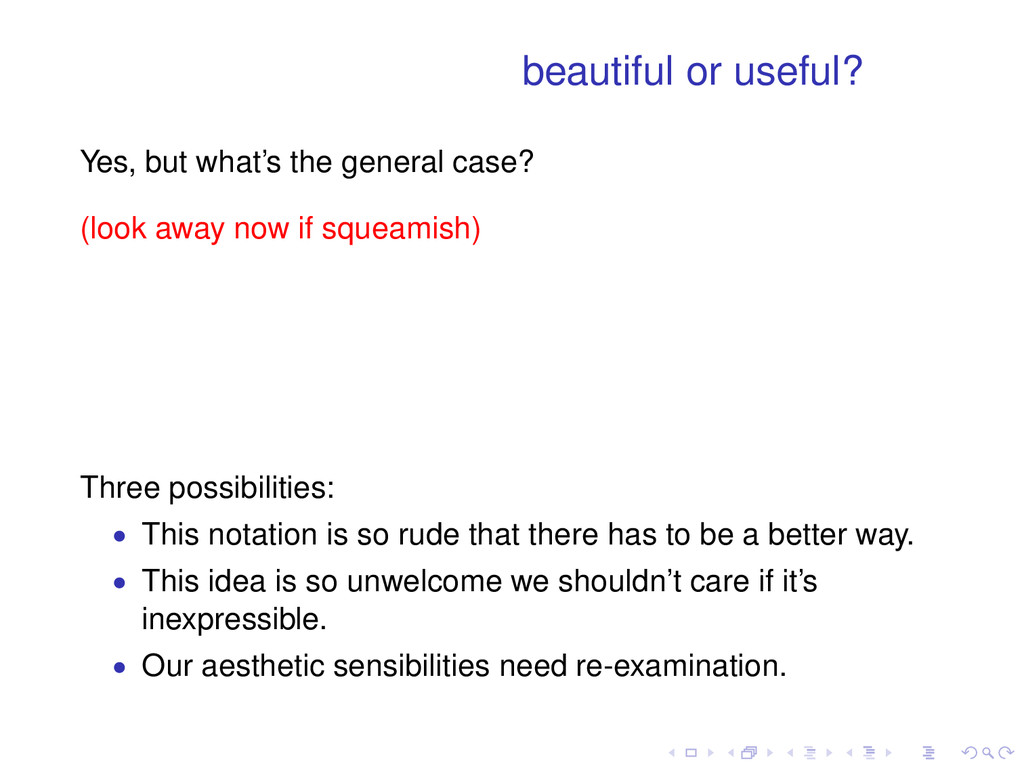
away now if squeamish) Three possibilities: • This notation is so rude that there has to be a better way. • This idea is so unwelcome we shouldn’t care if it’s inexpressible. • Our aesthetic sensibilities need re-examination.
= iota; +^(~&l,+^/~&r ;+ ~&f;+ ~&l)^( refer;+ -++-+ * ! ///, -++-+ (/*/\ ^H)+ ~&iNX|\NNiXXS+ --<&>+ &r!*) Three possibilities: • This notation is so rude that there has to be a better way. • This idea is so unwelcome we shouldn’t care if it’s inexpressible. • Our aesthetic sensibilities need re-examination.
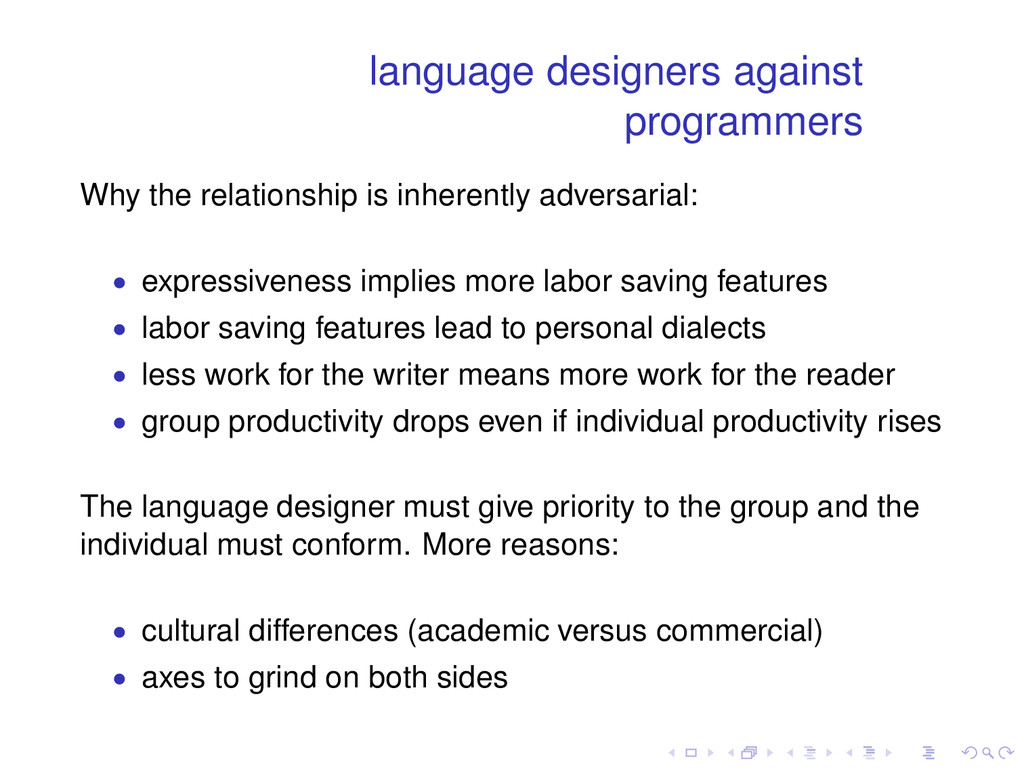
• expressiveness implies more labor saving features • labor saving features lead to personal dialects • less work for the writer means more work for the reader • group productivity drops even if individual productivity rises The language designer must give priority to the group and the individual must conform. More reasons: • cultural differences (academic versus commercial) • axes to grind on both sides
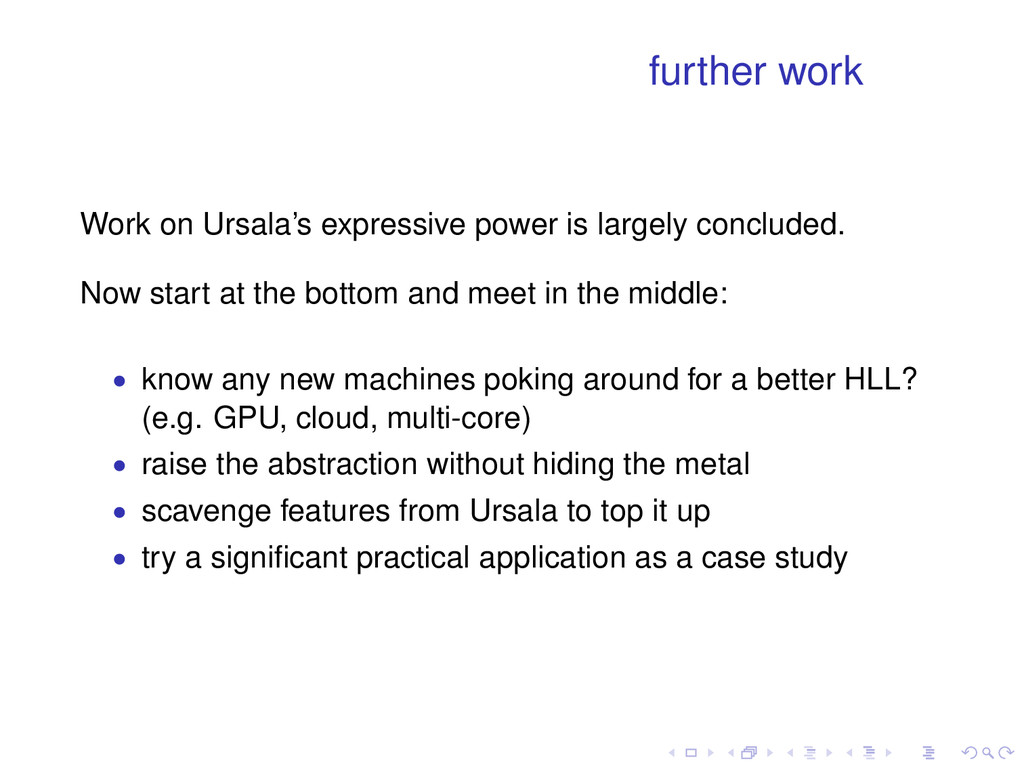
Now start at the bottom and meet in the middle: • know any new machines poking around for a better HLL? (e.g. GPU, cloud, multi-core) • raise the abstraction without hiding the metal • scavenge features from Ursala to top it up • try a significant practical application as a case study
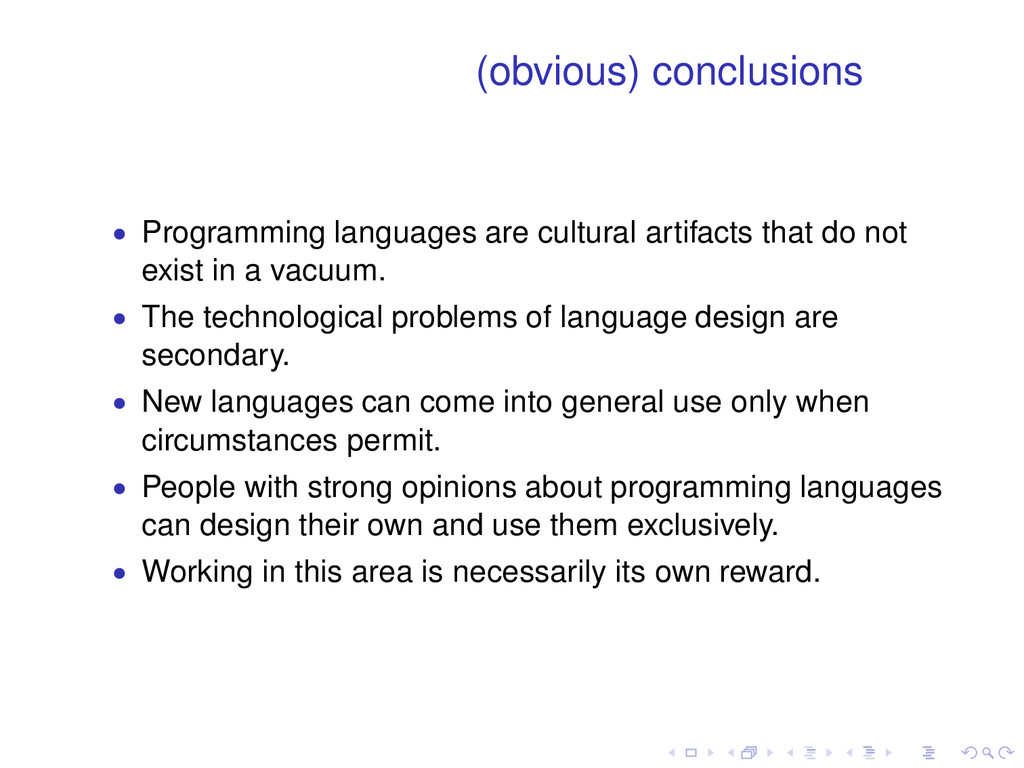
not exist in a vacuum. • The technological problems of language design are secondary. • New languages can come into general use only when circumstances permit. • People with strong opinions about programming languages can design their own and use them exclusively. • Working in this area is necessarily its own reward.


 cazinage
 falcon8823
 uyuki234
 ryu1013
 shihochan
 n_takehata
 findyinc
 seike460
 kinopeee
 tanahiro2010
 kenjiyoneyama
 utakaha
 kaityo256
 jdejongh
 shlominoach
 jnunemaker
 tammyeverts
 eitanlees
 aki_iinuma
 ryanjones
 gurzu
 lemiorhan
 marcelosomers
 varn
 marketingsoph