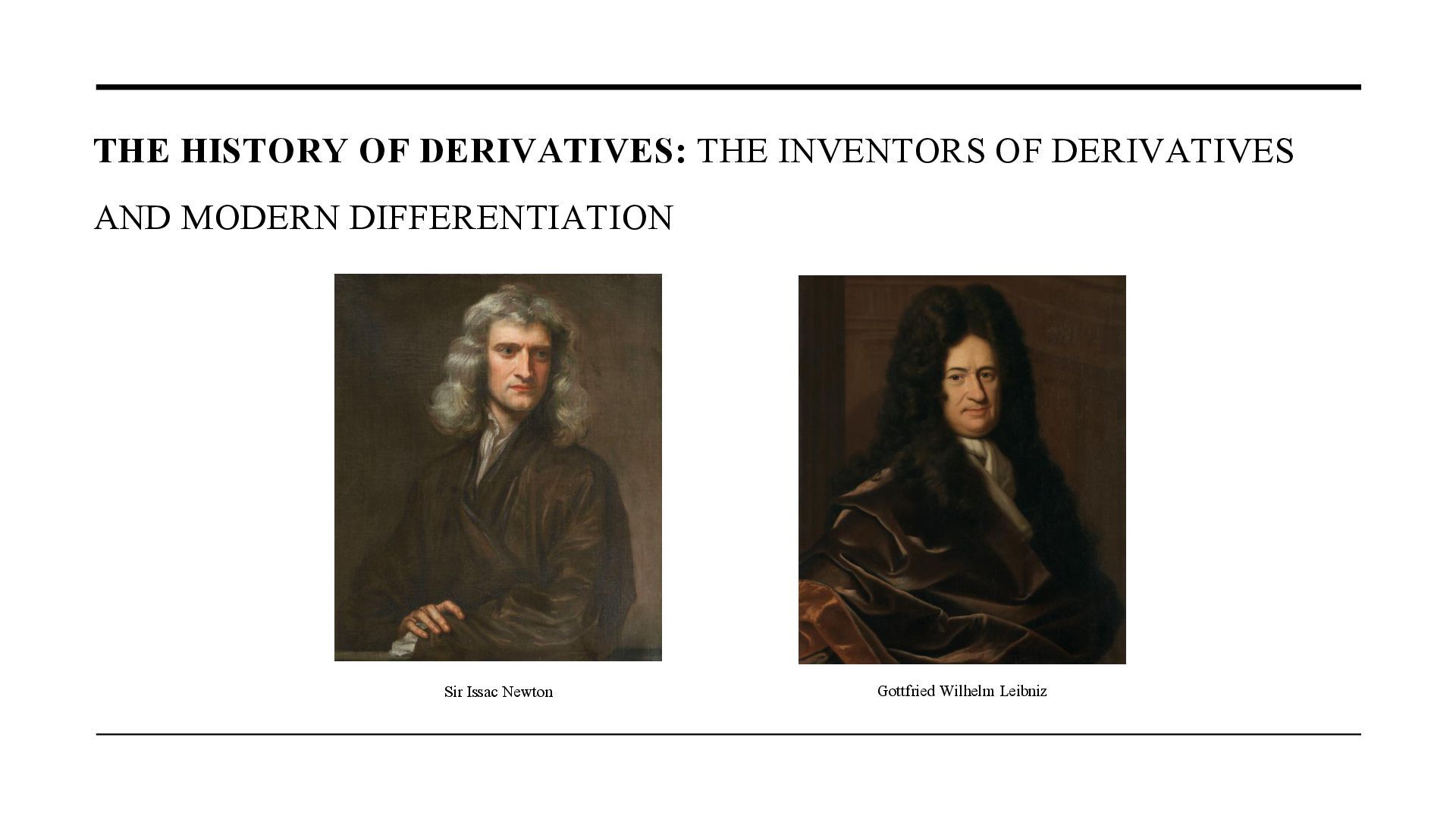
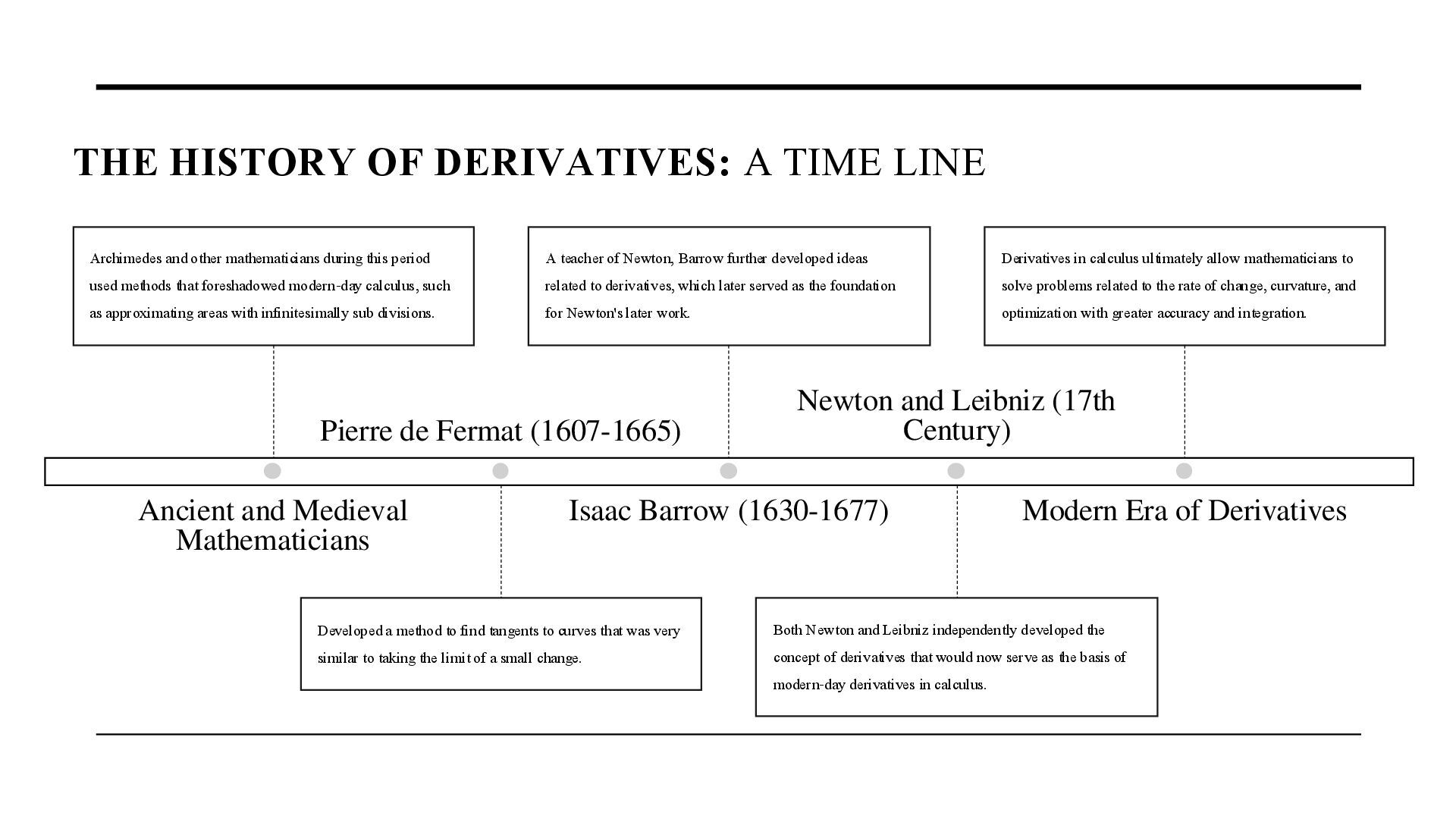
Mathematicians Archimedes and other mathematicians during this period used methods that foreshadowed modern-day calculus, such as approximating areas with infinitesimally sub divisions. Pierre de Fermat (1607-1665) Developed a method to find tangents to curves that was very similar to taking the limit of a small change. Isaac Barrow (1630-1677) A teacher of Newton, Barrow further developed ideas related to derivatives, which later served as the foundation for Newton's later work. Newton and Leibniz (17th Century) Both Newton and Leibniz independently developed the concept of derivatives that would now serve as the basis of modern-day derivatives in calculus. Modern Era of Derivatives Derivatives in calculus ultimately allow mathematicians to solve problems related to the rate of change, curvature, and optimization with greater accuracy and integration.
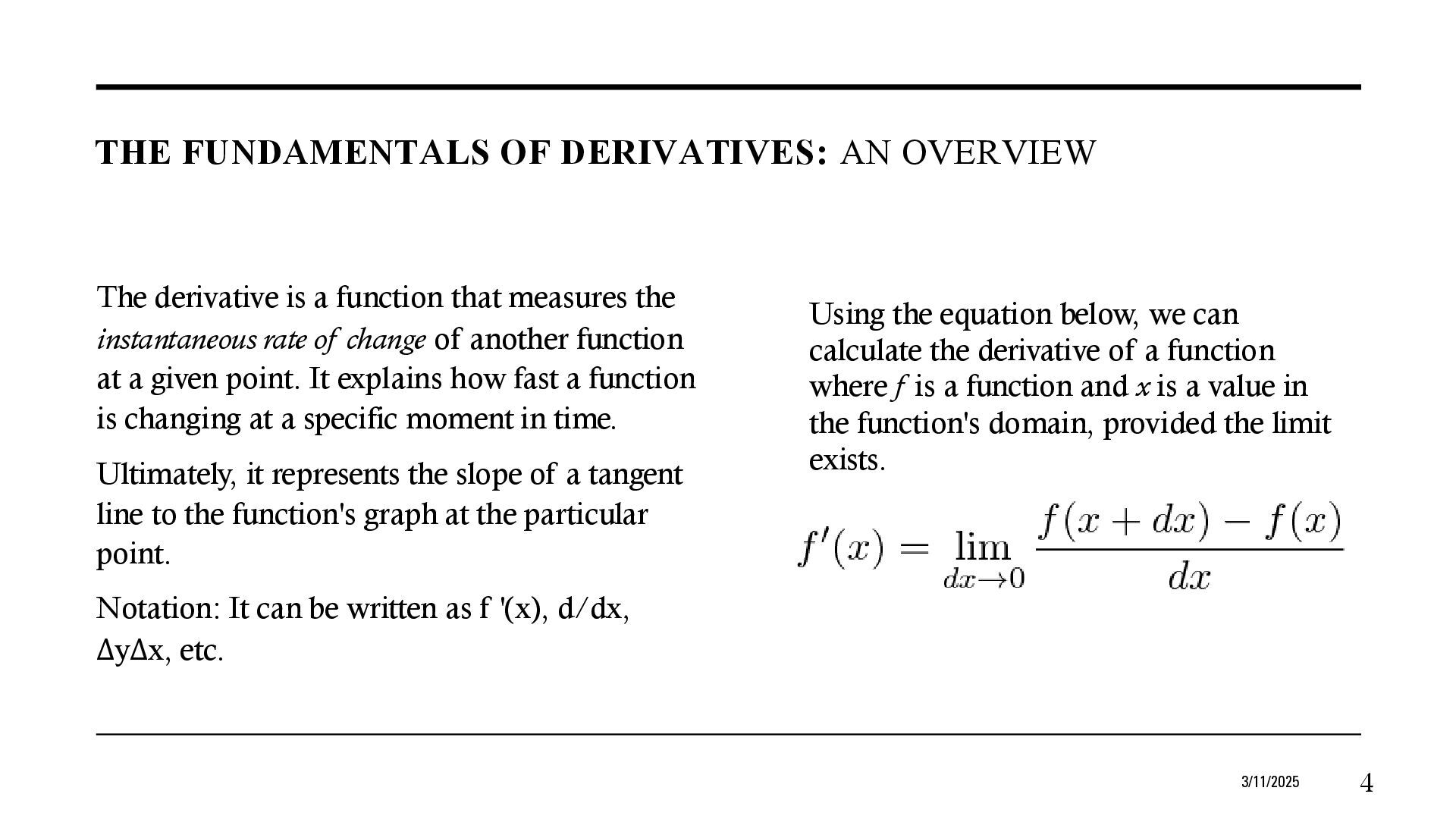
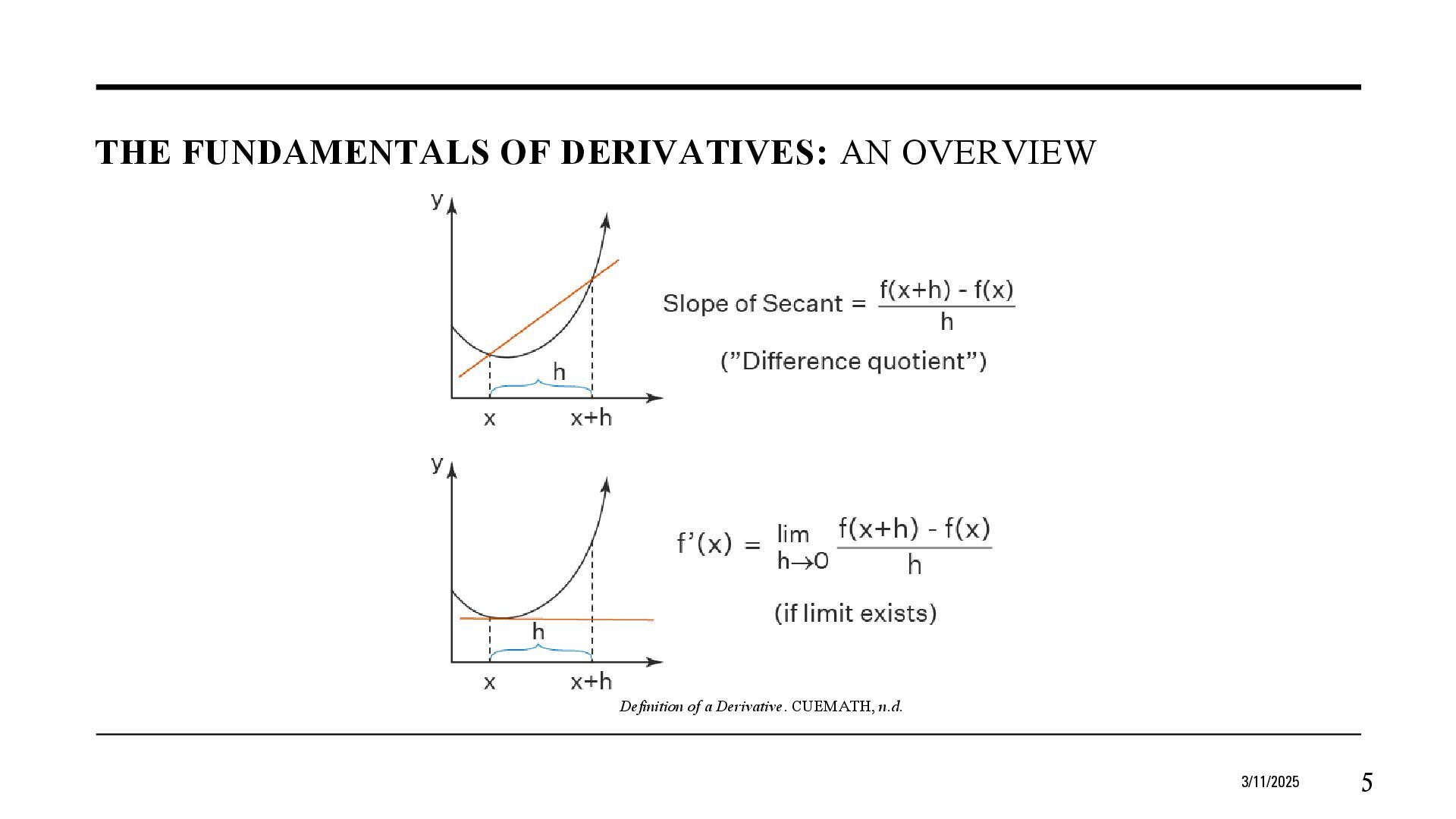
function that measures the instantaneous rate of change of another function at a given point. It explains how fast a function is changing at a specific moment in time. Ultimately, it represents the slope of a tangent line to the function's graph at the particular point. Notation: It can be written as f '(x), d/dx, ΔyΔx, etc. 3/11/2025 4 Using the equation below, we can calculate the derivative of a function where f is a function and x is a value in the function's domain, provided the limit exists.
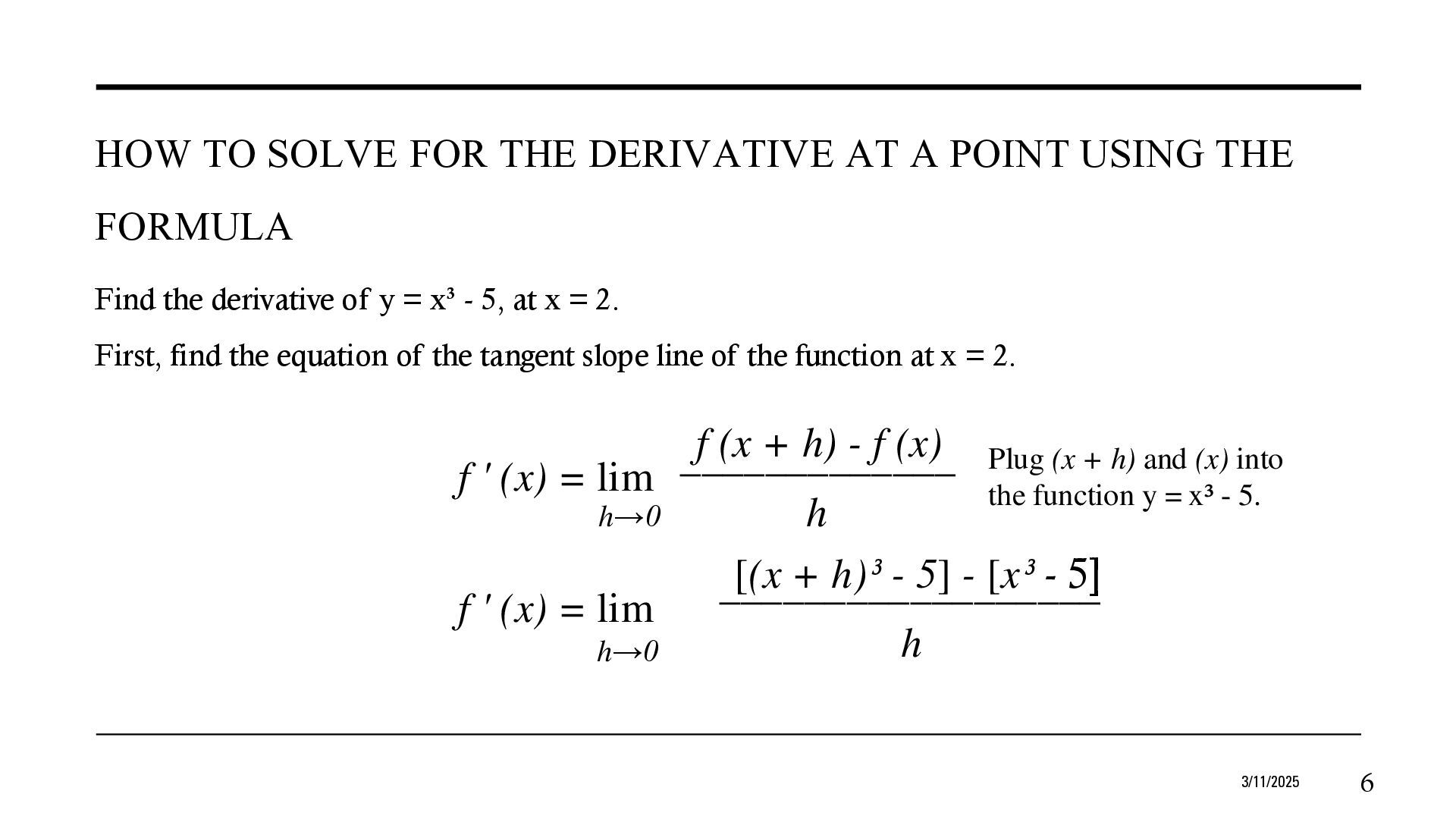
THE FORMULA Find the derivative of y = x³ - 5, at x = 2. First, find the equation of the tangent slope line of the function at x = 2. 3/11/2025 6 f (x + h) - f (x) f ' (x) = lim h→0 _____________ h Plug (x + h) and (x) into the function y = x³ - 5. __________________ f ' (x) = lim h→0 h [(x + h)³ - 5] - [x³ - 5]
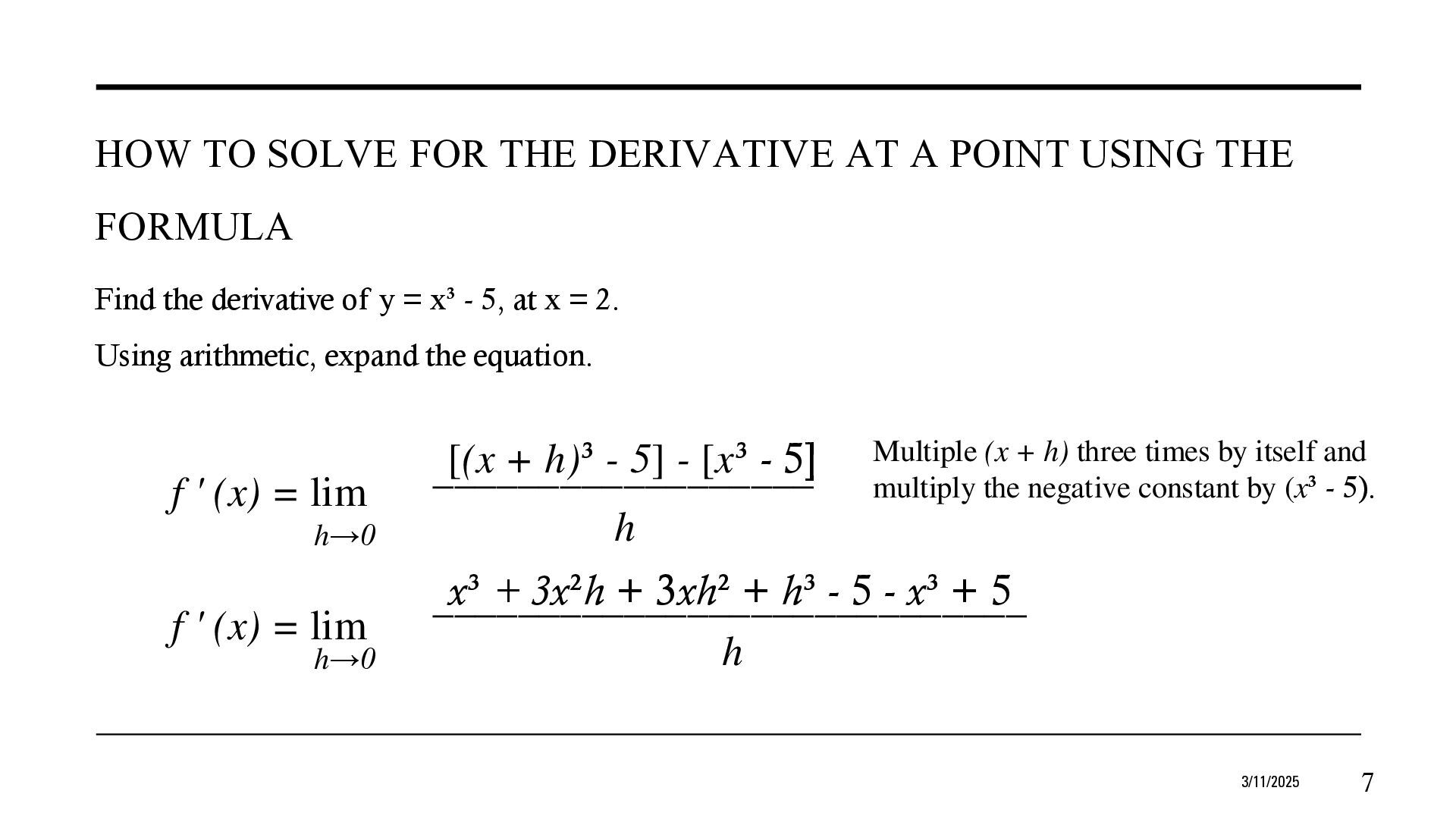
THE FORMULA Find the derivative of y = x³ - 5, at x = 2. Using arithmetic, expand the equation. 3/11/2025 7 Multiple (x + h) three times by itself and multiply the negative constant by (x³ - 5). __________________ f ' (x) = lim h→0 h [(x + h)³ - 5] - [x³ - 5] ____________________________ f ' (x) = lim h→0 h x³ + 3x²h + 3xh² + h³ - 5 - x³ + 5
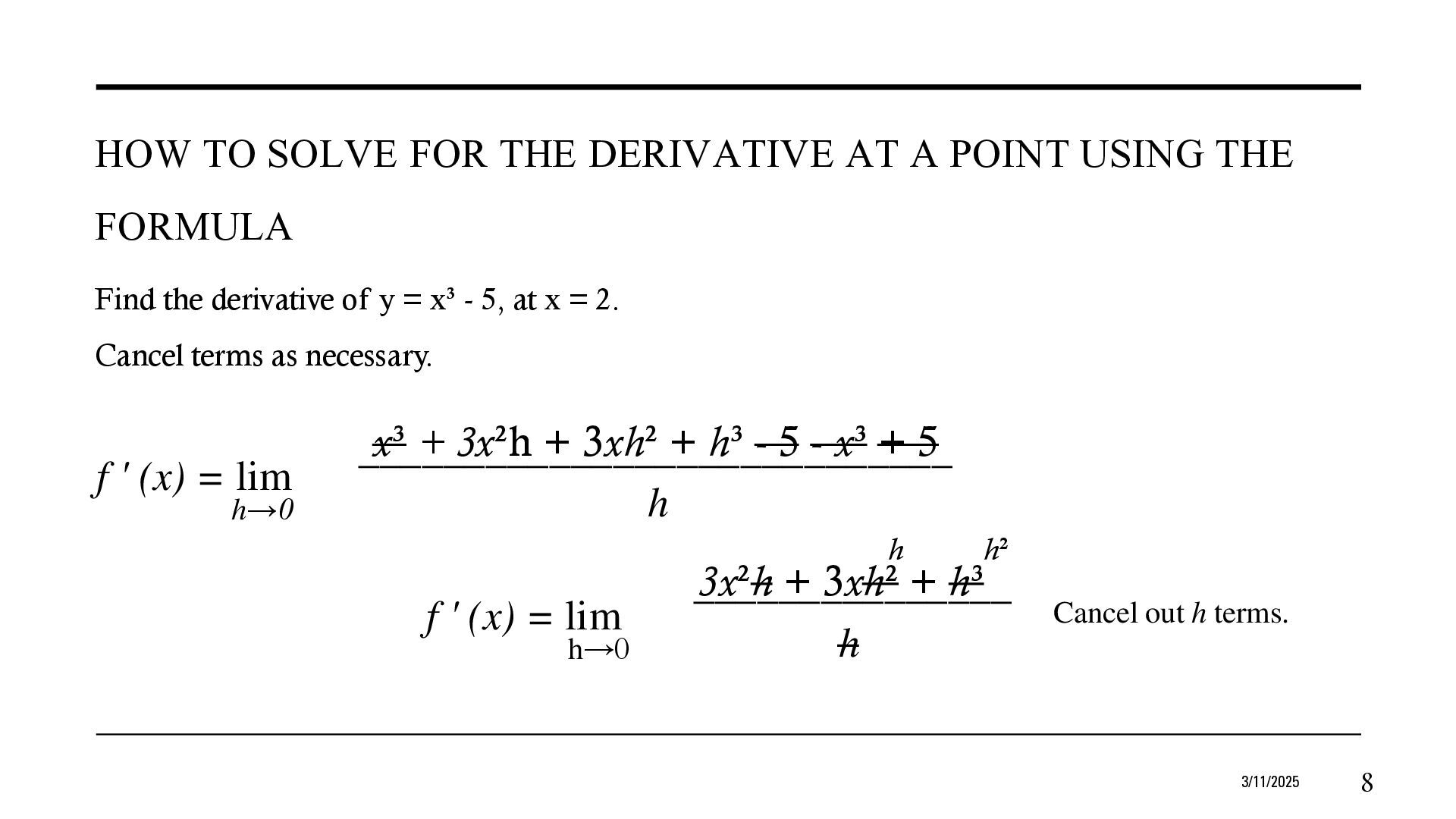
THE FORMULA Find the derivative of y = x³ - 5, at x = 2. Cancel terms as necessary. 3/11/2025 8 Cancel out h terms. ____________________________ f ' (x) = lim h→0 h x³ + 3x²h + 3xh² + h³ - 5 - x³ + 5 _______________ f ' (x) = lim h→0 h 3x²h + 3xh² + h³ h h²
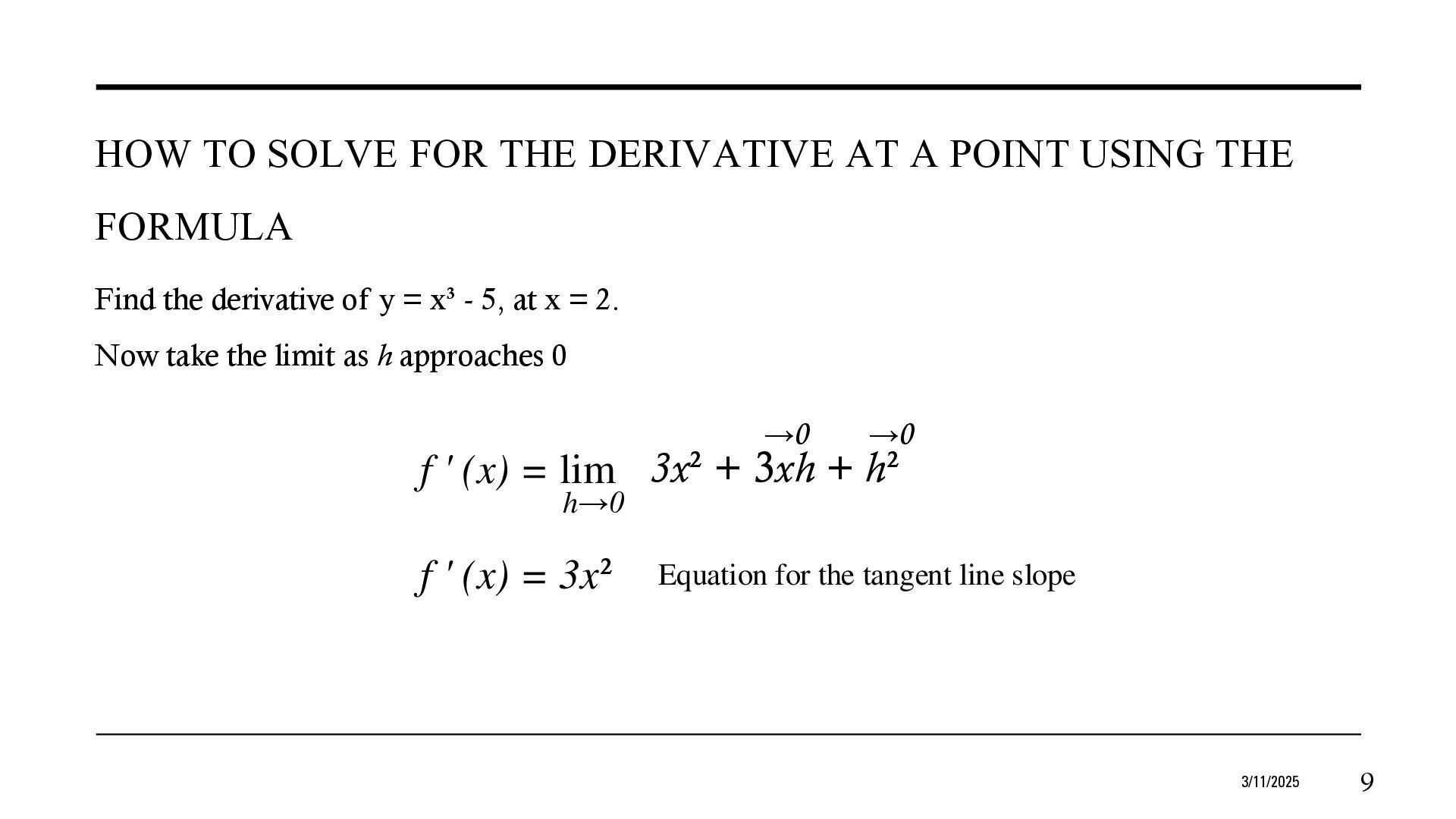
THE FORMULA Find the derivative of y = x³ - 5, at x = 2. Now take the limit as h approaches 0 3/11/2025 9 f ' (x) = lim h→0 3x² + 3xh + h² →0 →0 f ' (x) = 3x² Equation for the tangent line slope
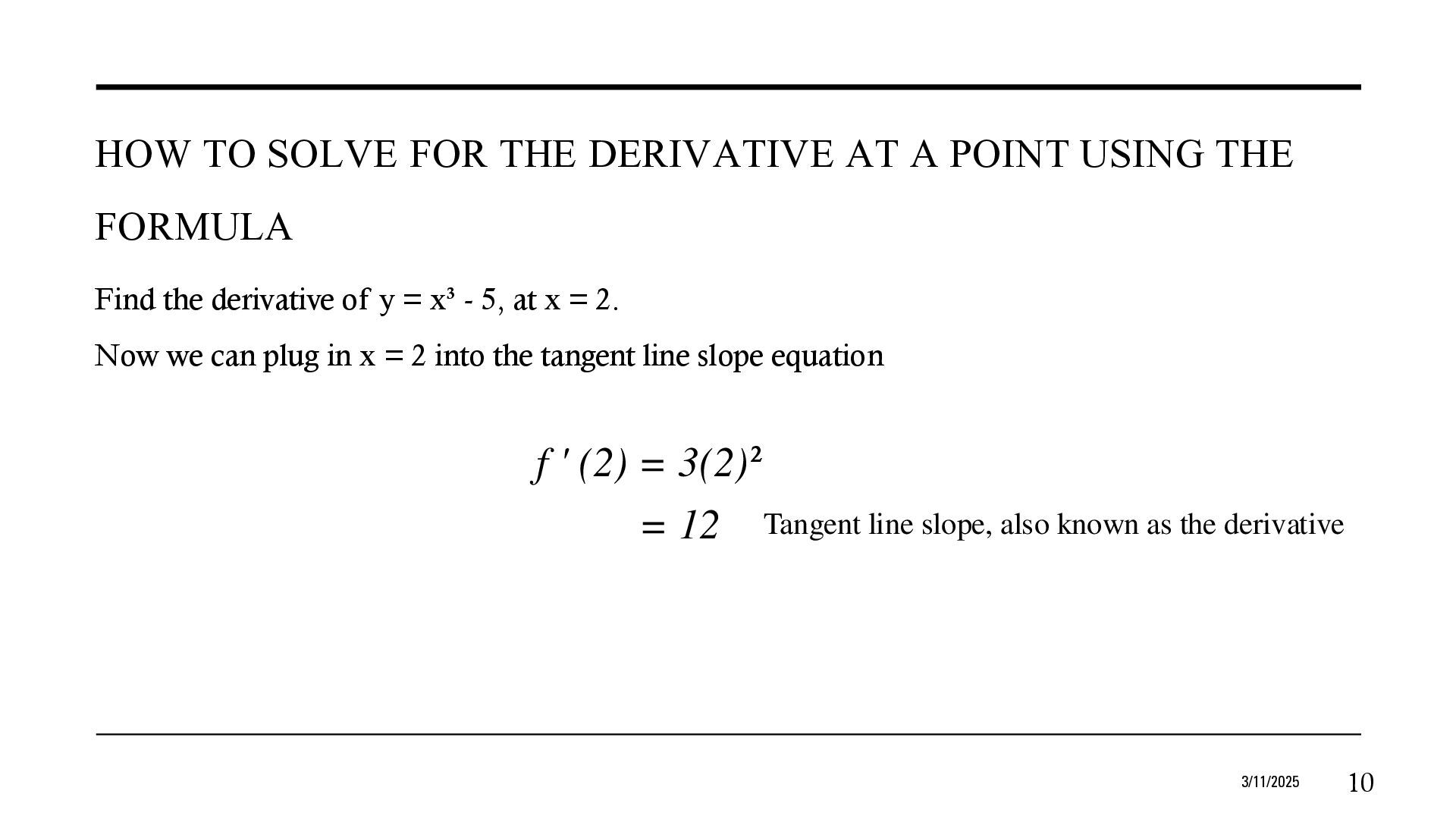
THE FORMULA Find the derivative of y = x³ - 5, at x = 2. Now we can plug in x = 2 into the tangent line slope equation 3/11/2025 10 f ' (2) = 3(2)² = 12 Tangent line slope, also known as the derivative
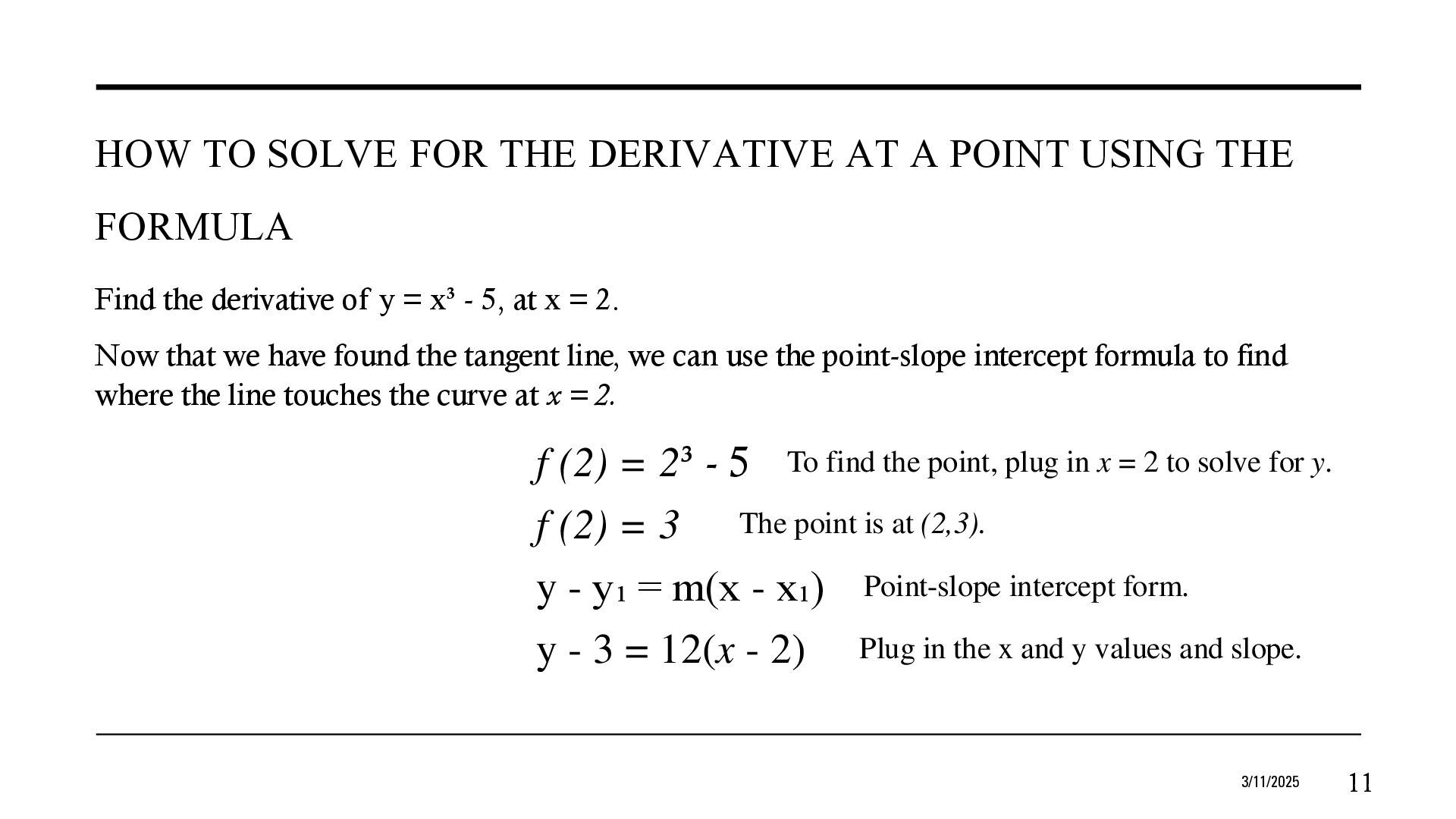
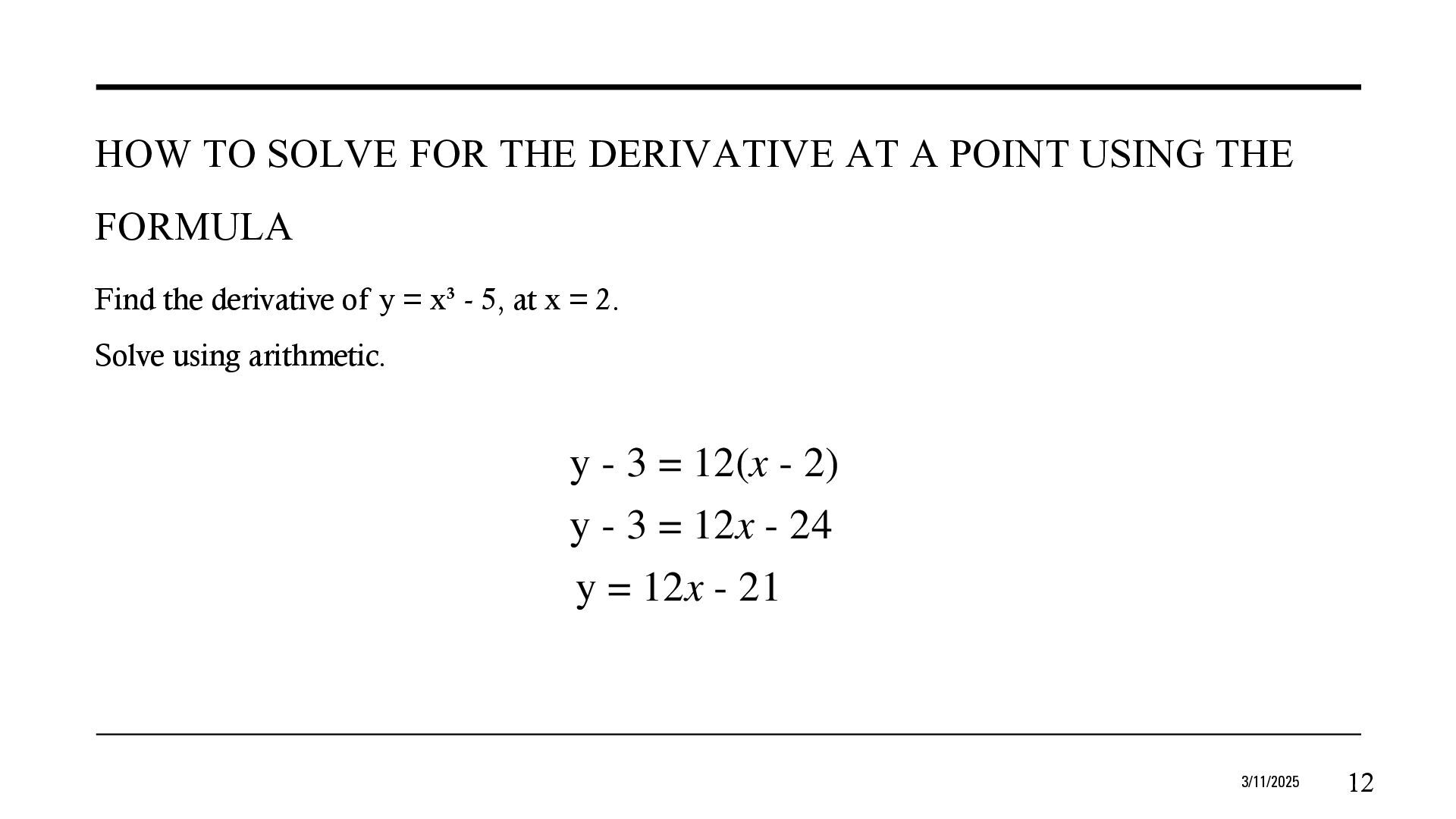
THE FORMULA Find the derivative of y = x³ - 5, at x = 2. Now that we have found the tangent line, we can use the point-slope intercept formula to find where the line touches the curve at x = 2. 3/11/2025 11 f (2) = 2³ - 5 f (2) = 3 To find the point, plug in x = 2 to solve for y. The point is at (2,3). y - y₁ = m(x - x₁) Point-slope intercept form. y - 3 = 12(x - 2) Plug in the x and y values and slope.
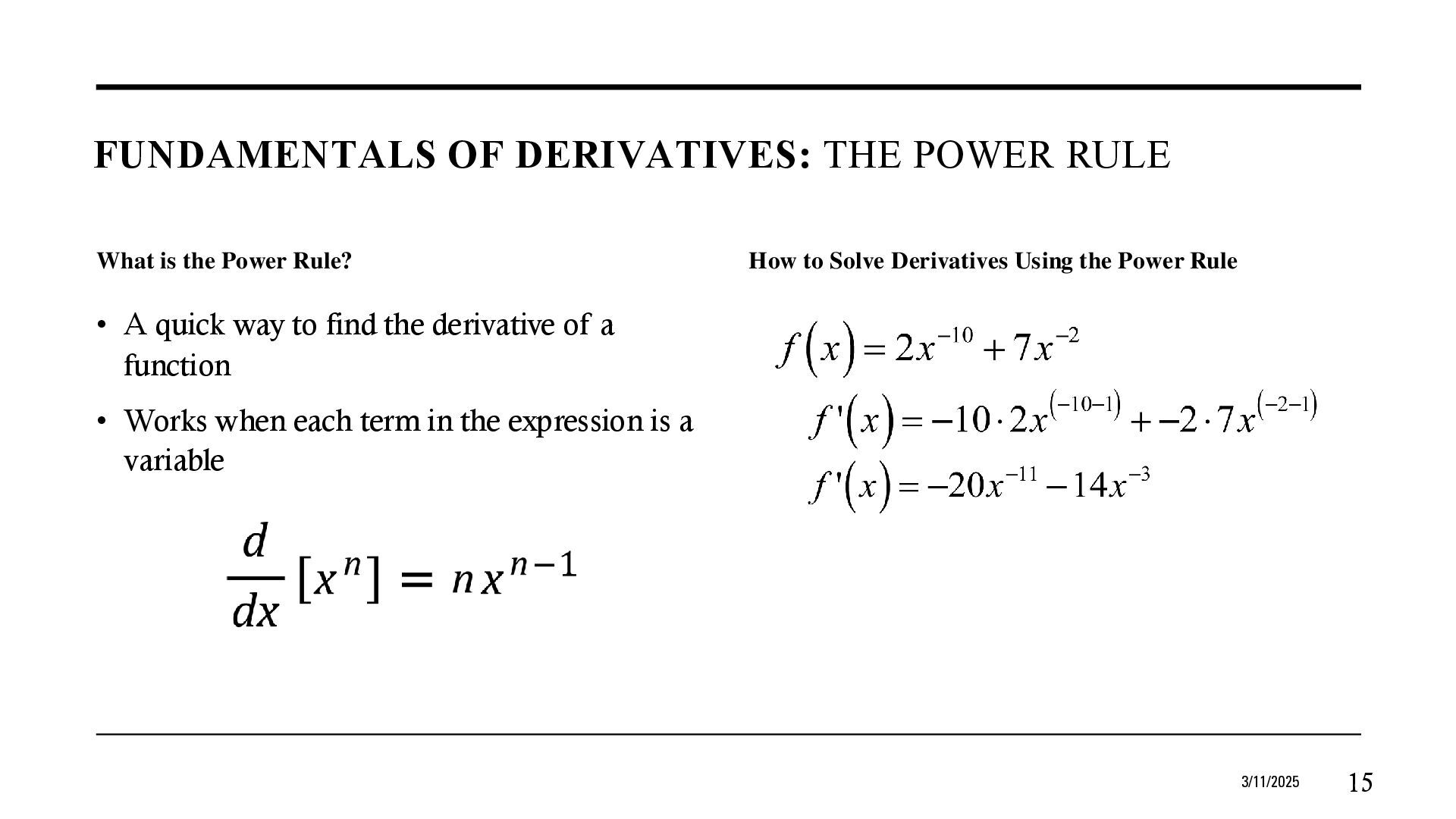
Rule? • A quick way to find the derivative of a function • Works when each term in the expression is a variable How to Solve Derivatives Using the Power Rule 3/11/2025 15
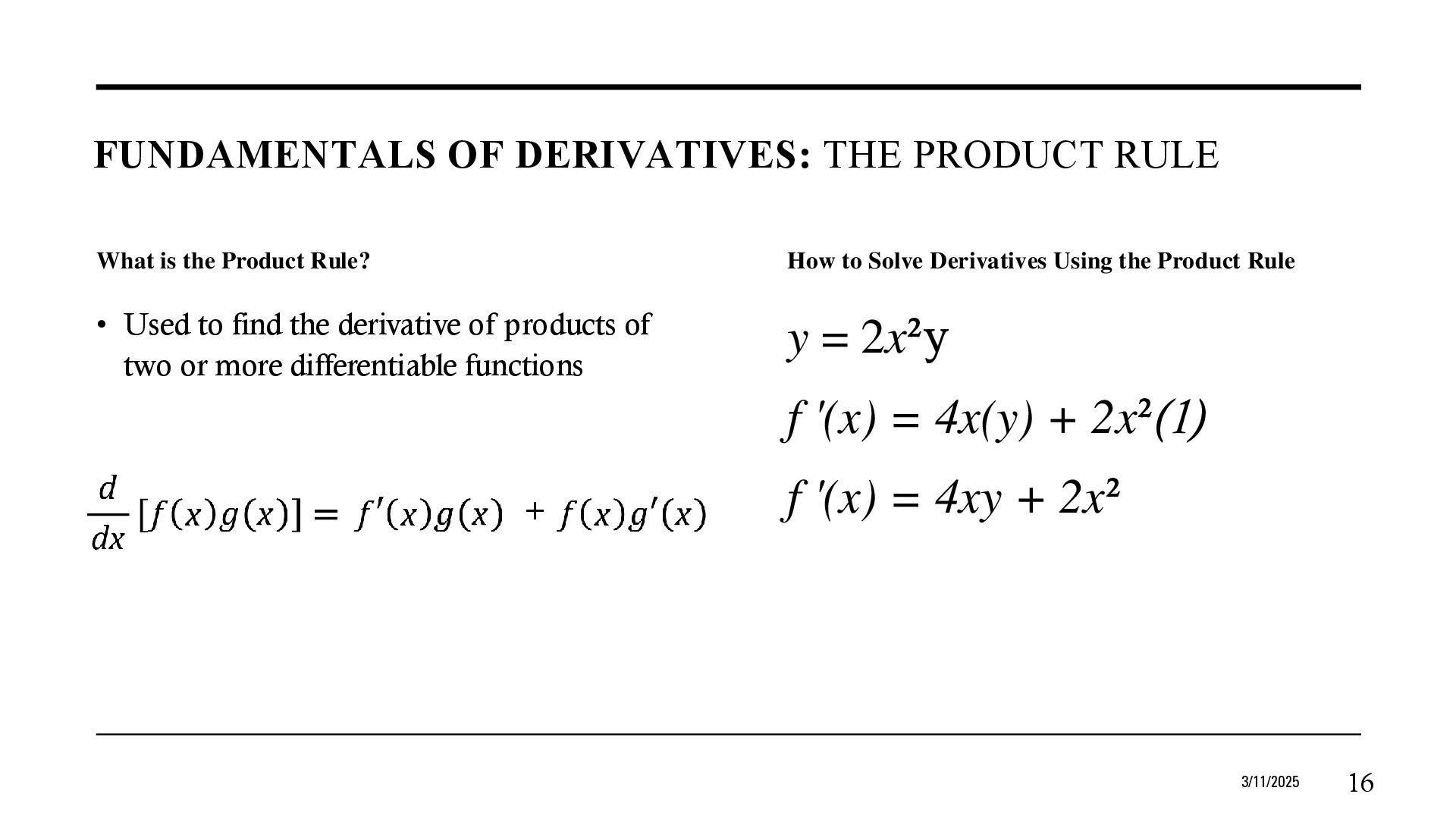
Rule? • Used to find the derivative of products of two or more differentiable functions How to Solve Derivatives Using the Product Rule y = 2x²y f '(x) = 4x(y) + 2x²(1) f '(x) = 4xy + 2x² 3/11/2025 16 +
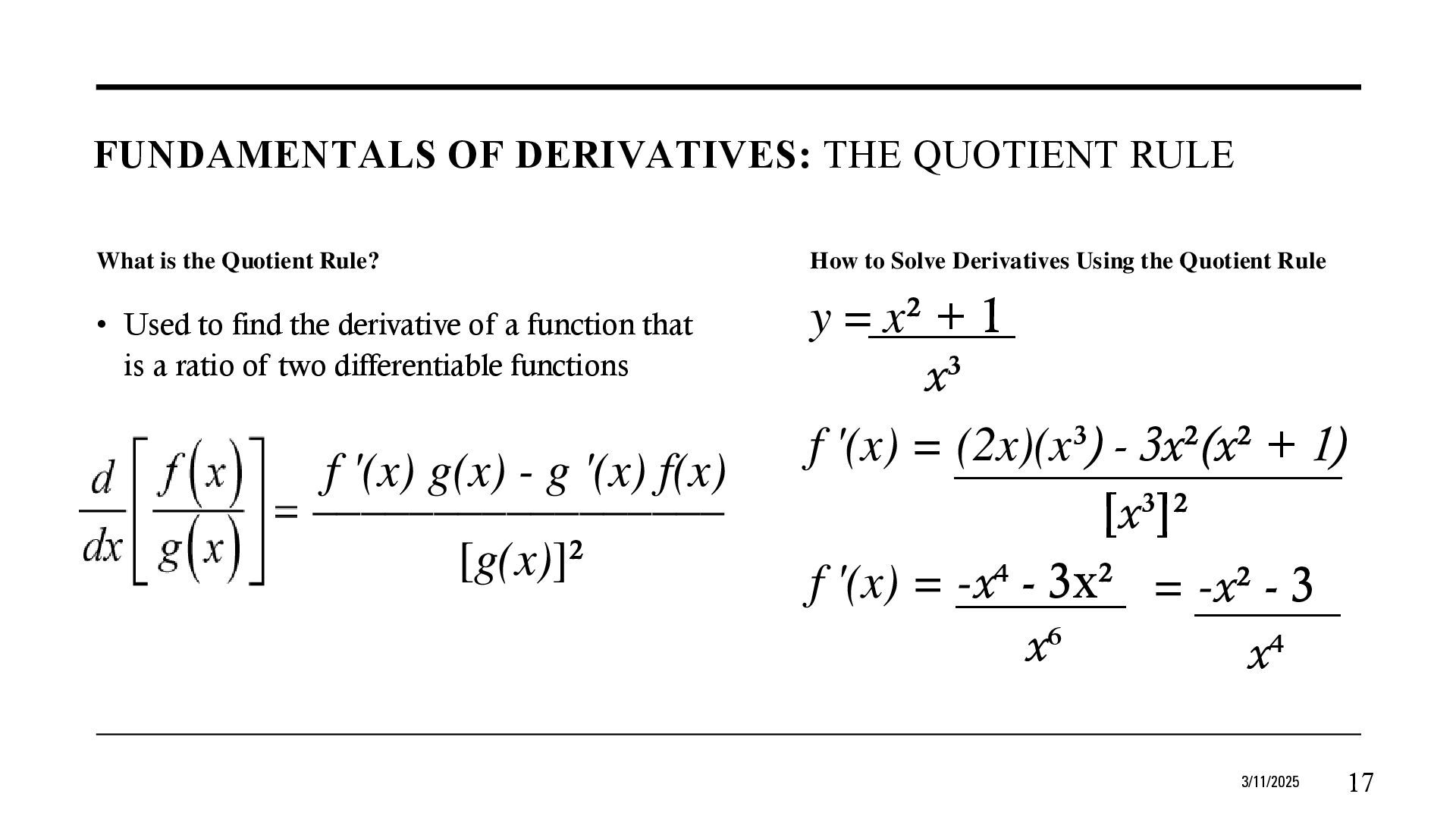
DERIVATIVES: THE QUOTIENT RULE What is the Quotient Rule? • Used to find the derivative of a function that is a ratio of two differentiable functions How to Solve Derivatives Using the Quotient Rule 3/11/2025 17 f '(x) g(x) - g '(x) f(x) _________________ [g(x)]² y = x² + 1 x³ f '(x) = (2x)(x³) - 3x²(x² + 1) ________________ [x³]² x⁴ ______ = -x² - 3 x⁶
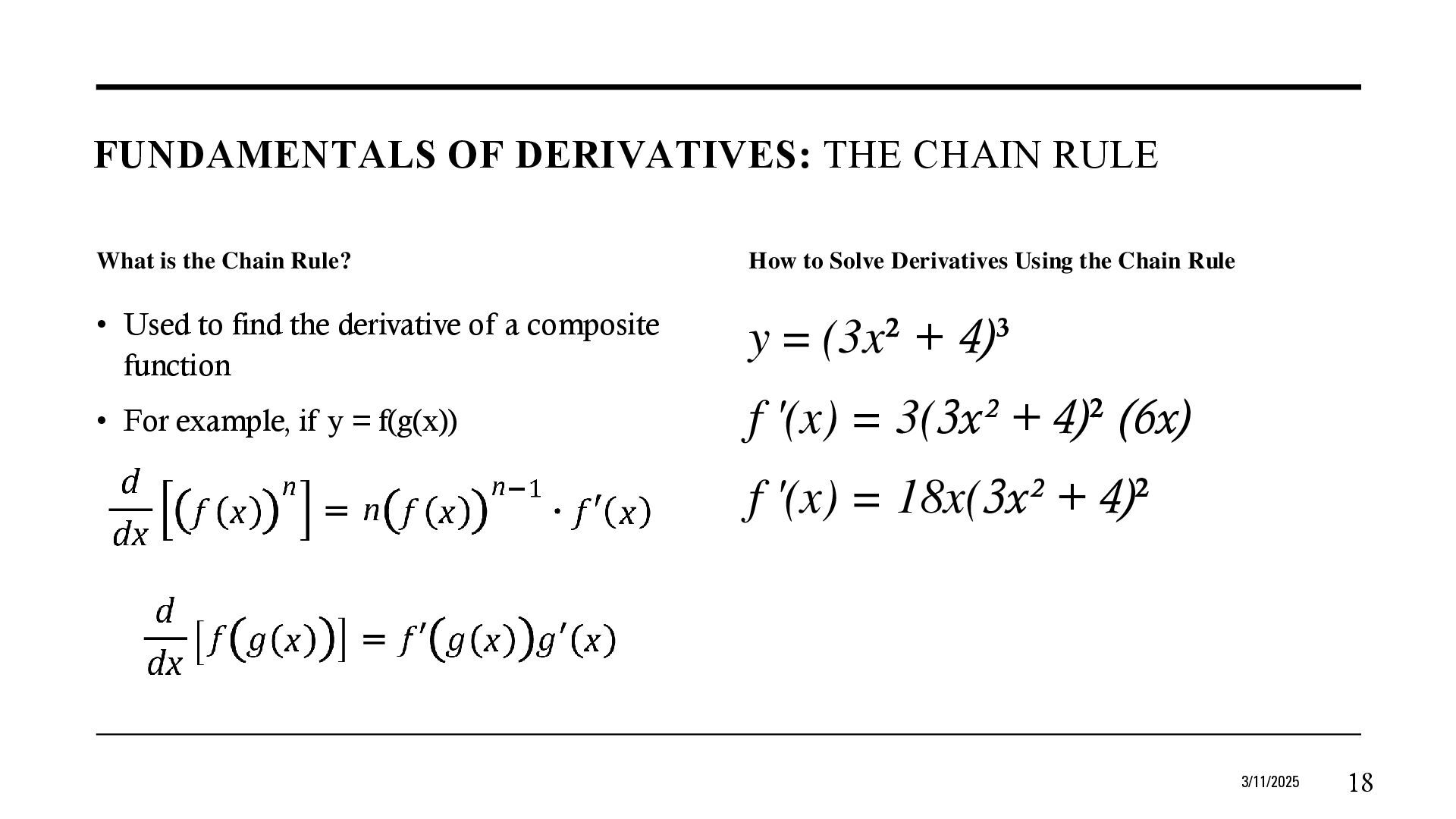
Rule? • Used to find the derivative of a composite function • For example, if y = f(g(x)) How to Solve Derivatives Using the Chain Rule y = (3x² + 4)³ f '(x) = 3(3x² + 4)² (6x) f '(x) = 18x(3x² + 4)² 3/11/2025 18
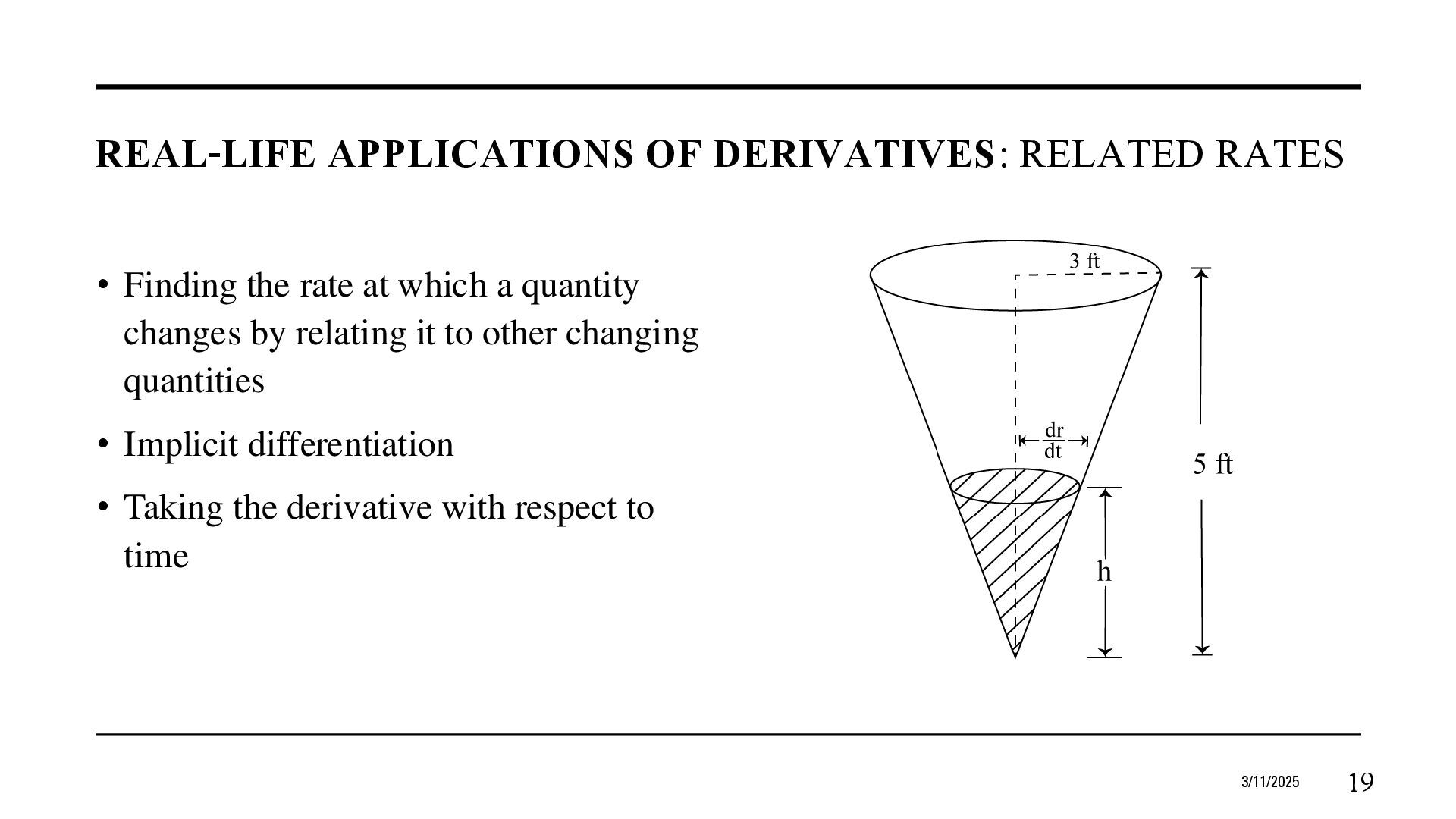
at which a quantity changes by relating it to other changing quantities • Implicit differentiation • Taking the derivative with respect to time 3/11/2025 19
Courses That Take the Mystery Out of Learning Math. Calcworkshop - Giving You Confidence In Math. https://calcworkshop.com/ CUEMATH. (n.d.). Derivatives. Derivatives - Calculus, Meaning, Interpretation. https://www.cuemath.com/calculus/derivatives/ Oxford College. (n.d.). The Department of Mathematics and Computer Science. The Definition of the Derivative. https://mathcenter.oxford.emory.edu/site/math111/defOfDerivative/ 3/11/2025 22


 ishii_mit
 juanmartin2026
 pawan_pharm
 tasusu
 mariooc
 bvr7352
 fmarot
 matleenalaakso
 camel_404
 yasslab
 kentaroy47
 cbtlibrary
 mojombo
 davidcarrasco
 palkan
 schroneko
 garrettdimon
 iamctodd
 bluesmoon
 mayunak
 skipperchong
 sugarenia
 tanoku
 pedronauck