Upgrade to Pro — share decks privately, control downloads, hide ads and more …

How Websites Detect Proxy Servers: IP Reputatio...

How Websites Detect Proxy Servers: IP Reputation, TCP Fingerprinting & DNS Leaks

Think your proxy is invisible? Most are not. Websites use a layered detection stack that catches proxies before the browser even loads.

This deck breaks down the five core methods: IP reputation and ASN classification (datacenter IPs get flagged instantly), DNS leaks (misconfigured proxies expose your real location through resolver mismatches), TCP fingerprinting (SYN packet parameters like TTL and window size reveal the real OS behind a connection), handshake timing analysis (double-hop latency patterns give away proxied traffic), and browser-level fingerprinting for multi-account detection.

Includes a side-by-side TCP fingerprint comparison showing how Linux proxy servers look nothing like Windows 11 Chrome, a full proxy type detection resistance matrix from datacenter through mobile, and practical breakdowns of why scraping and multi-accounting face fundamentally different detection challenges.

Avatar for Romeo Mihalcea

Romeo Mihalcea

April 20, 2026

More Decks by Romeo Mihalcea

Other Decks in Technology

Transcript

  1. How Websites Detect Proxy Servers IP Reputation, TCP Fingerprinting &

    DNS Leaks Explained anonymous-proxies.net anonymous-proxies.net/posts/how-detect-proxy/
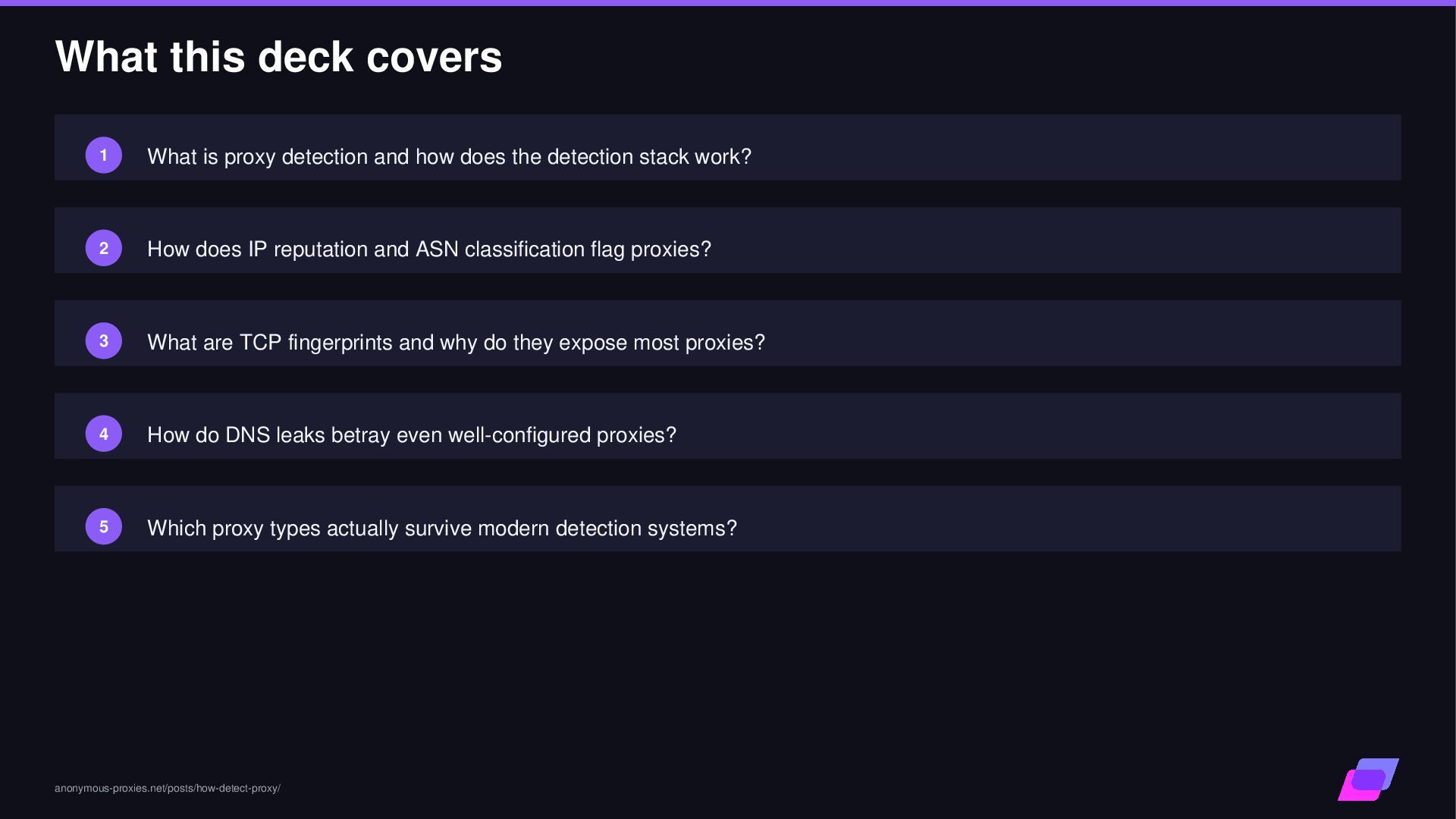
  2. What this deck covers 1 What is proxy detection and

    how does the detection stack work? 2 How does IP reputation and ASN classification flag proxies? 3 What are TCP fingerprints and why do they expose most proxies? 4 How do DNS leaks betray even well-configured proxies? 5 Which proxy types actually survive modern detection systems? anonymous-proxies.net/posts/how-detect-proxy/
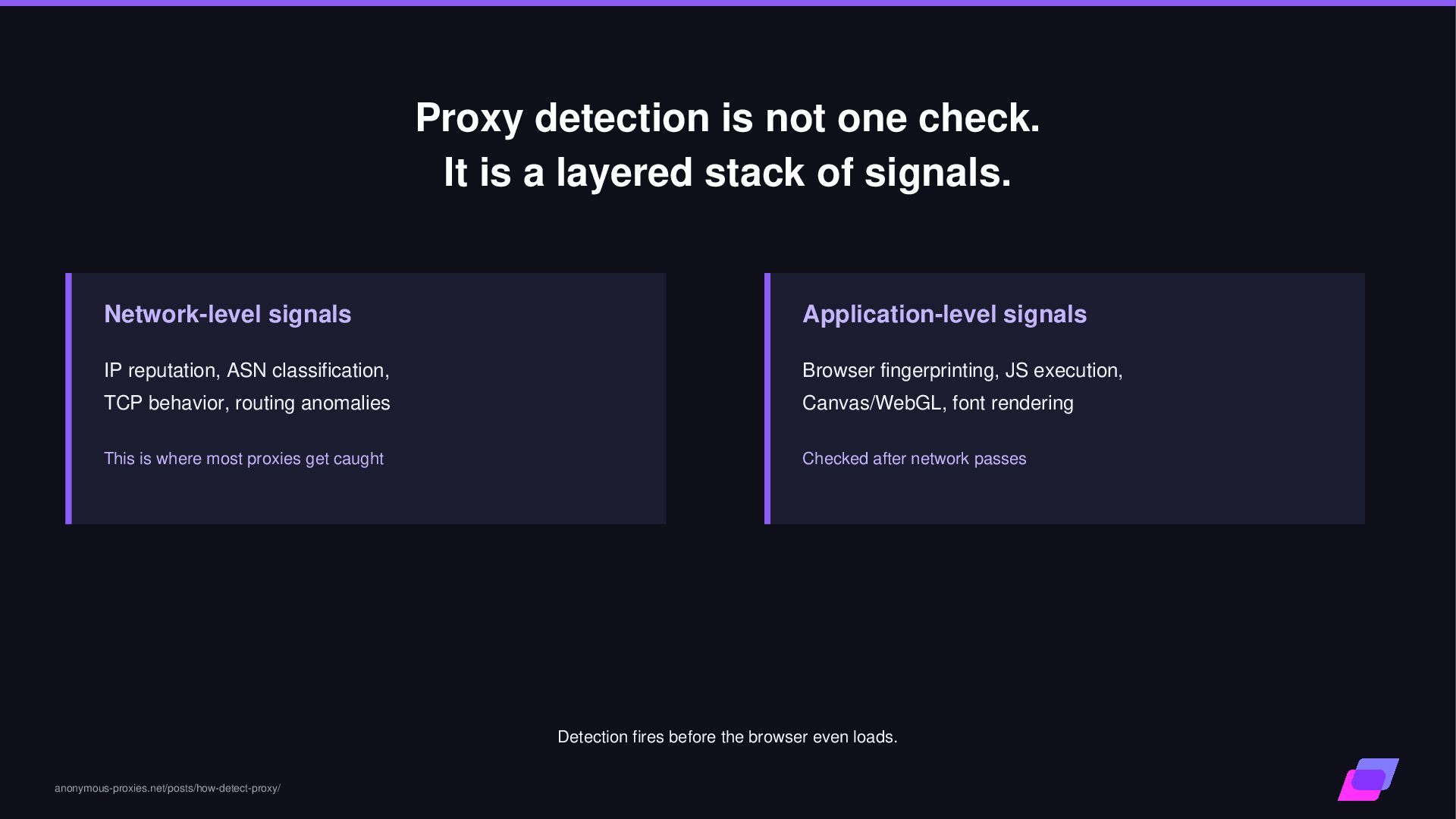
  3. Proxy detection is not one check. It is a layered

    stack of signals. Network-level signals IP reputation, ASN classification, TCP behavior, routing anomalies This is where most proxies get caught Application-level signals Browser fingerprinting, JS execution, Canvas/WebGL, font rendering Checked after network passes Detection fires before the browser even loads. anonymous-proxies.net/posts/how-detect-proxy/
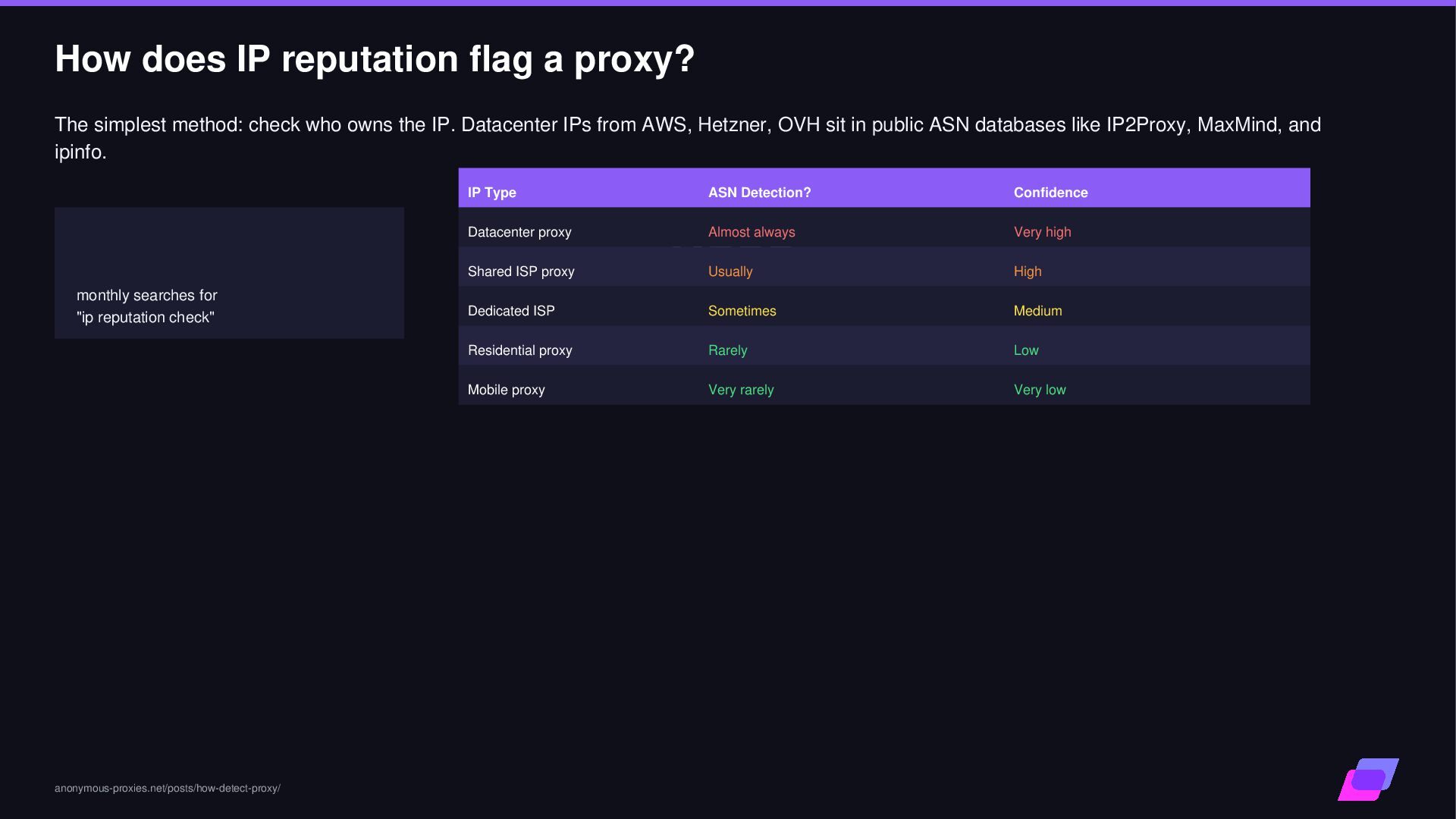
  4. How does IP reputation flag a proxy? The simplest method:

    check who owns the IP. Datacenter IPs from AWS, Hetzner, OVH sit in public ASN databases like IP2Proxy, MaxMind, and ipinfo. 1,600 monthly searches for "ip reputation check" IP Type ASN Detection? Confidence Datacenter proxy Almost always Very high Shared ISP proxy Usually High Dedicated ISP Sometimes Medium Residential proxy Rarely Low Mobile proxy Very rarely Very low anonymous-proxies.net/posts/how-detect-proxy/
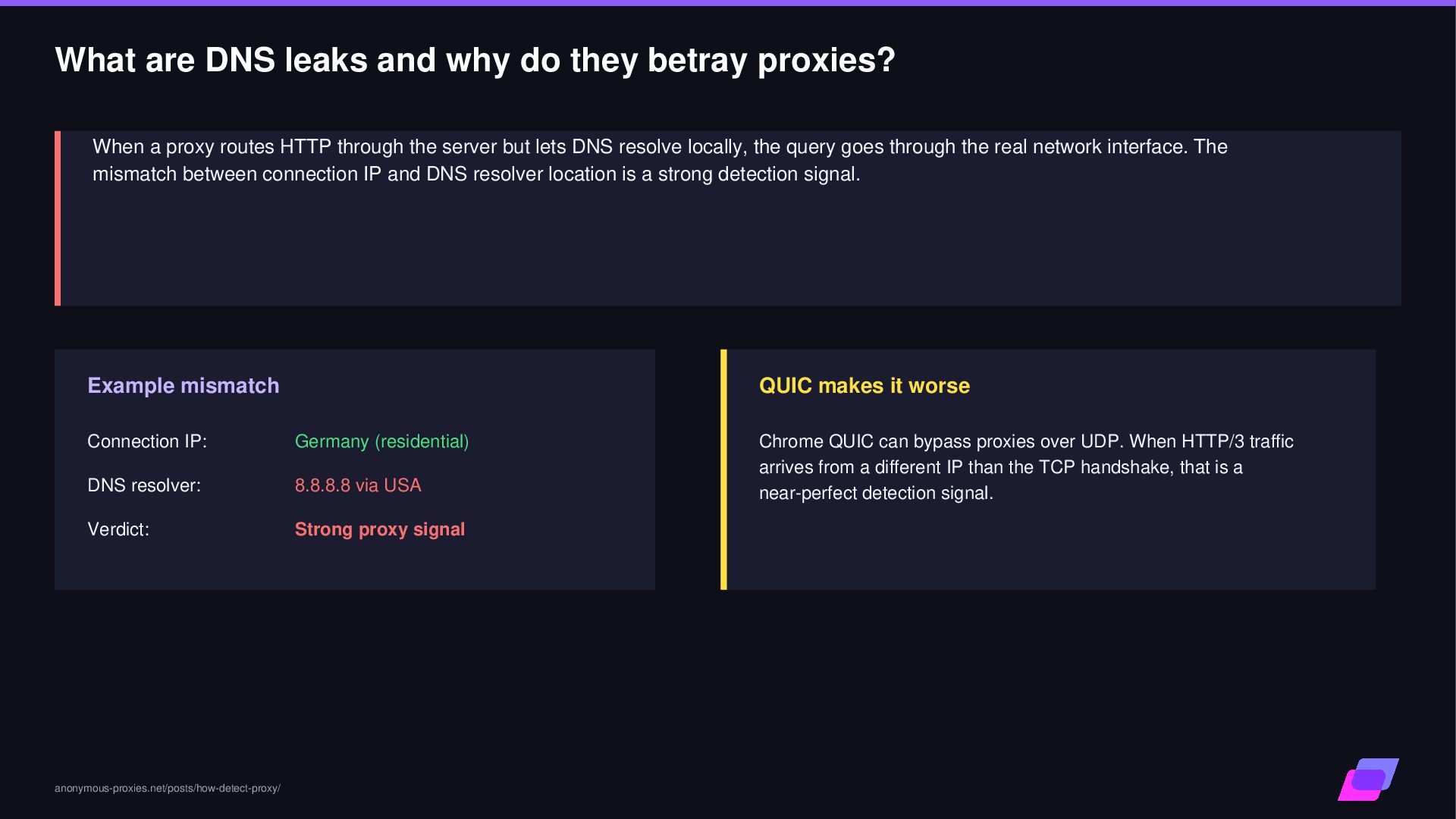
  5. What are DNS leaks and why do they betray proxies?

    When a proxy routes HTTP through the server but lets DNS resolve locally, the query goes through the real network interface. The mismatch between connection IP and DNS resolver location is a strong detection signal. Example mismatch Connection IP: Germany (residential) DNS resolver: 8.8.8.8 via USA Verdict: Strong proxy signal QUIC makes it worse Chrome QUIC can bypass proxies over UDP. When HTTP/3 traffic arrives from a different IP than the TCP handshake, that is a near-perfect detection signal. anonymous-proxies.net/posts/how-detect-proxy/
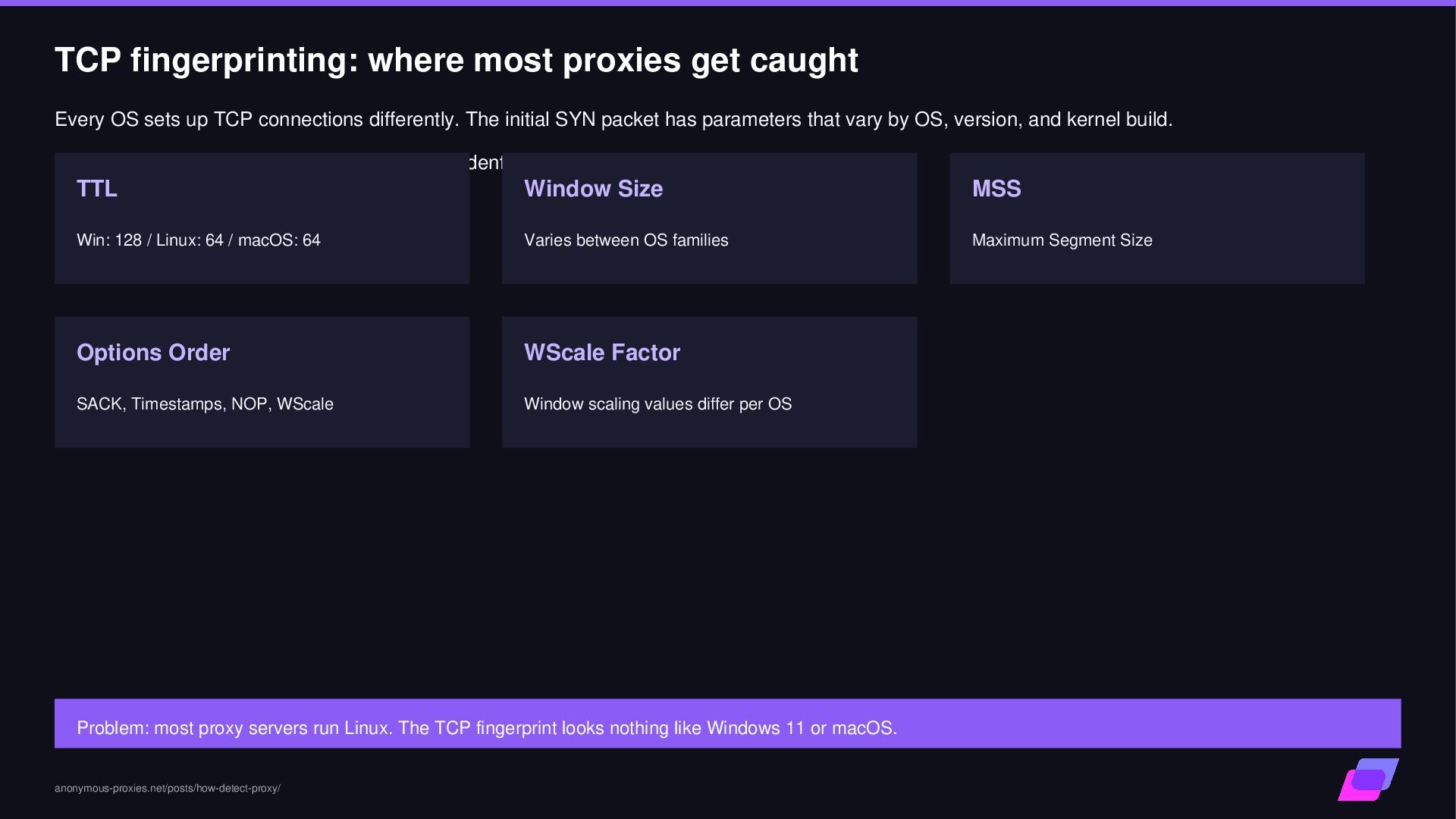
  6. TCP fingerprinting: where most proxies get caught Every OS sets

    up TCP connections differently. The initial SYN packet has parameters that vary by OS, version, and kernel build. Tools like p0f, nmap, and Cloudflare passively identify the real OS. TTL Win: 128 / Linux: 64 / macOS: 64 Window Size Varies between OS families MSS Maximum Segment Size Options Order SACK, Timestamps, NOP, WScale WScale Factor Window scaling values differ per OS Problem: most proxy servers run Linux. The TCP fingerprint looks nothing like Windows 11 or macOS. anonymous-proxies.net/posts/how-detect-proxy/
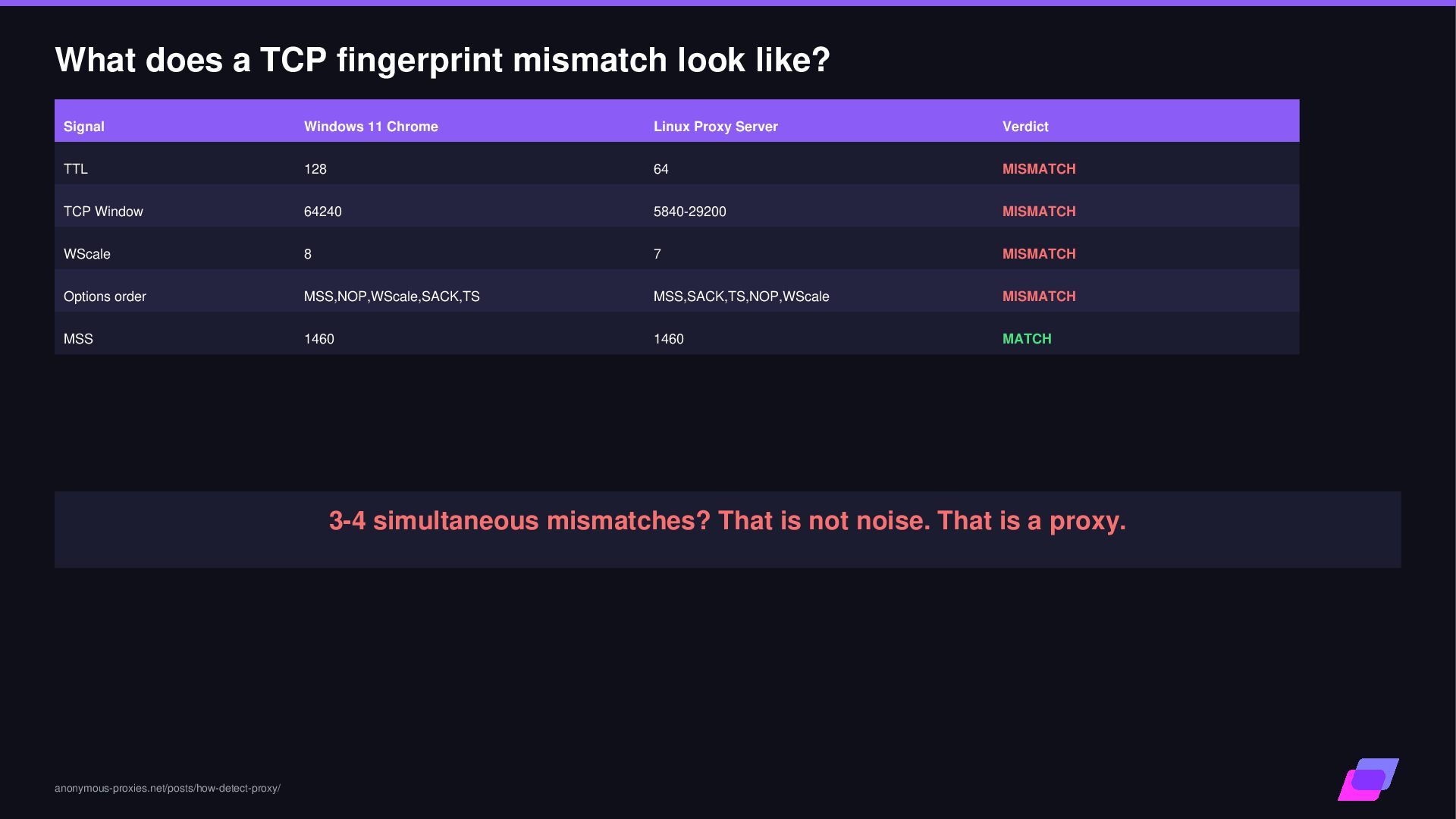
  7. What does a TCP fingerprint mismatch look like? Signal Windows

    11 Chrome Linux Proxy Server Verdict TTL 128 64 MISMATCH TCP Window 64240 5840-29200 MISMATCH WScale 8 7 MISMATCH Options order MSS,NOP,WScale,SACK,TS MSS,SACK,TS,NOP,WScale MISMATCH MSS 1460 1460 MATCH 3-4 simultaneous mismatches? That is not noise. That is a proxy. anonymous-proxies.net/posts/how-detect-proxy/
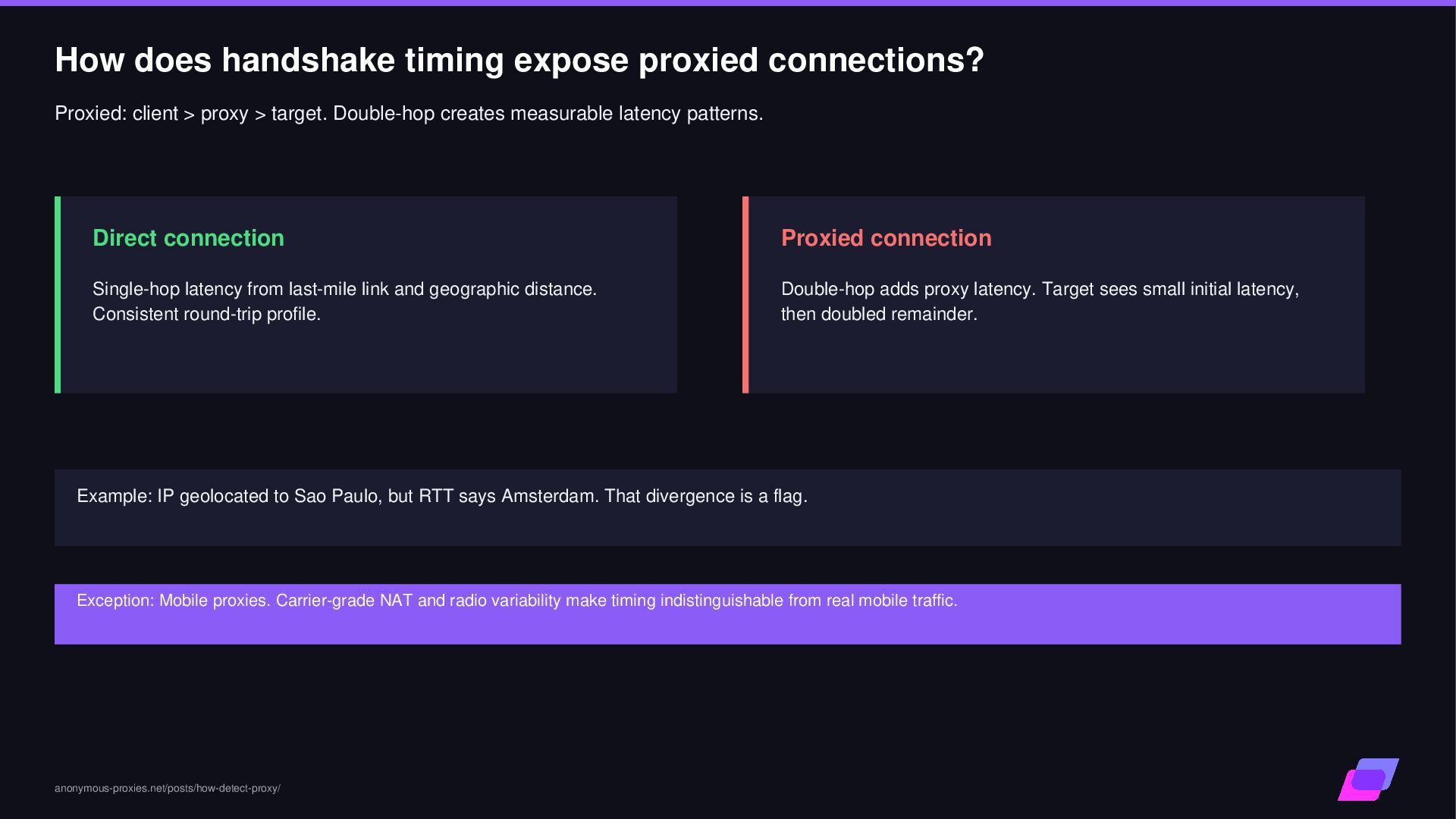
  8. How does handshake timing expose proxied connections? Proxied: client >

    proxy > target. Double-hop creates measurable latency patterns. Direct connection Single-hop latency from last-mile link and geographic distance. Consistent round-trip profile. Proxied connection Double-hop adds proxy latency. Target sees small initial latency, then doubled remainder. Example: IP geolocated to Sao Paulo, but RTT says Amsterdam. That divergence is a flag. Exception: Mobile proxies. Carrier-grade NAT and radio variability make timing indistinguishable from real mobile traffic. anonymous-proxies.net/posts/how-detect-proxy/
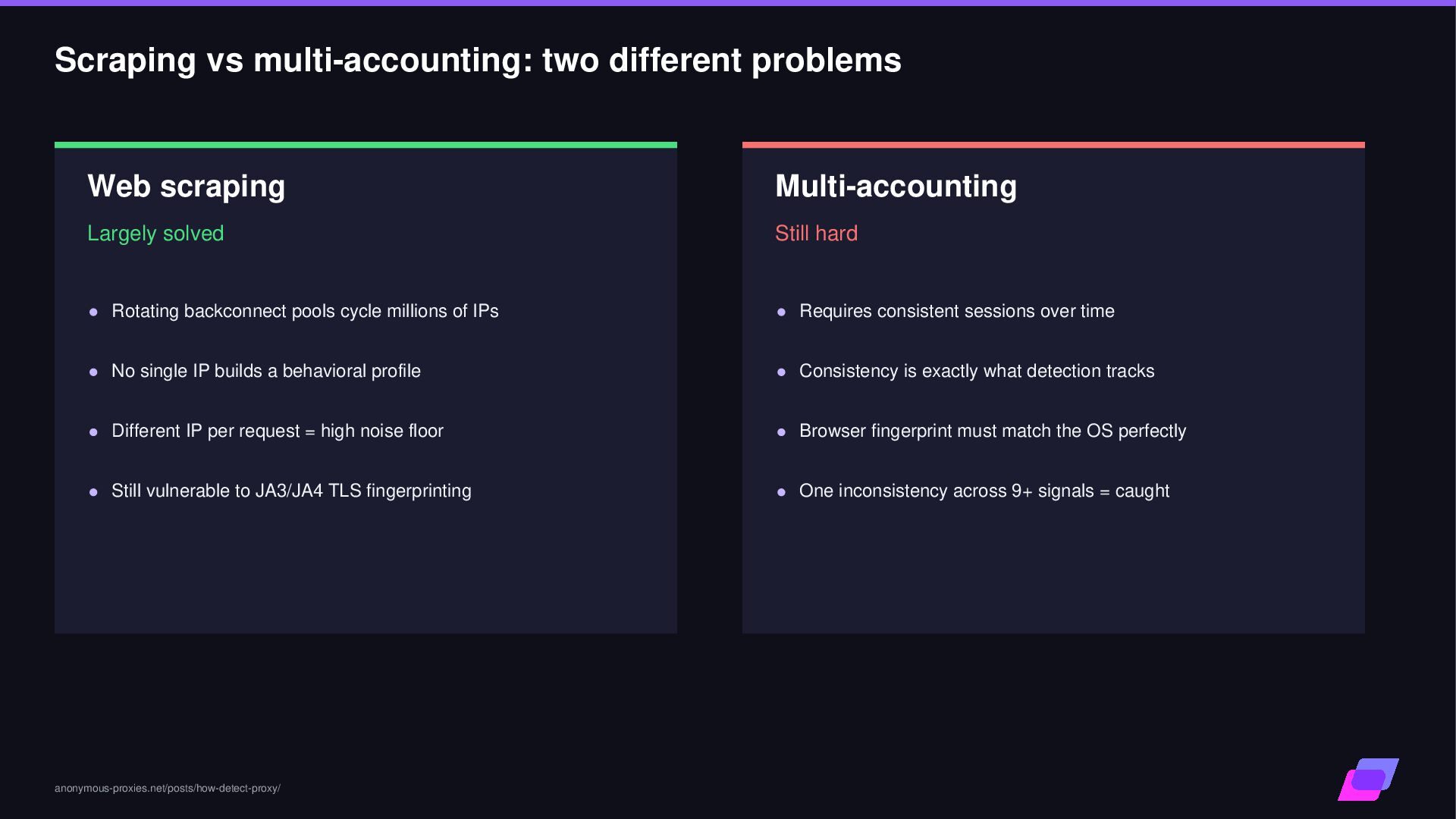
  9. Scraping vs multi-accounting: two different problems Web scraping Largely solved

    Rotating backconnect pools cycle millions of IPs No single IP builds a behavioral profile Different IP per request = high noise floor Still vulnerable to JA3/JA4 TLS fingerprinting Multi-accounting Still hard Requires consistent sessions over time Consistency is exactly what detection tracks Browser fingerprint must match the OS perfectly One inconsistency across 9+ signals = caught anonymous-proxies.net/posts/how-detect-proxy/
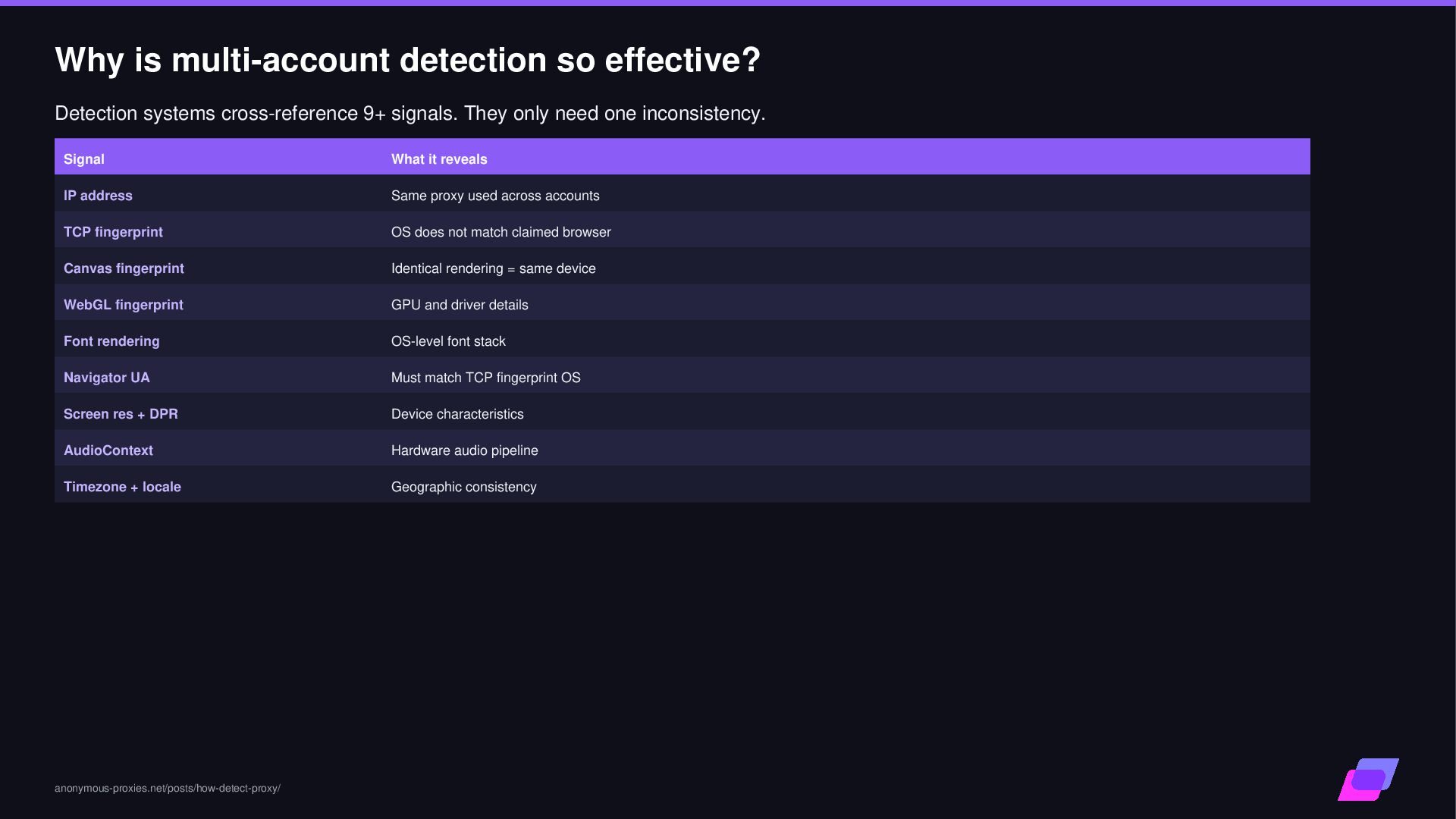
  10. Why is multi-account detection so effective? Detection systems cross-reference 9+

    signals. They only need one inconsistency. Signal What it reveals IP address Same proxy used across accounts TCP fingerprint OS does not match claimed browser Canvas fingerprint Identical rendering = same device WebGL fingerprint GPU and driver details Font rendering OS-level font stack Navigator UA Must match TCP fingerprint OS Screen res + DPR Device characteristics AudioContext Hardware audio pipeline Timezone + locale Geographic consistency anonymous-proxies.net/posts/how-detect-proxy/
  11. Want the full technical breakdown? The original article includes code

    samples for TCP SYN packet inspection, detailed OS fingerprint comparisons, and a complete proxy type matrix. Read the full article anonymous-proxies.net/posts/how-detect-proxy/
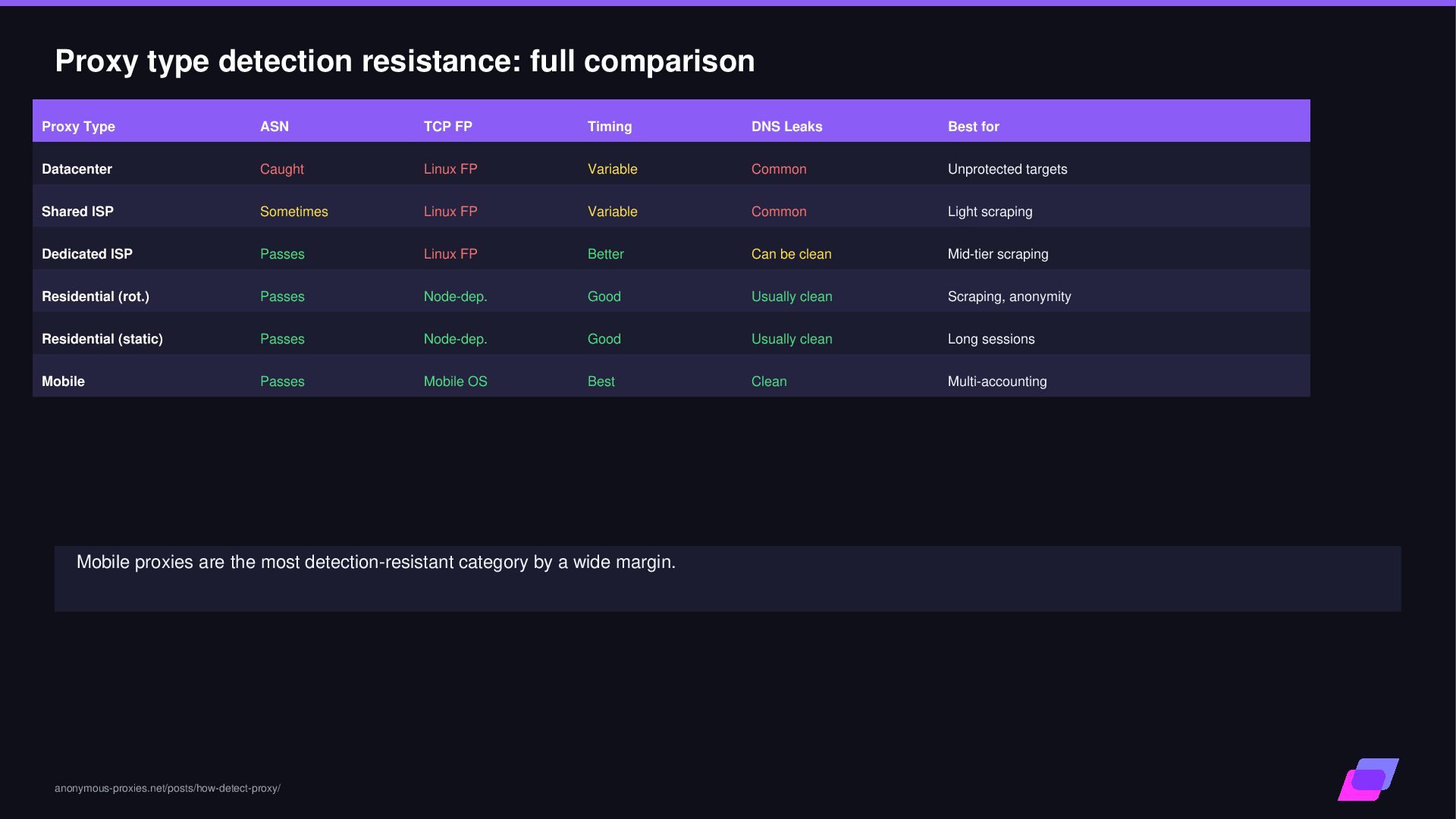
  12. Proxy type detection resistance: full comparison Proxy Type ASN TCP

    FP Timing DNS Leaks Best for Datacenter Caught Linux FP Variable Common Unprotected targets Shared ISP Sometimes Linux FP Variable Common Light scraping Dedicated ISP Passes Linux FP Better Can be clean Mid-tier scraping Residential (rot.) Passes Node-dep. Good Usually clean Scraping, anonymity Residential (static) Passes Node-dep. Good Usually clean Long sessions Mobile Passes Mobile OS Best Clean Multi-accounting Mobile proxies are the most detection-resistant category by a wide margin. anonymous-proxies.net/posts/how-detect-proxy/
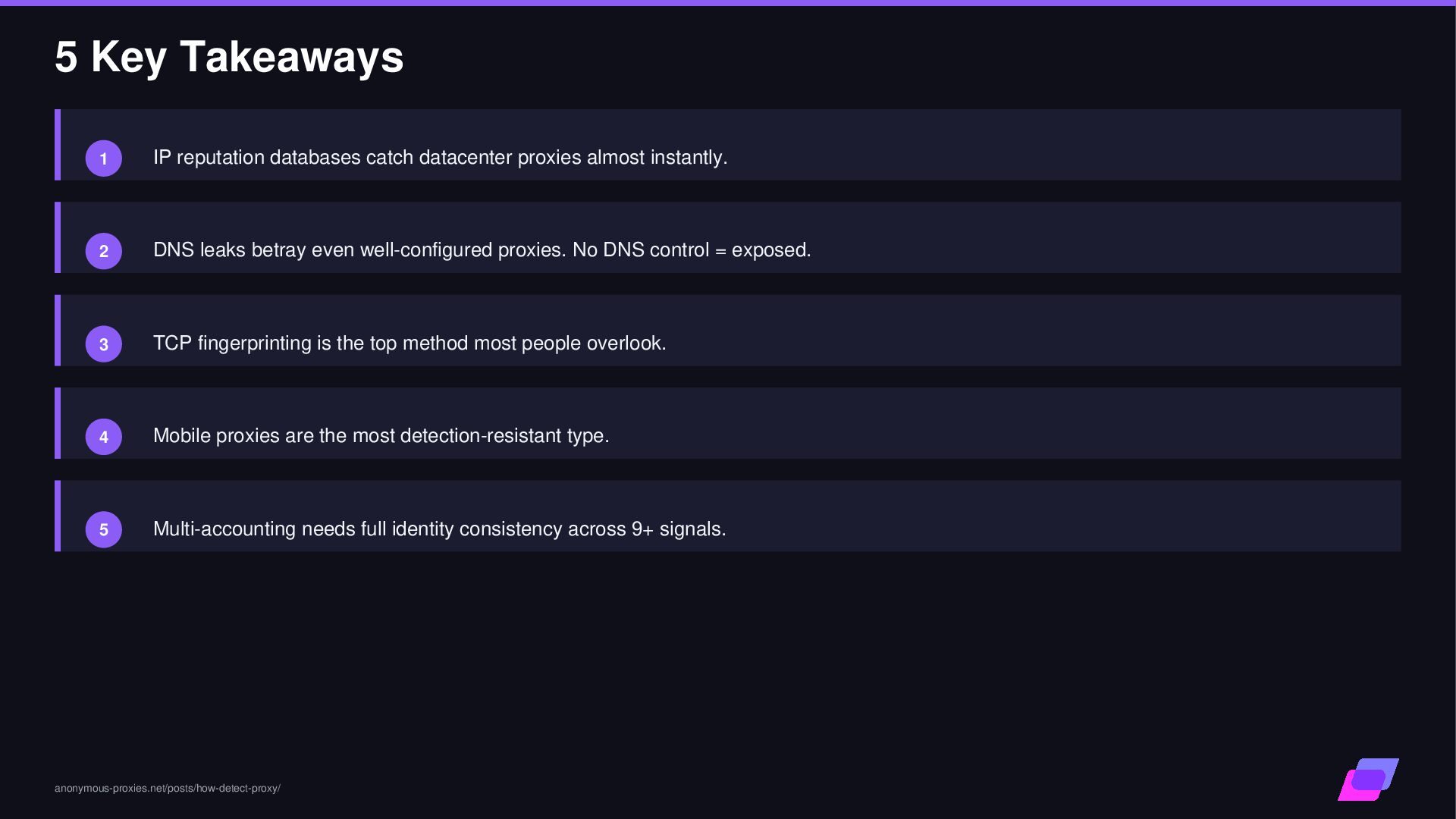
  13. 5 Key Takeaways 1 IP reputation databases catch datacenter proxies

    almost instantly. 2 DNS leaks betray even well-configured proxies. No DNS control = exposed. 3 TCP fingerprinting is the top method most people overlook. 4 Mobile proxies are the most detection-resistant type. 5 Multi-accounting needs full identity consistency across 9+ signals. anonymous-proxies.net/posts/how-detect-proxy/
  14. Get detection-resistant proxies Real 4G/5G mobile proxies, residential rotating pools,

    dedicated ISP proxies. Built for operators who stay undetected. Visit anonymous-proxies.net Read the full article
  15. Anonymous Proxies Premium proxy and VPN infrastructure for professionals. HTTP,

    SOCKS5, Shadowsocks, residential, mobile, Wireguard, Amnezia VPN. Website anonymous-proxies.net Products HTTP, SOCKS5, Residential, Mobile, VPN Coverage 190+ locations worldwide