responsible for Cloud Service Management and Site Reliability Engineering in the Cloud Adoption, Method and Solution Engineering office for IBM Cloud. Dan Lüdtke is the Technical Lead of SRE at eGym, former army officer, and future space traveler. danrl ingoa @danrl_com @ingoa
lightning talks) relating to the very broad field of Site Reliability Engineering. Get in touch with the organizers if you'd like to present! Future Talks
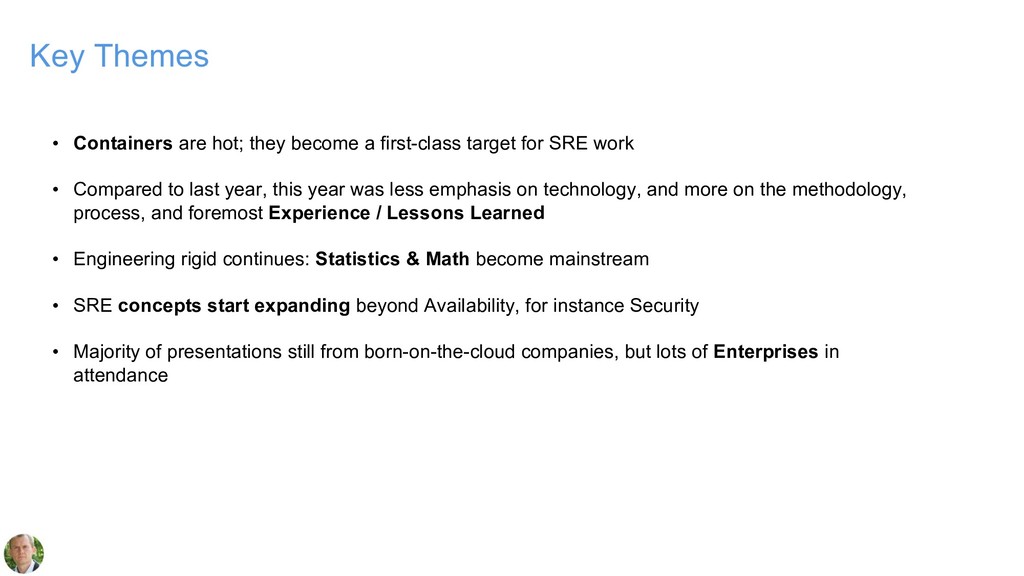
target for SRE work • Compared to last year, this year was less emphasis on technology, and more on the methodology, process, and foremost Experience / Lessons Learned • Engineering rigid continues: Statistics & Math become mainstream • SRE concepts start expanding beyond Availability, for instance Security • Majority of presentations still from born-on-the-cloud companies, but lots of Enterprises in attendance
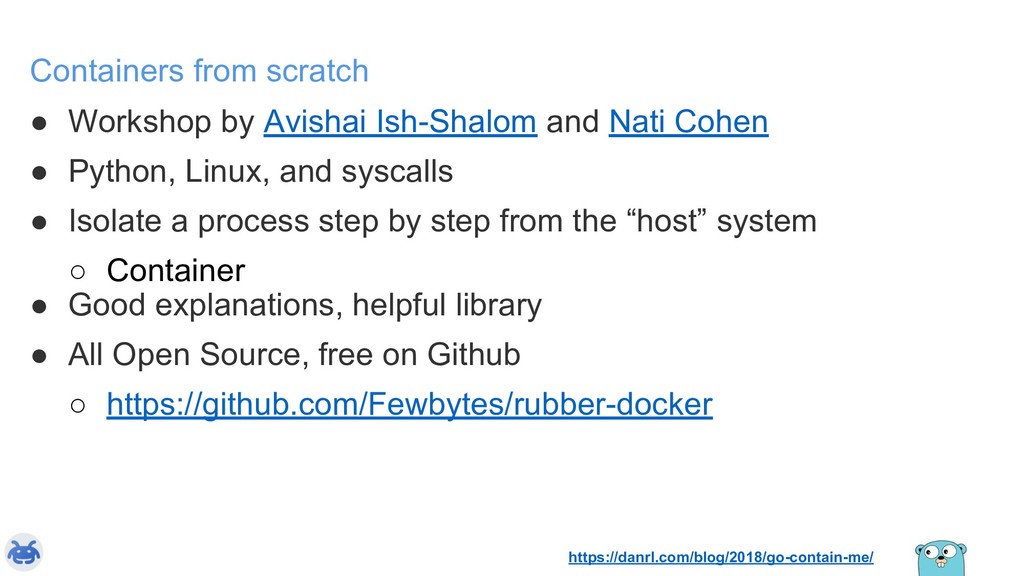
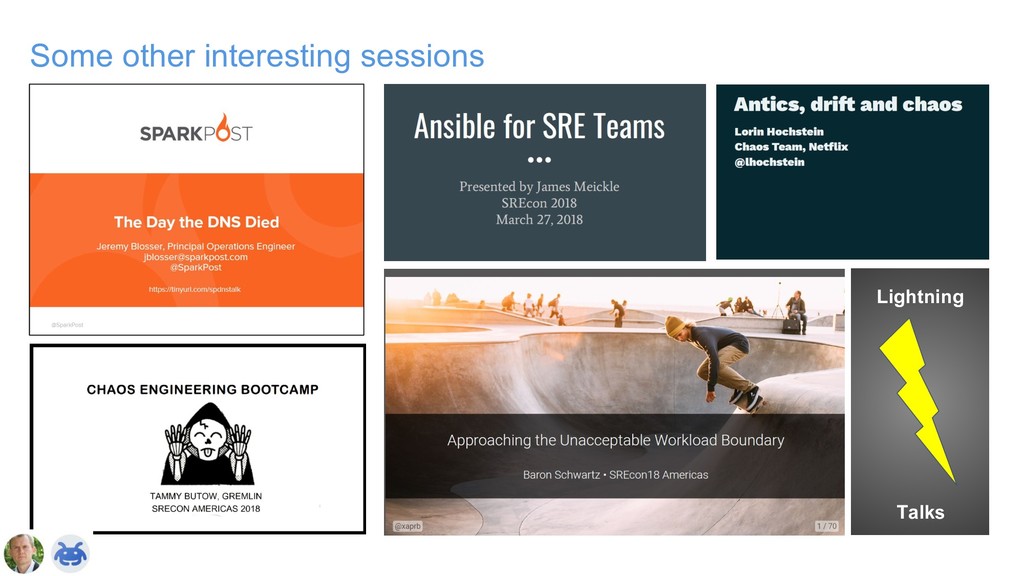
Cohen • Python, Linux, and syscalls • Isolate a process step by step from the “host” system ◦ Container • Good explanations, helpful library • All Open Source, free on Github ◦ https://github.com/Fewbytes/rubber-docker https://danrl.com/blog/2018/go-contain-me/
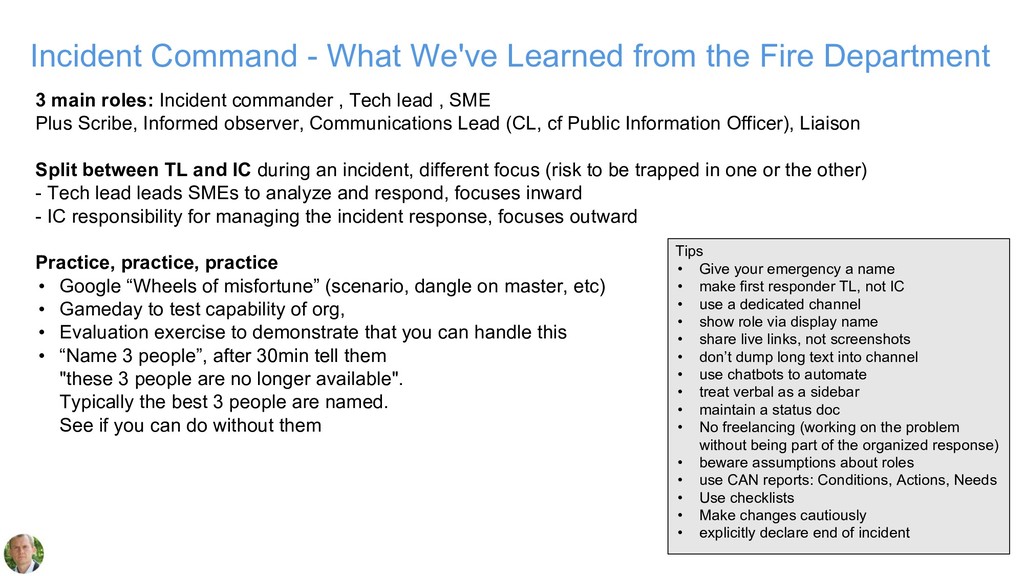
3 main roles: Incident commander , Tech lead , SME Plus Scribe, Informed observer, Communications Lead (CL, cf Public Information Officer), Liaison Split between TL and IC during an incident, different focus (risk to be trapped in one or the other) - Tech lead leads SMEs to analyze and respond, focuses inward - IC responsibility for managing the incident response, focuses outward Practice, practice, practice • Google “Wheels of misfortune” (scenario, dangle on master, etc) • Gameday to test capability of org, • Evaluation exercise to demonstrate that you can handle this • “Name 3 people”, after 30min tell them "these 3 people are no longer available". Typically the best 3 people are named. See if you can do without them Tips • Give your emergency a name • make first responder TL, not IC • use a dedicated channel • show role via display name • share live links, not screenshots • don’t dump long text into channel • use chatbots to automate • treat verbal as a sidebar • maintain a status doc • No freelancing (working on the problem without being part of the organized response) • beware assumptions about roles • use CAN reports: Conditions, Actions, Needs • Use checklists • Make changes cautiously • explicitly declare end of incident
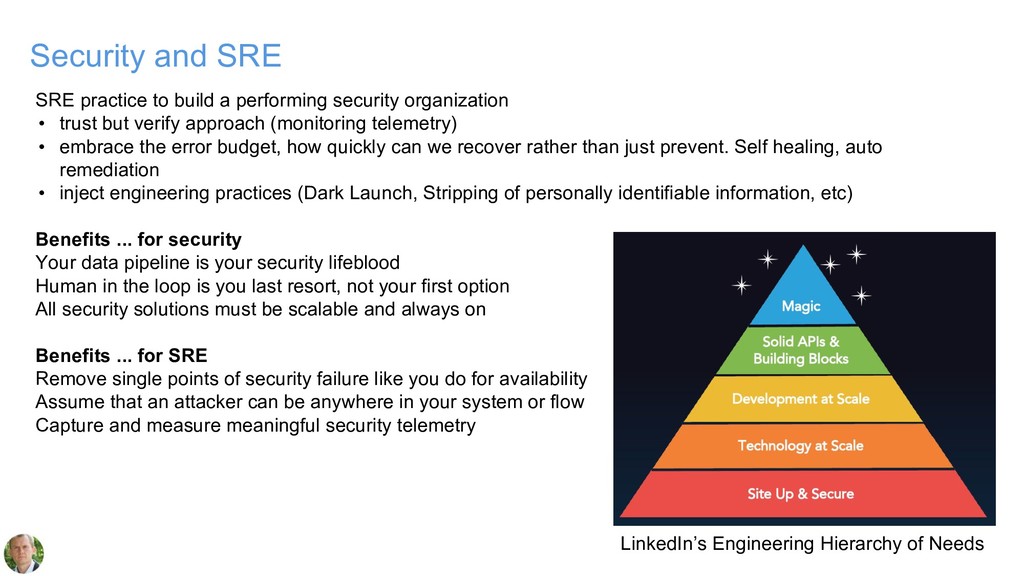
organization • trust but verify approach (monitoring telemetry) • embrace the error budget, how quickly can we recover rather than just prevent. Self healing, auto remediation • inject engineering practices (Dark Launch, Stripping of personally identifiable information, etc) Benefits ... for security Your data pipeline is your security lifeblood Human in the loop is you last resort, not your first option All security solutions must be scalable and always on Benefits ... for SRE Remove single points of security failure like you do for availability Assume that an attacker can be anywhere in your system or flow Capture and measure meaningful security telemetry LinkedIn’s Engineering Hierarchy of Needs
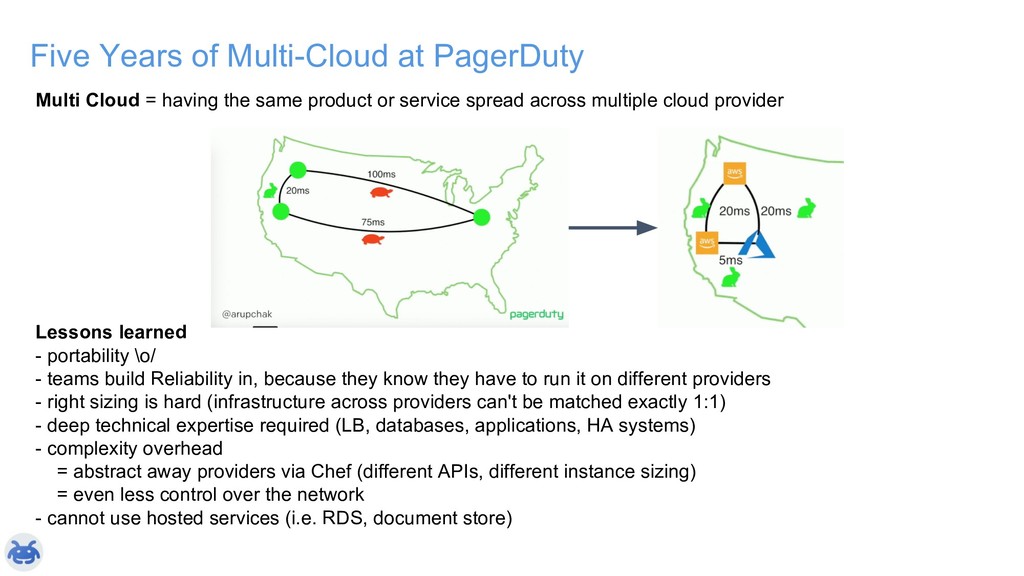
the same product or service spread across multiple cloud provider Lessons learned - portability \o/ - teams build Reliability in, because they know they have to run it on different providers - right sizing is hard (infrastructure across providers can't be matched exactly 1:1) - deep technical expertise required (LB, databases, applications, HA systems) - complexity overhead = abstract away providers via Chef (different APIs, different instance sizing) = even less control over the network - cannot use hosted services (i.e. RDS, document store)
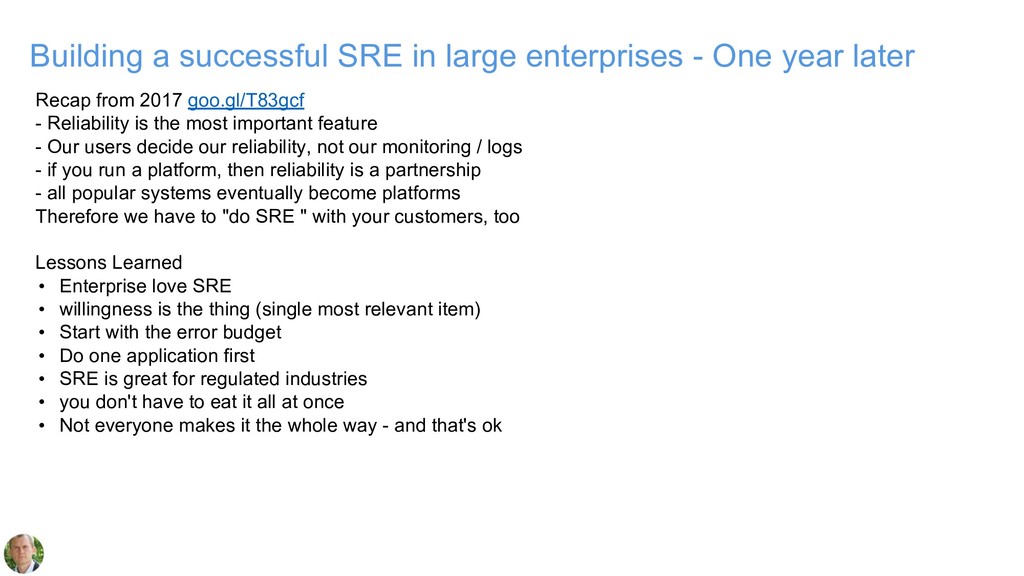
later Recap from 2017 goo.gl/T83gcf - Reliability is the most important feature - Our users decide our reliability, not our monitoring / logs - if you run a platform, then reliability is a partnership - all popular systems eventually become platforms Therefore we have to "do SRE " with your customers, too Lessons Learned • Enterprise love SRE • willingness is the thing (single most relevant item) • Start with the error budget • Do one application first • SRE is great for regulated industries • you don't have to eat it all at once • Not everyone makes it the whole way - and that's ok
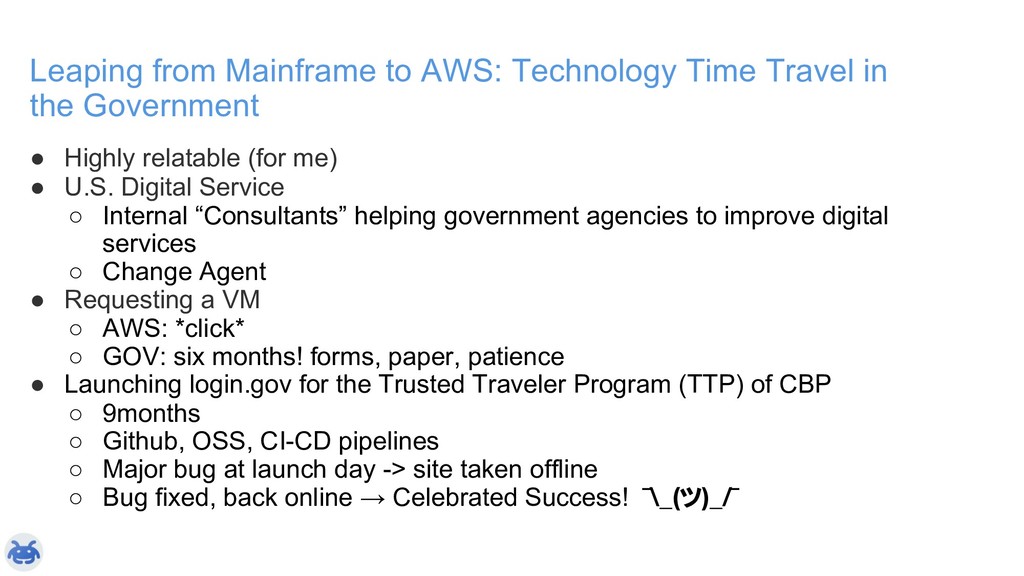
Internal “Consultants” helping government agencies to improve digital services ◦ Change Agent • Requesting a VM ◦ AWS: *click* ◦ GOV: six months! forms, paper, patience • Launching login.gov for the Trusted Traveler Program (TTP) of CBP ◦ 9months ◦ Github, OSS, CI-CD pipelines ◦ Major bug at launch day -> site taken offline ◦ Bug fixed, back online → Celebrated Success! ¯\_(ツ)_/¯ Leaping from Mainframe to AWS: Technology Time Travel in the Government
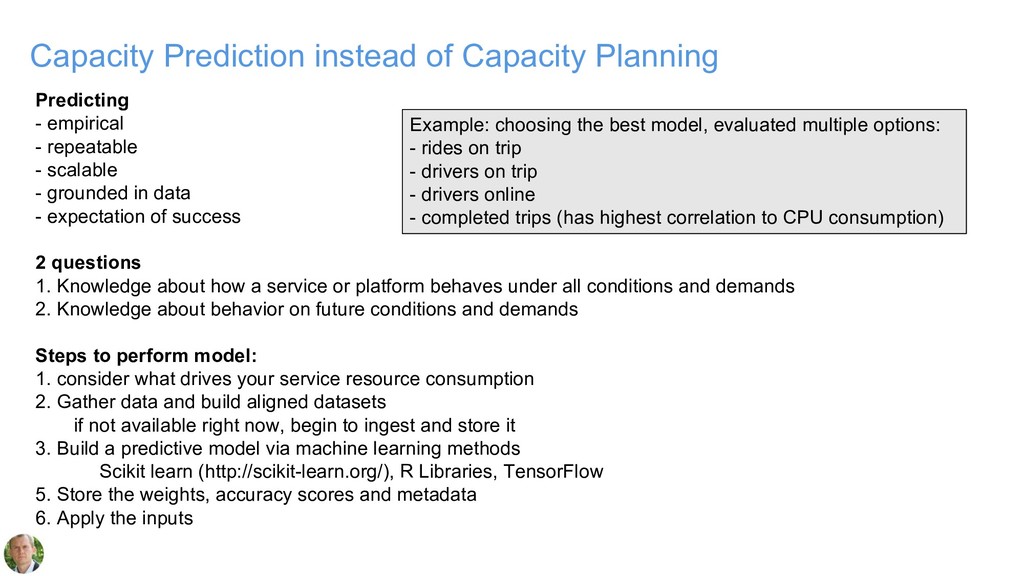
repeatable - scalable - grounded in data - expectation of success 2 questions 1. Knowledge about how a service or platform behaves under all conditions and demands 2. Knowledge about behavior on future conditions and demands Steps to perform model: 1. consider what drives your service resource consumption 2. Gather data and build aligned datasets if not available right now, begin to ingest and store it 3. Build a predictive model via machine learning methods Scikit learn (http://scikit-learn.org/), R Libraries, TensorFlow 5. Store the weights, accuracy scores and metadata 6. Apply the inputs Example: choosing the best model, evaluated multiple options: - rides on trip - drivers on trip - drivers online - completed trips (has highest correlation to CPU consumption)
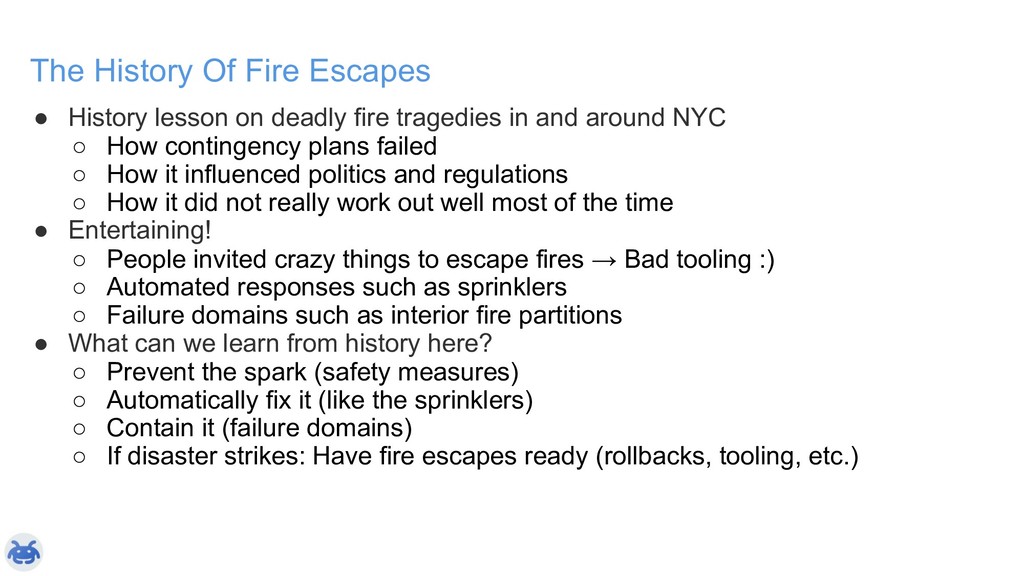
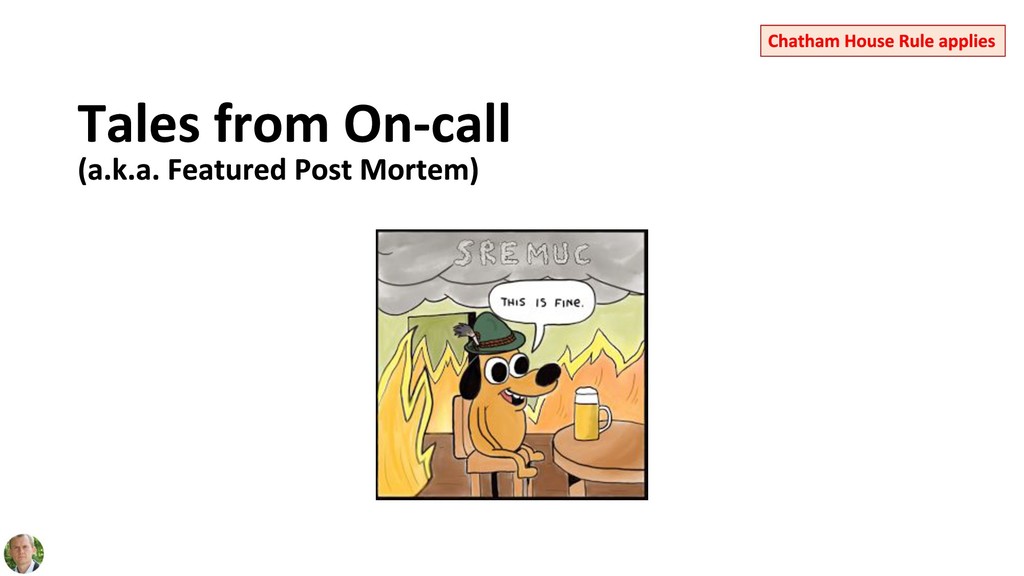
fire tragedies in and around NYC ◦ How contingency plans failed ◦ How it influenced politics and regulations ◦ How it did not really work out well most of the time • Entertaining! ◦ People invited crazy things to escape fires → Bad tooling :) ◦ Automated responses such as sprinklers ◦ Failure domains such as interior fire partitions • What can we learn from history here? ◦ Prevent the spark (safety measures) ◦ Automatically fix it (like the sprinklers) ◦ Contain it (failure domains) ◦ If disaster strikes: Have fire escapes ready (rollbacks, tooling, etc.)
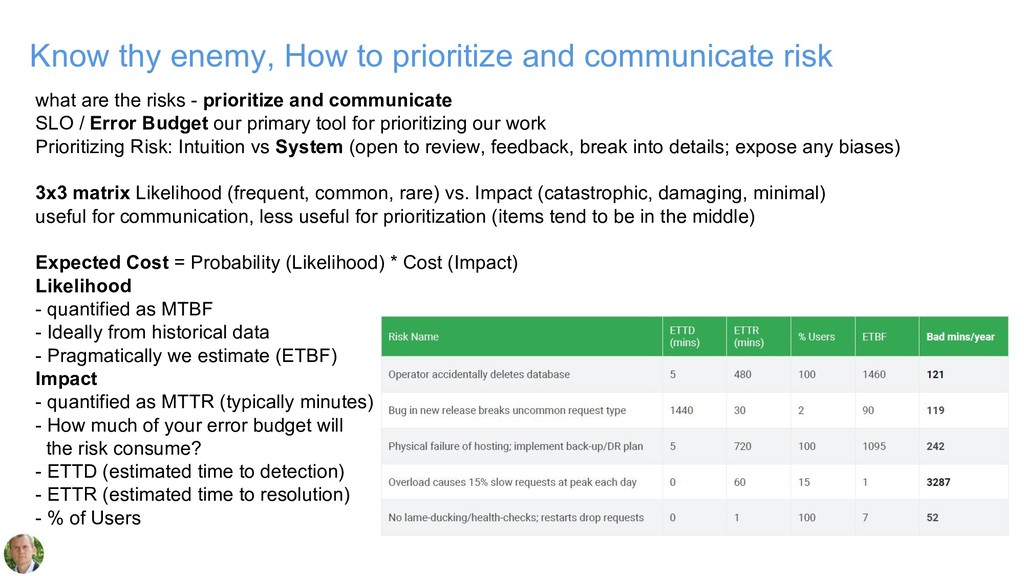
are the risks - prioritize and communicate SLO / Error Budget our primary tool for prioritizing our work Prioritizing Risk: Intuition vs System (open to review, feedback, break into details; expose any biases) 3x3 matrix Likelihood (frequent, common, rare) vs. Impact (catastrophic, damaging, minimal) useful for communication, less useful for prioritization (items tend to be in the middle) Expected Cost = Probability (Likelihood) * Cost (Impact) Likelihood - quantified as MTBF - Ideally from historical data - Pragmatically we estimate (ETBF) Impact - quantified as MTTR (typically minutes) - How much of your error budget will the risk consume? - ETTD (estimated time to detection) - ETTR (estimated time to resolution) - % of Users
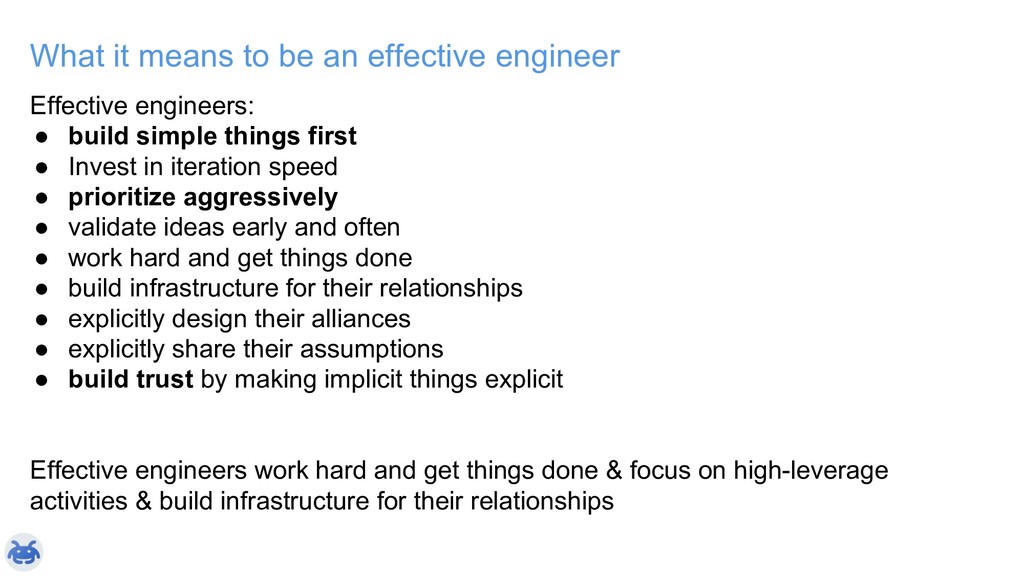
• build simple things first • Invest in iteration speed • prioritize aggressively • validate ideas early and often • work hard and get things done • build infrastructure for their relationships • explicitly design their alliances • explicitly share their assumptions • build trust by making implicit things explicit Effective engineers work hard and get things done & focus on high-leverage activities & build infrastructure for their relationships
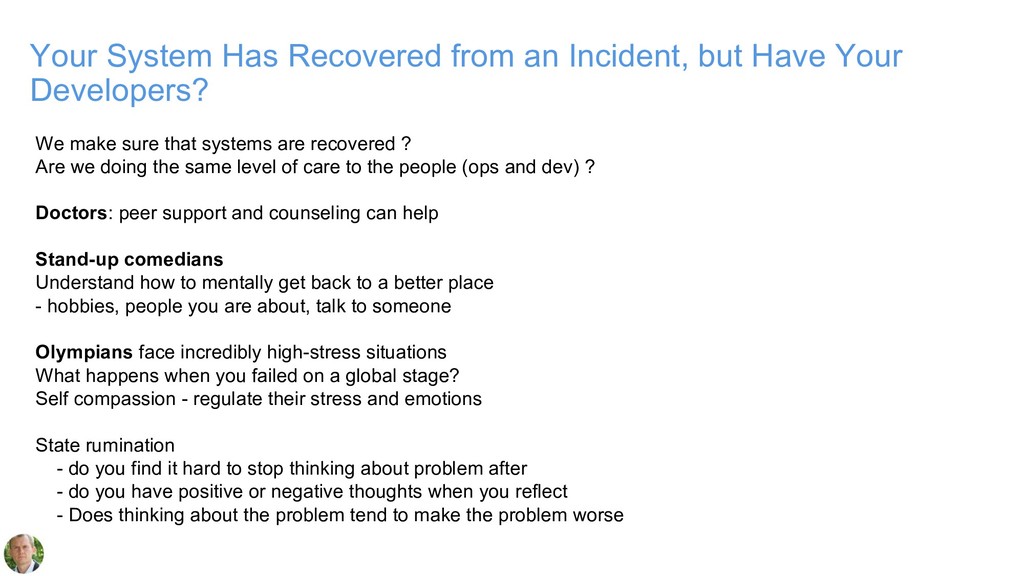
Developers? We make sure that systems are recovered ? Are we doing the same level of care to the people (ops and dev) ? Doctors: peer support and counseling can help Stand-up comedians Understand how to mentally get back to a better place - hobbies, people you are about, talk to someone Olympians face incredibly high-stress situations What happens when you failed on a global stage? Self compassion - regulate their stress and emotions State rumination - do you find it hard to stop thinking about problem after - do you have positive or negative thoughts when you reflect - Does thinking about the problem tend to make the problem worse

 SiteGround - Reliable hosting with speed, security, and support you can count on.


 riyaamemiya
 occhi
 techtekt
 recruitengineers
 shumei_ito
 namiki64
 pfn
 greenmidori
 takahashim
 kairim0
 bgpat
 tomokusaba
 cassininazir
 samanthasiow
 wayneb77
 szymonslowik
 soysaucechin
 techseoconnect
 ipullrank
 rkendrick25
 aleyda
 smashingmag
 ammeep