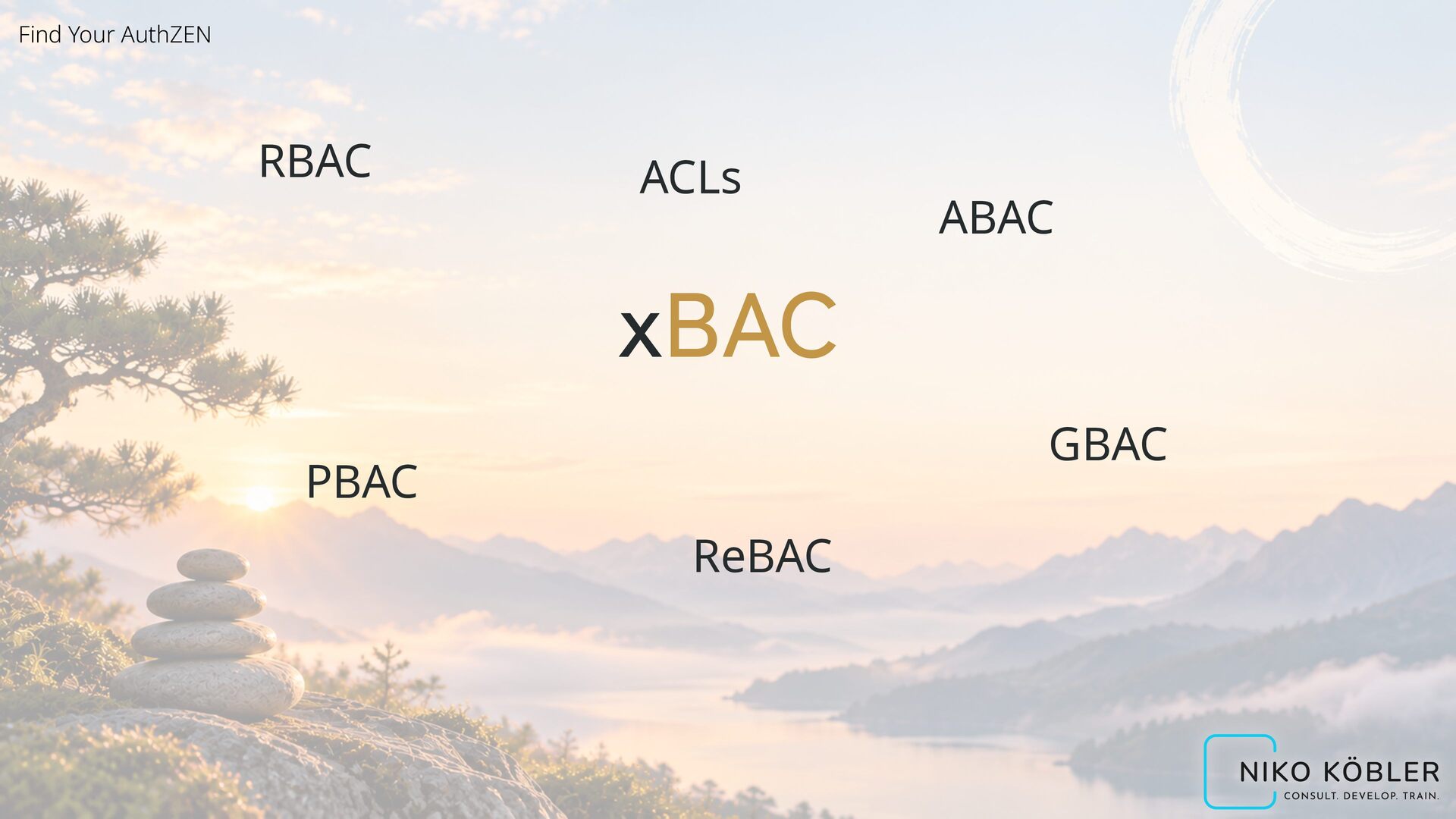
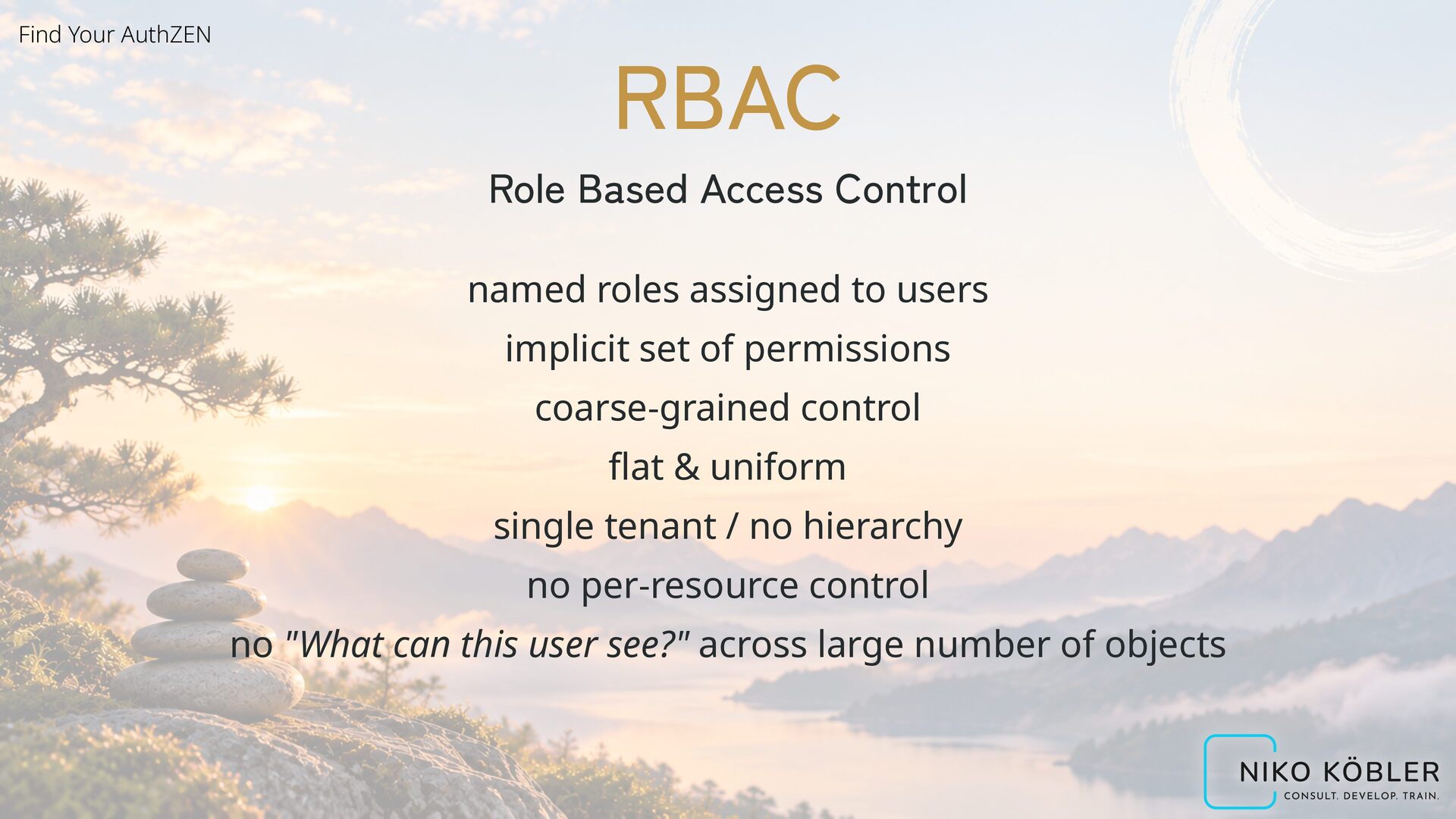
roles assigned to users implicit set of permissions coarse-grained control at & uniform single tenant / no hierarchy no per-resource control no "What can this user see?" across large number of objects
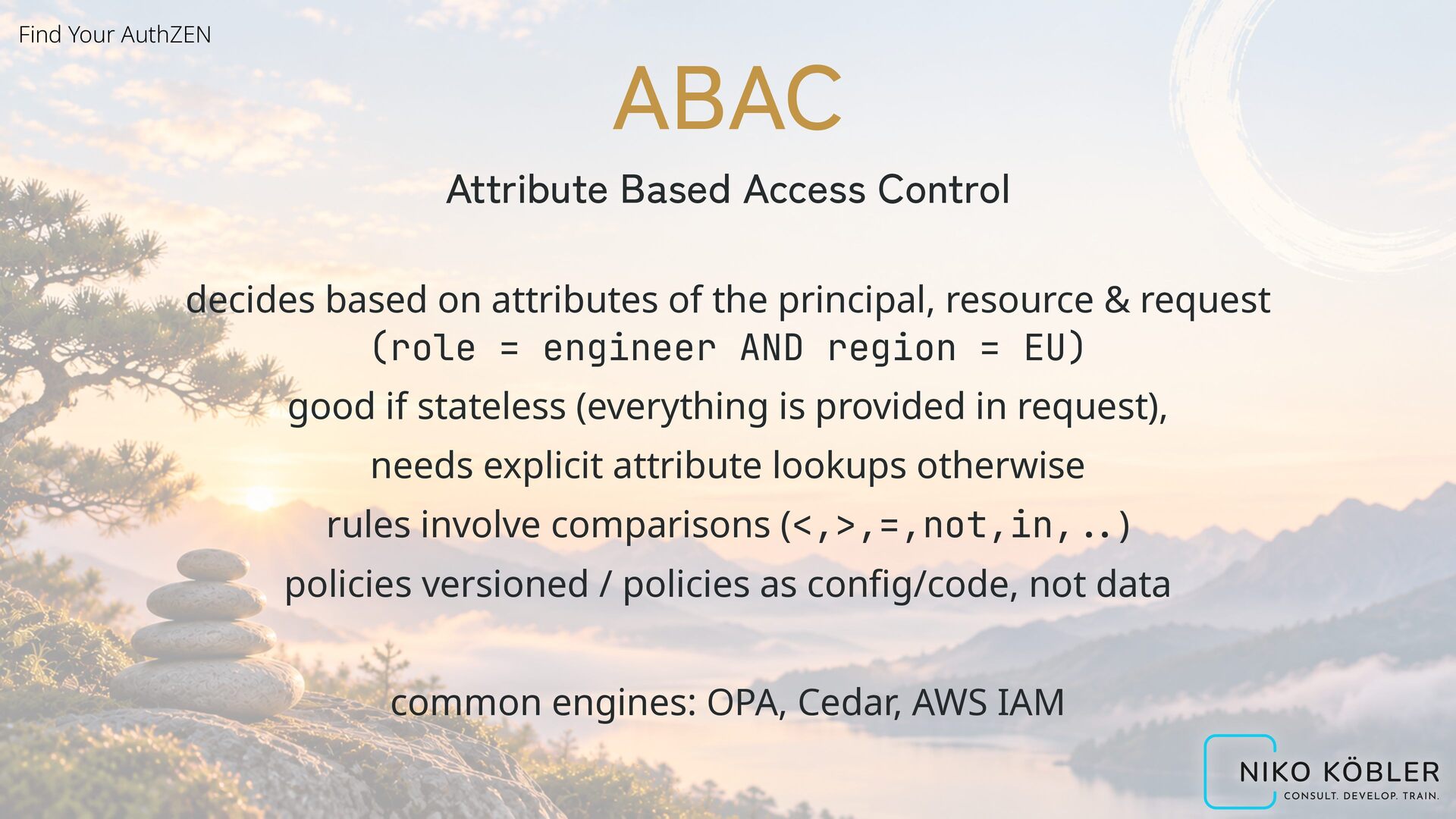
on attributes of the principal, resource & request (role = engineer AND region = EU) good if stateless (everything is provided in request), needs explicit attribute lookups otherwise rules involve comparisons (<,>,=,not,in, ) policies versioned / policies as con g/code, not data . . fi common engines: OPA (Rego), Cedar, AWS IAM
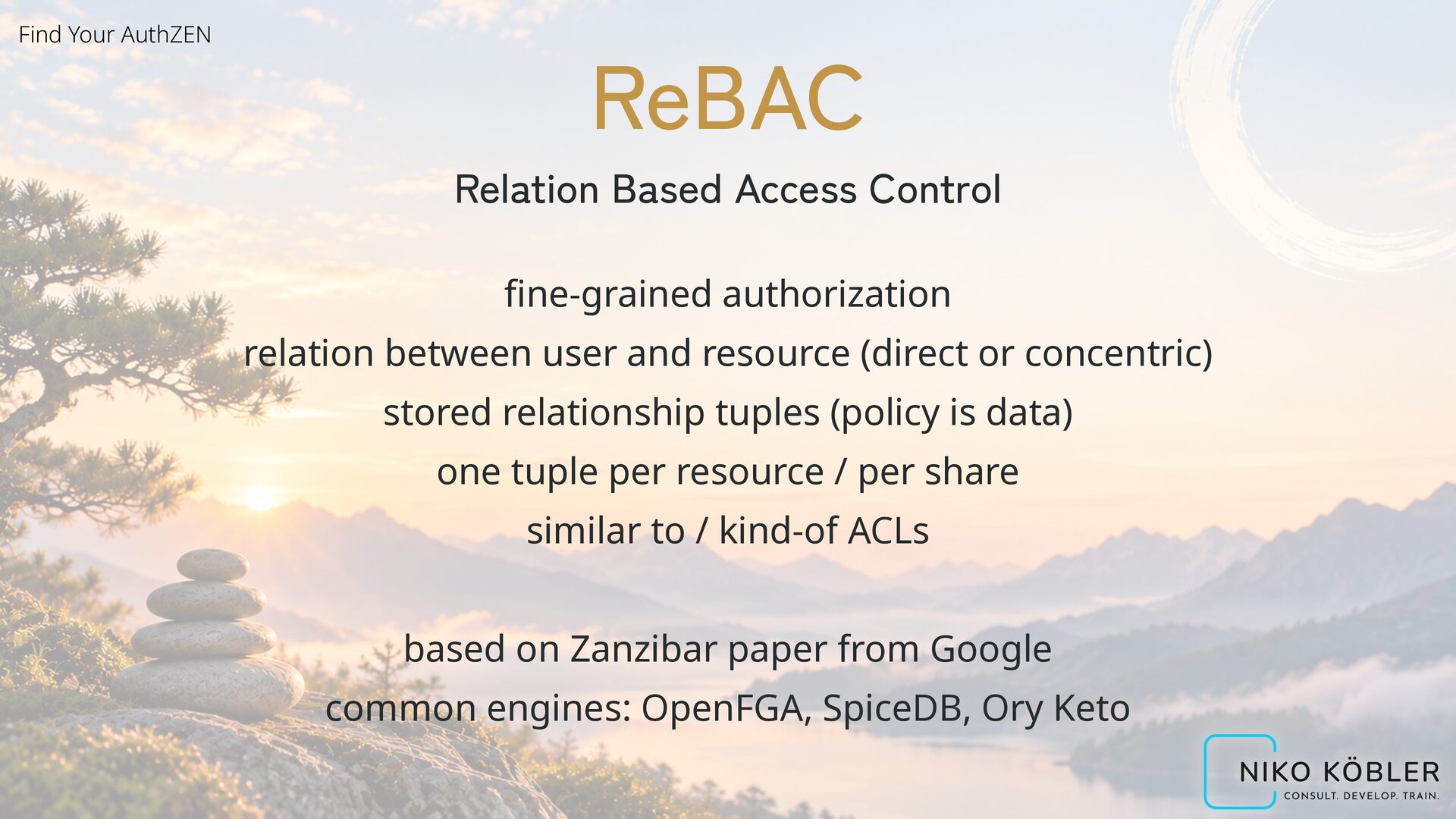
authorization relation between user and resource (direct or concentric) stored relationship tuples (policy as data) one tuple per resource / per share similar to / kind-of ACLs based on Zanzibar paper from Google common engines: OpenFGA, SpiceDB, Ory Keto
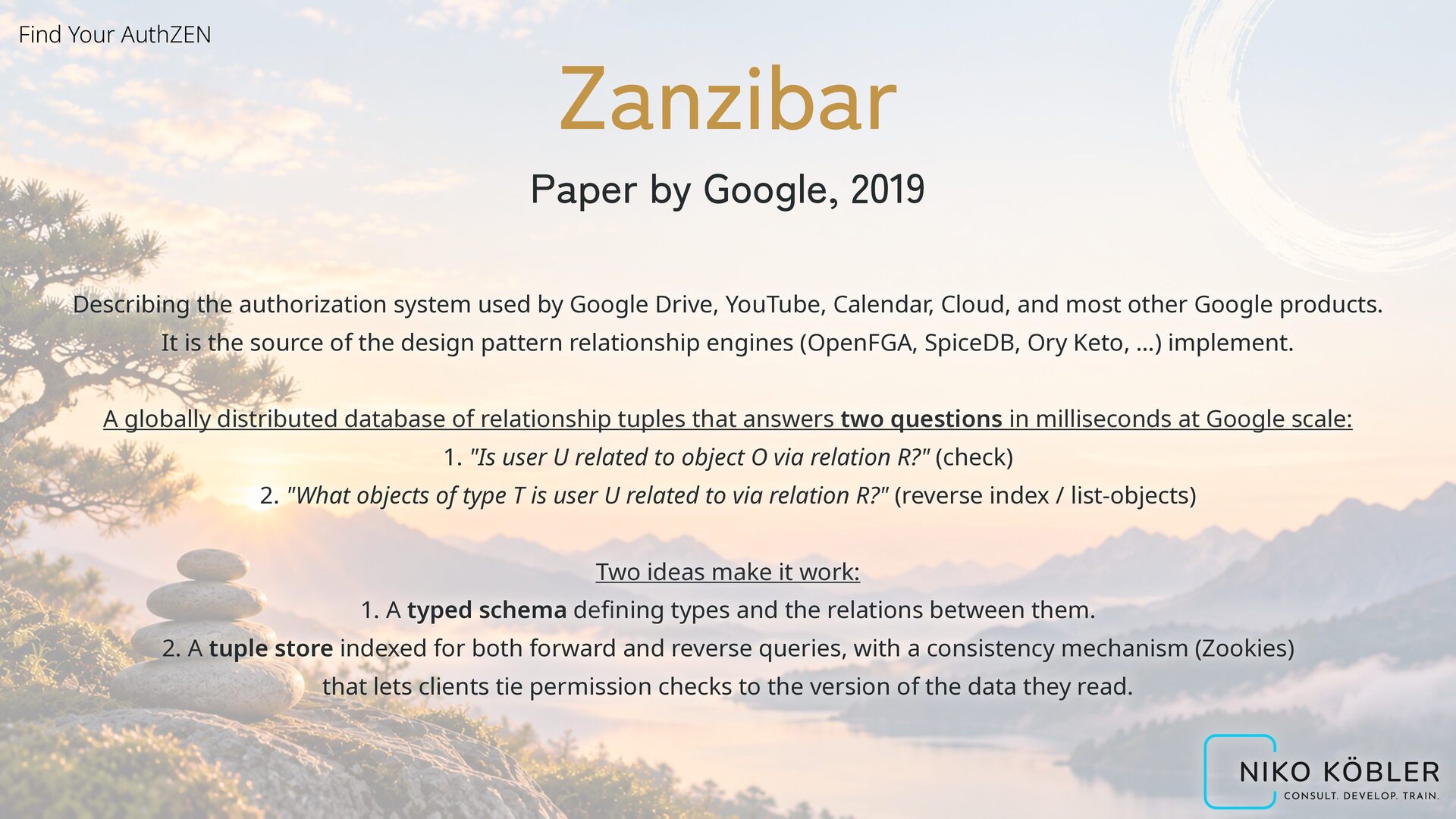
authorization system used by Google Drive, YouTube, Calendar, Cloud, and most other Google products. It is the source of the design pattern relationship engines (OpenFGA, SpiceDB, Ory Keto, …) implement. A globally distributed database of relationship tuples that answers two questions in milliseconds at Google scale: 1. "Is user U related to object O via relation R?" (check) 2. "What objects of type T is user U related to via relation R?" (reverse index / list-objects) Two ideas make it work: 1. A typed schema de ning types and the relations between them. 2. A tuple store indexed for both forward and reverse queries, with a consistency mechanism (Zookies) fi that lets clients tie permission checks to the version of the data they read.
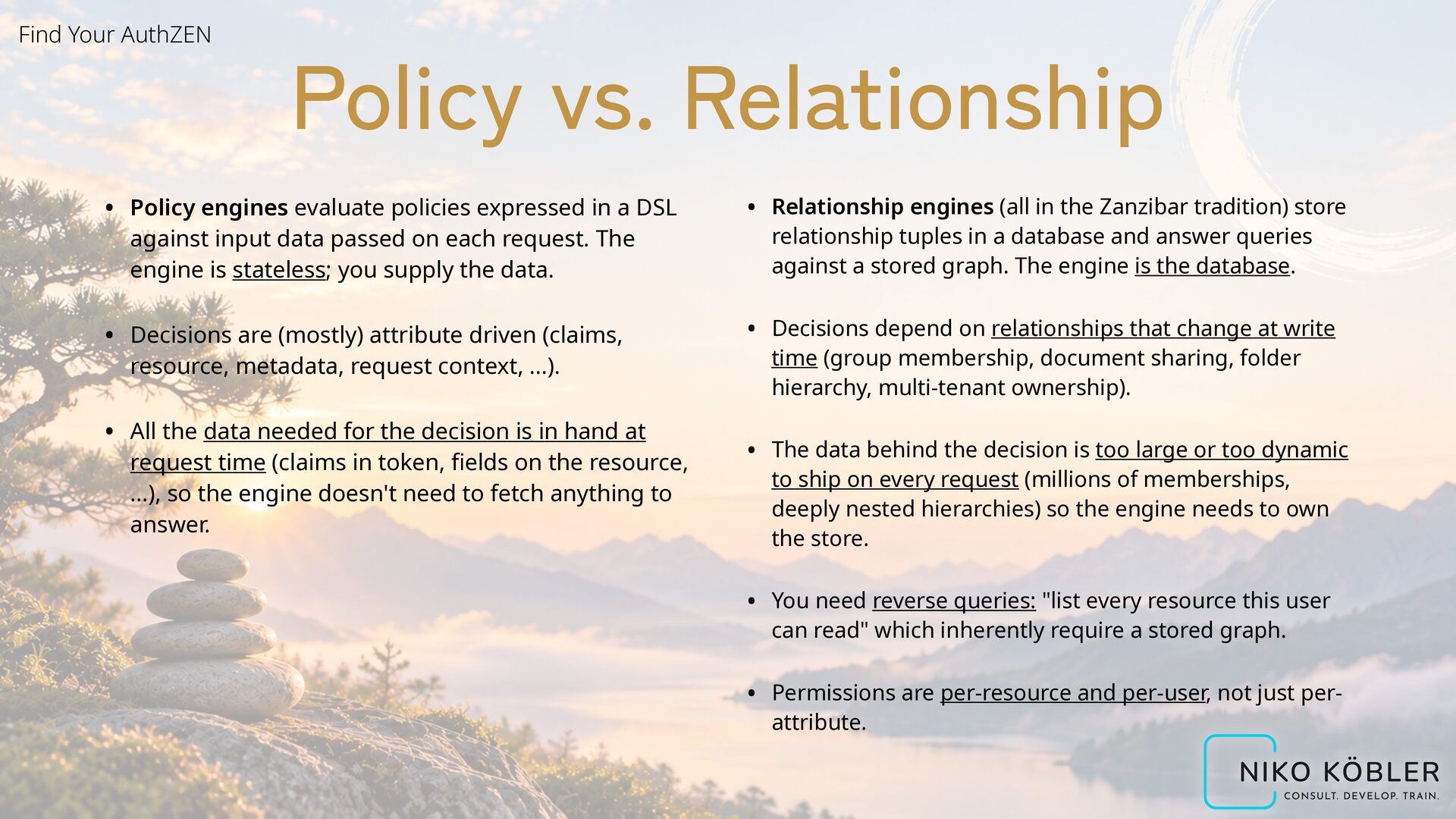
policies expressed in a DSL • Relationship engines (all in the Zanzibar tradition) store • Decisions are (mostly) attribute driven (claims, • Decisions depend on relationships that change at write against input data passed on each request. The engine is stateless; you supply the data. resource, metadata, request context, …). • All the data needed for the decision is in hand at request time (claims in token, elds on the resource, …), so the engine doesn't need to fetch anything to answer. relationship tuples in a database and answer queries against a stored graph. The engine is the database. time (group membership, document sharing, folder hierarchy, multi-tenant ownership). • The data behind the decision is too large or too dynamic to ship on every request (millions of memberships, deeply nested hierarchies) so the engine needs to own the store. • You need reverse queries: "list every resource this user can read" which inherently require a stored graph. • Permissions are per-resource and per-user, not just per- fi attribute.
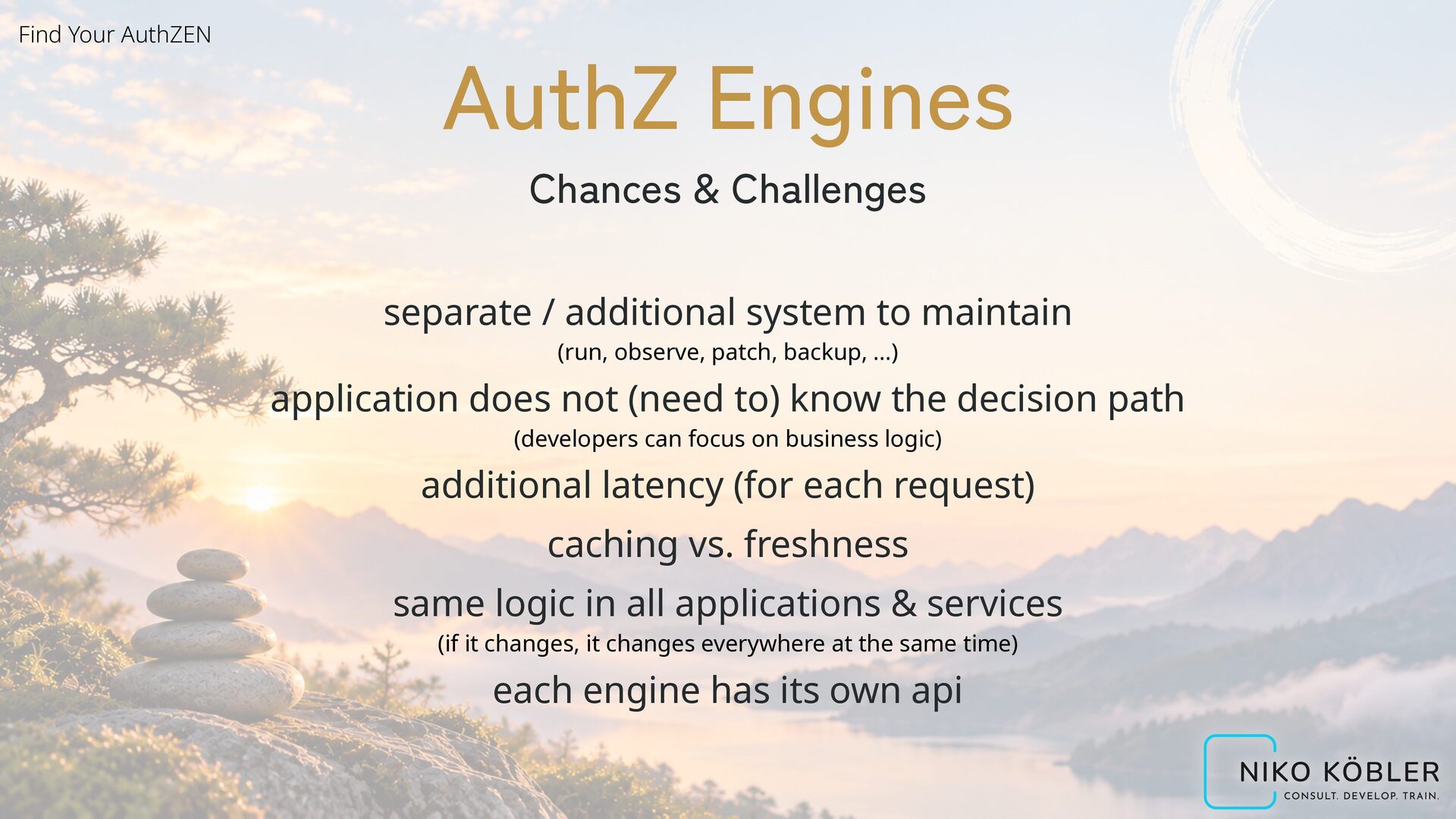
additional system to maintain (run, observe, patch, backup, …) application does not (need to) know the decision path (developers can focus on business logic) additional latency (for each request) optimized for performance caching vs. freshness same logic in all applications & services (if it changes, it changes everywhere at the same time)
set of permissions (because you have role 'X' you may do 'Y') explicit allow/deny of each request every identity must prove their permission (non-/human identities, agents) auditable and versionable each engine has its own data format & api
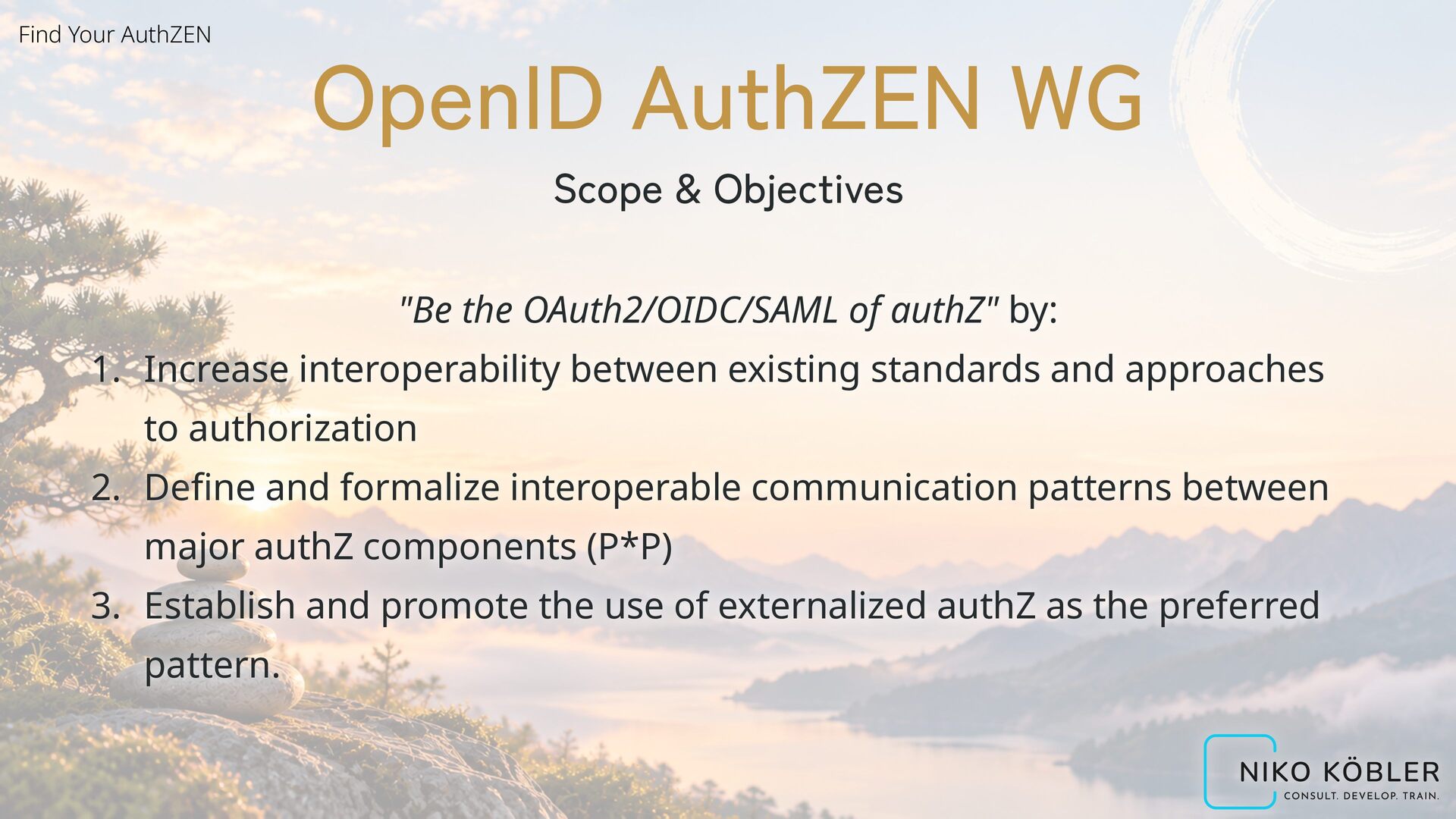
the OAuth2/OIDC/SAML of authZ" by: 1. Increase interoperability between existing standards and approaches to authorization 2. De ne and formalize interoperable communication patterns between major authZ components (P*P) 3. Establish and promote the use of externalized authZ as the preferred fi pattern.
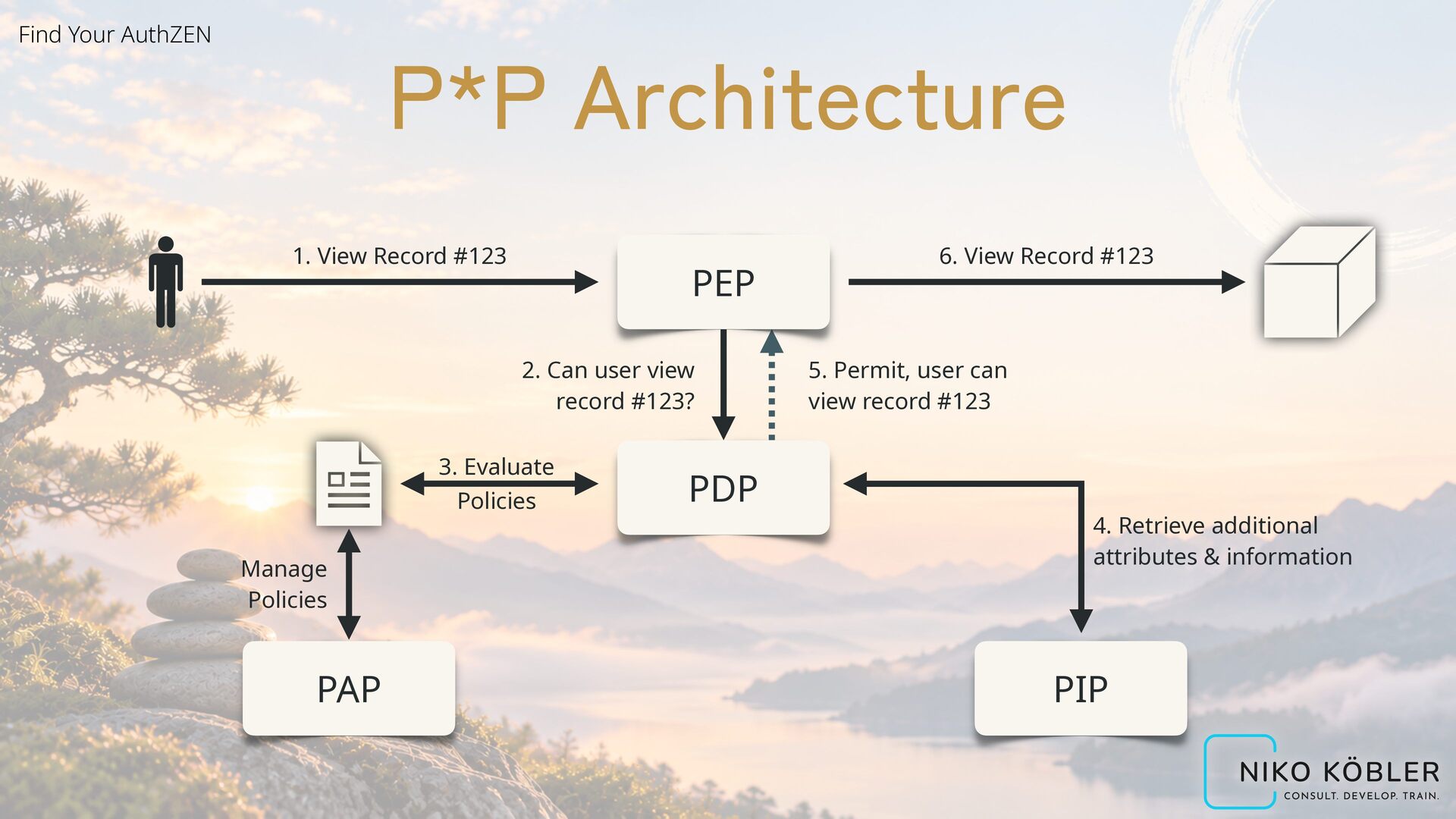
early 1970’s 1. View Record #123 PEP 2. Can user view record #123? 3. Evaluate Policies Manage Policies PAP PDP 6. View Record #123 5. Permit, user can view record #123 4. Retrieve additional attributes & information PIP
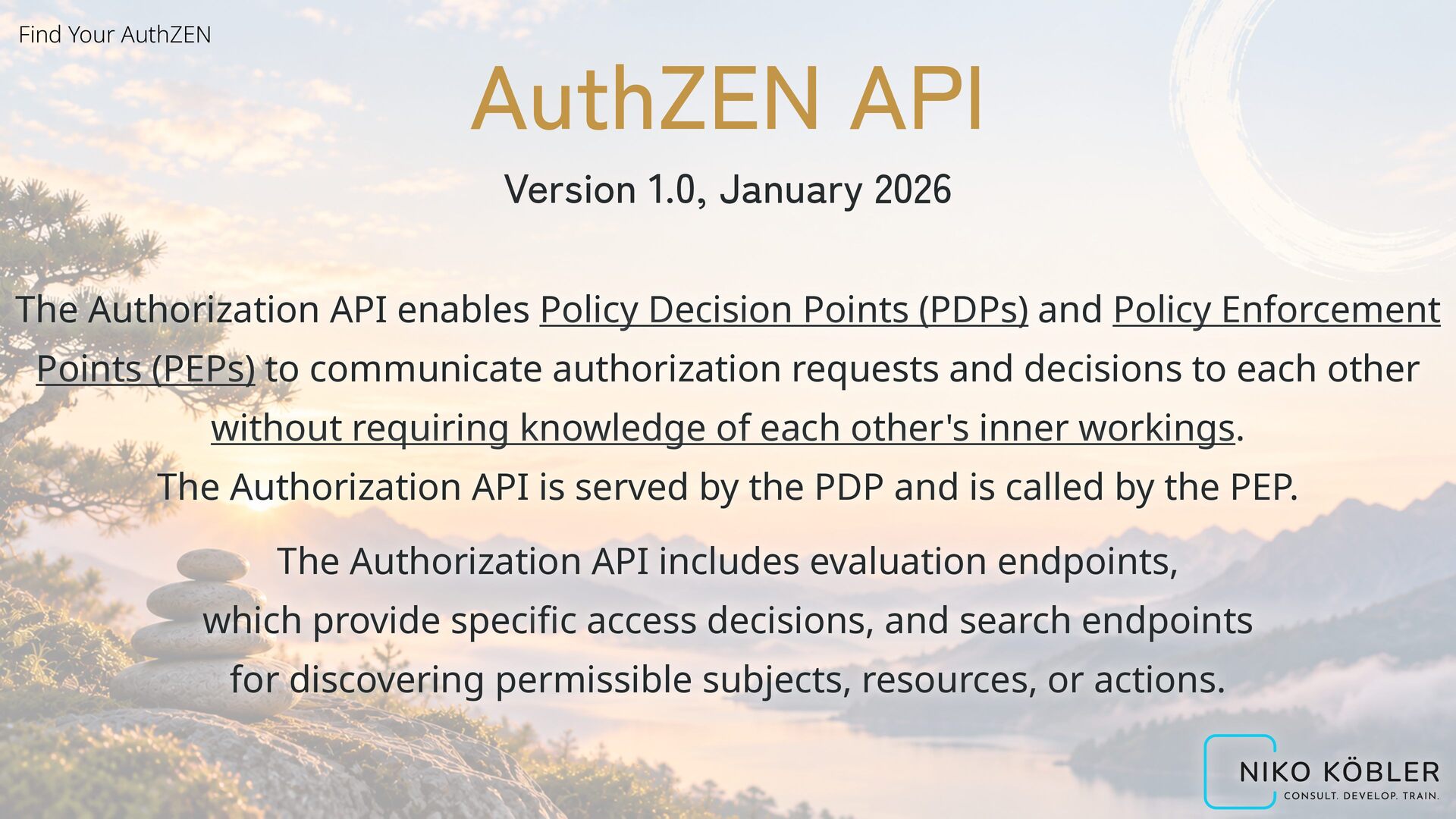
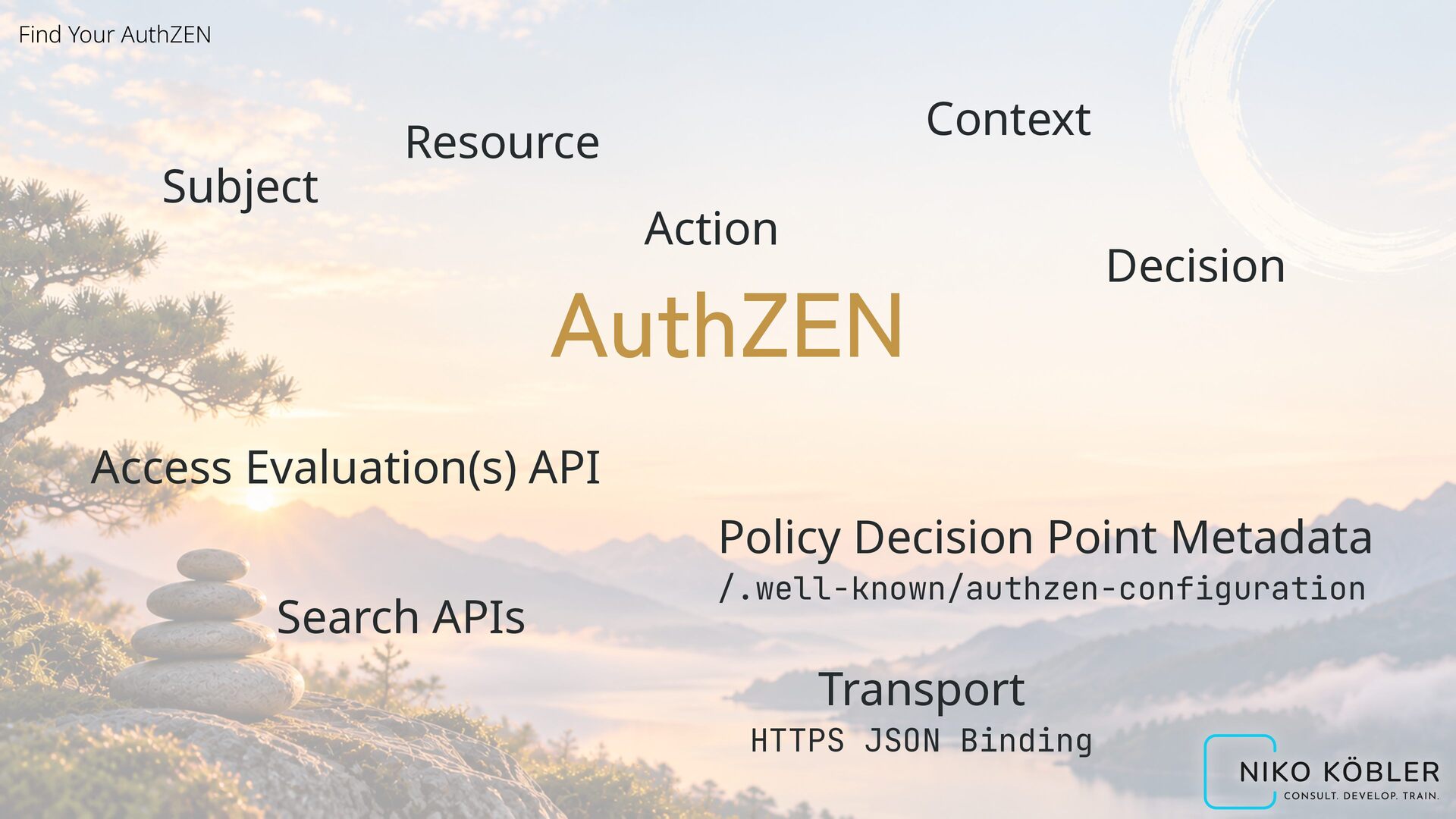
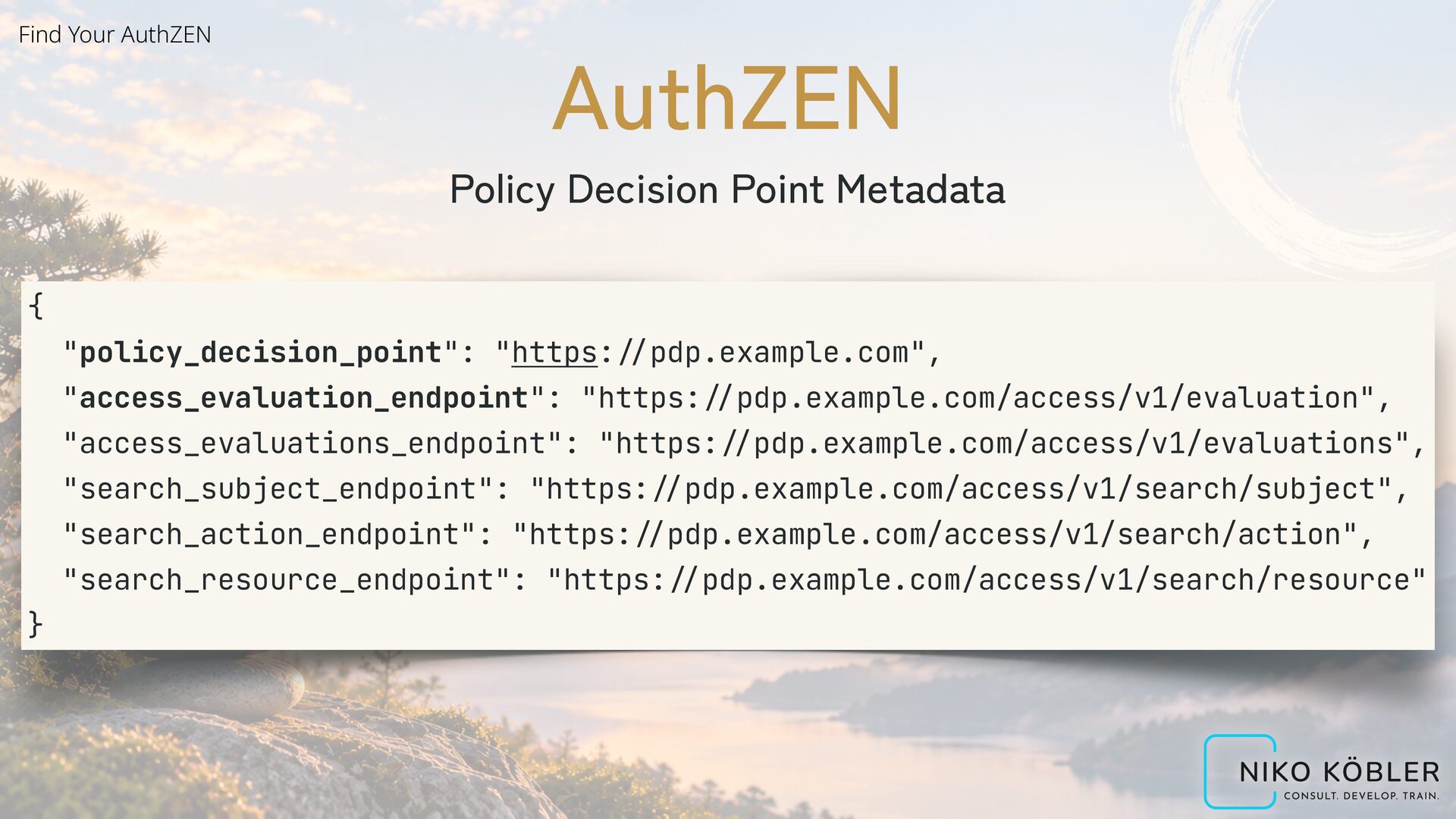
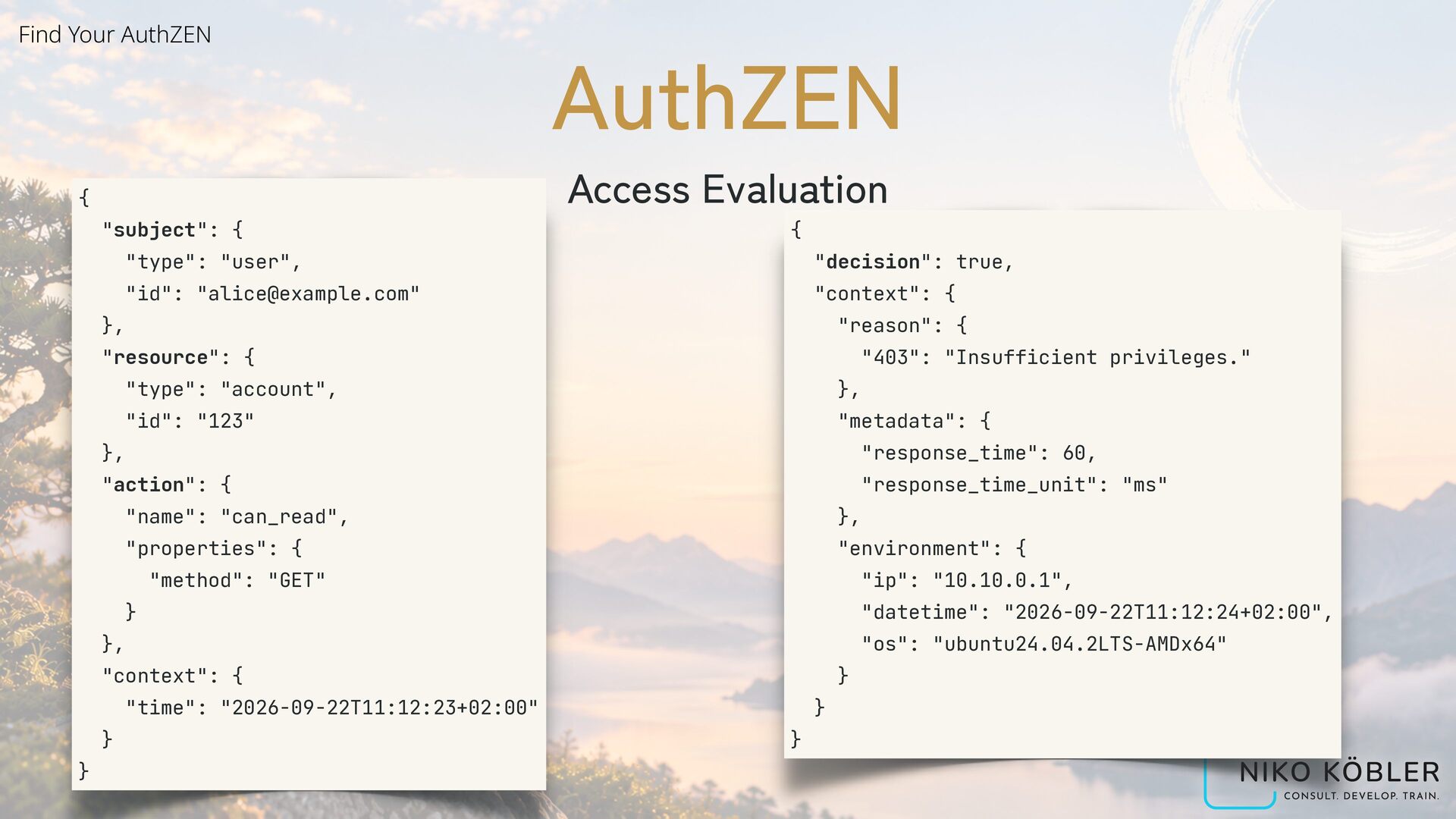
Authorization API enables Policy Decision Points (PDPs) and Policy Enforcement Points (PEPs) to communicate authorization requests and decisions to each other without requiring knowledge of each other's inner workings. The Authorization API is served by the PDP and is called by the PEP. The Authorization API includes evaluation endpoints, which provide speci c access decisions, and search endpoints fi for discovering permissible subjects, resources, or actions.


 dasniko
 gam0022
 kanfab1
 elmetal
 y0hgi
y0hgi
 nao_randd
 syumai
 rockname
 akit37
 neuecc
 glassfiber
 panda728
 palkan
 eitanlees
 orderedlist
 techseoconnect
 mfonobong
 tonyrice
 davidcarrasco
 pauljervisheath
 leimatthew05
 brad_frost
 kneath
 twada
twada
 baasie

![Find Your AuthZEN ध वाद न्य Questions? www.n-k.de [email protected] linkedin.com/in/dasniko](https://files.speakerdeck.com/presentations/22f664f569e1422c937141a84b56f268/slide_21.jpg)