Share
Embed
Controlling Hardware with Python
A presentation I held at the Zurich Python User Group in October 2015. It talks about hardware and Python.
dbrgn
October 29, 2015
Transcript
73 slides
-
1 Controlling Hardware with Python PyZurich Meetup 2015-10-29 Danilo Bargen
(@dbrgn), Webrepublic AG -
2 - Leading Digital Marketing agency in Switzerland - Owner-managed
and independent - Established in 2009 - Based in Zurich and Lausanne - Portfolio of 120+ national and international brands - Full coverage of digital performance path - Sparring partner for ambitious organizations - Own software development team Webrepublic -
3 - Software Engineer - Mostly interested in Python and
Rust - Bought a Raspberry Pi the day it became available - Founded a Hackerspace in Rapperswil in 2013 (coredump.ch) - NOT a hardware or electronics expert! =) Twitter: @dbrgn Blog: blog.dbrgn.ch Me -
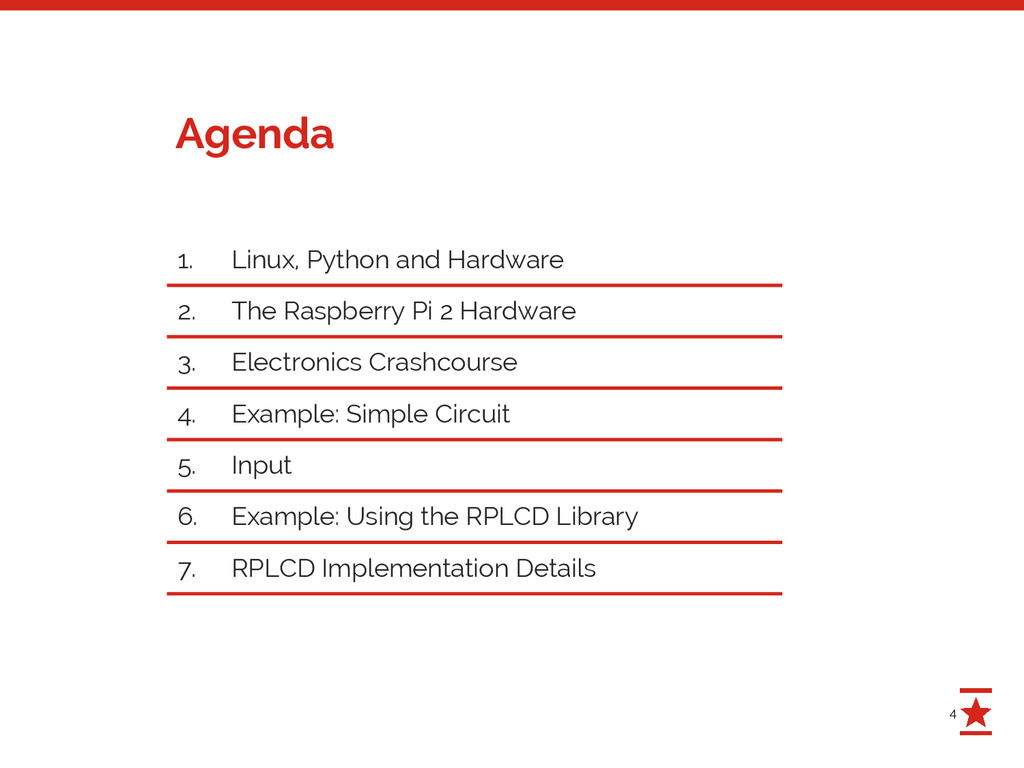
4 Agenda 1. Linux, Python and Hardware 2. The Raspberry
Pi 2 Hardware 3. Electronics Crashcourse 4. Example: Simple Circuit 5. Input 6. Example: Using the RPLCD Library 7. RPLCD Implementation Details -
5 - I’ll try to keep the language as simple
as possible. - Target audience: Python developers (maybe of the webdev flavor) that have no or little experience with hardware. - Correct me if something is wrong, but... - ...simplifications are being used on purpose. This isn’t a lecture. ETA: 60–90 minutes About this talk -
7 - Usually C/C++ or Assembly is being used to
control hardware - Realtime performance / exact timing is often important - Deterministic runtimes: Knowing how long a CPU cycle takes Controlling Hardware with Code -
8 - A regular Linux kernel does not guarantee timing
- The Linux kernel can be configured to guarantee specific response times - The Raspbian kernel is not realtime - (I won’t get into the details of what defines “realtime” =)) Why Linux? -
9 - Python is a high-level garbage collected language -
Not terribly well suited for controlling hardware - No timing guarantees due to GC pauses Why Python? -
10 - Turns out that timing is not always that
important - Python is easy to learn - Python is easy to use - Good to get started with hardware Then why Linux + Python? -
11 2: The Raspberry Pi Hardware A great platform for
n00b hardware hackers. -
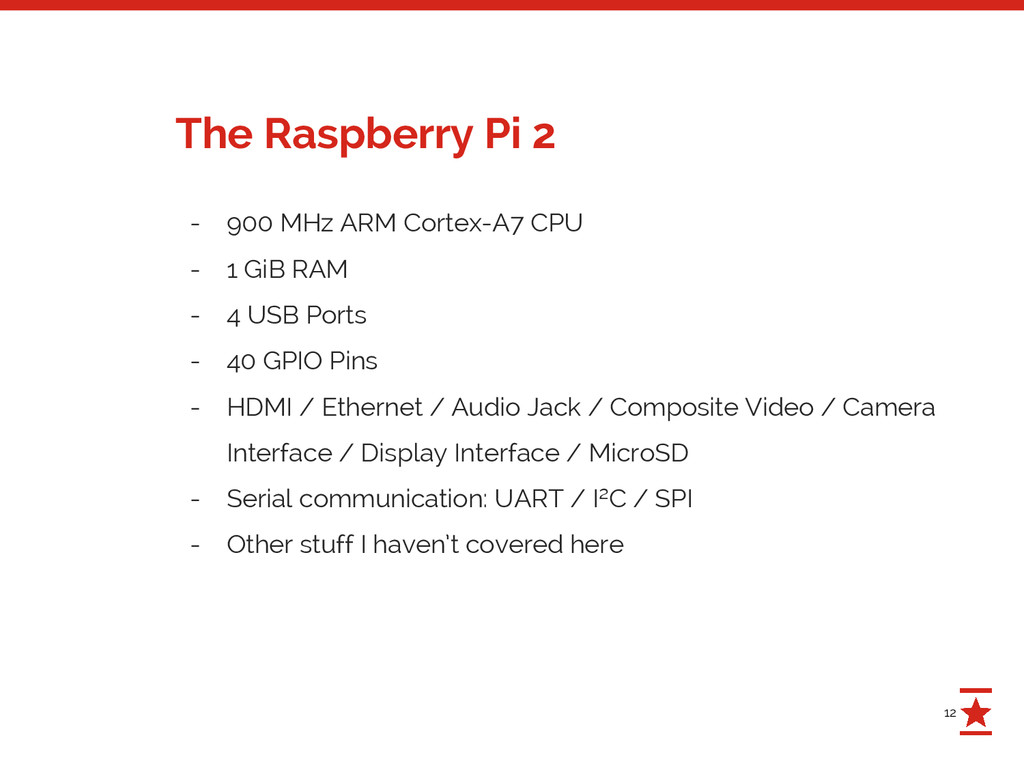
12 - 900 MHz ARM Cortex-A7 CPU - 1 GiB
RAM - 4 USB Ports - 40 GPIO Pins - HDMI / Ethernet / Audio Jack / Composite Video / Camera Interface / Display Interface / MicroSD - Serial communication: UART / I²C / SPI - Other stuff I haven’t covered here The Raspberry Pi 2 -
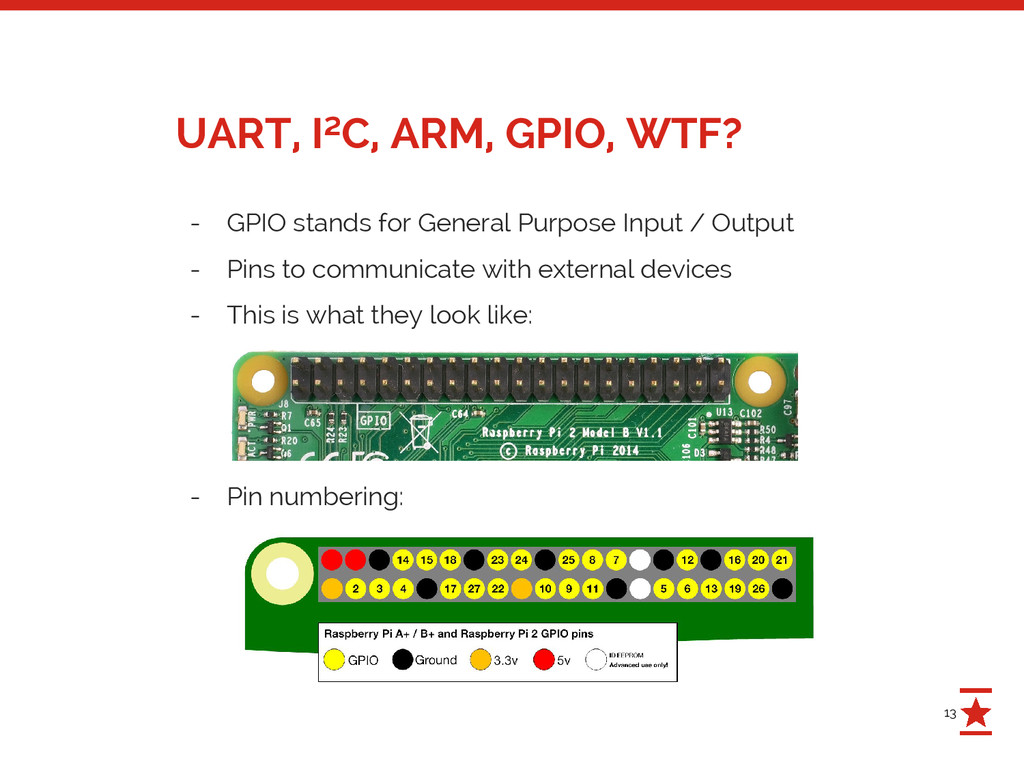
13 - GPIO stands for General Purpose Input / Output
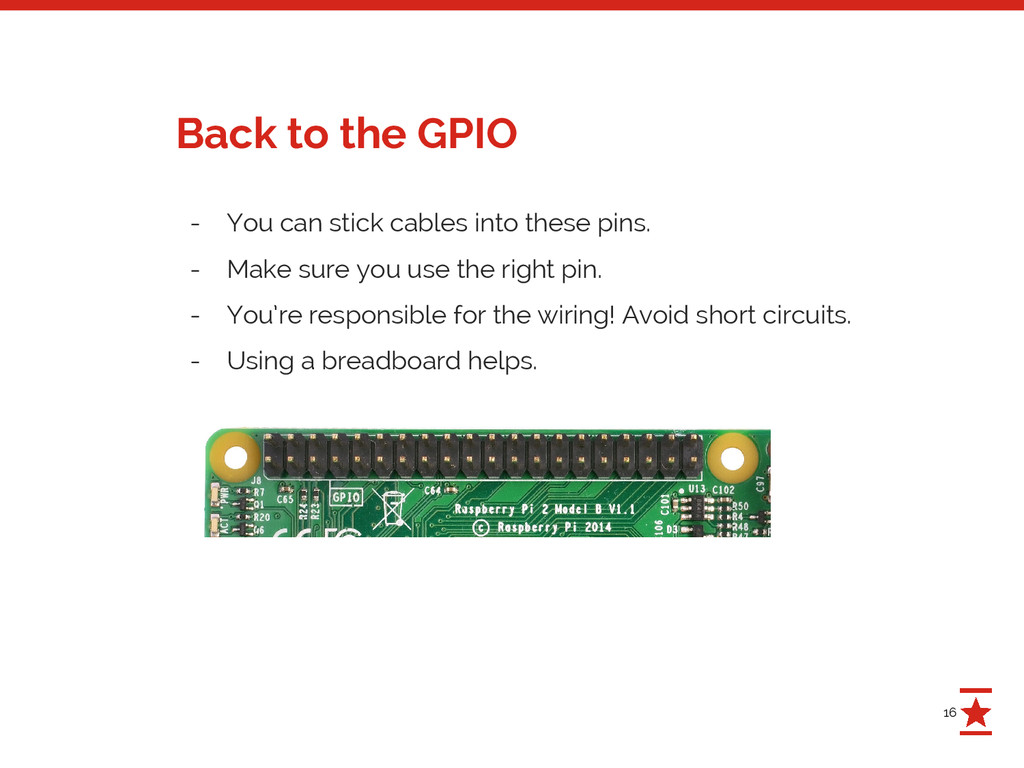
- Pins to communicate with external devices - This is what they look like: - Pin numbering: UART, I²C, ARM, GPIO, WTF? -
14 - Complicated abbreviations make everything sound hard - Most
stuff is actually easy - Never think “this is too hard for me”! - Here are some (simplified) translations: - GPIO: “Wires sticking out of the hardware that can be set to 5V or 0V” - UART: “Two wires for sending and receiving” - Bus: “A cable with many devices on it” - SPI: “Like UART with support for multiple devices and faster” - Syscalls: The Linux kernel API - Driver: “An API client that sends 1’s and 0’s through a wire” - Kernel driver: “A driver that is a pain to debug” - Interrupt: “A high-priority callback” Public Service Announcement -
16 - You can stick cables into these pins. -
Make sure you use the right pin. - You’re responsible for the wiring! Avoid short circuits. - Using a breadboard helps. Back to the GPIO -
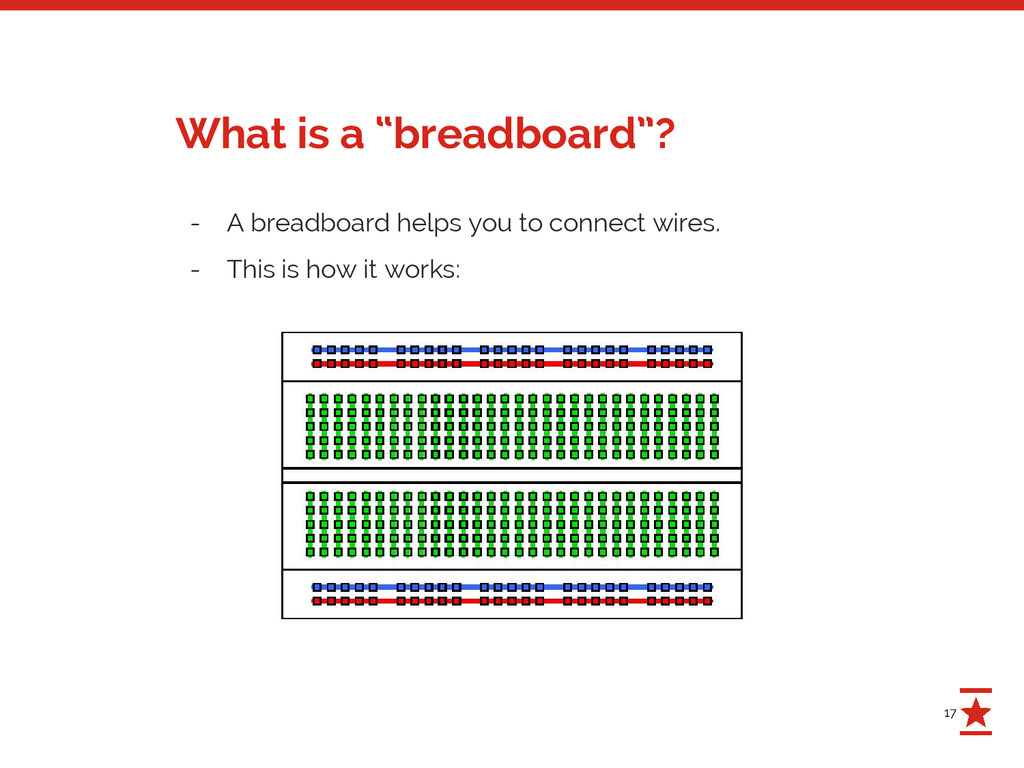
17 - A breadboard helps you to connect wires. -
This is how it works: What is a “breadboard”? -
18 - A “short” is short for “short circuit” -
This means that you connect a voltage source (e.g. the 5V pin) with the ground pin without having anything in between that uses some of the current. - The “something in between” could be a resistor or a LED - Don’t do it! https://www.youtube.com/watch?v=PqyUtQv1WoQ What is a “short” or “shorting”? -
19 - You need to configure the pins as either
input- or output-pins - They use 3.3V internally, so don’t feed them 5V! - Maximum current draw per GPIO pin is 16 mA. - Maximum current draw for all GPIO pins is 50 mA. http://elinux.org/RPi_Low-level_peripherals http://raspberrypi.stackexchange.com/a/9299/6793 Important facts about the GPIO pins - What is a “mA”? -
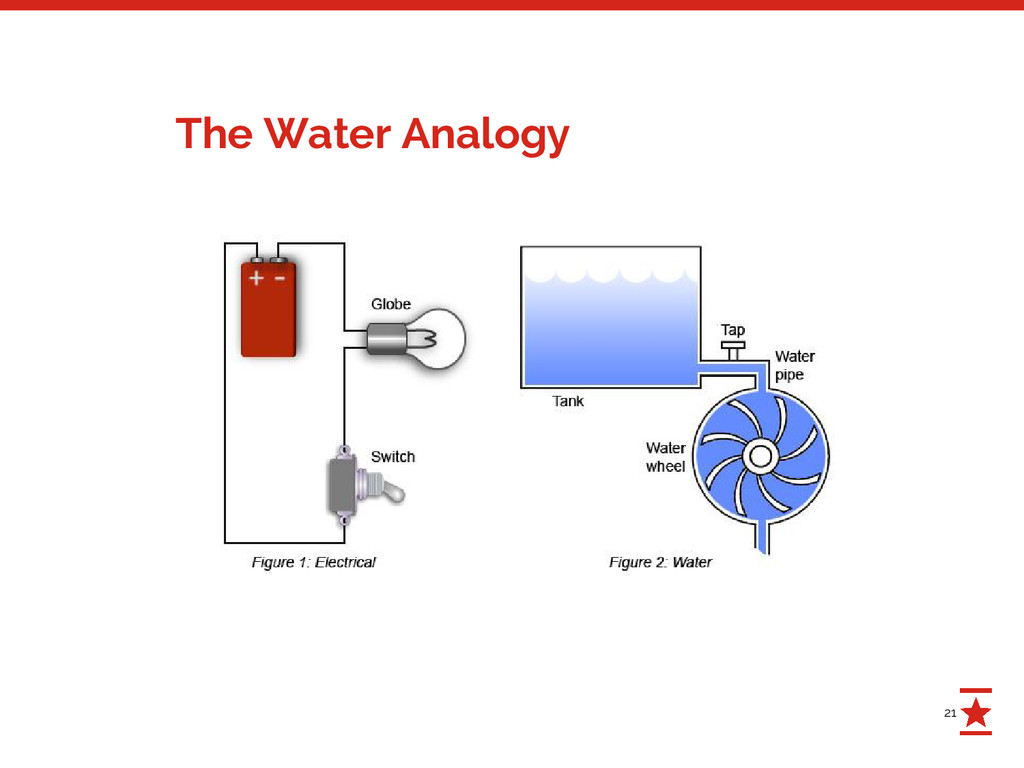
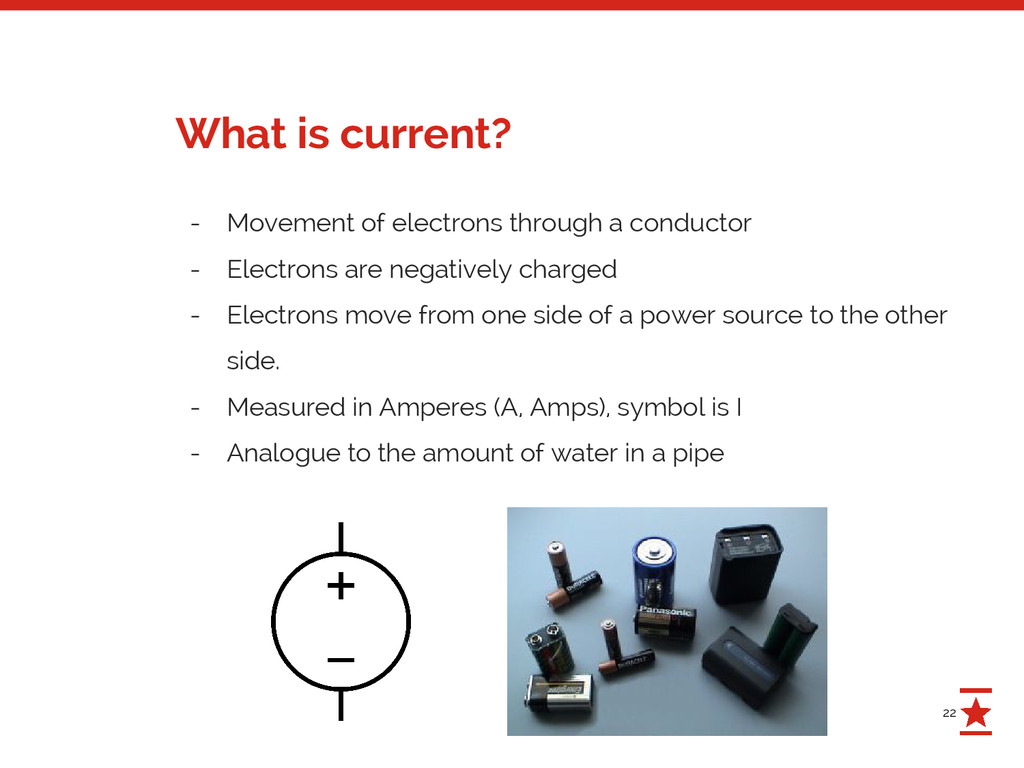
22 - Movement of electrons through a conductor - Electrons
are negatively charged - Electrons move from one side of a power source to the other side. - Measured in Amperes (A, Amps), symbol is I - Analogue to the amount of water in a pipe What is current? -
23 - Electronic potential difference between two points - Analogue
to the pressure in a pipe - Measured in Volts (V, Voltage), symbol is U - An AA battery has 1.3–1.5 V - The Swiss electricity grid uses ~230V What is voltage? -
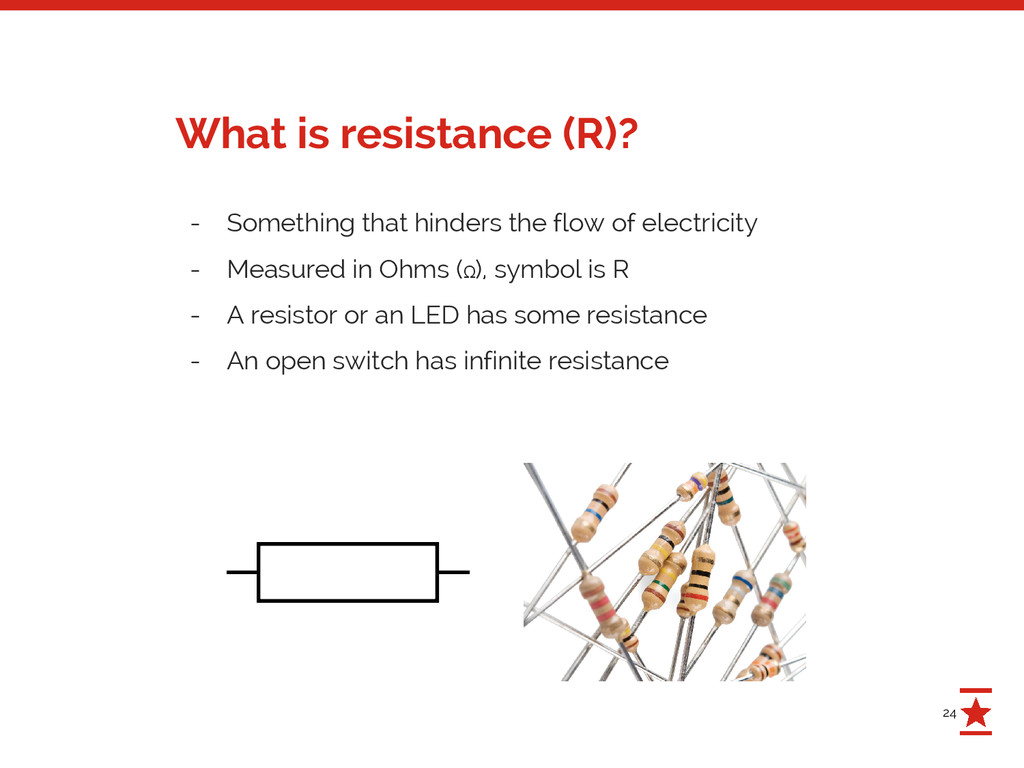
24 - Something that hinders the flow of electricity -
Measured in Ohms (Ω), symbol is R - A resistor or an LED has some resistance - An open switch has infinite resistance What is resistance (R)? -
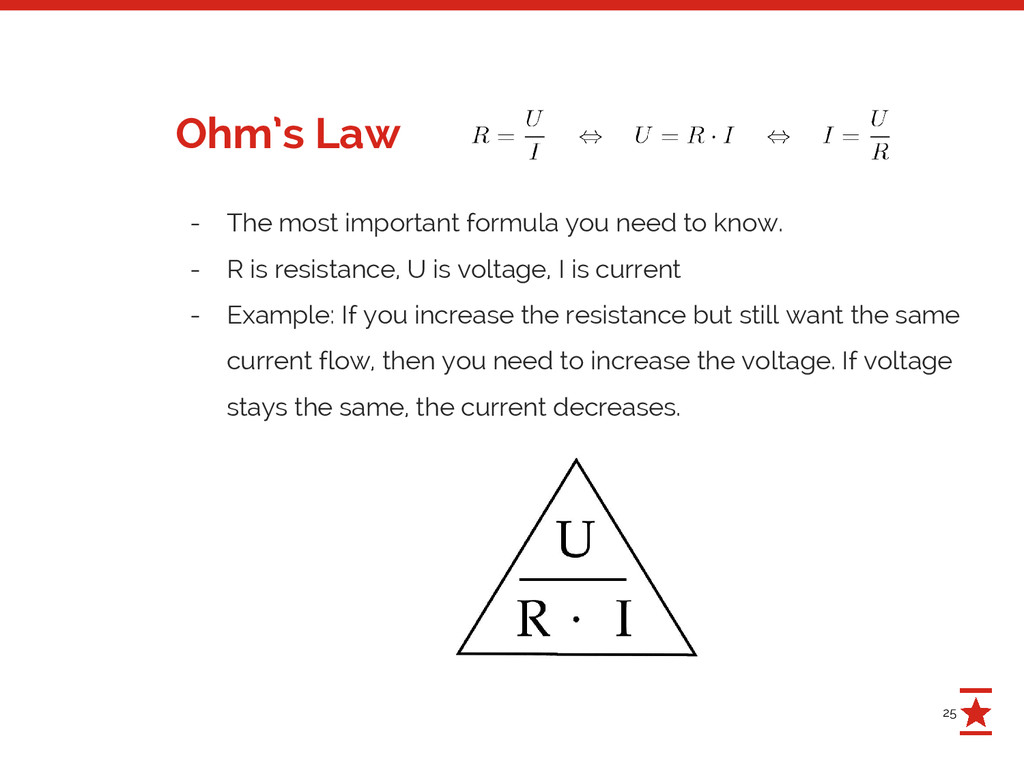
25 - The most important formula you need to know.
- R is resistance, U is voltage, I is current - Example: If you increase the resistance but still want the same current flow, then you need to increase the voltage. If voltage stays the same, the current decreases. Ohm’s Law -
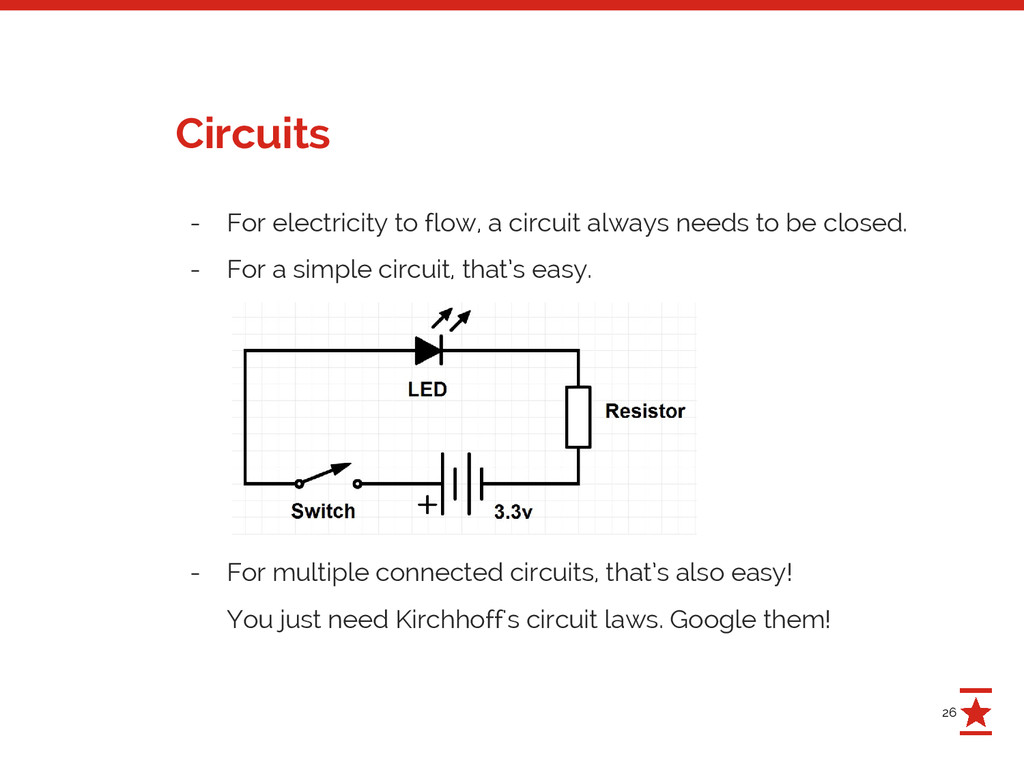
26 - For electricity to flow, a circuit always needs
to be closed. - For a simple circuit, that’s easy. - For multiple connected circuits, that’s also easy! You just need Kirchhoff's circuit laws. Google them! Circuits -
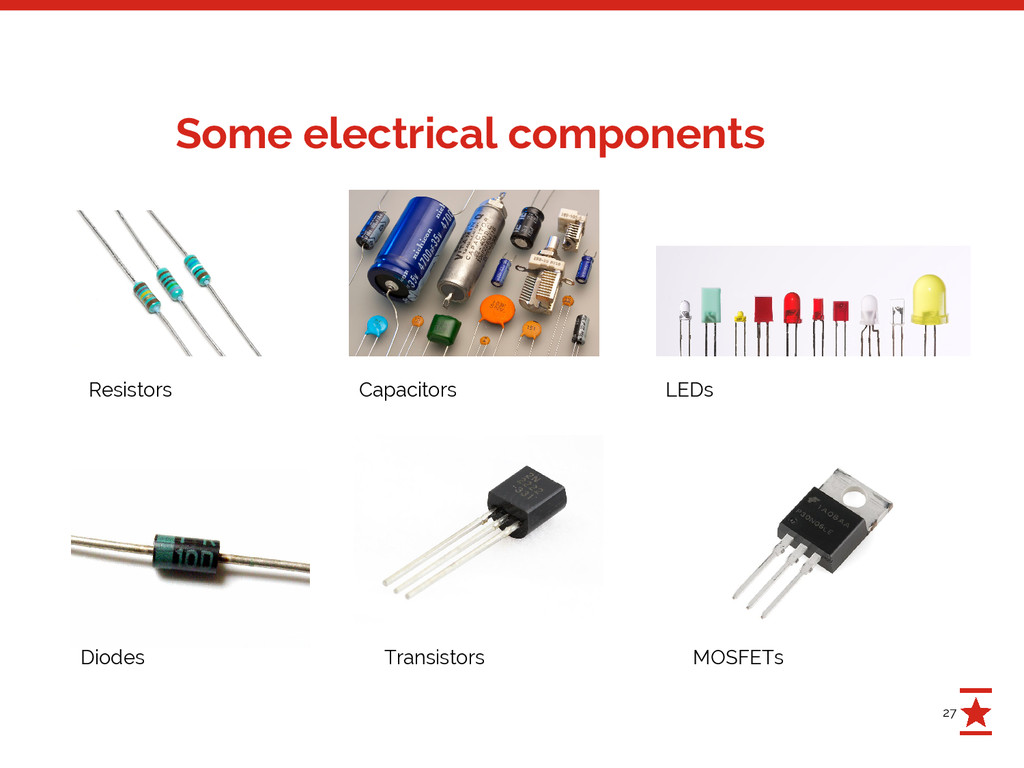
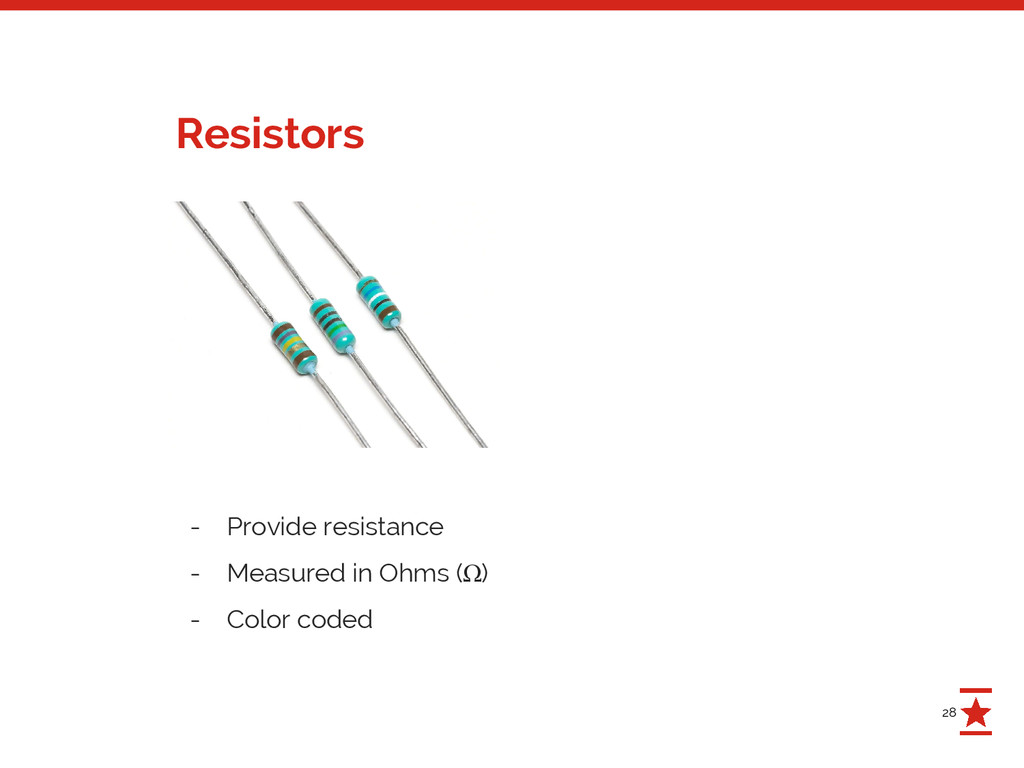
28 Resistors - Provide resistance - Measured in Ohms (Ω)
- Color coded -
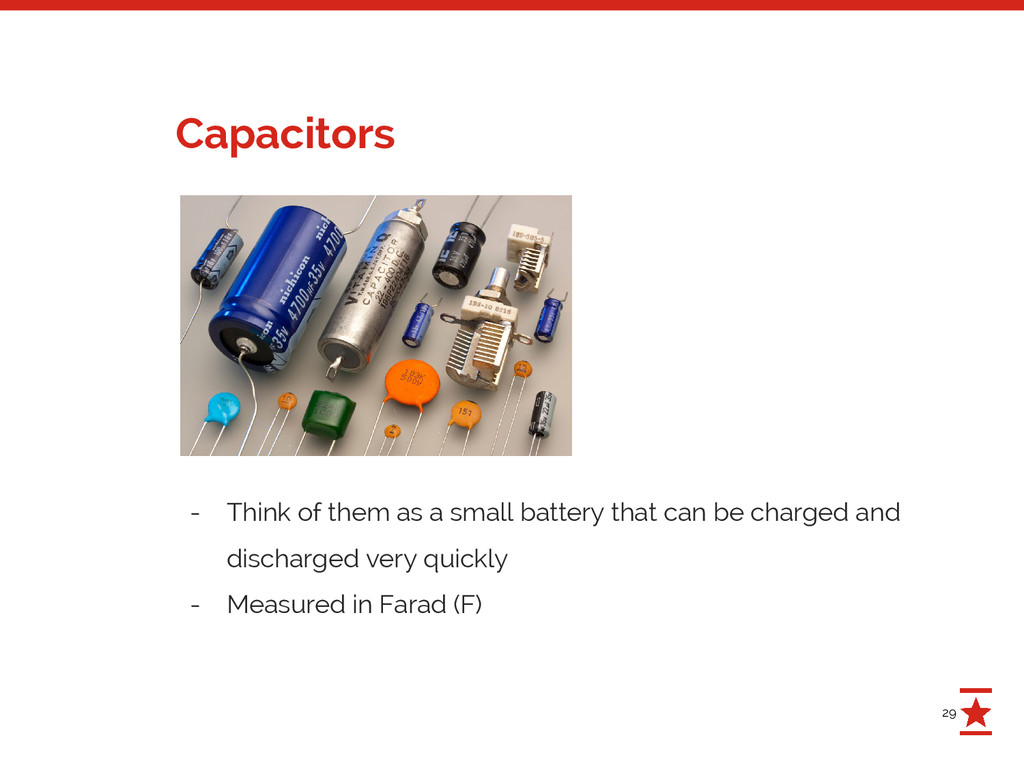
29 Capacitors - Think of them as a small battery
that can be charged and discharged very quickly - Measured in Farad (F) -
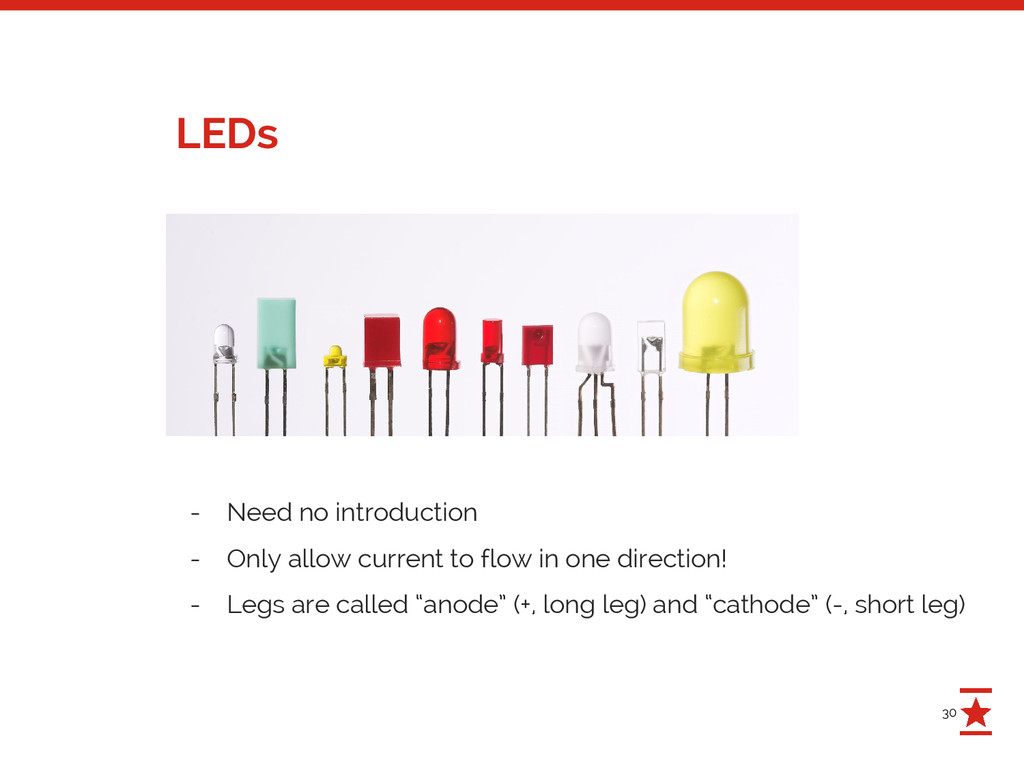
30 LEDs - Need no introduction - Only allow current
to flow in one direction! - Legs are called “anode” (+, long leg) and “cathode” (-, short leg) -
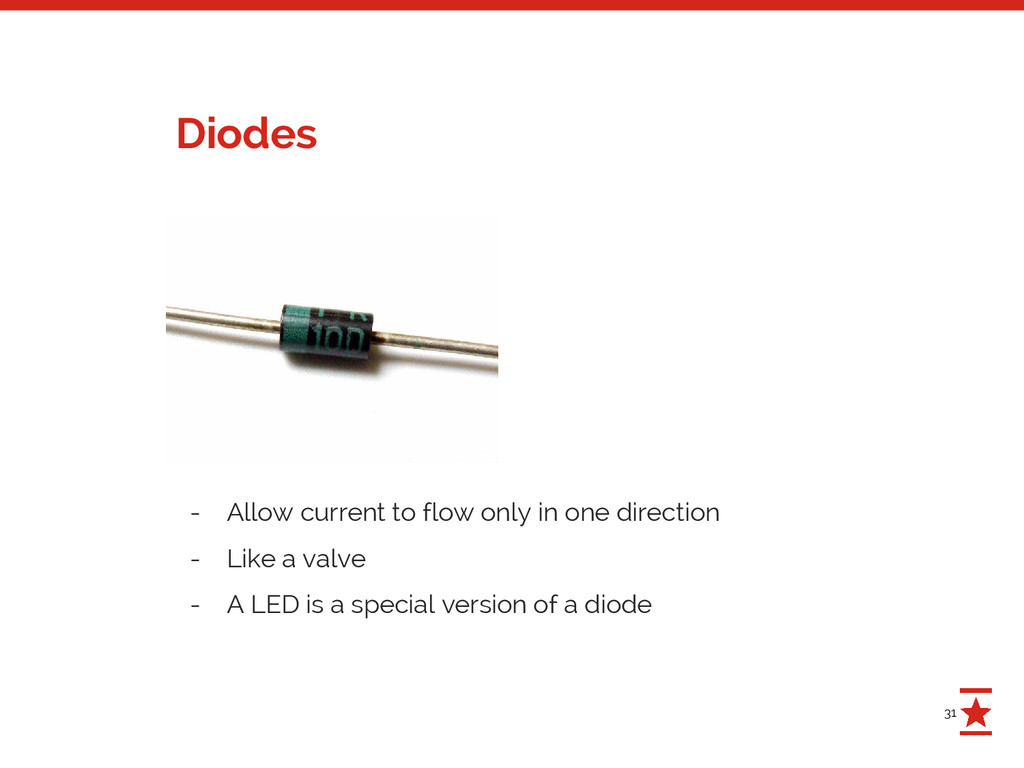
31 Diodes - Allow current to flow only in one
direction - Like a valve - A LED is a special version of a diode -
32 Transistors - Kind of important for computers :) -
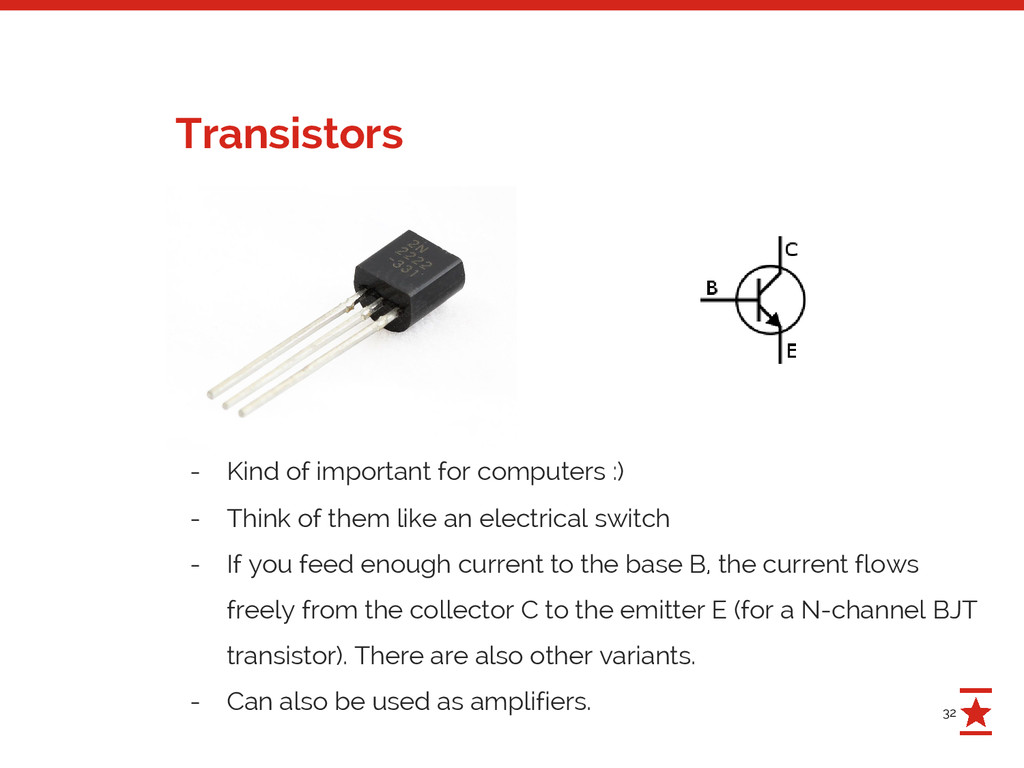
Think of them like an electrical switch - If you feed enough current to the base B, the current flows freely from the collector C to the emitter E (for a N-channel BJT transistor). There are also other variants. - Can also be used as amplifiers. -
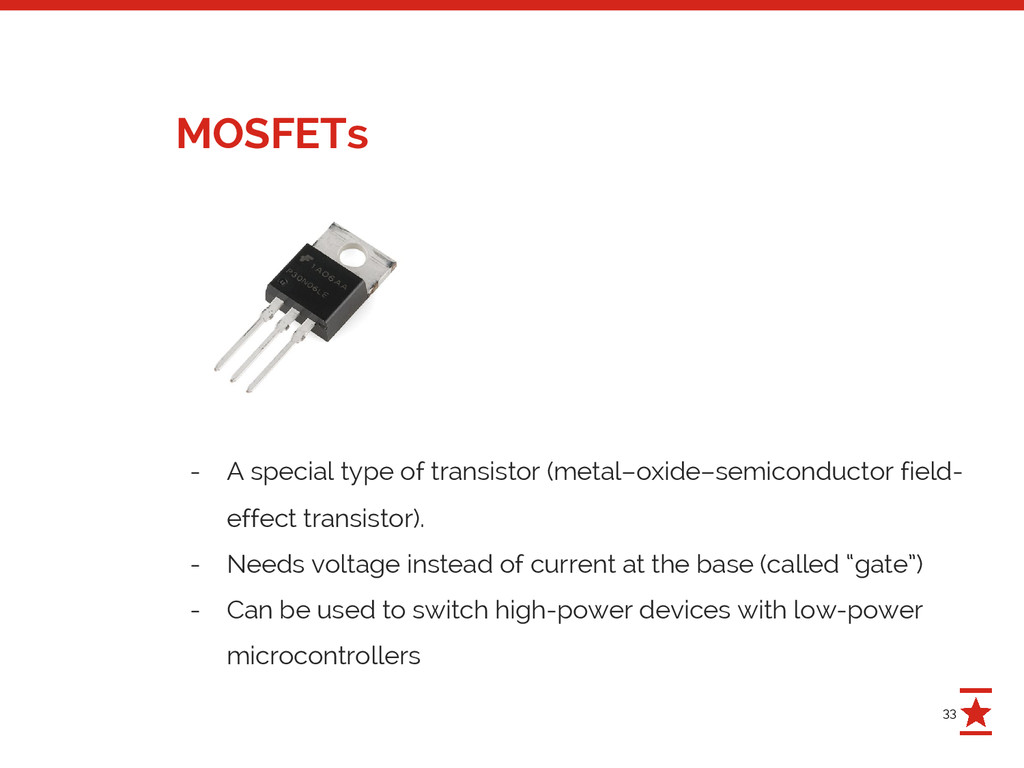
33 MOSFETs - A special type of transistor (metal–oxide–semiconductor field-
effect transistor). - Needs voltage instead of current at the base (called “gate”) - Can be used to switch high-power devices with low-power microcontrollers -
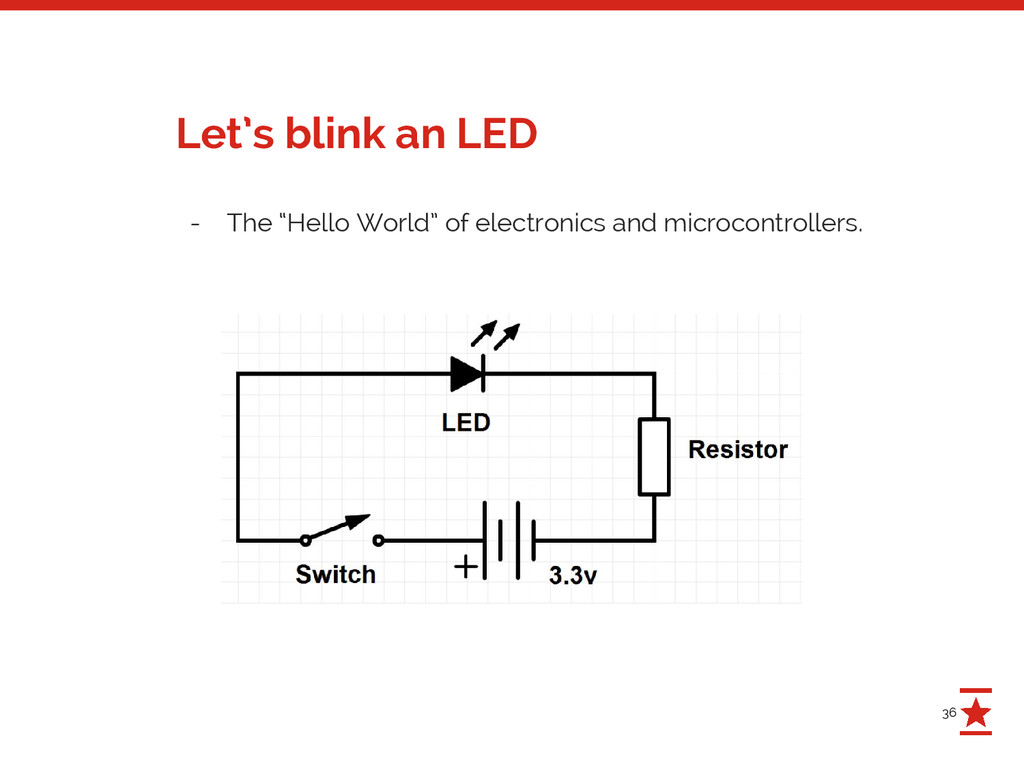
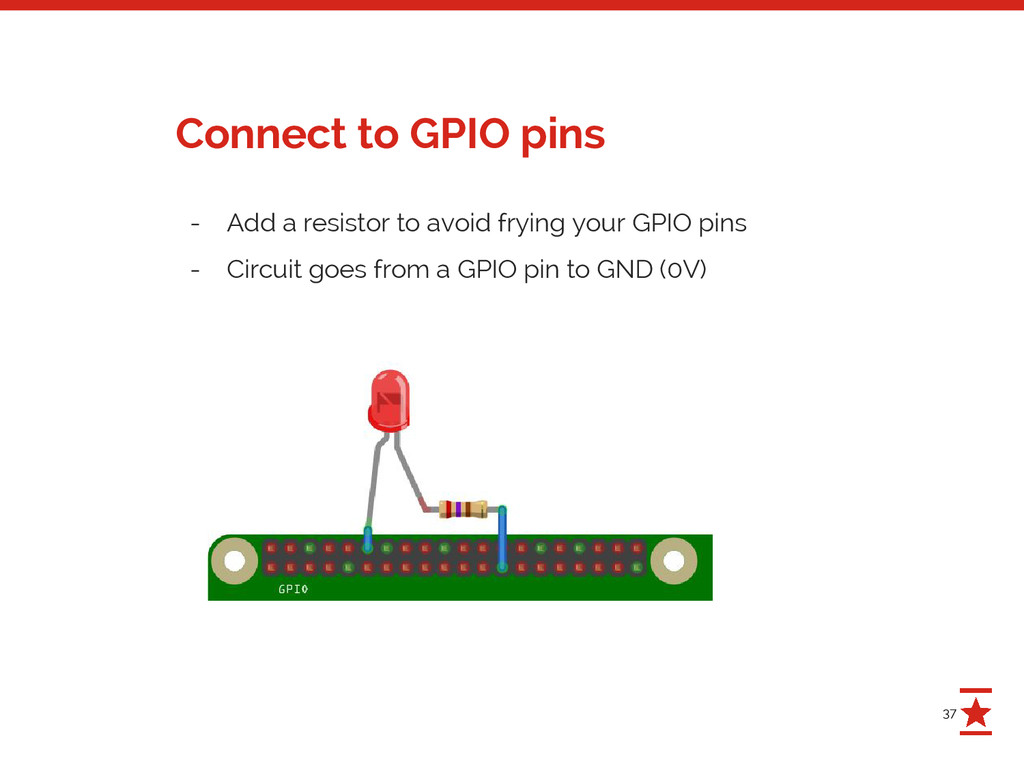
37 - Add a resistor to avoid frying your GPIO
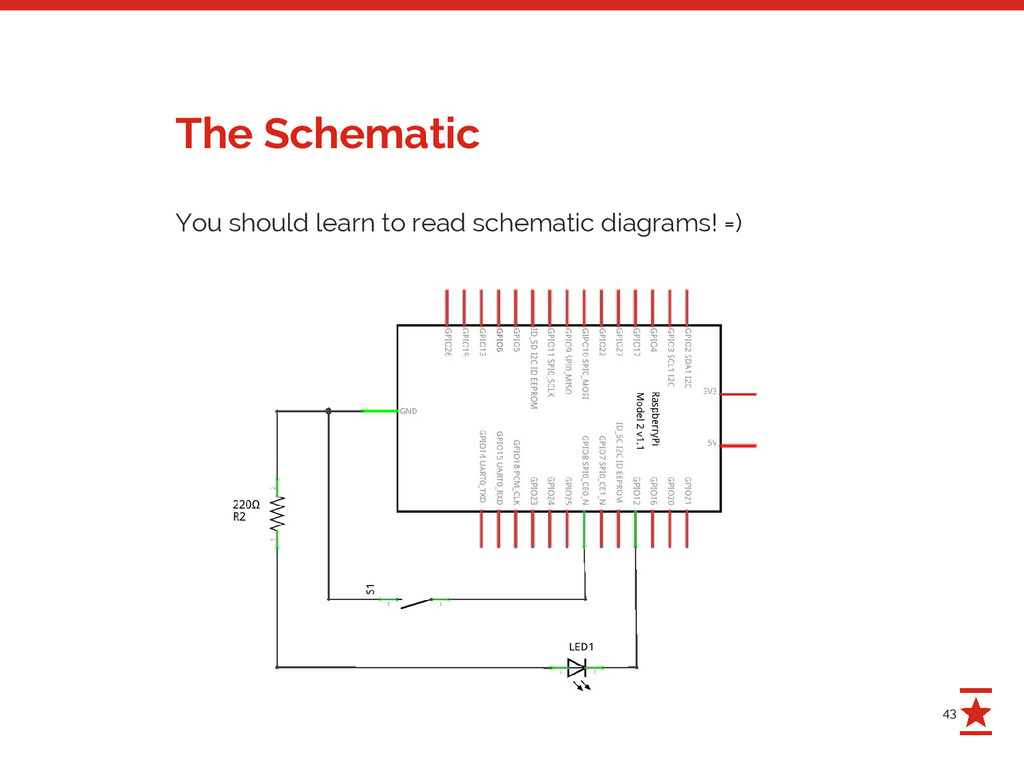
pins - Circuit goes from a GPIO pin to GND (0V) Connect to GPIO pins -
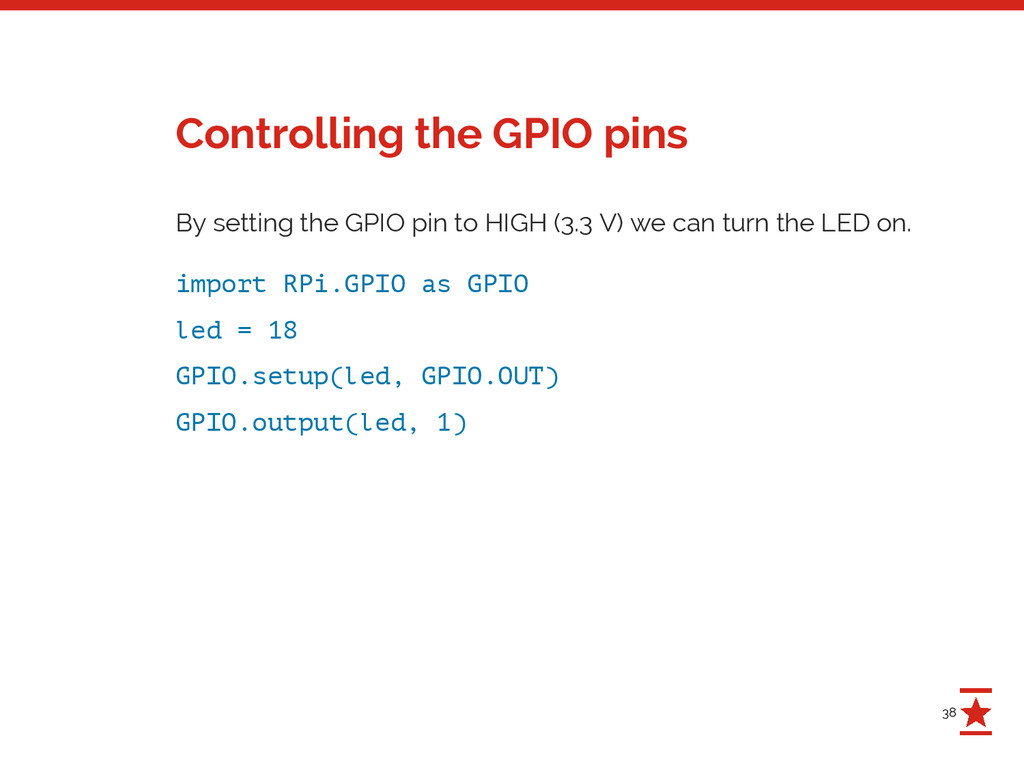
38 By setting the GPIO pin to HIGH (3.3 V)
we can turn the LED on. import RPi.GPIO as GPIO led = 18 GPIO.setup(led, GPIO.OUT) GPIO.output(led, 1) Controlling the GPIO pins -
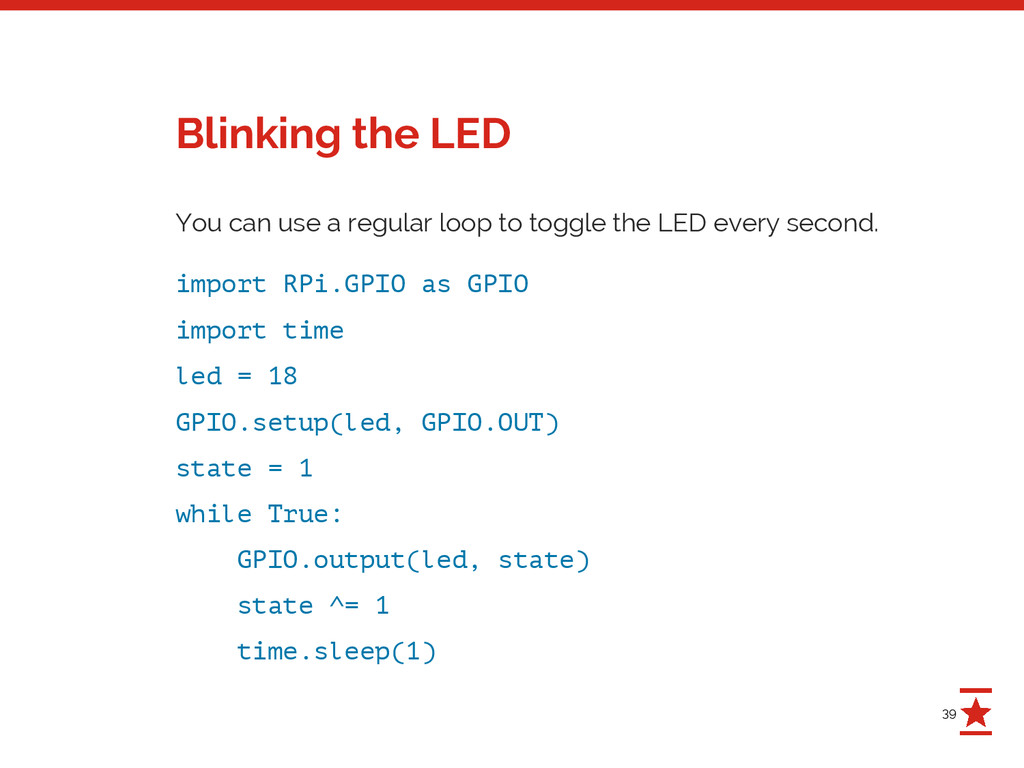
39 You can use a regular loop to toggle the
LED every second. import RPi.GPIO as GPIO import time led = 18 GPIO.setup(led, GPIO.OUT) state = 1 while True: GPIO.output(led, state) state ^= 1 time.sleep(1) Blinking the LED -
40 If you want to be a good citizen™, clean
up after every program to make pins available again to other scripts. try: main_loop() except Exception: GPIO.cleanup() Don’t forget to clean up -
41 5: Input Let’s look at reading input values, debuncing
and interrupts. -
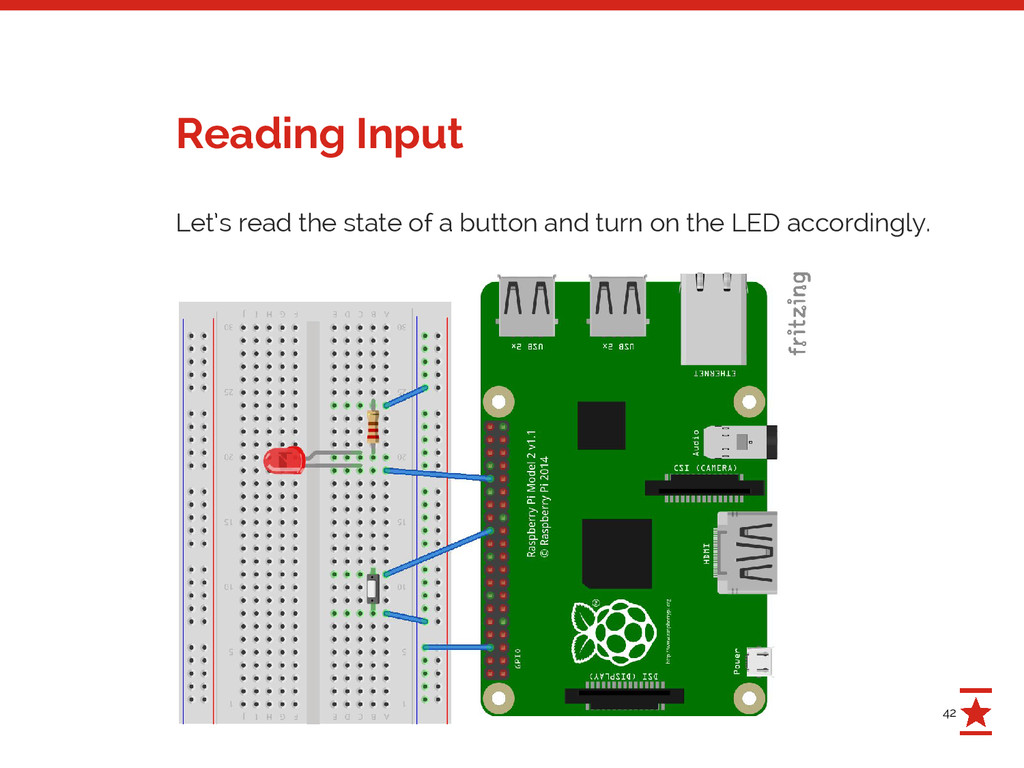
42 Let’s read the state of a button and turn
on the LED accordingly. Reading Input -
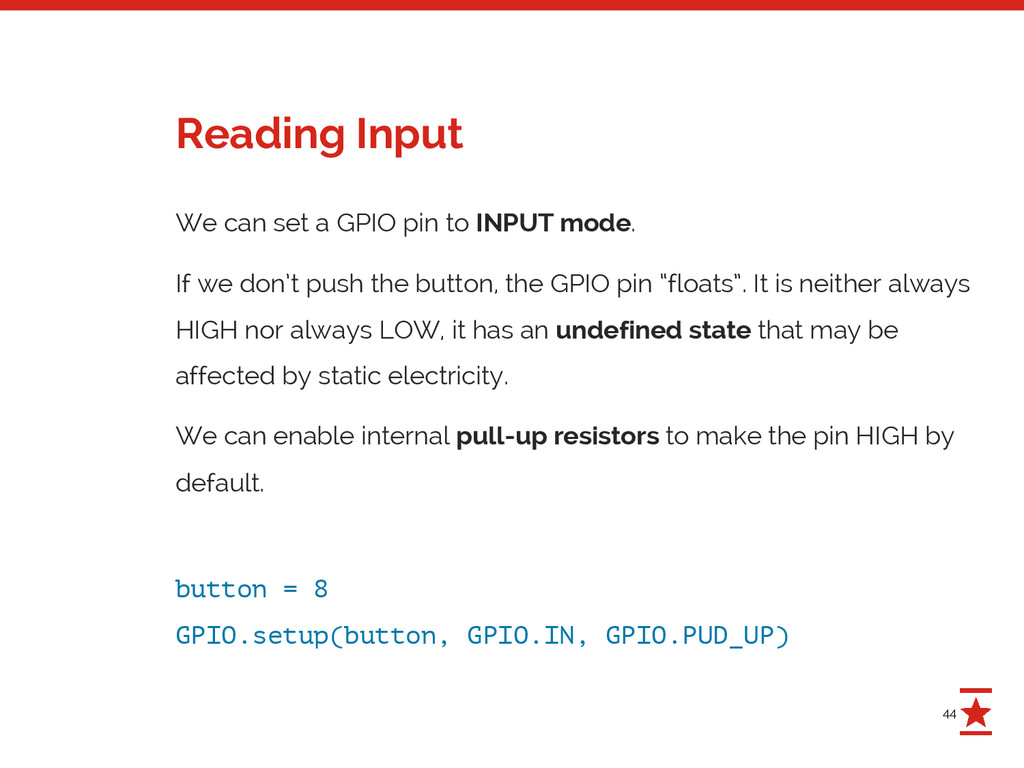
44 We can set a GPIO pin to INPUT mode.
If we don’t push the button, the GPIO pin “floats”. It is neither always HIGH nor always LOW, it has an undefined state that may be affected by static electricity. We can enable internal pull-up resistors to make the pin HIGH by default. button = 8 GPIO.setup(button, GPIO.IN, GPIO.PUD_UP) Reading Input -
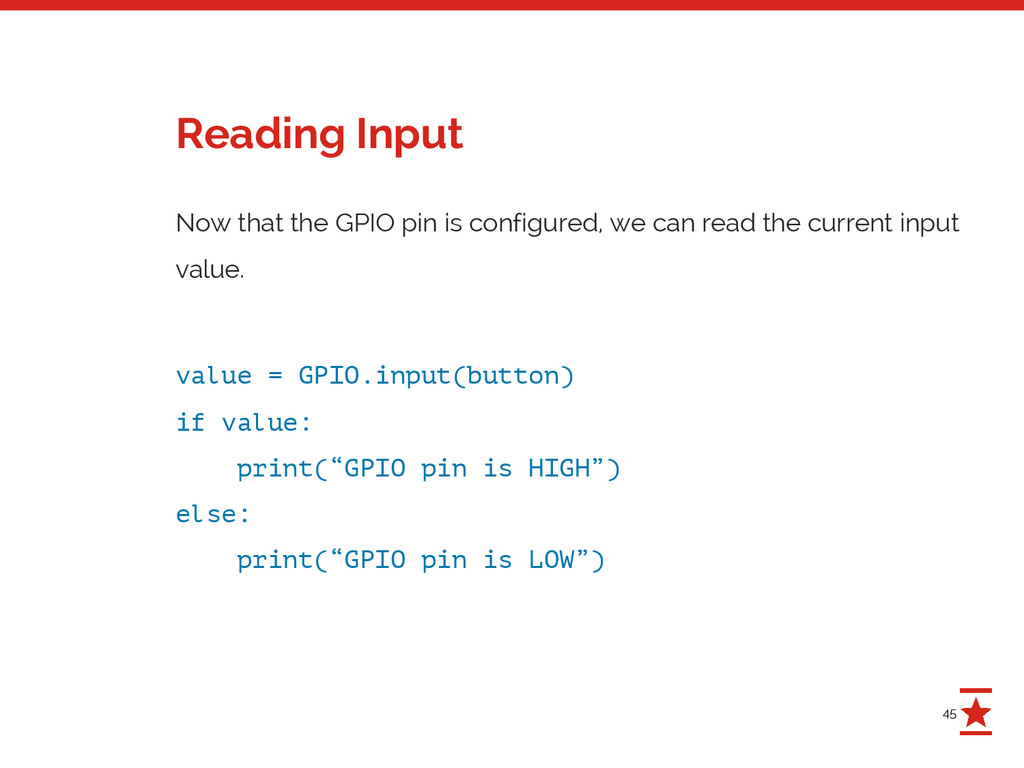
45 Now that the GPIO pin is configured, we can
read the current input value. value = GPIO.input(button) if value: print(“GPIO pin is HIGH”) else: print(“GPIO pin is LOW”) Reading Input -
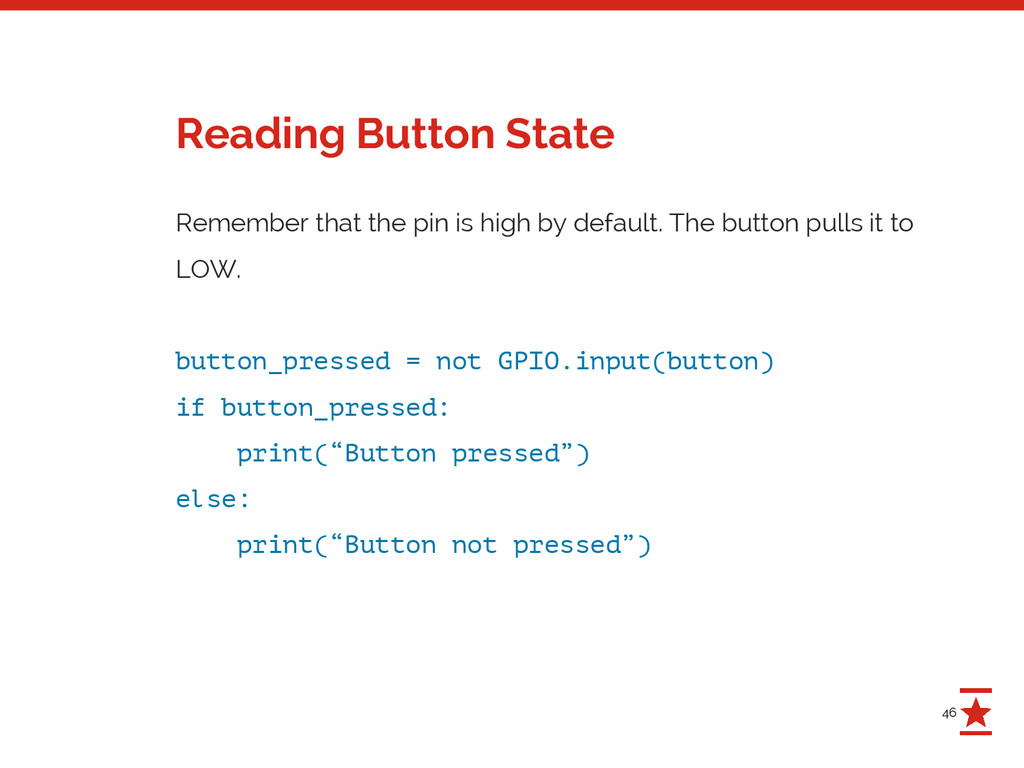
46 Remember that the pin is high by default. The
button pulls it to LOW. button_pressed = not GPIO.input(button) if button_pressed: print(“Button pressed”) else: print(“Button not pressed”) Reading Button State -
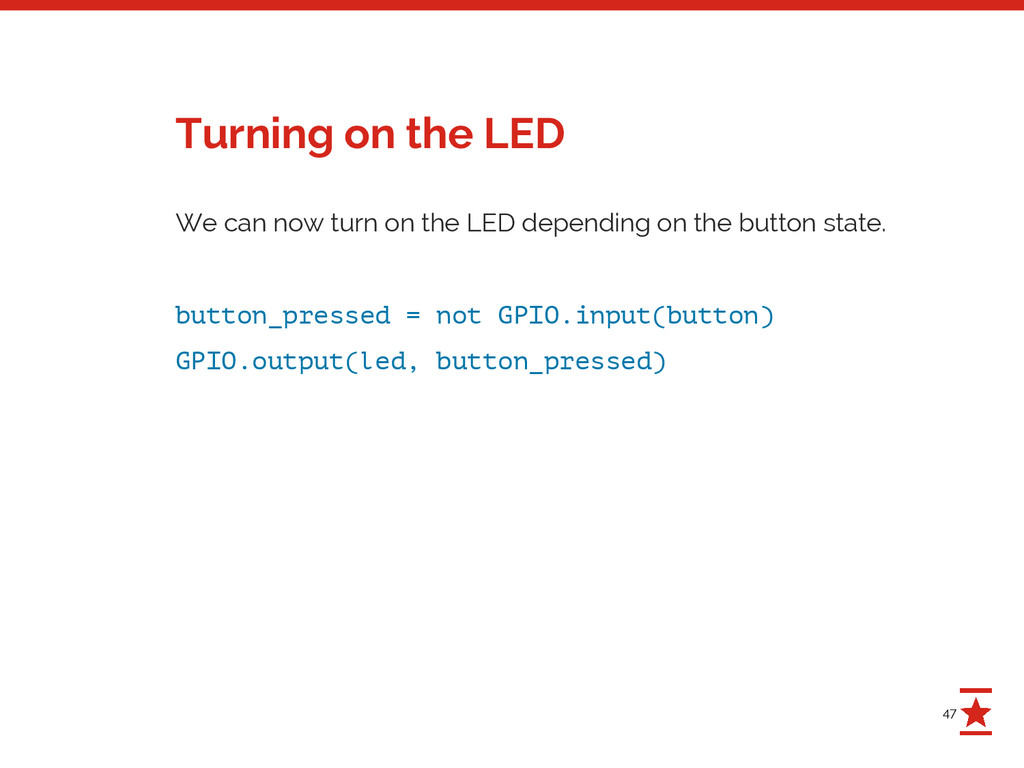
47 We can now turn on the LED depending on
the button state. button_pressed = not GPIO.input(button) GPIO.output(led, button_pressed) Turning on the LED -
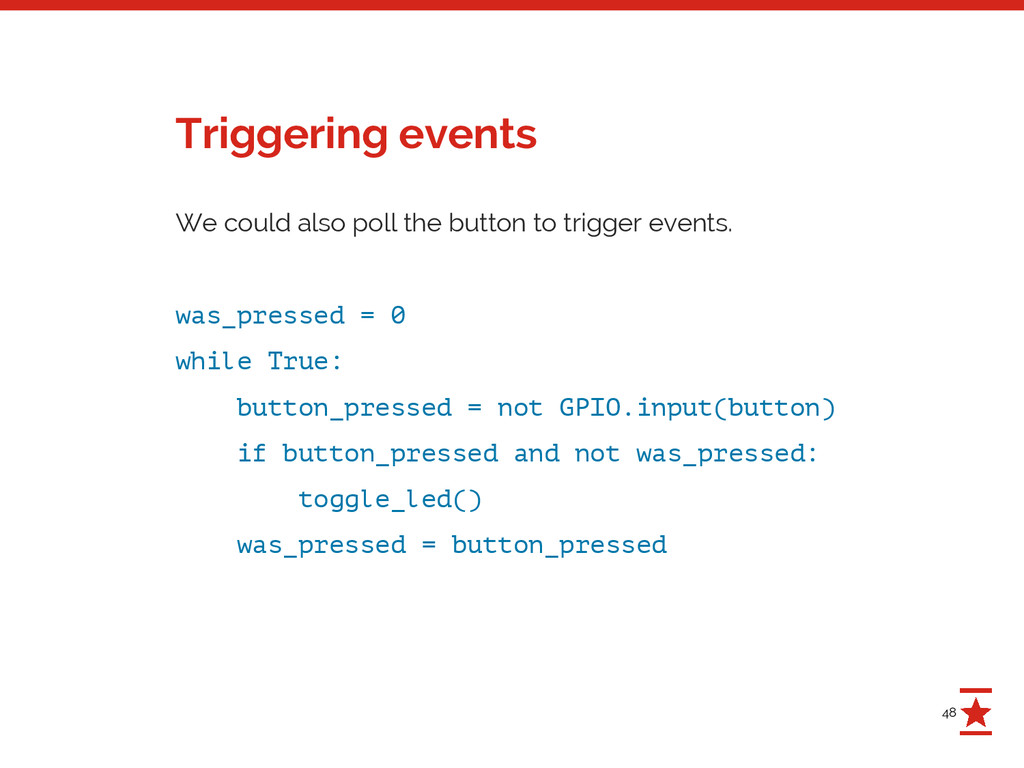
48 We could also poll the button to trigger events.
was_pressed = 0 while True: button_pressed = not GPIO.input(button) if button_pressed and not was_pressed: toggle_led() was_pressed = button_pressed Triggering events -
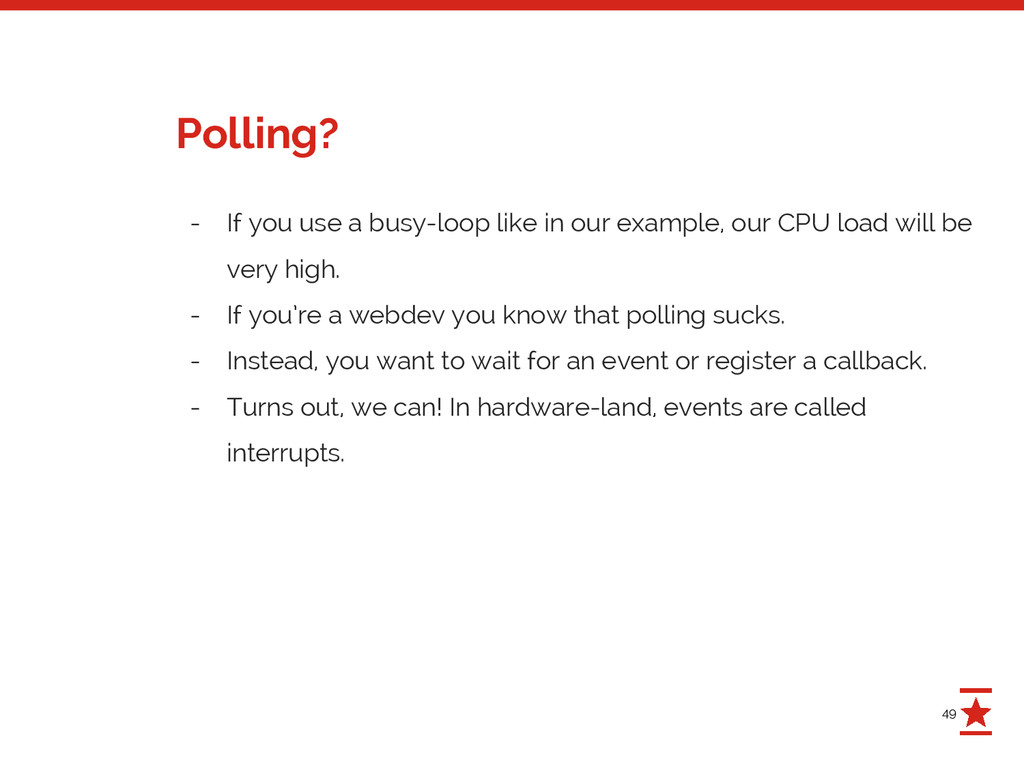
49 - If you use a busy-loop like in our
example, our CPU load will be very high. - If you’re a webdev you know that polling sucks. - Instead, you want to wait for an event or register a callback. - Turns out, we can! In hardware-land, events are called interrupts. Polling? -
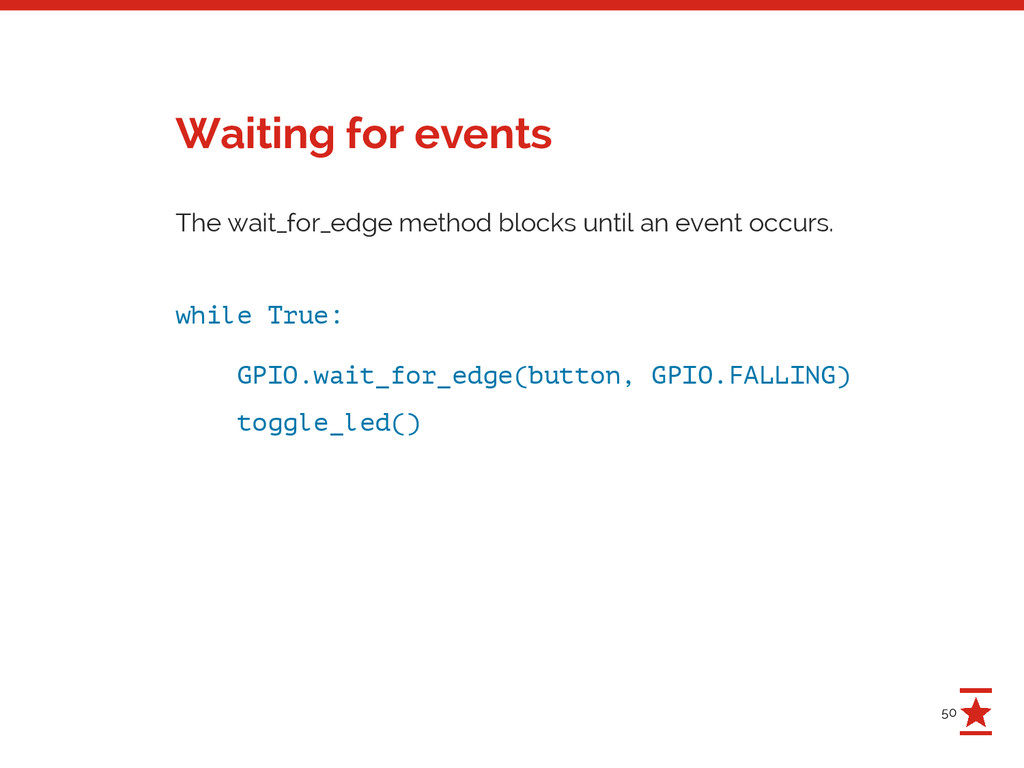
50 The wait_for_edge method blocks until an event occurs. while
True: GPIO.wait_for_edge(button, GPIO.FALLING) toggle_led() Waiting for events -
51 We can also use threaded callbacks (aka “interrupt handlers”
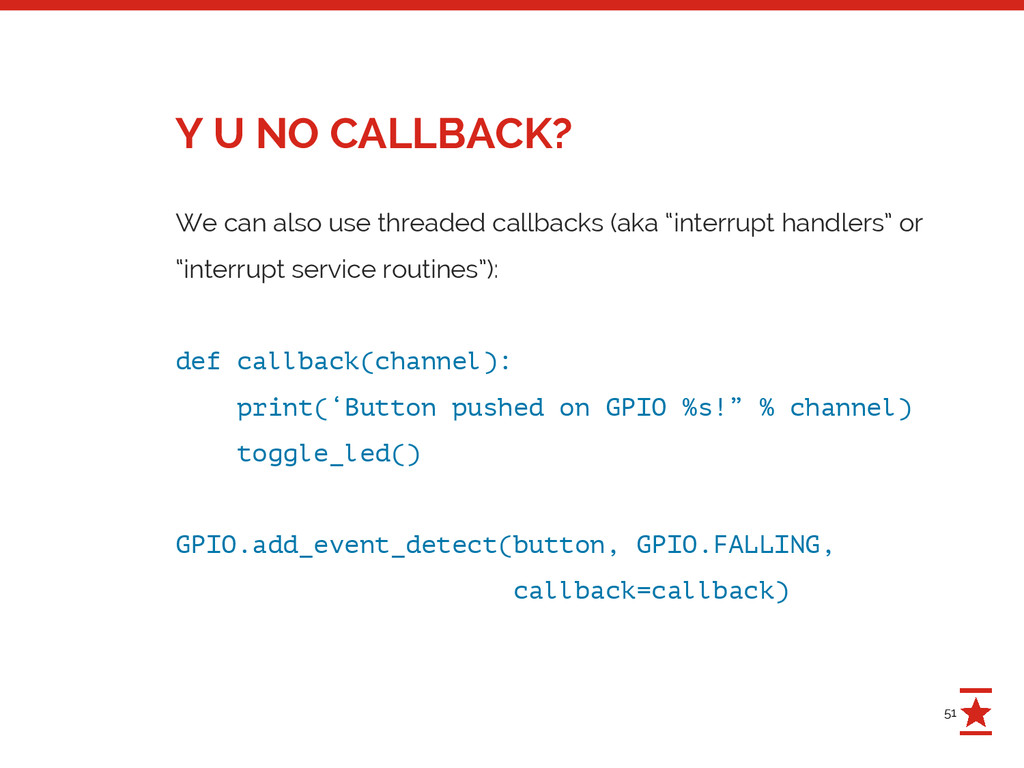
or “interrupt service routines”): def callback(channel): print(‘Button pushed on GPIO %s!” % channel) toggle_led() GPIO.add_event_detect(button, GPIO.FALLING, callback=callback) Y U NO CALLBACK? -
52 - If you actually implement this code, you will
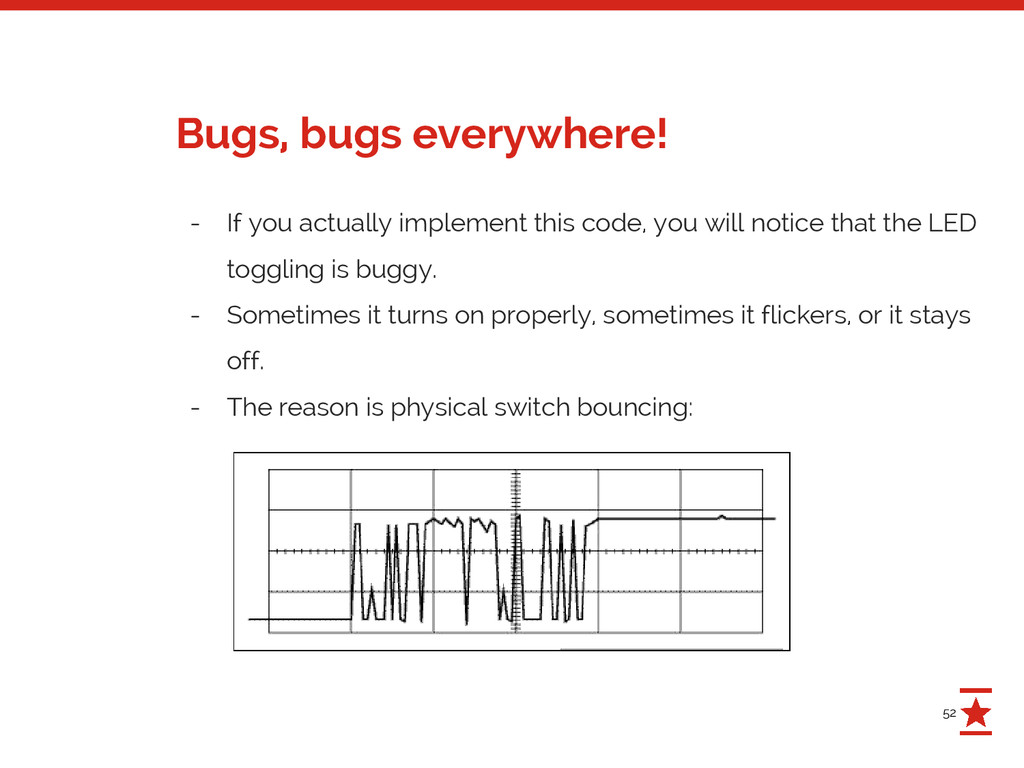
notice that the LED toggling is buggy. - Sometimes it turns on properly, sometimes it flickers, or it stays off. - The reason is physical switch bouncing: Bugs, bugs everywhere! -
53 Simple software debouncing is pretty straightforward: was_pressed = 0
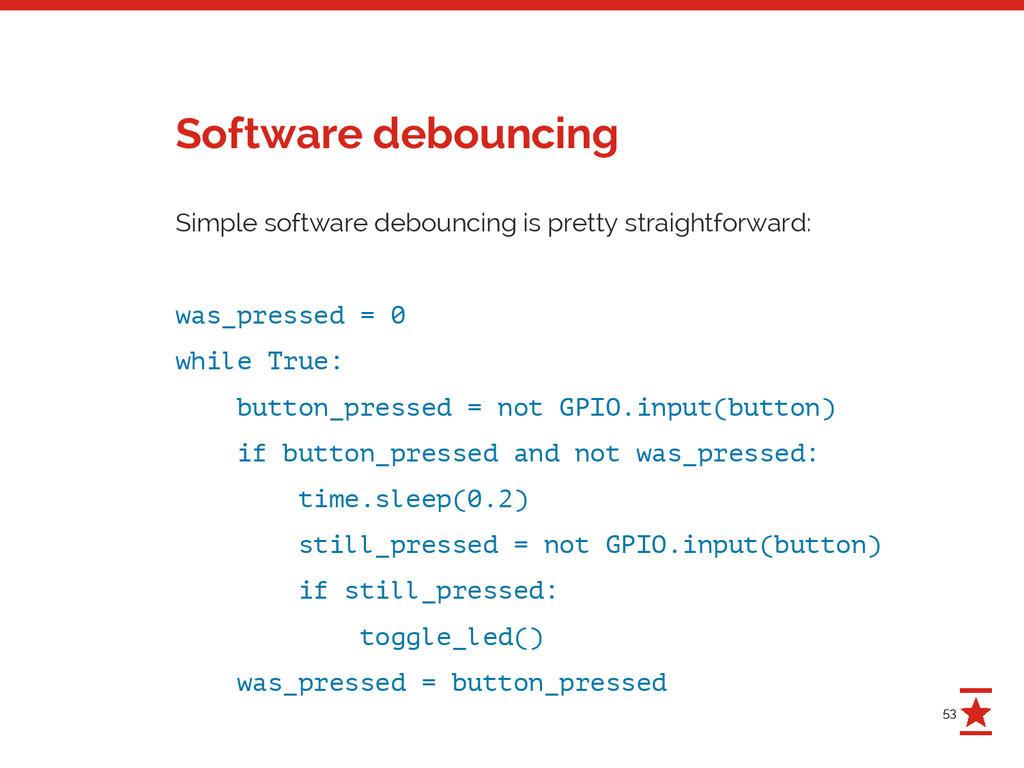
while True: button_pressed = not GPIO.input(button) if button_pressed and not was_pressed: time.sleep(0.2) still_pressed = not GPIO.input(button) if still_pressed: toggle_led() was_pressed = button_pressed Software debouncing -
54 We can also get this for free though: def
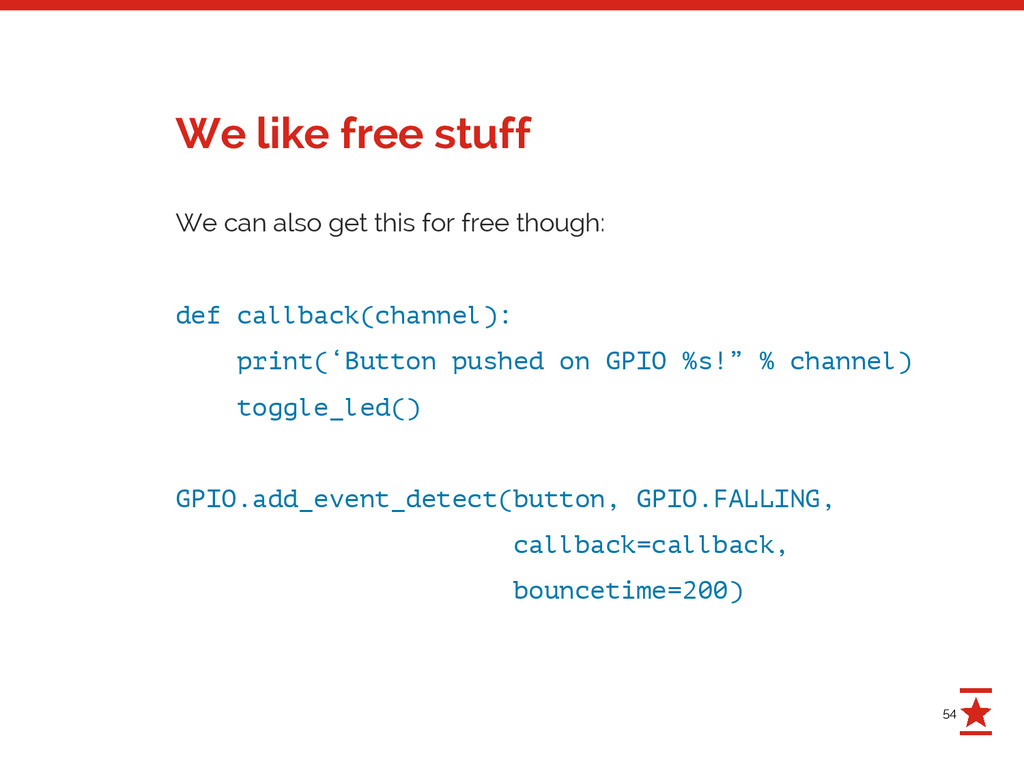
callback(channel): print(‘Button pushed on GPIO %s!” % channel) toggle_led() GPIO.add_event_detect(button, GPIO.FALLING, callback=callback, bouncetime=200) We like free stuff -
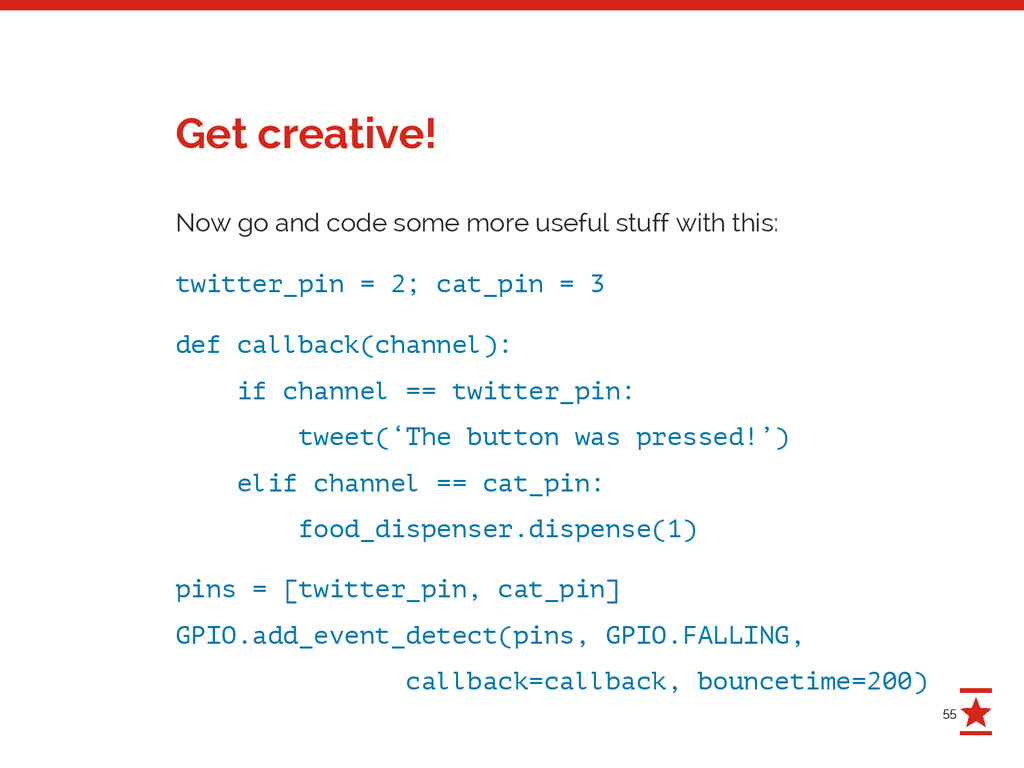
55 Now go and code some more useful stuff with
this: twitter_pin = 2; cat_pin = 3 def callback(channel): if channel == twitter_pin: tweet(‘The button was pressed!’) elif channel == cat_pin: food_dispenser.dispense(1) pins = [twitter_pin, cat_pin] GPIO.add_event_detect(pins, GPIO.FALLING, callback=callback, bouncetime=200) Get creative! -
56 6: Example: Using RPLCD A library for writing to
HD44780 character LCDs. -
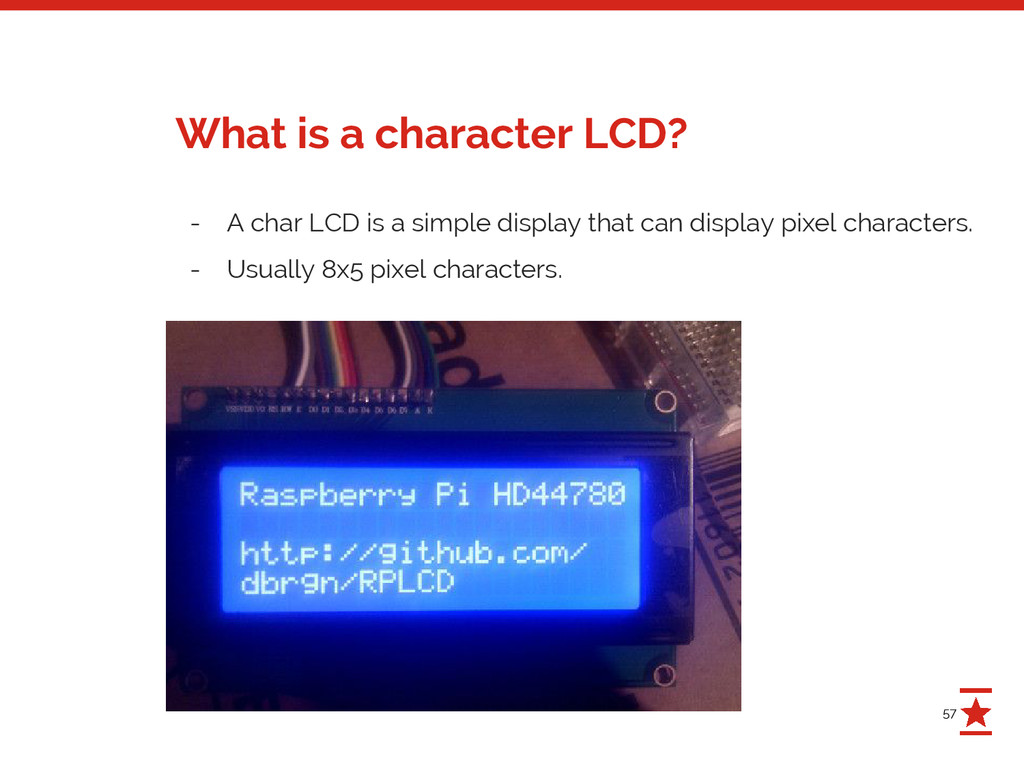
57 - A char LCD is a simple display that
can display pixel characters. - Usually 8x5 pixel characters. What is a character LCD? -
58 - A char LCD controlling chip by Hitachi -
The most widely used character LCD controller - Many compatible controllers not by Hitachi What is “HD44780”? -
59 - A Python library I wrote in 2013 to
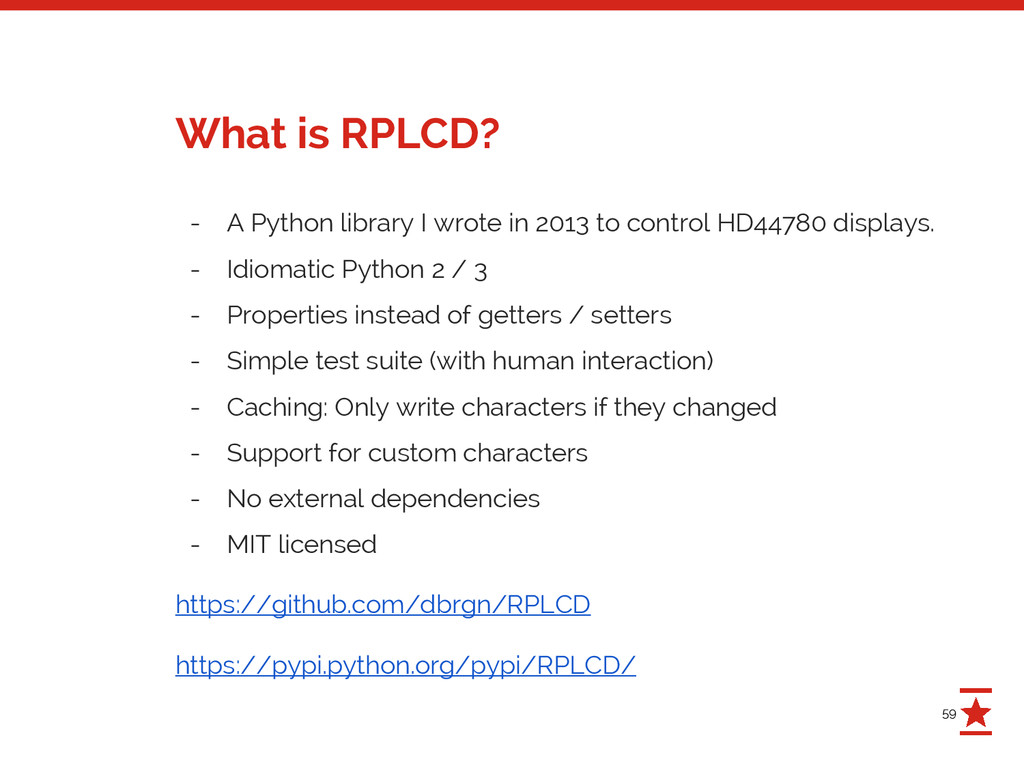
control HD44780 displays. - Idiomatic Python 2 / 3 - Properties instead of getters / setters - Simple test suite (with human interaction) - Caching: Only write characters if they changed - Support for custom characters - No external dependencies - MIT licensed https://github.com/dbrgn/RPLCD https://pypi.python.org/pypi/RPLCD/ What is RPLCD? -
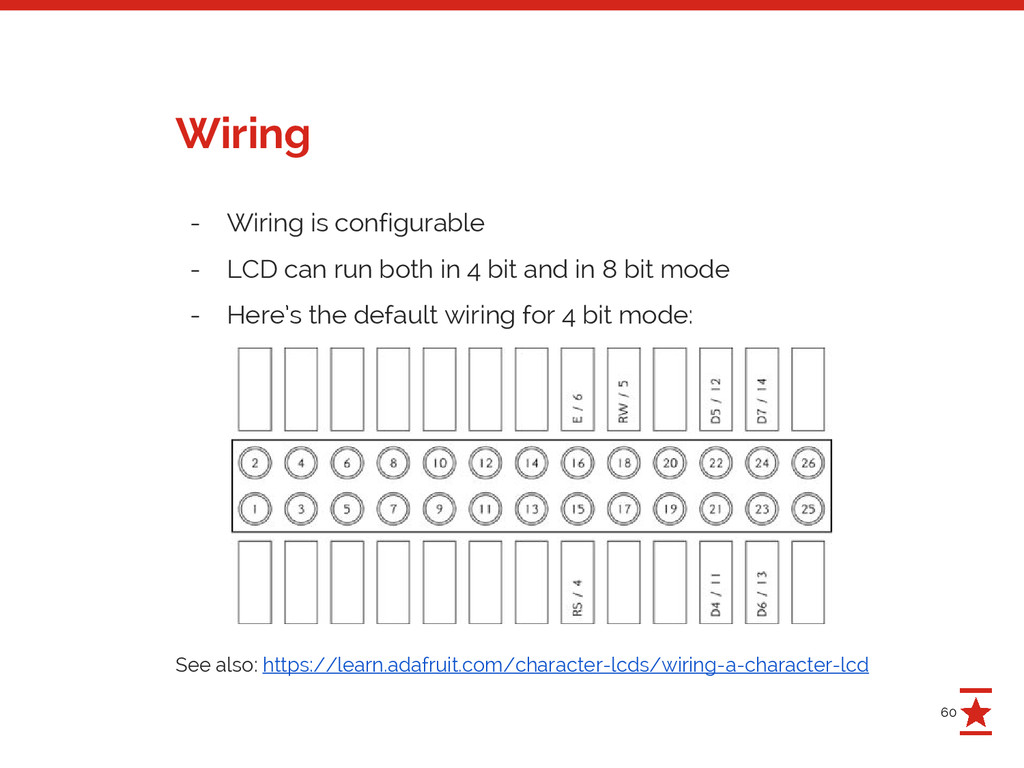
60 - Wiring is configurable - LCD can run both
in 4 bit and in 8 bit mode - Here’s the default wiring for 4 bit mode: See also: https://learn.adafruit.com/character-lcds/wiring-a-character-lcd Wiring -
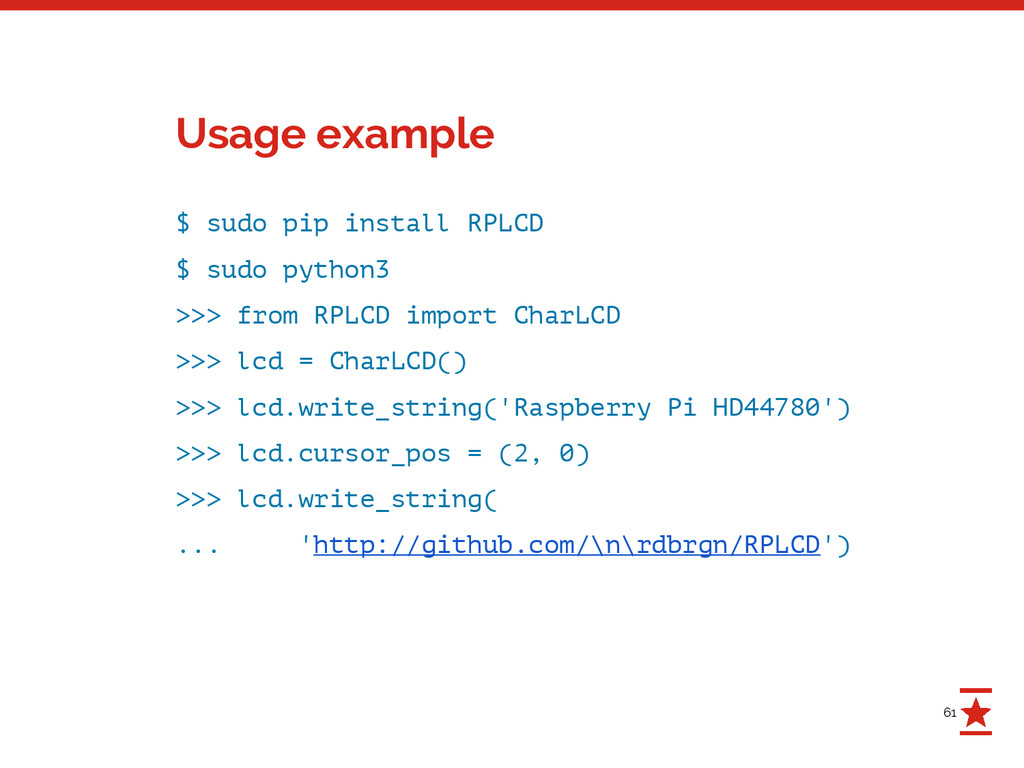
61 $ sudo pip install RPLCD $ sudo python3 >>>
from RPLCD import CharLCD >>> lcd = CharLCD() >>> lcd.write_string('Raspberry Pi HD44780') >>> lcd.cursor_pos = (2, 0) >>> lcd.write_string( ... 'http://github.com/\n\rdbrgn/RPLCD') Usage example -
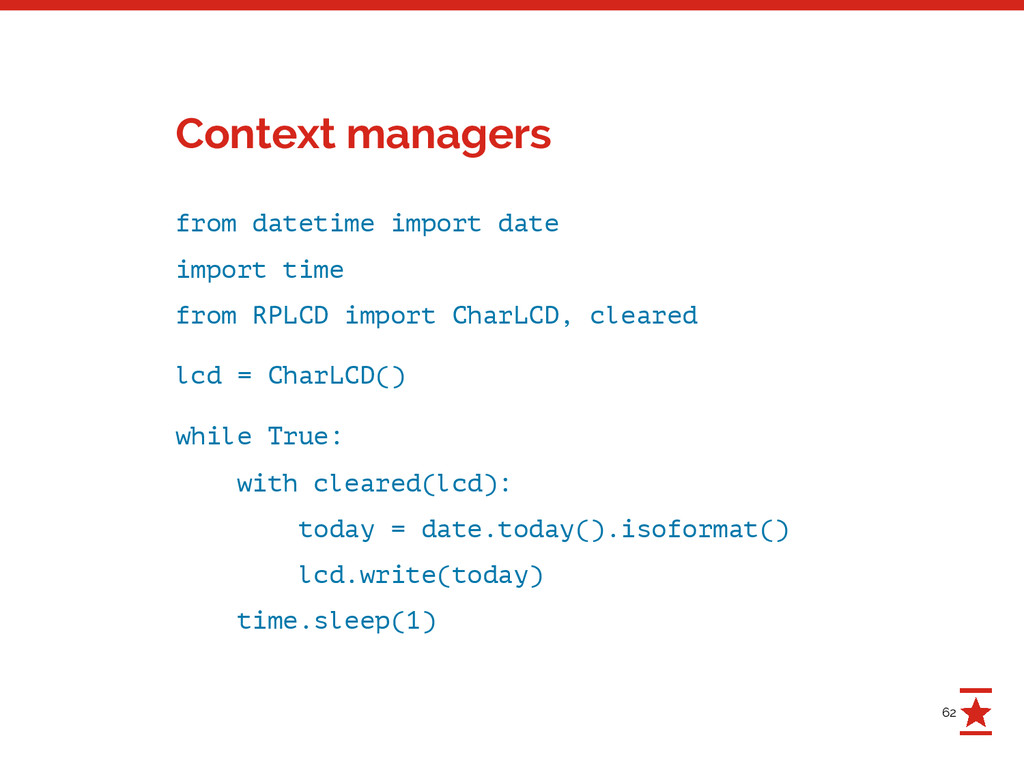
62 from datetime import date import time from RPLCD import
CharLCD, cleared lcd = CharLCD() while True: with cleared(lcd): today = date.today().isoformat() lcd.write(today) time.sleep(1) Context managers -
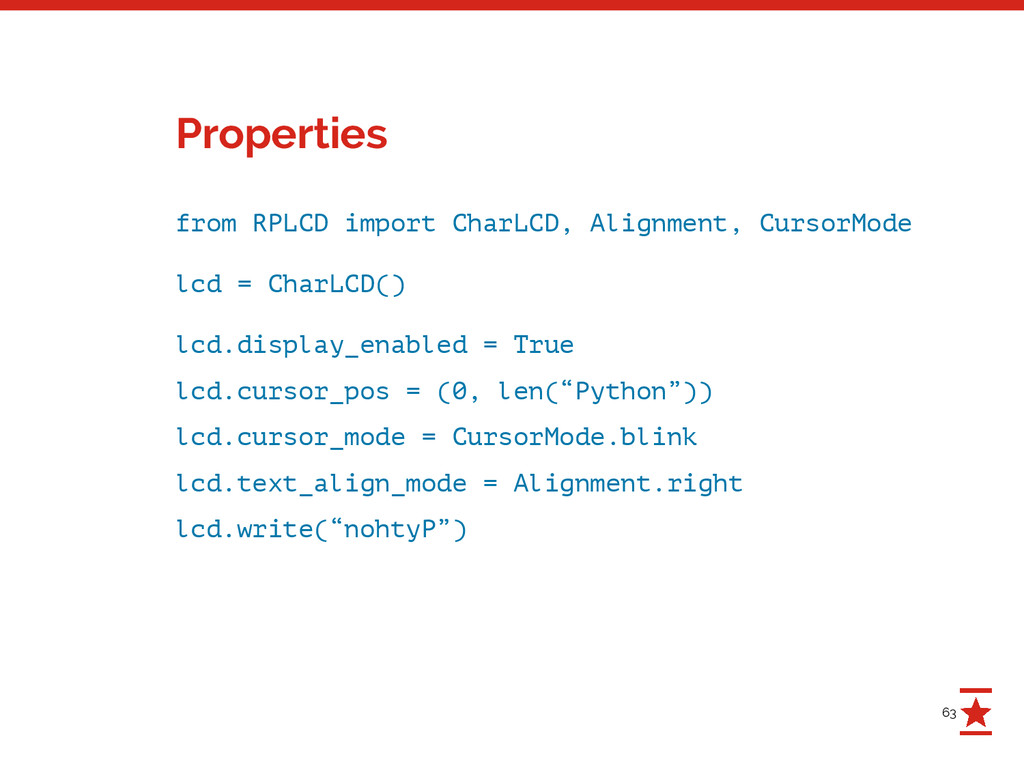
63 from RPLCD import CharLCD, Alignment, CursorMode lcd = CharLCD()
lcd.display_enabled = True lcd.cursor_pos = (0, len(“Python”)) lcd.cursor_mode = CursorMode.blink lcd.text_align_mode = Alignment.right lcd.write(“nohtyP”) Properties -
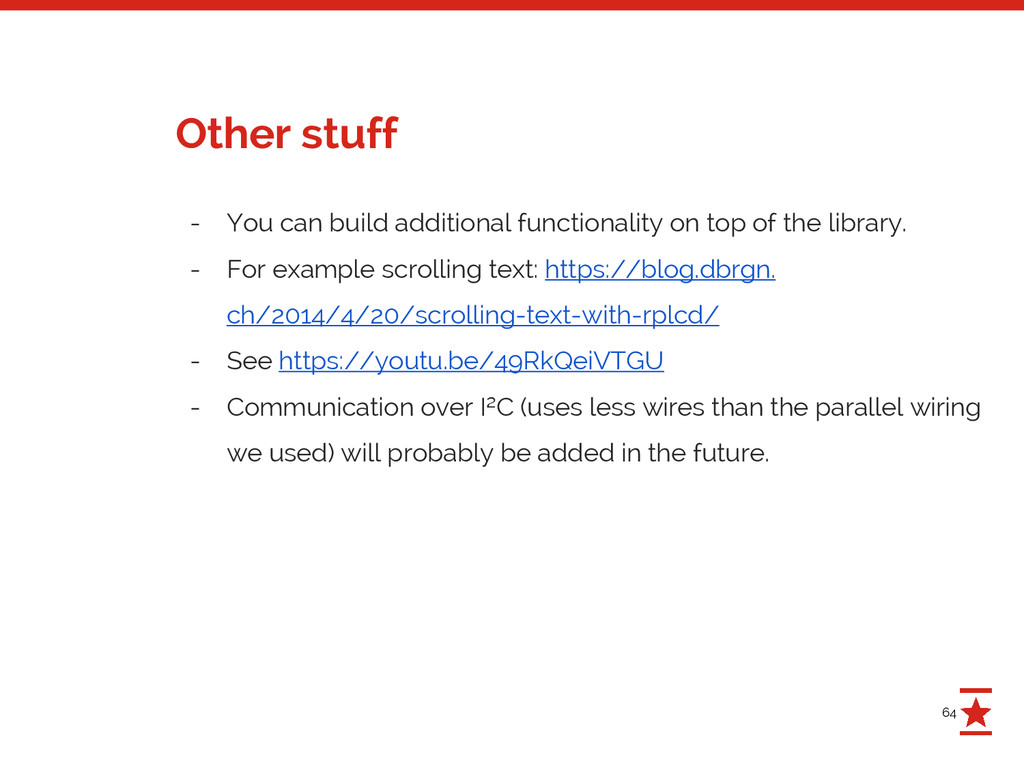
64 - You can build additional functionality on top of
the library. - For example scrolling text: https://blog.dbrgn. ch/2014/4/20/scrolling-text-with-rplcd/ - See https://youtu.be/49RkQeiVTGU - Communication over I²C (uses less wires than the parallel wiring we used) will probably be added in the future. Other stuff -
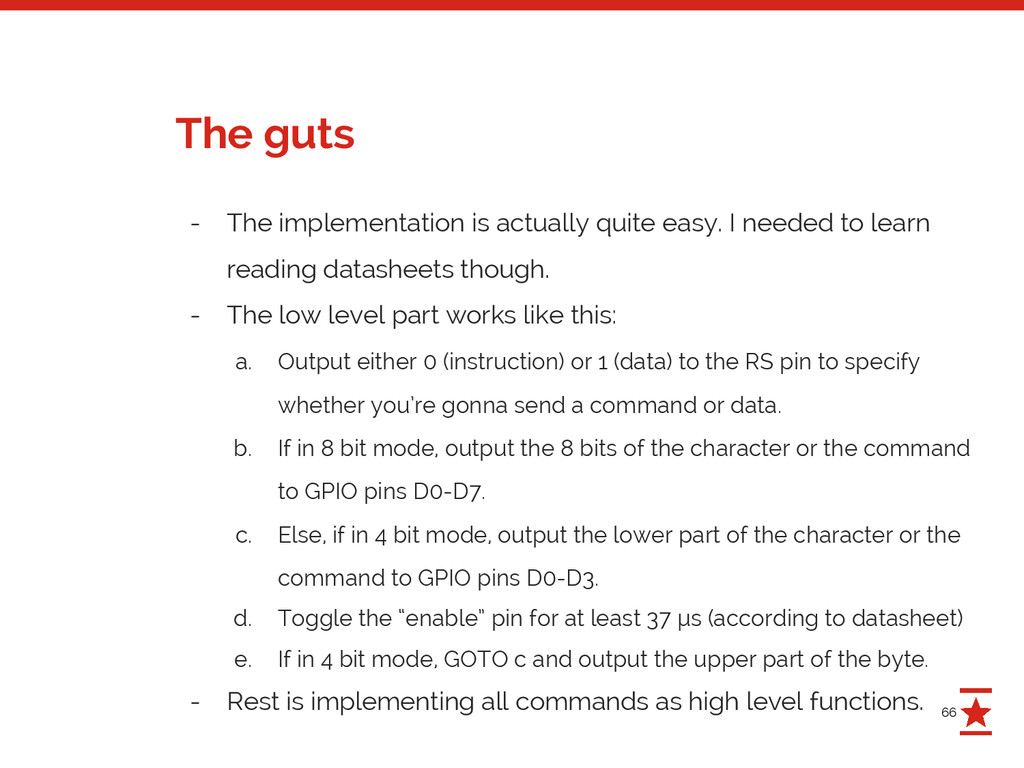
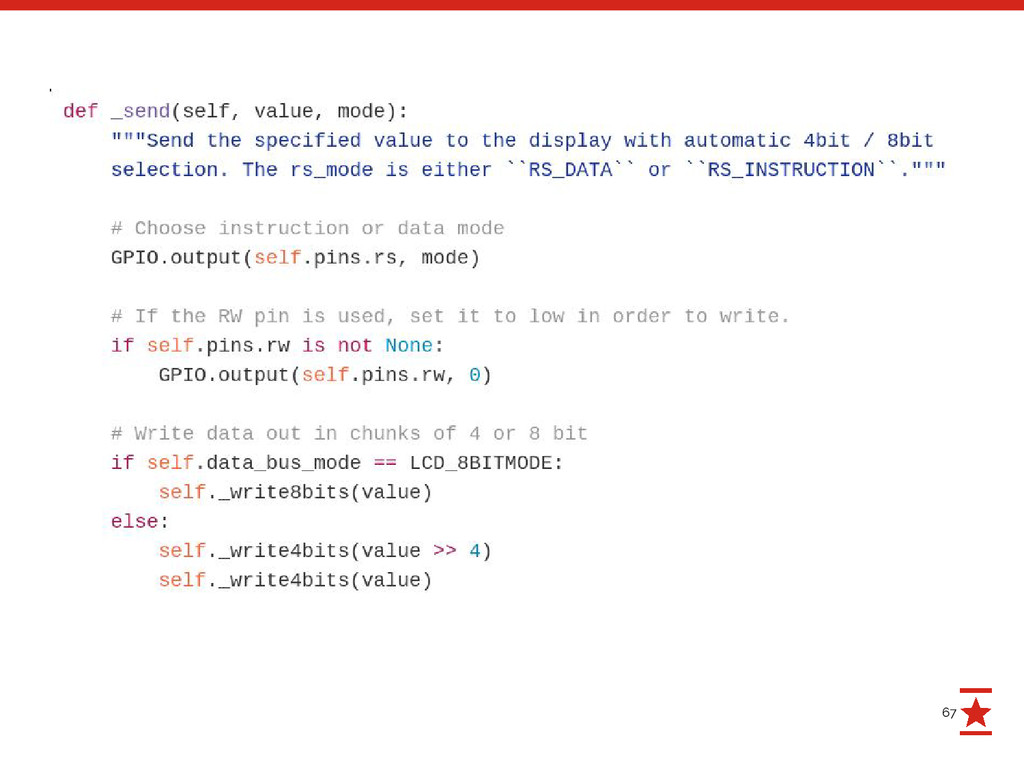
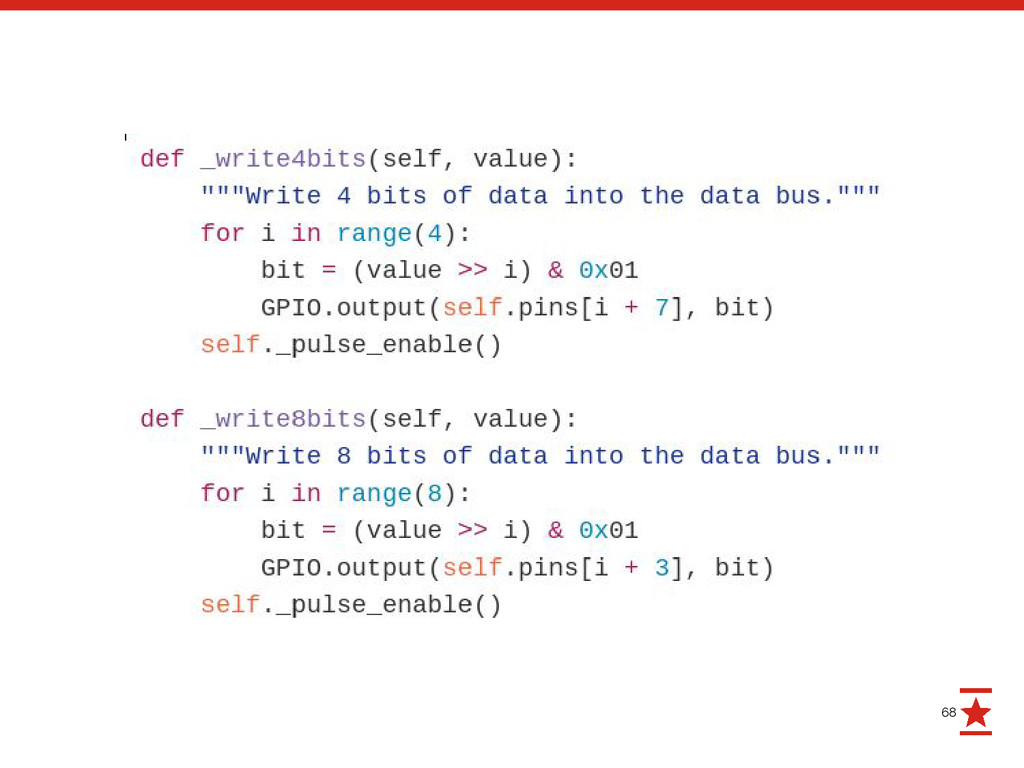
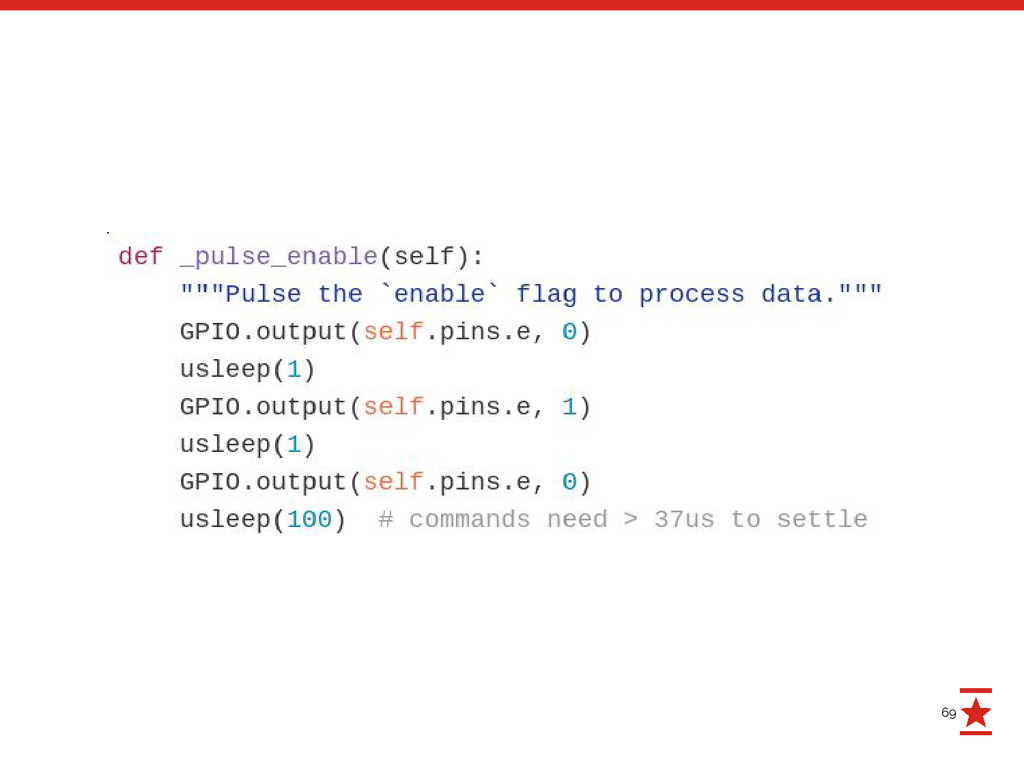
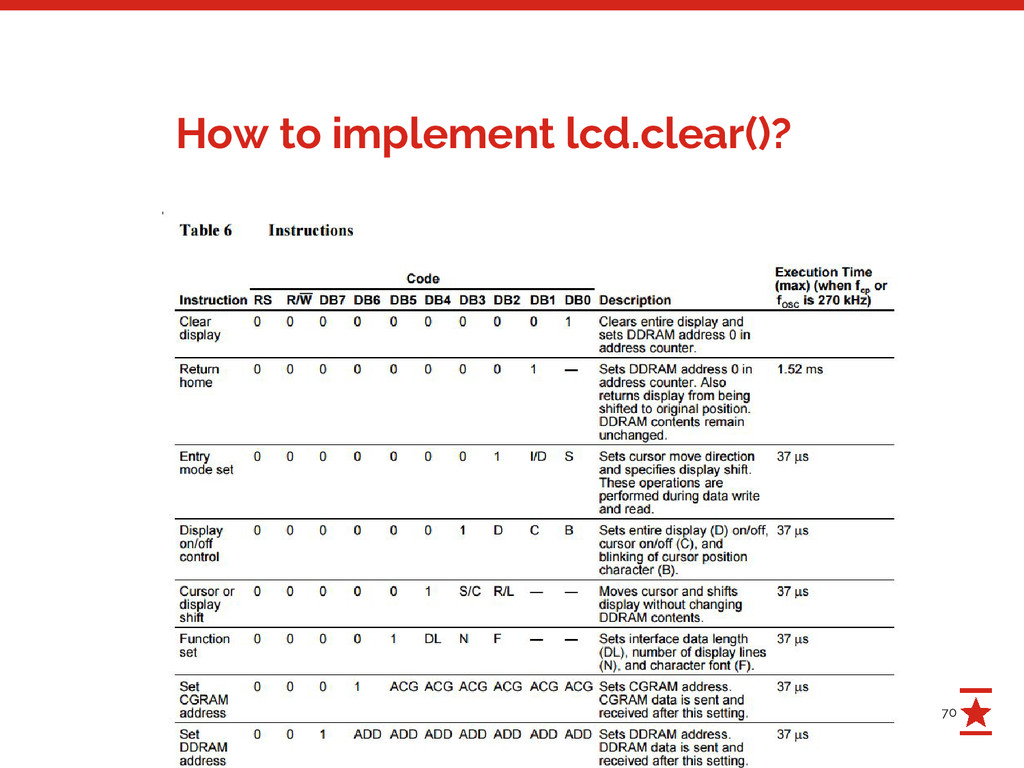
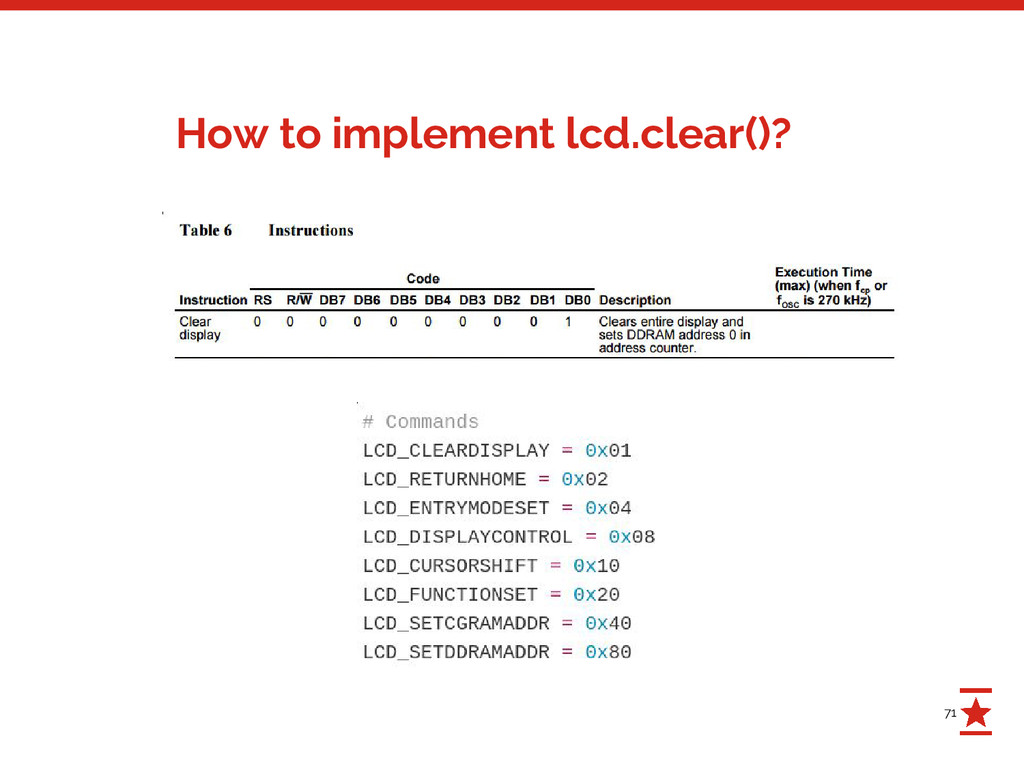
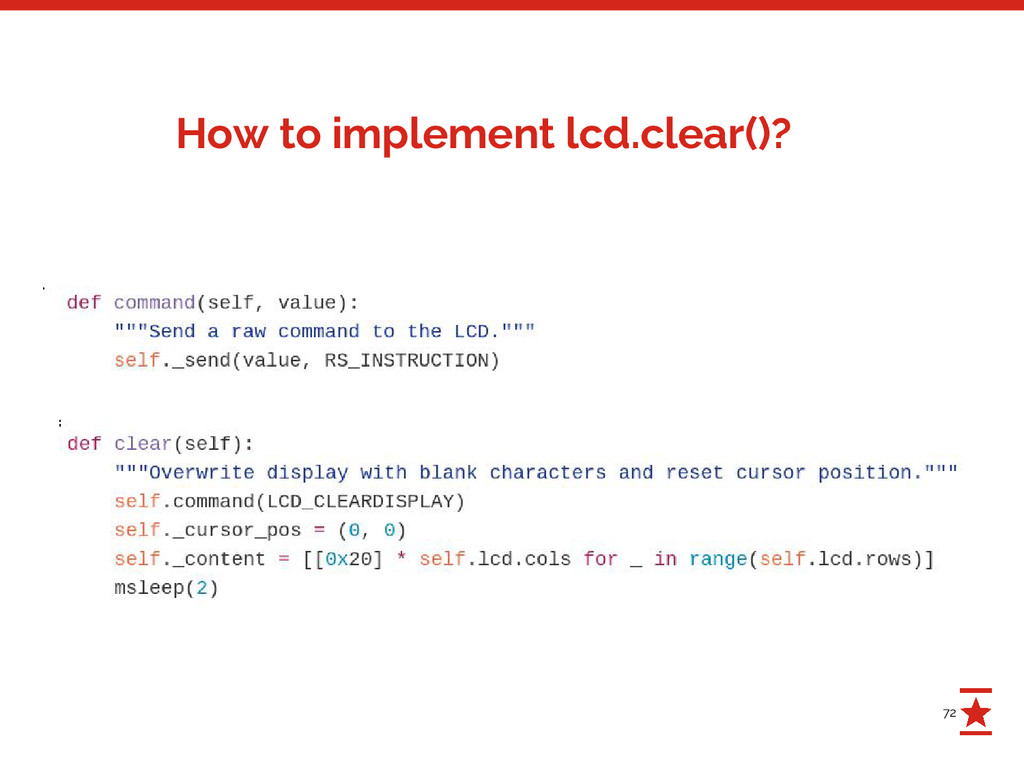
66 - The implementation is actually quite easy. I needed
to learn reading datasheets though. - The low level part works like this: a. Output either 0 (instruction) or 1 (data) to the RS pin to specify whether you’re gonna send a command or data. b. If in 8 bit mode, output the 8 bits of the character or the command to GPIO pins D0-D7. c. Else, if in 4 bit mode, output the lower part of the character or the command to GPIO pins D0-D3. d. Toggle the “enable” pin for at least 37 µs (according to datasheet) e. If in 4 bit mode, GOTO c and output the upper part of the byte. - Rest is implementing all commands as high level functions. The guts -
73 It’s possible! Thank you. Slides will be available here:
https://speakerdeck.com/dbrgn