$30 off During Our Annual Pro Sale. View Details »

Architectural Extensions

Architectural Extensions

The extension layers take care of various aspects:
* Middleware – communication and deployment.
* Shared Repository – persistence and synchronization.
* Proxy – protocols, routing, and security.
* Orchestrator – integration and use cases.
* Combined Component – multiple aspects.

Avatar for Denys Poltorak

Denys Poltorak

December 24, 2025
Tweet

More Decks by Denys Poltorak

Other Decks in Programming

Transcript

  1. The extension layers take care of various aspects: • Middleware

    – communication and deployment. • Shared Repository – persistence and synchronization. • Proxy – protocols, routing, and security. • Orchestrator – integration and use cases. • Combined Component – multiple aspects. Contents
  2. In most cases we’ll be adding layers to a system

    of subdomain Services. However, the same techniques tend to work with Shards or even Layers. The components are color-coded Schema
  3. Middleware – overview A Middleware is a system-wide layer which

    provides other system components with means of communication. A Middleware may function as: • A Message Broker – it lets its users message or call each other in a uniform manner. • A Deployment Manager – it supervises scaling and error recovery of the services it hosts. Middleware helps communication and scaling in complex systems. But it may be overly generic for high-load or low latency cases. Middleware
  4. Middleware – trade-offs Encapsulates connectivity concerns Takes care of scaling

    of components Is available off the shelf May increase latency May not support specialized transports May become a single point of failure
  5. A Middleware works in one of the following addressing modes:

    • Channels (one to one) – two components establish a communication channel. Anything pushed to one end of the channel pops out of its other end. • Actors (many to one) – every component has a public mailbox. Any component that knows its name or address can post there a message. • Publish / subscribe (one to many) – a component published updates to a topic. Other components that subscribe to the topic are notified of the updates. • Gossip (many to many) – every replica of a component periodically synchronizes its state with other random replica. Middleware – addressing
  6. A Middleware can be used in the following ways: •

    Notifications – a component sends a message that indicates that an event has happened and continues its tasks. It is up to other components to subscribe to the message and continue the use case (choreography). • Request / confirm – a component sends a request to another component (orchestration) and proceeds to its other tasks (Proactor). As soon as it receives the confirmation for its original request, it returns to its original task. • Remote procedure call (RPC) – a component sends a request (orchestration) and blocks (Reactor) on the Middleware till it receives the corresponding confirmation. Then in continues its task. Middleware – flow
  7. As networks and components tend to fail, messages may be

    lost or duplicated: • Exactly once – the slowest mode of communication, often implemented with distributed transactions. Fits financial applications. • At least once – messages are re-delivered on failure, risking a duplication. Therefore message processing should be idempotent. • At most once – a message is lost on any failure. This is acceptable when the data that comes in messages is aggregated, as with weather sensors. • At will (no guarantee) – raw UDP traffic that allows for message loss, duplication, and reordering. It is fast, simple, and stupid, but now the application itself must ensure message order and validity. Middleware – delivery guarantee
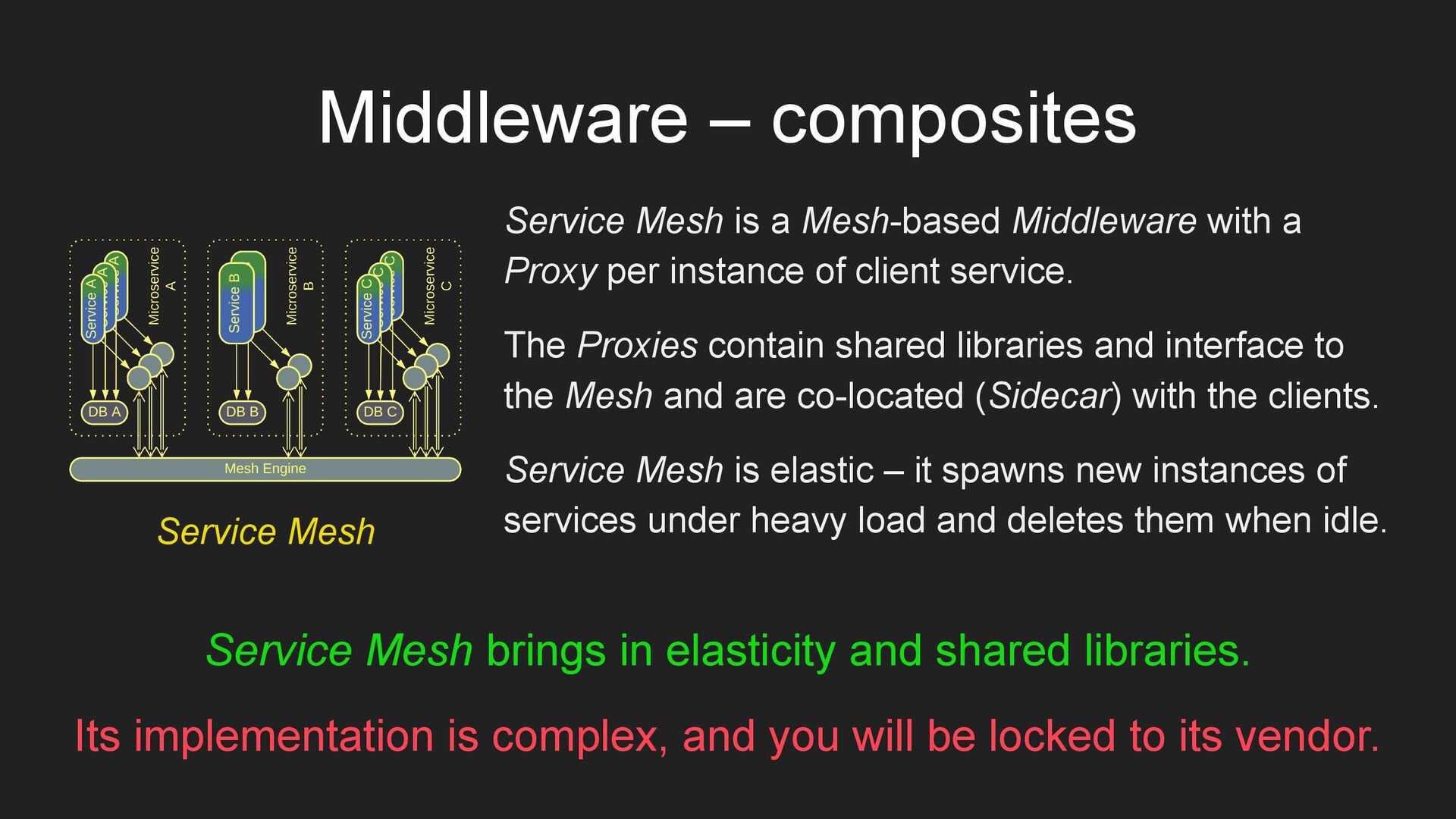
  8. Middleware – composites Service Mesh is a Mesh-based Middleware with

    a Proxy per instance of client service. The Proxies contain shared libraries and interface to the Mesh and are co-located (Sidecar) with the clients. Service Mesh is elastic – it spawns new instances of services under heavy load and deletes them when idle. Service Mesh brings in elasticity and shared libraries. Its implementation is complex, and you will be locked to its vendor. Service Mesh
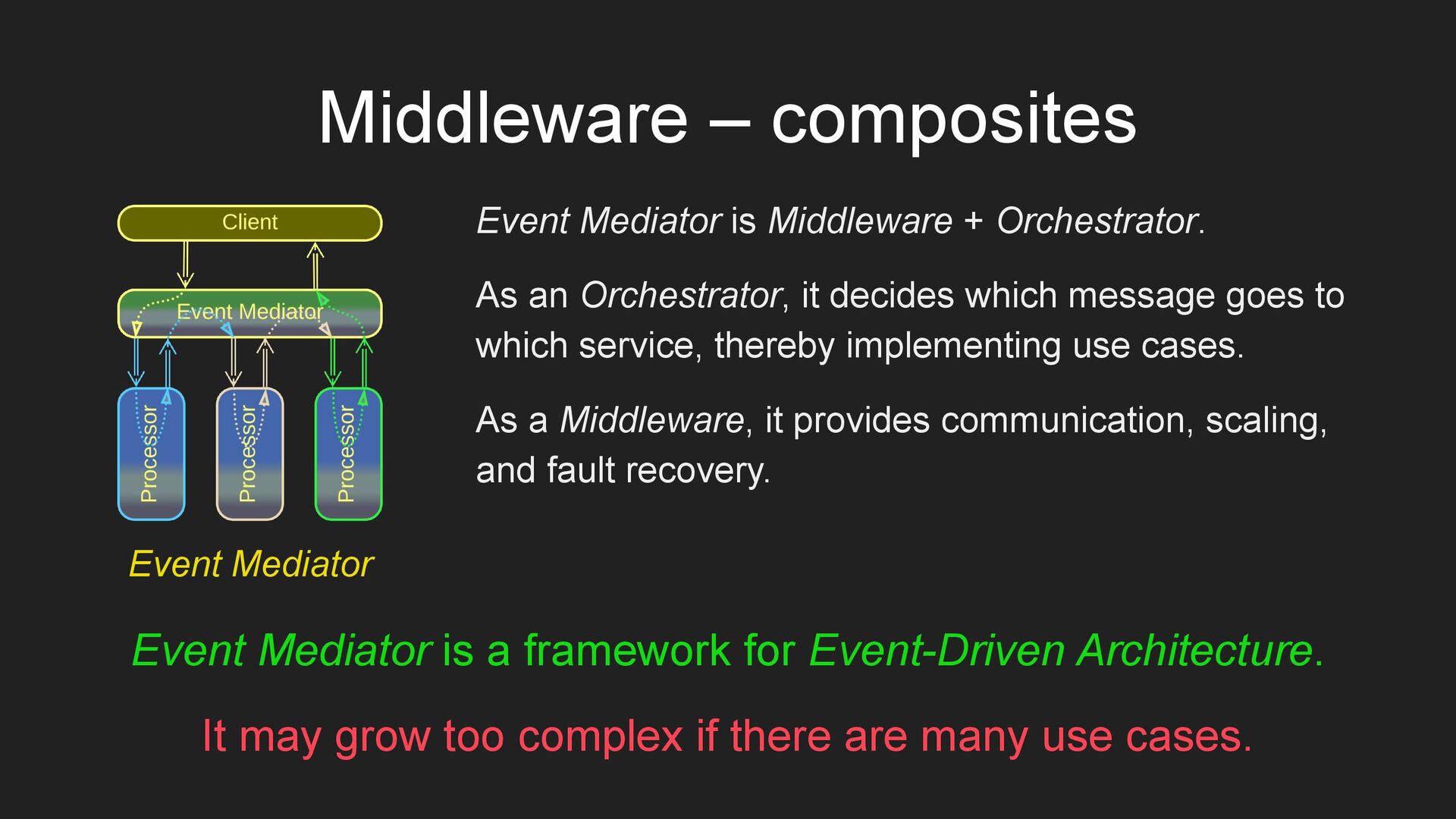
  9. Middleware – composites Event Mediator is Middleware + Orchestrator. As

    an Orchestrator, it decides which message goes to which service, thereby implementing use cases. As a Middleware, it provides communication, scaling, and fault recovery. Event Mediator is a framework for Event-Driven Architecture. It may grow too complex if there are many use cases. Event Mediator
  10. Middleware – composites Message Bus is a Middleware with an

    Adapter per client component. The Adapters translate between the components’ protocols and the protocol used inside the Message Bus. That enables the integration of legacy subsystems without making them communicate in a uniform manner. Message Bus allows for integrating legacy services. However, protocol translation slows down the communication. Message Bus
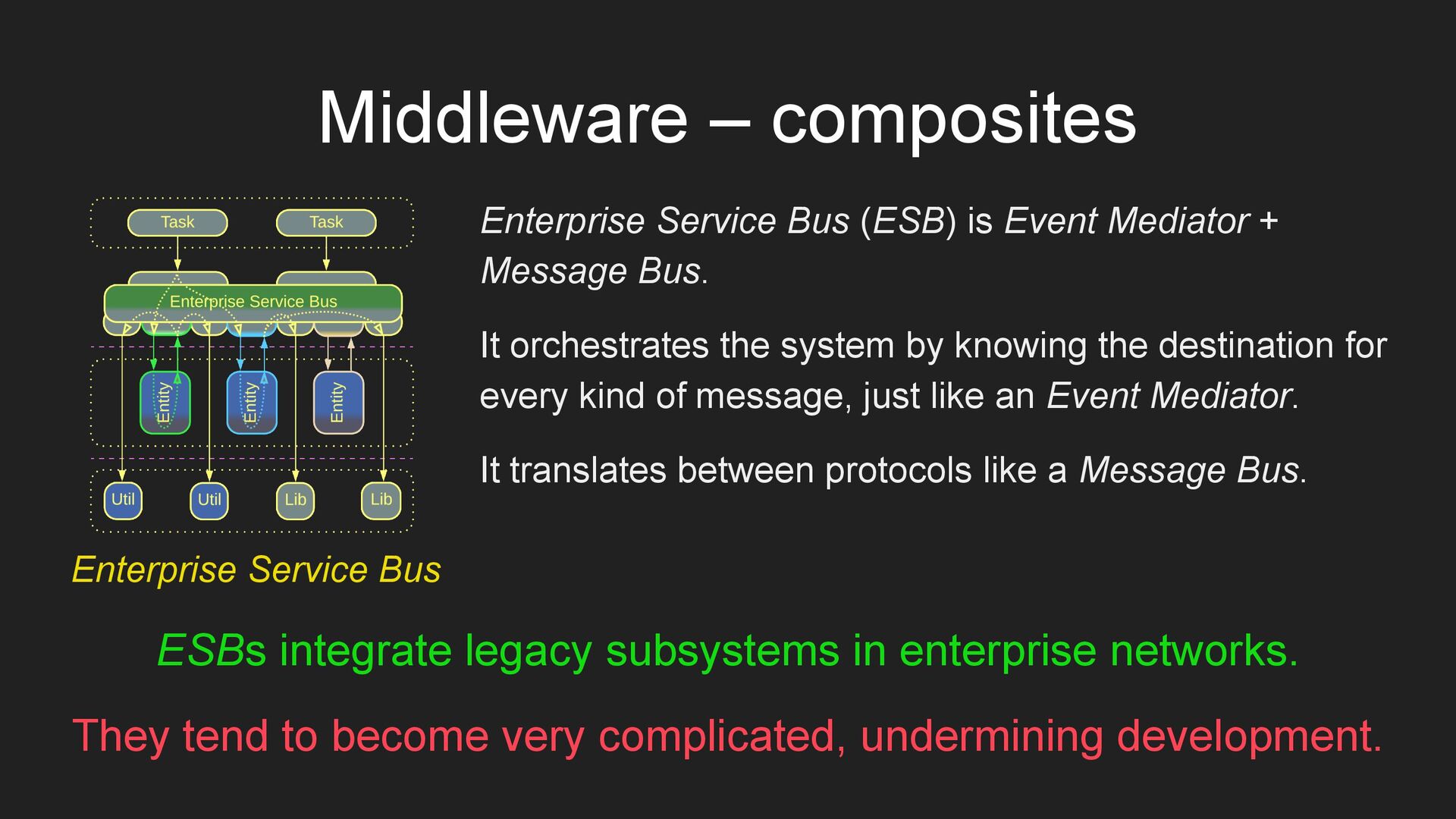
  11. Middleware – composites Enterprise Service Bus (ESB) is Event Mediator

    + Message Bus. It orchestrates the system by knowing the destination for every kind of message, just like an Event Mediator. It translates between protocols like a Message Bus. ESBs integrate legacy subsystems in enterprise networks. They tend to become very complicated, undermining development. Enterprise Service Bus
  12. Shared Repository – overview A Shared Repository is a data

    layer shared by other system components. Its functions include: • Persistence – storing the data. • Consistency – providing atomic transactions. • Notifications – letting a component know when data changes. Shared Repository enables data-centric or simple projects. It may not be flexible enough for high-load or evolving domains. Shared Repository
  13. Shared Repository – trade-offs Supports coupled data Grants data consistency

    Helps saving on hardware and administration Allows for a quick start of a project Couples its clients to a shared schema Has a limited scalability May not fit the needs of its clients equally well May be a single point of failure
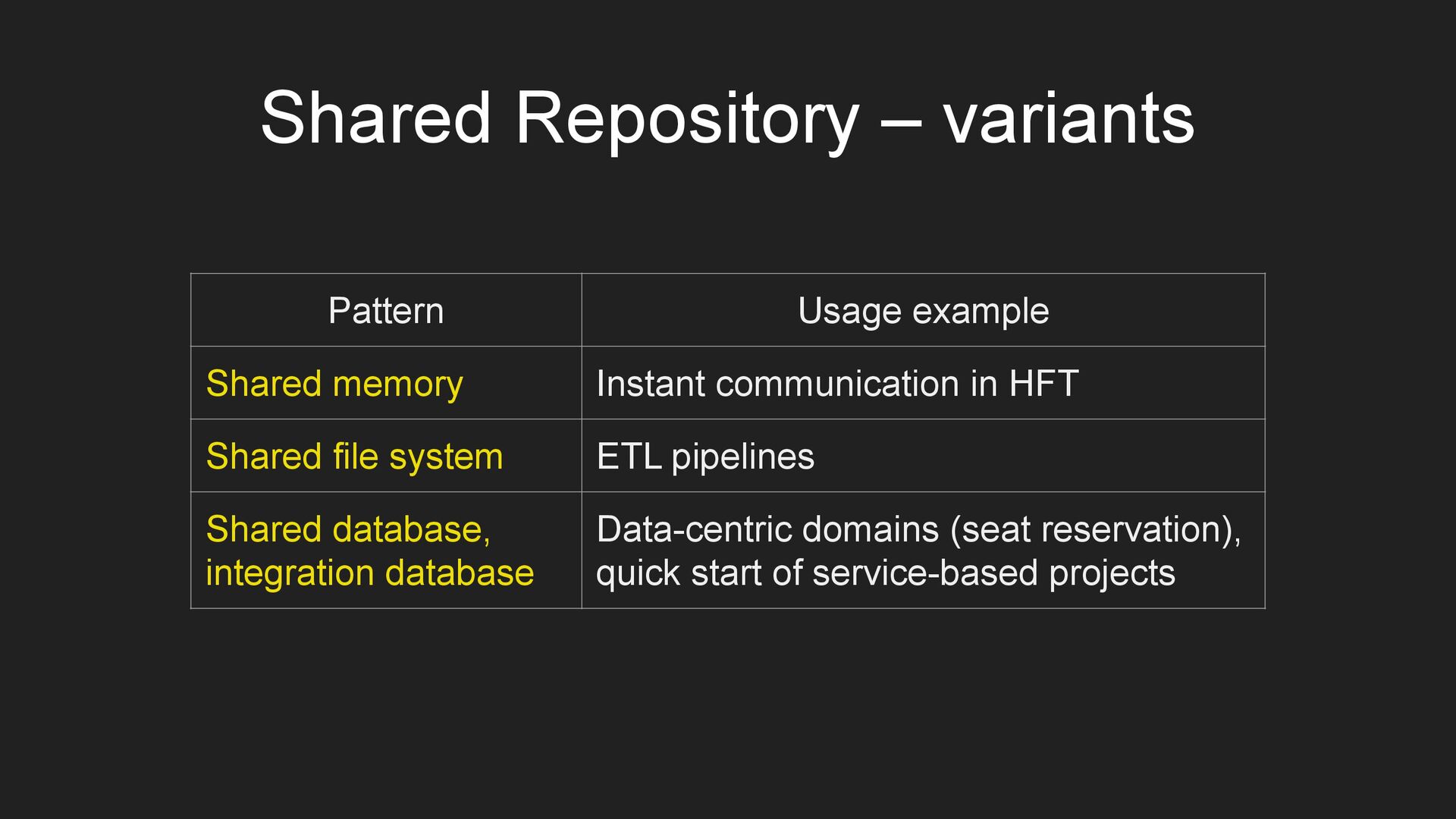
  14. Shared Repository – variants Pattern Usage example Shared memory Instant

    communication in HFT Shared file system ETL pipelines Shared database, integration database Data-centric domains (seat reservation), quick start of service-based projects
  15. Shared Repository – examples Blackboard was used for non-deterministic calculations.

    An individual algorithm (knowledge source) reads whatever inputs it needs from the blackboard and adds its output to the blackboard. The scheduler (control) chooses the best algorithm to run next based on the data currently available on the blackboard. Blackboard
  16. Shared Repository – examples Data Grid is a virtual shared

    dictionary that runs in a Mesh. It is the foundation of Space-Based Architecture. Every instance of every service in the system has a replica of the entire system’s dataset. When a service ()writes to its replica, the Data Replication Engine copies the changes to every other system component. The changes are also persisted to a database. Data Grid Data Grid is extremely scalable and elastic... …but frequent writes may result in conflicts.
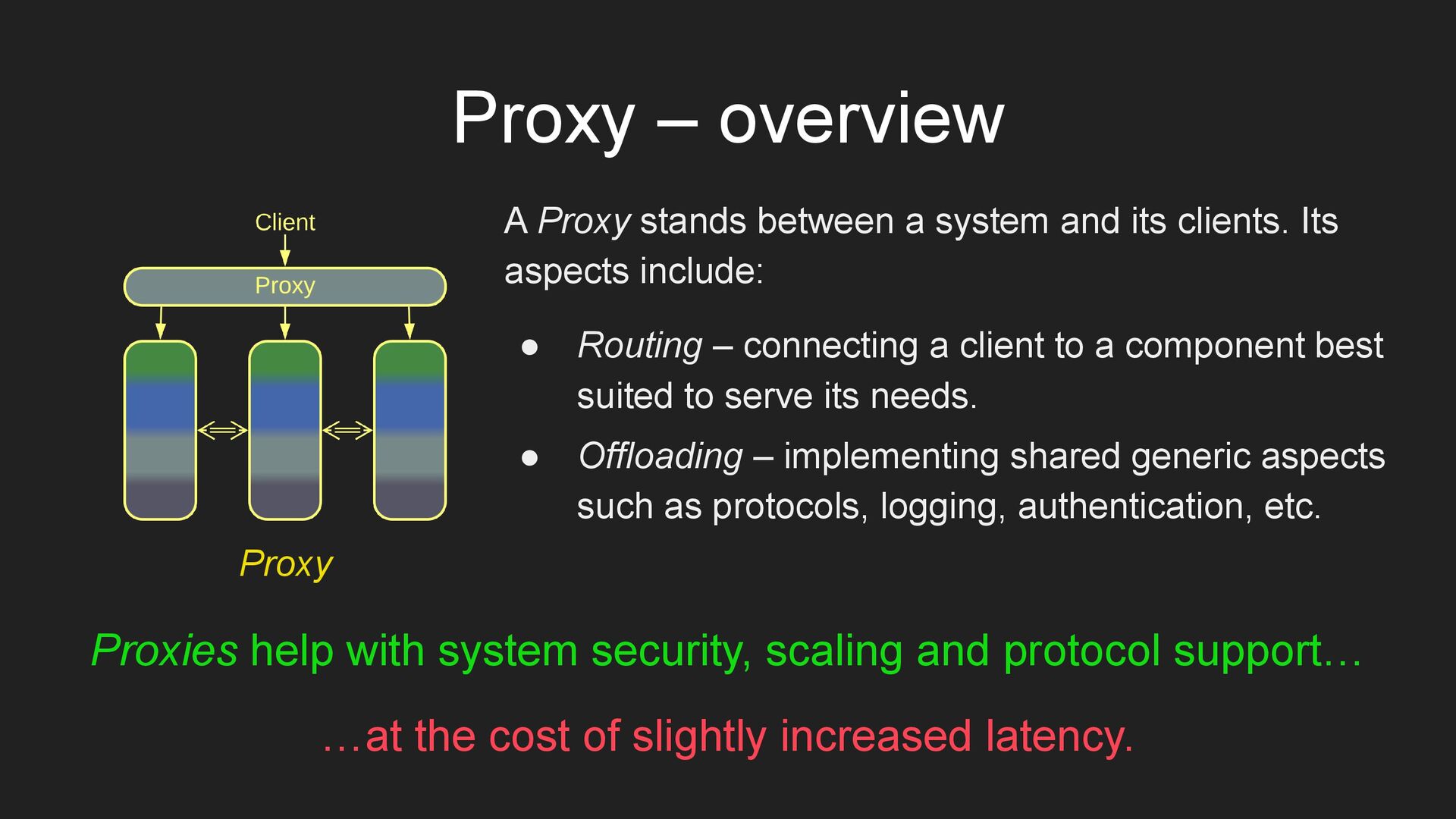
  17. Proxy – overview A Proxy stands between a system and

    its clients. Its aspects include: • Routing – connecting a client to a component best suited to serve its needs. • Offloading – implementing shared generic aspects such as protocols, logging, authentication, etc. Proxies help with system security, scaling and protocol support… …at the cost of slightly increased latency. Proxy
  18. Proxy – trade-offs Implements cross-cutting concerns Decouples the system from

    its clients Acts as a secure perimeter Is available off the shelf Most kinds of Proxies degrade latency May be a single point of failure
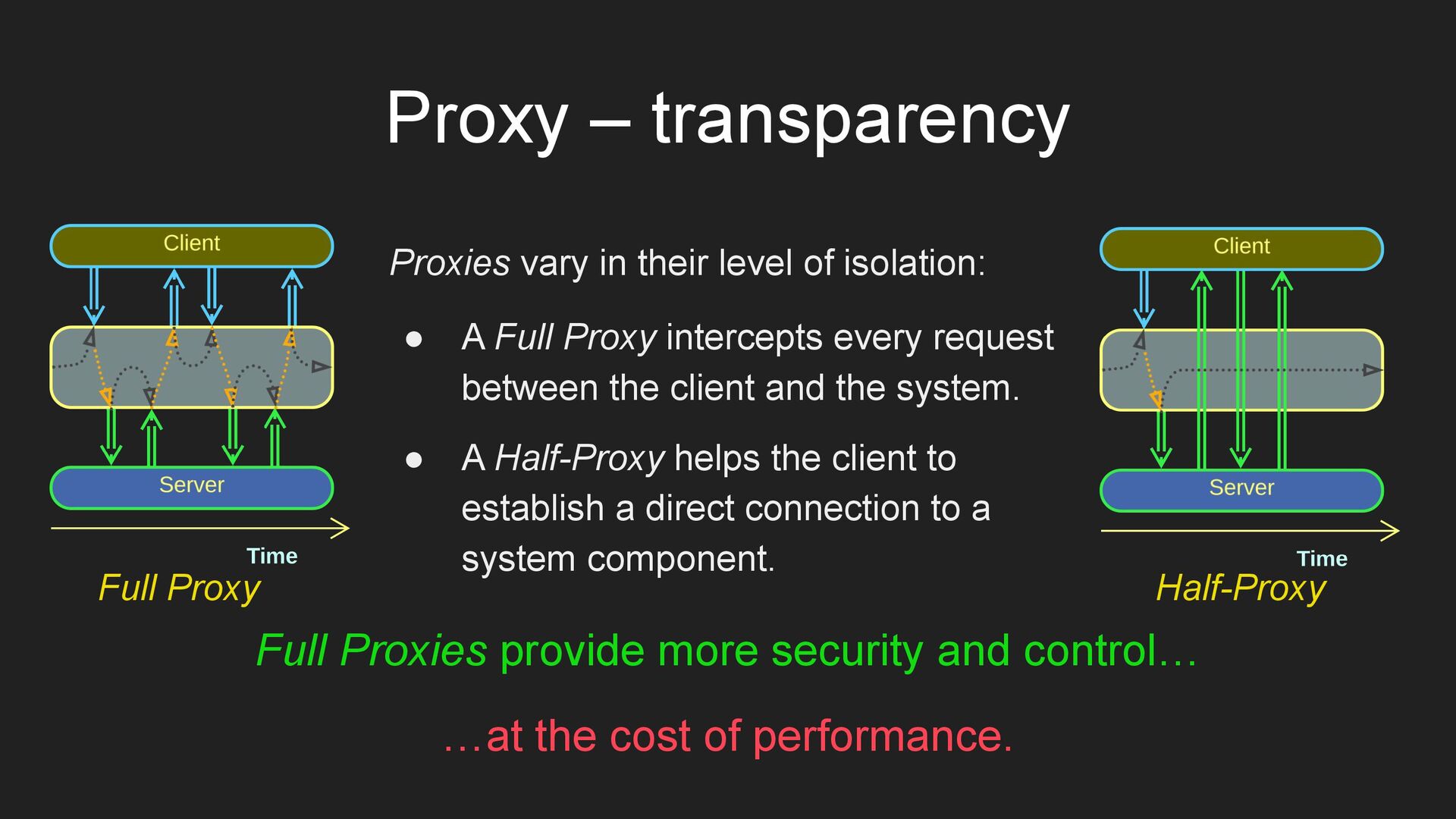
  19. Full Proxies provide more security and control… …at the cost

    of performance. Proxies vary in their level of isolation: • A Full Proxy intercepts every request between the client and the system. • A Half-Proxy helps the client to establish a direct connection to a system component. Full Proxy Half-Proxy Proxy – transparency
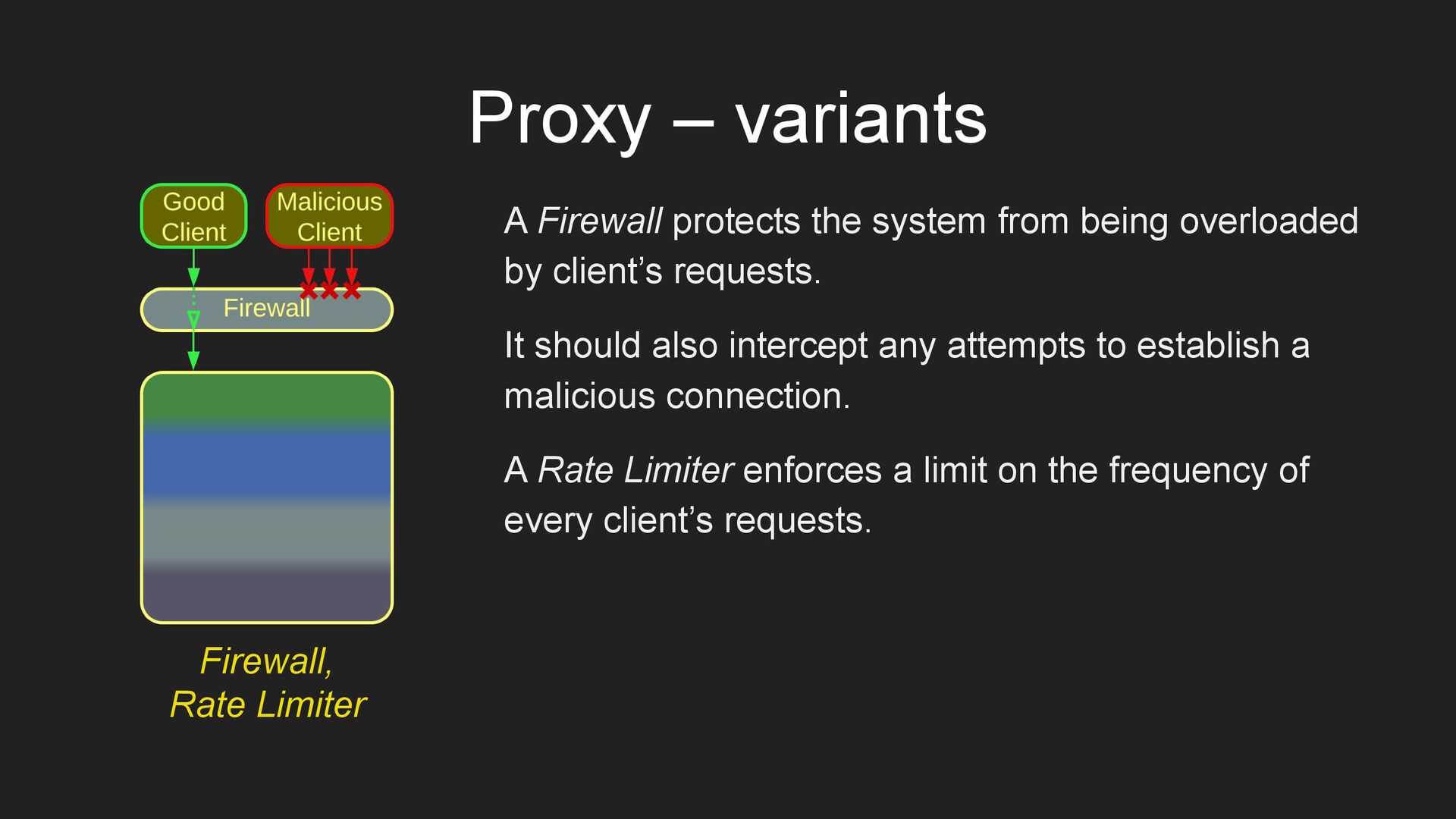
  20. Proxy – variants A Firewall protects the system from being

    overloaded by client’s requests. It should also intercept any attempts to establish a malicious connection. A Rate Limiter enforces a limit on the frequency of every client’s requests. Firewall, Rate Limiter
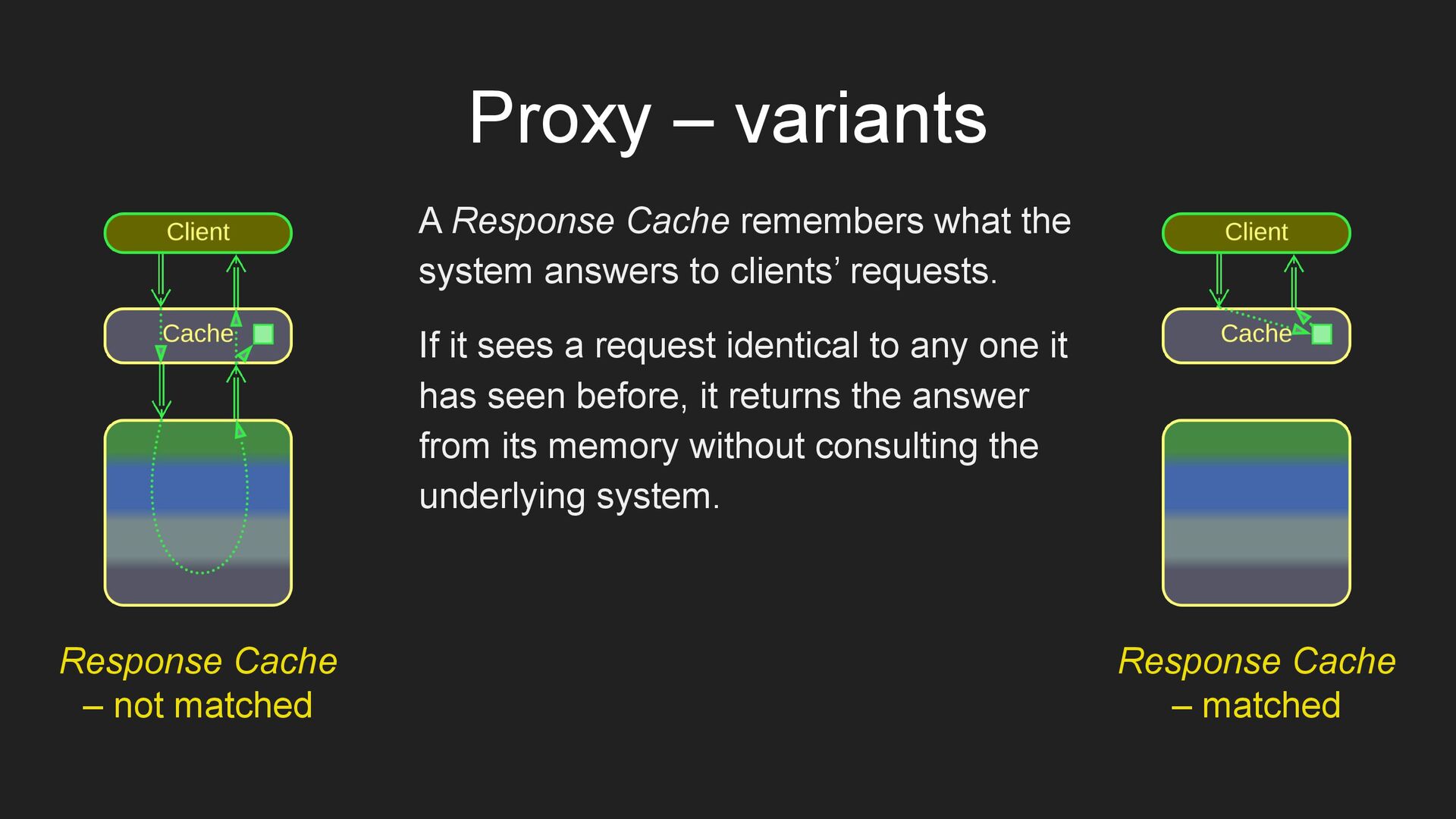
  21. Proxy – variants A Response Cache remembers what the system

    answers to clients’ requests. If it sees a request identical to any one it has seen before, it returns the answer from its memory without consulting the underlying system. Response Cache – not matched Response Cache – matched
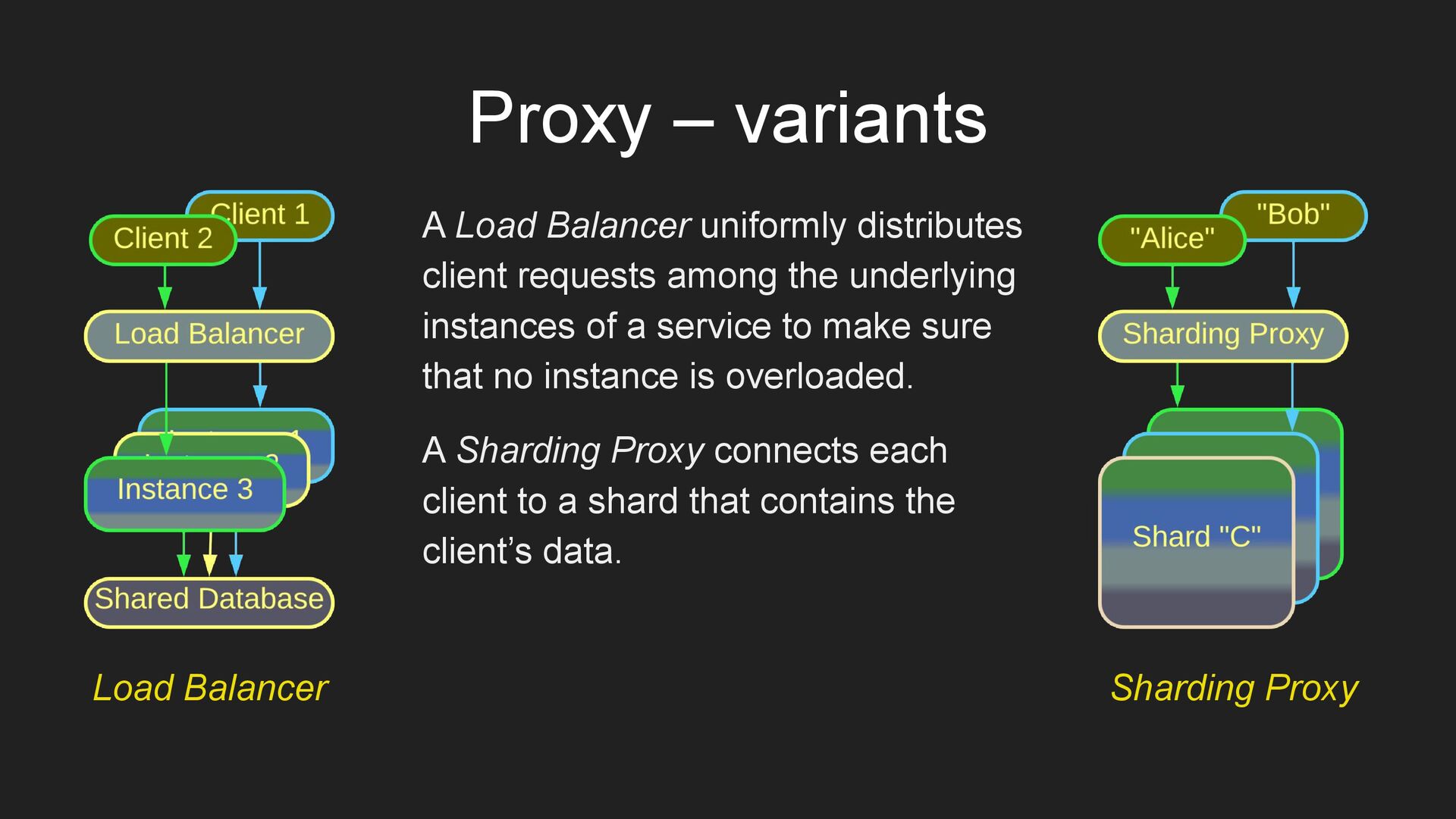
  22. Proxy – variants A Load Balancer uniformly distributes client requests

    among the underlying instances of a service to make sure that no instance is overloaded. A Sharding Proxy connects each client to a shard that contains the client’s data. Load Balancer Sharding Proxy
  23. Proxy – variants A Reverse Proxy forwards a client’s request

    to the service which knows how to handle it. Reverse Proxy, Dispatcher
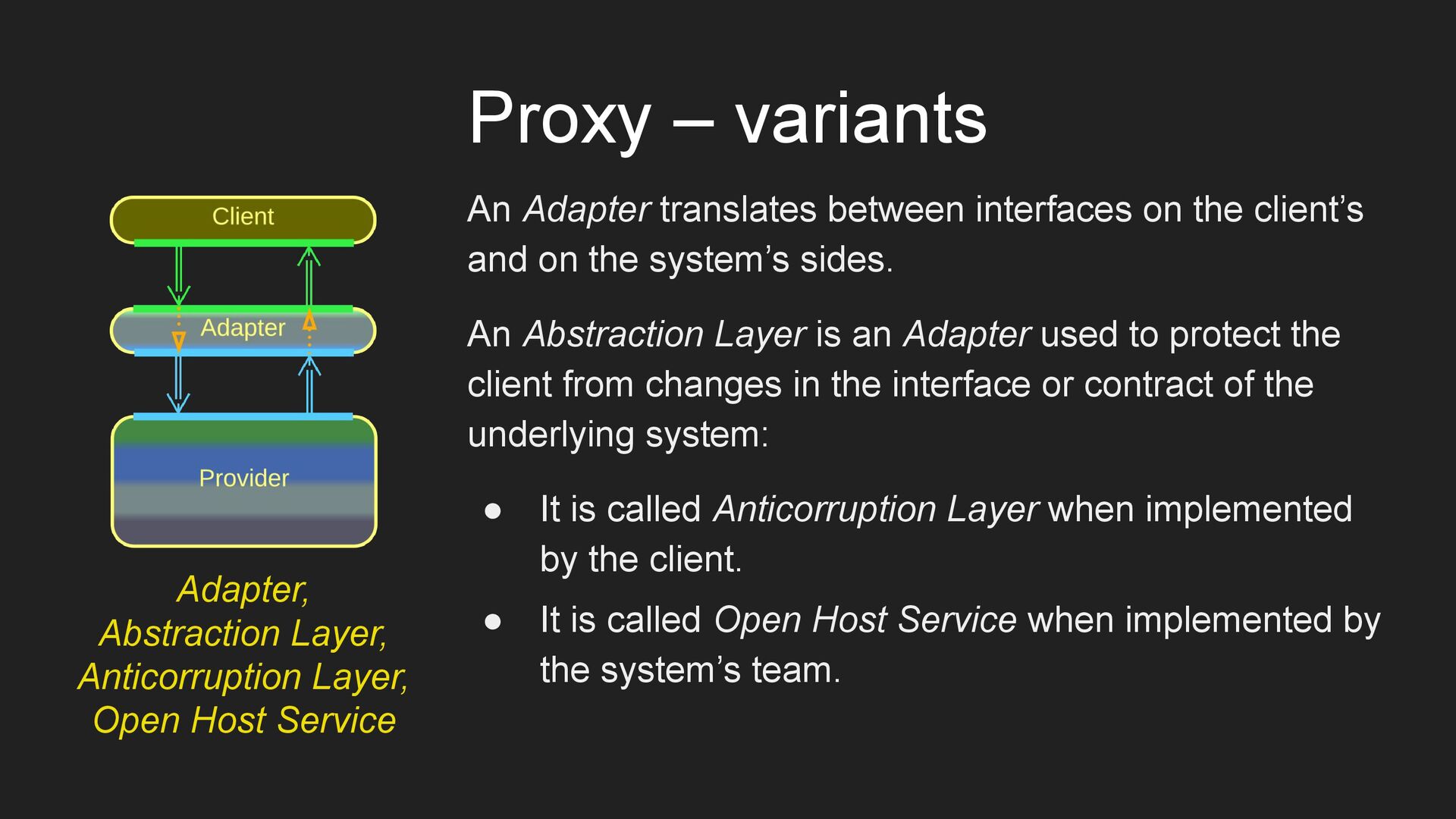
  24. Proxy – variants An Adapter translates between interfaces on the

    client’s and on the system’s sides. An Abstraction Layer is an Adapter used to protect the client from changes in the interface or contract of the underlying system: • It is called Anticorruption Layer when implemented by the client. • It is called Open Host Service when implemented by the system’s team. Adapter, Abstraction Layer, Anticorruption Layer, Open Host Service
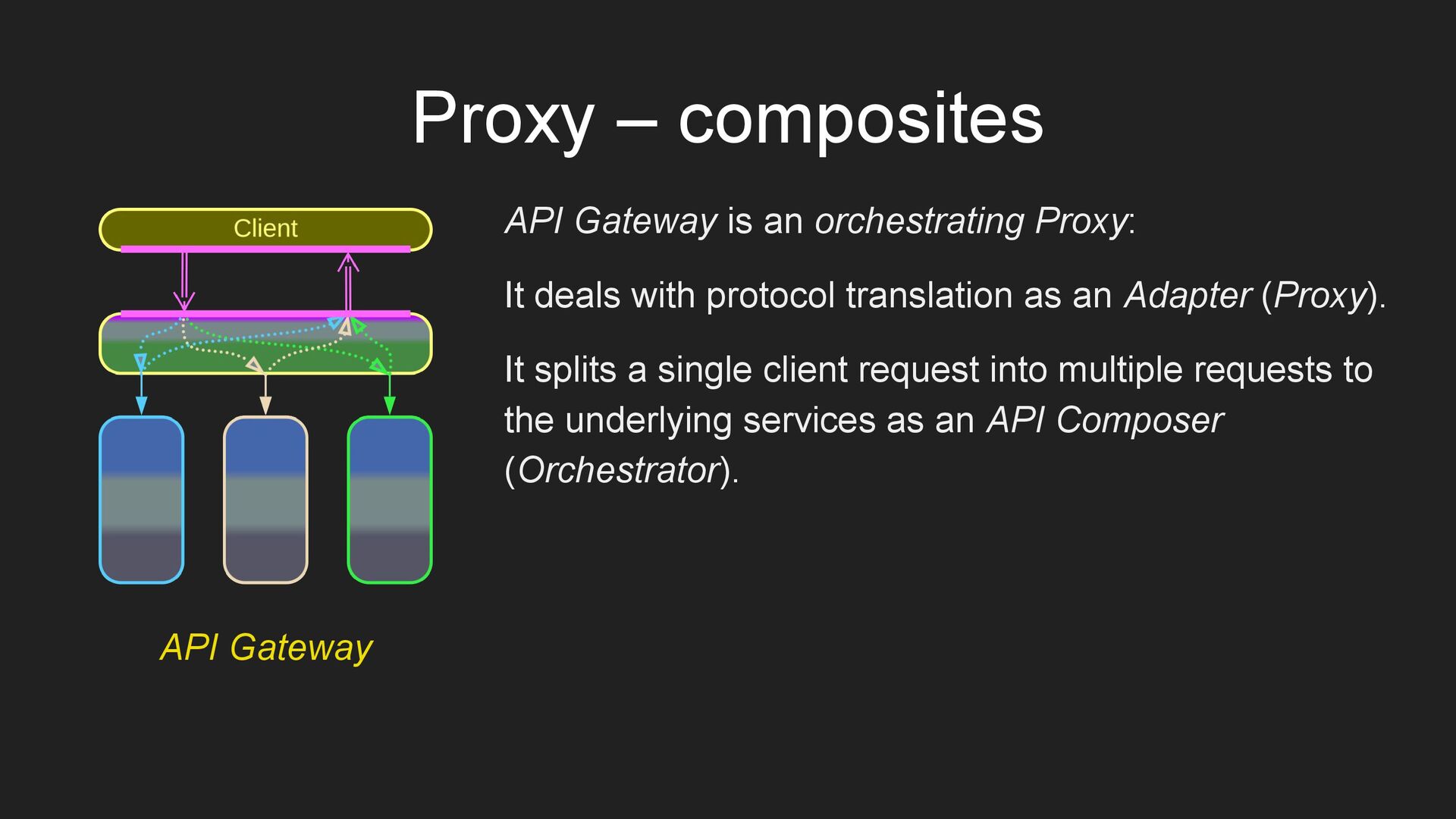
  25. Proxy – composites API Gateway is an orchestrating Proxy: It

    deals with protocol translation as an Adapter (Proxy). It splits a single client request into multiple requests to the underlying services as an API Composer (Orchestrator). API Gateway
  26. Orchestrator – overview An Orchestrator integrates lower-level components. It acts

    as: • A Mediator by propagating state changes among system components. • A Facade by implementing system-wide use cases. Orchestrator helps projects with many complex use cases… …at the cost of increased latency and operational complexity. Orchestrator, Application Layer
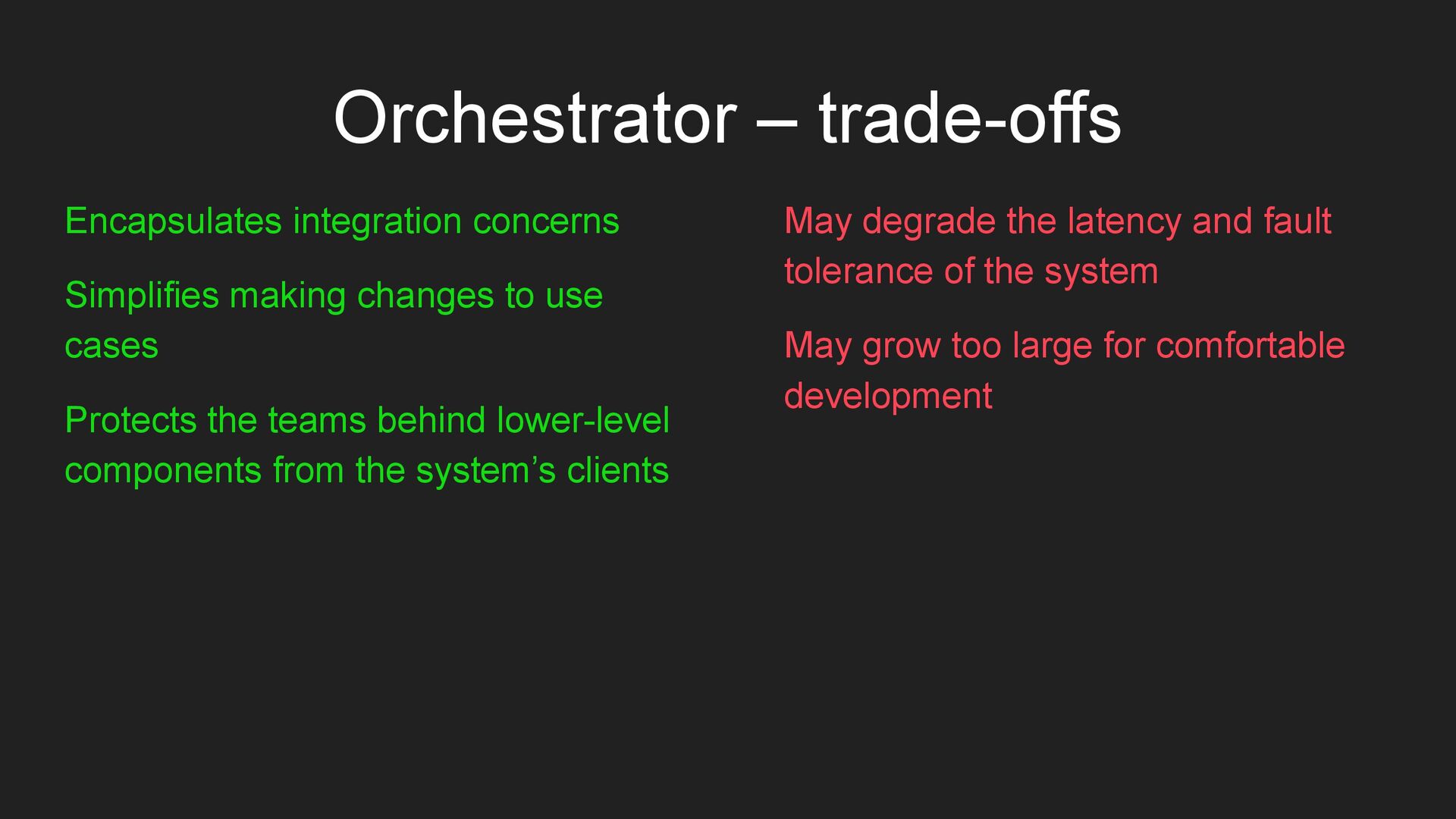
  27. Orchestrator – trade-offs Encapsulates integration concerns Simplifies making changes to

    use cases Protects the teams behind lower-level components from the system’s clients May degrade the latency and fault tolerance of the system May grow too large for comfortable development
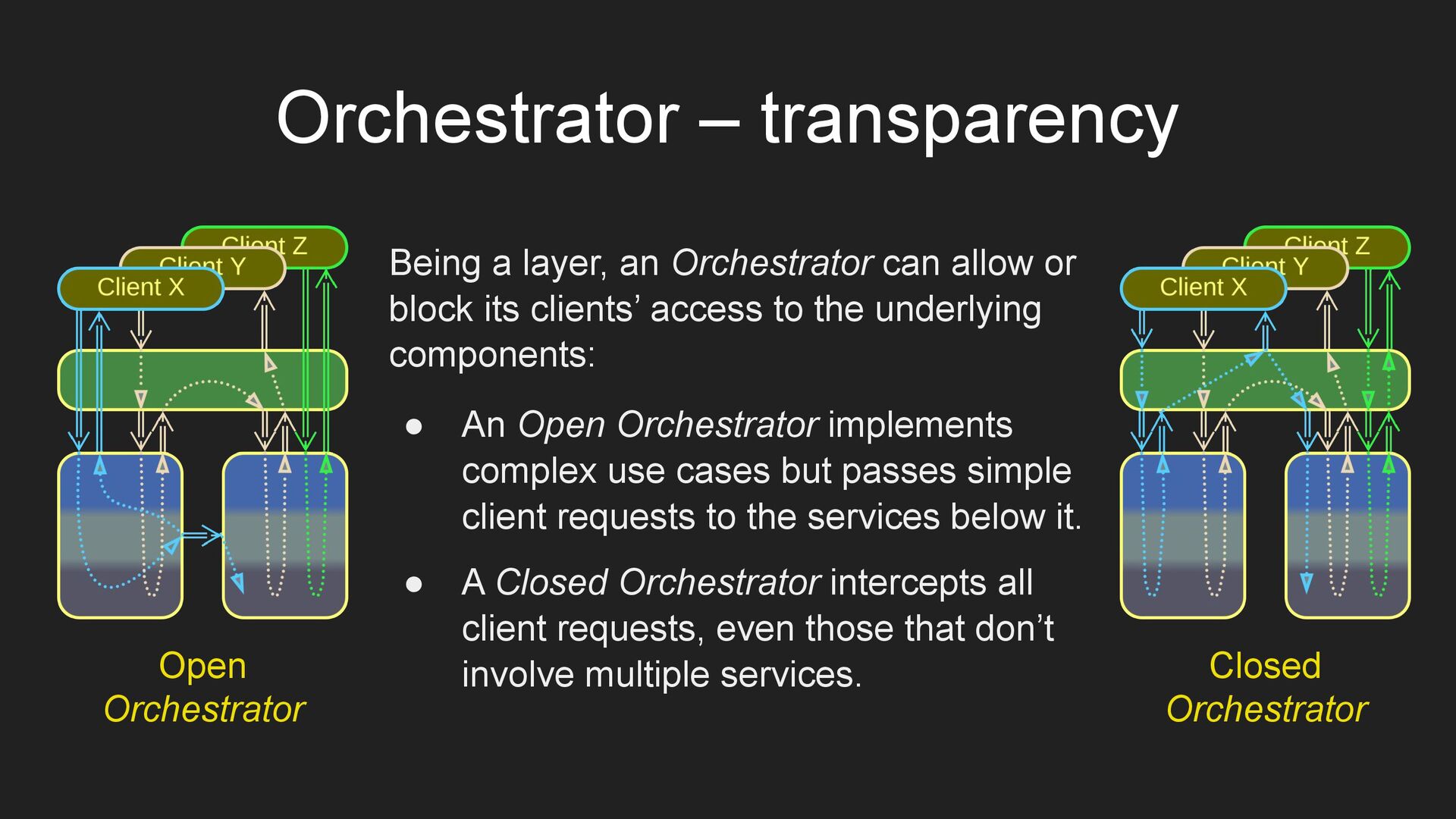
  28. Being a layer, an Orchestrator can allow or block its

    clients’ access to the underlying components: • An Open Orchestrator implements complex use cases but passes simple client requests to the services below it. • A Closed Orchestrator intercepts all client requests, even those that don’t involve multiple services. Open Orchestrator Closed Orchestrator Orchestrator – transparency
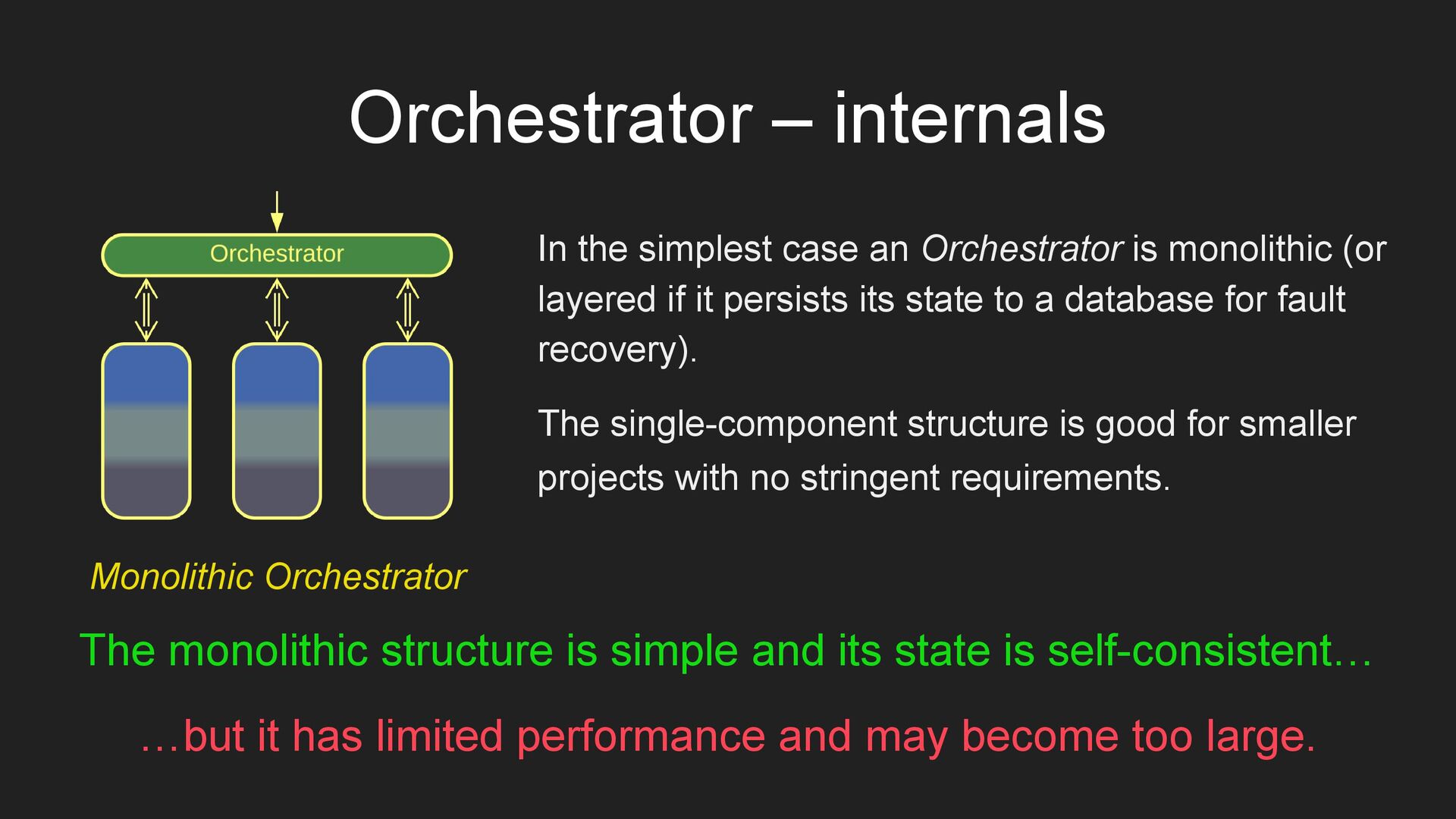
  29. Orchestrator – internals In the simplest case an Orchestrator is

    monolithic (or layered if it persists its state to a database for fault recovery). The single-component structure is good for smaller projects with no stringent requirements. Monolithic Orchestrator The monolithic structure is simple and its state is self-consistent… …but it has limited performance and may become too large.
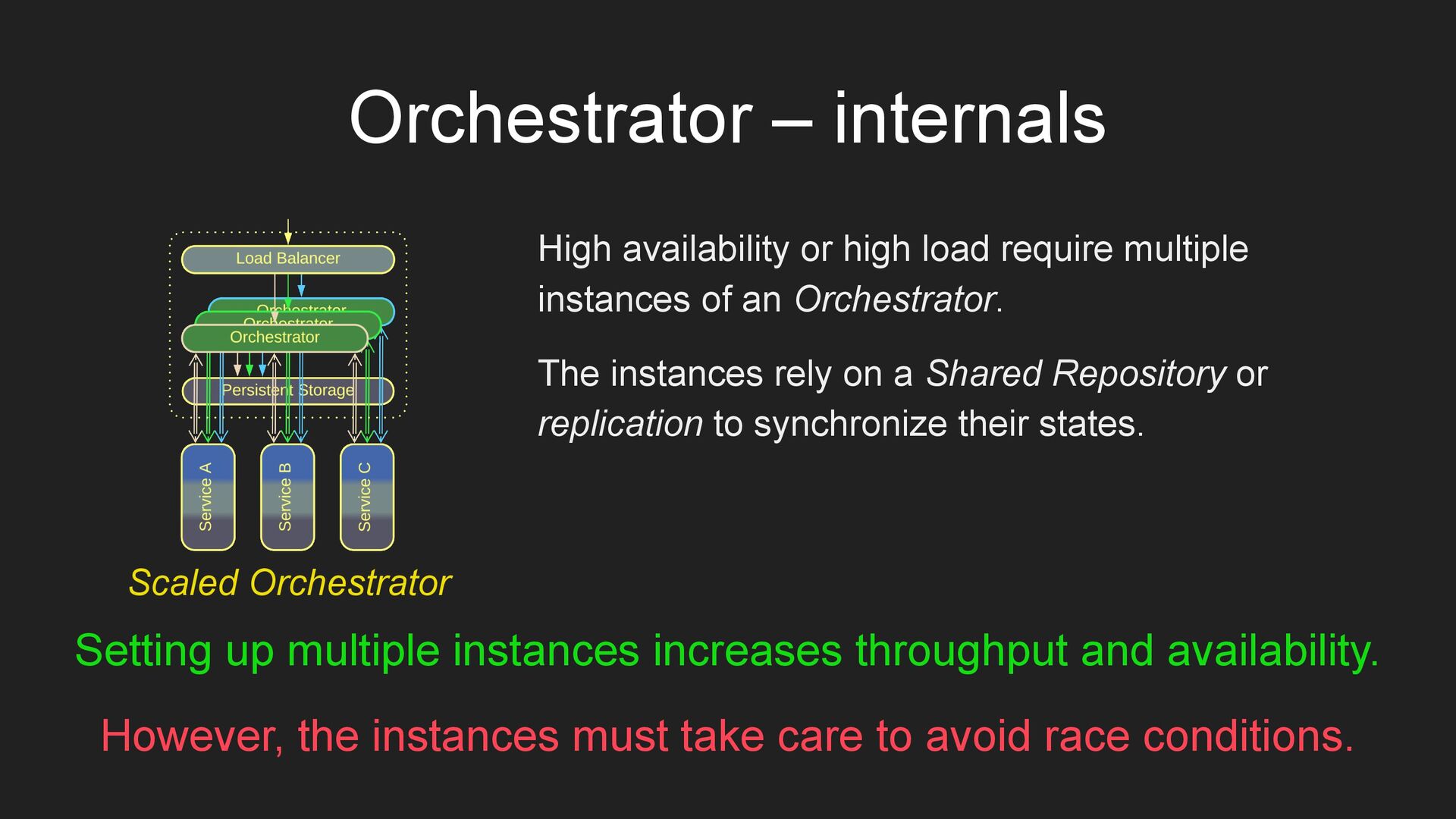
  30. Orchestrator – internals High availability or high load require multiple

    instances of an Orchestrator. The instances rely on a Shared Repository or replication to synchronize their states. Scaled Orchestrator Setting up multiple instances increases throughput and availability. However, the instances must take care to avoid race conditions.
  31. Orchestrator – internals It is possible to use several Orchestrators

    of different complexity. All user requests get to a simple Orchestrator. If it cannot handle a request, it forwards the latter to a more complex implementation. Layered Orchestrator A Layered Orchestrator reserves complex code for hard use cases. But it requires the team to learn multiple technologies.
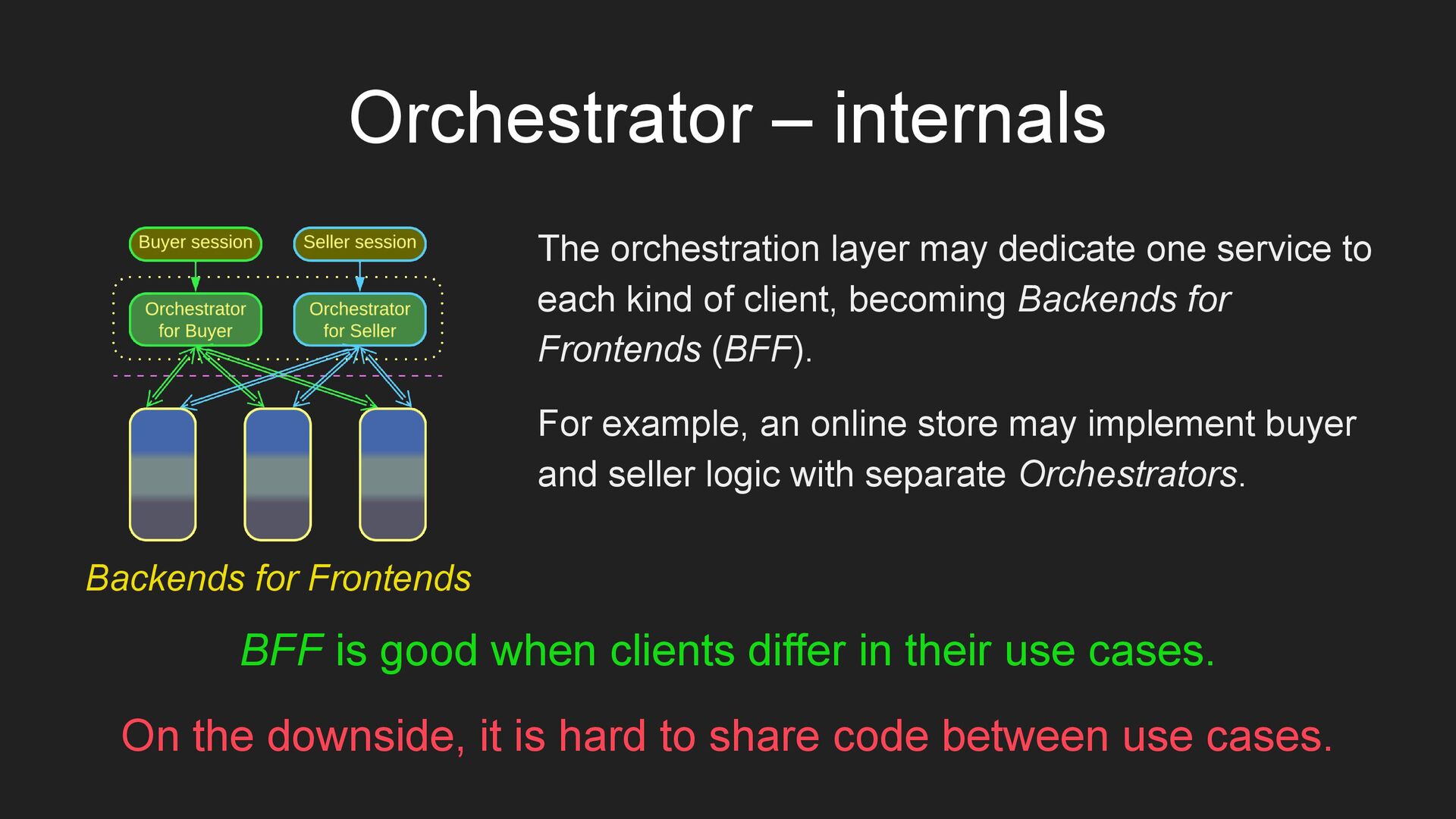
  32. Orchestrator – internals The orchestration layer may dedicate one service

    to each kind of client, becoming Backends for Frontends (BFF). For example, an online store may implement buyer and seller logic with separate Orchestrators. Backends for Frontends BFF is good when clients differ in their use cases. On the downside, it is hard to share code between use cases.
  33. Orchestrator – internals Top-Down Hierarchy has multiple layers of Orchestrators.

    The top-level component operates coarse-grained actions. Each layer translates a call to its API into several calls to the APIs of the layer below it. Hierarchy distributes complexity among several layers. However, only few domains are hierarchical. Top-Down Hierarchy
  34. Orchestrator – internals The SOA-style orchestration relies on many small

    Orchestrators, each implementing a few closely related scenarios. SOA-style orchestration Each Orchestrator stays small and humble. But there are too many of them.
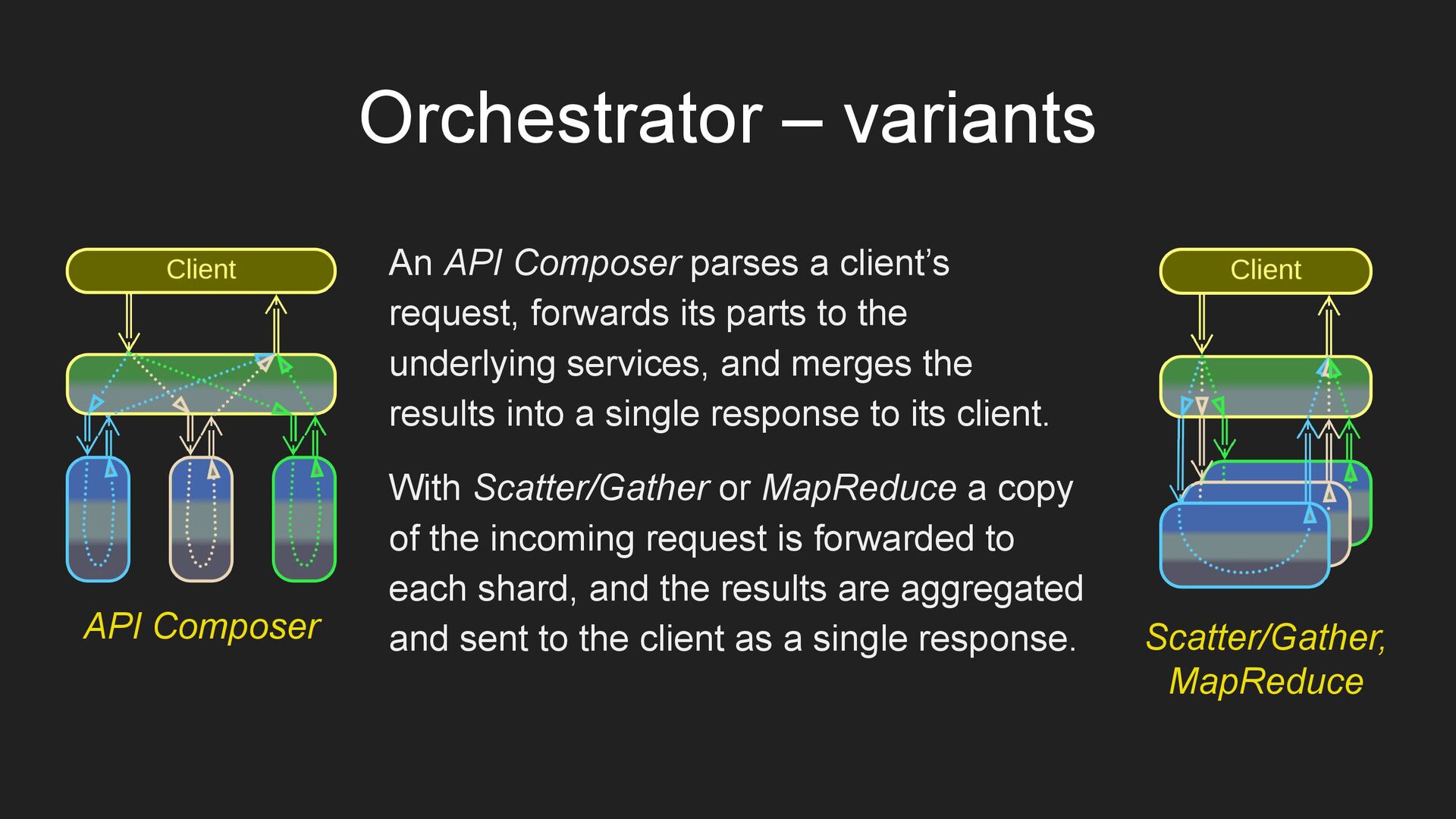
  35. An API Composer parses a client’s request, forwards its parts

    to the underlying services, and merges the results into a single response to its client. With Scatter/Gather or MapReduce a copy of the incoming request is forwarded to each shard, and the results are aggregated and sent to the client as a single response. API Composer Scatter/Gather, MapReduce Orchestrator – variants
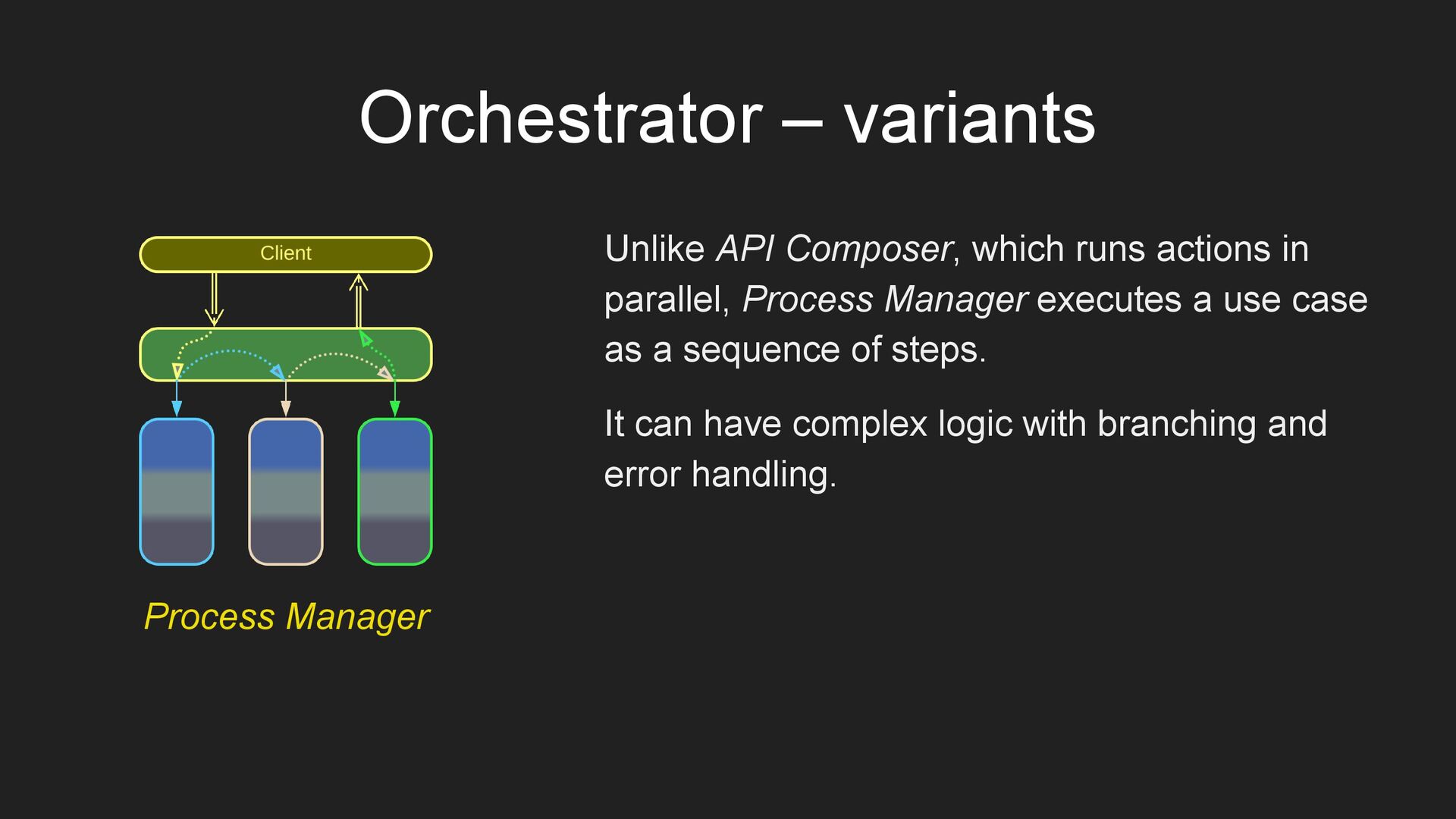
  36. Orchestrator – variants Unlike API Composer, which runs actions in

    parallel, Process Manager executes a use case as a sequence of steps. It can have complex logic with branching and error handling. Process Manager
  37. A Saga is a scenario that updates states of multiple

    components: • An Atomically Consistent Saga rolls back changes on any error. • An Eventually Consistent Saga retries applying the changes till it succeeds. Atomically Consistent Saga Eventually Consistent Saga Orchestrator – variants
  38. Orchestrator – variants An Integration Service is a full-featured service

    which uses other services in its operation. It tends to implement the application layer (use case logic) in DDD terminology. Integration Service, Application Service
  39. Combined Component – overview A Combined Component implements the functionality

    of several different system-wide layers. Combined Components expedite programming in familiar domains. It is very hard to replace if you outgrow it. Combined Component
  40. Combined Component – trade-offs Covers many of your needs off

    the shelf Has better performance and simpler setup than a set of stand-alone layers Locks you to its vendor Requires learning a proprietary technology May be too simple, too complex, or just misaligned for your needs
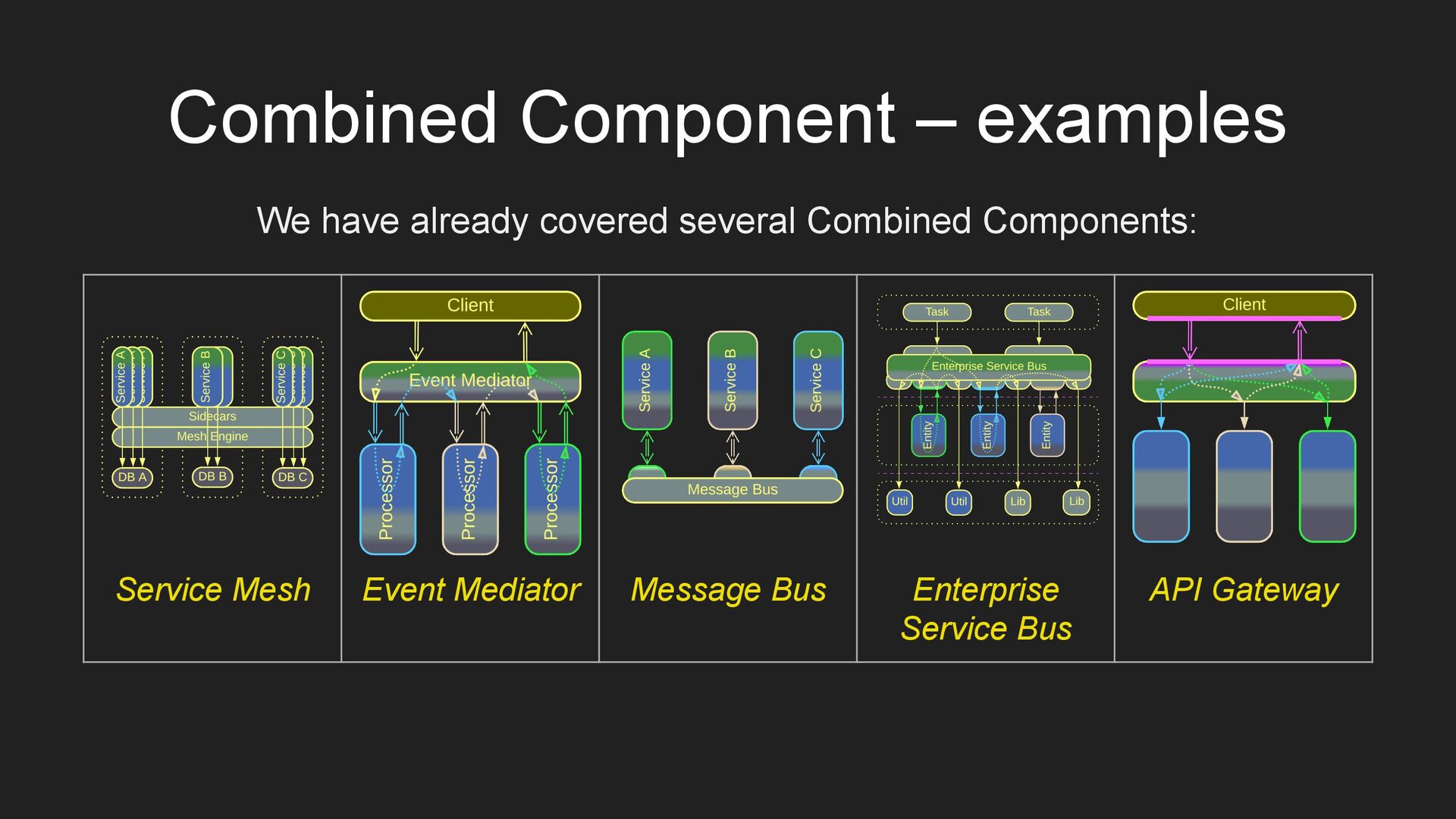
  41. Combined Component – examples Service Mesh Event Mediator Message Bus

    Enterprise Service Bus API Gateway We have already covered several Combined Components:
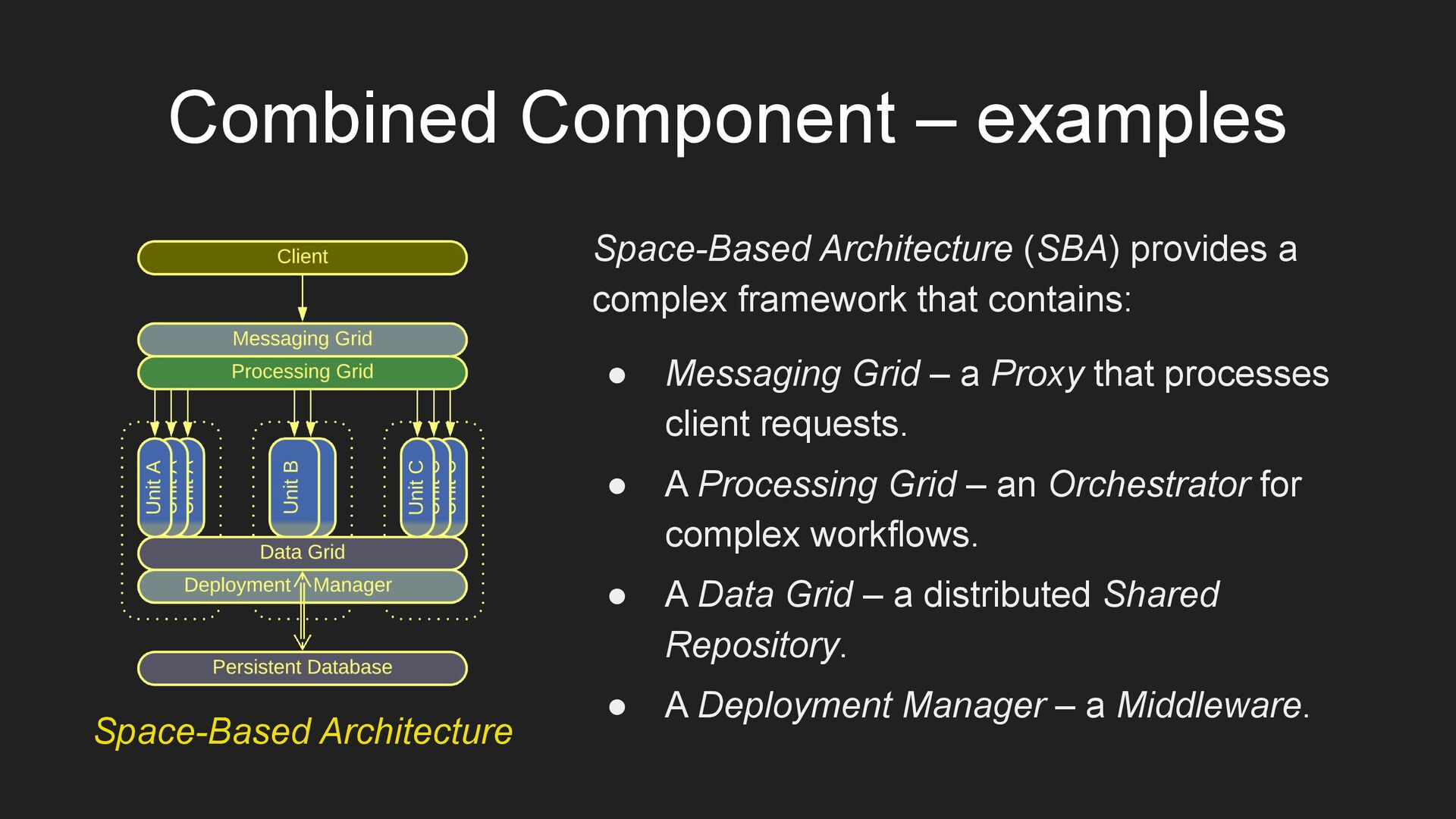
  42. Combined Component – examples Space-Based Architecture (SBA) provides a complex

    framework that contains: • Messaging Grid – a Proxy that processes client requests. • A Processing Grid – an Orchestrator for complex workflows. • A Data Grid – a distributed Shared Repository. • A Deployment Manager – a Middleware. Space-Based Architecture
  43. Combined Component – examples A Cell is an intermediate step

    in transition from Layers to Services. The domain logic layer is the easiest to subdivide into services, while other components remain as layers. Though not being genuine Combined Components, Cells show a similar structure. Cell
  44. Each of the extension patterns which we’ve reviewed takes care

    of some functionality which would otherwise need to be implemented by the main services that contain the business logic. It is the business logic that makes the core of the business and brings profit to the company. Your teams should concentrate their efforts on developing it. Everything else is expendable and should be acquired when available off the shelf. Segregating technical or behavioral aspects not only lowers the development complexity, but may also decouple the subdomains, as we see when data-centric systems are built around Shared Repositories or when applications with complex use cases employ Orchestrators. Moving functionality out of services
  45. Links This was an overview of part 3 of my

    book Architectural Metapatterns which is available: – as a website metapatterns.io – as a PDF or EPUB from leanpub.com/metapatterns The diagrams and the ODT source file are available under the CC BY license. More patterns are to follow…