Lock in $30 Savings on PRO—Offer Ends Soon! ⏳

Fragmented Architectures

Fragmented Architectures

Several patterns don’t rely on system-wide layers:
* Layered Services – divide into services, then into layers.
* Polyglot Persistence – employ multiple databases.
* Backends for Frontends (BFF) – dedicate a service to each kind of client.
* Service-Oriented Architecture (SOA) – divide into layers, then into services.
* Hierarchy – recursive subdivision.

Avatar for Denys Poltorak

Denys Poltorak

December 24, 2025
Tweet

More Decks by Denys Poltorak

Other Decks in Programming

Transcript

  1. Several patterns don’t rely on system-wide layers: • Layered Services

    – divide into services, then into layers. • Polyglot Persistence – employ multiple databases. • Backends for Frontends (BFF) – dedicate a service to each kind of client. • Service-Oriented Architecture (SOA) – divide into layers, then into services. • Hierarchy – recursive subdivision. Contents
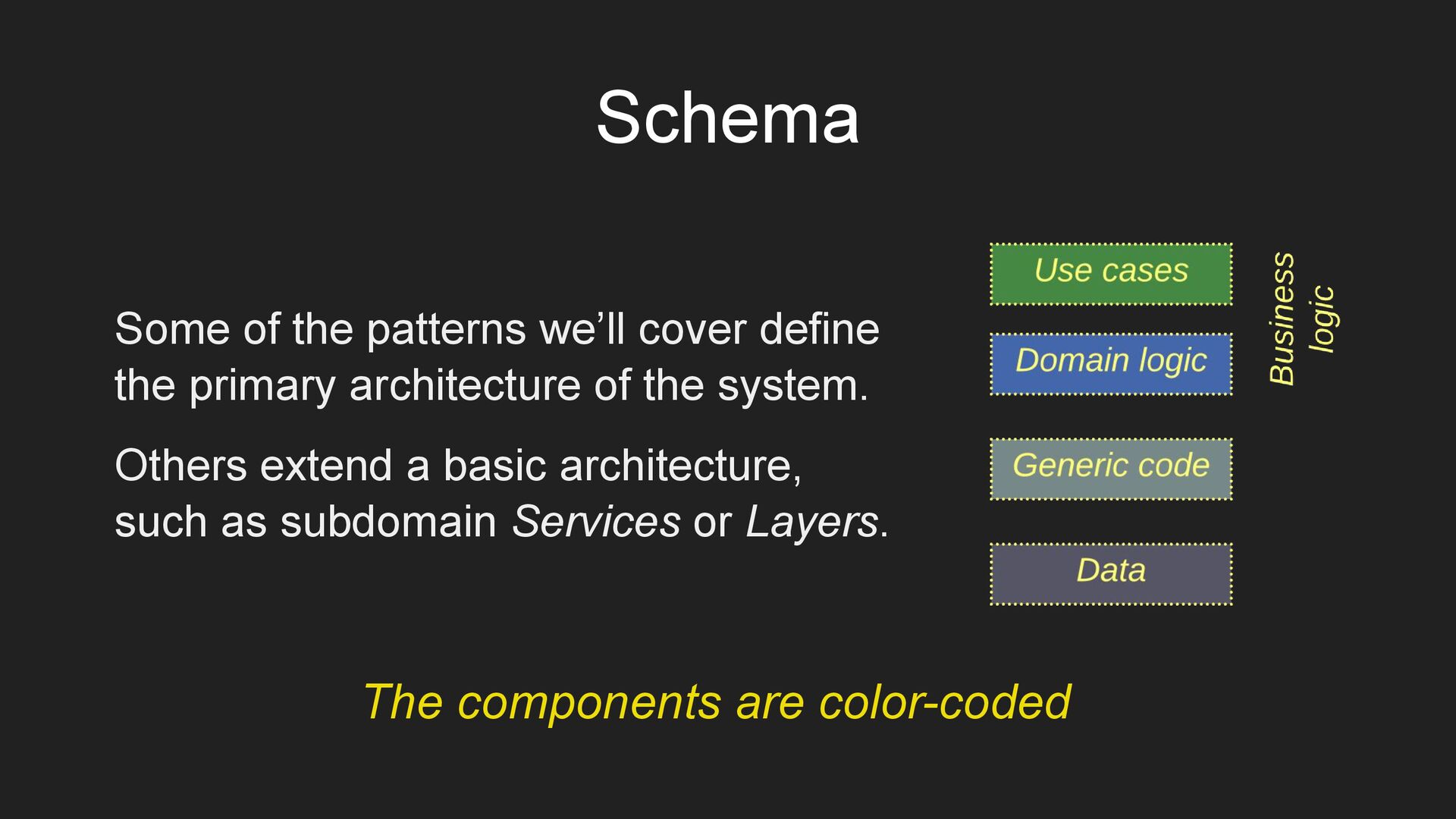
  2. Some of the patterns we’ll cover define the primary architecture

    of the system. Others extend a basic architecture, such as subdomain Services or Layers. The components are color-coded Schema
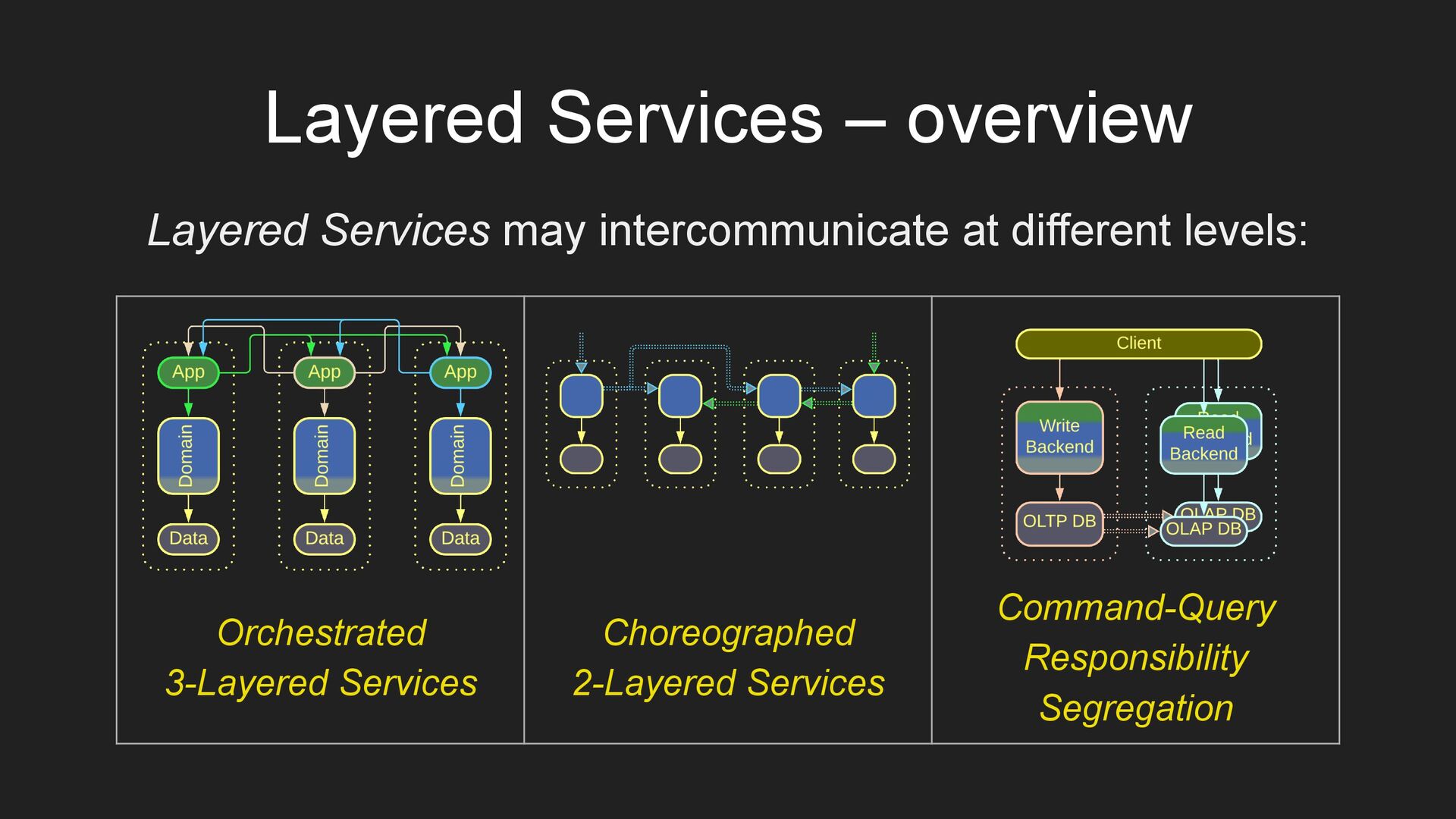
  3. Layered Services – overview Orchestrated 3-Layered Services Choreographed 2-Layered Services

    Command-Query Responsibility Segregation Layered Services may intercommunicate at different levels:
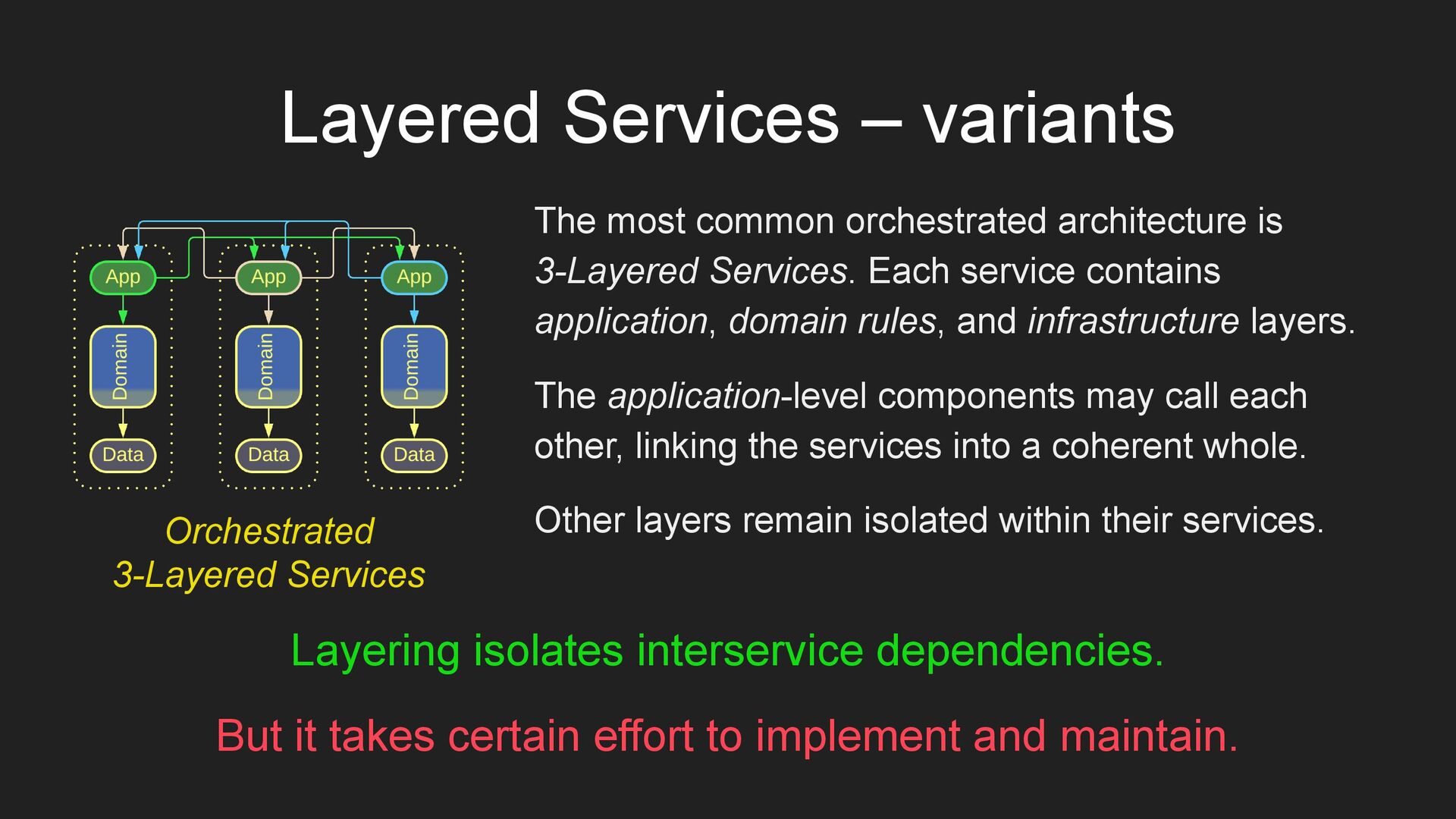
  4. Layered Services – variants The most common orchestrated architecture is

    3-Layered Services. Each service contains application, domain rules, and infrastructure layers. The application-level components may call each other, linking the services into a coherent whole. Other layers remain isolated within their services. Layering isolates interservice dependencies. But it takes certain effort to implement and maintain. Orchestrated 3-Layered Services
  5. Layered Services – variants A choreographed system has no application

    layer. The use cases are encoded in the connections between the services which make a Pipeline. In 2-Layered Services each service stores its data in a private database for the sake of encapsulation. Private databases make the services almost perfectly independent. But they add to operational complexity. Choreographed 2-Layered Services
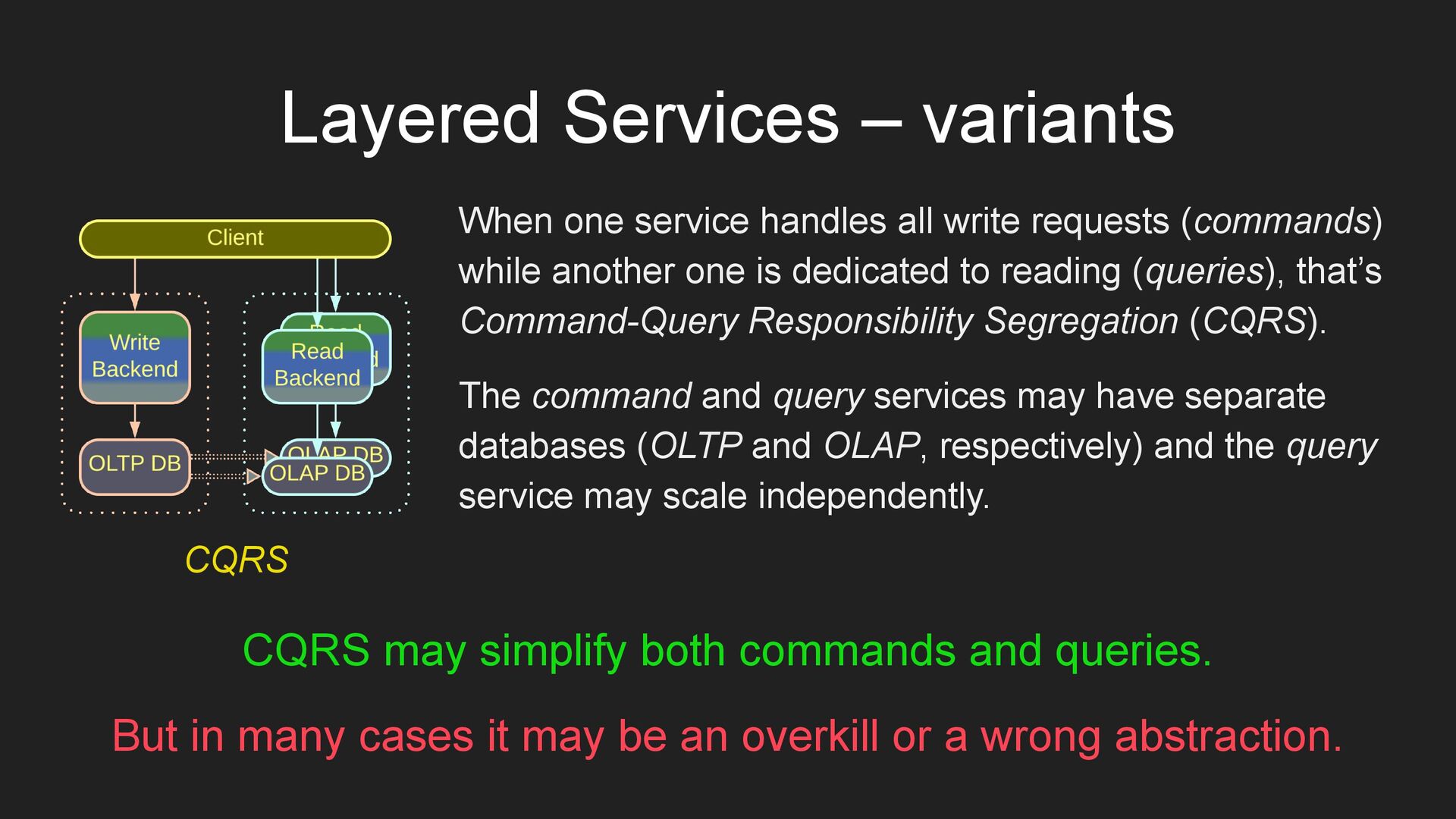
  6. Layered Services – variants When one service handles all write

    requests (commands) while another one is dedicated to reading (queries), that’s Command-Query Responsibility Segregation (CQRS). The command and query services may have separate databases (OLTP and OLAP, respectively) and the query service may scale independently. CQRS may simplify both commands and queries. But in many cases it may be an overkill or a wrong abstraction. CQRS
  7. Polyglot Persistence – overview You can rely on dedicated storage

    technologies for different kinds of data or patterns of data access in your system. The storages may be independent or one may derive its data from another. They may be private to a service or shared within the system. Polyglot Persistence is found in high-load or low latency systems. It may be too complicated and fragile for general use. Polyglot Persistence
  8. Polyglot Persistence – trade-offs Performance is fine-tuned for multiple access

    patterns The load is distributed among the datastores in use Multiple technologies need to be mastered There is more operational complexity and more points of failure Data consistency becomes an issue
  9. If Shards or Services become coupled through a small subset

    of the system’s data, that subset can be extracted into a Shared Database, while the main dataset remains private. Private and Shared Databases for Services Private and Shared Databases for Shards Polyglot Persistence – independent DBs
  10. Polyglot Persistence – independent DBs There are many database engine

    technologies, each optimized for a small number of use cases and data types. If you need top-grade performance, you can hand-pick databases that best fit the structure and access patterns for subsets of of your data. Specialized Databases
  11. Polyglot Persistence – independent DBs Some data types, such as

    web page templates, images, or videos, are best served from files. A Content Delivery Network (CDN) is a distributed file storage that replicates web content over the globe so that every user downloads it from the nearest data center. Data File and Content Delivery Network
  12. Polyglot Persistence – derived DBs Read-heavy systems benefit from running

    multiple read-only replicas of the database. One instance of the database, called leader, accepts all write requests and propagates changes to other replicas used in read-only queries. If the leader becomes unavailable, any other replica is promoted to the leader role. Read-Only Replicas
  13. Polyglot Persistence – derived DBs A Database Cache stores the

    most recent database queries and their results in memory to bypass the main database when a known query is repeated. The hard part is keeping the data in the Cache and the database in sync. Cache-Aside, Database Cache
  14. A Memory Image aggregates events into an up-to-date snapshot of

    the (sub-)system’s state. It is queryable, unlike the event store. Memory Image – starting Polyglot Persistence – derived DBs Memory Image – running
  15. Here we have dedicated OLTP (commands) and OLAP (queries) databases.

    • A Reporting Database exposes the dataset of this service to external queries. • A CQRS View aggregates events from another service into a queryable state. CQRS View Reporting Database Polyglot Persistence – derived DBs
  16. Polyglot Persistence – derived DBs A Query Service is a

    shared CQRS View. It aggregates events from multiple services to provide a consistent, queryable representation of the state of the whole system. Query Service
  17. An External Index is a query engine dedicated to an

    uncommon technology, such as NLP or geospatial data. You can use it to get a list of all the rows in your main database that match a special kind of query not supported by your primary database. External Index – update Polyglot Persistence – derived DBs External Index – find
  18. Polyglot Persistence – derived DBs Keeping old data which is

    not going ever to change together with the most recent records bloats and slows down your main OLTP database. Therefore you should periodically move the old data to a read-only archive OLAP storage. Data Archiving
  19. BFF – overview If you clients differ in their protocols

    and/or workflows, you can dedicate a component (Backend for Frontend, BFF) to each kind of client. The BFFs may act as Proxies, Orchestrators, or their combinations. BFF is useful with dissimilar client protocols, UIs or workflows. Its use with closely related clients asks for trouble. Backends for Frontends
  20. BFF – trade-offs Clients and the teams that support them

    become independent Each of the multiple BFFs tends to be much simpler than a universal layer It’s hard to share code between BFFs BFFs increase operational complexity
  21. BFF – variants Multiple Proxies are made use of to

    support clients that differ in their protocols but not workflows. An example is accessing the system from the internal network and via a VPN. Proxies are often available off the shelf and don’t require much effort to set up. Proxies
  22. BFF – variants BFF Orchestrators deal with workflows but not

    protocols. For example, an online store may use different Orchestrators for buyers and sellers. Each Orchestrator is likely to remain relatively small and simple thanks to the separation of concerns. Orchestrators
  23. BFF – variants When the clients differ in both protocol

    or security, and their workflows, Proxy + Orchestrator pairs are used. This also allows for reusing Proxies and/or Orchestrators in different combinations. Proxy + Orchestrator pairs
  24. BFF – variants An API Gateway implements aspects of both

    a Proxy and Orchestrator. Therefore it can be used as a more convenient alternative to a Proxy + Orchestrator pair. API Gateways
  25. BFF – variants An Event Mediator is an orchestrating Middleware.

    There are reports of using an Event Mediator per kind of system’s clients to achieve the following benefits: • Smaller and more cohesive orchestration logic for each kind of client. • If one Event Mediator malfunctions, the system remains available to other kinds of clients. Event Mediators
  26. SOA – overview Service-Oriented Architecture (SOA) first splits a system

    into Layers, then divides each layer into Services. This is similar to how OOP/OOD treats a complex project. The resulting architecture addresses the complexity of the domain, but is itself quite complicated. SOA suits huge projects, often with heterogeneous hardware. But don’t expect fast-paced development or low latency. Service-Oriented Architecture
  27. SOA – trade-offs Supports huge codebases with many development teams

    and technologies Provides fine-grained scalability and deployment to dedicated hardware The teams are interdependent, which slows down development The excessive distribution makes the system slow, fragile, and hard to debug The system is hard to maintain or test because it contains many tightly interacting components
  28. SOA – examples Enterprises used to enlarge by acquiring smaller

    companies, each with its own homegrown software system that had to be integrated into the enterprise’s architecture. The integration was mediated by an Enterprise Service Bus (ESB) responsible for both protocol translation and orchestration. However, the resulting complexity of the ESB made everyone hate it. Enterprise SOA
  29. SOA – examples Domain-Oriented Microservice Architecture (DOMA) is made up

    of Cells (domains, groups of related services) instead of plain services. It relies on Plugins for cross-domain customization. DOMA seems to be a flexible real-world architecture suitable for huge projects. Domain-Oriented Microservice Architecture
  30. SOA – examples AUTOSAR Classic from the automotive industry is

    marketed as a SOA (with its Virtual Function Bus matching ESB) but, on closer inspection, it looks like a Microkernel. Automotive SOA
  31. Hierarchy – overview Hierarchy distributes complexity over a tree-like structure.

    It is straightforward, convenient, and agile, but few domains are truly hierarchical. A Hierarchy can be built: • Top-Down (Orchestrator of Orchestrators) • Bottom-Up (Bus of Buses) • In-Depth (Cell-Based Architecture) Hierarchy shines with large projects and/or physical devices (IoT). Making a good hierarchical decomposition may be hard or impossible. Hierarchy
  32. Hierarchy – trade-offs It’s good in decoupling logic Multiple development

    teams are supported Low-level components are easy to add or replace The system is quite fault-tolerant as its parts may act independently System-wide use cases are slow and hard to debug Hierarchy has high operational complexity It also requires much planning or trial and error to discover good interfaces
  33. Hierarchy – variants A Top-Down Hierarchy (Orchestrator of Orchestrators) builds

    a tree whose root deals with high-level commands or notifications while its leaves are responsible for concrete actions. Examples include: • Product filters in web marketplaces. • Automation of industrial complexes (IIoT). • Hierarchical UIs (PAC and HMVC). Top-Down Hierarchy
  34. Hierarchy – variants A Bottom-Up Hierarchy (Bus of Buses) interconnects

    several networks that differ in their internal protocols. This is what the Internet is. Bottom-Up Hierarchy
  35. Hierarchy – variants An In-Depth Hierarchy relies on a recursive

    subdivision of elements. A common example is the WSO2 definition of a Cell that is a subsystem made of services which itself takes the place of a single service in a larger system: • Cell-Based Architecture is a single layer of Cells. • Domain-Oriented Microservice Architecture is a SOA made of Cells. In-Depth Hierarchy, Cell-Based Architecture
  36. If a component conjoins loosely coupled segments, subdividing it may:

    • Yield smaller and better structured code thanks to the separation of concerns. • Improve performance through the careful selection of technologies. • Improve fault tolerance if the newly created parts of the system may act independently. However, it also: • Increases operational complexity and latency. • Makes sharing code inconvenient. Subdividing a component
  37. Links This was a brief summary of part 4 of

    Architectural Metapatterns: – read it online at metapatterns.io – download the eBook from leanpub.com/metapatterns The diagrams and the ODT source file are available under the CC BY license. If you like this book, please tell your friends about it. I have no way to promote it on my own.