Lock in $30 Savings on PRO—Offer Ends Soon! ⏳

Implementation Patterns

Implementation Patterns

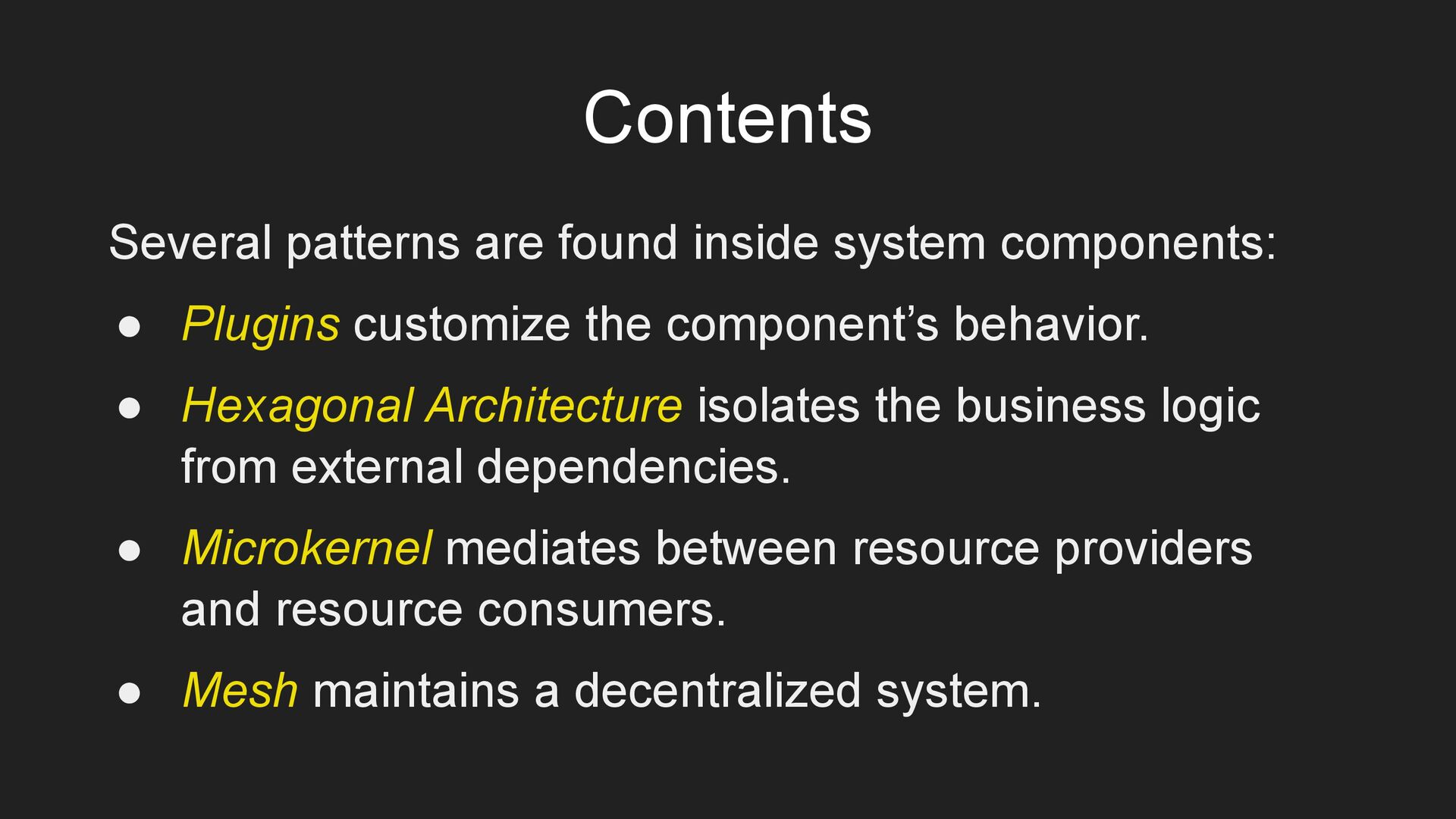
Several patterns are found inside system components:
* Plugins customize the component’s behavior.
* Hexagonal Architecture isolates the business logic from external dependencies.
* Microkernel mediates between resource providers and resource consumers.
* Mesh maintains a decentralized system.

Avatar for Denys Poltorak

Denys Poltorak

December 24, 2025
Tweet

More Decks by Denys Poltorak

Other Decks in Programming

Transcript

  1. Several patterns are found inside system components: • Plugins customize

    the component’s behavior. • Hexagonal Architecture isolates the business logic from external dependencies. • Microkernel mediates between resource providers and resource consumers. • Mesh maintains a decentralized system. Contents
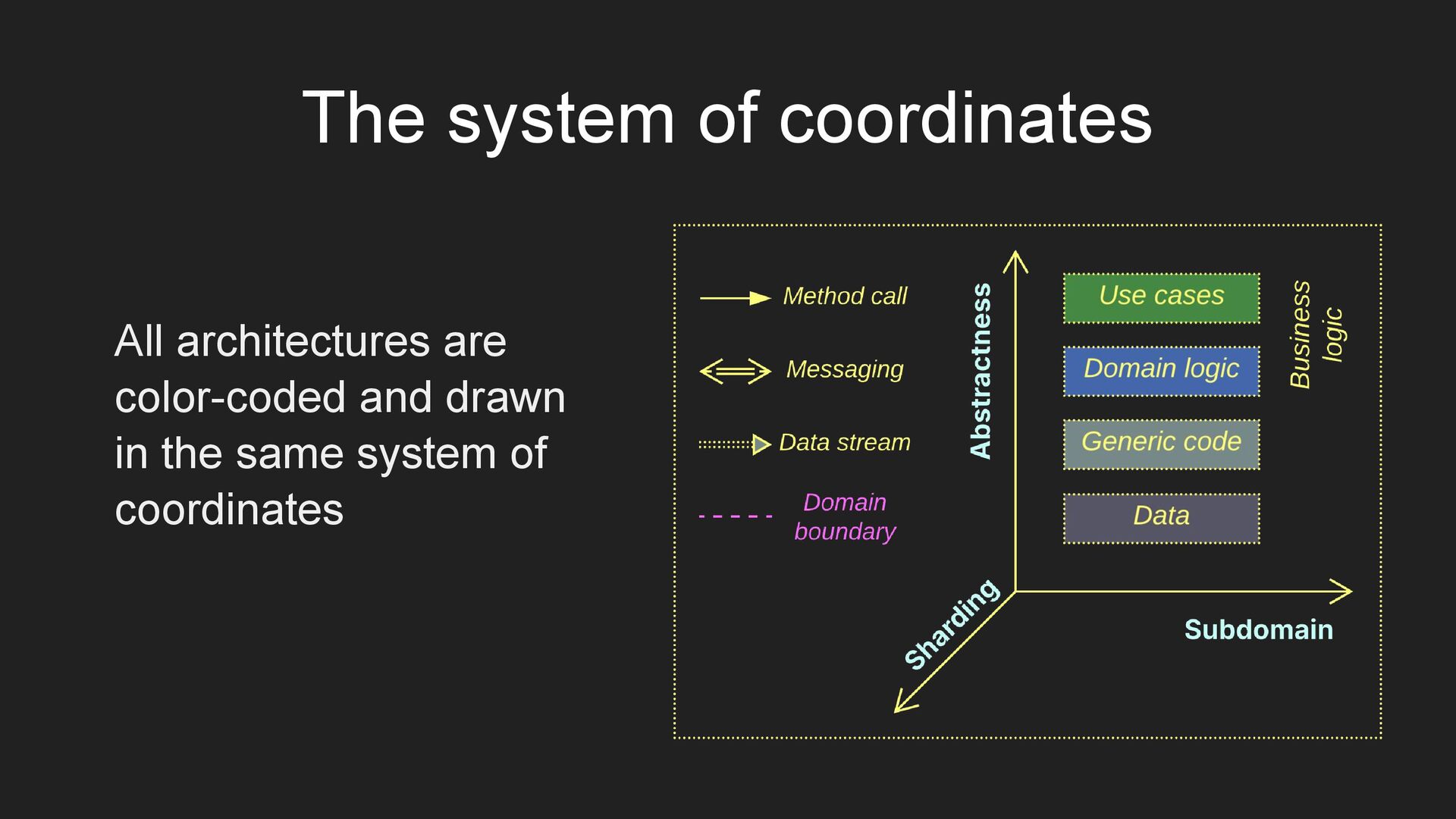
  2. All architectures are color-coded and drawn in the same system

    of coordinates The system of coordinates
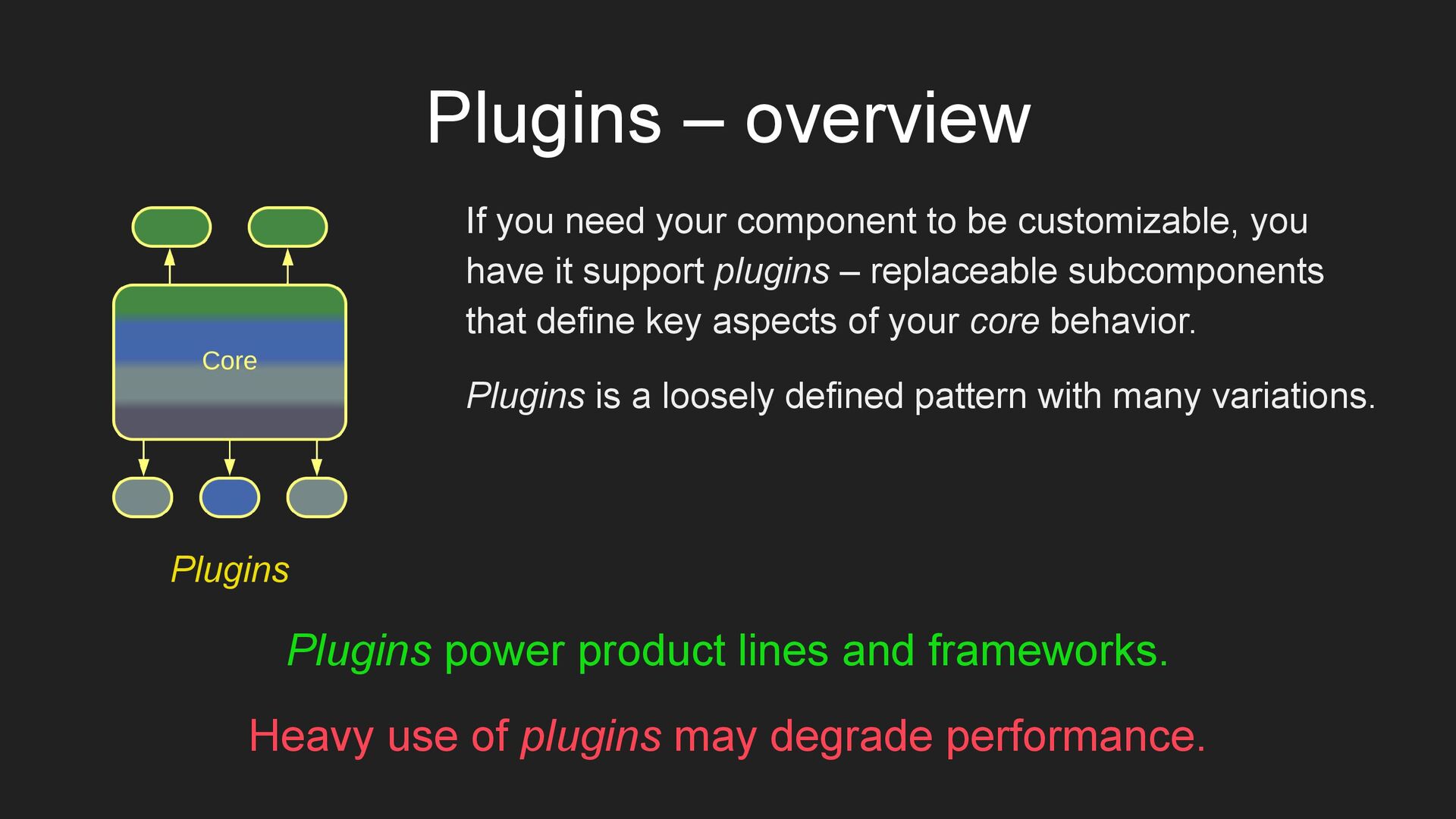
  3. Plugins – overview If you need your component to be

    customizable, you have it support plugins – replaceable subcomponents that define key aspects of your core behavior. Plugins is a loosely defined pattern with many variations. Plugins power product lines and frameworks. Heavy use of plugins may degrade performance. Plugins
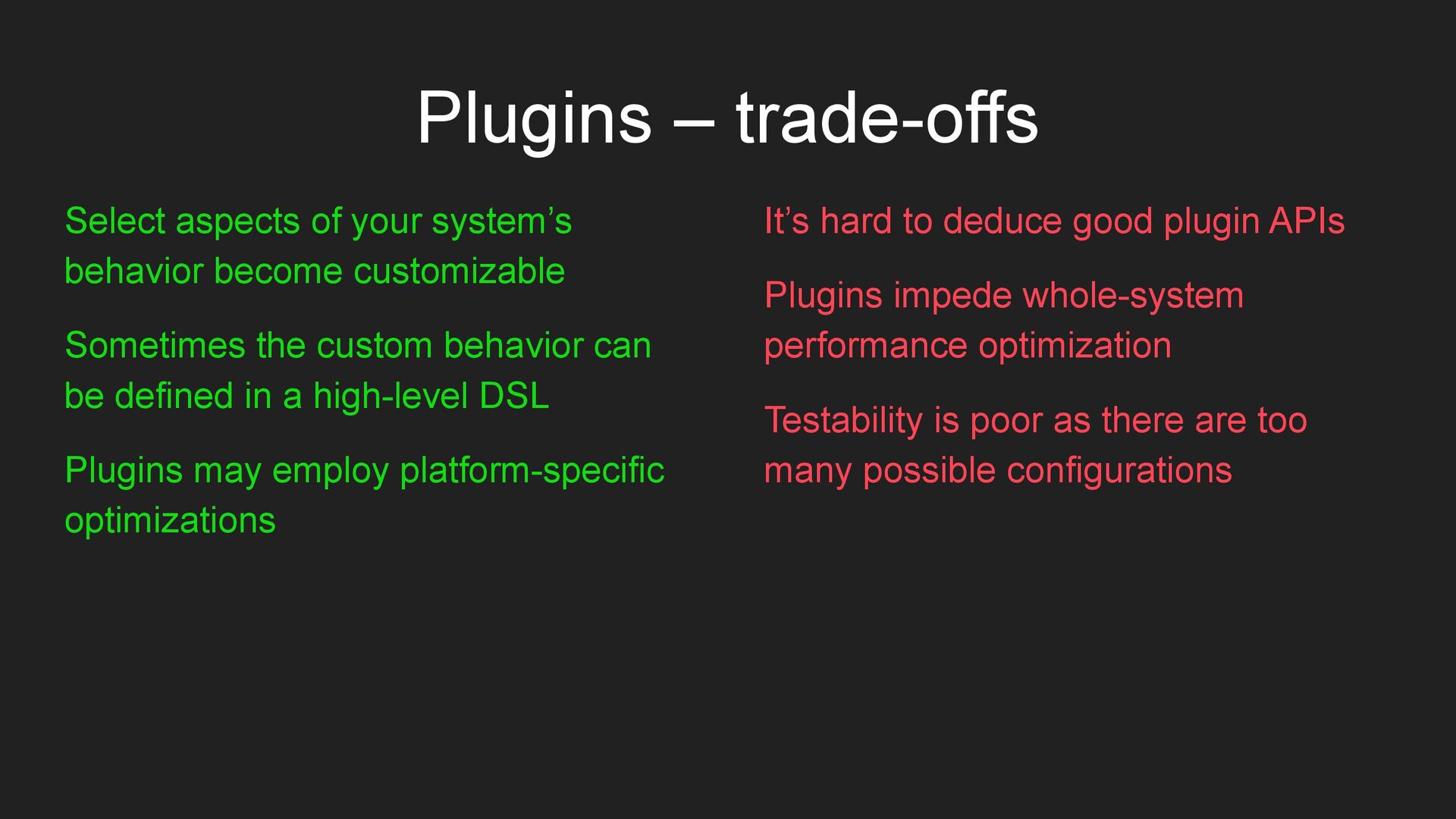
  4. Plugins – trade-offs Select aspects of your system’s behavior become

    customizable Sometimes the custom behavior can be defined in a high-level DSL Plugins may employ platform-specific optimizations It’s hard to deduce good plugin APIs Plugins impede whole-system performance optimization Testability is poor as there are too many possible configurations
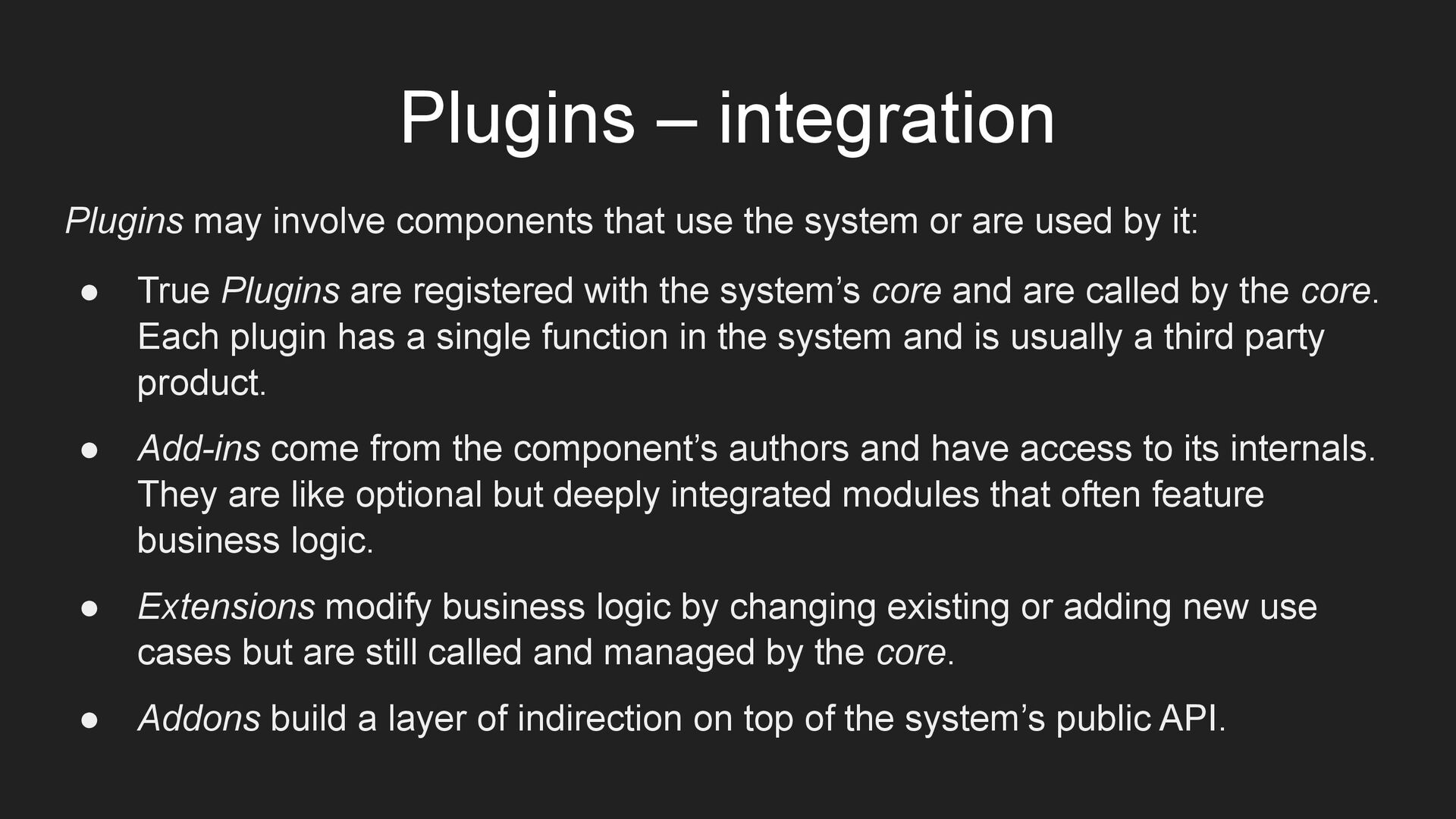
  5. Plugins may involve components that use the system or are

    used by it: • True Plugins are registered with the system’s core and are called by the core. Each plugin has a single function in the system and is usually a third party product. • Add-ins come from the component’s authors and have access to its internals. They are like optional but deeply integrated modules that often feature business logic. • Extensions modify business logic by changing existing or adding new use cases but are still called and managed by the core. • Addons build a layer of indirection on top of the system’s public API. Plugins – integration
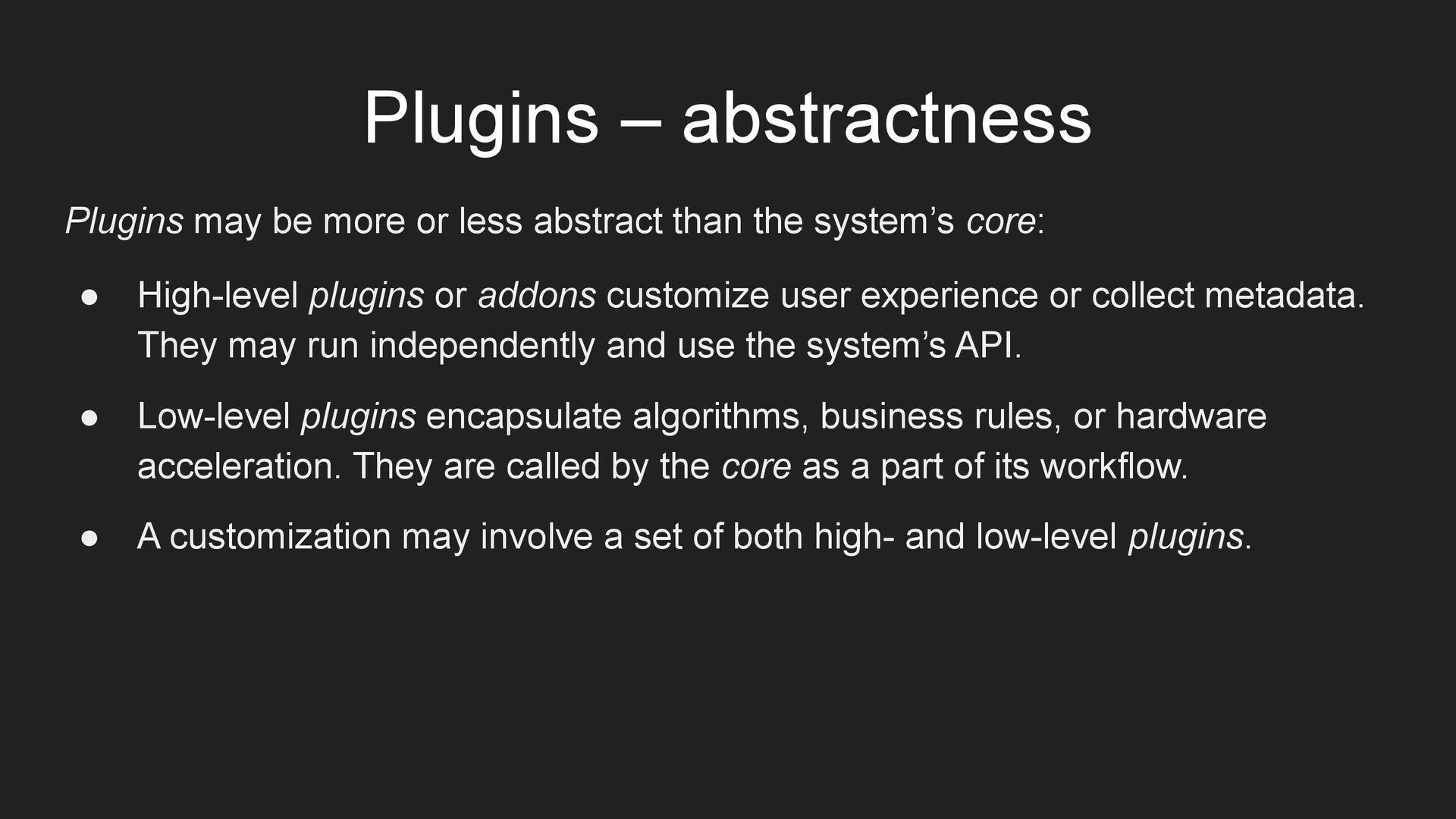
  6. Plugins may be more or less abstract than the system’s

    core: • High-level plugins or addons customize user experience or collect metadata. They may run independently and use the system’s API. • Low-level plugins encapsulate algorithms, business rules, or hardware acceleration. They are called by the core as a part of its workflow. • A customization may involve a set of both high- and low-level plugins. Plugins – abstractness
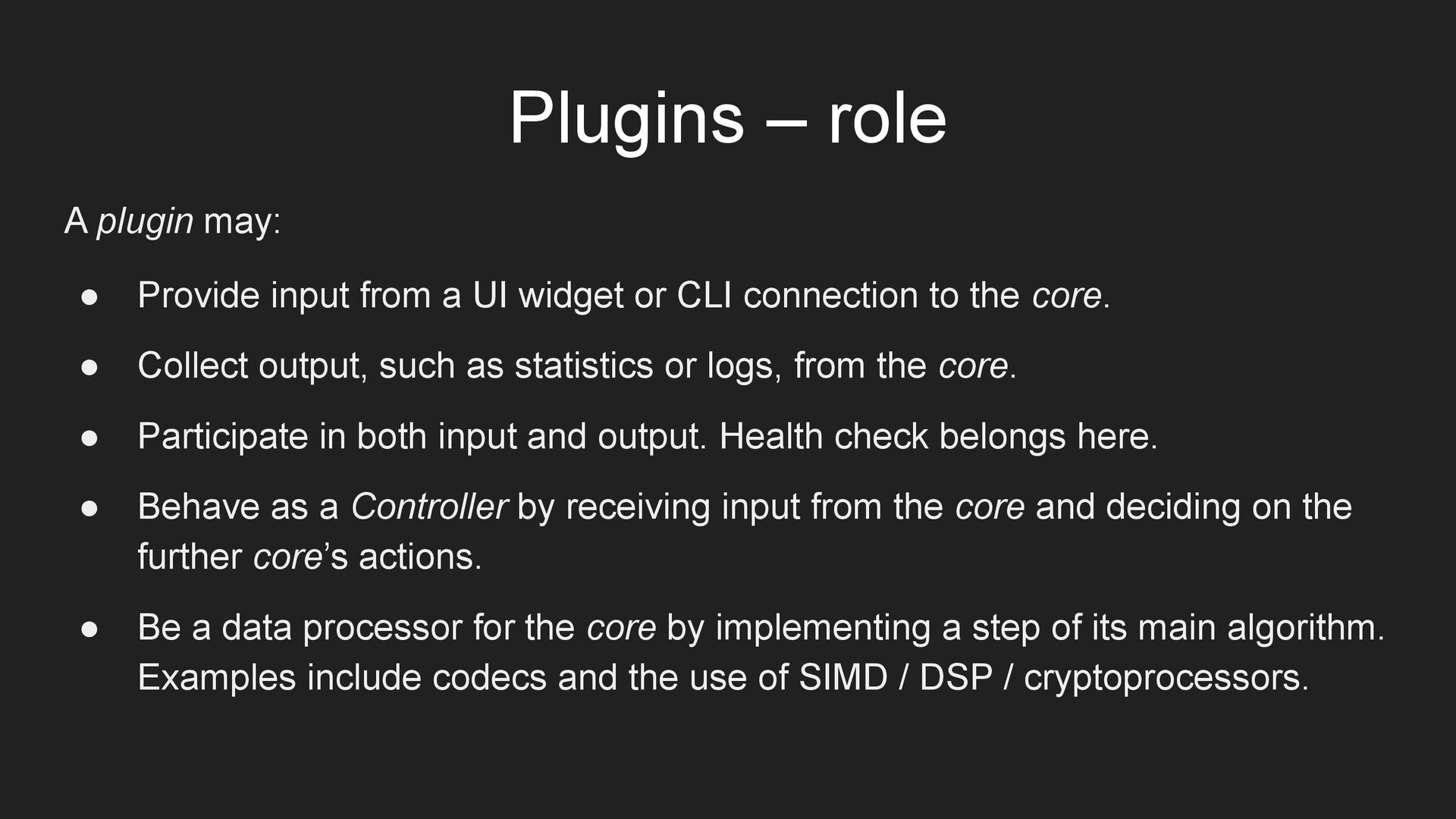
  7. A plugin may: • Provide input from a UI widget

    or CLI connection to the core. • Collect output, such as statistics or logs, from the core. • Participate in both input and output. Health check belongs here. • Behave as a Controller by receiving input from the core and deciding on the further core’s actions. • Be a data processor for the core by implementing a step of its main algorithm. Examples include codecs and the use of SIMD / DSP / cryptoprocessors. Plugins – role
  8. Plugins may be selected at different stages: • Flavors are

    special builds of a software with functionality customized through different sets of plugins. A more functional flavor is more expensive. • An application may choose plugins at startup according to its configuration file. • Some software systems allow for changing plugins at runtime. Plugins – linkage
  9. A plugin can be large or tiny: • A small

    function or class built into the application corresponds to the Strategy pattern. • An aspect implements some kind of pervasive functionality, such as logging. • An external component (library, application or remote service) may be used by the core as a plugin. Plugins – granularity
  10. A plugin can be optional or mandatory: • A mandatory

    plugin, such as an implementation of an algorithm or business rule, is required for the proper functioning of the core. • An optional plugin may be absent, in which case the core substitutes an empty or trivial implementation. This is common with logging or statistics. • It can also be subscriptional, in which case multiple instances of an optional plugin are allowed. This helps if you want your logs to be both saved to the local file system and sent over the network. Plugins – multiplicity
  11. A plugin can be executed in a variety of ways:

    • It can be a selectable part of the core, or a statically or dynamically linked library. • It can be written in a domain-specific language (DSL) which is interpreted or compiled by the core. • It can reside on a remote server or in a hardware device accessible via RPC or messaging. Plugins – execution
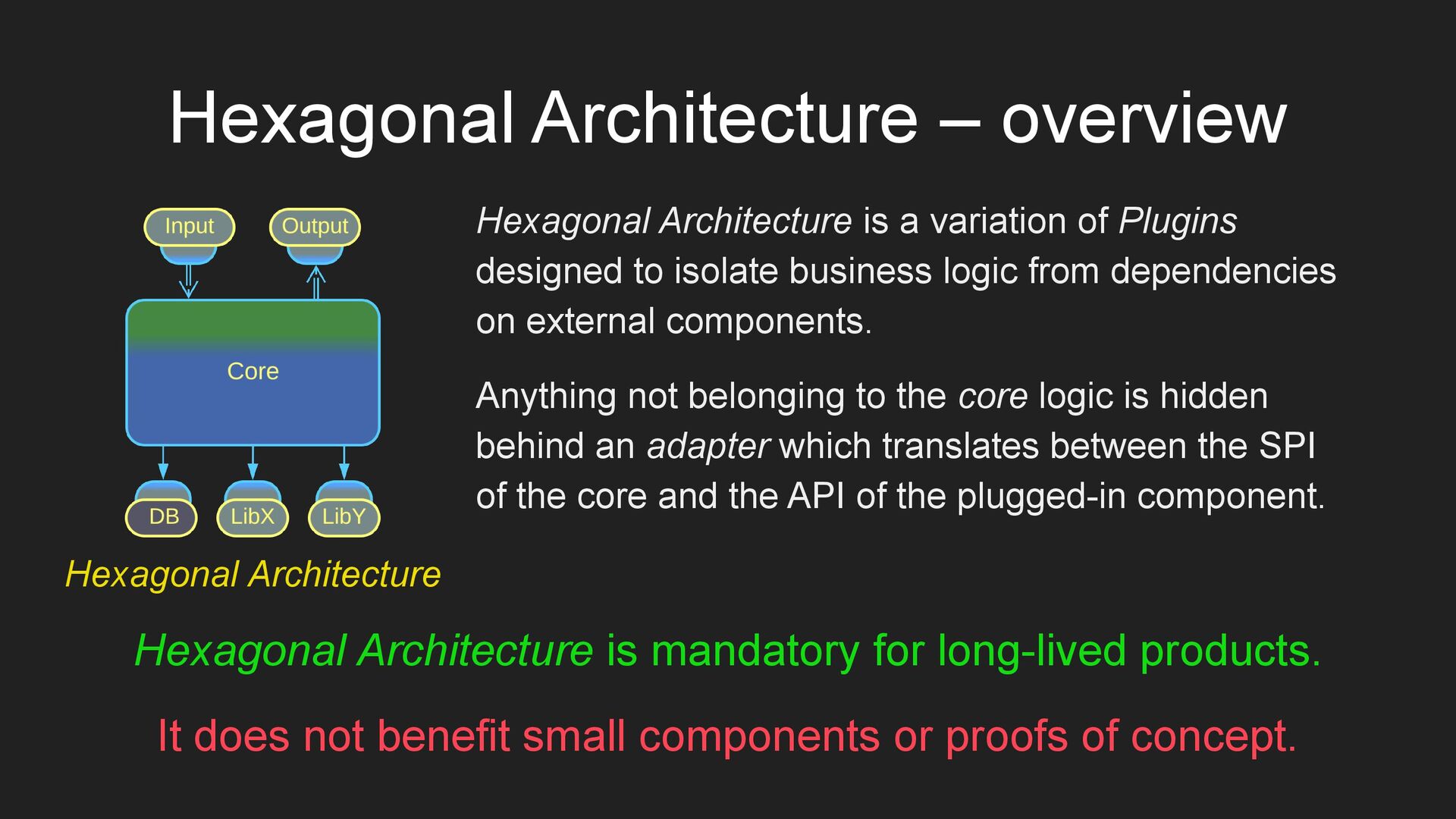
  12. Hexagonal Architecture – overview Hexagonal Architecture is a variation of

    Plugins designed to isolate business logic from dependencies on external components. Anything not belonging to the core logic is hidden behind an adapter which translates between the SPI of the core and the API of the plugged-in component. Hexagonal Architecture is mandatory for long-lived products. It does not benefit small components or proofs of concept. Hexagonal Architecture
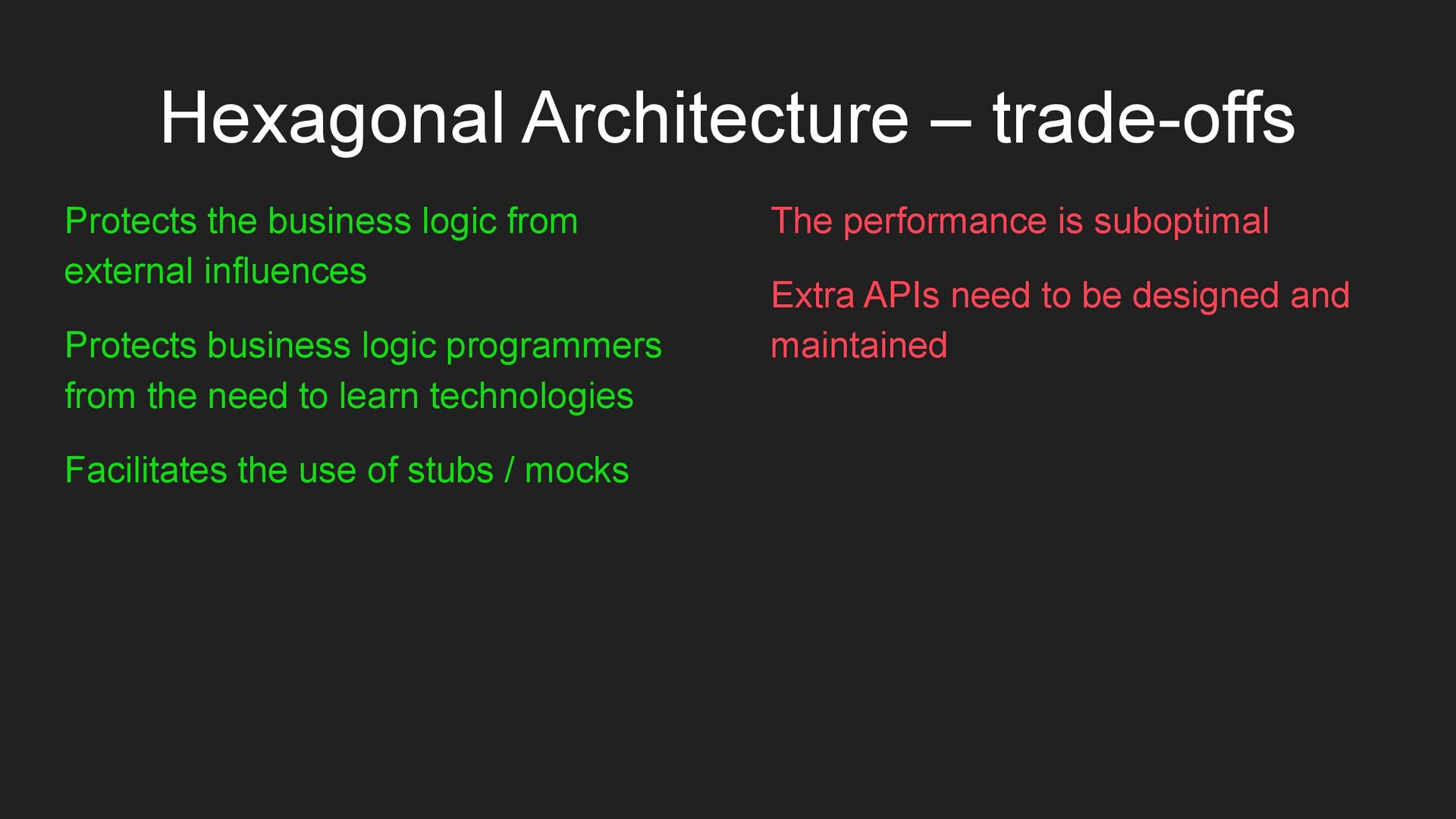
  13. Hexagonal Architecture – trade-offs Protects the business logic from external

    influences Protects business logic programmers from the need to learn technologies Facilitates the use of stubs / mocks The performance is suboptimal Extra APIs need to be designed and maintained
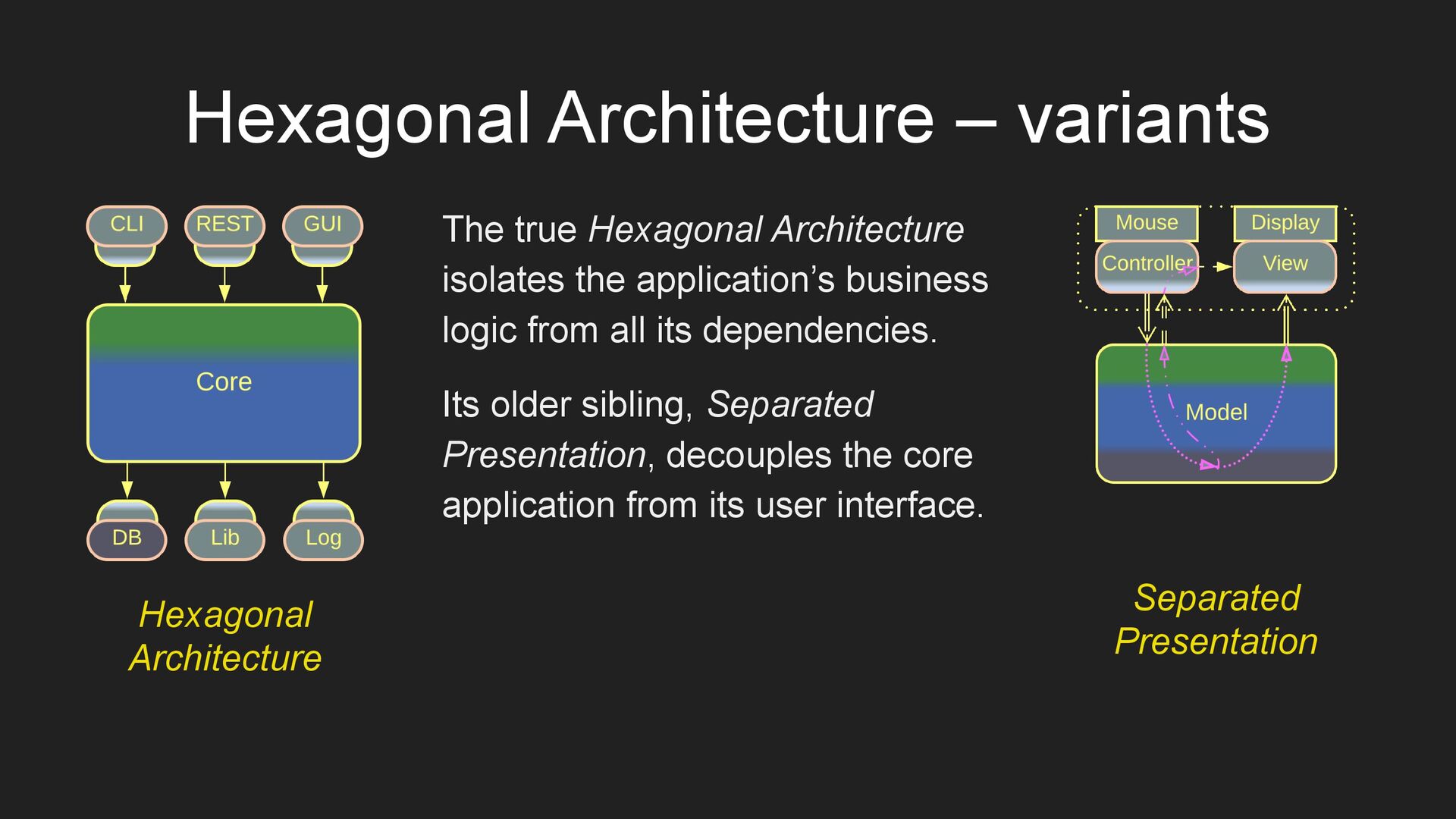
  14. The true Hexagonal Architecture isolates the application’s business logic from

    all its dependencies. Its older sibling, Separated Presentation, decouples the core application from its user interface. Separated Presentation Hexagonal Architecture Hexagonal Architecture – variants
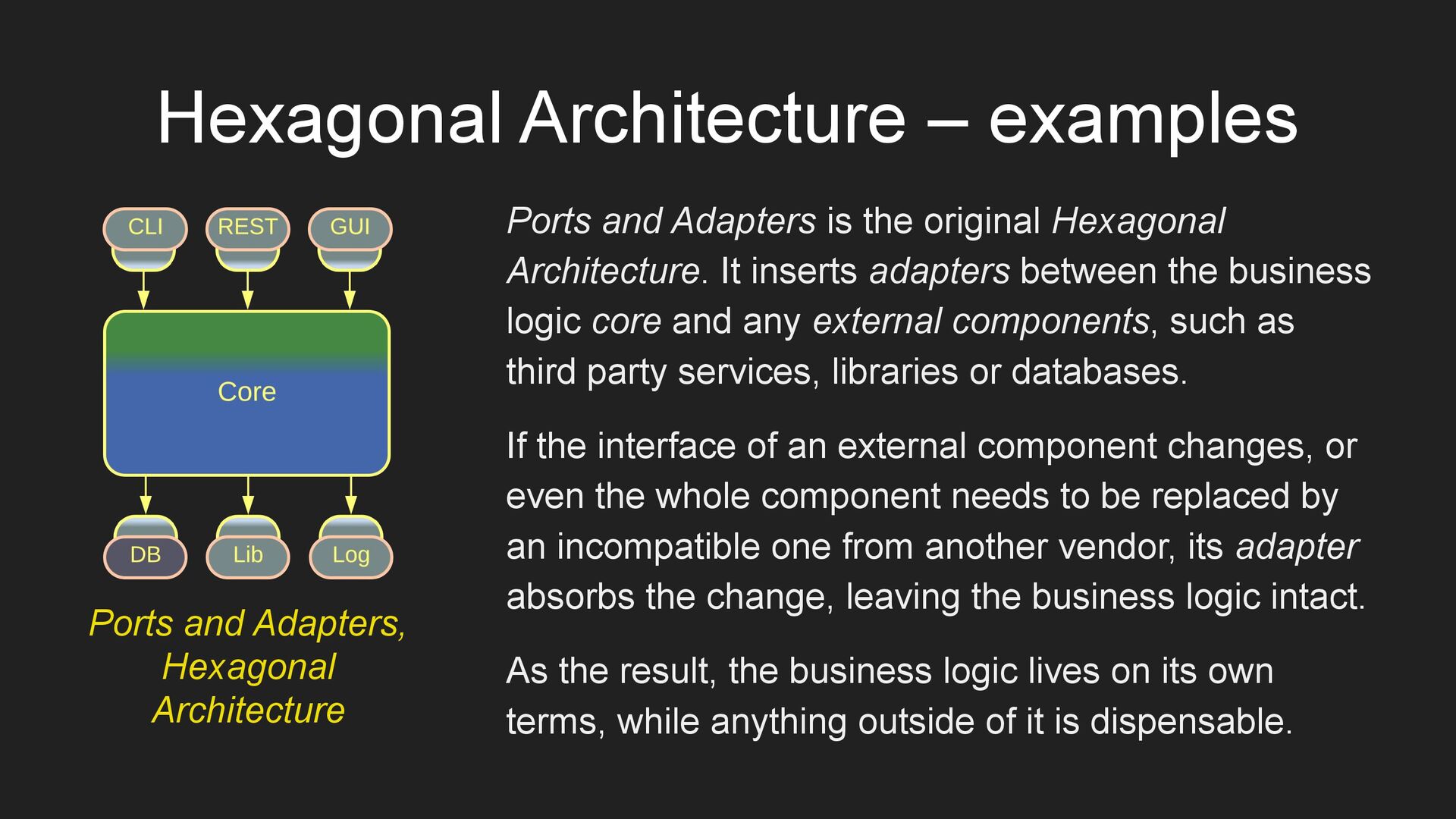
  15. Hexagonal Architecture – examples Ports and Adapters is the original

    Hexagonal Architecture. It inserts adapters between the business logic core and any external components, such as third party services, libraries or databases. If the interface of an external component changes, or even the whole component needs to be replaced by an incompatible one from another vendor, its adapter absorbs the change, leaving the business logic intact. As the result, the business logic lives on its own terms, while anything outside of it is dispensable. Ports and Adapters, Hexagonal Architecture
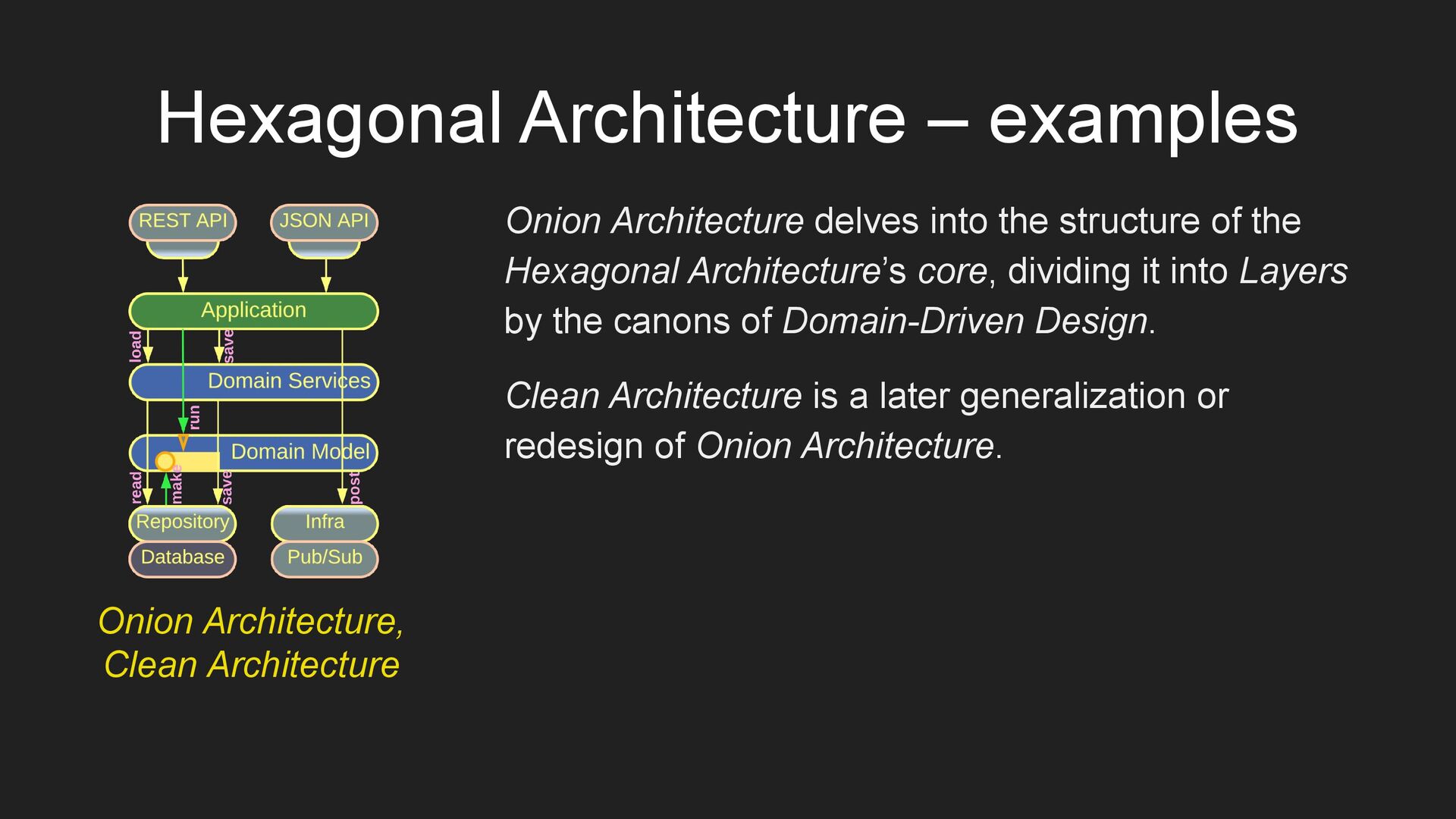
  16. Hexagonal Architecture – examples Onion Architecture delves into the structure

    of the Hexagonal Architecture’s core, dividing it into Layers by the canons of Domain-Driven Design. Clean Architecture is a later generalization or redesign of Onion Architecture. Onion Architecture, Clean Architecture
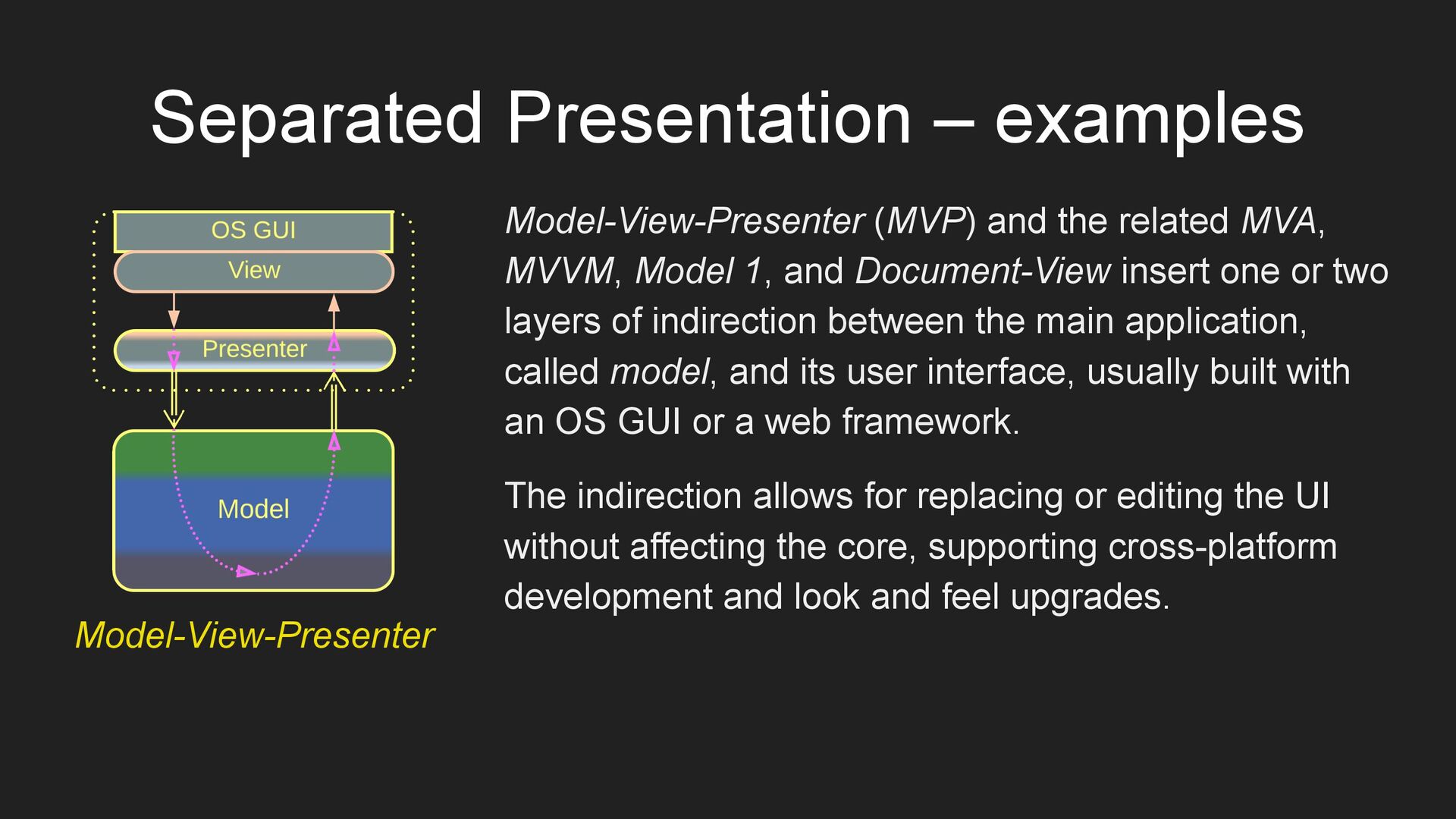
  17. Separated Presentation – examples Model-View-Presenter (MVP) and the related MVA,

    MVVM, Model 1, and Document-View insert one or two layers of indirection between the main application, called model, and its user interface, usually built with an OS GUI or a web framework. The indirection allows for replacing or editing the UI without affecting the core, supporting cross-platform development and look and feel upgrades. Model-View-Presenter
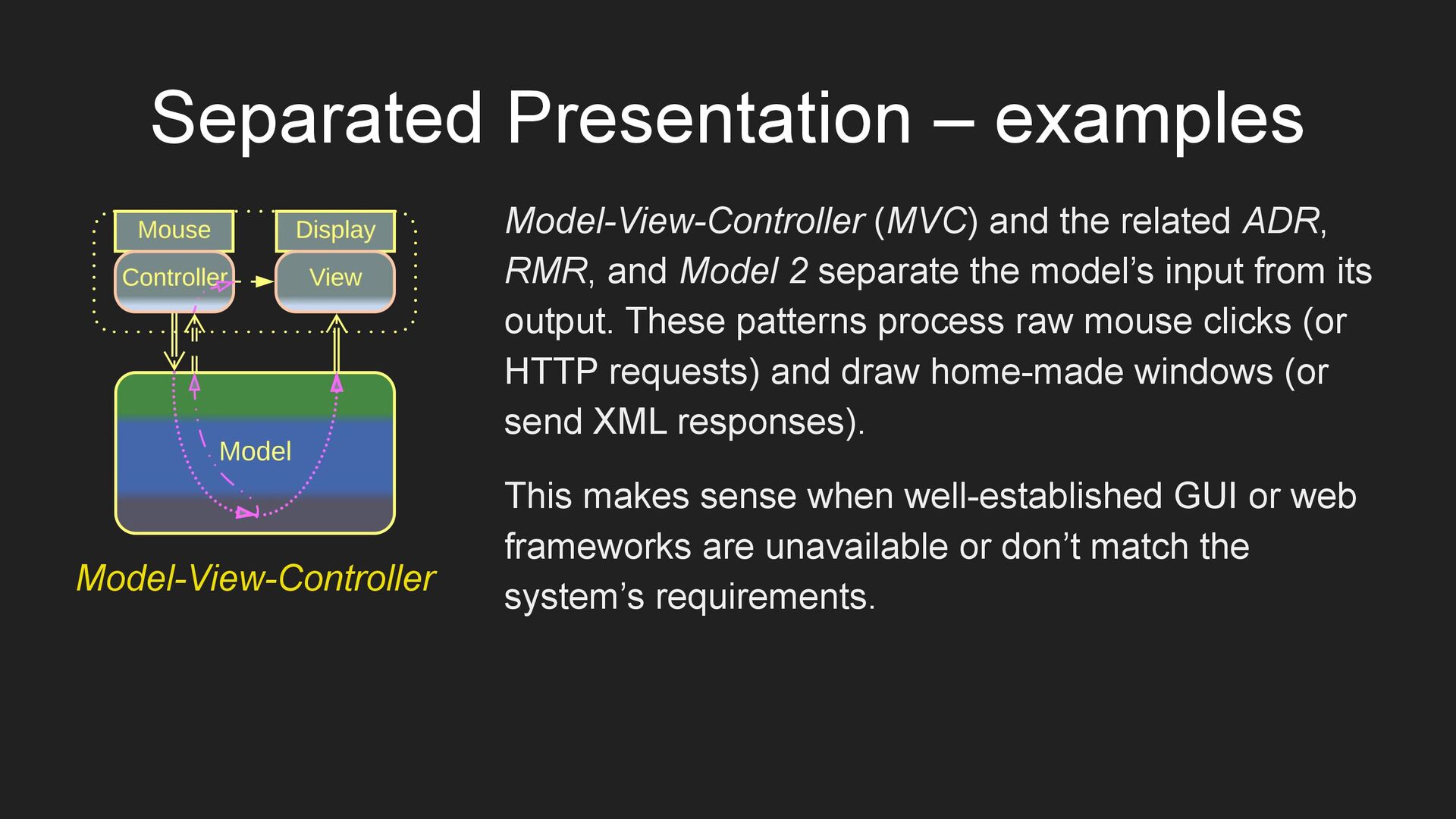
  18. Separated Presentation – examples Model-View-Controller (MVC) and the related ADR,

    RMR, and Model 2 separate the model’s input from its output. These patterns process raw mouse clicks (or HTTP requests) and draw home-made windows (or send XML responses). This makes sense when well-established GUI or web frameworks are unavailable or don’t match the system’s requirements. Model-View-Controller
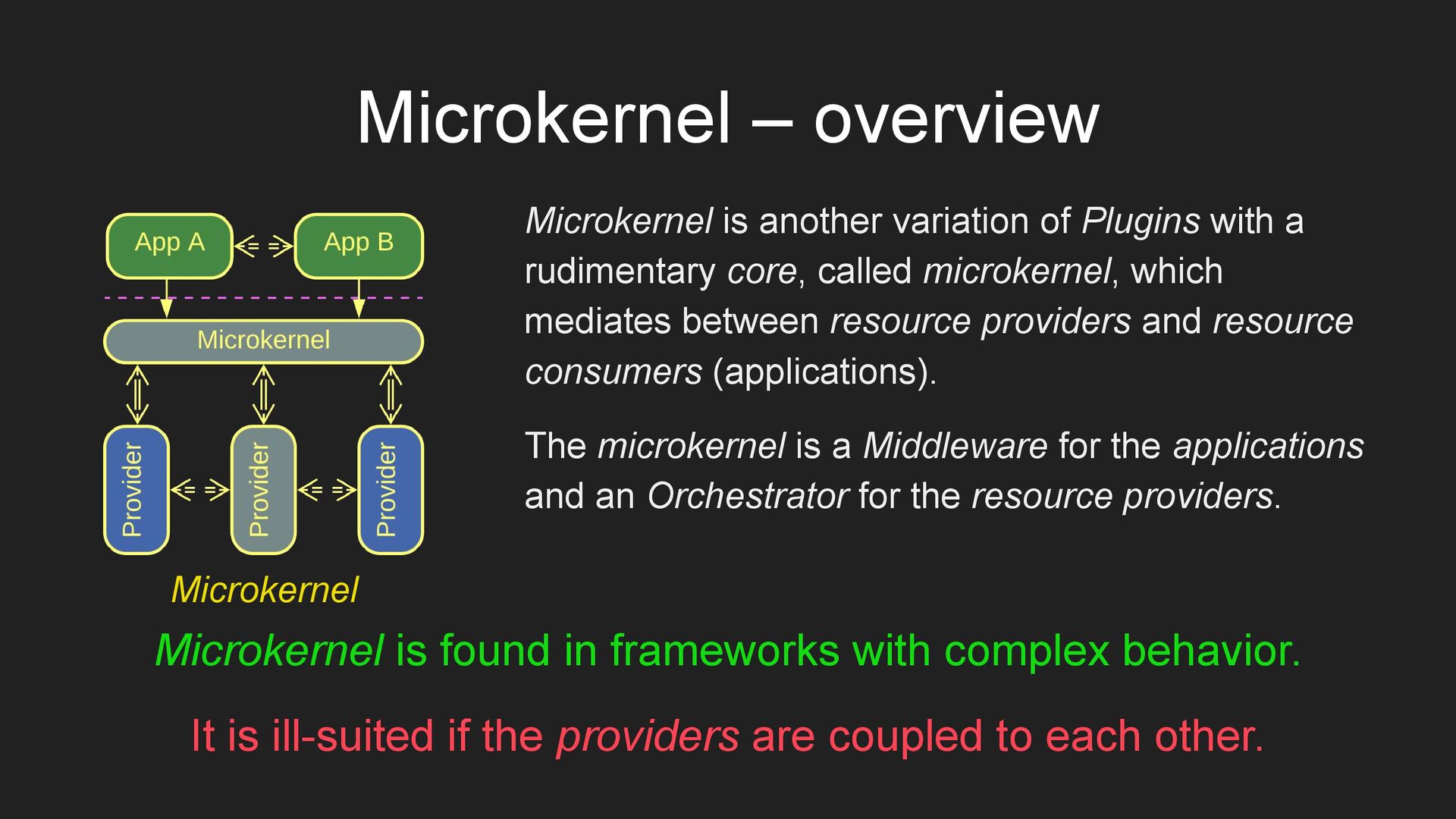
  19. Microkernel – overview Microkernel is another variation of Plugins with

    a rudimentary core, called microkernel, which mediates between resource providers and resource consumers (applications). The microkernel is a Middleware for the applications and an Orchestrator for the resource providers. Microkernel is found in frameworks with complex behavior. It is ill-suited if the providers are coupled to each other. Microkernel
  20. Microkernel – trade-offs Microkernel tackles system complexity by distributing it

    across multiple roles Polymorphic components, often from unknown vendors, are supported The applications are sandboxed and platform-agnostic Microkernel’s APIs and SPIs are hard to change after the initial release Indirection degrades performance The latency is unpredictable because of resource contention
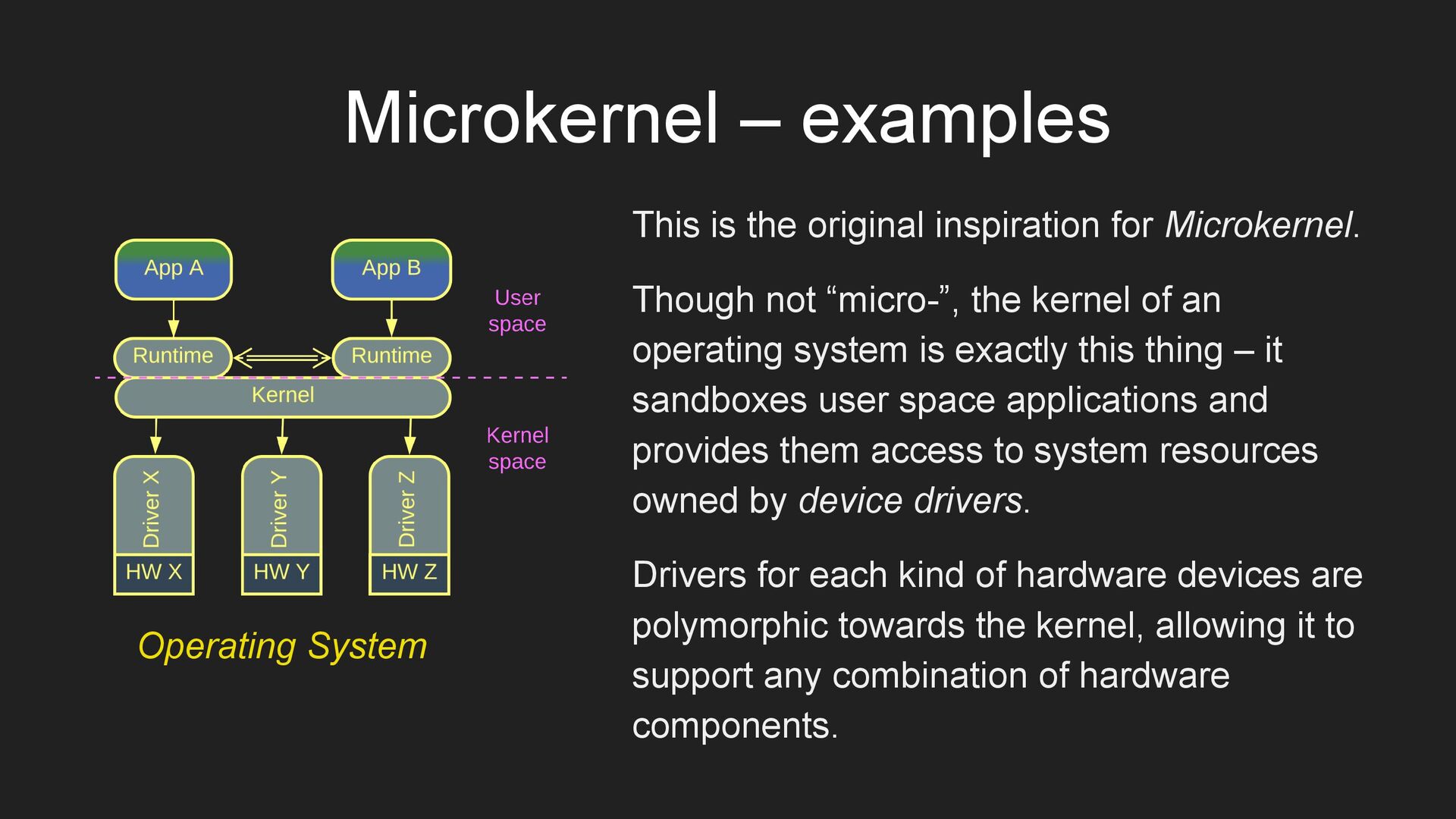
  21. Microkernel – examples This is the original inspiration for Microkernel.

    Though not “micro-”, the kernel of an operating system is exactly this thing – it sandboxes user space applications and provides them access to system resources owned by device drivers. Drivers for each kind of hardware devices are polymorphic towards the kernel, allowing it to support any combination of hardware components. Operating System
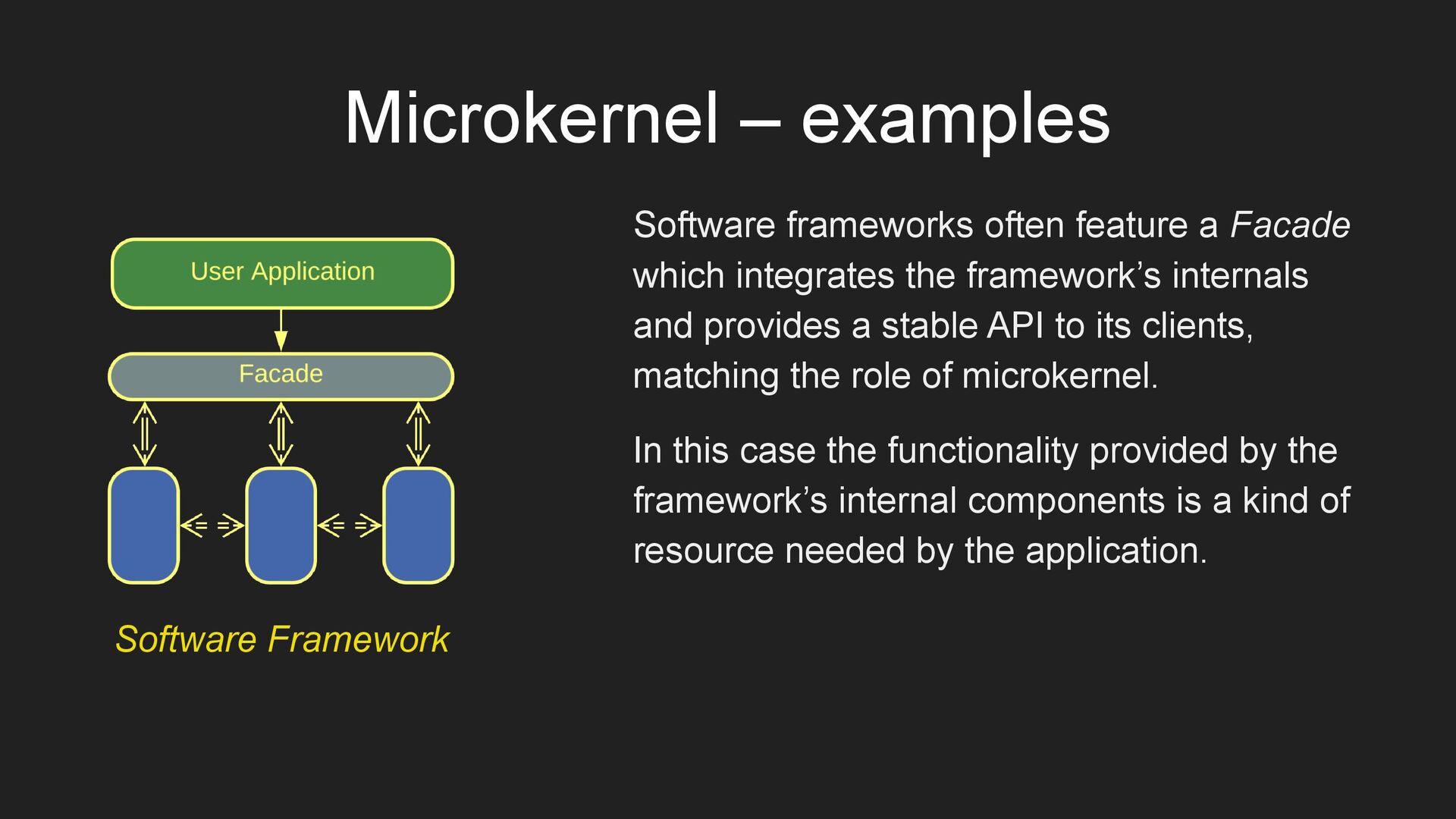
  22. Microkernel – examples Software frameworks often feature a Facade which

    integrates the framework’s internals and provides a stable API to its clients, matching the role of microkernel. In this case the functionality provided by the framework’s internal components is a kind of resource needed by the application. Software Framework
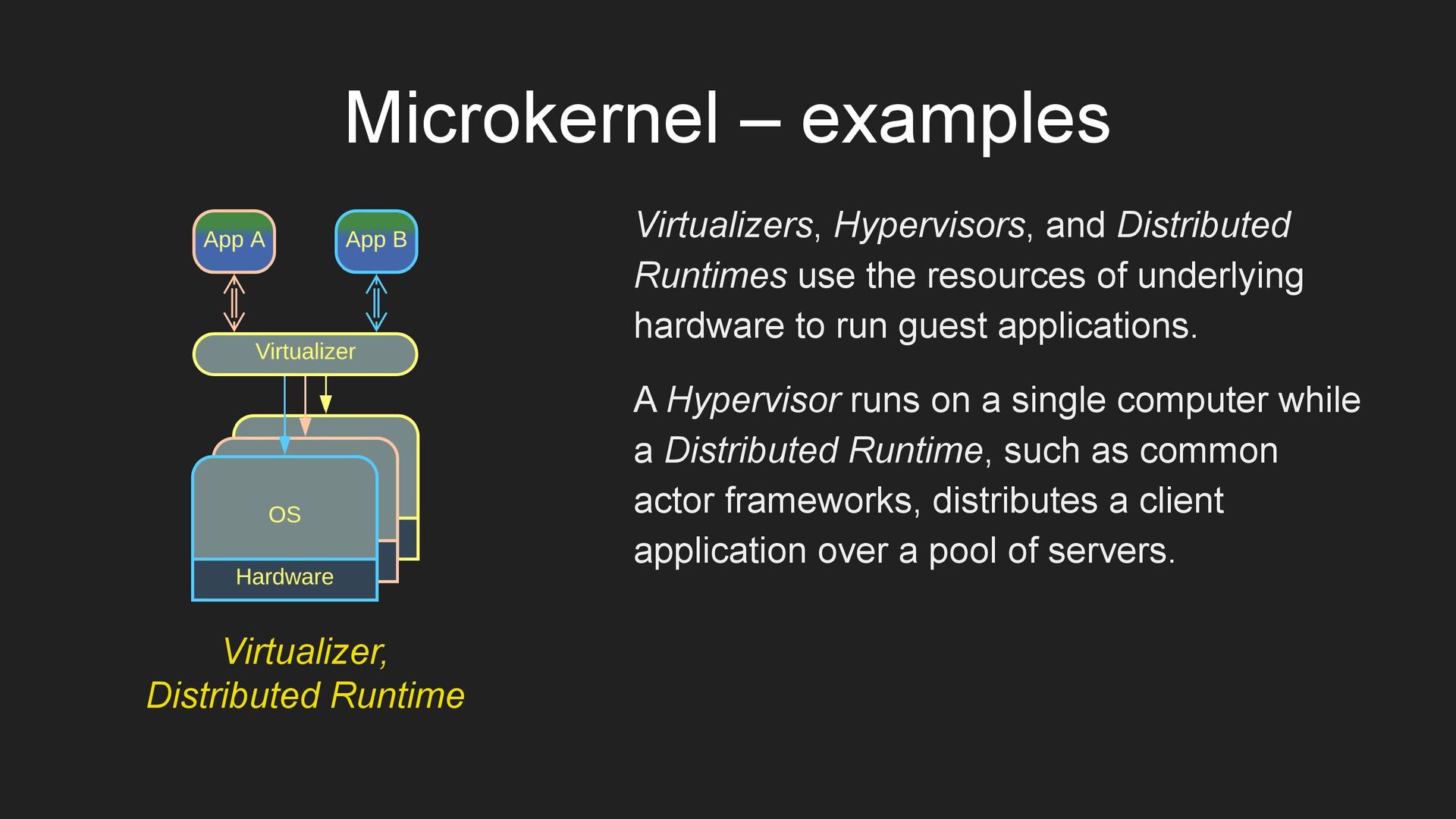
  23. Microkernel – examples Virtualizers, Hypervisors, and Distributed Runtimes use the

    resources of underlying hardware to run guest applications. A Hypervisor runs on a single computer while a Distributed Runtime, such as common actor frameworks, distributes a client application over a pool of servers. Virtualizer, Distributed Runtime
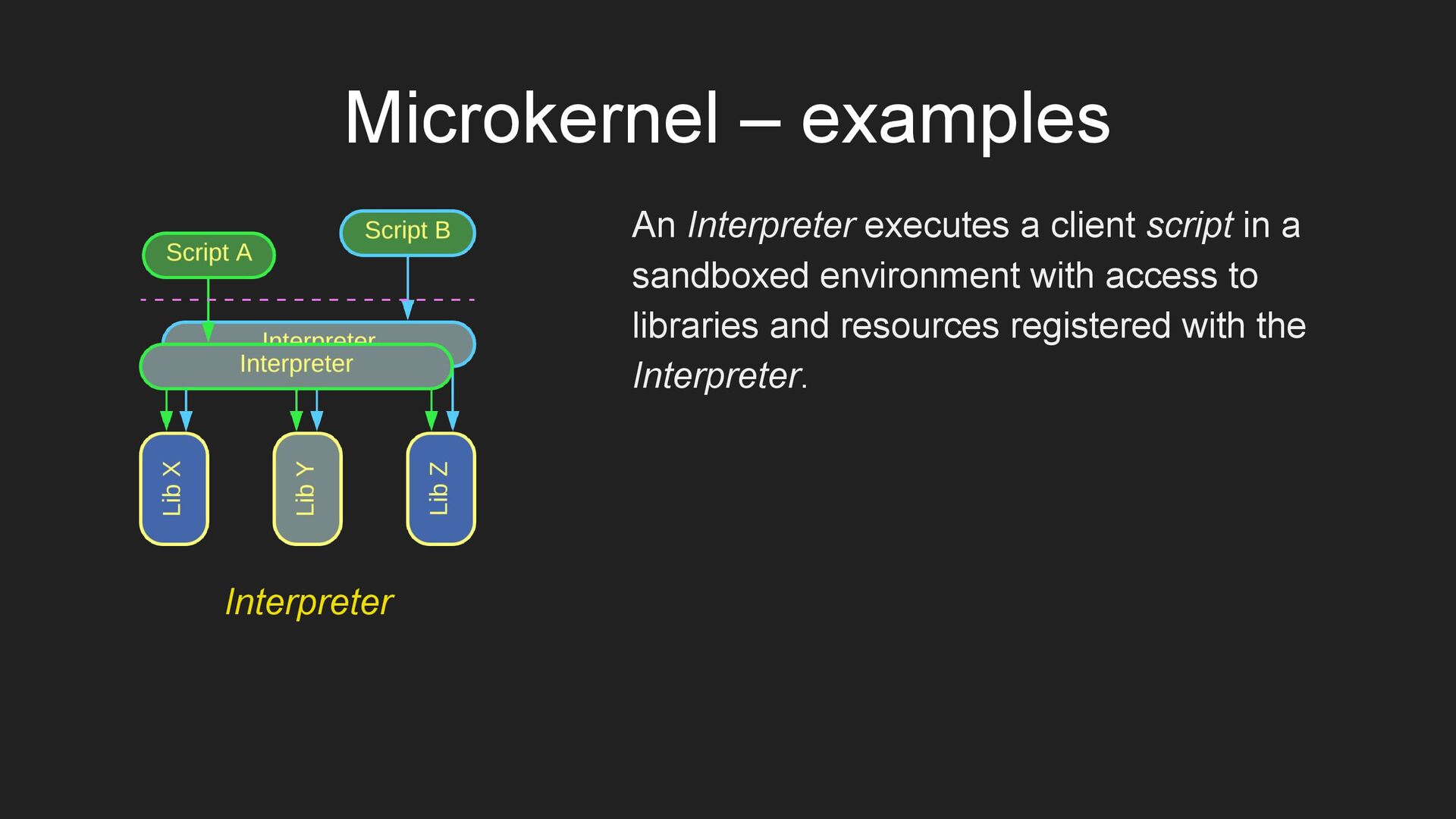
  24. Microkernel – examples An Interpreter executes a client script in

    a sandboxed environment with access to libraries and resources registered with the Interpreter. Interpreter
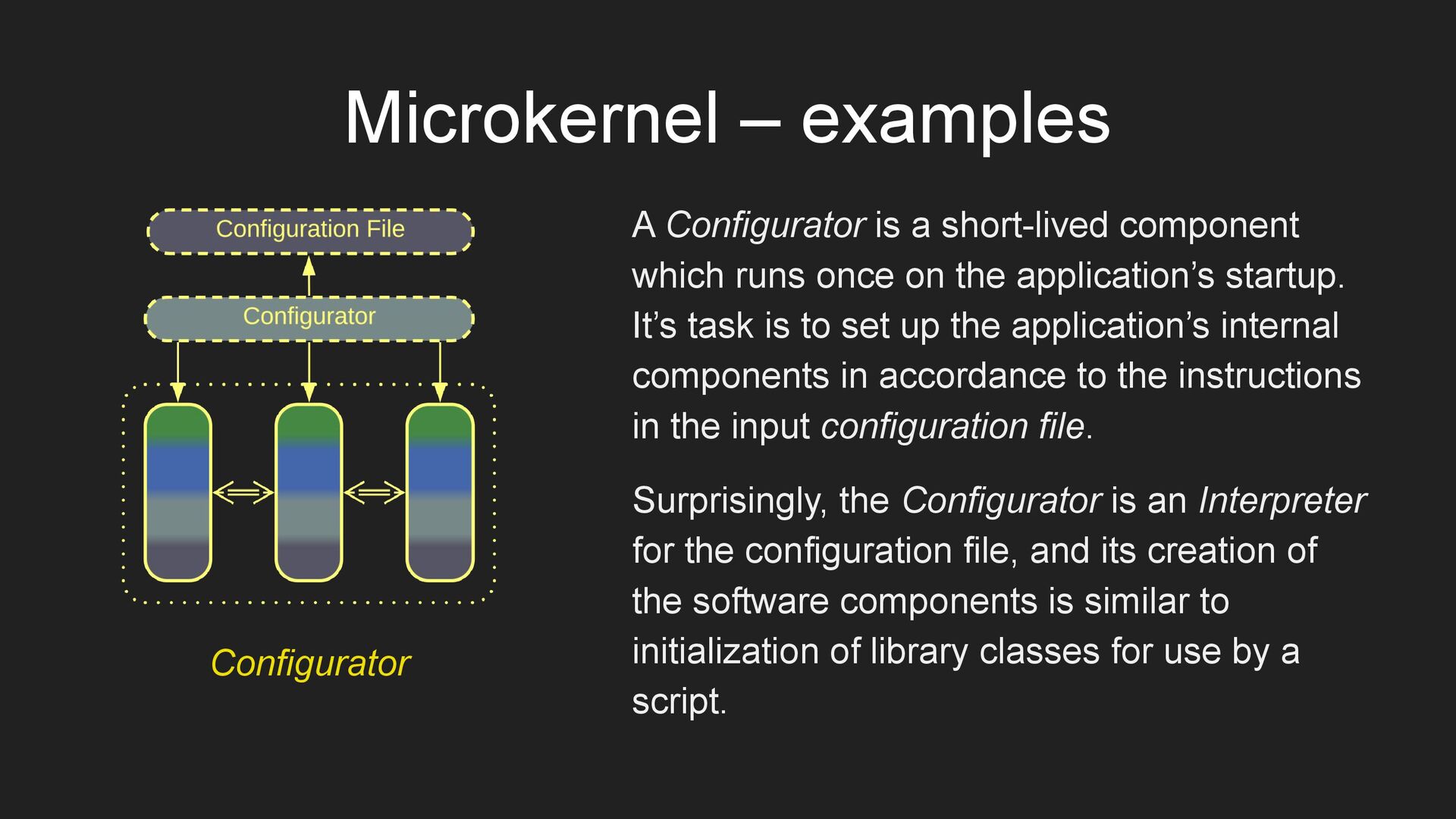
  25. Microkernel – examples A Configurator is a short-lived component which

    runs once on the application’s startup. It’s task is to set up the application’s internal components in accordance to the instructions in the input configuration file. Surprisingly, the Configurator is an Interpreter for the configuration file, and its creation of the software components is similar to initialization of library classes for use by a script. Configurator
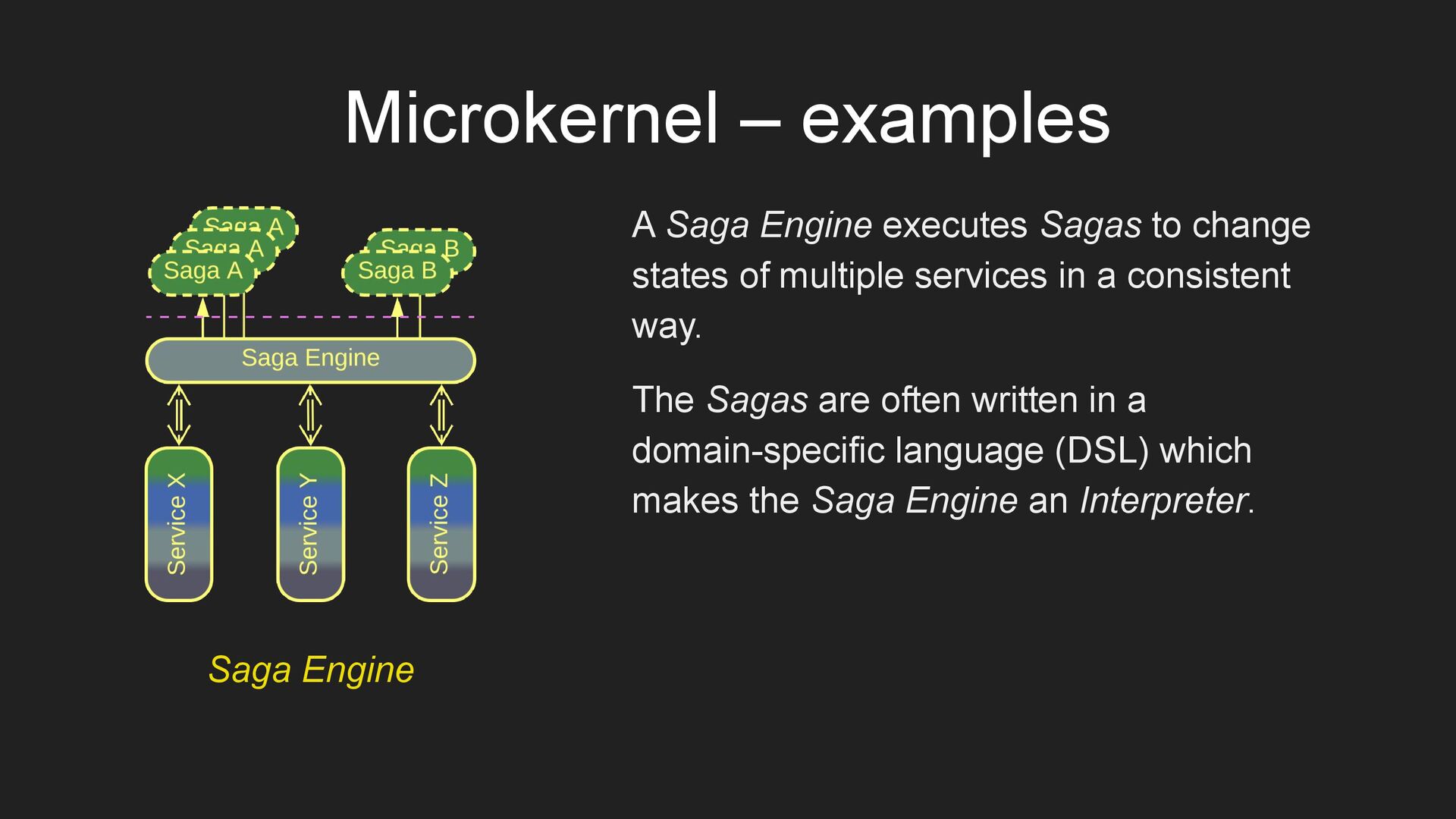
  26. Microkernel – examples A Saga Engine executes Sagas to change

    states of multiple services in a consistent way. The Sagas are often written in a domain-specific language (DSL) which makes the Saga Engine an Interpreter. Saga Engine
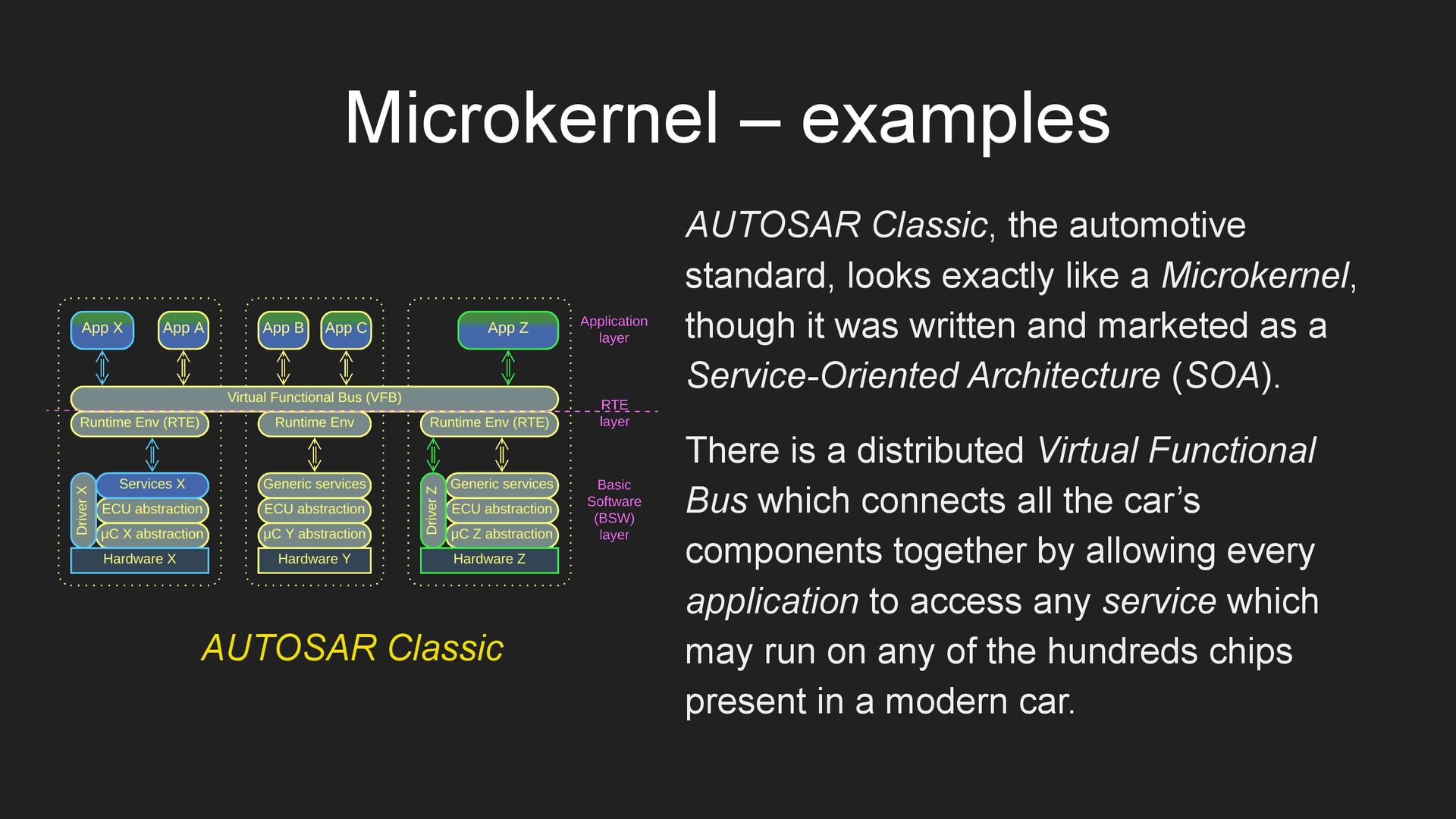
  27. Microkernel – examples AUTOSAR Classic, the automotive standard, looks exactly

    like a Microkernel, though it was written and marketed as a Service-Oriented Architecture (SOA). There is a distributed Virtual Functional Bus which connects all the car’s components together by allowing every application to access any service which may run on any of the hundreds chips present in a modern car. AUTOSAR Classic
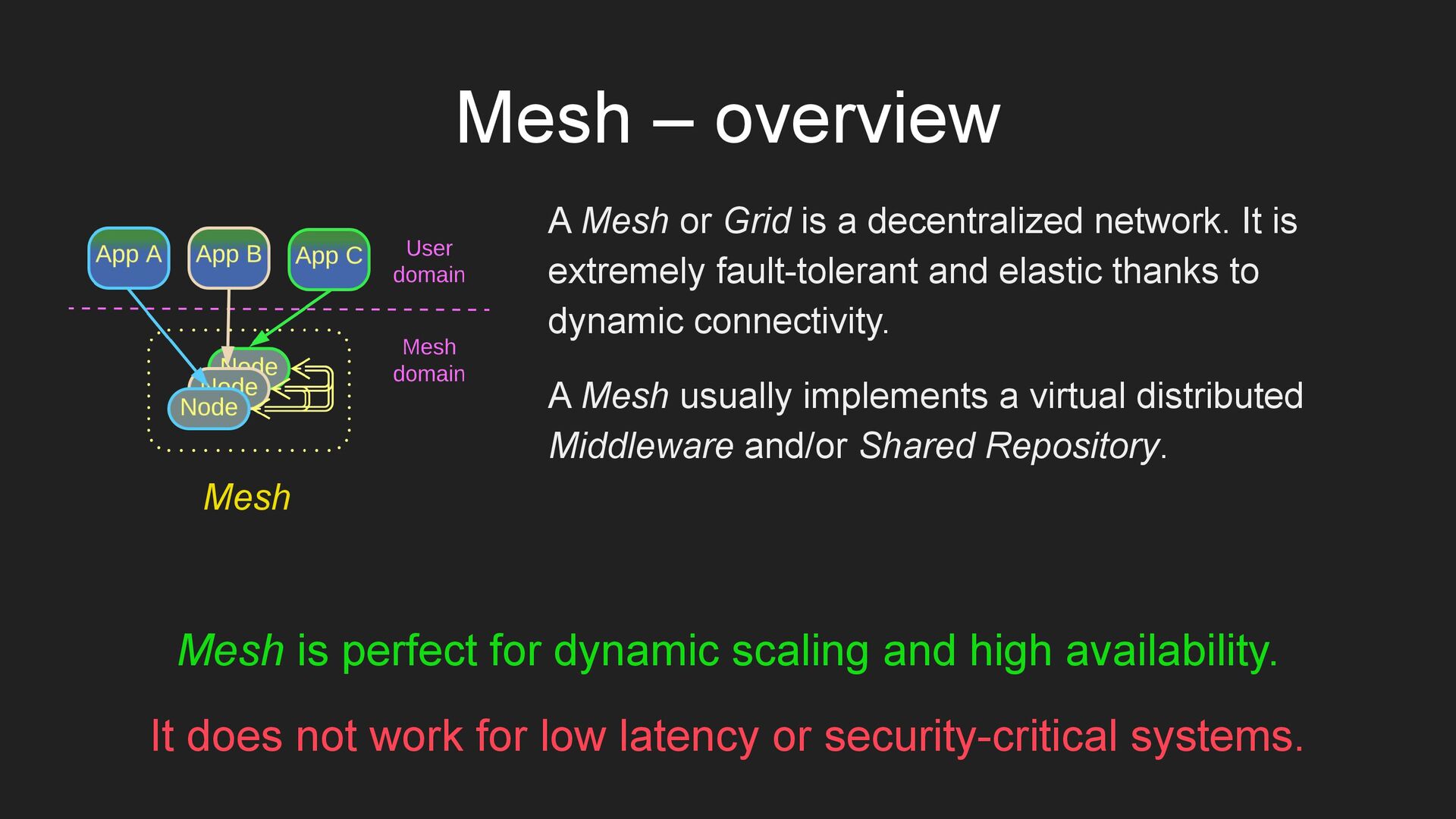
  28. Mesh – overview A Mesh or Grid is a decentralized

    network. It is extremely fault-tolerant and elastic thanks to dynamic connectivity. A Mesh usually implements a virtual distributed Middleware and/or Shared Repository. Mesh is perfect for dynamic scaling and high availability. It does not work for low latency or security-critical systems. Mesh
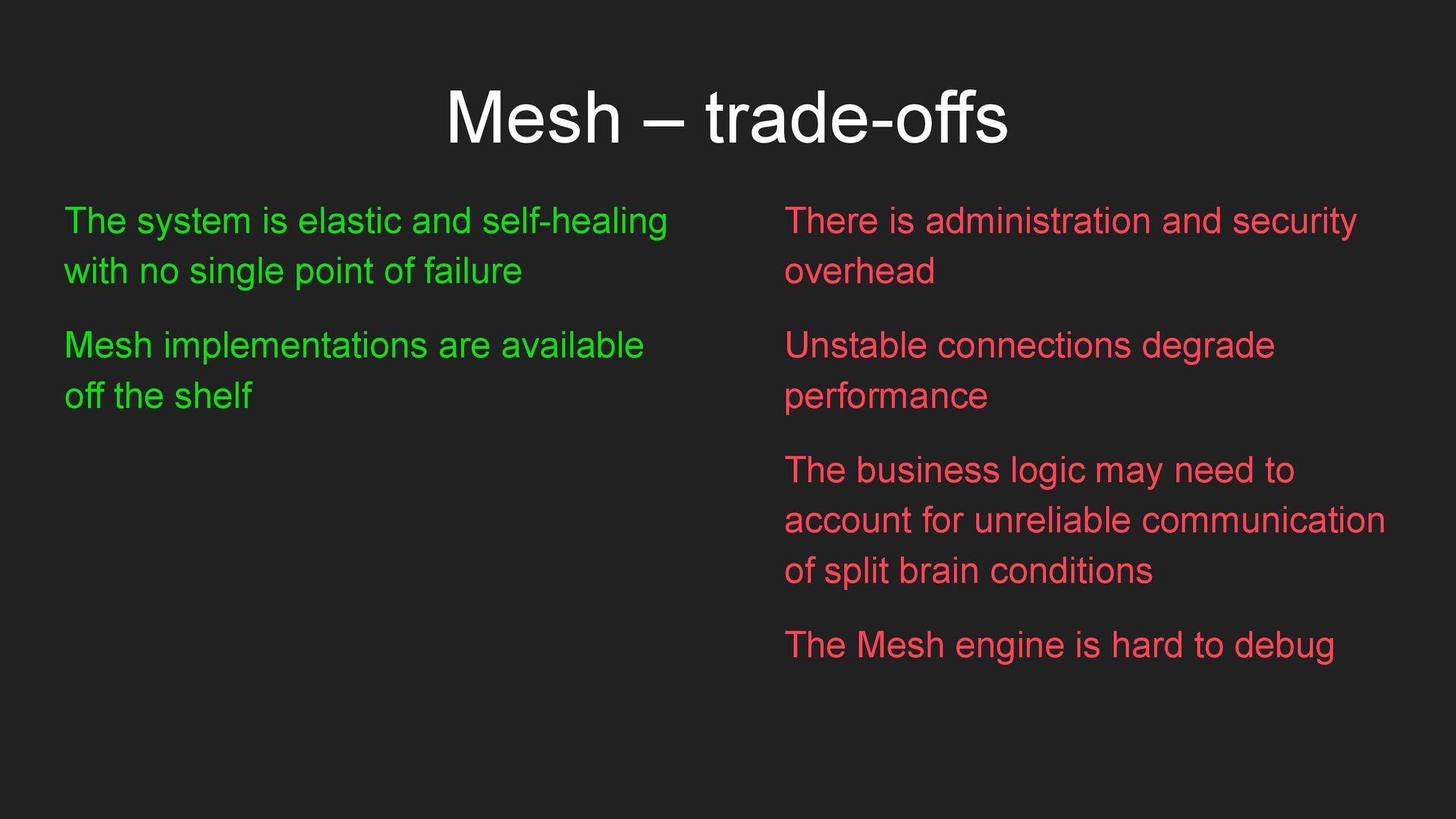
  29. Mesh – trade-offs The system is elastic and self-healing with

    no single point of failure Mesh implementations are available off the shelf There is administration and security overhead Unstable connections degrade performance The business logic may need to account for unreliable communication of split brain conditions The Mesh engine is hard to debug
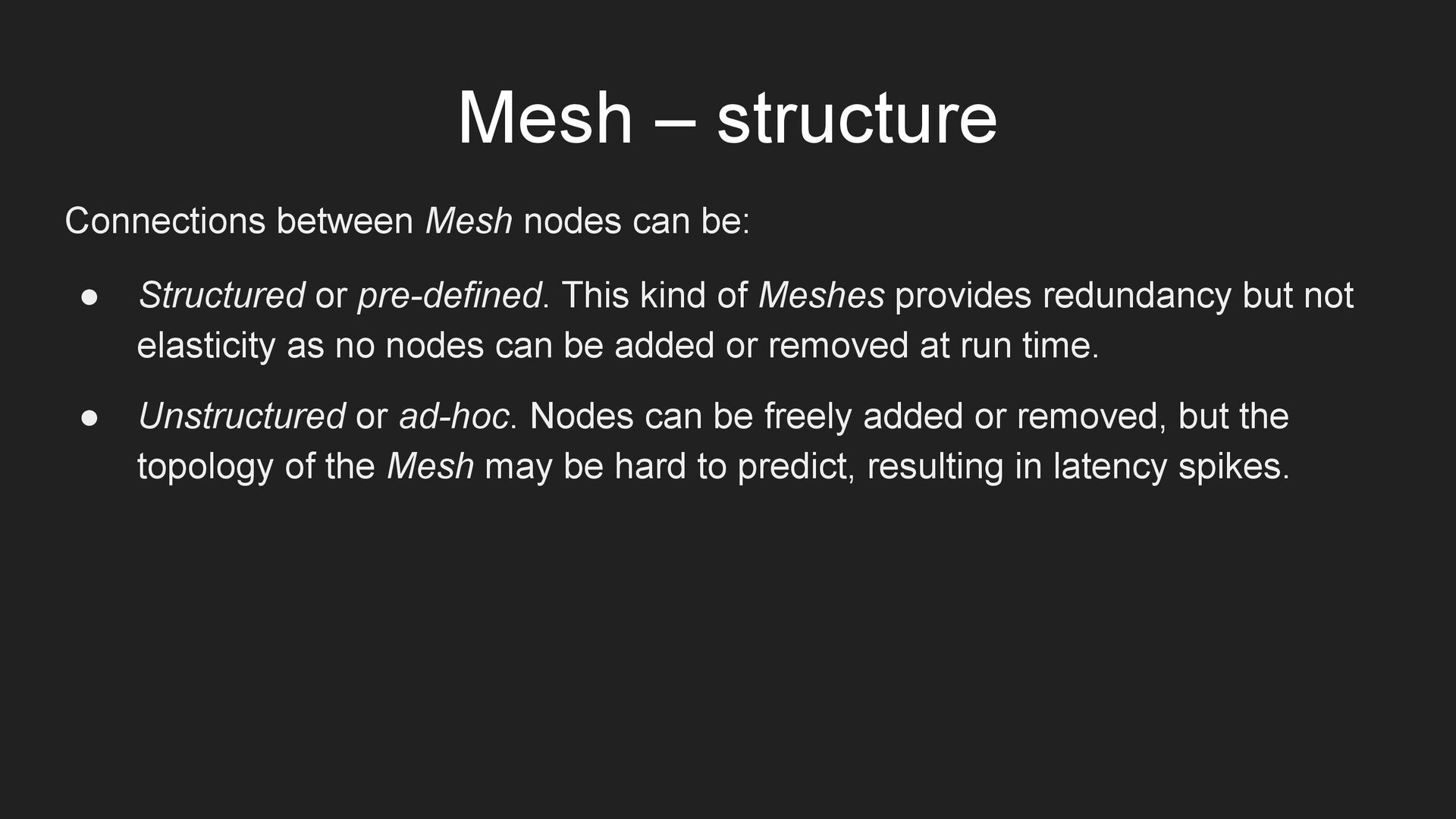
  30. Connections between Mesh nodes can be: • Structured or pre-defined.

    This kind of Meshes provides redundancy but not elasticity as no nodes can be added or removed at run time. • Unstructured or ad-hoc. Nodes can be freely added or removed, but the topology of the Mesh may be hard to predict, resulting in latency spikes. Mesh – structure
  31. Each node can be: • Connected to every other node,

    making a fully connected Mesh. Such Meshes are limited in size because of the number of connections, but deliver the best performance and fault tolerance. • Connected to some other nodes. The exact rules for making connections define the internal topology of the Mesh. Mesh – connectivity
  32. The interconnected nodes of the Mesh can be: • Identical

    in a one-layer Mesh. • Specialized in a multi-layer Mesh. In most cases there are trunk nodes that maintain the Mesh’s topology and connectivity, and leaf nodes that carry end user applications. Mesh – layering
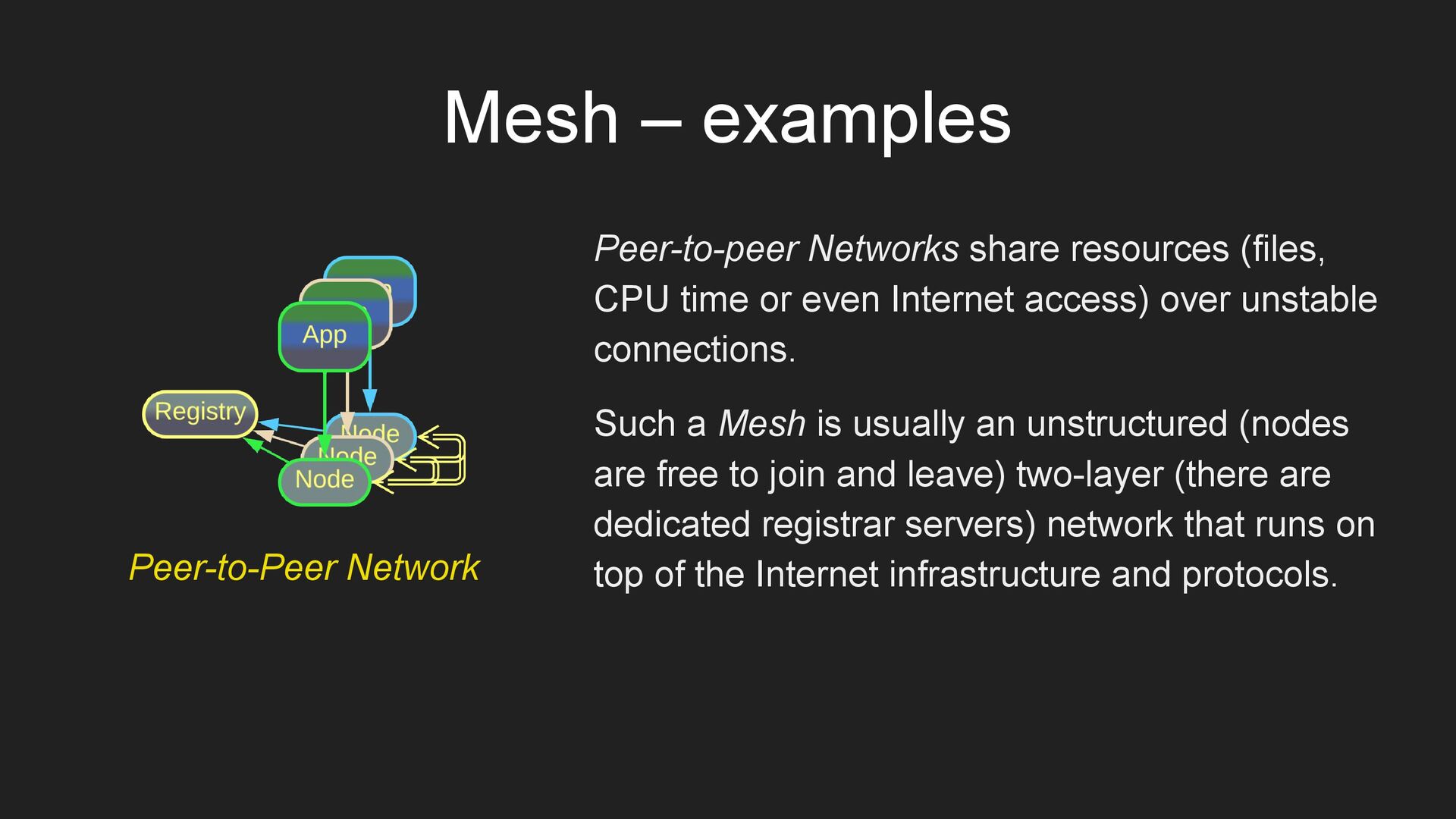
  33. Mesh – examples Peer-to-peer Networks share resources (files, CPU time

    or even Internet access) over unstable connections. Such a Mesh is usually an unstructured (nodes are free to join and leave) two-layer (there are dedicated registrar servers) network that runs on top of the Internet infrastructure and protocols. Peer-to-Peer Network
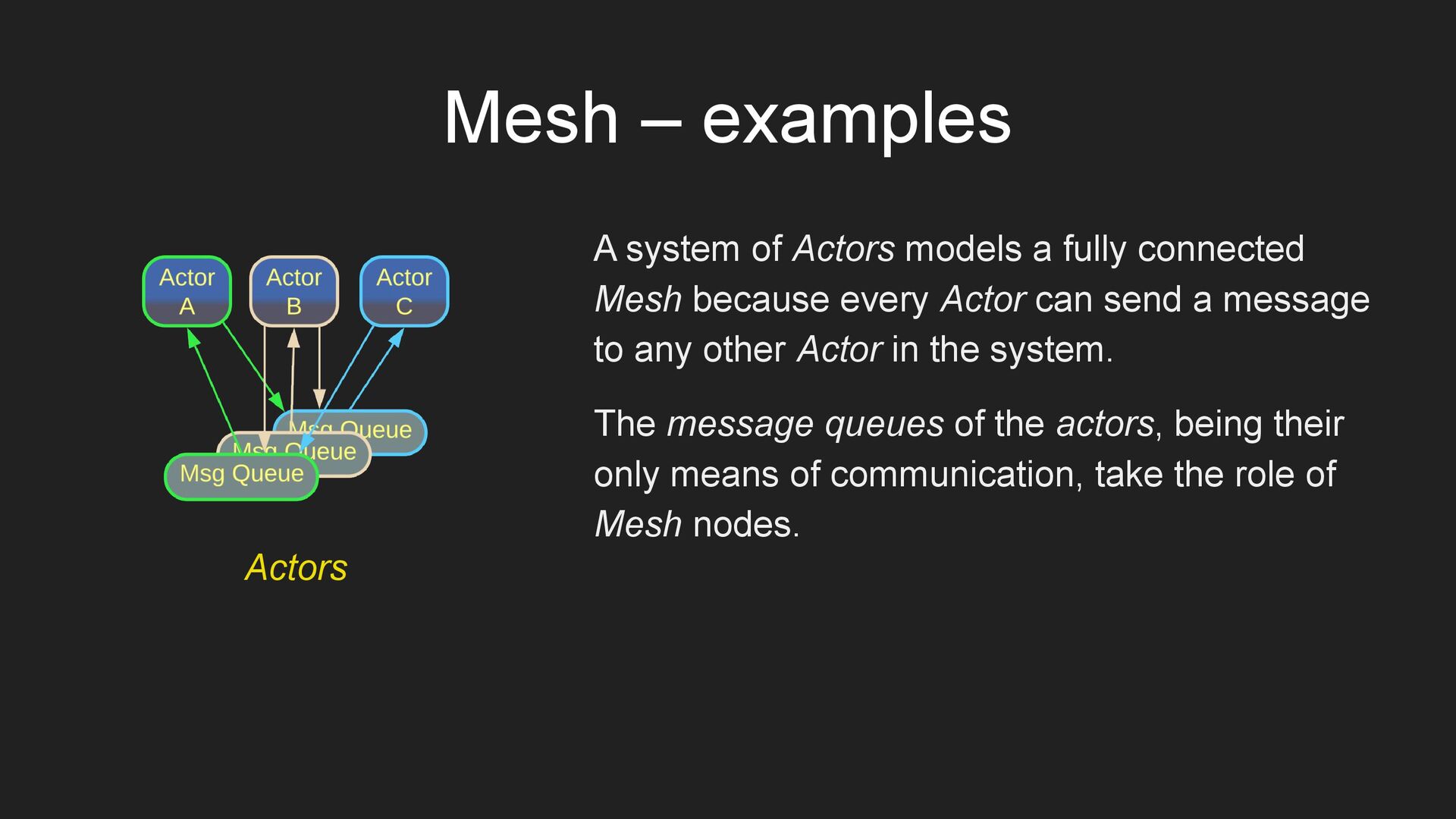
  34. Mesh – examples A system of Actors models a fully

    connected Mesh because every Actor can send a message to any other Actor in the system. The message queues of the actors, being their only means of communication, take the role of Mesh nodes. Actors
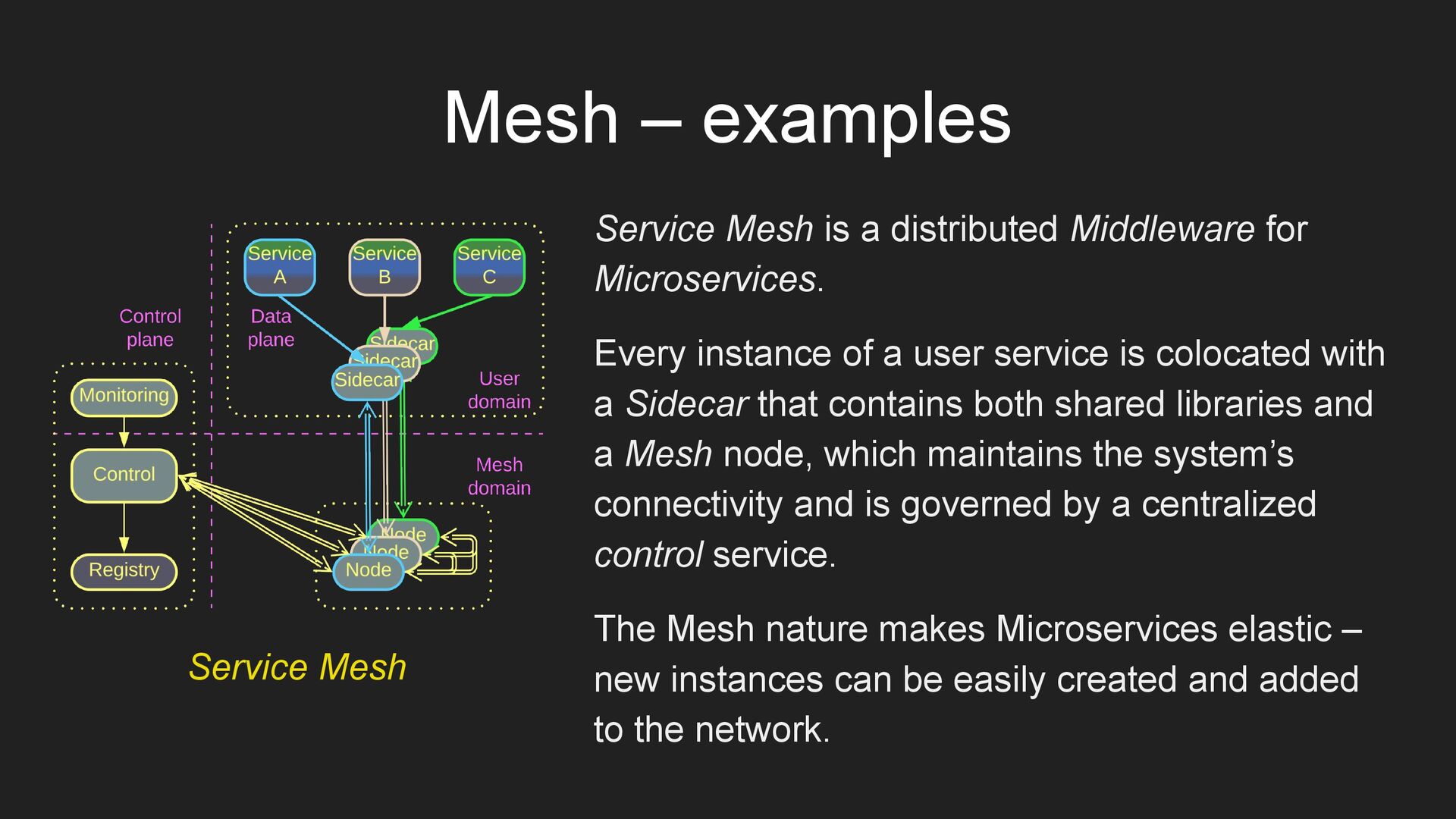
  35. Mesh – examples Service Mesh is a distributed Middleware for

    Microservices. Every instance of a user service is colocated with a Sidecar that contains both shared libraries and a Mesh node, which maintains the system’s connectivity and is governed by a centralized control service. The Mesh nature makes Microservices elastic – new instances can be easily created and added to the network. Service Mesh
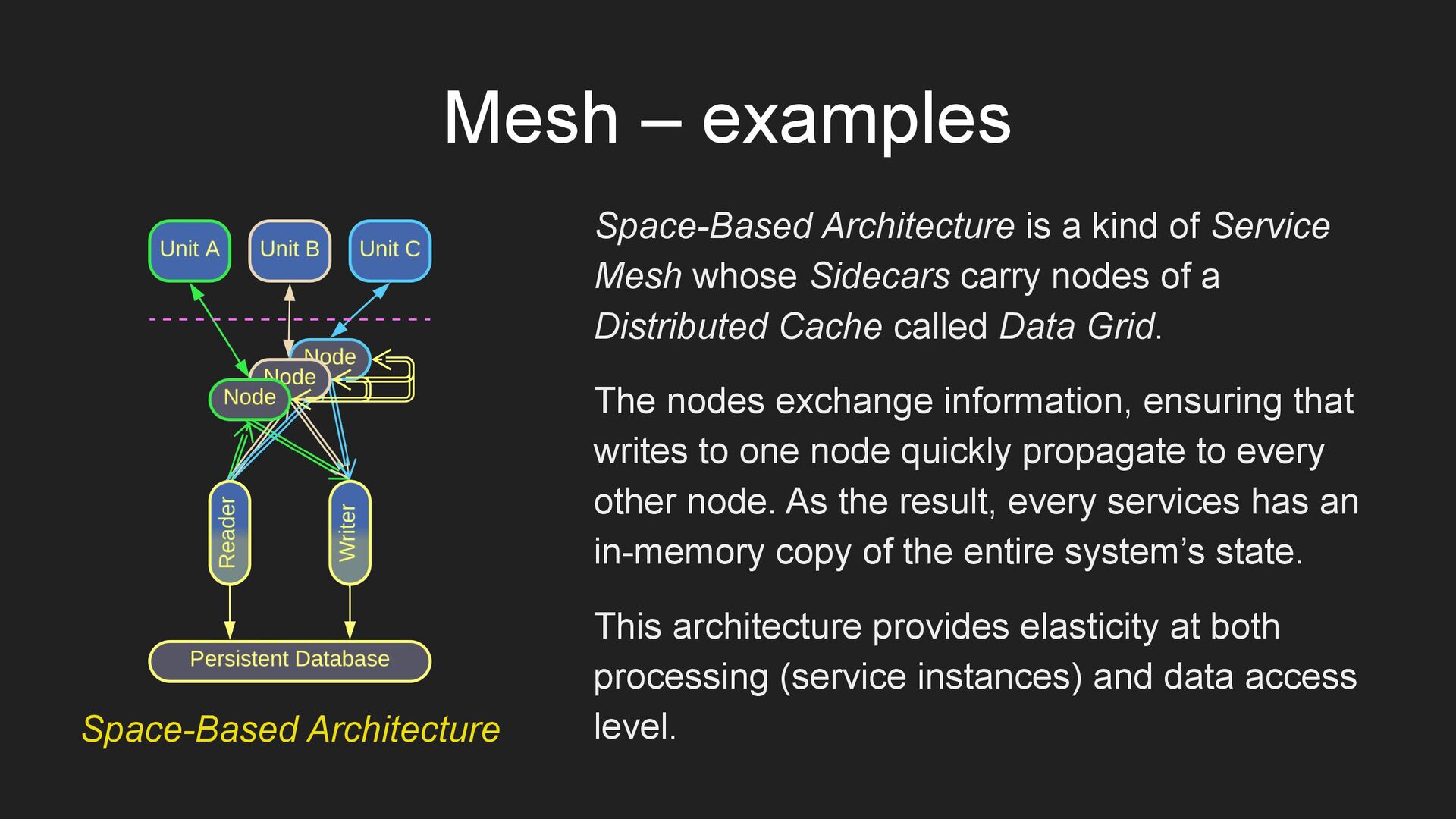
  36. Mesh – examples Space-Based Architecture is a kind of Service

    Mesh whose Sidecars carry nodes of a Distributed Cache called Data Grid. The nodes exchange information, ensuring that writes to one node quickly propagate to every other node. As the result, every services has an in-memory copy of the entire system’s state. This architecture provides elasticity at both processing (service instances) and data access level. Space-Based Architecture
  37. We can modify the internal design of a system component

    to achieve flexibility with Plugins or stability with Hexagonal Architecture. We can share or coordinate resources by employing a Microkernel. We can make our system elastic and fault tolerant by running it in a Mesh. Patterns are like data structures: any system can be implemented with only vectors, or lists, or hash tables. Still, its performance will be better if you use an appropriate algorithm for each data processing task. Likewise, any business logic can be implemented without patterns, but making prudent use of them will improve both the structure and performance of the code. The way of patterns
  38. Links This was an overview of patterns revisited in part

    5 of Architectural Metapatterns. You can: – read the book online at metapatterns.io – download it from leanpub.com/metapatterns The diagrams and the ODT source file are available under the CC BY license. The book also contains analytics not covered by these slides.