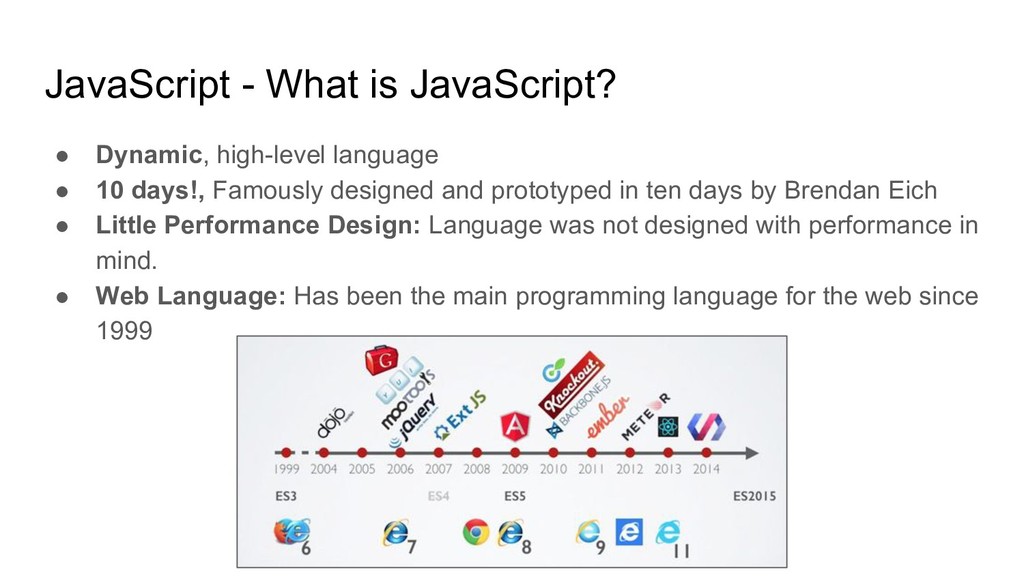
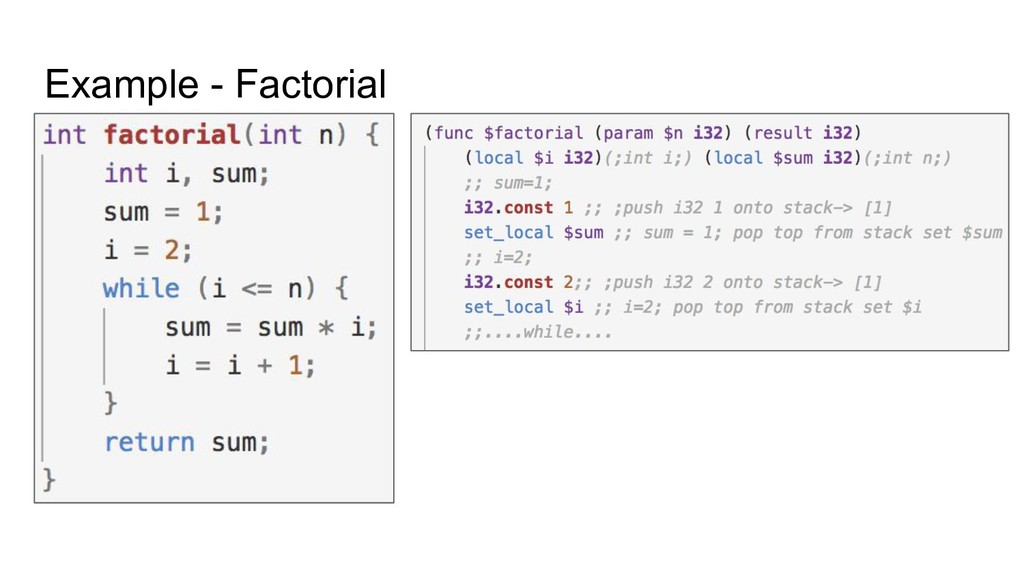
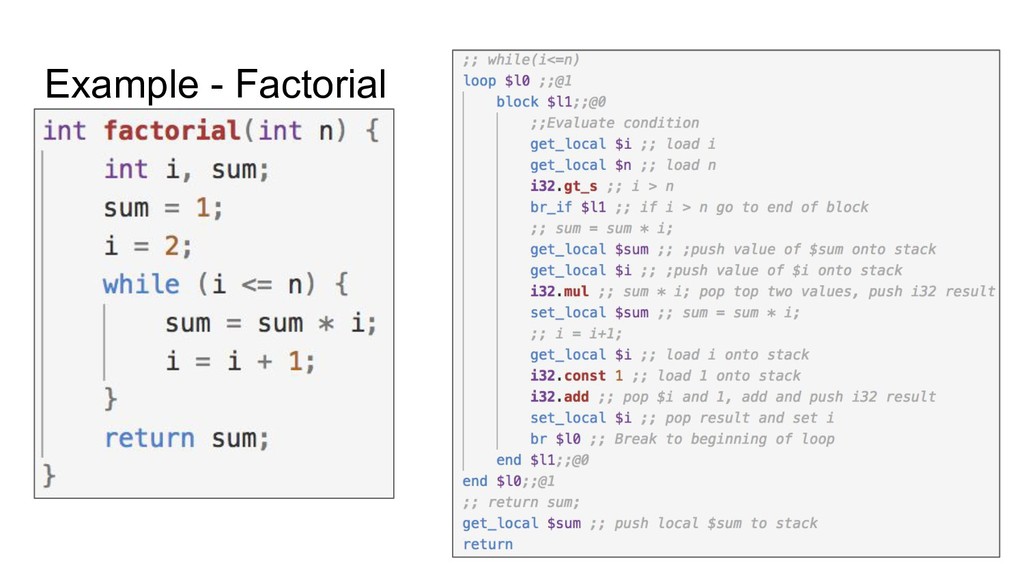
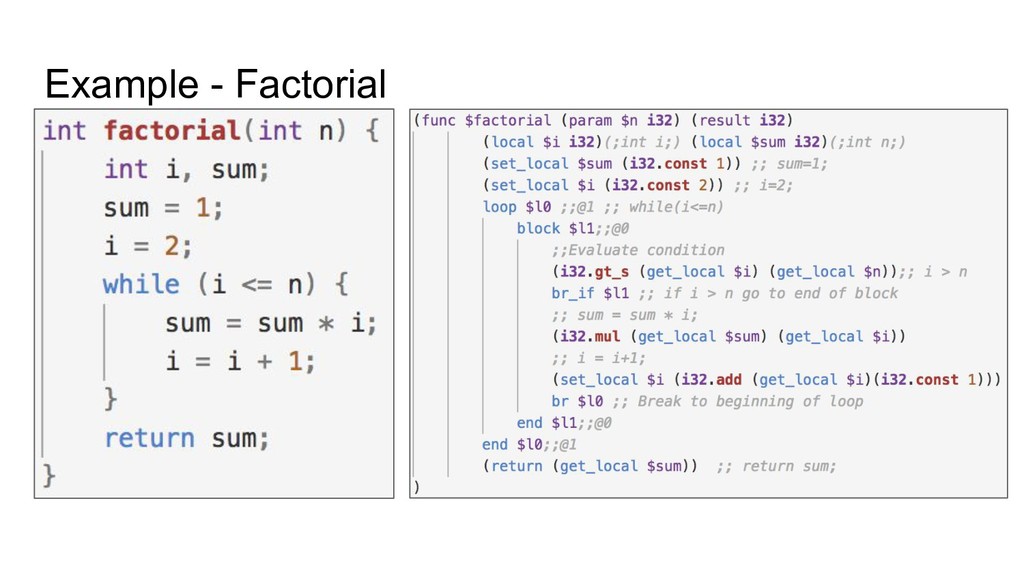
prototyped in ten days by Brendan Eich • Little Performance Design: Language was not designed with performance in mind. • Web Language: Has been the main programming language for the web since 1999 JavaScript - What is JavaScript?
it a “tough target” of static languages such as C and C++, as well as a relatively slow language. • Lacks Parallelism: No real parallelism supported natively. (At least not widely supported by all browsers, or general with full control) • Number type: Numbers are restricted to doubles, float64. This means that for instance, an i64 number cannot be represented natively in JavaScript.
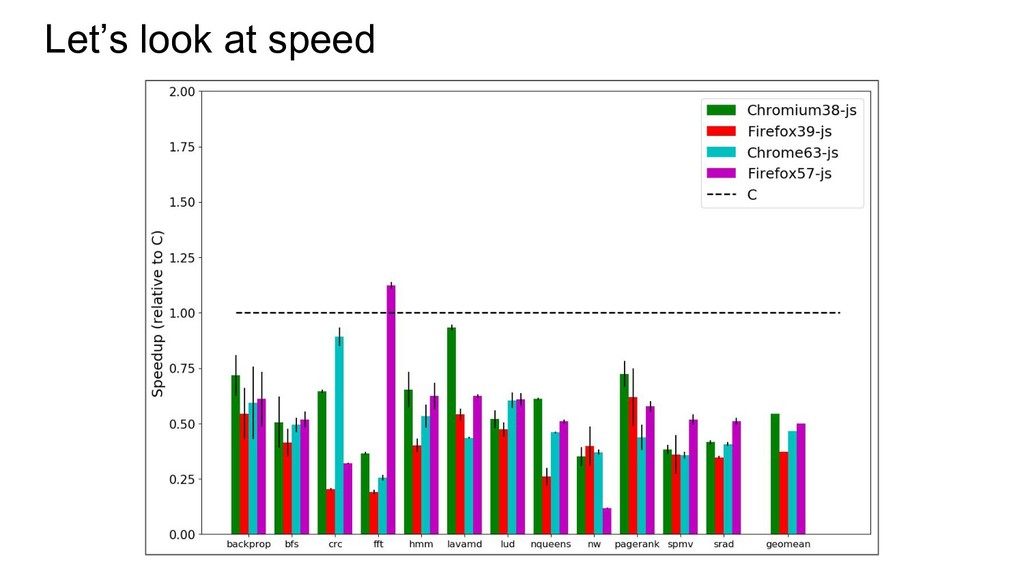
Doable? Yes, since JavaScript is turing complete, it should be able to represent any sort of weird semantics. • Is it efficient? Let’s look at Emscripten
compiler from LLVM to JavaScript created in 2011 • Asm.js is a“typed” subset of JavaScript which serves as a target for Emscripten • Initial goal was to support a large enough subset of C and C++ constructs that could be run on the web. • Any language that has front-end to LLVM can compile to asm.js
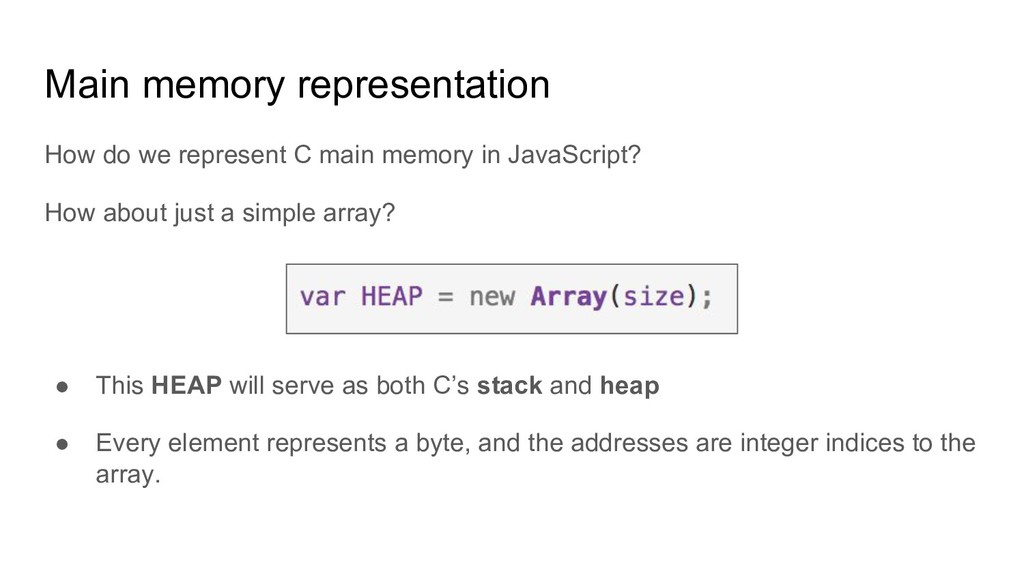
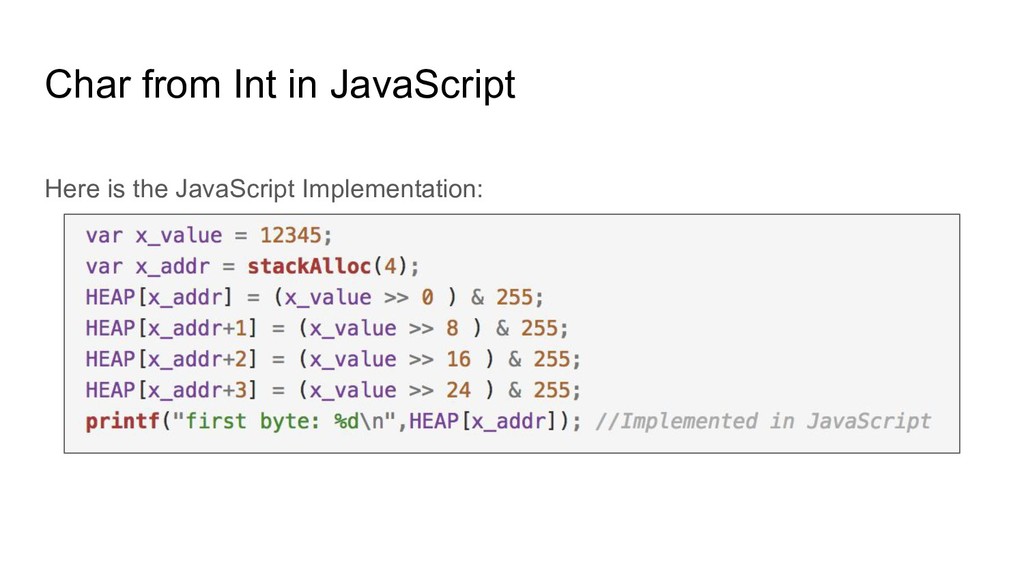
in JavaScript? How about just a simple array? • This HEAP will serve as both C’s stack and heap • Every element represents a byte, and the addresses are integer indices to the array.
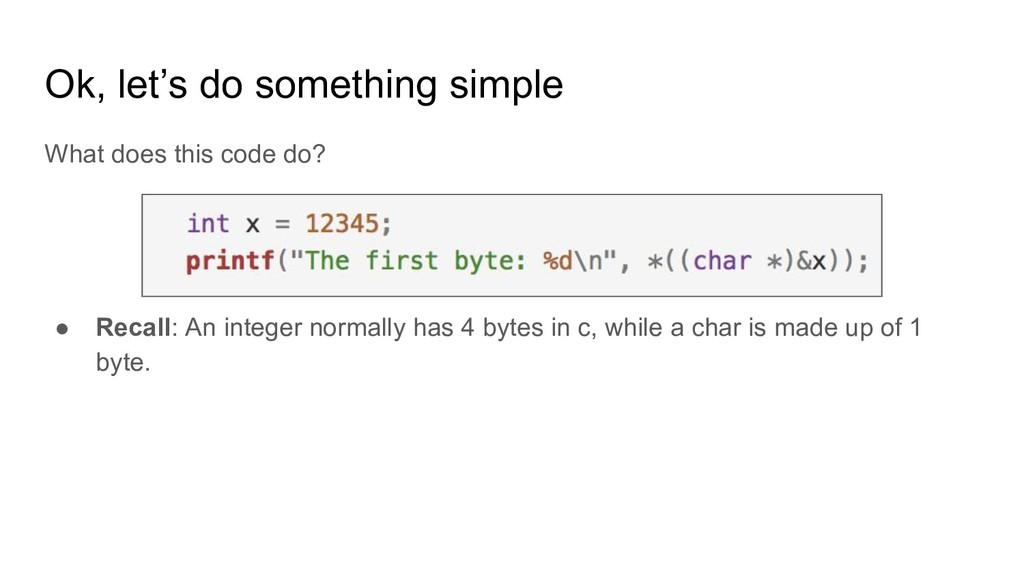
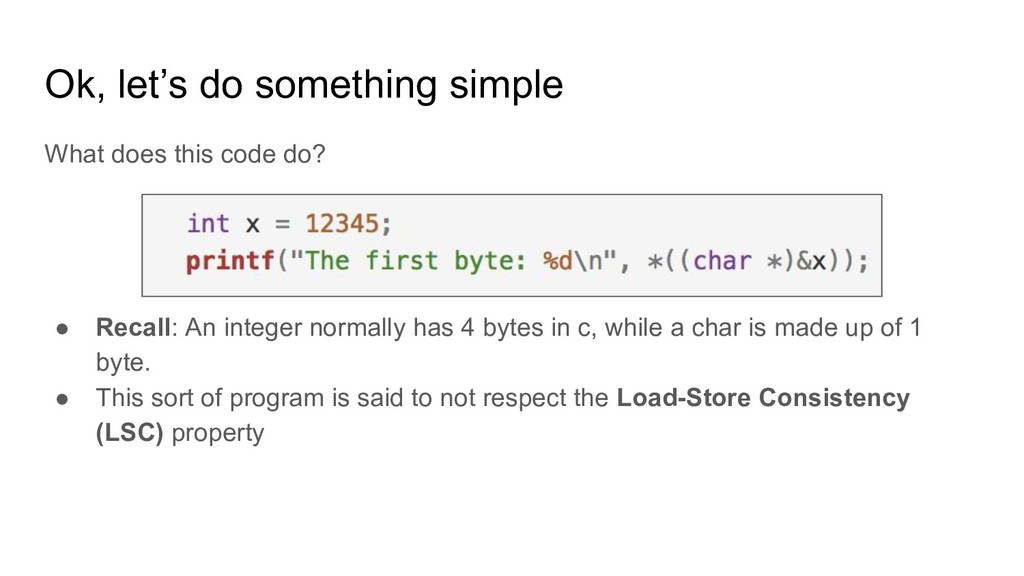
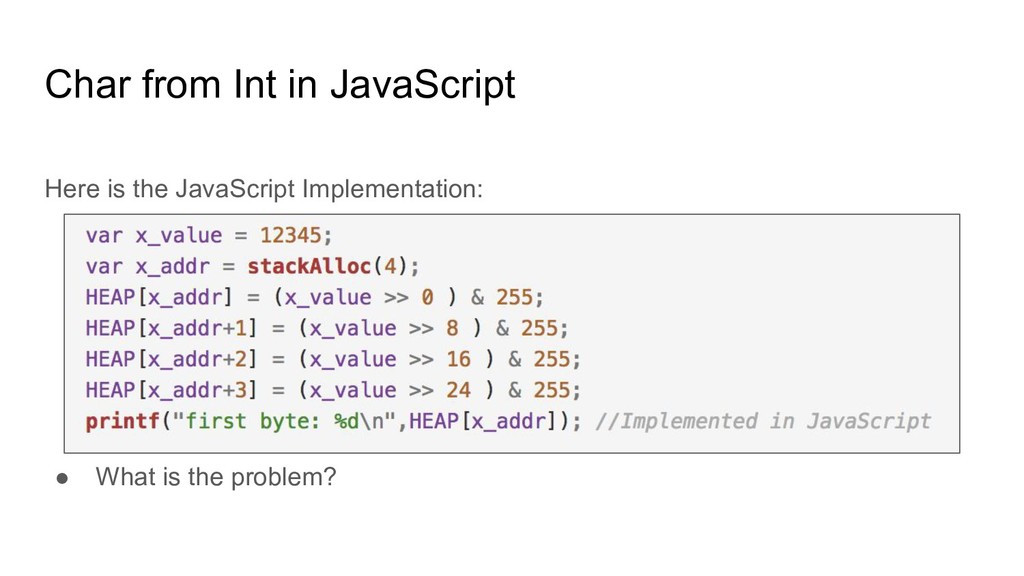
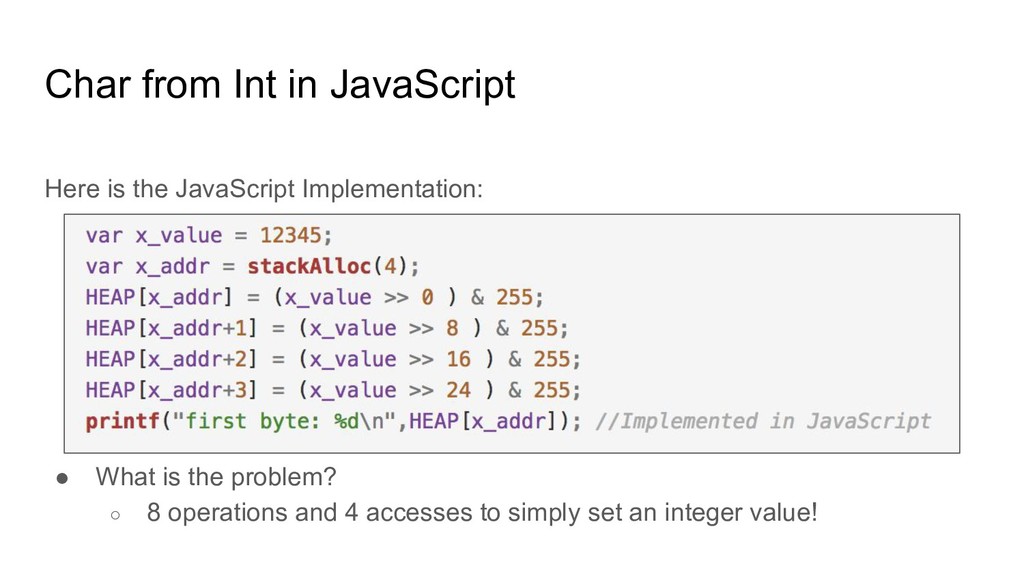
• Recall: An integer normally has 4 bytes in c, while a char is made up of 1 byte. • This sort of program is said to not respect the Load-Store Consistency (LSC) property
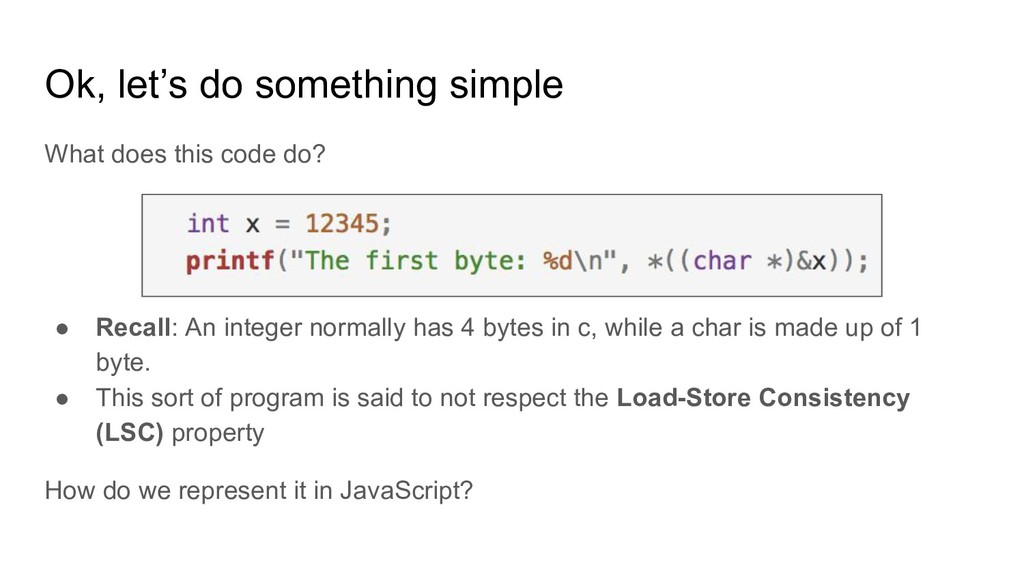
• Recall: An integer normally has 4 bytes in c, while a char is made up of 1 byte. • This sort of program is said to not respect the Load-Store Consistency (LSC) property How do we represent it in JavaScript?
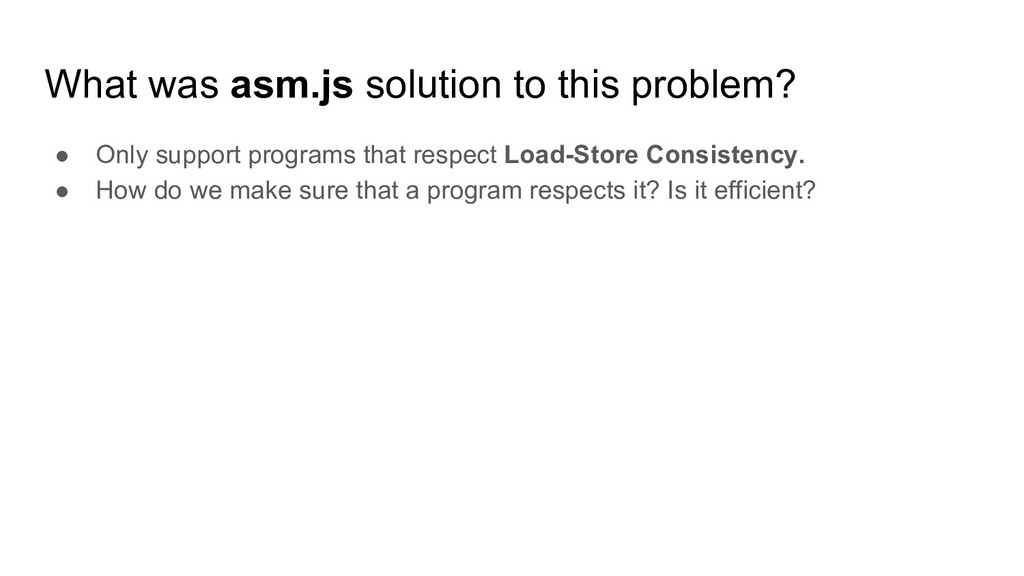
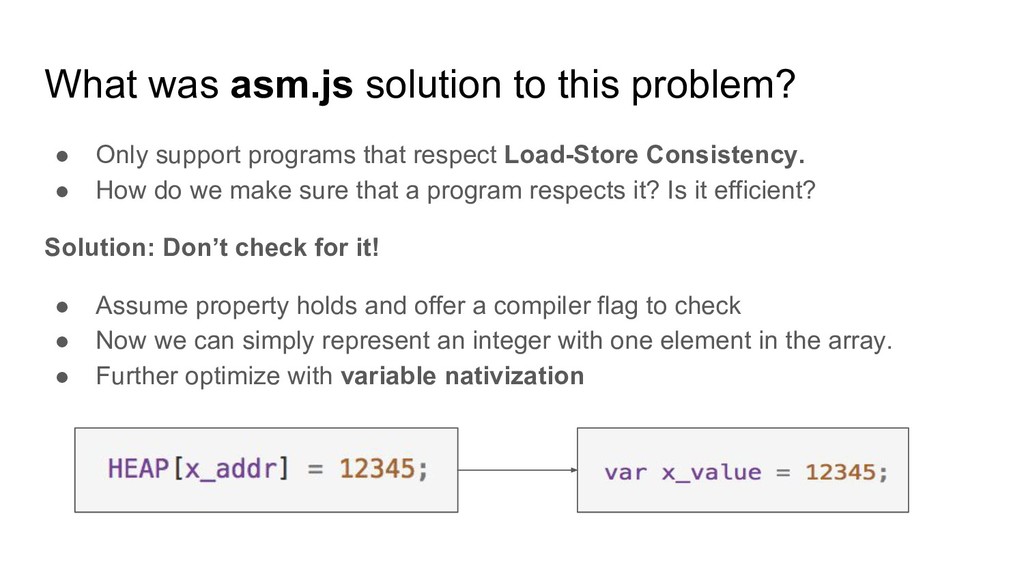
programs that respect Load-Store Consistency. • How do we make sure that a program respects it? Is it efficient? Solution: Don’t check for it! • Assume property holds and offer a compiler flag to check • Now we can simply represent an integer with one element in the array. • Further optimize with variable nativization
a large subset of C and C++ efficiently. ▪ The C/C++ programs supported must be cut down in order to perform operations efficiently ◦ Make a typed subset of JavaScript which can be highly optimized by a specialized section of the JavaScript JIT compilers.
a large subset of C and C++ efficiently. ▪ The C/C++ programs supported must be cut down in order to perform operations efficiently ◦ Make a typed subset of JavaScript which can be highly optimized by a specialized section of the JavaScript JIT compilers. • asm.js has since grown to be supported by most browser vendors. • In 2013, typed arrays became the standard, all due to asm.js ◦ Int8Array, Int16Array, Int32Array, Float64Array, Float32Array etc. ◦ All of this have an ArrayBuffer as their underlying representation. This array buffer is a byte array.
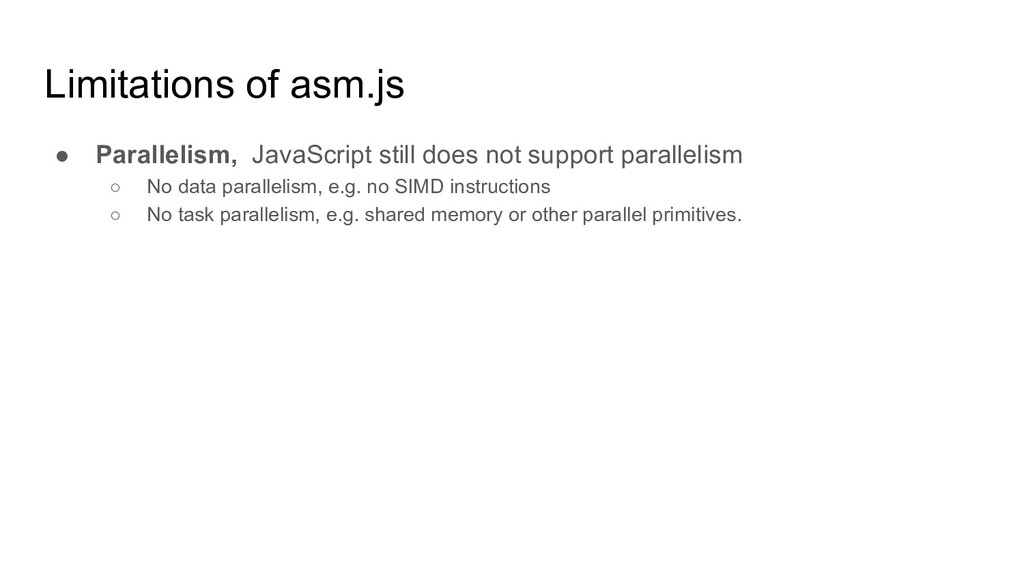
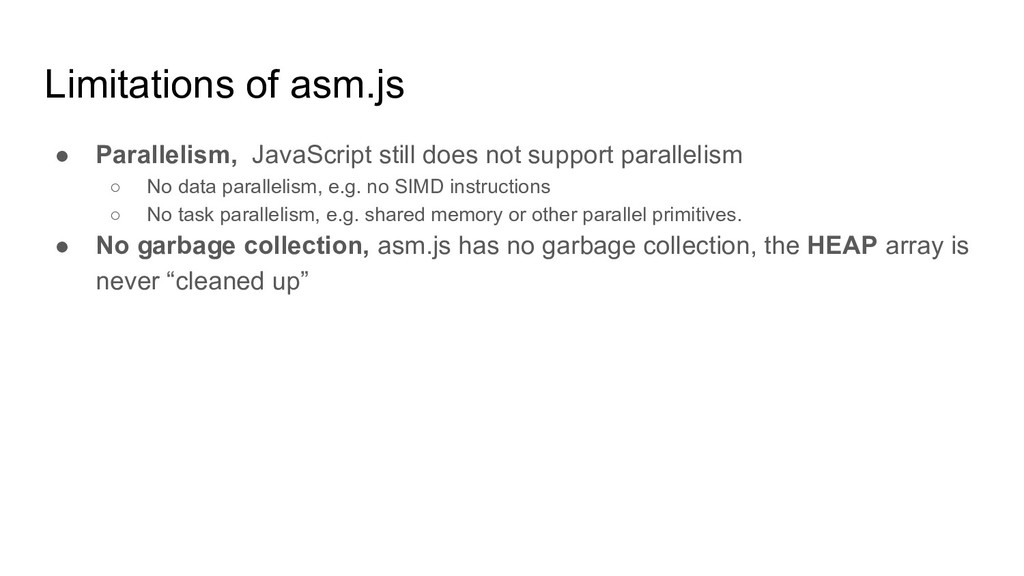
parallelism ◦ No data parallelism, e.g. no SIMD instructions ◦ No task parallelism, e.g. shared memory or other parallel primitives. • No garbage collection, asm.js has no garbage collection, the HEAP array is never “cleaned up”
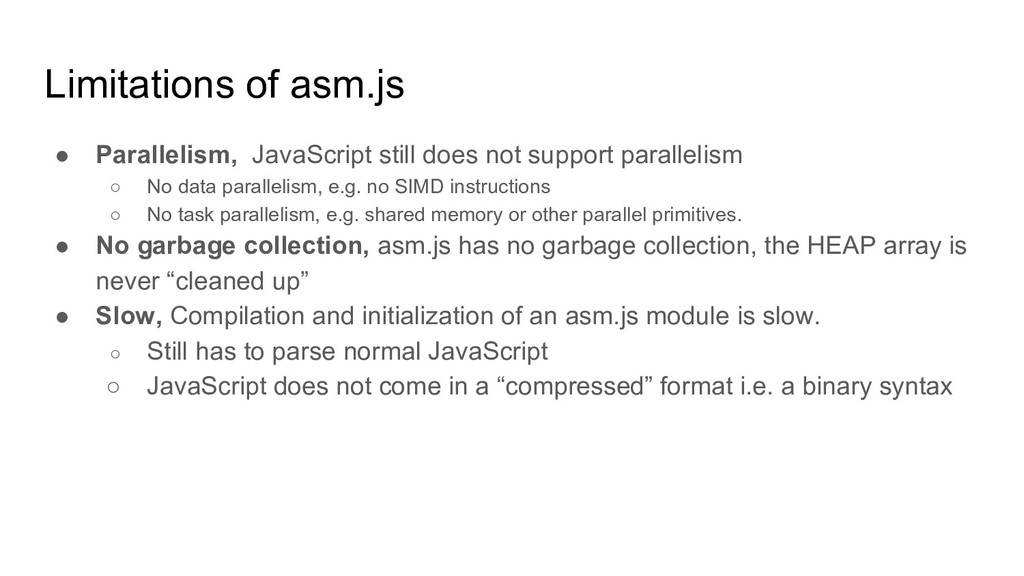
parallelism ◦ No data parallelism, e.g. no SIMD instructions ◦ No task parallelism, e.g. shared memory or other parallel primitives. • No garbage collection, asm.js has no garbage collection, the HEAP array is never “cleaned up” • Slow, Compilation and initialization of an asm.js module is slow. ◦ Still has to parse normal JavaScript ◦ JavaScript does not come in a “compressed” format i.e. a binary syntax
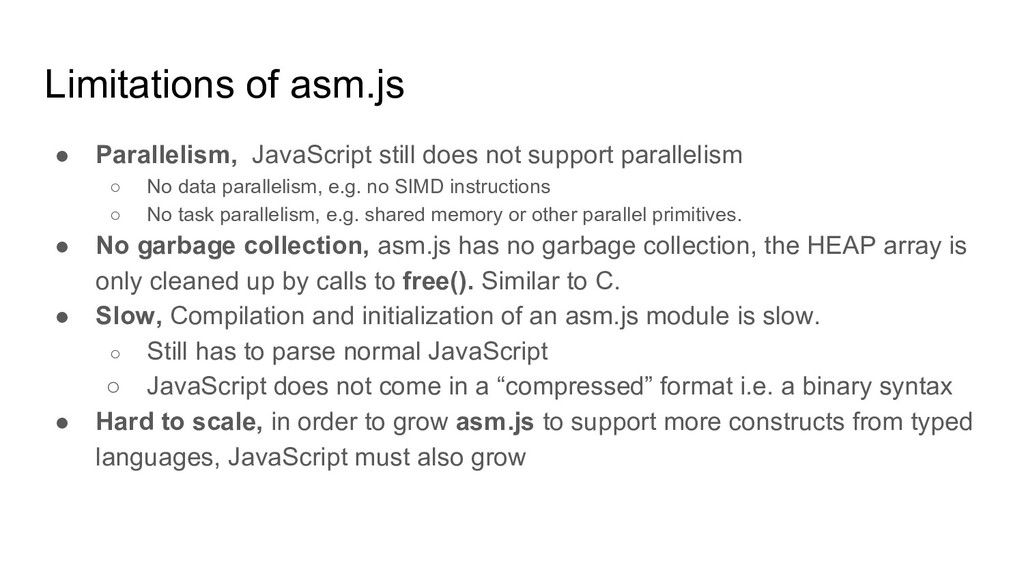
parallelism ◦ No data parallelism, e.g. no SIMD instructions ◦ No task parallelism, e.g. shared memory or other parallel primitives. • No garbage collection, asm.js has no garbage collection, the HEAP array is only cleaned up by calls to free(). Similar to C. • Slow, Compilation and initialization of an asm.js module is slow. ◦ Still has to parse normal JavaScript ◦ JavaScript does not come in a “compressed” format i.e. a binary syntax • Hard to scale, in order to grow asm.js to support more constructs from typed languages, JavaScript must also grow
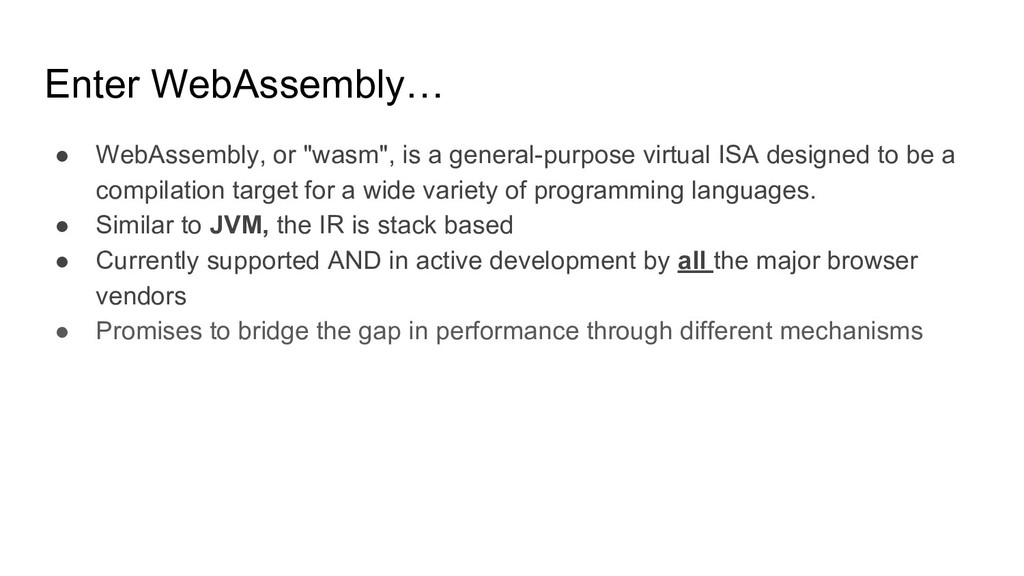
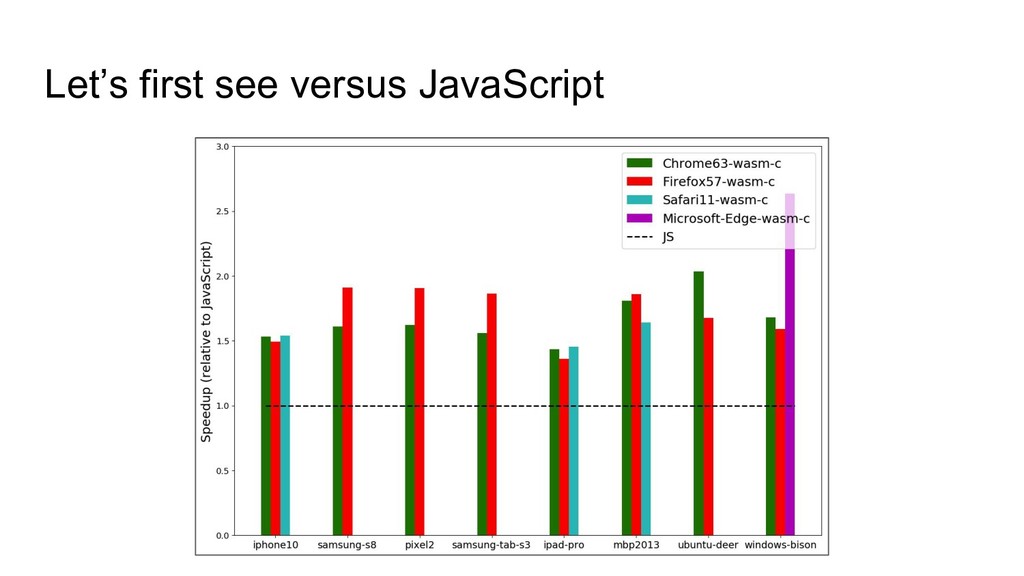
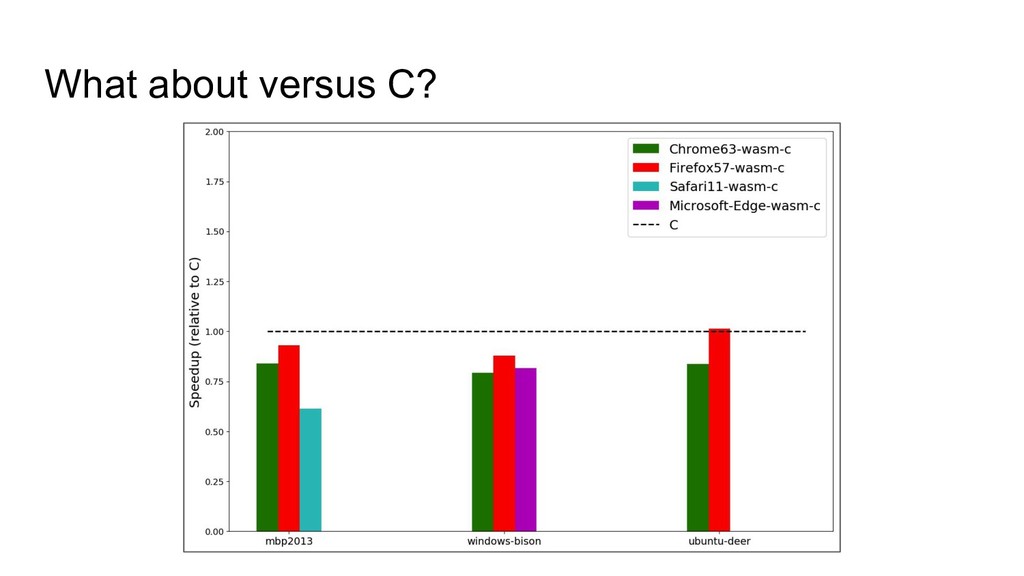
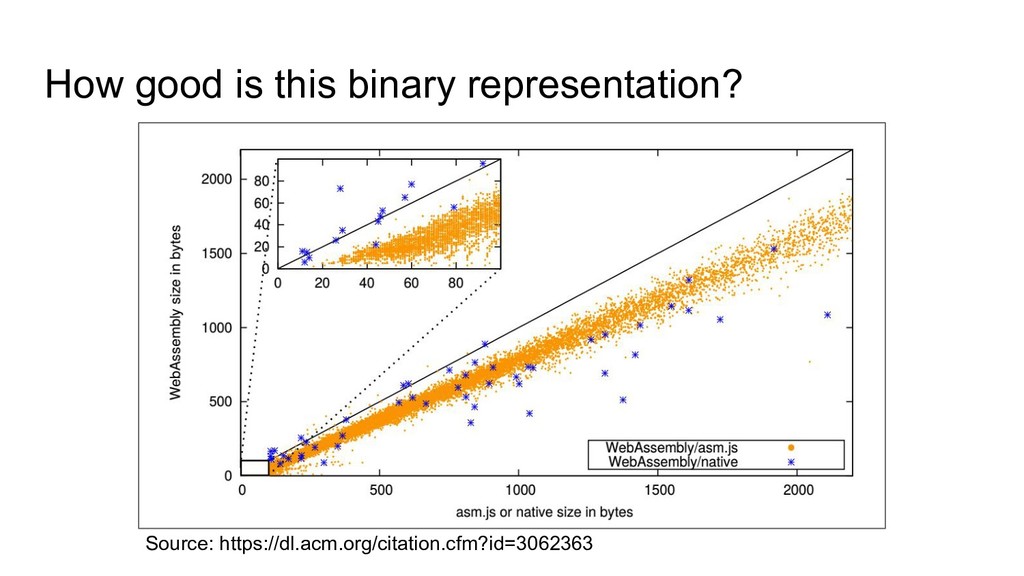
ISA designed to be a compilation target for a wide variety of programming languages. • Similar to JVM, the IR is stack based • Currently supported AND in active development by all the major browser vendors • Promises to bridge the gap in performance through different mechanisms
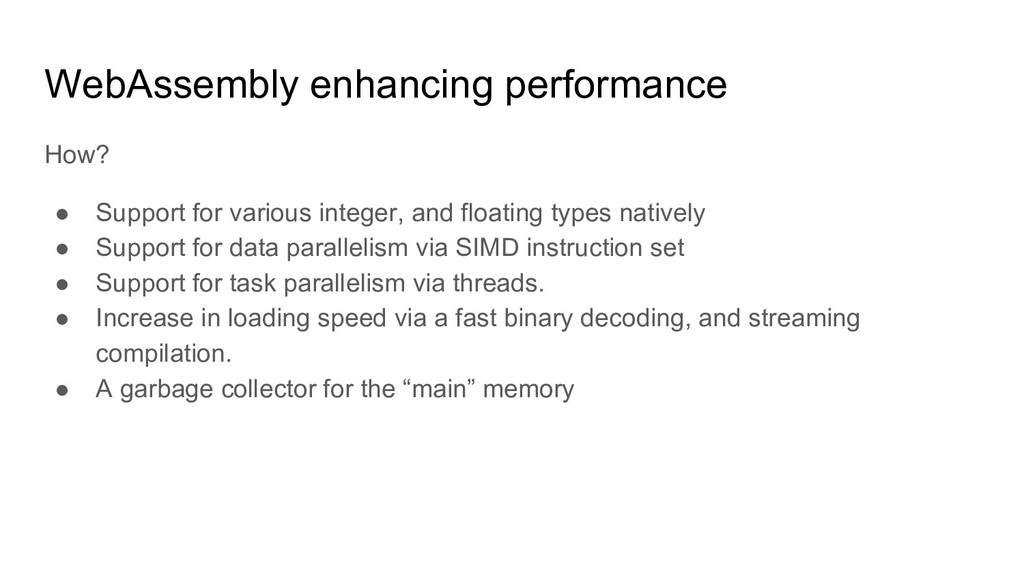
floating types natively • Support for data parallelism via SIMD instruction set • Support for task parallelism via threads. • Increase in loading speed via a fast binary decoding, and streaming compilation. • A garbage collector for the “main” memory
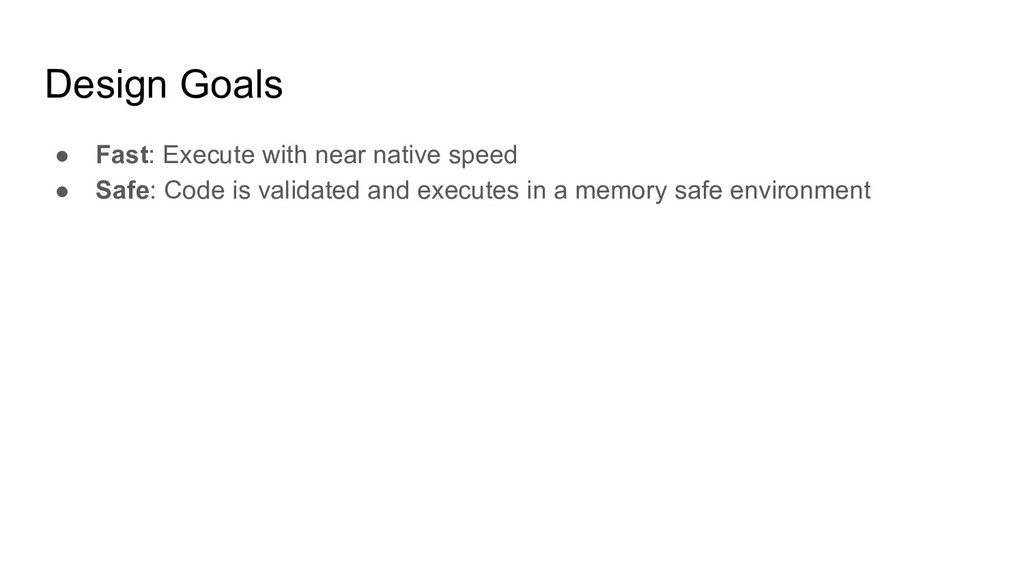
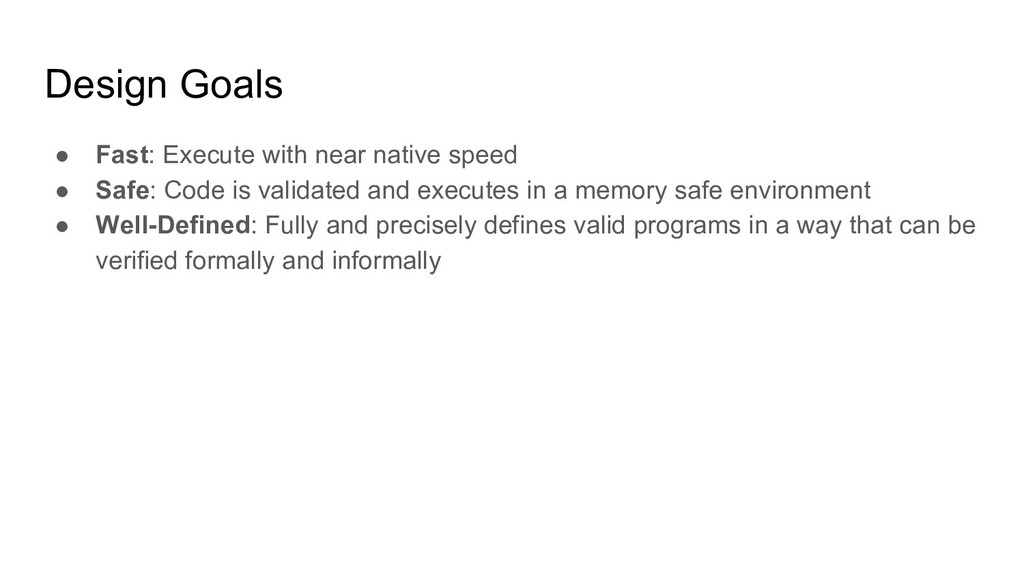
Safe: Code is validated and executes in a memory safe environment • Well-Defined: Fully and precisely defines valid programs in a way that can be verified formally and informally
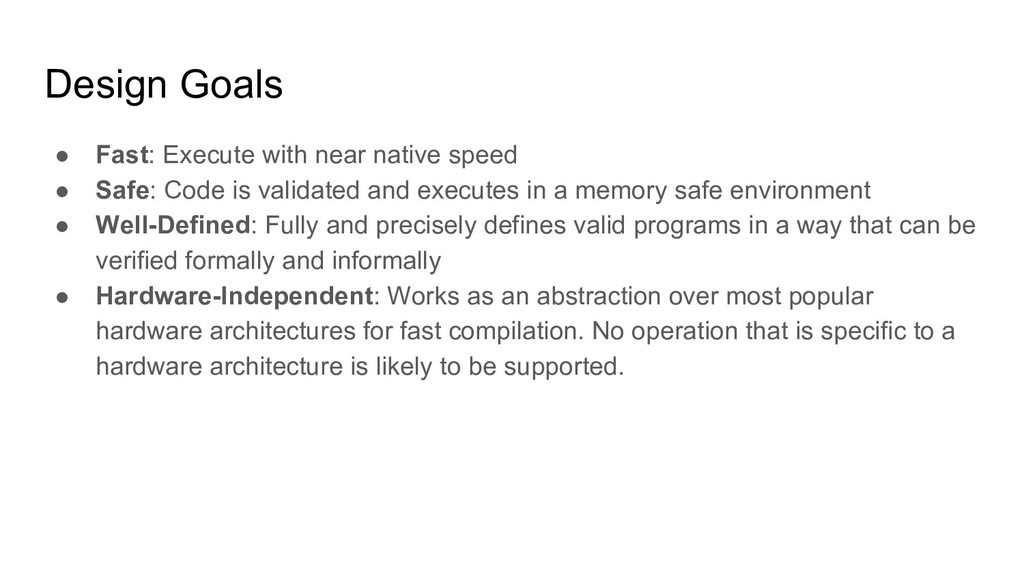
Safe: Code is validated and executes in a memory safe environment • Well-Defined: Fully and precisely defines valid programs in a way that can be verified formally and informally • Hardware-Independent: Works as an abstraction over most popular hardware architectures for fast compilation. No operation that is specific to a hardware architecture is likely to be supported.
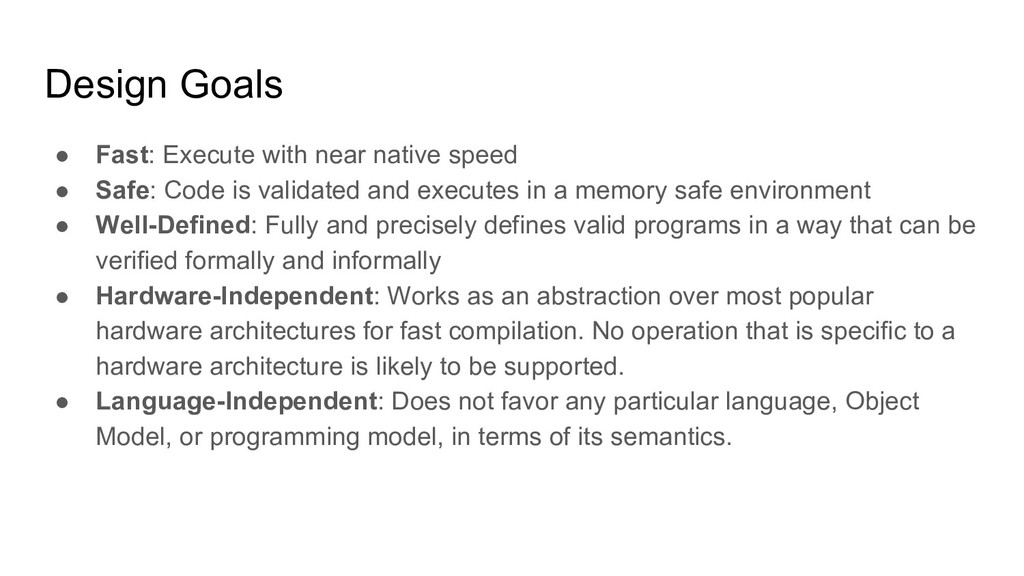
Safe: Code is validated and executes in a memory safe environment • Well-Defined: Fully and precisely defines valid programs in a way that can be verified formally and informally • Hardware-Independent: Works as an abstraction over most popular hardware architectures for fast compilation. No operation that is specific to a hardware architecture is likely to be supported. • Language-Independent: Does not favor any particular language, Object Model, or programming model, in terms of its semantics.
Safe: Code is validated and executes in a memory safe environment • Well-Defined: Fully and precisely defines valid programs in a way that can be verified formally and informally • Hardware-Independent: Works as an abstraction over most popular hardware architectures for fast compilation. No operation that is specific to a hardware architecture is likely to be supported. • Language-Independent: Does not favor any particular language, Object Model, or programming model, in terms of its semantics. • Platform-Independent: Does not depend on the Web, it can run as an independent VM in any environment,.
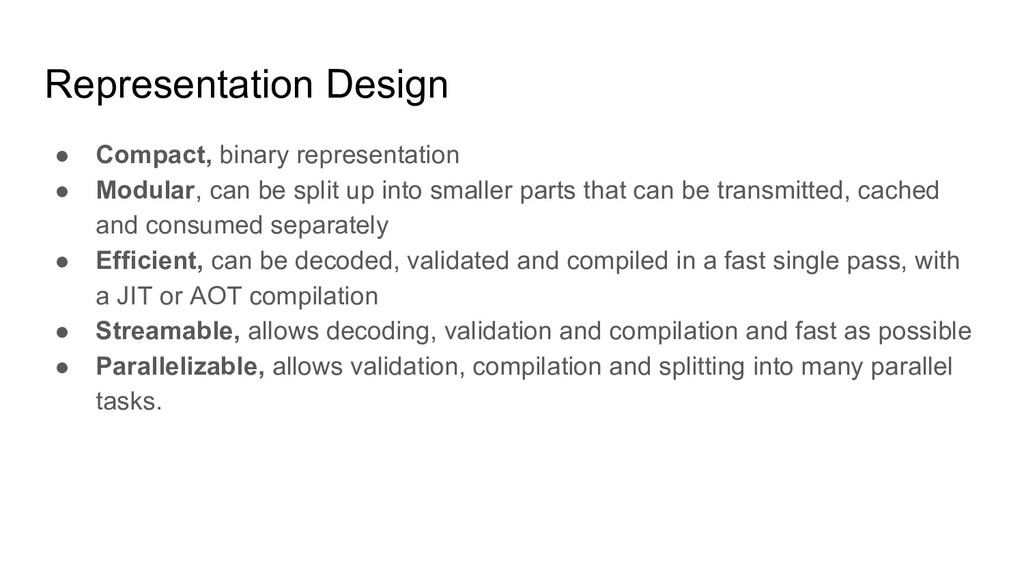
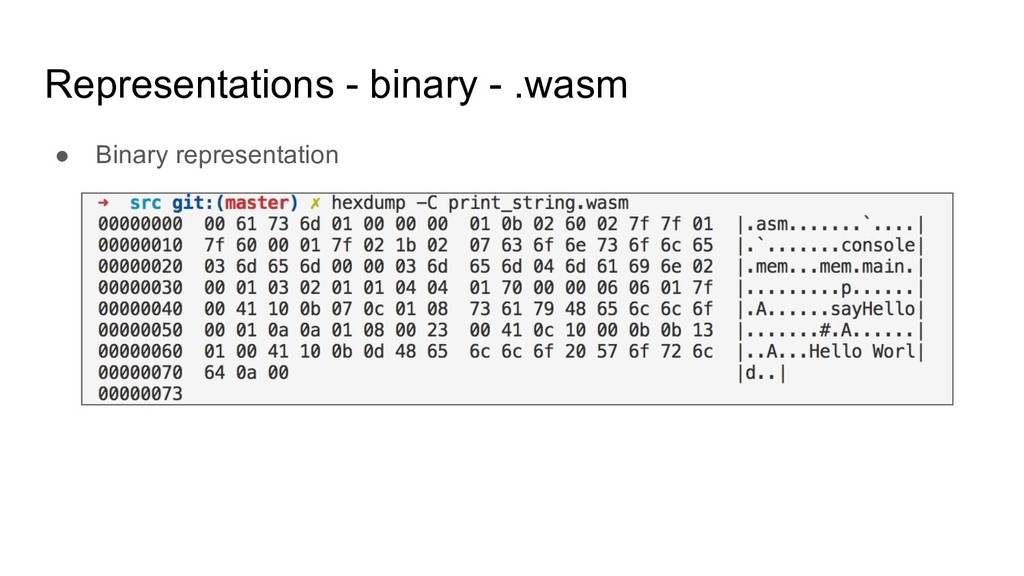
split up into smaller parts that can be transmitted, cached and consumed separately • Efficient, can be decoded, validated and compiled in a fast single pass, with a JIT or AOT compilation • Streamable, allows decoding, validation and compilation and fast as possible • Parallelizable, allows validation, compilation and splitting into many parallel tasks.
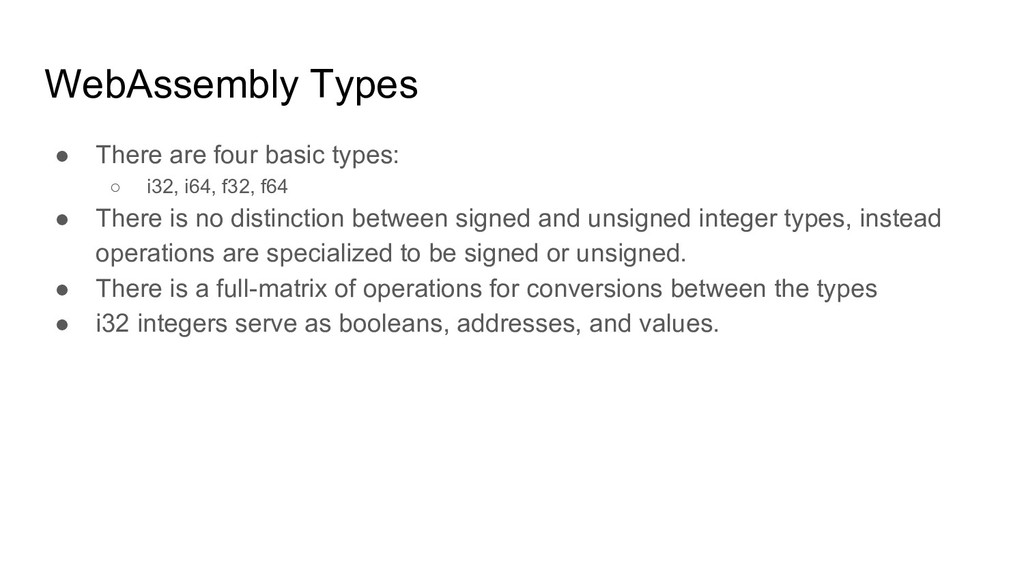
i64, f32, f64 • There is no distinction between signed and unsigned integer types, instead operations are specialized to be signed or unsigned. • There is a full-matrix of operations for conversions between the types • i32 integers serve as booleans, addresses, and values.
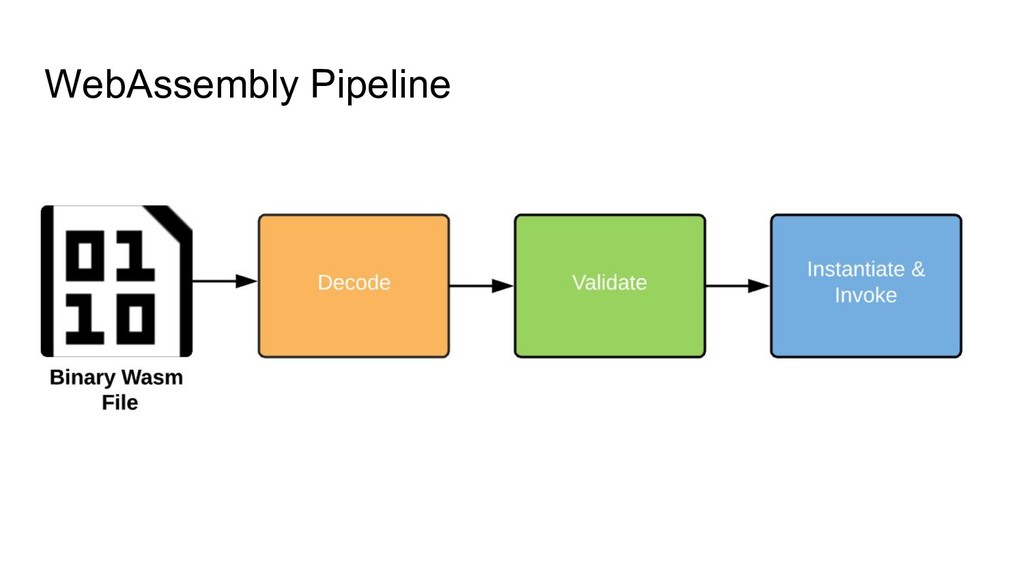
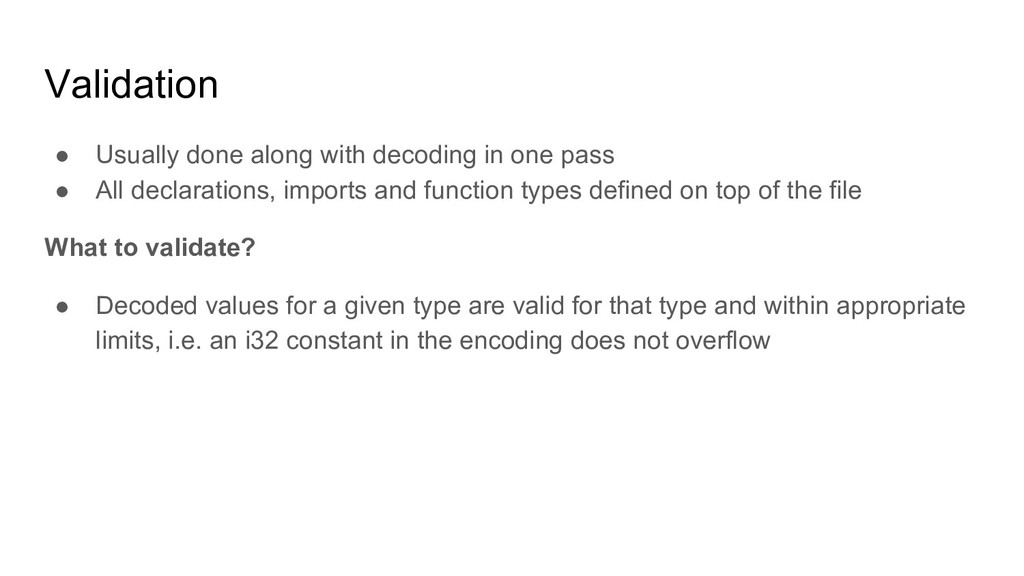
• All declarations, imports and function types defined on top of the file What to validate? • Decoded values for a given type are valid for that type and within appropriate limits, i.e. an i32 constant in the encoding does not overflow
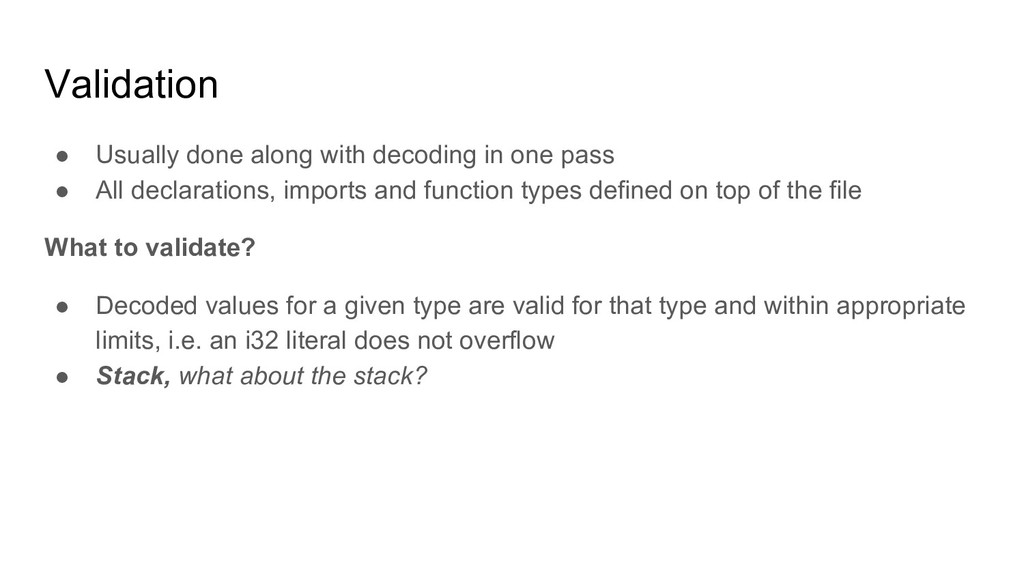
• All declarations, imports and function types defined on top of the file What to validate? • Decoded values for a given type are valid for that type and within appropriate limits, i.e. an i32 literal does not overflow • Stack, what about the stack?
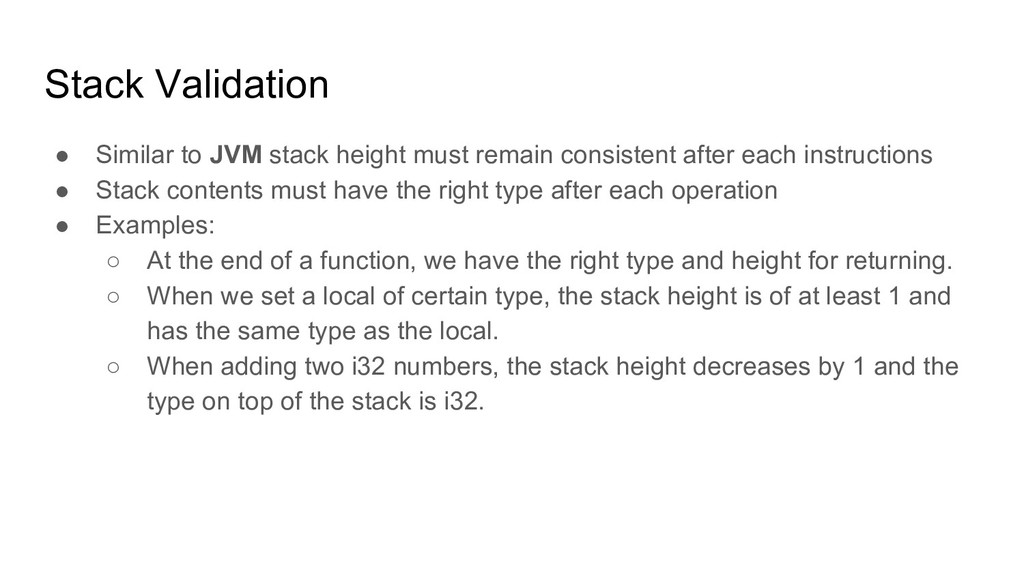
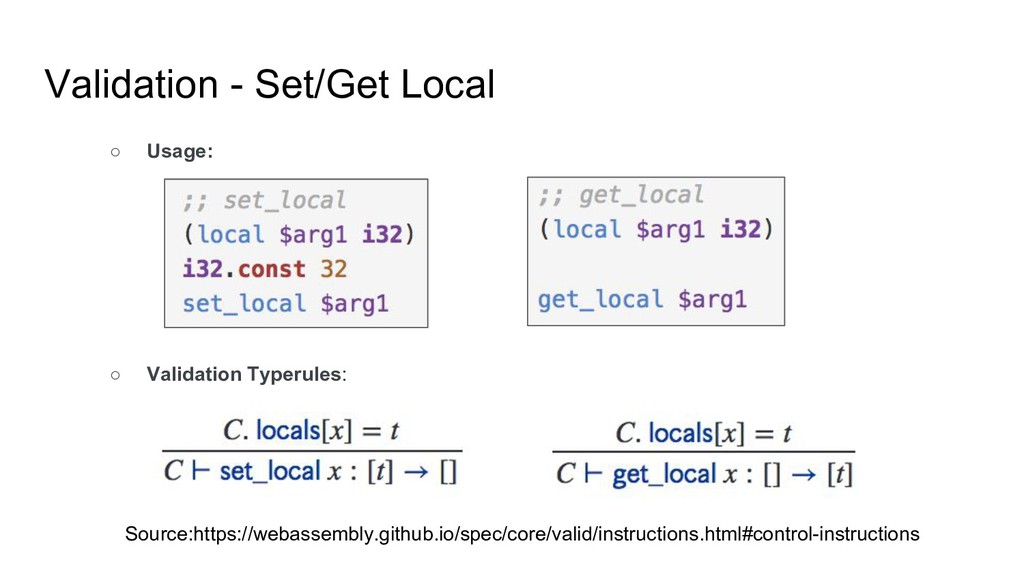
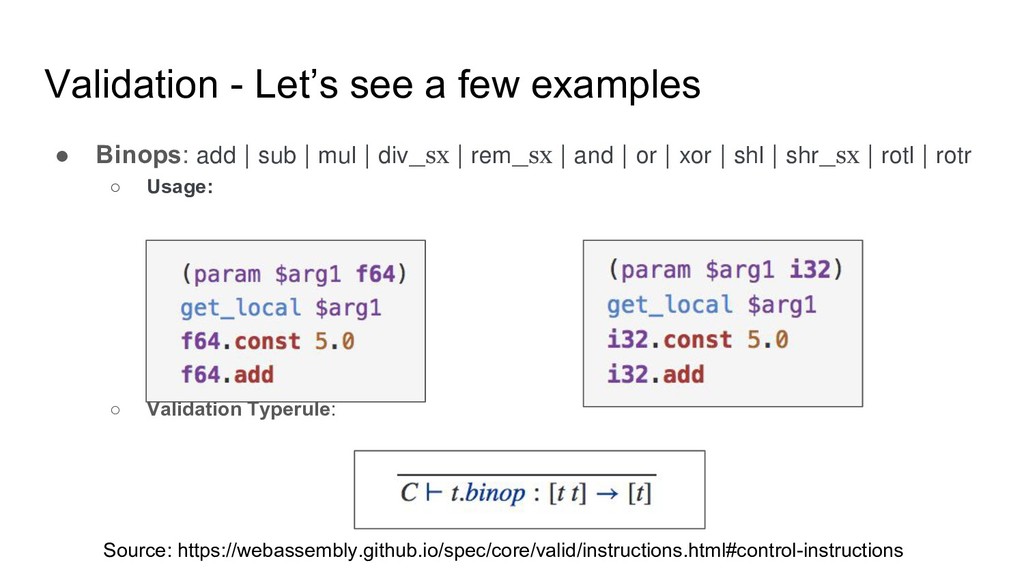
consistent after each instructions • Stack contents must have the right type after each operation • Examples: ◦ At the end of a function, we have the right type and height for returning. ◦ When we set a local of certain type, the stack height is of at least 1 and has the same type as the local. ◦ When adding two i32 numbers, the stack height decreases by 1 and the type on top of the stack is i32.
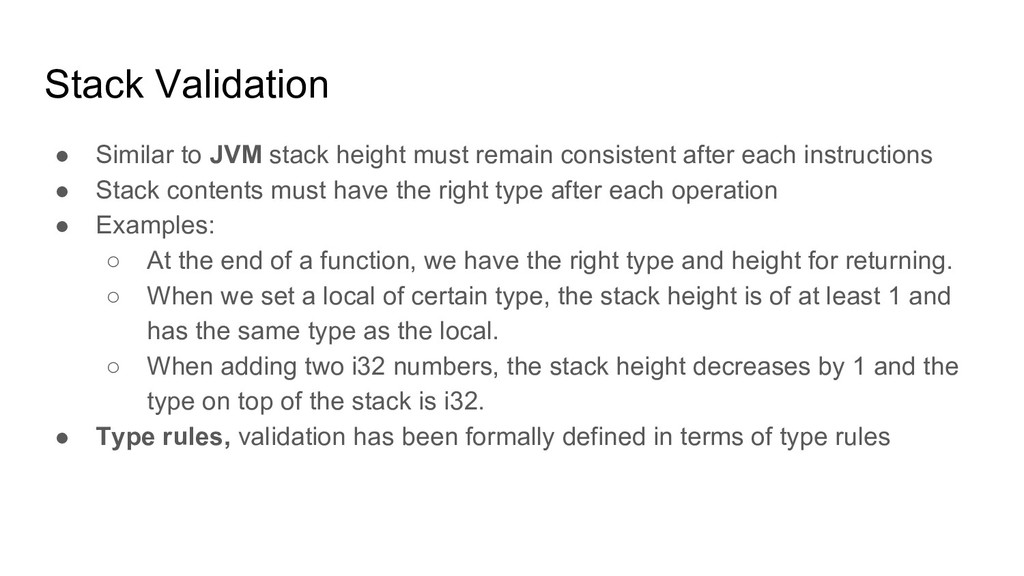
consistent after each instructions • Stack contents must have the right type after each operation • Examples: ◦ At the end of a function, we have the right type and height for returning. ◦ When we set a local of certain type, the stack height is of at least 1 and has the same type as the local. ◦ When adding two i32 numbers, the stack height decreases by 1 and the type on top of the stack is i32. • Type rules, validation has been formally defined in terms of type rules
through two phases: ◦ Instantiation: Dynamic representation of a module, the module imports are loaded, global tables, and memory segments are intialized, and its own execution stack and state are set. Finally its start function is ran. ◦ Invocation: Once instantiated, a module instance is ready to be used by its host/embedding environment via the exported functions defined in the module. ◦ The task of Instantiation and invocation is the responsibility of the host environment.
to static typing. • During execution we care about the actual values • Again, this was formally defined using formal, reduction rules. • There are three types of stack contents ◦ Values, i32, i64, f32, f64 constants. ◦ Labels, branching labels/targets ◦ Frames, a function’s run-time representation • Other implementations may choose to have three separate stacks but the interleaving of the three stack values makes the implementation simpler.
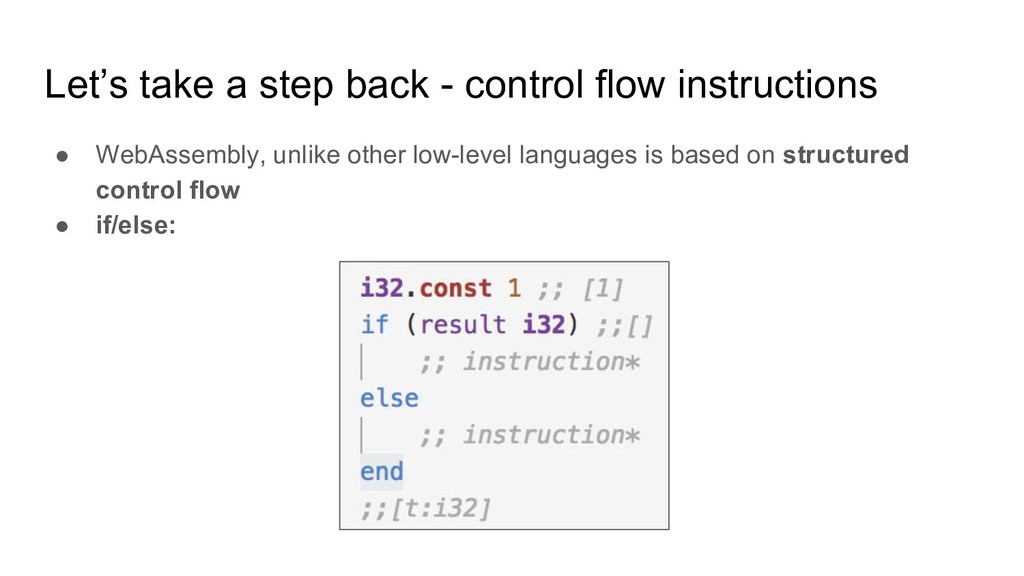
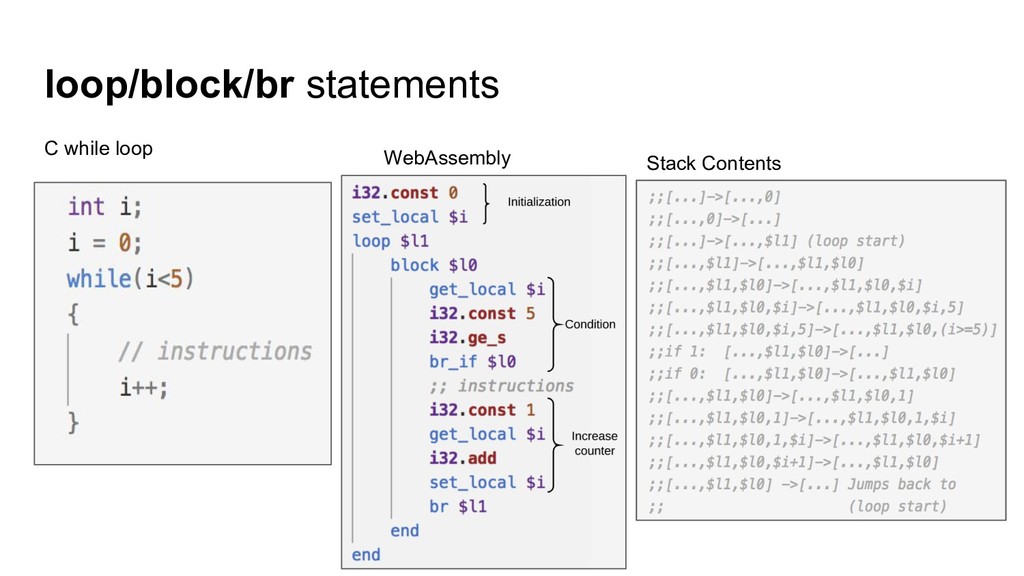
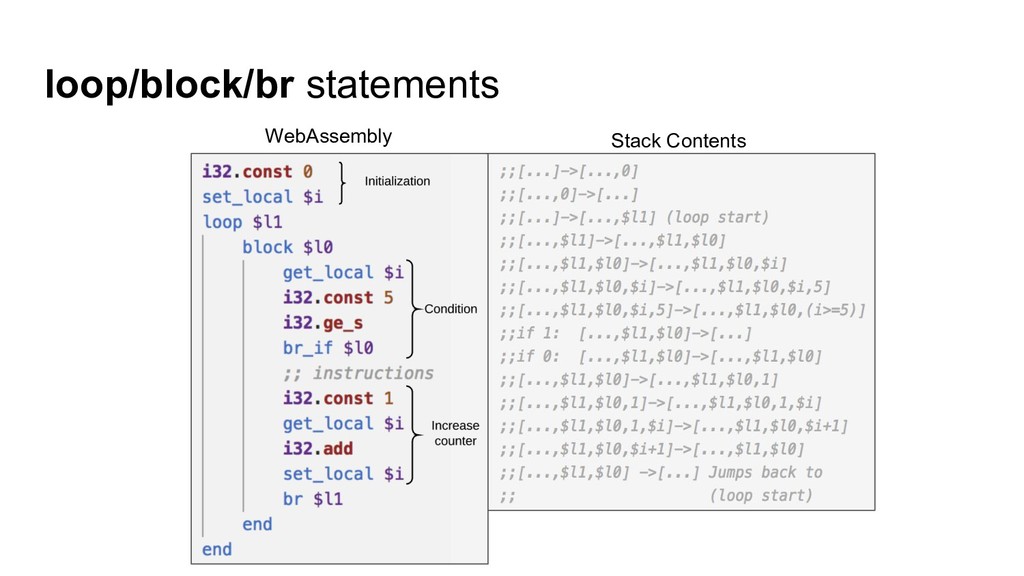
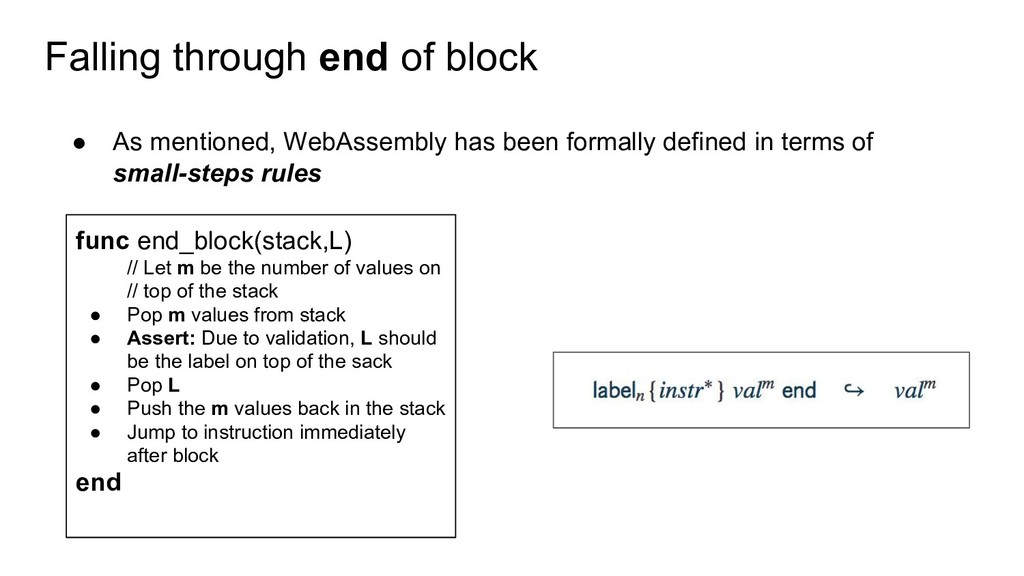
be the number of values on // top of the stack • Pop m values from stack • Assert: Due to validation, L should be the label on top of the sack • Pop L • Push the m values back in the stack • Jump to instruction immediately after block end • As mentioned, WebAssembly has been formally defined in terms of small-steps rules
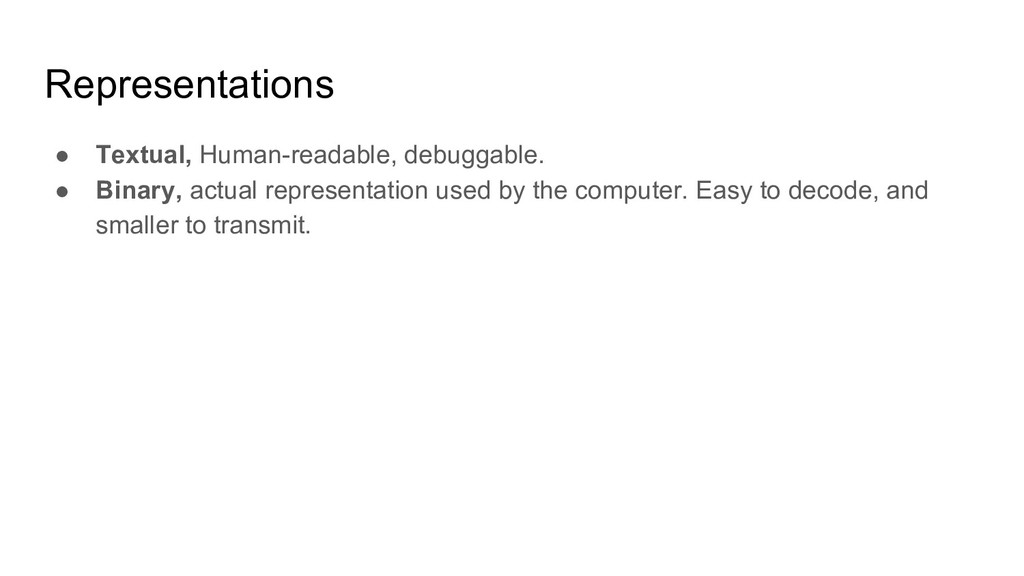
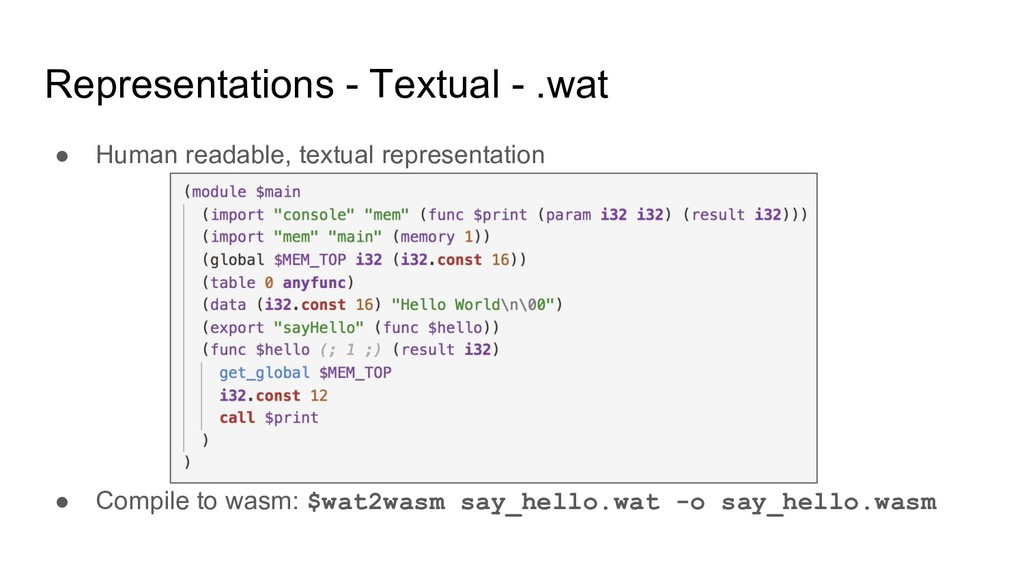
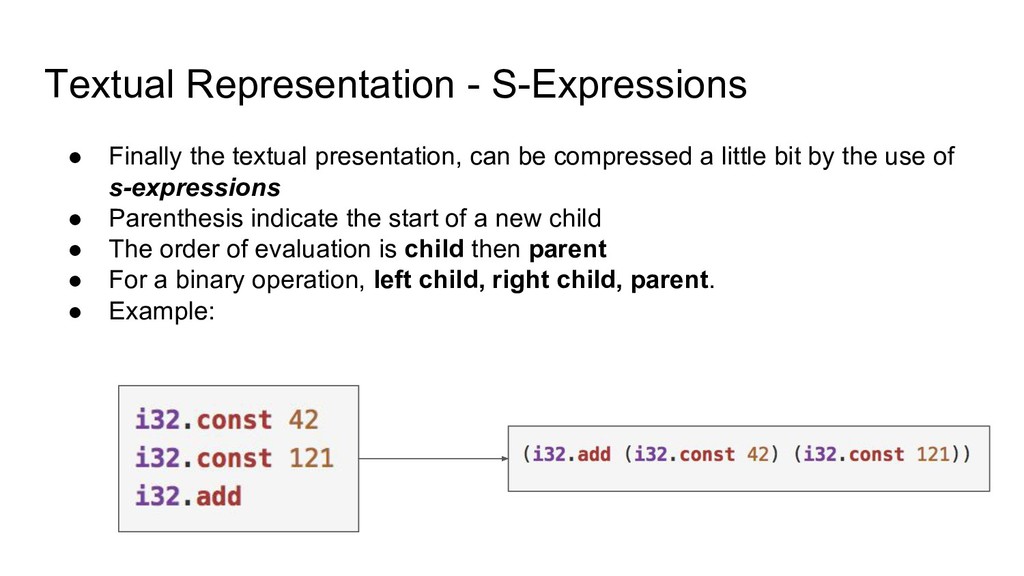
be compressed a little bit by the use of s-expressions • Parenthesis indicate the start of a new child • The order of evaluation is child then parent • For a binary operation, left child, right child, parent. • Example:


 dherre3
 jnunemaker
 lauravandoore
 quramy
 jonoalderson
 techseoconnect
 letsgokoyo
 palkan
 garrettdimon
 pauljervisheath
 deanohume
 aleyda
 tammyeverts